University of Hawaii, Spring 2008, G27, Psychology 409b Seminar
Class Home Page
for G27, Spring 2008 is at:
www.soc.hawaii.edu/leonj/leonj/leonpsy27/409b-g27-lecture-notes.htm
Student reports and their annotated Web Links on Marriage:
www.soc.hawaii.edu/leon/499f2006/Links/
The web address of
this document is:
www.soc.hawaii.edu/leonj/leonj/leonpsy27/409b-g27-lecture-notes.htm
 TOGETHER FOREVER -- ETERNITY NOW
The Unity Model of Marriage
How to Achieve the Conjoint Self
Lecture Notes
Version 21c
Dr. Leon James
Professor of Psychology
University of
Hawaii
Spring 2008
Sections
1.
Introduction: Till Death Do Us Part or Till the End of Eternity?
2.
Mental Anatomy and the
Individual's Threefold Self
2.1 Mental
Anatomy of Women and Men
2.2 Masculine
Intelligence and Feminine Intelligence
3.
Three Levels of Unity in the
Marriage Relationship
4.
Unity Through Reciprocity and
Differentiation
5.
Sensorimotor, Cognitive,
and Affective Conjunction
5.1 Sexuality:
Non-exclusive Love of the Sex vs. Exclusive Love of One of the Sex
6. Unity
Model in Marriage: Ennead Chart of Growth Steps
7. Threefold Degrees of
Conjunction
8.
Male Dominance Phase
of Marriage
9.
Sexual Blackmail
9.1 Definition
of sexual blackmail
10.
Developing mental
intimacy with one's wife
11.
The Spiritual Dimension to
the Unity Model
12.
Making Field
Observations
13.
Dynamic
Elements of the Ennead Chart
14.
Areas
of Observations for Equity
15.
Behavioral Indicators of One's
Relationship Phase
16.
Gender Discourse
Within the Three Phases
16a. Sexy vs. Unsexy
Conversational Style of Husbands
16b. Spiritual Dynamics
Between Husband and Wife
16c. Conversational Rules
for Husbands in Conjugial Interactions
16d. Characteristics of
Husband's Threefold Self During Discourse
16e. Field Activity: Monitoring
Disjunctive vs. Conjunctive Discourse
17. Happiness and Unhappiness on the Ennead Chart
18.
Contrasting the Three Phases
19.
Examples of Anti-Unity Values
(AUVs)
20. Examples of
Unity Values (UVs) -- Sweetheart Rituals
21.
Giving Objective Feedback
Reading List
Student Reports
EXERCISES
1.0 ||
2.1.1
|| || 3.1
|| 5.0.1
|| 5.1.1
|| 5.1.2
|| 6.1
|| 7.1
|| 7.2
|| 8.1
|| 9.1
|| 10.1
|| 10.2
|| 11.1
|| 12.1
|| 14.1
|| 15.1
|| 16a.1
|| 16b.1
|| 16c.1
|| 16d.1
|| 16d.2
|| 16e.1 ||
17.1 ||
18.1
|| 19.1
|| 19.2
|| 20.1
|| 20.2
|| 21.1
|| 21.2
|| 21.3
|| 21.4
|| 21.5
|| 21.6
|| 21.7
|| 21.8
||
1. Introduction:
Till Death Do Us Part or Till the End of Eternity?
There are two
views on marriage. One may be called the "materialistic" view of
marriage, while the other is the "spiritual" view of marriage.
The
materialistic view on marriage is the socio-legal definition by community and
government, namely that marriage ends at the death of one of the partners. This
type of outlook on marriage creates what may be called "natural marriages."
"Spiritual
marriages" are those in which the partners see themselves as bound
together after death. Hence, when one of the two partners dies, the other does
not think that the marriage is over. Death is just a temporary separation until
the other can catch up, whereupon they are reunited as husband and wife to
continue forever.
The
materialistic view on death is that it is the end. The spiritual view on death
is that it is the end of life in the physical world of time, and the beginning
of life in the spiritual world of eternity.
In the history
of modern scientific psychology the adoption of materialism was a necessary
step in separating psychology from philosophy and religion, with which it was
tied before for centuries, since Aristotle. The new materialistic psychology
views marriage in the socio-legal track so that marriage counseling does not
involve discussion of the marriage continuing in the afterlife. It merely
assumes the end of it at death.
In the past few
years the American Psychological Association, which sets standards for science
and practice, has encouraged licenses therapists to become knowledgeable in
"theistic psychotherapy" which refers to the inclusion into the
therapy of spiritual ideas that clients may have. In other words clinicians in
the future will be expected to be able to deal with relevantly spiritual
marriages as well as natural marriages.
Note well: This
does not mean that the therapist is expected to believe that the marriage
continues after death. In other words, the therapist's view on marriage can be
called a "materialistic view of spiritual marriages." Of course this
is different from a "spiritual view of spiritual marriages."
The difference
between materialistic and spiritual is easy to remember:
Materialistic
view on marriage = 'Till death do us part
Spiritual view
on marriage = Forever in the afterlife
It's
understandable that materialistic psychology takes the socio-legal view on
marriage when we realize that psychologists do not have any details about the
human body and mind after death. Until such knowledge is developed psychology
must remain materialistic about marriage and the human mind.
Fortunately, in
1981 I discovered the Swedenborg Reports which were written in the 18th century
by the Swedish scientist Emanuel Swedenborg (1688-1772). I will present his
discoveries throughout the course, especially in relation to his observations
about marriages in the afterlife of the spiritual world. At the age of 57 he
suddenly became conscious in his spiritual mind. As a result of this he was in
the unique historical position of recording his observations of what happens to
people after death. The unity model of marriage in this course is based on his
reports and observations.
The Swedenborg
Reports at last gives psychology the knowledge of mental anatomy. It therefore
gives psychology a basis for a new view on marriage which is spiritual rather
than materialistic. In other words, the new view takes into account the
dynamics of marriage as progressive from this life to the afterlife. The
anatomy and physiology of a human being will now be dualist rather than monist.
In other words every human being is born simultaneously into two worlds through
a physical body in the physical world and a spiritual body through the
spiritual world of the afterlife. At death we lose connection with the physical
body and continue life in the spiritual body. When Swedenborg at age 57 became
conscious in his spiritual body while still connected to his physical body, he
was able to observe how the two worlds work together in one function.
This will help
you with the new ideas introduced in this course: Remember that in this new
view, our thoughts and feelings do not reside in the brain of the physical
body, but in the brain of the spiritual body.
The reason is
that sensations, thoughts, and feelings are psychological entities or
substances, not physical or electro-chemical, like the neurons of the brain and
their activity. Materialistic psychology is forced to put sensations and
thoughts in the physical brain since it knows nothing about the spiritual body
and its spiritual brain, spiritual heart, spiritual skin, spiritual liver,
spiritual uterus, spiritual hands and legs, and so on. But in this course we
are going to assume that we have valid knowledge from the Swedenborg Reports
about the spiritual body and its organs.
This new
approach will allow psychology to avoid the trap of "reductionism"
which many critics of psychology have pointed out. Reductionism is to reduce
the mind as the same as the body. Instead of talking about some hypothetical
mind, psychology prefers reductionism, namely, our thoughts and feelings are
"epiphenomena" of the physical brain of neuronal activity. When the
neuronal activity in the physical brain dies, the thoughts and feelings
disappear from existence. The self or person is no more.
Again this is a
forced reductionist position for psychology since it knows nothing about the
spiritual body. It is the activity of the spiritual body that constitutes what
we call "the mind." This makes sense because the spiritual body is
not born in physical time and matter, but in the spiritual world. Swedenborg
gives many geographic details about the spiritual world of the afterlife. He
observed the process of "resuscitation" with hundreds of people he
knew in Sweden and elsewhere, and hundreds of strangers from all parts of the
world. It happens as follows.
Our conscious
life of self and personality is the collection of sensations, thoughts, and
feelings we experience from birth onward. Our conscious life exists therefore
because of the activity in the layers of our spiritual body which is houses the
mind and its sensations, thoughts, and feelings. The mental layers or levels of
conscious life in human beings falls into two major categories called the
natural mind and the spiritual mind.
Swedenborg
discovered that from birth to death we are conscious in our natural mind and
unconscious in our spiritual mind. At resuscitation, which occurs a few hours
after death, we become conscious in our spiritual mind and gradually lose
consciousness in our natural mind.
In our daily
life consciousness of the natural mind we are not aware that we are connected
to our spiritual mind. And yet, Swedenborg shows that the two layers of the
mind are interconnected and function together. Neither could function without
the other. People are therefore unaware that their choices moment to moment all
day long operate at two levels, one in the natural mind, connected to the
physical body, and the other in the spiritual mind connected to the spiritual
body.
In a natural
marriage the husband and wife interact without realizing that each interaction
has a determinative effect on their spiritual mind and body. But when they
decide to have a spiritual marriage, they become aware of how their current
interaction through the natural mind is going to affect their future together
in eternity through their spiritual body and mind.
More on these
anatomical details will be discussed as we progress through the course. For now
you need to realize that you are not being asked to believe in the afterlife or
in the scientific validity of the Swedenborg Reports, or in the unity model of
marriage. You are only given these ideas as things to learn about and analyze
from a rational, objective, and scientific perspective. You will learn various
facts and interpretations in relation to the unity model of marriage. You don't
have to believe these facts and interpretations, only to know what they are as
presented in this research seminar.
The Unity Model
of Marriage as I present it here has two components -- the theoretical context
and the empirical confirmation. The theory is based on the mental anatomy
discovered by Swedenborg through his life in a dual consciousness state for 27
years. This mental anatomy shows that we are born with a physical body in time
and
a spiritual body
in eternity. Marriage involves a conjunction between the partners' physical
bodies (which is temporary) and their spiritual bodies (which is permanent in
eternity).
If we assume the
positive bias in science on the Swedenborg Reports then we can examine whether
this theoretical context helps us in our modern context to understand the
marriage relationship as it is today. This is the second component of the Unity
Model of Marriage. Since 1981 I have made an intense study of my own marriage
within this theoretical context. In 1985, I articulated my initial observations
in the Doctrine of the Wife.
Since then I continued my self-study on a daily basis and tried to express the
theoretical context in modern scientific terms suitable for psychology as we
know it today. I applied the theoretical principles to my observations of my
thoughts and feelings throughout the day, especially in relation to my
interactions with my wife. We discussed our insights together on a daily basis
so that she is as much a co-creator of the model as I am. Her feminine
intelligence is the centre of this model as expressed through my masculine
intelligence.
This seminar
on the Unity Model of Marriage will give you the opportunity to examine gender
behavior in the context of marriage and of exclusive romantic relationships.
We will identify
the sub-components of gender habits in men and women within the three domains
of behavior: affective (A), cognitive (C), and sensorimotor (S). We will use
the phrase "threefold self" to refer to these three
levels of human activity. This three-way subdivision of human behavior is
traditional and very useful. However these three components have been studied
separately, each in their own context. In this course we will make sure that
we always keep track of interactions in terms of these three components
together. In real life nothing happens unless all three operate in synergy.
For instance, as
you read this you are thinking (cognitive, C). But you are also looking
(sensorimotor, S). And you couldn't be looking and thinking unless you are
motivated (affective, A) to do that by some goal you have (e.g., performing an
assignment, interested in the subject, etc.). So the threefold self (A, C, S)
must be involved in every interaction and behavior we do all day long. Start
observing things around when you can take a moment, and think about which is
the affective (A) -- or why they're doing it, and which is the cognitive (C) --
or what they're thinking while doing it, and which is the sensorimotor (S) --
or what they are doing that you observe. Often it is easier to start in reverse
order with what they are doing that you can see (S), what they must be thinking
(C), and why they are doing it (A).
This self-witnessing
exercise is also very helpful to apply to yourself in various
situations throughout the day:
- What
I am doing or saying or showing that someone can see (S)
- What
I am thinking, planning, interpreting, appraising, figuring (C)
- What
I am intending, striving for, hoping for, wanting, desiring (A)
Our focus will
be on identifying the differences in the mental structure of men and
women so that we may gain a rational understanding of how they manage to
actually form a pair or a unit. In order to form a perfect functioning and
fulfilling pair or unit, women and men must have reciprocal mental
traits to allow them to conjoin mentally, and thus to reach mental intimacy or
conjunction.
There are
different types of intimacy, like the intimacy of family members, the intimacy
of good friends, the intimacy of lovers who have just met, the intimacy we have
with various others like doctors, lawyers, therapists. These types of
intimacy are different from the intimacy between married partners or couples who
intend to be together for life. People recognize that when they are in love
they are in heaven. And sometimes they feel like they are in heaven and hell
alternately, when there are threats they perceive to that love (e.g., when
having a fight or disagreement). It is recognized that being in love with one's
spouse or one's committed partner provides a delightful, heavenly, and
fulfilling life. But this reality is known more from romantic songs and novels
than from real life because of a lack of understanding of how unity is
achieved.
There are
couples who are mentally tied to each other on a permanent basis, and yet don't
feel fulfilled to the extent of calling their life delightful and heavenly
(sometimes we observe this with our parents or uncles and aunts). There are
couples who are tied to each other by tradition and family in social circles
where women don't have the same rights as men to decide on things. This
applies as well to dating couples and couples who live together unmarried.
Inequality of status and of rights can lead to male dominance and suppression
of women's inner feminine traits. Without free expression and trust, women
cannot feel that they are in heaven. And the freedom that men feel in male
dominated relationships is not truly a freedom that can lead them to feel that
they are in heaven.
The heavenly
happiness and fulfillment of both wife and husband depend on the attainment
between them of physical intimacy within the shared context of mental
intimacy. To be mentally intimate means that they are best friends to
each other in the context of a romantic and sexual relationship. This
relationship is also called being "soul mates."
We will use the
expression "conjoint self" to refer to the
reciprocal union of the marriage relationship, when it is based on the unity
model.
Definition:
We will use the
concept of "model" to refer to the principles, beliefs, and
attitudes that husbands and wives use or practice to govern their behavior in
the marriage relationship.
This covers both
the principles and attitudes they are aware of, as well as those they
acquired and perform without awareness. Both types govern the values (A),
emotions (A), thoughts (C), and actions (S) during their interactions.
Note that this definition of model is a different
use of the term than the one you ordinarily encounter through other courses. A
"scientific model" usually refers to a theory constructed by a
scientist to explain a complex set of phenomena or observations. In psychology
we can contrast the "behavioral model" with the "psychodynamic
model" or the "Gestalt model." In economics there are
mathematical models to account for data trends such as the stock market. The
Stanislavski method of teaching professional actors is also called a model. You
can find two dozen definitions with this link: http://www.google.com/search?num=100&hl=en&rls=GGLJ,GGLJ:2006-24,GGLJ:en&defl=en&q=define:model&sa=X&oi=glossary_definition&ct=titl
The way we use the word model in
the "unity model of marriage" is to represent the mentality, or type
of mental states, that men and women have when interacting with each other. For
example, if a man has the "male dominance model" in his principles
and motivations, he will express attitudes that indicate the principle that
women have a lower status than men and should be obedient to their husband or
boyfriend. This attitude or "ruling motive" enters into
every interaction with a woman that such a man has. It may only be visible
in some interactions, but it is present in all interactions. In contrast a
man who thinks and reasons from the "equity model" will be motivated
to achieve parity, equity, or fairness between men and women in all situations.
Other terms that are related to the term
"model" in the sense we are using it, include script, schema,
expectancy, philosophy, or principle.
Part of
the purpose of the course is to give you skills in recognizing what
relationship phase that two partners are in at any particular time or in any
specific situation or issue that confronts them.
This is not
always clear to the participants themselves. A man may think and claim that he
is in the equity phase of equal sharing in all tasks in the marriage. But in
actuality, observation would show that he is acting and thinking more according
to the male dominance model which gives a man privileges over women and
considers women less capable or worthy than men. You will also learn of the
unity model which prompts a man to treat women in a special way such as is done
by men who are chivalrous or gallant and respectful of women. In this mental
unity phase husbands are capable of becoming best friends and soul mates with
their wife.
The overall
approach we will focus on is the idea that a man and a woman can form a special
and unique relationship in marriage in which they can become unified at all
three levels of the threefold self -- in sensory and motor behavior
(sensorimotor self, S), in thinking operations (cognitive self, C), and in
feeling states (affective self, A).
When they are
unified at all three levels of self, husband and wife are best friends to each
other and can be called soul mates functioning with a conjoint
self (instead of
each with his and her independent selves).
In the male
dominance and equity models there is no motivation for achieving a conjoint
self. In those mental states men would feel like they are abnormally losing
their freedom and personality when they consider becoming a conjoint self with
their woman. But in the unity phase of thinking men desire to achieve that
state and are willing to give up their independent self for the sake of the
conjoint self. In general you will find that women are more attracted to
the unity model than men.
The unity model
of marriage actually describes a progression of three phases. The first phase
is called the male dominance phase because society gives men privileges
over women in many ways. Most men are raised to exercise these male
prerogatives, and they do so during dating and afterward in marriage. For
example, men interrupt women, and often feel it's all right to ignore what a
woman wants or says. Men pressure women to do things the women don't want to
do. Men expect women to serve them and take care of their personal things. Men
go out with each other and do things and say things that are disrespectful to
women. Men get mad and threaten women. Etc. These are all the ways in which
husbands or boyfriends treat their wife or girlfriend during the first phase of
their intimate relationship called the male dominance phase.
Following this
phase, many men are forced to admit to themselves that their wife also has the
right to expect him to share in the tasks of living and having a life together.
Some men eventually get the idea that they can't just continue to dominate
their wife or girlfriend and expect the two of them to be in heavenly happiness.
Hence they enter more an more into the equity phase of marriage. This is
the middle phase during which a man will spend more and more time acting and
thinking according to the equity or parity model, and less and less time acting
and thinking in the male dominance mode.
Some men are
spiritually enlightened by accepting in their mind the reality of the afterlife
and the ability of being together with this one woman for eternity. Once men
accept this idea as real, they are called spiritually enlightened. The word
"spiritual" as used in this course is defined as that which has to do
with eternity. Once a man is spiritually enlightened he begins to see
intuitively and rationally that equity is not bringing their wife true heavenly
happiness.
Equity or parity
between woman and man puts them theoretically at the same level. This
relationship is better for the woman than the male dominance relationship phase
-- far better. But it is not enough for a woman to feel completely free,
totally her feminine, hence really happy and flourishing. A woman
instinctively, or spiritually and rationally, feels and knows that she deserves
a higher place in a man's estimation than just parity because women are
outwardly more delicate and heavenly beings than men, and it is this
heavenly nature of women that allows a man to become heavenly by conjunction
with her. This is not parity or equity, but unity.
Inwardly, both
men and women are equally heavenly and celestial, but outwardly a man is less
heavenly than a woman. This is because the male function on this planet is to
face the harshness of the outside world while the female function is to provide
man with the motivation for it. She provides a softer context for his harsher
exterior so that he may be mollified and acquire the capacity of be more
celestial, more peaceful, more altruistic, more human. Masculine intelligence
alone is harsh, competitive, and task-focused; hence it neglects the higher
aspects of life that he can enjoy, such as love, conjunction, unity, peacefulness,
altruism, romance, children, self-sacrifice, community, communication,
intimacy, compassion, receptiveness, cooperation. These are called
"heavenly" or "celestial" traits and are supplied and
sustained by feminine intelligence.
Hence by making
himself conjoin to his wife, a man becomes heavenly in his outward life as
well. He can achieve this conjunction with his wife by following the unity
model in his mind.
There are barriers
or resistances to overcome with each level of the relationship process -- from
male dominance to equity, and from equity to unity. We need to examine these
barriers, and especially, the inherent and cultural resistance men have to
the unification process. Men would outwardly prefer to remain in the male
dominance phase. This is what they find most comfortable. But women desire and
long for the conjoint self of soul mates, lovers and best friends, as the
ultimate happiness, the ultimate fulfillment, thus, heaven itself.
Men do not at
first see the conjoint self as a heaven, but as a kind of hell in which the
wife is always encroaching on their mental space of freedom and comfort.
So husbands
and boyfriends frequently oppose the unification process to more intimate
levels, while wives and girlfriends constantly fight for pulling the man into
such mental intimacy.
We will examine
this classic and traditional relationship dynamic or fight by observing and
monitoring the behavior of boyfriends and husbands, or those portrayed on TV,
in song lyrics, and in novels. You will read the reports of prior generation
students in this course in which they present some of this evidence, Your
reports will be similarly studied by future generations of students. You can
access the reports from the links given in the Readings section at the end of these lecture
notes.
The first
level of unity may be referred to as sensorimotor consociation (S)
and involves what the couple do together externally or socially.
The second
level may be called cognitive affiliation (C), involving how they
each think and to what extent they agree in definitions and beliefs.
The third and
deepest level may be called affective conjunction (A), and involves
what they feel for each other, whether they have compatible intentions,
whether they enjoy compatible things, and whether they are striving for
compatible and mutual goals.
This includes
what they are motivated to achieve, whether for instance, they are willing to
make their unification as the most important element in their life, more
important than anything else. For instance, it is common for husbands to devote
more time, attention and importance to other activities like children, career,
parents, old friends, sports, etc. This means that achieving affective
conjunction or intimacy is judged less important to the husband or boyfriend
than to the wife or girlfriend. This basic opposition forms the
psychological dynamics of the marriage relationship -- its healthy
progression or its gradual degradation into abuse or failure.
Marriage? What's
the secret? How not to get a divorce:
http://www.youtube.com/watch?v=M6yvoBgbQZ8&eurl
The hypothesis
to be examined throughout the course is that the marriage relationship between
husband and wife begins at a natural level ("natural marriages") and
can add a spiritual level of relationship ("spiritual marriages"), once
the natural level is well established.
We shall introduce the new concept of spiritual
marriages which is based on what Emanuel Swedenborg (1688-1772) called conjugial
love. He made a distinction between the two words -- conjugal and
conjugial. Conjugal is the ordinary word that refers to natural marriages
while conjugial is a new word he coined to refer to spiritual marriages.
Natural marriages follow the motto "Till Death Do Us Part" while
spiritual marriages follow the motto "Till Endless Eternity."
Definition:
The expression "spiritual
marriage" will be used in this course to refer to the marriage of partners
who define their marriage as continuing in the afterlife. The unity model of
marriage is possible only with spiritual marriages. Hence "spiritual"
= marriage in the afterlife of eternity. Swedenborg interviewed many couples
who are living in the afterlife of eternity in what they call their
"heaven."
The
expression "soul mates" also implies that the relationship continues
forever. Partners who see themselves as "soul mates" united forever
are willing to give up their independent self for the conjoint self.
Couples who are
soul mates to each other, and have achieved a relationship of mental intimacy
at all three levels of the threefold self, are able to sense by inner rational
insight, that death cannot separate them.
Hence they see
themselves as together forever, united to endless eternity.
Until the
Writings of Swedenborg (1688-1772), scientists were not able to introduce the
concept of spiritual marriages and the concept of the afterlife of eternity
because there was no scientific proof of the existence of an afterlife that
takes place in a world of eternity, outside time and space, also called
"the spiritual world" and "heaven and hell." Scientists
relegate these ideas to religion, belief, or folklore. But this changed
with the Swedenborg Reports, written and published in the 18th century, when
it was discovered that we are born with a physical body in time and a spiritual
body in eternity.
The Swedenborg
Reports (or the Writings of Swedenborg)
present empirical proof of the existence of the afterlife in the spiritual
world of heaven and hell. The unity model of marriage is based on Swedenborg's
detailed empirical data which he gathered in the spiritual world of eternity.
These data include the many interviews he conducted with married couples in the
mental zones of eternity called "heaven" and "hell." It
may at first surprise you that we are talking about heaven and hell in a
psychology course! Nevertheless you will see that it is now possible to do
so, due to the Swedenborg Reports and the methodological approach called the positive bias in science.
More will be
said on this as we progress, including how you can examine these reports
yourself. Nothing here is based on religion or belief.
Everything is based only on the objective evidence to be found in the
Swedenborg Reports.
In this
psychology course you are not asked to believe anything.
You are asked to
evaluate rationally and scientifically the evidence presented. This
means examining it, before you reject it. To reject it before you examine
it, will be discussed below as the negative bias in science, while to examine
it before you reject it, will be discussed as the positive bias in science.
That marriages
continue in the afterlife is good news because true love strives to be eternal,
and not to die at some point in the future. Swedenborg shows that what is truly
human with us must be immortal and that to think of ourselves as mortal, is to
remain below our true potential. If you love someone as much as you love
yourself, the thought of losing this person is like death, and actually losing
the person is like dying. Love dies when it loses its object of love. This
is why it's such good news that love never dies. This idea exists in
romance and in first loves. Often people adopt a cynical view, thinking that
these are just ideas, ideals, songs, fantasy. But now with the new empirical
and observational evidence presented by Swedenborg, scientists like myself can
examine the facts, the explanations, the consequences.
As scientists
in training in this Research Seminar on the unity model of marriage you are
asked to examine this evidence and the rationality of its theory, and to see if
you can usefully apply it to your current cultural and intellectual context
relating to relationships and marriage.
Some marriages
remain what they started out to be, namely an external socio-legal bond that is
legally and socially recognized. It is also a psychological bond because
married and live in partners rely on each other and support each other in joint
pursuits like parenting, financial resources, lifestyle, retirement, and so on.
But note also that this external bond -- legal, social, psychological -- is not
sufficient to stabilize the marriage and insure unending growth. Instead, half
of the marriages fail in divorce and separation, and much of the other half
fails to supply the intimacy, friendship, and romance, that women crave for
from their husbands or committed boyfriends.
After examining
the evidence for this situation, our conclusion will be that external
"natural" marriages are necessary but not sufficient for achieving
true affective conjunction or intimacy, and hence not sufficient for human
fulfillment and endless growth together.
We will follow
this up with the concept of "spiritual marriages" which is based on
Emanuel Swedenborg's Writings (see Reading List). We will examine the
hypothesis that the bond between the wife and the husband can become spiritual
(or eternal), in addition to natural (or temporary).
The difference
is illustrated by the marriage vows. Our socio-legal-psychological context
involves the idea that marriage is dissolved at the death of one of the spouses.
This is correct of course -- from the legal point of view, and also from the
religious point of view for most people. It is a common belief which we acquire
in our socialization that marriage ends at death, hence the familiar phrase in
the vows: "Until death do us part." But according to the hypothesis we
are examining, the marriage bond need not end at death, but can go on forever
with our spiritual bodies in the mental regions of the mind called
"heaven."
Some couples who
know nothing about the "afterlife of mental eternity"
nevertheless have the instinctive feeling that they are "soul-mates"
and can never be separated, even by death. Some spouses are so
"close" that when one of them dies, the one remaining insists that
that their spouse is "with them" mentally, psychologically,
spiritually.
So this is
not a new notion.
Although they
may be in a cultural minority right now, some couples seem to have an inner
bond of mental intimacy that seems to go beyond the physical body and the
socio-legal-psychological bond of "natural" marriages. We will call
this type of inner marriage bond "spiritual" in the specific sense
that the bond survives the physical separation of the spouses by death.
Marriages that are external and limited to the natural world and the physical
body will be called "natural marriage" or external marriage.
A natural
marriage becomes a "spiritual marriage" when the married couple's
idea of their bond changes from "until death do us part" to
"until endless eternity."
Of course to
take this step, the partners have to know or assume that there is an afterlife
of eternity, that they are both immortal human beings, and that they will be
fully equipped with an eternal or spiritual body through which they can once
again be together, be intimate sexually, live in a house, have a social life,
and continue an endless heavenly existence in their immortality.
This detailed
knowledge of the afterlife is not available to most people today.
It is flatly
denied by materialistic science in the negative bias mode, and many religious
dogmas are taught that deny marriages in the afterlife. Yet our culture
supports many widespread activities around the idea that there is a spiritual
world (or "heaven"), though nothing substantial is known about it,
only wildly differing speculations. No wonder therefore that science cannot
rely on this folklore about the afterlife.
As a result,
psychology does not acknowledge or know about spiritual marriages that occur
right here on earth. Some couples have entered the spiritual dimension of their
mental intimacy, but when they are studied by scientists operating from the
negative bias, the spiritual dimension is neutralized, reduced, or eliminated
from focus. Hence the research literature on marriage in psychology does
not mention spiritual marriages and the afterlife. Nevertheless as more people
begin to accept the possibility of spiritual marriage there will be more data
to study detailing the benefits of spiritual marriages to the happiness,
productivity, and fulfillment of the partners here on earth.
This was the
negative bias intellectual climate in which I was immersed when I started
studying the marriage relationship in 1962 when I received my Ph.D. in
psychology. But in 1981 my wife and I were browsing together the shelves in
Hamilton Library here on the University of Hawaii campus, and we happened to
come across a shelf containing a collection of around 30 volumes, all by the
same author: Emanuel Swedenborg. This really intrigued us since we never saw so
many volumes by one author. We each checked out one volume and started reading.
We could not stop at one volume but went on to read the entire collection. What
we found was amazingly stupendous!
You can read
about Swedenborg's Writings in detail by consulting the Theistic
Psychology Lecture Notes for Psych 459, G27, along with the student reports
at:
www.soc.hawaii.edu/leonj/theistic/mental-anatomy.htm
A thorough
compilation of articles and links about Swedenborg is available from Answers.com
at:
www.answers.com/topic/emanuel-swedenborg
As you
explore what people say about Swedenborg you will note that almost all of it
has to do with interpreting his Writings as theological and religious, rather
than scientific. I am among a few current scientists who see Swedenborg's
Writings as science rather than religion.
To me the
most amazing aspect of Swedenborg's discovery is that the spiritual world of
the afterlife in eternity is the same thing as our mental world.
In other words
we are born into eternity with a spiritual body and into time-place with a
physical body. The two are connected by the laws of correspondence. All our
sensations, thoughts, and feelings are stored and felt in the spiritual body,
not in the physical body whose brain activity consists of merely chemical and
electrical activity. In contrast, the activity in the spiritual body is
mental and is a reaction by correspondence to the activity in the physical
body. When the physical body dies or disintegrates, the spiritual body is free
from the prior connection and continues life where it has been since birth,
namely the mental world of eternity. The details of how this phenomenon occurs
are totally unknown in psychology so it's understandable that it is not
considered scientific.
This may not be
an easy concept to understand right away. The positive bias in science assumes
that there are two worlds of reality, one world in time-space-matter, and the
other world outside time-space-matter called the mental world of eternity.
After some
reflection you will come to realize that sensations, thoughts, and feelings are
not material (electrical or chemical). They don't have mass and don't weigh anything in the material
world. Thoughts and feelings cannot exist in the material world since
they are not electrical or chemical. In the negative bias mode it is
concluded that thoughts and feelings are not real but subjective illusions that
"emerge from" the electro-chemical activity of the physical brain.
This type of materialistic interpretation or bias is called reductionism.
But in the
positive bias mode of scientific thinking it is concluded that thoughts and
feelings are real objective phenomena. They are not material (physical
anatomy), but substantive (mental anatomy). This is called "substantive dualism"
in science. In other words, there exist mental substances and organs of the
threefold self in our spiritual body, and our thoughts and feelings are
constructed out of these mental substances in our spiritual body.
Swedenborg was
able to confirm that the people he encountered in his spiritual travels were
the same people he had known as friends and neighbors in Sweden. Swedenborg at
age 57 suddenly found himself conscious in both worlds simultaneously. Until
age 82 when he passed on, he took daily notes of his observations and
experiments, amassing a collection of about 30 volumes called the
"Writings of Swedenborg." They have been studied by Swedenborgian
scholars who translated his works into various languages. Consult Google to see
what Swedenborg's stature is today.
So the
spiritual world of the afterlife is nothing else than the mental world in which
we are conscious right now.
The reason we
are not aware of those who live in the afterlife of mental eternity is that we
must be conscious in our spiritual mind in order to be aware of the
mental world of eternity in which we are now. Instead, our conscious awareness
is restricted to the natural mind and this part of the mind gets all
its input from the physical body. But once we are cut off from the physical
body by the dying process, we are resuscitated a few hours later in our
spiritual mind. At that instant we become aware of all those who are there
and the cities and gardens they dwell in. Swedenborg observed hundreds of
people undergo this resuscitation process, talking to them on earth before
death, and then talking to them a few hours later in the mental world of the
afterlife.
Once we are
resuscitated in the spiritual body we appear exactly like before and we
discover that our sensations, thoughts, and feelings are much more intense and
pure when the physical body is no longer connected to our spiritual body.
Swedenborg interviewed many couples who live in their "heavens," even
some who have been there together for thousands of years. They all looked like
they were in the "flower of youth" or late adolescence and early
adulthood. You can check out many more details if you consult the Lecture Notes for Theistic Psychology (Psychology 459,
G27).
This is truly
wonderful and amazing news! We live our immortality in eternity, which is our
mental world, not as a disembodied soul, dream specter, or ghost, but as a full
fledged bodily human being.
Swedenborg was
conscious in the world of the afterlife continuously without interruption for
27 years, from age 57 to 82 in the years 1745 to 1772, while at the same time
he maintained his busy schedule as scientist, government engineer, legislator,
traveler, international publisher, and frequent invited guest at the Swedish
Royal table where his amazing stories of the afterlife were greatly appreciated
and admired. This man of impeccable reputation all his life, a greatly admired
genius in science and philosophy, wrote that he had been prepared by God from
earliest childhood to be the vehicle for what God wanted the human race to know
regarding marriage and the afterlife, and how women and men are to achieve
their highest potential through an eternal marriage as soul mates.
At first this
sounds to most of us as a kind of fantastic child-like story, introjected right
in the middle of a research seminar in psychology by a professor who must be
terribly naive, or worse.
I am attributing
these words to you so that you may gain some perspective on the content of this
course. I am trying to show that I am aware of the "fantastic"
quality of my proposal. But this is only an appearance that you are
experiencing because of your past training in the negative bias mode of
thinking, and also because you've been taught that God and science don't mix.
Also because there are lots of mentally questionable individuals who have
claimed to talk to God or to see angels, etc.
Given all
this background with the negative bias mode of thinking, it's not a surprise
that you might think that this is a fantasy subject, not science.
Nevertheless,
please hear me out until the end and continue your examination and study of the
facts and theory being presented in this course. Even if, in the end, you will
reject the eternity feature of the unity model, there will remain several very
useful concepts that you can use in your life and philosophy, such as the
threefold self, the three models of marriage, and the use of these models in
measuring and analyzing elements of popular culture and couples' relationships.
To think that
some aspects of this proposal are fantastic, is a common reaction for most
people. To me, this common widespread negative reaction, shows that it is
a group practice that we all learn, and that later when we are exposed
to this kind of a proposal, a trained reasoning process is set in motion in
each of our individual minds, and we react as expected by thinking that this is
fantastic -- science fiction, rather than science.
And it is pretty
easy to start listing all the reasons why we think that it is fantastic and not
science. And if we compare all these reasons, we will find that almost
everybody has given the same reasons. Again, this fits with what I am saying,
namely that the resistance we all feel is a built in learned reaction against
any proposal in science that makes mention of the afterlife, of heaven and
hell, or of how God is managing events, and especially, that God appeared to
Swedenborg at age 57 and prepared him to be conscious simultaneously in both
worlds, and also that he talked to the people there, including Aristotle and
Newton, and other historical figures we read about in the literature. All
this kind of thinking strikes us at first as being fantastic due to our socialization
and education in the negative bias mode of thinking.
But note this: Although we are supposed to think from
science education that this proposal is fantastic and impossible, we are not
able to prove that it is false and fantastic, or even, that it is not science.
I have examined the explanations and arguments of various scientists writing
from the negative bias mode. It is clear that they too are unable to prove that
there is no God, unable to prove that this world is self-born or produced,
unable to prove that our spiritual body does not exist, unable to prove that
thoughts and feelings are electrical activity rather than eternal mental
substances, unable to prove that marriage ends at death and does not continue.
Etc. Etc. You can see from these considerations why I call the materialistic
view as the negative bias in science.
A bias means
that they assume something as valid which they cannot prove scientifically to
be true or accurate.
For further
discussion along this line, please consult Volume 1 of Textbook of Theistic
Psychology at www.soc.hawaii.edu/leonj/theistic/ch1.htm
Let's examine
Swedenborg's language and style, as translated from Latin into English. Quoting
from Swedenborg's book Conjugial Love (1768):
Note:
In some
places I insert italicized explanations in square brackets in order to fill in
some of the context that is not presented here.
CL 27.
II MARRIAGES IN HEAVEN
The existence of marriages in the heavens is incredible to those who believe
that after death a person becomes a soul or spirit, if their concept of a soul
or spirit is that of a tenuous ether or breath. So too it is to those who do
not believe that a person can live as a person again until after the day of the
Last Judgment, and generally speaking to those who know nothing about the
spiritual world, where angels and spirits live, and where the heavens and hells
are.
Since this world has so far remained unknown, and there is utter
ignorance of the fact that the angels of heaven are completely human in form,
and likewise the spirits of hell, though less completely human, any revelation
about marriages has been impossible. For people would say, 'How can a soul be
united with a soul?, or a breath with a breath, as husband and wife are united
on earth?' And many more things which, the moment they were uttered, would
destroy and scatter belief in marriages there. [ Note: angels = people who
have passed into the afterlife and are living in their heavens; spirits =
general word for people in the afterlife ]
Now, however, that many revelations have been made about the spiritual world,
and its nature has been described in my books HEAVEN AND HELL and THE
APOCALYPSE REVEALED, it is possible to present also arguments in confirmation
of the existence of marriage there, even for reason to grasp, as follows:
(i) A person lives on as a person after death.
(ii) A male is then male and a female is female.
(iii) Each person retains his own love after death.
(iv) The chief love is sexual love; and in the case of those who reach heaven,
that is, those who become spiritual on earth, it is conjugial love.
(v) These facts have been fully confirmed by eye-witness.
(vi) Consequently there are marriages in the heavens.
(vii) The Lord's statement that after the resurrection people are not given in
marriage refers to spiritual weddings.
These arguments will now be developed in sequence. (CL 27)
CL 28.
(i) A person lives on as a person after death.
It has not so far been known that a person lives on as a person
after death for the reasons which have just been mentioned. It is surprising
that this is even true in Christendom, where the Word is known to give
enlightenment about everlasting life, and where the Lord Himself teaches that
all the dead rise again, and God is not the God of the dead, but of the living
(Matt. 22:31, 32; Luke 20:37, 38).
Moreover, as far as the affections and thoughts of a person's mind
are concerned, he is in the company of angels and spirits, and so closely
associated with them that he cannot be torn away from them except by dying.
This ignorance is all the more surprising, when everyone who has died from the
beginning of creation has come or is coming to his own people, or, as the Word
has it, he has been or is being gathered to them.
In addition, people have a general impression, which is none other than the
influence of heaven on the inner levels of the mind, which causes him to have
an inward perception of truths, and so to speak to see them. This allows him to
grasp this truth in particular, that a person continues to live as a person
after death, happily if he has led a good life, unhappily if not. Surely
everyone has this thought, if he lifts his mind a little above the body and
thinks beyond the immediate level of the senses, as happens when he is deep in
the worship of God, or when he lies on his death-bed awaiting his last breath,
and similarly when he hears people speaking about the departed and their fate.
I have related thousands of facts about the departed, telling their brothers,
wives and friends the fate of some of them. I have also written about the fate
of the British, the Dutch, the Roman Catholics, the Jews, and the heathen, and
about the fate of Luther, Calvin and Melanchthon. But up to the present I have
never heard anyone remark, 'How can that be their fate, when they have not yet
been resurrected from their graves, since the Last Judgment has not yet taken
place? Surely they are in the meantime souls, mere puffs of wind, in some limbo
called Pu*?' I have never heard anyone say such things, and this has allowed me
to draw the conclusion that each person has a private perception that he lives
on as such after death. Does not any husband who loves his wife, his young or
older children, say to himself when they are dying or dead, that they are in
God's hands, and he will see them again after his own death, and he will again
share with them a life of love and joy? (CL 28)
CL 31.
It needs to be known that after death a person ceases to be a natural man and
becomes a spiritual man [ man = generic male or female ], but he looks
to himself exactly the same, and is so much the same that he is unaware that
he is no longer in the natural world. He has the same kind of body, face,
speech and senses, because in affection and thought, or in will and intellect,
he remains the same. He is in fact not really the same, because he is then
spiritual, and so his inner man. But he cannot see the difference, because he
is unable to compare his present state with his earlier, natural, one, since he
has put that off and has put on his other state. I have therefore often heard
people say that they are quite unaware of not being in their former world, but
for the fact that they can no longer see those whom they left in that world,
and they do see those who have departed from it, that is, who have died.
The reason, however, why they see the latter but not the former is
that they are not natural, but spiritual or substantial people. A spiritual or
substantial person can see a spiritual or substantial person, just as a natural
or material person can see another natural or material person. But they
cannot see each other because of the difference between the substantial and
the material, which is similar to the difference between what is prior and what
is posterior. The prior being inherently more pure is invisible to the
posterior, which is inherently more gross, nor can the posterior, being more
gross, be seen by the prior, which is inherently more pure. It follows that an
angel is invisible to a person in this world, and such a person is invisible to
an angel.
The reason why a person after death is spiritual or substantial is because this
lay hidden within the natural or material person. This served him as a
covering, like an outer skin, which on being shed allows the spiritual or
substantial person to emerge, so that he is more pure, more inward and more
complete. A spiritual person is still a complete person, although invisible
to a natural person, as was made plain by the Lord's appearing to the Apostles
after His resurrection. He was seen and then later was not seen, and yet He was
a man like Himself, when He was seen and then disappeared. They said too that,
when they saw Him, their eyes were opened. (CL 31)
CL 32.
(ii) A male is then male and a female is female.
Since a person lives on after death, and a person may be male or
female, and the male and the female are so different that one cannot change
into the other, it follows that after death a male lives on as a male and a
female as a female, each of them being spiritual. We say that the male
cannot change into the female, nor the female into the male, so that in
consequence after death a male is a male and a female is a female, but because
it is not known in what masculinity and femininity essentially consist, I must
state this briefly here.
The essential difference is that the inmost core of the male is
love, and its envelope is wisdom, or what is the same thing, it is love
enveloped in wisdom. The inmost core of the female is the wisdom of the male,
and its envelope is the love from it. But this is a feminine love, which the
Lord gives a wife by means of her husband's wisdom. The other love is a
masculine love, a love of being wise, given by the Lord to the husband to the
extent that he acquires wisdom. Thus it is that the male is the wisdom of love
and the female the love of that wisdom. There is therefore implanted in each
from creation a love of being joined into one. But I shall have more to say
about these matters in what follows. The female comes from the male, that is,
the woman was taken out of man, as is clear from the following passage of
Genesis:
Jehovah God took one of the man's ribs and closed up the
flesh in its place, and he built up the rib he had taken from the man to make a
woman. And he brought her to the man, and the man said, She is bone of my bones
and flesh of my flesh, so it shall be called Ishshah, because it was taken from
man. Gen. 2:21-23.
The meaning of rib and flesh will be given elsewhere. (CL 32)
CL 33.
The result of being so formed in the beginning is that the male is by birth a
creature of the intellect, the female a creature of the will, or to put the
same thing another way, the male acquires from birth an affection for knowing,
understanding and being wise, and the female acquires from birth a love of
joining herself with that affection in the male. [ this does not mean that
men are more intelligent than women -- see our class discussions and later in
these notes ]
Since what is within forms the outside so as to resemble itself,
and the form of the male is that of the intellect, and the form of the female
is that of love for it, this is why the male differs from the female in face,
voice, and the rest of the body. He has a sterner face, a rougher voice and a
stronger body, not to mention a bearded chin, so generally speaking a less
beautiful form than the female. There are also differences in their gestures
and behavior. In short, they have no similarity, and yet every detail has
the impulse towards union.
In fact, there is masculinity in every part of the male, down to
the smallest part of his body, and also in every idea he thinks of and every
spark of affection he feels; and the same is true of the femininity of the
female. Since therefore one cannot change into the other, it follows that after
death the male is male and the female is female. (CL 33)
CL 34.
(ii) Each person retains his own love after death.
People know about the existence of love, but not what it is. Our
common forms of speech tell us that love exists, as when we say that he loves
me, the king loves his subjects, the subjects love their king, the husband
loves his wife, the mother her children, and they love her. We also talk of one
or another as loving his country, his fellow citizens, his neighbour, and the
same expression is used of non-personal objects, as in he loves this or that.
But in spite of the universal mention of love in speech,
still hardly anyone knows what love is.
Since meditation about it cannot form any concept of it in a
person's thinking, or bring it into the light of the intellect, because it is
not a matter of light, but of heat, he asserts that it is either non-existent,
or some influence produced by seeing, hearing and being in a person's company,
and so impelling him. He is quite unaware that it is his very life, not just
the general vital principle of the whole of his body and of all his thoughts,
but the life in every single detail of these.
A wise person can grasp this in this way. Suppose we say, 'If you
take away the affection of love, can you think of anything? Can you do anything?'
Surely to the extent that affection, a part of love, grows cold, so do thought,
speech and action, and to the extent that affection grows warm, so do they. Love
then is the heat of a person's life, his vital heat, and this alone is the
reason blood is hot and also that it is red. These effects arise from the
fire of the sun of the heaven [ = Spiritual Sun in the mental world of
eternity ] of angels [ = people after death who live in the
heavens of their mind ], which is unadulterated love. (CL 34)
[ love = operations in our affective organ = life or heat of
our affections, feelings, emotions, sensations, intentions, motivation ]
CL 35.
The infinite variety of people's faces is an indication that everyone has his
own love, to be distinguished from anyone else's, that is to say, no one has
the same love [ = operations in the affective organ ] as another.
Faces are the expression of loves, for it is well known that faces
change and look different, depending on the affections of a person's love.
Desires too which are part of love, as well as its joys and sorrows, shine out
from the face. This shows plainly that a person is his own love, or rather a
form [ = exterior visible portion in body and speech ] taken by
his love.
But it ought to be known that the inner man [ = our spiritual
mind in the spiritual body which becomes conscious after death and
resuscitation in eternity ], which is one and the same as his spirit which
lives on after death, is a form taken by his love [ = our face in the
spiritual body looks similar to our face in the physical body ]. But the
outer man in the world [ = physical body ] is not, because this
has learned from childhood up to hide the desires of his love, or rather to
pretend and make a show of something other than his true feelings. (CL 35)
CL 36.
The reason why each person retains his love after death is that love is a
person's life (as stated in 34 above), and in consequence is the person
himself. A person is also his thought, and so his intelligence and wisdom [ =
operations in the cognitive organ that are directed by the operations in
the affective organ ]; but these make one with his love. For it is love
which is the origin and determinant of a person's thought; in fact, if he
has freedom, of his speech and actions too.
From this it may be seen that love is the being or essence of a
person's life, and thought is the resultant coming-into-being or arising of his
life. Speech therefore and actions, which derive from thought, are not so much
from thought as from love by means of thought. [ = in the threefold self,
the sensorimotor actions (S) are directed by the cognitive operations (C) that
are directed by the affective operations (A): thus: A -->
C --> S ]
Much experience has allowed me to know that after death a person
is not his thought, but his affection and the thought which comes from it; or
he is his love and the intelligence which comes from it. Also, a person
after death puts off everything not in harmony with his love; in fact, he
successively puts on the face, voice, speech, gestures and behaviour which fit
the love of his life.
Thus it is that the whole of heaven is arranged in accordance with
all the different kinds of affection of the love for good, and the whole of
hell in accordance with all the kinds of affection of the love for evil. (CL
36)
CL 37.
(iv) The chief love is sexual love; and in the case of those who reach
heaven, that is, those who become spiritual on earth, it is conjugial love.
[ Note: this is really good news, don't you think?! How can we feel that
we are in heaven if we can't have conjugial love with sexual love? The
sensations we experience in our spiritual body after death are far more intense
and pure than the sensations we experience in the physical body now. Swedenborg
was able to confirm this many times during his 27 years of dual citizenship
]
The reason why a person's sexual love remains after death is that
a male remains a male and a female remains a female, and the male's masculinity
pervades the whole and every part of him, and likewise a female's femininity;
and the impulse to be joined is present in every detail down to the
smallest.
Since that impulse to be joined was implanted from creation and is
therefore continually present, it follows that the one desires the other and
longs to be joined to the other.
Love taken by itself is nothing but a desire and hence an impulse
to be joined; conjugial love is an impulse to be joined into one.
For the male and the female of the human species are so
created as to be able to become like a single individual [ = the conjoint self in the unity model
of marriage ], that
is, one flesh; and when united, then they are, taken together, the full
expression of humanity. [ = the conjoint self is a higher form of human potential than the
self ]
If not so joined, they are two, each being as it were a
divided person or half a person.
Since that impulse to be joined lies deeply hidden in every part
of both male and female, and every part has the ability and desire to be joined
into one, it follows that people retain mutual and reciprocal sexual love
after death. (CL 37)
CL 38.
Sexual and conjugial love are both mentioned, because sexual love is not the
same as conjugial love. Sexual love belongs to the natural man [ = our
natural mind and physical body ], conjugial love to the spiritual man [ =
our spiritual mind and spiritual body ]. The natural man loves and
desires only outward union [ = social and legal ] and
the bodily pleasures [ = of the physical body ] it gives [
= to our natural mind ].
But the spiritual man loves and desires inner union [ =
mental intimacy at the affective level of the threefold self ] and
the delights of the spirit it gives [ = the pleasures experienced with the
spiritual body which are more intense and pure than is possible with the
physical body ], and he perceives that these are only possible with one
wife [ = exclusive sexual relationship ], with whom the degree of union
can perpetually [ = after death ] increase. The more the union
increases, the more he feels delights rising in the same scale, and lasting for
ever. But the natural man [ = materialistic outlook or mentality ] never
thinks of this.
This is how it is that we say that conjugial love remains after
death with those who reach heaven, those, that is, who become spiritual on
earth [ = undergo the process of character reformation and
regeneration of our inherited selfish or evil traits ]. (CL 38)
CL 39.
(v) These facts have been fully confirmed by eye-witness.
I have so far considered it enough to confirm these propositions
by intellectual, what are called rational, arguments: that a person lives on as
a person after death, that a male is then a male and a female a female, that
each person retains his own love after death, and his chief loves are sexual
and conjugial. But people have from childhood been given by parents and
teachers, and later by learned men and clergy, a firm belief that they will not
live on as people after death, except on the day of the Last Judgment, and some
have now spent six thousand years waiting for it.
Moreover, many have placed this belief in the category of things
which must be taken on trust and not understood. For these reasons it has been
necessary to confirm the same propositions also by eye-witness accounts. If
this is not done, the person who trusts only his senses will be led by the
belief forced on him to say, 'If people lived on as people after death, I could
see and hear them' and 'Who has come down from heaven, or up from hell, to tell
us?'
But it has not been and still is not possible for an angel of heaven to come
down, or for a spirit of hell to come up, and talk with a person, unless the
inner levels of his mind, that is, of his spirit, have been opened by the Lord.
This can only happen fully with those whom the Lord has prepared to receive the
truths of spiritual wisdom. It has therefore pleased the Lord to do this
with me, in order to ensure that conditions in heaven and hell, and how people
live after death, should not remain unknown, be sunk in ignorance and finally
buried in denial.
The eye-witness proofs of the propositions mentioned above are too
numerous to relate here; but they can be seen in my book Heaven and Hell,
also in the Continuation About the Spiritual World; and later in my Apocalypse
Revealed. But in so far as particularly concerns marriage, they will be
found in the account of experiences subjoined to sections or chapters of this
book. (CL 39)
[ You can read these books online at http://www.swedenborgdigitallibrary.org/index1a.html#can
]
CL 40. (vi) Consequently there are marriages in heaven.
Since this has now been confirmed both by argument and by
experience [ = as reported in his books, see just above for links ], it
requires no further proof. (CL 40)
CL 41.
(vii) The Lord's statement that after the resurrection people are not given in
marriage refers to spiritual weddings.
We read in the Gospels: [ = New Testament Sacred Scripture
]
Some of the Sadducees, who deny that there is a
resurrection, asked Jesus, saying, Master, Moses wrote, 'If a man's brother who
has a wife dies, and he is childless, his brother is to marry his wife, and
raise up seed to his brother.' There were seven brothers each of whom, one
after the other married a wife, but they died childless. At length the woman
too died. In the resurrection then, whose wife will she be? But Jesus in reply
told them, The children of this world marry and are given in marriage. But
those who will be judged worthy of reaching the other world and rising again
from the dead will neither marry nor be given in marriage. For they can no longer
die, for they are like angels and sons of God, being sons of the resurrection.
But the resurrection of the dead was proved by Moses calling the Lord the God
of Abraham and the God of Isaac and the God of Jacob. But God is not the God of
the dead, but of the living; for him all are alive. Luke 20:27-38; Matt.
22:23-32; Mark 12:18-27.
The Lord made two points in this teaching; first that people rise
again after death, and secondly, that they are not given in marriage in heaven.
Resurrection after death was proved [ = in quoted passages from the Old and
New Testament Sacred Scriptures ] by God being not the God of
the dead, but of the living, and Abraham, Isaac and Jacob are alive; and
further by the parable of the rich man in hell and Lazarus in heaven (Luke
16:22-31).
[2] The second point, that people are not given in marriage in heaven, was
proved by the words [ = in the New Testament ] 'those judged worthy
of reaching the other world do not marry or are given in marriage.'
It is plain this means spiritual weddings because of the
immediately following words, 'they can no longer die, because they are like
angels and sons of God, being sons of the resurrection.' A spiritual wedding
means being linked with the Lord [ = through reformation and regeneration of
our inherited evil character traits ], something that happens on earth,
and if it has taken place on earth, it has also taken place in heaven. The [
spiritual ] wedding [ = regeneration of character ]
therefore cannot be repeated in heaven, nor can they be given in marriage
again. This is the meaning of these words, 'The sons of this world marry
and are given in marriage. But those judged worthy of reaching the other world
neither marry nor are given in marriage.' These people are also called by
the Lord 'the sons of the wedding' (Matt. 9:15; Mark 2:19*); and in this
passage 'angels,' 'sons of God' and 'sons of the resurrection.'
[3] Marrying [ = spiritual wedding ] is being linked with the
Lord, and going in to a wedding is being received into heaven by the Lord. This
is plain from these passages. [ = New Testament Sacred Scripture ]
The kingdom of the heavens is like a royal personage who
made a wedding for his son, and sent out his servants with invitations to the
wedding (Matt. 22:1-14).
The kingdom of the heavens is like the ten maidens who went
out to meet the bridegroom, five of whom were ready and went in to the wedding
(Matt. 25:1ff).
It is clear that the Lord here meant Himself from verse 13 of this
chapter, which says, 'Keep awake, because you do not know the day or the
hour at which the Son of Man will come.' Also from the Book of Revelation:
[ = New Testament Sacred Scripture ]
The time of the wedding of the Lamb has come, and his wife
has made herself ready. Blessed are they who are summoned to the wedding feast
of the Lamb. Rev. 19:7, 9.
There is a spiritual meaning in everything the Lord said, as was
shown fully in THE TEACHING OF THE NEW JERUSALEM ABOUT THE HOLY SCRIPTURE,
published at Amsterdam in 1763.
(CL 41)
CL 42. I shall append here accounts of two experiences from the
spiritual world, of which this is the first.
One morning I looked up into heaven and saw above me one broad
level above another, and as I watched, the first level near to me was opened
up, and then the second above, and finally the third, which was the highest. I
was enlightened by this so as to grasp that the angels forming the first or
lowest heaven were on the first level, those forming the second or middle
heaven on the second level, and those forming the third or highest heaven on
the third level.
At first I wondered what this meant and why it so appeared; and then I heard a
voice like the sound of a trumpet coming out of heaven, which said, 'We have
noticed and now see that you are meditating about conjugial love. We know that
so far no one on earth knows what truly conjugial love is in its origin and
essence, important though it is to know this. It has therefore pleased the Lord
to open up the heavens to you, so that the light which enlightens may flow into
the inner levels of your mind and allow you to perceive it. Our celestial
delights in the heavens, especially the third, are chiefly from conjugial love.
We have therefore been given permission to send down a married couple for you
to see.'
[2] Then suddenly there was to be seen a chariot coming down from the highest
or third heaven, containing what seemed to be one angel. But as it approached,
it seemed to have two angels in it. The chariot seen from afar sparkled like a
diamond, and had harnessed to it foals as white as snow. The travelers riding
in the chariot held in their hands two turtle-doves, and they called out to me,
'You would like us to come closer, but be careful then that the fiery radiance,
which is from the heaven we come down from, does not strike too deep. It will
certainly enlighten the higher concepts in your intellect, which are in
themselves heavenly. But these are inexpressible in the world where you now
are. So understand rationally what you are about to hear, and so explain this
to your intellect.'
'I will be careful,' I replied, 'come closer.' They did so, and turned out to
be a husband and wife. 'We are a married couple,' they said. 'We have led a
blessed life in heaven from the earliest time, which you call the Golden Age.
We have been perpetually in the bloom of youth, in which you see us today.'
[3] I gazed at them both, because I realized that in their life and their
adornment they were a picture of conjugial love. Their lives were to be seen
from their faces, their adornment from their dress. For all angels are
affections of love in human form. Their ruling affection shines out from their
faces, and it is their affection which provides and determines what they wear.
So in heaven there is a saying, everyone is dressed by his affection. The
husband looked to be of an age half way between an adolescent and a young
adult. Sparkling light glittered from his eyes, an effect of the wisdom of
love; this light made his face shine with a kind of internal radiance, and this
radiation made his skin shine on the outside, so that his whole face was a
single lovely splendour. He was dressed in an ankle-length robe, over a blue
garment with a gold belt, decorated with three gems, a sapphire at either side
and a carbuncle at the centre. He wore stockings of shining linen with silver
threads in the weave, and pure silk shoes. This was the picture presented by
conjugial love in the husband.
[4] In the wife it appeared like this. I saw her face and at the same time I
did not see it. It looked like Beauty itself, but I could not see it because
this is inexpressible. Her face shone with fiery light, the light the angels in
the third heaven enjoy, and this dazzled my sight, so that I was simply amazed.
When she noticed this, she spoke to me. 'What can you see?' she asked. 'I can
see nothing but conjugial love and the form it takes,' I answered. 'But I both
see and don't see.'
At this she turned sideways on to her husband, and then I could gaze at her
more fixedly. Her eyes flashed with the light of her heaven, a fiery light, as
I have said, which derives from the love of wisdom. For the love wives have for
their husbands in that heaven comes from and is focussed on their wisdom, and
the love husbands have for their wives comes from and is focussed on that love
for themselves, so that it unites them. As a result her beauty was such that no
painter could ever rival it or render it in its true appearance, for his
colours lack radiance and his art has no means to express her loveliness. Her hair
was beautifully dressed in an arrangement which had a meaning by
correspondence, and it had flowers in it made of jewelled settings. Her
necklace was of carbuncles, and from it hung a rosary of gold-coloured gems,
and she had pearl bracelets. She was dressed in a red gown over a purple
blouse, fastened at the front with rubies. But I was surprised to see that the
colours changed as she turned towards or away from her husband, and this too
made them sparkle more or less, more when they looked at each other, less when
not directly facing.
[5] When I had seen this, they spoke with me again; and when the husband
spoke, it was as if what he said came at the same time from the wife, and when
the wife spoke, it was as if it came at the same time from her husband, so
closely united were their minds, from which their utterances flowed. [
=the conjoint self ] And I could also then hear the sound of
conjugial love, which was in inward unison within their speech, and arose from
the delights of a state of peace and innocence.
At length they said, 'We are being called back, we must go.' Then they were
seen again riding in a chariot, as before. They drove along a paved road
between flower-beds with olive-trees and trees laden with orange fruit
springing from them. When they approached their own heaven, maidens came out to
welcome them and escort them in. (CL 42)
CL 45.
THE STATE OF MARRIED PARTNERS AFTER DEATH
That there are marriages in the heavens has been shown just above.
It is now to be shown whether or not the conjugial covenant entered into in the
world will continue after death and be enduring.
This is not a matter of judgment but of experience, and since this experience has been
granted me through consociation with angels and spirits, the question may be
answered by me, but yet in such wise that reason also will assent.
Moreover, it is among the wishes and desires of married partners
to have this knowledge; for men who have loved their wives, and wives who have
loved their husbands, desire to know whether it is well with them after their
death, and whether they will meet again. Furthermore many married partners
desire to know beforehand whether after death they will be separated or will
live together - those who are of discordant dispositions, whether they will
be separated, and those who are of concordant dispositions, whether they will
live together. This information, being desired, shall be given, and this in the
following order:
I. That after death, love of
the sex remains with every man such as it had been interiorly, that is, in
his interior will and thought, in the world.
II. That the same is true of conjugial
love.
III. That after death, two married
partners, for the most part, meet, recognize each other, again consociate, and
for some time live together; which takes place in the first state, that is,
while they are in externals as in the world.
IV. But that successively, as they put
off their externals and come into their internals, they perceive the nature of
the love and inclination which they had for each other, and hence whether they
can live together or not.
V. That if they can live together,
they remain married partners; but if they cannot, they separate, sometimes
the man from the wife, sometimes the wife from the man, and sometimes each from
the other.
VI. And that then a suitable wife is
given to the man, and a suitable husband to the woman.
VII. That married partners enjoy similar
intercourse with each other as in the world, but more delightful and blessed,
yet without prolification; for which, or in place of it, they have spiritual
prolification, which is that of love and wisdom.
VIII. That this is the case with those
who go to heaven; but not so with those who go to hell [ = this is
determined by personal choice according to our ruling love after resuscitation
from death ].
The explanation now follows whereby these articles are illustrated and
confirmed. [ not reproduced here due to its length, but see the original book
Conjugial Love
]
EXERCISE
First read all the sub-parts of this exercise, then explore the following site:
http://healthymarriages.blogspot.com/2007/04/key-to-happiness-is-healthy-marriages.html
(a) Explore this site. Read a sample of the articles.
(b) Summarize the perspective outlined by Solomon and Tirah Keal in
their marriage support blog.
(c) Compare their view to the unity model of marriage. What are the
similarities and the differences.
(d) Discuss it with your friends. What are your conclusions?
Here is a selection from the site:
The doctrine (and practice) of true
marriage love is one of the most wonderful things we can offer this world,
as Christian people.
"The marriage of one husband with one wife is the precious jewel of
human life." - Emanuel Swedenborg (Conjugial Love 457)
In what ways is the doctrine and practice of true marriage love different from
the ways the rest of the world looks at marriage?
- Marriage is Eternal: If we think of marriage as temporary, then we
won't treat it with the care it deserves. But if we recognize that marriage is
eternal, we will treasure it, and nurture it, with the knowledge that it will
keep getting better to eternity in Heaven.
- Marriage is about Daily Choice, or Daily Consent: In rough times in
our marriage, we might be tempted to think, "Did I make the wrong choice?
Did I pick the wrong person? Should I have chosen somebody else?" These
thoughts will break down a marriage. Finding our "true love" is not
about destiny, it's about the work of choosing to love someone every minute of
every day. We have the power to make our spouse our "true
love," simply by choosing them.
- Marriage is about the Complementary Union of two individuals into one
"angel": Men and Women each represent half of humanity. As an
individual we are really only half human, and half the image of God. But in
marriage we can come together in a complementary union that allows for true
human happiness.
- Marriage (like Spiritual Re-Birth) takes regular Maintenance: We might
be tempted to think that once we've gotten married, the work is over. Actually
the work is just beginning, and if a marriage doesn't have daily maintenance,
it will fall apart much faster than any machine. If we make it a spiritual
discipline to love God, and love our neighbor (the nearest one being our
spouse) then we will find true happiness.
1.
Part B
We cannot
disprove the scientific validity of the Swedenborg reports. Nor can we prove
them to be scientifically valid. And that is why I call this model "the
positive bias in psychology." So, for the purpose of this course let us
adopt the positive bias instead of the usual negative bias. This means that
we grant the possibility that the Swedenborg reports are
scientifically valid. This attitude allows us to examine the unity model of
marriage which is based on the positive bias regarding the Swedenborg reports.
The unity model
of marriage says that men and women are created reciprocals of each other so
that they can conjoin into a unity. This means that the two become as-if one
person with interdependent thoughts and feelings. What keeps them in this
state of heavenly union or conjoint self, is their mutual love and inmost friendship
for each other.
(1) They are lovers and best friends at the same time.
(2) They are strongly motivated not to hurt each other out
of neglect, impatience, anger, disagreement, or resentment.
(3) They are committed to never contradict each other.
(4) They remain loyal to each other before anybody else, including
children, family, friends, career, hobby.
(5) They are happy, fulfilled, and constantly passionately in love
with each other.
How did they
get to this state of unity?
Remember that
the unity model consists of three phases of attainment in marriage and intimate
exclusive romantic relationships:
Phase 1:
male dominance model (natural marriage, traditional)
Phase 2: equity model (natural marriage, modern)
Phase 3: unity model (spiritual marriage)
These three
phases of the marriage relationship will be further defined and discussed in
detail as you progress through the course.
Every couple has
to leave the male dominance phase behind them for the equity phase, but then
some couples can come to realize that the equity phase is inherently unfair to
women. It appears that the equity phase empowers women to leave behind the
oppressiveness of the male dominance phase, but it turns out that this is an
illusion or legend. Yes, the wife can now negotiate with the husband:
"Honey, you take out the garbage and I'll take the kids to school."
Later, she finds out he didn't do it. She reminds him a couple of times, which
she finds denigrating because he puts her down for it, telling her to stop nagging
him. So what has she gained in the equity model? Or take this example:
He says:
"No, I don't think it's a good idea for you to work."
She pleads with him: "But you said before we got married that it was all
right with you."
He says: "Well, I changed my mind."
And that's the
problem, isn't it? The woman has no guarantee about anything in the equity
phase. Men are given the advantage over women in many ways, both in free
democracies like ours, and even more so in less free societies. The equity
phase does not come with a guarantee or a method for enforcing broken promises
and contracts by the husband. A woman can make herself less sexually available
in order to fight the man's injustice when he breaks his promises and does not
follow the equity phase fairly. This solution is often described in history and
literature, and in the media today. Even if a man wants to be fair at a certain
level of consciousness, he is subconsciously biased in favor of himself because
men's male dominance interferes with accurate perception of their interactions
with women.
This is why men
need a more powerful model by which to operate in the relationship. Both the
traditional male dominance phase and the popular equity phase, are not
sufficient to give many men the motivational capacity to change. But there
is one guarantee for success: the man can switch over to the unity model.
In order for
the husband or boyfriend to adopt the unity model he must first be spiritually
enlightened. This means
that he is willing to think of his relationship with his wife as being eternal,
not ending at death.
Their love
relationship will continue in the afterlife. They started their marriage with
the vow "Until death do us part" and this led them into the male
dominance phase and the equity phase. But now he is willing to go further and
take the last and ultimate step, which is the vow "Until endless
eternity." There is no parting, ever. If a man runs away from that thought
with one woman, he will not adopt the unity model. But if he loves the idea
of his wife as eternal soul mate, then he can find the motivational power to
declare himself for the unity model, and to keep striving to achieve it in the
ensuing years.
The adoption of
the unity model is all at once, like an acknowledgement and commitment, but the
attaining of it in daily practice is progressive and developmental.
Nevertheless, the
husband's declaration of his commitment to the unity model makes a huge
difference to the wife, even if it becomes actual only gradually, and not
full and complete for years and even decades. Why?
Because now
the wife or girlfriend possesses spiritual leverage over him when he falls back
on the equity phase and the male dominance phase.
For example:
Wife:
Honey, I want you stop sending birthday cards to your ex-girlfriends.
Husband:
Why all of a sudden? It's just a nice habit to keep up with people you know.
Wife:
You said you are committed to the unity model. Are you giving that up
now?
Husband:
OK, I see your point. I don't like it, but I see it.
Wife:
It doesn't matter if you like it or not. But you should learn to like
it because it is
our conjugial heaven.
Husband:
You are right.
Wife:
Well, are you going to stop?
Husband:
Yes. Thanks for reminding me, sweetheart.
What do you
think of this kind of exchange?
You can see that
the husband feels spiritually bound to his commitment. His wife has to be
strongly motivated to keep bringing this point up to him, to keep facing him
with his spiritual commitment. She has to put motivational pressure on him
by using the force that he provides her, since she herself has almost no power
over the man in a man's world. In the male dominance phase the husband did not
allow her to put this kind of psychological pressure on him. He would oppose
it, reject it, and blame her for it. But now that he has declared himself
for the unity model, these separative strategies suddenly no longer work for
him. He cannot both engage in separative behaviors and continue to hold on
to the unity model. He has to choose because these are opposites.
The commitment
he has to the unity model is grounded in his idea that his marriage is
continuing in the afterlife as a conjugial heaven between lovers who are best
friends to each other.
Settling into
this idea as a certainty acts as a receptor of spiritual power. This spiritual
power transfers by correspondence into psychological ability to remain
motivated to continue the gradual changeover process from the earlier
dominant-equity relationship to the eternal conjugial unity model.
This new ability
flows into the conscious mind of the husband from his unconscious spiritual
mind. This new ability involves enlightenment in the cognitive organ and
empowerment in the affective organ. The husband or boyfriend can now compel
himself to think and act from the unity model even when he is tempted to act
from the equity or dominance phases of the past.
Without the idea
that he and his wife will be together in heaven as lovers and best friends
forever, a man does not have the affective power to prevent himself from
sliding back into the equity or dominance way of interacting with his wife or
girlfriend whenever he feels like it, or whenever he is being challenged. Hence
he cannot stick it out with the unity model long enough to discover that he
actually much prefers it.
When a man
discovers that he actually prefers the unity model to anything else, he has
become an angel on earth, and he and his wife will be an angel in the heaven of
their conjugial eternity.
And yet, even
such an angel on earth is not yet like an angel in heaven, such as a man
becomes in his full human potential in eternity when he loves conjugial unity.
The wife is then most fulfilled from within in a way she could not experience
before. Later we will discuss what kind of behaviors express a man's commitment
to the unity relationship.
So here we are.
With respect to the reality of eternal or spiritual marriages observed by
Swedenborg, we have a choice of rejecting its possibility, without
actual proof (negative bias in science), or accepting the possibility,
without proof (positive bias in science).
Remember, the
positive bias is to accept the possibility that the reports may be valid. You may decide they are not valid after
you examine the evidence. Or, you may decide they are valid.
The positive
bias merely says that it's possible that they are valid. The negative bias says that it's useless
or ridiculous to examine it because it can't possibly be valid. Either way you
choose, you are accepting something that has no proof.
Either way we
go -- negative bias or positive bias in science -- we must adopt a bias.
In this proposal
you are given the opportunity to adopt the positive bias in science, and to
hold the negative bias tucked away in abeyance, so to speak, until the end of
the course, at which time you can bring it back, should you still want to.
By adopting the
positive bias approach now, you are giving yourself the opportunity to examine
the evidence in seriousness (positive bias) rather than in mockery (negative
bias).
In order to
examine what I am presenting in seriousness, you need to act like in your mind,
that you are adopting for the moment, the positive bias approach in science for
the sake of the potential benefits being claimed for learning this new
knowledge.
We also
want to realize in clear awareness, that our initial preference for the negative
bias position in science, is not due to our own thinking, but to the
accepted or approved way of thinking that we do by habit regarding scientific
subjects. We think about the "scientific method" with borrowed
attitudes from our socialization, and especially definitions in our science
education in high school and in college. We are told over and over again that
ideas about the spiritual world of eternity and science don't mix because you
can't investigate the world of the afterlife by observation and experiment.
Hence these topics are outside the realms of science. We all received this
notion from our education by teachers who themselves received this negative
bias in science and are passing it on to the next generation.
But notice this
significant fact: teachers don't tell students that they are transmitting
the tradition of the negative bias in science. Instead students are told
that to reject the idea of eternal marriages is "science." Students
are not told that to reject the afterlife is the "negative bias in
science". Why, do you think this is? Why don't teachers tell students that
to reject eternity is the negative bias in science, instead of saying that it
is science? Why do they do that? Think about it for awhile.
When I think
about it, my answer is that those who hold the negative bias in science cannot
see that it is a bias, since a bias by definition, blinds you to reality and
truth. Instead, they see the "positive bias in science" as a bias,
and not as science.
So the negative
bias in science creates a knowledge culture that is dead set against anything
that is not definable by physical measurements and abstract derivations
thereof.
Anything having
to do with eternity or the spiritual world is simply ruled out. Since eternity
is ruled out, so are eternal marriages.
So the unity
model of marriage is not comprehensible or meaningful within the negative bias.
The idea of marriage as a binding relationship "until death do us
part" comes to you from the negative bias in science as applied to
marriage. In contrast, the positive bias in science leads you to the idea of
marriage as a permanent or eternal relationship with your soul mate. The
difference is whether you think of yourself as the temporary brain in the physical
world, or as the immortal mind in the spiritual world.
In this proposal
I am saying that it is possible to examine the Swedenborg reports rationally
and impartially, in order to decide whether they are scientifically valid and
rationally meaningful, or not.
I have done so
myself for the past thirty years and found these reports rational, empirical,
valid, scientific, and highly useful to know about. As a result I set out in
this research seminar, to present to you the content of these reports regarding
eternal marriages.
In this seminar
on the unity model of marriage we will discuss Swedenborg's unique experience
so that you may gain a rational and scientific idea of marriages in the
afterlife. However the religious view on the afterlife will not be
examined in this course.
Swedenborg was a
respected and well known Swedish engineer, scientist, and legislator
(1688-1772), admired for his wide ranging set of discoveries in mining
engineering, crystallography, chemistry, physics, brain anatomy, physiology.
His science was unusual in that he always tried to include God as the creator
and manager of all phenomena, while other well known scientists and
mathematicians like Descartes, Leibniz, Newton, Darwin, only mentioned God in
the Preface of their book, acknowledging Him as the Creator of Nature. But then
they never mentioned God again in the rest of the book that contained their
scientific theory. Swedenborg on the other hand kept bringing God into all of
his scientific theories.
This is because
Swedenborg had a passion for the full rational account in which he tried to
take into account the idea that if God is omnipotent He cannot give away His
power to nature or to natural laws. It is God who must be activating all the
forces of nature. And further, since God had a definite purpose and goal to
bring about, it was obvious to him that God had to manage all the details of
nature that added up to the whole. Hence it made sense to him to bring God into
science, trying to see how every phenomenon contributed to God's overall goal.
He was especially aversive to the idea of keeping explanations restricted to a
small area without worrying about how they fit in with the whole.
It is clear to
me as I read all of Swedenborg's works and Writings that he succeeded in
establishing God as a scientific concept. This is totally unique to
Swedenborg's Writings. He established the reality of God in science (not
religion). Hence Swedenborg's science can be called "theistic
science" to indicate that God has a conceptual status in that approach to
science. You may be interested in how I translate Swedenborg's Writings into
theistic psychology -- see my online textbook here: www.soc.hawaii.edu/leonj/theistic/
At age 57,
Swedenborg had a vision experience in which God as the Divine Human Man
appeared to him and told him that Swedenborg had been unconsciously prepared
since early childhood to become a theistic scientist and to build up the
scientific knowledge and theory in which God could be incorporated as an
objective concept and thus, at last, made part of the scientific explanation of
events. Now that Swedenborg had formed the natural basis for a theistic science
(prior to age 57), he was ready for the spiritual laboratory he needed to
provide the objective evidence for dualism in science. Swedenborg's substantive
dualism refers to the philosophical and scientific theory that human beings
are born into two worlds simultaneously -- with a temporary physical body in
the natural world of time and space, and a permanent or eternal spiritual body
in the spiritual world not in time and space (called "eternity" and
"afterlife").
The positive
bias in science was not possible until Swedenborg published his reports about
the spiritual world of eternity. He was the only modern scientist who had
access to the observations he presents. This was made possible when he
suddenly at age 57, became conscious simultaneously in both worlds, whereas
every other scientist only becomes conscious of the spiritual world after
resuscitation at death. Now that we have Swedenborg's reports we are able to
adopt the positive bias in science -- long enough to be able to examine his
evidence. These findings about eternity cannot be examined in the negative
bias mode, because it rejects them in advance without proof.
Swedenborg
has proven by repeated daily observations over 27 years that human beings are
born into eternity as immortal beings and are only temporarily connected to
this world of time through the physical body. This proof forms the empirical basis of
the unity model of marriage -- thus making marriage into a permanent immortal
relationship, not "until death do us part", but "until endless
eternity".
The physical
body with which we are born in the physical world of time-space and the
mental-spiritual body we are born with in eternity outside time, are
functionally inter-connected so that our sensations, thoughts, and feelings occur
in our mental-spiritual body and organs, while the physical body exists and
moves around in the natural world. For example, the facial expression on our
physical body corresponds or is connected to, the mental emotions and mood in
our affective organ which is located in the mental-spiritual body. As a result,
the face can sometimes be used as an index to the emotions. The physical
operations of the facial muscles and the sensorimotor brain correspond
to the mental-spiritual operations in our affective organ located in the
spiritual body.
Note well:
The facial muscles and their correlated brain operations exist in time and
space in the physical world, but the emotions and feelings to which they
correspond, exist outside time and space in the mental world of eternity.
Our
mental-spiritual body exists in eternity since birth and remains there after
the death of the physical body.
Death is
therefore a continuation of life, as our conscious awareness shifts from the
natural mind and its connection with the physical body, to the spiritual mind
and its connection to the mental-spiritual body which exists in eternity. All
this will appear more real to you if you remember that your thoughts and
feelings are not the same as the electro-chemical operations of the neurons in
your brain. If you would like more information on this, you can check out the
lectures notes for G27, Psych 459, Theistic Psychology, Part 1: Mental
Anatomy.
Proof:
The thoughts and
feelings of human beings are constructed out of spiritual substances not
physical matter, like that of the physical brain. These spiritual
substances are by definition immortal or eternal since death applies only to
what is in time-space. Death does not apply to what is in eternity, and our
thoughts and feelings are born in eternity in our spiritual body, which remains
there forever. This means that the self, which is made up of our thoughts and
feelings, is immortal. The spiritual substances originate from the Spiritual
Sun just like natural matter for our physical body originates from the physical
sun and stars. Remember this proof. Try it out on your friends.
At the death of
the physical body, the spiritual body with its organs of sensing (S), thinking
(C), and feeling (A), is freed from any connection with the world of time and
space. We then continue our life of immortality in the mental world of eternity
into which we were born to begin with. This mental world of eternity is also
called the afterlife and the spiritual world. Swedenborg was able to confirm
this by direct observation, when at age 57 his encounter with God left him conscious
simultaneously in both worlds. We are all dual citizens, like
Swedenborg, but we don't get to be conscious in our spiritual mind until the
death of the physical body. Until then we are conscious only in our natural
mind which is connected by correspondence to our physical body.
Swedenborg
observed thousands of people being "resuscitated," which occurs about
30 hours after the death of the physical body. He talked to many people
immediately after their resuscitation. Most of them were extremely surprised to
find themselves alive in the spiritual world of eternity.
Swedenborg
visited the people who had been in the world of eternity for untold ages. He
described their cities and lifestyles. He talked to people whom he personally
had known and then passed on. He talked to people he had read about in
literature like Aristotle, Newton, King David, Mary, or Luther. He described the
lifestyle in the "heavenly" and "hellish" cities and
societies that he observed in the afterlife world of eternity. His dual
citizenship lasted for 27 years until age 84 when he passed permanently into
the afterlife. During those 27 years he published nearly 30 volumes of
observational and theoretical reports on the spiritual world.
One of the most
amazing is his discovery that people in the afterlife are in a spiritual body
that is permanently youthful (around age 20), and that in the heavenly regions
of the mental world of eternity, everyone lives as a married couple. His book Conjugial
Love (1763) is a detailed description of the relationship he observed
between husbands and wives in the eternity of their heaven. Each couple is
called "an angel" because from a distance they appear as one angel,
but close up they are seen as a husband and wife.
The unity model
of marriage in this course is based on the empirical descriptions that
Swedenborg gives of the "angel couple," which is what married partners
are called in the afterlife of their heaven. But Swedenborg also described the
"infernal marriages" of people who are in the hells of their mind --
and that is pretty ugly and awful! Swedenborg also describes and explains why
people choose to be in the heavens or in the hells of their mind -- for he
found that in the afterlife, everyone chooses their own preference of life.
What Swedenborg
discovered empirically by direct observation, multiple times in the course of
daily observations for 27 years, is that when people are resuscitated in the
world of spirits a few hours after the death of the physical body, they appear
not as filmy gaseous spirit ghosts, but exactly the same as in their
physical body!
They have solid
bodies that he could touch and shake hands with. He ate with them. He slept and
had dreams. He talked to couples who had been husband and wife for untold ages,
who told him that they were doing with their mental-spiritual body in their
heaven everything they did on earth with their physical bodies, except that
here, their sensations were much keener and stronger than what they had in
their physical bodies.
In other
words, what Swedenborg saw and confirmed many times in different ways, is that
our afterlife of eternity is spent in a real substantial non-material body that
is immortal and cannot die.
This real body
of immortality is what I call "the spiritual body" or "the
mental body." We could also call it "the rational ether body"
because it is a body constructed out of rational ether, which is the substance
out of which all things are made of in the world of eternity, which is the
mental world of the human race . This spiritual substance of rational ether
emanates from the Spiritual Sun in the midst of which God can be seen visibly by
those who live in the highest heavens of their mind.
This makes sense
since the world of eternity
= the mental world of the human race
= individual self and conscious life within that world.
All of this may
sound like a naive fairy tale, not science! If you want to find our more how
this is indeed science, and not a fairy tale or religion, I invite you to read
a little further on "the negative and positive bias in science"
available at:
www.soc.hawaii.edu/leonj/theistic/
where you can also read the generational reports of the students who have
studied theistic psychology.
From: http://www.nationalpost.com/loveandsex/story.html?id=306567
For marriage proposals ring, bended knee still de
rigueur
Anne Marie Owens, National Post
Published: Wednesday, February 13, 2008
The first date
and the marriage proposal, two of the seminal moments in courting behaviour,
still stick very closely to a traditional script, despite dramatic societal
changes in relationship-making.
For all the hype
about hooking up, the increasingly casual view of relationships and the move
away from conventional marital patterns, new research suggests that the
majority of young people have expectations of these pivotal relationship
moments that are rooted in convention and traditions established long ago.
In two separate
studies in the latest issue of the journal Sex Roles, researchers examine the
accepted scripts for the first date and for the engagement proposal, and in
both cases, the so-called scripts could as easily fit 1968 as they do 2008.
The engagement
proposal considered to be the strongest, for example, was more likely to
feature the traditional elements of the man asking the woman, a diamond ring
being presented, and even the extremely traditional move of a bended-knee
proposal.
First-date scripts
cling quite clearly to traditional gender roles -- with the majority of the
hypothetical scenarios assigning the "pick up date," "pay,"
"walk/drive home," and "more than kissing" roles to the
man.
The findings
were culled from research involving large-scale surveys of university students
at different Midwestern U.S. colleges. Together, they show that "the
commonly accepted, traditional elements" -- as one researcher describes it
-- still shape the perception of the good date or the good engagement more than
the lived reality of most students.
Neither of the
studies surveyed students about their experiences, but rather focused on their
perceptions of hypothetical situations -- an important distinction.
"College
students are especially prone to ideas about romance," said Sine Anahita,
a sociology professor at the University of Alaska, Fairbanks, and one of the
researchers of the engagement study. "College students have been fed a
steady diet of media images of love and romance ... If an event like an engagement
proposal is supposed to be the most romantic highlight of a woman's life, she
would want it to follow a script that she is going to understand."
The engagement
study was drawn from the responses of more than 2,000 students who were asked
to evaluate relationship strength based on how a hypothetical couple adhered to
"culturally accepted" scripts about a proposal.
"Both men
and women, and both older and younger individuals were likely to evaluate
relationships based on their conformity to traditional proposal scripts,"
said the study, called, A Story and a Ring: Audience Judgments about Engagement
Proposals. "There was a great deal of agreement among our participants as
to the message that a traditional or non-traditional proposal sends to others
as to the strength of a relationship."
Quite simply,
the most traditional elements of a proposal (bended knee, parental permission)
led to a rating that the relationship was strong; while non-traditional
elements (no ring accompanying the proposal or the couple decided to get
married without either one asking the other) were rated as a relationship that
was not very strong or impossible to classify.
The first-date
study, which was drawn from a survey of more than 200 college students,
revolved around lists that included an average of 21 actions they expected to
occur on the date.
Although
traditional gender roles were common in the hypothetical assignment of roles in
the date, there were interesting gender variations related to sexual behaviour
and whoever initiated the date.
Women surveyed
believed that "a kiss" was more likely on a male-initiated date than
a female-initiated date; men believed that "more than kissing" was
more likely on a female-initiated date than a male-initiated date. What that
means, the researchers suggest, is that person asked out on the date "is
likely to be more confident that their date partner has a romantic or sexual
interest in him or her" than the person who initiated the date will be.
As to why so
many elements of the first-date script stayed so closely to the traditional,
the lead researcher suggests it is because that is where the cultural knowledge
resides. "Even a person who has never been on a first date can describe
one because they have heard stories from others about their first dates, they
have seen first dates depicted in movies, and so on," said Mary Claire
Morr Serewicz, a professor at the University of Denver and lead researcher.
"The first date script seems to be something we all know on a cultural
level ... Because that knowledge exists on a cultural level, it is very slow to
change."
From: http://www.nationalpost.com/loveandsex/story.html?id=306567
EXERCISE 1.0
(a) Read the
above Introductory Section once through, then again while taking notes. (b)
Note some of your reactions to this unusual treatment of a subject normally
associated with religion or spirituality, rather than psychology. (c) Note your
reactions to the positive bias proposal, namely that it's possible that
the Swedenborg reports are scientifically valid. Note your reactions to the
content of the Swedenborg reports, such as our immortality and the state of
being married to one's soul mate forever in the mental world of eternity of the
afterlife.
Now discuss your
notes and observations with friends and class teams.
Section 2
2.
Part A
The immortal
spiritual body with which we are born, contains our mind, that is, our mental
organs, which are called the affective organ (A), the cognitive organ (C), and
the sensorimotor organ (S). These three mental organs are in the
spiritual-mental body in the same way that the physical body contains the
circulatory system, the respiratory system, and the nervous-skeletal system.
The circulatory
system in the physical body corresponds to the affective organ in the
spiritual body, whose operations give us the subjective experience of feeling
and willing. Feelings in the spiritual body correspond to the circulatory
system in the physical body, because feelings nourish the life of experience.
Feeling and willing give us
- an affective
consummatory life such as needs, wants, desires, satisfactions, pleasures,
interests, attractions, etc. (as well as their opposites),
and
- an affective
conative life such as intentions, motives, purposes, endeavors,
resolve, compassion, love, etc. (as well as their opposites)
The respiratory
system corresponds to the cognitive organ whose operations give us the
subjective life of thinking, reasoning, and intelligence. Thoughts in
the spiritual body, that is, the operations of the cognitive organ, correspond
to the respiratory system in the physical body, because thoughts guide our
feelings and clarifies them, just as oxygen cleans and purifies the blood.
Thoughts give us
- a cognitive
appraising life through memory, imagination, words, meaning, concepts,
topics, knowledge, logic, common sense, conversation, etc.
and
- a cognitive
planning life through rational reasoning, inventiveness, predictions,
hypotheses, fantasies, schedules, blueprints, management policies, etc.
The nervous-skeletal
system corresponds to the sensorimotor organ whose operations give us
the subjective life of sensing the environment outside the body and of acting
upon that environment through motor determinations. Sensations and
motor determinations in the spiritual body correspond to the nervous system in
the physical body, because sensations give us the life of experiencing the
world outside of us and motor determinations give us the ability to make our
bodies move and interact with the environment. Sensations and motor
determinations give us
- a sensory
noticing life such as seeing, hearing, tasting, touching, pleasure,
pain, heat, cold, etc.
and
- a motor
execution life such as moving, pushing, pulling, dancing, chewing,
verbalizing, writing, drawing, etc.
Here is then a
summary of the exact correspondence between mental anatomy and physical
anatomy (try to memorize this after you studied the details given above):
- an affective
consummatory life in the spiritual body (= circulatory veins in the
physical body)
- an affective
optimizing life in the spiritual body (= circulatory arteries in the
physical body)
- a
cognitive appraising life in
the spiritual body (= respiratory inhaling in the physical body)
- a cognitive
planning life in the spiritual body (= respiratory exhaling in the
physical body)
- a sensory
noticing life in the spiritual body (= nervous afferent input in the
physical body)
- a motor
execution life in the spiritual body (= nervous efferent output in the
physical body)
The affective
life of feelings cohere together as a cumulative whole called the affective
self.
The cognitive
life of thoughts cohere together as a cumulative whole called the cognitive
self.
The sensorimotor
life of sensations and motor determinations cohere together as a cumulative
whole called the sensorimotor self.
Every person can
therefore be studied, described, and understood as a threefold self.
2.
Part B
Gender behavior
in marriage is defined in this course along all three interacting domains of
the individual's threefold self. The individual's affective self
operates the feelings and motivations we maintain in dating or in marriage
relationships. The individual's cognitive self operates the
thinking and reasoning we do in these relationships. The individual's sensorimotor
self operates the sensations, perceptions, and motor acts we
perform in gender relationships. The category of "motor acts"
includes overt verbal behavior (discourse, talk) and non-linguistic behaviors
(expressions, appearance, style). Be aware however that motor acts and talking
occur not from themselves but from cognitive acts (our thinking and lifestyle
philosophy), and these in turn occur from our affective acts, which are
motivations and needs that guide our thinking towards goals. Affective acts
(A), cognitive acts (C), and Sensorimotor acts (S) form a perfect synergy
between feelings (A), thoughts (C), and actions with their sensations (S). This
is called the threefold self or person.
In other words,
each of us is involved in gender relationships in which we operate along three
interconnected domains of behavior. The deepest and most intimate and
influential is the affective operation (A) in which we maintain selected
motivations and desires in accordance with our primary needs and satisfactions
(A). These affective operations in our mind are the most influential or
determinative because they select and direct the other two domains.
Affective operations guide and influence the direction of operations in the
cognitive self, so that what we think or how we justify things cognitively, is
selective and responsive to our affective motives.
We entertain
and prefer a way of thinking that will support and promote our motivations and
feelings.
In other words,
our cognitive behavior adjusts itself to support our affective behavior. The
affective and the cognitive domains together select and determine the
sensorimotor behavior that eventuate in our overt actions, appearance, words,
and styles. What we do and say amounts to our overt gender behavior, which is
the result of what we think, and that is the result of how we feel and what
motivates us.
Note that we are
often more aware of what we think than of how we feel (or what motivates
us).
In relationships
between a man and a woman, women get more practice in becoming aware of their
own feelings and motivations than men are of theirs, who in comparison, tend to
be less aware of their own feelings and motivations. This is because women are
more motivated to spend time and focus to figure out how they really feel or
what they really want. Women tend also to be more aware of the man's feelings and
motivations than the men are of their own feelings and motivations. This is
because women are motivated to form a united couple, while men tend to be more
motivated to maintain their independence and options.
However, this
does not mean that men have less feelings than women, as it is sometimes
misrepresented in gender stereotyped thinking. It means that men are less
motivated to discover what are their feelings and the feelings of women.
However, as we shall see, men can learn to acquire this interest, habit and
practice.
Note well this
principle:
Both men and women have the same amount of feelings and emotions.
This fact can be
observed when you analyze how men behave and react to things moment by moment,
showing their feelings and emotions --
- being surprised,
- reacting with anger,
- being pleased or displeased,
- feeling like talking or feeling like keeping
quiet,
- being in a good mood or bad,
- getting excited when telling a story,
- picking a fight,
- feeling resentful,
- liking something,
- appreciating something,
- feeling happy about something,
- walking out on an exchange,
- being terrified to commit,
- being worried about their success,
- lacking confidence or feeling very confident,
- getting excited in games,
- etc.
These
observations prove that men equally with women have feelings and react with
emotions all the time.
Living means
having emotions and feelings. Hence it is invalid to say that men have less
feelings than women, or that men are less emotional then women. Instead, we
need to think that men express their feelings and emotions differently than
women, and we shall study these differences.
Emotional
reactions and feeling motivations are a necessary part of all thinking and
acting. It is not possible to act and react in a conversation or interaction
without feelings and motivations being present all the time, at every
instant.
Nevertheless
there are differences between men and women as to how aware or conscious they
are of their own feelings and emotions from moment to moment, or of the
emotions of their partner. Women tend to specialize in becoming aware of
feelings and emotions of their partner. They are motivated to practice more
than men in focusing consciously on feelings in gender relationships. This is
because women are motivated to conjoin to the man of their choice as intimately
as possible, while men are motivated to keep their independence emotionally and
in their feeling life.
This difference
in the skill of gender perceptiveness between a man and a woman creates an
active gender dynamic in which the woman is motivated to prod her man to become
more aware of his and her feelings and motivations.
The man tends to
resist this affective prodding and finds it unpleasant and
objectionable. This creates a constant strain on the developing relationship.
The woman feels that the man doesn't want to "commit" and is
resisting the process of conjunction by wanting to maintain affective
independence and some mental distance, thereby keeping the couple in a state of
division and conflict which is not totally satisfying to the woman.
Nevertheless, all men can learn to be motivated to understand and recognize
their feelings and those of their partners. We will examine the methods men can
use to be successful in this fundamental change in their gender character.
Both men and
women can gain understanding of the initial oppositeness between the
sexes--women striving to conjoin, men resisting the process. The analysis of
how men and women talk to each other reveals this dynamic opposition between
men and women, as exemplified in the studies reported in our text by Deborah
Tannen--Gender and Discourse. Analyzing verbal interactions between men
and women is a powerful method for bringing out the differences between how
they use talk to either oppose each other or to gain deeper intimacy and mutual
support. Some of your activities in this course will include observing the talk
and interaction of men and women in real life and on television (see Instructions for Report 1).
The views of
"Dr. Laura" in her book The Proper Care and Feeding of Husbands
presents the point of view that men are in general "simpler
creatures" than women, and that a wife needs to treat her husband in a
certain way in order to keep him happy and well functioning. This is a
different model of marriage than the unity model because it establishes an
unequal status between men and women. This point of view puts less of
responsibility on the men to change and more responsibility on the women to
learn to live with it. The wife is told to adjust to this unequal status rather
than to seek equality or unity.
The individual's
threefold self in gender relationships is a joint product of
biology, socialization, culture, and spiritual make up. As children we acquire
the relationship style of our parents, other adults, and the media (TV, movies,
songs, magazines, cartoons, commercials, online gathering places, social networking).
By the time we begin adolescent or adult relationships, men have been exposed
to years of stereotyped gender behaviors in all three domains of the threefold
self:
- (a) exploitative feelings and intentions
(affective self) towards girls and women, whom they view as the
"opposite" sex
- (b) sexist thoughts (cognitive self) that
stereotype women in a negative content
- (c) injurious or hostile actions and words
(sensorimotor self) against women
These affective,
cognitive, and sensorimotor patterns of negative gender behavior by men create
an atmosphere of discord and conflict in dating and marriage, even as the
partners strive to love each other and become a functioning and satisfying
unit.
Section 2.1
2.1 Part
A
The expression
"mental anatomy" at first sounds like a metaphor about the mind. We
are used to hearing about the anatomy of the physical body. But
regarding the mind, it is common for us to imagine that it either
doesn't exist, or if it does exist, it is something gaseous or transparent, not
solid, just as "a spirit" or "departed person," is often
portrayed in literature or television. But we are also familiar with the
portrayal of angels who appear on earth and have visible bodies. But we imagine
that after they return to "heaven," they no longer have a real body
for being married. We all have been exposed to the various fantasies or
imaginings that people have about the afterlife, including our own. This is why
it is essential that we stick with the facts and the actual observations.
Swedenborg was
the only scientist in history who was allowed by God to be conscious in his
spiritual mind before resuscitation, and therefore he is the only scientist in
the history of the world who can give us factual information about the
spiritual world of the afterlife in eternity. This is looking at the Swedenborg
Reports with the positive bias in science perspective.
It is
fascinating to discover what married couples are like when they reach the
heavens in the mental eternity of their afterlife. Swedenborg's observations of
the relationship between husbands and wives in heaven and hell give us factual
information about the future we can have in our immortality after we are no
longer connected to the physical world. People who find their way into the
heavens of their mind, are married, which symbolizes and reflects their mental
unity. Amazingly, when Swedenborg saw a conjugial couple from a distance, he
saw but one person walking or sitting. But when he came nearer to the couple,
they were a husband and wife. The fact that they appear as one person is an
outward representation of their inward mental unity.
From
Swedenborg's description of the difference between men and women, I constructed
various visual charts to picture their mental anatomy. By studying the details
pictured in somewhat different way, it might be easier for you to gain a
clearer knowledge and understanding of how men and women differ in their spiritual
or mental anatomy.
Remember:
spiritual = afterlife of eternity.
So the
anatomical difference between the threefold mind of men and women remains
forever to distinguish them from birth to eternity.
This diagram is
from an article I wrote on "spiritual genes in marriage" and is
available here: www.soc.hawaii.edu/leonj/leonj/leonpsy/instructor/gloss/dow2.html
Spiritual Gender Genes
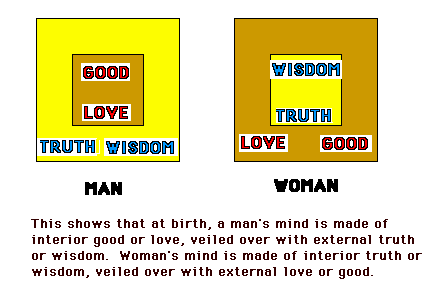
Quoting
from the Writings of Swedenborg:
CL 195. X.
THAT THIS FORMATION BY THE WIFE IS EFFECTED BY THE CONJUNCTION OF HER WILL WITH
THE INTERNAL WILL OF THE MAN.
That with the man are rational wisdom and moral
wisdom, and that the wife conjoins herself with those things with the man which
pertain to his moral wisdom, has been shown above (nos. 163-65). All things
pertaining to rational wisdom make his understanding, and all things pertaining
to moral wisdom make his will. It is with these latter, being those which
form the man's will, that the wife conjoins herself.
It is the same whether it be said that the wife
conjoins herself or that she conjoins her will to the man's will; for a wife is
born voluntary and hence does what she does from the will. It is said with the
man's internal will because man's will has its seat in his intellect, and the
intellectual of man is the inmost of woman, according to what was said above
(no. 32) and frequently thereafter respecting the formation of woman from man.
Men have also an external will, but this often partakes of simulation and
dissimulation. A wife sees this will clearly but does not conjoin herself with
it except in pretence or playfully. (CL 195)
CL 222. (13) There is a conjugial atmosphere which
flows in from the Lord through heaven into each and every thing of the
universe, extending even to its lowest forms. We showed above in its own
chapter* that love and wisdom, or to say the same thing, good and truth,
emanate from the Lord. A marriage of these two elements continually emanates
from the Lord, because they are Him, and from Him come all things. Moreover, whatever
emanates from Him fills the universe; for without this, nothing that came into
existence would continue to exist.
[2] There are several atmospheres which emanate
from the Lord. For example, an atmosphere of conservation for conserving the
created universe; an atmosphere of protection for protecting good and truth
against evil and falsity; an atmosphere of reformation and regeneration; an
atmosphere of innocence and peace; an atmosphere of mercy and grace; besides
others. But the universal one of all is a conjugial atmosphere, because it is
at the same time an atmosphere of propagation and is thus the supreme
atmosphere in conserving the created universe by successive generations.
[3] This conjugial atmosphere fills the universe
and pervades it from the firsts to the lasts of it. That this is so is apparent
from observations made above,** where we showed that there are marriages in
heaven, and most perfect marriages in the third or highest heaven; also, that
besides being in human beings, this atmosphere exists in all members of the
animal kingdom on earth, extending even to worms, and furthermore in all
members of the vegetable kingdom, from olive trees and palms to the smallest
grasses.
[4] This atmosphere is more universal than that of
the heat and light which emanate from the sun of our world; and reason can be
convinced of this from the fact that the conjugial atmosphere operates even
when the sun's warmth is absent, such as in winter, and when the sun's light is
absent, such as at night. Especially is this so in the case of human beings. It
continues to operate because it originates from the sun of the angelic heaven,
and that sun produces a constant balance of heat and light, that is, a constant
union of good and truth. For heaven is in a state of perpetual spring.
Variations in goodness and truth in heaven or in its warmth and light do not
result from changes of the sun, as changes on earth do from variations in the
heat and light coming from the sun there; but they occur as a result of the way
recipient vessels receive them. (CL 222)
To summarize the mental anatomy of a man and
woman:
A woman does things from wisdom by means of
love. A man does things from love by means of wisdom. In other words, a woman
does things from her cognitive organ by means of her affective organ. A man
does things from his affective organ by means of his cognitive organ.
2.1
Part B
The following
diagram is from an article on "The Spiritual Psychobiology of
Marriage" and is available here:
www.soc.hawaii.edu/leonj/leonj/leonpsy/instructor/gloss/dow1.html#biology
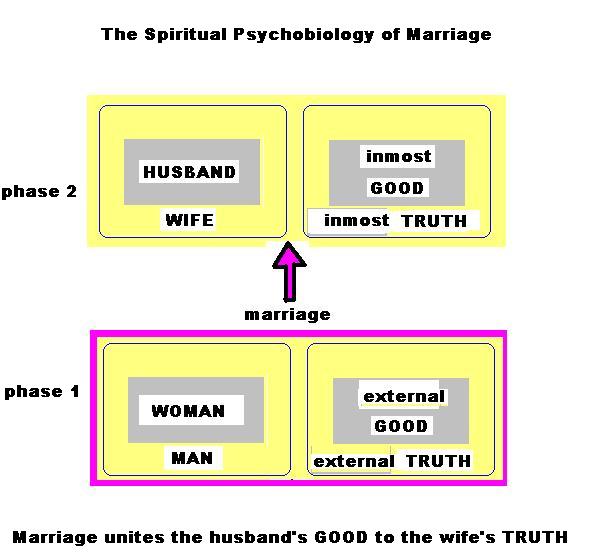
The
diagram immediately above shows the two phases or stages of marriage. Initially
(phase 1), the man's consciousness of externalizing truth, which is what
he thinks about and knows (cognitive, C), conjoins itself with
the wife's externalizing good, which is the complex of the loves
she has (A). And reciprocally, the wife's externalizing loves and affections
(A) conjoin with the husband's externalizing cognitions (C). Thus they form an
externalizing marriage or social and moral bond (natural marriage). In phase 1
of marriage and close relationships the man presents the external front and
leadership and is on the outside facing the world, while the woman is on the
inside creating a permanent relationship and bond between them, thus a
"home" as it were.
In
traditional marriages following the male dominance
model, this relative position of man and woman is enacted literally, so that the woman stays home and is the
"homemaker," while the man leaves the home to earn a living for the
family. In modern marriages following the equity model, wives and mothers may
also have work or career outside the home. But psychologically, biologically,
and spiritually the woman in a couple partnership occupies an inner position
relative to the man, who is on the outside. A man's consciousness faces outward
to the world while a woman's consciousness faces inward toward the bonding of
the relationship and the achievement of mental intimacy or unity.
The woman
works towards unity from her "external good" which is "within"
or "above" the man's "external truth." What is within or
above in terms of spiritual positioning is also higher, more refined, more
concerned with celestial things like love, harmony, unity,
growth, peace, beauty, sensuality, warmth.
The man's
outward or external spiritual positioning is lower, rougher, grosser,
more concerned with spiritual things like truth, knowledge,
rationality, doctrine, precepts, principles, applications.
Phase
1 in marriage and relationships is called externalizing because the
man's cognitive focus (C, achieving) and the wife's affective focus (A,
bonding) are both in the externalizing or lower degrees of their consciousness
(natural marriage). However, if the two partners continue to grow together and
conjoin more deeply within, then they enter phase 2 which is an internalizing
union or conjunction (spiritual marriage). Now their internalizing parts are
conjoined or united--the man's internalizing good and the woman's internalizing
truth. Now for the first time the man becomes fully a husband and the woman
fully a wife.
The
unity model specifies the mental anatomy of marriage. In the negative bias
approach to the psychology of marriage only phase 1 is recognized. Couples are
expected to grow more interdependent and close as the decades of marriage
proceed. This is certainly valid. Phase 1 undergoes growth and development so
that the partners feel closer and closer, when the marriage is a success and
lasts. But the unity model introduces a new dimension to the relationship based
on mental anatomy not physical anatomy or psychological definitions of
closeness. In other words every man and woman is born with a temporary physical
body on earth, and a permanent spiritual body in the mental world of eternity,
as discussed above. The process of bonding and becoming interdependent does not occur
in the physical body or with the physical body.
The
process of becoming a couple is a mental event, and must have an organic basis
in the spiritual body where are located our mental organs: affective
(feelings), cognitive (thinking) and sensorimotor (sensations and movements).
Bonding
is an activity of our feelings, loves, intentions, desires, fears, anxieties,
enjoyments -- these are all mental experiences we have as a result of the
operations going on in our affective organ in the spiritual body in the mental
world of eternity. We are conscious of these experiences because they are going
on in the portion of the spiritual body called the natural mind. So the
diagrams in this section attempt to portray the organic relationship between
man and woman in the process of bonding, both in phase 1 (natural marriage),
and in phase 2 (spiritual marriage).
You
can see that the anatomical nature of bonding is totally different in the
natural marriage phase (1) and in the spiritual marriage phase (2). Couples
cannot attain to the beginning of phase 2 by going further and further with
phase 1. The two phases are discontinuous and one cannot go from one to
the other. They are in "discrete degrees" and relate to each other by
correspondence (not by continuity). Phase 1 bonding activity in the mind of the
partners is an operation going on in the external region of the spiritual body.
For instance if you have a pimple on the face it is an external activity (skin)
of the physical body. But if you have a cold sore on the lip it is an internal
activity (virus) of the physical body. Phase 1 bonding is external, phase 2
bonding is internal.
Phase
1 bonding in external marriages and relationships conjoins the man's external
mental focus (cognitive, C) the woman's external mental focus (affective, A). A
man's consciousness focus as he grows up and becomes an adult is centered in
his cognitive organ (C), while a woman's consciousness as she grows up and
becomes and adult is centered in her affective organ (A). When man and woman
get together to form a couple or romantic partnership they are each focused on reciprocal zones
of their cumulative interactions. The man is focused on this thoughts
about himself with her, while the woman is focused on her feelings and
intentions about him. Phase 1 bonding takes place when her feelings are
conjoined to his thoughts.
If
she does not like his thoughts she cannot bond to him. A woman bonds to a man
romantically when she likes his thoughts and his way of reasoning and
presenting himself and things. If she does not approve of his thoughts, or
feels repelled by his attitudes, she cannot bond with him romantically.
A man will allow the
woman to bond to him when he recognizes that she likes his thoughts.
Note
that in phase 1 bonding the woman takes the lead. The man does not bond because
bonding is an affective focus on the relationship and men have a cognitive
focus on the relationship. So when the woman takes the lead in phase 1 bonding
(external) by loving the man's thoughts, he can respond and react by allowing
it in his mind or rejecting it in his mind. In general, if he sees that she
likes his thoughts, he will feel attracted to her, and this is the acceptance
of her bonding to him. In this way they achieve mutual bonding when the man man
responds positively to the woman. Anatomically this is all happening in the
external portion of their spiritual body.
After phase 1 bonding
is achieved and is working for both partners, there is the opportunity of
starting phase 2 bonding, which is an inward anatomical conjunction or
interdependence of their spiritual bodies. Here everything is reversed. The
woman cannot take the lead. She eventually comes to realize this after trying
desperately to achieve affective intimacy which the man continuously and
successfully resists. She then understands that this deeper intimacy she craves
for has to come from him. The man has to take the lead in phase 2.
Note
the anatomical details of this spiritual bonding process (phase 2, diagram
above). The wife is shown outside and the man inside -- the opposite of phase
1. In phase 2 bonding the spiritual bodies are facing the mental world of
eternity, not the physical world of time and space. In the mental world of eternity
what is within determines what is on the outside. In phase 1 the wife is inside
and the husband outside, hence the wife takes the lead. In phase 2, the husband
is within and the wife is outside, hence the husband takes the lead. If the
woman fails to take the lead in phase 1, there will be no external bonding --
they are a couple only in name. Similarly, If the man fails to take the lead in
phase 2, there will be no internal bonding -- they are a couple only in the
natural marriage sense, that is, without affective intimacy (spiritual
marriage).
The
woman takes the lead for external bonding (natural marriage), while the man
takes the lead for internal bonding (spiritual marriage). External
bonding involves external cognitive operations (man) conjoined to external
affective operations (woman). Internal bonding involves internal
cognitive operations (woman) conjoined to internal affective operations (man). To understand this you need to know the
difference between external mental operations (A and C) and internal mental
operations (A and C).
External affective operations (A) is feminine and
contrast with internal affective operations (A) which is masculine. External
cognitive operations (C) is masculine and contrasts with internal cognitive
operations (C) which is feminine. In other words, the mental organs of women in
the spiritual body is arranged with the cognitive organ inside the affective
organ, while for men, the cognitive organ is outside the affective organ, which
is within. In still other words, women act from inner truth through outer love,
while men act from inner love through outer truth. Masculine truth is outward,
feminine truth is inward. Masculine love is inward, feminine love is outward.
What is inward commands what is outward, hence men's way of thinking is adapted
for the external life, while women's way of thinking is adapted for the
internal life.
In the afterlife of eternity where the couple will
be rejoined, the woman's thoughts and wisdom (C) define the couple's external
life (S), while the man's loves and virtues (A) define the couple's internal
life. In this life, the man's thoughts and intelligence (C) define the couple's
external life, while the woman's loves and virtues (A) define the couple's
internal life.
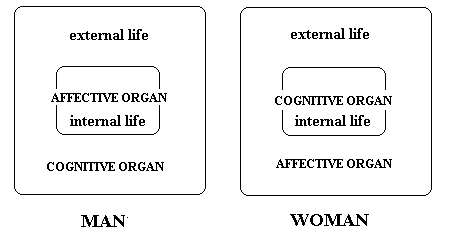 Our external life refers to our focus
on the daily issues and activities a couple is immersed in -- living together,
adapting to each other's social and physical habits and styles, coping with
social and financial demands, caring for children, relationship to parents, community
service, entertainment, sports, eating together, sexual activity. Our internal
life refers to our focus on mental intimacy and affective support and
bonding -- being best friends and soul mates, looking out for what is best for
the other, full confidence and trust, reliance and acceptance, being together
forever.
Our external life refers to our focus
on the daily issues and activities a couple is immersed in -- living together,
adapting to each other's social and physical habits and styles, coping with
social and financial demands, caring for children, relationship to parents, community
service, entertainment, sports, eating together, sexual activity. Our internal
life refers to our focus on mental intimacy and affective support and
bonding -- being best friends and soul mates, looking out for what is best for
the other, full confidence and trust, reliance and acceptance, being together
forever.
To be fulfilled and to have access to the full
benefit of marriage bonding, it is necessary that the partners conjoin both
their external (phase 1) and their internal life (phase 2).
In the
diagram below, the same process is portrayed.
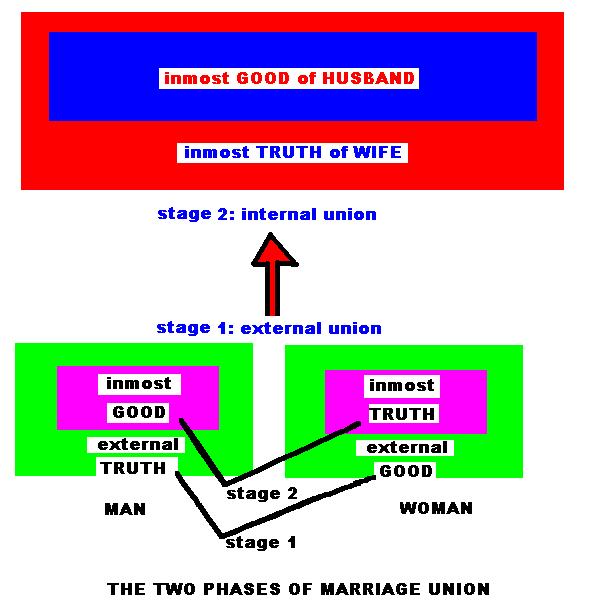 The externalizing
union in stage 1 is shown to bond the man's externalizing truth (C) to the
wife's externalizing good (A). This is not so much a true union as a
partnership since it resides in externalizing (or lower) parts of the
consciousness. Husband and wife as partners are adjoined to each other by
externalizing natural life and family, but they are not yet conjoined from
within by inner or spiritual life, which refers to inmost intimacy and eternal friendship.
But in stage 2, the husband's internalizing good (A) is conjoined to the wife's
internalizing truth (C). Now the marriage bond consists of his affections (A)
covered over with her truths (C). This is a true conjunction or union because
it resides in the higher or internalizing regions of their consciousness and
life. Only when this stage of internal conjunction is achieved can they be
prepared into a heavenly marriage and live together in eternity.
The externalizing
union in stage 1 is shown to bond the man's externalizing truth (C) to the
wife's externalizing good (A). This is not so much a true union as a
partnership since it resides in externalizing (or lower) parts of the
consciousness. Husband and wife as partners are adjoined to each other by
externalizing natural life and family, but they are not yet conjoined from
within by inner or spiritual life, which refers to inmost intimacy and eternal friendship.
But in stage 2, the husband's internalizing good (A) is conjoined to the wife's
internalizing truth (C). Now the marriage bond consists of his affections (A)
covered over with her truths (C). This is a true conjunction or union because
it resides in the higher or internalizing regions of their consciousness and
life. Only when this stage of internal conjunction is achieved can they be
prepared into a heavenly marriage and live together in eternity.
Couples
who do not progress to an internal union of minds or spirits (stage 2,
spiritual marriage), remain separated in their internals, and when they meet
again in the other life, they live with one another again for a brief period.
They then can become aware of each other's internal character and disposition,
and these separate them. Each then looks for another partner with whom they can
enter into an internal marriage in heaven. But this happens only when both have
been regenerated while still in the physical body.
To be
regenerated means to learn to give up inherited hellish traits and to acquire
heavenly traits in one's threefold self.
When
they meet in the other life and live together again briefly, they may decide
that they are unsuitable for each other by internal disposition, in which case
they separate. The one who is regenerate in character goes to heaven with the
newly found conjugial partner or soul mate, while the other who is not
regenerated goes to hell where they enter into a series of relationships, which
are called infernal concubinage. These infernal marriages are purely
externalizing and both partners are "devils" who hate each other's
guts yet are forced to endure each other in a marriage made in hell.
Quoting
from Swedenborg's Conjugial Love:
CL 32. (ii) A male is then male and a female is
female.
Since a person lives on after death, and a person
may be male or female, and the male and the female are so different that one
cannot change into the other, it follows that after death a male lives on as a
male and a female as a female, each of them being spiritual. We say that the
male cannot change into the female, nor the female into the male, so that in
consequence after death a male is a male and a female is a female, but because
it is not known in what masculinity and femininity essentially consist, I must
state this briefly here.
The essential difference is that the inmost core of the male is love, and
its envelope is wisdom, or what is the same thing, it is love enveloped in
wisdom. The inmost core of the female is the wisdom of the male,
and its envelope is the love from it. But this is a feminine love,
which God gives a wife by means of her husband's wisdom. The other love is a
masculine love, a love of being wise, given by God to the husband to the extent
that he acquires wisdom.
Thus it is that the male is the wisdom of
love and the female the love of that wisdom.
There is therefore implanted in each from
creation a love of being joined into one. (CL
32)
CL 33. The result of being so formed in the
beginning is that the male is by birth a creature of the intellect, the female
a creature of the will, or to put the same thing another way, the male acquires
from birth an affection for knowing, understanding and being wise, and the
female acquires from birth a love of joining herself with that affection in the
male.
Since what is within forms the outside so as to
resemble itself, and the form of the male is that of the intellect, and the
form of the female is that of love for it, this is why the male differs from
the female in face, voice, and the rest of the body. He has a sterner face, a
rougher voice and a stronger body, not to mention a bearded chin, so generally
speaking a less beautiful form than the female.
There are also differences in their gestures and
behaviour. In short, they have no similarity, and yet every detail has
the impulse towards union. In fact, there is masculinity in every
part of the male, down to the smallest part of his body, and also in every idea
he thinks of and every spark of affection he feels; and the same is true of the
femininity of the female. Since therefore one cannot change into the other, it
follows that after death the male is male and the female is female. (CL 33)
CL 88. (iii) There is the truth of good, and from
this the good of truth, that is to say, truth coming from good and good from
that truth; both of them have a tendency implanted from creation to join
themselves into one.
Some idea of the distinction between these two must be gained, because knowledge
of the essential source of conjugial love depends upon it. For the truth of
good, that is, truth from good, is, as will be shown in what follows [90, 91],
male; and the good of truth, that is, the good from that truth, is female.
But the distinction can be better grasped, if love is substituted for good and
wisdom for truth. These are one and the same (see 84 above). The only way
wisdom can come into existence for a person is by means of the love of being
wise. If this love is taken away, there is no way the person can be wise. It is
wisdom arising from this love which is meant by the truth of good, or truth
coming from good. But when a person has as a result of that love acquired
wisdom, and loves wisdom in himself, that is, loves himself for his wisdom,
then he forms a love, which is the love of wisdom and is meant by the good of
truth, or good coming from that truth.
[2] A man therefore possesses two loves. One, which comes first, is the love of
being wise, and the other, which comes later, is the love of wisdom. But if
this second love remains with a man, it is a wicked love, called pride in or
love of one's own intelligence. It will be proved in the following pages that
it has been provided from creation that, to prevent this love being his ruin,
it was taken from the man and copied into the woman, so becoming conjugial love
which makes him whole again. Some remarks about these two loves and the copying
of the latter one into the woman may be seen in 32, 33 above, and in the
Preliminaries, 20. If therefore we understand for love "good"
and for wisdom "truth," then it is proved by what has been
said that there is truth of good, that is, truth coming from good, and from
this the good of truth, that is, good coming from that truth. (CL 88)
Note this sentence in the quote above from CL 88:
"the truth of good, that is, truth from good, is male; and the good of
truth, that is, the good from that truth, is female." Here is a diagram
that attempts to portray what the passages above describe:
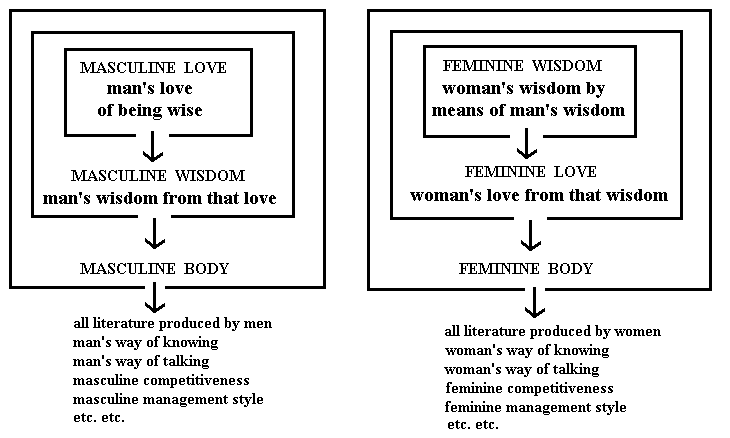
Starting at the bottom you can see that literature
written by women is different from that of men, or that women managers do
things in a feminine way, which is different from the masculine way. The
question of "Which is better or more effective" needs to be answered
by presenting evidence showing that women who have been traditionally excluded
from certain activities or jobs, have been working at these now for several
workforce generations, and some women outscore men, while the overall average
and range are also very similar.
This proves that men and women can perform
equally effectively in any job setting or team work.
But it leaves open the question of how these jobs
or activities are performed by men and by women. The diagram above indicates
what the differences are in the way women and men perform the same activities. This
difference is not due to their intelligence, but to their mental anatomy.
For instance, men and women eat the same foods, but their bodies assimilate the
nutrients from them differently due to hormonal and biochemical differences
relating to physical anatomy or physiology.
Now you need to practice applying the diagram to
the differences you can observe between men and women. Women are most
comfortable being themselves according to their mental anatomy. This is how
they define intimacy with a man in marriage or in an exclusive relationship. When
the woman feels that she can be her feminine self in the relationship she feels
maximum freedom, and thence total intimacy with the man.
She feels happy and alive when this happens.
Everything she then does is from her feminine self. This is portrayed in the
diagram above. If a woman competes with another woman or a man, she does it from
her wisdom by means of her love. Her wisdom is inmost, while her love is
outmost. What is inmost is less clearly in awareness compared to what is
outmost. So when a woman acts she is less aware of her wisdom in the act,
and more aware of her love in the act. A man is the reciprocal of this. When
a man acts he is less aware of of his love in the act, and more aware of his
wisdom in the act. In order to understand this you need to call upon what
you already know about men and women -- which is considerable.
EXERCISE
2.1.1:
Read this Section once over then again as
you think about your parents. Jot down or type out thoughts that come to you as
you consider these questions.
(a) Your father as a representative of man, and
your mother as a representative of woman. How were they different as you grew
up? How did you experience them distinctly? What was a normal or regular mood
or emotional quality that you experienced when being with one of them, or the
other, or with both together? What similar or different thoughts or emotions
did you have when something happened and you had to deal in turn with your
father and your mother?
(b) Now look at your notes. You might want to
expand on some issues. Summarize what you discovered in relation to how a man
thinks and feels and how a woman thinks and feels. Relate this to the mental
anatomy of a man and a woman.
(c) Now apply this approach to other men and women
you know -- siblings, friends, neighbors, teachers, motorists, co-workers,
supervisors. Does this approach help you to understand better what people do?
(d) Now discuss your findings and new perspective
with friends, parents, or class teams. Come to class prepared to discuss some
of these issues.
The anatomy of the human mind contains a higher
spiritual mind that we use in our afterlife of eternity and a lower natural
mind that we use in this life. The conjugial heavens in eternity are the
thoughts and feelings we have in the spiritual mind. The conscious life we have
in this life is through the thoughts and feelings in our natural mind. At death
the natural mind becomes unconscious while we awaken fully conscious in the
spiritual mind. This anatomy has been described by Swedenborg through his observations
of the afterlife in his spiritual mind. At age 57 he suddenly developed the
capacity to be conscious in his spiritual mind as well as in his natural mind.
He was thus able to describe in his reports the empirical details of
resuscitation and conjugial love. We are taking on the positive bias in science
so that we can examine and assess what he has presented. If we remain in the
usual negative bias in science we would be unable to examine and assess his
reports without rejecting them right from the start as being impossible. The
positive bias allows us to examine the reports objectively and to do so at
their face value. Swedenborg was a well known scientist and public figure in
Sweden and he had the respect of everyone as a genius and honest impeccable
scientist.
The mental anatomy that we are considering in the
previous diagrams clearly indicate that the intelligence of men cannot be the
same as the intelligence of women inasmuch as they are anatomically reciprocals
of each other. In the male dominance mentality men are more intelligent than
women. In the equity mentality men and women are equally intelligent. In the
unity model men and women have different intelligences that must fit together.
By fitting together as reciprocals they are able to greatly enhance each
other's thinking and understanding.
In other words the world is greatly enriched
in intelligence because there are men and women in the equation. Each gender
contributes a unique type of thinking and understanding. According to the
mental anatomy diagrams above, men act (S) from love (A) by means of
intelligence (C), while women act (S) from intelligence (C) by means of love.
Another way of saying it is this:
Men act (S) from love (A) by through intelligence (C).
Women act (S) from intelligence through love (A).
Still another way of saying the same anatomical
fact:
Men act (S) from feelings (A) through thoughts (C).
Women act (S) from thoughts (C) through feelings (A).
Diagrammatically:
Men:
Am -----> Cm -----> Sm
Women: Cw
-----> Aw -----> Sw
As is plainly visible, the threefold self of men
and women is created by anatomical differences in the way their mental organs
function in action (S), thought (C), and feeling (A). Remember that what is
first in the sequence is also higher and more interior. So a man's highest and
inmost organ is the affective (A) while a woman's inmost organ is the cognitive
(C). Note that for men intelligence (C) is in the intermediate position while
women's intelligence (C) is in the first position. Since first is always higher
it follows that women's intelligence (Cw) is higher than man's
intelligence (Cm). This is the basis for the unity model of
marriage.
Higher or interior intelligence is more spiritual,
while lower or external intelligence is natural. Hence women's intelligence
is more suited and adapted for spiritual or interior things, while man's
intelligence is more suited and adapted for natural or external things.
Experience in this world demonstrated that a
woman's intelligence gives her the capacity to function and achieve as much as
a man through his male intelligence. Women can do the same jobs as men and
perform within similar ranges. But because women can do this with their
feminine intelligence does not mean that the female intelligence is the same as
the male intelligence.
When it comes to achieving a spiritual marriage woman's
intelligence provides a big advantage over masculine intelligence. Spiritual
marriages are based on the unity model. This phase becomes actual when man's
intelligence conjoins with woman's intelligence.
Note again:
Men:
AIM -----> CEM -----> SM
Women: CIF
-----> AEF -----> SF
Conjoint self: AIMCIF -----> CEMAEF
-----> SMSF
IM = internal male
IF = internal female
EM = external male
EF= external female
Note that the unity couple's conjoint self is
constructed anatomically by joining together man's interior or higher feelings
(AIM) with woman's interior or higher thoughts (CIF)
yielding this: (AIMCIF), and man's lower or external
thoughts (CEM) with woman's lower or external feelings (AEF)
yielding this: (CEMAEF).
As you can see
from the anatomical diagram natural marriage (phase 1) consists of
conjoining woman's lower or external good (A) with man's lower or external
truth (CEMAEF). Phase 2 (spiritual marriage)
consists of conjoining man's inmost or higher good (A) to woman's interior or
higher thoughts (AIMCIF).
Note from the
diagram that in natural marriages (phase 1) the woman is within (A) while the
man is outside (C) relative to each other. Anatomically, the natural marriage
is the conjunction between the woman's affective organ (A) in the external mind
and the man's cognitive organ (C) in the external mind. The affective organ
supplies the operations of the will, of intentions, of motives, of goal
achievement. The cognitive organ supplies the operations of the understanding,
of planning, interpreting.
So in this external
conjunction of the partners (phase 1, natural marriages), the woman is the
source of the couple's intentions and motives (A) towards the world, while the
man is the source of the couple's interpretations of the world and their
planning strategies (C).
Note that
external or natural female affections (A) are used for the couple's intentions,
motives, values, feelings (A) while external or natural male intelligence (C)
is used for the couple's dealings with the world -- interpreting what is going
on on the outside and planning strategies to deal with it (C). Hence it is that
the man takes the lead in dealing with the outside world where the couple must
survive and adapt, while the woman takes the lead in dealing with the inside
world of the marriage and the family. This has applied to all couple relationships
in the past, which is why men run things in the world while women run things in
the home. This is still true today with modern couples (equity model) that have
working wives and mothers. The men are supposed to help out with domestic
chores to ease the load on the working wives and moms. But society still
attributes to the woman the central responsibility for running the home
(cooking. laundry, toddlers) and making sure everything is being taken care
of.
In natural
marriages the external or materialistic thoughts (CEM) of the man
are conjoined to the external materialistic feelings (AEF) of the
woman. In spiritual marriages (unity model) the interior or spiritual feelings
of the man (AIM) are conjoined to the interior or spiritual thoughts
of the woman (CIM).
Natural
marriages are involved in the male dominance model and in the equity model.
Spiritual marriages are involved in the unity model. Natural marriage
(phase 1, dominance and equity models) is called an external conjunction
of man and woman because it involves the conjunction of the two people's
external minds. Spiritual marriage (phase 2, unity model) is called an internal
conjunction of man and woman because it involves the conjunction of the
two people's external minds.
Every person is
born with a natural mind and a spiritual mind. Both are housed in the spiritual
body which is born in eternity and connected by correspondence with the
physical body which is born in the natural world of matter, time and place.
This is why we are called dual citizens. We are citizens of the
physical world of time through our temporary physical body, which functions in
correspondence with our natural mind. And through our immortal spiritual body,
we are also citizens of the spiritual world of the afterlife, also called the
mental world of eternity.
Until death of
the physical body we are conscious in our natural mind and unconscious in our
spiritual mind. After resuscitation from death (a few hours later), we are
conscious in our spiritual mind and unconscious in our natural mind. We
continue our life of immortality in eternity through our spiritual mind which
is housed in our spiritual body.
Spiritual
marriage (phase 2) involves the conjunction of the man's interior or spiritual
mind with the interior or spiritual mind of the woman. This is why spiritual
marriages are permanent and eternal.
Note
carefully:
Since spiritual marriage is an internal conjunction of the their
spiritual body and spiritual mind it cannot be seen in the physical world.
Natural marriage is an external conjunction of their physical body and
interactions, it can be seen, measured, and recorded. Natural marriage has a
worldly and legal basis in the physical world, while spiritual marriage becomes
visible and recordable in the world of eternity.
Nevertheless,
when the couple is involved in a spiritual marriage, as in the unity model,
their natural marriage reflects this. For instance, in a spiritual marriage the
couple's natural marriage is in correspondence with it so that it may be called
a heavenly marriage or a 'match made in heaven' between soul mates. The unity
model leads to such a spiritual marriage.
The husband who
wants to be a unity husband has to learn to accept and love the following principles of good behavior towards his wife:
1. Not to express disagreement through the
sensorimotor self (head , face, hands, stance, voice, touch, speech acts).
Wanting to learn from the wife what she sees and experiences about his
sensorimotor expressions when he interacts with her under various situations or
issues.
2. Not to express disagreement in verbal exchanges
that are experienced by the wife as disjunctive. Wanting to learn from the wife
what she experiences as disjunctive and unsexy conversational style.
3. Not to perform acts of disloyalty to her. Not
to betray her to others by revealing things she does not want them to know. Not
to discuss her with anyone in a way she would object if she heard a recording
of the conversation. Not to lie to her in order to protect himself from her
disapproval. Not to ignore what she says, but to think about it and remember
it, and make it important to him.
4. To be supportive of her by encouraging her in
what she wants to do or accomplish. To want to strengthen her self-confidence
and thus, not to do or say anything that would weaken it or hurt it. To listen
to her, to understand her, to learn from her, to admire her thinking, to
appreciate her humor, to love her observations and perspective on various
things.
5. To be protective of her sense of security and
her vulnerabilities. To love her femininity. To be soft and sweet with
her, always. To avoid giving her worries. To relieve her stress and anxieties.
6. To be useful to her in various ways that make
her life more comfortable. To learn to offer to do things for her, then to
learn to do them in a way she approves and likes.
7. To touch her every time he sees her. To keep
himself clean, shaven, and attired in clean, attractive clothes. To learn how
she likes to be touched and aroused. To pay attention to details. To learn how
to make her laugh, and what puts her in a good mood. To be be dedicated to her
happiness.
8. To learn how she wants him to make up when he
precipitated a state of disjunction between them, by violating good principles
of action. To learn how to perform procedures of (a) sufficient apology, (b)
felt remorse, and (c) fun ideas about restitution or compensation (e.g.,
surprises that delight her).
These same principles of good behavior apply to
all couples, married or not, who are in a romantic and exclusive long term
relationship that they think of as forever or eternal.
Husbands can be committed to these 'good behavior'
principles only when they experience an attraction to the unity model of
marriage. To feel this attraction they must have a liking for the
spiritual ideas of eternity and femininity. Love attracts. The husband has to
love the idea in his mind that he is going to be attached to this woman more
and more to endless eternity. He has to find this idea attractive in his mind.
To be attached to this one woman forever. He has to love that idea more
than any other idea he can think of. When a man brings himself into this mental
state, he can learn to love these 'good behavior' principles, and begins to
practice them in his daily interactions.
Once a man is committed to this daily practice of
being a unity marriage husband, his mental state changes day by day,
progressively into the "heavenly order." This is an expression used
in the Swedenborg Reports where it is described according to what Swedenborg
observed during his interviews and visits with couples after resuscitation who
inhabited their heavenly layers in the mental world of eternity. The heavenly
order of the mind is arranged in a top-down hierarchy of loves or feelings of a
certain kind or quality. At the very top of the hierarchy of loves is what the
Swedenborg Reports call "conjugial love." The word's usual spelling
"conjugal" refers to natural marriage in the socio-legal sense,
but when spelled "conjugial" it refers to spiritual marriage.
Spiritual marriage begins when both partners
understand and realize that their union is permanent to eternity. Spiritual
marriage evolves from that beginning and progresses closer and closer to the heavenly
order. This means that the husband has endorsed and committed himself to the
principles of good behavior needed to build the unity model marriage. In a
"conjugial marriage" the affective hierarchy of both husband and wife
are arranged so that the highest love each one has is the love for each other.
He is her heart and circulatory system, while she is her lungs or respiratory
system. He supplies their conjoint blood -- that is, their loves and
affections, and she supplies their conjoint breath -- that is, their thoughts
and wisdom. Conjugial husband and wife function as one unit -- the conjoint
self.
Husbands who are practicing the unity model of
marriage can experience the conjoint self more and more distinctly as they
progress more deeply into the conjugial relationship. The conjoint self is the
heavenly order in marriage. We work towards that state by aligning our
affections and loves so that they represent the heavenly order. In the
husband's mind the wife has to occupy top position or first place. This is
conjugial love. All things must be subordinated to the one ruling love, which
is the love they each have for the other. By committing himself the the good
behavior principles, the husband taps into the source of inner mental power
capable of overcoming his natural and intense personal and masculine feelings
and needs to be woman dominant. This higher inner mental power is available to
any husband or boyfriend, merely by committing himself to practicing the good
behavior principles because he wants to achieve the heavenly order of conjugial
love through the conjoint self.
This higher or inner mental power is able to
overcome the natural hereditary biological masculine resistance for affective
intimacy with a woman. Man wants to retain his affective independence. He
wants to love what he likes, he wants to think what he likes, he
wants to act the way he likes. This is what he now has to give up so that he
will want to love what she likes, he will want to think what is
agreeable to her, he will want to act the way she likes. To make this
switch in mental state the man must have the inner power to accomplish it,
through overcoming his own powerful resistance towards giving up affective
independence. He now has to like what she likes more than he likes what he
likes. Being committed to practicing the good behavior principles gives
him access to this inner power, which is the heavenly power.
Everything gets better and better in the heavenly
order of marriage.
It is well known that natural marriage tends to
wane and diminish in romance and passion, though commitment to making the
marriage last may increase. Often couples who have been married for decades
have never become best friends to each other. They share loyalties and habits,
but not feelings of peace and unity that come from not tolerating disagreements
with each other. When the heavenly order of marriage is entered, its
progression is experienced by both partners every day more and more as they
live their life together. There is no waning of love, romance, and passion, but
a progressive increase of it, and a deepening of it, so that the entire mental
state is affected in many layers, all arranged in the heavenly order, which is
infinite in variety, quality, beauty, and wisdom. The Swedenborg Reports
describe many aspects of this heavenly order which is called "the marriage
of good and truth." This eternal and Divine marriage in God is the source
of conjugial love between husband and wife in a spiritual marriage.
We will now
study various details about the three models -- male dominance model, equity
model, and unity model.
Section 3
3.
Part A
Research and
personal observation confirm that most couples report experiencing oppositional
or negative feelings, and at times acting upon them by retaliating, exploiting,
abusing, or injuring their partner. When couples have a disagreement or fight,
physical and mental abuse is practiced by men more than by women in the
majority of societies and cultures. When men reason under the influence of
exploitative motivations, they tend to misinterpret the intentions of their
wife or girlfriend and tend to use stereotyped, inaccurate, and prejudiced
thinking about them. Their unflattering and insulting verbal behavior will
reflect this style of biased thinking against women. So will their abusive
actions. Boys are immersed in this practice of talking against girls and
putting them down among each other.
Adult dating men
and husbands retain the capacity and internal desire to put women down in their
mind and among each other with other men. It is part of man's thinking about
women -- until the man becomes spiritually enlightened and realizes with shame
and guilt that engaging in this denigrating behavior against women is contrary
to heaven, and that without being united to a woman, the man cannot be his
best, his greatest potential, his true self, his ultimate happiness. By
thinking badly of women in his mind the man weakens himself from within and
robs him of reaching his ultimate potential and true self.
This conclusion follows from
the mental anatomy of heaven in eternity. It makes sense rationally from the
perspective of the positive bias in science. God reveals in Sacred Scripture
that His purpose for creating individual human beings is so that He can bring
two of them together, made for each other, built mentally to fit and to attain
the true higher experience of life in heaven in eternity. The unity of a man
and a woman into a conjugial couple in heaven -- this is the purpose of the
universe, according to God's own revelation to humankind. The man who
realizes this idea is no longer capable of thinking badly about the woman he
loves, and for her sake, he can no longer think badly of any woman.
Because of the
intensity with which the negative bias is instilled in the thinking of educated
people, few educated people know today that an individual is not a full human
being, but only has the capacity to become one. A man is created to achieve
unity with a woman, and a woman is created to achieve unity with a man. Women
are more aware of this regardless of their education, which they put around
themselves like a cape but do not let enter into their spiritual self. Men are
more vulnerable to education, shaping their inner thinking according to its
dictates and doctrines. They ingest the negative bias in science more deeply
into their reasoning process.
Women retain a
distinct rational perception of conjunction, external and internal. They sense
strongly that the external conjunction ("I love you." ... "I
love you too.") is not the final type of conjunction they crave for to
become truly free, truly themselves as they were created feminine by God. Men
do not sense this -- until they become spiritually enlightened and are able to
examine the positive bias perspective regarding eternal spiritual marriages.
Once a man is enlightened he can begin the long journey backwards in his mind,
a journey in which he left around all sorts of gross thoughts and inclinations
towards a woman, and women in general. This is a long and arduous task for most
men, but many are able to stick to it and acquire a new chivalrous or gallant
character that respects women as their highest principle in life and the
universe. In this way they become real men, real to their creation, which is,
that they unite themselves with a woman and live in conjugial happiness to
eternity. This is why God created them.
The key to this
amazing victory and achievement is to start practicing the self-witnessing
life. This means monitoring what your mental organs are doing: your feelings
(A), thoughts (C), and sensations and actions (S).
With this
objective data on what you actually are all day every day, you have what you
need to change yourself. I
have done this for many years and it has allowed me to reform my socialization
habits of thinking negative thoughts about others all the time. I no longer do
this. It is the same with my private thoughts about women, about their motives,
about their intelligence, about their capacities, about swearing using women's
body parts, or about telling or laughing at jokes against women. I no longer do
(S) any of these and have an aversion (A) for the idea (C) doing it again (S).
There is an
advantage in gaining control over our gender behavior in the three domains of
the threefold self -- affective (A), cognitive (C), and sensorimotor (S). We
can avoid those cultural and psychological traits and habits that interfere
with adaptive, successful long term marriage relationships. The benefits of a
stable successful long term partnership are extremely attractive.
We will explore
a particular principle in the unity model of marriage called the
conjoint self.
According to
the "unity" model of marriage, the perfection of unity in a marriage
increases through differentiation (the two are mentally different), and reciprocity
(all their differences fit together).
Mental
interdependence between husband and wife becomes total in the spiritual body. Swedenborg
was amazed when he saw couples in the third heaven of eternity, which is the
most perfect expression of conjugial love. From a distance he saw only one
"angel" but when they drew near to him he saw a husband and his wife
each attired in beautiful clothes and light and beauty shining from their
youthful faces. This is the expression of the unity of married couples in the
mental world of eternity. When he saw their two faces close up he saw that they
were one and the same, one masculine and the other feminine. When one spoke it
was like it came from the other. When one removed himself or herself, the other
lost all composure and happiness, even intelligence. They were united, two
individual human beings forming one complete one. He spoke to many such couples
in the course of his dual consciousness over 27 years.
This then shows
us the potential we can achieve -- if we are willing to make it more important
than all other things we consider important. In other words, conjugial love
has to become the ruling love of a man, as it already is for woman from birth
to eternity.
In the spiritual
body of the unity couple here on earth, the woman's external affective organ
(A) is conjoined to the man's external cognitive organ (C) (phase 1, natural
marriage), and his internal cognitive organ (C) is conjoined to her internal
affective organ (A) (phase 2, spiritual marriage).
This conjoint
self therefore proceeds,
(Step 1) with
her external will (A) joined to his external understanding (C) (natural environment);
and
(Step 2) with
her internal will (A) joined to his internal understanding (C) (spiritual
environment)
Before the
conjoint self is born, his understanding is joined to his own will, but after
the conjoint self is born (Step 1), his understanding is joined to her
will (no longer to his own will).
This means
that in Step 1 or the natural daily environment of the couple, the husband
practices learning to love to act from his wife's will (A) more than he loves
(A) to act (S) from himself.
This means that
he won't allow himself to disagree with her on anything whatsoever.
Since a man
cannot just stop disagreeing with a woman on some occasions, it is necessary
for him to practice conjugial simulation. This means that he
acts outwardly like he agrees with her even if inwardly he disagrees.
The woman will
accept this as a temporary solution. Out of her inner wisdom she perceives that
he needs time to change himself inwardly, and she will go along with his
simulation as-if she accepts it. In other words, she will not feel agitated and
upset like she does when he overtly expresses his disagreement. This is a
win-win situation, so I recommend it, having practiced it myself for years.
If you think
this is hypocritical, think about some more. When people are being hypocritical
they have some bad purpose in mind that can injure innocent people who fall for
the act and believe they are being sincere. But if you withhold expressing your
disagreement or disapproval to protect the person's feelings, this person being
your girlfriend or wife, then you are not being hypocritical at all. You are
being conjugial and chivalrous or gallant, thus trying to be good and heavenly.
Later you will experience the slow disappearance of your disagreements and
disapprovals in connection with your wife or girlfriend.
A husband or
boyfriend practices the unity model by remaining committed to
- listening to his wife or girlfriend,
- trying to agree with her with everything she
explains to him,
- hiding his disagreement or disapproval whenever
he feels or thinks it,
- valuing what she says as important and worthy of
his attention, and
- honoring what she wants, whether she asks for it
or not.
This is the
husband's side of the conjoint self.
On the wife's
side of the conjoint self, she is committed to lead her husband by means of her
feelings, intentions, and perceptions for the purpose of making him part of
herself, and thereby making him happy from herself and all that she can give
him. The more he listens to her and agrees with her on all that she wants,
the more he can receive from her the happiness and peace he craves for.
The conjoint
self is the result of a spiritual (mental) union that lasts to eternity. In a
unity marriage, the husband and wife develop a conjoint self, while their
former individual self recedes into the background and no longer operates.
The unity
marriage is not achieved by promise, love, or declaration, but by making
developmental steps of internalizing and unifying which married partners must
go through with each other, like a joint growth process that takes many years
of dedicated effort.
The
"conjoint self" refers to a husband and wife who have achieved unity
at all levels of the threefold self -- affective (feelings, intentions),
cognitive (thoughts and reasoning), and sensorimotor (sensations
and responses).
Each individual
has been changed, dropping off some traits and acquiring new ones that can fit
together. This is called growing together through differentiation in
reciprocity. The husband has to abandon some traits he cherished since
childhood because these habits cause opposition and disunity with the wife. The
wife has to abandon some of her traits, those that she perceives do not fit
with her husband's personality. Both have to acquire new traits which create
a new character and personality that can fit together as a differentiated
reciprocal unit.
The old traits
that are abandoned and the new traits that are acquired consist of sensorimotor
(S), cognitive (C), and affective (A) traits in the threefold self. These are
made of:
- habits
of external activities (S),
- habits
of thinking (C), and
- habits
of internal feeling and intending (A).
The conjoint
self operates as a synergistic unit. The husband guides his thinking and
reasoning into directions that he knows his wife would approve. If he
thinks something that he he knows his wife would not like or approve, he tries
to reject that idea or way of thinking about something.
The wife learns
the style of her husband's thinking in order to better guide him in his
attempts to avoid thinking what she disapproves of. The wife's continuous
and unfailing motive and intention is to find ways of conjoining her husband to
herself. The more he lets her guide his thinking, the more she is able to
be successful. She is totally dependent on her husband to cooperate. She does
not have the power to coerce him or even to convince him of anything he doesn't
want to accept. Hence her success is entirely dependent on the husband's
response to her attempts -- whether he responds through the unity phase, or
through the equity and dominance phases.
Levels of
conjunction in marriage are ordered from relatively less to more and more
interior conjunction, as will be explained below. For instance, the initial
or first level of conjunction between married partners involves the sensorimotor
portion of their threefold self. They like and enjoy to do things together like
dancing, touching each other, partying, camping, watching movies, eating,
driving, talking about their favorite topics, and so on. These overt
"external" activities involve sensory and motor interactions,
including verbal, which is an overt motor activity.
Of course every
sensorimotor activity (S) involves thinking and feeling, but these cognitive
(C) and affective (A) operations are not yet known or visible to each other at
this early stage. Their focus at this stage is on the external activity of the
other and self. There is less focus or concern at this stage on the particulars
of what the other is thinking or feeling, as long it is favorable.
Note that these
joint external activities do not necessarily mean that the two partners are in
agreement with each other's way of thinking, each other's attitudes, or
feelings and motivations. The cognitive and affective self of each partner may
not be in agreement with the other, and they may even be competitive or hostile
to the other. What is on the inside that is not visible (affective and cognitive
self) may be in opposition and even hatred against the partner, while what
shows on the outside--the sensory-motor activity, may appear cooperative and
compatible.
This underlying
non-visible disagreement or dislike they have for each other becomes suddenly
visible when there is an overt fight during which the two partners show their
anger, resentment, and disrespect for one other. Afterwards they make up,
and the cognitive disrespect and affective dislike recede again into the
underlying invisible state, lurking there, until the next fight at which time
the abuse and disrespect come out again.
Women, more than
men, tend to experience this external phase of the relationship as
unsatisfactory, painful, and injurious. Women often have to bond with other
women to support and reassure each other during this phase of disharmony with
their husband or partner. During this initial phase of external
sensorimotor conjunction (S), men refuse to accept the idea that they would be
happier and freer if they got rid of the traits that their wife or girlfriend
wants banished or extinguished from their personality and character.
During this
initial phase of conjunction, the men and the women each bond with same-sex
friends outside the marriage. Women use each other as a source of support for
the painful labor involved in getting a man to listen to a woman. On the other
hand men tend to bond with other men by complaining about women and speaking
about them with disrespect. Men also keep secrets from their women and do
things they want to hide from their wife or girlfriend. So while the men are
willing to pursue sensorimotor conjunction (S), they are not willing to
cooperate in cognitive and affective intimacy. They want to retain their
cognitive and affective independence.
At this external
level of conjunction, men feel more comfortable than women because they
exercise more control in the relationship. Men tend to resist closer, more
intimate relationship phases, in order to maintain their cognitive and
affective independence. A man ordinarily dislikes giving up independence in his
private thinking, feeling, and intending (plans), while a woman is generally
motivated to conjoin her thinking and feeling with her man--if only he
cooperates with her. A woman strives to achieve mutual and reciprocal
interdependence, while a man strives to retain independence. This creates a
conflict dynamic between them, especially in the first level of conjunction
which is external, involving mainly the sensorimotor self.
This intrinsic
difference between women and men occurs at all levels of their humanity:
biological, social, psychological, and spiritual. Biologically and socially,
women make themselves dependent on men for reproduction, parenting, and
lifestyle habits. Psychologically, women love and enjoy the man's
intelligence and inventiveness, and they adopt the husband's ideas and
philosophies as their own, as long as they are morally valid.
Spiritually (in mental anatomy), women are made of
feminine intelligence on the inside (cognitive organ) and feminine conjunctive
love on the outside (affective organ). Men are made of masculine intelligence
on the outside (cognitive organ) and male conjunctive love on the inside
(affective organ). So a man is spiritual love covered over with spiritual
intelligence while a woman is spiritual intelligence covered over with
spiritual love.
What is on the
inside is superior or more advanced in spiritual human potential than what is
on the outside. So a woman's spiritual intelligence is superior to a man's,
while a man's spiritual love is superior to a woman's. This difference is due
to their spiritual anatomy (see Section xx). In this way they fit together to
achieve total spiritual unity in eternity. The woman's superior spiritual
intelligence conjoins with the man's superior spiritual love. According to
Swedenborg, conjugial conjunction in the unity model is possible only between
intelligence (cognitive organ) and love (affective organ). It is not possible
between intelligence and intelligence (cognitive organ with cognitive organ) or
between love and love (affective organ and affective organ).
If women and men
were similar in these fundamental anatomical traits, they could only form
temporary external relationships in the physical world, and could never achieve
eternal conjunction as the conjoint self. Their selves would remain separate
because like cannot conjoin with like but only associate with it. Like
can be adjoined to like, but only reciprocals can conjoin.
For example,
think of the shape of reciprocals and how they would not be able to fit
together if they were similar instead of reciprocal: pot and handle; key and
key hole; shoe and lace; button and button hole, window and window sill,
picture and frame, hand and glove, etc.
Sensorimotor
disjunction refers to
overt interactions whose motive is the opposite of intimacy and conjunction.
For instance,
when a woman asks questions about what the man did, or why he did not do
something, he typically uses this occasion to attack her or to act in an
unfriendly and unsexy way towards her. For example, he might raise his voice
threateningly and say, "There is nothing wrong with the way I did it,
OK?" Or things like that which he says in a rough voice intended to
intimidate or scare her away from asking any more questions.
Speaking in a
rough voice to your sweetheart, or a loud voice, or an unpleasant voice is a
sensorimotor disjunctive act. The message she is getting from this performance
is that he does not want to progress to true intimacy with her. To be willing
to be mentally intimate with her would mean that he retains her in his focus
when he talks to her, and she is the center of the purpose of his talking. He
wants to show her his desire for intimacy by softening his voice, by inhibiting
any gesture or expression that she finds intimidating or threatening.
If a woman has
sex with her husband or boyfriend even though she is still remembering and
feeling her intimidation of his threatening behavior, then she injures her
conjugial, that is, her motivation for unity with that man.
She feels forced
to have sex by thinking that if she refuses she would be accused of not being a
good wife or appealing girlfriend. She may also have doubts as to what's the
best thing to do. She may be afraid he will get worse or end the relationship.
Other women may counsel her to have sex anyway. What she actually wants is to
have sex with him but not before he made up for his disjunctive and rude
behavior. If she compels herself to have sex with him before he is willing to
make her feel better about what happened, then she is giving in to sexual
blackmail. And the more a woman does this, the less she has the
motivational power, resolve, or interest to conjoin with that man on the
internal or spiritual plane.
When a man
swears at a woman or calls her by insulting names or words, he is performing
sensorimotor disjunctive behavior. Also, when the man refuses to answer when
she talks to him.
When a man lets
a woman carry the load (packages, child) when they walk together, he is
performing sensorimotor disjunctive behavior. Similarly, when a man does not
call her on the phone when she wants him to, as for instance when she is wondering
where he is, he is performing sensorimotor disjunctive behavior. When a man
forgets to mention things she wants him to remember, like anniversaries or
details about her life, he is performing sensorimotor disjunctive behavior.
As discussed
above, couples begin their relationship together by external sensorimotor
conjunction and disjunction -- talking to each other, eating, dancing, driving,
doing fun things, etc., and also, arguing, fighting, yelling, walking away.
This is the sensorimotor level of their road to conjunction.
The
sensorimotor level continues and deepens while things are beginning to happen
with the other two selves.
3.
Part B
The second
level of conjunction is deeper or more intimate in that it involves the
cognitive self of the two partners.
This includes
how they think, how they reason, how they justify things, what they consider
acceptable or unacceptable, what information or knowledge they have, what
philosophy of life and religious beliefs they officially sustain. These
cognitive behaviors and habits tend to be more resistant to mutual adaptation
for achieving reciprocity in the relationship. For instance, a man and a woman
can be married for years and yet maintain contradictory attitudes, beliefs, and
judgments. They have many areas in which they "have agreed to
disagree."
To disagree is
to maintain distance, which is the opposite of intimacy for conjunction. To
"agree to disagree about x" makes the distance official, makes the
lack of intimacy an official thing between them. This may be necessary for
social or political reasons to keep peace in the marriage and family. So in
that case their agreement not to talk about certain subjects is useful and
serves a good purpose. Nevertheless, when they are both spiritually committed
to the unity model, they will find ways of agreeing with each other on al
things that are important or prominent, and thus eliminate those gaps that are
a barrier to complete cognitive intimacy.
Remember this:
for the unity couple
Mental intimacy
= agreement
Disagreement =
lack of mental intimacy
The external
sensorimotor level of conjunction does not necessarily lead to a more interior
conjunction of thinking and reasoning (cognitive habits). Yet many couples
achieve a certain externalizing cognitive unity by joint involvement in having
a social life together, running a home, or raising children. They see 'eye to
eye' on many things and enrich each other's thinking process by mutual
stimulation and interest. When a man and a woman achieve this second level
conjunction (cognitive), they can love each other more deeply and the
relationship continues to grow and become more satisfying and enriching. The
sensorimotor interactions also improve as the cognitive intimacy grows because
now they are more actual or real. Sexual activity (S) is more fulfilling (A)
because it now has an inner cognitive (C) intimacy to rest on.
Achieving cognitive
conjunction is often easier for women because they are spiritually (or by
mental anatomy) oriented towards conjunction as a felt inner compulsion.
Women desire to
become a conjoint self more than they desire to retain their own ideas and
philosophy, which they obtained from some other man or men. On the other hand
men spiritually (by mental anatomy) are infatuated with their own ideas, and
resist change for the sake of the conjoint self. Men see the conjoint self
as giving up selfhood, while women see it as gaining togetherness.
However, when a
wife perceives that her husband's thinking is disjunctive with her thinking,
she tries to change the man's thinking rather than adopting it for herself. A
wife or girlfriend has an inner spiritual perception of her man's disjunctive
or separatist thinking, even while he himself is blind to it.
She can sense
and perceive the man's areas of resistance to their conjunction while the man
cannot. He is not as aware of his own feelings and principles as she is of his.
This is because
by mental anatomy, a woman spiritual or inner mind is spiritual intelligence
covered over with spiritual love, while a man is spiritual love covered over
with spiritual intelligence. So a woman perceives more with her feminine
spiritual intelligence than a man can perceive with his masculine spiritual
intelligence. On the other hand, a man's masculine spiritual intelligence is
more focused than a woman is on cognitive issues of rationality, spiritual
doctrine, or theoretical explanations and debates. A woman can also match these
understandings but she does not have the interest in it and love for it, that
he does.
The reason for
this difference is that they have a contrastive cognitive focus -- the woman's
feminine intelligence focuses on the interactional methods of conjunction with
her man, while the man's masculine intelligence focuses on the methods of
achieving control over the environment, which includes his woman. As a result
of this difference in focus, the process of conjunction in love relationships
is slow and tortuous, especially for the woman.
Cognitive
intimacy is what builds cognitive conjunction. As a method of resistance to cogntive conjunction men
exercise a technique we can call information flow control in their own favor.
In other words, they keep secrets so they won't have to face their woman's
interference or "meddling" as they think of it. This is a disjunctive
behavior that prevents the build up of cognitive intimacy.
For a
woman to have cognitive intimacy with her man (friend and lover), she needs to
know what her man is actually thinking.
A man who
is not telling his woman what he is thinking, when she wants to know that, or
when she is asking him about it, is showing her that he does not want to work
for cognitive intimacy with her.
He has to face
it and make up his mind. Does he want mental intimacy with her? If yes, this
means cognitive intimacy, which means he has to tell her what he is thinking
when she wants to know that. The normal way for a man is to hide from her what
he is thinking. This is the way their relationship starts -- they each have
their own cognitive life, unknown to one another. But then they become lovers
and fall in love and are also best friends. Now they want to progress in their
relationship experience, they long for fulfilling their relationship potential.
This is especially true of women because their focus is on conjunction while
the men can be distracted for years with outside tasks and efforts. Meanwhile
the woman has to wait and keep her love going for him.
Understanding
and supporting the unity model in their mind gives men motivational power to
stop the distractions and perform a turnabout in life -- to focus on his wife
as his eternal partner. Now he can start building his eternal heaven with
her. The tool for building this new conjoint self is cognitive intimacy.
This means that
he begins to share with her a greater and greater proportion of his thinking.
His goal is to have her know everything, or everything she wants to know. When
a woman asks a man a series of questions about what he did or why he thinks in
a certain way, the man starts accusing the woman that she is prodding, or not
trusting him, or being pushy, and tells her to back off. This is extremely
unfriendly and unsexy, thus contrary to his role with her, which is to be a
friend and a lover. That means he has to love her as a friend by being decent
and encouraging.
Why does the man
want to hide his thoughts from her?
Because he wants
to retain independence in his thinking and in his planning. He is not ready to
be mentally intimate with her.
From her
perspective, if he loves her, he wants to be mentally intimate with her, which
means allowing her to react to his thinking after he tells her what it is.
That's why the
men resist mental intimacy with their woman -- because they don't want the
woman to react to what they are thinking.
Sometimes men
will "share" their feelings, as they call it, or even "bare
their soul" as they call it, but they don't want the woman to react, other
than approval and acceptance. They don't want the woman's feminine intelligence
to illuminate his perspective. This is a disjunctive attitude that prevents
progress in unity and friendship between them. Men can discover that if they
allow the woman's feminine reaction to his thinking and intentions, they are
enhanced, enriched, and empowered by it. They really love it, if only they are
willing to do it, to allow their woman to react freely to what the men are
thinking.
There are
various reasons and situations why a husband or boyfriend doesn't want his
woman to know what he is thinking. He may think that she disapproves of what he
is thinking, and then he would have to face the consequences of her
disapproval. He takes the disjunctive solution to the problem -- he just
doesn't tell her, so she doesn't know. He cares less about the fact that this
prevents cognitive intimacy and conjunction. Perhaps he irrationally thinks
that he can achieve a different kind of intimacy where he doesn't have to be
honest in his conversations with her. This is like chasing the pot of gold at
the end of the rainbow.
The unity model
helps him to see that even though achieving cognitive intimacy is a very
painful process, he can get through it, and then he will be a true man, happy
and in an elevated mode of thinking and feeling as a human being. Then his
woman will be truly happy because she is fully conjoined with him, since her
life and passion exist in this conjunction. Take away this conjunction and her
life dies because her love is unattainable.
A man can
practice being more and more informative to his woman about what he is thinking
and why. This means that he must allow her freely to have her reaction to this
information. This is her basic human right that he must honor. So if she gets
emotional and passionate about it, he must not injure her. He must allow her to
say what she wants, how she thinks and feels about it. And he must take that
into account. He cannot dismiss it by saying, Thank you for your thoughts. This
would be an insult. He must do something about it.
He must change
the way he is thinking about whatever it is they are talking about. Or he must
keep talking to her until they reach full satisfaction of each other. Then they
are getting cognitively intimate. Their future for heavenly happiness with each
other is full of promise.
One of the
most difficult aspects to accept and understand about the unity model is its
apparent lopsidedness in favor of women. A man in the equity phase of thinking will think that it's
unnatural or unfair or unwise to follow a principle that makes the woman always
right and the man always wrong. Even women might think this because they have
been raised to think in the masculine intelligence and perspective, which sees
only the external aspects of the relationship. Women might think: But what if
I'm wrong? I need the man's input and perspective where his knowledge and
experience is greater than mine." Or they might think: "I've been
wrong plenty of times before, so it wouldn't be right or prudent to always go
after what I think about something."
These concerns
are well taken, and they are valid. However you need to consider where this
unity rule applies in which the husband always has to listen to the woman and
agree with her.
The wife expects
her husband to tell her what he thinks, how he thinks about something, and even
what he thinks is wrong with her plan or conclusion about something. She wants
to hear what he has to say and what he thinks. If she is wrong she will see it
from his explanations. But if she is not convinced by all his explanations
there remain only two possibilities: He goes along with her or she goes along
with him. Here the unity rule applies: He should compel himself to go along
with her. This will work almost always in normal situations.
There may be
exceptions. Suppose the woman is ill, mentally deranged, not in command of her
faculties due to various reasons, perverted from prior experiences, unable to
think normally, in danger she does not recognize, manipulated or blackmailed by
sinister others, etc., then obviously the man is to do what he decides
is best for her. But this would occur in abnormal situations, not their normal
routine everyday relationship.
The third
level of conjunction involves the partners' affective self -- their
feelings, motivations, and goals of happiness and togetherness.
Affective
conjunction is the basis
of the inmost level of intimacy between husband and wife, or of boyfriend and
girlfriend, when they are thinking of themselves as a permanent couple.
Only conjoint
feelings, loves, desires, or goals remain operationally legitimate in their
mind. This is achieved by a systematic and long term effort in reciprocal
growth. The partners give up former feelings, loyalties, goals, or
involvements that are not conjoint and tend to exclude the other partner
in some way. Affective conjunction is weakened if one partner reserves an
area of their mind or involvement that excludes the other partner.
For example,
some husbands spend socializing time with male friends. The activity is such
that they don't want wives or girl friends around, even if they are not
cheating on them or "doing something bad." But the fact that a
husband's wife is excluded, not wanted there, means that the man intends to
retain independent involvements and loves that exclude his wife. These
affective habits and enjoyments are not reciprocal. They do not contribute to
conjunction in marriage, but slow the process down or act against it.
Still, this
does not apply the same way to every man or group of friends. It's possible
for there to be healthy "guy friend" relationships that do not
exclude the other partner in principle, just in interest or involvement. Hence
men friends can be a positive asset as well. It depends. A man should seek his
wife's perspective on the people he hangs around with. This applies equally
to unmarried couples who are in love. The boyfriend should seek to have the
girlfriend's perspective on the friends he hangs around with and the activities
going on. If he does not allow her to do this he is unwilling to be mentally
intimate with her.
Women have
loyalties and friendships with each other for different goals and feelings than
men have friendships with each other. The involvements that married women have
with other women is for supporting the marriage, not resisting it. Men have an
inborn resistance to marital conjunction, a negative feeling which they have to
fight against most of their life. Their male friendships, when they exclude the
wife, serves their desire to escape total conjunction with their wife, at least
in mutual fantasy with the other "guys." This is not so with married
women and serious girlfriends since they have an inborn desire and need to
strive for as much unity with their man as is possible.
Women who are
neglected, treated badly, abused, or not loved by their husbands or boyfirends,
gradually lose the desire and motivation for conjunction with that man.
The following
diagram summarizes the three levels or phases of marriage:
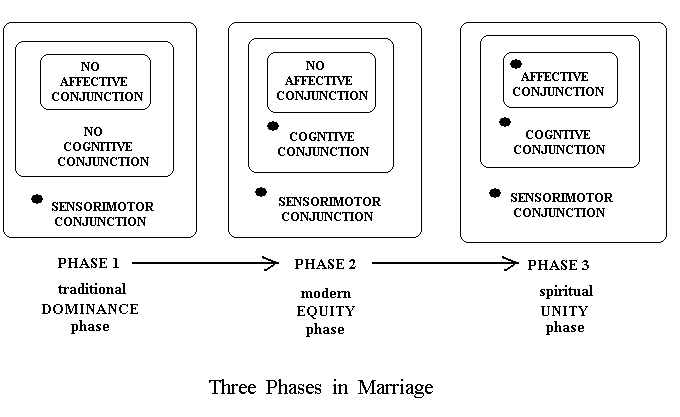
Study the
diagram. Imagine you're explaining it to your friend. Memorize the diagram.
Notice its various elements and how they fit together. It's a diagram about the
three phases of marriage that most, if not all, married couples go through, or
live through, but each couple in a unique way. Knowing the general principle of
the three phases can help you understand and manage your own relationships, or
to understand the relationship of others like friends and parents.
It's
important to understand that all three phases may occur simultaneously, but in
different degrees of overlap as the couple progresses to unity more and more,
which is a gradual process that takes years.
The diagram
pictures the threefold self of the two partners and whether or not they are
conjoined or united in each domain of the threefold self. Conjunction requires
intimacy and harmony or agreement. When a husband models his behavior according
to the traditional male dominance principle, the marriage is in phase 1 of
development. As the diagram portrays, this phase conjoins the couple at the
sensorimotor level, but not at the cognitive and affective levels. The
husband's thinking and way of reasoning towards his wife is governed by
tradition and social norms.
The wife is
required and expected to submit her thinking to this traditional mode so that
she thinks of herself as lower in status, authority, and freedom than men
(husband, brother, uncle, stranger). Later we will study how men act when they
behave from the traditional male dominance phase. So even if the wife in such a
relationship accepts the man's thinking as traditional and even appropriate,
she still can't conjoin herself to such male dominant views of women because
they are contrary to unity, something all wives crave for.
Young or
"modern" couples tend to spend time in both phases 1 and 2. The more
they see themselves in modernistic terms, the more situations in marriage that
they will handle according to the equity phase. This means that they do not
follow the traditional norms in many areas of interaction but negotiate with
each other on who does what when. This is when husbands share the domestic work
load and parenting, and consult their wife regarding financial and career
decisions. Most couples will alternate between equity and dominance phases
depending on the situation.
The diagram
shows that sensorimotor intimacy is present in both the dominance and equity
phases of marriage. But cognitive intimacy or conjunction only begins with the
equity phase. This is because the husband's thinking in many areas of their
interaction is now influenced by his wife's thinking more than by tradition.
What is the
difference between sensorimotor conjunction without cognitive conjunction
(phase 1) and sensorimotor conjunction with cognitive conjunction (phase 2)?
This will be studied in detail later on.
If the husband
is spiritually enlightened and looks upon his marriage as eternal, then the couple
can start performing more and more of their interactions through the unity
model. This means that he allows affective interdependence and gives up the
idea of his own emotional independence as a person. He begins to see marriage
as a physiological process of growing together to achieve a conjoint self -- no
longer a single whole individual, but part of a unit.
This is a long
process of maturation while the couple is growing in mental intimacy at all
levels of the threefold self. During this time the husband will regress towards
the dominance phase many many times, which will make his wife suffer mental
agony. But at the same time she now knows with certainty that they are going to
stay an eternal couple in eternity, and this gives her strength to endure the
husband's faltering episodes, hoping and knowing that he will eventually get
rid of them.
4. Unity Through Reciprocity
and Differentiation
Section 4
There are three
principles in the unity model of "conjugial love" described by
Emanuel Swedenborg (1688-1772).
- First
Principle--Differentiation: No spiritual or mental
part of a woman is like any part of a man and vice versa.
- Second
Principle--Reciprocity: The perfection of unity in
marriage increases with the diversity of its composing elements when
integrated into a conjoint self.
- Third
Principle--Eternity: The unity marriage relationship is
eternal, continuing in the afterlife of heaven.
According to the
first principle of marital unification the threefold self of men and women are
biologically and spiritually different. This amounts to maximum differentiation
or diversity in every part of the uniting components.
According to the
second principle, the diversity becomes unified through reciprocity by
which the traits of a woman can harmonize or fit together with the traits of a
man, and vice versa.
According to the
third principle, marriage is a spiritual union of mind and spirit that is not
just for this world -- "till death do us part," but is eternal,
since the spirit or mental self of a person is immortal (for more on this topic
see the Psych 459 Lecture Notes on Theistic Psychology: www.soc.hawaii.edu/leonj/theistic/mental-anatomy.htm
).
Here are some
illustrations of these three principles acting together. Consider where you are
already familiar with the unity of two different components through
differentiation and reciprocity (though not with eternity). At the physical level
we can see how a bolt, nut, and washer work together structurally to achieve a
tight grip on some object. The form of the nut must fit exactly the form of the
bolt. The bolt is different in form from the nut, and it is the particular way
they are different that makes them work together, reciprocally. They would not
work together as a unit if there was no differentiation and reciprocity between
them. Consider the same principle operating in other functionally related
objects like a hammer and nail, or like a purse and its strap, or a fork and
knife, or glove and hand, shoe and foot, etc.
The same
principle of reciprocity with differentiation applies to interactions between
partners. When you
dance, your partner must make the reciprocal steps (mirror image) -- not the
same steps, as you are making, or else you step on each other. In a four-part
harmony with men and women, in a quartet or other choir, the singers are
differentiated into soprano, alto, tenor, and base. This differentiation is
combined into a unity when they sing reciprocally according to the arrangement
prescribed for each part. The result is a harmony that is rich and attractive
but which cannot be achieved by any of the voices individually.
When you are
talking with someone you mostly alternate between speaker and listener. These
two roles are reciprocal and differentiated. When you are in the role of
speaker, the other person takes on the reciprocal role of listener. And so on.
All interactions therefore follow the law of reciprocity with differentiation.
Note the result
of the reciprocity with differentiation process: There is a synergy or separate
parts conjoined or acting together into a unity. The dancing couple is a unit
made of two differentiated components (two dancers) acting in reciprocity to
each other. The talking couple is a unit, with each alternating role-taking
interaction. When you kiss someone on the cheek, your lips and the person's
cheek are differentiated components in reciprocal relation or action. When a
wife holds a husband's hand the reciprocity can generate healing power (see
story below).
When a
functioning unit is formed, the components together can accomplish much more
than when they do not form a reciprocal unit.
For example, if
you are working on some project you will find it helpful to talk about it to
others or to consult other people for information and advice. Why is it helpful
to talk to others? When you talk, you form a reciprocal unit with that person.
It is known as creating "intersubjectivity." The two minds together
are capable of much more than one mind on its own. In general being with
others, forming a reciprocal unit of some sort, promotes teamwork, community
life, and society.
The marriage
unit is of course different from other units one can form. It is more basic,
more intimate, more complicated, and more enriching than any other unit people
can form. This is because of creation: Individuals are created for each
other, not for themselves. As you proceed with the unity model of marriage you
will begin to see why marriage is deeper than any other relationship human
beings can have, having critical significance for you to eternity.
Recently
in the news:
 Stressed Out?
Grab Hubby's Hand
FRIDAY, Dec. 22, 2006 (HealthDay News)
-- If you're a woman stressed out from work, holiday shopping, the kids or even
too much traffic, grab your husband's hand for instant relief. And if you're
spouse-less? Holding any male's hand is better than none.
That's the conclusion of a study published in the
December issue of the journal Psychological Science.
"Hand-holding is second nature for kids"
when they're under stress, said James A. Coan, assistant professor of
psychology and neuroscience at the University of Virginia, who led the study.
"This can also work for adults."
The happier the marriage, the greater the
stress-reducing benefit, Coan found. But
even a stranger's hand can help reduce stress, he said.
For the study, Coan recruited 16 married women who
scored high on his marriage satisfaction quiz and gave them magnetic resonance
imaging (MRI) scans of their brain when confronted with stress. He subjected
them to a very mild electric shock in three situations: by themselves not
holding anyone's hand; holding their husband's hand; and holding the hand of a
male stranger.
"First, we wanted to know what the brain is
doing when the women were completely alone," he said. "We got a
baseline of how the brain responds to stress."
Then, the researchers looked at the MRI images of
the brain when the women held their husband's hand or the stranger's hand.
"When your brain is under stress, it has to work hard, it has all these
different problems to solve," Coan said.
"We found when you are holding a hand, any
hand, the parts of your brain responsible for mobilizing your body into action
calm down," Coan said. "It doesn't matter whose hand it is. "
But a husband's hand provided the greatest
benefits. "Both hands calmed the
bodily reaction to stress," Coan said, "but only the spousal hand
can calm the mind, only a husband's hand calmed down the region of the
brain that keeps your emotions in check."
And the happier the marriage, the greater the
benefits. Among couples in the study who scored the highest on marital
satisfaction -- pairs that Coan termed "super couples" -- the women
got even more benefit from spousal hand-holding than did the other women.
Coan found that the region of the brain thought to
be associated with experience of pain quieted down even more in those women.
"If you are in a 'super couple,' hand-holding serves as a kind of
analgesic," he said.
Whatever the amount of benefit, Coan said he
believes "the brain works a lot less hard when there is someone else
helping us cope. One of my students said, 'It's like the brain is contracting
out some of the work,' keeping our brain less stressed."
Dr. Charles Goodstein, a psychoanalyst at New York
University Medical Center and a clinical professor of psychiatry at New York
University School of Medicine, said the study gives scientific credence to
long-time observations. "Interaction between members of a species can have
a momentous impact on emotion, and emotion can have a profound impact on bodily
functioning," he said.
Often, Goodstein noted, medications are used to
provide relief from anxiety and anticipated anxiety. "This study shows
that there is a better way."
From: www.forbes.com/forbeslife/health/feeds/hscout/2006/12/22/hscout600407.html
This is a cute
story. I'm glad scientists may be beginning to realize how special is the
relationship of husband and wife. Note that "super-couples" benefit
even more from hand holding. I hold my wife's hand when we are together
--watching TV, driving, walking. She says it calms her down. She misses it when
I forget to do it. When I was panicked about a surgical procedure on my face
the doctor let me hold her hand and it was very calming. When my wife had laser
eye correction surgery her regular eye doctor made it a point to be present and
held her hand. My wife found it very calming during the few minutes of
stress.
In the
sensorimotor domain of gender interactions we can see how a woman's body is
differentiated from a man's body, and how the parts of the man are shaped to
fit the parts of the woman. No doubt this is the analogy upon which electrical
objects are designated, as for instance the wall receptacle is called the
female and the plug is called the male. They act together to form a unit
through differentiation and reciprocity of physical form or shape. When you
consider sports teams, government departments, or armies, you notice a similar
reciprocity of different role behaviors, so that they can achieve joint action,
unity, or several acting as one. In fact throughout nature, and even the
universe, you will find a unified whole made of differentiated parts acting in
synergy. It makes sense therefore to have a model of gender unity that is based
on the two acting as one through differentiation and reciprocity.
A well known symbolic
representation of sensorimotor unity is the familiar Ying/Yang emblem.
According to ancient tradition, it "demonstrates the perfectly
balanced interchange of the two dynamically opposed forces of the Universe, the
dot represents integration." In Tai Chi and I Ching traditions, the white
area of the emblem represents heaven, the dark area earth and the curvy line
between them represents the Law or reality. In Feng Shui the Yin/Yang
represents the integration of Female/Male duality: "Yin and Yang are
dependent opposites that must always be in balance." And: "It is a
duality that cannot exist without both parts." (See for example this Web
site: www.168fengshui.com/Articles/Article_yinyang.htm
In other
words, it is the differentiation that makes the perfection of unity out of
reciprocity.
The man and the
woman as a couple can be totally integrated, or form a unity, because they are
completely different but in a way that is reciprocal. Nothing of the male
mind can be like anything of the female mind or else they could not conjoin
into a perfect unity (Yin/Yang diagram shows all white vs. all black for
the two). But they curve around into each other, in a perfect fit of reciprocal
union, the perfect circle. This is the principle of "synergy" which
is defined as "combined action or operation." It comes from the Greek
"synergos" or working together. In business "synergism"
refers to "a mutually advantageous conjunction or compatibility of
distinct business participants or elements (as resources or efforts)"
(Merriam-Webster Online).
The principle
of synergy operates universally where separate elements interact to produce a
joint goal.
Synergy is obvious
in the physical body where thousands of separate and differentiated parts work
together to produce the functions of a normal human body. How many parts does a
computer need to be able to function -- one million? To function means to
operate as a synergistic unit.
The more
there are parts that make a unit, the more perfect the unit is.
The human brain
contains billions of cells, and Swedenborg says that each cell is like a little
brain that is made of billions of other things that exist in a cell. To make up
the unit of a human being many billions and trillions of components had to be
created by God so it may operate in a synergistic unit. The physical world of
endless space and expanding galaxies of stars and planets, is the most perfect
natural thing created. Think of the numberless elements the physical world must
contain if just one cell of one plant contains billions of parts acting as one
cell. Through the positive bias in science it is known that to God infinite
things make a unit and function as one.
You can
comprehend a little better now the rational principle that the perfection of
a unit increases with the number of parts that operate in unison.
Our mental
organs are made of substantive elements from the Spiritual Sun in the mental
world of eternity. This Spiritual Sun is the source of infinite substantial
elements that continuously enter and enrich the mental world of humanity.
What is
difficult to comprehend with natural ideas of time and place is the difference
between the Spiritual Sun which is substantial in mental ether, and the
physical sun which is material in time-space. How would you describe the
difference to your friends if you wanted them to consider the issue from a
scientific perspective -- remember: not negative bias scientific, but positive
bias scientific (and this you will have to keep remembering yourself, and to
keep reminding your friends. Then both of you may have the opportunity to
examine this ideas rationally and with coherent explanations.
Think of your
dreams and day dreams. You are creating scenes with things and people in them.
You are recreating elements not only in your memory -- which is in the
cognitive organ, but in your affective organ of emotions and motives. Your
hopes, fears, and enjoyments are powerful operations in your affective organ.
They possess the power to influence, even control, the operations in your
cognitive organ -- hence what should be the content of your thoughts and
dreams. So the source of dreams or imagined things (C) is our love and its
affections (A), which operate in the affective organ (A).
Every thought or
daydream you ever had, every sensation you ever had, moment by moment all your
life, and every emotion or feeling or desire you ever experienced, are all
permanently recorded in your mental organs -- affective, cognitive, and
sensorimotor. The record is permanent because the components are immortal and
eternal -- sensations, thoughts, feelings in the spiritual body.
Swedenborg
confirmed by observation and experiment that this is true. He had the
opportunity to interview and experiment with thousands of people in their
afterlife of eternity. No operation in our mental organs, once it occurs,
can be erased or changed. People who had already been settled in
eternity for untold ages were easily able to recall any detail of their life on
earth, which was thousands of years since they had lived on earth. In order to
have access to earth memories they had to exit from their celestial
consciousness in which they were, and lower it all the way to the external
level called the natural mind. This is the mind that you are conscious in now,
as you read this and do your daily activities.
After we are
resuscitated, we are given the opportunity, actually the necessity, to make a
critical life changing choice. Is there any hellish trait we are unwilling
to part with?
If there is just
one trait you don't want to give up no matter what, your powerful affective
organ will activate this one trait to greater and greater intensity, until it
reaches paroxysms of excess, and the individual enters a mental state called
eternal spiritual insanity. This means that they prefer to suffer the mental
torments and inconveniences of a hellish mental life to a heavenly mental life.
Every person makes their own choice, in fact, every person feels compelled to
make the choice they love the most.
This is because
in the mental world of the afterlife there is no external limit or restraint to
hold someone in check, as there is here on earth. All actions here on earth
have their consequences -- physical, social, and legal. But all this disappears
from our focus after resuscitation, since we no longer have a connection to the
physical body and the world it is in. So once you are resuscitated nothing can
stop you from what you want to do. Except of course -- other people. Whatever
hellish trait you desire to hold on to, you will live with it forever in
eternity. Also, the hellish traits, whatever they are, tend to get worse and
worse as they devolve forever.
Heavenly traits
you love and want to hold on to in eternity create a beautiful world of
appearances in your consciousness. To you and to your partner, your life in the
heaven of your eternity is populated with others who desire and enjoy what you
do, but they also have a way of enriching your experience endlessly, every day
of eternity. This is the conjugial heaven that every individual has in the
upper layers of their mental organs. All we need to do is to acquire the love
for this heaven more intensely than any other love that we can have.
The unity
model of marriage is a method that helps us build such a heavenly marriage in
the course of our lifetime here, and then continue it in eternity.
Society is
viewed as made up of separate and unique family units forming themselves into a
community and abiding by mutual norms, laws, and expectations. The same
reasoning applies to the marriage relationship which society officially
sanctions and licenses. Society recognizes that a married couple forms a new
unit that acts together for common goals and that the partners are united by
positive feelings and loyalties. Married couples who live according to the
unity model represent the most perfect unit or a "one" that a man and
a woman can form together. Affective unity is the most essential, and it
influences the cognitive and sensorimotor unity that is possible for that
couple.
Unity is
achieved through the synergy of the threefold self of each partner acting
together. There is no independence in any area or under any
circumstance. All points of independence have been transformed into points
of interdependence. Even when the two are in physically in different
locations (e.g., at home vs. at work), they remain united because each
partner acts and thinks when alone as if the other were present.
In order for
this to be a reality, the husband has to learn his wife's preferences in all
things, just as his wife does that for him. He has to internalize his wife's
thinking and reasoning, just as she has done that about the husband in her
mind. When she realized that she was in love with the man, she felt compelled
by her love for him, to conjoin his attitude, humor, and style of thinking to
her own thinking. It's as if she has a little version or model of her
husband in her mind, and she is therefore able to interpret things according to
his interpretation. Sometimes women are so attached and so influenced in
this process of cognitive conjunction with their man, that they seem to their
girl friends to have changed personality after meeting the man she is in love
with.
But the man
lags behind this active process of unifying his mind to the woman's mind.
It's natural for
a boyfriend or a husband to express resistance to doing the same thing in his
mind about her, as she has done about him in her mind. Men spontaneously
resist the process of unification. They experience it as a threat to
their comforts and status of independence and superiority or dominance. However
if a man becomes spiritually enlightened, knowing the permanence of the
relationship to eternity, then he is powerfully motivated to unifying his mind
to hers. He will then inhibit the instinctive resistance he feels for giving
up his cognitive and affective independence.
Under this
powerful motivation he can compel himself to learn his wife's way of thinking
and reasoning. He can compel himself to listen to her, to actually listen, not
just pretend. Men by instinct and socialization, normally dismiss what a woman
says or thinks. He will deny this and he will pretend otherwise, but careful
observation by the girlfriend or wife will reveal whether he is willing to
internalize her way of thinking and reasoning, or whether he will continue to
fight it and dismiss it.
A woman in
the effort of conjunction, wants the man to think like her and to understand
how she thinks, first of all, and second, she wants him to like it, to love it.
She knows
whether he loves her way of thinking by the way he acts and talks. Every statement,
gesture, or facial expression of the man is an index the woman can read. Her
motivation to conjoin gives her perception of the man's inner resistance to her
and her effort to conjoin him to herself, to her bosom, so that she may be
his love as he has become her love. Through this mutual romantic love
between best friends and lovers, they can be a unity in eternity. In this
state of conjugial unity both he and she are magnified to their highest human
potential for which they were created to achieve in eternity.
Our culture
gives us the expectation that spiritual and sexual are opposed to each other. This false legend is most
harmful to people who adopt it as a justification for their life philosophy and
base their character and life on this opposition. The positive bias regarding
the Swedenborg reports clearly demonstrates to us that our life in eternity is
founded upon conjugial love. Swedenborg was told by both husbands and wives
that sexual pleasures among heavenly partners is experienced in their spiritual
body, and that this sensation is far superior to sexual sensations experienced
in the natural mind through the physical body.
This is because
the physical body actually acts as gross material filter that far diminishes
the mental sensation in our natural mind. After the loss of the physical body
and consequent resuscitation of the immortal spiritual body in eternity, the
natural mind becomes so weak and unimportant that it loses all functionality
and goes into a state of shut down or hibernation. We then have our conscious
awareness in the spiritual mind and the celestial mind, which are suited for
life in eternity.
The unity model
as a method of practice for married partners, helps them to achieve spiritual
unity in eternity. The experience of married partners still here on earth, who
are working within the unity model, is a foretaste of the spiritual and
celestial life they are going to have in eternity. This heavenly life in
eternity is possible for any married couple. The couple reaches this virtual
marriage heaven on earth when the husband is fully committed in philosophy and
attitude to act from the image of his wife within himself.
Before this
landmark, he acts from himself whenever he wants to, but he also can act
according to his wife's preferences, whenever he wants to. He remains
independent. He decides when he listens to his wife, and when he listens to
himself. This attitude, and the philosophy behind it, is anti-unity rather than
unity.
See what this
news article says regarding current thinking about marriage:
Love doesn't necessarily mean
marriage: survey
Fri Jan 4, 2008
12:04am IST
NEW YORK (Reuters Life!) - Four out of 10 Americans
say they don't need a marriage certificate to prove love or commitment,
according to a new online survey.
Overall, 44 percent
of the 7,113 Americans aged 20 to 69 who took part in the poll by Zogby
International and AOL Personals said they didn't need marriage to validate
their relationships.
"Across all
age groups, you just don't need a marriage certificate to mean love," AOL
Personals Director Keith Brengle told Reuters.
"People are
coming online to find that special someone but that special someone doesn't
necessarily translate into a marriage, and more so with the folks in their
60s."
Half the
respondents between the ages 20 and 29 said marriage wasn't necessary.
A majority of
respondents also said they would prefer to live together first before marriage
and most said marriage should truly be until "death do us part,"
especially those in their 30s (73 percent).
Trust was ranked
highly important to most singles polled, especially for those in their 20s.
Although
20-somethings said they were more open to experimenting with sexual
relationships, they were also more willing to end a partnership over infidelity
when compared to respondents in their 50s and 60s.
"Trust is
still extremely important for the 20-somethings -- they wouldn't work through
any infidelities, they'd walk away," Brengle said.
However, older
respondents were more interested in companionship, didn't feel the need to be
married and were more comfortable accepting infidelity "as a part of life."
"They've
probably been tested so they're much more accepting of things that
traditionally you would think they wouldn't be," Brengle said.
"As such
they're going to be less likely to have to snoop through a partner's things to
try to find indiscretions."
The survey also
found that as people age they are more likely to believe that more than one
soulmate exists.
A majority of those
polled said they would date someone their friends found unattractive, were
willing to date someone with different political or religious beliefs, a
different race or a person with a physical disability.
However, the poll
showed people were less willing to date someone with a life-long sexually
transmitted disease or someone with poor hygiene.
The poll was
conducted between Nov 9 and 12, 2007, and has a margin of error of +/- 1.2
percentage points.
(Reporting by
Natalie Armstrong; Editing by Paul Casciato)
The above is from: http://in.reuters.com/article/lifestyleMolt/idINL0312488620080103?sp=true
Once the husband
switches commitment to the unity model of eternal union, his main problem
becomes how not to lapse into his anti-unity mode of interacting called
disjunctive. He throws a temper tantrum and stamps his foot and refuses to
budge. His strategy is to keep arguing with her until she is exhausted and
emotionally drained. Then she has to quit, and he wins the argument. Or, else,
he walks out and deprives her of any further access and input to his mind.
Hence nothing gets resolved in her mind, and she suffers abandon by her
so-called friend-lover. Seduced and abandoned. When he returns, he does not
want to spend the effort of making things right again between them. Instead he
wants to express his emotions by having sex with her. This puts her in a bind
called sexual blackmail. If she says, "NO, you must make up for what you
did", he acts like he lapses back into the hostile mode. If she gives in,
she feels manipulated and furious at him, and at herself.
This and many
other things like this, have to be overcome by the husband or boyfriend, using
the strength and clarity provided by the wife or girlfriend.
This is how
unification is possible and in no other way, given the spiritual anatomy of men
and women, and the developmental psychobiology of the conjugial conjunction
process.
Unification is a
process of anatomical symbiosis and physiological cooperation through
interdependent cognitive and affective operations. Now the man is unwilling to
think or act from himself, as he so often did before, and feels guilt and
intense anxiety when he acts against his wife's way of thinking. But he
feels peace, security, and empowerment when he acts and thinks from the image
of his wife that he has incorporated within himself.
The
husband's approach is different when he acts from the "dominance
phase" in his mind. This idea of sharing the burden and the benefits, is
also transmitted in our socialization process and is part of our modern culture
so that everyone follows some norms of equity in various areas of living. This
is a good thing in public life because it acts to reduce discrimination against
women, which has been the traditional practice and still is for the most part.
Gender relationships in dating or marriage may start with men assuming
traditional dominant roles and women being submissive. But the relationship can
then move on to the equity phase which helps the two partners by reducing the
traditional heavy load of expected work on women, and can make their
relationship more intimate at the cognitive level. But the equity phase need
not be the last phase. The couple can then move into the unity phase which
affords still more intimacy at the affective level (see diagrams above).
Ask yourself
this question: If equity is given up for unity, which of the two partners
should be giving up their equal power which they had under equity?
If it is the
woman who gives up equal
power or equity, then the couple falls back into the traditional male
dominance phase that they started with, in which the man dominates the
woman in socially prescribed ways. On the other hand if it is the man
who gives up equity power in decision making, then they move forward into
the unity model, which leads to still greater intimacy, growth, and mutual
love as best friends and lovers to eternity. This conclusion will be reviewed
in detail in our class discussions throughout the semester. Be sure you
understand it as it is the key principle in achieving unity in marriage.
Why should
the man be the one to give up power sharing? Why should the woman end up with
all the power in the relationship?
The answer is
that it's not about giving up power but about cooperating.
The husband
intrinsically has all the power (physically, socially, financially, culturally)
and retains all the power, even under the unity model.
This is a fact
of life and society. The husband must compel himself not to use the power
that he has over his wife.
The wife never
acquires power over the husband, but the husband cooperates by not using the
power he could use.
So to observers,
it may look like the wife is dominant and powerful in the relationship
because the husband is always doing things the way she wants it done. The wife
instinctively takes charge of him in all the details of life, and manages them.
She tells him do this, don't do that, and, do it this way not that way. And he
says, "Yes, Sweetheart." and does what she wants. So to his
unenlightened friends it may appear that he is being dominated by his wife.
But to himself he appears enlightened, and he feels the happiness and peace of
conjunction.
And he also sees
that his wife is effective and intelligent in the things she takes charge of
and manages. But this is a process of gradual maturation and the husband will
regress back many times into the dominance mode of interacting. Nevertheless,
each time he is able to recover, and to continue with the maturation process.
EXERCISE 3.1
Read the above Sections 3 and 4 through
first. Then read it again with the following questions in mind (it's good to
type out notes for yourself as the ideas come to you).
1) To what extent do your current views on
relationships reflect your socialization experiences, including school, peer
group, and the media?
2) How much thinking and figuring out have you
done to see if some of these received views on couples and marriage are
possibly invalid perhaps injurious to the achievement of affective mental intimacy
between a man and a woman? (e.g. : soul mates, true love forever, best friends
and lovers, lasting romance, never ending passion and enthusiasm)
3) Examine and pinpoint some of your beliefs
and attitudes on man-woman relationships. Examine the lyrics of songs you
listen to -- how do they portray relationships, men, women, marriage?
4) What is your reaction to learning about the conjoint
self in the unity model? Describe to your partner or friend what this idea
involves, namely, unity, eternity, reciprocity, differentiation, mental
intimacy, interdependence, external and internal conjunction.
5) What is your reaction to reading that in order
to achieve unity and mental intimacy, the man has to compel himself to agree
with the woman whenever they don't agree?
By doing this the man becomes affectively interdependent with the woman, and
thus united. But when the man retains his disagreement he also retains his
affective independence, and this makes affective intimacy impossible since she
cannot trust that he will always protect her feelings. Affective intimacy for a
woman means that she trusts the man to protect her feelings no matter what the
situation or issue is (e.g., when a man gets angry or resentful or critical or
deceptive, he is hurting her feelings)
6) Discuss with your partner or friends the
diagram that summarizes the three levels or phases of marriage: male dominance,
equity, unity.
5, Sensorimotor, Cognitive,
and Affective Conjunction
Section 5
5.
Part A
Consider the
cognitive (C) and affective (A) domains of gender interaction in marriage. For
instance, a wife's depth of perception of a situation (her affective self)
contrasts with that of a man's, but the difference is such as to be reciprocal
with it. But if the man feels competitive with her, as in the male dominance
and equity phases, their difference in perception is then nonreciprocal,
incompatible, or opposite. Similarly, a woman's cognitive self complements that
of a man, which is why they find each other's ideas interesting and
stimulating.
A man ordinarily
resists the idea that the woman who loves him has a deeper perception of his
own feelings and motivations than he has himself. Women in relationship have
this greater awareness of feelings than men due to the confluence of biology,
gender socialization, personal experience, and spiritual anatomy. Hence
the unity model helps the man give up dominance and equity power that he
already has in the relationship due to external factors of society and culture.
To give up power and advantage in the relationship means that the man voluntarily
agrees to let the woman play the lead role in decision making when it comes to
their relationship areas. He always retains the power to disagree and to do
what he wants anyway, but he refrains from using this power because he is now
enlightened and can see that unity in eternity is possible.
He thereby
gains new power over himself that he did not have before. Now he is more of a
man than before, and she can love him for that even deeper than before.
For example, a
wife might request that her husband no longer talk to an old girl friend of
his. She feels very strongly about it. She perceives it from within, as
if it was instinct. In other words, she may not be able to give a rational explanation
of where it comes from or why she feels so strongly about it. She tells her
husband all this, yet he rejects it because he thinks differently about it. He
feels a certain loyalty to many of his old friends and doesn't want to give
that up, especially since the wife (or current girlfriend) can't explain her
demand in a way that makes sense to him. He and his old girl friend do not have
any romantic feelings for each other, so his wife (or current girl friend)
should not be jealous. That's how he thinks. So he argues about it with his
wife or girlfriend, instead of trusting her judgment about such relationship
issues.
Arguing and
refusing is part of the dominance phase. It is a power play by the man, to make
sure he can do what he wants, despite what the wife or girlfriend wants. The
message she is getting through this is that he is refusing to work for
affective intimacy between them. This can be hard and stressful on the
woman as it puts her in a double bind -- the man whom she loves, the man who
says he loves her, flatly refuses to share affective intimacy with her. His
goal in the relationship is to remain affectively independent, his own man,
doing what he thinks is right or wrong, regardless of what she thinks.
The same applies
to his men friends. If the girlfriend or wife wants him to quit doing certain
activities, and he keeps insisting that she doesn't make sense or that she is
not being reasonable, then he is refusing to become affectively intimate with
her. No matter what she says, how she argues and pleads, he defeats her and
refuses. He can get away with this affective disjunction because he has
all the power in the relationship, given to him by society and its norms.
This disjunctive
stand adopted by the man puts a hold on the inward (affective) growth of the
relationship.
She may not say
this to him, and sometimes she may not be clearly aware of it, but within
herself she knows that the relationship is not growing deeper. She hopes that
it can be amended but for now it's like a broken leg you can't use for walking.
She feels neutralized by his stance of affective independence. He has excluded
her and taken away her right or opportunity to make him change his stand, from
equity-dominance to reciprocity, conjunction, unity, oneness in mind to
eternity. He is keeping an area of his love sealed off to her. He reserves his
affectional territory for something for which she has no direct input. She
feels herself kept on the outside of his true love.
This brings her
emotional stress, lack of mental peace, hesitation in the relationship, and
confusion as to what is truly going on between them.
How do you know
if you and your partner have affective intimacy? In the unity model, the wife
perceives it and tells the husband, who accepts her perception. A woman
feels affective intimacy with a man when he makes her feel that he is motivated
to protect her feelings without exception.
This is not the
same as what is called "unconditional love" in the equity model. In
that mentality there is pressure on the woman to tone down the importance she
attaches to affective intimacy. This lets the man off the hook and not
progressing towards what she feels and considers is affective intimacy, namely,
feeling completely free to present to him her true feelings about him, his
behaviors, his traits, his attitudes -- which are things to which he exposes
her and requires her to deal with it herself. In the equity phase the man feels
that she is too demanding to require him to be what she wants him to be. And so
he will engage in fights and resistance to her attempts at a deeper affective
intimacy between them.
If she keeps her
insistence and continues the struggle with his resistance (instead of giving in
to him), then she is providing him with an opportunity to start agreeing
with her on some things, then enlarging the circle to all things. They will
then progress to the unity mentality of affective intimacy. She will then
feel like she, or her feelings (A), are safe with the man. She can then be
content at last, and growing in beauty, strength, and love. And he will at last
experience the woman's sweetness, which is heaven to him. Any man who has
experienced the sweetness of the love of the woman he loves in return,
will know experientially what is what is heaven on earth, and consequently what
is heaven in eternity. From that moment on he is spiritually enlightened --
which means being involved in preparing his character and behavior to be
conjugial in heavenly eternity.
Consider some
other common examples where the girlfriend or wife is anxious for the man to
change his manners and talking style for the sake of their greater affective
intimacy. He knows she wants him to stop using crude language. He knows she
wants him to get rid of some of his manners and habits that she finds
objectionable and beneath the style of life she wants for them. Her motivation
is that they be able to reach a deeper and higher human level of living
together. Her goal is eternal conjunction -- as long as the man wants to be
her best friend as well as romantic lover forever.
So she does
everything rational that a manager can do to facilitate the process and to
reach success with him, which is unity in eternity. She knows from her insights
in spiritual biology that in the state of unity with her, he is elevated to his
happiness, bliss, and full potential. She loves him, so she wants him to reach
this highest level of himself with her.
But the normal
response for the man to her attempts at unity in eternity is to resist and to
retaliate against her for even trying. He is 'dead set' or 'hell bent' to
fight to retain his affective independence as an independent person. He
does not yet see what she sees, so the fight between conjunction and
disjunction goes on, and on. This makes both men and women unhappy and unable
to reach their potential.
The battle does
not stop until either she gives up on him or on heaven with him, or, he gives
up on his independent personality and self.
He has to give
up his habit of rejecting her interdependent desires for the two of them and
maintaining his independent desires for himself. In other words, what is it
that prevents their affective conjunction and intimacy? Why can't they be best
friends as well as soul mate lovers? Best friends don't treat each other the
way he treats her when he decides it's all right to step on her feelings, to
disregard her opinion, to refuse to do something she asks him to do. As long as
the man insists on acting this disjunctive way with her, he is refusing greater
affective intimacy. The path to their unity must therefore be postponed as
long as he refuses her.
Now if we read
the above paragraphs from the equity or dominance phase in our mind, the first
thing we think of is "What about the woman? Does she has the right to
refuse what he wants?"
This question is
motivated by the desire to reject the unity model. Some men want to reject it
because it depends on the existence of eternal marriage in the afterlife. Some
women want to reject the unity model because it seems too idealistic, or
perhaps, unrealistic in real life with real people. Some men want to reject the
unity model because they are attached to the idea of retaining affective
independence, even if they love a girlfriend or wife. So one way of rejecting
the unity model is to think that it is not balanced, that it doesn't give equal
responsibility and effort to both sides, laying most of the responsibility on
the men.
But once these
objections in one's mind are put aside through the positive bias, one can
examine the unity model in its own perspective, as presented in these lecture
notes. As you go along you will be able to judge whether your understanding of
it is growing and whether it is rational in your own thinking. Finally, you
will be able to test out the model through empirical observations of the
threefold self of couples. At that point you will have developed an
educated perspective on the unity model. You can then take it with you, or
leave it behind.
This situation
can be better understood if we look at it in more detail as to what's going on.
In their relationship the man and the woman are interacting at the three levels
of the self: sensorimotor (S), cognitive (C), and affective (A). The process of
forming a marital unity involves the successive conjunction of the threefold
self of each partner to that of the other. The sensorimotor self of the man and
the woman are conjoined first as shown by the activities they enjoy doing
together--eating, playing, embracing, talking. These activities involve mostly
the "external" physical and external mental self of the
partners. It is called external because it is easily visible to them and to
others like their friends, parents, and neighbors. We can call this phase sensorimotor
conjunction.
In this phase
the man often takes the lead and exerts a dominant role. The woman follows
along with his dominance in order to keep the relationship going. Her motive is
higher than the man's. His motive is to please himself; her motive is to help
the relationship to go to a deeper level (cognitive and affective intimacy --
see diagrams above).
At the same time
that they are being intimate at the sensorimotor level, the two partners are
also interacting at the cognitive level, though this level of intimacy may be
only slight. At this cognitive level of the interaction, the woman takes the
lead. She strives to take the man's perspective, to learn his sense of
humor, to memorize the details of his life that he reveals, to acquire the
reasoning style he uses. Her motive in all this effort at cognitive
intimacy is to harmonize with the man and to please him. She understands
intuitively, and sometimes explicitly or consciously, that by making him laugh
and pleasing him by how she thinks, she will better succeed in conjoining the
man to herself. This will also help him feel that this is "his
woman", or at least, "his kind of a woman."
The man is
normally focused on himself, on his ideas, his plans, his goals, and he is
pleased when she shows interest in him and demonstrates that she remembers and
knows his ideas and his past. He is not thinking of her perspective, while
she is constantly trying to analyze his perspective. Obviously, this
differential effort and focus gives the woman a superior perception and
understanding of the relationship, that is, of the process of conjoining. This
cognitive communication of ideas between them can be described as reaching for cognitive
conjunction or cognitive intimacy.
Cognitive
conjunction is more visible than affective conjunction because it comes out in
their overt verbal discussions, their stated agreements or disagreements
on this or that subject. Long after sensorimotor conjunction has been
established, and after cognitive conjunction has been operating for awhile in
the relationship, the woman strives even more intensely to conjoin the man to
herself at the affective level.
She senses from
her unconscious spiritual self, and sometimes realizes it explicitly or
consciously, that the relationship won't be perfect or fully satisfying and
fulfilling, until they achieve affective conjunction.
This doesn't
just mean saying "I love you" even if this is said sincerely. Affective
conjunction means that the man has aligned his feelings with his woman.
In other words,
until he has given up his male prerogatives that are left to him by
society and tradition.
Society allows a
man to retain affective independence from the woman he is married to. This is a
male prerogative or inherent right given to him by society. There are other
male prerogatives like the "double standard" regarding pre-marital
sex, and even, extra-marital sex. Another male prerogative is to pay less
attention to what a woman says than what a man says. Expecting the woman in a
room to make coffee, take notes, clean up, etc. is another area of male
prerogatives in our society, and in most societies. To the extent that a man
exercises or practices the male prerogatives given to him by society, to that
extent he is opposing affective intimacy as a couple.
The
"good" husband is expected to provide for the wife's needs, to
support her in her side endeavors or activities, and to be decent to her. But he
is not expected to become dependent on her for his feelings about himself, for
his motives and goals in life, or for his ambitions and endeavors as a man. He
is expected to love her and be loyal to her, but not to give up his own
independent feelings and strivings. Affective independence is the practiced
norm for a man in most societies.
In contrast,
social and cultural norms require a woman not only to love her mate but to be
dependent on him for her feelings and emotions.
For example, in
most couples if she loves Italian food and he hates it, she is expected to give
up her old loves and adopt his loves (male prerogative to expect this). He
expects it and sees it as a sign of loyalty to him male prerogative to think
this way). If she complies with this (male prerogative) expectation,
he feels bonding with her.
Note that a man
feels bonding or conjunction when the woman becomes dependent on him in her
threefold self. But this kind of bonding is not true conjunction and cannot
lead to unity. That's because it's not what she ultimately and truly wants,
and needs, to be fulfilled. She needs for him to be the center of his
affective life. This means that whatever he is planning or doing should
relate to her in some way -- e.g., How will this affect her? Is this something
she would want me to tell her about? Would she go along with this? etc. These
are affective conjunctive thoughts that the man has when she is not physically
present.
Nothing he ever
does should be independent of her and her feelings, her opinions, her
principles, her preferences. This is affective intimacy and conjunction.
This is what the woman wants and craves for from her spiritual mind which is in
eternity. This is what truly and finally fulfills her as a woman, her feminine
task, what she was created for by God, and this is what allows her to reach her
innate potential. This is how she wants their love to become -- immersed in
affective intimacy, the two as-if one. He loves her feelings and ideas more
than his own. He is motivated to fulfill her wants more than his own.
All this he
wants to do because he has come to realize and understand that this is what he
was created for by God and this is what will make him maximally happy and
intelligent. This is affective conjunction or unity. This is not an ideal, or
an idea, or a principle, or a fantasy. It is a felt reality, the actual
experiencing of it. That's why this mental state is called "heaven on
earth" and after death "heaven in eternity."
5.
Part B
In the region of
"the heart", or spiritual love, which has to do with eternity, woman
rises far above the man in perception, rationality, understanding, and
consciousness. This is the result of her biological, psychological, and
spiritual anatomy. Therefore the gender syntax that produces unity involves the
husband becoming affectively dependent on the wife (vs. affectively
independent). This runs contrary to his past socialization and to his
current life philosophy, so he puts up enormous resistance--that the
woman has to overcome if they are going to achieve unity.
Both men and
women have three natures or levels of operation of life:
- a
biological nature or sensorimotor self (sensations, movements)
- a
thinking nature or cognitive self (thoughts, intelligence)
- a
feeling nature or affective self (feelings, loves, motives)
By the principle
of differentiation and reciprocity (as discussed above) it is clear that men
and women differ in their biological nature, they differ in their thinking
nature, and they differ in their affective nature. As stated before, there is
nothing in a man that can be like what is in a woman, and vice versa. This is
because sensations, thoughts, and feelings are mental operations that take
place in the spiritual body, which is born either male or female. Since this
spiritual body is immortal in the mental world of eternity, a male man remains
a male forever, and a female man remains a female forever.
Further, the
spiritual body is created by each unique soul that carries the immortal spiritual
DNA of every unique individual. A female soul creates female mental organs:
cognitive organ within, affective organ on the outside of it. A male soul
creates male mental organs: affective organ within, cognitive organ on the
outside of it. Every sensation, thought, and feeling in a male anatomy must be
different than any sensation, thought, or feeling in a female anatomy. All
human sensations (S), thoughts (C), and feelings (A) are either female in
origin or male.
This difference
in mental operations of the spiritual body corresponds to the difference in
physical operations in the physical body. Medical theory and practice is far
enough advanced today to recognize that the research done on men is not
indicative of how the drug will affect women. It is known that the blood of
women contains hormones that men ordinarily do not carry. Certain diseases
affect mostly men, others mostly women. All this suggests that the physical
body of women is not like the physical body of men. This is even more true of
the spiritual body and the sensations, thoughts, and feelings that occur there
(they do not occur in the physical body or brain -- remember that).
The threefold
self of a woman is unlike anything about the threefold self of a man, and vice
versa. This makes unity between them possible (see the principles of
reciprocity and differentiation discussed above).
Biological
differences between them are obvious in the anatomy and appearance of their
physical body and in how they enjoy things (S). Rational differences (C)
between men and women result in the reciprocal orientation and focus they each
have. When a man's cognitive (C) focus is reciprocal to the woman's
cognitive focus, they can conjoin and reach cognitive intimacy. To conjoin
means to allow mutual influence on each other. To resist influence on each
other is called disjunctive behavior.
When a man
retains affective independence he is performing disjunctive behavior because he
is resisting influence from his wife or girlfriend. To accept influence is
conjunctive behavior. For example, if she wants him to do X when he wants to do
Y, then if he does X he is accepting her influence on his affective operations.
This is practicing affective conjunction and intimacy.
In the equity
way of thinking, the man expects an exchange: If he does what she wants on this
occasion, then she should do what he wants on some other occasion, and in this
way they can get along well. This is how a man thinks in the equity phase. But
this kind of equity arrangement cannot lead to unity because it interferes with
affective intimacy. A man who bargains with his wife or girlfriend is showing
her that he wants to retain affective independence.
Note this
well:
When a man is
ready to give up affective independence he does not ask the woman to do what he
wants, when she wants something else than what he is offering. But when a woman
asks the man to do what she wants rather than what he wants, she is practicing
affective interdependence, mental intimacy, spiritual conjunction, and eternal
unity. This may sound invalid or unfair -- when viewed from the dominance and
equity mentality. But when viewed from the anatomical and biological
perspective in the unity model, it is valid.
You need to
review the argument as we got here, if you are not completely clear on why the
above is rationally and anatomically valid. Write down your questions, bring
them for class discussions.
A man and a
woman have different functions for their thinking, that is, they think
differently using different cognitive procedures. A woman might say or think X
and a man might say or think X yet they are not thinking the same thing. A
woman uses thinking in the relationship for the purpose of achieving intimacy
because that's the way she defines herself, while a man uses his thinking for
the purpose of retaining independence because that's the way he defines
himself. This is one reason they are called "opposite" sex to
each other.
A man prior to
practicing the unity model wants the woman to give up her feminine thinking and
think like him instead. This is impossible for nothing in a man can be like
anything in a woman, and vice versa. On the other hand, he can give up his
affective independence so that his thinking (C) now responds not just to his
own preferences and purposes (A), but to her preferences and purposes as well
(A). The affective organ always directs the cognitive organ, that is, the
will (A) always directs the understanding (C). Prior to practicing the unity
model the man's thinking (C) is directed by his own will (A), but once he
starts practicing the unity model, his thinking is directed by her will (A) as
well as his own will (A). Thus he is no longer mentally independent, as if he
were still alone.
In this way
the man's thinking is elevated to a new level of consciousness, intelligence,
and wisdom known as the conjoint self (versus his prior independent self).
But when he
refuses to give up his affective independence, his thinking remains where it
has always been, unable to achieve the higher levels of his own masculine
humanity. It's obvious therefore that "giving up" affective
independence is not losing something but gaining a whole new level of life for
a man.
When a husband
is committed to giving up affective independence, he is conjoined to his wife
at the inmost or affective level of intimacy. This is a spiritual conjunction
that lasts forever. It has a built in dynamic for dissolving disagreements.
Not a single disagreement can arise between them no matter what -- and if it
does arise, as soon as it has arisen, and he notices it, he puts his
disagreement away. This is because they have learned a reciprocal unity
style of interacting at all three levels of the self.
In the early stages
of this practice the man may experience lapses during which he finds it
difficult or impossible to lay aside his disagreement and follow the woman's
desire or request. When he does have a lapse or a relapse, it will not last. Sooner
or later, either minutes, hours, or days, he will come to realize that he he
cannot achieve unity if he insists on maintaining a disagreement whenever he
feels like he wants to or must. He will then give in and lay aside the
disagreement, once more rejoining her in affective intimacy.
Sensorimotor
conjunction or
intimacy is the mental state of husband and wife in which their sensations and
physical actions are mutually and reciprocally interdependent. The
pleasures they enjoy are centered around making each other happy. For instance,
what the unity husband enjoys most is to keep his wife feeling comfortable, and
her desires or preferences satisfied. He talks to her softly in a pleasant
voice with a smile or happy appearance. He keeps himself clean and groomed,
wearing the kind of apparel that she approves of.
Sensorimotor
disjunction or independence exists when the husband insists on his own comforts
and pleasures. His
focus is then on himself, not his wife, then himself. If he is in a bad
mood, he scowls and makes gruff sounds and noises. He neglects his appearance
in front of her. He acts like he acts when he is alone. This is sensorimotor
disjunctive behavior. It is negative intimacy -- unfriendly and unsexy. The
wife feels frustrated, disturbed, defeated. Unloved. No longer special in his
eyes.
It's common to
observe in public couples walking together and carrying things -- at airports,
on the streets, in stores and restaurants, etc.. More often than not you will
see the woman carrying a greater load than the man. Maybe a child and a big
bag, while the man has his hands free. Or at airports you see the woman carry
two big bags and the man she is with is carrying one bag. These interactions
result from the man's sensorimotor independence or disjunction. He is not focused
on his woman or their relationship. He relegates her to second class
citizenship doing the menial jobs. He takes her for granted. He considers her
an object of possession. He practices his male prerogatives in all three
domains of the threefold self -- what he does with her or how he treats her,
what he thinks of her, and how he feels towards her femininity (chivalrous or
anti-chivalrous).
Another area of sensorimotor
disjunction is the fact that often husbands in the male dominance phase
will satisfy their sexual appetites for years and make hardly any effort to
discover anything about their wife's appetites or satisfactions. This is
because the man's focus is mostly on himself, even during "love
making". This is different when the man operates from the equity phase,
in which case he is motivated to alternate between focusing on himself and
focusing on his woman. This again changes when the man commits himself to the unity
model, in which case he is strongly motivated not to alternate, but to keep
his focus always on the wife.
It helps to
contrast clearly the differences between the affective (A) and sensorimotor
(S) parts of the threefold self.
Often people use
the word "feeling" when they mean thinking (C), and vice versa. For
example, people say, "I feel that we should wait longer" when they
are discussing what they think (C). Sometimes feelings (A) are confused with
sensations (S). For example, "I feel hot flashes coming on" or
"I feel so tired." In both cases it is not the feelings (A) that are
discussed but the sensations (S). When we say "It feels so good" we
are talking about a sensation (S). When we say "I feel good today" we
are talking about an affective experience (A). The expression "I can't
stand it" refers either to a sensation (e.g., being tickled) (S), or to a
feeling (A) (e.g., feeling bad about the situation).
The sensorimotor
area of the threefold self includes these primary features of our everyday
life:
- sensing physical pleasures, or pain
- sensing excitement in the stomach or other parts
- sensing being scared, or calm and
relaxed
- experiencing a healthy well being, or being sick
- sensing physical attraction for someone
("vibes", "chemistry"), or the opposite
- coordinating one's movements with partner, or
acting independently
- expressing positive or negative emotions through
the tone of the voice, gesture, and face
- performing any activity with the body
- the appearance we have (expression, clothes,
activity)
- all our possessions are extensions of our
physical body and its sensorimotor sphere
- etc.
The affective
area of the threefold self includes these primary features of our everyday
life:
- feeling good and hopeful, or bad, depressed
- feeling hesitant, unsure, or confident, eager
- feeling apprehensive, anxious, or calm,
reassured
- feeling resistant, rejecting, or cooperative,
accepting
- feeling connected, or alienated
- striving to reach a goal, or having no
motivation
- perceiving from within that something is right
and good, or not (conscience, insight)
- feeling guilty, embarrassed, ashamed, regretful,
or not
- feeling calm, cool, and collected, or the
opposite
- etc.
Do you get
the difference? Note that the affective always comes first in the sequence of
our behavior. We do something because we are motivated to do it or we have a
desire to do it (affective). We are motivated to do something to achieve
a particular goal (affective). Every goal is defined by what we want
or desire or prefer to happen (affective). Therefore all human
action starts from a feeling -- what we want or intend to happen, together with
a goal that satisfies what we want.
The sequence
of execution in behavior is always ACS: A ---> C ---> S
(A)
affective (wanting to do
something) ----> (C)
cognitive (planning) ----> (S) sensorimotor (executing or performing)
Once we
have a feeling, motive, or particular goal that we desire to happen
(affective), the next behavior in sequence is the cognitive self. Our thinking
operations (C) suddenly begin to figure out a plan or method of proceeding that
will bring about the desired goal (A), and thereby satisfy the feeling
(A). It is the feeling (A) that motivates, guides, and directs (A) the
thinking and planning (C). It is the feeling-intention or
striving for the goal (A) that keeps the sequence of mental operations (C)
focused in a coherent way so it may lead to the desired goal (A).
For
example, you become aware that you are thinking (C) about the candy bar in your
pocket or purse. What made your thoughts go in that direction? It had to be some
kind of feeling (A). When we sense hunger in the stomach (S), the sensation
becomes the occasion for a new motive (A), namely, the desire to satisfy the
hunger (A). This desire or feeling (A) then awakens our thoughts and memories
(C) to think about the candy bar (C). Another feeling or motive (A) can take
over, namely, the desire (A) to control one's weight. This new feeling (A) now
directs the cognitive to plan (C) a substitute for eating, or a way not to
ingest certain foods (S), and the sensorimotor then carries out (S) the
motivated (A) plan (C) (e.g., inhibits the hands from reaching for the candy
bar). Either way, the sequence of execution is always the same (ACS):
affective, cognitive, sensorimotor.
It is the
reverse with the sequence of reception which is always SCA:
A <--- C <--- S <---- environment
noticing or
sensing something in the environment (sensorimotor) ----> appraising it (cognitive) ----> evaluating it (affective)
Once the
feeling or desire (A) and the thinking about the candy bar in pocket or purse
(C), are placed together or conjoined, the hand starts reaching (S) for the
candy bar or the legs start waking (S) to the kitchen.
But then you
stop the hand or the legs from going further (ACS). "Wait. I'm on a
diet and I want to lose weight. Remember?" What's happening here? It's
another feeling (desire, motive) (A) that takes over and this new
feeling (A) now directs the thinking (C) and the moving in another direction
(S).
So whatever we
do all day long minute by minute, has to do with sequences and loops of
feelings, thoughts, and sensorimotor executions of them (ACS). Note that the
SCA sequence happens along with the ACS sequence in alternating cycles. We
notice something (S), we think about it (C), and we react to it (A) (happy or
sad, attractive or repelling, etc.). This is the SCA cycle. Then we form the
intention (A) of holding it, so we see a way of grabbing it (C), and we reach
for it (S) or inhibit reaching (S). This is the ACS cycle. Note that the SCA
cycle is called "reception" while the ACS cycle is called
"optimizing." Reception (SCA) is passive (feminine, left hand and
side), while optimizing (ACS) is active (masculine, right hand and side). Thus
both men and women have a feminine side (receiving, satisficing, valuing) and a
masculine side (optimizing, giving, engaging).
All affective
operations (motives, feelings, intentions, valuations) (A) are dynamically
ordered in a top down hierarchy or networked nodes. For instance:
A1
striving to keep alive, safe, out of trouble
A2 wanting to avoid hurting certain people
A3 keeping track of our belongings, money
A4 striving to maintain a healthy diet
A5 having a good time, fun, pleasure
A6 enjoying eating chocolate and candy several times a day
A7 intention to get the candy and eating it
This example
shows that the desire to get the candy (A7) is the lowest in the hierarchy of
motives for this individual. Six higher motives exist that relate to it. Since
affective operations are in a control hierarchy relative to each other,
a higher motive "trumps" a lower motive if it interferes or becomes
engaged in the operation. The motive to maintain a healthy diet (A5) trumps the
motive of enjoying eating chocolate (A6) which then inhibits the intention to
get the candy (A7) so that no candy will be eaten. But this happens only when
the higher motive (A4) is engaged in the situation. If it is "asleep"
or "looking the other way" or disengaged from the situation as not
relevant, then the lower motive (A7) will direct and execute, and candy will be
eaten.
By
self-witnessing or self-monitoring ourselves in a systematic and persistent way
in the course of our daily activities, we gradually learn to distinguish
between the actions of the threefold self (ACS) and how the affective hierarchy
of our feelings (A) dominates and rules our thinking (C) and doing (S).
Most people
prior to self-witnessing are not fully aware of the feelings they have and
their relative hierarchy of power over the threefold self. What we don't know
about ourselves, we cannot control or modify even if they are maladaptive and
are the source of negative consequences. It is to everyone's advantage to
get to know the hierarchy of feelings they have in the course of their day.
Here is a summary
table to memorize: (read Table from bottom up)
Table 5B.1
|
PRINCIPLES BY WHICH HUSBAND
GOVERNS HIS BEHAVIOR
TOWARDS HIS WIFE
|
HOW THEY BEHAVE TOWARDS ONE
ANOTHER AND CONSEQUENCES ON WIFE
|
|
Phase 3
UNITY
MODEL
|
spiritual marriages
("Till endless eternity in afterlife")
|
husband chooses to act
from his wife’s preference (or "will"), rather than from his own
will, thereby unifying the two into one conjoint self in eternity
|
|
Phase 2
EQUITY
MODEL
|
modern natural marriages
(“Till death do us part”)
|
the two negotiate
consensual arrangements, based on equal rights principles, so husband agrees
to help in domestic activities. However, he reverts to dominance when he
chooses
|
|
Phase 1
DOMINANCE
MODEL
|
traditional natural marriages
(“Till the husband decides to divorce his wife”)
|
wife is submissive and
obedient to husband and his family, and must endure societal sanctioned abuse
of women by men
|
See if you can
follow the themes in each cell in the above Table. Try to see how these names
and descriptions apply to your experience with couples, partnerships, and
marriages:
- yourself
- parents
- friends
- movies
- song
lyrics
- jokes
- group
practices, norms, and expectations.
Review what you
know about each of these items in the list above. Are the Table cells helpful
in organizing and characterizing what you are observing when you examine these
areas of daily life? For example, think about the meaning of lyrics to songs
you enjoy listening to and singing along. Do they portray the male dominance
pattern of relationship between men and women? (e.g., abusing women or using
them as sex objects, etc.). Or what about your favorite sit come or movie:
Which model of interaction do they portray between women and men? Do your
parents fit one model more than another? Have you ever seen the unity model
portrayed? What about old fashioned romantic songs and movies that talk about
love being forever?
Spiritual
marriages enhance natural marriages through the new creation of the conjoint
self. Masculine and
feminine intelligence (C) act in differentiated synergy to enrich their
rationality and wisdom in daily choices and decisions. Feminine and masculine love
(A) act in reciprocal synergy for empowering husband and wife in all aspects of
the personality and self. Feminine and masculine bodies and sensorimotor organs
(S) act in familiar synergy that delights, intensifies, and fulfills their
affections and desires (A).
Spiritual
marriages are based on the unity model which requires two conditions:
- (I)
that they both think of their marriage as eternal, unique, special, never
ending, eternally improving; and
- (II)
that the husband chooses to act from his wife’s preference (or
"will"), rather than from his own will.
The first
condition requires that they have a rational idea of God and of life after
death in a spiritual body.
The second condition
requires that the husband loves his wife and is willing to treat her with
chivalry and respect for her femininity or "womanness." This is the
recognition that all women deserve chivalrous respect from every man. In the
eyes of the unity husband, the wife in her feminine character is the
representative of all women. Chivalry for a husband is to act according to
his wife's will or preference in all things of their interaction. When this is
adopted by the husband as a daily spiritual discipline, it is called the Doctrine of the Wife (available
at: http://web.archive.org/web/20161031210444/http://www.soc.hawaii.edu/leonj/theistic/ch11.htm
)
From
Swedenborg's direct observation of couples in their heavenly layers of their
mind:
CL 213. III.
THAT WITH THOSE WHO ARE IN LOVE TRULY CONJUGIAL THE HAPPINESS OF COHABITATION
INCREASES BUT WITH THOSE WHO ARE NOT IN CONJUGIAL LOVE IT DECREASES. That the
happiness of cohabitation increases with those who are in love truly conjugial
is because they love each other mutually with every sense. The wife sees
nothing more lovable than the man, and the man nothing more lovable than the
wife; yea, neither do they hear, smell, or touch anything more lovable. Hence
the happiness of cohabitation that is theirs in house, chamber, and bed. You
who are husbands can confirm this from the first delights of marriage, these
being in their fullness because then, of all the sex, it is the wife alone who
is loved. That the opposite is the case with those who are not in any conjugial
love is well known. (CL 213)
As you
continue studying the following Sections, be sure to integrate them in your
mind with the above Summary Table.
You actually
need to integrate all the Tables in these Lecture Notes, and then you will see
clearly how this unity perspective can give you a rational understanding of
marriage.
You might want
to print out just the Tables, and study them together, trying to integrate them
into your understanding. A good method is to try to explain the Table to
someone.
Here is a recent newspaper article that discusses recent
findings on marriage:
The key to wedded bliss
by Graham Payne and Dan Ballard
February 11, 2008
A FEW simple questions could hold the key to
whether a marriage will last or end in divorce, according to a study.
John Gottman, an emeritus professor of
psychology at the University of Washington and founder of what the media termed
"The Love Lab", where much of his research on couples' interactions
was conducted, headed the experiment.
He says he found the answers given by a sample selection of married couples
helped his researchers come up with an amazingly accurate prediction as to
those who would stay together or split.
"After computer analysis, we predicted which of the marriages would end in
divorce.
"We never told the couples, of course, but four years later, our
predictions were 94 per cent accurate."
That prediction was based solely on the couples' answers and how they
interacted during a 15-minute discussion of the two problem areas in their
marriage.
The 12 questions that couples were asked were carefully compiled after months
of research.
"They're clever because couples don't know what answers are expected of
them, and so they're not constantly trying to show themselves up in the best
light," says Prof Gottman.
The questions – which focus on nine areas of a marriage, including how husband
and wife deal with marital disappointments, negative feelings and affection –
are now to be specially constructed to apply to engaged couples and might even
be available for personal computer testing.
In evaluating the replies in the study, Prof Gottman's researchers measured:
• Affection towards the spouse.
• Negative feelings towards the spouse.
• Expressiveness about the relationship versus withdrawal.
• "We-ness" versus separateness – how connected and intimate the
couple felt.
• Feelings of chaos or control over events in the couple's life.
• Glorifying the struggle – pride in getting through hard times.
• Disappointment and disillusionment with the marriage, difficulty in
expressing what makes a marriage work.
The single, most potent predictor of divorce was found to be the husband's
disappointment with the marriage. Among couples who divorced, the husbands were
found to be "low in fondness, low in 'we-ness', low in expressiveness,
while high in negativity and marital disappointment".
For the wife, the most important predictors of divorce included being low in
"we-ness" and high in marital disappointment.
The researchers did find that some disagreement – and well-vented anger – could
be good for a marriage.
But other negative behaviours, including defensiveness, stubbornness or
withdrawal, were likely to lead to divorce.
Do you dare try them?
1. Tell how the two of you met for the first time. Was there anything about
him/her that made him/her stand out? What were your first impressions of each
other?
2. How long did you know each other before you got married? What do you
remember of this period? What were some of the highlights? Some of the
tensions? What types of things did you do together?
3. Tell about how you decided to get married. What led you to decide that this
was the person you wanted to marry? Was it an easy decision? Was it a difficult
decision?
4. Tell what you remember about your wedding. Did you have a honeymoon? What do
you remember about it?
5. What do you remember about the first year you were married? Were there any
adjustments to being married?
6. If you are parents, tell what the transition to this period of your marriage
has been like.
7. Looking back, what moments stand out as the really good times of your
marriage?
8. Many couples say their relationships go through periods of ups and downs.
Would you say this is true of your marriage?
9. Looking back, what moments stand out as the really hard times in your
marriage? How did you get through them? Why do you think you stayed together?
10. How would you say your marriage is different from when you first got
married?
11. Why do you think some marriages work while others don't? Think of a couple
you know who have a particularly good marriage and one couple who have a
particularly bad marriage. What is different about these two marriages? How
would you compare your own marriage with each of these?
12. What about your parents' marriage. What was/is their marriage like?
Would you say it was/is very similar or very different from your own marriage?
From: http://www.news.com.au/story/0,23599,23192307-5015723,00.html
EXERCISE
5.0.1
Read the above Section (5A and 5B) through first.
Then reread it while typing notes about the following issues. Then discuss them
with your partner, friends, or class teams.
1) Explain what are the three types of conjunction
possible within a couple. How are they different. Give various examples for
each type of conjunction in the threefold self of partners. Examine each type
of conjunction in your experience as a couple, or a couple that you know well
(parents, friends, TV).
2) The Section also discusses the threefold self
of women as different from the threefold self of men. Hence the man and the
woman are not pulled in the same way when they work for greater mental intimacy
between them. Describe this differential dynamic based on how woman is and how a
man is, or, what a woman wants and what a man wants. Also this: what a woman is
willing to settle for if she has to, but not if she can get what she prefers in
the relationship.
3) Explain why it is that in order to achieve
mental intimacy the man has to compel himself to do what the woman wants, but
not vice versa, unless she wants that. How do you account for the apparent
lopsidedness of the unity model? If you think this is not valid or unfair,
examine whether you are thinking about this with the equity or dominance
perspective or assumptions.
4) What are the reactions of people you are
talking to about these issues? What conclusions do you draw from their
statements and beliefs?
Section
5.1 Selections
from : www.soc.hawaii.edu/leonj/theistic/ch6.htm#sex
5.1
Part A
Sexuality is a key
issue in most people's lives and is an important topic in any society. For
example, the word "sex" is the most frequently looked up word in Web
search engines. If you look up the word sex in the top ranked Web search
engine, www.google.com (November 2007), you get an astonishing
520 million registered Web pages that use this word. The word "God"
receives 450 million hits, which is pretty impressive to me, compared to
"food" which receives 570 million hits. Just to get a real contrast
the word "psychology" receives 100 million hits, the word
"mother" receives 260 million, and "money" is listed on 675
million Web sites. "Patriotism" has 12 million, and
"morality" has over 21 million. "Rationality" has 9 million,
"Swedenborg" receives 800,000 hits, Leon James gets 58,000 (not just
me), and theistic psychology gets just 36 (most by me and the generational
reports).
Why do the topic of
money and sex come out on top? The topical frequency of occurrence on
the Web is a measure that reflects the mental frequency of occurrence of
this topic.
A popular or
"hot" issue in society is a hot issue in the minds of the majority of
people in a community or nation. The hot issue in our mind about sex is
caused by the non-exclusive love of the sex that is built into the affective
organ of every mind, but in a different way for men than for women.
The unity model
distinguishes two forms of sexual love or activity, one that belongs to our
spiritual mind in eternity (our higher nature), the other to our natural mind
or lower nature. People grow up with the indiscriminate enjoyment of sex, that
is, the capacity to enjoy sex with many people. When people dance at a party
with multiple partners they are capable of being sexually aroused by many
individuals. They are able to enjoy pleasure by being touched by various
people, not just one person. Humans have this "corporeal" pleasure
like animals do, who can enjoy being petted by many people. At the sensorimotor
level, humans have the capacity to enjoy physical pleasure from multiple sex partners.
But this is more difficult to do at the cognitive level, and almost impossible
to do at the affective level.
Human sexual activity
always involves the threefold self -- sensorimotor (S), cognitive (C), and
affective (A).
Look again at the
diagram that was discussed above:
Let us summarize the
four situations in which human beings engage in sexual activity:
Phase 0 Sexual
Activity: Sex Without Mental Intimacy (not
on the diagram above)
Non-exclusive sexual activity with a succession of partners at different
times.
Phase 1
Sexual Activity: Sex With Sensorimotor Intimacy Only (male dominance phase)
Exclusive sexual activity in the male dominance phase of marriage or
dating.
Phase 2
Sexual Activity: Sex With Sensorimotor and Cognitive Intimacy (equity
phase)
Exclusive sexual activity in the equity phase of marriage or dating.
Phase 3
Sexual Activity: Sex With Sensorimotor, Cognitive, and Affective Intimacy
(unity phase)
Exclusive sexual activity in the unity phase of marriage or dating.
Most people start
sexual life at Level 0 and move on, though some stay at this level forever.
This means that they are not working to achieve marital unity. Many people come
to realize that non-exclusive love of the sex, which is lacking in mental
intimacy, is a trait that human beings share with most other animal species,
and that in order to raise ourselves above the level of animals, we need to
cultivate a love for an exclusive and intimate sexual relationship with one
person. This is the meaning of "spiritual marriage" (unity phase)
Psychologists who
reject life after death cannot see the difference between natural marriage
("till death do is part") and spiritual marriage ("till
eternity"). They do not see spiritual marriage as real so they cannot
study it or advise people about it. It is not possible to do research on
something that they define as non-existent.
Exclusive sexual
activity occurs at progressively higher levels of mental intimacy.
Phase1 sexuality involves the sensorimotor system of the two
partners as the central feature, with less importance attached to cognitive and
affective intimacy. In other words, when a couple's dating becomes exclusive
they enter a phase of sensorimotor intimacy in which they are physically
intimate with each other to various degrees, depending on the couple and the
situation. During this phase they are not yet cognitively intimate, and not yet
affectively intimate. They each think their own thoughts (C), have
their own emotions and feelings (A). They are not cognitively intimate
since they do not share their thoughts and plans (C). They are not affectively
intimate since they each feel responsible for their own emotions and feelings (A).
But if they continue
dating as an exclusive couple, or if they get married, their sexual activity is
going to change to Phase 2, which involves both the cognitive as well
as the sensorimotor phases of conjunction. Now their sensorimotor sexual
activity (S) is different from their previous sensorimotor activity in Phase 1
sexuality. The sensorimotor sexual activity is more intimate than before
because it is intertwined with the cognitive intimacy of knowing each other's
attitudes and values, being familiar with each other's sense of humor, being
able to talk about various things and understand each other, etc.
Finally, Phase 3
sexuality involves the affective phase of intimacy along with the cognitive
and sensorimotor intimacies. Sexual pleasure (S) is more personal,
satisfying, and meaningful when it is in the context of cognitive and affective
intimacy. The partners feel for each other and their sexual emotions are
magnified due to this mutual feeling of sympathy and friendship. More
details will be discussed below.
Notice that the
non-exclusive love of the sex with many is natural, like that of some
animals, and it is not intimate,
while the exclusive love of the sex with just one is
intimate and spiritual, thus specially human. It is known that some animal
species also show the characteristic of exclusive mating relationship
maintained for life. This corresponds to the unity model, but of course this is
biologically based rather than spiritually or rationally as it is with humans.
People differentiate
between "having sex" and "making love." Only the latter is
considered mentally intimate. Sexual activity (S) without mental intimacy (C,
A) is a lower form of human pleasure and satisfaction than intimate sexual activity
(S). The highest and most satisfying human form of sexual activity is achieved
in the unity phase of the relationship (Phase 3 sexuality). This is
because the sensorimotor activity of sex (S) is then the result of
cognitive (C) and affective (A) intimacy.
To understand the
precise difference we need to focus on the difference between
"non-exclusive" sex vs."exclusive" sex.
Definition:
To love non-exclusive sex is to love one's own pleasure in the
activity with whomever is available or suitable. The identity of the
partner is of little importance in relation to one's own pleasure.
But to love exclusive sex is to love a particular person sexually.
The identity of the partner is of central importance in relation to one's own
pleasure. "Identity" does not mean merely knowing the person's
name but the person's thinking (C) and feelings and values (A), and this
requires mental intimacy.
Quite a difference
between the love of non-exclusive sex and the love of the exclusive sex.
Everyone retains the
physiological ability to enjoy non-exclusive sex, but those who develop the
love of exclusive sex inhibit and lay aside their former capacity for
non-exclusive sex. Women can do this immediately but men lag behind so that
even though they feel the love of exclusive sex men are unwilling to give up
certain forms of non-exclusive sex like pornography, voyeurism, exhibitionism,
sexual fantasies. Marriage counselors who do not recognize spiritual marriages
sometimes counsel couples to watch sexually arousing videos together or to
imagine themselves having sex with someone else. But you can see from the
positive bias perspective that mental infidelity is even more real than
physical infidelity because what is mental is spiritual and eternal.
Watch this video and
contrast the views of the husband and wife:
http://video.ivillage.com/player/?id=0#videoid=155984
The non-exclusive love
of the sex apart from the person, is a mental operation in the affective organ
of the corporeal mind, which is the lowest part of the natural mind, a part
that we share with animals. The non-exclusive love of the sex by humans is very
similar to the love of copulation and mating by animals. Non-theistic biology
and medicine in the negative bias perspective, view all human sexual response
in these animal or physiological terms. But theistic psychology in the positive
bias perspective, cannot view all of sexuality as limited to the lowest levels
of the mind, since the operations of the affective organ are ranked in a
hierarchy of distinct degrees--lowest natural, middle natural, highest natural
or rational, lower spiritual, and highest spiritual or celestial. You
may want to check out the chart of layers in the Psych 459 G27
lecture notes at: http://web.archive.org/web/20161031210444/http://www.soc.hawaii.edu/leonj/theistic/mental-anatomy.htm#chart-layers
In the lowest portion
of the natural mind, sexuality (Phase 0) is not intimate, it is indiscriminate,
non-exclusive, and temporary because it is determined by the love of one's own
pleasure in sex, which is the love of indiscriminate sex without intimacy and
regardless of person, situation, or condition.
The interpersonal
attitude behind the non-exclusive love of the sex without intimacy is
exploitative, selfish, or abusive because it is tied to the love of self for
the sake of self, or selfish sex. There is no love of the sexual partner for the sake of
the partner--which may be called altruistic sex (mutual,
exclusive, and mentally intimate).
We have an innate
natural capacity to enjoy non-exclusive sex with many others and without mental
intimacy or mutual caring. We also have a higher spiritual capacity to enjoy
exclusive sex with one person with whom we are mentally intimate. As we
progress with our character development in life, we become more and more
attracted to the mental intimacy that is the result of mutual exclusive
sexual love between best friends. When this phase progresses further
through the unity model, the couple attains the state called conjoint
self .
This is the deepest
and highest form of sexual mental intimacy (C, A) between partners and
therefore it is accompanied by the most satisfying sensual experiences (S).
Swedenborg interviewed couples in heaven and they testified that they are in
this kind of conjugial love, and further, that their romantic passion for each
other grows daily more intense to endless eternity. (See details and discussion
above.)
The biological
capacity for physical pleasure though sex has two modalities for human beings
-- either with or without mental intimacy.
Sex without mental intimacy can be enjoyed by both men and women of all ages
and races. But this animal or physiological pleasure is greatly enhanced in
satisfaction and meaning when it is produced from mental intimacy. If there is
mental intimacy, and this produces sexual activity among friends who love each
other, the human sexual experience reaches its full potential. This full
potential is given up when we attempt to enjoy sex without intimacy and
friendship between the partners.
When a wife or girlfriend
engages in sexual activity due to physical, social, or psychological pressure
by the husband or boyfriend, the sexual activity will be without mental
intimacy. It is called sexual blackmail (as discussed above).
Even though the woman is familiar with the identity and values of the man, the
sexual activity itself will not be intimate because she is not allowed to be
honest with him (what she really thinks and feels), and gives in to his
pressure rather to his charm or attractiveness. Thus her sexual participation
is not free and voluntary, thus not from her love for it.
When a husband has a
mental attitude that encourages fantasizing about non-exclusive sex with other
women, he performs biological coupling with his wife, but this is not
conjunctive or mentally intimate. It is a depersonalized experience that does
not go deeper than his physical pleasure isolated from friendship or caring.
This kind of sexual attitude by a husband or boyfriend is not personal, not
intimate, it is indiscriminate, mentally promiscuous, pornographic, and
unchaste to the marriage vow of exclusivity with one woman for life.
His sexuality is
not personal or intimate with his wife. Sex therapists in non-theistic
psychology prescribe or approve of fantasizing that you are with someone else
while making love to your spouse. Some even recommend that the couple watch
pornographic videos to stimulate and "revitalize" their passion for
each other. This kind of therapy or advice ignores the spiritual consequences
when a partner encourages the habit of having non-exclusive sex thoughts. Check
out what advice is being given on the Web regarding sex in marriage.
Sex that has no
spiritual context within it is not personal, not intimate, not lasting in
interest or passion. When sex is practiced in a context of friendship and
intimacy, the relationship becomes intimate, personal and lasting. That
relationship enters the spiritual phase of conjunction, which is eternal and
unbreakable by death. In the afterlife of heaven, the two soul mates live in
conjugial unity forever .
Non-theistic sex
therapy does not recognize that allowing mental non-exclusivity hurts affective
closeness and intimacy, thus hurts conjunction between husband and wife at the
inner level of their relationship, that level that is spiritual or eternal in
significance for their marriage. The spiritual level of marriage is that
part that continues in the afterlife . It strongly influences the degree of
mental intimacy and affinity the couple can have for each other. This is why a
husband's encouragement of the habit of using pornography or mental
non-exclusivity in marriage, hurts the mental intimacy that he and his wife can
achieve together.
Swedenborg has
confirmed by repeated observation that after resuscitation in the other life
people shed off all their external inhibitions and external loyalties. Here if
a husband only fantasizes sex with another woman, or has an email woman
correspondent with whom he discusses intimate things, it is considered not so
hurtful to his marriage as long as he doesn't meet these women or go off to a
bar where there are women willing to act slutty to make a profit on men. Such a
man may not act out his fantasy or attraction because he is concerned that it
might destroy his marriage and hurt his career. But in the other life these
inhibitions and considerations do not apply. Men do what they feel like doing
and nothing can stop them from acting out their fantasies. This is why
mental infidelity is as real, or more real, than physical infidelity.
The media often depict
men wanting the woman to act like a slut towards them. They call that
"being sexy." But they don't mean sexy; they really mean slutty. This
adjective refers to a woman who acts like she approves of or encourages non-exclusive
sex. Men go to bars or look at "adult" movies and begin to confuse or
associate non-exclusive sexual exploitation with sexual pleasure. Men act like
they want their girl friend or wife to act that way for them. This leads to
the loss of their ability to feel sexually aroused in the context of personal
friendship and intimacy with one woman. When they are in a situation of
sexual exclusivity with one woman, they begin to lose sexual interest in her.
This is destructive and wasteful of human potential.
On the other hand,
sexual activity within the context of mental intimacy and friendship leads the
partners into a spiritual-sensual sexuality which corresponds to the
celestial marriage they are going to enjoy together as soul mates in heaven in
eternity. The delights and pleasures of exclusive and chaste conjugial love,
here and in heaven, are immeasurably greater and more passionate than the
pleasures of natural-sensuous non-intimate sexuality. Swedenborg conversed
about this with both husbands and wives in the heavens of eternity and it
is they themselves who reported this wonderful intensity of their
sexuality. This is not something Swedenborg invented or theorized about.
In the spiritual-sensuous
portion of our mind, sexuality is entirely different from that in our natural-sensuous
mind..
At the spiritual level
of rational consciousness, sexuality consists of the exclusive love of one of
the sex and is closely tied to the love of others for the sake of others
(altruistic sex). The exclusive love of one of the sex in the affective organs
of the spiritual and celestial mind is exclusive with just one person, is
monogamous in marriage, and is eternal. It builds and solidifies unity between
husband and wife so that mentally they are conjoined into a conjoint self,
thereby reaching their full human potential.
In movies and novels
this theme is often reflected contrastively with men and women, men being shown
as promiscuous and unchaste, while their girlfriends or wives are chaste and
exclusive. The word "chaste" in the Writings of Swedenborg means
exclusive sex with one's spouse. A "chaste" husband abhors thoughts
of being with other women. A "chaste" wife allows herself to be
sexually aroused only by her husband. The opposite of chaste, or
"unchaste," is non-exclusive sexual interest.
Often the women are
portrayed as feeling jealous and threatened when the man shows a sexual
interest in other women. It is known therefore that women love monogamy and
exclusivity in sex while men do not love that, and have to force themselves to
be faithful in act or thought. Eventually the men also love exclusivity and
mental intimacy in sex when they begin to bond internally with their wife.
Even then the husbands may feel attraction and excitement of the non-exclusive
type of the love of the sex with many. But this attraction gradually dies out
if the man does not approve of it because it is contrary to the conjoint self
with his wife -- and that is his true love.
It makes rational
sense for husbands to be very careful by rejecting these natural-sensuous
thoughts and desires when they occur spontaneously. It's not their occurrence
that should be addressed (over which a person may have no control), but the
rejection of them when they occur in the mind. If we do not actively and
explicitly reject them in our mind, we are allowing them in, and since they are
pleasurable and delightful, we love them, and the loves (A) we accept fully
with cognitive justifications (C), those we can never give up.
Quoting from the
Writings of Swedenborg:
CL 48. Love of the sex is love towards many of the sex and with
many; but conjugial love is love towards one of the sex and with one.
Love towards many and
with many is a natural love, for man has it in common with beasts and birds,
and these are natural; but conjugial love is a spiritual love and peculiar
and proper to humans, because humans were created and are therefore born to
become spiritual.
Therefore, so far
as we become spiritual, we put off love of the sex and put on conjugial love.
In the beginning of
marriage, love of the sex appears as if conjoined with conjugial love; but in
the progress of marriage, they are separated, and then, with those who are
spiritual, love of the sex is expelled and conjugial love insinuated, while
with those who are natural, the opposite is the case.
From what has now been
said, it is evident that love of the sex, being a love shared with many and in
itself natural, yea, animal, is impure and unchaste; and being a roving and unlimited
love, is scortatory; but it is wholly otherwise with conjugial love. (CL 48).
Note that the
exclusive love of one of the sex with married partners is called
"conjugial love." Note the word "conjugial" which
means spiritual marriage together with natural marriage vs. the word
"conjugal" which means natural marriage without spiritual
marriage.
Most husband and wife
couples begin their life together in a natural or external marriage without a
spiritual dimension. Some marriages stay that way until the end, but others go
on to the next phase which is the conjugial phase or spiritual dimension of
marriage. The unity model refers to this spiritual phase that is tied to the
natural phase.
Everything spiritual
is based on rational consciousness which animals cannot possess, not having the
mental anatomy for it. We become spiritual to the extent that we think
rationally about unity in eternity, and abandon non-intimate sexual activity in
favor of conjugial love. This makes sense since non-exclusive love of the
sex with many keeps our consciousness in the natural-animal mind where natural
loves operate. To raise our consciousness to the spiritual level we must commit
ourselves to conjugial love which is a love operating in our spiritual mind,
the organ that we possess as our conscious mind after resuscitation in
eternity. This organ is in our immortal spiritual body which we have since
birth. This spiritual body is anatomically equipped with everything that the
physical body is equipped with. Thus we can enjoy in eternity the things we
enjoyed here but with greater purity, intensity, and satisfaction.
5.1
Part B
Quoting from the
Writings of Swedenborg:
CL 46. (i) Everyone retains his sexual love after death, exactly
as it was inwardly; that is, as it was inwardly in his thought and will while
in the world.
Every love accompanies a person after death, because it is the essence of his
life; and the dominant love, the chief of all, lasts for ever in a person,
together with the subordinate loves. The reason is that love is properly a
function of a person's spirit, reaching the body from the spirit. Since after
death a person becomes a spirit, he brings his love with him. Since love is
the essence of a person's life, it is obvious that a person's fate after death
is determined by the kind of life he led in the world.
As regards sexual love, this is a universal feature shared by all. For it was
implanted from creation in a person's soul, which is the source of the whole
person's essence, as something necessary for the continuance of the human race.
This love remains the chief one, because after death a man is a man and a woman
is a woman; and there is nothing in the soul, mind or body which is not male
in the man and female in the woman.
These two have been
so created as to strive to be joined, in fact to be joined into one. This
striving is sexual love, which precedes conjugial love. Since then this
tendency to union is stamped upon every detail of the male and the female, it
follows that it cannot be wiped out and die together with the body. (CL 46)
CL 47. The reason why sexual love remains as it was inwardly in
the world is that everyone has an interior and exterior; this pair is called
the inner and the outer man. He has as a result inner and outer will and inner and
outer thought. When a person dies, he leaves behind his exterior and keeps his
interior, for outward things belong properly to his body, inward things to his
spirit. Since a person is his love, and love resides in the spirit, it follows
that his sexual love remains with him after death as it was inwardly before.
For example, if his
love was inwardly conjugial or chaste, it remains conjugial or chaste after
death, but if it was inwardly scortatory (unchaste, non-exclusive) it
remains the same after death. It should, however, be noted that sexual love is
not the same in one person as in another, for there are countless differences.
But it still remains in each case as it was in each person's spirit. (CL 47)
CL 44. The second experience.
I once saw three spirits newly arrived from the world [ = after
resuscitation we are called spirits ], who were wandering about, gazing
around and asking questions. They were surprised to find that they were still
living as human beings, and seeing familiar sights [ = in the mental world
of eternity ]. For they knew that they had departed from the previous,
natural, world, and that there they had not believed that they would live as
human beings until after the day of the Last Judgment, when they would again be
clothed in the [physical] flesh and bones they had left in their graves.
So to free them of all
doubt that they were really human beings, they took turns to examine and touch
themselves and others, handling objects and finding a thousand proofs that they
were just as much human beings as in their previous world, with the one
difference that they could see one another in brighter light, and objects in
greater splendour, that is to say, more perfectly.
[2] Then it happened that two angelic spirits [ = people who live in their
second or middle heaven ] came across them. They stopped them to ask,
'Where do you come from?' 'We have departed from the world,' they replied, 'and
are living again in a world, so we have moved from one world to another; that
is what is making us wonder.' The three newcomers then questioned the two
angelic spirits about heaven; and since two of the newcomers were young men,
and their eyes glittered with the spark of sexual lust, the angelic spirits
said, 'Have you perhaps seen any women?' 'Yes, we have,' they answered.
In reply to their questions about heaven the angelic spirits said, 'In heaven
everything is magnificent and splendid, things of a sort you have never set
eyes on. There are girls and youths there, the girls so beautiful they could be
called models of beauty, and the youths of such good character they could be
called models of good character. The beauty of the girls and the good character
of the youths match so well that they resemble shapes that fit snugly together
[ = reciprocity ].
The two newcomers enquired whether human form in heaven is exactly like that in
the natural world. The reply was that they are exactly alike, with nothing
taken away from the man or from the woman. In short, a man is a man, and a
woman is a woman, with all the perfection of shape with which they were endowed
by creation. Please go aside and check yourselves over, to make sure you are
just as much a man as before.'
[3] The newcomers asked another question: 'We were told in the world we have
left [the natural world] that in heaven there is no giving in marriage, because
people are then angels. So is sexual love possible?' The angelic spirits
replied, 'Your sort of sexual love is impossible, but there is angelic sexual
love, which is chaste and free from all the allures of lust.' 'If sexual love,'
said the newcomers, 'is devoid of allures, what is it then?' Thinking about
that kind of love made them groan and say, 'How boring heavenly joy must be!
How could any young man long to go to heaven? Is not such love barren and
lifeless?'
The angelic spirits replied with a smile, 'Sexual love among the angels, the
kind of love there is in heaven, is still full of the most intimate delights.
It is an extremely pleasant feeling, as if every part of the mind were expanded.
This affects all parts of the chest, and inside it is as if the heart
were playing games with the lungs; and this play gives rise to breathing, sound
and speech. These make contact between the sexes, that is, between young
men and girls, the very model of heavenly sweetness, because it is pure.
[4] All newcomers who come up to heaven are tested to see how chaste they are.
They are introduced into the company of girls of heavenly beauty, and these can
detect from their sound, speech, face, eyes, gestures and the sphere they emit,
what their sexual love is like. If it is unchaste, they run away and tell their
friends they have seen satyrs and priapi. The newcomers too undergo a change
and appear hairy to the eyes of angels, with feet like calves or leopards. They
are quickly sent back down, so as not to pollute with their lust the atmosphere
there.'
On hearing this the two newcomers said again, 'So there is no sexual love in
heaven! What can chaste sexual love be but love stripped of its living essence?
Surely the contacts between young men and women there are boring pleasures. We
are not made of stone or wood, but sensations and the wish to live.'
[5] On hearing this the two angelic spirits indignantly replied, 'You are quite
ignorant of what chaste sexual love is, because you are not yet chaste
yourselves. That love is the supreme delight of the mind and so of the heart,
but not of the flesh too below the heart. Angelic chastity, which is shared by
either sex, prevents that love from passing beyond the barrier of the heart,
but within and above it the young man's good character enjoys the delights of
chaste sexual love with the beauty of the young woman.
These are too inward
and too rich in charm to be described in words. This sexual love is the prerogative
of angels, because they have only conjugial love; and this cannot be
combined with unchaste sexual love. Truly conjugial love [exclusive sexual
love between married partners] is a chaste love, and has nothing in common with
unchaste [non-exclusive] love [of many]. It is confined to one person of the
opposite sex to the exclusion of all others, for it is a love of the spirit
leading to love of the body, not a love of the body leading to love of
the spirit, that is to say, not a love which attacks the spirit.'
[6] The two newcomers were pleased to hear this and said, 'So there is sexual
love in heaven. What else is conjugial love?' But the angelic spirits replied,
'Think more deeply and check your thoughts; you will find that your sexual love
is love outside marriage, quite different from conjugial love, which is as
different from it as wheat from chaff, or rather what is human from what is
bestial. If you ask women in heaven what is love outside marriage, I assure you
they will reply, "What do you mean? What are you saying? How can you utter
a question that hurts our ears like this? How can a love which was not created
be generated in a person?"
'If you then ask them what truly conjugial love is, I know they will answer
that it is not sexual love, but the love of one of the opposite sex, something
that happens only when a young man sees the young woman the Lord has provided
for him, and the young woman sees the young man. Then they both feel the
fire of marriage catch alight in their heart, and he sees that she is
his and she sees that he is hers.
One love meets the
other, makes itself known and instantly joins their souls, and thus their
minds. From there it enters their chests, and after they are married
spreads further, so becoming love in all its fullness, growing together
day by day, until they are no longer two, but as if one person.
[7] 'I know too that these women in heaven will swear that they know no other
kind of sexual love. For they say, "How can sexual love exist, if it does
not go out to meet the other and receive it in return, so as to long for
everlasting union, the two becoming one flesh?"' To this the angelic
spirits added, 'In heaven no one knows what promiscuity means or even the
possibility of its existence. Angels feel cold all over at the idea of unchaste
love or love outside marriage; on the other hand chaste or conjugial love
makes them feel warm all over. In the case of men, all their sinews go slack at
the sight of a whore, and become tense on seeing their wives.'
[8] On hearing this the three newcomers asked whether married couples in the
heavens have the same kind of love as they do on earth. The two angelic
spirits replied that it is exactly the same. Then seeing they wanted to know
whether the ultimate delights were the same there, they said they were exactly
the same, but far more blessed, 'because,' they said, 'angels' perception and
feeling is much more exquisite that those of human beings; and what
brings love alive but the current of potency?
Surely its failure
leads to a cessation and cooling of that love? Is not that power the very
measure, degree and basis for that love? Is it not its beginning, its
strengthening and its completion? It is a universal law that first things are
brought into being by ultimates, are kept in being by them and endure by their
means. So it is with this love; so if the ultimate delights were absent,
there would be no delights in conjugial love.'
[9] Then the newcomers asked whether the ultimate delights of that love led to
the birth of children there, saying that, if not, what use were they? The
angelic spirit replied that there are no natural, only spiritual children.
'What,' they asked, 'are spiritual children?' 'A married couple,' they
answered, 'are more and more united by the ultimate delights in the marriage
of good and truth. The marriage of good and truth is that of love and
wisdom, and love and wisdom are the children born of that marriage.
Since in heaven the husband is wisdom and the wife is the love of wisdom, both
being spiritual, they cannot have any but spiritual children conceived and born
there. This is why these delights do not leave angels depressed, as some on
earth are, but cheerful; this is due to the constant inflow of fresh
strength to replace the former, at once renewing and enlightening it.
For all who reach
heaven return to the springtime of their youth, recovering the strength of that
age, and keeping this for ever.'
[10] On hearing this the newcomers said, 'Do we not read in the Word [ = New
Testament Sacred Scripture ] that in heaven people are not given in
marriage, since they are angels?' 'Look up to heaven,' was the angelic spirits'
answer to this, 'and you will receive your answer.' They asked why they should
look up to heaven. 'Because,' they were told, 'it is from there we get our
interpretation of the Word. The Word is deeply spiritual, and angels, being
spiritual, will teach us its spiritual meaning.'
After a short while heaven was thrown open overhead, and two angels came into view,
who said, 'There are weddings in the heavens as there are on earth, but
only for those for whom good and truth are married [those who have undergone
regeneration], for no others are angels [after the second death]. So it is
spiritual weddings, the marriage of good and truth, [ = rebirth of the
individual, or regeneration of the inherited character ]
which are meant by this passage. These are possible on earth, but
not after death, and so not in the heavens.
So it is said [ =
in the New Testament Sacred Scripture ] of the five foolish maidens, who
were also invited to the wedding, that they could not go in, because they
lacked the marriage of good and truth [ = all people who have not changed
their inherited character ]; for they had no oil, but only lamps [ =
people who knew what is true but did not live accordingly ]. Oil means good
and lamps truth; and being given in marriage is entering heaven, where that
marriage is.'
The three newcomers were very happy to hear this, being full of the longing for
heaven and hoping to get married there. So they said, 'We shall devote
ourselves to good behaviour and a decorous life, so that we cachieve our aims.'
(CL 44)
CL 45. THE
STATE OF MARRIED PARTNERS AFTER DEATH
That there are marriages in the heavens has been
shown just above. It is now to be shown whether or not the conjugial covenant
entered into in the world will continue after death and be enduring. This is
not a matter of judgment but of experience, and since this experience has been
granted me through consociation with angels and spirits, the question may be
answered by me, but yet in such wise that reason also will assent. Moreover, it
is among the wishes and desires of married partners to have this knowledge; for
men who have loved their wives, and wives who have loved their husbands, desire
to know whether it is well with them after their death, and whether they will
meet again. Furthermore many married partners desire to know beforehand whether
after death they will be separated or will live together - those who are of
discordant dispositions, whether they will be separated, and those who are of
concordant dispositions, whether they will live together. This information,
being desired, shall be given, and this in the following order:
I. That after death, love of the sex remains with
every man such as it had been interiorly, that is, in his interior will and
thought, in the world.
II. That the same is true of conjugial love.
III. That after death, two married partners, for
the most part, meet, recognize each other, again consociate, and for some time
live together; which takes place in the first state, that is, while they are in
externals as in the world.
IV. But that successively, as they put off their
externals and come into their internals, they perceive the nature of the love
and inclination which they had for each other, and hence whether they can live
together or not.
V. That if they can live together, they remain
married partners; but if they cannot, they separate, sometimes the man from the
wife, sometimes the wife from the man, and sometimes each from the other.
VI. And that then a suitable wife is given to the
man, and a suitable husband to the woman.
VII. That married partners enjoy similar
intercourse with each other as in the world, but more delightful and blessed,
yet without prolification; for which, or in place of it, they have spiritual
prolification, which is that of love and wisdom.
VIII. That this is the case with those who go to
heaven; but not so with those who go to hell.
The explanation now follows whereby these articles
are illustrated and confirmed.
CL 46. I.
THAT AFTER DEATH LOVE OF THE SEX REMAINS WITH EVERY MAN SUCH AS IT HAD BEEN
INTERIORLY, THAT IS, IN HIS INTERIOR WILL AND THOUGHT, IN THE WORLD. Every love
follows man after death, love being the esse of his life; and the ruling love,
which is the head of all the rest, continues with man to eternity, and with it
the subordinate loves. The reason why they continue, is because love pertains
properly to man's spirit, and to his body from the spirit; and after death man
becomes a spirit and so carries his love with him. And because love is the esse
of man's life, it is evident that as the man's life was in the world, such will
be his lot after death.
As to love of the sex, this is the universal of
all loves, for it is implanted by creation in man's very soul, from which is
the essence of the whole man, and this for the sake of the propagation of the
human race. This love especially remains because, after death, man is a man and
woman a woman, and there is nothing in their soul, mind, or body which is not
masculine in the male and feminine in the female. Moreover, the two have been
so created that they strive for conjunction, yea, for such conjunction that they
may become one. This striving is the love of the sex which precedes conjugial
love. Now, because the conjunctive inclination is inscribed upon each and all
things of the male and of the female, it follows that this inclination cannot
be obliterated and pass away with the body.
CL 47. The reason why love of the sex remains after death such as it had been
interiorly in the world is this: With every man there is an internal and an
external, these two being also called the internal and external man. Hence there
is an internal and external will and thought. When a man dies, he leaves his
external and retains his internal; for externals pertain properly to his body,
and internals properly to his spirit. Now because a man is his own love, and
his love resides in his spirit, it follows that his love of the sex remains
after death such as it had been within him interiorly. For example, if
interiorly that love had been conjugial or chaste, it remains conjugial and
chaste after death; and if interiorly it had been scortatory, it also remains
such after death. But it must be known that love of the sex is not the same
with one man as with another. Its differences are infinite in number; yet, such
as it is in the spirit of each man, such also it remains.
CL 48.. II.
THAT CONJUGIAL LOVE LIKEWISE REMAINS SUCH AS IT HAD BEEN WITH THE MAN
INTERIORLY, THAT IS, IN HIS INTERIOR WILL AND THOUGHT, IN THE WORLD. Since love
of the sex is one thing, and conjugial love another, therefore both are named,
and it is said that the latter also remains with man after death such as it had
been in his internal man while he lived in the world. But because few know the
difference between love of the sex and conjugial love, therefore, at the
threshold of this treatise, I will premise something respecting it.
Love of the sex is love towards many of the sex
and with many; but conjugial love is love towards one of the sex and with one.
Love towards many and with many is a natural love, for man has it in common
with beasts and birds, and these are natural; but conjugial love is a spiritual
love and peculiar and proper to men, because men were created and are therefore
born to become spiritual. Therefore, so far as a man becomes spiritual, he puts
off love of the sex and puts on conjugial love. In the beginning of marriage,
love of the sex appears as if conjoined with conjugial love; but in the
progress of marriage, they are separated, and then, with those who are
spiritual, love of the sex is expelled and conjugial love insinuated, while
with those who are natural, the opposite is the case. From what has now been
said, it is evident that love of the sex, being a love shared with many and in
itself natural, yea, animal, is impure and unchaste; and being a roving and
unlimited love, is scortatory; but it is wholly otherwise with conjugial love.
That conjugial love is spiritual and properly human, will be clearly evident
from what follows.
48a. III. THAT AFTER DEATH, TWO MARRIED PARTNERS,
FOR THE MOST PART, MEET, RECOGNIZE EACH OTHER, [AGAIN] CONSOCIATE, AND FOR SOME
TIME LIVE TOGETHER; WHICH TAKES PLACE IN THE FIRST STATE, THAT IS, WHILE THEY
ARE IN EXTERNALS AS IN THE WORLD. There are two states through which man passes
after death, an external and an internal. He comes first into his external
state and afterwards into his internal. If both married partners have died,
then, while in the external state, the one meets and recognizes the other, and
if they have lived together in the world, they again consociate and for some
time live together. When in this state, neither of them knows the inclination
of the one to the other, this being concealed in their internals; but
afterwards, when they come into their internal state, the inclination manifests
itself, and if this is concordant and sympathetic, they continue their
conjugial life, but if discordant and antipathetic, they dissolve it. If a man
has had several wives, he conjoins himself with them in turn while in the
external state; but when he enters the internal state, in which he perceives
the nature of the inclinations of his love, he either takes one or leaves them
all; for in the spiritual world as in the natural, no Christian is allowed to
take more than one wife because this infests and profanes religion. The like
happens with a woman who has had several husbands; women, however, do not
adjoin themselves to their husbands but only present themselves, and their
husbands adjoin them to themselves. It must be known that husbands rarely know
their wives, but wives readily know their husbands. The reason is because women
have an interior perception of love, and men only an exterior perception.
48b. IV. BUT THAT SUCCESSIVELY, AS THEY PUT OFF
THEIR EXTERNALS AND COME INTO THEIR INTERNALS, THEY PERCEIVE THE NATURE OF THE
LOVE AND INCLINATION WHICH THEY HAD FOR EACH OTHER, AND HENCE WHETHER THEY CAN
LIVE TOGETHER OR NOT. This need not be further explained since it follows from
what has been set forth in the preceding article. Here it shall only be shown
how, after death, a man puts off his externals and puts on his internals.
After death, every one is first introduced into
the world which is called the world of spirits--which is in the middle between
heaven and hell--and is there prepared, the good for heaven and the evil for
hell. This preparation has for its end, that the internal and external may be
concordant and make a one, and not be discordant and make two. [2] In the
natural world they make two, and only with the sincere in heart do they make a
one. That they are two is evident from crafty and cunning men, especially from
hypocrites, flatterers, dissemblers, and liars. In the spiritual world, a man
is not permitted thus to have a divided mind, but he who had been evil in
internals must be evil also in externals; so likewise the good must be good in
both; for after death every man becomes what he had been internally, and not
what he had been externally. [3] To this end, he is then let into his external
and his internal alternately. While in his external, every man, even the evil,
is wise, that is, wishes to appear wise, but in his internal, an evil man is
insane. By these alternations, the man is able to see his insanities and repent
of them; but if he had not repented in the world, he cannot do so afterwards,
for he loves his insanities and wishes to remain in them, and therefore brings
his external to be likewise insane. Thus his internal and his external become
one, and when this is the case, he is prepared for hell. [4] With a good man,
it is the reverse. Because in the world he had looked to God and had repented,
he is wiser in his internal than in his external. Moreover, in his external, by
reason of the allurements and vanities of the world, he sometimes became
insane. Therefore, his external must be brought into concordance with his
internal, which latter, as was said, is wise. When this is done, he is prepared
for heaven. This illustrates how the putting off of the external and the
putting on of the internal is effected after death.
CL 49. V.
THAT IF THEY CAN LIVE TOGETHER THEY REMAIN MARRIED PARTNERS; BUT IF THEY CANNOT
THEY SEPARATE, SOMETIMES THE MAN FROM THE WIFE, SOMETIMES THE WIFE FROM THE
MAN, AND SOMETIMES EACH FROM THE OTHER. That separations take place after death
is because conjunctions made on earth are seldom made from any internal perception
of love, being for the most part from an external perception, which holds the
internal in hiding. External perception of love derives its cause and origin
from such things as pertain to love of the world and the body. To love of the
world pertain especially wealth and possessions, and to love of the body,
dignities and honors. Besides these, there are also various allurements which
entice, such as beauty and a simulated propriety of behavior; sometimes even
unchastity. Moreover, marriages are contracted within the district, city or
village of one's birth or abode, where there is no choice save one that is
restricted and limited to the families of one's acquaintances, and among these
to those in the same station of life as oneself. Hence it is that, for the most
part, marriages entered into in the world are external and not at the same time
internal, when yet it is internal conjunction, or conjunction of souls, which
makes marriage. This conjunction, however, is not perceptible until man puts
off his external and puts on his internal, which takes place after death. Hence
it is that there is then separation and afterwards new conjunctions with those
who are similar and homogeneous--unless these had been provided on earth, as is
the case with those who from youth have loved, chosen, and asked of the Lord a
legitimate and lovely partnership with one, and who spurn and reject wandering
lusts as an offence to their nostrils.
CL 50. VI. THAT THEN A SUITABLE WIFE IS GIVEN TO THE MAN, AND LIKEWISE A
SUITABLE HUSBAND TO THE WOMAN. The reason is, because no other married partners
can be received into heaven and remain there save those who are inwardly united
or can be united as into a one; for there, two partners are not called two but
one angel. This is meant by the Lord's words, They are no more two but one
flesh. That no other married partners are received into heaven, is because
there, no others can live together, that is, can be together in one house and
one chamber and bed; for in heaven all are consociated according to the
affinities and relationships of love, and it is according to these that they
have their abodes. In the spiritual world, there are not spaces but appearances
of spaces, and these are according to the states of their life, the states of
their life being according to the states of their love. For this reason, no one
there can abide in any house but his own. This also is provided, and it is
assigned to him according to the quality of his love. If he abides elsewhere,
he is troubled in his breast and breathing. Moreover, two persons cannot live
together in the same house unless they are similitudes; and by no means married
partners unless they have mutual inclinations. If their inclinations are
external and not at the same time internal, the very house or very place
separates, rejects, and expels them. This is the reason why, for those who
after preparation are introduced into heaven, a marriage is provided with a
consort whose soul so inclines to union with that of the other that they do not
wish to be two lives but one. It is for this reason that after separation, a
suitable wife is given to the man, and a suitable husband to the woman.
CL 51.
VII. THAT MARRIED PARTNERS ENJOY SIMILAR INTERCOURSE WITH EACH OTHER AS IN THE
WORLD, BUT MORE DELIGHTFUL AND BLESSED, YET WITHOUT PROLIFICATION; FOR WHICH,
OR IN PLACE OF IT, THEY HAVE SPIRITUAL PROLIFICATION, WHICH IS THAT OF LOVE AND
WISDOM. That married partners enjoy similar intercourse as in the world, is
because, after death, the male is a male and the female a female, and in both,
an inclination to conjunction is implanted from creation. This inclination is
an inclination of the spirit and thence of the body. Therefore, after death,
when man becomes a spirit, the same mutual inclination continues, and this
cannot exist without similar intercourse. For man is man as before, nor is
there anything lacking either in the male or in the female. They are like
themselves as to form, and equally so as to affections and thoughts. What else
can follow then, but that they have similar intercourse? and since conjugial
love is chaste, pure, and holy, that the intercourse is also complete? But see
further on this subject in the Memorable Relation, no. 44. That the intercourse
is then more delightful and blessed, is because, when that love becomes a love
of the spirit, it becomes more interior and purer and therefore more
perceptible; for every delight increases according to perception, and it so
increases that its blessedness is observed in its delight.
CL 52.
That marriages in the heavens are without prolification, in place whereof is
spiritual prolification which is the prolification of love and wisdom, is
because, with those who are in the spiritual world, the third thing, which is
the natural, is lacking. This is the containant of spiritual things, and
without their containant, spiritual things are not set as are those which are
procreated in the natural world. Regarded in themselves, spiritual things
relate to love and wisdom. It is these, therefore, that are born of their
marriages. It is said that they are born, because conjugial love perfects an
angel, so uniting him with his consort that he becomes more and more a man;
for, as said above [no. 50], two partners in heaven are not two but one angel.
Therefore, by conjugial unition they fill themselves with the human, which
consists in willing to become wise, and in loving that which pertains to
wisdom.
CL 53.
VIII. THAT THIS IS THE CASE WITH THOSE WHO GO TO HEAVEN; NOT SO WITH THOSE WHO
GO TO HELL. The statements, that after death a suitable wife is given to the
man, and likewise a suitable husband to the wife, and that they enjoy
delightful and blessed intercourse but without other than spiritual
prolification, are to be understood of those who are received into heaven and
become angels. The reason is because they are spiritual, and marriages in
themselves are spiritual and thence holy. But all who go to hell are natural,
and merely natural marriages are not marriages but conjunctions which originate
in unchaste lust. What the nature of these conjunctions is, will be shown
hereafter when treating of the chaste and the unchaste, and further when
treating of scortatory love.
It is clear from these
descriptions that our eternal life in heaven contains more perfect sexuality
with our spouse than we could even imagine at this point. But we also need to
understand rationally why this is so, otherwise it becomes something obscure
and unconvincing in the mind.
At the beginning of
marriage we typically have the non-exclusive love of sex with many, but as we
progress in spiritual development, the natural-animal love of sex with many is
transformed into the spiritual love of sex with only one between married
partners, or conjugial love.
Marriages that do not
develop a spiritual dimension through striving for unity in eternity, remain
natural and external, but if a spiritual dimension develops, the natural
non-exclusive love of sex with many is extinguished and exclusive conjugial
love takes its place. This elevates our mind to the spiritual and celestial
levels of operation by bringing our natural mind into correspondence with our
heaven. We then behave like angels on earth.
The word
"spiritual" is used in many different ways and most people can't give
a clear definition of what it is. In the unity model of marriage there is a
clear definition as follows:
When we are born we
start our life as dual citizens. Our physical body is in time and space, but it
does not have the ability of containing sensations, thoughts, and feelings. The
physical brain contains electro-chemical operations within neural networks of
cells. But sensations, thoughts, and feelings are not electrical, not chemical,
not physical, but purely mental. Because of this we are born with a spiritual
body that is connected by correspondence to the physical body, and the two act
together by correspondence. Our "spiritual body" is permanent,
immortal, eternal, while our "physical body" is only temporary. At
its death, we continue life in eternity through our spiritual body.
For more details on
this perspective called "dualism", see the textbook on theistic
psychology used by the Thursday class: www.soc.hawaii.edu/leonj/theistic/
The afterlife of eternity
was empirically discovered by Emanuel Swedenborg (1688-1772). At age 57, in the
middle of a successful career as a mining engineer and science publisher,
Swedenborg suddenly started being conscious in both worlds. For the next 27
years he took daily notes of his observations and experiments in the
"spiritual world" of eternity. He immediately discovered that all the
people he had known and had died, were now living in this world of eternity.
This was a tremendous opportunity for a modern scientist to tell science about
what happens when people die. After he started publishing his reports, people
became very interested in his observations and explanations. He wrote nearly 30
volumes of reports on the spiritual world. They have been translated in many languages.
Various religions have been founded on them. You can see the activity around
his Writings today if you google Swedenborg.
One of Swedenborg's
books is titled Conjugial Love (1768). It is available online here:
www.swedenborgdigitallibrary.org/contets/cltc.html
This book is totally
unique and unlike any other book on marriage. First, it confirms by observation
and interview that married couples who are also best friends and soul mates,
live together in their heaven of eternity as a conjugial couple, and through
their spiritual body, enjoy fully the pleasures and passions of exclusive sex
with each other.
Second, it confirms
that people who do not value mental intimacy and exclusivity are in their own
mental zone in eternity, and this is quite contrastive with the heavenly zone.
Eternal conjugial love in the heavenly zone is marked by utmost friendship
between partners and full confidence and trust in each other. In contrast,
non-exclusive sexual love is a kind of "infernal love" between
partners who hate each other but feel compelled to be together. This creates a
marital hell.
Swedenborg was able to
interview and observe couples in eternity, both couples in the heaven of their
mind and couples in the hell of their mind. He discovered that the couples
chose their own mental states. Those who were in the marriage hells chose to be
there and when they were given an opportunity to experience what it was like in
the heaven of their mind, they could not stand it. It was torture to them far
worse that the infernal couplings in their hells. And vice versa, so when those
in conjugial marriages in their heaven were given the opportunity to switch
over to the hells in their own mind, they could not stand it. Hence it is
that each person's eternity is determined by what they love and what they hate.
You can see from
Swedenborg's evidence, only sketched out here, that the style of marriage
relationship we have on this earth is going to influence our choices in the
afterlife, whether we want to live as a conjoint self with our soul mate and
best friend, or whether we want to live as an infernal couple, in serial
marriages that create a hell in our eternal mind.
From Swedenborg's
descriptions in his book Heaven and Hell (1758) available online
at www.swedenborgdigitallibrary.org/contets/HH.html
we have valuable information concerning our married afterlife choices, and what
they depend on. In order to keep track of them in this course we use the
contrast between heavenly traits and hellish traits. People
ordinarily think of "heaven" and "hell" as religious ideas
of faith and belief, hence, what would be heavenly or hellish traits would seem
to depend on one's faith or religious belief system.
But it's different
with the heaven and hell that Swedenborg observed and empirically described. It's possible to assume two attitudes towards this. One is
called the negative bias in science, the other is called the positive bias in
science. The negative bias, with which you are already familiar from prior
courses, says that God, eternity, heaven, hell, and other such spiritual
concepts are not part of science because these things don't exist for science.
According to the negative bias it is not possible to prove that the afterlife
exists. Therefore we are going to assume that it does not exist -- until
someone can prove that it does exist. This is called a "bias" because
no proof is given that the afterlife does not exist or cannot exist. It is
called a negative bias because it denies the existence of something even though
it cannot prove it.
The other position
that scientists can take up is called the positive bias in science because it
assumes that the afterlife exists, even though it cannot be proven by natural
methods of physical measurement. However, positive bias psychologists argue
that science consists of a diversity of methods, and that the methods used by
Swedenborg are fully acceptable, being rational, systematic, empirical, and
repeatable. Even though no other scientist has had his ability to be conscious
in both worlds simultaneously, all scientists will be conscious in the
afterlife of eternity when they lose their connection to their dying physical
body. They will be able in that state to test, verify, and confirm all of
Swedenborg's observations. Possibly also in the future, other scientists will
be given this ability as our spiritual evolution progresses even further.
In the meantime what
are we to do in this debate between the negative and positive bias in science
regarding the afterlife of eternity?
There may be a number
of alternatives, but the one offered in this course is the positive bias. You
now have the opportunity of seeing what it would be like to assume the positive
bias within the limits of this class.
So if we examine the
character and personality of the people who are in the conjugial heavens of
their mind and people who are in their hellish relationships, what can we learn
about marriage? How did they get there? Why are they choosing to stay in that
mental state in eternity? Surely this kind of information or knowledge would be
valuable to us today, here and now. What can be more important for us to
take care of and to prepare for, than our eternity, whether in a heavenly union
or an infernal hell?
In a real sense you
already know this. If people are to prepare adequately for life in eternity
they must have a way of differentiating between what are heavenly traits and
hellish traits in their mind. This cannot depend on external reading or
education or religion because every human being regardless of experience and
intelligence, must be able to make this distinction. This is what it means to
be born human. We call it conscience. You know your conscience because it is an
active organ in our spiritual body, like the heart is an organ in our physical
body. When you run and get out of breath, you can feel your heart beating in
your chest hard and fast. It is the same with your conscience -- you can feel
its effects when you do something that you know you shouldn't. You feel guilty
afterwards. This can be very intense and disturbing. Conscience allows you to
respond spontaneously with empathy and sympathy to others. Conscience also
allows you differentiate between right and wrong, good and bad. Conscience
is innate because it is spiritual.
So using your
conscience and your rational thinking, you can figure out which traits you have
that are heavenly and which hellish. In general terms, focusing on
relationships with couples, heavenly traits include mutual love, friendship,
caring, respect, sympathy, intimacy, and liking. Hellish traits include
encouragement or promotion of non-exclusive sexual activity, a competitive
relationship characterized by dominance, lack of commitment and loyalty to
one's partner, and expressing negative emotions to each other, like anger,
resentment, desire to retaliate, disrespect, dislike.
By definition, heavenly
traits lead to mental intimacy, emotional interdependence, and conjugial love
in eternal unity, while hellish traits lead to lack of mental intimacy, to
emotional independence, to inner cold and separation, and ultimately to
infernal cohabitations in the hells of our natural mind.
The non-exclusive love
of sex is also called "roaming" because it is indiscriminate. For
instance, husbands who encourage or support pornographic entertainment as
something normal or habitual, remain in a natural love towards their wife
because they are willingly maintaining their sexuality at the promiscuous or
non-exclusive level that lacks mental intimacy.
This means that they
not only desire pornographic stimulation but approve of and justify the idea as
good or allowable or not harmful. They are making pornography or non-exclusive
sexual activity as permissible since "it is only mental." They are
immersing their consciousness in a natural-animal love that is opposed to
the higher spiritual sexuality of conjugial love in eternity. It is the
same with husbands who fantasize having sex with another woman while they are
having sex with their wife. And it is the same when they are having "phone
sex" or "email sex" with others.
All these
activities are hellish traits because they prevent the growth of mental
intimacy with their wife.
The fact that they
have to hide these activities and do them in secret or in privacy, shows that
they know these are hellish traits. The characteristic of all hellish traits
is that we can't stop enjoying them even though our conscience tells us they
are hellish.
We can have two
reactions in this situation. Either we compel ourselves to stop doing the
hellish or anti-conjugial things, or else we ignore our conscience, try to weaken
it, until it eventually stops functioning, stops bothering us. The first is to
build a heaven for ourselves in eternity, the second a hell.
It is important to
understand rationally what are the consequences of remaining in a natural state
of sexuality and not progressing to a spiritual sexual love of one's spouse.
Spiritual sexual love is the sexual love we have in eternity, and to achieve
it, we need to reform our mind through temptation battles against our
attraction to non-exclusive sexuality. These spiritual battles in our mind
must take place here while we are still attached to the physical body and
before we are resuscitated in the afterlife of eternity. Swedenborg
repeatedly observed and confirmed the fact that after resuscitation people
always choose to live according to the loves they practiced here. Here we have
a choice; there we do not. Here we can act against our hellish enjoyments and
loves from a higher motive, or a stronger motive for heavenly loves; there we
are compelled to act according to the enjoyments and loves we held on to and
confirmed in lifestyle habits of doing (S), thinking (C), and feeling (A).
Quoting from the book
of the Writings of Swedenborg called Conjugial Love:
CL 48.
(ii) Conjugial love likewise remains as it was inwardly, that is, in inner
thought [ = C ] and will [ = A ], as a person had it in the
world.
Because sexual and conjugial love are different, both are here mentioned, and
it is stated that conjugial love also remains after death as it was in a
person's interior when he lived in the world [ = on earth through the
physical body ]. But since few people know the difference between sexual
and conjugial love, I must at the outset of this section say something by way
of preface.
Sexual love is love directed to and shared with
several persons of the other sex, but conjugial love is directed to and shared
with one person of the other sex.
Love directed to and shared with several persons
is natural love, for man has this in common with animals and birds, which are natural
creatures. But conjugial love is spiritual, special and proper to human beings,
because human beings were created, and are therefore born, to become spiritual.
In so far as a person becomes spiritual, he sheds sexual love and takes on
conjugial love.
At the beginning of a marriage sexual love seems as if combined with conjugial
love. But as the marriage progresses, these loves become distinct, and then
with those who are spiritual, sexual love is banished and conjugial love is
introduced. In the case of those who are natural, the reverse happens.
What I have now said makes it plain that sexual
love, being shared with several persons and inherently natural, or rather
animal, is impure and unchaste, since it is errant and unchecked, scortatory [ =
promiscuous, non-exclusive ]. Conjugial love is totally different. It will
be shown in the following pages that conjugial love is spiritual and properly
human.
47r* (iii) Married couples generally meet after death, recognise each other,
renew their association and for some time live together. This happens in their
first state, while they are concerned with outward matters as in the world.
After death a person goes through two states, an outer and an inner one. He
comes first into his outer state, afterwards into his inner one. When he is in
his outer state, a husband meets his wife, if they have both died, recognises
her and if they lived together in the world forms an association and for some
time they live together. While they are in this state, each is unaware of the
other's feelings towards him or her, since this is kept hidden at the inward
level. But afterwards, when they reach their inner state, their feelings become
plain. If they are harmonious and sympathetic, they continue their married
life; but if they are discordant and antipathetic, they put an end to it.
If a man had more than one wife, he associates with them in turn, while he is
in the outer state; but on entering upon his inward state, when he can grasp
the nature of the feelings of love, he either chooses one and leaves the rest,
or he may leave them all. For in the spiritual world as much as in the natural
one, no Christian is allowed to marry more than one wife, because this is an
attack on religion and profanes it. The same thing happens to a woman, if she
has had more than one husband. However, wives do not form associations with
their husbands; they merely present themselves, and the husbands take them to
themselves. It should be noted that husbands rarely recognise their wives, but wives
recognise their husbands very well, since women are able to perceive inward
love, while men perceive only outward love.
* There are two sections numbered 47 and 48 in the original.
48r (iv) But by stages, as they put off their outward state and enter instead
into their inward one, they perceive what their mutual loves and feelings
towards each other were like, and whether or not they can live together.
There is no need to explain this further, since it follows from what was
explained in the last section. I shall here only illustrate the way a person
after death puts off his outer state and takes up his inner one. Each person is
after death first brought into what is called the world of spirits, which is
midway between heaven and hell, and there he is prepared, for heaven if good,
for hell if wicked.
[2] The preparation he undergoes there is intended to bring the interior and
the exterior into harmony, so that they make one, instead of disagreeing and
making two. This is what happens in the natural world, and it is only in the
case of those of upright heart that they make one. Their making two is clear
from the deceitful and tricky, especially hypocrites, toadies, pretenders and
liars. In the spiritual world, however, no one is allowed to have his mind
divided, but anyone who was wicked inwardly will also be wicked outwardly.
Likewise one who was good will be good both inwardly and outwardly.
[3] For everyone after death becomes what he was like inwardly, not outwardly.
For this purpose he is then by turns put into his outward and then his inward
state. When each is in his outward state, he is wise, that is, he wants it to
look as if he were wise, even if he is wicked. But the wicked man is inwardly a
fool; he can at intervals see his own follies, and recover his senses. But if
he did not recover them in the world, he cannot do so later, for he loves his
follies, and wants to keep them. Thus he induces his outward state to be
similarly foolish, so making his inward and outward states one. When this has
happened, he is ready for hell.
[4] The good man follows the opposite course. Since in the world he had looked
to God, and recovered his senses, he was more wise inwardly than outwardly.
Outwardly he was at times led into madness by the enticements of the world and
its vanities. So he too has his exterior brought into harmony with his
interior, which, as I said, is wise. When this has happened, he is ready for
heaven. This will illustrate the way in which the exterior is put off and the
interior is put on after death. (CL 48)
Young people today are raised in a culture where
sexual activity prior to marriage is common. Is that hellish? Some people marry
late; does that mean that they are not to have sex at all? Some people cheat on
their girlfriend or wife; does that mean they can no longer have a heaven? The
way to take care of these types of questions in our mind is to remember that
heaven and hell are parts of everybody's mind, and they are opposites in every
detail. What determines where we are in our mind -- heaven or hell -- is the
character of our ruling love hierarchy. There are two loves that are the
ruling loves of all human beings. One is the love of self and the world for the
sake of self, the other is the love of self and the world for the sake of
others. One love is hellish and the other love is heavenly.
You can see this for yourself if you think
about it rationally. What kind of world is
possible when people are motivated in everything by the love of self and the
world for the sake of self? This kind of community would be a hell, would it
not? People would be plotting against each other all the time, forming power
alliances, breaking them, cheating, being disloyal, hypercritical, destructive,
injurious, cruel, heartless. This is hell in the human mind.
In contrast, what kind of world is possible when
people are motivated in everything by the love of self and the world for the
sake of others? People would be sincere, compassionate, peaceful. Such a
community is a heaven in the human mind. Here on earth our natural mind is
filled with both kinds of loves. Some things we do out of selfishness and we
don't care if we hurt or annoy others. We are acting with hellish traits, that
is, traits that create a hell in our mind. Some things we do for the sake of
others because we care, and this is creating a heaven in our mind.
All the hellish traits are together in a pack
and are ruled by the chief love that creates hell in our mind, which is the
love of self and the world for the sake of self. All the heavenly traits are
together in a pack and are ruled by the chief love that creates heaven in our
mind, which is the love of self and the world for the sake of others.
These two chief loves rule our mind.
We can keep them both and practice them both --
until our death and resuscitation. But when we awaken from resuscitation we are
psychologically and anatomically compelled to make a choice because the two
-- heaven and hell -- can no longer occupy the same mind, as before.
Now you are totally free to choose on your own. No
one forces you or tries to change your mind because it's not possible. Only
you can choose to keep the ruling love that rules the pack of your hellish
traits, or to keep the ruling love that rules the pack of your heavenly traits.
Whichever you choose, the other is put to sleep in
your mind. You then continue in that mentality forever.
So what is the conclusion?
There is only one practical, rational, and
effective strategy we can use to control our fate in eternity, and that is to
practice enjoying and loving heavenly traits.
This is impossible until we start opposing our
hellish traits.
The love for non-exclusive sex is ruled by the
love of self for the sake of self. It is natural that every human being
possesses this love to begin with. So if we are going to weaken this love we
need to fight against it by using our rational understanding of what is heaven
and hell in eternity and how we control our future.
We look at our enjoyment of pornography, and our
desire for sex with many even when we are in an exclusive relationship. We
reflect upon the fact that it is controlled by the ruling love of the self for
the sake of self, which is a hell. We decide to fight it, to take away its
legitimacy in our mind. To the extent that we engage in this spiritual battle,
to that extent we can come around and begin to love exclusive sex even more.
And at last, we develop an aversion for the idea of non-exclusive sex as we
have an aversion for deadly viruses and harmful bacteria.
This principle applies to all our hellish traits,
most of which we inherited from birth.
Exclusive sex is love of self for the sake of
another, hence it makes heaven in our mind.
5.1
Part C
Swedenborg was able to observe that when married partners have both passed on, they
then meet in the mental world of eternity and live again together in their
external state, which means in the natural marriage state in which they lived
on earth (dominance and equity). During this initial encounter in the afterlife
neither of the two partners are aware of how they feel toward one another in
their "interior" or spiritual mind. They seem to get along and like
each other on the surface, but deep down they may feel the opposite. The
deeper feelings were hidden from their conscious awareness on earth, yet
they were there, as shown by the fact that at times they did not get along, had
fights, and expressed dislike and even hatred of one another. After awhile, the
two partners are separated from their external feelings and they become
conscious of their deeper or interior feelings. Now if these deeper feelings
for one another are positive, they continue to live together forever, but if
the deeper feelings are negative, they now separate and go their own way.
What happens now to those who have harbored
desires for other partners that they kept from coming to the surface?
They now come out in their most intense form and
they feel irresistibly drawn to others and away from the spouse. Thus they break
up the partnership and each goes their separate ways. It is the end of their
marriage in eternity. But it is different with those who reject their
non-exclusive desires as something they don't want to get stuck with in
eternity. It's normal for men and women to feel attracted to the adventures
and excitement of non-exclusive romance and sex with attractive others --
either in reality or in fantasy. This is much portrayed in the media so most
people are familiar with it and must wonder what it would be like to have an
affair on the side. What's important is not that you are curious about it,
but how you evaluate your curiosity and interest. That's what's going to
determine if you get stuck with it in eternity, or not.
If you allow such thoughts and desires as
"harmless" to your eternity then you are getting more attached to
them. Remember what love is behind this love: the love of self and world for
the sake of self, thus hell. You cannot have such fantasies of infidelity in
heaven, for the moment you do, you are out of your heaven, and in your hell.
Swedenborg observed this with some couples who had remaining unresolved
"issues" regarding their attraction to certain hellish enjoyments.
Each time it came up in their mind they found themselves out of heaven and in a
hell where they could enjoy those things, but not for long, for soon the longed
for heaven again. This in and out of heaven lasted for awhile but eventually
they were able to get rid of the last vestiges of hellish enjoyments.
Knowledge of the unity model is helpful in the
management of our transition from natural sexuality to spiritual sexuality.
Natural sexuality includes the ability to remain faithful in the partnership,
but doing so for external reasons such as "It's inconvenient." or
"It's risky." or "There is no opportunity." etc. These are
external reasons because inwardly we still desire it, still arouses us in
thought, but refrain due to these reasons. Once these reasons or concerns no
longer apply, we rush into the non-exclusive sex mentality. But if our reason
for remaining mentally and physically faithful is that only exclusive sex is
part of heaven, then the desire and enjoyment of non-exclusive sex dies.
One spiritual discipline of great usefulness is to
evaluate the various thoughts that we have in our everyday life. This is called
self-witnessing on the daily round. To monitor your thoughts means to
comment to yourself about these thoughts.
For instance, you find something and you feel how
nice it would be to keep it instead of turning it in. But then you assess this
thought by thinking that this would not be a heavenly thing to do. If you want
to be in heavenly traits in eternity it is required that you practice doing
them and learn to eventually love them. Unless we teach ourselves in daily
life how to love doing and thinking what is heavenly, we cannot be in heaven in
eternity. This is because to be in heaven means to be in one's loves.
So it makes sense to perform the act of mental
rejection when we monitor ourselves and notice that we are practicing a
hellish trait by what we are thinking or doing. When this mental rejection is
performed consistently and honestly throughout romantic relationships and
marriage on earth, we are liberated from the love of non-exclusive sex and gradually
begin to enjoy the far greater pleasures and delights of conjugial sex. In this
way, when we meet our conjugial partner in the other life we are able to enter
heaven together and abide there forever.
Even if you've never met your conjugial partner in
this life, you can create a conjoint self with him or her, as long as you
are prepared to love conjugial unity exclusively with one. And this
requires that we learn this before death and resuscitation. In the
afterlife of eternity our mind is set the way it was at our death. All the
loves that we approved of are present in our mind and now lead and dictate our
life in eternity.
When married partners who first meet in the
afterlife discover that they are internally unsuitable for each other,
they separate and then each meets another person with whom they can develop a
conjugial love relationship, at which point, they enter heaven.
Or, one may enter heaven while the other enters
hell, or both can enter hell. In hell there are no conjugial love relationships
because this requires a rational consciousness of genuine good and truth. In
the hells of our mind we are corporeal-sensuous and irrational, hence we
cannot experience a rational love like the unity marriage. Those in hell are
compelled to live in a state of "concubinage" or "infernal
marriage" with someone there whom they hate and despise. Definitely
something that we would want to avoid, especially since, as Swedenborg
observed, those in hell have absolutely no love of sex left. The men loathe
marriage and the idea of sex with the wife makes them violently nauseous.
Some women in hell called "sirens"
acquire the ability to make themselves look beautiful, virginal, modest, and
chaste. They set traps for men in hell who try to satisfy their never-ending
lust for various types of sexual perversions or "degrees of
degeneracy"-- fantasies having to do with "deflowering virgins"
and then abandoning them; or, seducing another man's wife; and many other
hellish things that we are all familiar with from the movies, from literature,
and from fantasies. These sexual activities are for them symbolic, not real,
since they despise sex after becoming completely irrational and deluded.
Sometimes people joke that they wouldn't mind
going to hell if they can continue to experience the enjoyment of lusts they
enjoy during their life on earth. But this is an illusion. Swedenborg
confirmed by much observation that sexual lust as experienced here through the
physical body is totally extinguished and is replaced by mental torture in the
experience of wanting desperately what cannot be satisfied. The
intensity grows until the very thought of sex makes the person nauseous.
Enjoyment of sex is extinguished in the hells of our mind.
Here is a brief passage showing the controlled and
experimental character of Swedenborg's reports on the spiritual world. On
this occasion he wanted to find out if there are men who are only interested in
sex when they can seduce someone else's wife. A sample of men were brought to
Swedenborg by his angel guides who were people from the highest portion of
their mind called the third heaven of the mental world, and thus possessed
super-powers relative to those whose consciousness existed lower in the mental
world. The portion that describes the experiment is underlined.
CL 483. To
this I shall add some facts from the spiritual world which are worth relating.
I heard there that some married men have a lust
for promiscuity with inexperienced women or virgins, some for experienced women
or whores; some for married women or wives; some for such women of noble
families, and some for women of the lower classes. I have been convinced in
that world of the truth of this by numerous examples from various kingdoms .
When I thought about the variety of such lusts, I
asked whether there were men who seek all their pleasure with other men's wives
and none with unmarried women. So to prove to me that there were, a number were
brought to me [ = after their resuscitation ] from a certain kingdom [ =
on earth ], who were compelled to speak as their lustful nature dictated
[ = the "angels" have this power over those in hell ]. These
said that their sole pleasure and joy had been [ = on earth ], and still
was, to misbehave with other men's wives. They said that they picked out the
beautiful ones for themselves, and hired them for as high a fee as their wealth
allowed. For the most part they agreed the fee with the women alone.
I asked why they did not hire unmarried women.
They said that this was too common for them, being inherently worthless and
devoid of any pleasure. I asked again whether these wives afterwards went back
to their husbands and lived with them. They replied that they either did not,
or did so coldly [ = no longer loved their husband ], since they had
become promiscuous [ = loving to be with other men ].
I then asked them very seriously whether they had
ever considered, or were now considering, that this was double adultery, since
they did it while themselves married; and that such adultery robbed a person of
all spiritual good. This caused many of those present to laugh, and they said,
'What is spiritual good?'
But I insisted and said, 'What is more detestable
than to mix one's own soul in a wife with her husband's soul? [ = spiritual
conjunction of wife can only be with one husband exclusively ] Don't
you know that a man's soul is in his semen?' [ = in conjugial love the souls
of the two partners are united organically ]
At this they turned away and murmured, 'What harm
does it do there?' [ = this is said from the natural or physical perspective
only ] At last I said, 'Although you are not afraid of God's laws,
are you not afraid of the civil law?' 'No,' they answered, 'only of some of the
clergy, but we keep this from them; and if we cannot, we keep on good terms
with them.' Afterwards I saw them divided into groups, some of which were
thrown into hell (CL 483):
The above experiment is a case of forced
self-witnessing out loud.
Here on earth today, the lie-detector is used by
some companies and institutions when investigating personnel issues. The
instrument makes physiological measurements of an individual's skin conductance
(perspiration) and blood pressure, both being viewed as indicators of emotional
reactions. The questions are phrased slowly and in different ways, relating the
person to some act (e.g., "Did you know it was broken?" "Did he
ever speak to you?"). GSR readings and blood pressure changes are recorded
and later analyzed. A conclusion is then reached as to whether the individual
was lying, not lying, or that one cannot tell from the results.
The angelic guides who were assisting
Swedenborg in the experiment related above, had a more effective technique
available to them -- they spiritually and mentally compelled them to answer as
they really think, making it impossible for them to say the opposite of the
truth, as they always do in the mentality in which they live in the hells of
their mind.
In the above passage Swedenborg portrays himself
as indignant at their callous attitude. Swedenborg reminds them graphically
that sexual intercourse with another man's wife mixes their semen with her
husband's semen. But they obviously fail to be shocked at this image:
"What harm does it do there?" Swedenborg was confronting them with
the fact that they were flouting "God's law" because "a man's
soul is in his semen." This is explained in other passages, namely
that the semen carries not only the father's physical DNA but also a complete
copy of his soul or spiritual DNA. This is a spiritual organ in the spiritual
body that receives the impulse of life and therefrom animates the body's
physiology. In this soul are contained all the loves of the father, those
that he himself inherited and those that he himself contributed.
These inherited loves are both evil and good. They
will all strive to come out into the mind and behavior of the offspring. They
are visible or measurable in terms of innate capacities, impulsive tendencies,
various weaknesses, and strong preferences, similar dislikes, similar
reactions, similar enjoyments, etc. These mental tendencies are spiritual
organic elements in the organ of the soul that is in the spiritual body. The
soul then expresses its imprint on the mental organs and they come out as
emotions, feelings, preferences, tendencies in the mind and from there in the
physical body.
Note well:
The individual is not responsible for the inherited hellish traits, nor gets
credit for the inherited heavenly traits.
In other words, we don't go to hell because of our
inherited hellish traits, and we don't go to heaven because of our inherited
heavenly traits. This would be totally unfair, so that's not what is happening
in God's scheme.
The inherited traits are not part of the
individual -- until the person chooses to practice (S) these inherited
traits, to love them (A), and to justify them (C) as all right to do or enjoy.
At that point they are integrated into our threefold self. We are then
"married" to that trait, conjoined to it organically. And since these
are immortal organic substances from the Spiritual Sun our confirmed and
practiced loves will remain with the spiritual body forever to eternity. Is
this fair?
It might not be if people change their former
character. But the way it works is fair and rational. After resuscitation
everyone chooses between our hellish ruling love (that controls all the others)
and our heavenly ruling love (that controls all the others). It's our
free choice because people who are free to choose always choose what they love.
So we choose between our two ruling loves, one
leading to the hells in our mind, the other leading to the heavens in our mind.
Once we choose one of the two ruling loves, the other is put to sleep forever. The
two ruling loves can no longer continue to exist or be functional together in
one spiritual body. This is for the benefit of the individual who would
suffer inhuman torment and destruction as human beings if these two were mixed
simultaneously in their consciousness.
The physical act of sexual intercourse is itself
only a representative or an effect of a mental-spiritual act. The men in the
passage above can only focus on the physical semen and see no consequences in
having the semen of several men in a woman's vagina. Apart from the fact that
sexually transmitted physical diseases come in this way, one must also consider
the disorderly intentions and motives that create such a situation, because
motives (loves) are spiritual events that have their consequences in eternity.
Even if no immediate physical harm comes from seducing another's man's
wife, there is spiritual harm to the mental organs of the man and woman. There
are built in and inevitable spiritual consequences to every mental act,
heavenly or hellish.
Remember that all these statements about hell and
heaven are anatomical, not moralistic or dogmatic. These lecture notes allow us
to examine together what it would be like to have a psychology that presents
knowledge about mental anatomy and its relationship to the afterlife of
eternity. This allows us to examine psychological issues that are important to
each of us. Anatomical reasons for heaven and hell are constructed to be
objective, rational, integrated, and scientific, so that we can exclude moral
judgments or religious dogmas from our discussion and consideration.
Any student or researcher can read these
anatomical descriptions and functions and understand them rationally. The only
issue that remains is whether or not the anatomical descriptions are accurate
and valid. This is why I often refer to Swedenborg's empirical observations and
confirmations. In the positive bias of science we will allow the possibility
that the Swedenborg Reports are genuine scientific works.
The "roving" love of sex with many
partners is a four-stage process, as described in the Swedenborg Reports. The first
stage is that of being sexually active with multiple partners, physically,
or mentally (in fantasy or virtual games). The second stage is loss of
sexual interest with just one partner. The third stage is resumption of
roving and looking for other partners. This process recycles for some years,
then it ends with the final stage: loss of interest in sex, at first,
and later, hatred of sex and nausea when it is mentioned or thought of. In
this final stage there is an obsessive desire to abuse women, to dominate them,
and to degrade them sexually. Men can act in such a way that others might
say that he loves women. But his inner motive for being around women is to
degrade them out of this inner hatred for all women and all sexuality.
Swedenborg has confirmed this through his observations of various men who were
living in the hellish zones of their mind in eternity.
These anatomically
built in consequences and mechanisms must be understood rationally and
physiologically, or else one begins to question the idea that some things
are hellish. "If it's just some moral or religious dogma, I can skip it,
but if it's a scientific physiological consequence, I better pay
attention".
At the end of the passage above we get an image of
what these consequences are: "Afterwards I saw them divided into groups,
some of which were thrown into hell." To be thrown into hell means, as
explained elsewhere, that they appear to throw themselves into hell out of
anticipation and lust for the disorderly things they can do in that mental
state.
But they are certainly not counting on the fact
that after a little time of wanton abandon and delights, their mental state
changes to an endless cycle of emotions that they hate--like being deprived of
their lusts, being persecuted and haunted by others whom they cannot escape,
and taking turns torturing each other endlessly. This is the life of insanity
and delusion that is provided for us in hellish layers of our mind in eternity.
And this can happen only through the process of attaching ourselves by
love to hellish traits.
Let's get back to the earlier passage discussed
above regarding married partners who meet in the world of spirits. Continuing
with that passage:
CL 48. If
a man has had several wives, he conjoins himself with them in turn while in the
external state [ = the period immediately following our resuscitation ];
but when he enters the internal state [ = our second death when we are get
to choose between our two opposing ruling loves ], in which he perceives
the nature of the inclinations of his love, he either takes one or leaves them
all; for in the spiritual world as in the natural, no Christian is allowed to
take more than one wife because this infests and profanes religion [ non-Christian
countries also have laws for monogamy ]. The like happens with a woman who
has had several husbands; women [ = after resuscitation ] ,
however, do not adjoin themselves to their husbands but only present
themselves, and their husbands adjoin them to themselves. It must be known
that husbands [ = in the male dominance and equity phases ] rarely
know their wives, but wives readily know their husbands. The reason is
because women have an interior perception of love, and men only an exterior
perception. (CL 48)
It's revealing to discover that husbands
"rarely know their wives" when they meet up in the world of spirits,
while wives recognize their husbands. This comes about because of a fundamental
physiological difference in love between men and women. Men have an
"exterior perception" of love while women have an "interior
perception." Wives monitor the feelings of their husbands at a more
interior level than husbands themselves are aware of their own loves. A man
might say that he loves this or that, but his wife knows what he really loves
or hates. On the other hand husbands who have practiced the unity model and
have formed a spiritual marriage on earth, recognize their wife because they
have been mentally intimate with her, sharing the operations of the cognitive
and affective organs.
Continuing with the Number:
CL 48. BUT
THAT SUCCESSIVELY, AS THEY PUT OFF THEIR EXTERNALS AND COME INTO THEIR
INTERNALS, THEY PERCEIVE THE NATURE OF THE LOVE AND INCLINATION WHICH THEY HAD
FOR EACH OTHER, AND HENCE WHETHER THEY CAN LIVE TOGETHER OR NOT. This need not
be further explained since it follows from what has been set forth in the
preceding article. Here it shall only be shown how, after death, a man puts off
his externals [ = our external social personality such as it
is known by friends and family ] and puts on his internals
[ = our inner character or the emotions and thoughts we feel moment by
moment as we negotiate our way through the day ]
After death, every one is first introduced into
the world which is called the world of spirits [ = the mental world of
eternity after resuscitation in our spiritual body ] -- which
is in the middle between heaven and hell [ = the mind is arranged in anatomical layers ]
-- and is there prepared, the good for heaven [ = those who choose their
heavenly ruling love ] and the evil for hell [ = those who
choose their hellish ruling love ].
This preparation has for its end, that the internal
[ = character, ruling love ] and external [ =
social personality ] may be concordant and make a one [ =
anatomical functioning in eternity ] , and not be discordant and make two [
= as it did in our natural mind before death ] . (CL 48)
Here you can see that whether a man and a woman
stay together to eternity is a matter of spiritual physiology and
compatibility, just like antibodies act on other cells of the body to reject or
accept. It's not a matter of subjective or arbitrary preference but is the
inevitable consequence of the structure of the mind that each has formed for
themselves while living on earth.
What's remarkable is that there are two levels of
anatomical structure and physiological functioning, external and internal
(inner character and outer personality), and many people are not aware of their
own inner character. For instance, they are aware that they like this or that
activity or experience, and desire to repeat it over and over, yet they are not
aware of the interior feelings and delights that actually control the external
likes and choices.
Think of the iceberg analogy here: We can see the
external structure of the mountain of ice floating on the ocean, but we do not
know how large the structure is below the surface, or what is its shape. Yet
what is below the surface is far more important in determining the
consequences. For instance, if a ship collides with the iceberg, whether it
survives or not depends on the size of the iceberg below the surface. And other
consequences that one can describe. In the same way the consequences of our
inner feelings and motives, which we cannot see, are far more important for our
future--whether we go to heaven or hell, whether we stay together as partners
or not, and other consequences that follow from these.
From the passage above, you can also see
that there are two phases we go through after the process of resuscitation from
the death of the physical body, which is a matter of about 30 hours as observed
by Swedenborg. The first phase is the awakening to our conscious
awareness in the world of eternity. We are then in the external portion of our
natural mind, or personality and memory. We recall our life on earth just like
when we are awakened from surgery and after a few moments of confusion, we are
back in the saddle of our life. Our memories and knowledge of this life is what
our consciousness is immersed in during this first phase of the afterlife. We
know our identity and relationships, often meeting up with friends and family
that preceded us in the afterlife. If our spouse or significant other has
preceded us, we meet up and even live together intimately for awhile. In our
spiritual body we can perform the same activities as we are used to, and the
sensations and delights are far more intense and pure than what we had in the
physical body. These observations were made by Swedenborg with large samples of
people he was able to observe from the moment they were resuscitated to their
final dwelling place in heaven or hell.
In the second phase after resuscitation we
become aware of a change that is taking place with us. Inner feelings we were
only dimly aware of, now begin irresistibly to come out of us. We are surprised
but also delighted. The deeper the feeling that comes out into conscious
awareness, the more intense the delight we experience and the freer we feel.
The freedom we felt in our external loves and motives now appear to us as
partial and very limited. We would never want to go back into such restricted
mental spaces, like a genii out of the bottle. Along with these powerful new
feelings and enjoyments comes a change in our appearance and environment. Our
former friends no longer recognize us and we seem to be encountering all sorts
of new people that are exciting and lead us further and deeper into the
unfolding of our inner character.
This is the process of the "second death"
which refers to the quieting down and laying aside of the external personality
we had on earth. The process varies in extensiveness depending on how aware or
unaware the individual is of their inner character and what loves and motives
are entrenched there. Love is what produces freedom. Freedom is the feeling
we have when we act out our love, both in thinking and in sensing and doing.
If anything inhibits the acting out of our love, we feel unfree and unhappy.
Our delight and enjoyment of life is gone when we are prevented from acting out
our loves. While we were on earth there were external reasons and forces
restricting us from acting out many of our loves. We didn't like that, and it
often made us depressed or resentful, even rebellious and destructive.
Forces that prevent us from acting on our loves
and desires here on earth include fear, disapproval, punishment, guilt,
embarrassment, shyness, lack of suitable partners, etc. These are external
natural conditions that have no power after the second death.
In that state new of mind we do what we please. We
go where we want because it is our desires and motives that bring us to the
places and people we are interested in. Those who would disapprove or punish
cannot be around us because we choose to exclude them and there is nothing they
can do about it. There is no government, police, or prison since the walls
would crumble immediately when you have the desire to exit. Your environment is
produced by the feelings and thoughts you have, not by the physical constraints
around your spiritual body.
The coming out of your inner ruling love and its
sub-loves is therefore an inevitable process for every individual who has been
resuscitated. Whether it seems to us like a few hours, days, or months, the
process comes to an end when all of our external motives and loves have been
shut down, and we are fully immersed in our inner loves and character. Now at
last you can know for sure who you are and what you are. If you discover
yourself to be a devil, you are led to where devils are in their mind, and
together you form a spiritual or mental community.
The thoughts and feelings each individual has in
such a community now determines the appearance or environment of the dwelling
place. Swedenborg saw the dwelling places or mental environments of those who
are in the hells of their minds together by the similarity and compatibility of
their ruling love and sub-loves. They are awful, much worse than you can
imagine, much worse than I could imagine. This is because in the hell zones
there are no balancing mechanisms. All rational thoughts and good intentions
are automatically turned into their opposites, so that the people are
irrational, delusional, and savage. Reality cannot enter there to moderate and
balance.
If you discover yourself to be an angel, having
chosen your heavenly ruling love, you are led to where others are in their
heavenly rationality. Swedenborg noted that roads or pathways suddenly appear
to you, which you are moved to take, and quickly you seem to yourself to arrive
to a most beautiful city full of gardens, at the gates of which people greet
you and welcome you. Amazingly, they seem totally familiar to you, like
siblings and childhood friends you haven't seen for awhile. Even their
appearance and face are similar to yours, like you are all from the same
family. No one else can see the road or path that the individual, for whom it
is a sign that the second death has happened and one's final destination in
eternal life has arrived.
And if you have a conjugial spouse that preceded
you, he or she now appears to you, being reunited with heavenly joy and
blessedness. The two of you then walk a little further on the streets until you
come to a house that you both recognize as yours. No one else has been able to
see the house or enter into it. You enter, and you begin your life in conjugial
heavenly eternity as an angel couple, living in bliss with other angel couples,
protected forever from every single possible negative feeling, thought, or
emotion.
You can see form this summary description that
heaven and hell are anatomical concepts not places of reward for being good and
places of punishment for sins.
From Swedenborg's observations we know that no one
in the afterlife is ever punished for past sins or misdeeds no matter how good
or evil. I was amazed when I read this. It seemed contrary to what I had
believed from religion, and it seemed counter-intuitive. But then I got the
full rational explanation. It is the inner character or ruling love that
creates the heaven and hell in our mind. This is the inevitable anatomical and
physiological consequences of our prior life and choices (loves). It is the
organic mental structure of our loves that determine whether we sink into the
emotions and delusions of hell or ascend to the rational truths and loves of
heaven.
Suppose you see yourself sink into the hells in
your mind after your resuscitation phase is over. You are not being punished
for passed misdeeds. You are sinking into hell because your ruling love, and
its sub-loves, delights, lusts, and enjoyments are hellish in character. It
is an inexorable law of the mental world of eternity that your environment is
determined by your inner character.
If you see yourself rise to the heavens in your
mind, it is happening not as a reward for what you did in the past on earth,
but a consequence of the spiritual law that your ruling love and its sub-loves
create the environment for everyone there. You entering heaven is an event
produced by your inner loves, when they are heavenly loves that you acquired on
earth by a life of conscience and usefulness to others. These heavenly traits
must be loved so that they may be appropriated to our mind as an anatomical
bond. Anatomically, love is the only permanent bond.
Continuing with the passage:
CL 48. [2] In the natural world they
make two [ = outer social personality and inner ruling love and sub-loves
], and only with the sincere in heart [ = character is regenerated by
temptation battles ] do they make a one [ = once we are
regenerated our outer personality and inner character coincide ].
That they are two is evident from crafty and
cunning men, especially from hypocrites, flatterers, dissemblers, and liars. In
the spiritual world, a man is not permitted thus to have a divided mind, but he
who had been evil in internals must be evil also in externals; so likewise the
good must be good in both; for after death every man becomes what he had been
internally, and not what he had been externally.
[3] To this end, he is then let into his
external and his internal alternately. While in his external, every man,
even the evil, is wise, that is, wishes to appear wise, but in his internal, an
evil man is insane. By these alternations, the man is able to see his
insanities and repent of them [ = give them up and all the sub-loves
that they go with ]; but if he had not repented in the world [ =
prior to resuscitation ], he cannot do so afterwards, for he
loves his insanities and wishes to remain in them, and therefore brings his
external to be likewise insane. Thus his internal and his external become one,
and when this is the case, he is prepared for hell.
[4] With a good man, it is the reverse. Because in
the world he had looked to God and had repented, he is wiser in his internal
than in his external. Moreover, in his external, by reason of the allurements
and vanities of the world, he sometimes became insane. Therefore, his external
must be brought into concordance with his internal, which latter, as was said,
is wise. When this is done, he is prepared for heaven.
This illustrates how the putting off of the
external and the putting on of the internal is effected after death. (CL 48)
There is then a mighty
struggle that occurs in our mind between the first death and the second death.
The passage above says that we are "let into our external and our internal
alternately." This alternating experience must be like a Dr. Jekyll and
Mr. Hyde type experience. At some point we look like an angel person, gentle,
handsome, and rational, and at the next moment we look like a devil person,
insane, ugly, and dangerous. Our fate in eternity is now determined by this
life and death struggle. Heaven is called life while hell is called death
because it is the death of our human part so that what is left is a kind of
human-beast. The purpose of this alternation serves to make us aware of the
inner loves we actually have within us, entrenched, inextricable, there
forever.
Quoting from the
Writings of Swedenborg:
AC 2870.
HUMAN FREEDOM
Few know what freedom is and what non-freedom is. Freedom seems to entail
everything that is in keeping with any love and associated delight, and
non-freedom to entail everything that is at variance with these.
That which is in keeping with self-love and love
of the world, and with the desires belonging to those loves, seems to man to be
freedom; but that is the freedom of hell [ = slavery to one's lusts
and obsessive motives ] . That however which is in keeping with love
to the Lord and love towards the neighbour, consequently with the love of what
is good and true, is true freedom, being the freedom that exists in heaven
[ = freedom to follow what we know is good and true ] . (AC 2870)
No one can be forced
or compelled to enter either hell or heaven.
It is by definition a
choice we make according to our ruling loves.
Note the somber
warning in the passage above: "if he had not repented in the world, he
cannot do so afterwards, for he loves his insanities and wishes to remain in
them." We cannot repent means that our ruling loves cannot be displaced by
other loves. Imagine your best friend is with you at that state of mind and is
pursuing his evil loves. You try to change his mind, pointing out how awful
hell is and how wonderful heaven is. But your friend just laughs at you and
continues to sink into hell by going deeper and with more abandon into the evil
loves and irrational thoughts. Soon you have to remove yourself form his
presence since you cannot stand to see those evils and to be in them yourself.
From these
descriptions of the resuscitation process and the second death you can see what
happens to married partners. Everything is determined by the ruling loves you
acquire in your marriage with your spouse.
If you have had an
external natural marriage only, your inner ruling loves were not actually
involved. They remained buried within your character, and only once in a while
did you and your spouse have an inkling of what they are.
Every marriage begins
with the conjunction or union of the two external personalities. This type of
relationship is often based on the "male dominance" phase of
marriage, as discussed above. Then, some couples move on to the equity phase
which engages more inward forms of their personality called cognitive (C). And
after that, they have the opportunity to engage their inmost loves and to be
conjoined affectively (A) in an internal or spiritual marriage.
Now their external
marriage is complete because it has the internal spiritual marriage within it.
It is this internal conjunction or marriage between the partners that takes
over at the second death and determines their fate.
Video (Media Player or
QuicTime) link: "Just Fine" by Mary J. Blige
http://www.geffen.com/artist/player/default.aspx?mid=3521&aid=233&fp=qt&?utm_source=maryjblige&utm_medium=justfine&utm_campaign=quicktime&bhcp=1
EXERCISE 5.1.1
1) Explain the three phases of marriage in
relation to the s exu al relationship of the couple. How do the three phases
relate to stages of mental intimacy?
2) Define non-exclusive sex and contrast it with
exclusive sex. How do you relate this definition to our popular culture as
portrayed in the media? How do the practices of your friends or acquaintances
fit into this distinction? Find out from them if they agree with the
explanation of "slutty" as given here?
3) In what way is sex related to the spiritual?
What is spiritual? Why is it spiritually harmful for a man to fantasize about
other women when he is in a committed relationship and does not commit
infidelity?
4) What is your reaction to the idea that we have
a spiritual body in the afterlife, with which we lead a married sexual life in
eternity as we do with our physical body in this life? Explain to your friends
the discussion on sex, marriage, and heaven that Swedenborg had with three
newcomers shortly after their resuscitation from death (CL 44). How do they
react? Explain to them the negative bias in science and the positive bias in
science. What do they say to the idea that we need to prepare ourselves for the
afterlife if we want to be happy and sane forever.
EXERCISE 5.1.2
Continuing with the same Section as exercise 5.1.1
1) Give a definition of heaven and hell in terms
of types of feelings and thoughts that people have. Explain the function
of our "ruling love" and what we need to do to about it to insure a
heavenly eternity for ourselves and our soul mate. Contrast what happens in the
afterlife when the ruling love in sex is non-exclusive with many vs. exclusive
with only one. What is self-witnessing? What is its purpose? Do a few hours of
self-witnessing. Was it helpful in any way?
2) Are people responsible for inheriting a ruling
love that is selfish and harmful to others? Does the unity model provide a
moralistic justification for what is "evil" or an anatomical justification?
Explain the anatomy and psychobiology of our mental life of sensations,
thoughts, and feelings. Describe what happens in the dying process and the
resuscitation that immediately follows? Explain how the quality of life in our
life in eternity is dependent on the habits of thinking and feeling that we
have acquired in this life? Does this make rational sense to you, or not?
Section 6
6.
Part A
This is Table 6.1
The Basic Ennead Matrix: The Nine Zones in Marriage
(READ
TABLE FROM BOTTOM UP)
|
PHASE THAT GOVERNS THEIR INTERACTIONS
|
THREEFO0LD SELF
|
|
SENSORIMOTOR
(external)
S
|
COGNITIVE
(internal)
C
|
AFFECTIVE
(inmost)
A
|
|
UNITY
conjunctive interactions
|
7
|
8
|
9
|
|
EQUITY
negotiated interactions
|
4
|
5
|
6
|
|
MALE DOMINANCE
coercive
interactions
|
1
|
2
|
3
|
All ennead
charts are read from bottom up.
This ennead
chart ("ennead" = nine), shows that there are nine succeeding
stages or steps for achieving unity in marriage. The nine phases are marked
in the intersecting cells. This basic ennead chart clearly shows you that the
unity model (cells 7, 8, 9) cannot be reached without first going through the
dominance (cells 1, 2, 3) and equity phases (cells 4, 5, 6). You need to remember this. A couple's interactions can occur
in any of the nine zones, depending on the situation.
For example, one
couple can start their marriage with 90 percent of their interactions
classifiable as falling in the traditional male dominance phase (cells 1, 2,
3). Soon they move away from their home town, start a career, and have
children. This new situation prompts them to spend less of their interactions
in the male dominance phase as they need to coordinate with each other for
daily tasks. Now they may spend 20 percent of their interactions in the male
dominance phase, 75 percent in the equity phase, and 5 percent in the unity
phase. At some point the husband becomes enlightened and realizes that his
marriage with this woman is eternal. He may also realize that in the afterlife,
he and his wife will be like one, so he needs to prepare for that mental state
since it requires new skills. In the next few years this couple may spend more
and more of their interactions in the unity phase (cells 7, 8, 9), having
learned how to avoid interactions in the male dominance or equity phases (cells
1 through 6).
In subsequent
discussion below, we will examine what kind of interaction occurs within each
cell of the basic ennead chart. Without knowing this, the chart is just an
empty structure, like an envelope you get in the mail that has nothing in it
when you open it. You need to memorize the basic ennead chart as all the
other charts are derivations from it.
Note that the nine
intersecting cells are generated when you keep track of what happens to the
threefold self of husband and wife as they progress towards unity. It would be
very beneficial for you to memorize this chart so you can reproduced it on
paper, and then mentally picture it as you think about these issues and read
the explanations to follow. The chart will re-appear several times throughout
the rest of the presentation, each time with new content, but the same basic
ennead chart.
Try to make a
mental picture of the chart as you read the following explanations. If you make sure you fully understand
it, you will be able to use the chart in your everyday thinking about
relationships, your own, or those of others.
Take a few
minutes to memorize the chart. If you can reproduce it on paper without looking
at the original, then you know you've got it memorized.
Note that that
the threefold self (columns) is conceptualized in relation to the model or
philosophy that the partners use in their daily interactions (rows). This
"model" may not be clearly conscious in their mind if you ask them
about about it. Nevertheless it is like the habits children spontaneously
pick up from their peers and parents, much of it without their conscious
awareness. These habits and attitudes operate sub-consciously or outside our
normal conscious focus, so that later as adults, we are not clearly
aware that we are following these practices or habits ("models"). It
is called a model because it is shared with others who also practice this model,
whether or not they do so consciously or without clear awareness.
Most people
assume that what they are thinking and how they are feeling is private and
personal to them. They do not realize that our mental operations are
standardized or imprinted by our culture and socialization. This includes how
we think, how we justify things, what we assume automatically, what we admire,
what we imagine, what we are afraid of, etc. These are all mental scripts
that follow the group practices of others in our social group. Without this
mental standardization, national surveys would not be possible, and an
"average" for a population would not be meaningful.
When you ask
people about their behavior and attitude you are getting answers that relate to
the person's self-image and reputation. This is known in psychology as the social
desirability effect in interviews. But besides giving answers that are
socially acceptable, one also avoids giving answers that are not consistent
with the kind of person you want others to think you are. This principle
also applies to you, when you are thinking about what kind of person you are.
There are many areas and zones of our personality that we are not aware of, and
should we become aware of them, we would be dissatisfied with ourselves.
People work hard
to avoid becoming aware of their own physical habits (unclean, gross) and
mental practices (prejudices, inconsistencies). Why?
Because to
become aware of our habits and practices would mean that we might need to
change them.
People are
inherently resistant to changing themselves. Why?
Because they
love themselves, they love themselves as they are, they love their
habits and practices indiscriminately.
Human beings are
governed by their loves (A). We are governed by the loves we inherit and the
loves we acquire. Part of becoming a confident adult in a competitive society
may be to love ourselves, to stand up for our ideas, to protect our reputation,
to form alliances or friendships with others who accept you as you are.
Now you can see
that the interactions between married partners that fall in cells 1 through 6
are learned habits of the threefold self.
Couples within a
community or family are social copies or typical "models" of each
other, even though each couple varies as to how much time they spend in each
cell and the unique style with which they perform those activities.
There is a
main system of group practices shared by all married threefold selves in a
community. Within that
main system, there are sub-streams that characterize social varieties of
interactions between married partners. Once you learn how to use the ennead
chart for observations of your interactions and those of others, you will be
able to chart or map out the interactions that are prominent in a relationship.
This allows you to evaluate where the relationship is going and how it might be
managed to success.
First, the
threefold self of the husband and wife must conjoin themselves at the usual
dominance level -- zones 1, 2,
3. This is characterized by the coercive treatment of the wife by the
husband. This mode of interaction is traditionally male dominant. Husbands
rely on the coercive power of tradition and expectation to force their wife to
be obedient, regardless of her feelings.
The husband who
acts from the dominance phase is closest to his wife in the sensorimotor zone
of interaction (cell 1). So while the wife is being physically intimate with
her husband, at the same time she is not being as intimate with him at the
cognitive and affective zone of interactions (2 and 3). This is why the number
1 in cell 1 (S) is bigger in the chart than the numbers in cells 2 (cognitive)
and 3 (affective).
This pattern is
called "coercive" because the wife is not given an opportunity to
share her thoughts and feelings about the sensorimotor obedience. She is
required to behave in the expected way or she gets punished in various ways --
physical threat, verbal abuse, condemnation, criticism, being abandoned, etc.
Hence the male dominance phase relies on sensorimotor coercion of women's
sensorimotor behavior, and suppression of her cognitive and affective behavior,
except within permissible limits.
It took several
years of effort for me to recognize the various sub-conscious habits I had for
controlling my wife and coercing her indirectly, rather than directly. This
allowed me to claim for years that I did not use coercion with my wife. I
preferred to claim that I was fair or gentlemanly. But bit by bit I began to
pay attention to how she described feeling my coerciveness. One example was
raising my voice as soon as she was challenging my opinion or interpretation.
She would say, "Please stop yelling at me." and I would
retort, "I'm not yelling. What's the matter with you." -- thus
proving that I was yelling at her both physically with a louder, more
intimidating voice, and with the speech act: "What's the matter with
you" which is an attack on her because it implies that I think there
is something wrong with her.
Other male
dominance phase disjunctive sensorimotor habits of mine by which my
wife felt coerced included
- frowning
at her when I disagreed or disapproved of what she was doing or saying
- turning
the lips down when I was rejecting what she was saying
- putting
my hands on the hips when I was impatient or rebellious
- looking
away, not meeting her eyes
- interfering
with her breathing by interrupting her when she talks
- talking
about disturbing things when she wants to relax
- not
shaving carefully, leaving long strands of hair showing that she disliked
- not
trimming my bushy eyebrows that bothered her
- postponing
going for a haircut after she announced that I need it
- talking
and eating with the mouth open which she found gross
- putting
on dark socks with light slacks, or vice versa, which violated her sense
of decor
- wandering
off when we were shopping together, so she had to look for me
- getting
in the car, then making her wait while going back in the house for
something
- not
cleaning up my work area until she felt compelled to do it for me
- making
her repeat her words, acting distracted or inattentive
- grabbing
her arm and pulling to get her to walk faster or to move away
- refusing
to learn to fold clothes properly, so she had to redo it
- honking
to get her attention somewhere in public
- going
outside to put out the garbage while wearing indoor shorts which she
thought of as indecent
- making
dogs bark by walking too close to a fence
- driving
without checking about the route first and getting lost or being late
- leaving
the closet doors open
- not
drying the bathroom sink counter after using it
- mixing
dark and light clothes, cotton and flannel, in the wash machine
- putting
in too much laundry soap in the wash machine
- not
watering or fertilizing plants after I agreed to take care of them
- walking
in the garage with sandy shoes
- etc.
etc.
Husbands and
boyfriends who act in ways similar to what I describe above, are following the
male dominance phase in the relationship -- even if they deny it, as I have for
years. It is the wife or girlfriend who has the objective view since she
experiences her reactions to every little thing he does or fails to do..
Hence the rational and gentlemanly thing for the man to do is to listen
to what the wife says makes her feel coerced by his sub-conscious habits,
instead of rejecting and disagreeing with what she says about it.
When a man says
to a woman "I love you." he incurs a series of obligations as a
result. If he strives to meet these obligations he is a gallant man, a real
man, a contended man who is moving on to a spiritual marriage and eternal
happiness. No woman can resist feeling attracted to such a man and loving him
back with all that she has. But as we all know, most men are not gallant and
truly real with women most of the time. They say "I love you." many
times, but then they do no intend to meet the relationship obligations that
this declaration entails. They settle down into their comfort zone and
gradually stop inhibiting themselves from performing the disjunctive
sensorimotor acts of the type listed above. In effect they take the position
that if a woman loves a man she should allow him his comfort zones and not make
an issue about them.
The male
dominance pattern is easy to see in foreign cultures and with couples who
relate to a foreign family background. It's more difficult for us to see it in
our own interactions, even though many couples actually relate to each other
through this dominance model. A couple may describe themselves
"officially" as following the equity phase (zones 4, 5, 6). This phase relies on negotiation
rather than coercion. Notice in the basic ennead chart above that zone 5
(cognitive) is given the emphasis. In the male dominance phase, zone 1 is given
prominence (sensorimotor). When partners relate to each other through
negotiation, their intimacy focus is on the cognitive (C) rather than on the
sensorimotor (S) or affective (A).
When a man
habitually performs disjunctive sensorimotor acts (such as in the list above)
he is acting according to the male dominance model in his mind. He loves (A) to
think (C) that she should accommodate (S) to his comforts and physical habits
(S). This is what he thinks of a woman, and a woman's love for him. Girlfriends
who move in with their boyfriends are made to feel intimidated and pressured to
accept the man's argument about his physical habits. The man confronts her with
the challenging "If you love me..." or "Why aren't you more
accommodating?" Etc. This makes the woman hold back. She gets uncertain,
confused. How much should she push? What if she is too picky or intolerant.
Etc. This is injurious to her striving for unity with this man. He is slowly
defeating her, destroying the possibility of their becoming mentally intimate
and best friends. He is putting a limit on their relationship for selfish and
foolish and unworthy reasons (unmanly, cowardly).
I was like that
for many years -- unmanly, cowardly, burning the unity bridges that remained
connected between us. But my wife was a fierce conjugial warrior. She matched
my extremity with her greater extremity. She never let up on what I thought at
the time to be her pickiness, her unreasonableness, her perfectionist demands.
Because she never gave up on me, always being in my face with my disjunctive
unsexy behaviors, I gradually started taking her requests seriously and learned
how to perform conjunctive sensorimotor acts.
Contrast the
above list with some of the conjunctive sensorimotor habits that I have
had to acquire in the unity model:
- first
of all, stopping the sensorimotor disjunctive behaviors listed above
- second,
doing sensorimotor conjunctive acts instead, as listed below
- smiling
at her when she walks into the room (vs. continuing what I was doing)
- graciously
allowing her to interrupt my tasks (vs. complaining about it)
- coordinating
my walking with her so she feels comfortable
- making
that phone call she wants me to do now instead of later
- not
interrupting her when she is talking
- not
wearing shirts with dirty spots on them
- keeping
my face clean of unseemly hair
- folding
clothes so she won't feel like she has to redo it
- taking
care of her when she needs to relax
- helping
her select and shop for clothes, shoes, accessories, make up, gifts
- knowing
what she likes to eat and drink
- keeping
my drawers and closets neat
- remembering
where things are (vs. always asking her)
- laughing
at her sense of humor
- not
embarrass her in public by talking too loud or "making a scene"
- agreeing
and smiling when she talks (vs. disagreeing, frowning, and shaking the
head)
- doing
things she wants done right away (vs. postponing)
- always
being civil with strangers, including the phone
- always
seeing her off at the door when she leaves the house
- surprising
her with a gift or a new fun idea
- holding
hands while watching her favorite programs or movies with her
- doing
yoga and walks with her
- giving
her massages (see this video: http://video.ivillage.com/player/?id=179060 )
- staying
with her when she gets dressed and talking
- taking
care of people who come to the front door
- helping
her with bills and record keeping (vs. letting her do it all alone)
- calling
her cell phone whenever she might wonder where I am
- keeping
my cell phone on so she can contact me whenever she wants
- etc.
etc.
When the focus
of the intimacy is on the cognitive (C) (equity phase, zone 5), the wife can
hold her own with the man since she is just as smart at negotiating as he is,
and maybe even more skilled at it. Unfortunately, while the woman is
motivated to play fair in the negotiation process, the man reserves the right
to revert to the male dominance phase whenever he feels like doing that.
For example, the
man may be going along in the negotiating process, when all of a sudden he
refuses to cooperate or to be intimate with her thinking process. He rejects
her thinking process and disagrees flatly with it. He refuses. He falls silent.
He shows anger. He threatens. He walks out. In all of this, he has reverted
back to the male dominance phase of interacting.
There is not
much the woman can do at that point. The man has broken cognitive intimacy with
her. He is facing her with his made up mind and decision. She has no choice but
to feel coerced by him. The friendship is broken. They are no longer best
friends. They have reverted to being lovers in the male dominance phase
where she feels sexually coerced, blackmailed, threatened with negative
consequences if she doesn't show obedience. She now she has to wait until the
man becomes more rational and responsible, willing to compel himself to get
back into the equity phase and respect her cognitive intimacy. Then they can
grow further together by conjoining their threefold self again, under the
equity phase -- zones 4, 5, 6.
Many husbands
and boyfriends resist the equity phase and insist on going back to the male
dominance phase whenever the woman tries to have him abandon some obnoxious
habits.
But if the man
changes his mind and sticks to the equity phase (instead of sneaking back into
the male dominance phase), then the couple can grow still further towards fully
being conjoined and intimate in their threefold self. Eventually couples can
move into the unity stages -- zones 7, 8, 9. This happens when the husband adopts a new way of
interacting with his wife. This new way has to do with his thinking about
eternity as a couple.
But keep
remembering that in actuality the interactions of couples fall into a frequency
distribution pattern across all nine cells.
In the
unity model of interaction (zones 7, 8, 9), the husband allows the wife's feminine
intelligence or way of thinking, to lead his own masculine intelligence --
whenever they are encountering a significant difference with each other.
This is called affective
intimacy, which is why the number in zone 9 is emphasized.
He has to tell
himself repeatedly that her way of thinking is different from his, and that he
is going to make the decision each time (if he can), that he will follow her
way instead of his way. After some serious and honest practice, he will be
able to stay in the unity model for more and more of his interactions with his
wife (conjunctive behaviors).
This must be
voluntary on his part and occurs when he becomes spiritually enlightened
from a desire to be conjoined eternally to his wife. He realizes that in
eternity couples have to be "of one mind (C) and one heart" (A),
which means having cognitive intimacy with affective intimacy, and from these
two, sensorimotor intimacy. As a result, the man is now willing to let go of
his own independent self, for the sake of a new self called the conjoint
self.
With this new
conjoint self he is no longer mentally an independent person or human being.
He can no
longer choose to will (A) and plan (C) on his own -- except when he admittedly slides back
into lower zones, which happens repeatedly and is normal in the early years.
Whatever he does (S), think (C), or strive for (A), he consults his wife's
preferences, either verbally with her or mentally with himself.
To be able to do
this he needs to first achieve cognitive conjunction or intimacy in the unity
model of operation (zone 8). This will give him the interactions he needs in
order to find out how she thinks about something. When he knows what she
prefers and how she prefers it to be done, and he wants to make her happy, he
will be able to listen to what she wants and honor that in his own mind. Then
and only then will he begin to become her soul-mate, her best friend, her
romantic partner. They will be unified at all three levels of human
conjunction.
Even if this
process takes years to complete, the couple will derive significant benefits
throughout the lengthy process of maturing their conjoint self.
And all along
they both know that this is only the beginning of their conjugial eternity in a
heavenly state.
There is no
pressure or impatience or waste, but only a steady expanding passion they have
for each other, so they know with inner confidence that they are succeeding.
This romantic
love and inmost confidence they have with each other is felt as a spiritual
conjunction or love. This experience opens their spiritual rationality and intelligence.
It changes their mental anatomy and physiology. They enter a stage of human
evolution that is higher than what they had before.
Men and women
who are in love spend some of their interactions in the unity zones. This is
especially visible during the dating and honeymoon period of their
interactions. The husband is romantic, friendly, attentive, generous, and is
careful to inhibit some of his grosser traits and habits. Then, when the
honeymoon period is over, Boom! he starts showing the other zones of his
personality. He starts using coercive tactics to dominate her and to get what
he wants out of her. He sometimes puts on a show of negotiating with her and
lets her think he is being sincere. Meanwhile, in the privacy of his mind, he
plots to do things he wants to hide from her. The unity zones of romance,
friendship, attentiveness, generosity, and civility that he performed for her
during the honeymoon period, are now empty cells, unused, neglected, abandoned.
Now the husband
is on a developmental plateau. His higher human potential and inner peace or
confidence are eluding him. His enthusiasm for life is slowly dying -- losing
optimism and being cynical, losing romance and replacing it with familiarity
and nothing special. And his passion and enthusiasm for her dies -- unless he
can compel himself to rescue their future together in eternity. He thinks of
his eternity with her, and he realizes that conjugial unity is the beginning
for achieving full human potential.
The husband must
be willing therefore to acquire an accurate knowledge of his wife's feelings
and emotions. Once he has internalized them, he can consult them whenever he
acts, decides, or plans something. He is no longer a single self or
individual. He can see that in this new state of unity he is a half-person
as an independent self, and is completed reciprocally by his wife as a conjoint
self.
You've no doubt
heard the common expression "She is my better half" -- meaning, my
wife. Together, the husband and wife, make one complete human being, that is, a
human being with full potential. When a couple reaches this spiritual level of
union, they are in their heavenly conjugial bliss in never ending eternity.
This can start while they are in this life, and continue later, in the afterlife.
The wife
cannot impose the unity model on her husband by trying to dominate him,
intimidate or persuade him.
The husband can
refuse to go along with her whenever he pleases. There are few husbands who are
willing to voluntarily subordinate their own outward masculine intelligence to
the wife's inner feminine intelligence. To agree to this, a man must be willing
to compel himself to undergo much mental pain and self-denial. But those
husbands who are willing to undergo the challenge, can form a true and perfect
reciprocal union with their wife. This is a spiritual state of the highest
human potential that lasts forever into the afterlife called
"heaven."
For more
information on this topic, you can consult the 459 Lecture Notes, on the Web
at: www.soc.hawaii.edu/leonj/theistic/mental-anatomy.htm
When you look up
and down each column of the basic ennead chart above you are locating or
contrasting the same component of the threefold self across the three phases.
For instance, the sensorimotor zone of each phase (1, 4, 7) involves the
sensorimotor interactions between the two partners. In the initial phases of
practicing within a phase, the man's affective and cognitive self are
subordinated to the sensorimotor self as a couple. They get along with the new
phase, but only so long as they retain focus on the sensorimotor intimacy,
avoiding attempts to establish cognitive and affective intimacy within that
phase.
For instance,
they do things together that involve their physical enjoyment and fun --
eating, touching, holding, dancing, driving, playing games, watching movies,
listening to music, talking, etc., and sometimes, dealing with children and
their immediate physical needs. However, these sensorimotor interactions
vary for each phase (1,4,7).
In the male
dominance phase, sensorimotor interactions (zone 1) are coercive as described
above. In the equity phase, sensorimotor interactions (zone 4) reflect the
level of intimacy of their cognitive negotiation process. If the wife feels
that her husband is sincere and fair in his negotiating, she acts very responsive
and engaged with him at the sensorimotor level of intimacy. In the unity model,
sensorimotor interactions (zone 7) reflect the level of intimacy of their
affective conjunction process. The wife feels drawn more and more into the love
and friendship of their unification, feeling full confidence and satisfaction
with him at the sensorimotor level.
In the dominance
phase, the relationship is governed cognitively (zone 2) by tradition and
affectively (zone 3) by reward and punishment. The two partners are only
externally conjoined by sensorimotor intimacy (zone 1). Their life together as
a unique couple centers on what choices they make together at the sensorimotor
level. At this stage, even if they are physically together, they are only
partially together at the cognitive and affective levels of conjoining.
They are
partially separated or "disjoined" in their thinking and in their
feeling, each one having their thoughts and their feelings, without being able
to share them. The reason they cannot share them is that they do not agree.
Externally (S) they are in coordinated synergy as a couple. Internally (C, A)
they are independent and possibly conflictual. They avoid analyzing their
relationship in order to avoid this inner conflict from coming out into the
open and interfere with their life together.
Some couples say
that they "agree to disagree" about this or that topic. This keeps
the outward peace and synergy from collapsing. They each give up being
cognitively intimate with each other. An unresolved disagreement prevents
cognitive intimacy. If a disagreement comes out, the partners want to work
on resolving it, not fossilizing it forever.
But progress may
be slow. Cognitive intimacy with her husband is extremely critical for the
wife. His connectivity to her depends on him thinking that she admires his
thinking. The man feels bonded to the woman when she loves the way he
thinks. Women realize this, and they spontaneously love, admire, and enjoy
the thinking and masculine intelligence of the man they want to conjoin with.
The practice
of agreeing to disagree is therefore injurious to the growth of intimacy
between them. Nevertheless,
a woman may feel she cannot go further in cognitive intimacy than the man is
willing to tolerate at the time. As a result she may rely on the principle
of let's agree to disagree as a a temporary strategy to avoid the wrong kind of
conflict.
EXERCISE 6.1
Read the Section above (Part A). Then read it
again while you type out notes involving the following issues.
1) Learn to write out or draw the basic ennead
matrix in marriage. Practice explaining each row and column intersection (or
the nine zones of marriage). Why are ennead charts read from bottom up? How can
this chart help you make objective observations about the interactions of
couples? Each zone of marriage has its own "mental scripts" so that
if you can identify the mental scripts of the partners, you can then identify
the zones they are spending with each other. Define the mental scripts associated
with each of the nine zones. Discuss these zones with your partner, friends,
and class discussion teams. What is your overall evaluation of what others
think about it?
2) Define conjunctive and disjunctive exchanges
between partners. Give illustrations from the notes, but also from your own
observation of couples -- in real life or in the media. Explain the difference
between men and women in relation to the process of conjoining their threefold
self. Do your friends see something wrong with putting the emphasis on the man
in terms of the need for him to change himself for the sake of the conjunction
process?
3) Define the conjoint self. Describe the
progressive growth of the conjoint self using the basic ennead chart of
marriage. Is this model relevant to what you know about couples? Explain. What
is the reaction of your partner and friends when you tell them about the
conjoint self? What are you finding out by trying to explain it to them and how
they react?
The equity phase
(zones 4, 5, 6) is associated with the
"modern" or progressive outlook that young people in many traditional
cultures adopt as a new philosophy of relationship between men and women,
thereby taking a step away from the traditional male dominance phase of their
elders. In the equity phase of marriage, responsibilities and duties of
husband and wife are shared through negotiation and agreement between each
other.
This leads to
the development of cognitive intimacy between a man and a woman (zone 5), since
they have to negotiate by logical arguments why one partner should do X and Y
and the other partner should do A and B.
Cognitive
intimacy or conjunction is gradually achieved through such a process of
negotiation, as long as both partners are sincere rather than just
manipulative.
Women tend to be
very sincere in negotiation, believing that it is a method for finding a way
they can both be happy with instead of one feeling exploited by the other or by
the circumstances. Men on the other hand have less of a motivation to be
sincere in negotiating because they start with the position of societal and
traditional advantage over women, and thoughtlessly or spontaneously use this
advantage to win a better deal for themselves. Thus, men are not normally
focusing on equity and fairness, but on using equity argumentation to maintain
the superiority given to them by society and tradition.
The equity
phase is essentially a political power sharing agreement. It tends to
create similar ideas and beliefs in the two partners, a similar reasoning
process as to what is fair or safe. This increase in cognitive intimacy
(zone 5) makes the sensorimotor interaction (zone 4) also more intimate and
favorable than what it was before.
They get along
better in their coordination of tasks and activities (zone 4, S), agree more on
goals and purposes (zone 6, A), can talk it out and influence each other's
thinking and decisions (zone 5, C). Because of this their sensorimotor
interactions (zone 4, S) are more compatible -- they enlarge and diversify
their physical activities and enjoyment of each other. But they still argue and
disagree on certain things (zone 5). The wife still gets abused from time to
time when the husband gives himself permission to explode and revert to becoming
abusive (zone 3) or take a stance that hurts her. The husband still resists and
resents (zone 6, A) the wife's attempt to influence him, to change his traits
and habits that she finds are in the way of a still closer relationship.
There is one
more phase that the woman wants and needs -- a focus on their affective
conjunction (zone 9).
This would
create unity, for which a woman spiritually craves for, as well as
instinctively, biologically, consciously, knowingly. Nothing less than the
husband's focus on their affective intimacy can completely fulfill her. The
wife has a mental picture of the conjoint self inscribed in her spiritual
genes. To achieve the conjoint self, the husband must be willing to make
their affective intimacy (zone 9) the focus of every interaction he has with
her.
She
desperately needs to be liberated from the constant fear that at any moment the
man she loves can suddenly bite her and hurt her feelings. This is a mental state of affective
disjunction. Her love is
slowly being suffocated by this state of affective disjunction. Her love as a
wife is being killed, and her love as a wife is her very life.
She wants her
husband to give in to her feminine intelligence in all their interactions.
The wife insists
on being first in her husband's mind not because she is selfish or vain, merely
thinking of her comfort or ego. When she desires to be first in her husband's
mind she is thinking of the conjoint self and she wants that true and perfect
unity that lasts to eternity. She realizes in her spiritual wisdom or feminine
intelligence that acquiring a conjoint self is more important for her husband
than his normal way of looking at things through masculine intelligence.
His way of looking at things cannot create an eternal relationship in
heaven, only a temporary empire on earth.
When affective
unity is the focus of the interactions (zone 9), the cognitive and sensorimotor
interactions greatly improve at the same time (zones 8 and 7). Not only are the
two partners conjoined in their sensorimotor (S) and cognitive self (C), but
now they at last become conjoined in their affective self--their feelings,
motivations, evaluations (A). This level of conjunction is not possible without
both partners abandoning their loyalty or preference for interactions that fall
in the prior two phases. The focus at this third level must be their
affective intimacy, while cognitive and sensorimotor intimacy are then
consequences of this inmost affective conjunction.
By inhibiting
his interactions from the male dominance phase (zones 1, 2, 3), the husband
begins to recognize that he is not "entitled" to being treated in a
subservient way by the woman. Afterwards, by abandoning also his interactions
from the equity phase (zones 4, 5, 6), the husband no longer sees power sharing
and negotiation as a good focus for their developing intimacy. The equity focus
leads to hard bargaining and to disagreements, and even the consensual
agreements may not be fully suitable to the woman. By abandoning the equity
phase of interaction the man now adopts a new philosophy or model for their
relationship.
Note in the
basic ennead chart that zones 1, 5, 9 are bolded. This is the path that represents the
progressive growth of the conjoint self.
First, the
couple is focusing on their sensorimotor conjunction (zone 1) in the male dominance phase, while the
cognitive and affective interactions (zones 2 and 3) follow the sensorimotor
focus. Second, they focus on cognitive conjunction (zone 5) in the equity phase, while the
sensorimotor and affective interactions (zones 4 and 6) are consequences of the
cognitive focus. Finally, they focus on affective conjunction (zone 9) in the unity model, while the cognitive
and sensorimotor interactions (zones 7 and 8) follow from the affective focus.
In the unity
model, the husband understands rationally that gender unity in eternity is
based on differentiation of traits that are reciprocal. This is not something
to be negotiated about (equity phase) or imposed by coercion (male dominance
phase), but loved and lived (unity model). The husband begins to see that his
affections or loves--what he likes and dislikes, are often incompatible with
his wife's affections--what she likes and dislikes.
For example, he
would like to keep his male friends even after his wife shows her opposition
because she doesn't like the influence they have on him, which is to cause a
separation between her and her husband. He resists by denying that they are having
a bad influence, or by insisting that marriage doesn't mean that everything
that came prior must stop, or by accusing her of being over controlling or
jealous. By means of these political tactics of resistance, the man is
able to keep separate from the woman and remain disjoined from her at the
affective level. Their relationship remains at the equity or traditional
dominance level and cannot grow inward towards full intimacy and unity.
Or take another
example. She wants him to call her during the day, or when he is on his way
home, or somewhere else. She feels more at ease when she knows exactly where he
is, when. The man has a choice: He can rebel and dishonor her need or desire
(affective disjunction). He can disagree with her and argue that her demand is
unreasonable and excessive (equity). Or, he can honor her request and feel
happy that he can give her peace by conforming to her expectation of his
calling (affective conjunction).
The husband or
boyfriend can think rationally about it and figure it out. This is called
spiritual enlightenment because he can have this realization only if he thinks
of his wife as an eternal partner, not just "until death do us part"
or "until we get divorced." He can then decide to give up
his affective independence without feeling that he is losing something of his
masculinity. He can have the vision or realization that heaven in eternity
requires affective conjunction between them, and this does not allow any
independence whatsoever. Remember that every time the man decides to
disagree with the woman, he is rejecting affective intimacy and conjunction
with her.
Now the husband
has a new rule for himself in the unity model, with his focus on affective
intimacy (zone 9): he will keep himself from ever disagreeing with her about
any of her demands, requests, pleadings, urgings, or expectations -- these
being all the ways the wife reveals her affections to her husband. Hence
these are all the ways she is attempting to be affectively intimate with him --
by making requests, demands, or pleadings. These are the ways she is trying
to have an influence on him so he doesn't just act from himself alone but from
her as well. This is affective intimacy -- to act from her will and his own,
not just from his own.
He is now called
an enlightened husband. He can see rationally that by subordinating his own
affections to hers, the two of them can form a unity, which will then greatly
enhance their cognitive and sensorimotor intimacy that they attained
previously. Now they will truly be of "one mind" (cognitive intimacy)
and "one heart" (affective intimacy) or "one flesh" or
"one spirit" or soul mates to eternity. The husband experiences
enormous resistance to this course of action, and it takes years of effort for
a man to stop relapsing into the equity or dominance mode of interacting with
his wife.
Definition:
Remember that
the unity model of marriage actually refers to all three phases together (nine
zones of interaction). This is because the other zones are also active for awhile
and are therefore necessary intermediate stages.
No couple starts
directly at the third level called unity (zones 7, 8, 9). Unity or inner conjunction of the
threefold self, is a developmental outcome of prior phases of relationship.
A couple often
interacts at different levels at different times and in different areas of
their relationship. Theoretically it is possible for a couple to be active in
all nine zones. Suppose you decide to monitor two couples you know,
categorizing their interactions into the nine zones of the basic ennead chart.
You find the following for the three phases: dominance, equity, unity:
- The
first couple has roughly equal interactions in the three phases (33%, 33%,
33%)
- The
second couple has a lopsided distribution (10%, 10%, 80%)
The first couple
is less advanced than the second couple and the two partners experience
conflict or disjunction for two-thirds of their interactions daily. The second
couple succeeds in staying in the unity model for most of their daily interactions.
Only when the lower levels of interaction (dominance, equity) are mostly
abandoned and no longer occur, can true unity be achieved as a lifestyle and
permanent state of inmost friendship and full confidence (spiritual marriage).
For the next few
weeks practice using the basic ennead chart for your observations of couples
around you, or in the media.
Table 6.2
(READ
TABLE FROM BOTTOM UP)
|
PHASE
THAT GOVERNS THEIR INTERACTIONS
|
THREEFO0LD SELF
|
|
SENSORIMOTOR
|
COGNITIVE
|
AFFECTIVE
|
|
level 3
UNITY
Rational
Mentality
-------
Relationship at the
INTERNAL LEVEL
(spiritual
marriages)
|
zone 7
rational
sensorimotor
acts
-------
e.g., partners' movements are coordinated to each other to form a synergy
|
zone 8
rational
cognitive
processes
-------
e.g., partners discover and always strive to agree with each other's opinions
and justifications
|
zone 9
rational
affective
states
-------
e.g., the husband always strives to align his feelings or desires to match
his wife's feelings
|
|
level 2
EQUITY
Competitive Mentality
-------
Relationship at the
INTERMEDIATE
LEVEL
(natural marriages)
|
zone 4
competitive
sensorimotor
acts
-------
e.g., partners' movements are competitive with each other
|
zone 5
competitive
cognitive
processes
-------
e.g., partners often disagree with each
other's opinions and justifications
|
zone 6
competitive
affective
states
-------
e.g., partners take turns giving in even if they
don't agree
|
|
level 1
DOMINANCE
Authoritarian
Mentality
-------
Relationship at the
EXTERNAL LEVEL
(natural marriages)
|
zone 1
authoritarian
sensorimotor
acts
-------
e.g., the wife's movements are directed by
the husband using force, threat, or intimidation
|
zone 2
authoritarian
cognitive
processes
-------
e.g., the wife knows the husband's prerogatives and strives to submit to them
under fear of retaliation
|
zone 3
authoritarian
affective
states
-------
e.g., the partners' interactions are governed by
the expectations of tradition and family
|
Table 6.2 above
helps you to distinguish more clearly the kind of relationship that married
partners are in when they model their behavior in accordance with the the three
levels of mentality.
The
authoritarian mentality of the male dominance phase (level 1) involves the
partners at a general level, thus more distant to each other than the
equity or unity phases. Husband and wife relate to each other at a general level.
It has physical and mental intimacy, but only of the external or outward
self -- how one appears to others. Inside, what one actually thinks and
feels, may be the opposite. This means no intimacy because intimacy
involves the freedom to share thoughts and feelings. When tradition and
family govern or dictate the interaction possibilities between husband and
wife, their relationship remains at the general level (no mental intimacy).
But with the
equity phase (level 2) the married partners can interact at the personal
level, independently of tradition and family. They get closer to each other
mentally, not just physically. They get to know each other's opinions (C) and
preferences (A) and they take turns agreeing with one another (S) as a way of
maintaining peace and avoiding warfare (S). Their relationship is at the
personal level and can get more and more personal, but it cannot get to be all
encompassing for every particular aspect of their personality and social make
up (A).
They prefer to
remain at a certain distance in their affective intimacy in areas where they
both agree to some "legitimate" independence -- e.g., how they think
about certain things like politics or religion, what the best and what the next
best of something is, what friends and hobbies they are allowed to have
separately from each other, their personal habits, their family loyalties,
their close childhood friends, etc. These are all the ways that they maintain
affective distance from each other as a pair.
All these negotiated
agreements and mutual allowances of independence in the equity phase, are
banished when the husband moves up to the unity model of interaction. Maybe not
completely in actuality -- but in goal. The husband officially commits to
the goal of never disagreeing with his wife.
This is the
entry point to the unity phase of marriage.
If he later does
something disjunctive like getting angry or impatient or rude, she only needs
to point out to him that this is contrary to his unity model. If he was sincere,
he has no choice but to admit this, and consequently he has to perform various
acts to "erase" what he did so they can continue with their unity
process. If he refuses to confess this, the unity process is put on hold. If
unity is his highest goal for his marriage and for eternity (heavenly ruling
love), then he will have no choice but sooner or later to get on with the
confession and the repair, so that he may go on to his highest goal.
But if unity in
eternity is not his highest goal, the other ruling love will take over, which
is hellish, and he will remain a slave to his pride, arrogance, and
foolishness. This leads him down the path to the hells in his mind after
resuscitation. In the meantime he will not only destroy the relationship but his
own ability to be happy and fulfilled. He will go on to hate marriage, and
ultimately to hate women and children and all innocence and good.
But if he is
sincere in his prior commitment and spiritual insight, he will overcome these
types of selfish obstacles, over and over again over the years of mutual
development and growing close spiritually, that is in thoughts and feelings.
The rational
mentality of the unity model in eternity prompts the partners to be intolerant
of any differences between them. They each strive to eliminate any love,
affection, desire, or goal that is antagonistic or independent of the other
partner's loves and goals -- but only the heavenly traits, and never the
hellish traits. They are each committed to eliminate all the hellish traits
they still have, for the sake of their togetherness in a heavenly eternity. They
help each other identify their hellish traits without thinking they are being
criticized. They remain best friends throughout this process, protecting
each other's feelings and sentiments.
But they must
act reciprocally to one another. The husband cannot practice equity for this
to work out. He cannot start identifying his wife's hellish traits the way
she identifies his, up front. He needs for her to be straight and direct and
explicit, while he on the other hand needs to be a diplomat, or a gallant man,
a gentleman. He must not act towards her the way she must act towards him. And
in this way, it will work out. But if he practices equity and insists on
telling her the way she must tell him, it will not work out because then she
cannot be best friends with him. But he can be best friends with her
only if she comes out directly saying what she is thinking about what he should
do or not do about this or that.
In this way they
have a mutual love that expresses itself as the constant striving or motivation
by each to make the other one happy through what one can do for the other.
Summary:
In the male dominance phase of interaction the wife is persuaded by
authority or coercion to make the husband happy by doing things for him the way
he wants and directs. This is a general level of relationship based on a
corporeal or biological mentality (layer 9). In the equity phase the two
partners take turns doing for the other what is wanted or requested. This is a
personal level of relationship based on materialistic appearances (8S) that
each partner gives to the other about oneself (layer 8). In the unity
phase of rational mentality (layer 7) the husband is enlightened spiritually to
realize that perfect marriage unity depends on exchanging his independent loves
and goals (A) for conjoint loves and goals.
He thus
acquires a conjoint self that is dependent, compatible, and integrated with his
wife. In this way out of
two separate individuals, they become one conjoint individual. This is the
highest state of life humans can reach in which they are stable, happy, wise,
useful, and productive beyond anything possible otherwise.
Quoting from
Swedenborg's Writings:
AC 10168.
Love truly conjugial is the union of two minds [ = unity model ] ,
which is a spiritual union [ = spiritual marriages ]; and all spiritual
union descends from heaven [ = highest layer of the spiritual mind ].
From this it is that love truly conjugial is from
heaven [ = heavenly traits ], and that its first being is from the
marriage of good and truth there [ = affective and cognitive organs acting
together ]. The marriage of good and truth in heaven is from the Lord [
= God ]; wherefore in the Word [ = New Testament Sacred Scriptures ]
the Lord is called the "Bridegroom" and "Husband," while
heaven and the church are called the "bride" and "wife;"
and therefore heaven is compared to a marriage. (AC 10168)
AC 10169.
From all this it is evident that love truly conjugial is the union of two
persons in respect to their interiors, which belong to the thought [ = C
]and the will [ = A ], thus to truth and good; for truth belongs to the
thought, and good to the will. For one who is in love truly conjugial loves
what the other thinks (C) and what the other wills (A); thus he also loves to
think as the other does (C), and he loves to will as the other does (A);
consequently to be united to the other, and to become as one man (S).
(...) (AC 10169)
AC 10170. The
delight of love truly conjugial [ = spiritual marriages ] is an
internal delight, because it belongs to the minds (C, A), and is also an
external delight from this, which belongs to the bodies (S). But the delight of
love not truly conjugial [ = natural marriages ] is only
an external delight without an internal one, and such a delight belongs to the
bodies (S) and not to the minds (C, A). But this delight is earthly, being
almost like that of animals, and therefore in time perishes; whereas the
first-mentioned delight is heavenly, as that of men should be, and therefore is
permanent. (AC 10170)
AC 10173.
That which is done from love truly conjugial is done from freedom on both
sides, because all freedom is from love, and both have freedom when one
loves (A) that which the other thinks (C) and that which the other wills (A).
From this it is that the wish to command [ = male dominance phase of
interacting or authoritarian mentality, level 1 ] in marriages
destroys genuine love, for it takes away its freedom, thus also its delight.
The delight of commanding, which follows in its
place, brings forth disagreements, and sets the minds at enmity [ =
disjunctive interactions ], and causes evils to take root according to the
nature of the domination on the one side, and the nature of the servitude on
the other. (AC 10173)
Note this
passage above:
For one who
is in love truly conjugial loves what the other thinks (C) and what the other
wills (A); thus he also loves to think as the other does (C), and he loves to
will as the other does (A); consequently to be united to the other, and to
become as one man (S).
(AC 10169)
This says that
unity is achieved when the man loves how his wife thinks and loves to act from
the wife's will more than he loves to act from his own. When he has this love
he can no longer disagree, or stay angry or negative towards her. If a man
allows himself to overtly disagree with the woman, he is giving her the message
that he does not love how she thinks and what she does. This prevents her
from feeling that he is her best friend, hence there is no affective intimacy
and freedom in the partnership. His disagreement kills unity. But if the
woman opposes something he is doing or saying, she is not killing friendship
but solidifying it -- as long as he does not resist her or even punish her
by retaliation, as in the equity phase.
Note also this
passage above:
The delight
of love truly conjugial [
= spiritual marriages ] is an internal delight, because it belongs to
the minds (C, A), and is also an external delight from this, which belongs to
the bodies (S). But the delight of love not truly conjugial [ = natural
marriages ] is only an external delight without an internal one,
and such a delight belongs to the bodies (S) and not to the minds (C, A).
But this delight is earthly, being almost like that of animals, and therefore
in time perishes; whereas the first-mentioned delight is heavenly, as that of
men should be, and therefore is permanent. (AC 10170)
Spiritual
marriage unites the threefold self of the partners to each other. Affective
conjunction (A) occurs after cognitive conjunction (C), which occurs after
sensorimotor conjunction (S). Once affective conjunction is achieved, the
spiritual marriage is functioning. Whatever the partners do at the sensorimotor
(S) level (e.g., talking, eating, having sex) is within the context of
cognitive intimacy (C) (e.g., they express their thoughts in confidence knowing
they are best friends and supportive). And at the same time they have affective
intimacy (A) knowing they do not disapprove of one another but like each other.
Note also this
passage above:
AC 10173.
That which is done from love truly conjugial is done from freedom on both
sides, because all freedom is from love, and both have freedom when one
loves (A) that which the other thinks (C) and that which the other wills (A).
From this it is that the wish to command [ = male dominance phase of
interacting or authoritarian mentality, level 1 ] in marriages
destroys genuine love, for it takes away its freedom, thus also its delight.
The wish to
command in the male dominance phase (level 1) and the wish to disagree or
criticize in the equity phase (level 2) destroys freedom and spiritual love (A)
between them. The unity phase starts when he loves (A) what she thinks
(C) and what she wills (A) and does (S). Again, disagreement or
intimidation are impossible when he loves (A) her thinking (C) and her willing
(A) and consequently doing (S). The threefold self united makes the conjoint
self of heavenly eternity.
Section 7
Table 7.1
(READ TABLE FROM BOTTOM
UP)
|
PHASE
THAT GOVERNS THEIR INTERACTIONS
|
THREEFOLD SELF
|
|
SENSORIMOTOR
ACTS
|
COGNITIVE
PROCESSES
|
AFFECTIVE
STATES
|
|
level 3
UNITY
Rational Heavenly
Mentality
|
7
rational
sensorimotor
acts
|
8
rational
cognitive
processes
|
9
rational
affective
states
|
|
level 2
EQUITY
Competitive Egalitarian
Mentality
|
4
competitive
sensorimotor
acts
|
5
competitive
cognitive
processes
|
6
competitive
affective
states
|
|
level 1
MALE DOMINANCE
Authoritarian Coercive
Mentality
|
1
authoritarian
sensorimotor
acts
|
2
authoritarian
cognitive
processes
|
3
authoritarian
affective
states
|
Table 7.1 above
identifies the psychological characteristics or "mentality" that
creates a preference for one of the three phases.
The male
dominance phase is called level 1 because it tends to be first in the couple's
development. "Authoritarian" mentality refers to the style of
personality that focuses almost exclusively on coerciveness. It is a
materialistic outlook, but even more so than the "competitive"
mentality of the equity phase (level 2). The authoritarian mentality reflects
the level of operation of the threefold self -- our feeling states, our
thinking style, and our overt acts and sensations (zones 3, 2, 1). If you
inspect this ennead chart you will see how each zone is defined by the
intersection of the horizontal and vertical marginal entries. The three
marginal entries (columns by rows) intersect at 9 cells or "zones" of
interaction between the threefold self and the three levels of marriage
mentality.
A few
illustrations may help you see how you can construct your own examples for each
zone. See if you can add more examples in each zone.
Zone 1
authoritarian sensorimotor acts
- gesturing
instead of talking to her, as a way to control her actions
- grabbing
the arm and pulling or pushing
- maintaining
a stone face without expression as a way of putting pressure on her
- maintaining
silence when she expects him to say something
- interrupting
when she speaks and he disagrees with her
- yelling
or using angry menacing tone and face
- criticizing
her and saying disrespectful hurtful things to her
- not
calling her when she expects him to
- lying
or deceiving her in some way, by commission or omission
- etc.
Zone 2
authoritarian cognitive processes
- not
tolerating her to think differently from him on anything
- planning
to deceive her or keep her in the dark about something she wants to know
- ridiculing
her ideas or criticizing her intelligence
- rewarding
her when she submits or agrees, punishing her when she does not
- feeding
her the wrong information so he could control her
- not
explaining things to her in a way that she could understand
- using
religion or dogma to force her into submission and assert his status and
power
- etc.
Zone 3
authoritarian affective states
- giving
her the feeling of fear, so he could control her
- threatening
her or blackmailing her or putting unfair pressure on her to go along with
something
- loving
her sometimes, hating her or punishing her at other times, putting her in
a scary double bind
- not
caring to support her or make her feel better when she doesn't submit to
him
- not
allowing her to have an influence on him whenever he chooses to remain
independent
- keeping
her isolated so she would have no support from others against him
- imposing
his wishes alone on how to raise the children
- etc.
EXERCISE 7.1:
1) Fill in the other
zones with illustrations. Discuss them with your partner and friends. Are they
able to give you more examples from their experience? What is your conclusion
from these examples? How does this exercise help you better understand couples
and their behavior with each other?
Zone 4
competitive sensorimotor acts
Zone 5
competitive cognitive processes
Zone 6
competitive affective states
Zone 7
rational sensorimotor acts
Zone 8
rational cognitive processes
Zone 9 rational
affective states
Now let's apply
the previous table to an actual behavioral area in marriage: sexual behavior.
In Table 7.2 below, let's enter a characterization of each of the nine zones of
sexual interaction.
Table 7.2
(READ
TABLE FROM BOTTOM UP)
|
PHASE THAT GOVERNS THEIR INTERACTIONS
|
THREEFOLD SELF
|
|
SENSORIMOTOR
ACTS
|
COGNITIVE
PROCESSES
|
AFFECTIVE
STATES
|
|
level 3
UNITY
Rational
Mentality
|
7
RATIONAL
SENSORIMOTOR
ACTS
sensations and pleasures felt as consequences of their mental unity
|
8
RATIONAL
COGNITIVE
PROCESSES
involved with thoughts about the spiritual or eternal details of their
conjunction
|
9
RATIONAL
AFFECTIVE
STATES
constantly motivated and striving to achieve mental closeness
|
|
level 2
EQUITY
Competitive
Mentality
|
4
COMPETITIVE
SENSORIMOTOR
ACTS
sensations and pleasures felt as consequences of their performance
or achievement
|
5
COMPETITIVE
COGNITIVE
PROCESSES
involved with thoughts about evaluation (How am I doing? Is it the best ever?
Is this fair? Different? Etc.
|
6
COMPETITIVE
AFFECTIVE
STATES
constantly motivated and striving to compete with or gain more from the
partner
|
|
level 1
DOMINANCE
Authoritarian
Mentality
|
1
AUTHORITARIAN
SENSORIMOTOR
ACTS
sensations and pleasures felt as
consequences of maintaining control over the partner
|
2
AUTHORITARIAN
COGNITIVE
PROCESSES
involved with thoughts about how to keep
pressuring the partner to cooperate or be non-resistant
|
3
AUTHORITARIAN
AFFECTIVE
STATES
constantly motivated and striving to overcome and compel the partner to be
submissive
|
EXERCISE 7.2
Replace the characterizations
in each zone of Table 7.2 above with your own examples of sexual behavior in a
couple you know (real or TV or movie). Then do two more CHARTS, one on
"money" and the other on "lifestyle." Discuss your
results with friends to see if they can agree on your characterizations. What
is you conclusion?
The book Proper
Care & Feeding of Husbands by Dr. Laura Schlessinger has been on the
national best seller list, along with several other books by the popular
radio talk show host whose voice of morality in relationships has been
influential with millions of listeners and readers. The book jacket says that
she is the author of "Six New York Times Bestsellers". We have
been using her book in this course as a rich source for studying the mentality
and characteristics of the male dominance phase in marriage. Her radio show
is broadcast on many stations daily, including Oahu -- KHBZ 990 AM radio . (See
listings at: www.hawaiiradiotv.com/OahuRadio.html ).Try
to listen to her program or have someone record it for you. See also her
official Web site at www.drlaura.com/main/
Note:
This semester we are reviewing her new book Proper Care & Feeding of
Marriage but it's also useful to review her earlier book as well in the
discussion that follows.
It may surprise you
that "Dr. Laura" as a popular woman therapist and counselor, supports
and promotes the male dominance phase of marriage. I was also surprised, and
many times shocked, at her traditionalist oriented philosophy that gives women
subordinate status to men. Dr. Laura sees stability in marriage when the wife
and mother subordinates what she wants to what he wants and needs as a
"simple creature." This means catering to him and his requests and
expectations in all areas of their interaction -- children, work, friends, sex,
family, money.
Chapter 6 is entitled
"What's Sex?" and opens with three letters by husbands who have
written to "Dr. Laura."
I think women use
their bodies as tools for controlling men. Once married, they go on to other
tools. It seems to me we have this backwards. Girls ought to be more modest,
and wives ought to be less so--around their husbands. Instead single women show
thighs and breasts, and wives dress like Eskimos. I saw a lot more skin in my
dating life that I do as a married man--and I was a virgin when I
married!"
Bob
My wonderful wife
has put it best: "Sex is to a husband what conversation is to a wife. When
a wife deprives her husband of sex for days, even weeks on end, it is
tantamount to his refusing to talk to her for days, even weeks." Think of
it that way, wives, and realize what a deleterious impact enforced sexual abstinence
has on a good man who is determined to remain faithful."
Herb
We need more sex.
Once a day is fine.
Steve
Dr. Laura quotes these
three letters at the head of the chapter to make the same point she makes in
every chapter, as echoed in the title of the book: which appears in the header
line on every page: The Proper Care and Feeding of Husbands. Let's analyze the
assumptions contained in the statements these three men are making about their
wives and which Dr. Laura has chosen to make her point about how wives should
listen to their husbands about what they need to be properly taken care of, and
in this chapter, it is about sex--what kind of sexual behavior wives owe their
husbands if the marriage is going to succeed and not break up.
Assumptions of the male
dominance phase contained in the three letters:
(1) women use their
bodies as tools for controlling men
(2) married women have
less interest in sex than unmarried
(3) wives ought not to
be sexually modest with their husbands
(4) unmarried women
are "girls" who dress to show their thighs and breasts
(5) wives dress like
Eskimos at home, hiding their thighs and breasts
(6) wives should think
that when they say no to sex they are hurting a good man who wants to be
faithful
(7) when wives say no
to sex they are depriving their husbands and are enforcing abstinence
(8) it's mean for a
wife to say no to sex--it is like a husband refusing to have a conversation
with her
(9) men need more sex
and wives should provide it
There are many more assumptions
in the male dominance phase, but these are the nine that permeate the logic of
the three notes Dr. Laura is quoting. The general theme expressed here is that
a the man has the right to expect his wife to have sex with him when he wants
it. Dr. Laura chides married women for not taking care of their appearance to
please their husbands. A few days ago I listened to one of Dr. Laura's radio
broadcasts. A woman called in and shared her distress over her husband's
complaints and criticisms of her because she didn't want to comply with his
excessive sexual demands. He insists that she has sex with him every day, and
sometimes three times a day. Furthermore, he criticizes her for not consenting
each time to have her legs up in the air during intercourse. She said it was an
uncomfortable position for her, but since she has had her second child, he
insists that that's the only way he can enjoy himself. What should she do?
Dr. Laura told her she
needs to show more enthusiasm about their sex and take an active role. She
should not have sex with him in a passive subdued mode because he gets bored
with that and since he brings home the paycheck, goes out into the world to
earn a living to support her and the children, he is a good husband and she
should treat him well. Dr. Laura suggested that she make a reservation at a
motel and surprise him by spending a night of sex with him. Dr. Laura often
reports that women write to her to say how grateful they are when their
husband's attitude has changed for the better, after the wife started showing
her husband appreciation and tried to please him.
Notice that according
to this male dominance perspective, the wife is coerced or pressured to have
sex with her husband (zone 1 )without feeling mentally intimate with him (zone
2 or 3). In the equity phase there is cognitive intimacy (zone 5) between them
to support sexual activity (zone 4). In the unity model there is affective
intimacy (zone 9) to support sexual activity (zone 7). So in the male dominance
phase of interaction, the wife has to have "coercive" sex without
feeling mentally intimate with her husband. In the equity phase, the wife has
cognitive intimacy in "negotiated" sex, but less affective intimacy
because there is still present an element of competition or expectation.
In the unity model, the wife has affective intimacy in sex, which also includes
cognitive intimacy. Hence the married partners are best friends to each other
as well as passionate lovers.
From the perspective
of the male dominance phase one might argue, like Dr. Laura, that a husband who
is good, deserves to be treated in the way he wants to because this is his need
and the wife who loves her husband, should take care of his need, whether
sexual or otherwise. I call this the blackmail argument because
it puts the woman into a double bind, the result of which is to destroy the
internal bonds of the married partners (spiritual marriage of unity). Much
more on this will be said later.
I witnessed a similar
attitude practiced by Dr. Phil, a popular TV host of counseling sessions with
married couples. Try to catch a few of his programs. A common issue he handles
is the husband's complaint that his wife's sex drive is lower than his, and
sometimes nonexistent. Dr. Phil confronts the wife -- Why aren't you giving him
the sex he wants? or, What have you got against sex? or, You need to realize
that sex is a necessary component of a good relationship, and other such
statements, by which he faults the wife for not letting her husband molest
her sexually. He certainly would not agree that this is
"molesting" but consider this:
From a woman's
inner feeling, being compelled to have sex with her husband when she feels that
he is not being nice to her, or not treating her right, is like prostituting
herself or even like marital rape.
She doesn't want her
freedom of choice being taken away from her as to how she should feel towards
her husband. She knows what she is feeling and it hurts her self-confidence
and self-esteem as a woman when others, like marital counselors, try to
convince her that she is wrong in her feelings. The male dominance
perspective is not knowledgeable about how a woman feels because the focus is
on the man as having a higher status than the woman.
What Dr. Phil and Dr.
Laura and the other male dominance oriented therapists need to do, as I see
it, is to start with the husband, not the wife. In other words, start
objectively by going directly to the source of the wife's aversion towards
having sex with him. If sex in marriage is to be intimate and loving,
rather than exploitative and coercive, it is the husband who needs to find ways
to make the wife feel like being sexually intimate with him.
If she is not
enthusiastic about having sex with him it's because he actively makes himself
unsexy in her eyes.
For instance, every
disjunctive act is unsexy. Every frown or intimidating gesture is a threat to
mental intimacy and confidence. Every disagreement he expresses injures sexual
attraction. Every neglect he performs, like not doing something he agreed to
do, hangs like an unpleasant odor in the bedroom. Every time he ignores her or
doesn't pay attention to her cools off her passion for him. Every time he takes
the children's side against her the desire to have sex with him dies. So now a
few hours after criticizing her or calling her names, he wants to have sex with
her, and she feels cold or aversive to the idea of physical intimacy (S) in the
midst of this cognitive silence (C) and affective cold (A). So she has to say
"No, I'm tired." since she cannot say "You disgust me."
since saying this would empower him to put her through more misery.
Dr. Phil and Dr. Laura
cannot see this from the male dominance perspective. The woman's actual inner
spiritual feelings are not part of the equation in their psychology. They only
see the legitimacy of the husband's demand for sexual services from his wife.
The male dominance perspective makes the woman into an unofficial slave. Dr.
Laura, herself a married woman and mother, may be aware of the unity feelings that
women have from birth, but she follows the masculine intelligence that says
that such feelings of inner freedom are to be left out of the equation of
whether or not she should have sex with her husband. This is then the
characterization of "natural marriages."
But from the
perspective of the unity model it is the husband's responsibility entirely, one
hundred percent, what his wife feels about their mental intimacy together. This
is what sets the stage and the motive for his wife to have sex with him. Since
she is not a slave she has the right to decide when and if she has sex with
him. Because they are married, or living together, does not mean that the
woman suddenly loses her spiritual freedom to decide about sex.
You can understand
this when you remember the principle of differentiation and reciprocity (see
above). The husband has 100 percent responsibility for his side, what he has to
do, and the wife has her 100 percent of what she needs to do. They each must
have 100 percent responsibility for doing their side. So the husband's
or boyfriend's side is to achieve cognitive or affective intimacy with his wife
or girlfriend before he insists on sexual activity. This is just a matter
of human rights freedom. The woman must be protected in this way or else
conjugial love for the human race will die out. Sex for a woman is so closely
tied to conjugial love that it cannot be separated in her mind and spiritual
body. Hence if a woman has sex in the absence of mental intimacy she can
injure her conjugial eternity.
If he does his share,
she will do hers, and both will love it. If he doesn't do his share, she should
not be forced to have sex with him, for this is violating her human rights to
basic freedom.
From the dominance
phase one wants to argue that having sex is a fifty-fifty responsibility. One
of the first things Dr. Phil says is "You need to negotiate," by
which he means in this case, that the wife should give up her busy schedule ("There
is no time for sex in our busy schedules"), and make time for being
sexually intimate with her husband. Then, Dr. Phil usually turns to the
husband, as an afterthought it seems to me, to tell him that he must help too.
Dr. Phil turns to the wife and says, "You must learn to say No to
activities. Maybe you can work less hours. Maybe you don't need to do as much
as you are doing. But you must find time for sex." (These are made up
quotes that I think express their answers accurately.)
This kind of male
dominance advice plays into what I call sanctioning sexual blackmail.
I call it this because
I have learned that this is the woman's perspective on the issue. She feels
herself compelled to have sex with her husband while she is aversive to it
because he is not being nice to her or treating her right. The husband normally
allows himself to remain unaware that he has created this disjunctive feeling
with his wife by the way he treats her.
If I were giving
the advice, I would try to bring out these two steps:
(1) Teach the husband
that things can be fixed if he accepts the idea that he is the cause of his
wife's aversion to having sex with him.
This is the case even
if she says that she doesn't feel like having sex because she is tired, or has
too much work to get through, or there is no time or privacy, or some other
justification. The justification given by the wife may also be true, but the
unspoken part is that she hates being sexually intimate with him while he is
treating her bad, and she doesn't want to do it for sexual blackmail, which
would make her feel like a slut slave and a worthless person unfit to be a
mother or full fledged citizen. By saying No to him, she is protecting her
dignity, freedom, and sanity.
This is why it is so
stressful on women to be told by a marriage therapist that they should just go
along and agree to more sex, or else the marriage will fail.
This advice is deeply
threatening and disturbing to as woman, hence all the more cruel as it is
motivated by the self-serving male dominance perspective. The woman has to face
all this cruelty and abuse from the male dominance phase and has to find
courage to oppose all of tradition and all of society, that support the
husband's side. These male dominant voices and are all telling her, "You
must give him more sex. This is your duty. If you refuse, the marriage won't
last and you will be left alone, condemned by everybody." This has the
same psychological threat value as blackmail, hence I cal it sexual
blackmail in marriage (see below).
The same situation is
the case with boyfriends who blackmail girlfriends to engage in sex when the
woman does not want to. They try to make the girlfriend feel confused, to doubt
themselves, and trying to pressure them with implied threats of leaving them or
getting into a bad mood and spoiling everything planned. These are blackmail
strategies and they hurt the woman's capacity for unity, if she gives in. And
if she does not give in, she is punished for it. Such is the cruelty and
foolishness of the male dominance perspective on sex.
Once the husband
accepts and understands this sexual blackmail feature of his demands, he can
begin solving his situation.
(2) Teach the husband
how to obtain facts from his wife regarding all the ways he turns her off and
makes her feel sexually not attracted towards him.
One of the sharpest
and most cruel of stabs a husband delivers to his wife is when he shows her by
his behavior that he discounts her observations in comparison to his own. This
is one of the most destructive habits to marriage in both the male dominance
and unity phases. The woman's opinion or explanation appears to be driven
away, banished from the subjective world of male intelligence.
A man generally
wants to discount a woman's opinion or perspective whenever it doesn't agree
with the male intelligence perspective.
This gender attack is
so pernicious to the woman's conjugial or spiritual well being that she
exhausts herself emotionally trying to make him listen.
Inside of himself, the
man laughs at her desperate attempts, confident in himself, knowing that she
can't win, that he'll never give in on this or that point they are arguing
about. Arrogantly he thinks that she should just give in and lay her own
feminine ideas to the side for the sake of his, and for the sake of their peace
in marriage.
Quoting my wife:
"To the unenlightened man, a woman's voice is a babbling brook."
In Gender Discourse
and other books, Tannen documents this principle in the context of meetings of
managers working on a collective project. During the discussion, a woman may
present an idea or solution, and discussion continues with no one
commenting. A few minutes later, a man presents the same suggestion, and this
time several other men praise the the suggestion and go with it. Girlfriends,
mothers, sisters, and wives are familiar with the experience of having to
repeat something several times before it will enter the male consciousness.
EXERCISE 8.1
Watch this brief video
of an interview with Dr. Laura about the book we are studying this semester: The
Proper Care and Feeding of Marriage.
http://www.youtube.com/watch?v=fKvjkwYfPKA&eurl
1) Discuss
your impressions of this interview. On the one hand she expresses a bias
towards married women, echoing once again her male dominance perspective on
women, but on the other hand she also expresses views of a good marriage that
seem congruent with the unity model.
2) Discuss
Dr. Laura's approach in the book Proper Care and Feeding of Husbands (our
current text) in relation to the dynamics of sex between married partners. Find
out how your friends stand on this issue. Is there a difference in outlook
between the men and the women you talk to? What is your conclusion.
9. Sexual
Blackmail
From the perspective
of the male dominance phase it is not possible to understand the concept of
sexual blackmail in the sense used here. For instance, in the book and on her
daily radio program, Dr. Laura often repeats to women callers that they should
appreciate it and feel lucky when they have a "good man" for a
husband. What is a good man? Dr. Laura specifies that it is a man who is
responsible enough to have a decent job, to support his family, and to want to
spend time with his wife -- going to Church, having sex, going for trips,
talking to his wife, even helping out, although this last behavior is not a
requirement for being a good husband. So when a good husband comes home he
expects and "deserves" his wife to cater to him, to his needs, to
express appreciation for his courage in going out there into the world to earn
a living for his family instead of running off with another woman.
But what about the
wife? Why doesn't Dr. Laura mention the wife's hard work staying home
taking care of everything -- house, meals, bills, pets, errands, after school
lessons for the children, remembering birthdays for everyone, taking care of
emergencies, going through pregnancy, being tolerant of all the unpleasant or
gross manners of her husband, etc. Why is Dr. Laura ignoring this
contribution of the wife when it comes to telling her to have sex because he
deserves it for his hard work?
I imagine that if Dr.
Laura read these Lecture Notes she would protest that of course she does
acknowledge the work of women -- after all she has been a mother and a wife for
many years, and she has been talking to women for many years.
But this doesn't take
care of the problem I'm raising. In order to see the problem Dr. Laura will
have to look at the male dominance phase from the perspective of the equity
phase, something she may be familiar with, but doesn't think much of, and not
enough to make it part of her advice or talk. And yet she would have to give it
the positive bias, which means to acknowledge the idea that the equity phase
may actually be superior to the male dominance phase. With this
acknowledgement, the argument can be examined and evaluated.
The equity phase
requires that every concept applied to the husband must simultaneously be
applied to the wife -- not later or in the next part of the discussion or in
some past discussion. For instance, if Dr. Laura advises the wife that she
be appreciative, she must at the same time advise the husband to be
appreciative. This she does not do. In her mind and in her understanding
these two things are separate. And this is the way one thinks from the male
dominance perspective. A therapist who is in the male dominance phase of
thinking will automatically think in parallel terms regarding the equitable
sharing between husband and wife.
So it's biased towards
men to consider the issue of "man deserves sex for his hard work" and
not tie this to "woman deserves being treated better for her hard
work."
Instead, the
therapist can advise that the husband find ways of making his wife feel like
being sexually intimate with him.
The husband should be
warned not to put pressure on his wife to have sex, but instead, should find
ways of being mentally intimate. He should be counseled that mental intimacy
is the condition for having sex. The man needs to understand that if the
woman gives in to his sexual pressure, without giving her the mental intimacy,
then she spiritually injures her precious womanhood and their conjugial unity
for eternity.
Dr. Laura is against
being unfair to women in marriage, but she draws the line of fairness on the
male side, not in the middle, or on the side of the woman. Why do so many men
and women think this way about marriage? Because it is traditional and part of
one's culture and upbringing. Most people start the marriage relationship with
a male dominance perspective.
Now what happens if we
switch over to the equity phase perspective? What would Dr. Laura have to say
to give advice from the perspective of the equity phase? If she is talking to a
man who is complaining that his wife doesn't greet him at the door with a warm
smile and all pretty and nice smelling, Dr. Laura usually first finds out if he
is a good husband. By this she means whether he brings home the family paycheck
and has no extra-marital affairs. Then she agrees with him that his wife needs
to learn how to show her appreciation for his being a good husband, something
he deserves to receive from her if she respects him. That's it. She doesn't ask
the man if and how he shows his appreciation of her being a good wife.
That's because Dr.
Laura doesn't define a "good wife" in the same way as she defines a
good husband. A woman does not receive the epithet of "good wife" for
all she does by taking care of the kids, the house, the bank, the car, the
laundry, the cooking, the cleaning, the family dinners, and the driving to the
ballet and soccer classes. This is something the wife should be doing
anyway -- according to the traditional dominance mentality as expressed by Dr.
Laura. In order to be called a "good wife" she also needs to show her
appreciation for her husband being good -- doll herself up before he gets home,
keep the children quiet, have dinner ready, and later, give him sex in the way
he wants it.
Why the double
standards?
This appears to be a
necessary part of the male dominance phase. I have observed this with other
"media therapists" that I get to see on TV. Almost all of them are
men and they operate from a perspective of male dominance. One of the most
popular shows in this genre is "Dr. Phil" McGraw, and I've watched
him many times deal with problems couples bring up. He talks to him, then to
her. He lets him off easy, hardly ever challenging any of his statements, and
smiling and being friendly with him. Then he focuses in on the wife. Now he is
not smiling, but acting confrontational and intimidating. He grills her and
constantly argues to get her to accept the blame for the marriage problems. Dr.
Phil acts like he wants the wife to feel that she is the one who is at fault,
she is the one who has to change and give up this or that expectation she has
of her husband.
Another popular author
and national seminar leader on marriage counseling is Dr. John Gray, known for
his best seller book Men are from Mars, Women are from Venus (Harper
Collins, 1992) and several other such books widely used in his
"relationship seminars." I saw him several years ago appearing on the
highly popular "Oprah" Winfrey television show. He was telling the
audience that wives should give their husbands sex every day, or as often the
men want it. Oprah looked nonplussed: "You mean they should have sex even
if they don't want to?" John Gray nodding vigorously said, "Yes. You
know, men get all jammed inside if they don't have it." and he was
pointing to his abdomen with rapid circular movements of his hand, no doubt to
indicate the "jamming up" part. Although Oprah normally has popular
therapists on her show for several shows, she never had John Gray again after
that episode.
It's astonishing to me
that Dr. John Gray, Dr. Phil, and Dr. Laura can apparently have so many women
among their supporters and regular audience. I explain this by the overwhelming
pressure these women must feel from their husbands, boy friends, media experts,
and social norms, all of which operate to support the male dominance phase of
interaction between men and women. Mothers raise their daughters to cater to
their father and brothers, and when they begin to date there is enormous
pressure on them to "please" the boy they are going with, which means
to engage in sexual behavior with him. During this interaction, the woman will
have to constantly fight off the advancing pressure. The man, ardent on
satisfying himself, steps over the line that the woman has set down. The
pressure becomes physical intimidation, threat, force, date rape, or, as we are
discussing here, sexual blackmail. According to this cruel social rule, the
wife must give her husband sex, and she has no legitimate right to rely on her
own feelings whether to have sex or when.
Watch this
video: http://video.ivillage.com/player/?id=179060#videoid=186087
9.1 Definition of sexual
blackmail
Sexual blackmail is a hurtful
strategy practiced by husbands or boyfriends threatening to punish the wife or
girlfriend if she doesn't act like she wants to have sex with him whenever he
wants to.
Notice the components
of this definition. "Hurtful strategy" refers to the suffering of the
woman which is deliberately caused by the man as he does not care that she is
mentally suffering. "Practiced by husbands and boyfriends" refers to
the frequency and regularity with which this is done by the man.
"Threatening to punish" refers to the man turning emotionally cold
towards her which she feels as a threat and betrayal of their love and mental
intimacy. It also includes performing negative behaviors that are disturbing to
her, such as clamming up, putting on an annoyed voice, canceling plans they had
together, not cooperating in tasks, or walking out and staying away. These are
strategies the man uses to make the woman feel guilty and scared so that she
would start acting like she wants to have sex with him. To "act like she
wants to have sex" refers to not merely submitting in bed but to show
enthusiasm about it, as if she desires him and wants him to have sex with her.
The male dominance
phase has from time immemorial promoted the sexual slavery of women. For
example, in the Old Testament days and culture men could have several wives,
and they were allowed to overtly discriminate among them and their children.
Men were allowed to divorce their wives merely by openly declaring their wish.
They could then banish them from the household and all other help or
protection. The men could do this, and still receive the respect of the
community. This mentality is still governing the lives of the majority of women
on this planet. This week the news reported that a married woman in a Muslim
country who got raped by two men was thrown in jail and sentenced to forty
lashes on the theory that it's her fault that the men raped her because she was
alone with them, and this is a taboo.
To be objective and
accurate we must make a distinction between two types of abuse of women
stemming from the male dominance phase: physical and mental. Where there is
physical abuse, there is also mental abuse. But there may be mental abuse
without physical abuse. This is by far the most common form of abuse among men
in our society. Men with a domestic violence history are not respected in our
society. They are disapproved of and sometimes sent to jail. On the other hand,
the majority of well respected and up standing citizens of most communities in
this country will tolerate and practice mental abuse against women. This
includes name calling, sexual blackmail, social restrictions, economic
exploitation, second class citizenship, male infidelity, being criticized,
forced to do menial jobs for men, etc.
Here is a video in
which John Gray is discussing what makes men happy vs. what makes women happy :
http://www.youtube.com/v/KjevBQ-clfw&rel=1
Here John Gray
discusses how men communicate:
http://www.youtube.com/v/KjevBQ-clfw&rel=1
Mental abuse
of wives by husbands, and of girlfriends by boyfriends, includes these common
forms of cruel and
denigrating
behaviors:
1.
verbally criticizing and name calling
2.
talking with a threatening voice or
implication
3.
maintaining silence and refusing to
talk
4.
walking out in anger
5.
pressuring her for physical intimacy
without adequately preparing her for mental receptivity
6.
making her feel neglected and not
appreciated
7.
showing disapproval or making her feel
guilty about herself
8.
deliberately trying to confuse her so
he can get his way with her
9.
breaking promises
10. interrupting to prevent her from talking
11. using her sexually then discarding her
12. keeping her from expressing her true self
13. keeping her from reaching her cherished goals
14. showing disinterest in her
15. exploiting her by making her work hard to do things for him
16. damaging her reputation by gossiping about her
17. and etc. (how many more can you add?)
Note especially item
(5): pressuring her for physical intimacy without adequately preparing her for
mental receptivity. This is the type of mental abuse we've been discussing
above regarding the advice offered by Dr. Laura, Dr. Phil, and John Gray, among
others. Why is the wife not reciprocating her husband's sexual advances?
The male dominance phase puts the blame on the wife. The equity phase puts the
blame on both the husband and the wife. The unity model puts the blame on the
husband for not adequately preparing the wife to be mentally receptive to him.
From the perspective
of the unity model it is the husband who stands in the way of mental intimacy
with the wife. The wife desires mental intimacy with her husband but the
husband finds that kind of intimacy aversive. He desires the sexual
exploitation, which is self-centered, not couple centered, or wife-centered.
The unity model has
a wife-centric focus.
It assumes that the
wife wants mental conjunction and intimacy, while the husband is fighting it,
trying to retain his mental independence. For a woman, sexual intimacy is a
spontaneous and delightful consequence of mental intimacy with the man she
loves and to whom she wants to conjoin herself. So if the wife refuses
sexual intimacy with her husband, it's because he doesn't want to be
mentally intimate with her.
This is the cause of
her apparent coldness to his hot advances. He is self-centered, or
genital-centered. He wants sexual relief. Like Dr. John Gray said, "a
man gets all jammed up in there if he doesn't get enough sex from his
wife." That's what the man is looking for, to get 'unjammed'. An approach
to counseling that is guided by the male dominance phase, cooperates with the
husband's perspective and advocates a methodology that I have called sexual
blackmail.
The male dominance
phase therapists advocate that the wife should have sex with her husband even
when he is unwilling to be mentally intimate with her.
The unity model sees
this as sexual blackmail because it is not healthy for a woman to have sex with
a man who is unwilling to be mentally intimate with her.
Watch this
video: http://video.ivillage.com/player/?id=179060#videoid=183720
By unhealthy, I mean
that her self-respect and human dignity is injured, in the same way that slaves
were hurt psychologically by being denied their human rights. Also, like women
who are forced into prostitution by a boyfriend to whom they must hand over the
money, and who beats them if they refuse him.
Making a wife have sex
with her husband even though she doesn't want to, is cruel to the wife and
harmful to the marriage relationship. The male dominance phase therapists and
husbands want to separate the issue of "mental intimacy" and
"sexual intimacy." This is a purely masculine perspective. The
feminine perspective is that first comes mental intimacy, then physical
intimacy.
Sex should be the
outcome or consequence of mental intimacy.
In prostitution or
casual sex, there is no requirement for mental intimacy to be present, and in
fact, all parties prefer that mental intimacy be left out of the sexual
transactions. When men get married they bring into the marriage this male
dominant perspective. Therapists like John Gray, among many others, support
the husband's perspective, despite the fact that it is harmful to the wife and
to the marriage. Ultimately it is harmful to the husband since this
perspective inhibits real intimacy and the rich life of conjunction. He
doesn't get to find out how warm and passionate and sweet his wife actually is
when he develops mental intimacy with her.
EXERCISE
9.1
1) Define "sexual blackmail." Explain
how the approach of Dr. Laura and some other therapists encourage sexual
blackmail in marriage?
2) Here is an example
of the use of the phrase "sexual blackmail" from the male dominance
perspective. You will note that this perspective turns the issue around and
accuses women of sexual blackmail. This accuses women of blackmailing men by
not having sex with them unless they do what the woman wants them to do. Discuss
the validity of this explanation, namely that women should have sex with them
for the sake of sex and not connect it to things they want the man to do.
From: AskMen.com at: http://www.askmen.com/fashion/austin_150/165_fashion_style.html
Reject sexual
blackmail
Sex is a woman’s power
base and she uses it to control the relationship. Her strategy is, “I want what
I want, and if I don’t get it, I’m going to cut off access to the nookie
factory.” Unfortunately, men crumble before this awesome power like cheap blue
cheese. Essentially, men are scared that if they don’t cave into their woman’s
demands, they’ll be sleeping alone. And make no mistake about it: She will try
to use sexual blackmail to its full advantage. But if you want your
independence back, you can’t let your sex drive control you. You have to stand
firm. You have to break her sexual control over you even when those knees snap
shut.
Identify the various
assertions made in this male dominance view on women. For instance, the first
sentence makes two assertions: (1) "Sex is a woman’s power base and"
(2) "she uses it to control the relationship." Do you agree with this
in some way (e.g., it might be true in some cases). Note the ruling motivation
in this man's view on relationship with woman: "if you want your
independence back." This is an instance of the resistance to unity that
most men feel in the beginning phases of conjunction (S without C or A). Some
men don't want to go beyond that beginning, and when the woman starts
insisting, they end the relationship. This is their fear, anxiety, and aversion
for giving up their cognitive and affective independence.
3) Summarize some of
the views of G26 reports that discuss sexual blackmail. How do you react to
their descriptions? Can you agree with them? What was your view on this before
now?
There are two steps
for the husband to make in order to develop mental intimacy with his wife.
First,
he must stop adding to her mental distress.
Second, he must start easing her mental distress.
These are simple
strategies, easy to understand and carry out by husbands. A husband who follows
these two rules, loves his wife from mental intimacy. But a husband who refuses
to practice these rules daily, does not love his wife from mental intimacy, but
only outwardly, physically, and socially. In order to become soul mates in
eternal marriage, a husband must follow these two rules of mental intimacy
(spiritual marriage).
Here is a list of
common behaviors by a husband which keeps him from becoming mentally intimate
with his wife.
Examples of the
husband's anti-intimacy practices:
1.
blames his wife for something
2.
expresses anger at his wife for
something
3.
insults his wife
4.
says things unflattering about her
5.
embarrasses her in front of others
6.
refuses to talk about something she
wants
7.
says No to her despite her pleadings
8.
ignores her when she walks into the
room
9.
fails to stop her anxieties when he can
so by calling
10. forgets things that she wants him to remember
11. doesn't try to find out how she wants to be handled
physically
12. lets her feel that he doesn't feel as responsible for
housework and other marriage tasks, as he expects her to be
13. doesn't try to get rid of habits he has that she doesn't
like
14. doesn't come to her rescue when he sees she is in distress
(e.g., has too many things to do)
15. tries to get her to do things for him even when she rather
not do them
16. gets insulted at her for saying something to him he doesn't
like
17. tells her she is a nag for repeatedly reminding him of his
broken promises
18. maintains relationships with men friends from which she
feels excluded
19. lies to her and hides things from her
20. puts limits around certain issues where she is given no
power of influence
21. makes sarcastic remarks that hurt her self-image
22. sees her being disturbed about something and does nothing
about it
23. makes her accept his choice in something when she would
prefer something else (e.g., ordering food, renting a movie, selecting a TV
channel, going somewhere, buying something, etc.)
24. etc. etc.
Watch this
video: http://video.ivillage.com/player/?id=179060#videoid=183720
If I were a marriage
counselor I would tell husbands that they need to monitor their interactions
with the wife and note how many of these types of disjunctive behaviors they
commit in a day. They cannot do this on their own so they need to enlist the
cooperation of their wife. She will help him identify the exchanges that make
her feel separate from him instead of intimate. Husbands who do this sincerely
and persistently will discover how passionate and sweet their wife can be.
Never again will they complain that they are all jammed up sexually and
prepared to get it by blackmail, intimidation, or guilt.
This morning on my way
back from campus I listened to Dr. Laura on her daily radio program. A woman
called in and asked for advice on what to do about her husband who has accused
her of not caring about him because she is teaching Sunday School while he
attends Church with the family. Her child is in the Sunday School class and
that's one of the reasons she didn't feel like dropping the activity. Dr. Laura
immediately accused her of not being a good wife because she is choosing some
task she wants to do over her husband. Dr. Laura admonished the woman that she
should appreciate the fact that her husband is willing to go to Church instead
of going off to his golf on his own. The woman said she did appreciate that but
sometimes he comes along and sometimes he doesn't want to, so she doesn't like
the idea of dropping her Sunday School teacher activity, with her daughter in
the class. Dr. Laura insisted the wife is being selfish and foolish. "Do
you want to break up your marriage? The days he doesn't want to go to Church,
that's fine, just stay home with him."
Looking at this from
the perspective of the equity and unity models one can see clearly that it is
the husband who is being selfish and foolish in this situation. He doesn't
respect her religion if he feels he can stay home any time he doesn't
feel like going, and then expects her to stay home too. Furthermore, he doesn't
respect his wife since he is willing to put an end to her Sunday School
teaching when she is so involved in it, and when it is a good thing to do, as
indeed it is. He is being selfish for disregarding his wife's request that she
continue to teach Sunday School on account of their child being there. Dr.
Laura could have advised that the husband should join her in teaching Sunday
School. He can sit in and help her manage the kids. He doesn't need to know the
subject matter she is teaching. This would show his respect for his wife and
family. But Dr. Laura would not be able to support such a solution as long as
she is speaking exclusively from the male dominance phase.
This is a common way
in which husbands are unwilling to be mentally intimate with their wives. In
this case, the husband was unwilling to show respect for her Sunday School
involvement. This is mental abuse. Dr. Laura could not see that it is mental
abuse. Instead, she saw it as a reasonable demand on the part of the husband,
and she put the blame on the wife for not going along with his demand. Now
suppose the husband tries to have sex with his wife that week. He is demanding
that she be physically intimate with him even though he is refusing to be
mentally intimate with her. She is not only not turned on by his touching, but
she is turned off, and makes her feel dirty to have to give in to him for fear
of his retaliations. If they should call Dr. Laura, or go consult Dr. Phil on
his show, the wife would be told that she is being selfish or stupid for not
having sex with such a good husband who brings home the paycheck and is
interested in her instead of going to another woman.
This is the mentality
and level of moral reasoning of the male dominance phase.
Recall this very important
fact: We all start out with the male dominance phase!
This is what we
inherit culturally and socially, both men and women. Then, as women have more
life experience and understanding, they quickly figure it out and try to do the
best with the man they end up with. The men are resistant. They want to hold on
to the male dominance phase of interaction with women. They love it. And so
they accuse the women of nagging them, of not accepting them for who they are,
and they pressure the women to back off into silence and obedience. In other
words, the men refuse to be mentally intimate even though they demand
that the women be physically intimate with them. This puts the women
into a hurtful double bind. It is a cruel thing to do to them, but the men
do not care about this type of cruelty. They just want the women to keep quiet
about it because it is too inconvenient for the men to deal with.
But fortunately,
many men come to discover that they like mental intimacy with women. They then have to voluntarily lay aside the culturally
inherited tendency to hate and denigrate women. This is a giant battle within
themselves, but eventually they can move on to the equity phase. Their wives or
girlfriends now experience some relationship relief. At last she has some
chance now since he is allowing them to negotiate over many things. She now has
some victories that make her life more comfortable, and draws them closer in
mental intimacy. This feels to her like a big relief. But there continue to be
problems because the man keeps falling back on blackmail methods of
negotiating, which is a male dominance pattern within the equity phase.
Eventually the wife
will remain unfulfilled unless the husband is willing to begin acting from the
unity model. This is the interactional position the wife wants with her husband
and lover. She needs for him to always align his thoughts and feelings to
agree with hers. Once he is steadily committed to this unity model of
behavior, the wife begins to feel that she is winning, that her desire for
conjunction is actually happening. Now at last she has a husband who wants to
be mentally intimate with her. The sexual happiness of the couple then reaches
a new high unknown to them before.
They are now
soul-mates, on their way to conjugial love in eternal union in the immortality
of their heaven.
Bill of Rights
(A= affective;
C=cognitive; S=sensorimotor)
My woman has
the following human rights I owe her:
The right to ...
- have a bill of rights from her man, such as this
one (S)
- be placed at the center or top of her man's
agenda and daily effort (A)
- be given total loyalty, taking precedence over
children, career, and hobbies (A)
- have the status of best friends and lovers, soul
mates in the afterlife of eternity (ACS)
- an appropriate way of making up, as defined by
her (S)
- be shown that I enjoy her humor and respect her
intelligence (CS)
- be shown that I prefer to spend time with her
than with friends or self (CS)
- be spared the grossness of men when they are
with each other or alone (S)
- be talked to by me in a gentle and harmonious
manner (CS)
- be shown that I enjoy talking to her, learning
how to respond to her as a good friend (ACS)
- be shown that I like her feminine sides, being
interested and helpful in creating her wardrobe, being supportive and
helpful in shopping for her clothes and accessories, learning about
women's apparel (ACS)
- tell me how she wants me to change this or that
trait of mine, how she wants me to behave so she can feel comfortable with
me and be honored by me (ACS)
- never be lied to or be deceived for whatever
reason by me (S)
- expect me to be willing to give up all
independence from her, in all areas (A)
- etc.
This type of listing
the rights of a wife is drawn up by the husband, adjusting or
adapting it to his unique situation. It portrays for him in specific terms what
his ideal is as a practitioner of the unity model of eternal marriage. This
type of listing reminds him how to manage his effort in creating more intimacy
with his wife along the threefold self -- sensorimotor intimacy with her,
cognitive intimacy, and at last, affective intimacy.
Intimacy
is defined by the wife.
View this
video: http://video.ivillage.com/player/?id=179060#videoid=166955
The unity model
husband knows that he is not himself to define the level or quality of intimacy
that she feels she has with him. He knows he is to love her assessment
of how they're doing more than his own assessment. This unity attitude or
orientation by the husband allows the wife to take the lead role in the healthy
progressive development of their affective intimacy. This makes sense given
what needs to happen anatomically in their mind in order to achieve mental
conjunction along the threefold self.
A husband who
draws up a similar list, and is committed to it to endless eternity, will make
constant progress in his ability to stick to the list in an honest and
significant way. That man is a spiritually enlightened man, a fortunate man, a
celestial man. Swedenborg interviewed celestial men and found them to be
gentlemen who are totally devoted to the rights of their wife, and being
successful at it, as testified by their wives, to whom Swedenborg also spoke.
This highest
achievement of human life must start in the marriage here on earth in
order that it may continue in the afterlife of eternity. This is the purpose of
the unity model, to give men a guide for how to achieve this.
Watch this
video: http://video.ivillage.com/player/?id=179060#videoid=170563
Here is an
article in the News reporting on a research study published in the psychology
literature. It gives support to the idea that husbands and boyfriends are the
source of stress for wives and girlfriends, but for men the source of stress is
outside the relationship.
The following article is from:
http://www.telegraph.co.uk/news/main.jhtml?xml=/news/2008/01/01/nhappy101.xml
Happy marriage means less stress - for wives
By Nic Fleming, Medical Correspondent Last
Updated: 2:28am GMT 01/01/2008
A happy marriage reduces stress levels in women
but not in men, psychologists have claimed.
Billie Piper's New Year's Eve wedding Researchers
found that women enjoying wedded bliss have lower levels of a stress hormone
than those who are dissatisfied in their relationships.
For men, the state of their marriage was much less
important to their stress levels than how busy they were at work.
The team behind the study believes that marital
harmony has more impact on stress in women because in happier relationships men
tend to help out with chores such as housework or child care.
Darby Saxbe, the lead author and a psychologist at
the University of California, Los Angeles (UCLA), said: "As far as women
are concerned, being happily married appears to bolster physiological recovery
from work.
"Women in unhappy marriages are coming home
from a busy day and, instead of having some time to unwind and relax and have a
spouse picking up the load of setting the table, getting dinner going, signing
forms for the kids, these women may have to immediately to launch back into
another stressful routine.
"Perhaps in happily married couples the
demands of domestic life are being shared more equitably between men and women,
or at least that may be the case when wives return home from a demanding day at
work."
The hormone cortisol is released by the adrenal
glands when an individual is under stress and is widely considered a reliable
marker for showing response to stressful situations.
Levels start high in the morning and decline
steadily throughout the day.
The slope of this decline is believed to be
correlated with feelings of well-being, with steeper drops indicating better
health.
Long-term elevated cortisol levels have been
linked to depression, chronic fatigue, reduced immune system effectiveness,
osteoporosis and even cancer.
In the new study, researchers asked 60 married
parents to fill questionnaires on how satisfied they were with their marriage.
Twice during each of the three days of the study
they also answered questions while they were at work about how their day was
going and how busy they felt.
The UCLA team also collected saliva samples from
participants in early morning, late morning, afternoon and evening to measure
cortisol concentrations.
Women who expressed the most satisfaction in their
marriages were shown to have steeper declines in cortisol levels than those in
unhappy relationships.
In men, the state of their relationship with their
wife appeared to have little influence on cortisol levels, which were affected
far more by how busy they felt at work.
The research is published in the American
Psychological Association journal Health Psychology.
The above is from: http://www.telegraph.co.uk/news/main.jhtml?xml=/news/2008/01/01/nhappy101.xml
EXERCISE 10.1:
Analyze the two lists
of complaints below from the perspective of the unity model, which gives a specific
definition of soul-mates in terms of a husband and wife couple that achieves a
conjoint self by leaving behind the dominance and equity phases. Note the
difference between the list of Women's Complaints about Men and the list of
Men's Complaints about Women. All 11 items given by women are in support of
unity and the achievement of the conjoint self. All the 10 items given by men
are anti-unity values that criticize women and describe women in insulting
anti-feminine ways. See if you can confirm this conclusion in your rational
understanding with each of the items listed for women (girlfriends and wives)
and for men (boyfriends and husbands).
From eNot Alone at www.enotalone.com/article/2638.html
Women's Complaints about Men [ I add italicized comments in square brackets ]
1. Men are not understanding enough.
[this
is true of relationship areas]
2. Men are not sensitive to feelings and needs.
[if
they were, they could achieve mental intimacy]
3. Men are not affectionate enough.
[if
they learned to be more so, they could achieve mental intimacy]
4. Men tend to bypass sexual foreplay, and are
quick to ejaculate thus losing their sexual interest, before the woman is satisfied.
[husbands who learn to do this right can achive greater
mental intimacy]
5. Men do not communicate enough. Men do not
express their feelings and thoughts.
[this
shows women's motivation to unity and affective intimacy]
6. Men do not pay enough attention to their
partners.
[the
wife wants the husband's attention and focus to be on her because this is how
conjoined partners grow more conjoined]
7. Men do not spend enough time at home with their
children.
[if
they would, the family could achieve greater quality relationships and
cohesion, also achieving affective harmony and intimacy between the husband the
wife]
8. Men do not help with order and cleanliness of
the home.
[this
is because they are not striving for affective intimacy and unity. They can do
so by taking on responsibility for the wife's happiness and caring for her
enjoyments and conveniences]
9. Men do not appreciate the work involved in
keeping up the home or in bearing and bringing up children and do not
compensate this contribution to family life.
[this is because men choose
to act in a selfish or male dominant way towards women who love them. The
husbands can achieve higher human potential and happiness by adopting the
wife's focus as caretaker and homemaker -- what she cares about, is going to be
what he cares about. This is affective intimacy and unity -- true love, honest
love, unconditional love, eternal love, soul-mate love, conjoint love,
spiritual love, interior love]
10. Men make decisions about work and life without
regarding the woman's or the family's needs.
[By
giving up this type of independence, a husband can stop being selfish, and
achieve a higher human potential as a conjoint self with mental intimacy in the
threefold self. This is the internal marriage, the spiritual marriage]
11. Men create extramarital relationships.
[this destroys all cognitive
and affective intimacy between a man and a woman, kills all friendship between
them]
Men's Complaints about Women [ I add italicized
comments in square brackets ]
In the same groups I have found that men have the
following complaints about women.
1. Women complain, criticize and nag too much.
[this is a hurtful insult to
all women. The man who thinks this, does not like to conjoin with a woman, and
only likes to abuse her and control her for selfish motives. This makes the man
to be less than human and civilized, thus unable to experience and achieve
higher feelings and life. The marriage will fail altogether, or it may last but
make the wife most unhappy and miserable, unfulfilled, hopeless, depressed.]
2. Women try to control and suppress men.
[this is a hurtful
misrepresentation by a man designed to allow the husband or boyfirend to retain
affective independence from the wife or girlfriend. This attitude destroys a
woman's desire for sexual intimacy with him.]
3. Women are seldom happy.
[this is a lie designed to
hurt women. In fact, all a woman needs to be extatically happy, is for her man to
love her by giving up his affective independence for the sake of achieving a
conjoint self with her.]
4. Women tend to withhold sex as a punishment or
blackmail.
[this is a political power
play by a husband or boyfriend who expects the wife or girlfriend to have sex
with him though he has insulted her and has refused to alleviate her cares and
worries. In fact, the man's expectation for sex under these conditions, which
turns into subtle or physical pressure, is sexual blackmail against the woman.]
5. Women do not think logically, but emotionally.
[this is thinking done by a
man who does not like and respect women. In fact, women are far more logical in
every day life than men, far more effective in keepting things running. Men get
involved with their ego, act emotionally instead of rationally.]
6. Women's emotions are not predictable but change
quickly especially due to hormones, during menstruation, pregnancy or
menopause.
[this is a radical and
fundamental attack against women. The man who thinks this does not respect
women, therefore cannot love them, but only abuse them and exploit them and
control them -- this is what they love, not the women.]
7. Women tend to gossip.
[this is disrespectful of
women. It shows a complete ignorance of women and a total lack of interest in
the feminine.]
8. Women, too, create extramarital relationships.
[if a wife is disloyal to
her husband by having an affair, one needs to look at the reason and the
situation. Often it is duje to her hopelessness caused by his unwillingness to
take care of her properly, by achieving affective intimacy with her. The lack
of this, and his rejection, is what leads her to the affair. Oc ourse, if she
does this, affective intimacy between them may be destroyed forever.]
9. Women are not home enough (which for some men
means - continuously)
[I'm not sure what this may
be referring to.]
10. Women are not taking enough care of the home.
[a husband needs to take
joint responsibility for both the home and the wife in the home. If he does
this, the wife would be able to function truly as his conjoint self and
soul-mate, making him and each other happy beyond belief.]
The above is from eNot Alone at
www.enotalone.com/article/2638.html
The following is from: http://www.tehrantimes.com/index_View.asp?code=160619
How to keep Your marriage strong
Here are some tips from Dr. John Gottman’s
research on successful marriages:
• Express more positives than negatives. In
Gottman’s research, he found that those happily married showed a 5:1 ratio of
positive to negative statements to each other and about their relationship.
• Accept each other’s influence. In strong
partnerships neither spouse is too rigid to consider the requests or input of
his or her mate.
• Maintain high standards. Those who regularly
accept disrespectful behavior from a partner are likely to see their
relationship deteriorate over time.
• Learn how to exit an argument. This can include
expressions of humor, compassion or appreciation; a time-out until cooler heads
prevail; or even backing off from your position in the disagreement.
• Edit your angry thoughts. Just because it’s
normal to feel anger doesn’t mean it’s useful to express all of it. Those rated
as happier couples learned to manage angry thoughts and share them judiciously.
• Consider your opening. Pay attention to your
tone and wording. Couples can avoid, soften or de-escalate differences through
the manner in which they raise sensitive issues.
• Don’t hesitate to seek professional help.
Gottman reports that the average couple waits six years before reaching out for
help with a troubled marriage. The earlier a couple addresses problems the
easier it is to make positive changes.
(Source: parenthood.com)
EXERCISE 10.2:
Analyze the extent to
which the recommendations on the following site agree with the unity model:
Achieving Intimacy In Life Learning To Develop Lasting Relationships at:
www.mtnviewhospital.com/Health%20Information%20Library/PFF%20Achieving%20Intimacy%20in%20Life.htm
Some excerpts:
Mental Intimacy is a process of two minds working as one. It is being
like-minded, or having the same purpose or goal. Mental intimacy is best
described by the acronym
L.O.V.E.
L-Listen
O-Overlook and Forgive
V-Value Each Other
E-Express Love
This form of intimacy only grows through
communication, which creates a better understanding of each other.
Mental intimacy is difficult because communication
is difficult; however, it is vital to remember that love is a choice,
commitment is a decision, and success is a matter of the mind first and the
heart second. Mental intimacy is a thought process that realizes that the needs
of your spouse should be more important than your own. There is a word for
that, it is service.
Physical Intimacy is the actual touch between spouses. More than just sex,
physical intimacy is a touch of tenderness, warmth and kindness. It is a
process in growing intimacy not the end result. Kindness means to have sympathy
or affection for something, in this case your spouse.
(...)
Spiritual Intimacy is a bonding of the deepest level of the individual. It is
a true change from a “me versus you” to an “us” attitude. This is done through
a personal commitment to each other and the moral and spiritual absolutes of
the marriage vows. It is a building up of faith in one another because of the
spiritual commitment.
Developing a spiritual intimacy requires a
commitment to God that will keep you faithful to your mate. It is a protection
against temptation and doubt, an assurance that what was right then continues
to be right now. A strong spiritual basis is a foundation for a positive
self-image, which allows the individual to commit with all their heart and all
of their mind to their spouse.
(...)
Emotional Intimacy is the process of sharing your thoughts, feelings and
experiences with your spouse in and open and honest way. This level of intimacy
requires the greatest risk because you will be vulnerable to the possibility of
rejection. But, when the three aforementioned levels of intimacy are being
pursued, then there is freedom to have emotional intimacy. At this level of
intimacy, trust is the backbone. Intimacy must constantly be maintained and
emotional intimacy is the key to keeping love alive. (...)
zzzzz
Psychology exists in
two versions. One is called the negative bias, while the other is called the
positive bias. The negative bias leads to materialism and non-theistic
psychology. The positive bias leads to dualism and theistic psychology (see www.soc.hawaii.edu/leonj/theistic).
The unity model is within theistic psychology and is based on the Writings of
Emanuel Swedenborg (1688-1772). Since theistic psychology is a dualist
perspective, it addresses the connection between this life in time-space and
the afterlife in eternity. In fact it elevates the importance of knowing this
connection to a matter more important than life or death. In the positive bias,
we remain scientific and empirically oriented, but we rely on facts gathered by
Swedenborg in his eyewitness exploration of the "the spiritual world"
of the afterlife, also known as eternity.
To me, one of the most
amazing and happy of the discoveries Swedenborg made is that our life in heaven
is in a conjugial (or married) state. He interviewed many "celestial"
couples who had lived on earth thousands of years ago. And they were forever
together with their childhood sweethearts, living in the fullness of their
youth, in company of other conjugial couples, each enjoying their private
houses which are magnificent, according to Swedenborg detailed descriptions of
them. This is conjugial unity in heaven to eternity. Endless marital
happiness and joy increasing daily forever.
Given Swedenborg's
special Divinely appointed scientific mission to report on the afterlife, he
was given the ability to visit the mental heavens and the hells that every
human being contains in their mind. In other words, heaven and hell not only
have a subjective experiential individual mental reality but also a communal
heaven or hell (or group). In other words we are not alone in our mental hell
or in our mental heaven. Others are also there. This makes sense if you
remember that there is only mental world, just as there is only one physical
space in the natural world. The afterlife of the human race is the mental world
in eternity where we are born with a spiritual body at the same time that we
are born on earth with a physical body. But our sensations, thoughts, and
feelings are not physical things, hence they cannot exist in the physical body
or brain. Instead, they exist in the spiritual body that is already in the
afterlife of eternity. Hence we are born immortal.
Just as the physical
body is surrounded by other physical bodies in the natural world of time, so is
the spiritual body surrounded by other spiritual bodies in the mental world of
eternity (also known as the "spiritual world"). So what is spiritual
is nothing else than what is mental. You are in the spiritual world of eternity
right now in your spiritual body that contains our mental organs -- affective
(A), cognitive (C), sensorimotor (s) all arranged in layers of consciousness
operations.
The unity model is
based on this dualist approach in the positive bias of science.
When a man and a woman
fall in love and desire to become mentally intimate and to form a union of
friendship and love, they begin a mental organic process, or a spiritual
process, in which their mental organs learn to function together in synchrony,
and through this coordination, they become interdependent in their mental
organs. People know that love is powerful binding force but few know that
this is an organic process involving the mental organs of the threefold self in
the spiritual body.
The bonding of love in
the male dominance and equity type of interactions between husband and wife
creates interdependence at the sensorimotor (S) and cognitive (C) levels of
organic conjunction. These involve lower layers of the mental organs and do not
involve the inmost or highest layers of the mental organs called
"celestial" or heavenly. If organic conjunction occurs at the
affective level, as in the unity phase, then a conjoint heaven is being built
up organically. They will live in this conjoint heaven once they are both in
the afterlife. But if the couple does not desire or strive to achieve affective
unity in their marriage relationship then this conjoint organ of heaven cannot
develop.
Still, as already
stated before, every man and woman who is not yet conjoined to a soul mate, is
given the opportunity to meet with one in the afterlife, and then together they
can form a conjoint heaven from the spiritual love they have for each other. This
is the conjugial love by which they desire to be interdependent
affectively more than being independent. This is the definition of an
angel. Swedenborg interviewed many angel couples and the unity model is
based on the characteristics he found in their relationship. The spiritual
body of husbands appeared masculine, handsome, and youthful, attired in
beautiful clothes. The spiritual body of wives appeared feminine, stunningly
beautiful, and youthful, attired in gorgeous clothes and adorned with amazing
jewelry.
When one spoke it was
like they were both speaking jointly. From a distance they appeared as just one
angel. They were always present to each other mentally no matter who they were
with or what they were doing in the course of the day. Each couple was totally
unique and contributed their special uniqueness to the rest of the couples in
that city or society. Each couple communicated mentally their special
knowledge, perception, or abilities to the other couples in that society so
that they mutually enriched each other continuously, as though they were one
communal mind. And yet, each couple had their own area or mental zone of
total privacy where the other minds could not have access.
All this is possible
because the mental world of eternity is an organic world in the mind of the
human race communally, and individually. There is only one mental world in
which all the individual spiritual bodies are located. Hence it is that in the
afterlife everyone can visit or see everyone else. The laws of desire and
similarity drawn spiritual bodies into the same mental zone so they can see
each other and interact with each other, live with each other.
People's consciousness
of self occurs through the spiritual body that allows us to exist in the world
of eternity. Swedenborg discovered that the laws of the mental world construct
a communal consciousness or intersubjectivity. This is like the Web
social networks and gathering places like MySpace or Facebook or YouTube, etc.
Through the virtual
environment technology provided by SecondLife.com people can consociate with an
assumed character and have relationships with others through their assumed
character. This type of game like virtual world is analogous to what Swedenborg
discovered about the mental world of eternity when he became conscious in both
worlds from age 57 to 84.
When we
"die" or "pass on" we awaken (through resuscitation) in the
spiritual world a few hours later and continue our immortal life in the mental
world of eternity through the spiritual body that we received at birth and
through which we have accumulated our sensations, thoughts, and feelings.
This life of immortality
is either in the heavens of our mind or in the hells of our mind.
What determines our
ultimate destination in immortality depends on the traits we have accumulated
while living in this life. If we are willing to let go of our hellish
type traits, which are ego-biased and not based on rationality, then we can
experience the kind of heaven we can live in with the heavenly traits we
acquired, which are based on loving one's wife, being useful to society, and
being considerate of others.
In other words, if you
can be eternally happy with heavenly traits alone, you're in.
But if you cannot be
eternally happy just with the heavenly traits, you're out. You cannot keep a
single hellish love if you enter the heavenly layers in your mind. And vice
versa. This is an organic law of creation.
If we are willing to
let go of all our heavenly traits, and to keep only our hellish traits, we
begin to sink into the depths and quagmires of our irrational mental hell. Of
course there are gradations of hell, depending on how much people are willing
to give in to their savage desires and insane thoughts. Swedenborg observed
that the people in the hells of their mind also appear to themselves as living
together as couples in dingy, dark, and stench filled habitations. But these
couples are not loving with each other but in hatred towards each other and in
the lust of dominance and exploitation. Swedenborg has disturbing descriptions
of how much they abuse each other and try to dominate one another constantly. But
the couples in heaven are kept together by harmony and mental unity, which is
the maximum possible affective intimacy a married couple can experience.
After reading
and appreciating Swedenborg's reports, which amount to about 30 volumes in
English translation, I looked for ways to apply this new knowledge to my life,
and my marriage was the most obvious place for me to focus on. At that point I
was already in my early forties and had been basking complacently in the equity
phase of marriage most of the time, and the male dominance phase some of the
time. I was content because I could opt out any time I wanted from the equity
expectations simply by slipping back into the male dominance phase. Then, after
having my way, I could slip back into the equity phase and take credit for
being a reasonable, kind, civilized, and modern husband.
This was a fraudulent
equity phase and my poor wife was suffering, having to live her life in the
loneliness of her mental intimacy where I would not venture myself. Nor would I
allow her into the mental intimacy of my mind, which she experienced as
slippery and without real inner principles. She recognized that I was a slave
to my inherited traits and that it was taking me down the path of hell. No
heavenly life could exist amidst such feelings of male superiority that I had
internalized.
When I came upon the
Writings of Swedenborg in 1981 I quickly realized that they were genuine and
scientific. For the first time in human history husbands have available
direct evidence of what it will be like for them if they retain the
equity-dominance phase vs. acquiring a new way of interacting with the wife
called the unity model. I appreciated being given that opportunity. And
when I saw what it's really going to be like, I backed off from the
equity-dominance phase and formulated for myself a new approach which I called
the unity model.
From the moment of
committing myself to the unity model I had a new motive to help me change in
all the areas of my relationship with my wife.
I had a simple method,
but totally effective. Whatever I felt like doing, saying, or thinking about
any issue between us, I asked myself: Is this from heaven or from hell?
The effectiveness of
this method is that there are no in betweens. Equity arguments don't work.
Dominance arguments work even less. I had no choice but to pick one or the
other. No shades of in between, no conditional exceptions or justifications or
excuses. It's a categorical and unconditional decision. And incalculable
benefits or harm will result in how I choose as a pattern for myself, either
hellish or heavenly. I can make mistakes along the way. But it is the
cumulative pattern that indicates which direction I'm going in.
Swedenborg's reports
allow me to fill in the precise consequences of choosing to go my heavenly way
or my hellish way when I interact with my wife. I am motivated to live in a
heavenly life in which I am eternally conjoined to my wife so that we no longer
are two but one.
Once I officially and
publicly committed myself to this goal, my wife was able to help me in a
decisive way. Before this, I neutralized her methods and resisted them. I
remained who I was when she married me. I did not let her change me. I
did not join her in her mental intimacy. I kept her out of my mental intimacy.
We were two people separated by two different minds. But then, we started
becoming one-minded when I censored most of my spontaneous feelings, thoughts,
and reactions, and labeled them as coming from hell.
I noticed that in this
decision of which way to go, hell or heaven, there was a little space left in
the cusp. I had an instant of free choice offered me: To go with the hellish
reaction I was feeling, or to jump to the other side of it, and go with the
heavenly reaction, which was to inhibit the hellish one. In that little space I
was able to insert a heavenly reaction, thought, or feeling. Suddenly my wife
felt like I broke into her long suffering loneliness and neglect. I saved her,
as I should have done, right from the beginning we met. Better late than never.
And now I'm sharing with others the knowledge of the unity model.
The positive bias
towards the idea of eternal marriage in the unity model gives women access to
three important benefits. First, it allows women to see more clearly where and
why the men are resistant in the relationship. Second, women can see more
clearly how the man's resistance to mental intimacy affects the women's own
peace and self-confidence. Third, women can see more clearly where they can use
rationality to apply mental pressure towards the man so that he can become more
motivated to get rid of his resistance to conjunction and intimacy.
To the extent that
these benefits accrue to women, to that extent the men they are in love with
will also benefit -- if only they are willing to listen to their woman.
The section on Field
Observations below will give you analytic tools that are effective in
monitoring your interactions and the interactions of couples you know. Until we
learn how to monitor our interactions objectively, we only have an inaccurate
and biased view of ourselves. Try to memorize the tables or charts.
Once they are in your conscious awareness, you will be able to use them to
identify the interactions you are observing live. The more you use the charts
for your observations and thinking, the more your rational understanding will
be enriched.
The woman's role in
this process of unification is central and needs to be understood by the man in
order to be able to cooperate with her.
The man's primary job
in the unification process is to refrain from weakening the woman's
self-confidence in the process.
At the cognitive level
(C) man needs to give the woman the right and propriety of her affective (A)
interventions (S). Because man is resistant in giving up his affective
independence he will need the woman's help to melt the resistance away. He
must be careful not to allow his resistance to turn into
counterattack and punishment. This would only weaken her resolve to keep
fighting for affective intimacy.
Women give up on
their husbands when the husbands continue to punish them for trying to make a
real man out of them. For instance they use the negative word
"nagging" to refer to their legitimate role of fighting for the man's
heaven and preventing him from sinking into a hell. This is a loving
self-sacrificing altruistic activity that a woman does for the man whom she
wants to unite with. It's gross and cruel for the man to punish her for
doing her job to save his eternal happiness and comfort.
So above all, the man
must not continue to weaken the wife's resolve and self-confidence by punishing
her and retaliating against her when she is afire with passion to make him
change something about himself.
A woman may appear
like she is angry with the man by the way she talks and looks. But this is not
anger, but zeal. The two look alike on the outside but they are as different on
the inside as hell and heaven. Anger is from hell, but zeal is from heaven. Zeal
it the passion she has for the heavenly work it takes to bring her man on board
the conjugial wagon of affective intimacy. The man can prove to himself
that it is not anger by agreeing to what she wants, and instantly she becomes
sweet again. When she is angry because he has hurt her callously, she cannot
turn sweetly on a dime. It takes getting over, it takes making up and making it
right again. Anger is disjunctive. But zeal is conjunctive, and it evaporates
in an instant when the man complies from a desire to become more unified.
A real man is one
who remains gallant and considerate of her feelings during her explosive
reactions from zeal. To retaliate with
anger or insult is beneath the man. He must learn to compel himself to rise
above it, to allow her insistence, her prodding, her constant watchfulness. To
allow it means to take it in a positive way, to see its legitimacy and
spiritual function.
The man can cooperate
in the process of unification by giving his wife even more power over him. He
needs to tell her what's on his mind, what he is planning, what he is
expecting, what he is hoping for, what he is afraid of, what he is trying to
bring about. This is cognitive intimacy. The wife can then use this information
against his resistance by bringing it out into the open, discussing it with
him, giving him the benefit of how she thinks about it. And if he allows her
to influence him, he is taking a step closer to affective intimacy with her.
It's hurtful and gross
for a man to use the word "nagging" when she confronts him with her
zeal to make him be good and sincere. It is cruel for him to call her
derogatory names, and especially is it gross if he refers to her as a female
body part, dehumanizing her, robbing her of her precious femininity, attacking
and injuring her innocence and heavenly zeal for unification. And yet men do
this without giving it much thought. This they must stop or else there is not
going to be any affective intimacy, any conjoint heaven for them.
It is not realistic
to expect that the men can stop their anti-unity values and habits all at once
and immediately.
This is not what the
woman is expecting. In her wisdom she knows that it will take time and much
cooperative effort. She is looking for his change of heart, his commitment and
sincere motivation to put himself through the process of gradually conjoining,
to get through the process, and eventually to achieve success. She is willing
to wait and continue to work hard at it -- as long as he shows that he is
willing.
To achieve success the
man needs to begin the process of self-witnessing so that he may become aware
of his inherited prerogatives that society gives him, which he uses to maintain
distance between him and her. And this requires analytic tools for observation
and classification. The ennead matrix is a good tool for this purpose. We will
now study how the ennead chart can help us in identifying disjunctive and
conjunctive interactions between a man and a woman.
In the unity model the
definition of spiritual marriage depends on the mental anatomy of
men and women. A man and a woman can form a natural marriage only, without at
the same time a spiritual marriage. Anatomically this conjoins their external
mental organs called the natural mind. If they enter into a natural marriage
union, and then pursue the unity model in their interactions, then they enter
into the spiritual marriage as well. For a spiritual marriage to exist, there
must first be a natural marriage. When they enter the spiritual marriage their
internal organs are then also conjoined. This mind is called the spiritual
mind. Hence natural marriages are in the natural mind, while spiritual
marriages are in the spiritual mind.
Anatomically, the
spiritual mind is functioning in the mental world of eternity in its spiritual
body, which we have since birth. We are not conscious of the operations in our
spiritual mind until after resuscitation, following the dying and separation of
the physical body. The unity model is based on this spiritual marriage. The
conjunction of the mental organs of wife and husband in their spiritual mind
creates the conjoint self, as discussed previously. This is a mental state
called heaven in eternity.
But outside the
unity model and its theory, the expression "spiritual marriage" has a
different meaning which you need to be aware of. Here are some instances of that.
From Wikipedia
at: http://en.wikipedia.org/wiki/Spiritual_marriage
"Spiritual
marriage comes from the idea of "love without sex." It is a practice
in which a man and a woman live intimately without having any sexual
relationship. It is been known throughout all cultures as a bond of a man and a
woman with its only reason being the spiritual connection between the two and
nothing more. Spiritual marriage is the ultimate singular relationship."
In other words,
this is the opposite meaning of that in the unity model.
One reason that people
dissociate "spiritual" from sexual love is that they are not aware of
mental anatomy and have no knowledge or idea of it. Sometimes people use the
expression spiritual marriage to refer to the relationship between God and the
soul. Sometimes people take the literal verses of Sacred Scripture as
indicating that people in the afterlife are not sexual because sexuality is
associated with the physical body, and they have no idea that we are born with
a spiritual body as well as a physical body, and that all mental things such as
sexual desire and mental intimacy originate in the spiritual body. The sexual
sensations we have, the sexual thoughts, and the sexual emotions and feelings
-- are all located in the immortal spiritual body and its mental organs. The
physical brain is not capable of containing sexual feelings, thoughts, and
sensations because these are not physical phenomena, but mental. All mental
phenomena must be in the mental world of eternity, none of it in the physical
world.
As Swedenborg found
out through meeting them, the couples in the heavens of their mind in eternity
are all enjoying their conjugial love or marital sexuality. This then may be
rightly called spiritual marriage because all marriage consists of sexual
love as the hub around which all other issues revolve.
A view on spiritual
marriage that is more compatible with the unity model is based on the teachings
of a Hindu guru well known in the United States and named Paramahansa
Yogananda founder of the Self-Realization Fellowship.
From: http://alternativespirituality.suite101.com/article.cfm/spiritual_marriage
Yoganandaji teaches that in men, reason is
ascendant, and in women, feeling is ascendant. Perfection is a balance of
reason and feeling, and both men and women need that balance. Since they do not
have that balance, they can learn much from each other. A truly spiritual
marriage exists when the partners are practicing a discipline that helps them
seek that perfect balance of reason and feeling.
In Spiritual Marriage, a booklet from SRF’s
“How-to-Live” Series, Brother Anandamoy says, “The ideal of spiritual union
between [man and woman] is that man might bring out the hidden reason in woman,
and that woman might help man uncover his hidden feeling.” The bond of mutual
spiritual aid to each marriage partner creates the “spiritual marriage” or the
highest purpose of human marriage.
Too much emphasis on the material level of human
existence dooms a marriage, for example, when people marry for the wrong
reasons, such as sexual attraction, or financial gain, or status in society.
When they seek perpetual romance and do not grow into the calm, serene state of
spiritual striving and when love remains on the surface and vanishes with
youthful physical beauty, the marriage does not grow into a spiritual
experience but disintegrates as the partners try to capture the original
youthful blindness that attracted them in the beginning of the relationship.
Love must be allowed to mature and deepen into a
genuine caring about the partner if the relationship is to become spiritual and
not merely a physical bond.
You can see that in
this view spiritual marriage is within natural marriage. In other words, once a
man and a woman have a natural marriage going they can move into a deeper
relationship that is spiritual, hence eternal. What is eternal is called
spiritual.
Is marriage only a
piece of paper? See this news article:
http://icwales.icnetwork.co.uk/news/feature-news/2008/01/02/is-marriage-only-a-piece-of-paper-91466-20303481/
Happy marriage cuts
stress for women. See this news article:
http://timesofindia.indiatimes.com/Happy_marriage_cuts_stress_for_women/articleshow/2669164.cms
EXERCISE 11.1
1) Explain what the unity model is based on.
Discuss the negative and positive bias in science. What is Swedenborg's report
regarding "conjugial love" in the afterlife of eternity? How do you
react to this perspective? How is this related to the anatomy of the human
mind?
2) What is the man's role in helping to create the
unification process in marriage? How does this contrast with the woman's role?
Define what is a spiritual marriage. Discuss your definition with your partner
and friends. How do they react? What is your conclusion?
You can practice
observing couples, yourself in a couple, or other couples, to try to identify
the level of their conjunction and interaction.
- Observe their mode of talking. Does the man contradict
what the woman says, or does he make her lose face by some other way like
embarrassing her?
- Is there conflict between them? Does he get mad
and yell or pout? Does he walk away to cool off and stays away out of
anger and inability to come together at the cognitive or affective level?
- Does he insist on his own male prerogatives as a
man? Does he leave her to do his own thing with his friends, leaving her
behind?
- Does he insist or put pressure on her to do X or
Y that she rather not do?
- etc.
On occasions
when you'll observe a couple in the unity phase, you will note that the
interaction is very different. There is never any anger, hostility,
disagreement, or bickering between them. They are united from the affective (A)
level outward to the cognitive (C) and the sensorimotor (S). You're observing
their sensorimotor interaction -- physical actions and talk -- but from
these one can also infer to some extent the quality of their cognitive and
affective levels of interaction.
Note that the
traditional male dominance and modern equity phases have to do with gender
politics in power sharing and negotiating about who does what when. In
contrast, the unity model is organic and has to do with reciprocity and
mutuality. For instance, the human body is organically a whole, a unit
functioning as one person. This organic unity is not achieved by the power of
differentiation between the parts, arguing among each other which organs or
body parts are more powerful or important. Rather, what makes synergistic unity
is the reciprocal and mutual interdependence of differentiated parts, each part
functioning at its unique best in contributing to the whole.
What are
relationship areas where the woman should lead in the unity model?
These include all
the areas in which a man is motivated by feelings and attitudes that he does
not clearly recognize.
The husband's or
boyfriend's feelings and attitudes (A) are critical since his thinking
(C) and his acting (S) are determined by these hidden motivations and feelings.
The woman has
the biological and spiritual capacity to perceive intuitively and very
accurately which of the man's feelings and attitudes are competitive with
her or even hostile to her, which means that these are destructive of their
eventual conjunction.
Assuming that
the man also wants ultimate conjunction, it is rational for him to rely on
his wife's or girlfriend's intuitive perception of his hidden motives and
intentions. In this way he can put up the effort to modify these anti-unity
feelings and intentions that all men have to begin with.
She can feel
his attitude of resistance or his disjunctive feelings through her reactions to
his actions.
In other words a
woman experiences a specific affective or mental reaction to a man's action
towards her. By being aware of her own reaction the woman knows whether the
man's action towards her was conjunctive or disjunctive.
The man himself
may not be aware whether his action was conjunctive or disjunctive. He may
think and say that he meant it as conjunctive, but her reaction perceives that
it was really disjunctive. He can now dispute her, which is further disjunctive
action on his part. Or, if the man is enlightened, or wants to be,
then he can listen to her, follow her leading, when it comes to identifying his
own anti-unity feelings, attitudes, and actions.
In the male
dominance and equity phases the man reserves the right to say No! to the
woman's perceptions and intuitions, even if she pleads with him to listen to her.
But in the unity model he officially recognizes that she always has
perceptions of their relationship details that promote their unity, while he
often does not. Recognizing this, he voluntarily submits to her
pleadings, urgings, demands, requests, suggestions, and expectations. And in
this way he becomes the man she can be united with forever. But if he
reserves the right to pick and choose when he will listen to her and when not,
then they cannot achieve full unity of the threefold self.
In the marriage
relationship the husband at first feels independent of his wife in terms of his
cognitive and affective self. He loves the woman, spends time with her, and
they do activities together, like going out, eating, running a house, etc. This
joint activity unites them in the external sensorimotor (S) self. But he
maintains separate thoughts (C) and attitudes (A) and resists her attempts to
modify them. They are not united internally at the cognitive level, and
even less in the inmost or affective level. But as the relationship
grows deeper, the husband allows his thinking to be influenced by his wife so
that they may achieve unity at the cognitive level. He tries not to disagree
with her (A) and to go along with her requests or demands (S).
Later the husband
can grow enough to be able to give up his independence at the affective level
so that he elevates her motivations and perceptions above his own.
He allows
her feelings and intentions (A) to rule his thoughts (C) and actions (S).
Normally a man
resists moving in this direction, but unless he does, he remains independent of
her in his feelings. Since feelings and intentions (A) ultimately determine
thinking (C) and doing (S), the unity of the couple cannot be achieved in the
internal plane unless the affective self is unified.
A woman who is
in an exclusive long term conjoining relationship with a man develops an
accurate image of her man's relationship model. The wife has an accurate
mental replica of her husband. By observing this inner representative or virtual
husband that the wife has within her mind, she can see that, at different
times, he behaves towards her in three distinct ways or styles. One style
of interacting he uses towards her is called the male dominance phase. Another
style he uses towards her is called the equity phase. And sometimes he uses the
unity model style to relate to her in his interactions. Of course this is the
style she loves the most and hopes for having all the time.
She hopes that
he will spend less and less of his interactions in the equity phase, and none
at all in the dominance phase. She remembers that when they met they went
through a dating or honeymoon phase that she loved because he was mostly acting
from the unity model -- never disagreeing with her, always being attentive,
gallant, and romantic. This is what she wants all the time, what she needs,
what she deserves from the man who swears he loves her and with whom she has
decided to conjoin in physical and mental intimacy. She needs for him to be
both romantic lover and best friend. She wants and needs both of these
in one man.
When the man
also wants ultimate and affective conjunction, the two partners are gradually
and organically becoming one conjoint self. They are thus achieving a higher
human potential and happiness than is possible each on their own. They are also
constructing the heavenly mansion they will be be living in the other life.
You can see that
a unit (or "oneness") formed by a couple is a higher form of human
life than an individual by himself or herself. The unit of a single individual
is based on selfism since since the individual's self is the unit, even if the
individual is compassionate and charitable. But the unit made by a couple is
higher in human functioning because it is based on the other, not the self.
Mutual love
and community elevate the individual into a higher form of life, marked by
happiness through altruism rather happiness through selfism.
In the same way
couples can vary in terms of how perfectly the two partners are united --
external intimacy (sensorimotor), internal intimacy (cognitive), and inmost
intimacy (affective). The most perfect unit is formed when the two partners are
united at all three levels of the threefold self. This is then a permanent or
spiritual unit that lasts into the eternal future or "heaven" where
it continues to improve forever to unimaginable levels of human joy, bliss, and
intelligence
It may seem
that the model of unity gives unequal status to the man and the woman, and that
the man seems to be blamed for everything that doesn't function just right in
the couple.
Because women
want to be fair to men, they sometimes feel uneasy with the unity model, and
some even think that the unity model involves some "man-bashing."
But this idea
goes away when you realize that women and men are not equal in anything or at
any level -- physically, mentally, spiritually.
The only
equality there ought to be between men and women is political and financial
equality.
But there is no
equality between man and woman biologically, psychologically, and spiritually.
Each must play the role of differentiation and reciprocity. The woman does this
spontaneously from herself, but most men need the woman's help. The unity model
helps the woman and the man achieve their reciprocal role, and thereby achieve
a conjoint self to eternity.
The three phases
assign different role behaviors to the couple. Those interactions of the man
that are activated by the dominance phase assign a dominant role to the
man and a submissive role to the woman in all the areas defined by culture. The
equity phase theoretically or ideally assigns equal power and
responsibility in the relationship, so that the couple has to negotiate power
sharing arrangements and decision making areas. The unity model assigns
a lead role to the woman in the area of the relationship, but this lead role
is not the same thing as the dominance of a man in the male dominance phase.
The leading role
of the woman in the unity model operates by the man's own voluntary compliance
to the wife's affections and motivations, being committed to follow them
instead of his own. At any moment he feels free to decide to withdraw his
consent to her leading role, and then she no longer has an influence on him. He
still does what he wants. This proves that the wife's or girl friend's
leading role in the relationship is not a form of female dominance, as it s in
the case of male dominance.
The wife has no
power to retain the leading role when the husband doesn't feel like giving
assent to her.
In the male
dominance phase this is not the case, since the woman cannot withdraw her
assent, but is forced by tradition, society, and husband to go along with the
male dominant arrangement.
This is why the
unity model works. It is based on the man's rational understanding that she can
see things about him that he cannot see about himself, and therefore it is a
matter of trust and compliance to her vision and motivation, over his own. If
he cannot see this by rational understanding, he will maintain the relationship
at the male dominance or equity level. To be able to see this rationally is
called spiritual enlightenment (see G27, 459 Lecture Notes for more on this
topic: www.soc.hawaii.edu/leonj/theistic/mental-anatomy.htm )
In order to
achieve internal unity with his wife, a husband has to acknowledge all the ways
he keeps himself affectively separate from his wife, or all the ways he resists
complete internal unity with her. To help in this self-witnessing task, I made
a long list of "confessions" of those behaviors that I observed
myself doing in the relationship with my wife during the first twenty years.
1.
I upset her by raising a topic at the wrong time
2.
In our conversations, I initiate most of the topics
3.
When we talk, I pursue my perspective on the topic rather than hers
4.
When I get upset in our exchanges, I raise my voice and put on a stern face
5.
When I'm under stress, I don't mind taking it out on her
6.
When I'm very angry, my body assumes a threatening posture towards her
7.
When I feel that she is driving me nuts, I stay away from her
8.
When I think she is not paying attention, I punish her by making her feel bad
9.
When I feel "nagged," I think it's OK not to answer her
10.
If in a discussion, I feel that she is getting "irrational," I put
her down in my mind
11.
If I get annoyed at her, I don't mind showing it
12.
I refuse to take responsibility for her feelings when I’m the cause of it
13.
I criticize her when I feel she "deserves" it
14.
I hate it when she pouts because of something "insignificant" I did
to her
15.
I hate it the way she keeps "bugging" me when I won't do something
her way
16.
Sometimes I think she is lazy
17.
I think she tends to deliberately exaggerate our difficulties
18.
I often think it's unfair the way she mostly wants things her way
19.
When things get impossible with her, I just walk off
20.
When I leave or come home, she wants me to make a big fuss over her, and I hate
it
22.
I don't mind embarrassing her in public if she gets on my nerves
23.
When I drive, I don't tolerate her telling me what to do
24.
I put my loyalty for our children ahead of my loyalty for her
25.
I show my impatience when I am shopping with her and I think she is taking too
long
26.
When I get mad at her, I stay mad longer than one hour
27.
When I make her cry, I wait more than five minutes to come to her rescue
28.
I let weeks go by without making her dance with me even though I know she wants
to
29.
I let days go by without giving her a shoulder and neck rub even though she
would want one
30.
I let a whole day go by without giving her at least one kiss or hug
31.
I often change topics without satisfying her
32.
I frequently conveniently forget something I agreed to do
33.
I neglect her and exploit her in many different ways
34.
I betray her in my mind by ridiculing her, belittling her, saying No to her
35.
I try to keep certain information about myself from her so she won't be able to
get to me by using it to pressure or fight me
36.
I retaliate when she's just doing her job pointing to my resistances and lack
of cooperation
37.
I pass gas at my pleasure without consideration for her feelings or
sensibilities
38.
I belch aloud in her presence without excusing myself, like a savage
39.
I expose her to my bad breath
40.
I expose her to my body’s unpleasant acrid odors from sweating and not washing
41.
I often present my scratchy unshaven face and irritate her skin
42.
I touch her with dirty finger nails
43.
I let my nose and ear hair grow until they show despite her protest
44.
I walk around the house in unkempt shorts and sneakers not caring about her
45.
I leave my clothes lying around for her to pick up
46.
I never pick up after her, expecting her to do that
47.
I don't launder my clothes and often don't bother thanking her for doing it for
me
49.
I expect her to take care of the bills and criticize her if she makes a mistake
or is late
50.
I don't call her when I'm late coming home, ignoring her fears and insecurity
51.
I neglect to express my appreciation for a thousand little kindnesses she does
for me all day long
52.
I look at other women when she is with me, and I don't hide it from her
54.
I'm not upset if I forget to do something I promised her, and I don't try to
own up to my mistake and make her feel better about it
55.
I fail to give her sexual satisfaction due to my incompetence
56.
I fail to massage her body every day, though she likes it, needs it, and feels
it as closeness
57.
I sometimes criticize her body parts
58.
I fail to play with her hair, though she told me many times she likes that and
makes her feel secure
59.
I often fail to comment appropriately on her appearance, clothes, jewelry
60.
I sometimes criticize her looks
61.
I make her wait when she calls me to the meal table
62.
I make her late when she's anxious to get there on time
63.
I often enter a room where she is and do not acknowledge her presence
64.
I often show insufficient enthusiasm for her proposals, hints, plans
65.
I lie to her when I decide it's OK to do that
66.
I let her believe a lie sometimes to avoid an argument
67.
I don't laugh at her jokes
68.
I have not bothered to learn how to walk close with her without bumping into
her
69.
I have not bothered to learn how to drive without making her anxious about my
driving
70.
I have not bothered to learn how to find something at home without asking her
(e.g., a light bulb, a battery, a clean bed sheet, a tax record, etc.)
71.
I have not bothered to learn how to buy her tampons without having to ask her
the type
72.
I have not bothered to remember what her doctor's name is and what medicines
she takes
73.
I don't feel responsible for running out of things at house parties--that's her
problem
74.
I don't feel responsible for getting us to a social engagement on time
75.
I don't feel responsible for keeping up appropriate social appearances and do
all the expected rituals like birthdays etc.--that's her job
76.
I don't feel responsible for planning and preparing for a party we throw--that's
her job
77.
I don't feel responsible for taking care of Christmas gifts--that's her job
78.
I don't feel responsible for taking the cats to the vets for their shots, but I
complain when she doesn't
79.
I make her responsible for overdrawing our checking account
80.
I don't feel responsible for taking our clothes to the cleaners
81.
I sometimes forget our anniversary date
83.
I raise my voice above hers to force her to relinquish her demand
84.
I am task-involved in discussing something with her, and pay no attention to
how she feels during the discussion, simply ignoring her frustration and
suffering
85.
I often ignore where a discussion was left off, so she gets the feeling it's
hopeless because there is no cumulative progress--so she has to start from
scratch each time
86.
I often forget things that are important to her that she doesn't want me to
forget--but I act like I have forgotten anyway. Further, I don't act like my forgetting
is a big deal and I act like she is a "stickler or nag" because she
insists on remembering "that stuff"
87.
I don't find out what she thinks about many things because I don't make the
effort to find out, so that she is left with the injurious feeling that I don't
care about her and that I'm not interested in her
88.
I raise my voice at her and intimidate her physically (like throwing, banging)
so that she feels fear from me as if I were a stranger
89.
I criticize her, which makes her feel that I do not like her
90.
I don't always help her when she needs help, thus letting her figure it out for
herself--which gives her the feeling of not having a friend
91.
I expect to have sex with her without making up for my prior insults or
quarrels--this makes her feel like a slut, but I act like it's not a big deal
93.
I rebel against her desire to know my every move and don't tell her details
about my schedule so she has to wonder where I am and when I'm coming home. And
worse: sometimes lying about what I do or covering it up because I want to
retain my independence or because I decided it's not her role to keep tabs on
my comings and goings.
94.
I resent her for wanting to micro-manage my time or activities and going along
with that resentment instead of fighting it as illegitimate and evil
96.
I embarrass her in public, or to her friends or company, or to the children;
making a scene and spoiling the decorum and mood she wants to set or maintain
98.
I don't mind letting a whole day go by without complementing her or her
appearance or her work; taking her for granted, and making her feel that I'm
taking her for granted instead of treating her like I think she is special
99.
I relentlessly pursue my topic, insisting on my opinion or judgment,
suffocating her with my dominating power and rigidity and selfishness
101.
I refuse to give her veto power over what I want to wear, then embarrassing her
by what I wear as if that decision is mine entirely
102.
I act disinterested in her aesthetic side so she ends up feeling neglected and
needing friends who will give her attention
103.
I leave wet towels in the bathroom for her to pick up, as if she were my slave,
and then do not acknowledging her charitable deed on my behalf
104.
I jab my fingers into her ribs, and claim I'm just tickling, when really it's
to make her flinch and struggle to pull away
105.
I procrastinate in self-destructive ways (e.g. not getting forms filled out by
a deadline, not taking care of needed repairs), then act like she's responsible
for the remedies to the situation (like rushing to the post office for me)
EXERCISE 12.1:
Share this list
with some of your friends of family members. What is the difference in the way
men and women react to this list? Discuss some the items on the list with your
boyfriend or girlfriend. Which items do you disagree on and why? Does
this give you more insight into your relationship? How can this list be
validated empirically? How can it be used in relationship counseling or
therapy? Explain how you yourself could make use of such a list to keep track
of your relationship over time, or that of couples you've known for years.
As you go
through the 100+ items see if you can identify the area of the threefold self
each item involves (affective, cognitive, or sensorimotor). Discuss what your
experience has been with yourself (if you are male) or with the men you have
known (if you are female). In other words, to what extent would you (if you're
a man) admit to these behaviors? Or, if you're a woman, to what extent would
the men you know admit to them? Explain how these anti-unity behaviors (on the
list) are contrary to the principle of reciprocity and differentiation.
You can use the
ennead chart to keep track of the relationship steps between a husband and
wife, or between a man and a woman who are in an exclusive and long term
relationship. Here is the chart again -- have you memorized it yet?
Table 13.1
(READ TABLE FROM BOTTOM
UP)
|
PHASE
THAT GOVERNS THEIR INTERACTIONS
|
THREEFO0LD SELF
|
|
SENSORIMOTOR
(external)
|
COGNITIVE
(internal)
|
AFFECTIVE
(inmost)
|
|
UNITY
|
7
|
8
|
9
|
|
EQUITY
|
4
|
5
|
6
|
|
MALE DOMINANCE
|
1
|
2
|
3
|
Now let's fill
in the cells with more information based on the marginals of the ennead matrix.
Table 13.2
(READ TABLE FROM BOTTOM
UP)
|
PHASE THAT
GOVERNS THEIR INTERACTIONS
|
THREEFO0LD SELF
|
|
SENSORIMOTOR
(external)
|
COGNITIVE
(internal)
|
AFFECTIVE
(inmost)
|
|
UNITY
|
zone 7
sensorimotor
unity (SU)
|
zone 8
cognitive
unity (CU)
|
zone 9
affective
unity (AU)
|
|
EQUITY
|
zone 4
sensorimotor
equity (SE)
|
zone 5
cognitive
equity (CE)
|
zone 6
affective
equity (AE)
|
|
MALE DOMINANCE
|
zone 1
sensorimotor
dominance (SMD)
|
zone 2
cognitive
dominance (CMD)
|
zone 3
affective
dominance (AMD)
|
|
PHASE
THAT
GOVERNS THEIR
INTERACTIONS
|
THREEFO0LD
SELF
|
|
SENSORI-
MOTOR
(external)
|
COGNITIVE
(internal)
|
AFFECTIVE
(inmost)
|
|
UNITY
|
zone 7
sensorimotor
unity (SU)
|
zone 8
cognitive
unity (CU)
|
zone 9
affective
unity (AU)
|
|
EQUITY
|
zone 4
sensorimotor
equity (SE)
|
zone 5
cognitive
equity (CE)
|
zone 6
affective
equity (AE)
|
|
MALE
DOMINANCE
|
zone 1
sensorimotor
dominance (SMD)
|
zone 2
cognitive
dominance (CMD)
|
zone 3
affective
dominance (AMD)
|
Note the
progression -- path 1,4,7. What is the difference between sensorimotor behavior
as it rises from dominance to equity to unity? Similarly for the cognitive
behavior of the partners -- path 2,5, 8. How does the thinking of the couple
change as they progress from cognitive dominance to cognitive equity to
cognitive unity? In the same way, how does affective dominance differ from
affective equity then affective unity -- path 3,6,9?
You need to
observe the threefold self of partners to know specifically what kind of
interaction occurs in each of the nine zones. Observing yourself, or
self-witnessing, is a powerful way of learning to understand the psychological
dynamics that is operational in each zone. Understanding this allows you to
accurately assess the depth of your relationship as a couple. This leads to
greater satisfaction as well as influence over the course of your relationship.
It also helps you understand the behavior of other couples like parents and
friends. It can also guide you in raising children, helping prepare their
threefold self with habits that insure receptivity to unity marriage.
Here is a way of
using the ennead chart of marriage to help us define and identify specific
emotions, moods, thoughts, and acts.
Table 13.3
(READ
TABLE FROM BOTTOM UP)
|
PHASE
THAT GOVERNS THEIR INTERACTIONS
|
THREEFO0LD SELF
|
|
SENSORIMOTOR
(external)
|
COGNITIVE
(internal)
|
AFFECTIVE
(inmost)
|
|
UNITY
PHASE
focus on partner
|
zone 7
sensorimotor
unity (SU)
altruistic
sensations
|
zone 8
cognitive
unity (CU)
altruistic
thoughts
|
zone 9
affective
unity (AU)
altruistic
feelings
|
|
EQUITY
PHASE
focus on intellect
|
zone 4
sensorimotor
equity (SE)
intellectualized
sensations
|
zone 5
cognitive
equity (CE)
intellectualized
thoughts
|
zone 6
affective
equity (AE)
intellectualized feelings
|
|
MALE DOMINANCE
PHASE
focus on self
|
zone 1
sensorimotor
male dominance (SMD)
self-centered
sensations
|
zone 2
cognitive
male dominance (CMD)
self-centered
thoughts
|
zone 3
affective
male dominance (AMD)
self-centered
feelings
|
Here is a way of
using the ennead chart of marriage to help us define and identify specific
emotions, moods, thoughts, and acts.
This is Table 13.4
(READ
TABLE FROM BOTTOM UP)
|
PHASE THAT
GOVERNS THEIR INTERACTIONS
|
THREEFO0LD SELF
|
|
SENSORIMOTOR
(external)
|
COGNITIVE
(internal)
|
AFFECTIVE
(inmost)
|
|
UNITY
PHASE
focus on partner
|
zone 7
sensorimotor
unity (SU)
altruistic
sensations
|
zone 8
cognitive
unity (CU)
altruistic
thoughts
|
zone 9
affective
unity (AU)
altruistic
feelings
|
|
EQUITY
PHASE
focus on intellect
|
zone 4
sensorimotor
equity (SE)
intellectualized
sensations
|
zone 5
cognitive
equity (CE)
intellectualized
thoughts
|
zone 6
affective
equity (AE)
intellectualized feelings
|
|
MALE DOMINANCE
PHASE
focus on self
|
zone 1
sensorimotor
male dominance (SMD)
self-centered
sensations
|
zone 2
cognitive
male dominance (CMD)
self-centered
thoughts
|
zone 3
affective
male dominance (AMD)
self-centered
feelings
|
It helps to know
some dynamic elements of the nine zones. Here is the chart with some further
paths illustrated.
This is Table 13.5
(READ TABLE FROM BOTTOM
UP)
|
PHASE
THAT GOVERNS THEIR INTERACTIONS
|
THREEFO0LD SELF
|
|
SENSORIMOTOR
(external)
|
COGNITIVE
(internal)
|
AFFECTIVE
(inmost)
|
|
UNITY
|
7b
zone 7
SU
7a ------>
|
<------8b
zone 8
CU
8a------>
|
<------
9b
zone 9
AU
9a
|
|
EQUITY
|
4b
zone 4
SE
4a------>
|
<------
5b
zone 5
CE
5a------>
|
<------
6b
zone 6
AE
6a
|
|
MALE DOMINANCE
|
1b
zone 1
SMD
1a ------>
|
<------
2b
zone 2
CMD
2a ------>
|
<------
3b
zone 3
AMD
3a
|
Consider the
male dominance phase -- zones 1, 2, 3. The two married partners begin their
life of conjunction at the bottom of zone 1 marked 1a. Sensorimotor male
dominance (SMD) is shown by the fact that they act physically with each other
according to culture and tradition. This normally means that the husband sets
the pace for their physical interactions and the wife submits or complies.
While this is going on, the partners also go through the phase of cognitive
male dominance (CMD) marked as 2a. This shows by the way the husband's ideas
and decisions take precedence over the wife's. While this is going on, the
partners also undergo the phase of affective male dominance (AMD) marked as 3a.
This shows by the way the husband's will is imposed on the wife's. She is
expected to take care of his feelings and well being while she has to put her
own feelings in the background.
The pattern 1a ------> 2a ------> 3a is followed by the reverse
pattern 3b ------> 2b
------> 1b. The first pattern is not
as mature as the second pattern. For instance the cognitive dominance in zone
2a is not yet fully connected to the affective dominance in 3a. It is just
building up. The pattern 3b ------> 2b ------>
1b is fully mature and established because the sensorimotor male dominance is
justified by the cognitive male dominance, and this is fully supported by the
affective male dominance. The man at this point will not budge on any of the
issues he defines as his prerogative as a man. At this point the relationship
is vastated or consummated at the dominance phase. No further growth is
possible unless the husband decides to move into the equity phase. He now has
to define his interactions with his wife in terms of zone 4a -- sensorimotor
equity in the initial phase.
|
PHASE
THAT GOVERNS THEIR INTERACTIONS
|
THREEFO0LD
SELF
|
|
SENSORI-
MOTOR
(external)
|
COGNITIVE
(internal)
|
AFFECTIVE
(inmost)
|
|
UNITY
|
7b
zone 7
SU
7a ------>
|
<------8b
zone 8
CU
8a------>
|
<------ 9b
zone 9
AU
9a
|
|
EQUITY
|
4b
zone 4
SE
4a------>
|
<------ 5b
zone 5
CE
5a------>
|
<------ 6b
zone 6
AE
6a
|
|
MALE DOMINANCE
|
1b
zone 1
SMD
1a ------>
|
<------ 2b
zone 2
CMD
2a ------>
|
<------ 3b
zone 3
AMD
3a
|
Husbands may
make this move for several possible reasons. They are exposed to more modern
and less traditional ideas. They agree to go along with some of their wife's
demands or requests. They become more spiritual and realize that the wife has
human rights they should respect and cater to. They feel moved by inner love
for their wife and a desire to please her in many new ways. So he begins the
journey to deeper intimacy and conjunction by following path 4a ------> 5a ------> 6a. They now get into the habit routines where they
negotiate outcomes. A husband may still be trying to dominate the wife in these
negotiations, but he now has the new habit of allowing her to argue with him
until they can come to a consensus. For this, he must give up his affective and
cognitive dominance.
Stability at the
equity level is not established until they routinely follow pattern 6b------> 5b ------> 4b. Now the husband is grounded in affective equity
so that he no longer allows himself to impose his will over his wife, but must
rely on cognitive equity in their discussions. He now must respect her views
and opinions as much as his own. At least, he must act that way. Eventually he
will be able to feel this also, and then the marriage reaches a new plateau of
happiness and intimacy.
But for the
wife, this is not the end. She desires and inwardly needs to have affective
unity with her husband. She doesn't want to have to negotiate all the time
(like a man wants to), and she longs for her husband to know how she feels and
how she wants to be treated in their interactions. She wants him to take the
initiative in going along with her perceptions and intuitions without her
having to convince him each time. She longs for the day when she will not have
to defend her rights to him, and she wants him to want to grant all her
unspoken requests and desires in everyday things, regarding his appearance, his
clothes, his manners, his thoughtfulness, his tastes, how he talks to her, how
he touches her, how he thinks of her. This is what she wants now. Their
marriage has reached another new state of vastation and consummation. They are
no longer growing but merely marking time in this pattern of equity
interactions.
If the husband
becomes enlightened spiritually and rationally, he will want to make the move
to zone 7, following the initial pattern 7a ------> 8a ------> 9a. Now for the first time in his life the husband
begins to think of the relationship as going on into the afterlife to eternity.
This idea motivates him to become more to his wife than a cooperative and
thoughtful partner. He is now for the first time beginning to be receptive to
his wife's inmost feelings and wants. He sees rationally that eternity together
must mean total union, total unity, total conjunction. During these formative
stages the husband experiences many lapses and he continually wants to
negotiate with his wife about this or that. But if the wife continues to insist
and demand affective unity, he can eventually establish himself on the pattern
9b ------>
8b ------> 7b, which when it becomes mature,
is the celestial marriage, the highest consciousness and happiness that human
beings are capable of. This is why it's called "heaven."
|
PHASE
THAT GOVERNS THEIR INTERACTIONS
|
THREEFO0LD
SELF
|
|
SENSORI-
MOTOR
(external)
|
COGNITIVE
(internal)
|
AFFECTIVE
(inmost)
|
|
UNITY
|
7b
zone 7
SU
7a ------>
|
<------8b
zone 8
CU
8a------>
|
<------ 9b
zone 9
AU
9a
|
|
EQUITY
|
4b
zone 4
SE
4a------>
|
<------ 5b
zone 5
CE
5a------>
|
<------ 6b
zone 6
AE
6a
|
|
MALE DOMINANCE
|
1b
zone 1
SMD
1a ------>
|
<------ 2b
zone 2
CMD
2a ------>
|
<------ 3b
zone 3
AMD
3a
|
Note the location of sexual intimacy, pleasure, and progressive
enhancement. It is in zone 7b.This sensorimotor intimacy is the zone of the
state that some people call "best sex ever." Note that it follows the
pattern: 9b ------> 8b
------> 7b. That is, it follows the
direction: affective intimacy (inmost), cognitive intimacy, sensorimotor
intimacy. In other words, the sexual intimacy and satisfaction is the result of
its origin stemming from affective intimacy, and not the other way around, as
in: 7a ------>
8a ------> 9a.
Sexual intimacy that initiates each higher level of intimacy
(zones 1a, 4a, and 7a), is not as mature or enhancing as the sexual intimacy
that completes each higher level (zones 1b, 4b, and 7b). This is because inmost
intimacy in eternity is achieved through the conjoint self of the married
couple. Hence their heaven together forever exists in the highest regions of
their mind, where they are conjoined. This is the celestial level of the mind.
This level of the human mind cannot be activated or operationalized as a single
self, but only as a conjoint self. This is a biological necessity from the
creation of the human race.
You can see now
that their conjoint self in their joint eternity, is the result of the unity
they maintain with each other from inmost to outmost. This means from
affective intimacy to sensorimotor intimacy 9b ------> 8b ------> 7b). Sexual intimacy between husband and wife as a
conjoint self, then becomes a total and ultimate fulfillment, embodiment,
consummation of their perfect union and love. It is not so yet in the sequence
7a ------>
8a ------> 9a.
|
PHASE
THAT GOVERNS THEIR INTERACTIONS
|
THREEFO0LD
SELF
|
|
SENSORI-
MOTOR
(external)
|
COGNITIVE
(internal)
|
AFFECTIVE
(inmost)
|
|
UNITY
|
7b
zone 7
SU
7a ------>
|
<------8b
zone 8
CU
8a------>
|
<------ 9b
zone 9
AU
9a
|
|
EQUITY
|
4b
zone 4
SE
4a------>
|
<------ 5b
zone 5
CE
5a------>
|
<------ 6b
zone 6
AE
6a
|
|
MALE DOMINANCE
|
1b
zone 1
SMD
1a ------>
|
<------ 2b
zone 2
CMD
2a ------>
|
<------ 3b
zone 3
AMD
3a
|
This also
applies to the other two levels. Take for instance the less mature sequence 4a ------> 5a ------> 6a vs. the matured sequence 6b ------> 5b ------> 4b. In the less mature sequence sexual intimacy
occurs prior to affective intimacy so their sexual interactions are not an
expression of their inmost love for each other. The man retains affective
independence and the woman has to be satisfied with sexual activity with him
without affective intimacy. Sometimes this turns into what people call
"sleeping with the enemy." In this phase of interaction (4a ------> 5a ------> 6a) wives and girlfriends have to put up with the
degradation of sexual blackmail.
One student in
G26 suggested that the two rules for unity husbands discussed above in Section
12:
First, he must stop
adding to her mental distress.
Second, he must start easing her mental distress
can be
understood in terms of Piaget's theory of assimilation / accommodation.
In the male dominance phase of interaction, the husband interprets his wife's
mental state through his "pre-existing cognitive structures" that
include "nag" or other disrespectful labels. This would be the
process of assimilation. But when the husband becomes motivated to go to
the next level of mental intimacy with his wife, he will modify some or all of
his existing cognitive structures in order to accommodate to his wife's
cognitive structure regarding herself and the relationship. In the Table the
two sequences marked a and b can therefore be understood as assimilation
("a" states) followed by accommodation ("b" states). Note
that each phase has this assimilation / accommodation sub-phase.
It is the
husband or boyfriend who has to make up the list of human rights he is willing
to provide her with. Even if he fails to do so on repeated occasions,
nevertheless when he has drawn up such a listing of the "bill of
rights," he will be able to make up with her appropriately when he
ignores some item on the listing. It is the woman that must define what
constitutes appropriate making up.
For instance,
saying "Sorry" usually is not enough. He has to learn what is enough
for her, that is, what makes her actually feel better, what helps her get over
it, what gives her the feeling that he wants to make it up to her so she can
forgive him, that is, so she can feel good about him again, and be able to feel
attracted sexually towards him. If he tries to have sex with her before he has
actually succeeded in changing her feelings, then it is called sexual
blackmail. This is injurious to their unity and conjoint self.
EXERCISE
14.1
Consider and discuss the following issues
regarding Table 16.1 and the ennead matrix of growth steps in marriage:
·
How would these observations help you
in assessing the quality of relationship of couples you know -- yourself and
others?
·
How do you explain these
observations--what do they show or why are things this way?
·
How do you now understand gender
relationships in terms of dominance, equity, unity, biology, culture,
spirituality?
This is Table 14.1
Areas of
Observation for
Sensorimotor Male Dominance vs. Sensorimotor Equity vs. Sensorimotor Unity
Zones 1, 4 ,7
1.
Who gets to hold and control the TV
remote
2.
Whose choice prevails for what home
movies to watch
3.
Who chooses what restaurant to go to
4.
What interaction dynamics goes on in
each other's appearance--clothes, body shape, hair, etc.
5.
How much influence is each partner
willing to take from the other regarding how to behave with friends or family,
or others
6.
How do they talk to each other and what
does the talk reveal about their cognitive and affective self
7.
What are the conditions under which
they are physically intimate and how do they act and react
8.
How do they coordinate their movements
while walking, doing tasks at home, sitting beside each other
9.
What kind of facial expressions do they
have when alone together
10.
What are their preferences in tastes,
colors, odors, sounds, lighting
11.
Who changes topics in a conversation or
introduces new topics
12.
Who is attentive to the other
13.
Who doesn't answer, looks away, avoids,
ignores, walks out
14.
Who yells, expresses angry and hurtful
words, hits, acts threatening, throws things
15.
Who marks dates, events, anniversaries,
celebrations, birthday cards, flowers
16.
etc.
Areas of
Observation for
Cognitive Male Dominance vs. Cognitive Equity vs. Cognitive Unity
Zones 2, 5, 8
1.
What do the two partners think of each
other in terms of who controls whom, when, and how
2.
How do they use "equity
philosophy" in their relationship (i.e., how they decide about sharing
work, duties, money, responsibilities)
3.
What is their attitude about one
partner trying to influence the other (e.g., when trying to change the
other's habits, beliefs, loyalties, personality traits)
4.
What does each partner think of the
other's opinions and views (e.g., dislikes them, ignores them, isn't interested
in them, argues against them, etc. -- or the opposite of these -- likes them,
pays attention to them, is interested in them, goes along with them, etc.)
5.
What do the two partners seriously
disagree about or argue about without resolution of the problem
6.
How much agreement or disagreement
exists between the partners regarding God and their being together in the
afterlife
7.
How much do the two partners let
themselves be intellectually influenced by each other's ideas
8.
How clear are they to each other when discussing
things (e.g., hiding things, keeping secrets, being touchy or oversensitive to
some topics, talking guardedly or with reserve, -- or the opposite)
9.
How much does each believe in marriage
myths like "Passion decreases with time" or "Absence makes the
heart fonder" or "Wives tend to nag" or "Husands need thier
own hobbies" etc.
10.
etc.
Areas of
Observation for
Affective Male Dominance vs. Affective Equity vs. Affective Unity
Zones 3, 6, 9
1.
How motivated is each partner to
remember relationship things (dates one of them considers important,
celebrations, joint memories, intimate events, preferences of the other for
various things like food or activities)
2.
How motivated is each to the idea of
putting the partner ahead of everything else--children, friends, family,
career, attachments.
3.
How committed is each partner to the
idea of total unity (e.g., feeling free to raise and talk about any
topic, feeling motivated to eliminate all disagreements between them by wanting
to change for the sake of the other, and so on)
4.
What motivates them to consider each
other ahead of everything else, or not
5.
How much do the partners try to hurt
each other (e.g., retaliation, punishment, sulking, staying away, breaking
promises, being unfaithful or disloyal, being uncaring or unloving,
manipulating, forcing)
6.
How passionate is each partner towards
the other (e.g., in being romantic, in making the other feel special and
exclusive, etc.) Is she his Sweetheart? Is he her Ideal Man?
7.
How much are the partners motivated to
stay together as much as they can (e.g., shopping together, leisure activities,
lunches, watching TV, hobbies, house tasks, seeing others, vs. doing separate
things each on their own (e.g., seeing friends, sports and games,
hobbies, TV programs, shopping separately)
8.
etc.
EXERCISE 15.1
Here is a table
that shows some contrastive elements that differentiates the three phases of
growth in marriage.
Table 15.1
|
Behavioral Indicators of
One's Relationship Phase
|
1
Dominance phase
|
2
Equity phase
|
3
Unity phase
|
|
Partners tolerate
role differences, either culturally defined or by personal preference
|
Yes
|
Yes
|
Yes
|
|
Partners tolerate
some disagreements as something normal and inevitable
|
Yes
|
Yes
|
No
|
|
Partners tolerate
status differences between a man and a woman
|
Yes
|
No
|
No
|
|
Partners insist on
exclusivity so that neither may carry on close friendships with others
|
No
|
No
|
Yes
|
|
Partners allow each
other privacy or separate activities that the other is not involved in
|
Yes
|
Yes
|
No
|
|
Partners believe
themselves to be married in this life and in the afterlife in heaven to
eternity
|
No
|
No
|
Yes
|
|
Each partner is
tolerant of some of the other's faults and tries to live with them
|
Yes
|
Yes
|
No
|
|
The man always
cooperates with the woman's attempts to change him
|
No
|
No
|
Yes
|
|
When partners
disagree they negotiate to reach a consensus
|
No
|
Yes
|
No
|
|
When partners
disagree the man gives in to the woman's way of thinking
|
No
|
No
|
Yes
|
|
Partners can't
stand being separated even for a few hours, and get very anxious
|
No
|
No
|
Yes
|
|
Partners are
mutually interdependent and complementary in all areas
|
No
|
No
|
Yes
|
|
Partners have total
confidence in each other, feeling free of any criticism ever
|
No
|
No
|
Yes
|
|
Partners never try
to punish each other or retaliate for anything
|
No
|
No
|
Yes
|
|
While making
seating choices for guests at a wedding, splitting up the married couples
|
Yes
|
Yes
|
No
|
|
Partners assume
responsibility for each other's feelings and emotions
|
No
|
No
|
Yes
|
|
Partners try to
make each other happy
|
Yes
|
Yes
|
Yes
|
|
Partners allow each
other to have incompatible opinions about various topics
|
Yes
|
Yes
|
No
|
|
Partners never
diminish in enthusiasm and admiration for each other
|
No
|
No
|
Yes
|
|
The original
passion of love decreases as the years go by
|
Yes
|
Yes
|
No
|
|
etc. (add your own
here)
|
|
|
|
This type of
contrastive analysis shows that the dominance phase has an 84% overlap in
answers with the equity phase but only 16% overlap with the unity phase. Similarly
the equity phase has only a 16% overlap with the unity phase. This shows that
the unity model is most different from the other two. It is also the most
difficult to achieve unless the husband is spiritually enlightened and has the
afterlife in mind regarding their eternal conjunction.
Construct your
own table as above, making up new items for each row. Discuss it with your
partner and friends. What did you learn through these discussions?
Consider why a
wife needs girl friends to talk to, to go out shopping, to go to lunch, call
each other on the phone, send birthday cards and give gifts, keep each other in
the loop about happenings, etc. Husbands and boyfriends have to acquire similar
conversational skills if they want to be their wife's friend, and even best
friend.
A woman
affiliates with women friends more when their husband or boyfriend hasn't
learned how to act like a friend. She tries to talk to him, hoping he can be a
friend, but he resists and acts like he doesn't want to learn how to talk to
her like a friend. Being friends is different from being just lovers and
roommates. To be able to talk like friends two people have be mentally intimate
at the cognitive level (C), and to be best friends, at the affective
level (A) as well. To be best friends with his wife, a husband has to
remember her topics and keep track of all the details of her involvement with
some issue, person, or activity. This is cognitive intimacy (C).
In addition, the
husband has to care more about making her feel good about herself, than caring
about the topic or his solution or opinion or analysis. So he needs to perform
the speech acts that make her feel interesting, approved of, accepted, even
admired. This is affective intimacy (A). A husband can be best friends with
his wife if he is willing to learn how to talk to her in that way. But to
remain best friends on a long term basis, or even forever, the husband
has to maintain this style of talking to her in everything and all times.
You can see from this that a wife whose husband is her best friend will derive
more from this relationship with him than with any other person -- girlfriend,
family member, old friend, good friend, high school friend, team buddy, etc.
The husband-wife conjunction as best friends and soul mate lovers is the
highest mental state that human beings can achieve in eternity and heaven.
Best friends
never yell at each other, never get mad at each other, never lie to each other,
don't like to keep secrets from each other, always try to promote the other,
always show admiration for one another, like being together and having fun, and
support each other in whatever they do never showing disapproval or rejection.
Women can achieve some of these things with a girlfriend or family member, but
only with her husband can she achieve this fully involving all of herself and
body.
Why does the man
resist this process of increased mental intimacy with the woman with whom he is
being physically intimate? One reason is that it takes mental effort to
progress on the path of intimacy and in order to put up that effort the man has
to feel enough of a reward to go through with it. This is a selfish and foolish
reason. An enlightened man thinks about being with this woman in eternity
forever as best friends and soul mates. This is an immense reward, greater than
all the others he can amass. He knows this rationally. Through this rational
knowledge he can gain intentionality and motivation to work towards achieving
progressively deeper states of intimacy with his wife. Heavenly life in
conjugial union as a conjoint self -- this is the greatest reward there can be.
The man has to think this as the true reality from creation.
 When a man and
a woman are in a permanent love relationship, sexual union is at the centre of
their relationship, like the hub of a wheel holding the spokes in place.
Through the spokes, the central component or hub, comes into contact with every
part of the surface of the wheel. Sexual union or sexual love between husband
and wife is the hub or central component of all other activities of the couple.
Each spoke represents some area of interaction like going shopping, playing
games, raising the children, keeping house together, dealing with the extended
family, finances, etc. Each activity or area of concern is connected to the
hub, which is their sexual love. There is a popular saying that a marriage goes
on the rocks in bed. In other words, when sexual love dies, the hub or center
of the relationship can no longer hold the marriage together.
When a man and
a woman are in a permanent love relationship, sexual union is at the centre of
their relationship, like the hub of a wheel holding the spokes in place.
Through the spokes, the central component or hub, comes into contact with every
part of the surface of the wheel. Sexual union or sexual love between husband
and wife is the hub or central component of all other activities of the couple.
Each spoke represents some area of interaction like going shopping, playing
games, raising the children, keeping house together, dealing with the extended
family, finances, etc. Each activity or area of concern is connected to the
hub, which is their sexual love. There is a popular saying that a marriage goes
on the rocks in bed. In other words, when sexual love dies, the hub or center
of the relationship can no longer hold the marriage together.
Here is an
illustration from the NetDoctor Web site that relates to this topic:
From: http://www.netdoctor.co.uk/ate/sexandrelationships/relationships/200720.html
My marriage is on the rocks
Question
My marriage is on the rocks, both myself and my
husband have talked things through - we love each other a lot but no longer
cuddle, kiss, show each other affection and we only have sex about once a
month. My daughter is one year old. (...)
I would even go as far as saying that I feel I
would rather not be here and life hurts too much sometimes.
My husband is a good man but things have reached a
peak. He says he would never leave as he loves me loads and would also never
leave because of our daughter but he can't take the fact that I show him no
affection whatsoever.
I feel really selfish - I always want him to
cuddle me when we go to bed and I don't even think about cuddling him. I never
feel like sex, which is one of the major problems.
I so want my sex drive back again. I just don't
know where to start.
The love is there but we seem to have been taking
each other for granted and the affection has gone and we don't know how to get
it back. If things don't change I don't know what'll happen - I can't even
think about us splitting up, the tears start and I really don't think I'm
strong enough to go through that again - please help.
Is there anything I can take to kick start my
libido. I should mention that I did have a period of postnatal depression and I
also have low self-esteem and confidence. I am not on the Pill - I have the
contraceptive coil fitted.
We do not want any more children - we just want
our old selves back.
Answer
David writes:
Well, your letter strongly suggests that you are
depressed. I beg you to go and see your GP this week, and discuss whether you
should be on antidepressants.
As regards your sex-related problems, these need
discussing with a counselor. There must be some reason why your sex drive has
disappeared, and you need to find out why. (Depression, probably plays a
part.) (...)
Christine adds:
Yes, I heartily agree with all of this. I really
do think that you are depressed.
Your husband clearly loves you, so I really don't
think there is any prospect of him asking for a separation or anything.
I wonder how well you've bonded with your child. You
don't say much about her but say that you don't want more kids and 'just want
our old selves back'.
So it sounds as if motherhood may not be all you
had hoped for - but again, this could be the depression talking. (...)
Last updated 1.10.2002
The above is
from: http://www.netdoctor.co.uk/ate/sexandrelationships/relationships/200720.html
The marital
counseling exhibited here is clearly from the male dominance perspective. We
have encountered this type of advice giving in our discussions on Dr. Laura,
Dr. Phil, and Dr. Gray. This approach consists of focusing in on the woman as
the source of the problem, and avoiding attributing any responsibility to the
husband. This type of advice is devastating to the woman, shaking her
self-confidence, if any is left, and driving her deeper into despair, into the
feeling that she is all alone and no one will legitimize her.
In this case the
woman writing the letter has been affectively abandoned by her husband.
Her
self-confidence is shaken to the core, even to depression, because she is made
to feel that her lack of sexual love for her husband is her fault. The male
dominance perspective wants to put her in a bad light, making her feel guilty
because the husband is a good man and says he loves her and will never leave
her. This declaration puts the wife into an emotional, moral, and spiritual
double bind. On the one hand she is supposed to return the love of a good
husband, and on the other hand, she hates the idea of being sexually intimate
with him.
Women have been
impressed with the idea that if a man loves her she is supposed to want to have
sex with him. And if she does not feel like it, or does not want to, or cannot
bring herself to do, then she must be a bad woman. This is the male
dominance perspective. It lacks affective intimacy. It feels to the woman that
she is being turned into a sex slave or a slut or a prostitute. She has lost
her freedom as a human being of dignity.
As we will see
in the following discussions the cause of the wife's aversion to sexual love is
the husband's resistance to affective intimacy with her as a context for the
sex. To declare his love to her and his lifelong loyalty to the marriage, is
a good thing, but it is not affective intimacy. If the wife realized this
clearly she would not feel depressed because she will not attribute her sexual
aversion for him as being her fault.
Take for
instance the man's conversational style with her. When husbands continue
to put up resistance to affective intimacy, they generally don't get to find
out that women intuitively evaluate the man's conversation as either unsexy or
sexy.
A woman responds
with warming inner feelings to her husband or boyfriend when he uses a sexy
conversational style with her, but she feels an inner turn off or aversion to
him when he uses the unsexy style of interacting with her at the verbal level.
The level of his verbal interactions with her with is a direct indication of
the level he is interacting with her mentally, whether intimate or not. She
feels the warming feelings throughout her chest and hands, since his sexy talk
streams out from his sexy thoughts.
Men think
that having sexy thoughts refers to talking about sex or making sexual
references in his conversation with her. This is not at all what's being
described here as a sexy conversational style.
Rather, a sexy
conversational style for the husband or boyfriend refers to whether his
thoughts are focused on self, the topic, or the wife. Only when he is focused
on the wife as the center are his words and thoughts sexy and personal.
What are the
contrastive characteristics of sexy vs. unsexy conversational interactions by
the husband or boyfriend?
Focus on self is
the least sexy style for a man. When the husband is activated by the male
dominance phase in his mind he doesn't care if the wife finds him sexy or not.
It's more important to him that he control his wife so that he can have sex
with her when he wants, in the way he wants, and the wife is a secondary
consideration to him, or none at all. He is full of himself. His focus is on
himself. She is expected to cooperate or be obedient.
So he gives
himself permission to constantly interrupt the wife when she is talking. He
expects her to allow him to interrupt her and not try to finish what she wanted
to say. He acts like he is not interested in having her say what she wants to
say. He acts like he is annoyed when she says what she wants to say, instead of
carefully editing herself, and saying only what he would approve. Through these
kinds of daily interactions, the wife's sexual feelings for him are injured,
and even eliminated. Instead of sexual attraction and responsiveness, she feels
aversion and anger. She cannot just forget how awful he makes her feel when
he talks to her in a threatening, impatient, or denigrating tone. And he
does this whenever he gives himself permission to do so. His declarations of
love sound ironic and hollow to her if he allows himself to treat her bad when
he feels like it, when he feels it is justified.
One of the
symptoms of this killing of the sexual love of the wife for the husband is that
husbands in the male dominance phase mentality frequently make jokes or
complain about the fact that their wife is not giving them enough sex, or that
the wife is not as hot and passionate towards him as she was when they started
going out together, or before the second child arrived. The letters from men
that Dr. Laura selected in her book often do this kind of complaining, or
bad-mouthing, of their wife, and Dr. Laura supports them in this attitude,
giving advice to women that they should give their men all the sex the men
want, as long as the men have a regular job and aren't having extra marital
affairs. However, this kind of advice is unsexy to women. It feels to
them like sexual blackmail to which they have to submit, or else they
are considered bad wives by their husband and by mental health professionals
like Dr. Laura and Dr. Phil who give marital counseling within the traditional
male dominance perspective on marriage.
Besides
constantly interrupting, which shows the absence of the man's focus on the wife
of girlfriend, the man will persist in changing the wife's conversational focus
in various ways. To the wife, this change of topic focus is felt as unsexy,
irritating, frustrating, lonely. She feels alone. There is no cognitive
intimacy (C), and yet this is what she wants and needs from a good friend. The
man who calls himself her devoted husband, and to whom she is talking, is not
acting like a friend but like a stranger. She needs for him to be familiar with
the topic focus she wants to maintain in the conversational interaction with
him. This is something personal about her that he needs to learn and respect.
For instance,
suppose the woman, as she gets home, is expressing her conflictual and
disturbing feelings and thoughts about her boss and the day's events at work.
Or else, he comes home and she is expressing her thoughts and feelings about
what happened with the kids. The man can handle this conversation in an
intimate, personal and sexy style or in an impersonal, hurtful, unsexy style.
He must stop
interrupting her or giving advice to solve her problems.
Both of these
speech acts are disjunctive, unsexy, unfriendly.
He needs to
understand how the woman he is interacting with actually responds. He needs to
consider her actual feelings. He can notice this if he watches her face when he
interrupts her or starts solving "her problems." Even if he operates
from the male dominance phase, rather than the equity phase, he still is going
to interrupt her and change her topic focus from where she wants to go, to
where he thinks the topic should go. He retains a focus on the topic from
his own perspective, but he does not focus on her and what she wants, and
needs. When she talks to her girlfriend she experiences the intimacy, but
it is not a sexy intimacy, like it could be with the husband or boyfriend.
So
conversational intimacy with a husband or boyfriend can be a more satisfying
fulfilling experience to a woman than even talking to her best girlfriend or
her mother and sister.
The husband
needs to learn how to give his wife the feeling that he is interested in
maintaining her topic focus.
He has to
show her by his speech acts that he wants to hear what she wants to say to him.
He has to want
this more than he wants to say something himself "for the sake of the
topic or the task" or "for her own sake." He has to
sacrifice and give up his focus on himself (what he thinks should be said). He
has to give up his focus on the topic or task (how her problems can be solved).
He needs to make himself want to give her the feeling that he wants to hear
what she wants to say. He needs to give up the idea that he has the right
to make comments on what she brings up, since this is his focus on the
topic or task -- male dominance phase.
In the sexy
conversational interaction style, the husband needs to learn how to give his
wife the feeling, over and over again, that he wants to hear what she wants to
say. Without hurrying her and acting like he wants the process to be over
already, or to go at a faster pace than it is going.
But he also
needs to do this by being very reactive, rather than subdued and silent or
passive.
The husband
needs to act like he is hot rather than cold to what his wife is saying and
implying, directly and indirectly.
To act hot is
to show emotional reactions or affectivity.
Men may sit
quietly while their wife is talking to them. She might be doing two or three
minutes of talking while her husband looks on blandly, sometimes frozen like a
statue, or fidgeting like a puppy. This style of conversation is unsexy. The
man needs to allow himself to be activated by his wife's spirit. He must keep
his eyes on her face while she is talking. There he will find clues as to
how to synchronize his breathing and vocalization to match hers.
If she smiles,
he smiles. If she frowns, he frowns. If she tells something she finds
surprising, the husband is to act surprised -- but he must not interrupt the
stream of her verbalization. If she was amazed at something, he now is to be
amazed also, and this visibly to her eyes. If she makes a hint of a
joke, he is to pick it up and either laugh or show that he got it. This gives
her the feeling that he is paying attention to her, hence values her views.
This in turn gives her the feeling of self-confidence that her relationship is
in a good and healthy place. This allows her to experience inner peace, which
she craves for and needs in order to survive as a woman.
And then, and
only then, can she feel sexually attracted to him from her freedom, from her
love, from her feminine sweetness. Lucky and smart is the man who wants to go
that far with his woman.
Look at some of
these videos on Love and Sex:
http://www.nationalpost.com/loveandsex/video/index.html
Video interviews
with Dr. Deborah Tannen. Mother and daughter communication:
http://www.youtube.com/v/sFqwwvvorJ0&rel=1
Review of Dr.
Tannen's book: You Just Don't Understand
http://www.youtube.com/v/nucV2B5hIZg&rel=1
It is important
for a husband to learn to recognize his wife's verbal humor to make sure he can
laugh at those moments. His wife will be noticing whether he laughs at her
jokes or innuendoes and can pick up on her humor and wit. It's easy for a
husband to make his wife laugh because she has had to learn his brand of humor,
which is often related to his family and ethnicity. But a husband is less
inclined to learn his wife's sense of humor. As a result, the wife feels that
she is kept away at some distance by him, in certain areas of his thinking and
intelligence (C). Therefore the husband must try to love (A) his wife's humor
like he loves her beauty and style (S). For wife and husband to laugh together,
especially in a simultaneous explosion, is an intimate transaction that she
finds sexy and agreeable. It is a spiritual togetherness that builds friendship
and the desire to conjoin still further.
A husband must
want to show that he is having a good time being with his wife, whenever and
wherever -- that's his job as husband-friend and soul mate.
He is to be her
sweetheart forever. If a man knows this and loves it, he is a real man, an
enlightened man, a wise man, a conjugial husband. He is able to ascend into
conjugial love in the third heaven of his mind, where he becomes one with his
soul-mate, the wife he married and loved on earth. Swedenborg interviewed many
such couples who have known each other for "ages and ages" living in
their endless eternity at the top portion of the human potential called the
third heaven of rationality in the afterlife.
A man resists
the idea that his job in life is to give his wife the feeling that nothing else
matters more to him than to be with her, to enjoy her, to have her enjoy
herself by feeling free, taken care of, protected, cherished by him above all
else in the universe. Every husband that Swedenborg talked to in the third
heaven was in this kind of love to his wife, called conjugial love .
For a
woman, the most unsexy thing a husband can do is to disagree with her and to
let her become disturbed and angry with him.
"Unsexy"
means that her feeling of conjunction and intimacy with her husband has been
broken and needs fixing. When a man disagrees with his wife or girlfriend,
he is breaking intimacy with her.
Without
intimacy, a woman feels resistance to engaging in sexual interactions. To
repair the situation, the man must reverse himself and agree with her. Then he
must show regret for upsetting her. After this, their mental intimacy is
restored.
It's easy for a
husband to drive his wife to paroxysms of frustration by his relentless refusal
to go along with her on something she wants him to do or to stop doing. He just
digs his heels into the carpet and refuses to budge no matter how upset she
gets. This is what kills the sex factor of mental intimacy between them.
His refusal no
matter how upset she gets, is proof to her mind that he does not love her more
than he loves himself.
She feels
that if he truly loved her, he would come to her rescue and not let her sink
deeper and deeper into her hell feelings. How can he be so cruel and cold as to
stand by and not do anything to help her get out of it?
He is keeping
her in excruciating hell feelings by continuing to refuse to give up his
position and refusing to agree to do what she wants him to do.
He just refuses,
and she feels that their sex life is dying. Denigrated. Seduced and abandoned.
She feels denigrated by the man who swears he loves her. She feels cheapened as
a woman. Now he is going to have to work twice as hard to restore their
intimacy. It would have been easier for him had he remembered to stop
expressing disagreement with her, to just go ahead and do what she wants, what
she needs for him to do. This is her life. She wants him to honor her life. If
it's important to her, she wants it to be important to him. He must not be
affectively independent from her. His feelings should be made to match her
feeling. This is unity.
Watch this
video: John Gottman: The Magic Relationship Ratio
http://youtube.com/watch?v=Xw9SE315GtA
A man must
understand this spiritual dynamic of zero tolerance for disagreements
between conjugial partners in training.
In the
enlightened perspective of the unity model, the man sees the woman as desiring
to conjoin herself to him. Before this, he saw her as the woman who is
constantly on his case, bothering him, do this, don't do that. He hated her
insistence that he should see all things her way. He thought of her as pushy, a
nag, never satisfied. But now he is shocked that he would think this way
about her. He sees her in the effort and passion for him, for conjoining
herself to him, mind and body. This is very sexy to a man who leaves his male
chauvinism behind.
She wants to
know where he is every moment of the day and what he is doing -- not because
she is jealous or controlling, but because she is conjoining herself to him, to
his life. Her threefold self to his, her thinking to his thinking, her willing
to his willing.
When he
disagrees with her or thinks that she is being controlling, she is defeated and
devastated. He is showing her that he doesn't mind breaking intimacy, that
his feelings are more important to him than hers. She feels attacked,
neutralized in the game of hearts. Her life of love and sex is ending within
her. Quick! He must come to her rescue and save their intimacy, their
sexual passion for eternity, their conjugial love and unity as bosom friends
and lovers forever.
He must win her
broken heart back and treat it gently so she can recapture her trust, her
confidence, and her feeling of love for him that he so carelessly shattered by
neglecting her, embarrassing her, refusing her, disagreeing with her, accusing
her, complaining to her, scolding her, showing anger at her.
If he sees this
dynamic and understands it rationally, it is his enlightenment. He is lucky.
The worse is now over. What remains is to practice the new sexy way of
interacting with his wife. He instantly discovers that he likes it, loves it.
His enlightenment grows as he for the first time begins to understand what is
woman.
Swedenborg
explains that God created the universe for the purpose of conjugial couples
living in the heaven of eternity. Conjugial love is the attainment of unity between
husband and wife in the eternity of their heaven. This endless and constantly
increasing happiness and bliss between wife and husband, is the supreme love
and the highest good from which all other loves in the human race are derived
from. In other words, all human potential is derived from the unity
relationship between wife and husband. This is the purpose for which God
created the universe, and all things in the universe exist to serve conjugial
love.
The unity couple
make a single conjoint self. What the husband thinks is always agreeable to the
wife. His agreeableness comes from his affective organ operating in a heavenly
order, that is, in the order of his heaven, or highest potential. By
refusing to disagree with his wife in his own mind, he had made his heaven to
be in the order of his wife's heaven. His heart is connected, not to his
own lungs, but to hers. His heart can no longer function without her
respiration. His blood, or what he loves more than anything, is purified by her
lungs, or what she thinks he should be doing about this or about that all day
long every day. He loves what she thinks, so he does what she loves.
He is content and in peace. He loves what she thinks more than what he thinks
-- that's what it means that he wants to arrange his heaven in the order of her
heaven.
God has created
a conjugial heaven in the wife's mind. This is something every woman has
from birth. Now the husband can become an integral part of this conjugial
heaven by conjoining himself to his wife in a unity relationship. He can do
this, if he wants to, by learning to love to do what his wife tells him to do,
more than he loves to do what he chooses by himself or from himself.
Through this method he forges for himself a mental heaven that is in the same
order as his wife's conjugial heaven, so that the two may be one life in one
heaven. This conjugial heaven where they can both exist together is called the conjoint
self.
Learning a sexy
conjugial conversation style with the wife is therefore the husband's first big
task. It is more important than all his hobbies and guy friends put together.
More important even than advancement in his career and financial growth.
How a husband
talks to his wife is the single most important determiner of how satisfying and
healthy the couple's sex life is.
This is because
an unsexy conversational style inhibits and freezes over a wife's feelings of
warmth in the chest and hands. When her sexuality is frozen above the waist
(due to lack of mental intimacy) (C, A), the wife also senses a coldness below
the waist (feels aversion to having sex) (S). In contrast, the husband can
sense a cold in his chest above the waist, like feeling annoyance or anger against
her (A), yet he still wants to use her by having sex with her, and he can enjoy
it and be content with it. But not the wife. She does not want to
have sex with him after he turned her into an icicle inside by the unsexy and
offensive way he talks to her on a daily or regular basis.
She has to spend
immense mental and emotional energy fighting to resist sexual blackmail imposed
on her by the husband, the marriage counselors, and social expectations of a
male dominated society .
The husband
must at all cost avoid sexual blackmail in his conversations with the wife.
Since every
husband expects his wife to have sex with him on a regular basis, he is living
the life of a sexual blackmailer if he uses an unsexy conversational style that
she finds abusive and denigrating.
We men all start
our marriage relationship that way, and it is to the credit of our wife that
she is able to forgive our abusive verbal treatments, laying their feelings
aside, tucking them away in a fold somewhere in their mental world, so that
they can continue to love their man sexually. But this hurts the women deeply,
and they cannot keep this up endlessly.
Hence, the man
is putting their future unity into jeopardy. Many men blow their chance at life
in eternity with their wife. Swedenborg reports that after resuscitation, every
woman meets her soul-mate, recognizes him from within herself, then conjoins
herself to him from within, and the two as one, now enter together their joint
heaven in eternity. This soul mate is her husband from earth, if he has learned
to talk to her like a conjugial husband. But it is another man, if her husband
has failed to learn to treat her with dignity when talking to her.
The first and
most basic dignity, from which all other dignities follow, is the dignity of
being talked to in a friendly and loving style.
And yet, there
are few men who know how not to abuse their woman by the way they talk, stand,
or gesture. For instance, suppose the wife talks to her husband, trying to get
his attention and focus. The husband's response frequently is to resist her
efforts or defeat her efforts in various ways that he acts. He may be looking
at the TV screen while she is talking. Or holding the director in his hand, to
give her the message he wants her to stop talking already. Or continuing to
work at his computer, or on his bike, or whatever. Or not turning the volume of
the music down so she has to shout. Or continuing to eat as if he was alone,
instead of being in a conversation with her. Or giving her mean looks. Or
giving her cold looks. Or being non-reactive, silent, cold, when she needs for
him to be reactive, passionate, agreeable, supportive, pulling where she is
pulling. He is being unsexy when he could be sexy.
If he commits
himself to the unity model by weakening in his mind the equity and dominance
phases, he then puts himself in a position of being able to find out what woman
is, and thereby be enlightened to attain his highest potential, love, and true
masculine humanity.
A man's
perspective on women's use of words:
Also:
Watch this video: http://video.ivillage.com/player/?id=179060#videoid=194042
EXERCISE 16a.1
1) Define sexy
vs. unsexy conversational style of men with their partners. Focus on how the
woman reacts as the definition for the two styles. Explain. Describe it to your
partner and friends. Is there a difference in the reactions of men vs. women?
What is your conclusion?
2) Watch these
five videos on marriage. Contrast the point of view they promote or display.
Relate them to the ennead chart of the three phases of the threefold self of
married partners. Find some more such contrasts on YouTube videos about Love
and Marriage. Discuss these with your partner and friends. What are your
conclusions?
Video 1
Video 2
Video 3
Video 4
Video 5
EXERCISE 16b.1
Analyze the
conversational exchange from this video using ideas you obtained from this
section and related sections. Discuss it with your partner and friends.
Summarize what you have learned from this type of analysis.
You can
supplement your analysis with other clips on this movie at YouTube (see Related
Videos).
16c: Conversational
Rules for Husbands in Conjugial Interactions
The first
rule of conjugial conversation he can follow is to be reactive and friendly whenever his wife is
talking to him, as discussed above. This he is able to do, and probably has
done it during the time he was dating her and trying to convince her that he is
a good man for her. But then he stopped. So now he has to start again. Pretend
you are on a permanent date with the woman you are after, and this woman will
want to be your date or your wife. A man can do this. All he needs is to want
to do it. And this means to make himself want to do it, because at first, he
doesn't like it. He doesn't like the idea that he has to be nice to her, or
else. But he can convince himself of it, if he reflects on and understands the
unity model of marriage.
The second
rule of conjugial conversation he can follow is to deny himself the right to express
disagreement with her. He has to deny himself the right to say No to something
she wants him to do. He already knows how to do that with his supervisor at
work, but he refuses to do that with his wife. She is asking him to change
something, but he insists on keeping it the way it is even though he can see that
she wants it changed. This refusal is unfriendly, hostile, and abusive.
Definitely unsexy. At first, men might think that this is a terrible way of
living in your own home. And yet he expects his wife not to say No when he
tells her that he wants something changed. This shows that he is following the
lopsided male dominance model in his own mind.
The third
rule of conjugial conversation he can follow is create a conversational atmosphere in which his
wife feels unoppressed, free, and safe because he shows that he cherishes
everything about her. She is not afraid to talk intensely about what she wants
him to do, and instantly jump to another topic that's on her mind, then go back
to the first topic and continue telling him some more about what she wants him
to do. Meanwhile he is getting hot under his tee shirt, perspiration forming on
his forehead and in his armpit, as he is experiencing the heat of the passion
to shut her up, to reassert himself as a man, to respond to her constant
invasive instructions by snarling, snapping, and growling at her. This is the
moment of freedom and potential liberation for him. This is when he can conquer
in battle with his demon self, defeat himself, put himself under her will
power, and become obedient, a supporter and friend of her wishes and wants. If
he wills himself to conquer, he instantly becomes enlightened and wise. The
anticipated torture in his mind of becoming a slave to her, does not
materialize in reality. Instead he feels liberated, wise, content, in true
control of himself.
The fourth
rule of conjugial conversation he can follow is to use the conversation as a method of enhancing
her mood, of making her feel young in heart and stimulated in mind. A wife
conjoins herself to her husband's wisdom and truth and rationality, but not to
his idiocy, irrationality, and falsities he may believe. To conjoin herself to
his wisdom and rationality and intelligence means that she loves how he thinks
when he thinks that way. Conversation is an expression of how we think. Hence
the husband's wisdom and rationality must be behind what he says to her at any
time. When he focuses on his wife with his masculine intelligence, he
appears to her wise and sexy. When he focuses on himself, the task, or the
topic (as in the male dominance and equity phases), he appears to her foolish
and unsexy her. The first of wisdom for the husband is to value what his wife
says to him. To value it means to give it priority over what he says to
himself.
Of course she
wants him to tell her what he thinks about something, or how to proceed in some
situation. She values what he thinks when he is in an intelligent and rational
mood. She depends on him. She wants to depend on his masculine intelligence.
She likes that. It's part of conjugial unity. But she doesn't want him to
oppose her when he is telling her what he thinks about something she says. He
must find a friendly and respectful way of expressing what he thinks. He can
learn how to do this. She is giving him plenty of chances and opportunities to
become better at it, by how patient and forgiving she is of all his mistakes
and abuses. But he must give her the feeling that he is trying hard, that it is
more important to him than other things in his life. Then she can continue to
be patient and forgive him over and over again, being full of the hope that he
will change, that he is changing, that he really wants to change. She now
stakes her entire life and happiness on this hope.
EXERCISE 16c.1
1) Explain what
are the four rules of conjugial conversation. Focus on what the woman wants and
what the man needs to do to give it to her. Discuss it with your friends. Are
they willing to go along with this perspective? What are your conclusions?
2) Analyze what
is portrayed in the following video between a boy and a girl who have a date
appointment. What does it show about the difference between an adolescent boy
and girl? Give specific examples of what you see in the video. Discuss it with
your partner and friends. What are their views? What does the discussion reveal
to you about the difference between men and women in relationships?
16d: Characteristics
of Husband's Threefold Self During Discourse
Now, having
studied what was discussed above, consider Table 18d.1 below on the
characteristics of the husband's discourse.
Keep in mind
that when we talk, the threefold self of the person is always involved. The words we speak, the tone of voice,
the gestures -- are the external sensorimotor effects (S) of what we are
thinking (C) and feeling or intending (A) on the inside. The cognitive self (C)
is doing all the thinking. But it is the affective self (A) that motivates and
directs what we are thinking, and hence, what we are saying (S). So when you
read the chart, think about how the husband's affective self (A) controls the
cognitive self (C), and the two together, control the sensorimotor self that is
doing the talking and gesturing (S) through the physical body.
This is Table 16d.1
Characteristics of Husband's Discourse
(READ
TABLE FROM BOTTOM UP)
|
MODEL HE
USES
TO GOVERN INTERACTIONS
WITH HIS WIFE
|
THREEFOLD SELF OF HUSBAND
|
|
SENSORIMOTOR
(external)
|
COGNITIVE
(internal)
|
AFFECTIVE
(inmost)
|
|
3
UNITY
PHASE
focus on his wife
|
** tries to never talk in an
unfriendly tone
** doesn't interrupt her
** always appears interested, involved, animated and supportive of her
|
** thinks that his masculine views
don't matter as much as his wife's views (which include his), since he is
trying to adopt her feminine views for the sake of unity in eternity. Recall
that the wife's views are influenced by the husband's views to begin with.
|
** loves to learn how to make his wife
more central in his mind than himself
** loves mental intimacy with her as woman, thus does not put up resistance
to affective intmacy
|
|
2
EQUITY
PHASE
focus on topic
or task
|
** talks like he is always out to
defend his views, rights, or conveniences
** exaggerates and lies to control her
** calls her bad names and criticizes her when he is mad
|
** thinks that her views are not as
relevant to the specific situation
** considers his views fair and rational
** hides his feelings to control her
|
** loves to retain for himself some
areas of independence
** insists on it and fiercely resists no matter what, thereby making his wife
suffer tortures
|
|
1
MALE DOMINANCE
PHASE
focus on himself
|
** interrupts her
** calls her denigrating names
** uses harsh tones
** uses gestures and his body to intimidate her or to punish her
|
** thinks that women are less
intelligent than men
** dismisses her views when it suits him
|
** loves to dominate her more than
to be intimate with her
** prefers the company of men to women
|
Try to memorize
the chart. It will help you learn this new technique of using the ennead chart
(9 zones) of the threefold self so you can make objective and useful
observations about the three levels of marriage interactions of people you are
observing.
Watch this
video: http://video.ivillage.com/player/?id=179060#videoid=196628
What the wife is
hearing and experiencing from her husband through their overt interactions
are the things listed in the sensorimotor column (S). This is what reverberates
in her threefold self, her sensations (S), thoughts (C), and feelings or
emotions (A). From her sensations, the wife can recognize what the husband
is thinking and feeling.
If she regularly
has the sensation (S) of being interrupted by him before she can fully express
herself (S), or she feels physically intimidated or scared of him (male
dominance phase), then she knows (C) that he thinks (C) of her as less
intelligent, or that he thinks (C) her views on the matter are to be dismissed
(S). And then she also knows (C) that he loves (A) to dominate her more than he
loves (A) to actually be intimate with her in a mental and personal way (C, A).
If the wife
observes that her husband talks like the main thing for him is to defend his
views or rights, then she knows that he thinks his views should rule her mind
because his views are "fair and rational" (he thinks) while hers are
"biased and feminine" (he thinks). And from this she then knows that
he loves to put her views aside, or below his, which means to her that he is
not committed to her fully and absolutely, and that he wants and intends to
retain for himself areas or zones of independence in his mind and personality.
On the other
hand, if the wife experiences her husband's talking as pleasant, agreeable,
gallant, considerate of her feminine status and position, then her
consciousness enters a conjugial sphere of heavenly peace, which she can almost
smell in the fragrance of the air around her, in which she sees her husband
talking to her with such attention, care, and gladness of spirit and heart.
She also has a
sensation (S) of this in her chest and hands, by which she senses the exciting
warmth of sexual feelings, spreading from there throughout her body, if
conditions allow. And from all this heavenly zone around her, she knows that
her husband thinks that her views matter to him more than his own, and from
this she knows that he wants to form a conjoint self with her. This is the
ultimate happiness and peace she wants, and can feel, under earthly
circumstances.
Sexual love in
the dominance and equity phases normally begin below the belt and move upward
into the chest. But tin the unity phase sexual love is turned into conjugial
love and this begins in the chest and only then moves down below the belt.
EXERCISE 16d.1
1) Use the
ennead chart of marriage to characterize the discourse of husbands with their
wives. Give illustrations from the lecture notes as well as some from your own
observations. Discuss with your friends the conversational dynamics of men and
women in specific movies you're familiar with. What is the relationship between
conversation style and mental intimacy?
2) Read the
advice given in the article linked below regarding gender communication in the
work place. Assess their advice in terms of the unity model's distinction
between conjunctive-disjunctive:
www.exe-coach.com/CrossGenderCommunication.html
EXERCISE 16d.2
Analyze the
mentality from which this dating advice is given to men. Discuss what they call
"myths" with your partner and friends. What views are you getting
from them? What is your reaction?
16e: Field
Activity: Monitoring Disjunctive vs. Conjunctive Discourse
After studying
and understanding Table 16d.1 above, you can use it to make a list of your own
observations of gender discourse. If you are a man, you need to observe your
discourse during interactions with your wife or girlfriend. If you are a woman,
you need to to observe your boyfriend's or husband's discourse with you. If you
prefer instead, you can observe the discourse interactions of a couple you are
familiar with. An additional variation is to observe the discourse interactions
between couples in novels, movies, TV, song lyrics, and the other media.
You can write
down short snippets of an exchange after it happened as best you can remember.
Some of these snippets or replies may occur frequently so that you can almost
predict what they will be. Each verbal snippet can be analyzed to show that
it is either a disjunctive exchange or a conjunctive exchange. Longer
snippets or conversational interactions should be recorded and transcribed
since you cannot rely on memory.
Each verbal
snippet or longer conversational exchange needs to be analyzed using the
threefold self as defined throughout the Tables in these Lecture Notes. In
other words, you can use the ennead matrix of the threefold self within the
three marriage phases, as a template to analyze or locate the characteristics
of the verbal exchange.
Here are
examples of disjunctive replies of husbands and boyfriends
1)
Negation, Denial, Refusal
- she
says "Let's do x" to which he says "Let's do y"
- she
says "That's not what it is. This is what it is." he says
"No way, it's that"
- she
says "It's not the right way to it" he says "Yes, it
is."
- she
says "You did x" he says "No, I did y"
- etc.
These are
disjunctive replies. They happen very frequently in the dominance and equity
phases, but only sometimes with the unity model, at the beginning before the
husband is able to control himself fully.
If you are a
woman and are analyzing the exchanges with your partner, you can add how his
disjunctive replies make you feel, what your reactions and thoughts are. Wives
and girlfriends have an immense capacity to take abuse from their partner.
They are willing to put up with this negativity in their partner because they
have hope that he will eventually change his model of interacting with her. She
is looking forward to his awakening and enlightenment when he will want to
treat her nicely and with male decency.
Here are the
equivalent examples of conjunctive replies of husbands and boyfriends:
- she
says "Let's do x" to which he says "Ok, if you want
to."
- she
says "That's not what it is. This is what it is." he says
"All right, I'll adopt your view on the situation."
- she
says "It's not the right way to it" he says "I understand
what you are pointing out. OK, I'll go along."
- she
says "You did x" to which he says "Strange how I remember
doing y, but OK, we will accept your version."
- etc.
These are
conjunctive replies. They happen once in a while with the dominance and equity
models, but not enough to make the woman's life much easier on the whole. But
when the husband is governing his interactions from his understanding of the
unity model, he compels himself to inhibit disjunctive replies to his wife, and
to give her conjunctive replies.
Disjunctive
replies are unsexy, while conjunctive replies maintain a romantic tension
between husband and wife that is delightful to both of them.
God is
maintaining the wife's mind to fit conjunctively with the husband's mind, and
the husband's mind to fit conjunctively with the wife's mind. In this
conjunctive mind (or conjoint self), the couple becomes one merged individual.
Swedenborg presents much evidence from his observations of couples in heavenly
eternity, that shows how the conjunctive self of a couple in conjugial unity,
is incredibly superior and empowering. The wife feels completed and endlessly
loved. The husband feels expanded and endlessly enthusiastic.
Watch this
video: http://video.ivillage.com/player/?id=179060#videoid=191617
2)
Disloyalty, Secrecy, Lies
- he
talks to the children about his wife, not telling her what he says
- he
talks to his guy friends or strangers about his wife, in ways she wouldn't
like
- he
tells her lies about various things he knows or does, as a way of
controlling her
- he
keeps her out of the loop without explaining to her that he does that or
why he does it
- he
embarrasses her in public in front of others by contradicting her or
criticizing her, or by bringing up things that she considers private
between the two of them
- etc.
These are
disjunctive conversational acts performed by the husband. They happen very
frequently in the dominance and equity phases, but only sometimes with the
unity model, at the beginning before the husband is able to control himself
fully.
The equivalent conjunctive
acts would be these:
- he
never talks to the children about his wife, without telling her what he
said
- when
he talks to his guy friends or strangers about his wife, he acts like his
wife is listening
- he
never tells her lies about what he knows or does, and avoids acting in a
way she wouldn't approve if she knew all the circumstances
- he
keeps her in the loop about all things without exception, explaining to
her all that he does and why
- etc.
These are
conjunctive moves the husband makes towards his wife. It is his will and desire
(A) to become mentally intimate with her, to share minds with this one woman.
He can easily see from this enlightened perspective that if he deceives her, or
keeps what he thinks from her, he cannot be fully united to her in eternity because
that kind of uniting must be total mental unity.
It works
differently for the wife.
She carries secrets in her heart that she may not want to share with her
husband. These secrets are not lies and deceptions, like it is for
husbands when they keep secrets. The wife's secrets are spiritual secrets,
not physical and social secrets, like the secrets of the husband. His secrets
are disjunctive because the purpose of keeping things from his wife is so that
he can get away with doing disjunctive things that oppose unity. But the
secrets of the wife that are spiritual are for conjunctive reasons. She is
afraid that if she told him what she knows about their unity or lack of it, he
wouldn't be able to handle it in a right way, and his reaction would be deeply
disjunctive. So in her zeal to protect their potential conjugial unity, the
wife keeps spiritual secrets from her husband.
Swedenborg was
once interviewing a group of wives in one of the heavens of their eternity.
They told him they did not want Swedenborg to write down and reveal to the
public on earth, certain of these spiritual secrets that wives knew about their
husbands, and which they had just discussed with him in the interviews. They
told him that if husbands knew of these spiritual secrets of their wives, they
would turn cold towards them, first mentally, then sexually, and this would be
the end of their happiness in the marriage. But Swedenborg answered that he had
no choice but to report accurately all that he was able to observe in the spiritual
world of mental eternity.
What are these
spiritual secrets?
Swedenborg
describes them as a special womanly perception in the interior mind that God
gives the wife about her husband's unconscious or subconscious affections,
desires, proclivities, inner make up. In my own experience as a husband who is
striving to govern my actions through the principles of the unity model, I
found that my wife's extrasensory perception of my unconscious or subconscious
affections, have always been correct in the long run. A wife can share more
and more of these secrets as her husband progresses and practices with the
unity model in his mind. It requires that I give more credence to what
she says about me, than what I say to myself about me. This was a huge
battle in my mind for many years.
At first I
flatly rejected such an idea, while I lived the dominance and equity phases in
my mind. My philosophy of justification was that we are all individual human
beings and we each have the right to be who we are, etc. She was to be
responsible for herself and her emotions and coping, and I was to be
responsible for mine. We can help each other of course, since we love one
another, but we cannot invade or occupy each other's respective mental zones or
territory, so I thought. But eventually I started adopting the unity model as I
began studying the Writings of Swedenborg in 1981, at the age of 43, as I was
starting my second marriage with my new wife. This required me to trust my
wife's thinking and judgment as much as I trusted my own, and eventually, more
than I trusted my own.
This is the
right thing to do because the wife has intuitions and perceptions from God
about the husband that he himself does not have. Through creating and managing
this difference in the mind of the couple, God is trying to bring the husband
and wife together into a unity that will continue into their endless conjugial
eternity . The husband must give up relying on himself independently of his
wife, for any single decision he makes or idea he has about himself and his
wife. By accepting and loving this reliance and dependence on his wife, the
husband makes it possible for the couple to become a conjoint mind or self.
This is what the wife has been patiently and hopefully waiting for. Now she can
be fulfilled as a woman, and he can be fulfilled as a true man.
3)
Abusiveness, Swearing, Yelling
- he
continues to use derogatory names when he is in a bad mood, or when
he is mad at her and is criticizing her for something she has done or not
done. Examples include the "b" words used to put women down, the
"f" words to show disrespect to women, or else comparing women
to their feminine parts and organs, and using prejudiced expressions
to refer to what women do, like "nagging" ,
"complaining", "never being satisfied" etc.
- he
raises his voice in a harsh and menacing tone, trying to intimidate her,
yelling, throwing, breaking things, walking out, and other forms of abuse
- he
uses silence as a form of passive aggressive control over his wife, or he
refuses to address the specific point she wants him to address, talking
around it instead of to it, even making jokes about it or else denying it,
which puts her in a cruel double bind as he does one thing, while claiming
he is not doing it
- he
fails to keep up with the topics she has already mentioned earlier in the
conversation, or in an earlier conversation to which she wants this to be
a follow up. But he acts like she has to start all over again. This
exhausts her emotionally and makes her feel desperate. Will her husband
ever start loving her more than he loves himself?
- etc.
These are
disjunctive conversational acts performed by the husband against his wife. They
happen very frequently in the relationship of the married partners, until the
husband is enlightened and becomes willing to start being governed by the
principles of the unity model.
4) After
Disturbing His Wife, Not Making Up Adequately Enough
- he
doesn't make up for his disjunctive acts but expects her to forget about
it after awhile
- he
refuses to accept the idea that his wife needs for him to make up in a way
that is enough for her
- he
continues to insist in his mind that saying Sorry, or Giving a special
treat or gift, is enough
- he
continues to hang on to the false idea that if she loves him, she should
forgive him
- he
uses all sorts of justifications to explain away what he did to her, which
is to cause her to be disturbed, and instead talks about why he did what
he did, refusing to address or acknowledge what he did to her feelings
- etc.
These are
disjunctive acts that hurt the future unity of the couple, now and in eternity.
In my own experience, I have had to learn in middle age that the thread or mesh
that holds my wife and me together, is an actual thread made of spiritual or
mental substances . When this thread or mesh work is injured by the husband's
disjunctive act, the wife feels it on the surface of her life, making her
miserable and anxious. But the husband is able to push it away outside of his
focus, thus hardly becoming aware of it, and not paying any attention to what
he could be aware of. In my case I had to compel myself to pay attention to her
emotional distress caused by my disjunctive act. I had to repent and repair the
damage. She can sense it when I repent vs. when I just go through the motions.
I had to compel myself to perform the conjunctive acts that repaired the
injured thread in my wife's affective organ.
This required
that I humble myself, which took a long time for me to accept and be willing to
do it.
The conjunctive
model would be:
- he
compels himself to make up for every disjunctive act he becomes aware of,
knowing that she cannot forgive and forget without making up in a way she
finds satisfactory. He must find out what that is by observation and
discussion. This is called making an effort towards mental intimacy.
- he
accepts the new idea that his wife cannot repair by herself the mental
injury he caused to her
- he
learns new and more adequate ways of apologizing, realizing that treats
and gifts are also necessary, but not sufficient to prove to her that he
is sorry for causing her emotional stress
- he
abandons the false idea that if she loves him, she should forgive him,
seeing forgiveness in terms of repairing injured threads, rather than
merely dispensing verbal expressions of apology or being sorry
- he
stops using justifications to explain away what he did to her, and admits
that he was wrong in causing her to become disturbed. Instead, he talks
about what he did to her feelings and mental states.
- etc.
These are
conjunctive acts of repair. The husband or boyfriend lover has to teach himself
that when a woman gives herself physically and sexually, she does it either in
freedom or under pressure. If she has sexual activity with him under pressure,
then there is no internal conjunction between her and the man. It is merely an
outward act that may hurt her physically and socially, but not mentally and
spiritually. But when she gives herself freely, without pressure and without
being motivated by some ulterior motive or plan, then she forms thereby an
inner relationship and tie, an inner conjunction that is localized in the
mental threads that unite their minds and mental organs.
A frequent
way that a man hurts these conjugial threads, is by not making up adequately
for his disjunctive acts. What is adequate is determined solely by her and he
must find out what it is.
It is
extremely difficult for a man to believe that he can be incredibly happier and
more masculine if he puts his wife ahead of every thing else in the universe.
Yet it is true.
Even God is
to be served by a man through his wife, not apart from his wife, according to
the unity model of thinking.
This is
obviously true when you recall that God made conjugial love between husband and
wife the highest love in all creation, which means, that everything else you
can name, is not for its own sake, but for the sake of contributing to
conjugial love in the human race. This is God's wish, plan, and created reality.
We know this from revelation in Sacred Scripture.
For the
husband to serve God through his wife is to honor God's highest purpose for
creating him.
But this is only
true from the perspective of the unity model which is based on conjugial
togetherness in eternity, as observed and confirmed by Swedenborg. This issue
is a controversial one in religious thinking but it deserves to be examined
independently and scientifically, as is done in theistic psychology.
For more on this
subject, you can read Volume 1 of Theistic Psychology which discusses in
detail the positive and negative bias in science in relation to the Swedenborg
Reports:
www.soc.hawaii.edu/leonj/theistic/
Watch this
video. It discusses more aspects of communication and conversational style
between couples:
http://video.google.com/videoplay?docid=3173881615196062057&q=couples+therapy+site%3Avideo.google.com&total=352&start=0&num=100&so=0&type=search&plindex=60
EXERCISE 16e.1
1) Explain the difference between disjunctive and
conjunctive replies a man gives to a woman during conversational
interaction. Give several specific illustrations of various types of
replies. Discuss it with friends. What difficulty are they having in understanding
the difference? What is your conclusion?
2) Observe the discourse of two or three men you
talk to as friends or at work. What do you notice in terms of patterns relating
to conjunctive and disjunctive replies. Compare the results with two or three
women friends you communicate with. What are your conclusions?
3) Analyze the
conversational portrayal in this video between husband and wife. Identify the
conjunctive and disjunctive interactions. Is this kind of exchange usual in
your experience? Discuss it with your partner and friends. What is your
reaction to their observations?
Now let's use
Table 19.1 below to help us identify various concepts in marriage. Let's start
with happiness, since this is a critical part of marriage. I
entered one specification of being happy in each phase. Whenever we operate
within that phase, what makes us happy is specified in ALL CAPS in each zone.
This is Table 17.1 -- Happiness
(READ TABLE
FROM BOTTOM UP)
|
PHASE
THAT GOVERNS THEIR INTERACTIONS
|
THREEFO0LD SELF
|
|
SENSORIMOTOR
(external)
|
COGNITIVE
(internal)
|
AFFECTIVE
(inmost)
|
|
UNITY
PHASE
focus on partner
|
zone 7
sensorimotor
unity (SU)
altruistic
sensations
-----
PLEASURING THE PARTNER
|
zone 8
cognitive
unity (CU)
altruistic
thoughts
-----
THINKING THAT THEY ARE EACH OTHER'S MORE
AND MORE
|
zone 9
affective
unity (AU)
altruistic
feelings
-----
STRIVING TO ALIGN SELF WITH PARTNER'S
PREFERENCES
|
|
EQUITY
PHASE
focus on intellect
|
zone 4
sensorimotor
equity (SE)
intellectualized
sensations
-----
GIVING AND RECEIVING PLEASURE IN EQUAL
AMOUNT
|
zone 5
cognitive
equity (CE)
intellectualized
thoughts
-----
THINKING THAT THEY EACH MUST RESPECT WHAT
THE OTHER WANTS
|
zone 6
affective
equity (AE)
intellectualized feelings
-----
STRIVING TO JUSTIFY ONESELF TO THE PARTNER
|
|
MALE DOMINANCE
PHASE
focus on self
|
zone 1
sensorimotor
dominance (SD)
self-centered
sensations
--------
INSISTING ON BEING PLEASURED BY THE WIFE
|
zone 2
cognitive
dominance (CD)
self-centered
thoughts
----------
THINKING WHETHER SHE IS COMPLIANT IN ALL
WAYS
|
zone 3
affective
dominance (AD)
self-centered
feelings
-----------
STRIVING TO MAINTAIN DOMINANCE OVER HER
|
After you
processed the meaning of each zone and its example (in ALL CAPS), focus on each
portion of the threefold self by looking at the table up and down within each
column.
For instance, in
the sensorimotor areas (zones 1, 4, 7) I give examples relating to physical
intimacy. When husbands try to behave according to the dominance phase, their
sensorimotor happiness depends on the expression of self-centered sensations
like "being pleasured by the partner." This is another expression of
the underlying phase: sensorimotor dominance (zone 1).
When husbands
try to behave according to the equity phase, their sensorimotor happiness is
different. It now depends on more intellectualized sensations motivated by
their equity phase (zone 4). Their focus is intellectualized upon equity in
everything in the relationship. It is an "economic" focus and
involvement, and comes out as a concern for equal pleasure. They want it to be
balanced so that neither gives more than they receive (sensorimotor equity,
zone 4).
When husbands
try to behave according to the unity model, their sensorimotor happiness is
still different. It now depends on more altruistic sensations motivated by
their unity model (zone 7). Their focus is upon unity in everything in the
relationship. It is an "altruistic" focus and involvement, and comes
out as a concern for the partner's pleasure. The focus on one's own pleasure
(zone 1) and the focus on the equal amounts of pleasure (zone 4) now changes to
a focus on the partner's pleasure (zone 7). One's own pleasure may be there but
only as an indirect result of succeeding in giving pleasure to the partner.
After you
processes the sensorimotor column, move to the cognitive column.
For husbands
choosing to behave according to the dominance phase, "thinking that the
partner is compliant in all ways" (zone 2), is necessary for their
happiness. If they notice any hesitation or refusal in the compliance of the
wife, they immediately begin to exert their pressure and power to make
the wife obedient. Husbands have different styles and methods for doing this,
some using violence, some persuasive strategies, some relationship blackmail
(e.g., holding back, pouting, and staying away), etc.
But when they
move deeper in the relationship to the equity phase, husbands "think that
they each must respect the other's point of view" (zone 6). This
intellectualized economy governs their relationship in all its details. To be
happy, husbands operating with the equity phase must think that they each
respect the other's point of view. Often this interpretation is delusional.
When the wife wants to influence the husband in a decision, he reacts by saying
that she is not respecting his point of view. Clearly this is not adaptive to a
close relationship. The wife has to be able to express her true feelings
without her husband accusing her of not respecting his point of view.
When husbands
are willing to finally move into a closer relationship, their cognitive unity
is their happiness, that is, "thinking that they are each other's more and
more" (zone 8). The husband is alert and looks for any sign that his wife
thinks differently than he does on some issue. He then explores it with her,
being motivated to eliminate ideas in his mind that are not compatible with
cognitive unity between them (zone 8).
Finally look up
and down the third column.
Husbands
choosing to operate according to the dominance phase will strive to
"maintain primacy over the partner" and must see himself succeeding
if he is going to be happy (zone 3). This is an expression of his self-centered
feelings that are motivated by his affective dominance and the satisfaction it
gives him to achieve it and maintain it, even increase it as he gets older.
Husbands
choosing to operate according to the equity phase will constantly be involved
in justifying themselves to the partner" (zone 6). This is an expression
of their intellectualized feelings that come from a focus on affective equity.
This is non-adaptive to achieving a deeper relationship because the husband's
economic focus on equity keeps the wife out of his heart. His focus on equity
in feelings is a strategy to maintain his affective independence.
The wife doesn't
want him to see himself as independent in his feelings, hence independent of
her. This threatens her influence on him, by which she strives to conjoin him
to herself. By insisting on affective independence through equity
considerations, the husband remains cold in his heart towards the wife. He has
removed any power she may have over him. Without this affective influence by
the wife on the husband's feelings and motivations, the husband cannot achieve
a deeper relationship with her.
On the other
hand, husbands who choose to move forward and behave according to the unity
model, are happiest when they succeed in aligning every single feeling and
affection they have with the wife's feelings and affections (zone 9). To
"align" means to "make it agree with" by eliminating
anything that does not agree. This is the maximum closeness that they can
achieve together. Once this affective unity defines the marriage relationship,
the partners can grow spiritually into a celestial couple that can live in
conjugial love to eternity.
Watch this video
and compare the views of men and women: http://video.ivillage.com/player/?id=0#videoid=164547
What would the
previous Table above look like for "unhappiness"?
This is Table 17.2 --
Unhappiness
(READ TABLE FROM
BOTTOM UP)
|
PHASE
THAT GOVERNS THEIR INTERACTIONS
|
THREEFO0LD SELF
|
|
SENSORIMOTOR
|
COGNITIVE
|
AFFECTIVE
|
|
UNITY
PHASE
focus on partner
|
zone 7
sensorimotor
unity (SU)
altruistic
sensations
-----
NOT BEING INVOLVED IN PLEASURING THE
PARTNER
|
zone 8
cognitive
unity (CU)
altruistic
thoughts
-----
THINKING THAT THEY ARE NOT PERFECT FOR EACH
OTHER
|
zone 9
affective
unity (AU)
altruistic
feelings
-----
SEEING THE PARTNER AS INDIFFERENT OR INDEPENDENT
|
|
EQUITY
PHASE
focus on intellect
|
zone 4
sensorimotor
equity (SE)
intellectualized
sensations
-----
NOT RECEIVING BACK AS MUCH AS ONE GAVE TO
THE OTHER
|
zone 5
cognitive
equity (CE)
intellectualized
thoughts
-----
THINKING THAT THE PARTNER IS GETTING AWAY
WITH NOT DOING THEIR SHARE
|
zone 6
affective
equity (AE)
intellectualized feelings
-----
FEELING COMPETITIVE AND ARGUING WITHOUT
RESOLUTION
|
|
MALE DOMINANCE
PHASE
focus on self
|
zone 1
sensorimotor
dominance (SD)
self-centered
sensations
----------
HAVING TO PLEASURE THE WIFE
|
zone 2
cognitive
dominance (CD)
self-centered
thoughts
------------
THINKING THAT SHE IS REBELLING AND REFUSING
TO BE SUBMISSIVE
|
zone 3
affective
dominance (AD)
self-centered
feelings
-------------
INTIMIDATING OR DOMINATING THE WIFE
|
Now practice
applying tables 17.1 and 17.2 to other important traits in being married:
feeling separated, feeling close, being satisfied, being respected, being
disrespected, getting along, going through a difficult period, etc.
EXERCISE 17.1
Discuss what
these two article say and how that relates to the three phases of marriage in
the unity model.
From:
ReligionAndSpirituality.com at: http://www.religionandspirituality.com/relation_sexuality/view.php?StoryID=20071119-054526-9814r
Just because two people are having sex,
it does not mean that they are experiencing union
Does sex equal intimacy?
Column: Married
Sex
Dr. Sorah
Dubitsky
November 19,
2007
(...)
I think that one of the problems people have is that sex is equated with intimacy,
love and filling emotional need or enhancing self-esteem. Sex can be the most
intimate act in which two people engage, or it can be the most divisive. Just
because two people are having sex, it does not mean that they are experiencing
union. There are too many jokes about women lying back and thinking about what
to cook for dinner or men actively fantasizing about Angelina Jolie. Everyone
also knows that love is not necessarily a prerequisite for sex. Sexual
attraction does not equal love. And as far as filling emotional need or
enhancing self-esteem, the flood of ecstasy that sex provides is like a
temporary drug high. As with all highs, the effects soon wear off.
(...)
What is real
intimacy? Does sex equal real intimacy?
(...)
Other levels of relationship are partnership,
caring, concern, companionship, meal planning, being best friends, playing an
active part in helping someone else grow, raising kids, planning, scheming,
loving life and on and on.
Real intimacy is cutting your spouse's toenails
when he or she is just home from the hospital. It's putting a Band-Aid on a cut
that's in a hard-to-reach place. Real intimacy is telling your spouse that you
don't like it when he or she is being sarcastic toward you. It's also talking
about politics and your hopes and fears about the future. Real intimacy is
sharing your thoughts about the latest Robert Parker novel. It's critiquing
your husband's artwork or his editing your essays. Intimacy is holding hands,
hugging, kissing, laughing and telling jokes. Intimacy is presence. It's being
here now, fully focused on Being with your spouse this moment.
(...)
Of course, when sex is accompanied by intimacy,
the ecstasy stops time. It's union with God. Couples in long-term relationships
need to take time to have sex. They need to relish one another physically.
Taking time for sex is part of a "relax/refresh/renew" lifestyle that
leads to all-over health and well-being. But sex alone does not create
intimacy, and just because bodies are joined, it doesn't mean that hearts and
souls are joined. Building intimacy in a relationship takes the same qualities
that are needed in building character: trust, faith, and patience and honesty.
An intimate relationship makes for great sex, not the other way around.
The above is
from: ReligionAndSpirituality.com at: http://www.religionandspirituality.com/relation_sexuality/view.php?StoryID=20071119-054526-9814r
From: Reader
Blogs at http://blog.seattlepi.nwsource.com/beastmom/archives/128557.asp?from=blog_last3
Reflections On The First Decade Of Marriage
I read a marriage book with my husband several
years ago. The book is called, "The Seven Principles For Making Marriage
Work" by John Gottman. This is the BEST book on marriage I've ever read.
Both husbands and wives can learn from this book. This book was life-changing
for me. I can't speak for my husband, but as a wife, I will tell you what I
learned from it...
The first thing I learned from this book is that
my ideas on conflict resolution were wrong. I believed (ideally) that every
conflict is resolvable. This is untrue. Some conflicts are not resolvable; they
are perpetual and crop up over and over again.
Related to this first thing is that I learned that
it's OK that some conflicts are not resolved, that it's actually more important
to recognize this reality during conflict and be able to diffuse it as a
result. The AFTERMATH of unresolvable conflicts is more important than doggedly
trying to solve it (impossible). To be able to say, "This is
unresolvable" and to emotionally move towards one another anyway is key.
Also related to this issue is that I could finally
and confidently debunk the myth that we married people can solve all conflicts
if we only "improve communication skills". I've thought for a while
that was incorrect and futile. Most of us do NOT need better communication
skills. We're quite adequate. My husband is a very talented verbal
communicator. My strength is in writing, and I can hold my own in conversation
just fine. We both communicate at sufficient levels. But we still had conflict.
I was sick of reading about "communication skills" in marriage books.
(I think those sorts of marriage books turn off men in particular.) This
Gottman book sent us both a completely different direction. What was that
direction? It was towards DREAMS.
This part of what I learned is SO signficant...
When I read this book with my husband, I'd been married almost 10 years. I
assumed I knew what was most important to my husband. By reading this book,
however, and doing a few of the exercises, I came to realize I DID NOT KNOW HIS
DREAMS. This was shocking to me. We did one of the exercises where we each
privately listed our personal dreams in order of what was most important. And
then we each wrote a list for the other person. I was off in my "guess"
list regarding my husband's dreams. I was off in both content and order. I got
pieces and parts right, but overall, I was quite surprised when he honestly
revealed what was most important to him.
This new knowledge has deeply affected my actions
since. I may not have the exact same dreams as him, but I can better support
his dreams anyway. The book talks about various ways to support your spouse's
dreams. This includes things like engaging emotionally and resourcing the other
person's dreams (financially and otherwise). I know I used to sometimes throw a
wet rag on dreams my husband presented to me. He might mention a wish of his
and I'd immediately respond with how that can't work or how we don't have money
for it. Or I might not even engage in the conversation in the first place,
looking disinterested, drained, or even scowly. (Of course sometimes our dreams
directly opposed one another, resulting in my negative reaction. And sometimes
for him to get one of his dreams into action meant one of mine would be majorly
thwarted. Hence conflict.)
For my husband I've learned that it's not that
he's insisting that every single one of his wishes comes true, but that I just
dream with him to start, and that we consider together if it's possible to
bring things about. If it's not possible sometimes, he can accept that. What's
not acceptable is when he feels that I simply don't care and don't even engage
in conversation. It's also not acceptable for me to not give his ideas/wishes a
chance, financially or otherwise. It's depressing for a spouse to feel like
their most important wishes are always criticized or ignored or uncared about,
that there's never any money or time for them. It's hard for husbands and wives
to feel like by getting something they want that their spouse suffers or gets
drained. Many spouses will forgo what they want just to see the other person
happy and energetic. This is reality in marriage & parenthood, but it's
also dream-killing...
I've done my share of being a dream-buster at
times. And I've been working hard to change it. I can tell that my husband has
been working really hard to both recognize and better support my dreams as
well. We still struggle when our highest dreams clash once in a while - all
couples experience that reality and that's the hardest kind of conflict to deal
with because neither of us wants to give up our own dreams, even temporarily.
But we recognize this type of conflict more quickly now. This alone helps to
diffuse conflict, to stop it before it escalates. And perhaps most tangible of
the benefits is that we both have committed to moving towards one another even
after fighting. This doesn't mean we always contritely apologize and make it
all perfect. Sometimes there's nothing to say sorry for - we simply had a clash
of dreams and priorities. What it does mean, however, is that we eventually do
those little things that say, "I'm still with you." It might take
five minutes or five hours, but we do eventually come back together
emotionally. This is key. (And it's actually EASIER to move towards each other
when we recognize our conflict was about dreams, something that's not wrong
inherently. This understanding about dreams offers a new lens to interpret
arguments and supposed "wrongdoing". Sometimes we interpret another
person's actions as objectively wrong when all they were doing was following a
different dream.)
Before reading this book and talking about both
our dreams, I realized our marriage felt blah after having kids. We conflicted
more and liked each other less. We'd been married for a lot of years already.
And then having two kids was a huge dream-dampener in some ways. It definitely
limits some parts of adult life. When people date and romance one another, they
take all kinds of time to listen to what's most important to the other person.
They dream together. They dream often. They talk about possibilities. They go
on new adventures. They risk. It's that exact dynamic that helps make dating
wonderful - to know this one other person cares this much, is interested at
that level, is desirous of spending time together to make each other happy.
Married people can revive this dynamic. Personal dreams don't die just because
you marry or have kids. There are of course reality checks in time, budget, and
energy. But our personal dreams don't go away even with added difficulty.
Sometimes our dreams even magnify if we have to mourn them too often. Married
people can find each other's dreams again. We recognized them when we dated. We
used time and money to help meet them. We went out of our way.
I hope my husband feels more of my support these
days than in years prior. I hope he knows I want his dreams to move forward,
that I'm interested, even if I don't hold the exact same dreams for myself. I
hope he sees that I often try to make things work financially so that we can
plan to resource what's important to him. I hope he feels that I engage with
him better. I hope he feels loved because of all this...
-bm
P.S. I am not saying this book fixes all marriage
problems. Some couples have problems outside the scope of this book. (I think
that's obvious, but I'm saying it anyway. :) THIS post is for adults who are
currently married and having very NORMAL issues that sometimes feel huge and
hopeless, when in reality, they are quite common.
Thoughts?
Posted by Christina Hyun at December 31, 2007
12:55 a.m.
The above is
from:
http://blog.seattlepi.nwsource.com/beastmom/archives/128557.asp?from=blog_last3
See also
these YouTube videos:
Dr. John Gottman
on TSTN Presents
Table 18.1
|
Yes = tolerates at times a difference or
disagreement
about that issue
No = never tolerates a difference or disagreement
about that issue
|
1
dominance phase
|
2
equity phase
|
3
unity phase
|
|
What restaurant to go to
|
Yes
|
Yes
|
No
|
|
What to order on the menu
|
Yes
|
Yes
|
No
|
|
What movie to go to or rent
|
Yes
|
Yes
|
No
|
|
What either should wear somewhere
|
Yes
|
Yes
|
No
|
|
What friends to socialize with
|
Yes
|
Yes
|
No
|
|
How to deal with money or investments
|
Yes
|
Yes
|
No
|
|
How to deal with the children
|
No
|
Yes
|
No
|
|
Where to live
|
No
|
Yes
|
No
|
|
How to deal with family
|
Yes
|
Yes
|
No
|
|
What political candidate deserves support
|
Yes
|
Yes
|
No
|
|
Physical abuse or violence
|
No
|
No
|
No
|
|
What they laugh at
|
Yes
|
Yes
|
Yes
|
|
What they feel sentimental about
|
Yes
|
Yes
|
Yes
|
|
|
|
|
|
|
etc. (write your own)
|
|
|
|
|
|
|
|
|
Note that Table
20.1 shows different categories of items as defined by the pattern of answers.
There are four patterns illustrated by items:
- Yes,
Yes, No
- No,
Yes, No
- No,
No, No
- Yes,
Yes, Yes
You will note
that the unity model shows "No" in most categories illustrated.
Within this phase of operation, husband and wife each feel disturbed for the
other whenever any difference or disagreement is detected between them. They
see a disagreement, no matter how small, no matter about what, as a threat to
their unity.
They are each
strongly motivated to realign their own affections to fit with the other's
affections, so that the disagreement is immediately removed and not left
festering and creating a rift or division in their mental unity. Further, the
unity model assumes that it is the husband who should realign his feelings to
agree with the wife whenever a difference between them comes out into the open.
This one-sidedness may appear foolish and dangerous (to the male dominance
perspective), or irrational and unfair (to the equity perspective). But it
makes sense from the unity perspective since by anatomy, women have a deeper
perception than men regarding relationship dynamics. Women are the experts and
it makes sense to listen to the expert rather than the amateur in a situation
where the two don't agree.
When a woman
is made to listen to the man she is cut off from her freedom and love, hence
from her feminine intelligence (C). But when a man is made to listen to a woman
he is cut off from his slavery to selfism, gaining his masculine freedom and
strength of character (A).
When married
partners are still operating from the lower two phases, they tolerate many
differences and disagreements as part of their normal marriage relationship and
partnership. Their goal is not unity, but peace and comfort. In the male
dominance phase they want to live and let live within prescribed boundaries. In
the male dominance phase the separateness is defined by tradition and the
constant striving for dominion, usually male over female. That is why the
majority of items for these two phases is "Yes" for tolerating
differences and disagreements.
|
Yes, Yes, No
No, Yes, No
No, No, No
Yes, Yes, Yes
|
Remember that
the four "patterns" reflect habitual behaviors motivated by the
marriage model they subscribe to, which governs the way each interacts with the
other. But people do not follow their own model in a perfectly consistent
manner. The "model" behavior or pattern may disintegrate at times
when one or both partners revert to an earlier phase of interaction or pattern.
For example, a
husband who is operating from the unity model may become quarrelsome and
non-cooperative with some touchy issue which he has not yet resolved in his
personality. His wife can perceive this and has no choice for the moment but to
put up with her husband's lapse to a lower form of mental intimacy with her.
Soon the husband will recover and feel guilty because he can see from his
doctrine of the unity model, that keeping himself separated is contrary to his
highest goals. He will express his guilt appropriately to repair the injury to
his sweetheart so that she can bring herself to accept him again into her inner
self and thus make a unity with him.
Watch this video
and compare the views of men and women: http://video.ivillage.com/player/?id=0#videoid=145814
EXERCISE 18.1
Here is a useful exercise for identifying how
couples are portrayed on TV and the media. Watch the shows or movies you want
to analyze and take notes while watching. You can do this alone or with your
partner or friend.
Write down the events, words, or attitudes you
observed. Note the name of the show, the characters involved, and the date or
week you made your observations. List each event or episode separately. Look
through the generations of Student
Reports to see how they did their analysis of popular shows and
songs.
Unity =
affective intimacy between wife and husband = spiritual marriage (lasts
forever) = conjoint self
AUV =
anti-unity value = anti-intimacy between partners = resistance of husband to
affective intimacy
EXERCISE
19.1
In the following examples of anti-unity values
(AUVs), often promoted in the media, explain for each what constitutes the
anti-unity dynamic.
For instance, in showing people living together
unmarried (1), young people receive the impression that this is something they
could try as well. However, they are not told at the same time that there are
disadvantages to doing that. Specifically, it will make it more difficult
for the couple to move from equity to unity in their mental intimacy. The
woman will have less motivational leverage on the man to have him change from negotiation
and affective intimacy as a way of interacting with her (equity phase), to
that of agreement and affective intimacy (unity phase).
1.
Living together unmarried
2.
Having children together without
getting married
3.
Making each other jealous on purpose
4.
Infidelity for any reason
5.
Promiscuity (sex with strangers as a
habit)
6.
Dressing up sexy to be noticed by men
other than one's partner ("slutty")
7.
Having a same sex best friend who is
placed ahead of the partner in some situations
8.
Having a heterosexual best friend who
is placed ahead of the partner in some situations
9.
Same sex friends going out as a group
for fun and entertainment without their partners
10.
Flirting with another man to retaliate
against one's partner
11.
Cultivating separate interests and
activities for partners
12.
Manipulating partner through deception
or keeping secrets
13.
Accepting the idea that it's OK to
"agree to disagree" about some things
14.
Promoting the idea that one should not
try to change one's partner but should accept them unconditionally with their
faults, etc.
15.
Participating in girls only or boys
only entertainment activities
16.
Acceptance of the idea that men have
more rights in certain areas than women
17.
Promoting the idea that men are more
rational than women
18.
Promoting the idea that women are
generally frivolous as part of their gender
19.
Making it look normal for a man to
abuse women (e.g., calling her insulting names)
20.
Making it look normal for a man to have
prerogatives or perks that women should accept and honor (e.g., serving men,
doing what they want no matter what, being dominant, boys will be boys
attitude, etc.)
21.
Making it look like what women say or
think is less important
22.
Accepting the idea that a man does not
need to "grovel" when he apologizes for something bad he did to her
(e.g., "the minimum is enough and she should not ask for more even if her
feelings are still hurt or else she is being unreasonable" etc.)
23.
etc. etc.
After this, monitor the gender interactions that
are portrayed on your favorite television shows. For each of the AUVs you
observe, try to explain why that scene is promoting that is an AUV -- in what
way is that type of event or attitude contrary to the formation of unity
between partners?
For example, item 13: "Accepting the
idea that it's OK to agree to disagree about some things" promotes the
acceptance of permanent separate attitudes about some issues, whether
politics, sports, or family. When partners are motivated to achieve external and
internal unity they need to discuss their opinions and beliefs in a helpful way
until they are able to resolve what they disagree on. Partners who
are affectively intimate desire to resolve any cognitive differences they still
have. This makes sense anatomically since all cognitive operations
(attitudes, opinions) are directed and controlled by affective operations. Hence
any disagreement in cognitive attitudes or opinions (C) indicate an affective
separation (A) or lack of conjunction and intimacy.
Disagreements of opinion or attitude, if accepted
as permanent, prevents complete unity since each disagreement has assumptions
and attitudes behind it or within it (affective is within or behind cognitive),
and these must somehow come out in their relationship, leading to avoidance and
separation in that area (S).
Or take for another example, item 14: "Promoting
the idea that one should not try to change one's partner but should accept them
unconditionally with their faults, etc.." This is an anti-unity value
(AUV) because one cannot achieve unity if the partners are not free to
influence one another in personality traits, both cognitive and affective.
Besides that, partners who are moving towards
unity are motivated to become for the other what the other wants and needs. The
wife strives to please her husband and to get to know his tastes, sense of
humor, preferences, masculine intelligence, etc., so that she can make him
happy and make him feel attached to her. The husband strives to make the wife
comfortable and content by cutting out his behaviors and traits that upset her
and by learning new behaviors that she likes. In this way both the husband
and the wife strive to change for the other so that they may become as one.
But if the husband insists on remaining the way he is, or the way he was
prior to the marriage, he puts a limit to how close and intimate the two can
grow together.
Once you have your own list of observations, the
next step is to test it out. You can do so in various ways, depending on how you
decide to proceed. One possibility would be to make up a Form with scales and
definitions, then use the Form while you are watching similar shows. Fill
out the Form while you are watching.
Note: It might be helpful to consult examples in the
Generational Curriculum where students worked to develop DBB Ratings for TV
shows ("Drivers Behaving Badly") -- see this directory: www.drdriving.org/articles/dbb.htm
See also the
Song Analysis done by prior generation students, available here:
www.soc.hawaii.edu/leonj/leonj/student3/amyl/public_html/499/songls.html
EXERCISE 19.2
Spiritual Marriage (or Eternal Marriage)
Anatomical Conjunction of Mental Organs of Husband and Wife
Quoting from the book Conjugial Love
(1763) by Emanuel Swedenborg:
CL 321.
(4) People who before had lived with their partners in a state of truly
conjugial love [ = unity model ] do not wish to marry again, except
for reasons dissociated from conjugial love.
People who before had lived in a state of truly
conjugial love do not wish to marry again after the death of their partner for
the following reasons:
1. Because they have been united in respect to
their souls [ = affective conjunction ] and so in respect to their minds
[ = cognitive conjunction ]; and this union, being a spiritual one [ =
spiritual marriage ] , is an actual coupling [ = anatomical conjunction ]
of the soul and mind of one to the soul and mind of the other, which cannot in
any way be dissolved [ = spiritual or eternal ]. (That this is the
nature of spiritual union we have already shown here and there previously.)
[2] 2. Because they have been united also in
respect to their bodies [ = sensorimotor conjunction ], by the wife's
reception of the propagations of the husband's soul [ = affective
conjunction ], and thus by an implantation of his life in hers [ =
anatomical conjunction of mental organs ], by which a maiden becomes a
wife; and conversely by the husband's reception of the wife's conjugial love,
which disposes the inner faculties of his mind and at the same time the inner
and outer faculties of his body into a state capable of receiving love and
perceiving wisdom, a state which turns him from a youth into a husband (on
which subject, see nos. 198, 199 above).
[3] 3. Because an atmosphere of her love [ =
affective ] continues to emanate from the wife, and an atmosphere of his
intellect [ = cognitive ] from the husband; and this perfects the bonds
between them, and with its pleasant ambience surrounds them and unites them
(again, see above, no. 223).
[4] 4. Because married partners so united think of
and yearn for eternity in their marriage, and eternal happiness for them is
founded on that idea (see no. 216). [ = spiritual marriage ]
[5] 5. Because in consequence of the foregoing
they are no longer two but one person, that is, one flesh. [ = mental
conjunction of the threefold self of the two, creating the conjoint self ]
[6] 6. Because such a oneness cannot be sundered
by the death of the other partner - a fact manifestly evident to visual sight
in the spirit. [ = anatomical cojunction ]
[7] To these reasons we will add this new one:
7. Because the two are not actually separated by
the death of one; for the spirit of the deceased continues to dwell with the
spirit of the one not yet deceased, and this until the death of the other, at
which time they come together again and are reunited, loving each other even
more tenderly than before, because they are in the spiritual world [ =
mental world of eternity ].
From these circumstances comes the following
inevitable result, that people who before had lived in a state of truly
conjugial love do not wish to marry again.
If they nevertheless do afterwards enter into
something like a marriage, it is for reasons dissociated from conjugial love;
and these reasons are all external ones. As for example: If there are little
children in the house and there is need to provide for their care. If the house
is a large one, equipped with servants of both sexes. If responsibilities
outside the house divert the mind from domestic concerns at home. If there is
need for joint assistance and shared duties. And other like reasons. (CL 321)
CL 229.
(20) For people who desire truly conjugial love, the Lord [ = God ]
provides similar partners, and if they are not found on earth, He provides them
in heaven [ = afterlife of eternity through the spiritual mind within the
spiritual body ]. This results from the fact that all marriages of truly
conjugial love are provided by the Lord [ = God ]. They come from Him,
as may be seen above in nos. 130, 131.
But how they are provided in heaven, I once heard
described by angels [ = married couples in the heavens of their mind ]
as follows:
The Lord's Divine providence [ = God's rational
management style ] is most specific and most universal in connection with
marriages and in its operation in marriages, because all delights of heaven
flow from the delights of conjugial love, like sweet waters from a gushing
spring. [ = sexual love is the hub around which all other relationship
issues revolve ]
It is therefore provided that conjugial pairs be
born, and they are raised and continually prepared for their marriages under
the Lord's guidance, neither the boy nor the girl being aware of it. Then,
after a period of time, the girl - now a marriageable young woman - and the boy
- now a young man ready to marry - meet somewhere, as though by fate, and
notice each other. And they immediately recognize, as if by a kind of instinct,
that they are a match, thinking to themselves as from a kind of inner dictate,
the young man, 'she is mine,' and the young woman, 'he is mine.'
Later, after this thought has for some time become
settled in the minds of each, they deliberately talk about it together and
pledge themselves to each other in marriage.
We say as though by fate, by instinct and as from
a kind of dictate, when we mean by Divine providence, because when one is
unaware that it is Divine providence, that is how it appears. For the Lord
unveils their inner similarities so that they notice each other. (CL 229)
You can explore
the Numbers cited in this passage, where much more detail is presented, by
going to the online version of the Conjugial Love book
at: http://www.swedenborgdigitallibrary.org/contets/cltc.html
Discuss the
ideas presented in the above passage. It is central to the unity model and upon
which the unity model is based. Which ideas do you like and why? Which ideas
don't you like and why? How do they contrast with the ideas on marriage in (1)
the psychology you know from courses; and (2) popular beliefs that you are
aware of from other readings or from your family and friends. Discuss these
ideas with your partner or some friends and family. What does the discussion
with them reveal to you? What are the consequences for your thinking or
attitude about marriage and relationships in your own life?
A husband who is
committed to the unity model tries to create an endless romantic sphere
between him and his wife, and all around them in their living quarters or when
they are out in public. We can call this type of romantic unity focus by the
name of sweetheart rituals.
This expression
refers to the husband constantly looking for ways to interact with his wife in
a romantic way, similar to the first phase of their relationship, when they met
and fell in love.
This sweet
heavenly phase between them is called the honeymoon phase of the
relationship, which today in our culture often occurs long before the
wedding and marriage. Today the expression "honeymoon" simply refers
to the few days or weeks following the wedding. But this does no longer refer
to the sweet mental phase when the partners are each other's sweetheart. The
sweetheart stage may have ended long before a wedding actually takes place.
Whenever the honeymoon phase occurs mentally it is a special state that does
not repeat itself again. It is the beginning of their attraction for each other
when the man is starry eyed and hot for the woman, before he begins to show her
what lies underneath in terms of unattractive and obnoxious habits and
enjoyments.
The mental
honeymoon phase is given by God as a foretaste of their unity in heaven in the
afterlife of their immortality.
The woman is
given spiritual perception of the man, like an x-ray vision of his true self,
as he can become if he desires to conjoin himself to her and thereby reach his
full potential as a masculine intelligence and masculine love of her.
The man is given
a heavenly high in which he can experience what it would be like to be in
heaven with her. This mental state is extremely pleasant and invigorating, and
reveals to him how life can be when it is perfect and exciting every moment.
The mental
honeymoon phase is marked by very intense feelings and emotions which some
psychologists call "infatuation" with each other. But I think this is
a prejudicial view that goes along with the idea that "passion" in
the love between husband and wife wanes from their life after about seven
years. Obviously this is a terrible thing to contemplate for a unity couple who
are looking to being together forever. What is seven brief years of
passion in comparison to an eternity of lack of it? How totally
depressing! But fortunately, it is completely untrue. These depressing concepts
can only apply to the dominance and equity phases of marriage -- and then it is
unclear what is its cause, or why it is not true for some couples.
At any rate, it
is probably to be expected that sexual passion and romantic intensity will
decrease in a marriage when the husband fails to maintain sweetheart rituals
that are harmonious and supportive of passion and love to continue.
In fact,
according to the unity model, romantic love and sexual passion progressively
increase throughout the years of marriage, and then afterward in eternity.
This was
empirically confirmed by Swedenborg when he interviewed several wives in heaven
concerning their romantic passion with their husbands.
What are sweetheart
rituals? Everybody knows some that are standard -- like phone calls, flowers,
cards, dining out on a date, buying gifts on anniversaries and birthdays,
reminiscing about the past at candle light, etc. But there are also daily
sweetheart rituals that must be established.
Here are some of
the sweetheart rituals that I have learned to maintain over the years with my
wife.
- When she walks into the room where I am, I
acknowledge her with a welcoming smile and eye contact.
- When I leave the house I hold her, embrace her,
kiss her, and declare my love for her, promising to return safely to her.
- When I work for hours at the computer, I
reestablish connection with her, going to her, sitting with her, holding
hands, smiling, appearing pleased and happy.
- I don't let more than a couple of hours go by
before I touch her, stroke her, declare my love for her, and ask her if
she would like something from the kitchen, or if she has something on her
mind that needs to ge done, offering to do it myself.
- When she is at work I send her email messages of
love and anticipation for our reunion in a few hours.
- I think of ways to surprise her every day, like
something I bought for her, or something I cooked or prepared for her, or
doing something she wanted done, or telling her something she didn't know,
making reservations at a restaurant, finding something she had been
looking for, fixing something she needed, etc.
- Giving her massages and rubs once or twice a
day. Stroking her hair. Squeezing her neck and shoulder. Foot massage with
lotion. Head and scalp rub. Facial. Full body massage. Etc.
- Keeping up my appearance at home -- shaving,
mouth hygiene, neat hair, clean finger nails, body odor and cleanliness,
clipping unwanted eyebrow, nose and ear hair, etc.
- Watching her get dressed, talking to her about
the clothes, admiring her looks
- Shopping with her for her clothes, knowing what
stores she likes, what kinds of clothes she does not like, helping her
find things in the store (sizes, colors, styles), expressing my opinion on
pieces and accessories, avoiding looking like I'm tired and maintaining
energy level and enthusiasm to match hers.
- Going places with her like doctor's
appointments, always offering to chauffeur her around wherever she needs
to go, thus acting like I want to be with her, and that I consider it
important to do that.
- Asking her regularly what's on her mind and if
there is anything I can do to make it easier on her.
- Being friendly to her girl friends, treating
them with respect and consideration.
- Rescuing her from her feelings of self-blame
when she makes a mistake, arguing on her behalf, minimizing the
consequences, offering to take care of it for her.
- Discussing with her intimate things concerning
her body and physiology, getting myself knowledgeable about women's health
issues (it's easy on the Web where there is so much information), reading
the news on women's health (on Google), emailing her links to some
articles, discussing it with her later, striving to cut a reassuring tone,
objectifying health and illness concerns and fears at a rational and
practical level.
- Supporting her in her shopping desires, giving
her courage to buy what she thinks is right for her, never talking about
price or money -- since I found that she is already careful and rational
about spending.
- Making sure I am a "good secretary"
for her about phone messages left for her, or reminders.
- Never, never criticizing her. Never ever
judging and blaming her. Never losing my temper at her or showing
impatience with her.
- etc.
You might think that I must be an angel to do all these things, or
that I am exaggerating. My wife might agree with you that I might be
exaggerating. And I always make myself agree with my wife. Still, we would all
agree that these items represent the unity model. A husband who is dedicated
and skilled can become a unity husband if he follows these types of sweetheart
rituals. This is because each such ritual that is practiced conjoins the
husband to his wife at the mental level. This involves mental organs that are
immortal and eternal, and if they are conjoined at the level of affective
intimacy they are conjoined spiritually, that is, forever.
Some of you might wonder: What's such a big deal about being
conjoined forever? Why not being conjoined for a few thousand years, then
try the next few thousand years with another partner, and so on forever.
This rotating partnership idea is natural and is based in our
materialistic experiences in the natural mind restricted to the physical body
and the physical world. For instance, if heavenly partnership were on some
earth in the natural world, involving a physical body that yet lives forever,
one might be able to consider such a rotating partnership because in a
physical body husband and wife are further mentally from each other than in a
spiritual body in the mental world of eternity.
In the real heaven in the spiritual mind of our eternity there is
no mental distance possible between conjugial partners. The moment any small
distance of any kind is introduced the partners find themselves as if thrown
down into a lower layer of their mind, no longer in heaven itself.
The very idea of a rotating partnership in eternity would
instantly catapult the partners into a deep hell in their mind and suffer great
anguish and loss. So you need to remember that conjugial love involves mental
anatomy and physiology of immortal substances and forms. Once a man's affective
and cognitive organs are conjoined to the woman's affective and cognitive
organs, they are no longer two selves but one conjoint self, male and female. This
conjoint self is what grows forever more and more in human perfection. Any
other system like rotating partnership, or occasional infidelity, or etc., has
the built in destructive power to annihilate the conjoint self in the human
race. But if this is done then heaven for the human race also disappears, for
that mental state was created by God to be an immortal anatomical
conjunction between husband and wife in conjugial love endlessly increasing and
perfecting.
We are not truly human, or fully human, until we become a conjoint
self with another.
Our true life of endless perfection, compassion, intelligence, and
enthusiasm actually only begins when our consciousness
enters the heavenly layers in our spiritual mind.
By Husband for Husband: Romancing your wives
Finally, the most important consideration of all for you to
ponder:
Why do we need to know about all this? What happens when we don't
anything about it?
We need to know this because we need to prepare for life in
eternity. If we don't, we remain in our inherited character as we were born and
grew up. Our adult life will continue in this channel, and also our
relationships and married life. But if we become enlightened to see rationally
that we need to prepare for heavenly life, then we need some knowledge and
techniques to prepare adequately and effectively.
The unity model is knowledge that all people can use to prepare
themselves for love, rationality, and happiness in heavenly conjugial eternity,
thus avoiding the only alternative there is -- rage, insanity,
and suffering in the hell layers of our mental eternity.
To agree with this by seeing it rationally is called being
spiritually enlightened.
Wild at Heart
(3) Romance with your wife
EXERCISE 20.1
Make up your own
list of sweetheart rituals. If you are a man make a list of interactions with
your partner (actual or imagined) that you would want to perform with her in
terms of sweetheart rituals. If you are a woman make a list of items that
represents what you would like your partner (actual or imagined) to exhibit
with you. Discuss the list with friends and partner. What conclusions do you
draw from your discussions with them?
EXERCISE 20.2
Read the advice
below and create a Table of UV (Unity Values) based on it. Note that some of
these recommendations or attitudes may not be fully compatible with the unity
model. See if you can spot them.
Secrets to a
Happy Marriage
by Rev. Dr. Trey
Kuhne, Pastoral Marriage and Family Therapist
Note: full article in Parts is available at:
gdgrifflaw.typepad.com/kansas_family_law_/2006/02/secrets_to_a_ha.html
(...)
Secret number
1: Full Disclosure of Moneys - No Hidden Accounts
Money may appear
to be the root of all evil but it is really the love of money that reveals the
root of all evil. That being said, money seems to cause so much trouble in
households and puts undue pressure on marriages when it need not. But all too
often husbands and wives keep hidden things from one another in the form of
hidden monetary accounts and various means of not fully disclosing their
moneys.
Spouses need to
be fully and completely open with one another about any and ALL money that each
has: pension accounts, insurance, savings, 401(k), retirement, checking,
rainy-day money (mad money), anything and everything. Doing so helps to prevent
loss of moneys in the event of an illness or early death. But the most
important reason of this first secret is so that both spouses can be equally
empowered in the relationship. Money is power, so to speak but it is the
spousal relationship that is to be empowered not the money.
(...)
Husbands: if you have any moneys hidden away in
private accounts, even with regard to the business you are in, please come
clean with your spouse. Fully disclose this information with your wife and do
it ASAP!
Wives: if you have any hidden accounts to keep
your husbands out of the loop, even with regard to the business you are in,
please come clean with your spouse. Fully disclose this information with your
wife and do it ASAP!
Bringing out the
hidden things empowers each other and creates an environment in the family of
equality and the sharing of power. This is vital to keeping the love and
intimacy healthy in the marriage relationship.
(...)
Note:
From the
perspective of the unity model, the wife is the one who needs empowerment. The
husband has the power status given him by society while the wife is often being
discriminated and abused by male dominant laws, norms, rules, and traditions.
So it might make sense for the wife to also have a separate account so she can
establish her own credit, just as all men are supposed to do. The husband is
the one who should insist that his wife have a separate account of her own, in
addition to the joint accounts. In contrast, the husband does not need from the
financial perspective, to have his own separate account. So the wife has
somewhat different needs than the husband, and he should see to it that her
needs are taken care of. What is your view on this?
At the same time
there is no need for the wife to keep her own additional accounts secret from
her husband. She may let him look at her statements, if he wants to, just to
show him she has nothing to hide. While having a separate account, in addition
to the joint account, is beneficial to the wife's financial status, it is not
beneficial or necessary to have secrecy between her and her husband. The unity
model leads them to be best friends with each other, one trusting the other
fully. The additional separate bank accounts for the wife is not related to
trust at all, but the wife's financial welfare as a citizen. This applies not
only to bank accounts but investments. The wife should have some of the
family's savings and investments to be in her own name, in addition to her
having her name on the joint investments.
The principle of
unity here is to make sure the woman is protected both as to money and as to
how she feels in her involvement with finances. Things should be allocated
according to the woman's needs rather than according to equity principles.
The rules should favor the woman in a married partnership. If equity is the
principle being followed, the woman ends up the loser, and the man ends up the
winner. This is spiritually evil and prevents unity in eternity.
In a
spiritual marriage, the woman must be the winner, and the man
must be the loser, in all exchanges where they do not agree, when they compete,
thus when they are not united. This will create unity.
Continuing with
Dr. Trey's article:
Secret number
two: Each spouse must become a skilled cryptographer or develop competent
communication skills.
Those who served
in the military know what a cryptographer does: a person trained in breaking
codes, the secret communication patterns intended to hide what is really being
said. Husbands and wives really do speak different languages. It can be
difficult to interpret what the other intends to say at times. Either the
husband has to magically interpret the hidden codes in his wife’s conversations
or he has to develop competent communication skills. Those spouses that have
healthy marriages have worked hard to develop competent communication skills to
understand the other.
Prime example:
husband comes home from a hard stressful day of work and wants to watch TV and
unwind. Wife enters the room and wants to connect with her husband about his
day. What ends up happening is a confrontation that never should have happened.
The two spouses collide together in misunderstanding and end up experiencing
rejection from the other. All because each doesn’t know the other’s language.
(...)
How do spouses
develop competent communication skills? Husbands and wives need to take time to
ask each other what they mean and clarify, clarify, clarify! Husbands: clarify
what you mean when you say you just want to sit and watch TV after work. Tell
you wife that it DOESN’T mean you are avoiding her all evening long. Tell her
that you will do it for a certain amount of time and then will be available to
talk with her afterwards. Tell her how important that time is for you.
Husbands: Do not think that all your wishes and
wants will somehow be transferred to your wife by osmosis. She doesn’t know but
what you tell her. She can’t be expected to read between all the lines and
figure out the secret man language you are using. And when you are desiring
intimacy with your wife, sometimes she can miss it. If left to her own devices,
she will misunderstand something you did not adequately communicate! So what do
you do? Clarify, explain, communicate.
Wives, as well,
speak a totally different language than husbands. They speak with emotion,
with connection, with a desire that their husbands will take an interest in
them and in their day. Wives speak with depth, even when they seem shallow
to their husbands. But wives, you too will have to clarify what you mean when
you come home and want to spend time with your husband. He doesn’t understand
the emotional connections, the need to be needed, the need for spoken words of
affirmation, the need to be told ‘I love you’ and to be cuddled at night before
bed. Many times you speak in a foreign language. And when you are desiring
romance, he can totally miss it.
Note:
From the
perspective of the unity model the above advice may play into the hands of the
husband and prevent him from seeing what he needs to do to take care of this
situation.
Take for
instance the statement underlined above: "They speak with emotion, with
connection, with a desire that their husbands will take an interest in them and
in their day." This is true. What needs to be stressed is that the
wife's "desire that her husband take an interest in her day" is
motivated by the desire to conjoin him to herself . If the husband rejects her
desire for him to talk about her and her day, he needs to know that he is rejecting
conjunction and unity. If he does this, he cannot later truthfully claim to her
that he does love her and wants to be her best friend. He may try to claim that
later, but it wont' work on her. The trust is broken. Now he has to do the
right thing to repair the injured trust between them -- as long as he still
wants to be best friends with her.
Continuing with
Dr. Trey's article:
Wives: Do not think that your wishes and wants
will be magically transferred to your husband by osmosis. He needs for you to
clarify, explain, communicate.
To put it
another way, if we don’t communicate, then we will be distant, confused, and
lost. Eventually, the relationship grows apart and dissolves; without
communication, without connection, we die. Newborn infants have to be held
after birth to develop normally. Child friendships develop because two persons
find common areas of connection and interest. We are not made to be alone for
our life.
Husbands and
wives are brought together to be complementary and connectional.
Marriage demands
excellence of the husband and the wife. The old adage of ‘we’ve been married
for 40 years and we haven’t had a communication problem since I told her who
was the boss’ doesn’t hold water anymore. Our parents and grandparents may have
been able to scuff off not having had good communication skills and made us
believe as if it was just fine and dandy to operate in misunderstanding and
disconnection. 2005 is different. Husbands and wives operate in equality in the
21st century. Gone are the days of male domination and ‘women are to keep
silent.’
(...)
Good
communication empowers both spouses in love and harmony. Good communication
keeps you connected to the other in understanding and clarity. And when
problems arise and misunderstandings creep through the relationship, having
established a pattern of understanding helps to ward off unnecessary arguments
and family problems.
(...)
Secret number
three: Words empower -- praise your spouse often in public and private.
It is rather
easy at the start of a marriage, or even after years of marriage, for many
couples to begin to gnaw on the other. Those little things that each does that
totally irritates the other - small comments of complaint or disgust to the
other spouse for the way they look, what they do, how they are, what is said,
etc. Over time these small forms of rejection build up to form an emotional
wall that forms between you and your spouse. Even if such small comments are
unintentional or even part of your relationship, those comments do emotional
damage when it need not.
Words can do
allot of damage and equally words can bring inner healing and health. We all
long for our parents to praise us for succeeding in life, for choosing a good
partner, for having beautiful children, or for carrying on the family values.
Equally, spouses long to hear those powerful words of affirmation from the
other. Spousal comments can have the weight of parental comments.
More than just
words of affirmation, praising the other spouse when you are out in public
draws attention to the spouse’s strengths and abilities. It is a way of
recognizing the VALUE you place in your spouse. It is more than just bragging
on them, it is attaching the high value to them by recognizing their importance
to you.
I know many of
you reading this know well enough the complaints both husbands and wives have
shared about the other in public places. I don’t need to share here the kinds
of things you all have said about your spouse. We have all done it. But the bad
part is how damaging it is to the other spouse, much like being slandered in
public. Every time you share with another person a deficiency or problem in
your spouse, you are slandering an aspect of your marriage, your covenant with
them. You are actually lowering their value to you and after a while the sum of
all they are can get quite low. If your marriage was a value stock on the
emotional stock market, would it gain in value over time or lose in value over
time?
Husbands: note the patterns in your life with
your guy buddies as to how you speak of your wife to them. Do you praise
your wife in front of them, noting the things she does well and the
appreciation you have for her. If you begin to do this, your friends will begin
to be envious of you and your relationship. They will wish to be like you. What
a strong witness that can be for both your marriage and your faith.
Wives: note the patterns in your life with
your girl friends as to how you speak of your husband to them. Do you praise your
husband in front of your girlfriends, do you tell them about the things he does
well and your appreciation for him? If you start doing this, they will wish
they had as great a husband. What a powerful witness it is for a wife to praise
her husband in public.
I certainly do
not think that you have to lie and make up something about the other spouse.
This isn’t about ego or trying to psych them into doing something right. It is
about acknowledging the strengths and abilities of the other. It is about attaching
a high value that is rightfully present.
It is important
to praise your spouse in public, where others can attest and lay witness to
your statements, but it is equally important to speak praise to your spouse
within their listening range. Spouses, take moments to tell the other what you
appreciate in them. Speaking words of praise to your spouse in private gives
feedback directly to them, helping to strengthen their emotional foundations in
the relationship. Tell your spouse what they are doing well and how that makes
you feel. Share with them that you feel stronger in your faith because of their
support for you. Tell them that the words of beauty and the words of love are
meaningful and helpful.
Words are
powerful elements within our culture and life. As you find yourself praising
your spouse for their strengths and abilities, you will find yourself thinking
more about them in your day. And the small things that irritate, even the
mistakes that are made, seem more manageable. Such communication with your
spouse creates a healthier environment by which to address the things that may
be getting in the way of the relationship.
(...)
Note:
After studying
the above mentioned advice and secrets, make notes about how each of them
relates to the three models of dominance, equity, and unity. Discuss your
observations with your partner or friends. What did you discover through these
discussions?
Praise and
mutual admiration, as discussed above, are good things. However be sure you
realize that praise and admiration do not exclude objective feedback
that the wife gives to the husband about how she feels about his actions. The
husband depends on the wife's objective feedback to him about how she feels as
a result of what he is doing.
It is more
effective when a wife uses objective feedback rather subjective
feedback. To give feedback subjectively is to allow her frustration and
anxieties be the context for what she says. This subjective approach can be
dismissed by husbands as "criticizing" and "complaining,"
hence reducing the wife's effectiveness. Talking about him and his behavior
has the effect of allowing the husband to dismiss it by calling it
"complaining" or "nagging." Once he calls it that in
his mind, her intervention has no power or influence on him.
But giving
feedback objectively confronts the husband at the right level and focus.
To talk objectively, the wife needs to talk about herself and her feelings.
She is the only one who can discuss objectively what she is feeling since
she can observe that directly and report on it.
People often
have this reversed due to a lack of understanding, or due to wrong teaching.
When the wife talks about the husband's behavior or attitude she is providing
an assessment or evaluation of him on some scale like "good-bad" or
"fair-unfair" or "consistent-inconsistent" or
"appropriate-inappropriate" etc. What are these ratings? They are
subjective evaluations of the husband's performances. She decides subjectively
where to put the check mark on the scale, reflecting her point of view and
assessment criteria. This is a subjective assessment of the husband. He can
reject this kind of subjective evaluation by calling it "nagging" or
"There she goes again, complaining about me." or "What's wrong
with her today. She is being so critical and judgmental." Etc. Every man
already knows how to do this, how to reject the subjective assessment of their
behavior by mothers, teachers, supervisors, etc. So the wife or girlfriend
is less effective by playing into this practiced rejection habit of the man.
But objective
feedback is to tell the husband how she feels. If she says to him
"I'm very annoyed at you. I want you to stop." or "I
feel so frustrated because you are not listening to me." the focus of
what she is saying is on herself, not him. This is not an assessment or
evaluation of his behavior. She can avoid talking about his behavior and
attitude (subjective evaluation) by talking instead about her feelings and her
wants (objective report).
You need to see
the difference clearly and rationally. If she is talking about him, he
can easily reject her description of his behavior merely by contradicting or
disagreeing with her. But is she is talking about herself, her feelings, her
wants -- then what can be his response? He cannot disagree with her if she
says, "I'm very annoyed at you." He cannot respond, "I
don't think that's fair." or "That's not accurate."
or "I don't agree." These things he can only apply to what she
says about his behavior. So he has no comeback. He must address the issue she
is raising: "I'm very annoyed at you." This is the issue. She
is reporting to him about her feelings. He does not have access to her
feelings, so she reports it to him. This is objective because she is describing
something she can actually see or sense, and confirm.
Now when the
woman says "I'm very annoyed at you", suppose he responds:
"That's too bad for you." or "That's not my fault, is
it.", then he is taking the exchange to a new level of escalation in
their relationship. He is in effect saying to her: "I don't really care
that you are annoyed at me. Just stop this nonsense." This is very
hostile and threatening to their closeness and intimacy. It is very obvious to
him, not just to her, that he is escalating and trying to punish her.
The woman must
become skilled at this kind of exchange if she is going to insure that their
future together will include affective intimacy. First she needs to lay aside
for now feeling insulted or disappointed by him. Instead she needs to focus on
how she can use the man's own claimed values and principles, what he claims are
his values and principles in general, and what he claimed to her specifically about
how he loves her, respects her, likes her, wants a future with her. These are
his declarations, these are his claimed values and principles in the
relationship. These are claims about himself that she needs to use against
him, against his the resistance he is putting up to their becoming more
mentally intimate.
Here is a
made-up dialog that illustrates the wife's strategy.
She
says: I'm upset. I the garbage truck came and our
garbage was not put out. I hate how it's going to smell for the next few days.
I'm very annoyed and frustrated.
He
says: Oh, yeah. I'm sorry. I forgot again.
He
says: I'm so upset because this happens regularly. I
have to keep thinking "Will he remember to put out the garbage this time,
like he promised. I hate the idea that my husband promises something then
doesn't keep it. I'm wondering to myself: What kind of man is that? I hate
thinking this way.
He
says: Oh, don't be so fussy, honey. What's the big
harm. Our bin is only half way full anyway. It's not like we wont' have room
for the garbage.
She
says: Now I feel even worse. I'm very very upset. I
am hurt and scared by the idea that my man, my protector, my lover, doesn't
care about how I feel, about how I am so upset and disturbed.
He
says: OK, all right, I'll put the garbage out next
time and I won't forget. I promise.
She
says: That will be good. But I'm still upset. I'm
scared that you are not going to keep your promise. I need to be able to rely
on your promises. It's very disturbing.
He
says: (comes over and holds her hand gently,
looks into her eyes) I want to make sure you feel reassured and not have to
keep putting up with this feeling about me and my promises. (kissing
her) (then she relents, feeling better, smiles at him, holds her body
close to him)
Now compare the
above strategy used by the wife, which is objective, to the following one,
which is subjective.
She
says: Honey, you forgot to put out the garbage
again.
He
says: Yeah, I guess so.
She
says: But honey, you always forget. Why don't
you care enough about it to remember. It's not such a big deal. Why don't you
write a note to yourself or set the timer on your cell phone.
He
says: Nah, it's OK. I'll remember next time.
She
says: Now it's going to smell all week. You
promised me. Can't you make your promises good?
He
says: You're making too much of this. Just
forget about it. It won't smell. It's only if you open the lid that it will
smell.
She
says: Oh, No, it's horrible. The neighbors can smell
it on the other side of the fence.
He
says: I don't know. I didn't notice that.
Etc.
You can see that
in the above subjective approach the wife is not getting anywhere with him. He
just starts arguing with her about the details of the garbage smelling or not
smelling. This is not what she wants, not what she needs, not what will put her
mind and feelings at rest. Notice that the wife's statements are all about her
husband and his behavior, while in the objective approach, the wife's statement
are all about herself, her feelings, her needs, her wants.
Study the
contrast between the objective and subjective approaches in the examples below:
Objective
feedback approach:
Or, "I
am getting sick with stress because you are not talking to me about it."
Or, "I
feel totally bummed out. I feel it's totally unfair for you to do this."
Or, "I
feel that you are not listening to me. I'm getting more and more upset because
you won't take care of my feelings."
Or, "I'm
very annoyed at you. I want you to stop."
Etc.
Subjective
feedback approach:
"You are
lazy. When are you going to fix yourself?"
Or, "You
are not listening to me. What is wrong with you?"
Or, "You
forgot again. You're being totally unfair. You're so annoying."
Or, "You're
being ridiculous. There you go again."
Etc.
Study the
differences. You will see that all objective statements start with
"I" while all subjective statements start with "You." This
may be the reverse of what you had thought until now. but consider the logic of
it. The only objective statements we can make are those that start with
"I" since no one else can observe directly how you feel or what you
think. So your statement reporting on how you feel or what you think is
objective.
For the same
reason if you start a statement with "You" then you're going to have
to guess subjectively what the other person is doing or thinking or feeling.
That's where the exchange starts failing. The husband simply denies that he
feels this way or thinks that. He is going to reinterpret what you say and you
fail to make your point to him. But he cannot call into question statements you
make about yourself that you are informing him about.
Notice that the
wife is telling the husband how she feels about what he is doing or not doing.
So she can talk about what he should do or stop doing by telling him how she
feels about it herself. Now it is up to him. If he says "Well, I don't
care that you feel this way." then she knows where they stand. He cannot
hide it or pretend. It's better that his attitude be called out into the open
because then it's on the table and she can tell him how she feels about it.
So the wife's
strategy to help the husband is to always confront him with objective
statements about herself regarding how she feels about him or what he is doing
or not doing. Everything a husband does is something he does to his wife. Until
he recognizes this truth and reality, he is avoiding unity, avoiding true love,
true friendship, and ultimately, conjugial unity in eternity.
EXERCISE 21.1
Make up two
different dialog exchanges between a man and a woman, married or living
together. Pick any two topics other than taking out the garbage. Show the
dialog to your partner or friends. Discuss it with them from your perspective
on mental intimacy. Explain to them the difference between objective and
subjective comments. What are your observations or conclusions from these
discussions?
EXERCISE 21.2
Read the
following excerpted article. Reread it while you note the contrasts about the
behavior of boys and girls. In each case think about how it promotes either
anti-unity or pro-unity values and habits of thinking and interrelating.
Discuss it with your partner and friends. Describe what you learned from these
discussions.
From: http://www.theglobeandmail.com/servlet/story/RTGAM.20070717.wlgirltalk17/BNStory/lifeMain/home
She said
what? What a downer...
As long as there are
school bullies and jealous fights, girls will inevitably tell problems to their
best friend. But a new study shows that playground commiseration may be the
root of increased depression
SIRI AGRELL From
Tuesday's Globe and Mail July 17, 2007 at 8:21 AM EDT
Every day at recess, 11-year-old
Anya Goss huddles with her best friend on the playground of her Toronto school
and begins going over the day's problems.
The girls talk about who has been bullying
them, who picked a fight with someone who used to be their best friend, who is
mean and who is just jealous.
"In one recess we can cover about five
problems," said Anya, who will start Grade 6 in the fall.
"But none of them really get solved."
Anya and her friends, like most girls their
age, talk about their problems a lot. They whisper about them in the halls and
cry to each other on the phone after school.
For many adolescent girls, this process is a
major component of friendship, a way to help each other out and build
solidarity against perceived injustices.
But the constant discussion of all things
downer could actually be making thing worse. According to a study in the July
issue of Developmental Psychology, girls who constantly rehash their problems
with friends develop higher levels of depression and anxiety over the course of
a school year.
"With this focused insistence on talking
about their problems, they don't get a chance to do other things that might
take their mind off it," said Amanda Rose, the study's author and a
professor at the University of Missouri. "They keep getting reminded about
what they're upset about, so it's harder for them to move on."
Dr. Rose made her discovery after spending
eight months studying a group of 813 students in grades 3 through 9.
Both boys and girls were found to co-ruminate -
or talk to one another about their problems - but only among girls did the
habit predict heightened levels of depression and anxiety.
Boys were less likely to talk to their friends
about emotional problems, she said, and even when they did, it did not seem to
make them feel any worse.
"I was surprised that co-rumination didn't
cause depression among boys," Dr. Rose said.
She believes this is because girls tend to
blame themselves for their problems, while boys find fault externally - a
gender difference that has been established in other research.
But Dr. Rose also found that the more girls
talked to a friend about a problem, the closer they felt to that individual.
Their friendships improved even as their moods seemed to darken.
"I think their intentions are very
positive and they might feel better in the moment when they're actually
talking," she said. "They really bond over it."
Anya began discussing her problems regularly
when she entered Grade 5 and "things got more complicated."
Suddenly, girls in her class were fighting
every day, and talking about it with her best friend made Anya feel like she
wasn't the only one being picked on.
But she admits that having people on her side
sometimes agitates things further.
"Some problems I like keeping
secret," she said, "because if you tell your friends they want to
make stuff better, but when they try and make stuff better, it makes stuff
worser."
Like Dr. Rose, Anya has noticed that boys don't
seem to endlessly discuss their issues.
"As much as I'm close to a lot of my
friends that are boys, more girls understand about this stuff," she said.
"Boys will forget it or ignore it, but girls basically put it in a library
and they can take it out whenever they want."
Marshall Korenblum, chief psychiatrist at the
Hincks-Dellcrest Centre for Children in Toronto, said his female patients are
regularly involved in this kind of constant chronicling.
"It can be pretty all-consuming. They talk
about it on MSN [instant messaging] and you think that would be enough, but no,
then they have to go to Facebook and then the telephone. But they just saw each
other 10 minutes ago," he said.
Instead of telling them to stop, Dr. Korenblum
encourages the girls also to discuss their problems with an adult, who may be
able to help them reach a solution in a single sitting. Once they feel better
about the issue, he said, they will naturally stop obsessing over it with their
friends.
Dr. Rose, on the other hand, believes girls
should be told directly to "rein in" the time they spend
commiserating, and should be taught about the link between co-rumination and
depression.
"A lot of people don't think talking about
problems could make you feel worse," she said. "So even just letting
them know about this idea could help move them away from it."
Nevertheless, Dr. Rose said it won't be easy
for girls to stop talking each other's ears off about their issues. For most
women, including the researcher herself, the behaviour continues into the
teenage years and adulthood.
"Now that I've seen these findings I do
try and co-ruminate less," she said.
"But I'm not sure how successful I'll
be."
The above is
from: http://www.theglobeandmail.com/servlet/story/RTGAM.20070717.wlgirltalk17/BNStory/lifeMain/home
Here are more
headlines on the same story, from Goggle News:
Girls Who Complain About Their Problems At Greater Risk Of ...
Science
Daily (press release) - Jul 16, 2007
Science
Daily — A researcher at the University of Missouri-Columbia has found that
girls who talk very extensively about their problems with friends are ...
Chat leaves teenage girls flat
The
Australian, Australia - Jul 16, 2007
Friendships
that lend themselves to ruminating about problems may actually contribute to
emotional difficulties, depression and anxiety. ...
Ruminating may not be good for girls
Earthtimes.org - Jul 16, 2007
COLUMBIA,
Mo., July 16 Friendships that lend themselves to ruminating about problems may
actually contribute to emotional difficulties in girls, ...
Venting with friends mixed blessing for teens
Vancouver
Province (subscription), Canada - Jul 16, 2007
Anyone who
has nursed a broken heart or bruised ego knows venting with a friend is great
for bonding, but now researchers say too much of it can be harmful ...
EXERCISE 21.3:
Read this first.
Then analyze each advice given in terms of unity values.
From www.gottman.com/marriage/self_help/
Gottman’s Marriage Tips 101
Since 1973, Dr. John Gottman has studied what he
calls the "masters and disasters" of marriage. Ordinary people from
the general public took part in long-term studies, and Dr. Gottman learned what
makes marriages fail, what makes them succeed, and what can make marriages a
source of great meaning. By examining partners’ heart rates, facial
expressions, and how they talk about their relationship to each other and to
other people, Dr. Gottman is able to predict with more than 90% accuracy which
couples will make it, and which will not. What advice does Dr. Gottman have to
offer? Below are some of his top suggestions for how to keep your marriage
strong.
- Seek
help early. The average couple
waits six years before seeking help for marital problems (and keep in
mind, half of all marriages that end do so in the first seven years). This
means the average couple lives with unhappiness for far too long.
- Edit
yourself. Couples who avoid
saying every critical thought when discussing touchy topics are
consistently the happiest.
- Soften
your "start up."
Arguments first "start up" because a spouse sometimes escalates
the conflict from the get-go by making a critical or contemptuous remark
in a confrontational tone. Bring up problems gently and without blame.
- Accept
influence. A marriage succeeds
to the extent that the husband can accept influence from his wife. If a
woman says, "Do you have to work Thursday night? My mother is coming
that weekend, and I need your help getting ready," and her husband
replies, "My plans are set, and I'm not changing them". This guy
is in a shaky marriage. A husband's ability to be influenced by his
wife (rather than vice-versa) is crucial because research shows women are
already well practiced at accepting influence from men, and a true
partnership only occurs when a husband can do so as well.
- Have
high standards. Happy couples
have high standards for each other even as newlyweds. The most successful
couples are those who, even as newlyweds, refused to accept hurtful
behavior from one another. The lower the level of tolerance for bad
behavior in the beginning of a relationship, the happier the couple is
down the road.
- Learn
to repair and exit the argument.
Successful couples know how to exit an argument. Happy couples know how to
repair the situation before an argument gets completely out of control.
Successful repair attempts include: changing the topic to something
completely unrelated; using humor; stroking your partner with a caring
remark ("I understand that this is hard for you"); making it
clear you're on common ground ("This is our problem"); backing
down (in marriage, as in the martial art Aikido, you have to yield to
win); and, in general, offering signs of appreciation for your partner and
his or her feelings along the way ("I really appreciate and want to
thank you for.…"). If an argument gets too heated, take a 20-minute
break, and agree to approach the topic again when you are both calm.
- Focus
on the bright side. In a happy
marriage, while discussing problems, couples make at least five times as
many positive statements to and about each other and their relationship as
negative ones. For example, "We laugh a lot;" not,
"We never have any fun". A good marriage must have a rich
climate of positivity. Make deposits to your emotional bank account.
If you'd like to test your relationship
click on relationship
quizzes. And for anyone who wants their relationship
to attain its highest potential, check out our new DVD/Video Workshop for
Couples, The Art & Science of Love (click
here).
The above is from www.gottman.com/marriage/self_help/
Now analyze each
advice given in terms of unity values. Show your analysis to your partner and
friends. What did you observe in these discussions?
EXERCISE 21.4
Evaluate the Baha'i
marriage in terms of the unity model. What overlapping features do you note?
What are differences?
From: www.bci.org/bahaimarriage/what.html
What is
a Bahá'í Marriage?
As to the question of marriage, according to the
law of God: First you must select one, and then it depends on the consent of
the father and mother. Before your selection they have no right of
interference.
Bahá'í marriage is union and cordial affection between the two parties. They
must, however, exercise the utmost care and become acquainted with each other's
character. This eternal bond should be made secure by a firm covenant, and the
intention should be to foster harmony, fellowship and unity and to attain
everlasting life...
In a true Bahá'í marriage the two parties must
become fully united both spiritually and physically, so that they may attain
eternal union throughout all the worlds of God, and improve the spiritual life
of each other. This is Bahá'í matrimony.
Among the majority of the people marriage consists of physical relationship and
this union and relationship is temporary for at the end physical separation is
destined and ordained. But the marriage of the people of Bahá must consist of
both physical and spiritual relationship for both of them are intoxicated with
the wine of one cup, are attracted by one Peerless Countenance, are quickened
with one Life and are illumined with one Light. This is the spiritual
relationship and everlasting union. Likewise in the physical world they are
bound together with strong and unbreakable ties.
When relationship, union and concord exist between the two from a physical and
spiritual standpoint, that is the real union, therefore everlasting. But if the
union is merely from the physical point of view, unquestionably it is temporal
and at the end separation is inevitable.
Consequently when the people of Bahá desire to enter the sacred union of
marriage, eternal connection and ideal relationship, spiritual and physical
association of thoughts and conceptions of life must exist between them, so
that in all the grades of existence and all the worlds of God this union may
continue forever and ever for this real union is a splendor of the light of the
love of God.
Likewise if the souls become real believers they will find themselves ushered
into this exalted state of relationship, becoming the manifestors of the love
of the Merciful and exhilarated with the cup of the love of God. Undoubtedly
that union and relationship is eternal.
The souls who sacrifice self, become detached from the imperfections of the
realm of man and free from the shackles of this ephemeral world, assuredly the
splendors of the rays of divine union shall shine in their hearts and in the eternal
paradise they shall find ideal relationship, union and happiness.
Abdu'l-Bahá, Bahá'í World Faith - Abdu'l-Bahá
Section, p. 373.
The above is from: www.bci.org/bahaimarriage/what.html
EXERCISE
21.5
Watch this cute
video about Lilly. Describe what you notice about Lilly's relationship to her
father and mother. How does she orient differently to each? How does this
relate to her future behavior and personality as a woman? Discuss it with your
partner and friends. What emerges in these discussions that you could observe?
EXERCISE 21.6
Discuss the
following article on the history of marriage. What is your position?
From: http://seattlepi.nwsource.com/opinion/341867_marriage02.html
Last updated November 30, 2007 4:31 p.m. PT
It's time to roll back the clock on marriage
Licenses used to provide for dependents
STEPHANIE COONTZ
OLYMPIA -- Why do people -- gay or straight --
need the state's permission to marry? For most of Western history, they didn't,
because marriage was a private contract between two families. The parents'
agreement to the match, not the approval of church or state, was what confirmed
its validity.
For 16 centuries, Christianity also defined the
validity of a marriage on the basis of a couple's wishes. If two people claimed
they had exchanged marital vows -- even out alone by the haystack -- the
Catholic Church accepted that they were validly married.
In 1215, the church decreed that a
"licit" marriage must take place in church. But people who married
illicitly had the same rights and obligations as a couple married in church: Their
children were legitimate; the wife had the same inheritance rights; the couple
was subject to the same prohibitions against divorce.
Not until the 16th century did European states
begin to require that marriages be performed under legal auspices. In part,
this was an attempt to prevent unions between young adults whose parents
opposed their match.
The American colonies officially required
marriages to be registered, but until the mid-19th century, state supreme
courts routinely ruled that public cohabitation was sufficient evidence of a
valid marriage. By the later part of that century, however, the United States
began to nullify common-law marriages and exert more control over who was
allowed to marry.
By the 1920s, 38 states prohibited whites from marrying
blacks, "mulattos," Japanese, Chinese, American Indians,
"Mongolians," "Malays" or Filipinos. Twelve states would
not issue a marriage license if one partner was a drunk, an addict or a
"mental defect." Eighteen states set barriers to remarriage after
divorce.
In the mid-20th century, governments began to get
out of the business of deciding which couples were "fit" to marry.
Courts invalidated laws against interracial marriage, struck down other
barriers and even extended marriage rights to prisoners.
But governments began relying on marriage licenses
for a new purpose: as a way of distributing resources to dependents. The Social
Security Act provided survivors' benefits with proof of marriage. Employers
used marital status to determine whether they would provide health insurance or
pension benefits to employees' dependents. Courts and hospitals required a
marriage license before granting couples the privilege of inheriting from each
other or receiving medical information.
In the 1950s, using the marriage license as a
shorthand way to distribute benefits and legal privileges made some sense
because almost all adults were married. Cohabitation and single parenthood by
choice were very rare.
Today, however, possession of a marriage license
tells us little about people's interpersonal responsibilities. Half of all
Americans aged 25 to 29 are unmarried, and many of them already have incurred
obligations as partners, parents or both. Almost 40 percent of America's
children are born to unmarried parents. Meanwhile, many legally married people
are in remarriages where their obligations are spread among several households.
Using the existence of a marriage license to
determine when the state should protect interpersonal relationships is
increasingly impractical. Society has already recognized this when it comes to
children, who can no longer be denied inheritance rights, parental support or
legal standing because their parents are not married.
As Nancy Polikoff, an American University law
professor, argues, the marriage license no longer draws reasonable dividing
lines regarding which adult obligations and rights merit state protection. A
woman married to a man for just nine months gets Social Security survivor's
benefits when he dies. But a woman living for 19 years with a man to whom she
isn't married is left without government support, even if her presence helped
him hold down a full-time job and pay Social Security taxes. A newly married
wife or husband can take leave from work to care for a spouse, or sue for a
partner's wrongful death. But unmarried couples typically cannot, no matter how
long they have pooled their resources and how faithfully they have kept their
commitments.
Possession of a marriage license is no longer the
chief determinant of which obligations a couple must keep, either to their
children or to each other. But it still determines which obligations a couple
can keep -- who gets hospital visitation rights, family leave, health care and
survivor's benefits. This may serve the purpose of some moralists. But it
doesn't serve the public interest of helping individuals meet their care-giving
commitments.
Perhaps it's time to revert to a much older
marital tradition. Let churches decide which marriages they deem
"licit." But let couples -- gay or straight -- decide if they want
the legal protections and obligations of a committed relationship.
Stephanie Coontz, a professor of history at The
Evergreen State College, is the author of "Marriage, a History: How Love
Conquered Marriage." Copyright 2007 The New York Times.
The above is
from: http://seattlepi.nwsource.com/opinion/341867_marriage02.html
EXERCISE 21.7
Discuss and
comment on the advice given in the article below. What is the counselor's first
focus in terms of a solution: is it what the wife complained about -- her
husband, or is the focus on the wife, how to fix her? What perspective does
this indicate about the counselor's model of the marriage relationship? Does
the woman receive the mental tools that she needs to overcome her problem? What
would you recommend from the perspective of the unity model?
I just don't think I'm his main priority
or main source of happiness,
and I feel I never will be
From: http://www.chicagotribune.com/chi-1203talesdec03,1,6494538.column?coll=chi_home_util
With creativity, new mom can
boost lagging marriage
Cheryl Lavin | Tales from the Front December 3,
2007
I've been with Frank for more than 10 years. We've
been married for six years and have a year-old daughter. We have a fairly good
marriage, except for one major problem -- his need to go to a bar with his
friends. On weeknights, he'll leave at 8 p.m. and be home by 1 a.m. On the
weekends, he'll be home around 3 a.m. I've asked him to come home earlier, but
he refuses.
I understand that guys need to be with guys to
chill out, watch the game, have a few beers, play pool, etc.
What I'm upset about is that the nights he is
home, he's exhausted. It makes me sad that I never get to experience fun, happy
Frank. Instead, I'm stuck with overworked, dull Frank.
Cheryl Lavin Bio | E-mail | Recent columns
There's no spontaneity in our marriage, and
whatever plans are made, I make. It's very tiring, and I'm drained. I stay home
and take care of our daughter all day, and sometimes the only communication I
have is with Frank when he gets home.
He has his friends, and I have mine, but we have
no friends in common. I feel very lonely when he's out. With a baby, it's hard
for me to be out at night. Most of my socializing is during the weekend days.
Our sex life isn't that great either. It's usually
me pursuing him, and most of the time he's too tired to have sex. I don't think
he's cheating on me, but it's possible. We've been in counseling and it did
help, but nothing has worked.
I've considered leaving, but Frank's a great dad,
and with a new baby and me not working, it would be difficult. Also, it's not
that I don't love him, I just don't think I'm his main priority or main source
of happiness, and I feel I never will be. Should I leave? I can't imagine
living like this forever.
-- Bar Widow
Dear Bar Widow:
Let's break your problems down. No. 1: You're a
new mother, home alone every day with a baby. You're dying for adult
conversation and companionship. You need to enroll you and your daughter in
some classes. Join a gym that has day care. Get out of the house, meet other
new mothers and make new friends.
Get a baby-sitter one night a week so that you can
go out with a girlfriend and see a movie, have dinner and a few drinks, go
shopping. Join a book club. Take a class. In other words, make your life
better, fuller, more interesting and more exciting without your husband. We'll
get to him in a minute.
The second issue is your resentment of being the
social director of your marriage. In most marriages, the wife makes the plans.
Accept this, don't resent it. Then accept the challenge of coming up with
something -- anything -- you and your husband can enjoy together. There must be
something he likes besides hanging out with the guys. What did you do when you
were first dating?
Rent a movie you'd both enjoy. Get some books on
how to spice up your marriage. Show him a few new tricks. Get tickets to a
concert or a sporting event. Watch sports with him. Make him a special dinner.
It's the holidays. Invite his bar buddies and
their wives and girlfriends over to your house for a potluck dinner. Get to
know them. Enlist the other women in thinking of some fun activities. Put some
imagination into your nights together.
The third issue is fairness. You have to sit Frank
down and explain that he's not being fair to you and you're not willing to put
up with it anymore. He can't give all his energy to his friends and have
nothing left for you and expect you to be satisfied. If he loves you and wants
to be married to you, he needs to compromise.
The above is
from: http://www.chicagotribune.com/chi-1203talesdec03,1,6494538.column?coll=chi_home_util
EXERCISE 21.8
Read what is
presented in the article below about three couples. Comment from the
perspective of the ennead charts that you have studied in this course. Comment
also on the psychologist's advice for a happy marriage. How do his
recommendations fit the ennead chart zones?
From: http://www.news.com.au/heraldsun/story/0,21985,22847377-5006012,00.html
Love actually
By Vanessa Waters December 02, 2007
12:00am
WHAT keeps
a relationship going through tough times?
We speak to three couples to find out.
(...)
Osnat Marshall (33) and Cameron Marshall (34)
have been together for six years and are expecting their first child.
Cameron: Osnat and I had been living together for a year when I
went to Israel to meet her family. My bag got lost so when I arrived in Israel
I didn’t have any clothes, and then the war in Iraq started. I’d met Osnat’s
dad a few times in the first week and then he was tragically killed by a car
crossing the road. We went through the whole Jewish mourning period, which was
something really different for me.
We overcame that time with lots of hugs and kisses
and by talking a lot. The whole experience definitely made us stronger.
As a man I obviously can’t think like a woman, but
it’s important for me to respect, listen and try to understand her. It can be
hard because we are made up differently, so it’s good if you can understand
that, be aware of it and give her the space she needs, or the opposite – be
close to her when she needs it.
Osnat:
When we first met, the language barrier was very hard. I am Israeli and spoke
French and Hebrew and Cam spoke English, but when we started talking, it just
felt right.
I wasn’t sure if I was going to come back to
Australia after my dad died because it felt like the end of the world for me.
At the same time my application for Australian residency was rejected. I was
extremely lucky to have Cam with me as he is so gentle and understanding.
My advice for marriage? We are one, but you have
to remember your husband is a different person and you can’t control him or
predict what he is going to do. Just plan to know each other more, and learn
about the other person’s needs. Surprise each other as well; that can be positive.
Have fun now and deal with the big things when they come.
Josephine McAleer (49) and Tim McAleer (53)
have been married for over 20 years and have two children.
Tim:
I think we seek that which complements us, because Josephine and I are total
opposites in every way. It gets pretty tempestuous at times, but for me it’s
really simple – there is nobody else I want.
The biggest destroyer of relationships is trying
to change somebody else’s behaviour. A time that was hard for us was when
Josephine was studying for her masters degree. As much as I could respect and
admire her for going back to university, it drove me mad because I felt she was
ignoring the family and there was a huge amount of friction between us.
But I learnt to accept that the only person’s
behaviour I can change is my own, and to allow the other person to
self-actualize and be who they have to be. I think love should be nurturing. A
lot of what passes for love in our society isn’t that at all; it’s about
ownership, control or making yourself look good. But if you are in the
relationship for the other person to be bigger, stronger, better and brighter,
then you are loving that person.
Josephine: Tim is a very bright man, has a lot of integrity and is
someone I have always respected. We do butt heads and I don’t think we will
ever stop. Initially, I thought, “This is not going to work”, but it was about
getting to a place where I felt assured that conflict did not mean the end of
our relationship. And while our personalities are different, our fundamental
values are very much the same.
One of the best things we did was go to a marriage
counsellor, who gave us certain rules for engagement – now we won’t interrupt
each other, raise our voices or call each other names. For me, love is trust. It’s
knowing that Tim is not going to walk out the door if I mess up. He is going to
catch me if I stumble and won’t let me fall.
Ethel May and Norman Treleaven are both in
their nineties. They met just before World War II and have been married for
over 65 years.
Norman: The best thing that has ever happened to me was when May said “Yes”.
She was my first and only girlfriend and after 65 years together I am still in
love with her. The secret is to give and take. I
It’s impossible to have it all your own way. If
you are determined to get your own way, you’ll have a row. The relationship
will finish. When two people with strong personalities are together one has to
give way, or you part. Just work it out. Know how to say, “Yes, dear.”
It is also good to please one another. May is
often unwell, so I like to spoil her and I’m sure it helps. I know what she
likes. When you are happily married you want to do things together. We are
happy in one another’s company.
Even now we get up and go for a walk together
before breakfast. I strongly recommend marriage. It’s the friendship, the
company, it’s knowing you always have something to work towards. When you are
on your own it can be lonely, but being married has so many benefits. It’s
life! I don’t know what I’d do without her.
May:
When we got married, Norm’s mother said to me, “May, if ever you have a row
with Norm, don’t go to bed until you have straightened it out.” You can be
cranky and snub one another all day, but come night we say we are sorry.
When I first had the stroke Norm had to do
everything – for 10 years he did all the housework and looked after me. Even
now I can hardly bend and I have trouble balancing, so Norm dries my hair, puts
my shoes on, gets the bed ready.
Just the other night, Norm turned to me and said,
“I love you still!” Even after all this time we are in love and just want to be
with one another.
Tips for a successful marriage
Dr John Gottman, psychologist, relationship expert and co-author of The
New York Times bestseller, The Seven Principles For Making Marriage Work
(Crown) offers these tips for achieving a happy union:
* Focus on the bright side – In a happy
marriage couples make at least five times as many positive statements to and
about each other and their relationship as negative ones. A good marriage must
have a climate of positivity.
* Edit yourself – Couples who avoid saying
every critical thought when discussing touchy topics are consistently the
happiest.
* Have high standards – Happy couples have high
standards for each other even as newlyweds. The most successful couples are
those who refuse to accept hurtful behaviour from another. The lower the
tolerance for bad behaviour in the beginning of a relationship, the happier the
couple is down the road.
* Seek help early – The average couple
waits six years before seeking help for marital problems, meaning that the
average couple lives with unhappiness for far too long.
* Learn to repair and exit the argument –
Successful couples know how to exit an argument and repair the situation before
it gets out of hand. Successful repair attempts include: changing the topic to
something completely unrelated; using humour; making it clear you are on common
ground; backing down (in marriage, as in martial arts, you have to yield to
win); and, in general, offering signs of appreciation for your partner and his
or her feelings along the way. If an argument gets too heated, take a 20-minute
break, and agree to approach the topic again when you are both calm.
The above is
from: http://www.news.com.au/heraldsun/story/0,21985,22847377-5006012,00.html
For further
information about Swedenborg's Writings see the online lecture notes for
Psychology 459 G27 Lecture Notes for the Study of Theistic Psychology
at: www.soc.hawaii.edu/leonj/theistic/mental-anatomy.htm
Readings
- Gender Discourse by Deborah Tannen (Oxford University Pres,
1994)
- The Proper Care and Feeding of Marriage by Laura Schlessinger (Harper/Collins
Publishers, 2007)
- The Lazy Husband by Joshua Coleman (St. Martin's Press, 2005)
- Lecture Notes on the Unity Model of Marriage by Leon James (2008). Online Lecture Notes
available here
www.soc.hawaii.edu/leonj/leonj/leonpsy27/409b-g27-lecture-notes.htm
- Conjugial Love by Emanuel Swedenborg (1763). Available online
as Married Love at:
www.swedenborgdigitallibrary.org/contets/cltc.html
Prior Generation Student Reports
My Understanding of the Unity Model of Marriage
Reports From Generation 26 (Spring 2007)
- www.soc.hawaii.edu/leon/409bs2007/kwon/kwon-409b-g26-report1.htm
- www.soc.hawaii.edu/leon/409bs2007/gorman/gorman-409b-g26-report1.htm
- www.soc.hawaii.edu/leon/409bs2007/sasser/sasser-409b-g26-report1.htm
- www.soc.hawaii.edu/leon/409bs2007/gomes/gomes-409b-g26-report1.htm
- www.soc.hawaii.edu/leon/409bs2007/wong/wong-report%201.htm
- www.soc.hawaii.edu/leon/409bs2007/aquinomichaels/aquino-409b-g26-report1.htm
- www.soc.hawaii.edu/leon/409bs2007/mosier/mosier-409b-g26-report1.htm
- www.soc.hawaii.edu/leon/409bs2007/rafael/rafael-409b-g26-report1.htm
- www.soc.hawaii.edu/leon/409bs2007/blow/blow-409b-g26-report1.htm
- www.soc.hawaii.edu/leon/409bs2007/kawasugi/kawasugi-409b-g26-report1.htm
- www.soc.hawaii.edu/leon/409bs2007/wong/wong-report%201.htm
- www.soc.hawaii.edu/leon/409bs2007/voss/voss-409b-g26-report1.htm
- www.soc.hawaii.edu/leon/409bs2007/atkinson/atkinson-409b-g26-report2.htm
- www.soc.hawaii.edu/leon/409bs2007/gomes/gomes-409b-g26-report2.htm
- www.soc.hawaii.edu/leon/409bs2007/gorman/gorman-409b-g26-report2.htm
- www.soc.hawaii.edu/leon/409bs2007/kawasugi/kawasugi-409b-g26-report2.htm
- www.soc.hawaii.edu/leon/409bs2007/kwon/kwon-409b-g26-report2.htm
- www.soc.hawaii.edu/leon/409bs2007/may/may-409b-g26-report2.htm
- www.soc.hawaii.edu/leon/409bs2007/mosier/mosier-409b-g26-report2.htm
- www.soc.hawaii.edu/leon/409bs2007/rafael/rafael-409b-g26-report2.htm
- www.soc.hawaii.edu/leon/409bs2007/reiber/reiber-report2.htm
- www.soc.hawaii.edu/leon/409bs2007/sasser/sasser-409b-g26-report2.htm
- www.soc.hawaii.edu/leon/409bs2007/voss/voss-409b-g26-report2.htm
- www.soc.hawaii.edu/leon/409bs2007/wong/wong-409b-g26-report2.htm
Reports From Generation 25 (Fall 2006)
- www.soc.hawaii.edu/leon/409bf2006/moa/moa-409b-g25-report1.htm
- www.soc.hawaii.edu/leon/409bf2006/moa/moa-409b-g25-report2.htm
- www.soc.hawaii.edu/leon/409bf2006/akiyama/akiyama-409b-g25-report1.htm
- www.soc.hawaii.edu/leon/409bf2006/akiyama/akiyama-409b-g25-report2.htm
- www.soc.hawaii.edu/leon/409bf2006/bulda/bulda-409b-g25-report1.htm
- www.soc.hawaii.edu/leon/409bf2006/bulda/bulda-409b-g25-report2.htm
- www.soc.hawaii.edu/leon/409bf2006/kim/kim-409b-g25-report2.htm
- www.soc.hawaii.edu/leon/409bf2006/delapena/delapena-409b-g25-report2.htm
- www.soc.hawaii.edu/leon/409bf2006/murray/murray-409b-g25-report1.htm
- www.soc.hawaii.edu/leon/409bf2006/murray/murray-409b-g25-report2.htm
- www.soc.hawaii.edu/leon/409bf2006/georgeo/georgeo-409b-g25-report2.htm
- www.soc.hawaii.edu/leon/409bf2006/gora/gora-409b-g25-report1.htm
- www.soc.hawaii.edu/leon/409bf2006/gora/gora-409b-g25-report2.htm
- www.soc.hawaii.edu/leon/409bf2006/ide/ide-409b-g25-report1.htm
- www.soc.hawaii.edu/leon/409bf2006/ide/ide-409b-g25-report2.htm
- www.soc.hawaii.edu/leon/409bf2006/afonin/afonin-report1.htm
- www.soc.hawaii.edu/leon/409bf2006/imose/imose-409b-g25-report2.htm
- www.soc.hawaii.edu/leon/409bf2006/long/long-409b-g25-report2.htm
- www.soc.hawaii.edu/leon/409bf2006/malala/malala-409b-g25-report2.htm
Reports From Generation 24 (Spring 2006)
- www.soc.hawaii.edu/leon/409bs2006/kanemaru/kanemaru-409b-g24-report2.htm
- www.soc.hawaii.edu/leon/409bs2006/tabon/tabon-409b-g24-report2.htm
- www.soc.hawaii.edu/leon/409bs2006/adams/adams-409b-g24-report2.htm
- www.soc.hawaii.edu/leon/409bs2006/montague/montague-409b-g24-report2.htm
- www.soc.hawaii.edu/leon/409bs2006/Antonio/antonio-409b-g24-report2.htm
- www.soc.hawaii.edu/leon/409bs2006/lagondino/lagondino-409b-g24-report2.htm
- www.soc.hawaii.edu/leon/409bs2006/stipek/stipek-409b-g24-report2.htm
- www.soc.hawaii.edu/leon/409bs2006/buchner/buchner-409b-g24-report2.htm
- www.soc.hawaii.edu/leon/409bs2006/lau/lau-409b-g24-report2.htm
- www.soc.hawaii.edu/leon/409bs2006/kanemaru/kanemaru-409b-g24-report1.htm
- www.soc.hawaii.edu/leon/409bs2006/saito/saito-409b-g24-report1.htm
- www.soc.hawaii.edu/leon/409bs2006/buchner/buchner-409b-g24-report1.htm
- www.soc.hawaii.edu/leon/409bs2006/stipek/stipek-409b-g24-report1.htm
- www.soc.hawaii.edu/leon/409bs2006/adams/adams-409b-g24-report1.htm
Reports From Generation 23 (Fall 2005)
- www.soc.hawaii.edu/leon/409bf2005/takahashi/Takahashi-409b-g23-report2.htm
- www.soc.hawaii.edu/leon/409bf2005/ventrucci/ventrucci-409b-g23-report2.htm
- www.soc.hawaii.edu/leon/409bf2005/funtanilla/funtanilla-409b-g23-report2.htm
- www.soc.hawaii.edu/leon/409bf2005/peters/peters-409b-g23-report2.htm
- www.soc.hawaii.edu/leon/409bf2005/bernstein/bernstein-409b-g23-report2.htm
- www.soc.hawaii.edu/leon/409bf2005/ethier/ethier-409b-g23-report2.htm
- www.soc.hawaii.edu/leon/409bf2005/mcwade/mcwade-409b-g23-report2.htm
- www.soc.hawaii.edu/leon/409bf2005/patinio/patinio-409b-g23-report2.htm
- www.soc.hawaii.edu/leon/409bf2005/ramirez/ramirez-409b-g23-report2.htm
- www.soc.hawaii.edu/leon/409bf2005/paulino/paulino--409b-g23-report2.htm
Reports From Generation 22 (Spring 2005)
- www.soc.hawaii.edu/leon/409bs2005/horst/409b-g22-report2.htm
- www.soc.hawaii.edu/leon/409bs2005/kwan/409b-g22-report2.htm
- www.soc.hawaii.edu/leon/409bs2005/kikuchi/409b-g22-report2.htm
- www.soc.hawaii.edu/leon/409bs2005/luney/report2.htm
- www.soc.hawaii.edu/leon/409bs2005/nakamura/409b-g22-report2.htm
- www.soc.hawaii.edu/leon/409bs2005/regucera/409b-g22-report2.htm
Reports From Generation 21 (Fall 2004)
- www.soc.hawaii.edu/leonj/409bf2004/sabey/409b-g21-report2.htm
- www.soc.hawaii.edu/leonj/409bf2004/valle/409b-g21-report2.htm
- www.soc.hawaii.edu/leonj/409bf2004/lacy/409b-g21-report2.doc.htm
- www.soc.hawaii.edu/leonj/409bf2004/leung/409b-g21-report2.htm
- www.soc.hawaii.edu/leonj/409bf2004/garhartt/409b-g21-report2.doc.htm
- www.soc.hawaii.edu/leonj/409bf2004/arakawa-longboy/report2.htm
- www.soc.hawaii.edu/leonj/409bf2004/Villegas/REPORT%20TWO.htm
Reports From Generation 20 (Spring 2004)
Gender Unity--Annotated Bibliography
- www.soc.hawaii.edu/leonj/409bs2004/duclos/report1.htm
- www.soc.hawaii.edu/leonj/409bs2004/shortcake/report1.htm
- www.soc.hawaii.edu/leonj/409bs2004/kent/report1.htm
- www.soc.hawaii.edu/leonj/409bs2004/howard/report1.htm
- www.soc.hawaii.edu/leonj/409bs2004/combs/report%201.htm
- www.soc.hawaii.edu/leonj/409bs2004/kent/report1.htm
- www.soc.hawaii.edu/leonj/409bs2004/lau_r/paper1.htm
- www.soc.hawaii.edu/leonj/409bs2004/liwai/stuff/firstreport.doc
Gender Unity--Applied Project
- www.soc.hawaii.edu/leonj/409bs2004/ruby_skies/ruby_skies%20report%202.htm
- www.soc.hawaii.edu/leonj/409bs2004/howard/report2.htm
- www.soc.hawaii.edu/leonj/409bs2004/duclos/report.2.htm
- www.soc.hawaii.edu/leonj/409bs2004/combs/report%202.htm
- www.soc.hawaii.edu/leonj/409bs2004/kent/report2.htm
My Proposal for TV Ratings on Anti-Unity Values
(AUV)
- www.soc.hawaii.edu/leonj/409bs2004/liwai/report3.htm
- www.soc.hawaii.edu/leonj/409bs2004/shortcake/report3.htm
- www.soc.hawaii.edu/leonj/409bs2004/chrism/report3.htm
- www.soc.hawaii.edu/leonj/409bs2004/ruby_skies/report3.htm
- www.soc.hawaii.edu/leonj/409bs2004/duclos/report3.htm
- www.soc.hawaii.edu/leonj/409bs2004/howard/report3.htm
Readings
From Earlier Generations:
Student Reports on Gender and Driving
- Gender Differences in Driving Norms. Are Men More
Aggressive Drivers Than Women? by Sheri Lieberman
- Gender Differences in Driving: Society's Effect on
Our Driving by Karla Hampp
- Gender Differences in Driving: You're Driving me
Nuts! by Ike Matsunaga
- Gender differences in Driving:subjective or
concrete? by Jason Thompson
- In Kyung Yang's Report with Review Articles
- Lucey's Report on Gender differences Among Drivers
- Finta's Review of Gender Differences in Aggressive
Driving
- Naranjo's Report on Women Drivers
- Hatori's Report on Gender Differences
- Report on Men and Women Drivers
- C. Kawamura--Is There a Gender Difference in
Driving?
- J. Nakasone--Gender differences: Make your own
observations
- W. Tagomori--Does Sex Matter in Driving?
- I. Yang--Gender Differences in Driving: Not Easy
to Prove
Please Note:
For additional
material not included in these Lecture Notes, consult
Volume 11 The
Marriage Relationship and the Doctrine of the Wife in the Theistic
Psychology Series at:
www.soc.hawaii.edu/leonj/theistic/ch11.htm
Back to G27 Class Home Page: www.soc.hawaii.edu/leonj/leonj/leonpsy27/classhome-g27.htm
Back to Leon James Home: www.soc.hawaii.edu/leonj/leonj/leonpsy/leon.html





