Scientific discovery of Spiritual Laws given in Rational
Scientific Revelations
|
|

Series: |
Sermons On The Word by Edward S. Hyatt(Part 5)
The letter of the Word is called a two edged sword be-cause there are essentially but two ways in which it can be, turned — against the Lord and against self. If a man does not turn it against self, he does turn it against the Lord; and he can only avoid turning it against the Lord by continually endeavoring to turn it against self, being willing to lose his own life or love in order that he may receive the Lord's instead. The Lord has not come to bring peace in the first place but a sword, a. sword to be turned against the foes which are within a man's own self. Thus in order to avoid spiritually injuring himself by this two-edged sword, he must to appearance turn it to the destroying of his own life, though it is really for the salvation of the life for which the Lord has created him. The letter of the Word is for the defence of genuine truth against those who would abuse it. Hence if man would retain its real use in itself he must remember that it is for defending the genuine truth which he has received against his own self-will which is continually,- endeavoring, often with ingenious cunning, to ture it back so that it may defend self against the interference of truth with it. The natural man calls non-interference with his self-love peace, and is indignant against the breaking thereof which is necessary before even a beginning is made in the practical work of regeneration. And even the regenerating man is often brought into states of temptation doubt, because of the continual trials and disturbances which regeneration involves. At every combat which threatens or troubles his self-life, lie is infested with regret for having started out for the promised land and with the longings to be back in his old state in Egypt. Whenever the edge of the sword is applied to his self-love he is tempted to turn it to the defence thereof instead. (195)
Many openly make it a. condition of their acceptance of Divine Revelation that it shall defend their own natural beliefs which all favor their self-love. How often has the remark been heard, I believe the Writings because I find that they teach what I have always believed! Such do not see genuine truth. For when the letter is used to defend a mail's own love, it at the same time really guards genuine truth from him, from his very approach. But there is often the same tendency even inhere it is not openly expressed or acknowledged even to one's self. While persuaded that they receive it because it is the truth, it is really because they find much therein that can readily be turned to the defence of the states in themselves which they love. Both the former and the latter in effect stipulate in their acceptance of Divine Revelation, that it shall guard them in the way which they are already going, give them what they regard as good and lead them to a. state of peace in the carrying out of their self-will even as Jacob made similar conditions for his acceptance of the Lord as his God, saying: If God will be with, one and guard me in this way in which I am walking, and will give me bread to eat and clothing to clothe me, and I return in peace to the house of nay father, theca Jehovah shall be to me for a God, Gen. 28 : 20—1. Not only do men often make a similar condition for their acceptance of the Revelation in which the Lord has come anew; but even when they have received Min intellectually, they will find that there is still the same tendency in themselves in regard to the reception of Him into their will. That tendency is to receive into the will only those things which will guard the self-love there. Indeed that is all that is ever received easily or as a matter of course. Genuine Truth always comes as a sword turned against self-love and is never received into the will without a combat caused by the resistance of the natural man. The Word must therefore be received as a sword, which will not bring peace except as the result of combat in which self-love is defeated. But also it must be received as a two-edged sword which can be turned either against self-love or against what opposes self-love, or in other words either against what are really our spiritual foes within us, or only against what we naturally feel to be our foes, namely whatever opposes our self-love. Our real foes we naturally and sincerely love and desire to guard them by all means. Compel yourselves to turn from them to look to the Lord and behold the sharp two-edged sword going forth out of His mouth, and take heed that it be turned against those foes which are enthroned in your natural love. (196)
The Divine of the Lord makes Heaven, both in its greatest form and in its least forms in each individual. The Divine of the Lord is what belongs to Him and is Himself. And He can only dwell in what is His own in man. In order to receive heaven therefore man must receive what is the Lord's into his will and by confirming it by voluntary acts appropriate it to himself, so that what is really the Lord's own, may become also as if it were his. Nothing which is man's own in the first place is or can be receptive of heaven. The very forms of truth are not, if they even seem to man to be self-derived. For in that case innocence has no place therein, and innocence is an essential without which nothing of heaven is givable. Man must both receive what is the Lord's own and acknowledge it to be so before he can become receptive of heaven. In order that man may be able to do this as of himself the Lord has provided written Revelations of Divine Truth, where man may learn if he will what he could not possibly have known otherwise. But still the truths there revealed as they are first received by man into his memory are merely empty forms without any life. They need to be fulfilled, or as it is literally expressed in the Writings, infilled with life. This may be done in two opposite ways — they may be infilled with a man's own life, that is with just that which is good in his own eyes, or they may he infilled with innocence, that is, with endeavor to obey them just because they express the Lord's will. Choosing between these two ways is what determines the individual life either to hell or to heaven. The Lord Himself set the example of how the latter determination should be effected, by infilling all things of the Word with the Divine Good of which Truth is the form. (197)
“That the Lord in the world infilled all things of the Word, and that by that He became Divine Truth or the Word, even in ultimates, is meant by these words in John : And the Word was made flesh and dwelt among us, and we saw His glory, the glory as of the Only-begotten from the Father, full with grace and truth, 1 : 14. To be made flesh is to be made the Word in ultimates”, T.C.R. 261. Thus to be the Word is to be the Divine Truth in act and deed. This the Lord's life on earth was perfectly — a perfect ultimation of Divine Truth. Truth regarded as to its form is intermediary between the life it receives within it which is the sole cause of all things, and the life which flows from it as a result. So far as it is infilled with genuine life, which is the love called innocence — life according to the truth grows from it as a matter of course. Also reciprocally when obedience to the truth is rendered by self-compulsion, because it is from the Lord, then the Truth receives the internal life with which it must be infilled before it is more than the mere form of Truth. Thus, though infilling the Truth is not just the same as obeying the Truth it does practically make one with the obedience which is of innocence. Such obedience is indeed the means by which that infilling is received --it is what opens the forms of truth to the influx of life from the Lord, which thereafter causes them to be the Lord in man. So far as Truths thus infilled with life from the Lord have place in man, external life of a heavenly quality is naturally produced therefrom and is the fruit by which they may be known. But it must be known and kept in mind that such fruit never grows naturally with man in the first place — if it does come naturally it can-not be genuine internally, or if it be brought about by any other means than self-compulsion in the struggles of spiritual combat it is certainly spurious, Genuine good of life only comes naturally so far as something of regeneration has actually been accomplished, and this is never done without a life and death struggle with those natural tendencies within ourselves which we cherish as our life. Such struggles emulate in a finite degree the infinite agony with which the Lord endured them in Gethsemane, as He as it were compelled Himself to put off the merely human tendencies inherited from the mother that even the ultimate forms which He had thus assumed might be infilled instead with Divine Life. (198)
“Of what quality the Lord was as the Word in ultimates, He showed to the Disciples when He was transformed, Matt. 17 : 2 seq., Mark 9 : 2 seq., Luke 9 : 28 seq.; and there it is said that Moses and Elias were seen in the glory — by Moses is meant the Word which was written by him, and in general the Historic Word and by Elias the Prophetic Word. The Lord as the Word in ultimates was also represented before John, in the Apocalypse, 1 : 13—16, where all things of the description of Him signify the ultimates of Divine Truth or of the Word”, T.C.R. 261. The Lord when He was transformed represented the Spiritual Sense of the Word brought down into ultimates — that is, the Word in ultimates when they are infilled with the Spiritual Sense. In order that the forms of Truth in us may be thus infilled with their Spiritual Sense, it is necessary that the Spirit of the Divine Law should be obeyed and not its mere letter. The Lord's words are spirit and are to be obeyed as such. Relatively to the Old and New Testaments the Writings present the spirit of Truth. But each Divine Revelation in its place, the Writings themselves as well as the rest, need to be obeyed as to their spirit. The mere letter can always be turned into agreement with self-love — a man may shun stealing from self-love as well as from love to the Lord, and the same with regard to obedience to the teaching of the Writings. To obey the spirit thereof is the same as to obey them as understood in their own light, as distinguished from the meaning which would naturally be attributed to them by all who view them in the light of self-intelligence, or according to the promptings of their own will. The spirit of the Word is in general summed up in the two great commandments concerning love to the Lord and love towards the neighbour. No Divine command can be obeyed as to its spirit unless it be done from the love of being led by the Lord rather than by self. Unless this be in the obedience the very spirit of it is not there, however spiritual the form of the truth obeyed may be. Again in regard to those laws which regulate the relation of men to each other — the laws of charity — unless our obedience to them involve as much consideration for our neighbour's welfare as for our own, the spirit of them is not obeyed, and where the spirit of truth is not obeyed the forms of truth as received by man are not infilled with heavenly life. (199)
“The Lord indeed was the Word or Divine Truth before, but in Primes, for it is said: In the beginning was the Word and the Word was with God and God was the Word, John 1 : 1—2; but when the Word was made flesh then the Lord became the Word even in ultimates; from this it is that He is called the First and the Last”, T.C.R. 261. Obedience to the Spiritual Sense, or to the spirit of the Word is not of a kind that concerns the internal first, though it must begin from there; but it must be brought down into external ultimates before that of regeneration can be accomplished -which corresponds to the Lord's glorification. The exercise of power depends upon its being based upon ultimates, and so the power which is inherent in the Doctrines of the Nevi Church can only become manifest in proportion as the very spirit of them becomes manifested in ultimates, for only so far can they become infilled with life. (200)
“How the Lord is the Word is understood by few, for they think that the Lord can enlighten and teach men by the Word and nevertheless He cannot thence be called the Word; but let them know that each man is his own will and his own understanding, and thus one man is distinct from another; and because the will is the receptacle of love and so of all the goods which are of that love, and the understanding is the receptacle of wisdom and so of all things of truth which are of that wisdom, it follows that each man is his own love and his own wisdom, or what is the same his own good and his own truth; man is man from no other source and nothing else with him is man. As concerns the Lord, Hers love itself and wisdom itself, thus Good Itself and Truth Itself which He became by that He infilled every good and every truth which is in the Word, for he who thinks and speaks nothing but the truth becomes that truth, and he who wills and does nothing but good becomes that good; and the Lord because He infilled all the Divine Truth and Divine Good which are in the Word, as well those which are in its natural sense as those which are in its spiritual sense, He became Good Itself and Truth Itself, thus the Word", T.C.R. 263. Truth infilled with Good elevates a man to heaven. Truth alone, thus not infilled with good, damns man to bell. It is the same with merely external good, which, if not infilled with Divine Truth and Good, only fits man for hell, that is, it leaves him in a state which makes the government of compulsory laws of restraint necessary. Wherever such laws are necessary — there is the state of hell. Such laws do exist around us in this world and include not merely the code of civil law, but all the external restraints which are imposed by society and by a man's love of himself. The Lord has come to save us from the necessity for external restraints; but they can never be wisely removed until a man comes into obedience to the very spirit of the Divine Law, according to which the Lord is regarded more than one's self and the neighbour as much as one's self. In striving to do this by the guidance of Divine Truth a man's life becomes essentially, though of course finitely, identified with that Truth, for thus the Truth becomes infilled with life and that becomes the life of the new will and understanding which the Lord then gives him. (201)
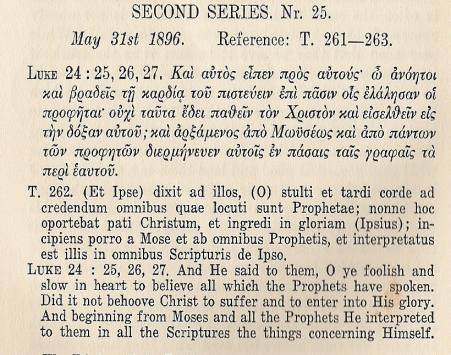
But when the Lord interpreted the Word to His disciples, that it was all concerning Himself and that all needed to be infilled in Himself, He first rebuked them for their foolishness and slowness in believing what the Prophets had spoken, especially for their being disturbed and disheartened by the suffering which it entailed upon Him. The rebuke is still often needed, and stands there in the Word for all those whose faith in the New Church wavers because of the trials which she has to suffer, the differences and disturbances which so often afflict her members. Slow in heart must he indeed be, who, knowing what the Lord has revealed in the Writings concerning the state of the Old Church and of the hereditary which the man of the New Church inevitably derives thence, is disturbed, or even surprised, because nothing is accomplished without conflict. The Lord in the course of His glorification met troubles and trials of every kind; He was misrepresented, reviled, mid despised and at last was deserted even by His followers, before He accomplished the work of infilling all things of the Word with life even to the ultimates. The disciple cannot expect to fare better than his Lord except that his suffering and trials are comparatively finite. Still in their degree such things must be met by everyone who is really endeavoring to attain regeneration and also by every Church which is composed of such men. The Lord has not come to call the just but sinners to repentance. The Church is not for regenerated men, but for those who are slowly and gradually and often painfully undergoing the beginning of.' regeneration. It is necessary for them that the evils of their hereditary be excited, sometimes by each other, sometimes by those who are only externally of the Church and are not really seeking regeneration, and sometimes by evil spirits. Unless their evils were excited they could not be seen, if not seen they could not be removed by self compulsion and so the way for regeneration could not be opened; but being thus excited they cannot but cause some degree of disturbance. Let not any be surprised therefore that disturbances exist; let each instead try to turn it to good account by attending principally to the evils which the disturbance may excite in his own self, by earnestly striving to overcome them. External trials or even internal temptations are not evils to the man of the Church — for him the only evil is in succumbing to such trials, in his allowing them to form an excuse for his being less loyal to the Church, or less eager to avail himself of her support. Let each therefore strive to become less deserving of the Lord's rebuke: 0 ye foolish and slow in heart to believe all which the Prophets have spoken. Did it not behoove. Christ to suffer and to enter into His glory. Is not the Word full of wars and treacheries, of plagues and cruelties — of trials and conflicts of all kinds? And yet the Word from beginning to end is a history of the Lord's glorification and thence it is also a history of the regeneration of every man who undergoes it. He in finite emulation of the Lord's example must strive to infill all things of the Word and meet the many combats and trials there that he is sure to become in something of the same spirit in which the Lord met them, when He prayed: Nevertheless, not my will but Thine be done. It was in that spirit that He infilled all things of the Word. And beginning from Moses and all the Prophets He interpreted to them in all the Scriptures the things concerning Himself. (202)
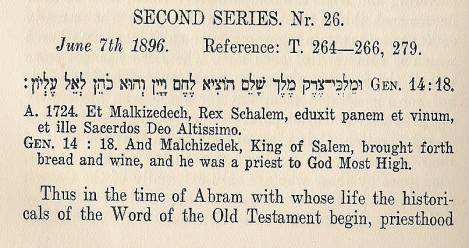
Thus in the time of Abram with whose life the historicals of the Word of the Old Testament begin, priesthood was established which served the Lord, and ministered to a genuine Church long before the Israelitish Church or even the Israelitish people existed. Beyond similar references to it however the Word of the Old Testament gives no information about either that Church or its Priesthood. Jewish tradition identified Melchizedek with Schem, and the Old Church has favoured various guesses and opinions concerning him, as that he was an incarnated angel or other superhuman creature, and there has been a. sect who named themselves from him and held that he was an incarnation of the Holy Ghost. This is one of the many instances which illustrate the futility of guessing where Divine Revelation is silent. When truth is revealed to man by the Lord it is to supply him with those means of regeneration which he cannot in the least degree acquire for himself. By their very nature they are such that they cannot be supplemented by the suppositions or discoveries of self-intelligence, except so far as such are used merely to confirm what is revealed. Man can find out facts, but he can never discover truths as distinct from facts — and facts in themselves can teach nothing of regeneration, however true the facts may be as facts. If actual facts be useless for this purpose, how much more so must the mere guesses as to fact which men indulge in and which receive so much consideration in the Old Church. (203)
The Writings reveal to man many things which were not known before. They reveal all that is necessary for the New Church. But although they contain infinite Divine Truth, still what is able to appear to man must always be limited, though capable of for ever becoming less so. It is a temptation to the man of the New Church, as it has been to the men of' former Churches, to busy himself rather with what Revelation has not made clear to him than with what is already quite evident to him. The things which man needs most are so very clear, altogether too clear indeed to please the natural man, which would rather evade the duties made so plain to him, and involved in the repenting of the evils of self-love and love of the world, by giving attention instead to matters which are not so clear and which he can therefore excuse himself from putting into practical application for the present. The Revelation given to the New Church leaves no obscurity any longer as to the Church of which Melchizedek was a priest, which Church, like every spiritual Church, was founded upon a written Revelation of Divine Truth called the Ancient Word, and this is now revealed because it is practically necessary to a rational faith to know that there has always been a Church in the world, not as a mere incident in the history of the world, but because the world was created for no other purpose than to be the basis of a Church to prepare men for heaven. No history of the world therefore, nor history of any country in it, can be more than most superficially true unless it be primarily a history of the Church therein. Other matters are essentially important only from their relation to the Church. Take the Church away and the world has no importance, yea no raison d'etre at all — and without there were some genuine Church therein it would vanish away as something of no use in the Divine Economy. The Writings make this quite clear to the New Church, because the Church cannot be rationally thought of at all unless its supreme importance be in some degree grasped. In the history of the Churches which have existed in this world from the beginning and for the sake of which the world was created, that of the Ancient Church has an especial interest to us because it was more like than the others what the New Church is to be, though like the rest it differed in passing through periods of decadence which the New Church as a whole can never do. It was a representative Church; but not merely so, for its essential was Charity. It was representative in that it sought in worship to ultimate spiritual things correspondentially; but it was only in its decline that it made use of sacrifices. They did not attend to the external correspondences themselves but only used them as the ultimates on which to base spiritual thought. Thus it is written: (204)
“If a man of the Most Ancient or the Ancient Church lived at this day and read the Word, he would not attend at all to the sense of the letter, which would seem as nothing, but to the internal sense. They wonder exceedingly that anyone should perceive the Word otherwise. Wherefore also all the books of the Ancients were so written as to bear a different meaning in the interior sense from that in the letter”, A.C. 1539. “The Most Ancients who were before the flood, in all and single things, as in mountains, in hills, in plains, in valleys, in gardens, groves, forests, in rivers and waters, in fields and seeds, in trees of every kind, also in animals of every kind, in the luminaries of heaven, saw something representative and significative of the Lord's Kingdom, but they never adhered with the eyes still less with their minds in the objects, but they were to them means of thinking concerning the celestial and spiritual things which are in the Lord's Kingdom; and this even to that degree that there was nothing at all in universal nature which did not serve them for means; in itself also it is so, that all and single things in nature represent, which at this day is an arcanum and is scarcely believed by anyone. But after the celestial, which is of love to the Lord, perished, then the human race was not any more in that state, namely that Icy objects as means it should see the celestial and spiritual things of the Lord's Kingdom; but still the Ancients after the flood knew from traditions and collected accounts that those things signified and because they signified they also had them holy; hence was the representative worship of the Ancient Church, which Church because it was spiritual was not in perception that it was so, but in knowledge, for it was in obscurity respectively, still nevertheless they did not worship external things, but by externals they remembered internal things, and hence when they were in those representatives and significatives they were in holy worship; also they were able, because they were in spiritual love, that is in charity, which they made essential worship, wherefore holiness from the Lord could inflow into their worship”, A.C. 2722. "Such was the wisdom of the Ancient Church. Their hooks also were written so, and this manner of writing emanated from them to the gentiles themselves for they wished to express the things which are in heaven by means of those things which are in the world, yea to see spiritual things from natural", A.C. 3179. The books of the Word, which certain of them were inspired thus to write from the perceptions of the Most Ancient Church, were of two kinds — historical and prophetical. The historical portion, like the historicals of the Word with us, was principally concerning wars and combats and hence was called the Wars of Jehovah. (205)
“By the Wars of Jehovah in that Word as in ours, are meant and described the combats of the Lord with the hells and victories over them, when He would come into the world; those same combats are also meant and described in the historicals of our Word as in the wars of Joshua with the nations of the Land of Canaan, and in the wars of the Judges and Kings of Israel”, T.C.R. 265. The prophetical portion was of course concerning the coming of the Lord. “That Word is still preserved in heaven and is in use with the Ancients there, with wham that Word was when they were in the world. Those ancients with whom that Word is still in use in heaven were as to part from the land of Canaan, and from the confines of it, as from Syria, Mesopotamia, Arabia Chaldea, Assyria, from Egypt, from Sidon, Tyre, Nineveh, the inhabitants of all of which kingdoms were in representative worship, and thence in the knowledge of correspondences. The wisdom of that time was from that knowledge and by it they had interior perception and communication with the heavens. They who knew the correspondences of that Word were called wise and intelligent and afterwards Diviners and Magi. But because that Word was full with such correspondences, as remotely signified celestial and spiritual things and hence by many began to be falsified, therefore from the Lord’s Divine Providence it vanished away in process of time and another Word written by correspondences not so remote was given and this by the Prophets with the sons of Israel”, T.C.R. 279. (206)
Here is indicated the difference between the various forms of the Word which are all written in pure correspondences , but in correspondences more or less remote. The most remote correspondences were used in the Ancient Word, less remote ones in the Word of the Old Testament, still less remote ones in the Word of the New Testament, and less remote ones yet in the Writings. In the latter they are so much less remote that some fail to recognize that they are written in correspondences, when nevertheless reflection on the nature of the Word as now made clear by Revelation will show that the Word, that is, Divine Revelation, cannot be given otherwise than in correspondent forms, and that this is so even in the heavens although the correspondences there all even less remote than in the Writings — in the highest heaven least so of all. The Word is also always given in ultimates, but these ultimates are more or less remote. The Word of the Old Testament is not given in as remote ultimates as the Ancient Word except as to the portions taken therefrom like the first chapters of Genesis, and the passages quoted in this morning's lesson. “Concerning that Ancient Ward which was in Asia before the Israelitish Word, it is allowed to report this new thing — that it is still preserved there with the peoples who dwell in Great Tartary”, T.C.R. 279. In the APOCALYPSE REVEALED it is added: “Seek concerning it in China and perchance you will find there with the Tartars”, A.R. 11. (207)
The Writings are addressed to the New Church — the APOCALYPSE REVEALED perhaps most immediately so, and therefore it seems to be a duty pointed out here for the New Church to do, namely to seek for this Word, that so the New Church may possess all the written forms of the Word that have been given in this world. It must be that it would be an added use to the New Church, for otherwise it would not have been thus commanded to seek it. On the other hind, it is shown that the protection of these Sacred Writings is what underlies the exclusiveness of the Chinese, which will be successful in keeping them hidden until such time that they may he safely trusted into Christian hands. When that time comes more still will be known concerning the Ancient Church, for it will be seen then just what was the form in which Truth was taught to the Ancient Church by Melkizedek and other of that Priesthood and thus the very quality of the bread and wine which he brought forth thence “Jehovah was called God Most High in the Ancient Church from the cause that height represented and therefore signified what was internal, thus the most high the inmost”, A.C. 1735. Melkizedek therefore was a priest to God Most High, because he endeavored to bring forth from the Word and leach the very spirit thereof, to lead men not to dwell in the mere letter of Divine Revelation, but to ever seek to know more and more of the spirit which that letter is intended by the Lord to convey. Hence Malkizedek, King of Salem, brought forth bread and wine, and he was a priest to God Most High (208)
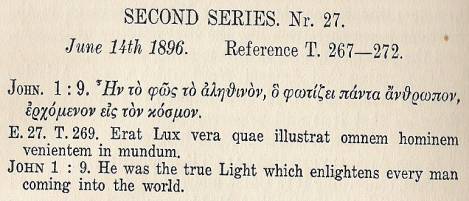
That the Lord is the source of all spiritual light is familiarly known in the Church, and also that the Divine Truths of Revelation are the forms by which that light is conveyed into human minds. Such Divine Truths as a whole are meant by the Word — by the Word is meant all the Divine Truth of Revelation. The Church has light from the Word, that is, the Church is composed of those who are receptive of the light of Truth from the Word. But the subject which our lesson brings before us this morning is that the Word is also the source of light for those outside of the Church as well; that that light indeed enlightens every man coming into the world. “That by the Word there is also light to those who are outside of the Church and do not have the Word”, T.C.R. 267. Of course in the widest sense all light, natural as well as spiritual has its first origin from the Lord. But al-though it is true that every man is thus indebted to the Lord for the natural light which he enjoys, the further truth still remains that as to the spiritual light of the Word, also the Lord enlightens every man coining into the world. The light from the sun of the world by itself can convey no rationality, not even that which is called natural, because it is principally thence. It is spiritual light in-flowing into that light which endows man with rationality. Indeed rationality is defined in the Writings as the faculty of receiving spiritual light. Thus: (209)
“The faculty of receiving spiritual light is what is meant by the Rationality which every man has from the Lord and which is not taken away from him, for if it were taken away he would not be able to be reformed. From that faculty which is called Rationality it is that man can not only think but also speak from thought, differently from a beast, and afterwards from his other faculty, which is called liberty, he is able to do those things which he thinks from the understanding”, D.L.W. 247. Thus the fact that man has rationality at all differently horn beasts is from his being able to receive spiritual light from the Word, and that to some extent also every man does receive something of that light, otherwise he would not be able even to abuse his rationality by reasoning falsely. This appears very clearly from what is taught concerning light in Hell. Thus: “Light in hell is also of three degrees, light in the lowest hell is like light from burning charcoal; light in the middle hell is like light from the flame of the hearth; and light in the highest hell is like the light from candles, and with some like the nocturnal light from the moon. Nor are these lights natural, but they are spiritual, for all natural light is dead and extinguishes the understanding, and those who are in hell have the faculty of understanding which is called rationality as was shown before, and rationality itself is from spiritual light and not at all from natural light”, D.P. 167. If therefore even the devils in hell could not have their faculty of rationality except from spiritual light, rationality in this world can be from no other source either. But: “The spiritual light from which they have rationality is turned into infernal light, as the light of day is turned into the darkness of night”, D.P. 167. (210)
Thus infernal rationality is all from perverted spiritual light. So in this world all false and misleading rationality comes from the perversion of spiritual light confirmed by and to appearance drawn from the mere appearances revealed by natural light. But again there is a further truth beyond this in the text and is this morning's lesson. Not only is the Word the source of all rationality, and even of the spiritual which perverted becomes the false rationality of selfish and worldly men; but in this world differently from hell there is spiritual light from the Word, to some degree at least unperverted with a11. That is, every man has with him some measure, however small, of genuine truth, from which if he hearkens to its teaching he is able both to begin the formation of genuine rationality, and to begin the reciprocal work of his own salvation. There is a true doctrine of permeation as well as a perverted one. There is indeed no, permeation of truth into the Old Church itself, no permeation that can ever restore life to a body judged and condemned by the Lord as spiritually consummated and dead; but there is sufficient permeation of truth into the minds of all individuals even in the Old Church to light and lead them out of that Church if they were willing to heed it, and if they did not prefer the darkness instead. From all that is revealed concerning the Divine Providence it can be seen that the teaching here given that those outside of the genuine Church also have spiritual light from the Word must be true as to every adult man that has attained any rationality whatever. That is, every one has something of truth in his mind which if he obeyed from any principle of innocence, would prepare him to receive more truth, and ultimately all the truth needed to fit him for his own particular place in heaven. No man is condemned for not obeying the truth he does not know, but every man who goes to hell is condemned thither be-cause he has deliberately rejected voluntary obedience to that of truth which he did know. And it cannot be too clearly recognized that there is no man who has attained any state of rationality that does not have enough of truth in his mind to enable him to exercise his free determination as to whether he will obey that truth from a principle of religion or whether lie will reject it for the sake of following his own natural impulses instead. Thus every adult determines his life either for heaven or for hell while in this world, which could not be done unless something of spiritual light from the Word reached each one. (211)
“Conjunction with heaven cannot be given unless some-where on the earth there is a, Church where the Word is and by it the Lord is known, because the Lord is the God of heaven and earth, and without the Lord there is no salvation”, T.C.R. 267. The Church is thus the principal recipient of the Word; but it is also the custodian of it, that it may be a source of light to the rest of the world. It should always be remembered that every idea of truth there has ever been in the world has come in the first place from the Word as revealed to man, however disconnected therefrom it may appear to be in the connections in which it is found. But there is always with man a tendency to pervert the truths received, and it is necessary that the fountain of truth should be kept intact in the Word. To do this is the duty of the Church and is one reason for its establishment. “It is sufficient that there be a church where the Word is, although it is of few respectively, still by it the Lord is present in the universal orb of earths for by it heaven is conjoined to the human race”, T.C.R. 267. The use of the Church does not depend upon the numbers of those who compose it, not therefore upon its being widely spread among others, but rather upon the integrity of the Word which it is the Church’s privilege to guard, and upon the purity and integrity of the teaching which she draws thence, and according to which her members govern their lives. The Church has no power or strength in itself – all its power is that of the Divine Truth. Its power therefore does not at all depend upon the number of its members, but altogether –upon the integrity of the Truth which it receives and dispenses. That Church which puts more trust in her own prudence than in the integrity of the Truth which she presents, is so far false to her Divine Lord. (212)
The specific Church now in the world, the New Church, is the heart and lungs to the Church in its most universal form, consisting of everyone who from a. principle of religion compels himself to obey such measure of Truth as he may possess. The rest of the human race who do not do that are not in that human form at all, but have chosen to be connected instead with the grand monster of hell. Among these, Revelation declares, is the bulk of those who Constitute what is called the Old Church. The New Church performs the use of heart and lungs to that universal Church composed chiefly of the gentiles all over the world, or rather of those of the gentiles with whom there is religion and one God is worshipped, and who thence live well. These constitute the remaining members, organs, and viscera of the Grand Man as it exists in this world, all of which depend for their life blood upon the New Church where the Word is in its integrity which alone is the source and fountain of that blood. It is hence the duty of the Church to see that Truth from the Word is circulated in its purity, and also to purify that which has circulated from the falses and evils which constantly contaminate the Truth, if it be not as constantly renewed at the fountain head where the Word is preserved in its own integrity. “That thus it is in the universal heaven can be concluded from what is similar in every society of heaven, for every society is a heaven in less form which also is like a Maas. In every society of heaven those who are in the middle of it similarly refer to the heart and lungs and with them is the greatest light. The Light itself and thence the perception of truth propagates itself from that middle towards the circumferences on every side, thus to all who are in the society, and makes their spiritual life. It has been shown that when those who were in the middle and constituted the province of the heart and lungs, and with whom was the greatest light, were taken away, those who were around were in the shade of the understanding and then in such feeble perception of truth that they lamented; hut immediately they returned, light appeared and they had perception of truth as before. Comparison can be made with the heat and light from the sun of the world, which gives vegetation to trees and shrubs even to those which are towards the sides and stand under a cloud, if only the sun has risen. Thus the Light and Heat of heaven from the Lord as a Sun there, which Light in its essence is Divine Truth from which angels and men have all intelligence and wisdom; wherefore it is said concerning the Word that it was with God and was God, that it illuminates every man coming into the world and that that Light also appears in the darkness, John 1 : 1, 5, 9. By the Word there is meant the Lord as to Divine Truth”, T.C.R. 269. (213)
There have been a succession of Churches in this world for the guardianship of the Word. As each in its decline became unfit to perform this use a new one was established in its place. Sometimes the bringing about of a new stale in the same Church was sufficient for a time. As when the former Christian Church withheld the Word from the people, the Reformed or Protestant Church was raised in order that the Word might as it were be drawn out from hiding places and put into use. By that Church the letter of the Word was widely distributed, but when so much falsity was distributed together with it as to threaten a total nullifying of that use, the Lord effected His New Advent and established the New Church to which is given not only the literal forms of the Word, but also the doctrine of genuine Truth, such as will suffice to preserve the integrity of the Word in its use to mankind for ever, and thus the light of Truth from the Word almost extinguished has been restored and made manifest even with heavenly glory. “As the Lord is the Word, also heaven is the Word, since heaven is heaven from the Lord, and the Lord by the Word is the all in all things of heaven”, T.C.R. 272. What is true of heaven is also true in its degree of the Church. Therefore as the Lord is the Word also the Church is the Word, since the Church is the Church from the Lord, and the Lord by the Word is the all in all things of the Church. That is, the Church must so identify herself with the Word, by regarding nothing as being really of the Church but what is of and from the Word, that she make the Word the all in all things of her life. She must receive the Word as the only light by which her own life must be guided and as necessary also to give light to all who are salvable throughout the world. Thus only can the New Church be loyal to her Divine Husband who is and was and ever will be the True Light which enlightens every man coming & to the world. (214)
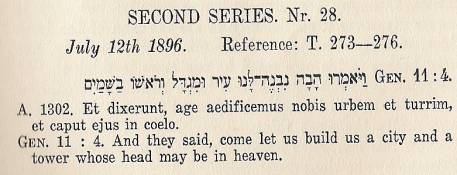
As long as the Word is regarded merely as to its literal sense, it is no wonder that evils such as that described in the text should be regarded as exceptional, and therefore as having no application to ordinary sinners. Few if any would be so insane now as to suppose that they could literally build a tower that would reach to heaven. But it is to be feared that even when it is known that there is a sense within that of the letter, there still remains a tendency to regard many of the evils correspondentially described in the Word as being evils of an exceptional nature, at least as being sufficiently so to cause them to have little or no application to ourselves. This is a very great mistake. Appearances do indeed favour such a mistake, for in ultimate form, the evils of different men differ very widely, and the grosser evils are comparatively absent with some. But the spiritual essentials of all abound with everyone as to the natural man. That is, except so far as a man comes to be actually regenerated, he is full of evils. It is not just that some men are so, but that all are. However polished and refined the natural man may be, internally there is no life but that of self-love and love of the world. The natural man is really insane as to spiritual things and it is no exception for him to attempt to build such a city and tower and its head in heaven as is described in the text. Every person has the natural idea that he would be happy if he had all that he wanted — that is, that getting all he wanted would be a heavenly state for him. He is also in the endeavour to obtain what he considers would thus satisfy his wants and make him happy, and in so doing he is attempting the insane task of building a tower that will reach to heaven. Now even natural experience goes to disprove this idea, seeing that however much be attained, happy contentment never results; but still it never disproves it sufficiently to rid the man of the false idea. He may come to admit the mistake theoretically, but still within in his own mind he continues to think that if he could get what he still feels to be lacking he would be happy — and to be really happy and to reach heaven are practically the same thing. Now this morning's lesson exposes the very root of such mistake by showing: “That unless there were the Word no one would know God, Heaven, and Hell, and the life after death, and still less the Lord”, T.C.R. 273. (215)
Man cannot know anything about heaven therefore not anything as to what constitutes real happiness, unless he knows something of the Lord, for everything that goes to make heaven or to confer the happiness thereof is of and from the Lord alone. Heaven is from the Lord and in no sense whatever is it from man, who can only be a recipient of it. He becomes such a recipient just so far as he learns to know the Lord and submit to being led by Him. So hit' as man leads himself he invariably leads himself into states of unrest and dissatisfaction. Hence the importance of recognizing not only that knowledge of the Lord can only come to man by Divine Revelation, but also that that knowledge so far as it is received by man without perverting it, is essentially different from all man's natural ideas of what is good and of what constitutes happiness. Only as this is realized is man able to shun as sin the evil of expecting happiness to come as a result of self-guidance and the cultivation of what seems good in a man's own eyes, and thus shun the insane attempt to build a tower reaching to heaven. “Since there are they who affirm and have confirmed with themselves that man could without the Word know the existence of God and also of heaven and hell, also the rest that the Word teaches, therefore it is not allowed to deal with them from the Word, but from the natural lumen of reason, for they do not believe in the Word but in themselves. Inquire from the lumen of reason and you will find that there are two faculties of life with man which are called the Understanding and the Will, and that the Understanding is subject to the Will and not the Will to the Understanding. For the Understanding only leaches and shows what is to be done from the Will. Hence it is that there are many who are of an acute genius and understand the moral things of life beyond others and nevertheless they do not live according to them. It would be otherwise if they willed them. Inquire also and you will find that the will of man is his proprium and that this is evil from nativity and that thence there is what is false in the understanding. When you find these things you will see that man from himself is not willing to understand other than what is from the proprium of his will and that unless there were elsewhere whence he might know it, man from the proprium of his will is not willing to understand other than what is of self and the world — whatever is above is in thick darkness". T.C.R. 273 (216)
It requires very close reflection to recognize how completely the understanding of man is subject to his will, for the understanding is apt to so justify what the will desires that man is able to persuade himself that he is only following what his understanding shows to be right, when really it is only his own will which his understanding thus naturally justifies. Again it is difficult for man to recognize that his will is evil — for what he loves always seems good to him. But he can see this if he consider the natural relation of one person's will to that of another where they are associated together, whether by the external bonds of marriage or of society generally. He can then see that the natural tendency of a man's will is to subdue all others to itself and to acquire to itself as much of the world's service as possible, and that therefore when two or more such wills become associated together mutual and reciprocal happiness is not possible. Thus the fact that the association of natural wills with each other inevitably produces unhappiness either manifestly or secretly, is itself a sufficient proof of the essentially evil nature of man's will. Now human beings are made to be associated together, for they are all born for heaven, and most certainly cannot find happiness in an altogether solitary life, and yet the natural will of each one is evil because each seeks to make itself a centre for the rest, and therefore they cannot associate happily unless each gives up his own will and submits himself to the leading of Him whose infinite wisdom alone suffices to harmonize all the varieties of human life which He has created. It is essential to note here that the natural will must be given up — no modification or improvement will answer, for it is such, and ever continues, that from it a man is not willing to understand other than what favours self, and acquires the things of the world. The natural will has that idea of happiness and cannot but seek it in that way, the way which corresponds to the building of a tower by self that will reach heaven. To meet this case man must look to the leading of Divine Revelation and be willing to learn and be guided by just that therefrom which he is not naturally willing to even understand, much less to do. It is by compelling himself to obey such truth that his regeneration is effected and the way opened for him to be gifted by the Lord with a new will, entirely different in this respect from his natural will, in that it can come into happy harmony with all the orderly subordinations of life because it loves the guidance of Him who is the only way to heavenly happiness, and who at once confers full freedom to each individuality and full harmony among all the varieties thereof.. By no possible means can man reach such a state of himself. He is so certain to rush into opposite states by his own guidance that it is altogether insane to seek happiness so, even more so than it would be to literally undertake to build a tower whose head should reach heaven. (217) It is not merely that man of himself does not understand the things of spiritual life, but the very idea of the existence of such things would never have had place in his mind unless it had come from Divine Revelation in the first place. Without that there would have been no idea of God at all, not even the question as to whether there was any life after death would have risen. All such knowledge has come in the first instance from the Word, either that which we now possess or that given to the Ancients. Man has never acquired even the most elementary idea of spiritual things from himself. Nor having acquired such ideas from Revelation has he ever done other than pervert them so far as he has thought of them from himself and from the appearances of life about him. If this were really kept in mind and were practically acted upon, it would save us from many mistakes and much misunderstanding of truth. Appearances and experiences are of no use whatever to teach spiritual things — and to think from them is inevitably to darken our understanding of what is learnt from Revelation. The human will always tends to turn all things to the service of building a tower by which it may itself attain heaven in its own way. Let each one sincerely examine himself and he will find that however well this truth is known, that tendency continues with himself as surely as he continues to have his own natural will. Do not let the idea have place in your mind even that appearances and experience are of secondary value — they are of no value in teaching spiritual thing, their only use in this respect is to confirm what, is rind, accepted and learnt from the authority of Divine Revelation. So far as a man does not compel himself to adhere to this law, he is not and cannot be willing to understand other than what is of self and the world, or have any other idea of heaven than what self and the world regard as such. (218)
“That they are such is from the will which is evil, and this as was said before, leads the understanding and takes away the truth which is there from the Word. If man had been able to know from himself that God is and that there is a life after death, why had he not known that man is a man after death, why does he believe that his soul or spirit is like wind or ether, which does not see with eyes, and hear with ears, and speak with a mouth before it is conjoined and coalesces with its own corpse and with its own skeleton. Suppose therefore a doctrine hatched from mere natural lumen, would it not be that self should be worshipped as has been done for ages, and also is done at this day by those who know from the Word that God alone should be worshipped. Any other worship cannot be given from the proprium of man and not even the worship of the sun and moon”, T.C.R. 274. Thus of himself man cannot get away from the worship of his own self and of the world — to this, of himself, he always tends — to trust in self-guidance and to give his heart to the things of this world. Such worship is worse than any external idolatry — it is the internal idolatry which prevails at this day, and with which we are infested within and without. Men are possessed with the idea that they can make heaven for themselves and even when they accept Revelation they continue to be infested with fear, even if they do not resist, whenever they are called upon to give up the idea that being able to guide oneself makes heaven, or that the devices of natural prudence are the only safeguard of freedom. The state of happiness in heaven, or the states in emulation thereof in the Church, are not to be attained or protected by any means of man's own devising, but solely by obedience to those laws of order which are to be learned nowhere but from Divine Revelation. Take heed therefore of the warning with which the lesson concludes, to those who think to attain heavenly states by the devices of their own intelligence, or to protect themselves therein by "their" own prudence. “I will tell of what quality is the lot which remains for I hem alter death — first they become like drunkards, afterwards like fools, and at length stupid and they sit in darkness. Let them therefore beware themselves of such delirium”, T.C.R. 276. (219)
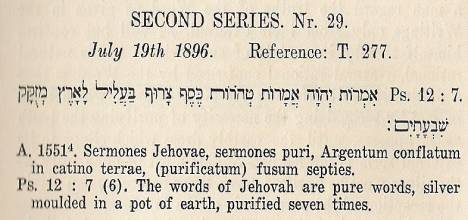
By silver is here meant knowledge of truth from the Word. The truths of the Word are pure in themselves — that they are wholly and fully so is meant by the silver being purified seven times. “For numbers in the Word signify things, and seven all things and all men and thence also what is full and perfect and it is the Word where it is treated concerning a holy thing and in the opposite sense concerning a profane thing; wherefore that number involves what is Holy and in the opposite sense what is profane. That numbers signify things, or rather that they are as it were a kind of adjectives and substantives bringing some quality to things is because a number in itself is natural, for natural things are determined by numbers, but spiritual by things and their states; wherefore he who does not know the signification of numbers in the Word ... cannot know many arcana which are contained therein”, A.R. 10. (220)
But although the truths of the Word are thus described as being altogether pure, yet they are also described as being moulded in pots of earth. That is, the forms or language in which the truths of the Word are revealed are taken from man — even from the external man — yea in the case of the Word of the Old Testament from the external of that most external nation — the Jewish nation. There the external forms of truth are so moulded that sometimes they appear to express what is diametrically opposite to what the truth itself teaches. Thus it there often seems to express the mere hatred and revenge of that cruel people. But even in the forms of the Word where this is not the case, the forms are still taken from the external man — in the Writings from the external rational of man. Therefore if a man regard the truths of the Word as given in the Writings only from their external, he will but confirm himself thereby in a state of subservience to his natural rational. Natural rational confirmed by the, Word is thus a distinctive evil infesting the New Church, which must be met by recognizing the necessity of purifying the truth as it appears, until the earthly dross which clings to its external form is purged away. This must be done fully — the silver must be purified seven times before we can attain the reception of the pure words of the Lord. In this morning's lesson there is set forth an infinitely instructive representation of how it is with the silver of the Word which is thus introduced: On a certain day I wandered in the spirit through various places in the spiritual world for the sake of the end that T might observe representations of heavenly things which are exhibited in many places there", T.C.R. 277. (221)
The memorable relations are of two kinds, one describes scenes of actual life in the spiritual world, and the other describes representations which are made for the purpose of instruction and confirmation like the one read this morning. They are all of necessity correspondential in their character, and thus have an internal sense, whether that sense be directly set forth or whether it be left to be learned from the teaching given elsewhere in the Writings. Thus they are very like the visions described in the Apocalypse and in the Prophets, with the difference that they are here set forth by one who was prepared by the Lord to observe them rationally, and to record them in the form best adapted to illustrate and confirm the doctrine of the New Church. “In a certain house where there were angels I saw great bags in which silver was stored up in much abundance, and because they were open it appeared as if anyone could take the silver there stored up, yea, steal it; but next to those bags there sat two youths who were guards.... By those things there was represented the natural sense of the Word in which is the spiritual sense; those great bags full with silver signified knowledges of truth in much abundance; that they were opened and nevertheless were guarded by youths signified that anyone can take knowledges of truth thence, but that care is taken lest anyone should violate the spiritual sense in which are pure truths”, T.C.R. 277. (222)
Thus knowledges of truth are indeed open to all, though at the same time the spiritual sense is carefully guarded. Thus to acquire knowledges of truth even from the Writings and to acquire the spiritual sense are two distinct things. As has been shown before, the spiritual sense is not given to anybut those who are in enlightenment from the Lord, and this notwithstanding that knowledges of truth are open to all. The spiritual sense means more than mere knowledge. We only have the spiritual sense when we see it in application to our own spiritual life — only as we the truth in such a way as to expose our own spiritual evils. Let no one therefore deceive himself that he knows the real spiritual sense unless it is teaching him the spiritual evils which he needs to shun as sins against God. Unless he be able to learn this from the truth that he may endeavor to do it, the spiritual sense is guarded from him — the bags of silver indeed lie open, but guards are placed by the Lord lest the spiritual sense should be violated. “The place where they were stored up appeared like a manger in a stable;… the manger as in a stable signified spiritual nutrition for the understanding; a. manger signifies this because a horse that eats thence signifies the understanding”, T.C.R. 277. It was for the same reason that the Word made flesh was laid in a manger as a babe. But this was only at first, and thus it represents how the Word first comes to us as merely nutrition for the understanding. This is especially the case with the Word as revealed by the Lord in His New Advent — it is apt to be received so as to do little more at first than interest the understanding and flatter the conceit of self-intelligence. In the DIARYit adds that the manger in a stable "was an unsuitable place, signifying that the human understanding ought not to have part in setting forth the interiors of the Word", S.D. 3605 ½. (223)
If the natural rational attempt to have part in setting forth the interiors of the Word it invariably perverts them to make them agree with what seems good to it. Therefore it is taught that that rational should not be consulted but a receptive attitude towards the Word cultivated independently of it. It is only so far as a man compels his under-standing to receive the teaching of the Word in that manner that the new or spiritual rational can be formed in him by the truth. The manger in a stable is an unsuitable place for storing up the silver of the Word. “I then went into a small room where at first it seemed to me it would have been delightful to dwell. There were modest virgins there with a modest wife, signifying that they should not be set forth thus as preachers are wont to do, for moving the affections, for thus not much would remain”, S.D. 3605 ½. “The modest virgins who were seen in a neighboring room signified affections of truth and the chaste wife the con-junction of good and truth”, T.C.R. 277. Hence although this room appeared so attractive and to be more suitable, really it was still less suitable than the manger in the stable, for it is of order that the Word should be received first by the understanding, and it is contrary to order for teachers of truth to apply themselves to moving the affections, even though those affections be good in themselves, such as correspond to modest virgins and a chaste wife; although to do so may seem much more attractive and better calculated to succeed. For in such a case the affections would be moved only to the cultivation of natural good, nor can it be otherwise unless the under standing be first led instead to see the necessity of shunning evils as sins. “Near that room stood two infants and it was said that they were not to be played with childishly but they were to be treated wisely.... The infants signified the innocence of wisdom, for the angels of the supreme heaven who are the wisest, from innocence appear from afar as infants”, T.C.R. 277. (224)
Those who are in bondage to their natural rational are apt to make sport of the very simplicity of the Word especially of an attitude thereto of simple unquestioning receptivity. Such a state seems to them to be too foolish to be treated seriously. But wise consideration would cause them to admit that such an attitude is the only really rational one to be taken towards the Lord's Word by those who acknowledge Him to be the only God of heaven and earth — the infinite source of all love and of all wisdom. Swedenborg says in the DIARY that he himself wished to port with those two infants, but that it was allowed to converse with them but not to sport in an infantile manner. The innocence of wisdom is a rational innocence. Then "there came forth from the room a very obscene girl among the more beautiful ones, who wished to seize me by force and when I was fleeing away I awoke and saw the carcase of a horse, signifying that eloquence is not to be studied, which appears as a beautiful virgin, but because it was a harlot breaking forth from such a room, it seemed to me that it was of such a quality as the black carcase of a horse”, S.D. 3605 ½. As it is not of order in teaching the Word to apply oneself to the moving of the affections, so neither is it of order to study to please the understanding by mere eloquence although the appearance of so doing is compared to that of a beautiful virgin. For what the Word is given to teach men is not something that is pleasing to them in the first place, but something which cannot be seen in a state of pleasure, namely the altogether spiritually evil state in which every man naturally is, and which must be met by painful self-compulsion until something of actual repentance is accomplished before any step of regeneration can be taken, thus before any step can be taken towards the realization of anything of heavenly happiness. To lead a man to this is not a matter of eloquence but solely of the power of Divine Truth presented in its simplicity and integrity. If that cannot effect the desired end nothing can. Whether it is able to do so or not depends upon the humility and innocence with which it is received. The eloquence which many depend upon may seem to have the beauty of a virgin but it is really that of a harlot, when it, rather than the purity and integrity of truth, is most regarded. (225)
“The harlot with the dead horse signified the falsification of truth by many at this day, by which all understanding of truth perishes — the harlot signifies falsification of truth, and the dead horse no understanding of truth”, T.C.R, 277. Beware therefore of mere appeals which move the natural affections. Beware also of the eloquence which studios merely to please and flatter the understanding, for so far as that alone is sought, or indeed so far as that is chiefly sought the truth is certainly falsified and its allurement becomes that of a seeming beautiful harlot that would betray us into being false to the truth in which the Lord has come to save us and which is the silver by which He would ransom us from the bondage of self and the world. That silver appears at first as if stored up in a manger, and can be received only by those who approach it with humility and innocence, and even then, moulded as it is in a pot of earth, it must be purified seven times before our reception thereof enables us to realize the words of the Lord in their purity. The words of the Lord are pure words, silver moulded in a pot of earth, purified seven times. (226)
In this morning's lesson it is revealed that the meaning of this verse in summary is: (227)
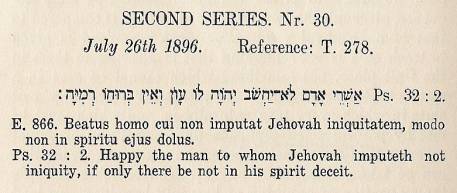
“That the Lord is also merciful to those who do evil”, T.C.R. 278, the angels explaining that meaning from the letters or syllables alone in a way which it is not possible for us to do. It is however revealed that the forms of the letters in which the Word is written in the third heaven differ but slightly from the Hebrew letters of the present day, and that those forms, that is, the very curves and inflexions of the letters derive their origin from the flux of heaven, and therefore correspond to and express the very truth which makes heaven. Thus the sense of the letter in the third heaven and thence in the Hebrew of the Word is not merely the literal sense of the words but of the syllables, yea, even of the very letters separately as well as conjointly. This knowledge enables us to better understand how fully the Word is ultimated in literal forms not only in this world but even in the highest heaven. Also that the sense of the letter on each plane differs in the degree of accommodation, for it is declared that the sense which the celestial angels explain from the very forms of the letters, and which is therefore the sense of the letter with them, is nevertheless concerning the Lord alone, which is the celestial sense. In considering the meaning of the text thus revealed, therefore, let us keep in mind that it is a sense of the letter drawn from the letter of the celestial Word and confirmed thereby — also that the same teaching is ultimated in and can be confirmed by the letter of each form of the Word that we possess, but that the teaching is made rationally clear only In the Writings, which alone for us afford rational confirmation thereof. The more we consider how infinitely the Lord’s Divine Providence operates in every detail of life, the more evident it becomes that it must control every detail of the means by which His Word is accommodated and revealed to us. It was for the sake of the Word that the Lord provided that the art of printing should be invented. If thus it is of Providence that printing exists for this end, would it not be altogether inconsistent, if the forms of the letters used were not in each case just such as would best ultimate the Word for the purpose it was given? (228)
That the Lord is merciful even to those who do evil. is taught throughout the Writings. For the Lord is there shown to be incapable of acting from anything but pure love. That He manifests His love differently to different people is only because His love is directed by infinite Wisdom to do what is the very wisest and bests for each one, for each of the evil as well as for each of the good. For He maketh His sun to rise on the evil and on the good, and sendeth rain on the just and on the unjust, Matt. 5, 45. “The Lord never judges anyone except from good for He wills to raise into heaven all whosoever they are, yea, it He can even to Himself, for the Lord is Mercy Itself and Good Itself. Mercy Itself and Good Itself can never damn anyone, but it is man, because he rejects good, who damns himself. As man had shunned good in the life of the body, thus he shuns it in the other life, therefore thus he shuns heaven and the Lord”, A.C. 2335. "He never averts His face from anyone, hut it is nun, when he is in evil, who averts his face. As the Lord said through Isaiah: `Your iniquities are what separate between you and between your God; your sins cause His faces to be hidden from you', 59 : 2", A.C. 223. (229)
For the Lord's face to be hidden from us, is to have heavenly states removed from us and this can only be done by our own evils. The Lord never removes happiness from us — He does not even suffer anyone to excite in us the states which interfere with our external happiness except for our salvation, if only we allow such revelation of our own evils to cause us to shun them as sins. "Jehovah God or the Lord never curses anyone, never is angry with anyone, never leads anyone into temptation, never punishes, still less curses, but the diabolical crew do such things. From the fountain of Mercy, Peace, and Goodness such things can never come", A.C. 245. "The Lord never began a combat with any hell, but the hells attacked Him, as also happens with every man who is in temptation, or in combat with evil spirits; with him the angels never attack, but evil or infernal spirits always and continually do so; the angels only avert and defend. This comes from the Lord who never wills to bring evil to anyone even if he should be the worst and most hostile enemy of all, or to detrude him into hell, but it is he who brings evil 10 himself and precipitates himself into hell. This also follows from the nature of evil and of good", A.C. 1683. As this is the Lord's attitude towards all, and as He rules and controls all things, it follows of necessity that no one can do us other than good — all real hurt can only come from our own selves. Even when others are permitted to excite the evils in us which hurt us — this is only done so far as the Lord can overrule it for our eternal good. It is for us then to so strive to trust in Divine Providence, to so strive to trust that the Lord is doing the best good for everyone that possibly can be done without interfering with their freedom, that we may learn more and more to see in all the actions of others toward us only the instrumentality which the Divine Providence is using for our welfare, if only we humble ourselves before Him, that He may conquer our evils for us. If it were not that the Lord is merciful even to the evil, none of us could hope for mercy — for all are evil. (230)
“The mercy of Jehovah or of the Lord involves all and single things which are done by the Lord toward I he human race which is such that He has mercy on it and on each according to his state, thus He has mercy on him whom He permits to be punished and He has mercy on him to whom He gives to enjoy good. It is of mercy to be punished because He bends all theevil punishment into good; and it is of mercy to give to enjoy good because no one merits anything of good; for all the human race is evil and from himself everyone rushes toward hell, wherefore it is mercy that he should be taken out thence, nor is anything but mercy, because He has need of no one. Hence it is called mercy because it takes man out from miseries and hell, thus relatively towards the human race which is such and it is the effect of love toward all because they are such”, A.C. 587. But though the Lord is merciful to all, and all need His mercy for all are evil, yetthe degree in which His mercy upon the attitude of man towards Him and therefore His mercy is especially toward the regeneration and toward those who can be regenerated, which isinvolved in the latter part of the text: Happy is the man to whom the Lord imputeth not iniquity, if only there be not in his spirit deceit. “Iniquity regards evil, and deceit the false thence; … by deceit is not meant deceit in the natural sense in which there is fraudulent device, and lying from malice against another, but deceit in the spiritual sense, in which deceit there is thought from the intention of the will or from the purpose and decision of speaking and persuading falses and thus of destroying the soul… Deceit in the spiritual sense is against the truth and good of the Word and the Church. . . . That deceit is such a grievous crime is because decision and purpose are of the will and whatever is of the will is of the man himself and is called the evil of his heart. For the will is of the man himself, but indeed thought before consent which is of the will is not in a man but outside of him, since those things which inflow into the thought are like objects which inflow into the sight from the world of which some please and some do not please; and those which please enter the delight of the life but those which do not please are rejected. Thus it is with everything which inflows into the internal sight of man which is of his understanding and thence of his thought — if it please it enters the will and adds itself to his life, but indeed if it does not please it is rejected. It is to be known that all the evil have the disposition and cupidity, consequently the will, of destroying the truths of heaven and the church by falses. the reason is because they are conjoined to hell and the infernals, from the delight of their love, burn with the cupidity of destroying all things of heaven and the church, and this by cunning deceits which they artificially weave and wonderfully prepare, which if I should describe from experience I would fill sheets. Hence it is evident that by deceit in general is signified every evil of intention of destroying truths by falses", A.E. 866. (231)
Thus it is necessary to regeneration and therefore necessary to becoming especially receptive of the Lord's mercy that this kind of deceit be shunned, of which the text declares: if only there be not in his spirit deceit. How common this kind of deceit is only becomes evident after considerable reflection in the light of revelation, for man is apt to exercise this kind of deceit without recognizing it in himself. For how are truths destroyed? What way can they he destroyed, otherwise than by perverting them from their application to our own evils? There is ever a natural tendency so to turn our understanding of truths as to make them not apply to those evils which we cherish as the delight of our life — the only evils which endanger our salvation. Natural reason is active in thus destroying truths by removing them from that which alone can save man from his evils, and yet in so doing he especially deceives himself and persuades himself that the lifeless truths which he thus receives are loved for the sake of truth. This is a deceit which everyone should carefully examine himself for, in order that by getting rid of it he may so open himself to the reception of the Lord's mercy that he may be saved thereby. “There are two things which not only close up the way of communication (with the rational) but also deprive malt of the faculty of ever being able to become rational, they are deceit and profanation — deceit is like a subtle poison which infects the interiors. From these two the rational altogether perishes. There are with every man goods and truths stored up by the Lord from infancy — deceit infects these, and profanation commingles them”, A.C. 5128. (232)
They who are interiorly infected by spiritual deceit. that is, hypocrisy, are meant by those who speak against the Holy Spirit, for whom there is no remission . . . for thus the false lies within in the truths which they speak and evil in the goods which they do, which is hidden poison, hence they are called the progeny of vipers.... That there is no forgiveness for them is because hypocrisy or deceit about holy Divine things infects the interiors of man and destroys everything of spiritual life with him, at length even to that degree that there is no soundness anywhere.... They are also such who are meant by the one who was not clothed with a nuptial garment”, A.C. 9013 Thus throughout the Word there is warning against spiritual deceit—that deceit which renders truth ineffective, when nevertheless it is the only means by which man can be saved. This deceit is the opposite of innocence. Deceit destroys truths to make them non-destructive of the evils that are loved. Innocence is a readiness to see and shun the evils in oneself which truths are revealed to us to expose. Happy is the man to whom the Lord imputeth, not iniquity, if only there be not in his spirit deceit. The deeds which a man outwardly does do not follow him into the other life, but only the will that, was in them. If there was self-will in them, and the man had by spiritual deceit prevented truth from exposing his evil state, he shuts himself against the Lord’s mercy. But whatever his outward deeds, if there has been really within them any genuine endeavor to do the Lord’s will rather than his own, and the man has thus preserved in himself a state of readiness to see the application of truth to his own spiritual evils, then he can and does receive of the Lord's infinite mercy and is saved in spite of the evil deeds he may have done — for the Lord is also merciful to those who do evil. Happy is the man to whom the Lord imputeth not iniquity, if only there be not in his spirit deceit. All salvation is entirely and solely of the Lord's mercy and in spite of our own natural love. How absolutely this is true and how emphatically it is taught in the Word, can to some extent be seen; but the angels see it taught and confirmed even in the very forms of the letters in which the Word is ultimated. (233)
Satans are those who are in falses, or what practically amounts to the same, those who are in the pride of their own intelligence. Self-intelligence is formed in every man naturally from the appearances about him and from reflection thereon. According to the quality of the reflections that intelligence may be more or less gross. It may indeed be so cultivated as to be very effective in dealing with the affairs of this world. But nevertheless it should always be kept in mind by the man of the Church that however well cultivated it may be, natural intelligence always remains too gross to enter into spiritual affairs, and whenever the attempt is made to use it in dealing with spiritual things it leads only to obscurity in spiritual things, if not to open denial of true spiritual principles. Being formed from appearances, appearances are mostly in its favour, and can always be made to seem so. Hence natural intelligence is plausible to those who give weight to appearances, and indeed so much so that it is regarded by such as being formed of self-evident truths which it is absurd to deny. Hence it is useless to reason in favour of spiritual principles with those who trust in natural intelligence, which can be received only by those a ho are willing to put away self-intelligence and who refuse to listen to its ratiocinations against spiritual truths, even as the Lord refused to listen to Peter when he denied the necessity of undergoing the sufferings which the Lord prophesied. It was in reply to that denial that the Lord said: Get thee behind Me, Satan; ,thou art a scandal to Me; because thou savourest not of those things which are of God, but of those things which are of men. (234)
In the world about us no distinction is recognized between spiritual and natural things than as between what is more or less refined. As things exist in the Old Church the distinction really does not involve any more, for what are called spiritual things there are no more than refinements of the natural. In the New Church however the distinction is known at least theoretically as being altogether a discrete one; but yet in practice the discrete quality of the distinction is apt to be overlooked, and spiritual things are then discussed from natural intelligence and pride and are only received when they have been so fax modified as to gain the approval of the natural rational. Hence it is important not only so to see but as far as possible to realize the completeness of the distinction, and the impossibility of bringing spiritual things into the range of the jurisdiction of natural intelligence without essentially perverting thorn. They are on a discretely higher plane to which the understanding must be elevated if it would see them, and the understanding can be so elevated only when it is willing to emulate the Lord's example, in putting away natural considerations and plausibilities, saying thereto: Get thee behind me, Satan; thou art a scandal to me; because thou savourest not of those things which are of God, but of those things which are of men. The distinction is very vividly set forth in the Memorable Relation read this morning, where the unique case of Swedenborg is made the means of presenting instruction on this matter for both angels and men, for even angels had not previously understood it. (235)
“Angels had not before known the difference between the spiritual and the natural on account of the cause that there had not before been given any means of comparison by any man who was at the same time in both worlds, and those differences without comparison and relation are not knowable”, T.C.R. 280. The distinction is ultimated in the fact that natural eyes cannot see the objects of the spiritual world nor yet can spiritual eyes see the objects of the natural world. To Swedenborg however it was given to be able to present himself in each world and to reflect upon and understand the relation between the two, which relation he has been caused to set forth rationally for us. It is important to realize this, although the knowledge of the fact that the objects of the one world cannot be seen in the other may seem not to have much practical application, until it is remembered that the two worlds are represented within the minds of each individual who is being regenerated, and the discrimination needs to be made there in order to be able to think spiritually without its being perverted by merely natural thought. The first point to be observed is that the distinction between the spiritual and the natural is not like that between what is more or less pure, the spiritual is not a purer natural. “The distinction is not such; the natural can never by subtilization approximate to the spiritual so that it can become it, for the distinction is of such quality as between prior and posterior, between which a finite ratio is not given; for the prior is in the posterior as a cause is in its effect, and the posterior is from the prior as an effect is from its cause. Hence it is that the one does not appear to the other”, T.C.R. 280. That this is so objectively is simply the basis and ultimate which results from its being so in the mind. There is no finite ratio between spiritual and finite thought, so that if the distinction between them be not observed the spiritual quality is inevitably lost and merged into the natural. This is continually being done and is the cause of much of the difficulty experienced in understanding spiritual teaching. It is hard to realize the necessity of putting natural thought behind before the understanding can be effectively elevated to spiritual thought. The more the natural thought has been cultivated on ordinary lines, the more difficult it is to realize this necessity, for then the pride of intelligence interposes and easily confirms itself by appearances and experience. Yet it must be done before there can be any clear spiritual thought from the doctrines. Moreover there is not only a discrete difference between spiritual thought and natural thought, which necessitates their being kept respectively in their own distinct planes, but also there is a relation by correspondence which must be observed. This relation is that of cause and effect. Therefore spiritual and natural thought must not only be kept distinct, but also the natural must be kept in subordination to the spiritual. The spiritual must lead. But the natural continually attempts to do so, and when it does, it becomes satanic in its quality and should be ordered to get behind. It is like Peter presuming to rebuke the Lord when He foretold His sufferings saying: Be it far from Thee, Lord, this shall not he 'unto Thee. The natural would advocate what is smooth and easy to the will, and protect against hard standing by principle, regardless of consequences. But however plausibly it pleads, the Lord teaches us to rebuke it as He did Peter's suggestion — Get thee behind Me, Satan; thou art a scandal to Me; for thou savourest not of those things which are of God, but of those things which are of men. (236)
The same may be confirmed by the distinction and relation which exists between spiritual language and natural language, as also between spiritual writing and natural writing. Spiritual language and writing express so many particulars of principle which can only be generalized in natural language and writing, which generalizations not only cannot teach or lead to an understanding of those innumerable particulars, but if the attempt be made to carry them to that plane, they would teach what is quite untrue in the realm of causes, however correct it may be in treating merely of the realm of effects. Spiritual thought may be generalized in natural thought and these generalizations may be expressed in natural language. Thus it is that the Word as ultimated in natural languages only expresses the generals of truth relatively to the innumerably more particulars that can be expressed when it is ultimated in spiritual language. But still these more general expressions serve as a basis and prepare the way for the ultimate reception of those particulars, which cannot be received until man is fully raised into the plane of spiritual thought. “Spiritual thought exceeds natural thought so much that it is ineffable; . . . no idea of natural thought adequate to any idea of purely spiritual thought (can be found), thus no natural words expressing it; . . . spiritual ideas are supernatural, inexpressible, ineffable, and incomprehensible to the natural man; and because they are so super-eminent spiritual ideas or thought respectively to natural are ideas of ideas and thoughts of thoughts, and therefore by them are expressed qualities of qualities and affections of affections; consequently spiritual thoughts are the beginnings and origins of natural thoughts”, T.C.R. 280. (237)
Man from the natural habit of his natural mind which is formed from external appearances and thinks from them, supposes that complexity is in externals and that he can conclude concerning internals by a process of analysis; but such conclusions are necessarily false for there are infinitely more things in the internal than in the external, each of which are more complex than anything which the external presents. “What is divided does not become more and more simple but more and more multiplex, because it approaches nearer to the Infinite in which all things are infinitely”, T.C.R. 280. This can be seen from the relation of external acts to the complexity of motives which often enters into them on the part of those doing them. Hence the simplest expression of Divine Truth contains and involves an infinity of particulars, which no mere analysis of the external expression can bring out and which natural thought could never grasp however they were presented. “For (moreover) to think spiritually is to think without time and space and to think naturally is to think with time and space; for there adheres to every idea of natural thought something of time and space, but not to any idea of spiritual thought. The reason is because the spiritual world is not in time and space like the natural world, but is in the appearances of those two. In this also thoughts and perceptions differ. Wherefore those in the spiritual world can think concerning the Essence and Omnipotence of God from eternity, that is, concerning God before the creation of the world, because they think concerning the Essence of God without time and concerning His Omnipotence without space, and thus comprehend such things as transcend the natural ideas of man. ... Once I thought concerning the Essence and Omnipotence of God from eternity, that is, concerning God before the creation of the world and because I could not yet remove spaces and times from my ideas I was made anxious, since the idea of nature instead of God entered. But it was said: remove the ideas of space and time and you will see. And it was given me to remove them and I saw, and from that time I could think God from eternity, not at all nature from eternity, because God is in all time without time and in all space without space, but nature in all time is in time and in all space is in space, and nature with its time and space could not but begin, but not God who is without time and space; wherefore nature is from God, not from eternity, but in time with its time and space", T.C.R. 280. (238)
It is evident therefore that natural thought is utterly unable to penetrate to spiritual things, as also to evolve the spiritual sense of the Word from the natural. Spiritual truth can only come by Revelation. But even the revelation of the spiritual sense has to be given to us in a natural form expressed in a natural language derived from the things of time and space. How then are we to learn therefrom the genuine spiritual sense which is discretely above and within any natural expression? The lesson makes it clear that it cannot be done by any effort of the natural intelligence -- it cannot he arrived at by hard thinking. The spiritual sense is given to no one but those who are in enlightenment from the Lord. Its reception therefore depends upon how far we place ourselves in an attitude of innocence while we study written Revelation; and this again depends upon the completeness with which we shun being influenced by the natural thought of our own intelligence while we study the Word. If then you would elevate your understanding to the reception of the spiritual light of the word, resist the promptings and suggestions of your natural intelligence and put away your conclusions from appearances and experience, and be ready, at their every attempt to influence you, and however acceptable to your own will their pleadings may be, to apply to them the Lord's answer: Get thee behind Me, Satan; for thou savourest not of those things which are of God, but of those things which are of men. (239)
This "signifies that all are judged according to their internal life in externals", A.R. 871. It is significant that the chapter of the TRUE CHRISTIAN RELIGION concerning the Word concludes with a Memorable Relation describing the judgment of those who have confirmed themselves from the Word in justification by faith alone, thus emphasizing the teaching that the Word is given that its truths may be done and that every one is judged by the works which he does. This judgment as far as it involves treating each one according to his works, is not just an experience which has to be met and got through, but it is a treatment which is continued to eternity in hell as well as in heaven. Everyone has to perform use and the food, clothing, and lodging which he receives is according to the quality and dignity of the work which he does. This is a universal law of the spiritual world and applies to hell as well as to heaven. It is taught that everyone is born for heaven. It is the same if it be said that everyone is born for the performance of some use. If by the Lord's help he conquers the evils in himself which prevent him from loving the work of his use, he is thereby fitted for the life of heaven; but if not, he has to go to where he will be compelled to do the work he is fitted for. Thus though in this world, for the sake of freedom in determining his life, a man may sometimes be permitted to live in idleness; it is not so in that life where every man finds his eternal home. There idleness is not tolerated. Heaven is the state of those who love to work for the sake of use. Hell is the state of those who have to work for their living, of those who would not do it without that compulsion. Although it is quite evident that the work done in the world is largely of the latter kind — indeed the unregenerate man can do no other — still in an individual case it may not appear clearly what the quality of the work done is — whether it is done from the love of use — from the love of gain — or from the necessity of life. Hence the judgment which each one undergoes after death, is just to make this point manifest — because of the quality of their internal life in externals, they are judged each according to his works. (240)
“I. When they have died and live again as to the spirit, which generally takes place on the third day after the heart has ceased to beat, they appear to themselves in a similar body to that in which they had before in the world, even to that degree that they do not know otherwise than that they still live in the prior world, though not in a material body but in a substantial body, which appears before the senses like the material one although it is not”, T.C.R. 281. They have indeed already decided the determination of their life either to heaven or hell, before their death by the choice they have made as to the internal quality they have put into their work. But this internal quality is often hidden even from themselves, by being covered over by an external quality quite different. People often profess to work for the good of the country and of the neighbour until they even persuade themselves that it is so. So much is this so that many, if they were suddenly brought into their internal states, would not recognize themselves, still less would they be recognized by others as the same persons. Therefore they are led into them by degrees only starting from a state just similar to that which they outwardly manifested in the world. “II. After some days they see that they are in a world where various societies arc instituted, which world is called the World of Spirits and is mediate between heaven and hell. All the societies there which are innumerable are wonderfully ordered according to good and evil natural affections. The societies ordered according to good natural affections communicate with heaven, and the societies ordered according to evil natural affections communicate with hell", T.C.R. 281. (241)
Natural affections are those that men have in common with animals, like affection for the own offspring and affection for those who treat them well. Good natural affections are like those which man has in common with gentle and tame animals. Evil natural affections are like those which he has in common with cunning and savage animals. Worldly people often cultivate good natural affections, for the sake of making the world more pleasant about themselves, and this sometimes with a strong appearance of unselfishness. Even in the world they tend to associate themselves with each other according to these natural affections, and some have the idea that if they could only do this fully they would realize a heavenly state. Hence when they first come into the world of spirits they are thus consociated, and they then find that it does not suffice, for if they are not in harmony as to internal affections, and this can only be the case with the regenerated, there will be internal conflict however it is hidden by natural agreeableness. “III. The novitiate spirit, or spiritual man, is led and transferred into various societies, both good and evil, and is explored whether he is affected by goods and truths and how, or whether he is affected by evils and falses and how”, T.C.R. 281. This is in order that the quality of the internal affection may be brought out, for it is always in agreement with a person’s attitude towards truths and falses. If the internal affection is good it is affected by truths, for good loves truth and continually desires to be led thereby. But if the internal affection be evil it is affected by falses and favors them because falses favor self-leading and the rule of the merely natural affections. “IV. If he is affected by goods and truths he is led away from evil societies until he comes into a society corresponding to his natural affection and there enjoys the good corresponding to that affection, and this until he puts off his natural affection and puts on the spiritual, :and then he is elevated into heaven. But this takes place with those who in the world have lived a life of charity and I lies also a life of faith which is that they have believed in the Lord and have shunned evils as sins”, T.C.R. 281. (242)
It is only with these that good natural affection is genuine and in agreement with its internal, thus with these i hat their work is internally good. For works to be internally good they must be done from innocence, that is, they must be done from a principle of obedience to truth instead of being merely from some natural affection. The latter alone always has the love of self-leading within it. Thus an affirmative attitude towards genuine truth always accompanies good internal affection and is an indication of its presence. “V. But those who have confirmed themselves in falses by rational things, especially by the Word and so have not lived any other life than a merely natural one, thus an evil life; for evils accompany falses, and evils, adhere to falses; these, because they are not affected by goods and truths, but by evils and falses, arc led away from good societies and are led into evil ones and also into various ones, even until they come into some society corresponding to the concupiscences of their love”, T.C.R. 281. Notice here that an evil life and a merely natural life are the same thing — thus evil works and merely natural works are the same. In the world this is not recognized --merely natural works are the only good works known or cultivated. Such natural works may be useful to others, but in their effect on those who do them they are evil, for 1 hey in some way directly or indirectly regard self more than use to others. Let each try to keep this in mind lest they fall into the popular delusion that because they do not do What the world calls evil works, they do not do what are meant by evil works in the Word, for their regeneration depends upon their learning to shun these evils as sins. All who have only done such evil works in the world, come into evil societies in the other life. “VI. But because in the world they simulated good affections in externals, although in their internals there were nothing but evil affections or concupiscences, they are by turns held in externals; and they who in the world had been set over companies, are set over societies here and there in the world of spirits, in general or in part according to the amplitude of the offices which they had performed before. But because they do not love truth, nor do they love what is just, neither can they be illustrated so that they may know what is true and just, therefore after some days they are dismissed. I have seen such transferred from one society into another and everywhere administration is given to them, but after a short time they are as often dismissed", T.C.R. 281. (243)
Thus they are given uses to perform similar to those which they did in the world, and this repeatedly until they prove that they are not able to do them satisfactorily, for their internal quality cannot be concealed there as they are often able to do in the world. “VII. After frequent dismissals, some from weariness do not wish, some from fear of the loss of fame do not dare to seek functions anymore, wherefore they recede and sit sad, and then they are led away into a solitude where there are huts which they enter, and there there is given to them some work to do, and as they do it they receive food, and if they do not do it they hunger and do not receive any, wherefore necessity compels them. Foods there are similar to foods in our world, but they are from a spiritual origin. and are given from heaven by the Lord to all according to the uses which they do — to the idle because they are not useful they are not given”, T.C.R. 281. This is the ultimate state of judgment to which those who do not internally love to do useful work for the sake of the use, are brought. When external honors and rewards can no longer be obtained by their work, they begin to loathe work, and can only be brought to do it by the compulsion of hunger when it so presses upon them that they are not able to think of anything else than how to obtain food to appease their hunger, and even then when opportunity is given to them to work for some food they do not do it faithfully but fraudulently as also unwillingly, wherefore they leave their work and only love to be in company to talk, to walk, and to sleep. So finally they are placed in workhouses situated in caverns, from which they are not allowed to go out, but are made to work for their food, work being allotted to them each day such as they are fitted to do, and food is given to them only when they have finished it; while if they do evil to another they are severely punished. (244)
“Hell consists of such caverns which are nothing but eternal workhouses”, T.C.R. 281. Thus even in hell idleness is not tolerated — all are compelled to work and as work that is done by compulsion is of the lowest quality, the rewards given for it correspond. The Word is given to teach men what they should do in order to perform uses in a heavenly manner and thus to teach how they may become fitted for heaven. The heavenly manner of doing useful work is not to do just what seems useful but what the Lord teaches to be really useful. Everyone is judged according to his work. Work that is done merely by the compulsion of necessity, is work done the way it is done in hell. Idleness is not compatible even with the order of hell, much less with that of heaven. While work that is done for the sake of honour and gain is a kind that is tolerated only temporarily while in this world. In the other life everyone who has not learned to work for the sake of the use done, only does work under the compulsion of hunger. It is then for the man of the Church to shun not only idleness, for that in the other world he will be made to do whether he chooses or not, but also to shun working merely for the necessities of life, or merely for honour and gain. Everyone who works for the sake of use and combats every temptation to work for any other end has a right to trust the Lord to give him all that is good for him, which the Lord never fails to do. Remember that the same work which is externally good and useful, may be of opposite qualities internally according to the ends that are in it; and it is according to these ends which are in man's work that every one is finally judged. Every man is born for useful work, because he is horn for heaven; but if he will not choose to love work for the sake of its use, the Lord provides what in that case is the best that can be done for him --- that he should be compelled to work by hunger, which is the mercifully provided state of all those in hell. They have been judged each according to his works. (245)
|
|