|
| |
A Scholarly Site since 1995
About
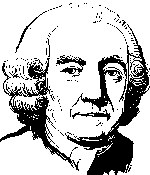
Emanuel Swedenborg 
1688 - 1771
by
Dr. Leon
James
Professor of Psychology, University of
Hawaii
*
To
see a List of Swedenborg's Writings and free access to them online
--- Click here
including
De Hemelsche
Leer (DHL) and other collateral works
*
To see an
introductory statement
about this site
including
a linked directory listing of hundreds of topics ---
Click here
* To see
Student Reports on Theistic Psychology
--- Click
here
You can also scroll down
for many interesting links to articles and Web sites.
You will also find
some illuminating quotations from Swedenborg's Writings. |
"Everything not connected
with something prior to itself falls into nothing."
(Arcana
Coelestia 5084)
"Angels have all their blessedness through truths from good."
(Apocalypse
Explained 484)
|
Quick Access Links
Directory of Swedenborg Encyclopedia of Theistic Psychology
Textbook
of Theistic
Psychology:
The Scientific Knowledge of God Extracted from
the Correspondential Sense of Sacred Scripture
Mirror site:
TheisticPsychology.org
A Man of the
Field: Forming the New Church Mind in Today's World
Moses, Paul, and Swedenborg: Three Steps in Rational Spirituality
 Swedenborg's
Writings Online Swedenborg's
Writings Online
|
Spiritual Psychology
and Theistic Psychology Articles
by Leon James |
Related Web Sites
on
Swedenborg |
From Swedenborg's
Arcana
Coelestia 10597
"The Word teaches that a person is alive after death, for example where it
says that God is not the God of the dead but of the living, Matt. 22:32; that Lazarus was
taken up after death to heaven, but the rich man was cast down to hell, Luke 16:22,23ff;
that Abraham, Isaac, and Jacob are there, Matt. 8:11; 22:32; Luke 16:23-25,29; that Jesus
told the robber, Today you will be with Me in paradise, Luke 23:43; and in other
statements elsewhere." (AC 10597)
"Nothing is permitted to happen that has not been foreseen, for otherwise
it cannot happen." Swedenborg's
Spiritual
Experiences 1088 (SE 1088)
Theistic Psychology
Expressed in One Formulaic Idea
Theistic Psychology = eternity = heaven vs. hell = rational vs.
irrational = human = good and truth = God the Divine Human.
More here...
Everything not connected with something prior to itself falls into
nothing. (AC 5084)
Angelic people have all their blessedness through truths from good. (AC
484)
Wives are by birth forms of love, so that it is innate in them to wish to
be one with their husbands. But it is different with husbands; since they
are not by birth forms of love, but designed to receive that love from their
wives. (CL 216)
Sacred Scripture is the only doctrine which teaches how a man must live
in the world in order to be happy to eternity. (AC 8939)
|
|
 From
Swedenborg's Arcana Coelestia
AC 2588.
Abraham's wife. That this
signifies in order that spiritual truth might be conjoined with celestial
good, is evident from the representation of Sarah as a wife, as being
spiritual truth conjoined with celestial good (see n. 1468, 1901, 2063,
2065, 2172, 2173, 2198, 2507); and from the representation of Abraham, as
being celestial good conjoined with spiritual truth (see n. 2011, 2172,
2198, 2501). Whether we say "spiritual truth and celestial good," or "the
Lord," it is the same; because the Lord is truth itself and good itself, and
is the very marriage itself of truth and good, and of good and truth. How
the case herein is can indeed be seen from the explication; but as these
matters are among those which are obscure at this day, we may so far as
possible illustrate them.
The subject here treated of is the doctrine of faith,
concerning which the Lord thought in His childhood, namely, whether it was
allowable to enter into it by means of rational things, and thus form for
one's self ideas concerning it. His so thinking came from His love and
consideration for the human race, who are such as not to believe what they
do not comprehend in a rational manner.
But He perceived from the Divine that this ought not to be
done; and He therefore revealed the doctrine to Himself from the Divine, and
thereby at the same time all things in the universe that are subordinate,
namely, all things of the rational and of the natural.
[2] How the case is with the doctrinal things of faith among
men has been stated above (n. 2568), namely, that there are two principles
from which they think, a negative and an affirmative; and that those think
from the negative principle, who believe nothing unless they are convinced
by what is of reason and memory-knowledge; nay, by what is of sense; but
those think from the affirmative who believe that things are true because
the Lord has said so in the Word, thus who have faith in the Lord.
They who are in the negative in regard to a thing being true
because it is in the Word, say at heart that they will believe when they are
persuaded by things rational and memory-knowledges. But the fact is that
they never believe; and indeed they would not believe if they were to be
convinced by the bodily senses of sight, hearing, and touch; for they would
always form new reasonings against such things, and would thus end by
completely extinguishing all faith, and at the same time turning the light
of the rational into darkness, because into falsities.
But those who are in the affirmative, that is, who believe
that things are true because the Lord has said so, are continually being
confirmed, and their ideas enlightened and strengthened, by what is of
reason and memory-knowledge, and even by what is of sense; for man has light
from no other source than by means of the things of reason and memory, and
such is the way with everyone. With these the doctrine thus "living lives;"
and of them it is said, that they "are healed," and "bring forth;" whereas
with those who are in the negative the doctrine "dying dies;" and it is said
of them that "the womb closing is closed."
All this shows what it is to enter into the doctrine of
faith by means of rational things, and what to enter into rational things by
means of the doctrine of faith; but let this be illustrated by examples.
[3] It is from the doctrine of the Word, that the first and
principal thing of doctrine is love to the Lord and charity toward the
neighbor. They who are in the affirmative in regard to this can enter into
whatever things of reason and of memory, and even of sense, they please,
everyone according to his gift, his knowledge, and his experience. Nay, the
more they enter in, the more they are confirmed; for universal nature is
full of confirmation.
But they who deny this first and principal thing of
doctrine, and who desire to be first convinced of anything true by means of
the things of reason and memory, never suffer themselves to be convinced,
because at heart they deny, and all the time take their stand in favor of
some other principle which they believe to be essential; and finally, by
confirmations of their principle they so blind themselves that they cannot
even know what love to the Lord and love to the neighbor are.
And as they confirm themselves in what is contrary, they at
length confirm themselves in the notion that no other love is possible that
has any delight in it except the love of self and of the world; and this to
such a degree (if not in doctrine, yet in life) that they embrace infernal
love in place of heavenly love.
But with those who are not in the negative nor as yet in the
affirmative, but are in doubt before they deny or affirm, the case is as
above stated (n. 2568), namely that they who incline to a life of evil fall
into the negative, but they who incline to a life of good are brought into
the affirmative.
[4] Take another example: It is among the primary things of
the doctrine of faith that all good is from the Lord, and all evil from man,
that is, from one's self. They who are in the affirmative that it is so, can
confirm themselves by many things of reason and of memory-knowledge, such as
that no good can possibly flow in except from good itself, that is, from the
Fountain of Good, thus from the Lord; and that the beginning or principle of
good can be from no other source; finding illustration in all things that
are truly good, in themselves, in others, in the community, and also in the
created universe.
But they who are in the negative confirm themselves in what
is contrary by everything they think of, insomuch that at last they do not
know what good is; and dispute among themselves as to what is the highest
good, being deeply ignorant of the fact that it is the celestial and
spiritual good from the Lord, by which all lower good is made alive, and
that the delight therefrom is truly delight. Some also think that unless
good is from themselves, it cannot possibly come from any other source.
[5] Take as another example the truth that they who are in
love to the Lord and charity toward the neighbor can receive the truths of
doctrine and have faith in the Word, but not they who are in the life of the
love of self and the world; or what is the same, that they who are in good
can believe, but not they who are in evil. They who are in the affirmative
can confirm this by numberless things of reason and memory. From reason they
can confirm it on the ground that truth and good agree, but not truth and
evil; and that as all falsity is in evil, so it is from evil; and that if
any who are in evil nevertheless have truth, it is on the lips, and not in
the heart; and from their memory-knowledge they can confirm by many things
that truths shun evils, and that evils spew out truths.
But they who are in the negative confirm themselves by
alleging that everyone, of whatever character, is able to believe just as
well as others, even though he lives in continual hatred, in the delights of
revenge, and in deceit; and this even while they themselves altogether
reject from their doctrine the good of life, after the rejection of which
they do not believe anything.
[6] That it may be still more manifest how the case herein
is, let us take this example: They who are in the affirmative that the Word
has been so written as to possess an internal sense which does not appear in
the letter, can confirm themselves therein by many rational considerations;
as that by the Word man has connection with heaven; that
there are correspondences of natural things with spiritual, in which the
spiritual are not seen; that the ideas of interior thought are altogether
different from the material ideas which fall into the words of language;
that man, being born for both lives, can, while in the world, be also in
heaven, by means of the Word which is for both worlds; that with some
persons a certain Divine light flows into the things of the understanding,
and also into the affections, when the Word is read; that it is of necessity
that there should be something written that has come down from heaven, and
that therefore the Word cannot be such in its origin as it is in the letter;
and that it can be holy only from a certain holiness that it has within it.
He can also confirm himself by means of memory-knowledges;
as that men were formerly in representatives, and that the
writings of the Ancient Church were of this nature; also that the writings
of many among the Gentiles had this origin; and that it is on this account
that in the churches such a style has been revered as holy, and among the
Gentiles as learned, as examples of which the books of many authors might be
mentioned.
But they who are in the negative, if they do not deny all
these things, still do not believe them, and persuade themselves that the
Word is such as it is in the letter, appearing indeed worldly, while yet
being spiritual (as to where the spiritual is hidden within it they care
little, but for manifold reasons are willing to let it be so), and this they
can confirm by many things.
[7] In order to present the subject to the apprehension of
the simple, take as an example the following matter of knowledge. They who
are in the affirmative that sight is not of the eye, but of the spirit,
which sees the things that are in the world through the eye as an organ of
its body, can confirm themselves by many things;
as from our hearing things said by others; in that they
refer themselves to a certain interior sight, into which they are changed;
which would be impossible unless there were an interior sight; also that
whatever is thought of is seen by an interior sight, by some more clearly,
by others more obscurely; and again, that things we imagine present
themselves not unlike objects of sight; and also that unless it were the
spirit within the body that saw the objects which fall within the ken of the
eye as the organ of sight, the spirit could see nothing in the other life,
when yet it cannot but be that it will see innumerable and amazing things
that cannot possibly be seen with the bodily eye.
Then again we may reflect that in dreams, especially those
of the prophets, many things have been seen although not with the eyes. And
finally, should anyone be skilled in philosophy, he may confirm himself by
considering that outer things cannot enter into inner things, just as
compounds cannot into simples; and therefore that things of the body cannot
enter into those of the spirit, but only the reverse; not to mention a host
of other proofs, until at last the man is persuaded that the spirit has
sight, and not the eye, except from the spirit.
But they who are in the negative call every consideration of
this kind either a matter of nature or one of fancy, and when they are told
that a spirit possesses and enjoys much more perfect sight than a man in the
body, they ridicule the idea, and reject it as an idle tale, believing that
if deprived of the sight of the bodily eye they would live in the dark;
although the very opposite is the truth, for they are then in the light.
[8] From these examples we may see what it is to enter into
the things of reason and memory-knowledge from truths, and what it is to
enter into truths from the things of reason and memory-knowledge; and that
the former is according to order, but the latter contrary to order; and that
when we do that which is according to order we are enlightened; but when we
do that which is contrary to order, we are made blind.
All of which shows of how great concern it is that truths
should be known and believed; for man is enlightened by truths, but is made
blind by falsities. By truths there is opened to the rational an immense and
almost unbounded field; but by falsities comparatively none at all, although
this does not appear to be so. It is because the angels are in truths that
they enjoy wisdom so great; for truth is the very light of heaven.
[9] They who have blinded themselves by not being willing to
believe anything which they do not apprehend by the senses, until at length
they have come to believe nothing, were in old times called "serpents of the
tree of knowledge;" for such reasoned much from sensuous things and their
fallacies, which easily fall into man's apprehension and belief, and thereby
they seduced many (see n. 195, 196). In the other life such are readily
distinguished from other spirits by the fact that in regard to all things of
faith they reason whether it be so; and if they are shown a thousand and a
thousand times that it is so, still they advance negative doubts against
every proof that is offered; and this they would go on doing to all
eternity.
So blind are they on this account that they have not common
sense, that is, they cannot comprehend what good and truth are; and yet
every one of them thinks himself wiser than all in the universe; making
wisdom to consist in being able to invalidate what is Divine, and deduce it
from what is natural. Many who in this world have been esteemed wise, are
preeminently of this character; for the more anyone is endowed with talent
and knowledge, and is in the negative, the more insane he is, beyond all
others; whereas the more anyone is endowed with talent and knowledge, and is
in the affirmative, the wiser he is able to be.
It is by no means denied man to cultivate the rational
faculty by means of memory-knowledges; but that which is forbidden is to
harden ourselves against the truths of faith which belong to the Word.
|
Other Articles
on Swedenborg
by Leon James
|
Other Swedenborg
Web Sites |
|
What
is Spiritual Psychology?
What is
Cyber-Psychology?
Two Perspectives on Swedenborg's Writings:
Secular and Religious
The Reciprocal Relation Between Science and
Religion
Swedenborg and the Future of Psychology
as a Science
Overcoming Objections to Swedenborg's Writings Through the Development of
Scientific Dualism
Psychology Student Reactions to
Swedenborg
Scientific Dualism in Psychology
Swedenborg's Theory of Trisubstantivism as a Basis for the Science of Human
Behavior
Lecture
Notes on Swedenborg's Religious Behaviorism
Swedenborg's
Religious Psychology
The Fourteen Scientific Fallacies in Swedenborg's AC 5084: Implications for
Science Education
Comprehensive
Discourse Analysis in a Swedenborgian Perspective
Other Full-Text Articles by Leon
James
Quotations
from the Works of Leon James
47. DIVINE LOVE AND DIVINE WISDOM MUST NECESSARILY
HAVE BEING [Esse] AND HAVE FORM [Existere] IN OTHERS CREATED BY ITSELF.
It is the essential of love not to love self, but to
love others, and to be conjoined with others by love. It is the essential of
love, moreover, to be loved by others, for thus conjunction is effected. The
essence of all love consists in conjunction; this, in fact, is its life,
which is called enjoyment, pleasantness, delight, sweetness, bliss,
happiness, and felicity. Love consists in this, that its own should be
another's; to feel the joy of another as joy in oneself, that is loving. But
to feel one's own joy in another and not the other's joy in oneself is not
loving; for this is loving self, while the former is loving the neighbor.
These two kinds of love are diametrically opposed to each other. Either, it
is true, conjoins; and to love one's own, that is, oneself, in another does
not seem to divide; but it does so effectually divide that so far as any one
has loved another in this manner, so far he afterwards hates him. For such
conjunction is by its own action gradually loosened, and then, in like
measure, love is turned to hate.
Swedenborg in
Divine Love and Wisdom Number 47
|
A List of Famous Writers Who
Said They've Been Influenced by Swedenborg
(includes Calvin Coolidge, Helen
Keller, Carl Gustav Jung, Henry James Sr., William Butler Yeats, Arthur Conan Doyle,
Samuel Taylor Coleridge, Jorge Luis Borges, Honoré de Balzac, Elizabeth Barret Browning,
Ralph Waldo Emerson, Thomas Carlyle, Walter M. Horton, Hiram Powers, and others)
A New Church Women's Page
The Lord's New
Church
The Bible's
Deeper Meaning: Outlook Newsletter from the Swedenborg Movement
Why I believe by JudyE and
other articles and links
Soulmates Marriage in Heaven by
JudyE
Hurtsville,
Australia: The Swedenborg Association--Swedenborg's Spiritual Philosophy The Teachings of
the New Church/New Spiritual Consciousness
Sermons by
General Church Ministers
FAQ Swedenborg
Swedenborg Foundation
Swedenborg Book Publishers
and Societies
The
Lord's New Church--Esoteric Christianity
Full text Books
by Swedenborg Available Online in English Translation
Full Text of Swedenborg's
Book The New Jerusalem and Its Heavenly Doctrines (1758)
List of Swedenborg's Writings
Online Courses
and Chat Rooms on Swedenborg Topics
Connect to
Swedenborg Information and Discussion Groups on the Internet.
The Swedenborgian
Church
Web Directory of
Swedenborg Discussants and Lists
Swedenborg: A
Biography by Dr. Jane K. Williams-Hogan
Includes the Article, "Swedenborg Chronology, Selected Bibliography, and General Reference
Works"
Swedenborg Society in the UK
Dr. Ian Thompson's Site on
Theistic Science
John
Odhner on the Correspondence to Blood
Swedenborg’s Missionary Work
by Rev. Donald L. Rose A review of Swedenborg's publishing and promotion
activities of the books of the heavenly doctrines. |

There are some who are in doubt before they deny, and
there are some who are in doubt before they affirm. They who are in doubt before
they deny are they who incline to a life of evil; and when this life carries
them away, then insofar as they think of the matters in question they deny them.
But they who are in doubt before they affirm are they who incline to a life of
good; and when they suffer themselves to be bent to this by the Lord, then
insofar as they think about those things so far they affirm. (AC 2568)
"Emanuel Swedenborg's theological first editions are rich with ornaments.
Swedenborg sent his theological
 contribution
into the world heavily and consistently adorned with graphic decorative touches.
Yet few know of their existence. Although every theological word penned by
Swedenborg has long ago been translated into English, although subsequent Latin
editions, and translations into thirty-four languages, have brought his unique
thoughts and experiences before the world, the ornaments that formed an integral
part of his original publications have been all but lost." contribution
into the world heavily and consistently adorned with graphic decorative touches.
Yet few know of their existence. Although every theological word penned by
Swedenborg has long ago been translated into English, although subsequent Latin
editions, and translations into thirty-four languages, have brought his unique
thoughts and experiences before the world, the ornaments that formed an integral
part of his original publications have been all but lost."
From: The Ornaments in Swedenborg's Theological First Editions by
Jonathan S. Rose, M.Div., Ph.D. Available online at:
www.glencairnmuseum.org/ornaments/Ornaments.htm
Some of the People Who Were
Influenced by Swedenborg
"The most remarkable step in the religious history of
recent ages is that made by the genius of Swedenborg." Ralph Waldo Emerson
"I admire Swedenborg as a great scientist and a great
mystic at the same time. His life and work have always been of great interest to
me." Carl Jung, Psychologist
"For you Westerners, it is Swedenborg who is your Buddha,
it is he who should be read and followed!" D. T. Suzuki, Zen Buddhist
Scholar
"The correlations between what Swedenborg writes of some
of his spiritual experiences and what those who have come back from close calls
with death report is amazing." Raymond Moody, author of Life After Life
"People who have had near-death experiences peek through
the door of the after-life, but Swedenborg explored the whole house." Kenneth
Ring, founder of International Association for Near Death Studies (I.A.N.D.S.)
"Let me explain why Swedenborg merits scrutiny. It is a
fact that the greatest poets and prose writers have borrowed liberally from him.
The list is long: first Blake, as his direct spiritual descendant; then Goethe,
a fervent reader of Swedenborg (as was Kant followed by Edgar Allan Poe,
Baudelaire, Balzac, Mickiewicz, Slowacki, Emerson, Dostoevsky...." Czeslaw
Milosz, 1980 Nobel Prize, Literature
"Swedenborg's enormous work has been my companion
throughout my entire life." Henry Corbin, Islamic Scholar
"Swedenborg's message has meant so much to me! It has
given color and reality and unity to my thought of the life to come; it has
exalted my ideas of love, truth, and usefulness; it has been my strongest
incitement to overcome limitations." Helen Keller
"I have come back to Swedenborg after vast studies of all
religions... Swedenborg undoubtedly epitomizes all the religions - or rather the
one religion - of humanity." Honore de Balzac
"More truths are confessed in Swedenborg's writings than
in those of any other man... One of the loftiest minds in the realm of mind...
One of the spiritual suns that will shine brighter as the years go on."
Thomas Carlyle, Theologian
"Swedenborg was one of the world's greatest geniuses. With
his rare intellect and deep spiritual insight he has much to contribute to our
modern life." Norman Vincent Peale
"To my mind, the only light that has been cast on the
other life is found in Swedenborg's philosophy. It explains much that was
incomprehensible." Elizabeth Barrett Browning
Other artists, writers, thinkers and leaders influenced by
Swedenborg include:
William Blake
Jorge Luis Borges
Robert Browning
John "Johnny Appleseed" Chapman
Samuel Taylor Coleridge
John Flaxman
Benjamin Franklin
Robert Frost
Northrop Frye
Victor Hugo
George Innes |
Henry James, Sr.,
George Macdonald
Ezra Pound
Howard Pyle
Georges Sand
August Strindberg
Henry David Thoreau
George Washington
William Butler Yeats
Bill Wilson (co-founder of Alcoholics Anonymous)
and more. |
©2001 Information Swedenborg
Inc. All Rights Reserved. Original here:
www.swedenborg.ca/swedenborg/influence.html |
|
Quoting
from Swedenborg's
Divine Providence No.
279:
Affections, which belong to the will, are nothing but changes of
state of the purely organic substances of the mind, and that thoughts, which belong to the
understanding, are nothing but changes and variations in the form of these substances, and
that memory is a permanent state of these changes and variations. Everyone acknowledges,
when it is stated, that affections and thoughts exist only in substances and their forms,
which are subjects; and as these exist in the brain, which is full of substances and
forms, they are said to be purely organic forms. No one who thinks rationally can help
laughing at the fanciful notions of some that affections and thoughts do not exist in
forms that are substantiated, but that they are exhalations formed into shapes by heat and
light like images appearing in the atmosphere. For thought can no more exist apart from a
substantial form than sight apart from its form which is the eye, hearing apart from its
form which is the ear, and taste apart from its form which is the tongue. If you examine
the brain you will see innumerable substances, and likewise fibers; you will also see that
everything in it is organized. What need is there of any other than this ocular proof?
[7] The question arises, What is affection and what is thought in
the mind? This may be inferred from all the things in general and in particular in the
body where there are many viscera, each fixed in its own place and all performing their
own functions by changes and variations of state and form. It is well known that they are
engaged in their own operations - the stomach, the intestines, the kidneys, the liver, the
pancreas, and the spleen, the heart and the lungs, each organ in its respective operation.
All these operations are kept in motion from within, and to be moved from within is to be
moved by means of changes and variations of state and form. Hence it may be evident that
the operations of the purely organic substances of the mind are of a similar nature, with
this difference, that the operations of the organic substances of the body are natural,
while those of the mind are spiritual, and that both act together as one by
correspondences.
[8] The nature of the changes and variations of state and form in
the organic substances of the mind, which are affections and thoughts, cannot be shown to
the eye; but still they may be seen as in a mirror from the changes and variations in the
state of the lungs in speaking and in singing. There is, moreover, a correspondence; for
the sound of the voice in speaking and singing, and also the articulations of sound, which
are the words of speech, and the modulations of singing, are caused by means of the lungs,
and sound corresponds to affection and speech to thought. Further, sound and speech are
produced by affection and thought; and this is effected by changes and variations in the
state and form of the organic substances in the lungs, and from the lungs through the
trachea or windpipe, in the larynx and glottis, then in the tongue and finally in the
lips. The first changes and variations of the state and form of sound take place in the
lungs, the second in the trachea and larynx, the third in the glottis by the various
openings of its orifice, the fourth in the tongue by its various adaptations to the palate
and teeth, and the fifth in the lips by their various modifications of form. Hence it may
be evident that the mere changes and variations, successively continued, in the state of
organic forms produce sounds and their articulations, which are speech and singing. Now,
since sound and speech are produced from no other source than the affections and thoughts
of the mind, for they exist from these and are never apart from them, it is clear that the
affections of the will are changes and variations in the state of the purely organic
substances of the mind, and that the thoughts of the understanding are changes and
variations in the form of those substances, as is the case in the pulmonary substances.
[9] As affections and thoughts are simply changes in the state of
the forms of the mind, it follows that memory is nothing else than a permanent state of
these changes. For all changes and variations of state in organic substances are such that
once they have become habitual they are permanent. Thus the lungs are habituated to
produce various sounds in the trachea, to vary them in the glottis, to articulate them in
the tongue, and to modify them in the mouth; and when once these organic activities have
become habitual such sounds are in the organs and can be reproduced. (DP 279)
|
| It shall first be
explained what a spirit is, and what an angel is. All persons after death come, in the
first place, into the world of spirits, which is midway between heaven and hell, and there
pass through their own times, that is, their own states, and become prepared, according to
their life, either for heaven or for hell. So long as people stay in that world they are
called spirits. They who have been raised out of that world into heaven are
called angels; but those who have been cast down into hell are called either satans
or devils. So long as these continue in the world of spirits, those who are
preparing for heaven are called angelic spirits; and those who are preparing
for hell, infernal spirits; meanwhile angelic spirits are conjoined with
heaven, and infernal spirits with hell. All spirits in the world of spirits are
adjoined to people still on earth; because people still on earth, in respect to the
interiors of their minds, are in like manner between heaven and hell, and through these
spirits they communicate with heaven or with hell according to their life. It is to be
observed that the world of spirits is one thing, and the spiritual world another; the
world of spirits is that which has just been spoken of; but the spiritual world includes
that world, and heaven and hell. (From Swedenborg's Divine
Love and Wisdom No. 140) (DLW 140) |
| And so, meanwhile
back on earth, what does all this mean? It means the vertical community!! We
are members of a horizontal community (as in "I'm an American in the year 2000")
and simultaneously, we are members of a vertical community. Our language and style
and behavior pattern are influences from the horizontal community; our thoughts and
feelings are influences from the vertical community. What a mind blower: I'm
not alone in my thoughts and feelings! Swedenborg called it spiritual influx.
All my thoughts and feelings stream into my mind from all those other minds in the
spiritual world who have been there and are there. Each one of us joins them when we
pass on, and the stream or network of thoughts and feelings continues to reverberate and
circulate and take new patterns endlessly, forever. This process is managed by the
Laws of Divine Providence. From Leon James Swedenborg Glossary, see the entry for
"Vertical Community" by Leon James--Continued
here. |
| These are the general principles
of all religions by which everyone can be saved. To acknowledge God and to refrain from
doing evil because it is against God are the two things which make religion to be
religion. If one of them is wanting it cannot be called religion, since to acknowledge God
and to do evil is a contradiction; so also is to do good and yet not acknowledge God, for
one is not possible without the other. It has been provided by the Lord that almost
everywhere there should be some form of religion, and that in every religion there should
be these two principles; and it has also been provided by the Lord that everyone who
acknowledges God and refrains from doing evil because it is against God should have a
place in heaven. For heaven in the complex resembles one Man whose life or soul is the
Lord. In that heavenly Man there are all things which are in a natural man with that
difference which exists between things heavenly and things natural. From Swedenborg's Divine Providence. |
| Swedenborg warns that nothing is more
important in our life here on earth than to understand how our
feelings rule our thoughts. Without this understanding, truth appears as falsity, and
good appears as evil. What a stupendous blunder, robbing us of all lasting intelligence,
wisdom, and the warmth of love. Swedenborg has witnessed the lot of those of us who end up
in mind's hell with such stubbornness as to keep us there endlessly. Such is the virtual
power of the human spirit given to it by the Divine through continuous, ceaseless influx
of spiritual substances into the mind. by Leon
James Continued
in this article. |
| CL 1. I anticipate that
many who read the following descriptions and the accounts at the ends of the succeeding
chapters will believe they are figments of my imagination. I swear in truth, however, that
they are not inventions, but actual occurrences to which I was witness. Nor were they
witnessed in any condition of unconsciousness but in a state of full wakefulness. For it
has pleased the Lord to manifest Himself to me and send me to teach the doctrines that
will be doctrines of the New Church, the church meant by the New Jerusalem in the book of
Revelation. To this end He has opened the inner faculties of my mind and spirit. As a
result, it has been made possible for me to be in the spiritual world with angels and at
the same time in the natural world with men, and this now for twenty-five years.* * From
Conjugial Love
by Swedenborg, published in the
year 1768. |
Swedenborg's
Writings Online
Go to this new site that allows you to read and search the
entire collection of Swedenborg's Theological Writings, as well as a Key for
Bible References in the Writings.
 |
Selections from Swedenborg's Writings
| From Swedenborg's
Conjugial Love book:
CL 34. (3) Everyone's own
love remains in him after death. People know that love exists, but they do not know what
love is. They know that it exists from common conversation. For instance, people say that
"he loves me," that a king loves his subjects and the subjects love their king,
that a husband loves his wife, and a mother her children, and vice versa, also that this
person or that loves his country, his fellow citizens, his neighbor. So, too, with matters
abstracted from person, as in saying that one loves this or that thing.
But even though love is so frequently mentioned, nevertheless
scarcely anyone knows what love is. Whenever someone meditates on it, he cannot then form
for himself any idea in his thought about it, thus he cannot bring it into the light of
his understanding, because it is not a matter of light but of warmth. Therefore he says
either that love is not anything, or that it is merely some stimulus flowing in through
his vision, hearing and social interaction, which thus affects him. He does not know that
love is his very life, not only the general life in his whole body and the general life in
all his thoughts, but also the life in every single particle of them.
The wise person can perceive this from considering the
following proposition: If you take away the impulse of love, can you form any thought? Or
can you perform any action? In the measure that the affection belonging to love cools, is
it not true that in the same measure thought, speech and action cool? And the warmer the
affection grows, the warmer they grow?
Love, therefore, is the warmth in a person's life or his
vital heat. The warmth of the blood, and also its redness, have no other origin. The fire
of the angelic sun, which is pure love, causes it.
From E. Swedenborg's Conjugial Love
|
| DP
333. The operation of the Divine Providence for the salvation of man is said to begin at
his birth and to continue right on to the end of his life. In order to understand this it
should be known that the Lord sees what the nature of a man is, and foresees what he
desires to be, and thus what he will be; and in order that he may be a man and therefore
immortal, the freedom of his will cannot be taken away, as has been shown above in many
places. Therefore the Lord foresees man's
state after death and provides for it from his birth right on to the end of his life. With
the wicked the Lord provides by permitting and continually withdrawing them from evils;
while with the good He provides by leading them to good. Thus the Divine Providence is
unceasing in the work of saving man. However, no more can be saved than desire to be
saved, and only those desire to be saved who acknowledge God and are led by Him; but those
do not desire to be saved who do not acknowledge God and who lead themselves; for these
give no thought to eternal life and salvation, while the others do. This the Lord sees and
still He leads them, leading them according to the laws of His Divine Providence, contrary
to which He cannot act, since so to act would be to act contrary to His Divine Love and
contrary to His Divine Wisdom, that is, contrary to Himself.
[2] Now since the Lord foresees the state of all
after death and also foresees the places in hell of those who do not desire to be saved,
and the places in heaven of those who desire to be saved, it follows, as has been said,
that He provides their places for the wicked by permitting and withdrawing, and their
places for the good by leading; and unless this were done continually from the birth of
everyone to the end of his life neither heaven nor hell would continue to exist, for
without this foresight and Providence at the same time neither heaven nor hell would be
anything but confusion. It may be seen above (n. 202, 203) that everyone has his place
provided for him by the Lord from this foresight.
[3] This may be illustrated by the following
comparison. If a javelin thrower or a musketeer were to aim at a target and a straight
line were drawn from the target a thousand feet beyond it; and if he should err in his aim
by only a nail's breadth, his weapon or bullet, at a distance of a thousand feet, would
diverge very far from the line drawn beyond the mark. So would it be if the Lord did not
every moment, even every least fraction of a moment, regard eternity in foreseeing and
providing everyone's place after death. This, however, is done by the Lord because all the
future is present to Him and all the present is to Him eternal. It may be seen above (n.
46-69, 214, and following numbers) that the Divine Providence in everything it does has
regard to the infinite and the eternal.
Divine
Providence |
| From Swedenborg's The True
Christian Religion 771.
In the
chapter on the Sacred Scripture I showed that the literal sense of the Word is written by
appearances and correspondences. Each of its details therefore contains a spiritual sense
in which truth is illuminated by its own light, and the literal sense is in shadow. So to
prevent the people of the new church, like those of the old church, going astray in the
shadows obscuring the literal sense of the Word, especially as regards heaven and hell,
how they will live after death, and on the present occasion about the Lord's coming, the
Lord has been pleased to open the sight of my spirit, thus admitting me to the spiritual
world. I have been allowed not only to talk with spirits and angels, with relations and
friends, even with kings and princes, who have met their end in the natural world, but
also to see the astonishing sights of heaven, and the pitiful sights of hell. So I have
seen how people do not pass their time in some pu deep in the earth, nor flit around blind
and dumb in the air or in empty space, but live as human beings in a substantial body, in
a much more perfect state, if they come among the blessed, than they experienced
previously when living in material bodies.
[2] So to prevent people from plunging yet deeper into erroneous ideas about the
destruction of the sky we see and the earth we live on, and consequently about the
spiritual world, as the result of ignorance, which leads to worshipping nature and this
automatically to atheism - something which at the present time has begun to take root in
the inner rational minds of the learned - to prevent then atheism from spreading more
widely, like necrosis in the flesh, so as to affect as well the outer mind which controls
speech, I have been commanded by the Lord to make known various things which I have seen
and heard. These include heaven and hell, the Last Judgment, and the explanation of
Revelation, which deals with the Lord's coming, the former heaven and the new heaven, and
the holy Jerusalem. If my books on these subjects are read and understood, anyone can see
what is meant there by the Lord's coming, a new heaven and the New Jerusalem.
|
|
True Christian Religion
TCR
475.
IV. SO LONG AS MAN LIVES IN THE WORLD, HE IS KEPT MIDWAY BETWEEN HEAVEN AND HELL,
AND IS THERE IN SPIRITUAL EQUILIBRIUM, WHICH IS FREEDOM OF CHOICE.
In order to know what freedom of choice is and the nature of it, it is necessary to
know its origin. Especially from a recognition of its origin it can be known, not only
that there is such a thing as freedom of choice, but also what it is. Its origin is in the
spiritual world, where man's mind is kept by the Lord. Man's mind is his spirit, which
lives after death; and his spirit is constantly in company with its like in the spiritual
world, and at the same time by means of the material body with which it is enveloped, it
is with men in the natural world. Man does not know that in respect to his mind he is in
the midst of spirits, for the reason that the spirits with whom he is in company in the
spiritual world, think and speak spiritually, while his own spirit thinks and speaks
naturally so long as he is in the material body; and the natural man cannot understand or
perceive spiritual thought and speech, nor the reverse.
This is why spirits cannot be seen. But when the spirit of man is in company with
spirits in their world, he is also in spiritual thought and speech with them, because his
mind is interiorly spiritual but exteriorly natural; therefore by means of his interiors
he communicates with spirits, while by means of his exteriors he communicates with men. By
such communication man has a perception of things, and thinks about them analytically. If
it were not for such communication, man would have no more thought or other thought than a
beast, and if all connection with spirits were taken away from him, he would instantly
die.
[2] But to make it comprehensible how man can be kept midway between heaven and hell
and thereby in spiritual equilibrium from which he has freedom of choice, it shall be
briefly explained. The spiritual world consists of heaven and hell; heaven then is
overhead, and hell is beneath the feet, not, however, in the center of the globe inhabited
by men, but below the lands of the spiritual world, which are also of spiritual origin,
and therefore not extended [spatially], but with an appearance of extension.
[3] Between heaven and hell there is a great interspace, which to those who are there
appears like a complete orb. Into this interspace, evil exhales from hell in all
abundance; while from heaven, on the other hand, good flows into it, also in all
abundance. It was of this interspace that Abraham said to the rich man in hell:
Between us and you there is a great gulf fixed; so that they who would pass from hence
to you cannot, neither can they who are there cross over to us (Luke 16:26).
Every man, as to his spirit, is in the midst of this interspace, solely for this
reason, that he may be in freedom of choice.
[4] Because this interspace is so large and because it appears to those who are there
like a vast orb, it is called the World of Spirits. Moreover, it is full of spirits,
because every man after death first goes there, and is there prepared either for heaven or
for hell. There he is among spirits, in company with them, as formerly he was among men in
the world. There is no purgatory there; that is a fiction invented by the Roman Catholics.
But that world has been treated of particularly in the work on Heaven and Hell (London,
1758, n. 421-535).
TCR 476.
Every
man from infancy even to old age is changing his locality or situation in that world. When
an infant he is kept in the eastern quarter towards the northern part; when a child, as he
learns the first lessons of religion, he moves gradually from the north towards the south;
when a youth, as he begins to exercise his own thoughts, he is borne southward; and
afterwards when he judges for himself and becomes his own master, he is borne into the
southern quarter towards the east, according to his growth in such things as have regard
interiorly to God and love to the neighbor. But if he inclines to evil and imbibes it, he
advances towards the west.
For all in the spiritual world have their abodes according to the quarters; in the east
are those who are in good from the Lord, because the sun, in the midst of which is the
Lord, is in that quarter; in the north are those who are in ignorance; in the south, those
who are in intelligence; and in the west, those who are in evil. Man himself is not kept
as to his body in that interspace or middle region, but only as to his spirit; and as his
spirit changes its state by advancing towards good or towards evil, so is it transferred
to localities or situations in this quarter or in that, and comes into association with
those who dwell there.
But it must be understood that the Lord does not transfer man to this or that place,
but man transfers himself in different ways. If he chooses good, he together with the
Lord, or rather the Lord together with him, transfers his spirit towards the east. But if
man chooses evil, he together with the devil, or rather the devil together with him,
transfers his spirit towards the west. It must be noticed that where the term heaven is
here used, the Lord also is meant, because the Lord is the all in all things of heaven;
and where the term devil is used, hell also is meant, because all who are there are
devils.
TCR 477.
Man
is kept in this great interspace, and midway therein continually, for the sole purpose
that he may have freedom of choice in spiritual things, for this is a spiritual
equilibrium, because it is an equilibrium between heaven and hell, thus between good and
evil. All who are in that great interspace are, as to their interiors, conjoined either
with the angels of heaven or with the devils of hell; or at the present day either with
the angels of Michael or with the angels of the dragon. After death every man betakes
himself to his own in that interspace and associates himself with those who are in a love
similar to his own, for love conjoins everyone there with his like, and causes him to
breathe out his soul freely, and to continue in his previous state of life. But the
externals that do not make one with his internals are then gradually put off, and when
this has been done the good man is raised up to heaven, and the evil man betakes himself
to hell, each to such as he is at one with as to his ruling love.
TCR 478.
This
spiritual equilibrium, which is freedom of choice, may be illustrated by various forms of
natural equilibrium. It is like the equilibrium of a man bound about his body or at his
arms between two men of equal strength, one of whom draws the man between them to the
right, and the other to the left, so that the man in the middle can freely turn this way
or that as if unrestrained by any force; and if he turns toward the right he draws the man
on his left forcibly toward him, even bringing him to the ground. It would be the same
with any unresisting person, even if bound between three men on his right, and the same
number on his left, of equal power; also if bound between camels or horses.
[2] Spiritual equilibrium, which is freedom of choice, may be compared to a balance, in
each scale of which equal weights are placed; but if a slight weight is then added to
either scale, the tongue of the scale begins to vibrate. It is similar with a pole or
large beam balanced on its support. Each and all things within man, as the heart, the
lungs, the stomach, the liver, the pancreas, the spleen, the intestines, and the rest, are
in such a state of equilibrium; and for this reason each is able to discharge its
functions in perfect quiet. It is the same with all the muscles; if they were without such
equilibrium all action and reaction would cease, and man would no longer act as a man.
Since, then, all things of the body are in such equilibrium, so are all things of the
brain, and consequently all things of the mind therein, which relate to the will and
understanding.
[3] There is a freedom also belonging to beasts, birds, fishes and insects; but these
are impelled by their bodily senses, prompted by appetite and pleasure. Man would not be
unlike these if his freedom to do were equal to his freedom to think. He, too, would then
be impelled by his bodily senses, prompted by lust and pleasure. It is otherwise with one
who heartily accepts the spiritual things of the church, and by means of them restrains
his freedom of choice. Such a man is led by the Lord away from lusts and evil pleasures
and his connate avidity for them, and acquires an affection for what is good, and turns
away from evil. He is then transferred by the Lord nearer to the east, and at the same
time to the south of the spiritual world, and is introduced into heavenly freedom, which
is freedom indeed. |
Click here to access the
Swedenborg Glossary of Theistic Psychology by Leon James
This is my attempt to organize and translate Swedenborg's concepts into modern
psychology and to transform it into scientific dualism.
Back to Leon James Home Page
Annotated Directory
of the Writings of Leon James
Quotations from the Works
of Leon James
The
Spiritual Sayings and Aphorisms of Leon James
Send
e-mail to Leon James
|
Swedenborg's
Writings Online
Go to this new site that allows you to read and search the
entire collection of Swedenborg's Theological Writings, as well as a Key for
Bible References in the Writings.
|
Back to Leon James Home Page
|

