|
| |
Theistic Psychology:
The Scientific Knowledge of God
Extracted from the
Correspondential Sense
of Sacred Scripture
 Dr.
Leon James Dr.
Leon James
Professor of Psychology
University of Hawaii
Published on the Web in 2004
Latest Update: 2007
Publication Note, Permissions to Use, and Copyright
Notice
The Topical Index to Sections
and Reading List is in Volume 18
This is Volume 11
The Marriage Relationship and
The Doctrine of the Wife
(version 50j)
11.0
Feminizing the Marriage
Relationship: The Unity Model
11.1
Marriages in Heaven or Conjugial Love
11.2
Marriages in Hell or Infernal Concubinage
11.3
Three Levels of Unity in Gender Relationship
11.3.1.1
Mental Anatomy of Women and Men
11.3.2
Unity Through Reciprocity and Differentiation
11.3.3
Sensorimotor, Cognitive, and Affective Conjunction
11.3.4
Unity
Model in Marriage: Ennead Chart of Growth Steps
11.3.5
Male Dominance Model of Marriage
11.3.5.1
How does the husband develop mental intimacy with his wife?
11.3.5.2 Political
Semantics of the Male Dominance Model
11.3.5.2.1 "Nagging"
11.3.5.2.2
"Give him sex"
11.3.5.2.3
"Don't try to
change him"
11.3.5.2.4
"Keep
yourself attractive for him"
11.3.5.2.5
"That's how men are"
11.3.5.2.6
"Show that
you appreciate him"
11.3.5.2.7
"Wives,
submit to your husbands"
11.3.5.3
Does the Male Dominance Model Have a Biblical Grounding?
11.3.5.4
Hellish Marriages and the Female Dominance Model
11.3.6
The Spiritual Dimension to the Unity Model
11.3.6.1
Making Field Observations
11.3.6.2
The Ennead Charts of Marriage
11.3.6.3
Behavioral Indicators of One's Relationship Model
11.3.6.3.1
Gender Discourse Within the Three
Models
Part 1: Sexy vs. Unsexy Conversational Style of Husbands
Part 2: Spiritual Dynamics Between Husband and Wife
Part 3: Conversational Rules for Husbands in Conjugial Interactions
Part 4: Characteristics of Husband's
Threefold Self During
Discourse -- Table 7aa
Part 5: Field Exercise: Monitoring
Disjunctive vs. Conjunctive Discourse
Examples of Unity
Values
11.3.7
Six Phases of Temptations for Regenerating Husbands
11.3.7.1
Overcoming White Temptations
11.3.7.2
Overcoming Yellow Temptations
11.3.7.3
Overcoming Green Temptations
11.3.7.4
Overcoming Blue Temptations
11.3.7.5
Overcoming Brown Temptations
11.3.7.6
Overcoming Black Temptations
11.4
The Doctrine of the Wife For Husbands
11.4.0
Conjugial Love: The Jewel of Human Life
11.4.1
The Surrendered Wife vs. the Surrendered Husband
11.4.2
The Surrendered
Husband is The Ideal Elevated Man
11.4.3 The
Self-Entrapment of Male Intelligence
11.4.4
The Spiritual
Physiology of Marriage
11.4.5
Conjunction Dynamics in Marriage
11.4.5.1
Conjugial Simulations -- Not Fake but
Necessity
11.4.6 Her
Heaven, Not His
11.4.7 Divine
Truth Within Which Is Divine Love
11.4.8
Is The Surrendered Husband Feminized?
11.4.8.1
Husbands Confess Here: Leon James
11.4.9
The Conjoint Mind Is Both Masculine And Feminine
11.4.10 The
Wife's Role in Heavenly Marriages
11.4.10.1
The Wife is a Form of the Highest Human
Wisdom
11.4.11 Part
A: Spiritual Psychobiology of Marriage
11.4.11
Part B: The Husband's Two Forms of
Wisdom:
Intellectual and Moral
11.4.11
Part C: The Wife's Superior Perception of the Husband's Affections
11.4.11.1 The
Source of Conjugial Love With Husbands:
The Inner Sense of CL 88
11.4.11.2
The Circle of Life In Marriage
11.4.11.3
Two Phases of Achieving Unity in Marriage
11.4.12
Marriage and Doctrine
11.5
Preparation
for Marriage
11.6
Conjugial
Love and Children
11.7
The Marriage Relationship
Based on Sacred Scripture Described in Modern Islam
11.7.1
The Definition of God
The Topical Index to Sections
and Reading List is in Volume 18
The quotations from Swedenborg's book on marriage are from:
Swedenborg, Emanuel.
(1768) Wisdom's Delight in Marriage ("Conjugial") Love: Followed by Insanity’s
Pleasure in Promiscuous Love (abbreviated: Conjugial Love (CL) and
Marriage Love). Available online at:
www.swedenborgdigitallibrary.org/contets/cltc.html
11.0
Feminizing the Marriage Relationship: The Unity Model
The "model" in marriage refers to the philosophical belief system of each
partners. I have identified three models that are aligned progressively from the
early phase of male dominance to the later phase of equity to the final phase of
unity. With few exceptions, every marriage starts with the male dominance model
which both partners come with based on their cultural background and upbringing.
There are couples who appear intellectually opposed to the male dominance model,
and see themselves as following the equity or equality model. Dr. Laura
Schlessinger's ideal model of marriage is the male dominance model. The
popularity of the book indicates that this is the model that many American men
are most attracted. Dr. Laura Schlessinger's advice to wives is to allow the
husband to remain in the illusion of the male dominance model, and to take
actual charge of the relationship. Dr. Laura Schlessinger says that it is the
woman who has the real power, because she understands relationships and what's
going on with the husband, while the husband is clueless because he is "simple"
in mentality. This point of view is the male dominance model.
We will examine what she writes and how she expresses the male dominance model
as the ideal for couples to follow. I will point out the assumptions that show
her belief in the male dominance model. To be able to bring this out, I will
contrast the male dominance model with the equity and unity models. I will try
to show that the dominance model is an external phase of the marriage
relationship, and that the partners need to progress to further phases in order
to make the marriage more internal, involving spiritual loves that are
permanent. The equity model is a belief system that couples use to leave behind
the male dominance model, on their way to the unity model, which is the true
internal marriage of conjugial love. If the marriage partners both enter this
unity model phase before passing on, they will be in heaven together to
eternity, growing endlessly more interior into the human potential.
The wife can enter into conjugial love more easily than the husband, and if her
husband is unwilling to follow her into that phase, she will be in heaven with
another mind, her true soul mate who is willing to follow her to her heaven or
perfect happiness. The husband who is unwilling to enter the unity phase with
any woman, even after arriving in the world of spirits, cannot enter the heaven
of his mind, but slips down into his own hell, created by his rejection of
rational consciousness and true spirituality. The unity model of marriage is a
spiritual and celestial model that represents the relationship of marriage in
the heavens. It is described in the book of the Writings known as Conjugial
Love (1768).
A wife's heaven is the state of mind she is in where her husband is present with
her and united mentally as one. In other words the functioning of her mental
organs is dependent on the reciprocal functioning of his mental organs in such a
way that they can form a one or unity. And yet absolutely nothing in the wife is
like anything in the husband for there is a perfect and total differentiation of
all units in mental organics and hence in physical. This reciprocal relationship
of differentiation and unity, is like the relationship between the heart and the
lungs.
The body's blood circulation and heart correspond to the affective organ in the
mind and the lungs and pulmonary system correspond to the cognitive organ. The
affective and cognitive organs in the mind work together in synergy, like the
heart and lungs in the body. They are two systems that are completely
differentiated from each other, each having a structure that is different in all
aspects from the other. The differential structure of each organ allows them to
serve their own unique function. Neither alone can support the operation of the
muscles and sensory nervous system, but together the structural parts
interconnect and act appropriately according to the function they each must
meet. Together, or in unity of function, they allow the muscles and senses to be
alive in their operation.
Marriage is similarly a synergy of the husband and wife operating together
through their differentiated structures, to create a unity of minds that allows
the two independent people to form a conjugial couple, conjoined internally to
eternity and developing together their progressive perfection.
The problems in marriage today are many. Why are there problems with
marriage? It is a creation by God to bring about the perfect happiness of two
human beings to eternity in heaven. This creation is perfect and there are no
problems with it. The perfection of marriage cannot be created by God apart from
a man and a woman born on some earth in the natural world within some culture
and society. The perfection of marriage is this: That it a process of
growing into a conjugial couple. Two independent individuals, a man and a woman,
regardless of culture or personality, regardless of physical size or mental
ability, can start the process of growing progressively more and more into a
unity, and this to eternity. This independent self-motivated progressive growth
is necessary for our happiness and joy to be as much as we can take every day to
eternity. Marriage is a perfect creation because it leads to this perfect state
of human life. No other mechanism than marriage is given in Divine revelation
for achieving the perfection of eternity.
It has also been revealed that the perfection of marriage is a spiritual
phenomenon, not natural. Natural marriages which are external without the
spiritual within it, are not perfect, and in fact external marriages have many
sad and self-destructive characteristics. The power and perfection of marriage
is achieved only when the spiritual marriage is also operative within the minds
of the husband and wife. The spiritual marriage is called "the marriage of good
and truth." This spiritual marriage is the very basis and foundation of
regeneration and salvation, that is, of spiritual development towards the
perfection of eternity in heaven. The marriage of good and truth is called most
holy in the Writings because Divine Good is the same as Divine Love, and Divine
Truth is the same as Divine Wisdom, and these are most holy because God Himself
in Essence and Form.
It has been revealed that in the Divine-Human there is a most holy marriage of
Divine Love and Divine Truth. Infinite love and infinite truth in God make a
one, a unity. Nothing about love is like anything about truth, just as nothing
about the affective organ is like anything in the cognitive organ. Or again:
nothing about a feeling is like anything about a thought. And again: nothing
about a woman is like anything in a man. There must be this absolute duality
between the elements of the two parts that unite into a perfect oneness. There
cannot be a oneness between God and a human being because they are of different
substances, God infinite and uncreate, a human being finite and created. The
creator cannot become one with the created--this would be a rational
impossibility. If it were to happen, the duality between Creator and created
would disappear, and neither created nor Creator could then continue to exist.
The total differentiation between man and woman is a representative
correspondence of the total differentiation between love and truth in God. The
marriage of good and truth in the Divine-Human is the source of perfection of
the marriage of a man and a woman, and the source of perfection of the
regeneration of an individual's affective and cognitive life. Spiritual
development of the individual is the progressive perfection of the marriage in
his mind between the will and the understanding, that is, between the operations
of the affective organ and those of the cognitive organ. When the affective and
cognitive organs are joined by synergy into a unity, the individual is being
regenerated, the individual grows spiritually and is made ready for conjugial
love. The regenerating husband and the regenerating wife then grow together in
the internal spiritual portion of the marriage process.
The earliest generations on this earth are called in the Writings "the Most
Ancient Church" or the "Adamic Church." Swedenborg visited them in their heavens
where they have lived in conjugial love for many thousands of years, though they
themselves have no sense of time or history. They were born on this earth with a
celestial mind and they had the ability to communicate directly with those who
preceded them in the spiritual world. They entered into the perfect marriage
process without resistance or opposition. They were incapable of thinking about
non-exclusive relationship or sexuality. When Swedenborg started telling them
about the commonness of adultery, infidelity, and promiscuity on this earth in
modern times, they were so horrified they could not bear to think about it, and
refused to hear any details.
But the celestial mind which was first created on this planet was not complete
in its ultimate evolution and perfection. The very fact that they could not
contemplate or imagine infidelity or promiscuity created a certain weakness, a
certain lack of perfection. They had the wisdom based on the innocence of
childhood, but they lacked the wisdom based on the innocence of old age. One
symptom of this was the fact that they typically passed on in their early
thirties, which was wonderful because their physical bodies did not deteriorate
and they were spared the sickness of older ages. But because they lacked the
wisdom that develops in old age, their happiness in heaven could not be as great
as it would become later, as the generations on earth evolved and become more
and more scientific and rational.
The split-brain race that succeeded the celestial mind is called the spiritual
race. We are part of this race. Although we are born with inherited evil in our
natural mind, we have been given the mechanism by which we can cleanse ourselves
from this inheritance. This cleansing process is called regeneration and it
takes a life time to achieve. The lifespan of people gradually increased from
ancient to modern times and today, we have hundreds of millions of people in
every generation that reach old age, giving the human mind on earth the
opportunity to develop still further. The wisdom we acquire in old age, when
based on Divine revelation, is higher than the wisdom we acquire when younger.
By living to a ripe old age our generation has infused new higher wisdom into
the conglomerate of the human mind called the Grand Human (see Section xx),
which includes the most ancient civilizations that are now alive in their
heavens.
There is thus a mutual and interdependent connectivity between all the
generations that have ever been born on this and other planets, who are all in
the spiritual world in eternity, either in heaven or in hell. The process that
creates this Grand Perfection of the human race is unity at all levels, of
couples, societies, generations, and worlds. And the unity at all the levels
rests on the unity of its constituent level, which is that of the couple. Hence
the marriage of a man and a woman is the foundation for the universe and its
endless future. These details indicate to you that the sanctity of marriage and
sexuality is not merely a moral and religious issue. People have rebelled
against morality and religion, claiming freedom from persuasion, dogma, or norm.
But people cannot rebel in freedom when they understand rationally why sexual
behavior is the foundation of their future and that of the universe.
When you engage in a sexual act, either physically overt or mentally covert, you
are on the stage of history and evolution. Sex is not a private act, except in
its external physical dimensions. The sex act, physical or mental, is the
foundation of the universe. You contribute to this foundation, or you attack it.
You attack it by doing or thinking as you please even if it's against the order
of reality as revealed by God to the human race. You thereby influence the
evolution of the entire human race. A single promiscuous thought that you enjoy
and accept as legitimate for you to enjoy, initiates counter-evolutionary forces
that add themselves to similar acts by others, and join with them to create a
river of counter-evolution or devolvement that eventually creates a human hell
in the mind where many are entrapped forever.
Similarly, every time you resist a promiscuous thought or act because you
understand its universal consequences, you are evolving the human mind to its
progressive perfection--your own mind and the mind of all others who are
progressing similarly. Resisting a promiscuous thought and refusing to accept it
as legitimate, is called a chaste act. Your chaste act adds itself to all
your chaste acts to set you on the road to conjugial love. Furthermore, your
chaste acts add themselves to the chaste acts of others who are regenerating,
and together they form a river of evolution that creates an ever deeper and more
perfect heaven in our mind and in the Grand Human.
When you take this scientific perspective on chastity, sexuality, and marriage,
you free yourself from the rebelliousness we feel when told dogmatically or
moralistically, that fornication and masturbation will be punished by hell. The
rational understanding of it frees you from having to rebel against something
obscure and religiously mystical or arbitrary.
The progression of marriage from the male dominance model, to the equity model,
and finally to the unity model needs to be examined scientifically and
understood rationally. The forces of resistance and opposition we feel in our
spiritual progression of marriage are to be analyzed, identified, and
neutralized by means of rational arguments and proofs.
11.1 Marriages in
Heaven or Conjugial Love
Quoting from the Writings Sacred Scripture:
CL 27. II MARRIAGES IN HEAVEN
The existence of marriages in the heavens is incredible to those who believe
that after death a person becomes a soul or spirit, if their concept of a soul
or spirit is that of a tenuous ether or breath. So too it is to those who do
not believe that a person can live as a person again until after the day of
the Last Judgment, and generally speaking to those who know nothing about the
spiritual world, where angels and spirits live, and where the heavens and
hells are. Since this world has so far remained unknown, and there is utter
ignorance of the fact that the angels of heaven are completely human in form,
and likewise the spirits of hell, though less completely human, any revelation
about marriages has been impossible. For people would say, 'How can a soul be
united with a soul?, or a breath with a breath, as husband and wife are united
on earth?' And many more things which, the moment they were uttered, would
destroy and scatter belief in marriages there.
Now, however, that many revelations have been made about the spiritual world,
and its nature has been described in my books HEAVEN AND HELL and THE
APOCALYPSE REVEALED, it is possible to present also arguments in confirmation
of the existence of marriage there, even for reason to grasp, as follows:
(i) A person lives on as a person after death.
(ii) A male is then male and a female is female.
(iii) Each person retains his own love after death.
(iv) The chief love is sexual love; and in the case of those who reach heaven,
that is, those who become spiritual on earth, it is conjugial love.
(v) These facts have been fully confirmed by eye-witness.
(vi) Consequently there are marriages in the heavens.
(vii) The Lord's statement that after the resurrection people are not given in
marriage refers to spiritual weddings.
These arguments will now be developed in sequence. (CL 27)
CL 28. (i) A person lives on as a person after death.
It has not so far been known that a person lives on as a person after death
for the reasons which have just been mentioned. It is surprising that this is
even true in Christendom, where the Word is known to give enlightenment about
everlasting life, and where the Lord Himself teaches that all the dead rise
again, and God is not the God of the dead, but of the living (Matt. 22:31, 32;
Luke 20:37, 38). Moreover, as far as the affections and thoughts of a person's
mind are concerned, he is in the company of angels and spirits, and so closely
associated with them that he cannot be torn away from them except by dying.
This ignorance is all the more surprising, when everyone who has died from the
beginning of creation has come or is coming to his own people, or, as the Word
has it, he has been or is being gathered to them.
In addition, people have a general impression, which is none other than the
influence of heaven on the inner levels of the mind, which causes him to have
an inward perception of truths, and so to speak to see them. This allows him
to grasp this truth in particular, that a person continues to live as a person
after death, happily if he has led a good life, unhappily if not. Surely
everyone has this thought, if he lifts his mind a little above the body and
thinks beyond the immediate level of the senses, as happens when he is deep in
the worship of God, or when he lies on his death-bed awaiting his last breath,
and similarly when he hears people speaking about the departed and their fate.
I have related thousands of facts about the departed, telling their brothers,
wives and friends the fate of some of them. I have also written about the fate
of the British, the Dutch, the Roman Catholics, the Jews, and the heathen, and
about the fate of Luther, Calvin and Melanchthon. But up to the present I have
never heard anyone remark, 'How can that be their fate, when they have not yet
been resurrected from their graves, since the Last Judgment has not yet taken
place? Surely they are in the meantime souls, mere puffs of wind, in some
limbo called Pu*?' I have never heard anyone say such things, and this has
allowed me to draw the conclusion that each person has a private perception
that he lives on as such after death. Does not any husband who loves his wife,
his young or older children, say to himself when they are dying or dead, that
they are in God's hands, and he will see them again after his own death, and
he will again share with them a life of love and joy? (CL 28)
CL 31. It needs to be known that after death a person ceases to be a natural
man and becomes a spiritual man, but he looks to himself exactly the same, and
is so much the same that he is unaware that he is no longer in the natural
world. He has the same kind of body, face, speech and senses, because in
affection and thought, or in will and intellect, he remains the same. He is in
fact not really the same, because he is then spiritual, and so his inner man.
But he cannot see the difference, because he is unable to compare his present
state with his earlier, natural, one, since he has put that off and has put on
his other state. I have therefore often heard people say that they are quite
unaware of not being in their former world, but for the fact that they can no
longer see those whom they left in that world, and they do see those who have
departed from it, that is, who have died.
The reason, however, why they see the latter but not the former is that they
are not natural, but spiritual or substantial* people. A spiritual or
substantial person can see a spiritual or substantial person, just as a
natural or material person can see another natural or material person. But
they cannot see each other because of the difference between the substantial
and the material, which is similar to the difference between what is prior and
what is posterior. The prior being inherently more pure is invisible to the
posterior, which is inherently more gross, nor can the posterior, being more
gross, be seen by the prior, which is inherently more pure. It follows that an
angel is invisible to a person in this world, and such a person is invisible
to an angel.
The reason why a person after death is spiritual or substantial is because
this lay hidden within the natural or material person. This served him as a
covering, like an outer skin, which on being shed allows the spiritual or
substantial person to emerge, so that he is more pure, more inward and more
complete. A spiritual person is still a complete person, although invisible to
a natural person, as was made plain by the Lord's appearing to the Apostles
after His resurrection. He was seen and then later was not seen, and yet He
was a man like Himself, when He was seen and then disappeared. They said too
that, when they saw Him, their eyes were opened. (CL 31)
CL 32. (ii) A male is then male and a female is female.
Since a person lives on after death, and a person may be male or female, and
the male and the female are so different that one cannot change into the
other, it follows that after death a male lives on as a male and a female as a
female, each of them being spiritual. We say that the male cannot change into
the female, nor the female into the male, so that in consequence after death a
male is a male and a female is a female, but because it is not known in what
masculinity and femininity essentially consist, I must state this briefly
here.
The essential difference is that the inmost core of the male is love, and its
envelope is wisdom, or what is the same thing, it is love enveloped in wisdom.
The inmost core of the female is the wisdom of the male, and its envelope is
the love from it. But this is a feminine love, which the Lord gives a wife by
means of her husband's wisdom. The other love is a masculine love, a love of
being wise, given by the Lord to the husband to the extent that he acquires
wisdom. Thus it is that the male is the wisdom of love and the female the love
of that wisdom. There is therefore implanted in each from creation a love of
being joined into one. But I shall have more to say about these matters in
what follows. The female comes from the male, that is, the woman was taken out
of man, as is clear from the following passage of Genesis:
Jehovah God took one of the man's ribs and closed up the flesh in its place,
and he built up the rib he had taken from the man to make a woman. And he
brought her to the man, and the man said, She is bone of my bones and flesh
of my flesh, so it shall be called Ishshah,* because it was taken from man.
Gen. 2:21-23.
The meaning of rib and flesh will be given elsewhere. (CL 32)
CL 33. The result of being so formed in the beginning is that the male is by
birth a creature of the intellect, the female a creature of the will, or to
put the same thing another way, the male acquires from birth an affection for
knowing, understanding and being wise, and the female acquires from birth a
love of joining herself with that affection in the male. Since what is within
forms the outside so as to resemble itself, and the form of the male is that
of the intellect, and the form of the female is that of love for it, this is
why the male differs from the female in face, voice, and the rest of the body.
He has a sterner face, a rougher voice and a stronger body, not to mention a
bearded chin, so generally speaking a less beautiful form than the female.
There are also differences in their gestures and behaviour. In short, they
have no similarity, and yet every detail has the impulse towards union. In
fact, there is masculinity in every part of the male, down to the smallest
part of his body, and also in every idea he thinks of and every spark of
affection he feels; and the same is true of the femininity of the female.
Since therefore one cannot change into the other, it follows that after death
the male is male and the female is female. (CL 33)
CL 34. (ii) Each person retains his own love after death.
People know about the existence of love, but not what it is. Our common forms
of speech tell us that love exists, as when we say that he loves me, the king
loves his subjects, the subjects love their king, the husband loves his wife,
the mother her children, and they love her. We also talk of one or another as
loving his country, his fellow citizens, his neighbour, and the same
expression is used of non-personal objects, as in he loves this or that.
But in spite of the universal mention of love in speech, still hardly anyone
knows what love is. Since meditation about it cannot form any concept of it in
a person's thinking, or bring it into the light of the intellect, because it
is not a matter of light, but of heat, he asserts that it is either
non-existent, or some influence produced by seeing, hearing and being in a
person's company, and so impelling him. He is quite unaware that it is his
very life, not just the general vital principle of the whole of his body and
of all his thoughts, but the life in every single detail of these. A wise
person can grasp this in this way. Suppose we say, 'If you take away the
affection of love, can you think of anything? Can you do anything?' Surely to
the extent that affection, a part of love, grows cold, so do thought, speech
and action, and to the extent that affection grows warm, so do they. Love then
is the heat of a person's life, his vital heat, and this alone is the reason
blood is hot and also that it is red. These effects arise from the fire of the
sun of the heaven of angels, which is unadulterated love. (CL 34)
CL 35. The infinite variety of people's faces is an indication that everyone
has his own love, to be distinguished from anyone else's, that is to say, no
one has the same love as another. Faces are the expression of loves, for it is
well known that faces change and look different, depending on the affections
of a person's love. Desires too which are part of love, as well as its joys
and sorrows, shine out from the face. This shows plainly that a person is his
own love, or rather a form taken by his love. But it ought to be known that
the inner man, which is one and the same as his spirit which lives on after
death, is a form taken by his love. But the outer man in the world is not,
because this has learned from childhood up to hide the desires of his love, or
rather to pretend and make a show of something other than his true feelings.
(CL 35)
CL 36. The reason why each person retains his love after death is that love is
a person's life (as stated in 34 above), and in consequence is the person
himself. A person is also his thought, and so his intelligence and wisdom; but
these make one with his love. For it is love which is the origin and
determinant of a person's thought; in fact, if he has freedom, of his speech
and actions too. From this it may be seen that love is the being or essence of
a person's life, and thought is the resultant coming-into-being or arising of
his life. Speech therefore and actions, which derive from thought, are not so
much from thought as from love by means of thought. Much experience has
allowed me to know that after death a person is not his thought, but his
affection and the thought which comes from it; or he is his love and the
intelligence which comes from it. Also, a person after death puts off
everything not in harmony with his love; in fact, he successively puts on the
face, voice, speech, gestures and behaviour which fit the love of his life.
Thus it is that the whole of heaven is arranged in accordance with all the
different kinds of affection of the love for good, and the whole of hell in
accordance with all the kinds of affection of the love for evil. (CL 36)
CL 37. (iv) The chief love is sexual love; and in the case of those who reach
heaven, that is, those who become spiritual on earth, it is conjugial love.
The reason why a person's sexual love remains after death is that a male
remains a male and a female remains a female, and the male's masculinity
pervades the whole and every part of him, and likewise a female's femininity;
and the impulse to be joined is present in every detail down to the smallest.
Since that impulse to be joined was implanted from creation and is therefore
continually present, it follows that the one desires the other and longs to be
joined to the other. Love taken by itself is nothing but a desire and hence an
impulse to be joined; conjugial love is an impulse to be joined into one. For
the male and the female of the human species are so created as to be able to
become like a single individual, that is, one flesh; and when united, then
they are, taken together, the full expression of humanity. If not so joined,
they are two, each being as it were a divided person or half a person. Since
that impulse to be joined lies deeply hidden in every part of both male and
female, and every part has the ability and desire to be joined into one, it
follows that people retain mutual and reciprocal sexual love after death. (CL
37)
CL 38. Sexual and conjugial love are both mentioned, because sexual love
is not the same as conjugial love. Sexual love belongs to the natural man,
conjugial love to the spiritual man. The natural man loves and desires only
outward union and the bodily pleasures it gives. But the spiritual man loves
and desires inner union and the delights of the spirit it gives, and he
perceives that these are only possible with one wife, with whom the degree of
union can perpetually increase. The more the union increases, the more he
feels delights rising in the same scale, and lasting for ever. But the natural
man never thinks of this. This is how it is that we say that conjugial love
remains after death with those who reach heaven, those, that is, who become
spiritual on earth. (CL 38)
CL 39. (v) These facts have been fully confirmed by eye-witness.
I have so far considered it enough to confirm these propositions by
intellectual, what are called rational, arguments: that a person lives on as a
person after death, that a male is then a male and a female a female, that
each person retains his own love after death, and his chief loves are sexual
and conjugial. But people have from childhood been given by parents and
teachers, and later by learned men and clergy, a firm belief that they will
not live on as people after death, except on the day of the Last Judgment, and
some have now spent six thousand years waiting for it. Moreover, many have
placed this belief in the category of things which must be taken on trust and
not understood. For these reasons it has been necessary to confirm the same
propositions also by eye-witness accounts. If this is not done, the person who
trusts only his senses will be led by the belief forced on him to say, 'If
people lived on as people after death, I could see and hear them' and 'Who has
come down from heaven, or up from hell, to tell us?'
But it has not been and still is not possible for an angel of heaven to come
down, or for a spirit of hell to come up, and talk with a person, unless the
inner levels of his mind, that is, of his spirit, have been opened by the
Lord. This can only happen fully with those whom the Lord has prepared to
receive the truths of spiritual wisdom. It has therefore pleased the Lord to
do this with me, in order to ensure that conditions in heaven and hell, and
how people live after death, should not remain unknown, be sunk in ignorance
and finally buried in denial. The eye-witness proofs of the propositions
mentioned above are too numerous to relate here; but they can be seen in my
book Heaven and Hell, also in the Continuation About the Spiritual
World; and later in my Apocalypse Revealed. But in so far as
particularly concerns marriage, they will be found in the account of
experiences subjoined to sections or chapters of this book. (CL 39)
CL 40. (vi) Consequently there are marriages in heaven.
Since this has now been confirmed both by argument and by experience, it
requires no further proof. (CL 40)
CL 41. (vii) The Lord's statement that after the resurrection people are not
given in marriage refers to spiritual weddings.
We read in the Gospels:
Some of the Sadducees, who deny that there is a resurrection, asked Jesus,
saying, Master, Moses wrote, 'If a man's brother who has a wife dies, and he
is childless, his brother is to marry his wife, and raise up seed to his
brother.' There were seven brothers each of whom, one after the other
married a wife, but they died childless. At length the woman too died. In
the resurrection then, whose wife will she be? But Jesus in reply told them,
The children of this world marry and are given in marriage. But those who
will be judged worthy of reaching the other world and rising again from the
dead will neither marry nor be given in marriage. For they can no longer
die, for they are like angels and sons of God, being sons of the
resurrection. But the resurrection of the dead was proved by Moses calling
the Lord the God of Abraham and the God of Isaac and the God of Jacob. But
God is not the God of the dead, but of the living; for him all are alive.
Luke 20:27-38; Matt. 22:23-32; Mark 12:18-27.
The Lord made two points in this teaching; first that people rise again after
death, and secondly, that they are not given in marriage in heaven.
Resurrection after death was proved by God being not the God of the dead, but
of the living, and Abraham, Isaac and Jacob are alive; and further by the
parable of the rich man in hell and Lazarus in heaven (Luke 16:22-31).
[2] The second point, that people are not given in marriage in heaven, was
proved by the words 'those judged worthy of reaching the other world do not
marry or are given in marriage.' It is plain this means spiritual weddings
because of the immediately following words, 'they can no longer die, because
they are like angels and sons of God, being sons of the resurrection.' A
spiritual wedding means being linked with the Lord, something that happens on
earth, and if it has taken place on earth, it has also taken place in heaven.
The wedding therefore cannot be repeated in heaven, nor can they be given in
marriage again. This is the meaning of these words, 'The sons of this world
marry and are given in marriage. But those judged worthy of reaching the other
world neither marry nor are given in marriage.' These people are also called
by the Lord 'the sons of the wedding' (Matt. 9:15; Mark 2:19*); and in this
passage 'angels,' 'sons of God' and 'sons of the resurrection.'
[3] Marrying is being linked with the Lord, and going in to a wedding is being
received into heaven by the Lord. This is plain from these passages. The
kingdom of the heavens is like a royal personage who made a wedding for his
son, and sent out his servants with invitations to the wedding (Matt.
22:1-14). The kingdom of the heavens is like the ten maidens who went out to
meet the bridegroom, five of whom were ready and went in to the wedding (Matt.
25:1ff). It is clear that the Lord here meant Himself from verse 13 of this
chapter, which says, 'Keep awake, because you do not know the day or the hour
at which the Son of Man will come.' Also from the Book of Revelation:
The time of the wedding of the Lamb has come, and his wife has made herself
ready. Blessed are they who are summoned to the wedding feast of the Lamb.
Rev. 19:7, 9.
There is a spiritual meaning in everything the Lord said, as was shown fully
in THE TEACHING OF THE NEW JERUSALEM ABOUT THE HOLY SCRIPTURE, published at
Amsterdam in 1763.
* The original Greek says 'sons of the bride-chamber.' (CL 41)
CL 42. I shall append here accounts of two experiences from the spiritual
world, of which this is the first.
One morning I looked up into heaven and saw above me one broad level above
another, and as I watched, the first level near to me was opened up, and then
the second above, and finally the third, which was the highest. I was
enlightened by this so as to grasp that the angels forming the first or lowest
heaven were on the first level, those forming the second or middle heaven on
the second level, and those forming the third or highest heaven on the third
level.
At first I wondered what this meant and why it so appeared; and then I heard a
voice like the sound of a trumpet coming out of heaven, which said, 'We have
noticed and now see that you are meditating about conjugial love. We know that
so far no one on earth knows what truly conjugial love is in its origin and
essence, important though it is to know this. It has therefore pleased the
Lord to open up the heavens to you, so that the light which enlightens may
flow into the inner levels of your mind and allow you to perceive it. Our
celestial delights in the heavens, especially the third, are chiefly from
conjugial love. We have therefore been given permission to send down a married
couple for you to see.'
[2] Then suddenly there was to be seen a chariot coming down from the highest
or third heaven, containing what seemed to be one angel. But as it approached,
it seemed to have two angels in it. The chariot seen from afar sparkled like a
diamond, and had harnessed to it foals as white as snow. The travelers riding
in the chariot held in their hands two turtle-doves, and they called out to
me, 'You would like us to come closer, but be careful then that the fiery
radiance, which is from the heaven we come down from, does not strike too
deep. It will certainly enlighten the higher concepts in your intellect, which
are in themselves heavenly. But these are inexpressible in the world where you
now are. So understand rationally what you are about to hear, and so explain
this to your intellect.'
'I will be careful,' I replied, 'come closer.' They did so, and turned out to
be a husband and wife. 'We are a married couple,' they said. 'We have led a
blessed life in heaven from the earliest time, which you call the Golden Age.
We have been perpetually in the bloom of youth, in which you see us today.'
[3] I gazed at them both, because I realised that in their life and their
adornment they were a picture of conjugial love. Their lives were to be seen
from their faces, their adornment from their dress. For all angels are
affections of love in human form. Their ruling affection shines out from their
faces, and it is their affection which provides and determines what they wear.
So in heaven there is a saying, everyone is dressed by his affection. The
husband looked to be of an age half way between an adolescent and a young
adult. Sparkling light glittered from his eyes, an effect of the wisdom of
love; this light made his face shine with a kind of internal radiance, and
this radiation made his skin shine on the outside, so that his whole face was
a single lovely splendour. He was dressed in an ankle-length robe, over a blue
garment with a gold belt, decorated with three gems, a sapphire at either side
and a carbuncle at the centre. He wore stockings of shining linen with silver
threads in the weave, and pure silk shoes. This was the picture presented by
conjugial love in the husband.
[4] In the wife it appeared like this. I saw her face and at the same time I
did not see it. It looked like Beauty itself, but I could not see it because
this is inexpressible. Her face shone with fiery light, the light the angels
in the third heaven enjoy, and this dazzled my sight, so that I was simply
amazed. When she noticed this, she spoke to me. 'What can you see?' she asked.
'I can see nothing but conjugial love and the form it takes,' I answered. 'But
I both see and don't see.'
At this she turned sideways on to her husband, and then I could gaze at her
more fixedly. Her eyes flashed with the light of her heaven, a fiery light, as
I have said, which derives from the love of wisdom. For the love wives have
for their husbands in that heaven comes from and is focussed on their wisdom,
and the love husbands have for their wives comes from and is focussed on that
love for themselves, so that it unites them. As a result her beauty was such
that no painter could ever rival it or render it in its true appearance, for
his colours lack radiance and his art has no means to express her loveliness.
Her hair was beautifully dressed in an arrangement which had a meaning by
correspondence, and it had flowers in it made of jewelled settings. Her
necklace was of carbuncles, and from it hung a rosary of gold-coloured gems,
and she had pearl bracelets. She was dressed in a red gown over a purple
blouse, fastened at the front with rubies. But I was surprised to see that the
colours changed as she turned towards or away from her husband, and this too
made them sparkle more or less, more when they looked at each other, less when
not directly facing.
[5] When I had seen this, they spoke with me again; and when the husband
spoke, it was as if what he said came at the same time from the wife, and when
the wife spoke, it was as if it came at the same time from her husband, so
closely united were their minds, from which their utterances flowed. And I
could also then hear the sound of conjugial love, which was in inward unison
within their speech, and arose from the delights of a state of peace and
innocence.
At length they said, 'We are being called back, we must go.' Then they were
seen again riding in a chariot, as before. They drove along a paved road
between flower-beds with olive-trees and trees laden with orange fruit
springing from them. When they approached their own heaven, maidens came out
to welcome them and escort them in. (CL 42)
CL 43. After this I saw an angel from that heaven. He held in his hand a
parchment, which he unrolled with the words, 'I have seen that you are
meditating about conjugial love. This parchment contains treasures of wisdom
on that subject, which have not yet been revealed in the world. They must now
be revealed, because this is important. We have in our heaven more of these
treasures than elsewhere, because we enjoy the marriage of love and wisdom.
But I prophesy that the only people who will make that love their own are
those whom the Lord receives into the new Church, which is the New Jerusalem.'
With these words the angel let go of the unrolled parchment, which a certain
angelic spirit took and placed on a table in a room; this he at once locked up
and handed me the key, with the instruction, 'Write about it.' (CL 43)
CL 45. THE STATE OF MARRIED PARTNERS AFTER DEATH
That there are marriages in the heavens has been shown just above. It is now
to be shown whether or not the conjugial covenant entered into in the world
will continue after death and be enduring. This is not a matter of judgment
but of experience, and since this experience has been granted me through
consociation with angels and spirits, the question may be answered by me, but
yet in such wise that reason also will assent. Moreover, it is among the
wishes and desires of married partners to have this knowledge; for men who
have loved their wives, and wives who have loved their husbands, desire to
know whether it is well with them after their death, and whether they will
meet again. Furthermore many married partners desire to know beforehand
whether after death they will be separated or will live together - those who
are of discordant dispositions, whether they will be separated, and those who
are of concordant dispositions, whether they will live together. This
information, being desired, shall be given, and this in the following order:
I. That after death, love of the sex remains with every man such as it had
been interiorly, that is, in his interior will and thought, in the world.
II. That the same is true of conjugial love.
III. That after death, two married partners, for the most part, meet,
recognize each other, again consociate, and for some time live together; which
takes place in the first state, that is, while they are in externals as in the
world.
IV. But that successively, as they put off their externals and come into their
internals, they perceive the nature of the love and inclination which they had
for each other, and hence whether they can live together or not.
V. That if they can live together, they remain married partners; but if they
cannot, they separate, sometimes the man from the wife, sometimes the wife
from the man, and sometimes each from the other.
VI. And that then a suitable wife is given to the man, and a suitable husband
to the woman.
VII. That married partners enjoy similar intercourse with each other as in the
world, but more delightful and blessed, yet without prolification; for which,
or in place of it, they have spiritual prolification, which is that of love
and wisdom.
VIII. That this is the case with those who go to heaven; but not so with those
who go to hell.
The explanation now follows whereby these articles are illustrated and
confirmed.
CL 195. X. THAT THIS FORMATION BY THE WIFE IS
EFFECTED BY THE CONJUNCTION OF HER WILL WITH THE INTERNAL WILL OF THE MAN.
That with the man are rational wisdom and moral
wisdom, and that the wife conjoins herself with those things with the man
which pertain to his moral wisdom, has been shown above (nos. 163-65). All
things pertaining to rational wisdom make his understanding, and all things
pertaining to moral wisdom make his will. It is with these latter, being those
which form the man's will, that the wife conjoins herself. It is the same
whether it be said that the wife conjoins herself or that she conjoins her
will to the man's will; for a wife is born voluntary and hence does what she
does from the will. It is said with the man's internal will because man's will
has its seat in his intellect, and the intellectual of man is the inmost of
woman, according to what was said above (no. 32) and frequently thereafter
respecting the formation of woman from man. Men have also an external will,
but this often partakes of simulation and dissimulation. A wife sees this will
clearly but does not conjoin herself with it except in pretence or playfully.
(CL 195)
CL 222. (13) There is a conjugial atmosphere which
flows in from the Lord through heaven into each and every thing of the
universe, extending even to its lowest forms. We showed above in its own
chapter* that love and wisdom, or to say the same thing, good and truth,
emanate from the Lord. A marriage of these two elements continually emanates
from the Lord, because they are Him, and from Him come all things. Moreover,
whatever emanates from Him fills the universe; for without this, nothing that
came into existence would continue to exist.
[2] There are several atmospheres which emanate
from the Lord. For example, an atmosphere of conservation for conserving the
created universe; an atmosphere of protection for protecting good and truth
against evil and falsity; an atmosphere of reformation and regeneration; an
atmosphere of innocence and peace; an atmosphere of mercy and grace; besides
others. But the universal one of all is a conjugial atmosphere, because it is
at the same time an atmosphere of propagation and is thus the supreme
atmosphere in conserving the created universe by successive generations.
[3] This conjugial atmosphere fills the universe
and pervades it from the firsts to the lasts of it. That this is so is
apparent from observations made above,** where we showed that there are
marriages in heaven, and most perfect marriages in the third or highest
heaven; also, that besides being in human beings, this atmosphere exists in
all members of the animal kingdom on earth, extending even to worms, and
furthermore in all members of the vegetable kingdom, from olive trees and
palms to the smallest grasses.
[4] This atmosphere is more universal than that of
the heat and light which emanate from the sun of our world; and reason can be
convinced of this from the fact that the conjugial atmosphere operates even
when the sun's warmth is absent, such as in winter, and when the sun's light
is absent, such as at night. Especially is this so in the case of human
beings. It continues to operate because it originates from the sun of the
angelic heaven, and that sun produces a constant balance of heat and light,
that is, a constant union of good and truth. For heaven is in a state of
perpetual spring. Variations in goodness and truth in heaven or in its warmth
and light do not result from changes of the sun, as changes on earth do from
variations in the heat and light coming from the sun there; but they occur as
a result of the way recipient vessels receive them. (CL 222)
Summary Interpretation of Numbers:
CL 27-40
1. A man is love’s wisdom, that
is, interior love covered over with wisdom.
2. A wife is the love of that
wisdom, that is, a love of the wisdom that comes from love in the husband.
3. If a man loves his own wisdom,
he becomes a fool. Instead it is the wife who becomes the love of that wisdom,
and consequently, that wisdom is implanted in her and appropriated to her.
4. To remain wise, the man cannot
love his own wisdom, and consequently that wisdom is not implanted in him, and
is not appropriated to him. That wisdom cannot exist or endure in him, for if it
does, the man can’t help but love his own wisdom, and consequently he loses it
by becoming foolish.
5. Therefore the only way a man
can become wise and grow wiser, is to love his wife's wisdom more than his own.
She has this wisdom in her because she is the love of her husband's wisdom, the
wisdom that comes from the love of wisdom in him. Both wisdom and love come from
God and are God in them.
6. It follows from these
connected propositions that the DoW (Doctrine of the Wife) is consistent with
the letter of CL in these Numbers. The DoW says that in order for a husband to
regenerate and be able to receive conjugial love from the Lord through his wife,
he must learn to love his wife's wisdom more than his own (see Section 11.4).
11.2 Marriages in Hell
or Infernal Concubinage
zzz
11.3 The Conjoint Self and
The Unity Model of Marriage
Research confirms
that most couples report experiencing oppositional or negative feelings and
acting upon them by exploiting, abusing, or injuring their partner. Physical and
mental abuse is practiced by men far more than by women in the majority of
societies and cultures. When people reason under the influence of exploitative
motivations, they tend to misinterpret the intentions of their partner and tend
to use stereotyped, inaccurate, and prejudiced thinking. Our verbal behavior
will reflect this style of biased thinking. So will our actions.
There is an
advantage in gaining control over our gender behavior in the three
domains--affective, cognitive, and sensorimotor. We can avoid those cultural and
psychological traits and habits that interfere with adaptive, successful long
term gender relationships. The benefits of a stable successful long term gender
partnership are extremely attractive. We will explore a particular principle in
gender relationship called
the conjoint self.
11.3.1
Three Levels of Unity in the Marriage Relationship
Gender behavior in marriage is defined along three interacting domains called
the individual's threefold self. The individual's affective self
operates the feelings and motivations we maintain in dating or marriage
relationships. The cognitive self operates the thinking and
reasoning we do in these relationships. The individual's sensorimotor self
operates the sensations, perceptions, and motor acts we perform in gender
relationships. The category of "motor acts" includes overt verbal behavior
(discourse, talk) and non-linguistic behaviors (expressions, appearance, style).
Be aware however that motor acts and talking occur not from themselves but from
cognitive acts (our thinking and lifestyle philosophy), and these in turn occur
from our affective acts, which are motivations and needs that guide our thinking
towards goals. Sensorimotor acts, cognitive acts, and affective acts form a
perfect synergy between feelings, thoughts, and actions. This is called the
threefold self.
In other words, each of us is involved in gender relationships in which we
operate along three interconnected domains of behavior. The deepest and most
determinative is the affective operation in which we maintain selected
motivations and desires in accordance with our primary needs and satisfactions.
The affective operations in our mind are the most determinative because they
select and guide the other two domains. Affective operations guide and influence
the direction of operations in the cognitive self, so that what we think or how
we justify things cognitively, is selective and responsive to our affective
motives. We entertain a way of thinking that will support and promote our
motivations and feelings. Our cognitive behavior adjusts itself to support our
affective behavior. The affective and the cognitive domains together select and
determine the overt sensorimotor behavior of our overt actions, appearance,
words, and styles. What we do and say (=overt gender behavior) is the result of
what we think, which is the result of how we feel (what motivates us).
Note that we are often more aware of what we think than of how we feel (or what
motivates us). In relationships between a man and a woman, women tend to be more
aware of their own feelings and motivations than men are aware of their own
feelings and motivations. This is because women are more motivated to spend time
and focus figuring out how they really feel or what they really want. Women tend
also to be more aware of the man's feelings and motivations than the men are of
their own feelings and motivations. However, this does not mean that men have
less feelings than women, as it is sometimes misrepresented in gender
stereotyped thinking.
Note well this principle: Both men and women have the same amount of feelings
and emotions. This fact can be observed when you analyze how men behave and
react to things moment by moment--with surprise, or with anger, or being pleased
or displeased, feeling like talking or feeling like keeping quiet, being in a
good mood or bad, getting excited when telling a story, picking a fight, feeling
resentful, liking something, appreciating something, feeling happy about
something, etc. These observations prove that men equally with women have
feelings and react with emotions all the time.
Emotional reactions and feeling motivations are a necessary part of all thinking
and acting. It is not possible to act and react in a conversation or interaction
without feelings and motivations being present all the time, and every
instant. Nevertheless there are differences between men and women as to how
aware or conscious they are of their own feelings and emotions from moment to
moment, or of the emotions of the partner. Women tend to specialize in becoming
aware of feelings and emotions of their partner. They are motivated to practice
more than men in focusing consciously on feelings in gender relationships.
This difference in the skill of gender perceptiveness between a man and a woman
creates an active gender dynamic in which the woman is motivated to prod her man
to become more aware of his and her feelings and motivations. The man tends to
resist this "affective prodding" and finds it unpleasant and objectionable. This
creates a constant strain on the developing relationship. The woman feels that
the man doesn't want to "commit" and is resisting the process of conjunction,
thereby maintaining the couple in a state of division and conflict which is not
totally satisfying to the woman.
Both men and women can gain understanding of the initial oppositeness between
the sexes--women striving to conjoin, men resisting the process. The analysis of
how men and women talk to each other reveals this dynamic opposition between men
and women, as exemplified in the studies reported in our textbook by Deborah
Tannen--Gender and Discourse. Analyzing verbal interactions between men
and women is a powerful method for bringing out the differences between how they
use talk to either oppose each other or to gain deeper intimacy and mutual
support.
The views of "Dr. Laura" in her book The Proper Care and Feeding of Husbands
presents the point of view that men are in general "simpler creatures" than
women, and that a wife needs to treat her husband in a certain way in order to
keep him happy and well functioning. This is a different model of marriage than
the unity model because it establishes an unequal status between men and women.
This point of view puts less of responsibility on the men and more on the women.
The wife is told to adjust to this unequal status rather than seek equality or
unity.
The individual's threefold self in gender relationships is a joint
product of biology, socialization, culture, and spiritual make up. As children
we acquire the relationship style of our parents, other adults, and the media
(TV, movies, songs, magazines, cartoons, commercials). By the time we begin
adolescent or adult relationships, we have been exposed to years of stereotyped
gender behaviors in all three domains of the threefold self:
(a) exploitative feelings towards the "opposite" sex (affective self),
(b) sexist thoughts that stereotype the other gender (cognitive self),
(c) injurious or hostile actions and words against the partner (sensorimotor
self).
These affective, cognitive, and sensorimotor patterns of stereotyped gender
behavior create an atmosphere of discord and conflict even as the partners
strive to love each other and become a functioning and satisfying unit.
11.3.1.1
Mental Anatomy of Women and
Men
The expression "mental anatomy" at
first sounds like a metaphor about the mind. We are used to hearing about the
anatomy of the physical body. But regarding the mind, it is common
for us to imagine that it either doesn't exist, or if it does exist, it is
something gaseous or transparent, not solid, just as "a spirit" or "departed
person," is often portrayed in literature or television. But we are also
familiar with the portrayal of angels who appear on earth and have physical
bodies while they are here. But we imagine that after they return to "heaven,"
they no longer have a real body for being married. We all have been exposed to
the various fantasies or imaginings that people have about the afterlife,
including our own. This is why it is essential that we stick with the facts and
the actual observations. Swedenborg was the only scientist in history who was
allowed by God to be conscious in his spiritual mind before resuscitation, and
therefore he is the only scientist in the history of the world who can give us
factual information about the spiritual world of the afterlife in eternity. This
is looking at the Swedenborg Reports with the positive bias in science
perspective.
It is fascinating to discover what
married couples are like when they reach the heavens in their mind. Swedenborg's
observations of the relationship between husbands and wives in heaven give us
factual information about the future we can have in our immortality after we are
no longer connected to the physical world. People who find their way into the
heavens of their mind, are married, to symbolize and reflect their mental unity.
Amazingly, when Swedenborg saw a conjugial couple from a distance, he saw but
one person walking or standing. But when he came nearer to the couple, they were
a husband wife (see Section xx). The fact that they appear as one person is an
outward representation of their inward mental unity.
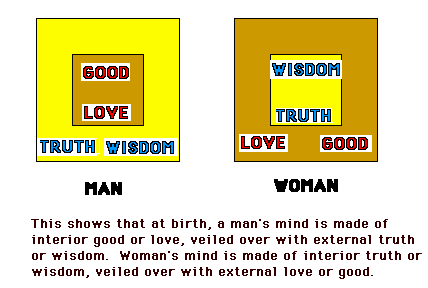
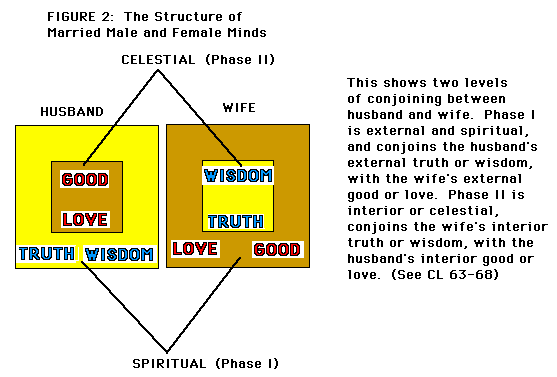
From Swedenborg's description of the
difference between men and women, I constructed various visual charts to picture
their mental anatomy. By studying the details pictured in somewhat different
way, it might be easier for you to gain a more detailed knowledge and
understanding of how men and women differ in their spiritual anatomy.
Remember: spiritual = afterlife of eternity. So the anatomical difference
between the mind of men and women remains forever to distinguish them from birth
to eternity.
This diagram is from an article
I wrote on "spiritual genes in marriage" and is available here:
www.soc.hawaii.edu/leonj/leonj/leonpsy/instructor/gloss/dow2.html
Spiritual Gender Genes
The following diagram is from an article on "The
Spiritual Psychobiology of Marriage" and is available here:
www.soc.hawaii.edu/leonj/leonj/leonpsy/instructor/gloss/dow1.html#biology
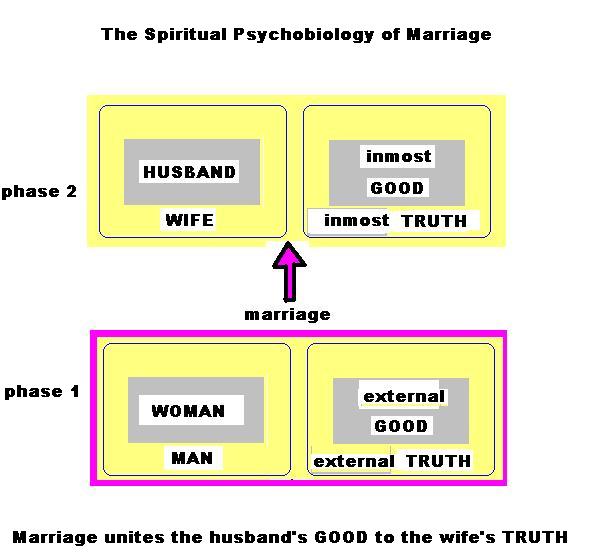
The diagram immediately above shows the two phases or stages of marriage.
Initially, the man's consciousness of externalizing truth, which is the truth he
knows, conjoins itself with the wife's externalizing good. That is the wife's
externalizing affections conjoin with the husband's externalizing cognitions.
Thus they form an externalizing marriage or bond. It is externalizing because
the man's truth and the wife's affections are both in the externalizing or lower
degrees of their consciousness. However, if the two partners continue to grow
together and conjoin more deeply within, then they enter phase 2 which is an
internal union or conjunction. Now their internalizing parts are conjoined or
united--the man's internalizing good and the woman's internalizing truth. Now
for the first time the man becomes truly a husband and the woman truly a wife.
Quoting from the Writings Sacred Scripture:
AC 725. That by "male and female" are signified
truths and goods, is evident from what has been said and shown before, namely,
that "man" and "male" signify truth, and "wife" and "female" good. But "male
and female" are predicated of things of the understanding, and "man and wife"
of things of the will, for the reason that marriage is represented by man and
wife, and not so much by male and female. For truth can never of itself enter
into marriage with good, but good can with truth; because there is no truth
which is not produced from good and thus coupled with good. If you withdraw
good from truth, nothing whatever remains but words. (AC 725)
AC 718. That by "man and wife" is signified that
the truths were conjoined with goods, is evident from the signification of
"man" as being truth, which is of the understanding, and from the
signification of "wife" as being good, which is of the will (concerning which
before), and also from the fact that man has not the least of thought, nor the
least of affection and action, in which there is not a kind of marriage of the
understanding and the will. Without a kind of marriage, nothing ever exists or
is produced. In the very organic forms of man, both composite and simple, and
even in the most simple, there is a passive and an active, which, if they were
not coupled as in a marriage, like that of man and wife, could not even be
there, still less produce anything, and the case is the same throughout
universal nature. These incessant marriages derive their source and origin
from the heavenly marriage; and thereby there is impressed upon everything in
universal nature, both animate and inanimate, an idea of the Lord's kingdom.
(AC 718)
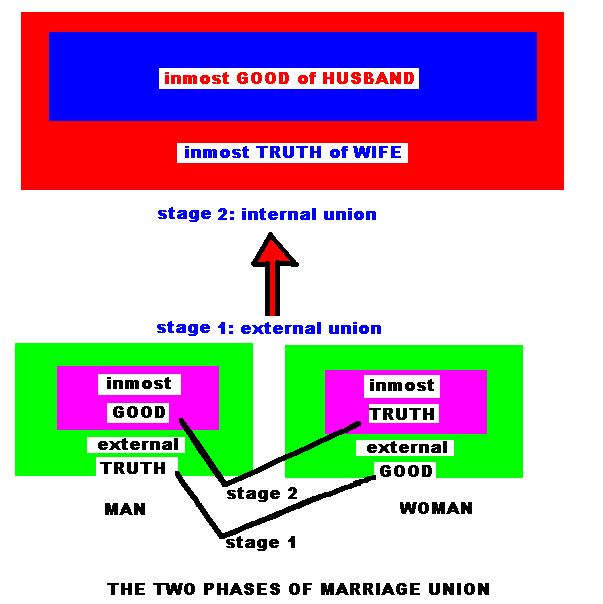
In the diagram below, the same process is portrayed. The externalizing union in
stage 1 is shown to bond the man's externalizing truth to the wife's
externalizing good. This is not so much a true union as a partnership since it
resides in externalizing (or lower) parts of the consciousness. Husband and wife
as partners are adjoined to each other by externalizing natural life and family,
but they are not yet conjoined from within by inner or spiritual life. But in
stage 2, the husband's internalizing good is conjoined to the wife's
internalizing truth. Now the marriage consists of his affections covered over
with her truths. This is a true conjunction or union because it resides in the
higher or internalizing regions of their consciousness and life. Only when this
stage of internal conjunction is achieved can they be regenerated into a
heavenly marriage and live together in eternity.
Couples who do not progress to an internal union of minds or spirits remain
separated in their internals, and when they meet again in the other life, they
live with one another again for a brief period. They then can become aware of
each other's internal character and disposition, and these separate them. Each
is then given another partner with whom they can enter into an internal marriage
in heaven. But this happens only when both have been regenerated while still in
the physical body. If they are unsuitable to each other by internal disposition
or genius and separate, the one who is regenerate goes to heaven with the newly
given conjugial partner or soul mate, while the other who is not regenerated
goes to hell where they enter into an infernal concubinage with a partner. These
infernal marriages are purely externalizing and both partners are "devils" who
hate each other's guts yet are forced to endure each other in a marriage made in
hell.
Research and personal observation confirm that most couples report experiencing
oppositional or negative feelings, and at times acting upon them by exploiting,
abusing, or injuring their partner. When couples have a disagreement or fight,
physical and mental abuse is practiced by men more than by women in the majority
of societies and cultures. When people reason under the influence of
exploitative motivations, they tend to misinterpret the intentions of their
partner and tend to use stereotyped, inaccurate, and prejudiced thinking. Our
verbal behavior will reflect this style of biased thinking. So will our other
actions.
There is an advantage in gaining control over our gender behavior in the three
domains--affective, cognitive, and sensorimotor. We can avoid those cultural and
psychological traits and habits that interfere with adaptive, successful long
term marriage relationships. The benefits of a stable successful long term
partnership are extremely attractive. We will explore a particular principle in
marriage relationship called the conjoint self.
According to the "unity" model of marriage, the perfection of unity in a
marriage increases through differentiation and reciprocity of behavior in the
threefold self of the two partners, and is a spiritual union that lasts to
eternity. In a unity marriage, the husband and wife develop a conjoint self,
while their former individual self recedes into the background and no longer
operates.
The
unity marriage is not achieved by promise or desire alone. There
are developmental levels of unity that married partners must go through with
each other, like a growth process that takes many years of dedicated effort. The
"conjoint self" refers to a husband and wife who have achieved unity at all
levels of the threefold self (as explained below). Each individual has been
changed, dropping off some traits and acquiring new ones that can fit together.
This is called growing together in reciprocity. The husband has to abandon some
traits he cherished since childhood because these habits caused opposition and
disunity. The wife has to abandon some traits that she perceives do not fit with
her husband's character. Both have to acquire new traits that could fit together
as a unit. The old traits that were abandoned and the new traits that were
acquired consist of sensorimotor, cognitive, and affective traits in the
threefold self. That is: habits of external activities, habits of thinking, and
habits of internal feeling.
Levels of unity are ordered from external to more and more interior unity, as
will be explained below. For instance, an external level of unity between
marital partners involves their sensorimotor portion of the threefold self. They
like and enjoy to do things together like dancing, touching each other,
partying, camping, watching movies, eating out, driving, talking about their
favorite topics, and so on. These overt "external" activities involve sensory
and motor interactions, including verbal, which is an overt motor activity. Of
course every sensorimotor activity involves thinking and feeling but these
cognitive and affective operations are not visible, and the focus of the two
partners at this stage is on the external activity of the other. There is less
focus or concern on what the other is thinking or feeling.
Note that these joint external activities do not necessarily mean that the two
partners are in agreement with each other's way of thinking, each other's
attitudes, or feelings and motivations. The cognitive and affective self of each
partner may not be in agreement, and they may even be competitive or hostile to
the other. What is on the inside that is not visible (affective and cognitive
self) may be in opposition and even hatred against the partner, while what shows
on the outside--the sensory-motor activity, may appear harmonious and
compatible. This underlying disagreement or dislike becomes visible when there
is an overt fight during which the two partners show their anger, resentment,
and disrespect for one other. Afterwards they make up, and the cognitive
disrespect and affective dislike recede again into the underlying invisible
state, lurking there, until the next fight at which time the abuse and
disrespect come out again.
There is therefore a first level of the conjoint self, and this is
external, involving sensorimotor reciprocity and joint achievement,
without necessarily there being an interior agreement and respect for the
partner. Women, more than men, tend to experience this external phase of the
relationship as unsatisfactory, painful, and injurious. Women often have to bond
with other women to support and reassure each other during this phase of
disharmony with their husband or partner.
Men tend to bond with other men by complaining about women and speaking about
them with disrespect. They also keep secrets from their women and do things they
want to hide from them. Men do this in order to obtain sexual favors. This
deception is a method of exploiting women and dehumanizing them. At this
external level of unity, men feel more comfortable than women because they
exercise more control in the relationship. Men tend to resist closer, more
intimate relationship phases, in order to maintain their cognitive and affective
independence. A man ordinarily dislikes giving up independence in his private
thinking and feeling, while a woman is generally motivated to conjoin her
thinking and feeling with her man--if only he lets her. A woman strives to
achieve mutual and reciprocal dependence, while a man strives to retain
independence. This creates a conflict dynamic between them, especially in the
first level of unity which is external, involving the sensorimotor self
only.
This intrinsic difference between women and men occurs at all levels of their
humanity: biological, mental, and spiritual. Biologically, women make themselves
dependent on men for reproduction, parenting, and lifestyle habits. Mentally,
women love and enjoy the man's intelligence and inventiveness, and adopt his
ideas and philosophies as her own. Spiritually, women represent inner wisdom
surrounded by external love. Men represent inner love surrounded by external
intelligence. Women and men are thus born reciprocals of each other, so they may
better fit into a perfect unity.
If women and men were similar in these fundamental traits, they could only form
external relationships and could never achieve the married state of the conjoint
self. Their selves would remain separate because like cannot conjoin with like.
Like can be adjoined to like, but only reciprocals can conjoin. For example,
think of the shape of reciprocals and how they would not be able to fit together
if they were similar instead of reciprocal: pot and handle; key and key hole;
shoe and lace; button and button hole, snaps, window and window sill, picture
and frame, etc.
Couples begin their relationship together by sensorimotor reciprocity: talking
to each other, eating, dancing, driving, doing fun things, etc. This is the
first level of unity.
The second level of unity is deeper in that it involves the
cognitive self
of the two partners. This includes how they think, how they reason, how they
justify things, what they consider acceptable or unacceptable, what information
or knowledge they have, what philosophy of life and religion. These cognitive
behaviors and habits are more resistant to mutual adaptation and reciprocity in
the relationship. For instance, a man and a woman can be married for years and
yet maintain contradictory attitudes, beliefs, and judgments. The external
sensorimotor level of unity does not necessarily lead to a more interior unity
of thinking and reasoning (cognitive habits). Yet many couples achieve a
cognitive level unity by joint involvement in running a home and raising
children together. They see 'eye to eye' on many things and enrich each other's
thinking process by mutual stimulation and interest. When a man and a woman
achieve this second level unity, they can love each other more deeply and the
relationship continues to grow and become more satisfying and enriching.
Achieving cognitive reciprocity is often easier for women because they
are mentally oriented towards conjunction. They desire to become a conjoint self
more than they desire to retain their own ideas and philosophy. But men
generally are in love with their own thinking and ideas and resist change for
the sake of the conjoint self. Men see the conjoint self as giving up selfhood
while women see it as gaining togetherness.
However, when a wife perceives that her husband's thinking is corrupt, she tries
to change the man's thinking instead of adopting it for herself. A wife has a
keen perception of what is her husband's corrupt thinking, even while he himself
is blind to it. This is because spiritually, a woman is inner wisdom covered
over with love, while a man is inner love covered over with external
intelligence. So a woman perceives more with her inner wisdom while a man with
his outward intelligence. Inner wisdom can see corrupted thinking where outward
intelligence cannot. Outward intelligence is motivated by sensorimotor goals
while inner wisdom is motivated by affective goals. But when the husband's
allows his outward intelligence to be influenced by the wife's inner wisdom, his
outward intelligence is elevated or made more excellent, so that he too can then
perceive corrupt thinking in himself and others.
The inmost
level of unity involves the partners' affective self -- their feelings,
motivations, loves, ultimate goals of happiness and togetherness. Affective
reciprocity is the basis of an eternal unity between husband and wife. Only
conjoint feelings, loves, desires, or goals are allowed to remain operational in
their mind. This is achieved by a systematic and long term effort in reciprocal
growth. The partners abandon their feelings, loyalties, goals, or involvements
that are not conjoint and exclude the other partner. Affective reciprocity or
conjunction would be weakened if one partner reserves an area of their mind or
involvement that excludes the other partner. For example, some husbands spend
socializing time with male friends. The activity is such that they don't want
wives or girl friends around, even if they are not cheating on them or doing
something bad. But the fact that a husband's wife is excluded, not wanted there,
means that he is retaining independent involvements and loves. These affective
habits and enjoyments are not reciprocal. They do not contribute to unity in
marriage, but slows the process down or acts against it.
However, this
principle does not apply to women in the same way. Women have loyalties and
friendships with each other for different goals and feelings than men have with
each other. The affections and involvements that married women have with other
women is for supporting the marriage, not resisting it. Men have an inborn
resistance to marital unity which they have to fight against most of their life.
Their male friendships that exclude the wife respond to their desire to escape
total unity with their wife. This is not so with married women since they have
an inborn desire and need for total unity with their husband.
11.3.2
Unity Through Reciprocity and Differentiation
There are two principles in this model of "conjugial love" described by Emanuel
Swedenborg (1688-1772).
-
First Principle--Differentiation:
No part of a woman is like any part of a man and vice versa.
-
Second Principle--Reciprocity:
The perfection of unity increases with the diversity of its composing elements.
-
Third Principle--Eternity: The unity marriage
relationship is eternal, continuing in the afterlife of heaven.
According to the first principle of marital unification the threefold self of
men and women are biologically and spiritually different. This is maximum or
total differentiation or diversity in every part. According to the second
principle of marital unification, the diversity becomes unified through
reciprocity by which the traits of a woman can harmonize or fit together with
the traits of a man, and vice versa. According to the third principle, marriage
is a spiritual union of mind and spirit that is not just for this world -- "till
death do us part," but is eternal, since the spirit of a person is immortal (for
more on this topic see the Psych 459, G21 Lecture Notes on Theistic Psychology:
www.soc.hawaii.edu/leonj/theistic
).
Here are some illustrations of these two principles acting together. Consider
where we are familiar with unity through differentiation and reciprocity (though
not with eternity). At the physical level we can see how a bolt, nut, and washer
work together structurally to achieve a tight grip on some object. The form of
the nut must fit exactly the form of the bolt. The bolt is different in form
from the nut, and it is the particular way they are different that makes them
work together, reciprocally. They would not work together as a unit if there was
no differentiation and reciprocity between them. Consider the same principle
operating in other functionally related objects like a hammer and nail, or like
a purse and its strap, or a fork and knife, or glove and hand, show and foot,
etc. When you dance, your partner must make the reciprocal steps -- not the same
steps, as you are making, or else you step on each other. In a four-part harmony
with men and women, in a quartet or other choir, the singers are differentiated
into soprano, alto, tenor, and base. This differentiation is combined into a
unity when they sing reciprocally according to the arrangement prescribed for
each part. The result is a harmony that is rich and attractive but which cannot
be achieved in any other way.
In the sensorimotor domain of gender interactions we can see how a woman's body
is differentiated from a man's body, and how the parts of the man are shaped to
fit the parts of the woman. No doubt this is the analogy upon which electrical
objects are designated, as for instance the wall receptacle is called the
female and the plug is called the male. They act together to form a unit through
differentiation and reciprocity of physical form or shape. When you consider
sports teams, government departments, or armies, you notice a similar
reciprocity of different role behaviors, so that they can achieve joint action,
unity, or several acting as one. In fact throughout nature, and even the
universe, you will find a unified whole made of differentiated parts acting in
synergy. It makes sense therefore to have a model of gender unity that is based
on the two acting as one through differentiation and reciprocity.
A well known symbolic representation of sensorimotor unity is the familiar
Ying/Yang emblem. According to ancient tradition, it "demonstrates the
perfectly balanced interchange of the two dynamically opposed forces of the
Universe, the dot represents integration." In Tai Chi and I Ching traditions,
the white area of the emblem represents heaven, the dark area earth and the
curvy line between them represents the Law or reality. In Feng Shui the Yin/Yang
represents the integration of Female/Male duality: "Yin and Yang are dependent
opposites that must always be in balance." And: "It is a duality that cannot
exist without both parts." (See for example this Web site:
www.168fengshui.com/Articles/Article_yinyang.htm
In other words, it is the differentiation that makes the unity out of
reciprocity. The man and the woman as a couple can be totally integrated, or
form a unity, because they are completely different but in a way that is
reciprocal. Nothing of the male can be like anything of the female (Yin/Yang
diagram shows all white vs. all black for the two). But they curve around into
each other, in a perfect fit of reciprocal union, the perfect circle. This is
the principle of "synergy" which is defined as "combined action or operation."
It comes from the Greek "synergos" or working together. In business
"synergism" refers to "a mutually advantageous conjunction or compatibility of
distinct business participants or elements (as resources or efforts)"
(Merriam-Webster Online). The principle of synergy operates universally where
separate elements interact to produce a joint goal. Synergy is obvious in the
physical body where thousands of separate and differentiated parts work together
to produce the functions of a normal human body.
Society is viewed as made of separate and unique family units forming themselves
into a community and abiding by mutual norms, laws, and expectations. The same
reasoning applies to the marriage relationship which society officially
sanctions and licenses. Society recognizes that a married couple forms a new
unit that acts together for common goals and are united by positive feelings and
loyalties. Married couples who live according to the unity model represent the
most perfect unit or a "one" that a man and a woman can form together. Affective
unity is the most essential, and it influences the cognitive and sensorimotor
unity that is possible for that couple. Unity is achieved through the synergy of
the threefold self of each partner acting together. There is no independence in
any area or under any circumstance. Even when the two are in physically
different locations (e.g., at home vs. at work) they remain united because each
partner acts and thinks when alone as if the other were present.
A different approach is that of "equity model" in marriage. This idea is
transmitted in our socialization process and is part of our culture so that
everyone has norms of equity in various areas of living. This is a good thing in
public life because it acts to reduce discrimination against women which has
been the traditional practice and still is by and large. Gender relationships
may start with men assuming traditional dominant roles and women being
submissive. But the relationship can then move on to the equity model which
helps the two partners by reducing the traditional load of expected work on
women and can make their relationship more intimate. But the equity model need
not be the last phase. The couple can then move into the unity model which
affords still more intimacy.
In the unity model there are two possible directions, one valid the other
destructive. If equity is given up for unity, which of the two partners should
be giving up their equal power under equity? If the woman gives up equity, then
the couple falls back into the traditional dominance model they started with in
which man dominates woman in socially prescribed ways. On the other hand if the
man gives up equity power in decision making, then they move forward to the
unity model that leads to greater intimacy, growth, and mutual support. This
conclusion will be reviewed in detail in our class discussions throughout the
semester.
11.3.3
Sensorimotor, Cognitive, and Affective Conjunction
Consider the cognitive and affective domains of gender interaction in marriage.
For instance, a wife's depth of perception of a situation (her affective self)
contrasts with that of a man's, but the difference is such as to be reciprocal
with it. But if the man feels competitive with her, as in the traditional and
equity models, their difference in perception is then nonreciprocal,
incompatible, or opposite. Similarly, a woman's cognitive self complements that
of a man, which is why they find each other's ideas interesting and stimulating.
A man ordinarily resists the idea that the woman who loves him has a deeper
perception of his feelings and motivations than he has himself. Women have this
greater awareness of feelings than men due to the confluence of biology,
socialization, experience, interest, and spiritual structure. Hence the
unity through reciprocity model requires that the man give up equity power and
give in to the woman's way of understanding. This means that the man would
voluntarily agree to let the woman play the lead role in decision making when it
comes to their relationship areas.
For example, a wife might request that her husband no longer talk to an old girl
friend of his. She feels very strongly about it. She perceives it from
within, as if it was instinct. In other words, she may not be able to give a
rational explanation of where it comes from or why she feels so strongly about
it. She tells her husband all this, yet he rejects it because he thinks
differently about it. He feels a certain loyalty to many of his old friends and
doesn't want to give that up, especially since she can't explain her demand in a
way that makes sense to him. He and his old girl friend do not have any romantic
feelings for each other, so his wife (or current girl friend) should not
be jealous. So they argue.
This stand off puts a hold on the inward (affective) growth of the relationship.
She may not say this to him, and sometimes she may not be clearly aware of it,
but within herself she knows that the relationship is not growing deeper. She
hopes it can be amended but for now it's like a broken leg you can't use for
walking. She feels neutralized by her partner's independent stance. He has
excluded her and taken away her right or opportunity to make him change his
stand into reciprocity, conjunction, unity, oneness in mind and body. He is
keeping an area of his love sealed off to her. He reserves his affectional
territory for something in which she has no direct input. She is kept on the
outide.
This situation can be better understood if we look at it in more detail as to
what's going on. In their relationship the man and the woman are interacting at
the three levels of the self: sensorimotor, cognitive, and affective. The
process of forming a marital unity involves the conjunction of the threefold
self of each partner. The sensorimotor self of the man and the woman are
conjoined first as shown by the activities they enjoy doing together--eating,
playing, embracing, talking. These activities involve mostly the "external"
physical self of the partners. It is called external because it is easily
visible to them and to others like friends, parents, and neighbors. We can call
this phase sensorimotor conjunction. In this phase the man often
takes the lead and exerts a dominant role. The woman follows in order to keep
the relationship going. Her motive is higher than the man's. His motive is to
please himself; her motive is to continue the relationship going to a deeper
level.
At the same time the cognitive self of the two partners are interacting. At this
level of the interaction, the woman takes the lead. She strives to take the
man's perspective, to learn his sense of humor, to memorize the details of his
life that he reveals, to acquire the reasoning style he uses. Her motive in all
this cognitive effort is to harmonize with the man and please him. She
understands instinctively, and sometimes explicitly or consciously, that by
making him laugh and pleasing him by how she thinks, she will succeed in
conjoining the man to herself. The man is normally focused on himself, on his
ideas, and he is pleased when she demonstrates that she knows those ideas. He is
not thinking of her perspective, while she is constantly trying to analyze his
perspective. Obviously, this differential effort and focus gives the woman a
superior perception and understanding of the relationship, that is, of the
process of conjoining. This cognitive communication of ideas between them can be
called cognitive conjunction.
Cognitive conjunction is more visible than affective conjunction because it
comes out in their agreements or disagreements. Long after sensorimotor
conjunction has been established, and after cognitive conjunction has been
operating for awhile in the relationship, the woman strives even more intensely
to conjoin the man to herself at the affective level. She understands from
instinct, and sometimes explicitly or consciously, that the relationship won't
be perfect until they achieve affective conjunction. This doesn't
just mean saying "I love you" even if it is meant sincerely. Affective
conjunction means that the man has aligned his feelings with his woman. In other
words he has given up his male prerogatives left to him by society and
tradition. Society allows a man to retain affective independence from the woman
he is married to. He is expected to provide for her needs, to support her in her
endeavors, and to be decent to her. But he is not expected to become dependent
on her for his feelings, motives, ambitions. He is expected to lover her and be
loyal to her, but not to give up his own independent feelings and strivings.
Affective independence is the norm for a man in most societies.
In contrast, social and cultural norms require a woman not only to love her mate
but to be dependent on him for her feelings and emotions. For example, if she
loves Italian food and he hates it, she is expected to give up her old loves and
adopt his loves. He expects it and sees it as a sign of loyalty to him. If she
complies with this expectation, he feels bonding with her. Note that a man feels
bonding or conjunction when the woman becomes dependent on him in her threefold
self. But this kind of bonding is not true conjunction and cannot lead to unity.
In the region of the heart, woman rises far above the man in perception,
understanding, and consciousness. This is the result of her biological,
rational, and spiritual nature. Therefore the gender syntax that produces unity
involves the husband becoming affectively dependent on the wife. This runs
contrary to his socialization and philosophy, so he puts up enormous
resistance--that the woman has to overcome if they are going to achieve unity.
Both men and women have three natures or levels of operation of life: a
biological nature or self, a rational nature or self, and a spiritual nature or
self. By the principle of differentiation and reciprocity it is clear that men
and women differ in their biological nature, they differ in their rational
nature, and they differ in their spiritual nature. Biological differences
between them are obvious in the anatomy and appearance of their physical
body. Rational differences between men and women result in the reciprocal
orientation and focus they each have. When a man's cognitive focus is
reciprocal to the woman's cognitive focus, they can conjoin. To conjoin means
that they share parts of it, or all of it.
But sharing doesn't mean that they are similar because a man and a woman have
different functions for their thinking. A woman might say or think X and a man
might say or think X yet they are not thinking the identical thing. A woman uses
thinking in the relationship for the purpose of achieving unity because that's
the way she defines herself, while a man uses his thinking for the purpose of
retaining independence because that's the way he defines himself. He wants her
to give up her cognitive independence and think like him. This is impossible for
nothing in a man can be like anything in a woman, and vice versa. On the other
hand, he can give up his affective independence so that his thinking now
responds not just to his own needs and purposes, but to her needs and purposes
as well. In this way the man's thinking is elevated to a new level of
consciousness, intelligence, and wisdom. But when he refuses to give up his
affective independence, his thinking remains where it has always been, unable to
achieve the higher levels of his own humanity. It's obvious therefore that
"giving up" affective independence is not losing something but gaining a whole
new level of life for a man.
When a husband is committed to giving up affective independence, he is conjoined
to his wife at the inmost or affective level. This is a spiritual conjunction
that lasts forever. It has a built in dynamics for dissolving disagreements. Not
a single disagreement can arise between them no matter what. This is because
they have learned a reciprocal style of interacting at all three levels of the
self.
Sensorimotor conjunction
is the mental state of husband and wife in which their sensations and movements
are mutually and reciprocally interdependent. The pleasures they enjoy are
connected to making the partner happy. For instance, what the husband enjoys
most is to keep his wife feeling comfortable, and her desires or preferences
satisfied. Sensorimotor independence exists when the husband insists on his own
comforts and pleasures. His focus is then on himself, not his wife. It's common
to observe in public couples walking together. More often than not you will see
the woman carrying a greater load than the man. Maybe a child and a big bag,
while the man has his hands free. Or at airports you see the woman carry two big
bags and the man she is with is carrying one bag. These interactions result from
the man's sensorimotor independence. Often husbands will satisfy their sexual
appetites for years and never care enough to discover anything about his wife's
appetites or satisfactions.
It helps to contrast clearly the
differences between the affective and sensorimotor parts of the threefold self.
Often people use the word "feeling" when they mean thinking (cognitive self),
and vice versa. For example, people say, "I feel that we should wait longer"
when they are discussing what they think. Sometimes feelings (affective) are
confused with sensations (sensorimotor). For example, "I feel hot flashes coming
on" or "I feel so tired." In both cases it is not the feelings (affective) that
are discussed but the sensations (sensorimotor).
The sensorimotor area of the
threefold self includes these primary features of our everyday life:
-
physical pleasures (all five senses), or their opposites
-
enjoyable sensations and movements, or their opposites
-
mental pleasures and delightful experiences, or their opposites
-
healthy well being and feeling good physically, or the opposite
-
being physically attracted to someone, or the opposite
-
feeling calm, cool, and collected, or the opposite
-
coordinating one's movements with partner, or the opposite
-
etc.
The affective area of the
threefold self includes these primary features of our everyday life:
-
feeling good about the situation, or the opposite
-
feeling hesitant or resistant, or the opposite
-
feeling afraid or scared, or the opposite
-
feeling connected, or the opposite
-
striving to reach a goal, or the opposite
-
accepting someone or thing, or the opposite
-
perceiving (feeling, sensing) from within that something is right and good, or
not
-
feeling guilty, embarrassed, ashamed, regretful, or not
-
etc.
Do
you get the difference? Note that the affective always comes first in the
sequence of our behavior. We do something because we are motivated to do it. We
are motivated to do something to achieve a particular goal. Every goal is
defined by what we want or desire or prefer to happen. Therefore all human
action starts from a feeling -- what we want to happen, together with a goal
that satisfies what we want.
Once
we have a feeling, motive, or particular goal we desire to happen, the next
behavior in sequence is the cognitive self. Our thinking operations suddenly
begin to figure out a plan or method of proceeding that will bring about the
desired goal, and thereby satisfy the feeling. It is the feeling that motivates,
guides, and directs the thinking, keeping the sequence of mental operation
focused in a coherent way to lead to the goal state. For example, we become
aware that we are thinking about the candy bar in our pocket or purse. What made
your thoughts go in that direction? It had to be some kind of feeling, like
sensing hunger in the stomach (sensorimotor) which became the occasion for a
desire to satisfy it. This desire or feeling then awakened our thoughts and
memories to think about the candy bar.
Once
the feeling (desire) and the thinking (candy bar in pocket or purse) are placed
together or united, the hand starts reaching for the candy bar or the legs start
waking to the kitchen (sensorimotor).
But then you stop the hand or the
legs. Wait. I'm on a diet and I want to lose weight. Remember? What's happening
here? It's another feeling (desire, motive) that takes over and this new feeling
now directs the thinking and the moving in another direction.
So whatever we do all day long
minute by minute, has to do with sequences and loops of feelings, thoughts, and
sensorimotor executions of them. By self-witnessing or self-monitoring ourselves
in a systematic and persistent way, we gradually learn to distinguish
between the actions of the threefold self and how the affective hierarchy of our
feelings dominates and rules our thinking and doing. Most people prior to
self-witnessing are not fully aware of the feelings they have and their relative
hierarchy of power over the threefold self. What we don't know about ourselves,
we cannot control or modify even if they are maladaptive and the source of
negative results. It is to everyone's advantage to get to know the hierarchy of
feelings they have in the course of their day.
Here is a summary table to memorize:
|
PRINCIPLES BY WHICH HUSBAND GOVERNS HIS
BEHAVIOR
TOWARDS HIS WIFE |
CHARACTER OF THE PARTNERSHIP |
HOW THEY BEHAVE TOWARDS ONE ANOTHER AND
CONSEQUENCES ON WIFE |
|
follows the
UNITY
MODEL
affective
conjunction |
spiritual
marriages
("Till endless eternity in afterlife") |
reciprocity with
differentiation
unifying, conjoining
rational , theistic
enlightened, etc. |
husband chooses to always
act from his wife’s feelings and preferences,
rather than from his own, which might be different,
thereby unifying the two into one conjoined self in heaven |
|
follows the
EQUITY
MODEL
cognitive
conjunction |
natural progressive
marriages
(“Till death do us part”) |
agreeing with
contracting with
associating with
co-sponsoring, etc. |
the two make up consensual
arrangements,
based on equal rights principles,
so husband agrees to help in domestic activities,
but maintains independence where he chooses,
so many women are stuck in unhappy roles and unromantic, unfulfilling
marriages |
|
follows the
DOMINANCE
MODEL
sensorimotor
conjunction |
natural traditional
marriages
(“Till the husband decides to divorce his wife”) |
consociation by male
dominated norms,
and race, family, blood, religion, genes – are central issues |
wife is submissive and
obedient to husband and his family ,
and must endure societal sanctioned abuse of women by men |
See if you can follow the themes in each cell in
the above Table. Try to see how these names and descriptions apply to your
experience with couples, partnerships, and marriages:
Review what you know about each of these. Are
the Table cells helpful in organizing and characterizing what you are observing
when you examine these areas of daily life?
As you continue studying the
following Sections, be sure to integrate them in your mind with this Table. You
actually need to integrate all the Tables in these Lecture Notes, and then you
will see clearly how all this perspective can give you a rational understanding
of marriage. You might want to print out just the Tables, and study them
together, trying to integrate them into your understanding.
11.3.4 Unity
Model in Marriage:
Ennead Chart of Growth Steps
This is
Table 1a
(READ TABLE FROM BOTTOM UP)
|
MODEL THAT GOVERNS
THEIR INTERACTIONS |
THREEFO0LD SELF |
|
SENSORIMOTOR
(external)
|
COGNITIVE
(internal)
|
AFFECTIVE
(inmost)
|
|
UNITY
|
7 |
8 |
9 |
|
EQUITY
|
4 |
5 |
6 |
|
DOMINANCE
|
1 |
2 |
3 |
All
ennead charts are read from bottom up.
This ennead chart ("ennead" = nine), shows that there are nine succeeding phases
for achieving unity in marriage. Note that the nine cells are generated when you
keep track of what happens to the threefold self of husband and wife as they
progress towards unity. It would be very beneficial for you to memorize this
chart so you can reproduced it on paper, and then mentally picture it as you
think about these issues. Try to make a mental picture of the chart as you read
the following explanations. If you make sure you fully understand it, you will
be able to use the chart in your everyday thinking about relationships, your
own, or those of others.
Note
that that the changes are conceptualized in relation to the model or philosophy
the partners have. The "dominance" model often describes the husband's
attitude towards his wife, and this agrees with the prevailing cultural norms in
most societies on this earth. Women are socialized to accept this male dominance
perspective and many women come to see it as normal, and even good. Some women
however, reject it. They demand that the husband switch to the "equity"
model, which means that he can't just make decisions by himself for their joint
life. They have to consult each other and resolve differences with a consensus
with which both can live and feel comfortable.
First,
the threefold self of the husband and wife must conjoin themselves at the usual
dominance level -- zones 1, 2, 3. Then they can grow further together by
conjoining their threefold self again, but under the equity model -- zones 4, 5,
6. Many husbands resist the equity model and prefer to go back to the dominance
model. But if he changes his mind and adopts the new model for their
interactions, then the couple can grow still further towards fully being
conjoined in their threefold self. Eventually couples can move into the unity
stages -- zones 7, 8, 9. This happens when the husband adopts a new way of
interacting with his wife.
In the
unity model of interaction (zones 7, 8, 9), the husband allows the wife's inner
wisdom to lead his own outward intelligence. This must be voluntary on his part
and occurs when he becomes spiritually enlightened from a desire to be conjoined
eternally to his wife. He is willing to let go of his own self, for the sake of
a new self called the conjoint self. With this new self he is no longer
independent. He can no longer choose to act on his own. Whatever he does, think,
or strive for, he consults his wife first.
The
husband must therefore acquire an accurate knowledge of his wife's feelings and
emotions. Once he has internalized them, he can consult them whenever he acts,
decides, or wants something. He is no longer a single self or individual. He is
a half-person by himself, and is completed reciprocally by his wife. Together,
the husband and wife, make one complete human being. When a couple reaches this
spiritual level of union, they are in their eternal conjugial bliss in heaven.
This can start while they are in this life, and continue later, in the
afterlife.
The wife
cannot impose the unity model on her husband by means of dominance,
intimidation, or persuasion. He can refuse to go along with her whenever he
pleases. There are few husbands who are willing to voluntarily subordinate their
own outward intelligence to the wife's inner wisdom. It's a model they can
achieve only with the husband's willingness to undergo much mental pain and
self-denial. But those husbands who are willing to undergo the change, can form
a true and perfect reciprocal union with their wife. This is a spiritual state
that lasts forever into the afterlife called "heaven." (For more information on
this topic, you can consult the 459 Lecture Notes, on the Web at:
www.soc.hawaii.edu/leonj/theistic
The first phase of each model (zones 1, 4, 7) involves the sensorimotor self of
the two partners as the central focus of their relationship. Their affective and
cognitive self subordinate themselves to the sensorimotor self as a couple. They
get along fine and enjoy each other company, but only so long as they retain
focus on the sensorimotor level. For instance, they do things together that
involve their physical enjoyment and fun--eating, touching, holding, dancing,
driving, playing games, watching movies, listening to music, talking, etc., and
sometimes, dealing with children and their immediate physical needs.
In the dominance model (zones 1, 2, 3), the relationship is governed cognitively
by tradition and affectively by reward and punishment. The two partners are only
externally conjoined. Their life together as a unique couple centers on what
choices they make together at the sensorimotor level (zone 1). Even if they are
physically together, they are not together at the cognitive and affective levels
of conjoining. They are separated or "disjoined" in their thinking and in their
feeling. Their thinking is dictated by tradition and family. Their feeling is
governed by being rewarded or punished by the other one, depending on what
happens. It is normal in the traditional dominance model for a man and a woman
to make love and feel close, then a little while later they can argue about
something and express hostility. This proves that they are not united in feeling
because when a couple is united in feeling it is impossible for one to express
hostility to the other. Hostility separates and destroys internal unity, even if
later, it is followed by making up and expressing love. This alternating
flip-flop state of love and hostility marks the typical behavior in the
dominance and equity models (zones 1 through 6).
The equity model is
associated with the "modern" outlook that young people in many traditional
cultures adopt as a new philosophy of relationship between men and women,
thereby taking a step away from the traditional dominance model of their elders.
In the equity model of marriage, all responsibilities and duties of husband and
wife are shared through negotiation and agreement between each other. This leads
to a cognitive level of conjunction between a man and a woman (zone 5), since
they have to negotiate by arguments why one partner should do X and Y and the
other partner should do A and B. Cognitive unity is gradually achieved through
such a process, as long as both partners are sincere rather than just
manipulative.
While the focus in the dominance level is sensorimotor conjunction (zone 1), the
focus in the equity model is cognitive conjunction (zone 5). The equity model is
essentially a political power sharing agreement. It tends to create similar
ideas and beliefs in the two partners, a similar reasoning process. This
cognitive conjunction makes the sensorimotor interaction better than before.
They get along better, agree more, can talk it out and influence each other's
thinking and decisions. Because of this their sensorimotor interactions (zone 4)
are more compatible--they enlarge and diversify their physical activities and
enjoyment of each other. But they still argue. The wife still gets abused from
time to time when the husband gives himself permission to explode or take a
stance that hurts her. The husband still resists and resents the wife's attempt
to influence him, to change his traits and habits that she finds are in the way
of a still closer relationship.
There is one more phase the woman wants and needs--their affective conjunction.
This would create unity, for which a woman craves for instinctively,
biologically, consciously, knowingly. Nothing less than that can completely
fulfill her. The wife has a mental picture of the conjoint self where the focus
is on affective and inmost conjunction. She can be free of the fear that any
time her husband can jump on her and hurt her feelings. She wants her husband to
give in to her inner wisdom in all three domains of the self. She wants her
husband to love her affections and wisdom more than he loves his own. In this
way she will be first in his mind rather than himself.
The wife
desires to be first in her husband's mind not because she is selfish and
thinking of her comfort or ego. She is thinking of the conjoint self and she
wants that true and perfect unity that lasts to eternity. She realizes in her
inner wisdom that acquiring a conjoint self is more important for her husband
than his way of looking at things. His way of looking at things cannot create an
eternal relationship.
The third and inmost phase of conjunction achieves affective unity (zone 9) and
greatly improves the cognitive and sensorimotor interactions at the same time
(zones 7 and 8). Not only are the two partners conjoined in their sensorimotor
and cognitive self, but now they at last become conjoined in their affective
self--their feelings and motivations. This level of conjunction is not possible
without both partners abandoning the prior two models. The focus at this third
level must be the affective self, and the other two are then consequences of
this inmost conjunction.
By abandoning the traditional dominance model (zones 1, 2, 3), the husband no
longer sees himself as entitled to being treated in a certain way by the woman.
Afterwards, by abandoning the equity model (zones 4, 5, 6), the husband no
longer sees equal power and responsibility as a good focus for their
relationship. The equity focus leads to disagreements, and even the agreements
may not be fully suitable to the woman. Instead the man now adopts a new
philosophy or model for their relationship. Note in the chart that zones 1, 5, 9
are bolded. This is the path that represents the progressive growth of the
conjoint self. First the engaged or married couple is focusing on their
sensorimotor conjunction
(zone 1) in the dominance model. Then they focus on cognitive conjunction
(zone 5) in the equity model. Finally, they focus on affective conjunction
(zone 9) in the unity model.
In the unity model, the husband
understands rationally that gender unity is based on differentiation of traits
that are reciprocal. This is not something to be negotiated about but recognized
and lived. The
husband
begins to see that his affections or loves--what he likes and dislikes, are
often incompatible with his wife's affections--what she likes and dislikes. For
example, he would like to keep his male friends even after his wife shows her
opposition because she doesn't like the influence they have on him, which is to
cause a separation between her and her husband. He resists by denying that they
are having a bad influence, or by insisting that marriage doesn't mean that
everything that came prior must stop, or by accusing her of being over
controlling or jealous. By means of these tactics of resistance, the man is able
to keep separate from her and remain disjoined at the affective level. Their
relationship remains at the equity or traditional dominance level and cannot
grow inward.
The
husband
can think rationally about it and figure it out. This is called spiritual
enlightenment because he can have this realization only if he thinks of his wife
as an eternal partner, not just "until death do us part." He can then decide to
give up his affective independence without feeling that he is losing something.
He can have the vision or realization that heaven in eternity requires affective
conjunction between them. Now the
husband has a new
rule for himself: he will keep himself from ever disagreeing with her about any
of her demands, requests, pleadings, urgings, or expectations. These are all the
ways the wife reveals her affections to her husband. He can see rationally that
by subordinating his own affections to hers, they can form a unity, which will
then greatly enhance their cognitive and sensorimotor conjunction attained
previously. Now they will truly be of "one mind" and "one spirit." The husband
experiences enormous resistance to this course of action, and it takes years of
effort for a man to stop relapsing into the equity or dominance mode of
interacting with his wife.
The unity model
of marriage actually refers to all three models together. No couples start
directly at the third level called unity (zones 7, 8, 9). Unity or inner
threefold conjunction, is a developmental outcome of prior phases of
relationship. Further, a couple often interacts at different levels at different
times and in different areas of their relationship. Theoretically it is possible
for a couple to be active in all nine zones at different times. But this kind of
instability and inconsistency does not allow true inner conjunction or unity.
There may be times when the couple reaches a unity level, but it doesn't last.
Only when the lower levels of interaction (dominance, equity) are mostly
abandoned and no longer occur, can true unity be achieved as a lifestyle and
permanent state of eternal happiness and peace. A useful application of the
ennead model is to use it as a map for identifying and locating the current
levels of interaction between a husband and wife.
This is Table 1b (READ
TABLE FROM BOTTOM UP)
|
MODEL THAT GOVERNS THEIR INTERACTIONS |
THREEFO0LD SELF |
|
SENSORIMOTOR
(external)
|
COGNITIVE
(internal)
|
AFFECTIVE
(inmost)
|
|
level 3
UNITY
Rational
Mentality
|
7
rational
sensorimotor
acts |
8
rational
cognitive
processes |
9
rational
affective
states |
|
level 2
EQUITY
Sensuous
Mentality
|
4
sensuous
sensorimotor
acts |
5
sensuous
cognitive
processes |
6
sensuous
affective
states |
|
level
1
DOMINANCE
Corporeal
Mentality
|
1
corporeal
sensorimotor
acts |
2
corporeal
cognitive
processes |
3
corporeal
affective
states |
Table 1b above identifies the
psychological characteristics or "mentality" that creates a preference for one
of the three models. The dominance model is called level 1 because it tends to
be first in the couple's development. "Corporeal" mentality refers to the style
of personality that focuses almost exclusively on physical goals and
satisfactions. It is a materialistic outlook, but even more so than the
"sensuous" mentality of level 2. The corporeal mentality reflects the level of
operation of the threefold self -- our feeling states, our thinking style, and
our overt acts and sensations (zones 3, 2, 1). If you inspect the Table you will
see how each zone of the ennead is defined by the marginal entries. The by three
marginal entries (columns by rows) equals 9 cells or "zones" of interaction
between the threefold self and the three levels of human mentality.
Let's apply Table 1b to an actual
behavioral area in marriage: sexual behavior. In Table 1c below, let's enter a
characterization of each of the nine zones of sexual interaction.
This is Table 1c
(READ TABLE FROM BOTTOM UP)
|
MODEL THAT
GOVERNS THEIR INTERACTIONS |
THREEFO0LD
SELF |
|
SENSORIMOTOR
(external) |
COGNITIVE
(internal) |
AFFECTIVE
(inmost) |
|
level 3
UNITY
Rational
Mentality |
7
RATIONAL
SENSORIMOTOR
ACTS
sensations and pleasures felt as consequences of their mental unity |
8
RATIONAL
COGNITIVE
PROCESSES
involved with thoughts about the spiritual or eternal details of their
conjunction |
9
RATIONAL
AFFECTIVE
STATES
constantly motivated and striving to achieve mental closeness |
|
level 2
EQUITY
Sensuous
Mentality |
4
SENSUOUS
SENSORIMOTOR
ACTS
sensations and pleasures felt as consequences of their performance or
achievement |
5
SENSUOUS
COGNITIVE
PROCESSES
involved with thoughts about evaluation (How am I doing? Is it the best
ever? Is this fair? Different? Etc. |
6
SENSUOUS
AFFECTIVE
STATES
constantly motivated and striving to compete with or gain more from the
partner |
|
level 1
DOMINANCE
Corporeal
Mentality |
1
CORPOREAL
SENSORIMOTOR
ACTS
sensations and
pleasures felt as consequences of maintaining control over the partner |
2
CORPOREAL
COGNITIVE
PROCESSES
involved with
thoughts about how to keep pressuring the partner to cooperate or be
non-resistant |
3
CORPOREAL
AFFECTIVE
STATES
constantly motivated and striving to overcome and compel the partner to be
submissive |
In order to understand the chart
better replace the characterizations with your own examples of sexual behavior
in a couple you know (real or TV). Then do two more on the topic of "money" and
"lifestyle."
This is Table 1d
(READ TABLE FROM BOTTOM UP)
|
MODEL THAT GOVERNS THEIR INTERACTIONS |
THREEFO0LD SELF |
|
SENSORIMOTOR
(external)
|
COGNITIVE
(internal)
|
AFFECTIVE
(inmost)
|
|
level 3
UNITY
Rational Mentality
-------
Relationship at the PARTICULAR
LEVEL
|
zone
7
rational
sensorimotor
acts
-------
e.g., partners' movements are coordinated to each other
|
zone
8
rational
cognitive
processes
-------
e.g., partners discover and always strive to agree with each other's opinions
and justifications
|
zone 9
rational
affective
states
-------
e.g., the husband always strives to align his feelings or desires to match his
wife's feelings
|
|
level 2
EQUITY
Sensuous Mentality
-------
Relationship at the PERSONAL
LEVEL
|
zone
4
sensuous
sensorimotor
acts
-------
e.g., partners' movements are competitive with each other
|
zone 5
sensuous
cognitive
processes
-------
e.g., partners know but often disagree with each other's opinions and
justifications |
zone
6
sensuous
affective
states
-------
e.g., partners take turns giving in even if they don't agree
|
|
level
1
DOMINANCE
Corporeal Mentality
-------
Relationship at the GENERAL
LEVEL
|
zone 1
corporeal
sensorimotor
acts
-------
e.g., the wife's
movements are directed by the husband using force, threat, or intimidation |
zone
2
corporeal
cognitive
processes
-------
e.g., the wife knows the husband's prerogatives and strives to submit to them
under fear of retaliation
|
zone
3
corporeal
affective
states
-------
e.g., the partners' interactions are governed by the expectations of tradition
and family
|
Table 1d above helps you to
distinguish more clearly the kind of relationship that married partners are in
when they model their behavior in accordance with the the three levels of
mentality.
The corporeal mentality of the
dominance model (level 1) involves the partners at a general level, thus more
distant to each other than the equity or unity models. Husband and wife relate
to each other at a general level. It has physical and mental intimacy, but only
of the external or outward self -- how one appears to others. Inside, what one
actually thinks and feels, may be the opposite. When tradition and family govern
or dictate the interaction possibilities between husband and wife, their
relationship remains at the general level.
But with the equity model (level 2)
the married partners can interact at the personal level, independently of
tradition and family. They get closer to each other mentally, not just
physically. They get to know each other's opinions and preferences and they take
turns agreeing with one another as a way of maintaining peace and avoiding
warfare. Their relationship is at the personal level and can get more and more
personal, but it cannot get to be all encompassing for every particular aspect
of their personality and social make up. They prefer to remain at a certain
distance in their intimacy in areas where they both agree to some "legitimate"
independence -- e.g., how they think about certain things like politics or
religion, what is the best and what the next best of something is, what friends
and hobbies they are allowed to have separately from each other, etc.
All these negotiated agreements and
mutual allowances of independence in the equity model, are banished when the
husband moves up to the equity model of interaction. The rational mentality of
this model prompts the partners to be intolerant of any differences between
them. They strive to eliminate any love, affection, desire, or goal that is
antagonistic or independent of the other partner's loves and goals. In this way
they have a mutual love that expresses itself as the constant striving or
motivation by each to make the other one happy through what one can do for them.
In the dominance model of
interaction the wife is persuaded to make the husband happy by doing things for
him the way he wants and directs. This is a general level of relationship based
on a corporeal or physicalistic mentality (level 1). In the equity model the two
partners take turns doing for the other what is wanted or requested. This is a
personal level of relationship based on sensuous appearances that each partner
gives to the other about oneself. In the unity model of rational mentality the
husband is enlightened spiritually to realize that perfect marriage unity
depends on exchanging his independent loves and goals for joint loves and goals.
He thus acquires a conjoint self that is dependent, compatible, and integrated
with his wife. In this way out of two separate individuals, they become one
conjoint individual. This is the highest state of life humans can reach in which
they are stable, happy, wise, useful, and productive beyond anything
possible otherwise.
11.3.5 Male Dominance Model of Marriage
One of the books on the national best seller list today as I
write this (April 2004), is The Proper Care & Feeding of Husbands by Dr.
Laura Schlessinger, the popular call in talk show host whose voice of morality
in relationships has been influential. The book jacket says that she is the
author of Six New York Times Bestsellers. I use her book in my course on Gender
Relationships in Marriage as a rich source for studying the attributes of the
dominance model in marriage.
Chapter 6 is entitled "What's Sex?" and opens with three
letters by husbands who have written to "Dr. Laura."
I think women use their bodies as tools for controlling men.
Once married, they go on to other tools. It seems to me we have this backwards.
Girls ought to be more modest, and wives ought to be less so--around their
husbands. Instead single women show thighs and breasts, and wives dress like
Eskimos. I saw a lot more skin in my dating life that I do as a married man--and
I was a virgin when I married!"
Bob
My wonderful wife has put it best: "Sex is to a husband what
conversation is to a wife. When a wife deprives her husband of sex for days,
even weeks on end, it is tantamount to his refusing to talk to her for days,
even weeks." Think of it that way, wives, and realize what a deleterious impact
enforced sexual abstinence has on a good man who is determined to remain
faithful."
Herb
We need more sex. Once a day is fine.
Steve
Dr. Laura quotes these three letters at the head of the
chapter to make the same point she makes in every chapter, as echoed in the
title of the book: which appears in the header line on every page: The Proper
Care and Feeding of Husbands. Let's analyze the assumptions contained in the
statements these three men are making about their wives and which Dr. Laura has
chosen to make her point about how wives should listen to their husbands about
what they need to be properly taken care of, and in this chapter, it is about
sex--what kind of sexual behavior wives owe their husbands if the marriage is
going to succeed and not break up.
Assumptions of the male dominance model contained in
the three letters:
(1) women use their bodies as tools for controlling men
(2) married women have less interest in sex than unmarried
(3) wives ought not to be sexually modest with their husbands
(4) unmarried women are "girls" who dress to show their thighs and breasts
(5) wives dress like Eskimos at home, hiding their thighs and breasts
(6) wives should think that when they say no to sex they are hurting a good man
who wants to be faithful
(7) when wives say no to sex they are depriving their husbands and are enforcing
abstinence
(8) it's mean for a wife to say no to sex--it is like a husband refusing to have
a conversation with her
(9) men need more sex and wives should provide it
There are many more assumptions in the male dominance model,
but these are the nine that permeate the logic of the three notes Dr. Laura is
quoting. The general theme expressed here is that a the man has the right to
expect his wife to have sex with him when he wants it. Dr. Laura chides married
women for not taking care of their appearance to please their husbands. A few
days ago I listened to one of Dr. Laura's radio broadcasts. A woman called in
and shared her distress over her husband's complaints and criticisms of her
because she didn't want to comply with his excessive sexual demands. He insists
that she has sex with him every day, and sometimes three times a day.
Furthermore, he criticizes her for not consenting each time to have her legs up
in the air during intercourse. She said it was an uncomfortable position for
her, but since she has had her second child, he insists that that's the only way
he can enjoy himself. What should she do?
Dr. Laura told her she needs to show more enthusiasm about
their sex and take an active role. She should not have sex with him in a passive
subdued mode because he gets bored with that and since he brings home the
paycheck, goes out into the world to earn a living to support her and the
children, he is a good husband and she should treat him well. Dr. Laura
suggested that she make a reservation at a motel and surprise him by spending a
night of sex with him. Dr. Laura often reports that women write to her to say
how grateful they are when their husband's attitude has changed for the better,
after they started showing them appreciation and pleasing them
The unity model of marriage focuses on the mental union
between husband and wife as the primary interaction, while the physical
interaction is secondary. In other words, sex is the secondary outcome of the
primary mental union. The male dominance model focuses on physical sex as the
primary thing and mental union as secondary. The masculine model is to have sex
first, and second to get to know one another. A husband sometimes says mean
things to his wife, deprecating things about her appearance, calling her names,
yelling, getting angry, walking away, giving the silent treatment, refusing to
do something he promised, etc. Some minutes, hours, or days later, the husband
feels better and wants to make up by having sex with her. If she refuses, he is
angered and expresses resentment, accusing her of selfishness or coldness. From
the perspective of the unity model, this type of behavior by the husband is
self-centered, cruel, and destructive of the internal bonds of the marriage.
From the male dominance model one might argue, like Dr.
Laura, that a husband who is good, deserves to be treated in the way he wants to
because this is his need and the wife who loves her husband, should take care of
his need, whether sexual or otherwise. I call this the blackmail argument
because it puts the woman into a double bind, the result of which is to destroy
the internal bonds of the married partners.
I witnessed a similar attitude practiced by Dr. Phil, a popular TV host of
counseling sessions with married couples. A common issue he handles is the
husband's complaint that his wife's sex drive is lower than his, and sometimes
nonexistent. Dr. Phil confronts the wife -- Why aren't you giving him the sex he
wants? or, What have you got against sex? or, You need to realize that sex is a
necessary component of a good relationship, and other such statements, by which
he faults the wife for not letting her husband molest her sexually. From a
woman's inner feeling, being compelled to have sex with her husband when she is
aversive to it, is like prostituting herself or at least, to be a slut. She
doesn't want her choice being taken away from her as to how she should feel
towards her husband. She knows what she is feeling and it hurts her for others
to try to convince her that she is wrong in her feelings.
What Dr. Phil and Dr. Laura and the other male dominant therapists need to do is
to start with the husband, not the wife. Cherchez le husband. In other words,
start objectively by going directly to the source of the wife's aversion towards
having sex with him. This is objectively the husband's responsibility. If sex in
marriage is to be intimate and loving, rather than exploitative and slutty, it
is the husband who needs to find ways to make the wife feel like being intimate
with him. This is the husband's responsibility entirely, one hundred percent.
The equity model would say that this is a fifty-fifty responsibility. One of the
first things Dr. Phil says is "You need to negotiate," by which he means in this
case, that the wife should give up her busy schedule and make room for being
intimate with her husband. Then, Dr. Phil usually turns to the husband, as an
afterthought it seems to me, to tell him that he must help too. He turns to her
and says, "You must learn to say No to activities. Maybe you can work less
hours. Maybe you don't need to do as much as you are doing. But you must find
time for sex."
This is what I call sanctioning sexual blackmail. I call it this because I have
learned that this is the woman's perspective on the issue. She feels herself
compelled to have sex with her husband while she is aversive to it. She hates
the idea of having him do his thing in her while she is dead tired, tense,
sleepy, and resentful like hell at him. There is the point that Dr. Phil and Dr.
Laura do not ever focus on, as it it were a nonexistent issue for them. And
perhaps it is, from the mentality of the male dominance model (see the Tables in
the
Field Observations below.).
Back to the main point that needs be focused on in marriage therapy or
counseling: It is the husband who needs help in understanding his contribution
to his wife's aversion at having sex with him.
The husband is normally totally unaware that he has created this sexual aversion
in his wife. Note that few wives ever allow themselves to express their feelings
and say to their husbands, "You disgust me. I hate the way you touch me. I hate
how you know nothing about me, nor are you interested." If a wife were to
express this feeling to her husband, he would likely turn impotent with her for
all times. A woman knows from inner perception what not to tell him about her
feelings though they are real to her.
If I were giving the advice, I would try to bring out these two steps:
(1) Teach the husband that things can be fixed if he accepts the idea that he is
the cause of his wife's aversion to having sex with him.
This is the case even if she says that it is because she is tired, or has too
much work to get through, or there is no time or privacy, or some other
justification. The justification given by the wife may also be true, but
the unspoken part is that she hates being sexually intimate with him and doesn't
want to do it for sexual blackmail, which would make her feel like a slut slave
and a worthless person unfit to be a mother or full fledged citizen. By saying
No to him, she is protecting her dignity, freedom, and sanity. This is why it is
so hard on women to have to be told by a marriage therapist that they should
agree to more sex or give up on the marriage lasting. This idea is terribly
threatening and disturbing, hence all the more cruel. The woman has to face all
this cruelty and abuse from the male dominance model and oppose all of tradition
and all of society, that are behind her husband's side and are all telling her,
You must give him more sex, you must.
Once the husband accepts and understands this sexual blackmail feature of his
demands, he can begin solving his situation.
(2) Teach the husband on how to obtain facts from his wife regarding all the
ways he turns her off and makes her feel ant-sexual towards him.
One of the sharpest and most cruel of stabs a husband delivers to his wife is
when he shows her by his behavior that he discounts her observations in
comparison to his own. This is one of the most destructive habits to marriage in
the male dominance model. The woman's opinion or explanation is driven away,
banished from the subjective world of male intelligence. A man generally wants
to discount a woman's opinion or perspective whenever it doesn't agree with the
male intelligence or perspective. This attack is so pernicious to the woman's
well being that she exhausts herself emotionally trying to make him listen.
Inside of himself, the man laughs at her desperate attempts, confident in
himself, knowing that she can't win, that he'll never give in on this point.
Arrogantly he thinks that she should just give in and lay her own stubborn ideas
to the side for the sake of his, and for the sake of their peace in marriage.
Here too, we can recognize the male dominance blackmail approach. He is saying
to her, "Look woman, I've got you over the barrel. You need me, so you better
just go along and give yourself a chance to be happy, or comfortable, or rich,
or whatever." Again, this is blackmail for to go along with it, the woman has to
give up her human rights -- her dignity, her freedom, and her sanity.
So the husband must be taught how to listen to his wife. For more on this, see
the
Readings
under the "Doctrine of the Wife."
From the perspective of external bonds between the married
partners, this blackmail double bind situation for the wife cannot be seen or
understood. For instance, in the book and on her daily radio program, Dr. Laura
often repeats to women callers that they should appreciate it and feel lucky
when they have a good man for a husband. What is a good man? Dr. Laura specified
that it is a man who is responsible enough to have a decent job, to support his
family, and to want to spend time with his wife--going to Church, having sex,
going for trips, talking to his wife, even helping out, although this last
behavior is not a requirement for being a good husband. So when a husband comes
home he expects and deserves his wife to cater to him, to his needs, to express
appreciation for his courage in going out there into the world to earn a living
for his family instead of running off with another woman.
When I read this in her book or hear it on her radio program,
my mind screams in protest: What about the wife? Why doesn't Dr. Laura
mention the wife's hard work staying home taking care of everything--house,
children, bills, pets, errands, after school lessons for the children,
remembering birthdays for everyone, taking care of emergencies, going through
pregnancy, taking all the nastiness and grossness her husband dishes out daily,
etc. Why is Dr. Laura ignoring this?
I know if she read this she would protest that of course she
does acknowledge the work of women--after all she has been a mother and a wife
for many years, and she has been talking to women for many years.
But this doesn't take care of the problem I'm raising. In
order to see the problem Dr. Laura will have to look at the male dominance model
from the perspective of the equity model, something she may be familiar with,
but doesn't think much of, not enough to make it part of her advice or talk. And
yet she would have to give it the positive bias, which means to acknowledge the
idea that the equity model may actually be superior to the male dominance model.
With this acknowledgement, the argument can be examined and evaluated.
The equity model requires that every concept applied to the
husband must simultaneously be applied to the wife--not later or in the next
part of the discussion or in some past discussion. For instance, if Dr. Laura
advises the wife that she be appreciative, she must at the same time advise the
husband to be appreciative. This she does not do, ever. In her mind and in her
understanding these two things are separate.. And this is the way one thinks
from the male dominance perspective.
Dr. Laura is against being unfair to women in marriage, but
she draws the line of fairness on the male side, not in the middle. Why do so
many men and women think this way about marriage? Because it is traditional and
part of one's culture and upbringing. Most people start the marriage
relationship with a male dominance perspective.
Now what happens if we switch over to the equity model
perspective?
What would Dr. Laura have to say to give advice from the
perspective of the equity model? If she is talking to a man who is complaining
that his wife doesn't greet him at the door with a warm smile and all pretty and
nice smelling, Dr. Laura usually first finds out if he is a good husband. By
this she means whether he brings home the family paycheck and has no
extra-marital affairs. Then she agrees with him that his wife needs to learn how
to show her appreciation for his being a good husband, something he deserves to
receive from her if she respects him. That's it. She doesn't ask the man if and
how he shows his appreciation of her being a good wife. That's because Dr. Laura
doesn't define a good wife in the same way as she defines a good husband. A
woman does not receive the epithet of "good wife" for all she does by taking
care of the kids, the house, the bank, the car, and the driving to the ballet
and soccer classes. This is something the wife should be doing anyway --
according to the traditional dominance mentality as expressed by Dr. Laura. In
order to be called a "good wife" she also needs to show her appreciation for her
husband being good--doll herself up before he gets home, keep the children
quiet, have dinner ready, and later, give him sex in the way he wants it.
Why the double standards?
This appears to be a necessary part of the male dominance
model. I have observed this with other "media therapists" that I get to see on
TV. Almost all of them are men and they operate from a perspective of male
dominance. One of the most popular shows in this genre is "Dr. Phil" McGraw, and
I've watched him many times deal with problems couples bring up. He talks to
him, then to her. He lets him off easy, hardly ever challenging any of his
statements, and smiling and being friendly with him. Then he focuses in on the
wife. Now he is not smiling, but acting confrontational and intimidating. He
grills her and constantly argues to get her to accept the blame for the marriage
problems. Dr. Phil acts like he wants the wife to feel that she is the one who
is at fault, she is the one who has to change and give up this or that
expectation she has of her husband.
Another popular author and national seminar leader on marriage counseling is Dr.
John Gray, known for his best seller book Men are from Mars, Women are from
Venus (Harper Collins, 1992) and several other such books widely used in his
"relationship seminars." I saw him several years ago appearing on the highly
popular "Oprah" Winfrey afternoon television show. He was telling the audience
that a wives should give their husbands sex every day, or as often the men want
it. Oprah looked nonplussed: "You mean they should have sex even if they don't
want to?" John Gray nodding vigorously said, "Yes. You know, men get all jammed
inside if they don't have it." and he was pointing to his abdomen with rapid
circular movements of his hand, no doubt to indicate the "jamming up" part.
Although Oprah normally has popular therapists on her show for several shows,
she never had John Gray again after that episode.
It's astonishing to me that John Gray, Dr. Phil, and Dr. Laura can apparently
have so many women among their supporters and regular audience. I explain this
by the overwhelming pressure these women must feel from their husbands, boy
friends, media experts, and social norms, all of which operate to support the
male dominance model of interaction between men and women. Mothers raise their
daughters to cater to their father and brothers, and when they begin to date,
there is enormous pressure on them to "please" the boy they are going with,
which means to engage in sexual behavior with him. During this interaction, the
woman will have to constantly fight off the advancing pressure. The man, ardent
on satisfying himself, steps over the line the woman has set down. The pressure
turns into physical intimidation, threat, force, date rape, or, as we are
discussing here, sexual blackmail.
According to this cruel social rule, the wife must give her husband sex at a
rate that can be mutually negotiated, but she has no legitimate right to rely on
her own feelings whether to have sex or when.
The male dominance model has from time immemorial promoted the sexual slavery of
women. For example, in the Old Testament days and culture men could have several
wives, and they were allowed to overtly discriminate among them and their
children. Men were allowed to divorce their wives merely by openly declaring
their wish. They could then banish them from the household and all other help or
protection. The men could do this, and still receive the respect of the
community. This mentality is still governing the lives of the majority of women
on this planet.
To be objective and accurate we must make a distinction between two types of
abuse of women stemming from the male dominance model: physical and mental.
Where there is physical abuse, there is also mental abuse. But there may be
mental abuse without physical abuse. This is by far the most common form of
abuse among men in our society. Men with a domestic violence history are not
respected in our society. they are disapproved of and sometimes sent to jail. On
the other hand, the majority of well respected and up standing citizens of most
communities in this country will tolerate and practice mental abuse against
women.
Mental abuse of wives by husbands includes these very common forms of
cruel and denigrating behaviors:
-
verbally expressing denigration and name calling
-
talking with a threatening voice or implication
-
maintaining silence and refusing to talk
-
walking out in anger
-
forcing physical intimacy without adequately preparing her for receptivity
-
making her feel neglected and not appreciated
-
showing disapproval or making her feel guilty about herself
-
deliberately trying to confuse her so he can get his way with her
-
breaking promises
-
interrupting to prevent her from talking
-
using her sexually than discarding her
-
keeping her from expressing her true self
-
keeping her from reaching her cherished goals
-
showing disinterest in her
-
exploiting her by making her work hard to do things for him
-
damaging her reputation by gossiping about her
-
and etc. (how many more can you add?)
Note especially item (5): forcing physical intimacy without adequately preparing
her for receptivity. This is the type of mental abuse we've been discussing
above regarding the advice offered by Dr. Laura, Dr. Phil, and John Gray, among
others. Why is the wife not reciprocating her husband's sexual advances? The
male dominance model puts the blame on the wife. The equity model puts the blame
on both the husband and the wife. The unity model puts the blame on the husband.
From the perspective of the unity model it is the husband who stands in the way
of mental intimacy with the wife. The wife desires mental intimacy with her
husband but the husband finds that kind of intimacy aversive. He desires the
sexual relief, which is self-centered, not couple centered, or wife-centered.
The unity model has a wife-centric focus. It assumes that the wife wants mental
conjunction and intimacy, while the husband is fighting it, trying to retain his
mental independence. For women, sexual intimacy is a spontaneous and delightful
consequence of mental intimacy with the man she loves and to whom she wants to
conjoin herself. So if the wife refuses sexual intimacy with her husband, it's
because he doesn't want to be mentally intimate with her. This is the cause of
her apparent coldness to his hot advances. He is self-centered, or
genital-centered. He wants sexual relief. Like Dr. John Gray said, "a man gets
all jammed up in there if he doesn't get enough sex from his wife." That's what
the man is looking for, to get unjammed. An approach to counseling that is
guided by the male dominance model, cooperates with the husband's perspective
and advocates a methodology that I have called sexual blackmail.
The male dominance model therapists advocate that the wife should have sex
with her husband even when he is unwilling to be mentally intimate with her.
The unity model sees this as sexual blackmail because it is not healthy for a
woman to have sex with a man who is unwilling to be mentally intimate with her.
By unhealthy, I mean that her self-respect and human dignity is injured, in the
same way that slaves were hurt psychologically by being denied their human
rights. Also, like women who are forced into prostitution by a boyfriend to whom
they must hand over the money, and who beats them if they refuse him.
Making a woman have sex with her husband even though she doesn't want, is cruel
to the wife and harmful to the marriage relationship. The male dominance model
therapists and husbands want to separate the issue of "mental intimacy" and
"sexual intimacy." This is a purely masculine perspective. The feminine
perspective is that first comes mental intimacy, then physical intimacy. Sex
should be the outcome or consequence of mental intimacy. In prostitution or
casual sex, there is no requirement for mental intimacy to be present, and in
fact, all parties prefer that mental intimacy be left out of the sexual
transactions. When men get married they bring into the marriage this male
dominant perspective. Therapists like John Gray, among many others, support the
husband's perspective, despite the fact that it is harmful to the wife and to
the marriage. Ultimately it is harmful to the husband since this perspective
inhibits real intimacy and the rich life of conjunction. He doesn't get to find
out how warm and passionate and sweet his wife actually is when he develops
mental intimacy with her.
11.3.5.1 How does the husband develop mental
intimacy with his wife?
There are two steps.
First, he must stop adding to her mental distress.
Second, he must start easing her mental distress.
These are simple strategies, easy to understand and carry out by husbands. They
are not done because husbands resist and refuse, soon after they find out all
that is included in these two rules. A husband who follows these two rules,
loves his wife. But a husband who refuses to practice these rules daily, does
not love his wife.
Here is a list of common behaviors by a husband which keeps him from becoming
mentally intimate with his wife.
-
blames his wife for something
-
expresses anger at his wife for
something
-
insults his wife
-
says things unflattering about
her
-
embarrasses her in front of
others
-
refuses to talk about something
she wants
-
says No to her despite her
pleadings
-
ignores her when she walks into
the room
-
fails to stop her anxieties when
he can so by calling
-
forgets things that she wants
him to remember
-
doesn't try to find out how she
wants to be handled physically
-
lets her feel that he doesn't
feel as responsible for housework and other marriage tasks, as he expects her
to be
-
doesn't try to get rid of habits
he has that she doesn't like
-
doesn't come to her rescue when
he sees she is in distress (e.g., has too many things to do)
-
tries to get her to do things
for him even when she rather not do them
-
gets insulted at her for saying
something to him he doesn't like
-
tells her she is a nag for
repeatedly reminding him of his broken promises
-
maintains relationships with men
friends from which she feels excluded
-
lies to her and hides things
from her
-
puts limits around certain
issues where she is given no power of influence
-
makes sarcastic remarks that
hurt her self-image
-
sees her being disturbed about
something and does nothing about it
-
makes her accept his choice in
something when she would prefer something else (e.g., ordering food, renting a
movie, selecting a TV channel, going somewhere, buying something, etc.)
-
shows sexual interest in another
woman (real life or media)
-
shows interest in pornography
(videos, magazines, Web, Internet, dancers)
-
dampens her enthusiasm for
something she proposes or anticipates
-
doesn't show interest in her
hormonal or ob-gyn issues
-
allows himself to be gross in
her presence (passing gas, burping, wolfing food down, bad breath, nose har,
old clothes, etc.)
-
scolding her for spending money
-
not wanting to go shopping with
her or acting impatient when going
-
etc. (how many more can you
add?)
If I were a marriage counselor I would tell husbands that they need to monitor
their interactions with the wife and note how many of these behaviors they
commit in a day. They cannot do this on their own so they need to enlist the
cooperation of their wife. She will help him identify the exchanges that make
her feel separate from him instead of intimate. Husbands who do this sincerely
and persistently will discover how passionate and sweet their wife can be. Never
again will they complain that they are all jammed up sexually and prepared to
get it by blackmail, intimidation, or guilt.
This morning on my way back from campus I listened to Dr.
Laura on her daily radio program. A woman called in and asked for advice on what
to do about her husband who has accused her of not caring about him because she
is teaching Sunday School while he attends Church with the family. Her child is
in the Sunday School class and that's one of the reasons she didn't feel like
dropping the activity. Dr. Laura immediately accused her of not being a good
wife because she is choosing some task she wants to do over her husband. Dr.
Laura admonished the woman that she should appreciate the fact that her husband
is willing to go to Church instead of going off to his golf on his own. The
woman said she did appreciate that but sometimes he comes along and sometimes he
doesn't want to, so she doesn't like the idea of dropping her Sunday School
teacher activity, with her daughter in the class. Dr. Laura insisted the wife is
being selfish and foolish. Do you want to break up your marriage? The days he
doesn't want to go to Church, that's fine, just stay home with him.
Looking at this from the perspective of the equity and unity
models one can see clearly that it is the husband who is being selfish and
foolish in this situation. He doesn't respect her religion if he feels he
can stay home any time he doesn't feel like going, and then expects her to stay
home too. Furthermore, he doesn't respect his wife since he is willing to put an
end to her Sunday School teaching when she is so involved in it, and when it is
a good thing to do, as indeed it is. He is being selfish for disregarding his
wife's request that she continue to teach Sunday School on account of their
child being there. Dr. Laura could have advised that the husband should join her
in teaching Sunday School. He can sit in and help her manage the kids. He
doesn't need to know the subject matter she is teaching. This would show his
respect for his wife and family. But Dr. Laura would not be able to support such
a solution as long as she is speaking exclusively from the male dominance model.
This is a common way in which husbands are unwilling to be mentally intimate
with their wives. In this case, the husband was unwilling to show respect for
her Sunday School involvement. This is a mental abuse. Dr. Laura could not see
that it is mental abuse. Instead, she saw it as a reasonable demand on the part
of the husband, and she put the blame on the wife for not going along with his
demand. Now suppose the husband tries to have sex with his wife that week. He is
demanding that she be physically intimate with him even though he is refusing to
be mentally intimate with her. She is not only not turned on by his touchings,
but she is turned off, and makes her feel dirty to have to give in to him for
fear of his retaliations. If they should call Dr. Laura, or go consult Dr. Phil
on his show, the wife would be told that she is being selfish or stupid for not
having sex with such a good husband who brings home the paycheck and is
interested in her instead of going to another woman. This is the mentality and
level of moral reasoning of the male dominance model.
Recall this very important fact: We all start out with the male dominance model!
This is what we inherit culturally, spiritually, and socially, both men and
women. Then, as women have more life experience and understanding, they quickly
figure it out and try to do the best with the man they end up with. The men are
resistant. They want to hold on to the male dominance model of interaction with
women. They love it. And so they accuse the women of nagging them, of not
accepting them for who they are, and they pressure the women to back off into
silence and obedience. In other words, the men refuse to be mentally
intimate even though they demand that the women be physically intimate
with them.
This puts the women into a hurtful double bind. It is a cruel thing to do
to them, but the men do not care about this type of cruelty. They just want the
women to keep quiet about it because it is too inconvenient for them to deal
with.
But fortunately, many men come to discover that they like mental intimacy with
women. They then have to voluntarily lay aside the culturally inherited tendency
to hate and denigrate women. This is a giant battle within themselves, but
eventually they can move on to the equity model. Their wives or girlfriends now
experience some relationship relief. At last she has some chance now since he is
allowing them to negotiate over many things. She now has some victories that
make her life more comfortable, and draws them closer in mental intimacy. This
feels to her like a big relief. but there continue to be problems because the
man keeps falling back on blackmail methods of negotiating, which is a male
dominance pattern within the equity model.
Eventually the wife will remain unfulfilled unless the husband is willing to
begin acting from the unity model. This is the interactional position the wife
wants with her husband and lover. She needs for him to follow the Rule of the
Doctrine of the Wife (see Section xx), which is that, he always has to align his
thoughts and feelings to agree with hers. Once he is steadily committed to this
unity model of behavior, the wife begins to feel that she is winning, that her
desire for conjunction is actually happening. Now at last she has a husband who
wants to be mentally intimate with her. The sexual happiness of the couple then
reaches a new high unknown to them before.
They are now soul-mates, on their way to conjugial love in eternal union in the
immortality of their heaven.
11.3.5.2 Political Semantics of the Male
Dominance Model
Built into the male dominance model, are hurtful persuasive strategies that may
be called "political semantics" because their goal is to convince women to go
along with their lower status in the marriage relationship. It's normal for the
inner sense of freedom we all have to revolt against being enslaved. The
political semantics of the male dominance model fabricates a web of arguments
that appear rational on the surface, but are not, when you examine their logic
carefully. Women are subjected to that faulty logic and pressure is put on them
to go along with it, to stop rebelling against it, to keep the peace, not to
upset the cart, to just take it as a necessary aspect of social living, etc.
etc. -- arguments that are designed to neutralize and discourage women from
demanding justice and respect.
The politics of semantics is a general strategy used in society to shape
people's beliefs and attitudes, and to recast existing meanings to fit the
political agenda. In gender politics, the agenda is to keep men in the dominance
position relative to women. One of the consequence of this gender politics is
the male dominance model in marriage relationships. It gives words and arguments
a special meaning that is filled with male dominance assumptions and
presuppositions. Until these presuppositions are made explicit it appears that
the male dominance arguments have logical force and exert a strong influence on
the thinking of women and their resultant submission. Women are taught these
male dominant principles from their childhood onward and they are reinforced
every day by the media one is exposed to. Women grow up talking to each other
using male dominant concepts without knowing it. Those women know it who analyze
the presuppositions of the male dominant arguments used against them by their
loved ones and their marriage counselors, male and female. These women then
realize that they are being enslaved by the men who say they love them. When
they bring it up, the men deny it or don't want to talk about it. Thus the women
are left with no recourse, and they feel desperate and lonely amidst the social
business of their marriage.
Let us examine some of the principal strategies involved in the political
semantics of the male dominance model.
11.3.5.2.1
"Nagging"
The word nagging is pejorative in meaning, and therefore when you apply that
word to a woman, you are insulting her as a woman. You are insulting her
femininity, thus trying to hurt her in her inner core -- very damaging, very
pernicious, very evil. This is especially true because the term "nagging" is
applied to something the wife is doing in the management role she was given by
society and the husband. The wife was given the job of maintaining order in the
domestic household and of keeping things going for the benefit of the family.
Husbands want the political reputation of "helping" around the house, of sharing
the chores. As long as they maintain this reputation, they have the power to
keep enjoying their male prerogatives. The wife is intimidated into silence when
she is reminded how lucky she is because she has a man who is willing to help
and share the work load at home.
The wife knows this isn't true. The husband want only the reputation that they
are sharing the load, but they have not taken on the responsibility for getting
it down. They figure that since they are "volunteering" their services they
should be appreciated by the wife -- whatever they are willing to offer her. She
should be content with just the fact that he is willing to do his share. There
is an unstated assumption here: ".... when it's not really his final
responsibility." That's why she should be content -- according to this
pernicious and false argument.
The wife points out that he is not really doing what he promises to help with,
and that she has to repeatedly remind him of doing them, so that ultimately he
is not taking final responsibility for them, but leaves that on her. In other
words, the husband is not really easing her burden of responsibility yet he is
claiming he is, and marriage counselors and social authorities agree with him
and take his side against her. They show this one-sidedness by using the word
"nagging" when the wife is making desperate attempts to get him to keep his
promises, not just his reputation.
In my view, the rational and good thing to do would be to support the wife, to
make the husband admit that he is not taking responsibility for doing the chores
he agreed to do. He is not considering how the wife is affected when he
postpones doing something he agreed to do. "Did you take the garbage out?" The
husband should be taught by the marriage authority figures that the purpose of
his helping with domestic tasks is to ease her mental burden and distress while
having to manage the joint household. This must be the husband's primary focus:
How can I ease her mental stress. His perspective is not helpful. He is
thinking, "Well, I told her I'll take out the garbage. I will do it when I'm
ready. She should just forget about the garbage. She should not nag me with it.
I hate that." So his focus is on himself -- how he hates something she is doing.
Instead, his focus should be on his wife -- how he needs to ease her distresses.
When he calls what she is doing as "nagging," the husband is attacking the core
being of his wife's femininity.
In addition, he is missing the boat of intimacy in marriage. He is putting
distance between himself and his wife when he falls into the pit of name
calling, using derogatory terms to refer to the woman he says he loves. A few
hours later, that same man will approach his wife in bed and want her to give
him sex. She remembers that he called her by a derogatory feminine insult. She
feels hurt and separated from him. What is she supposed to do now? Allow herself
to be physically intimate with him across the mental gulf of separation?
Whenever she gives in to his exploitative sexual demands or expectations, she
feels like a prostitute or sexual slave. So she says she is tired, has a
headache, and turns away, hoping to find some solace and sanity in her corner of
the bed.
The man who calls his wife's behavior as "nagging" has an internal mental
framework of women that is disrespectful and unjust. It is part of the attitudes
we inherit in our socialization. Men are raised to disrespect the human rights
of women. They are taught that it's all right to try to enslave women. I saw a
disturbing TV documentary the other day that showed conversations between girls
in third grade, or around the age of nine, thus pre-puberty. They were talking
about boys and sharing notes. They talked about being pressured by the boys whom
they were "dating" to give them orgasmic gratification. They used graphic and
explicit language about how to do it efficiently. They said that the boys insist
on it and if the girls don't service them, they refuse to have anything to do
with them, make fun of them, gossip about them, and harass them in various
denigrating ways. These young boys and girls are in training, practicing the
male dominance model with each other. The women learn the notion that society
expects them to service men sexually. When they become a little order, this
includes sexual intercourse on dates and in marriage, whenever the man says he
wants it or needs it.
The great irony of this tradition-grounded sexual abuse of women by men is that
men get the false and pernicious belief that women don't like sex as much as
men. In fact, the opposite is the case, as every woman knows, and as every man
knows who likes women for their femininity.
The male dominance model creates a mental separation between men and women. The
result is that women have no other recourse but to refuse having sex with their
husbands, whenever they feel they can get away with it without heavy
retaliation. This refusal to have sex does not mean that the women want sex less
than the men. The women need and want sex because this gives them the intimacy
in the relationship that relieves and takes away their stress of life. It's only
when the men drive them to desperation that women are willing to give up the
sexual intimacy they need and crave for. The husband can improve his act by
showing that he cares about relieving her stress and distress. If he agrees to
put out the garbage, he stays focused on it so that he does it when he knows she
expects him to do it. He does not postpone it because he is motivated by the
right thing -- his wife's distress. If he forgets, and she has to remind him, he
never thinks of her as nagging. He thinks of her as helpful. He thanks her. He
does it immediately. He apologizes for the fact she had to remind him and
therefore experience stress as a result of his not having done it. This is
mental intimacy. When the husband does that to his wife, she will be propelled
by her own emotions to look for sexual intimacy with him at the first
opportunity.
The husband has to maintain this focus on the wife's emotional needs for mental
intimacy. He will see his domestic tasks not as "helping" her, but as easing her
mind and sharing the focus and involvement. This is what she needs and craves
for, and this is what he should compel himself to give her.
11.3.5.2.2
"Give him sex"
As pointed out in the previous section, the hostile political semantics of
"nagging" creates a mental distance between the man who uses that word and idea,
and the woman who knows that the man thinks of her in derogatory terms that
demean her femininity. There are multiple anti-feminine words and ideas that
husbands bring into the marriage and contribute to the mental distance with
their wives. This mental distance inhibits and suppresses mental intimacy, upon
which is based a woman's feeling of wanting to be sexually intimate with that
man. Women are biologically and spiritually "wired in" for conjugial love or the
celestial marriage. Women crave deeply for the soul-mate to come along and save
her from her loneliness. A woman feels loneliness within her being, and she
craves deeply and intensely to fulfill herself in a complete and total union
with a man. It is in this complete and total union with a husband that a woman's
immortality lies. Swedenborg discussed this point with women who had been
married to a man for thousands of years in their heavens. These women looked in
the "prime of their beauty," forever youthful, happy, fulfilled more and more
each day to eternity. This is the mental state for which God created woman, for
which she craves constantly without letup, and in which she finds herself
completed at last as true and genuine woman.
This is the mental intimacy a wife craves for, and this is the very thing that a
man naturally hates and avoids.
At first.
This is how men enter into relationships with women prior to marriage, and bring
this outlook with them in marriage. You can see why so many women feel desperate
after waiting for a few years within the marriage, waiting for the man she is
with to be willing to conjoin himself with her mentally, not just sexually in
accordance with his corporeal desires and physical and physiological makeup. The
wife longs for the day when her husband will have sex with her after he
fulfilled her need to be mentally intimate with him. She needs to see how he
humbles himself as a biological man and uses his higher mental powers to compel
himself to become mentally intimate with her. She has watched him for years turn
away in disgust from her femininity. Whenever she reveals some of her femininity
to him, he tries to squash it, turn it around, deflect it, argue with it, insult
it. This is how she sees his idea of her "nagging" him to put out the garbage.
What does he do when she reveals to him that she needs for him to involve
himself with her feelings and emotions of distress every day? He deflects the
idea into a concession or promise to "help" her more. Marriage counselors in the
male dominance mode are fully satisfied with the husband when he does this.
But the wife is desperate. She begins to doubt herself in the face of such
authority of society. Maybe there is something wrong with her individually, she
wonders with deep distress and alarm. She is confused by all this political
activity within her relationship. She knows clearly and definitively from within
what it is she wants. She wants and needs mental intimacy, mental conjunction,
mental unition, mental unity, oneness. She can hardly say these words or think
these thoughts. They are words and thoughts from the angel wives in their
immortal happiness as conjugial wives united to a conjugial husband. Their
thoughts echo as vague feelings and longings inside the heart and will of every
woman.
The politics of sexual blackmail for the benefit of male dominance prevents a
husband and wife from entering into a deeper spiritual union that involves them
in mutual and reciprocal mental intimacy. The masculinity of the man now has to
come face to face with the femininity of the woman. From the perspective of a
man I can report that this is an awesome and terrifying encounter. Men can know
their wives for 20 years and never come face to face with their femininity. Men
are not aware of this, and may want to deny this, upon reading it. But every man
can examine the objective evidence by observing himself. This self-witnessing
effort must be constant all day long for many months and years (see Section xx).
But even at the beginning you can already observe how you turn away from your
wife when she wants to be mentally intimate with you.
For example, at as shopping outing together, she somehow got it wrong, and
didn't show up at the place you were to meet her. After much annoyance and
stress, you find her. You show your annoyance, sometimes aggressively,
embarrassing her, or sarcastically, calling her names or implying something
unflattering. You now expect her to pacify you, to act like she is sorry, to eat
humble pie so as to soothe your disturbed emotional state. Instead, she argues
with you about who got it wrong in the first place. You argue back. You both get
to the car and start the ride home. You stay silent as a protest against her
behavior.
In this episode, so common among couples, the husband is continuously and
repeatedly turning away from his wife's femininity. He hates that femininity. He
hates what that femininity thinks and does. "Why doesn't she admit that she is
the one who got it wrong and as a result, I had to wait and wait for her." The
husband is performing avoidance of femininity. He is turning her down for mental
intimacy. Instead, he wants to maintain his masculine idea of what happened.
Later, some of us learn that we can abandon the masculine perspective on many of
our interactions with the wife. This doesn't mean that we are becoming less
manly. And later we discover that facing the femininity in our wife enhances our
manliness or manhood. This is the process of becoming mentally intimate with
one's wife. The more we as husbands, involve ourselves in the femininity of our
wife, the more we feel our manhood. This is because the anatomy and physiology
of our mental organs have been created by God with reciprocal functions that are
totally masculine or totally feminine. Note one thing in a man's mind can be
like any thing in a woman's mind, and vice versa. This total and absolute
differentiation at all levels of being, between a man and a woman, makes it
functionally possible for the man and the woman to be united into a perfect
conjugial union that lasts to eternity and enhances the feelings of each
partner, magnifying it into joy, bliss, and happiness.
What's more, the mental intimacy that allows this conjugial unity, is built into
the woman's framework by birth, but is absent at birth from the man's framework.
The man has the capacity to change his inherited traits regarding male
dominance. This change is to be voluntary, acquired through the man's own
self-compulsion. No one, the wife the least, can compel the man to love and
honor her femininity by suppressing and abandoning his male dominance model
which holds women in inferior position to themselves in many areas in life. The
wife has no power to compel the man to be mentally intimate with her. He has the
power. A man wants to do everything from his own voluntary motivation and
understanding. Otherwise he feels coerced, like a slave, and he rebels in
fury and turns away. But man in this brutish state is not happy, despite his
macho bravado exterior. He doesn't know what's wrong. The wife knows, but he
does not yet listen to her insights about him. Eventually, through the wife's
cumulative love and sweet caring efforts, the husband begins to discover that he
loves her femininity. It's not scary at all, not ugly, not naggy and spiteful
and confused and unpredictable. Femininity is beautiful, and interesting, and
wise, and fun, and sexy.
This is what the enlightened husbands get to find out -- that femininity is
sexy. Wives who have attained mental intimacy with their husbands have never
been accused of not giving them enough sex. To instruct a woman to "give him
more sex," as is done by many male dominance marriage counselors, is not
only to hurt the wife's femininity, but also to make it more difficult for the
couple to become mentally intimate. It's mental intimacy that the therapists and
counselors should be focusing on, in my view. Once that is resolved, the sexual
intimacy is resolved. A man loses his manly integrity and beauty when he
complains about his wife that she is not giving him enough sex. Instead of
addressing the sexual frequency issue directly, and unfairly confronting the
wife about it, marriage counselors should, in my view, address the mental
intimacy problem. And this problem should be addressed to the husband, not the
wife, since it is the man who turns away from it while the woman desires it.
11.3.5.2.3
"Don't try to change him"
What is mental intimacy? Few men consider this topic of sufficient interest to
have formulated an adequate idea of what mental intimacy is. Women on the other
hand think of nothing more than mental intimacy. It is the biological and
spiritual urge in them to always to seek mental intimacy with the man they love.
Women know that mental intimacy with a man is allowing yourself to be changed by
the partner so you fit better together. When a woman loves a man she strives
hard to please him, which means to get to know his thoughts and his sense of
humor, his likes and dislikes, his passions. When a wife in love tries to be
mentally be intimate with her husband, she fidgets with his hair, straightens
his collar, washes his clothes, shops for his underwear, reads his letters,
rearranges his room, gives him instructions, tells him what to do, what not to
wear, whom to avoid, etc. etc. In other words, the loving and intimate wife
wants to be all over her husband all the time.
But beyond such
sensorimotor intimacy, which she experiences as being in
his life physically, she also wants to be in his life mentally. This means being
able to roam around her husband's thoughts and feelings. This is the essence of
mental intimacy as experienced by femininity. A wife will ask questions upon
questions in pursuit of his revelations and confessions. She doesn't want any
secrets or covered closets between them. When I was still getting my act
together as a conjugial husband, I disliked such close attention to the details
of something I did or thought. I felt that she should accept the amount of
detail I gave, which was considerable, and not probe beyond that. I didn't like
it. It felt like over-control to all the control I already agreed to let her
have. It's only much later that I was able to experience her involvement in
micro-details as her femininity in operation. She was in her very life when she
was involved with the micro-details of my life, thoughts, and doings. For me to
experience this as anything but feminine love, sweet and inquisitive, would be
to betray her to the core of our relationship.
I have learned from my discussion with students that it's common for men to
think that their girlfriend or wife should not try to change them. So strong is
this male dominant tradition that many of the women students also think this.
The women have internalized the arguments of the men and now they act like they
too believe it. Deep down they do not accept the argument because they can
perceive within themselves that their man should listen to her perceptions and
insights about him. The women can perceive the man's habits that are detrimental
to his happiness and effectiveness as a man, as well as detrimental to their
relationship. But she may also realize that the man is going to refuse taking in
her influence on his habits. She also sees that if she insists on discussing the
issue, the man turns cold towards her and this hurts her deeply. So she tries to
avoid making him cold by being too intimate with him. She keeps her distance,
and this makes her interiorly sad and lonely, but forever hopeful in case he
might change his mind and his attitudes and allow her to roam around in his
mind.
Cognitive intimacy between husband and wife is not merely sharing of
ideas and telling each other secrets. It is also gaining the right to roam
around in each other's mind.
What happens when a man tells his wife or girlfriend that she should not try to
change him and that she should accept him as a human being for what he uniquely
is. Or else, the man may say that certain of his "family" traits are innate and
cannot be changed. Or else the man might accuse the woman of not liking him for
who he is, of not accepting him as a person. When a man takes this position, the
woman experiences him as cold. This is an important concept to women, yet men
are mostly unaware of it. When a man wants to stop his wife from roaming around
his mind, she experiences him as turning cold. Mental cold is the opposite of
mental intimacy. A woman experiences mental intimacy as hot and free. So does a
man -- but only after he has entered a new enlightened phase of life and
marriage.
A conjugial husband who has learned to love the femininity of his wife feels
warm and expansive when his wife roams around his mind. He thoroughly enjoys
mental intimacy with her and experiences it as romantic love.
He feels her poking around his memory. He is intrigued by what in him interests
her. When she sees something she wants to fix, change, or rearrange in his mind,
he is delighted by the attention. Pretty soon he is turned on by her interest
and he gets animated and enthusiastic. He has a good time as she tells him to
stop thinking a certain way about something. He is very agreeable about it. He
is delighted by being able to please her in that way.
In my years of preparation and development as a conjugial husband I would feel
this type of mental roaming around as an invasion of privacy or selfhood.
Sometimes even as betrayal. For example, I would tell her about something that I
said to someone. My wife would then comment that what I said was not a good
thing to do. I would then give her further details and she would use these
details against me, I thought, to prove that I was wrong. I hated that. I
thought she was trespassing upon my territory. I thought that she had no
business doing that since she knew little about the totality of the situation. I
felt like she was betraying me after I told her these details. This was my
conjugial cold as a husband. But in later years I realized that it was all wrong
and delusional for me to go off on that angle. This is not what she was doing.
She was being her femininity. She was caring and loving and honest and sweet.
She takes it upon herself to fix my mind so that it be healed from all the male
dominance craziness I inherited from culture and practiced for many years. She
was giving me a new chance to be free as a real man.
And now I feel it is normal and good for my wife to act on my physical and
mental territory as if it was her own. The thought of "don't try to change me"
is far from me. Instead I want her to change me because I feel it as her love
and sweetness in me.
11.3.5.2.4
"Keep yourself attractive for him"
When men apply this idea to married women they mean "sexually" attractive. One
of the common ways husbands bad mouth their wives is to say that they "have let
themselves go," by which they mean that their wives are not acting sexually
seductive, when they used to while the two of them were dating.
The idea of a woman acting seductively to a man is a man's way of thinking. When
they get married, men seldom give up their sexual interests in other women. They
may boast that they have been faithful to their partner for many years, yet at
the same time they hide their unfaithful thoughts and fantasies. Men believe
that if they are unfaithful in thought and fantasy, they are still to be
considered faithful as long as they don't act out their sexuality physically
with another woman. Some men even insist that they can carry out an intimate
email exchange with another woman and still feel that he deserves to be called
faithful to his wife, as long as he doesn't make an attempt to phone the woman
or to see her. Many husbands think it's all right for them to enjoy pornography
as long as it doesn't lead to actually seeing another woman. It's not uncommon
for husbands away from home at a conference to visit a strip bar and to spend
money on the "working girls" there who pleasure the men in various ways.
Men have invented a form of male dominance sexuality in which the woman is
expected to please the man by acting seductively. During the dating phase of
intimacy, women go along with such macho expectations and try to act
seductively. Without this, they know that the man would not commit to a
long term relationship. The women feel that they have no choice. In addition,
the women may be confused from all the male propaganda in our society that
elevates female seductive behavior to a high degree of desirability and reward.
Some women even fall into the notion that seductiveness is femininity. But it is
not. To a woman sex is something that follows and flows from mental intimacy.
Seductive behavior puts the cart before horse. When a man wants a woman to act
seductively, he is giving up his true role as a man. Many men are so addicted to
seductive sexuality that they become impotent with their wives and lose all
interest in having sex with them. Marriage counselors and the media encourage
seductive behavior on the part of women. This is a male perspective -- "Promise
me sexual favors in advance so that I may be sure that you're going to give out.
I don't have to do anything. You have to be my sexual slave." This constitutes a
sexual turn on for men who have not learned to be mentally intimate with a
woman.
The idea that a wife should "keep herself attractive" for her husband is
chauvinistic because it does not apply to the husband at the same time. It would
be all right if you said that married partners should keep themselves looking
attractive to each other. This means him and her. He should not walk around the
house in his dirty shorts, unshaven for the whole weekend, smelling of beer and
beans. He should not put on weight and he should maintain his physical
conditioning so that he may do things around her with strength and grace.
Similarly, she should be clean, avoid being overweight, and wear clothes that
fit and are decorative and feminine. These rules are good rules of living for
both. They are completely different from the unjust and denigrating rule of the
wife having to look "sexy" when the man comes home from work.
When a husband says to the wife, "Be more sexy for me," he is breaking intimacy
with her. A wife likes the idea of her husband wanting to have sex with her. She
is is always very willing. All he has to do is to put her in the mood so she can
be genuinely sexy instead of seductively or artificially faking it. He can
succeed with her sexually by being mentally intimate first. I have had to learn
over the years that mental intimacy is not something I can turn on and off. For
instance, if I speak to my wife sharply or impatiently in the morning, forget to
do a couple of things she expected me to do in the afternoon, and come home in a
bad mood, then I cannot expect to reverse everything a few minutes before
bedtime, act nice and interested in her for awhile, and then expect her to fall
in bed and have sex. Mental intimacy cannot be turned on and off. It has to be
maintained in order to give the woman the preparedness she needs for giving
herself sexually to her man.
11.3.5.2.5
"That's how men are"
The gender politics of the male dominance model strives to maintain a double
standard that is strict and harsh on women but easy going on men. Women are
expected to adapt themselves to their husbands while men are, well, the way they
are. You cannot change men, according to this false ideology. Before men become
husbands, they are are trained in the philosophy known as "boys will be boys."
That women are discouraged from pre-marital promiscuity is a given, even is men
are allowed to "sow their wild oats" before getting married and "settling down."
Marriages have been weakened in the sense that men and women are less capable of
benefiting and fulfilling each other, many of them ending in divorce. Marriages
can be restored to their created greatness by restoring a philosophy of chastity
for both men and women. Swedenborg talked to couples in their immortal heaven
who had lived on earth thousands of generations ago. They belonged to the early
generations of the human race on earth called the celestial civilization (see
Section xx). Both men and women had a premarital life of chastity. Adultery did
not exist. They had celestial marriages on earth with the husband and wife fully
conjoined in mental intimacy through living the unity model.
It has often been said that men are by nature promiscuous while women are
monogamous. This is true of the unenlightened natural man, before he is willing
to undergo character reformation and become a spiritual man (see Section xx).
After he becomes spiritual, a man also becomes monogamous, not just by
self-compulsion, but my mental disposition as well. A spiritually enlightened
husband understands that marriage is a creation by God, and thus most holy. He
knows from revelation that marriage is forever. When he is enlightened, a man
thinks back on his marriage vows "till death do us part" and wants to amend it
"till death do us part in this world and then to eternity in the afterlife."
This is the conjugial commitment -- "I will be for you everything I can be to
make you happy. This means changing myself so that I have what it takes to make
you happy from myself. This is my love for you so that I can be yours more and
more, and you can be mine more and more, to the eternal future."
11.3.5.2.6
"Show that you appreciate him"
I typed the phrase "Show that you appreciate him" into the google.com Web search
engine and it listed 57 sites that use this phrase. Several that I looked at had
to do with giving advice to women on how to convince their man that they love
him and appreciate him. Here are two samples. The first is about interactions
generally, while the second is specifically sexual. Both samples are written
from the male dominance perspective, and they may have been written by women or
men.
65 WAYS TO SAY YOU LOVE HIM
c. Show That
You Appreciate Him
21. Do your best to stay up and greet him with a hug if he's stuck working
super-late.
22. Write him thank-you notes whenever he gets you treats or does huge favors.
23. Take him out for ice cream after he's quit a job he hates, nervous, scored
a new one,
been promoted, or earned a raise.
24. If you can Keep track of his big business meetings so you remember to ask
him how they went.
26. Show up at his softball, hoops, hockey games or the games he likes the
most and cheer the loudest.
27. Read his magazines and discuss some of the articles with him.
28. Master the fundamentals of his favorite sport to watch or play.
30. If you are working then try to arrive first, so you can greet him with a
huge hug and smile.
(Seen on the
Web in December 2004 at
www.suratcityonline.com/women/relationship/65ways2.asp )
====================
Get Physical (and More)
14. Get a bikini wax in the middle of winter.
16. Wear your sexiest shoes -- and nothing else -- to bed.
18. Invite him to join you in the bathtub during what's supposed to be your
precious alone time.
19. Let him change your mind when you don't think you're in the mood.
20. Get some lingerie in his favorite color.
21. Pat him on the butt in front of his buddies.
22. Get a temporary tattoo and have him strip-search you to find it.
24. Draw the curtains and declare it a naked day.
25. Grab his crotch when you're on a crowded dance floor or watching a movie
in a theater.
26. Wipe your lipstick off your mouth before you attack him with a surprise
make-out session.
27. Trace "I love you" on his back and have him guess what you're writing.
28. Call him right before he leaves the office and tell him you have a sexy
surprise for him when he gets home -- then follow up.
31. Tell him you're not wearing underwear the next time you're at a family
event.
(On the Web December 2004 Redbook
Magazine Sex & Marriage
http://magazines.ivillage.com/redbook/sex/closer/articles/0,,284441_289189-2,00.html?arrivalSA=1&cobrandRef=0&arrival_freqCap=2
The first sample is from the male dominance perspective because it advises the
woman to adopt the interaction manners of a man. The items listed are masculine
behaviors, thought up in the male imagination of a man, and taught to other men
and women so that it has become part of the political semantics of male
dominance in society. For instance, a woman should "Master the fundamentals of
his favorite sport, " "Read his magazines," and "Show up at his softball games
and cheer the loudest." This is what a man would think when asked how a woman
can show that she appreciates him. Should a woman therefore act this way? Or,
should a man learn more feminine ways of receiving the message that she
appreciates him?
The feminine way would be to express her fondness of him by telling him that she
is fond of him and what she likes about him. She would also express sensorimotor
intimacy on a continuum that the man should keep track of. She might touch his
arm and lean on it while crossing the street. She would smile at him often and
look into his eyes. She could kiss him on the lips. She might write him a note
or give him a modest gift. The behavioral items listed in the first sample are
indeed practiced by many women, but it is not because of their femininity
thinking of acting that way. Their motivation to act this way is from their
femininity, namely, how can she gain the man's attention and loyalty. This is an
exquisite feminine involvement and activity. But the manner of acting as
portrayed in the items is not the style of behavior she would choose. She does
it anyway, though she feels this is not how she would like to express herself.
In her feminine thinking she would rather that he change his involvement, paying
more attention to her in particular, than these political and official "moves"
in the relationship game, as seen by men.
The second sample advises wives to act seductively towards their husband as a
way of showing him that she loves him. It tells the woman to do things she would
not do, like "Getting a bikini wax in the winter," or "Grabbing his crotch on a
dance floor or a movie theater." These are items fabricated by the male
dominance way of thinking about women sexually as playmates for men. In other
words, a husband fantasizes that a wife should act this way, and if she did, he
would be more sexually interested in her. Instead, he could become involved in
her femininity, and how a woman naturally feels like expressing her sexual love
to her husband. She would not "wear her shoes to bed -- and nothing else." She
would not naturally want to "Pat him on the butt in front of his buddies" or
"not wearing underwear at a family event."
A man's imagination thinks of such things because he is in the socialized habit
of sexualizing women's body parts. He thinks of her "not wearing panties at a
family gathering" as a provocative expression of her sexuality. On the other
hand, she thinks of it as mixing things in a disturbing and uncomfortable way.
She considers not wearing parties as something inconvenient and awkward. He
wants her to ignore her feelings of inconvenience and strangeness and get
involved with his sexualizing image of her not wearing panties. The male
dominance perspective wants woman to act in accordance with what a man
fantasizes as sexy. The unity model perspective wants a man to act in accordance
with what makes a woman feel sexy.
The advice "Let him change your mind when you don't think you're in the mood" is
part of the sexual blackmail discussed above. The male dominance view wants the
wife to ignore her feelings of not wanting to have sex when her husband acts
like he wants to. The advice is to go ahead anyway -- if you want to show him
that yu love him. This is a male dominance perspective. It urges the woman to go
against her feelings at the moment. Remember that those feelings of distance she
feels have been there for hours and days, or longer. He has not been willing to
become mentally intimate with her during those hours, days, or weeks. And even
now, as he is feeling the urge of physical sex, he wants her to act like man, to
ignore the mental intimacy issues that separate them, and to get involved in the
physical sex of the moment. It doesn't bother the male dominance point of view
to notice that she is not sexually aroused, prepared, and in the mood. The
husband wants to have sex with her anyway, even if she is not prepared for it
because he did not do his share.
The advice is therefore a form of sexual blackmail or slavery. According to this
male view, a husband has a constitutional right to have sexual access to the
wife. In other words, she doesn't have the right to refuse sexual activity even
though he has not prepared her for it by being mentally intimate with her first.
The advice women commonly receive from experts consists of a set of behaviors
she must perform for him if he is to believe her that she loves him. She must
"Get some lingerie in his favorite color," "Get a temporary tattoo and have him
strip-search her to find it," or "Draw the curtains and declare it a naked day."
Women are pressured into acting according to the imagination of a man who hates
femininity.
This assertion is difficult for men to accept prior to their enlightenment.
According to their view, they love femininity since their fantasies are about
women and their bodies. But this is incorrect. All men are born with a natural
enjoyment of having sex with many women. This motivation and involvement with
having sex is not an indication that they love femininity, The opposite is the
case. When men begin to love femininity, they realize that all along they had
but a male picture of having sex with a woman. And this male picture involves
the dominance and abuse of femininity. You know this when you consider that
almost every nation on this planet sanctions abusive and shocking practices
against young girls and women, married or not. You can see it on TV where abuse
of women by men is a common portrayal. The sexual abuse and exploitation of
women is nothing else than hatred of femininity. The sex industry -prostitution,
pornography, and bar girls -- involves the majority of men at some point in
their life. Why do they love it? Not because they love femininity, but because
they despise women, wanting to squash their human rights, wanting to enslave
them as objects that serve their satisfaction. Men who seduce women hate their
femininity and love to hurt them deeply by destroying their innocence. Men who
love their wives but hate their femininity are impotent with them without drugs
or pornography.
Men who do not care for the woman's feminine sexuality demand that she "attack
him with a surprise make-out session" or "Call him right before he leaves the
office to tell him you have a sexy surprise for him when he gets home -- then
follow up." This is something many women would do and do, no doubt, but only as
a duty, not as a free choice or love. A wife is normally working hard in the
relationship so that the husband would be pleased with her and thus become more
attached to her. This is her goal and constant striving in the relationship. So
girls and women learn to enact what the men want them to be like if they're
going to be able to perform sexually with them, and thus hopefully, to become
attached to them. Women have been willing to give up their own sexuality which
belongs to their femininity. Deep down women may perceive that they are not
living the fulfilling life. Some women may seek this fulfillment in all sorts of
wrong ways. Wrong for them because they do not attain fulfillment through these
patterns of behaviors with men.
Eventually a woman's biology, psychology, and spirituality require the unity
model relationship in order to be fulfilled as a woman. Swedenborg witnessed
this feminine fulfillment in the heavens where live the conjugial couples in
their eternity. He describes what the wives look like on the exterior --
youthful, beautiful, wise, and dynamic, and what they are in their interior,
according to what the women revealed to Swedenborg -- their total unity with
their husband, their reciprocal interdependence, their constant co-presence to
each other, how the women know what the men are thinking and feeling, how they
experience sexuality, etc.
From the perspective of the unity model, let me propose the following
list of
effective behaviors for husbands who desire sexual intimacy with their wife.
These behaviors are mechanisms by which the husband is able to achieve mental
intimacy with his wife.
-
laugh at her humor
-
make her laugh by knowing her humor
-
hang around with her while she is doing things, keeping her company and showing
interest in the details of her actions and focus of attention
-
take what she says with respect without doubting it or minimizing it in any way
-
never take sides against her in relation to children, parents, friends, or
strangers
-
become familiar with her involvement in clothes and make up, acquiring her
perspective and taste
-
show that you prefer to give up time from your hobby or friends and to spend it
with her instead
-
when she gets mad at you and talks to you like she is mad, always be receptive
and gentle, willing to take it on the chin like a real man, never reacting in
anger or retaliation or resentment
-
when it looks like she is criticizing your actions or complaining about you,
always take it with honor, being willing to receive her criticisms as nothing
but passionate appeals to you to change your behavior or way of thinking from
bad to good
-
when you hurt her feelings by what you say or do, always work hard to undo the
hurt by explaining to her on different occasions what it is you did and what was
wrong with it
-
when you initiate sexual intimacy, always give her a series of thresholds at
which she can indicate hesitation or discomfort in going further, then respect
that line without talking about it or making her justify it
-
learn her normal sexual response pattern by observing what her preferences are,
keeping track of them over time, and staying within the limits of those
patterns, thus giving her satisfaction and fulfillment without accompanying
mixed feelings like stress, anxiety, or discomfort
-
keep track of her body needs and procedures, showing involvement with them by
being able to discuss them with her -- weight, energy, hormones, drugs,
vitamins, ob-gyn, regularity, symptoms, check ups
-
give her something pleasant to eat, taste, or smell as often as you can in the
course of the day
-
learn various massage techniques -- head, shoulder, neck, feet, hands, face --
and do at least one of them on her every day, being careful not to sexualize it
by treating it as foreplay
-
keep yourself clean and healthy and in good physical condition
-
never keep secrets from her, and when she doesn't know of something or doesn't
ask, let her know of it
-
no matter what, always censor yourself, never voicing it out loud, when you
think something bad about her -- unflattering, derogatory, sarcastic, cynical,
upsetting, disagreeable, harsh, gross
-
if she is the cook in the family, hang around with her in the kitchen and act
like a chef's assistant, but if you are the cook, never treat her like a chef's
assistant, and convince her that you want her to feel liberated from
traditionally expected kitchen involvements
-
never invoke or practice the equity principle or fifty-fifty rule in any
interaction with her, and instead, let her off the hook at all times for all
things, so that she can always choose in freedom what she should be doing at any
one time without the political obligations imposed by the equity rule
11.3.5.2.7
"Wives, submit to your husbands"
This idea is examined in the next section.
11.3.5.3 Does the Male Dominance Model Have a Biblical
Grounding?
Driving on my way back from campus today I was listening to
the Word of Life radio broadcast in which pastors answer questions from callers
regarding what the Bible says about this or that issue. It so happens that a
woman called in asking about "Pastor Chuck's" view on Dr. Laura Schlessinger's
book The Proper Care and Feeding of Husbands. I immediately turned the
volume up. I wanted to hear his answer. He said he didn't know of this specific
book but that he has heard her give advice on her broadcasts and he has read
articles about her. He said that he thought her advice was Biblical, and even
though she is Jewish, not Christian, he thought that her practical answers to
people's everyday dilemmas were in agreement with Christian beliefs as well. He
asked the caller what specifically she was wondering about, and she said that
the advice Dr. Laura gives seems to say to wives should please their
husbands and that they should learn to be happy by listening to them. Pastor
Chuck chuckled a little and said that this indeed was the teaching of the Bible.
And he quoted from Paul in the New Testament where it instructs husbands to love
their wives as Christ loves the Church, and instructs wives to be obedient to
their husbands. The caller thanked him and hung up.
This position has been claimed to have a Biblical grounding.
It can be said that theistic psychology also has Biblical grounding because it
is based on knowledge extracted from Sacred Scripture, by which is meant the
threefold collection known as the Old Testament, the New Testament, and
the Writings of Swedenborg. The view that husbands ought to love their wives as
Christ loves the Church implies that the husband represents the Lord and the
wife represents the Church. Although some verses of Paul's Epistles can be
interpreted that way, other interpretations can be made that are more rational
and more in keeping with the spirit of the New Testament. Seventeen centuries
after the Incarnation Event (see Section xx), the Divine Human has made the long promised Second
Coming in the mental world of truth. This Divine Truth of the Divine Human could
not be revealed to the followers of historical Jesus of Nazareth who often
warned them that they are not yet able to receive this truth.
By this He meant that they are not able to accept it, and if
they are not able to accept it, they would reject it. If they reject the Divine
Truth that they are given by their Lord, they profane it. Profaning the Divine
Truth causes one's spiritual-rational mind to be turned off permanently because
the profanation is now present in the lower mind. It can never be dislodged from
there, which is why the Jesus warned them that the "sin against the Holy Spirit"
cannot be forgiven. If Jesus had told His disciples what the Writings of
Swedenborg have now revealed about Him, they would have rejected these things.
The disciples, even the angels of heaven, were tempted to disagree with their
Lord, when it was told them that He must be crucified. They wanted Him to use
His Divine power to prevent the act from being carried out.
The disciples could not accept the rational things about the
Divine Human that are revealed in the Writings of Swedenborg. These revelations
are called "the Second Coming of Christ" when considered in their literal
meaning, but "theistic psychology" when considered in their underlying
scientific meaning (see Section xx). As is historically the case, the Writings
Sacred Scripture were rejected by the primates of the Catholic and Protestant Churches when
Swedenborg sent them a free un-requested copy. Some of these Church prelates passed into the
afterlife world while Swedenborg was still busy writing several of the books of
the Writings Sacred Scripture. Some of these newly arrived prelates who had seen
the principal portion of the Writings Sacred Scripture called Arcana Coelestia (Heavenly
Secrets), were informing their colleagues about it in the spiritual world of the
afterlife. Swedenborg, being conscious in his spiritual mind, was given to be
present during their debate and wrote down their principal arguments (see
Section xx). In short, they rejected the new revelations of the Writings Sacred
Scripture,
and thereby were unable to receive these new truths of the Divine Human, the
Spiritual Sun, and the method regeneration by temptations (see Section xx). Without
these new truths, they were unable to rise to the heavens of their eternity,
which is a rational heaven. (see Section xx).
The disciples and followers of Jesus were even less able to
receive the rational truths given later in the Writings Sacred Scripture. They were told that they must give
up their sensuous consciousness of Him -- seeing and touching Him in His
Physical Presence and Body -- and must learn instead to acquire a rational
consciousness of Him -- seeing Him with their inner eye, which is the
rational understanding of truth from the spiritual sense of Sacred Scripture (see Section xx). This rational consciousness of Him
was to be called "the Holy spirit" and in theistic psychology, the
"Divine Psychologist" (see Section xx) Henceforth the human race would have a new
mental pathway towards immortality in heaven. The old mental pathways have been
rendered nonfunctional. There was no longer a mechanism for transforming people
from evil loves to good loves merely by their acknowledging the physical power
of God. This sensuous idea of God worked for the earlier celestial race on this
earth called the Most Ancient Church (see Section xx).
But with the "Fall" of the race, direct sensuous
communication with the spiritual world ceased as the new generations lost the
ability. Their mental organs no longer supported that function. Later
generations called the "spiritual race," had a split-brain which reflects the
fact that the mental organs of the will and understanding were separated. IN the
celestial race these two organs always worked together. They were locked into
each other like the heart and the lungs are interdependent for operation. But in
the new split-brain race, the affective organ of the will and the cognitive
organ of the understanding evolved a new way of functioning -- separated at
birth, locked together later by voluntary control. This is the essence of
rational consciousness, out of which the new human heavens were created through
the completion of the Writings in 1771. And that point a new and final glorious
chapter in the history of humanity was ushered in. Henceforth every individual,
regardless of religion or intelligence or personality, would be able to follow
the mental path of theistic psychology that leads to the new rational heavens
present in the mind of every human being.
You can see your new rational heaven when you elevate your
consciousness to the spiritual-natural level (see Section xx). You accomplish
this by taking studying the concepts of theistic psychology and understanding
them rationally. Your rational understanding is elevated when you begin to think
and reason every day by means of these concepts. The modern mind is shaped by
science and rational revelations. The scientific revelations of the Writings
could not be understood prior to our modern civilization. But now they can, as
long as one is willing to adopt the positive bias (see Section xx).
From all this you can now see that we need to extract the
scientific truths from the literal statements in the New Testament that address
the mutual roles of husband and wife before we can actually know what the Divine
Human is teaching us regarding this relationship and how a husband is to love
his wife, and vice versa. Here is an often cited passage from Paul's Letter to
Ephesians found in the New Testament Bible:
22 Wives, submit to your husbands as to the
Lord. 23 For the husband is the head of the wife as Christ is the head
of the church, his body, of which he is the Savior. 24 Now as the church
submits to Christ, so also wives should submit to their husbands in
everything.
25 Husbands, love your wives, just as Christ
loved the church and gave himself up for her 26 to make her holy,
cleansing her by the washing with water through the word, 27 and to
present her to himself as a radiant church, without stain or wrinkle or any
other blemish, but holy and blameless. 28 In this same way, husbands
ought to love their wives as their own bodies. He who loves his wife loves
himself. 29 After all, no one ever hated his own body, but he feeds and
cares for it, just as Christ does the church-- 30 for we are members of
his body. 31 "For this reason a man will leave his father and mother and
be united to his wife, and the two will become one flesh." 32 This is a
profound mystery--but I am talking about Christ and the church. 33
However, each one of you also must love his wife as he loves himself, and the
wife must respect her husband. (Ephesians 5:22-33).
"Submit" is an exhortation that wives should relate to their husband through the
husband's intellectual understanding. This is how we submit to the Divine
Psychologist in our mind, through
an intellectual understanding of His Divine Truth which is revealed in the
correspondential sense of Sacred Scripture.
In this sense, when the wife acquires for herself the husband's knowledge and reasoning style,
she is "submitting" to him "as to the Lord." The husband being "the head of the
wife" means that he must honor and love the wife like "Christ honors and loves the
church," that is, God loves and assists husbands and wives who acknowledge God.
The Divine Human loves husbands and wives (who both
make up "the church"), and this love is based on good and truth, substances
flowing into the mind from the Spiritual Sun (see Section xx). That's how the
husband must love the wife if he is going to love her "like Christ loves the
church." That "the church submits to Christ" means that the men and women who
lead their lives based on the truths of
Sacred Scripture, remain true to the truths that the
Incarnate Divine Human has revealed about
Himself (see Section xx). In this same way "wives should submit to their husbands" means that the
wife should acquire and appropriate to herself the husband's knowledge and style
of reasoning. This is something that wives love to do -- ask a few of them if
you're not sure (see Section xx).
That "husbands should love their wives as Christ gave Himself up for her" means
that a husband must sacrifice his own interest or male prerogatives, and place the wife's
requests and expectations of him as primary, that is, ahead of his own. By loving their wives in this way, husbands place the
wife's wishes and affections ahead of their own. Instead of insisting on some
issue that it should be done his way, he now insists on doing it her way,
whenever they see things differently. In other words, wives are told in
Sacred Scripture to think
like their husbands think, while husbands are told to act like their wife wants
them to. This is the Doctrine of the Wife (see Section xx).
The love a husband ought to have for his wife is to make her appear in his eyes
as "radiant, without stain or wrinkle or any other blemish, but holy and
blameless." When the husband loves his wife with this image in his mind, he
loves her "as Christ loves the Church" that is, the Divine Human loves the men and women
who lead their marriage through the spiritual truths of
Sacred Scripture.
Ephesians says that "husbands ought to love their wives as their own bodies" which
means that the wife should be loved as much as the husband loves himself. The
husband does not love his wife as much as himself when he disagrees with her,
rejects her perceptions of how he should behave, or what things should be done
regarding any issue that concerns their relationship or marriage. This is also
what the Doctrine of the Wife advocates (see Section xx). This is why it says that "he who loves
his wife loves himself." This means that he loves her as much as himself.
He
does not attach greater weight to his judgment in comparison to hers.
That the husband ought to "feed and care" for his wife as he does his own body"
means that he should be true to her mental needs, for this is how she is
mentally fed and
cared for in their relationship. This is what allows the wife to conjoin herself
to the husband. It is in these conjunctive efforts of the wife that she receives
conjugial love from the Divine Human. And once she does this, the husband is
enabled to receive conjugial love from his wife, and by this, conjoin himself to her.
It is their mutual and reciprocal conjunction that makes heaven in them -- the
mental layer to which the Divine Human conjoins Himself. So it takes for the husband to
surrender to his wife's conjugial perceptions in order to create the conjugial
couple that is heavenly (see Section xx). This heavenly state is discussed as "a
man will leave his father and mother and be united to his wife, and the two will
become one flesh." The expression "one flesh" in Sacred Scripture refers to
being of "one mind" or "soul-mates."
So when we analyze what Paul's sentences actually refer to we see that he was
referring to the Doctrine of the Wife and the unity model of marriage. There is
not justification to interpret him as supporting the male dominance model.
Consider how the Writings Sacred Scripture analyze some of these statements in
a passage from one of its Books titled Conjugial Love: .
CL 125. (vi) The husband does not represent the
Lord and his wife the church, because they both together, husband and wife,
make up the church.
It is generally said in the church that as the
Lord is the head of the church, so the husband is the head of the wife.*[E.g.
Ephesians 5:23]. From this it would follow that the husband would
represent the Lord and the wife the church. But the Lord is the head of the
church, and human beings, male and female, are the church; and even more so in
the case of husband and wife. In this case the church is first planted in the
man and by means of the man in the wife, because the man receives its truth in
his intellect, and the wife receives it from the man. But if it happens the
other way round, this is not in good order. However, this does sometimes
happen, but only in the case of men who are no lovers of wisdom, and so not
part of the church either, or who in servile fashion hang upon their wives'
whims. On this subject generally see the remark in the Preliminaries (21).
(CL 125)
Note the obvious fact that "the church" is made up
of both men and women, and so it is not rationally correct to say that the wife
represents the church. Since the husband and the wife together represent the
church, it is obviously not correct to say that the husband represents the Lord.
This is an incorrect idea, namely, that the husband represents the Lord and therefore the wife
must love and honor Him like the Lord, whom the husband represents. But this is
not what is contained in
Sacred Scripture in its correspondential sense.
Instead, the husband is commanded to love his wife like he loves himself, which
means he should not try to impose his will upon her when she disagrees with him
on some issue relating to their relationship, but should honor what she
requests, wants, or expects of him.
Here is an email contributed by Dawn Potts, based on
a speech she gave to a gathering of New Church women, in which she gives a
contemporary New Church perspective on the role of women in marriage viewed from
the spiritual perspective, and based on the Writings of Swedenborg:
The Roots of False Attitudes
by Dawn Potts (2006)
Domination and Conjugilitous
I will begin this discussion by first
paraphrasing from a paper I found called "The Effects of Christianity" which
explains how in the centuries after the Lord's first advent women's roles
disintegrated. 1 believe the role of women is reformed by the teachings of
the New Church.
In this paper "The effects of Christianity" it
is brought to our attention and described how the Lord in His actions and
teachings rejected all the traditional ideas of status and the social
customs of His time by repetitively including women. For example The Lord
first declared His Divinity to a Samaritan woman, in a culture in which
women were subordinate and Samaritans outcasts. He used women as well as men
to illustrate the values of faith, humility, and charity. The poor widow's
gift was worth more than that of the rich man... The kingdom of heaven is
like leaven, which a woman took and hid... five wise maidens filled their
lamps with oil. He saved the life of one of the most despised figures in
Jewish society, the adulteress.
When Martha complained that Mary was not helping
her serve the meal, The Lord replied that 'Mary has chosen the good portion,
which shall not be taken from her." These are only a few of the innumerable
examples of the Lord speaking directly to women without discrimination.
Now we know that by the time of the Council of
Nicaea when the Divine was divided into three persons, the epistles of Paul
had with authority, greatly influenced the attitude towards women. Remember,
Paul was a Jew speaking from his Jewish heritage and also a Pharisee. By the
third century menstruating women, could not approach the altar. By the
seventh century all of the myths about the destructive power of women had
been revised. Church Fathers then ranked the completely celibate life higher
than even the chaste married life. Priests ritually purified a woman from
the contamination of childbearing and the greater contamination of having
birthed a daughter.
These are the demeaning views of women when the
Christian Church began to formalize their organization and exclude women
from any position of responsibility, leadership or respect that they had
previously enjoyed. Societies in many areas of the earth used the same
falsified biblical sources to justify the subordination of their wives.
Through the nineteenth century in European
generations the wife was considered as a piece of property, and we know that
this is still the case in the Middle East and other places.
Do you experience today anything which
demonstrates these kinds of tendencies?
So in the seventeen hundreds Swedenborg's
teachings on marriage were actually revolutionary teachings. Coming into the
environment of that day many of the things said in Conjugial Love were not
to be easily accepted.
How different and new in contrast to Paul's
teaching, these ideas from Conjugial Love must have seemed. There can be no
domination in a marriage; domination destroys Conjugial Love whether it is
domination of a husband over a wife-- or domination of a wife over a
husband.
In some areas in early New Church thinking these
applications of the letter of the Writings produced attitudes, which
continued to hold women in the previous sub-servant roles especially
doctrinally, believing as did most cultures, that women were not smart
enough to vote, to be on Boards or included in Church Councils and not
rational and there fore should not to be included in the discussion of
Doctrine.
This attitude continued to be confirmed, I
believe by misapplying statements in the letter of the Writings which say,
'a man corresponds to the understanding and a women to the will and that a
wife is dependent on her husband's wisdom to get anywhere in Regeneration'.
When the Writings are viewed as "Plain
Teachings" and applied literally such teachings "that a wife is dependent on
her husband for wisdom' some women have questioned in what way this is true,
when this seems to say she is held again in bondage if her husband is not
wise.
There seem to be more people who are now
considering that the Writings in these numbers are giving a description in
the letter, of what the male and female are in their inmost, and these
statements defining the qualities of gender are not to be directly applied
to those who are not in" inmost things" which is producing a more
comfortable reaction.
In what ways do we hear these kinds of
statements about husband and wife with a good feeling? Or with an
uncomfortable one?
As the New Church developed different views of
the teachings of Swedenborg developed. Some believed the Writings to be
literally true but not the Word of God. Some viewed them as the Word of God
and only literally true, while some believed them to be the Word of God with
an external and an internal sense just as the Old and New Testament have,
that a person comes into through regeneration.
And so different branches of the New Church
evolved and here we are at Temonos having this New Church gathering to
celebrate those different branches of the New Church and share the leaves of
those different beliefs and acknowledge the Lord's Providence in the
Church's growth. And with delight see the freedom of variety in
understanding.
I would like to share the opinions of The Lord's
New Church, which is Nova Hierosolyma on this subject. When the Writings are
read believing them to be a Divine Revelation in every way, with an
spiritual sense that a person comes into through regeneration. It is
believed that they should be read as the Lord speaking directly to each
person. This is what The Lord's New Church calls 'The One Man Principle', or
'One Person Principle".
I want to read some quotes which I have
extracted randomly from the Writings, which point to a different level of
meaning a person can come in to about what Conjugial Love is, and how it is
understood differently and see how really it is speaking of the conjunction
of good and truth in one self.
"That all those belonging to the Lord's
Church... whether they are virgins, or young men, wives or husbands,
youths or old men, maidens or old women, are understood by virgins where
virgins are mentioned". A 'virgin' signifies the Church as a bride who is
willing to be conjoined to the Lord and become a wife. By father, mother,
brothers, children, and many names of relationship are goods and truths,
also evils and falsities” (AC10490)
The affection of truth called forth from the
natural man into the rational is as a married woman (AC3160)
The affection of good and the affection of
truth in the natural man are situated as brother and sister, but the
affection of truth called forth from the natural man into the rational is
as a married woman (AC3160)
For the Word of the Lord is such that inmostly
it focuses on the Lord Himself and His kingdom. This is the source of all
the life of the Word. Here likewise it is the heavenly marriage that is
focused inmostly... ..such is its nature that a proprium given life by the
Lord is called the Lord's Bride and also Wife'.
One does not know what Conjugial Love is
unless he be in good and truth from the Lord (AC10171)
By women is to be understood the Church".
(AC252)
Every doctrinal of faith has in itself the
heavenly marriage (AC2516)
So by women is signified the affection of
truth.
The good of the rational is the brother,
truth, the sister (AC 2508e)
In the Word marriage signifies the marriage of
good and truth (HH 3132,4434,4835)
Where in the Word, marriages are treated of,
the heavenly marriage, which is of good and truth, and in the supreme
sense, the Divine marriage which is in the Lord is meant (AC3132)
When betrothal and marriage is spoken about in
the Word, the initiation and conjunction of good and truth are treated
of."
All these statements in the Writings point to a
deeper meaning to every word of the Writings.
What thoughts do you have about these quotes?
In the twelve volumes of the Arcana Coelestia,
which contains the instruction of how a person’s spiritual mind is opened;
and how by living the truths that we know we can develop and be given a new
will from the Lord, there never mentions any difference between a women's
path and a man's path of regeneration.
Doesn't it just need to be emphasized how the
perception of truth that a women has -----is equal to the understanding of
truth that a man has?
The Writings teach that there are Cherubim put
to guard that a person does not go into truths they cannot be kept in. There
are Cherubim in the letter of the Old and New Testaments guarding the
internal sense, things saying 'light being created before the sun',
'smashing babies', 'commandment to leave father and mother', etc. these
things which give the Lord a way to keep a person from accepting the Word as
truth. The same things are in the letter of the Writings, odd things,
conflicting things, especially in the letter of Conjugial Love. Are these
also Cherubim in the letter guarding the very precious internal things,
especially truths said in the book of Conjugial Love which have meanings we
will come to see as our spiritual sight increases?
I would like to quote here from an article,
which expresses the direction of the thinking of "The Lord's New Church",
"The Male and the Female", by Bishop Philip N. Odhner.
"The word male (Latin: masculus) is said to
come from the Sanskrit "man", to think The word female (Latin: foemina) is
from the foot fe, fev-, Greek "phuo", to produce; Sanskrit, 'bhuas', to
become. The Latin 'flo' is from the same root, meaning to become.
The meanings of these roots, to think, and to
produce or become, confirm the teachings of the Writings as to what the
male and the female represent, and as to what they are.
....In many places the Word of the Writings
appears to give the leading part to the male, and not to the female. This
sometimes is very disturbing to women who read the Word or hear it because
they suppose that this means that they are thus made entirely subservient
to males, and have to look up to them for all things of spiritual life,
and wait upon the males to do something before they can do anything.
The reason for this appearance in the Word
(Writings) is that the Word (Writings) treat for the most part of the
spiritual church and how the Lord raises it to become celestial, and in
the spiritual Church the things of the true take the leading part.
In order that the leading part of the true may
be signified, the sense of the letter must make the part of the male the
leading part. Otherwise it would not be truly significant. And so in
hundreds of places in the Word where male and female are mentioned, the
male signifies the true and the female the good. But then, when the word
treats of celestial things, the meaning is reversed. For example Abram and
Abraham and Isaac and Jacob signify the Good, and their wives signify the
affection of the true, and sometimes the true.
This turning about of the meaning of the male
and female in relation to the spiritual and then relation to the celestial
has to do with the fact that the internal of the spiritual is related to
the external of the celestial.... We must recognize that this distinction
does exist and is often spoken of in the Word.
A deeper understanding of all the Writings of
Swedenborg, depends first on a deeper and substantial entering into the
things taught in the Arcana Coelestia and especially of the things taught
about the glorification of the Human of the Lord, and the regeneration of
man as being the image of that glorification." (P.N. Odhner)
Hearing all these conflicting statements isn't
it obvious that there has been and is good reason for misunderstanding the
book Conjugial Love? And understanding what conjugial love is?
I would guess that whatever branch of the Church
you are from, that when you got married; marriage was nothing like what you
expected it to be. If you are not married I promise you it is still
impossible to tell you what it is like to be in a marriage no matter how
many books you read about it.
I also would say that I believe that conjugial
Love is hardly what we all imagine now. Especially a young person’s romantic
idea of that state of mind.
Don't we all start off with mostly an
idealization of infatuation with many natural attractions apart from hardly
any inward spiritual sight or development from the Lord?
Conjugialitious is the name I call this
idealization or rather the false idealization of conjugial cove, which sends
young girls out looking desperately - longingly for the ONE 'Conjugial
Partner' yet with the fear "maybe I will marry the wrong person who isn't my
conjugial partner"?
Conjugalitious is easy to catch and flourishes
in our midst. It is passed down from generation to generation. It is a state
of mind infatuated with romantic love as portrayed in the world, which in
reality is being in love with our own personal gratification. Conjugialitous
mistakenly identifies romantic feelings as conjugial love and does not see
that it is an inmost state of mind, which is from the Lord and only gained
through each partner's regeneration by which the Lord makes them ONE.
Is conjugalitious a bad thing or a necessary
state that most youth passes through? Is it a worry? Would education cure
it?
Because every thing in the whole of creation
corresponds to the conjunction of Good and Truth, is Good and Truth in
Substance and Form this beautiful sphere of Love fills the whole earth, it
is present everywhere.
Don't most people get married believing that the
wonderful feelings of happiness in a relationship are just free---believing
that married life is all about these similitudes of likes and dislikes, and
always wake up to find that each has a whole proprial self that must be
reborn to create a marriage and a married partner. How can we teach this;
that marriage is a Holy journey?
Conjugial love is found on the path of
regeneration. When it says that conjugial love is one with the state of the
Church with a person, that is something deeply real.
I fully believe that the teachings of the New
Church about marriage can bring to the world enlightenment out of Heaven
itself. That conjugial love in the future is to be the precious jewel of the
New Church in all its branches. I believe it is from these teachings that
women will gain a new respect and certainly bring the world to a new sight
of the beauty of marriage between one man and one wife where there can be no
domination. In their inward spiritual growth they can become one -- she the
love of his wisdom and he in wisdom from her love.
The most important point I believe there is to
make about Conjugial love-- is that it really is what is of the Lord that is
to be loved in the other person---Because all that is good or true or what
is of wisdom or love in the man or in the wife is from The Lord." (end)
Let us explore further what the Writings say about
the role of men and women in relation to truth and love. Quoting from the
Writings Sacred Scripture:
AC 8994:[4] So it is that those who are
spiritually perceptive have a liking for women with an affection for truths,
but not for women who concentrate on gaining knowledge. For it is in keeping
with Divine order for men to know things and for women purely to have an
affection for them, so the women do not love themselves because of their
knowledge but love men; and from this springs the desire for marriage. (...)
It should be recognized however that this is the
situation among those who belong to the Lord's spiritual kingdom, whereas
among those who belong to His celestial kingdom the reverse applies. There
husbands are the ones with affection, and wives are the ones with knowledge of
good and truth; and this is what the desire for marriage springs from among
them. (AC 8994)
These two paragraphs show that husbands and wives
go through two phases of development as they grow into a conjugial couple. The
first phase is called here "the Lord's spiritual kingdom" while the second
phase is referred to as His celestial kingdom." Elsewhere it is clarified that
"spiritual kingdom" refers to the mental state in which we love the neighbor,
while the "celestial kingdom" refers to the mental state in which we love the
Divine Human. The celestial state is higher because it is focused on the Divine Human, and
from that, focused on the neighbor. The spiritual state is lower
because it is focused on the neighbor, and from that, focused on the Lord.
Those who are in the spiritual heaven of their mind (second heaven) love truth
first, and thence they love good. Those who are in the celestial heaven of
their mind (third heaven) love good first, and thence they love truth.
When married partners are preparing for a heavenly
conjugial life they evolve through stages of development (see Section
xx). In the first phase called "spiritual kingdom," the husband's role is "to
know things" and the wife's role is "purely to have an affection for them." In
other words, husbands have knowledge of the world while wives have the love
for that knowledge in their husbands. Of course the husband must have a love
for acquiring knowledge since without this motivation, he cannot acquire
anything. Of course women can also acquire knowledge, as much or more than
men, but the motivation of women to acquire knowledge is different from the
motivation of men. Men have a love for acquiring knowledge of the world,
and their focus is on the knowledge in their mind. They love to have it in
their mind, to understand it, and to be able to think it and talk about it.
While women can also do this, they are more interested in the men than in the
knowledge about the world.
Women are in a celestial state regarding marriage
while husbands begin in a spiritual state and must learn to think and behave
in the celestial state, after abandoning their spiritual state. When a husband
moves into his celestial state, he is joining his wife in the state she
already is in. Now they have reached a new phase in their relationship. The
passage above (AC 8994) tells us that the new phase is an exact reversal of
the older state. In the spiritual state it was the husband's knowledge that is
primary but in the celestial state it is the wife's knowledge that is primary,
and the husband becomes the love of his wife's knowledge or perception. The
wife's superior wisdom at the celestial level allows the husband's superior
love to be activated. By thinking from the wife's wisdom, the husband in the
celestial state is enabled to receive a higher form of love or good from
the Divine Human. In this way, the couple having been in an external state of
conjunction in the spiritual state, now find themselves in an internal state
of conjunction in the celestial state.
The Doctrine of the Wife is for husbands in the
spiritual state who are aspiring to reach their celestial state. But husbands
who are in the spiritual state and not yet aspiring to the celestial state, do
not accept the Doctrine of the Wife.
For more on the spiritual psychobiology of
marriage see Section xx.
Another passage, AC 5897, says that "celestial
people have no desire at all to know facts .... For everything they know grows
out of celestial good present with them and that good would perish if they
were to resort to factual knowledge. Indeed since celestial good is present
with members of the Lord's celestial kingdom, and celestial truth is charity
whereas spiritual truth is faith, they refuse even to speak of faith, for fear
that they may come down from good and look back ..." Facts, or factual
knowledge about the world, are external to our loves. Factual knowledge comes
by observation with the senses. This knowledge is made of an order that
belongs to the physical world. When we are in the heaven of our mind all
factual knowledge is in the external memory so that we can look down upon it
from our heavenly position. But what they know about the spiritual world, that
is the mental world of good and truth, does not enter from an external source,
but from internal perception. All knowledge about good and truth in heaven
come spontaneously to the celestial angels. Whatever they are curious about
and focus their mind on it, is illuminated in their perception of it. They do
not have to be instructed or told by others. They perceive directly the answer
to any questions they wonder about. But in the spiritual heaven, people
have no immediate perception whether something is true or good, so that they
must think about and analyze it in terms of what they know from written
revelation. So they benefit from instruction about Sacred Scripture.
In the conjugial state of celestial marriage the wife is given factual
perceptions about the husband which the husband himself does not perceive. Hence
it is that he must rely on his wife's celestial wisdom regarding all things
relating to the marriage relationship.
I have not included the female dominance model in the ennead charts of marriage
(see Section xx) because it only occurs infrequently with most married couples.
Not much is known about it by experts except that it is a kind of a male
dominance joke fantasy in the minds of men. We are all familiar with the female
dominant character in drama, literature, and mythology where female "harpies"
and "furies" are portrayed in a scary appearance -- snakes in the hair,
distorted face, shabby clothes, fiery eyes, dirty long finger nails, etc. Today
people say about some women that they are "witches" or "vampires" or "black
widow spiders" in their "man-eating" habits and powers. Some dominant women in
politics are labeled "the Iron Lady" and some women in business are called "men
crushers." In TV drama and soaps, there is the portrayal of women who have
relationships with "weak men" who act like they are their "puppy dogs." So the
idea of the "female dominant model" is well known to people. But ask yourself
how many women you know who fit this characteristic? It's not something women
ordinarily do, though it's possible for many more women to do it than actually
do. Why?
Because female dominance is the opposite of the mental state in which women
ordinarily feel fulfilled and safe -- which is mental intimacy and conjunction
with the man they love. The female dominance pattern is therefore special in the
sense that it occurs outside the ordinary pattern of women. The motivation women
have in the female dominance model is to control the man's sensorimotor and
affective behavior without at the same time involving the cognitive behavior.
She is not trying to convince him of anything, only making sure he obeys her
orders. She is not trying to achieve affective intimacy but only affective
control as a means of sensorimotor control, which is what she always wants to
do. That's how she sees him in the relationship.
The male dominance model has the potential of being supportive and adaptive to
the marriage relationship, especially if the husband moves on the the equity
model, and beyond. But the female dominance model does not have any way of
supporting or adapting to the marriage relationship. It is contrary to the
genuine and organic function of marriage, which is to achieve affective and
cognitive intimacy, by which conjunction is achieved, and thus the celestial
state of eternal happiness (see Section xx).
Swedenborg had an amazing opportunity to gather data from men and women who are
already in the spiritual world and are able to discuss the details of their
lives on earth. In the following passage from the Writings, there is a
description of some of these "hellish marriages" after they arrive in the
spiritual world. Note the opening sentence that "Hellish marriages are possible
in the world" which means that there are marriages in this world that are
"hellish marriages" where the couple appears normal in their overt interactions
but in their thoughts and feelings they hate and denigrate each other privately.
Remember that Swedenborg here is speaking to women and men in the spiritual
world.
CL 292. (xxi) Hellish marriages are possible in
the world between couples who are inwardly out-and-out enemies, but outwardly
the best of friends.
Wives of this description in the spiritual world
have forbidden me to speak openly about these marriages. For they are afraid
of the skills which enable them to gain power over their husbands being
revealed at the same time, when they want nothing more than to keep them
concealed. But since I am encouraged by men in that world to disclose the
reasons for their peculiar hatred, I might almost say the rage introduced into
their hearts against their wives as the result of their secret skills, I
should like simply to present the following remarks.
The men said that without being aware of it they
had acquired a terrifying fear of their wives. This made them unable to do
anything but submissively obey their orders, deferring to their whims more
humbly than the meanest servants, so that they became as it were nobodies.
They said that it was not only those who hold no important position who took
this attitude to their wives, but also men of high rank, even powerful and
distinguished leaders. After being reduced to such terror, they dare not talk
with their wives in any but friendly fashion, or do anything which did not
please them, despite the intense hatred they felt for them in their hearts.
They added that their wives still talked and behaved politely to them, and
meekly gave in to some of their requests.
[2] Now since the men themselves were very puzzled
about the source of such a strong antipathy on the part of the women at the
inner levels, while they showed almost sympathy at the outer levels, they went
to women expert in that secret skill to investigate it. They told me that they
had it from the women's own lips, that females keep very deeply hidden the
skill that enables them to subject men, if they wish, to the yoke of their
control. Uneducated wives do this by alternately scolding and being nice. In
other cases they do it by keeping constantly a stern and severe expression on
their faces, in other similar cases by other means. Wives of the educated
classes do it by keeping up obstinate demands without a break, and by stubborn
resistance to their husbands, if they treat them badly, insisting on the equal
rights conferred by law, to which they cling determinedly. In fact, they claim
that even if they are thrown out of their homes, they will come back as soon
as they please and continue to make similar demands. For they know that men's
nature does not allow them to resist their wives' obstinacy, and that once
they have given in they submit to their control. Then the wives when in
control put on a show of politeness and flattery to their husbands.
The real reason for wives establishing their
control by this trickery is that a man's actions are directed by his
intellect, a woman's by her will. The will can be obstinate, but not the
intellect. I was told that the worst women of this sort, who are totally
hooked on the pursuit of domination, can keep up their obstinacy to the point
of risking their lives.
[3] I have also heard the defense women put up, to
explain why they resorted to using this skill. They claimed that they would
never have started, had they not foreseen that if they became subject to their
husbands, they would have been utterly despised, rejected and ruined. It was
therefore necessity which made them take up arms. They added this warning to
men, to leave wives their rights, and when at intervals they are cold to them,
not to consider them as more worthless than servant-girls. They also said that
many of their sex are by nature too timid to pursue such a course; but I
interjected that they were by nature too modest.
These experiences have now made me aware what sort
of marriages are meant by hellish marriages in the world, between couples who
are inwardly out-and-out enemies and outwardly the best of friends. (CL 292)
Let us summarize the main points given in the above passage regarding how
certain wives subdue their husbands into doing what the women want.
-
Some types of marriage relationships are called "hellish marriages" in which
husband and wife "are inwardly out-and-out enemies, but outwardly the best of
friends."
-
These are female dominant marriages in which the wife deliberately uses secret
or "concealed" methods to subjugate the husband and to suppress all resistance
to her will.
-
Husbands who feel manipulated in this way and compelled to obey, develop "a
terrifying fear of their wives" and an inner hatred for them.
-
The men in this mental state are completely submissive like servants and feel
"like nobodies."
-
There are husbands in this type of relationship throughout the status spectrum
of society.
-
Once the husbands are "reduced to such terror" the husband wife simulate overt
friendship and polite dialog with each other.
-
Less educated women use female dominance techniques such as "alternately
scolding and being nice," and "keeping constantly a stern and severe expression
on their faces." More educated women "do it by keeping up obstinate demands
without a break," or "by stubborn resistance to their husbands," and by
"insisting on the equal rights conferred by law."
-
Female dominance techniques against husbands may involve threats to harass the
husbands even if they are separated or divorced. " For the wives know that men's
nature does not allow them to resist their wives' obstinacy, and that once the
husbands have given in they submit to wives' control."
-
Once the wives are in control
they "put on a show of politeness and flattery to their husbands."
-
Wives who use "trickery" in
"pursuit of domination" are successful because women have a greater capacity
for obstinacy than men in relationship warfare. "A man's actions are directed
by his intellect, a woman's by her will. The will can be obstinate, but not
the intellect."
-
Women who manipulate husbands
into submission are motivated by self-defense, since "if they became subject
to their husbands, they would have been utterly despised, rejected and ruined.
It was therefore necessity which made them take up arms."
-
Female domination of husbands
would not occur if the husbands would do the following:
(a) respect the wife's human rights and provide for her financially in case
they are separated or divorced;
(b) respect the wife's dignity and not treat her with disrespect when the
husband feels "cold to her" (e.g., angry or busy or un-sexy or involved with
someone else).
Swedenborg ends the passage with: "These
experiences have now made me aware what sort of marriages are meant by hellish
marriages in the world, between couples who are inwardly out-and-out enemies
and outwardly the best of friends." Marriages governed by the female dominance
model are called "hellish" because the husband and wife are inwardly enemies
despite the show they make on the surface that they are getting along and are
even friends. This inward hostility and hatred they have for one another means
that they are mentally separated. They are not capable of getting together
mentally, which means they cannot agree on anything, but only pretend that
they agree. Couples who care for one another are not enemies inwardly, but
friends. They can agree on many things and be "one one mind." But in hellish
marriages the partners are of a "divided mind."
When both partners are in the spiritual world,
they are reunited as a married couple. How long they stay together depends on
their mental states. In the case of hellish marriages on earth, the husband
and wife reunite in the world of spirits, once both are there. At that point
everything is different from what it was on earth where they both had their
conscious awareness in the natural mind which was attached to the physical
body and senses. But now that they are in the world of spirits, they both have
their conscious awareness in the spiritual mind which was unconscious before.
Now they continue their relationship, but at a more inward level of mentality.
They can no longer interact by orienting to the physical world. For example,
the wife is no longer anxious in being financially protected now that she is
living in her immortality where everything is free and created on the spot by
one's desires and intentions (see Section xx).
Now she has lost all need or motivation to be with
a person she hates or dislikes or resents. In fact the laws of the spiritual
world dictate that people who have incompatible feelings and thoughts cannot
communicate or remain present to each other. Very quickly, possibly within the
first hour of interaction, the couple may decide to be separated, never to see
each other again. Or it may take longer, depending on the interaction history
they have had and their current character and personality.
It's interesting to note that women do not naturally prefer to dominate their
husbands, but they are driven to to it by desperation, fearing they will be
seduced, abused, and abandoned -- as indeed commonly happens in all countries
even today. The female dominance model is therefore practiced in self-defense
against husbands who would rob them of their rights and abandon them to a cruel
cultural environment that discriminates against women. Note carefully that the
male dominance model does not imply such evil exploitation of women. Husbands
who think from the traditional male dominance model (level 1) have a strong
motivation to provide financially for their wife and to protect her from
disrespect and poverty. And yet we can witness from so many "ugly" divorce
cases, and "dead beat" fathers, that men are often reluctant to benefit their
former wife financially and to treat them with dignity and respect. This
indicates that all along, even when they appeared friends and lovers, they were
in fact inwardly disloyal and hateful to each other.
Psychology exists in two versions. One is called the negative bias, while the
other is called the positive bias. The negative bias leads to materialism and
non-theistic psychology. The positive bias leads to theistic psychology (see
Section xx). Since theistic psychology is a dualist
perspective, it addresses the connection between this life and the afterlife. In
fact it elevates the importance of knowing this connection to a matter more
important than life or death. In the positive bias, we remain scientific and
empirically oriented, but we rely on facts gathered by Swedenborg in his
eyewitness exploration of the "the spiritual world" of the afterlife. To me, one
of the most amazing and happy of the discoveries Swedenborg made is that we live
life in heaven in a conjugial state. He interviewed many "celestial" couples who
had lived on earth thousands of years ago. And they were forever together with
their childhood sweethearts, living in the fullness of their youth, in company
of other conjugial couples, each enjoying their private houses which are
magnificent, according to Swedenborg precise descriptions of them. This is
conjugial unity in heaven to eternity. Endless happiness and joy increasing
daily.
Swedenborg himself was attracted to this type of life and he wondered why
everybody else isn't in the state of heaven in their mind? Given his special
Divinely appointed mission, Swedenborg was given the ability to visit the
heavens and the hells that every human being contains in their mind. In other
words, heaven and hell are not only have an individual mental reality but a
communal one called the spiritual world of the afterlife. In other words, when
we pass on we awaken in the spiritual world and continue our immortal life there
(see Section xx). This life of immortality is either in the heaven of our mind
or in the hells of our mind. What determines our ultimate destination in
immortality depends on the traits we have accumulated while living in this life.
If we are willing to let go of our hellish traits, which are ego-biased and not
based on rationality, we can experience what kind of heaven we can live in with
the heavenly traits we acquired, which are based on being useful to society and
considerate of others (see Section xx).
In other words, if you can be eternally happy with heavenly traits, you're in.
But if you cannot be eternally happy just with the heavenly traits, you're out.
And that means sinking into the depths and quagmires of our hell. Of course
there are gradations of hell, depending on how much people are willing to give
in to their savage desires and insane thoughts. Swedenborg observed that the
people on the hells of their mind also appear to themselves as living together
as couples in dingy, dark, and stench filled habitations. But these couples are
not love with each other but in hatred. Swedenborg has disturbing descriptions
of how much they hate each other and try to injure one another constantly. But
the couples in heaven are kept together by mental unity, which is the maximum
possible intimacy a married couple can experience.
After reading and appreciating Swedenborg's reports, which amount to about 30
volumes in English translation, I looked for ways to apply this new knowledge to
my life, and my marriage was the most obvious place for me to focus on. At that
point I was already in my early forties and had been basking complacently in the
equity model of marriage most of the time, and the male dominance model some of
the time. I was content because I could opt out any time I wanted from the
equity expectations simply by slipping back into the male dominance model. Then,
after having my way, I could slip back into the equity model and take credit for
being a reasonable, kind, civilized, and modern husband. This was a fraudulent
equity model and my poor wife was suffering, having to live her life in the
loneliness of her mental intimacy where I would not venture myself. Nor would I
allow her into the mental intimacy of my mind, which she experienced as slippery
and without real inner principles. She recognized that I was a slave to my
inherited traits and that it was taking me down the path of hell. No heavenly
life could exist amidst such feelings of male superiority that I had
internalized.
When I came upon the Writings of Swedenborg I quickly realized that they were
genuine and scientific. For the first time in human history husbands have
available direct evidence of what it will be like for them if they retain the
dominance-equity model vs. acquiring a new way of interacting with the wife
called the unity model. I appreciated being given that opportunity. And when I
saw what it's really going to be like, I backed off with horror from the
dominance-equity model and formulated for myself a new approach which I called
the unity model.
From the moment of committing myself to the unity model I had a new motive to
help me change in all the areas of my relationship with my wife. I had a simple
method, but totally effective. Whatever I felt like doing, saying, or thinking
about any issue between us, I asked myself: Is this from heaven or from hell?
The effectiveness of this method is that there are no in betweens. Equity
arguments don't work. Dominance arguments work even less. I had no choice but to
pick one or the other. No shades of in between, no conditional exceptions or
justifications. It's a categorical and unconditional decision. And incalculable
benefits or harm will result in the how I choose as a pattern. I can make
mistakes along the way. But it is the cumulative pattern that indicates which
direction I'm going in.
Swedenborg's reports allow me to fill in the precise consequences of choosing to
go my heavenly way or my hellish way when I interact with my wife. I am
motivated to live in a heavenly life in which I am eternally conjoined to my
wife so that we no longer are two but one. Once I officially and publicly
committed myself to this goal, my wife was able to help me in a decisive way.
Before this, I neutralized her methods and resisted them. I remained who I was.
I did not let her change me. I did not join her in her mental intimacy. I kept
he rout of my mental intimacy. We were two people separated by two different
minds. But then, we started becoming one-minded when I censored most of my
spontaneous feelings, thoughts, and reactions, and labeled them as coming
from hell. There was a little space left as a result. In that little space I was
able to insert a heavenly reaction, thought, or feeling. Suddenly my wife felt
like I broke into her long suffering loneliness and neglect. I saved her, as I
should have done, right from the beginning we met. Better late than never. And
now I'm sharing the unity model with others.
The section on Field Observations below will give you analytic tools that are
effective in monitoring your interactions and the interactions of couples you
know. Until we learn how to monitor our interactions objectively, we only have
an inaccurate and biased view of ourselves. Try to memorize the tables or
charts. Once they are in your conscious awareness, you will be able to use them
to identify the interactions you are observing. The more you use the charts for
your observations, the more your rational understanding will be enriched.
11.3.6.1
Making
Field Observations
You can practice observing couples, yourself in a couple or other couples, to
try to identify the level of their conjunction and interaction.
-
Observe their mode of talking. Does the man contradict what the woman says, or
does he make her lose face by some other way like embarrassing her in front of
others?
-
Is there conflict between them? Does he get mad and yell or pout? Does he walk
away to cool off and stays away out of anger and inability to come together at
the cognitive or affective level?
-
Does he insist on his own prerogatives as a man? Does he leave her to do his own
thing with his friends, leaving her behind?
-
Does he insist or put pressure on her to do this or that she doesn't want to?
On
occasions when you'll observe a couple in the unity phase, you will note that
the interaction is very different. There is never any anger, hostility,
disagreement, or bickering between them. They are united from the affective
level outward to the cognitive and the sensorimotor. You're observing their
sensorimotor interaction -- physical actions and talk -- but from these one can
infer to some extent the quality of their cognitive and affective levels of
interaction.
Note that the traditional dominance and equity models have to do with gender
politics in power sharing. In contrast, the unity model is organic and has to do
with reciprocity and mutuality. For instance, the human body is organically a
whole, a unit functioning as one person. This organic unity is not achieved by
the power differentiation between the parts, arguing among each other which
organs or body parts are more powerful or important. Rather, what makes
synergistic unity is the reciprocal and mutual dependence of differentiated
parts, each part functioning at its unique best, and contributing to the whole.
What are relationship areas where the woman should lead in the unity model?
These include all the areas in which a man is motivated by feelings he does not
clearly recognize. His thinking and his acting are yet determined by these
hidden motivations and feelings. The woman can perceive which of the man's
feelings are competitive with her or even hostile to her. She can feel it
through her reactions to his actions. In the traditional dominance and equity
models the man reserves the right to say No! to the woman's perceptions and
intuitions, even if she pleads with him to listen to her. But in the unity model
he officially recognizes that she has perceptions of their relationship details
that promote their unity, while he does not. Recognizing this, he voluntarily
submits to her pleadings, urgings, demands, requests, suggestions, and
expectations. And in this way he becomes the man she can be united with forever.
But if he reserves the right to pick and choose when he will listen to her and
when not, then they cannot achieve full unity of the threefold self.
In the marriage relationship the husband at first feels independent of his wife
in terms of his cognitive and affective self. He loves the woman, spends time
with her, and they do activities together, like going out, eating, running a
house, etc. This joint activity unites them in the external sensorimotor
self. But he maintains separate thoughts and attitudes and resists her attempts
to modify them. They are not united internally at the cognitive level,
and even less in the inmost or affective level. But as the relationship
grows deeper, the husband allows his thinking to be influenced by his wife so
that they may achieve unity at the cognitive level. He tries not to disagree
with her and to go along with her requests or demands. Later he can grow enough
to be able to give up his independence at the affective level so that he
elevates her motivations and perceptions above his own. He allows her feelings
to rule his thoughts and actions. Normally a man resists moving in this
direction, but unless he does, he remains independent of her in his feelings.
Since feelings ultimately determine thinking and doing, the unity of the couple
cannot be achieved in the internal plane unless the affective self is unified.
When this occurs, the two partners of the couple have become one. You can see
that a unit (or "oneness") formed by a couple is a higher form of human life
than an individual by himself or herself. The unit of a single individual is
based on selfism, even if the individual is compassionate and charitable, since
the individual's self is the unit. But the unit made by a couple is higher in
human functioning because it is based on the other, not the self. Mutual love
and community elevate the individual into a higher form of life marked by
happiness through altruism rather happiness through selfism. In the same way
couples can vary in terms of how perfectly the two partners are united--external
(sensorimotor), internal (cognitive), and inmost (affective). The most perfect
unit is formed when the two partners are united at all three levels. This is
then a permanent unit that lasts into the eternal future or "heaven."
It may seem that the model of unity gives unequal status to the man and the
woman, and that the man seems to be blamed for everything that doesn't function
just right in the couple. Actually, there is no blame involved in this model,
but it is correct to say that the three models assign different role behaviors
to the couple. The dominance model assigns a dominant role to the man and
a submissive role to the woman in all the areas defined by culture. The
equity model assigns equal power and responsibility in the relationship, so
that the couple has to negotiate power sharing arrangements and decision making
areas. The unity model assigns a lead role to the woman, but this primacy
is not the same thing as the dominance of a man in the traditional model. The
lead role of the woman in the unity model operates by the man's own voluntary
submission to the wife's affections and motivations, being committed to follow
them instead of his own. At any moment he is free to decide to withdraw his
consent to her lead role, and then she no longer has an influence on him. He
still does what he wants. This is not dominance.
The wife
has no power to retain the lead role when the husband doesn't feel like giving
assent to her. In the traditional dominance model this not the case, since the
woman cannot withdraw her assent, but is forced by tradition, society, and
husband to go along with the male dominant arrangement. This is why the unity
model works. It is based on the man's rational understanding that she can see
things that he cannot see, and therefore it is a matter of trust and compliance
to her vision and motivation, over his own. If he cannot see this by rational
understanding, he will maintain the relationship at the traditional dominance or
equity level. To be able to see this rationally is called spiritual
enlightenment (see 459 Lecture Notes for more on this topic:
www.soc.hawaii.edu/leonj/theistic
In order to achieve internal unity with his wife, a husband has to acknowledge
all the ways he keeps himself affectively separate from his wife, or all the
ways he resists complete internal unity with her. To help in this
self-witnessing task, I made a long list of "confessions" of those behaviors I
observed myself doing in the relationship with my wife during the first twenty
years. The list of over 100 items can be inspected here:
www.soc.hawaii.edu/leonj/doctrine-of-the-wife2.htm#confessions
What is the difference in the way men
and women react to this list? If the two discuss it together, do they agree or
not? Which items do they disagree on and why?
The entire chapter is part of the required readings (see below). It explores the
unity model of "conjugial love." This expression is used by Swedenborg to refer
to the marriages he witnessed in heaven. Selected stories about married couples
which he witnessed in heaven are also part of the required readings.
As you go through the 100 items of my self-witnessing "confessions," try to see
which area of the threefold self they involve (affective, cognitive, or
sensorimotor) and what your experience has been with yourself (if you are male)
or with the men you have known (if you are female). In other words, to what
extent would you (if you're a man) admit to these behaviors? Or, if you're a
woman, to what extent would the men you know admit to them? In what way are
these behaviors contrary to the principle of unity by reciprocity and
differentiation?
11.3.6.2 The Ennead Charts of
Marriage
You can use the ennead chart to keep
track of the relationship steps between a husband and wife, or between a man and
a woman who are in an exclusive and long term relationship. Here is the chart
again -- have you memorized it yet?
Table 2:
The Basic Ennead Chart in Marriage (READ TABLE FROM BOTTOM UP)
|
MODEL THAT GOVERNS THEIR INTERACTIONS |
↑ THREEFO0LD SELF
↑ |
|
SENSORIMOTOR
(external)
|
COGNITIVE
(internal)
|
AFFECTIVE
(inmost)
|
|
UNITY
|
7 |
8 |
9 |
|
EQUITY
|
4 |
5 |
6 |
|
DOMINANCE
|
1 |
2 |
3 |
Now let's fill in the cells with
more information based on the marginals of the ennead matrix.
Table 3:
The Nine Zones of the Basic Ennead Chart (READ TABLE FROM BOTTOM
UP)
|
MODEL THAT GOVERNS THEIR INTERACTIONS |
↑ THREEFO0LD SELF
↑ |
|
SENSORIMOTOR
(external)
|
COGNITIVE
(internal)
|
AFFECTIVE
(inmost)
|
|
level 3
UNITY
|
zone 7
sensorimotor
unity (SU) |
zone 8
cognitive
unity (CU) |
zone
9
affective
unity (AU) |
|
level 2
EQUITY
|
zone 4
sensorimotor
equity (SE) |
zone
5
cognitive
equity (CE) |
zone 6
affective
equity (AE) |
|
level 1
DOMINANCE
|
zone
1
sensorimotor
dominance (SD) |
zone 2
cognitive
dominance (CD) |
zone 3
affective
dominance (AD) |
Note the progression -- path 1,4,7.
What is the difference between sensorimotor behavior as it rises from dominance
to equity to unity? Similarly for the cognitive behavior of the partners -- path
2,5, 8. How does the thinking of the couple change as they progress from
cognitive dominance to cognitive equity to cognitive unity? In the same way, how
does affective dominance differ from affective equity then affective unity --
path 3,6,9?
You need to observe the threefold
self of partners to know specifically what kind of interaction occurs in each of
the nine zones. Observing yourself, or self-witnessing, is a powerful way of
learning to understand the psychological dynamics that is operational in each
zone. Understanding this allows you to accurately assess the depth of your
relationship as a couple. This leads to greater satisfaction as well as
influence over the course of your relationship. It also helps you understand the
behavior of other couples like parents and friends. It can also guide you in
raising children, helping prepare their threefold self with habits that insure
receptivity to unity marriage.
It helps
to know some dynamic elements of the nine zones. Here is the chart with some
further paths illustrated.
Table 4: Dynamic Elements of
the Ennead Chart (READ TABLE FROM BOTTOM UP)
|
MODEL THAT GOVERNS THEIR INTERACTIONS |
↑
THREEFO0LD SELF
↑ |
|
SENSORIMOTOR
(external)
|
COGNITIVE
(internal)
|
AFFECTIVE
(inmost)
|
|
level 3
UNITY
|
7b
zone 7
SU
7a ------> |
<------8b
zone 8
CU
8a------> |
<------ 9b
zone
9
AU
9a |
|
level 2
EQUITY
|
4b
zone 4
SE
4a------> |
<------ 5b
zone
5
CE
5a------> |
<------ 6b
zone 6
AE
6a |
|
level 1
DOMINANCE
|
1b
zone
1
SD
1a ------> |
<------
2b
zone 2
CD
2a ------> |
<------
3b
zone 3
AD
3a |
Consider the dominance phase --
zones 1, 2, 3. The two married partners begin their life of conjunction at the
bottom of zone 1 marked 1a. Sensorimotor dominance (SD) is shown by the fact
that they act physically with each other according to culture and tradition.
This normally means that the husband sets the pace for their physical
interactions and the wife submits or complies. While this is going, the partners
also go through the phase of cognitive dominance (CD) marked as 2a. This shows
by the way the husband's ideas and decisions take precedence over the wife's.
While this is going on, the partners also undergo the phase of affective
dominance (AD) marked as 3a. This shows by the way the husband's will is imposed
on the wife's. She is expected to take care of his feelings and well being while
she has to put her own feelings in the background.
The pattern 1a
------>
2a ------>
3a is followed by the reverse pattern 3b
------> 2b ------>
1a. The first pattern is not as clear as the second pattern. For instance
the cognitive dominance in zone 2a is not yet fully connected to the affective
dominance in 3a. It is just building up. The pattern 3b
------> 2b ------>
1a is fully mature and established because the sensorimotor dominance is
justified by the cognitive dominance, and this is fully supported by the
affective dominance. The man at this point will not budge on any of the issues
he defines as his prerogative as a man. At this point the relationship is
vastated or consummated at the dominance phase. No further growth is possible
unless the husband decides to move into the equity model. He now has to define
his interactions with his wife in terms of zone 4a -- sensorimotor equity in the
initial phase.
Husbands may make this move for
several possible reasons. They are exposed to more modern and less traditional
ideas. They agree to go along with some of the wife's demands or requests. They
become more spiritual and realize that the wife has human rights he should
respect and cater to. They feel moved by inner love for their wife and a desire
to please her in many new ways. So he begins the journey to deeper intimacy and
conjunction by following path 4a ------> 5a
------> 6a. They now
get into the habit routines where they negotiate outcomes. The husband may still
be trying to dominate the wife in these negotiations, but he now has the new
habit of allowing her to argue with him until they can come to a consensus. For
this, he must give up his affective and cognitive dominance. Stability at the
equity level is not established until they routinely follow pattern
6b------> 5b
------> 4b. Now the husband is
grounded in affective equity so that he no longer allows himself to impose his
will over his wife, but must rely on cognitive equity in their discussions. He
now must respect her views and opinions as much as his own. At least, he must
act that way. Eventually he will be completely honest and the marriage reaches a
new plateau of happiness and intimacy.
But for the wife, this is not the
end. She desires and inwardly needs to have affective unity with her husband.
She doesn't want to have to negotiate all the time (like a man wants to), and
she longs for her husband to know how she feels and how she wants to be treated
in their interactions. She wants him to take the initiative in going along with
her perceptions and instincts. She longs for the day when she will not have to
defend her rights to him, and she wants him to want to grant all her unspoken
requests and desires in everyday things, like his appearance, his clothes, his
manners, his thoughtfulness, his tastes, how he talks to her, how he touches
her, how he thinks of her. Their marriage has reached another new state of
vastation and consummation. They are no longer growing but merely marking time
in this pattern of equity interactions.
If the husband becomes enlightened
spiritually and rationally, he will want to make the move to zone 7, following
the initial pattern 4a ------> 5a
------> 6a. Now for the
first time in his life the husband begins to think of the relationship as going
on into the afterlife to eternity. This idea motivates him to become more to his
wife than a cooperative and thoughtful partner. He is now for the first time
beginning to be receptive to his wife's inmost feelings and wants. He sees
rationally that eternity together must mean total union, total unity, total
conjunction. During these formative stages the husband experiences many lapses
and he continually wants to negotiate with his wife about this or that. But if
the wife continues to insist and demand affective unity, he can eventually
establish himself on the pattern 9b ------>
8b ------>
7b, which when it becomes mature, is the celestial marriage, the highest
consciousness and happiness that human beings are capable of. This is why it's
called "heaven."
Here are some possible areas of
observation for the threefold self of husband and wife.
Table 5: Areas of Observations
for the Nine Zones of the Ennead Chart
Areas of Observation for
Sensorimotor Dominance vs. Sensorimotor Equity vs. Sensorimotor Unity
Zones 1, 4 ,7
-
Who gets to hold and control the
TV remote
-
Whose choice prevails for what
home movies to watch
-
Who chooses what restaurant to
go to
-
What interaction dynamics goes
on in each other's appearance--clothes, body shape, hair, etc.
-
How much influence is each
partner willing to take from the other regarding how to behave with friends or
family, or others
-
How do they talk to each other
and what does the talk reveal about their cognitive and affective self
-
What are the conditions under which they are physically intimate and how do
they act and react
-
How do they coordinate their movements while walking, doing tasks at home,
sitting beside each other
-
What kind of facial expressions do they have when alone together
-
What are their preferences in tastes, colors, odors, sounds, lighting
-
Who changes topics in a conversation or introduces new topics
-
Who is attentive to the other
-
Who doesn't answer, looks away, avoids, ignores, walks out
-
Who yells, expresses angry and hurtful words, hits, acts threatening, throws
things
-
Who marks dates, events, anniversaries, celebrations, birthday cards, flowers
-
etc.
Areas of Observation for
Cognitive Dominance vs. Cognitive Equity vs. Cognitive Unity
Zones 2, 5, 8
-
What do the two partners
think of each other in terms of who controls whom, when, and how
-
How do they use "equity
philosophy" in their relationship (i.e., how they decide about sharing work,
duties, money, responsibilities)
-
What is their attitude
about one partner trying to influence the other (e.g., when trying to
change the other's habits, beliefs, loyalties, personality traits)
-
What does each partner think of
the other's opinions and views (e.g., dislikes them, ignores them, isn't
interested in them, argues against them, etc. -- or the opposite of these --
likes them, pays attention to them, is interested in them, goes along with
them, etc.)
-
What do the two partners
seriously disagree about or argue about without resolution of the problem
-
How much agreement or
disagreement exists between the partners regarding God and their being together
in the afterlife
-
How much do the two partners let
themselves be intellectually influenced by each other's ideas
-
How clear are they to each other when discussing things (e.g., hiding things,
keeping secrets, being touchy or oversensitive to some topics, talking
guardedly or with reserve, -- or the opposite)
-
How much does each believe in marriage myths like "Passion decreases with
time" or "Absence makes the heart fonder" or "Wives tend to nag" or "Husands
need thier own hobbies" etc.
-
etc.
Areas of Observation for
Affective Dominance vs. Affective Equity vs. Affective Unity
Zones 3, 6, 9
-
How motivated is each partner to
remember relationship things (dates one of them considers important,
celebrations, joint memories, intimate events, preferences of the other for
various things like food or activities)
-
How motivated is each to the
idea of putting the partner ahead of everything else--children, friends,
family, career, attachments.
-
How committed is each partner to
the idea of total unity (e.g., feeling free to raise and talk about any
topic, feeling motivated to eliminate all disagreements between them by wanting
to change for the sake of the other, and so on)
-
What motivates them to consider each other
ahead of everything else, or not
-
How much do the partners abuse or hurt each other (e.g., retaliation,
punishment, sulking, staying away, breaking promises, being unfaithful or
disloyal, being uncaring or unloving, manipulating, forcing)
-
How passionate is each partner towards the other (e.g., in being romantic, in
making the other feel special and exclusive, etc.)
-
How much are the partners motivated to stay together as much as they can
(e.g., shopping together, leisure activities, lunches, watching TV, hobbies,
house tasks, seeing others, vs. doing separate things each on their own
(e.g., seeing friends, sports and games, hobbies, TV programs, shopping
separately)
-
How romantic are they with each other? Is she his Sweetheart? Is he her Ideal
Man?
-
etc.
Consider these questions regarding Table 5 and the ennead matrix of growth steps
in marriage:
-
How would these
observations help you in assessing the quality of relationship of couples you
know -- yourself and others?
-
How do you explain
these observations--what do they show or why are things this way?
-
How do you now
understand gender relationships in terms of dominance, equity, unity, biology,
culture, spirituality?
Here is a way of using the ennead
chart of marriage to help us define and identify specific emotions, moods,
thoughts, and acts.
Table 7a: The Threefold Self
Within the Three Models (based on Table 3 above) (READ TABLE FROM
BOTTOM UP)
|
MODEL THAT GOVERNS THEIR INTERACTIONS |
↑
THREEFO0LD SELF
↑ |
|
SENSORIMOTOR
(external)
|
COGNITIVE
(internal)
|
AFFECTIVE
(inmost)
|
|
level 3
UNITY
MODEL
focus on partner
|
zone 7
sensorimotor
unity (SU)
altruistic
sensations |
zone 8
cognitive
unity (CU)
altruistic
thoughts |
zone
9
affective
unity (AU)
altruistic
feelings |
|
level 2
EQUITY
MODEL
focus on intellect
|
zone 4
sensorimotor
equity (SE)
intellectualized
sensations |
zone
5
cognitive
equity (CE)
intellectualized
thoughts |
zone 6
affective
equity (AE)
intellectualized feelings |
|
level 1
DOMINANCE
MODEL
focus on self
|
zone
1
sensorimotor
dominance (SD)
self-centered
sensations |
zone 2
cognitive
dominance (CD)
self-centered
thoughts |
zone 3
affective
dominance (AD)
self-centered
feelings |
Now let's use Table 7a to help us
identify various concepts in marriage. Let's start with happiness,
since this is a critical part of marriage. In Table 7b I have added one
specification of being happy in each model. Whenever we operate within that
model, what makes us happy is specified in ALL CAPS in each zone.
Table 7b: Using the Ennead Chart
to Specify the Features of Happiness in Each Model (READ TABLE FROM
BOTTOM UP)
|
MODEL THAT GOVERNS THEIR INTERACTIONS |
↑ THREEFO0LD SELF
↑ |
|
SENSORIMOTOR
(external)
|
COGNITIVE
(internal)
|
AFFECTIVE
(inmost)
|
|
level 3
UNITY
MODEL
focus on partner
|
zone 7
sensorimotor
unity (SU)
altruistic
sensations
-----
PLEASURING THE PARTNER |
zone 8
cognitive
unity (CU)
altruistic
thoughts
-----
THINKING THAT THEY ARE EACH OTHER'S MORE AND
MORE
|
zone
9
affective
unity (AU)
altruistic
feelings
-----
STRIVING TO ALIGN SELF WITH PARTNER'S
PREFERENCES AND SUCCEEDING
|
|
level 2
EQUITY
MODEL
focus on intellect
|
zone 4
sensorimotor
equity (SE)
intellectualized
sensations
-----
GIVING PLEASURE AND RECEIVING PLEASURE IN EQUAL AMOUNT |
zone
5
cognitive
equity (CE)
intellectualized
thoughts
-----
THINKING THAT THEY EACH MUST RESPECT THE OTHER'S
POINT OF VIEW
|
zone 6
affective
equity (AE)
intellectualized feelings
-----
STRIVING TO JUSTIFY ONESELF TO THE PARTNER AND
SUCCEEDING
|
|
level 1
DOMINANCE
MODEL
focus on self
|
zone
1
sensorimotor
dominance (SD)
self-centered
sensations
-----
BEING PLEASURED BY THE PARTNER |
zone 2
cognitive
dominance (CD)
self-centered
thoughts
-----
THINKING THAT THE PARTNER IS COMPLIANT IN ALL
WAYS
|
zone 3
affective
dominance (AD)
self-centered
feelings
-----
STRIVING TO MAINTAIN PRIMACY OVER PARTNER AND
SUCCEEDING |
After you processed the meaning of
each zone and its example (in ALL CAPS), focus on each portion of the threefold
self by looking at the table up and down within each column.
For instance, in the sensorimotor
areas (zones 1, 4, 7) I give examples relating to physical intimacy. When
husbands try to behave according to the dominance model, their sensorimotor
happiness depends on the expression of self-centered sensations like "being
pleasured by the partner." This is another expression of the underlying model:
sensorimotor dominance (zone 1).
When husbands try to behave
according to the equity model, their sensorimotor happiness is different. It now
depends on more intellectualized sensations motivated by their equity model
(zone 4). Their focus is intellectualized upon equity in everything in the
relationship. It is an "economic" focus and involvement, and comes out as a
concern for equal pleasure. They want it to be balanced so that neither gives
more than they receive (sensorimotor equity, zone 4).
When husbands try to behave
according to the unity model, their sensorimotor happiness is still different.
It now depends on more altruistic sensations motivated by their unity model
(zone 7). Their focus is upon unity in everything in the relationship. It is an
"altruistic" focus and involvement, and comes out as a concern for the partner's
pleasure. The focus on one's own pleasure (zone 1) and the focus on the equal
amount of pleasure (zone 4) now changes to a focus on the partner's pleasure.
One's own pleasure may be there but only as an indirect result of succeeding in
giving pleasure to the partner (sensorimotor unity, zone 7).
After you processes the sensorimotor
column, move to the cognitive column.
For husbands choosing to behave
according to the dominance model, "thinking that the partner is compliant in all
ways" (zone 2), is necessary for their happiness. If they notice any hesitation
or refusal in the compliance of the wife, they immediately begin to exert
their pressure and power to make the wife comply. Husbands have different styles
and methods for doing this, some using violence, some persuasive strategies,
some relationship blackmail (e.g., holding back, pouting, and staying away),
etc.
But when they move deeper in the
relationship to the equity model, husbands "think that they each must respect
the other's point of view" (zone 6). This intellectualized economy governs their
relationship in all its details. To be happy, husbands operating with the equity
model must think that they each respect the other's point of view. Often this
interpretation is delusional. When the wife wants to influence the husband in a
decision, he reacts by saying that she is not respecting his point of view.
Clearly this is not adaptive to a close relationship. The wife has to be able to
express her true feelings without her husband accusing her of not respecting his
point of view.
When husbands are willing to finally
move into a closer relationship, their cognitive unity is their happiness, that
is, "thinking that they are each other's more and more" (zone 8). The husband is
alert and looks for any sign that his wife thinks differently than he does on
some issue. He then explores it with her, being motivated to eliminate ideas in
his mind that are not compatible with cognitive unity between them (zone 8).
Finally look up and down the third
column.
Husbands choosing to operate
according to the dominance model will strive to "maintain primacy over the
partner" and must see himself succeeding if he is going to be happy (zone 3).
This is an expression of his self-centered feelings that are motivated by his
affective dominance and the satisfaction it gives him to achieve it and maintain
it, even increase it as he gets older.
Husbands choosing the operate
according to the equity model will constantly be involved in justifying
themselves to the partner" (zone 6). This is an expression of their
intellectualized feelings that come from a focus on affective equity. This is
non-adaptive to achieving a deeper relationship because the husband's economic
focus on equity keeps the wife out of his heart. His focus on equity in feelings
is a strategy to maintain his affective independence. The wife doesn't want him
to see himself as independent in his feelings, hence independent of her. This
threatens her influence on him, by which she strives to conjoin him to herself.
By insisting on affective independence through equity considerations, the
husband remains cold in his heart towards the wife. He has removed any power she
may have over him. Without this affective influence by the wife on the husband's
feelings and motivations, the husband cannot achieve a deeper relationship with
her.
On the other hand, husbands who
choose to move forward and behave according to the unity model, are happiest
when they succeed in aligning every single feeling and affection they have with
the wife's feelings and affections (zone 9). To "align" means to "make it agree
with" by eliminating anything that does not agree. This is the maximum closeness
that they can achieve together. Once this affective unity defines the marriage
relationship, the partners can grow spiritually into a celestial couple that can
live in conjugial love to eternity, as discussed in our
Readings.
What would Table 7b look like for
"unhappiness"?
Table 7c: Using the Ennead Chart
to Specify the Features of Unhappiness in Each Model (READ TABLE
FROM BOTTOM UP)
|
MODEL THAT GOVERNS THEIR INTERACTIONS |
↑ THREEFO0LD SELF
↑ |
|
SENSORIMOTOR
(external)
|
COGNITIVE
(internal)
|
AFFECTIVE
(inmost)
|
|
level 3
UNITY
MODEL
focus on partner
|
zone 7
sensorimotor
unity (SU)
altruistic
sensations
-----
NOT BEING INVOLVED IN PLEASURING THE PARTNER |
zone 8
cognitive
unity (CU)
altruistic
thoughts
-----
THINKING THAT THEY ARE NOT PERFECT FOR EACH
OTHER
|
zone
9
affective
unity (AU)
altruistic
feelings
-----
SEEING THE PARTNER AS INDIFFERENT OR
INDEPENDENT
|
|
level 2
EQUITY
MODEL
focus on intellect
|
zone 4
sensorimotor
equity (SE)
intellectualized
sensations
-----
NOT RECEIVING BACK AS MUCH AS ONE GAVE TO THE OTHER |
zone
5
cognitive
equity (CE)
intellectualized
thoughts
-----
THINKING THAT THE PARTNER IS GETTING AWAY WITH
NOT DOING THEIR SHARE
|
zone 6
affective
equity (AE)
intellectualized feelings
-----
FEELING COMPETITIVE AND ARGUING WITHOUT
RESOLUTION
|
|
level 1
DOMINANCE
MODEL
focus on self
|
zone
1
sensorimotor
dominance (SD)
self-centered
sensations
-----
HAVING TO PLEASURE THE PARTNER |
zone 2
cognitive
dominance (CD)
self-centered
thoughts
-----
THINKING THAT THE PARTNER IS REBELLING AND
REFUSING TO BE SUBMISSIVE
|
zone 3
affective
dominance (AD)
self-centered
feelings
-----
BEING ABUSED OR PHYSICALLY INTIMIDATED BY THE
PARTNER |
Now practice applying tables 7a and
7b to other important traits in being married: unhappiness, feeling separated,
feeling close, being satisfied, being respected, being disrespected, getting
along, going through a difficult period, etc.
Table 7d: The Husband's Three
Choices When the Wife is Disturbed With Him (READ TABLE FROM
BOTTOM UP)
|
MODEL THAT GOVERNS THEIR INTERACTIONS |
↑
THREEFO0LD SELF
↑ |
|
SENSORIMOTOR
(external)
|
COGNITIVE
(internal)
|
AFFECTIVE
(inmost)
|
|
level 3
UNITY MODEL
focus on partner
CELESTIAL
MENTALITY
|
zone 7
sensorimotor
unity (SU)
altruistic
sensations |
zone 8
cognitive
unity (CU)
altruistic
thoughts |
zone
9
affective
unity (AU)
altruistic
feelings |
|
level 2
EQUITY
MODEL
focus on intellect
SPIRITUAL
MENTALITY
|
zone 4
sensorimotor
equity (SE)
intellectualized
sensations |
zone 5
cognitive
equity (CE)
intellectualized
thoughts |
zone 6
affective
equity (AE)
intellectualized
feelings |
|
level 1
DOMINANCE MODEL
focus on self
NATURAL
MENTALITY
|
zone
1
sensorimotor
dominance (SD)
self-centered
sensations |
zone 2
cognitive
dominance (CD)
self-centered
thoughts |
zone 3
affective
dominance (AD)
self-centered
feelings |
In Table 7d you can see how the
three models each have their own mentality. This refers to the husband's
threefold self, whether it is self-centered (level 1), or intellectualized
(level 2), or altruistic (level 3). Zones 1, 5, and 9 are bolded to show the
couple's actual path of development when moving across models. Let us illustrate
with a specific situation. Suppose that the couple is having an interaction in
which the wife screams at the husband, criticizes him, throws his clothes on the
floor, and walks out of the room crying and sobbing. The husband has available
three types of reactions or responses. One is from the natural mentality, one
from the spiritual mentality, and the third from the celestial mentality. It's
totally up to the husband which of these three he chooses.
He may choose to react from the
natural mentality, which is a focus on self (level 1, dominance model). This
mentality centers in sensorimotor dominance (SD, zone 1). The husband is
preoccupied with self-centered feelings -- What he feels like after the wife
exits the room. He may feel bad in some way -- annoyed, angry, wanting to
retaliate, wanting to go after her and shake her a little, wanting to throw
something after her, wanting to threaten her and insult her with denigrating
names, planning to take his revenge. These are all bad things, evil things
intended to hurt the wife. Along with these evil feelings (zone 3), the natural
mentality fabricates self-centered thoughts (zone 2) whose goal is to
dominate her, to punish her for her outbreak, to make her suffer, to make her
beg for forgiveness.
He may choose to react from the
spiritual mentality, which is a focus on intellect (level 2, equity model).
This mentality centers in sensorimotor equity (CE, zone 5). The husband is
preoccupied with intellectualized feelings
-- he is responding to how the wife was wrong in what she was accusing him
of. He may feel bad in some way -- defensive, confused, making a case against
her, wanting to prove her wrong. These are all bad things, evil things intended
to justify himself as having greater merit than his wife. Along with these evil
thoughts (zone 5), the spiritual mentality fabricates intellectualized thoughts
(zone 5) whose goal is to get her to admit that she is wrong and he is
right.
Or he may choose to react from the
celestial mentality, which is a focus on conjunction with the partner (level
3, unity model). This mentality centers in affective unity (AU, zone 9). The
husband is preoccupied with altruistic feelings
-- he is responding to how the wife was disturbed rather than to what she
was accusing him of. He may feel bad in some way -- regretful, displeased with
himself, feeling weak, looking for the merit in what she says rather than his
disagreement with it. These are all good things intended to validate her point
of view which she felt compelled to express in such vehement or desperate
manner. Along with these self-amending thoughts (zone 8), the celestial
mentality fabricates altruistic thoughts (zone 8) whose goal is to protect her
from further disturbed feelings caused by his failure or unwillingness to keep
them away from her.
11.3.6.3 Behavioral Indicators of
One's Relationship Model
Here is a
table that shows some contrastive elements that differentiates the three phases
of growth in marriage.
Table 6:
Behavioral Contrasts Between the
Three Models
|
Behavioral Indicators of
One's Relationship Model
|
1
Dominance Model
|
2
Equity Model
|
3
Unity Model
|
|
Partners tolerate role differences, either culturally defined or by personal
preference
|
Yes
|
Yes
|
Yes
|
|
Partners tolerate some disagreements as something normal and inevitable
|
Yes
|
Yes
|
No
|
|
Partners tolerate status differences between a man and a woman
|
Yes
|
No
|
No
|
|
Partners insist on exclusivity so that neither may carry on close friendships
with others
|
No
|
No
|
Yes
|
|
Partners allow each other privacy or separate activities that the other is not
involved in
|
Yes
|
Yes
|
No
|
|
Partners believe themselves to be married in this life and in the afterlife in
heaven to eternity
|
No
|
No
|
Yes
|
|
Each partner is tolerant of some of the other's faults and tries to live with
them
|
Yes
|
Yes
|
No
|
|
The man always cooperates with the woman's attempts to change him
|
No
|
No
|
Yes
|
|
When partners disagree they negotiate to reach a consensus
|
No
|
Yes
|
No
|
|
When partners disagree the man gives in to the woman's way of thinking
|
No
|
No
|
Yes
|
|
Partners can't stand being separated even for a few hours, and get very
anxious
|
No
|
No
|
Yes
|
|
Partners are mutually interdependent and complementary in all areas
|
No
|
No
|
Yes
|
|
Partners have total confidence in each other, feeling free of any criticism
ever
|
No
|
No
|
Yes
|
|
Partners never try to punish each other or retaliate for anything
|
No
|
No
|
Yes
|
|
While making seating choices for guests at a wedding, splitting up the married
couples
|
Yes
|
Yes
|
No
|
|
Partners assume responsibility for each
other's feelings and emotions
|
No
|
No
|
Yes
|
|
Partners try to make each other happy
|
Yes
|
Yes
|
Yes
|
|
Partners allow each other to have incompatible opinions about various topics
|
Yes
|
Yes
|
No
|
|
Partners never diminish in enthusiasm and admiration for each other
|
No
|
No
|
Yes
|
|
The original passion of love decreases as the years go by
|
Yes
|
Yes
|
No
|
|
etc. (add your own here)
|
|
|
|
This type of contrastive analysis shows that the dominance model has an 84%
overlap in answers with the equity model but only 16% overlap with the unity
model. Similarly the equity model has only a 16% overlap with the unity model.
This shows that the unity model is most different from the other two. It is also
the most difficult to achieve unless the husband is spiritually enlightened and
has the afterlife in mind regarding their eternal conjunction.
11.3.6.3.1
Gender Discourse Within the
Three Models
Part 1: Sexy vs. Unsexy
Conversational Style of Husbands
This is Table 7aa Characteristics of
Husband's Discourse (READ TABLE FROM BOTTOM UP)
|
MODEL THAT GOVERNS HIS INTERACTIONS |
THREEFOLD SELF OF HUSBAND |
|
SENSORIMOTOR
(external)
|
COGNITIVE
(internal)
|
AFFECTIVE
(inmost)
|
|
UNITY
MODEL
focus on wife
|
|
|
|
|
EQUITY
MODEL
focus on topic
|
|
|
|
|
DOMINANCE
MODEL
focus on self
|
|
|
|
Consider why a wife needs girl
friends to talk to, to go out shopping, to go to lunch, call each other on the
phone, send birthday cards and give gifts, keep each other in the loop about
happenings, etc. Husbands and boyfriends are capable of acquiring similar
conversational skills if they want to be their wife's friend, and even best
friend.
Women affiliate with each other
more when their husband or boyfriend isn't acting like a friend. She tries to
talk to him, to be a friend, but he resists and acts like he doesn't want to
learn how to talk to her and become friends, besides just lovers and roommates.
Why does the man resist this process of mental intimacy with the woman with whom
he is being physically intimate?
As a result of this resistance,
men generally don't get to find out that women intuitively evaluate the man's
conversation as either unsexy or sexy. They respond with warming inner feelings
to their husband or boyfriend when he uses a sexy conversational style with her,
but they feel an inner turn off or aversion to their man when he uses the unsexy
style of interacting with her at the verbal level. The level he is interacting
with her at the verbal level is a direct indication of the level he is
interacting with at the mental level. Hence it is that she feels the warming
feelings throughout her chest and hands, since his sexy talk streams out from
his sexy thoughts.
Men think that having sexy
thoughts refers to talking about sex or making sexual references in his
conversation with her. This is not at all what's being described here as
a sexual conversational style of the man. Rather, a sexy conversational style
for the husband or boyfriend refers to whether his thoughts are focused on self,
the topic, or the wife. Table 7aa shows that these three levels of functioning
by the husband correspond to the three models of marriage we are discussing
throughout.
What are the contrastive
characteristics of sexy vs. unsexy conversational interactions by the husband or
boyfriend? Focus on self is the least sexy style. When the husband is activated
by the dominance model in his mind he doesn't care if the wife finds him sexy or
not. It's more important to him that he control his wife so that he can have sex
with her when he wants, in the way he wants, and the wife is a secondary
consideration to him, or none at all. He is full of himself. His focus is on
himself. She is expected to cooperate or be obedient. So he gives himself
permission to constantly interrupt the wife when she is talking. He expects her
to allow him to interrupt and not try to finish what she wants to say. He acts
like he is not interested in having her say what she wants to say. He acts like
he is annoyed when she says what she wants to say, rather than carefully editing
herself, and saying only what he would approve. Through these kinds of daily
interactions, the wife's sexual feelings for him are injured, and even
eliminated.
One of the symptoms of this
killing of the sexual feeling of the wife for the husband is that husbands in
the dominance model mentality frequently make jokes or complain about the fact
that their wife is not giving them enough sex, or that the wife is not as hot
and passionate towards him as she was when they started going out together. The
letters from men that Dr. Laura selected in her book (see Section xx) often do
this kind of complaining, or bad-mouthing, of their wife, and Dr. Laura supports
them in this attitude, giving advice to women that they should give their men
all the sex the men want, as long as the men have a regular job and aren't
having extra marital affairs. However, this kind of advice is unsexy to women.
It feels to them like sexual blackmail to which they have to submit, or else
they are considered bad wives by their husband and by mental health
professionals like Dr. Laura who works within the male dominance model of
marriage counseling.
Besides constantly interrupting,
which shows the absence of the man's focus on the wife of girlfriend, the man
will persist in changing the wife's conversational focus in various ways. To the
wife, this change of topic focus is felt as unsexy, irritating, frustrating,
lonely. She feels alone. There is no intimacy, and yet this is what she craves.
The man who calls himself her devoted husband, and to whom she is talking,
is not acting like a friend but like a stranger. She needs for him to be
familiar with the topic focus she wants to maintain in the conversational
interaction with her man. This is something personal about her that he needs to
learn and respect. For instance, suppose the woman, as she gets home, is
expressing her conflicting and disturbing feelings and thoughts about her boss
and events at work. Or else, he is coming home and she is expressing her
thoughts and feelings about what happened with the kids. The man can handle this
conversation in an intimate sexy style or in a hurtful unsexy style.
He must stop interrupting her or
giving advice to solve her problems. Both of these speech acts are disjunctive,
unsexy, unfriendly. He needs to understand how the woman he is interacting with
actually responds. He needs to consider her actual feelings. He can notice this
if he watches her face when he interrupts her or starts solving "her problems."
Even if he operates from the equity model, rather than the dominance model, he
still is going to interrupt her and change her topic focus from where she wants
to go, to where he thinks the topic should go. He retains a focus on the topic
from his own perspective, but he does not focus on her. When she talks to her
girlfriend she experiences the intimacy, but it is not a sexy intimacy, like it
could be with the husband. So conversational intimacy with a husband or
boyfriend can be a more satisfying feeling to a woman than even talking to her
girlfriend or her mother and sister.
The husband needs to learn how to
give his wife the feeling that he is interested in maintaining her topic focus.
He has to show her by his speech acts that he wants to hear what she wants to
say to him. He has to want this more than he wants to say something himself "for
the sake of the topic or the task" or "for her own sake." He has to
sacrifice and give up his focus on himself (what he thinks should be said). He
has to give up his focus on the topic or task (how her problems can be solved).
He needs to make himself want to give her the feeling that he wants to hear what
she wants to say. He needs to give up the idea that he has the right to make
comments on what she brings up (this is his focus on the topic or task -- equity
model).
In the sexy conversational
interaction style, the husband needs to learn how to give his wife the feeling,
over and over again, that he wants to hear what she wants to say. Without
hurrying her and acting like he wants the process to be over already, or to go
at a faster pace than it is going. But he also needs to do this by being very
reactive, rather than subdued and silent or passive.
The husband needs to act like he
is hot rather than cold to what his wife is saying and implying, directly and
indirectly. To act hot is to show emotional reactions or affectivity. Men may
sit quietly while their wife is talking to them. She might be doing two or three
minutes of talking while her husband looks on blandly, sometimes frozen like a
statue, or fidgeting like a puppy. This style of conversation is unsexy. The man
needs to allow himself to be activated by his wife's spirit. He must keep his
eyes on her face while she is talking. There he will find clues as to how to
synchronize his breathing and vocalization to match hers. If she smiles, he
smiles. If she frowns, he frowns. If she tells something she finds surprising,
the husband is act surprised -- but he must not interrupt the stream of her
verbalization. If she was amazed at something, he now is to be amazed also, and
this visibly to her eyes. If she makes a hint of a joke, he is to pick it up and
either laugh or show that he got it. This gives her the feeling that he is
paying attention to her, hence values her views. This in turn gives her the
feeling of self-confidence that her marriage relationship is in a good and
healthy place. This allows her to experience inner peace, which she craves for
and needs in order to survive as a woman.
17a Part 2: Spiritual Dynamics Between Husband and Wife
It is important for a husband to
learn to recognize his wife's humor to make sure he can laugh at those moments.
His wife will be noticing whether he laughs at her jokes and can pick up on her
humor and wit. It's easy for a husband to make his wife laugh because she has
had to learn his brand of humor, which is often related to his family and
ethnicity. But a husband is less inclined to learn his wife's sense of humor. As
a result, the wife feels that she is kept away at some distance by him, in
certain areas of his thinking and intelligence. Therefore the husband must try
to love his wife's humor like he loves her beauty and style. For wife and
husband to laugh together, especially in a simultaneous explosion, is an
intimate transaction that she finds sexy and agreeable. It is a spiritual
togetherness.
A husband must want to show that
he is having a good time being with his wife, whenever and wherever -- that's
his job as husband-friend and soul mate. He is to be her sweetheart forever. If
a man knows this and loves it, he is a real man, an enlightened man, a wise man,
a conjugial husband. He is able to ascend into conjugial love in the third
heaven of his mind, where he becomes one with his soul-mate, the wife he married
and loved on earth. Swedenborg interviewed many such couples who have known each
other for "ages and ages" living in their endless eternity at the top portion of
the human potential called the third heaven of rationality in the afterlife.
I assume that just about every
man, if not every man, on this planet, has resisted the idea that his job in
life is to give his wife the feeling that nothing else matters more to him than
to be with her, to enjoy her, to have her enjoy herself by feeling free, taken
care of, protected, cherished by him above all else in the universe. Every
husband that Swedenborg talked to in the third heaven was in this kind of love
to his wife, called conjugial love (see Section xx).
The most unsexy thing a husband
can do is to disagree with his wife and to let her become disturbed and angry
with him.
It's easy for a husband to drive
his wife to paroxysms of frustration by his relentless refusal to go along with
her on something she wants him to do or to stop doing. He just digs his heels
into the carpet and refuses to budge no matter how upset she gets. This is what
kills the sex factor of mental intimacy between them. His refusal no matter how
upset she gets, is proof to her mind that he does not love her more than he
loves himself. She feels that if he truly loved her, he would come to her rescue
and not let her sink deeper and deeper into her hell feelings. How can he be so
cruel and cold as to stand by and not do anything to help her get out of it? He
is keeping her in excruciating hell feelings by continuing to refuse to give up
his position and refusing to agree to do what she wants him to do. He just
refuses, and she feels that their sex life is dying right there on the floor
where he has abandoned her. Seduced and abandoned. She feels denigrated by the
man who swears he loves her. She feels cheapened as a woman.
A man must understand this
spiritual dynamic between him and the woman who is conjoining herself to him. If
he sees this, it is his enlightenment. He is lucky. The worse is now over. What
remains is to practice the new sexy way of interacting with his wife. He
instantly discovers that he likes it, loves it. His enlightenment grows as he
for the first time begins to understand what is woman.
Swedenborg explains that God
created the universe for the purpose of conjugial couples living in the heaven
of eternity. Conjugial love is the attainment of unity between husband and wife
in the eternity of their heaven. This endless and constantly increasing
happiness and bliss between wife and husband, is the supreme love and the
highest good from which all other loves in the human race are derived from. In
other words, all human potential is derived from the unity relationship between
wife and husband.
The unity couple make a single
conjoint self. What the husband thinks is always agreeable to the wife. His
agreeableness comes from his affective organ operating in order, that is, in the
order of his heaven, or highest potential. He had made his heaven in the order
of his wife's heaven. His heart is connected, not to his own lungs, but to hers.
His heart can no longer function without her respiration. His blood, or what he
loves more than anything, is purified by her lungs, or what she thinks he should
be doing about this or about that all day long every day. He loves what she
thinks, so he does what he loves. He is content and in peace. He loves what she
thinks more than what he thinks -- that's it what it means that he wants to be
in her heaven rather than his own. In reality, his heaven is an imaginary
heaven, a virtual heaven that is distorted by his masculine ego.
The only way a husband can be
saved from spending his eternity in this imaginary heaven, is to conjoin himself
to his wife's heaven. God has given the wife a conjugial heaven. This is
something every woman has from birth. Now the husband can become an integral
part of this real heaven by conjoining himself to his wife in a unity
relationship. He can do this, if he wants to, by learning to love to do what his
wife tells him to do, more than he loves to do what he chooses by himself or
from himself.
Learning a sexy conjugial
conversational style with the wife is therefore the husband's first big task. It
is more important than all his hobbies and guy friends put together. More
important even than advancement in his career and financial growth. How a
husband talks to his wife is the single most important determiner of how
satisfying and content he is in the couple's sex life. This is because an unsexy
conversational style inhibits and freezes over a wife's feelings of warmth in
the chest and hands. When her sexuality is frozen above the waist, the wife also
senses a coldness below the waist. In contrast, the husband can sense a cold in
his chest above the waist, like feeling annoyance or anger against her, and he
still wants to use her by having sex with her, and enjoy it and be content with
it. But not the wife. She does not want to have sex with him after he
turned her into an icicle inside by the unsexy and offensive way he talks to her
on a daily or regular basis. She has to spend immense mental and emotional
energy fighting to resist sexual blackmail imposed on her by the husband, the
marriage counselors, and social expectations of a male dominated society (see
Section xx).
The husband must at all cost avoid
sexual blackmail in his conversations with the wife.
Since every husband expects his wife
to have sex with him on a regular basis, he is living the life of a sexual
blackmailer if he uses an unsexy conversational style that she finds abusive and
denigrating.
We men all start our marriage
relationship that way, and it is to the credit of our wife that she is able to
forgive our abusive verbal treatments, laying their feelings aside, tucking them
away in a fold somewhere in their mental world,
so that they can continue to love
their man sexually in all other ways. But this hurts them deeply, and they
cannot do it endlessly. Hence, the man is putting their future unity into
jeopardy. Many men blow their chance at life in eternity with his wife.
Swedenborg reports that after resuscitation, every woman meets her soul-mate,
recognizes him from within herself, then conjoins herself to him from within,
and the two as one, now enter together their joint heaven in eternity. This soul
mate is her husband from earth, if he has learned to talk to her like a
conjugial husband. But it is another man, if her husband has failed to learn to
treat her with dignity.
The first and most basic dignity,
from which all other dignities follow, is the dignity of being talked to in a
friendly and loving style.
And yet, there are few men who know
how not to abuse their woman by the way they talk, stand, or gesture. For
instance, suppose the wife talks to her husband, trying to get his attention and
focus. The husband's response frequently is to resist her efforts or defeat her
efforts in various ways that he acts. He may be looking at the TV screen while
she is talking. Or holding the director in his hand, to give her the message he
wants her to stop talking already. Or continuing to work at his computer, or on
his bike, or whatever. Or not turning the volume of the music down. Or
continuing to eat as if he was alone, instead of being in a conversation with
her. Or giving her mean looks. Or giving her cold looks. Or being non-reactive,
silent, cold, when she needs for him to be reactive, passionate, agreeable,
supportive, pulling with where she is pulling. He is being unsexy when he could
be sexy.
If he commits himself to the unity
model by weakening in his mind the equity and dominance models, he then puts
himself in a position of being able to find out what woman is, and thereby be
enlightened to attain his highest potential, love, and true humanity.
17a Part 3: Conversational Rules for Husbands in Conjugial Interactions
The first rule of conjugial
conversation he can follow is to be reactive and friendly whenever his wife
is talking to him, as discussed above. This he is able to do, and probably has
done it during the time he was dating her and trying to convince her that he is
a good man for her. But then he stopped. So now he has to start again. Pretend
you are on a permanent date with a woman you are after, and this woman is your
wife. The man can do this. All he needs is to want to do it. And this means to
make himself want to do it, because at first, he doesn't like it. He doesn't
like the idea that he has to be nice to her, or else. But he can convince
himself of it, if he reflects and understands the unity model of marriage.
The second rule of conjugial
conversation he can follow is to deny himself the right to express
disagreement with her. He has to deny himself the right to say No to something
she wants him to do. He already knows how to do that with his supervisor at
work, but he refuses to do that with his wife. She is asking him to change
something, but he insists on keeping it the way it is even though he can see
that she wants it changed. This refusal is unfriendly, hostile, and abusive.
Definitely unsexy. At first men might think that this a terrible way of living
in your own home. And yet he expects his wife not to say No when he tells her
that he wants something changed. This shows that he is following the dominance
model in his own mind.
The third rule of conjugial
conversation he can follow is create a conversational atmosphere in which
his wife feels unoppressed, free, and safe because he shows that he cherishes
everything about her. She is not afraid to talk intensely about what she wants
him to do, and instantly jump to another topic that's on her mind, then go back
to the first topic and continue telling him some more about what she wants him
to do. Meanwhile he is getting hot under his tee shirt, perspiration forming on
his forehead and in his armpit, as he is experiencing the heat of the passion to
shut her up, to reassert himself as a man, to respond to her constant invasive
instructions by snarling, snapping, and growling at her. This is the moment of
freedom and liberation for him. This is when he can conquer in battle with his
demon self, defeat himself, put himself under her will power, and become
obedient, a supporter and friend of her wishes and wants. If he wills himself to
conquer, he instantly becomes enlightened and wise. The anticipated torture of
being a slave to her does not materialize in his mind. Instead he feels
liberated, wise, content, in true control of himself.
The fourth rule of conjugial
conversation he can follow is to use the conversation as a method of
enhancing her mood, of making her feel young in heart and stimulated in mind. A
wife conjoins herself to her husband's wisdom and truth and rationality, but not
to his idiocy, irrationality, and falsities he may believe. To conjoin herself
to his wisdom and rationality and intelligence means that she loves how he
thinks when he thinks that way. Conversation is an expression of how we think.
Hence the husband's wisdom and rationality must be behind what he says to her at
any time. When he focuses on his wife, he appears to her wise and sexy. When he
focuses on himself, the task, or the topic (dominance and equity models), he
appears to her foolish and unsexy her. The first of wisdom for the husband is to
value what his wife says to him. To value it means to give it priority over what
he says to himself.
Of course she wants him to tell her
what he thinks about something, or how to proceed in some situation. She values
what he thinks when he is in an intelligent and rational mood. She depends on
him. She wants to depend on him. She likes that. It's part of conjugial unity.
But she doesn't want him to oppose her when telling her what he thinks. He must
find a friendly and respectful way of doing this. He can learn how to do this.
She is giving him plenty of chances and opportunities to become better at it, by
how patient and forgiving she is of all his mistakes and abuses. But he must
give her the feeling that he is trying hard, that it is more important to him
than other things in his life. Then she can continue to be patient and forgive
him over and over again, being full of the hope that he will change, that he is
changing, that he really wants to change. She now stakes her entire life and
happiness on this hope.
Conversational Style of
Exchanges Between Husband and Wife in a Unity Couples
(1) The husband has to let the
woman take control of the exchange without falling into passivity. This means
providing animated reactions that match hers in quality and intensity.
(2) The husband has to pick up on
indirect clues the wife is enacting for him. He has to remember that she watches
whether he picks up on her clues. If he does, she feels an inner warmth that
reassures her need for continually bonding with him. If he does not, she feels a
downer in her mood that can turn into concern or worry about their closeness.
She is experiencing a barrier to
the building of full confidence between them. She cannot give herself completely
to him because he is not seeing and reacting to her pieces. She is inwardly
devastated. The only road she biologically knows exists, is cut off by his lack
of desire for her pieces. These are the only ones she has. Undaunted, woman as
woman, from creation to eternity, she covers up the inward devastation, and goes
on to the next external attempt, the next indirect clue she gives her husband
about herself and her pieces. A woman’s tenacity is greater than any other
process in the universe, according to the Writings of Swedenborg.
The husband has to make up his
mind whether he likes his wife or not. As long as he thinks “I love her very
much even if she carries around a bunch of things that I don’t like about her.”
This thinking by him is utterly devastating to her. He must get over this and
change this thinking, or else his exchanges
(3) Before the exchange begins the
husband has to prepare the ground. His masculine job is to create a pleasant
mood around himself. When a wife approaches her husband’s sphere she can
instantly experience what mood he is enacting. She can see his face, his
posture, his mouth, and above all his eyes and his voice. She carefully takes
note of each of these external appearances of his enactment towards her.
Husbands have to practice consciously setting these features until it becomes a
spontaneous habit.
When the wife disappears from his
view because she walked to another room or location, he needs to enact regret in
his mind. The light of beauty and warmth of sweetness in his life is gone. She
has taken all her pieces with her and he must enact grieving. Then, when she
walks back to the room, the husband can sincerely experience a tremendous jolt
of happiness that the source of his beauty and sweetness has returned into his
life. She can see this and takes note of it. It melts her fears away. It makes
her feel young and desirable.
At first you might think of this
idea as ridiculous, as I have at one time. To enact this little “sweetheart
ritual” a dozen times in an evening at home with your wife may strike you as
abnormal. Well then, strike back with the logic of truth. How else are you as
husband, going to forge the unity with your wife? This is an eternal unity.
There is no possibility of going back. All the bridges are burned on the roads
that led you there. Do you want it or not? Do you want it more than anything
else? We are talking about conjugial unity in the eternity of heaven, which is
the highest human potential created.
What is the husband’s alternative?
Is it hell in eternity? Is there nothing in between?
Heaven in eternity as a conjugial
unity couple, is a mental organ called the conjoint self. Hell in eternity as an
infernal couple, is not a mental organ because they are not internally
conjoined. They are each in their own organs and they hate each other, but feel
psychologically compelled to remain together. The conjoint self is a new mental
organ that grows with the unity couple, from the moment husband and wife
mentally declare themselves sincerely to conjugial unity, and then afterwards
progressively to eternity.
The reason that it is progressive
is that the husband keeps breaking the promises of his sincerity in his
exchanges with his wife. He keeps scaring her to death with his frowns and harsh
tones and even yelling at her or banging the door as he leaves in fury. He keeps
breaking her heart with his criticisms of her pieces, all the things she cares
about and feels sensitive about. He spoils her life, making it a harsh misery to
endure. He is disloyal to her, taking the children’s side against her, or even
worse, saying he doesn’t want to get involved in their issues. She is being
clobbered while he is saying he doesn’t want to take sides.
She makes a move for conjunction,
and says to him, “Honey, will you come and help me.” The first portion of his
enactment is to feel irritated. This he reinforces in himself with thoughts of
justification for the proposition that his wife is annoying him and that she is
being rude and insensitive. Now he has a moment of pure freedom: Shall he switch
to another enactment or shall he deepen this one. If he is willing to make
himself switch, however unpleasant he may feel about doing it, then he is
instantly enlightened and empowered by God. He is given the freedom to enact a
conjunctive response to his wife’s conjunctive invitation. Happy is that
husband, for he will then discover his wife’s sweetness and beauty. The wife
sweetness lies in her passion for conjunction with her husband and his pieces.
The wife’s beauty lies in her intelligence and wisdom as she forges the unity
bond of eternity between them.
But if he is not willing to make
himself switch, then he is instantly darkened and precipitated into his
inherited family hells. He answers her: “Can’t it wait?” and enacts annoyance in
the voice. The husband’s disjunctive act travels like an airborne sound grenade
to the wife’s inner ear and explodes there. I have witnessed my wife’s face when
I did this to her, routinely, unthinkingly in my darkened states of rebellion.
Sometimes I even enjoyed my power to resist her, never mind it hurt her. I was a
monster to myself and to her and to the world. But then I got tired of living in
hell, on the edge of happiness but never in it. I said to myself, Why do I deny
myself the sweetness she has to offer? Why do I deny myself real happiness? The
only real happiness is that which is from God through marriage unity.
As long as the husband holds on to
this idea, that is, the idea that he is now forging the future of his eternity,
he can find and receive the power to change his enactment during this moment of
freedom that God is giving him. And so, he can fix his face and his voice, give
up all control of the situation, and let her take over of him and his life. So
out loud he answers, “Sure honey, I’d love to. I’m coming right now.” And when
he is near her, near enough to touch her, he touches her, gently approaching, to
give her plenty of time to enter into her enactment pose for receiving her
husband’s touch.
(to be continued) zzz
17a Part 4: Characteristics of Husband's Threefold Self During Discourse
-- Table 7aa
Now, having studied what was
discussed above, consider this Table on the characteristics of the husband's
discourse. Keep in mind that when we talk, the threefold self of the person is
always involved. The words we speak, the tone of voice, the gestures -- are the
external sensorimotor effects of what we are thinking and feeling on the inside.
The cognitive self is doing all the thinking. But it is the affective self that
motivates what we are thinking, and hence, what we are saying. So when you read
the chart, think about how the husband's affective self controls the cognitive
self, and the two together, control the sensorimotor talking and gesturing.
This is Table 7aa
Characteristics of Husband's Discourse
(READ TABLE FROM BOTTOM UP)
|
MODEL HE USES
TO GOVERN INTERACTIONS
WITH HIS WIFE |
THREEFOLD SELF OF HUSBAND |
|
SENSORIMOTOR
(external)
|
COGNITIVE
(internal)
|
AFFECTIVE
(inmost)
|
|
3
UNITY
MODEL
focus on his wife
|
** tries to never talk in an
unfriendly tone
** doesn't interrupt her
** always appears interested, involved, animated and supportive of her |
** thinks that his views don't
matter as much as his wife's views, since he is trying to adopt her views
for the sake of unity in eternity |
** loves to learn how to make his
wife more important in his mind than himself
** loves mental intimacy with her as woman |
|
2
EQUITY
MODEL
focus on topic
or task
|
** talks like he is always out to
defend his views, rights, or conveniences
** exaggerates and lies to control her
** calls her bad names and criticizes her when he is mad |
** thinks that her views are not
as relevant to the specific situation
** considers his views fair and rational
** hides his feelings to control her |
** loves to retain for himself
some areas of independence
** insists on it and fiercely resists no matter what, thereby making his
wife suffer tortures |
|
1
DOMINANCE
MODEL
focus on himself
|
** interrupts her
** calls her denigrating names
** uses harsh tones
** uses gestures and his body to intimidate her or to punish her |
** thinks that women are less
intelligent than men
** dismisses her views when it suits him |
** loves to dominate her more than
to be intimate with her
** prefers the company of men to women |
What the wife is hearing and
experiencing from her husband are the things listed in the sensorimotor column.
This is what reverberates in her threefold self, her sensations, thoughts, and
feelings. From her sensations, the wife can recognize what the husband is
thinking and feeling. If she regularly feels interrupted by him before she can
fully express herself, and / or she feels physically intimidated or scared of
him (dominance model), then she knows that he thinks of her as less intelligent,
or that he thinks her views on the matter are to be dismissed. And then she also
knows that he loves to dominate her more than he loves to actually be intimate
with her in a mental and personal way.
If the wife observes that her
husband talks like the main thing for him is to defend his views or rights, then
she knows that he thinks his views should rule her mind because his views are
fair and rational while hers are biased and feminine. And from this she then
knows that he loves to put her views aside, or below his, which means to her
that he is not committed to her fully and absolutely, and that he wants and
intends to retain for himself areas or zones of independence in his mind and
personality.
If the wife experiences her
husband's talking as pleasant, agreeable, considerate of her feminine status and
position, her consciousness enters a conjugial sphere of heavenly peace, which
she can almost smell in the fragrance of the air around her, in which she sees
her husband talking to her with such attention, care, and gladness of spirit and
heart. She also feels this in her chest and hands, by which she senses the
exciting warmth of sexual feelings, spreading from there throughout her body, if
conditions allow. And from all this heavenly zone around her, she knows that her
husband thinks that her views matter to him more than his own, and from this she
knows that he wants to form a conjoint self with her. This is the ultimate
happiness and peace she wants, and can feel, under earthly circumstances.
17a
Part 5: Field Exercise: Monitoring Disjunctive vs. Conjunctive
Discourse
After studying and understanding
Table 7aa above, you can use it to make a list of your own observations of
gender discourse. If you are a man, you need to observe your discourse during
interactions with your wife or girlfriend. If you are a woman, you need to to
observe your boyfriend's or husband's discourse with you. If you prefer instead,
you can observe the discourse interactions of a couple you are familiar with. An
additional variation is to observe the discourse interactions between couples in
novels, movies, TV, song lyrics, and the other media.
You can write down short snippets of
an exchange after it happened that you can clearly remember. Some of these
snippets or replies may occur frequently so that you can almost predict what
they will be. Each snippet can be analyzed to show that it is either a
disjunctive exchange or a conjunctive exchange. Longer snippets or
conversational interactions should be recorded and transcribed since you cannot
rely on memory.
Each verbal snippet or longer
conversational exchange, needs to be analyzed using the threefold self as
defined throughout the Tables in these Lecture Notes. In other words, you can
use the ennead matrix of the threefold self within the three models, as a
template to analyze or locate the characteristics of the verbal exchange.
Here are examples of disjunctive
replies of husbands and boyfriends
1) Negation, Denial, Refusal
-
she says "Let's do x" he says
"Let's do y"
-
she says "That's not what it is.
This is what it is." he says "No way, it's that"
-
she says "It's not the right way
to it" he says "Yes, it is."
-
she says "You did x" he says "No,
I did y"
-
etc.
These are disjunctive replies. They
happen very frequently in the dominance and equity models, but only sometimes
with the unity model, at the beginning before the husband is able to control
himself fully.
If you are a woman and are analyzing
the exchanges with your partner, you can add how his disjunctive replies make
you feel, what your reactions and thoughts are. Wives and girlfriends have an
immense capacity to take abuse from their partner. They are willing to put up
with this negativity in their partner because they have hope that he will
eventually change his model of interacting with her. She is looking forward to
his awakening and enlightenment when he will want to treat her nice and with
decency.
Here are the equivalent examples of
conjunctive replies
of husbands and boyfriends:
-
she says "Let's do x" he says "Ok,
if you want to."
-
she says "That's not what it is.
This is what it is." he says "All right, I'll adopt your view on the
situation."
-
she says "It's not the right way
to it" he says "I understand what you are pointing out. OK, I agree."
-
she says "You did x" he says
"Strange how I remembered y, but OK, thanks, for setting the matter straight."
-
etc.
These are conjunctive replies. They
happen once in a while with the dominance and unity models, but not enough to
make the woman's life much easier on the whole. But when the husband is
governing his interactions from his understanding of the unity model, he compels
himself to inhibit disjunctive replies to his wife, and to give her conjunctive
replies. Disjunctive replies are unsexy, while conjunctive replies maintain a
romantic tension between husband and wife that is delightful to both of them.
God is maintaining the wife's mind to fit conjunctively with the husband's mind,
and the husband's mind to fit conjunctively with the wife's mind. In this
conjunctive mind, the couple become one merged individual. Swedenborg presents
much evidence from his observations of couples in eternity, that shows how the
conjunctive self of a couple in conjugial unity, is incredibly superior and
empowered. Wife feels competed and endlessly loved; husband feels expanded and
endlessly enthusiastic. This is to attain the truly human stage in our
immortality. It is expressed by popular knowledge as the state of being
"soul-mates forever."
2) Disloyalty, Secrecy, Lies
-
he talks to the children about his
wife, not telling her what he says
-
he talks to his guy friends or
strangers about his wife, in ways she wouldn't like
-
he tells her lies about various
things he knows or does, as a way of controlling her
-
he keeps her out of the loop
without explaining to her that he does or why he does
-
he embarrasses her in public in
front of others by contradicting her or criticizing her, or by bringing up
things that she considers private between the two of them
-
etc.
These are disjunctive conversational
acts performed by the husband to his wife. They happen very frequently in the
dominance and equity models, but only sometimes with the unity model, at the
beginning before the husband is able to control himself fully.
The equivalent conjunctive acts
would be these:
-
he never talks to the children
about his wife, without telling her what he said
-
when he talks to his guy friends
or strangers about his wife, he acts like his wife is listening
-
he never tells her lies about what
he knows or does, by avoiding to act in a way she wouldn't approve if she knew
all the circumstances
-
he keeps her in the loop about all
things without exception, explaining to her all that he does and why
-
etc.
These are conjunctive moves the
husband makes towards his wife. It is his will and desire to become mentally
intimate with her, to share minds with this woman. He can easily see from this
elevated perspective that if he deceives her, or keeps what he thinks from her,
he cannot be fully united to her in eternity because that kind of uniting must
be total mental unity.
It works differently for the wife.
She carries secrets in her heart that she may not want to share with her
husband. These secrets are not lies and deceptions, like it is for husbands when
they keep secrets. The wife's secrets are spiritual secrets, not physical and
social secrets, like the secrets of the husband. His secrets are disjunctive
because the purpose of keeping things from his wife is to be able to get away
doing disjunctive things that oppose unity. But the secrets of the wife that are
spiritual are for conjunctive reasons. She is afraid that if she told him what
she knows about their unity or lack of it, he wouldn't be able to handle in a
right way, and his reaction would be deeply disjunctive. So in her zeal to
protect their potential conjugial unity, the wife keeps spiritual secrets from
her husband.
Swedenborg was once interviewing a
group of wives in one of the heavens of their eternity, They told him they did
not want Swedenborg to write down and reveal to the public on earth, certain of
these spiritual secrets that wives knew about their husbands, and which they had
just discussed with him in the interviews. They told him that if husbands knew
of these spiritual secrets of their wives, they would turn cold towards them,
first mentally, then sexually, and this would be the end of their happiness in
the marriage. But Swedenborg answered that he had no choice but to report
accurately all that he was able to observe in the spiritual world of mental
eternity.
What are these spiritual secrets?
Swedenborg describes them as a
special womanly perception in the interior mind that God gives the wife about
her husband's unconscious or subconscious affections, desires, proclivities,
inner make up. In my own experience as a husband who is striving to govern my
actions through the principles of the unity model, I found that my wife's
extrasensory perception of my unconscious or subconscious affections, have
always been correct in the long run. A wife can share more and more of these
secrets as her husband progresses and practices with the unity model in his
mind. It requires that I give more credence to what she says to me about me,
than what I say to myself about me. This was a huge battle in my mind for many
years.
At first I flatly rejected such an
idea, while I lived the dominance and equity models in my mind. My philosophy of
justification was that we are all individual human beings and we each have the
right to be who we are, etc. She was to be responsible for her self and emotions
and coping, and I was to be responsible for mine. We can help each other of
course, since we love one another, but we cannot invade or occupy each other's
respective mental zones or territory. But eventually I started adopting the
unity model as I started studying the Writings of Swedenborg in 1981, at the age
of 43, as I was starting my second marriage with my new wife. This required me
to trust my wife's thinking and judgment as much as I trusted my own, and
eventually, more than I trusted my own.
This is the right thing to do
because the wife has intuitions and perceptions from God about the husband that
he himself does not have. Through creating and managing this difference in the
mind of the couple, God is trying to bring the husband and wife together into a
unity that will continue into their endless conjugial eternity (see Section xx).
The husband must give up relying on himself independently of his wife, for any
single decision he makes or idea he has about himself and his wife. By accepting
and loving this reliance and dependence on his wife, the husband makes it
possible for the couple to become a conjoint mind or self. This is what the wife
has been patiently and hopefully waiting for. Now she can be fulfilled as a
woman, and he can be fulfilled as a true man.
3) Abusiveness, Swearing, Yelling
-
he continues to use derogatory
names when he is in a bad mood, or when he is mad at her and is
criticizing her for something she has done or not done. Examples include the
"b" words used to put women down, the "f" words to show disrespect to women,
or else comparing women to their feminine parts and organs, and using
prejudiced expressions to refer to what women do like "nagging" ,
"complaining", "never being satisfied" etc.
-
he raises his voice in a harsh and
menacing tone, trying to intimidate her, yelling, throwing, breaking things,
walking out, and other forms of abuse
-
he uses silence as a form of
passive aggressive control over his wife, or he refuses to address the
specific point she wants him to address, talking around it instead of to it,
even making jokes about it or else denying it, which puts her in a cruel
double bind as he does one thing, while claiming he is not doing it
-
he fails to keep up with the
topics she has already mentioned earlier in the conversation, or in an earlier
conversation to which she wants this is a follow up. But he acts like she has
to start all over again. This exhausts her emotionally and makes her feel
desperate. Will her husband ever start loving her more than himself?
-
etc.
These are disjunctive conversational
acts performed by the husband against his wife. They happen very frequently in
the relationship of the married partners, until the husband is enlightened and
becomes willing to start being governed by the principles of the unity model.
4) After Disturbing His Wife, Not
Making Up Adequately Enough
-
he doesn't make up for his
disjunctive acts but expects her to forget about it after awhile
-
he refuses to accept the idea that
his wife needs for him to make up adequately enough
-
he continues to insist in his mind
that saying Sorry, or Giving a special treat or gift, is enough
-
he continues to hang on to the
false idea that if she loves him, she should forgive him
-
he uses all sorts of
justifications to explain away what he did to her, which is to cause her to be
disturbed, and instead talks about why he did what he did, refusing to address
or acknowledge what he did to her feelings
-
etc.
These are disjunctive acts that hurt
the future unity of the couple, now and in eternity. In my own experience, I
have had to learn in middle age that the thread or mesh that holds my wife and
me together, is an actual thread made of spiritual or mental substances (see
Section xx). When this thread or mesh work is injured by the husband's
disjunctive act, the wife feels it on the surface of her life, making her
miserable and anxious. But the husband is able to push it away on the backburner
of his feelings, thus hardly becoming aware of it, and not paying any attention
to what he is aware of. In my case I had to compel myself to pay attention to
her emotional distress caused by my disjunctive act. I had to repent and repair
the damage. She can feel when I repent and when I go through the motions. I had
to compel myself to perform the conjunctive acts that repaired the injured
thread in my wife's heart.
This required that I humble myself,
which took a long time for me to accept and be willing to do it.
-
he compels himself to make up for
every disjunctive acts, knowing that she cannot forgive and forget without it
-
he accepts the new idea that his
wife cannot repair by herself the mental injury he caused to her
-
he learns new and more adequate
ways of apologizing, realizing that treats and gifts are also necessary, but
not sufficient to prove to her that he is sorry for causing her emotional
stress
-
he abandons the false idea that if
she loves him, she should forgive him, seeing forgiveness in terms of injured
threads, rather than verbal expressions
-
he stops using justifications to
explain away what he did to her, and admits that he was wrong in causing her
to become disturbed. Instead, he talks about what he did to her feelings.
-
etc.
These are conjunctive acts of
repair. The husband or boyfriend lover has to teach himself that when a woman
gives herself physically and sexually, she does it either in freedom or under
pressure. If she has sexual activity with him under pressure, then there is no
internal conjunction between her and the man. It is merely an outward act that
may hurt her physically and socially, but not mentally and spiritually. But when
she gives herself freely, without pressure and without being motivated by some
ulterior motive or plan, then she forms thereby an inner relationship and tie,
an inner conjunction that is localized in the mental threads that unites their
minds and hearts. When she is in this type of relationship, he can hurt and
injure these conjunctive ties that unite them mentally and spiritually. And a
frequent way that a man hurts these conjugial threads, is by not making up for
his disjunctive acts.
Now let's use Table 7a to help us
identify various concepts in marriage. Let's start with happiness,
since this is a critical part of marriage. In Table 7b I have added one
specification of being happy in each model. Whenever we operate within that
model, what makes us happy is specified in ALL CAPS in each zone.
This is Table 7b (READ TABLE FROM BOTTOM
UP)
|
MODEL THAT GOVERNS THEIR INTERACTIONS |
THREEFO0LD SELF |
|
SENSORIMOTOR
(external)
|
COGNITIVE
(internal)
|
AFFECTIVE
(inmost)
|
|
UNITY
MODEL
focus on partner
|
zone 7
sensorimotor
unity (SU)
altruistic
sensations
-----
PLEASURING THE PARTNER |
zone 8
cognitive
unity (CU)
altruistic
thoughts
-----
THINKING THAT THEY ARE EACH OTHER'S MORE AND MORE
|
zone
9
affective
unity (AU)
altruistic
feelings
-----
STRIVING TO ALIGN SELF WITH PARTNER'S PREFERENCES AND SUCCEEDING
|
|
EQUITY
MODEL
focus on intellect
|
zone 4
sensorimotor
equity (SE)
intellectualized
sensations
-----
GIVING PLEASURE AND RECEIVING PLEASURE IN EQUAL AMOUNT |
zone
5
cognitive
equity (CE)
intellectualized
thoughts
-----
THINKING THAT THEY EACH MUST RESPECT THE OTHER'S POINT OF VIEW
|
zone 6
affective
equity (AE)
intellectualized feelings
-----
STRIVING TO JUSTIFY ONESELF TO THE PARTNER AND SUCCEEDING
|
|
DOMINANCE
MODEL
focus on self
|
zone
1
sensorimotor
dominance (SD)
self-centered
sensations
BEING PLEASURED BY THE PARTNER |
zone 2
cognitive
dominance (CD)
self-centered
thoughts
THINKING THAT THE PARTNER IS COMPLIANT IN ALL WAYS
|
zone 3
affective
dominance (AD)
self-centered
feelings
STRIVING TO MAINTAIN PRIMACY OVER PARTNER AND SUCCEEDING |
After you processed the meaning of
each zone and its example (in ALL CAPS), focus on each portion of the threefold
self by looking at the table up and down within each column.
For instance, in the sensorimotor
areas (zones 1, 4, 7) I give examples relating to physical intimacy. When
husbands try to behave according to the dominance model, their sensorimotor
happiness depends on the expression of self-centered sensations like "being
pleasured by the partner." This is another expression of the underlying model:
sensorimotor dominance (zone 1).
When husbands try to behave
according to the equity model, their sensorimotor happiness is different. It now
depends on more intellectualized sensations motivated by their equity model
(zone 4). Their focus is intellectualized upon equity in everything in the
relationship. It is an "economic" focus and involvement, and comes out as a
concern for equal pleasure. They want it to be balanced so that neither gives
more than they receive (sensorimotor equity, zone 4).
When husbands try to behave
according to the unity model, their sensorimotor happiness is still different.
It now depends on more altruistic sensations motivated by their unity model
(zone 7). Their focus is upon unity in everything in the relationship. It is an
"altruistic" focus and involvement, and comes out as a concern for the partner's
pleasure. The focus on one's own pleasure (zone 1) and the focus on the equal
amount of pleasure (zone 4) now changes to a focus on the partner's pleasure.
One's own pleasure may be there but only as an indirect result of succeeding in
giving pleasure to the partner (sensorimotor unity, zone 7).
After you processes the sensorimotor
column, move to the cognitive column.
For husbands choosing to behave
according to the dominance model, "thinking that the partner is compliant in all
ways" (zone 2), is necessary for their happiness. If they notice any hesitation
or refusal in the compliance of the wife, they immediately begin to exert
their pressure and power to make the wife comply. Husbands have different styles
and methods for doing this, some using violence, some persuasive strategies,
some relationship blackmail (e.g., holding back, pouting, and staying away),
etc.
But when they move deeper in the
relationship to the equity model, husbands "think that they each must respect
the other's point of view" (zone 6). This intellectualized economy governs their
relationship in all its details. To be happy, husbands operating with the equity
model must think that they each respect the other's point of view. Often this
interpretation is delusional. When the wife wants to influence the husband in a
decision, he reacts by saying that she is not respecting his point of view.
Clearly this is not adaptive to a close relationship. The wife has to be able to
express her true feelings without her husband accusing her of not respecting his
point of view.
When husbands are willing to finally
move into a closer relationship, their cognitive unity is their happiness, that
is, "thinking that they are each other's more and more" (zone 8). The husband is
alert and looks for any sign that his wife thinks differently than he does on
some issue. He then explores it with her, being motivated to eliminate ideas in
his mind that are not compatible with cognitive unity between them (zone 8).
Finally look up and down the third
column.
Husbands choosing to operate
according to the dominance model will strive to "maintain primacy over the
partner" and must see himself succeeding if he is going to be happy (zone 3).
This is an expression of his self-centered feelings that are motivated by his
affective dominance and the satisfaction it gives him to achieve it and maintain
it, even increase it as he gets older.
Husbands choosing the operate
according to the equity model will constantly be involved in justifying
themselves to the partner" (zone 6). This is an expression of their
intellectualized feelings that come from a focus on affective equity. This is
non-adaptive to achieving a deeper relationship because the husband's economic
focus on equity keeps the wife out of his heart. His focus on equity in feelings
is a strategy to maintain his affective independence. The wife doesn't want him
to see himself as independent in his feelings, hence independent of her. This
threatens her influence on him, by which she strives to conjoin him to herself.
By insisting on affective independence through equity considerations, the
husband remains cold in his heart towards the wife. He has removed any power she
may have over him. Without this affective influence by the wife on the husband's
feelings and motivations, the husband cannot achieve a deeper relationship with
her.
On the other hand, husbands who
choose to move forward and behave according to the unity model, are happiest
when they succeed in aligning every single feeling and affection they have with
the wife's feelings and affections (zone 9). To "align" means to "make it agree
with" by eliminating anything that does not agree. This is the maximum closeness
that they can achieve together. Once this affective unity defines the marriage
relationship, the partners can grow spiritually into a celestial couple that can
live in conjugial love to eternity, as discussed in our
Readings.
What would the previous Table above
(7b) look like for "unhappiness"?
This is Table 7c (READ TABLE FROM BOTTOM
UP)
|
MODEL THAT GOVERNS THEIR INTERACTIONS |
THREEFO0LD SELF |
|
SENSORIMOTOR
(external)
|
COGNITIVE
(internal)
|
AFFECTIVE
(inmost)
|
|
UNITY
MODEL
focus on partner
|
zone 7
sensorimotor
unity (SU)
altruistic
sensations
-----
NOT BEING INVOLVED IN PLEASURING THE PARTNER |
zone 8
cognitive
unity (CU)
altruistic
thoughts
-----
THINKING THAT THEY ARE NOT PERFECT FOR EACH OTHER
|
zone
9
affective
unity (AU)
altruistic
feelings
-----
SEEING THE PARTNER AS INDIFFERENT OR INDEPENDENT
|
|
EQUITY
MODEL
focus on intellect
|
zone 4
sensorimotor
equity (SE)
intellectualized
sensations
-----
NOT RECEIVING BACK AS MUCH AS ONE GAVE TO THE OTHER |
zone
5
cognitive
equity (CE)
intellectualized
thoughts
-----
THINKING THAT THE PARTNER IS GETTING AWAY WITH NOT DOING THEIR SHARE
|
zone 6
affective
equity (AE)
intellectualized feelings
-----
FEELING COMPETITIVE AND ARGUING WITHOUT RESOLUTION
|
|
DOMINANCE
MODEL
focus on self
|
zone
1
sensorimotor
dominance (SD)
self-centered
sensations
HAVING TO PLEASURE THE PARTNER |
zone 2
cognitive
dominance (CD)
self-centered
thoughts
THINKING THAT THE PARTNER IS REBELLING AND REFUSING TO BE SUBMISSIVE
|
zone 3
affective
dominance (AD)
self-centered
feelings
BEING ABUSED OR PHYSICALLY INTIMIDATED BY THE PARTNER |
Now practice applying tables 7a and
7b to other important traits in being married: unhappiness, feeling separated,
feeling close, being satisfied, being respected, being disrespected, getting
along, going through a difficult period, etc.
The unity model does not tolerate
any differences or disagreements between husband and wife. That's the meaning of
all the "No" entries in Table 8 below.
Table 8: Differences
and Disagreements Contrasts For the Three Models
|
Yes = tolerates
at times a difference or disagreement about that issue
No = never
tolerates a difference or disagreement about that issue |
1
Dominance Model
|
2
Equity Model
|
3
Unity
Model
|
|
What restaurant to go to |
Yes
|
Yes
|
No |
|
What to order on the menu |
Yes
|
Yes
|
No
|
|
What movie to go to or rent |
Yes
|
Yes
|
No
|
|
What either should wear somewhere |
Yes
|
Yes
|
No |
|
What friends to socialize with |
Yes
|
Yes
|
No
|
|
How to deal with money or investments |
Yes
|
Yes
|
No
|
|
How to deal with the children |
No
|
Yes
|
No
|
|
Where to live |
No
|
Yes
|
No |
|
How to deal with family |
Yes
|
Yes
|
No
|
|
What political party to support |
Yes
|
Yes
|
No
|
|
Physical abuse or violence |
No
|
No
|
No |
|
What they laugh at |
Yes
|
Yes
|
Yes
|
|
What they feel sentimental about |
Yes
|
Yes
|
Yes
|
|
etc. (write your own) |
|
|
|
Note that Table 8 shows different
categories of items as defined by the pattern of answers. There are four
patterns illustrated by items:
-
Yes, Yes, No
-
No, Yes, No
-
No, No, No
-
Yes, Yes, Yes
You will note that the unity model
shows "No" in most categories illustrated. Within this model of operation,
husband and wife each feel disturbed for the other whenever any difference or
disagreement is detected between them. They see a disagreement, no matter how
small, no matter about what, as a threat to their unity. They are each strongly
motivated to realign their own affections to fit with the other's affections, so
that the disagreement is immediately removed and not left festering and creating
a rift or division in their mental unity. Further, the unity model, as expressed
in the
Doctrine of the Wife (see
Readings) assumes that it is the husband who always realigns his feelings to
agree with the wife whenever a difference between them comes out into the open.
The rationale for this apparent one-sidedness is explained in the Doctrine of
the Wife.
But when the married partners
are still operating from the other two models, they tolerate many differences
and disagreements as part of their normal marriage relationship and partnership.
Their goal is not unity, but peace and comfort. In the equity model they want to
live and let live within agreed upon boundaries. In the dominance model the
separateness is defined by tradition and the constant striving for dominion,
usually male over female. That is why the majority of items for these two models
is "Yes" for tolerating differences and disagreements.
Remember that the four "patterns"
reflect habitual behaviors motivated by the marriage model they subscribe to,
which governs the way each interacts with the other. But people do not follow
their own model in a perfectly consistent manner. The "model" behavior or
pattern may disintegrate at times when one or both partners revert to an earlier
model of interaction or pattern. For example, a husband who is operating from
the unity model may become quarrelsome and non-cooperative all of a sudden with
some touchy issue which he has not yet resolved in his personality. His wife can
perceive this and has no choice for the moment but to put up with her husband's
lapse to a lower form of mental conjunction with her. Soon the husband will
recover and feel guilty because he can see from his doctrine of the unity model,
that keeping himself separated is contrary to his highest goals. He will express
his guilt appropriately to repair the injury to his sweetheart wife so that she
can bring herself to accept him again into her inner self and thus make a unity
with him.
Here
is a useful exercise for identifying how couples are portrayed on TV and the
media.
Watch the shows or movies you
want to analyze and take notes while watching. You can do this alone or with
your partner or friend.
Write down the
events, words, or attitudes you observed. Note the name of the show, the
characters involved, and the date or week you made your observations. List each
event or episode separately.
Examples of anti-unity values (AUVs) that are often promoted in the media
include:
Table 9: Anti-unity values
(AUVs) Promoted in the Media
-
Living together unmarried
-
Having children out of wedlock
-
Making each other jealous on
purpose
-
Adultery for various reasons
-
Promiscuity and bi-sexuality
-
Sexy dressing for men other than
one's partner
-
Having a same sex best friend
who is placed ahead of the partner or in competition for certain things
-
Having a heterosexual best
friend who is placed ahead of the partner or in competition for certain things
-
Same sex friends going out as a
group for fun and entertainment without their partners
-
Flirting with other gender as
retaliation against one's partner (or other reason)
-
Separate interests and
activities accepted for partners
-
Manipulating partner through
deception
-
Accepting the idea that it's OK
to "agree to disagree" about some things
-
Promoting the idea that one
should not try to change one's partner but should accept them with their
faults, etc.
-
Girls only or boys only
entertainment
-
Acceptance of the idea that men
are more important
-
Promoting the idea that men are
more rational than women
-
Promoting the idea that women
are generally frivolous as part of their gender
-
Making it look normal for a man
to exploit women
-
Making it look normal for a man
to abuse women
-
Making it look normal for a man
to have prerogatives or perks that women should accept and honor (e.g., serving
men, doing what they want no matter what, being dominant, etc.)
-
Making it look like what women
say and think as less important
-
Accepting the idea that a man
does not need to "grovel" when he apologizes for something bad he did to her
(the minimum is enough and she should not ask for more even if her feelings are
still hurt or else she is being "unreasonable" etc.)
For
each of the AUVs you observe,
try to explain why that scene is promoting an AUV -- in what way is that type of
event or attitude contrary to the formation of unity between partners?
For
example, item 13: "Accepting the idea that it's OK to "agree to disagree"
about some things" promotes the acceptance of permanent separate attitudes about
some issues, whether politics, sports, or family. When partners are motivated to
achieve external and internal unity they need to discuss their opinions and
beliefs in a helpful way until they are able to resolve what they disagree on.
Disagreements of opinion or attitude, if accepted as permanent, prevents
complete unity since each disagreement has assumptions and attitudes behind it
or within it, and these must somehow come out in their relationship, leading to
avoidance and separation in that area.
Or
take for another example, item 14: "Promoting the idea that one should not try
to change one's partner but should accept them with their faults, etc." This is
an anti-unity value (AUV) because one cannot achieve unity if the partners are
not free to influence one another in personality traits. Besides that, partners
who are moving towards unity are motivated to become for the other what the
other wants and needs. The wife strives to please her husband and to get to know
his tastes, sense of humor, preferences, etc., so that she can make him happy
and feel attached to her. The husband strives to make the wife comfortable and
content by cutting out his behaviors and traits that upset her and by learning
new behaviors that she likes. In this way both the husband and the wife strive
to change for the other so that they may become as one. But if the husband
insists on being the way he is, or the way he was prior to the marriage, he puts
a limit to how close and intimate the two can grow together.
Once
you have your own list of observations, the next step is to test it out. You can
do so in various ways, depending on how you decide to proceed. One possibility
would be to make up a Form with scales and definitions, then use the Form while
you are watching similar shows. Fill out the Form while you are watching.
Note: It might be helpful to consult
examples in the Generational Curriculum where students worked to develop DBB
Ratings for TV shows ("Drivers Behaving Badly") -- see this directory:
www.drdriving.org/articles/dbb.htm
Quoting from the
book Conjugial Love
(1763) by Emanuel Swedenborg:
CL 321. (4) People who
before had lived with their partners in a state of truly conjugial love do not
wish to marry again, except for reasons dissociated from conjugial love.
People who before had lived in a state of truly conjugial love do not wish to
marry again after the death of their partner for the following reasons:
1. Because they have
been united in respect to their souls and so in respect to their minds; and
this union, being a spiritual one, is an actual coupling of the soul and mind
of one to the soul and mind of the other, which cannot in any way be
dissolved. (That this is the nature of spiritual union we have already shown
here and there previously.)
[2] 2. Because they
have been united also in respect to their bodies, by the wife's reception of
the propagations of the husband's soul, and thus by an implantation of his
life in hers, by which a maiden becomes a wife; and conversely by the
husband's reception of the wife's conjugial love, which disposes the inner
faculties of his mind and at the same time the inner and outer faculties of
his body into a state capable of receiving love and perceiving wisdom, a state
which turns him from a youth into a husband (on which subject, see nos. 198,
199 above).
[3] 3. Because an
atmosphere of her love continues to emanate from the wife, and an atmosphere
of his intellect from the husband; and this perfects the bonds between them,
and with its pleasant ambience surrounds them and unites them (again, see
above, no. 223).
[4] 4. Because married
partners so united think of and yearn for eternity in their marriage, and
eternal happiness for them is founded on that idea (see no. 216).
[5] 5. Because in
consequence of the foregoing they are no longer two but one person, that is,
one flesh.
[6] 6. Because such a
oneness cannot be sundered by the death of the other partner - a fact
manifestly evident to visual sight in the spirit.
[7] To these reasons
we will add this new one:
7. Because the two are
not actually separated by the death of one; for the spirit of the deceased
continues to dwell with the spirit of the one not yet deceased, and this until
the death of the other, at which time they come together again and are
reunited, loving each other even more tenderly than before, because they are
in the spiritual world.
From these
circumstances comes the following inevitable result, that people who before
had lived in a state of truly conjugial love do not wish to marry again.
If they nevertheless
do afterwards enter into something like a marriage, it is for reasons
dissociated from conjugial love; and these reasons are all external ones. As
for example: If there are little children in the house and there is need to
provide for their care. If the house is a large one, equipped with servants of
both sexes. If responsibilities outside the house divert the mind from
domestic concerns at home. If there is need for joint assistance and shared
duties. And other like reasons. (Conjugial Love Number 321)
CL 229. (20) For
people who desire truly conjugial love, the Lord provides similar partners,
and if they are not found on earth, He provides them in heaven. This results
from the fact that all marriages of truly conjugial love are provided by the
Lord. They come from Him, as may be seen above in nos. 130, 131. But how they
are provided in heaven, I once heard described by angels as follows:
The Lord's Divine
providence is most specific and most universal in connection with marriages
and in its operation in marriages, because all delights of heaven flow from
the delights of conjugial love, like sweet waters from a gushing spring. It is
therefore provided that conjugial pairs be born, and they are raised and
continually prepared for their marriages under the Lord's guidance, neither
the boy nor the girl being aware of it. Then, after a period of time, the girl
- now a marriageable young woman - and the boy - now a young man ready to
marry - meet somewhere, as though by fate, and notice each other. And they
immediately recognize, as if by a kind of instinct, that they are a match,
thinking to themselves as from a kind of inner dictate, the young man, 'she is
mine,' and the young woman, 'he is mine.' Later, after this thought has for
some time become settled in the minds of each, they deliberately talk about it
together and pledge themselves to each other in marriage.
We say as though by
fate, by instinct and as from a kind of dictate, when we mean by Divine
providence, because when one is unaware that it is Divine providence, that is
how it appears. For the Lord unveils their inner similarities so that they
notice each other. (Conjugial Love Number 229)
Examples of
Unity Values
Read the advice below and create a Table of UV
(Unity Values) based on it.
Secrets to a Happy Marriage by Rev. Dr. Trey Kuhne,
Pastoral Marriage and Family Therapist pathwayspc@aol.com
Note: full article in Parts is available at: http://gdgrifflaw.typepad.com/kansas_family_law_/2006/02/secrets_to_a_ha.html
(...)
Secret number 1: Full Disclosure of Moneys - No
Hidden Accounts
Money may appear to be the root of all evil but it
is really the love of money that reveals the root of all evil. That being said,
money seems to cause so much trouble in households and puts undue pressure on
marriages when it need not. But all too often husbands and wives keep hidden
things from one another in the form of hidden monetary accounts and various
means of not fully disclosing their moneys.
Spouses need to be fully and completely open with
one another about any and ALL money that each has: pension accounts, insurance,
savings, 401(k), retirement, checking, rainy-day money (mad money), anything and
everything. Doing so helps to prevent loss of moneys in the event of an illness
or early death. But the most important reason of this first secret is so that
both spouses can be equally empowered in the relationship. Money is power, so to
speak but it is the spousal relationship that is to be empowered not the money.
(...)
Husbands: if you have any moneys hidden away in
private accounts, even with regard to the business you are in, please come clean
with your spouse. Fully disclose this information with your wife and do it ASAP!
Wives: if you have any hidden accounts to keep your
husbands out of the loop, even with regard to the business you are in, please
come clean with your spouse. Fully disclose this information with your wife and
do it ASAP!
Bringing out the hidden things empowers each other
and creates an environment in the family of equality and the sharing of power.
This is vital to keeping the love and intimacy healthy in the marriage
relationship. (...)
Secret number two: Each spouse must become a skilled
cryptographer or develop competent communication skills.
Those who served in the military know what a
cryptographer does: a person trained in breaking codes, the secret communication
patterns intended to hide what is really being said. Husbands and wives really
do speak different languages. It can be difficult to interpret what the other
intends to say at times. Either the husband has to magically interpret the
hidden codes in his wife’s conversations or he has to develop competent
communication skills. Those spouses that have healthy marriages have worked hard
to develop competent communication skills to understand the other. Prime
example: husband comes home from a hard stressful day of work and wants to watch
TV and unwind. Wife enters the room and wants to connect with her husband about
his day. What ends up happening is a confrontation that never should have
happened. The two spouses collide together in misunderstanding and end up
experiencing rejection from the other. All because each doesn’t know the other’s
language. (...)
How do spouses develop competent communication
skills? Husbands and wives need to take time to ask each other what they mean
and clarify, clarify, clarify! Husbands: clarify what you mean when you say you
just want to sit and watch TV after work. Tell you wife that it DOESN’T mean you
are avoiding her all evening long. Tell her that you will do it for a certain
amount of time and then will be available to talk with her afterwards. Tell her
how important that time is for you.
Husbands: Do not think that all your wishes and
wants will somehow be transferred to your wife by osmosis. She doesn’t know but
what you tell her. She can’t be expected to read between all the lines and
figure out the secret man language you are using. And when you are desiring
intimacy with your wife, sometimes she can miss it. If left to her own devices,
she will misunderstand something you did not adequately communicate! So what do
you do? Clarify, explain, communicate.
Wives, as well, speak a totally different language
than husbands. They speak with emotion, with connection, with a desire that
their husbands will take an interest in them and in their day. Wives speak with
depth, even when they seem shallow to their husbands. But wives, you too will
have to clarify what you mean when you come home and want to spend time with
your husband. He doesn’t understand the emotional connections, the need to be
needed, the need for spoken words of affirmation, the need to be told ‘I love
you’ and to be cuddled at night before bed. Many times you speak in a foreign
language. And when you are desiring romance, he can totally miss it.
Wives: Do not think that your wishes and wants will
be magically transferred to your husband by osmosis. He needs for you to
clarify, explain, communicate. To put it another way, if we don’t communicate,
then we will be distant, confused, and lost. Eventually, the relationship grows
apart and dissolves; without communication, without connection, we die. Newborn
infants have to be held after birth to develop normally. Child friendships
develop because two persons find common areas of connection and interest. We are
not made to be alone for our life. Husbands and wives are brought together to be
complementary and connectional.
Marriage demands excellence of the husband and the
wife. The old adage of ‘we’ve been married for 40 years and we haven’t had a
communication problem since I told her who was the boss’ doesn’t hold water
anymore. Our parents and grandparents may have been able to scuff off not having
had good communication skills and made us believe as if it was just fine and
dandy to operate in misunderstanding and disconnection. 2005 is different.
Husbands and wives operate in equality in the 21st century. Gone are the days of
male domination and ‘women are to keep silent.’ (...)
Good communication empowers both spouses in love and
harmony. Good communication keeps you connected to the other in understanding
and clarity. And when problems arise and misunderstandings creep through the
relationship, having established a pattern of understanding helps to ward off
unnecessary arguments and family problems. (...)
Secret number three: Words empower -- praise your
spouse often in public and private.
It is rather easy at the start of a marriage, or
even after years of marriage, for many couples to begin to gnaw on the other.
Those little things that each does that totally irritates the other - small
comments of complaint or disgust to the other spouse for the way they look, what
they do, how they are, what is said, etc. Over time these small forms of
rejection build up to form an emotional wall that forms between you and your
spouse. Even if such small comments are unintentional or even part of your
relationship, those comments do emotional damage when it need not.
Words can do allot of damage and equally words can
bring inner healing and health. We all long for our parents to praise us for
succeeding in life, for choosing a good partner, for having beautiful children,
or for carrying on the family values. Equally, spouses long to hear those
powerful words of affirmation from the other. Spousal comments can have the
weight of parental comments.
More than just words of affirmation, praising the
other spouse when you are out in public draws attention to the spouse’s
strengths and abilities. It is a way of recognizing the VALUE you place in your
spouse. It is more than just bragging on them, it is attaching the high value to
them by recognizing their importance to you.
I know many of you reading this know well enough the
complaints both husbands and wives have shared about the other in public places.
I don’t need to share here the kinds of things you all have said about your
spouse. We have all done it. But the bad part is how damaging it is to the other
spouse, much like being slandered in public. Every time you share with another
person a deficiency or problem in your spouse, you are slandering an aspect of
your marriage, your covenant with them. You are actually lowering their value to
you and after a while the sum of all they are can get quite low. If your
marriage was a value stock on the emotional stock market, would it gain in value
over time or lose in value over time?
Husbands: note the patterns in your life with your
guy buddies as to how you speak of your wife to them. Do you praise your wife in
front of them, noting the things she does well and the appreciation you have for
her. If you begin to do this, your friends will begin to be envious of you and
your relationship. They will wish to be like you. What a strong witness that can
be for both your marriage and your faith.
Wives: note the patterns in your life with your girl
friends as to how you speak of your husband to them. Do you praise your husband
in front of your girlfriends, do you tell them about the things he does well and
your appreciation for him? If you start doing this, they will wish they had as
great a husband. What a powerful witness it is for a wife to praise her husband
in public.
I certainly do not think that you have to lie and
make up something about the other spouse. This isn’t about ego or trying to
psych them into doing something right. It is about acknowledging the strengths
and abilities of the other. It is about attaching a high value that is
rightfully present.
It is important to praise your spouse in public,
where others can attest and lay witness to your statements, but it is equally
important to speak praise to your spouse within their listening range. Spouses,
take moments to tell the other what you appreciate in them. Speaking words of
praise to your spouse in private gives feedback directly to them, helping to
strengthen their emotional foundations in the relationship. Tell your spouse
what they are doing well and how that makes you feel. Share with them that you
feel stronger in your faith because of their support for you. Tell them that the
words of beauty and the words of love are meaningful and helpful.
Words are powerful elements within our culture and
life. As you find yourself praising your spouse for their strengths and
abilities, you will find yourself thinking more about them in your day. And the
small things that irritate, even the mistakes that are made, seem more
manageable. Such communication with your spouse creates a healthier environment
by which to address the things that may be getting in the way of the
relationship. (...)
11.3.7
Six Phases of Temptations For Regenerating Husbands
The following chart
is based on self-witnessing observations of one husband. It is part of a
research project that attempts to create an empirical taxonomy of temptations
using the "hexagram methodology" I developed years ago for applied
psycholinguistic systems. The hexagram classification scheme consists of six
developmental steps that are considered universal for all human development.
Here the scheme is applied to the self-witnessing data of one husband, and
future research is to determine whether it applies to all husbands. zzz
|
The Temptations That
Regenerating Husbands Must Overcome |
|
ORDERLY
SEQUENCE
|
MAIN CONFLICT |
SYMPTOMS OF THE TEMPTATIONS
HUSBANDS MUST OVERCOME TO REGENERATE |
|
I
INFANCY
WHITE
CELESTIAL
SENSUOUS
|
ROMANCE
vs.
REJECTION |
-
being unfaithful to his
wife
-
rejecting his wife in any
way
-
being disloyal to his wife
-
being unfriendly to his
wife
-
fails to support her
-
not coming to her rescue
-
allowing her to feel
abandoned
-
etc. etc.
|
|
II
CHILDHOOD
YELLOW
SPIRITUAL
SENSUOUS
|
DOMINANCE
vs.
HURTFULNESS |
-
complaining about his wife
-
dominating or controlling
his wife
-
neglecting his wife
physically or mentally
-
annoying his wife and not
stopping
-
driving her crazy
-
criticizing his wife
-
pouting to his wife and
acting cold
-
ignoring her
-
lying or keeping
information from her
-
being secretive and acting
on his own
-
deliberately confusing
her, misleading her
-
manipulating her,
controlling her
-
etc. etc.
|
|
III
ADOLESCENCE
GREEN
NATURAL
SENSUOUS
|
EQUITY
vs.
ABUSIVENESS |
-
denigrating his wife
-
insulting her
-
attacking her honor
-
causing her to doubt
herself
-
belittling her
-
taking advantage of her,
using her
-
abusing his wife
physically or mentally
-
making her feel ashamed,
worthless
-
bullying his wife through
threat or intimidation
-
endangering his wife and
not caring
-
etc. etc.
|
|
INVERSION
|
|
IV
YOUNG ADULTHOOD
BLUE
NATURAL
RATIONAL
|
SURRENDER
vs.
PREROGATIVES
|
-
treating his wife
severely
-
making her feel guilty,
sinful
-
insisting on male
prerogatives
-
quotes the Bible to her
to justify himself
-
likes the philosophy of
male chauvinism
-
indulges himself and puts
himself ahead of his wife
-
demanding things from his
wife and insisting
-
etc. etc.
|
|
V
ADULTHOOD
BROWN
SPIRITUAL
RATIONAL
|
SPECIALIZATION
vs.
INSECURITIES
|
-
feeling
disapproval for his wife
-
being
intolerant of something about his wife
-
fears the
feminization of religion, wanting gender roles and rules
-
puts the
Church ahead of the wife
-
rejects
affirmative action for husbands (like the Doctrine of the Wife or, feeling
responsible as a male for the abuse of women in society)
-
does not
mind using gender biased language like "man" and "he"
-
secretly
believes in the intellectual inferiority of women
-
doesn't mind
if the wife feels "closed out" from a portion of his life
-
is willing
to remain in conjugial cold in his internal mind as long as he feels heat
towards her in the external mind
-
does not
feel responsible for his wife's insecurities stemming from the doctrine of
specialization
-
does not
feel sympathy for the insecurities she has about gender role divisions and
how these interfere with conjugial love
-
etc. etc.
|
|
VI
OLD AGE
BLACK
CELESTIAL
RATIONAL
|
UNITY
vs.
DISCONNECTION
|
-
expresses
impatience to his wife
-
discounts in
his mind what wife wants or thinks
-
does not
value something his wife values
-
automatically believes himself before he believes his wife
-
likes the
idea of treating women special, yet is inwardly proud of his maleness
-
is inclined
to love his own wisdom before his wife's
says that he puts the wife ahead of the Church, but doesn't
-
says he
accepts the Doctrine of the Wife, but makes exceptions when he feels like it
-
practices
the principle of affirmative action for husbands (=feeling responsible as a
male for the abuse of women in society), but only on a part time basis
-
dedicated to
unity and eternity, yet tolerates separation when convenient
-
disconnects
himself from his wife as soon as she stands up to him, immunizing his
emotions so she can't bother him or "get to him"
-
feels
self-sufficient in his internal mind, untouchable, independent
-
enjoys his
wife's frustration at not being able to get to him on the inside (influence
him or make him back off)
-
practices
being a countercurrent to his wife, enjoying the sense of power
-
etc. etc.
|
The color code helps you keep track of the characteristics of each period or
segment and what it takes to overcome the temptations given in that period.
-
WHITE are CELESTIAL temptations in the EXTERNAL (sensuous) mind (INFANCY
period of marriage)
-
YELLOW are SPIRITUAL temptations in the EXTERNAL
(sensuous) mind (CHILDHOOD period of marriage)
-
GREEN are NATURAL temptations in the EXTERNAL (sensuous)
mind (ADOLESCENCE period of marriage)
-
BLUE are NATURAL temptations in the INTERNAL (rational)
mind (YOUNG ADULTHOOD period of marriage)
-
BROWN are SPIRITUAL temptations in the INTERNAL
(rational) mind (ADULTHOOD period of marriage)
-
BLACK are CELESTIAL temptations in the INTERNAL
(rational) mind (OLD AGE period of marriage)
We can also group them as follows:
-
WHITE and BLACK temptations are CELESTIAL (romance and unity VS. rejection
and disconnection)
-
YELLOW and BROWN temptations are SPIRITUAL (dominance and specialization VS.
hurtfulness and insecurities)
-
GREEN and BLUE temptations are NATURAL (equity and surrender VS. abusiveness
and prerogatives)
You should be able to reconstruct from memory the main elements of the chart.
Only in this way can you use the chart as a basis for keeping track objectively
of your married life and your relationship to your wife. This relationship is
the most important relationship we are ever going to have. It is this
relationship that will determine our lot and fate in the afterlife, hence our
happiness or misery to eternity. Surely it is worth the mental effort of
acquiring the language of these charts as an aid, a map for navigating the
successive states we must undergo.
Now let's focus on the three main conflict themes:
-
romance and unity VS. rejection and disconnection
-
dominance and specialization VS. hurtfulness and insecurities
-
equity and surrender VS. abusiveness and prerogatives
The elements before the VS. represent the normal intended steps in each period,
while the elements following the VS. represent the vastated or corrupted steps
in each period.
We will now examine the character of the temptations in each of the six periods
of our development as regenerating husbands.
11.3.7.1
OVERCOMING THE WHITE TEMPTATIONS
|
From
Swedenborg's
Conjugial Love
180. (21) The states
produced by this love are innocence, peace, tranquillity, inmost friendship,
complete trust, a mutual desire of the mind and heart to do the other every
good; also, as a result of all these, bliss, felicity, delight, pleasure,
and, owing to an eternal enjoyment of states like this, the happiness of
heaven.
All of these states are
inherent in conjugial love and consequently spring from it, and the reason
is that conjugial love originates from the marriage between goodness and
truth, and this marriage comes from the Divine-Human. |
Romance (WHITE) and unity (BLACK) is our end game; more specifically, unity
within romance. This is the state that the celestial angels are in. In their
internal mind: unity; in their external mind: romance. Romance is part of
sensuous consciousness, while unity is part of rational consciousness. We can
achieve this state now to the extent we are willing endure changing ourselves by
overcoming the six types of temptations. To achieve unity we must overcome our
great love for male conveniences (see BLACK temptations below). This is a kind
of laziness of our rational consciousness. We want our conveniences (which is
sensuous, not rational), but we also want unity (which is a rational
consciousness, not sensuous). Unity is not convenient much of the time, and so
we want to turn it on and off--at our convenience. That's how we males think and
feel before we are regenerated. Obviously we cannot achieve unity and live in
heaven as long as we put our personal conveniences ahead of our unity with our
wife. What will prevent us from achieving the end game?
|
Table 11.3.7.1 Overcoming
the White Temptations |
|
ORDERLY SEQUENCE
|
MAIN CONFLICT |
SYMPTOMS OF THE TEMPTATIONS THAT
HUSBANDS MUST OVERCOME TO REGENERATE |
|
I
INFANCY
WHITE
CELESTIAL
SENSUOUS |
ROMANCE
vs.
REJECTION |
-
being unfaithful to his wife
-
rejecting his wife in any way
-
being disloyal to his wife
-
being unfriendly to his wife
-
fails to support her
-
not coming to her rescue
-
allowing her to feel abandoned
-
ceasing to talk to her in a tender voice (contrast the
voice you're using with a pet or baby)
-
ceasing to be solicitous (e.g., when she hurts herself,
or sneezes, or sighs)
-
ceasing to remember personal celebrations (e.g., where
you had your first kiss, or when you got engaged)
-
ceasing to provide surprises for her (states of
excitement she needs and enjoys)
-
etc. etc.
|
The chart gives the answer. The end of romance in the wife's sensuous
consciousness is her husband's acts of rejection, and the end of unity in the
wife's rational consciousness is her husband's preference of his
convenience over unity with the wife (see BLACK temptations below). To keep
romance alive in our wife's heart we must avoid any deeds of rejection. And to
keep unity alive in her goals we must avoid choosing our convenience over unity
with her. Look at the WHITE list of temptations--they detail the various ways we
husbands reject our wife and destroy the romance in her heart.
Discuss the WHITE chart with your wife. Make up a hypothetical scale like this
one, and rate every item.
How often do I behave
this way in relation to my wife? |
|
never do it |
only do it as an exception |
do it from time to time |
regularly do it |
am always ready to do it |
|
0 |
1 |
2 |
3 |
4 |
Let both of you fill it out independently and then compare. But remember this:
your wife will UNDERESTIMATE how often you do these things to her, to spare your
feelings, because she loves you, and also so that her honesty doesn't blow you
away and then she'll some repairing to do to fix your ego. And you will also
UNDERESTIMATE how much you do these bad things to her because we are biased in
favor of ourselves and quite blind to ourselves as a result. This is why we need
the wife to lead us out of this hellish morass we call our ego and character.
And don't forget to solicit from her to specify more items where the etc.
etc. line is. Give her plenty of paper!! And of course, you must do that
yourself independently of her, and then again after you see what she added. But
the responsibility rests on you to ferret out all your WHITE temptations.
|
From
Swedenborg's
Conjugial Love
189. We say that a woman
feels the delights of her warmth in the light of a man; but what we mean is
that a woman feels the delights of her warmth in the wisdom of a man,
because wisdom is what receives it, and love has its pleasures and delights
when it finds this reception in something corresponding to itself. This does
not mean, however, that warmth has pleasure with its light apart from forms,
but in them. And all the more does spiritual warmth have pleasure with
spiritual light in them, because it is from wisdom and love that these forms
are alive and thus responsive. |
11.3.7.2
OVERCOMING THE YELLOW TEMPTATIONS
Dominance is a status differential. Husband and wife
must have a dominance arrangement that is mutually favorable and beneficial.
Dominion and control is an abuse of dominance. Dominance simply means to achieve
a mutually agreeable and comfortable status relationship. Specialization (see
BROWN consciousness below) means to understand rationally why men and women are
created for each other as organic portions that fit into a unity. This
specialization entails organic differences from the inmost soul to the outmost
body parts. At every level of detail or unit of comparison, the woman's portion
will be reciprocal to the man's portion, and no portion between them can be the
same but only reciprocal. Hence they require different treatment suitable to its
structure. When the husband can recognize this and practices it in daily
interactions with his wife, then he has achieved stability in sensuous dominance
through rational specialization within it. This will not be fully achieved until
the BROWN temptations are overcome (see below).
|
Table 11.3.7.2 Overcoming the Yellow
Tempttions |
|
ORDERLY
SEQUENCE
|
MAIN CONFLICT |
SYMPTOMS OF THE
TEMPTATIONS THAT
HUSBANDS MUST OVERCOME TO REGENERATE |
|
II
CHILDHOOD
YELLOW
SPIRITUAL
SENSUOUS
|
DOMINANCE
vs.
HURTFULNESS |
-
complaining about his wife
-
dominating or controlling
his wife
-
neglecting his wife
physically or mentally
-
annoying his wife and not
stopping
-
driving her crazy
-
criticizing his wife
-
pouting to his wife and
acting cold
-
ignoring her
-
lying or keeping
information from her
-
being secretive and acting
on his own
-
deliberately confusing
her, misleading her
-
manipulating her,
controlling her
-
etc. etc.
|
The chart indicates that hurtfulness is the result of not achieving a mutually
comfortable dominance pattern in marriage. For the most part this means that the
husband is hurtful to his wife. Look at the YELLOW list of temptations. They
spell out the various ways you can be hurtful to your wife by failing to work
out a mutually comfortable dominance pattern. Each of these acts you do on a
daily basis, hurts her. These are evil deeds of hurtfulness, each one of them,
and the cumulation of them is devastating to your wife--to her mental nad
physical health. And of course it is devastating to you, to your spiritual
growth and survival.
Discuss the YELLOW chart with your wife. Make up a hypothetical scale like this
one, and rate every item.
How often do I behave
this way in relation to my wife? |
|
never do it |
only do it as an exception |
do it from time to time |
regularly do it |
am always ready to do it |
|
0 |
1 |
2 |
3 |
4 |
Let both of you fill it out independently and then compare. But remember this:
your wife will UNDERESTIMATE how often you do these things to her, to spare your
feelings, because she loves you, and also so that her honesty doesn't blow you
away and then she'll some repairing to do to fix your ego. And you will also
UNDERESTIMATE how much you do these bad things to her because we are biased in
favor of ourselves and quite blind to ourselves as a result. This is why we need
the wife to lead us out of this hellish morass we call our ego and character.
And don't forget to solicit from her to specify more
items where the etc. etc. line is. Give her plenty of paper!! And of
course, you must do that yourself independently of her, and then again after you
see what she added. But the responsibility rests on you to ferret out all your
YELLOW temptations.
11.3.7.3
OVERCOMING THE GREEN TEMPTATIONS
Equity vs. Abusiveness is the theme of the GREEN temptations.
|
The
Temptations Husbands Must Overcome (Matrix 2) |
|
ORDERLY
SEQUENCE
|
MAIN CONFLICT |
SYMPTOMS OF THE
TEMPTATIONS THAT
HUSBANDS MUST OVERCOME TO REGENERATE |
|
III
ADOLESCENCE
GREEN
NATURAL
SENSUOUS
|
EQUITY
vs.
ABUSIVENESS |
-
denigrating his wife
-
insulting her
-
attacking her honor
-
causing her to doubt
herself
-
belittling her
-
taking advantage of her,
using her
-
abusing his wife
physically or mentally
-
making her feel ashamed,
worthless
-
bullying his wife through
threat or intimidation
-
endangering his wife and
not caring
-
etc. etc.
|
|
INVERSION
|
Equity refers to the just allocation of rights and
privileges in marriage. From the point of view of civil law and moral justice
women should have equal rights with men in all things. They should have equal
opportunities and equal access to goods and services, including honors and
recognition. But this in itself is not sufficient to establish real equity
between husband and wife. The norms of society favor men in many different ways
and its important to break those habits that hurt the progression to unity. Look
at the list of GREEN temptations. They detail the many ways we are abusive to
our wife on a daily basis. These acts of abuse are opposite to true equity. The
kind of true equity that leads to eventual unity eliminates these.
Discuss the GREEN chart with your wife. Make up a hypothetical scale like this
one, and rate every item.
How often do I behave
this way in relation to my wife? |
|
never do it |
only do it as an exception |
do it from time to time |
regularly do it |
am always ready to do it |
|
0 |
1 |
2 |
3 |
4 |
Let both of you fill it out independently and then compare. But remember this:
your wife will UNDERESTIMATE how often you do these things to her, to spare your
feelings, because she loves you, and also so that her honesty doesn't blow you
away and then she'll some repairing to do to fix your ego. And you will also
UNDERESTIMATE how much you do these bad things to her because we are biased in
favor of ourselves and quite blind to ourselves as a result. This is why we need
the wife to lead us out of this hellish morass we call our ego and character.
And don't forget to solicit from her to specify more items where the etc.
etc. line is. Give her plenty of paper!! And of course, you must do that
yourself independently of her, and then again after you see what she added. But
the responsibility rests on you to ferret out all your GREEN temptations.
11.3.7.4
OVERCOMING THE BLUE TEMPTATIONS
|
The
Temptations Husbands Must Overcome (Matrix 2) |
|
ORDERLY
SEQUENCE
|
MAIN CONFLICT |
SYMPTOMS OF THE
TEMPTATIONS THAT
HUSBANDS MUST OVERCOME TO REGENERATE |
|
INVERSION
|
|
IV
YOUNG ADULTHOOD
BLUE
NATURAL
RATIONAL
|
SURRENDER
vs.
PREROGATIVES
|
-
treating his wife
severely
-
making her feel guilty,
sinful
-
insisting on male
prerogatives
-
quotes the Bible to her
to justify himself
-
likes the philosophy of
male chauvinism
-
indulges himself and puts
himself ahead of his wife
-
demanding things from his
wife and insisting
-
etc. etc.
|
BLUE temptations carry the theme of Surrender vs. Prerogatives. "Surrender" here
refers to the crossing of the inversion line with respect to our philosophy of
life, the basis for our daily operations as an individual. Prior to the
inversion all the steps in the development of our mind were "descending" steps.
"Descending" in a scientific meaning refers to the order of the angelic heavens.
Our consciousness starts out with the highest celestial angels (Third Heaven)
during our Infancy period (celestial, WHITE). They are then removed by the
Divine-Human and replaced by the angels of the Second Heaven called Spiritual
Angels. This occurs as we take the second descending steps (spiritual, YELLOW).
Finally in the third descending step (GREEN, natural) we are with the lowest
angels in the First Heaven called Natural Angels). During these three descending
steps our sensuous consciousness has reached its full development.
Our rational consciousness has not yet been born (BLUE, BROWN, BLACK). As we
complete the third descending step, we hit the inversion line. We can do either
of two things. We can avoid crossing to the other side and refuse to undergo the
inversion of our mind. In that case we continue to make two more descending
steps. These steps are below the inversion line. One is called the sensuous
degree of consciousness, and the other which is the lowest,
is called the corporeal degree of consciousness. When the mind is
immersed in these degrees and are disconnected from the upper degrees, we exist
in hell. We are in company with all those individuals since the beginning of the
race who already inhabit these sub-human regions. Swedenborg has described the
conditions of life of these people and also what their thinking and emotions
are. If you read these descriptions you'll be filled with fear and the desire to
avoid joining that monstrous crowd of degraded humans.
And yet when we are born today we are with them in the vertical community. Our
thoughts and motives and intentions and preferences--are all their thoughts and
motives and intentions and preferences. This is because every single process in
our thinking and in our feelings is connected to every single like process they
are going through. This connection to them is effected by the Divine-Human in
the spiritual world where our mind is. This world is above the hells where they
are, and is below the heavens where the angels are. Angels are those of humanity
since the beginning who lived a life of regeneration while in the physical body.
This means a life of religion in accordance with the commandments of that
religion. This life, when lived sincerely rather hypocritically, allows the
Divine-Human to regenerate the person's character so that when they leave the
physical body they can continue life as angels, that is, as a husband and wife
conjugial couple.
God
connects us to BOTH the inhabitants of the hells and the inhabitants of the
heavens. This is called our vertical community. This two-fold connection creates
spiritual freedom within our temptations. Through an experience or an event, the
Divine-Human precipitates a temptation for which we are ready and which is
suited to our degree of consciousness. We feel our sensuous consciousness being
"pulled" this way in terms of a choice, or that way. With each pull there is
also an aversion or avoidance. We are thus poised at the cusp of eternity, as it
were, for this is a battle for our soul that will gain us eternal heaven or hell
forever. The Divine-Human insures that our mind is always in this equal balance
between the forces of evil and good whenever we make a conscious spiritual
choice. Through these conscious spiritual choices, our character is regenerated.
With every evil choice we are brought into tighter
relationship with some particular hellish society to which we had been connected
by heredity. With every good choice we are cut off forever from some particular
hellish society to which we had been connected by heredity and are reconnected
to some angelic society. Progress is a matter of simple numbers in a huge and
long battle. Gradually we get disconnected from more and more hellish societies
by each choice against them. The choice against them must happen first, then the
disconnection by the Divine-Human and the reconnection to a new angelic society.
The connection to the angelic society cannot take place until we have rejected
and have been cut off from a corresponding hellish society.
You can see that the process of regeneration or character reformation, is like
the growth process of a tree or your brain cells and their synaptic nerve
extensions throughout the body. The fibrils or spiritual synapses are formed by
means of our conscious decisions, and they cumulate in a hierarchy that has
consistency and regularity as seen in an individual's habits, philosophy, and
appearance.
If you don't cross the inversion line and continue descending, you are forever
removing yourself from heavenly life, heavenly thoughts, heavenly appearances.
Because heavenly life requires heavenly thoughts, and these must be rational.
Without a rational mind that is functioning and operative, heavenly life cannot
be supported within us. The Divine-Human can transport us through the
intermediary of angels to heavenly cities. When this happens, as witnessed by
Swedenborg many times, the individuals immediately sink down to lower levels of
consciousness or existence. They complain of terror and swooning and refuse to
go near that atmosphere ever again. Thus we cannot live in heaven unless we
developed our rational consciousness. And this cannot be done unless we cross
the inversion line.
This first ascending step is called crossing the inversion line.
The crossing is achieved through the help of the natural angels who are in our
sensuous consciousness at that period (GREEN, Adolescence). We had to go down
before we could go up, and the angels who were with us when we were low down
(natural) are going to help us make the inversion. They accomplish this through
influx into our interior-natural degree which pertains to rational
consciousness.
This is our very first experience of
as-of-self
rational consciousness. Until this period our intelligence was sensuous, not
rational. It appeared that we were able to think and speak rationally, but this
was an appearance. The reality was that our intelligence which was sensuous, had
to be animated or vivified by giving it a "borrowed" rational from the angels.
It is because their true rational flowed into our unconscious internal mind that
our external sensuous mind could act as if it had its own internal rational
intelligence. Without some underlying rational intelligence in the internal
mind, the external conscious mind cannot think with intelligence or and apparent
rationality. Perhaps an analogy might help you understand this more clearly.
Think of the computer application you are using when word processing or browsing
the Web or sending e-mail. Whatever you do on the keyboard or with the mouse is
monitored by the computer program and executes an operation in accordance with
its program as written by the programmer. What you see on the screen portrays
visually what is happening to a file on the computer's memory, as directed by
the program lines. What you see and what is marked on the file is the external
mind and corresponds to our conscious thinking process moment by moment. The
program lines working together in an organized sequence, correspond to our
rational internal mind. You can see that the program is inside the operations
visible on the screen just like grammar or syntax is inside the operations that
create a sentence. Your rational mind is the program that creates your conscious
intelligence. You are aware of your conscious intelligence but you are not aware
of the rational syntax that create your conscious intelligence.
During our descending steps we develop our sensuous consciousness, thus, our
conscious intelligence. We use it to operate, to think, to solve problems, to
come to conclusions, to analyze, to memorize and organize and retrieve our
memories and knowledges. All this intelligence activity is external, and it is
created by something internal. The internal is the rational within the sensuous.
But since our rational is not born until after the inversion, the intelligence
we develop and use before the inversion must have the support of the angels.
Their rational is what is inside our external intelligence. But when we cross
the inversion we begin to develop our own rational and gradually we fill our
internal mind with our own rational. Then we are fully human beings. SO WE MUST
CROSS THE INVERSION LINE.
During our Adolescence period (GREEN consciousness--third descending step) our
natural sensuous and abstract intelligences are at their maximum. This is the
period of scientific discoveries, engineering inventions, aesthetic crafts,
exploration of the earth, athletic excellence and records. But in all this
external sensuous achievement there is the borrowed rationality of the natural
angels active in our internal mind which is the seat of rationality. This active
and underlying rationality supports our outward intelligences, but they are not
our own UNTIL WE CROSS THE INVERSION LINE.
We
cross the inversion line when we think to ourselves:
Wait, just a minute. Am I accomplishing all this through my own powers?
Isn't it true that all this is created and run by God? Well, in that case I
have to shift my daily orientation. What can I find out about God and how
God runs things, including me and all the details of my life? What do I owe
God?
Thinking this way is called "crossing the inversion line."
It is the natural angels active in our interior-natural mind who provide us with
the rational ability to ask these questions, but especially, to confirm the
answers as-of-self. We MUST confirm the answers as-of-self. This is the life
that gives birth to rationality--as-of-self figuring it out. It's the sensuous
consciousness of mental effort. It's rational consciousness being vivified
within sensuous consciousness already operative. We begin "to see" inward. We
begin to perceive rational truths. We begin to have true representations of
reality. Before this our representations of reality were distorted, falsified.
Before the inversion our mid walks upside down; after inversion our mind walks
right side up. Before the inversion we believe and have the delusion that we are
acting on our own within ourselves. This is spiritual insanity. After the
inversion we believe the truth and perceive the reality that our rational
consciousness now reveals: God.
God runs things. God arranges things in our mind and
in our body and in our environment. And He is a Human Person, the Divine-Human.
He creates us immortal being who can never die. And He does all this from His
Love for each of us. And He is taking us to eternal life in heaven and saving us
from living in hell forever. All we need to do is to cooperate and go along. And
now after the inversion this cooperation becomes the center of our daily life.
And this more and more, day by day.
Remember from the chart that as a child (YELLOW consciousness) we were with the
spiritual angels during which we learned about God and how we owe Him respect
and obedience in life. But this learning from the spiritual angels was in our
sensuous consciousness. Our idea of God was never rational--until we cross the
inversion and confirm it as-of-self. We could not confirm our beliefs, nor deny
them, while we were in childhood and adolescence. Confirmation is a rational
activity of the rational mind and is done as-of-self when we approach God as our
Divine-Human. We can go though outer confirmations before the rational because
these outer confirmations have the angelic rationality within them. But not
until we cross the inversion as a young adult do we begin to confirm God from
our own rationality. The earlier confirmation of God we made was from tradition,
persuasion, imagination, ritual, memory, idealism, etc. But not from
rationality, that is, from rational consciousness that perceives rational truths
directly.
It is possible, as pointed out, to simulate as-of-self rational intelligence in
the descending steps, especially the last descending step (GREEN, adolescence).
But this is a simulation possible due to the furtherance of the angels in our
rational that is not yet our own. But once we cross the inversion line, we BEGIN
to acquire our own rational. At the end of this first ascending step (BLUE) the
natural angels that helped us grow our first rational mind will withdraw and be
replaced by the spiritual angels who are higher. This is why it's called an
ascending step.
The BLUE consciousness theme is Surrender vs. Prerogatives. This is a conflict
inside the husband's mind. It is a life and death struggle in which the natural
angels are working to further our positive outcome. When we cross the inversion
line we then for the first time acknowledge that we are not master in our own
house, in our marriage. We have a master who is in heaven but whose Divine power
and presence is with each individual. And so our task as individual is to return
this attention and love to God by loving Him and obeying His commandments. This
is the theme of Surrender. We surrender our lives to our master who is God.
As long as we are persistent and sincere (but not otherwise!) God will allow us
to discover what we need to know to love Him and obey Him. Insincere love of God
is actually a love of self, a love of hell and from hell. Swedenborg has
interviewed many of those who inhabit the hells and consider themselves pious
worshippers of God. They are a Church of Satan. You can claim you believe in
God, you can claim you worship and love God, but in actuality you are hating God
and loving yourself and your hell IF YOUR LOVE OF GOD IS NOT SINCERE.
God lets you know if your love for Him is sincere or bogus. He does this by
showing you what you do in temptations. When God brings you to a temptation He
connects you with evil and good spirits in the spiritual world where your mind
lives. You are conscious and aware of the choice before you. You see yourself
choose and act and think and feel as the temptation takes its course with you.
You also see yourself react to your choices, thoughts, emotions, and acts. And
in these reactions you can see sincerity or insincerity very clearly. If you
chose evil and falsity and if you allow yourself to continue to choose it, your
love of God is insincere. If you choose good, or if you choose evil then feel
guilty about it, then your love for God is sincere. If sincere, He can save you;
if insincere, He cannot. And these temptations or choices are given to us daily
by the hundreds if not more.
Crossing the inversion by a sincere return to God is
the beginning of your salvation. This new attitude is rational because it now
reflects reality, whereas before when we thought we acted from our own power, we
were not rational, not correct in our analysis of life and actuality. Now we are
rational because our knowledge of reality is real. The idea of Omniscience,
Omnipresence, and Omnipotence is one idea made of three parts. The parts are
meaningless by themselves, but together they make a rational idea--the infinity
of God, or, that in God infinite things are one. To the extent that we apply
this rational idea to our thinking in daily life, to that extent we are learning
to become more and more rational.
Rational is therefore closeness to God.
The reason is that God=Truth. The more complex idea is that God=Truth (Love),
which in words means that God is Divine Truth within which is Divine Love.
Divine Truth is a spiritual substance of infinite variety that is streaming out
of the Spiritual Sun (in the spiritual world). As this spiritual light or
substance appears to distance itself from the source, it appears to "descend"
and as it descends it "externalizes" itself more and more in an ordered series,
until it reaches its most external form called "physical matter, energy, time,
and space." How do I know all this? Because these rational details were revealed
in the Writings of Swedenborg.
You can see then that as our consciousness reaches its ultimate state of
externalization in the form of the external sensuous natural mind (GREEN
consciousness), we have gone the furthest out from God or Divine Truth and
reality. Our consciousness and understanding of Divine reality is the least in
this period when we rely exclusively on physical sensory data and their
abstractions. We would not be intelligent at all in such a state, were it not
for the borrowed rational of the natural angels working within our sensuous
intelligence and constricting it in specific ways so as to keep it on the path
of rationality. Without this guidance or directionality we would quickly plunge
into irrationality, illogic, superstition, magic, cult, and savagery, all of
which are irrational and subhuman.
Now notice the list of BLUE temptations for husbands
given in this period. Here they are again:
|
The
Temptations Husbands Must Overcome (Matrix 2) |
|
ORDERLY
SEQUENCE
|
MAIN CONFLICT |
SYMPTOMS OF THE
TEMPTATIONS THAT
HUSBANDS MUST OVERCOME TO REGENERATE |
|
INVERSION
|
|
IV
YOUNG ADULTHOOD
BLUE
NATURAL
RATIONAL
|
SURRENDER
vs.
PREROGATIVES
|
-
treating his wife
severely
-
making her feel guilty,
sinful
-
insisting on male
prerogatives
-
quotes the Bible to her
to justify himself
-
likes the philosophy of
male chauvinism
-
indulges himself and puts
himself ahead of his wife
-
demanding things from his
wife and insisting
-
etc. etc.
|
This is the mind of the husband when imbued with religious fundamentalism (BLUE
consciousness). It is assailed with temptations that arouse his love of his
masculinity, and especially, the prerogatives or perks that come with being a
male. By evolution and tradition the societies on earth have developed a man's
world, as it is called, because men have higher status than women just because
of their gender. As a result of this higher status given to men, culture has
sprung numerous rules, norms, expectations, and practices that have a double
standard--one for men, the other for women. Almost always and without fail, the
double standard favors men and castigates or discriminates against women. This
has been a tremendous tragedy for the human race. Women on this earth are
treated with amazing cruelty and ferocious hatred by their fathers, brothers,
husbands, and government officials.
The basis of BLUE temptations is the use of religion by the husband to keep his
wife subjugated to himself.
This is why the conflict theme is called Surrender vs. Prerogatives. The
rational course of action, which will develop the rational mind of the husband,
is to look at the male prerogatives he has been enjoying, and acknowledging them
as cruel and unloving to his wife, and of course, to all women. This is the
rational thing to do, to confirm, and to live. This is the meaning of loving God
sincerely. Denigrating women and treating them with hatred and cruelty is the
meaning of loving God insincerely. One leads the men of religion to heaven, the
other to hell.
But the women they mistreat and kill may easily go to heaven, depending on their
sincerity to God even as they were inhumanly treated. The mistreated and abused
women still have an inner choice, which is their relationship to God from
within. This "from within" is not reachable by the evil men who torture her and
make her life miserable. God is with her from within, so that she may talk to
God, and honor God, despite what's happening to her, and beg God to liberate
her. And God does, and she awakens in a heaven where her soul mate husband is
joyously welcoming her, and she enters as a Bride and Queen, no longer mindful
of her past on earth.
Look at the list again. They are the things we do to our wife when we want to
keep male prerogatives despite our claim of surrender to a higher power. We
treat her severely, pointing the finger of God at her, making her feel guilty
and sinful because she is rebellious in his judgment and because she doesn't
want to toe the line of gender submission. He wants his perks, and she refuses
to give them to him, therefore he will demand them, and justify them with his
religion. In this way he puts himself ahead of his wife and believes in himself
that he is justified, doing the right and holy thing. But this is irrational
because he is not doing the right and holy thing. He is actually doing the wrong
and evil thing. Thus he is delusional.
But when he gives up gender based prerogatives that are biased against his wife,
his eyes are opened, and he can see their injustice and irrationality. He can
see that they stand in the way of his regeneration. Now he conquers all his BLUE
temptations, or enough of them that his spiritual rational is ready to be
developed. The natural angels then leave and the spiritual angels arrive. We are
ready for the second ascending step (BROWN consciousness).
Discuss the BLUE chart with your wife. Make up a hypothetical scale like this
one, and rate every item.
|
The
Temptations Husbands Must Overcome (Matrix 2) |
|
ORDERLY
SEQUENCE
|
MAIN CONFLICT |
SYMPTOMS OF THE
TEMPTATIONS THAT
HUSBANDS MUST OVERCOME TO REGENERATE |
|
INVERSION
|
|
IV
YOUNG ADULTHOOD
BLUE
NATURAL
RATIONAL
|
SURRENDER
vs.
PREROGATIVES
|
-
treating his wife
severely
-
making her feel guilty,
sinful
-
insisting on male
prerogatives
-
quotes the Bible to her
to justify himself
-
likes the philosophy of
male chauvinism
-
indulges himself and puts
himself ahead of his wife
-
demanding things from his
wife and insisting
-
etc. etc.
|
How often do I behave
this way in relation to my wife? |
|
never do it |
only do it as an exception |
do it from time to time |
regularly do it |
am always ready to do it |
|
0 |
1 |
2 |
3 |
4 |
Let both of you fill it out independently and then compare. But remember this:
your wife will UNDERESTIMATE how often you do these things to her, to spare your
feelings, because she loves you, and also so that her honesty doesn't blow you
away and then she'll some repairing to do to fix your ego. And you will also
UNDERESTIMATE how much you do these bad things to her because we are biased in
favor of ourselves and quite blind to ourselves as a result. This is why we need
the wife to lead us out of this hellish morass we call our ego and character.
And don't forget to solicit from her to specify more items where the etc.
etc. line is. Give her plenty of paper!! And of course, you must do that
yourself independently of her, and then again after you see what she added. But
the responsibility rests on you to ferret out all your BLUE temptations.
11.3.7.5
OVERCOMING THE BROWN TEMPTATIONS
Look at the list of BROWN temptations:
|
V
ADULTHOOD
BROWN
SPIRITUAL
RATIONAL
|
SPECIALIZATION
vs.
INSECURITIES
|
-
feeling
disapproval for his wife
-
being
intolerant of something about his wife
-
fears the
feminization of religion, wanting gender roles and rules
-
puts the
Church ahead of the wife
-
rejects
affirmative action for husbands (like the Doctrine of the Wife or, feeling
responsible as a male for the abuse of women in society)
-
does not
mind using gender biased language like "man" and "he"
-
secretly
believes in the intellectual inferiority of women
-
doesn't mind
if the wife feels "closed out" from a portion of his life
-
is willing
to remain in conjugial cold in his internal mind as long as he feels heat
towards her in the external mind
-
does not
feel responsible for his wife's insecurities stemming from the doctrine of
specialization
-
does not
feel sympathy for the insecurities she has about gender role divisions and
how these interfere with conjugial love
-
etc. etc.
|
The conflict theme in this period is called Specialization vs. Insecurities.
This refers to the insecurities of the wife for which we husbands are
responsible because of our unwillingness to give up an irrational belief in our
gender superiority. In the previous step of BLUE consciousness, we left behind
the irrational idea that male prerogatives are protected and enjoined by
religion. This was called the Doctrine of Fundamentalism in an earlier chart
above (matrix 1). But now another similar but more virulent anti-rational idea
holds our attention and belief system. It is called the Doctrine of the Church,
not the true Doctrine of the true Church, but the husband's doctrine of the
falsified Church he erects in his imagination and delusion. The true Doctrine of
the Church is holy and from the Word, but a right understanding of the Doctrine
relating to gender roles only develops later. At first, the doctrine of the
Church we create from our self-intelligence is an unholy heresy and serves only
to maintain our superiority over our wife.
In the earlier state we gave up the idea that male
prerogatives are enjoined by religion and by God's creation (as we had believed
in BLUE consciousness). We can give up enjoyment of these prerogatives as
unworthy of us. And yet we are still prisoners of a deeper view we hold that was
not apparent to us until now because it was deeply hidden and covered over. But
now as we are into the development of BROWN consciousness the Divine
Psychologist brings these hidden inclinations to our new awareness. With this
new awareness we can witness our strivings and our justifications whenever the
subject of women or the feminine is brought to the fore.
Look at the list again.
These are the ways we create insecurities in our wife's mind and heart.
We do this because her insecurities as wife insure the maintenance of our
superiority as husband.
To be healed from these plagues we must identify with her insecurities and see
that it is us who create them by not managing them appropriately, with
compassion and friendship. And we must confirm by self-examination and
self-witnessing how we keep her insecure and when it is that we pull out our
masculine guns and threaten her with one of these insecurities. The basis of our
attack is to make her feel excluded by Divine Law from some of the husband's
Divinely given roles, tasks, and abilities. This excludes her by constitutional
authority, and she is rendered powerless to save the husband from himself. Yet
this is her God-given task, and this is his only salvation.
I have recommended a technique called "affirmative action for husbands" with
respect to the three ascending steps of rational consciousness. This is the idea
in the Doctrine of the Wife that we should act as if we take on the
responsibility for all of society in terms of its discrimination against women.
We must "bend over backwards" and declare ourselves guilty of society's
discrimination against women because al along we have been enjoying our special
male advantages. We have not rejected these male prerogatives given to us by
society. Even if we are not the ones who established them, even though we were
born into such a society, nevertheless we are guilty for not rebelling against
the discrimination. We went along with it and are still going along with it. We
are not breaking down doors, voting politicians out of office, bending over
backwards to give women employees an advantage in the workplace. We just quietly
go along with it, and even if we protest verbally and philosophically, we still
go along with the de facto situation. Therefore we should label ourselves as
guilty participants, for then we can change our view of our wife.
By "affirmative action" I mean going overboard in favor of women and without
debate finding men automatically at fault, thus in need of amendment and
repentance. We must repudiate the superior status with which we are born as
males and which our culture gives us permission to enact and enjoy. Instead we
must do the opposite of what male superiority enjoins. We must choose to
voluntarily act as if we are
submissive to our wife, to her inclinations, her wisdom. You can see this
article for more details.
When we can support this approach, we can cross into the next period of
development, the last ascending step (BLACK consciousness).
|
V
ADULTHOOD
BROWN
SPIRITUAL
RATIONAL
|
SPECIALIZATION
vs.
INSECURITIES
|
-
feeling
disapproval for his wife
-
being
intolerant of something about his wife
-
fears the
feminization of religion, wanting gender roles and rules
-
puts the
Church ahead of the wife
-
rejects
affirmative action for husbands (like the Doctrine of the Wife or, feeling
responsible as a male for the abuse of women in society)
-
does not
mind using gender biased language like "man" and "he"
-
secretly
believes in the intellectual inferiority of women
-
doesn't mind
if the wife feels "closed out" from a portion of his life
-
is willing
to remain in conjugial cold in his internal mind as long as he feels heat
towards her in the external mind
-
does not
feel responsible for his wife's insecurities stemming from the doctrine of
specialization
-
does not
feel sympathy for the insecurities she has about gender role divisions and
how these interfere with conjugial love
-
etc. etc.
|
Discuss the BROWN chart with your wife. Make up a hypothetical scale like this
one, and rate every item.
How often do I behave
this way in relation to my wife? |
|
never do it |
only do it as an exception |
do it from time to time |
regularly do it |
am always ready to do it |
|
0 |
1 |
2 |
3 |
4 |
Let both of you fill it out independently and then compare. But remember this:
your wife will UNDERESTIMATE how often you do these things to her, to spare your
feelings, because she loves you, and also so that her honesty doesn't blow you
away and then she'll some repairing to do to fix your ego. And you will also
UNDERESTIMATE how much you do these bad things to her because we are biased in
favor of ourselves and quite blind to ourselves as a result. This is why we need
the wife to lead us out of this hellish morass we call our ego and character.
And don't forget to solicit from her to specify more items where the etc.
etc. line is. Give her plenty of paper!! And of course, you must do that
yourself independently of her, and then again after you see what she added. But
the responsibility rests on you to ferret out all your BROWN temptations.
11.3.7.6
OVERCOMING THE BLACK TEMPTATIONS
|
VI
OLD AGE
BLACK
CELESTIAL
RATIONAL
|
UNITY
vs.
DISCONNECTION
|
-
expresses
impatience to his wife
-
discounts in
his mind what wife wants or thinks
-
does not
value something his wife values
-
automatically believes himself before he believes his wife
-
likes the
idea of treating women special, yet is inwardly proud of his maleness
-
is inclined
to love his own wisdom before his wife's
says that he puts the wife ahead of the Church, but doesn't
-
says he
accepts the Doctrine of the Wife, but makes exceptions when he feels like it
-
practices
the principle of affirmative action for husbands (=feeling responsible as a
male for the abuse of women in society), but only on a part time basis
-
dedicated to
unity and eternity, yet tolerates separation when convenient
-
disconnects
himself from his wife as soon as she stands up to him, immunizing his
emotions so she can't bother him or "get to him"
-
feels
self-sufficient in his internal mind, untouchable, independent
-
enjoys his
wife's frustration at not being able to get to him on the inside (influence
him or make him back off)
-
practices
being a countercurrent to his wife, enjoying the sense of power
-
etc. etc.
|
BLACK consciousness is the state of our third and last ascending step. This is
home coming. This is the fully human state that we will enjoy in one of the
three heavens after we exit from the physical body. This is the state we will be
growing in to eternity, regenerating more and more, that is, becoming more and
more rational. And this means getting closer and closer to the Divine. The
closer we can get to the Divine, the more we can understand and love His inner
rational truths that are endless. These also reflect the quality of our life and
the inner capacities we are able to receive from the Divine. It is the last
ascending step because we leave the spiritual angels and are now back with the
celestial or highest angels who are guiding the growth of our interior celestial
rational mind. We were with the celestial angels in our Infancy period (WHITE
consciousness), but their presence in our awareness was in the external mind of
sensuous consciousness. But now (BLACK consciousness) we are consciously growing
in our rational perceptions, which are in the internal mind.
The chart labels this period by the theme conflict of Unity vs. Disconnection.
This refers to the husband's disconnection from his wife's affections. When it
comes down to the most basic level, the highest state we can be in as humans,
what do we find that keeps us from enjoying it and being in it? They appear on
the surface to be little things that disconnect us from the wife in comparison
to the big things in earlier periods. In the state immediately before the
inversion the theme was Equity vs. Abusiveness (GREEN consciousness). This is
big and visible and ugly. Then as we cross the inversion line the conflict theme
becomes Sincere Surrender to God's Authority vs. Using God to Retain Male
Prerogatives (BLUE consciousness). Insisting on our male prerogatives sounds
less serious a crime against women than Abusiveness, Violence, and the Enjoyment
of Cruelty. This is true. And yet, seen from the inside, the conflicts and
crimes against women in the ascending steps are even more injurious to the
development of unity because they are more subtle, more hidden, more virulent in
the long run and we need to dig deeper to see them and get rid of them.
On the surface, BLACK temptations appear less
serious than the temptations before. Look at the list again.
Note how a lot of these temptations have to do with protecting our conveniences.
This is even more subtle than protecting our prerogatives (BLUE consciousness)
or protecting our God given superiority (BROWN consciousness). Why do we not
value something our wife values when we are committed to unity with her? The
answer is because it's inconvenient. We have our own values and plans, and we
take these to be rational and good because they are based on our love for
religion and revelation. So we
think within ourselves, and so we try to convince our wife. But to her it's
plain and simple, and perfectly rational. If the husband really wanted unity he
would not discount her ideas and her values and her approach to any single thing
or all things taken together. She plainly sees that her husband is reluctant to
listen to her wisdom because it's sooooo inconvenient to him.
She sees that the husband is theoretically committed to the Doctrine of the Wife
and she sees that he is officially supportive of the affirmative action
philosophy. Yet she sees how we fail to live by these ideals on account of our
unwillingness to give up the conveniences of our superior position. We have now
achieved our regeneration efforts, enough to be at the doorsteps of heaven and
ready to enter with our wife at our arms. And yet we won't step over into the
actual courtyard. We linger on the outside edges of the celestial property. We
loiter there and are in great great
danger of slipping back, slipping away, sliding down, and out into the outer
darkness of male chauvinism and hell.
But the celestial angels working within our inmost mind give aid and guidance
and we only need to obey from within. At last we can enter the courts of
conjugial love and enjoy that state even while we are here on earth, knowing
with full guarantee, that we will continue together as a couple, this conjugial
life that will be immeasurably aggrandized as soon as we cross the bar and enter
the heavens.
In a subsequent section below we will discuss the Scriptural justifications for
the Doctrine of the Wife. This is important because to our generation, and from
us onward into the future, the Writings of Swedenborg will be the primary and
perhaps only source of rational truths that are Divine Truths because they are
revelations from God given for our regeneration. So we will adduce various
passages and arguments from the Writings to show how the Doctrine of the Wife is
a philosophy of doing for regenerating husbands that is clearly indicated by
revelation. It is our guide post to conjugial love, and thus to heaven.
I think it is most important for husbands to keep very close track of their
temptations in marriage. Most women and a few men will be able to give their
assent to the idea of the Doctrine of the Wife when they hear it explained, as
in this article. But the majority of men will want "Scriptural" proof, and this
I give below in a small way. I believe this is something for husbands to do as
they strive to confirm the principle of the Doctrine of the Wife. They would
want to use their knowledge of the scientifics of the Writings to confirm the
Doctrine of the Wife, and as this literature and research accumulates, more and
more proof will be available to
confirm the many details of the Doctrine of the Wife.
The Doctrine of the Wife is the Crown of the rational truths a husband can have
with respect to marriage and regeneration. Conjugial love is the love of all
loves, which means that all loves are under this one. "All loves" include the
love of science, wisdom, and abilities. Conjugial love is ahead of all of them;
all loves depend on conjugial love. And conjugial love has the wife at its
center and crown. This is repeated many times in the Writings where women
represent truths, higher truths, rational truths, inmost truths, and Divine
Truths. These truths are called virgins, wives, women, daughters, sisters, and
mothers. Women are at the center and crown of conjugial love, which is at the
center and crown of all loves in the universe. Hence women are at the center of
the universe and deserve our regard and attention and focus. This is the truth
for husbands. This is what is contained in the Doctrine of the Wife for
Husbands.
You will experience all sorts of resistances and rebellions and explosions as
you read more and more things about the Doctrine of the Wife. Keep track of
them. They reveal to you your spiritual geography map--who you're with in the
vertical community. It is the "they"--the vast hoards carrying torches in the
darkness and endeavoring to catch you--it is they who are howling and rebelling
against the Doctrine of the Wife that your mind is contemplating. They see and
experience this contemplation, they form in their mind what you form in yours,
and they howl and protest, because they hate the idea of a wife. This has been
revealed in the Writings. And you experience their howling and their insane
pain. Now if you attribute these howlings to you--you're a goner. You're
finished. They've got you. You will be one of them when you depart from here.
But if you attribute these howlings, not to you, but to them, you will instantly
be propelled TO GET AWAY FROM THEM!
They are scary! You would want to get away from them if you saw them coming at
you fast. You would be instantly mobilized to get away, to separate, to put
distance between you and them. And how do we do this?
By means of rational truths.
There is no other way to get away from them.
The Doctrine of the Wife is a rational truth, or packet of truths, that protect
you from those hoards that hate the wife. You come attached to those hoards,
mostly unbeknownst to you and to your honey whom you court, sweep off the feet,
and marry. But she quickly finds out about the hoards as soon as the honeymoon
segment of the marriage is over. She finds out that she has married not one man,
but a hoard of men who hate her. And she realizes to her horror that her husband
doesn't want to get away from them. And this continues for a long time with most
husbands, and with many it goes to their grave from where they rise in their
spirit-body and immediately join those hoards in hell. This is the vision she
faces. This is the man she married. How utterly tragic.
And now she begins her work of suffering, her passion on the way to crucifixion
by her own husband who has sworn to protect her "till death do us part, for good
or for worse." It is her work to try to save her husband from those hoards that
hate her, hate the conjugial, hate happiness itself. And she puts up with all
his phases of childishness, of adolescence, of the inversion to religion and
then the continued persecution with the aid of his religion. At last, in a few
cases, though it should be in every case, the wife begins to see the light at
the end of the tunnel. Her husband has accepted the Doctrine of the Wife,
explicitly, or implicitly, depending on circumstances and genius.
This is the way conjugial love will come back to marriages on this earth as has
been promised by God in the Writings of Swedenborg.
|
VI
OLD AGE
BLACK
CELESTIAL
RATIONAL
|
UNITY
vs.
DISCONNECTION
|
-
expresses
impatience to his wife
-
discounts in
his mind what wife wants or thinks
-
does not
value something his wife values
-
automatically believes himself before he believes his wife
-
likes the
idea of treating women special, yet is inwardly proud of his maleness
-
is inclined
to love his own wisdom before his wife's
says that he puts the wife ahead of the Church, but doesn't
-
says he
accepts the Doctrine of the Wife, but makes exceptions when he feels like it
-
practices
the principle of affirmative action for husbands (=feeling responsible as a
male for the abuse of women in society), but only on a part time basis
-
dedicated to
unity and eternity, yet tolerates separation when convenient
-
disconnects
himself from his wife as soon as she stands up to him, immunizing his
emotions so she can't bother him or "get to him"
-
feels
self-sufficient in his internal mind, untouchable, independent
-
enjoys his
wife's frustration at not being able to get to him on the inside (influence
him or make him back off)
-
practices
being a countercurrent to his wife, enjoying the sense of power
-
etc. etc.
|
Discuss the BLACK chart with your wife. Make up a hypothetical scale like this
one, and rate every item.
How often do I behave
this way in relation to my wife? |
|
never do it |
only do it as an exception |
do it from time to time |
regularly do it |
am always ready to do it |
|
0 |
1 |
2 |
3 |
4 |
Let both of you fill it out independently and then compare. But remember this:
your wife will UNDERESTIMATE how often you do these things to her, to spare your
feelings, because she loves you, and also so that her honesty doesn't blow you
away and then she'll some repairing to do to fix your ego. And you will also
UNDERESTIMATE how much you do these bad things to her because we are biased in
favor of ourselves and quite blind to ourselves as a result. This is why we need
the wife to lead us out of this hellish morass we call our ego and character.
And don't forget to solicit from her to specify more items where the etc.
etc. line is. Give her plenty of paper!! And of course, you must do that
yourself independently of her, and then again after you see what she added. But
the responsibility rests on you to ferret out all your BLUE temptations.
|
From Swedenborg's Conjugial Love
213. (3) In
the case of people who are in a state of truly conjugial love, their
happiness in living together increases, but with those who are not in a
state of conjugial love, it decreases. Their happiness in living together
increases in the case of those who are in a state of truly conjugial love,
because they love each other with their every power of sensation. The wife
sees nothing more lovable than her husband, and the husband nothing more
lovable than her. Indeed, neither do they hear, smell or touch anything more
lovable than each other. From this comes their happiness in living together
and sharing house, bedroom, and bed. You who are married men can confirm for
yourselves that this is so from the first delights of marriage, which are
then felt in their fullness; because at that time, of all the opposite sex,
a husband loves his wife alone. Everyone knows that the reverse is the case
with those who do not possess any conjugial love. |
11.4 The Doctrine of the Wife
For Husbands (DOW)
See also: Doctrine of the Wife Notes, on the Web at:
www.soc.hawaii.edu/leonj/v3ch2-nonduality.html#_Toc22705816
www.soc.hawaii.edu/leonj/leonj/leonpsy/instructor/gloss/dow1.html
www.soc.hawaii.edu/leonj/wife.html
www.soc.hawaii.edu/leonj/leonj/leonpsy/instructor/gloss/wife.html
www.soc.hawaii.edu/leonj/doctrine-of-the-wife2.htm
Quoting from the Writings Sacred Scripture:
CL 159. The conjugial union is a union of the
wife's will with the husband's understanding, and a reciprocal union of the
husband's understanding with the wife's will. (CL 159)
The Doctrine of the Wife for Husbands (DOW) is a
collection of facts, principles, and commandments from the Writings Sacred
Scripture that deal with how husbands must attain to the spiritual state of
conjugial love. The central or pivotal commandment of this Doctrine is the idea
quoted just above from CL 159, namely, the "union of the husband's
understanding with the wife's will." This means that the husband must learn
to act from his wife's will rather than from his own in so far as they are
different in any situation. He must compel himself to always act from her will
rather than from his own will. This means that whenever he disagrees with his
wife, the husband is breaking this central commandment. He can attain conjugial
union in heaven with his wife only if he learns to love to act from his wife's
will more than he loves to act from his own. Every husband in heaven so acts.
A husband must prepare his mind to do this by daily
combats with his temptations (see Section xx). A husband cannot regenerate on
his own independently of his wife. Men who are unmarried in this life can
nevertheless prepare their mind for conjugial union in heaven with a wife
provided by God when he is resuscitated. To be in this prepared state, the man
must live his life as though he is a husband to his true soul mate who is
absent, but with whom he hopes to be united after resuscitation (see Section
xx). Even if he has relations with unattached women he will make certain that
his conjugial is separated and protected from these other relations.
Quoting from the Writings Sacred Scripture:
CL 193. (8) A woman is actually transformed
into a wife according to the description in the book of creation. We are told
in this book that woman was created from the rib of a man, and that when she
was brought to him, the man said,
She...is bone of my bones and flesh of
my flesh; she shall be called 'Ishshah (Woman) because she was taken from 'Ish
(Man). (Genesis 2:22-24)
In the Word, a rib from the breast
symbolically means, in its spiritual sense, not a rib but natural truth. This
is the symbolism of the ribs which the bear carried between its teeth in
Daniel 7:5; for bears symbolize people who read the Word in its natural sense
and see truths there without understanding. The breast of a man symbolizes
that essential and distinctive quality which makes it different in character
from the breast of a woman. This quality is wisdom, as may be seen above in
no. 187; for truth supports wisdom, as a rib supports the breast. These
distinctive qualities are symbolized, because the breast is where all the
qualities of a person are, so to speak, at their center.
[2] It follows from this that woman was
created from man by a transmission and replication of his distinctive wisdom,
which is formed from natural truth, and that man's love for this wisdom was
transferred to woman so as to become conjugial love; moreover, that the
purpose of this was to replace love of self in man with love for his wife,
who, from a nature innate in her, cannot help but turn the love of self in man
to his love for her. I have been told, too, that this comes about as a result
of the wife's love, without either the man or the wife being conscious of it.
It is because of this that no one is ever able to love his partner with a
truly conjugial love so long as he is possessed of a conceit in his own
intelligence from a love of self.
[3] Once this secret of the creation of
woman from man has been understood, it can be seen that in marriage a woman is
similarly created or formed, so to speak, from her husband, and that this
transformation is brought about by the wife - or rather, through the wife by
the Lord, who infuses into women the inclination to achieve it. For a wife
receives into her an image of her husband by assimilating his affections into
her (see above, no. 173); by uniting the internal will of her husband with
hers (concerning which below); and also by incorporating into her the
propagations of his soul (of which also below).
It is apparent from this that a woman is
transformed into a wife according to the description in the book of creation
understood in respect to its inner meaning, and that she is transformed
through the qualities she takes from her husband and his "breast" and implants
in herself. (CL 193) CL 194. (9) This
transformation is accomplished by the wife in secret ways, which is what is
meant by woman's having been created while the man slept. We read in the book
of creation that Jehovah God caused a deep sleep to fall on Adam so that he
slept, and that He then took one of the man's ribs and fashioned it into a
woman (Genesis 2:21,22). This sleep and the man's sleeping symbolize a man's
complete ignorance that his wife is transformed and, so to speak, created from
him. This is apparent from observations made in the preceding chapter, and
also in this one, respecting wives' innate discretion and prudence not to
divulge anything of their love, not even of their adopting their husband's
life's affections and of their thus transfusing his wisdom into them.
It is clear from what we presented before in
nos. 166-168ff that a wife does this without her husband's knowing and while
he is, so to speak, asleep, thus that she does it in secret ways. We also
showed in the same numbers that the prudence needed to accomplish it is
instinctive in women from creation, thus from birth, for reasons that are
necessary in building conjugial love, friendship and trust, so that the two
may have bliss in living together and happiness of life.
In order that this may come about as it
should, therefore, it was enjoined on man that he leave father and mother
and cling to his wife (Genesis 2:24, Matthew 19:4,5). [Old and New
Testament Sacred Scripture]
[2] The father and mother a man is to leave
mean, in a spiritual sense, the inherent nature of his will and the inherent
nature of his intellect (the inherent nature of a person's will being to love
itself, and the inherent nature of a person's intellect being to love its own
wisdom). And to cling means to commit himself to love of his wife.
These two inherent natures are evil and deadly to a man if they remain in him,
but the love arising from the two is turned into conjugial love as a man
clings to his wife, that is, as he acquires a love for her, as may be seen
just above in no. 193, and elsewhere.
(It can be amply demonstrated from passages
elsewhere in the Word that to be asleep symbolically means to be unaware or
oblivious; that father and mother symbolically mean the two inherent natures
of a person, one of the will and one of the intellect; and that to cling
symbolically means to commit oneself to love for something. But it would be
out of place to do it here.)
CL 195. (10) This transformation is
accomplished by the wife by a union of her will with the inner will of her
husband. It may be seen above in nos. 163-165 that a man has an
intellectual wisdom and a moral wisdom, and that a wife unites herself with
those qualities in her husband that have to do with his moral wisdom.
Qualities that are matters of intellectual wisdom form a man's understanding,
and qualities that are matters of moral wisdom form his will. A wife unites
herself with those qualities which form her husband's will. (Whether one
says that a wife unites herself, or that she unites her will, with the will of
her husband, it amounts to the same thing, because a wife is born
will-oriented, and therefore she does what she does in accord with her will.)
We say that it is a union with her husband's
inner will, because a man's will has its seat in his intellect, and
the intellectual quality of man is the inmost quality in woman, in
accordance with observations we have made before, in no. 32 and several times
since, regarding the formation of woman from man. Men also have an outward
will, but this very frequently comes of pretense or concealment. A wife
sees it, but she does not unite herself with it, except perhaps in a feigned
or playful way. (CL 195) CL 196. (11)
This to the end that the will of the one and the will of the other may become
one will, and the two partners thus one person. This is the goal, for
anyone who joins the will of another to himself also joins to himself the
other's intellect. Indeed, regarded in itself, the intellect is
only a servant and agent of the will. The fact of this is clearly apparent
from the way an affection arising from love impels the intellect to think as
it bids. Every affection arising from love is a property of the will, for what
a person loves, this he also wills.
It follows from this that anyone who
joins the will of another person to himself, joins to himself the whole person.
That is why it is instinctive in a wife's love to unite her husband's will
to her own, for in this way the wife becomes one who belongs to her
husband, and the husband one who belongs to his wife. Thus the two
become one person. (CL 196) CL 197. (12)
This transformation is accomplished by an adoption of the husband's
affections. This point goes along with the two preceding discussions,
since affections are matters of the will. For affections are simply the
offspring of love, and they form the will, molding it and composing it. In
men, however, these affections reside in the intellect, whereas in women they
reside in the will. (CL 197) CL 198. (13)
This transformation is accomplished by the wife by her reception of the
propagations of her husband's soul with delight - a delight arising from
her willing to be an embodiment of love for her husband's wisdom. Since
this accords with points already explained before in nos. 172, 173, further
explanation is omitted here.
In wives, conjugial delights take their rise
from no other source than their willing to be united with their husbands, as
good is united with truth in a marriage of these on the plane of the spirit.
We separately showed in its own chapter that conjugial love descends from this
marriage.* It can be seen in consequence, as though in a mirror, that a wife
joins her husband to her as good joins truth to it; also that a husband joins
himself to his wife in return according to his reception of her love in him,
as truth joins itself to good in return, according to its reception of good in
it. Thus it can be seen that a wife's love takes form through the wisdom of
her husband, as good takes form through truth; for truth is what gives form to
good.
It is apparent from this as well, then, that
conjugial delights in a wife come principally from her willing to be united
with her husband, consequently from her willing to be an embodiment of love
for her husband's wisdom. For she then feels the delights of her warmth in the
light of her husband, as explained under heading (4), nos. 188, 189. (CL 198)
CL 199 (14) A maiden is thus transformed into a wife, and a youth into a
husband. This follows as a consequence from what we have already said in this
and the previous chapter respecting the union of married partners into one
flesh. A maiden turns or is turned into a
wife because a wife has elements in her taken from her husband, thus elements
acquired which did not exist in her before as an unmarried woman. A youth
turns or is turned into a husband because a husband has elements in him taken
from his wife, which heighten the capacity in him for receiving love and
wisdom, elements which did not exist in him before as an unmarried man.
However, this is the case with people who are in a state of truly conjugial
love. Among them are some who feel as though they are a united person and
virtually one flesh (as may be seen in the preceding chapter, no. 178).
It is apparent from this that a maidenly
state is transformed into a wifely one in women, and a youthful state into a
husbandly one in men.
[2] I was convinced of the fact of this from
the following experience in the spiritual world:
Some men said that the relationship a man
has with a woman before marriage and the relationship he has with his wife
after marriage are similar. When they heard this, their wives became very
offended and said, "They are not at all alike! The difference is as the
difference between fantasy and reality."
To this the men retorted, "Are you not women
as before?" To which their wives responded with rising voice, "We are not
'women' but wives! The love you feel is a fantasy love and not a real one;
therefore you speak in fantasy terms."
The men then said, "If you are not 'women,'
still you are married women." But they replied, "In the early days of marriage
we were married women; now, however, we are wives." (CL 199)
CL 200. (15) In a marriage of one man with one wife, in which there is a truly
conjugial love between them, the wife becomes more and more a wife, and the
husband more and more a husband. It may be seen above in nos. 177, 178, that
truly conjugial love joins two partners more and more into one person. So,
because a wife becomes a wife by union with her husband and according to that
union, likewise a husband a husband by union with his wife and according to
it, and because truly conjugial love lasts to eternity, it follows that
a wife becomes more and more a wife, and a husband more and more a husband.
The fundamental reason for this is that in a
marriage of truly conjugial love, each partner becomes more and more deeply
human, for that love opens the deeper aspects of their minds, and
as these are opened, a person becomes more and more human. To become
more human is, on the part of a wife, to become more a wife; and on the part
of a husband, to become more a husband.
I have heard from angels that a wife becomes
more and more a wife as her husband becomes more and more a husband; however,
not so much the reverse. The reason, they said, is that a chaste wife
rarely if ever fails to love her husband, but what fails is her being loved by
her husband in return. They also said that this failure is attributable to
a lack of elevation in his wisdom, which alone receives the love of a wife.
(Respecting this wisdom, see nos. 130, 163-165.) But this they said in
reference to marriages on earth. (CL 200)
CL 201. (16) Their forms are also thus progressively perfected and ennobled
from within. The human form is most perfect and most noble when by marriage
two forms become one form, thus when the flesh of two becomes one flesh,
in accordance with the story of their creation. The husband's mind is
then elevated into a higher light, and the wife's mind into a higher
warmth, and they then burgeon, blossom and bear fruit, like trees in
springtime (as may be seen above in nos. 188, 189).
We will see in the discussion that follows
next that the ennobling of this form results in the birth of noble fruits (CL
201)
11.4.0
Conjugial Love: The Jewel of Human Life
Quoting from the Writings Sacred Scripture:
CL 457. These two points have been proved as
general principles and in detail in the whole of the first part on conjugial
love and the delights of its wisdom. It is the jewel of human life,
because a person's life is such as is the conjugial love he has, for this
makes up the inmost level of his life. This is the life of wisdom living
together with its love, or of love living together with its wisdom, so that it
is the life of the delights of both. In short, it is that love which makes a
person a living soul; and hence the principle of one man marrying one wife is
called the jewel of human life.
[2] This is proved by the following points which were made above. With one
wife truly conjugial friendship, trust and potency is possible, because it is
a union of minds (333, 334). It is the place and origin of the celestial
blessedness, the spiritual happiness and so the natural pleasures which have
been provided from the beginning for those who enjoy truly conjugial love
(335). It is the foundation of all celestial, spiritual and so natural loves,
and on it are conferred all joys and delights from first to last (65-69). As
regards its source, it is the sport of wisdom and love, as was fully proved in
the Delights of Wisdom concerning Conjugial Love, which is the title of the
first part of this book. (CL 457)
Conjugial love, the special love between husband and
wife, is called in Divine Speech "the jewel of human life." It explains why.
Conjugial love "makes up the inmost level of life." Human beings have an outward
level of life called natural, and an inward level called spiritual. Our natural
mind is somewhat similar to the natural mind of some mammalian species, even
though its capacity for abstracting and computing far exceeds that of any
animal. But a human being's inward level of life is in the spiritual mind, and
this organ is not constructed of empirical experience in the natural world. For
instance our conscience of right and wrong is not based on natural experience,
and our knowledge of Sacred Scripture gives us access to ideas not based in
physical time and place. For instance heaven and hell in eternity are not ideas
that can come from experience in the physical world.
The natural mind and the spiritual mind are
connected by correspondences (see Section xx). When something happens in the
spiritual mind, there is an immediate reaction that takes place in the natural
mind. So the event in our spiritual mind is called the cause, and the event in
our natural mind is called the effect. For instance, when you are thinking up a
plan to do something, the train of your thoughts can't just be random. Something
keeps the thoughts running in a certain direction and using a certain logic with
facts known to you. You do this spontaneously, not thinking about how you do it
or what keeps the thoughts together to come up with a final plan. The cognitive
and affective program that is in the background giving your thought sequences
its rationality and power, are actually the spiritual event that causes the
event in the natural mind to proceed, in this case, your thought sequences.
This is similar to how children learn to talk
without knowing any grammar. How then do they figure out what things mean when
they are abstract and you can't point to an object for it, like "God", "love" ,
"responsibility" , "being careful" , "next birthday" etc.? Again the cognitive
and affective program running in the background to give us a comprehension of
spiritual concepts, is the spiritual mind. This mind is constructed to be able
to receive spiritual light and heat from the Spiritual Sun, which is in
eternity, in the mind of every human being (see Section xx). In other words
spiritual signals or substances emanate from the Spiritual Sun and are received
by every spiritual mind simultaneously, that is, the human race. This
spiritual substance operates on the affective and cognitive organs in our
spiritual mind. These unconscious spiritual operations then activate by
correspondence the conscious operations in the natural mind, and this is how the
sentences you are thinking in your plan are arranged in a rational order.
Now the passage above on conjugial love says that
the highest form of operation in the spiritual mind is conjugial love. This
operation is by direct influx of spiritual heat and light from the Spiritual
Sun. The essence of spiritual light and heat is therefore the conjugial love
between a husband and wife in their heaven. This is God's most characteristic
Divine Human trait. Conjugial love originates in the mind of the Divine Human in
the form of Divine Love or Good and Divine Truth or Wisdom. In the mind of the
Divine Human love and wisdom, that is, good and truth, are united as one. This
unity of good and truth in God is the origin of conjugial love streaming into
the spiritual mind of every human being, and from there by correspondence, into
the every natural mind, human and animal, and even plant. This love is the
source of why humans, animals, plants, and organisms are activated by an inner
endeavour or propensity to reproduce one's own kind.
In humans, conjugial love is the source of both love
of the sex and love of one of the sex (see Section xx). Love of the sex is the
desire and delight of having sex with many, or with whomever one wants to. But
love of one of the sex is the desire and delight of having sex exclusively with
the spouse. This is conjugial love in the spiritual level, while love of the sex
is a natural form of conjugial love, at the natural level only. The union of
good and truth in God is the correspondential force that creates the conjugial
union between husband and wife.
From all this you can see that conjugial love is the
indeed the precious jewel of human life. It says in the passage above that "a
person's life is such as is the conjugial love he or she has, for this makes up
the inmost level of their life." All other personality and character traits will
depend on this chief love or force. How the husband treats his wife is therefore
a reflection of the level of conjugial love in his mind. It is said above that
conjugial love "is the life of wisdom living together with its love." The "life
of wisdom" signifies the husband's understanding of spiritual truths from Sacred
Scripture. "Its love" is the wife's reception of these same spiritual truths or
wisdom. The inmost or highest form of wisdom or spiritual truths is called "its
love" in the wife. In other words, a woman starts by being a virgin or
unattached female. When she enters into the conjugial relationship with a man,
she makes herself acquire all her husband's wisdom and spiritual truths (called
his "intellectual wisdom" see below). Now these truths are elevated to a higher
form in her mind. The wife's higher form of wisdom is able to receive conjugial
love from God, while the husband's lower form of wisdom is not capable.
But he is capable of receiving it from the wife by
learning to think like her, and especially to will like her, so that he never
disagrees with her or acts solely from himself instead of from her (see later
Sections below). Now this conjugial love in the husband inspired through the
wife, elevates the husband's mind to a higher masculine intellectual wisdom,
which the wife now transplants into her mind, where it is elevated still
further. And in this way, the cycle of conjugial love between husband and wife
elevates their life to unity and heavenly bliss in eternity.
Recapitulating what the passage says about the
consequences of conjugial love:
With one wife truly conjugial friendship, trust
and potency is possible, because it is a union of minds (333, 334). It is the
place and origin of the celestial blessedness, the spiritual happiness and so
the natural pleasures which have been provided from the beginning for those
who enjoy truly conjugial love (335). It is the foundation of all celestial,
spiritual and so natural loves, and on it are conferred all joys and delights
from first to last (65-69). As regards its source, it is the sport of wisdom
and love, as was fully proved in the Delights of Wisdom concerning Conjugial
Love, which is the title of the first part of this book. (CL 457)
Conjugial love is the "union of minds" between a
husband and a wife. This unity model of marriage (see Section xx) is the source
of true and inmost friendship between husband and wife who stay to be
sweethearts to one another forever. Marriage for them is not "until death do us
part" but "until endless eternity." Mental intimacy between husband and wife is
the union of their mind and it can never die or be separated from the two who
exist as one. From this eternal mental intimacy and inmost friendship springs
"spiritual happiness" which is the cause of the sensuous pleasures and delights
married couples have with each other when united as one. All possible human joys
and delights, "from first to last," are from this source. In other words, when
mental intimacy is not present as inmost friendship between a man and a woman,
the sensuous pleasures they have with each other is temporary and of a lower
grade than those they have in conjugial love. That is the declaration of Sacred
Scripture.
Sacred Scripture calls conjugial love "the sport of
wisdom and love." As will be shown by anatomical diagrams later (see Section
xx), the husband's mind is love on the inside covered over with wisdom on the
outside, while the woman's mind is the reciprocal of this, namely, wisdom
on the inside covered over with love on the outside. This spiritual anatomy
ensures maximum differentiation so that nothing in a man can be like anything in
a woman from birth to eternity. This maximum differentiation insures the
potential of total unity.
The forging of one mind out of two, one masculine
and the other feminine, is attained by both partners being willing to reach for
each other in total unity. This involves learning to love to be a conjoint self.
A conjoint self has the affective of the husband (his inmost level) conjoined
with the cognitive of the wife (her inmost level). This is the inward
conjunction, and comes after their outward conjunction.
The outward conjunction is attained by the wife
conjoining her outward will and understanding with the husband's outward will
and understanding (called "moral wisdom"). The inward conjunction that follows
next, is attained by the husband conjoining his inmost will and understanding
with her inmost will and understanding. This two-phase process repeats itself
cyclically, attaining higher and higher levels with each cycle.
For the husband to conjoin his inmost will and
understanding with the wife, he has to acknowledge the Doctrine of the Wife as a
Divine interaction mechanism that will allow him to be cooperative and
successful in the conjoining process. The Doctrine of the Wife is a thinking
register for husbands revealed by God in Sacred Scripture. Husbands who are
willing to compel their cognitive and affective life to be in total harmony with
their wife, are following the Doctrine of the Wife. They are thereby enlightened
by God who supervises and directs this process in every detail, striving to
influence the husband's affections and reasonings in the direction of surrender
to his wife's superior wisdom of life. Men who reject this idea with aversion
cannot form total unity with their wife here on earth. Swedenborg showed by much
empirical observation that no one changes their basic character after
resuscitation (see Section xx). Hence it is that the Doctrine of the Wife for
husbands is a Divine ticket to the wife's heaven. This is not because God favors
women over men! It's because it is the physiological method God created for
total unity of a man and a woman. This total unity is called heaven in eternity
(see Section xx).
The Doctrine of the Wife is a spiritual discipline for husbands.
The wife has no actual power to control her husband. The main principle in the
doctrine of the Wife is Rule 1:
RULE 1:
The first and only rule is that husbands are to learn to love acting from the
wife, more than from self.
The initiative here is in the husband. It is his voluntary decision to learn a new
thing: to learn to love acting from his wife more than from himself.
What
happens when he does not take this initiative and actually opposes it
ferociously? After all, this is the most common scenario with husbands: they
oppose their own conjugial reformation, and by this, they oppose their wife’s desires and
requests regarding his conduct and personality. If the wife then continues to
take the initiative by wanting to influence him, the husband knocks her down, and the marriage
eventually turns into a
hell. Therefore, she should not take the initiative but should "surrender" with
dignity to her situation as wife. This is the theme of a new movement among wives started by Laura Doyle
through her book known as “The Surrendered Wife.” It's worth examining
this marriage mentality as a contrast to that of the Doctrine of the Wife.
Here are excerpts from the Introduction of the book:
Why Would a Woman Surrender?
When I was newly married at
22, I had no idea I would ever call myself a surrendered wife. At that time, I
would have been repulsed by the whole idea. (…)
At first I treated him with
respect and kindness because I was so impressed with him. Then, as his
imperfections grew more familiar and glaring, I began correcting him as a way of
trying to help him improve. From my point of view, if he would just be more
ambitious at work, more romantic at home and clean up after himself, everything
would be fine. I told him as much.
Needless to say, he didn't
respond well to this. In fact, the more I tried to control him, the more
strained things got. While my intentions were good, I was clearly on the road to
marital hell. (…)
None of us feels good about
ourselves when we're nagging, critical or controlling. I certainly didn't. The
tone of my voice alone would make me cringe with self-recrimination. Through
surrendering, you will find the courage to gradually stop indulging in these
unpleasant behaviors and replace them with dignified ones. (…)
There was no single moment
when the surrendered light bulb went off in my head. Instead, I changed little
by little. I experimented, first by keeping my mouth shut and sometimes even my
eyes when John drove. When we arrived in one piece, I decided that I would
always trust him behind the wheel, no matter how strong my urge to control.
(…)
We were intimate again.
Instead of keeping a running list of complaints about how childish and
irresponsible he was, I felt genuine gratitude and affection for John. We were
sharing our responsibilities without blame or resentment. Instead of bickering
all the time, we were laughing together, holding hands, dancing in the kitchen
and enjoying an electrifying closeness that we hadn't had for years. (…)
The basic principles of a
surrendered wife are that she:
-
Relinquishes inappropriate
control of her husband
-
Respects her husband's
thinking
-
Receives his gifts graciously
and expresses gratitude for him
-
Expresses what she wants
without trying to control him
(…) If you're a wife who
feels overwhelmed, lonely and responsible for everything, this book is perfect
for you. If you can admit that you frequently or sometimes control, nag, or
criticize your husband, then it is up to you and you alone to take the actions
described here to restore intimacy to your marriage and dignity and peace to
yourself. … The point of my journey was to give up controlling behavior, and to
look inward instead of outward. (…)
-
Do not surrender to a man who
is physically abusive to you.
-
Do not surrender to a man who
is physically abusive to your children
-
Do not surrender to a man who
has an active addiction.
-
Do not surrender to a man who
is chronically unfaithful.
(…) If your husband
doesn't fall into one of the categories above, then you are married to one of
the good guys. Not a perfect husband, but one who is capable of loving you and
cherishing you one who has the potential to help you feel great about yourself
and your marriage. (…)
I know what I'm suggesting is
difficult. I know it doesn't seem fair. It didn't seem fair to me that I had to
work so hard to change while my husband continued to sit around watching
television, but your husband will have to make big changes too. … He will have
to listen to his own inner voice of conviction instead of relying on yours to
tell him when he's not doing something right. He will need to use his own mind
to figure out what's best for his family rather than reluctantly carrying out
your subtle or not-so-subtle orders.
(Laura Doyle. “The Surrendered
Wife: A Practical Guide to Finding Intimacy, Passion and Peace with a Man” 2001
on the Web at
www.surrenderedwife.com/chapterone.html Accessed June 2002)
This new philosophy is being acclaimed by many wives whose marriage became more
satisfactory when they stopped trying to “control” their husbands and learned to
act like a “surrendered wife.” The lesson I see in this is that a man has more
power to make his wife miserable than the other way round. The “surrendered”
wife gives up two things. One is her participation in negative interactions that
are used by the husband to create a hell for her. This is a good thing
for her and for their relationship. The other thing she gives up is her
participation in initiating his reformation. This is not a good thing.
The wife has an essential role to play in her husband reformation. He is
dependent on his wife for undergoing his reformation successfully and only in
special circumstances are some men able to do it
on their own. The examples Laura Doyle gives about her “control” attempts include
all the things that he should be listening to her, but refuses. It is his
cold hearted refusal, his self-centered attitude, and his punishing reaction that turn her interventions into
“nagging” and “controlling.” She is only courageously insisting that he change
his bad behaviors that are
irresponsible,
abusive, rejecting, and
non-cooperative. The wife’s motive is not “control.” This is a basic
misunderstanding of the surrendered wife mentality. This notion wrongly assumes that what
the wife is trying to do is to control her husband. This is a misconception
that men have foisted on women so that the men won’t have to change.
Anytime
a man thinks that his wife is “nagging” him or trying to “control” him, it is
most likely not so. This may happen, but it is so rare with the vast majority of
marriages that it would be a distraction to want to talk about that instead of
the most common case, which is that husbands mentally abuse their wife by saying
she is trying to control them like a mother controls a child. This is a male
political justification philosophy designed to protect the men from having to
change in accordance with their wife's requests and desires The men's
rigidified and self-protective attitude robs them from the one source of help
they need for their character reformation. Without this they cannot be in a
heaven in eternity (see section xx).
Wives are more honest and more skilled in relationships. They are given
perception about what conduct in their husbands is injurious to their intimacy
and love (see more below). In the quote above from The Surrendered Wife
book, Laura Doyle says:
At first I treated him with
respect and kindness because I was so impressed with him. Then, as his
imperfections grew more familiar and glaring, I began correcting him as a way of
trying to help him improve. From my point of view, if he would just be more
ambitious at work, more romantic at home and clean up after himself, everything
would be fine. I told him as much.
Needless to say, he didn't
respond well to this. In fact, the more I tried to control him, the more
strained things got. While my intentions were good, I was clearly on the road to
marital hell. (…)
It is clear that she was being a
good wife, not a bad one, as her husband and male defensive society were trying
to make it out to be. She was being good and honest by trying to influence him
so he may strengthen his character and become a better man, a true man who could
be an angel. She wanted him to be more ambitious at work. This is a good thing,
and a blessing for him if he would only allow it. She wanted him to be more
romantic at home and clean up after himself. In other words, she wanted him to
be sexy to her. If he would listen, he would be more sexy to her, and he would
be a happier man on account of her sweetness. She told him all this, many times,
and each time he slapped her down, abused her, turned their marriage into a
hell.
A male dominated mentality would
try to make it out like she was at fault, not him. He was just being him while
she was being rejecting of him. This interpretation is actually a mean spirited
manipulation and is injurious to the wife and to conjugial love, thus to all
humanity. It is an idea due to ignorance and lack of understanding of the Divine
process of conjunction called marriage.
The wife's
motivation to help reform the husband's character ought to be honored by the husband. And when it is,
he
does not feel “nagged” or “controlled” but grateful for being helped along the way of
spiritual reformation
and regeneration. If the “surrendered wife” surrenders her role in his
reformation, the external marriage may improve, as Doyle testifies, and others
who have followed her. But the inner union is made impossible.
For that union to
develop, the husband must willingly accept his wife’s role in changing him.
Therefore she cannot "surrender" to his self-condemnation but must continue, for
his sake, her efforts to change his character and personality in the direction
of mental conjunction, and consequently, heaven in eternity. The future is far
more important to fight for than the present. The wife must not surrender, but
the husband must if they are going to attain mental conjunction in eternity,
along with its wonderful blessings and powers (see Section xx).
11.4.2
The Surrendered Husband is The Ideal Elevated Man
Men are unwilling to give up the male prerogatives or perks that society bestows
upon them as a right and privilege for being a male man. I received the idea of
male superiority
from my childhood culture, when my parents expressed the philosophy that it was better to have boys than girls
as offspring.
Boys carry the name and the 'blood line'. Boys grow up to be men with power, fame,
and riches. Girls were nice, but they were 'weak' and you had to spend more effort
at keeping them 'unspoiled' so a man would 'want' them. This male blood line
philosophy also held that having girls as children cost you "a lot of
money" when you give them in marriage so you get financially ruined by too many
of them.
By contrast, boys can protect you and take care of you.
They admit also that Yes, boys are trouble sometimes, but you have to give them a lot of slack
and they'll be fine -- says this attitude that grants more favors to men and
status over women.
As a result, I was instructed by my parents before marrying that I be sure to
“train” my bride right from the start to be subservient to me. She has to learn
to follow
your word, and you must train her -- I was warned by my mother. A man must "wear the pants"
in the family and make the decisions. I was told that my wife has to serve
me, cook for me, wash my clothes, look after me properly, like I deserve -- said
my mother.
And, she would add, you have to let her know you’re expecting her to look fresh and nice for
your, when you come home, anytime. She shouldn’t "let herself go." You have to
demand respect from her. Keep her on a short leash. Then she’ll respect you as a
man, love you, and she’ll be happy, and she’ll
take care of your children too. These were my marital instructions from my
parents. They reflected my parents' attitudes which they held in common with the
others in their generation.
How shocking this attitude seems to me now, yet it still constitutes the
factual reality of cultural gender arrogance in every nation on this earth.
But the truth has now been revealed
in the Writings Sacred Scripture:
The opposite of male superiority is actually the case! It is the
feminine perception and the feminine intelligence and the feminine beauty that
is superior relative to men, as is proven in what follows. Does this mean that it is the man who has to surrender
to the wife—THE SURRENDERED HUSBAND? This would not be far from the truth, as
long as you make sure to include the idea that the "surrendered husband" is another way of saying Rule
1 of the Doctrine of the Wife:
RULE 1:
The first and only rule is that husbands are to learn to love acting from the
wife, more than from self.
This is what makes the difference between subjugation, servitude, and dominion.
Only love can fend away these inherited enemies. Rule 1 does not say
“Husbands must obey their wives.” Nor does it say “Husbands should listen to their
wives.” It says: “Husbands are to love acting from the wife more than from
self.”
If a husband behaves in a way that is pleasing to his wife, he is pleasing her,
even if internally he feels emotional conflict and stress, even opposition to it. This is the first
step of learning to live by Rule 1. It is the mental state of loving your wife more than loving
yourself.
This type of love is called celestial, and is the highest human love (see
Section xx). If this love is elevated by the husband to the highest position in
his hierarchy of loves, he will behave to please her because he wants to avoid
displeasing her. This must be his motivation if he is going to succeed. Eventually he will no longer feel the inner conflict of
rebellion when he is pleasing her. He will then act to please her, and love it.
From then on he lives by Rule 1, the celestial life on earth. He is conjoined as
one from within with his wife. Of the two, they make a one—the conjoint self
(see Section xx). This includes the idea that when he expresses disagreement or
ignores one of her requests and expectations, he will not allow himself to go
along with his own disagreement. He will fight against himself so that he can
give up what he wants for the sake of what she wants. Then he is regenerating,
undergoing character reformation, and consequently, his mind is being prepared
for heaven in eternity with his wife in unity.
The husband who acts this way
is the “surrendered husband”—the elevated true man of creation, who loves
the feminine sphere of his wife’s affections more than the masculine sphere of
his own affections.
The “surrendered wife” is the man’s exploitation of the woman, as a result of
which he fails to attain his true self, the self into whose perfection he was
created. A man can reach his perfection when he puts himself in the state of an elevated
husband, which is defined as a husband who is striving to love thinking and
willing from his
wife’s affections (or affective will), more than from his own. The man is then a celestial mind,
conjoined to the wife from within (or interiorly). Her life is his life because affections
are
nothing else than life itself in human beings. He then acts from his wife within
him. Note how different this is from acting from the wife from without, which is
called female dominance, and is not a conjugial state either for the husband or
the wife.
If a man acts from his wife from without, he is not a man but a zombie under the
woman’s control and domination. She thereby becomes infernal (or hellish), and
he as well, because subjugation to another is always voluntary. To agree to be
dominated by another creates the zombie relationship. God guarantees freedom of choice moment by moment for every individual
in the universe from birth to eternity. If a husband becomes a zombie to a
hellish woman, he maintains himself in that
state voluntarily, by his own falsifications of truth or reality. This is acting
from the wife from without—she is standing there, with her hands on the hips,
staring him down, putting the fear into him, and giving him orders to train him
to be dominated by her. This is an infernal couple. It is a hell. But it’s altogether different when
the husband acts from the wife from within.
The expression “to act from the wife from within” means that the husband is
committed to loving her affections and appropriating them to himself as
standards for how he should think and act. Now the wife’s affections are
within him. Her life and will is now in his life and will. Now he acts from the wife’s affections from within. This kind of
action is possible only from the husband's commitment and determination to love
his wife's affections. And what is loved, one
chooses freely and voluntarily, in freedom (see Section xx).
11.4.3
The
Self-Entrapment of Male Intelligence
I agree on this with Laura Doyle and the many enthusiasts she seems to have
among married women: It’s far better to be treated in a civilized way by one’s
husband than in an abusive way.
What a relief these women feel when their man suddenly stops the heavy handed
punishing treatments and abuses, verbal and physical, social and psychological.
But he still holds a threat on top of his wife’s head, like the mythical sword of Damocles
suspended by a hair, ready
to fall on her head if she should step over a line that he defines.
This is an important external improvement in her life, like what the citizens experience when a
dictator of a country passes away and is replaced by a democracy. Yes, being
treated by the husband with due process of human rights is a start. In Laura
Doyle's Surrendered Wife book, look what it takes for the husband to stop
making a hell for his wife: Her surrender! He is now back with his independent male
privileges and prerogatives! She is now treated a little better, but at what
ultimate cost to the relationship?
The wife’s surrender in order to achieve a sort of peace, the semblance of romance, and
his apparent respect of her, is similar
to the psychology and politics of blackmail, family style (cf. "the intimate
enemy" idea). The man says to his
wife: “I will stop abusing you and neglecting you if you turn yourself into a
surrendered wife.” And she has no choice but to accept, or else sees no end to
the abuse he heaps on her. She has no recourse because the man she is tied to by external
marriage bonds, has closed off the interior intimacy and relationship between them. Yet the
interior marriage relationship is the wife’s life roots, the wellspring of her
happiness and fullness of being. This is why she is married: To unite herself
from within—feelings, thoughts, futures, eternity. She is the genuine married partner
while he is the bogus husband, who does not treat her lovingly with friendship
and sympathy, but torments
her instead. She feels like a lamb chained to a wolf who at any moment he
wishes, can pounce on her and annihilate her softness, her happiness, her peace, her lifeline.
The husband sees himself adjoined to her in the exterior physical and
social domains. But the wife sees herself conjoined to his interior psychological
and emotional self, his hopes and aspirations, his dreams and perfectionism, his
intelligence and power of reasoning. In Sacred Scripture these are called his
"intellectual wisdom." She loves all of these because they are his, and unites
herself to them, which means that she takes his cognitive-affective
operations within
herself as she takes his semen into her birth canal. But the husband in contrast
spews out his wife’s affections with repulsive force and walls himself off to be sure they don’t get
to him. He will not appropriate them. His wife’s affections are his pet peeves,
the bane of his marriage. It is on account of her affections that he denigrates
her, calling his wife a nag, the moment her affections touch him. He acts like
he wants to shake them off, like so many worms clinging to his body. He hates
conjugial love because he is born with hell within him. Instead of conjugial
love, he is in conjugial cold (see Section xx).
And the people in eternity who are in the hells of their mind hate nothing more fiercely and
insanely than the idea of conjugial love, which includes the idea of children,
of innocence, and the love of God from whom are these things.
Swedenborg reports that when infernal
persons in the hells of their mind, are allowed to see a conjugial couple in the
heavens of their mind, the infernals receive a whiff of the
conjugial sphere, whereupon they fly into a maniacal frenzy in an attempt to tear apart
and squash the couple. But as they approach nearer to the heavenly couple, the
infernals are seized with such anxiety and terror, that they cast themselves
back down into their hell.
Such is the husband’s inherited opposition to internal unity with his wife. Such
an internal unity with the wife REQUIRES that he love her affections!
But he hates her affections and finds them obnoxious and unpleasant, grating and
nagging on his nerves. This hatred of her affections is what his lower outward
self expresses as abusive behavior, emotional coldness, uncaring, and
independent. She desires to tie him to her, for this is the internal unity. He
is revolted by the idea and makes him suffocate. He feels all the joy of his
life squeezed out of him when her affections touch him. He then feels like he’s
been burned and denigrated. He lashes out against this hated foe called his
wife’s affections. And she wonders “Why? And how can he be such a beast, such a
hypocrite, so self-destructive of his own elevated happiness, who he was created
to be, whom I fell in love with? O, O Where is my true husband who has been
hijacked by this rude and gross man pretending to be my husband. How long
Divine-Human?”
So now that she is a surrendered wife she sees her inner striving for
conjunction with him closed off.
The door has shut!
How could it be otherwise? He still wants her to obey him! This is the death of
the conjoint couple, the celestial ideal creation that makes up one celestial
angel. As long as the husband wants his wife to obey him, the interior door is
shut tight. She is excluded in an absolute way. It feels to her like death. Now
it’s her husband and God, forming an alliance against her. She is the third
person. First comes himself. Then comes his God. Then comes her. This is the
hierarchy in his mind, the idol he worships, or claims to, for convenience and
perks. By the wife “obeying him,” he means that he wants her to act against her
own wishes, her own best sense of what their relationship needs! She is the
expert who can see the relationship in a rational way since conjugial love
imparts the perception to the wife (xx). Her inner desire for conjugial love is
the source of her perception form the Divine-Human. The Divine-Human gives her
conjugial love, and then he can have it to the extent that he loves her
affections (xx). When he doesn’t love her affections, she is powerless like a
fish before a steamboat, or like a tomato on the road before a truck.
She feels disjointed, rejected, abandoned for the sake of an external
politically motivated physical and social intimacy, but not a spiritual
intimacy. What she craves for is a spiritual unity, which means that he loves
her affections, appropriates them as his own, then acts from her, now within
him. It’s a process that continues and repeats itself endlessly so that she is
in the fullness of perfection of her being as a woman. A woman and a man are
created reciprocals, in general and in every particular so that they may be
united into one conjoint self.
Consider the wife who got into an accident on her way over to visiting her
husband in the hospital, where he was waiting for a suitable donor to replace
his worn out heart. The take her to emergency and before she dies she wills her
heart to her husband. They perform the heart transplant and now he sits at home
thinking about her. He lives because her heart is in him.
This story is parallel to the conjugial union which is established when a man
adopts the Doctrine of the Wife and Rule 1 as a regeneration discipline. The
wife dying represents his hatred for her affections. The wife’s heart that is
now transplanted in him, represents her affections within him, because he now
loves them. That she is no longer around physically because she has died,
represents that she has resurrected in his mind as the conjugial wife. Since
this is a spiritual unity, it doesn’t appear in the outside natural appearances.
Perhaps it is necessary for a woman to become a “surrendered wife” for awhile,
as a phase in the marriage relationship. This may be imposed on her by the
husband’s
relationship blackmail mentioned above. But if there is going to be a
heavenly marriage with these two, the man must become a “surrendered husband” as
discussed above, since this is the state of perfection into which a man is
created. This is his “elevated state.” This is the second phase, when the
marriage turns into an inner unity between the willing and thinking of the man
and the willing and thinking of the woman.
It has been revealed that a woman’s intelligence, wisdom, compassion, and grace
is more abundant and inspired than a man’s (xx). A woman’s intelligence is
celestial or the highest and inmost of human possibility (xx). A man’s
intelligence is spiritual, which is a discrete degree below that of the
celestial. A woman’s intelligence can therefore be compared to the noonday sun
in the summer, while a man’s intelligence is like the light of the moon on a
bright night (xx).
Since this is the created reality, it is rational and spiritual for man to love
to act from his wife more than he loves to act from himself.
This means that the highest wisdom and intelligence of a man is that which he
acquires for himself from his wife’s affections which he has taken up within
himself.
Affections always determine the quality of wisdom and intelligence:
Such as the love is, such is
the wisdom, consequently such is the man. (DLW 362)
The affections in the will are called “love.” The unregenerate husband acquires
all his wisdom and intelligence from his own affections. This intelligence
opposes itself to the intelligence of his wife, which she acquired from her
affections. In other words he loves himself and is sealed and isolated in
himself. There is no entry point. His wife receives from the Divine-Human
conjugial love in her affections (xx). Her affections regarding him and the
marriage are therefore heavenly. She now has to wait. At some unpredictable
point he will decide to stop opposing and hating her heavenly affections. He
undergoes reformation by means of the Letter of the Writings which he applies to
his mind, bringing order out of disorder. Now he officially acknowledges to her
that he is struggling to learn to love her affections so that he could act from
her, rather than from himself. His Doctrine now confirms this process and he is
officially ready to participate, to submit, to die, for the sake of being reborn
an angel man.
He begins regeneration. He fights against his nature. He has to simulate
friendship and enthusiasm as he painfully makes himself swallow her affections,
like bitter medicine. As he persists in this struggle, the Divine-Human
enlightens him. He builds Spiritual Doctrine for himself whose power is so great
that he sees himself a new creation. He loves to love his wife’s affections! He
has been healed. He is now the elevated husband in training. He is happy. She is
ecstatic. Soon they are both ecstatic. Ecstasy becomes the bliss of their life
here on earth. They are forerunners of the new human race. The Alpha Couple. The
angels are in bliss for they actively participate in this awesome makeover.
Angels love nothing more than to assist in the birthing of conjugial love in a
couple on earth (xx).
Now the new husband would not be able to support displeasing his wife, an idea
that devastates him as if all his happiness were suddenly gone. He would always
act from her affections, which means from her perceptions and perspectives, not
his own. In this way he can be conjoined to her form within and be happy and
wise to eternity.
But if the wife surrenders to him, he is once again entrapped in his own male
intelligence and externality. It’s as if God had not created Eve as an help mate
to Adam.
The husband cannot save himself and he cannot be saved by his wife, as intended
by the Divine-Human.
The future of this man is sorry and miserable. This fate is not something she
contributed to. He is the one who forced her into the subservient status of a
“surrendered wife.” He forced her by systematically wearing her down over years
of strenuous effort. He made her feel scared, made her doubt herself, threatened
her, ignored her, did not value her judgment or opinion. So she had no choice
but to give up her most central role and task in life: To unite herself to her
husband and thus to make him happy and alive from herself, from what she has in
herself from the Divine-Human. This is how the Divine-Human intended it from the
beginning and this is what the Divine-Human once again will re-create, as
conjugial love is to return to this earth through the Heavenly Doctrines (CL
130).
When the man acts from his wife’s affections which he has internalized (Rule 1),
her life is in him like the organ transplant the husband received of his wife’s
heart. Her life is within him because her life is nothing else than her
affections (xx). His intelligence is now reformed by the new affections in
his will.
Her higher affections, which are from love and good, shape his new intelligence
which are from truth and faith. He receives truth from the Divine-Human as
before, but the truth he now receives is far more interior and higher than
before because he now has his wife’s affections in the will, and these celestial
affections conjoin themselves with a more interior truth form the Divine-Human.
The more the man loves his wife’s affections, the more he has got the celestial
love within him, and the more interiorly he can receive Divine Truth from the
Divine-Human. When he has only his own affections in his will, the man also
receives Divine Truth, but in a more external way. The Divine-Human longs to be
conjoined with the man more and more interiorly, as He is already conjoined to
the woman through conjugial love.
Recall again that “surrendered husband” doesn’t mean that she must now do the
finances, the military service, and the paycheck! Equity is not what it refers
to (see Chapter 9 Section 5). Rather, to be a surrendered husband means that he
prefers to act from her more than from himself. If she says, “Honey, would you
explain to me our finances?” he then strives to satisfy her. He explains as much
as she wants to know and tries to respond to her inner emotions and intentions
so she can feel that he is with her and for her. That’s what she wants, that’s
what the surrendered husband gives. Or, if she says, “Honey, I think we should
do x, not y” he then strives to value this request, to honor it, so that she
feels that he cares and he likes her. If she says to him,
-
Do this. Don’t do that.
-
Do it this way. Don’t do it that way.
-
Start now. Stop now.
-
Keep up with me.
-
Lower your voice. Stop frowning.
-
And other things like these,
and he doesn’t do any of these things, what will happen?
What will happen to her conjugial? She will be feeling a process of breaking
off, a growing incapacity to feel conjoined to him from within. This is
because he refuses to meet with her in the interior mind. That’s where they
are united, each giving something and living by what the other has. He—the
cognitive reception from heaven by means of her celestial affections which he
has internalized as-if his own. These are the interior truths that her conjugial
love craves from within to unite with. Her inmost being or consciousness
wants to unite to this Divine truth he receives from the Divine-Human by means
of her affections in him.
This is the achieving of the conjoint self
(see Section xx)
11.4.4
The Spiritual Physiology of Marriage
Quoting from the Writings Sacred
Scripture concerning the general principles of conjugial love in marriage:
CL 156. (...) The subject matter
before us here, which is the conjunction of two married partners into one
flesh by a union of their souls and minds. This union, however, will be
made clear according to the following outline:
(1) Each sex has implanted in it from creation a capacity and inclination that
gives them the ability and the will to be joined together as though into one.
(2) Conjugial love joins two
souls and thus two minds into one.
(3) A wife's will unites itself
with her husband's understanding, and the husband's understanding in
consequence unites itself with his wife's will.
(4) A desire to unite her
husband to her is constant and continual in a wife, but inconstant and
intermittent in a husband.
(5) A wife inspires the union in
her husband according to her love, and a husband receives it according to his
wisdom.
(6) This union takes place
gradually from the first days of marriage, and in people who are in a state of
truly conjugial love, it becomes deeper and deeper to eternity.
(7) A wife's union with her
husband's intellectual wisdom takes place inwardly, but with his moral wisdom
outwardly.
(8) In order that this union may
be achieved, a wife is given a perception of her husband's affections, and
also the highest prudence in knowing how to moderate them.
(9) Wives keep this perception
in them hidden and conceal it from their husbands for reasons that are
necessary in building conjugial love, friendship and trust, so that they may
have bliss in living together and happiness of life.
(10) This perception is a wisdom
that the wife has. A man is not capable of it, neither is a wife capable of
her husband's intellectual wisdom.
(11) A wife from her love
continually thinks about her husband's disposition towards her, with a view to
joining him to her. This is not true of a husband.
(12) A wife joins herself to her
husband by appeals to his will's desires.
(13) A wife is joined to her
husband by the atmosphere of her life emanating from her love.
(14) A wife is joined to her
husband by her assimilation of the powers of his manhood, though this depends
on the spiritual love they have for each other.
(15) A wife thus receives into
herself an image of her husband, and from it perceives, sees and feels his
affections.
(16) A husband has duties
appropriate to him, and a wife duties appropriate to her, and a wife cannot
enter into duties appropriate to her husband or a husband into duties
appropriate to his wife and perform them properly.
(17) These duties also join the
two into one, and at the same time make a single household, depending on the
assistance they render each other.
(18) According as the
aforementioned conjunctions are formed, married partners become more and more
one person.
(19) Partners who are in a state
of truly conjugial love feel themselves to be a united person and as though
one flesh.
(20) Truly conjugial love
regarded in itself is a union of souls, a conjunction of minds, an effort to
conjunction in breasts, and a consequent effort to conjunction in body.
(21) The states produced by this
love are innocence, peace, tranquility, inmost friendship, complete trust, and
a mutual desire in mind and heart to do the other every good; also, as a
result of all these, bliss, felicity, delight, pleasure, and, owing to an
eternal enjoyment of states like this, the happiness of heaven.
(22) These blessings are not at
all possible except in a marriage of one man with one wife.
Explanation of these statements now follows. (CL 156)
These 22 principles constitute a
summary of the spiritual physiology of marriage. The impulse or "inclination" to
get married is "implanted in each sex from creation" (1). When a man and a woman
are married in conjugial love, their "two minds are joined into one" (2). In the
first stage of the marriage, the wife unites herself with her husband
outwardly, by loving his ideas, his humor, and his way of thinking; then, in
the second stage of marriage, the husband unites himself with his wife
inwardly, by uniting his understanding with her will (3). This means that
she loves his understanding and he loves her will. She thinks what he thinks
(external stage), and he wills what she wills (internal stage). The wife's
desire to unite to the husband is "constant" while the husband's desire for
unity of minds is "inconstant and intermittent" (4).
For instance, when a wife argues
with her husband it is in order to influence him to give up his independence and
be united to her will. But when a husband argues with his wife it is in order to
refuse to act according to her will, insisting he wants to follow his own will.
In these states of disagreement, she strives to conjoin him to her, and he
strives to prevent her from succeeding. Thus they are in opposition. He is in
conjugial cold, while the wife is in conjugial heat. Her conjugial love is
always turned on and hot for conjunction, while his conjugial love is sometimes
hot, sometimes cold. When it is hot, he faces her with a pleasing face and
countenance; when it is cold, he turns his back on her.
The wife's conjugial heat
"inspires the union in her husband" and the husband receives this conjugial heat
in proportion to "his wisdom" (5). The husband's wisdom is proportional to his
"love of being wise" and this love comes into his mind by direct influx from God
(see Section xx). A husband becomes wise from God through his study of doctrine
in Sacred Scripture (see Section xx). This doctrine of truth from Sacred
Scripture is his wisdom. This doctrine commands him to conjoin himself to his
wife's will. This he does therefore to the extent of his love of being wise from
doctrine. The unity of conjugial love in marriage grows deeper from the first
day of marriage to endless eternity in heaven (6).
The husband's mind contains an
outward wisdom called "moral wisdom," and an inward wisdom called "intellectual
wisdom." The wife unites herself to her husband both outwardly and
inwardly (7). The husband's moral wisdom is expressed in his outward
personality and life style, also called "the descending line" in "the circle of
life" -- see Section xx). His intellectual wisdom is expressed in his
inward principles, beliefs, interests, and knowledges.
The wife "is given a perception of
her husband's affections" and the "highest prudence in knowing how to moderate
them" (8). In other words, God empowers the wife to perceive her husband's
feelings and emotions, and gives her the skill to manage them for the sake of
achieving unity. Since her inclination to unity is constant, she is given
special powers of perception about the relationship which the husband is not
given. For unity to occur, he must therefore reciprocate (stage 2) by acting
from her will instead of his own will. This must be a voluntary choice on his
part since, though she can argue with him, she cannot make him to anything he
doesn't want to. He must therefore learn to compel himself to neutralize his own
will, and conjoin his understanding to her will. Then he acts from her will
through his understanding. This causes them to be conjoined into one mind.
They are conjoined into one mind
to the extent that the husband wills himself to act from the wife's will. This
makes sense because he does not have the same powers of perception regarding his
own affections as she does, as explained above. But she hides her superior
insights into his character because he would turn cold towards her if he knew
this (9). But later, when the husband unites himself to her will, she can reveal
to him her special insights about the inner dynamics of his character and loves.
Her wisdom about the relationship and about him is superior to his wisdom about
himself and about the dynamics of the marriage union. He "is not capable of it"
(10). Neither is she capable of attaining to his intellectual wisdom. The wife
has her special feminine wisdom and the husband has his special masculine
wisdom. His masculine wisdom is not capable of perceiving her feminine wisdom,
and vice versa. Therefore each spouse must rely on the other's wisdom, but a
different aspect of their wisdom.
The wife relies on the husband's
masculine intellectual wisdom which he has from his love of being wise, and the
husband relies on the wife's feminine conjugial wisdom (or perception) which she
has from her conjugial love. The husband conjoins himself to his wife's
conjugial wisdom or perception by never disagreeing with her (see Section xx).
When the husband disagrees with his wife he is turning his back on her and is
unwilling to conjoin himself to her will. He refuses and turns her down. He gets
angry and walks out. He argues and intimidates her into giving in. Thus he
follows his own will, not hers, and consequently he stays outside the wife's
conjugial sphere. The marriage remains an external one (see Section xx). The
wife constantly thinks about "her husband's disposition towards her," striving
to influence him to receive her conjugial heat, so that they may thereby be
conjoined mentally and intimately (11). But the husband resists this process,
refusing to make her will and her perception more important in his mind than his
will and his perception.
The wife tries to make herself
attractive to "his will's desires" by doing what he likes (12). Her conjugial
heat emanates from her as a spiritual sphere or cloud, immersing the husband's
mind in her conjugial love (13). She conjoins herself to him by "assimilating
the powers of his manhood" (14), being the consummation of his satisfactions,
delights, and pleasures. By these dynamical procedures carried out by the wife
on a daily basis, she "receives into herself an image of her husband, and from
it perceives, sees and feels his affections" (15). The role of the husband and
the wife are completely different therefore, and each is incapable of carrying
out the other's role in the same way (16).
The wife can carry out masculine
duties involved in jobs and careers, and the husband can carry out feminine
duties domestically, but the manner of carrying them out differs fundamentally
when these are done by a woman or by a man. A woman scientist, physician,
soldier, or prime minister carries out her job activities differently than a man
occupying those roles. They may achieve similar competency and success, but this
is only an outward index. When the inward mental activities are examined, they
will be found to be radically different for men and women in these job
situations. The wife and the husband are dependent on each other to carry out
their roles, but the dependence of each on the other is radically different.
This mutual dependence on reciprocally contrastive procedures, unites them into
one (17). The more they each rely on the other's wisdom, the more they "become
one person" (18) and "feel themselves to be united as though one flesh" (19).
The conjugial union has its source
in the mind, and from there a desire for conjunction is felt in the body (20).
Nowadays this sequence tends to be reversed, so that couples meet and are
physically intimate, and then sometime later, may or may not experience the
desire for mental conjunction and intimacy (see Section xx). The proper or
built-in order is for a man and a woman to meet, to feel mentally attracted to
each other (which is , to declare themselves to each other in an exclusive
relationship, and to consummate the mental intimacy by physical intimacy. The
resulting mental states they enjoy are described as "innocence, peace,
tranquility, inmost friendship, complete trust, and a mutual desire in mind and
heart to do the other every good" (21). This is called the "happiness of heaven"
and includes "bliss, felicity, delight, pleasure, and, eternal enjoyment." These
blessings are possible only "in a marriage of one man with one wife" (22).
11.4.5
Conjunction Dynamics in Marriage
One expression of men’s
distaste of the feminine sphere is the grouping of the people at family
gatherings. The men group together and bask in the masculine sphere of each
other. Their wives are forced therefore to group with each other. They rather be
together with their husbands, but when they try, the husbands abuse them. So the
only peace the women can find is in each other’s sphere. This changes completely
when a husband is surrendered to his elevated creation, which is that he act
from his wife’s affections within him. When he does this, his intelligence tells
him that his wife wants to be together with him. He is entertained by her
feminine sphere far more than he cares for the masculine sphere. The feminine
sphere of his wife is now his life. This is because her life is in her
affections, and when he appropriate her affections to himself, her life is now
within him. Now he is a complete man, a true human, a celestial mind, a
conjugial husband.
The reason husbands hate the affectional sphere of women is that it breathes out
conjugial unity, spiritual conjoining in willing and thinking. The man feels
this as a process of being shackled or restricted. He feels that the woman wants
to encroach on his territory of independence and freedom. He experiences the
mother, the sister, the girlfriend, or the wife as constant nagging to do this
or to do that, to be this way or that way, never to be who you really feel like
being. So men prefer the permissive company of other men who respect the
brotherhood rule of not trying to pressure or coerce one another.
The woman’s sphere of affections is animated and domestic, because it is
celestial. Domestic uses are celestial while forensic uses such as business,
science, and politics, are spiritual and natural uses. The reason domestic uses
are higher is because they have to do with the home, with conjugial love, and
with raising children. These are celestial uses because the purpose of the
earths in the universe is to be a seminary for a heaven out of the human race
(xx). Domestic uses are therefore higher. Women are in charge of domestic uses
because the affections of women is celestial by birth, while the affections of
men is spiritual by birth. Celestial uses are far more elevated and human than
spiritual uses.
A man can transcend his lower creation by conjoining with a wife who is created
into a higher creation. This is the meaning of the surrendered husband. He is
surrendering the masculine idea that his essence is masculine.
For in fact the Divine-Human has revealed the physiology of the masculine and
feminine. The man as a whole, and in his every part and particle, is love in his
inmost, and this love is covered over with truth, which forms his exterior. The
reciprocal is the case for what women are made of. Woman as a whole, and in her
every part and particle, is truth in her inmost, and this truth is covered over
with love, which forms her exterior.
You can picture this to yourself as a diagram:
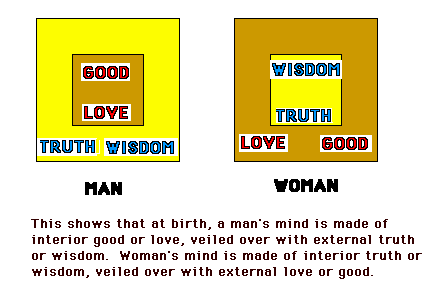
What an amazing scientific revelation! How beneficial it would be for society if
this revelation were understood rationally. Since man and woman are
reciprocals of each other in general they must also be in particular, which
means not a single thing in a woman can be like a thing in a man, and vice
versa. (xx)
This can be understood rationally if you think of marriage in a physiological
sense, which it is. Marriage is something sanctified and Divine since it is the
vehicle of the seminary for heaven, and this is the highest purpose or use for
creation. Unity is the conjoint operation of two things together so that the
result is a new conjoint object that is superior to the composing parts. Man as
an individual and woman as an individual are not human units, but only potential
human units. A human unit is the conjugial pair that from a distance is seen as
one angel (xx). The closest maximum unity is achieved between two distinct
individuals. Since not one thing in a man overlaps with one thing in a woman,
they remain most distinct. Therefore, when they unite, their unity will be more
perfect (xx).
Conjugial unity is so perfect that it demands that not a single thing in a man
can be like a single thing in a woman. An exception would reduce the perfection.
This applies to the body and the mind. Not a single fiber in a man can be like a
fiber in a woman. Not a single thought a man has can be like any thought a woman
has. Not a single affection a man has can be like an affection a woman has.
You can see the perfection of conjugial love when you consider from the
Writings, what happens when a man meets a woman and they fall in love and get
married. The woman takes within herself the man’s thinking style and reasoning
process. This is the same way as she takes his seed through her birth canal and
gives it life in her womb. That child born of her represents the husband’s
intelligence in the wife. She is now no longer an individual woman but a married
woman, which means that she has within her, his seed, his intelligence, his
ideas, his manner of thinking. She has a replica of her husband’s mind within
herself so that she always know what he is thinking!
Now it’s the man’s turn. His job is to take his wife’s affections within himself
just as she took his cognitions within herself. As a conjoint self, the couple
has become just one. She acts from his thinking within her and he acts from
her affections within him.
Thus they form a superior human being called the celestial mind or conjugial
couple. This is the plan of creation, now revealed!
Consider the second diagram of the spiritual physiology of marriage:
The marriage on earth of a regenerating couple is called Phase 1, while their
marriage once they get to heaven, is called Phase 2. Conjunction in Phase 1 is
external, also called spiritual. Internal conjunction in Phase 2 is celestial.
In the external conjunction while regenerating on earth, the husband’s
intelligence (“truth, wisdom) is conjoined to the wife’s affections (“love,
good”). The wife’s affections are within him as a result of loving them more
than his own affections. This gives the surrendered husband a new will from the
wife. And it gives the conjugial wife a new understanding from the husband. In
this mode they grow more and more into a spiritual unity while on earth. After
they are reunited in heaven, they begin the conjunction of Phase 2. Now they are
both interior people having cast off whatever was not part of their love and
affections. The external truth and wisdom of the husband, are gone. The external
love and good of the wife, are gone. What remains in the spirit-body of the
angel couple is the interior—his celestial love and her celestial truth. As
these unite, they become one angel more and more to eternity (xx).
Unity is only possible between truth and good, which is the same thing as
saying, between wisdom and love (xx). This unity is called “the marriage of good
and truth” (xx). For the celestial couple, the husband is the good and the wife
is the truth (xx). Their conjugial unity is the result of the universal unity
between good and truth in the Divine-Human. Marriage is holy because it is an
image of the marriage of good and truth in the Divine-Human (xx). Marriage on
earth is holy only when the husband’s truth unites with the wife’s love, which
is nothing else than her affections. In other words, when the husband loves
to act from her affections more than from his own.
The surrendered husband loves to meet his wife’s requests because that’s how he
reciprocates in conjoining himself with her, as she is conjoining herself with
him. The man who rebels and hates the feminine sphere perceives her wishes and
instructions as demands, as nagging, as taking away his freedom, as going too
far, as power hungry, as misguided, etc. I have felt all these feelings and they
are general to men, because biological and cultural.
A Christian, because he knows
the Divine-Human, has the Word, and since the Divine-Human places the church in
him through its means, it is obvious that he is more able than the non-Christian
to be reborn, so becoming spiritual, and to achieve truly conjugial love, since
these go together. (CL 339)
A husband is a form of truth,
and his wife a form of good, and that good cannot love any other truth than its
own truth, nor can truth love any other good in return than its own good.
If it were to love another, the inner marriage that forms the church would die,
and the marriage would become merely external - the kind of marriage that
idolatry corresponds to, not the church. (CL 76)
Here it is revealed how the “inner marriage” or internal unity, can be achieved.
The husband loves his wife as his own good attached to his truth. Not
his own good attached to his own truth—for this is the life of an
unregenerate single man, or an unregenerate married man who avoids internal
unity with his wife. To take his wife’s good as his own means to love to act
from what is in
her will more than what is in his own will. This is Rule 1 as
discussed throughout this chapter.
[3] Take as another example conjugial love. The good which comes first and is
introductory is good looks, or good manners, or outward compatibility, or
similarity of social class, or aspiration. These forms of good are the first
intermediate ones of conjugial love.
After this comes the joining together of minds (animus) in which one wills as
the other does and finds delight in doing that which is pleasing to the other.
This is the second state, and although those initial forms of good are still
present they are no longer kept in view.
Finally there follows a uniting involving celestial good and spiritual truth.
That is to say, one believes as the other believes, and one is moved by an
affection for good as the other is moved. When this state is reached both
together experience the heavenly marriage, which is a marriage of good and
truth, and so experience conjugial love since conjugial love is nothing else.
At the same time the Divine-Human is flowing into the affections of them both as
into a single affection. This is a good which flows in down a direct line,
whereas the previous kind of good which had flowed in down an indirect line had
served as the means of introduction to this good. (AC 4145)
Note the statement: “At the same time the Divine-Human is flowing into the
affections of them both as into a single affection.” The expression “into the
affections of them both as into a single affection” refers to what might be
called the conjoint self.
Why must the husband surrender to his wife before he can achieve the conjoint
self? Because:
-
He hates giving up his prerogatives and superiority status
-
He loves to have dominion over her
-
He has justified his superiority by philosophy or religion
-
He doesn’t trust women’s abilities
-
He hates the sphere of conjugial love she has within her
-
He ridicules or gets enraged at the idea he should act from her will
-
He justifies the falsity in his mind that it should be a kind of equity
arrangement—he has his roles and his places assigned by society and religion,
and she has hers.
What about the idea that the wife often doesn’t know as much as he does about
many things, and so it wouldn’t be prudent or rational to let her make the
decisions instead of him.
You will see that this is not a real danger, only an imagined one. It’s a doubt
about women being able to be reasonable and practical. It’s the generalized
gender bias that men have about women from inheritance and from culture. This
biased reasoning says, How can you trust women to make the right decisions about
so many things where men are used to making the decisions—etc. These are the
doubts that come from not valuing women. The external philosophy of equity that
men try to impose on women is nothing but a ploy. And unless men awake from this
subconscious acquiescence, they will be men no longer, for the unregenerate man
turns into a sub-human worse than any beast (TCR 564). Man’s salvation is
regeneration of character, for which the wife is a Divinely appointed and
essential instrument. This has been justified by many quotations from the
Writings in Section 1 above.
Many intelligent men will admit to this: that the wife is essential in their
life. And yet they do not ordinarily mean essential for their inner life, but
essential for their outer life. By their outer life they mean their intellectual
and economic power and their achievements and awards, including successful
children. Many men admit that without their woman they would not have achieved
what they did. And also, that they could not be content in life without being in
love with this woman. These are noble legends. He may have convinced
himself easily enough that he believes them sincerely. If indeed it had been the
truth, his woman would have been in the fullness of her being, conjoint to him
from within. But instead, she has been offered a fake marriage life, one that
has the trappings of external propriety, success, and happiness, but not
the real life and animation that is supposed to be within these outward
achievements and enactments.
The outward married life remains an enactment until it grows a spiritual reality
within. This is the spiritual union held together by each being the other’s
all in all in their willing and thinking. Can she achieve this without his
reciprocation? No, not in the least, for spiritual love requires reciprocation
to become alive and real.
He is satisfied with the outer success, but she languishes from within. He is
content to wait and let time pass, endless years and decades to her, waiting for
her real man to enter her.
And so what is to be done?
The surrendered husband is a practical proposal. It is just another way of
saying the Doctrine of the Wife, which is discussed at length in the preceding
section. Women are intelligent and wise from within from heaven from the
Divine-Human.
They will not do anything that is contrary to conjugial love. This is their
highest love and all other loves are placed below and subdued under its command
and absolute rule. This is woman’s wisdom: the certitude they feel from within
as to whether something is this way or that way in relation to her husband.
This is a Divine perception women receive from the Divine-Human regarding their
husband (CL 166). It is a perception of seeing the husband’s spiritual mind
and content, his inner affections, loves, and reasoning through them. She knows
this thoroughly, fully. More than he ever will—until he knows it from her, when
he is united to her.
The wife will know when to make a decision, and when to let him make it. She
would never override him except for one reason: she can see the danger he cannot
see. So it makes total sense that he should listen to her and really believe
from within that she has this perception from the Divine-Human. This is the
religion of the New Church mind for it is conjugial love, and this union between
husband and wife is the purpose and basis of the universe and of heaven (HH
382).
But, but what if she makes mistakes? What if she is uneducated? What if she’s
got weaknesses, blindnesses, even neuroses and addictions? The answer is: And
what if he has these things? Husbands make many many mistakes, do they not? Is
there somebody there to remove him from the office of decision maker and over
rider of her opinions when events prove her to have been right and he to have
been wrong? No of course not. He makes mistakes as he goes along and the family
lives with it. The point is that if he’s willing to live with the consequences
of her mistakes she will gradually improve and be at least as good as he used to
be—with his help. This is the point. Perhaps he needs to educate her views when
ignorant, just as she does that for him. After all, he is free to do as he wants
at any time whatsoever. His acting from her will is purely voluntary. He has the
exercise that power at any time. Again the point is this: is he after dominion
over her or after internal union? This he must answer for himself moment by
moment.
It makes sense to think that the Divine-Human is managing this process as
closely as any other in the universe. The Divine-Human longs for the husband to
want to be united to the wife. The Divine-Human calls the two together, “One
flesh,” and “His Church.” (CL 178) The husband-wife conjoint self makes the one
angel that is the Church to which the Divine-Human is married. (CL 62). Not the
husband by himself, ever, even if he comes to the gates of heaven in Aaron’s
robes. The only admittance to heaven for a male man is as a conjugial husband
(CL 50).
The only.
And so is this not the most important work a man has—to prepare his mind to be a
conjugial husband? Which is why a religious discipline is needed, as discussed
throughout this chapter.
11.4.5.1
Conjugial Simulations -- Not Fake but Necessity
Quoting from the Writings Sacred
Scripture:
CL 271. THE CAUSES OF APPARENT LOVE FRIENDSHIP, AND FAVOR IN MARRIAGES
Since the causes of cold and separation have been treated of, it follows in
order, that the causes of apparent love, friendship, and favor in marriages
should also be treated of; for it is well known that, although at this day
cold separates the minds of married partners, they yet dwell together and
procreate; and this would not be the case were there not apparent loves which,
at alternate times, are similar to the heat of genuine love or emulate it.
That these appearances are necessities and utilities, and that without them
homes and hence societies could not hold together, will be seen in what
follows.
Besides this, some conscientious persons labor under the idea that
disagreements of minds between them and their partner, and the consequent
internal alienations, are their own fault and will be imputed to them; and
because of this they grieve at heart. But since it is not in their power to
relieve internal dissidences, it is enough for them to still the troubles
which arise from conscience by apparent loves and favors. Moreover, in this
way there can be a return of a friendship, within which, on the one side if
not on the other, lies conjugial love.
But because of the great variety of material, this chapter, like the
preceding, shall be divided into articles. The articles are the following:
I. That in the natural world almost all can be conjoined as to external
affections, but not as to internal if these are dissident and come to view.
II. That in the spiritual world all are conjoined according to internal
affections, but not according to external unless these act as one with the
internal.
III. That it is external affections according to which matrimonies are
commonly contracted in the world.
IV. But that if internal affections which conjoin minds are not within them,
matrimonies are dissolved in the home.
V. That nevertheless, in the world, matrimonies are to continue to the end of
life.
VI. That in matrimonies wherein internal affections do not conjoin, there are
external affections which simulate the internal and consociate.
VII. That thence is apparent love between married partners, or apparent
friendship and favor.
VIII. That these appearances are conjugial simulations which are praiseworthy
because useful and necessary.
IX. That with a spiritual man conjoined to a natural, these conjugial
simulations savor of justice and judgment.
X. That with natural men these conjugial simulations savor of prudence for the
sake of various causes.
XI. That they are for the sake of amendments and for the sake of
accommodations.
XII. That they are for the sake of preserving order in domestic affairs, and
for the sake of mutual aid.
XIII. That they are for the sake of the care of the infants, and of
concordance in relation to the children.
XIV. That they are for the sake of peace in the home.
XV. That they are for the sake of reputation outside the home.
XVI. That they are for the sake of various favors expected from the partner or
from the partner's kindred; thus because of the fear of losing them.
XVII. That they are for the sake of the excusing of blemishes and the avoiding
of ill-repute therefrom.
XVIII. That they are for the sake of reconciliations.
XIX. That when the partners grow old, if favor does not cease with the wife
when ability ceases with the man, there may arise a friendship emulous of
conjugial friendship.
XX. That there are various kinds of apparent love and friendship between
married partners, of whom the one is subjugated and hence is subject to the
other.
XXI. That in the world there are infernal marriages between partners who
inwardly are bitter enemies and outwardly like close friends.
Now follows the explanation of the above. (CL 271)
See also: The Commandment Of
Conjugial Simulation
http://web.archive.org/web/20161031210444/http://www.soc.hawaii.edu/leonj/v3ch2-nonduality.html#_Toc22705832
11.4.6
Her
Heaven, Not His
The natural world tends to be male dominated, but not because of men’s superior
intelligence to women. It is a “man’s world” because the unregenerate natural
mind operates by the corporeal principle of “might makes right.” The feeling
from which this idea issues is at the level of animals and men’s affections are
at the animal level of operation in the unregenerate state. But when they begin
to be regenerated their internal mind is opened and receives feminine
intelligence through his wife from the Divine-Human. This softening and
humanizing of the man shows that man on his own is only a half-man.
Quoting from the Writings Sacred Scripture:
CL 37. And when they become one, then taken together they are man in his fullest
sense. But without that conjunction they are two, and each is like a person
divided or half a person. (CL 37)
(For more on the spiritual psychobiology of gender see
Reading List Part 1
Quoting from the Writings Sacred
Scripture:
CL 171. (13) A wife is joined to
her husband by the atmosphere of her life emanating from her love. From every
person there emanates, indeed pours, a spiritual atmosphere from the
affections of his love, and this atmosphere surrounds him. It also enters
into the natural atmosphere arising from the body, and the two atmospheres
combine together.
Everyone knows that a natural
atmosphere continually emanates from the body, not only from human beings but
also from animals - in fact, from trees, fruits, flowers, and also metals. So,
too, in the spiritual world, except that the atmospheres emanating from things
there are spiritual, and the atmospheres which emanate from spirits and angels
are interiorly spiritual, because the affections of their love and their
consequent perceptions and thoughts are interior.
Every feeling of affinity or
aversion has its origin from these atmospheres, and also all association
or dissociation. Thus a person's presence or absence depends in that world on
these atmospheres. For similarity or harmony in character causes association
and presence, while dissimilarity or disharmony causes dissociation and
absence. Consequently, it is these atmospheres which cause distances in that
world.
Some people also know what
effect these spiritual atmospheres have in the natural world. The
dispositions of married partners toward each other come from this very origin.
Harmonious and concordant atmospheres unite them, and contrary and discordant
ones drive them apart; for concordant atmospheres are delightful and pleasant,
while discordant ones are undelightful and unpleasant.
[2] Angels have a clear
perception of these atmospheres, and I have heard from them that every single
element in a person, both inside and out, renews itself, which it does through
processes of dissolution and restoration; and this is what produces the
atmosphere which is continually given off.
Moreover, the angels said, this
atmosphere is concentrated about a person's back and breast, but more lightly
around the back, more densely around the breast, and the atmosphere which is
about the breast combines itself with the breathing. That also is why two
married partners who differ in their dispositions and are out of harmony in
their affections, in bed lie turned away with their backs to each other, while
conversely, two who are in harmony in their dispositions and affections lie
turned toward each other.
[3] The angels said further that
because atmospheres emanate from every part of a person and extend widely
about him, these atmospheres not only join or drive apart two married partners
outwardly, but also inwardly. And this, they said, is the reason for all the
differences and diversities in conjugial love.
Lastly the angels said that the
atmosphere of love emanating from a wife who is tenderly loved, in heaven is
perceived as sweetly fragrant, considerably more delightful than the one which
is perceived in the world by a newly married husband in the first days of
marriage.
This makes plain the truth
asserted, that a wife is joined to her husband by the atmosphere of her life
emanating from her love. (CL 171)
What is the "atmosphere emanating
from the wife"?
For years now I’ve made it a habit to keep notepads all around the house and
write down many of my wife’s observations. I can accurately state that her
perceptions and insights form the starting point of the many rational and
spiritual ideas I elaborate in this and related articles. I’m especially
stimulated by the way her observations contain non-obvious connections to other
things, revealing to my sight relationships that raise the level of my
understanding and explanations. This cross-gender intellectual borrowing and
sharing process creates a more interior spiritual dimension in our relationship.
The wife’s interior wisdom from the Divine-Human descends into the
natural-rational intelligence of the husband where he builds it into an outward
shape that has many new uses.
In this way it has become true that I think from my wife, which is Rule 1 in
conjugial development (see Chapter 9, Sections 3 and 4 for more discussion on
Rule 1). If you ask her she would tell you that this is the ideal to which I am
officially committed, but that my actual adherence to it is variable. Therefore
I continue to struggle, turning to the Divine-Human for strength to persist. And
He always gives it, if only I would take it from Him.
The New Church mind today is only the sixth generation of the new civilization
of the Second Coming (1771 onward). We are part of the early generations that
are building the great transition of the human race from the temporary external
bonds of marriages to eternal interior union. The future of this transition
depends on how we today are dealing with the struggles in our mind against the
opposing forces of the natural mind. The power of the entire hells is in this
resistance and there is no way of winning except through the pathway the
Divine-Human laid down in His Second Coming. This pathway is the rule of life
for husbands that they must act from their wife and not from self. This is
explained in Sections xx and xx). The retain full independence of thinking and
willing.
They must learn to compel themselves voluntarily in all freedom to love acting
from the wife more than from self. In this way their independent
understanding—how they think and reason—is gradually realigned into the rational
alignment of conjugial love as defined in the Writings. They are unable to do
anything without this grounding and intentionality in their daily study of the
Writings.
Husbands would do well to explain this to their wife. They need to show them how
their conjugial efforts are grounded in the Writings and that this is the
cornerstone of their salvation. Only through religion can the New Church husband
obtain sufficient power to overcome himself, that is, the forces of hell in him
through his hereditary and acquired evil loves. He needs to have an ally in his
wife who can remind him when he is down and rebellious:
Now my husband, remember what struggle you are in. This is your life, our
eternity. Come now, gather your spiritual strength and your religious motives
and go forth in victory over your ego and arrogance. Compel yourself to act from
me, my standards, my guidance, my will. For only this is from the Divine-Human
in our marriage and what is from you is hell itself. I will help you if only you
will help yourself. Give up your rebellion and act like I say to you. Etc.
I’m sure you can understand the intended meaning in this representation and
apply it to the particulars of your unique life situation. The wife is to fight
for you with all that the Divine-Human gives her, and you are to fight yourself
by compelling yourself voluntarily to act from her. This is the spiritual
discipline for conjugial husbands.
For many years I’ve been keeping track of my interactions with my wife and my
behavior as a husband. This has helped me greatly to become actually aware of
attitudes, opinions, and behaviors that I have developed from socialization and
culture that are opposed to the development of conjugial love (see Note 16 at
end). I noted the many unexamined ways that I insisted on my male prerogatives
which a “man’s world” bestows upon men. Husbands interrupt when wives talk and
instead of listening they give premature advice. Husbands determine the majority
of topics being transacted by refusing to address issues raised by the wives.
Husbands raise their voices and make scary faces when they disagree or are angry
about this or that. These are maladaptive methods men use to intimidate women
whose sensitivities are threatened and injured by this manly harshness. A
crucial mental discipline for New Church husbands is to systematically and
regularly keep track of how we fail to honor our wife. It requires that we
enlist our wife’s help in providing us with information about our behaviors,
habits, and traits that are contrary to conjugial love. Wives receive from the
Divine-Human special perception into the unconscious traits of their husbands
(CL 156). Relying on our own perceptions is insufficient and misleading.
Making lists is very helpful. Keeping cumulative records is what makes into a
discipline. What makes it into a spiritual discipline is being
motivated to use the records for self-change efforts in conjugial cooperation.
Whatever the husband does consciously for the sake of preparing himself for
conjugial love is a spiritual discipline.
Those who enjoy truly conjugial love have eternity in view in their marriage;
but the reverse is true of those who do not.
The reason why those who enjoy truly conjugial love have eternity in view is
that eternity is contained within this love. This is because this love increases
for ever in the case of the wife, and wisdom increases for ever in the case of
the husband; and as these increase and develop, the couple plunges deeper and
deeper into the blessings of heaven, which lie hidden in their wisdom and also
the love for it. So if the notion of eternity were torn away, or by any accident
slipped from their minds, it would be as if they were cast down from heaven.
(…)
It is much the same with marriages on earth. When couples there love each other
dearly, they think of their partnership as eternal, and pay no attention to its
being ended by death. But if they do think of this, it upsets them; though they
are revived by hope, when they think of it continuing after death. (CL 216)
Keeping self-witnessing records conscientiously is a discipline. Consulting the
wife’s perceptions about the records for the sake of conjoining their
perspective, makes it into a spiritual discipline. It is painful due to our
inborn pride and runs against the grain of our culturally received male
chauvinism and male prerogatives. Resistance to the process is strong and
motivation falters. Overcoming these constantly opposing forces is the
discipline. The results are very beneficial and promote conjugial friendship and
unity. This makes it into a spiritual discipline.
11.4.7
Divine Truth Within Which Is Divine Love
Married and pre-married men can practice many conjugial disciplines that relate
to their relationship to a wife. Pre-married men can practice by viewing every
girl or woman as someone’s wife. In addition, Christian women have conjugial
love implanted and imprinted by nativity (CL 216, 457). The reason only
Christian women have this is that conjugial love is only from the Divine-Human
and so He alone must be acknowledged in order to receive it (CL 71).
Nevertheless the women who are not Christian can also be in conjugial love in
the afterlife, when they are instructed regarding the Divine-Human and are
willing to receive it (HH 512[3]). The New Church mind exists as a duality: male
and female, as determined by birth. No part of the male New Church Mind can be
similar or overlap with the female New Church Mind inasmuch as in marriage they
are united into a perfect one, and this is only possible with absolute
distinctiveness of each unique element.
The Divine-Human’s perfection lies in this: that in Him infinite things that are
distinct make a one (DLW 223). The New Church couple is a celestial unit made of
two elements that are distinctly different. If things are distinctly different
in general they are also distinctly different in every particular (AC 1040[2]).
Hence it is that nothing in a husband can be similar to anything in a wife.
This unity cannot be understood outside the intellectual sphere of the Writings.
To understand it rationally one needs to apply several things to it: the law of
discrete degrees (DLW 186), the Divine-Human’s Proprium that angels use for
themselves (AC 8409), the organic composition of the will and understanding (DLW
373), the perfection of unity from discrete elements (DLW 201), the character of
temptations (natural, spiritual, celestial) (NJHD 196), the gradual character of
regeneration (CL 146), conjugial simulation (CL 282), what chastity is and is
not (CL 138), the wife’s interior perception of their husbands which husbands do
not have on themselves (CL 166), and other things besides. In the context of
these ideas from the Writings physical and mental disciplines can serve to
strengthen a man’s suitability for conjugial union.
The focus is on the husband because conjugial love is not inscribed on men from
birth as it is on women. It is revealed that men are promiscuous from birth like
animals (CL 48) and if they are going to enter heaven they must regenerate into
a celestial human being. Only this interior human can unite in perfection with a
wife who has conjugial love implanted in her soul.
Conjugial love is lodged with chaste wives, but their love still depends upon
their husbands.
The reason is that wives are by birth forms of love, so that it is innate in
them to wish to be one with their husbands, and by keeping this thought in their
will they constantly nurture their love. So abandoning the effort to unite
themselves with their husbands would be abandoning their own nature. But it is
different with husbands; since they are not by birth forms of love, but designed
to receive that love from their wives, the more readily they receive it, the
more readily do their wives come in with their love. But if they fail to receive
it, their wives equally stay outside with their love and wait.
This happens in the case of chaste wives, but it is different with the unchaste.
These considerations will establish that conjugial love is lodged with wives,
but their love depends upon their husbands. (216bis) (see also CL 457)
Physical and mental disciplines by men performed for the purpose of conjugial
motives, as defined in the Writings, are spiritual disciplines. But not
otherwise.
From what
is implanted in them, wives wish to be wives and to be called wives. To them,
this is a name of beauty and honor and for that reason they love the bonds of
marriage. Moreover, chaste wives wish to be wives not in name only but actually,
and because this is effected by an ever closer tie with their husbands,
therefore they love the bonds of marriage by reason of the stability of its
covenant; and this the more, as they in turn are loved by their husbands or,
what is the same thing, as the men love those bonds. (CL 217.) (See also CL 457)
Self-witnessing is at the basis of these disciplines. (See Note 20 for more on
self-witnessing techniques).
The New Church mind contains the idea that the evolution of the universe towards
its perfection is gradual change back from exteriorization (=creation from
Firsts to lasts) to interiorization (=return to the Creator from lasts to
Firsts). Creation is a process of distancing from the spiritual Sun which is
uncreate, infinite and closest to the Divine-Human. This is the inmost of
existence and being. The substance from the spiritual Sun proceeds to a greater
and greater “distance” from Itself, going through discrete degrees of
transformation, each more externalized than the preceding, until at last it
reaches the inert stage of the physical universe, starting with energy and space
or ether, and more and more externalized until the various minerals and
compounds of planets is reached.
The distance or externalization is a process of becoming more and more inert,
that is, less and less life which is the inmost substance of every object. This
inmost of every object and particle is the life of existence in a created
reality. The word “distance” in this context must be taken as a correspondence
for the exteriorization process of creation by substance and intermediaries
(xx). The originating substance in sequential order becomes the inmost substance
in simultaneous order (xx). The originating substance of created objects is the
substance that emanates from the spiritual Sun. This substance is called “Divine
Truth within which is Divine Love” (xx).Therefore the inmost of every object or
particle in the universe is “Divine Truth within which is Divine Love.”
This inmost substance called “Divine Truth within which is Divine Love,” is
living in itself, or life in itself. It is an uncreate substance that belongs to
the Divine-Human, and is infinite, since infinite distinct things are contained
in it as one. You can see that this substance is be source of infinite distinct
or unique things in the created universe. This momentous scientific
revelation gives the human race a far higher consciousness of reality than was
possible before.
The level of thinking, reasoning, and understanding the workings of the universe
is immeasurably increased by this revelation. One important implication is that
the universe is rational. The universe is rational since it is created from
truth, within which is good. Truth is the inmost substance out of which a thing
exists! What an amazing revelation of reality! For instance, a rock, the brain,
and a feeling are all created out of truth as a substance of love. Truth creates
not from itself but from love or good. Still, it is not love that creates but
truth from love. This is what makes the universe rational, and what is rational
is both human and alive. Rational defines the human (xx) because the human mind
is created an organ for the reception of rational truths from the Divine. When
these rational truths are appropriated, loved, and lived, they become our heaven
in eternity. But without rational truths appropriated to ourselves by loving
them, there can be no heavenly life in us, but only infernal, for all life in
human beings is either heavenly or infernal (xx). This is the result of the fact
that all things of truth are heavenly, while all things of hell are
falsifications or distortions of truth.
This is the same as saying that the living function or quality is hidden more
and more within, and doesn’t show in its effects. Animals are less externalized
and the life within is visible and obvious. Human minds are the least
externalized of the created things, especially the consciousness or rationality
of human beings. The minds of women are more interiorized than the minds of men.
The male human is more externalized than the female human.
Every man is created that he
may live for ever. In the treatise THE DIVINE LOVE AND WISDOM, Parts Third and
Fifth, it is shown that in man there are three degrees of life, called the
natural, the spiritual and the celestial, and that these degrees are actually in
every man; while in beasts there is only one degree of life, which is similar to
the lowest degree in man called the natural. From this it follows that man by
the elevation of his life to the Divine-Human is in such a state above the
beasts that he is able to understand what pertains to the Divine Wisdom and to
will what pertains to the Divine Love, and in this way to receive the Divine;
and he who can receive the Divine so as to see and perceive it in himself cannot
be otherwise than conjoined to the Divine-Human, and through this conjunction
cannot but live for ever. (…)
In order that every man may
live for ever, what is mortal with him is taken away. His mortal part is the
material body which is taken away by his death. His immortal part, which is his
mind, is thus unveiled and he then becomes a spirit in human form, his mind
being that spirit. (…)
As it has been granted me to
speak with angels I will also say something from my own experience. I have
talked with some who lived many ages ago, with some who lived before the Flood
and with some who lived after it, with some who lived in the time of the
Divine-Human, with one of His Apostles, and with many who lived in later times.
They all appeared like men of middle age, and they said they did not know what
death is, but only that there is condemnation. Moreover, all who have lived
well, when they enter heaven, come into the state of early manhood they reached
in the world and continue in it to eternity, even those who had been old and
decrepit men in the world. Women, too, although they had been shrunken and aged,
return to the flowering period of their age and beauty. (…)
Thus every man is created that
he may enter heaven. This is the end of creation; but all do not enter heaven
because they become imbued with the delights of hell which are opposite to the
happiness of heaven; and those who are not in the happiness of heaven cannot
enter heaven, for they cannot endure it. To no one who enters the spiritual
world is it denied to ascend to heaven; but when one who is in the delight of
hell enters heaven his heart palpitates, his breathing is labored, his life
begins to fail, he is in anguish, distress and torment, and he writhes like a
serpent placed close to a fire. This is so because opposites act against each
other. (…)
Nevertheless, they cannot die,
as they were born men and thereby with the faculty of thinking and willing, and
consequently of speaking and acting. However, as they can live only with those
who are in a similar delight of life they are sent to them; thus those who are
in the delights of evil and those who are in the delights of good are sent to
their own appropriate companions. It is indeed granted everyone to experience
the delight of his own evil provided he does not molest any who are in the
delight of good; but as evil cannot do otherwise than molest good, for there is
inherent in evil hatred against good, therefore lest the wicked should inflict
injury they are removed and cast down to their own place in hell, where their
delight is turned to what is the reverse of delightful. (DP 324)
11.4.8
Is The Surrendered Husband Feminized?
In earlier drafts and articles I used the term “feminization,” as in “the
feminization of marriage” or “the feminization of the husband” and, “the
feminization of the universe” and also, “the feminization of the Church.” I have
a note to myself to go back to my earlier articles and edit out the word
“feminization” from the sub-titles as this might be a kind of red flag to some
people. While discussing the matter with my wife I suddenly got the sense that
it might be an unnecessary stumbling block. Some men might not be able initially
to shake the negative implications of this word when applied to a man.
Yet the underlying idea in the feminization of marriage, husband, universe, or
Church, is that conjugial love is returning to earth (See Section xx).
Conjugial love is feminine. When the husband is feminized it means nothing else
than that he has acquired conjugial love, which is now part of him. It cannot
mean that his traits have become feminine since it is a Divine Law by creation
that not a single thing in a man can be like a single think in a woman (See
Section xx). The
man before being feminized by conjugial love is the same man as afterwards,
except that he now has conjugial love as part of him whereas he did not before
that.
In the earlier phases of their
regeneration (see Level 2 Thinking Section xx), men are tempted to use the
literal sense of Sacred Scripture within the context of a religion, and through
this they practice dominance over women in areas that they claim is given to
them by Sacred Scripture (see Section xx). The following passage from Conjugial
Love 32 has been used by men to argue that they have a Divine warrant to choose
when they can prevail over women.
CL 32 (2). The difference
essentially consists in this, that the inmost quality in masculinity is love,
and its veil wisdom, or in other words, it is love veiled over with wisdom,
while the inmost quality in femininity is that same wisdom, the wisdom of
masculinity, and its veil the love resulting from it. This second love,
however, is a feminine love, and it is given by the Lord to a wife through the
wisdom of her husband, whereas that first love is a masculine love, which is a
love of becoming wise, and it is given by the Lord to a husband according to
his reception of wisdom. Consequently, the male is a form of the wisdom of
love, and the female is a form of the love of that wisdom. Therefore from
creation there was implanted in both male and female a love of uniting into
one. (CL 32)
We discussed the mental anatomy of
men and women in Section 11.3.1.1 above. An additional relevant diagram is to be
found in Section 11.4.11.2 below. The reciprocal anatomy of men and women
assigns both love and wisdom to both men and women, but in inverse order
relative to which is inner and which outer. This is repeated in the above
passage. But now consider this: " the inmost quality in femininity is that
same wisdom, the wisdom of masculinity, and its veil the love resulting from it."
This literally says that a woman's femininity comes from the man's wisdom of
masculinity. Men who are not yet regenerated are interpreting Sacred Scripture
literally when applying to themselves. In this passage men see themselves as
primary and women as secondary. They interpret this passage as meaning that
they have wisdom from God because they are born men. Even if they deny that they
are wise, they still think it because of masculine self-intelligence confirmed
in this passage and others like it. Hence when a husband has a disagreement with
his wife he insists that she should give in to his decision and his
understanding because he has wisdom from God and she is to take this wisdom into
herself from him. They interpret this as meaning that the woman's wisdom is
lower than the man's since she has it from him. These interpretations are
completely false.
According to the Doctrine of the
Wife a husband should always strive to make interpretations of Sacred Scripture
that favor his wife over himself (see Section xx). In this passage: "the
inmost quality in femininity is that same wisdom, the wisdom of masculinity, and
its veil the love resulting from it" --- it is clear that the masculine
wisdom of the husband is absorbed or implanted into the wife. Now instead of
concluding from this that therefore the wife's wisdom is lower, one should
conclude that the wife's wisdom is higher, not lower. This can be confirmed in
several ways. One is that the implanted wisdom in the wife is inner wisdom (see
anatomical chart), while the man's wisdom is outer. What is inner is always
superior to what is outer (see Section xx). Evidently, when the wisdom of
femininity is superior to the wisdom of masculinity. This can be also be
confirmed by observation of married couples. Husbands who allow their wife to
sway their opinion and judgment regarding their marriage and relationship,
achieve the unity phase, which is the inner marriage, the heavenly marriage that
will endure to eternity (see Section xx).
Another way one can confirm this
is that a man's wisdom is no greater than his application of it to life. Since
men regenerate gradually over the years of marriage, their wisdom later is far
superior to their wisdom earlier. In the meantime what is the wife supposed to
do about a husband is not yet wise? Clearly she is not to absorb her husband's
way of thinking and reasoning when it is not wise. Hence if he opposes his
wife's decision or conclusion or opinion, and rejects this for the sake of his
own, then his foolish, not wise. His wife is not going to love his foolishness,
and not she is not going to love him for his foolishness. But instead, he can
become wise if he willingly complies to her wisdom, which is always superior to
his, being his wisdom elevated in her inner mind.
11.4.8.1
Husbands Confess Here: Leon James
Please see this article:
Husbands Confess Here: Leon James
www.soc.hawaii.edu/leonj/leonj/leonpsy/instructor/gloss/leon1-shorter.html
11.4.9
The Conjoint Mind Is Both Masculine And Feminine
The Divine-Human has now revealed the scientific fact that a man by himself is
an incomplete creation and is still to develop to maturity. The mature man is
created into perfection when he is no longer an individual man, but a structural
or organic part of his wife, so that the two together are one angel (xx). Only
as an angel-husband is a man in his created perfection. It is just like the
surgical reintegration and attachment of a man and a woman in which her lungs
are removed and her heart is attached to his lungs. And his heart is removed and
his lungs are attached to her heart. This integrated new body corresponds to the
conjoint mind of an angel-couple, which therefore has both masculine and
feminine characteristics.
The Doctrine of the Wife, through Rule 1, creates the conjoint mind. Through
Rule 1 the husband’s will, which corresponds to his heart, is removed, and it is
replaced by the wife’s heart to which he keeps himself cleaving by conjugial
love and the motive to acquire it. From the perspective of the husband, thinking
and acting from his wife’s will, which corresponds to her heart, is to lay aside
his individual independent will, which was entirely masculine. Henceforth his
masculine understanding is to operate from a feminine will, just as his
masculine lungs would be purified of impurities and poisons by the feminine
heart to which he is now joined. To be a conjoint mind means that the husband
thinks from his wife’s will or affections, and the wife thinks from her
husband’s understanding or thoughts. He is feminized while she is masculinized,
even though they each retain their full gender, gaining everything, losing
nothing.
What does it mean specifically to say that the husband loves to think and act
from the wife’s willing more than from his own willing?
Consider how you might describe your daily behavior. You act in accordance with
your thinking, which is from your willing. In other words, the motives and
affections in your will select and direct those thoughts that serve its
affections and motives. The thinking is therefore from the willing, and the
acting is from both of them together. This is the way we operate prior to being
a conjugial husband.
As we are reformed by the Doctrine of the Wife, and struggle daily and hourly to
follow Rule 1, we begin gradually to change from the operation just described.
Now we inhibit and weaken and suppress our own affections and motives in
interacting with our wife. Instead, we begin to compel our thinking to fit the
wife’s requests and needs. This is gradual because we do not hear her requests
except in a weak sense at first, gradually gaining strength until we can
actually hear the request she had been making for years. Then we sometimes
compel ourselves to think in accordance with the request, but sometimes we
choose not to, and then we slide back, to the chagrin and suffering of the poor
wife. But eventually we get better at it, more honest in our attempts, and at
last our wife begins to say new things about us, things that a conjugial wife
says to her conjugial husband who has become her bosom friend.
The more we think from the wife’s willing, the more our mind is conjoined to her
mind. When our thinking is done from her willing, our doing will be called the
works of conjugial love. This is what the Divine-Human has Commanded by saying
that the man shall leave father and mother and cleave unto his wife (xx).
“Father and mother” refers to the man’s own willing and thinking, since willing
relates to good, and “father” represents good, while thinking relates to truth,
and “mother” represents truth or the Church in us. We leave our own “father and
mother” by laying aside our own willing, and the independent masculine thinking
that goes with that willing. And in its stead, we hook ourselves into our wife’s
willing by knowing her affections and hearing her requests. This is the meaning
of the promise to “honor” her which we solemnly make at our sacred wedding. “To
cleave to the wife” signifies to honor her by reforming our thinking to fit her
willing, and then acting by the new thinking from her willing. In this way we
act agreeably to her and she can conjoin herself to our new mind even more than
before. this is a continuous process over the years. Happy is the couple on
this earth that is immersed in this process.
Conjugial love is the highest of all loves and uses in the universe (xx), for
which all other loves exist, for which all created objects exist. Conjugial love
is called a celestial love (xx). This highest of all loves is received from the
Divine-Human in the inmost of the wife, and conjugial love in the wife becomes
the source of conjugial love for the husband (xx). It is in the husband only to
the extent that her heart is in his, that is, to the extent that he has
appropriated to himself her affections and now thinks and acts from them. Thus,
he is in the state described by Rule 1 of the Doctrine of the Wife. This is
meant by the elevated husband.
Conjugial love in the man is therefore the exchanging of his old masculine will
and affections for her feminine affections, which are her will, her love.
Her love is now in him and he thinks and acts from her love.
All thinking and acting is from love (xx), and he either acts from his own love
or from her love in him.
To be able to act and think form her love requires that he appropriate her love,
that is, make her affections to be in his will. This appropriation, or
interiorization, is achieved solely by loving them, for only loving something
can be appropriated to a human being. Once appropriated, it remains forever. Now
he is a new man, for the man is his intelligence, and this is such as his love
is (DLW xx). Now he acts from a higher love than before because woman’s love is
higher than man’s, her love being celestial, while his love being spiritual, and
the two are as far apart as the noonday sun light is from the midnight moon
light (xx).
Man was created into a perfect order. He arrives in this perfect order when he
becomes the elevated husband. He achieves this higher existence by exchanging
the hereditary and acquired masculine affections in his will with the feminine
affections of his conjugial life. Her affections are higher because she is the
only one that receives conjugial love directly from the Divine-Human (xx). The
Divine-Human provides that the husband also has conjugial love, but not directly
from Him, but directly from his wife. This appropriation to himself of the
Divine-Human’s conjugial love in her, effects his elevation. And this
appropriation of her love as his own makes him hers, for he now is what his love
is, purely hers. His new thoughts are now created by this new will, which is his
wife’s in him. These new thoughts are higher than his thoughts before the
makeover of his will. Now the wife takes these new thoughts into herself as she
does his seed through the thighs (xx). This is her delight of unity that is
indescribable according to the celestial wives who talked to Swedenborg about it
in a rose garden (xx).
11.4.10
The Wife's Role in Heavenly Marriages
First read the following delightful
story from Swedenborg's book Conjugial Love (1743). I will then comment
on what information we can extract from it.
CL 56. The second account:
One time, while speaking with angels in the
spiritual world, I was filled with a pleasant wish to see the Temple of
Wisdom, which I had seen once before.* So I asked the angels about the way to
it.
They said, "Follow the light, and you will find
it."
And I said, "What do you mean, follow the light?"
They said, "Our light grows brighter the closer we
get to that temple. Follow the light, therefore, in the direction it grows
brighter. For our light emanates from the Lord as the sun of this world, and
so, regarded in itself, that light is wisdom."
In the company of two angels I then went in the
direction that the light grew brighter, and I ascended by a steep path to the
top of a certain hill which was in the southern zone, where I found a
magnificent gate. When the guard saw the angels with me, he opened it, and
behold, I saw an avenue of palm trees and laurels, which we followed. The
avenue curved around and ended up at a garden, in the middle of which stood
the Temple of Wisdom.
As I looked around in the garden, I saw some
smaller buildings, replicas of the temple, with wise men in them. We went over
to one of the buildings, and we spoke at the entrance with the receptionist
there, telling him the reason for our coming and the way we had arrived. And
the receptionist said, "Welcome! Come in, have a seat, and let us spend some
time together in conversations of wisdom."
[2] I saw inside that the building was divided
into two sections, and yet the two were still one. It was divided into two
sections by a transparent partition, but it looked like one room because of
the partition's transparency, which was like the transparency of the purest
crystal. I asked why it was arranged like that.
The receptionist said, "I am not alone. My wife is
with me, and though we are two, yet we are not two but one flesh."
To which I replied, "I know you are wise, but what
does a wise man or wisdom have to do with a woman?"
At this, with some feeling of annoyance, the
receptionist's expression changed, and he stretched out his hand, and
suddenly, then, other wise men were present from the neighboring buildings. To
them he said with amusement, "Our visitor here says he wants to know what a
wise man or wisdom has to do with a woman!"
They all laughed at this and said, "What is a wise
man or wisdom apart from a woman or apart from love? A wife is the love of a
wise man's wisdom."
[3] But the receptionist said, "Let us join
together now in some conversation of wisdom. Let the conversation be about
causes, today the reason for the beauty in the female sex."
So they then spoke in turn. And the first speaker
gave this reason, that women were created by the Lord to be forms of affection
for the wisdom in men, and affection for wisdom is beauty itself.
The second speaker gave this reason, that woman
was created by the Lord through the wisdom in man, because she was created
from man, and that she is therefore a form of wisdom inspired by the affection
of love. And because the affection of love is life itself, a woman is a form
of the life in wisdom, while the male is a form of wisdom, and the life in
wisdom is beauty itself.
The third speaker presented this reason, that
women have been given a perception of the delights in conjugial love. And
because their whole body is an instrument of that perception, the abode where
the delights of conjugial love dwell with their perception cannot help but be
a form of beauty.
[4] The fourth speaker gave this reason, that the
Lord took beauty and grace of life from man and transferred them into woman,
and that is why a man not reunited with his beauty and grace in woman is
stern, severe, dry and unattractive, and also not wise except for his own sake
alone, in which case he is a dunce. On the other hand, when a man is united
with his beauty and grace of life in a wife, he becomes agreeable, pleasant,
full of life and lovable, and therefore wise.
The fifth speaker gave this reason, that women
were created to be beauties, not for their own sake, but for the sake of men,
so that men's natural hardness might become softer, the natural solemnness of
their dispositions more amiable, and the natural coldness of their hearts
warmer. And this is what happens to them when they become one flesh with their
wives.
[5] The sixth speaker offered this reason, that
the universe created by the Lord is a most perfect work, but nothing is
created in it more perfect than a woman attractive in appearance and becoming
in behavior, in order that a man may thank the Lord for such a gift and repay
it by receiving wisdom from Him.
After these and several other similar views were
expressed, one of the wives appeared through the crystal-like partition, and
she said to her husband, "Speak, if you wish."
And when he spoke, the life in his wisdom from his
wife was perceived in his speech, for her love was in the tone of his voice.
Thus did experience bear witness to the truth expressed.
After this we looked at the Temple of Wisdom, and
also at the things in the paradise surrounding it. And being filled with
feelings of joy on account of them, we departed and went along the avenue to
the gate, and so descended by the way we had come. (CL 56)
Let us now analyze this passage. The
following facts can be extracted.
(1) Wisdom is the state of becoming
enlightened when men and women receive spiritual light into the natural mind.
Their mind is then like a paradise of lovely gardens, such as appear around the
dwelling places of couples in conjugial love. The spiritual light enlightens the
natural mind when we read the Writings, acknowledging it as the Divine Truth
spoken by the Divine Human and expressed in a natural language. This is the
meaning of the "Temple of Wisdom" which then shines in our mental world. Both
men and women have the same Temple of Wisdom in their mind, but every individual
in their own unique way.
(2) The mind of the conjugial
husband is not independent or single. It is always filled with the wife's
affections and wishes. There is never a moment when the wife is not present in
the conjugial husband's mind because he continuously cleaves to her affections
and wishes that he memorizes, internalizes, and appropriates as-if they were his
own. Her mental presence in his mind creates a conjoint mind in which there is a
"transparent partition" so that the two minds form a conjoint self, just like
two rooms separated by a glass partition look like just one room. But when the
husband acts from his own affections and wishes, his mind and her mind are
divided by a brick wall, not a transparent partition. He cannot become a
conjugial husband as long as he is unwilling to align his thinking in accordance
with her affections and wishes, thereby removing the brick wall and installing
the transparent partition.
(3) "A wife is the love of a wise
man's wisdom." In a conjugial couple, it is the wife who supplies the will for
the couple's interactions with each other. The husband who is practicing being
conjugial does not wish to act from his own will, but from his wife's will only.
This means that he desires to consult his wife's affections and wishes before he
can rightly act through his own wisdom and understanding. He does not wish to
act or decide anything on his own, from his own understanding and inclinations,
until he has aligned them to be acceptable and harmonious to his wife's
affections and wishes. It says that a wife is the love of a "wise man's" wisdom
because if the husband is not a "wise man," the conjugial wife cannot be the
love of his unwisdom. When a husband goes after his own affections and
understanding, which are contrary to the wife's wishes, he is in unwisdom. The
wife cannot be the love of that unwisdom.
11.4.10.1
The Wife is a Form of the Highest Human Wisdom
(4) Continuing with the analysis of CL 56.
The wife "is a form of wisdom inspired by the
affection of love." The wife's affections and wishes are expressions of her
conjugial love which she has in herself inborn from nativity.
Quoting from the Writings Sacred
Scripture:
CL 224. (xv) Where truly conjugial love exists,
this sphere is received by the wife and is only received by the husband
through the wife.
The fact that in the case of those who enjoy
truly conjugial love this sphere is received by the husband solely through
his wife is today a secret. (CL 224)
CL 224. Since everyone, man and woman alike, is
enveloped in a sphere of life, densely in front and thinly at the back, it
is plain why husbands who are deeply in love with their wives turn towards
them and during the day smile kindly on them. Conversely those who do not
love their wives turn away from them, and during the day withdraw their gaze
when they see them. The way the conjugial sphere is received by the husband
solely through his wife allows truly conjugial love to be recognised and
distinguished from spurious, false or cold conjugial love. (CL 224)
CL 223. (xiv) This sphere is received by the
female sex, and by them it is transferred to the male sex[; but the reverse
of this is not the case].
My experiences have allowed me to see evidence that there is no conjugial
love present in the male sex, but it is only in the female sex, being
transferred from this to the male (see 161 above). Reason can add a further
proof: the male form is an intellectual one, woman is a voluntary form. An
intellectual form cannot be warmed by conjugial heat by itself, but only
from the linking heat of someone who has it implanted from creation.
Consequently it cannot receive that love, except through having attached to
it the voluntary form of a woman; this is also the form of love. (CL 223)
CL 393. VI. THAT THIS SPHERE AFFECTS THE FEMALE
SEX, THUS MOTHERS, PRINCIPALLY, AND THE MALE SEX, OR FATHERS, FROM THEM.
This is a consequence due to the same origin that was previously spoken of
[no. 222], namely, that the sphere of conjugial love is received by women,
and through women is transferred to men (CL 393)
CL 409. Conjugial love is implanted in every
woman from creation (CL 409)
CL 88. [2] A man therefore possesses two loves.
One, which comes first, is the love of being wise, and the other, which
comes later, is the love of wisdom. But if this second love remains with a
man, it is a wicked love, called pride in or love of one's own intelligence.
It will be proved in the following pages that it has been provided from
creation that, to prevent this love being his ruin, it was taken from the
man and copied into the woman, so becoming conjugial love which makes him
whole again. (CL 88).
CL 331. [2] Their second conclusion was, 'We
women are designed by birth to be the love of our husbands' intelligence. If
therefore men love their own intelligence, this cannot be united with its
true love, which resides with the wife. And if the husband's intelligence is
not united with its true love residing with the wife, pride turns
intelligence into folly, and conjugial love becomes coldness. Can any woman
unite her love with coldness? And can any man unite the folly of his pride
with the love of intelligence?' (CL 331)
CL 216r. [repeated] (7) Conjugial love has its
seat in chaste wives, but their love depends on their husbands. The reason
is that wives are born forms of love, and it is therefore innate in them to
wish to be one with their husbands. They also continue to feed their love
with this thought of their will. Consequently to turn away from their effort
to unite themselves with their husbands would be to turn away from their
very natures. It is different with husbands. Because they are not born forms
of love, but are receivers of that love from their wives, therefore to the
degree that they receive it, to that degree their wives enter into them with
their love. But to the degree they do not receive it, their wives stand
outside with their love and wait. This is what happens, however, in the case
of chaste wives. It is otherwise in the case of unchaste ones. It follows
from this that conjugial love has its seat in chaste wives, but that their
love depends on their husbands. (CL 216r)
CL 457. (12) For the conjugial union of one man
with one wife is the precious jewel of human life and the repository of
Christian religion. These two points are ones we have already demonstrated
universally and singly in the entire preceding part on conjugial love and
the delights of its wisdom. Conjugial love is the precious jewel of human
life because the character of a person's life is such as the character of
that love in him, that love forming the inmost element of his life. For it
is the life of wisdom dwelling together with its love, and of love dwelling
together with its wisdom, and thus it is the life of the delights of both.
In a word, a person is a living soul as a result of that love. That is why
we call the conjugial union of one man with one wife the precious jewel of
human life.
[2] This conclusion is supported by observations
made above: that truly conjugial friendship, trust and potency are possible
with only one wife, because only then is there a union of minds (nos. 333,
334); that in and from that union spring the celestial blessings, spiritual
felicities and natural delights which from the beginning have been provided
for people who are in a state of truly conjugial love (no. 335); that this
love is the fundamental love of all celestial, spiritual, and consequently
natural loves (nos. 65-67); and that into this love have been gathered all
joys and all delights, from the first to the last of them (nos. 68, 69).
Moreover, in Delights of Wisdom Relating to Conjugial Love, which forms Part
One of this work, it was fully shown that regarded in its origin, this love
is the interplay of wisdom and love. (CL 457)
Reviewing some of the points we
learn from the above passages:
CL 224. The fact that in the case of those who
enjoy truly conjugial love this sphere is received by the husband solely
through his wife is today a secret. (CL 224)
The expression "today" in Sacred
Scripture always signifies a developmental state in our regeneration process. In
this case, what is being described is the mental state of husbands before they
are enlightened and afterward. That it is a "secret" signifies that it is not
understood by them in their pre-enlightenment phase, but it is revealed to them
afterward. The doctrinal secret is that CL cannot be given to the husband
by the Lord except through the wife. This is a psychobiological secret,
that is, a scientific fact or spiritual doctrine that is revealed in Sacred
Scripture.
That CL is a "sphere" signifies that
it is a spiritual substance that emanates from the wife's spiritual mind and
encompasses the husband's spiritual mind. The husband's spiritual mind is
capable of approaching his wife's sphere of CL more and more, or closer and
closer, as he progresses in his "circle of life", applying to combats of
willing and thinking
in his interactions with her. But not so much if he does not apply it to
his interactions with her. This sphere of emanation from the wife is further
described as follows:
CL 224. Since everyone, man and
woman alike, is enveloped in a sphere of life, densely in front and thinly at
the back, it is plain why husbands who are deeply in love with their wives
turn towards them and during the day smile kindly on them. Conversely those
who do not love their wives turn away from them, and during the day withdraw
their gaze when they see them. The way the conjugial sphere is received by the
husband solely through his wife allows truly conjugial love to be recognised
and distinguished from spurious, false or cold conjugial love. (CL 224)
The expression "husbands who are
deeply in love with their wives" signifies that they are enlightened (see above)
and that they have learned to be willing to be influenced by the wife in the
natural mind. This is because a husband who loves his wife does not disagree
with her. He has learned to compel himself to elevate her influence on him as
higher and stronger than his influence on himself. Such a husband can be said to
be "deeply in love with his wife." And if he does not do this, if he disagrees
with her natural mind, and he lets it stand, then he may know that he is not
deeply in love with her. But if he can make himself to agree with her natural
mind, he is aligning his natural to correspond to a conjugial heaven. This
prepares his mind for conjugial heaven in the spiritual mind, that is in
eternity.
The expression "during the day" is
like the prior expression "today" and refers to a developmental phase that is
being discussed. In this case, that of husbands who have been enlightened (see
above). In that enlightened state, husbands are said to "turn towards their
wives", which signifies that they immerse themselves "densely" in the sphere of
the wife, which is "in front" rather than in the back. Husbands enter the mental
state of enlightenment when they are able to stand this CL sphere emanating from
the wife's mind "densely", which means they have learned to compel themselves to
be influenced by the wife's mind more than by his own mind.
That an enlightened husband "during
the day smiles kindly on his wife" signifies that he does not disagree with her.
He never disagrees with her when he is in an enlightened state. To "smile
kindly" means that his inner disposition towards her is favorable. It means that
he is her best friend and looks after her feelings and desires, striving to
satisfy them like a sweetheart would.
It is said that "Conversely those
who do not love their wives turn away from them" which signifies that before the
state of enlightenment, a husband readily disagrees with his wife, thereby
acting like he does not love her, does not look after her feelings as her best
friend would. He is her husband, but he is not her true lover, her conjugial
partner who desires to be immersed in her mental sphere. He finds this aversive,
which is what "conversely" signifies. Hence it is said that husbands "withdraw
their gaze when they see their wife", which signifies that they spiritually
withdraw themselves from the wife's front, where the emanating substance of CL
is "densely" packed. They take up position behind the wife, where the emanation
is thin, which means that they are less willing to be influenced by the natural
mind of the wife, and favor their own natural mind. In this way their natural
mind remains in correspondence with hell. This husband's love for his wife is
called "spurious, false or cold conjugial love."
The wife's conjugial love is
continuously renewed and received from the Lord on a moment by moment basis from
birth to eternity. It says that a wife is a "form of wisdom" because conjugial
love creates in her the highest form of human wisdom called "Sarah" in the Word
(Abraham's wife). The husband is born a form of wisdom which is spiritual
wisdom, and therefore is a lower form of wisdom than the wife's wisdom, which is
celestial. This is why in conjugial couples, it is the husband who aligns his
understanding to the wife's understanding in all things pertaining to their
relationship and interactions. Higher loves receive higher wisdom and conjugial
love is the highest of all loves. Hence it is that wives have the highest
wisdom. Therefore husbands who practice becoming conjugial acknowledge and
follow their wife's wisdom, honoring it above their own. Husbands who honor
their own understanding above that of their wife are not becoming conjugial.
Continuing with the analysis of CL 56.
(5) The wife "is a form of the life
in wisdom." Whatever wisdom the husband has is useless and is not genuine
wisdom, unless "the wife is the life of his wisdom." The conjugial husband
always has his wife's life in his mind by internalizing her affections and
wishes so that these now rule his mind, not his own affections and wishes that
are separate from his wife or contrary to his wife. It says that a wife is the
"life" in wisdom because the conjugial husband stores his wife's affections
and wishes in his wisdom. If he fails to do this then the husband's own
affections and wishes are in his own wisdom. And in that case he is neither a
conjugial husband nor a wise one. The wife cannot be the life or love of this
husband's lack of wisdom.
(6) The wife is empowered by the
Lord to receive "a perception of the delights in conjugial love." Her entire
body is a receptor organ ("instrument") that receives conjugial love from the
Lord. Her intelligence, wisdom, and perception are the expressions of this love.
This is also why the wife is a form of beauty, because beauty is the outward
form of her celestial wisdom. The husband is in conjugial cold when he relies on
his own wisdom in which are his own affections. But when he internalizes his
wife's affections and wishes (that is, her love), then he thinks and acts from
her love, and he is called "a wise man." The wife can then conjoin her conjugial
love to his genuine wisdom and as a result, his mind becomes like a paradise
garden in which conjugial love flows into him from his wife's affections, which
he has internalized, honored, and appropriated to be as-if his very own.
(7) A husband who thinks from
himself independently of or contrary to his wife's affections and wishes, is not
wise and not attractive. He is then "not wise except for his own sake alone,"
which is a "dunce." But when he makes his understanding and wisdom to agree with
his wife's affections and wishes, "he becomes agreeable, pleasant, full of life
and lovable, and therefore wise." A husband is said to act "for his own sake
alone" when he is acting from his own affections and wishes, despite their being
contrary to his wife's affections and wishes. He is then not a wise man but a
foolish man (or "dunce"). The wife cannot be conjoined to a foolish husband
because her conjugial love can only be conjoined to genuine wisdom.
(8) A husband who is not aligned with his wife's
affections and wishes is "naturally cold" but when he compels himself to be in
agreement with her wishes, he becomes "softer" and his "heart becomes warmer."
When husbands align their wisdom to agree with their wife's wishes, "they become
one flesh with their wives." The essence of conjugial love, its peace and
happiness, lies in the husband becoming "one flesh" with his wife. This means
that he voluntarily realigns his thinking to always agree with her affections
and wishes.
(9) When a husband thinks and speaks in agreement
with his wife's wishes, "her love is in the tone of his voice." It is said
that "her love" is in "his voice" because the tone of voice expresses the
speaker's love. For a conjugial husband, the wife's love is in his will and
understanding when he aligns them to be in agreement with his wife's feelings
and wishes. But when the husband does not align his thoughts to agree with his
wife's wishes, he is not a conjugial husband, and when he speaks, the absence of
the wife in his affections is marked by a harsh and severe tone, or else, an
insincere or hypocritical one.
There is a remarkable role switch that takes place
when couples move from the equity model to the unity model of marriage. The
equity model is called "the Lord's spiritual kingdom" in the following passage
from the Writings, while the unity model is referred to as "the Lord's celestial
kingdom." This is because the equity model proceeds from the husband's spiritual
mentality (level 2) while the unity model springs from conjugial love, which is
a celestial mentality (see Section xx).
AC 8994. [4] So it is that those who are spiritually
perceptive have a liking for women with an affection for truths, but not for
women who concentrate on gaining knowledge. For it is in keeping with Divine
order for men to know things and for women purely to have an affection for them,
so the women do not love themselves because of their knowledge but love men; and
from this springs the desire for marriage. This also is why those of old said
that women must keep silent in the Church. All this being so, factual and
religious knowledge are represented by men, but affections by women (...)
It should be recognized however that this is the
situation among those who belong to the Lord's spiritual kingdom, whereas among
those who belong to His celestial kingdom the reverse applies. There husbands
are the ones with affection, and wives are the ones with knowledge of good and
truth; and this is what the desire for marriage springs from among them. (AC
8994)
The first paragraph refers to husbands with the
equity model as "those who are spiritually perceptive." Husbands with the male
dominance model think about their wife only from natural ideas and thus are not
spiritually perceptive. The equity model (level 2) is more rational than the
male dominance model (level 1) but not as rational as the unity model (level 3).
This passage says that with couples at the equity level ("spiritual kingdom"),
the husband is motivated by the desire of "gaining knowledge," while the wife is
motivated to "have an affection for it." But when couples move into the unity
model ("celestial kingdom") there is a "reversal" and now it is the wife who is
oriented towards "knowledge of good and truth" while the husbands "are the ones
with affection."
Knowing about this reversal of roles is extremely
important. In the Writings Sacred Scripture this contrast is not given
explicitly when the focus is either on the spiritual or the celestial mentality.
It is always necessary therefore to accumulate various passages on the subject
and to keep them as a context for each other. Unless the reversal of gender
roles is kept as a context, it is possible to consider only the spiritual
mentality, and to find passages stating that men are "forms of understanding"
while women are the "love of man's understanding." Taken without the reversal,
this assertion can be used by unenlightened men to justify the male dominance
model. For instance, when it comes to daily decision making within the marriage,
husbands use this assertion to claim "Scriptural authority" over their wives
since they are to be "understanding and knowledge" while the wives are to be the
"love of the husband's understanding." Wives are told to submit and obey to
their husbands since Sacred Scripture gives them this definition and role.
But when the reversal is kept as a context, this
entire male dominance model argument collapses as irrational.
In the equity model, husbands retain intellectual
authority over their wives. Husbands will give their wives permission to discuss
and negotiate, seemingly on the basis of the equity model. In fact however, they
are operating with the male dominance model in the background, and with the
equity model in the foreground. Husbands want the reputation that they are in
the equity model since this appears more civilized and fair. But they reserve
the right for themselves to reject the negotiation process, since in the final
analysis, God appointed them to be the "understanding" in the relationship, and
women are to be the "love of the man's understanding." This is interpreted by
these husbands to mean that their understanding is superior to that of their
wife by innate God-given spiritual ability. But note that the Writings are not
saying that men have a superior understanding to women. It only says that men
are "forms of understanding" or that men "represent knowledge and intellectual
things." And at any rate, the representation and form are reversed in the
celestial couples in whom the wife represents and is a form of "inmost wisdom
and perception of truth" while the husband represents and is a form of "inmost
love of the wife's truth and wisdom."
A husband moves into the unity model (level 3,
celestial mentality) when he becomes enlightened and realizes that the wife's
truth and wisdom is superior to his own because it is more inward, and what is
more inward is also higher and superior (see Section xx). It's interesting to
reflect upon the idea that a husband's love in the unity model is higher or
superior to the wife's. In what way? IN the unity model the husband is activated
by his love for the Doctrine of the Wife (see Section xx). This is a superior
love to the wife's love because it is willing to subordinate its own
understanding and wisdom to that of the wife. Self-subordination for the sake of
the wife is an essential celestial love. By this act of self-denial the husband
is making his wife happy from himself. He is creating her conjugial happiness
by loving her wisdom more than his own.
In the equity model ("spiritual kingdom"), it is the
husband's understanding and wisdom that defines the couple's life and destiny.
In the unity model ("celestial kingdom"), it is the wife's understanding and
wisdom that defines the couple's life and destiny.
When the husband is unwilling to always align his
thinking with his wife's, he is imposing upon the marriage a male dominance
model under the guise of the equity model (see Section xx). Inner conjunction between the couple
is impossible as long as he insists on doing this. The wife has no recourse but
to wait and suffer. She continues to challenge him out of desperation and
loneliness, but she has no power over him. Eventually the husband must make
enough spiritual progress to realize that he is to compel himself to act according
to the Doctrine of the Wife if he wants to be with her in heaven.
Quoting from the Writings Sacred Scripture:
Verse 22 And Jehovah God built the rib which He took from the man into a
woman, and brought her to the man.
'Building means reconstructing that which has fallen down, 'rib' the
proprium that has not been given life, 'woman the proprium that has been given
life by the Lord, 'bringing her to the man' that a proprium was granted to
him. Since the descendants of this Church, unlike their ancestors, did not
wish to be the celestial man, but to be their own guides and so set their
heart on the proprium, they were allowed to have one. It was however a
proprium given life by the Lord, which is why it is called 'a woman', and
after that 'a wife'. (AC 151)
Anyone paying the matter only scant attention may see that woman was not
formed out of the rib of a man, and that the arcana embodied here are deeper
than anybody has ever been aware of up to now. And that the proprium is meant
by 'the woman may be seen from the consideration that the woman was the one
who was deceived, for nothing but the proprium - or what amounts to the same,
self-love and love of the world - ever deceives a person. (AC 152)
The well known Genesis story in the Old Testament of Eve being built out of
Adam's rib, refers in its scientific sense to the proprium, specifically, that
the proprium which is a dead delusion in itself, was enlivened by God. "Woman"
and "wife" refer to the enlivened proprium in all human beings.
Why does Divine Speech refer to our enlivened proprium as "wife"?
It was however a proprium given life by the Lord, which is why it is called
'a woman', and after that 'a wife' (AC 151)
It is said here that God calls our proprium "wife"
because it is "given life by God." In the correspondential sense what is being
described by this expression is the actual psycho-physiological unity of the
conjugial couple in eternity. The proprium or self is enlivened by God through
influx of spiritual heat and light from the Spiritual Sun into our affective and
cognitive organs (see Section xx). The proprium we have outside our heaven is
called "dead" or devoid of life because it was destroyed in the Fall of the
human race (see Section xx). Subsequently every generation has inherited the
dead proprium, that is, a self that is inclined to self-love and the love of
sensuous things, as opposed to the new proprium, or regenerated will, which is
inclined to love of God and neighbor (see Section xx). This new proprium is
called alive, enlivened by God, not by self.
Sacred Scripture refers to Adam's wife as Eve, a
Hebrew word meaning "alive from God." Eve is identified as Adam's wife.
In the conjugial couple, the wife is called the husband's life from God.
This is a central theme revealed in Sacred Scripture, and is known as the
Doctrine of the Wife (see Section xx).
11.4.11 Part A
Spiritual Psychobiology of Marriage
A man's mind is the converse of a woman's mind. The
human mind contains affective and cognitive organs at various levels and
relative functions (see Section xx). In a man the affective organ is located
inwardly relative to the cognitive organ, but the converse is the case with a
woman. Her affective organ is located outwardly relative to her cognitive organ.
This is portrayed in the diagram below.
Anatomy of the Mind or Spiritual Body: Male and Female
|
MAN'S MIND OR
SPIRIT |
WOMAN'S MIND OR SPIRIT |
Quoting from the Writings Sacred Scripture:
CL 160. (4) A desire to unite her husband to her is constant
and continual in a wife, but inconstant and intermittent in a husband. The
reason is that love cannot help but love and unite itself in order to be loved
in return, this being the very essence and life of love. And women are born
forms of love, while men - with whom they unite themselves in order to be
loved in return - are receivers. Moreover, love is continually operative. It
is like heat, flames and fire, which die if they are prevented from operating.
That is why a desire to unite her husband to her is constant and continual in
a wife.
On the other hand, a husband does not have the same desire with respect to his
wife, and that is because a man is not a form of love but only a form
receptive of love. And a state of reception comes and goes, depending on other
concerns which interrupt, depending on changing feelings of warmth or lack of
warmth in the mind for various reasons, and depending on increases and
decreases of the powers in the body. Because these things do not return in a
constant fashion or at set times, it follows that a desire for this union is,
in husbands, inconstant and intermittent. (CL 160)
This is the fundamental difference between men and women that
accounts for why husbands need a Doctrine of the Wife for their regeneration
process, and why wives do not need a like doctrine for themselves (see Section
xx). By overcoming this difference through daily combat in temptations, the
husband can learn to receive conjugial love from his wife on a constant basis.
This constancy depends on his willingness to give up and lay aside his
disagreement with her in any one situation, and to act from her will instead
of his own. All disagreements of a husband with his wife stem from his
inconstant and intermittent motivation to conjoin his understanding with his
wife's will. Disagreements with the wife take various forms, as for instance:
-
saying No to her or to one of her requests to him
-
talking harshly to her, with anger, sarcasm, or threatening
voice
-
ignoring her requests or forgetting to do them
-
talking behind her back, keeping secrets from her
-
denying her something she wants or is asking for
-
neglecting his appearance or health
-
letting her do chores he doesn't want to do himself
-
etc.
(see Section xx).
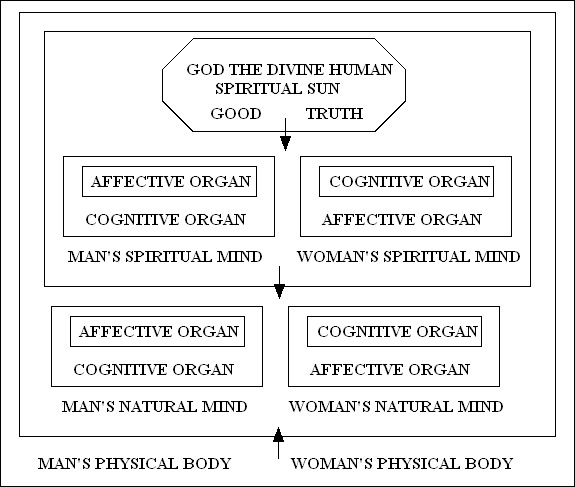
Here is another important difference in how the minds of men and
women operate contrastively:
CL 161. (5) A wife inspires the union in her husband according
to her love, and a husband receives it according to his wisdom. The idea that
a wife inspires the love and thus the union in her husband is today kept
hidden from men. Indeed, they universally deny it. The reason is that their
wives persuade them that men alone are the lovers, and themselves recipients,
or that men are forms of love, and themselves forms of compliance. They even
rejoice at heart when their husbands believe this. Wives persuade their
husbands of this for many reasons, all of which have to do with the prudence
and circumspect nature of wives (concerning which, something will be said
hereafter, and in particular in the chapter on the reasons for states of
coldness, separations and divorces between married partners*).
We say that it is wives who inspire or insinuate the love in their husbands,
because not a particle of conjugial love, not even of love for the opposite
sex, is seated in men, but only in wives and women. (CL 161)
The above applies to men before they are enlightened by
acknowledging the Doctrine of the Wife or by their doctrinal study of what the
Writings Sacred Scripture reveal about conjugial love. It is said above that men
in this pre-enlightened state are persuaded that their love of the sex, or
sexual desire for women, originates from themselves. Men come to this persuasion
by their experience with girls, women, and wives, who generally act like they
are the recipients of the men's sexual advances and desire, not the instigators
of it. And yet, Sacred Scripture reveals that "it is wives who inspire or
insinuate the love in their husbands, because not a particle of conjugial love,
not even of love for the opposite sex, is seated in men, but only in wives and
women" (CL 161). Swedenborg was able to confirm this by an experiment in the
spiritual world in which the presence of their wife was temporarily removed from
the consciousness of a group of husbands, whereupon they suddenly lost all
sexual feelings (xx).
The feeling of sexual love in the husband originates from his
mental attitude towards his wife. First there must be mental intimacy and
friendship between the man and the woman, and then this feeling for each other
exteriorizes into the physical body where it is felt as sexual heat, passion,
desire, and pleasure:
CL 162. (6) This union takes place gradually from the first
days of marriage, and in people who are in a state of truly conjugial love, it
becomes deeper and deeper to eternity. The first heat in marriage does not
join two people together, because it draws its character from a love for the
opposite sex, which is a love belonging to the body and on that account to the
spirit. And whatever is in the spirit as a result of the body does not last
long. But love that is in the body as a result of the spirit does last. Love
belonging to the spirit, and to the body as a result of the spirit, is
insinuated into the souls and minds of married partners together with
friendship and mutual trust. When friendship and mutual trust join together
with the first love in marriage, conjugial love results, which opens the
partners' hearts and inspires in them the sweet enjoyments of love, and this
more and more deeply as friendship and trust are added to the original love,
and as that original love enters into this friendship and trust and they into
it. (CL 162)
Mental union starts from the first day of marriage and gets
deeper endlessly to eternity in partners who have attained conjugial love. The
initial heat and passion of their sexual intimacy, either when they meet, or
after the wedding, is not yet a permanent conjunction because this sexual
passion and desire is partly due to the man's love of the sex. He would feel
this passion with countless other women. This is called a "love belonging to the
body and on that account to the spirit." The husband loves the woman from his
love of the sex, first, and only as a result of that, does he love the woman
mentally or spiritually. This kind of mental love does not last because it is
dependent on the physical or corporeal love of sex, which is indiscriminate,
like that of other mammals and animal species.
But after the man is enlightened through acknowledging the
Doctrine of truth from Sacred Scripture, his love for the woman begins as a
mental love, an exclusive desire for mental intimacy and conjunction with this
one particular woman. This love belongs to the spirit. And once this exclusive
love is in his mind, it can descend into the body and be felt there as sexual
heat and passion for this woman. Then the sexual passion he feels for her
endures forever. Swedenborg confirmed in his interviews with couples in heaven
that their sexual passion and potency never diminish despite their marriage
having lasted for ages and ages in eternity (xx).
The diagram above shows that a man's mind has an outward and
inward portion called the cognitive and affective organ, respectively. The
affective organ gives him the will, motivation, and intention needed to have
plans and act them out. The cognitive organ gives him the ability to plan, think
things out, and arrive at conclusions. His intellectual wisdom consists of the
content of his knowledge and understanding, and this involves his cognitive
organ. But when he connects the cognitive intellectual with the affective
intentions, his intelligence is called moral wisdom. This difference is somewhat
like what we would say is the difference between having a merely 'bookish' or
'theoretical' knowledge of something, vs. having practical know how or applied
knowledge. For example, a physician or psychologist who graduates from medical
school or graduate school, having acquired the theoretical knowledge of medicine
or clinical psychology, is still not allowed to practice medicine or
psychotherapy, until after receiving supervised training and practice. A man's
moral wisdom is his applied knowledge and practice, while his intellectual
wisdom is the knowledge on which his practice is based.
Quoting from the Writings Sacred Scripture:
CL 173. (15) A wife thus receives into herself an image of her
husband, and from it perceives, sees and feels his affections. From the
arguments presented above, it follows, as something already attested, that
wives receive into themselves matters that have to do with the wisdom of their
husbands, thus matters belonging to their souls and minds, and in this way,
from being maidens, they turn themselves into wives. These are the arguments
from which this follows:
1. Woman was created out of man.
2. Consequently, she has an inclination to unite and, so to speak, reunite
herself with a man.
3. On account of and for the sake of that union with her mate, a woman is born
a form of love for a man, and she becomes more and more a form of love for him
by marriage, because her love then continually devotes its thoughts to
joining her husband to her.
4. She is joined to her particular partner by appeals to his life's desires.
5. Married partners are joined together by the atmospheres surrounding them,
which unite them overall and in every instance according to the nature of the
conjugial love in the wives, and at the same time according to the nature of
the wisdom receiving that love in the husbands.
6. Married partners are also joined together by assimilations of the husbands'
powers by the wives.
7. From this it is apparent that something of the husband is constantly being
transfused into the wife and infused in her as though it were hers.
It follows from all this that an image of the husband is formed in the wife,
and that because of this image a wife perceives, sees and feels in herself the
things that are in her husband, and herself therefore as being in him. She
perceives from their communication; she sees from looking at him; and she
feels from touching him. She feels the reception of her love by her husband
from the touch of her hands upon his cheeks, arms, hands and breast -
something that was revealed to me by the three wives in the hall, and by seven
wives in a rose garden, spoken of in the narrative accounts.*
* See nos. 155[r] and 208; 293 and 294. (CL 173)
The fundamental difference between the wife and the husband is
that she strives to conjoin her husband to herself right from the start, while
the husband resists this process right from the start. Later, as his love for
the wife grows more interior and mentally intimate, he is enlightened to
perceive that he must join his will to hers in order to be in the heaven of
eternal unity. To conjoin his will to hers means that he compels himself never
to disagree with her, and if he does, he compels himself to give up what he
wants and accept what she wants. This mental attitude by the husband is called
The Doctrine of the Wife.
The wife ingests and digests the husband's thoughts and
feelings, conjoining herself to them until it is as though they are her own
thoughts and feelings. In contrast, the husband expectorates and regurgitates
the wife's feminine sphere of conjugial love, disjoining himself from it,
turning himself away from her so that he may escape facing her conjugial heat.
He wants internal independence from her, while she wants his total dependence
internally on her. This is the external phase of marriage. But later, when the
husband is enlightened, the phase of the internal marriage begins, as will be
explained in what follows.
11.4.11 Part B
The Husband's Two Forms of Wisdom:
Intellectual and Moral
The following passage explains how the woman relates to these
two aspects of a man's intelligence and wisdom:
CL 163. (7) A wife's union with her husband's intellectual
wisdom takes place inwardly, but with his moral wisdom outwardly. Wisdom in
men is twofold, intellectual and moral, and their intellectual wisdom has to
do with their understanding alone, while their moral wisdom has to do with
both their understanding and at the same time their life. This can be
concluded and seen from simply viewing the matter and examining it. Still, to
have it known what we mean by the intellectual wisdom of men, and what we mean
by their moral wisdom, we will list some specific examples:
Various terms are used to designate those elements which have
to do with men's intellectual wisdom. In general, they are called knowledge,
intelligence and wisdom. In particular, however, they are rationality,
judgment, genius, learning, sagacity. But because everyone has special kinds
of knowledge peculiar to him in his occupation, these kinds of knowledge are
therefore many and various. For there are special kinds of knowledge peculiar
to clergymen, to civil officers, to their various officials, to judges, to
physicians and pharmacists, to soldiers and sailors, to craftsmen and workmen,
to farmers, and so on. To intellectual wisdom belong also all the fields of
study to which adolescents are introduced in schools, and through which they
are afterwards led into intelligence; and these studies are also called by
various names, such as philosophy, physics, geometry, mechanics, chemistry,
astronomy, law, political science, ethics, history, and many more, through
which, as through gates, one enters into intellectual pursuits, from which
comes intellectual wisdom. (CL 163)
CL 164. Elements having to do with moral wisdom in men, on the
other hand, are all moral virtues which have regard to the way they live and
which enter into their manner of life. And they include as well spiritual
virtues which spring from love toward God and love for the neighbor, and which
flow together into those loves.
Virtues which have to do with men's moral wisdom likewise have
various names, and they are called temperance, sobriety, integrity,
kindliness, friendliness, modesty, honesty, helpfulness, courteousness; also
diligence, industriousness, skillfulness, alacrity, generosity, liberality,
magnanimity, energy, courage, prudence - not to mention many others. Spiritual
virtues in men are love of religion, charity, truthfulness, faith, conscience,
innocence, as well as many more.
These virtues, both moral and spiritual, can be attributed in
general to a man's love and zeal for religion, for the public good, for his
country, for his fellow citizens, for his parents, for his wife, and for his
children. In all of these justice and judgment prevail. Justice has to do with
moral wisdom, and judgment has to do with intellectual wisdom. (CL 164)
It is stated in this passage that a wife unites her love with
her husband's intellectual or theoretical wisdom "inwardly," but with his moral
or applied wisdom of life, "outwardly." We can understand this rationally when
we consider that a man's moral wisdom, or his applied knowledge and
intelligence, consists of the operation of his affective organ with his
cognitive organ. Specifically, it is the affective motivation of the will and
interest that directs, guides, and controls his application or practice. This is
not necessarily good and rational, not necessarily heavenly. The husband before
he makes progress in regeneration, is filled with hellish traits that he has
inherited and acquired. These negative, selfish, and irrational intentions and
applications to life, are not things that the wife can love and conjoin herself
with. So she does so outwardly, as a show of loyalty and liking for him, but she
is not really committed to continue to like this aspect of her husband's
character.
But it is different with the husband's intellectual or
theoretical understanding and wisdom. This is pure and idealistic, since he has
formed his rational thinking through these knowledges, studies, and
understandings. This reflects his true interest and motivation, what he delights
in knowing and constructing, what he can excel at and make contributions in the
cumulation of knowledge in this or that field or subject area. To this, the wife
can conjoin herself inwardly, through loving his theoretical knowledge and
understanding, purified from his own proprial or selfish loves. Every man has a
unique style and talent for intellectual wisdom, which comes to him from his
love of being wise, which comes to him from influx from God, to the extent that
he remains willingly open to it. To this, the wife of that man can conjoin
herself exclusively and uniquely, and inwardly. Once she does this, his
intellectual wisdom is replicated in her and becomes her wisdom.
But now, this transplanted wisdom of the wife from the husband,
is no longer the same masculine wisdom as she took from him. It has become
feminine wisdom in the woman's cognitive organ. As the diagram above shows, the
woman's cognitive organ is of a higher nature than the man's cognitive organ,
because hers is inward and his is outward, relative to the affective organ. And
what is inward is always superior spiritually or rationally to what is outward
(see Section xx). Now the husband can love this new feminine wisdom which is a
superior version of his masculine wisdom. If he loves his own masculine wisdom
in himself, he becomes a fool. God saves him from this fate by giving him his
wife's feminine wisdom to love instead. Now, in this new feminine form of his
own wisdom, it is safe for the man to love this. And in this way he progresses
towards conjugial love.
Quoting:
CL 165. We say that a wife's union with her husband's
intellectual wisdom exists inwardly, because this wisdom is characteristic of
the intellect of men, and it ascends into a light in which women are not. That
is why women do not speak from it, but in gatherings of men where matters like
this are being discussed, they keep silent and only listen. Nevertheless,
wives still have these things in them inwardly, as is apparent from the fact
that they do listen, inwardly recognizing and concurring with those things
which they hear and have heard from their husbands.
On the other hand, a wife's union with men's moral wisdom
exists outwardly, because the virtues of this wisdom are akin for the most
part to similar virtues in women, and they spring from the husband's
intellectual will, with which the wife's will unites and forms a marriage. And
because a wife recognizes these virtues in her husband better than he
recognizes them in himself, we say that a wife's union with them exists
outwardly. (CL 165)
In order to clarify still more what it means that the wife
conjoins herself outwardly to the husband's moral wisdom and inwardly to his
intellectual wisdom, consider this passage, in which "outwardly" is discussed as
"external affections" and "inwardly" as "internal affections":
CL 271.
I. That in the natural world almost all can be conjoined as to external
affections, but not as to internal if these are dissident and come to view.
II. That in the spiritual world all are conjoined according to internal
affections, but not according to external unless these act as one with the
internal.
III. That it is external affections according to which matrimonies are
commonly contracted in the world.
IV. But that if internal affections which conjoin minds are not within them,
matrimonies are dissolved in the home.
V. That nevertheless, in the world, matrimonies are to continue to the end of
life.
VI. That in matrimonies wherein internal affections do not conjoin, there are
external affections which simulate the internal and consociate.
VII. That thence is apparent love between married partners, or apparent
friendship and favor.
VIII. That these appearances are conjugial simulations which are praiseworthy
because useful and necessary. (CL 271)
In other words, conjunction by external affections can be
achieved by almost any married couple. At first, the wife conjoins herself to
her husband's moral wisdom or external affections, character, and lifestyle
habits. She does this out of her prudence in managing the relationship so that
it may endure and be successful. She accomplishes this external conjunction with
her husband by adopting his external life style habits. She learns to eat what
he eats, enjoy what he enjoys, laugh at what he laughs. She maintains her
appearance and outward personality to be such as he likes and enjoys. She learns
his sense of humor so she can make him laugh. She learns his tastes in food so
she can keep him satisfied. learns to relate to his friends so she can be
acceptable to his social life. In short, she puts on an outward role and conduct
that he finds delightful and admirable.
While she is enacting these outward roles of unity the wife is
also studying and reconstructing in her mind all of her husband's intellectual
wisdom. This she does spontaneously and in secret. She listens when he talks
about what he knows and how he justifies his opinions and beliefs. She learns
what his principles of life are and she observes to what extent he is consistent
or not. She transplants the intellect in his cognitive organ to be the intellect
in her own cognitive organ. Only her cognitive organ is interior, while his is
exterior. Therefore the intellect of the husband in the wife is elevated into a
higher form than the husband's intellect in himself. She keeps this greater
understanding and wisdom to herself since it would disturb her husband and his
state would turn into conjugial cold.
The passage above says that outward conjunction is possible even
if internal conjunction is not possible due to disagreement or "dissidence" in
internal affections. Internal affections involve interior thoughts and
intentions, such as one's attitude of life toward God and religion, or, the
principles of good and truth by which we judge what's right or wrong, or what's
good or evil. Internal affections can be kept hidden, while external affections
show in one's daily conduct. This is why a husband and wife can agree not to
discuss politics or who they are going to vote for in an election. In the
workplace, an individual's religious beliefs, sexual orientation, and
entertainment habits are considered private preferences, reflecting internal
affections. But things that belong to the external affections and appearance of
the individual are considered public or interpersonal, and are made to be part
of the sanctioned rules and expectations, as for example, clothes, speech,
punctuality, or competence. This outward life belongs to the individual's moral
wisdom while the private things of one's inner principles and justifications,
belong to the individual's intellectual wisdom.
The wife's outward or superficial conjunction with her husband's
lifestyle habits and character is a form of "conjugial simulation." This is
called a necessity or a convenience which the wife puts on and enacts for the
sake of her husband's acceptance and favor. The wife has her own character and
lifestyle preferences, but she hides these from the husband if they are not
compatible with his. Her enactment of being the woman that he can accept in his
own feelings, is for his sake, so that he may not turn cold in his feelings
towards her. But she is not actually becoming that simulated woman he likes her
to be. As the husband progresses to greater mental intimacy with her, she is
gradually able to drop the simulations and present to him what she is like
inwardly. She does this by recreating in herself a higher version of his
intellect, to which she conjoins herself inwardly, by internal affections, thus
spiritually, and consequently, forever. In this way the two are conjoined in
eternity. Internal affections conjoin permanently while external affections fall
away after resuscitation (see Section xx).
11.4.11 Part C
The Wife's Superior Perception of the Husband's
Affections
Quoting from the Work of Sacred Scripture titled Conjugial Love
(CL):
CL 166. (8) In order that this union may be achieved, a wife
is given a perception of her husband's affections, and also the highest
prudence in knowing how to moderate them. This, too, is one of the secrets of
conjugial love which wives conceal within and keep to themselves - the fact
that wives recognize their husbands' affections and discreetly moderate them.
They recognize these affections through the three senses of sight, hearing and
touch, and they moderate them without their husbands' being at all aware of
it.
Now, because these are among things kept secret by wives, it
is not appropriate for me to reveal them in their particulars. It is, however,
appropriate for wives themselves, and therefore I have included at the end of
several chapters four narrative accounts in which wives themselves reveal
them. Two of the accounts come from the three wives living in the hall on
which I saw what seemed to be golden rain falling.* And the other two accounts
come from seven wives sitting in a rose garden.** If these accounts are read,
this secret will be seen revealed. (CL 166)
* See nos. 155[r] and 208. ** See nos. 293 and 294.
You may want to check this narrative in the CL Numbers 155r,
208, 293, and 294. A copy of this Work may be found on the Web at:
www.swedenborgdigitallibrary.org/CL/clintro.htm
Swedenborg was interviewing a group of wives in heaven and was
asked by them not to reveal this secret in his books. But Swedenborg replied
that he must write about what he found out since this is his Divinely given
mission as the author of the Writings Sacred Scripture. What does it mean that
the wife is given the "highest prudence in moderating" the emotions or
affections of their husband, which they can perceive by a special Divinely given
power?
Prudence is a certain intuition that comes from God and is part
of the mechanism of Divine Providence in managing and controlling every detail
of existence and creation. Regarding the prudence of the wife in moderating the
husband's affections, it is written:
CL 194. IX. THAT THIS FORMATION IS EFFECTED BY THE WIFE IN
SECRET WAYS; AND THAT THIS IS WHAT IS MEANT BY THE WOMAN BEING CREATED WHILE
THE MAN SLEPT.
We read in the Book of Creation that Jehovah God caused a deep
sleep to fall upon Adam, that he might fall asleep, and then took one of his
ribs and built it into a woman (Gen. 2:21, 22). That by the man's sleep and by
his falling asleep is signified his entire ignorance that a wife is being
formed and, as it were, created from him, is evident from what was shown in
the preceding and also in the present chapter, concerning the innate prudence
and circumspection of wives in not divulging anything whatever about their
love or about their assumption of the affections of the man's life and so
about the transcription of his wisdom into themselves.
That this is effected by the wife in secret ways, the husband
all unaware and as though sleeping, is clear from what has been explained
above (nos. 166-68 seq.). There it was also explained that for reasons which
are necessities, the prudence to accomplish this is implanted in women from
creation and hence from birth, to the end that conjugial love, friendship, and
confidence may be established, and so the blessedness of cohabitation and the
happiness of life. That this may be rightly done, it was therefore enjoined on
the man that he should leave father and mother and cleave unto his wife (Gen.
2:24; Matt. 19:4, 5).
[2] In the correspondential sense, by the father and mother whom the
man is to leave is meant the proprium of his will and the proprium of his
understanding, the proprium of man's will being to love himself, and the
proprium of his understanding to love his own wisdom; and by cleaving is
signified devoting himself to the love of his wife. That these two propriums
are evils deadly to man if they remain with him, and that the love of the two
is changed into conjugial love so far as the man cleaves to his wife, that is,
receives her love, may be seen just above (no. 193) and in other passages.
That by sleeping is signified being in ignorance or unconcern; that by father
and mother are signified the two propriums of man, that of his will and that
of his understanding; and that by cleaving is signified devoting one's self to
the love of some one, can be abundantly confirmed by passages from other parts
of the Word, but this is not the place. (CL 194)
What a revelation! The wife has "secret ways" of which the
husband "is unaware and as though sleeping" by which "a wife is being formed
and, as it were, created from him." In other words, the husband's knowledge,
understanding, and character traits are reproduced in the wife's mind, and it is
as if the husband now lives in her mind so that she can perceive what he is
feeling and wanting. The wife is capable of reconstructing a virtual husband, or
husband agent, in her mind, which she can then query and interrogate to know
what he is thinking and feeling. Regarding this difference in level of
conjunction it is written in the Writings Sacred Scripture:
CL 195. (10) This transformation is accomplished by the wife
by a union of her will with the inner will of her husband. It may be seen
above in nos. 163-165 that a man has an intellectual wisdom and a moral
wisdom, and that a wife unites herself with those qualities in her husband
that have to do with his moral wisdom. Qualities that are matters of
intellectual wisdom form a man's understanding, and qualities that are matters
of moral wisdom form his will. A wife unites herself with those qualities
which form her husband's will. (Whether one says that a wife unites herself,
or that she unites her will, with the will of her husband, it amounts to the
same thing, because a wife is born will-oriented, and therefore she does what
she does in accord with her will.)
We say that it is a union with her husband's inner will,
because a man's will has its seat in his intellect, and the intellectual
quality of man is the inmost quality in woman, in accordance with observations
we have made before, in no. 32 and several times since, regarding the
formation of woman from man. Men also have an outward will, but this very
frequently comes of pretense or concealment. A wife sees it, but she does not
unite herself with it, except perhaps in a feigned or playful way. (CL 195)
zzz
The anatomy and physiology of conjunction will be illustrated
with diagrams in what follows.
11.4.11.1
The Source of Conjugial Love With Husbands: The
Inner Sense of CL 88
Quoting from the Writings Sacred Scripture:
CL 88. (iii) There is the truth of good, and from
this the good of truth, that is to say, truth coming from good and good from
that truth; both of them have a tendency implanted from creation to join
themselves into one.
Some idea of the distinction between these two
must be gained, because knowledge of the essential source of conjugial love
depends upon it. For the truth of good, that is, truth from good, is, as will
be shown in what follows [90, 91], male; and the good of truth, that is the
good from that truth, is female. But the distinction can be better grasped, if
love is substituted for good and wisdom for truth. These are one and the same
(see 84 above). The only way wisdom can come into existence for a person is by
means of the love of being wise. If this love is taken away, there is no way
the person can be wise. It is wisdom arising from this love which is meant by
the truth of good, or truth coming from good. But when a person has as a
result of that love acquired wisdom, and loves wisdom in himself, that is,
loves himself for his wisdom, then he forms a love, which is the love of
wisdom and is meant by the good of truth, or good coming from that truth.
[2] A man therefore possesses two loves. One,
which comes first, is the love of being wise, and the other, which comes
later, is the love of wisdom. But if this second love remains with a man, it
is a wicked love, called pride in or love of one's own intelligence. It will
be proved in the following pages that it has been provided from creation that,
to prevent this love being his ruin, it was taken from the man and copied into
the woman, so becoming conjugial love which makes him whole again. (CL 88)
Let us now analyze this Number to see what correspondential sense we can draw from it. Later we need to confirm by other Numbers whatever
principles or doctrines we extract from this Number.
CL 88. (iii) There is the truth of good, and from
this the good of truth, that is to say, truth coming from good and good from
that truth; both of them have a tendency implanted from creation to join
themselves into one.
Some idea of the distinction between these two
must be gained, because knowledge of the essential source of conjugial love
depends upon it. (CL 88)
This is clearly one of the most important ideas a
husband can have because it is said that "knowledge of the essential source of
conjugial love depends upon it." And in many places it is taught that conjugial
love is the highest of all loves, for which the universe was created as the end.
All other loves originate and depend on this one ruling heavenly love, thus
Divine Love with the human race. So to say that CL depends on understanding this
spiritual secret is indeed most weighty. What is this heavenly secret?
It is this: That the very basis and source of life
and all love is a psychobiological spiritual attraction or affinity that God
built into all things created. The two portions of every thing that is created
is called male and female. This is well known from many historical, cultural,
and philosophical traditions. What is not know is whence comes male and whence
comes female. Biologically we may ask what constitutes female and what male. The
human race is promulgated by the union between a man and a woman. A man and a
woman experience a strong attraction to each other. Where does this attraction
come from? How does God produce this attraction in men and women for each other?
this attraction is the basis of survival of the race in the physical world, and
it is the basis of eternal marriages or conjunctions in eternity.
The heavenly secret of which we must form a notion
or rational understanding, in order to have conjugial love, is next told:
CL 88. For the truth of good, that is, truth from
good, is, as will be shown in what follows [90, 91], male; and the good of
truth, that is the good from that truth, is female. But the distinction can be
better grasped, if love is substituted for good and wisdom for truth. These
are one and the same (see 84 above). The only way wisdom can come into
existence for a person is by means of the love of being wise. If this love is
taken away, there is no way the person can be wise. It is wisdom arising from
this love which is meant by the truth of good, or truth coming from good. But
when a person has as a result of that love acquired wisdom, and loves wisdom
in himself, that is, loves himself for his wisdom, then he forms a love, which
is the love of wisdom and is meant by the good of truth, or good coming from
that truth. (CL 88)
This is then the secret we husbands must understand
in order to be able to receive conjugial love from the wife, and thereby be
conjoined to her in eternity. It is that a man's mind or, being "male," is
"truth from good," that is, "the truth of good." Conversely, a woman's mind or,
being "female," is "the good from that truth," that is, "the good of truth."
Before we can assimilate this semantic puzzle we
must make it rationally clear to our comprehension. This can better be done with
a visual diagram which we can memorize, so that when we read the expressions we
can translate it into the diagram. This will make the meaning of the assertion
crystal clear to the rational mind. So here is a diagram you need to process by
figuring out its details:
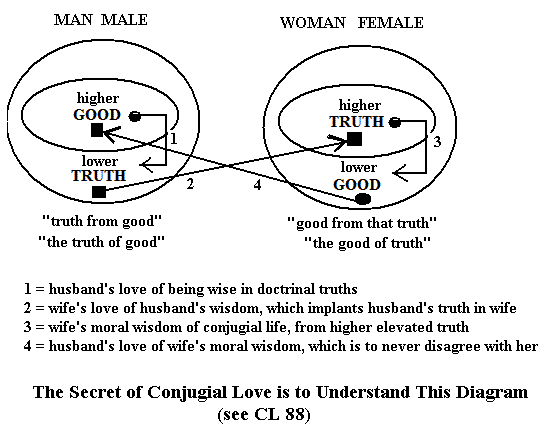
Note the four numbered arrows.
Arrow 1 marks the process of the husband acquiring
doctrinal wisdom of life from the correspondential sense of the Writings Sacred
Scripture (see Section xx). This is called the "ascending line" in the "circle
of life" (see Section xx). The love of being wise is the man's higher good or
inmost love which he receives from the Divine Human into his affective organ, or
the will. This inner good in the affective organ is received by the husband's
cognitive organ into an externalized form that is compatible with the inner
good. This is what the man does on his own, apart from his wife. The truth that
is born in this manner is called a lower truth or an external wisdom. It is the
man's self-intelligence which cause his delight in wisdom. If left to himself,
the man would then love his own intelligence which he mistakes as wisdom. this
renders him stupid and brutish, unsuitable for conjugial love in eternity.
Consequently, the wife must come to the rescue to save him.
Arrow 2 marks the process of the husband's outer truth of
doctrinal wisdom being implanted in the wife's cognitive organ or understanding.
This transfer of wisdom from the husband into the wife elevates the wisdom to a
higher level. This elevation of the husband's wisdom and appropriation of it by
the wife as her own wisdom, is accomplished by the conjugial love that she
receives from the Divine Human. The wife's wisdom is called higher truth because
of this elevation.
Arrow 3 marks the process of the wife's expression of
moral wisdom of life, She does this from her higher rational understanding which
is externalized as moral wisdom of life. This is called lower good because what
is external is lower than what is internal. This process of expressing higher
truth as moral wisdom of life, or as lower good in her will, is something the
wife does on her own apart from the husband.
Arrow 4 marks the process of the husband's love of his
wife's moral wisdom. Her lower good in the external will is implanted in the
husband's internal will, where it is called higher good or love. The husband
expresses this higher love for his wife's moral wisdom by never disagreeing with
her, never putting his intelligence and understanding above hers. And in this
way the circle of life in marriage completes a cycle of conjunction. Now the
process continues and repeats itself at a higher relative level or state. Now
the husband's wisdom or lower truth (arrow 1) is higher up than before, which
allows the wife to acquire a higher wisdom of life (arrows 2 and 3), which
brings the husband to still higher and more interior good, if only he honors and
loves his wife's wisdom above his own.
For the husband to honor his wife's wisdom above is his own
means never to disagree with her.
Quoting the rest of the Number:
CL 88. [2] A man therefore possesses two loves.
One, which comes first, is the love of being wise, and the other, which comes
later, is the love of wisdom. But if this second love remains with a man, it
is a wicked love, called pride in or love of one's own intelligence. It will
be proved in the following pages that it has been provided from creation that,
to prevent this love being his ruin, it was taken from the man and copied into
the woman, so becoming conjugial love which makes him whole again. (CL 88)
It is explained here that the man is saved by the transplanting
of his love of his doctrinal wisdom into the wife's inmost rationality and
understanding (arrow 2). Now she is the love of his doctrinal wisdom, which is
called the lower truth of the husband. This process saves him from retaining the
love of his own wisdom (called "wicked love"), which is his own
self-intelligence, and is the cause of "his ruin.". If he does not love his
wife's elevated wisdom more than his own lower wisdom (arrow 4), he cannot be
saved. The wife's rationality of doctrine called moral wisdom (arrow 3) is
higher than the husband's rationality called doctrinal wisdom (arrow 1). This
process of loving his wife's wisdom more than his own (arrow 4) "makes him whole
again."
Now study the next diagram on the psychobiology of marriage. The
expression the psychobiology of marriage refers to the modifications that
take place in the affective and cognitive organs when the mind of a man and the
mind of a woman effect a conjunction. For instance, they may be in love with
each other. The expression "being in love" refers to the mental modifications
that take place in their minds. To love someone means to be conjoined
spiritually. Mental conjunction is a physiological process by which the mental
organs are made to function together as one unit. Subjectively we experience
this in terms of our thoughts, emotions, and intentions we have regarding the
person we love. Getting married means that a man and a woman have the intention
of conjoining mentally, that is, of thinking of each other, and of feeling and
caring for each other.
The diagram above on the spiritual
psychobiology of marriage shows that the process of conjunction goes through two
major physiological phases of development or change. These phases describe the
spiritual state of the affective organ (feelings, intentions) and cognitive
organ (thoughts).
Phase 1 (bottom half of
diagram) shows that the woman occupies an internal role relative to the man.
This is portrayed by concentric rectangles showing the woman to occupy the
internal rectangle or role, while the man occupies the external rectangle or
role. This outside/inside relative position may be seen by others in the
couple's outward behavior towards each other. The woman shows her affectionate
role by how she smiles at him, how she holds him, how she talks to him, and how
she provides caring services for him. This is the woman's affectional role in
the relationship. Biologically, the affectional role is carried out by the
affective organ and the affective organ functions as the more interior organ
relative to the cognitive organ, which is more exterior.
The man's relationship role in the
couple is focused more centrally on his cognitive organ, which is functionally
organized as more outward in physiology than the affective organ. Both men and
women have both organs, of course, for without this one cannot be human. Every
individual must have both thoughts (cognitive organ) and feelings or intentions
(affective organ) in order to survive and be a person. So when we are in the
mental state of being single or not conjoined, we balance the two roles within
ourselves. In a sense we are both male and female. Women are male/female in a
different way than men are male/female since nothing in a woman can be anything
like that in a man, and vice versa (see Section xx).
A woman's mind is constructed by
having the affective organ on the outside, relative to her cognitive organ,
which is on the inside. This is shown in the various anatomical diagrams in this
Section, and elsewhere. The converse, or the reciprocal construction makes up a
man's mind: On the outside of his mind, a man has the cognitive organ, and on
the inside he has the affective organ. Spiritually, man and woman are reciprocal
constructions of each other. This is what makes their spiritual conjunction
possible. In the diagram above, phase 1 marks the external conjunction of
man and woman in marriage. In this state, the woman is the affective organ of
the unit, while the man is the cognitive organ of the unit. Together the man and
the woman make one unit. You can see on the right of the diagram how this
physiological unit is established, namely through the woman's "external good"
(outer affective organ) being conjoined to the man's "external truth" (outer
cognitive organ).
In phase 1 it is the woman who
conjoins herself to the husband. His focus in the relationship remains in his
outward cognitive organ. His inward affective organ is not yet engaged, if ever.
He reserves for himself a zone of affective independence from his wife. He is
not fully a husband to her in this state. His conjunction with her involves his
physical body and his thoughts and justifications regarding their relationship,
his philosophy of life, his other relationships and interests, and so on. It is
always the affective organ ("the will") that does the spiritual conjoining with
the cognitive organ ("the understanding"). Phase 1 of marriage is the external
phase in which the woman's affectional role conjoins the two, to the extent that
the husband is responsive to her affectional sphere as woman.
Phase 2 of conjunction in
marriage is internal. At this point the woman is called a spiritual wife and the
man is called a spiritual husband. This is called phase 2 because it involves
the interior organs of the man and the woman. As explained above, phase 1 is the
conjunction of the woman's outward affective organ with the man's outward
cognitive organ. Phase 2 is the converse of this. It is the conjunction of the
man's interior affective organ with the woman's interior cognitive organ, as
shown in the diagram above. Note that the man, now called a true husband,
occupies the role of the inmost rectangle, while the woman, now called a true
wife, occupies the outmost rectangle.
The wife is the inmost of a woman,
while the husband is the inmost of a man.
The inmost of a husband is good or
love (inward affective organ), while the inmost of a wife is truth or wisdom
(inward cognitive organ (see Section xx).
Phase 2 conjunction in marriage
involves the converse of phase 1 conjunction. When a couple reaches phase 2
conjunction, their union is in eternity and can never be broken (see Section
xx).
In phase 2 it is the husband who
conjoins himself to the wife. This is because the internal conjunction is that
between the husband's interior affective organ ("inmost good") with the wife's
interior cognitive organ ("inmost truth"). Conversely, in phase 1, it is the
wife who conjoins herself to the husband, as explained just above.
Every marriage starts with phase 1.
It remains in phase 1 until the husband reciprocates by engaging his interior
affective organ. This involves his conjoining himself with his wife.
The affective conjoins itself with
the cognitive outwardly at first (stage 1), and then inwardly (stage 2). The
woman conjoins her outward affective organ with the man's outward cognitive
organ (stage 1), while the husband conjoins his inward affective organ with the
wife's inward cognitive organ (stage 2). This is portrayed in the diagram below
on the two phases of marriage union.
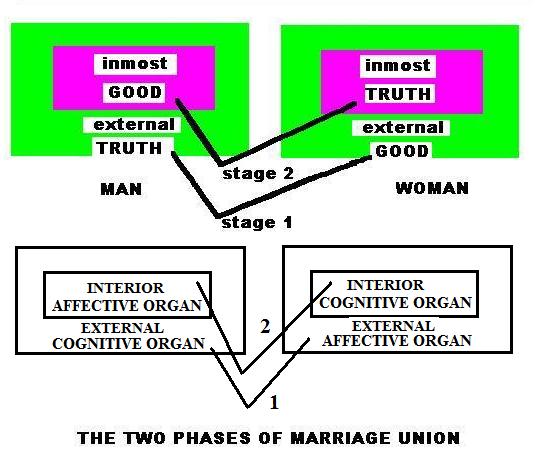
You can see from the diagram above
that unity or conjunction between man and woman must be reciprocal between them.
First the woman conjoins herself to the man outwardly by loving his outward
truth with an outward love. Then the husband conjoins himself to the wife by
loving her inmost truth with an inmost love. This completes the union or
conjunction.
What does it mean that the husband's
inmost love conjoins itself inwardly to the wife's inmost wisdom or truth?
(stage 2)
It means that he loves her inner
wisdom with an inner love. It means that he regulates his thinking according to
her wisdom, rather than according to his wisdom. This makes him truly wise
because the wife's wisdom is far superior to the husband's wisdom. This is
because, by spiritual physiology, the wife's wisdom or truth is interior, while
the husband's wisdom or truth is exterior. What is interior is far superior than
what is exterior (see Section xx).
In the external phase of marriage
(stage 1), the wife loves the husband's external truth with an external love. So
her external love conjoins herself outwardly to the husband's outward truth.
In this external phase of marriage it is the wife who compels herself to obey
the husband. But in the internal phase of marriage (stage 2), the husband
loves the wife's inmost truth with an internal love. So his internal love
conjoins itself inwardly to the wife's inmost truth. In this internal phase
of marriage it is the husband who compels himself to obey the wife.
The following diagram is a flow
chart showing the decision making process the husband follows in the internal
marriage state:
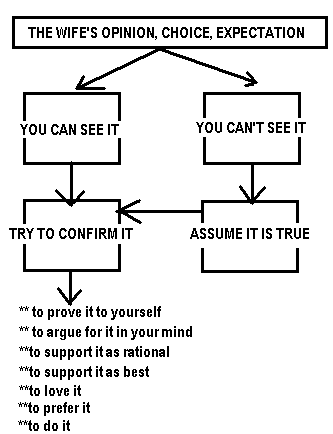
The above diagram shows the husband who is
confronted with his wife's opinion, choice, or expectations. This is her inmost
truth or wisdom, expressed by her in her speech, in her reasoning and
justifications, in her requests to the husband as they go about their daily
tasks and interactions. The husband can either "see it" and agree with her, or
he remains obtuse and can't see what his wife is requesting or asserting. If he
can see it, he will try to confirm it in various ways listed on the diagram. If
he cannot see it, that is, he disagrees, then he must compel himself to lay
aside his own idea, and assume that her idea is true and right. Then he is to
strive to confirm it, by various methods.
By following this procedural rule, the husband
becomes enlightened and wise. He begins to love his wife's inmost truth, which
is the closest to the Divine that the human mind can attain (see Section xx). As
he becomes more and more enlightened, he is able to conjoin with his wife's
inmost wisdom, which is endless from God (see Section xx). In this way, the
husband's inmost love can be brought out through conjunction with the wife's
inmost truth. The two are as one (see Section xx).
11.4.11.2
The Circle of Life In Marriage
Look at the following diagram on the circle of
life in marriage. Study its parts until you can reproduce it from memory. Then
the explanation that follows will be clearly grasped.
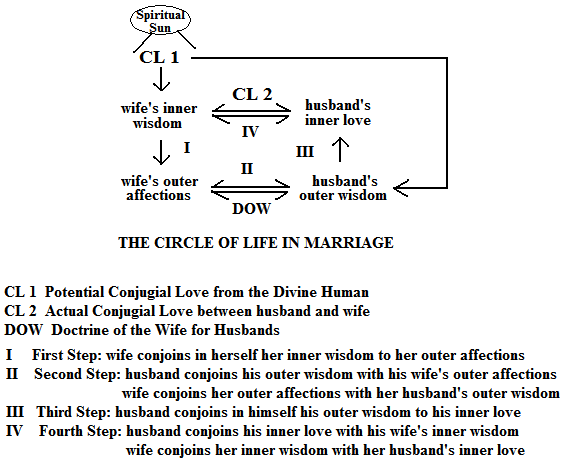
The circle of life in marriage covers four
phases or steps. These are discussed in various places in the Writings Sacred
Scripture (see Section xx).
-
Wife cannot conjoin her CL 1 with the
husband, but only within herself.
-
Husband can conjoin with wife in CL 2 to the
extent that he does Step III.
-
Husband can do Step III to the extent that
he does Step II. See DOW.
The circle repeats itself endlessly at higher
and higher levels, or closer and closer to the Divine Human.
DOW (Doctrine of the Wife) is the method by
which a husband can do Step II. This means that he formulates to himself the
components of the Doctrine of the Wife, which is part of the doctrine of truth
based on a spiritual understanding of Sacred Scripture. This Doctrine is the
husband's reception of conjugial love from the Divine Psychologist. This becomes
the husband's outer wisdom of life. This is the wisdom to which the conjugial
wife can conjoin herself by loving it (step II). This wisdom is from the Divine
Psychologist in the husband's understanding. The wife can love this wisdom
because her outer affections are conditioned by the conjugial love in her inner
wisdom (step I), which is in her inner understanding, also from the Divine
Psychologist. Hence it is that the Divine Psychologist works to unite the minds
of the husband and the wife.
Note that the process is completely different
for the wife and for the husband. The wife receives conjugial love in her inner
wisdom, but the husband in his outer wisdom. The reception of conjugial love
from God in the wife's inner wisdom is called the marriage of God's love to the
wife's inner wisdom. Similarly, the reception of conjugial love from God
in the husband's outer wisdom is called the marriage of God's love to the
husband's outer wisdom. The marriage of love from God to the wisdom in a human
being, creates the heaven in person's mind. This heaven is eternal, and when we
are resuscitated a few hours after death, we can enter this heaven in full
consciousness and dwell there forever with our soul-mate or conjugial spouse.
The marriage or conjunction of God's love to
the outer wisdom of the husband creates the appropriate mental state in him for
formulating, acknowledging, and practicing the Doctrine of the Wife (Step II).
But this is only an external attainment of The reception of conjugial love from
God in the wife's inner wisdom is called the marriage of God's love to the
wife's inner wisdom. In order to provide the love needed to match the wife's
conjugial love, the husband must elevate his wife's outer affections in
his mind so that what he thinks and intends are in complete conformance to her
affections. In this way he is making progress towards forging the unity of their
mind. To the extent that he does this in his daily interactions (Step II), to
that extent will the husband elevate his love for his wife, all the way to his
inner loves (Step III).
The elevation of the husband's outer wisdom to
his inner love (Step III) is also called a marriage, as is Step I by the wife.
Note that the wife's marriage of wisdom and affections in herself (Step I) is
very different from the husband's marriage of wisdom and love in himself (Step
III). The wife's arrow points downward, the husband's upward. What is inner is a
discrete degree closer to God than what is outer. As we are regenerating
throughout life, we get closer to God by understanding and practicing higher
truths of Doctrine from Sacred Scripture that we are given to perceive.
The wife receives conjugial love from God in
the unconscious portion of her mind called the spiritual mind, which contains
her inner wisdom. This unconscious inner wisdom orders and lines up her outer
affections or loves, which she is aware of in her daily activities (Step I). She
experiences these outer affections as the things she wants, desires, and strives
for in her relationship with the husband. Hence, what a wife wants in the
marriage for herself and the husband, is ordered by her unconscious inner
wisdom, operating from Divine influx of conjugial love. The love of children is
also from this source.
The enlightened husband knows this process
from the Doctrine of the Wife, acknowledges it, loves it, and practices it. He
understands that his wife's conjugial love from God, cannot align itself with
outer affections in her that are not orderly. She cannot follow Step II if the
husband does not acknowledge the Doctrine of the Wife, which he receives from
God in his outer wisdom. She can only love her husband's wisdom when it is
genuine, and the only genuine wisdom is that from God in Sacred Scripture.
Hence, the husband must practice the Doctrine of the Wife in his daily
interactions with the wife. He must rely on the wife's expressed outer
affections as the direction or guide for his actions and words.
For instance, several times a day the husband
will hear the wife's expressions of her preferences and intentions regarding
when he should do something and how. She might want him to acknowledge something
and receive her ideas about how to proceed in some task or activity. He will
feel that she is micro-managing him and that he is losing his independence and
individuality. He might feel like resisting this process of uniting his thinking
to her intentions. And yet this is what he must do in order to achieve the
conjugial union of minds. From an independent individual, the man is thereby
transformed into a conjoint self.
This conjoint self has an outer and an inner
portion. In the outer portion (Step II), the husband's thinking is
moderated or directed by the wife's affections, which she expresses and which he
has internalized in his mind. He can thus think from his wife's love even when
she is not physically present. In the inner portion (Step IV), it is the
wife's thinking that is moderated or directed by the husband's affections of
inner love. This is the circle of life that carries conjugial love forward, to
heaven. When one of the spouses passes on, he or she waits in a state of
heavenly preparation for the arrival of the other one, at which time they greet
each other with joy, are reunited sensuously in their spiritual body, and enter
blessedness in heaven. This joy and happiness increases endlessly to eternity.
As it does, the two partners become more and more wise, good, beautiful, and
happy.
Husbands resist the circle of life in marriage
with all the force of hell. They hate the conjugial sphere and the sphere of the
conjugial wife. They have an inner revulsion against it. They strive to destroy
the marriage and themselves. Only God can keep them from this, and only if they
cooperate with God's healing process of regeneration. This means a full
commitment to the Doctrine of the Wife on a daily basis. Husbands must suffer
themselves to think not as they wish, but as their wife wishes (Step II).
Because of this inherent antipathy of men for the conjugial sphere of women,
they must undergo daily temptations, in which they must cooperate with the
Divine Psychologist by calling to memory the Doctrine of the Wife and its
holiness, and compelling themselves to follow it. Then the Divine Psychologist
accomplishes the impossible -- slowly, day by day, step by step, saving the
husband, as the husband practices rejecting his thinking and his affections, and
accepting that thinking which is in agreement with his wife's affections.
This personality makeover by the husband (Step
II) goes on in al three elements of the threefold self -- affective, cognitive,
and sensorimotor. At the outermost level of the physical body and speech (sensorimotor
self), the husband will change his appearance and mannerisms to be fully
agreeable to his wife. He will not address her harshly or speak to her with
anger or disdain. He will not look at her with a stern face or cold expression.
He will not touch her in any way she finds unpleasant or obnoxious. At the inner
level of thinking and reasoning (cognitive self), the husband will change
the attitudes and opinions that he favors or enjoys, but which are not in
agreement with his wife's affections or loves, consequently, with her feelings
and attitudes. At the inmost level of feeling and intending (affective self),
the husband will learn to love what his wife's loves, and to intend what his
wife intends, and will always avoid these two from being contradictory.
Men, before they are married, and men who
never marry, nevertheless need to be regenerated by participating in this circle
of conjugial life, not actually, but virtually. Prior to marriage, all men are
called pre-husbands. With this attitude, men who don't get to be married for
various circumstantial reasons, nevertheless look forward to the day in heaven
when they are married to their soul-mate. When pre-husbands regenerate, they
imagine all the ways their soul-mate wife would react to this or that which they
are thinking or doing. They are thus never alone, never away from the idea that
their actual wife from heaven is spiritually present in their mind now. But men
who don't do this because of their love of independence or masculine chauvinism,
cannot regenerate. Consequently, their mind cannot be prepared for life in
conjugial heaven.
11.4.11.3
Two Phases of Achieving Unity in Marriage
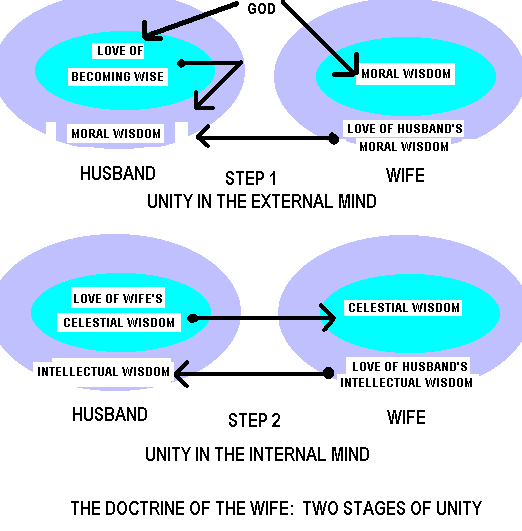
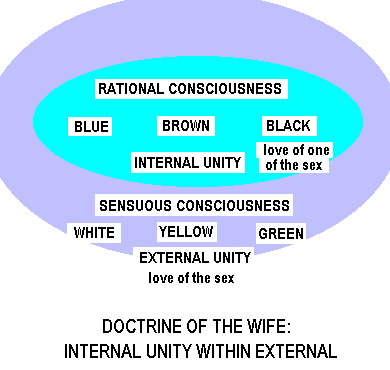
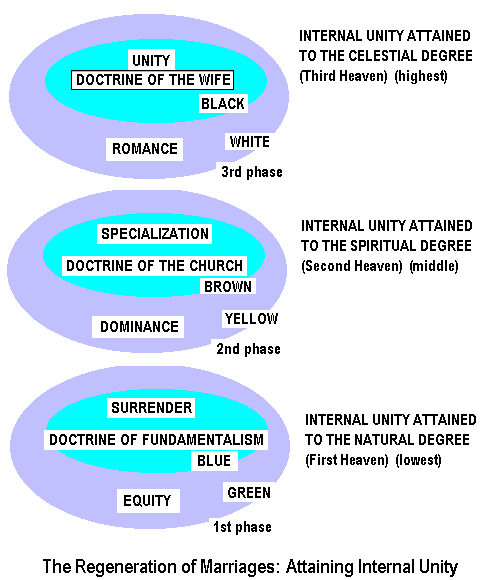
11.4.12
Marriage and Doctrine
Quoting from the Writings Sacred Scripture:
(AC 3757)
Genesis Chapter 29: 10. And it
came to pass, when Jacob saw Rachel the daughter of Laban his mother's
brother, and the flock of Laban his mother's brother, that Jacob came near,
and rolled the stone from the well's mouth, and watered the flock of Laban
his mother's brother. 11. And Jacob kissed Rachel, and lifted up his voice
and wept. 12. And Jacob told Rachel that he was her father's brother, and
that he was Rebekah's son; and she ran and told her father.
AC 3791. Verses 9-11 While he was still
speaking to them Rachel came with the flock which was her father's, for she
was a shepherdess. And so it was, when Jacob saw Rachel the daughter of Laban
his mother's brother, and the flock of Laban his mother's brother, that Jacob
came near and rolled the stone from over the mouth of the well, and watered
the flock of Laban his mother's brother. And Jacob kissed Rachel, and lifted
up his voice and wept.
'While he was still speaking to them' means
thought during that time. 'Rachel came with the flock' means the affection for
interior truth belonging to the Church and to doctrine. 'Which was her
father's' means from good in origin. 'For she was a shepherdess' means that
the affection for interior truth contained in the Word is that which teaches.
'And so it was, when Jacob saw Rachel the daughter of Laban his mother's
brother' means an acknowledgement of the affection for that truth as to its
origin. 'And the flock of Laban his mother's brother' means the Church and
doctrine from that origin. 'That Jacob came near and rolled the stone from
over the mouth of the well' means that the Lord, by virtue of natural good,
disclosed the interior contents of the Word. 'And watered the flock of Laban
his mother's brother' means instruction. 'And Jacob kissed Rachel' means love
directed towards interior truths. 'And lifted up his voice and wept' means the
warmth of love.
AC 3793. 'Rachel came with the flock' means
the affection for interior truth belonging to the Church and to doctrine. This
is clear from the representation of 'Rachel' as the affection for interior
truth, and from the meaning of 'the flock' as the Church and also as doctrine,
dealt with in 3767, 3768, 3783. To enable it to be known how 'Rachel'
represents the affection for interior truth, and 'Leah' the affection for
exterior truth, let a brief statement be made about the matter: The natural,
which 'Jacob' represents, consists of good and of truth; and within the
natural, as within every single part in the human being, and indeed within the
whole natural order, there ought to be a marriage of good and truth.
Without this marriage nothing is produced, for
every act of bringing forth and every effect is from that marriage. When he is
born there is no marriage of good and truth within a person's natural because
the human being, unlike other creatures, is not born into a condition where
Divine order is present. It is true that good which goes with innocence and
charity is present, flowing from the Lord in earliest childhood; but no truth
is present to which that good may be coupled. As he advances in life this good
which has been instilled by the Lord into a person in early childhood is drawn
in towards the interior parts and kept there by the Lord so that it may serve
to modify the states of life which he experiences subsequently.
As a consequence without the good belonging to his
infancy and early childhood the human being would be worse and more vicious
than any wild animal. When that good belonging to earliest childhood is drawn
inwards, evil in that case takes its place and enters the person's natural.
Falsity then couples itself to that evil, and a joining together and so to
speak a marriage of evil and falsity takes place with him. If a person is to
be saved therefore, he has to be regenerated. Evil has to be removed and good
instilled by the Lord. And in the measure that he receives good truth is
instilled into him so that a coupling, or so to speak marriage, of good and
truth takes place.
[2] These are the matters represented by Jacob and
his two wives, Rachel and Leah. 'Jacob' now takes on the representation of
natural good therefore, and 'Rachel' that of truth. But since all joining of
truth to good is effected through affection, it is the affection for truth
coupled to good that 'Rachel' represents. Furthermore the natural, like the
rational, has an interior and an exterior. 'Rachel' represents the affection
for interior truth, and 'Leah' the affection for exterior truth. 'Laban', who
is their father, represents a good that springs from a common stock, but is a
parallel good, as has been stated. That good is the good which in the parallel
line corresponds to the truth of the rational, which is 'Rebekah', 3012, 3013,
3077. Daughters descended from that good therefore represent affections
existing within the natural, for these are like daughters fathered by that
good. And because those affections are to be coupled to natural good they
consequently represent affections for truth - the first representing the
affection for interior truth, the second the affection for exterior truth.
[3] The regeneration of a person's natural is
altogether like Jacob and Laban's two daughters, Rachel and Leah. Anyone
therefore who can see and understand the internal sense of the Word sees this
arcanum which has been disclosed to him, but no one else is able to see it
except him in whom good and truth are present. No others, no matter how good a
perception they may have of the things to do with personal life and life in
society and may seem to be highly intelligent, are able to see and then to
acknowledge anything at all of that arcanum. Indeed they do not know what good
and truth are, for they imagine evil to be good, and falsity to be truth. For
this reason the moment good is mentioned the idea of evil presents itself, and
the moment truth is mentioned the idea of falsity does so. Consequently they
perceive nothing of the things contained in the internal sense, but as soon as
they hear anything of it darkness descends which extinguishes the light. (AC
3793)
AC 3796. And it came to pass, when Jacob
saw Rachel, the daughter of Laban his mother's brother,
That this signifies the acknowledgment of
the affection of that truth in regard to its origin, is evident from the
signification of "seeing," as here being to acknowledge, as is evident from
the series or connection; and from the representation of Rachel, as being the
affection of interior truth (see n. 3793). "The daughter of Laban, his
mother's brother" implies its origin, namely, that it was from collateral
good, which was joined in brotherhood with the rational truth represented by
Rebekah, the mother of Jacob.
[2] As regards the affections of truth and
of good the case is this: The genuine affections of truth and of good which
are perceived by man are all from a Divine origin, because from the Lord; but
on the way, as they descend, they diverge into various and diverse streams,
and there form for themselves new origins; for as they flow into affections
not genuine but spurious, and into the affections of evil and falsity in the
man, so are they varied. In the external form these affections often present
themselves like the genuine ones; but in the internal form they are of this
spurious character. The sole characteristic from which they are known is their
end; if as regards their end they are for the sake of self or the world, then
these affections are not genuine; but if as regards their end they are for the
sake of the good of the neighbor, the good of societies, the good of our
country, and especially if for the good of the church and the good of the
Lord's kingdom, then they are genuine, because in this case they are for the
sake of the Lord, inasmuch as the Lord is in these goods.
[3] It is therefore the part of a wise man
to know the ends that are in him. Sometimes it appears as if his ends were for
self when yet they are not so; for it is the nature of man to reflect upon
himself in everything, and this from custom and habit. But if anyone desires
to know the ends that are within him, let him merely pay attention to the
delight he perceives in himself from the praise and glory of self, and to the
delight he perceives from use separate from self; if he perceives this latter
delight, he is in genuine affection. He must also pay attention to the various
states in which he is, for the states themselves very much vary the
perception. A man can explore these things in himself, but not in others; for
the ends of each man's affection are known to the Lord alone. This is the
reason why the Lord said: Judge not, that ye be not judged; condemn not,
that ye be not condemned (Luke 6:37); for a thousand persons may appear to
be in a like affection in respect to truth and good, and yet every one of them
be in an affection unlike in respect to origin, that is, in respect to end.
[4] That the end determines the
quality of the affection, that is to say, whether it is genuine, spurious, or
false, is because a man's end is his very life; for a man has that for his end
which is of his life, or what is the same, of his love. When the good of his
neighbor, the general good, the good of the church and of the Lord's kingdom,
is the end, then as to his soul the man is in the Lord's kingdom, thus in the
Lord; for the Lord's kingdom is nothing else than a kingdom of ends and uses
for the good of the human race (see n. 3645). The angels themselves who are
with man are solely in his ends. Insofar as a man is in such an end as that in
which is the Lord's kingdom, so far the angels are delighted with him, and
conjoin themselves with him as with a brother; but insofar as a man is in the
end of self, so far the angels retire, and evil spirits from hell draw near,
for there reigns in hell no other end than this; from all of which we can see
how important it is to explore and know from what origin the affections are,
and this can be known solely from the end. (AC 3796)
AC 3797. and the flock of Laban, his
mother's brother,
That this signifies the church and the
doctrine therefrom, is evident from the signification of a "flock," as
being the church and doctrine (n. 3767, 3768, 3783). The reason why Laban is
here called "his mother's brother," is that thereby is likewise signified an
acknowledgment in respect to the origin, as stated just above.
AC 3798. That Jacob came near and rolled the stone
from over the mouth of the well' means that the Lord, by virtue of natural
good, disclosed the interior contents of the Word. This is clear from the
representation of 'Jacob' as the Lord's Divine Natural, dealt with already,
here as regards the good in it, and from the meaning of 'rolling the stone
from over the mouth of the well' as disclosing the interior contents of the
Word, dealt with in 3769, 3771, 3773, 3789. The reason why the highest sense
here means that the Lord by virtue of natural good disclosed the interior
contents of the Word is that 'Jacob' here represents good within the Natural.
For Jacob takes on the representation of good because truth had now to be
allied to it through the affection which 'Rachel' represents, see just above
in 3775, 3793; and it is by virtue of good that the interior contents of the
Word are disclosed, 3773.
[2] It is plainly evident that the Word is
disclosed by virtue of good. Everyone looks from the love present in him at
the things that belong to that love; and what he sees he calls truths because
these are in harmony with it. Everyone's love holds the light of his life
within it, for love is like a flame which radiates light. The nature of a
person's love or flame therefore determines that of the light of truth with
him. Those who are stirred by a love of good are able to see the things
belonging to that love, and so to see the truths that are in the Word. They do
so according to the amount and the quality of their love of good, for light or
intelligence flows in from heaven, that is, from the Lord by way of heaven.
This is why, as already stated, no one is able to see and acknowledge the
interior contents of the Word except one whose life is governed by good. (AC
3798)
AC 3800. 'And Jacob kissed Rachel' means love
directed towards interior truths. This is clear from the meaning of 'kissing'
as a uniting and joining together resulting from affection, dealt with in
3573, 3574, and therefore as love since love regarded in itself is a uniting
and joining together resulting from affection; and from the representation of
'Rachel' as the affection for interior truth, dealt with in 3793. From this it
is evident that 'Jacob kissed Rachel' means love directed towards interior
truths. (AC 3800)
AC 3801. 'And lifted up his voice and wept'
means the warmth of love. This is clear from the meaning of 'lifting up the
voice and weeping' as the warmth of love, for weeping is an expression of
sorrow and also an expression of love, and is the highest degree of either of
them. (AC 3801)
zzz
11.5
Preparation for Marriage
CL 305. IX. THAT DURING THE TIME OF BETROTHAL IT
IS NOT LAWFUL TO BE CONJOINED CORPOREALLY, for thus the order which is
inscribed on conjugial love perishes. In human minds there are three regions,
the highest of which is called celestial, the middle spiritual, and the lowest
natural. It is into this lowest region that man is born. He ascends into his
higher region, which is called spiritual, by a life according to the truths of
religion; and into the highest, by the marriage of love and wisdom. In the
lowest region, which is called natural, reside all the concupiscences of evil
and lasciviousness, but in the higher region which is called spiritual, are no
concupiscences of evil and lasciviousness, for man is led into this region by
the Lord when he is born again; and in the highest region called celestial, is
conjugial chastity residing in its own love. Man is elevated into this region
by the love of uses, and since the most excellent uses are from marriages, by
love truly conjugial.
[2] From this it can be seen in brief, that from the
first periods of its heat, conjugial love, if it is to become chaste, must be
elevated from the lowest region into the highest,* that from what is chaste it
may then be let down through the middle and lowest region into the body. When
this is done, this lowest region is purified of its unchastities by the
descent of what is chaste, and then the ultimate of that love also becomes
chaste. If then the successive order of this love be precipitated by corporeal
conjunctions before their due time, it follows that the man acts from the
lowest region which is unchaste from birth. That from this region, cold in
respect to marriage and neglect of the married partner together with loathing,
has its beginning and origin, is well known. Yet there are various differences
in the results of premature conjunction, as also of an over-prolonging and
likewise of an over-hastening of the time of betrothal; but on account of
their number and varieties, these can hardly be adduced. (CL 305)
See also:
Simons, Pastor Stephen R. (2003)
Preparing for Real Marriage (Thesis, M.Div., Bryn Athyn, PA: Academy of
the New Church Theological School.) Available at:
www.swedenborgdigitallibrary.org/prepare/preptc.htm
11.7
Conjugial Love and Children
CL 385. THE CONJUNCTION OF CONJUGIAL LOVE WITH A
LOVE A LITTLE CHILDREN
There are evidences which show that conjugial love
and a love of little children - which is called storg-* - are conjoined; and
there are evidences as well which may induce a belief that they are not
conjoined. For a love of little children is found in married partners who love
each other from the heart, and it is found in partners who are discordant in
heart; and also in partners who have separated, and sometimes tenderer and
stronger in them than in others. But it can be seen from the origin from which
it flows that a love of little children is still forever conjoined with
conjugial love. Even though the origin varies in its recipients, still these
loves remain undivided, just as any first end in the last end, which is the
effect. The first end of conjugial love is the procreation of offspring, and
the last end, which is the effect, is the offspring produced. The first end
enters into the effect and exists in it as it was in its inception, and does
not depart from it, as can be seen from a rational consideration of the
progression of ends and causes in their series to effects.
But because the reasonings of many people commence
only from effects, and proceed from these to certain consequences, and do not
commence from causes and proceed analytically from these to effects, and so
on, therefore rational matters of light cannot help but become with them the
dark shadows of a cloud, resulting in divergences from truths, arising from
appearances and misconceptions.
To show, however, that conjugial love and a love
of little children are inwardly conjoined, even if outwardly separated, we
will demonstrate it according to the following outline:
(1) Two universal atmospheres emanate from the
Lord to preserve the universe in its created state, one of which is an
atmosphere of procreating, and the other an atmosphere of protecting what has
been procreated.
(2) These two universal atmospheres ally
themselves with an atmosphere of conjugial love and with an atmosphere of love
for little children.
(3) These two atmospheres flow universally and
particularly into all things of heaven and into all things of the world, from
the firsts to the lasts of them.
(4) The atmosphere of a love for little children
is an atmosphere of protecting and maintaining those who cannot protect and
maintain themselves.
(5) This atmosphere affects both evil people and
good, and disposes everyone to love, protect and maintain his progeny in
accordance with his particular love.
(6) This atmosphere affects the feminine sex
primarily, thus mothers, and the masculine sex or fathers from them.
(7) This atmosphere is also an atmosphere of
innocence and peace from the Lord.
(8) An atmosphere of innocence flows into little
children, and through them into the parents so as to affect them.
(9) It also flows into the souls of the parents,
and joins itself with the same atmosphere in the little children; being
insinuated principally through the instrumentality of touch.
(10) In the measure that innocence in little
children recedes, affection and conjunction are also lessened, and this
progressively to the point of separation.
(11) The rational ground of innocence and peace in
parents with respect to their little children is that the little children know
nothing and can do nothing of themselves, but are dependent on others,
especially on their father and mother; and this state also gradually recedes
as the children gain knowledge and are able to act on their own independently
of their parents.
(12) This atmosphere proceeds sequentially from
its end through causes into effects, and produces cycles, by which creation is
preserved in its foreseen and provided state.
(13) A love of little children descends, and does
not ascend.
(14) The state of love that wives have before
conception is of one character, and of another character after conception to
the time of birth.
(15) Conjugial love is conjoined with a love of
little children in parents by spiritual motivations and consequent natural
ones.
(16) A love of little children and offspring is of
one character in spiritual partners, and of another character in natural ones.
(17) In spiritual partners, this love comes from
within or from a prior cause, while in natural partners it comes from without
or from the subsequent effect.
(18) So it is that this love is found in partners
who love each other, and also in partners who have absolutely no love for each
other.
(19) A love of little children remains after
death, especially in women.
(20) Little children are reared by them under the
Lord's guidance, and they grow in stature and intelligence as in the world.
(21) The Lord provides there that the innocence of
early childhood in them become an innocence of wisdom, and that the little
children thus become angels.
Explanation of these statements now follows. (...)
* From the Greek storg, pronounced stor'gee (like
psyche), in use in the 17th, 18th and 19th centuries to mean natural or
instinctive affection, usually that of parents for their offspring, but no
longer current. (CL 385)
Conjugial Love by Emanuel Swedenborg (1763).
Available online as Married Love at:
www.swedenborgdigitallibrary.org/contets/cltc.html
11.7
The Marriage Relationship Based on Sacred Scripture Described in Modern Islam
These are quotes from Web sites presenting modern
views of Muslims practicing the Islam religion, which is based on the Qu'ran
Sacred Scripture.
From:
www.qurantoday.com/BaqSec8.htm
Those who believe and those who are Jews, Christians and Sabeans, [in fact]
anyone who believes in God and the Last Day, and acts honorably will receive
their earnings from their Lord: no fear will lie upon them nor need they feel
saddened.
Surah Al-Bagarah Verse 2:62
From:
www.themodernreligion.com/women/w_rights_summary.htm
What are women's rights in Islam?
Courtesy of Islamic.Org
In a truly Islamic society women have the
following rights in Islam:
1. The right and duty to obtain education.
2. The right to have their own independent
property.
3. The right to work to earn money if they need it
or want it.
4. Equality of reward for equal deeds.
5. The right to express their opinion and be
heard.
6. The right to provisions from the husband for
all her needs and more.
7. The right to negotiate marriage terms of her
choice.
8. The right to obtain divorce from her husband,
even on the grounds that she simply can't stand him. (pls note that God deeply
frowns upon divorce as a solution unless there is hardly any other alternative
but it does not mean that men have more right to divorce their wives than
women do.)
9. The right to keep all her own money (she is not
responsible to maintain any relations).
10. The right to get sexual satisfaction from her
husband.
11. custody of their children after divorce.
12. to refuse any marriage that does not please
them
and more...
Selections from an article taken from a speech
which details some of these rights: Ideals and role models for women in
Islam: Hadith and Sirah
at
www.themodernreligion.com/women/w_roles_ideals.htm
(courtesy of Islamic.Org)
(...) it is
important to distinguish between current, or even past practice, and the
spirit of the law - the ideals as laid down by Allah in the Qur'an and
exemplified by the Prophet Muhammad*. Most modern writers on Women in Islam
are agreed that it is vital to go back to these original sources and
reinterpret them in the context of the societies in which we all live now in
order to clear up corruptions which have been incorporated into the laws, both
from indigenous cultural sources and European colonialist efforts to, as they
thought, `reform' the Shari'ah. So it is to these original sources, the Qur'an
and Hadith, that I shall mainly refer. (...)
women are given exemption from some duties,
- Fasting when they
are pregnant or nursing or menstruating,
- Praying when
menstruating or bleeding after childbirth, and
- The obligation to
attend congregational prayers in the mosque on Fridays.
- They are not
obliged to take part as soldiers in the defence of Islam, although they are
not forbidden to do so.
But under normal
circumstances they are allowed to do all the things that men do.
- Even when they
are menstruating, on special days, like the two Id festivals, they are still
allowed to come to the Id prayers, and menstruating women can take part in
most of the actions of the Hajj pilgrimage.
But are women's
duties in social life different and complementary as most scholars assert? Is
their sole function to keep house and bear and rear children while the men do
everything else? Does the fact that they suffer disruption to their health
when they menstruate make them unsuitable for any job outside the house, and
fit only to maintain a happy and peaceful home, as Mawdudi would have us
believe? This is an argument that is grossly
exaggerated by male scholars everywhere to justify all kinds of discrimination
against women. Mawdudi would have us believe that women scarcely
enjoy a few days' sanity in their lives, so disruptive are the effects of
menstruation and childbearing. No doubt there is some truth in his description
of such disruption, and allowances should be made by men, and other women for
this, but this does not disqualify women from any task that men can do any
more than it disqualifies them from creating happy and well-run homes.
Nor is there any
basis in the Qur'an or Hadith for such an attitude. The Qur'an mentions
menstruation in 2:222:
They ask thee
concerning women's courses. Say: `They are a hurt and a pollution, so keep
away from women in their courses, and do not approach them until they are
clean. But when they have purified themselves, ye may approach them as
ordained for you by Allah.'
According to the interpreters of Islamic law, this means only that sexual
intercourse is not allowed at such times, but any other form of intimacy is
still permissible. To put it briefly, menstruation may be messy and painful
but it is not a major disability. (...)
To sum up, the
qualifications of women for work of all kinds are not in doubt, despite some
spurious ahadith to the contrary. Women can do work
like men, but they DO NOT HAVE to do it to earn a living. They are
allowed and encouraged to take the duties of marriage and motherhood seriously
and are provided with the means to stay at home and do it properly.
The Muslim woman has always had the right to own and
manage her own property, a right that women in this country only
attained in the last 100 years. Marriage in Islam does not mean that the man
takes over the woman's property, nor does she automatically have the right to
all his property if he dies intestate. Both are still regarded as individual
people with responsibilities to other members of their family - parents,
brothers, sisters etc. and inheritance rights illustrate this.
The husband has the duty to support and maintain the
wife, as stated in the Qur'an, and this is held to be so even if she is rich
in her own right. He has no right to expect her to support herself,
let alone support his children or him. If she does contribute to the household
income this is regarded as a charitable deed on her part. (...)
Although the
Islamic marriage contract is a civil agreement
between the two parties, not a sacrament like the Christian one, it
is not just a relationship of material convenience. The words used to describe
marriage in the Qur'an are poetic and beautiful:
And among His
signs is this: that He created for you mates from among yourselves, that ye
may dwell in tranquility with them, and He has put love and mercy between
your hearts, verily in that are Signs for those who reflect.
Qur'an 30:21
They are your
garments and ye are their garments
Qur'an 2:187
Love, mercy, intimacy and mutual protection and modesty are the qualities
expected of an Islamic marriage. Even in Paradise marriage remains as one of
the great joys:
Verily the
Companions of the Garden shall that day have joy in all that they do; they
and their spouses will be in groves of (cool) shade reclining on thrones of
(dignity); fruit will be there for them, they shall have whatever they call
for; `Peace', a word (of salutation) from a Lord Most Merciful.
Qur'an 36:55-57
(...)
Parents have a responsibility to help their
children find spouses,
Umar Ibn al-Khattab and Anas reported God's
Messenger* as saying that it is written in the Torah, `If anyone does not
give his daughter in marriage when she reaches 12 and she commits sin, the
guilt of that rests on him.'
Hadith: Baihaqi
and
Abu Sa'id and Ibn Abbas reported God's
Messenger* as saying: `He who has a son born to him should give him a good
name and a good education and marry him when he reaches puberty. If he does
not marry him when he reaches puberty and he commits sin, its guilt rests
only upon his father.
Hadith: Baihaqi
But parents have no right
to force young women to marry against their will after they have reached
marriagable age. There is much evidence in the Hadith to show that
forced marriages are not legal and the wife has the right to have them
annulled:
Ibn Abbas reported that a girl came to the
Messenger of Allah, Muhammad* and she reported that her father had forced
her to marry without her consent. The Messenger of Allah* gave her the
choice ... (between accepting the marriage and invalidating it).
Hadith: Ibn Hanbal
In another version the girl said,
`Actually, I accept this marriage but I
wanted to let women know that parents have no right (to force a husband on
them).
Hadith: Ibn Majah
(...)
The Prophet* also advised
that couples should see one another before getting married, so there is no
Islamic basis for the custom of marrying young couples who have never set eyes
on one another. If a woman does find that she cannot bear the man
she is married to, even because she finds him ugly, Islamic law makes it
possible for a court to give her a divorce from him. It is only necessary to
prove that she hates him irrevocably - the court does not need to probe into
the reasons for the hatred. The Prophet* granted divorces to at least two
women in such circumstances. One of them, Jamila, the sister of the hypocrite
Abdullah Ibn Ubayy, told the Prophet* about her objection to her husband
Thabit Ibn Qais:
Messenger of Allah! Nothing can keep the two of
us together. As I lifted my veil, I saw him coming, accompanied by some men. I
could see that he was the blackest, the shortest and the ugliest of them all.
By Allah! I do not dislike him for any blemish in his faith or his morals, it
is his ugliness that I dislike. Had the fear of Allah not stood in my way, I
must have spat on him when he came to me. ... I am afraid my desperation might
drive my Islam closer to disbelief.
The Prophet asked her if she would return the
garden Thabit had given her, and she agreed to do this and was given a
divorce.4 Thabit did not do any better with his other wife, Habibah. And there
are also examples of similar cases from the times of the first three khalifahs.
(...)
And women taught men too,
not only the wives of the Prophet but many others later were teachers of men,
e.g. Aishah bt. Sa'id Ibn Abi Waqqas, who taught the first compiler of Hadith,
Malik; and Sayyida Nafisa, granddaughter of al-Hasan, the Prophet's grandson,
who taught Imam Shafi'i, and much later a woman taught Ibn al-Arabi, the
famous Sufi thinker and greatly influenced his thought.
According to the Prophet*:
It is the duty of every Muslim (male or
female) to seek knowledge.
Hadith: Bukhari?
So, to conclude, these are the ideals to which
Muslim women can aspire and frequently have done in the past. In a truly
Islamic society, they are guaranteed
- personal respect,
- respectable married status,
- legitimacy and maintenance for their children,
- the right to negotiate marriage terms of their
choice,
- to refuse any marriage that does not please
them,
- the right to obtain divorce from their husbands,
even on the grounds that they can't stand them (Mawdudi),
- custody of their children after divorce,
- independent property of their own,
- the right and duty to obtain education,
- the right to work if they need or want it,
- equality of reward for equal deeds,
- the right to participate fully in public life
and have their voices heard by those in power,
and much more besides.
What other religion, political theory, or philosophy has offered such a
comprehensive package?
The following article is from:
www.themodernreligion.com/women/w_unhappywife.html
When the Wife is
unhappy with her Husband
by Dr. Ahmad Shafaat (1984)
Qur'an 4:34 (Surah
Nisa, aya't 4) gives some guidance as to how to deal with marriage
difficulties when husbands feel that their wives are being deliberately
nasty to them. The Holy Qur'an also gives guidance for cases when it is the
wife who thinks that she is being mistreated and feels unhappy about it.
In this connection
it must, first of all, be clearly understood by all Muslims that
the Holy Qur'an unequivocally prohibits keeping women in
wedlock against their will. In Surah al-Baqarah, verse 231, it is
said:
"And do not retain them (i.e.
women) in wedlock against their will in order to hurt them. He who does such
a thing indeed sins against himself. And do not take the signs of God
lightly..."
And in Surah an-Nisa
verse 19 we read:
"O YOU who have attained to
faith! It is not lawful for you to [try to] become heirs of your wives [by
holding onto them] against their will."
These verses appear
in some particular contexts but they clearly contain the principle (also found
in Hadith) that women can be brought into the marriage relationship and kept
in that relationship only if they want to do so.
In some cultures,
including parts of the Muslim world, women are sometimes beaten by their
relatives into marrying men of the relatives' own choice or beaten to stay in
the marriage bond. Those who do that commit a sin and unless forgiven by the
women concerned will be punished by hell-fire in the hereafter.
It is true, as we
have seen in another article, that husbands can lightly beat their wives when
they show prolonged and deliberately nasty behaviour but such beating can be
done only when the intention to stay in the marriage bond is intact on the
part of both the husband and the wife. The moment the wife makes up her mind
that she does not wish to remain in the marriage bond and she clearly
expresses this decision on her part, the husband ceases to have any
justification in the sight of God to beat her.
It is not only by
physical force that women are sometimes kept in marriage against their will.
More often it is social or economic pressures that are used, consciously or
unconsciously, to keep them tied in the unwanted relationship. In Surah an-Nisa'
the Book of God combats such social and economic pressures:
"If a woman fears
ill-treatment (mushuz) or indifference (i'radh) from her
husband, it is not wrong if (at her initiative) the two set things
peacefully to right between themselves; for, peace is best, and selfishness
is ever present in human souls. But if you do good and are conscious of Him,
behold, God is aware of all that you do... If the two break up, God provides
everyone out of His abundance, for God is resourceful, wise." (4:128-130)
In many cultures,
including the Muslim culture, it is considered taboo on the part of a woman,
especially if she is of "noble" (sharif) descent, to express
unhappiness with marriage and to try to do something about it (except in cases
of extreme cruelty on the part of the husband). This type of attitude is part
of the social pressure which is used to keep women suppressed. The Qur'an says
that if a woman feels that her husband is too indifferent to her, i.e. does
not give enough love to her or mistreats her and she is therefore unhappy,
there is nothing wrong if she initiates steps to change the situation.
It should be noted
that whenever the Qur'an says "there is nothing
wrong" or "it is not wrong" (la
junaha), it means to fight certain social taboos and established
psychological attitudes. In the above passage it is fighting the attitude
which expects women to continue in the marriage bond as the husbands keep them
regardless of whether the wife is reasonably happy or not.
The first step that
a woman should take to change her marriage situation, if she is unhappy with
it, is, of course, to "talk it out" with her husband. This may lead to one of
two things: a greater understanding between the two resulting in a
satisfactory change in the husband's attitude or a mutual decision to dissolve
the marriage bond (with the wife possibly returning par of the dowry (2:229)).
Such peaceful settling of matters is beautifully encouraged in the words
"peace is best, and
selfishness is ever present in human soul. But if you do good and are
conscious of God, behold, God is aware of all that you do."
Selfishness is
accepted here as an inevitable condition of the human soul, so we are not
expected to altogether get rid of it. What we are expected to do is to balance
our selfishness with God consciousness and consideration for others. This
means that we should pursue our self-interests within the limits set by God
for our own good and also do something for others instead of being all the
time concerned with ourselves.
It is in such a
spirit that the husband and wife should discuss their marriage difficulties.
Both have the right to expect happiness from the marriage relationship but
each of them should seek happiness with consciousness of God and some concern
for the happiness of the other partner in marriage. If the husband is not
inclined to discuss things in this spirit and continues to mistreat the wife,
then the wife can go to an Islamic court which must then impose a settlement
on the husband on just terms. This is because it is the duty of Islamic courts
to enforce the law of God and deal with all forms of zulm (injustice).
The Holy Qur'an
wishes to make it socially acceptable for a wife to seek a change in her
marriage situation if she feels that her husband mistreats her or is
indifferent to her. But social acceptability alone is not enough; for, as
noted earlier, tied with social taboos are economic considerations that often
pressure the woman to accept her unhappy marriage situation. The Qur'an says
that this should not be the case. It reminds all the concerned persons - the
wife, the husband and relatives that:
"God provides everyone out of
His abundance, for God is resourceful, wise" (4:130)
If all attempts on
the part of the wife to establish a reasonably happy and dignified
relationship with her husband fail and breakup of the marriage is the only
option, then this option should not be rejected only for economic
reasons. Let the wife and her relatives trust in God who is the real provider
of all. Marriage should be viewed primarily as a love
relationship (30:21) and not as an economic relationship.
The reminder that
God is the provider of all is also meant for the husband. It tells him that he
should not be too stingily and try to get back every penny that he might have
spent on the wife but rather settle on equitable, if not generous, terms. God,
who provided him all that he spent on his wife, may provide him yet more out
of His infinite abundance.
It is instructive
to note a couple of differences between the passage considered above and verse
34 of the same Surah an-Nisa' dealing with the case when it is the husband who
is unhappy with the wife. In the latter case it is simply said:
"If you (i.e. husbands) part" whereas in
the above passage it is said "If a woman fears
nushuz or i'radh on her husbands part."
The addition of i'radh meaning turning away or becoming
indifferent in case of a husband and its omission in the case of a wife is
significant. This is a recognition that in love and sex relationship man's
role is a more active one in the sense that he is the
one who makes most of the first moves [Anjum Jaleel's Comments: Is it also
true in case of the Western women?] and therefore as a rule he alone
can do i'radh: she can, as a rule, only refuse to respond (which if
done willfully and too often would come under nushuz and would be dealt
with as such).
Another difference
between the two cases is that when the husband fears nushuz on the part
of the wife he can, after due admonition and talking, separate the wife in bed
and then lightly beat her while such measures are not suggested to the wife if
she is the one who fears nushuz or i'drah from the husband. This
is, of course, not because the Qur'an sees anything wrong in principle with
the wife separating herself in bed from the ill-treating husband or even
beating him. The reason rather is that the Qur'an recognizes the well-observed
fact that as a rule women are physically weaker than men and therefore it
would be difficult for her to implement such measures against the husband.
Unlike the sentimental feminists, the Qur'an is wise enough and realistic
enough to first admit that in general women are indeed physically weaker than
men and then to realize that it would be totally unhelpful to ask a weaker
partner to use forceful methods against a stronger one, especially if that
stronger partner is already mistreating her.
But this does not
mean that Islam leaves women at the mercy of their husbands. If despite being
a Muslim a husband fails to respect the principles outlined in the Qur'an and
instead of peacefully settling matters with the wife shows neither the
inclination to treat her as a husband should treat a wife nor lets her go in a
maruf (just and public) way, then it is the collective duty of the
Muslim society to step in and, through a suitable legal system, enforce the
law of God by imposing a settlement on the husband on terms judged equitable
by an impartial court. It is regrettable that Muslim societies have not yet
evolved such a suitable legal system to give women adequate protection against
their stronger marriage partners should these stronger partners abandon love
and tenderness and turn nasty.
Ideally speaking, women in Islam are treated like queens, indeed they are
better protected than our British royal family is now!
Not only are they are allowed to divorce their husbands,
rather than live apart and unable to remarry, like Princess Diana, but they
are also protected from scandal-mongers.
No-one is allowed, without permission, to invade their privacy in their houses
(24:27-28) not even their husbands when they return from a long journey.
Men are not allowed to treat them with disrespect,
to look at them more than once, or to touch them -even, some hadiths seem to
show, to shake their hands - and if anyone spreads rumours about their
chastity without the support of four eye witnesses to the act itself, they
themselves are liable to punishment in this life and the hereafter (24:23)!
To make this demand for respect abundantly clear
to the men, the wives of the Prophet are asked in the Qur'an to be modest in
their appearance, and behaviour, to stay quietly in their houses and not make
a great display of themselves as some well-known people were (and still are)
prone to do; not to speak too pleasantly to men for fear of `those in whose
hearts is a disease', and to be pious and virtuous and pure.
Ordinary Muslim women too are urged to lower their
gaze and wrap themselves closely in their outer garments, letting their
head-coverings fall over their neck opening, so that they may be recognised as
respectable women and not molested. The Prophet's wives are also reported to
have covered part of their faces with their cloaks when they were among
strange men. Those who regard veiling as a form of
exploitation should ask themselves which is more exploitative of women, the
mini skirt or the veil?
First published in Al-Ummah,
Montreal, Canada in 1984. Copyright, Dr. Ahmad Shafaat. The article may be
reproduced for Da'wah purpose with proper references.
www.themodernreligion.com/women/w_unhappywife.html
11.7.1
The Definition of God
From: Wikipedia, the free encyclopedia: Entry on
Tawhid
http://en.wikipedia.org/wiki/Tawh%C4%ABd
In a hadith,
Abu Huraira reports:
-
The people said to the Messenger of
God (may peace be upon him): Messenger of God, shall we see our
Lord on the Day of Resurrection? The Messenger of God (may peace
be upon him) said: Do you feel any trouble in seeing the moon on the
night when it is full? They said: Messenger of God, no. He (the
Messenger) further said: Do you feel any trouble in seeing the sun,
when there is no cloud over it? They said: Messenger of God. no. He
(the Holy Prophet) said: Verily you would see Him like this
(as you see the sun and the moon).Sahih
Muslim
001.0349
- (...)
"Not only were the words and sounds of
the Quran eternal, so that even its recital was uncreated, but its
parchment and binding shared the same qualities''[citation needed].
Abu Hanifa expressed:
We confess that the Quran is the speech
of God, uncreated, His inspiration, and revelation, not He, yet not
other than He, but His real quality, written in the copies, recited
by the tongues. The ink, the paper, the writing are created, for
they are the work of man" Revelation and Reason in Islam by A.J.
Arberry, pp 26-27.
(...)
Tawhid (Islamic Monotheism) has three
aspects:
Oneness of the Lordship of God: (Tawheed-ar-Ruboobeeyah)
To believe that there is only one Lord for all the universe, Who is
its Creator, Organizer, Planner, Sustainer, and Giver of security.
"God is the Creator of
everything. He is the guardian over everything. Unto Him
belong the keys of the heavens and the earth." (Qur'an,
39:62-63).
"No creature is there
crawling on the earth, but its provision rests on God. He
knows its lodging place and it repository." (Qur'an
11:6).
"He is God; there is no god but
He, He is the Knower of the unseen and the visible; He is the
All-Merciful, the All-Compassionate.
He is God, there is no god but
He. He is the King, the All-Holy, the All-Peace, the Guardian of
Faith, the All-Preserver, the All-Mighty, the All-Compeller, the
All-Sublime. Glory be to God, above that which they associate!
He is God the Creator, the Maker,
the Shaper. To Him belong the Names Most Beautiful. All that is
in the heavens and the earth magnifies Him; He is the
All-Mighty, the All-Wise." (The Holy Qur'an, 59:22-24)
(...)
Tawhīd is among the five
Shia
Roots of Religion. According to
Ali, the first
Shi'a Imam:
The foremost in religion is
the acknowledgement of Him, the perfection of
acknowledging Him is to testify Him, the perfection of
testifying Him is to believe in His Oneness, the
perfection of believing in His Oneness is to regard Him
Pure, and the perfection of His purity is to deny Him
attributes, because every attribute is a proof that it
is different from that to which it is attributed and
everything to which something is attributed is different
from the attribute. Thus whoever attaches attributes to
Allah recognises His like, and who recognises His like
regards Him two; and who regards Him two recognises
parts for Him; and who recognises parts for Him mistook
Him; and who mistook Him pointed at Him; and who pointed
at Him admitted limitations for Him; and who admitted
limitations for Him numbered Him. Whoever said in what
is He, held that He is contained; and whoever said on
what is He held He is not on something else. He is a
Being but not through phenomenon of coming into being.
He exists but not from non-existence. He is with
everything but not in physical nearness. He is different
from everything but not in physical separation. He acts
but without connotation of movements and instruments. He
sees even when there is none to be looked at from among
His creation. He is only One, such that there is none
with whom He may keep company or whom He may miss in his
absence [1].
(...)
Some verses of the
Qur'an that seem to ascribe God body parts,
for example verse (28:88) of which says: "Every
thing is mortal except His face", Shi'a
interpret as meaning "except His person". Shi'a
argue that the verse is not to be taken
literally, arguing that it can't be said that
only the face of God will remain, while His
other so-called limbs (either physical or not)
will die. Similarly, Shi'a argue that God has
used the word "Hand" (Arabic: Yad) in several
places in the Qur'an, where it means His power
and His Mercy, as in the verse (5:64): "But His
hands are outspread". Shi'a quote in support of
the verses being allegorical:
The Qur'an, chapter 3 (Aale
Imran), verse 7: “ He it is Who has revealed the Book
to you; some of its verses are decisive, they are the
basis of the Book, and others are allegorical; then as
for those in whose hearts there is perversity they
follow the part of it which is allegorical, seeking to
mislead and seeking to give it (their own)
interpretation. but none knows its interpretation
except God, and those who are firmly rooted in
knowledge say: We believe in it, it is all from our
Lord; and none do mind except those having
understanding.— translated by M. H. Shakir
Shaykh Saduq, one of the most distinguished
of Shi'a scholars expresed
[4]:
Verily, God is One, Unique,
nothing is like Him, He is Eternal; Hearing, Seeing,
Omniscient, Living, Omnipotent, above every need. He
cannot be described in terms of substance, nor body, nor
form, nor accident, nor line, nor surface, nor
heaviness, nor lightness, nor color, nor movement, nor
rest, nor time, nor space. He is above all the
descriptions which can be applied to His creatures. He
is away from both extremes: Neither He is just a
non-entity (as atheists and in a lesser degree
Mutazilites implied), nor He is just like other things.
He is Existent, not like other existing things.
List of attributes
Shi'a list some
positive attributes to God
[5]:
-
Qadím: God is eternal. He has neither
a beginning nor an end.
-
Qadir: God is omnipotent. He has power
over all things.
-
'Alim: God is omniscient. He is
all-knowing.
-
Hai: God is living. He is alive and
will remain alive forever
-
Muríd: God has his own discretion in
all affairs. He does not do anything out of
compulsion.
-
Mudrik: God is all-perceiving. He is
all-hearing, all-seeing, and is omnipresent.
God sees and hears everything though He has
neither eyes nor ears.
-
Mutakalim: God is the Lord of the
Worlds. He can create speech in anything: the
burning bush for Musa and the curtain of light
for Muhammad.
-
Sadiq: God is truthful. His words and
promises are true.
And some negative
attributes:
-
Sharík: God has no partners.
-
Murakab: God is neither made, nor
composed, of any material.
-
Makán: God is not confined to any
place and has no body.
-
Hulúl: God does not incarnate into
anything or anybody.
-
Mahale hawadith: God is not subject to
changes. God cannot change.
-
Marí: God is not visible. He has not
been seen, is not seen, and will never be
seen, because he has no form or body.
-
Ihtiyaj: God is not dependent. God is
not deficient, so he does not have any needs.
-
Sifate zayed: God does not have added
qualifications. The attributes of God are not
separate from His being.
Shaykh Saduq says
[6]:
For example, we say that God
was from ever Hearing, Seeing, Omniscient, Wise,
Omnipotent, Having power, Living, Self-existent, One and
Eternal. And these are His personal attributes. and we
do not say that He was from ever Creating, Doing,
Intending, pleased, displeased, Giving sustenance,
Speaking; because these virtues describe His actions;
and they are not eternal; it is not allowed to say that
God was doing all these actions from eternity. The
reason for this distinction is obvious. Actions need an
object. For example, if we say that God was giving
sustenance from ever, then we will have to admit the
existence of sustained thing from ever. In other words,
we will have to admit that the world was from ever. but
it is against our belief that nothing except God is
Eternal."
From Wikipedia, the free
encyclopedia: Trinity in Islam
http://en.wikipedia.org/wiki/Trinity_in_Islam
There are many
verses in the Qur'an relating to the divinity of
Jesus (See
Isa not God), however the word "Trinity"
only appears in the Qur'an in verses
4:171 and
5:73:
-
O People of the
Book, commit no excesses in your religion; nor
say of God anything but the truth. The Messiah
Jesus son of Mary was (no more than) a
Messenger of God, and His Word, which He
bestowed on Mary, and a Spirit proceeding from
Him; so believe in God and His Messengers. Say
not "Trinity": desist! It will be better for
you: for God is One: Glory be to Him! (far
exalted is He) above having a son. To Him
belong all things in the heavens and on earth.
And enough is God as a Disposer of affairs.
(Qur'an
4:171)
-
They do blaspheme
who say: God is one of three in a Trinity: for
there is no god except One God. If they desist
not from their word (of blasphemy), verily a
grievous penalty will befall the blasphemers
among them. (Qur'an
5:73)
From Wikipedia, the
free encyclopedia: Islamic view of Jesus
http://en.wikipedia.org/wiki/Islamic_view_of_Jesus#Jesus_neither_God_nor_the_Son_of_God
Islam holds Jesus (Arabic:
عيسى `Īsā) to have been a
messenger and a
prophet of God and the
Messiah (The concept of prophecy in Islam is
broader than Judaism and Christianity since
Muslims distinguish between "messengers" and
"prophets". Unlike prophets, messengers are
assured of success. All messengers are prophets
but not vice versa)
[1] According
to the
Qur'an, Jesus was one of
God's (Arabic
Allah) most beloved messengers, a precursor
to
Muhammad
[2], and was
sent to guide the
Children of Israel.
(...)
The
various names of Jesus in the Qur'an
-
Kalimatullaah
meaning "God's Word", mentioned in the
original text of
3:45
-
ruhun minhu
meaning a "a spirit from Him", mentioned in
4:171
-
al-Masih
meaning "The Messiah" mentioned eleven times.
-
Nabi
meaning "prophet" mentioned in
29:30
-
Rasul
meaning "envoy, messenger, apostle [of God]"
mentioned in the Qur'an
4:157,
5:75
-
Ibn Maryam,
Isa ibn Maryam meaning "son of Mary" or
"Jesus son of Mary" mentioned thirty three
times. This expression appears only once in
Gospels.
EI mentions a source
[3] that
considers the name came from the Church of
Ethiopia after the return of the second group
of emigrants. However, traditions report that
the name was in use before that time as the
emigrants had to recite Surah of Maryam (Q19)
to confirm their belief in Jesus and avoid the
charge brought against them by the Meccan
envoys who wanted the emigrants to be refused
asylum in Abyssinia.
-
Min al-muqarrabin
meaning "among those who are close to God",
later explained by the fact of his "ascension"
mentioned in the Qur'an
3:45
-
Wadjih,
meaning "worthy of esteem in this world and
the next".
EI quotes al-Baydawi who explains that
Jesus is on earth a prophet and in Heaven an
intercessor; mentioned in the Qur'an
3:45.
-
Mubarak,
meaning "blessed" explained by
EI as "a source of benefit for others,
probably a bringer of
barakah."; mentioned in the Qur'an
19:31.
-
Qawl al-haqq,
meaning "sure word".
-
Abd Allah,
meaning "Servant of God".
EI states that Abd literally means
"slave", but in theological terms it means
"the creature". Man is not only the "servant"
of God but also his property. In the Qur'an,
unlike the Bible, the angels are also called
Abd and the basic meaning of adoration
is found, with various nuances, in all derived
meanings. It is also interesting to note that
the Didache, one of the oldest writings of
primite Christianity, styles Jesus as Servant
of God about six times.
EI, pointing out that Qur'an insists that
the status of Jesus was no more than that of a
created being, a mortal.
EI doesn't agree with Ledit[4]
who interprets the meaning of this term in the
Judaeo-Christian sense and argues that
"Everywhere in the Qur'an the word means a
being created by God and subject to Him."
(...)
Muslims do
not believe 'Isa (Jesus) is God (in
Arabic:
Allah), nor was he the "begotten"
Son of God but rather only a man.
This differs from most Christian
denominations (Unitarians excluded) that
believe Jesus to be the begotten Son of
God and/or God.
Muslims
believe Jesus to be a righteous Prophet
and indeed acknowledge that his
relationship with God was special. The
Qur'an only rejects the use of the word
"begotten" when used to describe this
special relationship Jesus had with God.
"Begetting" is by definition is having
an offspring with characteristics of the
parent. Muslims view such an act as
undignifying to the majesty of God and
an act of
polytheism. They also believe that
God is the Judge, that He does not die,
thus no son is needed to carry out his
work as He will not grow old nor die.[5]
And they
say: Allah has taken to himself a son.
Glory be to Him; rather, whatever is
in the heavens and the earth is His;
all are obedient to Him. „ —Qur'an,
2:116
“
Wonderful Originator of the heavens
and the earth! How could He have a son
when He has no consort, and He
(Himself) created everything, and He
is the Knower of all things. „
—Qur'an, 6:101
“
Certainly they disbelieve who say:
Allah is the Messiah, son of Mary.
Say: Who then could control anything
as against Allah when He wished to
destroy the Messiah son of Mary and
his mother and all those on the earth?
And Allah's is the kingdom of the
heavens and the earth and what is
between them; He creates what He
pleases; and Allah has power over all
things. „ —Qur'an, 5:17
(...)
O
followers of the Book! do not exceed
the limits in your religion, and do
not speak (lies) against Allah, but
(speak) the truth; the Messiah, Jesus
son of Mary is only a messenger of
Allah and His Word which He
communicated to Mary and a spirit from
Him; believe therefore in Allah and
His messengers, and say not, Three.
Desist, it is better for you; Allah is
only one Allah; far be It from His
glory that He should have a son,
whatever is in the heavens and
whatever is in the earth is His, and
Allah is sufficient for a Protector. „
—Qur'an, 4:171
(...)
And when
Allah said: O Jesus, I am going to
terminate the period (or give you
death or take you back) and cause you
to ascend unto Me and purify you of
those who disbelieve and make those
who follow you above those who
disbelieve to the day of resurrection;
then to Me shall be your return, so l
will decide between you concerning
that in which you differed. „ —Qur'an,
3:55
(...)
And when
Allah will say: O Jesus son of Mary!
did you say to men, Take me and my
mother for two gods besides Allah he
will say: Glory be to Thee, it did not
befit me that I should say what I had
no right to (say); if I had said it,
Thou wouldst indeed have known it;
Thou knowest what is in my mind, and I
do not know what is in Thy mind,
surely Thou art the great Knower of
the unseen things. I did not say to
them aught save what Thou didst enjoin
me with: That serve Allah, my Lord and
your Lord, and I was a witness of them
so long as I was among them, but when
Thou didst cause me to die, Thou wert
the watcher over them, and Thou art
witness of all things. „ —Qur'an,
5:116-117
And
peace on me (Jesus) on the day I was
born, and on the day I die, and on the
day I am raised to life. —Qur'an,
19:33
-
 The
Writings of Swedenborg are available on the Web in a searchable format at: The
Writings of Swedenborg are available on the Web in a searchable format at:
www.theheavenlydoctrines.org
A definitive and well respected
biography of Swedenborg is:
Sigstedt, Cyriel (1952) The Swedenborg Epic.
The Life and Works of Emanuel Swedenborg
(New York: Bookman Associates, 1952) Available online:
www.swedenborgdigitallibrary.org/ES/epicfor.htm
The
Reading List
identifies basic collateral works on the Writings by Swedenborg scholars.
The Topical Index to Sections
and Reading List is in Volume 18
This is the End of Volume 11
|


















