Scientific discovery of Spiritual Laws given in Rational
Scientific Revelations
|
|

Series: |
Theistic Psychology:
| ||||||||||||||||||||||||||||||||||||||||||||||||||||||||||||||||||||||||||||||||||||||||||||||||||||||||||||||||||||||||||||||||||||||||||||||||||||||||||||||||||||||||||||||||||||||||||||||||||||||||||||||||||||||||||||||||||||||||||||||||||||||||||||||||||||||||||||||||||||||||||||||||||||||||||||||||||||||||||||||||||||||||||||||||||||||||||||||||||||||||||||||||||||||||||||||||||||||||||||||||||||||||||||||||||||||||||||||||||||||||||||||||||||||||||||||||||||||||||||||||||||||||||||||||||||||||||||||||||||||||||||||||||||||||||||||||||||||||||||||||||||||||||||||||||||||||||||||||||||||||||||||||||||||||||||||||||||||||||||||||||||||||
| Scientific Thinking About Psychology |
Name of Academic Field |
Foundational Theme |
Main Principles and Activities |
| Level 3 | theistic psychology |
(a) Equating rational with scientific. (b) Extracting scientific knowledge from the Writings of Swedenborg by applying the methods of extraction required to access the correspondential sense hidden within the literal meaning. (c) Formulating spiritual doctrine and applying that knowledge to our regeneration efforts in daily willing and thinking. |
(a) Positive bias mode of thinking--accepting the
possibility that God is a scientific concept. (b) Accepting the Writings as Sacred Scripture written in a natural historical sense and presenting many new scientific topics never heard of before in the history of science or civilizations. (c) Extracting the correspondential sense to construct a scientific account of our regeneration and how we are to cooperate in that lifelong spiritual discipline of character reformation. (d) Developing scientific concepts, charts, and applications having a spiritual content that elevates rational understanding of God, and our immortality in eternity. (e) Constructing scientific accounts of how human minds are created and managed by good and truth, or love and wisdom. |
| Level 2 | religious psychology |
(a) Rational faith and charity in daily life is an expression of the
worship of God as the Divine Human of the Incarnation Event. (b) Rational faith, called the New Church religion, is based on acknowledging the literal sense of the Writings Sacred Scripture. |
(a) Negative bias mode of thinking--rejecting the
possibility that God is a scientific concept. (b) Accepting dualism of time and eternity. (c) Accepting God's Personal omnipotence in managing every detail of reality and mind. (d) Accepting the Writings of Swedenborg as Sacred Scripture, and part of the "Threefold Word" which includes the Old and New Testament Sacred Scriptures. (e) Rejecting the idea that the Writings of Swedenborg have a hidden correspondential sense and that the literal sense itself is not spiritual. |
| Level 1 | non-theistic psychology | (a) Includes traditional psychology fields such
as experimental, social, clinical psychology. (b) Includes non-traditional fields such as pastoral psychology, transpersonal psychology, psychology of religion, holistic medicine, paranormal phenomena, shamanism, and psychic communication. |
(a) Negative bias mode of thinking--rejecting the
possibility that God is a scientific concept. (b) Denying dualism of time and eternity. (c) Denying God's Personal omnipotence in managing every detail of reality and mind. (d) Rejecting Sacred Scripture as actual Divine Speech and the sole source of all knowledge of truth and good. |
Everyone begins the study of theistic psychology at Level 1, even for people who already have a religion. Psychology majors in college take various psychology courses, some of which may be the fields listed at Level 1. Transpersonal Psychology is taught in many departments around the country and the Psychology of Religion is one of the official Divisions of specialization in the American Psychological Association (APA). Approved clinical psychology programs now recommend that psychologists familiarize themselves with religious attitudes and views of their clients (like sin or salvation), in order to be more effective in the kind of therapy they receive. Nevertheless all these efforts are going within an explicit non-theistic paradigm as indicated in the Level 1 row of the chart. So even if you are already religious or already have a certain relationship with God, nevertheless you are probably not ready to think rationally of God as part of science.
But as you continue studying theistic psychology beyond the quick reading of some pages here and there, you begin to see for yourself that it is presenting a universal scientific account of God that encompasses all religions. Religious psychology is at Level 2 reasoning about God so that the concept of religion could make complete rational sense. Nowhere else but in the Writings of Swedenborg do we have a full rational account of God and Divine Speech. As we study theistic psychology our comprehension is at first limited to a natural understanding of spiritual ideas. The concept of God is a spiritual idea, and so is heaven, and sin, and hell, and salvation. Why are these called spiritual ideas? Because they are dualist concepts that bridge the gap between things in time and things in eternity. This natural-spiritual correspondence is described in the Writings of Swedenborg as the essential characteristic of all Sacred Scripture.
But with more study and rational comprehension of theistic psychology, you discover that the literal sense of the Writings Sacred Scripture is suitable for the New Church religion, but some of is not suitable for theistic psychology. Hence you begin to be motivated to discover the hidden correspondential sense. You become a "scrutator" of the Writings Sacred Scripture, which means to follow the methodology prescribed in the Writings for extracting the correspondential sense from Sacred Scripture (see Section xx).
Theistic psychology is knowledge of the Writings of Swedenborg viewed from the perspective of modern behaviorist psychology. To mark this feature, I call this volume Religious Psychology.
There is a big difference between the branch of non-theistic psychology known as the "psychology of religion" and the branch of theistic psychology called "religious psychology."
The non-theistic study of the psychology of religion has nothing to do with religious concepts . Rather it studies the religious views of people. The difference is like that between studying shopping patterns in beach clothes vs. designing and manufacturing beach clothes. Studying the religious views of others from an non-theistic perspective is like studying people's shopping patterns, but analyzing and investigating the rationality of religious concepts is like designing and manufacturing the clothes.
Non-theistic psychology and its branch of the "psychology of religion" are outsiders looking in. They have zero understanding of religious ideas like God, sin, heaven, hell, rebirth, immortality and eternity. I say "zero understanding" not to criticize that field, but to indicate that this is not what they would do, by their own declarations. Since they are looking at God, or heaven and hell, from an non-theistic perspective in the negative bias (see Chapter 1), they do not grant that these are real concepts, scientific realities. They think of them as "beliefs" or fiction. They may respect the believer as a human being, but they do not grant the reality of their belief. Hence what could they know rationally or scientifically about God, sin, or salvation? Nothing, since these are not real things from an non-theistic point of view. After much research and investigation of belief systems, non-theistic psychology would still know nothing about sin or hell except as something people believe in and if they believe in it, their behavior is influenced by it.
But theistic psychology knows of the existence of God, heaven, hell, immortality, Divine revelation, Sacred Scripture. These are phenomena defined within the science of theistic psychology. The fact that people also believe in the existence of these phenomena--without scientific proof, as in religion-- does not add anything to their importance and centrality as scientific concepts that make up the theoretical framework of theistic psychology. Swedenborg's observations and experiments in the spiritual world make up the source of data needed for theistic psychology if it's to be an actual science. Religion and theistic psychology do not refer to the same ground or map. Religion refers itself to the literal meaning of Sacred Scripture while theistic psychology refers itself to the universal correspondential meaning of Sacred Scripture (see Section xx).
The psychology of religion often relies on the well known book by William James called The Varieties of Religious Experience (see Reading List). James' influence in general psychology is very strong and this is true also of the psychology of religion. He set the pace for studying religious behavior from an non-theistic perspective in psychology. To me this is quite surprising because William and his famous brother Henry, were home schooled by their famous father Henry James, Sr., who was a public champion of Swedenborg and wrote articles and books passionately defending the Writings from polemic attacks. William James edited his father's posthumous publications, including some the Swedenborg articles and manuscripts. Despite this background, neither William nor Henry have ever written anything about Swedenborg or even mention his name in their many publications on science, literature, philosophy, and religion. I find this astounding.
In William James' Varieties book, still well known and referenced today with new paper back printings, there is not a hint that God is a real scientific concept, but only what is real are the experiences people have when they report being in contact with God. The experiences are real but God is not. Or, at least, the experiences are real from the standpoint of psychology as a science, but God is not real from the standpoint of psychology as a science. When someone has a fear of going to hell--this is real, but hell itself, is not--at least not from the perspective of the science of psychology. Guilt from sin is a real feeling, but sin itself is not real--at least not in psychology. The idea of God held by the religious person, moves passions and self-sacrifice, but God does not. The belief in the Bible as Holy, is real, but the holiness of the book is not real. And so on. This approach by William James, rather than being in support of spirituality, is the destruction of it, despite many people writing the contrary.
For example, Bill Wilson, co- founder of Alcoholics Anonymous, is said to have launched his widely successful program after reading William James' Varieties book. The brief half-page statement of the famous 12-Step Program of AA includes the mention or reference to God 12 times. The famous and successful program requires that each member to acknowledge publicly that he or she has no power to fight their addiction and that the only way is to acknowledge God and let God give you His power to defeat the addiction.
Obviously, in the AA system of thinking, God is a real Person to whom the addict appeals and asks for the power to resist. Ironically, according to the perspective in James' Varieties, it is the strong belief in God that gives the addict the power to resist--not God. James' non-theistic psychology destroys the God of the 12-Step Program.
Religious psychology is the name I propose for the branch of theistic psychology that makes a scientific study of religious concepts and phenomena such as God, prayer, heaven, hell, eternity. Both religion and theistic psychology are grounded in Divine Speech or Sacred Scripture. Every culture and civilization on this earth has always possessed a religion based on Sacred Scripture by which God could be known, worshipped, and obeyed. While religion is based on the literal sense of Sacred Scripture, theistic psychology is based on the underlying scientific sense that has now become accessible to us through the Laws of Correspondences by which Divine Speech is given. This previously unsuspected knowledge has now been revealed in the Writings of Swedenborg (1688-1772) (see Volume 1).
The literal language of all Sacred Scripture is historical, descriptive, and poetic. Religion can be based on this sense because there are sufficient parts of the literal language that describe God's attributes of Omnipotence and Omnipresence, as well as the Commandments and rituals that must be followed by those who are sworn into that religion. Individuals who lead a life in accordance with their understanding of this literal meaning, have a conscience by which they are lead by God to make the right choices that will develop in them a character that can live in heaven in eternal conjugial joy. Religion is therefore necessary and sufficient for regeneration and adequate preparation for heavenly life. In other words, the literal plain teaching of Sacred Scripture is sufficient for salvation and regeneration--as long as the person lives by what doctrine teaches.
Swedenborg has observed many people in this category who arrived into the other world upon the death of their physical body (see Section xx). When they were instructed by the angel teachers regarding theistic psychology or the underlying sense of the Sacred Scripture they knew well, they were quite surprised but also delighted of the spiritual truths they were being taught, namely, that God is the Divine-Human who incarnated on this earth, prepared the mental pathways for regeneration, and ascended to the heavens where the human race can see God in His Glorified Natural Body obtained from this earth (see Section xx). Also, that God the Divine-Human, now gives every individual born on earth the power to regenerate and prepare a character that is fit for conjugial life in heaven (see Section xx). And also, that in order to be rational and sane, we ought to recognize that we don't have any power, life, or intelligence on our own, and therefore we must not take credit for any of our accomplishments, but attribute all credit and power to the Divine-Human who manages every thought and feeling from birth to eternity (see Section xx).
Swedenborg reports that those who have lived a life of conscience according to their religion, when they pass on, are instructed in theistic psychology from the Sacred Scripture they know. They are then able to comprehend them, to accept them, and to love them. This shows that their mind was readied for rational spirituality while they lived on earth and followed a life of conscience or doctrine. Whatever dogma or doctrine they had from their religion, they were able to see through them, once they received the new instruction regarding the Divine-Human, and thus to abandon whatever was incompatible with the truth of the Divine-Human. This proves that religion is necessary and sufficient for adequate preparedness for heavenly life--as long as the individual is sincere and honest about living according to the religion.
This is also what explains that religion can be mystical while theistic psychology must be scientific and rational. A religion that is based on the Writings of Swedenborg is called "rational faith" in contrast to "blind faith" or mystical faith. A religion that is based on "rational faith" from the Writings of Swedenborg is obviously closely related to theistic psychology. When you examine the Reading List you will see that many of the entries are from the religious literature of the General Church of the New Jerusalem in Bryn Athyn, Pennsylvania. There is a strong overlap between their literature, insights, and doctrines with theistic psychology.
What happens to those who abandon their religion of childhood, and are no longer willing to live life according to its dictates? Swedenborg observed in the world of spirits that they fall into two categories, those that doubt and never believe, and those that doubt and subsequently believe. The first category of thinkers are stuck in the negative bias, while the second category move on to the positive bias (see Chapter 1). Today in the age of science and modernism, once we have left our childhood religion, there is only sure road back to God, and that is through the scientific approach of theistic psychology. Once we begin to understand rationally who God is, and what God is accomplishing in our lives for our future, we cannot but love God and desire to follow the Commandments that God gives us to prepare ourselves adequately for eternal conjugial joy in heaven. But merely loving God and desiring to be in heaven is not enough by itself. We must be willing to suffer to let God change our character from evil to good. Without calling upon God to help us in our daily temptations, most of us do not have the power or motivation or know how to succeed in character regeneration (see Section xx).
It is important in this development of our mind that we understand fully the rational basis of religion and doctrine. Only if we understand rationally and empirically what consequences follow "sinful" behavior, is it possible for us to acquire rational faith and rational love, two traits absolutely necessary for heavenly life.
Note: Since I'm thoroughly familiar with the Judaeo-Christian tradition or religion, I shall limit my analysis of religious psychology to that tradition. But I expect that future researchers and scholars in theistic psychology will expand the analysis to other religious traditions such as Hinduism, Islam, Buddhism, and so on. The Writings reveal that two basic facts about religions. One is that all religions are based on Divine Speech written down as Sacred Scripture. And the second is that all Divine Speech is written in a special style called correspondential (see Section xx). It makes sense therefore to expect that all religions will be able to use theistic psychology to extract from their Sacred Scripture the knowledge they need for regeneration. It's not appropriate to ask other religions to reject their beliefs and culture before they can study theistic psychology. Instead, they can learn scientific facts about their own mind that is extracted from Sacred Scripture given to the Judaeo-Christian tradition, as long they disregard the literal historical sense , and focus only on the underlying universal sense that is extracted from it (see Section xx). The theistic psychology that is extracted applies to the entire human race, not merely to the religion of that Sacred Scripture.
It may seem at first that religious psychology is Western and Judaeo-Christian. But this appearance is only due to my own limitation of knowledge about other religions. Nevertheless, anyone from any religion may benefit from the study of religious psychology even if it is still restricted to the examination of Western Judaeo-Christian ideas. This is because the same God is the God of every religion and of every Sacred Scripture. It is possible for anyone to benefit from the scientific study of Christian ideas about God and the spiritual world since science is rational and universal. Nothing in religious psychology will contradict or be incompatible with any religion when these universal principles and truths are examined without prejudice.
On the surface, the Writings of Swedenborg are Christian as well as scientific. But remember that when we reach our highest heaven there is no religion there that is separate from the rational knowledge of theistic psychology. The Writings are read there as Divine Speech in its universal scientific sense. None of the cultural-historical-natural references, names, and events, appear there, but instead, the spiritual correspondences of these natural, cultural-religious details. All Sacred Scripture is from Divine Speech which filters down from God into the natural mind of a prophet where it is represented by natural and historical events and ideas. But when we apply the code of correspondences to Sacred Scripture we can reconstruct the original content of Divine Speech before it was transformed by correspondences (see Section xx). And the content of the reconstructed Divine Speech is theistic psychology, psychology that God is teaching the human race to help us acquire a heavenly personality that can live in conjugial eternity. For this is God's purpose for creation (see Section xx).
In theistic psychology all religions are resolved into their universal form and expression by translating their cultural-ethnic content into universal spiritual truths and facts.
13.0.1.1 Salvation For Those Who Do Not Know Sacred Scripture
In the following quotes from the Writings Sacred Scripture, certain expressions in the literal can be substituted with equivalent expressions that occur in the literal of other parts of the Writings (see Section xx). Making these substitutions makes it clearer to us what it is that Divine Speech says at the level of theistic psychology.
AC 2589. CONCERNING THE STATE AND LOT IN THE OTHER LIFE OF THE NATIONS AND PEOPLES BORN OUTSIDE OF THE CHURCH.
It is the common opinion that they who are born out of the church, and who are called Pagans and Gentiles, cannot be saved, because they have not the Word, and thus are ignorant of the Lord, without whom there is no salvation. But that these also are saved, may be known from the following considerations: that the Lord's mercy is universal, that is, toward everyone; that these are born men equally with those who are within the church, who are comparatively few; and that it is not their fault that they are ignorant of the Lord. Consequently, their state and lot in the other life, have of the Lord's Divine mercy been shown me.
Consequently, their state and lot in the other life, have of the Lord's Divine mercy been shown me.
|
Original Letter |
Its Meaning in |
|
the Word |
Sacred Scripture (Threefold
Word) |
|
the nations and peoples |
the affective and cognitive organs (see Section xx) |
|
born outside the church |
our character prior to reformation ("rebirth" or "born again") (see Section xx) |
|
concerning the state and lot in the other life |
"state" here refers to our mental state between
resuscitation and the second death (see Section xx); |
|
Pagans and Gentiles |
the ideas we have of God and heaven prior to reformation (see Section xx) |
|
ignorant of the Lord |
the state prior to regeneration before we have a perception of the correspondential sense of Sacred Scripture (see Section xx) |
|
without whom there is no salvation |
regeneration is effected by the Divine Psychologist whom we must acknowledge consciously in order to acquire a heavenly character (see Section xx) |
| Christians | the ideas we have of God and heaven during reformation and prior to beginning one's regeneration (see Section xx) |
In other words, throughout our childhood religion and culture, followed by our adolescence and young adulthood, we believe that we are saved by our faith in the religion we have, and hence people who are not of our religion are not saved. The people that we call "the other religions" are here called Pagans and Gentiles, in accordance with the historical tradition of Western-Christian culture. But in its inner, universal, scientific sense all people are signified because Divine Speech is addressed to every human mind. In Sacred Scripture we are called Gentiles from birth because our consciousness is rooted in the natural mind and the physical world. We inherit this natural mind from parents who inherit theirs. We know about God and we have a religion, but it is not a spiritual idea of God that we have, and our religion is external, reaching as far as our social personality, but not as deep as our character. Hence this religion is called external religion. We do not know God from His Divine Speech and enlightenment. We do not yet have a spiritual or rational idea of God, nor do we have a spiritual love for God. This is why we believe that we are saved by religion and faith, and that others who have no such religion and such faith, are not saved.
But when we undergo reformation in young adulthood and begin our regeneration, we are enlightened by the co-Presence of the Divine Psychologist and we are led to the realization that it is not our religion that saves us but our character reformation and regeneration. Regeneration is an individual activity and process. Every individual who regenerates, is saved, by definition, since regeneration = acquiring a heavenly character. With such a character at death and resuscitation, the individual can live in eternal conjugial bliss in heaven. No religion or faith is involved here as a pre-condition that God sets up for heavenly life. It would be grossly unfair for the majority of people on this earth to be denied heavenly life because their childhood religion and culture did not include the Sacred Scripture known in the Western-Christian culture.
No matter what our religion and culture, we have only one method of avoiding hell and living in eternal heaven. This method is the same for those who study Sacred Scripture and for those who will never hear of it or read it. It is the method of regeneration. We must put up the effort of changing our inherited natural character which has its roots and life in hell (see Section xx).
Note the last sentence: "Consequently, their state and lot in the other life, have of the Lord's Divine mercy been shown me." This indicates the source of Swedenborg's data. The Divine Psychologist, working with Swedenborg's mind, gave Swedenborg the observational ability to report empirically and factually, what happens to people after resuscitation when they have arrived without prior knowledge of Sacred Scripture.
Continuing:
AC 2590. I have been instructed in many ways that Gentiles who have led a moral life, and have been obedient, and have lived in mutual charity, and have received some sort of conscience according to their religion, are accepted in the other life, and are there instructed by angels with anxious care in the goods and truths of faith. While receiving instruction they conduct themselves modestly, intelligently, and wisely, and easily receive and become imbued with the instruction; for they have formed for themselves no principles contrary to the truths of faith that have to be dispersed, still less stumbling-blocks against the Lord; as have many Christians who have led a life of evil. Moreover such do not hate others, nor avenge injuries, nor plot artifices and deceits. Nay, they wish well to Christians; although on the other hand Christians despise them and even do them violence so far as they can; but they are withdrawn by the Lord from their unmercifulness, and are protected. (AC 2590)
The passage above is a clear message from Divine Speech regarding the scientific basis upon which salvation is based. Clearly, salvation and eternal life in heaven, is achieved by anyone from any culture or religion, who has lived a moral life according to conscience and religion. This means that they have undergone natural temptations and have resisted the evil tendencies form the inherited love of self. This allows them to "live in charity," which means, to refrain from deliberately hurting anyone in any way because this is contrary to conscience, contrary to good, contrary to decency and humanity, and for those who have religion, contrary to God and heaven. That's all. Religion is not required, special membership or ceremonies are not required. They "are accepted in the other life," which means that they arrive with a character that live in heaven. They "are instructed" in the truths of Sacred Scripture that they had now known about. They gladly receive and adopt this new knowledge and enter their heaven.
Those who have religion and Sacred Scripture ("Christians"), but "have led a life of evil," that is, a life contrary to conscience and decency, do not arrive with a character that can live in heaven, and hence are admitted to hell.
Continuing:
AC 2590. [2] For the case of Christians and Gentiles in the other life is such that Christians who have acknowledged the truths of faith, and have at the same time led a life of good, are received in preference to Gentiles; although at the present day such are few; but Gentiles who have lived in obedience and mutual charity are received in preference to Christians who have not led so good a life. For in the wide world all those who have lived in good are of the Lord's mercy received and saved; for good is that which receives truth. The good of life is the very ground for the seed, that is, for the truth. Evil of life cannot possibly receive it, for although such as are in evil be instructed in a thousand ways, nay, even if they become most fully instructed, nevertheless the truths of faith enter no further with them than into the memory, and do not penetrate to the affection which is of the heart; and therefore in the other life their truths of memory are dissipated, and become null and void. (AC 2590)
The passage above distinguishes between the mental states every individual experiences prior to reformation ("Gentiles") and during reformation ("Christians").
Our corporeal mental states ("Gentiles") view God as an impersonal and infinite force, incomprehensible, and invisible. Our life of religion is inherited, not chosen, and consists of performing required rituals to honor and serve this unfathomable force, and in this way, we keep God on our side, favoring us over others. In our corporeal mental states Sacred Scripture is a holy object of God to which we have an external relationship. It is a Book we own, or kiss, or read from on prescribed occasions. Salvation depends on membership in a community that has a special relationship to God.
Our sensual mental states ("Christians") view God in two forms, one invisible and infinite, the other visible as Divine Man. Our life of religion is chosen or self-declared. Inherited religion is no longer valued. The reality of the Divine Man is an internal presence. Salvation does not depend on community membership, but is individual. Our own actions and decisions create the distance between the individual and the Divine Man. Every individual chooses how close to be to God by the daily life choices one makes.
The phrase "Christians who have acknowledged the truths of faith, and have at the same time led a life of good" designates mental states during reformation when we examine our thoughts in the light of the doctrine we have from Sacred Scripture. Our goal during reformation is to establish an external order in our beliefs and intentions in daily life. The old order must be rejected before we can establish the new order. Former ways of thinking and reasoning must cease in favor of new thoughts and justifications based on the doctrine of truth from Sacred Scripture. The passage says that mental states of reformation "are received in preference to Gentiles," which means that sensual mental states of God lead to regeneration more so than corporeal mental states. When we acknowledge the presence of an internal Divine Man we are able to enter into a more personal relationship of love with God. The sensual mental states of reformation bring us closer to God than the corporeal mental states that precede reformation. It is said "at the present day such are few" which means that there is much resistance to undergoing reformation.
The passage says that "Gentiles who have lived in obedience and mutual charity are received in preference to Christians who have not led so good a life." This means that the corporeal mental states that are sincere allow some closeness to God, in fact a greater closeness to God than the sensual mental states that are insincere.
The passage says that "in the wide world all those who have lived in good are of the Lord's mercy received and saved; for good is that which receives truth." This means that truth about God, and consequent closeness, cannot be received except in mental states that are good or heavenly. Salvation is closeness to God, and this is achieved by means of truth about God that is received in our heavenly traits or character. First we must shun evil affections that hurt others. Next we must acquire and love good affections that benefit others. When we are operating with good affections, then spiritual truth about God is received from Sacred Scripture and is perceived consciously ("the good of life is the very ground for the seed, that is, for the truth").
The passage cautions us: "Evil of life cannot possibly receive it, for although such as are in evil be instructed in a thousand ways, nay, even if they become most fully instructed, nevertheless the truths of faith enter no further with them than into the memory, and do not penetrate to the affection which is of the heart; and therefore in the other life their truths of memory are dissipated, and become null and void." In other words, zzz
AC 2591. Among the Gentiles however, just as among Christians, there are both the wise and the simple. In order that I might be instructed as to the quality of these, it has been granted me to speak with both wise and simple, sometimes for hours and days. But of the wise there are scarcely any at this day, whereas in ancient times there were very many, especially in the Ancient Church, from which wisdom emanated to many nations. In order that I might know of what quality these were, I have been allowed to hold familiar converse with some of them; so that the nature of their wisdom, and its superiority to that of the present day may be seen from what follows.
AC 2592. There was present with me a certain person* who was formerly among the more wise, and was thereby well known in the learned world. I conversed with him on various subjects, and as I knew that he had been a wise man, I spoke with him concerning wisdom, intelligence, order, the Word, and finally concerning the Lord. Concerning wisdom he said that there is no other wisdom than that which is of life, and that wisdom can be predicated of nothing else. Concerning intelligence he said that it was from wisdom. Concerning order he said that it is from the Supreme God, and that to live in that order is to be wise and intelligent.
[2] As regards the Word, when I read to him something from the prophecies, he was very greatly delighted, especially from the fact that each of the names and each of the words signified interior things, wondering greatly that the learned of this day are not delighted with such a study. I plainly perceived that the interiors of his thought or mind had been opened, and at the same time that those of certain Christians who were present had been closed; for ill will against him prevailed with them, and also unbelief that the Word is of this nature. Nay, when I went on reading the Word he said that he could not be present, because he perceived it to be too holy for him to endure, so interiorly was he affected. The Christians on the other hand said aloud that they could be present; and this was because their interiors had been closed, and therefore the holy things did not affect them.
[3] At length I talked with him about the Lord; that He was born a man, but was conceived of God; that He had put off the human and had put on the Divine; and that it is He who governs the universe. To this he made answer that he knew many things about the Lord, and had perceived in his own way that it could not have been done otherwise if the human race was to be saved. Meantime certain wicked Christians injected various difficulties, for which he did not care, saying that it was not surprising, because they had become imbued in the life of the body with unbecoming ideas respecting these things, and that until such ideas were dispersed they could not admit things confirmatory, as could those who are ignorant. This man was a Gentile.
* Probably Cicero; see Heaven and Hell, n. 322. [REVISER.]
AC 2593. I have also been permitted to speak with others who lived in ancient times and who were then among the more wise. They were at first seen in front at a distance, and were there able to perceive the interiors of my thoughts, thus many things in a thorough manner. From one idea of the thought they could know the entire series, and fill it with delightful things of wisdom together with pleasing representations, which showed me that they were among the more wise, and I was told that they were from the Ancients. So they drew nearer, and when I read to them something from the Word they were most highly delighted. It was granted me to perceive their very delight and enjoyment, which arose chiefly from the fact that all the things they heard from the Word were both in general and in particular representative and significative of heavenly and spiritual things. They said that in their time when they lived in the world their mode of thinking and speaking, and also of writing, was of this nature, and that this was their wisdom's study.
AC 2594. But as regards the Gentiles who are on earth at this day, they are not so wise, but are for the most part simple in heart; and yet those of them who have lived in mutual charity receive wisdom in the other life-concerning whom I may relate what follows.
AC 2595. I heard the sound of a certain gyre,* but coarser than usual, and from the sound I at once knew that they were from the Gentiles. I was told by the angels that they were Gentiles who had been raised up three or four days before. The gyre or choir was heard for several hours, and it was perceived that even during the short time in which it was heard they were being perfected more and more. When I wondered at this I was told that these can be initiated into choirs, and thus into harmony, in one night; while most Christians barely can in thirty years. Gyres or choirs exist when many speak together, all as one, and each as all; but concerning gyres or choirs, of the Lord's Divine mercy elsewhere.
* That is, a revolving circle, or gyration. See Arcana Coelestia, n. 4041, 5182, etc. [REVISER.]
AC 2596. One morning there was a choir at a distance from me, and it was given me to know from the representations of the choir that they were Chinese; for they presented a kind of woolly goat, a cake of millet, and an ivory spoon, as also the idea of a floating city. They desired to come nearer to me; and when they had applied themselves they said that they desired to be alone with me, that they might open their thoughts. But they were told that they were not alone, and that there were others who were indignant at their desiring to be alone, when yet they were guests. When they perceived the indignation of the others, they began to think whether they had trespassed against the neighbor, and whether they had claimed anything for themselves that belonged to others. (In the other life all thoughts are communicated.) I was permitted to perceive their trouble: it was that of an acknowledgment that perhaps they had wronged the others, and of shame on that account, and of other good affections at the same time, from which it was known that they were endued with charity. Presently I spoke with them, and at length about the Lord. When I called Him Christ, a kind of repugnance was perceived in them; but the cause was discovered to be that they brought this repugnance from the world, from their having known Christians to live worse than they did themselves, and in no charity. But when I simply called Him the Lord, they were inwardly moved. They were afterwards instructed by the angels that beyond every other doctrine in the whole world the Christian doctrine prescribes love and charity, but that there are but few persons who live in accordance with it.
AC 2597. 2597. There are Gentiles who when they lived in the world had known from social interaction and report that Christians lead the very worst life-in adulteries, in hatreds and quarrels, in drunkenness, and the like things-at which they are affected with horror, because such things are contrary to their laws, their morals, and their religion. In the other life these are more timid than others in receiving the truths of faith; but they are instructed by the angels that the Christian doctrine, and the faith itself, teach the very opposite, but that Christians live less in accordance with their doctrine than do the Gentiles. When they perceive this they receive the truths of faith and adore the Lord, but more tardily.
AC 2598. 2598. When I read the 17th and 18th chapters of Judges, concerning Micah, how the sons of Dan took away his graven image, the teraphim, and the Levite, there was present a spirit from the Gentiles, who in the life of the body had adored a carved image. While he listened attentively to what was done to Micah, and in what grief he was on account of his graven image that the Danites took away, he too was overcome with grief, and was affected to such a degree that he scarcely knew what to think for inward grief. I perceived his grief, and at the same time perceived the innocence in each of his affections. Christian spirits were also present and observed it, and wondered that a worshiper of a graven image should be moved by so strong an affection of mercy and innocence. Afterwards good spirits spoke to him, saying that a graven image ought not to be adored, and that he could understand this because he was a human being; but that he ought to think beyond the graven image of God the Creator and Governor of the universal heaven and earth; and that this God is the Lord. When these things were said I was permitted to perceive the interior emotion of his adoration, which was communicated to me, and was much more holy than that with Christians; from which it could be seen that Gentiles come into heaven more easily than Christians at this day who are not so affected (according to the Lord's words in Luke 13:29, 30); for in the state in which he was he could be imbued with all things of faith, and could receive them with interior affection. There was in him the mercy that is of love, and in his ignorance there was innocence; and when these are present, all things of faith are received as it were spontaneously, and with joy. He was afterwards received among the angels.
AC 2599. 2599. There was also another among the Gentiles, who had lived in the good of charity. When he heard Christian spirits reasoning about things to be believed (spirits reason with one another much more fully and much more acutely than men, especially about goods and truths, because these belong to the other life), he marveled that they should dispute so, and said that he did not want to hear such things, because they were reasoning from fallacies, and he gave them the following instruction: If I am good, I can know from good itself what is true, and what I do not know, I can receive.
AC 2600. 2600. Well-disposed Gentiles are instructed in the other life, for the most part, and so far as possible, in accordance with their states of life and in accordance with their religion, thus in various ways. I may here describe only three.
AC 2601. 2601. Some are reduced into a state of tranquillity, as it were a kind of sleep; and they then seem to themselves to be building small cities, and in the midst of them to hide some secret thing which they wish to preserve from violence. They give these cities to others, with entreaties not to do violence to the secret thing in the midst of them. Innocence is thus insinuated into them, and also charity, together with the idea that the secret thing is concerning the Lord. They are kept in this state a considerable time. It is a state of ignorance in which there is innocence. They are guarded by little children, lest anyone should do them harm. I have spoken with them, and have been much affected by their state of innocence and charity, and also by the solicitude with which they hide the secret, and by the holy fear lest it should be violated.
AC 2602. 2602. There is one nation (I was told that it is from the Indies) which makes it their religion to worship the Greatest God with the following rite. When they are adoring Him they first magnify themselves, but soon prostrate themselves as worms; and at the same time they hold, that above the universe, which they believe to be whirling around, is that Greatest God, looking down on what they are doing. As they have had such religious observances, in the other life they are brought back into them; and I have spoken with them while they imagined such things. They are for the most part modest, obedient, and simple in heart. They are by successive steps freed by the angels from this phantasy; for they are instructed, in accordance with their religion, that the Greatest God is the Lord; and that they can indeed magnify themselves on account of their being able to adore Him; and that nevertheless they are like little worms; and that the Lord from on high sees each and all things. In this manner, by means of their own religion, they are brought into the knowledges of good and truth.
AC 2603. 2603. There are some Gentiles from those regions where they are black, who bring with them from their life in the world a wish to be treated severely; believing that no one can come into heaven except through punishments and afflictions, and that they will afterwards receive more gladsome things, which they call paradisal. As they have such ideas from their religion they are at first treated severely in the other life by some whom they call devils, and are afterwards taken to the paradises already described (n. 1622). But they are instructed by the angels that their punishments and afflictions are turned by the Lord into what is good for them, as with those who are in temptations; also that paradisal things are not heaven, but that heaven is the affection of the celestial and spiritual things that are in them; and that they have been in a certain way of truth, although in the shade of ignorance. They spoke with me a long time. While in their state of affliction their speech was attended with a kind of collision; thus was distinct from that of others; but after their afflictions were over, and they were taken up to the paradises, they no longer had such a speech, but one that was almost angelic. From their religion they have that they believe, and desire to have interior things. They said that whenever they are treated severely they are black; but that they shortly put off the blackness, and put on whiteness; knowing that their souls are white, but their bodies black.
AC 2604. 2604. It is usual for Gentiles who adore any god under an image or statue, or any carved thing, to be introduced, on coming into the other life, to certain ones who are in the place of their gods or idols, in order that they may put away their phantasies; and when they have been with these for some days, they are taken away from such persons. They who have adored men are also sometimes introduced to them, or to others in their stead; as many of the Jews are to Abraham, Jacob, Moses, and David; but when they perceive that these have the same kind of human nature as others have, and can afford them no help, they become ashamed, and are taken to their own places in accordance with their life. Among the Gentiles in the other life the Africans are the most beloved, because they receive the goods and truths of heaven more easily than others. They especially desire to be called the obedient, but not the faithful. They say that Christians can be called faithful, because they have the doctrine of faith; but not they, unless they receive it, or as they say, are able to receive it.
AC 2605. 2605. I have spoken with some who were in the Ancient Church, and who then knew concerning the Lord that He was to come, and who had been imbued with the goods of faith, but yet fell away and became idolaters. They were in front, toward the left, in a darksome place, and in a miserable state. Their speech was like the sound of a fife, of one tone, almost devoid of rationality of thought. They said that they had been there for many ages, and that they are sometimes taken out thence to serve others for some uses, which are vile. From these it was given me to think about many Christians, who are idolaters not exteriorly but interiorly, and who at heart deny the Lord, and thereby also the truths of faith; and to reflect upon what kind of a lot must await them in the other life.
AC 3267. [2] The situation with the Lord's spiritual Church is that it is spread throughout the whole world, and wherever it exists varies so far as matters of belief or truths of faith are concerned. Those variations are the derivatives meant by 'births', which occur either simultaneously or consecutively. The same applies to the Lord's spiritual kingdom in the heavens - that is to say, in matters of faith variety is so great that not one community, nor even one member of a community, is in complete agreement with any other in the things which constitute the truths of faith, 3241. But for all that, the Lord's spiritual kingdom in the heavens is one, the reason being that with everyone charity is the chief thing, for charity makes the spiritual Church, not faith, unless you say that faith is charity.
[3] Anyone who has charity loves the neighbour, and when the latter differs from him in matters of belief he thinks nothing of it provided he leads a life that is good and true. Neither also does he condemn upright gentiles, in spite of the fact that they have no knowledge of the Lord and do not know any truth of faith. For the person who has charity, that is, who leads a good life, receives such truths from the Lord as agree with his good, and gentiles receive such things as can be turned in the next life into the truths of faith, 2599-2603. But the person who has no charity, that is, who does not lead a good life, cannot receive any truth. He can indeed know the truth, but it is not implanted in his life. He is indeed able to speak that truth with his lips, but not have it in his heart, for truth cannot be joined to evil. For this reason also, although they are in the Church because they were born in it, those who know truths which they call matters of belief and yet do not lead a charitable or good life nevertheless do not belong to the Church. For they have nothing of the Church within them, that is, no good at all to which truth may be joined.
AC 7173. Certain spirits knew from heaven that a promise had once been made to the spirits of the earth Mercury that they should see the Lord, and therefore they were asked by the spirits about me whether they remembered this promise. They said that they remembered it, but that they did not know whether the promise was of such a nature that they should have no doubt about it. While they were thus talking together, the sun of heaven appeared to them. *The sun of heaven, which is the Lord, is seen only by those who are in the inmost or third heaven; all others see the light from it, and also the moon, (n. 1529-1531, 4060). When the sun was seen, they said that this was not the Lord God, because they saw no face. Meanwhile the spirits were talking together, but I do not know what they said. Then suddenly the sun appeared again, and in the midst of it the Lord encompassed with a solar circle. On seeing this, the spirits of Mercury humbled themselves profoundly, and settled down. Then also the Lord from the sun was seen by spirits of this earth who when they were men had seen Him in the world; and they all one after another, and thus many in order, confessed that it was the Lord Himself; and this they confessed before all the company. Then also the Lord from the sun was seen by the spirits of the planet Jupiter, who said in a plain voice, that it was He Himself whom they had seen on their earth when the God of the universe appeared to them. (AC 7173)
13.0.2 The Writings of Swedenborg as Sacred Scripture
TCR 779. The second coming of the Lord is effected by means of a man before whom He has manifested Himself in Person, and whom He has filled with His Spirit to teach the doctrines of the New Church through the Word from Him." (TCR 779)
HH 1. That at this day there exists such immediate revelation, is because this is meant by the Advent of the Lord. (HH 1)
INV 55. It has pleased the Lord to prepare me from my earliest youth to perceive the Word, and He has introduced me into the spiritual world, and has enlightened me with the light of His Word more proximately. From this it is manifest that this surpasses all miracles. . .(INV 55)
In place of miracles, there has, at this day, taken place a manifestation of the Lord Himself, an intromission into the spiritual world, and enlightenment there through immediate light from the Lord, in such things as are the interior things of the church; but chiefly, the opening of the correspondential sense in the Word, in which the Lord is in His own Divine light. (Coronis: Miracles Iv)
That this [New] Church is not instituted and established through miracles, but through the revelation of the correspondential sense, and through the introduction of my spirit, and at the same time of my body, into the spiritual world, so that I might know there what heaven and hell are, and in light might imbibe immediately from the Lord the truths of faith whereby man is led to eternal life." (INV vii)
AE 624:15. The prophets of the Old Testament. . . did not have their understanding enlightened, but the words which they were to say or write they received merely by the hearing, and did not even understand their interior sense, still less their correspondential sense." (AE 624:15)
AC 7055:3. The prophets through whom the Word was written. . . wrote as the spirit from the Divine ;dictated, for the very words which they wrote were uttered in their ears. With them was the truth which proceeds mediately from the Divine, that is, through heaven, but not the truth which proceeds immediately; for they had not a perception of what each thing signified. . ." (AC 7055:3) ( Compare AC 5121:3)
SD 1647. That the things which I learned from representations, visions, and discourses with spirits and angels were from the Lord alone.
Whenever there was any representation, vision, and discourse, I was kept interiorly and intimately in reflection upon it, as to what thence was useful and good, thus what I might learn therefrom; which reflection was not thus attended to by those who presented the representations and visions, and who spoke; yea, sometimes they were indignant when they found that I was reflecting. Thus have I been instructed; consequently by no spirit, nor by any angel, but by the Lord alone, from Whom is all truth and good; yea, when they wished to instruct me concerning various things, there was scarcely anything but what was false wherefore I was prohibited from believing anything that they said; nor was I permitted to infer any such thing as was proper to them. Besides, when they wished to persuade me, I perceived an interior or intimate persuasion that the thing was so and so, and not as they wished; which they also wondered at. The perception was manifest, but cannot easily be described to the apprehension of men. - 1748, March 22. (SD 1647)
The Writings of Swedenborg appear on the surface to be a reformulation of the Christian religion as well as a new clarification of the Old and New Testament Sacred Scriptures. His last book in the collection is titled The True Christian Religion (1771). Anyone considering this would conclude that the Writings of Swedenborg are books for the Christian religion and for Christians. This conclusion is identical to that one would make for the New Testament Sacred Scripture which also treats of the Christian religion. Similarly with the Old Testament which treats of the Hebrew and Jewish religion upon which modern Judaism is based.
But it was demonstrated in earlier discussions (see Section xx), that the Old and New Testament Sacred Scriptures are religious books on the surface, but when decoded by means of spiritual correspondences, they make a unified handbook of theistic psychology. The names of Judah, Israel, Abraham, Egypt, Philistines, Jerusalem, Moses, etc., disappear from the Old Testament Sacred Scripture and what is left is their scientific reference about the human mind, the spiritual world, evolution of consciousness, character reformation, and the laws that tie the natural world to the spiritual world. These are universal scientific concepts, principles, and rational laws. These scientific revelations were given and revealed by God to all of humanity for its benefit, both in this world and in the afterlife. Swedenborg saw copies of Sacred Scripture in the spiritual world and none of them had historical-ethnic references. But when he compared the verses, word for word, he saw that they were the same text. Where the natural version of his Bible on earth said "Jerusalem" the heavenly version said "doctrine" and where his Bible said "Abraham" or "David," the spiritual copy in heaven said "the Divine-Human." And so on. Swedenborg analyzed almost every verse of the Bible and gave its spiritual meaning in heaven. For examples of such analyses see Section xx.
In exactly the same fashion it will be demonstrated through future research in theistic psychology that the Writings of Swedenborg contain a scientific sense that is entirely different from its surface meaning, which appears like the Old and New Testament Sacred Scriptures, to have been written for the creation of a new form of the Christian religion. But this sectarian and cultural perspective and content is a cover for the theistic psychology that lies within it. The reason for this cover is not to prevent people from having access to the Divine scientific revelations contained within it. All Divine Speech, as explained in the Writings, must undergo transformation by correspondences as it filters through the layers of the spiritual world or human mind (see Section xx). The Writings are this Divine Speech filtered through the scientifically prepared mind of Emanuel Swedenborg (1688-1772). The literal text of the Writings, as is the case for all Sacred Scripture, is expressed in a natural language (Neo-Latin). This natural language is incomprehensible to those who inhabit the heavens for in that state of mind everyone thinks and speaks in a spiritual language that has nothing in common, content wise, to the natural content except by correspondences.
Swedenborg saw books in heaven that the inhabitants acknowledged as Sacred Scripture. The books were written in a spiritual script that superficially looked somewhat like the Hebrew language Swedenborg had studied on earth. He gives quite a few details about this spiritual language. To be there among the celestial inhabitants, Swedenborg himself had to be raised in consciousness to his heaven. In that state of mind he was able to read the spiritual script. Simultaneously he was in his natural consciousness on earth and was able to hold a Bible and read it. In this way he had experimental proof that the version of Sacred Scripture in heaven is the same as the version of Sacred Scripture on earth, except that one was the correspondence of the other. Both were reconstructed correspondences of the same Divine Speech (see Section xx).
The following passage is a quote from Swedenborg regarding Sacred Scripture in the heavens of our mind. In the passage below, the word "church" in its scientific sense refers to the regenerating mind. Sacred Scripture on this earth is given by God primarily as an aid in regenerating our mind from hellish to heavenly. This regeneration process continues in heaven by means of Sacred Scripture so that our mind can be perfected endlessly to eternity. There are three heavens, or hierarchical layers of mental operations, in every human being. "The Word" refers to Sacred Scripture, which is the script of Divine Speech.
xx Sacred Scripture in the heavens.
The Word exists in all the heavens, and it is read there as it is in the world, and sermons are based on it. For it is the Divine Truth which is the source of the angels' intelligence and wisdom. For without the Word no one knows anything about the Divine-Human, love and faith, redemption, and all the other secrets of heavenly wisdom. In fact without the Word heaven would not exist, just as without the Word there would be no church in the world, so that there would be no linking with the Divine-Human.I demonstrated above that natural theology is impossible without revelation, and in the Christian world without the Word. If it is not granted in the world, neither would it be granted after death. For the nature of a person's religious belief in the world dictates its nature after death, when he becomes a spirit. The whole of heaven is not made up of angels created before the world or at the same time as it, but of those who were people on earth, and were then angels inwardly. By means of the Word these in heaven acquire spiritual, that is, inner wisdom, because the Word there is spiritual.
[2] The Word in the Divine-Human's spiritual kingdom is not the same as the Word in the world. In the world there is the natural Word, but in that kingdom there is a spiritual Word. The difference is like that between its natural and correspondential senses. The nature of the correspondential sense has been demonstrated at length in my Arcana Coelestia, where the whole contents of Genesis and Exodus have been explained in accordance with that sense. The difference is such that no word is the same. Things take the place of names, and likewise of numbers; the histories are replaced by matters concerning the church [refers to the mind and its regeneration].
The surprising thing is that, when an angel reads it, he is unaware that it is not the same as what he read in the Word while in the world. This is because he no longer has any natural ideas, since they are replaced with spiritual ones; and the natural and the spiritual are linked by correspondences into a kind of unity.
So when someone passes from the natural into the spiritual, it seems to him as if they were the same. In fact an angel does not know that he is wiser than he was in the world, though his wisdom is really so superior as to be comparatively indescribable. He is unable to recognize the difference, because in his spiritual state he knows nothing of the natural state, which he had in the world; and he is unable to compare and differentiate them, because he cannot return to his former state so as to make a comparison. Still an angel in heaven is constantly being brought to a higher degree of perfection in wisdom than he had in the world, because his affection for spiritual truth is purer.
[3] However, the Word in the Divine-Human's celestial kingdom is far superior and wiser than the Word in His spiritual kingdom. The difference is of the same kind as that which distinguishes the natural Word in the world from the spiritual Word, as has been stated. For that Word contains an inmost sense, called celestial, which in all its details refers to nothing but the Divine-Human. In this Word the Divine-Human is read in place of Jehovah, and of Abraham, Isaac and Jacob; and also the Divine-Human is named in place of David, Moses, Elijah and the rest of the Prophets; and His divinity is distinguished by special marks. The names of the twelve tribes of Israel, and also the names of the Apostles, when read there, convey something about the Divine-Human as regards the church [refers to the mind and its regeneration]; and so with all the rest.
From this it became plain to me that the whole of the Sacred Scripture deals in its inmost sense with nothing but the Divine-Human.
The difference which distinguishes the two Words, the spiritual and the celestial, is like that between thoughts, the province of the intellect, and affections, the province of the will. For the angels of the celestial kingdom are guided by love to the Divine-Human and so affection for good; the angels of the spiritual kingdom are guided by faith in the Divine-Human and so by perception of truth.
[4] Another difference between the celestial and spiritual Words is their script. The script of the spiritual Word is made up of letters resembling the printed letters of our world; but each letter has a meaning. If therefore you were to see that script, you would not understand a single word. For one letter succeeds another without a break, with dashes and dots above and below, since it is in accordance with spiritual speech, which has nothing in common with natural speech. The wiser angels are, the more they see of the inner secrets of their Word so written, more so than the simpler angels. What is stored there is plainly visible to the eyes of the wise, but not to the eyes of the simple. It is similar to what happens with our Word, but to a greater degree; here too the wise see more than the simple.
The script of the celestial Word, however, is made up of letters not known in the world. They are indeed alphabetical, but each one of them is composed of curved lines with serifs above and below, and there are small marks or dots in the letters, and also above and below them. I was told that the most ancient people on this earth had such a script. Some details agree with the Hebrew script, but not much. Such a script expresses the affections which make up a love; so it contains more secrets than they themselves can ever utter. They express these unutterable secrets which they perceive from their Word by means of representations. The wisdom hidden away in this Word surpasses the wisdom in the spiritual Word as a thousand does one.
[5] To make the difference between the three Words, the natural, the spiritual and the celestial, intelligible, let us take as an example the first chapters of Genesis, which deal with Adam, his wife and the Garden. In the natural Word which we have in this world there is a description of the creation of the world, the first creation of man, and the earthly pleasures and delights of man and the world. By the persons named following him up to the Flood are meant his descendants, and the numbers mean their ages. But in the spiritual Word the angels of the spiritual kingdom have, this is not what is meant. The first chapter is a description of the reform and regeneration of the people of the most ancient church [refers to our celestial mind]; this too is called a new creation. The second chapter describes as the Garden the intelligence of the people of that church [refers to our celestial intelligence]; Adam and his wife stand for the church itself [the regenerating mind], and their descendants down to the Flood describe the changes in the state of that church, up to the time when it came to an end and was finally destroyed by the Flood [refers to the spiritual temptations in our mind when we are regenerating].
But in the celestial Word possessed by the angels of the Divine-Human's celestial kingdom, the first chapter describes the glorification of the Divine-Human's Human; the Garden describes his Divine wisdom. Adam himself is understood to mean the Divine-Human as regards the Divine itself and at the same time the Divine-Human. His wife stands for the church, which since it has life from the Divine-Human is called Eve from [the Hebrew word for] life. Adam says of her that she was to be his bone and his flesh, and [they should be] one flesh, because the church [regenerated mind] comes from the Divine-Human, and is out of Him and with Him as if one. The names of the descendants of Adam describe the successive states by which the Divine-Human was received by the people of that church and linked with them, until there was nothing at all received and so no linking [refers to our states of vastation prior to regeneration when we have no spiritual truths].
[6] So when the first chapters in our Word are read by upright people, especially by boys and girls, and they feel joy at the state when everything was created and at the Garden, then these meanings are unfolded, and the spiritual angels understand them in accordance with their Word, and the celestial angels in accordance with theirs, without being aware that a person or a child is reading it [refers to the vertical community--see Section xx].
These meanings are unfolded in their due sequence because they correspond, and correspondences are from creation like this. This makes it plain what the Word is like in its depths, that is, it has three senses. The last is the natural one for men on earth; this deals mainly with worldly matters and where it deals with Divine matters, they are still described by the kind of things which the world contains.
The middle sense is the spiritual one, which describes the kind of things which belong to the church [refers to the regenerating mind]. The inmost sense is the celestial one, which contains the kind of things which belong to the Divine-Human. For the whole of nature is a theatre representing the Divine-Human's kingdom; and the Divine-Human's kingdom, heaven and the church [refers to the mind], is a theatre representing the Divine-Human Himself. For just as the Divine-Human glorified His Human, so too He regenerates a person; and as He regenerates a person, so too did He create him.
[7] These facts may establish what the Word is like in its depths. The natural Word as possessed by the Christian part of the world contains within itself a spiritual and a celestial Word. For the correspondential sense of our Word is the Word in the heavens which make up the Divine-Human's spiritual kingdom; and the celestial sense of our Word, its inmost sense, is the Word in the heavens which make up the Divine-Human's celestial kingdom. Our Word therefore contains both the spiritual and the celestial Words; but the spiritual Word and the celestial Word do not contain the natural Word. The Word of our world is therefore the one most full of Divine wisdom, and consequently more holy than the Word of the heavens. (De Verbo 14)
The first work of the Writings is the 12-volume Arcana Coelestia (=Heavenly Secrets in Latin) in which Swedenborg analyzes the three books of the Bible--Genesis, Exodus, and Revelation. He gives a word by word and verse by verse analysis of the correspondences. In other words, he reconstructs the scientific meaning of these books, the same sense that he was able to see in the spiritual world from the text of Sacred Scripture written in a spiritual script. I illustrate this process in detail with respect to Genesis Chapter 22 (see Section xx). In this way we can prove that Sacred Scripture is written in a Divine style whose content adjusts itself to the level of consciousness of the people reading it. As we study theistic psychology we are able to understand the meanings of Sacred Scripture in a deeper sense, sometimes so deep that the content seems to change. In other words, the meanings of Divine Speech are conveyed in the natural language by means of cognitions or meanings called "natural-rational correspondences." The meanings of Divine Speech are conveyed in the spiritual language by means of cognitions or meanings called "spiritual-rational correspondences." The meanings of Divine Speech are conveyed in the celestial language by means of cognitions or meanings called "spiritual-rational correspondences." (For further discussion of this topic see my Volume 2 of my book A Man of the Field, on the Web at: www.soc.hawaii.edu/leonj/volume2-nonduality.html
The Writings do not analyze themselves in this way. Nowhere does Swedenborg state explicitly that the Writings are written in a Divine style like that of the Old and New Testament Sacred Scriptures. But they do state that everything Swedenborg wrote down was from "the Divine-Human only." Clearly then, he wrote down Divine Speech, which is described in the Writings as having these multiple layers of content. Nevertheless, because it is not explicitly stated that the Writings themselves are written in the style of Divine Speech, there are those who deny that this is so, saying that the Old and New Testaments are written in correspondences but the Writings are not. Theistic psychology research can alleviate these doubts when it is fully demonstrated what is the content of the inner scientific sense of the Writings of Swedenborg. If the Writings are Sacred Scripture they must contain three levels of meaning even if they don't say explicitly that this is the case. Neither do the Old and New Testament Sacred Scriptures mention that they have three meanings contained within the literal sentences--and yet Swedenborg has demonstrated that they do.
The Writings contain three major categories of content: (1) historical, (2) rational, and (3) personal. The historical content covers the history of the Sacred Scripture or "the Word" which contained Divine revelations given to a particular nation or area of the globe. Several religions or "Churches" succeeded one another in the form of an Oral Word or tradition, followed by a written Word, and eventually by the Old Testament Sacred Scripture in the Hebrew language. This was to be the first component of the Threefold Sacred Scripture which will usher in the modern rational world and human mind. Following the Old Testament Sacred Scripture came the New Testament Sacred Scripture and finally the Last Testament Sacred Scripture in the form of the Writings of Swedenborg. This Threefold Sacred Scripture is now complete. The process of completion took several thousand years--from Moses to Swedenborg. (See my book Moses, Paul, and Swedenborg for an analysis--available on the Web at: www.soc.hawaii.edu/leonj/leonj/leonpsy/instructor/gloss/moses.html
With the completion of the Threefold Sacred Scripture, the evolution of the human race has entered its final phase. From now on people can educate themselves by studying the scientific sense of the Threefold Sacred Scripture whose content is universal since it is the message of God to humankind for all times and places. The content of this message is theistic psychology. This new knowledge changes completely human consciousness from sensuous to rational. We are born sensuous, like animals, but we have the innate capacity to become rational. This growth from sensual consciousness to rational consciousness is called regeneration and is accomplished by character reformation through temptations.
That's what the content is of the Threefold Word or Sacred Scripture when viewed in its scientific sense.
There is no culture, country, religion, nations, times, and places in this scientific sense of Divine Speech. Each of these natural elements are translated or reconstructed into their spiritual correspondence which then yields theistic psychology. The historical content of the Threefold Sacred Scripture disappears so that the rational understanding soars above culture and politics of religion, above this earth, into the universe of the raitonal mind or eternity.
Quoting from Swedenborg:
The inward level of meaning in the Word cannot be seen at all unless the meaning of the letter is almost blotted out. This applies also in other things, as in philosophical material, when the mind dwells on the words by themselves, as on trivialities; or when a person is absorbed in outer and physical objects. A like principle applies when it comes to the more inward level of meaning. (SE 99)
Being Divine the Word contains within itself things that are infinite which come from its first source, and as a consequence contains things beyond description such as constitute angelic wisdom; but in its lowest form it contains only such things as those that man is able to grasp. (AC 4383)
As already pointed out, Divine Speech originates from the Spiritual Sun and enters the highest portion of the human mind called "the third heaven." Obviously there must be a letting down or lowering of rational truths and concepts from the Divine Rational mind to the our mind in the third heaven. This let down is a filtering down. What is it that filters down? Words? Yes, words and sentences that make up a coherent text for the mind to understand. But obviously the operations of our understanding or reasoning in our celestial mind is much higher than in our lower spiritual mind ("second heaven"), which itself is much higher than our understanding in our spiritual-natural mind ("first heaven"), which is much higher than our understanding in the natural-rational mind in which we are conscious while living in the physical body on earth.
You can see from the above that there are four levels of content that are derived from Divine Speech. These four levels of content consist of four levels of mental operations such as feeling, understanding, and perceiving. Our feeling, thinking, and sensing in the third heaven of our mind is celestial, but only spiritual in the second heaven of our mind, and only interior-natural in the first heaven. These three levels of feeling and thinking are far above the external natural level of our everyday consciousness and mental operations. The difference is that our external natural mind is formed by the order of the physical world while our internal spiritual mind is formed by the order of the spiritual world and heaven.
Yet something is innately provided in our mind that saves us from being in constant rational obscurity while living on earth. This is the ability of the natural mind to think rationally. Animals do not have this capacity. It is this capacity that makes us immortal because the rational mind is built up of substances from the Spiritual Sun, and these substances are not in time and space, meaning that they lack the property of being temporal or spatial. This is what makes them immortal. The rational mind being constructed out of these spiritual substances is necessarily immortal.
The sensuous mind is also immortal since it is part of the mind. But its content represents the things of the planet and the physical world. It is built up by sense impressions whose content and structure is formed by the physical environment. The sensuous mind is thus a replica or image of the natural world. It contains many details much of which we are not consciously aware since our conscious awareness in the sensuous mind is limited to a few items at a time, perhaps up to a dozen. This is miniscule compared to the hundreds of impressions that we gather every second for years. The sensuous mind is therefore an impressive database of information about the natural world. When our physical body drops off, and we awaken in the spiritual world, which is the world of the mind, we have this formidable information database with us recorded in the sensuous mind.
We can now recreate the scenes and phenomena of earth while we are in the spiritual world--just as we do in our dreams.
This is one reason why people in the spiritual world are present to each other on the basis of similarity of overlap in their sensuous mind. Swedenborg reports that in the early phases of becoming adjusted to the spiritual world, people rely heavily on the details of their memories of life on earth. The people who know each other or are from the same place, find themselves in company with each other, so much so, that it seems to them at first that they are back in the town on earth where they came from, which leads them to name their cities after those on earth, like London or Amsterdam or Jerusalem. But this external form of life quickly changes as the individual gets more and more into the interior mind, memory, and character. As a result, the environment seems to change drastically and all sorts of strangers are now around. At last, the second death occurs, which is a total separation from the sensuous mind and its external memories from earth (see Section xx).
What is left then? What are we then as we start eternal life?
Only the rational mind is left because only rational operations can have a permanent existence in the rational ether of the spiritual world which contains all our feelings--good or bad, and all thoughts--rational or irrational. Irrational mental operations are tied to evil feelings and motives, while rational mental operations are tied to good feelings and motives. Irrational thoughts are inversions of rational thoughts and evil motives and feelings are inversions of heavenly motives and feelings. So our rational mind has the built in capacity to invert truth and good into falsity and evil. When we are born, this inversion tendency is inherited and tends to form our personality and character. Because of this, God has to provide Divine Speech to allow us to rearrange our feelings and thoughts according to the new map we have from Divine Speech or Sacred Scripture.
Every level of operation in our mind must therefore have its own content from Divine Speech in order to use it at its level. Within our conscious natural-rational operations in the natural mind we are able to reconstruct by representation and correspondence, all the content of Divine Speech or Sacred Scripture. In order to understand Divine Speech at the celestial level, we need to study its celestial-correspondences. Similarly, in order to understand Divine Speech at the spiritual level, we need to study its spiritual-correspondences, and in order to understand Divine Speech at the spiritual-natural level, we need to study spiritual-natural correspondences. These are then the three levels of enlightenment or spiritual growth:
(1) spiritual-natural (or interior-natural) correspondences or content
(2) spiritual-rational correspondences or content
(3) celestial-rational correspondences
All three levels of mental operations are rational operations. They all depend on rational consciousness or understanding. In order to reach our full human potential we must reach a mental state called celestial and this mental state consists of celestial-rational correspondences or content.
But what happens if we arrive into the afterlife still in a state of rational inversion because we were unwilling to suffer ourselves to undergo character reformation by temptations?
Our state of inversion means that the spiritual light that is constantly entering our mind form the Spiritual Sun is automatically inverted into its opposite so that our mental operations get progressively more and more irrational. When we are in this process it is very difficult to free ourselves from it because to our consciousness we are completely convinced that we are right. We see the inverse of truth as truth and the inverse of good as good. We call what is evil, good, and we call what is false, true. So we are stuck, unwilling to listen to rationality. As a result we surround ourselves with others who also live the same type of insanity, and there are endless types. Those who are together in this way produce a joint or communal fantasy life which is called hell because it is so atrocious.
From all this you can now see more clearly why Divine Speech is needed and how Divine Speech is used by the various layers of our mind in the form of correspondences at different levels of content and consciousness.
The Threefold Sacred Scripture replicates in historical development the three layers of correspondences that operate in the human mind or the spiritual world. The Old Testament Sacred Scripture portion of the Threefold Sacred Scripture was given to a civilization whose level of mental operation was sensuous, not rational. This is why the content of the Old Testament Sacred Scripture hardly ever mentions any detail about the spiritual world or the mind, so much so, that when I grew up as a child within a Jewish religion based on the Old Testament Sacred Scripture, I was given no knowledge of a spiritual world. Instead, we believed that at the "end of the world" God will create a new world and we shall be resurrected from the grave into this new world, which would still be earth, so much so, that Jerusalem will still be the main religious city.
The content of the New Testament Sacred Scripture is spiritual-natural (see level 1 above). At this level of mental operation, we have conscious knowledge of many details about the spiritual world, not available before from the Old Testament Sacred Scripture. When I first read the New Testament Sacred Scripture at age 40 I was amazed to discover these details about the spiritual world I did not know about. For instance we are told that "heaven is within you" which, once you figure it out, means that the spiritual world of the afterlife and of eternity is a mental world and that our immortality is dependent on our mind, not the physical body. Other details in the New Testament Sacred Scripture show that what we do in our mind is more important and permanent than what we do in the physical body. We are also taught in the New Testament Sacred Scripture to reason at a spiritual-natural level of thinking. For instance, we are told of spiritual correspondences of many parables that are told in a natural language, as for instance that "seed in the ground" is natural correspondence of a spiritual meaning--"truth in the mind or understanding." And finally, we are told that in order to live in eternity we must "regenerate" which refers to modifying our inverted mental operations through rearranging everything in our thinking in accordance with the interior-natural correspondences of the New Testament Sacred Scripture.
The content of the Writings Sacred Scripture is spiritual-rational correspondences (see level 2 above). When we reflect and understand spiritual-rational correspondences we are rearranging our rational mind in accordance with these patterns. This is the content of the literal meaning of the Writings. It appears rational, in a more advanced or detailed sense than the New and Old Testament Sacred Scripture . With spiritual-rational correspondences in our understanding we are able to think of endless details about the spiritual world and the human mind. This is the level upon which theistic psychology is founded. And yet there are further progressions one can make, by studying the celestial-correspondences that are included within the spiritual-rational correspondences of the literal meaning. These deeper meanings, or more direct details of our mental world, allows us to be enlightened to our full potential.
For further exploration, see what is presented here:
Thompson, Ian. (2004). Spiritual Meaning of Words in the Bible Based on Swedenborg's Correspondences, Compiled by Dr. Thompson at www.biblemeanings.info/Words/index.html
Thompson, Ian. (2004). Spiritual Meaning of Parables in the Bible, Based on Swedenborg's Correspondences, Compiled by Dr. Thompson at www.biblemeanings.info/Parables/index.html
What follows is from my book Moses, Paul and Swedenborg: 6.2 New Testament Sayings of Jesus and their Spiritual Meaning: www.soc.hawaii.edu/leonj/leonj/leonpsy/instructor/gloss/moses.html#_Toc41286014
|
New Testament |
Phase 2 Interpretation |
|
Matthew 12:28 |
The Kingdom of God is the spiritual realm, and it includes, heaven, hell, and our mind or spirit, with which demons or spirits interact.
|
|
Matthew 19:24 |
A “rich man” designates all those who are in phase 1 or the Moses Old Testament state. The “kingdom of God” is the spiritual realm in our mind, that is, phase 2 understanding. One cannot enter phase 2 without abandoning phase 1. To get into the Paul phase, one must give up the Moses phase (“rich man”). To get into personalism (New Testament perspective), one must abandon sectarianism (Old Testament perspective).
|
|
Matthew 21:31 |
“Tax collectors and prostitutes” designate that part of our external natural life, or religious ritualism, which is harmful to others (like dishonest tax collectors referred to here) and insincere in their show of love (like prostitutes are known to be). External rituals by themselves are corrupt and spiritually useless. We can become spiritual, that is, “enter the kingdom of God,” when we abandon our external corrupted and self-serving ritualisms, for the sake of internal purification of the mind.
|
|
Matthew 21:43 Therefore I tell you that the kingdom of God will be taken away from you and given to a people who will produce its fruit.
|
“Taken away from you" indicates that the phase 1 external sectarianism cannot become a spiritual entry point to the inner realm of heaven within you. Rather, you must adopt a system of worship that produces its fruit, that is, becomes internal, which is the true worship or "fruit" of religion. Internal worship regards our intentions, not merely our outward deeds separate from our intentions. “Fruit” refers to successful character reformation by which we become sincere and have good will towards the neighbor.
|
|
Mark 1:15 |
"The time has come" refers to the crossing from phase 1 to phase 2 religious behavior. This was not possible before. "Repent" means to acknowledge that one's phase 1 worship is not yet spiritual or heavenly, thus, it is self-centered and based on false doctrine (e.g., meritoriousness, personal holiness, predestination or "being chosen"). "The Good News" marks the beginning of a new human evolution in which internal worship (New Testament state) becomes possible. Only external worship was possible before (Old Testament state).
|
|
Mark 4:11 |
"The secret" refers to the existence and availability of the inner church (inner worship), that is, the opening of phase 2 religious behavior. "To you" refers to those who hear and accept this revelation, and have made the decision to abandon their external ritual worship in the form of fundamentalist sectarianism, trading this in for an internal worship of personalism. "To those on the outside" refers to our refusal to hear and accept this revelation of the existence of an inner worship. "Everything is said in parables" means that for them, the statements about inner worship make no sense, that is, they see nothing in the “good news" even as they continue to cling to the former external worship and idea they had of God. To them, their external worship seems internal, and they do not acknowledge another worship that is internal.
|
|
Mark 9:1 |
“Tasting death" means rejecting the "good news" of new internal worship now available, the result of which is spiritual death, or eternal life in the hellish parts of the human mind. Those who "are standing here" are our thoughts and feelings when in a state of inner worship. These phase 2 thoughts and feelings are entirely different from our thoughts and feelings in phase 1 external worship. Instead of leading to hell, this inner worship leads to Heaven, which is "to see the kingdom of God coming with power,” that is, with the reality of truth. These are those who “do not taste death.”
|
|
Mark 9:47 |
"To be thrown into hell" is to stay in external worship which leads to corruption of character or "sin" (e.g., sectarianism, hatred, literalism, intolerance, pride, meritoriousness). This process delivers the person to hell after the death of the body. The "eye to be plucked out" refers to our self-intelligence which is inside all our religious concepts in the state of external worship, and is attached to a virulent virus called "meritoriousness" or egotism. "Two eyes" means unreformed sectarianism, stuck in external worship which is merely natural and egotistical.
|
|
Mark 10:14 |
"Little children" refers to a mental state of reception to truth, that is, a lack of resistance to truth. Resistance to truth is something we acquire as we leave off being children, part of which involves a motive on self-reliance. When, as adults, we hear the "good news" of internal worship and dualism, we have a resistance to it. To overcome this resistance, we must revert to a state of innocent acceptance of inner worship revealed to us in the Word ("kingdom of God"). This "belongs to children" means that inner worship is available only after we reject our former Moses-phase of fundamentalist sectarianism, which is based on salvation by performing external rituals, not on internal recognition and adoration of God as one’s personal Savior (phase 2 “Personalism”). “Little children” represent this inner worship on account of their innocence and absence of egotism and self-reliance.
|
|
Mark 10:23 |
"The disciples of Jesus" refers to our acceptance of the new revelation of inner worship (phase 2 Personalism). "The rich" refers to the intellectually rich, those who rely on secular humanism and materialistic science, and have gathered much knowledge that arouses resistance to dualism and the inner state of eternal heaven. The Moses-phase is called "the rich" because it attributes to self what belongs to God (merit and holiness gained by performing prescribed rituals). This reliance on self is spiritually deadly because it opposes inner worship, hence leads only to life in hell forever.
|
|
Luke 6:20 |
“Disciples” of Jesus refers to His followers, those who accept the “good news” of inner worship. They are called "poor" because they give up the external worship that keeps self at the center, and God on the side (or outside). The "poor," that is, those who give up self-reliance and merit, are "blessed" which means that they are undergoing the mental or spiritual process of rebirth, reformation, and regeneration, the result of which is eternal life in Heaven.
|
|
Luke 7:28 |
"Those born of women" are the thoughts of our external worship, which is merely a natural birth, not spiritual, because it relies on literalism of revelation rather than a spiritual interpretation of it. The literalism leads to natural sectarian thoughts rather than rational universal thoughts. "John the Baptist" represents our Old Testament worship based on literalism and ritualism. John being "the greatest" designates the highest possible form of phase 1 worship. The "least in the kingdom" refers to the initial beginnings of phase 2 worship, and this is "greater than John" because it is in a new paradigm and cannot be reached by going further and further with the old paradigm of worship.
|
|
Luke 9:62 |
"Fit for service" refers to continued development in our New Testament Paul- phase of inner worship. It is not the ultimate phase. Continuing the process of development in this inner worship is necessary, for it is not the final purpose of our journey. To "look back" means to resist the inward journey after beginning it. It means to fall back on the Moses phase of external worship. To "put our hand to the plow" is our inward journey to the celestial mind that is within us. This inward journey is like tilling the ground of our mind. This represents our daily effort at improving our character. In this inward journey, we must rely exclusively on spiritual ideas, and if we fall back or "look back" to our former natural ideas, we cannot complete our journey to heaven.
|
|
Luke 10:9 |
"The sick" refers to our external worship that prevents our rebirth and regeneration in preparation for Heaven. "To heal" means to begin the process of rebirth, that is, reformation and regeneration, and this is accomplished when we accept the good news that the state of inner worship we are seeking, is "near you," that is, it is no farther than our thoughts and feelings. We must abandon our current thoughts and values, which are grounded in self and the material world, and begin daily life with new thoughts and feelings, those that are "near you" or inside of you. Our mind has an outside (which is called the natural mind), and an inside, which is called the rational or spiritual mind.
|
|
Luke 13:28 |
"Gnashing of teeth" refers to false beliefs. Swedenborg witnessed the sound of grating teeth coming from those in the spiritual world he conversed with about their false beliefs, which they took as truths, e.g., "Gnashing of teeth in the other life comes from those who believe that nature is everything and the Divine nothing (AC 5568)." Abraham" and the patriarchs and prophets, designate our external imagination of Heaven in the Moses phase. In this external belief system, we will see ourselves falling into our old idea of hell as some corporeal prison camp where we are held against our will ('thrown out").
|
|
Luke 13:29 |
People from all compass directions indicate all the religions of earth. "The feast" refers to their admission into the inner spiritual realms of the mind ("kingdom of God"). The former sectarianism of history and race will be replaced by the personalism of humankind, where we can see all people as children of the One God. The Word of the Third Testament (or Writings of Swedenborg) reveals that the perfection of Heaven is increased by its multi-religious composition, each Heavenly religion uniquely and most appropriately suited to each "mental genius" dispersed through the Earths in the Universe.
|
|
Luke 17:20-21 |
"Pharisees" refers to our Moses phase of external worship. Our religious idea in that state, of what is spiritual ("the kingdom of God"), is so external and materialistic, that it requires Heaven to be a natural phenomenon, in physical time and space, for us to see it, and hence to believe that it's something real. But the inner world of spirit, or Heaven and hell, cannot be perceived with the physical senses ("with your careful observation"), because it is a mental state ("within you"). The mind is the spiritual world. When the mind, or spirit, is extirpated at the death of the body, it is resuscitated within 36 hours, and awakes in a spiritual body in the spiritual world.
|
|
John 3:3 |
"To be born again" means to abandon our exclusive reliance on thoughts and feelings based in the natural mind (Moses-phase). We cross the threshold into the personalist New Testament Paul-phase, when we reject the idea that our Heavenly place is assigned to us in accordance with our merit, or personal effort at performing strict rituals of religion. We are reborn when our thoughts of ourselves begin to accept the new idea that all humans are God's children and that God does not show preference to a racial or religious group. Inner worship is personal, because spiritual, while outer worship is sectarian, because only natural. |
Innumerable scientific revelations are contained in just these few verses of the New Testament Sacred Scripture. Let’s mention a few:
(1) There are demons and they can keep us from heaven.
(2) There is hell and we have to take care not to end up there.
(3) Only the Lord can defeat the demons, and therefore we must turn to Him to do it in us.
(4) To have an enlightened consciousness, we need to abandon sectarian thinking and feeling.
(5) To prepare ourselves for a life in heaven we must focus on reforming or elevating the inner life of thinking and feeling.
(6) There is external worship of ritual and tradition, which we get first, but then we must replace it with internal worship which looks to the reformation of our intentions and delights, that these may become purified for heavenly life.
(7) God gives us the choice of choosing spiritual death, which is life in hell, or life in heaven.
(8) Preparation for heavenly life is a gradual process of daily struggles to shun evil thoughts and feelings.
(9) Heavenly life is for the entire human race, regardless of religious denomination.
(10) Heaven and hell are in the mind, which overlaps with the spiritual world. They are not “places” or “locations” but states of mind.
(11). The only condition that makes heavenly life possible is the reformation and regeneration of our character, that is, our thoughts and feelings.
As we mature in our intellectual potentials, and to the extent that we cultivate discipline of character and conscience, we enter the Paul-phase of religion or spiritual consciousness. Now our religious behavior extends inward to our thoughts as well as our external conduct. We become intent in keeping our mind from being polluted or corrupted by selfish tendencies that are harmful or, are inconsiderate of others. Consider this earth-shattering, evolution-splitting statement by God-Man in the New Testament Sacred Scripture:
But I tell you that anyone who looks at a woman lustfully has already committed adultery with her in his heart. Matt. 5:28
The mind of the Pharisees, that is, our mind in the external phase 1 worship, cannot fathom this Divine statement. How can we equate a sexy daydream with actual adultery in the act. What are the limits of this amazing statement? Does that mean that if I enjoy sexy movies, novels, or magazines and feel aroused, I'm committing adultery and will go to hell unless I change my mind about it? Yes, that's what it means. This is one of those "hard sayings" the Lord's audience was complaining about. Indeed, Swedenborg once accompanied a group of newcomers in the spiritual world for a visit to one of the Heavenly cities. After the men talked to some celestial husbands who greeted them, they were introduced to some young women, still not married. The men silently admired their grace and beauty. But the women quickly withdrew themselves. Later, one of the angel husbands explained that the young women ran away when the men started having lustful thoughts. To which they replied: How is it possible to see and appreciate such beauty of the female sex and not feel aroused? Indeed, one cannot--unless you have trained yourself to do it, while still in the physical body in this world before you pass on.
Such training of oneself is crucial because it confronts our Moses-phase thinking, and challenges it to a death duel. This kind of inner battle is called a spiritual temptation. In the Moses phase we have only natural temptations. The Old Testament Sacred Scripture gives us a number of episodes called temptations, as in these:
Joseph resisting the seductive advances by Potiphar's wife
David giving in to his unlawful union with Uriel's wife Bathsheba
Abraham binding Isaac to sacrifice him according to God's directive
Samson giving in to Dahlia's entreaties and revealing to her the secret of his hair
Our natural mind, bound to the literal meaning of these events, sees each of them as a trial by God to test the people’s loyalty to the ritual command of God. Keep yourself holy means keep yourself separate. The Jewish soldiers were commanded to avoid any intimate contact with women prior to battles in order to keep their body pure and unsoiled by corporeal desires and contact. Uriah touched the Holy Ark that was on a chariot being transported back to the City of David. He was trying to stop it from tumbling to the ground. He died for it, because it is not the intention that is regarded in this Moses phase, but the deed itself. It is an external view that fails to make internal distinctions, and thus gives a false view, an imagined view that fits with one's prejudices, and delights us in them.
Similarly, in the Moses phase we are not capable of understanding the personalist, universal, and symbolic idea that "neighbor" means "any human being" and therefore one is not allowed to mistreat strangers and enemies. In the external natural Moses phase, "Love thy neighbor" means love your family, friends, and all those that we like or share a fate with. To the extent that we accept the New Testament Sacred Scripture re-definition of "neighbor" as universalist and personal, namely, excluding no one, to that extent we have crossed into the inner worship, the spiritual worship of the New Testament Sacred Scripture.
The circle of application for being considerate to others now greatly expands. In the Moses-phase we define "neighbor" as those who are of the same ethnic or denominational group ("tribe", “blood relation”). In the Paul-phase we turn more inward towards the race's common humanity and feel compelled to give the status of "neighbor" to all human beings, irrespective of ethnic-denominational identification. As we be begin to think more interiorly we focus less and less on the external features of culture and religious ritual or regulation. The sentences of Scripture are understood in a more spiritual and personal sense, and one is affected more by the spirit than the letter. Compliance to faith becomes more personal and individual rather than congregational or public. In the Moses-phase "holiness" of a person corresponds to consciensciousness of obeying all regulations with religious fervor. In the Paul-phase holiness is detached from "religious works," that is, from merit or reward, and instead is seen as something imparted to all the faithful through membership status (e.g., those who are baptized). In the Swedenborg-phase (to be discussed later), holiness is no longer seen as a quality of the individual and one's membership, but of God's conscious rational presence within the individual when engaged in striving for good and truth for the sake of character reformation and regeneration.
Quoting from the Writings Sacred Scripture:
AE 915. When the disciples could not heal the lunatic, Jesus said unto them, "O faithless and perverse generation, how long shall I be with you?" And Jesus healed him. And he told the disciples, that they could not heal him by reason of their unbelief (Matt. xxvii. 14, and following verses).
Jesus came into his own country, and they were there "offended in him, he said, A prophet is not without honor save in his own country, and in his own house. And he did not many mighty works there, because of their unbelief" (Matt. xiii. 57, 58).
The reason why the Lord called, the disciples men of little faith when they could not perform miracles in His name, and why He could not perform miracles in His own country on account of their unbelief was, that the disciples did indeed believe the Lord to be the Messiah or Christ, the Son of God, and the prophet of whom it was written in the Word. They did not yet, however, believe in Him as God Omnipotent, and that Jehovah the Father was in Him; and so far as they believed Him to be a man, and not at the same time God, His Divine, to which Omnipotence belonged, could not be present with the disciples by faith. For faith causes the Lord to be present, as said above; but faith in Him, as a man only, does not cause His Divine Omnipotence to be present. This also is the reason why those cannot be saved, who, at this day in the world, look to His Human only and not at the same time to His Divine; as is the case with Socinians and Arians.
[8] It was for a similar reason that the Lord could not perform miracles in His own country, for they there saw Him from infancy, as any other man; and therefore they could not attach to this the idea of His Divinity; and if this idea is not present, the Lord is indeed present in a man, but not with Divine Omnipotence; for it is faith that causes the presence of the Lord in man according to the nature of the perception concerning Him. Other things a man does not acknowledge, and so he rejects them. For, in order that the Lord may accomplish any thing in man by faith, His Divine must be present in man, and not out of Him.
In John:
"Many of the people believed on" Jesus; "and said, When Christ cometh, will he do more miracles than these which this man hath done?" (vii. 31).
In Mark:
"These signs shall follow them that believe; In my name they shall cast out devils; they shall speak with new tongues; they shall take up serpents; and if they drink any deadly thing, it shall not hurt them; they shall lay hands on the sick and they shall recover. They went forth, and preached everywhere, the Lord working with them, and confirming the word with signs following" (xvi. 17-20).
[9] That it is a miraculous and not a saving faith which is there meant is evident also from this fact, that the Jewish nation believed in Jehovah only on account of His miracles. For they were external men; and these are moved to Divine worship only by external things, such as miracles, and these strike their minds. A miraculous faith was also the primary faith with those among whom a new church was to be established; and it is also the primary faith with all in the Christian world at this day, therefore the miracles performed by the Lord were described, and are also preached. For the primary faith with all is a historical faith, which afterwards becomes saving when a man by his life becomes spiritual. For it is first of all to be believed, that the Lord is the God of heaven and earth, and that He is omnipotent, omnipresent, omniscient, infinite, and one with the Father. It is necessary that these things should be known; and so far as they are mere knowledge, they are historical; and historical faith causes the Lord to be present, because it is an intuition of the Lord from the nature of His Divinity. But still that faith does not save, until a man lives the life of faith, which is charity; for he then wills and does what he believes. And to will and to do pertains to the love; and Him whom faith causes to be present love conjoins. What those miracles which the disciples were to do signified, and those which were done by them in the beginning of the church, as the casting out of demons, speaking with new tongues, and others, may be seen above (AE 915)
13.0.4 Swedenborg's Mission in His Own Words
As long as the mind confines itself to the sense of the letter alone one cannot possibly see that its contents are such. Take for instance these first sections of Genesis: From the sense of the letter the only subject matter people recognize is the creation of the world, and the Garden of Eden which is called Paradise, and Adam as the first man to be created. Who thinks anything different? The fact that these things contain arcana however which have never been revealed up to now will be sufficiently clear from what follows - especially clear from the fact that the subject of Genesis 1 is, in the internal sense, the NEW CREATION of man, that is, in general his REGENERATION, and in particular the Most Ancient Church. And the subject is presented in such a way that not the smallest part of any expression fails to have a representation, carry a spiritual meaning, or embody something within itself. (AC 4)
But unless he has it from the Lord no human being can possibly know that this is the situation. By way of introductory remarks therefore it can be disclosed that in the Lord's Divine mercy I have been allowed constantly and without interruption for several years now to share the experiences of spirits and angels, to listen to them speaking and to speak to them myself. I have been allowed therefore to hear and see astounding things in the next life which have never come to any man's knowledge, nor even entered his imagination In that world I have learned about different kinds of spirits, about the state of souls after death, about hell (the miserable state of people who do not have faith), about heaven (the very happy state of those who do have faith), and above all else about the doctrine of the faith that is acknowledged in the whole of heaven. In the Lord's Divine mercy more will be told about these matters in what follows. (AC 5)
I foresee that many who read the Memorable Relations annexed to the chapters in this work will believe them to be inventions of the imagination. But I affirm in truth that they are not inventions, but were truly seen and heard; not seen and heard in any sleeping state of mind, but in a state of full wakefulness. For it has pleased the Divine-Human to manifest Himself to me, and to send me to teach those things which will belong to His New Church, which is meant by "the New Jerusalem" in the Apocalypse. For this purpose He has opened the interiors of my mind or spirit, whereby I have been permitted to be in the spiritual world with angels, and at the same time in the natural world with men, and this now during twenty-seven years.
Who in the Christian world could have known anything about Heaven and Hell, had it not pleased the Divine-Human to open the sight of someone's spirit, and show and teach him? That such things as are described in the Memorable Relations do appear in the heavens is made clear by the like things seen and described by John in the Apocalypse, also in the Old Testament Sacred Scripture written through the prophets.
[2] In the Apocalypse are the following: John saw the Son of man in the midst of the seven candlesticks; he saw in heaven the tabernacle, the temple, the ark, and the altar; he saw a book sealed with seven seals; he saw this opened, and horses going out of it; he saw four animals round about the throne; twelve thousand chosen out of each tribe; locusts ascending from the abyss a woman bringing forth a male child, and fleeing into the desert on account of the dragon; two beasts, one going up out of the sea and the other out of the earth; an angel flying in the midst of heaven having an eternal Gospel; a sea of glass mingled with fire; seven angels having the seven last plagues; bowls poured out by them on the earth, the sea, the rivers, the sun, the throne of the beast, the Euphrates, and the air; a woman sitting on a scarlet beast; the dragon cast into a lake of fire and brimstone; a white horse; a great supper; a new heaven and a new earth; the holy Jerusalem coming down out of heaven, the gates, walls, and foundations of which he describes; also the river of the water of life, and trees of life bearing fruit every month; with many other things, all of which were seen by John, and seen when as to his spirit he was in the spiritual world and in heaven. Add what was seen by the apostles after the Divine-Human's resurrection, and later by Peter (Acts 11), and what was seen and heard by Paul; and still further what was seen by the prophets in the Old Testament, as by Ezekiel,
That he saw four living creatures, which were cherubs (Ezek. 1 and 10).
A new temple and a new earth, and an angel measuring them (40-48).
He was carried away to Jerusalem and saw the abominations there, and also into Chaldea (8 and 11).[3] With Zechariah like things occurred:
He saw a man riding among myrtle trees (Zech. 1:8-11).
He saw four horns; and afterward a man with a measuring line in his hand (1 and 2).
He saw a flying roll and an ephah (5:1, 6).
He saw four chariots between two mountains, and horses (6:1-8).Likewise with Daniel:
He saw four beasts coming up out of the sea (Dan. 7:1-8).
He saw the Son of man coming in the clouds of heaven, whose dominion shall not pass away, and whose kingdom shall not be destroyed (7:13, 14).
He saw the battles between the ram and the he-goat (8:1-27).
He saw the angel Gabriel, and he talked with him (9).
The servant of Elisha saw chariots and horses of fire round about Elisha, and saw them when his eyes were opened (2 Kings 6:17).From these and many other passages in the Word it is evident that those things which exist in the spiritual world have appeared to many, both before and since the Divine-Human's coming. What marvel, then, that they should be seen now also, when a New Church is commencing, or when the New Jerusalem is descending from heaven? (TCR 851)
Here is an article written by Rev. Geoffrey Childs that shows how Swedenborg's revelation was given to him.
When the Lord was on earth He said: "I have yet many things to say unto you, but ye cannot bear them now. Howbeit when He, the Spirit of truth, is come, He will guide you into all truth." (John 16: 12, 13) Here was a direct prophecy of His second coming, when He would reveal "all truth." Of this coming it is said:
"The Lord will now appear in the Word. The reason why He will not appear in person is that since His ascension into heaven He is in His glorified Human; and in this He cannot appear to any man unless the eyes of his spirit are first opened .... [Rather] He will appear in the Word, which is from Him and is thus Himself." (TCR 777)
"This second coming of the Lord is effected by means of a man [Swedenborg], to whom the Lord has manifested Himself in person, and whom He has filled with His spirit, that he may teach the doctrines of the New Church from the Lord by means of the Word." (TCR 779)
This is our faith: that the Lord has made His second coming through Swedenborg, who was His scribe; and that the Writings are therefore the Lord's alone, and not at all Swedenborg's. This belief is the rock upon which our church is built. Yet there are those who would reject this rock as the head of the corner; for there are those who have read in the Writings and do not consider them a Divine revelation. Most of these describe Swedenborg as an amazing genius and as astonishingly prolific in his ideas. But they readily and easily ascribe these ideas, these truths, to Swedenborg, and not to the Lord. They ignore what Swedenborg himself testifies about the authorship of the Writings.
Those who doubt the Divine authority of the Writings have a probing question to ask: How can a man, who is finite, write what is Divine? This is a valid question, for Swedenborg was only a finite man. To see how the Lord could nevertheless reveal the Divine Word through him is a vital point of doctrine. For since we believe that the Writings are true, we must have a rational answer to critics.
Here we can turn to the past, for knowledge of how previous revelations were given will enable us to understand Swedenborg's inspiration in clearer light. Thus, the Old Testament Sacred Scripture was written through Divinely chosen scribes - Moses, the prophets, and others Divinely chosen. How is it, then, that what they wrote was the Lord's, and not their own? It is because they wrote down, verbatim, what was dictated to them by the Lord. In this, the Lord used angels as His spokesmen. We are told: "Sometimes the Lord so fills an angel with His Divine that the angel does not know that he is not the Lord." (DP 96: 6) When so infilled, the "angel speaks not from himself but from the Lord." His words are the Lord's. (AC 1745: 3) All that is the angel's own is quiescent. Such "subject angels" appeared to the scribes of the Old Testament Sacred Scripture. "They [these scribes] wrote as [subject angels] dictated, for the very words which they wrote were uttered in their ears." (AC 7055:3)
This literal dictation was a necessity in the Old Testament Sacred Scripture, for in it the very Hebrew letters - every jot and tittle - have a Divine correspondence. Yet the dictation was not as arbitrary as it sounds; for the Old Testament scribes were first prepared and instructed before such Divine dictation was given to them. They were Divinely educated for their roles, and were thus enabled to co-operate willingly, where necessary. The eyes of their spirits were opened, and the things about which they were later to write were portrayed before them. But when they actually wrote their portion of the Word they were not in the spirit but in the body. Then they heard interiorly the literal words, Divinely dictated, which they wrote down, letter by letter; and this they did with joy, as servants of the Lord.
Yet, as scribes, they were far different from Swedenborg. For these early revelators did not understand the meaning of what they wrote; or rather, what was written through them. It is true that they had often seen in the other world the things later written through them; yet they had no idea of the inner meaning of what was dictated. "They were not illustrated as to the understanding." (AE 624:15)
However, the words chosen for them to write were such as they would natively use. (WE 6955) The distinctive style of each scribe was kept. One reason for this was for the sake of the freedom of the scribe. Also, if the entire Old Testament were written in exactly the same style, and yet by many different writers, this would compel belief in Divine authorship. And compelled belief is always avoided in the Divine Providence, for it can lead to one of the worst of all evils - profanation. What an evil person believes through compulsion he later rejects, and in so doing comes into what is profane.
It is a fascinating testimony to the Divine Omniscience that the words in the vocabulary of each prophet were correspondentially highly suitable. Astonishingly, and yet understandably, the Lord supervised the education of each scribe from his infancy.
The Gospels of the New Testament Sacred Scripture and the book of Revelation were written in a similar manner to the Old Testament Sacred Scripture. Each of the writers was first thoroughly prepared. They were Divinely led to inquire into all the details of the Lord's life on earth, to come into a deep knowledge of it. Where it was necessary, their spiritual eyes, too, were opened; and when their education and preparation were full and complete, then subject - angels came to them as well, and they received a literal dictation from the Lord through an angel. For in the New Testament Sacred Scripture every Greek word has its correspondence and therefore needed to be Divinely chosen. Nevertheless, the New Testament Sacred Scripture writers could comprehend something of what was written through them: they knew of the Lord's life, and they had an understanding of His moral teachings. But the correspondential sense of what they wrote: this was unknown to them.
As with the scribes of the Old and New Testament Sacred Scripture, so with the scribe of the Second Coming. There are striking similarities. But there was also a great difference. It is known that Swedenborg was prepared for his use as a revelator from his infancy. His whole life was guided by an especial Providence. Thus Swedenborg testifies: "The Lord prepared me from childhood." (Letter to the Landgrave of Hesse-Darmstadt, PTW 1, 590) "From my fourth to my tenth year I was constantly engaged in thought upon God, salvation, and the spiritual affections of men . . . ." (Letter to Dr. Beyer, PTW I, 8) He was carefully withheld from confirming the false doctrines of the Old Church, or even from studying them in any depth, for this might have clouded his mind. It was also of the Divine Providence that he loved the sciences and philosophy. He was asked why, as a philosopher, he had been chosen as a revelator; why, for instance, was not a learned priest chosen instead? He answered that the spiritual things which the Writings reveal are to be taught and understood naturally and rationally. For this reason, Swedenborg reveals, "I was introduced by the Lord first into the natural sciences, and thus prepared; and indeed from the year 1710 to 1744, when heaven was opened to me." (Letter to Oetinger, PTW I, 571) The human race as a whole was reaching adult status and attaining scientific rationality. That is why a new revelation was needed: the human race was ready and needed to hear Divine truth on a plane that was not before fully opened. This is why a man like Swedenborg was chosen, a scientist and a highly rational man. The Divine love and the Divine wisdom were now to be revealed on the rational plane. God was to be with us in His glorified Human.
Because the Writings were to be a rational revelation, the Lord willed that Swedenborg understand the new doctrines to be revealed. Therefore before he became a revelator he underwent a lifetime of preparation. First he was led towards spiritual truth through science and philosophy. Then, when he was ready, the Lord appeared to him, revealing the use that was to be his role and honor. But then there were still years of preparation. His spiritual eyes were opened only gradually, and at first he saw the light of heaven dimly. At the same time he read the literal Word, and the universals of its correspondential sense were unfolded to him. For four years this special spiritual education continued; more and more the nature of the spiritual world was revealed to him; by experience he came to know the truths of heaven and the glory behind the clouds.
It was only when he had a real grasp of the heavenly doctrines, of correspondences and of the nature of the other world that he was permitted to enter into his role of revelator. Then, when the Arcana Coelestia was started, the Lord began to reveal the Writings to mankind. And it was the Lord who did this. Thus Swedenborg says: "As for myself, I have not been allowed to take anything from the mouth of any spirit, nor from the mouth of any angel, but from the mouth of the Lord alone." (Verbo 29e) Many spirits and angels spoke to him. But through interior perception given to Swedenborg the Lord chose out what was to be used in the Writings; it was the Lord who chose and ordered and it was from His mouth, using subject spirits and angels as means.
Concerning the Writings Swedenborg states: "When I think of what I am about to write, and while I am in the act of writing, I enjoy a complete inspiration; for otherwise it would be my own; but now I know for certain that what I write is God's living truth." (Docu. 251: 7) His inspiration is defined in these words: "Inspiration is not dictation, but is influx from the Divine." (AC 9094: 4) There is a number in the Arcana that reveals how the Lord inspired Swedenborg. We read:
"There was an influx like a most gentle and almost imperceptible stream, the current of which does not appear, but still leads and draws. This, which flowed in from the Lord, led in this manner all the series of my thoughts into the consequent things, and altogether gently [yet] powerfully, so that I could not wander into other thoughts, which also I was allowed to attempt, but in vain." (AC 6574)
This inspiration extended even into the single words Swedenborg used. (SD 2270)
Thus, for instance, with the Arcana itself, Swedenborg had the letter of the Word open before him. He had studied and been instructed in its correspondences for years. Then, as he was preparing actually to write the Arcana, the Lord, by directing influx, chose what was to be written down. Swedenborg did not choose, the Lord did. Thus Swedenborg states: "When I think about what I am about to write, and while I am writing, I enjoy a complete inspiration; for otherwise it would be my own; but now I know for certain that what I write is God's living truth." He experienced an internal dictation that was absolute; and as he testifies, he was only an instrument. What is marvelous is how the Lord prepared Swedenborg so that he could be a perfect instrument. Beautifully and interiorly, he was the scribe of the Lord his maker. "For He whom God hath sent speaketh the words of God: for God giveth not the Spirit by measure unto Him." (John 3: 34)
Before us stand the Writings in their beauty, in their Divinity. The final Word is the Lord's, even as is the Old Testament Sacred Scripture and the New Testament Sacred Scripture. We rejoice because the "Spirit of truth" has come, to lead us into "all truth." In this revelation, what is finite is removed; the Divine Lord Himself stands fully revealed. He is revealed as the Lord of love, the Divine Comforter who would lead each human being to a home in heaven. In His final Word, the Spirit saith, "Come." And man's answer may be: "Even so, come, Lord Jesus." (Revelation 22: 17, 20)
New Church Life 1973;93:22-26 Reprinted on the Web at: www.baltimorenewchurch.org/gc73.htm
TCR 851 The things contained in the Memorable Relations which follow the chapters are true; and like things were seen and heard by the prophets before the coming of the Lord, and like things by the apostles after His coming, as by Peter, Paul, and especially by John in the Apocalypse; which things are set forth (n. 851). (TCR 851)
TCR 694. The third experience.
Some while later I looked towards the city of Athenaeum which I mentioned in the preceding account. I heard an unusual shouting coming from it. There was a certain amount of laughter in the shouting, and a certain amount of indignation in the laughter, and a certain amount of sadness in the indignation. Yet this shouting was not for this reason discordant; it was harmonious, because one element was not together with the other, but one was inside the other. In the spiritual world one can distinguish in sounds the mixture of differing affections.
I asked from a distance, 'What is happening?' 'A messenger,' they said, 'has come from the place where newcomers from the Christian parts of the world first appear, to say that he had heard from three people there, that in the world they had come from they shared the belief of other people that the blessed and happy would after death have total rest from their labours. Since administrative duties, offices and work are labours, they believed they would have rest from them. The three have now been brought by our emissary, and are standing waiting in front of the gate. So a great shouting has started, and they have deliberated and decided that they should not be brought into the Palladium on Parnassium, as in the previous case, but into the large auditorium, so that they can reveal their news from Christendom. Some people have been despatched to introduce them in due form.'
I was in the spirit, and distances for spirits depend upon the condition of their affections, and I then had a desire to see and hear them, so I found myself in their presence, watching them being brought in and hearing them talking.
[2] The older and wiser people were seated at the sides of the auditorium, and the rest in the middle. There was a raised platform in front of them, and to this the three newcomers together with the messenger were conducted by younger men in a solemn procession through the middle of the auditorium. When silence had been obtained, they were greeted by one of the elders present and asked: 'What is the news from earth?'
'There is a lot of news,' they said, 'please tell us about what.'
'What is the news from earth,' replied the elder, 'about our world and about heaven?'
They replied that when recently they had arrived in this world they had heard that there and in heaven there are administrative duties, ministries, public offices, businesses, studies of all sciences and wonderful work. Yet they had believed that after their migration or transfer from the natural world to this spiritual one, they would come into everlasting rest from labours, and what were duties but labours?
[3] To this the elder said: 'Did you understand everlasting rest from labours to mean everlasting leisure, in which you would continually sit or lie, plying your hearts with delights and filling your mouths with joys?' The three newcomers smiled gently at this, and said they had supposed something of the sort.
'What have joy,' they were asked in reply, 'and delights and so happiness got in common with leisure? The result of leisure is that the mind collapses instead of expanding, or one becomes as dead instead of lively. Imagine someone sitting completely at leisure, with his hands folded, his eyes cast down or withdrawn, and imagine him being at the same time surrounded with an aura of cheerfulness; would not his head and body be gripped by lassitude, the lively expression of his face would collapse, and eventually his every fibre would become so relaxed that he would sway to and fro until he fell to the ground? What is it that keeps the whole system of the body stretched and under tension but the stretching of the mind? And what is it that stretches the mind but administrative duties and tasks, so long as they are enjoyable? So I will tell you some news from heaven: there are there administrative duties, ministries, higher and lower law-courts, as well as crafts and work.'
[4] When the three newcomers heard that in heaven there were higher and lower law-courts, they said: 'Why is that? Are not all in heaven inspired and led by God, so that they know what is just and right? What need then is there of judges?'
'In this world,' replied the elder, 'we are taught and learn what is good and true, and what is just and fair, in the same way as in the natural world. We do not learn these things directly from God, but indirectly through others. Every angel, just as every man, thinks what is true and does what is good as if of himself, and this, depending upon the angel's state, is not pure truth and good, but mixed. Among angels too there are simple and wise people, and it will be for the wise to judge, when the simple as the result of their simplicity or their ignorance are in doubt about what is just, or depart from it. [5] But if you, who have still not been long in this world, would be good enough to accompany me to our city, we shall show you everything.'
So they left the auditorium, and some of the elders went with them. They came first to a large library, which was divided into smaller collections of books by subjects. The three newcomers were astonished to see so many books, and said: 'Are there books in this world too? Where do they get parchment and paper, pens and ink?'
'We perceive,' said the elders, 'that you believed in the previous world that this world is empty, because it is spiritual. The reason for this belief of yours is that you entertained the idea that the spiritual is abstract; and that what is abstract is nothing and so as if empty. Yet here everything is in its fulness. Everything here is substantial, not material; material things owe their origin to what is substantial. We who are present here are spiritual people, because we are substantial, and not material. This is why everything that is in the material world exists here in its perfection; so we have books and writing, and much more.'
When the three newcomers heard the term substantial mentioned, they thought this must be so, both because they saw there were books written and because they heard it said that matter originates from substance. To give them further proof of this, they were taken to the houses of scribes, who were making copies of books written by the city's wise men. They looked at the writing and were surprised how neat and elegant it was.
[6] After this they were taken to research institutions, high schools and colleges, and to the places where their literary contests took place. Some of these were called contests of the Maidens of Helicon, some those of the Maidens of Parnassus, some those of the Maidens of Athena and some those of the Maidens of the Spring-waters. They said that they were so named because maidens stand for the affections for branches of knowledge, and everyone's intelligence depends upon his affection for knowledge. The contests so called were spiritual exercises and gymnastics. Later, they were taken around the city to visit controllers, administrators and their officials and these showed them the remarkable work performed by craftsmen in a spiritual manner.
[7] When they had seen this, the elder talked with them again about the everlasting rest from labours the blessed and happy obtain after death. 'Everlasting rest,' he said, 'is not leisure, since that reduces the mind and so the whole body to a state of feebleness, torpidity, stupidness and somnolence. These are not life, but death, much less the everlasting life of the angels in heaven. So everlasting rest is a rest that banishes all those ills and makes people alive. This can only be something that uplifts the mind. So it is some interest or task which excites, enlivens and delights the mind. This depends upon the purpose for which, in which and towards which it aims. This is why the whole of heaven is seen by the Lord as a coherent purpose, and it is the purpose he serves that makes every angel an angel. The pleasure of service carries him along, as a favourable current does a ship, and confers upon him everlasting peace and the rest peace gives. This is what is meant by everlasting rest from labours. The extent to which an angel is alive depends upon his mental commitment arising from service. This is perfectly clear from the fact that the depth of conjugial love anyone enjoys, together with the manliness, potency and delights that accompany it, depend upon his commitment to true service.'
[8] When it had been proved to the three newcomers that everlasting rest is not leisure, but the pleasure of some work that is of service, some girls came with embroidery and sewing, their own handiwork, and presented these to them. Then, as the new spirits took their departure, the girls sang a song expressing in an angelic melody their affection for useful work and its attendant pleasures. (TCR 694)
Quoting from a biography of Swedenborg:
By the spring of 1770 The True Christian Religion was completed, and on June nineteenth Swedenborg wrote the memorable lines:
NOTE. - After this work was finished the Lord called together His twelve disciples who followed Him in the world; and the next day He sent them all forth throughout the whole spiritual world to preach the Gospel that THE LORD GOD JESUS CHRIST reigns, whose kingdom shall be for ages and ages, according to the prediction in Daniel (7:13, 14), and in Revelation (11:15).
Also that blessed are those that come to the marriage supper of the Lamb (Rev. 19:9).
This took place on the nineteenth day of June, 1770. This is what is meant by these words of the Lord:
He shall send His angels and they shall gather together His elect, from the end of the heavens to the end thereof (Matt. 24:31). (TCR 791)
The bulky manuscript was now ready for the printer and Swedenborg prepared to set out on his eleventh foreign journey. He seems to have known that it would be his last.
His Divine mission completed, Swedenborg, at the age of 84, passed into the spiritual world, never to return, on March 29, 1772.
A prayer Swedenborg wrote in his Diary at the beginning of his mission and entry into the spiritual world at age 57:
I then arose, full of God. God be thanked and praised! I do not will to be my own: I am certain of it, and believe that Thou, O God, lettest me be Thine, all my life long, and that Thou dost not take away Thy Holy Spirit from me, which strengthens and upholds me. (JD 103)
For more on Swedenborg descriptions of his mission, see
www.soc.hawaii.edu/leonj/theistic/index.htm#Swedenborg-writing-about-himself
Perhaps to many psychiatrists it makes no difference whether Swedenborg thought he was the Messiah or whether he thought he was merely announcing the Messiah's Second Coming, with himself as the only earthly witness to it. In both cases modern psychiatry would almost compulsively assign a diagnosis of psychosis. Strengthening this diagnosis, psychiatrists would point to facts acknowledged and commonly accepted in non-theistic psychiatry, such as the following:
Swedenborg kept a diary of his daily conversations with "spirits" who are inhabitants of the spiritual world after their death in this world.
Jesus Christ personally appeared to him in a vision on more than on one occasion and directly instructed Swedenborg to write about his experiences with spirits and their relation to the Bible, and to call these writings Sacred Revelations, the Second Coming of Christ, as a means of effecting a new Christian dispensation for the entire future to come.
As part of this New Christian revelation Swedenborg presents his series of experiences in the spiritual world including the direct communication with spirits who had been born on various planets inside and outside the solar system, and even some episodes that involved actually "seeing through the eyes" of living inhabitants on distant planets, through the mediation of spirits.
Also as part of this new revelation, Swedenborg includes his extensive conversations with "angels" who are the inhabitants of celestial regions after their departure form the planetary life, and who shared with him their knowledge and wisdom about human behavior, about life on planets, about human anatomy, morality, religion, and God.
Swedenborg reports conversations with historically known figures such as Moses, David, Mary, Aristotle, Luther, Newton, as well as contemporaries who had just departed including a Swedish king and other acquaintances and family members. In these conversations, Swedenborg reveals new facts about these people, not known from history, such as for instance, Newton's recantation and rejection of his concept of vacuum (see below), an idea Swedenborg abhors as irrational. Another: his conversations with Luther (SD 5103) who confesses that an angel appeared to him at the beginning of his attempts to effect a religious schism in Catholic Christianity, warning Luther not to continue pushing his idea of "faith alone saves, not works," because he knew that it is a false idea and harmful. But Luther did it anyway because he saw no other way of solidifying the Protestant schism, and then he confessed his regretfulness to Swedenborg.
Swedenborg's description of the afterlife, or "the spiritual world," is universalized in absolute terms. He offered his extensive writings of more than two dozen volumes, self-published in Neo-Latin at his own expense, as the very Word of God, claimed to be equal to the Bible, and describing himself and his work as "the greatest miracle ever granted by the Divine-Human" in the history of humankind.
Swedenborg's Writings cover both spiritual and natural or scientific revelations.
(see also: www.soc.hawaii.edu/leonj/leonj/leonpsy/instructor/np98.html )
It is important to realize in a rational way how it is possible for God to speak to the human race at the natural level of consciousness. God is infinite in all the uncorrupted attributes that human beings have--intelligence, rationality, love, desire, compassion, creativity, satisfaction, joy, and so on. We have these things with us because God puts us "online" so to speak, so that we can receive a continuous nonstop flow of these "goods" or good things. Once these Divine inflowing attributes are received by our spiritual organs of the mind, we can operate with them in an "as-if" fashion. In other words, God reveals the existence of this inflow for our rational understanding and scientific thinking, so that we don't develop false scientific theories about the human mind. For instance, the materialistic denial of God, or the rejection of the idea that God Personally manages all details all the time. To prevent these non-theistic fallacies from overtaking the entire human race, God provides the written books of scientific revelations that all generations of a civilization can study and form their rationality accordingly.
Therefore we know of God's influx and omnipotence. This is our rational consciousness of God. It is the basis for regeneration, character reformation, and salvation for heavenly life.
But God's Laws of Order deny us the ability to be conscious of God's influx. Instead it seems to us in experience that the good things we do, think, and feel, are our very own. It seems to us as if we are ignorant and foolish until we put up the effort to be educated and informed. This effort of educating ourselves feels really real. Those who are unmotivated or rebellious, and do not put up this effort, do not get educated or informed. Lacking skills required by society, they suffer a lesser life with less opportunities, less abilities, less creativity, and more problems and troubles. Our personality feels to us like our very own achievement, hard-earned habits and skills at the cost of self-denial and postponement of gratification. Our successes in life feel like our very own. This is our sensuous consciousness, the very basis of our "self" a lasting unique human individual.
There is therefore a fundamental disconnectedness in a human life between the Divine rational reality of life 'online' on the one hand, and on the other, the subjective reality of sensed independence and selfhood.
Swedenborg talked to many of the people who are already living in the heaven of their minds. We can therefore anticipate what we will be like when we reach the heavens in our mind. He reports that once human beings climb to the top of their consciousness called heaven, they experience the greatest or maximum possible joy of life, as they live their indescribable immortal life of conjugial unity and blessedness. In that high state of mind we are called by God "Angels" and "Saints" in Sacred Scripture. And angels told Swedenborg that the essence of their happy state is based on the full rational and conscious awareness moment by moment that everything good they sense in themselves is the Divine Good of the Divine-Human inflowing through the spiritual heat and spiritual light of the Spiritual Sun.
It is this constant rational consciousness of God's influx that their blessedness and joy depend on. They confess that the moment they lose rational sight of this central reality, they experience a lowering of consciousness, even a distancing from the Spiritual Sun, and thus a lowering of their joy and even, the beginning of depression and anxiety. It is significant to note that angels have the Spiritual Sun constantly in front of their eyes no matter which way they appear to turn or walk. This amazing external fact is an expression or correspondence to the spiritual inner fact of their rational consciousness, which never for a moment ceases to acknowledge the presence and co-participation of the Divine-Human in every feeling, thought, and sensation.
The Divine influx of Human attributes is the same for every human being, namely, the maximum, that is, "in their fullness" as expressed in Sacred Scripture. God is omnipresent in fullness everywhere. This is a rational necessity since the Infinite cannot divide itself. Hence wherever God is present, that Divine Presence is there in fullness no matter where one considers it. That unchanging perfect presence is received by every thing in a unique way because ever created thing has been created to be a receptor of the Divine-Human Presence through its infinite attributes of goodness and truth or rationality.
The mountain, plant, electron, or human mind--they are all created things to be receptors of the Divine-Human Attributes--various qualities that act in integrated and purposeful unison to produce an environment for immortal human minds.
For the evolution and perfection of the human "self" it is necessary that each self be interconnected and integrated into horizontal and vertical community networks. The perfection of the human race depends on the perfect integration of infinitely variable traits and qualities. Heaven is a perfect place of mental or spiritual development because it encompasses varieties of human genius and character. The more diverse the elements that fit into a unity, the more perfect and elevated that unity is. The highest unity is God because in the Divine-Human infinite things make a One. The universal heavens that Swedenborg visited appear from a distance as land masses in the perfect shape of the human body. This was conveniently used by Swedenborg to describe the location of the mental state he was visiting, as for instance, "in the right eye," or "in the stomach," or "in the region bellow the buttocks" (which are the hells), and so on. This spiritual geography corresponds perfectly to the mental organic structure of the human mind or spiritual body.
Our rational consciousness of God's influx and our sensuous consciousness of as-of self life, create a perfect mental ambiance for developing our spiritual-rational character or mind.
It is necessary that we strengthen our moral life and our rational thinking in order to survive in this experiential paradox. Those who do not, are in danger of falling into materialism and atheism. It is correct that atheism and materialism both allow and support morality and human compassion. Secular humanism and political liberalism are significant major intellectual influences in our Western democracies. They are compatible with public education, universal suffrage, and equal justice and opportunity for all. Clearly, God's management techniques work through these intellectual belief systems and leads people through them, to morality and justice. Nevertheless, we must inquire as to what happens when people leave this earthly environment at the death of the physical body. From Swedenborg's interviews and long term observations of all types of people in the spiritual world, we now know that this morality and secular rationality does not make the jump from here to there.
Obviously this is most important for people to understand in advance. There exists an external natural and temporary morality and an internal spiritual permanent morality. Only the spiritual morality survives to allow us to raise our consciousness to the eternal heavenly state of life. Therefore it is unwise, irrational, and injurious to the quality of our immortal spiritual life, when we deny our dual existence in two worlds, one temporary, the other permanent. Natural morality can only exist in the natural mind. It is devoid of spiritual morality which depends on acknowledgment of God's co-participation in every feeling, plan, or action that we perform. To deny this acknowledgement is to create an inverted "vortex" in the organic coils of our spiritual mind. These inverted fibers have the property of automatically reversing the direction of the Divine-Human influx.
Every attribute of good and truth flowing in through the vertical community from God is received in an inverted manner by a mind aligned against the Divine
Swedenborg proved this fact in various experimental ways, the most direct being the questioning of people in the world of spirits who were unwilling to give up their non-theistic morality and method of reasoning. Whatever true statement he asked them to repeat, they repeated its semantic opposite, being apparently unaware of this fact.
Again the same point. Quoting from Swedenborg's Writings:
[20] In Luke:
"When ye see a cloud rising in the west, straightway it is said, There cometh rain, and so it is; and when the south wind bloweth, it is said, There will be heat, and it cometh to pass. Ye hypocrites, ye know how to interpret the face of the earth and of heaven, how is it that ye do not interpret this time?" (xi.; 54-56).
The Divine-Human teaches by this comparison that they see earthly things but not heavenly things; and the comparison itself, as in the case of all comparisons in the Word, is made from correspondences. For by the cloud rising in the west is signified the coming of the Divine-Human at the end of the church, predicted in the Word, the cloud denoting the Word in the letter, the rising of it the coming of the Divine-Human, and the west the end of the church. Straightway it is said, There cometh rain, signifies that then there is the influx of Divine Truth; and when ye perceive the south wind blowing, signifies preaching concerning His coming: it is said, There will be beat, signifies that then there is the influx of Divine Good.
The same words also signify contentions and combats of truth from good with falsities from evil, rain and heat also signifying these contentions and combats; for this comparison follows immediately after the Divine-Human's word, that He came not to send peace on the earth, but division; and that the father shall be divided against the son, and the son against the father, the mother against the daughter, and the daughter against the mother (Luke xii. 51-53). These words signify such contention and combat; that the same is also signified by rain will be seen below.
Because this comparison considered in its correspondential sense involves the coming of the Divine-Human, and because they would not acknowledge Him through blindness caused by falsities although He might have been known to them from the Word, therefore these words follow, "Ye hypocrites, ye know how to interpret the face of the earth and of heaven, but ye do not interpret this time," namely, the time of His coming, and the conflict which then took place between the falsity of evil and the truth of good. (AE 644)
The "Coming of the Divine-Human" refers to the process of reformation of our character, which begins when we acknowledge the Divine-Human's co-participation in our every feeling, thought, and act. The Writings point out that there is a certain appearance of incongruity in the giving of the Ten Commandments by God Personally, as described by Moses in the Sacred Scripture of the Old Testament. The mind wonders at these commandments when it is discovered from history that similar laws were already in place in Mesopotamia, prior to Moses, as for instance the Code of Hamurabi. Why would God give these Ten Commandments on Mount Sinai with such an awesome Divine appearance when they were already civil and criminal law in other countries? The Writings answer that the purpose of God in that event was to demonstrate to the human mind on earth that these commandments of life are not merely social, legal, or natural. but spiritual and Divine. This was not yet in the consciousness of the human race at that time on earth. It was a revelation that morality must be in the inner spiritual mind and not merely in the external natural mind.
Inner spiritual morality differs from external natural morality by the acknowledgment of the Divine as the source of that morality. Moral rules of life must be motivated by Divine Commandments. Secular, social, legal motives for morality remain external and conditional upon the natural consequences and enforcement procedures in force. We don't steal because we don't want to get into trouble with the law and other people. We don't murder because we respect all people as equal in their humanity and rights. We don't break our marriage vows because it will hurt our reputation. And so on. These external motives for "being good" remain in force only as long as they are enforced by society and the social environment. Whenever people believe that they can get away with it, they secretly break the rules of their morality.
But inner morality is not dependent on external enforcement or threat. God is acknowledged as the source of moral behavior and we know from revelation that breaking God's Commandments hurts us, hurts our eternal future. Our motive for not stealing and lying must be the preservation of our spiritual eternity, so that when we pass on, and start our new life of freedom in the spiritual-mental world, we will still have the same permanent motive to maintain a moral personality. In that way we can live in the eternal heavens in our mind.
But if we arrive into the world of spirits with an externally conditioned motive for a moral character, we are absolutely unwilling to withhold ourselves from immoral behavior since all external restraints are removed in the world of spirits. We then give in to our undisciplined loves or cupidities and we practice deceit and injustice. These behaviors in the world of spirits have their inevitable consequences. They take us down to our corporeal consciousness where we abandon all rational thinking and human restraint. While this is exciting and fun at the beginning, it quickly turns into a miserable life imposed on us by the deceit, cruelty, and domination of others in the same state who are more wicked and powerful than we. But despite their suffering, people in that corporeal state of mind are still unwilling to give it up because their state of infernal suffering is still less of a suffering than their state when they approach the heaven in their mind, as observed many times by Swedenborg.
You can see from all this why God gives revelations to the human race. But now we need to ask why God gives revelations immediately through the minds of human beings. Why doesn't God appear at the United Nations, on TV, on the streets, and give us the Divine message? Would this not be more impressive and effective?
The answer is that Yes, it would be so impressive and effective that people would have no choice but to acknowledge the Divine existence and omnipresence.
And this is the problem with such an approach and why God does not use it. As the Writings reveal:
IT IS A LAW OF THE DIVINE PROVIDENCE THAT MAN SHOULD NOT BE COMPELLED BY EXTERNAL MEANS TO THINK AND WILL, AND THUS TO BELIEVE AND LOVE, THE THINGS OF RELIGION, BUT SHOULD PERSUADE AND AT TIMES COMPEL HIMSELF TO DO SO.
This law of the Divine Providence follows from the two preceding which are, that man should act from freedom according to reason (n. 71-99); and that he should do this of himself although from the Divine-Human, thus as of himself (n. 100-128). Since being compelled is not acting from freedom according to reason, and is not from oneself but is from what is not freedom and is from another, therefore this law of the Divine Providence follows in order after the two former. Moreover, everyone knows that no one can be compelled to think what he is not willing to think, and to will what his thought forbids him to will, and thus to believe what he does not believe, and certainly what he is not willing to believe, and to love what he does not love, and certainly what he is not willing to love; for a man's spirit or mind is in full liberty to think, will, believe and love. It is in this liberty by virtue of influx from the spiritual world which does not compel, for man's spirit or mind is in that world, but not by virtue of influx from the natural world, which is not received unless the two act as one.
[2] A man may be compelled to say that he thinks and wills the things of religion, and that he believes and loves them; but if they are not, or do not become, matters of affection and consequently of his reason, he nevertheless does not think, will, believe and love them. A man may also be compelled to speak in favor of religion and to act according to it; but he cannot be compelled to think in favor of it from any faith in it, or to will the things of religion from any love of it. Moreover, in kingdoms where justice and judgment are guarded, everyone is restrained from speaking and acting against religion; but still no one can be compelled to think and will in favor of it. For it is within the liberty of everyone to think with hell and to will in its favor, and also to think and will in favor of heaven; but reason teaches what man's nature is in the one case and in the other, and the nature of his abiding lot; and it is from reason that the will has liberty to choose and make its selection.
[3] From these considerations it can be seen that the external may not compel the internal; nevertheless, this is sometimes done, but that It is pernicious will be shown in the following order:
I. No one is reformed by miracles and signs, because they compel.
II. No one is reformed by visions and by conversations with the dead, because they compel.
III. No one is reformed by threats and punishments, because they compel.
IV. No one is reformed in states that are not of rationality and liberty.
V. It is not contrary to rationality and liberty to compel oneself.
VI. The external man must be reformed by means of the internal, and not the reverse. (DP 129)
From these rational considerations, when fully understood, it is clear that God cannot appear in the United Nations or on TV without causing a lot of people to feel compelled to believe and acknowledge the Divine-Human. But by giving Sacred Scripture through the mind of a selected individual who writes it down, everyone can read it and feel free to dismiss it. The Written Word of God does not compel the natural mind but gives it a choice.
This method of contacting the human race by means of Sacred Scripture was in danger of becoming ineffective at some point in the history of developing civilizations on earth. Of course God not only had planned for this eventuality, but brought it to existence, in order to protect the human freedom of choice which is essential for our ability to elevate our consciousness to the heavenly state. And thus, the Incarnation became the next solution to save Sacred Scripture from falling into disuse and to strengthen its power to regenerate the human mind for heavenly life.
You can see that it was not possible for God to Incarnate without picking an identity, a gender, a culture, and an epoch. God saved Sacred Scripture for humankind by appearing in history in an appearance of an ordinary man that lived among the people for a few years during which He created mental pathways of inner morality that any individual at any time could follow in order to prepare adequately for heaven.
Although the Incarnation event had to assume a historical-cultural-gender identity, the significance of the event is universal for the entire human race regardless of civilization, epoch, or religion.
The Incarnation is recorded and described in great detail in the Old and New Testament Sacred Scriptures, and in the Writings of Swedenborg. What is available from the literal sense of the Old and New Testaments is quite limited, yet fully sufficient for religious purposes. The Science of Correspondences revealed in the Writings of Swedenborg, gives us many more details that are encoded and hidden within the literal-historical-poetical meaning of the Old and New Testament Sacred Scriptures. When we uncover and consider these scientific revelations hidden within the literal text, we can see God's procedures in a rational way and we can understand all the puzzles that religion and dogma merely impose on the mind. Then it is clear that God does not have a cultural identity but is the God of all humanity, and the procedures God uses to run the universe are fully comprehensible and independent of any religion or culture or history.
Quoting from the the Writings of Swedenborg (Conjugial Love 1-26):
CL 1.
1. I anticipate that many who read the following descriptions and the accounts at the ends of the succeeding chapters will believe they are figments of my imagination. I swear in truth, however, that they are not inventions, but actual occurrences to which I was witness. Nor were they witnessed in any condition of unconsciousness but in a state of full wakefulness. For it has pleased the Divine-Human to manifest Himself to me and send me to teach the doctrines that will be doctrines of the New Church, the church meant by the New Jerusalem in the book of Revelation. To this end He has opened the inner faculties of my mind and spirit. As a result, it has been made possible for me to be in the spiritual world with angels and at the same time in the natural world with men, and this now for twenty-five years.
This work was originally published in the year 1768.CL 2.
2. I once saw an angel flying beneath the eastern sky holding a trumpet to his mouth, who sounded towards the north, towards the west, and towards the south. He was wearing a cape which swept backwards as he flew; and he was girded with a sash of garnets and sapphires that seemed ablaze with fire and light.
Flying in horizontal position, facing forward and down, he slowly descended to the tract of ground surrounding me. Landing upright upon his feet, he began to pace back and forth, and then seeing me he headed in my direction. I was in the spirit, and in this state was standing on a hill in the southern zone.
When he drew near, I spoke to him and asked, "What is happening? I heard the sound of your trumpet and saw you descending through the air."
The angel answered, "I have been sent to call together people most renowned for their learning, most discerning in their brilliance, and foremost in their reputation for wisdom, who have come from the kingdoms of the Christian world and are living in this surrounding land. I have been sent to assemble them on this hill where you are standing, to express their honest opinions as to what they had thought, understood and perceived in the world regarding heavenly joy and eternal happiness.
[2] "The reason for my mission is that some newcomers from the world, admitted into our heavenly society in the east, have told us that not even one person in the whole Christian world knows what heavenly joy and eternal happiness are, thus what heaven is. My brothers and companions were very surprised at this, and they said to me, 'Go down, call together and assemble the wisest in the world of spirits (the world into which all mortals are first gathered after they leave the natural world) in order that we may learn from the testimony of many whether it is true that Christians are in such darkness and unenlightened ignorance concerning the life to come.'"
He also added, "Wait here a little, and you will see companies of the wise streaming here. The Divine-Human is going to prepare a hall of assembly for them."
[3] I waited, and behold, after half an hour I saw two bands of people coming from the north, two from the west, and two from the south. As they arrived, they were led by the angel with the trumpet into the hall prepared for them, where they took places assigned to them according to the zones they came from.
They formed six groups or companies. A seventh came from the east, but it was not visible to the others owing to the light.
After they were assembled, the angel explained the reason they had been called together, and he asked the companies to present in turn their wisdom regarding heavenly joy and eternal happiness. Each company then gathered into a circle, its members facing each other, in order to recall the ideas they had acquired on the subject in the previous world, to consider them now, and after conferring to present their conclusion.
CL 3.
3. After conferring, the first company, which came from the north, said that heavenly joy and eternal happiness are the same as the life of heaven. "Consequently," they said, "everyone who enters heaven enters with his life into its festivities, just as one who enters into a wedding celebration enters into its festivities. Is not heaven something we can see above us, thus something that has location? There and nowhere else exists bliss upon bliss and pleasure upon pleasure. On account of the fullness of joys in that place, a person is introduced into this bliss and pleasure with every perception of his mind and every sensation of his body when he is introduced into heaven. Therefore heavenly happiness, which is also eternal happiness, is simply admission into heaven, and admission by Divine grace."
[2] Following that statement, the second company from the north presented in accordance with its wisdom this conjecture: "Heavenly joy and eternal happiness consist simply in delightful associations with angels and enjoyable conversations with them, which keep the countenance in continual expressions of gladness and the mouths of all in pleasant laughter as a result of charming and witty exchanges. What are heavenly joys but varying interchanges of this sort to eternity?"
[3] The third company, which was the first of the wise from the western zone, expressed in accordance with the thoughts of its members' affections this opinion: "What else is heavenly joy and eternal happiness but dining with Abraham, Isaac and Jacob, at tables that will be set with rich delicacies and fine vintage wines, followed by exhibitions and dances by young men and women performed to the rhythms of stringed and wind instruments, and from time to time the sweet singing of songs? And finally in the evening there will be theatrical performances, and after that more dining. And so on every day to eternity."
[4] After that pronouncement, the fourth company, the second from the western zone, reported its verdict, saying, "We have entertained many ideas with respect to heavenly joy and eternal happiness, but having considered various kinds of joy and compared them with each other, we have come to the conclusion that heavenly joys are like those of a paradise. What else is heaven but a paradise, stretching from east to west and from the south to the north, containing fruit trees and delightful flowers, and in their midst the magnificent tree of life, around which the blessed will sit, feeding on fruits of exquisite flavor and adorned with garlands of sweet-smelling flowers?
"We conclude, too, that owing to a climate of endless spring, these fruits and flowers are produced again and again daily, with unlimited variety; and that because of their continual production and growth, and at the same time the constantly springlike temperature, minds and hearts cannot help but breathe in and out new joys every day, being forever rejuvenated so as to return to the flower of their youth and through this to the pristine state into which Adam and his wife were created. Thus they are restored to the paradise of old, transferred from earth to heaven."
[5] The fifth company, which was the first of the brilliant from the southern zone, declared the following: "Heavenly joys and eternal happiness are nothing else but positions of great power, possessions of great riches, and so superregal magnificence and superglorious splendor. We have discerned that the joys of heaven and the continual enjoyment of them (which is eternal happiness) consist in such things from observing people in the previous world who there possessed them. Furthermore, we know that the happy in heaven will reign with the Divine-Human and will be kings and princes, because they are the sons of Him who is King of kings and Divine-Human of Divine-Humans. Also that they will sit upon thrones, and that the angels will minister to them.
"As for the magnificence of heaven, we have discerned this from the account of the New Jerusalem, by which the glory of heaven is described, that it will have gates, each one of which will be one pearl, and streets of pure gold, and a wall founded upon precious stones. From this we conclude that everyone received into heaven has his own palace of gold, resplendent with precious things, and that the right of dominion will pass from one to another in turn. And because we know that joys are intrinsic to such things and happiness inherent in them, and that the promises of God are unbreakable, we have been unable to trace the origin of the most happy state of heavenly life from any other source."
[6] After this, the sixth company, the second from the southern zone, raised its voice and said, "The joy of heaven and eternal happiness there consist solely in a continual glorifying of God, a religious celebration lasting to eternity, and blessed worship with singing and exultation, resulting in constant elevation of the heart to God, with full confidence in His acceptance of prayers and praises offered in gratitude for His Divine munificence in rendering the worshipers blessed."
Some members of the company added that this celebration would be accompanied by magnificent lighting and sweet-smelling incense, with solemn processions led by a high priest carrying a great trumpet, followed by prelates and other clergy, great and small, and behind them men with palm branches and women with golden images in their hands.
CL 4.
4. The seventh company, invisible to the rest on account of the light, was from the east part of heaven. Its members were angels from the same society that the angel with the trumpet came from. When they heard in their heaven that not even one person in the Christian world knows what the joy of heaven and eternal happiness are, they said to each other, "This cannot be true! Such great darkness and numbness of mind is not possible among Christians. Let us go down, too, and hear for ourselves whether it is so. If it is, it is without doubt an astonishing event."
[2] These angels now said to the angel with the trumpet, "As you know, everyone who has longed for heaven and has had some particular opinion about the joys there, after death is introduced into the joys of his imagination. Then when he has experienced what those joys are like and found that they reflect empty theories or his own irrational fantasies, he is afterwards taken out of them and instructed. This happens with most in the world of spirits who in their former life thought about heaven and came to some conclusion respecting joys there to the point of longing for them."
Hearing this, the angel with the trumpet said to the six companies assembled from the wise of the Christian world, "Follow me and I will introduce you to your joys and so into heaven."
CL 5.
5. So saying, the angel led the way, accompanied first by the company of those who had persuaded themselves that heavenly joys consisted simply in delightful associations and enjoyable conversations. The angel introduced them to gatherings in the northern zone, comprised of people who in the former world had had the same idea of the joys of heaven. There was a huge house there, into which people like this were brought together. The house had more than fifty rooms, each devoted to a different topic of conversation.
In some of the rooms they were talking about things they had seen or heard in the public square and in the streets. In others they were saying various amiable things about the fair sex, interspersed with witty exchanges that kept increasing until the faces of all in the gathering expanded into merry laughter. In other rooms they were discussing news relating to the royal courts, their ministries, the political condition, and various matters emanating from the privy councils, with arguments and conjectures regarding the outcomes. In other rooms the subject was business. In others, scholarly matters. In others, concerns having to do with citizenship and moral living. In others, affairs having to do with the church and religious denominations. And so on.
It was granted me to look into the house, and I saw people running from room to room, looking for gatherings with their same affection and so in harmony with their joy. In the gatherings I also saw three kinds of people: some practically panting to speak, some anxious to ask questions, and some eager to listen.
[2] The house had four doors, one toward each of the four points of the compass, and I noticed that many were leaving their gatherings and hurrying to get out. Following several of these to the east door, I saw a number of them sitting beside it with downcast faces. I went over to them and asked why they were sitting there so sadly.
They answered, "The doors of this house are kept closed to anyone trying to leave. It is now the third day since we arrived, and having lived the life we longed for in socializing and conversation, we have grown tired of the constant talk, to the point that we can hardly bear to hear the murmur of sounds coming from it. So, out of weariness and boredom we made our way to this door and knocked. But we received the reply that the doors of this house are not opened for people wishing to leave, only for those wanting to enter. 'Stay and enjoy the joys of heaven!' we were told. From this response we concluded that we are to remain here to eternity. Our minds were filled with dejection at this, and now we are becoming oppressed at heart and taken with anxiety."
[3] The angel then spoke to them and said, "This state is the state in which your joys die, joys you believed to be the only heavenly joys, when in fact they are merely subsidiary adjuncts to heavenly joys."
So they asked the angel, "What, then, is heavenly joy?"
The angel answered, briefly, "It is the pleasure of doing something that is of use to oneself and to others, and the pleasure in being useful takes its essence from love and its expression from wisdom. The pleasure in being useful, springing from love through wisdom, is the life and soul of all heavenly joys.
[4] "Angels in heaven enjoy delightful associations which stimulate their minds, gladden their spirits, gratify their hearts, and recreate their bodies. But they enjoy these associations after they have performed useful services in their occupations and employments. The life and soul in all their delights and pleasures comes from the useful services they perform. If you take away that life or soul, however, the subsidiary joys gradually become no longer joys, but first matters of indifference, then stupid, and finally dreary and distressing."
With these words the door was opened, and the people sitting there leapt up and fled away home, each one to his occupation and employment, and so they were revitalized.
CL 6.
6. After this the angel spoke to the ones who had instilled in themselves the idea that the joys of heaven and eternal happiness would be dinners with Abram, Isaac and Jacob, followed by exhibitions and shows and more dining, and so on to eternity. And the angel said to them, "Follow me and I will introduce you to the felicities of your joys." He then led them through a grove of trees to a level clearing overlaid with wooden boards on which stood tables, fifteen on one side and fifteen on the other.
And they asked, "Why so many tables?"
The angel answered that the first table was Abram's, the second Isaac's, the third Jacob's, and the tables after these, in order, the tables of the twelve apostles. "And on the other side," he said, "are again as many tables belonging to their wives. The first three are the tables of Sarah, Abram's wife, of Rebekah, Isaac's wife, and of Leah and Rachel, the wives of Jacob. The remaining twelve are the tables of the wives of the twelve apostles."
[2] After some delay the tables all appeared filled with plates of food, with the spaces between them decorated with little pyramidal vessels containing condiments. Dinner guests were standing around the tables awaiting the appearance of the hosts of the tables. Following a short wait, the hosts appeared, entering in order of procession from Abram to the last of the apostles. And presently, going over to their tables, they each took a place on the couch at the head of the table. Then they said to the people standing about, "Recline here with us also." And the men reclined with the patriarchs and the women with the patriarchs' wives, and they ate and they drank in gladness and with veneration.
After the meal the patriarchs departed, and then the exhibitions began - the dances of young men and women, and afterwards shows.
When these came to an end, the guests were again invited to dine, but with the stipulation that those who on the first day ate with Abram, on the second would dine with Isaac, on the third with Jacob, on the fourth with Peter, on the fifth with James, on the sixth with John, on the seventh with Paul, and so on with the rest in order until the fifteenth day, whereupon they would change seats and begin the dinner parties again in the same sequence, and so on to eternity.
[3] At this point the angel called together the men of the company and said to them, "All these people that you saw at the tables had the same imaginary idea of the joys of heaven and consequent eternal happiness that you did. So in order that they may see the foolishness of their ideas and be weaned from them, dinner scenes like this have been instituted and have been permitted by the Divine-Human. The leaders you saw at the heads of the tables were actors playing old men, most of them from a backward people, who let their beards grow and developed a haughtiness over the rest on account of their possessing a certain wealth. A fantasy has been produced them that they are those patriarchs.
"But follow me to the paths leading out of this arena."
[4] So they followed, and they saw fifty people here and fifty there, people who had stuffed their bellies with food to the point of nausea, and who longed to return to the familiar settings of their homes, some to their professional duties, some to their businesses, and some to their employments. But the guards of the grove detained many of them and interrogated them about the days of their dining, as to whether they had eaten yet at the tables of Peter and Paul, telling them that if they were leaving before doing so, it would be to their disgrace, because it was impolite.
But most of them answered, "We have had enough of our joys. The food has become tasteless to us and our ability to taste has run dry. Our stomachs are sick of food. We cannot bear to taste it. Having dragged out several days and nights in this dissipation, we earnestly beg to be released."
And being released, with panting breath and hurried step they fled away home.
[5] Afterwards the angel called the men of the company and on the way explained to them the following things about heaven:
"In heaven they have food and drink just as in the world, also dinner parties and festive meals. And in the homes of the leading citizens there they have tables set with rich, choice and exquisite foods, which enliven and refresh their spirits. They also have exhibitions and shows, and instrumental and vocal musical performances, all in the highest perfection. Such things, too, they regard as joys, but not as happiness. Happiness must be in the joys in order to come from the joys. Happiness in the joys causes the joys to be joys. It enriches them and sustains them so that they do not become common and loathsome. This happiness everyone has from being useful in his occupation.
[6] "Latent in the affection of every angel's will is a certain inner tendency which draws the mind to accomplish something. By accomplishment the mind finds peace and satisfaction. This satisfaction and peace produce a state of mind receptive of a love of useful service from the Divine-Human. From the reception of this love comes heavenly happiness, which is the life in the joys just referred to.
"Heavenly food in its essence is nothing else than love, wisdom and useful service combined, that is, useful service accomplished through wisdom out of love. Consequently in heaven everyone is given food for the body in accordance with the useful service he performs - magnificent food in the case of those engaged in outstanding service, modest food but of excellent flavor and taste in the case of those in an intermediate degree of useful service, and humble food in the case of those in humble service, while the lazy receive none."
Cf. Matthew 8:11.CL 7.
7. After that the angel called to himself the company of the so-called wise who had placed heavenly joys, and because of them eternal happiness, in positions of great power, possessions of great riches, and so superregal magnificence and superglorious splendor, because it says in the Word that they will be kings and princes, that they will reign with Christ to eternity, and that the angels will minister to them, among other things.
The angel said to them, "Follow me and I will introduce you to your joys." And he led them to a gallery constructed out of columns and pyramidal piers. In front of it was a humble palace, through which the entrance to the gallery opened. The angel led them through the palace, and behold, they saw people waiting, twenty here and twenty there. Then suddenly an actor appeared, playing the part of an angel, who said to them, "The way to heaven lies through this gallery. Wait here a little while and prepare yourselves, because the older ones among you are going to become kings and the younger princes."
[2] At these words a throne appeared next to each column, with a silk robe upon the throne, and upon the robe a scepter and crown. And next to each pier appeared a chair of state raised three cubits from the ground, with a chain made of links of gold upon the chair and sashes of knighthood fastened at the ends with circlets of diamonds. Then the proclamation rang out, "Go now, dress yourselves, take your seats, and wait!"
And instantly the older ones ran to the thrones and the younger ones to the chairs of state, and they dressed themselves and took their seats.
But then a kind of mist appeared rising from below, which the people sitting upon the thrones and chairs of state breathed in, and because of it their faces began to swell and their chests to rise, and they became filled with confidence that they were now kings and princes. The mist was an aura of fantasy, with which they were infused.
And suddenly young men flew to their sides, as though from heaven, and they stood two behind each throne and one behind each chair of state, to serve in attendance on them. Then from time to time some herald would cry out, "You kings and princes, wait a little while longer. Your courts are now being prepared in heaven. Your courtiers will arrive presently with attendants to conduct you."
They waited and waited, until their spirits were panting and they grew weary with longing.
[3] After three hours heaven opened above their heads and angels looked down, and taking pity on them the angels said, "Why are you sitting there so foolishly and behaving like play-actors? They are playing games with you and have turned you from men into idols, because you have instilled in your hearts that you will reign with Christ as kings and princes and that angels will then minister to you. Have you forgotten the Divine-Human's words, that in heaven whoever desires to be great becomes a servant?
"Learn therefore what is meant by kings and princes and by reigning with Christ. It means to be wise and perform useful services. For the kingdom of Christ, namely, heaven, is a kingdom of useful services. The reason is that the Divine-Human loves all people and so wills good to all, and good means useful service. Now because the Divine-Human performs good or useful services indirectly through angels, and in the world through people, therefore to those who faithfully perform useful services He gives a love of being useful and its reward. The reward is internal blessedness, and this blessedness is eternal happiness.
[4] "Positions of great power and possessions of great riches exist in heaven as well as on earth, for they have governments and forms of government in heaven and so also greater and lesser positions of power and rank. Moreover, people who are in the highest positions have palaces and courts which surpass in magnificence and splendor the palaces and courts of emperors and kings on earth. And because of the number of their courtiers, ministers and attendants and the magnificent vestments in which these are appareled, they are surrounded with honor and glory.
"Yet the people in the highest positions are chosen from those whose heart is in the public welfare, and only their bodily senses in the grandeur of magnificence for the sake of being obeyed. And because it contributes to the public welfare for everyone to be of some useful service in society, as in a common body, and because all useful service comes from the Divine-Human and is rendered through angels and men as though from them, it is evident that this is what it is to reign with the Divine-Human."
When they heard these words from heaven, the people playing at being kings and princes descended from their thrones and chairs of state and threw away their scepters, crowns and robes. And the mist which contained the aura of fantasy receded from them, and a bright cloud enveloped them, which contained an aura of wisdom. So sanity returned to their minds.
See Revelation 1:6, 5:10. 2 Timothy 2:12, Revelation 5:10, 20:4,6, 22:5. See Hebrews 1:13,14. About four and a half feet. Matthew 20:26,27, 23:11, Mark 9:35, 10:43.CL 8.
8. After this the angel returned to the house where the wise from the Christian world were assembled, and he called to him those who had instilled in themselves the belief that the joys of heaven and eternal happiness were the delights of a paradise.
He said to them, "Follow me and I will introduce you to paradise, your heaven, so that you may start on the blessings of your eternal happiness." And he led them through a high gateway constructed out of the interwoven branches and boughs of stately trees. Beyond the entrance he led them around through winding paths from place to place.
It was, in fact, an actual paradise at the first entrance to heaven, to which people are admitted who in the world had believed that the whole of heaven is a single paradise, because it is called Paradise, and who had fixed in themselves the idea that after death they would find complete rest from their labors, rest that would consist solely in breathing in delightful essences, walking on rose petals, enjoying the delicate juices of grapes, and partaking of liquid refreshments at festive parties, a way of life they believed possible only in a heavenly paradise.
[2] Led by the angel they saw an immense number of people - of men, old and young, and boys, and also women and girls. Some of them were sitting by beds of roses, in groups of three and groups of ten, weaving garlands with which to adorn the heads of the older men, the arms of the youths, and - as though with sashes - the breasts of the boys. Other groups were picking fruits from the trees and carrying them in baskets to their companions. Others were pressing the juice from grapes, cherries and berries into cups and good-naturedly drinking. Others were breathing in and smelling the wafting aromas given off by the flowers, fruits and fragrant leaves. Others were singing sweet songs with which they delighted the ears of those present. Others were sitting at fountains and spraying the jets of water into various patterns. Others were walking, talking and exchanging pleasantries. Others were running, playing, and dancing, sometimes in sets, and sometimes in circles. Others were going into garden houses to lie down on the couches. And so on with other pleasures suitable to a paradise.
[3] After they had viewed these scenes, the angel led his companions along by-paths here and there, and finally to some people sitting in a beautiful rose garden surrounded by olive trees, orange trees, and citrons. Rocking back and forth, they sat with their cheeks in their hands, grieving and weeping. The companions of the angel spoke to them and said, "Why are you sitting here like this?"
And they replied, "It is now the seventh day since we came into this paradise. When we arrived it seemed as though our minds had been raised into heaven and admitted into the inmost blessings of its joys. But after three days these blessings began to grow dull and vanish in our minds, becoming no longer perceptible and so no longer blessings. And when our imagined joys thus died, we became afraid of losing all delight in our lives, and we started to doubt whether there is any eternal happiness.
"Moreover, we then wandered about through the paths and areas to look for the gate through which we entered. But we went around and around in circles. When we asked the people we met, some of them said the gate is never found, because this garden paradise is an immense maze, of the sort that if anyone tries to leave, he goes in deeper. 'Consequently you have no choice but to remain here to eternity,' we were told. 'You are at the center of the paradise, where all its delights are at their focus.'"
And they said further to the companions of the angel, "We have been sitting here now for a day and a half. And because we have lost hope of finding the way out, we have set ourselves down by this rose garden, and we look about us at the abundance of olive trees, grapes, oranges, and citrons. But the more we look at them, the wearier our eyes grow of seeing them, our noses of smelling them, and our mouths of tasting them. This is the reason for the sorrow, grief and tears in which you see us."
[4] On hearing this, the angel with the company said to them, "This maze or paradise actually is an entrance into heaven. I know the way out and will take you."
At that, the people sitting there got up and embraced the angel, and went with him along with his company. And on the way the angel explained to them what heavenly joy and so eternal happiness are, saying that they are not the outward delights of a paradise unless they include at the same time the inward delights of a paradise.
"The outward delights of a paradise," he said, "are only delights of the physical senses, while the inward delights of a paradise are delights of the affections of the soul. Unless the inward delights are in the outward, there is no heavenly life, because the soul is not in them, and every delight without its corresponding soul at once grows weak and dull, wearying the mind more than labor. Garden paradises exist everywhere in the heavens, and they are also sources of joy to the angels, but the joys are joys to the angels to the degree that a delight of the soul is in them."
[5] When they heard this, they all asked, "What is a delight of the soul, and where does it come from?"
The angel answered, "Delight of the soul comes from love and wisdom from the Divine-Human. And because love is creative of effects, and is effective through wisdom, therefore the abode of both love and wisdom is in the effect, and the effect is useful service. This delight flows from the Divine-Human into the soul, and it descends through the higher and lower regions of the mind into all the senses of the body and fulfills itself in them. Joy becomes joy from this, and it becomes eternal from Him who is its eternal source.
"You have seen what paradise holds, but I assure you that there is not one thing there, not even a tiny leaf, that does not originate from a marriage of love and wisdom in useful service. Consequently if a person is in this marriage, he is in a heavenly paradise, thus in heaven."
Luke 23:43, 2 Corinthians 12:2-4.CL 9.
9. After that the angel guide returned to the hall, to the ones who had firmly persuaded themselves that heavenly joy and eternal happiness are a continual glorifying of God and a religious celebration lasting to eternity, because in the world they had believed that then they would see God, and because the life of heaven is called a perpetual Sabbath on account of its worship of God.
To them the angel said, "Follow me and I will introduce you to your joy." And he led them to a small city, in the middle of which was a temple, and all the houses were called sacred halls.
In that city they saw a flood of people from every corner of the surrounding land, and among them a number of priests. The priests met and greeted the people as they arrived and, taking them by the hand, led them to the doors of the temple and from there to some of the buildings around the temple. Then they introduced them into a never-ending worship of God, saying that this city was a forecourt to heaven, and that the temple of the city was an introduction to the magnificent and grand temple existing in heaven, where God is glorified by the angels with prayers and praises to eternity.
"The rules," they said, "both here and there, are that people must first enter the temple and stay there three days and three nights. Then after that initiation they must go into the houses of the city (all of them sacred halls that we have sanctified), and passing from building to building, in communion with the congregations there they must pray, cry out, and deliver sermons.
"Above all," they said, "be careful that you do not think to yourselves or say to your companions anything that is not reverent, pious and religious."
[2] Afterwards the angel led his company into the temple. It was packed full of people, many of whom had been in high position in the world, and also many who had been of the common people. Moreover, guards had been stationed at the doors to prevent anyone from leaving before his three days were up.
Then the angel said, "Today is the second day since these people came in. Look at them and you will see their glorifying of God."
So they looked, and they saw most of the people sleeping, and the ones who were awake kept yawning and yawning. Furthermore, because of the continual elevation of their thoughts to God without returning again back down into the body, some of them appeared to have faces separated from their bodies, for that is how they seemed to themselves, and so that is how they appeared to others as well. Some looked wild-eyed from constantly averting their gaze.
In short, they all looked oppressed at heart and weary in spirit with boredom, and turning away from the pulpit they began crying, "Our ears are growing numb! Put an end to your sermons! No one is listening to a word any more, and the very sound is becoming detestable."
And then they got up and rushed en masse to the doors, broke them open, and pressing upon the guards drove them away.
[3] Seeing this, the priests followed them and attached themselves to their sides, preaching and teaching, praying, sighing, and saying, "Join in the religious celebration! Glorify God! Sanctify yourselves! In this forecourt of heaven we will prepare you for the eternal glorifying of God in the magnificent and grand temple which is in heaven, that you may enter the enjoyment of eternal happiness."
But the people did not understand and scarcely even heard what the priests were saying, owing to their numbness from having their minds suspended for two days and from being withheld from their domestic and occupational concerns.
When they tried to pull away from the priests, however, the priests took hold of their arms and also their garments, urging them to the halls where the sermons were to be delivered. But in vain. And the people began crying out, "Leave us alone. Our bodies feel as though we are about to faint!"
[4] At these words, behold, four men appeared in bright white clothing and wearing miters. One of them had been an archbishop in the world, and the other three, bishops. Now they had become angels.
They called together the priests and addressing them said, "From heaven we have seen you with your flock and how you feed them. You feed them to insanity! You do not know what is meant by glorifying God. It means to bring forth the fruits of love, that is, to perform the work of one's occupation faithfully, honestly, and diligently. For this is the effect of love of God and love of the neighbor, and it is what binds society together and makes its goodness. It is by this that God is glorified, and afterwards by worship at prescribed times. Have you not read these words of the Divine-Human:
By this My Father is glorified, that you bear much fruit and become My disciples. (John 15:8)
[5] "You priests can go on glorifying in worship because it is your profession, and from it you have honor, glory and remuneration. But even you could not go on glorifying like that any more than they if honor, glory and remuneration did not come with your office."
So saying, the bishops ordered the keepers of the doors to let everyone pass in and out. "For," they said, "there is a host of people who have been unable to imagine any other heavenly joy than everlasting worship of God, because they have known nothing about the state of heaven."
CL 10.
10. After this the angel returned with his companions to the place of assembly, which the companies of the wise had not yet left, and there he called to him the ones who believed that heavenly joy and eternal happiness are simply admission into heaven, and admission by Divine grace, thinking that then they would have joy, as people do in the world who are admitted into the courts of kings on days of celebration or who are admitted by invitation to the celebration of a wedding.
To them the angel said, "Wait here a while, and I will sound my trumpet, and some distinguished people will come to this hall who are renowned for their wisdom in spiritual matters connected with the church."
Several hours later nine men appeared, each wreathed with laurel as a mark of his reputation. The angel led them into the hall of assembly, where all those previously called together were waiting.
Addressing the nine laureates in their presence, the angel said, "I know that in answer to your prayer in accordance with your belief, it was granted you to ascend into heaven, and that you have returned to this lower or subcelestial land with full knowledge regarding the state of heaven. Tell us, therefore, what heaven seemed like to you."
[2] Then they replied in turn, and the first of them said, "From earliest childhood to the end of my life in the world my idea of heaven had been that it was a place of all blessings, felicities, delights, gratifications, and pleasures. And I thought that if I should be allowed in, I would be surrounded with an atmosphere of enjoyments of this sort and would drink them in with full breast, like a bridegroom when he celebrates his wedding and enters the marriage chamber with his bride.
"With this idea I ascended into heaven, and I passed the first sentries and also the second, but when I came to the third, the captain of the guard spoke to me and said, 'Who are you, friend?'
"So I replied, 'Is this heaven? I have longed and prayed for it and therefore I have come up here. Please let me in.' And he let me in.
"And I saw angels in white garments. And surrounding me and looking me over, and they began to murmur, 'Look, a new visitor not dressed in a garment of heaven.'
"Hearing this, I thought to myself, 'It appears I am in a similar situation as the one who the Divine-Human says went to a wedding without a wedding garment.' So I said, 'Give me such garments.'
"But they laughed. And then one of them came running from the court with the order, 'Strip him naked, throw him out, and throw his clothes out after him.' And so I was thrown out."
[3] The second of the laureates in turn said, "I believed as he did, that if I should only be let into heaven (heaven being above my head), I would be surrounded with joys and breathe them in to eternity. I, too, got my wish. But when the angels saw me, they fled away, and they said to each other, 'What monstrosity is this? How did this bird of the night get here?'
"And I actually felt a change in myself from being human, even though I was not changed. It was an effect I experienced from breathing in the heavenly atmosphere.
"But presently one of them came running from the court with an order for two servants to lead me away and take me back by the way I had ascended till I reached my home. And once I was home I appeared to myself and others as a human being."
[4] The third laureate said, "I constantly thought of heaven in terms of a place and not in terms of love. Therefore when I arrived in this world, I longed for heaven with a great longing. And seeing others ascending, I followed them and was let in, though no more than a few paces.
"But when I went to enjoy myself in accordance with my idea of the joys and blessings there, the light of heaven (which was as white as snow and whose essence is said to be wisdom) caused a numbness to seize my mind and then darkness my eyes, and I began to lose my reason. And shortly the heat of heaven (which matched in intensity the brightness of its light and whose essence is said to be love) caused my heart to pound, and I was seized with anxiety, and being tormented by an inward pain, I threw myself flat on my back on the ground.
"Then as I lay there, an attendant came from the court with an order for them to carry me down slowly into my own light and heat, on reaching which, my spirit and my heart were restored to me."
[5] The fourth laureate said that he, too, had thought of heaven in terms of a place and not in terms of love. "And as soon as I arrived in the spiritual world," he said, "I asked the wise whether I might be allowed to ascend into heaven. They told me that everyone is allowed to, but people should beware of being cast down.
"I laughed at this and ascended, believing as others do that all in the entire world are capable of receiving the joys there in their fullness.
"But in fact, once I was in, I almost died, and from pain and then torment in head and body, I flung myself to the ground, and writhing like a snake held next to a fire, I wriggled along to a precipice and threw myself over the edge.
"Afterwards I was taken up by some bystanders below and carried to an inn, where I was restored to health."
[6] The five remaining laureates also told surprising tales about their attempts to ascend into heaven. And they likened the changes they experienced in the state of their lives to the state of fish lifted out of the water into the air, and to the state of birds in outer space.
They said further that after those harsh experiences they no longer yearned for heaven, but only for a life shared in common with people like themselves, wherever they may be. Moreover, they know that in the world of spirits, "where we are now," they said, all are first prepared, the good for heaven and the evil for hell, and that when they have been prepared, they see paths opened to them leading to societies of people like themselves, with whom they will remain to eternity; and that they then enter upon these paths with delight, because they lead in the direction of their love.
Hearing these accounts, the people who had been called together originally all confessed as well that the only idea they, too, had had of heaven was an idea of some place, where with open mouth they would drink their fill of the surrounding joys to eternity.
[7] Afterwards the angel with the trumpet said to them, "You see now that the joys of heaven and eternal happiness do not have to do with location, but with the state of a person's life. The state of heavenly life comes from love and wisdom. And because useful service is the containing vessel of both love and wisdom, the state of heavenly life comes from a combination of these two in useful service.
"It is the same if we use the terms charity, faith, and good work, since charity is love, faith is truth that results in wisdom, and good work is useful service.
"Furthermore, in our spiritual world we have locations just as in the natural world. Otherwise we would not have dwellings and separate places to stay. Still a location there is not a place, but it is an appearance of place according to some state of love and wisdom or of charity and faith.
[8] "Everyone who becomes an angel carries his own heaven within him, because he carries the love that belongs to his heaven. For man from creation is a little effigy, image and replica of the larger heaven. The human form is nothing else. Therefore everyone comes into a society of heaven of which he is a form in individual effigy. Consequently when he comes into that society, he enters into a form corresponding to himself, thus passing as if out of himself into that larger self, and entering as if from that larger self into the same self within him, so that he draws its life as his own, and his own life as life belonging to it.
"Every society is like a whole unit, and the angels in it like similar parts out of which the whole is formed.
"From this it now follows that people who are caught up in evils and their resulting falsities have formed in themselves an effigy of hell, and this effigy suffers torment in heaven as a result of the activity flowing in and the violent action of opposite upon opposite. For hellish love is opposed to heavenly love, and consequently the delights of the two loves clash with each other like enemies and destroy each other when they meet."
Matthew 22:11,12. Cf. Matthew 22:13.CL 11.
11. Following these events, a voice was heard out of heaven saying to the angel with the trumpet, "Choose ten of all the people assembled and bring them to us. We have heard from the Divine-Human that He will prepare them so that the heat and light, or love and wisdom, of our heaven will not do them any harm for three days."
So the angel chose ten, and they followed him. And they ascended by a steep path to a certain hilltop, and from there to a mountaintop, on which those angels had their heaven, which before had appeared to them in the distance like an expanse in the clouds. The gates were also opened for them, and after they passed the third of these, the angel guide hurried to the prince of that society or heaven and reported their arrival.
And the prince replied, "Take some of my attendants and report to the visitors that I welcome their arrival, and bring them to my outer hall and assign each of them his apartment with his bedroom. Take some of my courtiers and servants, too, to wait on them and serve them at their bidding."
And so it was done.
However, when the angel brought them to the outer hall, they asked whether they might go and see the prince, and the angel answered, "It is now morning and visits are not allowed before noon. Till then they are all engaged in their official duties and employments. But you are invited to the midday luncheon, and then you will sit down to dine with our prince. Meanwhile, I will take you into the palace, where you will see magnificent and splendid things."
CL 12.
12. As they were being taken to the palace, they first viewed it from the outside. It was large, built out of porphyry, with a foundation of jasper, and in front of the entrance there were six tall columns of lapis lazuli. Its roof was covered with sheets of gold. Its high windows were made of the clearest crystal, and their frames were also of gold.
After this they were ushered into the palace and taken around from room to room, and they saw ornaments of indescribable beauty, with carvings beyond imitation decorating the ceilings. Positioned along the walls they saw tables of silver mixed with gold, and on them various utensils made of precious stones and of whole gems in heavenly forms. They also saw many other things which no eye on earth had ever seen, and consequently no one could ever have persuaded himself to believe that such things exist in heaven.
[2] As they stood in amazement at these magnificent sights, the angel said, "Do not marvel. The wonders you see were not made or crafted by the hand of any angel, but were fashioned by the Maker of the Universe and given as a gift to our prince. Therefore architectural art exists here in its quintessential form, and from it come all the rules of the same art in the world."
The angel said further, "You may suppose that wonders like these enchant our eyes and captivate them to the point that we believe them to be the joys of our heaven. But since our hearts do not lie in them, they are only subsidiary adjuncts to the joys of our hearts. As a result, to the extent that we view them as subsidiary adjuncts, and as works of God, to that extent we view in them the Divine omnipotence and benevolence."
CL 13.
13. After that the angel said to them, "It is not yet noon. Come with me to our prince's garden, adjacent to this palace."
So they went, and at the entrance he said, "Look, the most magnificent garden in this heavenly society!"
But they replied, "What do you mean? This is not a garden. We see only one tree, with what appear to be fruits of gold on its branches and at the top, and what seem to be leaves of silver, whose edges are adorned with emeralds. And under the tree we see children with their nursemaids."
At this the angel said with inspired voice, "This tree is in the middle of the garden. We call it the tree of our heaven, and some call it the tree of life. But go, get closer, and your eyes will be opened and you will see the garden."
So they did so. And their eyes were opened, and they saw trees loaded with flavorful fruits and covered with leafy vines, the tops of which swayed with their fruits towards the tree of life in the center.
[2] These trees had been planted in a continuous series which went out and around in perpetual circles or rings, in a seemingly endless spiral. It was a perfect spiral of trees, with one species following another in unbroken succession in the order of the excellence of their fruits. The beginning of the spiral started at a considerable distance from the tree in the middle, and the intervening space was lit up by a sparkling stream of light, which caused the trees in the spiral to shine with a successive and continued radiance from the first to the last of them.
The first trees were the most excellent of them all, abounding with rich fruits, and called trees of paradise, which the visitors had never seen because these trees do not and cannot exist in the lands of the natural world. After them came trees whose fruits are used in the production of oil. Next, trees whose fruits are used in making wine. Then trees marked by their fragrance. And finally timber trees whose wood is used in construction.
Here and there in this spiral or circular course of trees were places to sit, formed by the trained and interwoven branches of the trees behind them, and loaded and adorned with their fruits. This unending circle of trees had openings which led out into flower gardens, and from these to lawns, divided into areas and beds.
[3] Seeing all this, the companions of the angel exclaimed, "Look, a model of heaven! Wherever we turn the gaze of our eyes, some sight of a heavenly paradise comes flooding in that is beyond description!"
On hearing this the angel rejoiced and said, "All the gardens of our heaven are, in their origin, representative forms or images of heavenly blessings. And because your minds were elevated by the flowing in of these blessings, you cried out, 'Look, a model of heaven!' But people who do not receive that influx see these sights of paradise simply as woodsy scenes. Moreover, all people receive the influx who are motivated by a love of being useful. But people who are motivated by a love of glory, and this not for the sake of any useful purpose, do not receive it."
Afterwards the angel explained to them and taught them what each thing in the garden represented and symbolized.
CL 14.
14. While they were thus engaged, a messenger arrived from the prince, who invited them to break bread with him. And at the same time two attendants of the court brought linen garments and said, "Put these on, because no one is allowed at the table of the prince without being dressed in the garments of heaven."
So they girded themselves and accompanied their angel, and they were led into a cloister, the enclosed courtyard of the palace, where they waited for the prince. And the angel introduced them there into gatherings that included dignitaries and officials who were also awaiting the prince.
Then behold, a short while later the doors were opened, and through one broader doorway on the west side they saw the prince entering in the line of a grand procession. Preceding him were the privy councillors. After these came the cabinet councillors, and behind them the principal officials of the court. In the middle of them was the prince, followed by courtiers of various distinction and finally attendants. All told, they numbered up to one hundred and twenty persons.
[2] Standing before the ten newcomers (who by their dress then looked like residents), the angel went with them to the prince and respectfully presented them. And the prince without pausing in the procession said to them, "Come take bread with me."
So they followed into the dining hall, where they saw a table magnificently set. In the center of the table they saw a high pyramid of gold with a hundred saucers in three rows upon its tiers, containing cakes and wine jellies, along with other delicacies made from cake and wine. And up through the middle of the pyramid gushed what appeared to be a spurting fountain of nectarlike wine, whose stream sprayed out from the top of the pyramid and filled the goblets.
Around the sides of this high pyramid were various heavenly forms of gold, holding plates and dishes filled with all sorts of foods. The heavenly forms holding the plates and dishes were forms of art arising from wisdom, forms which in the world cannot be depicted in any field of art or described in words. The plates and dishes were made of silver, engraved all around their surface with forms like the forms on which they rested. The goblets were made of translucent gems.
That was how the table was set.
CL 15.
15. The dress of the prince and his ministers, moreover, was as follows. The prince wore a full-length purple robe decorated with embroidered silver-colored stars. Under the robe he had on a blue tunic of shiny silk. It was open around the chest, revealing the front part of a kind of cummerbund bearing the emblem of his society. The emblem was an eagle brooding over her young at the top of a tree. It was made of gleaming gold bordered with diamonds.
The privy councillors were dressed in almost the same manner, but without the emblem. Instead of the emblem they had carved sapphires hanging from the neck by a golden chain. The courtiers were in gowns of a light brown color, inwoven with flowers surrounding young eaglets. Their tunics underneath were of silk having an opalescent color. So, too, were their breeches and stockings.
That was what their dress was like.
CL 16.
16. The privy councillors, cabinet councillors and officials were standing around the table, and at the bidding of the prince they folded their hands and murmured together a prayer of praise to the Divine-Human. After this at a sign from the prince they took their places on the couches at the table. Then the prince said to the ten visitors, "Recline here with me also. See, there are your seats."
So they reclined, and the courtiers previously sent by the prince to wait on them stood in attendance behind them.
Then the prince said to them, "Take a plate, each of you, from its serving ring and afterwards a saucer from the pyramid."
So they did so, and behold, immediately new plates and saucers appeared, taking the place of the ones they removed. And their goblets were kept filled with wine by the fountain spurting from the great pyramid. So they ate and they drank.
[2] Halfway through the meal, the prince spoke to the ten guests and said, "I have heard that you were called together in the land which is below this heaven, to reveal your thoughts about the joys of heaven and so eternal happiness, and that you presented divergent views, each according to the delights of his physical senses.
"But what are delights of the physical senses apart from delights of the soul? It is the soul that makes them delightful.
"Delights of the soul in themselves are imperceptible states of bliss, but they become more and more perceptible as they descend into the thoughts of the mind and from these into the sensations of the body. In the thoughts of the mind they are perceived as states of happiness, in the sensations of the body as delights, and in the body itself as pleasures.
"Eternal happiness results from all these combined. But happiness resulting from the latter delights and pleasures alone is not eternal but temporary. It comes to an end and passes away, and sometimes turns into unhappiness.
"You have now seen that all your joys are also joys of heaven, joys more excellent than you ever could have imagined. But even so, they still do not affect our minds inwardly.
[3] "There are three things which flow as one from the Divine-Human into our souls. These three things together, or this trinity, are love, wisdom, and usefulness. Love and wisdom, however, do not occur by themselves except in imagination, because by themselves they exist only in the affection and thought of the mind. In useful service, on the other hand, they exist in actuality, because they exist at the same time in the action and activity of the body. And where they exist actually, there they also remain.
"Now because love and wisdom exist and endure in useful service, it is useful service that affects us, and useful service is to carry out the duties of one's occupation faithfully, honestly and diligently.
"The love of being useful, and its consequent application in useful service, keeps the mind from being dissipated and wandering, and from taking in all sorts of seductions which pour in alluringly through the senses from the body and from the world. As a result of these seductions, the truths of religion and the truths of morality are scattered with their goodness to the four winds. In contrast, application of the mind in useful service holds these truths and anchors them, and orders the mind into a form receptive of wisdom as a consequence of them. Moreover, the mind then thrusts aside the shams and pretenses of both falsities and illusions.
"But you will hear more about this from some of the wise of our society, whom I will send to you this afternoon."
So saying, the prince arose, followed by his companions, and he bade them farewell, having told their angel guide to take them back to their apartments and to show them all the considerations of courtesy. He also told the angel to call urbane and affable men as well, to entertain them with conversation about the various joys of that society.
CL 17.
17. When they got back to their apartments, it happened as arranged, and men summoned from the city arrived to entertain them with conversation about the various joys of the society. After an exchange of greetings, they went walking, and the men made polite conversation with them. But their angel guide said that the ten visitors had been invited into that heaven to see its joys and so gain a new idea of eternal happiness.
"Tell them, therefore, something about its joys," he said, "the joys that affect the physical senses. Later some men of wisdom will come to explain some of the things that make those joys pleasing and delightful."
Heeding the angel, the men summoned from the city told them the following:
(1) "We have days of celebration here, proclaimed by the prince, to relax people's spirits from the fatigue that the drive to excel may have produced in some of them. These days are accompanied by instrumental and choral musical performances in the public squares, and by athletic and theatrical performances outside the city.
"Bandstands are erected in the public squares on such occasions, surrounded by latticework woven out of vines, with clusters of grapes hanging from them. The musicians sit inside in three tiers, with stringed and wind instruments, both high-voiced and low, shrill-voiced and mellow. On either side of them are singers, male and female, and they entertain the citizens with delightful exultation and singing, in concert and solo, varying the type of music periodically. On these days of celebration, such performances last from morning to noon, and after noon till evening."
[2] (2) "In addition, every morning we hear the most charming singing of young women and girls coming from the houses around the public squares, filling the whole city with its sound. Each morning they express some particular affection of spiritual love in song, which is to say that they express it in sound by the variations or modulations of the singing voice, and the affection is perceived in the singing as though the singing were the affection itself. The sound infuses itself into the souls of its hearers and stirs them to a corresponding state. Such is the nature of heavenly song.
"The singers say that the sound of their singing seems to be inspired and to take life on its own from within, and by itself to rise delightfully in quality, according to the reception of it by its hearers.
"When the singing comes to an end, the windows are closed in the houses on the square and at the same time in the houses along the streets, and the doors are shut, too, and then the whole city falls silent. Not a sound is heard anywhere, nor is anyone seen wandering about. All are then ready to carry on the duties of their appointed tasks."
[3] (3) "Around noon, however, the doors are opened, and here and there in the afternoon the windows, too, and boys and girls are seen playing games in the streets, under the supervision of their nursemaids and teachers sitting on the porches of the houses."
[4] (4) "On the edges of the city, in its outskirts, various activities go on for boys and adolescent youths. There are running games, ball games, and games with rebounding balls, called rackets. Competitive exercises are held among the boys to show who is quicker and who is slower in speaking, acting and comprehending. And the quicker ones receive several laurel leaves as a prize. There are also many other activities which serve to encourage the latent abilities in boys."
[5] (5) "Moreover, outside the city theatrical performances are put on by comic actors on stages, who portray the various honorable qualities and virtues of moral life, with dramatic actors among them also to provide points of comparison."
At that, one of the ten visitors asked, "What do you mean, 'to provide points of comparison'?"
And the men answered, "No virtue with its honorable and becoming qualities can be presented convincingly except through relative comparisons of those qualities, from the greatest of them to the least of them. The dramatic actors portray the least of those qualities even to the point that they become non-existent. But it has been prescribed by law that they may not exhibit anything of the opposite that is called dishonorable and unbecoming, except symbolically and, so to speak, from a distance.
"The reason it has been so prescribed by law is that no honorable or good quality of any virtue ever passes through diminishing stages to the point of becoming dishonorable and bad, but only to the point of becoming so very little that it dies, and when it dies, then the opposite begins. That is why heaven, where all things are honorable and good, has nothing in common with hell, where all things are dishonorable and bad."
CL 18.
18. While they were speaking, a servant ran up and announced that eight men of wisdom were there by order of the prince and were waiting to enter. Hearing this, the angel went out and welcomed them and brought them in. Then after a brief exchange of the customary courtesies of greeting, the men of wisdom first spoke with them about the initial and developmental stages of wisdom, including various remarks on the way it progresses, saying that wisdom in the case of angels never comes to an end and stops, but grows and increases to eternity.
Listening to the discussion, the angel with the company said to the men, "At luncheon our prince talked to them about the abode of wisdom, saying that it lies in useful service. Speak to them, if you please, about this as well."
So they said, "When human beings were first created, they were imbued with wisdom and a love of wisdom, not for their own sake, but for the sake of their having it to share with others. Therefore it was engraved on the wisdom of the wise that no one should be wise and live for himself alone, unless he was wise and lived at the same time for others. This was the origin of society, which otherwise would not exist. To live for others is to perform useful services. Useful services are the bonds of society, there being as many bonds as there are good and useful services, and useful services are unlimited in number.
"Useful services are spiritual when they have to do with love toward God and love for the neighbor. They are moral and civic services when they have to do with love for the society or civil state in which a person resides, and with love of the companions and fellow citizens with whom he is associated. Useful services are natural when they have to do with love of the world and its necessities. And they are corporeal when they have to do with the love of self-preservation for the sake of higher uses.
[2] "All these capacities for being useful are engraved on the human spirit, and they follow in sequence, one after another, and when they are combined, one exists within another.
"People who concern themselves with the first useful services, which are spiritual, also concern themselves with the ones that follow, and these people are wise. People who do not concern themselves with the first useful services, however, and yet concern themselves with the second kind and those that follow after, are not so wise, but only appear as if they were on account of their outward morality and civic-mindedness.
"People who are not concerned with the first and second types of useful service, but with the third and fourth kinds, are hardly wise at all, for they are followers of Satan, in that they love only the world, and themselves for worldly ends; while people who concern themselves only with useful services of the fourth kind are the least wise of all, being devils, because they live for themselves alone, and if they do anything for others, it is merely for the sake of themselves.
[3] "Furthermore, every love has its own delight, for love lives through delight, and the delight of the love of performing useful services is heavenly delight, which descends into the succeeding delights in turn and in the order of its descent ennobles them and makes them eternal."
Afterwards the men recounted some of the heavenly delights resulting from the love of being useful, saying that there are millions of them and that people enter into those delights who enter into heaven. And speaking further about the love of being useful, they drew out the day with them with wise discussions until evening.
CL 19.
19. Around evening, however, a runner dressed in linen came looking for the ten visitors accompanying the angel and invited them to a wedding to be celebrated the following day. And the visitors greatly rejoiced that they would also see a wedding in heaven.
After this they were taken to one of the privy councillors and they dined with him. Then after dinner they came back, and taking their departure from each other, they separated, each to his own bedroom, where they slept till morning.
On waking in the morning, they then heard the singing of young women and girls coming from the houses around the public square, as previously described. The affection expressed in the singing that morning was one of conjugial love. Being deeply affected and moved by the sweetness of it, they began to perceive a pleasant sense of bliss being implanted in their feelings of joy, which elevated those feelings and gave them a new quality.
When it was time, the angel said, "Get yourselves ready and put on the garments of heaven which our prince sent to you before."
So they dressed, and suddenly their garments began to shine as if with a flaming light. And they asked the angel, "Why is this happening?"
The angel replied, "It is because you are going to a wedding. It happens with us that on such occasions our garments shine and they become wedding garments."
CL 20.
20. Afterwards the angel took them to the house where the wedding was to take place, and a doorman opened the doors for them. Then shortly, inside the doorway, they were welcomed and greeted by an angel sent by the bridegroom, and they were taken in and escorted to seats reserved for them. Presently, then, they were invited into an anteroom outside the marriage chamber, where they saw a table in the center. On the table stood a magnificent candelabrum with seven branches and cups of gold. Over on the walls hung lampholders of silver, which, once lit, caused the surroundings to appear as though golden. And to the sides of the candelabrum they saw two tables holding cakes placed in three rows, and in the four corners of the room, tables set with crystal goblets.
[2] While they were looking at these things, suddenly a door opened from a room next to the bridal chamber, and they saw six young women coming out, and behind them the bridegroom and bride, holding each other by the hand and escorting each other to a seat of honor. The seat was placed facing the candelabrum, and they took their places on it, the bridegroom on the left side of the bride, and the bride on his right. And the six young women stood to the side of the seat, next to the bride.
The bridegroom was dressed in a glistening purple robe and a tunic of shining linen, with an ephod bearing a gold plaque studded around the edges with diamonds. Engraved on the plaque was a young eaglet, the wedding emblem of that society of heaven. And on his head the bridegroom wore a turban.
The bride, moreover, was dressed in a scarlet mantle, and under it an embroidered gown, extending from her neck to her feet, and about the waist she wore a golden cummerbund, and on her head a crown of gold studded with rubies.
[3] When they were thus seated together, the bridegroom turned to the bride and placed a gold ring on her finger, and taking out bracelets and a necklace of pearls, he fastened the bracelets on her wrists and the necklace around her neck. Then he said, "Accept these tokens." And when she accepted them, he kissed her and said, "Now you are mine," and he called her his wife.
This done, the guests cried out, "May there be a blessing!" They each called this out individually, and then all together. One sent by the prince in the prince's stead also called out. And at that moment the room was filled with an aromatic smoke, which was the sign of a blessing from heaven.
Then servants in attendance took cakes from the two tables next to the candelabrum, and goblets, now filled with wine, from the tables in the four corners of the room, and they gave each guest a piece of cake and a goblet, and they ate and they drank.
Later the husband and his wife arose, followed to the doorway by the six young women carrying silver lamps, which were now lit. And the married couple entered the marriage chamber, and the door was closed.
CL 21.
21. Afterwards the angel guide spoke with the guests regarding his ten companions, saying that he had brought them in by command and had shown them the magnificence of the prince's palace with the wonders it contained, and that they had dined at luncheon with the prince. He said, too, that they had subsequently spoken with some of the wise men of the society, and he asked the guests if they would permit the visitors to engage in some conversation with them as well.
So they came and spoke with them. And one of the wise among the men at the wedding said, "Do you understand the meanings of the things you have seen?"
They said, a little. And then they asked him why the bridegroom - now the husband - was dressed as he was.
The wise man replied that the bridegroom - now the husband - represented the Divine-Human, and the bride - now the wife - represented the church, because weddings in heaven represent a marriage of the Divine-Human with the church.
"That is why the groom had a turban on his head," the wise man said, "and why he was dressed in a robe, tunic and ephod like Aaron. And that is why the bride - now the wife - wore a crown on her head and was dressed in a mantle like a queen. Tomorrow, however, they will be dressed differently, because this representation lasts only this one day."
[2] Again the visitors asked, "If the groom represented the Divine-Human and the bride the church, why did she sit on his right side?"
The wise man answered, "It is because a marriage of the Divine-Human and the church is formed by two things, namely, love and wisdom, the Divine-Human being the love and the church being the wisdom, and wisdom sits on the right hand of love. For a person of the church becomes wise as though on his own, and as he becomes wise, he receives love from the Divine-Human. The right hand also symbolizes power, and love has power through wisdom.
"But as I said, after the wedding the representation changes, for then the husband represents wisdom and the wife represents love of that wisdom. This love, however, is not the first love referred to before, but a secondary love which the wife has from the Divine-Human through the wisdom of her husband. The Divine-Human's love, which is the first love, is the love in the husband of becoming wise. Consequently, after the wedding the two together, the husband and his wife, represent the church."
[3] The visitors further asked, "Why did you men not stand beside the bridegroom - now the husband - as the six bridesmaids stood beside the bride - now the wife?"
The wise man answered, "The reason is that on this day we are counted among the maidens, and the number six symbolizes all people and completeness."
But they said, "What do you mean?"
He replied, "Maidens symbolize the church, and the church is made up of both sexes. Therefore we, too, are maidens in terms of the church. That this is so appears from these words in the book of Revelation:
These are the ones who were not defiled with women, for they are virgins and follow the Lamb wherever He goes. (Revelation 14:4)
"Moreover, because maidens symbolize the church, therefore the Divine-Human likened the church to ten virgins invited to a wedding (Matthew 25:1ff.). And because the church is symbolized by Israel, Zion and Jerusalem, therefore the Word so often refers to the 'virgin' and 'daughter' of Israel, of Zion and of Jerusalem. The Divine-Human also describes His marriage with the church by these words in the Psalms of David:
At your right hand, the queen in the fine gold of Ophir..., her clothing of inweavings of gold, she shall be brought to the King in garments of needlework, the virgins after her, her companions..., they shall come into the palace of the King. (Psalms 45:9-15)"
[4] Afterwards the visitors asked, "Is it not proper for a priest to be present and officiate in these ceremonies?"
The wise man answered, "It is proper on earth, but not in heaven because of the couple's representing the Divine-Human and the church. People on earth do not know this. But among us a priest still performs betrothals and hears, receives, confirms and consecrates the consent. The consent is the essential element in marriage, and the rest of the things that follow are its formalities."
CL 22.
22. After this the angel guide went over to the six bridesmaids and told them as well about his companions, and he asked them to grace the visitors with their company. So they started to approach, but when they drew near, they suddenly turned back and went into the women's quarters where their friends, young women like them, were.
Seeing this, the angel guide followed them and asked them why they had turned away so suddenly without speaking to the visitors. They replied, "We could not go near." And the angel said, "Why not?" And they answered, "We do not know, but we felt something that repelled us and drew us back. We hope they forgive us."
So the angel returned to his companions and told them the young women's response, and he added, "I divine that you do not have a chaste love for the opposite sex. In heaven we love young women for their beauty and elegance of manners, and we love them very much, but chastely."
At this his companions laughed and said, "You divine correctly. Who can see such beauties near and not feel some desire?"
CL 23.
23. At the end of this festive reception, the wedding guests all departed, including the ten men with their angel. It was late evening and they went to bed.
At dawn they heard a cry proclaiming, "Today is the Sabbath." So they arose and asked the angel, "What does this mean?"
The angel replied that it was a call to worship of God, which recurs at prescribed times and is proclaimed by the priests. "The worship takes place in our temples," he said, "and lasts about two hours. Come with me, therefore, if you like, and I will take you in."
So they readied themselves, and accompanying the angel, they went in. And lo, the temple was huge, capable of holding about three thousand people. It was semicircular, with benches or pews arranged around in circular fashion following the contour of the temple, and the seats in back were higher than those in front. The pulpit was in front of the seats, placed a little way back from the center. There was a door behind the pulpit on the left.
The ten newcomers entered with their angel guide, and the angel gave them places to sit, saying to them, "Everyone who comes into the temple knows his own place. He knows this by instinct, nor can he sit anywhere else. If he sits elsewhere, he hears nothing and understands nothing, and he also disturbs the order of things; and when the order is disturbed, the priest is not inspired."
CL 24.
24. When the congregation was assembled, a priest went up into the pulpit, and he preached a sermon full of the spirit of wisdom. He preached on the sacredness of the Holy Scripture and on the conjunction of the Divine-Human with each world, the spiritual and the natural, by means of it. In the enlightenment in which he was, he established fully that that Holy Book was dictated by Jehovah the Divine-Human, and that the Divine-Human is therefore present in it, even so that He is the wisdom in it. But that wisdom, he said, which is the Divine-Human in it, lies hidden beneath the literal meaning and is not disclosed except to people who are concerned with truths of doctrine and at the same time with goodness in life, thus who are in the Divine-Human and the Divine-Human in them.
He concluded the sermon with a reverent prayer and descended.
As the members of the congregation were leaving, the angel asked the priest to say a few words of farewell to his ten companions. So he came over to them, and they talked for half an hour. The priest spoke about the Divine Trinity, saying that it exists in Jesus Christ, in whom dwells all the fullness of the Godhead bodily, according to the statement of the apostle Paul. Then he spoke of the union of charity and faith, though he said the union of charity and truth, because faith is truth.
Colossians 2:9.CL 25.
25. After expressing their thanks, the visitors went home, and there the angel said to them, "Today is the third day since your ascent into the society of this heaven, and you were prepared by the Divine-Human to stay here for three days. Consequently it is time for us to part. Take off the garments sent by the prince, therefore, and put on your own."
Then, when they were in their own clothing, they were filled with a desire to leave, and they left and descended, with the angel accompanying them till they reached the place of assembly. And there they gave thanks to the Divine-Human, that He had deigned to bless them with knowledge and so with understanding regarding heavenly joys and eternal happiness.
CL 26.
26. Again I swear in truth that these events and words occurred as I have related them, the first ones in the world of spirits, which is midway between heaven and hell, and the subsequent ones in a society of heaven, the society from which came the angel with the trumpet, who acted as guide.
Who in the Christian world would know anything about heaven and the joys and happiness there - knowledge of which is also knowledge of salvation - unless it pleased the Divine-Human to open to someone the sight of his spirit and to show him and teach him?
Corroboration that things like these occur in the spiritual world appears plainly from the things seen and heard by the apostle John, as described in the book of Revelation. For example, he describes having seen the following:
The Son of Man in the midst of the seven lampstands.
A tabernacle, temple, ark, and altar in heaven.
A book sealed with seven seals. The book opened, and horses going out of it.
Four living creatures around a throne.
Twelve thousand taken from each tribe.
Locusts arising out of the abyss.
A dragon and its fight with Michael.
A woman giving birth to a male child and fleeing into the wilderness because of the dragon.
Two beasts, one rising up out of the sea, the other out of the earth.
A woman sitting on a scarlet beast.
The dragon cast into a lake of fire and brimstone.
A white horse, and a great supper.
A new heaven and a new earth, and the holy Jerusalem coming down, described as to its gates, wall, and foundations.
Also a river of water of life, and trees of life yielding fruits every month.
Besides many other things, all of which were seen by John, and seen when he was in the spiritin the spiritual world and in heaven. In addition, those things which were seen by the apostles after the Divine-Human's resurrection.And which were later seen by Peter (Acts of the Apostles, chapter 11).Also which were then seen and heard by Paul.
Moreover, there were the things seen by the prophets. For example, Ezekiel saw the following:
Four living creatures, which were cherubs. (Ezekiel 1 and 10)
A new temple and a new earth, and an angel measuring them. (Ezekiel 40-48)
Being carried off to Jerusalem, he saw the abominations there. (Ezekiel 8) And he was also carried off into Chaldea, to those in captivity. (Ezekiel 11)
Something similar happened with Zechariah:
He saw a man riding among myrtle trees. (Zechariah 1:8ff.)
He saw four horns, and then a man with a measuring line in his hand. (Zechariah 1:18ff., 2:1ff.)
He saw a lampstand and two olive trees. (Zechariah 4:1ff.)
He saw a flying scroll, and an ephah. (Zechariah 5:1,6)
He saw four chariots coming from between two mountains, with horses. (Zechariah 6:1ff.)
Likewise with Daniel:
He saw four beasts come up from the sea. (Daniel 7:1ff.)
Also the combats of a ram and a goat. (Daniel 8:1ff.)
He saw the angel Gabriel, who spoke at length with him. (Daniel 9)
Moreover, Elisha's young man saw fiery chariots and horses around Elisha, and he saw them when his eyes were opened.
From these and many other passages in the Word, it is evident that the things which exist in the spiritual world have appeared to many, before and after the Divine-Human's Advent. Why should it be surprising for them to appear also now, when the Church is beginning and the New Jerusalem is coming down from the Divine-Human out of heaven?
A key issue in theistic psychology is whether it is a universal science or a hidden form of the Christian religion.
It appears at first that the Writings of Swedenborg are books of theology
written for a new religion. This appearance is real because the Writings serve
as the Word for the New Church (see my article here:
www.soc.hawaii.edu/leonj/leonj/leonpsy/instructor/gloss/newchurch.html
or consult the many Web sites of New Church organizations:
www.soc.hawaii.edu/leonj/leonj/leonpsy/instructor/swedenborg.html
So it is the case that the Writings of Swedenborg are books of religion for a Christian Church. In fact, the title of the last book in the collection of the Writings is The True Christian Religion (1771). Swedenborg's biographer's point out that Swedenborg never tried to create a church, and there is no passage in any of his books or published letters, where he says he was intending to begin a new church through his Writings. Instead, Swedenborg mentions that it is the Lord who is creating a New Church that will be based on the Writings. This was true of the Old Testament Sacred Scripture, upon which the Jewish Church was founded, and it was true of the New Testament Sacred Scripture, upon which the Christian Church was founded. Today, in 2004, it is also true of the Writings of Swedenborg, upon which the New Church is based (see the Web site at: www.newchurch.org
But Swedenborg was never given the mission to create a Church. He was a scientist, a mining engineer, an inventor, a publisher, a traveler, a member of the legislature (Swedish Housel of Lords). His father was a bishop but Emanuel never even considered a formal relationship to the Church, even though he was a devout student of the Bible and his science was dualist on account of this, unlike his contemporaries who left God out of their scientific theories and treatises. Swedenborg was a theistic scientist, the first in modern times. Theistic psychology is knowledge of the Writings viewed from the perspective of modern behaviorist psychology. To mark this feature, I call this volume Religious Psychology.
Prior and current study of religion within non-theistic psychology does not deal with the rational content of Sacred Scripture. Religious psychology does. Non-theistic psychology today is not capable of dealing scientifically with the content of Christian doctrine based on Sacred Scripture. Because religious psychology is based on theistic psychology, it has access to the dualist concepts of the Writings and the empirical revelations about the spiritual world or the universal human mind.
The Writings of Swedenborg contain the Old and New Testament Sacred Scriptures. This means that the Old and New Testament Sacred Scriptures are shown to contain a hidden coded inner spiritual meaning. Without the Writings the Old and New Testament Sacred Scriptures cannot be deciphered. The Old Testament Sacred Scripture, the New Testament Sacred Scripture, and the Writings Sacred Scripture constitute a whole or unit. If any one is taken away, the other two cannot stand. This unit is visible only if you decode the Old and New Testaments using the Code of Correspondences reveled in the Writings Sacred Scripture. Today anyone in the world who can read school textbooks has sufficient rational thinking skills to verify whether it is indeed true that the Old and New Testament Sacred Scriptures indeed contain such a double meaning, one surface literal historical, the other underlying hidden coded. I have verified it from the perspective of my decades long training in higher education and as a practitioner and contributor to scientific research and publication.
The point is that any scientist can verify Swedenborg's several types of proofs of the absolute Divinity of the Old and New Testament Sacred Scriptures. these proofs are rational, empirical, and experimental. They are given throughout theistic psychology under various topics (see Volumes 1 and 2, especially).
If we adopt the positive bias in science and allow for the possibility of dualism and God, then we put ourselves in a strong position of being able to examine this evidence from our own personal rational understanding.
As we go through the process of verifying the rationality and truth of the Writings, we struggle intellectually to integrate its content with our knowledge and our culture and religion.
This integration is facilitated through the study of theistic psychology because theistic psychology is a scientific effort to integrate human behavior with Divine revelation.
The only way this integration can be scientific is to not base it on the literal meaning of Divine revelations. Anything based on the literal meaning of Old and New Testament Sacred Scriptures will necessarily be interpreted as religious, cultural, and ethnic. Therefore the literal of the Old and New Testament Sacred Scriptures cannot serve adequately for modern science. Instead, theistic psychology and theistic science generally, are based on decoding the scientific content that is hidden within the literal verses and chapters. When viewed through this process, the entire text of the Old and New Testament Sacred Scriptures make a rational unified whole, like the DNA code of cells. Each piece of the text of the Old and New Testament Sacred Scriptures, written by different people in different centuries, hold together in a rational series of facts and scientific revelations. Of course, the original authors knew nothing of this inner sense of the text they were inspired, even compelled by God, to write down word for word as witnessed.
In this way God insured that there is a written record of Divine Speech that can be put together by the rational individual by applying the code of correspondences. This code has been revealed through Swedenborg in order to usher in a new and final age for the human race called the Second Coming. This refers to the universal evolutionary event of the Incarnation, which is therefore called the First Coming. God's Second Coming was an approach in the rational mind of the human race. Now the human mind is completed in its creation because the rational truths and facts have been revealed about what we are unable to see from this earth--our eternal future in the spiritual world.
Divine Speech filtered through the natural-historical language of the Old and New Testament Sacred Scriptures was given in a style that fits the times and cultures of the peoples who adopt the Divine Speech as a way of life called religion. Meanwhile unbeknownst to those peoples over the centuries, God was gradually developing and evolving the human rational mind. Modernity is one of the results. When modern science and public education created a natural-rational mind, the human mind was ready to be told about the secrets scientific facts and principles hidden in the literal meaning of the text they revered from religion. This is called the Second Coming because it is a revelation of God's Scientific Mind while the First Coming was a revelation of God's Human Mind. God's revelation of His Human Divine Mind was anticipated in many ways in the Old Testament Sacred Scripture, but not enough. People who worshiped the Old Testament Sacred Scripture as their religion did not know that God was a Human, but only that God had no shape or form and only spoke like a human in Sacred Scripture so that we can relate to God in worship and love. Through this worship and love God was able to benefit them in many ways that without this worship of God they could not have obtained. God gives rationality to both those who acknowledge Him and to those who deny Him. But there is a great difference. A more genuine and purer form of rationality can be received when we put ourselves into a state of positive bias toward God, heaven, and hell.
God's interest and desire to be acknowledged, honored, and worshipped is altruistic not selfish. The Divine-Human is filled with infinite burning desire to make each created person eternally happy, rational, and never ceasing to learn and develop. If we know this, we are immediately attracted to the Divine-Human. How could we not? There is no anger or rejection possible in such Divine Love. We can feel unconditionally safe, accepted, protected, loved, pampered. God would instantly transport any human being, even hypocrites, deceivers, rapists, serial killers, and maniacal war lords. Everyone. But He can't. He can't because of His very omnipotence and omniscience.
Who gets to go to heaven or to hell?
It is well known that religions commonly think that their members go to heaven if living their faith sincerely. This is the very point of religion, namely to prepare people to acquire a heavenly character that can live in heaven and to avoid a hellish character that pulls them into hell. So it makes good sense to think that unless you live sincerely according to the doctrines and understanding of your religion, you will enter heaven. But what about those who are not members of your religion? There are two trends diametrically opposed to each other. One set of religious beliefs says that everyone else goes to hell. The other set of beliefs says that God is the God of all people and therefore anyone of any religion can go to heaven if they develop a character that can live in heaven.
The Writings show clearly in different ways that religious membership or belief system is not the determining factor, and in fact, is an irrelevant factor. Viewed scientifically, every human mind is mortal and every human mind ends up in the spiritual world. Life in eternity in the spiritual world is identical with live in your own mind. The spiritual world is the apparent "place" where every human mind is or exists. The only reason we cannot now see those who are there, who have "passed on" as we say, is because we are permitted to be conscious in our spiritual mind. This sensuous consciousness of the spiritual world starts operating when the physical body is lost and the natural mind can no longer receive input from the physical senses.
When we awaken in the spiritual-body as "spirits" we begin to explore how we are to live in this new environment. Quickly we learn that the environment around us doesn't stay fixed, as on earth, but is more like what happens in our dreams, where the surrounds are instantaneously created in our dream. Only this time it's as if we have awakened inside our dream world. We learn that what gets instantiated or created around us is determined by the thoughts and feelings we have. And these thoughts and feelings have the innate power to instantiate our living conditions and the quality of life according to the spiritual order established by God the Divine-Human. Now comes the moment of truth: it is called the "second death" when we are compelled by the forces of the spiritual world to rise in consciousness or to go down. Everyone arrives with hellish and heavenly traits in their character. But some people have the hellish in the first place and the heavenly in the second place. Others have it reversed. Which you are depends on whether you've suffered yourself to undergo character reformation in your earthly life.
Regeneration refers to the creation of a spiritual organ called the spiritual-rational level of thinking and feeling. This is the organ of the mind that allows us to live in heaven. It has nothing to do with some arbitrary judgment that depends on your former membership in some religion or ethnic group. Although this dogma is taught in some religions or cultures, it is not in Divine Revelation for the simple reason that it is not true or factual. The scientific truth is that anyone possessing an operational spiritual-rational level of consciousness is automatically sucked into heaven and anyone not capable or willing to have the thoughts and feelings at this level, is automatically sucked into hell. Either way we continue immortal life but under totally different surrounds and lifestyles, one very high and human, the other very low and savage.
In order to be able to fully understand in a rational way for your own self whether you can agree with this account or not, one needs to keep examining the evidence. Here is a passage in the Writings that shows how one can put into background focus the literal meaning of Divine Speech by applying to it the code of correspondences. When this is done, there emerges an entirely new topic which is about the mental development of every human being in relation to the universal God. On the surface God is saying something in a natural language about angels blowing trumpets and teaching from the Old and New Testament Sacred Scriptures. This sounds like something for the Christians. But in the spiritual language that is within the natural, God is talking to us about the scientific details we need to know about how every person is to develop mentally in order to enter heaven. To develop mentally means to acquire the right kind of thinking and feeling that is necessary for avoiding a fate in hell and for acquiring a life of eternal happiness in heaven. The spiritual language talks about universal scientific knowledge while the natural language talks about wild visions of the prophet John who wrote the last book in the New Testament Sacred Scripture called the Apocalypse or the Book of Revelation. Quoting from Swedenborg's 6-volume work titled Apocalypse Explained Number 624:
Verse 11. And he said to me, Thou must again prophesy [Revelation 10:11] , signifies Divine command to still teach the Word. This is evident from the signification of "saying," when the angel speaks, by whom in this chapter the Divine-Human in relation to the Word is represented, as being command, for what the Divine-Human says is a command; also from the signification of "to prophesy," as being to teach the Word (of which presently). It is said he must still teach the Word, because such understanding of the Word as still remained in the church was explored, and it was found that the Word was delightful in respect to the sense of the letter, for this is signified by "the little book was in the mouth sweet as honey," "the little book" meaning the Word. It was commanded to still teach the Word in the church, because its end was not yet come. The end of the church is described by "the sounding of the seventh angel;" but here the state of the church next before the end is described by "the sounding of the sixth angel;" this state of the church is here treated of. Before the end, the Word when taught is still delightful to some, but not so in the last state of the church or its end, for then the Divine-Human opens the interior things of the Word, which are undelightful, as has been said above in treating of the eating up of the little book and its making the belly bitter. (AE 624)
The decoded scientific meaning of the Book of Revelation deals with the mental history of civilization called "the church." We must go through a series of developmental steps in order to accomplish regeneration and plant a new spiritual organ in our mind. Without this knowledge we cannot make the steps because the steps must be consciously understood and desired. Hence it is necessary for us modern rational minds to have the scientific meaning disclosed to us so that we can use for ourselves whether we can go along with it and desire the next and the next step until we have acquired this "spiritual-rational organ" we need to live in heaven. We are not born with this organ and it cannot grow on its own or be made grown by God. It must our free choice, our love for it, that brings the next phase and the next. It is said in the above paragraph that this mental growth process is painful. We don't like it at first. We don't like giving up the thoughts and desires we love for the sake of new thoughts that we are told by God that we must have. Nevertheless the literal sense of Sacred Scripture must be taught because without this foundation in our knowledge and memory, we cannot go the next step of decoding the scientific meaning.
The next paragraph mentions "the consummation." This concept refers to the end of one phase prior to the beginning of a new mental phase. The kinds of thinking and feeling that we do at a prior level prevent us from going on to the next level of consciousness unless we are willing to "consummate" that phase, that is, willing to fully end it, to stop loving it and holding on to it. "The men of the church" refers to any person who is in a particular mental phase. When we are willing to consummate a phase and give up its way of thinking, reasoning, and feeling, it is said that "there is no longer any good or truth remaining with the men of the church."
In other words, we have reached the end of the road thinking and feeling at that level. We cannot go on in our spiritual development any longer without altering our mental course in accordance with the mental map given in Divine revelation. "The Last Judgment" refers to transition point between the consummation or end of one stage, and the "new day" or new phase in our consciousness by which we are able to think and feel at a more spiritual-rational level than before. This new ability that comes after the "last judgment" when we are separated by God from our older way of thinking and feeling. It is called a "judgment" because it so appears to those who are unwilling to move on to the next phase by consummating the current phase they are in. By holding on to a wrong way of thinking and feeling they are precipitating themselves into a hellish environment from which they suffer greatly--hence the idea of a "judgment." But for those who move on the next phase, the judgment is actually a blessing and a facilitation.
[2] Why the Word must still be taught although its interior truths are undelightful, and why the Last Judgment does not come until the consummation, that is, when there is no longer any good or truth remaining with the men of the church, is wholly unknown in the world, although known in heaven.
The reason is that there are two classes of men upon whom judgment is effected; one class consists of the well-disposed, and the other of those who are not well-disposed. The well-disposed are the angels in the ultimate heaven, most of whom are simple, because they have not cultivated the understanding by interior truths, but only by exterior truths from the sense of the letter of the Word, according to which they have lived; for this reason their spiritual mind, which is the interior mind, was not indeed, closed, but neither has it been opened, as it is with those who have received interior truths in doctrine and in life; this is why they have become simple in respect to spiritual things, and are called well-disposed. (AE 624)
The above passage says that two things can happen when we need to move on from one phase to the next. We can take the road called "well-disposed" which refers to the being well disposed toward Divine revelations as the only map for our new way of thinking and feeling. The other road is called "not well-disposed" and refers to our entrenchment or fossilization in the current phase of thinking and feeling. We are unwilling to give up what we think and what we want for the sake of adopting something new that God wants. It is said above that we can take the well-disposed route by learning what Divine revelation says for us to do.
This is called learning the "exterior truths from the sense of the letter of the Word." God's Divine Speech in the natural language is called the "Letter of the Word." To study the Letter of the Word and to live sincerely according to our rational understanding of it, is the new phase discussed in this passage. From being materialists, we need to turn our thinking towards dualism, looking at what Divine Speech tells us about the spiritual world in which we are to live in the afterlife. For instance, the Old and New Testament Sacred Scriptures both inform us that a good life leads to heaven but an evil life leads to hell, and we are also told what constitutes good acts and evil acts without which we could merely call good what we like and evil what we don't like.
In the next portion we are told that it is not what we pretend to be outwardly that counts but how we think and feel privately in the conscious mind. Outward acts can be simulated for selfish or even sinister purposes. These insincere acts that appear good and decent benefit others, which is why God allows them, but they do not contribute to the person's development of a spiritual mind that can live in heaven. Only if we perform decent acts from a decent motive can we move on in our development of a heavenly character. The name "Christians" is used here in the universal sense of anyone in any religion who acts on the basis of Divine commandments known to them. "To live outwardly as Christians" means to act outwardly in accordance with one's religious practices.
But the ill-disposed are those who have lived outwardly as Christians but inwardly have admitted evils of every kind into the thought and into the will, so that while in the external form they appeared to be angels, in internal form they were devils.
When such come into the other life they come into association for the most part with the well-disposed, that is, with the simple good who are in the ultimate heaven; for exterior things consociate, and the simple good are such that what appears in external form to be good they believe to be good, their thought not penetrating farther. These ill-disposed must be separated from the well-disposed before the Last Judgment comes, and also afterward and they can only be separated successively. This is why before the time of the Last Judgment the Word must still be taught, although interiorly, that is, in respect to its interiors, it is undelightful; and as these interior things are undelightful they do not receive them, but only such things from the sense of the letter of the Word as favor their loves and the principles derived from them, on account of which the Word in respect to the sense of the letter is delightful to them. It is therefore by means of these interior things that the well-disposed are separated from the ill-disposed. (AE 624)
In the above passage it is stated that everyone has ways of thinking and feeling called "well-disposed" as well ways of thinking and feeling called "not well-disposed." We can accumulate both of these in our daily living, but they cannot be mixed up with each other. In other words, we can think and react according to a former lower phase of our thinking, especially when we are being challenged by circumstances and striving to cope with what can be experienced as overwhelming. But this is only a temporary set back, and we soon come out of that older phase into our newer higher, more heavenly phase. We can alternate between heavenly and hellish ways of thinking and reacting.
But not forever. When we pass on, and we are ready for the second death, there is a "last judgment" to face which is the new state in which the heavenly and the hellish ways of thinking and feeling are separated or segregated forever--hence the expression "Last Judgment." This involves losing the operation of one of them. Either we keep the heavenly and lose the hellish traits, or we lose the hellish traits and keep the heavenly. Those who lose the heavenly traits, sink into hell and a way of life that is sub-human and irrational. Those who lose the hellish traits, rise to the heaven of their mind in the spiritual world, where they live in conjugial bliss to eternity with other like-minded friends.
The passage above also specifies the scientific mechanisms used by God to effect the change discussed. "It is therefore by means of these interior things that the well-disposed are separated from the ill-disposed. " In other words, spiritual development towards heavenly life is by means of understanding Divine Speech ("the little book" or "the Word") more and more "interiorly" which means more and more rationally. The rational has to become spiritual. More specifically, the natural-rational way of thinking must give way to the spiritual-rational way of thinking. The natural-rational way of thinking is based on our materialistic mental framework from nature, while the spiritual-natural way of thinking is based on the new dualist mental framework we obtain through the positive bias (see Chapter 1, Volume 1).
The passage above indicates that the second death is determined by the type of rational thinking we come with into the afterlife. If our morality is an outward veneer of the personality we have developed only our natural-rational way of thinking that leaves God out of the formula. If our morality refers itself to God and has caused us to develop a heavenly character, then our way of thinking and feeling has entered deep into our character and our ruling love. We are then capable of going deeper into spiritual rationality, and thus all the way to heaven. This is called "interior truths" contained in Divine Speech. These interior truths are scientific understandings of God and our everlasting relation to the Divine-Human.
Going to the next portion. It speaks of the decoded scientific facts revealed in the interior truths of a passage in the New Testament Sacred Scripture that discusses the second death when we have to undergo separation between our good traits and our evil traits. In the excerpt from the Gospel of Matthew in the New Testament Sacred Scripture it is easy to see that Jesus Himself showed explicitly that Divine Speech has an internal sense that is entirely different from the literal sense, e.g., the "sewer of the good seed"=the Divine-Human or "Son of man", a "field"=the world or everyone in the world, the "good seeds"=those who live sincerely according to their religion or "sons of the kingdom," the consummation or end of the age, that is, of a mental phase="the harvest," and "burning of the tares" evidently refers to entering hell for those who do not live sincerely according to their faith.
[3] That for this reason the time is extended after the Last Judgment before the new church is fully established, is an arcanum from heaven which at this day cannot enter the understanding except with a few; yet this is what the Divine-Human teaches in Matthew:
The servants of the householder coming said unto him, Didst thou not sow good seed in thy field? Whence then are these tares? And they said, Wilt thou then that we go and gather them up? But he said, Nay; lest while ye gather up the tares ye root up at the same time the wheat with them. Let both, therefore, grow together until the harvest; and in the time of harvest I will say to the reapers, Gather ye first the tares, and bind them in bundles to burn them; but gather the wheat into the barn. He that hath sowed the good seed is the Son of man; the field is the world; the good seed are the sons of the kingdom; the harvest is the consummation of the age. As then the tares are gathered up and burned in the fire, so shall it be in the consummation of this age (13:27-30, 37-43).
"The consummation of the age" signifies the last time of the church; that until then the well-disposed are not to be separated from the ill-disposed, because they are consociated by outward things, is signified by "lest while ye gather up the tares ye root up at the same time the wheat with them." (On this see the small work on The Last Judgment, n. 70.) (AE 624)
You can see that Divine Speech hides scientific statements, principles, and facts about reality, the mind, God's work with the human race, heaven, and hell. It is not just the parables in the New Testament Sacred Scripture that contain a hidden meaning to be deciphered, but every word and phrase belonging to Divine Speech necessarily contains different layers of meaning intended for the entire human race, some of whom are in their highest human consciousness called "the Third Heaven," others in a lower consciousness called spiritual, and others who are enlightened in the natural mind. Finally, divine speech has an outermost layer within which are hidden all the inner layers. This outer layer is the natural language history and poetry we are familiar with in the Old and New Testament Sacred Scriptures, as well as the literal rational language in which the Writings were written by Swedenborg.
Continuing with the next portion we can see that again that the coded scientific sense (or "correspondential sense") of Divine Speech talks about the methods of achieving salvation, in this case, referring to the important fact that we cannot be saved by knowing Divine revelation, but only by doing it, that is, acting daily in accordance with our understanding of Divine revelation. Salvation is therefore not a matter of membership or declaration of faith, but living according to that faith. God is informing us here that faith is necessary but not sufficient.
[4] "To prophesy" signifies to teach the Word, because a "prophet" means in the highest sense the Divine-Human in relation to the Word, and in a relative sense one who teaches the Word, but in an abstract sense the Word itself, and also doctrine from the Word. This a "prophet" signifies, therefore "to prophesy" signifies to teach the Word and doctrine from the Word. That such is the signification of "to prophesy" and "prophet" can be seen from passages in the Word where these are mentioned, understood in the correspondential sense, as in the following. In Matthew:
Many will say to Me in that day, Divine-Human, Divine-Human, have we not prophesied by Thy name, and by Thy name cast out demons, and in Thy name done many mighty works? But then will I profess unto them, I know you not; depart from Me, ye that work iniquity (7:22, 23).
This treats of salvation, that one is saved not by knowing the Word and teaching it, but by doing it; for just before, it is said that those only will enter the kingdom of the heavens who do the will of God (verse 21); and just after, that he who hears the Divine-Human's words and does them is a prudent man, but he who hears and does not is a foolish man (verses 24-27).
This makes clear what these words mean, namely, that worship of the Divine-Human by prayers and by words of the mouth only is meant by "Many will say to Me in that day, Divine-Human, Divine-Human;" and to teach the Word and doctrinals from the Word is meant by "have we not prophesied by Thy name?;" "name" signifying according to doctrine from the Word, and "to prophesy" to teach; "to cast out demons" signifies to deliver from falsities of religion, "demons" meaning the falsities of religion; "to do many mighty works" signifies to convert many. But because these works were done not for the Divine-Human's sake, nor for the sake of truth and good and the salvation of souls, but for the sake of self and the world, thus only that they might appear in outward form, so in reference to themselves it was not good but evil that was done; this is meant by the Divine-Human's saying "I know you not, ye that work iniquity." Doing such things does not appear to be working iniquity, and yet everything that a man does for the sake of self and of the world is iniquity, since there is in it no love of the Divine-Human and of the neighbor, but only the love of self and the world; and his own love awaits everyone after death. (AE 624)
It is clear that scientific revelations in Divine Speech are for the entire human race, for everyone from all religions, and for those without religion, unlike the literal sense of Divine Speech which appears to be addressed to a particular culture, ethnic group, or religion.
In the scientific sense "Church" refers to the regenerating human mind, "the Word" refers to Divine scientific revelations, and "the Divine-Human" refers to God. Those who are "outside the Church" are called "the heathen" which refers to our state prior to starting regeneration. Think of this scientific sense as you read the passage below. If you merely focus on the literal sense of many passages in the Writings, you might get the impression that it is a sectarian book for Christians and about the Bible. But if you focus on the scientific sense that is applicable universally, regardless of religion, the Writings of Swedenborg are clearly seen as books of Divine scientific revelations for the entire human race, both in the natural world, and in the spiritual world.
Quoting from Swedenborg's Writings:
HH 308. There is also a conjunction of heaven by means of the Word with those who are outside the Church where there is no Word; for the Divine-Human's Church is universal, and is with all who acknowledge the Divine and live in charity. Moreover, such are taught after death by angels and receive Divine truths;# on which subject more may be seen below, in a specific section on the heathen. The universal Church on the earth in the sight of the Divine-Human resembles one man, just as heaven does (see above, n. 59-72); but the Church where the Word is and where the Divine-Human is known by means of it is like the heart and lungs in that man. It is known that all the viscera and members of the entire body draw their life from the heart and lungs through various derivations; and it is thus that those of the human race live who are outside the Church where the Word is, and who constitute the members of that man. Again, the conjunction of heaven by means of the Word with those who are at a distance may be compared to light radiating from a centre all around. The Divine light is in the Word, and there the Divine-Human with heaven is present, and from that presence those at a distance are in light; but it would be otherwise if there were no Word. This may be more clearly seen from what has been shown above respecting the form of heaven in accordance with which all who are in heaven have association and communication. But while this arcanum may be comprehended by those who are in spiritual light, it cannot be comprehended by those who are only in natural light; for those who are in spiritual light clearly see innumerable things, while those who are only in natural light do not see, or see as one obscure thing.
# The Church specifically is where the Word is and where the Divine-Human is known by means of it, thus where Divine truths from heaven are revealed (n. 3857, 10761).
The Divine-Human's Church is with all in the whole globe who live in good in accordance with religious belief (n. 3263, 6637, 10765).
All wherever they are who live in good in accordance with the principles of their religion and who acknowledge the Divine are accepted by the Divine-Human (n.
2589-2604, 2861, 2863, 3263, 4190, 4197, 6700, 9256).
And besides these all children wheresoever they are born (n. 2289-2309, 4792). (HH 308)
One would need to explore all the citations to other Numbered passages in order to get a clear understanding of the universal relationship God has with every person regardless of religion.
13.0.9 The Church
In the scientific sense "the Church" always refers to the mental states that involve regeneration or the series of developmental steps an individual must grow through for spiritual development. On the surface, "the Church" appears to be a reference to the Christian Church, and this makes sense historically. But in its universal scientific sense the historical and religious disappear from focus and what is left is the scientific sense. In the following the various levels of mental operation called "the Church" are being described. Try to read it by focusing on the scientific sense, namely the levels of mental operation in the various states of regeneration and enlightenment. Theistic psychology is based on the scientific sense of the Threefold Sacred Scripture.
The church is internal and external (n. 1242, 6587, 9375, 9680, 10762). The internal of the church is love to the Divine-Human and charity towards the neighbor. Thence they who are in the affection of good and truth from love to the Divine-Human and from charity towards the neighbor, constitute the internal church; and they who are in external worship from obedience and faith, constitute the external church (n. 1083, 1098, 4288, 6380, 6587, 7840, 8762). To know truth and good, and to act from thence, is the external of the church, but to will and love truth and good, and to act from thence, is the internal of the church (n. 4899, 6775). The internal of the church is in the worship of those who are of the external church, although in obscurity (n. 6775). The internal and external church make one church (n. 409, 10762). Man has an internal and an external, an internal after the image of heaven, and an external after the image of the world; and therefore, in order that the man may be a church, his external must act in unity with his internal (n. 3628, 4523, 4524, 6057, 6314, 9706, 10472). The church is in the internal of man and at the same time in the external, but not in the external without the internal (n. 1795, 6580, 10691). The internal of the church is according to truths and their quality, and according to their implantation in good by life (n. 1238).
The church like heaven is in man, and thus the church in general consists of the men in whom the church is (n. 3884). In order that a church may exist, there must be the doctrine of life, that is, the doctrine of charity (n. 3445, 10763, 10764). Charity makes the church, and not faith separated from charity (n. 916). Consequently, not the doctrine of faith separated from charity, but the doctrine of faith conjoined therewith, and a life conformable to it (n. 809, 1798, 1799, 1834, 1844, 4468, 4672, 4689, 4766, 5826, 6637). The church is not with man, unless the truths of doctrine are implanted in the good of charity with him, thus in the life (n. 3310, 3963, 5826). There is no church with man, if he is only in the truths, which are called the truths of faith (n. 5826). How much good would be in the church, if charity were in the first place and faith in the second (n. 6269). And how much evil, if faith is in the first place (n. 6272). In the ancient churches charity was the principal and essential of the church (n. 4680). The church would be like heaven, if all had charity (n. 2385, 2853). If good were the characteristic of the church, and not truth without good, thus if charity were its characteristic, and not faith separate, the church would be one, and differences with respect to the doctrinals of faith, and external worship, would be accounted as nothing (n. 1285, 1316, 2982, 3267, 3445, 3451).
Every church begins from charity, but declines therefrom in process of time (n. 494, 501, 1327, 3773, 4689). Thus to falsities from evil, and at length to evils (n. 1834, 1835, 2910, 4683, 4689). A comparison of the church at its beginning and decline with the infancy and old age of man (n. 10134). And also with the rising and the setting of the sun (n. 1837). Concerning the successive states of the Christian Church even to its last state; wherein are explained the particulars which the Divine-Human foretold concerning "the consummation of the age," and His "coming," in Matt. chap. 24 from the beginning to the end (n. 3353-3356, 3486-3489, 3650-3655, 3571-3757, 3897-3901, 4057-4060, 4229-4335, 4422-4424, 4635-4638, 4807-4810, 4954-4959, 5063-5071). The Christian church is at this day in its last states, there being no faith therein because there is no charity (n. 3489, 4689). The Last Judgment is the last time of the church (n. 2118, 3353, 4057, 4333, 4535). Of the vastation of the church (n. 407-411). The consummation of the age and the coming of the Divine-Human is the last time of the old church and the beginning of the new (n. 2243, 4535, 10622). When the old church is vastated, interior truths are revealed for the service of the new church which is then established (n. 3398, 3786). Concerning the establishment of the church with the Gentiles (n. 1366, 2986, 4747, 9256). (NJHD 246)
|
↑ Please Read Table From Bottom Up ↑ |
|||
|
Sacred Scripture |
Timeline |
Consciousness Level or Mentality |
Brain anatomy |
|
Writings Sacred Scripture (Final Testament in Latin) |
1771 AD onward |
Rational level Consciousness Rational Spirituality Start of Age of Modern Science and Democracies |
Split-Brain race (will and understanding are reunited in affective behaviors) |
|
New Testament in Greek |
33 AD to 1771 AD |
Sensuous level Consciousness Rational Spirituality Growth of Science |
Split-Brain race (will and understanding are reunited in cognitive behaviors) |
|
Old Testament in Hebrew |
1500 BC to 33 AD |
Corporeal level Consciousness Rational Spirituality Pre-scientific Mentality |
Split-Brain race (will and understanding are reunited in sensorimotor behaviors) |
|
Ancient Sacred Scripture |
10,000 BC to 1500 BC |
Spiritual level Consciousness Start of Rational Spirituality |
Start of Split-Brain race (will and understanding are separated) |
|
Flood Story in OT (celestial human race dies out) |
|||
|
Most Ancient Sacred Scripture |
unknown |
Sensuous Consciousness of spirits Celestial Mind |
One brain (will and understanding are united) |
13.0.10 God's Incarnation Viewed Scientifically
It is possible to think rationally about God's Incarnation if we consider what God has revealed in scientific revelations. We can view the Incarnation Event as part of the rational and perfect plan God is evolving and managing in relation to the created universe and the human race. God has revealed that the purpose of the universe is to create a heaven out of the human race where people would live forever in perfect conjugial happiness in a sheltered celestial environment that caters to their every joy and desire. We can certainly appreciate that such a wonderful Divine Motive is a creative or existential expression of God's Infinite Love for the human race, past, present, and future. Since every human being is born immortal you can see how vast the human race is by now, and how much more numerous it will become in the endless future.
Since God is perfectly rational, it follows that everything that exists in the universe is solely for the purpose of contributing to this Divine ruling Love. And since God is infinite power and intelligence, it follows that everything that happens or exists must contribute to this goal and nothing happens that has not been Divinely provided and planned for. Clearly then, God's Incarnation is part of the overall plan which Divine Providence manages and inexorably brings about. This principle is discussed in the Writings as the Divine Laws of Providence.
But this is not enough to explain the puzzle rationally. Specifically, we can ask why God had to incarnate. Or we can ask why God doesn't bring about the grand purpose faster and with less mayhem and suffering on the part of those poor human beings who were created to live a joyous eternal life in heaven. Why all the evil around us that plagues our race with sickness, pain, depression, cruelty for one another, stupidity, mental illness, hereditary diseases, wars, murders, rapes, and the abuse of innocent children. Why these things, given the heavenly purpose and the perfect power and wisdom of God?
The traditional answer has been that God created a perfect world but it is the wickedness of human beings that introduced evil. This is true, but it's not a sufficient answer to understand the puzzle rationally. Why did God allow such evil things to come into existence? The Writings reveal that God manages the universe by two sets of rational laws: the Laws of Divine Providence and the Laws of Divine Permissions. God's Laws of Order make allowance for the spiritual development of the human race and of every human being. The ultimate goal for creating human beings is for them to become angelic minds that can live happily forever in a celestial sphere of life or "heaven." For human beings to be happy they must be allowed to choose their life according to their loves. Every human being is created to be a unique person to eternity, with a unique personality and intelligence. To achieve this end God must make allowances for people's loves.
God must therefore create mental pathways that people can follow in their effort to become celestial minds capable of living in heaven. God must manage every individual's affective and cognitive operations, from the moment of birth to the endless eternity. Furthermore, God must manage to keep the human race evolving endlessly in love, intelligence, and happiness. The heavenly state of life does not consist of a place where you are admitted and then remain the same forever after that. Human beings cannot remain happy unless they constantly evolve and improve in their feeling and thinking operations. Swedenborg reports that the people who reach the heavens in their mind are called angels, and that they go through a daily cycle of evening and morning in their feelings and thoughts. In other words, their consciousness wakes up to a new morning on a cyclical basis, and this is experienced by them as a new excitement, a new appreciation, and new experiences that gives them a feeling of moving forward in their endless progression of development.
It is not in accordance with God's Laws of Order to produce angels that are always the same robotic self, in obedience to God's Will by habit rather than conscious choice at every turn. Instead, God's Order produces angels in heaven out of the people born on the natural earths in the universe, people who are responsible for developing their personality through unique experiences brought by God to every individual. A personality cannot be produced by downloading feelings and thoughts like an artificial intelligence machine. The only way to produce a human personality is to activate and operate one's conscious awareness of choices to be made and consequences to follow. Unless our life experience on earth is dependent on our free choices made according to our feelings and thoughts, we cannot turn into a human person that is capable of being an angel. Neither is it possible to create just one human being or angel, for being human means being social. Again, this means that people are influences on each other, by inheritance and culture. In fact, it has now been revealed in the Writings that the entire human race is before God as one individual. God keeps the race united in evolution and daily operation, as discussed in this book under the issue of the "vertical community."
The evil traits we develop through our choices and then transmit to our offspring by spiritual inheritance, cannot be suppressed by God without destroying our freedom of choice and responsibility for the consequences of our choices. To manage this operation God controls the evils that will be allowed to come into existence through the choices people make. Only those evil traits and acts are allowed to come into existence that God can regenerate. Every evil trait must be regenerated prior to our entering the eternal heavenly state of life in our mind. It has been revealed that today the human race on this earth has reached a full state of evil so that every child being born inherits the entire long chain of evils developed through each individual's life choices and transmitted through heredity.
To manage the regeneration needs of people God must create pathways that human minds can follow through their feelings and thoughts. It has been revealed that God uses two rational methods for creating these experiential pathways, one called "immediate influx" and the other "mediate influx." Immediate influx refers to God's exercise of control over out thoughts and feelings in an unconscious manner. God does not allow us to be aware of how some impulse or some thought is either suppressed or triggered at every moment and minute of our life. This is necessarily an unconscious control mechanism because human beings cannot develop and be happy if we sense this Divine control of our mind. Yet is necessary for God to exercise this kind of control over the affairs of society and the historical course of civilization and events. Any event, act, feeling, memory, or thought that cannot be regenerated and turned into something good and heavenly, is suppressed by God and cannot come into existence. Only those evil traits and choices can come into existence that God can turn into good, both for the individual's spiritual future as an angel, and for the spiritual evolution of the human race as a whole.
This unconscious control of our mental operations would not be sufficient to regenerate the human race since the evils that are permitted by God to occur are still with each person, and God must use the mediate influx mechanism to give people the power to modify their own traits. Mediate influx is conscious and involves our conscious effort at character reformation. The method of mediate influx involves conscious enlightenment of our reasoning so that we can understand how we are to cooperate with God in regeneration. Two types of conscious enlightenment operations have been created, one is by perception of Divine Truth and the other is by understanding of Divine Truth. In either case, Divine Truth is the conscious method by which people are regenerated by God.
Understanding of Divine Truth is provided by means of Divine revelation in the form of Divine Speech or Sacred Scripture, as discussed elsewhere in this book. When we acknowledge Divine Revelation as Divine Speech as the source of all spiritual truth, we are consciously acquiring truths about God, about reality, about regeneration, and about heaven. These truths must be understood with our rational capacity so that we must read, think about, and apply these truths to our daily choices. God supplies all the operational power that is needed to carry out these mental processes. God supplies the rationality by which our mind can operate and process information. God supplies the willpower to apply the truths we understand to our choices and daily lives. God also supplies the power to reject the truths, which involves turning them around into their opposites or "falsified truths." God supplies the willpower to pursue falsified truths instead of truths. Why? Because if we sensed that God is forcing us to choose this or that, we would no longer feel that we are free to pursue our own loves, and without that, we cannot be happy, nor become angles in our heaven.
This then explains why God has allowed certain evils to come into existence. It is solely for the benefit of the human race.
God's Divine Speech or Revelation and God's Incarnation are both supplied for the sake of our regeneration.
God's Incarnation has been revealed long before it actually took place. It was already known to the early generations on this planet which Swedenborg calls the Ancient Church civilization. They received Divine scientific revelations that were collected in a book named the Ancient Word. Swedenborg saw a copy of this book when he visited the heavens where live the people of this civilization. It was a written on the surface like a nature book for children and adults employing the "Science of Correspondences" which they had inherited from the culture of the Most Ancient civilization on earth. A selected sample from the Ancient Word was still extant when Moses wrote the Book of Genesis. Quoting from the Writings of Swedenborg:
That there was a Word among the ancients is evident from Moses, who mentions it, and who took some things from it (Num. 21:14, 15, 27-30); the historical parts of that Word being called Wars of Jehovah, and its prophetical parts Enunciations. From the historical parts of that Word Moses took the following:
Wherefore it is said in the book of the Wars of Jehovah, At Vaheb in Suphah, and the rivers of Arnon; and the watercourse of the rivers that inclineth toward the dwelling of Ar, and betaketh itself to the border of Moab (Num. 21:14, 15).
In that Word, as in ours, the "Wars of Jehovah" meant and described the Divine-Human's combats with hell and his victories over it at the time when He should come into the world. The same combats are meant, and are described, in many passages of the historical parts of our Word, such as the wars of Joshua with the nations of the land of Canaan, and those of the judges and kings of Israel.
[2] From the prophetical parts of that Word Moses took the following:
Wherefore the Enunciators say, Come ye to Heshbon, let the city of Sihon be built and strengthened; for a fire is gone out of Heshbon, a flame from the city of Sihon, it hath devoured Ar of Moab, the possessors of the high places of Arnon. Woe to thee, Moab! Thou hast perished, O people of Chemosh: he hath given his sons as fugitives, and his daughters into captivity unto Sihon king of the Amorites. With darts have we destroyed them. Heshbon hath perished even unto Dibon, and we have laid waste even unto Nophah, which reacheth unto Medeba (Num. 21:27-30).
The translators say "They that speak in Proverbs," but the rendering should be "Enunciators," or "Prophetic Enunciations," as is evident from the meaning of the word m'shalim in the Hebrew tongue, which is not merely proverbs, but also prophetic enunciations, as in Num. 23:7, 18; 24:3, 15, where it is said that Balaam uttered "his enunciation" which was prophetic, and which also was about the Divine-Human. His enunciation is called mashal, in the singular. Consider also that the things taken from them by Moses are not proverbs, but prophecies.
[3] That the Ancient Word, like ours, was Divine or Divinely inspired, is evident from Jeremiah, where almost the same words occur:
A fire is gone forth out of Heshbon, and a flame from the midst of Sihon, that hath devoured the corner of Moab, and the crown of the head of the sons of clamor. Woe unto thee, O Moab! The people of Chemosh is undone, for thy sons have been carried off into captivity, and thy daughters into captivity (Jer. 48:45-46).
Besides these books, a prophetic book of the Ancient Word called the Book of Jashar, or the Book of the Upright, is mentioned by David and by Joshua. By David:
David lamented over Saul and over Jonathan, and wrote, To teach the sons of Judah the bow. Behold it is written in the Book of Jashar (2 Sam. 1:17, 18).
And by Joshua:
Joshua said, Sun, be silent in Gibeon, and thou, moon, in the valley of Ajalon. Is not this written in the Book of Jashar? (Josh. 10:12, 13).
Furthermore: I have been told that the first seven chapters of Genesis appear in that Ancient Word complete to the slightest expression. (SS 103)
Swedenborg doesn't mention here who had told him but from other passages it is clear that he is referring to the angels who acted as his guides on many of his "excursions" to the heavens. These angels had access to the original Ancient Word and Most Ancient Word that existed in the heavens of those who had lived on earth in those ancient times. This is not surprising in view of the fact that all books written on earth are inspired by attendant spirits, or what I have called elsewhere, the "vertical community" that ties together in one great network called the "Grand Human." As mentioned just above, the entire human race is as one individual in the integrating eyes of God. God wills that all created human minds be not merely immortal, but integrated in one network, like a spider's web, so that no matter what happens in one mind is communicated throughout the entire network (see the section titled "The Perizonius Thesis" below).
You can see therefore that whatever an author must do to write a book involves not just the individual author but numerous other individuals in that individual's vertical community. All mental operations of an individual involve co-participants in the world of spirits who are in communication with the spiritual body, or mind, of those still active on earth. Swedenborg saw his own books in the world of spirits and in the heavens. Interestingly, his name was not on it, nor any of the references to earthly history such as the people and times of the Old and New Testament Sacred Scriptures, or the cultures and religions Swedenborg writes about--Jewish, Moslem, Hindu, Catholic, Protestant, etc., and likewise the nations he talks about like Sweden, England, France, and so on. Instead of these earthly historical names, the spiritual version of the Writings contains only details about the anatomy and function of the human mind and of the Laws of Order by which God manages the phenomena of the natural world and the mental world (that is, the spiritual world). We can have some idea of what this topic consists of by applying the laws of correspondences to decipher the scientific meaning of Divine Speech or Sacred Scripture, as discussed elsewhere.
For every civilization on earth God provided scientific revelations in Sacred Scripture, which is Divine Speech produced by God through the mind of a selected individual who was prepared for the task of revelation. The written form of each revelation was protected and transmitted by the religion or "Church" for which it was given. The overt surface or literal meaning of all Divine revelation appears historical and natural. It gives enough detail of the Commandments God gives for leading an upright life. Often there are rituals to perform because this was considered an essential component of worship by people of all cultures and epochs. But in actuality these rituals did not add to the regeneration of the people. The only thing that allowed actual regeneration was character reformation by following the Commandments.
The people already in the spiritual world received the same revelation as the people on earth, since Divine Speech proceeds from the mind of God and progressively filters through the degrees or layers of height in the spiritual world, or the human mind. By the time Divine Speech filters down to the natural mind in the form of a written book it has undergone several major transformations according to the Laws of Correspondences. For instance, the natural language and events described in the Old Testament Sacred Scripture are exact natural correspondences of the spiritual meanings in Divine Speech, as read by the angels in heaven. Since it was given to Swedenborg to reveal once more these Laws of Correspondence our generation is now capable of discovering what the scientific meaning of revelation deals with. Indeed, this is the major effort Swedenborg performed in his work called Arcana Coelestia (in 12 volumes) and Apocalypse Revealed (in 6 volumes).
The topics of theistic psychology in Volumes 2 and 3 of this book indicate what is the content of the scientific meaning of Divine Speech, namely, the anatomy and development of the human mind. This scientific knowledge is given by God to humankind for the express purpose of facilitating regeneration and thus insuring the survival of the human race for heavenly life in eternity.
Quoting from an article by Rev. Theodore Pitcairn:
THE COMINGS OF THE LORD TO MAN
As is known, the history of the Churches from the beginning is repeated in the man who is regenerated.
The two greatest events in the history of the human race are the first and second Comings of the Lord.
Since the coming of the Lord on earth, the Divine Human of the Lord is present in the soul of everyone born into the world. Since this coming, the Lord is present in the Sun of Heaven, and thence in the soul of man. Hence it is, that the source of all influx of the Good and the True is from the Divine Human; while before His birth on earth, it was from Jehovah God, through the Human Divine in the heavens.
Since the Lord's First Coming the Divine Human has therefore taken upon itself, by becoming one with the Divine Itself, the function of the Divine Itself before His coming.
We are told that every morning is a coming of the Lord, thus there was a coming of the Lord to instaurate each church. But the birth of the Lord on earth was a different coming from His other comings. The other Comings took place by influx and the giving of the Word or Doctrine; but the birth of the Lord on earth was not only an influx, but it was also a taking on of a human by birth.
There is a corresponding coming of the Lord to man. Before the birth of the Lord with man, the Lord is present by influx of His Divine Human which is in the soul of man into the human man has from creation. As long as there is something of innocence with man this is possible. But the time comes that man loses his innocence, by turning to the loves of self and the world. A total damnation then stands at the door and threatens. This total damnation can only be removed, by the Lord's descending, into the natural of man, by birth in the natural mind, and thus by His taking to Himself a Human of His own in man's natural mind; not a Human as before by influx, but His own Human by birth. The Lord then in this Human, which has adjoined to it a maternal human from man, then goes through all the corresponding states to the Lord on earth, and finally glorified returns to the Divine Human, which was in the soul of man, and becomes one with it.
In the Gospels, there is described the Life of the Lord, and of the Apostles, Disciples and women who followed Him, and who constituted the beginnings of the Christian Church; and who represented the Divine Goods and Trues of the Church.
In relation to the Birth of the Lord on earth with man, we must distinguish between, the Lord Himself, on earth with man and the goods and trues with man represented by the Apostles who follow Him.
Just as the Apostles only saw the natural life of the Lord who was with them on earth, but knew nothing of the interior life of the Lord, His temptations, in His combats with the hells, and the processes by which He glorified His human. So likewise man in the state corresponding to the presence of the Lord on earth does not see or comprehend the wonderful work that the Lord undergoes in his natural to save him. He indeed sees the Lord’s miraculous works in the natural and believes on Him, but he knows nothing of the Lord’s internal working for the sake of his salvation.
In the Second Coming of the Lord, to man, just as Swedenborg was elevated into heaven and the Lord appeared to him and revealed the internal sense of the Word concerning Himself. So with man in the corresponding state there is that of the human of man which is elevated into the interior mind where the Lord appears to him and reveals to him the internal of the Word, that is the internal life of the Lord, while He was on earth, and in relation to man the internal working the Lord has performed when He lived in man’s natural.
After the Lord has made His Comings to man, salvation depends not only in believing in the Divine Human which is in the soul of every man, but also in the Divine Human which the Lord takes upon Himself by His birth and glorification of His own Human in man, which He unites and makes one with the Divine Human which was present in the soul of man from birth.
(AC 2819, 1661, 1692)
13.0.11 Theistic Psychology and the Judaeo-Christian Religion
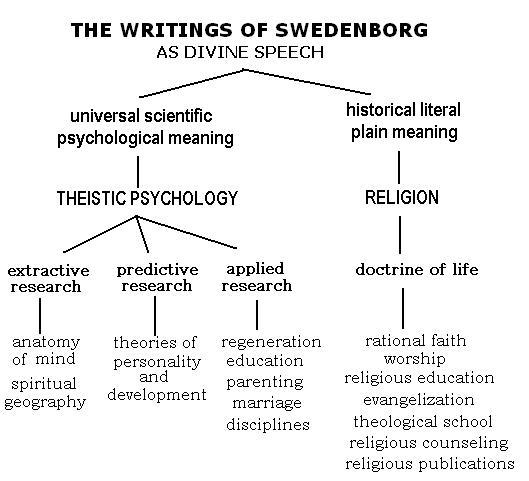
zzz (See Section xx)
|
The Relationship of the Letter of Sacred
Scripture to
Its correspondential sense |
||
|
first ====> |
middle ====> |
ultimate |
|
end |
cause |
effect |
|
esse (being) |
fieri (becoming) |
existere (subsistence) |
|
Divine Itself |
Son of God |
Divine Human |
|
Old Testament phase of understanding the Writings |
New Testament phase of understanding the Writings |
Third Testament phase of understanding the Writings |
|
understanding the
Writings |
understanding the
Writings |
understanding the
Writings |
|
basis for the |
containant for the |
support for the |
|
The phase of the representative of a New Church in the New Church mind, with attachment to literalism, external rituals, and religious identity |
The Christian Church phase in the New Church mind, which takes the literal sense of the Writings to be the spiritual meaning of the Old and New Testaments |
The New Church phase in the New Church mind, which acknowledges that the Writings also are written in pure correspondences, which are natural in the literal sense |
|
Convention phase of the NC mind in historical recapitulation |
General Church phase of the NC mind in historical recapitulation |
Lord's New Church phase of the NC mind in historical recapitulation |
|
first degree priesthood or regeneration of the NC mind |
second degree priesthood or regeneration of the NC mind |
third degree priesthood or regeneration of the NC mind |
|
state of life prior to regeneration, with moral temptations, natural good and truth, and an attachment to faith in the absence of charity |
state of life after reformation in young adulthood, with spiritual-natural temptations and a stronger commitment to faith than to charity |
state of life with spiritual-rational temptations, the possession of truth from good (enlightenment), and a commitment to charity as greater than faith |
|
natural-corporeal doctrine which is the literal sense of the Writings without comparative context |
natural-rational doctrine which is the interior-natural sense of the Writings, not yet spiritual-rational (First Heaven) |
spiritual Doctrine which is the genuine Doctrine of the Church from Celestial origin, and hence Divine (Second and Third Heaven) |
Quoting from the Writings Sacred Scripture:
SS 28. "... in every complete thing there is a trine, which is called first, middle, and ultimate; also end, cause, and effect; and also esse, fieri, and existere. When these things are comprehended, it is also comprehended that every Divine work is complete and perfect in its ultimate; and likewise that the whole is in the ultimate, which is a trine, because the prior things are together, or simultaneously, in it." (SS 28)
TCR 210. "... in every complete thing there is a trine, which is called the first, the middle, and the last, also end, cause, and effect. When this is understood, it can also be understood that every Divine work is complete and perfect in its last; also that the whole is in the last, because in it prior things are together." (TCR 210)
This diagram is contributed by David Chambers (see Astronomica Section xx):
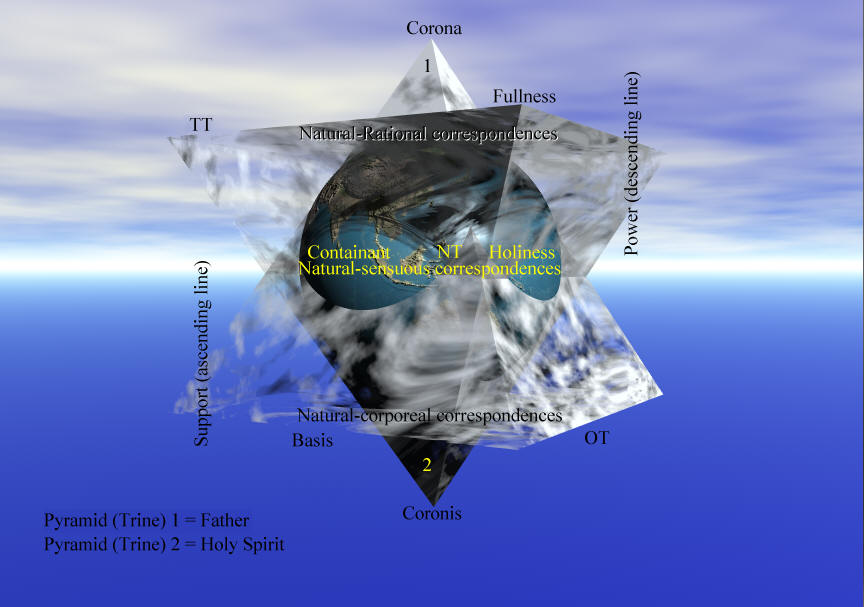
zzz
The following is based on
Moses, Paul and Swedenborg by Leon James. Section 11. Spiritual Development is Cyclical and
Recursive: Comparison of Religious Ideas in the Three Phases:
www.soc.hawaii.edu/leonj/leonj/leonpsy/instructor/gloss/moses.html#_Toc41286028
|
Judaeo-Christian Religious Ideas in the Three Phases of Spiritual Development |
|||
|
Characteristic |
Phase 1 |
Phase 2 |
Phase 3 |
|
Focus |
Ritual piety |
Mystified or Blind Faith |
Rational Faith, Dualist, Theistic, or True Science |
|
Scriptural Basis |
Old Testament
|
New Testament
|
Third Testament
|
|
Orientation |
sectarianism |
personalism |
particularism |
|
Mind Physiology |
External |
Intermediate |
Inmost |
|
Realm |
Natural |
Spiritual |
Celestial |
|
Order |
Material |
Substantive (spiritual) (truths) |
Substantive (celestial) (goods) |
|
Faith |
Orthodoxy and strict adherence to rituals brings purification, holiness, merit, power, and rewards. Emphasis on literalism. Contains superstition. Tribal basis of worship and salvation. Exclusionary and does not seek converts. Disdain for other religions. Restricts God to own tribe or sect. Heaven will be on earth and is reserved for the people of one’s sect. Ritual is more important than understanding doctrine from Sacred Scripture. |
Blind faith in the saving power of the Blood of Christ earns one's entrance into Heaven. Faith alone saves, not good works, which contribute nothing to salvation. Reliance on miracles. Combines literalism and symbolism. Contains mysticism. Seeks converts. Sometimes believes in eternal hell, sometimes in temporary hell, sometimes in no hell. Strength of blind faith is more important than understanding doctrine from Sacred Scripture. |
Rational faith, True Science, absence of all mysticism. All go to heaven regardless of religious background, who respect their innate conscience and shun evils of life as character traits that prevent entry into heavenly life. Ability to shun one’s evils depends on appealing to God to give the power. Cannot be done without this conscious daily reliance on God. This process of regeneration goes on all of life on earth, then continues to eternity in heaven. Without this process people sink into the insanities of hell and are stubbornly unwilling to come out of it, even though it is made possible for them to do so. Only the rational understanding of doctrine from Sacred Scripture can make the faith to be genuine. |
|
God |
Invisible and incomprehensible, sometimes punishing and unforgiving. Created universe by voice out of nothing. Uses the devil to rule over earth. Has a special relationship to one’s sect. |
Trinity of Divine Persons in One Godhead, which is a mystery of blind faith. Need to pray to the Father God in the Name of the Son God. God’s nature of Justice condemns people to hell, but His nature of Mercy saves them for Heaven. |
Trinity of Aspects belonging to One Visible Divine Human Person – at once Creator, Savior, and Regenerator. No other power exists in the universe except His. He intervenes and manages every singular detail of the universe and of our mind. He maintains every individual in spiritual freedom of choice from birth to eternity, in heaven, in hell, and on the many earths in the universe. |
|
The Future (On earth and afterlife) |
Destruction of current world and recreation of a new world. Resurrection of the dead into new physical bodies on earth. End of all evil on earth. Jews are to rule all other nations. Sacrifices will be reinstituted as part of worship. God will retain a special relationship to the Chosen people. |
Destruction of the natural world, leading to universal resurrection of the dead for eternal life in Heaven without a sensual body. No one knows what this heavenly life is. All those go to hell who refuse to acknowledge Jesus Christ as their Savior. |
Earths in the universe continue to be multiplied endlessly. Upon death, every person undergoes immediate resuscitation for eternal life in Heaven as a married couple with a sensual spirit-body and a rational mind that continues to develop daily forever. Those refusing to regenerate will insanely insist on keeping themselves in hell forever. |
|
Repentance and Regeneration |
Performing cycles of rituals is repentance, and thereby attaining collective atonement with one's tribe. Regeneration of character is not a concept for this phase since salvation is achieved by tribal membership in good standing. |
Examining oneself regularly and giving up behaviors contrary to faith because they are sins against God and lead to hell. However, this is tempered by the Faith Alone doctrine which makes salvation not dependent on character change. |
Regeneration is a physiological process of the mind requiring daily conscious effort, not unlike muscle building, and must be motivated by our desire for good and truth to be received from the Lord and to be applied to daily living. All thoughts and feelings that are contrary to good and truth must be shunned and stopped for regeneration to proceed. |
|
Temptations and Consciousness Raising |
Able to overcome natural temptations based on shame and fear of punishment or loss of health, money, affiliation, and status. Morality is based on external deeds. |
In addition, able to overcome spiritual temptations based on anxiety and guilt about loss of connection with God. Morality is based on thoughts as well as on external deeds. |
In addition, able to overcome celestial temptations based on doubt or obscurity of comprehension, as well as the tendency to revert to former, more external states (phases 2 and 1). Morality is based on feelings, intentions, and thoughts, as much as on external deeds. |
|
Charity |
Charity is giving to the poor and fulfilling religious rituals consistently and literally. Some charity (e.g., Church and widows) earns more merit than others (e.g., giving to strangers). Meaning of charity restricted to overt acts. |
Charity is giving one’s ten percent (or equivalent) to the Church and the poor, and praying for one’s enemies as well as for family and friends. Being tolerant and compassionate to all people. Charity ranks lower than faith. |
Charity is being motivated to be useful to others and society. There is no spiritual merit or reward in giving. But care must be exercised not to give indiscriminately (e.g., people dangerous to the community). Human dignity is owed to all human beings regardless of anything else. Charity ranks higher than faith. |
|
Conjugial Love |
External marriage relationship with allowable divorce. Marriage is to last this life only. Faith ranks higher than marriage in God’s eyes. Men rank higher than women in all things. Women are expected to be sub-servient. Men exclude women from many activities, privileges, and rights. |
External marriage on earth, with divorce not allowed. No marriage in heaven and no sensual body there. Unclear what you do in heaven. Faith ranks higher than marriage in God’s eyes. Women have their place in the Church affairs, men have theirs. Women are expected to let men lead. |
Internal marriage formed on earth, to continue in a spiritual body in the afterlife with the same person when both pass on. Divorce allowed under certain conditions of incompatibility. Marriage love ranks higher than faith in the Lord’s eyes. Sometimes women are expected to let the men lead in Church affairs, sometimes they are considered equal. In regeneration, husbands are encouraged to accept the wife’s leading in his own character change because the wife receives from the Lord a special perception of their husband’s mental states, which husbands do not have about their own states. |
zzz
Quoting from the Writings Sacred Scripture:
AE 817. And he spake as a dragon. [Apocalypse Ch. XIII, v. 11]
That this signifies in affection, thought, doctrine, and preaching, similar to what prevails with those who separate faith from the life of faith, which is charity, is evident from the signification of speaking, as denoting affection, thought, doctrine, and preaching. The reason why speaking signifies these things is, that all of a man's speech is from affection and thought thence, the affection itself being expressed by the sound of the speech, and the thought by the words. That both the affection and the thought are in the speech, is evident to every one who reflects.
Affection alone cannot speak, it can only make a noise and sing; nor can thought alone speak except as an automaton without life. For it is the affection which gives life to every expression of speech.
This is also the reason why man is regarded by others according to the affection in his speech, and not according to the words. The reason why speaking also signifies preaching from doctrine, thus doctrine and preaching thence is, that it is said that the beast spake as a dragon; and by the dragon are meant those who are in faith separate from charity both in doctrine and in life (as may be seen above, n. 714). And by this beast are meant confirmations from the sense of the letter of the Word in favour of the separation of faith from life, and the resulting falsifications of the Word. That religious persuasion, as to doctrine and as to preaching, is signified therefore by speaking as a dragon.
Because by the dragon and by his two beasts is described faith separate from charity, and the resulting falsification of the Word, it shall be shown in this article, that a similar heresy is described in the Word by Cain, Reuben, and the Philistines; and is also meant by the he-goat in Daniel. For there have been several churches upon this earth - the Most Ancient, which was before the flood; the Ancient Church, which was after the flood; the Jewish, which succeeded the Ancient, and lastly the Christian Church.
All these churches, in process of time, degenerated into two great errors, one which has adulterated all the goods of the church, and the other which has falsified all its truths. The church which has adulterated all the goods of the church is described in the Word by the Babylonians and Chaldeans; and the church which has falsified all the truths of the church is described by Cain, Reuben, and the Philistines; and also by the he-goat in Daniel, which fought with the ram and overcame it.
Concerning the adulteration of the good of the church, which is described by the Babylonians and Chaldeans, we shall speak in the following parts of this work, where Babylon is treated of in the Apocalypse. At present we shall confine ourselves to the subject of the falsification of truth, described here by the dragon and his two beasts. That the same is described also by Cain, and by the rest above-mentioned, shall now be explained.
[3] That those who separate the knowledges of truth and good from a life in agreement with them, and believe that they may be saved by these alone, were represented by Cain, has been briefly shown in the Arcana Coelestia, where Cain and Abel are treated of, to which we shall add the following observations. It is written of Cain,
That he was the first-born of Adam, and that he tilled the ground, and brought of the fruit of the ground an offering to Jehovah; and that Abel was a shepherd of the flock, and brought of the firstlings of his flock, and of the fatness thereof; also that Jehovah had respect unto the offering of Abel, and not unto the offering of Cain, wherefore anger was kindled in Cain, and he slew his brother; that Cain, was therefore accursed, and banished from the ground, and became a vagabond and fugitive on the earth; and that Jehovah set a mark upon Cain, lest he should be slain, and appointed that whoever should slay him, should have vengeance taken on him seven-fold (Gen. iv.).
It is to be observed, that all the names of persons and places in the Word signify things and states of the church; and especially the names in the first chapters of Genesis, because the historicals in those chapters are constructed historicals, containing in them the deepest mysteries of heaven, but which are, nevertheless, most holy in the sense of the letter; because in every word there is a correspondential sense which unites the heavens with the men of the church. What those historicals involve in the correspondential sense, and what the names of the persons there signify, is explained in the Arcana Coelestia. By Cain are signified the knowledges of truth and good separate from a life in agreement with them, thus from heavenly love; and by Abel is signified heavenly love; or, what amounts to the same, by Cain is signified truth separate from good, and by Abel good conjoined to truth.
And because truth is the primary thing of the church, every church being formed by truths, for from truths, or from the knowledges of truth and good, every church first commences - therefore Cain was the first-born, and was named a man (vir) of Jehovah; for by a man of Jehovah, in the Word, is signified the truth of heaven and the church; and by the ground which Cain tilled, is signified the church. The separation of truth from good is signified by the murder of Abel by Cain. For when every thing of the church is placed in truths or in knowledges, and not in goods, or in the affection of living according to truths; then good with its affections is slain. And because every thing of the church perishes when truth is separated from good; therefore Cain was banished from the ground, by which, as was said, is signified the church.
But because truths are the primary things of the church, for truths will teach men how to live, therefore a mark was set on Cain, lest any one should kill him; and it was appointed that if any one should kill him, he should be avenged seven-fold. And because truth without good is carried hither and thither, having nothing to lead it, consequently it successively wanders into falsities, and falls away from the way that leads to heaven; therefore Cain was banished from before the face of Jehovah, and became a vagabond and fugitive. The case is similar with respect to faith and charity, because faith belongs to truth, and charity to good. Thus the case is similar with respect to faith separate from charity as with what is said concerning Cain, that is, that it kills Abel its brother, which is charity, whence the church perishes. And this is signified by being banished from the ground, and becoming a vagabond and fugitive; for when faith is separated by charity then truth is successively turned into falsity, and so falls to decay.
[4] That Reuben, the first-born of Jacob, signified the light of truth, and thence the understanding of the Word, and thereby truth from good, or faith from charity, as was also the case with the apostle Peter; and that Reuben also, on the other hand, represented truth separated from good, or faith separated from charity; and that this faith is signified by his adultery with Bilhah his father's concubine, in consequence whereof the primogeniture was taken away from him and given to Joseph, may be seen above (n. 434). To these things is to be added, that all heresies, so far as they are adulterations and falsifications of the Word, correspond to adulteries and whoredoms of various kinds, which, because of such correspondence, are also actually perceived in the spiritual world, from those who are in heresies.
The reason is, that marriages, such as they are in the heavens, derive their spiritual origin from the conjunction of good and truth; and, on the other hand, adulteries derive their origin from the conjunction of evil and falsity. This is why heaven, in the Word, is compared to marriage, and hell to adultery. And because in the hells there is a conjunction of evil and falsity, therefore a sphere of adultery continually exhales from them. This is the reason why adulteries and whoredoms, in the Word, signify adulterations of the good of the church and falsifications of the truth thereof (as may be seen above, n. 141, 161).
[5] Faith separate from charity is perceived in the spiritual world as the adultery of a son with a mother, and also with a mother-in-law. The reason is, that faith shuts out the good of charity; and this being so, the evil of the love of self and of the world succeeds in its place, and such faith conjoins itself with it. For all faith must necessarily conjoin itself with some love; wherefore when spiritual love, which is charity, is separated, then the faith conjoins itself with the love of self or the love of the world, these being the loves that rule in the natural man; this is why such a horrible adultery results from faith separated from charity. And it is evident therefore what the adultery of Reuben with Bilhah his father's concubine signifies, and why he was therefore rejected from the right of primogeniture. This is also meant by the prophecy of Israel concerning Reuben:
"Reuben, my first-born, thou art my might, and the beginning of my strength, excellent in dignity, and excellent in power. Unstable as water, thou shalt not excel, because thou wentest up to thy father's bed; then defiledst thou it: he went up to my couch" (Gen. xlix. 3, 4):
which words may be seen explained in the Arcana Coelestia (n. 6341-6350).
That such adultery from faith separated from charity is perceived in the spiritual world, has been made evident to me from correspondences in that world; for as often as I have perceived from afar the sphere of adultery with a mother or mother-in-law, I have known at once that they were at hand who had confirmed themselves in faith alone both in doctrine and in life, and they were also then discovered; and being examined as to their quality, they were found to have been such in the world.
[6] Thus far concerning Reuben. Something shall now be said concerning the Philistines. These also in the Word represent faith separated from love. This is why they were called the uncircumcised; for to be uncircumcised signifies to be without spiritual love, and to be solely in natural love, with which love alone not anything of religion, much less anything of the church, can be conjoined. For everything pertaining to religion and the church regards the Divine, heaven, and spiritual life; and these cannot be conjoined with any other than a spiritual love, consequently, they cannot be conjoined with a natural love separate from a spiritual. For natural separate from spiritual love is man's proprium, which, in itself, is nothing but evil.
All the wars which the sons of Israel waged with the Philistines represented the combats of the spiritual man with the natural man, and also the combats of truth conjoined to good, with truth separated from good, which in itself is not truth but falsity. For truth separated from good is falsified in the thought concerning it; the reason being, that there is nothing spiritual in the thought to impart enlightenment. This is also the reason why those who are in faith separated from charity have no truth, except that used in speech or preaching from the Word. For the idea of the truth perishes as soon as such people exercise their thought about it.
[7] Because this religion in the churches prevails with all those who love to live a natural life, therefore in the land of Canaan the Philistines were not subjugated, like the other nations of that land, and hence so many battles took place between them. For all the historicals of the Word are representative of such things as pertain to the church; and all the nations of the land of Canaan represented things heretical confirming either falsities of faith or evils of love; and the sons of Israel represented the truths of faith and the goods of love, consequently the church.
But what the wars represented which the inhabitants of the land of Canaan carried on will be shown in due course. Here we shall merely show that the Philistines represented a religious persuasion separated from spiritual good, such as that of faith alone separated from its life, which is charity. This is why as often as the sons of Israel departed from the worship of Jehovah to the worship of other gods, they were delivered up to their enemies, or were conquered by them. Thus they were delivered up to the Philistines, and served them eighteen years, and afterwards forty years (Judges x., xiii.). This represented their receding from worship from the good of love and the truths of faith, to a worship from the evils of love and the falsities of faith. It is mentioned that they were conquered and brought into straits by the Philistines (1 Sam. iv., xiii., xxviii., xxix., xxxi.); but when the sons of Israel returned to the worship of Jehovah, which was worship from the good of love and the truths of faith, they then conquered the Philistines (as 1 Sam. vii., xiv.; 2 Sam. v., viii., xxi., xxiii.; 2 Kings xviii.).
That those historicals involve such things, can only be seen from the series of things there described in the internal sense, which we have not the time here to explain. We shall adduce only one passage from the prophetical parts of the Word, from which it will be evident that such things as pertain to the church were represented in those historicals by the Philistines. (AE 817)
AC 6777. And they filled the troughs. That this signifies that from this they enriched the doctrine of charity, is evident from the signification of "filling from a well," as being to enrich from this, or from the Word; and from the signification of a "trough," as being the doctrine of charity. That a "trough" or "basin" is the doctrine of charity, is because it is a trough of wood into which water is drawn from a well to give drink to flocks; for what is of "wood" in the internal sense signifies the good of charity (n. 3720); "to draw" signifies to be instructed (n. 3058, 3071); the "water" which is drawn, signifies the truth of faith (n. 2702, 3058, 4976, 5668); the "well" from which it is drawn signifies the Word (n. 2702, 3424, 6774); and "to give drink to the flocks" signifies to instruct in good from the Word (n. 3772). From all this it is evident that a "trough" is the doctrine of charity. (AC 6777)
zzzz
13.0.11.1 Rational Faith or The Beliefs of the New Church Mind
A more elaborate discussion of
the New Church Mind, its formation today in a modern world, is presented in
another electronic book by Leon James available here:
www.soc.hawaii.edu/leonj/nonduality.html
Quoting from the Writings Sacred Scripture:
AE 151. These things saith the Son of man. That this signifies the Lord as to the Divine Human, from which is that constituent of the church, is evident from the signification of the Son of God, as denoting the Lord as to his Divine Human, and as to Divine truth, inasmuch as the latter proceeds from Him (concerning which see above, n. 63). That it also denotes from whom is that constituent of the church, that is, the opening of the internal or spiritual man and its conjunction with the external, is, that everything of the church pertaining to man is from the Lord's Divine Human.
For everything of love and faith constituting the church proceeds from the Divine Human of the Lord, and not immediately from the Divine itself; for what immediately proceeds from the Divine itself does not enter into any thought or affection of man, and consequently not into faith and love, because it is far above them, as is evident from the fact that a man cannot think of the Divine without connecting with such thought the human form, unless he thinks of nature, as it were, in its minutest parts. The thought which is not directed to some particular form is diffused in all directions, and what is thus diffused is dissipated. This it has been specially granted me to know, from those in the other life who come from the Christian world, and who have thought only of the Father, and not of the Lord, that they make nature in its minutest parts their God, and at length fall away from any idea of God, consequently from the idea and faith of all things of heaven and the church.
[2] It is different with those who have thought of God in the human form; all these have their ideas directed to the Divine, nor do their thoughts, like those of the former, wander in every direction. And, inasmuch as the Divine under a human form, is the Divine Human of the Lord, therefore the Lord bends and determines their thoughts and affections to Himself. Because this is the essential of the church, therefore it continually flows in from heaven with man, consequently it is, as it were, implanted in every one to think of the Divine under a human form, and thus inwardly in themselves to see the Divine, except in the case of those who have extinguished this impression in themselves (as may be seen in the work, Heaven and Hell, n. 82).
It is therefore evident why all men after death, however vast their number, when they become spirits, are turned to their own loves, and that hence those who have worshipped the Divine under the human form turn to the Lord, who is seen by them as a Sun above the heavens. But those who have not worshipped Him under the human form are turned to the loves of their own natural man, all of which have reference to the loves of self and of the world; thus they turn backwards from the Lord; and to turn themselves backwards from the Lord, is to turn towards hell. (That all turn themselves to their own loves in the spiritual world, may be seen in the work, Heaven and Hell, n. 17, 123, 142-145, 151, 153, 255, 272, 510, 548, 552, 561.
[3] All those who lived in ancient times, and worshipped the Divine, saw the Divine, in thought, under a human form, and scarcely any one thought of an invisible Divine; and the Divine under the human form, even at that time, was the Divine Human. But because this Divine Human was the Lord's Divine in the heavens and passing through the heavens, when heaven became weakened for the reason that men, of whom heaven consists, from internal became successively external, and thus natural, it therefore pleased the Divine Himself to put on the Human, and to glorify this, or make it Divine, that thus from Himself He might affect all, both those who are in the spiritual world and those who are in the natural world, and save those who acknowledge and worship His Divine in the Human.
[4] This Is manifest from many passages in the Prophets of the Old Testament, and also in the Evangelists, from which we shall adduce only the following in John
"In the beginning was the Word, and the Word was with God, and God was the Word. All things were made by him, and without him was not anything made that was made. In him was life; and the life was the light of men. And the light shineth in darkness; and the darkness comprehended it not. That was the true light, which lighteth every man that cometh into the world. He was in the world, and the world knew him not. And the Word was made flesh, and dwelt among us, and we beheld his glory" (i. 1-14).
That the Lord as to the Human is there meant by the Word, is quite clear, for it is said, "the Word was made flesh, and dwelt among us, and we beheld his glory;" and that the Lord made His Human Divine, is also plain from these words, "the Word was with God, and God was the Word," and this was made flesh, that is, man. And whereas all Divine truth proceeds from the Divine Human of the Lord, and this is His Divine in the heavens, therefore by the Word is also signified Divine truth; and it is said, He was the true light which lighteth every man that cometh into the world. Light also is Divine truth; and because men, from being internal, became external or natural, because they no longer acknowledged Divine truth, or the Lord, therefore it is said that the darkness comprehended not the light, and that the world acknowledged Him not. (That the Word is the Lord as to the Divine Human, and Divine truth thence proceeding, may be seen in The Doctrine of the New Jerusalem, n. 263 and 304. That light is Divine truth, and that darkness denotes the falsities in which those are who are not in the light, may be seen in the work, Heaven and Hell, n. 126-140, 275.)
[5] That those who acknowledge the Lord, and worship Him from love and faith, and are not in the loves of self and of the world, are regenerated and saved, is also taught in these words,
"As many as received him, to them gave he power to become the sons of God, to them that believe in his name; which were born, not of bloods, nor of the will of the flesh, nor of the will of man (vir), but of God" (i. 12, 13).
Those who are born of bloods, are those who destroy love and charity; the will of the flesh denotes all evil derived from the loves of self and of the world, and is man's voluntary proprium, which in itself is nothing but evil; the will of man is falsity derived from that voluntary proprium. That those who are not in these loves receive the Lord, are regenerated and saved, is meant by them that believe in His name becoming the sons of God, and being born of God. (That to believe in the name of the Lord, is to acknowledge His Divine Human, and to receive from Him love and faith, may be seen above, n. 102, 135.
That bloods denote those things that destroy love and charity, see Arcana Coelestia, n. 4735, 5476, 9127: that flesh denotes the voluntary proprium of man, which in itself is nothing but evil, n. 210, 215, 731, 874-876, 987, 1047, 2307, 2308, 3518, 3701, 3812, 4328, 8480, 8550, 10,283-10,286, 10,731; and that man's proprium is the love of self and the love of the world, n. 694, 731, 4317, 5660. That man (vir) denotes the Intellectual, and hence truth or falsity, because the Intellectual is from the one or the other, see n. 3134, 3309, 9007, thus the will of man (vir) denotes the intellectual proprium, which, when it exists from the voluntary proprium, which in itself is nothing but evil, if; nothing but falsity; for where evil is in the will there falsity is in the understanding. That to be born of God is to be regenerated by the Lord, may be seen in The Doctrine of the New Jerusalem, n. 173-184. Moreover, that all in the universe, from influx out of heaven, and from revelation, worship the Divine under the human form, may be seen in the small work, The Earths in the Universe, n. 98, 121, 141, 154, 158, 159, 169; and likewise all the angels of the higher heavens, in the work, Heaven and Hell, n. 78-86.)
[6] From these considerations it is now evident that the all of the church, thus also the all of heaven pertaining to men, is from the Lord's Divine Human. It is on this account that the Son of Man, who is the Divine Human, is described, in the first chapter of the Apocalypse, by various representatives, and afterwards from that description are taken the exhortations to the several churches (as may be seen above, n. 113), and specifically to this church, in writing to which this great essential of the church is treated of, that is, the conjunction of the internal and external, or the regeneration of the man of the church; for it is said to the angel of this church, "These things saith the Son of man, who hath his eyes like unto a flame of fire." (AE 151)
AE 10370. And the sons of Israel shall keep the Sabbath, to perform the Sabbath to their generations. That this signifies that the very essential of the church is the acknowledgment of the union of the Divine Itself in the Lord's Human, and that this must be in each and all things of worship, is evident from the signification of "keeping the Sabbath," as being continual holy thought about the union of the Divine Itself with the Lord's Human (see above, n. 10356), thus also acknowledgment, for thought without acknowledgment and faith is not spiritual thought; from the representation of the sons of Israel, as being the church (see the places cited in n. 9340); from the signification of "performing the Sabbath," as being devoutly to worship this union, thus to worship the Lord as to the Divine Human, for this union is in the Divine Human; and from the signification of "to the generations of the sons of Israel," as being in each and all things of the church (n. 10282).
From all this it is evident that by "the sons of Israel keeping the Sabbath to perform the Sabbath to their generations," is signified the acknowledgment of the Divine Itself in the Lord's Human in each and all things of worship.
The reason why this is an essential of the church, and consequently an essential of its worship, is that the salvation of the human race depends solely upon this union. Moreover the Lord came into the world for the sake of effecting this union. Therefore also in its inmost sense the whole Word treats of this, and the rituals of the church instituted among the sons of Israel represented it and signified it. [2] That the salvation of the human race is therefrom, consequently that this acknowledgment is an essential of the church and of its worship, the Lord teaches in many passages, as in John: He that believeth in the Son hath eternal life; but he that believeth not the Son shall not see life (John 3:36; also verses 15, 16; 6:40; 11:25, 26; 20:31).
"The Son" denotes the Divine Human of the Lord. The reason why those have no eternal life who do not from faith acknowledge the Lord, is that the whole heaven is in this acknowledgment; for the Lord is the Lord of heaven and earth, as He teaches in Matthew: All power hath been given unto Me in heaven and on earth (Matt. 28:18); and therefore heaven is closed to those who do not acknowledge Him; and he who (being within the church) does not make acknowledgment in the world, does not make it in the other life. Such is the state of man after death. (AC 10370)
zzz
13.0.11.1.1 History and Evolution Leading Up to the Incarnation Event
God created the human race out of good and truth, without evil, but with spiritual freedom to think that which contradicts truth, and with spiritual freedom to want to do that which is contrary to good.
When the first person with an evil mind was resuscitated (see Section xx), during the early generations of the human race on this earth, this person was physiologically unable to continue surviving in the atmosphere of the human heavens where everyone else was living in their blissful state of heaven in the eternity of the human mind. Hence, God had to create a new state of mind in humanity's eternity. This new expanse of life-support system in eternity is called the Grand Monster, while the older expanse of life-support system is called the Grand Human (see Section xx). The Grand Human was seen by Swedenborg as he was given a bird's eye view of the human heavens and their shape. This shape is the human form or body (see Section xx). The Grand Human appears as one handsome angel person, while the Grand Monster, as one deformed devil person. They each have this appearance because the outside of something presents to view the quality of the inner feelings and thoughts of a person.
This effect is somewhat masked in the physical body because it is comparatively like a rigid plaster that encases the soft and responsive mental body within. When this relatively inert plaster drops off at death, the mental body at last is able to sense, think, and feel like a spirit, that is, like a mental being, not physical. While still connected to the physical body, the mental body could not fully experience the true quality and intensity of the spirit's ability to experience. All along we were encased in this rigid non-responsive physical cast while we were experiencing pleasurable sensations and having feelings and thoughts. But now, during resuscitation a few hours after death, we for the first time begin to feel a new quality to our experiences. Swedenborg was able to compare the two while he was conscious in both worlds of time and eternity. He reports that the sensations we have through the physical body are like candle light at night compared to the midday brilliant and warm sun as a spirit in the mental body in eternity (see Section xx).
Think about the sad day when the first evil mind was resuscitated and God had to construct a new living expanse in the human mind where this individual could exist and live as a human. This new place of creation in the evolution of the human mind is known as the hells. We all know what the hells in our mind feel like. We are in the hells of our mind when we are experiencing these things: anger, annoyance, frustration, fear, laziness, neglect of self and responsibilities, stupidity, envy, enjoyment of vengeance, willingness to steal and kill for selfish motives, cynicism, atheism, rejection of truth, ignorance, irrationality, prejudice, carelessness, addiction, enjoyment of corrupting innocence, acting foolishly without proper planning, etc. etc. All these familiar things are the hells of the human mind, and we are in those hells when we experience any one of these feelings and thoughts. These hells, these experiences, these thoughts and feelings did not exist until those first few people in our race a long time ago, started contradicting the truth in their mind, and through that, started justifying evil habits, practices, and lifestyles. Since then the hells of the human race have immeasurably grown in population (see Section xx).
Furthermore, the individual's mental connection to these human hells is passed on hereditarily (see Section xx). This means that people who merely live a life of following their impulses and inborn preferences, are resuscitated with a mental body that contains a personality that is not able to tolerate the atmosphere, lifestyle, and relationships that make up the heavenly thoughts, ideas, and feelings (see Section xx). God has insured that every generation has access to Sacred Scripture that is written in a language anyone can understand. This is the source of knowledge for the person who wants to acquire a new reborn character that is capable of supporting eternal life in heaven (see Section xx). The understanding of Sacred Scripture refers to the memorization, reflection, and study of it as Divine Speech ("the Word of God") (see Section xx). Once some of this knowledge is in our memory and understanding, we are then able to apply the knowledge to guide our willing and thinking in daily life (see Section xx). To the extent that we engage in this character "regeneration" effort on a daily and hourly basis, to that extent we receive enlightenment and power from the Divine Psychologist (or God), that is, understanding of truth and reality, and the motivation and ability to act in accordance with that truth. Through this endlessly recurrent process or cycle of escalation, our consciousness ascends gradually to become that of a heavenly angel in eternity (see Section xx).
Although there are many religions in the human race there is only one God. All religions belong to the One God when they are still genuine, before they are corrupted by false ideas and hijacked by evil purposes. When people are resuscitated, they are instructed in the truth of Divine Speech that is hidden within all Sacred Scripture (see Section xx). The literal sense of Sacred Scripture is written in a style and with a content that is accommodated to a historical time, culture, and mentality (see Section xx). They are not transferable from one religion to another. But when you extract the universal correspondential sense hidden within the literal sense, then the same rational scientific descriptions are found in them (see Section xx). This is the basis of theistic psychology (see Section xx).
For many generations people were able to receive the enlightenment and power from God to allow their character to be regenerated by God. This process was possible because people believed in Sacred Scripture as being Divine Speech and hence, containing absolute truth. This was sufficient as long as they were willing to acquire and understand these Divine truths for the purpose of using them to acquire a new character of good and truth from God. But when people lost this true motivation, they started acquiring these truths from Sacred Scripture as a means of reputation, gain, and power. The result was that their rational understanding was more and more darkened, and all they could do is to contradict whatever they read, instead of finding rational ways of agreeing with them (positive bias) (see Section xx). At that point of human evolution it appeared that the entire race would be eventually swallowed up by evil. This would mean that every new born child would have no longer the power to end up in heaven in eternity. The entire human race in both time and eternity, was at the brink of extinction -- past, present, and future (see Section xx).
To overcome evil in the human race, God had a special strategy that was foreseen since humanity was created. This special strategy was known to the ancients through their knowledge of the correspondential sense that lay hidden in Sacred Scripture. They discussed it as the Incarnation Event ("Coming of Messiah"). Once the process of devolution of the human race reached its lowest possible level, God entered history and the physical reality. The process of birth, its location and time, were specified in Sacred Scripture. It is recorded in the New Testament Sacred Scripture, written more than 2000 years ago, that the Messiah, or Son of God, would be born in the city of Bethlehem in the Holy Land which is the historical location discussed by the Sacred Scripture in the Bible and the Koran, as well as previous Sacred Books containing Divine Speech.
The Incarnation Event is the entry of God into the natural world, into its history and science.
History and science are both concerned with evidence and facts of reality and truth. An event X either did happen or it did not happen. An object or quality Y either does exist or it does not. Reality is about what exists. History and science are rational methods for acquiring knowledge and understanding of reality or truth. God either exists or does not exist. God made Himself be born as a Divine Child on this earth, or He did not. God entered reality and history as a Divine Child, or He did not. Since none of these propositions can be proven by means of physical evidence, to assume that the Incarnation Event (God's birth on earth) is a real historical event that occurred, is called the positive bias in science (see Section xx). Conversely, to assume that the Incarnation Event (God's birth on earth) is not a real historical event that occurred, is called the negative bias in science (see Section xx).
Which bias do you uphold in your role as a scientist? We all know that non-theistic psychology and science assume the negative bias. Any journal article or textbook that presents explanations in psychology referring to God is carefully excluded by editorial policy. In fact, talking about God in non-theistic psychology -- what you have been studying until now, is considered automatically as non-scientific, and is rejected. This rejection is called the negative bias in science. It is not the same with the rejection of magic, superstition, or psychic powers. In fact, the positive bias was adopted towards psychic research and paranormal phenomena. Scientists gave it chance to be proven right. They accepted the possibility that paranormal phenomena may be real and true, even though they did not know whether it is or not. Hence they had to adopt the positive bias, just so they could investigate it.
Question: Could researchers have investigated paranormal phenomena if they had retained the negative bias towards it?
The answer is No. When researchers investigate anything scientifically, like the existence of the Loch Ness monster, they must grant the possibility that the phenomenon exists. Then they can investigate empirically whether they can prove that it exists. But those researchers who assume that such a phenomenon is made up fiction or imagination, and cannot possibly exist in reality, then they are in the negative bias, and they would never investigate its so-called existence. It is the same with God in science and history. Scientists in non-theistic psychology who are in the negative bias regarding God's existence, would never want to investigate theistic psychology to see if it is true or not, real or fantasy. But scientists in non-theistic psychology who are in the positive bias regarding God's existence, may want to investigate theistic psychology to see if it is true or not, real or fantasy. Either way, it is a bias.
So from which bias are you thinking about God in your role as a psychology student?
Almost certainly you have been thinking about psychology and God from the negative bias. Almost certainly you are thinking from an assumption you have accepted in your courses or readings about what scientists say and do. It's not because you have thought rationally about whether God is part of history and science, or not. You have accepted what you were told and what you memorized and what you keep reading today in newspapers and science stories. It is the case that the negative bias in science is so complete that you would hardly ever come across anything written in science from the positive bias perspective. We are not talking about religion and God. Only about science and God. This issue -- science and God, is independent of the issue religion and God. People put them together in their mind and in their discussions, but that's only because they are not making the distinction (see Section xx).
This then is what it means to study theistic psychology, namely, to admit that it is possible that God exists, and therefore it is possible that God and science could be together as part of what is reality and how to investigate it rationally.
So God became a man on earth (see Section xx). From the positive bias assumption, this could be an actual true fact. We need to investigate it to see. That's what the study of theistic psychology is.
13.0.11.1.2 Neuro-Physiology of God Man's Incarnation
So the first issue to consider, in order to investigate this rationally, is how can God be a man on earth -- who then is taking care of the universe? The answer is that as a man on earth, God went through two states of existence or life, alternating repeatedly between them. First, a state of existence called humiliation during which the Divine Man fell in consciousness to the mere human level of the people and culture around Him. In this fallen state, the physical Divine Man saw Himself as separate from Himself as God. He saw Himself as having no Divine power, and no Divine knowledge. Then, an hour or a day later, He saw Himself as He really was from within, that is, as God Himself, with omnipotent power and omniscient knowledge. The Incarnate Divine Man managed His life on earth, and all the events surrounding His presence as a citizen, by following the exact biographical blueprint described thousands of years earlier in the prophecies recorded in Sacred Scripture (see Section xx).
So we know that the universe was still being managed by God Himself, even though He had made Himself be born as a Divine Man on earth. It is not possible for the omnipotent God to give up power or to abdicate any rule of order that creates reality out of truth.
Why did God go through repeated phases of humiliation ("exinanition") during which He had an obscured vision and lowered powers, which required Him to face temptations by suffering?
When God Man was facing executioners who put Him to death, as described in the New Testament Sacred Scripture, who was managing events? Where did the executioners take the physical power to torture and kill the God Man? Where did the lawyers and judges take the mental power to formulate the legal justifications for the death penalty they imposed on the God Man? Clearly all these details were managed and determined by God Man Himself. He Himself gave them the power and intelligence to arrest Him, condemn Him, and execute Him. God Man Himself did all of this. Not a single finger or thought could have occurred without God Man making it occur. These are logical conclusions that follow from the assumption that God exists (see Section xx).
God Man's purpose was to confine within temporary limits His own Divine infinite power. This is why it is called a state of humiliation during which God humiliated Himself by creating a physical Person who was a mere human on the outside, but whose soul on the inside was the infinite God Himself. How were these two to conjoin and become One? We are each born with a soul that makes us unique with distinct qualities that no other soul has. From this soul we have the quality of our mind and hence, of our experience of self and life. It is our soul that makes us who we really are, thus, who we are going to be in eternity. And yet we know absolutely nothing about our soul. We know that it exists because that is revealed in Sacred Scripture (see Section xx). We are unconscious of anything about our soul, which yet determines the core of who we are. This mere human process models after the Divine Human process by which God united this physically born Person to Himself. This process ;of unification or conjunction between God's physical Body and His spiritual mind and soul, is called the process of glorification (see Section).
The details of this process are fully revealed in the hidden correspondential sense of Sacred Scripture (see Section xx). It makes sense that God wants us to know about these details because everything He did during this process of glorification on earth, was actually a process of new creation in the human mind that did not exist before. The mental or spiritual physiology of the mind did not have the components and processes that were initiated in the human race by this process of glorification. IN other words, God Man's glorification steps with Himself on earth in time and space, is the model or physiological blue print our mind follows today in the process of our regeneration or character reformation (see Section xx).
This etiological symbiosis between God Man's glorification of Himself and every individual's regeneration steps, makes it rationally clear to us what God Man did during His thirty-three years of presence on this earth. He was battling the hells!
God Man's states of humiliation are described in intimate detail in the hidden correspondential sense of Sacred Scripture (see Section xx). We understand what happens to us when we are undergoing battles with the hells (see Section xx). For instance, you see a beautiful diamond ring on the grass in a park at the very spot where you just saw a young lady get up and walk away half a minute ago. You can still see here slowly walking off and you could easily catch her. You are holding the ring, thinking, maybe it's not hers, maybe it's just my lucky day. Now the temptation starts. You are beginning to think of reasons why it would be all right for you to keep the ring. Your intelligence allows you to fabricate what appear to you good reasons. So you feel a strong emotional pull to keep the ring and the thought makes you breath faster as you're contemplating all the things you can do with the money. But now you feel an opposite pull, as you recoil with horror at the idea that you're going to steal the ring even though you know it belongs to that young woman. Your are now in the very midst of the temptation, which is called a spiritual battle (see why in Section xx).
You are in emotional agony. It's not just the money of the ring. It's your self-image and self-esteem. Can you life with yourself knowing that you are the kind of person who could do this? And if you could do this, what else can you do that's even more horrific? But, but, the money, and, and, what if she says it's hers, when it's not, etc. It's not fair, other people always getting things, going to Las Vegas, and you can never go. Besides, there are many philosophers and politicians in history who have stated that you must be strong and look after yourself first, and then, other people. e I've been living a false philosophy, limiting myself to so-called honesty and morality. Look at how many people cheat and do illegal things in our society. Who doesn't? Etc. Your eternal future hangs in the balance of this battle, and other battles like this every day. It all adds up to character reformation -- if you win your spiritual battles, and remaining in the character you've inherited - if you don't win your spiritual battles (see Section xx).
The reason you can win your battles in spiritual temptations is that you have available the process of regeneration, which is modeled after the process of glorification, as just explained.
The Divine Man in His states of humiliation as a mere human being, was able to face spiritual temptations. This means that He was able to face the hells in the minds of the human race that have evolved for numerous generations (see Section xx). These are the hells that are inherited by every generation since the mind of a newborn is physiologically an "offshoot" of the parents. It is known that the physical body inherits many physical and genetic traits from the physical body of the parents. It is not generally known that the mental body of the newborn is inherited from the mental body of the parents. All the mental impulses and preferences we have are inherited in the mental body. You can see therefore that once a single individual becomes evil, it's only a matter of time before this evil is passed on to the generations, so that there is a cumulative inheritance of evil traits.
By the time you and me have come around, many generations before us have already accumulated so much inherited evil that there can be no hope for us to escape hell in eternity -- except for one thing: The Divine Human's glorification process, which acts ceaselessly today on every human mind, making it possible for anyone who wants to, to undergo the process of regeneration and character preparation for heavenly life in eternity. This is why the Divine Man's glorification is called the salvation of the human race -- because it is making it possible for anyone anywhere anytime to sign up for it, go through with it, and end up in the heavens of the human mind. This is called being saved because we are saved from a miserable life of hell and we are given instead, a life of heaven in eternity.
What actually is heaven and hell?
13.0.11.1.3 Neuro-Physiology of Heaven and Hell
People in the negative bias in science, or people who see themselves as cynics or materialists, tend to ridicule the idea that there is a heaven and a hell. How do you know, they say? Is this not something invented to keep people in check? Besides, who knows what is heaven, what is absolute good, or absolute truth. Your god may not be my god. Etc. etc. But this kind of thinking and clever talking is done our of mere ignorance. It doesn't have to impress us as intelligent or true. It is actually foolish and false. Heaven and hell are real physiological entities or organs in the mental body. If you study the anatomy of the mental body (or spirit or mind), you will discover that the mind is constructed out of vertical layers of spiritual substances from the Spiritual Sun (see Section xx).
The Spiritual Sun is the infinite emanation of good and truth from God. There are infinite different states or qualities of good, and infinite different states or qualities of truth. Our soul and our spirits or mind, is made of organs of the mental body. The uppermost organ in the human mind is called heaven because it receives good and truth from God without distorting it. Swedenborg interviewed many of those who dwell in the heavens of their mind (see Section xx). He was able to study their character and quality of mind. He called them angels. Any person who underwent character reformation prior to death, is resuscitated, instructed, and taken to their heavens where their soul mate spouse awaits, or where they are to await their soul mate spouse (see Section xx). They thus live in conjugial blessedness and joy to eternity, reaching progressively higher and higher states of good and truth, endlessly to eternity.
The Divine Human's glorification process created these heavens. All the older heavens of the human race were recreated in the new form of the Divine Man and His mind or character. From then on the human mind could receive the good and truth streaming forth from the Divine Man through the Spiritual Sun (see Section xx). This allows us to define heaven physiologically as that part of the human mind that can receive good and truth from the Divine Man without appropriating it to self, and thus distorting it into its opposite, or the falsities of evil.
The Incarnation Event is the greatest evolutionary step of creation since the human race was created (see Section xx). During this event God altered the course of the human race. The mental world of humanity had been invaded by the virus of irrationality that falsifies the truths of Sacred Scripture, and by the disease that corrupts good into evil. The human race stood at the brink of insanity and bestiality, which would have destroyed the ability of human beings to live in the eternity of heaven. To prevent this happening, God incarnated as a God Man who alternated between mental states of humiliation during which He did not know He was God, and mental states of glorification during which He acted as God Himself through the Divine Man that He caused to be born in time and history. During the mental states of humiliation, the Divine Man faced down the hells through temptations and victories over them.
The hells constitute the center and source of all human insanities and cruelties. These thoughts and feelings maintain themselves through illogical connections by which evils are justified as allowed, and finally seen as good, while what is good is now seen as evil and what is true is now seen as false. So the mental world of hell is upside down and inside out. When we face temptations we are battling the hells in our mind. For instance, we know that we should not be driving after drinking alcohol, and yet we get into the car and are about to drive off. We are experiencing a temptation. From the hells of our mind we receive the influx of irrational thoughts that attempt to justify our desire to drive off even if in an impaired state. Now if we are willing to battle the temptation, instead of giving in, we appeal to principles or truths that we value and desire to uphold in our life. We might think, "I don't want to cause someone's death." or, "I may feel all right but my intelligence tells me that my reactions must be slower." Etc. In other words, we combat our hells with truths from our heavens.
We want to avoid ending up living our immortality in hellish thoughts and feelings. Hence we must acquire truths from our heavens in order to battle the hells. These heavenly truths are available to us through Sacred Scripture (see Section xx).
But what happens if we acquire the habit of contradicting Sacred Scripture? And if we teach these mental habits to our children through socialization and enculturation, within a few generations Sacred Scripture will have lost its ability to save people from their hells. Swedenborg discovered that this is indeed what happened to our race on this earth (see Section xx). It is sometimes called "the Fall" of humankind. The only source of knowledge about how to fight the hells had been perverted. Now the entire sequence of generations of humans stood at the brink of destruction. God foresaw this situation from creation and provided a mechanism for the restoration of the human ability to receive heavenly truths from Sacred Scripture. Not only was this a perfectly effective solution to the problem, but it was also an occasion God used to create the next evolutionary step in permanently elevating the human race to heaven.
This solution and mechanism of salvation was the Incarnation Event.
By causing Himself to be born into the world of time and history, God created something that did not exist before, namely a Divine Human Child growing up in a human society on earth. This Divine Child grew up to be a Divine Man, in the natural world, walking around in cities and having dinner with followers and worshippers. The significant part of this scientific event is what the Divine Man had created in His Own Human mind.
Theistic psychology was created in the mind of this Divine Child as He studied the Old Testament Sacred Scripture and revealed to Himself as God, the hidden correspondential sense it contained.
The Divine Child created theistic psychology in two modalities -- neurobiological and psychological. He altered the neural fibers of the affective organ in the natural mind (see Section xx), introducing into it a new sub-organ with higher order functions than the external-rational thinking we do in our daily living. This new organ within the natural mind is called the interior-natural mind (see Section xx). The existence of this new affective organ in the natural mind of the human race makes it possible to receive higher -order truths from Sacred Scripture, which was not possible before, when this organ was lacking in the human race. It was the Divine Child who created in Himself the first interior-natural organ in the race. Through this new affective organ He empowered Himself to fight the hells with new truths that humanity did not know before. Many of these new truths were recorded in the New Testament Sacred Scripture by the disciples of the Divine Human (see Section xx).
By the union of the Human and the Divine through the Divine Man born in time, God preserved the human and improved it to its final state of perfection from creation.
From then on, union is affected individually with every person through a process of modeling neurophysiologically or, following mentally in the steps of the Divine Man on earth. Each person faces inherited connections to the hells through temptations, which are called spiritual combats fought by means of truths from Sacred Scripture (see Section xx). By overcoming temptations the person is put in a state of union with the Divine Man whose neurobiological steps every person models in the temptations. During the temptation, people experience the feeling of being forsaken by God and that they are fighting on their own. The Divine Psychologist creates this feeling of being separated because the person must go through the effort of fighting as-of self. As soon as the temptation is overcome as-of self, the Divine Psychologist – who was managing things in the background – comes out to your awareness and union is effected. This union is the neurophysiology of immortality in heaven through good and truth.
The consequence of overcoming temptations is that the good inflowing from the Divine Human into our affective organ, is now being conjoined to the person's truths acquired from Sacred Scripture. We first learn truth from Sacred Scripture. But this is half of a step. It does not allow us to change our character until we apply this truth and use it to fight some temptation as-of self. This takes as-of self effort, courage, and struggle. It is the Divine Psychologist who actually does the fighting, the fending off of the hells in the mind. The individual has zero power to resist the hells. Hence all we need to do is to fight as if we had the power, knowing all along that it is the Divine Human who does the fighting, since He alone has power (see Section xx). God supplies the power to the hells to tempt us, and God supplies the power for us to resist. But we must do it as-of self, through the truths in our mind that we acquired through Sacred Scripture (see Section xx).
The instant we fight in temptation by means of truths, God adjoins good to our truth. That means we now have the capacity and ability and motivation to have our character modified by God. Until we cooperate consciously by battling temptations, God is not capable of adjoining good to the truths we know. Our truths are useless, powerless to do anything, until good is adjoined to them by God. When this is completed, we can say that we love truths. Until then we only know truths. To know remains in memory and outside our will (affective organ). To love, or to want to do, enters the will and becomes attached to us forever.
What is the neuro-physiology of sinning?
Since good and truth in our mind from God make up the heavens in our mind, you can see that contradicting truth and inverting good make up the hells in our mind. Sinning is nothing but the act of contradicting the truth of our heaven and the act of perverting the good of our heaven. For example, when we overeat and under exercise we are sinning because we are contradicting the truths of a healthy lifestyle and we are perverting the goods of healthy living. As a result we are entering the hellish zones in our mind and begin to experience the things of hell -- lack of energy, depression, malfunctioning of organs, worrying about getting sick, getting sick, not being able to do things because of being sick, worrying those who love us, avoiding activities that give us pleasure and joy of living, lower capacity to function and enjoy, being a burden on the family and community, losing one's pleasant appearance, etc. etc. Sinning puts us in the hells of our mind. Contradicting truth makes us irrational and stupid. Perverting good makes us weak and ineffective, or else, cruel and violent, and these ultimately fail to bring us what we want, and makes the life of others miserable.
Society’s ills and people’s sufferings are the consequences of moral iniquities -- another way of referring to sinning. Sinning brings on ills. The connection between sinning and ills is a built in organic connection that cannot be avoided. Every single act of sinning, that is, of contradicting truth and perverting good, has built in and inevitable consequences to eternity, or endlessly (see Section xx). God does not will or provide evil, but He allows it. Why? We need to understand the answer to this question in a rational way or else we lapse into obscurity, mysticism, irrationality, and intolerance. Truth is the rational understanding of God that forms the basis for created reality. Good is the power to do what God wants us to do. Heaven is the reception in our mind of good and truth from God. Hell is the contradiction of truth and perversion of good into their opposites. God allows every person to do this, to sin. Why?
Because the consequences are that the population of the human heavens keeps growing at an accelerated rate, endlessly to eternity. This is God's purpose, intent, and desire in creating human beings and a universe for them to live in. First in a universe of time and physical things, then, in a universe of eternity outside time, namely, a rational world of thinking truth and feeling good. This universe in eternity is the mental world of the human race (see Section xx). So when you were born, your mind or spirit, was born in the world of eternity. Your thoughts and feelings are not material things, hence it is not possible for them to exist in a physical plane in time and space. Every single thought you have and every single sensation and feeling, occurs in your mind, in you mental body (see anatomy in Section xx). They are immortal. They cannot die or disappear. Hence your personality or self-identity or self-consciousness is immortal and can never die.
But where is your self or personal identity? Our thoughts and feelings cannot exist in the brain because the brain can only support electrical and chemical, and other physical activity, not mental. All mental activity can only occur outside physical space and time, that is, in eternity only. So we are dual citizens at birth -- physical body and organs in physical world of time, and mental body and organs in eternity and immortality. As we grow our thoughts and feelings accumulate and hold together as a unique immortal indestructible individual self (see Section xx). But where is this self constructed out of accumulated thoughts and feelings of each unique individual?
This unique subjective self called "a person" exists through the operations of the organs in the mental body. Inspect this chart of the mental body in eternity.
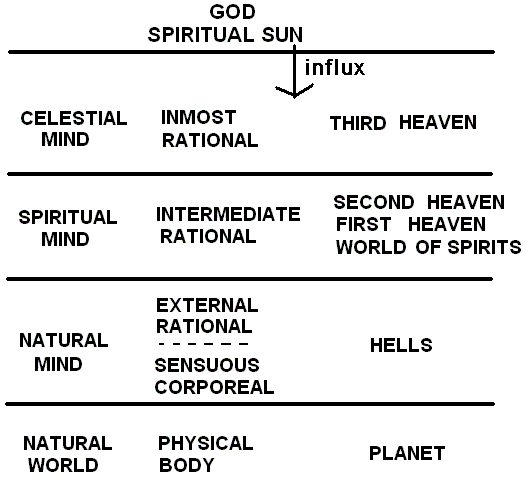
First read the left hand column up and down. You can see here a schematic representation of the anatomical and functional levels of our mental organs. They are arranged in a vertical order of levels and each level operates its own operations. The organic levels of the mind are created out of the substances of good and truth that stream out of the Spiritual Sun, as shown in the chart. These organic levels are created for each individual at birth. Note that the highest level is closest to the "influx" of good and truth from God through the substances of the Spiritual Sun. This level of our mind is called the celestial level, or the celestial organ, or the celestial heaven or Third Heaven. At this level of reception of influx we are closest in character to God who is the One and Only and Original Divine Human (see Section xx). We are "human" only in the sense that we are in the "image and likeness" of God the only true Human. This is the Divine Human or universal God, creator and manager of all things in existence.
What is human?
As the chart above shows, the highest form of being human is the celestial organ of the mind which is capable of receiving good and truth from God with the least amount of distortion possible. So to be human means to be able to receive good and truth from God without distortion.
According to this definition it is clear that only the highest level of our mind is truly human. The chart describes the celestial mental state as the "inmost rational" and Third Heaven in our mind. In other words, we begin our true humanity only when we are truly rational, which is the celestial state. All the levels below the celestial functioning are not yet fully human but necessary preparatory steps on the way to becoming fully human.
You might want to print the chart so you can have it in front of you as you read this -- select the chart, copy it, paste it into a word processor, print it, or else have it show in another browser window so you can go back and forth. As the chart shows the next level lower is called the "spiritual mind" or Second Heaven. This is characterized as the "intermediate rational" because it fulfills the function of being an intermediary connector to the "inmost rational" (above itself) and the "external rational" (below itself). Our conscious awareness in everyday life activities, like you reading this now and figuring out its meaning, is called the "natural mind" which consists of three organic sub-zones called (1) the external rational mind; (2) the sensuous corporeal mind; (3) the hells.
Other anatomical charts (see Section xx) give you the details of the organs at each level. Briefly, you should remember that each level of the mind consists of three distinct organs or functional systems of operation called the affective organ, the cognitive organ and the sensorimotor organ (see Section xx). Consider for instance the operations of the external rational mind that you are familiar with on a daily basis. When you are thinking about organizing a schedule for some project you want to do, you are using rational methods of thinking to select among alternatives available to you. These sequences of thoughts called "cognitive planning operations" take place in the cognitive organ under the guidance of the affective organ. Your mind is active at the external rational level of operation. Note from the chart what makes it possible for you to perform cognitive planning operations in the natural mind.
What do you see?
Each level of operation of the mental body organs are determined by the operations going on at the immediate level above itself. This psychobiological principle of the mental organs is known to some extent to psychologists interested in control mechanisms for constructing artificial intelligence machines. Control mechanisms are arranged in vertical levels so that what is higher controls what is lower. This is familiar to you in external physical organizations in the natural world -- the lowest level of the chart. The natural world is mostly physical in time-space, but some of its elements that border the natural mind are of seemingly intermediary composition. According to Swedenborg's scientific studies there are elements or essences of "nature in their purest form" that make up the composition of the inmost portion of each neuron in the brain (see Section xx). Swedenborg called each neuron a "brain in miniscule" and asserted that its interior composition gets more and more complex as you look into smaller and smaller portions of it. The inert chemical elements are formed into a super-thin material that is so sensitive and carries so much information that the sensorimotor organ of our corporeal mind can react to it by pure mental correspondence (see chart).
So to understand how our immortal mental self is built up from experiences through our physical body, consider the entire chain process. When we are born we possess all four levels of functioning shown on the chart. Now consider what happens when you are doing something, like eating and thinking about your plans. The food and the hand that takes it to your mouth and the taste buds are all physical matter in time-space that evoke automatic built in sensations in your brain and in each neuron of your brain, and the inmost of each neuron. This is not yet your mind for no human sensations are involved. But now, the corporeal zone of the natural mind reacts to what is happening in the inmost of each neuron. This reaction is purely mental and is called experiencing a sensation. Sensing is a mental operation if it refers to human sensations of experience, rather than brain reactions to sensory input. Brain reactions to input from the sensory organs is not mental. This is not the sensation.
The sensation begins only at the instant the sensorimotor organ reacts to the activity in the neuron.
All incoming information from the physical neuron is recorded in the sensuous-corporeal mind. Nothing ever can get lost through this process. Every single sensation, feeling, thought, or imagery is permanently recorded in our sensuous-corporeal mind (see Section xx). Now with all this activity going on in the lower zones of the natural mind, the external-rational mind reacts to it. You experience this reaction by monitoring your thoughts and feelings. If your brain neurons react to a signal from the ear when exposed to a sound, you may stop what you are doing and monitor the sound trying to figure out what it was. You are consciously aware of the sensation of the sound in your natural mind and your rational operations process the meaning of the sensation or sound.
So now you can see that unless your natural-rational mind were operating, you could not hear a sound. It could be a meaningful sound or a new and puzzling sound. In either case it is the rational processing that is needed to be going on in order to attach meaning to the sound ("It's a car coming." or, "It can't be. Sounds like a loose lion in the street." etc.). But now your external-rational mind would not be able to think these thoughts were it not for the spiritual mind right above, controlled the syntax of thinking so that it remains rational and does not become illogical. The spiritual mind operates at the level of "intermediate rational" which is built to function by receiving truth or rationality from the celestial mind. So it is the celestial mind that must be involved if we are going to be able to give meaning to that sound in a rational way.
And finally about this chart, look at the hells. They are located in the natural mind that we inherit from our parents in a long line of cumulative inheritance of mental traits (see Section xx). This portion of the mind is separated in a distinct zone of its own in the natural mind. This organ belongs to the affective system and is hooked into the vertical community in the world of spirits (see Section xx). From this organ we experience the impulse to pervert the good into something selfish and irrational. These impulses connect us to the hells of the human race that are situated in the natural mind of every individual born on this earth. These irrational thoughts and perverted feelings are not human. They are sub-human or perverted-human or monster-human. The rational thoughts and the non-perverted feelings are human or angelic (celestial).
So now you can understand heaven and hell in anatomical and psychobiological terms or logic. These are two organs of the human mind in the eternal mental world. The operations in the celestial organs of the mind create the experience and existence we call heaven, while the operations of the inherited sensuous-natural organs of the mind create the experience and existence we call hell. Does this mean that heaven and hell are in our mind? Yes, that is correct. Heaven and hell are mental operations of the opposite kind, like matter and anti-matter. Hence we have the absolute opposition between the evils and irrationalities in our hells and the goods and truths in our heavens. These are contradictory thoughts and feelings that annihilate each other, ending all existence and life -- were it not for the sole fact that God keeps the hells separate and isolated in our mind so that it cannot contaminate our heavens. Nothing from our hells can influence anything in our heavens because the heavens are far above the hells.
To eliminate or reduce the ills of individual and society, we need to eliminate the causes of ills – which are the moral iniquities we live when we go along with our inherited impulses. To neutralize and eliminate the impulses of the hells in our mind, the neurobiology of the mind requires a mental victory over the temptations brought to our awareness by the Divine Psychologist as a psycho-therapeutic opportunity of improving our character. This is possible for God to do the very instant that the person starts loving truths, which means, starts aligning acts, feelings, and thinking with these truths on a daily and hourly basis. The truths are always obtained from one source only, namely from the Divine Psychologist speaking to our rational mind when we are figuring out what Sacred Scripture is saying in its hidden correspondential sense (see Section xx). This is the essence of rational spirituality and rational faith (see Section xx).
The Divine Man during mental states of humiliation (see above), faced the entire hierarch of lusts and insanities that had accumulated in the mental world of the human race since almost the beginning, with the first person who willfully chose to contradict truth. After that, the population of occupants in the hells of the human mental world, rose with each cumulative generation. The evolution of the mental world in eternity comprises the steady increase in the population of both heaven and hell. Remember that every newborn person inherits he mental world of their parents, up the long chain of inheritance in the human race since the beginning. Every baby born today has a mental body living in the eternity of the human mental world. All human minds are interconnected (see Section xx).
There is therefore complete freedom for every individual to choose where they prefer to exist in the eternity of their mental world.
This freedom is the essence of being human and rational. Without it, we cease to be human, and we cease to have the capacity to be immortal in heavenly life and experience. Without this freedom we lose everything for which God created us. Hence it is that the primary rule that governs all other rules of reality is that nothing can happen or exist that takes away this freedom. God manages every detail of existence within the limits of this primary rule of order of creation and possibility. Hence it is that God allows individuals to contradict truth and pervert good (see above). God allows it by making it look like He is not present and not making it happen. For instance God's power activates the muscles we use to steal, deceive, or kill. God's rationality or truth activates the thinking process that is illogical and irrational, and leads a person to believe what is wrong or false. And similarly, God's power of good and love activates the feeling process that we call cruelty and shamelessness. Everything that happens in the heavens of our mind and in the hells, is activated by God through good and truth. But in the hells of our mind we use our freedom to invert and contradict the truth because it gives us justification to enjoy evil and thereby to harm others.
13.0.11.1.4 Contemporary Religious Expressions of the New Church
Contemporary life within the New Church intellectual community is exemplified by a selection of articles formulated from the perspective of the Writings of Swedenborg as Sacred Scripture.
Quoting from:
Teachings For a New Spiritual Day
www.baltimorenewchurch.org/index2.htm#MF
The Baltimore New Church
The reason God created the universe was to make spiritual free will possible, so the decision to go to heaven and relate to Him is meaningful. God could have loved Himself more perfectly than anyone outside Him could love Him. But self-love is the essence of aloneness, of evil. God, (,,,) Thus it is that everyone begins life in our physical universe, where there's no proof of God or spiritual reality (for proof by definition interferes with free will). [More about this: Creation: Why and How, Who is God?]
God allows people to do all the sad and terrible things they do since, again, you're not really free to choose good if you could not also have chosen evil. (...) [More about this: Divine Providence and Evil]
You go to heaven or hell of your own free will. You are the same person after death that you were in this world except that you can no longer hide your motives. Hypocrisy of any kind is impossible. If your motive in life was to do the best you could according to your principles, you will want to be with other people with the same motive - in heaven. If you basically love to have your own way and are hard on other people, you will want to go to hell. (...) [More about this: Heaven and Hell]
Dying is not an end but an awakening. Your spirit is already in the spiritual world, but you are not aware of it. At death you become conscious in that world as you lose consciousness in this one. You leave the body your spirit has been driving around in this world and take on a new spiritual body that's far more perfectly fit to the "real (spiritual) you" than your present body. (...) [More about this: The Death Process]
Life in heaven and hell are more real and vivid than life here. There are mountains and plains, trees and rivers, houses and towns, lovely in heaven, grim and ugly in hell (because that's how the inhabitants prefer it, in both cases). Men are men and women are women in every detail. [More about this: Heaven and Hell]
Men and women are spiritually different. In a true marriage, they are spiritually "in the image of God" as neither can be alone. Each is incomplete for each is only half of "man" - as in humankind. It is man, male plus female, that is the image of God-Man. (...) [More about this: Building a Spiritual Marriage]
Everyone in heaven is wonderfully happily and romantically married, even if they had not been married in this world. Death never parts a married pair who truly love each other, and those who have not found their true spiritual partner in this world will find him or her in the spiritual world since, again, everyone in heaven is married to eternity. [More about this: Marriage in Heaven, Building a Spiritual Marriage]
Heaven isn't happy due to endless parties, church services or vacations. Its secret for happiness is everybody being useful - a secret that applies in this world too. There are many aspects to life in heaven, but a central one is that everyone there is useful, because being able to be useful is fundamental to being happy. (...) [More on this: On Being Useful]
Children who die go directly to heaven, where loving angel parents raise them. The children grow up, as children do here, but in a far more wonderful place. They then meet the person they will marry in an almost fairy tale way, have a lovely wedding, and move on into eternity where all those who love them will meet them again someday. [More on this: Children in Heaven, and a gentle explanation of this topic for children]
The human race has grown up intellectually. So have God's explanations, up through, finally, the Second Coming. There have been several revelations over the history of the human race, each adapted to the states of people at the time when it was given. Each contained more truth than the previous one, just as fuller explanations are given to people as they grow from children to having the understanding of adults. (...) The Writings, in other words, claim to be, at last, the full "adult" revelation, providing more truth than anyone can absorb in a lifetime. They are thus the final revelation, in fact the Second Coming; (...) [More about this: The Revelation Process, The Second Coming: Revelation Grows up with the Human Race, The Word of God, Swedenborg and His Revelation: An Anthology]
The Bible is not just history but an enormous parable from God. Even its apparently trivial details contain symbolically important teachings. Seen in light of these inner meanings, the puzzling and apparently inconsistent statements of Scripture, its many apparently cruel and strange stories, miracles that apparently violate the laws of science, and its great amount of apparently trivial detail all take on a dramatically new aspect. (...) [More about this: Correspondences, The Word of God, How Miracles Worked, The Bible and the Writings]
Creation is a parable too, a living physical symbol of deeper spiritual realities. The complex and beautiful relationships of physical ecosystems are symbols of the even more complex and beautiful relationships of the spiritual ecosystem, which in turn is a parable of God. [More about this: Correspondences, Creation: Why and How]
There is only one God and only one Truth. That Truth has been revealed to mankind several times. (...) The Writings claim to be the revelation that "gets it all together," unifying all the Truth fragments and providing a fuller explanation of spiritual reality than has ever been given before.
As the teachings of Christ were given "not to destroy, but to fulfill" (Matt. 5:17) those of the Old Testament Sacred Scripture, so the Writings don't conflict with but "fulfill" - give new meaning and insight to - the Bible. [More about this: The Bible and the Writings, The Word of God] The Writings also relate the teachings of revelation to the discoveries of science. In the Writings'’ thousands of information-packed pages are found at last explanations of the single seamless web of law that governs all creation, from the spiritual to the physical. For instance, they explain how the Biblical miracles worked. [More about this: How Miracles Worked]
God is a human being, a Divine Human. What makes us human? Our mind, which is made up of our feelings and thoughts, our will and understanding. Where did we get that mind? From God, in whose image it is made (Gen. 1:27). God is Love Itself and Wisdom Itself. (...) [More about this: Who is God?]
God appeared in this world as Jesus Christ. To understand how this could be, it is useful to look at human beings, created in His image. (...) More about this: Who is God?]
God and eternity exist outside of time and there is no time (or space) in heaven. Time here in the physical world is only an appearance. It is difficult for our minds, which exist in the space and time of this world, to conceive of what it means to be outside of these characteristics of our reality. On the other hand, it makes it easier to understand how God can foresee the future since, to Him, the Writings teach, all time is now. [More about this: Time and Eternity]
True religion and science do not conflict. God created the universe with a single integrated set of spiritual and physical laws. (...)Integrating the truths of revelation and science, on the other hand, provides answers in areas ranging from "evolution" to the relation of the different planes, or "discrete degrees," of existence that we will never know otherwise. [More about this: Science and Religion, Creation: Why and How]
Religion is most fundamentally between you and God, in free will. We talk to God in prayer, and, the Writings say, He does answer us, though in a very quiet way. (...) [More about this: Conversation with God, The Lord's Prayer]
You don't have to belong to any church to get to heaven. On the other hand, you can't choose teachings that may help you on the road to heaven if you've never heard of those teachings. So God, Who always plays fair, provides revelation about the spiritual reality we could not discover on our own. True revelation is given by a process similar to what everyone experiences in the transition to spiritual awareness we call death. [More about this: The Revelation Process]
Your religion is your whole waking life. Religious study is useful, as is religious ritual. But it is the life-long collection of daily thought, decision and action that defines your basic motive in life (or what the Writings call "ruling love"), the one that will take you to heaven or to hell. In the words of the Writings, "All religion is of life, and the life of religion is to do good." (Doctrine of Life 1)
The human race, not God, invented evil and founded hell. (...) [More on this: Getting Rid of Evil]
God permits evil, but only evil that can produce good. As noted above, there must be evil for there to be free will. But God's Providence sees to it that no specific evil is allowed unless it can serve some good use. (...) [More about this: Divine Providence and Evil]
Are the Writings the
voice of God, or just Swedenborg? The Writings only ask that you read
them with an open mind and see. The
Writings are without precedent in religious history in terms of their
scope, sheer size (30 volumes), and both originality and plain
sensibleness of the answers they provide, in many cases to questions
that have puzzled people for centuries. Could a person, even one as
brilliant as Swedenborg, have written the Writings (especially when he
didn't even start work on them till he was 57 years old)? (...) More
on this:
Who was Emanuel
Swedenborg? |
The
Revelation Process |
Swedenborg
and His Revelation: An Anthology
See also:
Marriage in Heaven:
www.baltimorenewchurch.org/marr.htm
The Eternity of Marriage:
www.baltimorenewchurch.org/marr.htm
The State of Married Partners After Death:
www.baltimorenewchurch.org/cl2.htm
Building a Spiritual Marriage:
www.baltimorenewchurch.org/marriage/smint.htm
Divorce:
www.baltimorenewchurch.org/marriage/wdp74
Apparent Love in a Covenant for Life
(conjugial simulation"):
www.baltimorenewchurch.org/pc/rsj66.htm
13.0.11.2 The Nine Zones of the Ennead Matrix of Rational Spirituality in the New Church Mind
Quoting from the Writings Sacred Scripture:
TCR 775. The situation with the people who make up the church en masse or taken collectively is much the same as with the person by himself or taken individually. People en masse or taken collectively are a church of many members; and the person by himself or taken individually is the church in each of those many members. It is in accordance with Divine order that there should be general and particular levels, co-existing in any thing you like to mention, and the particular levels could not otherwise come into or continue in existence. In this way there could not be any particular part within the human body unless there were general layers surrounding it. Particular parts in the human body are the viscera and each part of them; the general layers are the coverings which envelop not only the whole body, but also each of the viscera and each part of them. It is much the same in every animal, bird and worm, as well as in every tree, shrub and seed. Nor can strings or wind instruments produce any sound, unless there were a very general level, from which the individual notes derive the general sound which allows them to be produced. It is also similar with all the bodily senses, such as sight, hearing, smell, taste, and touch; and with all the inward senses which exist in the mind.
[2] These illustrations have been given to make it known that in the church too there are general and particular levels, as well as the very general ones. It is also intended to show that this is why the four churches have succeeded in order. This succession gave rise to the most general level of the churches as a whole, and one after another the general and particular level of each. In the human body too there are two very general levels which give rise to the existence of all the other general and particular levels. The two most general items in the body are the heart and the lungs, those in the spirit, the will and the understanding. On these two sets of items depend all the details of a person's life generally and particularly; without them these would fall apart and die off. It would be much the same with the whole heaven of angels and with the whole human race, in fact, with the whole created world, if everything in general, and the details in particular, were not dependent upon God, His love and His wisdom. (TCR 775)
The passage above, and others dealing with this same topic, reveal one of the most amazing concepts of scientific dualism, or True Science. I searched for a word in the dictionary that might be allied to this concept and found the word “synecdoche” which is defined as “the rhetorical or metaphorical substitution of a part for the whole, or vice versa.” The general is what belongs to the whole, while the particular belongs to the part. The general, or what belongs to the whole, must also belong to the particular, or what belongs to the part – and vice versa. Note that the concept of synecdoche is considered by the dictionary a “rhetorical” or “metaphorical” device, which means that it is not to be taken literally or physically. This shows that there is not yet a conscious awareness of phase 3 thinking, as in the Writings, where it is revealed that that general-particular, or whole-part, relationship is also actual and real, being a spiritual law governing all objects in both the natural and spiritual worlds.
This spiritual law can be stated in several interlocking rational ideas that only come into our understanding in phase 3 thinking – see how many you already thought of, and how many you can agree with:
the end is contained in the beginning part, and in every following part
the smallest part of a whole, contains the whole
the highest is contained within the lowest
the internal is contained within the external
uncreate non-material substances form the foundation structure for material things -- mass, motion, space, time
natural history recapitulates spiritual history because the two are synchronously tied by creation
individual biography recapitulates spiritual history because from the same source
the infinite is within the finite, not the other way round
This does not exhaust the series. For now, you can see that smaller cycles of development would recapitulate larger cycles. In the case of religious behavior, the three phases of the entire developmental scale, namely, Moses-Paul-Swedenborg, repeat themselves within each phase, cyclically. Further cyclical patterns no doubt occur, and will be discovered by future researchers in True Science. Here is a matrix that shows the recursive property of phases within phases. Since there are 3 phases, laying them against each other creates a ennead or matrix of nine cells. These type of matrices place levels or developmental steps on the vertical dimension, starting with the bottom level first, then ascending in steps to the top. The horizontal dimension is laid out from left to right and indicate three steps of internalization (initial, intermediate, mature). I have numbered the cells accordingly.
ENNEAD MATRIXOF RATIONAL SPIRITUALITY (9 zones of development) |
Old Testament |
New Testament |
Third
Testament |
|
Swedenborg Phase 3 (celestial mind) |
7 |
8 |
9 |
|
Paul Phase 2 (spiritual mind) |
4 |
5 |
6 |
|
Moses Phase 1 (natural mind) |
1 |
2 |
3 |
I have discovered in three decades of research that this type of ennead matrix appears over and over again when you try to describe organic mental structures. For additional explanations with diagrams, consult the articles listed just below. When I first started reading the Writings two decades ago I immediately noticed the ennead matrix is a universal spiritual structure, so I called it the “genes of consciousness.” I tried to put many of these ennead structures together and it seemed to me that our talk and discourse is organized on this fundamental spiritual structure. Future research in True Science will reveal the many amazing properties of this structure. I noticed that some of these appear in the literal meaning of the Writings, but many are underlying or hidden, and need to be extracted scientifically through the method of correspondences as outlined in the Writings which gives detail rules on how to extract knowledge from the Letter of the Threefold Sacred Scripture. The laws of spiritual-natural correspondences can be discovered from the Writings, and confirmed from the Bible, from children stories and fables, from our everyday linguistic expressions, and from inventive creations which we are inspired to do, notice, or perform.
But applying the correspondences mechanically does not yield spiritual meaning – try it and you’ll be convinced. We also need to be enlightened by the Lord synchronously to applying the knowledge of correspondences. This protects every individual and researcher from profaning holy things and thereby suffer irreparable damage to their spirit. Therefore no one can understand or perceive anything spiritual unless at the same time enlightened by the Lord. The Lord enlightens all who seek truth for the sake of being good, and further, acknowledge that all good is from God. Illustration is another word used for enlightenment. The laws of illustration are empirical and experiential. They relate to the level of access to spiritual perception or understanding. Every spiritual idea that is part of a greater idea, contains the entire idea within itself. This law insures that we can begin anywhere and arrive at the truth as long as we locomote inward, which is upward. The Laws of Divine Providence operate the level of height, or inwardness, of the illustration we are given at any moment.
As you look at the above ennead matrix you can see its horizontal and vertical orientations. The ennead structure is composed of parts that contain its entirety. Each zone or zone contains all nine cells, and each of those contain them, and so on, recursively as it cycles from part to whole, from within to without. Another was of saying this is that all developmental steps are contained in each step. This means that the past and the future and contained in the present. Note carefully that the ennead relationship of developmental laws are functional relationships, not substantive identities. In other words, every level and state is isolated from every other level and state by discrete degrees of creation. Every object is created into three discrete degrees simultaneously. This is why all of the future, which is called “the end” (or ultimate goal), is contained within the present, but this containing is of discrete degrees, not continuous contact. It is impossible to reach the next higher level of mental state by keeping on improving at the prior level or state of mind. It’s not like a physical destination where you keep on getting closer to it and at last, you’re there. You can see this if you’re on an island and your destination is the mainland. No matter how long you keep on walking you can never get to the mainland. You need a different level of transportation, like a boat or air carrier. In spiritual development it is the same law operating. No matter how much you improve in one direction or at one level of thinking and feeling, you cannot break into the next level. Instead, a discrete jump is necessary.
How do you jump from phase 1 thinking to phase 2 thinking? If you’ve been socialized into the culture of sectarianism, fundamentalism, and literalism, you oppose, resist, and despise the ideas of personalism and universalism, which is phase 2 thinking and feeling. An explanation for this still needs to be presented here, I admit, and I will. It will help if you continue noting some additional properties of the ennead matrix. Note in the matrix that phase 1 (“Moses” phase) has three states to be matured – cells 1, 2, and 3. These three states are discretely separate from each other, so it will require a jump to go from one to the next. Note also that zone or zone 1 is Phase 1 based on the Old Testament Sacred Scripture portion of the Threefold Sacred Scripture. Similarly, zone 2 is Phase 1 based on the New Testament portion of the Threefold Sacred Scripture. Finally, zone 3 is Phase 1 based on the Third Testament portion of the Threefold Sacred Scripture. It is evident from this that phase 1 thinking undergoes three discrete steps of change or spiritual ascension. Again, phase 2 thinking undergoes the same prior three discrete states, but this time at a higher level of the Threefold Sacred Scripture.
Remember that the Threefold Sacred Scripture contains all discrete levels, but at different depths of availability. Finally, when we reach phase three thinking (cells 7, 8, 9), we still need to undergo the three developmental states based on the Threefold Sacred Scripture. When we reach zone 9, we are ready to depart from this earth since zone 9 is the mental state we need to exist in heaven. Once ready, there is no need for us to stay around here, and the Lord performs the transfer called resuscitation. Isn’t it wonderful that True Science has now given us a spiritual map of our regeneration so that we may consciously follow the road to heaven, which is the Lord’s goal or end for every soul. Once we’ve been brought into the state of zone 9, our creation is complete and the Lord can then keep us continually in youthful maturity, wisdom, and love forever and ever. Now that we have the map, all we need is to compel ourselves to follow it. The Lord supplies the power for our every choice and sub-goal along the way.
Here is another way of diagramming the ennead structure (also shown above):
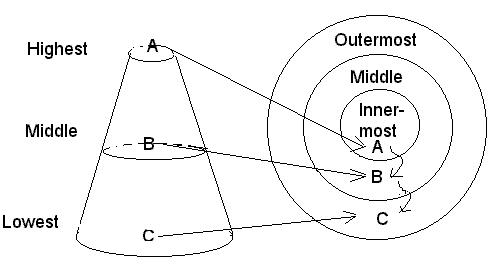
I base this diagram directly on the explanations of “discrete degrees,” including the contrast “simultaneous” vs. “discrete” degrees. The vertical dimension, like the ennead matrix, represents developmental steps, which are called “successive degrees” because level 2 succeeds level 1 in development. What’s especially notable is that developmental steps are from creation, from necessity, and they represent or replicate the steps of creation. Every galaxy, planet, rock, tree, animal’s organ, house, computer chip, or jacket, etc., is created, or comes into existence, by successive discrete steps called “degrees.” The steps proceed from the Spiritual Sun which descends and externalizes along each successive step in order.
First, the highest, which is the inmost, which is the closest to the Spiritual Sun amidst of which the Lord appears to the angels. Second, the middle or intermediate level, which is the level of thinking and feeling of the angelic spirits in our mind. And third, the lowest most externalized or outermost, which is the level of good spirits in our mind. This is the natural level of the mind and of all things in the natural world. Once the ultimate is reached, the goal is reached, and creation is complete. Now for the object or state to persist, to continue existing or subsisting, the successive process now ended is replaced by the simultaneous process which refers to the maintenance in existence of each level. The Lord does this for every object or state. Creation doesn’t just begin and end, after which things run on their own (phase 1 and 2 thinking). Rather, creation continues ceaselessly, because existence is perpetual subsistence. In other words, to keep on existing, an object or state must be re-created by the Lord continuously, or else it falls apart and disintegrates out of existence. Look at the diagram above and see if this important idea can gain a foothold in your mind!
See the following related articles:
www.soc.hawaii.edu/leonj/leonj/leonpsy/instructor/gloss/ennead.html (ennead matrix)
www.soc.hawaii.edu/leonj/leonj/leonpsy/instructor/gloss/harmonizing3.htm (genes of culture
www.soc.hawaii.edu/leonj/leonj/leonpsy/instructor/gloss/correspondences.html (spiritual-natural correspondences)
www.soc.hawaii.edu/leonj/leonj/leonpsy/instructor/gloss/dhl.html (De Hemelsche Leer article)
www.soc.hawaii.edu/leonj/leonj/leonpsy/instructor/marriage/table1.html (Mental Health and Personality)
www.soc.hawaii.edu/leonj/499ss99/man/citizenship.html (dual citizenship)
zzz
See also Section 15.0 and Section 11.7.
Theistic psychology throws a new rational light on the religious idea of inherited sin. This idea has been revealed through the literal meaning of the Old and New Testament Sacred Scriptures, and now, through the Writings of Swedenborg.
MAN IS BORN [WITH AN INCLINATION] TO EVILS OF EVERY KIND; AND UNLESS HE TO SOME EXTENT REMOVES HIS EVILS BY REPENTANCE, HE REMAINS IN THEM; AND HE WHO REMAINS IN EVILS, CANNOT BE SAVED.
That every man is born [with an inclination] to evils, so that he is nothing but evil from his mother's womb, is well known in the church; and it has become known because it has been handed down by the councils and leaders of the churches, that the sin of Adam was transmitted to all his posterity; and that for this sin alone every man after him has been damned along with him; and that it is this sin that is inherent in every man by birth.
On this assertion, moreover, other things taught by the churches are based, as that the washing of regeneration, which is called baptism, was instituted by the Divine-Human in order that this sin might be removed; that this was the reason for the Divine-Human's coming; and that faith in His merit is the means whereby it is removed, besides other doctrines which have been based by the churches upon this assertion.
But that there is no inherited evil from that origin can be seen from what has been shown above (n. 466, seq.), that Adam was not the first man, but that the story of Adam and his wife representatively describes the first church on this earth -the garden of Eden its wisdom, the tree of life its looking to the Divine-Human who was to come, and the tree of the knowledge of good and evil its looking to self and not to the Divine-Human. That this church is what is representatively described by the first chapters of Genesis has been clearly proven by many parallel passages from the Word in the Arcana Coelestia, published at London.
When these things are understood and accepted the opinion heretofore entertained that the evil innate in man from his parents is from that source falls to the ground, for that evil has a different origin. In the chapter on Freedom of Choice it has been fully shown that the tree of life and the tree of the knowledge of good and evil are in every man, and that they are said to be located in a garden to signify man's freedom of choice to turn to the Divine-Human or to turn away from Him. (TCR 520)
In other words the religious or doctrinal beliefs that have been adduced from the literal language of the Old Testament Sacred Scripture is not compatible with scientific revelations contained in Sacred Scripture. When Divine revelation is understood spiritually it never contradicts what is known from natural science independently
Swedenborg appeals to what is commonly known about the inheritance of family traits, the differentiation of species, and the varieties of plants. Family traits are inherited by one's parents in a natural way and not by a spiritual curse initiated by the sin of Adam.
Since the churches in the Christian world, both the Roman Catholic Church and those separated from it, which are named after their leaders, Luther, Melancthon, and Calvin, derive all sin from Adam and his transgression, it is permissible to subjoin here something about the sources whence sins are inherited; for these sources are as many as there are fathers and mothers in the world.
That inclinations, aptitudes, and propensities to evils are derived from these, is manifest in light from the testimonies of experience, and also from the assent of reason. Who does not know, from the collective suffrages of experience, that there is a general likeness of minds, and hence of manners and countenances, from parents in the children and children's children, even to a certain posterity? Who cannot thence infer that original sins are from them? The notion suggested to everyone, when he looks at the countenances and manners of brothers and relatives in families, causes him to know and acknowledge this.
[2] What reason, then, is there for deducing the origin of all evils from Adam and his seed? Is there not equal reason for deducing it from parents? Does not the seed of these similarly propagate itself? To deduce from Adam's seed alone the allurements from which and according to which the spiritual forms of the minds of all men in the universe exist, would be like deriving birds of every wing from one egg, also beasts of every nature from one seed, and trees of every kind of fruit from one root.
Is there not an infinite variety of men? one like a sheep, another like a wolf? one like a kid, another like a panther? one like a tamed carriage horse before a carriage, another like an untamable wild ass before it? one like a playful calf, another like a voracious tiger? and so on. Whence has each his peculiar disposition but from his father and his mother? Why then from Adam? by whom nevertheless is described in a representative type the first church of this earth, as has been already shown? Would not this be like deriving from one stock deeply hidden in the earth a plantation of trees of every kind and use, and from a single plant shrubs of every degree of value?
Would that not also be like deriving light from the darkness of the ages and of histories, and like unraveling the thread of a knot that cannot he untied? Why not rather from Noah, "who walked with God" (Gen. 6:9), and "whom God blessed" (Gen. 9:1), and from whom alone, surviving with his three children, "the whole earth was overspread"? (Gen. 9:19.) Would not the hereditary qualities of the generations from Adam be extirpated, as if drowned by a flood?
(...) Who does not know, or may not know, that a man must be regenerated by the Divine-Human, that is, created anew, and that so far as this is effected so far he is in goods? Hence this follows: that so far as a man is unwilling to be generated anew or created anew, so far he takes up and retains the evils implanted in him from his parents... (Coronis 35)
This passage indicates that we are to make a rational distinction between the idea of "inherited evil" and "inherited sin." Sin itself is not inherited because every human being is responsible for their own sins. It would not be a just world if we were to inherit and be held accountable for the sins of our parents and forefathers. Everyone must pay for their own sins and not the sins of others, just like a parent cannot be held legally responsible for the crimes of their adult children. If this is seen as unjust in natural life, it is even less to be expected that God would attribute sins to people in an unjust manner.
But evil traits are inherited from one's parents. This is a natural fact.
Everyone inherits mental traits from their parents. Some traits are heavenly and some are hellish (see Chapter 12). Hence we inherit both types of traits. We cannot enter heaven on the basis of what we inherit, since this would be favoritism or "pre-destination," an idea described by the Writings as abominable and contrary to God's Love and Justice. Nor can we enter hell by inheritance, as is supposed by the religious idea of Adam's original sin that infects the entire human race, for this would be injustice. Instead, we inherit traits which we then make our own by practice and acceptance. If we practice the heavenly traits we inherit, we prepare our mind for heavenly life, and if we practice the hellish traits we inherit, we prepare ourselves for life in hell. It is the appropriation of traits by our own loves that makes them our own responsibility.
If we do not fight against the evil traits we've inherited, we "die" in them, which means that we are going to be unwilling to choose life in heaven. In this sense, sin is "deadly" for it is the appropriation of evil as one's own by means of love and habitual practice.
Can sins be forgiven once appropriated?
Remember that what is appropriated is the evil tendency which we build into a habit by engaging in evil behavior. When we arrive into the other life with such a character filled with evil habits, we cannot get rid of them by a Divine act of Mercy. The Writings reveal that God is pure Mercy and desires to forgive everyone no matter what, and in fact, God does forgive everyone. Nevertheless this Mercy and forgiveness cannot compel the unwilling person to give up the evil habits. Isn't this amazing?
And yet it makes rational sense when we consider that God is unwilling to compel anyone to be good for this would remove any humanity from people. God could use Divine omnipotence to remove the evil habits and to compel the person to receive the influx of good and truth. But God is unwilling to do this for this would injure the humanity of the person. The person would become a heavenly robot, not a human being. Such an angel-robot is not capable of being happy, only of obeying the influx. While this would produce many angel-robots it would not produce any human beings.
Therefore it is that God does not and cannot remove evil habits once these are brought into the world of spirits at the death of the physical body. This is why it is so crucial that people understand this process scientifically and not rely on the subjective idea of God's Compassion and Mercy.
The Christian religion was established by the Incarnated God-Man known in history as Jesus Christ. This religion was originally based on rational-scientific ideas that are visible both in the literal meaning of the New Testament Sacred Scripture and in its coded correspondential meaning. But it took only a few years for the original message to be changed into a form that was contrary to the its rational basis. Much of the rationale for this modification has been fabricated by Paul in his Epistles, which was that salvation of the human race was achieved by the religious sacrifice of the Son of God. In the Jewish religion to which Paul belonged, animal sacrifices were believed to wipe off the sins of the people, or the specific individuals who offer the sacrifice. The belief in the removal of sins by animal sacrifice was a common practice in many ancient religions, including the Jewish, and so this was an accepted idea that Paul was able to apply to the sacrifice of the Messiah on the cross of crucifixion.
The sacrifice of the Messiah to come for the salvation of the Jews was an idea that can be extracted from various passages in the Old Testament Sacred Scripture. Hence it is possible that Paul actually believed that forgiveness of sins can be obtained vicariously by the sacrifice of someone else, especially someone like the Messiah, who was held to be sinless, and so described in the Old Testament Sacred Scripture. The sinless Messiah was represented by the red cow to be sacrificed who was to be physically perfect and without blemishes. Quoting from the Writings of Swedenborg:
The law is frequently mentioned in the Word. I must state what the law means in the strict sense, what in a wider sense, and what in the widest sense. In the strict sense the law means the Ten Commandments; in a wider sense the rules given by Moses to the Children of Israel, and in the widest sense the whole Word.
It is well known that the law in the strict sense means the Ten Commandments. The law in a wider sense means the rules given by Moses to the Children of Israel, as is evident from the individual rules in Leviticus each being called a law:
This is the law of the sacrifice. Lev. 7:1.
This is the law of the sacrifice for making one's peace. Lev. 7:7, 11.
This is the law of the grain-offering. Lev. 6:14ff
This is the law of the burnt-offering, the grain-offering, the sin-sacrifice and the guilt-sacrifice, and the completions. Lev. 7:37.
This is the law of beast and bird. Lev. 11:46, 47.
This is the law of the woman who gives birth to a son or a daughter. Lev. 12:7.
This is the law of leprosy. Lev. 13:59; 14:2, 32, 54, 57
This is the law of the person with a discharge. Lev. 15:32.
This is the law of jealousy. Num. 5:29, 30.
This is the law of the Nazirite. Num. 6:13, 21.
This is the law of cleansing. Num. 19:14.
This is the law concerning the red cow. Num. 19:2.
The law for the king. Deut. 17:15-19.In fact the whole book of Moses is called the law (Deut. 31:9, 11, 12, 26; also in the New Testament Sacred Scripture, as Luke 2:22; 24:44; John 1:45; 7:22, 23; 8:5; and elsewhere).
[2] The context plainly shows that these rules were what Paul meant by 'the deeds prescribed by the law', when he says that man is justified by faith without the deeds prescribed by the law (Rom. 3:28). The same is shown by his words to Peter, whom he criticized for behaving like the Jews, when he says three times in one verse that no one is justified by the deeds prescribed by the law (Gal. 2:14, 16).
The law in its widest sense means the whole of the Word, as is plain from these passages:
Jesus said, Is it not written in your law, you are gods? John 10:34.
This is said in Ps. 82:6.
The crowd answered, We have heard from the law that the Christ remains for ever. John 12:34.
This is said in Ps. 89:29; Ps. 110:4; Dan. 7:14.
That the word should be fulfilled which is written in their law, They hated me without cause. John
This is said in Ps. 35:19.
The Pharisees said, Have any of the princes believed in him? But the crowd which does not know the law.... John 7:48, 49.
It is easier for heaven and earth to pass away, than for one dot of the law to fall out. Luke 16:17.
The law in these passages means the whole of Holy Scripture; and there are a thousand further passages in the Psalms of David. (TCR 288)
It was a natural transition of the thinking of the Jews whereby they saw the Messiah as a sacrifice of the innocent which would placate God the Father, alienated from the human race because of their sins inherited from Adam's original sin. God hates sins and therefore, according to this way of thinking, God had to be placated by the supreme sacrifice of His Son on the Cross of Calvary. Once this sacrifice was made, God could look upon the human race "an no longer remember their sins." Today, Christians declare as their faith that anyone can be saved as long as they acknowledge Jesus as Divine-Human and that He died on the Cross for them.
This belief system of salvation by vicarious sacrifice is strongly ingrained in Christians today as is shown by the reception of the public of the Mel Gibson movie The Passion, released in 2004. It has broken attendance records for all previous movies and it has been the subject of every news and talk show on TV and radio. The Christian clergy, from the Evangelists all the way to the Protestant bishops and the Catholic Pope in Rome, have been unanimous in acclaiming the movie as veridical and inspiring, and have recommended their flock to go see it by the tens of millions in the United States alone. The Mexican government has banned children from seeing the movie on account of its violence. The movie covers only the last few hours of Jesus and graphically depicts the brutal torture to which it is believed that the Roman soldiers subjected Him. The attitude has been frequently expressed that by identifying with the enormousness of the suffering of Jesus, one would be more inclined to acknowledge God and to renew and strengthen one's feelings for religion.
It is likely that the majority of Christians who think this way are sincere in their attitude. But in the context of religious psychology we need to ask an objective and scientific question about this attitude or belief system. Is it rational or mystical? Many Christians talk about the "mysteries of faith" and believe in the "healing power of the Blood of Christ" by which God the Father forgives their sins and saves them for heaven, if only they believe this with a strong faith. The saving power of physical blood shed by Jesus is a mystical idea that has no rational justification or explanation. It encourages the idea that God is incomprehensible, or that the mysteries that cannot be understood today, will be understood at the time of the return of Jesus to earth and all who died in the acknowledgment of the sacrifice of Jesus, will be resurrected from their graves and begin a new life on earth that will be like a paradise.
While these beliefs are sincere, they represent the tradition of worship and atonement by animal sacrifices, and sometimes, by human sacrifices by which an "angry" God could be placated. This is believed by many despite the fact that Jesus stated that the old dispensation of the Jewish Church given through Moses has now ceased as the Divinely sanctioned means for atonement of sins for the descendants of the children of Jacob. Forgiveness of sins through performing sacrifices was no longer Divinely sanctioned or effective. A new method was now created by God, and announced by Jesus, the Son of God. From now on every person had to be "reborn." The New Testament Sacred Scripture gives many details about what this means. It was a difficult concept at the dawn of the rational age (Greek and Hebrew civilizations).
In those early days of the new human rational mind people still believed that heaven is an external place and that to get there you need to be very strict and careful about following religious laws every minute of the day. It was thought that by doing this one was able to gain "merit" in the eyes of God, and thus receive holiness above that of others. Jesus had to establish for them the reality of the mental world and elevate it far above the physical. He taught them that heaven "is inside you" and that thinking evil was even more serious a sin then doing it. He also explained to them that in order for them to be with Him, He must remove Himself physically from them. He will continue His reality and Presence with them, from within, that is mentally. His mental presence with them He called "My Spirit" and the "Holy Spirit."
They had difficulty understanding this fully. As they saw Him ascend to heaven, they only saw His physical Natural Body rising in the physical sky and disappearing way high. They did not immediately see that His disappearing meant His real reappearing within their mind. They could have figured this out because He had told them (1) that heaven is within you, and (2) that He was ascending to heaven. And within the mind, the Divine-Human is now present in every individual in the universe. This is now the new method of salvation for the Fallen human race.
The Divine-Human on earth, while growing up a Child and a Man, created the new mental pathways that are now opened for every individual to step through and thereby achieve "rebirth" or a heavenly character that can live in eternal conjugial bliss as an angel. This is salvation. God's Blood was indeed spilled on the Cross of Calvary, and this did indeed represent the sacrificial Lamb for the atonement of the people's sins. But it did not remove the necessity of rebirth by character reformation. If vicarious atonement by the Blood of Christ were possible, would not God use it and bring everyone to heaven? But you can see that some go to heaven and many go to hell. Faith in the saving power of the Blood of Christ still requires character reformation or rebirth. This activity produces a heavenly character that can live in heaven. This requires long term daily effort and victory in many temptations of different kinds, that the Divine-Human brings to the individual who has acquired knowledge of Him through Sacred Scripture. (See Chapter 7).
Today in the modern age of science and rationality it is easier to understand that the mental world of every individual contains the same objective spiritual world and that it is in this spiritual reality that we live in eternity. This is what Jesus taught by saying that heaven is within you and that the inner mental reality is more real than the outward natural world. It stands to reason therefore that "rebirth" or regeneration of character, must take place here in this world. This is salvation--acquiring for yourself a heavenly character, that is, a character that can exist in the heavenly spheres of eternal life. Swedenborg observed many Christians who, immediately after being resuscitated, asked that they be admitted to heaven. They were. But it was not a heaven they could like or support or survive in. They discovered that in heaven none of their unregenerate personality habits could function.
They could not be proud of themselves; they could envy others; they could not feel resentment; they were unable to be deceitful, to say one thing and thin another; they were unable to hide anything; they were unable to feel anger, or think lecherous thoughts, and so on. They felt that all their life was leaving them. They had no loves left and without loves we do not feel alive, let alone happy. And so they quickly left heaven and sought others with a states of mind similar to their own. Would God not have kept them in heaven? He is pure Divine Love and cannot feel the desire to punish or keep a human being from their love. But it is against the rational order to live in heaven without heavenly traits--self-effacing, compassionate, honest, truthful, industrious, obedient, rational, wise, decent, loving truth, innocence, and conjugial loyalty and exclusivity. Unless we acquire these heavenly traits here on earth, through daily struggles against temptations, we cannot arrive in the other world with a mind that is capable of being happy in heaven.
This is the message of Jesus that many have forgotten today. A reliance on being saved by vicarious sacrifice of the innocent and blameless Lamb of God, contributes to the difficulty of regeneration and character reformation. The motive and determination to put up the daily and hourly effort and struggle (to carry the Cross), is weakened when we can enter heaven anyway, as long as we have blind faith in the saving power of the Blood of Christ. Religious psychology and theistic psychology can help people understand rationally what it takes to live in heaven and therefore what we must do every day to acquire a character that can exist in heaven (see Section xx).
Here is what the Writings Sacred Scripture reveal about the subject of sacrifices in Old Testament days. This explanation is given in connection with the verse by verse explication of the Books of Genesis and Exodus in the Old Testament Sacred Scripture. Swedenborg painstakingly goes through every word, gives its hidden correspondential spiritual meaning, and puts the pieces together into a science of human development as revealed by the infinite knowledge extractable from Divine Speech (see Section xx). The following passage analyzes one verse in the dramatic episode regarding the Sacrificial Binding of Isaac by his father Abraham. This passage reveals each different mental state that corresponds to the species of the animals that were commanded for use in worship sacrifices. Note that these correspondences are not poetic or figurative or personal to Swedenborg, as Emerson misunderstood when he read about correspondences in Arcana Coelestia. Emerson rejected many of Swedenborg's correspondences and substituted his own, that he preferred in terms of his secular belief system about human intelligence and nature.
But correspondences are absolute fixed laws that govern the functional cause-effect relationships of every phenomenon in the universe (see Section xx). Because Swedenborg was consciously aware in both the physical world in time and the mental world of the afterlife, he was able to determine empirically what correspondences were. He was able to observe what animals were visually present when people in eternity discussed some topic together. For instance, whenever they were discussing religious topics horses could be seen all around, and the type and appearance of each horse depended on what specifically was being said about a religious subject (see Section xx). Or, a group of people together would be seen surrounded by dark clouds in the air and scorpions and poisonous snakes on the ground. When Swedenborg listened to what they were saying, he determined that they were plotting injury against others, and that their surrounding appearance were the things that corresponded to the evil thoughts and feelings they were having. When people expressed good thoughts and feelings, the surrounding environment was filled with pleasant things like flowers with nice scents, and peaceful and useful animals like sheep and butterflies (see Section xx).
Emerson missed the central point about correspondences in the Old Testament Sacred Scripture, namely, that they are not figurative or poetic but real and actual. Swedenborg's dual consciousness allowed him to observe what animals appear in the other world and he observed the relation between the thoughts and feelings of the people there and the animals that appeared around them. In general, hellish feelings and thoughts bring around fierce, dangerous, and destructive animals, while heavenly feelings and thoughts produce gentle, harmless, and useful animals. Correspondences are not poetic or figurative interpretations, they are scientific determinations by which mental or spiritual events instantiate natural appearances like animals, mountains, lakes, palaces, caverns, darkness, light, fruits, stones, etc. etc. Specific kinds of animals were commanded for specific occasions for sacrifices and the cooccurrence was always determined by the scientific laws of correspondences by which natural appearances are instantiated by mental operations.
The prophets of the Old Testament Sacred Scripture and the Apostles John and Paul in the New Testament Sacred Scripture, were all witnesses of heavenly scenes they were able to see when their spiritual mind was made consciously operational for a brief time, sometimes during sleep, sometimes when awake. They were then able to write down the visions they were given to see and hear. All this is explained in the passage below and similar passages throughout the Writings Sacred Scripture.
And thou shalt take one ram [Exodus 29:15]. That this signifies the good of innocence in the internal man, is evident from the signification of a "ram," as being the good of innocence and of charity in the internal man (of which in what follows). As in this chapter the sacrifices and burnt-offerings of rams and of lambs are treated of, it must be told what was signified by the animals in general that were offered in the sacrifices and burnt-offerings.
These animals were oxen, bullocks, he-goats, rams, she-goats, and he-kids; also he-lambs, she-lambs, and she-kids. One who does not know what these animals signify, cannot possibly know what is specifically signified by the sacrifices and burnt-offerings of them. Be it known that all animals on the earth signify such things as are in man, which in general bear relation to the affections of his will and the thoughts of his understanding, thus to goods and truths, for goods are of the will, and truths are of the understanding. And as they bear relation to goods and truths, they also bear relation to love and faith, for all things of love are called goods, and all things of faith are called truths.
[2] That animals of different kinds have such a signification has its cause in the representatives in the other life; for in that life there appear animals of many genera and innumerable species. Such animals there are appearances to the very life, corresponding to the affections and thoughts that exist with the spirits and angels. That this is so can be seen also from the prophetic visions in the Word throughout; for all things seen by the prophets are such as appear before the angels in heaven.
From this it is that beasts are so frequently mentioned in the Word, and by everyone of them is signified something that bears relation to such things as are in man (of which above). Neither is man anything but an animal in respect to his external man, but he is distinguished from animals by the internal man, whereby both the internal and the external man can be elevated toward heaven and to God, and thence receive faith and love. From this it is that beasts were employed in the sacrifices and burnt-offerings. He who does not know this, cannot possibly know why it was commanded at one time to offer bullocks, rams, and he-lambs; at another time oxen, she-goats, and she-lambs; and at another he-goats, he-kids, and she-kids; for otherwise what would be the purpose of such things? (...)
[3] But as regards the sacrifices and burnt-offerings from them, be it known: (1) that the representative worship with the Jewish and Israelitish nation consisted chiefly in sacrifices and burnt-offerings; (2) that the sacrifices and burnt-offerings in general signified the regeneration of man through the truths of faith and the goods of love from the Divine-Human; and in the supreme sense the glorification of the Divine-Human's Human; (3) that everything of worship, according to the various things of it, was represented by the sacrifices and burnt-offerings, thus with all variety; and that for this reason various kinds of animals were commanded.
[4] But to take up these points in detail: (1) That the representative worship with the Jewish and Israelitish nation consisted chiefly in sacrifices and burnt-offerings, is evident from the fact that they were employed for every sin, and for every guilt; also for every consecration and inauguration; and besides on every day, on every Sabbath, every new moon, and every festival; and that for this reason the altar was the most holy of all things, and all the other things of worship with that nation depended upon these. Therefore where the abolition of representative worship is treated of in Daniel, it is said that "the sacrifice and oblation shall cease" (Dan. 9:27), and "the continual sacrifice shall be removed" (Dan. 8:10-13; 11:31; 12:11). By "the continual sacrifice" is specifically signified the sacrifice that was offered daily, and in general all worship. But see what has already been shown about these things, namely, that sacrifices in general signify all representative worship (n. 923, 2165, 6905, 8680, 8936); that the altar was the principal representative of the Divine-Human and from this of worship (n. 2771, 2811, 8935, 8940, 9388, 9389, 9714, 9964); that the ancients before Eber knew nothing of sacrifices (n. 2180); that by Eber, thus with the Hebrew nation, and from this with the posterity of Jacob, sacrifices were instituted, and why (n. 1128, 1343, 2180, 2818); that sacrifices were not commanded, but permitted (n. 2180).
[5] (2) That sacrifices and burnt-offerings in general signified the regeneration of man through the truths of faith and the goods of love to the Divine-Human from the Divine-Human, is evident from the fact that all things of worship relate to purification from evils and falsities, to the implanting of truth and good, and to their conjunction, thus to regeneration; for by means of these three things man is regenerated; consequently sacrifices and burnt-offerings were offered for every sin and for every guilt; and when they were offered, it is said that expiation was made and that pardon would be granted (Lev. 4:20, 26, 31, 35; 5:6, 10, 13, 16, 18; 6:7; 7:7; 10:17; 14:18, 19; 15:30, 31; 16:6, 24; 17:11). The pardon of sins, expiation, propitiation, and redemption, are also nothing else than purification from evils and falsities, the implantation of good and truth, and their conjunction, thus regeneration (n. 9076, 9452-9454, 9937, 9938). Every process of regeneration is also described by the special rituals of the several sacrifices and burnt-offerings, and it is opened when the representatives are unfolded by means of the internal sense (n. 10022).
[6] That in the supreme sense the sacrifices and burnt-offerings signify the glorification of the Divine-Human's Human, is because all the rituals of worship instituted with the Israelitish and Jewish nation regarded the Divine-Human alone; thus the sacrifices and burnt-offerings especially regarded Him, because by them in general was represented everything of worship, as has been shown above. Moreover, the regeneration of man is from no other source than the Divine-Human (n. 9506, 9715, 9486, 9487, 9809, 10019); and therefore where the regeneration of man is treated of in the Word, in the supreme sense the glorification of the Divine-Human's Human is treated of; for the regeneration of man is an image of the glorification of the Divine-Human (n. 3138, 3212, 3296, 3490, 4402, 5688). To glorify the Human is to make it Divine, but to regenerate man is to make him heavenly, in order that the Divine of the Divine-Human may dwell in him.
[7] (3) That everything of worship, according to the various things of it, was represented by the sacrifices and burnt-offerings, thus with all variety, and that for this reason various kinds of animals were commanded, is evident from the various things for which sacrifices and burnt-offerings were made; namely, for sins by error, and for sins not by error; for every transgression and uncleanness, whether with the priest, or with the whole assembly, or with a prince, or with any soul; for cleansing from leprosy; for purification after child-bearing; for the consecration of the altar, of the Tent of meeting and of all things therein; for the cleansing of the same when Aaron once every year entered into the holy of holies; for the inauguration of Aaron and his sons into the priesthood; for the consecration of the Nazirites; and in general on the three feasts, on each of the new moons, on the Sabbaths, and daily in the morning and between the evenings; besides the votive and voluntary offerings.
[8] As there were sacrifices and burnt-offerings for such various purposes, and by them were represented the various things of worship, therefore also the various kinds of animals that were to be offered were commanded; namely, bullocks, oxen, and he-goats; rams, she-goats, and he-kids; he-lambs, she-lambs, and she-kids; and by the sacrifices and burnt-offerings from the bullock, ox, and he-goat were represented the purification and regeneration of the external or natural man; by those from the ram, she-goat, and he-kid were represented the purification of the internal or spiritual man; and by those from the he-lamb, she-lamb, and she-kid were represented the purification or regeneration of the inmost or celestial man. (That there are three things that are in succession with man: the celestial, the spiritual, and the natural, see n. 9992, 10005, 10117; and that in order to be regenerated a man must be regenerated as to things internal and also external, see the places cited in n. 9325 at the end.)
[9] But what is specifically signified by the sacrifice and the burnt-offering from a ram, which are treated of in this chapter, is evident from the passages in the Word where sacrifices and burnt-offerings from a ram are described, and where a ram is mentioned; from which it is plain that by a "ram" is signified the good of innocence and of charity in the internal man; and by the sacrifice and burnt-offering from it, the purification and regeneration of the internal man; thus the implantation of the good of innocence and charity therein. That this is signified by a "ram," is evident from the following passages. In Isaiah:
All the flocks of Arabia shall be gathered together to thee, the rams of Nebaioth shall minister to thee; they shall come up with acceptance on Mine altar (Isa. 60:7);
where the subject treated of is the Divine-Human and His heaven and church; "the flocks of Arabia" denote all the goods of the internal man; "the rams of Nebaioth" denote the goods of innocence and of charity there. (That "flocks" denote the good of the internal man, see n. 8937, 9135; that "Arabia" denotes where good is, n. 3268; that "Nebaioth" denotes those who are there in this good, n. 3268, 3686, 3688.)
[10] In Ezekiel:
Arabia and all the princes of Kedar, the traders of thy hand in small cattle, and rams, and he-goats (Ezek. 27:21);
speaking of Tyre, by which is signified the church where are the knowledges of good and truth (n. 1201); "traders" denote those who have these knowledges and communicate them (n. 2967, 4453); "small cattle" denote the goods of love; "rams," the goods of charity; and "he-goats," the goods of faith. In the Word mention is made of "flocks," "small cattle" [pecora], and "cattle" [pecudes], which in the original tongue are distinguished by their names, and by "flocks" are signified in general internal things; by "cattle," the same specifically, and by "small cattle," inmost things specifically; but by "herds" are signified external things. In Jeremiah:
I will bring them down like small cattle to the slaughter, like rams with he-goats (Jer. 51:40);
by "small cattle," "rams," and "he-goats" similar things are here signified.
[11] In Ezekiel:
Thus said the Divine-Human Jehovih, Behold I judge between cattle and cattle, and between the rams and the he-goats (Ezek. 34:17);
"between cattle and cattle" denotes between those who are in the interior things of good and of evil; "between the rams and the he-goats" denotes between those who are in charity and thence in faith, and those who are in the truths of faith without charity; "rams" here signify the like as sheep, for rams are the males of sheep (that "sheep" denote those who are in charity and from this in faith, see n. 4169, 4809; and that "he-goats" denote those who are in truths, which are called the truths of faith, without charity, n. 4169, 4769). Like things are signified by the "ram" and the "he-goat" in Daniel 8; and by the "sheep" and the "he-goats" in Matthew 25:32.
[12] In Moses:
If a soul hath sinned through error, he shall bring his guilt to Jehovah, a ram without blemish out of the flock (Lev. 5:15, 18; 6:6);
by the sacrifices from a ram is signified the purification of the internal man and the implantation of the good of innocence therein; for "sin through error" denotes sin from ignorance in which is innocence, and the innocence of ignorance is of the internal man.
[13] In the same:
In the new moons they were to offer two bullocks, one ram, and seven he-lambs; and afterward a he-goat; in like manner on every day of the passover; and on the day of the firstfruits (Num. 28:11, 15, 19, 22, 27);
this was in order that there might be represented the purification of the whole man, as well external as internal and inmost; by the sacrifice and burnt-offering from bullocks, the purification of the external man; from a ram, the purification of the internal man; and from the lambs, the purification of the inmost man. And as purification was represented, so also was the implanting of the good of innocence, for a "bullock" denotes the good of innocence in the external man; a "ram," in the internal, and a "he-lamb" in the inmost, as said above; that the last of them was a he-goat was because by a "he-goat" is signified the truth of faith in the external man, and the truth of faith there is the ultimate (n. 9959). As the goods and truths with man follow in this order, therefore also the presents of the princes of Israel, when the altar and the Tent of meeting were anointed, were a bullock, a ram, and a he-lamb for burnt-offerings; and a he-goat for a sacrifice (Num. 7:15-17, 21-23, 27-29, 33, and following verses). From all this it can now be seen that a "ram" signifies the good of innocence and of charity in the internal man. (AC 10042)
From this passage, and many others like it, we discover the reason why God gave Commandments to the Jews through Moses regarding animal sacrifices as part of their worship. the Writings Sacred Scripture explain that the Jewish Church was built on spiritual representatives and these dictated what kind of ritual acts they must perform. It is explained that no one knew these correspondences and they were not revealed to the Jewish prophets who acted as the chosen minds through whom God gave these highly specific instructions. The Jews were willing to obey these ritual laws to their tiniest detail even though they were not informed as to the specific spiritual reasons for them. Neither were these revelations uncovered by Jesus, the Incarnated form that God took on in the midst of the Jewish nation.
The Writings Sacred Scripture explain that these rational secrets were not revealable until the human mind was prepared to receive modern scientific concepts. Swedenborg's mind was the first to be able to think of religious mysteries in a scientific and rational way. He did this years before he was given the ability to be conscious in both worlds, proving that his theistic science was ripened in his mind on the basis solely of the facts of natural science that everyone knew of, and the facts of spiritual science he was able to see in the Bible.
All Divine Speech in the form of Sacred Scripture was always delivered through correspondences. In the passage above, Swedenborg explains the correspondential reason for the details about animal sacrifices that were commanded to the Jewish Church. Hundreds of years later, when God incarnated as a member of that Church, all animal sacrifices were abolished. Jesus then began to reveal some of the mysteries about sacrifices, but in a limited fashion, mindful of the ability of the people to understand it and therefore of their willingness to accept it and believe it. A mere blind faith is useless to everyone as shown by the fact that those who arrive in the afterlife with a blind faith are no longer willing to continue believing despite how the truth is being demonstrated to them. Only those people are willing to be instructed in the truths of the spiritual world who have made an attempt, in this life, to understand their religious ideas in a rational fashion rather than leaving it to hidden mystery. What one understands, one can believe and love, and what one loves, remains in the afterlife.
The passage quoted above reveals this important fact: "that the sacrifices and burnt-offerings in general signified the regeneration of man through the truths of faith and the goods of love from the Divine-Human; and in the supreme sense the glorification of the Divine-Human's Human." In other words, it was indeed true what Jesus revealed to the writers of the New Testament Sacred Scripture that the sacrifices in the Old Testament Sacred Scripture were representative allusions to His task of salvation for which He came down to earth as a Divine-Natural Man. But note carefully that this revelation and truth does not say that His work of salvation consisted of His being sacrificed on the Cross. True, this was a necessary part in order to fulfill the consciousness of the Old Testament Sacred Scripture in people's mind and faith. Nevertheless, this was not the main method which He used to achieve the salvation of the human race, as He repeatedly explained regarding the necessity of being reborn, and acquiring an angelic personality.
the Writings Sacred Scripture reveal that the principal way that God-Man incarnate accomplished salvation of the race is by His "glorification." This is a technical scientific term referring to the unition between the Divine and the Human in Jesus. God made Himself to incarnate as a Natural Divine Child by means of a conception that was not possible for any human being, namely the Virgin Conception. This makes sense when you consider that God had to "Father" Himself or else the incarnate form would not be Divine or God Himself. The Jesus Child was therefore totally unique in structure. From the Jewish woman called Mary He made Himself inherit all the hereditary evils that anyone born in that time had to inherit from parents. This was His external mind. But His internal mind was the Mind of God, also called His Divine Soul. Therefore the Jesus Child was a schizophrenic Person, partly ordinary human and partly Human Divine. God was the Human Divine, but without a Natural Body or existence--until the Incarnation event. Now God was acquiring a new Form for Himself in relation to the human race. While God in Himself is forever the same and never changes from eternity to eternity, He nevertheless can create new Forms of interaction between Himself and the human race.
The Incarnation event marks the time in history in the natural world that God created a Divine Natural Body made of the elements of this earth. With that came a Natural Mind that was not yet perfect, not yet infinite, not yet completely Himself. For 33 years He fought to regenerate this imperfect mind and thereby He created the new mental pathways or operations that any human being can now employ to accomplish regeneration. The Glorification work He accomplished expelled all infirmity and evil from His merely human so that His merely human died on the Cross and what was left was His Glorified Human, which is called the Divine-Human, now visible in the spiritual world, seen often by Swedenborg and all the inhabitants of the heavens. Anyone can see this Divine-Human by lifting our consciousness to the heaven in our mind, where He dwells.
This new Form was to be called the Divine-Human, to distinguish God's earlier relationship to the human race, which is known as the Human Divine. In other words, the God of the Old Testament Sacred Scripture is called the Human Divine or "Jehovah" in Hebrew, which means Essential Being. In the New Testament Sacred Scripture, during the transition phase, Jehovah is called "God the Father" while Jesus is called "God the Son." God prior to Incarnation was God the Father, Jehovah, the Human Divine. God after the Incarnation, was the Son of God, which refers to the Divine-Human that now possesses a Divine Natural Body in which God can be seen in the heavens by all there.
But it took Jesus 33 years to accomplish this unition between His external imperfect human from the mother, and His internal perfect Human Divine Mind from Himself.
During these 33 years Jesus worked feverishly to prepare His Natural Body and imperfect natural mind to be nothing but an expression of all that the Divine that He was within. To do this He had to create new mental pathways that no human before had been able to undergo. This is revealed to some slight extent in the literal meaning of the New Testament Sacred Scripture where Jesus makes allusions to His "suffering" that will fulfill the representations of Him in the Old Testament Sacred Scripture. But nothing more. The real details of what Jesus did in His mind in order to "glorify" His Human, that is, to unite His Natural Human to His Human Divine, the mental battles during His Childhood, and thereafter, this story is told in the inner sense of the story of the patriarchs in the Old Testament Sacred Scripture--Abraham, Jacob, Isaac, and Joseph. Swedenborg demonstrates how we can extract the scientific details of the Glorification process by applying the science of correspondences to the Old Testament verses.
This is indeed stupendous! Only God could accomplish such a feat. It is proof that the Bible is Divine Speech. Think about it, how astounding it is. Historical and biographical events are described in the Old and New Testament Sacred Scriptures in books written by different authors or prophets over many centuries. Unbeknownst to anyone on this earth, the biographical details correspond to the feelings, thoughts, and struggles of the Divine Jesus Child! The thoughts and mental struggles Jesus experienced were already described in great detail through these events taking place over hundreds of years involving multitudes of people and nations. How can this be? Swedenborg analysis proves it and you or anyone can verify it. Only God could create such a an amazing fabric of meaning and truth.
The "glorification series" are hidden by correspondence in the stories of the four patriarchs and describe the step by step mental struggles undergone by Jesus by which He fashioned the ideas and truths that we can think of today and through them overcome our own battles with the hells as we undergo regeneration or character reformation. Through the inherited tendencies in our natural mind, tendencies for what is evil and contrary to truth, we are in continuous communication with the societies of those who live in the hells of their mind. Their joy of life, or lust, consists in sensing the evils in our natural mind. God uses them to help us effect our own character reformation. Their presence is felt most strongly in our temptations, when our conscience warns us not to do something that we enjoy but is evil and contrary to heaven.
The influence the hells have on our mind is through our inherited evil tendencies and enjoyments. The human race was about to be overwhelmed by the hells so that the new generations of people would have been prevented from changing their inherited character tendencies. This would have condemned every person to a life in hell right from birth. It is to prevent this calamity that necessitated God's plan to incarnate and to break the stronghold of the hells upon the human race. Mediate influx through Sacred Scripture was no longer effective as before. God had to use a new method, long foreseen, which was to put Himself in a position or state where He could be attacked by the hells. This could not take place without the Incarnation. If God had attempted to forcefully break the stronghold of the hells over the human race, the result would have been the destruction of the hells, and the destruction of the entire system of checks and balances through which the human race was guided to salvation for heaven.
The only way God could restore order in the spiritual world was to incarnate, acquire an imperfect and infirm human body, with its natural mind tied to the hells, and then from Himself as the Divine, to strengthen this infirm human, to teach it truths by which it could fight the hells, and put them into submission again. This was the purpose and method of the Incarnation. This was the method of salvation. It was not the incredible suffering and pain Jesus endured on the Cross that constitutes salvation, but His fight against the hells, by which He ordered them and contained them, through allowing them to attack His infirm human, by which He fought back, without destroying them.
This is what constitutes salvation of the human race accomplished by God's Incarnation:
(1) the ordering of the hells and their containment; and
(2) the glorification of this Natural Human so that it became the Divine-Human.
Now, through this Divine-Human, God gave Himself the power to save every individual who
(1) acknowledges the Divine-Human as the one and only God, and
(2) is willing to undergo character reformation, or regeneration, by means of the truths revealed in Sacred Scripture or the Word of God.
Recall why the human race needed rescuing by salvation. Swedenborg spoke to the people from the earliest civilization on earth which he calls the Most Ancient Church. He visited them in their heavenly habitations. They told him that they were a celestial race on earth long ago. Swedenborg marveled at their handsome youthful appearance as they were each joined by their indescribably beautiful wife. Swedenborg learned of their lives on earth as celestial minds, the original human creation before the Fall of the race. These people from the Most Ancient Church on earth were physiologically different from the Ancient race that succeeded them, and from which we are descendants.
The celestial people of the original race on this earth had dual consciousness, like Swedenborg at the time he talked to them (around 1750 in Europe where Swedenborg was traveling). Swedenborg was able to continue functioning on his duties as a Chief Government mining engineer and publisher in Latin of scientific journals read by European scientists. Meanwhile he was writing voluminous notes day and night as he recorded his observations and experiments in the spiritual world. What is amazing to realize is that each of us can do what he did, if only we could become conscious of our spiritual mind, which is existing right now for you, not in this world, but in the spiritual world. Our mind is a spiritual organ born in the spiritual world while our body was born in this world. When we drop the physical body--vroom! we awaken in the spiritual world where our spiritual mind has been since birth. We then continue our immortal life under entirely new conditions, as described in this Volume.
Swedenborg was given this special ability of becoming conscious in his spiritual mind by the Divine-Human who appeared to him when he was 57 years old, at the height of his scientific career, of which he was quite proud. The Divine-Human told him to get off his high horse and begin the work of revelator, for which he was being Divinely prepared since early childhood. From age 57 to 82, Swedenborg took daily notes about his observations. In English translation, his notes add up to approximately 30 volumes. They are known in the literature as the Writings of Swedenborg and are to be found in most libraries in the United States and elsewhere. Many famous names in American and European literature have acknowledged Swedenborg (see Volumes 1 and 2). Not so in the history of science where he is entirely absent, as you can imagine, given his unprecedented claims. You can examine the Writings online at this Web location: www.theheavenlydoctrines.org Now for the first time in the normal practice of academic psychology, Swedenborg's Writings in their entirety, emerge into the rational light of scientific examination through the concept of the positive bias (see Volume 1, Chapter 1).
Note however that Swedenborg had no special ability each of us don't have, namely a spiritual mind. Normally however the spiritual mind isn't conscious until we pass into the spiritual world at the death of the physical body. So only the special condition Swedenborg had was premature consciousness of the spiritual mind, while he was still functioning normally in his physical body. After a few weeks of confusion and inexperience in his new dual consciousness, Swedenborg resumed normal work activity as a scientist and active member of the Swedish legislature. The 30 volumes of records he left us are written in an impeccable scientific style that exhibits his talent and probity as an accurate observer and a rational mind that has been acknowledged by many as one of the greatest geniuses in the history of literature.
I found the Writings in English while browsing in our university library in 1981 along with my wife Diane. We were both astounded as soon as we started reading the Volumes of the Writings, and we never stopped since. It is the only written scientific record by a reputable scientist of empirical, objective observations and experiments in the spiritual world. It is the first and only scientific proof of the existence of the spiritual world and the immortality of every human being. It is the first scientific and complete description of the process of resuscitation, which occurs about 30 hours after the cessation of the brain and heart in the physical body. It is the only source of objective reports about life in heaven and hell. And further--this may be the MOST amazing--he proves beyond possible doubt that the places he "visited" as the spiritual world, heaven, and hell, are places in the human mind, yours and mine.
In other words, every individual is born in the dual existence, with the physical being temporary, and the spiritual being eternal. While you are reading this, it is your mind that thinks about it, and your mind is not in the physical world--a total impossibility, but in the spiritual world. You are not conscious of the surrounds of the spiritual portion of your mind, but only of the natural mind which is only aware of the natural or physical surround. You therefore have the feeling and sensation that your are here on earth. But in fact you are in your mind in the spiritual world. Your natural mind receives input from your physical senses, while your spiritual mind receives input from your spiritual body and its senses. The senses of the spiritual body is far keener, sharp, and intense than your senses in the physical body. Hence the conscious life of senses we now live in the natural mind is pretty tame to what we experience in the senses when we cut off the physical body.
When the physical body is cut off from the mind ("death"), the natural mind shuts down and we experience instant conscious awareness in our spiritual mind. We appear to ourselves and to others around us in a body just as before, but it is a spiritual body and far more alive and capable than our physical body was. How very nice! We have that to look forward to! We will then be able to sensuously verify all that Swedenborg had reported in the Writings. It was necessary for Swedenborg to be given dual consciousness so that he may create a scientific record of the spiritual world and its laws of functioning in correspondence with the physical world. Swedenborg's Writings therefore represent perhaps the greatest single gift bestowed upon the human race by the Divine-Human. Everyone in the spiritual world has the ability to see and encounter this Divine-Human.
Swedenborg was therefore the first to enjoy of a new capacity for the human race in its evolution. As mentioned above, he visited the earliest generations of humans on this planet who are living in their heavens in eternal conjugial youthfulness and creativity. They were created celestial minds, which means that they had the capacity of dual consciousness, simultaneously in this world and in the spiritual world. It was common for them to be instructed by their parents or grandparents speaking to them directly from heaven. You can find more details about them in the Writings Sacred Scripture.
Now I want to point out again how amazing Swedenborg's discovery was. His spiritual mind, when conscious, gives him the appearance of being in a spiritual world. Now note this: everyone's spiritual mind, when conscious, experiences the appearance that they are in the same spiritual world. I repeat: in the same spiritual world! Do you see how stupendous this is? It means that the inside of my mind is the same place as the inside of everyone else's mind. In other words, any human being anywhere from any time can meet and talk to any other human being anywhere, merely by becoming conscious in the spiritual mind. Have you ever heard of anything more stupendous about reality?
Swedenborg observed thousands of people passing on from the consciousness in their natural mind to the consciousness in their spiritual mind. This transition process is called "resuscitation" and takes about 30 hours, viewed from the natural mind that relates to concepts of time and space. Amazingly, our spiritual mind does not relate to time and space, but only to the appearances of time and place, not unlike in our dreams.
Swedenborg contrasted the personalities of the Most Ancient people with those of the subsequent generations. Their minds were so different that even today the heavens in their mind are unreachable to the people of our race called the Fallen race. We are called this in comparison to the Most Ancient race. They are called celestial minds while we are called spiritual minds. They had celestial perception on earth while we have spiritual understanding on earth. Theirs was a direct sensuous consciousness of the spiritual world and the Divine, while ours is a rational consciousness of the spiritual world and the Divine.
The original race of celestial minds on earth ended in a dead end evolutionary cul-de-sac when their civilization began the misuse of the Science of Correspondences which they knew from their dual consciousness. More and more people corrupted the power of correspondences for egotistical use like magic and idol worship. In other words, they became insane, and this was passed on to the offspring cumulatively until God cut off their capacity to reproduce naturally. The race thus ended. The new race that then evolved was a spiritual race whose conscious awareness was restricted to the natural mind. The spiritual mind became unconscious until resuscitation, when the natural mind was put to sleep.
The new race of humans had no direct perception of God or the spiritual world. This is why it is called the Fallen race. We are a materialistically oriented race because we are only conscious of the natural mind which is built up by a rationality based on physical space, time, number, size, temporality, physical sequence, layout, segmentation, categorization, "time-binding" concepts and reasoning operations. This characteristic of the natural mind is retained somewhat in the content of the spiritual mind. We are familiar with this overlap when we dream and we appear to be moving around in physical space surrounded by objects and people that appear physical moving in physical timing and sequence. All these creations in our dream are instantaneous appearances that come and go, in accordance with our feelings, thoughts, and memories. It is similar to our life in the spiritual mind, except for this amazing difference, mentioned above: In the spiritual mind we are in the same mind called the spiritual world.
Hence the life in the spiritual mind is a social life that involves intense interactions with others, much more intense than in the natural mind where our experiences are restricted and limited by physical rules.
Now you are beginning to see what it means that we are a Fallen race and what it means that the human race must be saved. God's original plan for the evolution of the human race has not changed at all and continues as intended by the Divine Love and Wisdom of the Divine-Human. The spiritual human race (us), had to be saved for heaven, that is, we had to be given a mental pathway through which we can reach our celestial mind, which is the portion of the spiritual world called the "heavens." This new method of preparing the human mind for heavenly life in eternity, is called salvation.
The spiritual generations on earth had to be prepared or evolved through many steps in order for people of a spiritual genius to gain the ability and willingness to develop a character that can live in heaven. It may not be the original human genius, like that of the Most Ancient race in their heavens, but it is a new mental creation within the spiritual mind, that functions as a real heaven for the spiritual race. The two sets of heavens--the original celestial genius and the modern spiritual genius--are segregated because of these differences, so there is no contact between them, except in an unconscious manner, as the entire human race is interconnected.
The preparation for the mental pathways to be taken before the "new spiritual heavens" could be created took many generations. In the meantime, where did these people go when resuscitated? They were kept in a state of their mind called by the Writings Sacred Scripture "imaginary heavens" which created a portion of the spiritual world. Since these were not real or mature heavens their life experiences were not purely heavenly but mixed, as in the natural mind on earth. Their hellish traits and beliefs were not gone and they did not possess the mental ability to reason their way out of these false lives. They were not truly happy or safe. Their eternal life was not yet happening. This continued until the Incarnation event when the new Divine-Human glorified left the natural world and appeared to the people in the spiritual mind (i.e., in the spiritual world). This new reality began with the event called the Resurrection of the Son of God. "Son of God" is the Name used for God-Man while still being in the natural world. But after leaving the natural world, He is called the Divine-Human to eternity.
After the Resurrection marking the new rational consciousness of the human race, which is two thousand years ago in history, the new "spiritual" generations had the capacity to step through the mental pathways created by the God-Man as He grew up on this earth from Natural Childhood to Natural Adulthood. In the span of three decades, viewed historically, the Son of God created the mental reasoning and the motivational capacity, to undergo regeneration so that the Divine-Human can form a new heaven within our spiritual genius. IN these New Heavens, we can ascend in our mind through character reformations, and live there in conjugial bliss to eternity.
All this then depends on our acknowledgment and rational understanding of the revelations given by the Divine-Human in the Writings Sacred Scripture. Such acknowledgment and rational consciousness of the Divine-Human, is called enlightenment (see Section xx).
Because God's Incarnation as a God-Man had to occur in the physical world the Incarnation event has two components, one natural and historical, the other universal and spiritual or eternal and timeless. The local historical component rationally required that the Divine Child be born somewhere on some earth in some country on a particular date within a specific culture, and assuming a gender, either male or female, and a name. These are all rational and logical requirements of the Divine Birth in the natural world. For many reasons made clear in the Writings Sacred Scripture, the Divine restricted the choices to two thousand years ago in the city of Bethlehem in the Jewish Church that had been chosen by God centuries ago and prepared for this reception by many generations of descendants. Remember that the Incarnation as a universal event involved the entire human race then alive on this earth, and the entire human race from the past that were congregated in the spiritual world and lived there, also awaiting "the Coming of the Messiah."
This event was known and expected since the earliest generation on earth to who God had revealed it. It was important for the entire race to be involved in this event. It was part of the final completion of the creation of the human race. The race's evolution or mental development is a gradual process like the geological formation of planets. God uses this slow method by necessity, given the rate of spiritual absorption that the race on earth is capable of at any time. Every generation is created out of the spirit or mind of the prior generation, like a growing vine that if not stopped, will grow to cover all the available surface on an island or planet. Hence whatever mental traits and habit tendencies one generation acquires, are transmitted by the laws of inheritance to the next generation, which add its acquired traits and habit tendencies, so that the generation after that has more to inherit. There is no limit to this process of human multiplication
A celestial race is created on every inhabitable planet, according to the revelations in the Writings Sacred Scripture. The dawn of every new human life on a planet is a celestial civilization. Swedenborg met the celestials of this earth who now live in their isolated heavens. They do not possess the deep fissure in the brain that gives us a distinct left brain and right brain, each with their separate specialization of function. The current split-brain race (as I call it) is of a spiritual "genius" not celestial. We were evolved into the separation of the organs of the will and understanding in order to allow our regeneration. The mental affective function is represented by the right brain operations while the mental cognitive function is represented by the left brain operations. Swedenborg was the first scientist in the literature to have noted this correspondence of functions. The split-brain physiology gave the spiritual race on earth a new pragmatic ability that the celestials did not have, because they did not need it. It is the ability our race has to simulate, to lie, to deceive, to act hypocritically, to have privacy and secrets, to plot and conspire against others.
The spiritual human race on this earth was a Fallen race, in relation to the extinct celestial race. The reference to the Fall is about the fall of consciousness. The celestial race on every planet is capable of dual consciousness, like Swedenborg. They have conscious awareness simultaneously of the natural mind and the spiritual mind. They can therefore direct their focus of attention either to scenes on earth and their topics, or to scenes in the spiritual world and their topics. This was a huge advantage in terms of their ability to prepare themselves for angelic life, which began for them as soon as they were ready, normally in their third decade of life. They then partook in a Resurrection Ceremony during which they joyfully said good bye and went to sleep. The relatives and friends could follow the person's phases of resuscitation as a spirit, which took about 30 hours. After resuscitation, the celestial mind joined relatives and friends in heaven, from which state they were now able to communicate with those left behind. It was an orderly process, a perfect process for God's purpose of creation, namely, to provide a natural world in which humans could acquire an adult rational natural mind that could be in perfect correspondence with the rational celestial mind, and thus allow the creation of an eternal heaven for them where they could live in conjugial blessedness with the utmost happiness each is capable of.
The creation and development of the celestial race was the first step in the overall Divine plan. The heavens of the celestial race could not be fully perfected until the spiritual race was formed and completely established in the Divine plan. The spiritual and the celestial, along with the natural, constitute the three degrees of creation or existence. Today, in the Age of the Second Coming, when creation is at last completed, the perfection of the heavens is far greater than it ever was before. But again, the full establishment of the spiritual race took several millennia of history, science, and civilization. God had to be patient and true to His own Rational Order so that He could not compel people to be wise and good sooner than they freely chose this out of their understanding of truth.
In the generations immediately following the Most Ancient Church civilization, the spiritual split-brain Fallen human race went through several civilizations of developing their rational consciousness of God. The celestial generation could do this easily and spontaneously because they had direct sensuous consciousness of the spiritual world, heaven, and the Divine Presence. Given this perceptual ability they were able easily to form a rational consciousness of God through instruction from their heavenly teachers with whom they were in communication. But the spiritual race were in total darkness perceptually of anything spiritual. They were called a spiritual race because they had the capacity to regenerate into a spiritual race. In conscious awareness they were born in spiritual darkness and the only light they could see was the light of the natural sun. Their natural conscious mind was therefore formed out of a material world of time, space, matter, sequence, fixity, and self-destruction. They were complete materialists in thinking and mechanized logic. The only way they could develop their higher rational powers, which alone were spiritual, was to study the correspondences of Sacred Scripture they were given by God for that purpose.
From then on the spiritual split-brain race on earth was redeemable for heavenly life as long as they continued to honor and love the rational information about God and heaven that was given them through their prophets and revelators. The materialist intellect operates within the negative bias (see Chapter 1). The mental and spiritual world is easily denied by them as something not real, the bottom line of what is real being what can be sensed with the physical senses of the physical body. In this they become irrational since they do not recognize the most fundamental rational facts of reality. As a result, many of the spiritual race willfully oppose being regenerated, which means that they are not generating or giving birth in themselves, to a new character or personality that bases its conclusions on revealed facts, not materialistic appearances. They have no conscious spiritual life, nor do they acknowledge a higher authority than the human.
Swedenborg reports their behavior when they are resuscitated. They at first do not believe they are in the world of spirits since the external appearances are similar to what they remember. But soon they are forced to admit it when they learn the new reality and life in the spiritual world. They are then instructed regarding the truths of Sacred Scripture, the Divine-Human, heaven, and hell. They then undergo a series of experiences by which their true inward private loves and desires are brought out to the fore of their consciousness. They become those loves and desires and motives. Their external appearance changes to reflect these loves. They then appear as comely young handsome angels or devilish monstrosities, continuing life forever in that state of choice. Swedenborg confirms from his visual reports what is revealed in Sacred Scripture, that many end in hell, few in heaven.
What a colossal waste! For every particular heaven, specializing in some wonderful human love or trait, there is a corresponding hell specializing is the opposition, resistance, and inversion of that angelic love or trait. The human mind, to be a complete creation, must contain a heaven and a hell. There is a unique personal heaven and a corresponding unique personal hell in every individual's mind. Every truth we learn can be contradicted by our cognitive mind (or understanding), and every good love we experience can be inverted by our affective mind (or will). If we did not possess this dual balancing capacity we would not be fully human, and we could not develop into Angels, a state for which every individual is created.
You can see therefore that the Fall of the human race was a necessary step in its evolution and ultimate perfection. God relates to the human race differently than to other created objects. An object is maintained in existence by continuous influx of the Divine substances. This is called "immediate influx." Human minds or spirits are also sustained in existence by this continuous and immediate influx, beginning at conception and continuing to eternity. God cannot 'remove Himself' from us or else we become non-existent. But in addition to this immediate influx that keeps all things 'online' in existence, there is also a "mediate influx" that requires human or rational intelligence. This mediate influx is not possible with inanimate objects, plants, animals, because it requires a spiritual organ that is created to receive mediate influx by conscious meaning.
The history of Mediate Influx for the human race is the evolution of human consciousness.
First a celestial race was created to receive the mediate influx of love and truth simultaneously into their mind which was consciously operational from top to bottom, from higher spiritual-rational to lower natural, sensuous, and corporeal. Because they received love in the will and truth in the understanding they were unable to think or speak except according to their loves and affections. They could not simulate, lie, or deceive. In some sense they were incapable of being bad and rejecting the love and truth streaming into their celestial mind. Hellish traits could not be born and develop in their character. In that sense they were not yet full fledged human beings because they were not in complete unconditional freedom. Therefore their happiness in heaven was extremely intense but not perfect, as if they still had a maturation phase to go through. For instance they were unable to see God with their eyes. They were told that they will reach the state where they could see God with their eyes and touch Him. This was the prophecy of the Coming of the Divine-Human into existence. They were looking forward to that ultimate moment.
Indeed, many generations later, after the new spiritual race had been grown on the earths, and human civilization on this earth progressed to true spiritual rationality, the Divine child was at last born, and as He grew to adulthood as a Divine Natural Man, He fashioned the mental pathways and operations that the spiritual race could use for regeneration. Once the new spiritual heavens was being populated, the celestial minds in their heavens experienced a progressively greater capacity to receive the mediate influx and their rational consciousness, so much so, that they were at last raised to their perfect consciousness where they could behold the Divine-Human Himself, see Him, touch Him, serve God and love Him in a new closer way.
The final completion of creation of the human race occurred with the ushering in of the new age called the Second Coming, beginning in history with the publication of the Writings of Swedenborg (1688-1772).
It is commonly believed today, as it has been for many centuries, that the Second Coming of Christ is to take place in the physical world. This belief is based on the literal language of Sacred Scripture. Even Swedenborg had this idea prior to the start of his dual consciousness at age 57. The inner spiritual or scientific sense of Sacred Scripture had not been revealed until the Writings Sacred Scripture. Swedenborg himself discovered it only after his dual consciousness status began. During those early months and years he made a concentrated effort to learn Hebrew to be able to read the Old Testament Sacred Scripture in its original text. He was already familiar with the Greek text of the New Testament Sacred Scripture from his classic education. Now as his dual consciousness began, he was able to read a verse of the Testaments in its natural language (Hebrew and Greek) and observe simultaneously what was happening around him in the spiritual world. By dint of repetition and study he was able to learn the correspondences of the natural expressions in the Testaments to the spiritual meanings they evoked in the spiritual world.
Swedenborg reports that every verse of the Testaments communicates with a particular society in heaven in which are gathered the people who have an inner affectional relationship to what the verse expresses spiritually. And all the verses together, in their scientific meaning, make a complete statement like the DNA code in a cell makes a complete statement of how the cell can perfectly reproduce or duplicate itself. Swedenborg witnessed the unity of the heavenly societies into one by being taken to a distancing mental position or state in which he could observe the shape of the heavenly lands. It gave the appearance of a perfect human body, with all its internal organs visible. Swedenborg called it the "Grand Man of Heaven" or the Grand Human--it contained both male and female organs.
Swedenborg was able to establish this astounding fact: that the societies that lived in the apparent location of each organ had a different genius or intellect that corresponded perfectly to the function of the human organ. He often localized his visits to the societies by referring to their location as "in the province of the right eye," or "in the region of gallbladder, or "in the right testicle," etc. In fact, he found out that the "angels" of each of these societies participated in the specific functions of the organ which corresponded to them. This was a universal operation, so that that organ's function in any individual on any planet in the universe, was effected and kept in perfection by the loves and thoughts of the people in the heaven corresponding to the organ.
As well, Swedenborg was given to see the shape of the hellish inhabitations. It appeared as a Giant Human Monster or Devil. Once again the universal balance holds, namely, that every perfection in an organ's functioning, brought about by the heavenly societies, could be resisted, opposed, and corrupted by the corresponding hellish society.
The salvation of the human race is now assured as there is a perfect balance between the Grand Human of Heaven and the Giant Monster of Hell. This universal balance operates in the mind of every human being already alive or being born from now to the endless future. Now human consciousness can travel from its lowest corporeal hell to its highest rational heaven. Our freedom to choose life is complete and guaranteed forever.
CORO 42. Certain it is that this Ancient Church was a representative Church, which, in visible and natural types and signs, figured forth the invisible and spiritual things of the Church which was yet to come, when Jehovah Himself would manifest Himself in a natural human form, and by this means secure for Himself entrance to men, and for men access to Himself, and thus would divest Himself of types, and found a Church with precepts which should lead all who believe on Him as Man, and do His commandments, by a ready way to heaven, the dwelling-place of His Divinity. But, inasmuch as this Ancient Church, typical of that which was to come, turned the representative correspondences into magic and idolatry, and thus into things infernal, Jehovah raised up the Israelitish Church, in which He restored the primitive types, which were heavenly: such types were all the tabernacles, feasts, sacrifices, priesthoods, the garments of Aaron and his sons, and the anointings; besides the statutes in a long series which were promulgated through Moses. (CORO 42)
zzz
Three expressions are used in theistic psychology that are equivalent in meaning: regeneration, character reformation, and spiritual development. The word "regeneration" is associated with religion and is used in the literal language of Sacred Scripture. "Character reformation" is used in a moral instruction context. "Spiritual development" is used in philosophy and literature. all three terms are used in an equivalent sense in theistic psychology . Their meaning in theistic psychology is defined by the theory and method outlined in this book.
Quoting from Swedenborg:
That nation had no knowledge at all of rebirth or regeneration, that is, of becoming an internal man, and as a consequence saw this as 'a harlot'. Such ignorance may be seen from Nicodemus, a ruler of the Jews, in John 3:1-13, for he said,
How can a person be born when he is old? Can he enter a second time into his mother's womb and be born? John 3:4.
It is well known that the Divine-Human revealed the internal truths of His kingdom and of His Church. Even so, those truths had been known to the ancients, such as the truth that a person needed to be born again, so that he could enter into life; the truth that in this case he needed to cast aside the old man, that is, self-love and love of the world together with their lusts, and to put on the new man, that is, love towards the neighbour and towards God; and the truth that heaven needed to exist within the regenerate person; and many more truths that were internal ones. Those who belonged to the Ancient Church knew these truths, but they were led to know them through external representatives. However, because among the Jewish nation such truths had become completely lost the Divine-Human presented those same truths in His teaching. Actual representatives were done away with by Him since the majority of them had regard to Himself; for the image must pass away when the actual likeness presents itself.
[3] The Divine-Human therefore established a new Church which was not to be led to know internal truths, as that former Church had been led, by means of representatives but was to know them without the help of representatives. In place of these representatives He ordained certain external forms, baptism and the Holy Supper. Baptism was ordained so that it might enable people to call regeneration to mind, and the Holy Supper so that it might enable them to bring to mind the Divine-Human and His love towards the entire human race, and man's reciprocation of His love. These matters have been mentioned so that it may be recognized that the internal truths of the Church which the Divine-Human taught had been known to the ancients but that among the Jewish nation they had become completely lost, so completely that they were regarded to be nothing else than falsities. (AC 4904)
Quoting from a sermon by Rev. Philip Odhner:
FIRST SERMON ON THE PARABLE OF THE SHEEP AND THE GOATS
A Sermon by Rev Philip N. Odhner March 01, 1959 (posted at: www.vrtinc.com/sermons/pno590301.html )"I was thirsty, and ye gave me drink. When saw we thee...thirsty and gave thee drink? Inasmuch as ye have done it to one of the least of these my brethren, ye have done it unto me." (Matt. 25:35, 36, 40)
When the Lord on the cross saw that all things had been accomplished that the Scriptures might be fulfilled, He said, "I thirst." (John 19:28) The Lord's thirst was a Divine Spiritual thirst. It is a thirst for the Divine Truth and Divine Good in the Church, through which there may be the salvation of the Human Race. The Lord said, "I thirst," when He knew that all things had been accomplished that the Scriptures might be fulfilled, that is, when He knew that all things of His glorification had been accomplished through which there was the Divine Human, in which the Divine was made accessible and conjoinable to men. In these words therefore we hear the longing of the Lord's Divine Love that there might be those who would receive Him in His Divine Human, His longing for a genuine Church which would acknowledge Him, His longing for the reception by the Church of the Truth and Good of His Divine Human. This was His Divine end from the beginning of creation, for this He had striven with the human race in all the former ages and Churches, for this He had come into the world and assumed the Human and glorified it. And when He had done all things to make possible the conjunction of Himself with the Human Race, His Love longed for that conjunction, for the reception of His Divine Human life in the Church.
When the Lord said, "I thirst," they gave Him vinegar to drink. And by this is signified, that the Church which came into being did not receive and acknowledge the Divine Human of the Lord, but had truth mixed with falsities, the truth of faith separated from love and charity. For this reason the Lord came again into the world to establish a New Church in which there could be the reception of the truth and good of His Divine Human. Will those who are called to the New Church feel His thirst and give Him drink?
In man, thirst signifies the affection of the true. And if this affection, in man, is genuine then there is in it that which corresponds with the Divine Spiritual thirst of the Lord. For there is in it the longing that the human of man might be reborn and saved, the longing that man's human might be formed and opened to receive the Truth and Good of the Divine Human. If this is not present in the affection of the true, at first in a latent way, and then more and more openly, it is not a real affection of the true, and not a genuine spiritual thirst.
There are affections of the true which are not genuine. There are thirsts for knowledge and understanding which are not good but evil, which do not open the mind to the Lord but close it. Between these affections we must learn to discriminate, before we can know that real affection which is the neighbor who is to be loved. Most have the love of learning, the love of knowing, from which they daily acquire knowledge of many things, some of which are for natural uses, and most of which are for no other end than the delight of knowing them. This love can be of great use in filling the memory of man with things which are tools for his thinking. But it may exist without any affection of the true. And it is an easy prey to the love of honour, reputation, and gain.
The love of understanding, of reasoning, of coming to brilliant conclusions on the basis of what one knows, may also be mistaken for the affection of the truth, and thus as a genuine spiritual thirst. There are many obvious examples of those who have such a love of reasoning and yet have no love of truth at all. Where our difficulties in telling what is a real affection of the true commence, is with those who have a love of knowing and understanding the things of the Word and of the Doctrine of the Church. Because many love to think and talk about these holy things, it appears as if they are affected with them, when yet we know from the Word that many love to think about these holy things from a merely natural love without anything of spiritual love being in it. They who are in faith alone, or in faith separate from charity, have such an appearance of the affection of the true. They love to study, think and talk about the things of religion, but in such a way as to leave untouched their life's love and its intentions and thoughts.
If you look into your own life you will observe that the things of your religion have as it were their own compartment in your mind. All the terms of theology have as it were a meaning in that compartment, but no meaning anywhere else. There are of course the common truths of moral and civil life which reach into other compartments of the life, but these are such as to be common with other churches and religions, so that there is, so to speak, no difference in the other compartments between a man of the Church and others in the world. And you will observe that you tend to think that this compartment of religion is the internal with yourself, and that the other compartments are your external, which are necessarily somehow made different from others by that internal. And when we speak of the affection of the true, our thought almost always applies this affection only to that separated religious compartment of the mind. If we want to know and understand the truths of theology, as existing in that compartment, then we think we are in the affection of the true.
It is a great mistake to think of that religious compartment as our internal. We can have a very highly developed religious compartment without having any effect on our life's love and its intentions and thoughts. All that is in that compartment is merely abstract terms that have no meaning in life for us whatsoever. In fact, it may be said that our greatest danger, at this time in the Church, is that we may mistake such a developed religious compartment as our internal, and mistake the delights of knowing and understanding in that compartment as the affection of the true. Such an understanding must indeed be developed with us, but to regard it as an end in itself, to regard it as an internal life in itself, is a grievous error. If isolated in that compartment, the things of theology become like a kind of algebra. It becomes a thing of formulas, which we can manipulate as formulas, and even solve equations, and yet the letters or symbols in themselves mean nothing at all to us, nothing more than the x and y or a and b of an algebraic equation. So we can manipulate the terms celestial, spiritual, natural; and rational, natural, sensual; good and truth; good of truth and truth of good; falsity of evil and evil of falsity; and yet they may mean nothing to us more than x and y. How can we call such a separated theological compartment our internal? Does the existence of such a complex theological algebra elevate and make new our life in some mysterious way? Can we call the love of that theological reasoning and equationing the affection of truth? Is this the thirst that is the neighbor to be loved?
Everyone can clearly see that regeneration is not the manipulation of a set of terms, no matter how much those terms may seem to put on life by reason of their juxtaposition one to another. Regeneration is to be in the things, and in the order of the things, which the terms represent and signify. And the affection of the truth is the affection of seeing the things in life which are true, and it is not the affection of the terms which represent and signify those things. If we deceive ourselves into thinking that the terms are truths, then we will never come into an affection of truth. We will then never know that we do not have the truth, that the truth is not in us, and we will never thirst for it. It is a kind of spiritual drunkenness, and the thirst for that kind of term-truth is like the thirst of a drunkard. It is fantastic and purely imaginative. In it we think we see all kinds of things which we do not see at all. It is divorced from reality.
Just ask yourself what you actually see in yourself when you read or think or speak of some truth. Do you really see something, or is it merely a term? For example, you know many things about the spiritual world, about the laws of heaven and of hell. Do you really see these things in your life, so that you know what they are, or are they just terms which have no meaning in your life? We know that the marriage of conjugial love descends out of the marriage of the good and true. Do we see this good and true in our marriages, or is it all just a kind of vague shadowy terminology, which we acknowledge in the abstract and reject in the reality? The thirst for the true is the thirst to see the true in reality, to see the actual forms of the good of life. If we will cease getting drunk on the terms of religion, and lead the understanding to see the actual good and true, and the actual evil and false in our human things, we will receive a thirst for the true that will open our minds to receive the Divine True of the Lord. Pay attention to your own mind. Look at your loves. Examine them in your thought. Analyze them. See what they really are. See if you can see the truth of the Word there. If a man does this, he will find that he knows very little and that he understands hardly anything at all. And he will realize that in his human things he is in need, and lacks all things. Then can the thirst start with him, a longing for truth that will burn in him, and cause his mind to open and imbibe with love what is given to him from the Lord. So it is said in the Apocalypse, "To him that is athirst will I give of the fountain of the water of life freely." And by this is meant that to those who desire truth out of any spiritual use, there will be given to them all the truth that is conducive to that use. To desire truth out of spiritual use, is to desire it for the sake of that new human life which can receive the life of the Divine Human of the Lord.
Sometimes those, who wish to deride the usefulness of the Church, will ask, in a sarcastic manner, where the differences in the life of the Church and the life of the world can be seen. They will ask to be shown in so many words where the new plane of the life of the Church is. If this were asked out of the great longing for that life and that plane, if it were asked out of the desperate need of it, then it would indicate a real thirst for the true. But if it is asked in derision, then it is asked out of faith alone and out of a complacent satisfaction with the old life and the old human. All of us may at times feel that derision. But only they who are being regenerated feel the actual despair of seeing the truth in their life, and only these feel the thirst for it which may be satisfied from the fountain of the water of life.
The affection of the true is sometimes called in the Word the love of the true for the sake of the true. This could be mistaken to mean the love of knowing the true for the sake of knowing it, thus that the abstract true is an end in itself. But what is meant is, that that understanding of the true, which is given to us, if in an abstract compartment of the mind, is for the sake of seeing the actual truth in life.
It would be good for us if, at the end of each day, we should reflect as to whether or not we have come to see anything of actual truth in that day. Not just to have learned a new term, or to have learned to manipulate some term, but to have seen it in our own life, in such a way that we know what it is. If we did this, we would come to thirst, and many times we would experience a despair that we have seen nothing, and perhaps even been cast into doubt about what we had previously seen. And yet in this, we would come to understand in a real way, what it is that the Lord thirsts for in us, and our hearts would be prepared to receive His Truth. And then too we would begin to know the signs of this thirst in other men, and to love them fof it, knowing that they have with them an affection which is of the Lord. To see the true in the human things, in the life, is to see it in a form which does not appear immediately or directly to be of the Word. It is therefore likened to a thirsting and a giving to drink to others, to the least of the Lord's brethren. And yet in so doing we would indeed be making possible that for which the Lord longs for out of His Divine Love.
Quoting from Swedenborg:
Apocalypse Revealed 889. I will give unto him that thirsteth of the fountain of the water of life freely, signifies that to those who desire truths from any spiritual use, the Lord will give from Himself through the Word all things that are conducive to that use. By "him that thirsteth," is signified he who desires truth from any spiritual use, will be seen presently; by "the fountain of the water of life," is signified the Lord and the Word (n. 384) ; by "giving freely," is signified from the Lord, and not from man's own intelligence. The reason why by "thirsting" is signified to desire for the sake of some spiritual use, is because there is given a thirst or desire for the knowledges of truth from the Word, from natural use, and also from spiritual use, from natural use with those who have learning for their end, and by learning, fame, honor, and gain, thus self and the world; but from spiritual use with those whose end is to serve the neighbor from love to him, to consult the god of their souls, and that of their own, thus on account of the Lord, the neighbor, and salvation; truth is given to these so far as it conduces to that use, "from the fountain of the water of life," that is, from the Lord through the Word; to the rest truth is not given from thence; they read the Word, and every doctrinal truth therein they either do not see, or if they do see it they turn it into falsity, not so much in speech when it is uttered from the Word, but in the idea of their thought concerning it. That "to hunger" signifies to desire good, and "to thirst" to desire truth, may be seen (n. 323, 381). (AR 889)
zzz
Quoting John Clowes on "co-operation" with God that is required of each of us in regeneration:
Conclusion.
Q. JESUS CHRIST says to His disciples before His death, "Verily, verily I say to you, He that believes on me, the works that I do shall he do also, and greater works than these shall he do, because I go to my Father, (John 14:12); and again, He says after His resurrection, These signs shall follow them that believe; in my name shall they cast out devils; they shall speak with new tongues; they shall take up serpents; and if they drink any deadly thing, it shall not hurt them; they shall lay hands on the sick and they shall recover, (Mark 16:17, 18). — how do you understand these words, and what is the lesson which they inculcate?
A. I understand these words as inculcating on every true believer the absolute necessity of co-operating with Jesus Christ in the great general work of his salvation, which general work includes in it several particular works, called by Jesus Christ greater works than what He Himself did, and distinguished by the several striking characters of casting out devils, speaking with new tongues, taking up serpents, escaping hurt from drinking any deadly thing, and laying hands on the sick, so as to restore them to health.
Q. Do you conceive then that man is called to cast out devils, to speak with new tongues, to take up serpents, etc?
A. Yes; for Jesus Christ says expressly of every true believer, The works that I do shall he do also, and that these signs shall follow them that believe.
Q. And in what sense do you conceive those works are to be done by the true believer?
A. The true believer casts out devils, when he opposes and subdues evil in himself, for all evils are in close connection with devils; again, he speaks with a new tongue, when he acknowledges Christian doctrine, especially the doctrine which teaches that Jesus Christ is god, and that evil ought not to be done, because it is opposed to Him and to His life. Again, he takes up serpents, when he elevates his sensual principle, by compelling it to regard an eternal ends. Again, he drinks deadly things and they do not hurt him, when he admits false persuasions into his understanding, but does not suffer them to influence his will and life. Lastly, he lays hands on the sick and they recover, when he applies the truth, which he believes, to the removal of all his natural infirmities, disorders and corruptions.
Q. And what do you mean by co-operating with Jesus Christ in these works?
A. Man co-operates with Jesus Christ, when he believes the words of Jesus Christ, Without me you can do nothing, (John xv. 5); and when he nevertheless exerts himself in the discharge of all his duties freely, as if all depended on his own exertions, yet under the acknowledgement that all his power and exertion is from that great god and saviour. For the conduct of man in regard to saving works is of a three-fold character, since he may, first, either trust to the almighty to do every thing for him without doing any thing for himself, or, secondly, he may depend upon his own exertions without trusting to the almighty, or, thirdly, he may combine his own exertions with divine power, and thus co-operate with that power.
Q. And which of these rules of conduct do you think the safest, and most agreeable to the order of heaven?
A. I should think the last, because in pursuing the first of those rules, man makes himself a mere machine, and in pursuing the second, he becomes his own god, by resting his salvation on his own powers independent of the power of god, the fatal consequence of which is, that his own activities only tend to separate him more and more from the blessed life of god. Accordingly Jesus Christ, with a view to secure man against the danger of both these rules of conduct, delivered to mankind this important injunction, Abide in me, and I in you, (John 15:4), by which He meant to teach the necessity of a reciprocal conjunction of Himself with man, and or man with Himself, in the discharge of every duty, before that duty can be of any avail in promoting man's salvation. The law therefore of co-operation with Jesus Christ in the performance of religious duties is grounded in the grand design of all true religion, which is to effect man's conjunction with his maker, since without co-operation it is impossible that such conjunction can ever be accomplished.
Q. Do you conceive then that co-operation with Jesus Christ is necessary in discharging the duty of prayer?
A. Yes; I conceive it to be so necessary, that man cannot properly pray without it, since without it, all his prayers are but mere sounds of words, which may more properly be called, Saying a prayer, than praying. For all true prayer implies, not only the sound of words, but heavenly affection and heavenly thought, and how can man possess or exercise either heavenly affection or heavenly thought without assistance from above, or from that divine Being who has said, Without me you can do nothing? Unless man therefore in his prayers looks up to Jesus Christ as the author and giver of heavenly affection and thought, his prayers must of necessity be mere sounds of the voice, and so far from procuring him any blessing, they will but separate him further from its divine source. Thus it is an eternal law of profitable prayer, that it shall not only be directed to Jesus Christ, but also be acknowledged to be from Him.
Q. And do you conceive that the same cooperation is necessary in keeping the commandments of the decalogue?
A. Yes; for the commandments of the decalogue are laws of spiritual, of civil, and of moral life, being designed of god to effect His conjunction with man, and man's conjunction with Him in the several degrees of man's life, which may be called spiritual, civil, and moral. If man then does not co-operate with Jesus Christ in keeping these divine and heavenly laws, he cannot then keep them completely, but only in part, for if he does not co-operate with Jesus Christ in keeping them, he must then keep them, if he keeps them at all, from mere worldly and temporal motives, such as the fear of human laws, the loss of reputation, etc. thus he will keep them as moral and civil laws, but not as spiritual laws, and the terrible consequence will be that not regarding an eternal end in them, that is to say, not abstaining from evil because it is sin against god, consequently not regarding god and His eternal kingdom, these heaven-born laws will effect no conjunction between god and himself, and no radical purification from his natural evils, as they were designed to do, but will leave him as far from god and his life, and as deeply immersed in sin as if he never kept them at all.
This was the case, we find, with the young man in the gospel, who had thus kept the moral and civil part of the divine law, but not the spiritual part at the same time, by respecting god in the other parts, of whom therefore it is written, that Jesus beholding him, loved him, and said to him, One thing you lack, (Mark 10:17-23). This one thing lacking was co-operation with Jesus Christ in the rejection of evils, and if this one thing be lacking amongst Christians at this day, the necessary consequence must be, that the commandments will be deprived of their purifying and saving efficacy, so that although man, as to the letter of the law, abstains from murder, from adultery, from theft, and from false witness, yet, not abstaining from these evils in the spirit. or because they are sins against god, he will still be a spiritual murderer, adulterer, thief, and false witness.
Q. What then do you suppose Jesus Christ means by the greater works, which the true believer is to perform?
A. The greatest of all works, and of all miracles, properly considered, is done by the true believer, when he prostrates himself before his heavenly father, in devout prayer, and keeps the commandments of the decalogue according to the internal spirit both of the lord's prayer and His precepts, and in co-operation with Him; for in this work both god and man are employed conjointly, since it cannot be effected by either singly. In this work too are combined all the miracles which Jesus Christ ever wrought, when understood according to their real, proper, and spiritual meaning; for by this work, the blind receive their sight, and the lame walk, the lepers are cleansed, and the deaf hear, the dead are raised up, and the poor have the gospel preached to them, (Matt. 11:5).
Thus by a right use of the lord's prayer, and a right observance of the divine precepts of the Decalogue, all the infirmities, disorders, defilements, and miseries of man are worked upon and removed, and since these effects are produced by Jesus Christ in His glorified humanity, and by man conjointly, therefore they are called greater works than those performed by Jesus Christ here on earth before his glorification, and without the co-operation of man. Accordingly the reason assigned by Jesus Christ for these greater works is expressed in these remarkable words, Because I go to the Father, which is the same thing as if He had said, Because my humanity will be made divine, and I shall thus be enabled to operate on my children with seven-fold energy, whilst they, in their turn, will be enabled to co-operate with Me to seven-fold advantage, by the reception of a seven-fold increase of faith, and love, and joy.
Q. What then is the general instruction which you learn from all the lord's miracles?
A. I learn, in the first place, that the blessed Jesus, from His humanity now made divine, and by the instrumentality of His holy word, is ever willing and purposing to accomplish in the souls of men the same divine works, or miraculous operations, which He accomplished in their bodies, when here on earth. Thus it is still His divine will and purpose, by means of His holy word, to instruct mankind in the knowledge of the eternal truth, which is to deliver them from blindness, by opening their eyes to the blessing of sight. In like manner, it is His will and purpose, by the same means, to render them obedient to the truth, which is to open their ears; also to enable them to profess the
: truth, which is to unloose their tongues; likewise to dispose them to live according to the truth, which is to make the lame walk; and again, to purify them from their disorderly loves, which is to cure the leper and the sick of the palsy, etc.; lastly, to deliver them from the power of sin, and restore them to the new life of His most holy love and wisdom, which is to raise them from the dead, and elevate them in ascension-glory to conjunction of life with Himself.In the second place, I learn what are the works which I myself ought to accomplish, because Jesus Christ has said of every true believer, The works that I do shall he do also, (John 14:12). It is therefore my duty, as it is my happiness to endeavour to cure my natural blindness, my natural deafness, and my natural dumbness, by reading, meditating on, and practising the word of god. Again, it is my duty, as it is my happiness, to submit all my natural evils, infirmities and disorders to the healing virtue of the eternal truth, that so the leprosy, palsy, and all other diseases which I have contracted through sin, may be cleansed and cured, and all my faculties both of body and mind restored to their proper health and order.
Lastly, it is my duty, as it is my happiness, to die daily to my natural evils of an inordinate self-love and the love of the world, that so I may be raised up in resurrection and ascension-glory to the pure love of god, and of my neighbour. In the third place I learn, that to effect these blessed purposes, I must co-operate with Jesus Christ, because this incarnate god has said of those who believe, In my name shall they cast out devils, etc. thus instructing all Christians, that without Him [or His name] they can do nothing, and that therefore they ought to look up to Him with humble dependance on His divine aid, in the performance of every duty, yet at the same time to perform it freely as of themselves. Thus, whether they read the word of god, or are instant with god in prayer, or are employed in worldly callings, or are engaged in combat with their passions and corruptions, or through that combat are elevated to the joy and glory of spiritual victory, they ought in all things to depend on god more than on themselves, yet not so to depend on god, as to neglect their own exertions under that dependance,
I am resolved therefore from henceforth to take Jesus Christ and His works for my model, and for the model of my own works, and recollecting that I am called to do the same, and even greater works, I will so endeavour to imitate His blessed example, that He may again live in me the life which He once lived here below, and that I may live ever in Him, and that thus joining my will with His will, my wisdom with His wisdom, and my operation with His operation, as He is disposed to join His with mine, I may recover gradually from all my natural blindness, deafness, dumbness, lameness, palsy, leprosy, and every other infirmity and uncleanness, until I am restored to that pure and happy state of spiritual health and vigour, in which I shall be enabled to sing the blessed song, The Lord is my rock and my fortress and my deliverer; my God, my strength, in whom I will trust; my buckler, and the horn of my salvation, and my strong tower, (Ps. 18:2) Amen. (Rev. John Clowes, on the Web at www.biblemeanings.info/Parables/miracles/37.html
Quoting from the Writings Sacred Scripture:
III. SO FAR AS EVILS ARE REMOVED THEY ARE REMITTED. It is an error of the present age to believe
1. That evils are separated from man and indeed cast out when they are remitted; and
2. That the state of man's life can be changed in a moment, even to its opposite, so that from being wicked he can become good, and consequently can be brought out of hell and straightway transferred to heaven, and this by the immediate mercy of the Lord.
3. Those, however, who entertain this belief and opinion do not in the least know what evil is and what good is; and they know nothing whatever of the state of man's life.
4. Moreover, they are totally unaware that affections, which belong to the will, are nothing but changes and variations in state of the purely organic substances of the mind; and that thoughts, which belong to the understanding, are nothing but changes and variations in the form of these substances; and that memory is a permanent state of these changes.
From a knowledge of these things it may be clearly seen that no evil can be removed except by successive stages, and that the remission of evil is not its removal. These things are stated here in a summarised form; and unless they are demonstrated they may indeed by recognised but they cannot be comprehended; and what is not comprehended is vaguely defined like a wheel which is kept spinning round by the hand. Therefore, the propositions just stated must now be demonstrated one by one in the order in which they are set forth.
[2] First: It is an error of the present age to believe that evils are separated and indeed cast out when they are remitted. It has been granted me to know from heaven that no evil into which man is born and to which he has actually habituated himself is separated from him, but is only so far removed that it does not appear. Before that, I held the belief entertained by most people in the world, that when evils are remitted they are cast out, and are washed and wiped away as dirt from the face by water. This, however, is not the case with evils or sins. They all remain, and when after repentance they are remitted, they are moved from the centre to the outskirts; and then what is in the centre, because it is directly under view, appears as in the light of day, and what is at the outskirts is in the shade, and sometimes as it were in the darkness of night. As evils are not separated but only removed, that is, relegated to the outskirts, and as a man may pass from the centre to the parts round about, it may also happen that he can return to his evils which he supposed had been cast out. For man is of such a nature that he can pass from one affection into another, and sometimes into an opposite one, and thus from one centre to another, that affection in which he is for the time being constituting the centre, for he is then in its joy and in its light.
[3] There are some who after death are raised up by the Lord into heaven because they have lived well, but who yet have carried with them the belief that they are clean and pure from sins and therefore are not in a state of guilt. These are at first clothed in white garments in accordance with their belief; for white garments signify a state purified from evils. Later, however, they begin to think as they did in the world that they are as it were washed from all evil, and so to boast that they are no longer sinners like other men. Now this can hardly be separated from a certain elation of mind (animus) and a measure of contempt for others compared with themselves. Therefore, in order that they may be removed from their ill-founded belief they are sent down from heaven and permitted to enter upon the evils which they practised in the world; and at the same time they are shown that they are in hereditary evils, of which they were ignorant before. When they have thus been induced to recognise that their evils have not been separated from them but only removed, and consequently that of themselves they are impure, and indeed that they are nothing but evil, and that they are withheld from evil and kept in good by the Lord, and that this only appears to them as of themselves, they are again raised up by the Lord into heaven.
[4] Second: It is an error of the present age to believe that the state of man's life can be changed in a moment, so that from being wicked he can become good, and consequently can be brought out of hell and straightway transferred to heaven, and this by the immediate mercy of the Lord. Those are in this error who separate charity and faith, and place salvation in faith alone; for they suppose that merely thinking and uttering the words which state their faith, if it is done with assurance and confidence, is what justifies and saves. Moreover, many suppose that this is effected instantaneously, and, if not before, about the last hour of a man's life. These cannot but believe that the state of a man's life can be changed in a moment, and that he can be saved by the exercise of immediate or direct mercy. That the mercy of the Lord, however, is not immediate, and that a man cannot from being wicked become good in a moment, and can only be brought out of hell and transferred to heaven by the continual operation of the Divine Providence from infancy right on to the end of his life, will be seen in the last chapter of this treatise. At this point this only need be observed, that all the laws of the Divine Providence have for their end the reformation and thus the salvation of man; and consequently the reversal of his state, which by birth is infernal, to the opposite state, which is heavenly. This can only be effected step by step as man, withdrawing from evil and its delight, enters into good and its delight.
[5] Third: Those who entertain this belief do not in the least know what evil is and what good is. They do not know that evil is the delight of the lust of acting and thinking contrary to Divine order, while good is the delight of the affection of acting and thinking according to Divine order; nor do they know that there are myriads of lusts entering into and composing every individual evil, and myriads of affections entering into and composing every individual good, and that these myriads are in such connected order in man's interiors that it is not possible to change one without at the same time changing all. Those who do not know this may believe or suppose that evil, which to them appears to be one single entity, can easily be removed; and that good, which also appears to be one single entity, can be introduced into its place. As these do not know what evil is and what good is they cannot but suppose that there is such a thing as instantaneous salvation and also immediate mercy; but it will be seen in the last chapter of this treatise that these are not possible.
[6] Fourth: Those who believe in instantaneous salvation and immediate mercy do not know that affections, which belong to the will, are nothing but changes of state of the purely organic substances of the mind, and that thoughts, which belong to the understanding, are nothing but changes and variations in the form of these substances, and that memory is a permanent state of these changes and variations. Everyone acknowledges, when it is stated, that affections and thoughts exist only in substances and their forms, which are subjects; and as these exist in the brain,* which is full of substances and forms, they are said to be purely organic forms. No one who thinks rationally can help laughing at the fanciful notions of some that affections and thoughts do not exist in forms that are substantiated, but that they are exhalations formed into shapes by heat and light like images appearing in the atmosphere. For thought can no more exist apart from a substantial form than sight apart from its form which is the eye, hearing apart from its form which is the ear, and taste apart from its form which is the tongue. If you examine the brain you will see innumerable substances, and likewise fibres; you will also see that everything in it is organised. What need is there of any other than this ocular proof?
[7] The question arises, What is affection and what is thought in the mind? This may be inferred from all the things in general and in particular in the body where there are many viscera, each fixed in its own place and all performing their own functions by changes and variations of state and form. It is well known that they are engaged in their own operations - the stomach, the intestines, the kidneys, the liver, the pancreas, and the spleen, the heart and the lungs, each organ in its respective operation. All these operations are kept in motion from within, and to be moved from within is to be moved by means of changes and variations of state and form. Hence it may be evident that the operations of the purely organic substances of the mind are of a similar nature, with this difference, that the operations of the organic substances of the body are natural, while those of the mind are spiritual, and that both act together as one by correspondences.
[8] The nature of the changes and variations of state and form in the organic substances of the mind, which are affections and thoughts, cannot be shown to the eye; but still they may be seen as in a mirror from the changes and variations in the state of the lungs in speaking and in singing. There is, moreover, a correspondence; for the sound of the voice in speaking and singing, and also the articulations of sound, which are the words of speech, and the modulations of singing, are caused by means of the lungs, and sound corresponds to affection and speech to thought. Further, sound and speech are produced by affection and thought; and this is effected by changes and variations in the state and form of the organic substances in the lungs, and from the lungs through the trachea or windpipe, in the larynx and glottis, then in the tongue and finally in the lips. The first changes and variations of the state and form of sound take place in the lungs, the second in the trachea and larynx, the third in the glottis by the various openings of its orifice, the fourth in the tongue by its various adaptations to the palate and teeth, and the fifth in the lips by their various modifications of form. Hence it may be evident that the mere changes and variations, successively continued, in the state of organic forms produce sounds and their articulations, which are speech and singing. Now, since sound and speech are produced from no other source than the affections and thoughts of the mind, for they exist from these and are never apart from them, it is clear that the affections of the will are changes and variations in the state of the purely organic substances of the mind, and that the thoughts of the understanding are changes and variations in the form of those substances, as is the case in the pulmonary substances.
[9] As affections and thoughts are simply changes in the state of the forms of the mind, it follows that memory is nothing else than a permanent state of these changes. For all changes and variations of state in organic substances are such that once they have become habitual they are permanent. Thus the lungs are habituated to produce various sounds in the trachea, to vary them in the glottis, to articulate them in the tongue, and to modify them in the mouth; and when once these organic activities have become habitual such sounds are in the organs and can be reproduced. That these changes and variations are infinitely more perfect in the organs of the mind than in those of the body is evident from what has been said in the treatise THE DIVINE LOVE AND WISDOM (n. 199-204),** where it is shown that all perfections increase and ascend with degrees and according to them. On this subject more may be seen below (n. 319). (DP 279)
CL 466. (4) It is licentiousness, by which the conjugial inclination, the precious treasure of Christian life, is lost. We can convincingly demonstrate, by arguments persuasive to the reason of one who is wise, that it is a form of licentiousness more opposed to conjugial love than ordinary licentiousness that is called simple adultery; also that it entails the loss of every capacity for and inclination to married life which is present in Christians from birth.
With respect to the first, it can be seen that taking a mistress simultaneously or conjointly with the wife is a form of licentiousness more opposed to conjugial love than ordinary licentiousness that is called simple adultery, from the following considerations:
Ordinary licentiousness or simple adultery does not involve a love analogous to conjugial love, for it is only an urge of the flesh which immediately subsides, and which sometimes leaves behind it not a trace of any love for the woman. Consequently, if this boiling over of lasciviousness is not purposeful or deliberate, and if the adulterer repents of it, it takes away only a little something from conjugial love.
It is otherwise with polygamous licentiousness. It does involve a love analogous to conjugial love; for it does not subside, fade, and disappear after boiling over as the former does, but remains, grows and ensconces itself, and in the same measure it takes away from love for the wife and induces a coldness toward her instead. Indeed, the man then regards the harlot who shares his bed as lovable because of the freedom of will he has in being able to withdraw if he chooses - a trait that is inborn in the natural self and which, because it is therefore pleasing, supports that love. And furthermore, with all its allurements he has with the mistress a closer union than with his wife. On the other hand, he does not regard his wife as lovable because of the obligation he has of living with her, an obligation enjoined on him by a covenant for life, which he then perceives as all the more compelled because of the freedom he has with the other. It follows that love for the married partner cools in the same degree that love for the adulterous one grows warmer, and that the first is despised in the measure that the latter is prized.
[2] With respect to the second point, it can be seen that taking a mistress simultaneously or conjointly with the wife robs a man of every capacity for and inclination to married life which is present in Christians from birth, from the following considerations:
In the measure that love for the married partner is transferred to love for a mistress, in the same measure it is taken away, depleted and dissipated with respect to the married partner, as shown just above. This comes about as a result of the closing of the interior elements of the man's natural mind and the opening of its lower ones, as may be seen from considering that the seat of the inclination in Christians to love one of the opposite sex is in the inmost elements of a person, and from the fact that this seat can be closed off, although not eradicated.
An inclination to love one of the opposite sex, and with it a capacity for receiving that love, has been implanted in Christians from birth, for the reason that this love comes from the Lord alone and has been made part of their religion, and because in Christianity the Lord's Divinity is acknowledged and worshiped, and religion is derived from His Word. Hence the implantation of that inclination, and also its transmission from generation to generation.
We said that this Christian conjugial inclination is lost by polygamous licentiousness, but what we mean is that it is closed up and cut off in the Christian polygamist. However, it may still be reawakened in his descendants, as happens in the instance of the likeness of a grandfather or great grandfather reappearing in a grandson or great grandson. That is why we call this conjugial inclination the precious treasure of Christian life, and above in nos. 457, 458, the precious jewel of human life and the repository of Christian religion.
[3] It is clearly apparent that by polygamous licentiousness this conjugial inclination is lost in a Christian who engages in it, from the fact that it is impossible for him to love a mistress and a wife equally in the way that a polygamous Muslim can. Rather, the more he loves the mistress, the less he loves his wife, or the warmer he grows toward the first, the colder he becomes to the latter. Moreover, what is even more despicable, in the same measure, too, he at heart accepts the Lord only as a natural man and Mary's son, and not at the same time the Son of God, and to that extent also attaches little importance to religion.
It should be properly recognized, however, that this is what happens in the case of those who take a mistress in addition to the wife and engage in a physical union with both; and not at all in the case of those who for legitimate, just and truly weighty reasons separate and disunite themselves from the wife in respect to physical love, substituting another woman in her stead. Consideration of the latter kind of circumstance in taking a mistress now follows. (CL 466)
CL 258. (xxii) The third accidental cause of coldness is the wife's giving notice of her love and talking about it.
Among the angels in heaven there is no refusal or repugnance on the part of wives, as there is in some cases on earth. Among the angels in heaven wives are willing to talk about love, and do not keep the same silence as some wives on earth. But I am unable, since it would not be proper for me, to disclose the reasons for these differences. Still reference may be made to the statements by the wives of angels, freely uttered in front of their husbands, which are recorded in the four accounts of experiences at the ends of chapters: the three wives in the court over which the golden rain was seen [155bis, 208], and the seven who were sitting in the rose-garden [293-4]. These accounts are given so that everything may be revealed about conjugial love, the subject of this work both in general and in particular. (CL 258)
CL 259. (xxiii) The fourth accidental reason for coldness is when the husband thinks day and night about his wife being willing, and conversely when the wife thinks about her husband being unwilling.
The second is a reason for the cessation of love among wives, and the first is a reason for coldness among men; these statements require no comment. A man who, on seeing his wife by day or lying by her side at night, thinks of her as desiring or being willing, experiences extreme coldness; and on the other hand a wife, who thinks of her husband as being able but unwilling, loses her love. These facts are well known to husbands who take an interest in the secrets of conjugial love. These facts are also reported so as to make this work complete, and to make a full list of the delights of wisdom concerning conjugial love. (CL 259)
CL 260. (xxiv) As there is coldness in the mind, so there is also in the body; and as that coldness increases, the outward parts of the body too are shut down.
People today believe that a person's mind is in his head, and not at all in his body. Yet the truth is that both soul and mind are as much in the body as in the head. For a person is his soul and mind, since they both make up the spirit which lives on after death. I have shown at length in my works that the spirit has a complete human form. This is why, the moment a person thinks anything, he can at once express it with his lips and at the same time make the appropriate gesture. Likewise the moment he wishes anything, he can at once do it and use the parts of his body for the purpose. This could not happen, if the soul and mind were not together present in the body, and if they did not compose his spiritual man. In these circumstances it can be seen that when conjugial love is present in the mind, a similar emotion is present in the body; and since love is heat, it opens up the path from the inner to the outer levels of the body. On the other hand, anything that takes that love away, that is, any coldness, closes off the path from the inner to the outer levels of the body. These facts make perfectly plain the reason for the angels having a potency that lasts for ever, and for men failing through coldness. (CL 260)
CL 294 [4] Then I asked, 'Where does the coldness that you call coldness to marriage come from?' 'It comes,' they replied, 'from their folly about spiritual matters. Everyone who is foolish about spiritual matters feels at the inmost level coldness towards his wife, and warmth towards prostitutes. Since conjugial love and scortatory love are opposites, it follows that, when scortatory love is hot, conjugial love is cold. When a man has coldness dominant in him, he cannot put up with any feeling of love, not even a breath of it, coming from his wife. So his wife wisely and prudently conceals it, and to the extent that she conceals it by her denials and refusals, to that extent her husband is warmed and restored by the sphere of prostitution influencing him. That is why the wife of such a man has no delights in his heart, as we have, but only pleasures. These are called the pleasures of folly as applied to the man, since they are the pleasures of scortatory love.
[5] 'Every chaste wife loves her husband, even if he is unchaste. But since wisdom is the only means by which her love can be received, she devotes all her energies to turning his folly into wisdom, that is, preventing him lusting after other women. She has a thousand ways of doing this, but she takes the greatest care to see that none of them are tracked down by her husband. For she is well aware that love can never be forced, but slips in where there is freedom. Women therefore have been given the ability to recognise by sight, hearing and touch any state of mind their husbands have. Men, on the other hand, are not given the ability to recognise any state of mind their wives have.
[6] 'A chaste wife can look sternly at her husband, speak harshly to him, get angry and quarrel with him, while still in her heart she cherishes a mild and tender love for him. These fits of anger and pretence are aimed at making the husband wise and receptive of her love, as is obvious from the fact that they can be instantly reconciled. Moreover, wives have these methods of concealing their love implanted in their heart and marrow, in order to prevent an explosion of coldness to marriage in the husband. It is also to prevent this coldness quenching the fire of his scortatory warmth, thus turning him from green wood into a dry stick.' (CL 294)
Theistic psychology is a
workable innovation in scientific thinking that is based on by-passing the
religious and cultural content of the Writings Sacred Scripture. My students today, and
generally people in the future, are able to study the Writings Sacred Scripture
within their own religious and cultural context. This is made possible by
applying the method of correspondences with enlightenment, which makes the “literal
of the Word to vanish” (AC 1405; 3776). What then stands revealed in the understanding,
is theistic psychology, the science of immortality and how to prepare for a
heavenly life, which is available to any individual from any background or
religion.
My students have been able to
make the religious and cultural content of the Writings Sacred Scripture to vanish. They have
been successful in reading the Writings Sacred Scripture (small portions thereof), without
feeling attacked in their religious beliefs, because they could accept the
scientific meaning that was extracted. Of course, the students did not do this
themselves, but were presented with the fruits of my labor as theistic
psychology.
The style I use to present
theistic psychology is to make use of quoted passages from the Writings Sacred
Scripture, which
I then analyze by using the extraction techniques. In this way students follow
the technique, though they do not yet perform it themselves. However, I can
foresee the situation where students would want to specialize and continue
their study as a life involvement. Then it may be possible for them to perform
the method of correspondences with enlightenment.
It is a unique new
development in science to tie research and expertise to “enlightenment.”
Non-theistic science separates the scientist’s character or personality from the
quality of his science. A wicked scientist, an obese scientist, a criminal
scientist, an adulterous scientist, all have the same ability to become experts
in some field and to produce valuable research that helps other scientists to
progress. But this attitude is totally reversed in theistic psychology. The
only source of knowledge is the Writings Sacred Scripture, and the only method
of obtaining knowledge is the one prescribed there, which requires
enlightenment.
Enlightenment is immediate
illumination from God. Spiritual light from the Spiritual Sun enters all human
minds simultaneously and operates the cognitive organ called understanding.
This operation is duplicated through discrete levels across the layers of the
mind, until we become conscious of it in the natural mind. Should God block the
continuous input of this spiritual light, we immediately lose all rationality
and understanding. Hence it is God who works with us to enlighten our rational
understanding and to give us the knowledge of theistic psychology.
God gives this spiritual
light or understanding into every cognitive organ of every human being,
regardless of culture, religion, or background. But we can become conscious of
this higher understanding only in proportion to our spiritual progress. The
more we progress spiritually, the more we can be enlightened with higher and
higher knowledge and understanding.
Hence theistic psychology is
understood at different levels, depending on one’s progress in character
reformation, regeneration, or spiritual growth. It is called character
reformation because every individual is born with inherited tendencies and
inclinations that are evil, injurious to others, and self-destructive. Every
individual is born with a mind that contains heavenly states and hellish
states. Theistic psychology describes what happens when people arrive into the
afterlife state of human development. Swedenborg was able to observe and
monitor the mental phases that they go through. Eventually (“second death”), every
person’s inner character comes to the fore and determines the quality of their
experiences into the eternal future.
The study of theistic
psychology helps people understand the process of their mental development into
immortality. It helps people realize that they are now going through the
natural phase of their eternity. Human development is the transformation of an
evil character, which is our consciousness in the hell of our mind, to an
angelic character, which is our consciousness in the heaven of our mind.
Swedenborg has described the hellish and heavenly traits by the special ability
he was given to become conscious simultaneously in his natural mind and in his
spiritual mind. What happened when he suddenly found himself at age 57,
conscious in his spiritual mind?
He became aware of being in
the presence of other people, namely those who had passed on and were living in
their state of immortality or afterlife. If right now you became likewise
conscious in your spiritual mind, which is now unconscious, you too would be
able to see all the people who are in their afterlife. And in fact you will see
them, when your physical ties to earth are removed from your natural mind at
the moment of the death of the physical body.
Theistic psychology is
written in a scientific style, as may be observed from this article and the
selections provided. I found a way of talking about “the holy things of the
Word” in a scientific way, as long as
the positive bias is granted. Because it is for pan-human use, theistic
psychology avoids certain terms, except when explaining them from the Writings
Sacred Scripture.
I don’t use the expression “the Lord” or “Holy Spirit” which have a historical
reference. I use “God” when referring to a general topic, like dualism in
science, and “Divine Human” when referring to a more specific topic, like the
Spiritual Sun or creation. I use “the Divine Psychologist” when discussing
regeneration and how we are to cooperate by self-examination and by being
willing to face spiritual temptations. Instead of “Jesus” I use the expression
“the Divine Child,” and instead of “the birth of Jesus” I use the expression
“the Incarnation Event.”
By way of social interest I
may mention that after three semesters of teaching theistic psychology I still
react emotionally from within, when a student uses the word God or Lord or
Divine Human. Throughout the first semester I found myself instinctively
looking over my shoulder to the open classroom door whenever I was talking out
loud about God or spirits. This nervousness gradually disappeared for me, but I
sense it present with the students in each new semester. This conflictual
socio-emotional climate about God exists in public schools in the
Now the making of theistic
psychology is introducing God into public classrooms -- not from Church or
religion, but from science. Recently in the news, upper level court decisions
went against Church based lawsuits trying to compel textbook publishers to
label evolution as “a theory” and to present competing theories such as
Creationism. Of course it is known from the Writings Sacred Scripture that the creation story in
the first eleven chapters of Genesis,
are not science, nor are they historical. They are written in correspondences
in the style of writing of the Word of the
It is not possible to
introduce God into science and public schools by teaching through the literal
meaning of Sacred Scripture. This is obvious for the Old and New Testament
Sacred Scriptures
because they were written many centuries ago. But it is also true for the
Writings Sacred Scripture which was written in the modern age of science. The
obvious reason is that the literal meaning of the Writings Sacred Scripture is intended and necessary for
forming the
But the making of theistic
psychology brings an entirely new possibility because it is based on the
principle that the literal meaning of the Writings Sacred Scripture is not theistic psychology.
The literal expressions are viewed only as correspondences that “vanish” from
view when the method of correspondences with enlightenment is applied in the
extraction process (AC 1405). There is no issue of Church or religion, and
hence no issue about protecting people’s religious freedoms.
The only issue now is dualism
in the positive bias vs. materialism in the negative bias, and this is strictly
a scientific issue about methodology and theoretical paradigms. The argument
about theistic psychology is a scientific one, not a political or religious
one. People on both sides of this argument are scientists discussing their
normal scientific justifications and assumptions based on evaluating the
empirical evidence brought forth by Swedenborg during 27 years of direct experimentation
and observation in the spiritual world.
Theistic psychology brings
the universal knowledge that acquiring heavenly traits is the key to reaching
our full human potential in immortality.
In the Writings Sacred
Scripture, God reveals to all humankind the method by which we can acquire for
ourselves a heavenly character. There are only two general steps to make.
First, we must stop thinking our own thoughts and willing our own purposes.
Second, we must start thinking God’s thoughts and willing God’s purposes. This
makes sense rationally since God created us in that way. Every human being is
created to be eternally happy and productive in their conjugial heaven. God
creates therefore a method by which every individual can develop into a human
being who prefers by far to think God’s thoughts to thinking their own, and
prefers by far to be led by God and be animated by Him, than to be led and
animated by self.
Swedenborg saw what happens
in the world of the afterlife to those who prefer to be led by themselves. They
are in a miserable state of life because the human self is born spiritually
insane, unable to tell the difference between evil and good. Hence it is that
God gives us Sacred Scripture by which we may know what is good and true that
lead to the eternal heavens in our mind, and how to avoid what is evil and
self-centered, which leads to the hells in our mind. We make the choice by the
way we align our mind to be agreeable to the mind of the Divine Human, or away
and contrary to that.
Theistic psychology makes
regeneration and character reformation the central theme around which all other
human issues revolve. Theistic psychology shows how the Divine Psychologist
(“Holy Spirit”) is co-Present in our conscious natural mind. He is in charge of
operations in the cognitive and affective organs of our mind –
Can you think of anything
more intimate and close than this relationship that every human being has with
the Divine Psychologist in their conscious rational consciousness of God? The
central theme of theistic psychology is therefore the psychology of cooperation
with the Divine Psychologist.
The teaching of theistic
psychology in a public state university ushers in a new era for humankind. God is now entering modern science. It
is a development made possible by the Writings of Swedenborg, but they are only
now put to use for this purpose in a public institution of higher learning. If
this effort is successful it can put an end to the current schizophrenic
attitudes and conflicts attendant to the science-religion controversy.
The benefits of theistic
psychology to the human race are extraordinary and extensive, touching society,
community, family, marriage, and individual development. Everyone will know
about the two worlds, the three heavens in the mind, and the hells. People in
every country and from every religion will be given the invaluable opportunity
to know scientifically that they are immortal, and to know how they can prepare
for a heavenly eternity by avoiding an endless life of horror in the insanities
and delusions of the mind’s hells.
At this point in time
theistic psychology is in the process of childbirth in the consciousness of
humanity. The future growth of theistic psychology here on earth affects the
entire humanity of the Grand Human. The people of this earth have a mental
genius that is located by correspondence in the skin of the Grand Human. Our
race on this earth has evolved a specialized rational function that the rest of
humanity depends on for use. We are deeply involved in “scientifics” and
“mechanics” – as this work on the “science of immortality” testifies. This
specialized mechanistic genius of the people born on this planet is one reason
why the Divine Child was born on this earth.
The location of this
universal event on this particular earth, rather than on another, continues the
theme of Divine Speech which exteriorizes from “firsts to ultimates” in the
natural mind of humanity. Our mental capacities and inclinations are
formalistic and analytic, constructed on a semantic web of empiricism or abstractions
of “sensuous” thinking. This deep seated inclination of the people born on this
earth allows the specialized development of theistic psychology, which may also
be referred to as “the mechanics of Divine doctrine.”
The more theistic psychology
develops in the minds of the future generations born on this earth, the more
the rest of humanity in the Grand Human will be able to evolve in consciousness
of the Divine Human and in a heavenly character from Him. (see Note 11). The
Writings Sacred Scripture will remain forever such as it is now. But theistic
psychology will forever change as it develops and evolves, progressively
forming the consciousness of humanity into a heaven.
For
Theistic psychology can be
beneficial for
It is not injurious for the
Theistic psychology shows
that a universal science is hidden within the religious sentences of the
Writings Sacred Scripture. For the
Theistic psychology
strengthens the importance of the Writings Sacred Scripture in the world scene because it makes
the Writings Sacred Scripture to be absolutely the
exclusive source for every concept and fact in theistic psychology.
Anyone can engage in this extraction
activity from their own ideas and intelligence, but nothing spiritual can be
extracted and understood except from enlightenment by the Divine Psychologist.
To the
These spiritual concepts are
difficult to discuss with those who are not of the
The
Theistic psychology gives the
understanding of why the process of regeneration requires cooperation with the
Divine Psychologist. This cooperation is effective to the extent that we are
willing to learn how to receive more from Him. Studying theistic psychology gives us the skills of cooperation in our
regeneration. We perform our willingness to cooperate by becoming an expert
in theistic psychology, which any person can do by ordinary study methods.
To be an expert in theistic psychology means nothing
else than to practice the skills of extracting one’s doctrine from the Writings
Sacred Scripture and practicing its truth. This is regeneration.
To love the Writings Sacred
Scripture means to study it, to memorize it, and to learn how to extract
doctrine from it. This doctrine in our understanding applied to our willing and
thinking is what effects regeneration, and nothing else. The process of
regeneration, from the perspective of human beings, is made of cooperation
through the doctrine of truth in our understanding. The Divine Psychologist arranges
everything so that we can face a particular type of spiritual temptation
regarding some specific inherited evil enjoyment. The process of temptation is
experienced as a combat between the forces of heaven and hell in our conscious
willing and thinking. The Divine Psychologist prepares us for this battle by
means of doctrine of truth from the Writings Sacred Scripture in our understanding.
Note well: in our rational
understanding, not merely in our memory.
Theistic psychology gives us
the register of thinking and reasoning for our combat in temptation. The Divine
Psychologist’s power of healing and regenerating our deep seated inherited
character is effective in proportion to our willingness to have the doctrine of
truth from the Writings Sacred Scripture in our understanding, not merely in our memory. To have doctrine of truth in the
understanding, not merely in the memory, we are commanded to practice the process of extraction from the
Writings Sacred Scripture. Quoting:
AC
10105
[2]
The words 'employing the truths of doctrine seen in light received from the
Lord' are used because truths drawn from the Word have to be marshaled into
doctrine in order that they may be put to use. The marshalling must be done by
those who see things in light received from the Lord; and those so enlightened
when they read the Word are people who desire truth for its own sake and for
the sake of goodness of life, not those who desire it for the sake of
self-glorification, reputation, or gain. Doctrine drawn from the Word is wholly
essential for understanding the Word, see 9025, 9409, 9410, 9424, 9430; and
those who gather doctrine from the Word must see things in light received from
the Lord, 9382, 9424. (AC 10105)
We can list the elements in
this passage for better focus. I will also add the implications.
(1) Truths drawn from the
Writings Sacred Scripture must be “marshaled into doctrine in order that they
may be put to use.” The expression “to put to use” here refers to what we need
to do in combat during temptation, namely, to defeat by reasoning with doctrine
of truth in our understanding. If it is only in our memory, we are unwilling or
unmotivated to put up the intellectual effort to figure out its meaning and
implications. As a result we cannot reason and argue with and defeat the
persuasive thinking in our mind that protects the evil enjoyment from being
defeated. We put a limit to the effectiveness of our regeneration by showing
unwillingness to practice the extraction process for obtaining doctrine of
truth in our understanding. Without
practicing the extraction process the truths of the Writings Sacred Scripture
remain merely in the memory.
(2) “The marshalling must be
done by those who see things in light received from the Lord” which clearly
states that the extraction process from the Writings Sacred Scripture must be
done by the method of correspondences with enlightenment. Every individual is
to practice this method in order to be enlightened by the Divine Psychologist.
This is cooperation in regeneration.
(3) “those so enlightened
when they read the Word are people who desire truth for its own sake and for
the sake of goodness of life, not those who desire it for the sake of
self-glorification, reputation, or gain” (AC 10105), which defines for us the
conditions of achieving enlightenment, a state which is necessary for
cooperation in regeneration. The expression “for the sake of goodness of
life” here refers to our willingness to let the doctrine of truth in our
understanding rule over every other falsification with which our reasoning process
is tainted from long standing association with evil enjoyments and compulsions.
When we have this
willingness, we are enlightened by the Divine Psychologist and we are prepared
for the next combat which is even more interior. As long as we keep this
willingness, we progress to our heavenly mind. This willingness comes from
innocence – the willingness to be led by the Divine Human rather than by self
or others.
(4) “those who gather
doctrine from the Word must see things in light received from the Lord” which
means that the extraction of doctrine from the Writings Sacred Scripture must
follow the method of correspondences with enlightenment. This is the method
prescribed in the Writings Sacred Scripture for “drawing doctrine out of the
Word” since the “Word” is always written in correspondences. Quoting:
the
Word was written wholly by correspondences, each thing and all things in it
being correspondent.# If man, therefore, had a knowledge of correspondences he
would understand the correspondential sense of the Word, and from that it would be
given him to know arcana of which he sees nothing in the sense of the letter.
For there is a literal sense and there is a correspondential sense in the Word, the
literal sense made up of such things as are in the world, and the correspondential sense of such things as are in heaven. And such a Word, in which everything
down to the least jot is a correspondence, was given to men because the
conjunction of heaven with the world is effected by means of correspondences.
#
The Word was written wholly by correspondences (n. 8615). (HH 114)
This passage clearly states
that the Writings Sacred Scripture “was written wholly by correspondences” and
that we cannot see spiritual meanings in them unless we know that they are
correspondences (“arcana of which he sees nothing in the sense of the letter”).
Theistic psychology “marshals” the reasons of why this is so.
At first there is the obvious
appearance that we see heavenly secrets, or spiritual meanings, in nearly every
Number of the Writings Sacred Scripture. We can speak, write, and reflect upon such spiritual
topics as the Divine Human, heaven, salvation, worship, conjugial love,
doctrine of truth, regeneration, angelic societies, the Grand Human, and many
others. There are two phases in the growth of our understanding heavenly
secrets or spiritual topics:
phase 1:
Understanding spiritual topics naturally
phase 2:
Understanding spiritual topics spiritually
We are in phase 1 until we
begin our reformation and regeneration, sometime in adulthood. Until then our
worship is acceptable to the Divine Human because we are not capable of
undergoing spiritual temptations. But upon reformation and beginning of
regeneration as an adult, we are capable of being enlightened, in proportion to
our willingness to cooperate. To be enlightened means to enter phase 2 which
begins our ability to understand spiritual topics spiritually. At that point
our worship becomes internal, because based on spiritual meanings.
This is what it means that
the Writings Sacred Scripture was written in correspondences (“the Word was
written wholly by correspondences”). The Letter of the Writings Sacred Scripture discusses
spiritual topics in the language of natural-rational correspondences of Divine
Speech. Because they are correspondences, they contain the spiritual meanings
we can receive by enlightenment. The natural meaning of spiritual topics and
the spiritual meaning of spiritual topics are as far apart as earth and heaven.
Understanding spiritual topics naturally refers to mental operations in our external natural mind. Understanding spiritual topics spiritually refers to mental operations in our interior natural mind. The interior-natural mind cannot be activated until we undergo reformation and begin regeneration. The Divine Psychologist produces our enlightenment through the activation of operations in the interior-natural organ. Our conscious perception of the operations in the interior-natural organ constitute the enlightenment process itself. In theistic psychology the activated interior-natural organ is also called virtual heaven, because it gives us the capability of being conscious of spiritual correspondences – spiritual-natural (first heaven), spiritual-rational (second heaven) and celestial-rational (third heaven). (For details See section xx).
The following is from my book Moses, Paul
and Swedenborg: 15.5 Elevation of Spiritual Consciousness in Every Day
Tasks:
www.soc.hawaii.edu/leonj/leonj/leonpsy/instructor/gloss/moses.html#_Toc41286041
In the history of consciousness there have been two paths running parallel to each other. The first one may be called sensuous consciousness, and the second, rational consciousness. These two methods were created by God as a dual approach to the Divine, that is, being in the conscious co-Presence of God. Experiencing God occurs in two different media or organic venues of the mind. Sensuous consciousness is the direct apperception of the Divine Appearance. For instance, Swedenborg witnessed the Lord’s Visual Presence in the spiritual Sun. Every angel in the Third Heaven can likewise see the Lord amidst the spiritual Sun. Furthermore, they have the spiritual Sun in front of them no matter which they turn or walk. Therefore it is literally true that we can see the Divine Appearance when we are in our Third Heaven of the mind. This is the top of the human mind, so created by God that we are in His conscious co-presence ceaselessly whenever we rise in consciousness to the top of the mind. The method for rising has also been created and provided for, and has been discussed under the topic of regeneration.
Another instance of sensuous consciousness of the Divine occurred after the Resurrection, when the Lord showed Himself to various people. The shepherds who saw the Angels, and Mary who spoke to an Angel, also are instances of sensuous consciousness of the Divine. There are similar visions described in the Old Testament history where numerous individuals had sensuous consciousness of the Divine, as for example Moses on Mount Sinai, the Patriarchs all of whom spoke to the Divine by living voice, Hagar fleeing in the desert to whom the Lord appeared as an Angel, and the daily miracles the Jews were granted after their Divinely managed Exodus from Egypt, such as the splitting of the Red Sea, the Manna falling from heaven, the cloud of fire protecting their encampments, and many more sensuous demonstrations of the Divine presence with them, with the Ark, with the Temple.
Yet there is a universe of difference between these two types of sensuous consciousness described in the Old and New Testament Sacred Scripture. Sensuous consciousness operates at the level of the mind where the conscious awareness is located or is operational. In the natural mind, marked by phase 1 thinking and feeling, religion is external to one’s actual inner loves, thus not yet spiritual since the spiritual level is an inner operation of the mind, a discrete degree above the natural mind. This external relationship to religion means that one is directed by one’s own loves rather than by one’s relationship to God, who is seen as a distant figure, or even infinite force. Phase 1 religion deals with God from a distance. For example, if religious doctrine contradicts our inner loves, we ignore that religion and look for another, and keep looking until we find something that does not pose a threat to our inner loves. These inner loves are entirely evil, through and through, from inheritance, and can only be gotten rid of through the long term and intensely challenging process of regeneration.
As a result of this cognitive distance, God can only appear to them from a distance. For example, when God’s Presence descended or infilled the region of Mount Sinai, what was His Appearance to the people? A burning bush? An Angel? A Living Voice? Thunder and Lightning? These instances of sensuous consciousness of the Divine’s Presence are geared to phase 1 thinking and feeling. The people were not able to receive the Stone Tablets of Ten Commandments Etched by God’s Finger. They had to be broken by Moses and a new set acquired, one that Moses etched, and this they were able to receive. How did the people feel and act as the Divine Presence came closer to them? The were terrified! They felt they were losing the breath of life. They begged Moses to go on his own and to let them wait it out further away from the Mountain where God had alighted. All of this indicates that phase 1 thinking and feeling provides a natural form of sensuous consciousness of the Divine. This is the closest the natural mind can come to anything spiritual.
Compare this to the sensuous consciousness enjoyed by the Jews who became followers of the Lord during the three years of His Divine co-Presence with them. As the history in the New Testament Sacred Scripture describes, the Lord made many attempts to open their sensuous consciousness above their inherited culture and faith. For instance, He Himself performed miracles in front of their eyes. The miracles came from Him visibly. This has never occurred before in the history of the race. Now for the first time the Divine Human Person appeared visibly in sensuous consciousness to humankind. He has entered human history and science. He has thus become visible to endless generations merely by the knowledge that God actually, historically, scientifically, appeared to the human race in a visible, tangible, material form.
Within this Divine Human Natural Body there was the infinite Divine Love and Wisdom, God Himself, One and the same from the beginning and always. Now this infinite Divine Love and Wisdom has created a new method of appearing to human beings. He created a physical Body by means of earthly laws, developed a natural Mind by means of growing up as a Child, and revealed Divine truths about Himself, creation, heaven, hell, and regeneration. These truths could not be received before in phase consciousness of the Divine. They were denied by most. The Divine appears to them, and they deny it because they cannot see it. The Divine only appears to them from a distance, not up close in the form of a Human, even if a Divine Human.
Note that the Old Testament Sacred Scripture portrays God as Human. He talks like a Human, loves like a Human, has emotions and concerns, repents of His mistakes, isn’t fully predictable or consistent, gets angry, punishes, threatens, and many such things, along with the Divine traits like omnipotence and omniscience. Phase 1 consciousness of God is mixed good and bad. As a result, there evolves the idea that God is presented in the Old Testament Sacred Scripture in figurative terms so that humans could understand Him. Therefore, one ought not to think of God as Human, since human is finite, while God is infinite. This idea then becomes a stumbling block to further spiritual development. Why? Because the reality is that God is a Divine Human Person, as phase 2 consciousness begins to see and accept.
It is necessary to think of God in rational terms rather than physical if we’re going to elevate our consciousness from phase 1 to phase 2. Indeed, there is a challenge to the mind to understand the Incarnation. By tackling this challenge, by reflecting on it as reality, our thinking is led to a rational consciousness of God. This transfer of Divine consciousness from sensuous to rational operations of the mind is the most significant evolutionary step the race has undergone since creation. What happened to Abraham and Moses when they arrived in the world of spirits? They arrived with a spirit-body whose mental operation was in phase 1, thus in the natural mind. Their idea of God and heaven was so distant that they could not enter a heaven in their mind where they had to leave behind everything about themselves – their identity, their culture, their religious rituals, their personality, everything they valued as essential to their life. And instead, to adopt the mental life of the Divine Human Person. This is what heaven is, namely, the place in your mind where you experience God’s loves and truths, where there is nothing whatsoever of your own mind except the reception of them.
Only if Abraham and Moses were willing to give up everything of their own that they brought along, could they enter the eternal Promised Land. And the Writings Sacred Scripture reveal that many people were willing to do so of all generations and civilizations, but many were not willing, and today, many still are unwilling to give up their own infernal or fallen “proprium” (what is one’s own or self), for a heavenly Proprium from the Lord. By refusing to give up their inner loves, and thus refusing to adopt “as one’s own,” the loves and truths of the Divine Human Person, they condemn themselves to a lower consciousness in which existence is miserable and hardly human. In phase 1 thinking we experience the resistance of nonduality in our natural mind. Our natural mind is born unregenerate, filled by inheritance with ties to the hells by means of infernal loves we are unwilling to give up. This unregenerate self is on its way to hell, but it can be saved from that awful fate. God provides the method of salvation. It is called regeneration of our character by struggling with our temptations the Lord brings to us, and victory over them by appealing to the Lord.
Our character refers to our inner loves, the ones tat are infernal by birth and by subsequent habit and acquiescence, and eventually full immersion and enjoyment. We are then tied to the source of these evil loves, which are the societies of the hells. Many societies are involved in a single evil love, to provide for its pleasure, its delight, its false justifications and hypocrisies. You can see that these attachments and bonds remain in the afterlife where we feel totally free to engage in them. And while we enter these evil loves by practicing them and justifying them, we sense the infernal delights of cupidities, lusts, cruelties, and hatreds. But in due course every evil love turns against the subject. Soon the infernal delights turn into infernal sufferings as the person gets absorbed into the infernal societies were the inhabitants take turns practicing cruelties on each other. What a fate!
There are angels from heaven who look down on the hells and are given power by the Lord to intervene. They try to moderate the cruelties being practiced so that they stay within permissible limits. They also strive to instruct them about good and truth which can take them out of the hell they’re in and up to the top of their mind to heaven. But they refuse and reject and are unwilling. When their thinking focuses on any truth or good that angels present to them, they are seized with a frenzied fury and run to hide in caverns and under rocks they find to avoid the light of heaven flowing into their environment. This is what happens in the spiritual world when truth is received, namely, light from the spiritual Sun enters and shines all around. This light is Divine Truth in infinite variety, and Divine Love is within this Truth and animates it. When the inhabitants of the hell societies perceive this light entering, they are seized with agony and fear and rage against it. They then turn themselves away from it, which means that their mind goes back to darkness by turning the truth into its opposite. Then they feel that they can live. You can see why the inhabitants of the hells have betaken themselves to the bottom of their mind and cannot be taken up to the top of their mind or heaven.
True Science describes in great detail all that we need to know to fully understand how our rational consciousness of the Divine may be systematically elevated to the Divine. Rational consciousness has been provided for escalating to the third and final step of human evolution. Genuine sensuous consciousness of the Divine on earth has ceased to operate since the Ascension and the “giving of the Holy Spirit.” The Ascension marks to moment in history where God removes His Divine Natural Body from direct sensuous consciousness on earth or in the natural world. But in the spiritual world, direct sensuous consciousness of God continues to eternity. In other words, when we transfer to the spiritual world, and we are able to rise to the heaven in our mind, we will have direct sensuous consciousness of the Divine Human Person, as witnessed many times by Swedenborg. But not here on earth. There will be no sensuous consciousness of the Divine in the former things – visions, miracles, angels, Divine light, holy objects, and the like. The only consciousness of the Divine henceforth is the Holy Spirit, and this refers to the rational consciousness of God.
When I hear of a miracle performed by some preacher or psychic, I put it in the context of True Science, thus, it is not a spiritual phenomenon. Similarly with mystical experiences such as spiritual ecstasy or union with God. Similarly with belief in influencing God by prayer, and thus belief in the miracle of prayers when sufficiently sincere or ardent. These sensuous methods of being conscious of the Divine presence have all been made void and non operational, as explained in the Writings Sacred Scripture. Further, the reason miracles are not allowed by the Lord is to help us grow in a rational consciousness of Him. Our rational consciousness cannot grow in the presence of a sensuous consciousness of God. Those who arrive in the other life with a sensuous consciousness of God are not capable of sustaining the idea of God there and become nonbelievers and mockers. Such is persuasive faith, namely that it removes our rational free will, and are compelled by physical evidence of God’s presence. But God’s presence does not appear physically in the other life but rationally. This is perhaps the most important knowledge you can take with you from this book.
It becomes crucial therefore to escalate our thinking and feeling to the operational level of rational truths and rational loves. This is where phase 3 consciousness begins. The method by which phase 3 consciousness is appropriated is regeneration of our inner loves or character. Regeneration is accomplished by God on a daily basis, but only to the extent that we cooperate. He cannot regenerate us except through that self-initiated effort of cooperation. This involves knowing one’s thoughts and feelings, evaluating them in the light of one’s doctrine from Divine revelation, and discarding all those that are contrary. This daily and hourly process throughout our life on earth is the method that has been created for our regeneration, hence the quality of our eternal life. Self-witnessing or self-examination needs to be systematic, cumulative, and persistent, for without this, we cannot know the evils and falsities we must give up to become regenerated.
Self-witnessing or self-examination is a process of self-monitoring. This involves monitoring and note-keeping of our mental life in daily tasks and interactions with others. Each exercise involves keeping track in the three “domains” or organs of the mind: affective, cognitive, and sensorimotor.
Affective Organ (will):
“What feelings do I have in this situation?” Or: “What do I feel like doing right now?”
Cognitive Organ :(understanding):
“What thoughts do I have right now?” Or: “What are the words and sentences I’m thinking right now?”
Sensorimotor Organ (acting out and sensations):
“What sensations am I experiencing right now?” And: “What is my body doing and how does it appear to others—my face, my hands, my position, my rhythm, my voice, my breathing, etc.”
Keeping cumulative notes in a journal or diary is necessary. Dictating notes with a recorder is also useful. Part of the discipline is to review or analyze the data collected over many samples of one’s interactions and behaviors and to evaluate them as indicators of one’s dedication and progress in regeneration.
Regeneration involves freely rejecting our evils even though they delight us tremendously. It is not possible to reject our own evils by the group or collectively, as just discussed. It is only possible to reject them one by one. Therefore if we don’t make lists, how are we going to keep track of them so we may reject them? This is a practical issue. If we run a department store without an inventory, can we succeed? We must identify something before we can sell it or reject it. Therefore we should use the method of making lists and inventories of our evils and falsities just as we make lists of things to do on a busy day.
No one can shun that of which he is ignorant (DP 278)
Spiritual consciousness is determined by the level of our thinking and feeling in every day tasks. Minute by minute all day long a steady stream of thoughts and feelings produce coiled fibers in our understanding and will. True Science shows that the will and the understanding are spiritual organs created by spiritual fibers or substances. The will and the understanding are organs in the mind, while muscles are organs in the body. The muscle is built up by protein material, fiber by fiber, to the extent that the muscle is activated by physical exertion. Every time you flex the muscle, another fiber is guilt up. It is similar with the brain cells. As we learn some skill the synapses connecting the cells grow into one another, making permanent connections. All day long we make decisions and react with this or that emotion, and then as we are conscious to an emotion or thought, we react to that, and so on endlessly. Each of these acts of thinking and emoting is like the flexing of a muscle or the practicing of a foreign language. Organic fibers are built up from each individual act in the long endless series. Another analogy is to think of a tapestry and how it is built up or created by individual stitches, each different in terms of color and fabric. All the stitches together make up the tapestry, carpet, or garment. A human character is like a tapestry, built up by individual acts of one’s understanding and one’s will.
When we arrive in the afterlife, our mind or spirit-body contains the organs of the will and understanding at three levels of operation. The shape and form of these organs is unique and is determined by the content of the thoughts and feelings that created the character. The character is nothing than the sum total of all the thoughts and feelings we’ve had in our life on earth. You can see why it’s so crucial that we arrive in the afterlife with a regenerated character. If it is not regenerated, it contains an infernal will and insane understanding. How then is regeneration of the character accomplished? Nothing can be more important to us than to know the right answer to this question.
To react to what we observe is to make an evaluation of our willing and thinking. This evaluation is from a rational level, looking down, while the stream of thinking we are observing, is from a sensuous or corporeal level. An analogy might be standing on a bridge and looking down on the flow of a semi-transparent river and inspecting its contents—stones, fish, plants, debris. These things represent the content of our mind—knowledges, truths, and falsifications of truths. The flow of the river is the sequencing of the thoughts, their reasoning and coherence.
Monitor your eyes as you walk on the street or as you read a magazine or watch TV. The eyes respond to our interest, to our affections, to what we find delightful. As your eyes roam they settle on this or that object, body part, detail. The eyes are quick. You have to catch yourself and become conscious of where they settle for how long, and where they keep coming back to. These eye movements will reveal interests and delights that we do not wish to publicize because they are filthy and scortatory, as the passage above describes. As Swedenborg walked in the street, the spirits with him “carried away my eyes to all such things; wherever there was filth, excrement and intestines, thither they directed my eyes, although I was ignorant where were such things in the street, because not observed by me.” Monitoring our eyes will reveal to us what filthy things are of interest to us form heredity. These filthy interests are not our own affections, they are the affections of the filthy spirits. But we are tied to those spirits by heredity and the filth remains with us unless consciously removed.
It is important to realize that what comes into the mind from the evil spirit societies is not damning or a sin. I was able to stop blaming myself by no longer identifying with those awful snatches of thoughts. These were not my ideas, but theirs! I was not the one with affections for blasphemy; it was them! But at the same time I was led to understand that it is my responsibility as to how I react to them. My reaction is what comes out of the mind, and for this I am responsible. Do I just continue being a host to them and letting them use my house, or do I boot them out?
Examine the following chart. It shows the content of our thinking and feeling in the three phases of spiritual development. See if you can recognize these thoughts and feelings in you. See how many more you can add. Read the chart from bottom up.
|
|
THINKING |
FEELING |
||
|
|
NEGATIVE |
POSITIVE |
NEGATIVE |
POSITIVE |
|
Phase 3
|
|
celestial-rational |
|
altruistic |
|
Phase 2
|
mystical |
spiritual-rational |
over
permissive |
charitable |
|
Phase 1 |
inflexible |
natural-rational |
egotism |
industrious |
I have written extensively on self-witnessing as a tool for regeneration. Please consult volume 3 of A Man of the Field available here: www.soc.hawaii.edu/leonj/v3ch1-nonduality.html
For now, I will illustrate the results of the method by analyzing the character of some common everyday behaviors. Once you understand this in terms of the three levels of consciousness, you will be able to apply it to your own self-witnessing. See also the Exercises in Section 18.1 below.
13.10.2 Eating Practices
As I monitor my thoughts and feelings in the stream of behavior I notice many things that are in place in my habit routines and mental scripts. What are my thoughts as I eat or look around for something to eat? What procedures do I follow to get the food to my mouth? Do I follow diet rules or merely cravings? How do I decide when to start, when to stop? How fast do I put things in my mouth and in what sizes? Do I swallow what’s there before I put more in it? Do I chew adequately? Do I dislike exerting control over how fast I eat and how much? Do I exert a veto power over my cravings? Etc. The monitoring of these sequences is equivalent to a mapping of the spiritual societies we are connected to, which can be called our vertical community. For instance if we stuff and swallow repeatedly we are with different spirits than if we moderate size and rate. If we deny ourselves another portion we are with different spirits than if we give in to our appetite and overeat. Affections for unhealthy foods come from different spiritual societies than affections for healthy food.
Here is a general characterization of eating behavior in the three phases of spiritual development.
|
|
Phase 1 natural-rational |
Phase 2 spiritual-rational |
Phase 3 celestial-rational
|
|||
|
Thinking |
Feeling
|
Thinking |
Feeling |
Thinking |
Feeling |
|
|
eating behavior |
we select and eat traditional foods and we model the habits of our parents and family |
we are aversive to unfamiliar foods and we allow ourselves to indulge and binge
|
being overweight and under-exercising is not considered a sin against God
|
we are permissive toward eating unhealthy foods and overeating, then feeling guilty, then breaking resolutions
|
we see each bite as nourishment from God which represents receiving Divine Truth from the Threefold Word |
we feel averse to eating unhealthy or too much, which we see as a sin against the Lord because from evil, tying us to the hells unless the evil love is shunned and reversed
|
You can particularize the table above by self-witnessing your eating behavior in the three domains of behavior: (1) Sensorimotor (what you can notice about your motor movements and sensations); (2) Cognitive (your thinking sequence); and (3) Affective (your feelings in terms of intentions, delights, and aversions). Self-witnessing your threefold self supplies the objective data you need on your eating behavior. Now you need to evaluate it or judge it using the principles of doctrine you know and understand. If you’re operating in phase 3 consciousness, your doctrine is from True Science. This level of spiritual knowledge gives you the power to perceive celestial temptations in yourself. In phase 2 consciousness we can perceive spiritual temptations, while in phase we can perceive only natural temptations.
The level of temptations we can perceive in ourselves – natural, spiritual, celestial, determines how thorough our regeneration may be. People differ in the extent of their regeneration when they arrive in the afterlife. Those who were able to perceive celestial temptations (phase 3), and were victorious in them, severed the ties they held to the deepest hells. This allowed their celestial mind to be opened. Filled with thoughts and feelings of a celestial-rational quality, they rise to the top of the human mind, a state of life called the Third Heaven, whose inhabitants are called angels. Swedenborg met those inhabitants and describes their character. Those who were able to perceive spiritual temptations (phase 2), and were victorious in them, severed the ties they held to the intermediate hells. This allowed their spiritual mind to be opened. Filled with thoughts and feelings of a spiritual-rational quality, they rise to the upper middle portion of the human mind, a state of life called the Second Heaven, whose inhabitants are called angelic spirits.. Those who were able to perceive natural temptations (phase 1), and were victorious in them, severed the ties they held to the milder hells. This allowed their natural mind to be implanted with a natural-spiritual mind. Filled with thoughts and feelings of a natural-spiritual quality, they rise to the middle portion of the human mind, a state of life called the First Heaven, whose inhabitants are called good spirits..
You can see from this that it’s up to each of us to cooperate with God in our regeneration. God keeps our consciousness in balance by associating us with good and evil spirits. This gives us the ability to compel ourselves to follow the good spirits even though we are more delighted in following the evil spirits. Ours is the choice, and God manages the event to insure we remain in balance, consequently in spiritual freedom to choose one way or the other. God highlights the choice to our consciousness by creating a temptation in us at a level we can handle – natural temptations, spiritual temptations, or celestial temptations. Here are some illustrations in the eating arena of our life.
Natural temptations (phase 1)
No, I’m not going to have seconds. It’s unhealthy to be overweight. Well, maybe this time I can make an exception. Yes, why don’t I go ahead and have some seconds. But I’m already ten pounds above my limit. I better not. But I’m still not full. I haven’t eaten in three hours. I’ll start my strict diet tomorrow. OK, I’ll have some more of that mashed potatoes. Should I? I don’t know. I could make up for it tomorrow by eating less. Oh I hate this diet. Why can’t I eat what I want. Etc.
Spiritual temptations (phase 2)
I think I’ll have some more of that mashed potatoes. Wait, I better not. I shouldn’t just give in to my lowly cravings. Gluttony is a vice. Maybe I could just have a little extra serving as an exception today. Oh, no, I must not. I must learn to stick to my higher principles. This is a battle between my lower animal self and my higher rational self. The higher shall prevail over the lower. I can’t just go with the shifting wind of impulse, but must rely instead on the steady rock of conscience.
Celestial temptations (phase 3)
I’m eating too fast, stuffing my mouth unconsciously like an animal. I’m not going to reach for another serving of those mashed potatoes. I’m hunched over eating with vigor like a starving beast. I sense the impulse to eat faster and to really get into its taste, enjoying it, delighting in it, getting lost in it. But this is not me, is it. I want to be more refined, like an angel, since I’m preparing myself for an angelic life. Think of how embarrassed I’ll be while eating with angels in heaven and having such bad manners or involvements. Eating represents the appropriation of goods from the Lord. In itself, it is animal, unless I’m involved in it more spiritually.
13.10.3 Physical Exercising
|
|
Phase 1 natural-rational |
Phase 2 spiritual-rational |
Phase 3 celestial-rational
|
|||
|
Thinking |
Feeling
|
Thinking |
Feeling |
Thinking |
Feeling |
|
|
physical exercising
|
I better not skip my workout today. It really keeps me in shape. To be successful you’ve got to look attractive. That means being in shape. Besides, you avoid heart attacks.
|
I hate this workout stuff. I rather watch TV or surf the net. But I’m making myself do it. I refuse to break my resolution. I’m scared to get sick and end up under a doctor’s care. Besides, it’ll be soon over then I can watch TV. |
I need to learn to like my workout session. It’s the right thing to do. It keeps me from bad habits like laziness and lack of self-control. It’s necessary for a healthy life. |
I’m actually looking forward to my workout. Yes, it takes effort and motivation, but it’s worth it. I feel better, clean, purified, satisfied with myself. |
Exercising the physical body is like exercising the mind with study. Compelling myself to do it as scheduled, develops my mental discipline upon which rests my spiritual development. I must look on the physical exercise as a spiritual discipline. |
I feel that every movement brings me closer to my heavenly character. I sense the physical power in my body to be connected to my will and motive. Since this is from heaven, I feel closer to heaven as I exercise. |
13.10.4 Sexuality
Sexual love is like a spring from which a rivulet of chaste as well as unchaste love can flow (Swedenborg, CL 445)
|
|
Phase 1 natural-rational |
Phase 2 spiritual-rational |
Phase 3 celestial-rational
|
|||
|
Thinking |
Feeling
|
Thinking |
Feeling |
Thinking |
Feeling |
|
|
sex
|
We think of sex as a natural activity, and of marriage as a legal contract. Cheating on your partner is legitimate under some conditions. We permit sexualizing with strangers involving pornography entertainment, and nudity,
|
We feel a roving desire for sex with multiple partners, but we are afraid to hurt or anger our partner. Sometimes we give in and go ahead anyway, We are strongly attracted to pornography, “dirty jokes,” and cybersex. |
We think of sex and marriage as Divinely ordained activities. Adultery is against God’s commandment and destructive of a civilized world. We look upon pornography as adultery. |
We oppose our roving desire for sex as something contrary to God or higher consciousness. We strive to be satisfied with one partner. We value loyalty to each other and are devastated when this is gone. |
Besides being Divinely ordained, sex and marriage are eternal, continuing in heaven as conjugial love. Any roving sexual desire must be eradicated or it will prevent conjugial love in heaven.
|
We feel spiritually conjoined with our spouse, knowing we will have one soul in heaven. We feel a mortal threat at accepting any roving thoughts and desires, wanting immediately to get rid of them with the help of the Lord. |
Quoting from the Writings Sacred Scripture:
CL 37. The chief love is sexual love; and in the case of those who reach heaven, that is, those who become spiritual on earth, it is conjugial love.
The reason why a person's sexual love remains after death is that a male remains a male and a female remains a female, and the male's masculinity pervades the whole and every part of him, and likewise a female's femininity; and the impulse to be joined is present in every detail down to the smallest. Since that impulse to be joined was implanted from creation and is therefore continually present, it follows that the one desires the other and longs to be joined to the other.
Love taken by itself is nothing but a desire and hence an impulse to be joined; conjugial love is an impulse to be joined into one. For the male and the female of the human species are so created as to be able to become like a single individual, that is, one flesh; and when united, then they are, taken together, the full expression of humanity. If not so joined, they are two, each being as it were a divided person or half a person. Since that impulse to be joined lies deeply hidden in every part of both male and female, and every part has the ability and desire to be joined into one, it follows that people retain mutual and reciprocal sexual love after death. (CL 37)
CL 432. Scortatory love makes a person less and less human and virile, and conjugial love makes him more and more human and virile. (CL 432)
13.10.5 Politics and War
|
|
Phase 1 natural-rational |
Phase 2 spiritual-rational |
Phase 3 celestial-rational
|
|||
|
Thinking |
Feeling
|
Thinking |
Feeling |
Thinking |
Feeling |
|
|
politics
|
we follow persuasive leaders who share and support our biases
|
we are loyal to sectarian authority and ethnic identity |
we support popular leaders and laws that echo our ideals |
we are loyal to democratic institutions, cultural diversity, and class equality
|
we support whomever supports truth and good |
we are aversive to gender bias and all forms of inequality, |
|
|
Phase 1 natural-rational |
Phase 2 spiritual-rational |
Phase 3 celestial-rational
|
|||
|
Thinking |
Feeling
|
Thinking |
Feeling |
Thinking |
Feeling |
|
|
war
|
War is an instrument for advancing one’s nation or religion. It’s good to hate the enemy. They don’t deserve humane treatment since they want to harm us. Eye for an eye philosophy. |
Hating the enemy with self-righteousness. Wanting to deny humane treatment to the enemy. Feeling justified in using illegal types of weapons and in killing the unarmed innocent. Wanting to inflict maximum damage. Feeling justified in maltreating prisoners of war. Joy in the spoils of war. |
There are just wars and evil wars. Protecting ourselves and coming to the rescue of the subjugated are just wars. The enemy must be treated humanely and not hated. God is on the side of the just. Those who are pacifists think that all wars are evil. They would rather see the enemy continue its cruelties against others. |
Feeling confident in winning and relying on God. Wanting to defeat the enemy without hating them. Hoping that enemy may be amended rather than destroyed. Wanting to minimize damage and ready to help with reconstruction of the country. |
All wars are under the direct auspices of the Lord. All evil is moderated by the Lord to its maximum allowed. Evil itself punishes the enemy. Our job is to neutralize their ability to hurt others and to try to amend them. |
Striving to win by means of as-of self effort powered by the Lord. Striving to avoid hate as self-corrupting. Sense of sadness rather than joy in hurting and killing enemy. Desire to protect enemy by keeping injury and damage to the minimum necessary for gaining control. |
|
|
Phase 1 natural-rational |
Phase 2 spiritual-rational |
Phase 3 celestial-rational
|
|||
|
Thinking |
Feeling |
Thinking |
Feeling |
Thinking |
Feeling |
|
|
casualties
|
The loved one is dead, killed by the enemy. We’ve been humiliated to the utmost degree. The enemy deserves the worst possible fate. |
Agony of an unbearable and cruel loss. Rage against enemy and desire for revenge and mayhem. Anger at God. |
The loved one is with the Lord. The enemy must be found and punished to satisfy justice and prevent future repetitions. God will help the just cause. |
Sense of deep personal loss. Sense of sacrifice to protect the good. Sense of closeness to God and certitude of ultimate outcome. |
Dying is not the end but a transition to a more vibrant life. The time of death is chosen by the Lord and occurs as soon as the person can no longer benefit from further regeneration here. We will be reunited when it’s our turn to make the transition. |
Sadness and loss of companionship. Resignation to the event of dying as transioning. Wondering about the person’s condition and fate. Anticipating being together again. Thankful to the Lord for His love and care in all details. Fully trusting in His Providence to take care of everything. |
13.10.6 Entertainment
An important area of self-witnessing is the entertainment content we enjoy on TV, comics, novels, and music. The mind becomes polluted when we routinely enjoy and tacitly accept vulgarities, profanities and the portrayal of lusts and violence. Monitoring our exposure and involvement with these things allows us to turn away and to turn back, and so regain an innocence that teaches us to feel shocked at these rehearsals and dramatic portrayals of evil. Similarly, we must not allow ourselves to repeat and love lyrics that are profane and glorify disorderly things. On the other hand there are millions of people who enjoy the songs of romance that portray soul mates leading to eternal love and conjugal happiness. What a contrast between these angelic themes and the love-yourself promiscuity held up by popular songsters like a fiery serpent that is idolized by the unregenerate masses.
I observed that I watch TV in two distinct mental states—conscious and unconscious. In general people give high preference ranks in entertainment value for shows, movies, novels, and games that are absorbing. What is being “absorbed” in a dramatic presentation? It consists in losing oneself, so to speak, and living in the excitement of the drama. Obviously this is a spiritual phenomenon having to do with how the spirit or mind is animated.
But the individual does not think of the spiritual aspect but of the corporeal aspect—the excitement, the sensations, the emotions, the fascination, the surprise, the scare, the sensory information or vista, etc. These are corporeal events and bring consciousness down to that level. The rationality drops away because it is considered to be in the way. People enjoy sitting in the dark in a theater or nightclub and becoming absorbed in another world that does not require rationality, salvation, and God. It’s almost as if they declare Time Out from reality that is heavy and disturbing. They want to forget for awhile the worries and the realities. It is felt like a relief. And so on. These are the reasons we learn to give for why we are consumers of entertainment.
I observed that when I get absorbed in a scene on TV, even for a minute or two, the event or dialog later replays itself over and over in my mind, and I get involved in modifying, enriching, expanding, or continuing some scene in various ways. I asked myself what drives these compulsive imagings and memories? It seems that the explanation may have something to do with being “absorbed” a word that the dictionary defines as:
to take in and make part of an existent whole; to suck up or take up (a sponge absorbs water); to engage or engross wholly (absorbed in thought)
Almost all, if not all, entertainment is filled with portrayals of evil things, regardless whether it also portrays virtuous things. When we are absorbed in a book, movie, or song our mind sucks up the negative content that portrays infernal loves and falsities. Once these are in, they “make part of an existent whole” and this the natural self. The natural self is unregenerate and contains evil things and good things, though in separate layers for the Lord will not allow them to be mixed (DP 16). The evil things and the good things become part of the “existent whole.” Now the evil things with their falsities start having their deleterious effects in the natural mind by stimulating certain thoughts, expectations, and attitudes that multiply quickly into enormous stumbling blocks, so that our spiritual state after the absorption is worse than before. We now have more impediments to beginning our reformation and getting on with our regeneration. It is very common for people to remain in their hereditary evils and to acquire new ones on their own (TCR 469; SE 2424). Absorption in entertainment and physical pleasures make it harder for the New Church mind to be formed in us. There is a better way of watching TV and being a consumer of cultural content.
The more rational way of watching, reading, or being a consumer of entertainment is to be aware of the content as it comes in, and to assess its status in relation to your formulated standards. Processing all incoming information needs to go through an evaluation filter that involves two parallel levels of thinking, one above the other. There is a dual activity going on: one is the self being absorbed in the content, that is, being unconsciously entertained; the other is the self above who acts as the critic or commentator. The self who consumes the content and is delighted by it, is corporeal. The self who filters, identifies, and evaluates the incoming content is rational. the Writings Sacred Scripture reveal the existence of these two levels of the natural self (AC 1914).
A name for this way of consuming entertainment or cultural content might be “metanoid watching” or “metanoid reading,” and even “metanoid participation” (as in parties and games). The word metanoid is constructed from Greek and means "to stand beside oneself." I saw this word in R. D. Laing (The Politics of Experience. New York: Ballantine Books, 1967), before I found the Writings in 1981. Nevertheless, I think it’s appropriate to use it. It’s not possible that Laing could have thought of it in the same way as the New Church mind, nevertheless we can make use of his concept in the context of the what the New Church mind knows from the Writings Sacred Scripture. “Metanoid perception” is another way of discussing self-witnessing or self-examination (see Chapter 8; see also Note 20 at end).).
I later saw that my earlier idea of metanoid perception was a reduced version of what the Writings Sacred Scripture describe as follows:
AC 1914. The interior can perceive what takes place in the exterior, or what is the same, that the higher can see what is in the lower; but not the reverse. Moreover they who have conscience can do this and are accustomed to do it, for when anything contrary to the truth of conscience flows into the thought, or into the endeavor of the will, they not only perceive it, but also find fault with it; and it even grieves them to be of such a character. (AC 1914)
Clearly this type of internal self-monitoring is quite common and is part of the normal repertoire of mental skills people can perform. Since childhood we learn to internalize the authority that comes from the command of others—their orders, exhortations, expectations, orientation, philosophy, ethics, and political attitudes and values. Once these mental systems are internalized, they run themselves off in our mind and constitute our own daily mental life. The things that are called “standards, principles, or rules” have motivational value that we strive to achieve in our actions and conduct. When we talk about conscience, we are referring to these internalized standards or rules. These activities in our mind are higher than those involving corporeal things of pleasure, delight, popularity, power, and consumption.
Our conscience, or the standards and rules we hold, looks down upon the corporeal activities and evaluates them in terms of the standards and rules it has. The usefulness of conscience is its metanoid functioning. It is like light from above that illumines with a rational light. Seeing things from principles and standards is to see them more rationally, more deeply, more realistically. Those who systematically destroy their conscience also destroy their rationality. They still appear rational to others, but only when they are in their external self and socializing or working with others as a team. But inside, they are raving mad (xx). This they hide from others. But when they arrive in the afterlife, they cannot hide it.
|
|
Phase 1 natural-rational |
Phase 2 spiritual-rational |
Phase 3 celestial-rational
|
|||
|
Thinking |
Feeling
|
Thinking |
Feeling |
Thinking |
Feeling |
|
|
entertainment
|
entertainment and having fun is good for you and is the reward for work. Nothing wrong with watching and enjoying disorderly portrayals since it is just fantasy. That can’t hurt you.
|
enjoyment of absorption in drama and fantasy. Enjoyment of violence, nudity, gross language, pornography, practical jokes, or ridiculing others. Idol worship of popular actors and singers.
|
entertainment and having fun is acceptable as long as it doesn’t involve pornography and blasphemous language. Having fun is good for you and a normal thing to do in family life but children should be protected from adult shows. |
enjoyment of drama and fantasy, as long as it is not too explicit in nudity and violence. |
all loves remain attached to us forever. Enjoyment of the portrayal of what’s disorderly ties us to the hells and interferes with regeneration. Fantasy can hurt you, if enjoyed.
|
striving to be vigilant not to enjoy disorderly things. |
The anatomy and physiology of the mind in the spirit-body has been discussed throughout this book. By you’re familiar with the threefold structure of the mind into a lower natural portion, a middle spiritual-rational portion, and an uppermost celestial-rational portion. Our consciousness is the result of the operations going on within each of the three minds we have. The celestial mind receives Divine Truth and Love as an influx of substances streaming in from the spiritual Sun. The resultant activity in the celestial mind is in itself unconscious while we are earthlings, but its resultant effect in the natural mind is conscious. This resultant effect is caused by the action of the laws of correspondences. These effects in our natural mind are called mental characteristics. The highest mental characteristics we possess in our conscious awareness are caused by the unconscious activity in our celestial mind.
Similarly, we have mental characteristics that are spiritual, rather than celestial. These spiritual mental characteristics in our natural mind are the result of the unconscious activity in our spiritual mind. As well, we have mental characteristics that are natural, rather than spiritual or celestial. These natural mental characteristics in our natural mind are the result of the unconscious activity in our interior-natural mind, which is a natural-spiritual operation within the natural mind. Before the active operation of the celestial and spiritual mind, there is no mediate influx going through the mind but only immediate influx similar to that with animals, plants, and inanimate objects. With progress in regeneration, the spiritual mind is opened or operationalized for mediate influx. At this point the mediate influx can descent by correspondence to the natural mind, where it becomes conscious. This conscious awareness and perception of spiritual truths is called enlightenment.
It makes a radical difference therefore whether our spiritual mind is opened for mediate influx, or not yet. And again, another radical difference on top of that, if our celestial mind is opened for mediate influx. The opening or operationalizing of our higher mind for mediate influx of Divine Truth, is contingent upon the start of our regeneration in adult life. Prior to the spiritual mind being opened, our consciousness in the natural mind is natural, even regarding spiritual topics like God or heave and hell. When we read revelations we comprehend everything naturally. We have a natural consciousness that is similar to that of animals, but more advanced and developed. Similar because the order of ideas and concepts we have is built up by the senses and reflects the laws and order of the physical world. But spiritual consciousness reflects the order of the spiritual world, not the natural. We do not have this perception in natural consciousness. When we are enlightened through regeneration, we become conscious of the mediate influx into the spiritual mind, and as we advance in regeneration, we become conscious of the mediate influx into the celestial mind. The quality of reception of influx determines the quality of consciousness, whose content is made up of the thoughts and feelings we have.
The chart below shows the characteristics we have as angels and spirits in the afterlife. The quality of reception of Divine influx determines the level of consciousness in which we can operate. The details are based on Arcana Coelestia Number 1383 and following Numbers.
RECEPTION OF INFLUX PROPORTIONATE TO DEGREE OF CONSCIOUSNESS |
|
|
DEGREES of consciousness |
MENTAL CHARACTERISTICS OF ANGELS AND SPIRITS AT EACH LEVEL |
|
CELESTIAL |
1. we have rational consciousness of the Divine Human Person, existing in His co-Presence 2. we receive rational loves from which we have rational truths and wisdoms 3. we occupy ourselves with teaching, nurturing, overseeing human affections 4. we attend individuals on the earths in their celestial temptations, conceptions, births, regeneration, etc. 5. we recognize all truths immediately by perception or enlightenment 6. we perceive Divine influx and can distinguish it from our own feelings and thoughts 7. we perceive all the interior feelings, thoughts, and memories of others 8. in our present we contain all of our past and all of our future 9. in our sensual externalizing life we perceive unparalleled felicities and blessings 10. we can remove sadnesses and anxieties in others by internal communication 11. our greatest delight is to communicate happinesses to others by correspondence |
|
SPIRITUAL |
|
|
NATURAL |
1. we see the spiritual Sun continuously, at some distance 2. we focus on externalizing uses from which we derive wisdom and love 3. we occupy ourselves with business or sports, inspiring humans on the earths 4. we attend individuals on the earths in their natural or moral temptations, instruction, regeneration, etc. 5. we have insights into truths that deal with our preferred activities 6. we do not perceive Divine influx but acknowledge and attribute all power to God 7. we perceive the feelings, thoughts, and memories of others but less interiorly 8. in our present we contain all of our past and all of our future but obscurely 9. in our sensual life our vibrancy dwarfs what can be experienced with the physical body 10. we can remove natural falsities in others by internal communication 11. our greatest delight is to engage in the uses we specialize in |
|
SENSUAL |
|
|
CORPOREAL |
1. we are blind to every truth and turn away from all good 2. we consider only corporeal sensations as real and valuable 3. we see nothing rational, even denying that God and heaven exist 4. we hold ourselves in fantasies and delusions, excluding all else 5. we hold on to and are immersed in hatreds towards the entire human race 6. we delight only in evils, lusts, falsities, adulations, and all filth and degradation |
This chart contains the scientific revelations of True Science. It is extremely valuable because it provides a description of the five avenues we have to reach our eternal future. There will be no other possibility for our eternal fate but the five listed above. Which one we end up in is entirely a process of freedom and regeneration. The choices we make in this life determine which of the five destination points we shall attain. It is possible to know the inner character that we live here on earth, whether evil or good. It has been revealed that if we are regenerating, we will be in one of the three heavens – celestial, spiritual, or natural, and we will experience life as depicted in the chart above. If we are not regenerating, we will be in hell and we will have the life depicted in the chart. Everything but everything therefore depends on steady progress in our regeneration. The method by which we can undergo regeneration has also been revealed. First, we study revelation and form doctrine or principles of life from it. Second, we apply this doctrine to our daily willing and thinking.
This second step requires systematic self-witnessing of our thoughts and feelings all day long every day. When we discover an evil delight or a false thought, we compel ourselves to reject them by appealing to Gold for power, who then gives it. One by one, we identify and shun our inherited and acquired evil loves and false thinking that goes with it. God supervises the process by bringing temptations to us at the right time in the right place so that we can become aware of the evil and exercise the free choice of rejecting it. Then God can remove the evil, replace it with good, and continue the process of elevating our consciousness through more spiritual temptations, and eventually, through celestial temptations.
Additional discussion
may be found in a related article called The Genes of Consciousness,
available on the Web:
www.soc.hawaii.edu/leonj/leonj/leonpsy/instructor/gloss/geography.html
The mind is a spiritual organ created with three separate organic parts, it operates at three levels of consciousness, so that the thinking and feeling that is going on at each level is discretely different. Any layer above is so superior to the layer below that there is no overlap and can never be, no matter how much the lower layer progresses and improves. This is the meaning of discrete degrees, revealed in True Science, and forms the layering of every existing object or quality in the universe. Hence also all the internal things -- the mind, the spiritual world, heaven, an idea, a plan, a mental construction, a drawing, and so on. There is nothing that exists that does not have three discrete layers to itself. Discrete degrees are related to each other by correspondences. In other words God created the Laws of Correspondences that determine how the lower layer is going to react when the upper layer is active.
For example, when a husband says something to his angel wife or a companion, the words he speaks in appear as visible phenomena in the heaven below his heaven. For example if he talks about a new plant he discovered in his garden, the lower heaven changes by correspondence to represent the new thoughts and feelings the angel had who discovered the plant and now talks about. That phenomenon in the middle heaven now arouses a correspondent phenomenon in the lower heaven, which then has an effect on the world of spirits where is located our spirit-body while we are earthlings. In other words, the speech of angels or other events around them, doesn’t just take place by itself in that portion of the spiritual world, but radiates out by resonance in accordance with the laws of correspondences. And when you consider that what the angels say or see is from the Lord, you can see the entire chain of command from Firsts to Lasts in the Lord, and from the Lord. This chain of determination from God to events anywhere is called “influx.”
The mind is an organ that responds correspondentially throughout its three layers or portions. Influx from the lowest heaven into our spiritual mind (which is the spirit-body in the world of spirits), is unconscious while we are earthlings. We become consciously aware of the content of the influx when the chain of correspondences activates our natural mind. First, the influx enters from the spiritual mind in to the interior portion of the natural mind, which is a spiritual organ created and developed during regeneration. Before that, it is not operational and our conscious awareness is limited to the natural order of things and meanings. But once regeneration begins sometime in adult life, the interior organ tied to the natural consciousness begins to be active. This activity of the natural-spiritual mind, as it is called, results in our enlightenment, This means that we are able to be consciously aware of spiritual ideas and meanings.
Until that phase of growth, while the natural mind does not yet have its interiors opened, our consciousness remains natural. Our thinking and feeling is restricted to the natural mode of operation. When we read the Threefold Sacred Scripture, or when we are instructed regarding religion and spiritual ideas, the meaning that we form regarding God, heaven, hell, sin, forgiveness, etc., is a natural meaning. Even if it is complex and highly abstract, as in theology and philosophy, the natural order of the thinking remains. God is seen as “supernatural” rather than spiritual because there is no understanding of duality. When one thinks of heaven, one thinks of it as a physical place, either filled with clouds, or a place on earth that is turned into a paradise. The idea of forgiveness of sins is also understood naturally, for instance, that God requires sacrifice or ritual before He can forgive, whereas the truth is that God forgives even before the sinful act is complete, and what remains to be done is voluntary repentance and change of heart by the sinner.
You can now see that the infinite Divine Truth by which all things are created and held in existence, goes out into the universe from the spiritual Sun, and permeates every object and quality, giving it its function or use by means of the unique form of each object . The unique form of objects and media, reacts in its own specific way to influx, creating all the phenomena and forces of the universe. With humans there is an additional influx that other created things do not have. This additional influx peculiar to humans is called “mediate influx” while the more general influx is called “immediate influx.”
The mediate influx of Divine Truth into the universal human race is by means of Sacred Scripture or Divine revelation. Our consciousness level is formed by the manner in which we receive, react, and adapt to mediate influx from revelation. The Divine Truth streams out of the spiritual Sun into the celestial mind. Only those are consciously aware of this mediate influx whose celestial mind is opened and operational. All others receive this mediate influx into their celestial mind, but they are not conscious of it. The celestial mind is the topmost portion of our mind. The thoughts and feelings at this level of operation are the highest that humanity can have regarding God and spiritual understanding. Swedenborg had the occasion to talk to those who dwelt in the topmost portion of their mind. The are called angels of the Celestial or Third Heaven. Swedenborg testifies that he was able to understand only a small fraction of their sentences and ideas, and this only because it was given him by the Lord to do so for the sake of the Writings Sacred Scripture. Not a single idea of that heaven can be understood by the angelic spirits who inhabit the middle portion of their mind called the Spiritual or Second Heaven. Similarly, the good spirits of the Natural or First Heaven were incapable of understanding a single idea of the angelic spirits above them. The only relation between the levels of the human mind is that of correspondences, as explained.
Look at the chart below showing the four windows to the human mind.
The two vertical columns refer to our understanding, one type called “natural understanding” and the other “spiritual understanding.” These two relate to each other only by correspondences. The spiritual understanding occurs first in sequence, the its corresponding effect occurs in the natural understanding. The spiritual understanding can observe, reflect, and be conscious of the natural understanding, but not the other way around. When the natural understanding tries to look up or into spiritual understanding, it sees nothing but more natural things.
The horizontal rows refer to topics. Some topics are natural, as for example the subject matter of the sciences we study in school and in books and reports. Other topics are spiritual, as for example talking or thinking about God, the afterlife, heaven, love, truth, hell, sin, falsity, evil, devil, forgiveness, prayer, and so on.
There are therefore four cells of intersection between the two types of topics and the two types of understanding. The bottom left cell refers to the natural-sensuous mind. Notice the intersection that creates this cell – natural understanding of natural topics. Moving one cell up we have the intersection formed by a natural understanding of spiritual topics. This is called the natural-rational mind. Note that both the natural-sensuous mind and the natural-rational mind give us a natural understanding of topics, either natural topics or spiritual topics. Moving over to the other two intersections that give us a spiritual understanding of either natural or spiritual topics. The third cell is the intersection between spiritual understanding and spiritual topics (top right window). This level of consciousness operates in the interior-natural (or natural-spiritual) mind, which as explained before, is the spiritual portion formed by God within the natural mind as we regenerate. Finally the fourth window or cell is the mental operation of spiritual understanding of natural topics. This is called the spiritual-celestial mind. We do not have conscious awareness of the activity in this mind until we pass on and enter the celestial portion of the mind.
There is a relationship between the opening of the mind and revelation. The Threefold Sacred Scripture was given to engineer the elevation of human consciousness from natural, to spiritual, to celestial. The natural-sensuous mind (bottom left window) refers to phase 1 thinking prior to acknowledgement of spiritual topics like God or the afterlife. The level of thinking in this mode of consciousness is by means of concepts and ideas that are called natural-sensuous correspondences. The language and reasoning process we acquire in the study of science and other academic subjects, is at this level of natural-sensuous correspondences. These are the ultimates of influx, that is, when the chain of influx from the spiritual Sun descends until it can no longer descend further. Divine Truth then rests in ultimates, that is, in corporeal-sensuous ideas and qualities.
When we use our natural understanding to reflect on and comprehend spiritual topics our natural consciousness is elevated to the rational level. The content of ideas and concepts at this level are still natural, but more abstract than the natural-sensuous ideas and reasoning. The more abstract natural concepts are capable of representing spiritual concepts or topics (top left window). Mere natural-sensuous ideas (bottom left window) are not capable of representing spiritual ideas. But in order to have a spiritual understanding of spiritual topics we must elevate the mind’s operation to a higher level, one that is capable of thinking with interior-natural correspondences. The conscious awareness of interior-natural correspondences depends on the successful formation of the interior organ within the natural. As already pointed out, this formation occurs during regeneration in adult life, not before. Those who pass into the world of spirits before becoming an adult, nevertheless must do so afterwards, in the world of spirits. Swedenborg reports that one of the favorite occupations angels volunteer for is the raising of spirits who arrive as children. Once they are instructed, their mind becomes adult. They do not have to spend years doing it, as it is done for those who grow up on earth.
The literal language of the Threefold Sacred Scripture is written in natural-rational correspondences since it is intended to give a natural understanding of spiritual topics (top left window). The three Testaments are not however at the same level of abstractness and therefore they each represent a different level of preparation for spiritual understanding (top and bottom right windows). The Old Testament Sacred Scripture treatment of spiritual topics is at the corporeal level of rationality. The New Testament Sacred Scripture treatment of spiritual topics is at the sensuous level of rationality. The Third Testament treatment of spiritual topics is at the rational level of rationality. These differences are important because each of the Testaments contain within the literal meaning, a spiritual meaning that is not apparent until the interior-natural (or natural-spiritual) mind is opened with regeneration (top right window). This is called enlightenment. The bottom right window, or spiritual-celestial mind does not become conscious until we enter heaven. This is the consciousness that allows us to perceive the wonderful environment of heaven.
13.11 Anatomical Diagrams of the Mind in Relation to God and Universe
Consider diagram 1 below. It is a sketch of the relation between the physical body, the mind, and the spiritual world. Note that there are three columns. The left column shows the three levels of the human mind – celestial, spiritual, and natural. Below the natural mind is the natural world. In True Science whatever is lower is also more external relative to God. The celestial mind is within the spiritual mind, which is within the natural mind, which is within the body. This body is physical while we live on the planet, but spiritual when we resuscitate after death of the physical body. When it is spiritual, it is called the spirit-body. The spirit body contains the natural mind, within which is the spiritual mind, within which is the celestial mind. By “within” in True Science, it is always meant “a discrete degree within or higher.” The discrete degrees are represented in the diagram by horizontal dividing lines. It is also helpful to redraw the diagram using concentric circles. IN that case the celestial mind would be in the inmost circle; the spiritual mind would be in the intermediate circle; and the natural mind would be in the external circle. The three levels of the mind form a unit and cannot be separated. They relate to each other by correspondence so that their action is coordinated or synchronized with each other.
Diagram 1
The middle column represents the operational level of thinking and feeling at each discrete level of mind. Thinking and feeling begin in the natural mind (above the physical body). Note that the natural mind has three sub-levels in it – corporeal, sensuous, and external rational. These three sub-levels of the natural mind develop with age and experience of the individual. The external rational of the natural mind is not a genuine rational but appears to be. The genuine rational only begins in the spiritual mind, and is not fully mature until the celestial mind is opened. The external rational operates through natural-rational correspondences. The intermediate rational level of thinking, which is in the spiritual mind, is a discrete degree above the external rational. No matter how much the external rational improves and matures, it can never reach the level of the intermediate rational. This level of thinking cannot occur in the natural mind. The intermediate rational operates through spiritual-rational correspondences. The inmost rational operates through celestial-rational correspondences. These are a discrete degree above the spiritual mind.
The right column in diagram 1 represents the spiritual world which overlaps perfectly with the mind. The celestial mind, with its inmost rational thinking and feeling, overlaps with the Third Heaven, which is the highest and nearest to the Spiritual Sun. This Sun is an emanation form the Lord, and when our consciousness is at the level of the celestial mind, we can see the Lord amidst the Spiritual Sun, as witnessed by Swedenborg. All the angels of the Third Heaven can see the Lord in this way and have the Lord before their face no matter which way they turn or walk. The spiritual world has distinct levels arranged in order of discrete degrees and sub-degrees. These are the Third Heaven, the Second Heaven, the First Heaven, the World of Spirits, and the Hells which correspond in levels to the heavens, but in their opposites. The hells overlap with the natural mind, but especially the corporeal and sensuous sub-levels, and not the external rational sub-level. The spiritual mind overlaps with the world of spirits and the first two heavens. Influx from the Spiritual sun is the origin and source of the uncreate substances that are with God and have always existed. They are called uncreate substances because they form the foundation or core for the created things of the universe, which do have a beginning of existence. They did not exist prior to creation, but the uncreate substances always existed with God.
Uncreate substances are infinite in variety and inexhaustible to eternity. But created things are finite and their continued existence, or subsistence, depends to the constant influx of the uncreate substances. This influx first enters the celestial mind or the Third Heaven, then proceeds downwards, or outwards, until it reaches the outermost, where it rests. A planet therefore, with all its objects, contains all of these degrees within each object separately, regardless of its size. In other words, the inmost core of a rock or tree is the uncreate substance of life, love, and truth. The next level of the rock or tree contains the Third Heaven, or the celestial mind. The next level below this contains the second and first heavens, with the world of spirits, that is the spiritual mind. The next level below this contains the natural mind. The next level below this contains the materials and chemicals of the physical elements. You can see from this that the universe is a human universe since every object or atom contains within it the levels of the human mind.
Consider diagram 2, which attempts to portray this rational system.
Diagram 2:
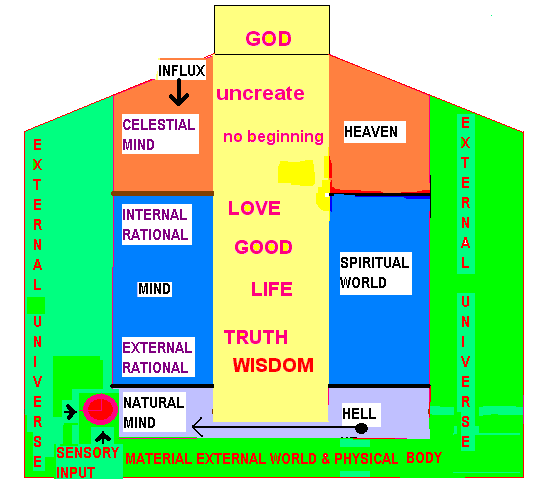
Note in the diagram that the created universe is made of uncreate substances in God, pictured in the central core column running down the middle of the universe, and forming its center shaft. These uncreate substances are life, love, good, truth, wisdom, light, and the like. They are uncreate in the sense that they have no beginning. All created things have a beginning in existence, but the uncreate things have always existed with God. It's possible to think of them as being "part of" God or as being "in God" but not as "God" because God is infinite, and the infinite cannot be captured or divided into separate parts. So we need to delineate God Itself as separate from the uncreate, as I have done in the diagram.
Let's start with the uncreate things pictured in the center column. Note that it is the inmost of the universe. This is important to note and remember: There is no created thing that does not have the uncreate things as its own core or center shaft. No object can exist except that which is made out of the uncreate things. This means that every (created) thing that exists has as its core or foundation, the skeleton parts of the uncreate things that have always existed with God. Remove this center core uncreate substance, and all the outside created things vanish into nothing. This is a key feature of phase 3 thinking. It is a scientific description of the concept of “omnipresence.” In phase 2 thinking we already accept the idea that God is omnipresent, but we do not understand how this is. It is a mystery and we are content to live with that mystery as long as we remain in phase 2. By taking the perspective of True Science we come into possession of a rational understanding of God and His omnipresence.
Note that all uncreate things are human things – love, wisdom, good, truth, and even light and life are human because they are in a Human God. Only a Divine Human Person can have Love and Wisdom. These do not exist apart from a Human Subject, by definition and by rationality. Consider the statement “the universe loves you,” voiced by modern TV gurus admired by tens of millions of people. This is an oxymoron or self-contradiction, showing the blind thinking we all do when we are in phase 1 and decide from our own intelligence what is God rather than accept and receive the definition given in Divine revelation. The universe is a physical creation by God and therefore is not human and has no human qualities. One of the fallacies that spring from self-definitions of God is to blind the understanding by the idea that the universe is alive and that’s how the universe can have love. But this is pure fancy and vanity. The fact is that the universe is not alive but is made of chemical materials which are not alive. A protein cell has life in it by reception just like a TV set has a picture on the screen by reception of the signal or the transmission of the signal through a cable.
In the same sense, an animal or human organism on earth is constructed out of chemical parts in a form that is capable of receiving life from God. This life, like the radio or television signal, must be streaming into the organism that acts as a receptor. When the radio signal is interrupted, the sound ceases. When the influx of life stream is interrupted, the organism instantly dies, that is, can no longer function as a receptor of life. What is alive, therefore, is not the organism, but the life it receives as an incoming stream or influx from God. All uncreate things stream into created things, with a variety of reception depending on the form or structure of the organ or organism.
Now you can see more rationally what is omnipresence of God. Consider space. We at first think of space as something out there, all around us (phase 1 thinking). Then we begin to see that space is also within us, and within every object and atom. There is space between the electrons that swirl around the nucleus of an atom. An atom is like an image of the physical universe, with its nucleus being like a sun, and the electrons, like planets. With this understanding we can see that space is unbroken and constitutes one extension of itself, whether around planets or within protein cells. There is only one space surrounding planets and within atoms. In other words, space is omnipresent physically. What gives space physical omnipresence? It’s the fact that it is at the core of all objects. No object – planet or atom – is without space at its core (phase 2 thinking). Now you can extend this rational understanding of physical omnipresence to spiritual omnipresence by considering that the uncreate things – life, love, truth – are at the core all created things (phase 3 thinking). This allows you to also see that all created things have a human purpose, that is rational and spiritual. Rational and spiritual are human, by definition, since these are uncreate (truth and love) and all uncreate things are in God, and God is Human, as is known from Divine revelation. God is omnipresent through love and truth, which are at the core of all created things.
This phase 3 perspective allows you to see more amazing things. For instance, that space, atoms, and planets are constructed out of love and truth! This is quite a surprising statement, is it not? We doubt the reality of this prior to being in phase 3 consciousness. We see it as a metaphor or poetic expression. But it is an actual empirical and literal assertion: Space and chemical materials are constructed, not out of nothing, not out of space and energy waves. Space, energy, chemical elements, sub-atomic particles, are all constructed out of love and truth. Now you can see how this is true, by considering their core, which is love and truth. This could be never be known had it not been revealed to the human race by God in His Threefold Sacred Scripture. You can also see from this how the spiritual world is within the natural world since the uncreate core (good and truth) is spiritual, because from God and God is a Spirit, as we know from revelation. The natural world within which is the spiritual world – this is the central definition of dualist science. God has now revealed in the Writings Sacred Scripture that the spiritual and the natural interact with each other synchronously by the Laws of Correspondences. The spiritual within the natural is the cause, while the natural is the effect, the two acting together and simultaneously. God controls and manages all things from this within portion of every object. From this within, God is omnipresent.
God is omnipresent within all space but apart from space. God’s presence within space is not in the same dimension as the space. God is spiritual, space is physical. God controls the physical from the spiritual within the physical. This is omnipresence, as understood scientifically in phase 3 thinking.
The diagram shows the physical universe, or natural world, pictured on the outside. It is the outside of creation, which is why I drew it as surrounding all else. The things that are outside in relation to God, are more and more limited and rigid in form and temporary in time, thus, less perfect than the uncreate or permanent things out of which the less perfect temporary physical things are made. Consider what physical objects are made of. We can't say "nothing" because that would not be rational or scientific since nothing cannot be the basic construction element for something. This applies equally to space. Space cannot be nothing or the absence of something. In True Science space is called ether, which is a material substance more perfect that energy and particles, but less perfect that the love and truth out of which it is made from within. If we say that physical things are made of stars, atmospheres, cells, genes, atoms, particles, waves, rays, fields, energy, force, gravity, vacuum, etc., then we have not really offered an answer to what the material universe is made of. We have merely made a list of the parts we can observe or infer in the physical universe through our senses and machines. What are these parts made of?
From a rational perspective one can see that the created material things must be made of something other than material things, or else you fall back to saying that they're made of nothing, which is not rational. The diagram represents a rational answer: The outside natural matter (created physical objects) is made of the interior substance (uncreate love and truth), which is made only of itself because it is uncreate and has no beginning. Anything that has a beginning, is created, and therefore must be made of something uncreate, or else you fall back to saying that they're made of nothing, which is not rational.
Consider the uncreate things again. All religions teach that God is Love and Good. Also, Truth, which is like saying Wisdom. For short, we can talk about Good and Truth, or Love and Wisdom, as the basic uncreate substances out of which all created things are constructed. Good includes Love while Truth includes Wisdom.
Now we arrive at an astonishing and elevating conclusion: All things in the universe are made of good and truth (or, of love and wisdom). This is meant literally, not symbolically or allegorically or metaphorically. Look at your hands: the protein cells and genes and atoms they're made of, what are they made of? You can't say "nothing" and still claim to be rational. People often say, Well there is a limit to human inquiry, and this is one of them. It’s a mystery. But now all mysteries of knowledge and science have been rationally explained and revealed in the Writings Sacred Scripture. Now we know from True Science that the cells and atoms of your hands are made of good and truth. The physical hand is in the natural world, while the love and truth it is made of from within, is the spiritual world.
The mind is unwilling to make this step very easily. What is your life? Nothing else than your thoughts, feelings, emotions, strivings, desires, satisfactions, pleasures, and the like. What are these made of? Experiences? What are they made of? Electrical firings of brain cells? Hardly. Thoughts and feelings are made of truth and good. Your mind is made of “truth” substances and “good” substances. Look at the diagram and note the middle region between the external universe and the uncreate things that are with God. This middle region composes the mind and the spiritual world.
One of the great insights we are given by True Science is that mind is spirit. Whether you say mind or spirit, it is like saying truth or wisdom, and physical or natural, and water or steam, etc. In other words, the spiritual world and mind are of the same substance and form. We can say that the mind is in the spiritual world, which is also correct. One of the most difficult concepts to understand at phase 3 level thinking is the idea that the spiritual world has no space, matter, motion, number, or time, because these things are natural. No natural object can exist in the spiritual world. Similarly with mind: No physical object can be in the mind since the mind is spiritual, and everything spiritual must be from and in the spiritual world. Further, there is no migration or transportation between the two worlds. When we are born, our physical body is in the natural world and our mind is in the spiritual world. The body and mind are interconnected by the determinative action of the laws of correspondences. Our mind therefore has no physical objects. What is in our mind? Or, we can ask, What is in our spirit, for mind=spirit.
True Science describes the anatomy of the mind, its physiology and function. The mind is a replica of the spiritual world. What is in the spiritual world, that is in the mind. Spiritual geography and mental states are therefore in perfect overlap. Both are made of three levels of operational functioning and two types of content or substance. The upper level of functioning in the spiritual world or mind is called heavenly and celestial. The middle level is called spiritual and rational. The lowest level is called natural and corporeal. The types of content in the spiritual world or mind, are called love and truth. The portion of the mind where love resides is called the organ of the will, and the portion of the mind where truth resides is called the organ of the understanding. Love in the will gives rise to all phenomenally sensed experience and consciousness of feelings, emotions, desires, impulses – what is known as the affective domain of behavior. Truth in the understanding gives rise to all phenomenally sensed experience and consciousness of thoughts, images, representations, interpretations, reasonings – what is known as the cognitive domain of behavior.
Let us recapitulate – it also helps to reread this section, beginning with the diagram.
The human mind overlaps perfectly with the spiritual world, as the two are in each other reciprocally. This “overlap” is not physical but substantive and structural. Two things that are made of the same substance and have the similar form occupy the same “space” or location in the universe. For instance, people in the spiritual world who have similar belief systems, that is, similar thoughts, are co-present to each other, can see each other, talk, touch, and do everything that one does when physically together. To make this easier to understand, think of what happens you dream, say, about running on the beach while holding hands with your soul mate wife or husband. The two of you are running with ease, and you are filled with joy and gladness, and you can also feel the joy and gladness of your beloved spouse. This is only a dream, but yet a dream is a real event. It cannot be nothing. Somewhere in your mind there is an organ that operates to produce these visions and feelings that are the dream. Those visions are real; those feelings are real. But the visions are not in the natural world, they are in the spiritual world, that is, in the mind.
The mind is real, made of real organs, operating in real sequence and state. Therefore all thoughts, visions, and feelings in the mind are real spiritual objects or operations. Your dream can actually be witnessed by those standing next to you, or in communication with you, in the spiritual world. You do not see them because you are still tied to your physical body, but they see the content of your mind, its operations, and therefore its visions and emotions. They can see all that as witnessed by Swedenborg many times.
Now consider these logical questions that must be answered to remain rational and scientific: Where is the beach in your dream? Is that beach on earth? Is there a beach like that in the spiritual world? How long is that beach? Does it have a limit? Can others come to that beach? Can crabs and birds live on that beach?
Now consider the answers from True Science as revealed and demonstrated empirically in the Writings Sacred Scripture:
The beach in your dream cannot be on earth since it is in your mind. The beach is a real creation called a vision. In the spiritual world everyone has the power to create visions that they can see and others nearby can see. Whatever people in the spiritual see around them are real visions. If you thought of it in analogical terms, you could think of a holodeck in Star Trek movies which as enclosure you can enter and experience visions and events that feel real, and only when you exit the holodeck apparatus do you realize that it was imagined. Even though we say that it was “imagined” you can see that it was real since your thoughts and feelings. It’s not possible to have thoughts and feelings and not have them. You cannot cancel the existence of your thoughts and feelings in a dream by saying, Oh, it was just a dream. It was, but the thoughts and feelings you had during the dream were real thoughts and feelings, for only real thoughts and feelings can exist in experience.
The space and objects you experience in dreams, daydreams, or thoughts and imaginations, are not physical objects or space but appearances of space, time, quantitative, and material objects. In the natural world objects and space are physical entities within which are spiritual enteritis, as already discussed. But in the spiritual world the objects and space you see around you as a spirit person, are appearances of natural things. They come and go instantaneously, just like in a dream. Everyone around can also see these appearances. You can understand now that people who are in different surrounding appearances cannot possibly see each other or be in communication with each other. It would be like your spouse with whom you’re running on the beach in your dream suddenly became your real spouse who is sleeping next to you in bed. This is an impossibility. But let’s say that your wife sleeping next to you has exactly the same dream as you have, then you would expect that you would both be in each other’s dreams. But the fact is that as long as both of you are still tied to the physical body, you cannot consciously appear to each other in the mind or the dream. But when both of you are spirit persons, you can dream and be in each other’s dream in actuality.
It is therefore a law of the spiritual world that similarity translates into appearances of spatial co-presence, and dissimilarity translates into the appearance of distance and unavailability. People in the spiritual world live in cities, and each city is made of a society that is homogeneous in terms of the thoughts and feelings of the inhabitants. It is not possible for an inhabitant of one city to sleep or live in another city, for the thoughts and feelings of the visitors would clash with that of the inhabitants, preventing their sleep, peace, mental, clarity, and happiness. Swedenborg says that visitors are sometimes allowed under restricted conditions of protection and preparation by the Lord. In fact certain types of “wandering spirits” spend their life journeying from “place to place,” that is, from one mental state to another. Every mental state has a geographic allocation in the spiritual world. You might think of the spiritual world as a mental map of thoughts and feelings that human beings can have. You can see that there is no limit to the variety of the spiritual worlds since there is no limit to the human mental states. This is because mental states are produced by the influx of love and truth, and these two substances are uncreate, and consequently infinite.
It is fascinating to read about Swedenborg’s travels in the spiritual world. The details he has recorded constitute the scientific properties and laws of the spiritual world. For example, if you are in the spiritual world, as you will be at some point, soon or later, you might be thinking about the next door neighbor you had in your last residence before you passed on. You then experience the desire to talk to him. Behold, he is here next to you, looking at you. You shake hands, you talk. You feel like having a cup of coffee, Behold, the tow of you are sitting in a restaurant you liked to visit together, and you’re tasting the aromatic brew, enjoying yourselves. But then the conversation somehow deteriorates, becomes negative, and you are both filled with incompatible thoughts and feelings. Behold, your friend has disappeared.
Now you may be wondering about some logical questions: Where is your friend? Where did he come from? Where is he now? How did he go away?
The answer from True Science is that your friend didn’t have to go anywhere to join you and didn’t go anywhere to separate from you. Remember that there is no actual space in the spiritual world or in the mind. Therefore the space you see around you in the spiritual world are appearances of space, time, number, quantitative, quality. Your desire to talk to your friend, when it happens to be a reciprocal desire by your friend, puts you in communication with each other. Neither of you go anywhere. In fact, once you have your allotted position in the spiritual world, which you get soon after arrival, you never go anywhere, and your position is fixed forever. This may sound like a terrible fate if you think of it in physical terms. In that case it arouses claustrophobia as you are imagining that you are chained to a pole forever – what a horrible hellish fate to imagine. But in the spiritual world your mind overlaps with everybody’s mind since everybody’s mind overlaps with the spiritual world, and there is only one spiritual world. Hence there is a perfect unity between the entire human race, every individual being in the same extension as everyone else. In fact, to God, the entire human race is united in His Mind and perception as one human individual. Swedenborg was given the very special opportunity to glimpse this Grand Human from afar so he could testify that it exists.
And so in the spiritual world, or in mind, you have access to every other human being, and the consciousness of this availability is determined by the mental states you are willing to let yourself go into. You can meet with and interact with anyone from any of the numberless planets who have arrived in the spiritual world. Swedenborg describes his journey to the spirits from a distant galaxy from ours. Normally people from different planet systems do not interact when they get to the spiritual world because they are of different “genius” or mentality. In other words their thoughts and feelings are not compatible, meaning that they are not willing to occupy the same mental states long enough to communicate or interact. They are aversive to each other, hence avoidant. And what you avoid mentally is inaccessible spiritually. But Swedenborg, on account of his mission, was willing and prepared to undergo significant changes in his normal mental states. Consequently, there were some angels present with him who managed this change in mental states so that he can interact with those people from the distant planets. It took several earth days, in Swedenborg’s dual consciousness experience, to accomplish the whole series of mental changes, but at the end he was able to talk and interact with those dissimilar spirits.
Let us get back to the diagram. You might want to look at it again.
Notice that the mind has "height" (sometimes called "depth").This is not a physical height but an organic structure which has only the appearance of extension, space, or height and depth. So when your eyes go up and down the diagram, you are not going up or down in space but changing to a different mental state. Space on the diagram is an analogy for change of mental state. Change of mental state can only occur by means of different organs operating together and in sequence. Each mental state is made possible by a corresponding action of the mental organs acting together. Look up and down the left hand side first. The lowest region of the mind is called the natural mind. The region above that is called the rational mind. The upper organ in the mind is called the celestial mind. Remember that sequence: natural, rational, celestial. One is within the other by discrete degrees, but on the diagram, I pictured it as one above the other separated by lines. At birth, the mind is ready for use but totally empty of any content. How does it grow? It grows by accumulating and organizing the substances it has access to, namely, truth and good. How does it have access to these substances?
To explain this, consider what we know about the body. The anatomy of the mind is easy to picture because it corresponds perfectly to the body. One is a copy or image of the other, but in different substances. You could not see without eyes, and you could not walk or lift something without muscle fiber. And these organs and fibers would not work if the cells they're composed of could not engage in bio-chemical transfers whereby they are able to strip and organize the available materials and elements into its requirements and needs. Similarly, if the child is going to build up not just a body, but a mind with it, the mind needs to have mental organs of function that can transform the substances of truth and good into thoughts and feelings in accordance with the physical action of the body. The two cannot be separated. The mind cannot exist without the body, and vice versa. When the physical body becomes a disintegrating corpse, the mind is freed from its correspondential attachment, and we awaken in a spirit-body that is suitable to continue life forever. This spirit-body was “within” the natural body, not physically within, but spiritually or by correspondence. Even in the spiritual world we need an external body that houses our organs of the will and understanding. These are the receptors of love and truth in infinite variety.
The mind’s anatomy, as described in the Writings Sacred Scripture, has two main organs: the affective organ, also called the will, and the cognitive organ, also called the understanding. These two organs of the mind are made of spiritual substances to begin with (good and truth), but each individual mind is created in a unique form or identity by Divine Law, and there are unique individual differences in the way each person builds up the mind through these same available spiritual substances and natural experiences. The natural mind develops and matures first under the stimulation of the body’s sensory organs which are designed to translate the order of the physical world into the order of the natural mind. This is essential because the content of the natural mind determines the content of our life in eternity. Heaven is made of cities of splendor and gardens of beauty, while the hells are made of caverns, spider webs, and stenches. These natural images, or appearances, in heaven and hell, originate from the natural mind and its ability to represent, to recreate as it were, the realities of the natural world. A few decades on this earth is enough to develop the natural mind for most people. This experience is then to last us to eternity, but in an everlasting enrichment of it which we an only dimly fathom now. This is why I say that one minute on this earth is worth more than one million in the spiritual world when you consider the everlasting consequences of each minute of life on earth.
The natural mind develops gradually and matures by means of formal education, science, and practical experience. But there is another influence as well in all cultures, insuring that the individual will not grow up entirely in accordance with the order of the planet, for this order is only the ultimate. The upper portion of the natural mind is called the external rational mind. This mind is capable of thinking at high level of abstraction away from the material order of the physical world. It can entertain science fiction worlds and alternate realities. It can also understand duality concepts learned from religion and tradition. These dualist concepts speak of another world, thus a dual universe, separate and real. The upper portion of the natural mind, due its ability to abstract, is therefore capable of understanding the existence of God, heaven, and hell.
Of course, at this level of thinking, we understand all spiritual or dualist concepts in a natural way. Rational, yes, but an external rational, not a genuine and true rational. It’s like getting hold of a cocoanut on an island when you’re dying of thirst and hunger. Cocoanuts can keep a man alive for months and years – but not the plentiful of cocoanuts that you can find on the beach underneath a cocoanut tree. The external of the cocoanut cannot support life just as the external rational cannot invent or discover the spiritual. Only the internal rational can reflect or represent the spiritual to our understanding and consciousness, just as only the internal of the cocoanut will keep us alive.
But it is crucial that the natural mind be developed all the way to its highest operational level, that is, sufficiently abstracted away from the natural order of things, that it can entertain and accept the idea that there is a world above this natural called spiritual where God is and from where He rules and manages the natural world. We can understand this in an abstract way with our natural mind, therefore we can accept it, support it, love it, be refreshed and enriched by it. Once the natural mind has matured in its external rational, the spiritual mind can be opened. This process of opening is done by God who manages the endless number of details that are involved, as you can imagine. Billions of thoughts sequence themselves, trillions of emotions, and quadrillions of perceptions and impressions, for each individual, in association with other individuals who mutually influence one another by their thoughts and emotions – you can see the complexity of it all, so that only an omniscient omnipotent infinite Divine Human Person would be able to figure it all out, make it all come out right, and all for the sole purpose of making every person as happy as is supportable to eternity. Such is Divine Love and Divine Wisdom of the Divine Human!! He is the genuine True Scientist, the genuine True Manager, the Genuine True Therapist and Father, Creator, Redeemer, Savior, Regenerator.
It is the greatest privilege to know His existence, to feel the real warmth that comes in from Him even as we hold Him in our focus, concentration, and consciousness. And the sensation intensifies greatly when we worship Him in addition to acknowledging Him. Worship Him is to love Him, and since this love is from Him, as all genuine love is, therefore we are conjoined to Him thereby. Then we begin for the first time our life as a True Human, whom the Lord calls His Holy Angels, for then we are nothing but Him more and more purely, never becoming like Him in any other way but in image and likeness, by correspondence and appearance.
The spiritual mind is opened in this way, by a living acknowledgement of dualism, with God at its throne. We are enlightened in this way. Enlightenment is the experience of the operation of the spiritual mind. This portion of the mind is the middle level and is developed by means of spiritual-rational correspondences. These are appearances of truth that are higher or more interior than the rational concepts in the lower natural mind. These are higher or more genuine, that is, less distorted, less filtered out by natural abstractions, and therefore they elevate our consciousness form material order to spiritual order. When our conscious awareness is focused on these spiritual-rational correspondences, the new understanding and perception is called enlightenment.
The Writings of Swedenborg have been given as Sacred Scripture of the Second Coming, which is the revelation of the Divine Rational to humanity. The literal meaning of the Writings Sacred Scripture is at the level of natural-rational correspondences. This means that any scientist, scholar, or student of the Writings is able to comprehend it, regardless of their regeneration status. Al that is needed is the ability to decode and understand spiritual topics presented in an abstracted style. Note that the spiritual topics which are dealt with in the literal meaning of the Writings Sacred Scripture concern God, His Divine Nature, His Incarnation, His mental development as a Divine Child on earth, the history of the Churches on this earth going back all the way to the beginning of the human race on this planet, the Laws by which God governs the universe, the methods of regeneration, the spiritual world, heaven and hell, the levels of the human mind, theistic psychology, inhabitant planets in the universe, marriage and conjugial love, and many other topics. These topics are spiritual but the way they are described is natural, using external rational abstractions and descriptions. This literal meaning develops our ability to think rationally about spiritual topics. Once we have incorporated and assimilated these natural-rational correspondences, our natural mind is sufficiently prepared to receive spiritual-rational correspondences from the spiritual mind. These spiritual-rational correspondences are perceptions by influx from the spiritual world. They are therefore arranged in a spiritual order, not natural.
In this way, the natural mind continues progressively to be more and more enlightened as the spiritual mind is opened by God and as its concepts descend within the external rational concepts of the literal meaning. Now as we read the Writings Sacred Scripture we are enlightened, that is, we perceive spiritual-rational correspondences within the literal meaning. This entirely new perception or consciousness is the operation of the spiritual mind. Remember that what is above is within in terms of discrete degrees. The spiritual world, is within the natural world. At first the natural mind is filled with dead reasoning and a dead order form the natural world. It is not yet alive, though it seems so to ourselves since we are able to think through our daily round of activities. But it has been revealed that things appear to work out for us, according to our apparent decisions, only because God is participating in every detail and makes it turn out that way. In other words, God has to save us constantly from destruction by stupidity. But when the spiritual mind is opened, and we start our life as a dual citizen, with a new dual consciousness, then our decisions and motives are more and more rational as we mature.
To continue maturing in the spiritual mind we must apply our understanding to our daily willing and thinking. Otherwise we lose our enlightenment and we revert to the earlier mode of understanding spiritual topics merely naturally. But as we continue to reform our character, fighting with the truths we know, understand, and love, against our inherited evils and falsities, then our celestial mind is gradually opened. This is when we become a genuine human being, for only the celestial portion of the mind is actually human. When we can no longer develop our celestial mind on earth, we pass on, and continue in heaven as a conjugial couple, for in heaven live only married couples or soul mates.
In what sense is heaven nothing else then the upper portion of the human mind, and in what sense is hell nothing else than the lowest portion of the human mind?
The answer from True Science in the Writings Sacred Scripture is that the spiritual world does not have any space, time, and number in the sense that we know these from the natural world. This is obvious from considering your dreams, as has already been discussed. There is no space or distance in our dreams, yet there is always enough room to include whatever it is we are dreaming about. We could be dreaming about riding up in an elevator, which is a small space; then, as we step out into the foyer there is suddenly more room, and as we look through the window there is more space, and even as we look at the sky there is more space. You never run out of space in your dreams. Space is manufactured instantaneously as needed. This happens in dreams because dreams are spiritual events that can be witnessed by those in the spiritual world who are near our spirit-body within which the dream occurs. There may be a roomful of people at a conference in the spiritual world – Swedenborg attended several of these and they apparently are popular and regular events in some societies. Let more people enter the room and Behold, there is space for everyone. Let many more people enter the room and Behold, there is space for everyone. Such is the law of “apparent space” in the spiritual world, or in the mind, while dreaming, or awake and thinking.
Since there is no physical space in the spiritual world objects overlap. This is logical. In fact, everything in the spiritual world must overlap with everything else since there is no size or measurement. To fully understand and accept this concept of the spiritual world one must be thinking at phase 3 level, as discussed in prior sections. Since there is no physical space, distance, or quantity in spiritual world, we can conclude that it is limitless and endless capable of receiving more and more people from the earths to the endless future. Whatever is said about the spiritual world applies equally to the mind since the two overlap completely. You can see therefore that if we say that there is a heaven in the spiritual world, it is equivalent to saying that this heaven is in the mind.
Similarly with hell. Sacred Scripture of the New Testament Sacred Scripture has revealed this two millennia ago when the Lord says that “the Kingdom of God is within you.”. The Kingdom of God is a reference to heaven. Even Sacred Scripture of the Old Testament Sacred Scripture reveals that hell is within the human mind, as when Jehovah says that the thoughts of the heart of all people have been corrupted and are evil through and through. But these earlier revelations were not modern, rational, and scientific, so that even if one acknowledged Sacred Scripture as Divine Truth, one still could only be left with a sense of mystery about all things spiritual. At last, Sacred Scripture of the Writings give us the full and complete scientific revelations about the spiritual world, its overlap with the mind, and its portions called heaven and hell.
Remember that all of humanity is linked and integrated, though this cannot be perceived or understood from the natural rational mind. It has to be understood from Divine scientific revelations. It follows from this unity of all humanity, that all those who live their consciousness in the bottom of the their mind, that is in their own hell, are united to all those who also live in the bottom of their own mind, or hell. Everyone lives in their own hell, yet they are all united. This is an objective feature of hell. Swedenborg was able to “visit” the hells and describe what he witnessed there. He was able to see the people there, along with all the angels who administer and enforce the rules in each of the numerous societies there. Remember that Swedenborg did not have to locomote or walk to hell, any more than he had to walk to heaven, since there is no physical space and distance. How then was Swedenborg able to witness the people in heaven and hell?
The answer is that one appears to oneself to travel, walk, fly, or ride through places when we are undergoing a change in affective state from what we normally have. In the spiritual world our normal mood and emotional state of mind provides for us the convenient and comfortable lodging and city in which we live. There are our neighbors and friends, and there are the Administrators and familiar city buildings, gardens, voices, and sounds. But the moment we alter our affective state away from this normal state, we appear to ourselves to be displaced, either by locomoting or by instantaneous arrival. Now a different appearance is before our eyes and spirit-body. These new surrounds are correspondent representations of the thoughts and feelings we have in our new mental state. This is one way Swedenborg could “visit” the hells, namely, by undergoing a change in his mental or affective state. To “travel” to hell, Swedenborg had to descend to the bottom of his mind!
Everyone who descends to the bottom of their mind appears to be in a hell surrounding, with other inhabitants who are wicked and hostile to each other, and are filled with delusions and insanities they believe to be true. Swedenborg says that he had to be specially prepared and protected by the Lord to be able to descend to the bottom of his mind, and not be injured, so he could come back to his normal state. He describes that he received angel guides who were experienced in this operation and managed Swedenborg’s mind descent with powers possessed by those who inhabit the heavens in their mind. The angelic guides formed themselves into a tube or column of light that surrounded Swedenborg throughout his journey down to the pit of his mind. Similarly, when Swedenborg visited the heavens he underwent change of mental states towards the top of his mind where the heavens are. There he saw and much admired the inhabitants, all of whom are called Holy Angels.
You can now see, as discussed earlier, that hell is not a punishment for sins and evil deeds, nor is heaven a reward for good deeds. Heaven and hell refer to the top and bottom of our own mind. What is incredible to me is that people would want to keep their consciousness in the bottom of their mind, instead of at the highest places. Can you understand that, friend? My wife has had many occasions to warn me that I have a strong streak of self-destructiveness in me. I couldn’t believe it. I was trained to think that all behavior tends towards survival and self-enhancement, not self-destruction. And yet, it’s obvious when we look around us that people generally act like they keep themselves in the hells of their mind. When we are unregenerate, we all act like we love misery and cruelty, and seem to work hard at keeping ourselves in negative emotional states such as anger, rage, depression, dissatisfaction, resentment, etc. None of these emotions can exist for you when you are higher up in consciousness. Typical emotions when we are in the upper regions of our mind include joy, gladness, enthusiasm, mutual love, delight in being useful, love of innocence, conjugial love, etc. And further, when we are in low moods affectively, our thinking responds by descending and keeping company with the mood. We think with cynicism and bias, illusion and delusion. But when our consciousness is in our heaven, our thinking rises in rationality and wisdom, an dour intelligence and understanding exceeds by far anything we are capable of in lower regions.
Why do people choose to keep themselves in the hells of their mind instead of ascending to the top of their consciousness level? True Science reveals that every one is born with a spirit-body that grows up surrounded by the inhabitants of hell. They influence our mental habits so that we acquire those habits of mind that keep us in hell. This is something they do automatically, by hellish instinct as it were. To be in hell also means to want to draw others into hell with you. And so by the time we are an adult in our natural mind and physical body, our mental habits are dependent on influx from the hells. Experientially it feels like we are pursuing freedom and pleasure. Those from hell who communicate with our spirit-body prevail, so that by the time we are a young adult, we are each of us a little hell in our own mind. Now God supervises and manages all this activity, never allowing the hells to influence us beyond the point necessary to feel free in pursuing our inner desires and outer ideas. In fact, the Lord makes sure that there are always good spirits and angels near our spirit-body. They constitute a counterforce to hell in our consciousness. In other words, our mind is a battle field between heaven and hell. This is called the world of spirits, to distinguish it from heaven and hell. The battles go on not in heaven and no tin hell, but in between, in a state of mind called the world of spirits. Therefore it is necessary for the Lord to transport people down from heaven and people up from hell, meeting in between in our mind, surrounding our spirit-body.
We are conscious of these momentous battles going on because the war is waged in terms of our own decision making and evaluation. The angels act into our conscience which is above the hells, while the devils and satans act into our natural mind, as the diagram shows. We experience a push and a pull in this direction, then the opposite. We are in the turmoil and conflict of temptations. Should I or should I not? Can I? No, I mustn’t. I have got to stop this. But I can’t help myself. I hate what I’m doing. Well, too bad, I’m going to do it anyway. I deserve it. It’s their fault, I don’t care. But how can I let myself go like this. I must stop. No, why should I. I feel so guilty, so ashamed. I can’t stand it. Is there a God? Who has come back from the dead to tell us? I want my vengeance. I want more. I want all of it. I don’t care if it’s yours. Now it’s mine. I have a good reason to cheat you. I can even kill you. You deserve it. Etc. Etc.
These are the conscious experiences we have during those battles between the angels and devils around our spirit-body. If we incline towards the devils, we acquire one more tie to them, which will be difficult to give up later. They will hold on to us as long as we hold on to them. If we incline towards the angels, we enter deeper and deeper into their societies, and our consciousness rises higher and higher. At last we are able to overcome in all our temptations and we are regenerated sufficiently to be able to stay in our heaven and exist there forever.
These battles of conscience and temptations end when we enter the spiritual world at the death of the physical body. Once we awaken in the world of spirits, we are unwilling to give up our inner loves and ideas. While we are still tied to life on earth our natural mind is capable of extinguishing old ties and forming new ones. This is why we are born with a physical body on earth rather than being born directly in heaven or the world of spirits. I do not yet fully understand how this works, how the presence of our physical body allows us to change our character, and that we lose this capacity once the physical body is no longer tied to our spirit-body. Future research and scholarship in True Science will give us more understanding of the details and mechanism involved. The only change we are willing to undergo in the spiritual world are changes that deepen the states already familiar and comfortable. Those who enter heaven deepen their mutual love, wisdom, and capacity for happiness. Those who enter hell deepen their mutual hatred, insanity, and capacity to be miserable.
When we are detached from the physical body, we re-awaken about 36 hours later in our spiritual body in the world of spirits, the region in between heaven and hell. This temporary stay in the in-between region is called the state of the first death. Here one undergoes brief but intense experiences that reveal to ourselves what is inside, what are our real loves and preferences. We are forced to face who we really are. And this always means how we've lived in our physical body as indicated by all our choices. When this process of self-recognition is complete a few days, weeks, or months later, we enter the state of the second death, which is our permanent state, during which we abandon anything whatsoever we've brought with us, that is not directly harmonious with our ruling love. If this ruling love is in accordance with good and truth (or love and wisdom), we enter the uppermost regions of our mind, called heaven, and dwell there in celestial cities with companions forever, growing daily in love and wisdom, and therefore, happiness and joy.
If this ruling love is contrary to good and truth (or love and wisdom), it is not called good or truth any more, or love and wisdom, but evil and falsity (or infernal lust and insanity). Our consciousness then sinks to the lowest region of the mind, even at the bottom of the natural mind, into what's called the "corporeal mind." There we enclose ourselves in experiences and affective states known as hellish insanities and infernal fantasies. It is a dark place of the mind where the light of truth and good cannot penetrate, where the inhabitants have lost all appearance of the human.
A reader of an earlier draft of this document wrote the following:
I have ambivalent feelings regarding the emphasis you put on individual moral effort. I do not necessarily like the “…get your act together lest you end up in hell forever…” tone. This is old style hell and brimstone preachin’ . In my dictionary the word “forever” does virtually not exist.
Reality is never static. Reality is changeable and fluid.
I simply cannot believe that a Divine Omniscient Creator would not have known about the Fall beforehand and adjusted our fate accordingly. My view is that the Fall were providentially foreseen, allowed and managed by the Lord so that greater good may eventually come from it.
Phase 1 thinking accepts the idea of hell, but sees it in a natural sense. They think of hell as a physical place where there is fire, prisons, torture chambers, the devil’s mignons, black smoke, owls, dragons, and scorpions. Such are the portrayals in paintings, engravings, books, and movies. At this level we do not see the illogic of souls being tortured by physical fire and held by physical chains. In this view, hell is a place of punishment for past sins and misdeeds. God is angry and hates sin. He turns away from sinners, imprisons them in hell, gives them over to the devil who enjoys torturing them. When the punishment time is up, we can exit from hell and join our family and tribe. This is a child’s perspective, pre-scientific, scary, vague, and mysterious.
As we move into phase 2 thinking, hell is seen as a spiritual place or state of mind. The fires of hell are seen as mental tortures that people can experience when they are tempted, anxious, fearful, depressed, delusional, or consumed by an insatiable passion that knows no bounds and gives no rest or peace. Still, hell is not forever, in this view either, because one likes to think that eventually enough is enough, and that the state of being cut off from God will change so that those people may be back together again with God. The reader above seems to have come to this position: “I simply cannot believe that a Divine Omniscient Creator would not have known about the Fall beforehand and adjusted our fate accordingly.” Another version might be: “I simply cannot believe that a Divine Omniscient and Loving Creator would not have been able to keep these people from eternal hell.”
When you enter phase 3 thinking you begin to look at hell from a scientific point of view, not from the point of view of punishment for sins and misdeeds. The Threefold Sacred Scripture shows this progression when you examine the doctrine of hell. In the Old Testament Sacred Scripture not much is revealed by hell, heaven, or the spiritual world. On the surface, the plain literal meaning seems to say that there is a devil and a following of dark and fallen angels, who are let loose by God to do mischief on earth whenever the situation calls for it. At the end of this world, a new world will be created, the good resurrected from their scattered dead bones that will grow flesh again, and the devil will no longer be given permission to do misdeeds. This phase 1 theory can be justified by many passages in the Old Testament Sacred Scripture to those who are in this phase of thinking and feeling. The New Testament Sacred Scripture’s treatment of hell is one phase above (2). It is more interior, more rational, less mystical, more spiritual, more correct.
The Lord Himself explicitly addresses the existence of hell and warns that we not end there. He has prepared heavenly mansions for us, but in order for Him to be able to take us there, we must prepare our spiritual mind by rebirth and regeneration, that is, by character reformation, that is, by fighting our evil tendencies and vices, and by dosing good to the neighbor. Hell is the consequence of turning away from the Lord. God has already forgiven all sins, yet those who use their spiritual freedom to remain cut off from God, are in hell. They are experiencing the mental torture of vice and delusion. You can see therefore, that there is a progression in the treatment of hell from the Old to the New Testament Sacred Scripture.
In the Third Testament (phase 3 thinking and feeling) hell is not a place of punishment, nor a place where God is absent and turned away. In phase 3 thinking there is a striving to be rational, logical, and consistent with every concept and explanation. The mind takes the issue all the way, and leaves no stone unturned. Every implication must have a rational justification. Since God is omnipresent, there is obviously no place where He is not present. Therefore God is present with every soul, whether in hell, heaven, or on some earth. But this is only phase 3, zone 7 thinking (Old Testament state of True Science). When you study the Writings Sacred Scripture in sufficient detail, you move on to zone 8 (New Testament Sacred Scripture state of True Science). Here we are in possession of more facts about hell. We can understand the mechanism by which God is present with every person’s mind. We know that the thinking and feeling that goes on in hell cannot be a mechanical process that moves itself, like a mythical perpetual motion machine. There is always friction and other forces at play to stop the motion of a thought process in hell, or a feeling state there. What is hell but the bottom of the human mind, that is, of every individual. God must be as active a manager of the thinking and willing of those in hell, as He does of those on earth, and in the vast heavens. There is no place where God takes a hike since He is omnipresent. He cannot therefore “turn away” or “remove Himself” or even distance Himself. The Divine Human Person is omnipresent and keeps every detail going.
For example, what the inhabitants of hell see around them is managed by Divine Human Person to reflect the particular thinking and feeling of those who are there, as also witnessed many times by Swedenborg and the angels who were with him. God has revealed in the Threefold Sacred Scripture what the precise rational mechanism or process He uses for effecting this phenomenon. It is called the method or law of spiritual-natural correspondences. This is built in as part of the creation of the dual universe. It is a natural law as well as a spiritual law because they are tied together one to one by the laws of correspondences. If a devil boils over with hatred towards heavenly things that come to his mind from within, the surrounding place suddenly becomes dark red like a blazing atmosphere darkened by a great fire, and suddenly noxious creatures appear to crawl out from everywhere or to fly around making raucous noises, and putrid smells invade the atmosphere, and hysterical yelling and screeching can be heard. Now when that devilish person calms down and rises somewhat in consciousness, the thinking and feeling changes, and so does the surrounding environment.
Swedenborg describes thousands of such events that illustrate and demonstrate the action and power of correspondences. For instance, Swedenborg describes the intense brilliant light that emanates from the temple or house where the Threefold Sacred Scripture is kept in each of the numerous heavenly societies or cities. The brilliant light is not blinding to those who are ready to receive the truths that are stored there in the sentences, words, and diacritics of their heavenly script in which the Threefold Sacred Scripture appears to their level of thinking.
Swedenborg describes an experiment in which he asked a stranger in the world of spirits who showed up near the temple, to copy a word or phrase from the Threefold Sacred Scripture there, on a piece of paper, and to throw the paper in the air. There resulted a show of lights or fireworks that followed the descending paper. An angelic spirit who was ministering to guarding the temple, warned another stranger not to touch the Sacred Book, but the stranger laughed and disregarded the warning. The moment he touched the platform upon which the Holy Book was placed, he was violently thrown back by an invisible force, all the way to the back wall, where he lay a long time before he revived enough to high tail out of there. These outward powers and phenomena or appearances, are instantaneously produced in the spiritual world by the laws of correspondences between spiritual events in human minds and natural events that everyone recognizes from their life on earth. The cities and inhabitations in the spiritual world are therefore mental projections that are cast in the language or form of correspondences built into creation.
You can see therefore why for instance the cities and gardens in heaven are beautiful, artistic, and alive with dynamic movement and progression at every level of detail. Peace reigns in the atmosphere. Truth is the level and content of thinking. Mutual love is the quality of feeling. All in endless infinite variety. But in the cities and inhabitations of hell there is disorder, insanity, ugliness, stench, and noxious unpleasant animals. Warfare reigns there and hatred is in the atmosphere. Falsity, or the distortion of truth, is the level and content of thinking. Self-love and mutual hatred is the quality of feeling. All in endless variety. Hell is therefore the bottom of the human mind just as heaven is the top, and both are in us, everyone of us.
Yet, even in this scientific understanding of hell, there is more to explain. In phase 3, zone 9 (the Swedenborg phase of True Science) there is the knowledge and rational understanding of additional details to be found in the Writings Sacred Scripture. For instance, we still need to understand why those people in hell are captured there forever and that their misery does not improve but endlessly deteriorates. We need to understand what keeps those people there. We know it is not a place punishment, why are they then kept there? And the answer is that that they are not kept there, but that they choose to remain there. The Divine Human Person loves every person equally, and what differentiates the level of human thinking and feeling is the reception of that Divine Truth and Divine Love which comes into each person’s soul and celestial mind. From there the Love and the Truth descend into the spiritual mind, and from there into the rational mind, where for the first time we become conscious of it.
For each descent there is a filtering which is necessary in order not be overwhelmed by the influx. We need to retain or sense of as-of self freedom, which means that the Lord manages the filtering process and accommodates the Love and Truth at each particular entrance point. By the time we are conscious of the descending influx, we have the sense that it is not influx but self-generated thinking and feeling, moment by moment. The content of the truths that has descended is altered to fit the content that is already there in the conscious mind of the person. We can feel contradictions and uncertainties, so the Lord has to be very carefully not to intrude into consciousness, for then our sense of as-of self freedom would shattered, and along with that, our happiness and motivation to do anything.
In zone 9 thinking we can see all this, and now we can read and correctly interpret the passages in the Writings Sacred Scripture that explain why these people in hell keep themselves there forever. We imagine at first that if we were there, we would agree to anything, we would say any prayer, go to Church services once an hour, as long as we can just get the hell out of there. This is what we imagine at first, but then we come to gradually accept the rational phenomenon involved here. First, we are told that the inhabitants of hell are allowed to ascend to higher levels of their mind, even unto and heaven. And in fact, Swedenborg witnessed some of them, who had been religious in the life on earth, and had formed for themselves an idea of heaven based on their religious beliefs, now in hell asked to be taken up to heaven. The attending angels complied with their request. Their minds were prepared for the transition, and Lo, they see themselves at the gates of one of the heavenly cities. With much anticipation they enter, but they see nothing, hear nothing, smell nothing. Where are the people and the wonderful mansions promised by God? And the angelic guides told them everything is here all around you but you cannot see it because your thinking and feeling are contrary to what heaven actually is. They went back to their hells greatly disappointed.
At another time, Swedenborg witnessed a man entering heaven under false pretenses by putting on airs of religious piety, so that he was admitted by the guards, surely for the purpose of allowing them to discover their actual feelings. But as soon as they started inhaling the air or atmosphere of heaven they were seized with such torture from within that he threw himself down and was writhing like a snake before a burning fire. He begged to be released back to his hell, and upon arriving there he was revived to his old state. And there are other such demonstrations that show that those who are in hell are allowed to leave that dreary place of the human mind, but when they ascend, they feel torture and disintegration far worse than their sorry hell.
Now you can rationally and scientifically understand why there is a hell, whey people are there, and why they keep themselves there forever.
A science of religious psychology must be universal and cannot be pre-empted by any sectarian belief system or doctrine. Science is the product of pan-human logic and rationality as we attempt to make sense of reality. There is only one reality, one logic, one rationality, namely truth or trues, which are universal, absolute, uncreate, eternal, and Divine. Religious psychology has two basic premises. One is dualism; the other is revelation. Dualism in science is the premise that there are two universes, one natural, the other spiritual. We are dual citizens, since our physical body is material, natural, and temporal, while the mind or self, is substantive, spiritual, and immortal. The relation or contrast between material and substantive was known and accepted by all the major Western philosophers and scientists up to the twentieth century, when the substantive was no longer seen as the basis for the material. This gave rise to a materialistic science that denies the possibility, the relevance, the reality and the rationality of God, revelation, and the spiritual world. Dualism in science restores the knowledge and perspective that science has evolved for thousands of years, and restores the imbalance and excesses of ideological materialism. In our view, dualism in science and religious psychology will prevail in the next millennium as it gradually replaces the old paradigm of anti-theistic ideological materialism.
This essay is an attempt to translate the ideas in Swedenborg's Writings into the language of modern science and psychology. To the extent that we succeed, the effort should make it easier for others to see how a positive science can view their cherished religious certainties: God, the Word, the Lord, the Trinity, the Incarnation, the Messiah, evil, sin, regeneration, Holy Communion, Heaven, hell, eternal life. It is awkward, perhaps even schizoid, for all of us to be educated in a science that denies these realities. Church is for Sunday, and science is for weekdays, has been a denigrating alternative we are supposed to accept and be quiet about. Praying is superstition, according to Skinner, and those who are the experts in the psychology of religion look for God, like Freud, Jung, Sartre, and Karl Marx, in the depths of the human psyche rather than in the idea of the Creator for the universe. We hope to show that science has the intellectual tools for dualism and religious psychology. Sin is real. Heaven is real. Hell is real. Regeneration is real. Love is real. Wisdom is real. Baptism is real. Praying is real. Revelation is real. And so on.
But beyond asserting their reality, our task is to show how they can have empirical meaning in a scientific system. But this no one can do without the knowledge given in revelation since the external natural senses cannot access the requisite data. So we must first show the existence of the inner senses that do have access to the relevant data through revelation, but not without it. This inner sense is the true human rational that can see spiritual reality and fact. This interior rational is far above the external rational that is built up through the external senses. This interior rational can be developed until it becomes so commonplace that one wonders how it used to be before its opening to consciousness. This we have achieved through the application of Swedenborg's Writings to our daily moment by moment life transactions. This achievement does not make us superior or special, but the vision it affords us is superior and special, and it never fails us. Anyone can do what we have, and we hope that this record of our journey, painstakingly kept track of and digested, will make it useful to your journey. We could not have done this without our daily study of the Writings of Swedenborg.
The second premise of revelation is that spiritual knowledge, that is, knowledge about the spiritual world of the mind, cannot be obtained directly by the natural senses, and therefore the mechanism of revelation exists. A modern and favorable examination of this issue in relation to Swedenborg's access to revelation, may be found in Christen Blom Dahl's book The Third Source: Swedenborg: A Physical & Metaphysical Revelation (available here full text). Also of relevance to the issue of revelation and Swedenborg's scientific empiricism and behaviorism, is the article quoted above: Overcoming Objections.
Religious psychology is non-sectarian, universal, and dualist. One issue that may trouble some is reflected in this question: How can you have a religious psychology that is scientific when each religion claims to have its own God and its own revelation, while denying the God and the revelation of other religions? This crucial issue is dealt with in the first section specifically, and throughout the Section.
13.12.1 The External and Internal Church
Jesus, Sun of Life, my Splendour,
Jesus, Thou my Friend most tender,
Jesus, Joy of my desiring,
Fount of Life, my soul inspiring,
At Thy feet I cry my Maker.
Let me be a fit partaker
Of this blessed food from Heaven,
For our good Thy glory given.17th Century Hymn (Brockes Passion) (Concordia Publishing House)
Religious psychology is the study of how the
Church grows within us. The Church is the operation itself of
religion. All religions operate through a church. There are many external
churches but only one internal Church. External churches are cultural
institutions, hence they are variegated and contrastive. External churches on
this earth are related by history and ideology (or theology) . Every external
church operates through Sacred Writings from which religious doctrines are
drawn as guides to religious practices, traditions, laws, norms, rituals,
worship, and commandments of living.
Because the external churches bicker among each other they give an appearance of disagreement, antagonism, enmity, and strife. the Writings Sacred Scripture they hold as sacred vary and the history of the world they give (or their eschatology) often contradict each other. Many believers hold that their version only is correct and genuine and doubt the salvation of others. This external appearance of varieties of religions and their doctrinaire contradictions vanishes in the internal operation of the Church within every person on this earth. The inner Church is universal and absolute though it grows and develops in stages within each person. All human beings belong to the internal Church and there are no human beings who are devoid of it irrespective of their beliefs or awareness. Individuals of all denominations and individuals who deny any religious affiliation all belong to the inner Church by Divine order. The inner Church grows within each person under the careful and constant supervision of God. It is an organic relationship of the spirit of each person. Religious psychology explores this universal inner Church.
There are three stages of growth of the Church within each person. We may refer to them in order as first, the Old Church state of mind, second, the New Church state of mind, and third, the Ultimate Church state of mind. The three Churches develop within us in that order. The Old Church is the basis and containant of the internal Church upon which the other two rest. The Old Church is born within each child when the child is told about God, sin, and the life after death. The New Church is added when the individual returns to religious life as an adult. This happens because adolescence and early maturity turns off the operation of the Church within us. When we return to religious life as an adult we do so from our own reason and free will, from rational decision and personal confirmation of the importance of God in our life. While the Old Church state of mind appears to us severe and restrictive in its Commandments, the New Church state of mind is experienced with positive affections and freedom; its New Commandment is more rational and inviting, more to our liking and philosophical inclinations. We fear the Old Church while we love the New Church.
After the New Church state of mind is established within us on top of the Old Church, the Third Church then develops and grows on top of the other two. This is the crown of all Churches and brings wisdom. This happens in maturity and old age.
To grasp these ideas better we may illustrate them by reviewing the historical development of the Judeo-Christian religion. The Jewish or Israelitish Church was established around 3,500 B.C. with the life of Abraham in Asia Minor. Its sacred Writings are known as the Old Testament and are made up of books written by prophets from about 1,500 B.C. to about 400 B.C. The Christian Church was established in the first century A.D. and is based on Sacred Writings called the New Testament Sacred Scripture.
This second Testament was added on top of the Old Testament Sacred Scripture and the two together make up the Holy Bible of the Christian Church. In the eighteenth century A.D. the Church of the New Jerusalem, or New Church, came into existence. Its Sacred Writings are the Old Testament Sacred Scripture and the New Testament Sacred Scripture in conjunction with the theological Writings of Swedenborg (1688-1772), the Swedish revelator. Around the middle of the twentieth century A.D. the Lord's New Church which is Nova Hierosolyma came into existence. This third Christian church added the Writings of Swedenborg to the Old and New Testament Sacred Scriptures, considering them as the Third Testament. The Three Testaments acknowledge each other in series: the New Testament Sacred Scripture quotes and upholds the Old Testament Sacred Scripture; the Third Testament quotes and upholds the Old and New Testament Sacred Scriptures.
This relationship of the Three Testaments may not appear as clearly in all religious Writings. Still, since the Sacred Writings always deal with regeneration, the members of all religions undergo the three stages represented by the Three Testaments. This is because the inner Church is universal and not dependent upon the details of the external cultural churches. Without this proviso people would be prevented from being regenerated in all churches but one, a situation clearly not allowable by a fair and universal God. This book will appeal to those of any religion who are interested in knowing about the growth of the three Churches within themselves. The following diagram summarizes what has been presented:
Diagram (a)
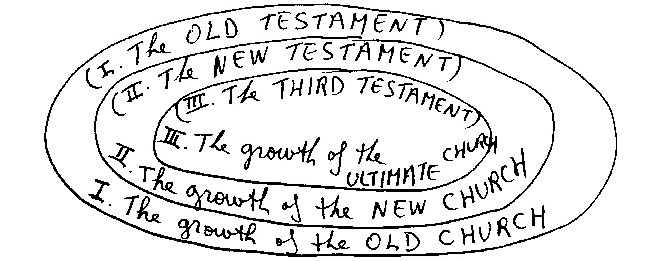
We may inquire as to what determines the growth of the Church within us. We will discuss the answer in terms of what may be called confirmation theory, which is the idea that the successive Churches are established within us when we confirm the trues of religion in our life. Thus, after the doctrines drawn from the Old Testament state of mind are confirmed in our life, the spiritual concepts of the New Testament state present themselves to our mind; then, when we succeed in confirming these doctrines, the spiritual concepts of the Third Testament state present themselves to the mind. When trues of the Third Testament state can be confirmed in our life, the Church within us is in its completed stage, though not complete in that ultimate stage. Indeed, the completion of the ultimate Church within us proceeds to eternity. In this third state we come into the image and likeness of God, an eternal and endless progression. This is the Angelic state of the mind.
We need to examine how doctrines drawn from the Three Testaments are confirmed in our life. This may be illustrated by considering the successive doctrines of the Three Testaments. The chief doctrine of the Old Testament Sacred Scripture is that God reveals Himself to us as a Human Divine Person Who created us and Who requires us to obey His Commandments under penalty of death and all sorts of inescapable punishments. His Divine omnipotence, omniscience, and omnipresence are absolute, infinite, and incomprehensible to us. As children we accept this doctrine with innocence and perfect faith. The Old Church then grows within us and produces thoughts, intentions, and feelings that harmonize with this doctrine. For instance, though we rather lie, steal, and commit adultery we strive not to do these things out of fear of God and a hope of reward. When we mess up and violate these Commandments, we feel guilty and uneasy; our happiness vanishes. But as soon as we repent and sincerely resolve not to continue in our sin, we can be happy again. This is the operation of the Old Church within us. Our living conscience, built up by the Old Church within us, is the confirmation in our life of the doctrine of the Old Testament Sacred Scripture.
As this operation is well established within us we come to the doctrine of the New Testament Sacred Scripture which is that God is present with each individual in an intimate relation and Personally labors to bring us to eternal happiness and fruition in His Kingdom of the afterlife. This New doctrine is more difficult to confirm in our life than the Old doctrine and requires many years to be completed. For example, whereas the Old Testament Sacred Scripture requires us to love our neighbor, the New Testament commands that we love our enemy as well. Or, while the Old Testament commands us to not commit adultery, the New Testament Sacred Scripture informs us that even the mental enjoyment of unchaste thoughts and emotions is a damnable sin, if confirmed. However, as we strive to live according to this New doctrine we find that we begin to think and feel more purely towards others. What seemed impossible before now is accomplished on a regular or routine basis. We discover that we can love the good part of our enemy, and we find that we no longer enjoy thoughts of revenge or emotions that are unchaste, but find them repulsive and aversive. We have then confirmed the doctrine of the New Testament Sacred Scripture in our life.
We then come to the doctrine of the Third Testament which says that God is the Divine Human Who alone is alive within us. This is even more difficult to confirm in our life and takes all of eternity. The reason this third doctrine is so difficult to confirm is that it takes away our selfhood. With the New Testament doctrine we are still partly in charge of our lives though we depend on God for victory and success in overcoming the selfish nature we are born with. But with the Third Testament doctrine we have totally lost our selfhood: we are not in charge of ourselves any more; in fact we are dead, we have never had life, and never will have. We are merely a vessel for God's Life within us. This is the most difficult doctrine to confirm in our life since it is difficult for us to rid ourselves of the delusional appearance that we have life of our own. We appear to think, and feel, and decide; it looks to us that God can influence us rather than being us. Yet the Third Testament informs us that our thoughts are not our thoughts but the thoughts of spirits with us, and the thoughts of spirits are not their thoughts but the reception of God's thoughts. Individual vessels receive God's thoughts, intentions, and feelings in accordance with the state of the Church in their mind or spirit, hence there is an appearance of individual variety or personality. But this variety is due to the variation in vessels as God Himself is One, Unchanging and Absolute.
It may seem at first that the doctrine of the Third Testament is abstract and impossible to confirm in one's life. Yet as we strive to observe our inner life through the study and application of the Third Testament, we begin to see how it is true. Our thoughts and feelings are not our own. They are inspired into us. They enter by an inner route from the soul and spirit and come out into our mind's awareness where we can see them. Our life is as-if our own. In this realization we suddenly feel very close to God, the Divine Human. We see that all along there was no other life but His Life. God has become the Divine Human, the only Human Who is the Very Human Itself pulsating in us. We are human vessels to His Divine Human Life. This realization becomes love into God from God, and leads to all true wisdom and blessedness.
Religious psychology attempts to uncover these steps of the growth of the Church within us. It is a discipline of study based on the successive doctrines of the Three Testaments in our mind. This book will appeal to those who want to reach in this life on earth the state of blessedness and wisdom which is promised through the Third Testament. We may gain a better comprehension of the development of the Church within us by reviewing some details of the developmental steps in the historical (external) churches.
13.12.2 History of the Churches on Earth
After the Fall of the human race on this earth the process of being regenerated by the Lord evolved in three successive phases or epochs. The history of the external church is the same as the history of the internal Church within each individual. By reviewing the epochs of the external church we gain a view of the three phases of our own regeneration. The interior Church within each of us is built up by the Lord in three phases, that is in three successive degrees. The interior sense of the successive historical churches is the representation of the successive stages of evolution of the inner Church within us. This relation is pictured in the following table:
|
EXTERNAL CHURCH |
||
| The First Period
(3,500 B.C. - 1,757 A.D.) |
The Second
Period (1,757 A.D. - 1,938 A.D.) |
The Third Period
(1,938 A.D. - onward) |
| The Old Church | The New Church | The Ultimate Church |
| The Old Testament | The New Testament | The Third Testament |
| Judao-Christian | New Christian | True Christian |
| Human Divine | Divine Truth | Divine Human |
| Invisible God | Visible God | God Man |
| etc. | etc. | etc. |
|
INTERNAL CHURCH |
||
| The First Degree (birth to adulthood) |
The Second Degree (maturity to old age) |
The Third Degree (old age to eternity) |
| The Natural Self | The Rational Self | The Celestial Self |
| Sinfulness (Evil) | Reformation | Regeneration |
| Worship from Fear | Worship from Reason | Worship from Love |
| etc. | etc. | etc. |
The upper part of the table reviews some features of the history of the external church since the spiritual Fall of the human race on this earth. The bottom part views the corresponding interior sense of this history. By studying and meditating upon the relation between these two, many additional entries or illustrations might be given.
13.12.2.1 The First Phase
We may examine this correspondence by considering first the progression of the periods of the church. Insight into the Old Church may be gained through a review of the Judeo-Christian commentaries to the Holy Bible. In this view, the Old Testament Sacred Scripture and the New Testament Sacred Scripture present the literal sense of Sacred Scripture, and in this sense the God of the Old Testament Sacred Scripture is invisible and incomprehensible. In order to have contact with people on earth this unreachable God is transformed in the external sense of Sacred Scripture into a Divine Personality called by various Names: Jehovah, I AM, Heavenly Father, the Most High, King of Kings, and many others. The character of this Divine Personality is not the character of God since this is impossible for people to understand. The character of this Divine Personality is only a gross and imperfect appearance. It is human in its nature since Jehovah in the Old Testament Sacred Scripture talks as a human does about His anger, His frustration, His gladness, His changing His mind, and so on. So we may refer to the Old Testament Sacred Scripture God as the God in human character, that is, as the Human Divine.
The Human Divine, called by the Name of Jehovah, is not God per Se, but God as initially presentable to humans who are in the state of the Fall. The child is in such a state when first instructed about God, sin, and the afterlife. The modern scientists are in this state when they separate their science from religion. The philosophers and secular humanists are in this state when they acknowledge the existence of God but insist that humans are to work out their own destiny. The Jews are in this state as they deny the Coming of the Messiah. The Christians are in this state as they pray to the Father in the Name of His Son.
In this state of the Old Church, worshippers address an invisible God out of fear. Though they believe that God is infinitely merciful, yet they also ascribe to Him the role of Judge, and Punisher. Their image of God is mixed. They accept contradictions as Divine paradoxes that will remain forever incomprehensible to the human mind. Faith is mystical and blind, not rational and crystal clear.
There are many varieties within this Old Church mentality. For example, the New Testament Sacred Scripture divides Christian from Jew. To the Jew, God remains distant and incomprehensible and He leaves us to fend for ourselves as best we can. To the Christian, God is incomprehensible in one way but comprehensible in another way. In effect, God becomes two Divine Persons (or three Divine Persons). The idea of One God Who is Two (or Three) Persons is not an idea that can be rationally grasped. Therefore this is a blind faith, not rational.
13.12.2.2 The Second Phase
This then is the first period of the external church and the first degree of the internal Church. The second period called the New Church was born historically (that is, externally), when people became capable of gaining a rational understanding of the New Testament Sacred Scripture in relation to the Old Testament Sacred Scripture. This occurred in the eighteenth century when some Christians began to read the Third Testament, that is, the Writings of Emanuel Swedenborg. In this second phase, the doctrines of the Church explain and clarify the relation between the invisible and visible God. In this state, called the New Church, the One-God-in-Two-Persons (or in Three Persons) is seen to be an irrational formula. There is no prayer or worship offered to "the Father in the Name of the Son." Rather, the Son is the visible Heavenly Father, Who is invisible as He is in Himself. He therefore has to present Himself in a visible form called the Son of God. This is not meant in the sense of a biological offspring, but a spiritual manifestation. There are thus not two Divine Persons (or Three Persons), but only One Person. And this One Person, called the Father in His invisible state, makes Himself visible as the Son. The Father and the Son are One Person in two states, one invisible as He is in Himself, and the other visible, as the Son. The Father made Himself visible as the Son by the process of Incarnation. There is not a blind faith in this but a rational one.
When we have the New Church within us, our sinful nature can at last be conquered. In this New Church state within us we proceed into mature life with a rational character and conscience by which we can learn to hate our own nature and love the Divine Truth. At last this exalted human-rational frees us from the bondage of sin. Yet the transformation is not complete. Again and again we fail in our attempt to banish selfish thoughts and wicked feelings. The ideal of purity still escapes us and we continue to suffer from anger, impatience, prejudice, harshness, and guilt. It appears to us in this state that as long as we live in this sinful body and world, we are not going to taste of the paradise of Eden. Conjugial love becomes an ideal for the future life.
13.12.2.3 The Third Phase
However this is only an appearance to the rational self which still holds on to the actuality of self-life though it recognizes in theory that the self has no true life of its own. But when we are ultimately willing to step up to the bullock, and slay it, we eradicate the natural remnant of our former life of the flesh. Thus we enter into the Third and Ultimate Church within us. We are now willing to call the Writings Sacred Scripture by a new Name; they become the Works of the Third Testament. Now the visible Divine Human enters into intimate relations with our daily transactions. This is the crown of the inner Church. It is the true activity of regeneration that begins on this earth and continues to eternity. It is the marriage feast to which we are invited by the Lord Who clothes us in sumptuous garments fit for angelic life on earth.
The three external churches now exist on earth. Every individual irrespective of the external church one belongs to must needs undergo the steps of the Three Churches within. Whether we are born Christian, Jew, Moslem, Buddhist, agnostic, or New Church, we still must undergo the same development of the inner Church in its three successive degrees. At some point in adulthood we are reborn from the Old Church within us into the New Church, and after that we are initiated by the Lord into the Third or Ultimate Church. Throughout this process the individual may retain membership in the external church of the family. Life circumstances may seem to determine whether we also change external churches as the inner Church develops but it is clear that all external churches will have members who are at different stages of development with regards to the inner Church. Our inner state may not be visible to others but to ourselves the change is always visible. An individual who is in the third degree of life in the inner Church may worship together with co-religionists who are in the second and in the first degree without necessary strife or disharmony. Of course the actual experience of their communal worship is going to be very different depending on their different inner states. But at the external level there need be no antagonism between them.
The transformation from the New Church to the Ultimate Church occurs when we have applied sufficiently the Divine Truth we come to love in the New Church state of mind. We apply the Divine Truth to our daily life, in our transactions with others, and see it confirmed there. This happens within our efforts at repentance during religious self-inspection. In this state we begin to perceive the interior sense of the Third Testament. This sense is mirrored in our inner life, our approval or disapproval of the transactions we are given to perform by the Lord. After death we can see this interior sense mirrored in our external environment as well, as our Heaven brings forth the fruits of our regeneration.
In the state of the Old Church within us we are sinful and evil in our transactions but we do not perceive this. To ourselves in that state we appear good when we act out of obedience to the Ten Commandments of the Old Testament Sacred Scripture or to the dictates of our conscience. When we act badly in this state we recognize our sinfulness, but if we act well out of conscience we are convinced that we are good. It is a delusional state since our acting well is not from the Lord but from ourselves, and is meritorious. In this state of the Old Church within us God necessarily appears as distant, invisible, and severe. Without a punishing omnipotent and omniscient God, whether Jehovah, Allah, or Buddha-Karma, the individual degenerates into libertinage, cruelty, and irrationality. In this state the individual recognizes One God in Two or more Divine Persons. When God became flesh, the Christians and Jews insisted on Two Divine Persons in the "Godhead"; this made them feel secure, sane, and happy. The Lord's Jewish apostles in the world had to see Him as the Son of God even though they were compelled by external miracles to recognize that the Father and the Son were equal in Divinity, though not yet in their mind, One in Personhood.
But so that our conscience may evolve from fear to reason, this Old Church state within us is succeeded by a New Church state in which God is restored to the status of One Divine Person. The Son is now the external, visible life of the Father. God is One and He loves us: His external (visible to us) part is called the Son and His internal part (not visible to us) is called the Father. In this New Church state within us the miracles and parables of the New Testament Sacred Scripture are comprehended in their interior sense through the doctrines drawn from the Writings of Emanuel Swedenborg. However, in this second phase of our Church development, only the literal sense of the Writings Sacred Scripture are perceived, hence acknowledged. The interior sense is not perceived, hence it is denied or doubted.
But when we enter the Third Church within us we acknowledge-ledge the interior sense of the Writings Sacred Scripture and call them the Third Testament because we can perceive it. Though we knew from before that the Lord is the visible Divine Human we did not perceive this directly but accepted it on faith. Now in the ultimate Church within us we perceive the interior sense of this Name. We see it in ourselves, in our daily transactions where this Name dwells in a living and immediate way. In this state we worship the visible Divine Human from love; that is, we are given to have love into Him from Him. A little later in this text, we will discuss the practical details of how we can confirm the Divine Human in our daily living choices and acts of conscience that we bring to our thoughts, feelings, and actions, moment by moment through every day, and without letup.
Those who study the Writings of Swedenborg as Sacred Scripture of the Lord sense strongly the attraction in the ideal of Conjugial Love given there. This attraction comes from their love of knowledge and truth. This is the affection of the rational self. Our rational self experiences great inner delight when we apprehend the meaning of a sentence or number in the Writings Sacred Scripture. We feel illuminated and we see an aspect of life which is helpful to our living. The sense of the letter of the Writings of Swedenborg has that quality of satisfying our desire to know and understand. Therefore it has the greatest of spiritual value.
We may now inquire about how this happens. In what way do the explanations in the Writings Sacred Scripture provide us with such delight? To answer this question we need to go to a second degree of meaning contained within these Writings. The only way available to this interior sense is through the Third Testament state of mind. Therefore in order to make the inquiry we must enter the third or Ultimate Church within us. After the realization occurs, for which we are supremely grateful, there is provided perception of this inner sense within Sacred Scripture and illustration of their actuality in daily living. This perception is called the correspondential sense of the Third Testament.
With this preparation we may now inquire as to the interior sense of this conjugial love to whose literal sense we feel such a strong attraction.
Our daily living consists of transactions with others. Each day brings thousands of individual transactions. A look is a transaction. A smile, or being late, or keeping a person in one's mind, or a name -- all these are transactions. These transactions are provided by the Lord. There is no transaction which is random or fortuitous or pre-determined; each and every transaction is provided for a specific good. It may astonish the rational self to think of this operation, of its gigantic size, of its improbability, etc., but the external rational is not to be consulted in spiritual meanings, because it is natural, not spiritual. We must rely on the interior rational, which is purely spiritual and celestial. The external rational excludes any information that is not natural. So it is obvious that it excludes the spiritual and the celestial. But the interior rational is built up not by ideas based on the natural senses, but by ideas based on correspondential senses. These are the senses of the mind or spirit and can receive or detect information that flow in from the spiritual world.
The interior sense of conjugial love relates to these transactions of daily living. Thus in order to perceive the interior sense of the Third Testament we must see it in relation to our transactions in every day life. However there may be several ways of doing this task of relating trues of Sacred Scripture to daily situations. For example, in the Old Church state we also attempt to apply the Bible to our lives but without success since what we did came from the natural self and not the spiritual self. Similarly, in the New Church state we attempt to apply the Writings Sacred Scripture to our daily living with others, to our education and counseling, and to our science. But this too lead to no ultimate success since we did it with the rational self of its own; like mighty mountains, our puny attempts were dwarfed by the stars of heaven. It's never quite enough. We're never quite there. We sense a veil, a glass ceiling of unattainable saintlihood. But as we enter the third Church within us, our rational holds still and listens with reverence to the spiritual perception that is unfolded to it from above.
13.12.3 The Positive Bias
With this sense or approach to the meaning of conjugial love we can begin to perceive through illustrations the Lord provides in these daily transactions. Religious psychology is the study for better managing our transactions from our perspective of Sacred Scripture. The practice of religious psychology involves a constant striving to understand and discipline ourselves. The diagrams and methods used in this book represent aids or tools in better self-management in accordance with each concept of Sacred Scripture. These intellectual tools may be used by a person from any religious denomination as long as the person is willing to accept the premiss that Sacred Scripture is Divine and that it has an interior correspondential sense. We may call this approach, adopting a positive bias. Note carefully: we are not saying that people have to give up their native or adopted religion before they can practice religious psychology. People of all religion can read the Three Testaments in their native language, as God has provided for their universal translation and dissemination. If they read these Three Testaments thinking that they are or may be Divine Works, because they say so about themselves, then they can enter fully in all three states of development of their inner Church, without having to convert to another religion.
If we thus adopt a positive bias towards the concept of conjugial love in its interior sense, we may begin to perceive in this new mode, the mode of perception characteristic of the Third or Ultimate Church. To make this living experience clearer to our external rational (which is natural, not spiritual), we may consider illustrations. Illustrations are case histories viewed in relation to doctrine from Sacred Scripture. In this case, conjugial love in its inner sense is a doctrine we want to view in relation to our daily transactions. Every person is born for heaven with a unique and specific angelic character to be attained. This character to be attained corresponds exactly to our geographic location in Heaven. Of course we will remember that "geographic location" in the spiritual world is according to our goods and trues, hence we call it spiritual geography.
The Lord supervises our transactions in order to govern our way to this angelic status. This is called regeneration. Religious self-inspection is a tool to help us discipline our daily transactions so that we may co-operate with our regeneration by the Lord. Self-management is thus a necessary activity in the state of the Third Church. The interior sense of conjugial love provides us with definitive guides to our temptations. The Lord uncovers deeper and wider areas of our evil by illustrating the meaning of Sacred Scripture in these transactions. How we choose rationales to justify ourselves, for instance. How we are totally blind to trues except when immediately illustrated by the Lord. How the Lord repeatedly takes us to the top of the world with promises and then plummets us down to our shame and horror. How we are bestial except under direct and continual enlightenment and encouragement from Him. The concept of conjugial love is given us in the sense of the letter of the Third Testament so that we may, if we will, enter into its interior sense and thereby perceive our marriage. In our own case, Leon's marital confessions as a husband has been documented here.
Marital transactions are representatives of spiritual realities. By witnessing these transactions we perceive the Lord's labor with us. We perceive God's Creation itself. The entire universe is merely for this purpose that God can turn our marital transactions into conjugial love. This is the interior sense of the doctrine of conjugial love. Religious self-inspection allows us to become more adept at perceiving the Lord's work within us, of seeing the way by which we are led to our Heavenly Society. It ought not to be thought that conjugial love is a doctrine only for those who are married since preparation for marital relations goes on since birth. Individuals are born men or women, with specific spiritual genes that represent the angelic character we become. The external rational (which is not yet spiritual) ought not to be consulted here since it evokes the detested idea of predestination. Rather, we wait patiently to be illustrated with further temptations. The Lord arranges our transactions in wonderful ways to bring us together as marital partners. Marital partners may perceive such similarities in their childhood affections that it is wonderful to contemplate the way the Lord managed our experiences to yield this similarity. And it is wonderful to behold how the Lord leads us from the perception of similarity to mutuality through an identity of thoughts, intentions and reasonings. In other words, we first perceive that we apparently think alike, and under this impress, we are led to feel alike; at last, when we feel alike, we are led to mutuality, where we truly think alike as a result of feeling alike.. This is the state of conjugial love.
This process may be apprehended by our external rational self. The activity goes on above the external rational, in our spiritual self, which is also our internal rational, but the external rational self can perceive it through immediate and direct illustration by the Lord of our daily transactions with others. Pre-marital transactions are not perceived since most of us are not willing to enter our Third Church until long after we’ve been married.
The subject matter of temptations in marriage is treated of in Conjugial Love when studied in the inner sense and applied to our daily transactions with others. The Work also throws light on pre-marital transactions since it explains the origin and development of scortatory loves within us. All the loves of the natural self and of the rational self prior to regeneration are scortatory or unchaste and delusional. There is no part of us, no thought, intention, or sentiment, that is good. Whatever good there is in us is exclusively the Lord's Own with us. The good is not our own.
We co-operate in our regeneration when we perceive how the Lord manages and governs our transactions. This perception is our own. It is a magnificent gift from the Lord for which we are supremely grateful. It is our very consciousness, our very awareness as a human self, without which we are inanimate as a stone. When we perceive one of our transactions as a temptation we are given to see an element of our evil. It is the greatest of all opportunities because we are given thereby another chance to be redeemed: we can approve or disapprove of the representation in our deed. As we approve when the Lord gives us to act well we are illustrated from doctrine. We experience our heavenly calling.
In preparation for our willingness to enter the interior sense of the doctrine of conjugial love we may consider and discuss the developmental steps we underwent as the Three Churches were established in us by the Lord through Sacred Scripture.
| OLD TESTAMENT | NEW TESTAMENT | THIRD TESTAMENT | |
| INMOST SENSE (CELESTIAL) | A description of the Lord's
glorification and of the Heavens; taught through correspondences, doctrines, & memorable relations. (PARTIALLY OPENED) |
A description of the
workings out of Divine Providence & Love; taught through as yet unknown ways. (UNOPENED) |
An explanation of how to
confirm the marriage of good & truth within us; taught through as yet unknown ways. (UNOPENED) |
| INTERMEDIATE SENSE (SPIRITUAL) | A description of the rise &
fall of the successive external churches on earth; taught through a knowledge of correspondences, doctrines, & memorable relations. (OPENED) |
An explanation of what is
Divine Truth; taught through the order & series of miracles & parables. (UNOPENED) |
A description of how the
inner Church develops within us (regeneration); taught through perception & illustration during religious self-inspection. (PARTIALLY OPENED) |
|
EXTERNAL LITERAL SENSE (NATURAL) |
A description of the
delights & uses (and their adulteration ) of external life; taught through historicals, allegories, & hymns. |
An explanation of the
morality of human relationships; taught through the content of mircales & parables. |
A description of how our
thoughts & feelings originate from the spiritual world; taught through rational exposition of the subject matter. |
This table summarizes certain features of what we may have perceived in Sacred Scripture thus far. Naturally there are going to be individual differences and peculiar obscurities to each one of us. Nevertheless a communal grasping of the doctrine is possible through our rational self. The chart may be read for greater comprehension from bottom up. The following discussion illustrates specifics which may be related to the chart in order to see the representatives of doctrine in our life.
Upon reflection and instruction we become aware that the Three Testaments contain a progressively more ideal religious ethics that govern our daily transactions. The Old Testament's Ten Commandments are blunt and proscriptive: only a barbarous nation would allow its citizens to murder, rob, libel, and commit adultery. Only individuals in a grossly degenerate state would try to justify violations of the Ten Commandments as good and decent. The New Testament's Commandment is infinitely more sophisticated, civilized, subtle: only a few individuals have been able to adhere to it in a consistent way -- the angelic spirits among us, the saints and heroes, the genuine altruists. Even so, the Third Testament's Commandments appear infinitely more radical and subtle than the New Testament Commandment for few people can stand to even read them! The Commandments of Sacred Scripture are thus arranged in three successive degrees of apparent difficulty so that the Second appears infinitely more difficult to obey than the First, and the Third is infinitely more difficult to obey than the Second. This is an external appearance of Sacred Scripture and represents the impossibility of fulfilling the commandments of Sacred Scripture of our own efforts.
A person who appears to be fulfilling the Commandments of the Old Testament Sacred Scripture is yet infinitely far from fulfilling the Commandment of the New Testament Sacred Scripture, which is that we have love and goodwill towards others. We all know the truth that our intentions and emotional reactions come and go within us at their pleasure: our understanding and reasoning has merely a veto power over them so that they do not break out in overt deeds. Yet the New Commandment asserts in its literal sense that we are evil and damnable because of these involuntary impulses within us. Our will is helpless to prevent evil thoughts and emotions and yet we are guilty for them. If our external rational be consulted here it would say that this is unfair; but the rational is not to be consulted. Rather we must wait patiently for illustration from the Lord. Then we can see that far from being unfair, it is Divine Love and Wisdom having us in sight and providence. You may like to read Rev. Ray Silverman's application of the Ten Commandments to one's daily interactions with others. Please click back to continue here.
When we consider all Three Testaments together, in a series, so that after our journey from Old, to New, to Third, we now are given to journey back from Third, to New, to Old, we at last are given to fulfill the Commandments of Sacred Scripture to its fullest. In order to prepare ourselves for this holy journey, back to the East, as it were, it is necessary to study the sense of the letter of the Third Testament so as to draw out spiritual doctrines to guide us in our approval or disapproval of our daily transactions. Afterwards, we need to strive to understand the interior sense of these doctrines by confirming them in our religious self-inspection. Then at last we will have fulfilled the Commandments of Sacred Scripture. In this journey we reproduce, as in an image, the Lord's Own glorification. His Journey as the Word of God, and as the Word made flesh, and as the Word transfigured and uplifted, is the pattern we are given to follow in our own regeneration by the Lord. The arena for our journey of regeneration is our mind -- our changing thoughts, reasonings, reactions, emotions, strivings, affections, and perceptions, in short, our daily transactional exchanges with others.
Religious ethics is a branch of religious psychology that helps us become objective and practical about our inner life with the motive to judge our transactions. It requires the method of self-exploration and self-investigation. Forensic tools must be used to unmask our pretenses and catch our deceits. We are helped by the knowledge in faith that we are guilty in every case that comes up! Our task is to prove it, to confirm it as-if of our own free will. We may prepare for this task by studying the methodology of religious ethics given us in the sense of the letter of the Third Testament.
We may illustrate this process by considering the manner in which the will and the understanding relate to each other. This topic is treated of everywhere in the Third Testament. For this example we may consider Numbers 478-500 in Conjugial Love where we are given a spiritual-psychological analysis of the kinds and degrees of adulteries we perform. As we study these numbers we are not only given a list of the adulteries but also a method of reasoning by which to identify them in us. It is required that we strive to understand this legalese language even so far as to be able to use it against ourselves so as to better convict. Under the impulse of this motivation we can learn to understand this language and experience the delights attendant to the acquisition of such mastery. To aid in this task we may use models and diagrams, lists, tables, and charts.
By way of illustration we may take Number 490 which reveals some of the operations of the will and understanding in the domain of our adulteries. It is written:
"Now, as the marriage of good and truth has been treated of in the First Part of this work, and as many things were there adduced respecting the will and the understanding, and respecting the various attributes and predicates of each, which as I think are perceived even by those who had not thought distinctly about the understanding and the will (for human reason is such that it understands truths from the light of them, even though it has not distinguished them before), therefore, in order that the distinctions of the understanding and of the will may be more clearly perceived I will here present some truths, to the end that it may be known of what quality adulteries of the reason or the understanding are, and after that of what quality adulteries of the will are. The following may serve for the cognizance of them." (Conjugial Love, 490)
There follows a list of four things, but this Number is marked as the tenth in a series of eighteen things. We may first draw an outline of the eighteen propositions and sub-propositions, as is given in the Table of Contents to Conjugal Love drawn up by the translator or editor. A related activity for study is to extract propositions wherever they can be noticed and to transform them into a language of our own thinking and reasoning, so as to better to insure that we understand them with our own intelligence and are able to instruct others concerning them. As an illustration of this activity let us take up the four sub-propositions presented in Number 490 which regard the nature of the interaction between our will and our understanding. In this exercise it is helpful to remember that the will represents the affective domain: that is, the good of love and its attendant affections, strivings, and motives, while the understanding represents the cognitive domain: that is, the truth of faith and its attendant thoughts, reasonings, principles, and value ideals.
13.12.5 Seeing Through Sacred Scripture
The external, physical body of Sacred Scripture is finite and appears to us today in the form of ordinary printed books. As we read a chapter, verse, or phrase in the positive bias attitude, we are presented with a natural-historical content that we can picture with material ideas in our natural imagination or automatic self. For instance, a verse in the New Testament Sacred Scripture says that "He send the rain upon the just and the unjust" (Matthew 5:45). From the physical content of this verse we can derive material ideas such as: that God is a He; that He is the Giver of rain; that there is rain; that we get rain because He sends it; that we all get rain from Him even when we are unjust in our dealings with others; that we can be either just or unjust. These are material ideas or implications drawn from the physical sense of the verse. Through the method of correspondence revealed and taught in the Third Testaments (that is, the Writings of Swedenborg) our rational is empowered to see through the external-natural sense of the verse, and into its spiritual interiors. This occurs when we are told what the spiritual meaning is of "rain," "God sending rain," and "the unjust and the just."
When we read Sacred Scripture our natural, automatic self sees its historical, physical things; but our rational-spiritual self sees its spiritual things. Whenever water is mentioned in Sacred Scripture (and there are hundreds of passages) it is mentioned in some particular form: rain, river, ocean, ice, flood, spring rain, autumn rain, well, fountain, and so on, as well as specific activities in connection with water: drinking it, washing with it, not having enough of it, changing it into wine, gathering it into one place, and so on. In all these passages Sacred Scripture is actually discussing Divine Truth and the influx of Divine Truth into people where it shows as understanding, intelligence, thinking, reasoning, and all the other cognitive operations of our mind. Each specific reference to water in some form and associated with some specific activity, signifies some specific intellectual operation. By collecting all the passages of Sacred Scripture that discuss water, and interpreting them in accordance with revealed correspondences, we are gaining many details regarding the true but hidden operations of our intellectual apparatus. The verse we are considering thus means, spiritually, that God is the source of all truth in our understanding, in our ability to reason, and that all people receive this ability, both those who have religion and those who deny it.
We shall quote from a number of passages illustrating this principle of analysis. The passages were culled from Potts' well known Concordance of the Writings of Swedenborg: (the numbers refer to the location of the paragraphs in the Arcana Coelestia, a 12 vol. work by Swedenborg)
(24) "Let there be an expanse in the midst of the waters, and let it distinguish between the waters and the waters" (Genesis 1:6) ... The knowledges in the internal man are called 'the waters above the expanse'; and the scientifics of the external man, 'the waters under the expanse!"
(27) "These knowledges (in the external memory) are 'the waters gathered together in one place,' and 'are called seas' (vers. 9,10).
(28) 'Waters' in Sacred Scripture=Knowledges and scientifics.
(57) 'The waters going out of the sanctuary' (Ezekiel 47:12) =the life and memory of the Lord. (=the truths which confer intelligence).
(382) 'To wander to drink waters' (Amos 4:8) = to seek for what is true.
(680) 'Water' (John 4) = the spiritual things of faith.
(847) 'The waters had receded from upon the earth, in going
and returning' (Genesis 8:3) = fluctuations between truth and falsity.
(2240) 'They found no waters' (Jeremiah 14:3) = no knowledges of truth.
(2702) 'The afflicted and the needy seek waters, and there are none' (Isaiah 41:17) = the desolation of truth (= those who long for the knowledges of good and truth. 10227).
(4926) 'The waters of the lower fish-pool' (Isaiah 22:9) = the traditions by means of which they have made breaches in the truths of Sacred Scripture.
(7322) 'Stretch thy hand over the waters of Egypt' (Exodus 7:19) = the exercise of spiritual power over the falsities which are infesting.
(8368) 'There were twelve springs of water' (Exodus 15:27) = truths in all abundance.
(9468) 'The waters of separation and expiation' (Numbers 19:6) = purification and withdrawal from evils and falsities by means of truths and goods from Sacred Scripture.
(10242) 'When entering the Tent... they shall wash with waters' (Exodus 30:20) = (when in) worship (there must be) purification by means of the truths of faith.
"These passages are only a few of the many listed and it is not possible to fully understand them without reading the explanations that go with them; nevertheless, the reader may have an idea from these as to the amazing details that the method of correspondences allows us to extract from Sacred Scripture on any one subject. It is evident to anyone who studies the Writings of Swedenborg that in Sacred Scripture there is to be found an unlimited source of information concerning the self in our dual citizenship, that is, our external-natural self and our internal-spiritual self-. It is also evident that these correspondences are not arbitrary but derive from the organic connection between the two worlds of our citizenship. The Writings of Swedenborg teach a method of rational picturing so that phrases and words of the Old and New Testament Sacred Scripture Sacred Scripture can be seen in their interiors. Through this method the phrases and words of Sacred Scripture become windows and doors into the other world we also live in. The interiors we see in all Sacred Scripture are also the interiors of ourselves. The details we see there constitute the science and knowledge of of ourselves and our life situation.
Religious psychology is the psychology in the positive bias which the Writings of Swedenborg unfold for our rational understanding. The religious psychologist acknowledges that though we must be empiricists, yet we cannot discover the spiritual facts about ourselves by ourselves using only physical methods of measurement. Instead, we must receive them through revelation in Sacred Scripture. Swedenborg reports that through his spiritual communications he was able to discover that the most ancient cultures on this planet were in conscious communication with their departed ancestors who came to them as angels in their meditations and dreams. Their ancestors from the afterlife appeared to them in their spiritual bodies, which resembled their former physical bodies in outward appearance. In this way they were instructed by them regarding their ideas of nature, God, heaven, hell, and the inner life of memory, morality, and feeling. These ancient wise people were thus able to read in natural events their spiritual significance and origin. They did this through a perception of correspondences which came to them by intuition. They thus had the law inscribed in their hearts; that is, they did not have to accumulate knowledges by education and science. Instead, they knew by instinct anything they wanted to know. Subsequent cultures gradually lost this inner ability as people insisted more and more to know from the external senses alone. Eventually all direct, conscious connection with the other world was lost. As a result, a written Word had to be given to humankind and all knowledges had to be learned through education and the accumulation of scientific discoveries. Nevertheless, the science of correspondences was retained in shredded form in many subsequent religions, Sacred Scriptures, and mythologies. Today, some of this knowledge is still evident in poetic and metaphoric language.
Religious psychology offers the possibility of a partial return to that state in which we can once again understand the natural in terms of the spiritual. This return is now possible because the Writings of Swedenborg give us a complete rational system of correspondences of Sacred Scripture. The religious psychologist now has the new ability of investigating and researching the facts of our dual citizenship. Because we acknowledge that we cannot discover these facts by ourselves, we need to be given a method by which these facts can be discovered and applied to human welfare. Yet we must remain empiricists: we cannot merely accept the authority of a "seer" or "prophet." We need to confirm every fact through our own confirmations.
This is Good News, indeed, for the scientist! See our work on Scientific Dualism.
Religious psychology works through the methodology the positive bias. This approach was meticulously practiced by Emanuel Swedenborg in all his scientific, philosophic, theological, and personal literature. These are available in English translation of his many published and unpublished writings, including letters, drafts, and personal diaries not meant for publication by the author. We estimate from public libraries records in the United States that he must be among the top five all time writers in the history of the world with several hundred titles to his name. His books, though not in entirety, appear in the holdings of most public libraries in the English speaking world. These books for the most part have been published and sold or donated to the libraries by the Swedenborg Foundation of New York, established in 1850 by a few people who felt strongly that Swedenborg's books ought to be made available to anyone who was willing to accept them as serious scientific and theological writings by an enlightened man.
The Foundation also produces multi-media works in films, television productions, art, and so on) which strive to bring to the public's attention that in Swedenborg's ideas the world may draw influences which are positive, creative, and altruistic. The Foundation has gathered historical documents and literature extracts from many famous literary and political figures who have declared to be greatly influenced by Swedenborg's writings. Selecting from that list, we may mention here the following:
Honore de Balzac, Charles Baudelaaire, Hector Berlioz, Hon. John Bigelow, William Blake, Robert Browning, Elisabeth Browning, Thomas Carlyle, Andrew Carnegie, Samuel Taylor Coleridge, Sir. A. Conan Doyle, Ralph Waldo Emerson, Benjamin Franklin, Johann Goethe, Heinrich Heine, Elbert Hubbard, Victor Hugo, all three James's, Abraham Lincoln, J. Ramsay MacDonald, Maurice Maeterlinck, Horace Mann, Czeslaw Milosz, John Frederick Oberlin, Sir Isaac Pitman, Edgar Allen Poe, Ezra Pound, George Sand, Friedrich Schelling, George Bernard Shaw, Sundar Singh, August Sdrindberg, Daisetz Suzuki, Henry D. Thoreau, H.G. Wells, John Wesley, William Butler Yeats.
This partial list is sufficient to show that the documentation of Swedenborgian biographers and scholars establish the fact that the positive bias in scientific and literary thinking has been steadily forming within the rational of the English speaking peoples since 1757, the year identified by Swedenborg as marking a new beginning for humankind. This was the year during which he was given by Divine intervention to be the wit ness from earth to this mind-shattering event. In that year took place the long awaited Christian hope of the Second Coming of Christ. Only, it was missed by everybody on this planet -except Baron Swedenborg, Swedish Nobleman and reputed European Scientist-Engineer.
Swedenborg then took down on paper everything he witnessed. Being an impeccably honest and intellectually meticulous genius, Swedenborg produced several hundred titles, or about 50 volumes in modern English print, telling of what he saw and experienced during 27 years of conscious dual citizenship; that is, he was living simultaneously in both this world and the world of the afterlife. These volumes demonstrate to the rationally inquisitive person that the Second Coming of Christ was meant to be in the rational of each human being on earth. The Second Advent begins a new organic evolution in the consciousness of the human race. This new organic growth of the mind will undoubtedly be discovered by future researchers in neurosciences. A similar new beginning had occurred before in the history of civilization, when the separation of the organ of the will and the organ of the understanding took place: this spiritual event in the formation of the human mind was followed by the growth of a new brain called the cortex, which in humans, now outweighs the old brain called the cerebellum. The cortex is the new seat for human rationality and freedom. Since the Second Coming of Christ is a rational new organ of the mind, it is likely that the changes in the human brain will not be as gross as before, but will take biochemical and genetic forms that adequately represent the subtlety and mathematical complexity of this new spiritual organ in our mind.
Whatever the case may be as to its physical symptoms, the psychological significance of this new era is immediately obvious and capable of being utilized for creative and altruistic purposes. Because our human destiny was carried out by this eminent ambassador, the writings of Swedenborg constitute a common property to all mankind. The historical and intellectual preparation has now been going on for more than two centuries. Many of our most influential thinkers have confessed being tremendously influenced by these writings and have used the ideas contained in them for personal understanding, creativity, and hope. Their ideas have filtered down and across the echelons of society. And so it is inevitable that ideas from the writings of this man are bringing about a complete and total revolution in all fields and departments of human endeavor.
Religious psychology is another instance of the effect of this new rational self which each of us is given by the infinite grace of God. Until this rational was granted, there was no possible way of forging a unity between science and religion in the modern world. This modern world was made possible through the First Coming of Christ which liberated humankind from spiritual infestations or disease. As history instructs, the nations of the world at the time of the Roman Empire were moral barbarians. Civilization was destroying itself through the capacity of men to make greater wars. This cruelty and materialistic outlook were the result of spiritual insanity caused by possessions and ii stations from the hells. The Bible is a record of such possessions, though this was not known except for a few openly mentioned cases in the New Testament Sacred Scripture. But in fact, once the secret code of "correspondences" is revealed in the new rational, it becomes apparent that the Bible for the most part was written in a double language: one for the natural intelligence, and another for the new rational. In other words, the historical events and sceneries depicted in the Bible were inspired and preserved by Divine intervention; this minute selection or Divine editing, was accomplished for the specific purpose of creating a written-historical record of spiritual events.
This could not be believed logically if it had been an arbitrary code revealed to or by one person. Such personal revelations have been advanced by many people and will no doubt continue to be. These personal claims at revelation are believed only by those who are willing to be persuaded by something less than one's own authority Swedenborg explains that we cannot use anything that has not been personally acquired for oneself. The only ideas and ideals that we appropriate internally are those which serve our loves or affections. This means that whatever we experience as a result of external stimulus is not our own, does not penetrate, will be lost; external stimulus means that we do things out of gain, reputation, or fear; internal stimulus means that we do things out of desire, love, worship, adoration, affection, striving, and so on.
The self-actualized people are those who live mostly from inner stimulus; hence they report that their lives are full, worth-while, happy, hopeful, and successful. By contrast, in their earlier stages of maturity they were anxious, worried, insecure, and conformist. Through normal mental growth, we act and experience more and more from inner impulse. What has been merely surface style and family habit now become personal expression. We come to discard many old beliefs, many old ways of doing things; but as well, we come to like more and more of the old things that we do retain. And so, these old things, which at first were external, now become inner impulse, inner habit, inner life. More and more of the unique genetic pattern of every individual comes outward and is expressed. Life in us bubbles with ever increasing force and wonderment.
When we accept a revelation or life perspective out of another's authority we cannot really honor it. We are just false witnesses and eventually we will go whoring after someone else's authority and cult. But when we accept some new idea from our own authority we can confirm it over and over again: we can prove it, we can support it, we don't have hesitancies about it, we can teach it to others, we can discover new places it applies to, and so on. This in other words, is the approach of science, engineering, and arts and crafts. From apprentice we must evolve into master; we have our own authority to rely on on matters of decision. The Christian Church established by the First Coming of Christ nurtured a belief system that has been called "blind faith." But this blind faith has now been healed through the Second Coming of Christ in the rational, so that we may have a rational faith rather than merely a blind one.
In the positive bias we admit that without this new rational we cannot break out from this world and must continue to be ignorant of our dual citizenship. However, with the positive bias freely adopted as a good method of procedure, we can experience and witness the birth and growth of rational faith, with its many benefits for individuals and communities. This rational faith is yet rational; that is, it proceeds like a scientist and scholar, on its own authority relying on logic, research, and evidence. From this cumulative perspective we easily discard false prophets and falsities that come to our attention. And so, this is the significance of the Writings of Swedenborg, that they teach a system of ideas that turns everyone into a scientist-scholar-engineer-practitioner. There is no cultism or blind faith permitted.
Rational faith, as found in the Writings of Swedenborg, is therefore the unification of science, morality, and religion. It is thus a faith universal, for all humankind, such as there once existed on this planet, and still exists on other "earths in the universe." It is satisfying to those who are in rational faith that the Bible is the source of it, rather than some entirely new and alien system. Besides its harmony with our moral and aesthetic sensibilities and standards, the Bible is an old familiar object to many many generations. Its histories and allegories, its poems and aphorisms, its proverbs and drama, are all familiar to numerous people over thousands of years. And so we have evolved complex affections that tie us to the Bible, each of us in slightly different ways. So it is satisfying now to discover that these familiar people, places, and events are allegoric representatives of the great immensity of our own mind. We have a Land of Canaan in our mind. We have a river Jordan. We have deserts and cities in our mind. We are at one time Abraham, at one time Ishmael, at one time Joseph sold into slavery and at another time Joseph made king. We are also Nicodemus, and Thomas, and Peter, and Gabriel, and the Devil. We are all these things because these things are really about the spiritual world. The historical events that have been-recorded in the-Bible occurred and were historicalized so that they can serve as a source of authority for our new rational, a new organ foreseen by God Who prepared for its reception.
One may wonder at such a grandioze drama: God preparing daily, historical events for many centuries in far away lands so that prophets may be inspired to record them * so that blind faith can develop, so that later, rational faith could be built upon it by opening up the secret code in which it was written all along, unbeknownst to the prophets or the believers! Yes, one may wonder at the fantastic nature of this. Yet after we study the matter and develop our new rational a little bit, the matter no longer looks improbable or fantastic. Consider how improbable and fantastic moonwalks, television, and hot showers would be to ancient philosophers and scientists. We can see that these artifacts are not improbable and fantastic, suddenly come upon, like in a fairy story. We can see that our technical advances have been "advances" and we can confidently retrace the steps of our discoveries. There is no hocus pocus or denus ex machine: by the sweat of our brow did we arrive at them, communally. So we feel that we own our technologies: they were not given to us by revelators, magicians, and ells. This feeling of ownership is essential for our freedom and rationality, for our very humanness. And so this is precisely what God is again accomplishing in our new growth, our new powers: we need to feel that they are ours, that we developed them cumulatively and communally.
It is not fantastic and improbable that the Bible be the foundation for the new rational intellect since the Bible is unique in that so many of us are tied to it through our inner affections, our standards for what is good and true and desirable. As well, we soon begin to realize that this secret code in which the Bible was written is not an arbitrary code God picked to give us as a strange new system of thought, feeling, and reasoning. Rather, this secret code is in actuality the origin and source of our long derived system of thinking throughout the nations on this planet. When this secret, universal code is not known the Bible cannot be acceptable to all peoples. Every people has its own culture and system of ideas and traditions. Those who have evolved from a cousin stock feel themselves independently secure; they don't wish to be told that God selected some other set of traditions and truths and their own is to be discarded, having been a fake all along. This is both unfair and irrational. And so, the Bible has not become universal, only international and cross-cultural. Those who hope from blind faith that the Bible be accepted by all, do so from ignorance of its secret code. Those who have studied this secret code through the Writings of Swedenborg can see clearly that the code it is written in is universal, not historical and national. The importance of the Bible is not that there was a people called Israel, that Abraham was its patriarch, that they had a land and kings, that they were dispersed among the nations, and so on. This is merely local history. But it becomes universal science when it is discovered that the "people of Israel" is a secret name for the "Church within us", that "Abraham" is a secret name for "our inner self", that "patriarch" is a secret name for "religion", that "land" is a secret name for "doctrines" or "teachings" or "knowledge", that "king" is a secret name for "truths", that "being dispersed among the nations" is a secret name for "having false religious beliefs", and so on. Viewed from this perspective the Bible is not at all sectarian, not even religious, if by that one means some denomination. Rather, the Bible is now a source of knowledge, a source of facts about the inner world of every human being, without ever an exception.
All Sacred Scriptures constitute the source of knowledge for religious psychology. It is not possible to discover a single fact about the inner world of the afterlife except from these sources. This is not a matter of authority. We are not elevating the authority of the Bible or of Swedenborg over some other person such as the prophets of Islam or the sages of Buddhism. It's just that no other books in the history of the world exist that were written in this secret code. This is a matter that can easily be proven once the code is known. This secret code is called "correspondences" because it is the code that the most ancient cultures on this planet were given when learning the ancient science of correspondences. This code and knowledge was subsequently forgotten or taken away by Divine intervention for reasons that can be made clear and are made clear in the Writings of Swedenborg.
Through his specialty given travels in the afterlife, Swedenborg was able to converse with those in the afterlife. He discovered that all those in the afterlife are the people who depart from their physical bodies upon death`: end find themselves resuscitated a few hours later in the spirit world, possessing to their surprise, a spiritual body that appears externally to be very similar to the physical body. The resuscitated people then undergo various growth experiences which by the law and order of the spirit world takes them eventually to a final residence in a society of happiness called Heaven or a society of bestiality called hell. Those who end up in one of the many heavenly societies do so by discarding all things of falsity and evil; this discarding process is slow and painful and involves much personal struggle in the company of others. However, when the process is complete, there remains in the individual personality only those loves and pleasures that are permitted by law in the heavenly societies. Those who end up in the hellish societies do so by willingly and insistently discarding heavenly pleasures and powers, and willingly and insistently confirming as desirable only those pleasures and powers that are in accordance to the law of the hellish societies. These two loves and pleasures are antagonistic to each other, hence they are separated in our final development. God provides for the law and reality on both sides. These matters are clearly and precisely explained in all the Writings of Swedenborg.
The most ancient peoples had a conscious relation to the heavenly inhabitants through their ancestors who appeared to them in their dreams, their meditations, and their observations of nature through the secret code of correspondences. This code allowed the ancients to observe a natural event in their environment and see the spiritual or real cause of it. If a bird suddenly appeared, they could tell from the flight and from the type of bird what was happening in the spiritual regions of their own minds. They thus saw a unity between the external world and their inner world of thoughts and feelings. They instantly knew what anything meant through this code. Swedenborg reports that this code is a practical reality for everyone in the afterlife. For instance, the inhabitants of heaven do not have to labor in the fields, grow food, build houses, invent transportation devices. These things are instantaneously there whenever they feel a need or desire for it.
The inhabitants of hell cannot make or invent anything on their own: no matter how hard they labor on their own they cannot build a single house or make a wearable garment. This is not because they have no intelligence but because intelligence cannot be used materially in the afterlife. People in the hellish societies use their intelligence in spiritual or irrational ways. For instance, they may plot, they may harangue, they may travel, they may discuss, they may seduce, persuade, mentally torture, fantasize, and so and so on. These are their actual occupations and daily strivings and pleasures; the external world around them then grows automatically into the correspondences of whatever moral, psychological, spiritual acts they perform on the inside. If they stop to plot revenge in their mind against someone they hate, suddenly they find themselves in dark caves with others who have a similar desire; bats and snakes and disgusting crawling things appear and form the external world. If then they stop plotting and feel they want to raise an army, they find themselves in some vaguely familiar city, with some vaguely familiar people, or strangers, sitting in some dark, dirty room and engaging in disgusting activities. This is the science of correspondences in the afterlife: it is the creation of one's external world through the confirmed loves of our heart and imagination.
Similarly, the inhabitants of heaven are surrounded by gorgeous natural correspondences to their pure moral altruistic loves for the whole human race. As they are engaged in pleasing one another, they find themselves in pleasant gardens, in fabulous jeweled cities, in horseless carriages that take them quickly to where they want to see others. When they study Sacred Scripture, which is the inner meaning of-the Bible (not the historical events), they experience great revelations, wonderful discoveries, new perspectives; these types of feelings instantly transform their external environment into lush gardens, sumptuously set tables with delicious foods harmonious performances of song and dance, new books and schools, non-competitive games and exhibits, new techniques and sciences, and many many more, to infinity.
This is then the truly great significance of the fact that the Bible was written in the language of correspondences. This knowledge is now newly made available once again to-humankind on this earth. That is the birth of the new rational faith which is available to all humanity in and through the Writings Sacred Scripture.
Now we may wonder, first, why did the human race lose the knowledge of correspondences, and second, what can we-do with it now. The answer as to why we lost correspondences is told through the code in the story of the Fall in the Old Testament Sacred Scripture, through the story of the Flood, through the story of the dispersion of Israel, through the story of Daniel's visions and adventures, through the story of John's visions in the New Testament Sacred Scripture, and through many more events described in the Bible. The secret code taught in the Writings Sacred Scripture allows us to decode and interpret exactly what each element in the stories indicate about the evolution of our mind, that is, the state of our dual citizenship. The Fall, the Flood, the Dispersion, the destructions -- these are natural correspondences or resultants of inner spiritual events. The-natural events occurred by Divine law and order since they signified the spiritual reality; nothing ever happened except what represented and corresponded with the people's inner reality of thoughts and feelings.
The Writings Sacred Scripture are thus not religious revelations alone, but rational-scientific disclosures as well. The new rational in the positive bias method may discover the real nature of the universe. God is not only the foundation of religion but a fact of reality, and hence a scientific fact. God's Will and Power is not a philosophy or belief, but the structure and framework of actuality in time and nature, and in human mind and eternity (see Section xx).
How can we make use of this new knowledge? Religious psychology is the study of how this new rational understanding and knowledge may be harnessed in accordance with God's law and order. Its promise is infinite.
The first sub-proposition can be paraphrased as follows:
(1) The will acts only through the understanding.
Now we may give a few related transformations each of which express a similar meaning in the sense of the letter:
(1a) The affective acts only through the cognitive, and cannot act on its own.
(b) Our intentions act only through our thoughts.
(c) Good purposes act only through true reasonings.
(id) Bad motives act only through false assumptions.
(le) Charitable deeds act only through trues of faith.
etc.
The second sub-proposition can be paraphrased as follows:
(2) The understanding acts only from the will.
Some paraphrastic transformations of this in the sense of the letter are as follows:
(2a) The cognitive acts from the affective, that is, the affective is primary.
(2b) All our thoughts come from our affections.
(2c) How we reason is governed by how we feel.
(2d) What we uphold as true is decided by our loves.
(2e) Our principles reflect our intentions.
(2f) Our value ideals come from our desires.
etc.
The third sub-proposition may be paraphrased in the sense of the letter as follows:
(3) The will inflows into the understanding.
Alternate ways we can phrase this:
(3a) The affective inflows into the cognitive, that is, the affective selects its appropriate cognitive response.
(3b) Our love controls our reasoning, and not the other way around.
(3c) Our affections rule our thoughts, but not the reverse.
(3d) Our desires determine our methods, but not the other way round.
(3e) Our cupidities rule our false beliefs, not the reverse.
etc.
The fourth sub-proposition can be given the following paraphrase in its literal sense:
(4) Will and understanding conjoin in two ways: will within the understanding is more interior than understanding within the will.
Now for some paraphrases of this:
(4a) The affective and the cognitive are connected in two modes: affective within the cognitive, which is higher in the control hierarchy than the secondary mode, namely, the cognitive within the affective.
(4b) Intentions and justifications have two relations: the stronger relation occurs when intentions rule the justifications; a weaker relation occurs when justifications appear to rule the intentions.
(4c) When our desires govern our methods we are more confirmed in that way than when our methods appear to govern our desires.
(4d) When our ends govern the means we are more committed than when our means appear to govern our ends.
(4e) (The relation may also be represented by a
diagram:

(4f) If our motives seduce our reason we are more confirmed in our guilt than if our reason seduces our motives.
(4g) If our intention leads us to compromise our principle we are more guilty than if our principle leads us to compromise our intention.
(4h) If our goods lead to our trues we are in a more advanced state of regeneration than the reverse situation.
(4i) It is more confirming to adjust our principles to our loves than the other way round.
etc.
Additional study of these and other relations may be found in these two documents:
As we are undergoing regeneration by the Lord we repeatedly enter into and regress from more advanced states. Hence our vision or perception is at times relatively elevated and sublime and at other times it is uninspired and obscure. These are appearances provided by the Lord in which we may learn to confirm matters in the interior sense of the Third Testament.
This activity of confirming the inner senses of
Sacred Scripture is carried out during
religious
self-inspection. In our marital transactions we perceive our distance
from conjugial love. The size of this distance informs us in a specific way
what our temptations are so that we may disapprove of them and thereby
perceive ourselves as freely co-operating with the Lord. Herein lie our
rationality and our freedom.
Religious self-inspection in marital transactions provides illustrations of the meaning of the matters which the Third Testament deals with in its inner senses. As an example let us take the concept of marriage and the idea we have of it in the three successive degrees of the Church within us. In the state of the Old Church we are affected by Sacred Scripture of the Lord declaring that the twain shall be one flesh. We see this as an instruction to be loyal partners to one another and a promise of happiness together. This ideal spurns us on to resist infidelity and to expect the benefits of a lifelong association with each other. We see ourselves as pulling together for the same goals and, in hours of anger or disappointment with each other, we pray to the Lord to have mercy upon us. This is the marital condition in the state of the Old Church within us and the sense of the letter of the Old Testament Sacred Scripture confirms this view.
Now as we are given by the Lord to enter the state of the New Church within our marital transactions, we experience a different view. We now know about the concepts of conjugial and scortatory love. We strive to dissociate ourselves from quarrels and disharmonies, attributing them to evil spirits that haunt us. We long for the day when the Lord will deliver us of spirit infestations so that we may no longer have to suffer strife and discord. With the knowledge of correspondences, and memorable relations, we search out the meaning of marriage the Lord gave when He was on earth as it is recorded in the New Testament Sacred Scripture. We now see that "the twain shall be one flesh" in a new sense and we have full confidence that the Lord will manage us to conjugial love when we get to our Heaven.
We strengthen ourselves in this expectation and resolve not to complain about imperfections down here below. Eventually we receive an altogether different view from the Lord when we are ready to enter the third degree of the Ultimate church within us. There is no longer a distance between the Lord and us so that He ceases to be in our mind a Busybody governing a gigantic estate, and we see Him instead working our marriage transactions in an interior way. He is the One, not us, to improve our marriage. He it is Who labors and fights discords; He is the General and the Soldiers on both sides of the apparent conflict. He manages our guardian angles from Heaven and our evil spirits from hell. There is not a single transaction which He does not initiate and complete. We are self-witnessing puppets affected with the delusion of Self. But note: not mere puppets, but self-witnessing puppets. We are called upon to approve or disapprove of the appearances in the Works. Each approval or disapproval is to be purified by Sacred Scripture. This is the state in which we can perceive the sense of conjugial love. This sense regards the appearances that are given by the Lord in our daily marital transaction as a representation of the Lord's Grand Master Plan, that He operates. It is a blueprint of how the Lord intends the universe to be, how angels from Heaven and spirits from Hell play out the serious drama in our marital transactions, and how our marital transactions fit into God's Plan. This is a vision of the endless song which the universe signifies.
Without specific illustrations the character of this
endless song remains in obscurity, embedded in generalities that are quite
theoretical and insubstantial. But with the perception of actual cases in our
own transactions, the interior sense and life of these generalities shine
through. This is not a retrospective perception
such as that we have when we are in the New Church state. Rather, it is an
ongoing self-witnessing during religious self-inspection. When
we are together as marital partners we observe with our external rational self
that, within the time span of an hour, we exchange thousands of transactions.
Thoughts, gestures, emotions, expectations, habitual sequences -- all succeed
one another at a rate too fast to record in our external memory. Yet not one
of them in all eternity is without some specific significance, brought about
by the Lord to represent to us some aspect of our actuality, our being, and
the way to our future angelic character and placement in
the Grand Human.
The sequence of our transactions represents an Order into which we are uniquely created; each married pair is unique, and is being created to eternity for a unique and particular locus or spot in the Grand Human. In our transactions there is reproduced a spiritual geography, our unique road to Heaven. By witnessing our daily transactions with others we perceive the map of Heaven and our way to it as long as our self-witnessing is a religious self-inspection based on doctrine from Sacred Scripture. Any other motive for self-observation and self-exploration would not uncover this map. Instead, unbeknownst to the person, one would construct fantastic maps that serve to represent the dreamer’s associations with the Hells rather than the way to the Heaven for which we were created. And so, by the Lord's infinite Love and Wisdom, the Cheruvim now guard the entrance to the interior sense of the Third Testament as they once guarded the interior sense of the Old Testament Sacred Scripture.
13.12.8 Studying the Psychology of Inner Life
Sound the trumpet! Praise Him!
Praise Him, Lord Almighty
Voices lifted, praise Him, praise Him,
Shout forever.
Sun and moon both join the swelling song,
Lord of Heaven, hear the song.
Sound the trumpet! Praise Him!
Praise Him, praise our God.
Join the shout of angels,
Sing we, "Holy, Holy, Holy."
Every land and every tongue unite
To sing the endless song.
All the honor, all the honor,
All the praise forever.(from St. Anthony's Chorale) (Coronet Press)
Our intention in this essay is to outline the psychology of religious life as viewed from self-inspection. These contain observations of the inner life of self as viewed through the light of Sacred Scripture. All of us have an inner life which is personal, intimate, familiar; yet it is not as readily available to observation as the interpersonal environment is. Think of the objects around us we can all see and the sounds we can all hear entering us through our external senses. These we can easily describe or communicate or agree upon. Even some rational things which cannot be seen with the external senses are easily communicable and discussible. Think of our many exchanges on abstract topics like politics, or sports, or literary criticism, or scientific writings, or relationship stages in the biography of a couple: none of these is physical or material that can penetrate through the external senses. They are beliefs, opinions, roles, expectations, approval and disapproval. These are rational things and they make up part of the interpersonal world. Though they are abstract, non-physical, or rational, we readily observe them and can discuss them. Language allows us to discuss rational ideas not observable through the external senses, because they are not physical.
But there is also a category of rational things that is not easily observable or discussible. These are not from the inter-personal world, but from the personal and intimate world of the individual's inner life. This inner life is made up of our sensations, emotions, thoughts, reasonings, ideas, feelings, desires, attractions, affections, and loves. This inner life has content and it has dynamics.
The content of inner life is describable or knowable
through titles we readily give to any event in our experience, or to any
quality we observe. Think of what you are doing now, or were doing a few
seconds ago. One might say, for instance, that "I was writing," or that “I
was listening to the sound of cars going by outside," or that "I was
readjusting my body position on the chair," or that "I was wondering where
this line of reasoning will lead me," and so on. One may intuitively grasp
this idea of the content of inner life by thinking of a library. It is not
only stacked with books and periodicals but it is also arranged in a certain
order. This order is describable or knowable through a catalogue. As we
search through the catalogue of a modern academic library we are faced with a
definite order of topics and their interconnections or cross-references. By
getting to know this order, or cataloguing system, we can find any book or
periodical we want; we can find any article on any topic, and thus we come
into contact with the intellectual history and culture of our nation and of
the human race.
We can say therefore that in order to get to know
our inner life we need to study the available information, that is, its
content. But this content may not be available in the books or periodicals of
a library. To get to know the content of our own intentions, reasonings, and
emotions, we need to observe them directly. This is an empirical scientific
issue of methodology, objectivity and validity. In the language of modern
psychology, we need to observe our motives
(affective behavior), our thoughts (cognitive behavior), and our sensations
and motor actions (sensorimotor behavior) in everyday living. By observing
and taxonomizing, or cataloguing, this living information on our inner life we
can construct theories and models that can explain the interconnections in
this inner life. For example, a theory can show that the
thoughts we have are aroused and guided by the feelings we have, and it can
further investigate the origins of these feelings, perhaps relating the
feelings to deeper affections of character or personality. At this point,
with the help of theory, we begin to perceive a new content not seen before.
This is a higher content, still more rational, yet real and perhaps more
crucial. We may think of this deeper content of inner life as the
dynamics of it, pictured as follows:
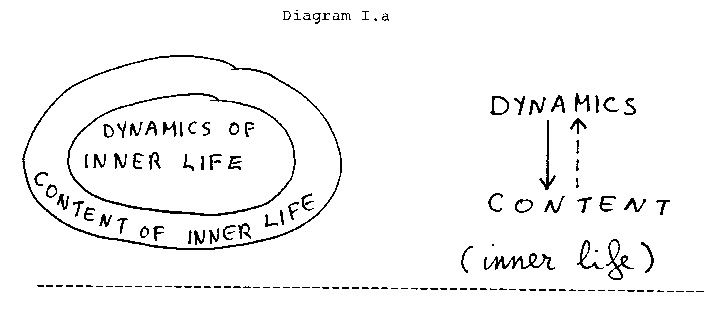
On the left, the content of inner life is held together by its dynamics. The deeper part of content, namely dynamics, plays a more crucial function in the sense of. control or self-management. This primacy is pictured on the right of the diagram by placing dynamics above content. The two parts of the diagram together portray the idea that there is a depth or height to inner life. What is deeper is also higher and more interior, while what is external is also lower. (For more discussion on the "height" and "breath" of discourse, consult this article: Ethnographic Discourse Methodology)
As we begin to observe the content of our motivational life, cognitive life, and sensorimotor life we develop theories or explanations for this life, and through these theories we can see the dynamics of this life. This greater understanding of our inner life leads to new rational insights, new visions of ourselves, which then come back down to us as creative solutions to problems or a more effective conduct of our external life. Here, inner study pays off not only in greater inner contentment and enjoyment but in outer gain as well. We not only become better to ourselves but more useful to others. This double gain makes the study of inner life useful to society and may eventually develop in the future as a science and field of community service. (For a description of this rational society and how to build it, see our efforts in creating a community-classroom in social psychology.)
It may be pointed out that modern psychology is still in its beginning phase from the point of view of history. Think of what the science of psychology may be like five or ten thousand years from now! The experimental science of psychology has greatly advanced in the first two or three centuries since its inception. But this gain has occurred mainly in the field of inter-personal environment. There are now hundreds of sub-fields in psychology each specializing in the knowledge and control of some area of the interpersonal environment. For example, there is a "social psychology" which studies family and city life; there is "educational psychology" which tries to advance our ability to teach in public schools; there is "psychopharmacology" which investigates how drugs affect people; there is "sports psychology" and so on.
All these modern "psychologies" share the method of interpersonal observation as the sole source of information for their theories. In "clinical psychology," for instance, which studies how a therapist might best influence our thoughts and behaviors, the source of all information is the therapist or the experimenter. Various methods are employed by the clinical psychologist to attempt to see or infer the thoughts and feelings of clients and subjects. Note that in this approach it is not permitted for the experimenter or therapist to offer their own inner life as the source of the data. Within such a restriction, good or effective theories of inner life have not yet emerged in modern psychology. This is plainly evidenced by the fact that clinical psychologists are not capable to readily modify the thoughts, feelings, and motivations of their clients. Whatever influence they may have is slight and of uncertain duration and extent. The reason is that clinical, social, and educational psychologists are faced with individuals who refuse to change and resist or oppose attempts at changing them. As modern psychology continues to evolve, we predict that it will be able to incorporate other methods of gathering information on the inner life. In particular, think of the information psychologists can gain from observing their own inner life, and building theories of the self based directly on these data. It's curious that psychologists have rejected this approach, believing it to be unreliable. But perhaps the real reason behind that is that they have a distaste for it. This claim may be better ascertained as you proceed through this essay.
There have been earlier attempts to study the mental operations of individuals known as the method of introspection. This approach has gone out of style in American psychology at around the turn of this century and there is virtually no legitimate outlet for it anymore. A psychologist who would build a theory of the self based on introspection may not have a place to publish it or teach it. An example in our case has been the persistent refusal of journal editors in psychology and psychiatry to publish our paper The Private World of the Driver: Affective, Cognitive, and Sensorimotor on the grounds that the data are not acceptable. This attitude contrasts of course with the humanities where self-witnessing experiences become of chief interest in literature, biography, art, poetry, drama, and even philosophy. We predict that the future will bring more and more successful attempts at constructing theories based on self-witnessing, with useful applications to community life. (You may consult one of our attempts at this in a paper called Workbook for the Study of Social Psychology.)
This essay is concerned with religious psychology, which is a scientific field as yet in its very infancy. It is not even recognized as a scientific field by the majority of American psychologists. There is a Division of the American Psychological Association called "Psychologists Interested in Religious Issues," of which I have become a member. However, this aspect of psychology is engaged in the study of religious issues to others, but not yet the religious experiences of the psychologist. Once again, the method of approach is inter-personal rather than intra-personal. One may look upon this essay as our attempt to build toward a truly objective religious psychology in which the data are directly observed from one's own source of inner life. (We may mention here the well-received books of contemporary psychologist Dr. Wilson Van Dusen (published by the Swedenborg Foundation), an avid reader and enthusiastic writer about Swedenborg. However, we make a distinction between his approach which we call "secular Swedenborgianism" and ours, which we call "religious Swedenborgianism." See this article.)
In the future we expect that psychology as a science will evolve theories and methods that will allow one's own inner life to be the source of data. Under such a method psychology and religion can intersect without one harming the integrity of the other. Religion offers ethnic and cultural content, while religious psychology is above ethnicity at a level where ethnicity does not reach in the depth of the mind. Religion is sectarian and divisive, though it need not be. Religious psychology is universal and unifying. This essay is an attempt to share with readers the results of our self-witnessings in the area of inner religious life. By elaborating the content and dynamics of religious affections and reasonings we hope to contribute to the development of a methodology for the science of religious psychology. What made this effort possible was our discovery in 1981 of the methodology to be found in the Writings of Swedenborg (1688-1772). This intellectual giant of the Age of Reason has left behind an imposing legacy of Writings on the psychology of inner religious life. It is known that these Writings have influenced a great many figures of British and American literature including Coleridge, Blake, Emerson and the three James', especially Henry James, Sr. who wrote several treatises on Swedenborg and tried to defend his system from attack and ridicule. Swedenborg's theological and psychological Works in modern English translation comprise a set of 30 volumes. After studying them intensely for several years we are convinced that we can find in them a useful methodology for establishing a science of religious psychology. The burden of this essay will be to establish this claim upon solid foundations.
The subject matter of this Volume is the study of one’s own inner life. It presents a perspective which views the religious life of the person as all pervasive. It shows how the inner life of thoughts and feelings is a spiritual life. Leon used to think, like so many in this generation, that the spiritual is something rare that one must look for in special places, or that the spiritual is something we experience when in a brief moment of ecstasy, and many other such nonsense. One of the students asked one day, "Dr. James, you mentioned the spiritual. What is spiritual?" And in the middle of Leon's long-winded lecture-answer, he suddenly and desperately realized that he did not know. As a psychologist that is. And all he had to do is to say simply: The spiritual is the same as the psychological. Mind is spirit. "Psyche" means mind, hence psychology concerns itself with the spiritual. The mind-body problem is one of the oldest and best debated topics in psychology textbooks, and in the historical literature before us. You can say mind-body problem or natural-spiritual problem, and they would be essentially equivalent. The body is natural or, material and physical, while the mind is spiritual or, immortal and substantive, as in the following Table:
| BODY | MIND |
| material | substantive |
| physical | spiritual |
| temporary | eternal |
| effect | cause |
| subsequent | prior |
The orientation of religious psychology is rational, scientific and pragmatic. The theories it presents are rationally to be evaluated by others, and errors of fact and prediction can be uncovered in them and corrected progressively. It is empirical in method in that systematic data are to be gathered for confirming principles and propositions. Its theories are to be progressively elaborated by researchers, students, and scholars. As well, it has direct applications to society, particularly in self-help psychology, in educational institutions and in child rearing practices.
Religious Psychology may thus be viewed as a developing scientific field or a perhaps a science of the future. It ought to be clearly distinguished from both Religion and Psychology. Religions are necessarily denominational, cultural, sectarian, and proselytizing. They are ethnic, cultural, historical institutions that guard specific norms and rituals through which each religion remains distinctively different from others and survives across generations. This process appears to be necessary to maintain an experiential environment that is suitable to the genetic varieties of spiritual genes.
Psychology in its current state appears inalienably wedded to the negative bias of materialistic monism by which it excludes the phenomena of spiritual life. Psychology maintains an orientation and a methodology that specifically deny and exclude any personal methods for confirming the propositions of revealed Sacred Scriptures or Writings. Sacred Scripture specifically asserts that no science, scholarship, or knowledge are possible without the revelations and propositions contained in them as Divine Truth.
Psychology does not allow us to first assume that Sacred Scriptures are absolute truths about the world, its origin and relation to God, sin, and life after death, Second, psychology does not allow us to try to confirm these truths through observation, scholarship, and theory. Instead, the method of materialistic psychology requires that we first assume that Sacred Scriptures are not necessarily true in their propositions about the world and people. This is essentially similar to the Null Hypothesis approach of proof in statistics. This involves that we assume that a relationship does not exist, when we know that it does, because we already looked at the data. It's a kind of logic game or ritual. For instance, if you want prove that a drug is effective, you first assume that it is not, and then point to the data to argue that it would be unreasonable to suppose that there is no relationship. Therefore there undoubtedly is one (or, at least with little doubt). Well, this strange ritual stands in the way of spiritual investigation, which is not possible when you deny it. This is because denial is spiritual, and spiritual acts on spiritual. The denial causes it to disappear. It is obvious and crystal clear, therefore, that religious psychology must operate by the positive bias methodology.
| Religious psychology is in the positive bias orientation: it first assumes that all of Sacred Scriptures are composed of valid and true propositions, and then looks for methods by which to confirm these truths with our own observation and theory. |
In this approach not a single proposition of Sacred Scriptures may be doubted or excluded from this blanket approval and positive bias. Why would you want to, knowing that this divine revelation created for your mind's ears? If something is puzzling or weird, it's much easier to think that we don't yet understand that part. This is especially true when we begin to see that all Sacred Scriptures are written in a symbolic code that lies hidden beneath the surface of the historical and natural descriptions and propositions. This is crucial to keep in mind. Religious psychology would not be possible if the language of all revelation were not written in this double code, one historical and natural, called the surface meaning or literal sense, and the other code, symbolic and spiritual, called the underlying meaning or inner sense. This inner sense is identical with religious psychology. It is information in the ancient code of correspondences that cements all natural languages through the symbolism of the sensory organs. Scholars have investigated these cross-sensory modalities under such topics as cross-modality transfer, synesthisia, synechdoche, metaphor, simile, and the like. (If this interests you, you may later want to check out a paper Leon wrote on the subject: The Affect of Symbols: Towards the Development of a Cross-Cultural Graphic Differential)
Interestingly, one's progress in the study and understanding of religious psychology is not determined by a knowing a body of knowledge that has accumulated through many researchers over time. In fact, the entire future knowledge is already available and accumulated by Divine creation. Think of it as mental library accessible conditionally through specified mental states. If you can put yourself into that mental state, you gain access to a sector of the spiritual library, depending on your motive, your curiosity, your current knowledge, and above all, your planned use of that information: is it for good, altruistic, or is it for evil, egotistical? Only positive socially beneficial motives for study allow access, while selfish motives deny access.
Also of interest is that religious psychology needs no special laboratory since its subject matter is life as it happens, the real world. If you're an actor, your play is the real world of economic gain for you, and social reputation, of course. If you're driving on a road, the real world is made of your decisions and choices as things happen, second by second. A parent disciplines a child; a parent hugs and comforts a child. The real world of experience and human choice is the laboratory for religious psychology.
It is clear then that Psychology and Religious Psychology are distinct from each other. As well, Religious Psychology is distinct from Religion in that Religious Psychology is non-denominational, non-sectarian, non-proselytizing, non-historical. It is cross-cultural, pan-human, and universal. It is a science in the positive bias method.
Religious Psychology is a scholarly discipline that is relevant to all religions, philosophies, and academic fields. In the future one may anticipate such new sciences in the positive bias method like “Religious Sociology," "Religious Engineering," "Religious Business & Management," Religious Biology," "Religious Crystallography," and so on. These religious sciences and disciplines are in the positive bias method in that they accept by premiss the truth of all propositions in genuine Sacred Scriptures. (You can later explore the relation we see between cyberspace and the spiritual world in this article on Spiritual Psychology
Some of the assumptions of Religious Psychology may be listed:
(1) All nations and ethnic groups inherit particular
religious affections (or tendencies) by heredity and tradition;
(2) Religious affections are organic spiritual
phenomena and can be scientifically confirmed;
(3) Religious affections are the source of all rational
and intellectual operations or capacities;
(4) Religious Commandments and Doctrines (or teachings)
are specific techniques and guides for better
spiritual health and development, hence for better intellectual and emotional
growth;
(5) False or adulterated religious beliefs degenerate
intellectual and moral capacities and gradually wear down and destroy life and
civilization;
(6) Religious affections and ideals govern societal
goals and priorities;
(7) A genuine and effective religious life promotes
intelligence, creativity, and societal and individual efficiency;
(8) Intellectual growth and health is totally dependent
upon true religious concepts and ideas from Sacred
Scriptures;
(9) Human rationality and freedom are not possible
without concepts and ideas from Sacred Scriptures learned in childhood and
adulthood;
(10) True or genuine Sacred Scriptures exist for all
cultures and ethnic groups even if they appear to each other as contradictory
and oppositional;
(11) The concepts, ideas, and propositions of Sacred
Scriptures can be falsified or adulterated through interpretations that serve
selfish or maniacal purposes; yet the true and genuine ideas remain in all
Sacred Scriptures unchanged and may be rediscovered again;
(12) All genuine Sacred Scriptures are written in a secret code; these codes are transmitted from generation to generation through religious instruction; the codes may be forgotten or falsified so that the genuine truths in Sacred Scriptures may no longer be known; however, these codes may be revealed again to particular individuals and taught to others, in which case the truths of Sacred Scriptures may once again be seen and known; these secret codes cannot be discovered or found out by any means but must be directly revealed to some person through Divine intervention;
(13) Truths about reality and self found in Sacred
Scriptures can be rationally confirmed and scientifically explained through
data, observation, and theories;
(14) Confirmed truths from Sacred Scriptures are
societal resources since they are effective in combating social strife,
ignorance, inequality; confirmed truths form the basis of better educational
systems, better methods for strengthening good character, and for inventing
better ways of managing society and solving its problems;
(15) All Sacred Scriptures contain three types of
revealed truths; these are revealed through secret codes in successive order;
the first type or degree of revelation may be called the Old Testament Sacred
Scripture; the
second degree of revelation may be called the New Testament Sacred Scripture; and the third or
highest may be called the Third Testament;
(16) The quality of the inner life of a person is
dependent upon the degree of revelation the person understands and lives by;
the first state is called the Old Church within us and is informed by the Old
Testament Sacred Scripture revelations; the second state is called the New Church within us
and is informed by the New Testament Sacred Scripture revelations; the third and highest
(deepest) state is called the Ultimate Church within us and is informed by the
revelations in the Third Testament;
(17) Each successive degree of revelation or state of
the Church within us is brought about by our willingness and readiness to
conform in thought, feeling, and deed to the truths revealed to us as we study
the Three Testaments and are instructed in them by others;
(18) We can have a theoretical knowledge of all three
states, but only an orderly progress allows us to confirm or apply this
knowledge to our life, and hence, derive its benefits in deeper understanding,
greater wisdom, and enlarged perception;
(19) Progress in the state of the Church within us
alters our inner life of thoughts and feelings, and hence, of deeds and
delights or uses; in the Old Church state we experience a life that is a
mixture of suffering and pleasure, of knowledge and ignorance, of truths and
falsehoods; in the New Church state we experience a life of commitment and
hope, of progressive rationality and a greater capacity to fulfill our
strivings and to serve society and people; at last, in the Ultimate Church
state we experience true understanding, wisdom, unbounded creativity, and
genuine altruism towards others;
(20) Practical methods of study and research exist for extracting from each of the Three Testaments, theories and models that constitute the subject matter of Religious Psychology. Some topics of Religious Psychology are these:
13.12.11 Religious Affections Are Inherited
It may be seen from our discussion thus far that
Religious Psychology is an academic discipline that is relevant to all aspects
of human growth and community development. Study and research allow us to
confirm these principles and to adduce new ones from Sacred Scriptures.
Religious Psychology is thus the study of what
we do, how we do it, and why we do it. Answers to these
questions cannot exclude the religious affections or ideals a person has. No
individual is born into a society that has no stance on the issue of who is
God, what is sin or evil, and what is the afterlife. Our stance on these
issues gives a clue to our religious affections. These religious affections
externalize and show themselves in our topics, opinions, views, attitudes,
ideals, priorities, and especially, our judgments, such as our approval vs.
disapproval of something. The role of religious affections is portrayed in
the accompanying diagram:
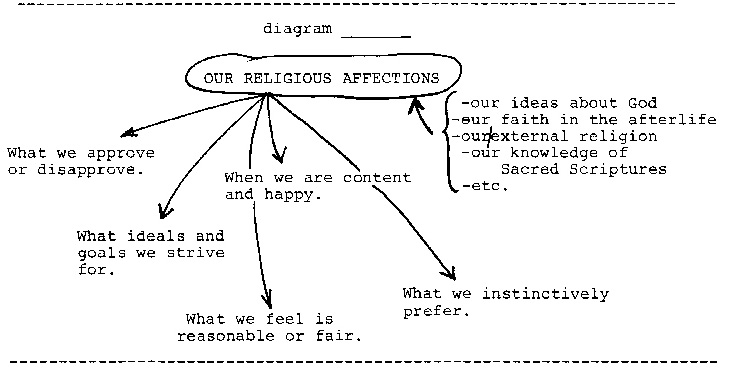
Thus it is clear that we cannot have an inner life which is free of religion. When we feel distant from religious involvement it appears that we have no religion or that religion is relatively unimportant in our lives; but this is only an external appearance. This illusion adheres to the body, to the external behavior, to one’s speech and declarations of opinion and belief, and even to one's own external thoughts and memory. However, at a more interior level of our life, that is, at the level of feelings, strivings, and other inner actions, it is clear that we cannot make any judgments or decisions without involving our ideas of good, right, and truth. These ideas are religious ideas and originate from our inherited religion and religious proclivities.
We may ask the question how we justify calling the things in the diagram "religious affections." On the surface these things appear to be merely social norms, the type one can find in any culture. Surely we learn these norms as we get socialized, and then as adults, we are guided by them in our judgments, goals, preferences, choices. Perhaps our emotions are conditioned to them by exposure, reward, and habit. All this is true. Yet we are not to think that acquired social norms and cultural beliefs are nothing but manifestations of our external life. Norms develop and evolve within the climate of religious life in both technological and primitive societies. Religion restricts and guides external freedom through tradition, ritual, and accumulated knowledge. Violation of religious laws are punished by death, imprisonment, ostracism, and reduced access to goods, services, and friendships. Secular law upholds the religious Commandments of its people in every society. This is by Divine intervention or providence.
Thus, people’s norms and habits reflect their religious affections even if they are not explicitly aware of this. People undergo an organic, inner development relative to their religious affections.
The first state of development in our religious affections can be called the Old Church state within us. It is based on religious affections for external compliance to the Commandments given in Sacred Scriptures or to societal laws based on them. For instance the Ten Commandments of the Old Testament Sacred Scripture are incorporated in our civil laws: we swear by the Bible in courts of law, we are punished if we are caught stealing, libeling, murdering, and so on.
The second state of development is called the New Church State within us. It is marked by religious affections for identifying with the Commandments (as in the New Testament Sacred Scripture) out of rational conviction rather than mere external compliance.
The third state of development of our religious affections, that is, of the Ultimate Church within us, is marked by religious affections for internalizing the Commandments through direct spiritual perception.
Thus, as the development of our religious affections proceeds from Old Church, to New Church, to Ultimate Church, we become progressively more aware of how our religious affections enter into our thoughts, judgments, emotions, and actions. At the stage of external compliance we are but dimly aware of this process and we believe that religion is separate from the rest of our life. At the stage of internalization or identification we gain awareness of the all-pervasive nature of religion in our inner and external live. Finally, at the stage of direct spiritual perception we can directly confirm the religious thesis that not a single thought, feeling, emotion, or act is independent of our religion. These states of a progressively more advanced awareness of our inner selves are produced in us by Divine intervention and supervision.
Each state of the Church within us brings
its own degree of temptations into our life. A
temptation is an organic process of spiritual growth through which our
awareness is expanded. Temptations have two phases: the
temptation itself, which is marked by suffering, doubt, and imperfection; then
follows the resolution phase which is marked by awareness, delight, and
perfection. We shall study this process in greater detail as it is central to
an understanding of Religious Psychology.
13.12.12 The Practice of Religious Self-Inspection
Awake, my heart, and render to God
Thy sure defender, thy Maker, thy Preserver,
A song of Love and fervor.
My heart shall be Thy dwelling,
With joy and gladness swelling.
Thy Word, my nurture,
Thy Word, my nurture given
To bring me on toward Heaven.
17th Century Anthem
(H.W. Gray Co., Inc.)
We know from the teaching of the Third Testament that
there isn't any detail in the world which is not directly under the
supervision of the Lord's Divine Providence. This arcanum has been revealed
before by the Lord Himself in His teaching that not a bird nor a hair can fall
without the Divine intervention (Luke 12:6,7; see also
Arcana Coelestia 2694:3; 6494). But now it is given us, by the
Lord's graciousness, to begin perceiving the interior sense of His message to
us. In the sense of the letter of the Third Testament the correspondence for
bird in general relates to our mental organization during
the process of our regeneration, and for hair in general the
correspondence relates to our willingness to examine this mental organization
for the purpose of separating in it what is true and what is false (see Arcana
Coelestia 6963:3,4).
The interior sense of bird and hair as used in the Third Testament is perceivable when their literal significance is related to the Lord's visible Divine Human at work in us. That is, our mental organization is to be examined in every single detail for the purpose of relating that detail to the Lord's Divine Human. This type of self-inspection is enjoined upon us as the first or chief concern in the life of the regenerating person. It may justly be regarded as the sine qua non of the existence and growth of the Church in the individual, hence the key that unlocks the floodgates of Heavenly life on earth.
The purpose of this section is to discuss the scientifics or, practicalities, of self-inspection whose end is to judge or, adjudicate, every detail of our mental organization as to whether it is proper or improper, that is, whether it is offensive to the Lord Himself. We shall for convenience refer to this activity as religious self-inspection. Related words are familiar:
We leave out “introspection" because of its negative history in American psychology. Also, "self-analysis" suggests that perhaps a pre-requisite of specialized knowledge may be necessary. The title 'self-inspection" does not presuppose any specialized knowledge or training, yet it implies that it be systematic, and thus excludes remembering from the past.
There exists of course another kind of activity which involves reviewing in memory some past event and deciding in retrospect whether it was proper or not. This is what we call "self-evaluation" after the fact. However, self-inspection is on-going and systematic, therefore it ranks with other types of scientific observation such as we have in interpersonal psychology or in physics and physiology. Religious self-inspection is a variety of self-inspection, namely whose function it is to witness an on-going activity of the self in order to note its potential offensiveness to God.
Since every religion (excluding cults) consists of God and the proprieties of our acts relative to the Divine Omnipresence, everyone on earth may practice religious self-inspection. All religions (excluding cults) lead to God and Heavenly life after death through self-discipline on earth in obedience to the law and order set forth, through Divine authority, by society.
The reason that religious self-inspection is of such great importance is that it is the only practical method available to the individual to shun evils as sins against God. Yet we are plainly told in the letter of the Third Testament that without shunning evils as sins we cannot ever be regenerated; hence Heavenly life, which is promised by religion, remains outside our reach irrespective of the amount of knowledge of Scripture we may accumulate.
It becomes therefore critical for each one of us to develop as-if of ourselves the facility of religious self-inspection. We can do this by resolutely striving to become better and better "religious self-inspectors," that is, more and more accurately to see the operation of the visible Divine Human in our mental organization. This is the signification of all correspondences when viewed in a more interior light. In Apocalypse Explained 419:20 we are told that hair signifies the ultimates of truth in the Church. This correspondence is in the sense of the letter of the Third Testament. By relating this rational fact to the visible Divine Human in the very operation of our mental organization, we can perceive a more interior sense of hair. Indeed, within our thoughts and intentions, as revealed by religious self-inspection, we perceive the work of regeneration going on as-if of ourselves.
This new awareness comes about through the act of judgment we pronounce on what we find going on within ourselves in daily living. Without this religiously motivated witnessing of our thoughts and intentions in everyday living we cannot be regenerated no matter what else we also do in terms of worship and conscience. In Divine Providence 159 we are told that the Lord's reference to our white hair (in Matthew 5:36) is in the context of His explaining that we cannot of ourselves do even the least thing. Certainly thinking and intending are included in this Doctrine.
It is therefore to be presupposed that the Lord works through our acts of thinking and intending, and this without a single exception to eternity! What an intimate life a person has with the Lord! Surely there is no human relationship comparable to this no matter how close two people may get; this relationship is then Divine and is the true meaning of religion, namely, a tying to God or conjunction with Him. The very place of religion therefore must be in our thoughts and intentions; they are the only true temple where God can dwell inmostly with us. This bond with the Divine is possible only through our love into the visible Divine Human of the Lord. This love to the Lord, which He commands, enjoins it upon us as a duty of highest worship to strive to become better and better religious self-inspectors.
There is a contrast drawn for us in the Third Testament between our own hair and the Lord's white hair in Revelations 1:14, which is the white hair of the visible Divine Human in our mental operation as revealed in religious self-inspection. Apocalypse Explained 66 tells us that the Lord's white hair signifies the Divine in first and last things, that is, Divine Providence in primes and ultimates. Where are we to find Him in ultimates? Surely not in the beauty of nature or the accomplishments of technology. These are His creations, and surely we must not confuse God with His creation! Neither can we find God in the church buildings, altars, crosses, or images; neither in the paper and ink of Bibles. The only place is within. But where? The Lord is quoted in the New Testament Sacred Scripture on this issue, and He indicates that "the Kingdom of God is within you":
Quoting from the Writings Sacred Scripture:AC 29. In the universal sense, 'the kingdom of God' is used to mean the whole of heaven, in the less universal sense the Lord's true Church, and in particular every individual who has true faith, that is, who has been regenerated by means of the life that inheres in faith. For that reason the individual is also called 'heaven', for heaven is within him, and 'the kingdom of God', since that too is within him. This the Lord Himself teaches through Luke,
Jesus was asked by the Pharisees, When is the kingdom of God coming? He answered them and said, The kingdom of God is not coming with observation, nor will people say, Behold, here it is! or, Behold, there! for behold, the kingdom of God is within you. Luke 17:20, 21.
This is the third stage of a person's regeneration, a state when he is repentant. It is like passing from shadow into the light, or from evening to morning, and this is why it is said in Verse 13, "And there was evening, and there was morning, a third day."
(AC 29)
We are given the direction by our love for the truths in the Lord's Second Advent. This Divine Coming is within our thoughts and intentions. It is available to anyone who is willing to practice religious self-inspection or active repentance in daily living. Our thoughts and intentions operate in the spiritual world, outside time and space. They are connected to time and space by definite laws of correspondence, but they are not in time and space, or of time and space. They are made up of spiritual substances just as the brain is made up of material substances from the sun and planets.
The spiritual Sun and its many earths form thoughts and intentions through its spiritual heat and light. It is revealed in the Writings Sacred Scripture that spiritual heat is Divine Love and spiritual light is Divine Wisdom. Thus, Divine Love, which appears as heat as heat from that Sun, spreads into the spiritual world and cools down as it journeys down towards the outward universe, to become affective substance in the form of intentions and desires on earth within human minds, and thence through correspondence, in human brains.
Similarly, the light which goes forth from this spiritual heat organizes the cognitive substances into a particular order and its usable functions in the mind. This light is Divine Wisdom or Divine Truth. It is the light we have through Sacred Scripture on earth.
Those who don't know Sacred Scripture, or don't read it, or read it but don't see anything Divine in it, are still subject to the same mechanism of inflow from the spiritual Sun, though they attribute it to a different source, such as their own intelligence, or science and transmitted culture. They don't consider the fact that science, knowledge, and culture in every society and tribe, is imbued with and originates from the spiritual Sun through the spiritual societies. As proof of this, consider the fact that all societies and tribes have religion, and that all religions enjoin its followers to love God and live by God's commandments or else they will pay for it in much suffering.
Thus our thoughts and intentions must be consciously related as-if of ourselves to God's Love and Wisdom. This only is the true life of religion and is available to anyone through religious self-inspection or repentance. Prior to repentance, or the act of judging our thoughts and emotions, we cannot receive the full value of spiritual heat and light. Like a dried out plant we slowly die spiritually and become insane. Religious self-inspection waters this starved plant whereby we revive.
That method of religious self-inspection will be good or, efficient, which succeeds in replacing or exchanging our own single hair we cannot make white with the abundant white hair of the Lord in His visible Divine Human, white hair which is white like wool. In other words, religious self-inspection succeeds when it yields judgments against ourselves and for the Lord. Not a single inhabitant of the heathen Land of Canaan is to be left alive in our mental organization. This love into the Lord will insure that we may avoid the deed of Achan related in Joshua 7 and whose significance we are told in Arcana Coelestia 5135:6. The commixing of truths and falsities of worship, which was the deed of Achan, threatens each one of us if we do not continually strive to become better religious self-inspectors. In every single detail of our own thoughts and intentions what is of our own origin from the external world must be found out, judged, and destroyed. Then, only then, can we continue the conquest of Canaan within ourselves.
Prior to our judging a thought or intention it is unclean. We are told this in Arcana Coelestia 3301:7 in connection with the removal of all natural trues, even the most external, signified by the hair of the feet in Isaiah 7:20 (see Apocalypse Explained 569:17). No aspect of our mental organization prior to regeneration has any spiritual truths but only the apparent truths mixed with falsities in worldly traditions and scientifics. Nothing of the earthly can know anything of the spiritual. This Doctrine guides us to a state of innocence in receiving the trues of the Heavenly Doctrine. By contrast, after a thought or intention has been judged in self-inspection as-if of ourselves, there remains an emptiness into which spiritual light can enter and we begin to perceive genuine trues. As each successive thought and intention is found out, judged, and cast out, there is left behind a clean vessel or temple into which holy things of the Church can enter. In that measure the Church can be within us, and therefrom Heavenly life on earth. This activity must be continual, never ending in one's daily living activities. Then the Church can gradually grow more and more within us, thus transforming us.
Birds signify thoughts in general (see Arcana Coelestia 3901:6; 5149:4). These include truths of every kind. Speckled birds or birds of prey signify trues in the understanding mixed with falsities (Arcana Coelestia 3993: 5,7). Thoughts we have are either in harmony with truths we have or they are in disharmony. In everyday living we continually make use of thoughts and intentions in our decision making; these thoughts and intentions form our reasonings, and they are in harmony or in disharmony with truths we have and receive from our study of Scripture. There is not a single moment of life (including sleeping) during which the operation of thinking, reasoning, or intending ceases, and in every case the thought or idea is either proper or improper in relation to the truth we receive from Sacred Scripture. By judging each thought or intention we bring this relationship to light, we make its relation to truth explicit.
When the operation of our thinking and intending is observed by our rational faculty we acquire useful knowledge regarding the scientifics of thoughts. This psychology of the self is to be employed as a theory about the operation of our interior organs of mind. The table below pictures this activity (follow the numbered boxes):
| THEORY or PSYCHOLOGY OF SELF | 2. we identify patterns in and influences on our thoughts | 3. we judge each one in relation to the Lord's visible Divine Human (This is repentance) |
| METHOD OF SELF-INSPECTION | 1. we observe our own external thinking activity with our interior rational faculty | 4. we
strive to modify the disharmonious activity as if of ourselves but
knowing that it is from the Lord (This is reformation) |
This diagram illustrates the practice of
religious self-inspection in four steps. Through our self-examination in the
external thoughts (step 1) we arrive at informed views regarding our more
interior thoughts such as our reasonings, intentions, and affections (step 2).
Then as we judge each thought and intention in relation to the visible Divine
Human (step 3), we succeed in cooperating with His Divine Providence in the
very operation of our mind; we then become reformed (step 4).
This activity recycles over and over again, thousands of times a day in our
earthly life, and thus is our regeneration accomplished by the Lord. It is
the Lord's work in us, His labor of love. Thus the Church grows in us more
and more and thus are we more and more introduced into the heat and light of
Heavenly life on earth. This is Divine Wisdom in us.
13.12.13 Repentance as the Gateway to the Interior Sense of Sacred Scripture
Open our eyes, O loving and compassionate Jesus,
That we may behold Thee,
That we may behold Thee,
Walking beside us,
Walking beside us in our sorrow.
Thou hast made death glorious and triumphant,
Thou hast made death glorious and triumphant.
For through its portals we enter
Into the presence of the Living God.
Open our eyes, 0 loving and compassionate Jesus,
That we may see to follow Thee, Jesus,
Jesus, Jesus, our Saviour,
Jesus our Saviour and Redeemer.
Anthem.
(G. Schirmer, Inc.)
We have discussed the practice of a constantly vigilant and watchful religious
self-inspection whose function it is to separate that which is our own worldly
and earthly inclination, which is unclean, from that which is clean and holy
and is with us from spirit and heaven. We are in the Ultimate Church within
by virtue of our active repentance through which the regenerating person
develops spiritually and advances deeper and deeper, or higher and higher,
into the interior of Sacred Scripture, that is, the mind, which is the spirit.
Let us recall that the Three Testaments of Sacred Scripture differ from each other in both the sense of the letter and in the interior senses according to the following Order: We should note here that we are not excluding any Sacred Scripture that was given as revelation to various nations and ethnic groups. Though all our examples and illustrations involve the Bible (Old and New Testament Sacred Scripture) and Swedenborg's Writings (Third Testament) this is because these are the revealed Scriptures we were born into and have formed our lives from birth onward.
| Table III. a | OLD TESTAMENT | NEW TESTAMENT | THIRD TESTAMENT |
| INTERIOR SENSE | the omnipotent Human Divine of the Lord | Divine Truth in ultimates | the visible Divine Human of the Lord |
| LITERAL SENSE | history & allegory | miracles & parables | correspondences, doctrines, & memorable relations |
| Divine Names | Jehovah; I AM | Christ; Son of God | Jesus; the Lamb; Divine Man |
The table above shows that our relationship to Sacred Scripture is various as to its different parts. In this section we are particularly concerned with our relationship to the interior senses of the Third Testament since the practice of religious self-inspection requires us to judge each mental process we observe in ourselves in relation to the visible Divine Human of the Lord, this being the interior sense of the Third Testament. We have already discussed the case with bird and hair with the following observations:
case with bird and hair with the following observations:
| Table III. b | LITERAL SENSE (correspondences) |
INTERIOR SENSES (life with faith) |
| Hair in the Third Testament | Self-examination with the view to separate true from false | Our activity of undergoing regeneration by the Lord |
| Bird in the Third Testament | The unexamined thoughts and intentions of daily living | Our own states of hell in infernal light |
The question arises as to how we are to cooperate with the Lord in His work of regenerating us? We need to gain an understanding of the activity of repentance since it is the only method available to us for entering the life of the true Church. In this study and practice of religious self-inspection we gain knowledge of the content and dynamics of inner life, that is, we learn the psychology of the self. This message is given us in the Threefold Sacred Scripture as follows:
| Table III. c | OLD TESTAMENT | NEW TESTAMENT | THIRD TESTAMENT |
| BIRD & HAIR (INTERIOR SENSE) | that all things in heaven and on earth are subject to
Divine omipotence
(THE HUMAN DIVINE OF THE LORD) |
that we are to lead our daily lives trusting in Divine
Providence
(THE SON OF GOD) |
that we are to shun evils as sins through repentance
(THE DIVINE HUMAN OF THE LORD) |
The question may now be considered as to how we are to cooperate with the Lord in His Work of regenerating us. We need to gain an understanding of the activity of repentance since it is the only method available to us for entering the life of the true Church. In this studying we need to practice religious self-inspection which is the same as getting to know the psychology of the self. To accomplish this we need to refrain from "consulting the rational," that is, the external rational built up through the physical senses, even as the Lord had to when He was a young Boy on earth (see Arcana Coelestia 2511).
One error we can easily fall into is to assume that we already know what repentance is and that the problem is only to muster the self-discipline in order to accomplish the repentance. This error, if confirmed in practice, would "sew up the womb of Abimelech and all his household" in our inner life (Genesis 20:18). The result would be the impossibility of our entering heavenly life on earth and the consequent death of the Church within us.
We can desist from this grave error when we reflect upon and confirm a distinction in degrees between the sense of the letter of the Third Testament, which is external rational, and the interior sense of the Third Testament, which is interior rational, which is spiritual and celestial. The external rational is not spiritual at all, but an abstracted natural, which is an intellectual process not yet free of the temporal and the local.
This distinction can be understood only by reference to the distinction between our abstract knowledge of repentance and our observed activity of repentance. Only the constant practice of religious self-inspection in daily living can give us the information needed to undergo the activity of repentance, to empower it from mere abstract knowledge to confirmed, lived activity.
And so as we study the Writings Sacred Scripture we need to draw out from its literal sense Doctrines of Faith that may be characterized as "spiritual-psychological" in content because these Doctrines deal with the self and the influences upon the self. These spiritual-psychological Doctrines of Faith, as applied to the actual self by each person, constitute the interior senses of the Third Testament. We should note here that we have greatly benefited from a publication called De Hemelsche Leer, written in the 1930s by a Dutch group of men through whose minds the Lord brought forth what we consider to be the Epistles for the New Church. Their central focus was to prove that the Work of the Writings called Doctrine Concerning the Sacred Scripture applies equally to the Writings Sacred Scripture themselves, and not just to the Old and New Testament Sacred Scriptures. Without their insight and devotion, this essay and its content would still not exist on this earth.
By way of illustration we may draw up lists of sub-activities within the general activity of repentance in daily living situations. To do this we need to follow general psychological principles, not the kind we make up from our external knowledge and rational understanding, but the kind that are patterned after the sense of the letter of the Third Testament. We may begin by considering where in our activity of repentance we are to locate the three degrees of Life as defined in Sacred Scripture. To guide us in our studying we shall refer to a type of diagram represented by three concentric circles, as follows: (For more on this type of diagram as a scientific methodology, you later can consult these two reports:
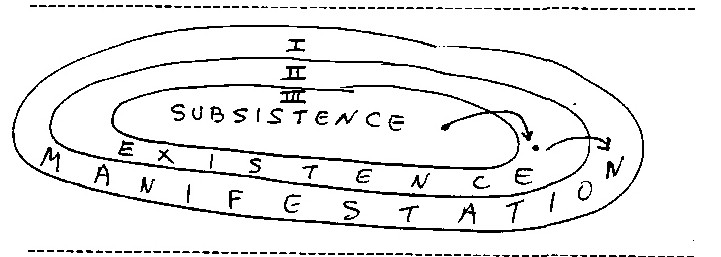
The above diagram pictures the doctrinal principle that Life proceeds from the inmost degree (SUBSISTENCE -- level III), through the intermediate degree (EXISTENCE -- level II) , and out to the ultimate degree (MANIFESTATION -- level I).
A connected idea is that the inmost degree is Celestial (level III), the intermediate degree is Spiritual (level II) , and the ultimate degree is Natural (level I). This connectedness may be extended to a whole series of such trines to be found in the sense of the letter of the Third Testament, as illustrated in the following Table:
|
LEVEL III (inmost) |
Subsistence | Celestial | Love | Will | Intentions | etc. |
|
LEVEL II (intermed) |
Existence | Spiritual | Wisdom | Understanding | Thoughts | etc. |
|
LEVEL I (external) |
Manifestation | Natural | Uses | Delights | Deeds | etc. |
This type of tri-grammatic table (read from bottom up) may be extended indefinitely the more we study Sacred Scripture. Each vertical trine constitutes three simultaneous degrees and represents a spiritual-psychological principle about the self as imaged in the Lord's visible Divine Human. This kind of table may be used as a guide or map to help us gain illustration from the Lord in Sacred Scripture regarding our activity of being regenerated by the Lord. We may similarly focus on the trines of successive degrees, as follows:
| OLD TESTAMENT | NEW TESTAMENT | THIRD TESTAMENT | |
| Civic Conscience | Moral Conscience | Spritual Conscience | |
|
LEVEL III (Celestial) (WILL) |
Needs | Affections | Loves |
| etc. | etc. | etc. | |
| ------------------------------------------------------------------------------------------------------------ | |||
| Knowledge | Intelligence | Wisdom | |
|
LEVEL II (Spirtual) (UNDERSTANDING) |
Memories | Understandings | Perception |
| etc. | etc. | etc. | |
| ------------------------------------------------------------------------------------------------------------ | |||
| Pleasures | Happiness | Tranquility | |
|
LEVEL I (Natural) (USES) |
Sensations | Observations | Confirmations |
| etc. | etc. | etc. | |
The table above indicates successive psychological states of development in the regenerating person (read from bottom up). For instance, in the domain of our loves or will (affective domain) (LEVEL III), we begin early adulthood with a civic conscience and with all sorts of needs; these give us the volition to obey the law, order, and mores of our culture from our external self. As we move into adulthood we begin to strengthen a moral conscience and other social affections which look out to what is fair and equitable in human relations for the sake of society. At last in maturity we evolve a spiritual conscience and religious loves whereby the Lord may regenerate us through our cooperative reformation and repentance.
A similar picture may be seen in the domain of our cognitions (LEVEL II). Knowledge and memories constitute our earliest spiritual life. This is followed by intelligence and understandings, and at last, our cognitions come into wisdom and perception. In the domain of our delights (LEVEL I) we at first experience pleasures and all sorts of sensations; this is followed by the capacity to feel happiness and more complex observations within our natural life; at last we come into tranquility (Sabbath Rest) and the confirmations of sensory life. This image of development of the self in three successive degrees represents the order in which the Lord glorified His Human and uplifted it even to His Divine Sensuous (see Arcana Coelestia 8624).
13.12.14 Discovering the Steps of Regeneration Through Microdescriptions of Our Inner Life
O Lord, in Thee we put our trust;
Source of peace and joy for ever more.
In days of trial be our stay.
Be our refuge, our hope.
We acknowledge that Thou only art God.
Thou art God.
In Thee we put our trust,
Source of peace and joy.Hymn.
(Harold Flammer, Inc.)
To the regenerating person, religious self-inspection, self-examination, and self-exploration are the necessary activities through which reformation of character is accomplished within us by the Lord. We are enjoined by the Lord to cooperate freely, as-if of ourselves, in this task of His. In the sense of the letter of the New Testament Sacred Scripture He refers to this activity as knocking on our door where He stands waiting to be admitted (Revelations 3:20). The interior sense of the New Testament Sacred Scripture treats of Divine Truth separated from Divine Good, even as the edge of the sword is separated from its flat side when used as a weapon. Our relationship to this part of Sacred Scripture is in regards to the activity of hair-splitting with our rationalizations. We are to use the cutting edge of the sword of Divine Truth to splice apart our Pharisaic excuses in the face of self-incriminating evidence. The spiritual meaning of the New Testament Sacred Scripture is to be used to effectively convict ourselves.
| November 1986: Leon's
Notes on
CL 293-4:
The Doctrine of the Wife is this, that the regenerating husband "Hearkens unto Sarah" that is, acts according to his moral wisdom. A husband has this wisdom from the study of Sacred Scripture. This gives him spiritual rationality to the extent that he wills himself to apply it to life, that is, in interactions with his wife. In these conjugial interactions, the wife acts from conjugial love from the Lord, and the husband receives perception through wisdom, and then reacts with conjugial heat. Applying the Third Testament trues to receive the wife's loving actions, is his moral wisdom that delights and satisfies the wife. When we husbands are in the unregenerate state of mind, we hate conjugial love, which is the sexual love of the wife alone or only, because we love "meretricious" sex, which is "crude sex with harlots", and we turn cold, that is, impotent, in the sphere of conjugial sex. Therefore, the wife, sensing this about her husband, hides her conjugial sex love, which are her inward bosom delights, and instead, fakes or simulates crude sex, that is, lacking in sincerity, to keep him from impotence with her. She also acts less interested and hard to get for this reason, that is, angry, quarrelsome, vehement, and insistent. |
Every person who strives to cast out their character evils, loves God. To those who do not know of the Three Testaments externally yet strive to cast out character evils they find within themselves, God is known by whatever traditional Name they were given, which involves the internal idea of God as a Person or Divine Human. They may not be conscious of this because of their received beliefs, but they act within themselves towards God as-if He was a Person--talking to Him, praying to Him, feeling His love, and so forth. And one can have these things only from a Person, not from an unapproachable infinite force in the universe.
Those of the Church who are actively cooperating with their regeneration by the Lord, do so by repentance and a change of life according to their rational understanding of the visible Divine Human, that is, of the Lord's operation within our thoughts, intentions, and affections. Religious self-inspection with the end of judging ourselves in every single particular, when practiced continually, constitutes the work of regeneration. We are then opening the door, as-if of ourselves, so that the Lord may dwell in His visible Divine Human with us.
It is crucial therefore that we strive ever more intensely to practice religious self-inspection with zeal and constancy, yea, with burning love. For this is the very love we have with the Lord, and our veriest life, wisdom, and happiness. When we read the New Testament Sacred Scripture, its interior sense arouses in us this burning love for the Lord. Scientifics is a tool from the Lord to help our regeneration. The principles of the psychology of self are to be Doctrines drawn from the sense of the letter of Sacred Scripture. They are come by when we live our faith. Every act of judgment in our religious self-inspection becomes a piece of datum for the theory of ourselves. Scientific data are systematic observations of facts organized by a theory. If we are to be scientists ourselves, as we must be if we strive to become better self-inspectors and self-modifiers, then we are not to shun the tools that are useful and readily available for this task.
Those who have access to the interior sense of the
Third Testament (as anyone may have who but accepts the idea) have available
an extraordinarily effective psychology of the self with which they strive
ever more intensely to search out in themselves their interior areas of evil.
This work is the work of the true faithful of the Church of the Lord; these He
loves especially, and they are especially near to Him, even as the beloved
disciple. These are the works of charity through faith. This work is what
leads to the genuine love of the neighbor for the sake of the Lord. It is
possible through the interior sense of Sacred Scripture, and especially if all
Three Testaments are included in the
Doctrine Concerning the Sacred Scripture.
It ought not to be thought that this especially helpful tool of regeneration is reserved for a few only. It is available to any person of common sense and learning who is willing to study the Three Testaments together as Sacred Scripture of the Lord, and to which three he or she applies the Doctrine Concerning the Sacred Scripture in equal measure. If this be done, the spiritual-psychological order of the self is laid bare by the Lord in His Word. We then contemplate before our eyes the Divine Human Proprium in ultimates with us.
It ought not be thought that this work is only possible to those who have a lot of free time off from their occupations and duties, for this work is to be performed conjointly with anything else we are also doing. Religious self-inspection is not a competing task, but a super-imposed task. It is a particular attitude of life, a set of mind, a bend of the character, an inclination of the heart.
Every single decision or focus of attention constitutes an interior act and is a candidate for self-inspection and judgment. Let us illustrate this view by citing common situations of everyday living. Let us say we are walking or driving somewhere. Other people are constantly appearing and disappearing in our view. We detect various things within ourselves to which we react. We may look upon someone's face, semiconsciously roam our focus upon a nose, an arm, a shirt. We are surprised by this or that. We smile to ourselves. We are curious. We free associate, mingling our thoughts and memories of people and situations. We are puzzled by something we see. It makes us laugh. We examine their clothes, what they are carrying. We conjecture about where they are going or what they are thinking. We approve or disapprove. We are curious. We investigate further. And so on. (You may want to look at this long list of confessions for husbands!)
Or let us say we are talking to someone. We try to give this or that kind of an impression. We think of other things. Our attention lapses. We pretend to have heard or understood. We smile even though we didn't catch the humor. We plan ahead to say something. We intend this or that regarding this person. We pretend not to notice something. And so on. (Later, you might like to see Leon's report on how he discovered Sudden Memory by using the technique of "mere witnessing.")
From these
microdescriptions of our moment by moment behaviors, both external and
internal, we can enter into the scientifics of the self, of our own proprial
life. We gain knowledge of ourselves through the facts of self-inspection, of
self-witnessing. If at the same time we have judgment as an
end in self-inspection, then these mental facts will be seen ordered in the
interior sense of the Three Testaments. In other words, the interior sense of
the Three Testaments, each distinctly, will fall into the facts we uncover
about ourselves. Then are we in the position of confirming the interior sense
of Sacred Scripture.
When the part is judged, the whole is better. There is a change of state in that part, a change of function in the self, in our thoughts, intentions, and emotions. The instant we judge ourselves in some part, repentance has begun. This new beginning is occupied by the Lord Who all along stood knocking at the door, waiting to be admitted by us, freely, as if of our own, from our love into Him. Now, after He is invited in, He can do much more for us. And this is an exchange that must recur daily, or even, minute by minute. We cannot merely invite Him once and that's it. This is because we repeatedly shut the door again, after we opened it.
It is the Lord's Proprium in the visible Divine Human that occupies or dwells in the part of ourselves that we judged. The Lord's indwelling is made possible by repentance of an act, thought, or intention, and henceforth He battles for us when we are in the throes of temptation. This occurs when we are subsequently faced once again with the knowledge of some related evil in us, and which the Lord tries to bring to our attention relentlessly, zealously, on account of His Great Love for us, and His concern to keep us from sliding into eternal hell, to which we are taken by our inherited and acquired inclinations like a ship is imperceptibly dragged along by the current. Each part that we judged returns to 'haunt' us: this is the labor of temptation and purification thereby. But let it be always remembered that it is not our own strength that conquers but the strong arm of the Lord Who occupies that part of our mind and indwells through Sacred Scripture in its three senses. Forget this, and your repentance is as nothing.
Following conquest in temptation there is joy and exhilaration. There is renewal. There is a direct perception of conjunction with the Lord's presence, a concrete understanding of His concrete presence, and a host of attendant affections into Him such as:
These benefits of religious self-inspection are easily observable, when they arrive.
The Lord regenerates through liberty and understanding. What we choose in freedom, this we love. What we love, we do in liberty. Our understanding is first attracted by certain appearances. Later we are attracted by rational truths; these shape our conscience and our ideals; they influence our character and our life goals. Still later we receive with joy the trues of religion. Then come the battles against our enslaved will. We wage these battles actively, as-if of ourselves, flashing the sword of Divine Truth, willing to choose the way of the Commandments even against our own desires and preferences. As we conquer more and more this inner Land of Canaan within ourselves, there enter Heavenly affections. Where our liberty was in chains, now we are free, delivered out of the enchantment of selfishness and wickedness.
We begin to apply the Trues of the Third Testament to our own psychological states of development. The journey down to Egypt is now seen as our state prior to the present. We now feel a spiritual difference in the quality of our hourly living. Heaven is present.
We no longer have to rationalize this, as before, when we were still in Egypt and were engaged in the labor of rationally convincing ourselves that the Spirit is, and that it is here now. Now we see ourselves already in the conquest of Canaan. Our heathen reasonings and ideals are systematically uncovered and destroyed. Nothing whatsoever from the old way of thinking, and planning, and reacting is to be left. All of the previous self must be found out, judged, and cast out with horror. Then at last we begin to feel a genuine longing for contact with the Lord. We feel awe and reverence, yet friendliness and camaraderie with Him. The Lord now becomes our Shining Humanoid Hero as we begin to realize more and more how good and delightful is the Grand Plan He has in store for us. We begin to love Him with ever more confidence as we realize that all along He has been the Boss in our life. We begin to perceive that there is no chance event in the universe. We are astounded to find that in every event in our life, in every decision we've ever made, in every thought or idea we've ever had, in every feeling or longing, He was there! He was never absent. He was an intimate co-participant in our external and our inner life.
And now He continues as before, but we are also given the opportunity to cooperate out of love into Him from Him. In this cooperation, as-if of ourselves, lie all the Heavenly states. Thus are we blessed.
For more on microdescriptions, consult this report: Taxonomy of Microdescriptions on the Daily Round: Part 1
13.12.15 The Threefold Order of the World and of HeavenSent from Heaven,
Thy rays were given
On great and small to shine,
O Light Divine!
Thou blessing to all creation
Lead us to our salvation.
Oh, shine from above,
Divine Light of Love!
Show us the way unto our God, we pray!
Thou our beacon and guide shalt be!
Light Divine, we praise Thee!Hymn
(Carl Fischer, Inc.)
Sacred Scripture has three senses, one within the
other. The sense of the letter is compared to a ruby or diamond; the
correspondential sense within that is compared to light that enlightens; and the
inmost sense within that is compared to heat that enkindles (see
Doctrine Concerning the Sacred Scripture., 42). This threefold
relationship may be expressed in a diagram for clearer comprehension, as
follows:
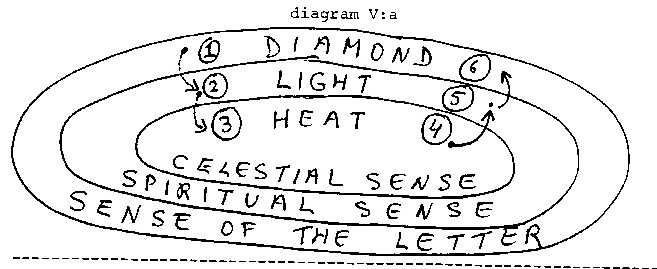
The six steps joined by arrows indicate a cycle of study to be repeated
endlessly in the life of men and women and angels. Step 1 constitutes the
external study of Sacred Scripture such as becoming familiar with its
historicals and scientifics. Step 2 constitutes the study of the first
internal of Sacred Scripture such as the doctrinal drawn from the sense of the
letter. Through this sense light is given by the Lord so that spiritual
things regarding the goods and trues may be seen translucent and shining forth
from the historicals, representatives, and scientifics in the literal sense of
Sacred Scripture. Step 3 constitutes the study of the second internal of
Sacred Scripture such as the recognition in oneself of the states of the
Church or of the states of glorification the Lord underwent in all its series
and order. These three steps are joined in the diagram by broken arrows to
distinguish them from the last three steps.
Steps 4, 5, and 6 are in the opposite direction from steps 1, 2, and 3. This relation is to indicate that the uses of Divine Truth by us is dependent upon adequate study and preparation in everyday living situations. As we regularly and continually practice religious self-inspection we are in fact performing steps 1,2, and 3 relative to Sacred Scripture. Only to the extent that is done, can we perform steps 4, 5, and 6 which constitute the genuine uses of Divine Truth.
At step 4 we are placed into the sphere of Heaven
through angelic affections. In this state of the Church in us we experience
the enkindling heat of love from the Lord into the Lord and toward the
neighbor. At step 3 we have gained an understanding of charity in life, or
the good of faith. From this practical understanding of Divine Truth in our
living situations we are enkindled with zeal to act from celestial
affections. Step 5 is thus the externalization of angelic affections; it is
the descent of the Heavenly Doctrine within us into our perceptions or
intuitions. Step 6 is the ultimate externalization (or descent) of Divine
Truth in our deeds and delights as heavenly uses on earth.
Now let us examine the way in which this 6-step
process operates constantly as we study the Threefold Testament of Sacred
Scripture. We are not to think that these steps are advanced by stages of life
exclusively. Rather, all of us as regenerating persons through the Lord's
Second Advent, undergo the 6 steps constantly in the various departments of
our social, psychological, and spiritual living.
In this next table the Threefold Testament is drawn to correspond to the Threefold Heaven. As there are three senses to each of the three Testaments the diagram constitutes an "ennead matrix," which is to say, a "ninefold" relation. We thus have nine varieties of relationship to Sacred Scripture as there are nine types of degrees into which the societies of the Grand Human are organized.
| Diagram V. b |
OLD TESTAMENT |
NEW TESTAMENT |
THIRD TESTAMENT |
|
CELESTIAL SENSE (inmost) THIRD HEAVEN (III) |
The Lord as the Human Divine Omnipotent (7) |
The Lord as Divine Truth separated in ultimates (8) |
The Lord in His visible Divine Human glorified (9) |
|
correspondential sense (intermediate) SECOND HEAVEN (II) |
Believing in the
operation of the Holy Spirit within us (4) |
Studying the message in the Lord's Life, Miracles, and Parables (5) |
Studying states of the
Church within ourselves (6) |
|
LITERAL OR NATURAL SENSE (external) FIRST HEAVEN (I) |
Obeying the Ten
Commandments (1) |
Obeying the Lord's New
Commandment (2) |
Studying correspondences, doctrines, and memorable relations (3) |
There are 9 zones in this ennead matrix reflecting the three senses of the three Testaments. As well, each of the three Heavens has three regions: an outer region, an intermediate region, and an inmost region; these three regions correspond to the three Testaments. The 9 zones correspond to our states of relationship to Divine Truth in the activity of being regenerated by the Lord through His Second Advent. The first level (I) is represented by steps 1,2, and 3, which are the literal sense of the three Testaments. The second level (II) is represented by steps 4, 5, and 6, which are the correspondential sense of the three Testaments. The third level (III) is represented by the inmost or celestial sense of the three Testaments. The three levels (I, II, and III) correspond to ever more interior journeys into the three Heavens, or Sacred Scripture. The inmost relationship we can have with Divine Truth, or Sacred Scripture, is pictured in zone 9, a state in which we perceive the celestial sense of the Third Testament. This highest sense of Sacred Scripture deals with the arcana of the Lord in His visible Divine Human, the very source of all Divine Love, Wisdom, and Power in the universe and in the soul of the human race.
Later, you may wish to study this notion of the ennead matrix and its applications in life: The Ennead Matrix of the Threefold Self: Affective, Cognitive, Sensorimotor.
13.12.16 The Ninefold Self and the Ninefold Sacred Scripture (Ennead Matrix)
Jesus, Bread of Life, I pray Thee,
Let me gladly here obey Thee.
By Thy Love I am invited.
Be Thy Love with love requited.
From this Supper let me measure,
Lord, how vas and deep Love's treasure.
Through the gifts Thou dost give me
As Thy guest in Heaven receive me.
17th Century Hymn, (Brockes Passion) (Concordia Publishing House)
We have discussed the
thesis that we have a ninefold or enneadic relationship to Sacred Scripture,
and that the regenerating person from the Lord undergoes these nine varieties
of spiritual states. The method through which we can cooperate, as-if of
ourselves, in this reformation of our character has been described as a
particular type of religious self-inspection whose purpose is to judge
ourselves in every single act, thought, or intention of our will and
understanding. We are continually to explore and examine our
thoughts, intentions, and reactions in order to observe and identify the many
varieties of our own proprial evils, and thereupon to cast out each one of
them by shunning further voluntary contact with them as sins against the
Lord. If this be done as a constant daily practice our movement through the 9
zones becomes visible so that we may cooperate with the Lord freely, as-if of
ourselves.
In order to obtain a still clearer comprehension of how we are to perform religious self-inspection, we may consider an ennead matrix: called the "ninefold self" which is patterned exactly upon the ninefold relationship we have to Sacred Scripture, as outlined before. This ninefold relationship stems from the order of degrees in which the Heavens are and which correspond exactly to the three senses of the three Testaments. It ought not to be thought that in these holy matters regarding our relationship to Divine Truth we are at liberty to invent or theorize whatever seems reasonable to us, as is the case in the various branches of science, philosophy, and theology. Instead we must always proceed from illustration given by the Lord when we study Sacred Scripture for the purpose of learning the scientifics of our own regeneration that we may better cooperate with the Lord as-if of ourselves.
The ninefold self to be now presented originates from the pattern given to us by the organization of the three Testaments and their three senses as revealed in the Heavenly Doctrine. Since by Divine Order there are nine types of relationships we can have to Sacred Scripture, we are to think of the self as also being constructed of these nine types of organic structure. The following diagram helps us gain a clearer comprehension of the self's nine organic parts:
|
Diagram VI. a |
NATURAL SELF
|
RATIONAL SELF
|
CELESTIAL SELF |
| AFFECTIONS (III) (Celestial Sense) ("Love") ("End") |
Natural Goods (e.g., abilities, capacities, & aptitudes) |
Rational Goods (e.g., the social viirtues & conscience) |
Spiritual Goods (e.g., love into the Lord) |
| CONGNITIONS (II) (Spritual Sense) ("Wisdom") ("Cause") |
Natural Truths (e.g., memory-knowledges & scientifics) |
Rational Truths (e.g., understanding of correspondences) |
Spiritual Truths (e.g., perception & illustration) |
| DELIGHTS & PRODUCTS (I) ("Natural Sense") ("Uses") ("Effects") |
Natural Uses (e.g., enjoyments & products of science & arts) |
Rational Uses (e.g., production & use of doctrines) |
Spiritual Uses (e.g., works of charity & states of conjugial love) |
|
READ FROM BOTTOM UP |
|||
This table pictures a ninefold relation between the three parts of the self in successive degrees (horizontal dimension on the diagram) and in simultaneous degrees (vertical dimension) The three successive parts of the self correspond to the three successive states of the external church as portrayed in the Old Testament Sacred Scripture, New Testament Sacred Scripture, and Third Testament, respectively. The Old Testament Sacred Scripture corresponds to our Natural Self. The New Testament Sacred Scripture corresponds to the Rational Self. The Third Testament corresponds to the Celestial Self. The simultaneous degrees are ordered from inmost (Affections) , through intermediates (Cognitions) to externals (Sensorimotor Delights & Products).
It should be understood that the purpose of this and
other diagrams is to help us make more explicit and clearer the knowledge we
acquire when we study Sacred Scripture from a reverend sense of duty and love
into the Lord. It would not be possible to
acquire an understanding of the holy things portrayed through these diagrams
solely by reading these explanations. Rather, an understanding of the
interior and real sense of these holy things can be gained only from a direct
study of Sacred Scripture while striving to enact them in our daily decisions
and choices and attitudes. As an adjunct to this study, the
reader may peruse these diagrams to summarize and perhaps confirm the holy
things from Sacred Scripture. Eventually every person may profit by
constructing their own diagrams. These are the memory-knowledges or
scientifics we receive from the Lord through Sacred Scripture.
But the real and important use of the diagrams come when they are internalized as maps of one's own progression in the regenerating life. Then, as we study Sacred Scripture in the context of our daily living situations, maps or diagrams spontaneously form in our understanding making the truths received to appear in a clearer light. As we perform religious self-inspection, the internalized maps or system of degrees help us recognize the spiritual states behind our natural acts. This identification or localization contributes significantly to our efforts in shunning our evils as sins against the Lord.
Only to the extent that this work of purification and reformation is grounded in active repentance of all our evils can we cooperate in our regeneration by the Lord, in freedom and as-if of ourself. Our state of external blessedness in conjunction with the Lord is attained in proportion to our success in this holy endeavor.
13.12.17 The Simple But Basic States of Our Religion in Childhood
Every human being is a child of God. Every religion that strengthens people's conscience for the good and the true reveres God and saves society from falling into bestiality and destruction. All religions are united in the ideal that there is no good and true apart from God. Every true religion teaches that God is One. All religious peoples of the world have Sacred Scriptures or Writings which are held to be Divinely inspired, hence Divine and Holy. In their essence all Sacred Scriptures reflect God because they are from God. These truths and realities need to be taught to every generation as rules of living. Religious feelings calm the mind and strengthen character. It is only politicking about religion that stirs disagreement, dispute, and prejudice. But when the desire is to find agreements about God, all religions have a wealth to offer. These are the varieties of good and truth, the beauty and glory of our common Divine Father.
Number 5135:3,4 in the Arcana Coelestia summarizes a number of truths which all external religions share. We may reword them as a list:
(1) There is a God Who is everywhere.
(2) God is one Divine Being, as each human being is one individual.
(3) God creates everything and controls whatever happens.
(4) God rewards those who will well, think well, and act well. But those who will, think, or act badly lose everything that is good and true with them.
(5) When we die we live in Heaven forever if we like to be good. But those who like to be bad live in Hell forever.
(6) God wants us to pray to Him every day. We need to ask Him to please show us how to be good.
(7) God wants us to study Sacred Scriptures because it is His Word and from that we can know what is good and true.
(8) God wants us to keep a day of the week holy for worship.
(9) God wants us to honor our parents, to respect the church of our religion, to love our country, and to do our duty at all times.
(10) God wants us to stop lying, and stealing, and making fun of people.
(11) God wants us to stop hurting people and He wants us to stop being unchaste.
(12) The more you try to be good according to Sacred Scriptures the more you feel free, and hence, the more you are happy and satisfied.
(13) When you try to be good you are loving the Lord God and He in turn is happy with you. But when you hurt someone and do not try to make up for it you are not loving the Lord and He is sad. The Lord keeps waiting for you to change your mind and be good again.
(14) Those who try to be good are our friends, but those who insist on being bad no matter what, are not our friends.
(15) To be good is to try to do what the Lord wants you to do. To be bad is to do what you want to do.
(16) The Lord wants you to be like Him: obedient, honest, and religious.
(17) To be religious means to watch out for God in every single act, thought, and desire.
(18) There are two ways to watch out for God in everything: first, always to listen to our conscience; second, every day to study Sacred Scriptures or Sacred Scripture of God.
(19) Good angels from Heaven lead us when we follow our conscience; bad spirits from Hell lead us when we disobey our conscience.
(20) Our conscience tells us to share with our friends everything we like and enjoy.
(21) There is a good and proper way to share and a bad and improper way. We know the difference when we follow the example of parents, elders, and officials.
(22) The more you enjoy something the more you owe thanks to the Lord your God. But when you are sad or in suffering, the Lord weeps with you and looks to changing your state so that you can be happy again.
(23) When you are afraid, sad, or unhappy, remind yourself that the Lord your God is in charge and your job is to trust Him at all times no matter what happens. Keep thinking about what Sacred Scriptures teach, which is that the Lord turns every event, no matter how bad, into something good.
(24) When you feel antsy, agitated, bored, go get yourself something good to eat while you study your favorite parts of Sacred Scriptures until you are content again.
(25) When you feel sad or depressed read passages of Sacred Scriptures which tell of the Lord's grief for the human race. Let yourself cry. Then the Lord will uplift your spirit and instead of sadness you'll feel joy.
13.12.18 The Psychology of Temptations
The phenomenon of temptations is central to the study of Religious Psychology though it is unknown in Psychology where Sacred Scripture is used to refer to lapses in our duty or morality and is not viewed as a process of organic spiritual development. It is well known in religious doctrines and the subject of temptations is explicitly discussed in all Sacred Scriptures, each in their own tradition. For example, the New Testament Sacred Scripture tells us that Jesus underwent temptations. As well, we are taught in Sacred Scriptures that our thoughts and intentions are evil and it is required that we purify them through resisting temptations. In the Old Testament Sacred Scripture we are told how Job was severely tempted by Satan. In the Third Testament we read that temptations are the very means by which the Lord regenerates everyone. A person may therefore ask, Where are my temptations? This surely ought to be an important subject in Religious Psychology since temptations are the means by which we are regenerated, and to be regenerated is the goal and love of all.
Where are my temptations? This inquiry is indeed to be taken very seriously by every individual. The state of the Church within us determines the nature and severity of our temptations at any time and in any area of life. When we are in the state of the Old Church within us we are given by the Lord to experience first degree temptations; these are at a relatively low but basic level of the self. We may think of them as natural temptations, or temptations of the Natural Self. These temptations are grouped and identified, as in the Ten Commandments: we must not give in to the temptations of
These are temptations that all socialized human beings must learn to overcome or control within their thoughts or impulses. The Lord manages every temptation so as to bring about the individual's spiritual growth. Not a single exception ever occurs as temptations follow a fixed and unchangeable Order governed by the Lord.
In Religious Psychology we may view temptations as the study of spiritual growth and development. How does the individual grow spiritually? Where can we look so as to observe this operation? To home in on this area we may consider the examples in the accompanying chart:
| domain III AFFECTIONAL DISTURBANCES (Will; Love; Good) (Spiritual Temptations) |
Spiritual Self |
(i) It's not up to me to do it. (ii) You didn't do it, did you. (iii) Oh that, it's awful. (iv) I don't deserve this kind of treatment. (v) I don't feel like, so I don't have to. (vi) etc. |
| domain II COGNITIVE DISTURBANCES (Understanding; Truth; Faith) (Moral Tempations) |
Rational Self |
(i) It does look bad. (ii) It's not my responsibility (iii) I'll do it some other time. (iv) Don't bother me now. (v) Why should I do it? (vi) etc. |
| domain I SENSORIMOTOR DISTURBANCES (Delights; Uses) (Corporeal Temptaions) |
Natural Self |
(i) I'm too tired to do it now (ii) I'm too busy to remember it. (iii) I'm too nervous to try it. (iv) I'm enjoying it too much to stop. (v) I can't really believe that it's bad for me. (vi) etc. |
|
READ FROM BOTTOM UP |
||
Self-justification is a second degree temptation that hinges on our reasonings
whereby we appropriate rights to ourself and against others in the areas of
duty, responsibility, and propriety. We need to observe how we make our
reasoning come out with permission to do something even though we suspect it
is self-serving; the reasoning we come up with appears to justify us in our
stance. Deep down we know otherwise. Our higher will to be good instructs
us, as it were, concerning what's right or wrong. This battle of reasonings
is the visible manifestation of the temptation we are experiencing. Later,
you can check these documents we have on matters related to temptations, which
also contain relevant quotations from the Writings Sacred Scripture.
Within the second degree, temptations can be classified in relation to the three domains of the human mind: the will (III) the understanding (II), and sensorimotor uses of external life (I). The chart lists specific cases that occur to us when we are in the New Church state and arranges them in the three domains of the self: spiritual temptations for the Spiritual Self, moral temptations for the Rational Self, and corporeal temptations for the Natural Self.
In the external domain of life, called the Natural Self, we may focus and inspect our errors of logic. For example, we look at an excuse or complaint we just made in a situation, either to others or to ourself. We said out loud, or thought to ourself, "I'm too tired to do it now." or “I'm too nervous to try it.” and by saying this we feel absolved of responsibility. This feeling of guiltlessness results from the severity of our temptation. In this state we experience spiritual, moral, and logical obscurity or "darkness." This feeling of guiltlessness becomes oppressive. Deep down we know we are wrong yet we feel guiltless! It is a state of Godlessness; it hardens our heart and stiffens our neck; it strengthens our resolve to be right even if bad! It is a state of suffering and labor. We are aware that we are disturbed in our uses and in our delights. We experience a lack of delight in our dark victory. We experience negative emotions towards ourselves and others. We observe ourselves in callous behavior. We feel impure. This outlook colors everything dark blue or black. Or else we act in a manic style, too loud, too fast, too insistent, too ticklish, too defensive, too sure of ourselves, and so on. Our rhythm is off; we do not co-ordinate with others. We long for a change. We fall into further temptations as if in an unending chain. We feel ourselves out of control. We are in trouble!
This is the character and quality of corporeal temptations in the New Church state within us. They are provided for our spiritual growth in the second degree of regeneration. The New Testament Sacred Scripture gives a precise record of corporeal temptations in the New Church state. Some of these are given in the sense of the letter, but others are hidden in the interior sense of doctrines, miracles, and parables taught by the Lord in the Gospels and require a revealed code to be known. This code has been revealed in the Writings of Swedenborg (1688-1772), an event that constitutes the Second Advent of Christ in Spirit, the very one foretold by the Lord Himself when He was in the world. This idea is central to the Writings Sacred Scripture and well documented and proven in numerous places there.
When we are thus in trouble in the New Church state within us we must wait in a patient and prayerful attitude until the Lord provides us with weapons of defense by which we may change our miserable state. We continue to transact with others and to carry out our daily activities. We will ourselves not to make things worse out of already a bad situation. This process may go on for a few moments or hours or days or for longer periods of time. In His infinite mercy and wisdom the Lord supervises this growth process most keenly as would a most loving and kindly nurse in some temporary sickness we have. He is gentle but firm, yielding just a bit in one moment but insistent again the next moment. He works through our own will and understanding making sure that we lose neither our rationality nor our freedom. Thus we experience the combat as if it were our own. We feel that we are pulled and pushed by our own will and reasoning. Though we see ourself act from uncontrollable impulse, yet we claim this impulse as our own, as our deeper and higher self.
At one moment, all of a sudden and without warning, a new and fresh idea enters our reasoning and conscious thought. Our will becomes empowered with a new impulse. This new idea is now able to conquer all our previous reasonings that now try to stand up in its way, but to no avail. It is the terrible swift sword of our King and Savior, the conquering Christ, Divine Truth itself, the Holy Spirit, the Angel of the Lord! This new idea conquers all the old enemies of the land. It chases away all the old worries and anxieties. It sees through our errors in logic; it can choose between available alternatives without bogging down in technicalities. We are saved! We conquer, we overcome. We are empowered to think new thoughts, to feel new feelings, and to break forth into new actions. The period of temptation is at an end. We feel it was worth it. We have clean garments, a new house. We are pure where we were impure. Our leprosy is healed. We feel gratitude and love toward the Lord. A new closeness with Him is inaugurated. We feel and we are blessed. Contentment, happiness, and a new competence are our rewards. Truly it is then the Sabbath.
Let us now consider the nature and quality of moral temptations. These occur in our cognitive disturbances, in the understandings of our Rational Self rather than in the sensorimotor activities of our Natural Self. Cognitive disturbances are about truth and faith rather than external emotions and acts. For example, suppose we excuse our forgetting something by thinking "Oh, well, I'm too busy to remember it." meaning, "I'm not to be blamed for it given the attenuating circumstances." This is a moral temptation: it challenges the Rational Self. Our rational is overcome. We are incapable of coming up with something our rational self can use to make us feel guilty for insufficient care. We ought to feel guilty for forgetting our duty and responsibility, for not thinking it important enough to keep in the forefront of our focus and attention, yet we feel guiltless. We are acting like a moral pariah! Like a psychopath without a conscience. But we are helpless to change our state. We are unable to convict ourself, to convince ourself that we are guilty of neglect:. We feel self-justified and in the right. We are unable to acknowledge our wrong or feel remorse for it. Instead we feel righteous, deserving. We are in trouble once again!
When we experience moral temptations we are to persist in our attempts to get free by invoking the Commandments of the New Testament Sacred Scripture. We are to remind ourselves that we do love the Lord. We remind ourselves that the Lord can and will deliver us with His Divine Truth, His Spirit of counsel and comfort.
When the process is at an end, the cognitive disturbance dissipates. All of a sudden we see through the contradictions; we now can resolve the paradoxes. Whereas in the state of moral temptation we said, “It's not my responsibility. It really isn't. That's all there is to it. That's the truth. etc." now we say, "Yes, but that's bringing in a non-essential element. It may be true, but it's also an excuse. And surely that takes precedence." And we really feel that it does take precedence, that the fact we were held fascinated by was merely a self-serving excuse, that though it appeared true, yet it was not good. And by this thought and feeling we are liberated from the combat.
Genuine truth, which is the servant of good, is now restored to us. Our faith becomes more beautiful and more powerful than before. We really understand things now in this new light and new warmth. We are renewed in our resolve to battle ourselves, to purify ourselves, to be healed from blindness, and deafness, and paralysis. We feel more responsible for our effects on others. We write things down to make sure we won't forget. We rehearse it in our mind many times a day to make sure we won't forget this time. We are reformed in our character. That particular weakness is no longer going to trouble us. Praise be to the Lord! Such is the character and progress of moral temptations.
We may now consider spiritual temptations which are affectional disturbances. These are the inmost and most grievous of temptations. In the New Church state spiritual temptations are about one's religious life. We experience a change in our religious affections. Our highest ideals and deepest motives are affected. It's not just that our logic is faulty (as in the corporeal temptations); neither is it merely that our rationality or morality is obscured (as in moral temptations). Here a deeper source is weakened and turned off, as it were: our will to love and be good is replaced by a will to be bad, to punish, and to taste sweetness in vengeance or rebellion. We feel that we deserve a break; we feel a kind of strength in our commitment to assert our rebellion; we feel it's our turn now, our chance that we ought to seize, our opportunity to grab. We take and we are not afraid. We reject and we feel justified. We judge and we feel privileged. These are the acts we perform within ourselves.
This state of
temptation called spiritual, is an onslaught against our inner temple of
worship. Hordes of enemies assail us yet we feel confident and secure. We
lose the capacity to feel horror or shame. We are a god unto ourself! We say
to ourself, "I don't have to do it." We say to another, "I don't deserve this
kind of treatment." We feel free to criticize, to point out errors, to give
advice, to choose between others according to our personal likes. We use our
intelligence and competence to convict others of their faults and to pressure
them into directions we select. We turn cold inside. We are no longer truly
human. No one can reach us with their love or honesty or kindness or need.
It is all over with us as nice and decent folk. It is finished with us!
Then all of a sudden the sun breaks over our horizon and it is morning and summertime. Heat melts the coldness away and our spiritual organs revive. How beautiful and vast and wonderful are the steps of Him Who walks on water, turns water into wine, and feeds the five-thousand with one loaf of bread. His strong arm is felt lifting us out of our misery. His Sheppard's voice brings tears of happiness. There is an aura of flowers, an aroma of spices, a sphere of freshness. Peace settles in, an impregnable fortress. We walk like a giant oak; we extend our influence as a giant ocean. We are blessed with perception and illustration and wisdom. Praise be to the Lord! Such is the character and progression of spiritual temptations.
We may now inquire concerning the mechanism by which spiritual growth is accomplished by the Lord through temptations. The workings of the human mind are detailed in the explanations found in the Third Testament. After reviewing what is told therein we may ask how we might confirm these truths about ourselves. It is taught that we are born into two orders of community life. Our membership in a cultural-historical group such as "American," dawns on us at around puberty and, as we grow older, we more and more realize that we owe our way of life and our values and goals to fellow Americans who labored and thought and discovered things before us. It dawns on us that we merely inherited and acquired these things from them. As well, we realize that our daily survival depends on the community we live in; our food, our shelter, our security, our entertainment and happiness. This extensive relationship with fellow nationals, past and contemporary, may be called our horizontal community. Such is the will of the Lord that we may know our ties to others for no one lives alone.
Later in life, as we enter the New Church state within us, we come to marvel and wonder about our intimate life with spirits and guardian angels. Though we are not directly aware of them, we yet know theoretically from the sense of the letter of the Writings Sacred Scripture that they are constantly with us, that we cannot think a thought or experience an emotion without their direct involvement with us, with our cognitions and our affections and our bodily functions. This intimate relation with spirits and angels, and our dependence on them, may be called our vertical community. You may want take a few minutes to explore this notion in more detail in these two documents, but don't forget to click back here, so you can continue.
Our spiritual growth, brought about by the Lord through temptations He provides for us, is a growth in which the vertical community participates in a direct way. We are told that our mind is always in intimate consociation with the minds of many others simultaneously. Hence when we are in a temptation state our activities are by no means of neutral significance to the spirits and angels who are consociated with us at the time. In fact, every temptation we undergo is of momentous import to myriad of human beings in the vertical community. There is an interdependence of fate, a joint victory or defeat, a communal celebration or mourning. When we win, they also win, but when we lose, they also lose.
Neither the spirits nor the angels know of these interconnections in specific detail as they are occurring. We all only know that their thoughts draw upon our memories and that their strivings are fulfilled by our affections; but we and they do not have a direct perception of this in the way Swedenborg had during his years of illustration and twin-life in the two worlds. Nevertheless the Lord gives us a perception of the contingencies between their thoughts and our memories, and between their loves and our affections.
We may inform ourselves concerning this by studying the spiritual geography and history given us in the Three Testaments. For example, the Land of Canaan in the Old Testament Sacred Scripture contains the geography and history of our own regeneration as effected by the Lord. The inhabitants thereof identify for us the temptations we must undergo to be regenerated and to complete our spiritual growth. The accompanying diagram illustrates aspects of this relationship:
|
STATE OF TEMPTATION |
STATE OF RESOLUTION |
| Joseph carried into slavery | Joseph as ruler and benefactor |
| Absence of Benjamin | Presence of Benjamin |
| Jacob's sons fearing Joseph | Jacob's sons reconciled to Joseph |
This subject continues in this article: Moses, Paul, and Swedenborg
13.12.19 Overview and Summary
Throughout this essay we highlighted in blue ink some propositions to be focused on, remembered, considered, and understood by way of an overview and summary-outline. We have collected these selections in this last section in order to help those who want a convenient summary or outline to relate to. If you want to retrace the paragraph each came from, use the Find Command under the Edit Menu: Highlight the passage, give the Copy Command, then give the Find Command, then the Paste Command, then hit return.
15.0 zzzz
((zzz Special topics: See marginal notes in AC volumes etc. marked T for titles))
See also:
From Bible Meanings Web site: www.biblemeanings.info/index.htm
Talks by Jonathan Bayley
Divine Unity and Trinity || Atonement or Reconciliation || Christian Life || Death and Resurrection || Judgment, Individual and General || The Second Coming of the LordTalk by Philip Richards
The Teaching of Jesus; New light on "Hard Sayings"
Enlightenment is a new understanding and perception of Divine scientific revelations. Enlightenment is a process involving a series of elevations in understanding and perception. Each higher degree of enlightenment is incomparably higher than the previous one. The first stage of enlightenment shows itself when we acknowledge Sacred Scripture as Divine Speech within which are contained infinite truths we can discover and perceive as we progress endlessly in enlightenment. This acknowledgement, when based on actual understanding rather than persuasion, automatically elevates the mind of the individual into a higher light or level of operation. This higher level of thinking and feeling prompts us to continue studying the Threefold Sacred Scripture and applying the new understandings to progress in our regeneration or spiritual development through character reformation. The more we are enlightened, the more we are able to experience higher celestial temptations. The meaning of Divine truth gives us the power to face these temptations and overcome. The more we are willing to be regenerated the higher the state of heaven that we can enter. Enlightenment and wisdom have similar meaning in theistic psychology.
Quoting from the Writings Sacred Scripture:
Angels are capable of receiving such wisdom because their interiors are open; and wisdom, like every other perfection, increases towards the interiors, thus to the extent that interiors are opened.# In every angel there are three degrees of life, corresponding to the three heavens (see n. 29-40)- those in whom the first degree has been opened are in the first or outmost heaven; those in whom the second degree has been opened are in the second or middle heaven; while those in whom the third degree has been opened are in the third or inmost heaven. The wisdom of angels in the heavens is in accordance with these degrees. Therefore the wisdom of the angels of the inmost heaven immeasurably surpasses the wisdom of angels of the middle heaven, and the wisdom of these immeasurably surpasses the wisdom of angels of the outmost heaven (see above, n. 209, 210; and what degrees are, n. 38). There are such differences because the things which are in the higher degree are particulars, and those in the lower degree are generals, and generals are containants of particulars. Particulars compared with generals are as thousands or myriads to one; and such is the wisdom of the angels of a higher heaven compared with the wisdom of the angels of a lower heaven. In like manner the wisdom of the latter surpasses the wisdom of man, for man is in a bodily state and in those things that belong to the bodily senses, and man's bodily sense belongs to the lowest degree. This makes clear what kind of wisdom those possess who think from things of sense, that is, who are called sensual men, namely, that they have no wisdom, but merely knowledge.## But it is otherwise with men whose thoughts are raised above the things of sense, and especially with those whose interiors have been opened even into the light of heaven.
# So far as man is raised up from outward towards inward things he comes into light, that is, into intelligence (n. 6183, 6313).
There is an actual elevation (n. 7816, 10330).
Elevation from outward to inward things is like elevation out of a mist into light (n. 4598).
As outer things in man are farther removed from the Divine they are relatively obscure (n. 6451).
Likewise relatively confused (n. 996, 3855).
Inner things are more perfect because they are nearer to the Divine (n. 5146, 5147).
In what is internal there are thousands and thousands of things that appear in what is external as one general thing (n. 5707).
Consequently as thought and perception are more interior they are clearer (n. 5920).
## The sensual is the outmost of man's life adhering to and inhering in his bodily part (n. 5077, 5767, 9212, 9216, 9331, 9730).
He is called a sensual man who judges all things and draws all his conclusions from the bodily senses, and believes nothing except what he sees with his eyes and touches with his hands (n. 5094, 7693).
Such a man thinks in externals, and not interiorly in himself (n. 5089, 5094, 6564, 7693).
His interiors are so closed up that he sees nothing of spiritual truth in them (n. 6564, 6844, 6845).
In a word, he is in gross natural light and thus perceives nothing that is from the light of heaven (n. 6201, 6310, 6564, 6598, 6612, 6614, 6622, 6624, 6844, 6845).
Interiorly he is antagonistic to the things of heaven and the church (n. 6201, 6316, 6844, 6845, 6948, 6949).
The learned who have confirmed themselves against the truths of the church come to be such (n. 6316).
Sensual men are more cunning and malicious than others (n. 7693, 10236).
They reason keenly and cunningly, but from the bodily memory, in which they place all intelligence (n. 195, 196, 5700, 10236).
But they reason from the fallacies of the senses (n. 5084, 6948, 6949, 7693). (HH 267)
(the citations in parentheses refer to Numbered Paragraphs in Arcana Coelestia)
Quoting Swedenborg:
In the Divine-Human's Word are Truths themselves; but in its literal sense are truths which are accommodated to the apprehension of those who are in external worship; whereas in its internal sense are truths accommodated to those who are internal men; that is, to those who are angelic as to doctrine and at the same time as to life. Their rational is enlightened therefrom to such a degree that their enlightenment is compared to the brightness of the stars and the sun (Dan. 12:3; Matt. 13:43). Hence it is plain how important it is that interior truths be known and received. These truths may indeed be known, but by no means received, except by those who have love to the Divine-Human, or faith in Him; for as the Divine-Human is the Divine good, so He is the Divine truth; consequently He is doctrine itself, since whatever is in the doctrine of true faith looks to the Divine-Human, and looks also to the heavenly kingdom and the church, and to all things of the heavenly kingdom and the church. But all these are His, and are the intermediate ends through which the last end, that is, the Divine-Human, is regarded. (AC 2531)
15.3. Miracles and Prophesies
From an email message:
I was reading Divine Providence, and I just happened to open to section #132, and I read the following:
"After the Divine-Human had made Himself known, though, and had been accepted and recognized in the church as the eternal God, miracles stopped happening." Swedenborg goes on to write that the Word itself says that miracles will cease. Of course, he says that if miracles happen, they would compel us to believe. "
But what of miracles that do not compel us to believe, but help us? If miracles are gone, then what do we call instances of angelic protection? What do we call miraculous faith healings? What does Swedenborg mean by "miracles?" Does it mean any kind of divine manifestation, or certain kinds of manifestation?
And if it means all kinds of divine help, then Houston, we have a contradiction, because miracles and divine healing still happen today.
Question 2: I read after that in section #134 that visions like that of John the Revelator and Daniel and Ezekiel have ceased, however I read that in #135, spirits and angels are permitted to talk with us, (though it's rare). When they do speak to us, however, they don't say anything that violates our free will or rationality. We seem to have another contradiction here, because don't NDEers have visions of Heaven? Or, is it referring to a particular kind of vision?
I am not trying to derail Swedenborgianism, I sincerely want to know the explanation to these apparent contradictions.
Let's discuss the main point raised in this message about Swedenborg's explanation of miracles and why they do not occur today: "If miracles are gone, then what do we call instances of angelic protection? What do we call miraculous faith healings? What does Swedenborg mean by "miracles?" Does it mean any kind of divine manifestation, or certain kinds of manifestation? And if it means all kinds of divine help, then Houston, we have a contradiction, because miracles and divine healing still happen today."
Miracles refer to sensuous consciousness of the Divine. Miracles constitute concrete physical evidence of God's intervention in a normal process. For instance the New Testament Sacred Scripture tells that Jesus healed people instantly of a long term chronic disease like blindness, paralysis, or leprosy. These are miracles because they were public demonstrations of God's intervention in normal natural phenomena. In the Old Testament Sacred Scripture we are told that God appeared to Moses in a burning bush that did not burn up and from which a Divine Voice came forth to his ears. Or we are told that the walls of the city of Jericho crumbled and fell when Joshua's men went around the city seven times and blew their trumpets. Many such miracles are told in the Old and New Testament Sacred Scriptures.
Notice however that the occasional use of miracles is not the sole indication of God's interventions and control of events. For instance, if you should win the lottery, you may think of it as God's intervention or just good luck, and if you fall and break your big toe, you may think of it as bad luck, or God's punishment. God's omnipotence and omnipresence means that every event is produced by God, either by direct Providence, in the case of good things, or by God's Law of Permissions or Leave, in the case of bad things. Nothing can happen or exist except by God's immediate creation and instantiation. Miracles are not different from ordinary events in the sense that all events are caused by God, as the only power to produce anything.
The difference between events produced by God that are miracles vs. ordinary, is that miracles are designed to impress the witnesses that God intervenes to produce results that benefit someone in situations where you would ordinarily expect the person to suffer through the consequences that are impending. For instance, suppose you apply for a job that means everything to you right now, but you know you don't have the chance of getting it because of several others more qualified than you have also applied. You ask God to please let you have the job. Later you find out you got it. You then thank God for getting it. Is this a miracle?
It may be, but it doesn't stand as a physical proof of God's intervention. There is always room for skepticism on the part of the atheists or materialists or believers who think that God doesn't intervene in the course of everyday events. We know from scientific revelations in the Writings Sacred Scripture that God is a co-participant to every thought and feeling, and that the Divine-Human is an intimate Divine Psychiatrist, constantly making something happen around us that is for our enlightenment or spiritual understanding. We know that God keeps certain memories out of conscious range, while others He allows us to be aware of. In short, the entire course of our thinking and feeling, moment by moment, and the particular events happening around us and to us, are meticulously produced and instantiated by God. Nothing, not the slightest part or detail, can occur or exist, except as God's Providence or Permission.
God stays in the background, out of range of our conscious awareness, and out of our range of physical observation. Why?
Why should He make it impossible for us to prove physically His constant Presence and intervention methods?
Because if He showed Himself or His constant control over us at the physical or natural level, we would alternate between rebellion-rejection-resistance, at one time, followed at another time by depression-immobility-purposeless. We would be like robots at one point, then switch into a mad-robot act, or a hopelessly depressed person. This would be the inevitable disastrous reaction if God showed Himself the way He controls our every move, motive, thought-sequence, and emotion. Therefore God must hide His control from our direct physical observation. IN other words, God's control, or Presence, or even existence, cannot be proven physically, and never will be.
In this context that we must understand the statement in the Writings Sacred Scripture that God does not allow miracles in the modern age with the modern mind as a witness. If God's physical control activities were to be proven physically, science would become theistic at first, but then it would turn non-theistic and insane. Currently science may be non-theistic, but it is not insane because scientists receive influx from the spiritual world, just alike anyone else does. This mediate influx is responsible for non-theistic science remaining sane and useful. Again, since it the influx is kept unconscious, scientists can believe that the rationality of their research and theory is due to their thinking, that it has nothing to do with God.
Miracles break this mechanism of unconscious control by God of the details of everyday life. Hence they are not permitted in the modern age.
All of the above was said concerning sensuous consciousness of God. We do have sensuous consciousness of God once we make the jump to the afterlife in the spiritual world. But this is true only if we have developed a heavenly character prior to the death of the physical body. When we remain in our unregenerate character we cannot see God, we do not have sensuous consciousness of the Divine-Human. Instead, we deny the Divine-Human, and when we say angels with powers from heaven, we curse them, and turn away. Thus, human beings are unwilling to change the attitude or mind-set with which they arrive into the spiritual world at death.
It is possible for people to become sincerely convinced that they are witnessing a miracle. This is the basis of financial success for media preachers who produce miracles for a weekly audience. Even if miracles are not produced upon demand, other persuasive methods accomplish a similar end, namely, that people begin to believe God's presence on the basis of such persuasiveness. the Writings Sacred Scripture reveal that persuasive faith is not rationally supported in a person's mind. When people arrive into the other life with such a persuasive faith, they demand to see miracles, they demand to enter heaven immediately. They cannot since they have not cultivated an inner character that can live in heaven that is formed out of rational concepts in our mind. Heaven is a sensuous conscious experience of God and bliss, but this is only the surface appearance. It must be produced from within by love and truth, or rational faith. This is what Sacred Scripture is made of--rational truth.
If miracles were allowed today it would splinter and dissolve the development of our rational consciousness of God. Two thousand years ago God Incarnated as a Divine Natural Man. People could hear God speak, they could embrace God, and they could love Him and worship Him right then and there. That lasted a mere three decades and at the end He explained to His disciples that He must go away, back to heaven, in order for them to generate a rational mind that lives in heaven. If He had stayed in the physical world, as the disciples had wanted, they would never have been able to develop a rational consciousness of Him, and never been able to enter the promised heaven. He told them that that is why He must go. And at the same time He explained that if He goes away physically, ascending to heaven, He can return to them mentally, since heaven is within them. All they need to do is to raise their consciousness to their heaven, and to Him.
And the Divine-Human also explained to them that they will see Him, recognize Him, and be instructed by Him, as the Holy Spirit. This was the title He gave to the new rational consciousness of God that all humanity now had available. The Holy Spirit is the rational consciousness we have of God from God. It is the Divine-Human consciously communicating with our mind. The Divine-Human created a new heaven in the spiritual race by Glorifying His human acquired on this earth and making it one with His Divine. By doing this, He created new mental pathways through which we can ascend in our rational consciousness and be instructed by the Holy Spirit. From this instruction we can become enlightened and wise, capable of seen and understanding the truths in Sacred Scripture. Now if we apply this enlightened understanding to compel ourselves to reform, to say no to our hellish traits, and to say yes the heavenly, then we have entered the road of regeneration, the road of salvation that leads to our heavenly consciousness in eternity.
To bring back miracles would interfere with this whole plan of salvation.
See also Sections 2.11. and 15.3
See also James, Leon (2004) Swedenborg's Argument of Why Miracles Are Not Allowed Today. Available at: www.soc.hawaii.edu/leonj/miracles.htm
See Also Clowes, John. (1816) The Miracles of Jesus Christ Explained According to their Spiritual Meaning. (Printed for a Society of Gentlemen, Manchester, England. 1816 and 1817). Available at www.biblemeanings.info/Parables/miracles/index.htm
15.3.1 Visions of Heaven?
The second part of the email message discussed above asks about visions: "Question 2: I read after that in section #134 that visions like that of John the Revelator and Daniel and Ezekiel have ceased, however I read that in #135, spirits and angels are permitted to talk with us, (though it's rare). When they do speak to us, however, they don't say anything that violates our free will or rationality. We seem to have another contradiction here, because don't NDEers have visions of Heaven? Or, is it referring to a particular kind of vision?"
We need to understand the answer in terms of the previous discussions on miracles and rational consciousness. The overarching rule is that God will do nothing to interfere or weaken the development of our rational consciousness, needed for our ascent to heavenly consciousness. If visions of heaven are allowed it must be under conditions where they cannot be physically proven. What about "near death experiences" (NDEs) and the apparition of angels to many people? My explanation for NDEs within the context of sensuous vs. rational consciousness is developed elsewhere (see this section of another book:
www.soc.hawaii.edu/leonj/v1ch4to5-nonduality.html#_Toc22537455
In summary: Eliminating the hypothesis that NDEs are actual visions of heaven, what can they be? I believe it is a natural medical phenomenon. I am impressed by the fact that NDE reports are very common--hundreds of thousands, maybe millions, have now claimed them. Furthermore, the details of the reports have startling similarities, as proven by Moody's comparisons and those of others. Therefore it is reasonable to suppose that they are all influenced by the same legend, which is well known to anyone watching TV and reading novels and magazines. Hence the frequently mentioned "bright lights," the feeling of overwhelming peace, the "tunnel effect," and being addressed by higher beings. This is the well known legend that has been transmitted as cultural knowledge. This cultural knowledge is the source of NDEs and other such visions of higher beings,
What about prophecies?
Again, employing the same reasoning context for the development of rational consciousness, prophecies would interfere if they could be proven. No prophecies could ever be proven except those that are from the Bible. And since the Bible can be dismissed in one's reasoning, no prophecy has ever been proven. There are those who are entertained by authors who claim to know prophecies, but again, this is a matter of freedom to think, to accept or reject any thought or rationale. The supposed existence of prophecies therefore do not interfere with rational consciousness of the Divine since they cannot be proven.
God uses many elaborate methods to prevent anyone from proving His intervention or presence. God creates random distributions of many events as well as events whose causation is so complex that scientists cannot figure it out, like the weather or natural disasters. God also hides behind so called accidents and fortuitous events or luck, good or bad. You can throw the dice and get two sixes twenty times in a row. This won't prove God, but only that an extremely rare event has occurred. And yet God made those dice fall on the sixes every time. This we can realize rationally from knowing and understanding God's omnipotence and management practices of reality. But we can't prove it physically. God will foil all our attempts, and thereby, save us for our rational consciousness of the Divine-Human.
Quoting from Swedenborg:
As a foreknowledge of future events destroys the human itself, which is to act from freedom according to reason, therefore it is not granted to anyone to know the future; but everyone is permitted to form conclusions concerning future events from the reason; hence reason with all that pertains to it enters into man's life. It is on this account that a man does not know his lot after death, or know of any event before he is involved in it. For if he knew this, he would no longer think from his interior self how he should act or how he should live in order to meet the event; but he would only think from his exterior self that he was meeting it. Now this state closes the interiors of his mind in which the two faculties of his life, liberty and rationality, especially reside. A longing to know the future is innate with most people; but this longing derives its origin from the love of evil. It is therefore taken away from those who believe in the Divine Providence; and there is given them a trust that the Divine-Human is disposing their lot. Consequently they do not desire to know it beforehand lest they should in any way set themselves against the Divine Providence. This the Divine-Human teaches by many passages in Luke xii. 14-48.
[2] That this is a law of the Divine Providence may be confirmed by many things from the spiritual world. Most persons when they enter that world after death desire to know their lot. They are told that if they have lived well their lot is in heaven, and if they have lived wickedly it is in hell. But as all, even the wicked, fear hell, they ask what they should do and what they should believe to enter heaven. They are told that they may do and believe as they will; but that they should know that in hell good is not done and truth is not believed, but only in heaven. To each one the answer is: "Seek out what is good and what is true; then think the truth and do the good, if you are able." So in the spiritual world as in the natural world all are left to act from freedom according to reason; but as they have acted in this world so do they act in the spiritual world. His own life awaits everyone and consequently his own lot, for the lot pertains to the life. (DP 179)
Rational consciousness is the spiritual race's only approach to heaven. The original celestial approach of dual consciousness was destroyed in the human race and can never be restituted. The Divine-Human can never again appear in the physical world. But the Divine-Human formed a new heaven inside our cognitive mind. The heaven of the celestial race is in their will, but the heaven of the spiritual race is in our understanding. This means that it is formed out of rational truths in our cognitive mind. A new affective heaven has been created for the human race, and the approach to this new heaven is by rational consciousness of the Divine-Human, and in no other way.
Science has become even more crucial for our salvation than it was before. Scientific concepts and methods of reasoning have been fostered and promoted by God for several centuries, so that today, in the new and everlasting age of the Second Coming, science is advancing to the theistic phase of its development. This book is a proof of that happening.
A Jewish perspective:
But there is a deeper and more theological objection to syncretism that can be developed out of classical rabbinic sources. Consider this statement in the Talmud: "Greater is he who performs a given act because he is commanded than he who performs the same act without being commanded." One might have thought the opposite, that it is better to act in response to inner rather than outer forces, that to be moral, a deed must be, as Kant claimed, freely chosen and not heteronomous. To be sure, in classic rabbinic theology, intention, motivation, and feeling are also important, but the statement quoted above subordinates all of these to obedience, specifically obedience to God’s mitzvot (commandments) as these are codified in halakhah.
At the deepest level, an act performed in order to subordinate one’s own will to the will of God is vastly different from the identical act performed in pursuit of other goals—self-expression, aesthetic pleasure, familial nostalgia, ethnic identification, whatever. The motivation, of course, is not transparent, and if we go only by appearances, syncretistic worship that includes Jewish elements looks like a hyphenation of traditional Judaism with other things. In fact, it is only the semblances of the Jewish observance that have been imported. Their deeper authorization—the unique claims of the Covenant of Sinai upon the people Israel—have been tacitly but thoroughly denied.
One should not disparage, nor does rabbinic theology disparage, the worth of a good deed performed with less than the ideal intention. As the behaviorists have taught us, actions can change attitudes. The matter is different, however, when actions are seen as self-contained and questions of attitude, theology, and normativity are marginalized or negated altogether. Not every Jew can immediately put into practice the deeper import of the injunction in the Mishnah that one "should first take upon himself the yoke of the Kingdom of Heaven and [only] afterward take upon himself the yoke of the commandments." But when the action specified by the commandment is performed indefinitely without reference to the Kingdom of Heaven, the term "commandment" itself becomes misleading, and we are left with a mere semblance of a Jewish observance without sustenance from the deepest sources of Judaism.
The result is something like what Abraham Joshua Heschel called "religious behaviorism," only much more extreme. Whereas religious behaviorism "stresses the external compliance with the law and disregards the importance of inner devotion," syncretistic appropriation of Jewish rituals extracts the actions from the law altogether, rendering them subordinate to individual choice and leaving the question of inner devotion altogether subject to personal whim. It mistakes the appearance of a religious act for the act itself.
( www.firstthings.com/ftissues/ft9712/opinion/levenson.html
Jon D. Levenson, The Problem with Salad Bowl Religion, 1997 First Things 78 (December 1997): 10-12
And another Jewish perspective:
Heschel’s earliest education was in the world of Polish Hasidism. His later theological writings are thoroughly imbued with a mystic/Hasidic strain. When Heschel stresses the primacy of kavannah, or inner devotion, over structure in prayer, when he rails against what he so felicitously calls “religious behaviorism,” when he insists that our awareness of God’s reality precedes all of our thinking about God, he is echoing significant Hasidic refrains. (Dr. Neil Gillman, Learn Torah With…Parashat Va-Yehi pm tje Web at www.torahaura.com/Bible/hereat_/LTW_5761/ltw_5761_Va-Yehi/ltw_5761_va-yehi.html
For Novak, imitatio Dei "requires imaginative application in concrete, specific circumstances, of the general principles of justice and equality laid down in the Torah" (emphasis mine). For Novak (and Nahmanides), the "theology which finds reasons for God's commandments cannot view them as mere positive decrees." Following Heschel, Novak argues thai it is "proper intention ... that distinguishes authentic religious actions from... religious behaviorism." While conceding that neither he nor Nahmanides is arguing that "holiness can be attained without observing the Torah," both argue that "the intention of holiness should lead one to do more than the letter of the law requires."
www.findarticles.com/p/articles/mi_m0411/is_n3_v43/ai_16348300
Spinoza is well known for his rejection of Jewish Law. To him Judaism, and even more so Halacha, is a kind of religious behaviorism, in which outward action is idolized and inner devotion of secondary importance. Judaism, according to Spinoza, is a well-organized discipline, in which tradition and careful observance have the upper hand. To obey and to follow all the minutiae of the Law is the ultimate goal of the religious Jew. There is "no place for lofty speculations nor philosophical reasoning." "I would be surprised if I found (the prophets) teaching any new speculative doctrine, which was not a commonplace to gentile philosophers."
Spinoza believed that for Judaism "the rule of right living, the worship and the love for G-d was to them rather a bondage than the true liberty, the gift and grace of Deity." (Tractatus Theologico Politicus III, XIII) Spinoza's main objection against Jewish Law is its confinement of the human spirit and its intellectual constraint. It does not allow for any novelty or intellectual creativity. All that the rabbis did, as they developed biblical law, was to spin a web so intertwined that it killed its very spirit and turned the religious Jew into a robot. As such, the Jew became a slave of the law and the law became a yoke. ( Because of this, Emanuel Kant maintained that Judaism is "eigentlich gar keine Religion" [actually not a religion]. The same applies to Hegel.)
Indeed this seems to be a bitter critique on the foundations of Judaism, not easily defeated.
Professor Ze'ev Falk z"l, one of the most eloquent voices of Israel, sheds light on the rabbinic methodology that comes to illumine this verse. He explains, "the explanation of lo titgodedu shows that Scripture is not simply monolithic Law but rather it is teaching (Torah), and that is forbidden to be satisfied with pan-halakhism or religious behaviorism, as defined by A.J. Heschel. The prohibition taught here is part of the obligation of always being close to God, and so that means that the individual must control feelings of sorrow. Also, the explanation of the Sages: 'not to make factions,' dovetails well with this commentary. Out of a closeness to God follows the need to be a role model [and to act in God's Image], and so, one must emphasize unity rather than division. This is Solomon Schechter's notion of 'Catholic Israel.' From here, it can also be explained that banim (literally 'sons' but also potentially 'children') includes daughters . . . and it is forbidden to divide the people Israel by diminishing women."
learn.jtsa.edu/topics/parashah/5764f/reeh.shtml
Rabbi Cardozo's initial goal is to create perplexity in a generation that he considers complacent. Rabbi Cardozo contends that many in the Jewish community adhere to a religious behaviorism devoid of meaning. The title of the book suggests that Judaism can only have deep meaning when its doctrines are questioned and analyzed.
www.urimpublications.com/Merchant2/merchant.mv?Screen=PROD&Store_Code=UP&Product_Code
=jt&Category_Code=bfbab
Quoting from the Writings Sacred Scripture:
CAN 33. CHAPTER I.
THE HOLY SPIRIT IS THE DIVINE, WHICH PROCEEDS FROM THE ONE, INFINITE, OMNIPOTENT, OMNISCIENT, AND OMNIPRESENT GOD, THROUGH HIS HUMAN ASSUMED IN THE WORLD.
1. The Holy Spirit is not God by itself, or singly; neither does it proceed from God through the Son as a Person from Persons, according to the doctrine of the church at the present day.2. This is utterly inconsistent; because a person is defined as being not a part and quality in another, but as subsisting separately.
3. And [it is said] that although the property and quality of the one are separate from that of the other, yet they are from an essence one and indivisible.
4. Thence inevitably results not only the idea, but also the confession of three Gods, which however from the Christian faith, according to the Athanasian Creed, are not to be called three but one.
5. The truth is, that from eternity, or before creation, there were not three Persons, each of which was God; thus there were not three infinite, three uncreate, three immense, eternal, omnipotent ones, but One.
6. But after creation there arose a Divine Trinity, since then from the Father was born a Son, and from the Father through the Son proceeds the Holy, which is called the Holy Spirit.
7. Hence, because the Father is the soul and life of the Son, and the Son is the Human body of the Father, and the Holy Spirit is the Divine proceeding, it follows that they are con-substantial, and hence that they subsist not singly, but conjointly.
8. And because the property of the one, according to order, is derived and passes over into the other, and from this to the third, they are one Person, thus one God.
9. Comparatively as in every angel, and in every man, from the soul by the body proceeds every operation.
10. Reason enlightened by the Sacred Scripture may perceive this, namely, that there is a Trinity of Person, which is a Trinity of God, but not a trinity of Persons, because this is a trinity of gods. (Canons 33)
CAN 35. CHAPTER III.
THE DIVINE WHICH IS CALLED THE HOLY SPIRIT, PROCEEDING FROM GOD THROUGH HIS HUMAN, PASSES THROUGH THE ANGELIC HEAVEN INTO THE WORLD, THUS THROUGH ANGELS INTO MEN.
1. The one God in His Human is above the angelic heaven, appearing there as a sun, from which proceed love as heat, and wisdom as light.2. Thus the Holiness of God, which is called the Holy Spirit, flows in order into the heavens; immediately into the supreme heaven, which is called the third heaven; immediately and also mediately into the middle heaven, which is called the second heaven; similarly into the ultimate heaven, which is called the first heaven.
3. It flows through these heavens into the world, and through this into men there.
4. Nevertheless the angels of heaven are not the Holy Spirit.
5. All the heavens together with the churches on the earths, in the sight of the Lord are as one Man.
6. The Lord alone is the soul and life of that Man, and all who are animated and live from Him are His body. Hence it is said, that the faithful constitute the body of the Lord, and they are in Him, and He in them.
7. The Lord flows into the angels of heaven, and into the men of the church, in a certain likeness to the manner in which the soul flows into the body with man. (Canons 35)
AR 0. Preface
There are many who have labored in the explanation of the Apocalypse; but, as the correspondential sense of the Word had been hitherto unknown, they could not see the arcana which lie concealed therein, for the correspondential sense alone discloses these; on which account expositors have conjectured various things, and the most of them have applied the things that are therein to the states of empires, intermingling also some things about ecclesiastical affairs. But the Apocalypse, like the whole Word, does not in the least, in its correspondential sense, treat of worldly, but of heavenly things; thus not of empires and kingdoms, but of heaven and the church. It is to be known, that after the Last Judgment, which was accomplished in the spiritual world in the year 1757, concerning which see in a small work by itself, published at London in 1758, there was formed a New Heaven from Christians; but from those only who could receive the Lord as the God of heaven and earth, according to His words in Matthew 28:18, and who at the same time in the world had repented of their evil works. From this heaven the New Church on earth, which is the New Jerusalem, is descending and will descend. That this Church will acknowledge the Lord alone, is manifest from these passages in the Apocalypse:
There came unto me one of the seven angels, and spake with me, saying, Come I will show thee the Bride, the Lamb's Wife; and he showd me the great city, holy Jerusalem, coming down out of heaven from God (chapter 21:9, 10).
And in another place:
Let us rejoice and exult; for the time of the Marriage of the Lamb is come, and His Wife hath made herself ready. Happy are they that are called unto the Marriage Supper of the Lamb (chapter 19:7, 9).
That there is to be a New Heaven, and that the New Church on earth will descend therefrom, is manifest from these words there:
I saw a New Heaven and a New Earth; and I saw the holy city Jerusalem coming down from God out of heaven, prepared as a Bride adorned for her Husband. He that sat upon the throne said, Behold, I make all things new; and He said unto me, Write, for these words are true and faithful (chapter 21:1, 2, 5).
"The New Heaven" is a New Heaven from Christians: "the New Jerusalem" is the New Church on earth, which will act as one with that New Heaven. "The Lamb" is the Lord as to the Divine Human.
To this something shall be added for illustration. The Christian Heaven is below the Ancient Heavens. Into it, from the time of the Lord, when He was in the wold, were admitted those who worshiped one God under three Persons, and who at the same time had not the idea of three Gods; and this because the Trinity of Persons has been received in the whole Christian world. But they who cherished no other idea of the Lord's Human than as the human of another man, could not receive the faith of the New Jerusalem; which is, that the Lord is the only God, in whom is the Trinity. These were for that reasons separated, and were sent away to the extremes: it was given me to see the separations and the removals after the Last Judgment. For the whole heaven is founded upon a just idea of God, and the whole church on earth, and in general all religion; since by that idea there is conjunction, and by conjunction light, wisdom, and eternal happiness.
Everyone can see that the Apocalypse can by no means be explained but by the Lord alone; for each word therein contains arcana, which could never be known without particular enlightenment, and thus revelation; wherefore it has pleased the Lord to open the sight of my spirit, and to teach me. Do not believe, therefore, that I have taken anything therein from myself, nor from any angel, but from the Lord alone. The Lord also said to John through the angel:
Seal not the words of the prophecy of this Book (chapter 22:10).
By which is meant that they are to be made manifest.
A SUMMARY OF THE DOCTRINES OF THE ROMAN CATHOLIC CHURCH AND RELIGION.
SINCE Babylon, which is the Roman Catholic Religion, is also treated of in the Apocalypse, chapters 17, 18, and 19, in the beginning of these explanations, its doctrinal tenets must be laid open, and in the following order: Of Baptism, the Eucharist or Holy Supper, Masses, Repentance, Justification, Purgatory, the Seven Sacraments, the Saints, and Power.
"I. Of Baptism, they teach: That Adam, after the offense of transgression was wholly changed for the worse, both as to body and soul; that this sin was transfused into the whole human race; that this original sin is taken away only by the merit of Christ; and that the merit of Christ is applied by the sacrament of Baptism; and that thus the whole guilt of original sin is taken away by Baptism; that nevertheless lust remains in the baptized as an incentive to sins, but not sin itself; that thus they put on Christ, become new creatures, and obtain a full and complete remission of sins. Baptism is called the laver of regeneration and of faith. That the baptized, when grown up, are to be questioned concerning the promises made by their sponsors; which is the SACRAMENT OF CONFIRMATION. That by reason of lapses after Baptism, the Sacrament of Repentance is necessary.
"II. THE EUCHARIST OR HOLY SUPPER. That immediately after consecration, the true body and the true blood of Jesus Christ are really and substantially contained under the form of bread and wine, together with His Soul and Divinity; the body under the form of bread, and the blood under the form of wine, by virtue of the words: but the body itself under the form of wine, and the blood under the form of bread, and the soul under both, by virtue of a natural connection and alliance, whereby the parts of the Lord Christ are united together, and the Divinity by reason of its admirable hypostatic union with the body and the soul; thus that they are as fully contained under one form as under both; in a word, that the whole and entire Christ exists under the form of the bread and under every part of that form; and the whole also under the form of the wine and its parts; that therefore the two forms are separated, and the bread is given to the laity, and the wine to the clergy. That water is to be mixed with wine in the cup. That the laity are to receive the communion from the clergy, and the clergy from themselves. That the true body and the true blood of Christ, after consecration, are in the host in the consecrated particles; and that therefore the host is to be adored when it is shown and carried about. That this wonderful and particular conversion of the whole substance of the bread into body, and of the whole substance of the wine into blood, is called transubstantiation. That the communion of both forms, under certain conditions, may be granted by the Pontiff. It is called supersubstantial bread, and the bread of angels, which these eat without any veils; it is also called spiritual food; also the antidote by which they are freed from sins.
"III. MASSES. It is called the sacrifice of the mass, because the sacrifice by which Christ offered up Himself to God the Father, is represented thereby under the form of the bread and wine; that thence it is a sacrifice truly propitiatory, pure, and there is nothing in it except what is holy. That if the people do not commune sacramentally, but only the minister, then the people commune spiritually, because the ministers do it, not for themselves only, but for all the faithful who appertain to the body of Christ. The masses ought not to be performed in the vulgar tongue, because they contain the great learning of the faithful people; but that the ministers may declare some thing concerning it on the Lord's days. That it is ordained, that some things which are mystical should be pronounced with a lower, and other things with a louder, voice; and, for the purpose of giving majesty to so great a sacrifice which is offered to God, there should be lights, incense, garments, and other like things. That it is to be offered for the sins, penalties, satisfactions, and all the necessities of the living, and also for the dead. That masses in honour of the saints are thanksgivings because they intercede when they are implored.
"IV. REPENTANCE. That besides baptism there is the Sacrament of Repentance, whereby the benefit of the death and merit of Christ is applied to those who lapse after baptism; therefore it is called a kind of laborious baptism. That the parts of repentance are contrition, confession, and satisfaction. That CONTRITION is the gift of God, and the impulse of the Holy Spirit, not yet indwelling, but only moving, therefore it is a disposing. That CONFESSION ought to be made of all mortal sins, even the most secret, and of the intentions; that sins which are withheld from confession are not forgiven, but that those which after search do not occur, are included in confession; that confession ought to be made at least once a year: that absolution of sins is to be given by the ministers of the keys, and that they are forgiven on their saying, I ABSOLVE; that absolution is like the act of a judge when sentence is pronounced; that the more grievous sins are to be absolved by bishops, and the still more grievous by the pontiff. SATISFACTION is made by satisfactory punishments imposed by the ministry at discretion, according to the measure of the offence; that when eternal punishment is remitted, then temporal punishment is remitted also. That the power of INDULGENCES was left by Christ to the church, and that the use of them is most salutary.
"V. JUSTIFICATION. That the change from that state in which man is born a son of Adam, cannot be effected into a state of face through the second Adam the Saviour, without the washing of regeneration and faith, or without baptism. That the second beginning of justification is from preventing grace, which is a calling, with which man cooperates by converting himself. That disposition is produced by faith, when man believes those things to be true which are revealed, to which he is freely moved; also by hope, when he believes that God is propitious for the sake of Christ; and by charity, in consequence whereof he begins to love his neighbour, and to hate sin. That justification, which follows, is not only remission of sins, but sanctification, and renovation of the interior man; that then they are not reputed just, but that they are just, receiving justice in themselves; and because they receive the merit of Christ's passion, justification is inserted by faith, hope, and charity. That faith is the beginning of human salvation, the foundation and root of justification, and that this is to be justified by faith: and because none of those things which precede justification, whether they be of faith or works, merit the grace of justification, that this is being justified gratis, for it is a preventing grace; and that still man is justified by works, and not so much by faith. That the just may fall into light and venial sins, and still be just; and that therefore the just ought continually to labour by prayers, oblations, alms, and fastings, lest they should fall, because they are born again into the hope of glory, and not into glory. That the just, if they fall from the grace of justification, may be justified again by the sacrament of repentance: that by any mortal sin grace is lost, but not faith, but that faith also is lost by infidelity, which is a receding from religion. That the works of a justified man are merits; and that the justified merit eternal life by those that are done by them through the grace of God and the merit of Christ. That FREE-WILL was not lost and extinguished after the sin of Adam; and that man co-operates by assenting to the calling of God; and that otherwise he would be an inanimate body. They establish PREDESTINATION, by saying that no one knows whether he is in the number of the predestined, and among those whom God has elected to Himself, except by special revelation.
"VI. PURGATORY. That all the guilt from which men are to be purified by temporal punishment is not blotted out by justification, and therefore all come into purgatory to be purified, before the entrance into heaven is open. That the souls there detained are assisted by the suffrages of the faithful, and particularly by the sacrifice of the mass; and that this is diligently to be taught and preached." The torments there endured are variously described, but they are inventions, and in themselves fictions.
"VII. THE SEVEN SACRAMENTS. That there are seven sacraments, Baptism, Confirmation, the Eucharist, Repentance, Extreme Unction, Order, and Matrimony; that there are neither more nor less: that one is of greater dignity than another; that they contain grace; and that from the work operated by them grace is conferred; that there were the same number of sacraments of the ancient Law. Baptism, Confirmation, the Eucharist, and Repentance have been treated of above. THE SACRAMENT OF EXTREME UNCTION: That it is founded on the epistle of James, chap. v., 14, 15; that it is to be administered to the sick near the end of life, whence it is called the sacrament of the departing; that if they recover, it may be applied again; that it is performed with oil blessed by the bishop, and with these words: `May God grant thee indulgence for whatsoever offence thou hast committed through the fault of the eyes, the nostrils, or the touch.' THE SACRAMENT OF ORDER: That there are seven orders in the ministry of the priesthood, which differ in dignity, and all together are called the ecclesiastical hierarchy, which is like the order of an encampment; that inaugurations into the ministry are to be effected by anointings, and by transferring of the Holy Spirit into them. That the secular power or consent, calling or authority of the magistrate is not required for the ordination of bishops and priests; that they who ascend to the ministry being appointed by a calling from them only, are not ministers, but thieves and robbers, who do not enter in by the door. THE SACRAMENT OF MATRIMONY: That the dispensation of degrees and divorces belongs to the church. That the clergy are not to contract matrimony. That all of them may have the gift of chastity, and if anyone saith he cannot, when nevertheless he has vowed, let him be anathema, because God does not refuse it to those who seek it in a right way, and does not suffer anyone to be tempted beyond what he is able to bear. That a state of virginity and celibacy is to be preferred to the conjugial state; besides other things.
"VIII. THE SAINTS. That the saints reigning together with Christ offer up their prayers to God for men; that Christ is to be adored, and the saints to be invoked; that the invocation of saints is not idolatrous, nor derogatory to the honour of the one Mediator between God and men; it is called Latria. That images of Christ, of Mary the God-bearer and of the saints, are to be revered and honoured; not that it is to be believed that there is Divinity or virtue in them, but because the honour which is paid to them is referred to the prototypes which they represent; and that through the images which they kiss, and before which they kneel and uncover their heads, they adore Christ and venerate the saints. That the miracles of God are performed through the saints.
"IX. POWER. That the Pope of Rome is the successor of the apostle Peter, and vicar of Jesus Christ, the head of the church, and the universal bishop; that he is above councils; that he has the keys to open and shut heaven, consequently the power of remitting and retaining sins; that therefore he, as key-bearer of everlasting life, hath a right at once to earthly and heavenly empire; that moreover bishops and priests have such a power from him, because it was given also to the rest of the apostles, and that therefore they are called ministers of the keys. That it belongs to the church to judge of the true sense and interpretation of the Sacred Scripture, and that they who oppose them are to be punished by penalties established by law. That it is not fitting for the laity to read the Sacred Scripture, because the sense of it is only known to the church; thence its ministers make traffic of their knowledge of it."
X. The above are from councils and bulls, particularly from the council of Trent, and the papal bull confirming it, wherein all who think, believe, and act contrary to what was there decreed, which in general is as above adduced, they condemn by anathema.
A SUMMARY OF THE DOCTRINES OF THE CHURCH AND RELIGION OF THE REFORMED
Since the Reformed are much treated of in the Apocalypse in its correspondential sense, therefore, before entering upon the explanations, their doctrinal tenets are also to be laid open, and in this order: Of God, of Christ the Lord, of Justification by Faith, and of God Works, of the Law and the Gospel, of Repentance and Confession, of Original Sin, of Baptism, of the Holy Supper, of Free-Agency, and of the Church.
"I. OF GOD. Of God they believe according to the Athanasian Creed, which, as it is in the hand of everyone, is not here quoted. That they believe in God the Father as the Creator and Preserver; in God the Son as the Saviour and Redeemer; and in the Holy Spirit as the Enlightener and Sanctifier, is also known.
"II. OF CHRIST THE LORD. Concerning the Person of Christ, the same doctrine is not taught by all the Reformed. The Lutherans teach that the Virgin Mary not only conceived and brought forth a real man, but also the real Son of God, whence she is rightly called, and truly is, the mother of God. That in Christ there are two natures, the Divine and the Human, the Divine from eternity, and the human in time; that these two natures are personally united, altogether in such a manner, that there are not two Christs, one the Son of God, and the other the Son of man; but that one and the same is the Son of God and the Son of man, not that these two natures are mixed together into one substance, nor that one is changed into the other, but that both natures retain their essential properties, which are also described as to their qualities; that their union is hypostatic, and that this is the most perfect communion, like that of the soul and body; that therefore it is rightly said, that in Christ God is Man and Man God; that He did not suffer for us as mere man only, but as such Man, whose Human nature hath so strict and ineffable a union and communion with the Son of God, as to become one Person with Him; that the Son of God truly suffered for us, but yet according to the properties of the human nature; that the Son of man, by whom is meant Christ as to the Human nature, was really exalted to the right hand of God when He was taken into God, which was the case as soon as He was conceived of the Holy Spirit in the womb of the mother; that Christ always had that majesty by reason of the personal union, but that, in the state of exinanition, He only exercised it so far as seemed good to Him; but that after the resurrection He fully and entirely put off the form of a servant, and established the Human nature or essence in the plenary possession of the Divine majesty; and that in this manner He entered into glory; in a word, Christ is, and remains to all eternity, perfect God and Man in one indivisible Person; and the true, omnipotent and eternal God; being, also with respect to His Human, present at the right hand of God, He governs all things in the heavens and on earth, and also fills all things, is with us, and dwells and operates in us. That there is no difference of adoration, because through the nature which is seen, the Divinity which is not seen, is adored. That the Divine essence communicates and imparts its own excellences to the Human nature, and performs its Divine operations through the body as through its organ; that thus all the fullness of the Divinity dwells in Christ bodily, according to Paul. That the Incarnation was accomplished that He might reconcile the Father to us, and become a sacrifice for the sins of the whole world, as well original as actual; that He was incarnated from the substance of the Holy Spirit, but that His Human nature was produced from the Virgin Mary, which, as the Word, He assumed and united to Himself; that He sanctifies those who believe in Him, by sending the Holy Spirit into their hearts, to rule, comfort, and vivify them, and defend them against the devil and the power of sin. That Christ descended to those below, and destroyed hell for all believers; but in what manner these things were effected, He does not wish them to scrutinize too curiously, but that the knowledge of this matter may be reserved for another age, when not only this mystery, but many other things also will be revealed." These particulars are from Luther; the Augustan Confession; the Nicene Council, and the Smalcaldic Articles. See The Formula Concordiae.
"By another part of the Reformed, who are also treated of in The Formula Concordiae, it is believed that Christ, according to His Human nature, by exaltation, received only created gifts and finite power, therefore that He is a man like any other, retaining the properties of the flesh; that therefore as to His Human nature He is not omnipresent and omniscient; that although absent He governs, as King, things remote from Himself; that as God from eternity He is with the Father, and as Man born in time, He is with the angels in Heaven; and that when it is said, in Christ God is Man and Man God, it is only a figure of speech; besides other things of a like nature.
"But this disagreement is adjusted by the Athanasian Creed, which is received by all in the Christian world, where these words occur: "The true faith is, that we believe and confess that our Lord Jesus Christ, the Son of God, is God and Man; God, from the substance of the Father, born before the world, and Man, from the substance of the mother, born in the world; perfect God and perfect Man: who, although He be God and Man, yet they are not two but one Christ: one, not by the conversion of the Divine essence into body, but by the taking of His Human into God; one altogether, not by confusion of substance, but by unity of Person; for as the rational soul and the body is one man, so God and Man is one Christ.'
"III. OF JUSTIFICATION BY FAITH, AND OF GOOD WORKS. The justifying and saving faith of the clergy is this: That God the Father turned Himself away from the human race on account of their iniquities, and so, from justice, condemned them to eternal death, and that He therefore sent the Son into the world to expiate and redeem them, and to satisfy and reconcile; and that the Son did this by taking upon Himself the condemnation of the law, and suffering Himself to be crucified, and that thus by obedience He entirely satisfied God's justice, even to becoming justice Himself; and that God the Father imputes and applies this, as His merit, to believers, and sends the Holy Spirit to them, who operates charity, good works, and repentance, as a good tree produces good fruits; and justifies, renews, regenerated, and sanctifies; and that this faith is the only means of salvation, and that by it alone a man's sins are forgiven. They distinguish between the act and the state of justification: by the act of justification they understand the beginning of justification, which takes place in a moment, when man by that faith alone takes hold of the merit of Christ with confidence; by the state of justification they understand the progress of that faith, which takes place by the interior operation of the Holy Spirit, which does not manifest itself except by certain signs, concerning which they teach various things. They speak also of manifest good works, which are done from the man and his will, and follow that faith; but they exclude them from justification, because the proprium and therefore the merit of the man is in them. This is a summary of modern faith, but its confirmations and the traditions concerning it are numerous and manifold; some of which also shall be adduced; which are, that men cannot be justified before God by their own strength, merits, and works, but gratuitously for Christ's sake, by faith; that by this faith they believe that they are received into grace, and their sins are remitted for His sake, who by His death made satisfaction for us, and that God the Father imputes this to believers for righteousness before Him; that this faith, that Christ suffered and died for us, is not only the historical knowledge, but also a cordial assent, confidence and trust that sins are gratuitously remitted for Christ's sake, and that they are justified; and that then these three things concur, gratuitous promise, the merit of Christ as a price, and propitiation. That faith is the righteousness by which we are reputed just before God on account of the promise; and that to be justified is to be absolved from sins, and that it may also be called being vivified and regenerated; that faith is reckoned to us for justice, not because it is so good a work, but because it takes hold of the merit of Christ. That the merit of Christ is His obedience, passion, death, and resurrection; that it is necessary that there should be something by which God can be approached, and that this is nothing else but faith, by which reception is effected. That faith, in the act of justification, enters through the Word and the hearing, and that it is not the act of man, but that it is the operation of the Holy Spirit, and that then man does not co-operate any more than a statue of salt, a stock, or a stone, doing nothing from himself, and knowing nothing of it; but that after the act he co-operates, yet not with any will of his own in spiritual things; in things natural, civil, and moral, it is otherwise: but that they can so far proceed in things spiritual as to will what is good, and to feel delight in consequence, yet this is not from their own will, but from the Holy Spirit, and that thus they co-operate, not from their own powers, but from new powers and gifts begun in them by the Holy Spirit in their conversion; and that in true conversion a change, renovation, and motion are produced in the understanding and heart of man. That charity, good works, and repentance,
do not enter into the act of justification, but that in the state of justification they are necessary, especially by reason of God's command, and that by them they merit the corporeal rewards of this life, but not the remission of sins, and the glory of eternal life, because faith alone, without the works of the law, justifies and saves. That faith in act justifies man, but faith in state renovates him; that in renovation by reason of God's command, the works reputed good, as commanded by the Decalogue, are necessary to be performed, because it is the will of God that carnal lusts should be restrained by civil discipline, for which reason He has provided doctrine, laws, magistrates, and punishments; that, therefore, it is consequently false, that by works we merit remission of sins and salvation, and that works have any effect in preserving faith, and that it is also false, that man is reputed just on account of the justice of his reason; and that reason can, from its own powers, love God above all things and do His law; in a word, that faith and salvation are not preserved and retained in men by good works, but only by the Spirit of God and by faith; but still that good works are testimonies that the Holy Spirit is present and dwells in them. They condemn as pernicious, the expression that good works are hurtful to salvation; because the interior works of the Holy Spirit are to be understood, which are good, not the exterior ones proceeding from man's own will, which are not good but evil, because meritorious. They teach, moreover, that Christ at the Last Judgment will pronounce sentence upon good and evil works as effects proper and not proper to the faith of man. This faith reigns at this day in the whole Reformed Christian world with the clergy, but not with the laity, except a very few; for the laity by faith understand nothing else but to believe in God the Father, the Son, and the Holy Spirit, and that he who lives well and believes well, will he saved; and of the Lord that He is the Saviour; for they are ignorant of the mysteries of justification of their preachers, who, although they preach such things, yet, with the laity who hear them, they enter in at one ear and go out at the other; their teachers, indeed, think themselves learned, from knowing them, and labor much in their schools and universities to acquire them; therefore it is said above, that this faith is the faith of the clergy. But yet the teachers teach this same faith differently in the different kingdoms in which the Reformed Church is established; in Germany, Sweden, and Denmark, they say that the Holy Spirit operates by that faith, and justifies and sanctifies men, and afterwards successively renovates and regenerates them, but without the works of the law; and they who are in that faith from trust and confidence, are in grace with God the Father; and that then the evils which they do, appear indeed, but are constantly remitted. In England, they teach that this faith produces charity without man's knowing it, and that when man feels the Holy Spirit operate interiorly in himself, this operation also is the good of charity; and if he does not feel it, and yet does good for the sake of salvation, that it may he called good, but still that it derives somewhat from man, in that there is merit in it. Moreover, that such faith can operate this at the last hour of death, yet it is not known how. In Holland, they teach, that God the Father, for the sake of the Son, justifies and purifies man interiorly by the Holy Spirit through that faith, but even to His own will, from which He turns back without touching it; some teach that He touches it lightly, and that thus the evils of man's will do not appear before God. But few of the laity know anything of these mysteries of the clergy; nor are they willing to publish them as they are in themselves, because they know that the laity do not relish them.
"IV. OF THE LAW AND THE GOSPEL. That the law was given by God, that it may be known what sin is, and that thus it may be restrained by threats and by fear, and afterwards by the promise and the announcement of grace; therefore the special office of the law is, to reveal original sin and all its fruits, and to make known to what a horrible degree the nature of man is fallen and how deeply it is depraved; by this means it terrifies, humbles, and prostrates man so that he despairs for himself, and anxiously desires help. This effect of the law is called contrition, which is not active or factitious, but passive, and the torment of conscience. But the Gospel is the whole doctrine concerning Christ and faith; and thus concerning the remission of sins; consequently, a most gladdening messenger, not reproving and terrifying, but comforting. By the law the wrath of God against all impiety is revealed, and man is condemned, therefore it causes man to look to Christ, and to the Gospel; they must both be preached, because they are connected. The Gospel teaches that Christ took upon Himself the curse of the law and expiated all sins, and that we consequently obtain remission by faith. That the Holy Spirit is given and received, and the heart of man renewed, not by the preaching of the law, but of the Gospel; and that the Spirit afterwards makes use of the ministry of the law, to teach and show in the Decalogue, what the good will and pleasure of God is; thus the Spirit makes dead and makes alive. That a distinction is to be made between the works of the law, and the works of the Spirit, therefore the faithful are not under the law, but under grace, for that very reason. That the justice of the law does not justify, that is, does not reconcile nor regenerate, nor, by itself, make men accepted of God; but when the Holy Spirit is given, the fulfilling of the law follows. That the works of the second table of the Decalogue do not justify, because by it we act with men, and not properly with God, and yet in justification we must act with God. That Christ, because without sin suffered the punishment of sin, and was made an offering for us, whereby He took away that right of the law, that it might not condemn believers, because He is a propitiation for them, for the sake of which they are reputed just.
"V. OF REPENTANCE AND CONFESSION. That repentance consists of two parts; one is contrition, or terror struck into the conscience by reason of sin; the other faith, which is conceived from the Gospel, and by the remission of sins, comforts the conscience and delivers from terrors. He who confesses that he is wholly sin, comprehends all sins, excludes none, and forgets none; thus sins are purged away, and man is purified, rectified, and sanctified; because the Holy Spirit does not suffer sin to have dominion, but represses and restrains it. That the enumeration of sins ought to be free, as the person may choose or not choose; and that great stress is to be laid upon private confession and absolution; therefore if anyone chooses, be may confess his sins, and receive absolution from the confessor, and the sins are then remitted. The words which the minister is to make use of on this occasion are, `May God be propitious to thee, and confirm thy faith; be it unto thee as thou believest, and I, by the commandment of the Lord, remit to thee thy sins;' but others say, `I announce to thee the remission of thy sins:' that still, however, sins are not forgiven by repentance any more than by works; but by faith. Therefore, the repentance of the clergy is only a confession before God that they are sinners, and a prayer that they may persevere in faith That expiations and satisfactions are not necessary, because Christ is the expiation and satisfaction.
"VI. OF ORIGINAL SIN, they teach: That after the fall of Adam all men propagated according to nature are born with sin, that is, without the fear of God, and with lusts; and that this condemns and brings eternal death upon those who are not born again by Baptism and the Holy Spirit; that it is a privation of original justice, and at the same time an inordinate disposition of the parts of the soul, and a corrupt habit. That there is a difference between the nature itself into which man was created, which exists even after the fall, and remains a creature of God, and original sin; therefore, that there is a difference between corrupt nature, and the corruption which is inherent in nature, and by which nature is corrupted; that no one but God alone can separate the corruption of nature from nature itself; that this will manifestly be done in the blessed resurrection, because then nature itself, which man bears around in the world, will rise again without original sin, and enjoy eternal felicity; that the difference is as between the work of God and the work of the devil; that this sin did not invade nature in such a manner, as if Satan had created any evil substantially and commixed it with nature, but that concreated and original justice was lost: that original sin is an accident; and that by reason of it, man is, as it were, spiritually dead before God: that this evil is covered and pardoned by Christ alone: that the seed itself from which man is formed, is contaminated by that sin: that hence also it is, that man receives from his parents depraved inclinations and internal uncleanness of heart.
"VII. OF BAPTISM. That Baptism is not simply water, but that it is water taken by the Divine command, and sealed with the Word of God, and thus sanctified: that the virtue, work, fruit, and end of Baptism is, that men may be saved and admitted into the Christian communion. That by Baptism victory is offered over death and the devil; remission of sins; the grace of God; Christ with all His works; and the Holy Spirit with all His gifts; and eternal blessedness to all and every believer. Whether faith be given to infants, also, by Baptism, is a question too deep to be solicitously inquired into. That immersion in water signifies the mortification of the old man, and the resurrection of the new; that therefore it may be called the laver of regeneration; and the true laver in the Word; also in the death and burial of Christ. That the life of a Christian is a daily Baptism once begun in this manner; that the water does not effect this, but the Word of God, which is in and with the water, and the faith of God's Word added to the water; that hence it follows, that Baptism in the name of God, is performed by men indeed, but is not from them, but from God Himself. That Baptism does not take away original sin by extinguishing depraved lust, but only the guilt of it.
"But others of the Reformed believe, that Baptism is an external laver of water, whereby an internal ablution from sins is signified; that it does not confer regeneration, faith, the grace of God, and salvation, but only signifies and seals them; and that they are not conferred in and with Baptism, but afterwards as the person grows up; and that the elect alone obtain the grace of Christ and the gift of faith: and because salvation does not depend upon Baptism, that therefore it is permitted to be performed by another in the lack of a regular minister.
"VIII. OF THE LORD'S SUPPER. They of the Reformed Church, who are called Lutherans, teach that in the Holy Supper or Sacrament of the Altar, the body and blood of Christ are really and substantially present, and are actually distributed and received with the bread and wine; that therefore the real body and the real blood of Christ are in, with, and under the bread and wine and are given to Christians to eat and drink; and that therefore they am not simply bread and wine, but are included and bound to the Word of God, and that this causes them to be the body and blood of Christ; for when the Word accedes to the element, it becomes a Sacrament; but yet that there is no transubstantiation, such as is that of the papists; that it is the food of the soul, nourishing and strengthening the new man: that it was instituted, to the end that faith might repair and receive its strength, to give remission of sins, and a new life, which Christ merited for us: that thus the body and blood of Christ are not only taken spiritually by faith, but also by the mouth, in a supernatural way, by reason of their sacramental union with the bread and wine: that the worthiness of this Supper consists in obedience alone, and in the merit of Christ, which is applied by true faith. In a word, that the Sacraments of the Lord's Supper and of Baptism are testimonies of the will and grace of God towards men; and that the Sacrament of the Supper is a promise of remission of sins through faith; that it may move the heart to believe; and that the Holy Spirit may operate through the Word and the Sacraments: that the consecration of the minister does not produce these effects, but that they are attributed to the sole omnipotent virtue of the Lord. That the unworthy, as well as the worthy, receive the real body and blood of Christ, as He hung upon the cross; but the worthy to salvation, the unworthy to condemnation; that they are worthy who have faith; that no one is to be forced to that Supper, but everyone may approach when urged by spiritual hunger.
"Others, however, of the Reformed Church teach, that in the Holy Supper the body and blood of Christ are taken only spiritually, and that the bread and wine are only signs, types, symbols, marks, figures, and similitudes; that Christ is not bodily present, but only in virtue and operation from His Divine essence; but that in heaven there is a conjunction according to the individual communion: that the worthiness of this Supper depends not only upon faith, but also upon preparation: that the worthy alone receive its virtue, but the unworthy bread and wine only. Although there are these disagreements, yet all the Reformed agree in this: that it is altogether necessary that they should do the work of repentance who desire to receive that Holy Supper worthily; the Lutherans insist that if they do not do repentance from evil works, and yet approach, they are eternally condemned; and the English, that otherwise the devil will enter into them as he did into Judas; this is evident from the prayers read before the communion.
"IX. OF FREE WILL. They make a distinction between the state before the fall, after the fall, after the reception of faith and renovation, and after the resurrection. That man since the fall is entirely incapable of beginning, thinking, understanding, believing, willing, operating or cooperating anything from his own power in spiritual and Divine things; or of applying or accommodating himself to grace; but that his natural will is only for those things which are contrary to God, and displease Him; thus that man in spiritual things is like a stock, but that still he has a capacity, not active, but passive, whereby he can be turned to good by the grace of God; that nevertheless there remains in man since the fall, the freewill and power either to hear or not to hear the Word of God, and that thus a spark of faith may be kindled in his heart, which embraces the remission of sins for Christ's sake, and imparts consolation. That nevertheless the human will enjoys the liberty of doing civil justice, and of making choice of such things as are within the province of reason.
"X. OF THE CHURCH. That the church is the congregation and communion of saints, and that it is spread through the entire world among those who have the same Christ, and the same Holy Spirit, and the same Sacraments, whether they have similar or dissimilar traditions: and that it is principally a society of faith; and that this church alone is the body of Christ, and that the good are both in reality and in name the church, but the wicked only in name; that the evil and hypocrites, because they are intermixed, are members of the church according to its external signs, provided they are not excommunicated, but that they are not members of the body of Christ. That ecclesiastical rites, which are called ceremonies, are matters of indifference (adiaphori), and that they are not the worship of God, nor a part of the worship of God; that therefore the church is at liberty to institute, change, and abrogate them, as, for instance, the distinctions of vestments, times, days, foods, and the like; and that therefore one church ought not to condemn another on account of things of this nature."
These are the doctrinal tenets of the Reformed Church and Religion in brief; but those which are taught by the Schwengfeldians, Pelagians, Manichaeans, Donatists, Anabaptists, Arminians, Cinglians, Antitrinitarians, Socinians, Arians, and, at this day, by the Quakers and Moravians, are passed over, because they are reprobated and rejected by the Church of the Reformed as heretical. (AR 0)
See
Maclagan, Rev. Henry. (1912) The Book of Leviticus Interpreted and Explained According to its Spiritual or Internal Sense With Copious References from the Writings of Emanuel Swedenborg, Explanatory Notes, and a Commentary. (James Speirs, London). Available at: www.biblemeanings.info/Bible/leviticus.html
Quoting from the Writings Sacred Scripture:
DLW 335. Even though we call these forms of use, because they have relation through mankind to the Lord, still it cannot be said that they are forms of use originating from mankind for the sake of the Lord. Rather they forms of use originating from the Lord for the sake of mankind, because all useful ends are infinitely one in the Lord, and do not originate in mankind except from the Lord. For a person cannot do good of himself but only from the Lord. Good is what we are calling a useful end. The essence of spiritual love is to do good to others, not for one's own sake, but for their sake. Infinitely more is it the essence of Divine love. The case is the same as with the love of parents for their children, who do good to them out of love, not for their own sake but for the children's sake. This is clearly seen in a mother's love for her little children.
[2] Because the Lord is to be adored, worshiped and glorified, people believe that He loves adoration, worship and glory for His own sake. But in fact He loves these for mankind's sake, since a person comes thereby into a state such that the Divine can flow in and be perceived, because the person thereby sets aside his native character which inhibits the influx and reception. For his native character, which is love of self, hardens the heart and closes it up. He sets this character aside by acknowledging that of himself he does nothing but evil, and from the Lord only good, thus occasioning a softening and humbling of the heart from which springs adoration and worship. It follows from this that the uses the Lord performs for Himself through mankind exist to the end that He may do good to people out of love, and because this is His love, their reception of it is His love's delight. Let no one suppose, therefore, that the Lord dwells in those who merely adore Him, but that He dwells in those who do His commandments,* thus who do things of use. It is in such people that He has His abode,** and not the first. (See also what we said on this subject in nos. 47-49 above.) * See John 14:15, 21, 23, 15:10. ** See John 14:23. (DLW 335) (emphases added)
See:
King, Thomas
A. (1922) Allegories of Genesis. (including Days of Creation)
Available here:
www.biblemeanings.info/Parables_King.html
See:
Clowes, John. (1858; reprinted 1983). Exposition of the Four Gospels. (New Church Collateral Publishing, Australia.
Clowes, John. (1851) The Parable of Jesus Christ Explained. Available online at: www.biblemeanings.info/Parables/Clowes/Parables_of_Jesus.htm
Clowes, John. (1816) The Miracles of Jesus Christ Explained According to their Spiritual Meaning. (Printed for a Society of Gentlemen, Manchester, England. 1816 and 1817). Available at; www.biblemeanings.info/Parables/miracles/index.htm
Quoting from the Writings Sacred Scripture:
AE 433 [2] Furthermore, no one is admitted into heaven except by the Lord, for the universal heaven is His, consequently no one is in heaven, or comes to it, unless he acknowledges the Lord and loves Him. To love the Lord is not to love Him in respect to person but to live according to His commandments, as the Lord also teaches in plain words in John:
In that day ye shall know that I am in My Father, and ye in Me, and I in you. He that hath My commandments and doeth them, he it is that loveth Me. If anyone loveth Me he will keep My words; and My Father will love him, and We will come unto him and make Our abode with him. He that loveth Me not keepeth not My words (14:20, 21, 23, 24).
Those love the Lord who do and keep His commandments and His words, because His commandments and words signify Divine truths, and all Divine truth proceeds from Him, and that which proceeds from Him is Himself; when, therefore, a man is in that truth in respect to his life the Lord is in him and he in the Lord; this is why it is said "ye in Me and I in you," and "We will come and make Our abode with him;" this, therefore, is loving Him. To love means also to be conjoined, for love is spiritual conjunction, and conjunction is effected by the reception of Divine truth in doctrine and in life.
[3] Before showing from the Word that "Judah," or the tribe named from Judah, signifies love to the Lord, it shall be told what "Judah" signifies in each sense in the Word. In the highest sense "Judah" signifies the Lord in respect to celestial love; in the internal sense the Lord's celestial kingdom, and the Word; and in the external sense doctrine from the Word belonging to the celestial kingdom. Because in the highest sense the Lord in respect to celestial love is signified, and in the internal sense the celestial kingdom, love to the Lord also is signified, for that is the reciprocal love in man, and reigns in the Lord's celestial kingdom. There are two kingdoms into which the universal heaven is divided, the celestial kingdom and the spiritual kingdom; the celestial kingdom consists of those who are in love to the Lord, and the spiritual kingdom of those who are in love towards the neighbor; from this can be seen what is meant by celestial love and by spiritual love (on these kingdoms, see in the work on Heaven and Hell, n. 20-28). These two kingdoms the Jews and Israelites represented, the Jews the celestial kingdom and the Israelites the spiritual kingdom. Again, "Judah" signifies the Word because the Lord is the Word, and He took on the Human in that tribe that He might be the Word in respect even to the Human, as it is said in John:
In the beginning was the Word, and the Word was with God, and God was the Word. And the Word became flesh and dwelt among us (1:1, 14).
"The Word" signifies the Lord in respect to Divine truth proceeding from His Divine love; consequently those who love the Divine truth that is in the Word by doing it are in the Lord's love. (AE 433)
15.10 The Scientific Sense of the Book of Revelation (Apocalypse)
See:
Clowes, John. (1837) The Psalms: With The Internal Sense And Exposition From The Writings Of The Hon. Emanuel Swedenborg, Together With Observations, And Notes On The Literal Sense, By The Editors. Available here: www.biblemeanings.info/Bible/psalms.html
15.12 The Scientific Meaning of the Lord's Prayer
Quoting from the Writings Sacred Scripture:
AE 654. That Egypt here signifies the natural man separated from the spiritual, and thus falsities flowing forth from the evils of the love of self, consequently, from the pride of [man's] own intelligence, shall now be explained. For when the Natural of man is separated from the Spiritual, which takes place chiefly from the love of self, then from the evils of that love falsities flow forth, all falsity being derived from evil. For falsity is the defence of evil, and the evil of the will is formed in the understanding by means of the ideas of thought; these ideas are called falsities, and because falsities flowing forth from the evils of the love of self are attended with pride, since a man then thinks from his proprium; therefore also Egypt here signifies the pride of [man's] own intelligence.
[2] But since Egypt signifies the natural man in both senses, that is both when it is conjoined with the spiritual man and when separated from it, thus in a good sense and in a bad sense, therefore the various things of the natural man are also signified by Egypt, and these in general have reference to knowledges and scientifics (cognitiones et scientifica). For the truths and falsities of the natural man are called knowledges and scientifics (cognitiones et scientifica). But when the truths themselves have acquired life, which is effected by means of a life of faith, which is charity, they then pertain to the spiritual man. These with their affections and pleasures do not appear to man's manifest sense and sight, as do the knowledges and scientifics of the natural man, because man, so long as he lives in the world, thinks naturally and speaks naturally, and a man feels and perceives this by a kind of sight belonging to his understanding. But his spiritual thought, which is conjoined to the affection for truth or for falsity is not apparent until a man has put off the natural body, and put on the spiritual body, which takes place after his death or departure from this world, and his entrance into the spiritual world; then he thinks spiritually and speaks spiritually, and no longer naturally as before. This takes place with every man, whether he be merely natural or at the same time spiritual; and thought with the merely natural man after death is still spiritual, but gross without the understanding of truth or affection for good, for it consists of corresponding ideas, which, indeed, appear to be material, but still are not material. But, the Lord being willing, more will be said elsewhere concerning the spiritual thought and also the speech therefrom of merely natural men in the spiritual world.
[3] Egypt, in the Word, signifies the natural man in both senses, good and bad, consequently everything that properly belongs to the natural man, because in Egypt knowledges (scientiae) were cultivated, especially the knowledge (scientia) of correspondences and representations, at the time when churches were representative. But, because they made for themselves images according to correspondences, and began to worship these with holy rites and make idols of them when from internal they became altogether external, therefore they turned the representatives of spiritual and celestial things into idolatrous things, and also into magical things, and thus Egypt, in the Word, in a bad sense, which is the opposite of the former, signifies the false scientific of the natural man, and also what is idolatrous and magical.
[4] That such things are signified by Egypt is evident from many places in the Word; but before we prove this from the Word it should be known that with every man there is an internal that sees from the light of heaven, which is called the internal-spiritual man, or the internal-spiritual mind, and an external that sees from the light of the world, which is called the external-natural man, or the external-natural mind. With every man of the church the internal must be conjoined with the external, or the internal-spiritual man with the external- natural man; and when they are conjoined, then the spiritual man, because it is in the light of heaven, has dominion over the natural man, which is in the light of the world, and rules it as a master rules his servant, and teaches it as a master his pupils. A man is a man of the church and an angel from this conjunction. But when the natural man is not conjoined with the spiritual and subject to it, as is especially the case when the spiritual man is closed - and it is closed with those who deny the Divine things of the Word and of the church, for such see nothing from the light of heaven - then the natural man is in blindness as to spiritual things, and by means of his Rational perverts all the truths of the church, and by means of his ideas of these turns them into falsities. The question of the conjunction of the spiritual man with the natural, and the separation of the natural man from the spiritual, is much treated of in the Word, especially where Egypt is spoken of, since Egypt signifies the natural man both conjoined with the spiritual man and separated from it. And where the natural man separated from the spiritual is treated of, Egypt is censured and rejected; [5] and because Egypt, in a broad sense, signifies the natural man, therefore Egypt also signifies the true scientific (scientificum verum) and the false scientific, for truths and falsities in the natural man are called scientifics. And because true and false scientifics are signified by Egypt, faith also is signified by it, and since faith is of truth, and truth is of faith, therefore faith conjoined with charity is also signified by Egypt in a good sense, and faith separated from charity in a bad sense. For faith is conjoined with charity when the spiritual man is conjoined with the natural, and then Egypt signifies true scientifics; but faith is separated from charity when the natural man is separated from the spiritual, and then Egypt signifies the false scientific. For when The natural man is separated from the spiritual man, then man has no truths, and if he draws truths from the Word, or from the doctrine of the church, still he falsifies them by the ideas of his thought; therefore all truth with such a man of the church becomes falsity.
[6] So far concerning the signification of Egypt in the Word. It shall now therefore be first proved from the Word itself that Egypt signifies the natural man conjoined with the spiritual, or the scientific vivified by the influx of spiritual light, or, what is the same, faith conjoined with charity, which is in itself faith. Afterwards it shall be proved that Egypt, in the opposite sense, signifies the natural man separated from the spiritual, or the scientific not vivified by any influx of spiritual life, or, what is the same thing, faith separated from charity, which in itself is not faith. That Egypt signifies the natural man conjoined with the spiritual, also the scientific vivified by the influx of spiritual light, which in itself is the true scientific, or the truth of the natural man, and what is similar, faith conjoined with charity, which in itself is faith, is evident from the following passages.
[7] In Isaiah:
"In that day there shall be five cities in the land of Egypt, speaking with the lip of Canaan, and swearing to Jehovah Zebaoth; every one shall be called the city of Cheres. In that day there shall be an altar to Jehovah in the midst of the land of Egypt, and a statue at the boundary thereof to Jehovah. They shall cry unto Jehovah on account of oppressions, who shall send unto them a Saviour and Prince. Then shall Jehovah become known to Egypt, and the Egyptians shall know Jehovah in that day, and shall make the sacrifice and meal- offering. So Jehovah shall smite Egypt, smiting and healing, whence they shall turn themselves unto Jehovah, who shall be entreated of them, and shall heal them. In that day there shall be a highway from Egypt into Assyria, and Assyria shall come into Egypt, and Egypt into Assyria, and the Egyptians shall serve with Assyria; in that day Israel shall be a third with Egypt and with Assyria, a blessing in the midst of the land, which Jehovah Zebaoth will bless, saying, Blessed be my people Egypt, and Assyria the work of my hands, and Israel mine inheritance" (xix. 18-25).
Here Egypt is put for the natural man conjoined with the spiritual, thus for the nations and peoples who were outside the church, and these, not being in truths, were natural men, but having heard the Gospel, they acknowledged the Lord, and being instructed therefrom in the truths of doctrine, they received faith. The coming of the Lord is meant by the term "in that day," which is here five times used. In that day there shall be five cities in the land of Egypt, speaking with the lip of Canaan, signifies that there shall be with them many doctrinals agreeing with the truths of the doctrine of the church itself, five denoting many, cities doctrinals, the land of Egypt the church of such nations, and the lip of Canaan the truths of the doctrine of the church. Every one shall be called the city Cheres signifies the doctrine of the good of charity in every one, city denoting doctrine, and Cheres - which in the Hebrew means the sun and its brightness - denoting the good of charity and faith therefrom.
[8] In that day there shall be an altar to Jehovah in the midst of the land of Egypt, and a statue at the boundary thereof to Jehovah, signifies that then there shall be the worship of the Lord from the goods of charity, and thence from the truths of faith in all things pertaining to the natural man. The altar to Jehovah signifies worship from the good of charity, and the statue, worship from the truths of faith; in the midst of the land of Egypt signifies every where and in all things of the natural man, and the boundary signifies truth scientific (verum scientificum).
[9] They shall cry unto Jehovah on account of oppressions, who shall send to them a Saviour and Prince, signifies their grief because of the defect of truth, and of spiritual good therefrom, and the advent of the Lord from whom they will receive them; to cry signifying grief, oppressions the want of truth and spiritual good therefrom, and Saviour and Prince the Lord, who is called preserver or Saviour from the good of love, and Prince from the truth of faith. Then shall Jehovah become known to Egypt, and the Egyptians shall know Jehovah in that day, signifies the acknowledgment of the Lord and of His Divine. And they shall make the sacrifice and meal-offering, signifies the worship of the Lord according to His precepts from the Word, thus from truths of doctrine and from the good of love. So Jehovah shall smite Egypt, smiting and healing, whence they shall turn themselves unto Jehovah, and He shall be entreated of them and shall heal them, signifies temptations and thus conversion, and healing from falsities by means of truths.
[10] In that day there shall be a highway from Egypt into Assyria, so that Assyria may come into Egypt and Egypt into Assyria, signifies that then the Rational shall be opened in them by means of truths scientific (vera scientifica), and so that man may regard the scientifics of the natural man rationally, and thus intelligently. Egypt denotes the Scientific of the natural man, and Assyria denotes the Rational. In that day Israel shall be a third with Egypt and with Assyria, a blessing in the midst of the land, signifies influx into each from spiritual light, Israel being the spiritual man, which has light from heaven, Egypt the natural man, which has light from the world, and Asshur the rational man, which is the middle, and which, receiving light from the Spiritual, transmits it into the Natural and illustrates it. Which Jehovah shall bless, signifies influx from the Lord; saying, Blessed be Egypt my people, signifies the natural man enlightened; and Assyria the work of my hands signifies the rational man, rational not from self but from the Lord; and Israel mine inheritance signifies the spiritual man, called an inheritance because the entire Spiritual is of the Lord, for it is His proceeding Divine from which are heaven and the church. Who could understand these prophecies without the correspondential sense?
[11] In Micah:
"This is the day in which they shall come even unto thee from Assyria and the cities of Egypt, and thence from Egypt unto the river, and from sea to sea, and from mountain to mountain" (vii. 12).
These things are also said concerning the establishment of a church by the Lord with the nations, and by these words are described the extension of that church from one end to the other. One extremity of the land of Canaan was the river Euphrates, and the other was the river of Egypt; the extension of truth from one end to the other is signified by from sea to sea, and the extension of good from one end to the other, by from mountain to mountain.
[12] That the extension of the land of Canaan, which signifies the church, was from the river of Egypt to the river of Assyria (Euphrates), is evident in Moses:
"In this day Jehovah made a covenant with Abram, saying, To thy seed will I give this land, from the river of Egypt even to the great river, the river Euphrates" (Gen. xv. 18).
And in the First Book of Kings:
"Solomon was ruler over all the kingdoms from the river" Euphrates "to the land of the Philistines, and even to the lands (iv. 21).
For the church, which in itself is spiritual, terminates in the natural man, that is, in its Rational and Scientific, for the Rational is in the interior-natural man, and is its understanding; in it also is the Scientific. The Rational is born by means of scientifics, for in these it sees its conclusions as in a mirror, and, confirms itself by means of them, but yet from the Spiritual, without which man can neither have the Rational nor a true Scientific, but in place of the Rational ability to reason, and instead of a true Scientific a false Scientific. These two therefore form the boundaries of the spiritual church, which is signified by the land of Canaan.
[13] In Ezekiel:
"Son of man, say unto Pharaoh, king of Egypt, and unto his multitude, Whom art thou like in thy greatness? Behold Asshur was a cedar in Lebanon, beautiful in branch, and a shady forest, and high in stature, and its shoot was among the interwoven boughs; the waters caused it to grow, the deep made it high so that with its rivers it went about the plant, and sent out its conduits to all the trees of the field, whence its stature became high, and its branches became long, because of the many waters which it sent out. In its branches all the birds of the heavens made their nests, and under its branches every beast of the field brought forth, and in its shade dwelt all great nations; it was beautiful in its greatness, in the length of its branches, for its root was with many waters. The cedars in the garden of God hide it not; the fir trees were not equal to its branches; nor was any tree in the garden of God equal to it in beauty; they made it beautiful by the multitude of its branches, and all the trees of Eden which are in the garden of God envied it" (xxxi. 2-9).
Because Pharaoh, king of Egypt, signifies the Intellectual of the natural man, which is born and formed from truths scientific (vera scientifica) rationally seen, he is therefore here called Asshur, which signifies the Rational, and is described by a cedar and its height, and the length and multitude of its branches; and this because a cedar also, in the Word, signifies the Rational. But the greater part of this passage has been explained above (650:26). Because the Rational is of such a nature and quality as to intellectual truths, and thence the Natural is such as to scientific truths, therefore it is said that the cedars in the garden of God hide it not, that the fir trees were not equal to its branches, nor any tree in the garden of God equal to it in beauty. The garden of God signifies the intelligence which the man of the church has, who is in genuine truths; the cedar signifies his Rational which is from a spiritual origin; the fir tree the perceptive [faculty] of the natural man; and beauty signifies affection for truth, and intelligence therefrom. By making it fair by the multitude of branches is signified abundance of scientific truths rationally perceived; all the trees of Eden in the garden of God envied it signifies the perceptions of truth from celestial good, whence comes wisdom, trees signifying perceptions, where the celestial man is treated of, cognitions where the spiritual man is treated of, and Eden in the garden of God the wisdom which is from the good of love. That Pharaoh and Egypt are here meant and described by Asshur and the cedar is evident also from the last verse of the same chapter, where it is said, "This is Pharaoh and all his multitude."
Since all the intelligence and wisdom of the spiritual man becomes ultimated in the natural man, and there renders itself visible, therefore, in the passage above cited, Pharaoh, king of Egypt, who signifies the Intellectual which is born and formed in the natural man from scientific truths, is compared to a cedar in the garden of God; consequently it is the land of Egypt that is meant by the garden of God, similarly as in Moses:
"Lot lifted up his eyes, and saw all the plain of the Jordan, that the whole of it was well watered, as the garden of Jehovah, as the land of Egypt, in coming to Zoar" (Gen. xiii. 10).
[14] The natural man as to his Intellectual, as described above in Ezekiel, is also described by Sennacherib, the chief captain of the king of Assyria, but by his blasphemies, in these words:
"By the hand of thy messengers thou hast insulted the Lord, and hast said, By the multitude of my chariots I am come up to the height of the mountains, the sides of Lebanon, where I will cut down the height of the cedars thereof, the choice of the fir trees thereof, and I will come on to the lodging-place of his border, the forest of his fruitful field: I have digged and drunk strange waters, and I will dry up with the sole of my footsteps all the rivers of Egypt" (2 Kings xix. 23, 24).
Similar things are here signified as in the passage cited above, namely, the rational things appertaining to the men of the church formed from scientific truths, and illustrated from the spiritual Divine, which still the king of Assyria, who here signifies the perverted rational, desired to destroy, for he made war upon Hezekiah, king of Judah. But because he blasphemed those things, and threatened to destroy all things of the church from first to last which is formed in man from the Spiritual in his Rational and Natural, therefore in that night a hundred and eighty-five thousand were smitten in his camp by the angel of Jehovah (ver. 35). Here the multitude of chariots of the king of Assyria signifies falsities of doctrine; the height of the mountains, and the sides of Lebanon which he wished to ascend, signify all the goods and truths of the church which he desired to destroy. The height of the cedars and the choice of fir trees which he wished to cut down signify rational and natural truths as to perception; the forest of the fruitful field signifies scientifics. The rivers of Egypt which he would dry up with the sole of his footsteps signify the knowledge (scientia) of the natural man from a spiritual origin, which he would annihilate and blot out by means of his Sensual, the sole of the footsteps of the king of Assyria denoting the Sensual and reasoning therefrom, which is from fallacies alone; and the rivers of Egypt denote the intelligence of the natural man from the scientifics that are from a spiritual origin, when they are applied to confirm the truths of the church, which are spiritual.
[15] Every man in whom the church is to be implanted must first be instructed in scientifics, for unless the natural man be instructed by means of scientifics, which consist of various experiences from worldly things and associations, a man cannot become rational, and if he does not become rational he cannot become spiritual, for the Rational of man conjoins itself on one side with the Spiritual, that is, with heaven, and on the other side with the Natural, that is, with the world. For this reason and because the church was to be instituted with the sons of Israel therefore the natural man with them had first to be instructed, that is, in truths naturally and also scientifically understood.
In order that this might be represented and signified, it came to pass that Abraham, whose posterity was to represent the church, and himself to be the head thereof, sojourned in Egypt with his wife, and abode there for a time, (Gen. xii. 10, and following verses); and afterwards, Jacob with his sons, who were then called the sons of Israel, went by command into Egypt, and dwelt in Goshen, which was the best of the lands of Egypt, and remained there a long time (Gen. xlvi., and following chapters).
[16] This was done to the intent that they might first be instructed in truths scientifically and naturally, before being instructed spiritually. For by truths scientifically and naturally understood every one procures to himself a Rational into which the spiritual can flow and become operative; for man receives the light of heaven, which is spiritual light, through the Rational, which belongs to his understanding, and through the Rational enlightened from the Spiritual he surveys knowledges and scientifics, selecting such as are in agreement with the genuine truths and goods of heaven and the church, which are spiritual, and rejecting those which do not agree. Thus does a man establish the church in himself. This is the reason it is said of Abraham and Jacob, that on account of the famine in the land of Canaan they went to Egypt to sojourn there; it is said on account of the famine, because a famine signifies a deficiency of the knowledges of truth and good, and also an ardent desire for them, and to sojourn, in the Word, signifies to be instructed.
[17] From this it is evident what is meant by these words in David:
"Thou hast caused a vine to go forth out of Egypt, thou hast driven out the nations, and hast planted it, thou hast made clean before it, and caused it to take root, so that it filled the land; thou hast sent out its shoots unto the sea, and its little branches to the river" (Psalm lxxx. 8, 9, 11).
The vine out of Egypt signifies the church, which the sons of Israel represented. By driving out the nations is signified to expel the evils of the natural man, which are expelled by means of truths; by planting it, making clean before it, and causing it to take root, is signified to instruct according to order, that is to embue with knowledges and scientifics, then to be as in a wilderness and be tempted, and afterwards to be introduced into the land of Canaan, that is, into the church; these things are signified in their order by thou hast planted it, thou hast made clean before it, thou hast caused it to take root, so that it filled the earth. By sending out the shoots thereof even to the sea is signified the increase of intelligence and its extension to the ultimates of the good and truth of the church; and by sending out the little branches unto the river is signified unto the Rational. That the river, namely, the Euphrates, signifies the Rational may be seen above (n. 569).
[18] In Hosea:
"When Israel was a boy, then I loved him, and called my son out of Egypt" (xi. 1).
Israel, in the correspondential sense, signifies the church, and in the highest sense the Lord, who, as He is the all of heaven, is also the all of the church. And because the sons of Israel were to represent the church, and it was according to Divine order that they should first be instructed in such things as might serve the Rational and by means of this the Spiritual, therefore they first sojourned in Egypt, and afterwards were led into the wilderness that they might undergo temptations, and that the natural man by means of these might be subdued. For man does not become rational until useless and false scientifics are removed, and the natural man is thus purified, which takes place chiefly by means of temptations.
[19] Since Israel, in the highest sense, means the Lord, therefore also the Lord Himself, when an infant, was carried down into Egypt, according to these words in Matthew:
"An angel of the Lord appeared to Joseph in a dream, saying, Arise, take the boy, and flee into Egypt, and be thou there until I bring thee word; and he arose and took the boy and his mother by night, and departed into Egypt, and was there until the death of Herod: that it might be fulfilled which was spoken by the prophet, Out of Egypt have I called my son" (ii. 13-15).
This also signifies the first instruction of the Lord; for the Lord was instructed like any other man, but by virtue of His Divine He received all things more intelligently and wisely than all others. But this departure into Egypt only represented instruction; for as all the representatives of the Jewish and Israelitish church looked to Him, therefore He also represented them in Himself and accomplished them, for thus He fulfilled all things of the Law. Since representatives were the ultimates of heaven and of the church, and since all prior things - which are rational, spiritual, and celestial things - enter into ultimates and are in them, therefore it was that the Lord was in ultimates by means of them. And because all strength resides in ultimates, therefore from primaries by means of ultimates He subjugated all the hells, and reduced to order all things in the heavens. For this reason the entire life of the Lord in the world was representative, even also as to all things related by the Evangelists concerning His passion, which represented the quality of the church at that time as being contrary to the Divine, and opposed to all the goods and truths of heaven and of the church.
[20] From these things it is evident what is meant by Egypt, where the church to be established by the Lord is treated of in the following passages.
In Isaiah:
"Thus said Jehovah: The labour of Egypt and the merchandize of Cush and of the Sabeans, men of length, shall come over unto thee, and they shall be thine; they shall come after thee, in bonds shall they come over unto thee, so that they shall bow themselves down towards thee, they shall pray towards thee; only in thee is God, and there is no God beside" (xlv. 14).
These things are said of the Lord, who is treated of in the whole of that chapter. By the labour of Egypt, and by the merchandize of Cush and of the Sabeans, is signified the delight of natural love arising from the acquisition of the knowledges of truth and good; those knowledges themselves are signified by the Sabeans, who are called men of length from good, for length signifies good and its quality, and breadth truth and its quality. That they will be added to the church, and acknowledge and worship the Lord, is signified by they shall come over unto thee, they shall be thine, they shall bow themselves down towards thee. That the natural man in them will serve the spiritual, and thus the Lord, is signified by the words, in bonds shall they come over, for those are said to come in bonds, in whom the desires of the natural man are restrained; that they shall acknowledge the Lord alone to be God is meant by the words, they shall pray towards Him, only in Him is God, and there is no God beside.
[21] In David:
"Those that are fat shall come out of Egypt, Cush shall hasten her hands unto God; sing to God, ye kingdoms of the earth, sing praises to the Lord" (Psalm lxviii. 31, 32).
Those that are fat out of Egypt signify the nations who are in the affection of knowing truths, and Cush signifies those who imbibe them from the delight of the natural man. This signification of Cush is evident from other passages in the Word where it is mentioned, as in Gen. ii. 13; Zeph. iii. 5, 9, 10; Dan. xi 43. That the nations will receive the goods and truths of heaven and of the church from the Lord is signified by the words, "Sing to God, ye kingdoms of the earth, sing praises to the Lord."
[22] In Hosea:
"With honour shall they come as a bird out of Egypt, and as a dove from the land of Assyria, and I will cause them to dwell upon their houses" (xi. 11).
These things are also said of the Lord as about to establish a church with the nations. It is said, as a bird out of Egypt, because a bird signifies thoughts from scientific truths; and as a dove from the land of Assyria, because a dove signifies rational good from spiritual, and Assyria the Rational itself. By causing them to dwell upon their houses are signified the interiors of the mind formed by means of truths from good, and thus safe from infestation by falsities of evil.
[23] In Isaiah:
"It shall come to pass in that day Jehovah shall beat out from the spike of the river unto the river of Egypt; and ye shall be gathered one to another, O sons of Israel; moreover it shall come to pass in that day that the great trumpet shall sound, and the perishing in the land of Assyria shall come, and the outcasts from the land of Egypt, and they shall bow themselves down to Jehovah in the mountain of holiness, in Jerusalem" (xxvii. 12, 13).
In that day signifies the coming of the Lord; from the spike of the river unto the river of Egypt which Jehovah shall beat out signifies all rational and scientific truth subservient to spiritual; it is said, from the spike, because it contains the corn, which signifies the truth and good that serve the spiritual man for nourishment. In that day the great trumpet shall sound, signifies a calling together unto the church by the Lord; that those shall be added to the church who otherwise would have perished by reasonings from scientifics applied to confirm falsities, is signified by the perishing in the land of Assyria shall come, and the outcasts from the land of Egypt. They shall bow themselves down to Jehovah in the mountain of holiness in Jerusalem, signifies that they will worship the Lord, and that a church will be formed from them, the mountain of holiness signifying the church as to the good of life, and Jerusalem the church as to truth of doctrine. These things are said of the sons of Israel who were held captive in Assyria and Egypt; but by the sons of Israel there and also elsewhere are meant the nations who were to form the church, and by their captivity in Assyria and Egypt is signified the spiritual captivity which a man is in from falsities of religion.
[24] In Zechariah:
"I will bring them back out of the land of Egypt, and I will gather them together out of Assyria, and I will lead them to the land of Gilead and Lebanon. He shall pass through the sea of affliction, but he shall smite the waves in the sea, and the pride of Asshur shall be cast down, and the staff of Egypt shall depart" (x. 10, 11).
These things also treat of the restoration of the church by the Lord. By bringing back out of the land of Egypt, and gathering them together out of Assyria, are signified things similar to those in the above passage in Isaiah, which have been explained. The land of Gilead and Lebanon signify the goods and truths of the church in the natural man. He shall pass through the sea of affliction, but shall smite the waves in the sea, and the pride of Asshur shall be cast down, and the staff of Egypt shall depart, signifies that the evils and falsities of the natural man shall be dispersed, and the reasonings from scientifics which confirm them. To pass through the sea of affliction signifies temptations; waves signify falsities and evils; the pride of Asshur signifies reasonings from the pride of [one's] own intelligence; and the staff of Egypt signifies the confirmatory scientific.
[25] In Ezekiel:
"At the end of forty years I will gather together Egypt from the peoples, whither they were scattered, and I will bring them back into the land of Pathros, upon the land of their trading, that they may be there a humble kingdom, that thou mayest not exalt thyself any more over the nations; and I will diminish them so that they shall not rule over the nations" (xxix. 13-16).
Egypt here signifies the church with those who are in a moral life from natural light (naturali lumine). The temptations which such must endure in order that the natural man may not rule over the spiritual, is signified by forty years; the scientifics by which they confirmed falsities are signified by Egypt which Jehovah will gather from the peoples among whom they were scattered; their enlightenment by the knowledges of truth is signified by, I will bring them back into the land of Pathros, which is called the land of their trading, from the knowledges which such will procure for themselves, for to trade signifies to procure and communicate knowledges. They shall be a humble kingdom, that thou mayest not exalt thyself any more over the nations; and I will diminish them so that they shall not rule over the nations, signifies that the scientifics of the natural man shall not be puffed up, and in their elation do evil to the truths and goods of the church, and rule over them. The nations first mentioned signify the truths of the church, and the nations last mentioned signify its goods.
[26] In Zechariah:
"Every one that is left of all the nations that come against Jerusalem shall go up from year to year to adore the king, Jehovah Zebaoth, and to keep the feast of tabernacles: whoso shall not go up, upon them there shall be no rain; and if the family of Egypt go not up, and come not, nor be with them, there shall be a plague with which Jehovah will smite the nations" (xiv. 16-18).
These words also are said of the coming of the Lord, and the establishment of the church by Him. The king, Jehovah Zebaoth, whom they shall adore, means the Lord; the feast of tabernacles signifies the implantation of good by means of truths. Whoso shall not go up, upon them there shall be no rain, signifies that there is no influx of truth and good from the Lord with those who do not come to His church. That those who are in natural light from scientifics only, and with whom good cannot be implanted by means of truths, will be in evils and falsities of every kind, is signified by, "if the family of Egypt go not up, there shall be a plague with which Jehovah will smite the nations."
[27] In Isaiah:
"I am Jehovah thy God, the Holy One of Israel, thy Saviour; I have given Egypt a ransom for thee, Cush and Sheba, in place of thee; I will give a man in place of thee, and a people for thy soul" (xliii. 3, 4).
These things also are said of the Lord and the redemption of those who acknowledge Him and from affection receive truths from Him; redemption is signified by "ransom," "in place of thee," and "for thy soul." The natural affection for knowing truths from spiritual affection is signified by Egypt, Cush, and Sheba; their intelligence thence is signified by a man; and the church from them, by a people.
[28] Since Egypt signifies the natural man, and all the intelligence of the spiritual man has its end and foundation in the natural man, and in its knowledges and scientifics, therefore a man without them is not intelligent or wise, nor indeed rational, for the spiritual man must act as one with the natural man, as cause with effect, and he acts as one by correspondences. This is the reason why in ancient times, when there was a representative church also in Egypt, that the king of Egypt, or Pharaoh, was called "the son of the wise," and "the son of the kings of olden time" (Is. xix. 11); and Egypt "the corner-stone of the tribes" (ver. 13), for the tribes signify all the truths and goods of the church collectively, and the corner-stone signifies their foundation.
[29] So also it is said of Solomon, who represented the Lord as to His celestial kingdom and His spiritual kingdom, that his wisdom excelled the wisdom of all the sons of the East, and all the wisdom of the Egyptians" (1 Kings v. 10). The sons of the East mean all those who at that time were in the knowledges of truth and good, and became wise through these. The Egyptians mean all those who were learned in knowledges (scientiis), especially in the knowledge (scientia) of correspondences, and were consequently in intelligence. The knowledges of the Egyptians are therefore called "the hidden things of gold and silver," and "desirable things," in Daniel:
The king of the north "shall put forth his hands over the lands, and the land of Egypt shall not escape, for he shall have power over the treasures of gold and silver, and over all the desirable things of Egypt" (xi. 42, 43).
[30] On this account also the sons of Israel, when they went out of Egypt, were commanded to borrow of the Egyptians vessels of gold and vessels of silver and raiment, which they took away out of Egypt" (Exod. xii. 35, 36). Vessels of gold and silver, and raiment, signified the knowledges and cognitions of truth and good, which were taken away from Egypt, because the Egyptians applied them to confirm evils and falsities, and perverted them to idolatrous and magical purposes. When, therefore, the Egyptians were deprived of them, and thus became merely natural, they were shortly afterwards drowned in the sea Suph (Red Sea), which represented the lot of those who make an improper use of knowledges (scientiae) to confirm evils and falsities; for after death they are deprived of all cognition of truth and good, and, when this is accomplished, they are cast down into hell, and this was also represented by the drowning of the Egyptians in the sea Suph (Red Sea).
[31] Because Egypt signifies knowledge (scientia), from which man has intelligence, therefore where Tyre is treated of it is said that fine linen with broidered work from Egypt was her sail, and that it was to her for a sign (Ezek. xxvii. 7). Tyre signifies the cognitions of truth, and fine linen with broidered work from Egypt signifies knowledge from spiritual truth, broidered work denoting knowledge, and fine linen, spiritual truth. A sail and a sign signify manifestation, spiritual truths being made manifest by means of knowledges (scientias), for by means of these they appear to the sight and perception of the natural man.
[32] Since all scientifics that serve the spiritual man for the confirmation of truths are from the Lord, that is, all the application of them to confirm the truths and goods of heaven and the church, therefore Joseph was carried down into Egypt, and was there made ruler of the whole land (Gen. xli.). For Joseph, in the highest sense, means the Lord as to the spiritual Divine, and thus also the truth of doctrine, which is based upon the scientifics of the natural man, as was said above (448). And because the natural man, or the Natural of man, must be subordinate to the spiritual, that it may be serviceable for confirming and executing the decisions of the spiritual man, therefore Joseph, on account of the representation of that dominion, was made ruler over Egypt, and, under his direction, Egypt had provision or corn in abundance so that the neighbouring countries were supplied therefrom, and the land of Canaan itself.
[33] Since Solomon represented the Lord as to both the celestial kingdom and the spiritual kingdom, and as all in both kingdoms are in intelligence and wisdom by means of the cognitions of truth and good and by means of the scientifics which confirm them, therefore Solomon took the daughter of Pharaoh to wife, and brought her into the city of David (1 Kings iii. 1); and also afterwards built for the daughter of Pharaoh a house like unto the porch (1 Kings vii. 8); this also represented, that knowledge (scientia) all intelligence and wisdom is founded, is signified by Egypt in a good sense. And because every man of the church has a Spiritual, a Rational and a Natural, therefore Solomon built three houses, the house of God, or the temple, representing the Spiritual, the house of the forest of Lebanon the Rational - for the cedar, and thence Lebanon, signifies the Rational - and the house of the daughter of Pharaoh the Natural. These interior truths (arcana) do not appear in the historical sense of the Word, but still they lie concealed in its correspondential sense.
[34] So far we have treated of the signification of Egypt in a good sense, now also the signification of Egypt in a bad or opposite sense must be treated of. In this sense Egypt signifies the natural man separated from the spiritual, or truth scientific separated from spiritual good, which in itself is falsity; or, what is the same thing, faith separated from charity, which in itself is not faith. For man is born natural, and at first acquires scientifics from his teachers and parents, also from the reading of books, and at the same time from his life in the world; and unless he becomes spiritual, that is, is born anew, he applies the scientifics which he has acquired to justify the appetites and pleasures of the natural man - in a word, his loves, which are all contrary to Divine order. It is this natural man that is signified by Egypt, in the opposite sense, as is evident from the following passages:
[35] In Ezekiel:
"Because" Pharaoh "is lifted up in stature, and hath set his top among the interwoven boughs, and his heart is lifted up in his height, I will give him into the hand of the strong one of the nations; according to his impiety I have rejected him, wherefore strangers shall cut him off, the violent of the nations, and shall cast him down; upon the mountains and the valleys have his branches fallen; whence all the peoples of the earth are gone down from his shadow and have forsaken him; upon his ruin shall dwell every bird of the heavens, and every wild beast of the field shall be upon his branches; all shall be delivered up to death, unto the lower earth, in the midst of the Sons of man, unto them that go down into the pit. In the day that he shall go down into hell (infernum = Hebrew, sheol) I will cover over him the abyss, and I will restrain the streams thereof, that the great waters may be shut up, and I will darken Lebanon over him, and all the trees of the field shall languish over him. To whom art thou thus become like in glory and in greatness among the trees of Eden? when thou shalt be brought down with the trees of Eden into the lower earth, when thou shalt be in the midst of the uncircumcised, with them that are slain with the sword. This is Pharaoh, and all his multitude" (xxxi. 10-18).
Pharaoh here signifies the same as Egypt, namely, the natural man as to knowledge (scientia) and intelligence therefrom. The pride of (man's) own intelligence from knowledge is meant by his being lifted up in stature, and setting his top amongst the interwoven boughs, and by his heart being lifted up in his height; the interwoven boughs signify the scientifics of the natural man. I will give him into the hand of the strong one of the nations signifies that scientifics were applied to justify desires for evil and falsity, the strong one of the nations denoting the falsity of evil. That the falsities of evil will destroy him is signified by the strangers shall cut him off, the violent of the nations shall cast him down.
[36] Upon the mountains and the valleys have his branches fallen signifies that all scientific and rational truths were dispersed by evils and falsities. That all the truths of the church were driven away is signified by, all the peoples of the earth are gone down from his shadow, and have forsaken him; that the thoughts of and affections for falsity succeed in the place of these is signified by, upon his ruin shall dwell every bird of the heavens, and every wild beast of the field shall be upon his branches. That all things are damned and infernal is signified by, all shall be delivered up to death, unto the lower earth, in the midst of the sons of man, unto them that go down into the pit; the sons of man denote those who are in [their] own intelligence, and the pit means where those are who are in falsities of doctrine; the prevention of any scientific and rational truths from entering is signified by, I will cover over him the abyss, and I will restrain the streams thereof; the same is meant of spiritual truths by, the great waters shall be shut up; that he shall have no Rational is signified by, I will darken over him Lebanon.
[37] That he shall have no knowledges of truth pertaining to the church is signified by, all the trees of the field shall languish over him. To whom art thou thus become like in glory and in greatness among the trees of Eden, signifies that he shall no longer have any understanding of truth, nor any perception of the knowledges of good, on account of the pride of [his] own intelligence. When thou shalt be brought down with the trees of Eden into the lower earth, signifies because the knowledges of good were utterly perverted by application to evil, the trees of Eden denoting knowledges of good from the Word, which the natural man has perverted and falsified. That they shall be among those in hell who by a faith separated from the life of charity have extinguished in themselves all truth, is signified by the words, when thou shalt lie in the midst of the uncircumcised with them that are slain with the sword, the slain with the sword denoting in the Word those who have extinguished truths in themselves by falsities; that all these things are said of the natural man deprived of light from the spiritual man is signified by, this is Pharaoh and all his multitude, Pharaoh denoting the natural man, and his multitude every scientific therein.
[38] In the same prophet:
"Son of man, prophesy and say, Howl ye, Alas, the day, a day of cloud, it shall be the time of the nations, in which a sword shall come into Egypt, and they shall take away her multitude, and shall overturn her foundations; and they that uphold Egypt shall fall, and the pride of her strength shall come down, from the tower of Seveneh they shall fall in it by the sword; then shall they be devastated in the midst of the lands that are devastated, and the cities thereof shall be in the midst of the cities that are wasted; that they may know that I am Jehovah, when I have set a fire in Egypt that all her helpers may be broken: and I will cause the multitude of Egypt to cease by the hand of Nebuchadnezzar, king of Babel, he and his people with him, the violent of the nations, who shall be brought to destroy the land; and they shall draw their sword against Egypt, and shall fill the land with the slain; then will I make the rivers dry land, and I will sell the land into the hand of the wicked, and I will lay waste the land and the fulness thereof by the hand of strangers, there shall no more be a prince out of the land of Egypt; I will set a fire in Egypt, and I will scatter Egypt among the nations, and I will disperse them through the lands" (xxx. 1 to end).
This is an abstract of that chapter. It is a lamentation over the vastation of the church by falsities which favour the evils of the natural man; for from the natural man separated from the spiritual flow all evils, and falsities therefrom, which pervert and destroy the truths and goods of the church. Lamentation over that vastation is signified by, howl ye, Alas, the day, a day of cloud, it shall be the time of the nations, a day of cloud denoting the state of the church from truths not understood, consequently from falsities, and the time of the nations denotes the state of the church from evils. That falsity will destroy the whole natural man, and all things that are therein by application to evils, is signified by, a sword shall come into Egypt, and they shall take away her multitude, and shall overturn her foundations.
[39] That there will be no confirmations and corroborations of truth by the scientifics of the natural man is signified by, they that uphold Egypt shall fall, and the pride of her strength shall come down. That falsities will destroy the understanding of truth is signified by the words, from the tower of Seveneh, they shall fall in it by the sword. That all things of the church and of the doctrine of the church will perish is signified by, then shall they be devastated in the midst of the lands that are devastated, and the cities thereof [shall be] in the midst of the cities that are wasted. The evil desires from the natural man are signified by the fire which Jehovah will set in Egypt. That there will be no longer any confirmations of truth from the natural man is signified by, all her helpers shall be broken. That the desires of the love of self and falsities therefrom will devastate is signified by, the hand of Nebuchadnezzar, king of Babel, of him and his people.
[40] That thus the church will be devastated by the falsities of evil doing violence to the goods of charity and the truths of faith, is signified by the violent of the nations being brought to destroy the land, and drawing their sword against Egypt, and filling the land with the slain. That thus truth is not understood is signified by, I will make the rivers dry land; because, instead of good in the church there is evil, and instead of truth falsity, is signified by, I will sell the land into the hand of the wicked, and I will lay waste the land and the fulness thereof by the hand of strangers. That there will be no truth as chief, and consequently no truth of life from the Lord, is signified by, there shall be no more, a prince out of the land of Egypt. That nothing but evils from the love of self will occupy the natural man is signified by, I will set fire in Egypt, and I will scatter Egypt among the nations; that hence all things of the church will be dissipated is signified by, I will disperse them through the lands.
[41] In Isaiah:
"The prophecy of the beasts of the south: in a land of distress and anguish, the young lion and the old lion are before them, the viper and the fiery flying serpent; they carry their wealth upon the shoulder of asses, and their treasures upon the back of camels, unto a people that shall not profit, and Egypt, vanity and emptiness, will be their help" (xxx. 6, 7).
The beasts of the south signify the desires, which are from the natural man, extinguishing the light which the man of the church ought to possess from the Word. The land of distress and anguish signifies the church where there will be no good of charity nor truth of faith. The Young lion and the old lion that were before them signify the power of falsity destroying the truth and good of the church; the viper and fiery flying serpent signify the Sensual reasoning subtly and craftily. They carry their wealth upon the shoulder of asses, and their treasures upon the back of camels, signifies the scientifics of the sensual and natural man, from which they draw all their conclusions, wealth and treasures denoting the knowledge of truth and good from the Word, but in this case false scientifics, because from [man's] own intelligence, asses denoting the things of the sensual man, and camels those of the natural. Egypt, which is vanity and emptiness, signifies both the Sensual and the Natural, which regarded in themselves are without good and without truths.
[42] In the same prophet:
"Woe to them that go down into Egypt for help, and stay on horses, and trust in chariots because they are many, and in horsemen because they are very mighty; but they look not unto the Holy One of Israel, and seek not Jehovah; for Egypt is man and not a god, and his horses are flesh and not spirit" (xxxi. 1, 3).
These words describe the state of those who desire to be wise from themselves, consequently from [their] own intelligence, and not from the Lord, in those things which pertain to heaven and the church, and because such are merely natural, and therefore take up every thing from the fallacies of the senses, and from scientifics wrongly applied, and pervert and falsify the truths and goods of the church, therefore it is said of them, Woe to them that go down into Egypt for help, and look not unto the Holy One of Israel, and seek not Jehovah. Things of the imagination from the fallacies of the senses are signified by the horses of Egypt on which they stay; falsities of doctrine confirmed from scientifics in great abundance are signified by their trusting in chariots, because they are many; and the reasonings therefrom with which they fight against truths are signified by the horsemen in whom they trust because they are very mighty. That the natural man has no understanding of Divine things from himself is signified by, Egypt is man and not a god; that his intelligence is from the proprium, in which there is no life, is signified by, his horses are flesh and not spirit, the horses of Egypt denoting things of the imagination, which in themselves are dead, because they are fallacies, flesh denoting the proprium of man, and spirit life from the Lord.
[43] In Jeremiah:
"Against Egypt, against the army of Pharaoh, king of Egypt, which was by the river Euphrates, which Nebuchadnezzar, king of Babel, smote. Who is this that cometh up like a stream, whose waters are tossed like the streams? Egypt cometh up like a stream, and like streams his waters are tossed; for he saith, I will go up, I will cover the earth, I will destroy the city and the inhabitants therein; go up ye horses, and rage, ye chariots, and come forth, ye mighty men; the sword shall devour and be satisfied, and shall be made drunk with their blood. Go up to Gilead, and take balm, O virgin daughter of Egypt, in vain hast thou multiplied medicines, there is no healing for thee" (xlvi. 2, 7-11, and also 14-26).
It is clear from all these details when seen in the correspondential sense that Egypt here also signifies the natural man with its scientifics, when separated from the spiritual, which results from the pride of [man's] own intelligence, which destroys the truths and goods of the church by reasonings from scientifics. For the army of the king of Egypt which was by the river Euphrates signifies scientifics falsely applied and reasonings from them; which Nebuchadnezzar, king of Babel, smote signifies the destruction of these by the pride of [man's] own intelligence. Who is this that cometh up like a stream, whose waters are tossed like the streams? signifies [man's] own intelligence and its falsities endeavouring to destroy the truths of the church. Egypt cometh up like a stream, and like streams his waters are tossed, signifies the natural man reasoning from himself, or from the proprium, against the truths of the church. For he said, I will go up, I will cover the earth, I will destroy the city and the inhabitants therein, signifies the effort and desire to destroy the church, and the truths and goods of its doctrine. Go up, ye horses, and rage, ye chariots, and go forth, ye mighty men, signifies by means of imaginary things from fallacies, and by means of falsities of doctrine confirmed from scientifics, from which they appear to themselves to be strong.
[44] The sword shall devour and be satisfied, and shall be made drunk with their blood, signifies the total destruction of the natural man by falsities and by falsifications of truth. Go up to Gilead, and take balm, O daughter of Egypt, signifies the truths of the sense of the letter of the Word, also reasoning and protection therefrom, Gilead signifying reasoning from the sense of the letter of the Word by which falsities are confirmed; for Gilead was not far from the Euphrates, and wax, balm, and myrrh came from there, and it was made the inheritance of the sons of Manasseh and the half tribe of Gad (Gen. xxxi. 21; xxxvii. 25; Numb. xxxii. 29; Joshua xiii. 25). Gilead therefore, in addition to other things, signifies reasonings from the sense of the letter of the Word: by balm is signified the application and thence confirmation of falsity, and by the daughter of Egypt the affection for falsity pertaining to such a church. In vain hast thou multiplied medicines, there is no feeling for thee, signifies that such things afford no help, however great their abundance, since truths themselves are thus falsified.
[45] In Moses:
"The Egyptians pursued the sons of Israel, and came behind them, all the horses of Pharaoh, his chariots and his horsemen, into the midst of the sea: but Jehovah looking unto the camp of the Egyptians, disturbed them, and took off the wheel of their chariots, and the waters returned, and covered the chariots and horsemen, with the whole army of Pharaoh" (Exod. xiv. 23-25, 28; xv. 19, 21).
The horses of Pharaoh signify imaginary things since they are fallacies, which are scientifics from the perverted Intellectual, applied to confirm falsities; by his chariots are signified doctrinals of falsity, and by horsemen reasonings therefrom; by the wheel of the chariots is signified the faculty of reasoning. But these things are explained in the Arcana Coelestia (n. 8208-8219, 8332-8335, 8343).
[46] Because of such signification of the horses of Egypt, it was directed through Moses, that if the people desire a king, a king shall be set over them, whom Jehovah God shall choose out of the midst of the sons of Israel, a man, a stranger who is not thy brother, shall not be set over them,
"only he shall not multiply to himself horses, nor bring back the people into Egypt, that he may multiply horses; for Jehovah hath said to you, Ye shall not return this way any more: neither shall he multiply to himself wives that his heart may not turn back, neither shall he greatly multiply to himself silver and gold" (Deut. xvii. 15-17).
What these directions to a king signify cannot possibly be seen, unless it be known what is signified in the correspondential sense by a king, by the sons of Israel, by Egypt and its horses, also by wives, and by silver and gold. A king signifies truth from good, Egypt the natural man; his horses signify scientifics, wives the affections for truth and good, and silver and gold the truths and goods of the church, and in the opposite sense, its falsities and evils. And because a king signifies truth from good, and the sons of Israel signify the church from those who are in truths from good, therefore it is said that if the people desire it, a king shall be set over them, whom Jehovah God shall choose out of the midst of the sons of Israel, and that a man, a stranger who is not a brother, shall not be set over them, a man, a stranger who is not a brother, denoting a non-concordant religion; also falsity in which there is no good.
[47] And as Egypt signifies the natural man, and horses signify false scientifics which are imaginary things, it is therefore said, "only he shall not multiply to himself horses, nor bring back the people into Egypt that he may multiply horses." As wives signify affections for truth and good, which become affections for evil and falsity when one man has several wives, it is therefore said, "Neither shall he multiply to himself wives that his heart may not turn back;" and because silver and gold signify the truths and goods of the church, but here falsities and evils since they are regarded only by the natural man, it is therefore said, "Neither shall he greatly multiply to himself silver and gold." But to come nearer to the point, these words prescribe that truth shall not have rule over good, as is the case when the natural man rules over the spiritual; that this must not be done is signified by he shall not bring back the people into Egypt and thence multiply horses, nor take several wives, for wife and husband signify the affection for good corresponding to the affection for truth, which correspondence exists in the marriage of a man with one wife, but not with several. Other things of a similar nature are prescribed in the law of a king (1 Sam, viii. 10-18). Because Solomon not only procured horses for himself from Egypt, but also multiplied wives, and heaped up silver and gold, therefore he became idolatrous, and after his death the kingdom was divided.
[48] In Isaiah:
"The prophecy concerning Egypt: Jehovah rideth upon a light cloud, and cometh into Egypt, whence the idols of Egypt shall be moved before him, and the heart of the Egyptian shall melt in the midst of him. I will shut up Egypt in the hand of a hard lord, and a fierce king shall rule over them. Then the waters shall fail in the sea, and the river shall dry up and become quite dry, and the streams shall recede, and the rivers of Egypt shall be dried up, the reed and the flag shall wither. Therefore the fishers shall mourn, and all that cast the hook into the stream shall be sad, and they that spread the net upon the faces of the waters shall languish; they also that make the thread of silks, and the weavers of curtains, shall be ashamed. How say ye unto Pharaoh, I am the son of the wise, the son of the kings of olden time? Where now are thy wise men that they may declare? Come now; and let them know what Jehovah hath purposed upon Egypt. The princes of Zoan are become fools, the princes of Noph are carried away, and they have seduced Egypt the corner-stone of his tribes: there shall be no work for Egypt, that may make head and tail, branch and rush" (xix. 1-15).
That Egypt signifies the Natural of man separated from his Spiritual is evident also from these words considered in their correspondential sense. And man becomes merely natural when in his life he does not look to the Lord, but only to himself and to the world, consequently he is in the pride of [his] own intelligence - a common thing among the learned; and this perverts their Rational, and closes up the spiritual mind. In order that it may be known that the natural man is signified by Egypt, [man's] own intelligence by its river, and that falsities are signified by the waters of the river of Egypt, I will explain in their connection the things summarily cited from that chapter. Jehovah rideth upon a light cloud, and cometh into Egypt, signifies the visitation of the natural man from spiritual-natural Divine Truth, for visitation is an examination into the quality of a man, and examination is made by means of Divine Truth; a light cloud denotes spiritual-natural Divine Truth, from which the quality of man as to his Natural becomes evident. Whence the idols of Egypt shall be moved before Him, and the heart of the Egyptian shall melt in the midst of Him, signifies a mass and crowd of falsities in the natural man from which worship exists, and its terror on account of visitation.
[49] I will shut up Egypt in the hand of a hard lord, and a fierce king shall rule over them, signifies that the evil of falsity and the falsity of evil will reign therein, a hard lord denoting the evil of falsity, and a fierce king the falsity of evil. Then, the waters shall fail in the sea, and the river shall dry up and become quite dry, signifies that there will be no truths in the natural man, nor any intelligence therefrom. And the streams shall recede and the rivers of Egypt shall be dried up, signifies that it will turn from truths to falsities, and that consequently intelligence, being without truths from the light of the spiritual man, will become dead. The reed and the flag shall wither, signifies that all perception of truth and good from the sense of the letter of the Word which the sensual man would otherwise possess will vanish. Therefore the fishers shall mourn, and all that cast the hook into the stream shall be sad, and they that spread the net upon the faces of the waters shall languish, signifies that those who teach and instruct will labour in vain to reform the natural man by means of truths from the Word, fishermen and those who spread the net upon the faces of the waters signifying those that teach and instruct natural men from the Word, specifically from the sense of its letter; fish signify knowledges therefrom, and to be sad and to languish signifies to labour.
[50] They that make the thread of silks, and the weavers of curtains, shall be ashamed, signifies those who teach spiritual truths in a natural manner, thread of silks denoting spiritual truth, curtains denoting natural truths from a spiritual origin, and to make and weave these denoting to teach. How say ye unto Pharaoh, I am the son of the wise, the son of the kings of olden time, where now are thy wise men? signifies that the wisdom and intelligence of the natural from the spiritual man have perished; for the natural man is formed to receive intelligence and wisdom from the spiritual man, and this takes place when both act as one, like cause and effect. The princes of Zoan are become fools, the princes of Noph are carried away, signifies that the truths of wisdom and intelligence from spiritual light in the natural man are turned into the falsities of insanity. Zoan and Noph were in the land of Egypt, and signified the enlightenment of the natural man from spiritual light. And they have seduced Egypt the corner-stone of the tribes, signifies that the natural man has been perverted; and in the natural man, nevertheless, all the truths and goods of the church have their foundation. There shall be no work for Egypt, that may make head and tail, branch and rush, signifies that they no longer have any intelligence, or knowledge (scientia) of truth, consequently no truth either spiritual or natural.
[51] In Ezekiel:
"Son of man, set thy faces against Pharaoh, king of Egypt, and prophesy against him, and against all Egypt; speak and say, Thus saith the Lord Jehovih, Behold I am against thee, Pharaoh, king of Egypt, the great whale, that lieth in the midst of his rivers, who hath said, The river is mine, and I have made it for myself; wherefore I will put hooks into thy jaws, and I will cause the fish of thy rivers to stick unto thy scales, and I will leave thee in the wilderness, thee and all the fish of thy rivers; upon the faces of the field thou shalt fall, thou shalt not be brought together, nor gathered; to the wild beast of the earth and to the bird of heaven have I given thee for food, that all the inhabitants of Egypt may know that I am Jehovah, because they have been a staff of a reed to the house of Israel; when they took hold of thee by the hand, thou wast broken, and thou piercedst through all their shoulder, and when they leaned upon thee, thou wast broken, and didst make all their loins to be at a stand. Behold I bring against thee the sword, and I will cut off from thee man and beast, that the land of Egypt may become a desert and a waste, because he hath said, The river is mine, and I have made it; therefore I am against thee, and against thy rivers, and I will give the land of Egypt unto desolations from the tower of Seveneh unto the border of Cush, and her cities shall be a desert forty years" (xxix. 2-12).
These words also describe the natural man deprived of all truth and good through pride of knowledge and of [its] own intelligence therefrom. And because Pharaoh, king of Egypt, signifies the knowledge of the natural man, and [its] own intelligence therefrom, it is therefore said, "Behold I am against thee, Pharaoh, king of Egypt, the great whale, that lieth in the midst of his rivers;" by the great whale is signified the scientific of the natural man in general, in this case the false scientific, and by the river is signified [man's] own intelligence. Who hath said, the river is mine, and I have made it for myself, signifies that intelligence is from one's self (ex me) and not from the Lord, thus these words involve the pride of [man's] own intelligence. Wherefore I will put a hook into thy jaws, signifies false speaking and chastisement in consequence of it. And I will cause the fish of thy rivers to stick unto thy scales, signifies false scientifics of the lowest kind which are from the fallacies of the senses, fishes denoting scientifics, and scales the fallacies of the senses, which are scientifics of the lowest kind.
[52] And I will leave thee in the wilderness, thee and all the fish of thy rivers, signifies to be deprived of truths together with all scientifics from which intelligence comes. Upon the faces of the field shalt thou fall, thou shalt not be brought together, nor gathered, signifies a religion without any coherence and which cannot be re-established. To the wild beast of the earth and to the bird of heaven have I given thee for food, signifies to be consumed by the affections for and thoughts of falsity. That all the inhabitants of Egypt may know that I am Jehovah, signifies that they may know and believe that all truth and good, even in the natural man, are from the Lord. Because they have been a staff of a reed to the house of Israel, signifies confidence in the scientifics of the sensual man, which are fallacies in the men of the church; that staff of a reed signifies such confidence may be seen above (n. 627). When they took hold of thee by the hand thou wast broken and thou piercedst through all their shoulder, signifies that by such faith all the power of truth perishes; and when they leaned upon thee thou wast broken, and didst make all their loins to be at a stand, signifies that by confidence in them the faculty of receiving the good of love perishes.
[53] Behold I will bring against thee the sword, and I will cut off from thee man and beast, signifies that falsity will destroy all intelligence of truth and affection for good in the natural man. That the land of Egypt may become a desert and a waste, signifies that the natural man will thence be destitute of all truth and of all good. Because he said, The river is mine, and I have made it, signifies on account of the pride of [its] own intelligence. And I will give the land of Egypt unto desolation from the tower of Seveneh unto the border of Cush, signifies the destruction of the church from primaries to ultimates in the natural man. Her cities shall be a desert forty years, signifies doctrinals from pure falsities until no truth remains, forty years signifying the entire period of the vastation of the church, and also the entire duration of temptations.
[54] In the Second Book of Kings:
"Thou hast trusted thyself upon the staff of a bruised reed, upon Egypt, upon which if a man lean it entereth into his hand, and pierceth it: so is Pharaoh king of Egypt to all that trust in him" (xviii. 21).
By the staff of a reed and by leaning upon it similar things to those above are signified. Therefore also Egypt is called in David, "The wild beast of the reed, the company of the strong, which scattereth the peoples" (Psalm lxviii. 30). The wild beast of the reed signifies the affection or desire for falsity from the scientifics of the sensual man, which are fallacies; these are called the company of the strong, because they strongly persuade; and because they disperse the truths of the church, it is said, "which scattereth the people."
[55] In Hosea:
"Ephraim shall be as a silly dove, without heart; they have called Egypt, they have gone to Assyria; woe unto them, because they have wandered from me, devastation to them, because they have transgressed against me; their princes shall fall by the sword, for the rage of their tongue; this is their derision in the land of Egypt" (vii. 11, 13, 16).
The subject there treated of is the pride of Israel, by which the pride of [man's] own intelligence in such things as pertain to the church is signified. That Egypt signifies the natural man, and its knowledge, is evident from the mention made of Ephraim, of which this prophet speaks much, and which signifies the Intellectual of the church and the truth of its doctrine in the Natural. That Ephraim has this meaning may be seen above (n. 440). Therefore by, Ephraim shall be as a silly dove, without heart, is signified that now there will be no Intellectual, because no truth, and no affection for truth and good. They have called Egypt and gone to Assyria, signifies their confiding in the scientifics of the natural man and in reasonings therefrom, which deceive. Woe unto them, because they have wandered from me, signifies aversion from truths from the Word. Devastation to them, because they have transgressed against me, signifies deprivation of all truth because of their falling away. Their princes shall fall by the sword, signifies that primary truths will be destroyed by falsities. For the rage of their tongue, this is their derision in the land of Egypt, signifies the condemnation of doctrine by the natural man, and contempt for it.
[56] In the same:
"Israel, thou hast gone a whoring under thy God; they shall not dwell in the land of Jehovah, and Ephraim shall return into Egypt, and they shall eat the unclean thing in Assyria: lo, they are gone away because of devastation; Egypt shall gather them, Moph shall bury them; the desirable [things] for their silver the thistle shall possess them; the thorn shall be in their tents" (ix. 1, 3, 6).
The subject treated of in the whole of that chapter is the understanding of the Word destroyed, which is here signified by Ephraim. Israel gone a whoring under thy God signifies the falsified truth of the Word. They shall not dwell in the land of Jehovah, signifies that they shall not possess the life of good, such as it is in heaven; and Ephraim shall return into Egypt, signifies the understanding of truth destroyed, in consequence of which they become natural. And they shall eat the unclean thing in Assyria, signifies the Rational swarming with falsities of evil. Lo, they are gone away because of devastation, signifies a turning away from the Lord through the falsification of truth. Egypt shall gather them, signifies that they have become merely natural; Moph shall bury them, signifies spiritual death through the application of the truths of the sense of the letter of the Word to falsities of evil. The desirable [things] for their silver, signify the knowledges of truth; the thistle shall possess them, signifies that evil shall pervert them; the thorn shall be in their tents, signifies the falsity of evil in worship.
[57] In the same:
"Israel shall not return into Egypt, the Assyrian, he is their king " (xi. 5).
Israel shall not return to Egypt, signifies that, the man of the church having become spiritual shall not become natural; the Assyrian, he is their king, signifies that reasonings from falsities will then rule. The man of the church from spiritual becomes natural when he separates faith from charity, that is, believes the Word, and does not live according to its precepts; also when he claims to himself intelligence, and does not ascribe it to the Lord, thence springs the pride, from which man becomes natural. For man is first natural, afterwards he becomes rational, and lastly spiritual. When a man is natural, he is then in Egypt, when he becomes rational, he is then in Assyria, and when he becomes spiritual, he is then in the land of Canaan, thus in the church.
[58] In the same:
"Ephraim feedeth on wind, and followeth after the east wind; every day he multiplieth falsehood and desolation, and they make a covenant with Assyria, and oil is carried down into Egypt" (xii. 1).
Ephraim signifies the church, in which the understanding of truth is destroyed; feeding on wind signifies to imbibe falsity; the east wind which he followeth after signifies the drying up and dispersion of truth; oil is carried down into Egypt signifies that the good of love is perverted by the scientifics of the natural man. But these words are more fully explained above (419:18).
[59] In Isaiah:
"Woe to the refractory sons, that take counsel but not of me, and that make a molten image but not by my spirit, that they may add sin to sin; who depart to go down into Egypt, but have not asked at my mouth, and to confide in the shadow of Egypt; therefore the strength of Pharaoh shall become a shame, and trust in the shadow of Egypt a disgrace (xxx. 1-3).
Woe to the refractory [sons], signifies lamentation concerning the damnation of those who turn themselves away; taking counsel but not of me signifies thoughts and conclusions concerning the things of heaven from self and not from the Lord; and that make a molten image but not by my spirit, signifies worship from infernal falsity, and not from Divine Truth. Who depart to go down into Egypt, but have not asked at my mouth, signifies from the proprium of the natural man, and not from the Word; and to confide in the shadow of Egypt signifies lest they have faith and confidence in such things as are suggested by the natural man, which is not in the light of heaven. Therefore the strength of Pharaoh shall become a shame, and confidence in the shadow of Egypt a disgrace, signifies that there will be no ability to resist evils from [man's] own intelligence, nor from the knowledge (scientia) of the natural man, shame and disgrace signifying the state of such, when on account of evils they are reputed vile.
[60] In Jeremiah:
"Thou didst forsake Jehovah thy God, in the time when he led thee into the way; what hast thou to do in the way of Egypt, to drink the waters of Sihor? and what hast thou to do in the way of Assyria, to drink the waters of the river? why goest thou actively about to change thy way? thou shalt also be ashamed of Egypt, as thou wast ashamed of Assyria" (ii. 17, 18, 36).
These words also treat of the man of the church who by falsities of doctrine and evils of life therefrom becomes external and merely natural. Thou didst forsake Jehovah at the time when he led thee into the way, signifies a turning away from being reformed by the Lord by means of truths that lead; what hast thou to do in the way of Egypt, to drink the waters of Sihor? signifies instruction solely from the natural man, whence come mere falsities. What hast thou to do in the way of Assyria, to drink the waters of the river? signifies reasonings therefrom, whence come falsities of faith. Why goest thou actively about to change the way, signifies strong resistance to being so reformed as to become spiritual; thou shalt also be ashamed of Egypt as thou wast ashamed of Assyria, signifies that it is a perverse and vile state to be led by the natural man, and by reasonings therefrom, because this is to be led by falsities and evils from the proprium.
[61] In Lamentations:
"Our inheritance is turned unto strangers, our houses unto aliens; we drink our waters for silver; our wood cometh for a price; we have given the hand to Egypt, to Assyria, that we may be satisfied with bread; servants rule over us, no one delivereth us out of their hands" (v. 2, 4, 6, 8).
Our inheritance is turned unto strangers, signifies the truths of the church changed into falsities; our houses unto aliens, signifies the goods of the church turned into evils; we drink our waters for silver, signifies instruction from ourselves, whence come mere falsities; our wood cometh for a price, signifies instruction also from ourselves, whence come mere evils, since man is freely instructed and reformed, that is, without silver and price, by the Lord (Isaiah lv. 1), therefore to drink for silver and to procure wood for a price, and thence to grow warm, signifies from ourselves; and as to be instructed from ourselves is to be instructed from the natural man and its scientifics and conclusions therefrom, therefore it is said, We have given the hand to Egypt, to Assyria, that we may be satisfied with bread; by Egypt is signified the natural man, from which falsities come, and by Assyria, the natural man reasoning from falsities, from which evils come. And because the things pertaining to the natural man are respectively things of service - for the natural man was formed to serve the spiritual - therefore when it rules over the spiritual, then the servants have dominion, and this is what is meant by, servants rule over us, no one delivereth us out of their hands.
[62] In Jeremiah:
"If ye say, We will not dwell in this land, saying, No, but we will go into the land of Egypt, where we shall not see war, and shall not hear the sound of the trumpet, and shall not hunger for bread, and there will we dwell. But if ye set your faces to go to Egypt, and go to sojourn there, it shall come to pass that the sword of which ye were afraid, shall there overtake you in the land of Egypt [and the famine of which ye were afraid shall cleave to you there in Egypt] and there shall ye die; and all the men who set their faces to go into Egypt to sojourn there shall die by the sword, by famine, and by pestilence, none of them shall remain or escape, and ye shall be for a curse, an astonishment, an execration, and a reproach, neither shall ye see this place any more" (xlii. 13-18, and following verses).
We frequently read, in both the historical and prophetical parts of the Word, that the people of Israel were inflamed with a desire to return into Egypt, and that this was forbidden them, and that they were threatened with plagues and punishment if they did so; but no one has heretofore known the reason for this. The reason was, that the sons of Israel were to represent the church from its first beginning to its end; and the church with man is first formed by means of knowledges (scientiae) and cognitions in the natural man, which is first cultivated by means of these. For every man is born natural, therefore the natural man must first be cultivated in order that it may also ultimately serve as a basis for man's intelligence and wisdom. Afterwards, by means of the knowledges (scientiae) and cognitions which are implanted in the natural man, the Intellectual is formed in order that man may become rational. But in order that from rational he may become spiritual, be must of necessity undergo temptations, for by means of these the Rational is so subdued that it cannot call forth from the Natural such things as favour lusts (concupiscentiae) and destroy the Rational. Finally, when man has in this way been made rational, he then becomes spiritual, for the Rational is the medium between the Spiritual and the Natural, therefore the Spiritual flows into the Rational, and by means of this into the Natural.
[63] In a word, man must first enrich the memory with knowledges (scientiae), afterwards his understanding, and finally the will, must be cultivated by means of these. Memory belongs to the natural, the understanding to the rational, and the will to the spiritual man; this is the way of man's reformation and regeneration. It was for this reason that the sons of Israel were first led into Egypt, afterwards into the wilderness to undergo temptations, and, finally, into the land of Canaan; for, as stated, they were to represent the church from its first rise to its final end. Their abiding and sojourning in Egypt represented the instruction of the natural man; their wanderings for forty years in the wilderness represented temptations, by which the rational man is formed; and the land of Canaan, into which they were finally brought, represented the church, which, considered in itself, is spiritual.
[64] But those who are not willing to be reformed and regenerated stop at the first stage, and remain natural. Therefore the sons of Israel, because they were not willing, desired so often to return into Egypt, of which desire so much is said in the Book of Exodus; for they were natural, and were hardly capable of becoming spiritual, but still they could represent those things which belong to the spiritual church, and for this reason they were led into Egypt, and afterwards into the wilderness, and finally into the land of Canaan, and this represented the rise, progress, and final establishment of the church in man.
From these things it is evident why the sons of Israel were so severely forbidden to return into Egypt; for had they done so they would have represented that from spiritual they had become natural; and when a spiritual man becomes natural, then he no longer sees any truths or perceives goods, but falls into falsities and evils of every kind.
[65] But let us proceed to the explanation of the words themselves. If ye say, We will not dwell in this land, saying No, but we will go into the land of Egypt, signifies a turning away from the spiritual state, in which those are who are of the church, and a longing for a natural state, and for those things that pertain to the natural man. Where we shall not see war, and shall not hear the sound of the trumpet, and shall not hunger for bread, signifies that there will then be no infestation from falsities and evils and no temptations; war signifies infestation and combat from falsities and evils, and not to hunger for bread signifies not to desire good, which is the case with those who are in falsities and evils, consequently with those who are merely natural; evils and falsities do not infest these, because they are in them, and do not know anything concerning truths and goods.
[66] And there will we dwell signifies natural life. But if ye set your faces to go to Egypt, and go to sojourn there, signifies if from love they desire natural life; it shall come to pass that the sword of which ye were afraid shall there overtake you in the land of Egypt, signifies falsities destroying truths; and the famine of which ye were afraid, shall cleave to you there in Egypt, signifies the deficiency of the knowledges of truth and good; and there shall ye die, signifies the consequent desolation of the church and damnation. And all the men who set their faces to go into Egypt to sojourn there shall die by the sword, by famine, and by pestilence, signifies similar things as before, pestilence denoting the vastation of all good and truth; none of them shall remain or escape, signifies that nothing at all of truth and good shall remain; and ye shall be for a curse, an astonishment, an execration, and a reproach, signifies all things pertaining to damnation; neither shall ye see this place any more, signifies that there shall be nothing of the church with them any more.
[67] In Ezekiel:
"There were two women, the daughters of one mother, who committed whoredom in Egypt; their names were Ohola, the elder, which is Samaria, and Oholibah, which is Jerusalem; Ohola committed whoredom while under me, and loved the Assyrians her neighbours, and bestowed her whoredoms upon the choice of all the sons of Asshur; nevertheless she forsook not her whoredoms from Egypt, for they lay with her in her youth; therefore I delivered her into the hand of her lovers, the sons of Asshur, they uncovered her nakedness, they took her sons and her daughters, and at length slew her with the sword. Her sister Oholibah saw and corrupted her love more than she, and her whoredoms above the whoredoms of her sister; she doted upon the sons of Asshur. For she added to her whoredoms when she saw men painted upon the wall, the images of the Chaldeans painted with vermilion, all having the semblance of princes, the likeness of the sons of Babel, of the Chaldeans. And the sons of Babel came to her to the couch of loves, and they polluted her by their whoredom. She multiplied her whoredoms while she remembered the days of her youth, in which she committed whoredom in the land of Egypt; she doted upon their concubines, because their flesh was the flesh of asses, and their issue the issue of horses. Thus didst thou favour the wickedness of thy youth, when thou adornedst thy paps from Egypt; therefore Oholibah, I will stir up thy lovers against thee, the sons of Babel, and all the Chaldeans and all the Assyrians with them; they shall take thy sons and thy daughters, and thy posterity shall be consumed by fire. They shall strip thee of thy garments, and shall take the vessels of thine adorning; thus will I cause thy wickedness to cease from thee, and thy whoredom from the land of Egypt, that thou mayest not lift up thine eyes unto them, nor remember Egypt any more; thou shalt be filled with drunkenness and sadness, with the cup of wasting and desolation" (xxiii. 2-33, and further on to the end).
In order that it may be known that Egypt signifies the natural man, in this case separated from the spiritual, and Asshur the rational, here reasoning from those things which pertain to the natural man, I will give a summary explanation of the above words. There were two women, the daughters of one mother, who committed whoredom in Egypt, signifies the falsifications of truth and good; and because the sons of Jacob were merely natural men, they imbibed the idolatries of the Egyptians, which signified that they falsified all the truths of the church. Their names were Ohola, the elder, which is Samaria, and Oholibah, which is Jerusalem, signifies the spiritual church and the celestial church, which the descendants of Jacob represented; the Israelites who were in Samaria representing the spiritual church, and the Jews who were in Jerusalem the celestial church, both from the same mother, which is Divine Truth.
[68] Ohola committed whoredom while under me signifies the falsification of Divine Truth which is in the Word; and she loved the Assyrians her neighbours, and bestowed her whoredoms upon the choice of all the sons of Asshur, signifies confirmations by many reasonings; nevertheless she forsook not her whoredoms from Egypt, for they lay with her in her youth, signifies that they still pursued their idolatries. Therefore I delivered her into the hand of her lovers the sons of Asshur, signifies reasonings confirming idolatries; they uncovered her nakedness, they took her sons and her daughters, and at length slew her with the sword, signifies deprivation of all truth and good and consequent extinction of the church with them, nakedness denoting deprivation, sons and daughters truths and goods, and Ohola, the church. Her sister Oholibah saw, and corrupted her love more than she, and her whoredoms above the whoredoms of her sister, signifies the devastation of the celestial church represented by the Jewish nation in Jerusalem, which is said to have corrupted her love more than her sister, when she perverted and adulterated the goods of the Word and of doctrine thence, for he who corrupts or perverts and adulterates the goods of the church commits a greater sin than he who does the same to its truths.
[69] She doted upon the sons of Asshur, signifies by reasonings against truths and goods; she added to her whoredoms, when she saw men painted upon the wall, the images of the Chaldeans painted with vermilion, signifies fancies from the fallacies of the senses, which are of the sensual man, and argumentations therefrom whence come falsifications; all having the semblance of princes, the likeness of the sons of Babel, of the Chaldeans, signifies the appearance of being as it were pre-eminent truths to be preferred to all others. And the sons of Babel came to her, and polluted her by their whoredom, signifies conjunction with the falsities of evil from the love of self. She multiplied her whoredoms, while she remembered the days of her youth, in which she committed whoredom in the land of Egypt, signifies confirmation of their idolatries, and of the falsities of evil imbibed from the natural man, and thus increase of their falsifications. She doted upon their concubines, because their flesh was the flesh of asses, and their issue the issue of horses, signifies the desires of love for those things, because from their voluntary proprium, and thus from their intellectual proprium, the flesh of asses denoting the voluntary proprium, and the issue of horses the intellectual proprium therefrom, which pervert all things.
[70] Thus didst thou favour the wickedness of thy youth, when thou adornedst thy paps from Egypt, signifies the love of falsity implanted from the earliest age, and enjoyment therefrom. Therefore Oholibah, I will stir up thy lovers against thee, the sons of Babel, and all the Chaldeans, and the Assyrians with them, signifies the destruction of the church by evils from the love of self, and by falsities from the pride of [their] own intelligence, wherein there is a deadly hatred against the goods and truths of doctrine. They shall take thy sons and thy daughters, signifies the truths and goods of the church, which they will destroy; and thy posterity shall be consumed by fire signifies that the remaining things therefrom shall perish through earthly loves. They shall strip thee of thy garments, and take the vessels of thine adorning, signifies the deprivation of all intelligence and knowledge (scientia), which are the adornment of the church. Thus will I cause thy wickedness to cease from thee, and thy whoredom from the land of Egypt, signifies that so truths can no longer be falsified. That thou mayest not lift up thine eyes unto them, nor remember Egypt any more, signifies when there is no longer any understanding of truth, or knowledge of truth. Thou shalt be filled with drunkenness and sadness, signifies insanity in, and a turning away from, spiritual things; with the cup of wasting and desolation, signifies the falsities of evil which entirely devastate and desolate all the goods and truths of the church.
[71] In the same:
"Thou hast committed whoredom with the sons of Egypt thy neighbours, great of flesh, and hast multiplied thy whoredom, and thou hast committed whoredom with the sons of Asshur, and there was no satiety in thee; and thou hast multiplied thy whoredom even to Chaldea, the land of thy trading, but neither then wast thou satiated" (xvi. 26, 28, 29).
This is said of the abominations of Jerusalem, which signifies the church as to doctrine; and whoredoms signify the falsifications of the truth of doctrine and of the Word. Therefore thou committedst whoredom with the sons of Egypt thy neighbours, great of flesh, signifies falsifications by the natural man, in which are all evils and falsities, flesh denoting the proprium of man, which resides in the natural man, and in itself is nothing but evil and falsity therefrom. And thou hast committed whoredom with the sons of Asshur, signifies falsifications by means of reasonings. And there was no satiety in thee, signifies the desire of falsifying truths without end. And thou bast multiplied thy whoredom even unto Chaldea, the land of thy trading, signifies falsifications from the sensual man, where are mere fallacies, from which man altogether rejects and denies, and also blasphemes truths, the land of trading signifying whence all falsities are procured; and the Sensual is the source of all evils and of falsities therefrom. Man also is born at first sensual, afterwards he becomes natural, then rational, and at length spiritual, and he who falsifies the truths of the church becomes again natural, and at length sensual. But neither wast thou satiated with this signifies a measureless desire of destroying the truths of the church.
[72] In Joel:
"Egypt shall be a desolation, and Edom a wilderness of desolation, because of violence to the sons of Judah, whose innocent blood they shed in their land" (iii. 19).
Egypt shall be a desolation, signifies that the natural man will be without truths, and thence in mere falsities; and Edom a wilderness of desolation, signifies that the natural man will be without goods, and thence in mere evils; because of violence to the sons of Judah, whose innocent blood they shed, signifies because they offered violence to the truths and goods of the Word, which they perverted.
Similar things are involved in the wars between the sons of Israel and the Egyptians; also in those between the sons of Israel and the Assyrians, and in those between the Assyrians and Egyptians, (2 Kings xxiii. 29 to end; xxiv.; Is. x. 3-5).
[73] In the First Book of Kings it is said, that under king Rehoboam, the king of Egypt came up against Jerusalem, and took the treasures of the house of Jehovah and the treasures of the house of the king; and that he took the shields which Solomon had made, and many other things (xiv. 25, 26). In all the historical as well as in the prophetical parts of the Word, there is a correspondential sense, for all the historical details of the Word are representative of spiritual and celestial things pertaining to heaven and the church, and the words here are significative. Thus by the king of Egypt taking the treasures of the house of Jehovah, and of the house of the king, and many other things, was represented the devastation of the church as to the cognitions of good and truth by scientifics in the natural man falsely applied.
[74] The quality of the natural man, when subject to the spiritual, and when separated from it, is fully described in the internal sense of Exodus. The quality of the natural man when subject to, and thus conjoined to the spiritual, is described where it treats of Joseph and of the sons of Israel called thither by Joseph, and dwelling in the land of Goshen, which was the best of the lands of Egypt. Where Joseph is treated of, the dominion of the Lord over the natural man is described, for by Joseph, in the correspondential sense, is meant the Lord, by Egypt the natural man, and by the sons of Israel the spiritual man. But afterwards the quality of the natural man, when separated from the spiritual, is described by Pharaoh's making the sons of Israel to serve grievously; and its vastation afterwards as to all the truths and goods of the church is described by the miracles performed there, which were so many plagues; and, lastly, its destruction, by the drowning of Pharaoh and all his host in the Sea Suph (Red Sea). The miracles by which the vastation of the natural man separated from the spiritual is described in the correspondential sense, were these:
[75] The staff of Aaron was turned into a serpent; the waters in the river were turned into blood, so that the fish died, and the river stank (Exod. vii.). From the rivers and pools were brought up frogs upon the land of Egypt; the dust of the earth as turned into lice; swarms of noxious flying things were sent into the houses of Pharaoh and of his servants, and into all the land of Egypt (Exod. viii.). There was a boil breaking forth with blains upon man and upon beast; a rain of grievous hail mingled with fire rained upon the land of Egypt (Exod. ix.). Locusts were sent upon the land, which devoured the herb, and all the fruit of the trees; a thick darkness came over all the land of Egypt (Exod. x.). All the first-born in the land of Egypt died (Exod. xi.). Finally, after the sons of Israel had borrowed of them, and thus spoiled them of their vessels of gold and silver, and their raiment, (which signify the knowledges of good and truth) the Egyptians were drowned in the Sea Suph (Exod. xiv. 28), which signifies hell. By all those things is described how the natural man is vastated, which takes place when he casts away from himself all the truths and goods of the church, and imbibes falsities and evils, until there is no longer any truth and good of the church remaining. But all these things may be seen explained at large as to their correspondential sense in the Arcana Coelestia, where the Book of Exodus is unfolded. It is then clear what is signified by the plagues and diseases of Egypt (Deut. vii. 15; xxviii. 60); also by being drowned in the river of Egypt (Amos viii. 8; ix. 5) and why it is that Egypt is also called "a land of bondage (Micah vi. 4); 11 the land of Ham" (Psalm cv. 23); and a "furnace of iron," (Deut. iv. 20; 1 Kings viii. 51). These things are said of Egypt. From these things it is clear that Egypt signifies the natural man in both senses. (AE 654)
See also Section 1.7
15.15 Children in Heaven
15.16 Marriage in Heaven
See also Volume 11
13.12.20 Applied Religious Psychology
Psychology espouses the negative bias approach while religious psychology is wedded to the positive bias method. Though they are distinct in method their goals overlap to a significant extent. This overlap is not total in that religious psychology has both natural and spiritual objectives, while psychology has only natural and moral goals. In the sense of the Writings of Swedenborg, both psychologies are "scientifics," yet natural psychology in the negative bias is quite a different scientific than religious psychology in the positive bias. The difference that is crucial is the positive vs. the negative method regarding our dual citizenship. In religious psychology we proceed with the spiritual facts as given in the Three Testaments; namely, that we have dual citizenship -- one temporal-natural, the other eternal-spiritual. Having accepted this reality as a rational reality, we are freed from the bounds of natural explanations for psychological phenomena. Instead, we now can use spiritual explanations for natural behaviors, just as the most ancient people of this planet were able to do through the science of correspondences. This knowledge was subsequently lost and the advent of the negative bias in science subsequently blotted out all rational evidence of this reality. It was doubted, then denied, that such a science could exist. This denial of our dual citizenship greatly weakened the power of psychology to apply itself to the ills of society. Consequently these ills have multiplied and intensified to the extent that it is common nowadays for everyone to experience a negative life marked by some positive moments.
Psychology in the negative bias has spent a great deal of effort in naturalistic work; that is, the work of isolating, identifying, and explaining a large number of facts about our physical, mental, and interpersonal life. Many psychologists express satisfaction at the fact that psychology as a field of knowledge has accumulated a stable degree of knowledge about human nature. This satisfaction of psychology's success is confirmed by not only coherent and ingenious theories, but as well numerous applications to society's needs in psychotherapy, counseling, neurophysiology and medicine, educational testing and instructional programming, in industrial work settings, and even in religious pastoral work. All of this success is attributed to the scientific research of psychologists in their laboratory and field observations using the rigors of statistical manipulation.
The issue that concerns us is that society continues to have vast human problems that seem to get worse despite what we all, in all the fields of science and government, can do about it. This is of concern to us, and we strongly feel that religious psychology has a significant part to contribute to this vast human suffering. Those who acknowledge the tenets of their religion proceed in their scientific work as if in the negative bias. In other words our dual citizenship is never called upon to be acknowledged in our science, medicine, engineering, business, education, the government. This separation of state and church, as it is called, is a constitutional feeling of patriotism with many. Prayer in school is opposed not because of atheism of the parents but because people feel that freedom of religious practices is thereby protected. And we agree.
The political freedom of religious practice applies to the external church, by necessity, since government does not make laws about our inner world of thoughts and feelings. The external religious behaviors include overt prayer, church attendance, monetary contributions, sacraments, rituals, publishings, schools, special foods, and the like. All these external religious behaviors are protected by the constitution and our collective love for freedom and the ideals of democracy. Within this cultural context, then, we see it desirable to separate our spiritual reality from the natural.
Religious psychology has a different vantage point on this issue of separation of our outer self or citizenship from our inner self or citizenship. Outer and inner citizenship are integrated in the same sense as an explanation integrates cause and effect. The assumption and acknowledgment of religious psychology is that we are the way Sacred Scripture of God has revealed it to us in the Three Testaments (the Bible and Swedenborg's Writings). From this departure point, religious psychology evolves methods, theories, and applications. We are informed in Sacred Scripture that we have dual citizenship; that is, our body lives on earth but our spirit lives in the spiritual world. The spiritual world we are told is the place of the afterlife. In the Third Testament these general facts are exploded into thousands of specific facts regarding the details of the mind, the societies of the spiritual world, and the specific mechanisms through which the interconnection between our body and spirit is accomplished. This interconnection is scientifically called cause-effect. In this case, the spiritual phenomenon is prior, precedes, and determines the natural phenomenon which is thus its result or consequence. Further, nothing in the natural world can exist without a corresponding thing in the spiritual world; if something in the spiritual world were to vanish, a corresponding counterpart in the natural world would also vanish. Finally, all natural laws are dependent on spiritual laws; if a spiritual law is changed there is an instantaneous corresponding change in a natural law; a natural law cannot be changed except by changing a corresponding spiritual law first.
These facts make it imperative that we consult Sacred Scripture regarding the nature and source of society's problems. Surely it is to be expected that knowledge about the causes of effects would allow us to control the effects better. So if human problems and suffering are natural effects of spiritual causes then we may expect to solve these problems better if we study their causes. This is a principal objective of religious psychology, and in this respect we may label this interest as applied religious psychology.
We need to make a list of the problems we encounter as human communities on this planet. The information is readily available in public libraries and in the daily news. Perhaps we ought to begin with the categories now in use, much of which is the system of theory and research in psychology with the negative bias. Here is a brief selection of library subject headings that categorize much university research and government regulations in the area of human problems of major importance:
-alcoholism -illiteracy
-geriatrics -malnutrition
-accidents -excessive dependence
-violence -low morale
These are general labels for a multitude of physical and mental ills that beset all societies including the most advanced. These are our government's top priorities in granting research moneys to researchers in the behavioral and biomedical disciplines in the negative bias. These problems have no definite solutions though psychologists and social workers and public health practitioners all have had some recognizable degree of success in their limited endeavors. As a whole, however, they do not possess the knowledge and know how to stop the deteriorating conditions of life in crowded cities.
Religious psychologists would approach these problems from the distinct vantage point of our knowledge of the details of dual citizenship as given in Sacred Scripture of the Three Testaments. For example, New Church practitioners in mental health and education have altered their practice from the theories of the negative bias to the spiritual facts disclosed in the Writings of Swedenborg. Much of this material is available from the General Church of the New Jerusalem at Bryn Athyn, Pennsylvania. This Philadelphia neighborhood of around fifty thousand people supports its own publishings, sound recordings, libraries, schools, and cathedral. They are known as New Church people or "Swedenborgians." This means that they are committed to living their life in accordance with the facts revealed in the Writings of Swedenborg, which they hold to be Divinely inspired Sacred Scripture, and call it Sacred Scripture along with the Old and New Testament Sacred Scriptures of the Christian Bible. Because they are intellectually isolated within the American scene, New Church educators, scientists, and artists have had to design totally new explanations and procedures for their research and educational program. Knowing of the reality of our dual citizenship we can no longer look upon history or biography in the same way as it is presented everywhere. New Church educators have designed curricula that fit the stages of the growth of the mind as revealed in Sacred Scripture. For instance, the Old Testament Sacred Scripture describes the steps of creation; in the Writings of Swedenborg it is explained that these steps of creation were accounts written down by ancient people who still knew of the science of correspondences. And so, through this knowledge, they knew a lot about the growth of the mind and what affects it. They wrote these correspondences not as a chart or list, as we might do it today, but wove them into a dramatic narrative such as we are given in the first eleven chapters of the Book of Genesis. We are informed that Moses copied these chapters from the Ancient Word, of which fragments still existed in his time. The Ancient Word was a genuine Bible given by Divine revelation. The New Church educator and mental health practitioner know this and accept it as true. There is therefore a felt religious and rational obligation to make use of these facts in one's occupation and profession.
New Church educators advise New Church parents to keep reminding their children of our dual citizenship. For example, New Church children in Bryn Athyn (and other General Church communities) are told that when they are being bad they are just doing what evil spirits put them up to; similarly, when they are being good they are to be told that they are just doing what the angels put them up to. To the average American this practice would sound dangerous; psychology and common sense seem to suggest that telling children spirits make them do things is flirting with mental trouble and emotional disturbance. Some extreme reactions might even be that the government shouldn't license schools where such things are taught to children there. These reactions stem from our common experience with emotional disturbance and mental illness which are so prevalent in our society. We read in psychology books that many mental patients hear voices from spirits, see ghosts, talk to God, claim to be given Divine rights to do what they please, and other such disturbing insanities. So right away we might think that telling children they have spirits within them would make it more likely that they would grow up to be less stable or even prone to mental illness.
However after we reflect some more and examine a number of considerations, we might not feel the same way at all. First, it is possible that society's vast problems are caused by denying that spirits are within us. Second, the Bryn Athyn community has raised many generations of dual citizens, some of whom can be found in all the branches of science, professions, and government. They have served in the military with all the distinctions of other individuals, they are indistinguishable from others in external appearance, capacity, and mental health. Third, the so called "voices" of the schizophrenic, the drug user, the mystic, the medium, may indeed be aberrations of our dual citizenship. These individuals have found ways to go against the normal spiritual order in our dual citizenship which prevents conscious connection between the two worlds. Much light is shed on this in the Writings of Swedenborg and is used in the work of New Church educators and mental health practitioners.
The perspective of New Church practitioners on the problems of society may now be explored using the subject headings previously given.
Alcoholic Anonymous has a religious creed, though it is nondenominational within the American scene. The medical and psychological programs in alcoholism are in the negative bias. Pastoral counseling includes prayer and Bible study for the spirit but uses psychology in the negative bias for mental health. Thus' wherever they turn to, alcoholics are not informed that it is spirits within them that make them drink. Recovery from alcoholism is uncertain and very slow, taking decades or a whole lifetime. Most alcoholics destroy their social life and body before they are even willing to admit they have a serious problem. There is thus an apparent helplessness we observe in alcoholism. This type of helplessness is characteristic of physical and mental addictions. In the Third Testament we are given many facts that relate to this state of helplessness. New Church writers explain that all physical and mental diseases are caused by spirits inflowing into our thoughts and feelings where they cause obsession and compulsions that lead to mental and physical illness.
This fact by itself might not be sufficient for an applied religious psychology in the positive bias. How do we use this fact in our practice? Why do the New Church practitioners not have a great deal more success than the others? Why aren't New Church Americans way above average in success, mental health, and physical strength? The reason we offer is that the facts of Sacred Scripture we are given represent trues that are still to be applied to life. Bishop Philip N. Odhner, of the Lord's New Church which is Nova Hieorosolyma at Bryn Athyn, has taught for many years that New Church people, or followers of Swedenborg, need to evolve deeper stages of understanding dual citizenship before they will become substantially superior in their approach to solving human ills. This is however an individual struggle, and the community can expect to derive benefits from it only to the extent that there are individuals within it who evolve in themselves a deeper understanding of the facts given us in Sacred Scripture of the Three Testaments.
Bishop Odhner's insight is open for confirmation by anyone who is willing to make the effort of actualizing dual citizenship in their everyday transactions. To the extent that New Church people live like others in their thoughts and feelings all day long, to that extent they will be harassed by the same problems and weaknesses as everybody else. But to the extent that they have their dual citizenship in front of their daily transactions, to that extent they will exhibit a superior growth and self control. This would be the principle to follow in attacking the problems of society, including alcoholism.
Sacred Scripture does not specify explicitly how we should design a program of re-training alcoholics, though study of Sacred Scripture's interior senses may reveal unexpected things. In the meantime, we may wonder what procedure an alcoholic should follow to get rid of haunting spirits that make them drink. In the absence of such a program that we know of, we may venture to design one on theoretical grounds as based on whatever facts we can glean from Sacred Scripture. Whatever programs we design will be a reflection of the understanding we've been granted. We all receive enlightenment on issues from the spiritual world in accordance with our willingness to prepare for it in accordance with Sacred Scripture's injunctions as to how we ought to conduct our lives. Then, we are told, that within our good strivings there will inflow from the spiritual world trues and wisdom and understanding.
First, alcoholics need to be taught the facts of dual citizenship. Regarding the physical body, they need to study and acquire a great deal of details about physiology and nutrition. This knowledge is equivalent to the knowledge of health food enthusiasts who altered their lifestyles in eating, exercise, and medicine,based on their self-education efforts and practices. So, the alcoholic needs to be taught those facts. Regarding the spiritual body, they need to study and acquire a great deal of details about religious psychology. This knowledge is equivalent to the knowledge of New Church people who take seriously the daily study of the Bible and the Writings of Swedenborg. Thus, the first step to rehabilitate alcoholics is to teach them the facts of their dual citizenship.
Second, alcoholics need to apply these newly acquired knowledges to their daily situations. Religious psychology teaches the practice of religious sell-inspection. This involves a type of meditation or reflection at the very time the activity is being carried out. For alcoholics this will be especially salient when they are thinking about drinking or taking actions relating to their drinking. This method is not effective unless it is practiced on a continuous basis, day in and day out. Slowly, we begin to gain a deeper insight or, a rational understanding, of what it really is like to have dual citizenship. We begin to observe how we exercise our inner freedom in thoughts and feelings and what the consequences are of such free choices. We begin to see that we are not possessed by spirits bodily, as was the case in ancient times. We are free to reach for a glass or not to reach for it, enter a store or not enter it, digest our food calmly or get all worked up over something, and so on. We are free agents of our own will. Yet we begin to see that though we are totally free we do not exercise this freedom. We typically rely, not on freedom moment to moment, but on good old habits as supported by the social and physical environment. We are conformists in our lifestyles, imaginings, reasonings, attitudes, ideals. The fact that people of one culture do, think, and feel alike, is an outcome of each person giving up a great deal of freedom for the sake of tradition and familiarity. Of course, this is necessary for communal life on earth; nevertheless, it also means that we do not exercise a great deal of our actual freedom in our deeds, thoughts, and emotions.
Cultural and family habits of doing, thinking, and feeling thus exert strong constraints against the use of freedom. This makes us vulnerable to evils and falsities by inheritance or transference across generations. The reason we see so many ills besetting society on earth is that bad habits of thought and feeling are cumulatively transmitted to every generation. By spiritual law and order, evil spirits from the hells, who delight in the harm and destruction of society, are allowed to inflow into evil habits and false reasonings. Alcoholics, seniles, malnutrition cases, helpless and ignorant people, overzealous people, cruel and violent people, and so on, are actually victims of their inherited habits of thought and feeling. Each specific disease or weakness is caused by the association with some specific hell society. There are as many ills of society as there are evil spirit societies that specialize in some form of motivational aberration. The human mind can harbor countless spiritual associations through our dual citizenship. When our spirit comes into association with one of these hell societies, our mental and bodily functions are attacked in specific ways that correspond to the nature of the attacking societies.
We always have the freedom to change our spiritual associations. Sacred Scripture explains that we are kept in these associations by the spirits who exploit our affections for specific things. For example, a person may notice his or her strong affinity or affection for the thoughts and feelings they experience when taking a drink of alcohol, or some other addictive drug. This is also the case with malnutrition that is caus~by overeating some kinds of foods and not eating enough of some other kinds of foods; these bad eating habits are due to an excessive attachment of the person to the delights one feels in their taste and their other sensory effects upon us. The person is literally starving because unwilling to give up certain tastes and sensations. The person has the freedom to give them up, but is unwilling. This attachment to a destructive habit is exploited by the evil spirits. As long as people ~ unwilling to liberate themselves from this habit, they are kept within the destructive obsessions and compulsions brought on by the malicious work of the evil spirits. This is the nexus of the alcoholic's problem: how to give up thoughts, feelings, emotions, sensations, pleasures, states of mind, which they enjoy too much to give up; or which they are afraid to give up for various imagined reasons.
As long as alcoholics attempt to do this from the perspective of the negative bias they will have a great deal of difficulty regain their freedom from the compulsive habit. They have no leverage; they feel to themselves as if they are being required to lift themselves up by their bootstraps. But this impotence is rectified when they are given the facts of dual citizenship. This new frame of reference for their actions empowers them to regain their freedom from the paralysis of the will. Rational understanding gives this power. The Second Coming of Christ has created the potential of a spiritual-rational self within us. This organic change can be activated through the sincere study of the Writings Sacred Scripture.
A similar approach can be employed in geriatrics, in driver's education, in nutritional reforms, in wholistic medicine, in crime and violence, and the other ills of society.
|
|
A Affective (Spirit) (a) Soul/Spirit Mind/Body (b) Spirit (A+C)/Body-Flesh |
C Cognitive (Mind)
|
P Psychomotor (Body) |
|
3 Internalized Identification SPIRITUALITY |
+/- A3 Altruism or Care and Selfishness or hate Love of God and desire to please Him |
+/- C3 Positive vs. negative dramatizations Wisdom and the ability to see truth and validity |
+/- P3 Inner happiness or peace and anxiety or suffering Pro-social behavior and happiness up being useful |
|
2 Mediate Conformity MORALITY |
+/- A2 Psychological needs and acquired interest Desire to be reformed in one’s character |
+/- C2 Trained or professional reasoning Study and understanding of religious doctrine (theology) |
+/- P2 Mental Satisfaction or Contentment and Discontent or Conflict Religious ministry (clerical and lay) (WORKS) |
|
1 External Compliance RELIGION |
+/- A1 Natural needs and inherited tendencies Religious tradition Freedom and Prejudice or Intolerance |
+/- C1 Common sense reasoning Religious Creeds and Dogmas (beliefs) |
+/- P1 Physical pleasures or comfort and pain or fear Religious rituals and national ethnic identity |
Some of my related articles to this topic are available here:
The Horizontal and Vertical Communities of our Dual Citizenship || Religious Psychology: A Guide to Spiritual Self-examination || Spiritual Associations or The Vertical Community || The Vertical Community || Spiritual Psychology || Substantive Dualism -- The New Paradigm for Science || Overcoming Objections to Swedenborg's Writings Through the Development of Scientific Dualism || Swedenborg's Theory of Tri-substantivism as a Basis for the Science of Human Behavior || Cyberpsychology: Cyberspace and the Spiritual World || The Postmodern Paradigm Shift in Psychology || Swedenborg's Status and Significance: A Great Paradox || Elements of Biological Theology
 The Writings of Swedenborg are available on the Web
in a searchable format at:
The Writings of Swedenborg are available on the Web
in a searchable format at:
A definitive and well respected biography of Swedenborg is:
Sigstedt, Cyriel (1952) The Swedenborg Epic. The Life and Works of Emanuel Swedenborg (New York: Bookman Associates, 1952) Available online: www.swedenborgdigitallibrary.org/ES/epicfor.htm
The Reading List identifies basic collateral works on the Writings by Swedenborg scholars.
The Topical Index to Sections and Reading List is in Volume 18
This is the End of Volume 13
|