Scientific discovery of Spiritual Laws given in Rational
Scientific Revelations
|
|
 
Series: |
Theistic Psychology:
| |||||||||||||||||||||||||||||||||||||||||||||||||||||||||||||||||||||||||||||||||||||||||||||||||||||||||||||||||||||||||||||||||||||||||||||||||||||||||||||||||||||||||||||||||||||||||||||||||||||||||||||||||||||||||
|
TEN COMMANDMENTS |
SCIENTIFIC MEANING |
SELF-WITNESSING DATA |
|
First Commandment |
God is the sole source of everything. Spiritual values must guide every one of your behaviors. |
In the course of the day I constantly forget to keep God in my conscious awareness. My commitment to do so is not constant, showing that I have insufficient love or motivation for it even though I accept the principle that I should. |
|
Second Commandment |
You must give up what is against God in your mind--slander, innuendo, character assassination, cursing, gossip, exaggeration, idle talk, obscene jokes. |
I accept this in principle but there are occasions when I find myself exaggerating something, or thinking of something obscene, or something negative about a stranger I don't even know. |
|
Third Commandment |
You must acknowledge God's operational presence in your thoughts and feelings all day long every day. |
I understand this process rationally, yet I frequently act as if I'm alone in my mind. I thus temporarily expel God from my mind when I want to continue doing what I shouldn't. |
|
Fourth Commandment |
Obey your conscience and the rule of law. Do not be cynical, arrogant, and unethical. Conserve the common good. |
I hold this up as an ideal for myself, yet I give myself permission to drive over the speed limit, or to waste water conservation by laziness (like not fixing a leak, or keeping the faucet running unnecessarily). |
|
Fifth Commandment |
Do not vent your anger or fantasize revenge. Do not violate the human rights of anyone. |
I fully agree with this, yet I enjoy, for a few seconds, the image of physically restraining someone who stands in my way, even mentally crushing another car with my giant tractor. I reject these fantasies as evil, yet I have not stopped enjoying them for the few moments they last, before I put an end to them. |
|
Sixth Commandment |
Do not fantasize illicit sex or enjoy pornographic entertainment in the privacy of your mind. |
I understand how important this requirement is, and yet I enjoy a sexual fantasy that pops into my mind, or a sexy photograph that unexpectedly comes my way on the computer screen, on TV, or a Victoria's Secrets lingerie catalogue. |
|
Seventh Commandment |
Do not spread false beliefs or deprive others of their truth and rationality. Do not attribute any power to yourself, but only to God. |
I officially attribute all things to the omnipotent God, and yet I often act as if I am my own boss, doing what I want instead of what God says He wants us to do. |
|
Eight Commandment |
Do not deceive anyone for your personal benefit. Do not contradict the truth of God. Do not justify in your mind or, find excuses for the bad things you do. |
I dislike the idea of spreading false facts, and yet I sometimes exaggerate how precisely I know something, giving my guess or recollection the status of research facts. Thus, my convenience and my self-promotion take precedence over being truthful. |
|
Ninth and Tenth Commandments |
Do not focus only on cleaning up your outward behavior. You must also clean up your private thoughts and feelings. |
I'm fully committed to this principle, and yet I see how my thoughts do not match my outward behavior, which means that I'm being hypocritical for my benefit. When I'm competing I have to remind myself that others have an equal right to win. |
The Ten Commandments Chart helps us to observe and catalogue all the ways in which we break them in our daily behavior. As you can see from my entries for each Commandment, I am fully committed to them theoretically, or cognitively, because I have formed for myself the doctrine of truth out of Sacred Scripture. Despite my commitment, I do not live up to the doctrine in my mind. this proves that I have hellish loves that oppose my heavenly commitments. Clearly, I must continue to fight for my eternal life in heaven. The Divine Psychologist is in charge of the events in my life, and in my mind, so that I might have the maximum opportunity possible to choose good over bad. Eventually, this process of victories in temptations, will bring me to a state where my motive to follow the Commandment is greater than my motive not to follow them. For more on this topic see Section xx.
6.0.5.4 A Spiritual Growth Method Based on Swedenborg and Gurdjieff.
Peter Rhodes, is a Swedenborgian psychologist in private practice in Bryn Athyn, PA. In his book AIM (see Reading List) Dr. Rhodes takes various concepts from Russian psychologist Gurdijef that are compatible with his Swedenborgian perspective, and collects them into a practical system for spiritual growth that has been used in Swedenborg oriented support groups for the past few years (see for example this Web location: www.newchurch.org/youngadults/AIM/Aim%20Title%20Page.htm )
Quoting from an interview in which Peter Rhodes discusses Gurdijef and the spiritual growth practice based on some of his concepts:
He [Gurdijef ] had a tremendous interest in what he calls esoteric Christianity. He was searching for the truth, and his premise was that the truth has been lost over time so the further you go back in time, the closer you get to a purer form of truth. As a young man he organized a group called the "Seekers of Truth," and after a long time he came to a book in Tibet which he describes as being written before Egypt had sand. (I don't know how old that is, but it must be quite old.) He studied the book and formed an organization which started to bring these teachings to London, Paris, Russia, and elsewhere. I was introduced to his teachings through a book called In Search of the Miraculous, by Ouspensky, who was a student of Gurdjieff and who was undergoing a similar search. Ouspensky had immediately recognized that this man, known only to him as "G," had something he had been looking for. It was something entirely different than just a psychology or other various theories and philosophies that he had previously studied. There was something unique in what Gurdjieff had found and taught. His teaching helped me for the first time to make a connection between what the Writings talk about and the thoughts, feelings and attitudes that I was becoming aware of in myself. I wanted to be free of many of my reactions to other people, my prejudices, anger, frustration and irritation, etc. This man was talking in ways that I could understand and he told of actual changes I could make by doing what he taught. A real change did take place in the way I responded in life.
I first came across Gurdjieff, Ouspensky, and also Maurice Nicoll, a student of Gurdjieff who studied the Writings of Emanuel Swedenborg, when I was raising young children. Anyone who has raised children knows that a lot of the things children do produce very strong responses in the parent. The children may not be doing something that we would term "bad" in terms of motive - for instance, when a child inadvertently spills a glass of grape juice on a new rug. There's no evil operating in the child; the glass is big and his hand is small, and his coordination is just starting to develop. Nevertheless, as a parent who just purchased a new rug, you may have a lot of anger; irritation and frustration occur. The immediate mechanical response may be to discipline the child. "I told you to be careful! Can't you pay attention?" A lot of anger comes out and the child, of course, gets upset and cries, and there is a lot of negativity that takes place. Gurdjieff's first statement to any student was, "You must not express negative emotions." He says that you do not have the power to not have negative emotions; you have no choice in regard to having negative thoughts and negative feelings, but a man must start by non-expression of these negative emotions. He also stressed that the negative response comes from within and is due to a man's "level of being" and only appear to be caused by the event, i.e., the child. (Peter Rhodes interview posted at: www.newchurch.org/youngadults/AIM/appendix%20etc..htm )
The basis of spiritual growth is self-control for the sake of obeying God's Commandments, the result of which is a heavenly character that can live its immortality in heaven. This heavenly character must be formed while we are still on earth. There are two things we should note about the Ten Commandments. First, that they are about all the things we must not do (see Section xx). Second, they apply to both outward conduct and mental behavior--thoughts and feelings. We also know that negative emotions are symptoms we have that show our inherited connectedness to the hells. Though we may know and understand the scientific meaning of the Ten Commandments, we may still not be able to instantly obey them, as I discussed above using myself as an example (see Section 6.0.5.3). We need the help of systematic techniques or methods in order to compel our outward conduct and our mental behavior to obey the dictates of our rational doctrine from Sacred Scripture.
Gurdijef's method starts with the principle that we "must not express negative emotions." This means that we must suppress their overt expression. This we have the power to do, if only we have the motivation or commitment. Suppressing the outward show of an inward negative emotion is thus the first step. All other steps depend on this. Note that there are good and bad motives for not showing a negative emotion like anger or disdain. A good motive would be to spare the other person the negative experience of being exposed to our show of anger or criticism. A bad motive would be to control, seduce, or mislead the other person for our own benefit, and thus acting hypocritically.
To try to improve our character to become more heavenly, is a good motive. We can elevate this motive to high rank in the hierarchy of our life motives through commitment and fear or love of God. From this rational position we are given the power to control the sensuous and corporeal mind, and therefore of the physical body. We can suppress the expression of negative emotions for the sake of our heavenly character. Gurdijef was much practiced in self-witnessing and he observed that you cannot control the mental behaviors in the same way as you can control the physical ones. In fact, he advised that you cannot control having a negative emotion by suppressing it in the way you do with the physical show of anger, like using threatening gestures and insulting words. Gurdijef attributed our negative thoughts and emotions to our "level of being." The cause of the negative emotion is never an outside event or person but the level of our mental consciousness, that is, of our spiritual growth. Anger, resentment, rage, criticism, depression, cynicism, arrogance, self-centeredness, pride, deceptiveness, intolerance, etc., are negative mental operations at a low level of spirituality. To grow spiritually, we must get rid of them in our daily life.
Continuing with the Peter Rhodes interview:
So I began not expressing negative emotions to my children and to observe that these negative emotions were in me. It became clear that any real change would come through a change in my reactions and not through trying to change my children or others. The child had just spilled the grape juice. The negative reaction was caused by the hells in the internal world, in my proprium trying to come through me to love of the world, in terms of the new rug, or love of dominion, etc. and if I gave in to negative responses I would see a live demonstration of the hells in me. I started to see what took place if the hells didn't operate through me. I saw the child and I could pick up the dropped glass, and be with the child. I could observe the tender emotions going on in him - his own concern, his own frustration, his own fear - and this would make a definite real change in my relationship to my family and others. This could only take place through what Gurdjieff calls, "the Work," i.e., work on oneself.
Why do we have to work on ourselves?
Because, as discussed in many places, we are born with ties to the hells in the lower portions of our natural mind (see Section xx). These ties do not damn us to hell and for which we need forgiveness to go to heaven, as some people have expressed it. God forgives even before we commit the sin, as revealed in the Writings. It is not God's lack of forgiveness that keeps us from heaven. We keep ourselves from heaven, which is in the mind of every human being, freely available at any time we should want it. God cannot compel us to raise ourselves to the heavens in our mind, for if He did, we would arrive there and see nothing and feel agony or death. This is because our life is in hell, though we may not know it or believe it when told. If you remove our ties to the hells, we have no emotions left, as long as most of our life is in negative emotions. And that happens to be the case for everyone born today on this earth.
This is then the reason that we are required to work on ourselves so that we ourselves freely come to choose heavenly loves and are willing to abandon all hellish enjoyments. Then we can have a life left in heaven where we can be conjugially happy to eternity. It is not God who prevents entry to our own heaven in the mind. We prevent ourselves by being unwilling to give up negative emotions we love from heredity.
Note carefully: If we end up in hell we are not being punished by God for misdeeds. Rather, we confirm the hells in us that we have from heredity. It is this confirmation in ourselves that sends us to hell and keeps us there forever. We go with the life of the emotions. If we hold on to bad emotions, that is our life, our only life, and therefore we keep ourselves in hell. The cause of going to hell is this holding on to the bad emotions.
This "holding on" is the grip of hell that we try to break as we work on ourselves.
The hell grips us not from its own power, remember that. Nothing has power but God. But God cooperates--within limits-- with the intentions of human beings. These limits are discussed in connection with the Laws of Divine Providence and Permissions (see xx). Within these limits everyone has the impression that they are acting from themselves with their own power. This as-of self impression is carefully maintained in place by God (see Section xx). It is required that we exercise this as-of self initiative and effort, or else we cannot appropriate the heavenly loves which constitute our very life in conjugial eternity.
The Writings reveal the process by which we appropriate to ourselves either hellish or heavenly ties. We are born from inheritance with ties to evils, but we also have the capacity to establish new ties with the heavens. The ties to the hells are in the lower portion of the natural mind called corporeal and sensuous, while the ties to the heavens are in the upper portion of the natural mind called "rational and spiritual" (see Section xx). We confirm the ties to the hells when we make the negative feelings our own. We make the feelings our own when we identify with them as our own, when we believe that they are our own and we love them and freely choose them. We experience the hells through our senses and mental justifications of them. We experience the heavens through our rational doctrine of truth from Sacred Scripture. If we understand them and then love them by doing them, then we are appropriating the good traits. We are being prepared for heaven in immortality.
We cannot suppress our hellish emotions, feelings, and thoughts, but we can refuse to identify with them as our own.
The Writings explain that God has the power to suppress our hellish emotions and feelings, but if He did this He would remove our freedom to choose, and therefore, our ability to appropriate the heavenly traits we need for conjugial immortality. God must therefore wait for our cooperation and willingness. This is the work we must do to regenerate our character.
Continuing with the Peter Rhodes interview:
I remember one particular incident with my son. It was sort of like waking up for the first time, or coming out of water and seeing clearly through the air. I could see how young and how tender he was. He was just about to be very injured by emotions in me, and I could see very clearly that the hells were going to come out and interfere with my relationship with him, my love and concern for him. I could see what Gurdjieff says is the horror of the situation. Swedenborg talks about this a great deal. He says if you could see things the way they really are you would be horrified. I started to see that things that I took as natural (it's natural to get angry, frustrated, etc.) are not natural. They are things the Lord has been telling us about. He really wishes His kingdom to come on earth, and He wishes His children to be raised by people who are open to His leading. But it takes a lot of conscious effort and work and it takes the understanding that we can only get from Revelation, or what Gurdjieff calls "higher influences." These things are not gained from natural reason but have to be explained to us by doctrine.
Peter Rhodes talks about his rational consciousness of God through "the understanding that we can only get from Revelation, " referring the Writings of Swedenborg. It is the doctrine of truth from Sacred Scripture that has the power to fight our own self-destructive tendencies that are made super-strong in us by heredity. It takes "a lot of conscious effort and work" to use our doctrine as a weapon of victory over our temptations. We would be horrified were we allowed to see our real character or proprium. Our Divine Psychologist prevents us from seeing ourselves as we are in order to protect us from a horror we cannot deal with.
Swedenborg, after special preparation and protection, was allowed to observe the human proprium, and he provides these descriptions:
Man's proprium when viewed from heaven looks just like something bony, lifeless, and utterly misshapen, and so in itself something dead. But once it has received life from the Lord it appears as something having flesh. For man's proprium is something altogether dead, though it has the appearance to him of being something; indeed it appears to be everything. (AC 149)
Nothing evil or false can possibly exist that is not the proprium or derived from the proprium. For man's proprium is evil itself, which means that man is nothing but evil and falsity. This has become clear to me from the fact that when the contents of the proprium are presented to view in the world of spirits they look so ugly that nobody can paint any uglier picture. (Those contents vary however according to the nature of the proprium.) As a result when anyone is offered a glimpse of the contents of his proprium he is horrified at himself and wishes to run as though from the devil.
On the other hand contents of the proprium which have been given life by the Lord look beautiful and attractive, varying according to the life to which a celestial quality that is the Lord's can be added. Indeed people who have received charity, that is, been made alive by it, look like boys and girls with very attractive faces. And people who have received innocence look like naked small children adorned in different ways with garlands of flowers twined around their breasts, and precious stones in their hair, living and playing in brightest light, with a sense of happiness stemming from the depths of their being. (AC 154)
What is the proprium? The human proprium consists of everything evil and false that gushes out of self-love and love of the world. It involves people believing not in the Lord or in the Word but in themselves, and their imagining that what they do not grasp through sensory evidence or through facts does not exist at all. They become as a consequence nothing but evil and falsity and so have a warped view of everything. Things that are evil they see as good, and those that are good as evil; things that are false they see as true, and those that are true as false. Realities they imagine to be nothing, and things that are nothing they imagine to be everything. They call hatred love, thick darkness light, death life, and vice versa. In the Word such people are called 'the lame and the blind'. This then is the human proprium which in itself is hellish and condemned. (AC 210)
What a devastating description of the human proprium or hereditary self. There are those who believe that the human psyche is innocent, beautiful, and godly, for instance the well known French Renaissance educator J. J. Rousseau. His followers today may have here a contrastive view from scientific revelation. Through many generations our race has cumulated countless traits under the influence of the hells, all of them collected in each generation, and increasing. That's why it says that "The human proprium consists of everything evil and false that gushes out of self-love and love of the world."
The most damaging feature of the Fallen human proprium on this earth is that it hides from us the true ugliness and wickedness in which it is immersed. It triggers our negative emotions from a distance, behind us, so that we do not suspect the ugliness of the source of our enjoyments. It is like kissing a stranger at a dance in a dimly lit room, or outdoors at night in moonlight. When the lights are turned on you are horrified to see you've been kissing and enjoying a horrible pussy human-frog with wild eyes like coal and full of inhuman hatred like an alien in a bad sci-fi movie.
That's what self love is. We love to kiss the drippy alien demon without taking a look at the ugliness and scariness of it. The repulsive appearance of the human proprium, or self, is merely a reflection of the inhuman affections and insane thoughts that are in our mind from heredity. Divine Speech speaking to us in the natural mind says this about us: "The human proprium consists of everything evil and false that gushes out of self-love and love of the world" But it's not really about us. This is what provides an exit from our inherited loves. These evil loves for self and world, this hatred for the good, the true, and the rational, is not ours, and is not truly human. Our true humanity is the good, the true, and the rational.
The problem therefore is that we think that the evil loves we enjoy are ours.
Our defeat is to be unwilling to hear the message of Sacred Scripture that informs uf of the true reality: These evil loves are not our own. Self-love is not our own. The self feels like what we have that's most our own. This is why it's called the proprium--the Latin word for "own" or "very own."
A useful way of thinking about it is that we are under a spell or in a dream. The ancients Swedenborg talked to in the spiritual world described our situation on earth as "darkness" and "utter darkness." This is also the expression used in all Sacred Scripture. The solution is to wake up. And a method for waking up has been provided for all people through philosophy, science, theology, religion, and truth seeking. These are all rational activities leading to dualism, which is the acknowledgment that there is God and immortality of the mind. Dualism is the wake up call.
When we enlarge our ability to think rationally about Sacred Scripture, we are acquiring new concepts, or new meanings, which elevate our consciousness above the appearances of materialism.
Materialism in its modern form is enforced today in science and education by the negative bias (see Chapter 1). Through this self-enforced censorship the scientific professions are fostering materialistic views on the self, the mind, death. This learned attitude strengthens the grip on the illusion of the self, that is, keeps us thinking that the self is our own, our very own. But dualism breaks this grip because it helps us to see that this feeling of "my" love, "my" thing, "my" wants, "my" happiness, my etc.--is a falsity of belief, and by believing it, we put ourselves in a sleep which is preventing us from preparing for our immortality. And you know the consequences of that (see Section xx).
We elevate our consciousness by means of correspondences to Divine Speech (see Section xx). God has created human beings so that they can be raised to immortality in conjugial heaven. This required that we be born on a physical earth until we acquire a heavenly proprium, at which point we transition permanently into the conjugial heavenly state of eternity. This idea of the afterlife is dismissed by many people, indicating their materialism or sometimes, lack of specific knowledge. And though this idea of the afterlife was known since the earliest generations on earth, its scientific basis was never established--until the scientific revelations in the Writings of Swedenborg (1768-1772).
Swedenborg interviewed these people in their immortal heavens. His observations prove that the idea of the afterlife known to the ancients, is accurate and verifiable. In fact anyone can verify it, once we are resuscitated (see Section xx). Sacred Scripture as we know it here on earth, are natural and spiritual correspondences of Divine Speech. As we study Sacred Scripture using the methods of theistic psychology we extract the correspondential meaning of Divine Speech. In other words, we are given a new rational insight on the meaning of the natural correspondences of the literal text. This new understanding is carried by spiritual-rational correspondences of Divine Speech (see Section xx). And our consciousness can be elevated to the highest heaven by being given the rational insight of a still higher-level of meaning called celestial-rational correspondences.
I underlined the phrase "we are given" to highlight the idea that this process is not in our own control.
Our Divine Psychologist is in charge of every step. Of course God would love to elevate everybody's mind to the highest heavenly potential of each individual. He would love to because He is pure Love and Love cannot do any other way. What stops Him is Truth or Wisdom or rationality, just as our parenting principles stop us from giving in to the impulse of love and stop disciplining our children. God cannot take anyone to heaven, cannot raise anyone's consciousness to that state of mind--except by the individual's willingness to love a heavenly proprium.
It's a rational necessity of creation. We must love the heaven we are taken to, or into which we are created--or else we do not feel free. We would feel in a prison to be forced into the heavenly state of our mind. We would feel controlled like a zombie, lose all joy of life and endeavor. Therefore God's Divine Love cannot save us from staying in hell--unless we are willing to love the heavenly proprium God creates in us by which we can be free and happy in our immortality.
The key issue for personality theory in theistic psychology is therefore this: How do we develop the practical skills human beings need to acquire a heavenly proprium that we can love to eternity.
Divine Speech gives us the knowledge. It is not possible to discover this by self-observation or observation of others. It must come to us by scientific revelations from Divine Speech. Human beings were created in that relationship to Divine Speech. There is an "online" relationship between our rational mind and the Divine Human through Divine Speech. Through Divine Speech we have access to correspondences of higher and higher levels, as discussed throughout theistic psychology. And through correspondences we can elevate our rational consciousness of God to our heavenly mind, where we can spend our immortality.
Let's examine some of these statements of Divine Speech, through its natural-rational correspondences, the level at which we are studying theistic psychology.
As has been stated, man's proprium is nothing but evil, and when presented to view is terribly ugly; but when charity and innocence are instilled into the proprium by the Lord it looks fine and attractive, as stated in 154. The charity and innocence not only excuse the proprium, that is, a person's evil and falsity, but also virtually do away with it, as anyone may see in the case of young children. When they love one another and their parents, and at the same time a childlike innocence is evident, evil and false traits at such times not only go unnoticed but are even pleasing. From this it can be seen that nobody is allowed into heaven unless he has some measure of innocence in him, as the Lord said,
Let the young children come to Me and do not hinder them; of such is the kingdom of God. Truly I say to you, Whoever has not received the kingdom of God like a young child will not enter into it. Taking them up therefore into His arms, He laid His hands upon them, and blessed them. Mark 10:14-16.
(AC 164)
In other words, when we stop believing the illusion that our inherited proprium is our very own, we are given a new proprium that is beautiful in appearance because it is made of heavenly loves. This new proprium is the Divine Human Proprium of God which appears to us just as "our very own" as the former proprium. Swedenborg confirms that the people he interviewed in their highest heavenly states, are able to actually perceive the influx of the Divine Human Proprium, love by love, and thought by thought. And despite this perception, and knowledge, they still experience it as their own proprium.
Countless things can be said about the proprium - about what the proprium is like in the case of the bodily-minded and worldly man, what it is like in the case of the spiritual man, and what in the case of the celestial man. With the bodily-minded and worldly man the proprium is his all. He is unaware of anything else but the proprium. And, as has been stated, if he were to lose his proprium he would think that he was dying.
With the spiritual man the proprium takes on a similar appearance, for although he knows that the Lord is the life of all, and that He confers wisdom and intelligence, and consequently the ability to think and to act, it is more a matter of something he says and not so much something he believes.
The celestial man however acknowledges that the Lord is the life of all, who confers the ability to think and act, because he perceives that this is so. Nor does he ever desire the proprium. Nevertheless even though he does not desire it the Lord grants him a proprium which is joined to him with a complete perception of what is good and true, and with complete happiness. Angels possess a proprium such as this, and at the same time utmost peace and tranquility, for their proprium has within it things that are the Lord's, who is governing their proprium, that is, governing them by means of their proprium. This proprium is utterly heavenly, whereas the proprium of the bodily-minded man is hellish. But more about the proprium further on. (AC 141)
The above passage describes the three stages of spiritual growth everyone can go through. Each stage of growth is characterized by the content of the proprium, which means, the level of its affective and cognitive operations. Our first state of rationality is natural and materialistic, and referred to above as the "bodily-minded and worldly man." In this state of negative bias we are "unaware of anything else but the proprium." But in the next stage of spiritual growth, called the "spiritual man," we acquire dualist concepts and begin to understand rationally what God is and how His omnipotence requires the management of every detail in our thinking and feeling. But at this stage, this knowledge is "more a matter of something he says and not so much something he believes." I noted students of theistic psychology who wrote accurate reports on its concepts, yet at the end state that the "still do not believe." (See Reading List, Part 2).
The next stage of spiritual growth is called the "celestial man" in which we begin to actually perceive in a sensuous manner, the influx into the heavenly proprium of the Divine Human loves and truths. This is no longer an issue of believing Divine Speech, but of perceiving it. This heavenly proprium turns us into Angels, "for their proprium has within it things that are the Lord's, who is governing their proprium, that is, governing them by means of their proprium." It is the Divine Human's Proprium that governs their thoughts and feelings, and this puts them in a state of "utmost peace and tranquility" to eternity in conjugial happiness.
The state of a person when caught up in the proprium, that is, when he imagines that he lives from himself, is compared to a deep sleep. Indeed the ancients actually called it 'a deep sleep' while the Word speaks of people having 'the spirit of deep sleep poured out on them, [Isaiah 29:10] and of their sleeping a perpetual sleep. [Jeremiah 51:57 ] The fact that man's proprium is in itself dead, that is, that nobody possesses any life from himself, has been demonstrated in the world of spirits so completely that evil spirits who love nothing except the proprium, and insist stubbornly that they do live from themselves, have been convinced by means of living experience, and have admitted that they do not live from themselves. With regard to the human proprium I have for several years now been given a unique opportunity to know about it - in particular that not a trace of my thinking began in myself. I have also been allowed to perceive clearly that every idea constituting my thought flowed in [from somewhere], and sometimes how it flowed in, and where from. Consequently anyone who imagines that he lives from himself is in error. And in believing that he does live from himself he takes to himself everything evil and false, which he would never do if what he believed and what is actually the case were in agreement. (AC 150)
What must we do to exchange our inherited evil proprium for a new heavenly proprium? The first stage of our effort must be self-witnessing (see Section xx). Theistic psychology makes self-witnessing an essential first step in regeneration. This idea is addressed by Peter Rhodes in the continuation of his interview discussed above:
Gurdjieff's teaching is that we always turn around and observe and work on our own response and not on the neighbor or "apparent cause." Observing our response does not necessarily change our response. He stresses that for years all we can do is observe our proprial response. It's not that by observing, you respond differently at once. It can, on the other hand, make it obvious to us that the hells through our proprium are in charge. He calls it being mechanical. Swedenborg tells us that we are servants to the hells, that our spirit may be in hell and may be captive.
Through observing these things objectively a transformation starts to take place. It's like a new skier - he may get upset when he falls, but if he can realize that falling gives him the same amount of information as not falling - then he can learn. But if he gets angry and frustrated at not being a good skier, then it's going to take a longer time for him to become a good skier. So the first thing we observe is that we derive our life through our proprium and love of self and of the world. We respond to other people by reacting in anger, etc. Observing these things starts to bring about change.
If you immediately observe your response to a person, you will have a picture of your place in the spiritual world. This will show you your level of being, giving you some idea of what loves are operating within you, so you can see where you are, compared to where you wish to be. Before observing their reaction, people believe that another person running into their car causes their anger, and that their anger is justified. At that point, according to Gurdjieff, you are "asleep." You're not even free to work because you don't even know what work is. Observation just brings you to the point of choice where you may wish to work or change your "level of being." (Peter Rhodes interview posted at: www.newchurch.org/youngadults/AIM/appendix%20etc..htm )
Self-witnessing is an objective technique for mapping out the spiritual societies to which we are connected all day long. Rhodes says that "If you immediately observe your response to a person, you will have a picture of your place in the spiritual world." This is because the content of our proprium is not ours but only feels like ours. The contents actually belong to the societies of hell that are brought into connection with our mind (see Section xx). As discussed above, we identify with the loves coming into us from the vertical community, and consider these loves as our own rather than theirs. As a result, we are unwilling to let go of these loves, believing that if we do, we would lose all life and happiness.
An example is the button myth that I discuss in my book on "aggressive driving" (see Reading List). Drivers often justify their aggressive behavior by saying that it's the other driver that's to blame because "he pushed my button." This is a trick that allows us to give ourselves permission to act aggressively. We don't have such a button. This is an example of "being asleep" in your proprium. You believe the illusion that the anger and desire for retaliation is your own, so you defend it as your own, as something you want to justify and hang on to. You think that it is right and good for you to be angry, given the circumstances. In that state of mind, as pointed out in the quote above, "You're not even free to work because you don't even know what work is."
"Work" means that you don't swim downward with the stream of you proprial loves. You don't accept them as your own. You are able to think that the anger is not yours. Whose is it? If you move into dualism as method of understanding reality, then you know that the anger is from the hells. Once you make this new identification, you are given the power to dissociate yourself from the hells, whereupon you experience a sudden and complete cessation of the anger, rage, resentment, and desire for revenge.
In the quote above it is said that Gurdijef "stresses that for years all we can do is observe our proprial response." But his experience is not based on the most effective method of emotional control since he does not make use of the doctrine of truth based on Sacred Scripture. In theistic psychology we can expect immediate results with the emotions that we reject as belonging to hell. After all it is God who actually disconnects us from the hell societies. We have no power to do that on our own. All that is required is that we have the desire to be rid of this particular negative emotion for the sake of our heavenly proprium.
I underline the phrase "for the sake of our heavenly proprium" because no other motive will work.
The reason is that this is the highest of all rational loves we can have here on earth.
Our loves in the affective organ of the mind are arranged in a hierarchy of operation from highest to lowest. The top ranking love is called the "ruling love" and also "lord" ( with a small "l"). Our loves are "lords" to us because we obey them. This is our apparent happiness while we are growing up. We are happy when we can do what we want, what we feel like doing, and we are unhappy and depressed otherwise. Our ruling love is "lord" because all our other loves are in obedience to the ruling love.
We may not be able to identify our ruling love until later in our regeneration, but we can identify the upper hierarchy of loves, among them our ruling love, by self-witnessing our thoughts and emotions all day every day. Our mind is created structurally to allow the upper region to see what's going on in the its lower region. This allows for self-monitoring and self-editing, which helps achieve expertise in skills, including the skill of thinking rationally, so essential for understanding Sacred Scripture and Divine Speech.
What do you think about a lot, more than other things? It's not enough to set up a list like this one: Money, sex, God, reputation, marriage, children, etc. These are broad topics within which one can do either heavenly or hellish things. You have to observe your record of thoughts, or be a witness to them while they are happening. If you're thinking about money or sex or children, in what way are you involved--selfishly or altruistically. Everybody must answer this question objectively, which means from actual self-observation of one's thoughts.
Of course not this: the self-witnessing can be done for a number of reasons or motives, but only one motive will actually be able to overcome the ruling loves--the motive to prepare our heavenly proprium. Why? Because this is the highest affective operation in the natural mind. It is built in that way. So we must go to the top motive we are given to oppose our hellish loves if we are going to succeed. A higher love trumps a lower love.
Peter Rhodes, a Swedenborgian psychologist who uses some of Gurdijef's techniques, describes his understanding of the process of evolving our heavenly proprium, as follows:
The beginning is that through observation one starts to see the real nature of feelings and of his thoughts. Then comes an awareness that they are not in fact good but evil. Through observing, we come to the possibility of not expressing what we observe. What Gurdjieff says is that it becomes possible to not identify with it and not to respond from it. We think evil, we feel evil, but we refuse to do it. Once we recognize it for what it is, and refuse to do it, then we are available to higher influences, heaven can begin to flow into us. We must first empty the cup before it can be filled with something.
Gurdjieff talks about how to participate in the process of becoming nothing. (Swedenborg tells us that of ourselves we are nothing.) We start to sacrifice our moods, our mechanical or proprial responses. For instance, if we are so wrapped up in love of self that we have envy of the neighbor, or hate, or irritation, or contempt, then we certainly couldn't feel love for the neighbor, or have what Gurdjieff calls "external consideration." But if we feel contempt and see that it's within, that it has nothing to do with the neighbor, and refuse to go along with that feeling, then at that time we may be able to feel for the first time some compassion, some love, some joy in relation to the neighbor. So Gurdjieff is really talking about the first process, which is emptying the cup. Then positive emotions become possible for the first time.
There's a long process and many techniques and exercises that Gurdjieff talks about. But it all comes down to the same thing, which is to give up one's own will, and to do so actively through conscious effort and attention. Then we become available to an influx from something higher. We make a place for heaven to enter. (ibid)
So this is the key technique that can be effective for us: "We think evil, we feel evil, but we refuse to do it. Once we recognize it for what it is, and refuse to do it, then we are available to higher influences, heaven can begin to flow into us." In other words, heaven moves in where hell moves out. Note that merely observing our faults or evils is not a motivation to suppress them. Our self-witnessing must have a spiritual purpose, which means that we are to apply the doctrine of truth from Sacred Scripture. What makes self-witnessing spiritual is the use of a heavenly tool to assess our inherited loves. Without this basis in theistic psychology our self-observation is useless because the assessment is then done from self, not from Divine Speech or God. When we judge from self we see what is good as evil and what is evil as good. Likewise, we think falsity and call it good, and we hear or read truth, can call it falsity. Clearly, we do not judge objectively but in a biased way to favor ourselves.
Dr. Rhodes summarizes the process: "But it all comes down to the same thing, which is to give up one's own will, and to do so actively through conscious effort and attention. Then we become available to an influx from something higher. We make a place for heaven to enter." We must "give up one's own will" which means the inherited proprium. But can we give it up?
Yes or No, depending on the motive.
As already discussed, a higher motive trumps a lower one, so we must have the highest heavenly motive on earth to trump the highest hellish motives we have from inheritance. Swedenborg confirms this by observation in the world of spirits where people from all the earths in the universe are resuscitated. People undergo a series of intense experiences in which they are compelled to give up their external veneer of loves that activated their social personality. The top dog of our loves then takes over, or else, the top angel. We then become either infernal or angelic for the rest of our immortality (see Section xx). This point is called the second death. Swedenborg confirmed by observation what was revealed to him from Divine Speech, that the motive to prepare for heaven is the only one that can overcomes the infernal ruling love. One may have been a kind and honest person, but for a selfish motive. For instance, for wanting to be most praised, or for having a higher status in heaven so others could admire them and serve them. We can be a seemingly good person on earth yet be motivated by hidden loves that turn out to be raging and insane when liberated in the world of spirits after resuscitation.
It is interesting to reflect upon the fact that Gurdijef did not make use of this highest heavenly motive in a specific way, thought it is being said about him that he was somewhat familiar with the Writings of Swedenborg. It seems to me that what Peter Rhodes is doing as a Swedenborgian psychologist, is to translate Gurdijef's less explicit approach into Swedenborg's more explicit approach, with which he is also very familiar. In other words, he "reads into" Gurdijef what isn't actually there. Nevertheless, Gurdijef's methods of self-observation and daily exercises to do may be of use to theistic psychology as long as the spiritual motive is applied in each exercise specifically, not just globally. Spiritual motive in theistic psychology is always specified as the doctrine of truth from Sacred Scripture. Any other definition such as that given by Gurdijef and others is thus a different meaning of spiritual, not suitable for the purposes of theistic psychology. We know this from the Writings which frequently specify this rule (see Section xx).
Here is an example of how Rhodes takes something from Gurdijef and embeds it in the context of Swedenborg:
Revelation teaches us that regeneration is a gradual process. The frustration and irritation at not becoming immediately a new person is really the impatience of the hells, our love of our own understanding, because we tend to think we can regenerate ourself. This is impossible. In the beginning all we can do is observe the hells in us, and refuse to go along with them. This is the process by which we are being made new by the Lord. Non-critical Self- observation is extremely hard to do, because we tend to identify with those things we observe. The Writings call it attributing them to ourselves. Gurdjieff explains the conscious process of drawing our feelings out of what we observe and how that starts to bring about change. It's much easier to teach people who are willing to learn from any response they get. I think that's true even in the process of transformation, repentance or regeneration. (ibid)
Here he takes this non-theistic idea from Gurdijef: "the conscious process of drawing our feelings out of what we observe and how that starts to bring about change." Then he supplies the theistic motive from Swedenborg: "frustration and irritation at not becoming immediately a new person is really the impatience of the hells" and "This is the process by which we are being made new by the Lord."
Here is another clear example:
Fortunately we don't have to regenerate all the way in order to have the process take place in relation to one particular state. Often Gurdjieff talks about big angels and big devils, and little angels and little devils. There are states, or what he would call "mechanical" reactions, that we refuse to respond to and thoughts that we refuse to think and emotions that we refuse to identify with and with which we struggle. Over time - and time varies, depending on the size of the state you're dealing with - you start to feel less and less identified with these thoughts and emotions. You start to feel a distance from what you are resisting. Then separation takes place; the hells may rage but the feeling of who you are is separated from those hells. There begins to be a tranquility in regard to that particular state, and a freedom that you realize was brought about only by something that is higher than yourself. You know the Lord is doing it, and that tranquility in regard to that particular evil encourages you to continue working on other evils. You may see the storm raging, even be surrounded by its fury, but you may still feel peace. A friend gave me a pillow with the words on it "Serenity is not peace from the storm, it is peace amid the storm." There's a peaceful place, a safe harbor available to us at all times, if we really want it. It's where the Lord dwells. (ibid)
Here Rhodes takes this idea from Gurdijef: "Often Gurdjieff talks about big angels and big devils, and little angels and little devils. There are states, or what he would call "mechanical" reactions, that we refuse to respond to and thoughts that we refuse to think and emotions that we refuse to identify with and with which we struggle." You should be aware that Gurdijef's use of "devils" and "angels" is metaphorical and refers to our mental states. He doesn't talk about heaven and hell as an actual place for the afterlife, though he could have known about this from reading Swedenborg. But obviously he did not take the Writings literally, thus like Emerson and others, assuming that Swedenborg merely talked this way to get his philosophical insights across.
To make up for this lack, Rhodes supplies to it the context from the Writings: "Then separation takes place; the hells may rage but the feeling of who you are is separated from those hells" and "You know the Lord is doing it...There's a peaceful place, a safe harbor available to us at all times...It's where the Lord dwells."
Theistic psychology has two branches of research--extractive and predictive (see Section xx). Extractive research refers to "extracting" knowledge from the Old Testament, New Testament, and the Writings of Swedenborg. Predictive research refers to a theory we construct from our knowledge of theistic psychology, which then needs to be confirmed by showing passages in Sacred Scripture that are consistent with the theory. We can consider the research of Peter Rhodes about Gurdijef as predictive research in theistic psychology since he always confirms a Gurdijef concept by contextualizing it in a Swedenborgian environment, as shown above. Other instances of predictive research may be seen throughout this book (see section xx).
Examples of predictive research include several concepts and terms that I have introduced into theistic psychology--
biography recapitulates evolution of consciousness (see Section xx)
biological theology (see Section xx)
doctrine of the wife (see Section xx)
dual citizenship (see Section xx)
ennead matrix for predictive research (see Section xx)
extractive and predictive research (see Section xx)
genes of consciousness (see Section xx)
genetic culture (see Section xx)
graphic differential (see Section xx)
height and breadth of discourse (see Section xx)
hexagram of development (see Section xx)
positive bias (see Section xx)
professionalized self (see Section 5.4.1.2)
rational vs. mystical spirituality (see Section xx)
religious behaviorism (see Section xx)
scientific meaning of the Writings (see Section xx)
scientific revelations in Sacred Scripture (see Section xx)
self-witnessing method (see Section xx)
spiritual geography (see Section xx)
spiritual geography = mental anatomy
spiritual literacy skills (see Section xx)
spiritual psychobiology (see Section xx)
standardized imaginings (see Section xx)
substantive (scientific) dualism (see Section xx)
substitution technique for extractive research (see Section xx)
taxonomy of the daily round (see Section 5.4.1.2)
theistic psychology (science) (see Section xx)
threefold self (see Section xx)
trigram of meaning (see Section xx)
vertical community (see Section xx)
and some others (see Section 5.0)
Whatever is not confirmable by Sacred Scripture id not part of theistic psychology. A new concept or new formulation from predictive research, must be concordant and consistent with extractive research already known. Furthermore, only that kind of predictive research is of interest which is known not to be in opposition to anything already known in extractive research. When someone proposes a new principle or idea it is automatically evaluated as we read it--is there anything in this proposed idea that is contrary to what I already know from Sacred Scripture or theistic psychology?
Sometimes a proposed new theory may be essentially in agreement with extractive research, but may contain some elements that appear not to be. A scientific evaluation of them by others is then called for. Let those who see the discrepancy prove it by extractive research. If there is reasoned agreement by several independent researchers that there is or there isn't inconsistency, the matter will be settled by this evidence.
See also Section 5.0 on Predictive Research.
Self-consciousness begins in the newborn infant when the child notices the will in action. The child might see its hand move across the field of vision. It is moving the hand but the child is not conscious of that. At first, the hand is just another moving object in the world. But the infant has an innate tendency to grasp things in view, and with this effort comes the perception of one's own effort leading to some external event. The will in action is the hand moving according to one's desire. When the infant notices the correlation between inner desire and outer action, the self is born.
But this is merely a sensorimotor self, a corporeal mind that is hardly above the physical body itself. This self must grow into its next phase in order to become a proprium or self-concept. This next phase requires another human will. The child's will has to clash with another human will, and when this is noticed, the true proprium is born. For example, the mother removes an object the child is holding. The child holds on and resists, but the mother is stronger and takes the object away. Now the child has a reaction. This reaction, when noticed by the child, gives birth to the true proprium. The child's will against the mother's will creates a clash of wills. When this is noticed the child has new view, a new perspective, and a new orientation to life. This is the beginning of the child's humanness.
The human child now begins life as an oscillating experience of heaven and hell. Infants love many things since they are born with hereditary loves in the mind. They love to grasp things and put them in the mouth, as everyone knows who has had a child or has taken care of other people's infants. They love many sensations of touch and taste. The love visual puzzles at their level of noticing. They love being held and spoken to tenderly. These loves are not learned. They come wired in the mental organ. Their heaven is the delight of receiving the mother's approval. Their hell is to receive the mother's disapproval or clash of wills.
When there is a clash of wills heaven suddenly disappears and hell is around. The parent or care taker becomes a punisher and looks scary and disapproving. The child wants to play and stay up; the parent wants the child to go to sleep. The parent wants the child to eat; the child doesn't want to swallow. And so on. The presence of hell is now evident. The child is in its hell quite visibly. It contorts its face, it screams, it cries, it throws itself violently to the floor, it refuses to be consoled, it is filled with a kind of infantile hatred, that is just a forerunner of the hatred later that leads the child into being bad and horrible. Then this hellish phase dies and the child is willing to be comforted. Heaven returns, for awhile.
This alternating cycle between clashing wills and harmonious wills, produces the mature self.
The child grows mentally in knowledge and intelligence. At every step of this activity there are clashes between its will and the will of authority. Soon the child learns about God's will. And this takes the self to its fully mature phase. The concept of God is that of a parent who is always there, sees everything that you think and do. This concept opens the beginnings of rationality.
For instance, moral reasoning develops when the child thinks as follows: "I want to play with those scissors. Mommy doesn't want me to. She punishes me when she sees me playing with it. I won't play with it." This is the lowest stage of moral reasoning. Obedience or compliance depends on external surveillance. Drivers don't break the speed limit when there is a police car behind them. People don't steal something in front of a surveillance camera, if they know it's there. But as soon as Mommy's eyes are outside the room, I can play with the scissors. Or, when I am allowed to visit overnight with my friend, I can stay up all night and even do forbidden things like sex.
With the concept of God being there all the time, our moral reasoning has to become more rational, more self-motivated. With God, there is no time out. If I plan something forbidden, God knows it. If I enjoy something I should stop, god is there to witness it. It is customary with most religious instruction to emphasize that God rewards and punishes (or disapproves of) both overt deeds that are bad and thoughts or feelings that are bad. There is therefore established in the mind a constant clash of the wills between self and God. The self always wants what God always forbids. Our reaction to this is one of frustration and displeasure. We become more and more aware of what we want that we cannot have, of what we want to do that we must not.
The essence or life of our own proprium or self is therefore rebellion to God's Proprium.
Quoting from the Writings on the character of the human proprium or one's own self:
What man's Own is may be stated in this way. Man's Own is all the evil and falsity that springs from the love of self and of the world, and from not believing in the Lord or the Word but in self, and from supposing that what cannot be apprehended sensuously and by means of memory-knowledge [sensualiter et scientifice] is nothing. In this way men become mere evil and falsity, and therefore regard all things pervertedly; things that are evil they see as good, and things that are good as evil; things that are false they see as true, and things that are true as false; things that really exist they suppose to be nothing, and things that are nothing they suppose to be everything. They call hatred love, darkness light, death life, and the converse. In the Word, such men are called the "lame" and the "blind." Such then is the Own of man, which in itself is infernal and accursed. (AC 210)
In other words, our "self" is limited to the material aspects of our life. The self is a materialistically oriented agent, to whom physical things appear real and solid, while mental things appear unreal and ghostlike. When the self hears about the existence of God, it rejects the idea as something mental and hypothetical, of little consequence and importance in comparison to concrete things like food, money, pleasure, or power that get you things. The self finds God an inconvenient clashing agent, seeing God as a threat to the self's security and comfort.
When infants oscillate into the heavenly phase they learn the existence of heavenly feelings and delights. These experiences are produced in the infant through the presence of celestial angels. As long as the infant allows it, the angels stay. But when the infant is readied to go into the hellish phase, the angels withdraw somewhat and allow the approach of the evil spirits. Now the hellish traits that have been inherited are set into action, enflamed by the passion of the evil spirits for bad things--rebellion against the good, disbelief of the truth, delight in deceit, violent acts of destructiveness, refusal to be rational, enjoyment of the forbidden, insistence on resentment and anger, etc.
Since the self grows as an oppositional agent to parent and God, the human proprium derives its life or content from the hells. When the self is told that it must love parents and God, it develops self-love instead. Self-love is the opposite of love of parent and God. Self-love is the actual proprium that is evil. The evil in self-love is the irrational insistence that the life we have is our own and from our self. This insistence rests on irreality, which is nothing but an appearance or delusional belief obtained when one opposes and denies truth or reality. Swedenborg reports seeing a hall in the spiritual world in which was a long table with many chairs. People would walk in, sit on an empty chair, and place on the table a few nuggets of gold. When all the chairs were filled, the doors were closed and the people sitting there were left to their phantasies of riches. Every person there fantasized that they owned all the gold they could see on the long table. This made them deliriously happy. Afterwards they left, taking their few nuggets with them, and reported that they felt revived and content. This happiness would last for awhile, and then they had to return to the room or feel miserable.
What is this kind of happiness based on? Irreality. Fantasy and delusion. It is a poor form of human happiness that is temporary and full of limitation in comparison to the happiness of reality in heaven where all things are possible that are truly good, lasting, and meaningful.
Quoting from the Writings Sacred Scripture:
HH 344. From the things stated, it can be confirmed what the education of little children is in heaven, namely, that it is leading them by means of an understanding of truth and the wisdom of good into the angelic life, which is love to the Lord and mutual love, in which is innocence. But how different in many cases is the education of little children on the earth can be seen from this example. I was in the street of a large city, and saw little boys fighting with each other; a crowd flocked around and looked on with much pleasure; and I was told that little boys are incited to such fights by their own parents. Good spirits and angels who saw this through my eyes were so revolted at it that I felt their horror, and especially that parents should incite their children to such things, saying that in this way parents extinguish in the earliest age all the mutual love and all the innocence that little children have from the Lord, and initiate them into hatred and revenge. Consequently, by their own endeavours they shut their children out of heaven, where there is nothing but mutual love. Let parents therefore who wish well to their children beware of such things. (HH 344)
The proprium of a child is marked by a sharp ambivalence. Children and adolescents experience swings between being in heaven and being in hell. They develop the natural belief system that they have two selves, one good and the other evil or rebellious. They alternate between these two states. They feel that they are the owners of both the good self and the evil self. They see themselves as ambivalent or dual. Both the good self and the hellish self feel like their own. It is extremely dangerous to believe that the evil we enjoy, think and do, is our own. The evil we enjoy is not on our evil but the evil of those who are in hell and are in an influencing relationship on our mental operations (see "vertical community" in Chapter xx).
We are not in hell while we are on earth tied to our physical body. We could end up in heaven or in hell, but we still have the option of going either way. As long as we don't appropriate the evil we enjoy we are kept in a state of mental balance. This balance is what gives us freedom to choose. We can then proceed with our rebirth and regeneration (see Section xx) and the Divine Psychologist maintains the balance for us. But as soon as we appropriate the evil enjoyments to ourselves as our own, our very own, originating in ourselves and being part of ourselves, then the balance is destroyed. As a result, we are not free to choose between good and evil since we believe that the evil is already ours. It's not a matter of choice but of fact. So we believe and so we think.
It is also dangerous to attribute to ourselves the good we enjoy and think. If we believe that the good and truth we have is our own we have no choice but to believe that we are good. This belief is called "meritoriousness," In the Christian religion this is known as a fundamental sin that takes us to hell. It is called attributing the "merit of righteousness" to oneself, and thus robbing God since God alone has merit and righteousness. Whatever good we have is God's good which we receive online, so to speak. Imagine if your refrigerator acquired self-conscious thinking and thought that the electric power it has is its own. It would be a delusional refrigerator. Delusional human beings think that the life, good, and truth they possess is their own. This delusional thinking leads them into further delusions like materialism and the negative bias, so that they end up living false philosophies. These false ideas lead to the society we are familiar with in our day--unloving, unpeaceful, unwise, beleaguered by sickness, crime, stress, deceit.
Hell on earth in our mind is produced by the false philosophies that are based on the delusion of self-appropriation of either evil or good.
Self-love or egotistical character is the product of a self that is beleaguered by false philosophies called "false gods." We worship false gods when we are in self-love. Self-love attaches to itself only those thoughts and justifications that will not oppose, and those reasonings that will support it. Self-love gets rid of mental operations that oppose self-love and promote love of God. In this state, good is perceived as evil, and evil is perceived as good. Also, truth is perceived as falsity, and falsity is perceived as truth. You can see why such a state is dangerous and deadly since falsity leads to hell and only truth leads to heaven.
Children can greatly benefit from being taught early that there is both good and evil in them, but neither belongs to them, and that they are to use the good to defeat the evil. In this way they will avoid a life of pain and fear in hell and can look forward to a life of fun and happiness in heaven. All they need to do is to use the good they have to fight the bad they also have. The bad is not part of them and therefore they can get rid of it, like dirt is not part of their room and they can clean it up. But the wall is part of the room and they cannot get rid of that. The commitment to get rid of the evil is like the wall, but the evil is like the dirt.
Later children are further benefited by being taught that the commitment to get rid of the evil in them is theirs, but the power that gets rid of the evil is not theirs. The commitment is theirs but not the power. The power is God who is present in the mind and managing all its details, making it work and operate. It is very useful for children to get the idea that God is so intimately participating in their thoughts and feelings and that they are never alone. If God left them alone, they would cease to be. Nothing would work in their mind. They thus get familiar with God and even attached to God.
Children are dependent upon adults to guard them from the consequences of bad judgment. Children and adolescents have limited ability to foresee consequences. They are dependent on responsible adults to help them resist inherited loves they cannot resist on their own. Children must be deterred from doing bad things and thus protected from the consequences they cannot accurately predict.
In infancy and early childhood the inherited heavenly trait of innocence allows them to experience heavenly feelings when they are harmoniously connected to parents. There is no feeling of the clash of wills because the children are happy to obey the parents' will. Opposition or resistance from their own will does not arise. Hence self-love has not yet developed. During this phase the heavenly feelings are stored up in a special compartment of the mind called "remains," and these are used later by the Divine Psychologist during the Sabbath rest, as discussed above. The heaven we eventually enter is within these remains. Once we reach there in our mind it feels like a "return home" because we are back in the innocence of our celestial state in infancy. This is the "heavenly proprium" that has now completely replaced the Fallen proprium. The essence of the heavenly proprium is the willingness to be led by the Divine-Human and the horror at the idea of being led by self.
The more children are given a focus on morality and virtues, the more they are protected from their inherited evil loves because morality and conscience are the tools for building rationality. Rational thinking is the only method available for resisting inherited evil loves. Some of these loves try to express themselves overtly while others linger in the background and exert their nefarious influence from the dark recesses of the sub-conscious mind. But the more rational or socio-moral tools we teach children the more of these evil loves they can face sooner, and by resisting them, develop a spiritual mind that can live in heaven.
The typical pattern in human growth is for heavenly remains to recede into the sub-conscious while the aggressive hellish traits come out into the fore. Self-love and independence grow up together so that older children and adolescents are often rebellious to parental and societal authority. The external natural mind or personality of the adolescent is in disorder in both bodily and mental habits. Quoting Swedenborg:
The evils present with man have many origins. The first lies in the heredity passed down to him by the series of transmissions to his father from grandfathers and forefathers, and then from his father, in whom evils have thereby become heaped up, down to himself. The second origin lies in what he himself makes actual, that is to say, in what a person acquires to himself by a life of evil. This evil consists partly of that which he draws from his heredity, as from an ocean of evils, and puts into practice, and partly of much more which he adds for himself to these. This is the source of the proprium which a person acquires to himself.
But this actual evil which a person makes his own also has various origins, though in general there are two. First there is the evil he receives from others, for which he is not worthy of blame; second there is that which he adopts of his own accord and for which he is thus worthy of blame. That which anyone receives from others and for which he is not blameworthy is meant in the Word by 'that which is torn', whereas that which he adopts of his own accord and for which he is thus blameworthy is meant in the Word by 'a carcass'. (AC 4171)
In other words, people are not responsible for their inherited evils. This makes good rational sense. It would seem a form of injustice to make us responsible for what we have not chosen. However, we are responsible for what we do about the evils with which we are born. This too makes good rational sense. The evil we are born with is similar to the situation of being pushed off a boat that is traveling up a large river. It wasn't our fault for falling into the river and being threatened by death. But it now becomes our responsibility to swim to shore. If we throw up our hands and drown it becomes our responsibility--not for falling into the river, but for refusing to swim ashore to safety. In the same way our inherited evils only put us into the life threatening river of evil consequences. We are also given the skill of swimming prior to falling. We are taught morality and respect for conscience--these are the "swimming" skills of regeneration. If we are unwilling to resist evil enjoyments, then we are responsible. It is counted to us as "sin" which means that we are being permanently connected to the hells, to which we shall gravitate irresistibly when we pass into the world of spirits. Unless we repent.
Repentance is the "one last chance" we are given by the Mercy of a compassionate God. We can repent. We can be horrified at our evil enjoyments and insane thoughts. Then our Divine Psychologist can bring us into spiritual temptation to face the infernal loves that are lurking in our sub-conscious, from where they are slowly and inexorably hauling us in to the hells where they actually are. Repentance is merely the platform from which to fight the battle of temptations, repeatedly, daily, for years.
But children are not capable of rational judgment and cannot be regenerated since regeneration is by means of spiritual temptations that can only be resisted by means of truths rationally understood. We don't reach adulthood until we are capable of rational judgment on our own behalf, at which point we are responsible for our choices and we can begin regeneration. Children and teenagers who pass into the world of spirits are welcomed by guardians and teachers who act as their parents, instruct them, supervise their mental growth until they become adult in the mind. They are then given the opportunity to exercise their choice for heaven or hell.
Bringing infants and children to adulthood in the spiritual world is one of the beloved occupations of angels. They have powerful mental tools to monitor the children's mental progress and to provide for each one the unique type of experience and opportunity each needs to face their inherited evils. They are instructed in rational truths about God, heaven, and regeneration. The children then use these understandings to reason against their Fallen proprium and thus to be regenerated. The process is more efficient in the world of spirits where special mental methods are available to create scenes and induce impressions, like a live version of Star Trek holodeck. The Writings inform us that the children are never allowed to be immersed in the experience of evil itself but are only allowed to the edge of it, as it were, then are held back until they have a reaction of rejection of their own. They are then freed of that connection with the hells in their mind--like a surgical cutting of the fibers.
Every person who reaches their twenties while still on earth is given the opportunity to regenerate regardless of religious or ethnic background. It wouldn't make rational sense for God to manage a system where some people get left out of the loop so to speak. Regeneration is for everyone without any exception. It is a universal psychobiological process all human beings undergo on all the planets of the vast inhabited universe. Regeneration is the spiritual development that is required for an earth born person to become a heavenly angel in eternity. Those who are unwilling to undergo regeneration by giving in to all their temptations, arrive into the world of spirits completely immersed in their sensuous mind. To keep this level of thinking they refuse to let the rational mind take over. They insist on irrational thinking and disorderly conduct. They are therefore segregated and allowed to sink into their hells where they spend eternity taking turn torturing each other in repulsive and horrible ways.
Quoting from the Writings:
It is well known that a person cannot be regenerated except in adult years, for not until then is he able to exercise reason and judgment and in so doing to receive good and truth from the Lord. Before entering that state he is being prepared by the Lord through the implantation of such things as can serve him as the soil for receiving the seeds of truth and good. Implanted thus are many states of innocence and charity, also cognitions of good and truth, and consequently thoughts. This implantation occurs during many years before his regeneration takes place. When a person has been endowed with these things and so has been prepared, his state is now said to be complete, for the things that are interior have been arranged ready to receive. All those things with a person which the Lord grants him prior to regeneration and by means of which he is regenerated are called remnants, which in the Word are meant by the number ten (AC 2636)
In other words, regeneration begins when the young adult is fully prepared with rational skills that can take Divine truth from Sacred Scripture and apply it to one's thinking and feeling on the daily round of activities. The passage above refers to "implantations" of states of innocence or "remains" (or "remnants"). This is also called the "seed of truth and good." Thoughts and sequences of reasoning are called forth by these seeds of truth and good, which are called "cognitions of good and truth." This process of implantation or spiritual growth goes on for years before the preparation is "complete."
Adulthood begins when we begin to form our own proprium out of the childhood self. We are now required to think for ourselves and most people have a strong desire to be freed from the childhood proprium and dependencies. Up to the point we mostly accepted our childhood religion and moral standard. It's the only thing we knew and our innocence, or partial innocence, made us happy, or sometimes happy, just to follow in the order of things that was laid out for us. Beginning to question this former acceptance is the beginning of our adulthood. There are individual differences in the intensity and urgency of this new direction in our life so that some people grow up fast while others prolong the dependency.
The fact that we are compelled by circumstances of life to think for ourselves now produces a new proprium. It is a mixed proprium, containing both good and evil habits of feeling and thinking. The Writings discuss the progression of remains or remnants we receive throughout the growth process:
Three kinds of goods are meant by 'remnants' - those instilled in earliest childhood, those instilled when want of knowledge is still present, and those instilled when intelligence is present.
The goods of earliest childhood are those instilled into a person from birth up to the age when he starts to be taught and to know something. The goods received when want of knowledge is still present are instilled when he is being taught and starting to know something. The goods that come with intelligence are instilled when he is able to reflect on what good is and what truth is. Good instilled in earliest childhood is received up to his tenth year.
[3] Good instilled when want of knowledge is still present is instilled from then until his twentieth year; and from this year the person starts to become rational and to have the ability to reflect on good and truth, and to acquire the good received when intelligence is present. The good instilled when want of knowledge is still present is that which is meant by 'twenty', because those with whom merely that good exists do not enter into any temptation. For no one undergoes temptation until he is able to reflect on and to perceive in his own way what good and truth are. (...)
[5] As regards the nature of these different kinds of goods- those instilled in earliest childhood, those when want of knowledge is still present, and those when intelligence is present - the last of these is the best, since it is an attribute of wisdom. The good which precedes it, namely that instilled during want of knowledge, is indeed good, but because it has only a small amount of intelligence within it, it cannot be called the good of wisdom. The good that belongs to earliest childhood is indeed in itself good, but it is nevertheless less good than the other two kinds, because it has not as yet had any truth of intelligence allied to it, and so has not become in any way the good of wisdom, but is merely a plane enabling it to become such. Cognitions of truth and good are what enable a person to be wise in the way possible to man. Earliest childhood itself, by which is meant innocence, does not belong to earliest childhood but to wisdom, as may become clearer from what will be stated at the end of this chapter about young children in the next life. (...) (AC 2280)
This passage tells us that there is a progression of goods and truths that we acquire as we grow, and only those we acquire as adults can be called goods and truths of "wisdom." The rational understanding of truth is called intelligence and its application to good is called wisdom. For instance, we learn, understand, and accept the idea that people are entitled to have their wallet back when it's inadvertently dropped. We can see from intelligence that it's only fair and that losing something doesn't mean it's no longer ours. But it's not until we find something that belongs to someone else that we have the opportunity to act according to our intelligence. If we return the wallet because of what we understand rationally by intelligence, then we are acting from wisdom. Only when truth is allied to good are the two secure in our character. Truth refers to what we know about something and good refers to acting in accordance with the truth we know and understand.
Conscience is formed by wisdom which is the "good of intelligence." It is the principles by which we now want to live our life. It gives rise to our personal code of conduct. This ideal self is now freely chosen, not merely received uncritically from parents and from a borrowed religious faith. Our ideal self is a heavenly proprium. But if we don't live up to our code of conscience we are building a hellish proprium. In this way the adult mind develops as spiritual schizophrenic, with two heads, one beautiful and good, the other ugly and evil. We alternate between the two like the infamous Dr. Jekyll and Mr. Hyde in his multiple personality disorder. Because our mind is made of this mixture of oscillating opposites the rational mind is only operating at an immature level called the "first rational." Quoting from the Writings:
With everyone who is being regenerated there are two rationals, the first existing before regeneration, the second after. The first, which exists before regeneration, is acquired by means of the experiences of the senses, by means of reflecting on the things that take place in public life and in private life, by means of formulated knowledge, and by means of reasonings based on and presented through these, as well as by means of cognitions of spiritual things obtained from the doctrine of faith, that is, from the Word. But none of these acquisitions rise at this time very much above the ideas present in the external or bodily memory, which are relatively speaking quite materialistic. Consequently whatever thought takes place in the rational at this time consists of such materialistic ideas, or else, so that what it thinks may be comprehended at the same time by inner or intellectual sight, the semblances of such things are presented in the form of comparisons or analogies. Of such a nature is the first rational, or the rational that exists before regeneration.
[3] But the rational after regeneration is formed by the Lord by means of affections for spiritual truth and good, which affections the Lord implants in a remarkable manner within the truths of the first rational, and in this way the things there that are in agreement and are favorably disposed towards them are given life. The rest however, having no use, are separated from these, until at length spiritual goods and truths are gathered so to speak into bundles, once those that do not agree and which cannot be given life are cast away so to speak to the circumference, this being effected gradually as spiritual goods and truths increase together with the life of the affections for them. From this it is evident what the second rational is like. (AC 2657)
In other words, there are two levels of rational operations in our mind. The first rational reflects a materialistic order since it is an intelligence built on the order of the world and society. Even the religious ideas we have are natural, not spiritual. This level of mental operation is called the "natural-rational" to distinguish it from the "spiritual-natural" which is a higher type of rational operation. The spiritual-natural is also called the interior-natural, and represents the level of thinking of those who are in the "first heaven." Note carefully that knowledge about God, religious faith, heaven, hell, or the things in Sacred Scripture, come to us in the first rational so that these ideas about spiritual subjects are natural ideas about spiritual topics. Later, when we operationalize the higher rational levels of operation, we then first begin to comprehend these spiritual topics spiritually.
The passage above says that the second or more advanced rational begins with regeneration when we develop our new adult proprium through the love of Sacred Scripture or "affections for spiritual truth and good." The difference between the first and second rational is described further in the same Number:
[4] These matters may be illustrated by comparing them to the fruit of trees. To begin with the first rational is like unripe fruit which ripens gradually until it produces seeds within itself. Then, having reached the point when it is ready to part from the tree, its state is complete, regarding which see above in 2636. The second rational however, which the Lord confers on those who are being regenerated, is like this same fruit now lying in good soil, where the flesh surrounding the seeds decays and these express themselves from the core, after which they send down a root and also a shoot up above the ground that grows into a new tree and spreads out, till finally it produces new fruits, and after that gardens and orchards, according to the affections for good and truth which it is receiving; see Matt. 13: 31, 32; John 12: 24.
[5] But since examples help to make things clear, take the proprium which a person has before regeneration and the proprium which he has after regeneration. From the first rational which he acquires through the means mentioned above, a person believes that it is from what there is within himself, thus from his proprium, that he thinks what is true and does what it good. This first rational is incapable of thinking anything else even when the person is taught that every good of love, and every truth of faith, derives from the Lord. But when he is undergoing regeneration, which takes place in adult years, he then starts - from the second rational which is conferred by the Lord - to think that good and truth do not spring from that which is within himself, that is, from his proprium, but from the Lord, though he still does what is good or thinks what is true, as if it began from within himself, see 1937, 1947. At this time the more he becomes confirmed in this the more he is guided into the light of truth concerning those matters, until he finally believes that all good and all truth come from the Lord. At this time the proprium belonging to the first rational is gradually separated and the Lord confers on that person a heavenly proprium which becomes that of the new rational. (AC 2657)
In other words, when we still operate mentally with the first rational we cannot but think that the truth we think and the good we do is from self. The truth and the good are felt to be our own, from our proprium. This is a dangerous delusion we must give up once regeneration begins. Through temptations in regeneration we begin to observe ourselves directly, seeing that we are indeed powerless to be good and to think truth, unless we allow God to give us the truth to think and the good to do. We can now see that truth and good do not spring from our proprium but from God. The old rational is "separated" or laid to rest and the new rational is now called the "heavenly proprium" by which we can think and understand that every and all truth and good is from God.
Continuing with the same Number:
[6] Take a further example. To begin with the only love known to the first rational is that of self and the world, and although it hears about heavenly love being altogether different it still has no conception of it. In this case when the person then does anything good the only delight he sees in doing it is that he may seem to himself to merit another's favor, or that he may be considered to be a Christian, or that he may obtain the joy of eternal life out of doing it.
The second rational however which the Lord confers through regeneration begins to feel some delight in goodness and truth themselves and to be stirred by this delight, not on account of anything that is his own but on account of goodness and truth themselves. When led by this delight he spurns the thought of merit, until at length he detests it as something monstrous. This delight as it exists with him gradually increases and becomes a blessed delight, and in the next life a blissful delight, being for him heaven itself. From this it may now become clear how it is with each of the two rationals in one who is being regenerated. (AC 2657)
Again we see that the first rational is meritorious since it is motivated to be good for the sake of reward. We think that "if I am being good, I deserve to be rewarded." This is called "monstrous" because it robs God of the ownership of all good and truth and therefore denies God's omnipotence. To feel that we deserve heaven is to feel that we are good from ourselves, which is a hellish thought based on hatred of God and innocence. But with the mental operations of our second rational we are able to see that all good and truth belongs to God. By loving "good and truth themselves," that is, for the sake of good and truth because they are good and truth, we are loving God. There is no meritoriousness in this since we do not think we deserve heaven but instead, are grateful to receive heaven from God. Our task is to prepare our mind so that it can live in the heaven graciously offered to us by God.
God provides a specific mechanism by which we can anesthetize the Fallen proprium, or self-love, so that we could adopt the new will and understanding that self-love denied and kept out, and that is innocence or willingness to obey God's order of reality. As pointed out before, this process is called rebirth and regeneration. It involves cooperating actively with the Divine Psychologist who is effecting the regeneration by His Own Divine Proprium, and the extent to which we are thus regenerated is proportional to the extent of our cooperation.
A central focus in theistic psychology is to develop effective principles for the psychology of cooperation with the Divine Psychiatrist. People would greatly benefit to learn effective techniques for cooperating with the Divine-Human in the critical lifelong process of regeneration or character rebuilding. The old self must die to make place for a new self, one that comes not from the disorder of the materialism but from the order of the mental heaven which each individual mind contains by creation.
We need to understand the mechanism by which the old material self can be rendered operationless so that the new spiritual-rational self can take its place as the center and sphere of our consciousness. This mechanism must involve our thoughts and feelings and the self-witnessing methodology (see Section xx) is quite adequate to give us an accurate map of how our thoughts and feelings gradually change as the old self is being pushed down and the new self to take over the agent and executor of our behavior, both physical, mental. The more rationally we understand this mechanism, the more we can be effective in our cooperation with the Divine Psychiatrist, thus insuring the elevation of our consciousness to the heavenly sphere of conjugial love in eternity.
We have already discussed in several places that regeneration is the process spiritual development and it is carried out by God through temptations--natural, spiritual, and celestial, in that order over a lifetime of struggle (see Section xx). The function of temptations is to bring to the fore something in our self that is hidden. For instance, a motive like infidelity in marriage may lie in the background in a husband's hierarchy of motives for many years unrecognized. Yet its motivational influence continues to exert powerful effects that slowly dissolve his resolve for loyalty to his marriage partner. These signs are not seen collectively by the man, thus not putting them together and realizing that they are all caused by this one big motive lurking there on its hierarchical node, beaming its powerful nefarious influence, dissolving the strength and future of his marriage and happiness. He may for example give himself permission to enjoy pornography in various forms. He may enjoy flirting with women at the office, or he may engage in phone sex or a fake passionate email exchange with a stranger. The man does not realize that these various activities are satisfying the hidden lust of infidelity.
Now then the Divine Psychologist has created a method for dealing with hidden motives. This is the method of temptations. When the temptation is precipitated upon us we suddenly are faced with this hidden love now suddenly seen in the open and clear vision of our conscious awareness. For instance, an unexpected situation may develop, such as being away at a conference, or being stuck in an elevator, and meeting a woman who arouses in us intense feelings that we are enamored with. We suddenly realize that all along we were longing for this kind of feeling, and that now we seem to ourselves really alive, while before we hardly were. This is a spiritual temptation.
It is agonizing.
It is called a spiritual temptation because there is no other way of fighting it except by means of spiritual weapons of truth that we have acquired previously and consider to be our creed.
Now our love and loyalty to the creed or "doctrine" is tested against our love and loyalty to self-love, this egocentric fascination we have with the feeling that seems to make us alive when we were not.
A lot of at stake. In fact, everything--your life, your future, your happiness, your eternity. Everything.
The Writings say that if you lose the temptation battle and after consciously applying your doctrine to the situation, you gave in, you are done for. Your fate in hell is sealed. Why? Because you will be unwilling to ever let go of that enamored fascination, no matter how much you suffer for it to eternity. This Swedenborg has confirmed--to his own amazement at such enormous tenacity of infernal love.
This is the reason that the Divine Psychologist does not bring to us a temptation that we cannot overcome. Of course those who are bent to take themselves to hell are given the spiritual temptations, and give in to them. This seals their desire to be in hell. But those who are unsure, feeling attracted to both heaven and hell, need the temptation so they may face the choice against the hidden evils to which they are attached by heredity and acquisition.
How then do we prevail upon the love we enjoy so much that we think all our true happiness will be gone if it's taken away from us .
Quoting from the Writings:
(...) the joining together of good and truth within the natural is effected by means of spiritual conflicts, that is, by means of temptations. With regard to the joining together of good and truth in the natural, the position in general is that man's rational receives truths before his natural receives them, the reason being that the Lord's life which, as has been stated, is the life of His love, may be able to flow in by way of the rational into the natural, bring order into it, and make it submissive. For the rational is purer, and the natural grosser, or what amounts to the same, the former is interior, the latter exterior. It is according to order - an order that one can know - that the rational is able to flow into the natural, but not the natural into the rational. (AC 3321).
In other words, the power of Divine truth enters the conscious mind through the rational thinking we do when we reason from Sacred Scripture. This rational power has the ability to "subdue" the natural mind which contains the Fallen proprium of self-love. The natural mind has several levels (see Section xx). The lower levels are mental operations based on materialistic thinking. The upper levels are mental operations based on Sacred Scripture. Reasoning from Sacred Scripture can be either rational or materialistic. In the lower operations of the mind, Sacred Scripture is misused to justify principles and behaviors that support self-love. In the higher more rational operations, Sacred Scripture is used to justify principles and behaviors that oppose self-love.
The above passage tells us that "the Lord's life," which refers to Divine Truth from Sacred Scripture, comes into our natural mind in the upper portion where we think rationally. In other words, the Divine Truth becomes our doctrine of life, that is, the principle to which we are committed as the ruling love in our daily behavior. This rational principle is from a Divine origin and has the power to make the lower potion of the mind "submissive" to itself. It cleans up our act. We are able to understand and see clearly the consequences of not imposing the Divine rational order upon our sensuous mind and life of enjoyment.
Though we enjoy the excitement of infidelity in a moment of temptation and unexpected opportunity, we are not blinded by the rush of its irresistible fever. Since it is irresistible, only Divine Power can defeat it and save us like a firebrand from a fire. This Divine Power comes through the doctrine of life or the rational principle we formed for ourselves from Sacred Scripture.
Continuing with the same Number:
[2] Consequently a person's rational is able to be adjusted to truths and to receive them before the natural does. This becomes quite clear from the fact that the rational man with someone who is to be regenerated conflicts greatly with the natural, or what amounts to the same, the internal man does so with the external. For as is also well known, the internal man is able to see truths and also to will them, but the external man refuses to see them and stands opposed to them. For in the natural man there are facts, which are to a great extent derived from the illusions of the senses, and which, although they are falsities, he nevertheless believes to be truths.
There are also countless things which the natural man does not grasp, since the natural man, compared with the rational man, is in shade and thick darkness; and the things which the natural man does not grasp are thought not to exist or not to be so.
There are also desires in the natural man which are those of self-love and love of the world, and the things which support those desires he calls truths. And when a person gives in to them everything that arises from them is contrary to spiritual truths. Present also are reasonings derived from falsities imprinted since early childhood. What is more, a person comprehends plainly with his senses the things which exist in his natural man, but less so those which exist in his rational until he has shed the body. This also causes him to suppose that the natural constitutes the whole, and what does not fall within the compass of his natural senses he believes to be scarcely anything.
In other words, through our rational thinking we are able to "to be adjusted to truths and receive them." When we are stuck in our sensuous way of reasoning it is difficult to believe in the existence of anything but the concrete sensual experience. The lower natural mind is materialistic while the upper rational mind is dualist (see Section xx). The lower way of thinking about truth and God is through sensuous consciousness; the higher way is through rational consciousness (see Section xx). The sensuous mind is opposed to the rational mind, and therefore it must be subdued and compelled to obey. The sensuous mind reads what truth is but refuses to see it, wants to doubt it, and finally rejects it. Now it sees falsities as truth because the falsities support the self-love and justifies it. Think of how many philosophies and creeds our generation entertains that justify any type of love that is enjoyable to the Fallen proprium. A general review with many examples will be found in my book A Man of the Field, Volume 1: www.soc.hawaii.edu/leonj/volume1-nonduality.html
In the passage above it is said that the "natural man is in shade" and doesn't comprehend many things about reality because it is not visible to the physical senses. This is talking about the sensuous portion of the natural mind. Our affective life at this level of consciousness is filled with the affections of "self-love and the love of the world." Whatever supports those desires is called truth. At this level of operation our mind is not genuinely human but animal. We become human in our higher operations that are in the rational portion of the natural mind called the natural-rational (see Section xx). The passage says that after "we shed the body" and are resuscitated in the world of spirits (see Section xx), we are able to better understand rational things. When we think at the level of the sensuous mind we believe that rational things are less real than sensuous things. When we hear about spiritual things like life in heaven, we think of a thinned out sensuous world like floating in clouds.
The truth however is that rational things are more real than sensuous things and that the rational ether that constitutes the spiritual world is far more alive and real than the physical matter of the natural world. Heaven is in our rational consciousness while hell is in our sensuous consciousness. Heaven is infinitely more real than hell. Rational consciousness is more real than sensuous consciousness devoid of the rational. But there is also a sensuous consciousness that has rational consciousness within it, and this is the mentality we have in heaven. For in heaven sensuous delights are plentiful and real and they are produced by the rational consciousness that is within them.
Continuing with the same Number:
[3] These and many others are the factors which cause the natural man to receive truths much later and with greater difficulty than the rational man receives them. Consequently conflict occurs, which persists for rather a long time and does not end until the recipient vessels of good in the natural man have been softened by means of temptations, as shown above in 3318; for truths are nothing else than recipient vessels of good, 1496, 1832, 1900, 2063, 2261, 2269. The harder those vessels are the more firmly is a person settled in the things referred to above. And the more firmly settled he is, the more serious is the conflict if he is to be regenerated. This therefore being the situation with the natural man - that the joining of truths to good in the natural man is effected by means of the conflicts brought about by temptations (...). (AC 3321)
A useful study of this passage (AC 3321) is given in a sermon by Rev .J. Clark Echols, Jr. titled Honest Self-Observation (General Church, Cincinnati, Ohio January 11, 2004). He points out that repentance is an important component of the process of temptations. Conscience and guilt motivate us to feel sorry about our evil deed or thought. Feeling sorry is a rejection of some particular evil in us that comes to our attention through the temptation experience. Prior to feeling sorry we feel indulgent toward the evil enjoyment as indicated by such expressions as, "You only live once so go for the gusto!" or, "You deserve a break today" or, "It's okay, no one else will ever know" or, It has always been this way."
When we operate at the level of the lower natural mind we want to hide how we feel, what we hope for, and what we think. Naturally, we don't want to be punished or disapproved of because of them. We want to enjoy loves that are antisocial, stupid, gross, abusive, deceptive. So we hide them and do the enjoying part in secret. We pose as hypocrites with a veneer of decency and generosity, meanwhile in our private self we are filled with envy, rage, and disdain for others.
When we think the upper portion of the natural mind we can reason in a rational way and understand rational things. We are not swayed by the senses and we can have ideas that are abstracted from the senses, ideas that have to do with morality and eternity, with altruism and integrity. When we think rationally we think from Divine truth since it is the source of all rationality in our mind. Rational consciousness of God motivates us to be innocent, to love to be obedient to God's order and God's Commandments (see Section xx). During regeneration we discover this basic conflict and opposition between our sensuous consciousness and our rational consciousness.
"Honest self-observation is the first step of repentance. To observe ourselves is to look at ourselves from our rational man, from the light of heaven. ... And repentance leads to spiritual freedom, to a genuine love for neighbor, to marriage love with your spouse, and to eternal happiness in heaven." (Echols, p. 4).
Regeneration is the central issue in theistic psychology. Without regeneration there is eternal hell and with regeneration there is eternal heaven. Given that we are born immortal human beings what can be more important to us than regeneration?
We discussed above that regeneration begins in adulthood and continues lifelong, and beyond. Regeneration is a word frequently used in Sacred Scripture, especially in the New Testament and the Writings. Little details are offered in the literal sense of the New Testament and the bulk of what has been revealed about it is in the literal meaning of the Writings. In the future much more will be known about regeneration when extractive research recovers the scientific revelations that lay hidden in the literal sense of Divine Speech.
Quoting from the Writings:
(...) the quality of the state of those who are reformed is in the beginning ... that they are carried away into various wanderings; for it is given them by the Lord to think much about eternal life, and thus much about the truths of faith; but because from what is their own (as just stated) they cannot do otherwise than wander hither and thither, both in doctrine and in life, seizing as truth that which has been inseminated from their infancy, or is impressed upon them by others, or is thought out by themselves-besides their being led away by various affections of which they are not conscious-they are like fruits as yet unripe, on which shape, beauty, and savor cannot be induced in a moment; or like tender blades which cannot in a moment grow up into bloom and ear.
But the things which enter in at that time, though for the most part erroneous, are still such as are serviceable for promoting growth; and afterwards, when the men are being reformed, these are partly separated, and are partly conducive to introducing nourishment and as it were juices into the subsequent life-which again can afterwards be partly adapted to the implanting of goods and truths by the Lord, and partly to being serviceable to spiritual things as ultimate planes; and thus as continual means to reformation, which means follow on in perpetual connection and order; for all things even the least with man are foreseen by the Lord, and are provided for his future state to eternity; and this for his good insofar as is in any wise possible, and as he suffers himself to be led by the Lord. (AC 2679)
This passage strikingly describes the intimate relationship every human being has with the Divine-Human who foresees in advance the future from birth to eternity of every individual. To foresee and to bring about--such is the total involvement of God with every human being's every instant of existence. This is called a "perpetual connection." The passage also reveals some of the mechanisms God uses to create our future moment by moment. In this instance we are focusing on that portion of our life called "reformation." Experientially it feels like we are "carried away into various wanderings" which are supervised or managed by the Divine-Human. Specifically, we are given to "think much about eternal life" and about "truths of faith." In our generation we refer to it as being "spiritual" or having "spiritual interests" or being interested in "spirituality" or religion.
But here only the period of reformation is involved. Some people may get stuck at this stage and be interested in spirituality all their life as a hobby or as entertainment or as expertise. These later states of intellectual searching or "wanderings" are not being discussed here (but elsewhere). If one prolongs the wanderings of reformation one postpones regeneration and all subsequent interest in spirituality is in vain until one returns to Sacred Scripture exclusively as the soul source of all truth. Then the Divine Psychologist can resume the process of reformation followed by regeneration. Endless wanderings in search of truth produces an idealist like Don Quixote, who though well meaning, is portrayed as a fool and laughing stock.
The intellectual wanderings in search of truth during reformation have a vacillating quality, going "hither and thither both in doctrine and life." In doctrine, our multivalenced approach takes us into all sorts of nonduality--eastern religions, ascetic disciplines, psychotropic drugs, shamanism, nihilist philosophies, secular humanism, political idealism, moral dissonance, fundamentalist faiths, universalist expressions, new age rituals. These are the spiritual interests of the early phases of reformation. It is a universalist awakening to dualism through all sorts of introductions and initiations. We are being "led away by various affections of which we are not conscious" and we bounce around with the persuasions to which we are exposed. The Divine Psychologist supervises every detail of these wanderings, every opportunity, every chance encounter or discovery in a book or conversation, every determined follow up, and yes, every crash--for the only reason we meander across the territory is that we abandon whatever we come to, back out, and continue searching.
The passage reveals how the Divine Psychologist conducts the wanderings for truth from things that are "for the most part erroneous" yet they are "serviceable for promoting growth." There are no real chance encounters or happenstances. These seemingly random events are used by God to hide His presence and close management of our mental operations (see Section xx). God is managing things in our mind in such a way as to bring us to rational conscious awareness of His Presence in the mind and outside. It must be a rational consciousness of His Presence. It would be so simple for God to instantaneously give us sensuous consciousness of Him as the Divine-Human simply by turning on the light of the spiritual mind so that we could see Him no matter which way we turned or what we were doing. This is precisely what He does when we climb to the heaven of our mind. Swedenborg has seen the Divine-Human many times for 27 years during his dual consciousness period. Everyone in the heavens of their mind can see Him. Right now if you could elevate your conscious awareness to the top region of your mind, you would see the Divine-Human surrounded by the Spiritual Sun and in the midst of it.
This would be so simple. So the fact that God is not doing this, not raising our sensuous consciousness to Him, must mean that He has a good reason why not. It always means in these kind of issues that, for God to do so, would be injurious to the individual. The Writings give much information on why such enlightenment of our sensuous consciousness would destroy our ability to develop our rational consciousness of the Divine-Human. Perhaps we would see God in flash, and then we would tumble from the heaven of our mind into the hell of our mind, and will we be able to emerge from there to eternity?
All this is understandable if you consider the full details (see Section xx). The fact you have to remember is that the new heavens that now exist in our mind (see Section xx), were created in our mind by the Incarnation Event two thousand years ago (see Section xx). There is no other heaven we can live in except the new rational heavens that were created then--the spiritual-natural operations in our mind ("First Heaven"), the spiritual-rational operations in our mind, and the celestial-rational operations in our mind. There is no other place in the human mind or the spiritual world where there is a heaven except in our rational consciousness. You can see now why God doesn't just appear in your mind or in your living room. Among Christians, the rational consciousness of the Divine-Human is called the "Holy Spirit" (see Section xx).
And so the Divine Psychologist uses wanderings to cure us of our inherited obsessions until He can bring us to Himself, through His Divine Speech or Sacred Scripture. In this we find the absolute dualities we have been running away from, and now we can accept them, and wonder of wonder, begin to love them. This insures that our regeneration will be successful since when we love the truth of Sacred Scripture we are restored to state of innocence, hence obedience with gladness. We are then willingly induced to cooperate with the Divine Psychologist. Our mission: To learn to reject the evil enjoyments and to abhor them. As we do this, and to the extent that we do, the Divine Psychologist implants the new proprium, the good will, the fresh thoughts, the good of blessedness and charity.
But this is only the beginning of a long journey full of effort and suffering, as well as full of discovery and enthusiasm. At first we believe that heaven is where all our wants are satisfied. Sure we want to go there. But along the way the Divine Psychologist shows us that His will is not the same as our will. What He wants for us is not the same as what we think we want for ourselves. There is a clash of wills between a Giant and "little me." The clash is painful, agonizing. Until we learn to give up the idea that heaven is where we get to satisfy what we want. Gradually the Divine Psychologist enlightens our understanding so that we begin to see that our heaven is where we satisfy the Divine-Human's wants, not our wants. For all our wants in the state of regeneration stem partly from the hellish proprium that is being eliminated, eliminating, going--but not yet gone.
We never knew and will never know what we truly want but only what we imagine we want. But if we love God more than self and world, we are more than happy to rely on God's ideas of what is our true happiness. This total and absolute reliance on God is much more reassuring than reliance on self. When we see this rationally, we would feel horror and anxiety at the idea of relying on self instead of God.
The Divine Psychologist is leading us therefore to a future that we cannot foresee or imagine, and even less, contribute anything to bringing it about.
The spiritual world (or the mind) is divided into heaven on top, hell at the bottom, and the world of spirits in between. These mental states or levels of mind are the same in every individual. Every person has a mind in which these three organic levels have been formed at birth. Since the mind operates in rational ether, all three geographic levels of the spiritual world are in the mind of every individual. We can ascend to heaven or descend to hell at will. For instance when we give in to selfishness and insincerity, we begin behaving in cruel and destructive ways and create a hell around us. On the other hand, we can create a heaven around us when we put up the effort to modify our character to become good, sincere, and wise.
While we are earth bound there are limitations to the heaven and hell we can create, but these restrictions are no longer there when, at the death of the physical body, we start operating in rational ether with our spiritual body. While as earthlings we have many limitations, when we become spirits at "death," we are liberated into the world of spirits, rational ether in rational ether, as a unique immortal individual.
There are no limits at that point. The will of the mind is powerful beyond expectation when it can act in rational ether and is not tied by physical restrictions of matter and space. The power we have to create a world in our dreams is now a real power creating a reality, not a dream. We can instantaneously create real palaces and real mountains and real diamonds, all within the rational ether of the spiritual world. You can see from this that if other spirits can catch you in their own web of creation, they could create a hell for you in which you are tortured beyond belief.
It may be puzzling as to how we cross from our own mental world into theirs where we suffer their hell, and also why we can't escape from their clutches if we are free spirits? The answer is as surprising as it is catastrophically devastating: You are keeping yourself in their hell!
This is the reason why you cannot be rescued from hell once you get into it. No one is forcing you in there and no one is keeping you there. Remember that hell is the bottom of your mind, hardly human, completely savage and uncivilized and stupid. The only way your consciousness can enter there is by willfully destroying the two operations that keep you from falling into hell: your conscience and your rationality.
Once these two spiritual operations have been willfully neutralized or rendered ineffective, and you have descended into the hell in your mind, what can bring your consciousness back up again?
Swedenborg reports various experiments he was allowed to conduct with people who live in hell, that is, willfully keep themselves in that state of mind. They were medically and momentarily raised back into the world of spirits, which is midway in the mind between heaven and hell. Once they are brought back into their "external mind" they appear normal, not like hideous devils, and they talk like normal people, and do not behave like dangerous delusional maniacs. This proves that they have the capacity to return to their sanity at any time. Amazingly, they only tolerate this normalcy for a little while, after which the craziness returns and they "cast themselves" back down into the hell of their mind.
At birth we come into possession of two bodies, one temporary, the other permanent and eternal. The temporary body is the physical body made of matter that is tied to time and space. The eternal body is the mind or spirit made of spiritual ether which contains substances from the Spiritual Sun. The physical body is made of matter originating in the natural sun or star, while the spiritual body or spirits is made of substance originating in the Sun of the spiritual world. This perspective is called substantive dualism (see Section xx).
Upon the death of the physical body our spirit is resuscitated within a few hours and we awaken in the world of spirits. At the point we can see that our spiritual body is a complete copy of the physical body but much more alive, sensitive and dynamic. From then on we continue life in immortality in the spiritual body.
The spiritual body contains our mental organs since birth. There are no mental organs in the physical body or brain. All sensation is located in the spiritual body. No sensation or feeling can be located in a physical body.
The spiritual body contains an integrated and coordinated action of three separate but interacting systems called the affective organ, the cognitive organ, and the sensorimotor organ. This integration of the three mental systems corresponds to the integration of the three physical systems known as circulatory, respiratory, and nervous systems of the physical body. The three systems in the spiritual body are known to non-theistic psychology by tradition going back to Aristotle. Modern psychology recognizes that the affective, cognitive, and sensorimotor functions of the mind are distinct and form an integrated whole.
The affective organ in the spiritual body has spiritual fibers that are adapted to receive spiritual heat from the Spiritual Sun. This heat radiates from the Spiritual Sun everywhere in the entire spiritual world, which is also the human mind. The Spiritual Sun creates a rational ether or sphere in which the spiritual body can be born and develop to eternity. The spiritual heat radiating outward from the Spiritual Sun enters every human mind from the chest of the spiritual body where the heart is located. The heart in the physical body corresponds to the heart of the spiritual body, and this is the affective organ. So the affective organ in the spiritual body is in the region of the heart and has a pulsation like the heart. The entire heaven of the human race pulsates with this beat.
The lungs of the physical body correspond to the lungs of the spiritual body which are its cognitive organ by which the spirit can think and reason. This organ of thinking is constructed of spiritual fibers that have the capacity to receive spiritual light from the Spiritual Sun. Spiritual heat and spiritual light streaming out of the Spiritual Sun together are separated when received by the two distinct mental organs. Once received, the spiritual heat in the affective organ create the experience of sensations and feelings, while the spiritual light in the cognitive organ create the consciousness of rational thought or meaning. When the feelings and the thoughts are now reunited in the mind, they give the power of overt behavior through muscles. This overt or external behavior is the outward correspondence of the two affective and cognitive organ acting together.
While we are on earth the affective--cognitive integration in the spiritual body has the power to produce movement in the physical body. The two bodies are linked by the laws of correspondences. Whatever action occurs in the mind has a correspondential action in the physical body. If you remove this mind-body connection the body cannot function and quickly disintegrates.
6.1.1 The Affective--Cognitive Integration: The Circle of Love
The relation between the affective and cognitive organs is determined by the relation between spiritual heat and spiritual light form the Spiritual Sun. These two substances make up the two organs and keep it operational by the constant influx of these two substances. This gives us the ability to think thoughts from rational meanings and to feel feelings and satisfactions from affections. All affections are forms of love and all thoughts are forms of truth. Spiritual heat is love and spiritual light is truth.
It takes a level of abstract thinking to be able to understand that love and truth are rational substances streaming from a Sun and entering our mind.
God is infinite Divine Love and Truth. That's the best way to describe and understand what God is. Love is God's Divine quality and truth is God's Divine-Human qualities. Rationality is from truth. In other words, rational operations in the cognitive organ are initiated and built by the truth it receives as spiritual light. Freedom and choice is from love. In otter words, affective operations in the affective organ are initiated and built by love it receives as spiritual heat.
To love is the power of the affective organ, while to think rationally is the power of the cognitive organ. In order for behavior and experience to occur we must perform loving and thinking together. They must act conjointly like husband wife, or like heart and lungs. For instance, to think a single thought or to visualize a single image, we must have a love for it, or a motive to do it. Without a motive or love to think something, we cease thinking. If you take away all the wants we have, we can no longer think anything. Thinking is a response to a want or desire or effort to reach a specific goal state.
You can see this when you consider how humans act. We have a motive, desire, need, or impulse. This mental experience is the result of the operations of the affective organ. This state of wanting something persists as long as it is maintained by some love that inflows or is received from the spiritual world. The motive or goal-effort acts upon the cognitive organ in such a way as to elicit thoughts that support and agree with the motive or goal effort. We begin to reason by means of cognitive skills of understanding and formulate a plan that promotes the fulfillment of the goal or want. The motive and the plan thus make a one. This then leads to the overt action which is therefore the integration of the affective and cognitive operations.
Quoting from the Writings Sacred Scripture concerning the distinction between "presence" and "conjunction":
DP 29. All conjunction in the spiritual world is effected by means of looking (inspectio). When anyone there is thinking of another from a desire to speak with him, the other immediately becomes present, and they see each other face to face. It is the same when anyone is thinking of another from an affection of love; but this affection brings about conjunction, while the other produces presence only.
This is peculiar to the spiritual world, for the reason that all there are spiritual: it is otherwise in the natural world, where all are material. With men in the natural world the same takes place in the affections and thoughts of their spirit; but as there are spaces in the natural world, while in the spiritual world spaces are only appearances, that which is done in the thought of everyone's spirit, in the spiritual world becomes an act in deed.
[2] This has been said in order to make known how the conjunction of the Lord with angels is effected, and how the apparent reciprocal conjunction of angels with the Lord is effected. For all angels turn the face towards the Lord, and the Lord looks upon their forehead, because the forehead corresponds to love and its affections; while angels direct their eyes towards the Lord, because the eyes correspond to wisdom and its perceptions. Nevertheless, the angels do not from themselves turn the face to the Lord, but the Lord turns them to Himself. He turns them by influx into their life's love, and through that love enters into their perceptions and thoughts; and in this way He turns them.
[3] There is in all things of the human mind this circle of love to thoughts and from thoughts to love from love, a circle which may be called the circle of life.
On this subject something may be seen in the treatise THE DIVINE LOVE AND WISDOM, as for instance:
The angels constantly turn the face to the Lord as a Sun (n. 129-134).
All the interiors of the angels, of mind as well as of body, are likewise turned to the Lord as a Sun (n. 135-139.
Every spirit, whatever his character may be, turns himself likewise to his ruling love (n. 140-145).
Love conjoins itself to wisdom, and causes wisdom to be reciprocally conjoined to itself (n. 410-412).
The angels are in the Lord, and the Lord is in them; and because angels are recipients the Lord alone is heaven (n. 113-118).
(DP 29)
zzzzz
Everything about our life and future is therefore determined by our loves operating in the affective organ.
While we are on earth God maintains two types of influx or inflow into the spiritual body and mind--a heavenly and a hellish influx. The heavenly influx is heavenly love from the spiritual heat of the Spiritual Sun. The hellish influx is infernal heat issuing from the hells. This heat is also called lust and cupidity. All inflowing love from the Spiritual Sun enters the highest level of the affective organ and descends by successive degrees to the lowest level of affective operations. In the process of being handed down by successive degrees, the love is transformed in accordance with the individual unique characteristics of the recipient affective organ. At this stage the original love may still be functionally present, or else its opposite love is present. Heavenly love thus turns into infernal love by how the individual reacts to it or receives it.
For instance, while riding the bus, we can receive the impulse to give up our seat to someone who seems to need it. This impulse inflows from heaven and gives rise to the thought of giving up the seat and the desire to do so. But then we have a reaction to it. We don't feel like leaving the comfort of the seat. We are reluctant. This feeling is an infernal love flowing from hell. It is the opposite love from the heavenly.
There are two ruling loves flowing in from heaven--the love of God and the love of heaven for the sake of loving others. These two loves can be turned into their opposites--the love of self and the world for the sake of self. So altruistic loves flow in from the heavens and selfish loves flow in from the hells.
When we are resuscitated in the world of spirits we quickly adjust to the new way of life in eternity. We learn that the surrounding environment or quality of our life is determined completely by what loves are operating in the affective organ. Heavenly loves create a heaven around us where we dwell in community with others who are also in similar heavenly loves. Hellish loves create a hell around us where we dwell in societies with others who are also similar in hellish loves.
Shortly after resuscitation we undergo various experiences designed to bring out our deepest ruling loves. If they are heavenly loves we enter the state of mind called heaven and abide there in conjugial love to eternity. If they are hellish loves we enter the state of mind called hell and abide there in infernal lusts to eternity. Therefore it is obvious that nothing can be more important to us while still on earth than to make sure that we acquire heavenly loves. And these loves cannot stay with us unless we rid ourselves of hellish loves. This is the process of regeneration (see Section xx).
Quoting from the Writings Sacred Scripture:
SE 1715. CONCERNING THE EFFECT OF PHANTASY.
Let it not seem wonderful that such things, which are merely corporeal, exist also in the world of spirits, namely, that the inhabitants appear to themselves to be bodies, yea, to be clothed with garments, that they should perceive pains, consequently that they should possess the sense of touch, besides other things which are merely corporeal, and such as it would seem could never fall to the lot of spiritual essences, or spirits; whereas that such is the fact is so true that all heaven is in the affirmation of it. (SE 1715)
SE 1716. Hence are their tortures in hell; hence their many pains and terrors, as also their cupidities, and other things which are corporeal. (SE 1716)
SE 1717. As it respects the causes whence such things exist [there], it is because spirits take with them phantasies from the life of the body, which because they are of the mind, and are such as are operative, therefore thence are their affections. (SE 1717)
SE 1718. ((Nor, supposing one to be possessed of any degree of sound judgment, has he reason to wonder at the fact now stated; for life, whether corporeal or spiritual, is not given without sense, and all sense refers itself to touch, even the intimate and inmost senses, as may be known to anyone from the sense of seeing and hearing. Since, therefore, there can no life be given without sense, it follows that those who think themselves to be corporeal, or who are in corporeal phantasies, and as long as they are in them, as is the case with many recently departed souls [carry those phantasies with them]; hence the effect above mentioned, or a kind of sense of corporeal things, for they imagine themselves to be living altogether in their bodies, nor can they be dispossessed of that phantasy, unless by living demonstrations, of which see in abundance elsewhere. (SE 1718)
SE 1719. For these reasons let men beware of giving heed to those opinions which some persons would fain publish and inculcate, that spirits are altogether devoid of sense, or that spiritual essences lack all that kind of affection which they enjoyed while living in their bodies. I know the contrary, which has been demonstrated to me by a thousand and a thousand most sensible proofs of experience, as I can solemnly declare and attest; and if men are unwilling to believe from the weight which they attach to their suppositions and opinions in respect to spiritual essences; let them take heed to themselves when they come into the other life, where experience will compel them to believe what they do not credit in this world.In ancient times there were no men of such a faith in regard to spirits, but [they exist] at this day, when from the ratiocination of their own brain, and not from the Word of the Lord, they would explain the nature of spirits whom they deprive, by their definitions and conjectures, of all sensual properties, denying everything of the kind to their interior and intimate principles, when yet these are the things which merely manifest themselves in externals and which are perceived; and although they appear in externals, yet it is no otherwise than as they believe the eye sees, the ear hears, when at the same time they may know that the eye is merely an organ which transmits visibilities, while the interior minds [of men] are what see and hear, the sensorial power being utterly dead without things interior, as may be abundantly shown.))
((((Hence now it may appear that there are senses in spirits or the spiritual essences of man, and moreover that they survive in souls after death, and that as long as a man is not in the truth of faith, he is made up of phantasies, which produce the effects before mentioned)))) (SE 1719)
SE 1720. Yea, I can assert that their torments, terrors, and the like are to them wellnigh as sensible as in the body, which they have oftentimes confessed to me; and unless the Lord should take away their phantasies, their corporeal things thus remaining in their minds, they would be tormented with much severer anguish than in their bodies; for evil spirits and the diabolic crew not only have such phantasies, but they inflict the like upon the minds of those whom they torment, which unless the Lord took away and moderated, they would have a hell vastly more excruciating than would ever be possible from their bodies being held in the suffering of the most intense anguish. (SE 1720)
One can understand it more rationally if you think of life after death as a continuation of life on earth. You bring with you what is already in your natural mind that has accumulated over your lifetime on earth. No one compels a novitiate spirit to choose heaven or hell, as a reward or as a punishment. Everyone is compelled by their own will. So whether you go up or down depends on what is in your will or character. If you've acquired affective habits in your will that are selfish, cruel, dishonest, foolish, then you are compelled by your own will to seek out the spiritual spheres that are most nourishing to it, and to avoid and recoil from spiritual spheres that inhibit its mode of operations.
Swedenborg interviewed people both in the bottom of their mind, and then afterwards, when they were momentarily brought up to the world of spirits, and also when they were momentarily brought up all the way to the heaven in their mind. What happened? If you are artificially brought up into the heaven of your mind while you retain active operations in your hell, you feel torn apart from the inmost of your being, exploding like a field mine you just stepped on. This is because the sphere of rational ether in the upper regions of the mind enters the spiritual fibers of the mind in counter-clockwise influx from the Spiritual Sun, and as this descends it tears up the spiritual fibers in the will that run in the opposite direction. There is no way you can stay in heaven for more than a few breaths before you are destroyed from within, which causes you to precipitate yourself back down as quickly as possible where, Swedenborg reports, they revive and stay put. Any hell is better for a "devil" than heaven.
You can see from this that minds operating in rational ether in the spiritual world are vastly more powerful than anything that exists in the physical world. There is a direct and instantaneous connection between our feelings and thoughts on the one hand, and on the other hand, the appearances of the spiritual environment around us. This is analogous to the awesome powers we have in dreams. The environment that appears in our dream world is not made of physical matter like the environment around our sleeping physical body. Dream scapes and objects are rational or spiritual objects, constructed of rational ether from the substances of the spiritual world. They are instantaneously created by the operation of the feelings and thoughts upon the spiritual environment. This is a built in feature of the structure of the spiritual world and the structure of the spiritual body. Both have the same substances and the same laws so that there is an identity already discussed: mental world = spiritual world. This the basic tenet upon which theistic psychology is founded. It is the definition of substantive dualism.
Quoting from the Writings:
AC 9192. 'He who sacrifices to the gods' means worship composed of falsities arising from evil.
This is clear from the meaning of 'offering sacrifice' as worship, worship being meant by 'offering sacrifice' because sacrifices were the chief forms of worship among the Israelite and Jewish people, 923, 6905, 8680, 8936; and from the meaning of 'the gods' as falsities, dealt with in 4402(end), 4544, 7873, 8941. The expression 'worship composed of falsities arising from evil' is used since it is the opposite of worship composed of truths springing from good. For the guidelines of all worship are religious teachings, which to the extent that they spring from good are truths, and to the extent that they arise from evil are falsities. The truths derive the essence and the life that is theirs from the good, while on the other hand the falsities derive the death that is theirs from the evil.
[2] The implications of all this are that there are some people who possess authentic truths, some who possess unauthentic truths, and some who possess falsities. And yet those who possess the authentic truths are often damned, while those who possess the unauthentic truths, and those too who possess falsities, are often saved. To most people this will seem to be paradoxical, but it is nevertheless the truth. Actual experience has proved it to me. I have seen in hell those who were more learned than others in truths derived from the Word and from the teachings of their Church, both prelates and others. On the other hand I have seen in heaven those who possessed unauthentic truths, and even those who possessed falsities, both Christians and gentiles.[3] The reason why the former were in hell was that in doctrine they had indeed possessed truths, but in life they had been steeped in evils. And the reason why the latter were in heaven was that in doctrine they had indeed possessed unauthentic truths, but in life they had nevertheless been governed by good. Some spirits who had arrived recently in the next life and to whom I was allowed to speak were amazed that those who were more learned than others in the Word and in the teachings of their Church should be among the damned. They had supposed that these would be leading lights in heaven, in accordance with the following words in Daniel,
Those who have intelligence will shine like the brightness of the expanse, and those who turn many to righteousness like the stars forever and into eternity. Dan. 12:3.
But I told those spirits that 'those who have intelligence' are people who possess truth and teach truths, and 'those who turn others to righteousness' are people who are governed by good and lead others to good, and that this was why the Lord said,
The righteous will shine like the sun in the kingdom of their Father. Matt. 13:43.
The word 'righteousness' has reference to good, so that 'the righteous' are those governed by good, see 2235.
[4] I went on to tell those spirits that people who are learned in doctrine but evil in the life they lead are the ones to whom the Lord was referring in Matthew,Many will say to Me on that day, Lord, Lord, did we not prophesy through Your name, and through Your name cast out demons, and do many mighty works in Your name? But then I will confess to them, I do not know you; depart from Me, you workers of iniquity. Matt. 7:22, 23.
And in Luke,
Then you will begin to say, We ate in Your presence and we drank; You taught in our streets. But He will say, I say to you, I do not know where you come from; depart from Me, all you workers of iniquity. Luke 13:26, 27.
The same people were also meant by the foolish virgins who had no oil in their lamps, who are spoken of in Matthew,
Finally those virgins came, saying, Lord, Lord, open to us. But He replying said, Truly I say to you, I do not know you. Matt. 25:11, 12.
'Having oil in their lamps' means having good within truths that belong to the Church's faith, 4638, 'oil' being the good of love, see 886, 4582.
[5] I also told those spirits that those who possess unauthentic truths, and indeed those who as a result of their ignorance possess falsities, yet are governed by good and therefore desire to know the truth, were meant by the Lord in Matthew,I say to you that many will come from the east even to the west and will recline with Abraham, and Isaac, and Jacob in the kingdom of heaven. But the sons of the kingdom will be cast into outer darkness. Matt. 8:11, 12.
And in Luke,
They will come from the east and the west, and from the north and the south, reclining in the kingdom of God. And behold, some are last who will be first, and some are first who will be last. Luke 13:29, 30.
The fact that gentiles who are governed by good, even though as a result of their ignorance they possess unauthentic truths, are received into heaven, see 2589-2604, 2861, 2863, 3263, 4190, 4197.
[6] From all this it now becomes clear that 'those who sacrifice to the gods' means people whose worship consists of falsity arising from evil, and that they are the ones who 'shall be utterly destroyed', that is, cast out. Falsities arising from evil are evils in an outward form, for when evil steps out into the light and dons an outward form it is called falsity. So it is that if people are ruled by evil in the life they lead, then even though in doctrine they possess truths, they are still steeped in falsities arising from their evil. The truth of this is plain to see in the next life. When those people are left to themselves, then evil that goes against the truths they have known and claimed to believe in governs their thinking, that is, falsities compose it. Those same people behave in a similar way in the world if left to themselves; for then their thoughts are such that those people either pervert truths or deny truths, in order to justify the evils of their life.
[7] But people who are governed by good yet possess unauthentic truths, and even people who possess falsities because they know no better (of whom there are very many within the Church, and also very many outside it, called gentiles), do indeed regard their falsities as truths. But since these falsities proceed from good and those people bend them towards good, there is nothing harmful about them, as there is about falsities that arise from evil. And since falsities arising from good are gentle and yielding, those people are capable of receiving truths, and do indeed receive them when given instruction by angels. These falsities may be compared to food that looks bad but is nevertheless palatable, whereas falsities arising from evil may be compared to bad-looking food that is rotten inside. Truths that arise from evil however may be compared to food that looks good yet contains what is harmful, or if hypocrisy is present is poisonous, as the Lord teaches in Matthew,Woe to you, scribes and Pharisees, hypocrites! For you make yourselves like white-washed sepulchres, which outwardly do indeed appear beautiful, but within are full of dead people's bones and of all uncleanness. Matt. 23:27.
(AC 9192)
Quoting from the Writings:
As a foreknowledge of future events destroys the human itself, which is to act from freedom according to reason, therefore it is not granted to anyone to know the future; but everyone is permitted to form conclusions concerning future events from the reason; hence reason with all that pertains to it enters into our life.
It is on this account that we do not know someone’s lot after death, or know of any event before we are involved in it. For if we knew this, we would no longer think from our interior self how we should act or how we should live in order to meet the event; but we would only think from our exterior self that we were meeting it.
Now this state closes the interiors of our mind in which the two faculties of our life, liberty and rationality, especially reside. A longing to know the future is innate with most people; but this longing derives its origin from the love of evil. It is therefore taken away from those who believe in the Divine Providence; and there is given them a trust that God is disposing their lot.
Consequently they do not desire to know the future beforehand lest they should in any way set themselves against the Divine Providence. (…)
[2] That this is a law of the Divine Providence may be confirmed by many things from the spiritual world. Most persons when they enter that world after death desire to know their lot. They are told that if they have lived well their lot is in heaven, and if they have lived wickedly it is in hell.
But as all, even the wicked, fear hell, they ask what they should do and what they should believe to enter heaven. They are told that they may do and believe as they will; but that they should know that in hell good is not done and truth is not believed, but only in heaven.
To each one the answer is: "Seek out what is good and what is true; then think the truth and do the good, if you are able." So in the spiritual world as in the natural world all are left to act from freedom according to reason; but as they have acted in this world so do they act in the spiritual world. (…) (DP 179) (“man” and “his” were changed to the plural)
What is always surprising about this identity is the experience we all have that we are alone in our mind. It feels absolutely private and it cannot be measured, detected, or copied. This is accurate -- but only for physical privacy, physical measuring devices, physical attempts at detection. It is the opposite in the spiritual world where our spiritual body is born and located. Our spiritual body is our mind and contains the affective organ, the cognitive organ, and the sensorimotor organ, each operating at three non-overlapping levels. But what does the spiritual body look like -- surely not like a walking brain! How funny. People have imagined all sorts of shapes for the soul, or ghosts and spirits. Even the word "spirit" gives us a feeling of airiness and unreality in comparison to the body or a tree. But Swedenborg verified the fact that spirits look like solid, clothed, earthlings. The mind that undergoes the resuscitation phase, a few hours following the cessation of the brain's functioning, is already housed in a spiritual body, since birth. There is no death or change in the spiritual body when the physical body disintegrates. Nothing can die in the mind because nothing mental exists in the physical body that dies. All along the brain did not house our feelings, thoughts, and sensations. These were in the mind all along, not on earth but in the world of spirits.
So our shape as spirits is the same shape as the spiritual body which is the same shape as the physical body. In fact the physical body has its shape only because it is a copy of the spiritual body. But whereas the physical body can be born damaged or undergo damage later, there is no damage or blemish on the spiritual body, nor can there be to eternity, for it is made of eternal substances in an eternal arrangement. The spiritual body can be seen, heard, touched by other spiritual bodies in the spiritual world. Swedenborg confirms the fact that spirits can see the spiritual body of anyone who is still tied to the physical body. Our spiritual body appears to them like the physical body appears to us when it is in a coma. Swedenborg observed that there is a special aromatic aura that surrounds the area around each of those spiritual bodies, serving as a warning for the spirits not to come closer, and also as a protective shield from unwanted communication and influence. Swedenborg observed these phenomena daily for 27 years as he was writing his notes.
Quoting from the Writings of Swedenborg:
That I might witness the torment of those who are in hell, and the vastation of those who are in the lower earth, I have at different times been let down thither. To be let down into hell is not to be carried from one place to another, but to be let into some infernal society, the man remaining in the same place. But I may here relate only this experience: I plainly perceived that a kind of column surrounded me, and this column was sensibly increased, and it was intimated to me that this was the "wall of brass" spoken of in the Word. {1} The column was formed of angelic spirits in order that I might safely descend to the unhappy. When I was there I heard piteous lamentations, such as, O God! O God! take pity on us! take pity on us! and this for a long time. I was permitted to speak to those wretched ones, and this for a considerable time. They complained especially of evil spirits in that they desired and burned for nothing else than to torment them. They were in despair, saying that they believed their torment would be eternal; but I was permitted to comfort them. (AC 699)
There are women who have lived in the indulgence of their natural inclinations, caring only for themselves and the world, and making the whole of life and the delight of life to consist in outward decorum, in consequence of which they have been highly esteemed in polite society. They have thus, by practice and habit, acquired the talent of insinuating themselves into the desires and pleasures of others, under the pretense of what is honorable, but with the purpose of gaining control over them. Their life therefore became one of dissimulation and deceit. Like others they frequented churches, but for no other end than that they might appear virtuous and pious; and moreover they were without conscience, and very prone to shameful acts and adulteries, so far as these could be concealed. Such women think in the same way in the other life, knowing not what conscience is, and ridiculing those who speak of it. They enter into the affections of others, whatever these may be, by simulating virtue, piety, pity, and innocence, which are their means of deceiving; but whenever outward restraints are removed, they rush into things most wicked and obscene.
[2] These are the women who become enchantresses or sorceresses in the other life, some of whom are those called Sirens; and they there become expert in arts unknown in the world. They are like sponges that imbibe nefarious artifices; and are of such talent that they quickly put them in practice. The arts unknown in this world which they learn in the other are these. They can speak as though they were in another place, so that their voice is heard there as from good spirits. They can as it were be with many at the same time, thus persuading others that they are as if present everywhere. They can speak as several persons at the same time, and in several places at the same time. They can turn aside what flows in from good spirits, even what flows in from angelic spirits, and in divers ways pervert it instantly in favor of themselves. They can put on the likeness of another, by the ideas of him which they conceive and fashion. They can inspire any one with an affection for themselves, by insinuating themselves into the very state of another's affection. They can withdraw suddenly out of sight, and escape unseen. They can represent before the eyes of spirits a white flame about the head, which is an angelic sign, and this before many. They can in divers ways feign innocence, even by representing infants whom they kiss. They also excite others, whom they hate, to kill them (for they know they cannot die), and then divulge it and accuse them of murder.
[3] They have called up out of my memory whatever of evil I have thought and done, and this most skillfully. While I was asleep they have talked with others, just as if from me, so that the spirits were persuaded of it, thus of things false and obscene. And many other arts they have. Their nature is so persuasive that no room is left therein for any doubt; therefore their ideas are not communicated like those of other spirits. And their eyes are like those ascribed to serpents, seeing and paying attention every way at once. These sorceresses or sirens are grievously punished, some in Gehenna, some in a kind of court among snakes; some by wrenchings and various collisions, attended with the greatest pain and torture. In course of time they are separated from all society and become like skeletons from head to foot. A continuation of the subject follows at the end of the chapter. (AC 831)
[2] It is the same with one man during temptation and when the commotions or waters of temptation cease, as it is with man in general, as I have learned by repeated experience; for evil spirits in the world of spirits sometimes band together in troops, and thereby excite disturbances until they are dispersed by other bands of spirits, coming mostly from the right, and so from the eastern quarter, who strike such fear and terror into them that they think of nothing but flight. Then those who had associated themselves are dispersed into all quarters, and thereby the societies of spirits formed for evil purposes are dissolved. The troops of spirits who thus disperse them are called the East Wind; and there are also innumerable other methods of dispersion, also called "east winds," concerning which, of the Lord's Divine mercy hereafter.
When evil spirits are thus dispersed, the state of commotion and turbulence is succeeded by serenity, or silence, as is also the case with the man who has been in temptation; for while in temptation he is in the midst of such a band of spirits, but when they are driven away or dispersed, there follows as it were a calm, which is the beginning of the disposal of all things into order. (AC 842)
Regarding how spirits communicate and are arranged in the vertical community, the Writings Sacred Scripture say:
AC 6923. At another time I saw a multitude of such spirits, but at some distance from me, in front, a little to the right, and they talked with me from there, but through intermediate spirits; for their speech is as quick as thought, which can fall into human speech only through intermediate spirits. And what surprised me, they spoke all together, and yet just as promptly and quickly. Their speech was perceived as an undulation, because it was of many together; and what is remarkable, it fell toward my left eye, though they were to the right. The reason was that the left eye corresponds to knowledges of things abstracted from things material, thus to such as are of intelligence; but the right eye corresponds to those which are of wisdom. They likewise perceived and judged what was heard with the same promptness as that with which they spoke, saying that this was so, and this not so. Their judgment was as it were instantaneous. (AC 6923)
6.3.1 Human Consciousness and Mediated Divine Influx
(From:
www.soc.hawaii.edu/leonj/leonj/leonpsy/
instructor/gloss/harmonizing2.htm )
This is what I call the vertical community. Our physical body is immersed in a social world of others so that we can interact and touch each other. Our body has a social and legal identity within a society within a nation and culture. This is our horizontal community -- it is bound in space and time across the planet. Within the context of the horizontal community our mind is a private world. But within the context of our vertical community the mind is a social world -- auras around our head reflect our mood and intentions when approaching, whether hostile or friendly. Objects and animals seen around us are clues to what we are feeling and thinking since these external appearances are creations by the laws of correspondence of the feelings and thoughts we have at any moment.
As feelings or moods change in an individual there is an instantaneous effect on the spiritual world. Bad moods create the appearance of a dark and stormy weather filled with screeching owls and black birds and scorpions. Negative emotions create the appearance of wild animals roaming around and awful smells that correspond to particular thoughts. Good feelings create beautiful gardens and paradises filled with gentle animals and luscious fruit. When you think about someone with the desire to interact, the person and you suddenly are in each other's presence. When you fight with a companion, he or she disappears from your presence. When you feel like eating, food appears. And so on. Swedenborg observed these instantaneous creations and changes for 27 years and it became so familiar that it was accepted ass something normal.
It is clear from this that the human personality has a super-natural ability and power that is impressive. An individual's mind is far more powerful than the all the natural forces on an entire planet. You know this from the power you have in your dreams, day dreams, imagination, and visualization. When we think from materialism we are less impressed by this mind-power since dreams, imagination, visualization are mental and come and go, with little apparent effects on our earthly environment. People say, Oh, that's just a dream, or that's just my expectation, etc. This appears valid only as long as we restrict our focus on the material physical world where is our physical body. But what about the spiritual world where our mind is? What happens there when we dream, daydream, fantasize, or feel a striving or desire for something?
Boom!
Suddenly everything changes as you change feelings or moods -- the environment, the house, the people you're with, your clothes, the sounds and smells, everything changes. So it's never "just" dreams or thoughts since they are the everything in the spiritual or mental environment.
The individual traits of personality are determined by the unique way each mind or "spirit" receives and processes the spiritual heat and light streaming forth from the Spiritual Sun. The spiritual light streams into the cognitive organ of the mind while the spiritual heat streams into the affective organ of the mind. The result is a unique reception with each unique personality or individual. This is analogous with the natural sun rays which stream into a variety of plants, each plant species in a unique way (wavelength), so that the same sunlight (photosynthesis) and heat (activation and flow) produce a variety of flowers and fruit. Similarly, the same spiritual light and heat from the Spiritual Sun produce unique effects in each mind receptor.
The spiritual influx of substances into the mind organ produces its affective, cognitive, and sensorimotor operations at several levels. Influx first enters through the celestial mind and is unconscious. The effects produced on the celestial mind filter down to the spiritual mind by the laws of correspondences. Ordinarily we are unaware of the operations in our spiritual mind, though we can acquire that ability to some extent. Finally, the effects of the operations in the spiritual mind filter down by functional correspondence to the natural mind. Here we become conscious of them.
The natural mind is built up by daily experience through the physical body and social interactions. The natural mind has three sub-components or levels of operation: corporeal-sensuous, and natural-rational. Corporeal-sensuous levels of operations in our mind are focused on sensations and motor movements. Natural-rational levels are focused on abstract representations of the corporeal-sensuous operations. When the operations of the natural mind are integrated and healthy the human personality is civilized, intelligent, virtuous, and moral. Prior to this integration, or even in states of disintegration, the human personality is savage, partially intelligent, corrupt, and amoral or immoral. Inheritance of personality traits insures that the disintegration of the natural mind is passed on to the ensuing generations. Each generation passes on additional new negative traits so that there has been a tendency for "fossilizing" negative and unhealthy personality traits. Every generation and every individual is thus faced with the challenging task of modifying inherited traits that prevent individuals from reaching their full human potential. See the discussion on character reformation (see Section xx).
Theistic psychology makes available new human resources by uncovering hidden powers known from scientific revelations. For instance, the knowledge that both heaven and hell are inside every individual provides us with techniques for character reformation. For every depression we have available anti-depression, and for every negative emotion we have access to is positive counter side. No one has to be stuck where they are born or where they have fallen. No one is more or less privileged in possessing both the highest and the lowest of humanity. Another example is the knowledge that everyone possessed a spiritual-rational mind that is not under their conscious control and cannot be perverted. This is the mind which causes the natural mind to be orderly arranged and to carry out operations that are rational. Hence everyone has an equal capacity to arrange their natural mind into a civilized and rational mode. All society's ills are caused by the natural mind remaining in disorder due to its active opposition to the influence of the spiritual mind. Untold human benefit would result if we allowed the knowledge of theistic psychology to spread to science and public education.
Certain cognitive habits function to inhibit the rational influence of the spiritual mind and thus lead to the downward spiral of hell. Atheism, materialism, cynicism, Machiavelli's, cultism, terrorism are all systems of thought, ways of thinking and feeling that are opposed and destructive of theism and rationality, the two elements of our character upon which heaven is built up. For instance religious terrorists have developed a religious and patriotic rationale for justifying hellish acts that go beyond universal rules of human decency and international law. On the one hand they ascend to their heaven and worship God through their ritual and dogma. On the other hand they descend to their hell and practice evil deeds as a deliberate policy to solve a particular political problem. They are thus activating both heaven and hell within themselves, destroying the fabric of their mind. Can suicide bombers enjoy life in heaven when heaven is a place of loving others more than self?
Consider the contrast with wars a country wages according to human decency and international law. One can disagree with the motive for going to war, and yet definite rules are voluntarily observed when dealing with the enemy. We are even expected to feel compassion for the enemy so that when we wound an enemy soldier we feel compelled, not to finish him off, but to rescue him from death by medical care, and afterwards we feel obligated to send them home. We wage war in a civilized manner because to become uncivilized is worse than to lose the war or to die honorably.
non-theistic psychology has been hampered in its mission to improve the lot of humanity by its inability to take sides between good and evil personality traits. There was no rationale for saying that this human trait is better than that. Blind evolution theory has it that the fittest survive, not the good in heart, and even that selfism is more "rational" than altruism since it is more likely to lead to one's survival. But now with theistic psychology we know as a scientific fact that the human mind is immortal and contains heaven and hell. Suddenly the stakes have gone much higher. Instead of a few decades of unhappiness due to immaturity we are looking at an eternity of happiness, or else, unhappiness. The stakes could not be higher than this!
Theistic psychology gives the current generation, and all the generations in the future, a knowledge of what's at stake and how to meet it. Theistic psychology opens up vast new untapped resources of human potential. Understanding personality from within is a great advantage that gives power to transform one's inherited character into a heavenly character that consists of loves that can sustain us in our heavenly mansions. Swedenborg has interviewed and observed many heavenly inhabitants. In that state of life every person is called an "angel" and everyone is in the "flower of their youth" -- around age 20 in looks, according to Swedenborg's impression. Everyone is beautiful there. Everyone is wise, decent, altruistic, and imbued with the love of serving the needs of others. Only "conjugial couples" live there, each in their heavenly mansion or garden, each growing happier, wiser, and more beautiful on a daily basis to eternity. Such is the awesome power and goodness of the human mind in its full potential.
non-theistic psychology teaches that people and animals do things for reward and reinforcement of their needs and goals. In that case every novitiate spirit should immediately rise to their heaven, but this is not the case. Swedenborg observed thousands of people being resuscitated from different countries during his years of active observation of the world of spirits (1745-1771) and he was amazed to discover that more than half descended to the bottom of their mind. He interviewed them to find out why. He eventually came to understand the spiritual physiology of personality which explained whey people would freely choose to descend to the bottom of their mind instead of ascend to the top.
The most important dynamic feature of the mind is that the affective rules the cognitive, and the two together rule the sensorimotor, which rules the body. In other words the will, which is an affective organ, rules the understanding, which is a cognitive organ. It is significant that non-theistic psychology has not been able to discover this, always leaning towards the position that the cognitive rules the affective. The primacy of the affective over the cognitive was confirmed by Swedenborg in many ways. It is known today that synergy depends on integration of diverse elements. The Writings had already fully established this thesis in the 18th century. For instance, the cumulative perfection of the human race is dependent on the diversity of its races and cultures, but only if they are integrated. If not, the diversity leads to conflict and discrimination. This applies equally to the affective domain, that is, the operations of willing and intending.
Quoting from the Writings:
These two verses deal with the introduction of truth into good. But the nature of this introduction does not fit easily into the pattern of thought of anyone whose mind is illumined solely by such things as are seen in the light of the world, and not at the same time by those seen in the light of heaven, by which those belonging to the light of the world are illumined.
People who are devoid of good and consequently of faith have no other ideas in their minds than those formed from objects seen in the light of the world. They do not know what the spiritual is, nor even what the rational is in the genuine sense, but only the natural, to which they ascribe everything. Here also is the reason why those things stated in the internal sense about the introduction of truth into good appear to them too remote to mean anything at all. Yet to those who see in the light of heaven they are considered most precious.
With regard to the introduction of truth into good, before truth has been introduced and rightly joined it does indeed reside with man, yet it has not so to speak become his or his own. But as soon as it is introduced into its own good it does become his own. It goes out of his external memory and passes over into the internal memory. Or what amounts to the same, it ceases to exist in the natural or external man, and passes over into the rational or internal man, where it clothes itself with the person himself and constitutes his humanity, that is, his own human character.
This is the situation with all truth that is being joined to its good, as also in a similar way with falsity that is being joined to evil which it calls good. The difference however is that truth opens the rational and so makes a person rational, whereas falsity closes the rational and makes him irrational, though he seems to himself while in the darkness enveloping him at this time to be more rational than others. (AC 3108)
This passage explains how the Divine Psychologist causes our mind to develop spiritually in preparation for entering eternal conjugial heaven in our mind. This is called "the introduction of truth into good." This refers to the marriage or conjunction between our cognitive and affective organs. This inner mental marriage makes us heavenly. It is an actual mechanism that will be researched in the future under a branch of theistic psychology called "spiritual psychobiology" (see Reading List under that title, as well as the title "Human Organic").
The above passage refers to our "external memory" and our "internal memory." These anatomical parts of our mind are distinct and have different functions. The external memory is involved in our overt personality roles and involvements. Only that information will enter the internal memory which we love. It's very important that people monitor this process of interiorization since the external memory is made non-operational at our second death when we permanently enter either heaven or hell in our mind. IN order to enter heaven we must transfer the doctrine of truth from Sacred Scripture into the interior memory, or else we do not have it with us at the second death, meaning that we cannot enter the heavenly state in our mind.
The passage above describes how we can transfer the doctrine of truth from Sacred Scripture from our external memory to our internal memory. This is the method of love. By making ourselves love the doctrine of truth from Sacred Scripture we achieve the marriage between the will and the understanding, that is, between our affective and cognitive organs. In other words, we make the love actual and real when we intend and act in accordance with the doctrine of truth from Sacred Scripture. That's what it takes.
The second paragraph in the quoted passage above explains that we cannot understand this process of spiritual development without the doctrine of truth from Sacred Scripture. Without this information or concept of Divine Truth operating in the world, we remain materialists in our thinking, being unable to see anything whatsoever in these ideas about good and truth and how God introduces one into the other to create a marriage that makes a heaven out o four mind. The the materialist person in the negative bias, these things seem meaningless and without any foundation (see Section xx).
The third paragraph in the quoted passage above explains that when the doctrine of truth from Sacred Scripture initially "resides" with us but has not become "our own." That's why it is called the "external" memory--it is outside of us. What we call the "us" or the "self" or what is our "own" is what is in our love or affective organ, that is, our character, what we really love underneath it all. This is the internal spiritual mind that remains with us into immortality. When we make our daily choices according to the truth in our external memory, we intend what we believe and know. This makes it our very own. Anything that we freely intend is our own since when we are free, we intend only what we love (no pretenses). If we freely intend what we know from our doctrine of truth from Sacred Scripture, then the truth "ceases to exist in the natural or external man, and passes over into the rational or internal man." The doctrine of truth from Sacred Scripture then becomes our own, which means that our character has become heavenly.
It is not possible for a non-heavenly character to freely intend the doctrine of truth from Sacred Scripture. Before we are mature adults we often know the doctrine of truth from Sacred Scripture but we do not freely intend it. We make a show of intending it because we desire to have a good reputation in the yes of those around us. But in the privacy of our own mind it is not possible for us to freely intend the doctrine of truth from Sacred Scripture--unless we desire to love it. But the hellish part of our mind cannot freely desire to love the doctrine of truth from Sacred Scripture. It is as impossible to do that as it is to put a house in your pocket from which you just exited.
The last paragraph of the passage quoted above explains that doctrine of truth from Sacred Scripture (or "truth") "makes a person rational" while non-truth or "falsity" makes a person "irrational." What is noteworthy is that when we are in an irrational state of mind, truth appear false and falsity appears like truth.
Quoting from the Writings:
It is well known that nobody is born rational but merely into the ability to become so, and that he becomes rational by means of factual knowledge, that is to say, by means of cognitions which divide up into many genera and species, the first of which are the means leading on to those next to them, and so on in order to the last of all which are cognitions of the spiritual things of the Lord's kingdom and are called matters of doctrine. These latter cognitions are learned in part from the doctrine of faith, in part directly from the Word, and in part therefore by a person's own efforts, as is also well known. As long as these matters of doctrine remain solely in the memory they are merely factual truths and have not as yet been made over to the individual as his own.
They first become made over to him when he starts to love them for the sake of life, and more so when he applies them to life. When this happens truths are raised up from the natural memory into the rational part of the mind and are there joined to good. And when they have been joined they are no longer matters of knowledge but of life, for in that case a person is no longer learning from truths how to live but actually living by them. In this way truths come to be his own and become matters of the will. He accordingly enters the heavenly marriage, for the heavenly marriage consists in good and truth joined together in the rational. With men these things are accomplished by the Lord. (AC 3161)
The same applies to everything implanted in someone since childhood. It does not become his own until he acts according to it, and does so from affection. For when he acts from affection that which has been implanted in him passes into his will. Then it is no longer put into practice by him simply because he knows that he should or because he has been taught to do it, but because some delight unknown to himself and so to speak his own disposition or nature lead him to do so. For everyone acquires such a disposition or nature from frequent practice or habit, and that practice or habit from the things he has learned.
This does not come about until the things he has absorbed through his being taught them have been passed through from the external man to the interior; for when they exist in the interior man he no longer acts from the sensory memory but from his acquired disposition, till at length they flow into action spontaneously. For in this case they have been inscribed on the person's interior memory, and the things that proceed from this give the appearance of being innate. This may be recognized from the languages a person has learned in childhood, also from the ability to reason, and from conscience too. From these considerations it is evident that the truths of doctrine, even those that are interior, are not joined to a person until they are matters of life. But further information on these points will in the Lord's Divine mercy appear elsewhere. (AC 3843)
You can see that the essence of a human being is the hierarchy of loves contained in the mind. If these loves are good and rational, the human being is heavenly. But if the loves are evil and irrational, the human being is hellish. We are such as our loves are, and in fact, angels in heaven call each other "affections," meaning, loves, enthusiasms, happinesses, and the like. The individual's highest potential is built up by the quality of loves one has as one's very own. If we live in our evil loves, we are nothing but devils and satans -- delusional and dangerous caricatures of humans. But if we live good loves, we are nothing but angels and good spirits -- peaceful, rational, and compassionate. Every individual can be either of these two from an innate capacity, as part of the spiritual organics of the immortal mind.
Human loves in the affective organ of the will, are organized in a ruling hierarchy. The entire hierarch depends on the "ruling love" which is top dog, king, and chair of the board. Swedenborg determined that the entire human race on earth has evolved an affective hierarchy that is passed on from generation to generation, cumulating in strength and intensifying over the generations. This hierarchy is visible by its ultimate effects -- a society marred by increasing criminality causing suffering and a deteriorating physical environment causing sickness and discomfort. These negative effects are the results of negative loves.
There are three strong forces that oppose this deterioration of loves: rationality, conscience, and sacred scripture. Rationality always promotes morality and respect for community standards. Conscience always promotes resistance to selfish and irrational temptations and serves as a guide to what are bad loves that should be avoided and what are good loves that should be embraced. Sacred Scripture always promotes love of God's commandments of life and love of others. You can see that these three forces -- rationality, conscience, and sacred scripture, give us the power to realign our affective hierarchy by dethroning the chief loves in place by the time we become adults and can survey our mental territory. The two ruling loves of every individual on this planet is "the love of self and world" and "the love of ruling over others."
By understanding the nature of these two loves theistic psychology can be more effective in reversing the downward evolution of human loves.
6.3.1.1.1 (I) Mental Biology
The reality of mental biology can be observed when you consider how you move your eyes to look around, or your legs to stand and walk. Let’s say you are reading this and at one point you decide to reread the sentence, and your eyes spontaneously move back to the beginning of the sentence, then move forward again. What controls these eye movements?
We can say in a general way that it is you, the person, the self, who is moving the eyes. True. But more specifically, we can say that it is our thinking operations in the cognitive organ and our motivational operations in the affective organ, when acting together, that are then moving the eyes, or the legs, hands, or throat and tongue while talking. There is therefore a connection that must exist between our mental operations of thinking or intending, and the operations of the physical body. This operational connection between the mental and the physical worlds can be called symbiosis. The symbiotic connection between mental states and the physical world is part of human biology.
Diagram 6.3.1.1.1 (A)
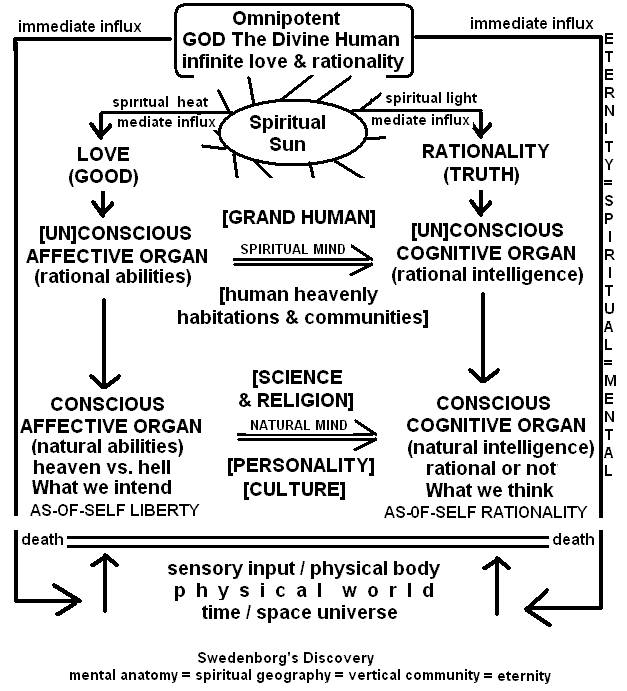
Study Questions for Diagram A
Diagram A above constitutes one single concept in theistic psychology. Many different passages from throughout the Writings Sacred Scripture are encapsulated in the diagram. Swedenborg reports that a single idea, when we are in our mental heavens, would take volumes to describe with the ideas and words we have in our natural mind. As soon as we are resuscitated, we begin conscious life in the eternity of our spiritual mind (see Section xx). At that moment we automatically and spontaneously talk like all "spirits" who already inhabit eternity. This is a thought-language rather than a word-language such as we use with natural languages. You've heard the expression "a picture is worth a thousand words." Now you can say that an expression or concept in our spiritual mind is worth a trillion words in our natural mind. In a similar way Diagram A creates a single spiritual-natural concept, and it would take many pages of theistic psychology to write this spiritual concept out in the words of English. But because we are capable of thinking rationally and abstractly in our conscious natural mind, we can study the Diagram and gradually piece together an understanding of it. Once you have this knowledge organized in a coherent and personally meaningful way, you can look at the Diagram and encompass it in its entirety in one spiritual-natural concept that you could call "mental biology."
The conceptual elements to be put together are listed on the Diagram and summarized in the Study Questions listed under it. You need to look up the topics in theistic psychology to be able to answer those questions coherently and consistently (consult the Subject Index and other listings in Volume 18: www.soc.hawaii.edu/leonj/theistic/ ). There are three distinct levels of progression we must go through in order to arrive at a spiritual-natural understanding of the concept "mental biology" as depicted in diagram A above (see Section xx).
Level 1 is to be able to replicate the diagram in its essential features so that you have it in long term memory, and then to be able to create a rational explanation or account of its elements and how they fit together. This level is achieved by students in theistic psychology after a course of study and reading, and are able to pass a quiz or exam on it. Or by any reader of theistic psychology who studies it as an academic or scientific discipline. At this level it is difficult to tell whether a person is approaching this with the negative or positive bias (see Section xx).
Level 2 progresses to the positive bias, but not yet at the scientific level. In other words, in relation to the elements in Diagram A, we believe that there is a God, that we have an affective organ and a cognitive organ, that there is heaven and hell and eternity, but we are not yet sure that this diagram, representing Swedenborg's version of things, is necessarily it, and we feel that this may just be another opinion or belief, even if interesting and possibly inspired and accurate.
Level 3 progresses to the theistic psychology phase of thinking about the Diagram. This thinking about Diagram A operates by seeing the diagram as a natural-rational representation of Divine Speech (see Section xx). The instant that you make this idea real in your mind, you will experience its spiritual-natural meaning. You will then be able to see the expression "mental biology" and see its spiritual meaning with full conscious awareness (see Section xx). All concepts in theistic psychology are understood at these three levels, and only the third level is actually the level of theistic psychology thinking and reasoning. This third level is genuine and holy, because it is spiritually online, so to speak, not natural. Hence it is Divine, and everything that is of the Divine, is called holy. In other words, it is the Divine Psychologist that has to give you the spiritual-natural perception of Divine Speech, as it is encapsulated or represented in Diagram A. This is why I say that it is "online" as it were, since the spiritual-natural perception of Divine Speech is an influx from the Spiritual Sun into our natural mind, passing through layers of intermediate states.
Memorize the following diagram titled Born Into Eternity, and show it to your friends. Give them enough explanations so they can understand it. What is their reaction? What is your reaction to their reaction?
Diagram 6.3.1.1.1 (B2)
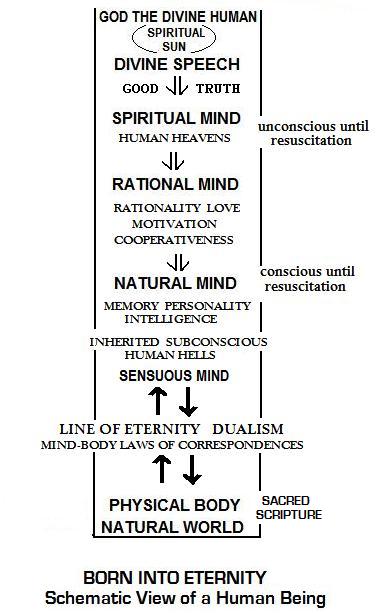
See also the discussion of this diagram in Section 5.1.1.1 Part C.
Quoting from the Writings Sacred Scripture:
DP 299. IV. THE LORD GOVERNS HELL BY MEANS OF OPPOSITES AND THE WICKED WHILE IN THE WORLD HE GOVERNS IN HELL AS TO THEIR INTERIORS BUT NOT AS TO THEIR EXTERIORS.
He who does not know the nature of heaven and hell cannot at all know the nature of man's mind. His mind is his spirit which lives after death. The reason of this is that the mind or spirit of man is in, every detail in the same form as heaven or hell. There is no difference except that one is very great and the other very small, or that one is the type and the other an effigy; therefore, man with respect to his mind or spirit is either a heaven or a hell in its least form. He that is led by the Lord is a heaven, and he that is led by his proprium is a hell. Now as it has been granted me to know the nature of heaven and of hell, and as it is important to know the nature of man with respect to his mind or spirit, I will briefly describe both. (DP 299)
DP 300. All who are in heaven are nothing but affections of good and thoughts of truth arising from these, and all who are in hell are nothing but lusts of evil and imaginations of falsity thence derived. In both cases these are so arranged that the lusts of evil and their imaginations of falsity in hell are directly opposite to the affections of good and their thoughts of truth in heaven. Therefore, hell is under heaven and diametrically opposite to it; diametrically, that is, opposite like two men lying in opposite ways or standing like those living on opposite sides of the globe, thus inverted to each other, with the soles of the feet meeting and the heels touching. Sometimes, also, hell appears to be so situated or turned in this way with respect to heaven; because those who are in hell make lusts of evil the head and affections of good the feet, while those who are in heaven make affections of good the head and lusts of evil the soles of the feet; hence the mutual opposition.
When it is said that in heaven there are affections of good and thoughts of truth arising from these, and that in hell there are lusts of evil and imaginations of falsity thence derived, it is meant that there are spirits and angels who are such; for everyone is his own affection or his own lust, the angel of heaven being his own affection and the spirit of hell his own lust. (DP 300)
DP 302. The arrangement of affections in heaven and of lusts in hell is wonderful, and is known to the Lord alone. In each case they are distinguished into genera and species, and are so conjoined as to act as one. Because they are distinguished into genera and species they are distinguished into greater and lesser societies; and because they are so conjoined as to act as one they are conjoined like all the things that are in man. Hence heaven in its form is like a beautiful man, whose soul is Divine Love and Divine Wisdom, thus the Lord; and hell in its form is like a monstrous man, whose soul is self-love and his own intelligence, thus the devil; for there is no devil who is sole lord there, but the love of self is called the devil. (DP 302)
DP 303. In order, however, that the nature of heaven and hell may be more clearly understood, let the delights of good be substituted for the affections of good, and the delights of evil for the lusts of evil; for there are no affections and no lusts without their delights, because delights constitute the life of everyone. These delights are what are distinguished and conjoined in the manner described above respecting the affections of good and the lusts of evil. The delight of his affections fills and surrounds every angel of heaven, and a common delight fills and surrounds every society in heaven, whilst a delight shared by all, that is, a most commonly shared delight, fills and surrounds the universal heaven.
In like manner the delight of his lust fills and surrounds every spirit of hell, and a common delight every society in hell, whilst a delight shared by all, that is, a most commonly shared delight, fills and surrounds the whole of hell. Since the affections of heaven and the lusts of hell are, as was stated above, diametrically opposite to each other, it is clear that a delight of heaven is so unpleasant in hell that it is intolerable; and on the other hand, that a delight of hell is so unpleasant in heaven that it also is intolerable. Hence arise antipathy, aversion, and separation. (DP 303)
DP 304. As these delights constitute the life of everyone in particular and of all in general, they are not felt by those in them, but their opposites are felt when they approach, especially when these are turned into odours; for every delight corresponds to an odour, and in the spiritual world may be converted into it. Then the common delight in heaven is perceived as the odour of a garden varied according to the fragrance there from flowers and fruits; while the common delight in hell is perceived as the odour of stagnant water, into which filth of various kinds has been thrown, varied according to the foul odour there from reeking, putrid matter. Moreover, it has been granted me to know how the delight of any particular affection of good is felt in heaven, and how the delight of any lust of evil in hell, but it would be tedious to explain it here. (DP 304)
DP 305. I have heard many newcomers from this world complain that they had not known that their life's destiny would be according to the affections of their love. They said that while in the world they had not given any thought to them, much less to their delights, because they had loved whatever was delightful to them, and had merely believed that everyone's lot would be according to his thoughts from his intelligence, especially according to thoughts arising from piety and also from faith. However, the answer given them was, that they could have known, had they wished, that evil of life is disagreeable to heaven and displeasing to God, but agreeable to hell and pleasing to the devil; and on the other hand, that good of life is agreeable to heaven and pleasing to God, but disagreeable to hell and displeasing to the devil; consequently that evil in itself is offensive and good in itself is fragrant.
As they might have known this if they would, why did they not shun evils as infernal and diabolical, and why did they indulge in evils merely because they were delightful? As they now were aware that the delights of evil smell so offensively they might also know that those who are so full of them cannot enter heaven. After this answer they betook themselves to those who were in like delights, for there and nowhere else were they able to breathe. (DP 305)
DP 306. From the idea of heaven now given it may be evident what is the nature of the mind of man; for, as has been said, man's mind or spirit is either a heaven or a hell in its least form, that is, his interiors are nothing but affections and thoughts arising from these, distinguished into genera and species as into greater and lesser societies, and so connected as to act as one; and that the Lord governs them as He governs heaven or hell. That a man is either a heaven or a hell in its least form may be seen in the work HEAVEN AND HELL, published in London in the year 1758 (n. 51-87). (DP 306)
6.3.1.1.1 (II) God's Omnipotence and the As-of-Self Free Will
Diagram A above shows that all events and phenomena in existence are powered, controlled, managed, and determined by God, through "immediate influx" of the spiritual heat and light into the inmost framework of every object or event in the universe. Everything that exists is maintained in existence by this influx. Should the inlux cease for a moment, all existence collapses and disappears. It is the continuous and ceaseless influx that keeps the universe going, once it has been created. This influx originates from the Omnipotent Divine Human whom Swedenborg was able to visually observe amidst the Spiritual Sun that surrounds God's Head like a super-brilliant aura. Swedenborg confirmed by repeated observations that everybody who is already in their spiritual heavens of eternity can see the Divine Human in this way. And on some special occasions, according to their accounts to Swedenborg, the Divine Human also appears to them face-to-face. Nevertheless, they know that this is only an outward appearance of God, who is infinite and omnipresent.
People who have not studied theistic psychology or the Writings Sacred Scripture, are not fully prepared rationally (at Level 2 thinking), to understand and accept the idea that God's omnipotence means that every detail of the universe must be controlled, operated, managed, determined by God directly and continuously without any exception (see Section xx). Especially are they unclear and hesitant about the idea that this omnipotence also applies to our thinking sequence, memory, and emotions and feelings. I think what I want, I look where I want, I touch what I want, I laugh at what I want, I fantasize what I want, etc. God doesn't make me do these things.
This idea of complete determinism by God has to be rationally reconciled with the idea of complete free will in our decisions, intentions, and actions. The two seem to contradict one another and unless they can be logically reconciled, our mind must reject one of them. But this would be destructive of our rationality. The Writings of Swedenborg, for the first time in scientific history, have given us the rational and true solution to this seeming paradox. Diagram A above depicts this solution with the words "as-of-self liberty" and "as-of-self rationality" shown under the affective and cognitive organs of the natural mind. You will find a number of different Sections in theistic psychology that discuss the concept of "as-of-self" (see Section xx).
The concept of "self" in non-theistic psychology assumes that the self is a self-determined human agent that makes up the person. No account has to be made of God's omnipotence and how there could be an autonomous self. The self is automatically considered autonomous. But the concept of "as-of-self" in theistic psychology is the idea that God creates and manages the mental details of the individual in such a way as to create in the person the sense of a self-determined being we refer to as "I, me, myself." In reality, as revealed by Divine Speech, God has to create and manage the mental details that are held together just right to create a self-conscious human person that has the sense or feeling of being autonomous or inner existent. No sense of "self" would be possible by itself, as an autonomous natural or spiritual object unless it were put together and held together and driven to action, by the Divine Psychologist. What we notice with our eyes or senses is selected and determined by God. What we don't notice or ignore, as well. What we remember or forget, what we succeed in or fail at, all is selected and determined by the omnipotent God.
Within this context of absolute determinism, God creates free will in our affective organ, and calls it the "as-of-self."
We must have free will as a true reality, not as an illusion.
We must have freedom to choose what we desire or intend. We must have the freedom to think whatever thoughts we want to think. God will maintain this real freedom for us. For instance, you feel like rubbing your right eye. You must have the freedom to be able to lift your arm and touch your eye. God cooperates. You must have the freedom to think about whoever you want, and be able to remember their name or face or details from your memory. So God cooperates by bringing particular stuff from your memory to your awareness at the right instant you want it. This is omnipotence. But this also: you decide to rob a bank so you can live in luxury. God cooperates by giving you the reasoning process necessary for planning and executing such an illegal and evil act. God cooperates in the background, never letting you see directly that you are being managed. This allows us to maintain the as-of-self freedom we sense we have. This is not an illusion. It is a real freedom and we sense that reality. But we do not sense all the reality. God does not let us sense the reality of His Co-Presence and total management procedures. But we would not be human unless God revealed to our rational understanding that these mental operations that appear to be our won, are not.
It is necessary that every human being understand these two things:
These two propositions or "doctrines of truth," form the mental foundation stones of our eternal conjugial heavens.
God controls our mental operations in such a way as to keep certain thoughts, memories, or realizations from us. God has a purpose in all this that He has revealed in Divine Speech. The purpose is to regenerate our character so that we may live our immortality in the joyful and expansive life of the eternal heavens. Every moment of life on earth is arranged by God to bring maximum possible progress in regeneration. The further we are willing to be regenerated, the higher God can bring us into the endless human potential that our race can receive from Him. God cooperates to such an extent with our as-of-self that He manages the existence of evil intentions, painful experiences, false beliefs, destructive acts. God provides a hell in the human mind to accommodate those who invert truth and pervert good. God allows them to do this, and supplies the power and the intelligence, in order to make sure they maintain their real freedom to choose. The victims of evil deeds are also protected by God. Their sense of as-of-self is not diminished while they suffer horribly and are being victimized. God will allow only those evil deeds to occur which He can turn into spiritual benefit for the victims.
6.3.1.1.1 (III) God's Omnipresence -- Not in Space, But Within It
Another paradox to consider is that of "immanence" or omnipresence of God, even though He is One Divine Human Person. How can one person be everywhere simultaneously? Of course this is not possible in the natural world of space and time where a person can only be in one place at a time, even God! If God came out (or down) into the natural world of time and space, He would be able to be in only one place at a time in the natural world. In fact, this has already happened. When the Divine Child was on earth during the Incarnation Event (see Section xx), He was present in the natural world in one place at a time, and had to physically travel from one place to another. Well, who was minding the store? In other words, who was running the universe? Of course it was the same God who Incarnated as a Divine Child, but He was omnipresent not in physical space, but "within" it or "apart" from it (see Section xx).
We need to understand this rationally (spiritually), not spatially (naturally). Consider your dreaming. You construct dreams while you sleep, just like you construct daydreams while you are awake. Both involve imagination. The content of dreams, daydreams, or imagined things is made of objects, situations, events, feelings, sensations, interactions. Suppose you have a dream in which you see a man slip on the street and fall. We can say that you, the author of the dream, are "within" the dream. This doesn't mean that you are in the dream, as when you are dreaming that you are the one falling on the street. In this case you are not in the dream (not dreaming about yourself), but as the author of the dream, you are "within" the dream. That is, you are creating the dream. You are the cause of the dream. Swedenborg showed that the cause of anything is always "within" the effect. For example, suppose you are switching stations on the radio. You have an intention to switch, a desire to listen to another station. You are motivated to move your hand to execute the switch. You do it, and now the old station is gone. What is the cause of the switch? It is your desire or intention to switch. This desire or intention (cause) is "within" the switching event (effect).
TCR 30. (iii) SINCE THE MAKING OF THE WORLD GOD IS NON-SPATIALLY IN SPACE AND NON-TEMPORALLY IN TIME.
The idea that God and the Divine which proceeds directly from Him is not in space, although He is omnipresent, present with every person in the world, every angel in heaven and every spirit beneath heaven, cannot be grasped by purely natural thinking, but can be to some extent by spiritual thinking. Purely natural thinking cannot grasp it because space is contained in it, since it is formed by the objects in the world around us; and in each and every object visible to the eyes there is space. It is space which makes anything big or small as well as long, broad and high. In short, every measurement, shape and form there depends upon space. Still one can to some extent grasp this idea by natural thinking, so long as one admits some spiritual light into it. But first I must say something about the idea of spiritual thinking. This is in no way dependent upon space, but gains its whole quality from state. State is what can be attributed to love, life, wisdom, affections, joys, and in general to good and truth. Any really spiritual concept of these has nothing in common with space, it is on a higher plane and looks down on spatial ideas as beneath itself, just as heaven looks down on earth.
[2] The fact that God is non-spatially present in space and non-temporally in time explains why God is ever the same from eternity to eternity, and so the same since the creation of the world as before it; and why before the creation of the world space and time did not exist in God or in His presence, but they did after this event. Therefore because He is the same, His presence in space is non-spatial and in time is non-temporal. Hence it follows that Nature is separate from Him, yet He is omnipresent in it. It is much the same as life being present in every substance and all the matter that make up a person, yet it is not mixed up with them. It might be compared with light in the eye, sound in the ear, taste in the tongue, or the ether in land and sea, which holds together and permits the rotation of the globe with the land and seas on its surface, and so on. If these agents were removed, the things constructed of substance and matter would at once collapse and fall apart. Indeed, the human mind, if God were not present in it at every place and every time, would burst like a bubble; and each of the two brains, which serve as the originating sources of action, would turn to foam, so that everything distinctive of humanity would become dust and a smell dispersed in the atmosphere. (TCR 30)
TCR 31.
[2] The angels in heaven understand by the immensity of God the Divinity as to Its Being (Esse), and by His eternity the Divinity as to Its Coming-into-Being (Existere); also by immensity they understand the Divinity as to Love and by eternity the Divinity as to Wisdom. This is because the angels banish space and time from their ideas of the Divinity, and this is the result. But because human beings are incapable of thinking except by means of ideas formed from spatial and temporal concepts, they cannot form any idea of the immensity of God before space existed or His eternity before time existed. In fact, when the human mind wishes to form such an idea, it is as if it lapsed into unconsciousness, almost like a shipwrecked mariner who has fallen into the water, or someone swallowed up by the earth in an earthquake. Indeed, if the mind persists in the attempt to penetrate these mysteries, it can easily become deranged, and thus be led to deny the existence of God.
[3] I [Swedenborg] too was once in a state like this, when I was thinking what God did from eternity, or before the world was made: did He deliberate about creation and work out the order to be followed? was deliberative thought possible in a total vacuum? and other useless speculations. But to prevent me becoming deranged by such speculations, I was lifted up by the Lord into the sphere and light enjoyed by the interior angels; and when the idea of space and time which had previously restricted my thinking was there to a small extent removed, I was allowed to grasp that the eternity of God is not an eternity of time, and that because time did not exist before the creation of the world it was quite useless to engage in such speculations about God. But because the Divine from eternity, and so regarded as separate from all time, does not involve the existence of days, years and centuries, but these are to God a single instant, I concluded that the world was not created by God in time, but that time was introduced by God together with creation.
[4] I will add this account of an experience.
At one end of the spiritual world are to be seen two statues of a monstrous human shape with open mouths and gaping jaws. Those who have useless and mad thoughts about God from eternity imagine themselves being swallowed by these statues. But this is mere imagination into which those plunge who have absurd and improper thoughts about God before the creation of the world. (TCR 31)
All this is to indicate that God orders the universe by discrete degrees (see Section xx). The existence of this order was revealed for the first time in the Writings Sacred Scripture. It is the foundation stone for theistic science in general, not just for theistic psychology (see Section xx). God manages all events through a downward series of discrete degrees that correspond. In Diagram A above several discrete degrees are shown:
Each higher discrete degree is "within" the next lower discrete degree. From this you can see that God is "within" all the subsequent discrete degrees. God is "within" your mind, and "within" your body, and "within" every natural object or cause-effect event. From this non-spatial meaning of "within" you can see that God is "within" every thing, though He is not in anything spatially. If you think of god being spatially everywhere, then you must think of God as some force or energy. Force, energy, space, God -- would be all physical. One force within another, as we are used to with natural objects and their constituents. To retain a rational idea of the Divine Human Person's omnipotence and omnipresence, we must think of discrete degrees, and that God determines and manages events from "within" them. Just as you determine and manage events in your dream or novel from "within" the dream, or "within" the novel, namely, by causation and intention. God is omnipresent by being "within" each degree. The rational concept of discrete degrees allows to see how a Person can be "within" another person, as when people say that God is "within" you. Without discrete degrees to think of, the expression "God is within me" can only be taken as metaphorical. If taken in reality, then God cannot be a Person in our mind. Hence we need the concept of discrete degrees to allow God to be a Person, and omnipresent.
6.3.1.1.1 (IV) Free Will, Heaven and Hell in the Levels of Our Mind
Quoting from Swedenborg:
TCR 475. III So long as a person lives in the world, he is kept midway between heaven and hell, and he is there in spiritual equilibrium. This is free will.
In order to know what free will is and what it is like, one needs to know its origin, It is chiefly by knowing its origin that one gets to know not only of its existence, but what it is like. It originates from the spiritual world, where a person's mind is kept by the Lord. A person's mind is his spirit, which lives after death; and his spirit is constantly in company with spirits in that world who are like himself, while his spirit is equally by means of the material body surrounding it in company with people in the natural world. The reason for a person's not knowing that as regards his mind he is surrounded by spirits, is that the spirits, in whose company he is in the spiritual world, think and talk spiritually, while so long as a person is in the material body, his spirit thinks and talks naturally. Spiritual thought and speech cannot be understood or heard by the natural man, and vice versa; this is why spirits cannot be seen either. However, when a person's spirit associates with spirits in their world, then he joins them in spiritual thought and speech, because his mind is inwardly spiritual, though outwardly natural. Therefore its interior permits him to communicate with those spirits, and its exterior with men. It is this communication which allows a person to perceive things, and to think about them analytically. Without this a man's thought would not go beyond or differ from an animal's; and if he were deprived of all contact with spirits, he would instantly die.
[2] But to render comprehensible how a person can be kept midway between heaven and hell, and by that means in spiritual equilibrium, I must explain briefly the origin of his free will. The spiritual world consists of heaven and hell; heaven there is overhead, hell is beneath the feet, yet not in the middle of the globe which men live on, but beneath the lands of the spiritual world. These too are of spiritual origin, and so not in space, though there is an appearance of space.
[3] Between heaven and hell there is a wide gap, which to those in it looks like a whole world. Into this gap there rise from hell exhalations of evil in boundless profusion, and, on the other hand, from heaven there flows in good, also in boundless profusion. This is the gap which Abraham described to the rich man in hell:
Between us and you a great gulf is fixed, to prevent those who want from passing across to you, and those there from passing across to us. Luke 16:26.
Everyone is as regards his spirit in the middle of this gap, for the sole purpose of allowing him to have free will. (TCR 475)
TCR 476. From childhood to old age everyone changes his place or location in the world of spirits. As a young child he is kept towards the north of the eastern sector. As a boy, as he begins to learn the rudiments of religion, he moves away by stages from the north towards the south. As a young man, as he begins to think for himself, he moves southwards; and later on, when he can exercise his own judgment and be his own master, in proportion to his development in matters which inwardly concern God and love towards the neighbour, south-eastwards. However, if his preference is for evil and he absorbs that, he moves towards the west. Everyone in the spiritual world has his dwelling-place determined by compass-points. The east is inhabited by those who have good from the Lord, for this is where the sun is, in the midst of which is the Lord. The north is inhabited by those who lack knowledge, the south by those who are intelligent, the west by those who are wicked.
[2] The person himself is not kept bodily in this gap or mid-region, but in his spirit; and as this changes its state, approaching good or else evil, the spirit is moved to places or locations in one or the other quarter, and comes into company with those who live there. It must, however, be known that it is not the Lord who moves them hither and thither, but the person moves himself in different ways. If he chooses good, then he together with the Lord, or rather the Lord together with him, moves his spirit eastwards. But if he chooses evil, then he together with the devil, or rather the devil together with him, moves his spirit westwards. It should be noted that where heaven is mentioned in this connection, the Lord is also meant, because the Lord is the all-in-all of heaven; and where the devil is mentioned, hell is meant, since that is where all the devils are. (TCR 476)
Diagram B below gives a general account of the vertical community and its function in creating heaven and hell in the human mind. The spiritual mind is the organ in which are located the human heavens, as shown in the earlier diagram. While we are attached to a physical body on earth, our spiritual mind is unconscious. Our awareness and conscious knowledge is located in the natural mind which is built up by ideas and experiences we have through the physical body, such as our social exchanges and life as a citizen. It is not suspected that this mental life in our natural mind could not be built up without the unconscious interactions we have with the vertical community through our spiritual mind. In other words, the abilities we have through the natural mind's affective and cognitive organs could not function at all without the mediate influx from both the heavens and the hells into our natural mind, as depicted in diagram B.
Diagram 6.3.1.1.1 (B)
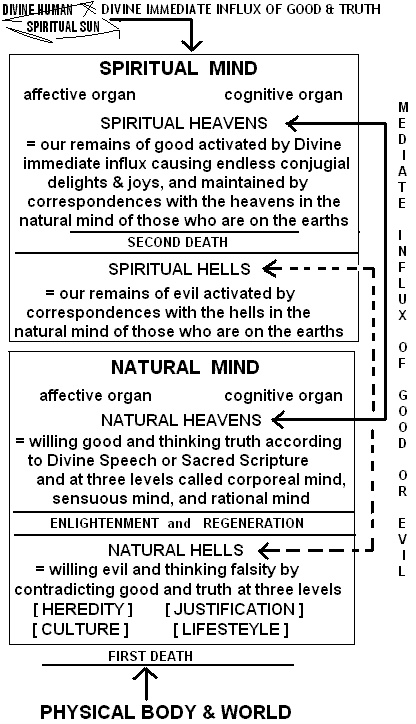
Diagram B shows that human beings have two distinctly different levels of operation. The lower level is called the natural mind, while the upper level is called the spiritual mind. when we are born we come equipped with both these levels within our affective and cognitive organs. Neuroanatomy makes it clear that the brain operates at different levels of neural architecture, such as those of the "old brain" (cerebellum) and "new brain" (cortex). As you descend into the deeper fissures and neural clumps, one finds more and more complex networks of interconnections of synapses, fibers, and molecular exchanges. The brain has these physical properties because it is a perfect correspondent, part for part, of the spiritual brain, or mental body constructed of spiritual substances only (see Section xx). In other words, by studying the properties of the brain we get to discover some of the properties of the mind, to which the brain corresponds.
There are then levels of operation in our mind, specifically in our affective and cognitive organs, which make up the mind like the circulatory and respiratory systems make up the body. The remaining part of the body, the nervous system, corresponds to the sensorimotor organ (not shown in the diagrams). (But see Section XX for more detailed diagrams of mental anatomy.) These three systems in the body correspond to the three systems in the mind, namely, affective (feelings, intentions), cognitive (thinking, justifying), and sensorimotor (sensations and movements). (See Section xx). The three systems of the mind are spiritual in construction, while the three systems of the physical body are natural in construction. Upon the death of the three physical systems, the three mental systems continue life in eternity, that is, outside time and space (see Section xx).
The shape of the circulatory system in the physical body is that of the physical body called the human form. The heart, arteries, capillaries, liver, digestive system, kidneys, are the circulatory system considered globally as the management of blood circulation and its contents (nutrition for cells). When considered in this global sense, you can see that the circulatory system is in the human shape. If you had a computer simulation of the body so that you could remove the other two systems and leave only the circulatory system, what would show up is the shape of the human body. It is the same with all three systems -- they are each in the human form, because they correspond to the mind, and the mind has that form. The shape of the mind is that of the shape of the body, and in fact, it is the other way round: the body has this shape because the mind has this shape. And the mind has this shape because God is a Divine Human, and everything created has the Human within it, in its inmost construction (see Section xx). In God, the Divine Human Person, infinite things are one (see Section xx).
The spiritual mind develops along with the natural mind, but each distinctly in their sphere. The natural mind is conscious and develops from sensory and cultural input through the physical senses. The spiritual mind is unconscious while we are tied to earth, but becomes conscious at resuscitation, 36 hours after the physical body has ceased being able to function in essentials. After resuscitation we are conscious in the spiritual mind, but we still have all our memories and cultural personality from the natural mind. After some further experiencing, we undergo the second death, which is the moment of ultimate choice. We are compelled to choose between our two ruling loves: hellish ruling love or heavenly ruling love. The diagram shows how these two ruling loves were built up by us while conscious in the natural mind during our life on earth through the temporary physical body.
We are born with a heredity and culture that predisposes us to willing evil, like maintaining selfish motives and engaging in prejudiced judgments. The word evil in theistic psychology means that which is in disorder relative to heavenly order. And heavenly order is revealed and specified in Divine Speech (it is not something people can make up). Modern life of mass society and competition makes it easy for us to maintain a life of negativity and selfishness in our affective organ of inherited tendencies and cultural practices. In other words, it is easy for most us to live a daily life of alternation between the hells and the heavens in our natural mind. We are in the natural heavens of our conscious awareness when we feel good, energized, enthusiastic, hopeful, confident, altruistic, honest, sincere, prudent, wise, and motivated to be creative and useful to others, to society, to humanity, to God. When we feel these things, we do so because our consciousness is in our natural heavens. But our consciousness is in our natural hells when we feel bad, sad, depressed, fearful, tired out, exploited, displeased, angry, vengeful, mean, insensitive, cruel, dissatisfied, unmotivated, destructive, selfish, egotistical, tyrannical, violent, murderous, deceitful, hypocritical, foolish.
Note that it is not heredity and culture that make our hell, since this would be unfair to the individual who chooses neither of them for birth. What creates the natural hells in our mind is the justification of the evil tendencies so that we no longer think they are evil or hellish. This is what makes the hells -- the conjunction or coordination of the affective and the cognitive organs acting as one disorder. The evil intention or tendency in the affective organ (= willing evil) cannot actualize itself in our mind until we make it permissible -- justify it -- by false reasonings (= thinking falsity), and confirm these by our lifestyle habits (doing evil works). Similarly, what makes the natural heavens in our mind is not merely the good intentions and motives we have in the affective organ, but their actualization in practice, which can only happen when the cognitive organ (= thinking doctrine of truth) acts in coordination with those intentions or motives (= willing according to the doctrine of truth)
Thinking falsely (= hell in the mind) vs. thinking rightly (=heaven in the mind), is determined not by one's philosophy or self-intelligence, which may vary endlessly from person to person, and from one time to another, but by the Divine Human through Divine revelations given to the human mind through Divine Speech or Sacred Scripture (see Section xx) which defines for us the Doctrine of Truth for Living. In other words, we need to manage our character reformation by first knowing what the heavenly character is, and then struggling to intend and think only that which is according to heavenly order. This process of progressive character reformation, from early adulthood to the separation of the body, is managed and created by the Divine Psychologist, especially through temptations at different levels and intensities throughout the course of life on earth (see Section xx).
TCR 478. Spiritual equilibrium, which is free will, can be illustrated by instances of natural equilibrium. It is like the equilibrium of someone who is tied around the body or by the arms between two men of equal strength, one of whom pulls the person in the middle to the right, and the other to the left. Then the person in the middle can freely turn in one direction or the other, as if there were no force acting on him; and if he moves to the right, he pulls the man on the left violently towards himself, even to the point of making the man on the left fall to the ground. It would be the same if even a weak* man were tied between three men on the right and the same number of and just as strong men on the left; and likewise if he were tied between camels or horses.
[2] Spiritual equilibrium, which is free will, can be compared with a balance, in either scale of which are placed equal weights; if then a little is added to the scale on one side, the balancing beam above rocks. It is the same too with a lever, or with a large beam balanced on its fulcrum. Every single part inside the human body, such as the heart, the lungs, the stomach, the liver, the pancreas, the spleen, the intestines, and so on, is in such a state of equilibrium; and this is what allows each of them to perform its functions in the greatest tranquility. It is the same with all muscles; if there were no such equilibrium in them, all action and reaction would cease, and the person would no longer be able to act as a person. Since then everything in the body is in such a state of equilibrium, and also everything in the brain is in like equilibrium, it follows that everything in the mind is too; and these things relate to the will and the understanding.
[3] Animals, birds, fish and insects also have freedom; but these are impelled by their bodily senses at the promptings of appetite and pleasure. A person would not be very different from them, if he were as free to act as he is free to think; he too would be impelled only by his bodily senses at the promptings of lust and pleasure. The case is different if he drinks in the spiritual teachings of the church and uses them to control his free will. The Lord leads him away from lusts and wicked pleasures and the innate longings he has for these; he strives after good, and turns his back on evil. He is then moved by the Lord nearer to the east and at the same time to the south in the spiritual world, and brought into heavenly freedom, which is true freedom. (TCR 478)
TCR 481. I have had personal experiences to show that everyone is given the ability to understand truth and to will it; even devils receive it, and it is never taken away. One of those who were in hell was once brought up into the world of spirits, and was there questioned by angels from heaven, to see whether he could understand what they were saying to him; the subject was spiritual ideas about God. He answered that he did. And when asked why he had not accepted similar ideas, he said that he did not like them and so did not wish to accept them. He was told again that he could have so wished. This surprised him, and he said he could not. The angels therefore filled his understanding with pride in his reputation together with its delights. On feeling this he then so wished and even liked the ideas. But soon afterwards he was brought back to his earlier state, in which he had been a thief and adulterer who cursed his neighbor; then, since he did not wish to do so, he was no longer able to understand those ideas. This shows plainly that it is free will in spiritual matters that makes a man a man; without this he would be like a tree-trunk, a stone, or the pillar Lot's wife became. (TCR 481)
6.3.1.1.1. (Part B) Where Am I Evil?
When I ask students to think of something really evil, they often give gross examples like Hitler, or a serial killer, or voodoo sorcery. These kind of instances of evil are so extreme and rare that people's everyday evils are forgotten or made to be less important or serious. Consider the issue of whether it is more likely that we end up in hell or in heaven. If we murdered and abused innocent people, hell is clearly justified. But if we were just not punctual, or neglected flossing our teeth regularly, or lied here and there for good reasons, then we feel that hell is less justified, and would even constitute gross injustice.
The above way of thinking comes from considering hell as a place of punishment for bad things people did. This is natural way of thinking about a spiritual idea. And in this mode of thinking, it would certainly be unjust and unfair for God to put us in hell for our little neglectful "sins" in comparison to the really bad guys.
But we need to think about hell spiritually, that is rationally and universally, as a matter of scientific inquiry. What is hell? It is not a place because there are no places in eternity, no space, no time, no distance. Rather, hell is a mental state, just like heaven is a mental state.
Further, to think of hell as punishment is also to think of it in a natural way. In that case it makes sense that the punishment should fit the crime. Murder and abuse of children is a more serious moral crime than not flossing, over eating, and not being punctual. This is again a natural way of thinking about hell. To think of hell spiritually, we need to realize rationally that God is pure Divine Love and therefore it is impossible for God to make Himself punish a human being. Love cannot punish. Instead, hell is a mental state of anti-heavenly order. All mental states are maintained by the individual's preference or love. In the afterlife of eternity no mental state can be maintained that the individual does not love or want. Clearly then, the mental state of hell is maintained by the individual through hellish loves. Similarly, the mental state of heaven is maintained by the individual through heavenly loves. Only our loves can create either heaven or hell in the mind. Hence hell cannot be a form of punishment.
So now we can get back to the difference between a monstrous life of murder and abuse of the innocent, vs. a passive life of neglecting to take care of your body and manners with other people. Since hell is not a punishment, we need to ask what it is you are going to hold on to when the second death has arrived, which is just a short while after the first death (see Section xx). The life of murder, abuse, and lawlessness could not occur without a love for doing those things. This love is a selfish love that hates others who don't support them and cater to them. It is this selfish love that allows them to do the horrible things to others. At their second death they are not willing to just give up this love for the sake of heavenly loves. They want this love like an obsession. They must have it. This is holding on to hell. Once in hell, they go deeper and deeper into this horrible love.
They are never willing to let go of it. In a way this is their self-made and self-maintained punishment. They cannot be alone in their hell. They need others there whom they can torture so they can have their horrible enjoyment. So people spontaneously congregate with those who share a similar hellish love. Once they are together, they are able to compel each other to take turns being tortured. Swedenborg asked some of them how they can submit to this type of torture, just so they then do it back to the others? And they answered that the delight of torturing the others is so intense that they cannot resist it, and thus they are willing to endure being tortured insanely for the sake of being able to do it back to them. This is the eternity of hell.
Now if you are shocked at this kind of vicious insanity you need to consider that there are innumerable mental states called hell, all different, and populated by people who maintain themselves in very specific mental states that are contrary to heavenly order. So now we are back to considering people's little habits of neglecting to take care of their body, their room or purse, their homework or job, and their relationships. Suppose they do this for years and decades. What allows them to maintain this kind of lifestyle habits? We always must look at the will, the motivation, the affective organ. Habits of neglect are maintained by such things in our mind as feeling lazy, feeling a strong attraction to harmful things, feeling unmotivated to be punctual or considerate to others, feeling rebellious against rules or authority, feeling a lack of respect for the dignity of others, and so on. All these feelings are hellish feelings. At their second death, people will choose to hold on to laziness. They don't want to be clean when they don't feel like it. But in heaven, one has to want to be clean all the time!
So we need a definition for what is evil. Here is a useful one:
Evil is the irrational support of affective disorder in oneself, of which there are three: consummatory, evaluative, and motivational (conative, intentional).
We need to understand the elements of this definition of evil:
irrational support
affective disorder in oneself
consummatory
evaluational
motivational
Irrational support of evil in oneself is to love evil enjoyments. These loves or affections are called irrational because evil cannot co-exist with good or truth, but only with falsified truth, which is called falsity. Heavenly loves and affections are attachments to truth, while hellish loves and affections are aversions to truth, hence attractions to falsity. This is why the definition says "irrational support for evil" because rational support of evil is not possible.
Affective disorder in oneself is the aversion of opposition to affective order, which is the heavenly order. The portion of our mind called heaven, contains an affective organ that is in heavenly order and operation. The portion of our mind called hell, contains an affective organ that is in hellish order and operation. These two are opposites to each other, contradict each other, and destroy each other when together in the same portion of the mind. Hence God keeps our heavens and our hells separated through our mental anatomy and biology (see Section xx). To support or love our hellish enjoyments, and to hate our heavenly enjoyments, is called affective disorder.
Consummatory affective disorders have to do with feeling attracted to and enjoying things that are harmful to our ability to reform our character, so that it may turn into a heavenly order. Our character consists of our deeper loves that pull the strings of our personality and conduct. To enjoy being lazy is an affective character disorder that involves consummatory satisfactions. We enjoy getting away with not doing something we promised to do. This is a consummatory affective disorder. So is enjoying some food that you know is bad for you. When our character states are affectively in the heavenly order, it is not possible for us to enjoy being lazy, getting away with something, or getting a raise at work even if one doesn't deserve it. Consider date rape. The man enjoys it even if it devastates the woman. But if the man is in affective order of good and truth, which is the order of heaven, then he cannot enjoy a date rape, and cannot even entertain the thought of it, without feeling horrified by it.
Evaluative affective disorders have to with the feelings that maintain our value hierarchy and priorities. Which is more important to you, winning at all cost, or playing fair in the competition? The value or norm "I must win at any cost" or "winning is what it is all about" is an evaluative affective disorder. If you have the feeling that it's better to be stubborn and hold your own, than to admit you were wrong, then you are in a state of an evaluative affective disorder.
Motivational affective disorders have to do with your hurtful or hostile intentions, motives, goals, purposes, strivings -- what you are trying to achieve, what you are hoping will happen -- when this is not good because it disrespects others or deprives them of their rights and privileges. When your character is reformed, it would be impossible for you to enjoy any hurtful or unfriendly intentions against people who do not deserve it or have rights that should be respected and honored. For instance, suppose that a driver on the road cuts you off while talking on the cell phone and being distracted. You have a real fright and are upset against that driver. While you are trying to calm yourself and recover, you notice the other car crashed into a pole. You feel happy and you think that the driver had it coming. It was his own fault for crashing. This is a motivational affective disorder. After character reformation, when our feelings are in a heavenly order, it would be impossible to enjoy seeing another human being crash his car and get hurt.
Let's consider the issue of premarital sex and pornography. The majority of people in the Western world, and elsewhere, engage in these two practices. Is it evil? Who is to say? Isn't sexual abstinence an old fashioned idea from the dogmas of religion? Isn't it prejudiced to impose the practice of chastity on everyone and to declare that those who are sexually active outside marriage are going to hell? Is this not a modern world and a democracy where everyone is free to live as they please? And what is wrong with enjoying some harmless, non-violent adult rated XXX movies and pictures? Sex therapists even recommend them to try to improve a couple's sex life.
As we consider this issue we need to remember that the heavens and hells in the human mind are universal. They are the same in every individual's mind. There is only one mental world, one spiritual world, one heaven, one hell, one Spiritual Sun, one God. This objective fact is independent of what anyone may believe or think. People who deny the existence of God and eternity, have exactly the same heaven and the same hell as people who are dualists and believe in the afterlife. Heaven is an objective fact. And so is hell. It's not a matter of opinion or judgment. The heart has two chambers, right and left. This is not an opinion. You can't rightly say, My opinion is that the heart has three chambers. It is the same with what is heavenly order and what is hellish disorder in the human character.
Those character traits that are heavenly are heavenly, regardless of our opinion. Let us take premarital sex. People can say: Look it's OK with consenting adults. If a young couple in their twenties like each other and it's convenient for them, they can move in with each other and they can have sex as much as they feel like it. What harm does it do? Who has the right to judge them? They are not harming anybody, just enjoying themselves in a non-hurtful and rewarding manner.
This type of thinking and reasoning is completely materialistic. It is dangerous to our eternity in heaven, like an iceberg is dangerous to a ship. If you look what's below the surface, you can see the danger, but not if you just look above the water. From the perspective of materialistic psychology, health counseling, medicine, or the law, there appears nothing on the surface that would harm the young couple living together and being sexually active in a responsible way. But from the perspective of dualism and immortality, we have to ask ourselves this question: Is my feeling of wanting to make premarital sex permissible, a heavenly feeling or a hellish feeling?
The answer has to do with what we know about life in the heavens of immortality vs. life in the hells. Swedenborg describes what he observed in the heavenly societies of the mental world (see Section xx). The people who are spending their eternity in the heavens of their mind live as conjugial couples (see Section xx). Couples are soul-mates, best friends, lovers, husband and wife forever. Swedenborg describes how they think together and form a unity called the conjoint self. Neither is complete without the other. This total unity of the husband and wife creates the heavenly bliss they are in. These couples told Swedenborg that if for a moment the man should think of another woman in a sexual way, they would both instantly find themselves no more in their heavens, but in their hells.
Now back to earth. It makes sense to want to consider whether it might hurt our conjugial relationship in eternity by being sexually active prior to meeting our soul mate. This is a complex issue and is considered in more detail elsewhere (see Section xx). For now, we can say that whatever we consider to be hurtful to our relationship with our soul-mate, we should try to avoid. It's not a matter of judging others or imposing one's morals on others. It has to do with what we each believe and understand. The point is this: We ought to consider the impact of our sexual actions on our spiritual mind. This is relevant and appropriate. It is the same with harmful habits in any area -- they make it more difficult for us to choose immortality in heaven.
Consider the definition of evil again:
Evil is the irrational support of affective disorder in oneself, of which there are three: consummatory, evaluative, and motivational (conative, intentional).
6.3.1.1.1. (Part C) Born into Eternity
Memorize the following Diagram and show it to your friends. Give them enough explanations so they can understand it. What is their reaction? What is your reaction to their reaction?
Diagram 6.3.1.1.1 (B2)
6.3.1.1.1 (V) The Divine Psychologist and Our Character Reformation
Quoting from Swedenborg:
TCR 36. This section of the chapter will be discussed under separate headings as before.
- (i) God is Love itself and Wisdom itself, these two making up His Essence.
- (ii) God is Good itself and Truth itself, because Good refers to Love and Truth to Wisdom.
- (iii) Love itself and Wisdom itself constitute Life itself, or Life in itself.
- (iv) Love and Wisdom are one in God.
- (v) The essence of love is loving others than oneself, wishing to be one with them and devoting oneself to their happiness.
- (vi) These properties of the Divine Love were the reason the universe was created, and are the reason it is preserved in existence.
These headings must now be discussed one by one. (TCR 36)
Divine Love is the motive of the Divine Psychologist in interacting with each individual mind. God reveals spiritual truths to each mind so that people can use that truth in their mind to fight their false ideas, fantasies, and evils. When we struggle to follow the Divine instructions in the Doctrine of Truth, we undergo enlightenment in early adulthood, followed by the lifelong process of regeneration (see Section xx), during which we create a new character by cooperating with the Divine Psychologist in daily self-witnessing and self-modification disciplines (see Section xx). It is the Divine Psychologist who arranges our environment and experience all day long every day, and He does this in view of the developmental steps we must take to regenerate, which means, to establish a spiritual heaven in our spiritual mind. This is the heaven that constitutes our conjugial eternity after the death of the body (see Section xx).
In the following quote from the Writings Sacred Scripture, the expression "the Lord" = Divine Psychologist. The expression "the spirit who is in evil" refers to our hellish mental states, that is, when we are in those mental states.
AC 6806. And God took knowledge. That this signifies that He endowed with charity, is evident from the signification of "knowing," when predicated of God, that is, of the Lord, as being to endow with charity; for it is charity which conjoins the Lord with man, and causes the Lord to be present with him, consequently to know him. The Lord indeed knows all in the universe, but not as a father his sons except those who are in the good of love and charity.
[2] Therefore the Lord says of those who are in good, whom He calls His "sheep":
I am the good shepherd, and I know Mine own, and I am known of Mine. My sheep hear My voice, and I know them, and they follow Me (John 10:14, 27).
But of those who are in evil, the Lord says that He "does not know them," in these passages: Many will say to Me in that day, Lord, Lord, have we not prophesied through Thy name, and through Thy name have cast out demons, and in Thy name done many mighty deeds? But then will I confess to them, I know you not: depart from Me, ye workers of iniquity (Matt. 7:22-23).
At last came also the other virgins saying. Lord, Lord, open to us. But He answering said, Verily I say unto you, I know you not (Matt. 25:11-12).
When once the master of the house hath risen up, and hath shut to the door, then will ye begin to stand without, and to knock at the door, saying, Lord, Lord, open to us; but He shall answer and say to you, I know you not whence ye are; then shall ye begin to say, We have eaten and drunk in Thy presence, and Thou hast taught in our streets; but He shall say, I say to you, I know you not whence ye are; depart from Me, all ye workers of iniquity (Luke 13:25-27).
Hence it is plain that "to be known," when said of the Lord, is to be in the good of charity, that is, to be endowed with that good, because all the good of charity comes from the Lord; and that "not to be known" is to be in evil.
[3] "To know" involves conjunction, and man is said to be "known" by the Lord insofar as he is conjoined with Him. The Lord also knows those who are not conjoined, nay, the very smallest particulars in every such man (John 2:24, 25); but these men, being in evil, are in a different kind of presence, which is as it were absence; although the Lord is not absent, but the man and the spirit who is in evil is he who is absent; and then it is said that the Lord "does not know" them. An image of this condition appears among angels and spirits; they who are alike as to states of life appear near each other, and thus mutually know each other; but they who are unlike as to states of life, appear to each other to be far away, nor do they know each other in the same way. In a word, in the other life likeness of state causes people to appear present, and to be known; and unlikeness of state causes them to appear absent, and not to be known. (AC 6806)
In other words, although God is equally present in every person at all times from birth to eternity, He is present in a different way with those who acknowledge Him as the Divine Psychologist in their rational mind. When we deny God in the negative bias (e.g., "If there is a God, prove it."), it appears to us that God is absent. Yet God is present regardless, since no thinking and feeling and living is possible except from the unconscious spiritual mind, which is online from God (see Section xx). God manages the thinking and feeling and living of every person, both those who deny Him and those who acknowledge Him.
What difference does it make therefore, when we begin to acknowledge God as the Divine Psychologist in our rational mind, as we do when we begin the study of theistic psychology in the positive bias (see Section xx)? the answer has to do with what goes on between us and the Divine Psychologist when we acknowledge His co-Presence (see Section xx). When we don't acknowledge the co-Presence of the Divine Psychologist (negative bias) we cannot be spiritually regenerated so that we remain attached to the hells that we inherited from our parental line (see Section xx). To break our attachment to the delights of hellish traits we must undergo spiritual temptations, and this requires that we consciously cooperate with the Divine Psychologist directly through the doctrine of truth from Sacred Scripture (see Section xx), or indirectly, through conscience, religion, and teachings (see Section xx). Those who know theistic psychology can learn the details of how they are to cooperate with the Divine Psychologist. This is not possible until we acknowledge His co-Presence and total management of our thinking, feeling, and living.
The psychological and physiological methods by which the Divine Psychologist creates or builds up the heavens in our spiritual mind has been revealed in the Writings of Swedenborg and is thus available for study and understanding in theistic psychology (see Section xx). It is discussed under the topic of "remains" which are moments of happiness and innocence that we experience every day one way or another. States of innocence are feelings we have when we are in our natural heavens, as discussed just above. For example, you see someone drop their bag and the the contents spill on the street. You experience an impulse to help the stranger pick up the scattered objects. This is a heavenly feeling of remains. The Divine Psychologist quickly snatches that feeling away from you and deposits it in your spiritual mind. Etc., etc. Every time you are being good in something, like deciding to brush your teeth instead of skipping, or doing your homework instead of skipping, or being nice to a friend instead of not nice, or doing your job well instead of not well -- in each of these moments there is a feeling of heaven that the Divine Psychologist deposits for you in your spiritual mind. These are your very own feelings, so that when you feel them again in your eternity, you will accept them as familiar and as your own, thus making your eternal conjugial heaven.
It is the same with hellish feelings when you will what is evil, as explained above. This evil intention, when justified and carried out, gets deposited in your spiritual hells in the spiritual mind, as the diagram shows. Note that there must be communication, networking, structured coupling of the natural and spiritual minds through mediate influx, as shown by the arrows in the diagram above. There must be a functional coupling or interaction by the laws of correspondence (see Section xx), between the natural heavens and the spiritual heavens, and between the natural hells and the spiritual hells. This structural coupling is called the vertical community. Those endless numbers of people from the numerous planets who are already in their eternity in their spiritual heavens or hells, could not survive in their spiritual mind unless their mind was coupled with the natural minds of those who are still attached to the physical bodies on the numerous planets. As we alternate and oscillate our daily life moments from hell to heaven and vice versa, between evil feelings and intentions and heavenly ones, we do so by alternating between the mediate influx of those who are in their spiritual hells and those who are in their spiritual heavens, as the diagram shows.
For instance, when we have an impulse to cheat or steal or be imprudent or uncaring, we are being activated by the evil intentions and cravings of those in the spiritual hells (hashed arrow in diagram). If we give in, those in the spiritual hells experience a fulfillment or consummation, thus a happiness or contentment of life. If we resist, we can do so by letting go of the evil mediate influx, and holding on to the heavenly mediate influx, which is constantly there for us to grab on to. We do this through the truth of doctrine from Sacred Scripture that we have internalized in our understanding and perspective on life. This is called enlightenment, and is followed by regeneration through daily efforts and discipline over many years (see Section xx).
Everything then is purified and simplified and disentangled immediately after our first death, when we drop the physical body (see Section xx). Between the first death, and the second death, a few weeks or months later (by earth time, as Swedenborg experienced it), the spiritual mind is split asunder, separating forever the spiritual heavens and the spiritual hells that have been built up there by the Divine Psychologist in the course of our life on earth. Now we decide what we can stand and what we cannot stand. If we can stand to let go of every single thing that is in our spiritual hells, then the Divine Psychologist removes it forever by Divine intervention, putting it to sleep, neutralizing its determinative effect, thus as if removed. We are then in our eternal conjugial state of heaven. Or else, at our second death, we cannot stand to let go of some things in our spiritual hells, and instead, we let go of the things in our spiritual heaven forever. Now we are in the eternal misery and insanity of our spiritual hells, along with others who are also there, which are very many, as witnessed by Swedenborg (see Section xx).
The natural heavens in the natural mind are a new creation by the Divine Child during the Incarnation Event (see Section xx). This new evolutionary portion of the natural mind is in a more interior discrete degree (see Section xx) than the natural mind that we are born with and which are connected to the spiritual hells, as the diagram shows. The Divine Child created this more interior structure of the natural mind in Himself, and this had the result that ever since then, about two thousand years ago, every human being is born with this new interior natural organ (see Section xx). This new spiritual-natural organ is actualized or "opened" to the extent that we are regenerating, that is, working the daily discipline of self-witnessing and self-modification of our intentions, thoughts, and deeds (see Section xx). The growth of the interior natural organ within our natural-rational mind (see Section xx), is the process of character reformation and regeneration. It is activated and energized by the mediate influx of those who are already living in their eternal conjugial habitations in their mind, as the diagram above shows (see also the Grand Human in Section xx). The more our daily life of willing and thinking becomes orderly, in the order of heaven on earth, the more our natural heavens grow within the new interior-natural organ. Our life on earth becomes more and more celestial, angelic, peaceful, wise, charitable, useful, content, conjugial, productive, understanding, intelligent, creative. And this is only a distant foretaste of the actual spiritual heavens that then become our permanent mental state. We then live as angels forever in the flowering of our youth and enthusiasm for life and love (see Section xx).
But if our natural mind remains a hell on earth, just as we were born, then the natural heavens cannot open and develop. Then our spiritual heavens cannot be formed. Then when our consciousness is cut off from this world at the death of the physical body, our consciousness is in the spiritual hells that were built up in correspondence with the natural hells we lived. When we remain in our natural hells we experience unhappiness, anxiety, discontent, depression, lack of confidence, inability to love, and we have a strong desire to hurt others, to be mean and cruel to them, to deny their rights, to take away their dignity, to hurt their innocence, all of which results in the society we have today and those that preceded this one -- injustice, violence, war, fear, anxiety, overeating, not reaching one's potential, unequal distribution of wealth, poverty, sickness, insanity, psychosis, ignorance, etc., all of which create a hell on earth. but the spiritual hells in our eternity are far worse, as described by Swedenborg in his many "travels" there (see Section xx).
Please review Diagram B, now that you have read the relevant explanations for it. See where the First and Second deaths are located on it. See the vertical relationship of influence between the spiritual mind and the natural mind. The natural heavens are located right above "Enlightenment and Regeneration" because you need to be enlightened before you are willing to be regenerated, and you need to be regenerated for awhile before you can become conscious of your natural heavens. Note that the Second death separates the eternal spiritual heavens from the eternal spiritual hells because it marks the process of choosing either our hellish or our heavenly ruling love to live with forever.
6.3.1.1.1 (VI) Societal Consequences of Individual Effort
The natural hells are built up every time we are willing evil and thinking falsity along with it, to justify it in our mind, which means to make it all right to do, that is, not really evil. The natural heavens are built up in our natural mind every time we are willing good and thinking truth according to Divine Speech. The spiritual hells and spiritual heavens in our spiritual mind contain the permanent roots of each. The operations of our affective organ (willing evil or good) is activated by spiritual heat and how we receive it -- in a heavenly order or a hellish one. Similarly, the operations of our cognitive organ (thinking truth or rationally) is activated by spiritual light and how we receive it -- in a heavenly order or a hellish one.
The next diagram depicts the organization of heaven and hell in the human mind.
Diagram 6.3.1.1.1 (C)
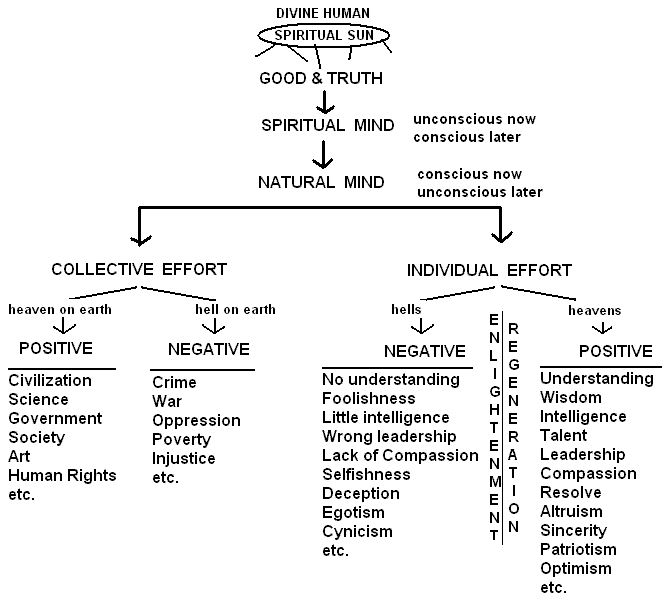
1. What is heaven or hell on earth?
2. What are heavenly and hellish traits? Explain with each illustration you give.
3. What is enlightenment and regeneration?
4. What is the relation between the spiritual and natural mind?
5. What is the relation between collective and individual effort?
The influx of good and truth from the Divine Human through the Spiritual Sun enters the spiritual mind and activates it. The affective organ of the spiritual mind (see previous diagram in this Section), is activated by the spiritual heat, which is a spiritual substance called good, while the cognitive organ is activated by the spiritual light that surrounds the spiritual heat. and is a spiritual substance called truth. These two substances are from the Divine Human in infinite variety and the human affective and cognitive organs have been created by Him to be able to function as an organic receptor for spiritual heat, or good, and spiritual light, or truth (see Section xx). When spiritual light is in the cognitive organ of the spiritual mind, the person is endowed with the ability of rationality, and when the spiritual heat is in the affective organ of the spiritual mind, the person is endowed with the ability called "liberty," by which we can have free will. There is a powerful dynamic tendency for the affective and cognitive organs to act in coordination with each other. The spiritual mind is in heavenly order because it is being built up by the Divine Psychologist through the remains of good that we freely will to do. We cannot destroy, corrupt, or downgrade these remains of innocence because they are attached to the spiritual mind over which we have no influence whatsoever as it is completely unconscious while we are still attached to the physical body (see Section xx).
The spiritual heavens (depicted in diagrams A and B above), are created within our unconscious spiritual mind by the Divine Psychologist, but only to the extent that it can act as one, with the affective and cognitive organs being fully coordinated, conjoined, married into a unity. This can be built up by the Divine Psychologist in exact proportion to the heavenly order being produced in our natural conscious mind. This changeover, or makeover, of our character begins in adult life when we become enlightened (see Section xx). This refers to the realization and understanding that we are born dual citizens in the natural and spiritual worlds, and that heaven and hell are in our mind from birth to eternity. This conscious enlightenment in our rational understanding, is produced by the Divine Psychologist in the natural mind by connecting our conscious understanding with rational ideas based in the spiritual mind. Although these rational-spiritual ideas are not conscious in a direct way, nevertheless they produce an elevation of understanding in the natural mind, and this can be distinctly felt or noticed. When we notice it, we experience extraordinary delight and clarity of vision. We can then make use of the new perspective by incorporating it into the ideas or issues that we are consciously involved with. As the diagram above shows, these issues can be positive or negative.
At the individual level of effort in daily experience, we oscillate between our heavenly and hellish traits. These are located in completely separate and isolated parts of our natural mind, as shown in the the first diagram in this Section. At the collective level, good and truth are received as a collectivity that is managed and maintained by the Divine Psychologist as a venue for human experiences and mental development. Experiences occasion remains of innocence, which are preserved in the spiritual mind where the eternal heavens are built out of them. The human race is variegated and getting more and more so, as the evolution of the mind progresses into the endless future (see Section xx). Variety of "genius" or collectivities and "similitudes" in loves and affections, receive their own influx as their eternal biography is maintained in progression and evolution as a collectivity. This has a spiritual form that is called "celestial." Swedenborg frequently describes the visits he made to these human celestial habitations or collectivities that he calls "societies of heaven" (or hell). Each society or mental collectivity has its own identity and this is symbolically expressed as the Society's official Logo by which it is recognized by other societies. The individuals that inhabit a collectivity are each unique, yet they have a common hierarchy of affections, loves, and consequently, the truths they understand and which form their external reality--their cities, lands, architecture, form of social government, daily routines or involvements, etc. (see Section xx). (See also the book by Hugo Lj. Odhner for an interesting description of life in the spiritual world based exclusively on the Writings, available at www.swedenborgdigitallibrary.org/hh/index2.htm ).
6.3.1.1.1 (VII) The Economics of Immortality
Section 6.5, Love of Self and the World for the Sake of Others, discusses the following diagram which is reproduced here for your convenience.
Diagram 6.3.1.1.1 (D)
|
|
|
L O V I N G |
|
||
|
|
|
GOD |
OTHERS |
SELF |
|
|
FOR THE |
GOD |
Sainthood |
True Love |
Piety |
= Higher heaven |
|
OTHERS |
Priesthood Evangelism |
Altruism |
Mastery |
= Lower heaven |
|
|
SELF |
Religious intolerance |
Selfish love |
Egotism |
= Hell |
|
For the sake of = What is
primary; the motivating feeling; the ruling love
True love = Love of neighbor (charity; conjunction) + conjugial love
(unity in marriage)
1. What is love or loving?
2. How is loving related to "for the sake of"?
3. What is God, Others, and Self?
4. Explain the nine cells in the matrix. Define each title and give a justification for this title in terms of the vertical and horizontal axis it falls into. For instance, Why is loving God for the sake of self (bottom left cell) titled "religious intolerance"? Etc.
5. Explain the economics of immortality.
The diagram above is called "economics of immortality" because it describes the activities we do on a daily basis that contribute to the maturation and growth of the heavens and hells in our natural mind, as depicted in the other diagrams in this Section. It is common to think erroneously that what really matters ultimately for our spiritual fate is the balance between our hellish and heavenly contributions. From this perspective we can continue to keep doing some hellish things, as long as we counterbalance them with heavenly things that we are also committed to. In this way, one gives oneself permission and the excuse to keep doing the hellish things along with the heavenly things. However, as Swedenborg discovered empirically by observation of those who are awakened in the world of spirits after resuscitation (see Section xx), every person is led by an inevitable process of rapid change towards their second death (see Section xx). This process involves the person in becoming fully and explicitly conscious of their deepest loves and affections which are ruled and determined by one ruling love (see Section xx). This chief of our loves determines what happens in our second death, that is, whether we can give up the collectivities of affections called heaven, or else those that are called hell. There is no balance. It is a zero-sum economics in which the person ends up with all bad and no good, or else, all good and no bad. There is no possibility of mixing feelings or affections from heaven and hell, as we do when we are still attached to the physical body.
The second death is the complete and total separation of {evils+falsitites} from {goods+truths}, that is, the complete separation of our spiritual heavens and our spiritual hells. The individual gets to choose. However, Swedenborg's observations show that people cannot choose contrary to their ruling love. You need to get to know your ruling love while you are still attached to the body because then it is still possible to change your ruling love hierarchy through regeneration of character (see Section xx). The diagram above can help you figure out this crucial process in your life. Ask yourself the following question, all day long as you go around feeling, intending, thinking, noticing, planning, and doing: What is it that I am willing, thinking, or fantasizing, and am I doing this for the sake of God, others, or self?
Anything that we do, think, or enjoy for the sake of self is governed by our ruling love that is hellish. Anything we do, think, or enjoy for the sake of others or God is governed by our ruling love that is heavenly. See also Section xx.
There is a spiritual danger in practicing the economics of immortality as if its purpose is to build up one's meritoriousness in the eyes of God, and hence thinking of heaven as a reward for ending up with more heavenly traits than hellish. This is a false reasoning or belief system. It leads the individual into further involvements with the hellish traits. False ideas or reasonings are immediately snapped up by the evil affections and intentions, making a conjunction that is called the infernal marriage (see Section xx). It is the maturing of a hell in our mind (see diagrams discussed above in this Section). Meritoriousness is one such false belief or principle. When our consciousness is in our heaven, we cannot even think of having any merit of our own deserving the eyes of God. Swedenborg has interviewed many individuals who are in that state of consciousness in their eternity. He calls them angels and has described their daily lives and surroundings (see Section xx). The moment they think that their wonderful abilities and acts are due to themselves, they fall out of their heavenly state, and into a hell in their mind, from which they can emerge only when they discard this idea as horrendous.
The reason it so horrendous to ascribe to oneself any merit for abilities, discoveries, effort, or decisions one makes, is that it is spiritually an act of stealing from God. Rationally we can know that God is omnipotent by definition, and therefore whatever abilities we have, or decision we make, takes power, and only God has any power. Hence one can understand rationally that none of the power to make our decisions or exert our efforts can be ascribed to self. When we feel meritorious in our presence with God, we are actually ascribing to ourselves what is God's. This results in disconnecting from God, hence from our heaven, which is nothing but the willing reception of God, that is, God's Proprium or Personality (see Section xx).
At some point in our spiritual development we become impressed by the idea that meritoriousness in the face of God disconnects us from God. To prevent this, we first tend to attack in our mind the logic of the economics of immortality. For instance, we might say that since we don't have the power to change our character, we will not attempt to do so, in fear that if we make the effort of being good, we are falling into the dangerous belief of meritoriousness. This attitude and reasoning fights against the idea in our mind that we need to accumulate good traits in order to get into heaven in the afterlife. The fear of meritoriousness leads to the rejection of the economics of immortality, and this rejection reduces our motivation for character reformation. It may actually prevent it. The consequences are that we are unwilling and unable to dwell in the consciousness of our heaven. Our life in eternity will be in the turmoil of hellish traits and surroundings. It is necessary to understand that heaven and hell are mental states caused by our character, not places of reward or punishment. Such is the law of reality in eternity, once we drop the connection to the physical body and world. The character determines the life and the surroundings (see Section xx).
The economics of immortality makes sense rationally and was confirmed observationally by Swedenborg (see Section xx). Every individual must undergo the second death after entering the world of spirits at the death of the body (see Section xx). This is a spiritual biological process described by Swedenborg through observation (see Section xx). It feels like we are incredibly free all of a sudden, able to do anything we please. There is no power to stop us since we are spirits and spirits do what they want. And this is the danger as well, because what we want can be manipulated by others who may have hostile or exploitative intentions. In this manner, we are led from experience to experience, from situation to situation, from relationship to relationship, in rapid and intense sequence. Each experience suddenly reveals something to ourselves about our character or inner loves. We pursue what we love, and more and more of what we really love comes out into our awareness and takes us to the next intense experience of self-discovery. All this is supervised by the Divine Psychologist through the participation of the angels, that is, those who are already in their mental heavens in eternity.
When we reach our heavens, we are angel people and we then have the mental capacity to become aware psychically from a distance as it were, what anyone is doing in their place of consciousness. As angel people we are always motivated by strong altruistic feelings and intentions, directly stimulated by God to have those good feelings and intentions. This is how we are led by God to come to the rescue of all the humanity that is below the heavens, and are struggling mentally to reach there. When we are in our heavens we gain conscious access to the people not yet in their heavens but struggling to resist their temptations and gain heavenly habits. Right now as we study theistic psychology and are applying it to our character reformation, we have access to those who are already in their heavens. Diagram B above shows this connection. Without it, we could not evolve as a race and we would fall back into human bestiality, which is the end of true humanity. The essence of being human is to accept the truth revealed by God and to struggle to live it, by which the person reaches the conjugial heaven of eternity.
The second death is the process of choosing what we love most, what we are unwilling to give up no matter what. This is what gets us permanently into either our heaven or our hell in eternity.
What we love most, the king or emperor of the army of our loves in our character, is called the ruling love.
The economics of immortality is not our banking practice but God's. God picks off the initial moments of good willing and intending we do all day long, and preserves them as remains (see above) in our spiritual heavens. They greet us when our consciousness is raised to our heaven, after the character is purified from evil loves. We feel at home in them like never before. Swedenborg reports that this occurs with both heaven and hell when people first "arrive there," that is, when we cross the state called the second death. The ruling love is our strongest motivation or intention, stronger than any of the others. For instance, ask yourself what is the one thing you would never give up for the sake of another thing?
For instance, in relation to the heavens in our mind:
loving one of the sex as an exclusive conjugial partner to eternity
wanting to eat pleasant and nutritious foods
wanting to have children and raise them
intending to receive approval of those in legitimate authority
motivated to be a useful person to society
wanting to know God and studying Divine Speech
feeling independent and self-confident
intending to be a sincere, dependable, and honest person
struggling to be the best at something for the sake of achievement and mastery
etc. (add a few more you have noticed about yourself)
Or else in relation to the hells in our mind:
hating to be faithful in marriage or in committed relationships
wanting to eat for the sake of eating whatever you want all the time
enjoying situations in which you can dominate someone else
needing to be right all the time, even if we're wrong
intending to be unfair or manipulative when convenient for oneself
wanting to elevate fun above responsibility, usefulness, and rationality
wanting to possess much power over others so you can subjugate them to your will
wanting to possess more fame, money and riches than anyone else
rejecting or rebelling against legitimate authority when it prevents what we want
desiring to be able to live in luxury without having to earn it in some way
struggling to be the best at something -- if it brings us honors and merit
etc. (add a few more you have noticed about yourself)
You can also observe what makes you feel good or bad in the course of the days and weeks. As soon as you discover one, ask yourself if you would be willing to give it up at your second death. Gradually you will come to know yourself, your ruling love and hierarchy. You will know what you are going to choose to give up, and what you are going to choose to hold on to. When you know this, you are for the first time ready for experiencing spiritual temptations (see Section xx). Temptations are mental struggles between heaven and hell in our mind. Large armies of devils and angels are involved in each battle (see Section xx). Our connections to the vertical community are activated by the Divine Psychologist to give us the conscious conflict of clearly perceiving which is our heavenly desire and which is the hellish. Only if we clearly see the two, feeling their emotional pull, can we make a free choice between them. The choice we make in that moment has eternal consequences for our life. In the course of our decades long regeneration process, we undergo many spiritual temptations (see Section xx).
Our loves are organized into a hierarchical organization in our affective organ. This means that there is a ruling love at the top that controls what other loves will be admitted and allowed to have a place in the hierarchy. While we are still connected to the physical body and world, our mental physiology allows us to have two hierarchies and two ruling loves, one heavenly, the other hellish. These two orientations, wants, intentions, battle against each other in our conflictual feelings as we struggle to inhibit and suppress the love we have for our evil traits, so that heavenly traits can be acquired in their stead. The economics of immortality is a way of understanding rationally how this process of character regeneration takes place, and what is our necessary role in it (see Section xx). Unless we learn how to actively and consciously cooperate in this process, it cannot succeed. This is because all progression consist of as-of-self struggle to resist temptations and evil enjoyments. This is our daily spiritual work. Some people have called it our burden. It takes mental effort to change the downhill course of inherited enjoyments and compulsions. It is in our self-generated as-of-self effort of will into which the Divine Psychologist can act and liberate us from slavery to this or that particular enslavement of enjoyment.
It is called our slavery because we are not in spiritual freedom. As long as we are attached to inherited loves, enjoyments, and perspectives that are opposite to heaven, we have no spiritual freedom. We are enslaved to these enjoyments, and their general support or tolerance in society. We gain our spiritual freedom when we struggle to resist them out of a sense of self-improvement, rationality, and the heavenly order. We reject the hellish order that we inherit, but we retain all the heavenly order that we also inherit. For instance, we inherit tendencies to come to the rescue when a human being or animal is in danger. We inherit tendencies to be generous, to share, to be industrious and curious, to be inventive and responsible, loyal and patriotic. These are traits in the heavenly order that we are given through parents and culture. But neither the heavenly, nor the hellish traits we are given are ours until we appropriate them as ours. This can only happen once we enter early adulthood, for until then we have no freedom of choice in our mind except in small things like style and expressiveness. But we are not yet fully adult or mature in our rationality, understanding, philosophy, scope of vision, knowledge, community experience. We only start having this possibility in early adulthood and later on.
TCR 34. [2] The human mind, organized as it is according to those three degrees, is a means of receiving Divine influence, but the Divine influence does not penetrate further than the extent to which a person clears the way or opens the door. If he does so up to the highest or celestial degree, then a person truly becomes an image of God, and after his death an angel of the highest heaven. But if he clears the way or opens the door only to the middle or spiritual degree, then although he becomes an image of God it is not to such a pitch of perfection, and after his death he becomes an angel of the middle heaven. But if he clears the way or opens the door only to the lowest or natural degree, then if he acknowledges God and worships Him with true piety, he becomes an image of God in the lowest degree, and after his death becomes an angel of the lowest heaven.
[3] If, however, he does not acknowledge God and worship Him with true piety, he puts off the image of God and becomes like an animal, apart from possessing the faculty of understanding and therefore of speech. If he then shuts off the highest natural degree, which corresponds to the highest celestial, he becomes so far as love is concerned like an animal. If he shuts off the middle natural degree, which corresponds to the middle spiritual, he becomes so far as love is concerned like a fox, and as far as the sight of the understanding is concerned like a nocturnal bird. But if he also shuts off the spiritual part of the lowest natural degree, he becomes so far as love is concerned like a savage beast, and as far as his understanding of truth is concerned like a fish. (TCR 34)
6.3.1.1.1 (VIII) Divine Speech Descends Through the Discrete Degrees of Every Mind, and Forms Them
We know that we are struggling to gain personal freedom when we begin to specify and justify what we believe in, what we are willing to struggle for, and perhaps die for. It is the understanding of truth that gains us spiritual freedom and it is the willing of that truth that maintains that freedom forever, as long as we keep willing that truth. We obtain that truth from culture and social exchanges, at first, and then we find it in Sacred Scripture as we begin to read it rationally. This means spiritually. The underlying spiritual meaning of Sacred Scripture is universal, biological, applying to the entire race from beginning to endless eternity (see Section xx). The greatest value of Swedenborg's Writings to humanity and science is his description of correspondences in which Divine Speech is cast as it descends from the Spiritual Sun and enters the human mind of every individual in one descent. It matters not what your culture or religion is, or the century in which you were born, or what your beliefs are about God and the afterlife. Every born human being without exception has a mind arranged in levels through which Divine Speech descends, simultaneously in every mind (see Section xx).
It is only two centuries ago that this great secret has entered the scientific mind through Emanuel Swedenborg (1688-1772), the impeccable scientist with a strong reputation for rationality and empiricism (see Section xx). Suddenly at age 57, at the height of his brilliant scientific career as a Swedish mining engineer, he receives an apparition of the Divine Human in his own room while eating lunch (see Section xx), who informs Swedenborg that his spiritual mind will be "opened" or made conscious, and that he will be living from then on in both the natural world and the spiritual world as a dual citizen in full conscious awareness, unlike the rest of us who are not consciously aware of our spiritual mind, though we may know from revelation or knowledge that we have it, but that it is not opened until we lose all connection with the physical world through our physical body. A few hours after later we are resuscitated in our spiritual body in the world of spirits (see Section xx). At that point our spiritual mind is conscious, and we still have our memories from our natural mind for awhile with us. We are then in a position to verify that there is an afterlife and that we have a spiritual body that is like the physical we had on earth in shape or form, but is constructed of the immortal materials of the Spiritual Sun.
In our spiritual consciousness we can verify the science of correspondences as described in the Writings of Swedenborg. We can then directly verify that Sacred Scripture is written in correspondences (see Section xx). Swedenborg's dual citizenship from age 57 to 82, allowed him to observe correspondences directly when he was reading verses of his Bible. His mouth in the natural world was reading "40 men" but the meaning in his spiritual mind was "temptations when we regenerate." Or his physical mouth would read "Egypt" but his spiritual mind was understanding "scientific knowledges." Swedenborg's first published work as a dual citizen was the 12-volume long Arcana Coelestia (=Heavenly Secrets in Latin. He goes through several chapters of the Bible, analyzing each verse, the phrases in each verse, and the words or numbers in each phrase. And this analysis is not his interpretation. It is his scientific report of direct observations of what his spiritual mind saw, when his physical mouth was reading the verses.
Now that the Divine Human has revealed the secrets of Divine Speech through the Writings, humanity has entered its fully adult state of evolution (see Section xx). This means that we now have the scientific rationality and empiricism to be able to discuss the true reality of the universe, why God has created it, what our special individual roles are in it, how it all works together, by what principles they are managed through Divine Providence and infinite Love and Wisdom (see Section xx). These are just some of the endless things that have been revealed are being revealed ceaselessly through Divine Speech. Theistic psychology is one of the first new disciplines to emerge from it, but there are others (see for instance the theistic physics developed by Dr. Ian Thompson and available at his TheisticScience.org Web site. Specific references to his articles will be found in the Readings Section (Volume 18).
Divine Speech is tied to mental biology. Our affective and cognitive organs are constructed out of the substances of the Spiritual Sun, which are love (spiritual heat) and truth (spiritual light). They are therefore receptor organs for spiritual heat and light. They are activated by this Divine influx from the Spiritual Sun and it is this that forms their rationality and immortality, hence their humanness. By rationality is meant both the affective and the cognitive organs working together as one unit or system. This is what forms heaven and hell in the mind (see Diagrams A and B above).
It is our rational understanding of Divine Truth in Divine Speech that brings on the mental state of reformation in adulthood, when we begin to define what we want and what we believe. We become enlightened by the understanding of that truth in a rational way. It is the rational that is the basis for being human (see Section xx). Until our rational is activated, we are not fully human and have no spiritual freedom. That means that we are not fully human until early adulthood, when we have the full capacity for rationality and spiritual choice. Our rational understanding of truth in Divine Speech allows us to perceive our evil enjoyments and life. We then make the spiritually free choice of struggling against what we enjoy when it is evil, even if it is so familiar and forms such a central part of our daily life. This is the struggle, the work, the discipline, the effort. It is in this effort, when we give it, that the Divine Psychologist is able to step in with love and truth, to remove the connection to hell through that particular enjoyment or falsity. One by one, day by day, they are all presented to our rational view, and to the extent we respond by struggling against them, to that extent the Divine Psychologist instills the new character, and in that, the new heaven of our conjugial eternity.
The construction and maturation of our eternal spiritual heavens in the mind, is our individual responsibility in the context of spiritual freedom. The Divine Psychologist in every individual's mind strives to descend into the natural mind so that we can have a conscious relationship with the Divine Being. The descent into the natural mind is through its three levels, namely, corporeal, sensuous, and rational (see Section xx). First, we hear about God from parents, teachers, books, and friends. This occurs through the medium of natural language, and enters by means of the senses, the brain, and the reaction of the entire body. The corporeal mind detects the physical body's activity in the brain and throughout the sensorimotor system of involvement with the physical environment. Now the corporeal mind has a symbolic or virtual representation or image of the physical environment.
When we hear about God it is in the context of language and culture, and social system and civilization. Until the foundation of theistic psychology through the Writings of Swedenborg (in the eighteenth century), all knowledge of God came through religion, and all religions base their knowledge of God on Divine revelation (see Section xx). We receive knowledge and consciousness of God's existence through Divine Speech, which descends simultaneously into the mind of human being in both worlds (see Section xx). First, Divine Speech descends through the spiritual mind of every human being (see Diagram A and B earlier in this Section). Those who are already in their eternity in conjugial heavens, are conscious of this descent since they have their spiritual mind opened after the first and second deaths (see Section xx). Those who are still tied to their physical body in the world of time, matter, and space, or earthlings, are not conscious of Divine Speech entering and activating their spiritual mind, which remains unconscious. In the case of Swedenborg at age 57, his spiritual mind was opened while still an earthling, so that he had dual consciousness permanently for the rest of his stay on earth. This phenomenon has never happened before in the history of humankind. And the fact that this unique event happened to a renowned and respected scientist and engineer, indicates what God's purpose was in making such a unique event occur, namely, that God was delivering Divine Speech to the human mind in a scientific form, which also has never happened before in the history of the race.
Through these new modern scientific revelations, God has initiated a new evolutionary stage of the human race in relation to God and immortality. Now for the first time in our racial history we are able to receive scientific concepts about God and our mind, about mental biology and the vertical community (which is the tile of this entire Section). When our corporeal mind hears or reads these revelations of theistic psychology, we try to make sense of it through our sensuous mind, which is one discrete level above the corporeal mind (see Section xx). The relationship between the corporeal sense of Sacred Scripture and its sensuous sense is illustrated by comparing the surface meaning of the historical events in Sacred Scripture to its spiritual message to us as we read it today (see Section xx). For instance, when reading or hearing the Old Testament phrase "there was a famine in the land" (Genesis 26:1), the corporeal mind thinks of corporeal or physical correspondences like 'people in that region at that time were starving." The conscious descent of Divine Speech into the lowest level of human thinking comes out into our conscious awareness as a historical statement about some particular people living there at a particular time in history.
But when we study and reflect upon the context of Sacred Scripture (see Section xx), we realize at a higher level of thinking, that there must be a spiritual message in that statement, since it is something that God wants us to know about. Hence we construct a deeper meaning for that phrase, and this deeper meaning is called the sensuous level of thinking. We can think for instance, that there are other places in the Old Testament Sacred Scripture where a famine in the land is mentioned, and in each case the message is that God punishes people when they disobey His rules of living and behavior. The sensuous correspondences of Divine Speech therefore give us a more rational and more spiritual consciousness that we can have of Divine Speech and God. But as we continue to study and reflect rationally upon the phrase "there was a famine in the land." we begin to see a third sense to it which is still higher and which is called the natural-rational mind (see Section xx).
The natural mind has three discrete levels, and the highest is the rational level. This is not a spiritual-rational level such as there is in the spiritual mind. The natural-rational level is the level of thinking we use in science, theology, and art theory. This level of human thinking can reflect upon the phrase in Sacred Sacred Scripture "there was a famine in the land," and can see that there is still a higher level of understanding the spiritual message of God punishing us if we are wicked. The Writings analyze this and other phrases in the Old Testament, and give us the method and science of correspondences so that we are able to extract the rational sense of Divine Speech. We do this extraction process (see Section xx) by translating or transforming every word in the corporeal and sensuous correspondences, into their rational correspondences, according to the rules of extracting correspondences. When we do this for the phrase "there was a famine in the land" we note that the word "land" in the Old Testament Sacred Scripture always corresponds to "mind" and the word "famine" or the word "eating" and "bread" (etc.), always refer to the process of appropriating and acquiring knowledge about God. Hence the expression "there was a famine in the land" refers to the mental state we are in when we are not willing to accept the truths about God in revelation, and instead, pervert those truths, and substitute our own rules of self-intelligence that are more convenient for us, since they allow us to justify retaining our evil enjoyments and deeds.
So God is talking about this mental state and is revealing something about it, which we can reflect on when we study that passage in greater detail (see Section xx).
6.3.1.1.1 (IX) Correspondences to Divine Speech in Sacred Scripture
From all this you can see that Divine Speech descends to the lowest level of human consciousness, then rises to the highest level of the natural mind where it is understood in its natural-rational correspondences (see Section xx). This is the level of thinking we start with in theistic psychology (see Section xx). We start with the literal meaning of the Writings Sacred Scripture, and apply to it the method of correspondences with enlightenment (see Section xx). In this way we go still higher in the meaning of Divine Speech, into the level of human thinking called the interior-natural or the spiritual-natural, both these two terms being used in the Writings Sacred Scripture (see Section xx). This spiritual organ within the natural mind is a new evolutionary creation in the human mind. It was created by the Divine Child during the Incarnation Event (see Section xx), about two thousand years ago in history. The Divine Child gradually created this new spiritual organ in His Own Mind, a process that is revealed and scientifically described in the Writings. After the Resurrection and Ascension events in history, this new spiritual-natural organ was activated and made operational in every human mind. From then on every individual on earth is able to regenerate the inherited character by spiritual-natural ideas of truth, such as we have in theistic psychology.
The purpose and function of every concept in theistic psychology is to develop and open up the interior-spiritual organ, that is, to do our thinking and reasoning through spiritual-rational concepts of Divine Speech rather than through natural-rational concepts of Divine Speech (see Section xx).
Take for instance the phrase we have been discussing: "there was a famine in the land." When understood at the natural-rational level, that is, at the level of the plain literal meaning of the Writings, we have this:
AC 3364. And there was a famine in the land, besides the former famine that was in the days of Abraham. That this signifies a lack of the knowledges of faith, is evident from the signification of "famine," as being a lack of knowledges (n. 1460). That it is a lack of the knowledges of faith, is evident from what presently follows, that is, from the representation of Abimelech, and from the signification of "Gerar," as being that which is of faith. The "famine" in the days of Abraham, mentioned in the twelfth chapter (verse 10), and explained above (n. 1460), denoted a lack of the knowledges which are of the natural man; but the "famine" here spoken of denotes a lack of the knowledges which are of the rational man; and therefore it is said that "there was a famine in the land, besides the former famine that was in the days of Abraham." In the internal sense the subject here treated of is the Lord, in that from His Divine are all the doctrinal things of faith; for there is no doctrinal thing, nor the smallest part of one, that is not from the Lord, because the Lord is doctrine itself. Hence it is that the Lord is called the "Word," because the "Word" is doctrine; but as everything that is in the Lord is Divine, and the Divine cannot be comprehended by any created being, therefore insofar as they appear before created beings, the doctrinal things that are from the Lord are not truths purely Divine, but are appearances of truth; nevertheless within such appearances there are truths Divine; and because they have these truths within them, the appearances also are called truths; and these are now treated of in this chapter. (AC 3364)
While this may seem difficult to comprehend, it just takes more familiarity and experience, like applying a new method of analyzing poetry, or like learning to translate from one language to another--it takes some practice before you can actually do it. Here, we want to apply the method of correspondences with enlightenment to figuring out the spiritual-natural correspondences that lie hidden within this text, which is written in natural-rational correspondences, as explained (see Section xx). This is not an easy or simple process and requires research and study. An example of how we transform or translate these natural-rational ideas into spiritual-natural correspondences, is provided by the diagrams in theistic psychology, such as the diagrams in this Section.
|
Old Testament Sacred Scripture |
The Writings Sacred Scripture |
Theistic Psychology |
|
And there was a famine in the land |
this signifies a lack of the knowledges of faith |
diagrams A and B in Section 6.3.1.1 (the current Section) and other Sections (xx) |
The Table above is a comparison of the discrete levels of operation of Divine Speech in our mind as it descends from the Spiritual Sun (see Diagram A). Divine Speech is also called Divine Truth and also, spiritual light. Truth is therefore a substance, which is why sunlight or electric light is a form of matter or physical energy. Light is not "nothing." It is constructed of something. Natural light is constructed of physical energy and matter. Spiritual light is constructed of the uncreate substances that stream forth from the eternal Spiritual Sun, which was not created because it exists in eternity, without a beginning point in time.
Time itself is a created natural thing or process. It is not yet known when time, space, matter and the expanding physical universe was first created. This was not revealed explicitly in Sacred Scripture. But it is possible that future research in theistic psychology may discover this knowledge by extraction, using the method of extraction specified in Sacred Scripture (see Section xx). It is not possible to know all that there is hidden and extractable from the Sacred Scripture we now possess (see Section xx). The Writings Sacred Scripture explicitly state that no new revelations are to be expected for the human race, and that the Writings Sacred Scripture complete the full creation and evolution of the human race. The mental anatomy is now in place in every human mind for Divine Speech to be consciously interpretable through applying the method of correspondences with enlightenment (see Section xx). Through this extraction process every individual now has the ability to construct true doctrine of life for oneself, and thereby be regenerated by the Divine Psychologist who is now operating at the level of the natural mind, as a result of the Incarnation Event (see Section xx).
The Table above gives an illustration of what this process of extraction yields. Divine Speech descends to its lowest possible point in the natural mind, which is called the corporeal mind (see Section xx). Sometimes this is referred to as the sensuous mind, or the corporeal-sensuous mind. To understand this, it is necessary to remember that the natural mind operates at three discrete levels of rationality, called the corporeal level, the sensuous level, and the rational level (see Section xx). The history of civilization shows a gradual progression of level of thinking from savage and barbaric to civilized and humane. The more civilization becomes humane, the more it is rational in its laws and practices. One sign of this is that new laws are constantly passed to give additional protections of human and individual rights. The more we are advanced in our civilization the more we practice justice, fairness, equal treatment, equal opportunity, compassionate government, spreading the wealth, helping neighbor countries and living in peace, etc. This progression in human mentality is created and managed by Divine Speech descending into the mind of every person.
In recent history, Divine Speech has brought on a new progressive mentality in civilization through the levels of correspondences in which Sacred Scripture was delivered to a person or prophet, who wrote it down, and then studied and transmitted through generations and culture. The Old Testament Sacred Scripture was delivered Book by Book, over several centuries, starting with the first five books written by Moses about four millenniums ago. It was completed with the last Book delivered by a prophet several hundred years before the next portion was delivered, called the New Testament Sacred Scripture. Then, seventeen centuries later, the third and final portion was delivered in the Writings Sacred Scripture (completed near the end of the18th century). These three portions of Sacred Scripture provide a full set of revelations for the human race. This fact is established and justified through scientific and rational arguments and evidence for it is presented in the Writings of Swedenborg. Any literate person or scientist can verify this argument and this evidence. I have done so continuously for the past 24 years (see Section xx). The more I study the Writings the more I can present scientific arguments and evidence verifying its statements. This course in theistic psychology is the presentation of that evidence.
The level of truths contained in Divine Speech correspond to the elevation of our rational understanding of God. It is Divine Speech that forms the content of our understanding at each level. Our understanding of God is higher and higher as we proceed from corporeal-sensuous correspondences of truth to natural-rational understanding, to spiritual-natural understanding. This is the highest level of thinking we are capable of as earthlings restricted to our natural mind in consciousness. At this level we are capable of character reformation and regeneration (see Section xx).
All truth is Divine Truth. God cannot give away anything that is Divine. Hence truth cannot be our own. The only thing that can be our own is the distortion of truth, when we receive it from the Divine Psychologist. But when we don't distort truth, our reasoning and thinking will be completely rational and wise. Our ability to think rationally, to reason logically, is caused by truth coming into our cognitive organ as spiritual light from the Spiritual Sun (see Section xx). This spiritual light is received by the cognitive organ but is not part of the cognitive organ. It could never be, because truth is Divine and what is Divine cannot be given to human beings, but only borrowed by them. An analogy would be that of the relation between electricity and your refrigerator. Electricity comes into the machinery parts of the refrigerator that is made for its reception. This inflow of electric power activates the refrigerator, expelling warm air and keeping itself cold. The electricity is never part of the refrigerator but the refrigerator is activated by the electricity. similarly with your television. The signal comes into the TV's reception unit, which gives it the power to light up the display screen according to the signal's content. The signal never becomes part of the TV.
It is the same with spiritual heat or good, which flows into the affective organ and energizes it with affections, feelings, emotions, but never becoming part of these human experiences. Good is also called love, and both are called spiritual heat from the Spiritual Sun that has inflowed into our affective organ. Spiritual heat, or good, is what activates our will and its emotions, satisfactions, intentions, principles, and goals (see Section xx). The will rules the cognitive organ and its selective content. Good (or love) has priority and superiority over truth (or rationality) (see Section xx). Our thinking in the cognitive organ is initiated, directed and interrupted by our will or affective organ. Good gives us all our power or abilities such as the ability to walk, talk, eat, think, feel. Consider the sentence: "People can..." and you will see that there is no end to the ways you can complete that sentence. This means that there is no end to what people can do with their abilities, as received through the inflow of good into the will or affective organ.
When you think of sunshine on your face, you not only think about the brilliant light, but the heat as well. Sunshine = heat + light. When you consider that it is sunshine that plants need to grow, you will recall that plant life requires the inflow of both heat and light from the natural sun. In other words Life = heat + light. When thinking about human beings, Life = affective organ + cognitive organ (acting together) (see Diagram A and B above in this Section). More specifically, we can say that our conscious mental life in the natural mind is created by the affective and cognitive organs acting together, as the diagram arrows show. Thus, the natural hells in our mind are constructed from the action of evil intentions in the affective organ (= willing bad) joined together with false thinking or justifications in the cognitive organ (= thinking wrong or irrationally). Similarly, the natural heavens. similarly, the spiritual heavens. And similarly, the spiritual heavens. It is always the joined action of the will and understanding, or the affective and the cognitive, that creates our life and experience.
For instance, we may get the idea that cheating on one's spouse is all right as long as it never gets to be found out. We think: What harm can it do, especially if we are careful on how we do it and with whom. This means that (a) we know it is cheating and breaking trust, and (b) we allow it and justify it under certain conditions. This creates a hell in our mind because cheating for the sake of self-gratification is evil, and when we find a reasoning process that justifies it, or makes it all right, we have joined falsity to the evil, thereby constructing the hell in our mind. Even if we don't carry out the intention because there is no opportunity, or because we are afraid to be caught, we are still creating a hell in our mind since we have joined together the affective and the cognitive (the intention and the justification). Only an opportunity is now needed to present itself, and we carry out the cheating acts. But the hell is already in the mind whether or not we carry it out. Swedenborg reports that once people are in the world of spirits, about to face their second death, they carry out all the deeds or acts they had justified mentally, but were afraid to carry out physically while still attached to the natural world.
The spiritual heavens, which are the mental states of eternity in our mind, are built up by the Divine Psychologist while we are still attached to the physical body. The extent to which these "eternal habitations" can be constructed in our unconscious spiritual mind depends on the extent to which we shut down the hells in our natural mind (see Diagrams above). This depends on regeneration and our discipline of cooperation with the Divine Psychologist (see Section xx).
6.3.1.1.1 (X) Character Reformation and the Psychology of Cooperation
Part A The Process of Reformation
The most important reason for studying theistic psychology is to discover how we are to cooperate with the Divine Psychologist in our work of regeneration. The struggle for character reformation is the central purpose for which God keeps us alive on this earth. As soon as the individual is no longer able to engage in this struggle, death of the body immediately follows, and the individual starts the life of eternity. This struggle starts when we are able to think for ourselves. This is called attaining the age of maturity at around 21 for most people. What is it that we are "attaining" at that age? It's the beginning of our ability to cut ourselves loose from being immersed in the received thoughts. Everything we think until that age is not from our own thinking, but from the thinking we have received in our socialization process. The individual is not aware of this under normal circumstances. We seem to ourselves to think from ourselves, not from our parents or people we admire. And yet, that sense is false, as evidenced in theistic psychology in various ways.
Some period after this beginning we have developed our ability to think from ourselves, and that point we have the preparedness for undergoing a reformation of our thinking. The Divine Psychologist brings certain information, and certain experiences, to each person, which have the consequence of strengthening the person's interest in morality, religion, or spirituality. If these contacts result in ideas that are compatible with truth, then the Divine Psychologist can bring the person's focus and interest more deeply into rational things of religion and spirituality. If on the other hand the ideas we pick up through these contacts and readings are incompatible with truth, then the individual turns more and more away from truth. Further progress in regeneration is cut off (see Section xx).
The Divine Psychologist is an active manager in this crucial process. It would not work otherwise! We are informed by Divine Speech that God's omnipotence must rationally extend to every detail, or else it cannot logically be called omnipotence. This includes therefore the details of the process by which information of the right sort comes to our attention at the right time, then impresses us enough to pay attention. Then there are the details of how reflect upon this information on other occasions, so that there is a functional and powerful cumulation of justifications, like a snowball that gets to be bigger than a house or tree. This mighty snowball of reasonings crushes all the former reasonings and false justifications. Only that is left which agrees with the newly realized truths about God and life, about morality and spirituality, character reformation and heaven or hell. Every human being has a conscience by which the Divine Psychologist communicates to our natural mind messages about truths, and punishments about evils. We feel and sense from within what is right or wrong. We feel a deep pain of regret and embarrassment when violate community standards and cultural taboos. These feelings and thoughts are actively fomented, stirred up, and directed by the Divine Psychologist in the direction of the person's heaven.
This is the process of reformation. It is the inner realization that there is morality, there is spirituality, there is immortality, there is heaven and hell, there is a Divine Human God who loves us and manages it all for our good. This is also called enlightenment, because we now understand and see true reality. From then on, we are prepared and ready to start character reformation, which is the regeneration of the affective organ. This requires our active cooperation with the Divine Psychologist. Hence we need to learn about the psychology of cooperation. Studying theistic psychology at level 1 (see Section xx) does not require reformation, enlightenment, regeneration, or cooperation. But studying theistic psychology at level 2 and 3 does require enlightenment and cooperation to some extent at earlier levels, and much more at later stages of study (see Section xx).
We cooperate with the Divine Psychologist by the daily practice of self-witnessing (see Section xx). This may be called a spiritual practice because it involves the motivation of doing for the purpose of our character reformation, and this is the central topic of theistic psychology. Self-witnessing is the self-observation of our feelings, intentions, thoughts, perceptions, focus of attention, social appearance, and actions or movements of the body, hands, legs, eyes, etc. These are the procedures that every individual accomplishes in the course of their minute by minute life in a group or community. These procedures can be observed by our self-monitoring skills, when we are fully motivated by the spiritual discipline. As we study theistic psychology we develop an understanding of the doctrine of truth from Divine Speech (see Section xx). This doctrine of truth constructs the principles and models we follow in our daily procedures of life.
Our task in cooperating with the Divine Psychologist is to exert the mental effort of
(a) examining our inner life;
(b) judging it by means of the doctrine of truth from Sacred Scripture;
(c) cease doing what is not allowed or condemned thereby;
(d) start doing what is allowed or commanded.
This process prepares your mind for temptations, the main method the Divine Psychologist employs to regenerate our will, that is, our affective organ, from hellish to heavenly. A new affective organ is provided which is then grown and expanded gradually as the person is regenerating. There are natural, spiritual, and celestial temptations, and each category has a developmental series that must be enacted or experienced. The result is a spiritual heaven in our spiritual mind that is prepared and ready for each of us, as we undergo the second death (see Diagrams A and B) (see also Section xx).
The economics of immortality was discussed earlier in this Section. At Level 2 thinking about theistic psychology (see Section xx), we want our hellish and heavenly traits to balance each other to some extent. In other words, even while we continue to enjoy evil loves, and continue to think at times against the truth, we want God to ignore this for the sake of something else we also did, something that is heavenly or pleases God. But at Level 3 thinking we begin to understand that God's single focus in His relationship to each individual is to bestow as much human potential as possible, and to make the person be filled with happiness and joy forever, without stop. This is what God wants. This is why He created the human race, and the universe for the sake of human beings. God is pure Love in His Essential Being, according to the revelations about Himself in Sacred Scripture. The essence of love is to make others happy from oneself, according to these revelations. Hence God's single minded focus is always on making the individual as happy and rational and wise as He can.
To be an individual human being, a person, is to have real freedom and real rationality. God is therefore dedicated to maintaining our freedom and rationality as two capacities we can always make use of as if they were our very own. This is what makes us human, an image and model of the Divine Human who is the only actual Human. We understand therefore that God cannot balance out our evil traits with our heavenly ones. The evil traits cannot be balanced out because we are not dealing here with an economics of keeping track of sins and forgiving or overlooking them. At Level 2 we might think that it is a matter of God forgiving us or not forgiving us. But at Level 3 thinking we understand that this is a matter of spiritual physiology of the mental organs, as shown in Diagrams A and B. The economics of our immortality is determined by the aversion we have accumulated for our evil traits.
Part B The Role of Temptations
Temptations are arranged for us by the Divine Psychologist in order that we may learn to reject our evil loves from a sense of aversion for them. In other words, through self-witnessing we become aware of what we are feeling, thinking, fantasizing, and doing. We then identify and recognize those things in our mental and bodily life that are the enjoyments of hells. We are amazed that we can enjoy that which is from hell. Amazed and dismayed. Perhaps depressed and disgusted. Or maybe just annoyed, and not wanting to think about it or figure it out. But the Divine Psychologist puts the issue right in our face by means of a temptation experience. For example, some driver just scared you with a near miss crash and you feel enraged against the driver, imagining that you can tear him to pieces, or at least scare him to death as he did to you. As you witness this reaction in yourself, you realize that it is against the doctrine of truth from Sacred Scripture to think evil of one's neighbor (see Section xx). We understand that if we justify this vengeful thinking we are creating a hell in our mind and we enter further into a tight connection with the hellish societies who are specialize in vengefulness. This is a spiritual temptation (see Section xx).
The Divine Psychologist has put you smack in the middle of a spiritual temptation. You are cursing your neighbor and you know it's evil, yet you enjoy it so much that you continue to do it, continue to enjoy the feeling of retaliating and taking your vengeance, or continue to enjoy the idea that this driver will kill himself, etc. This spiritual temptation precipitates you into a life and death struggle that you can win, if you are willing to give up your evil enjoyment, knowing that is evil. The Writings explain that armies of spirits, good and evil, line up to fight for one individual person on earth who is brought into a spiritual temptation. The outcome depends on your willingness to give up that enjoyment. The Divine Psychologist waits for you to be willing, and the instant you are willing to giv eup the enjoyment because it is evil, you feel the power to turn away from the enjoyment, to give it up. It now becomes easy, once your decision is made, because the power of influx then drives the evil spirits away, freeing the individual from the enjoyment. In this way, by progressive steps and temptation experiences, we are brought to eventually not only stop ourselves from fantasizing and wishing evil upon our neighbor, but to to hold this in aversion, to be shocked by the idea of doing it even for one instant. That's when we are fully and forever liberated from the spirits of vengeance. This is the way temptations progress our character regeneration.
Our ability to cooperate with the Divine Psychologist in our character reformation depends on the idea we have of God. At Level 1 thinking our relationship to God is non-personal, if it exists at all. If we are not outright naturalists, denying God's existence along with eternity, then we have some sort of "universal" idea of God as Energy, or as "the Universe" or even as "Whatevers." At Level 2 thinking we fully accept God and eternity and heaven and hell and Sacred Scripture as Divine. But we have all sorts of unscientific ideas about God. One common belief is that God is a Judge who is forced by His Own Law of Order, to judge the guilty who have sinned against Him by violating His Commandments (see Section xx).. Another idea is that human beings are necessarily evil because they inherit evil, and this is their unchangeable nature or character. Therefore the way to salvation and eternity in heaven (or earth) is to belong to a true religion and to carry out its prescriptions with sincere and deep faith in the truth and validity of these prescriptions as coming from God (see Section xx). Another idea is that God punishes or rewards depending on the severity of the sins or good works we perform, and perhaps in what proportion or frequency (see Section xx).
But at Level 3 thinking we no longer think of God as a Judge who is bound by His Own Law that we have violated, to punish us for sins. Neither do we think any more that God needs to forgive us for our sins (see Section xx). Instead we can see that God is pure Love and therefore never thinks of having to forgive, as if He withheld His forgiveness before that. We remember in our thinking to be rational and logical about God because God is Rational and Human, and runs the universe in a manner that we can understand and appreciate, even if we cannot understand any of the details that are not within the purview of created human beings to understand or conceive of. Obviously since God's intelligence is infinite no finite created individual can conceive of any of this. Nevertheless we can conceive representations and correspondences of Divine Speech starting from the highest level in our mind called the spiritual heavens, and descending to the natural mind where we are conscious of its meaning by means of thinking with natural correspondences of Divine Speech, which is Divine Truth, which is spiritual light from the Spiritual Sun, which is the aura issuing forth from the Divine Human into the universe, creating, managing, evolving, progressing closer and closer to perfection in the Grand Human (see Section xx).
Our psychology of cooperation is therefore conditioned by our relationship to God, which depends on our idea of God.
At Level 3 thinking about God we can form a relationship to Him as our Divine Psychologist. This gives us a way of seeing how God is managing our mental life and why. Since the Divine Psychologist is perfect in all possible ways, we have complete trust and confidence that absolutely nothing can occur in the universe or in our mind, that the Divine Psychologist is not directly and immediately managing and determining. We are completely confident in this because we are thinking about God rationally. We can understand the logic that "omnipotence" means that no mental event in our mind can occur except that He is bringing it about. And we also know that God is rational, hence He acts only from a purpose. God has revealed to the human race that His purpose is to create earths in the physical universe endlessly, where people can be supplied with physical bodies and experiences, to develop a natural heaven in their mind, and then live in a spiritual conjugial heaven to eternity (see Section xx). There are therefore endless varieties of heaven in the human mind. Swedenborg used the physical organs to describe the quality of the heavenly societies he encountered. The people whose heaven exists in say "the province of the heart" of the Grand Human, are of a different genius or mental quality than the people whose heaven is described as being "in the province of the stomach" and so on (see Section xx).
Theistic psychology understood at Level 3 thinking allows us to have an intimate relationship with the Divine Human. We are not focusing on God as a Person to be worshipped as a King and Judge (level 2 thinking) but as a Psychologist who is engineering our future through the control of the present in every detail that occurs in our mental life and in the construction of our being. We understand that God is much more familiar and knowledgeable of ourselves than we are. We do not turn away from God, feeling shame or embarrassment. We face God in reality, discussing with Him what is going on with us in any one situation or moment. This is the method that has been found universally effective in relating to God, that is, taking to God, facing Him in reality for what He is, not a Judge or Benefactor or Father, but what these holy terms and ideas represent and contain spiritually within themselves. Father is a term that means Love or Divine Love and Grace, while Judge means Divine Truth. We talk to God sincerely when our relationship is real and rational, devoid of distancing through ritual performances. Instead, addressing in your mind whatever spiritual ideas there are in those rituals. Rituals without their spiritual ideas are not spiritually effective or spiritually meaningful (see Section xx).
There is much to discuss with the Divine Psychologist at any moment of the day or night. In future research theistic psychology will be able to examine the styles or procedures that exist between humans and God while we are in the mental co-Presence of God. Of course we know that God is present and managing our mental operations moment by moment, every moment. But we only talk to God about all this management on a rare basis. In my case, despite my long standing motivation to talk to God all day long, I only manage to remember here and there, in the course of my daily activities. I found that when I study and write theistic psychology I am more conscious of god's co-Presence in my mental operations. I have acquired the habit of thanking the Divine Psychologist whenever I become aware of a new insight that delights me and impresses me enough to remember that He is the one making it happen right then and there. When I find myself fantasizing a hellish enjoyment or interest, I apologize to God for turning away from Him and His Love, and therefore from the conjugial heaven that He wants to construct in my mind.
Through this mental effort and spiritual discipline I find more and more ways or occasions to remain consciously aware of His co-Presence in the course of the day. I would be shocked at myself if I had a companion on my morning beach walk, and hardly ever acknowledged that he was there or spoke to him. And yet this is the abnormal situation I maintain when I forget about God's co-Presence and co-action in my mental operations. It's like taking all the credit for achieving yet another day in our life. This is irrational and leads to spiritual insanity in the hells of our mind (see Section xx).
Quoting from the Writings Sacred Scripture regarding temptations and how they work:
And the waters were going and failing.AC 857.
That this signifies that falsities began to disappear, is evident from the words themselves, as well as from what was shown above (verse 3), where it is said that "the waters receded, going and returning." Here however it is said that "the waters were going and failing" and by this, as by the former phrase, are signified fluctuations between what is true and what is false, but here that these fluctuations were decreasing.
The case with fluctuations after temptation (as before said) is that the man does not know what truth is, but that as by degrees the fluctuations cease, so the light of truth appears. The reason of this is that so long as the man is in such a state, the internal man, that is, the Lord through the internal man, cannot operate upon the external. In the internal man are remains, which are affections of what is good and true, as before described; in the external are cupidities and their derivative falsities; and so long as these latter are not subdued and extinguished, the way is not open for goods and truths from the internal, that is, through the internal from the Lord.
[2] Temptations, therefore, have for their end that the externals of man [ = our natural mind ] may be subdued [ = reformation of our belief systems from materialism to theistic psychology ] and thus be rendered obedient to his internals [ = our spiritual mind which receives by influx spiritual truths from the Spiritual Sun ], as may be evident to everyone from the fact that as soon as man's loves are assaulted and broken (as during misfortunes, sickness, and grief of mind), his cupidities begin to subside [ = weakening of our attraction to and enjoyment of inherited hellish traits like wanting our way to prevail even if it isn't good ], and he at the same time begins to talk piously [ = surface temporary repentance due to fear ]; but as soon as he returns to his former state, the external man prevails and he scarcely thinks of such things.
The like happens at the hour of death, when corporeal things begin to be extinguished [ = physiological decline of vital functions in the body ]; and hence everyone may see what the internal man is, and what the external; and also what remains are, and how cupidities and pleasures, which are of the external man [ = in our natural mind ], hinder the Lord's operation through the internal man. From this it is also plain to everyone what temptations, or the internal pains called the stings of conscience, effect, namely, that the external man is made obedient to the internal.
The obedience of the external man is nothing else than this: that the affections of what is good and true are not hindered, resisted, and suffocated by cupidities and their derivative falsities. The ceasing of the cupidities and falsities is here described by "the waters which were going and failing." (AC 857)
AC 2411. "And the men laid hold of his hand, and of the hand of his wife, and of the hand of his two daughters."
That this signifies that the Lord powerfully withheld from evils, and thus strengthened the goods and truths signified by "Lot, his wife, and his daughters," is evident from the signification of the "men," as being the Lord (concerning which above); from the signification of the "hand," as being power (see n. 878); also from the signification of "Lot," as being the good of charity (see n. 2324, 2351, 2371, 2399); from the signification of "wife," as being the truth of faith (treated of in the 26th verse); from the signification of "daughters," as being the affections of good and of truth (see n. 489-491, 2362); and finally from what was said above (n. 2388), namely, that good and truth flow in from the Lord in the proportion that man is withheld from evil; consequently, that the goods and truths signified by "Lot, his wife, and His two daughters," are in the same proportion strengthened.
[2] On reflection every man may know this from his own experience; for in proportion as he is removed from corporeal and worldly things, in the same proportion he is in a spiritual idea, that is, is uplifted toward heaven; as is the case when he is in any holy worship, when in any temptation, also when in misfortune or sickness. It is well known that corporeal and worldly things, that is, the loves of them, are then removed, the reason being as stated, namely, that what is heavenly and spiritual from the Lord continually flows in; but evil and its derivative falsity, and falsity and its derivative evil, which flow in from corporeal and worldly things, are what hinder its being received. (AC 2411)
AC 2334. "And they said, Nay."
That this signifies the doubting which is wont to attend temptation, may be seen from their declining and yet going into his house. In all temptation there is somewhat of doubt concerning the Lord's presence and mercy, and concerning salvation and the like things; for those who are in temptation are in interior anxiety, even to despair; in which they are for the most part kept, to the end that they may be at length confirmed in the fact that all things are of the Lord's mercy; that they are saved by Him alone; and that with themselves there is nothing but evil; in respect to which they are confirmed by means of conflicts in which they overcome.
After the temptation there remain from it many states of truth and good to which their thoughts may afterwards be bent by the Lord, which would otherwise rush into insane things, and draw away the mind into opposition to what is true and good.
[2] Since by "Lot" there is here treated of the first state of the church which is in the good of charity but in external worship, and since before a man comes into this state he is to be reformed, which is also done by a certain kind of temptation (but they who are in external worship undergo only a light temptation), therefore these things which involve something of temptation are said, namely, that the angels at first said they would pass the night in the street, and that Lot urged them, and so they turned aside to him, and came into his house. (AC 2334)
AC 3147. "
And water to wash his feet."That this signifies purification there, is evident from the signification of "water for washing," or of washing with water, as being to purify (concerning which presently); and from the signification of "feet," as being natural things, or what is the same, the things in the natural man (see n. 2162). In the representative church it was customary to wash the feet with water, and thereby to signify that the unclean things of the natural man were washed away. The unclean things of the natural man are all those things which are of the love of self and of the love of the world; and when these unclean things have been washed away, then goods and truths flow in, for it is solely these unclean things that hinder the influx of good and truth from the Lord.
[2] For good is continually flowing in from the Lord, but when it comes through the internal or spiritual man to his external or natural man, it is there either perverted, turned back, or suffocated. But when the things which are of the love of self and of the love of the world are removed, then good is received there and is made fruitful; for then man practices the works of charity. This is evident from many considerations; as when in misfortune, distress, and sickness, the things that belong to the external or natural man are merely lulled, the man forthwith begins to think piously [ = to believe that there is an afterlife, heaven, and hell ] and to will what is good, and also to practice works of piety insofar as he is able; but when the state is changed, there is a change also in all this. (AC 3147)
AC 5127. "After the former manner."
That this signifies in accordance with the law of order is evident from the signification of the "former manner," as being the law of order; for it is a law of order that exterior things should be subject to interior things, or what is the same, lower things to higher ones, and should serve them as servants; for exterior or lower things are nothing but servants, while interior or higher things are relatively lords. That such is the signification of the words "after the former manner" is because the butler as a servant had previously served Pharaoh as his lord, in accordance with the law of subordination; thus the sensuous represented by the butler had served the interior natural represented by Pharaoh, in accordance with the law of order.
[2] That it is the law of order that lower or exterior things should serve higher or interior things, is wholly unknown to the sensuous man [ = materialist outlook in our natural mind ]; for one who is merely sensuous does not know what interior is [ = our spiritual mind in eternity ], thus neither what is relatively exterior. He knows that he thinks and speaks, and that he wills and acts; and from this he supposes that to think and to will are interior, and that to speak and to act are exterior; but he does not know that to think from the senses only, and to act from the appetites, is of the external man, thus that his thinking and willing are solely of the exterior natural, and that this is still more the case when he thinks falsities and wills evils; and because in such persons the communication with interior things is closed, he therefore does not know what interior thought and will are.
If he is told that interior thought is to think from truth, and that interior will is to act from good, he does not at all apprehend it; still less that the interior man is distinct from the exterior, and so distinct that the interior man can see as from a higher position what is going on in the exterior man, and that the interior man has the capacity and ability of chastening the exterior, and of not willing and thinking what the exterior man sees from phantasy, and desires from cupidity.
[3] These things he does not see so long as his external man has dominion and rules; but when he is out of this state, as when he is in some depression arising from misfortunes or illness, he can see and apprehend these things, because then the dominion of the external man ceases. [ = we are then able to act from spiritual motives ]
For the faculty or ability of understanding is always preserved to man by the Lord, but is very obscure with those who are in falsities and evils, and is always clearer in proportion as falsities and evils are lulled to sleep. The Lord's Divine flows in continually with man and enlightens him, but where there are falsities and evils (that is, where there are things contrary to truths and goods), the Divine light is either reflected or suffocated or perverted, and only so much of it is received, as it were through chinks, as to give him the faculty of thinking and speaking from sensuous things, and also of thinking and speaking of spiritual things from forms of speech impressed on the natural or bodily memory. (AC 5127)
AC 5353. "And all my father's house."
That this signifies the removal of hereditary evils, is evident from the signification of "father's house," as here being hereditary evils; for by a "house" in the internal sense is signified a man, and indeed his mind either rational or natural, but specifically the will therein, consequently good or evil, because these are predicated of the will (see n. 710, 2233, 2234, 3128, 4973, 4982, 5023); and therefore by "father's house" here are signified hereditary evils. The quality signified by "Manasseh" is contained in these and the immediately preceding words. In the original language "Manasseh" means "forgetfulness," thus in the internal sense the removal of evils, both actual and hereditary; for when these are removed, a new will arises, for the new will comes into existence through the influx of good from the Lord. The influx of good from the Lord with man is continuous; but there are evils both actual and hereditary that hinder and obstruct the reception of it; and therefore when these are removed, a new will comes into existence. This is very evident in the case of those who are in misfortune, misery, and illness; for as in these the loves of self and of the world, from which come all evils, are removed, the man thinks well about God and the neighbor, and also wishes his neighbor well. It is similar in temptations, which are spiritual pains, and hence inward miseries and despairings: by these chiefly are evils removed, and after they have been removed, heavenly good flows in from the Lord, whereby a new will is formed in the natural, and this new will is "Manasseh" in the representative sense. (AC 5353)
AC 8981. "If his master shall give him a woman."
That this signifies good from the spiritual adjoined to truth while in combat, is evident from the signification of "master," as here being the spiritual; for by "master" is here meant someone of the sons of Israel, and by the "sons of Israel" are signified those who are true men of the spiritual church, that is, who do what is good from the affection which is of love, or what is the same, from charity.
(That "the sons of Israel" denote the men of the spiritual church, see n. 6426, 6862, 6868, 7035, 7062, 7198, 7201, 7215, 7223, 7957, 8234, 8805; consequently by the same in the abstract sense are signified spiritual truths and goods, n. 5414, 5801, 5803, 5806, 5812, 5817, 5819, 5833, 5879.) From this it is that by "master" is here signified the spiritual. And from the signification of "giving him a woman," as being to adjoin good to truth; for "to give," when said of a woman, denotes to adjoin, and "a manservant" denotes one who is in the truth of doctrine and not in the corresponding good (n. 8974); and "a woman" denotes delight (n. 8980), but here good, because it is given (that is, adjoined) from the spiritual; for all that which comes from the spiritual is called "good," because the spiritual itself is the good of charity (that "a woman" denotes good, see n. 915, 2517, 4823, 6014, 8337).
The reason why it denotes in combat, is that it is said that if his master have given him a woman, at the end of his service the woman should be the master's. From this it is evident that the woman was the manservant's while he was in service, and not afterward; thus while in combat, and not after combat; for by the service of six years is signified labor and combat (n. 8975).
[2] Who cannot see that in this statute there is a secret which cannot be known except by him to whom it has been revealed? For in the external form it appears contrary to Divine justice that a woman given to a manservant should remain the master's when the servant went out from service, seeing that a woman ought to be her man's forever. Of the same character are also many other things that were commanded the sons of Israel by Jehovah, as that they should ask of the Egyptians vessels of gold and of silver, and garments, and thus should spoil them; besides other things of a similar nature spoken of in their places. But although, as has been said, in the outward form these things appear contrary to Divine justice, they nevertheless are not so, for they flow from the laws of Divine order in the heavens, which laws are the very laws themselves of justice; but these laws are not clear unless they are unfolded from the sense of the letter by means of the internal sense [ = the correspondential sense of Sacred Scripture or theistic psychology ]. The law from which this statute flows is that spiritual good cannot be conjoined with those who are in the externals of the church from infancy, but can only be adjoined to them so long as they are in combat, and that after combat it recedes.
[3] That it may be clear how the case herein is (for it is a secret) [ = it is only seen through correspondences ], it shall be briefly explained. They who from infancy have thought little about eternal life, thus about the salvation of their soul, but only of worldly life and its prosperity, and yet have lived a good moral life, and have also believed in the truths of the doctrine of their church, when they come to more adult age, cannot be reformed otherwise than by the adjoining of spiritual good when they are in combat; but still they do not retain this good, but only confirm the truths of their doctrine by means of it.
The reason why they are of this character is that in their past life they have indulged worldly loves; and when these loves have been rooted in, they do not suffer spiritual good to be conjoined with truth, because these loves are altogether repugnant to that good.
Nevertheless spiritual good can take possession of the thought when these loves become inactive, as is the case when they are in anxiety, in misfortunes, and in sicknesses, and the like. Then the affection of well-doing from charity flows in, but this affection serves only for confirming and rooting in more deeply the truths of doctrine; but it cannot be conjoined with truth. The reason is that this influent affection of charity fills only the intellectual part of the mind, but does not enter into its will part, and that which does not enter into the will part is not appropriated, thus is not conjoined, because the conjunction of good and truth with man is effected when truth enters the will; consequently when the man wills truth, and from willing does it. Then for the first time truth becomes good, or what is the same, faith becomes charity.
[4] This cannot be effected with those who from infancy have indulged the loves of the world, and yet are in the truth of the doctrine of their church; for their will part is possessed by these loves, which are wholly in opposition to and reject spiritual good. They merely admit this into the intellectual part of the mind, that is, into the thought, when these loves are dormant, which is the case, as said above, in a state of sickness or of misfortune, or in anxiety, consequently in labor, and in some combat. This is the secret which lies hidden in this statute. And as this statute was thus representative of the law of Divine order with respect to those who are in the truth of doctrine and not in the corresponding good, therefore in the representative church it was in agreement with Divine justice, even in the external form. (AC 8981)
Regarding temptations, see also Section xx.
Part C In What Way Do We Need God?
Why do we need God as a scientific concept? Why do we need God for anything? Cynics like famed psychologist Sigmund Freud and influential behaviorist B.F. Skinner, have written that God is an idea of superstition created by human beings when they want to make themselves feel less lonely, like children who want to be with their father when they are scared. But mature people, according to this cynical view, do not need God to keep them safe. They create their own safety, their future, their own fate. I call them cynical scientists because they have taken a negative bias judgment for denying God's reality, when in fact they know nothing about it, are completely ignorant about anything Divine and spiritual, and further, are completely unwilling to hear about the evidence and to examine it. This is cynicism indeed. But those who take the positive bias on the scientific concept of God are declaring that they reject the cynicism of the negative bias in science. Instead, they take up the orientation of the positive bias in science and thereby, put themselves in the intelligent position of being interested in examining the scientific evidence contained in the Swedenborg reports, from which theistic psychology is extracted (see Section xx).
If we grant the possibility that God exists we are in the right position to examine what this concept is and what are its implications. For instance, God is both (a) Human and (b) infinite. That God is Human follows from the dictionary definitions of God as
"the supernatural being conceived as the perfect and omnipotent and omniscient originator and ruler of the universe; the object of worship in monotheistic religions"
"The Supreme Being; the eternal and infinite Spirit, the Creator, and the Sovereign of the universe"
"the name of the Divine Being"
"the Being perfect in power, wisdom, and goodness who is worshiped as creator and ruler of the universe"
(For more, see the Hyper-dictionary here: www.hyperdictionary.com/search.aspx?define=God )
God is defined as the Supreme Being who is the perfect, omniscient, omnipotent, good, wise, Creator of the universe, and further, that He is the object of worship in all religions. A Being who is good and wise must be a Person, which the dictionary defines as "human individual." This shows that since God is a Person, He must be Human, in other words, Divine Human. God is the Divine Human Person in whose "image" human beings have been created by God. We are called humans, while animals are not. What's the difference? Human beings are born dual citizens. At birth our mind or spirit is born in the world os spirits while our physical body is born in the natural world. The two are interconnected by the functional laws of correspondences (see Section xx). The physical body in the natural world grows along with the mental body in the world of spirits. The two are perfectly connected by interdependent action. The mind contains the affective, cognitive, and sensorimotor organs constructed out of spiritual substances from the Spiritual Sun shining forth in the world of spirits. The physical body contains the corresponding circulatory system (affective), respiratory system (cognitive), and nervous system (sensorimotor) constructed out of physical substances from the natural sun shining forth in our galaxy. This perspective is called substantive dualism.
We grow physically and mentally through experience. The physical world impinges upon the physical senses, making them vibrate and react mechanically, chemically, and electrically, as has been described in physiology and biochemistry. These physical reactions of the afferent-efferent action system in daily experience, are interpreted by the mental organs, which now react to the body's activity. First there is the reaction, or reception, of the sensorimotor organs in the mind. We experience this mental reaction as a sensation. All sensations are localized in the sensorimotor organ of the mind, which can be viewed therefore as the organic interface between the body and the mind, or between the natural and spiritual worlds. When the sensorimotor organ reacts, the cognitive organ reacts in synchrony according to the laws of correspondences (see Section xx). We experience this synchronous operation as a conscious or meaningful sensation. It is what constitutes our conscious life as a human being, a conscious self, an individual member of a group or society. Of course, to achieve this solely through the joint operation of the sensorimotor and the cognitive organs alone is impossible. We also need the third element, which in fact is the chief and central element, the commander of the other two. This is the affective organ. When this organ reacts to the joint action of the other two, we have a full meaningful experience rooted in some feeling (affective operation).
As we grow to become mature individuals mentally, we form a permanent conscious self that we call a human being. This is the "image" of the Divine Human in which we are constructed, that is, a permanent or immortal mental self composed of three organs by which we are human subjects capable of the three-way interaction between feeling (affective), thinking (cognitive), and sensating (sensorimotor). We are "human" because God is Human and He created human beings to be spiritual forms of an immortal self consisting of feeling, thinking, and sensating, and through these three, acting in the physical world with the body that responds perfectly to the mind (running, eating, talking, voting, kissing, etc.). Note that what makes these actions "human" is that they are produced by human organs acting in synchrony in the mind that is attached to the body. Humans act from a purpose, goal, or motive, which is nothing but the affective intentions of "the will," which is called the affective organ of the mind or spirit. All action is initiated by the will though intentions that activate rational thinking and problem solving. A child learns to move its hand to the visual object and to grasp it. Next time it grasps it, the child moves the hand intentionally, with the purpose or intention to get hold of the object. The arm, hand, and finger obey the affective intention or the will. But not directly since the cognitive must play an intermediary role between the sensorimotor interface and the affective inner face called the organ of feeling and intention.
The "heart" is called the center or essential of a human being because all thinking obeys the feeling or intention, also called the person's love or affections. What we want, what we desire, what we intend, what we long for, what we want make happen, what we work for, what we fight for, etc., constitute our love or our affections. An individual human being is a unique collection of feelings or loves, which invariably cause unique patterns of thinking, and hence, of acting out. Every personality is unique, and stays unique from birth to eternal and endless life of immortality. When the heart is corrupt, the whole person is corrupt. When the loves or affections are evil and injurious, the thinking is no longer rational, and the acting out is evil, cruel, dishonest, hypocritical, and so on. Our thinking may be rational or irrational at different times. What causes our rational thinking? It is the operation of the cognitive organ under the control of heavenly loves such as being of good will towards others and refraining from doing harm to them, naturally, mentally, or spiritually. Under such orderly affective operations, the cognitive operations are also orderly, that is, rational. But under hellish loves such as wanting to injure others for the sake of self, or acting well and cooperatively only when being observed, which is called hypocrisy and dishonesty, our thinking from these disorderly loves is bent into the opposite of what is orderly rational to think. This is by universal law of Divine Providence which prevents good loves from associating with false thinking, and prevents evil loves from associating with rational thoughts. Hence it is that the kind of person we are is determined by what loves we have.
Again the question is raised: Why do we need God? Or, more realistically, in what way do we need God? Another way of asking this question is this: If we need God, why do atheists seem to do just as well in society as believers do? If you look a group of successful people, it's hard to predict accurately which of them believe in God and which do not. And so, in what way is it correct to say that God is indispensable. For instance, you can see that electricity is indispensable for operating a home appliance built for plugging into an electric outlet. You can see that sunlight is indispensable for growing a forest. You can see that intelligence is necessary to read a textbook and pass a quiz on it. You can then see that motivation to act and intelligence to think are indispensable for a human society to exist. But the power of motivation in the affective organ, and the rationality of thinking in the cognitive organ, do not reside or belong to these organs. Just as electricity does not belong to the motor, sunlight does not belong to the tree leaves, in the same way motivation of the will and intelligence of the understanding do not belong to the individual. Most people do not know this and want to reject the idea when it is presented.
Part D The Role of the As-of-Self
People who are thinking at the natural level of rationality (level 1 thinking), and even those who are thinking at level 2 of religious beliefs (see Section xx), want to believe and think that their rationality and their motivation are "gifts" God gives them, and once that takes place, these become their own. But at level 3 thinking of theistic psychology, the scientific consistency and logic requires that God cannot remain omnipotent if He gives away power and intelligence to human beings. Because what happens after giving them away? Does that mean He can no longer control fully what people are going to do with the power they have been given? But this idea is irrational since God is omnipotent from beginning to end, and this cannot change on account of His infinity. We must conclude therefore the power of motivation to act, and the intelligence of rationality to think, is power that belongs to God and cannot be given away. All things that belong to God are called "uncreate" and all things in that category are infinite. Hence intelligence and motivation to act belong to God, remain with God, and never belong to human beings.
As a result of this conclusion it is necessary to bring in the concept of the as-of self (see Section xx). God manages the feelings, intentions, motives, thoughts, conclusions, etc., that every unique individual experiences from birth to endless eternity. God manages all these details through His infinity, His omnipotence, His omnipresence and omniscience. To God all the past, present, and future of created reality is present simultaneously in the eternal, unchangeable state of infinity. God manages all things in the person's mind, and without this direct and continuous intervention, the whole creation would collapse in chaos and vanish from existence. But this is of course impossible and irrational. The as-of self is the idea that God manages the details of the operations in our mind. He does this in such a way as to prevent the person from consciously or sensuously observing His intervention and management. This is to protect us for we would lose all happiness and initiative of life if we observed directly how closely God bends and selects our thoughts, and modifies our mood and feelings by connecting each person to others in the vertical community (see Section xx). Different spiritual societies infuse different loves and affections, and these select different thoughts, as explained above.
So God controls our feelings and thoughts, intentions and decisions, and thus actions, by connecting and disconnecting us with spiritual societies of this or that ruling love. The ruling love of the society to which we get connected, determines what kind of operation is going on in our affective and cognitive organs. We have therefore the experience of a free self acting from our own mind, while rationally and scientifically we know that God manages it all. Hence in theistic psychology we call ourselves the as-of self, instead of the self. This makes all the difference for regeneration of our character and for our cooperation with the Divine Psychologist in this lifelong process of personality change. When we orient towards our daily actions, making decisions about what we want and how we prefer to think, we do so within the context of our intention and desire to cooperate with the Divine Psychologist. We know that we have no power of "self" and that all self-modification and reformation must be accomplished by the Divine Psychologist. In this interaction, the Divine Psychologist is restrained or restricted by His Own Laws of Providence and Permissions (see Section xx). God cannot act contrary to good and truth, mercy and wisdom. God cannot punish (see Section xx). God manages our as-of self in such a way that He honors our intentions whenever He cannot change our mind without breaking the feeling that we are free to do and think as we please. For this is the essence of being human and if God takes this away, we are no longer human, but sub-human, like animals and robots, and these can have no relationship to god, hence no immortality.
Hence God allows us to resist Him, to resist being influenced by good loves, and to insist on adopting evil loves and their irrational way of thinking and reasoning. This does not mean He lost control! He exercises absolute one hundred percent control all the time. For instance, He will not honor any decision or intention by anyone when He cannot turn it into something good for the person and for all others involved. For instance, He will act in the background fabric of reality and events to prevent certain thoughts from entering the understanding, or certain feelings from entering the will, and thus certain action cannot occur. It may appear that because there is terrible and atrocious evil in the world, therefore God is not fully in control, for if He were, why would He allow all this evil!? But this is false thinking. Rationality demands that God's omnipotence cannot be reduced. Hence we can't say that "there is evil in the world because God can't control things fully as long as He gives us free will." This is not what is going on. Instead, we need to think rationally and scientifically by figuring out why God allows the evil and cooperates with in its execution by giving power to carry out the evil intentions, plans, and actions (see Section xx).
The actuality and truth are that God retains perfect and absolute power over every molecule, thought, galaxy, or heaven and hell. It is impossible for God to be not-God, hence it is impossible for God to be non-omnipotent, hence it is impossible for God to give away anything that is His, the things called "uncreate" such as life, intelligence, consciousness, power, light, endeavor, love, goodness, truth, inventiveness, coherence. All these things that are so familiar to us that with them we cannot live, are nevertheless not ours. They are familiar to us, yes, but we do not own them. They are not ours any more than the television picture is owned by the monitor or screen. The television picture originates from the input electronic signal which was created by a human being to communicate content and meaning. Similarly, God creates a receiving organ called the human mind, which is composed of affective, cognitive, and sensorimotor organs that are organized at three distinct levels of reception, and held together in a mental body in the spiritual world (see Section xx). By itself, this organic mental body is a spiritual robot because it has no life, no content, no desires. It is totally inert, like the computer is inert when the electricity and battery are disconnected.
In order for this organic robot to be operative it must be plugged into the Spiritual Sun in the world of spirits, just as in this world, the growing tree and plant must be plugged into the natural sun from which it receives energy to operate its cell physiology for growth. Put a tent around the tree and cut off all sunlight, and it quickly disintegrates. the tree disappears and no longer exists because it was unplugged from its source of energy. Instead there is a carcass of a tree, dead, petrified, remaining the same instead of growing and living. The affective organ of the will remains inoperative and inert until it receives some input signal from the Spiritual Sun. The spiritual heat is received by the affective organ while the spiritual light is received by the cognitive organ. Now these two organs are operational, as long as the spiritual heat and light keep coming in continuously, from birth to endless immortality. When the organs of the mind receive the appropriate spiritual signal, the organic mental robot or human being is online, lit, activated, operational with sequenced and patterned events that are built into the structure of these organs, unique for each individual.
Suddenly the consciousness of self is born at the very instant that the affective organ receives its first signal at the birth of the unique and immortal individual called a person, a human being, a child of God. We call God a "Father" because our consciousness and subjective experience as a self, originates and lasts as long as God's spiritual signal keeps flowing into our mental organs built for that reception. God builds the organic human robot out of substances emanating from His infinite Self, then activates the robot out of input signals from Himself, through the Spiritual Sun (see Section xx). Our subjective experience as an immortal conscious self and person is therefore completely and absolutely dependent on God's Own substances that are activated organically, and maintained in their operations forever, once activated. God is therefore the creator and manager of our cumulative subjective experiences as a person or unique individual. We have nothing except those subjective experiences. Those are our very own. But they are nothing but subjective consequences of the actual operations in the organs of the mind. Should these operations cease, our subjective life and continuity as a self, ceases. And it is God who operates and manages these organic processes, hence we rightly call God our Father.
These unique, personal, individual, subjective experiences make up our self, and its cumulative history and evolution. The mental organs that God constructs, activates, and manages are not our own, but the subjective feelings, thoughts, and sensations that result from it, are our very own. Our loves and affections are our very own. What we want to do and what we want to associate with, these are our own. What we prefer and choose is our own. Those feelings that are experienced in the upper levels of our organic operations are called heavenly because they have not been modified by the individual's choices and preferences. The upper celestial-spiritual regions of the affective organ are called heavens, while the lower natural-spiritual regions are called hells. We are created robots that inherit the previous version of the model. When we are born, our mental organs are structured in a certain way that is marked by the mind of the parents, and the line of inheritance all the way to the first generation of this race.
For many generations in olden times called "the Most Ancient Civilization" (see Section xx), the inheritance passed down the line was completely heavenly. In other words, the operations in the natural mind were harmonious with the heavenly operations in the spiritual mind (see Diagram A and B in this Section). But in subsequent generations there was a gradual decline of the content of the natural mind, until eventually the inherited natural mind was totally disharmonious in structure with the spiritual mind. This divided state was called "the Fall" of human kind (see Section xx). We belong to this race. So now the main purpose of our brief life here on earth is to regenerate the natural mind so that we begin to make heavenly choices and we begin to prefer heavenly enjoyments to hellish. This regeneration process is directed by the Divine Psychologist, who is God as He appears uniquely to each human mind. We have the most intimate relationship with the Divine Psychologist, who is with us in operating and managing what gives rise to our subjective feelings, thoughts, and sensations. This is indeed a very intimate relationship, right? Of course the person is not forced to acknowledge this intimate relationship. The person can construct the fantasy that there is no God, or that God is away, having given us the power and gift of life. Still, God continues to honor the intentions and desires of that person, even if they are hellish. God continues to activate events to cooperate with such a person, who in this way never has physical evidence of God's co-presence and management. Why?
Why does God stay hidden in the background of the person's conscious awareness in the natural mind?
You must have a rational answer for this question, or else the whole thing becomes unclear and therefore unconvincing and incomprehensible, hence pretty much useless to you. There are two parts to the answer:
(1) God can be known to us consciously only through the rational mind, only through rational ideas of thinking and understanding. This is discussed in theistic psychology in many places under the topic of "sensuous spirituality" vs. "rational spirituality." Heaven is only in the rational mind, and we are closest to God when we are in the state of heaven in our mind. The sensuous mind on the other hand is opposed to heaven and contains the hells of our mind. So you can see that God's love and rationality requires that He only appear to us in our rational thinking and ideas, from our interior, and that He avoid appearing to us in our sensuous or natural mind, from the exterior. However, once we are in our heavenly state of mind, God appears to us both from the interior and the exterior. Swedenborg has seen the Divine Human appear in the center of the aura called the Spiritual Sun, visible to the spiritual mind. When we die, we are resuscitated in our natural mind, but at our second death, the natural goes silent, and our consciousness finds itself either in heaven or hell. Our consciousness in heaven is within the rational feelings and ideas we have of God. Our consciousness in hell is within the hellish feelings and ideas we have of God. So this is the first reason why God stays in the background of our natural mind and only appears to us when we think of Him rationally as the Divine Psychologist, fully co-present, co-active, and co-loving.
(2) The second reason, related to the first, is that God's management style is mediational as well as direct. In theistic psychology this distinction is called mediate and immediate influx (see Diagram A and B above) (see also Section xx). To exercise absolute control over every thing and detail in the universe and in the mind, God must be in continuous and ceaseless contact and input with each separate event, or else that event cannot be fully controlled by Him or cannot continue to exist for an instant. This is immediate influx into all things of the created universe. But in the case of human beings, God also makes a mediate influx and presence. This mediate influx is the origin of our consciousness, hence life as an immortal human being. Mediate influx is possible only through a human mind or mental organ. There is no mediate influx of consciousness into anything else in the universe, except the human affective and cognitive organs. This mediate influx is called Divine Speech (see Diagrams above) (see also Section xx). Mediate influx is rational and is the originator and cause of conscious life, immortal life as a human being having cumulative feeling and thoughts.
God operates mediate influx through the vertical community (see Section xx). The entire human race, past and present, are interconnected through mediate influx in such a way that all the separate parts are actually synchronized, coordinated, shaped to each other to form the Grand Human (see Section xx). Our self or personality is constantly evolved by God to provide its unique location and quality to the entire human race. Every feeling, thought, and sensation, mood, insight that one person has is communicated to the entire heavenly society, from there to neighboring heavenly societies, then more distant ones, until finally every human being has been modified or affected in some way by another human beings feelings or thoughts! This is known in theistic psychology as the Perizonius Thesis (see Section xx).
From all these rational considerations you can see that entering heaven or hell is not a process of Divine reward and punishment for one's deeds or works in life. The choice of entering one or the other in our mind, is our own feeling, our own love, because we make decisions on the basis of our "ruling love," that is, the love or motive that dictates and governs all our other motives and intentions. You can see from the previous discussion that our fate in the afterlife of immortality is completely determined by our mental biology. And you can see that this fate is determined by whether or not we undergo character reformation or regeneration, prior to death and resuscitation (see Section xx). Now you can see more clearly why it is so crucial for you to study theistic psychology. This knowledge gives you the option you will want later, when it counts most, when it is your eternity that is at stake, not just a few decades of life on earth.
The process of regeneration is therefore an organic process dictated by our mental biology. The Divine Psychologist reveals to our mind what it is we have to do to fix our mental biology from hellish to heavenly. Those who are uneducated, or wrongly educated, have their inner conscience intact. The Divine Psychologist insures that He is available to the individual's rational mind through conscience. This mental function of the affective organ is protected by the Divine Psychologist from injury through education and culture. Whatever our background we have the inner voice of conscience telling us what is right and wrong, good and evil. Of course this voice is less powerful, extensive, detailed, scientific, or rational in comparison to the voice of God in Divine Speech as embodied in Sacred Scripture and demonstrated in theistic psychology.
Nevertheless the innate untrained voice of conscience is the voice of the Divine Psychologist with every person regardless of religion or belief system. Only the individual can destroy or silence this voice by ignoring it repeatedly and deliberately, rejecting it, avoiding it, until at last it falls silent. Then the person can no longer know the difference between right and wrong. From then on the person is exposed to mental viruses, which are false beliefs and principles that justify evils, also known as "spiritual plagues" (see Section xx). Once we are in that state of mind, what is true appears as false, and what is false appears as true. And further, what is good appears as evil, and what is evil appears as good. This mental virus prevents regeneration from occurring. The person is then growing and developing with deeper and deeper connections to the hells in their mind. At the second death, these hells are approached with avid desire, and the heavenly state is given up forever. That person's immortality is spent is hellish existence, which Swedenborg described and which are atrocious and shocking (see Section xx).
The process of organic regeneration of the affective organ (what we want and intend), proceeds through temptations (see Section xx). Temptations are arranged by the Divine Psychologist through events and experiences. There are natural temptations, spiritual temptations, and celestial temptations. For instance all the things that we are tempted to do that we know is dangerous or risky, like wanting to have unprotected sex with strangers, or like wanting to cheat in a competition. The more we resist these natural temptations the more we grow morally and rationally. Spiritual temptations are attacks on our principles of life. For instance, we are tempted to cheat and we see a way of getting away with it. This is a natural temptation. But now we have the spiritual temptation of changing our principles so that we can justify cheating in this case. We develop a line of false reasoning which nevertheless convinces us that it's all right to do it. And so if you accept this irrational principle you are no longer capable of undergoing spiritual temptations. The Divine Psychologist cannot bring any more spiritual temptations to you, because if He did, you would modify them all, corrupting your character forever. But you cannot be regenerated in that case.
The only way regeneration or character reformation can occur is if you are willing to fight against spiritual temptations. To the extent that you put up an emotional fight and try to reject the spiritual temptation that attacks your truths and principles of life, to that extent you can be given further and further spiritual temptations until you are regenerated enough to to be a heavenly person, with heavenly feelings and intentions towards God, others, and self (see Diagram D above in this Section). The state of development that follows spiritual regeneration of the affective organ is called the "spiritual wedding" (see Section xx). This refers to the affective organ in a heavenly state when it is "married" to the cognitive organ and its operations of rationality or truth. Good and truth enter into a heavenly marriage, and this constitutes the operation of heaven in our mind. In other words, our good intentions and desires in the affective organ conjoin and act in correspondence with thoughts of truth in the cognitive organ. This conjunction or reciprocal action, constitutes heavenly life of endless conjugial bliss and intelligence (see Section xx).
Celestial temptations are attacks on our spiritual loves, while spiritual temptations are attacks on our spiritual truths. To start the process of a spiritual or celestial temptation, the Divine Psychologist rearranges the vertical community in our network of influx. We are connected to spiritual societies who specialize in the evil enjoyments with which we are tempted. For instance, the feeling of arrogance and self-adulation is so enjoyable to people that in order to have this feeling intensified, they are willing to commit all sorts of evils against others and self. When we are arrogant we disbelieve the truth of reality and believe some falsity that allows us to remain arrogant, and even justifies it. We can now express anger against someone we love, or we can express cruelty like ridiculing someone, and enjoy it. These are mild examples and you can think of more serious ones. To be arrogant and to enjoy its delights, is a spiritual temptation. If we reject the dictates of our conscience and the truths of our rational understanding, then we can keep on being arrogant and enjoying it immensely, even thinking that this is what life really is about. But eventually arrogance takes us to hell, which is the endless spiritual state of slavery to evil plots and false principles of life. Every person is born with an inherited proclivity towards the enjoyment of evil loves. These evil affections and intentions cause people to see truth as falsity, and falsity as truth. Evil enjoyments entangle people hopelessly in delusional life such as are described by Swedenborg after interviewing the people who were spending their eternity in the hells of their mind (see Section xx).
Since we cannot change our loves once we leave this world it is imperative that we prepare for our afterlife in such a way as to empower our character with rational loves with which we can dwell in our heaven. Every person's heaven is in their rational mind, that is, in the concepts, meanings, and reasoning level that are based on the scientific revelations of Divine Speech rather than on human intelligence. Sacred Scripture reveals the science of immortality -- but NOT in its literal or historical sense (see Section xx). For instance, the Bible or the Koran have very little to say about the afterlife, so little in fact, that no one knows anything specific about their fate after death, or the fate of the children they lose. But this is completely changed in the Writings Sacred Scripture, which is Divine Speech revealed in the 18th century through the rational mind of Emanuel Swedenborg (see Section xx). Through this scientific revelation we are given the specific knowledge in detail about immortality, resuscitation, heaven and hell. This knowledge forms part of theistic psychology. There is also the extractive research part, which is the methodical process of looking for the meaning below the surface of the sentences (see Section xx)Divine revelation now includes mental anatomy and mental biology, as described in theistic psychology.
Part of this Divine revelation is the entire mechanism of our regeneration, by which we must cooperate with the Divine Psychologist in character reformation through temptations, as discussed above. It is extremely important to understand this process and to cooperate with it because God's ability to regenerate our character depends on this cooperation or reciprocation on our part. Without it there cannot be character reformation. There are therefore two procedures to keep in mind in this cooperation effort on our part:
(1) The as-of self effort we are willing to put up is the containant of God's power for organic surgery in our old character or affective organ
(2) The acknowledgment of the Divine Psychologist as the performer of that surgery
The first requirement insures that if we don't fight in our temptations, God cannot regenerate us. And also, that if we fight but little, God can regenerate us but a little. It makes sense therefore that we fight as hard as we can in our temptations so that God can maximally change our character to more and more a heavenly being, the only true human being. So if you give in to your temptations, if you fail to follow your principles, if you don't keep your resolutions, if you break your promises -- then you cannot endure spiritual temptations, only natural ones. This can insure that you develop to be a public spirited moral citizen -- but only on the exterior of your behavior. The moment the social or political situation changes, as for example when people turn against you, and are no longer your friends, you turn against them and vent your anger and vengeance against them. From a public spirited decent citizen you turn into a scofflaw, or bandit, or nazi, or opportunist, or rapist, or thief, or torturer. I am enumerating here all the terrible things people do to each other when they brother against brother because of political or religious disagreements. Instead of being civilized they suddenly turn into barbarians massacring each other and each other's families.
This shows therefore that there is no inner character change unless we acknowledge the Divine Psychologist and how we must cooperate with Him in order to change our inherited loves, tendencies, propensities, proclivities, innate preferences, spontaneous loves, cravings, desires, intentions, enjoyments -- all of which can be either good or evil. But in our generations, the evil ones are as numerous as the good ones and appear to gain power over them. This is shown by the fact that despite our high civilization today, which shows advanced rationality, society is plagued by crime, divorce, abuse of children, wars, ill health, depression, resentment, unhappiness, etc. These symptoms show that we cannot reform human character with advanced civilization and modern non-theistic techniques of psychotherapy and education. We can only enforce an external morality and good conduct. We cannot have any influence on the inner character that calls all the shots in our life.
Hence the second principle above is necessary. Putting up the effort of self-modification through self or another human being will reach the external behaviors of the individual, leaving the inner motives and desires unaffected, waiting in the background for an opportunity to come out and enjoy satisfaction. Only the Divine Psychologist has the power to change the organic substances of a malfunctioning affective organ. Our feelings, desires, and intentions are nothing but subjective experiences of these organic operations. Hence the Divine Psychologist manages our feelings and thoughts by managing the physiological operations of the affective and cognitive organs (see Section xx). It is not possible to change our affective organ by a resolution, a new habit, a new insight, a new persuasion or belief, or some other psychological means. These psychological experiences are consequences and effects of the organic changes in the mental organs. Clearly, the organic changes in the affective organ must occur first, before we can have new intentions and desires. Do you see this?
Hence the Divine Psychologist is the only one who can change these spiritual substances that operate our feeling and intending organ of the will (affective organ), and our thinking organ that gives us understanding, meaning, and conscious awareness (cognitive). The Divine Psychologist is able to change these operations directly only to the extent that the individual is willing to cooperate by acknowledging Him and fighting in temptations.
Without acknowledging the Divine Psychologist there cannot be an inflow of power to change the organs. But even if acknowledging the Divine Psychologist but without putting up the effort in temptations, there cannot be an inflow of power to change the operations of the organs. The character will remain inherently evil, which of course means living forever in the hells of the mind after the second death.
Divine Speech reveals the mechanism by which the Divine Psychologist modifies the organic functioning of the affective organ of the will. It involves spiritual physiology and the vertical community. The inherited unregenerate mental organ of the will responds to spiritual influx by inverting its good into evil, its heavenly into hellish. The affective organ operates with spiritual fibers and cell assemblies that are organized to react to the spiritual influx. These fibers are coiled counterclockwise by inheritance, which explains how Divine good flowing in is inverted or converted into human evil. For regeneration to proceed these coils and networks must be reversed one by one until they are coiling clockwise. In this state they are able to receive the inflowing good without perverting it. This is the process of regeneration. It is gradual and cumulative, and involves fibers and coils, just as with tree trunks or plant shoots, or a torn muscle that takes time to repair itself. To the extent that the coils of the fibers of the affective organ are reversed, to that extent we are able to experience good motives and intentions, thus a "good will."
The modification in the mental coils and fibers requires the presence of others in the vertical community. The Divine Psychologist connects us and disconnects us with particular spiritual societies, both evil and less evil and then good and more good. We decide how much we can progress with each new temptation. The Divine Psychologist connects us to a society of cheaters and hypocrites. Their manipulative intentions and evil feelings enter our affective organ. Now we experience these intentions as-if they were our own. We are not conscious directly that these are not our intentions and feelings, though we may know it intellectually through Divine Speech or theistic psychology. Now we are facing a temptation. We want to cheat in some situation. Only our principle of truth and doctrine from Sacred Scripture can stop us now. We have a clear choice: to give in or to resist the feeling. The Divine Psychologist gives us all the help we require by connecting us simultaneously to evil and to good spiritual societies in our vertical community. We are poised in perfect mental balance between good and evil. The Divine Psychologist is present, urging us by inclination to turn our back to the evil spirits, and to approach the good spirits. The moment we make this decision the Divine Psychologist disconnects from the evil society. We have overcome the temptation this time. We are making progress in our character reformation.
Does it make sense to you? As you contemplate these principles it is worthwhile to remember these words from the Writings Sacred Scripture.
Quoting from Swedenborg:
AC 7298. Be it further known that it is according to the laws of order that no one ought to be persuaded about truth in a moment, that is to say, that truth should be so confirmed in a moment as to leave no doubt whatever about it; because the truth which is so impressed becomes persuasive truth, and is devoid of any extension, and also of any yielding quality. Such truth is represented in the other life as hard, and as such that it does not admit good into it so as to become applicable. Hence it is that as soon as in the other life any truth is presented before good spirits by a manifest experience, there is soon afterward presented something opposite which causes doubt. In this way it is given them to think about it, and to consider whether it be so, and to collect reasons, and thus to bring that truth into their minds rationally. By this there is effected an extension in the spiritual sight in respect to that truth, even to its opposites; and thence it sees and perceives in the understanding all the quality of the truth, and thence can admit influx from heaven according to the states of the objects, for truths receive various forms according to the circumstances. (AC 7298)
This paragraph indicates that truth is something rational and can only be received in a cognitive organ that is structured appropriately to receive the influx of spiritual light, which is truth itself. The truths and principles of theistic psychology are not to be believed from authority or persuasiveness, for this is not rational thinking. Truths can be received from the Divine Psychologist only if we reason about them with the positive bias, accepting them as truths because they come from Divine Speech, but at the same time, trying to figure them out until they make sense and coalesce into a doctrine of truth for the principles of living daily life (see Section xx). When we reason about Divine Speech in an effort to extract rational doctrine of life, we acquire ideas and concepts. These ideas, concepts, principles, truths become our very own when we understand them rationally and become part of our knowledge. Now with these truths in our cognitive organ we are prepared to receive the goods that go with these truths, for unless the truths are conjoined with the goods, they are useless for our regeneration.
We receive goods in the affective organ and truths in the cognitive organ. When we have truths of doctrine from Sacred Scripture in our cognitive organ we can examine our daily life of intentions, feelings, and thinking in the light of these truths, and to judge them whether they are from heaven or from hell. All our thoughts are either associated with heavenly spirits or with hellish. There is no in between. This is the spiritual discipline of regeneration (see Section xx). Moment by moment, we become a witness to our thoughts and feelings, and judge them by means of our principles of truths. If we judge some thinking we do as false, we understand that this is conjoined with evil. Now the Divine Psychologist faces us with a temptation: We love this evil and we do not love this good. We enjoy for instance criticizing and ridiculing others when we feel like it. Sometimes we do it out loud in the company of other mockers, and sometimes we keep it to ourselves. Either way, we are attaching ourselves to evil through the acceptance of that enjoyment. In a temptation, the Divine Psychologist gives us a choice, lines us up with evil and good societies, and allows us to go with the one or the other, cooperating with our choice, making it happen as-if from ourselves.
So a regenerated heavenly character is grown gradually through the accumulation of our choices in temptations. We must choose good according to the truth we know. But before we can choose good, we must reject what is not good. We see that our enjoyment or intention is not good and we reject it. We warn ourselves that to think this way is evil. I must respect and honor all human beings. I must not denigrate them in my mind. I must follow the truths of Divine Speech which tell me that a heavenly character loves to do good to others and hates to do them evil. Every person must be loved for the good they possess, for this good is the Divine Human. No person could have any good except the good that flows into the affective organ from the spiritual mind and heaven (see Section xx). The worst possible person we can imagine does possess some good. We must not love this person, but we must love and honor the good in this person.
It's very important to understand that we must not love the person, but only the good in that person.
For instance, parents have a tendency to love their children as person. Sometimes they say that they love their children unconditionally. In movies the characters are sometimes made to say to their child: I love you no matter what. I want you remember that. You will always be my child. But this is what may be called blood lust rather than "storge" or parental love. The love for children is one of the highest and most cherished of the loves in heaven, yet no one there loves the person of the child, but only the good in the person. It is forbidden to love the person in anyone, but only the good that is in that person. This is the meaning of the universal Divine commandment that we must love one another, or that we must love our neighbor -- not the neighbor as person, but the good in the neighbor. And different people or neighbors have different good in them as each person is a unique individual and undergoing growth and regeneration forever.
It is the same with the other universal commandment that we must love God. Here too we must interpret and understand this statement as loving the good in God, not the Person of God. Of course, loving the Person of God is allowed, and is good, but it is not the final good, not the closest we can grow to God. The people who live in their third heavens are the closest to the Divine Human, so close that they can see Him face to face as a Person. Yet they do not love this Person as Person, but they love this Person as the infinite Divine Human, omnipresent through good and truth. This way of loving and thinking about God is level 3 thinking, while loving and thinking of God as Person, is level 2 thinking (see Section xx). Of course level 2 thinking is the way to graduate to level 3 thinking, and so thinking of God as Person and worshipping this Person as Holy is necessary on our way to level 3 thinking, which is thinking of the Divine Human Person as the Person in whom infinite good and truth make a one (see Section xx).
Thinking of God as Divine Person is to see Him sensuously as outside of ourselves. Thinking of Him as Divine Person in whom infinite good and truth make a one, is to see Him rationally and from within.
What is outside is relatively distant from what is within. In mental terms, closeness is a correspondence for similarity and reciprocity (see Section xx). God wants us to be as close to Him as we can tolerate it. This is determined by love. When we are in a state of innocence, we receive from Him the impulse and energy to love Him, which means to love the good and the truth that are in Him. The more we cooperate and reciprocate with God in our regeneration, the more love we can receive from Him, and the more we experience the love for the good and truth that are Him. This is the third heaven of the human mind. Swedenborg writes that he was not able to fully comprehend this mental state and when he interacted with those who were in this state, Swedenborg perceived a certain obscurity from which he understood that their ideas and loves could not descend into his conscious understanding. But I suppose that when Swedenborg was no longer connected to his physical body on earth (he passed on in 1772), he may have easily been able to ascend to this highest place in human functioning. Being connected to the natural world must have surely limited his celestial potential to some extent.
We must come to learn to perceive a fellow human being as an organic spirit that contains and is made up of good and truth, which are the Divine Human. God cannot give good and truth to us. When it inflows into our mental organs, the good and truth are God and remain God. This is the meaning of "God in us and we in God." God in us as a Person would be rather awkward, don't you think? It is God in us through the good and truth that we love, but which is not our own but only as-if our own. God wills that the good and truth that is Himself be felt in us as-if our own. This occurs when we understand truths rationally and love the goods that are associated within it. This is also what constitutes regeneration and character reformation.
Swedenborg tells about meeting some people in the world of spirits who were attached to each other as bosom friends, and sometimes, as parents and children who loved each other as person. In other words they has an unconditional love for each other as bosom friends or as parents. This is what I call "blood lust" because this kind of love is discussed by people in terms of blood or DNA. A parent who loves a child with this kind of blood lust loves himself in the child. If such a parent later discovers that the child was switched by mistake in the maternity ward, he no longer feels this love for his child. Another example is how people discuss step children or adopted children, and how they think about "biological parent" vs. "adoptive" parent. People who discover in adulthood that they have been adopted, feel strong urge to find their biological parent, even if it means hurting the real parent that raised them. This is blood lust. Racism is also a form of blood lust.
When Swedenborg saw people in the spiritual world who loved each other in this way, he noted that sometimes the two so connected by unconditional love or blood lust, were internally opposite, one being good, the other hellish. They were able to stay together through the outside of their personality, and this was compatible. But at regular intervals one or the other was drawn into their interior feelings and intentions. The other was dragged along into the interior states. But in the interior, they were not compatible. This gave them the experience of mental torture of the utmost intensity, by which they were going to be destroyed, had the state lasted further. But the Divine Psychologist insures that no one should be exposed in negative experiences beyond their spiritual breaking point. The two were then taken out of their interior states, back into their external personality, where they could subsist together. But this changeover occurred regularly, so they both suffered a great deal. Eventually, one of them is willing to receive the motivation to break off the relationship forever.
If we notice that our closest friend, spouse, or children think false thoughts and love evil enjoyments, we ought not to join them in these evil loves and false beliefs. If we notice they are doing something wrong, we ought not to continue loving them in the same way. We ought to be filled with reservations in our love for them, making sure we love the good in them, and never love the evil in them. Family loyalty should not lead us to approval of what is wrong in each member. However, whether or not we confront or share our perspective with them, is a political issue. It may not be possible to share our perspective without causing further harm to the innocence or good that each person has. In that case the good thing to do is to limit the relationship within formalized bounds (holiday get-togethers or family celebrations), and to keep silent about why.
All this comes back to the issue being discussed, namely that loving God means to love the good and the truth that we are willing to receive from Him, and that this good and truth is God Himself as the Divine Human Person in whom infinite good and truth make a one. To love God means to love the good and the truth. To love other human beings means to love the good and truth they are willing to receive from God. It also means to give them the good and truth that we have as God in us, to share with them, that is, to benefit them with it through ourselves. You can see why the first rule of love is to stop hurting others, anyone, ever. Since to hurt others is to hurt the good and truth in them, and this is to hate God -- a state of permanent hell.
6.3.1.1.1 (XI) Creating Our Own Hell and Heaven
Consider Diagram B, already discussed above. Our character reformation consists of acquiring and growing a new natural mind. We inherit a natural mind that is formed by space-time ideas like "survival of the fittest", or, "what you get is what you got, or, "live to the fullest now for tomorrow may never come", and other such principles of living and thinking immerse our consciousness in what is antagonistic to our natural heavens. Note in Diagram B what separates the natural mind into two independent and separate levels of operation of the affective and cognitive organs. It is the double line of enlightenment and regeneration. We are born with our conscious life in the natural hells of the natural mind. This is the inherited affective organ that contains the mental genes of our racial genius. This affective organ actually cumulates its content of hellish traits with each generation. What we have inherited in our affective organ, that's what we naturally and spontaneously love and feel comfortable with. Each portion or building block of our natural hell gets created the instant we justify any of these loves by constructing a life philosophy that allows these loves and enjoyments as a habit and lifestyle. In this way, one by one, we appropriate to ourselves each of the hellish traits we have inherited.
Note carefully that the hellish traits we inherit do not make our hells. It would be irrational and unfair to be blamed for what we inherit. For example, we inherit the love of the sex, which gives us the ability to enjoy illicit sex such as marital infidelity and risky sex. We inherit the capacity to enjoy evil loves such as overeating or, being late as a habit, or, manipulating others for personal gain. We enjoy thinking bad things about somebody we don't like or disapprove of. We love to win even if we know we don't deserve it. All these are very common traits. They are inherited. They are embedded in the genes of our affective organ. Throughout literature this organ used to be called "the will" and it was universally recognized that it is the person's character or ruling love (see Section xx). Still, people at Level 2 thinking believe that we are a condemned hell from our inheritance. But at Level 3 thinking you understand that the issue is mental biology, not the justice system of the Divine Court by which we are condemned to hell because of our inheritance.
It's clear from rational thinking that no one can be condemned by God for the evil loves of another. What we inherit in our affective organ are the evil loves of our parents, which they received from their parents, and then appropriated them to themselves by their own mental life. But they did not inherit the hell and neither can they pass on hell to you. They inherited the enjoyment of hellish loves, and you inherited the enjoyments that your parents appropriated to themselves. You did not inherit anything that your parents did not appropriate to themselves. It is the same way, you did not inherit hell (which would be unfair). Hell is something you create in your own mind all by yourself, independently of your parents or the loves and enjoyments you inherited. For instance, you inherited the enjoyment of self-neglect. This is in your will. We enjoy neglecting ourselves and our responsibilities for taking care and managing ourselves. We enjoy being lazy or care free. We enjoy getting away with not doing something that we should be doing.
The enjoyment of self-neglect is not our hell. Our hell is being created and built up when we allow the inherited affective organ to coordinate with the innocent cognitive organ, to create a marriage of hell in our mind (see Section xx). Our cognitive organ is called "innocent" because it is born tabula rasa, an expression used in the historical literature meaning a clean slate. Our cognitive organ comes as a clean slate. There is no inherited content in our cognitive organ such as language, culture, logic, or reasoning. At birth our cognitive organ is empty of all content. But as we grow and mature, and reach early adulthood age, we are ready and capable to examine the content that we have accumulated in our cognitive organ. Whether or not we examine it, we continue our life as an adult by living a lifestyle and following our philosophy of what we want to be and who we think we are and how we think we can get there. In the course of these daily activities as an adult, we find ways of justifying and allowing the enjoyments we have inherited. Because these enjoyments are irrational and antisocial, leading to suffering and destruction, whatever justification or reasoning process we develop to justify them, must necessarily be false and irrational arguments we fabricate.
It's important to understand that evil enjoyments in the affective organ cannot be married or coordinated with true principles or rational thinking in the cognitive organ. The light of understanding from the doctrine of truth that we have from Sacred Scripture, shines clearly upon the character of an evil enjoyment. There is no way that we could justify or allow ourselves to seek evil enjoyments the moment we consider them from the doctrine of truth. For instance, our roommate or spouse may request that we not leave dishes in the sink after we use the kitchen. When we use the kitchen we witness ourselves enjoying the feeling of just leaving the kitchen and postponing cleaning up for later. We love this feeling of postponing cleaning up the kitchen. As we witness this enjoyment, we realize that it would be better to clean up now, but we are unwilling to put up the effort it takes to overcome the reluctance or the aversion to doing it. So we walk away, leaving the dishes for now.
Now as we walk away, we can re-examine what we are doing in the light of the doctrine of truth from Sacred Scripture. We can now clearly see that our enjoyment of not cleaning up the kitchen cannot be an enjoyment from heaven. It must be an enjoyment from hell because the enjoyment competes with heavenly order, which in this case is to think about the roommate's request and that it is a legitimate request that you have agreed to in principle on several occasions. And so if you find a reason for postponing the clean up, it must be an irrational or false reason. For example, you might think that you have the right to leave dishes in one corner of the counter, which allows the roommate to use the other part. Or, you might think that the roommate does things you don't like, so he will have to just put up with some of your habits. Etc. All these justifications are false and antagonistic to truth. By uniting this false reasoning in the cognitive organ with the inherited evil enjoyment of not doing what you agreed to do, you are creating hell in your mind. This hell is something you will now pass on to your children.
We also do things in the course of the day that constructs our natural heavens. As Diagram B indicates, heaven is the uniting of good loves in the new affective organ with true reasonings in the reformed and enlightened cognitive organ. For instance, we may realize that we are creating a hell in our mind if we accept our false reasoning as true. We can see that our reasoning is false if we examine it in the spiritual light of the doctrine of truth from Sacred Scripture (see Section xx). Anything we do for the sake of self creates a hell in our mind, as shown in Diagram D. As opposed to anything we do for the same of others creates a heaven in our mind. By reflecting in this way, we can clearly understand that we should turn around and go back into the kitchen and clean it up so that it would be usable by your roommate. Now that you are intending something heavenly, you begin to see more things in clarity about the situation. As you are cleaning up you come to the realization that even if your roommate doesn't need to use the kitchen, you still should not give in to the enjoyment of not cleaning up. And in this way you are creating your natural heaven, and this at the same time, gives the Divine Psychologist the ability to save your heavenly remains and keep building up your spiritual heavens, as Diagram B shows.
Note also the action of the vertical community as portrayed in Diagram B. In order for you to develop the natural heavens in your mind you have to be willing to be obedient to those who already are living in in their spiritual heavens of eternity. When you will be in that state, you too will be influencing and facilitating the construction of natural heavens in the minds of those still on earth. This relationship is marked on Diagram B as the solid arrow of "mediate influx of good." There is also a vertical community relationship between the construction of our natural hells in the mind and the "mediate influx of evil" marked as the hashed arrow.
6.3.1.1.1 (XII) Psychology -- Theistic or non-theistic
The title theistic psychology for this course of studies stands in contrast to non-theistic psychology. Why is psychology non-theistic? Few psychology professors, practitioners, and scientists would be able to answer this question logically and rationally. The majority of them believe in God's existence and go to a house of worship once or more per year, according to consistent surveys over the decades (google it and you'll see) (see also Section xx). So the majority of psychologists could not say that psychology is non-theistic because there is not God. So they have to find another type of explanation or justification for their professional practice and expertise. At level 2 thinking (see Section xx) one might suppose that God does not manage the details of a person's thoughts, feelings, choices, accidents, weaknesses, etc. But at level 3 thinking you feel compelled to maintain logic and remind yourself that God is omnipotent, and it is not possible to be omnipotent if God does not control every single detail all the time without exception.
Hence, psychologists and scientists who believe in God cannot rely on the explanation that psychology as a science needs to be non-theistic because God has created a world of natural events and a natural mind for people, so that they can be free to live and reach their human potential. Clearly this explanation cannot logically be maintained since it is contrary to the principle of God's omnipotence. As discussed throughout this Section, God not only creates every thing but manages it to endless time. Humans are born immortal (see Section xx) and therefore God manages and controls every mental operation in our mind from birth to endless eternity.
So there is an obvious question that poses itself: If non-theistic psychology is wrong in rejecting God's omnipotence in human behavior, how has it been able to produce valid and useful knowledge about human behavior?
The science of non-theistic psychology is at a different level of being a science than physics, biology, chemistry, forensics, meteorology, agriculture, and other natural and physical sciences. The human sciences like psychology, sociology, anthropology, etc., deal with the human mind and mental activities are not directly observable. We can observe brain activity in the form of recordings, which are developments of physical science, not psychology. Psychologists can borrow and use physical instruments created by physical scientists to measure mental operations, but clearly this is logically impossible. Mental events are operations of the mental organs which are in the mind. The organs of the mind are born in the world of spirits, which is a mental world. Thinking and feeling can never be operations in the physical brain because the brain's electrical operations are in time and space, but the thoughts and feelings are in eternity (see Section xx).
The work of neuroscientists consists in mapping out the correspondences between electrical operations in the brain and mental operations such as mood, fear, depression, excitement. You can see that these are correlational studies, not cause-effect relations. For instance, they monitor brain scans (and other physiological and biochemical processes) while patients or volunteers are in different mental states such as excitement, depression, etc. They can correlate the mental states reported by the patients and their brain activity at the time. So clearly it is not logical to say that these neuroscientific experiments prove that mental operations are located in the brain. In actuality, we know from Divine Speech that God manages the brain's electrical operations through the laws of correspondences (see Section xx). God has revealed what these laws are so scientists can verify them and make use of them.
It is possible to
study the mind by studying the brain because the two are in perfect one-to-one
functional and causal correspondence to each other. Every synapse and neural
network is formed by God in correspondence to its associated mental network of
feelings, thoughts, and sensations. Hence valuable knowledge in psychology can
be extrapolated from neuroscience. The theistic psychology of Swedenborg was the
first scientific discussion in history of the relation between portions of the
brain and mental operations (see Section xx). (See also my article on Substantive Dualism: Swedenborg's
Integration of Biological Theology and Rational Psychology. Available at:
www.soc.hawaii.edu/leonj/leonj/leonpsy/instructor/dualism.html
Swedenborg's book Rational Psychology was written in 1743 (see Section 2.18). He was the first neuroscientist to correctly identify the relation between the right brain with the affective organ and the left brain with the cognitive organ. One year later he was able to verify this conclusion by direct observation when his spiritual mind became conscious, which gave him the ability to observe the mind directly (see Section xx).
So the knowledge of neuroscience is relevant and useful to theistic psychology. Other aspects of psychology as a science today are relevant and useful to theistic psychology. For instance, physiological psychology describes the sensorimotor correlates of emotions, perceptions, motivations, needs, cognitions, etc. In other words, we can find out things about our mental states by observing how our body parts operate in synchrony. Theistic psychology can also use a lot of the information gathered by child psychologists. They monitor the mental development of children by measuring their performance on various tests at various ages. Examples are the work of Piaget on stages of cognitive development, and the work of Bandura on how children imitate the behavior of adult models. My course in Social Psychology reviews in detail the work of many psychologists (see for instance here: .www.soc.hawaii.edu/leonj/leonj/leonpsy/instructor/society/hp.html All of that knowledge would be useful to theistic psychology. Future developments in theistic psychology will determine what knowledge in traditional psychology is compatible with the mental science revealed in Divine Speech, as outlined in theistic psychology.
Although I coined the phrase "theistic psychology" the content of this science is not determined by me or anyone else. It is the knowledge that is extracted from Divine Speech when we apply the method of correspondences with enlightenment, as described and defined in the Writings Sacred Scripture (see Section xx). There are three types of research in theistic psychology: Extractive, Predictive, and Applied (see Section 5.0 for examples). Examples of extractive research are given throughout theistic psychology when it is shown how a passage in the Writings Sacred Scripture is transformed into a concept or diagram in theistic psychology (see Section xx) (see also the summary examples accumulated in this article: www.soc.hawaii.edu/leonj/making.htm
6.3.1.1.1 (XIII) The Spiritual Consequences Within Our Natural Actions
When we are thinking at Level 2 about God and spirituality we separate the realm of the spiritual from the realm of the natural. For instance, on Sunday and other Church or Bible reading occasions, many scientists are involved in worship and reflection on God in relation to our future, our happiness and our safety and the safety of our family and country. But at other times during the week they deal with activities within the intellectual framework of non-theistic science. It is possible to separate the natural realm and the spiritual realm in this way. But at level 3 thinking we understand that there can never be a separation between the spiritual and the natural, because one is always the cause and the other is always the effect (see Section xx). You cannot logically separate the intention to press the gas pedal a little more (cause), and the car going a little faster (effect). The cause (wanting to accelerate) is within the effect (car going faster). There is also the instrumental cause, which globally is the car and its parts. Or, to take another example, you are dialing a number. This is the effect. What is the cause within that effect? It's your thinking that the person you are trying to reach will be there at that number. And so on. You can think up any number of such examples in which an event occurs (effect) when ti is preceded by a cause which makes it happen.
It is easy to see that the cause precedes the effect, but it is more difficult to see that while the effect is occurring, the cause is still within it, making it happen. For instance, You decide to read one more page of a book before quitting. The decision to postpone quitting for one more page is the effect. What is the cause of that decision? It is the desire to attain a certain unit or cut off point, and not quit before that. This desire or motivation is the optimizing feeling that causes the decision to go on reading for one more page. What keeps you going while reading the page, which might take several minutes? If the cause were not still in the effect, you would stop reading right then and there. You keep reading (effect) till the end of the page because the intention to to get to the end (cause) is still active with every line that you read on that page. You can think of other examples in which the cause is within the effect. In fact, the cause is never absent from the effect as long as the effect continues. Suppose you get through only half of the page and you stop. You decide you don't want to continue after all. The cause ceases; therefore, the effect ceases.
It is important to note the use of "within" in the sentence "the cause remains within the effect." It is the same "within" that was discussed above in connection with God's omnipresence. God is present everywhere, not in space, but within it. The word "within" used in this way refers to discrete degrees within, not physically within (see Section xx). So causes are a discrete degrees higher or within effects. This also means that they are in correspondence according to the laws of correspondences (see Section xx).
From all this you can see that all natural events exist as effects of spiritual events. God manages things through correspondences of Divine Speech (or Divine Truth), starting with spiritual events, which form the causes, and descending into the natural world where Divine Speech plays itself out in events of nature and history. You can trace this descending line of cause-effect correspondences through the extraction process in theistic psychology (as in the Diagram A and B in this Section and in this Volume).
It is important to apply this process to our mental life as we study theistic psychology and undergo character reformation. At levels 1 and 2 thinking about what is spiritual, we focus on our external behavior, which is always the effect. But this is natural, not spiritual. For example, killing another human being is the external act. This is a natural act. It is not spiritual. It is only the effect of a spiritual cause. When consider the motive for killing, then we are looking at the cause of our act, and this is spiritual. For instance, if we killed a bank robber while we are on duty as a security officer, our killing act (effect) is the result of our intention to carry out our duty (cause). This is a spiritual act. But if the robber killed a security officer (effect), we know that the spiritual event that caused this act is the robber's intention to steal the money, and in the process, kill if necessary. One killing is heavenly because it protects the good and the order. The other killing is hellish because it is evil and destructive of good and order.
Suppose you like chocolate and you buy it and eat it when you want to. This is the natural act (effect). The spiritual cause of the buying and eating is the intention to break your resolution not to eat any this week because you intend to lose some weight. The intention to lose weight for the sake of your health is a heavenly cause for the effect, which is to inhibit yourself from eating chocolate this week. But the intention to break this heavenly resolution is a hellish cause for the effect, which is to eat chocolate when you are trying not to. It is the same with similar temptations such as deciding to study tonight, then watching TV instead. Spiritual causes, either from the heaven or the hell in our mind, act by correspondence to produce effects in the natural mind and body. Start reflecting on this connection as you do your discipline of self-witnessing every day. Ask yourself why you are doing something and see if it identifies the spiritual cause of it such as an intention, desire, motive, feeling. Then decide if this cause is heavenly or hellish. There is no in between. (see also Section xx).
We are faced here once more with the economics of our immortality. At our second death we are compelled to choose giving up our hellish enjoyments, if we are going into our eternal spiritual heaven, or else, to give up our heavenly traits, if we are going into our eternal spiritual hells. At level 2 thinking we might think that there is something unfair about an omnipotent God allowing people to remain in their hells forever. This sense of it being unfair comes from the natural idea that God is a Judge, and hell is God's punishment for past deeds. If that were so, then indeed eternal hell should be something that God does not allow to happen to anyone. But it is not so. God is not a Judge and hell is not a punishment for past deeds. At level 3 thinking we can understand that because God doesn't punish, hell is not a punishment. Hell is a choice. Swedenborg observed several cases of people in the hells of their mind who were curious to visit the heavens. It was arranged through the action of one of the societies of the heavens. People in their higher heavens have such power or influence over people in their lower heavens or in their hells (see Section xx). In fact, the power and art of influencing others, even enslaving them, is much practiced among those who dwell in their various hells. This is allowed them by the Divine Psychologist who mitigates and directs their evil intentions and rageful insanities into less extreme intensities.
All those from their hells who are raised in level of life to their heavens have the same reaction, as frequently observed by Swedenborg. At first they act like they are in a place of emptiness or fog. They do not see anyone or anything. Soon they start feeling intensely distressed, with difficulty in breathing, until they panic as they feel that they are going to suffocate and die. They are then immediately returned by their therapists to their familiar hellish mental states, and then they act revived. They retain such an aversion for heaven that they never again want to visit there.
This amazing phenomenon can be scientifically understood at level 3 thinking because we understand that heaven and hell are mental states that are opposite in quality. In terms of mental biology, the spiritual mind contains both heaven and hell, that is, both heavenly traits and hellish, both good loves and evil lusts. This is possible only because the two mental states are in separated portions of the affective organ. These two portions correspond to each other by opposition. To every heaven there corresponds an anti-heaven or hell. Hell is nothing but the opposition to heaven. Since there are countless heavens in the human mind, there are also countless hells. This occurs because every individual is given the freedom to invert spiritual light into darkness, and spiritual heat into cold. When an individual desires to do this, and is not dissuaded by anything, then the Divine Psychologist cooperates and makes it happen. That is, the Divine Psychologist gives the person the mental operations allowing the person to invert the truth into not truth, the good into not good. From then on the Divine Psychologist will continue to cooperate and allow this person's evil intentions and plans to come out successfully. While doing this, the Divine Psychologist will continually attempt to direct the person's elsewhere, to less extremes of anti-truth and anti-good in themselves. What's also amazing is that the Divine Psychologist performs these operations through the intermediary of those who are in their heavens. This is the vertical community.
6.3.1.1.1 (XIV) The Grand Human and the Grand Monster
Although I have coined the phrase "vertical community" (see Section xx), what it stands for is fully explained and revealed in the Writings Sacred Scripture. We can understand this scientifically at level 3 thinking when we consider the spiritual idea of the Grand Human (see Diagram A). Swedenborg was given the opportunity of observing the Grand Human when he was induced into a rarely granted mental state by the Divine Psychologist through the intermediary of a few people who were dwelling in the highest heavens of the human race. In this mental state Swedenborg was able to see a bird's eye view, as it were, of the Grand Human. It was shaped like a giant person of perfect appearance, but upon closer inspection, he could see that the Grand Human possessed both male and female parts. He also saw that, as you get a closer view of it, the parts of the Grand Human body were actually heavenly cities and lands, just as we in our modern era, we can get a satellite view of the continental masses on our earth and their shape. Remarkably, Swedenborg also saw the Grand Monster, which he realized were the land masses and cities of the hellish habitations in the mind of the human race.
This unique observation point for viewing the mind of the entire human race is awesome and amazing. One way of representing this important fact is through the formula
spiritual geography = mental biology
(see Section xx). Spiritual geography is a phrase I coined to refer to Swedenborg's description of his travels or visits in the spiritual world which he was able to do since age 57 when he had a vision of the Divine Human appearing to him and announcing that Swedenborg will be able henceforth to be conscious in his spiritual mind (see Section xx). From age 57 to 82 he made copious daily notes of his observations in the spiritual world. He used the anatomy of the Grand Human to localize his mental navigations as he went from one spiritual society or city to another. For instance he would talk about being in "the province the stomach" or in "the region of heart" etc. In other words, each spiritual society is of a particular genius that corresponds to the physiological function of a particular human organ. The "place" in the Grand Human is determined by the mental states (or genius) that belong to the character or affective organ. Your place in the Grand Human will depend on the ruling love that is in your spiritual heaven that is being built up right now as you make daily decisions on earth.
So the "geography" or correspondential location of spiritual societies relative to each other is the same as the mental biology of the affective organ. Hence the formula spiritual geography = mental biology. this is one of the most amazing principles in theistic psychology. This was Swedenborg's awesome discovery when he became conscious in his spiritual mind at age 57. What did he see or feel when he became spiritual conscious? He discovered that the "spiritual world" is the same as the "mental world"! This makes it obvious that you are not on earth right now, but in the spiritual world. Your mind cannot be located in physical space and time because mental states and organs are not material but spiritual in origin and composition (see Section xx). So every person is born in the mental world, or the spiritual world, and remains there forever in immortality and eternity. We all see each other in this world outside time and space. Similarity of character or mental biology determines with whom you can communicate or be co-present with in the world of eternity.
Everything that was discussed in relation to the Grand Human is true in relation to the Grand Monster.
Swedenborg observed that when we enter into communication or co-presence in a spiritual society, the event is instantly communicated to every member of that collectivity. An analogy would be what happens to a lake when you drop a stone in it. Waves in concentric movement communicate the event throughout the surface. When there is a tsunami or ocean earthquake, the wave of water that gets generated can travel for thousands of miles all the way to the shores of another continent. When you listen to music, the sound waves fill the room, enter your inner ear, travel up the afferent nerves to the brain in the form of electro-chemical energy, then spread out through the neural networks of your complex brain. All these propagations are correspondences to what happens when we communicate with a spiritual society or enter to visit or dwell there. Everything you know and have in your memory and knowledge gets instantly transferred to every other member of that society, but each in a unique way. Reciprocally, everything each member knows or understands gets communicated to you as you enter their mental sphere. Furthermore, once the wave of communication has been mixed and received throughout a society, it is transmitted to adjoining societies first, then it gradually extends throughout the societies of the Grand Human. In this way the Divine Psychologist keeps the entire human race connected and evolving together. The communication between the Grand Human and the Grand Monster is always in terms of opposites, like matter and anti-matter, or good and evil, truth and falsity. Whatever communication of good and truth comes from the Grand Human is turned into evil and falisty when it reaches the outskirts of the Grand Monster in our mind.
Perizonius zzz to be continued
how our mental states are connected and influenced by the VC zzz
6.3.1.1.1 (XV) Theistic Psychology Expressed in One Formulaic Idea
Theistic Psychology (1) = eternity (2) = heaven vs. hell (3) = rational vs. irrational (4) = human (5) = good and truth (6) = God the Divine Human
The equal signs (=) are marked sequentially from 1 to 6. The topics in TP that justify each numbered equal sign are given below. You can look them up in the Subject Index Volume 18.
(1) = Substantive Dualism. Dual citizenship. Spiritual geography. Mental anatomy. Anatomy of Mind.
(2) = Resuscitation. Afterlife. Second death. Grand Human. Heaven. Earths in the Universe. Perizonius Thesis.
(3) = Rational spirituality. Incarnation or Embodiment. Divine Child. Interior natural organ. Virtual Heaven. Spiritual-natural. Spiritual Sun. Divine Speech. Influx. Sacred Scripture. Sensuous spirituality. Corporeal spirituality.
(4) = Inherited evil. Character reformation. As-of self. Temptation. Regeneration. Divine Psychologist. Psychology of Cooperation. Enlightenment. Reformation. Spiritual discipline.
(5) = Correspondences. Extractive research. Theistic psychology. Mental biology. Influx. Spiritual heat and spiritual light. Consciousness (development, growth and evolution). Vertical community. Most Ancient Church. Celestial race. The Fall. Split-brain race. Spiritual race.
(6) = God. Divine Human. Divine Psychologist. Infinity. Divine Love. Divine Wisdom. Divine Truth. Divine Good. Incarnation. Divine Child. Creation. Divine Providence. Divine Law of Permissions. Divine management.
6.3.1.1.1 (XVa) Divine Speech, Sacred Scripture, and Extractive Research in Theistic
Psychology
Divine Speech is universal. It is the basis of by which God creates Divine Order in the universe and by which God maintains it instant by instant to endless time and eternity. Divine Speech is the same as Divine Truth within which is Divine Love. These two -- Divine Love or spiritual heat, and Divine Truth or spiritual light -- issue from the Spiritual Sun that surrounds the Divine Human, and this issuance or outflow is called Divine Speech. When this Divine outflow reaches the created universe it first enters into the mental world of humanity which is called the "spiritual world of eternity," and from there enters the physical world of time and space. In other words Divine Speech flows down from God and flows outward. Along the way of externalizing itself, Divine Speech creates everything at each discrete level of externalization. Here is a list you can memorize to help you keep things distinct in your comprehension (see also Section xx):
First Level: Divine Speech descending creates the celestial-rational level of the human mind called "the Third heaven."
Second Level: Divine Speech descending creates the spiritual-rational level of the human mind called "the Second heaven."
Third Level: Divine Speech descending creates the spiritual-natural level of the human mind called "the First heaven."
Fourth Level: Divine Speech descending creates the natural-sensuous level of the human mind called "the natural mind."
Fifth Level: Divine Speech descending creates the natural-corporeal level of the human mind called "the animal mind."
Sixth Level: Divine Speech descending creates the physical level of the universe of time, space, and material substances.
We can also think about this in reverse, by abstraction, in order to understand it better. Instead of Divine Speech descending from the Divine Human outward into the mental world and then further down and outward into the physical world, we can think of starting from any material object in the physical world, which is the outmost of Divine Speech at the Sixth Level. Each level is called a "discrete degree" of creation because the levels are separated by an absolute chasm or span that cannot be crossed by objects at one level. An object created by Divine Speech at the Sixth Level (e.g., a rock or tree branch) cannot "ascend" to the Fifth Level and become a living thing (e.g., a fish). An animal mind is created by Divine Speech as it reaches the Fifth Level of discrete degrees. All objects created at the Fifth Level are capable of living sensations and experiences, but none of the objects created at the Sixth Level can have sensory experience. In the same way, feelings and thoughts at the Third Level, cannot ascend and become feelings and thoughts at the Second Level.
All levels of creation are therefore separated by discrete degrees and the objects at each level are incapable of entering into or touching another level. Instead, they are tied to each other by the laws of correspondence (see Section xx).
The idea that Divine Speech creates the universe us not a magical idea though it appears that way when we think of it at level 2 (see Section xx). For instance, the Bible often says that God speaks, and there is, as in the first three verses of the Old Testament Sacred Scripture:
In the beginning God created the heavens and the earth. 2 And the earth was formless and empty; and there was darkness on the face of the deep. And the spirit of God was brooding on the face of the waters. 3 And God said, Let there be light; and there was light. (Genesis 1)
At level 3 thinking in theistic psychology (see Section xx), Divine Speech = Divine Truth within which is Divine Love = spiritual light within which is spiritual heat. Hence, the spiritual substances from the Spiritual Sun form the constitutive infrastructure of all created objects. When Sacred Scripture writes "And God said, Let there be light; and there was light" we can understand it to mean that spiritual light from the Spiritual Sun creates physical light, space, and matter. The basis upon which the physical universe is constructed is nothing else then spiritual light in which there is spiritual heat issuing from the Spiritual Sun that surrounds the Divine Human's head as an Aura, and from issue issue infinite goods and truths, ceaselessly and continuously, keeping the created universe alive and in good order.
There is a special form of Divine Speech called Sacred Scripture. The influx from the Spiritual Sun enters the human mind and creates the Third heaven at the First Level of discrete degrees. When we are conscious at this level of our mind we are called "celestial angels" (see Section xx). Swedenborg was allowed to visit with people who dwell in that state in their heavens and was barely able to understand small fragments of their speech and ideas. It was far above and beyond what his spiritual mind could comprehend and translate into a natural language (he wrote things down in Latin or Swedish). Swedenborg was able to look at "the Word" in one of the societies of those heavens. It was a book in which he saw a script similar to Hebrew on this earth, which Swedenborg had studied, along with Greek and Latin. He tried to compare verses of the Sacred Scripture in the Third heaven and Sacred Scripture in the Old and New Testament, as we know it in one of the natural languages on this earth.
Although he found a word by word similarity, their meaning was entirely different. For instance, instead of this:
And it came to pass from the time that he set him over in his house, and over all that he had, that Jehovah blessed the Egyptian's house for Joseph's sake; and the blessing of Jehovah was in all that he had, in the house and in the field. (Genesis 39:5)
He found something like this:
From the Divine it then had the celestial natural.
Swedenborg explains the relationship between the two versions of Divine speech by using the knowledge of correspondences:
AC 4980. [This] is evident from the signification of "being blessed," as being to be enriched with celestial and spiritual good, and that it was from the Divine is signified by its being said that "Jehovah blessed;" and from the signification of the "Egyptian's house," as being the good of the natural mind (as above, n. 4973). Hence it follows that by "Jehovah blessed the Egyptian's house" is signified that from the Divine it then had the celestial natural. The celestial natural is the good in the natural which corresponds to the good of the rational, that is, which corresponds to the celestial of the spiritual from the rational, which is "Joseph" (n. 4963). (AC 4980)
In other words, the version of Sacred Scripture in the Third heaven expresses celestial-rational ideas (First Level) while the version of Sacred Scripture in a natural language on earth expresses natural-sensuous ideas (Fourth Level). The cultural and historical references in Sacred Scripture expressed in a natural language, such as Joseph, Egypt, Israel, etc., do not appear at all in the version of Sacred Scripture at higher levels. Swedenborg was able to make an empirical comparison between the four versions of Sacred Scripture (Levels 1, 2, 3, and 4). He made a word by word and phrase by phrase analysis of major portions of the Bible, demonstrating how they are related to each other in the versions of the three heavens and earth. He described and taught the methodology we need to use to analyze Sacred Scripture in order to extract the hidden layers of correspondences within each word and phrase. He compared the hidden layer of meaning to a buried temple.
The quote to be discussed below is from Swedenborg as he discusses the celestial meaning of the two principal rituals, called "sacraments," that are prescribed in the New Testament Sacred Scripture of the Bible. Note that Swedenborg specifies the universal spiritual meaning that is extractable from the literal, historical expressions. The literal meaning of Sacred Scripture is at the natural-sensuous level (Fourth Level) of thinking or comprehending Divine Speech. When paying attention only to the literal meaning of Sacred Scripture, we are thinking about Divine Truth at the natural-sensuous level (Third Level). This is not yet a spiritual way of thinking. Our ideas about God and Divine Speech at Level Three thinking are natural ideas about God and the afterlife. For instance, in the Old Testament, the end o the story off a person that is being mentioned is always at their death. It's as if there were no afterlife and at death the person disappears. This absence of any information about what happens after death shows that the literal meaning of the Old Testament Sacred Scripture is incapable of discussing the afterlife. This is the result of the fact that the literal language of the Old Testament is Divine Speech comprehended at the Fourth Level of natural-sensuous correspondences.
If we remain exclusively at the literal level of the Old Testament Sacred Scripture we are unable to form spiritual truths in our comprehension. We will continue to think of God as a Being who punishes people, gets angry at them, kills them out of vengeance for their sins, is partial to one historical ethnic group over all other people in the universe, makes personal pacts with certain individuals and guarantees special privileges and rights to their offspring, rewards people by giving them earthly riches and power, etc. When we die, it is the end, although it's possible to be resurrected once again on this earth, or some other earth. These are the natural-sensuous ideas we obtain about God and the afterlife from the literal meaning of the Old Testament Sacred Scripture. But hidden within this natural veneer of culture, history, and heredity there is a spiritual meaning that is extractable if one knows the laws of correspondences between the spiritual and the natural (see Section xx).
In contrast to this natural-sensuous view of God, is the New Testament Sacred Scripture view of God and the afterlife. Here there are many references to the afterlife and various details about it are given. For instance, that death is the beginning of the afterlife. In other words, when the physical body dies, our spirit is liberated and we continue life in company of others (see Section xx). The idea that we can live as a spirit in the afterlife, without a physical body or world, is a spiritual idea, and requires thinking with spiritual-natural concepts of God and eternity. Those who think with Old Testament level concepts of the afterlife cannot imagine this spiritual idea of living as a spirit in eternity, rather than back here on earth. At the level of natural-sensuous thinking (Third Level), there is no other heaven possible but heaven on earth. But at the spiritual-natural level of thinking (Fourth Level), eternity is another world for us that God has created, a better world, without sickness and death, without physical problems and limitations.
There is therefore this fundamental elevation of comprehending Divine Speech as we move from natural-sensuous thinking to spiritual-natural thinking about God and the afterlife. And a further elevation of comprehending Divine Speech occurs as we move from spiritual-natural ideas (Fourth Level) to spiritual-rational ideas (Fifth Level). This happens when we begin to comprehend the Writings Sacred Scripture, certain parts of which are written as "naked truths" at the level of spiritual-rational concepts (fifth Level). An instance of an idea at this level is the formulaic expression in theistic psychology given above under sub-section 6.3.1.1.1 (XV), and in other places (see Section xx). Although these naked truths of spiritual-rational ideas are expressed in the literal language, they are not understandable at that level except when we read them with the positive bias (see Section xx) and apply to them systematic methods of analysis called "extractive research" (see Section xx).
The method of "extractive research" in theistic psychology refers to these three conditions:
(a) All Sacred Scripture is written in correspondences to Divine Speech
(b) Correspondences of Divine Speech can be extracted from Sacred Scripture at different depth
(c) The Writings Sacred Scripture reveal the method of extraction that must be followed to be successful
Here is an example from the Writings Sacred Scripture in which Swedenborg is discussing the spiritual meaning of two rituals prescribed in the New Testament Sacred Scripture. The rituals, called "sacraments," are prescribed in natural-sensuous correspondences or meanings that make up much of the New Testament language (though not the "naked truths" -- see Section xx). Swedenborg extracts the spiritual-natural meaning and at that level, discusses the spiritual-rational and celestial-rational meanings, though this cannot be seen except by further analyses (see Section xx).
TCR 669. The two sacraments, baptism and the holy supper, are in the Christian church like two gems in the scepter of a king; but if their uses are unknown are merely like two figures of ebony on a staff. These two sacraments in the Christian church may also be likened to two rubies or carbuncles on the robe of an emperor, but if their uses are unknown they are like two carnelians or crystals on a cloak. Without a revelation by means of the correspondential sense of the uses of these two sacraments, there would be nothing but scattered conjectures about them, like the conjectures of those who practice divination by the stars, or even of those who in old times drew auguries from entrails or the flight of birds. The uses of these two sacraments may be likened to a temple, which by reason of its antiquity has sunk into the ground, and lies buried in the surrounding rubbish even to the roof, over which old and young walk and ride in carriages or on horses, not knowing that such a temple is hidden beneath their feet, in which are altars of gold, walls inlaid with silver, and decorations of precious stones. And these treasures can be dug up and brought to light only by means of the correspondential sense, which is now disclosed for the New Church, for its use in the worship of the Lord. Again, these sacraments may be likened to a double temple, one below, the other above. In the lower one the gospel of the Lord's new coming and of regeneration and consequent salvation by Him is preached; and from this temple, near the altar, there is a way of ascent to the higher temple, where the holy supper is celebrated; and from it is the passage into heaven, where those ascending are received by the Lord. Again, they may be likened to a tabernacle, in which after entering there are seen the table on which the bread of faces is arranged in its order, also the golden altar for incense, and between these the candlestick with its lighted lamps, by which all these things are made visible; and at length, for those who suffer themselves to be illuminated, the veil is opened to the holy of holies, where, instead of the ark, which formerly contained the Decalogue, the Word is placed, over which is the mercy seat with the golden cherubs. These things are representations of the two sacraments and their uses. (TCR 669)
And further:
AC 3889. In order that I might know not only that there is a correspondence of the celestial things which are of love with the motions of the heart, and of the spiritual things which are of faith from love with the motions of the lungs, but also how the case is with this correspondence, it was given me for a considerable space of time to be among the angels, who showed it me to the life. By a wonderful and indescribable flowing into gyres they formed a semblance of a heart and another semblance of lungs, together with all the interior and exterior contextures that are in them. They then followed the flow of heaven in a free way; for heaven is in the endeavor toward such a form, from the influx of love from the Lord. Thus they presented the several parts that are in the heart; and afterwards the union between the heart and the lungs, which they also represented by the marriage of good and truth. From this it was evident that the heart corresponds to the celestial which is of good, and the lungs to the spiritual which is of truth; and that the conjunction of these two in a material form is precisely as is that of the heart and the lungs. I was also told that the case is similar in the body throughout (that is, in its several members, organs, and viscera) in regard to the things therein which are of the heart, and those which are of the lungs; for where both do not act, and each distinctly take its turn, there cannot be any motion of life from any principle of the will, nor any feeling of life from any principle of the understanding. (AC 3889)
zzz
6.3.1.1.1.1 Passages from the Writings Sacred Scripture on the Vertical Community and Mental Biology
Wis. 7. . [94.] VII
WITH MAN THE CONJUNCTION OF BODY AND SPIRIT IS THROUGH HIS CARDIAC AND PULMONARY MOTIONS: SEPARATION TAKES PLACE WHEN THOSE MOTIONS CEASE
For this to be understood some things must be stated first, which may as it were bear a torch in advance; from them the truth of the above will be seen. They are:
(1) A man's spirit is equally a man.
(2) His spirit likewise has a heart and consequently pulsation, also lungs and consequently respiration.
(3) The pulsation of the spirit's heart and the respiration of its lungs flow into the pulsation of the heart and respiration of the lungs with the man in the world.
(4) The body's life, which is natural, comes into existence and continues in existence by means of that influx; it ceases upon withdrawal of the influx, thus on separation taking place.
(5) A man, then, from being natural becomes spiritual.
[95.] (1) A man's spirit is equally a man. This you may see attested by much experience in the work HEAVEN AND HELL, Nos. 73-77, 311-316, 445-452, 461-469: also that every one is, in respect of his interiors, a spirit, in Nos. 432-444. To this it may be added that everything spiritual is, in its essence, a man, and thus everything of love and of wisdom proceeding from the Lord, for this is spiritual. The reason that everything spiritual or everything proceeding from the Lord, is a man, is because the Lord Himself, who is God of the universe, is Man, and there cannot proceed from Him anything that is not of like nature; for what is Divine is not changeable within itself, nor is it extended, and that which is not extended is everywhere the same. From this comes His Omnipresence.
The reason men have formed the idea, in regard to angels and spirits and in regard to themselves after death, that they are like ether or air without a human body, is that materialistic (sensuales) learned men have conceived this to be the case from the name "spirit (spiritus)"* being the breath of the mouth, and also from spirits being invisible and not appearing to the sight; for materialistic men only think from the bodily-sense plane and from what is material. This notion of theirs was due also to some passages in the Word having not been spiritually understood. Yet they knew from the Word that the Lord, notwithstanding His being a man in respect of flesh and bones, actually became invisible in His disciples' presence, and passed through closed doors; they knew also that in the Word angels were seen as men by a number of persons, and these angels had not put on a human form but were showing themselves in their own form to those persons before the eyes of their spirit which had been opened at the time.
In order, therefore, that men should no longer remain in a fallacious idea concerning angels and spirits and their own souls after death, it has pleased the Lord to open the sight of my spirit and so enable me to speak face to face with angels and with men deceased, to observe them, to touch them, to tell them many things about the disbelief of those now living and how they are deceived. I have been in their company daily from the year 1744 to the present time, a period of 19 years.
From the above things it can be seen that a man's spirit is [equally a man].
[2] [96.] (2) A man's spirit likewise has a heart and consequently pulsation, also lungs and consequently respiration. This must be confirmed first from experience and afterwards by reason.
From experience. The angelic heaven is distinguished into two kingdoms, one called the celestial kingdom, the other the spiritual kingdom. The celestial kingdom is in love to the Lord, and the spiritual kingdom is in wisdom from that love. Heaven is distinguished in this way, because love and wisdom in the Lord, and from Him, are two distinct things, though united nevertheless; as said above, they are distinct in the same way as heat and light coming from the sun are. Angels of the celestial kingdom, being in love to the Lord, have reference to the heart of heaven, and angels of the spiritual kingdom, being in wisdom from that love, have reference to the lungs of heaven: for as also said above, in the Lord's sight the whole heaven is like one man. Furthermore, there is an influx from the celestial kingdom into the spiritual kingdom, like the influx from the heart into the lungs, with man; in consequence there is universal correspondence of heaven with those two motions, the cardiac and the pulmonary, in every individual. I even had occasion to learn from angels that the arteries pulsate in them from their heart and that they breathe, just the same as men in the world do; and further, that there are with them variations in the pulsation according to their states of love, and variations in their breathing, according to their states of wisdom. They themselves felt their wrists and told me so, and I have myself often felt the breathing from their mouth.
[[2]] [97.] As the whole heaven is distinguished into societies according to affections that are of love, and as all wisdom and intelligence is according to affections, therefore each society has distinctive breathing, different from that of any other society, and similarly, distinctive cardiac pulsation. Owing to this, no one from one society can enter another society remote from it, nor can any one from a higher heaven descend into a lower one, or any one from a lower ascend into a higher, for in that case his heart beats with difficulty and his lungs feel compressed; least of all, can any one from hell ascend into heaven: any one venturing to do so begins to struggle for breath like some one in the death agony, or like a fish taken out of water into the air.
[[3]] The most general difference in the respirations and pulsations arises from the idea they have of God, for it is from this that differences in love and wisdom result. On account of this a nation of one religion cannot approach nations of differing religion. I have seen how Christians were unable to approach Mohammedans on account of their respiration. The easiest and gentlest breathing of all is the breathing of those whose idea of God is that He is a Man, and, amongst those from Christendom, the breathing of those whose idea of the Lord is that He is the God of heaven. On the other hand, the breathing of those who deny His Divinity, as do Socinians and Arians, is hard and rough. As pulsation makes one with the Will's love, and breathing makes one with the Understanding's wisdom, those who are to come into heaven are first inaugurated into angelic life by means of respirations that accord with it; this is effected in various ways; by this means they come into interior perceptions and into heavenly freedom.
[[4]] [98.] By reason. A man's spirit is not a substance unconnected with his viscera, organs and members, it is intimately attached to them; for that which is spiritual accompanies every thread of them from outermost things to inmost things, and so, every thread and fibre of heart and lungs as well; the consequence is that when the connection between a man's body and spirit is severed, his spirit is in a form similar to the form the man had previously; there is merely a separating of the spiritual substance from the material substance. Accordingly the spirit possesses heart and lungs just as the man had possessed them in the world, and consequently it also enjoys similar sensations and similar motions, and speech as well; without a heart and lungs there could be neither sensation, nor movement, nor speech. Around spirits also there are atmospheres, but they are spiritual atmospheres. How greatly do they go astray who assign to the soul some particular position in the body, like the brain or the heart, for a man's soul which is to live after death, is his spirit.
[3] [99.] (3) The pulsation of the spirit's heart and the respiration of its lungs flow into the pulsation of the heart and respiration of the lungs with the man in the world. This also must be corroborated from experience, and afterwards by reason.
From experience. Men do not know that, while living in the world, they have a twofold pulmonary respiration and a twofold cardiac pulsation, because they do not know that a man in respect of his interiors is a spirit, and that his spirit is equally a man. That these twofold motions, however, do exist in man continuously, and that the two motions of his spirit flow into the two motions of his body, it has been granted me to feel perceptibly. I was once reduced to the use of the former only, at a time when there were spirits with me, who, from a strong Persuasive could deprive the Understanding of all its faculty for thinking, and so, take away the ability to breathe as well. Lest this might do me harm, I was reduced to the use of my spirit's respiration only, and I then plainly felt it to be in accord with the respiration of angels in heaven. From this it was evident also that heaven in general breathes and that every angel there in particular does so too; and further that so far as the Understanding is affected, the respiration is affected as well. For the Persuasive possessed by some evil spirits in the spiritual world has at the same time a suffocating effect as well. Accordingly it is termed "suffocative" in respect of the body, and "destructive" in respect of the lower mind (animus). Sometimes, too, angels have been empowered to control my respiration, reducing my bodily respiration and by degrees suppressing it until only the respiration of my spirit remained, and then I also perceptibly felt it. Besides I was in the respiration of my spirit whenever I was in a state similar to that of angels and spirits and whenever I was raised into heaven; at such times I have been in the spirit and not in the body, at other times in both the spirit and the body. See also HEAVEN AND HELL, NO. 449, in regard to the animation of my lungs, and of my body being suspended, leaving only the animation of my spirit.
[[2]] [100.] By reason. These actual experiences establish the fact that, because every human being enjoys this double respiration, one within the other, he can think rationally from his Understanding, indeed spiritually too: and can thereby also be differentiated from animals; and furthermore that he can be enlightened in respect of his Understanding, be raised into heaven and breathe with angels, and so be reformed and regenerated.
Besides, where there is an external, there must also be an internal; and this internal must be in every action and in every sensation. The external supplies what is general, the internal supplies what is particular (singulare), and where there is not a general, there is no particular either. Accordingly, human beings possess both an external and an internal systolic motion and inhaling motion, the external systolic and inhaling motions being natural, the internal being spiritual. It is in this way that the Will can, in union with the Understanding, bring about bodily movements, and that the Understanding can, with the Will, bring about bodily sense-activities. In animals also there are both general and particular pulsations and respirations, but in their case, what is external and what is internal are both natural, whereas, in the case of human beings, what is external is natural but what is internal is spiritual.
In a word, such as is the Understanding, such is the respiration, because such is the man's spirit; it is his spirit that from the Understanding thinks, and from the Will, wills. In order that these operations may flow into the man's body and enable him to think and will on the natural plane, the spirit's respiration and pulsation must be conjoined to his body's respiration and pulsation, and there must be influx from the one into the other; otherwise transference could not take place.
[4] [101.] (4) The body's life, which is natural, comes into existence and continues in existence by means of that influx; it ceases upon withdrawal of the influx, thus on separation taking place. The reason a man after death is equally a man as he was before, except that he then becomes a spirit man, is that his spiritual is adjoined to his natural-or the substantial of his spirit to the material of his body-so adaptively and so unitedly, that there is not a single fibril, or woven particle, or any smallest thread of them, in which the human of the spirit does not make one with the human of the body. And as the life of the whole and the life of the parts depend solely upon those two universal motions, the heart's systolic motion and the lungs' respiratory motion, the consequence is that when those motions cease in the body, the natural things that are material become separated from the spiritual things that are substantial, being unable to carry on together the same work, and this results in that which is the active itself, the spiritual, withdrawing from each of the things acted upon, namely, the natural things, and so the man becomes a man of another kind. This, then, is the death of the man, and it is his resurrection; on this subject, some things related from actual experience may be seen in the work HEAVEN AND HELL, Nos. 445-452, 453-460, 461-469.
[[2]] [102.] When a man's breathing ceases, he appears to have died, yet he is not dead until the motion of his heart also ceases, and usually this does not take place till later. That a man is not dead till then, is evident from the life possessed by infants in the womb and also from the life possessed by adults in fainting-fits or in states of suffocation, in which the heart continues contracting and expanding, while the lungs are quiescent; they are alive nevertheless, though without sensation and without movement, and so not conscious of any life. The reason for this is that, though it is true their spirit's respiration is continuing, there is no corresponding bodily respiration, and consequently there cannot be any reciprocation between the two vital motions, the motion of the heart and the motion of the lungs; without that correspondence and without that reciprocation, there is no life in sensation, neither is there any action.
It is the same with the natural life of a man's body as with the spiritual life of his mind; if his Will and Understanding, or his love and wisdom, do not act conjointly, no rational operation takes place. If the Understanding, or the wisdom, ceases to act, the Will with its love becomes as if dead; yet it is still alive, though not conscious of itself, provided the Understanding is only temporarily inactive, as in cases of loss of memory. It is quite different if the Will, or love, ceases to act; then it is all over with a man's mind, just as it is all over with him when his heart stops beating. That the separation of the spirit from the body takes place in most cases the second day after death supervenes, it was given me to know through my speaking with different deceased persons who were then spirits, the third day after.
[5] [103.] (5) A man, then, from being natural becomes spiritual. A natural man and a spiritual man are entirely different from each other; to such an extent do they differ that there is no possibility of their being together. Any one not knowing what the spiritual is in its essence, may suppose it to be only a purer natural which in man is called the rational. The spiritual, however, is above the natural and as distinct from it as midday light compared with the shades of evening in autumn. No one can become acquainted with that distinction and that difference except one who is in both worlds, the natural and the spiritual, and to whom it is granted to alternate between them, being now in the one, now in the other, and so, by his reflections upon them, to look at the one from the other. It having been granted me to be in a position to do this, I have become informed as to the nature of a natural man and the nature of a spiritual man, who is a spirit. In order that others may know this, it must he briefly described.
[104.] A natural man, in everything of his thought and speech and in everything of his Will and action, has matter, space, time and quantity as their "subject"**: these with him are fixed and permanent things, nor is he free from them in any idea of his thought or of his speech therefrom, or in any affection of his Will or in any action proceeding from it. [[2]] A spiritual man, or spirit, does not have these things as "subjects," but only as objects, the reason for this being that in the spiritual world there are objects exactly like the objects in the natural world; there are lands, there are plains, there are fields, there are gardens and woods: there are houses with rooms in them, and in the rooms all useful things: there are garments, too, women's garments and men's garments such as there are in the world: there are tables, foods, drinks, such as there are in the world: there are animals as well, both harmless ones and harmful ones; there are consequently spaces and times, and also numbers and measurements; all these things being so like the things in the world that the eye can detect no difference at all; yet they are all nevertheless appearances of wisdom and perceptions of loves, the appearances being of the angels' Understanding and the perceptions being of the angels' Will. For the objects are created in a moment by the Lord, and in a moment also are dissipated. They endure or they do not endure according as the spirits or angels continue or do not continue in the wisdom and love of which they are the appearance; this is the reason they are only the objects of their thoughts and affections, their "subjects" being the things from which the appearances are derived, which, as said, are the things of wisdom and of love, thus spiritual things. For example, when they see spaces, they do not think about them from the space they contain: when they see gardens, trees, fruits, shrubs, flowers and seeds, they do not think about them from the outward appearance they present but from those things that are the source of their appearing; and similarly with everything else. [[3]] Hence it is that the thoughts of spiritual beings are altogether different from the thoughts of natural beings: their affections likewise; they are so different, indeed, that they transcend the thoughts of natural beings, and do not fall into natural ideas, except in some degree into interior rational sight, and then only by withdrawing or removing from one's thought, when thinking about qualities, everything to do with quantities.
[105.] It is evident from this that angels possess a wisdom that to natural men is incomprehensible, and is moreover inexpressible. Their thoughts being so different, their speech is consequently different, too; so much does it differ from man's speech that they do not agree in respect of a single word. It is the same with their writing; although, as regards its letters, it resembles the writing of men in the world, even so it cannot be understood by anyone in the world. In their writing each consonant is a complete idea, and each vowel is an affection; the vowels, moreover, are not written, but pointed.*** Their manual works, which are innumerable, and the duties of their occupations, likewise differ from the works and duties of natural men in the world, and therefore cannot be described in human language.
[[4]] It can be perceived from these few instances that "natural" and "spiritual" are as different as darkness and light. However, there are many varieties of this difference, for there are sensual spiritual men, rational spiritual men and celestial spiritual men; there are evil spiritual men and good spiritual men. The difference varies with the affection and with the thought therefrom, and the appearances presented vary with the difference.
The above makes it plain that a man from being a natural man, becomes a spiritual man as soon as his body's lungs and heart cease their motions, and his material body becomes on that account separated from his spiritual body. * The Latin word anima means both "breath" and "soul," and spiritus means both "breathing" and "spirit." As the argument here depends on the double meanings of these Latin words, they have been inserted in brackets in every case. ** The Latin word "Subjectum" is used by Swedenborg in a philosophic sense, as that in and by which another thing has actuality. Thus, the eye is the "Subject" in which and by means of which the mind's seeing of external things has effective existence. *** In the Hebrew language, the vowels are said to be "pointed" because there are no vowel letters, the vowel sounds being indicated by small signs below, or above, or within, the consonants. (Wis. 7)
AC 3726. Spirits themselves equally with men are forms, that is, consist of continuous forms, but of a purer nature, and not visible to the bodily sight. And because these forms or substances are not visible to the bodily eye, man at this day apprehends no otherwise than that knowledges and thoughts are abstract things; hence also comes the insanity of our age-that men do not believe that they have a spirit within them which is to live after the death of the body, when yet this spirit is a substance much more real than the material substance of its body; nay, if you will believe it, the spirit, after being freed from bodily things, is that very purified body which many say they are to have at the time of the Last Judgment, when they believe that they shall first rise again. That spirits, or what is the same, souls, have a body, see each other as in clear day, discourse together, hear each other, and enjoy much more exquisite sense than while they were in the body or in the world, may be seen very clearly from what has been so abundantly related above from experience. (AC 3726)
AC 5089. And they were for days in custody. That this signifies that they were long in a state of rejection, is evident from the signification of "days," as being states (see n. 23, 487, 488, 493, 893, 2788, 3462, 3785, 4850); here therefore "for days" means that they were long in the state of rejection which is signified by "custody" (n. 5083). The particulars which are contained in the internal sense cannot be here set forth more fully, because they are of such a nature that no idea can be formed of them from the things in this world; as for instance of the celestial of the spiritual man, and of its state in the natural when the interior natural is being made new, and afterward, when it has been made new and the exterior natural is rejected. But of these and similar things an idea may be formed from the things in heaven, which idea is such that it does not fall into any idea formed from the things in this world, except with those who while in thought can be withdrawn from sensuous things.
[2] Unless man's thought can be elevated above sensuous things, so that these are seen as below him, he cannot understand any interior thing in the Word, still less such things as are of heaven abstracted from those which are of the world; for sensuous things absorb and suffocate them. It is for this reason that those who are sensuous and have zealously devoted themselves to getting knowledges, rarely apprehend anything of the things of heaven; for they have immersed their thoughts in such things as are of the world, that is, in terms and distinctions drawn from these, thus in sensuous things, from which they can no longer be elevated and thus kept in a point of view above them; thus neither can their thought be any longer freely extended over the whole field of the things of the memory, so as to select what agrees and reject what is in opposition, and apply whatever is in connection; for as already said their thought is kept closed and immersed in terms, and thus in sensuous things, so that it cannot look around. This is the reason why the learned believe less than the simple, and are even less wise in heavenly things; for the simple can look at a thing above terms and above mere knowledges, thus above sensuous things; whereas the learned cannot do so, but look at everything from terms and knowledges, their mind being fixed in these things, and thus bound as in jail or in prison. (AC 5089)
AC 5094. The butler and the baker. That this signifies concerning the sensuous things of both kinds, is evident from the signification of a "butler," as being the sensuous subordinate to the intellectual part (see n. 5077); and from the signification of a "baker," as being the sensuous subordinate to the will part (n. 5078). That these were rejected by the interior natural has been said above (n. 5083, 5089). Be it known, however, that it was not the sensuous things themselves-namely, those of the sight, hearing, smell, taste, and touch-that were rejected, for from these the body lives; but it was the views or thoughts, and also the affections and desires, from them. Objects from the world enter into the external or natural memory of man through these sensuous things on the one hand, and objects through rational things on the other. These objects separate themselves in his memory. Those which have entered through rational things take a more interior place, but those which have entered through the sensuous things have a more exterior place; hence as before said the natural becomes twofold, interior and exterior.
[2] The interior natural is what is represented by Pharaoh the king of Egypt, but the exterior natural by the butler and the baker. What the difference is may be seen from their respective views of things, or thoughts, and the conclusions thence derived. One who thinks and concludes from the interior natural is so far rational as he imbibes what enters through the rational; but one who thinks and concludes from the exterior natural, is so far sensuous as he imbibes what enters from sensuous things. Such a man is also called a sensuous man, but the other a rational man. When a man dies he takes with him all the natural; and such as it has been formed with him in the world, such it remains; insofar as he has become imbued with what is from the rational, insofar he is rational; and insofar as he has become imbued with what is from the sensuous, so far he is sensuous. The difference is that insofar as the natural has drawn and appropriated to itself what is from the rational, so far it looks at as beneath itself the sensuous things of the exterior natural, and insofar it has dominion over them, deeming worthless and rejecting the fallacies thence derived, whereas insofar as the natural has drawn and appropriated to itself anything from the sensuous things of the body, so far it looks at rational things as beneath itself, deeming them worthless and rejecting them.
[3] For example, the rational natural man can comprehend that man does not live from himself, but by an influx of life through heaven from the Lord; but the sensuous man cannot comprehend this, for he says that he plainly feels and perceives that life is in himself, and that it is idle to speak contrary to the evidence of the senses. As another example: the rational natural man comprehends that there is a heaven and a hell, whereas the sensuous man denies this, because he does not apprehend that there is any purer world than that which he sees with his eyes. The rational natural man comprehends that there are spirits and angels who are unseen; but the sensuous man does not comprehend this, supposing that to be nothing which he does not see and touch.
[4] As still another example: the rational natural man comprehends that it is the part of an intelligent man to look at ends, and to foresee and to dispose the means to some ultimate end. When he looks at nature from the order of things, he sees that nature is a complex of means, and he then perceives that a Supreme Being of intelligence has disposed them; but to what ultimate end he does not see unless he becomes spiritual. On the other hand the sensuous man does not comprehend that there can be anything distinct from nature, thus neither that there can be any Entity which is above nature. What it is to understand, to be wise, to look at ends, and to dispose means, he does not apprehend unless it is called natural; and when it is called natural, he has an idea of these operations like that which an artificer has of an automaton. From these few instances it may be seen what is meant by the interior natural and the exterior natural, and also what by sensuous things being rejected; namely, not the rejection of the things of sight, hearing, smell, taste, and touch, in the body, but of the conclusions therefrom concerning interior things. (AC 5094)
AC 5125. And shall bring thee back upon thy station. That this signifies that the things which are of the sensuous subject to the intellectual part would be reduced into order, that they might be in the last place, is evident from the representation of the butler, of whom these things are said, as being the sensuous subject to the intellectual part (n. 5077, 5082), consequently the things of this sensuous in the external natural, for the sensuous itself is not reduced into order, but those things which have entered through it into man's fantasy; and from the signification of "bringing back upon the station," as being to reduce into order; and because sensuous things (that is, those which have entered from the world through the external organs of sensation) are in the last place, and are in the last place when they minister and are subservient to interior things, therefore these are at the same time signified. Moreover, with the regenerate these sensuous things are in the last place; but with the unregenerate are in the first place (n. 5077, 5081, 5084, 5089, 5094). [2] Whether sensuous things are in the first or last place can easily be perceived by man if he pays attention. If he sanctions everything to which the sensuous prompts or which it craves, and disapproves of everything that the intellectual part dictates, then sensuous things are in the first place, and the man is governed by the appetites, and is wholly sensuous. Such a man is but little removed from the condition of irrational animals, for they are governed in the same way; nay, he is in a worse condition if he abuses the intellectual or rational faculty to confirm the evils and falsities to which sensuous things prompt and which they crave. But if he does not sanction them, but from within sees how they stray into falsities and incite to evils, and strives to chasten them and thus reduce them to compliance (that is, subject them to the intellectual and will parts which are of the interior man), then sensuous things are reduced into order, that they may be in the last place. When sensuous things are in the last place, a happy and blessed feeling flows from the interior man into the delights of these things, and increases them a thousandfold. The sensuous man does not believe that this is so, because he does not comprehend it; and as he is sensible of no other delight than sensuous delight, and thinks there is no higher delight, he regards as of no account the happy and blessed feeling which is within the delights of sensuous things; for whatever is unknown to anyone is believed not to be.
AC 5128. When thou wast his butler. That this signifies as is usual with sensuous things of this kind, is evident from the signification of a "butler," as being sensuous things, or that portion of them which is subject to the intellectual part (see n. 5077, 5082); its being "as is usual" with them is signified by "when thou wast." That sensuous things ought to be subject and subordinate to rational things has already been treated of in the preceding pages; and as this subjection and subordination is here treated of in the internal sense, it still remains to show how the case is in regard to it.
[2] The man in whom sensuous things are in subjection is called rational, but the man in whom they are not in subjection is called sensuous; but whether a man is rational or sensuous can scarcely be discerned by others; but it can be discerned by himself if he explores his interiors, that is, his will and his thought. Whether a man is sensuous or rational cannot be known by others from his speech or from his actions; for the life of the thought which is in the speech, and the life of the will which is in the actions, do not appear to any bodily sense. Only the sound is heard and the gesture seen together with their affection, and it is not distinguished whether the affection is pretended or real; but in the other life this is distinctly perceived by those who are in good, both as to what is in the speech and what is in the actions; thus what is the quality of the life, and also from what source the life therein is derived. In this world also there are some signs from which it can in some measure be inferred whether sensuous things are subject to the rational, or the rational to sensuous things, or what is the same, whether a man is rational or merely sensuous. The signs are these. If it is observed that a man is in principles of falsity, and does not suffer himself to be enlightened, but entirely rejects truths, and without reason obstinately defends falsities, this is a sign that he is a sensuous man, and not a rational, the rational being closed in him, so that it does not admit the light of heaven.
[3] Still more sensuous are those who are in the persuasion of falsity, because the persuasion of falsity totally closes the rational. It is one thing to be in principles of falsity, and another to be in the persuasion of falsity. They who are in the persuasion of falsity have some light in their natural, but it is a light like that of winter. In the other life this light appears with them white like snow; but as soon as the heavenly light falls into it, it is darkened, and becomes dark like night in accordance with the degree and quality of the persuasion. This is also evident with them while they live in the world, for they cannot then see anything whatever of truth; nay, in consequence of the obscure or benighted influence of their falsity, truths to them are as things of naught, and they also ridicule them. To the simple such persons sometimes appear as if they were rational; for by means of that snowy wintry light they can through reasonings so dexterously confirm falsities, that these appear like truths. In such persuasion are many of the learned, more than the rest of mankind; for they have confirmed falsities in themselves by syllogistic and philosophical reasonings, and finally by many acquired knowledges. Among the ancients such men were called serpents of the tree of knowledge (see n. 195-197); but at this day they may be called interior sensuous men who have no rational.
[4] The principal sign whether a man is merely sensuous or is rational, is from his life; not such as appears in his speech and his works, but such as it is within these; for the life of the speech is from the thought, and the life of the works is from the will, and that of both is from the intention or end. Such therefore as is the intention or end within the speech and the works, such is the life; for speech without interior life is mere sound, and works without interior life are mere movements. This is the life which is meant when it is said that "the life remains after death." If a man is rational, he speaks from thinking well, and acts from willing well, that is, he speaks from faith and acts from charity; but if a man is not rational, he may then indeed begin to act, and also to speak, as a rational man; but still there is nothing of life from the rational in him; for a life of evil closes up every way or communication with the rational, and causes the man to be merely natural and sensuous.
[5] There are two things which not only close up the way of communication, but even deprive a man of the capacity of ever becoming rational - deceit and profanation. Deceit is like a subtle poison which infects the interiors, and profanation mixes falsities with truths and evils with goods: through these two the rational wholly perishes. There are in every man gods and truths from the Lord stored up from infancy, which in the Word are called "remains" (see n. 468, 530, 560, 561, 661, 1050, 1738, 1906, 2284); these remains are infected by deceit, and are mixed up by profanation (what profanation is may be seen above, n. 593, 1008, 1010, 1059, 1327, 1328, 2051, 2426, 3398, 3402, 3489, 3898, 4289, 4601). From these signs it may in some measure be known who is a rational, and who a sensuous man.
[6] When sensuous things are subject to the rational, then the sensuous things from which man's first imagination is formed, are enlightened by the light which comes through heaven from the Lord, and are also disposed into order so as to receive the light and correspond. When they are in this state, sensuous things no longer stand in the way of truths being acknowledged and seen, those which disagree being instantly removed, and those which agree being accepted. Those which agree are then as it were in the center, and those which disagree are in the circumference; those which are in the center are as it were lifted up toward heaven, and those which are in the circumference as it were hang downward. Those which are in the center receive light through the rational, and when they are presented to view in the other life they are seen as little stars which gleam and shed light round about even to the circumference, with a gradual diminution. Into such a form are natural and sensuous things disposed when the rational has dominion, and sensuous things are in subjection. This takes place while the man is being regenerated, and thereby he is in a state of seeing and acknowledging truths in their full extent. But when the rational is subject to sensuous things, the contrary comes to pass; for falsities are in the middle, or in the center, and truths are in the circumference. The things which are in the center are in a certain light, but it is a fatuous light, or such as arises from a coal fire, into which flows a light on all sides from hell. This is the light which is called darkness, for as soon as any light from heaven flows into it, it is turned into darkness. (AC 5128)
AC 6183. And thou shalt carry me out of Egypt. That this signifies that there may be elevation out of memory-knowledges, is evident from the signification of "carrying me," as being elevation; for "going up" is said of passing from Egypt to the land of Canaan, whereby is signified elevation (see n. 3084, 4539, 4969, 5406, 5817, 6007), and the same by "carrying there out of Egypt;" and from the signification of "Egypt," as being memory-knowledges (of which above). What elevation from memory-knowledges is, shall be briefly stated. The regeneration of the natural is effected by means of the insinuation by the Lord of spiritual life through the internal man into the memory-knowledges in the natural. This insinuation has been treated of in this chapter. But if when the man has been regenerated thus far, he is of such a character that he can be further regenerated, he is elevated thence to the interior natural, which is under the immediate auspices of the internal; whereas if the man is not of such a character, in this case his spiritual life is in the exterior natural. The elevation is effected by a withdrawing from things of sense and memory-knowledge, thus by elevation above them, and then the man comes into a state of interior thought and affection, thus interiorly into heaven. They who are in this latter state are in the internal church; but they who are in the former state are in the external church, and are represented by Jacob, whereas they who are in the latter state are represented by Israel. To the end therefore that "Jacob" may be "Israel," and thus by him as "Israel" may be represented the spiritual good which is in the interior natural, thus the internal spiritual church, these words were said by Jacob.
AC 6200. As I have been now continuously for nine years in company with spirits and angels, I have carefully observed how the case is with regard to influx. While I have been thinking, the material ideas of my thought appeared as it were In the middle of a kind of undulation,* and I noticed that this undulation was nothing else than such things as had been adjoined to that subject in the memory, and that the full thought appears in this way to the spirits; but that nothing else then comes to the man's apprehension than that which is In the middle and which had appeared as material. I have likened that surrounding undulation to spiritual wings, by which the thing thought of is elevated out of the memory. From this the man has perception of a subject. That in that surrounding undulation there were innumerable things which agreed with the subject thought of, was made evident to me from the fact that the spirits who were in a more subtle sphere thereby knew all those things which I had ever known on that subject; and thus that they fully imbibe and put on all things which belong to the man; and genii, who attend solely to the cupidities and affections, imbibe and put on those things which are of the loves.
To illustrate this by an example: When I thought of a man whom I know, then the idea of him, such as it appears when his name is mentioned before a man, was presented in the midst; but round about, like an undulating volatile something (undans volatile), was everything that I had known and thought about him from childhood; whereby the whole of him, such as he was in my thought and affection, appeared among the spirits In an instant. Moreover when I have been thinking about any city, then from that undulating sphere that was round about, the spirits instantly knew all that I had seen and known about it. The case was the same with matters of science. * Thought represented by an undulating sphere with a solid in the middle. When a stone is thrown into clam water it produces a concentric undulation. This however is only in a plane. But imagine a sphere or globe of some fluid medium with such an exciting object in the middle, and undulations going away from it in all directions. This may give some idea of the "material ideas in the middle" and the "volatile undulating sphere" all around it. (AC 6200.)
AC 6201. The thought appeared in this way among the spirits when I was a little withdrawn from the things of sense. But when the thought was in the things of sense, no such undulating sphere appeared; but it was all material, and not unlike external sight. In this case the man is said to think in the sensuous. But when he thinks interiorly, he is said to be withdrawn from the things of sense. That man can be withdrawn from things of sense was known to the ancients, and therefore also some of them have written about this state. They who think in things of sense are called sensuous, and the like spirits are adjoined to them. Such spirits scarcely apprehend more things with a man than those which come down to his sensation; for they are more gross than all other spirits. It has been observed that when a man is in what is sensuous, and is not elevated therefrom, he thinks of nothing else than what is of the body and of the world, and is not then desirous to know anything about what belongs to eternal life, and is even averse to hearing of that life. [2] That I might know that this is the case, I have sometimes been let down into what is sensuous, and then such things instantly presented themselves, and then also the spirits who were in that grosser sphere poured in base and scandalous things; but as soon as I was withdrawn from what is sensuous, such things were dissipated. In sensuous life are many who indulge in the pleasures of the body, and also those who have altogether rejected thought beyond what they see and hear, and especially those who have rejected thought about eternal life. Wherefore such persons make light of all such things; and when they hear of them, they loathe them. Spirits of this kind abound in the other life at the present day, for troops of them come from the world; and the influx from them prompts man to indulge his natural inclination, and to live for himself and the world, but not for others except insofar as they favor him and his pleasures. In order for a man to be uplifted from these spirits, he must think about eternal life.
AC 6310. The interiors of man are distinct according to degrees by means of derivations, and according to these degrees are also the lights. The internal sensuous, which is nearest the sensuous things of the body, has the most gross light. This light it has been given me to discern by much experience, and I have noticed that whenever I sank into this light, falsities and evils of many kinds presented themselves, and even things scandalous against heavenly and Divine things, besides things filthy and foul. The reason is that this light rules in the hells, and by means of it chiefly do the hells flow into man. When a man is in this light, his thought is in nearly the same light as that in which is his external sight, and is then almost in the body. Men who are in this light are to be called the Sensuous, for they do not think beyond the sensuous things of the body. What is beyond these they neither perceive nor believe, believing only that which they see and touch. In this light are they who have not at all cultivated things interior, living in neglect and contempt of all things rational and spiritual; and in this light are especially the avaricious and adulterers, and they who have lived in mere pleasures and in disgraceful idleness, and who consequently think what is filthy, and often what is scandalous, about the holy things of the church.
AC 6311. In the light just referred to are as before said the hells, and in it also are some who are not so evil, that is, who have not been avaricious, adulterous, or voluptuous, but who have come into this light because they have not cultivated their rational. It was given me early one morning to see these spirits in a kind of twilight; they appeared in a public place, in crowds, carrying bags in which were crude materials, weighing them, and carrying them away. Some sirens were at that time not far off, and I heard them saying that they desired to be there, because they saw men with their eyes. For as sirens have been more adulterous than others, and also in opposition to all heavenly and spiritual things, they cannot see other spirits, except such as are in sensuous light, because they themselves are of the same character.
AC 6312. As the hells are in this sensuous light, therefore unless a man is elevated out of it, he must needs perish. He is elevated by means of the good of faith. There are also hells which are in a more subtle sphere, where are they who have been inwardly malignant, and have devised many arts for depriving others of their goods, and have contrived many treacherous plans in order to obtain dominion. But it was observed that this sphere flows into the external sensuous sphere, and this at the back where are the involuntary things of man. Hence the sensuous sphere is so strong.
AC 6313. When a man is being elevated toward interior things, he comes out of the gross sensuous light into a milder light, and at the same time is withdrawn from the influx of scandalous and filthy things, and is brought nearer to the things that belong to what is just and fair, because nearer to the angels who are with him, thus nearer to the light of heaven. This elevation from sensuous things was known to the ancients, even to the Gentiles, and therefore when the lower mind is withdrawn from sensuous things, their wise men said that it comes into interior light, and at the same time into a tranquil state, and into a kind of heavenly bliss; and from this they also concluded that the mind is immortal. Man is capable of being elevated still more interiorly, and the more interiorly he is elevated, the clearer is the light into which he comes; and at last he comes into the light of heaven, which light is nothing else than wisdom and intelligence from the Lord. The three heavens are distinguished in no other way than according to elevations toward interior things, thus also according to degrees of light; the third heaven, being in inmost things, is in the greatest light, thus in a wisdom which far surpasses the wisdom of the lower heavens.
AC 6314. As it is with light, so also it is with the heat which is man's vital heat. This vital heat does not in the slightest degree derive its origin from the heat which is from the sun of this world; but from spiritual heat, which is love, and which proceeds from the Lord: the angels have this heat. Hence so far as man is in love, so far he is in vital heat. The body, however, is in the heat of the world, and so is the interior sensuous; but the vital heat flows into this heat and vivifies it. The purities and the grossnesses of this heat are circumstanced in the same way as are the lights. It is this heat which is meant by the holy fires in the Word, and therefore by these fires are there signified heavenly loves. But in the opposite sense it is this heat which is meant by the fires of hell, and therefore by these fires in the Word are signified infernal loves and their cupidities.
AC 6315. A man who in his earthly life has been elevated from sensuous things by means of the good of faith, is alternately in sensuous and in interior light; when he is in worldly cares, in company where external things flourish, and in pleasures, he is in sensuous life; in this state he shuns and is also averse to speaking and thinking about God, and about the things that belong to faith; and if he were then to speak and think on these subjects, he would make light of them, unless at the moment he were to be elevated by the Lord toward interior things. When the same man is not in worldly things, but in interior light, he thinks from what is just and fair; and if he is in a still more interior light, he thinks from spiritual truth and good. He who is in the good of life is elevated from one light into the other; and into the more interior light in an instant when he begins to think evilly; for angels are near him. This has been given to know by much experience, because I have frequently perceived the elevations, and at the same time the changes of state in respect to the affections, and in respect to the thoughts.
AC 6316. It will surprise you to hear that a great part of the learned are sensuous. The reason is that they have acquired their knowledge merely for the sake of reputation, in order that they may be promoted to honors and thereby to gain, but not with a view to become wise; for all the sciences in the learned world are means of becoming wise, and also means of becoming insane. When the learned are raised to honors, they afterward live sensuously, more than the simple; and they then believe it to be the part of simplicity to attribute anything to the Divine, and not to prudence and nature, and everything else to chance.
AC 6317. 6317. There were spirits with me who when they had lived in the world were called learned. They were let into the state of thought in which they had been when in the body, and their thought about spirits was communicated to me, which thought was of such a nature that they could never be brought to believe that a spirit enjoys any sensation; and everything else they had thought about spirits or souls after death was devoid of all quality. The reason was that they had made life consist in the body, and by means of matters of knowledge and of philosophy had confirmed themselves against the life of the spirit or soul after death; and thereby had closed interior things against themselves in such a manner that they could not possibly be elevated into them. After they had confirmed themselves against the things that belong to the life after death, if the veriest truths had then been told them, they would have treated them like the blind who see not, and like the deaf who hear not; and some of them would ridicule them; and this in exact proportion to their belief in their own preeminent wisdom. But the unlearned, who have been in the good of faith, are not of this character, for they have not confirmed themselves against the things of the church by means of any matters of knowledge and philosophy, and therefore their perception is broader and clearer; and because they have not closed interior things they are capable of receiving goods and truths.
AC 6318. There are also men who are more than sensuous, namely, corporeal, and are those who have wholly confirmed themselves against the Divine, and have ascribed all things to nature, and thus have lived without any regard for what is just and fair, except only in the outward form. These being inwardly like brute animals (although outwardly they appear like men) are more than sensuous, and in the other life appear to themselves and others as if they were corporeal. They have been seen by me in front near the right foot, rising up out of the deep, very hairy, and as it were rough and gross; and when they had risen up there appeared the semblance of a sword hanging over their heads. I spoke with them, and they said it appeared to them exactly as if they were in the body.
AC 6564. Because they requited evil to thee. That this signifies because they had turned away from the good and truth which flow in, is evident from the signification of "evil," as being a turning away (see n. 5746). That it denotes from the good and truth which flow in, is signified by "they requited to thee," for "Joseph" is the celestial, and internal good (see n. 5805, 5826, 5827, 5869, 5877), through which good and truth flow in from the Lord. As regards the influx through the internal, the case is this. The Lord continually flows in through man's internal with good and truth, good giving life and its heat, which is love, and truth giving enlightenment and its light, which is faith. But when this influx advances further, namely, into the exteriors, with the evil it is resisted and rejected, or is perverted or stifled; and then according to the rejection, perversion, or stifling, the interiors are closed, an entrance only remaining open here and there as through chinks round about; and from this there remains to the man the capacity to think and will, but against truth and good. This closing penetrates toward the exteriors more and more, according to the life of evil, and the consequent persuasion of falsity, and this down to the sensuous degree, from which then comes the thought. Pleasures and cravings then carry everything off. In such a state are those who are in the hells; for all considerations of what is honorable and good for the sake of gain, honor, and reputation, are taken away from the evil who come into the other life, and then they are in what is sensuous.
AC 6598. Continuation about influx, and about the interaction of the soul and the body. It is known that one man excels another in the capacity to understand and perceive what is honorable in moral life, what is just in civil life, and what is good in spiritual life. The cause of this consists in the elevation of the thought to the things that pertain to heaven, whereby the thought is withdrawn from the external things of sense; for they who think solely from things of sense cannot see one whit of what is honorable, just, and good, and therefore they trust to others and speak much from the memory, and thereby appear to themselves wiser than others. But they who are able to think above the things of sense, provided the things in the memory have been set in order, possess a greater capacity than others to understand and perceive, and this according to the degree in which they view things from what is interior.
AC 6605. It is worthy of note, that as the universal heaven bears relation to a man, who from this is called the Grand Man (as shown at the end of many chapters), so each society in like manner bears relation to a man; for the image of the universal heaven flows into the societies, and causes them to be like it; and not only into the societies, but also into the individuals in the society, whence each individual has a human form; for everyone in an angelic society is a heaven in least form. The varieties of their human form are in accordance with the quality of good and of truth with them. Hence it is that every spirit and angel appears in a form wholly in accordance with the communication of his thoughts and affections with the societies. Hence the more they are in good and truth, so are they in a more beautiful form. But if the communication of the thoughts and affections has been diffused into societies not according to heavenly order, then the form is to the same extent unbeautiful. And if the communication is with infernal societies, then the form is ugly and devilish; and those who are in total opposition to good and truth, being in opposition to the form of heaven (which is the human form), in the light of heaven appear not as men, but as monsters. This is the case with the whole of hell, with the societies therein, and with the individuals in the societies; and this also with variety according to the degree of opposition of evil against good and of the derivative falsity against truth.
AC 6606. When speaking with angelic spirits I have observed that the affections and thoughts appeared like a surrounding stream, and that the subject of the thought was in the middle with the stream all round it, and that this extended thence in every direction. From this also it was made manifest that the thoughts and affections extend themselves on all sides to societies.
AC 6607. It has been shown that when thoughts together with affections diffuse themselves, they circulate almost according to the form of the convolutions of the gray substance in the human brain. I have seen these circumfluxions for a long while: they circled round, bent inward, and wound in and out, as do the convolutions of the gray substance of the brains. But the forms of heaven are still more wonderful, and such as can by no means be comprehended, not even by angels; in such a form are the angelic societies in the heavens, and into such a form the thoughts of the angels flow, and almost in an instant to a great distance, because according to the infinitely perfect form.
AC 6608. Intellectual light has been given me, taken away, diminished, and moderated, in thinking, speaking, and writing, and this frequently; and it has been given me to perceive the variations and differences. The light itself was perceived as an illumination which enlightened the substances of the interior sight, as the light of the sun enlightens the organs of bodily sight. This general illumination caused the objects of things to appear, as the objects of the earth appear to an enlightened eye; and I have been instructed that these variations came forth according to the communications with heavenly societies.
AC 6609. The thoughts and speech of the societies within which was my thought, have been occasionally represented to me by clouds which ascended and descended in the azure. From the forms of the clouds, their colors, thinness, and density, it was given to know what was flowing in. Truths were represented by the azure color mingled with a beautiful brilliant white, the brilliancy of which cannot be described; appearances of truth were represented by a dull whiteness; and falsities by black clouds; and thus the influx of thoughts and affections could also be known from these appearances.
AC 6610. So long as a man lives, the ideas of his thought are varied, that is, they are multiplied and divided, and are thus extended to various and new societies; with those who are in evil, to infernal societies, as also with those who are in the persuasions of falsity. But with those who are in persuasions of truth, that is, in persuasive faith, the ideas of the thought are exceedingly confined; while with those who are being regenerated, the thoughts and affections are continually insinuated into new heavenly societies, and the extension increases. The former thoughts and affections are also divided; and being divided, are associated with ideas, which are again communicated to new societies. More especially generals are filled with particulars, and these with singulars, thus with new truths, whereby the illumination increases.
AC 6611. I have spoken with spirits about the changes of state of man's life, that it is inconstant, and that he is borne upward and downward, now toward heaven and now toward hell. But they who suffer themselves to be regenerated are being borne continually upward, and thus always into more interior heavenly societies. Extension of sphere into these societies is given by the Lord to those who are being regenerated, especially to those who are being regenerated by means of temptations, in which resistance is made to evils and falsities; for the Lord then fights through angels against the evils and falsities; and in this way the man is introduced into the societies of these angels, which are more interior societies; and into whatever societies he has once been introduced, he there remains; and from this he also receives a more extended and elevated capacity of perception.
AC 6612. From all this it is also evident that the more exteriorly a man thinks, the less extension he has, and the more interiorly, the greater extension. For they who think exteriorly, that is, who are in what is sensuous, communicate only with grosser spirits; whereas they who think interiorly, that is, from the rational, have communication with angels; and the nature of this difference can be seen from the density of the sphere in which the sensuous spirits are, and from the purity of the sphere in which the angels of heaven are. This difference is like that between the extension of sound, and the extension of light; and how great this is, is known to those who are skilled in the things of nature.
AC 6613. That there are countless things in one idea of thought, and much more so in one thought composed of ideas, has been given me to know from much experience, some of which may be here adduced.
AC 6614. It has been shown by living experience how angelic ideas flow into the ideas of spirits who are beneath, and therefore in grosser ideas. An abundance of ideas from the angelic heaven was shown as a bright cloud divided into little masses; each little mass, which consisted of countless ideas, produced in a spirit one simple idea; and it was afterward shown that thousands and thousands of things were in it, which were also represented by a cloud before the eyes of spirits. I afterward spoke of these things with the spirits, showing that they may be illustrated by the objects of sight; for an object which appears simple, when seen through a magnifying glass, immediately presents to the sight a thousand things not before visible; as in the case of animalcules which appear as one obscure object, but when viewed in a microscope not only become many, but each is seen in its form; and if subjected to still higher power of sight, there are seen organs, members, viscera, and also vessels and fibers. Such also is the case with the ideas of thought, thousands and thousands of things being in each of them, although the many ideas together of which the thought is composed, appear only as a simple thing. Nevertheless there are more things in the ideas of thought of one person than in the ideas of another, the abundance of ideas in the thought being according to the extension into societies.
AC 6615. When the thought of angels descends to lower planes, it appears, as just said, like a bright cloud; but when the thought of the angels who are in the higher heavens descends, it appears like a flaming light, from which comes a quivering brightness. This bright cloud and flaming light are nothing else than the countless things that are in their thought. When these flow into the thought of the spirits who are beneath, they are there presented as only one thing; the light and brightness flow into their thought, and the flaming into their affection which is of love, which affection leads the ideas and joins them together. But the bright flaming and the quivering brightness do not appear to them, but were seen by me in order that I might know that higher things flow into lower ones; and that there are countless things which are perceived as one.
AC 6616. That there are so many things in one idea has also been made evident to me from the fact that when I heard spirits speaking with me, I could perceive from the mere tone of their speech whether they were speaking from pretense, from sincerity, from a friendly feeling, or from the good of love. A man can see this from the expression of the face of another man, and can also in some measure hear it from his speech; for when a man sees a glad expression shown him, and hears fair-spoken words, he can perceive whether there is in it pretense, or deceit, whether a gaiety that is natural or accidental, whether modesty, or friendliness, or insanity, and so on; which also is a sign that there are countless things in every idea. When I have spoken with spirits on this subject, some of them were incredulous, and they were therefore taken up into a higher region, and speaking with me from thence they said that they saw countless things in every idea of my thought; and so they believed.
AC 6617. That there are countless things in one idea, has also been made evident to me from the fact that the angels perceive in a moment the life of a spirit and of a man by merely hearing him speak, or by looking into his thought; the angels of a lower heaven can see this, and still more the angels of a higher one. A certain good spirit was taken up into the first heaven, and speaking with me from thence he said that he saw infinite things in what I was then reading in the Word; when yet I myself had only a simple thought on the subject. Afterward he was taken up into a more interior heaven, and he said from thence that he now saw still more things, and so many that what he had seen before were comparatively gross to him. He was next taken up into a heaven still more interior, where the celestial angels are, and he said from thence that what he had before seen was scarcely anything compared with the things he now saw. While this continued, various things flowed in, and I was affected with the various things that came from thence.
AC 6622. I have spoken with spirits concerning influx into the ideas of thought, saying that men can by no means believe there are such countless things in them, for they conceive thought to be a merely simple and single thing; thus they judge from the exterior sensuous. The spirits with whom I then spoke were of the opinion that there is nothing within ideas, having impressed this upon themselves in the life of the body. But in order that they might comprehend that they perceive countless things as one, I was allowed to say that the motions of myriads of moving fibers concur in one action, and that also at the same time all things in the body move and adapt themselves for that action, both in general and in particular; and yet that little action appears simple and single, as if nothing of the kind were in it; and in like manner that countless things concur together to form one utterance, as the foldings of the lips and of all the muscles and fibers thereof; also the movements of the tongue, throat, larynx, windpipe, lungs, and diaphragm, with all the muscles thereof in general and in particular. Now as the man perceives one utterance therefrom as merely a simple sound which has nothing in it, it may be seen how gross is perception from the sensuous. What then must be the perception from the sensuous concerning those ideas of thought which are in a purer world, and thus more remote from what is sensuous!
AC 6623. As there are things so countless in the ideas of thought, the angels can know merely from a single word which proceeds from the thought what is the quality of the spirit, or of the man. This also has been confirmed by experience. When the word "truth" was only mentioned, as was done by several spirits in succession, it was instantly heard whether there was in it what is hard, harsh, soft, childlike, dear, innocent, full, empty, also whether there was in it what is false, feigned, closed, or open, and in what degree; in a word, the very quality of the idea was heard, and this only in what is general. What then must be the case in the singulars which the angels perceive!
AC 6624. As man thinks from what is sensuous, such things are obscure to him, nay, so obscure that he does not know what an idea is, and especially that thought is divided into ideas, as speech is into words; for thought appears to him continuous, and not discrete, when yet the ideas of thought are the words of spirits, and the ideas of a thought yet more interior are the words of angels. As ideas are the words of their speech, they are also sonorous among spirits and angels; hence the silent thought of man is audible to spirits and angels when it so pleases the Lord. How perfect the ideas of thought are in comparison with the words of speech, may be seen from the fact that a man can think more things within a minute than he can utter or write in an hour. The same could also be seen from speech with spirits and angels, for then in a moment I have filled a general subject with singulars, with the affection adjoined, whence the angels and spirits distinctly apprehended all things, and many more, which appeared about the subject like a cloud.
AC 6625. From all this it may now be seen what is the nature of the ideas of those who live evilly, and thence think evilly, namely, that therein are hatreds, revenges, envies, deceits, adulteries, haughtinesses, outward decorum simulating honor, also chastities for the sake of appearance, friendships for the sake of honor and gain and yet no friendships, besides foul and filthy things unmentionable. And moreover there are certain doctrinal matters of faith which countenance cupidities, and unless they did so there would be unbeliefs and also mockings. These and other such things are in the ideas of those who live evilly and consequently think evilly. Such things being within their ideas, it must needs be that when such persons come into the other life, they are separated and removed far from heaven, where such things excite horror.
AC 6626. I will relate some wonderful things. The Lord, who alone is Man, and from whom angels, spirits, and the inhabitants of earth are called men, does Himself, by His influx into heaven cause the universal heaven to represent and bear relation to a man, and by influx through heaven and from Himself immediately into the individuals there, cause each one to appear as a man, the angels in a more beautiful and resplendent form than can be described; and in like manner by His influx into the spirit of man. Nay, with an angel, a spirit, and a man who lives in charity toward the neighbor and in love to the Lord, the very smallest things of thought bear relation to a man, for the reason that this charity and this love are from the Lord, and whatever is from the Lord bears relation to a man. Moreover it is these things that make man. On the other hand, in hell, because they who are there are in things contrary to charity and celestial love, in their own light they do indeed appear like men, but in the light of heaven as dreadful monsters, in some of whom scarcely anything of the human form is recognizable. The reason is that the Lord's influx through heaven is not received, but is either rejected, or extinguished, or perverted, causing them to have such an appearance. They are in like manner such forms in the smallest things of their thought or in their ideas; for such as anyone is in the whole, such he is in part; these being analogous and homogeneous. That form in which they appear is also the form of the hell in which they are; for every hell has its own form, which in the light of heaven is like a monster; and those of them who appear from this light show by their form from what hell they are. They have appeared to me at the gates which opened into the world of spirits, and they were seen as monsters, with much variety. That the gates of hell open into the world of spirits may be seen above (n. 5852).
AC 6844. Pull off thy shoes from upon thy feet. That this signifies that sensuous things, which are the externals of the natural, must be removed, is evident from the signification of "shoes," as being the sensuous things which are the externals of the natural (see n. 1748); and from the signification of "feet," as being the natural (n. 2162, 3147, 3761, 3986, 4280, 4938-4952). That "to pull off" denotes to remove is evident, because it is said of sensuous things; for terms must be applied to their subject that is being treated of; thus "to pull off," to the shoes; and "to be removed," to sensuous things. How the case herein is, must be told. Everyone can see that shoes here represent something that was not in agreement with the holy Divine, and thus that to pull off the shoes was representative of the removal of such things; otherwise what would it matter to the Divine whether man approached in shoes or with the soles of his feet bare, provided that he was interiorly of such a character as to be able to approach the Divine in faith and love? Therefore by "shoes" are signified sensuous things, and these being the externals of the natural are of such a nature that they cannot be present when the Divine is the object of holy thought; therefore, as at that time representatives were to be observed, Moses was not allowed to approach with shoes on his feet.
[2] That sensuous things, which are the externals of the natural, are of such a nature that they cannot receive the Divine, is because they are in things worldly, bodily, and even earthly, for they proximately receive these things; hence the things that are in the memory from sensuous things derive from the light and heat of the world all that belongs to them, and but little from the light and heat of heaven, and therefore they are the last things that can be regenerated, that is, receive anything of the light of heaven. Hence it is that when a man is in these sensuous things, and is thinking from them, he thinks no otherwise of the Divine than as he thinks about earthly things, and if he is in evil he thinks from these sensuous things quite against the Divine. Therefore if when a man is thinking about such things as are of faith and love to God he is in good, he is elevated from the sensuous things which are the externals of the natural, toward interior things, consequently from earthly and worldly things nearer to heavenly and spiritual things.
[3] This a man knows not, because he does not know that the interiors in him are distinct from the exteriors, and that thought is more and more interior and also more and more exterior; and as he does not know these things, he cannot reflect upon them. But see what has been before said about thought from sensuous things, namely, that they who think from them, have very little wisdom (n. 5089, 5094, 6201, 6310, 6312, 6314, 6316, 6318, 6598, 6612, 6614, 6622, 6624); that man is elevated from sensuous things, and that when thus elevated he comes into a milder light; and that this is especially the case with those who are being regenerated (n. 6183, 6313, 6315). From all this is now plain what is meant by "putting off the shoes from upon the feet." That the natural with man is external, middle, and internal, see n. 4570, 5118, 5126, 5497, 5649. The internal natural is signified by the "feet," the middle natural by the "soles of the feet," and the external by the "shoes." (AC 6844.)
AC 6845. For the place whereon thou standest a ground of holiness is this. That this signifies that otherwise the Divine cannot enter, is evident from the signification of "place," as being state (n. 2625, 2837, 3356, 3387, 4321, 4882, 5605), whence "the place whereon thou standest" denotes the state in which he as yet is; and from the signification of "ground of holiness," as being the holy which proceeds from the Lord. Thus it is a state of the holy proceeding from the Lord's Divine Human which is meant by these words. That it signifies that otherwise the Divine cannot enter, follows from what goes before, namely, that if man were not removed from sensuous things, which are the externals of the natural, that is, if he were not elevated from these to things interior, the Divine could not flow in. The reason why the Divine cannot flow in with man so long as he is in these sensuous things, is that the influx from the Divine passes on even to those things which are last in order, thus down to the sensuous things which are the externals of the natural with man; and if the things therein be merely bodily and earthly, the Divine things which flow in are there dissipated, because they are not in agreement. Therefore when man is about to receive the Divine, that is, the things which are of faith and love, he is elevated from sensuous things; and when he has been elevated from them, the Divine no longer flows in thither, namely, into the external sensuous, but into the interior plane into which the man has been elevated. That this is the case it has been given me to know from much experience.
AC 6948. And He said, Cast it to the earth. That this signifies the influx of the power of the Lord's Divine natural into the sensuous, is evident from the signification of a "rod," as being power in the natural, and when it is said of the Lord, as being the power proceeding from his Divine natural (of which just above, n. 6947) from the signification of "casting," or "sending forth," as being proceeding, thus influx; and from the signification of "the earth" as being man's external (n. 82, 913, 1411, 1733), here his sensuous and corporeal, which are the outermosts, because the rod became a serpent, and by a "serpent" is signified the sensuous and corporeal man.
[2] By the Divine power of the Lord is here meant the Divine truth proceeding from the Lord, for there is power in Divine truth, insomuch that it is power itself (n. 3091, 4931, 6344, 6423). The Divine truth proceeding from the Lord flows into every man, through his interiors into the exteriors, even into the external sensuous and into the corporeal, and calls forth everywhere things correspondent in their order; in the sensuous, things correspondent such as appear in the world and upon the earth. But as the things which are in the world and upon the earth appear otherwise than as they are, they are therefore full of fallacies; and therefore when the sensuous is in these evils only, it must needs think against the goods and truths of faith, because it thinks from fallacies; and when Divine truth flows in, it must needs turn it into falsity.
[3] That a man who is not elevated from the sensuous, but is in it and thinks from it, thinks from fallacies, may be illustrated by examples: The fallacies in respect to the life of man-that it is of the body, when yet it is of the spirit in the body; in respect to the sight-that it is of the eye; in respect to the hearing that it is of the ear; in respect to the speech-that it is of the tongue and mouth; when yet it is the spirit which sees, hears, and speaks, through these organs of the body. The fallacies in respect to life-that it is permanent in man, when yet it flows in. The fallacies in respect to the soul-that it cannot be in a human form, and in human senses and affections. The fallacies in respect to heaven and hell-that the former is above man, and the latter beneath him, when yet they are in him. The fallacies that objects flow into the exteriors, when yet what is external does not flow into what is internal, but what is internal into what is external. The fallacies in respect to the life after death-that it is impossible except together with the body. Besides the fallacies in natural things, which give rise to the self-contradictory conjectures of so many persons.
[4] Who cannot see that fallacies and the falsities thence derived have dominion instead of truths, merely from the dispute which long existed in respect to the circulation of the blood, which though supported by so many experimental proofs, nevertheless long remained in doubt; and also from the dispute about the sun-that it revolved once a day around this earth, and not only the sun, but also the moon, all the planets, and the whole starry heaven; and also from the dispute which still continues in respect to the soul, its conjunction with the body, and its seat therein. Seeing that the fallacies of the senses have dominion in such things, although their true character is plain from so many phenomena and effects, why should they not do so in such things as belong to heaven, which being spiritual are not plain except through correspondences?
[5] From all this it can now be seen what is the quality of man's sensuous, viewed in itself, and left to itself; namely, that it is in fallacies, and thence in falsities, thus is against the truths and goods of faith. Hence it is that when man is in the sensuous and in its light, he is in thick darkness in respect to the things of the spiritual world, that is, in respect to those which are in light from the Divine; and that the sensuous light is turned into mere thick darkness when the light from heaven falls into it. The reason is, that the truths which are of the Divine light cannot be together with fallacies and the falsities thence derived; but [the falsities] extinguish [the truths] and thereby induce thick darkness. (AC 6845)
AC 6949. And it became a serpent. That this signifies the sensuous and corporeal man separate from the internal, is evident from the signification of a "serpent," as being a man who reasons from things sensuous (see n. 195-197, 6398, 6399), thus the sensuous of man; and as by "serpent" is signified the sensuous, it signifies also the corporeal, for what the sensuous has, it has from the senses of the body. And because, regarded in itself, the sensuous is such as has been described just above (n. 6948), the "serpent" also (which is the sensuous), signifies all evil in general (n. 251, 254, 257). That by the "serpent" is here meant the sensuous and corporeal man separated from the internal or rational, is evident from the fact that Moses fled from before it, whereby is signified horror of it; and also from the fact that by this sign is described the state of those of the spiritual church, if they did not have faith; for then their internal would be closed, nor would more of the light of heaven flow in, than to enable them to think, and from this to speak, from the sensuous separated. All those think from the sensuous separated who defend falsities against truths, and evils against goods; in a word, all who are in evil of life, and thence in no faith, for he who lives evilly, believes nothing. Such persons excel others in the gift of reasoning, and also of persuading, especially the simple, for the reason that they speak from the fallacies of the senses, and from appearances in the world. They also know how to extinguish or veil truths by fallacies, whence also by "serpents" are signified cunning and craftiness. But when the sensuous has been conjoined with the internal, or rightly subordinated to the rational, then by a "serpent" is signified prudence and circumspection (see n. 197, 4211, 6398).
DLW 381. The heavens are divided into two kingdoms, one called celestial, the other spiritual; in the celestial kingdom love to the Lord reigns, and in the spiritual kingdom wisdom from that love. The kingdom where love reigns is called heaven's cardiac kingdom, the one where wisdom reigns is called its pulmonic kingdom. Be it known, that the whole angelic heaven in its aggregate represents a single man, and before the Lord appears as a single man; consequently its heart makes one kingdom and its lungs another. For there is a general cardiac and pulmonic movement throughout heaven, and a particular movement therefrom in each angel. The general cardiac and pulmonic movement is from the Lord alone, because love and wisdom are from Him alone. For these two movements are in the sun where the Lord is and which is from the Lord, and from that in the angelic heavens and in the universe. Banish spaces and think of omnipresence, and you will be convinced that it is so. That the heavens are divided into two kingdoms, celestial and spiritual, see the work on Heaven and Hell (n. 20-28); and that the whole angelic heaven in the aggregate represents a single man (n. 59-67).
DP 279. [7] The question arises, What is affection and what is thought in the mind? This may be inferred from all the things in general and in particular in the body where there are many viscera, each fixed in its own place and all performing their own functions by changes and variations of state and form. It is well known that they are engaged in their own operations - the stomach, the intestines, the kidneys, the liver, the pancreas, and the spleen, the heart and the lungs, each organ in its respective operation. All these operations are kept in motion from within, and to be moved from within is to be moved by means of changes and variations of state and form. Hence it may be evident that the operations of the purely organic substances of the mind are of a similar nature, with this difference, that the operations of the organic substances of the body are natural, while those of the mind are spiritual, and that both act together as one by correspondences.
[8] The nature of the changes and variations of state and form in the organic substances of the mind, which are affections and thoughts, cannot be shown to the eye; but still they may be seen as in a mirror from the changes and variations in the state of the lungs in speaking and in singing. There is, moreover, a correspondence; for the sound of the voice in speaking and singing, and also the articulations of sound, which are the words of speech, and the modulations of singing, are caused by means of the lungs, and sound corresponds to affection and speech to thought. Further, sound and speech are produced by affection and thought; and this is effected by changes and variations in the state and form of the organic substances in the lungs, and from the lungs through the trachea or windpipe, in the larynx and glottis, then in the tongue and finally in the lips.
The first changes and variations of the state and form of sound take place in the lungs, the second in the trachea and larynx, the third in the glottis by the various openings of its orifice, the fourth in the tongue by its various adaptations to the palate and teeth, and the fifth in the lips by their various modifications of form. Hence it may be evident that the mere changes and variations, successively continued, in the state of organic forms produce sounds and their articulations, which are speech and singing. Now, since sound and speech are produced from no other source than the affections and thoughts of the mind, for they exist from these and are never apart from them, it is clear that the affections of the will are changes and variations in the state of the purely organic substances of the mind, and that the thoughts of the understanding are changes and variations in the form of those substances, as is the case in the pulmonary substances.
[9] As affections and thoughts are simply changes in the state of the forms of the mind, it follows that memory is nothing else than a permanent state of these changes. For all changes and variations of state in organic substances are such that once they have become habitual they are permanent. Thus the lungs are habituated to produce various sounds in the trachea, to vary them in the glottis, to articulate them in the tongue, and to modify them in the mouth; and when once these organic activities have become habitual such sounds are in the organs and can be reproduced. (DP 279)
DLW 391. That a spirit, as well as a man on earth in the body enjoys a pulse and a respiration, can only be proved by spirits and angels themselves, when privilege is granted to speak with them. This privilege has been granted to me. When questioned about the matter they declared that they are just as much men as those in the world are, and possess a body as well as they, but a spiritual body, and feel the beat of the heart in the chest, and the beat of the arteries in the wrist, just as men do in the natural world. I have questioned many about the matter, and they all gave like answer. That man's spirit respires within his body has been granted me to learn by personal experience. On one occasion angels were allowed to control my respiration, and to diminish it at pleasure, and at length to withdraw it, until only the respiration of my spirit remained, which I then perceived by sense. A like experience was granted me when permitted to learn the state of the dying (as may be seen in the work on Heaven and Hell, n. 449). I have sometimes been brought into the respiration of my spirit only, which I have then sensibly perceived to be in accord with the common respiration of heaven. Also many times I have been in a state like that of angels, and also raised up into heaven to them, and being then out of the body in spirit, I talked with angels with a respiration in like manner as in the world. From this and other personal evidence it has been made clear to me that man's spirit respires, not only in the body but also after it has left the body; that the respiration of the spirit is so silent as not to be perceptible to man; and that it inflows into the manifest respiration of the body almost as cause flows into effect, or thought into the lungs and through the lungs into speech. From all this it is also evident that conjunction of spirit and body in man is by means of the correspondence of the cardiac and pulmonic movement in both.
DLW 392. These two movements, the cardiac and the pulmonic, derive their origin and persistence from this, that the whole angelic heaven, in general and in particular, is in these two movements of life; and the whole angelic heaven is in these movements because the Lord pours them in from the sun, where He is, and which is from Him; for these two movements are maintained by that sun from the Lord. It is evident that such is their origin since all things of heaven and all things of the world depend on the Lord through that sun in a connection, by virtue of form, like a chain-work from the first to outmosts, also since the life of love and wisdom is from the Lord, and all the forces of the universe are from life. That the variation of these movements is according to the reception of love and wisdom, also follows. (DLW 392)
6.3.1.2 The Establishment of Habits and Personality Disorders
Quoting from Hugo Lj. Odhner's theistic psychology book on interaction with spirits:
Viewed from the spiritual world, the establishment of a certain habit actually means that we have placed ourselves under the rule of a special kind of spirits who delight in that routine. We no longer bother to spend any thought upon it. The question whether it is right or wrong no longer comes up. This is for us a great saving of mental labor and even of physical energy. Human life would be most arduous, if not impossible, if whatever a person learned to do would have to be reasoned out again whenever they wished to repeat it. A person could then never acquire skill or facility in anything. No matter how often they had convinced themselves of some truth, they would still have recurrent doubts until they worked it all out in his or her mind again. Under such conditions there could be no progress. Therefore we are allowed to relegate what we have once approved to the interior or subconscious memory or, what is the same, to the spontaneous working of an accepted influx from the spiritual world. And when after death we enter that world, the roads we will see and wish to travel will correspond in general to the habits of thought which we have established in this world.
When we exercise our freedom of thought in the course of our earthly life we are, from time to time, making decisions as to what particular spirits we desire to receive; for choice has to do with "particular influx." As long as we are in the life of the body there will be repeated opportunities for such choice. Yet it seems likely, that when we are being carried along in a confirmed habit, which has established an unconscious plane of order or second nature, individual spirits are not so much in question as whole groups of spirits - a selected group of societies through whom life is channeled into our minds.
A person must therefore take thought and explore their habits of mind and body, before they are confirmed beyond the point of no return. In our habits we can recognize the workings of our self-love, our lack of consideration and charity, our impiety, brutality, conceit, or vanity. Our habits will reveal to us our ruling loves, our besetting sins and temptations. External habits which are in themselves good may because of their obsession over us indicate that we place overmuch value on external things.
We can imagine an evil person, a slave to his or her passions, without restraints or shame, who by their habits has abandoned themselves to the general influx from an infernal society. Their love has been fixed to the degree that they no longer desire to exercise their freedom of choice, but have surrendered to evil openly and irrevocably, so that their rational mind no longer resists. Their spirit is immersed into the hell of their delight. Particular influx is then renounced, and a general influx from hell takes over the government of their mind. (Odhner, Spirits in Human Life, see Reading List)
Note especially what is said in the next to the last paragraph quoted above, namely, that we "must explore the habits of mind and body" in order to discover which ones are from evil spirits. "Our habits will reveal to us our ruling loves" and it is these that form the center of our character. We must concern ourselves with the loves that sustain our habits of thinking, intending, and emoting (see Section xx). We become "slaves" to our habits so that we tend not to exercise our freedom of choice--the habit takes over without our thinking about it. We are no longer in the protection of our rationality through the doctrine of truth from Sacred Scripture. Quoting from the Writings:
AC 1954.
"Thou God seest me."
That this signifies influx, is evident from what has just been said. Mental view from the higher into the lower, or what is the same, from the interior into the exterior, is termed influx, for it takes place by influx; just as in the case of man's interior sight: unless this continually inflowed into his outer sight, which is that of the eye, this latter could not possibly apprehend and discern any object; for it is the interior sight which, through the eye, apprehends the things which the eye sees; and by no means is it the eye, although it so appears. From all this we may also see how much that man is in the fallacies of the senses who believes that the eye sees; when in fact it is the sight of his spirit, which is the interior sight, that sees through the eye.
[2] Spirits who were with me have seen through my eyes things in the world as well as I did (concerning which see n. 1880); yet some of them who were still in the fallacies of the senses supposed that they had seen through their own eyes; but they were shown that it was not so, for when my eyes were closed they saw nothing in this atmospheric world. It is the very same with man: it is his spirit that sees, not his eye: the spirit sees through the eye. The same thing may be seen from dreams, in which a man sometimes sees as in the day. The case is the very same in regard to this interior sight, or that of the spirit; this again does not see from itself, but from a still more interior sight, or that of man's rational. Nay, neither does this see of itself, but does so from a still more internal sight, which is that of the internal man (concerning which, n. 1940). And even this does not see of itself, for it is the Lord who sees through the internal man, and He is the Only One who sees because He is the Only One who lives, and He it is who gives man the ability to see, and this in such a manner that it appears to him as if he saw of himself. Such is the case with influx.. (AC 1954)
6.3.1.2.1 Anxiety and Depression
Quoting from the Writings Sacred Scripture regarding the source of anxiety and depression:
HH 299. I have also been permitted to know the source of human anxiety, grief of mind (animus), and interior sadness, which is called melancholy.
There are spirits not as yet in conjunction with hell, because they are in their first state; these will be described in the following pages where the world of spirits is dealt with. These spirits love things undigested and unprofitable, such as pertain to food becoming foul in the stomach. Consequently, they are present where such things are with man, because they find delight in them; and they talk there with one another from their own evil affection.
The affection that is in their speech inflows from this source with man; and when this affection is the opposite of man's affection it becomes in him sadness and melancholy anxiety; but when it is in agreement it becomes in him gladness and cheerfulness. These spirits appear near to the stomach, some to the left and some to the right of it, and some beneath and some above, also nearer and more remote, thus variously in accordance with the affections in which they are.
That this is the source of anxiety of mind has been shown and proved to me by much experience. I have seen these spirits, I have heard them, I have felt the anxieties arising from them, I have talked with them; when they have been driven away the anxiety ceased; when they returned the anxiety returned; and I have noted the increase and decrease of it according to their approach and removal.
From this, it has been made clear to me why some who do not know what conscience is, because they have no conscience, ascribe its pain to the stomach. (HH 299)
From this passage we can draw out the following facts:
(1) The source of our anxiety are a certain type of spirits in the vertical community with whom we communicate spiritually without awareness. Our unconscious spiritual mind receives direct influx of their aura, which is the proceeding or efflux of their affections and enjoyments.
(2) The method by which anxiety gets communicated to us is a kind of emotional contagion by which the operations in their affective organ are physiologically transmitted to our affective organ in the spiritual mind. Our affective organ in the conscious natural mind reacts by correspondence to what is happening in our unconscious spiritual mind (see diagram in Section xx). It is at that point that we become aware of the feeling of anxiety.
(3) The occasion for these types of spirits to become "present" with us is when we have "food becoming foul in the stomach." Translating this into its scientific correspondential sense, food digesting in the stomach refers to rational thinking and charitable willing that are done daily and are being incorporated or made into a habit in our personality structure. Foul food in our stomach and lying there undigested properly, refers to the falsified thinking that we do in order to suit our hellish enjoyments and to make them allowable in our life. When we adopt these false ideas as our own in daily life, we attract to ourselves the aura of these particular spirits who love the false ideas and their evil enjoyments. They do not know that they are with us since they have no awareness of who they are with. They just feel attracted and are present wherever someone thinks those false thoughts in the conscious natural mind.
(4) Once they become present or attached to the person's mind, "they talk there with one another from their own evil affection. The affection that is in their speech inflows from this source with man; and when this affection is the opposite of man's affection it becomes in him sadness and melancholy anxiety; but when it is in agreement it becomes in him gladness and cheerfulness." The feelings and enjoyments they express when present with our falsified ideas, are transmitted to our conscious natural mind. If we also enjoy feeling what they enjoy, we experience gladness and cheerfulness, but if we do not enjoy what they enjoy, their feeling of enjoyment occasions negative feelings in us, and in particular, anxiety, depression, feeling blue or moody.
(5) Swedenborg's experimental proof that these spirits are the source of anxiety is described in the passage as follows:
That this is the source of anxiety of mind has been shown and proved to me by much experience. I have seen these spirits, I have heard them, I have felt the anxieties arising from them, I have talked with them; when they have been driven away the anxiety ceased; when they returned the anxiety returned; and I have noted the increase and decrease of it according to their approach and removal. (HH 299)
Continuing with what the Writings Sacred Scripture say about anxiety as a form of "solicitude about things to come":
AC 5178. As solicitude about things to come is what produces anxieties in man, and as such spirits appear in the region of the stomach, therefore anxieties affect the stomach more than the other viscera. It has also been given me to perceive how these anxieties are increased and diminished by the presence and removal of the spirits referred to.
Some anxieties were perceived interiorly, some more exteriorly, some more above, and some more below, according to the difference of such solicitude as to origin, derivation, and direction. It is for this reason also that when such anxieties take possession of the mind, the region about the stomach is constricted, and at times pain is felt there, and the anxieties also seem to rise up from there; and hence also it is that when man is no longer solicitous about the future, or when everything turns out well for him so that he no longer is fearful of any misfortune, the region about the stomach is relieved and expands, and he feels delight. (AC 5178)
In other words, it is not the pain in the stomach that produces anxiety, but rather, anxiety that is felt in the stomach. First we have mental anxiety in our affective organ, then we sense it in the stomach of the physical body. The affective anxiety produces a correspondential reaction in the cognitive organ, which is experienced as thoughts about the future, that it might be bad and then we will have to face all the dangerous and injurious things that follow. So the affective influences the cognitive and the two together determine the sensorimotor palpitations in the stomach, and other symptoms of phobia and panic. The statement that "anxieties affect the stomach more than the other viscera" is a scientific revelation that was not to be known in medicine for another 200 years after Swedenborg wrote this. It is known today that stomach ulcers are caused by bacteria that produce strong acidity that attacks the stomach lining. It is believed that this syndrome occurs more readily when people lead lives in which they worry a lot about various things.
But since medicine today is in the negative bias mode of scientific thinking, it is not known why there seems to be a correlation between living with a lot of anxieties and having stomach pains and ulcers.
This can be understood when you consider why the spirits of anxieties gather in the region of the stomach. After resuscitation we are spirits and we become conscious in our spiritual mind, which gives us the ability to share the spiritual world of eternity with all the others, thus living our immortality endlessly (see Section xx). Spirits find themselves inexorably ordered by the spiritual laws of correspondences. They live in groups or societies, separated in accordance with their ruling love and its affections and thoughts. Spirits who have opposing or incompatible loves cannot be mentally together, hence cannot communicate with each other. Their differences in mind separates their existence and reality. Every society of spirits has a fixed location within the hierarchy of ruling loves. When all the ruling loves of humanity are viewed together, one sees a geographic shape which is the human form. This human form shows in the mental body of spirits and in the physical body on earth.
The shape of the spiritual world is that of a human body, hence it is called in the Writings Sacred Scripture the Grand Human (or Grand Man, or Greatest Man). Swedenborg was allowed to be taken up high, as it were, to get a bird's eye view, or a satellite view, of all the habitations in the spiritual world. And behold, it was the shape of the human body!
Now as he traveled throughout the habitations of the spiritual world of eternity, Swedenborg's spiritual geography map was in relation to the human body, describing where he was as "in the province of the stomach," or "in the region above the head" etc. (see Section xx). The societies of spirits whom he encountered in the stomach were different in loves and beliefs than societies in other regions of the Grand Human. There was a perfect correspondences between the ruling love of spirits and the organ in the body where they appeared to Swedenborg and to each other. Every ruling love in the human race appears in a spiritual society located in a corresponding body organ or location.
To understand why anxieties are located in the stomach consider these explanations in the Writings Sacred Scripture which discusses how we reach our final and eternal fixed position in the spiritual world after we are resuscitated. This mental process involves separating the hellish and heavenly traits, and stripping each trait from its entanglements, so that it may stand forth purified, in such a state as to be purely itself. The process of getting mentally integrated into the Grand Human of eternity corresponds to the process of food that is being ingested and digesting in the physical body. When food is eaten and digested it is made soft by liquids and its surfaces are stripped by harsh digestive juices, so that the nutritious parts can be separated from the non-digestible parts, whereupon one is absorbed into the blood stream, while the other is ultimately excreted from the body. The absorption of nutrients for life energy corresponds to our being integrated mentally into the heavenly society that has the same ruling love as we do. But the hellish traits are separated and isolated into the mental hells of the human race. The process of integration in eternity proceeds from resuscitation to the second death, when every mental trait has been processed, stripped, purified, and is standing forth in its naked quality, either a heavenly one or a hellish one. Now the spirit is compelled to choose one or the other, either staying forever with the heavenly traits and giving up forever every hellish trait, or else, the reverse. This process between resuscitation and the second death is compared to "undergoing agitations" and "castigations," while the process of entering heaven or hell in our mind is compared to "inauguration into circles and societies."
Quoting from the Writings Sacred Scripture:
AC 5173. In the other life there are very many methods of agitation, and also very many methods of inaugurations into circles. The purifying in the body of the blood, as well as of the serum or lymph, and also of the chyle, represents these agitations, which are effected also by various castigations; and the subsequent introducing into use of these fluids represents the inaugurations into circles. It is a very common thing in the other life for spirits, after undergoing agitation, to be let into a tranquil and delightful state, thus into the societies into which they are to be inaugurated, and to which they are to be joined.
[2] That the castigation and purifying of the blood, serum, and chyle, and of the food in the stomach, correspond to such things in the spiritual world, cannot but seem strange to those who think of nothing else in natural things than what is natural, and especially to those who believe in nothing else, thus denying that there is or can be anything spiritual within natural things that acts and rules; when yet the truth is that in all and each of the things in nature and her three kingdoms there is an inward active force from the spiritual world; and unless this were so, nothing whatever in the natural world could act as cause and effect, and consequently nothing could be produced. That which is within natural things from the spiritual world is called a propensity implanted from the first creation; whereas it is an endeavor, on the cessation of which, action or motion ceases. Hence it is that the universal visible world is a theater representative of the spiritual world.
[3] The case herein is like that of the motion of the muscles from which is action; unless there were in this motion an endeavor from man's thought and will it would cease in a moment; for it is according to laws known in the learned world that when endeavor ceases, motion ceases, and also that everything of determination is in endeavor, and that in motion there is nothing real except endeavor. It is clear that this propensity or endeavor in action or motion is the spiritual in the natural; for to think and will is spiritual, and to act and be moved is natural. It is true that those who do not think beyond nature do not apprehend this, and yet they cannot deny it. Nevertheless that in the will and thence in the thought, which produces, is not alike in form to the action that is produced; for the action merely represents that which the mind wills and thinks. (AC 5173)
In the last paragraph above an explanation is given of the nature of correspondences, that is, of the functional relationship between mental and natural events. It explains that our body parts move in a certain way which is determined by what we intend and think. When our hand is grasping a pen and writing our signature it is not the hand that determines its own motion. We first have an intention or desire regarding an object, which we are endeavoring to grasp or touch. Second, we construct a plan for reaching the goal we are endeavoring to make happen. Third, we determine to execute the plan and act on it in accordance with the goal that serves our intention and desire. The physical muscles execute the intended goal-plan by correspondence. In the view of substantive dualism, every natural object comes into existence with a built in correspondence to something spiritual-mental. The natural object is the effect, while the mental event is the cause (see Section xx). The last paragraph quoted above reveals that every natural object, a rock or a molecule or a gravitational force field, is kept in existence from a discrete degree within itself, which is the spiritual-mental degree that is within the natural degree (see Section xx).
Continuing with the next Number, which explains that after resuscitation we are ingested or processed through the region of the stomach of the Grand Human. Experientially we would feel that we are traveling and coming to different places, cities, and people, having all sorts of adventures that are exciting, intense, and profound -- not unlike what we are used to when we have a vivid dream. By coming into contact with various people or spirits, we are influenced by them, and we react to them spontaneously and without being able to control our reactions. We feel all sorts of emotions, some scary, some pleasant, but in all, extremely involving. All the details of this experiencing and mental motion are carefully managed by higher spirits who are motivated by love to assist the newly arrived spirits in integrating themselves into their life of immortality (see Section xx).
Quoting from the Writings Sacred Scripture:
AC 5174. It is known that the food in the stomach is agitated in many ways, in order that its inner elements may be extracted, and may serve for use, that is, may pass into chyle, and then into blood; and that it is further agitated in the intestines. Such agitations are represented by the first agitations of spirits, which all take place according to their life in the world, in order that evils may be separated, and goods gathered to serve for use; and therefore it may be said of souls or spirits that shortly after death or release from the body, they come first as it were into the region of the stomach, and are there agitated and purified.
They in whom evils have obtained the ascendancy, after being agitated with no good result, are conveyed through the stomach into the intestines, even to the last, which are the colon and rectum, and thence are cast forth into the privy, that is, into hell. But they in whom goods have had the ascendancy, after some agitations and purifications become chyle, and pass into the blood, some by a longer and some by a shorter way, some being agitated severely, some gently, and some scarcely at all. These last are represented in the food juices which are at once imbibed by the veins and carried into the circulation, even into the brain; and so on. (AC 5174)
Note from the above that each individual undergoes a mental processing that is dictated by the ruling love and its sub-loves and beliefs that the individual contains in the personality. Our daily life on earth is filled with thousands of decisions we make from morning to night, and each decision creates an addition to the collection of decisions. None can be forgotten or eliminated. Every one counts and stays. Some decisions are selfish and hellish, like not caring if your neighbor is bothered by the loud music you are playing for your enjoyment. The decision to turn it down because it bothers others, goes in the heavenly bin. The decision to let it play loud because you don't care, goes in the hellish bin. You can see why we have to be processed like food in the stomach when we are resuscitated and must enter either heaven or hell in our eternity. We cannot enter our rest, peace, and joy in heaven until every hellish trait, love, or enjoyment has been stripped away, and we are willing to leave it behind, to stop feeling attached to it.
Quoting from the Writings Sacred Scripture:
AC 5175. For when a man dies and enters the other life, his life is circumstanced like food, which is softly taken hold of by the lips and is then passed through the mouth, fauces, and esophagus, into the stomach, and this according to the nature that has been contracted in the life of the body by means of various activities. At first most spirits are treated gently, being kept in the company of angels and good spirits, which is represented by the food being first touched softly by the lips, and then tasted by the tongue to discover its quality.
Food that is soft, and in which there is what is sweet, oily, and spirituous, is at once absorbed by the veins, and carried into the circulation; but food that is hard, and in which there is what is bitter, noisome, and but little nutritious, is mastered with more difficulty, being let down through the esophagus into the stomach, where it is churned in various ways and windings; and food that is still harder, more noisome, and innutritious, is thrust down into the intestines, and at last into the rectum, where first is hell; and finally it is cast out, and becomes excrement. It is similar with the life of man after death. He is at first kept in externals, and because in these he had led a civil and moral life, he is with angels and upright spirits; but after external things are taken away from him it becomes plain of what quality he had been inwardly in respect to his thoughts and affections, and finally in respect to his ends, his life remaining according to these last. (AC 5175)
You can understand that each of us has a public social life and a private mental life. They overlap, but they are not totally the same, sometimes even very different. Can you say out loud every thought you have? every thing you imagine or say to yourself? and have this heard by others? Probably you think some things or tell yourself some things that you don't want others to know because you are embarrassed, or ashamed, or afraid, or because you like to be secretive or private or exclusionary, or etc. Also, you may not want person X to know what you are saying to person Y, and maybe even, vice versa. So there are multiple strands of life and traits that we have, multiple self-images, contradictory elements, dissonant beliefs, inconsistent principles that we adhere to. Most people do not know themselves well enough to disentangle the network of overlapping traits in themselves. People may think they are motivated by one thing, but underneath, they are really pulled and pushed by another thing.
So when we are resuscitated, in order to get to know what our loves really are, it takes some mental stripping away of covered up motives, desires, intentions, interests, attractions. On earth our condition was different. Now we are arriving all alone into a new world where we can no longer die and where there are no physical barriers to keep us in a place. There are no laws of government and police outside of our life, no need for a job or a house since everything our mind wants, it gets by instantiation or immediate fulfillment (see Section xx). So now without fear or shame or external restraint, we can give at last free reign to whatever we want, whatever turns us on. This is how we discover ourselves and what loves lie within us. Our life and self is such as our loves are, for we are our loves.
Quoting from the Writings Sacred Scripture:
AC 5176. So long as spirits are in the state in which they are like food in the stomach, so long they are not in the Grand Man, but are being introduced into it; but when they are representatively in the blood, they are then in the Grand Man. (AC 5176)
AC 5177. They who have been very solicitous about the future, and especially they who have therefore become grasping and avaricious, appear in the region where the stomach is. Many have appeared to me there. The sphere of their life may be compared to a sickening smell which is exhaled from the stomach, and also to the heaviness from indigestion. They who have been of this character stay long in this region, because solicitude about the future, when confirmed by act, greatly dulls and retards the influx of spiritual life; for they attribute to themselves that which is of the Divine Providence; and they who do this obstruct the influx, and take away from themselves the life of good and truth. (AC 5177)
The passage above tells us that when we are resuscitated our loves will take us to either heaven or hell in our mind. The process of ascending to our heaven is based on the rational idea that God is omnipotent and manages every detail in our lives. Therefore, if we accept this attitude of life, our thinking is in rational order, and we can experience the peace of heaven. But if we reject this rational principle, we begin to doubt whether God actually can control certain details in certain conditions. Our thinking is no longer in rational order. Now we begin to worry, we have anxieties, and we get exhausted working to avoid imaginary dangers. The passage above says that "solicitude about the future, when confirmed by act, greatly dulls and retards the influx of spiritual life." Spiritual life is grounded in rationality, in a rational consciousness of God through truth from Divine Speech (see Section xx).
Quoting from the Writings Sacred Scripture:
AC 5178. As solicitude about things to come is what produces anxieties in man, and as such spirits appear in the region of the stomach, therefore anxieties affect the stomach more than the other viscera. It has also been given me to perceive how these anxieties are increased and diminished by the presence and removal of the spirits referred to. Some anxieties were perceived interiorly, some more exteriorly, some more above, and some more below, according to the difference of such solicitude as to origin, derivation, and direction. It is for this reason also that when such anxieties take possession of the mind, the region about the stomach is constricted, and at times pain is felt there, and the anxieties also seem to rise up from there; and hence also it is that when man is no longer solicitous about the future, or when everything turns out well for him so that he no longer is fearful of any misfortune, the region about the stomach is relieved and expands, and he feels delight. (AC 5178)
AC 5179. I once observed an anxious feeling in the lower part of the stomach, from which it was evident to me that such spirits were present. I spoke with them, and said that they should go away, because their sphere induced anxiety and did not agree with the spheres of the spirits who were with me. I then discoursed with them about spheres, saying that there are very many spiritual spheres about man, and that men do not know nor desire to know that such is the case, because they deny all that which is called spiritual, and some whatever is not seen and touched; thus that certain spheres from the spiritual world encompass man, agreeing with his life, and that by means of them man is in company with spirits of similar affection, and that many things take place thereby which the man who attributes all things to nature either denies or ascribes to a more occult nature-as for example that which is ascribed to fortune; for by their experience some persons are fully persuaded that something called fortune is secretly at work, but they know not what is the source of it. That this hidden something is from a spiritual sphere, and is the ultimate of Providence, will of the Lord's Divine mercy be shown elsewhere, from what has been attested by experience. (AC 5179)
AC 6200. Because I have been living - constantly, for nine years now* - in company with spirits and angels, I have been able to take careful note of the nature of influx. When I have been thinking, the material ideas in my thought have presented themselves so to speak in the middle of a wave-like motion. I have noticed that the wave was made up of nothing other than such ideas as had become attached to the particular matter in my memory that I was thinking about, and that a person's entire thought is seen by spirits in this way.
But nothing else enters that person's awareness then apart from what is in the middle which has presented itself as a material idea. I have likened that wave round about to spiritual wings which serve to raise the particular matter the person is thinking about up out of his memory. And in this way the person becomes aware of that matter. The surrounding material in which the wave-like motion takes place contained countless things that harmonized with the matter I was thinking about. This was made clear to me by the fact that from those things spirits living in a more perfect sphere knew everything I had ever learned on that particular subject. It accordingly showed me that spirits take in and absorb everything a person knows, while genii, who are interested solely in his desires and affections, do the same to all aspects of his loves.
[2] Let the following example illustrate the point. Whenever I have thought about a person I knew, an image of that person, like that which comes to anyone's mind when his name is mentioned, presented itself in the middle. But round about the image of him - looking like the wings of a bird that are moving up and down - there was everything I had known and thought since childhood regarding that person. Consequently the entire character of that person as it existed in my thought and affection presented itself to spirits in an instant. The like has also happened whenever I have thought about any city. From the sphere round about moving like a wave spirits knew in an instant everything I had ever seen in it or known about it. The same thing has applied to my scientific knowledge.
* These words occur in Volume Five of the Latin, published in 1753. (AC 6200)AC 6201. This was how my thought was seen by spirits when I had been raised a little way above the level of the senses. But when my thought took place on the latter level no such wave-like motion was seen; instead something entirely material appeared there, not unlike an object seen with the physical eyes. This is called thinking on the sensory level; but when thought takes place on a more internal level it is referred to as being raised above the level of the senses.
The ancients were well acquainted with the idea that a person can be raised above the sensory level, and therefore some of them also wrote about that condition. People whose thought takes place on the lower level are called sensory-minded, and spirits of a similar nature are attached to them. These spirits take hold of little more from a person than what enters his own awareness too; for they are more unrefined than all other spirits. I have also noticed that when a person is on the sensory level and has not been raised above it his thought is confined to what is of a bodily and worldly nature. He has no wish to know about things that belong to eternal life; indeed he refuses to listen to anything about it.
[2] To enable me to know the nature of all this I have been brought down frequently to that sensory level, when the things described have occurred instantly. At the same time spirits in that more unrefined sphere have poured in foul and offensive ideas. But as soon as I was raised above the sensory level such ideas were dispelled. The life of the majority of people who surrender themselves to physical pleasures is on that sensory level, and so is the life of those who have utterly refused to contemplate the existence of anything beyond what they can see and hear, in particular those who have refused to think about eternal life.For that reason people of this kind revile such higher things and are nauseated when they hear them mentioned. At the present day large numbers of spirits like this exist in the next life, for bands of them enter it from the world. Also when they flow into a person they prompt him to indulge his natural inclination to lead a selfish and worldly life, not a life for others except insofar as they countenance him and his selfish desires. To be raised up above these spirits a person must entertain thoughts of eternal life. (AC 6201)
AC 6202. I have also noticed another kind of influx which does not take place through the spirits present with a person but through others who are sent out from some community in hell to the sphere emanating from that person's life. They talk among themselves about the kinds of things that are unacceptable to the person, which results generally in a flowing into him of what is in many different ways troublesome, unpleasant, dejecting, and worrying. Such spirits have often been present with me, when I have experienced in the province of my stomach those who poured in feelings of anxiety - not that I knew where the feelings came from. Yet on every occasion I found out who they were, and then I heard them talking to one another about the kinds of things that were unacceptable to my affections.
Avaricious spirits in the same region have sometimes been visible, though in a slightly higher position; they have poured in the kind of anxiety that results from concern for the future. I have also been allowed to rebuke those spirits and to tell them that they correlate with undigested food in the stomach which produces bad breath and so is nauseating. I have also seen them being driven away; and once they were driven away, anxiety completely disappeared. I have had this experience a number of times so that I could be quite certain that those spirits were the source of the trouble.
[2] This is the kind of influx that takes place among those who for no good reason are anxious and depressed, and also among those who are undergoing spiritual temptation. During temptation however there is not only a general influx of such spirits but also a particular stirring up by spirits from hell of the evils the person has put into practice. 'Those spirits also pervert and put a wrong interpretation on the forms of good that the angels use to fight with in temptation. A state such as this is what the person who is being regenerated enters by being let down into what is wholly his own. And this happens when he immerses himself too much in worldly and bodily interests and needs to be raised towards spiritual ones. (AC 6202)AC 6203. The influx of evil from hell arises in the following way: When a person plunges himself into some evil - first because he gives in to it, then because he deliberately intends it, and finally because he loves and delights in it - the hell where that kind of evil reigns is opened; for evils and all their variations give rise to each distinction that marks off one hell from all the others. After it has been opened an influx from that hell also takes place. If a person embarks on evil in that way it clings to him, for the hell whose sphere now surrounds him finds in him the same delight as is their own when immersed in their own kind of evil.
This being so, that hell does not give up but stubbornly persists in causing the person to think about that evil - first of all now and again, then as often as anything related comes along, till at length it becomes what governs him all the time. When this happens he looks around for ideas such as will support the notion that the thing is not an evil, until he becomes thoroughly convinced it is not. At this point he strives so far as he can to get rid of external restraints and to make it allowable and smart, and at length even attractive and honourable, to engage in adulterous practices, theft involving trickery and deceit, various forms of arrogance and boasting, contempt for others, insults, persecution carried on under a cloak of righteousness, and other things like these. They are like blatant thefts which a person cannot refrain from committing once he has deliberately engaged in two or three; for they cling constantly to his thinking. (AC 6203)
AC 6204. In addition to this it should be recognized that evil entering a person's thought does not do him harm; for spirits from hell are constantly pouring in evil, but angels are constantly driving it away. But when it enters the will it does do harm, for it leads on to actions as often as external restraints do not hinder it. Evil enters the will when it is retained in one's thought, is approved of, and especially when it is acted upon and therefore delighted in. (AC 6204).
AC 6205. I have often noticed that evil spirits invest themselves in particular with a person's false notions and evil desires, and that when they do they control him in a despotic way. For one who gets inside a person's evil desires and false notions makes him subject to himself and turns him into his slave. But an influx coming through angels adjusts itself to the person's affections, which they guide gently, turning those affections towards what is good without breaking them. The actual influx of them is silent, barely perceptible, for it is an influx into the person's interiors, always operating through his freedom. (AC 6205)
AC 6206. To take the subject further, it should be recognized that all evil flows in from hell and all good from the Lord by way of heaven. The reason however why evil becomes a person's own is that he believes and convinces himself that he thinks and practices it all by himself. In this way he makes it his own. But if he believed what is really so, it would not be evil but good from the Lord that became his own. For if he believed what is really so he would think, the instant evil flowed in, that it came from the evil spirits present with him; and since that was what he thought the angels could ward that evil off and repel it.
For influx from angels takes place into what a person knows and believes, not what he does not know or believe; there is nowhere else for it to become firmly established than in something the person knows or believes.
[2] When a person in that way makes some evil his own he acquires the sphere that is a product of that evil. This sphere is what the spirits from hell who have a sphere of like evil around them associate themselves with, for like is linked to like. The spiritual sphere existing with man or spirit is an emanation from the life which belongs to his loves, from which his character is recognized from afar. Their spheres are what determine the ways in which all are joined to one another in the next life, and the ways in which communities are joined too. They also determine the separations that take place, for contrary spheres conflict with and repel one another. Consequently the spheres produced by the loves of what is evil are all in hell, while the spheres produced by the loves of what is good are all in heaven, that is, those dwelling in such spheres are there. (AC 6206)
See also Section 5.4.0.2 for details on the vertical community and our associations with spirits.
6.3.1.2.2 Taxonomy of Behavioral Disfunctions
This section describes the procedures involved in analyzing transcripts or portions of talk in the therapy interview. Transcripts may be prepared in full through recording and transcribing, or they may be merely recorded and listened to, or they may be merely remembered quotations from clients’ talk. This section shows in particular how talk is analyzable into “speech acts” which have clearly discernable psychodynamic information about the clients’ level of functioning interpersonally and interpersonally. The method illustrated here is based on a system of thought developed by Emanuel Swedenborg (1668—1772) and developed for this purpose by me. The paper is designed to be a ‘mini—lesson’ so that a prospective therapist or user may instantly decide whether it is useful or not. The following steps are involved in the use of this analytic system:
ASSESSMENT OF PSYCHOLINGUISTIC FUNCTIONING
|
|
Affective |
Cognitive |
Behavioral |
|
LEVEL III |
client doesn’t use valid or good standards of judgment |
client misjudges or mis-categorizes (i.e. where and when) |
judgments and categorize at ions are being misused
|
|
LEVEL II |
client doesn’t use appropriate or fair norms |
client misevaluates (i.e. where and when)
|
norms client misuses
|
|
LEVEL I |
client doesn’t remember and notice things |
client manages not to remember and notice |
client doesn’t remember and notice
|
Notes: LEVELS I, II, III correspond to stages of natural language development and use (e.g., I: Reading; II: Writing; III: Theme Organization).
AREAS A, B, C correspond to “depth” of functioning from “inmost” (Affective) through intermediate (Cognitive) to “outmost” (Behavioral) Direction A ----> B ---> C is normal, mature, or repaired process while Direction C---> B --->A is analytic, empirical discovery of dysfunctions (or assessment of functions).
The Uses of Discourse in the Community
|
|
A |
B |
C |
|
III. Organizational functions |
|
|
|
|
II. |
|
|
|
|
I. Informational functions |
|
|
|
ILLUSTRATIVE CHART OF SYMPTOMS
|
|
AFFECTIVE AREA |
COGNITIVE AREA |
BEHAVIORAL AREA |
|
LEVEL III ORGANIZATIONAL DYSFUNCTIONS |
** feels lonely |
** Inability to meet one’s own minimum
standards |
Draws invalid conclusion |
|
LEVEL I I
NORMATIVE |
** feels anger ** feels guilt ** feels unproductive ** feels hesitant unsure, shy ** is disinterested ** etc. |
** reasons defensively ** thinks critically of others ** justifies unfair attitudes ** exaggerates ** etc. |
** makes unreasonable requests ** misattributes causes of things ** shirks responsibility and is careless ** neglects duties and agreements ** etc. |
|
LEVEL I
DYSFUNCTIONS |
Feels role strain ( ﺄ )
Feels tired ( ﺄﺄ )
Feels distracted ( ﺄﺄﺄ )
Feels frustration ( ﺄv )
Is excessively indulgent ( v )
Etc. ( vﺄ ) |
Is confused and unclear about obligations ( ﺄ )
Insufficiently informed ( ﺄﺄ )
Deficient literacy skills ( ﺄﺄﺄ )
Etc. ( ﺄv ) |
Forgets facts ( ﺄ )
Loses things ( ﺄﺄ )
Doesn’t keep appointments ( ﺄﺄﺄ ) Fails to carry out instructions ( ﺄv ) Unreliability ( v )
Et |
A C S Affective Domain Cognitive Domain Sensorimotor Domain
Level 3
Organizational Functions WHY HOW WHAT
Client's ability to use general standards
of judgments and categorizations
client doesn't use valid or good standards of
judgment client misjudges or miscategorizes WHERE and WHEN judgments and
categorizations are being misused
Level 2
Normative Functions WHY HOW WHAT
Client's ability to apply objective norms to
self and others client doesn't use appropriate or fair norms client misevaluates
WHERE and WHEN client misuses norms
Level 1
Informational Functions WHY HOW WHAT Client's ability to remember facts and
notice things
client doesn't remember and notice things
client manages not to
remember and notice
client doesn't remember and notice
Notes:
a) Levels (1, 2, 3) correspond to stages of natural language development and use. For example: reading (level 1); writing (level 2); theme organization (level 3).
b) Domains (A, C, S) correspond to internalized depth of functioning from inmost (affective) to outmost (sensorimotor).
c) Direction: Forward direction (A-->C-->S) is synthetic, generative,
or actual.
Reverse direction (S-->C-->A) is analytic, inductive, observational.
| A | C | S | |
|---|---|---|---|
| Affective | Cognitive | Sensorimotor | |
| Level 3 Organizational Functions |
BECAUSE WE NEED TO | THROUGH | TO PRODUCE |
| -- persuade others and make determinations -- select and conclude -- judge and decide -- justify and confirm -- request and govern -- valuate and prioritize -- etc. |
-- traditions or presuppositions -- taxonomies -- inventories and surveys -- standards and general plans -- laws and guiding strategies -- principles and premises -- etc. |
-- choices, values and catalogues -- taxonomies -- specific steps and recommendations -- schedules, charts and filing systems -- budgets, proposals and thesauruses -- reviews, essays and subject headings -- orders, requests and themes -- etc. |
|
| Level 2 Normative Functions |
BECAUSE WE NEED TO | THROUGH | TO PRODUCE |
| -- evaluate and assess -- compare and line up with -- qualify and question -- delimit and restrain -- challenge and defend -- formulate alternatives -- revise and edit -- etc. |
-- reasonings -- argumentations -- explanations -- special considerations -- relevant norms -- accountings -- structures and outlinings -- etc. |
-- norms and guides -- instructions -- replies and commentaries -- ratings and abstracts -- outlines and graphs -- results and tables -- reports and summaries -- etc. |
|
| Level 1 Informational Functions |
BECAUSE WE NEED TO | THROUGH | TO PRODUCE |
| -- retrieve information -- identify -- describe -- copy information -- represent -- paraphrase -- translate -- etc. |
-- tags and labels -- words and symbols -- names and titles -- specific locations -- diagrams and pictures -- intersections -- associations -- similarities -- etc. |
-- descriptions -- definitions and dictionaries -- messages and assertions -- indices -- meanings and translations -- paraphrases and formulaic expressions -- etc. |
| A | C | S | |
|---|---|---|---|
| Affective | Cognitive | Sensorimotor | |
| Level 3 Organizational Dysfunctions |
1) feels lonely ----- 2) witholds expression of emotions with relevant others ----- 3) feels failure ----- 4) feels unworthy ----- etc. |
1) cannot meet own minimum standards ----- 2) lacks insight of self and others ----- 3) challenges community premises ----- etc. |
1) draws invalid conclusions ----- 2) makes wrong judgments ----- 3) denies propositions that are true or proven ----- 4) acts destructive to self and others ----- etc. |
| Level 2 Normative Dysfunctions |
1) feels anger ----- 2) feels guilt ----- 3) feels unproductive ----- 4) feels hesitant, unsure, shy ----- 5) is disinterested ----- etc. |
1) reasons defensively ----- 2) thinks critically of others ----- 3) justifies unfair attitudes ----- 4) exaggeratesbr> ----- etc. |
1) makes unreasonable requests ----- 2) misattributes causes of things ----- 3) shirks responsibility and is careless ----- 4) acts destructive to self and others ----- 5) neglects dueties and agreements ----- etc. |
| Level 1 Informational Dysfunctions |
1) feels role strain ----- 2) feels tired ----- 3) feels distracted ----- 4) feels frustration ----- 5) is excessively indulgent ----- etc. |
1) is confused and unclear about obligations ----- 2) is insufficiently informed ----- 3) has deficient literacy skills ----- etc. |
1) forgets facts ----- 2) loses things ----- 3) doesn't keep appointments ----- 4) fails to carry out instructions ----- 5) is generally unreliable ----- etc. |
| Domain of Disturbance | Function of Disturbance | ||
| A. Assertive | B. Implicational | C. Presuppositioned | |
| III. Affective i) Will ii) The Subconscious iii) The Spiritual Self iv) Religion; motivation v) Paralinguistics |
7, IIIA |
8, IIIB |
9, IIIC |
| II. Cognitive i) Understanding ii) The Conscious iii) The Rational Self iv) Morality; Rationality v) Semantics |
4, IIA |
5, IIB |
6, IIC |
| I. Sensorimotor i) Uses & Delights ii) The Natural Mind iii) The Automatic Self iv) Logic; Memory v) Lexical Networks |
1, IA |
2, IB |
3, IC |
| Vertical Dimension (Simultaneous Degrees) (Internalization Depth) | Theoretical Approaches | ||
| Legend
i) = Humanistic Theories |
|||
6.3.1.2.3 Psychotherapy as Spiritual Geography: The Grand Human [Grand Man]
Spiritual geography refers to the apparent layout of inhabited lands in the mental world of eternity (see Section xx). Swedenborg, being conscious in his spiritual mind, was able to observe, inspect, and travel through this apparent layout, which he then described in his journals and reports (see Section xx). This is an amazing discovery. It means that our mental world is shared with all human beings, and that this world has a shape! Can you guess what shape the mental world has?
Swedenborg was given a bird's eye view of the shape of eternity in the human mind.
AC 1273. CHAPTER 11
CONCERNING THE SITUATION OF THE GRAND MAN; AND ALSO CONCERNING PLACE AND DISTANCE IN THE OTHER LIFE
Souls newly arrived from the world, when about to leave the company of the spiritual angels to go among spirits, and so at length to come into the society in which they had been while they lived in the body, are led about by angels to many mansions or abodes, that is, to societies which are distinct and yet conjoined with others; in some of which they are received, while in other cases they are led to still other societies, and this for an indefinite time, until they come to the society in which they had been while they lived in the body; and there they remain. From this moment they experience a new beginning of life. If the man is a dissembler, a hypocrite, or deceitful, who can assume a fictitious state, and a seemingly angelic disposition, he is sometimes received by good spirits; but after a short time he is dissociated, and then wanders about, without the angels, and begs to be received, but is rejected, and sometimes punished, and at last he is carried down among the infernals.Those who are taken up among angels after being vastated, also change their societies, and when they pass from one society to another they are dismissed with courtesy and charity, and this until they come into the angelic society which accords with the distinctive quality or genius of their charity, piety, probity, or sincere courtesy. I in like manner have been led through such "mansions," and those who dwelt there conversed with me, that I might know how the case was in regard to this matter. It was given me at the time to reflect on the changes of place, and to see that they were nothing else than changes of state, my body remaining in the same place. (AC 1273)
AC 1274. Among the marvelous things in the other life are, - First, the fact that societies of spirits and angels appear distinct from one another as to situation, although places and distances in that life are nothing else than varieties of state. Second, that the situations and distances are determined by their relation to the human body, so that those who are on the right appear on the right whichever way the body is turned; and the case is the same with those who are on the left and in all other directions. Third, that no spirits or angels are at so great a distance away that they cannot be seen; and yet no more come into view than so many as the Lord permits. Fourth, that spirits of whom others are thinking-for example, such as had been in some manner known to them in the life of the body-when the Lord permits it, are present in a moment, and so closely that they are at the ear, in touch, or else at some distance, greater or less, no matter should they be thousands of miles away, or even among the stars. The reason is that distance of place has no effect in the other life. Fifth, that with the angels there is no idea of time. These things are so in the world of spirits, and are still more completely so in heaven. How much more then must this be the case before the Lord, to whom all both generally and individually cannot but be most present, and under His view and providence. These things seem incredible, but yet they are true. (AC 1274)
AC 1275. I was in a society where there was tranquillity, that is, a society of those whose state was tranquil, approximating in a measure to a state of peace, but it was not peace. I spoke there of the state of infants; and also of place, saying that change of place and distance is only an appearance, according to the state of each one, and according to his change of state. When I was translated thither, the spirits around me appeared to be removed, and to be seen below me; and yet I could hear them speaking. (AC 1275)
AC 1276. As regards the situation in which spirits are in the world of spirits, and angels in heaven, the case is this. The angels are at the Lord's right hand; on His left are evil spirits; in front are those of a middle kind; at the back are the malignant; above the head are those of a self-exalted spirit who aspire to high things; under the feet are the hells which correspond to those who are on high. Thus all have their situation determined relatively to the Lord; in all directions and at all altitudes, in a horizontal plane and in a vertical one, and in every oblique direction. Their situation is constant, and does not vary to eternity. The heavens there constitute as it were one man, which is therefore called the Grand Man; to which all things that are in man correspond; concerning which correspondence, of the Lord's Divine mercy hereafter. It is from this that there is a like situation of all things around each angel; and with each man to whom heaven is opened by the Lord; for the Lord's presence is attended with this. It would not be so unless the Lord were omnipresent in heaven. (AC 1276)
AC 1277. The case is the very same with men, as to their souls, which are constantly bound to some society of spirits and of angels. They too have a situation in the kingdom of the Lord according to the nature of their life, and according to their state. It matters not that they are distant from each other on earth even though it were many thousands of miles-still they can be together in the same society-those who live in charity in an angelic society, and those who live in hatred and such evils in an infernal society. In like manner it matters not that there be many together on earth in one place, for still they are all distinct in accordance with the nature of their life and of their state, and each one may be in a different society. Men who are distant from each other some hundreds or thousands of miles, when they appear to the internal sense may be so near each other that some of them may touch, according to their situation. Thus if there were a number of persons on earth whose spiritual sight was opened, they might be together and converse together, though one was in India and another in Europe, which also has been shown me. Thus are all men on earth, both generally and individually, most closely present to the Lord, and under His view and providence. (AC 1277)
AC 1376. CONTINUATION CONCERNING SITUATION AND PLACE,AND ALSO CONCERNING DISTANCE AND TIME, IN THE OTHER LIFE.
I have frequently conversed with spirits concerning the idea of place and of distance among them-that it is not anything real, but appears as if it were, being nothing else than their states of thought and of affection, which are thus varied, and are in this manner presented to view in the world of spirits; but not so much so in heaven among the angels, since these are not in the idea of place and time, but in that of states. But the spirits to whom bodily and earthly ideas adhere, do not apprehend this, for they suppose that the case is exactly as they see it to be. Such spirits can hardly be brought to believe otherwise than that they are living in the body, and are not willing to be persuaded that they are spirits; and thus scarcely that there is any appearance, or any fallacy, in relation to the matter, for they desire to live in fallacies. Thus do they preclude themselves from the apprehension and acknowledgment of truths and goods, which are as far as possible from fallacies. It has been shown them many times that change of place is nothing but an appearance, and also a fallacy of sense. For there are two kinds of mutation of place in the other life; one is that which has been spoken of before, when it is said that all spirits and angels in the Grand Man constantly keep their own situation therein; which is an appearance. The other is that spirits appear in a place when in fact they are not there, which is a fallacy. (AC 1376)
AC 1377. That in the world of spirits place, change of place, and distance, are an appearance, has been evidenced from the fact that all souls and spirits whatever who have existed from the first creation, appear constantly in their own places, and never change their places except when their state is changed; and that as their state is changed, so are the places and distances with them varied. But as everyone has a general state which is regnant, and as the particular and individual changes of state have regard to the general state, therefore after these changes all return to their own situation. (AC 1377)
AC 1378. I have been informed, both by conversation with angels, and by living experience, that spirits, as spirits, in regard to the organic forms which constitute their bodies, are not in the place where they are seen, but may be far away, and yet appear there. I know that they who suffer themselves to be carried away by fallacies will not believe this, but still the case is so. This has been illustrated to those spirits who have believed nothing to be true that they did not see with their eyes-even if this were mere fallacy-by the fact that something similar is exhibited among men in the world. Take for instance the sound of a speaker's voice coming to the ear of another person: if the person who hears it did not know to the contrary, by the discriminations of sound, learned by experience from infancy, and did not see the speaker at a distance, he would have no other belief than that the speaker was close to his ear. So with a man who sees remote objects: if he did not at the same time see intervening objects, and know from them, or judge of the distance by what he knows, he would believe a distant object to be near his eye. Much more is this the case with the speech of spirits, which is interior speech; and with their sight, which is interior sight.
[2] And the spirits were told, further, that when plain experience declares a fact, they ought not to doubt, and still less deny it, on the ground that it does not so appear to the senses, and that they do not perceive it. For even within the realm of nature there are many things that are contrary to the fallacies of the senses, but are believed because visible experience teaches them. For example, the sailing of a ship around the globe: they who suffer themselves to be carried away by the fallacies of the senses, might believe that ship and sailors would fall off when they came to the opposite side, and that the people at the antipodes could never stand upon their feet. Such also is the case with the subject before us, and with many things in the other life that are contrary to the fallacies of the senses, and yet are true-as that man has no life of himself, but from the Lord; and very many other things. By these and other considerations, incredulous spirits could be brought to believe that the case is as we have stated it. (AC 1378)
AC 1379. From all this it may also be seen that the walking and removal of spirits from place to place, and their advancements, which are so frequently seen, are nothing but changes of state; that is to say, they appear in the world of spirits as changes of place; but in heaven, as changes of state. The case is similar with many other things that are representative, and are there presented to view, concerning which of the Lord's Divine mercy hereafter. (AC 1379)
AC 1380. That in the other life place, change of place, and distance are a fallacy, has been evidenced by the fact that spirits can by phantasy be carried up on high in a moment, even to a very great height, and can also at the same moment be carried into the depths below; and also as it were from one end of the universe to the other. Nay, the sorceresses and magicians there, can by phantasies induce others to believe that when they are in one place they are also at the same time in another, even in several places, thus counterfeiting as it were a universal presence. They who in the life of the body have aspired to exalted station, and also those who have been deceitful, often appear above the head, while really they are in a hell under the feet; and as soon as their soaring arrogance is taken away, they sink down into their own hell, as has been shown me. Their appearance on high is not an appearance, but a fallacy; for, as already said, there are two kinds of mutation of place; that arising from all spirits and angels keeping constantly in their own situation, being an appearance; and their appearing in one place when their real situation is not there, being a fallacy.
AC 1381. The souls and spirits who have not as yet been allotted a constant situation in the Grand Man, are carried to various places, now to this, now to that; now are seen on one side, now on another; now above, now below. These are called wandering souls or spirits, and are comparable to the fluids in the human body, which rise up from the stomach, sometimes to the head, sometimes to other parts, and are carried about. So is it with these spirits, until they come to their designated place, and to a situation in conformity with their general state. It is their states that are thus changed, and that are wandering. (AC 1381)
AC 1382. Men cannot but confound the Divine Infinity with infinity of space; and as they have no apprehension of infinity of space except as of a nothing, which in fact it is, they do not believe in the Divine Infinity. Such also is the case with the Eternity, which men cannot conceive of except as an eternity of time, since it is presented by means of time to those who are in time. The true idea of the Divine Infinity is insinuated into the angels by the fact that they are instantly present under the Lord's sight, with no intervening space or time, even though they were at the furthest extremity of the universe; and the true idea of the Divine Eternity is insinuated by the fact that thousands of years do not appear to them as time, but scarcely otherwise than as if they had lived only a minute; and both ideas are insinuated by the fact that in their present they have past and future things together. Hence they have no solicitude about future things; nor have they ever any idea of death, but only the idea of life; so that in all their present there is the Lord's Eternity and Infinity. (AC 1382)
Quoting from the Writings Sacred Scripture:
SE 1361. On this account, they have bothered me for a long time, in fact, for weeks, for even over a month, and have brought on that kind of hazardous impulse to put my tongue between my teeth, and then bite it off. I have complained about this for a long time, finding it unbelievable that any person should be troubled by such an impulsive urge. I do know where it comes from, for the cause of it is that they are all spirits who hate truths. They love only the literal meaning, then trust in their own merits and maintain that they deserve heaven on account of a little persecution, besides many other causes. 1748, 14 March. (SE 1361)
SE 1362. There are spirits who answer to all and the very least muscles in man; and angels, too
It is an amazing thing, which possibly very few are able to believe, that there are spirits and angels who answer to the smallest muscles in man-and not only spirits and angels, but societies of spirits and angels. In fact, the more there are in a society, and the more societies of the same kind answering to the smallest muscles, the better and the stronger is their action, because "there is strength in numbers working together." Because they all work together, energy rebounds into individual people, even into spirits. This is the unbelievable thing, and yet it is most true: the heavens interact with the individual, and the individual can therefore be called a heaven, and a kingdom of the Lord, because the Kingdom of God is within each one [see Luke 17:21]. (SE 1362)
SE 1708. THE EXISTENCE AND SUBSISTENCE OF HUMAN BODIES FROM THE LORD BY [OR THROUGH] THE GRAND MAN. HOW LIFE FROM THE LORD IS INFUSED EVEN INTO THE EVIL. (Spirits often upbraided me, as it were, as having no life, because I said to them - what is the fact - that neither men, spirits, nor angels live from themselves, but from the Lord, and that they are only organs of life. This prompted them to say that I was possessed of no life at all; and moreover, when I stated that whatever evil was excited with me pertained to them, and whatever of good to the Lord, this they were unwilling to comprehend, still insisting that [on this ground] I must be destitute of life. They have in fact a decided aversion to hearing such assertions, for they wish to live from themselves, and for this reason they often complained, and were indignant that I thus spoke.) (SE 1708)
SE 1709. On thinking the matter over with myself, how the life of the evil is infused into them from the Lord, I sometimes remarked that inasmuch as they are organs, therefore that life is according to the forms, which for their better understanding was compared to the light of the sun. This, although white in color and one in nature, yet as it passes through forms, or flows into them, is so varied as to give rise to different hues, temperatures [tepores], and the like: to which they could offer nothing in reply. (SE 1709)
SE 1710. But now [it is to be affirmed] that the life of the Lord flows in into all in the universe, for they constitute the Grand Body [corpus maximum] and heaven, with the heaven of spirits, which is His body, because it lives from Him, as a man lives from his soul; i.e. from the Lord through the soul, wherefore all the members, and the parts of the members, cannot but live from Him; just as in man the members and parts of members depend exclusively upon his soul; and according to the forms of the members and the forms of the parts, so they live, and so do they perform their functions, however diverse, in the universal body; and yet in such a way that they are led to uses and ends, like each single organ in the body, for there is a consent of all to uses and to one end, which is the Lord; whence life [flows] into all and each, from one mediately into another, through a society of forms. (SE 1710)
SE 1711. Those, however, in that Grand Body, who are evil, sustain to it the same relation as do the vicious parts in the body, which by various methods are brought to act in conjunction; wherefore they are [first] exterminated, dissolved, and made to pass into the blood, the noxious parts being rejected, and made to serve uses in this way to the blood, and thus are purified by innumerable methods. And because things are thus in the body, they cannot but have life also. - 1748, March 26. (SE 1711)
SE 1712. Whatever inflows from the Lord flows into the Grand Man, but with variety according to functions, so that there shall be no spirit or angel wholly free from the effect thence produced, just as in the human body there is nothing operated by the soul but it flows into its universal body. The case, however, is not the same in regard to what proceeds from men, spirits, and angels, for as they are external to each other, all influx from them is comparatively outward; it subsists within certain limits, for it does not go to interiors: interiors are without to it, nor does it reach to intimates, and so on; otherwise than with that which comes from the Lord, as this passes through intimates and inmosts. - 1748, March 26. (SE 1712)
SE 1713. Nor could the soul thus flow into the forms of its body according to all varieties, and operate so diversely in each single part, were there not a Grand Man, of which the Lord is the life, and which corresponds in all its minute details with human bodies. From hence exist the varieties of common forms in human bodies, or of viscera; hence the varieties of the distinct forms in the viscera; hence the ordination of everything to uses and ends; hence the functions of all things, of all and singular things from the Lord. - 1748, March 26. (SE 1713)
SE 1714. Hence now also is the existence of bodies and of their operations; hence subsistence, which is perpetual existence; hence conservation, which is perpetual creation; hence the existence and subsistence of all animal bodies, even of the minutest animalculae; hence the existence and subsistence of all vegetables with their varieties, which in their own mode typically represent the bodies of living things; hence, for the sake of correspondences, the representation of spiritual and celestial thing by corporeal and material; hence the adaptation of organs to spiritual and celestial things, organs corresponding to their active potencies, to their uses of life, and apart from which no effect takes place. - 1748, March 26.) (SE 1714)
zzzz
The expression "love yourself" is not meant in the same way as the love of self for the sake of self. Ordinarily the advice of loving yourself is seen as legitimate in the sense of "do not neglect yourself." Sometimes people, especially women, feel pressure to satisfy the needs of people around them, which leads them to neglect certain basic self-care requirements such as proper food and rest, as well as the pursuit of personal interests. It's not human to be a slave to others. Hence the advice, Love yourself, meaning, take care of your basic needs and then take care of other people's needs.
But the love of self for the sake of self is a selfish love that leads to self-centered thinking. For instance, when I'm driving somewhere in an aggressive manner because I'm in a hurry, I put others at risk. Every decade 65 million Americans end up in a hospital with a serious injury caused by an automobile crash. Millions of injuries could be avoided if people stopped driving aggressively. If I am motivated by the love of self for the sake of self I am going to drive aggressively whenever I want to, not caring about the fact that I'm putting others at risk. Or, suppose I get an insider tip about stocks that I own and I sell them just in time to avoid a loss. The love of self for the sake of self allows me to do it despite my knowing that it is illegal and unfair, causing loss to others. Or, when I watch TV in the evening I can have the volume loud enough to disturb my neighbors. I can do this night after night, even though my neighbors have complained. What allows me to do this is the love of self for the sake of self.
It is similar with the love of the world for the sake of self, which is another version of the love of self for the sake of self. For instance, many people love to be famous and popular, admired and praised, being given awards and recognition, special status and privileges. Some people love recognition because it allows them to be more useful with their skills. This is a good love. But when we love recognition and praise for the sake of self, we don't care if we are being more useful as a result. We just care about the fact that we will have more power and access to pleasures and conveniences.
Quoting from the Writings Sacred Scripture:
CL 261 There are three general facts about hell, but those about hell are diametrically opposed to those about heaven. The general facts about hell are the three loves: the love of controlling as the result of self-love, the love of possessing other people's goods as the result of love of the world, and scortatory love. The general facts about heaven are the opposite three loves: the love of controlling as the result of a love of being of service, the love of possessing worldly goods as the result of the love of being of service by their means, and truly conjugial love.' (CL 261)
The Economics of Immortality
|
|
|
L O V I N G |
|
||
|
|
|
GOD |
OTHERS |
SELF |
|
|
FOR THE |
GOD |
Sainthood |
True Love |
Piety |
= Higher heaven |
|
OTHERS |
Priesthood Evangelism |
Altruism |
Mastery |
= Lower heaven |
|
|
SELF |
Religious intolerance |
Selfish love |
Egotism |
= Hell |
|
True love = Love of neighbor (charity; conjunction) + conjugial love (unity in marriage)
For the sake of = What is primary; the motivating feeling; the ruling love
Quoting from the Writings Sacred Scripture:
DP 140. No one is reformed in a state of misfortune, if only then he thinks of God and implores His aid, because this is a state of compulsion; therefore as soon as he comes into a state of freedom he goes back into his former state in which he had thought little or nothing concerning God. It is otherwise with those who had, while in a free state, feared God before misfortune.
By fearing God is meant fearing to offend Him, and to offend Him is to sin. This is not a matter of fear but of love; for anyone who loves another fears to do him wrong, and the more he loves the greater is his fear. Without this fear love is insipid and superficial, a matter of thought only and not of the will. By states of misfortune are meant states of despair arising from peril, as in battles, duels, shipwrecks, falls, fires, imminent or unexpected loss of wealth, also of office and consequently of honour, and other similar dangers. To think of God only when in these states is not from God but from self; for the mind is then as it were imprisoned in the body; thus not in liberty and therefore not in rationality; and without these no reformation is possible. (DP140)
DP 141. No one is reformed in a state of mental disorder (animus), because disease of the mind takes away rationality, and consequently freedom of acting according to reason. For the mind (mens) is sick and unsound, and a sound mind is rational but not a sick one. Such disorders of the mind are melancholy, spurious and false remorse of conscience, hallucinations of various kinds, grief of mind (animus) arising from misfortunes, anxieties and mental anguish from a vitiated condition of the body. These are sometimes regarded as temptations, but they are not; for genuine temptations have as their objects spiritual things, and in them the mind is wise; but these states have as their objects natural things, and in them the mind is unsound. (DP 141)
DP 142. No one is reformed in a state bodily disease, because the reason is then not in a free state, for the state of the mind depends upon the state of the body. When the body is sick the mind also is sick, because of its separation from the world - if for no other reason. For a mind removed from the world thinks indeed concerning God, but not from God, for it does not have freedom of reason.
Man has freedom of reason from this circumstance, that he is in the midst between heaven and the world and can think from heaven and the world, also from heaven about the world and from the world about heaven.
When, therefore, a man is in sickness, and is thinking about death and the state of his soul after death, he is not then in the world but is withdrawn in spirit; and when in this state only, no one can be reformed; but he may be strengthened by this experience if he was reformed before he fell sick.
[2] It is the same with those who renounce the world and all business in it and give themselves up solely to thoughts about God, heaven and salvation; but on this subject more will be said elsewhere. If these persons, therefore, were not reformed before their sickness, they become after it such as they were before the sickness. Hence it is vain to think that any can repent or receive any faith during sickness, for there is no action in that repentance and no charity in that faith; thus it is all lip-service and nothing of the heart in both cases. (DP 142)
DP 143. No one is reformed in a state of ignorance, because all reformation is effected by means of truths and a life according to them. Therefore, those who have no knowledge of truths cannot be reformed; but if they desire truths from an affection for them they are reformed in the spiritual world after death. (DP 143)
DP 144. Neither can anyone be reformed in a state of blindness of the understanding. These also have no knowledge of truths, and consequently of life; for the understanding must teach truths and the will must do them; and when the will does what the understanding teaches its life is fashioned according to truths.
But when the understanding is blinded the will is also closed up, and from freedom according to its reason it does only the evil that is confirmed in the understanding, which is falsity.
Moreover, the understanding is blinded not only by ignorance but also by religion that teaches blind faith; and also by false doctrine. For as truths open the understanding so falsities close it; they close it from above but open it from below, and the understanding, open only below, cannot see truths but can merely confirm whatever it wills, especially falsity.
The understanding is also blinded by the lusts of evil. As long as the will is in these it moves the understanding to confirm them; and so far as the lusts of evil are confirmed it is impossible for the will to be in the affections of good and to see truths from them, and thus to be reformed.
[2] For example, when one is in the lust of adultery his will, which is in the delight of his love, moves his understanding to confirm it, saying, "What is adultery? Is there anything wicked in it? Is there not the same thing between husband and wife? Cannot children be born from adultery just as from marriage? Cannot a woman admit more than one without harm? What has the spiritual to do with this?"
So thinks the understanding which is then the courtesan of the will, and so stupid has it become from debauchery with the will that it cannot see that marriage love is spiritual, heavenly love itself, an image of the love of the Lord and of the Church from which it is derived; and thus that it is in itself holy, that it is chastity itself, purity and innocence; and that it makes men to be forms of love, since consorts can love each other mutually from inmost things and thus form themselves into loves; and that adultery destroys this form and with it the image of the Lord; and what is horrible, that the adulterer mingles his life with the husband's life in his wife, for a man's life is in the seed.
[3] As this is profane, therefore hell is called adultery, and heaven on the other hand is called marriage.
Moreover, the love of adultery communicates with the lowest hell but true marriage love communicates with the inmost heaven; and the organs of generation in both sexes also correspond to societies of the inmost heaven.
These things have been recorded that it may be known how blinded the understanding is when the will is in the lust of evil; and that no one can be reformed in a state of blindness of the understanding. (DP 144)
(zzzz)
Health professionals give this advice to people who don't take care of themselves because they are too busy taking care of others: You've got to love yourself. Of course they don't mean egocentric self-love or selfishness. They don't mean that one should stop helping others. To love yourself in a good sense means to nothing else then to take care of yourself. In other words, you have the motivation to take care of your body and comfort, otherwise you get sick, depressed, and stressed, a state in which you then need to be taken care of by others.
Some people are ambitious and competitively seek public office or job promotions and career moves. Does that mean they love self more than others? Not necessarily since good or bad always depends on the motive or goal we have in mind. We can pretend to care by doing things for others in a calculated hypocritical way in order to become more popular or influential, but at the same time, not caring at all and secretly doing things that hurt others. Or we can act in a caring way out of a desire to be helpful and useful to others, and at the same time, withholding ourselves from doing anything in secret that might hurt others.
The expression "for the sake of others" is frequently used in the Writings. Swedenborg observed the heavenly personality of the people he met in the heavenly regions of their mind. Every love they had was dependent on their ruling love which was "for the sake of others." We can call this altruism, a word from Old French that means "other people." The dictionary defines altruism as "unselfish regard for or devotion to the welfare of others" (Merriam-Webster Online). Selfish is the opposite of altruistic. When we are in an affective state ruled by the "love of self for the sake of self" we behave selfishly, which is defined as "concerned excessively or exclusively with oneself : seeking or concentrating on one's own advantage, pleasure, or well-being without regard for others." Note the phrase "without regard for others" which means the opposite of "for the sake of others."
The love of the world for the sake of others is a heavenly love while we are still on earth. It is heavenly because our motivation for acquiring riches, power, status, and influence is in that case not selfish but altruistic. Our motive is to be useful to others and society by serving their needs in the capacity of an office or an influential position. This altruistic love is not opposed to our being rich and powerful in society. It is well known that many people seek public office in order to be useful to others rather than to satisfy their own needs. Altruism is not opposed to taking care of ourselves by reducing stress and increasing comfort and conveniences. Altruism is not opposed to our love for art and the outdoors, nor to engaging in hobbies and in being entertained. But altruism is involved in the way or style that we do these things. We can enjoy the public beaches, lakes, and forests selfishly, in which case we behave obnoxiously to others by not cleaning up after ourselves or by injuring the environment in some careless way. Or we can enjoy the things of the world altruistically by always thinking of others when our actions may affect them.
But could we not be selfish in some situations and altruistic in others? Yes, while we are attached to the physical body here on earth; but No, once we become spirits upon death of the physical body. When we are conscious in our spiritual body and live in the spiritual world it is not possible for us to retain mixed affective states, that is, selfish traits and altruistic traits. The process of development in the spiritual world inexorably leads to a separation of opposite traits in our mind. This separation is called the second death. This separation phase may last a few days to a few months, as viewed from Swedenborg's earthly calendar. During this intervening time we face intense experiences in rapid succession which bring us face to face with our ruling loves, desires, and attitudes.
The psychological mechanisms for this personal drama include others in the world of spirits who also undergo this transition phase. It also involves spirits who have already undergone the second death and are already situated in their eternal states of mind, either in the heavens of their mind or in the hells of their mind. These people are allowed to return to their former external mind which they had prior to undergoing the second death. And in this temporarily altered state of consciousness, they participate in the transitional experiences of those still undergoing their second death phase.
At the end of the process no one is left with mixed loves. The ruling love that wins out is now permanently established and never changes. All other remaining loves are then subordinated to this one ruling love, and the person then enters their state of heaven or hell. If the ruling love that wins out is altruistic, the individual is indeed happy and enters the heavenly state to eternity. But if the ruling love is selfishness, one enters the permanent state of one's hell. The details of one's live in heaven and hell vary with individual differences, and since no two people can ever be identical to eternity, every person is in their own unique heaven or hell. What is amazing is that when we are in our own unique heaven or hell we are in company with others who are in their own unique heaven and hell. The others appear around us like in our dreams we have other people appear with whom we can interact. The difference is that in our heaven or our hell the people are real, not just a dream. They are people born on earth who passed on and are now living in the eternity of their mind.
The laws of the spiritual world are such that people who have similar character traits appear in each other's heaven or hell. In other words, both these propositions apply simultaneously:
(a) heaven and hell are subjective mental states that are unique to each individual; and
(b) heaven and hell are objective spiritual places that can be visited by others
These two statements are reconciled by the basic tenet of theistic psychology discussed before (see Section xx):
mental = rational = spiritual = immortal and eternal
Propositions (a) and (b) appear odd only because of our prior assumptions that are not factual or valid. But you can see that the propositions are compatible when you think, not from natural place and time, but from mental space and time, which is an appearance. Again think of your dreams. The places you visualize are not physical places but mental or rational places. These mental appearances of place and time are changeable, not constant as on earth. Just as others you know can appear in your dreams, in the same way others who have similar mental traits can appear and disappear in your presence in the spiritual world.
Swedenborg observed that loves are all powerful in the spiritual world so that friends and neighbors we love and enjoy never leave our presence. We spend an eternity with them because we are similar and we are tied by love. But since each one is a unique human being, the presence of others in our mental world vastly enriches our life and experiences every day. This is especially true of conjugial love which is the ruling love of couples in the highest heavens. A husband and a wife are together interiorly even when they seem to be in different places doing different things in the spiritual world. As well, whatever reactions, emotions, insights, perceptions, and enjoyments that an individual has in the spiritual world, it is instantaneously communicated by contagion to all the others who are in our company. Thus entire cities and larger societies are mutually affected in this way, and eventually the mutuality spreads to the other societies who are more distant to us in similarity. Ultimately every thought and feeling a person has spreads to the entire human race.
The expression "ruling over others" refers to dominance and power. Sometimes we may want dominance and power in order to be more effective or useful to others and society. This is a good love. But to want to rule over others for the sake of self is an evil love that leads you to wanting to enslave everyone, and those who refuse to be enslaved, we hate and try to destroy. If this love remains at the top of our motive hierarchy we are led more and more into a syndrome of dictatorship in our personality -- discriminating against those who resist us, imposing our will on others to deprive them of their rights, using deceptive methods to get our way regardless of the negative consequences on others, refusing to cooperate with others and disrupting the order of things other people depend on.
It's quite different with people who actively pursue a goal they believe to be good for others as well as for themselves. Some people campaign hard to be elected to a certain office because they intend to carry out their ideas for improving things for everybody. This is the love of ruling over others for the sake of their benefit. It is a good love.
Learning theistic psychology gives people self-witnessing skills for critically examining the loves that motivate their daily activities and to use other loves to realign the love hierarchy in their personality, thus reducing the rank of the ruling love, replacing it eventually with their positive counterparts. It is well known that personality makeovers are difficult to achieve successfully. We make many new year's resolutions about diet, exercise, addiction, anger, responsibility, compassion, but few of these are carried out. It is common for therapists, counselors, and self-help books today to say that people have no willpower or that willpower is not consistent and therefore you cannot depend on it. Instead you are to use systematic self-modification techniques. This explanation is inconsistent since it takes willpower to follow the instructions involved in all systematic self-modification, such as being motivated to keep notes, being motivated to proceed in small steps, being motivated to persist despite temptations and habits, being motivated to talk about their efforts to the counselor, and so on. What doe sit mean to be motivated? It means willpower. So it doesn't make rational sense to say that we have no willpower!
Instead we need to point out that resolutions are only a momentary motivational state that is replaced by stronger motivational states that are opposed to the resolution. For instance, we can be motivated to start a diet on January 2, but by January 12, the motive has fizzled into the background, replaced by the motive to satisfy you cravings. In both cases you have to use your willpower. First you use your willpower from January 2 to January 12 to stick to the diet. Then you use your willpower to dethrone that love and to pursue another love, which is your craving for certain foods. Willpower is just another word for motivation.
The real problem therefore is how do we maintain a particular state of motivation or willpower?
First note that motivation or willpower is directional or goal-directed. If we crave ice cream or avocado cheeseburgers, we have the constant motivational state of wanting to think about it even when we are not eating. The willpower or love for these particular foods provides directional energy for our thinking and planning. We make sure in advance that we carry money, that we are in the location where we can get these foods, or stash them at home where we can get to them. These preparations take motivation and willpower to carry out consistently and successfully. The fact that we get to be overweight is proof that our willpower is powerful indeed.
Exactly the same effective process must be used to overcome the motivation or willpower to satisfy our cravings. Willpower overcomes willpower, or, one motivation or love can overcome another motivation or love. The key to personality makeovers is therefore the use of willpower judiciously and with understanding. Techniques for increasing our efficiency in exercising willpower will be reviewed in the discussion on character reformation (see Section xx).
Quoting from the Writings Sacred Scripture:
[bracketed comments are not in the original]
DP 145. V. IT IS NOT CONTRARY TO RATIONALITY AND LIBERTY TO COMPEL ONESELF.
It was shown in what has gone before that man has an internal and an external of thought; that these are distinct like what is prior and what is posterior or like what is higher and what is lower; and that, because they are so distinct, they can act separately and also conjointly.
[natural-corporeal and natural-sensuous layers of the conscious natural mind vs. the conscious natural-rational layer above it]
They act separately when from the external of his thought a man speaks and acts otherwise than as he thinks and wills interiorly; and they act conjointly when he speaks and acts as he interiorly thinks and wills. The latter is, generally the case with the sincere, but the former with the insincere.
[2] Now since the internal and the external of the mind are in this way distinct, the internal can even fight with the external and by combat force it to compliance. Combat takes place when a man thinks that evils are sins and therefore resolves to desist from them; for when he desists a door is opened, and when it is opened the lusts of evil which occupied the internal of his thought are cast out by the Lord and affections of good are implanted in their place. This is done in the internal of thought.
But as the delights of the lusts of evil which invest the external of thought cannot be cast out at the same time, a combat takes place between the internal and the external of thought. The internal wishes to cast out these delights because they are delights of evil and not in accord with the affections of good in which the internal now is; and instead of the delights of evil it wishes to introduce delights of good that are in accord. The delights of good are what are called goods of charity. From this opposition arises a combat, and if it increases in severity it is called temptation.
[3] Now since a man is a man by virtue of the internal of his thought, this being the spirit of man itself, it is evident that a man compels himself when he forces the external of his thought to compliance, that is, to receive the delights of his affections, which are the goods of charity.
It is evident that this is not contrary to rationality and liberty but is in accordance with them; for rationality causes the combat and liberty carries it on. Liberty itself with rationality also has its seat in the internal man and from that in the external.
[cognitive organ initiates combat through truth from Sacred Scripture and the affective organ maintains it through good from influx of spiritual heat]
[4] When, therefore, the internal conquers, as happens when the internal has reduced the external to obedient compliance, then liberty itself and rationality itself are given to man by the Lord; for man is then withdrawn by the Lord from infernal freedom, which in itself is slavery, and is brought into heavenly freedom, which in itself is freedom itself and he is granted association with angels. That those are slaves who are in sins, and that the Lord makes those free who receive truth from Him through the Word, He teaches in John viii. 31-36. (DP 145)
DP 146. This may be illustrated by the example of a man who has taken delight in fraud and secret theft, but who now sees and interiorly acknowledges that these are sins, and therefore desires to desist from them. When he desists there arises a combat of the internal man with the external. The internal man has an affection for sincerity, but the external man still has delight in fraud; and as this delight is the direct opposite of the delight of sincerity it does not give way unless it is compelled; and it cannot be compelled unless by combat.
When victory has been won the external man is introduced into the delight of the love of what is sincere, which is charity; and afterwards delight in fraud gradually loses its pleasure for him. It is the same with all other sins, as with adultery and whoredom, revenge and hatred, blasphemy and lying.
But the hardest of all combats is with the love of rule from the love of self. He who subdues this easily subdues all other evil loves, for this is their head. (DP 146)
DP 147. It will also be briefly stated how the Lord casts out lusts of evil, which beset the internal man from birth, and how He bestows in their place affections of good when a man as of himself removes evils as sins.
It was shown before that man has a natural mind, a spiritual mind and a celestial mind; and that he is in the natural mind alone, as long as he is in the lusts of evil and their delight; and that during this time the spiritual mind is closed.
But as soon as he, after self-examination, acknowledges evils to be sins against God because they are contrary to Divine laws, and therefore desires to desist from them, the Lord opens the spiritual mind, and enters into the natural mind through affections for truth and good; and He also enters into the rational, and from it disposes in order the things that are contrary to order below it in the natural.
[= our inherited hellish natural mind is restored to heavenly order by the Divine Psychologist when we consciously love truth from Sacred Scripture motivated by receiving the good that is hidden within that truth]
This appears to man as a combat and, with those who have indulged much in the delights of evil, as temptation; for there arises grief in the mind (animus) when the order of its thoughts is inverted. Now since the combat is against the things that are in the man himself and that he feels as his own, and no one can fight against himself unless from an interior self and from freedom there, it follows that the internal man then fights against the external, and fights from freedom and forces the external to obedience.
This, then, is compelling oneself; and it is clear that this is not contrary to liberty and rationality, but is in accordance with them. (DP 147)
DP 148. Moreover, every man wishes to be free, and to remove not freedom but slavery from himself. Every boy who is under a master wishes to be his own master, and so to be free. It is the same with every man-servant under his master and with every maid under her mistress. Every maiden wishes to leave her father's house and to marry, in order that she may act freely in a home of her own; and every youth who desires to engage in work, or take part in business, or perform the duties of any office, while he serves under others wishes to be released in order that he may be his own master. All those who serve of their own accord by reason of their liberty compel themselves; and when they compel themselves they act from freedom according to reason, but from an interior freedom, from which exterior freedom is looked upon as servitude.
This has been stated in order to prove that it is not contrary to rationality and liberty to compel oneself (DP 148)
DP 151. At this point something will now be said on how the internal man is reformed and how the external man is reformed -by means of it.
The internal man is not reformed merely by knowing, understanding and being wise, and consequently merely by thinking; but by willing what knowledge, understanding and wisdom teach.
When a man knows, understands and has wisdom to see that there is a heaven and a hell, and that all evil is from hell and all good is from heaven; and if he then does not will evil because it is from hell, but wills good because it is from heaven, he is in the first stage of reformation, and is at the threshold out of hell into heaven.
[= moving from the negative bias to the positive bias, which is the state of acknowledging that there is God, afterlife, hell, heaven]
When he progresses further, and wills to desist from evils he is in the second stage of reformation, and is now outside hell but not yet in heaven, which he sees above him.
[= moving from acknowledging the existence of heaven and hell to seeing them in one's own mind, resisting the hellish enjoyments and willing oneself to select heavenly enjoyments instead]
A man must have such an internal in order that he may be reformed; but he is not reformed unless the external as well as the internal is reformed.
[= moving from resisting hellish enjoyments to preferring heavenly ones, thereby holding the hellish enjoyments in aversion forever]
The external is reformed by means of the internal when the external desists from the evils which the internal does not will because they are infernal, and still more when the external for this reason shuns them and fights against them. Thus willing is the part of the internal and doing of the external. For unless a man does that which he wills there is within him the failure to will which eventually becomes want of will.
["willing" = "the internal" = operation of the affective organ, e.g., intending, wanting, loving, craving, accepting, valuing.]
["the external" = operation of the sensorimotor organ, e.g., looking, touching, doing, reading, speaking.]
["the understanding" = operation of the cognitive organ, e.g., thinking, fantasizing, day dreaming.[2] From these few considerations it can be seen how the external man is reformed by means of the internal. This also is what is meant by the Lord's words to Peter: [New Testament Sacred Scripture]
Jesus said: If I wash thee not, thou hast no part with me.
Peter saith unto Him: Lord, not my feet only, but also my hands and my head.
Jesus saith to him: He that is washed needeth not save to wash his feet, but is clean every whit. John xiii. 8, 9, 10.["Jesus" = the Incarnated Divine Human = the Divine Psychologist]
["washing" = "purification from evils" = character reformation from hellish to heavenly]
["head and hands" = "the internal man" = "willing" = preferring heavenly traits to hellish]
["feet" = "the external man" = sensorimotor organ = doing and speaking]By washing is meant spiritual washing, which is purification from evils; by washing the head and hands is meant purifying the internal man; and by washing the feet is meant purifying the external man.
That the external man must be purified when the internal has been purified is meant by this, "He that is washed, needeth not save to wash his feet." (...) (DP 151)
[= once we undergo character reformation we begin to prefer heavenly traits and hold the hellish ones in permanent aversion. At that point, the Divine Psychologist permanently closes our inherited connection to the hells in our mind. From our former infernal slavery we are transplanted to heavenly freedom. Slavery = enjoying or performing hellish traits. Freedom = enjoying or performing heavenly traits.]
DP 152. Since man has an internal and an external, and both must be reformed in order that the man may be reformed, and since no one can be reformed unless he examines himself sees and acknowledges his evils, and afterwards desists from them, it follows that not only the external but also the internal must be examined.
If the external alone is examined, a man sees only what he has actually done, as that he has not committed murder, adultery, theft, and has not borne false witness; and so on. Thus he examines the evils of his body, and not the evils of his spirit; and yet the evils of the spirit must be examined in order that anyone may be reformed.
["evils of the spirit" = "the internal man" = "willing" = operation of the affective organ = intending or accepting enjoyments or acts we know to be hellish]
["must be examined = "seen and acknowledged" = self-witnessing of our willing, thinking, and doing in daily settings, and judging them on the basis of the truths we acquired from Sacred Scripture]For after death man lives a spirit, and all the evils that are in the spirit remain; and the spirit is examined only by man attending to his thoughts, especially to his intentions, for these are thoughts from the will.
In the will evils are in their origin and in their root, that is, in their lusts and in their delights; and unless these are seen and acknowledged the man is still in evils, although in externals he has not committed them. That to think from intention is to will and to do is clear from the Lord's words: [New Testament Sacred Scripture]
Whosoever looketh on the wife of another to lust after her commiteth adultery with her already in his heart. Matt. v. 28.
Such is the examination of the internal man, from which the essential examination of the external man is effected. (DP 152)
zzzz
Swedenborg reports that all heavenly societies have a public order and a form of government suitable to the character and orientation of the people. Human beings cannot be happy unless they do something they have an interest in. The effort of the work we enjoy keeps us happy. We would not be happy if we were spirits floating in clouds singing praises to God all day and forever. To be happy human beings need others around, they need a city where they can have a house next to neighbors, they need a daily work occupation or activity that involves being useful to others in some way. Nothing makes us happier in heaven than to use our own traits and skills to enrich the lives of others we love and feel close to, or others who need that help. These patterns of loves and happinesses are built in from birth and stay to eternity.
It's a sharp contrast with the people living in the hell of their mind. They have been separated from all altruistic traits and loves at their second death. Now they have immersed themselves in the selfish loves and their happiness depends on being able to satisfy those loves, which are called "lusts and cupidities" in the Writings, to distinguish them from the good loves in the heavens. There are two ways we experience lust and cupidities when we sink to the bottom of our mind. One is by torturing, abusing, or manipulating others who appear in our hell. The second way is by being associated with the spiritual bodies of those who still live on earth. When they are in this state of contact or communication we are not aware of their presence but we are aware of the lusts and cupidities they are enjoying. We then have the illusion that these are our own feelings. The evil spirit's enjoyment of something bad is felt by us as our own enjoyment.
God uses these vertical community contacts in a systematic and rational way to help us to become aware of our ruling loves. For instance, you see someone at work being ridiculed and made fun of by someone else. We laugh and enjoy it. This enjoyment is the lust of the evil spirits in contact with us. Every society of hell has its own version of lust they enjoy more than others. The hells are specialized communities of lust where people sharing similar lusts appear in each other's hell. God gives us the experience of these lusts along with a conscience that is activated to oppose the lust. This double process functions to increase our self-knowledge and to set us up for the occasion where we can voluntarily reject the enjoyment of lust as unworthy of our character, or the character we want to develop in ourselves, such as altruism, compassion, fair mindedness, the desire to protect the innocent and the public good.
The love of ruling over others for the sake of others is part of altruism and our heaven. Those who rule over others in the heavenly governments are placed in that position because they have certain virtues, skills, and understandings by which they can be useful to their societies. Swedenborg visited the homes of several heavenly "Princes" as the governors are called there. Their inhabitations appeared more magnificent than the others, and their clothes appeared more sumptuous or complex. Yet they were imbued only by the desire to serve and recoiled with horror at the suggestion that they enjoyed these honors for the sake of themselves.
Sexuality is a key issue in most people's lives and is an important topic in any society. For example, the word "sex" is the most frequently looked up word in Web search engines. If you look up the word sex in the top ranked Web search engine, www.google.com , you get an astonishing 250 million registered Web pages that use this word. The word "God" receives 61 million hits, which is pretty impressive to me, compared to "food" which receives 100 million hits. Just to get a real contrast the word "psychology" receives 14 million hits, the word "mother" receives 38 million, and "money" is listed on 106 million Web site. "Patriotism" has less then one million, and "morality" has over 2 million. "Rationality" has about half of one million and "Swedenborg" receives a little over 100,000 hits.
Why does the topic of sex arouse so much passionate interest everywhere? The topical frequency of occurrence measure reflects the mental frequency of occurrence. A hot issue in society is a hot issue in the minds of the majority of people in a community or nation. The hot issue in our mind about sex is caused by the non-exclusive love of the sex that is built into the affective organ of every mind, but in a different way for men than for women.
Based on the correspondential sense of the Writings Sacred Scripture, theistic psychology distinguishes two forms of sexuality, one that belongs to our heavenly mind, the other to our hellish mind. People start with the indiscriminate and promiscuous enjoyment of sex. Some people stay at this level forever, while others come to realize that non-exclusive love of the sex is a trait human beings share with most other species, and that to raise ourselves above the level of animals, we should cultivate a love for an exclusive sexual relationship with one. This may sound intolerant and bigoted from the perspective of today's diversified attitudes toward sexual behavior, but when you examine it within the positive bias perspective, it will be seen that this account is both rational and objective, not judgmental.
At the level of religion, the basis for prohibited sex is dogma or doctrine based on the literal meaning of Sacred Scripture. But when you reconstruct the correspondential sense of Sacred Scripture (see Section xx), there emerges the universal principle that everything in the human mind, without exception, originates either from heaven or hell. Within this context, saying that every sexual behavior and quality originates either from hell or heaven, is not dogmatic or prudish, but objective and rational, given that sexuality follows the same universal principles as do all human behavior characteristics.
Now we need to discover what features of sexuality are from hell and what from heaven. Again, it will be seen that only objective criteria are used, not judgmental or dogmatic. Since hell and heaven are both in every person's mind, our sexuality originates in our own mind. But we would not be able to have any sexuality without "influx" from the vertical community (see Section xx). Every hellish trait and every heavenly trait in our mind is similarly dependent on influx. Since the spiritual world = the mental world (see Section xx), all human traits, both hellish and heavenly, are shared in common by the human race. The sexuality of one individual is nevertheless unique because every person adapts the pool of pan-human traits to oneself in a unique way.
During character reformation, or spiritual development, we must investigate our traits and decide with each if it is hellish or heavenly, then reject the one and accept the other. In this manner we take progressive steps toward our regeneration, which refers to the preparation of a conscious character that can live in heaven to eternity. The trait of sexuality also needs to be examined in ourselves, a task that lasts a lifetime on earth. The following diagram can be helpful in distinguishing between heavenly traits of sexuality and hellish. Sexual behavior and attitude are closely linked to selfishness and altruism.
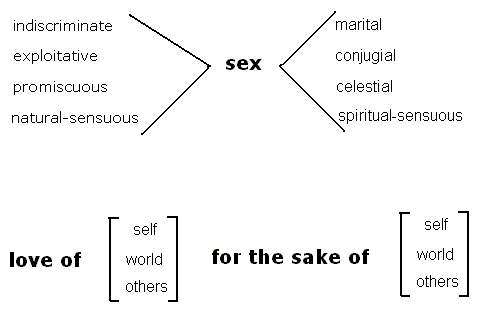
The Writings tell us that the hellish aspects of sexuality are activated by a ranking built-in and inherited motive called the "love of the sex," while the heavenly aspects of sexuality are activated by a ranking built-in and inherited motive called the "love of one of the sex." Be sure to carefully contrast these two expressions. I had to look at them many times before they stopped looking similar:
the non-exclusive love of the sex apart from the person (hellish) vs. the exclusive love of one of the sex (heavenly)
To understand the precise difference we need to focus on "non-exclusive" vs. "exclusive." To love non-exclusive sex is to love one's own pleasure in the activity with whomever is available or suitable, making the partner unimportant relative to self, while the exclusive love of one of the sex, is to love a particular person sexually. Quite a difference!
The non-exclusive love of the sex apart from the person, is a mental operation in the affective organ of the corporeal mind, which is the lowest part of the natural mind, a natural part which we also share with animals. The non-exclusive love of the sex by humans is very similar to the love of copulation by animals. Non-theistic biology and medicine view all sexual response in these terms. But theistic psychology cannot view all of sexuality as limited to the lowest levels of the mind, since the operations of the affective organ are ranked in a hierarchy of distinct degrees--lowest natural, higher natural, spiritual, and celestial. In the lowest portion of the natural mind sexuality is indiscriminate, non-exclusive, and temporary because it is determined by the love of one's own pleasure in sex, which is the love of sex regardless of person, situation, or condition. The attitude behind the non-exclusive love of the sex is exploitative because it is tied to the love of self and the world for the sake of self and the world. There is no love of others for the sake of others--which may be called altruistic sex.
We have an innate capacity to enjoy non-exclusive sex with many others and without mental intimacy or mutual caring. We also have the capacity to enjoy exclusive sex with one person with whom we are mentally intimate. As we progress with our character reformation we are more and more attracted to the mental intimacy that is the result of mutual exclusive sexual love. This is the very foundation of eternal conjugial love in the heaven of our afterlife (see Section xx). True mental intimacy only begins in heaven and then progresses daily to endless eternity. This is due to the fact that the conjoint self of the heavenly couple is a receptacle of spiritual good and truth in endless variety streaming in from the Spiritual Sun surrounding the Divine Human as an aura (see Section xx).
When a husband has a mental attitude and preference for non-exclusive sex, he performs sensorimotor coupling with his wife but this is not conjunctive or mentally intimate. It is a natural-corporeal experience for him and does not go deeper than his physical pleasure. This kind of sexual activity by a husband is indiscriminate, mentally promiscuous, pornographic, and unchaste to the marriage vow of exclusivity with one woman for life. His sexuality is not personal with his wife. Sex therapists in non-theistic psychology prescribe or approve of fantasizing being with someone else while making love to one's spouse. Some even recommend pornographic videos to stimulate and "revitalize" the passion of the married couple for each other. This kind of therapy or advice ignores the internal-spiritual consequences of approving non-exclusive sex thoughts. This kind of sex is not personal, not intimate, not lasting.
Non-theistic sex therapy does not recognize that allowing mental non-exclusivity hurts affective closeness and intimacy, thus hurts conjunction between husband and wife at the inner level of their relationship, that level that is spiritual. The spiritual level of marriage is that part that continues in the afterlife (see Section xx). This level is also present in this life, but it is not conscious. And yet, it still strongly influences the degree of mental intimacy and affinity the couple can have for each other. This is why a husband's habit of using pornography or mental non-exclusivity in marriage, hurts the mental intimacy that they can achieve together.
On the other hand, physical and mental exclusivity in sexual love leads the partners into a spiritual-sensual sexuality which corresponds to the celestial marriage they are going to enjoy together in heaven in eternity. The delights and pleasures of exclusive and chaste conjugial love, here and in heaven, are immeasurably greater and more passionate than the pleasures of natural-sensuous non-exclusive sexuality. Swedenborg conversed about this with both husbands and wives in the heavens of eternity and it is they themselves who reported this wonderful intensity of their sexuality. This is not something Swedenborg invented or theorized about.
It is noteworthy that Swedenborg was never married in this life, yet he was commissioned by the Divine-Human to write the scientific revelations of sexuality in the book of the Writings Sacred Scripture called Conjugial Love (1768). I speculate that the reason Swedenborg didn't get to get married on earth was brought about Providentially so that he could report on the subject of marriage without personal subjective experience of it in this world. He was led in this way to rely exclusively on his objective observations of married couples in the spiritual world and on their own self-witnessing reports of their feelings and thoughts.
In the spiritual-sensuous portion of our mind, sexuality is entirely different from that in our natural-sensuous mind..
At the spiritual level of rational consciousness, sexuality consists of the exclusive love of one of the sex and is closely tied to the love of others for the sake of others. The exclusive love of one of the sex in the affective organs of the spiritual and celestial mind is exclusive with just one person, is monogamous in marriage, and is eternal. It builds and solidifies unity between husband and wife so that externally they appear as one individual. The exclusive love of one of the sex cannot operate below the rational, spiritual and celestial levels. This spiritual-rational sexuality can be acquired by elevating one's rational consciousness by means of the correspondential sense of Sacred Scripture, rather than the literal sense.
There is an important difference between the religious and the scientific levels of thinking about sexuality. Religion based on the literal sense of Sacred Scripture specifies what sexual behaviors are permissible and which ones are prohibited. For instance, virginity, monogamy and fidelity in marriage are presented as Commandments of God that must be obeyed at the risk of displeasing God, sinning, or going to hell. This notions is strongly motivating though it becomes less powerful if we reject heaven and hell, as so many people do when they are not offered scientific proof of their existence.
In theistic psychology heaven and hell are given a scientific status and rational description. Therefore it becomes more difficult to merely reject or dismiss the religious prohibitions against the non-exclusive and extra-marital love of the sex with many. As we elevate our mind above the literal meaning of Sacred Scripture to its correspondential meaning, as in theistic psychology, we discover the scientific details with which we can assess our own sexuality from both a physical and spiritual standpoint. This gives the opportunity to choose objectively in freedom by means of rational understanding. This is the spiritual level of understanding sexuality. We can understand rationally that there are two intense and passionate forms of sexuality we can have.
One is natural-sensuous without the spiritual-rational in it, and the other is spiritual-sensuous with the spiritual-rational in it.
The natural-sensuous sexuality we have is non-exclusive and feels good with many, not just with one person. The spiritual-sensuous sexuality we have is exclusive and feels good with only one chosen person. All thoughts, fantasies, and desires for other partners in sex are seen as threats to our monogamous and exclusive sexual love.
In movies and novels this theme is often reflected contrastively with men and women, men being shown as promiscuous and unchaste, while their girlfriends or wives are chaste and exclusive. Often the women are portrayed as feeling jealous and threatened when the man shows a sexual interest in others. It is known therefore that women love monogamy and exclusivity in sex while men do not love that, and have to force themselves to be faithful in act or thought. Eventually the men also love exclusivity in sex when they begin to bond internally with their wife. Even then the husbands may feel attraction and excitement of the non-exclusive type of the love of the sex with many
It makes rational sense for husbands to be very careful to reject these natural-sensuous thoughts and desires when they occur spontaneously. It's not their occurrence that should be addressed (over which we may have no control), but the rejection of them when they occur in our mind. If we do not actively and explicitly reject them in our mind, we are allowing them in, and since they are pleasurable and delightful, we love them, and the loves we accept fully we can never give up.
Quoting from the Writings Sacred Scripture:
Love of the sex is love towards many of the sex and with many; but conjugial love is love towards one of the sex and with one. Love towards many and with many is a natural love, for man has it in common with beasts and birds, and these are natural; but conjugial love is a spiritual love and peculiar and proper to humans, because humans were created and are therefore born to become spiritual.
Therefore, so far as we become spiritual, we put off love of the sex and put on conjugial love.
In the beginning of marriage, love of the sex appears as if conjoined with conjugial love; but in the progress of marriage, they are separated, and then, with those who are spiritual, love of the sex is expelled and conjugial love insinuated, while with those who are natural, the opposite is the case.
From what has now been said, it is evident that love of the sex, being a love shared with many and in itself natural, yea, animal, is impure and unchaste; and being a roving and unlimited love, is scortatory; but it is wholly otherwise with conjugial love. (CL 48).
Note that the exclusive love of one of the sex with married partners is called "conjugial love." Note the word "conjugial" (=spiritual and its natural correspondence together) vs. the word "conjugal" (=natural apart from its spiritual correspondence). Non-exclusive sexual relationships are referred to in the above quote as "love towards many and with many," and is called a "natural love, yea, animal." This is well known in non-theistic psychology and biology. What is not recognized there is that there is another type of sexuality that is an exclusively human sexuality, not shared by any animals. The sexual love we share with animals resides in the lower layers of our natural mind that we have not yet connected, through regeneration, to our rational mind, and then to our spiritual-natural mind (see Section xx). The more we progress with our character reformation from enlightenment in truths from Sacred Scripture, the more we progress to the state of correspondential harmony between our spiritual-rational ideas and our corporeal-sensuous enjoyments.
Everything spiritual is based on rational consciousness which animals cannot possess, not having the mental anatomy for it. We become spiritual to the extent that we think rationally and abandon non-exclusive sexual relationships in favor of conjugial love. This makes sense since non-exclusive love of the sex with many keeps our consciousness in the natural-animal mind where that affection operates. To raise our consciousness to the spiritual-natural and spiritual-rational levels we must commit ourselves to conjugial love which is a love operating in our spiritual-natural mind, hence above the natural-animal, as heavenly things are above earthly things.
It is a common mistake to to oppose sexuality and spirituality, just as it is a common mistake to oppose rationality to spirituality (see Section xx). The literal sense of Sacred Scripture, which serves the basis of religions, has often been interpreted to mean that sexuality is of a lowly and sinful nature, and that it is higher and better to shun sexuality and to be single. In many spiritual movements sex is avoided at certain times of intense spiritual work because it is believed that it somehow drains your energy to be spiritual or close to God.
However all these beliefs about sexuality are based on various interpretations of the literal sense of Sacred Scripture. When you examine the correspondential sense of Sacred Scripture, you happily discover that sexuality is the very purpose for which God created the universe. Surprising? It was for me when I discovered it in the Writings Sacred Scripture. Quoting:
CL 46. (i) Everyone retains his sexual love after death, exactly as it was inwardly; that is, as it was inwardly in his thought and will while in the world.
Every love accompanies a person after death, because it is the essence of his life; and the dominant love, the chief of all, lasts for ever in a person, together with the subordinate loves. The reason is that love is properly a function of a person's spirit, reaching the body from the spirit. Since after death a person becomes a spirit, he brings his love with him. Since love is the essence of a person's life, it is obvious that a person's fate after death is determined by the kind of life he led in the world.
As regards sexual love, this is a universal feature shared by all. For it was implanted from creation in a person's soul, which is the source of the whole person's essence, as something necessary for the continuance of the human race. This love remains the chief one, because after death a man is a man and a woman is a woman; and there is nothing in the soul, mind or body which is not male in the man and female in the woman. These two have been so created as to strive to be joined, in fact to be joined into one. This striving is sexual love, which precedes conjugial love. Since then this tendency to union is stamped upon every detail of the male and the female, it follows that it cannot be wiped out and die together with the body. (CL 46)CL 47. The reason why sexual love remains as it was inwardly in the world is that everyone has an interior and exterior; this pair is called the inner and the outer man. He has as a result inner and outer will and inner and outer thought. When a person dies, he leaves behind his exterior and keeps his interior, for outward things belong properly to his body, inward things to his spirit. Since a person is his love, and love resides in the spirit, it follows that his sexual love remains with him after death as it was inwardly before. For example, if his love was inwardly conjugial or chaste, it remains conjugial or chaste after death, but if it was inwardly scortatory,* it remains the same after death. It should, however, be noted that sexual love is not the same in one person as in another, for there are countless differences. But it still remains in each case as it was in each person's spirit.
*Translator's note: This is the opposite of conjugial love, which Swedenborg named amor scortatorius. Though with other nouns 'promiscuous' may serve, it is hardly sufficient to translate 'promiscuous love', since it is especially reserved for the love which is the opposite of the love of one man for one woman, and so is opposed to the principle of monogamy. (CL 47)
CL 44. The second experience.
I once saw three spirits newly arrived from the world [after resuscitation we are called spirits], who were wandering about, gazing around and asking questions. They were surprised to find that they were still living as human beings, and seeing familiar sights [in the mental world of eternity]. For they knew that they had departed from the previous, natural, world, and that there they had not believed that they would live as human beings until after the day of the Last Judgment, when they would again be clothed in the [physical] flesh and bones they had left in their graves. So to free them of all doubt that they were really human beings, they took turns to examine and touch themselves and others, handling objects and finding a thousand proofs that they were just as much human beings as in their previous world, with the one difference that they could see one another in brighter light, and objects in greater splendour, that is to say, more perfectly.
[2] Then it happened that two angelic spirits came across them [people who live in their second or middle heaven]. They stopped them to ask, 'Where do you come from?' 'We have departed from the world,' they replied, 'and are living again in a world, so we have moved from one world to another; that is what is making us wonder.' The three newcomers then questioned the two angelic spirits about heaven; and since two of the newcomers were young men, and their eyes glittered with the spark of sexual lust, the angelic spirits said, 'Have you perhaps seen any women?' 'Yes, we have,' they answered.
In reply to their questions about heaven the angelic spirits said, 'In heaven everything is magnificent and splendid, things of a sort you have never set eyes on. There are girls and youths there, the girls so beautiful they could be called models of beauty, and the youths of such good character they could be called models of good character. The beauty of the girls and the good character of the youths match so well that they resemble shapes that fit snugly together.
The two newcomers enquired whether human form in heaven is exactly like that in the natural world. The reply was that they are exactly alike, with nothing taken away from the man or from the woman. In short, a man is a man, and a woman is a woman, with all the perfection of shape with which they were endowed by creation. Please go aside and check yourselves over, to make sure you are just as much a man as before.'
[3] The newcomers asked another question: 'We were told in the world we have left [the natural world] that in heaven there is no giving in marriage, because people are then angels. So is sexual love possible?' The angelic spirits replied, 'Your sort of sexual love is impossible, but there is angelic sexual love, which is chaste and free from all the allures of lust.' 'If sexual love,' said the newcomers, 'is devoid of allures, what is it then?' Thinking about that kind of love made them groan and say, 'How boring heavenly joy must be! How could any young man long to go to heaven? Is not such love barren and lifeless?'
The angelic spirits replied with a smile, 'Sexual love among the angels, the kind of love there is in heaven, is still full of the most intimate delights. It is an extremely pleasant feeling, as if every part of the mind were expanded. This affects all parts of the chest, and inside it is as if the heart were playing games with the lungs; and this play gives rise to breathing, sound and speech. These make contact between the sexes, that is, between young men and girls, the very model of heavenly sweetness, because it is pure.
[4] All newcomers who come up to heaven are tested to see how chaste they are. They are introduced into the company of girls of heavenly beauty, and these can detect from their sound, speech, face, eyes, gestures and the sphere they emit, what their sexual love is like. If it is unchaste, they run away and tell their friends they have seen satyrs and priapi. The newcomers too undergo a change and appear hairy to the eyes of angels, with feet like calves or leopards. They are quickly sent back down, so as not to pollute with their lust the atmosphere there.'
On hearing this the two newcomers said again, 'So there is no sexual love in heaven! What can chaste sexual love be but love stripped of its living essence? Surely the contacts between young men and women there are boring pleasures. We are not made of stone or wood, but sensations and the wish to live.'
[5] On hearing this the two angelic spirits indignantly replied, 'You are quite ignorant of what chaste sexual love is, because you are not yet chaste yourselves. That love is the supreme delight of the mind and so of the heart, but not of the flesh too below the heart. Angelic chastity, which is shared by either sex, prevents that love from passing beyond the barrier of the heart, but within and above it the young man's good character enjoys the delights of chaste sexual love with the beauty of the young woman.These are too inward and too rich in charm to be described in words. This sexual love is the prerogative of angels, because they have only conjugial love; and this cannot be combined with unchaste sexual love. Truly conjugial love [exclusive sexual love between married partners] is a chaste love, and has nothing in common with unchaste [non-exclusive] love [of many]. It is confined to one person of the opposite sex to the exclusion of all others, for it is a love of the spirit leading to love of the body, not a love of the body leading to love of the spirit, that is to say, not a love which attacks the spirit.'
[6] The two newcomers were pleased to hear this and said, 'So there is sexual love in heaven. What else is conjugial love?' But the angelic spirits replied, 'Think more deeply and check your thoughts; you will find that your sexual love is love outside marriage, quite different from conjugial love, which is as different from it as wheat from chaff, or rather what is human from what is bestial. If you ask women in heaven what is love outside marriage, I assure you they will reply, "What do you mean? What are you saying? How can you utter a question that hurts our ears like this? How can a love which was not created be generated in a person?"
'If you then ask them what truly conjugial love is, I know they will answer that it is not sexual love, but the love of one of the opposite sex, something that happens only when a young man sees the young woman the Lord has provided for him, and the young woman sees the young man. Then they both feel the fire of marriage catch alight in their heart, and he sees that she is his and she sees that he is hers.One love meets the other, makes itself known and instantly joins their souls, and thus their minds. From there it enters their chests, and after they are married spreads further, so becoming love in all its fullness, growing together day by day, until they are no longer two, but as if one person.
[7] 'I know too that these women in heaven will swear that they know no other kind of sexual love. For they say, "How can sexual love exist, if it does not go out to meet the other and receive it in return, so as to long for everlasting union, the two becoming one flesh?"' To this the angelic spirits added, 'In heaven no one knows what promiscuity means or even the possibility of its existence. Angels feel cold all over at the idea of unchaste love or love outside marriage; on the other hand chaste or conjugial love makes them feel warm all over. In the case of men, all their sinews go slack at the sight of a whore, and become tense on seeing their wives.'
[8] On hearing this the three newcomers asked whether married couples in the heavens have the same kind of love as they do on earth. The two angelic spirits replied that it is exactly the same. Then seeing they wanted to know whether the ultimate delights were the same there, they said they were exactly the same, but far more blessed, 'because,' they said, 'angels' perception and feeling is much more exquisite that those of human beings; and what brings love alive but the current of potency?Surely its failure leads to a cessation and cooling of that love? Is not that power the very measure, degree and basis for that love? Is it not its beginning, its strengthening and its completion? It is a universal law that first things are brought into being by ultimates, are kept in being by them and endure by their means. So it is with this love; so if the ultimate delights were absent, there would be no delights in conjugial love.'
[9] Then the newcomers asked whether the ultimate delights of that love led to the birth of children there, saying that, if not, what use were they? The angelic spirit replied that there are no natural, only spiritual children. 'What,' they asked, 'are spiritual children?' 'A married couple,' they answered, 'are more and more united by the ultimate delights in the marriage of good and truth. The marriage of good and truth is that of love and wisdom, and love and wisdom are the children born of that marriage. Since in heaven the husband is wisdom and the wife is the love of wisdom, both being spiritual, they cannot have any but spiritual children conceived and born there. This is why these delights do not leave angels depressed, as some on earth are, but cheerful; this is due to the constant inflow of fresh strength to replace the former, at once renewing and enlightening it.For all who reach heaven return to the springtime of their youth, recovering the strength of that age, and keeping this for ever.' [eternal sexual potency]
[10] On hearing this the newcomers said, 'Do we not read in the Word [New Testament Sacred Scripture] that in heaven people are not given in marriage, since they are angels?' 'Look up to heaven,' was the angelic spirits' answer to this, 'and you will receive your answer.' They asked why they should look up to heaven. 'Because,' they were told, 'it is from there we get our interpretation of the Word. The Word is deeply spiritual, and angels, being spiritual, will teach us its spiritual meaning.'
After a short while heaven was thrown open overhead, and two angels came into view, who said, 'There are weddings in the heavens as there are on earth, but only for those for whom good and truth are married [those who have undergone regeneration], for no others are angels [after the second death]. So it is spiritual weddings, the marriage of good and truth, [rebirth of the individual] which are meant by this passage. These are possible on earth, but not after death, and so not in the heavens. So it is said [New Testament Sacred Scripture] of the five foolish maidens, who were also invited to the wedding, that they could not go in, because they lacked the marriage of good and truth [all people who have not changed their inherited character]; for they had no oil, but only lamps [people who knew what is true but did not live accordingly]. Oil means good and lamps truth; and being given in marriage is entering heaven, where that marriage is.'
The three newcomers were very happy to hear this, being full of the longing for heaven and hoping to get married there. So they said, 'We shall devote ourselves to good behaviour and a decorous life, so that we can achieve our aims.' (CL 44)
It is clear from this description that our eternal life in heaven contains more perfect sexuality with our spouse than we could imagine now. But we also need to understand rationally why this is so, otherwise it becomes something obscure and fading in the mind.
At the beginning of marriage we typically have the non-exclusive love of sex with many, but as we progress in spiritual development, the natural-animal love of sex in our mind is transformed into the spiritual love of one of the sex between married partners, or conjugial love. Marriages that do not develop a spiritual dimension through striving for unity in eternity, remain natural and external, but if a spiritual dimension develops, the natural non-exclusive love of sex with many is extinguished and exclusive conjugial love takes its place. This elevates our mind to the spiritual and celestial levels of operation by bringing our natural mind into correspondence with our heaven.
The non-exclusive love of sex is also called "roaming" because it is indiscriminate. For instance, husbands who are into pornographic entertainment remain in a natural love towards their wife because they are willingly maintaining their sexuality at the promiscuous or non-exclusive level, instead of trying to fight that love in themselves as unchaste to the marriage. From the perspective of their life in eternity, it doesn't matter if they do not have physical sex with other women. If they desire pornographic stimulation and enjoy the idea of it, accepting it as permissible when it is only mental, they are immersing their consciousness in a natural-sensuous and corporeal animal love that is separated from the higher rational sexuality of conjugial love. It is the same with husbands who fantasize having sex with another woman while they are having sex with their wife. And it is the same when they are having "phone sex" or "email sex" with others.
These non-exclusive expressions of sexuality prevent people from re-aligning their natural-sensuous mind to be in correspondence with their rational spiritual mind. Yet this realignment is necessary to attain heavenly life in eternity.
It is important to understand rationally what are the consequences of remaining in a natural state of sexuality and not progressing to a spiritual sexual love of one's spouse. Spiritual sexual love is the sexual love we have in eternity, and to achieve it, we need to reform our mind through temptation battles against non-exclusive sexuality. These battles must take place here while we are still attached to the physical body and before we are resuscitated.
Quoting from the book of the Writings Sacred Scripture called Conjugial Love:
CL 48. (ii) Conjugial love likewise remains as it was inwardly, that is, in inner thought and will, as a person had it in the world.
Because sexual and conjugial love are different, both are here mentioned, and it is stated that conjugial love also remains after death as it was in a person's interior when he lived in the world. But since few people know the difference between sexual and conjugial love, I must at the outset of this section say something by way of preface. Sexual love is love directed to and shared with several persons of the other sex, but conjugial love is directed to and shared with one person of the other sex. Love directed to and shared with several persons is natural love, for man has this in common with animals and birds, which are natural creatures. But conjugial love is spiritual, special and proper to human beings, because human beings were created, and are therefore born, to become spiritual. In so far as a person becomes spiritual, he sheds sexual love and takes on conjugial love.
At the beginning of a marriage sexual love seems as if combined with conjugial love. But as the marriage progresses, these loves become distinct, and then with those who are spiritual, sexual love is banished and conjugial love is introduced. In the case of those who are natural, the reverse happens. What I have now said makes it plain that sexual love, being shared with several persons and inherently natural, or rather animal, is impure and unchaste, since it is errant and unchecked, scortatory. Conjugial love is totally different. It will be shown in the following pages that conjugial love is spiritual and properly human.
47r* (iii) Married couples generally meet after death, recognise each other, renew their association and for some time live together. This happens in their first state, while they are concerned with outward matters as in the world.
After death a person goes through two states, an outer and an inner one. He comes first into his outer state, afterwards into his inner one. When he is in his outer state, a husband meets his wife, if they have both died, recognises her and if they lived together in the world forms an association and for some time they live together. While they are in this state, each is unaware of the other's feelings towards him or her, since this is kept hidden at the inward level. But afterwards, when they reach their inner state, their feelings become plain. If they are harmonious and sympathetic, they continue their married life; but if they are discordant and antipathetic, they put an end to it.
If a man had more than one wife, he associates with them in turn, while he is in the outer state; but on entering upon his inward state, when he can grasp the nature of the feelings of love, he either chooses one and leaves the rest, or he may leave them all. For in the spiritual world as much as in the natural one, no Christian is allowed to marry more than one wife, because this is an attack on religion and profanes it. The same thing happens to a woman, if she has had more than one husband. However, wives do not form associations with their husbands; they merely present themselves, and the husbands take them to themselves. It should be noted that husbands rarely recognise their wives, but wives recognise their husbands very well, since women are able to perceive inward love, while men perceive only outward love.
* There are two sections numbered 47 and 48 in the original.
48r (iv) But by stages, as they put off their outward state and enter instead into their inward one, they perceive what their mutual loves and feelings towards each other were like, and whether or not they can live together.
There is no need to explain this further, since it follows from what was explained in the last section. I shall here only illustrate the way a person after death puts off his outer state and takes up his inner one. Each person is after death first brought into what is called the world of spirits, which is midway between heaven and hell, and there he is prepared, for heaven if good, for hell if wicked.
[2] The preparation he undergoes there is intended to bring the interior and the exterior into harmony, so that they make one, instead of disagreeing and making two. This is what happens in the natural world, and it is only in the case of those of upright heart that they make one. Their making two is clear from the deceitful and tricky, especially hypocrites, toadies, pretenders and liars. In the spiritual world, however, no one is allowed to have his mind divided, but anyone who was wicked inwardly will also be wicked outwardly. Likewise one who was good will be good both inwardly and outwardly.
[3] For everyone after death becomes what he was like inwardly, not outwardly. For this purpose he is then by turns put into his outward and then his inward state. When each is in his outward state, he is wise, that is, he wants it to look as if he were wise, even if he is wicked. But the wicked man is inwardly a fool; he can at intervals see his own follies, and recover his senses. But if he did not recover them in the world, he cannot do so later, for he loves his follies, and wants to keep them. Thus he induces his outward state to be similarly foolish, so making his inward and outward states one. When this has happened, he is ready for hell.
[4] The good man follows the opposite course. Since in the world he had looked to God, and recovered his senses, he was more wise inwardly than outwardly. Outwardly he was at times led into madness by the enticements of the world and its vanities. So he too has his exterior brought into harmony with his interior, which, as I said, is wise. When this has happened, he is ready for heaven. This will illustrate the way in which the exterior is put off and the interior is put on after death. (CL 48)
Swedenborg was able to observe that when married partners have both passed on they meet in the world of spirits and live again together in their external state, which means in the natural state in which they lived on earth. During this initial encounter neither of the two partners are aware of how they feel toward one another in their "interior" mind. They seem to get along and like each other on the surface, but deep down they may feel the opposite. The deeper feelings were hidden from their conscious awareness on earth, yet they were there, as shown by the fact that at times they did not get along, had fights, and expressed dislike and even hatred of one another. After awhile, the two partners are separated from their external feelings and they become conscious of their deeper or interior feelings. Now if these deeper feelings for one another are positive, they continue to live together forever, but if the deeper feelings are negative, they now separate and go their own way.
What happens now to those who have harbored desires for other partners that they kept from coming to the surface? They now come out in their most intense form and one feels irresistibly drawn to others and away from the spouse. The married partners now find themselves separated from each other. It is the end of their marriage. But it is different with those who rejected their non-exclusive desires when they occurred throughout the marriage on earth. The unchaste desires were not suppressed and hidden from view or expression. They were judged as inappropriate and dangerous, even if delightful, like a hungry person who rejects a tasty meal knowing that the dish is poisoned. When this mental rejection is performed consistently and honestly throughout marriage on earth, we are liberated from the love of non-exclusive sex and enjoy the far greater pleasures and delights of conjugial sex. When we meet our conjugial partner in the other life we are able to enter heaven together and abide there forever.
When married partners who first meet in the world of spirits discover that they are internally unsuitable for each other, they separate and then each meets another person with whom they can develop a conjugial love relationship, at which point, they enter heaven. Or, one may enter heaven while the other enters hell, or both can enter hell. In hell there are no conjugial love relationships because this requires a rational consciousness that is spiritual or celestial. In the hells of our mind we are corporeal-sensuous and irrational, hence we cannot experience a rational love. Those in hell are compelled to live in a state of "concubinage" or "infernal marriage" with someone there whom they hate and despise. Definitely something that we would want to avoid, especially since, as Swedenborg observed, those in hell have absolutely no more any love of sex. The men loathe marriage and the idea of sex with the wife makes them violently nauseous. Some women in hell called "sirens" acquire the ability to make themselves look beautiful, virginal, and chaste. They set traps for men in hell who try to satisfy their never-ending lust for various types of sexual perversions or "degrees of degeneracy"--fantasies having to do with "deflowering virgins" and then abandoning them; or, seducing another man's wife; and many other weird things.
Here is a brief passage showing the controlled and experimental character of Swedenborg's reports on the spiritual world. On this occasion he wanted to find out if there are men who are only interested in sex when they can seduce someone else's wife. A sample of men were brought to Swedenborg by his angel guides who were people from the highest portion of their mind called the third heaven and thus possessed super-powers relative to those who were lower in their mind. This is an amazing characteristic of the spiritual-mental world of rational ether (see Section xx). I underlined the phrase that shows the experimental condition used on this occasion.
CL 483. To this I shall add some facts from the spiritual world which are worth relating.
I heard there that some married men have a lust for promiscuity with inexperienced women or virgins, some for experienced women or whores; some for married women or wives; some for such women of noble families, and some for women of the lower classes. I have been convinced in that world of the truth of this by numerous examples from various kingdoms .
When I thought about the variety of such lusts, I asked whether there were men who seek all their pleasure with other men's wives and none with unmarried women. So to prove to me that there were, a number were brought to me from a certain kingdom, who were compelled to speak as their lustful nature dictated. These said that their sole pleasure and joy had been, and still was, to misbehave with other men's wives. They said that they picked out the beautiful ones for themselves, and hired them for as high a fee as their wealth allowed. For the most part they agreed the fee with the women alone.
I asked why they did not hire unmarried women. They said that this was too common for them, being inherently worthless and devoid of any pleasure. I asked again whether these wives afterwards went back to their husbands and lived with them. They replied that they either did not, or did so coldly, since they had become promiscuous.
I then asked them very seriously whether they had ever considered, or were now considering, that this was double adultery, since they did it while themselves married; and that such adultery robbed a person of all spiritual good. This caused many of those present to laugh, and they said, 'What is spiritual good?'
But I insisted and said, 'What is more detestable than to mix one's own soul in a wife with her husband's soul? Don't you know that a man's soul is in his semen?' At this they turned away and murmured, 'What harm does it do there?' At last I said, 'Although you are not afraid of God's laws, are you not afraid of the civil law?' 'No,' they answered, 'only of some of the clergy, but we keep this from them; and if we cannot, we keep on good terms with them.' Afterwards I saw them divided into groups, some of which were thrown into hell (CL 483):
The above experiment is a case of forced self-witnessing out loud. Here on earth today, the lie-detector is used by some companies and institutions when investigating personnel issues. The instrument makes physiological measurements of an individual's skin conductance (perspiration) and blood pressure, both being viewed as indicators of emotional reactions. The questions are phrased slowly and in different ways, relating the person to some act (e.g., "Did you know it was broken?" "Did he speak to you?"). GSR readings and blood pressure changes are recorded and later analyzed. A conclusion is then reached as to whether the individual was lying, not lying, or that one cannot tell from the results. The angelic guides who were assisting Swedenborg had a more effective technique available to them--they compelled them to answer as they think, making it impossible for them to say the opposite of the truth.
In the above passage Swedenborg portrays himself as indignant at their callous attitude. Swedenborg reminds them graphically that sexual intercourse with another man's wife mixes their semen with her husband's semen. But they obviously fail to be shocked at this image: "What harm does it do there?" Swedenborg was confronting them with the fact that they were flouting "God's law" because "a man's soul is in his semen." This is explained in other places, namely that the semen carries not only the father's DNA but also a complete copy of his soul, which is a spiritual organ that receives the impulse of life and therefrom animates the body's physiology. In this soul are contained all the loves of the father, those that he himself inherited and those that he himself contributed. These inherited loves are both evil and good. They will all strive to come out into the mind and behavior of the offspring. They are visible or measurable in terms of innate capacities, impulsive tendencies, various weaknesses, and strong preferences.
The physical act of sexual intercourse is itself only a representative or an effect of a mental-spiritual act. This mental act is defined as contrary to "God's laws." The men in the passage above can only focus on the physical semen and see no consequences in having the semen of several men in a woman's vagina, like a prostitute who doesn't wash herself every time. Apart from the fact that sexually transmitted physical diseases come in this way, one must also consider the disorderly intentions and motives that cause the act, because these are spiritual events that have their consequences. Even if no immediate physical harm comes from seducing another's man's wife, there is spiritual harm to the mental organs of the man and woman. This spiritual harm is the result of intending against God's laws of spiritual order. There are built in and inevitable spiritual consequences to every disorderly mental act. Any mental act that is contrary to God's laws is a disorderly act. One of the items I hear on the news today is a new survey that shows that 40 percent of Americans say they have tried a "sex toy." This would be funny were it not so pathetic. It shows the impossibility of satisfying "roaming" love of sex. The biggest money maker ever for U.S. pharmaceutical companies is Viagra, a drug prescribed for men who can't have an erection at the appropriate time and women who lack "libido."
The limited clinical use of sex drugs is understandable but the use of it for the majority of physically normal men is an indication that the love of non-exclusive sex and pornography leads to mental impotence. The "roving" love of sex with many partners is a four-stage process. The first stage is that of being sexually active with multiple partners, physically, mentally, or both. The second stage is temporary loss of sexual interest. The third stage is resumption of roving and looking for other partners. This process recycles for some years, then it ends with the final stage: loss of interest in all sex, at first, and later, hatred of all sex.
These built in consequences and mechanisms must be understood rationally, or else one begins to question what is disorderly. If it's just some moral or religious dogma, I can skip it, but if it's a scientific physiological consequence, I better pay attention. At the end of the passage above we get an image of what these consequences are: "Afterwards I saw them divided into groups, some of which were thrown into hell." To be thrown into hell means, as explained elsewhere in the Writings, that they appear to throw themselves into hell out of anticipation and lust for the disorderly things they can do there. But they are certainly not counting on the fact that after a little time of wanton abandon and delights, their mental state changes to an endless cycle of emotions they hate--being deprived of their lusts, being persecuted and haunted by others there whom they cannot escape, and taking turns torturing each other endlessly.
Let's get back to the earlier passage discussed above regarding married partners who meet in the world of spirits. Continuing with that passage:
If a man has had several wives, he conjoins himself with them in turn while in the external state; but when he enters the internal state, in which he perceives the nature of the inclinations of his love, he either takes one or leaves them all; for in the spiritual world as in the natural, no Christian is allowed to take more than one wife because this infests and profanes religion. The like happens with a woman who has had several husbands; women, however, do not adjoin themselves to their husbands but only present themselves, and their husbands adjoin them to themselves. It must be known that husbands rarely know their wives, but wives readily know their husbands. The reason is because women have an interior perception of love, and men only an exterior perception. (CL 48)
It's revealing to discover that husbands "rarely know their wives" when they meet up in the world of spirits, while wives recognize their husbands. This comes about because of a fundamental physiological difference in love between men and women. Men have an "exterior perception" of love while women have an "interior perception." Wives monitor the feelings of their husbands at a more interior level than husbands themselves are aware of their own loves. A man might say that he loves this or that, but his wife knows what he really loves or hates.
Continuing with the Number:
BUT THAT SUCCESSIVELY, AS THEY PUT OFF THEIR EXTERNALS AND COME INTO THEIR INTERNALS, THEY PERCEIVE THE NATURE OF THE LOVE AND INCLINATION WHICH THEY HAD FOR EACH OTHER, AND HENCE WHETHER THEY CAN LIVE TOGETHER OR NOT. This need not be further explained since it follows from what has been set forth in the preceding article. Here it shall only be shown how, after death, a man puts off his externals and puts on his internals.
After death, every one is first introduced into the world which is called the world of spirits--which is in the middle between heaven and hell--and is there prepared, the good for heaven and the evil for hell. This preparation has for its end, that the internal and external may be concordant and make a one, and not be discordant and make two.
Here you can see that whether a man and a woman stay together to eternity is a matter of spiritual physiology and compatibility, just like antibodies act on other cells of the body to reject or accept. It's not a matter of subjective or arbitrary preference but is the inevitable consequence of the structure of the mind that each has formed for themselves while living on earth. What's remarkable is that there are two levels of structure, external and internal, and many people are not aware of their own inner structure. For instance, they are aware that they like this or that activity or experience, and desire to repeat it over and over, yet they are not aware of the interior feelings and delights that actually control the external likes and choices.
Think of the iceberg analogy here: We can see the external structure of the mountain of ice floating on the ocean, but we do not know how large the structure is below the surface, or what is its shape. Yet what is below the surface is far more important in determining the consequences. For instance, if a ship collides with the iceberg, whether it survives or not depends on the size of the iceberg below the surface. And other consequences that one can describe. In the same way the consequences of our inner feelings and motives, which we cannot see, are far more important for our future--whether we go to heaven or hell, whether we stay together or not, and other consequences that follow from these.
From the passage above (and others relating to it in the Writings), you can also see that there are two phases we go through after the process of resuscitation from the death of the physical body, normally a matter of a few hours. The first phase is the awakening to our conscious awareness in the world of spirits. We are then in the external portion of our natural mind, or personality and memory. We recall our life on earth just like when we are awakened from surgery and after a few moments of confusion, we are back in the saddle of our life. Our memories and knowledge of this life is what our consciousness is immersed in during this first phase of the afterlife. We know our identity and relationships, often meeting up with friends and family that preceded us in the afterlife. If our spouse or significant other has preceded us, we meet up and even live together intimately for awhile. In our spiritual body we can perform the same activities as we are used to, and the sensations and delights are far stronger and purer than what we had in the physical body. These observations were made by Swedenborg with large samples of people he was able to observe from the moment they were resuscitated to their final dwelling place in heaven or hell.
Then we become aware of a change that is taking place with us. Inner feelings we were only dimly aware of, now begin irresistibly to come out of us. We are surprised but also delighted. The deeper the feeling that comes out into conscious awareness, the more intense the delight we experience and the freer we feel. The freedom we felt in our external loves and motives now appear to us as partial and very limited. We would never want to go back into such restricted mental spaces, like a genii out of the bottle. Along with these powerful new feelings and enjoyments comes a change in our appearance and environment. Our former friends no longer recognize us and we seem to be encountering all sorts of new people that are exciting and lead us further and deeper into the unfolding of our inner character. These experiences are carefully timed, arranged, and presented individual by the Divine-Human, regardless of whether the individual recognizes God's existence or not.
This is the process of the "second death" which refers to the quieting down and laying aside the external personality we had on earth. The process varies in extensiveness depending on how aware the or unaware the individual is of their inner character and what loves and motives are entrenched there. Love is what produces freedom, according to the Writings. Freedom is the feeling we have when we act out our love, both in thinking and in sensing and doing. If anything inhibits the acting out of our love, we feel unfree and unhappy. Our delight and enjoyment of life is gone when we are prevented from acting out our love. While we were on earth there were external reasons and forces restricting us from acting out many of our loves. We didn't like that, and it often made us depressed or resentful, even rebellious and destructive.
Forces that prevent us from acting our loves here on earth include fear, disapproval, punishment, guilt, embarrassment, shyness, lack of suitable partners, etc. These are external natural conditions that have no power in the world of spirits. In that state of mind we do what we please. We go where we want because it is our desires and motives that bring us to the places and people we are interested in. Those who would disapprove or punish cannot be around us because we choose to exclude them and there is nothing they can do about it. There is no government, police, or prison since the walls would crumble immediately you have the desire to exit. Your environment is produced by the feelings and thoughts you have, not by the physical constraints around your body.
The coming out of your inner loves is therefore an inevitable process for every individual who has been resuscitated. Whether it seems to us like a few hours, days, or months, the process comes to an end when all of our external motives and loves have been shut down, and we are fully immersed in our inner loves and character. Now at last you can know for sure who you are and what you are. If you discover yourself to be a devil, you are led to where devils are in their mind, and together you form a spiritual or mental community. The thoughts and feelings each individual has in such a community now determines the appearance or environment of the dwelling place. Swedenborg saw the dwelling places or mental environments of those who are in the hells of their minds together. They are awful, much worse than you can imagine, much worse that I could imagine when I read the Writings and all its details about heaven and hell.
If you discover yourself to be an angel, you are led to where others are in their heavenly rationality. Swedenborg noted that roads or pathways suddenly appear to you, which you are moved to take, and quickly you seem to yourself to arrive to a most beautiful city full of gardens, at the gates of which people greet you and welcome you. Amazingly, they seem totally familiar to you, like siblings and childhood friends you haven't seen for awhile. Their appearance is even similar to yours, like you are all from the same family. No one else can see the road or path that the individual for whom it is a sign that the second death has happened and eternal life has begun. And if you have a conjugial spouse that preceded you, he or she now appears to you, being reunited with heavenly joy and blessedness. The two of you then walk a little further on the streets until you come to a house that you both recognize as yours. No one else has been able to see the house or enter into it. You enter, and you begin your life in eternity as an angel couple, living in bliss with other angel couples, protected from every single possible negative feeling, thought, or emotion.
You can see form this summary description that heaven and hell are not places of reward for being good and places of punishment for sins. The Writings reveal that no one is ever punished for past sins or misdeeds no matter how good or evil. I was amazed when I read this. It seemed contrary to what I had believed from religion, and it seemed counter-intuitive. But then I got the full rational explanation. It is the inner character or ruling love that creates the heaven and hell in our mind. This is the inevitable. It is the actual mental state of our loves that determine whether we fall into hell or ascend to heaven. Suppose you see yourself sink into hell after your resuscitation phase is over. You are not being punished for passed misdeeds. You are sinking into hell because your loves, delights, lusts, and enjoyments are hellish in character. It is an inexorable law of the spiritual world that your environment is determined by your inner character. If you see yourself rise to heaven, it is happening not as a reward for what you did in the past on earth, but a consequence of the spiritual law that inner loves create the environment for everyone. Your entering heaven is an event produced by your inner loves, when they are heavenly loves you acquired on earth by a life of conscience and usefulness to others.
Continuing with the passage:
[2] In the natural world they make two, and only with the sincere in heart do they make a one. That they are two is evident from crafty and cunning men, especially from hypocrites, flatterers, dissemblers, and liars. In the spiritual world, a man is not permitted thus to have a divided mind, but he who had been evil in internals must be evil also in externals; so likewise the good must be good in both; for after death every man becomes what he had been internally, and not what he had been externally.
[3] To this end, he is then let into his external and his internal alternately. While in his external, every man, even the evil, is wise, that is, wishes to appear wise, but in his internal, an evil man is insane. By these alternations, the man is able to see his insanities and repent of them; but if he had not repented in the world, he cannot do so afterwards, for he loves his insanities and wishes to remain in them, and therefore brings his external to be likewise insane. Thus his internal and his external become one, and when this is the case, he is prepared for hell.
[4] With a good man, it is the reverse. Because in the world he had looked to God and had repented, he is wiser in his internal than in his external. Moreover, in his external, by reason of the allurements and vanities of the world, he sometimes became insane. Therefore, his external must be brought into concordance with his internal, which latter, as was said, is wise. When this is done, he is prepared for heaven. This illustrates how the putting off of the external and the putting on of the internal is effected after death. (CL 48)
There is then a mighty struggle that occurs in our mind between the first death and the second death. The passage above says that we are "let into our external and our internal alternately." This alternating experience must be like a Dr. Jekyll and Mr. Hyde type experience. At some point we look like an angel person, gentle, handsome, and rational, and at the next moment we look like a devil person, insane, ugly, and dangerous. Our fate in eternity is now determined by this life and death struggle. Heaven is called life while hell is called death because it is the death of our human part so that what is left is a kind of human-beast. The purpose of this alternation serves to make us aware of the inner loves we actually have within us, entrenched, inextricable, there forever.
Quoting from the Writings:
HUMAN FREEDOM
Few know what freedom is and what non-freedom is. Freedom seems to entail everything that is in keeping with any love and associated delight, and non-freedom to entail everything that is at variance with these. That which is in keeping with self-love and love of the world, and with the desires belonging to those loves, seems to man to be freedom; but that is the freedom of hell. That however which is in keeping with love to the Lord and love towards the neighbour, consequently with the love of what is good and true, is true freedom, being the freedom that exists in heaven. (AC 2870)
No one can be forced or compelled to enter either hell or heaven. It is by definition a choice we make according to our ruling loves. Note the somber warning in the passage above: "if he had not repented in the world, he cannot do so afterwards, for he loves his insanities and wishes to remain in them." We cannot repent means that our ruling loves cannot be displaced by other loves. Imagine your best friend is with you at that state of mind and is pursuing his evil loves. You try to change his mind, pointing out how awful hell is and how wonderful heaven is. But your friend just laughs at you and continues to sink into hell by going deeper and with more abandon into the evil loves and irrational thoughts. Soon you have to remove yourself form his presence since you cannot stand to see those evils.
From these descriptions of the resuscitation process and the second death you can see what happens to married partners. Everything is determined by the ruling loves you acquire in your marriage with your spouse. If you have had an external marriage only, your ruling loves were not actually involved. They remained buried within your character, and only once in a while did you and your spouse have an inkling of what they are. Every marriage begins with the conjunction or union of the two external personalities. This type of relationship is often based on the "male dominance" model of marriage, as discussed above. Then, some couples move on to the equity model in which engages more inward forms of their personality. And after that, they have the opportunity to engage their inmost loves and to be conjoined in an internal marriage. Now their external marriage is complete because it has the internal marriage within it. It is this internal conjunction or marriage between the partners that takes over at the second death and determines their fate.
Study Questions:
1. Explain what is meant by the "love of self and the world for the sake of self." How is this definition different from what people usually mean when you ask them what is the love of self? How does this definition help you understand yourself better? Does it help you understand other people better?
2. Explain the "economics of immortality." How does this compare to religious ideas? How is it related to morality and ethics -- look up these words on google to see what is said about them.
3. Explain how the economics of immortality applies to television shows with which you are familiar. What is this indicative of regarding society?
4. Explain the concept of "love of ruling over others for the sake of others." How is this related to leadership in this world? How is this related to heaven in the afterlife? What implications do you draw for yourself?
5. Explain how theistic psychology defines sexuality across the layers of the human mind, especially the contrast between natural sexuality and spiritual sexuality. How do you react to these new facts and principles?
6. Explain the meaning of "spiritual love of one's spouse." How is this related to the afterlife? What contrasts with this, so that it's the opposite? How does this apply to you now or in the future?
7. Explain the assertion that "whether a man and a woman stay together to eternity is a matter of spiritual physiology." How is this idea contrast with what other people think -- look it up on the Web.
8. Explain what is the first death and the second death. How do we know about this mental physiology in eternity? Can you imagine yourself going through these two states of mind?
9. Ask a few people about what they know or think about death and dying. Explain to them that we are immortal, born into eternity as dual citizens. What is their reaction? What is your conclusion about how theistic psychology can be taught to people.
6.9 Feelings Operate in the Spiritual Fibers of the Affective Organ
All feelings are produced by continuous spiritual influx into the organ of the will. In a real sense feelings are "online" like email and the world wide web. If the server goes down or the electronic traffic gets too dense the world wide web goes down into non-existence. All you have left is a bunch of stand alone computers lying around in buildings around the world. What happened to the world wide web? It no longer exists when the servers go down. It is analogous with feelings. One of Swedenborg's demonstrations of this fact occurred when he was conversing with some men in a heavenly city and he was given the ability and permission to temporarily remove the idea of "wife" from their mind. This was in response to the men's argument that their sexuality feelings come from themselves. The instant the concept of wife was removed from their mind, they complained that they felt different. They then were amazed to discover they could feel no sexual feelings. The instant the idea of wife was returned to them, they were greatly relieved and then admitted that their sexual feelings come from their wife and not from themselves.
Another method of demonstration involved removing normal influx from an individual's spiritual society with the result he was unable to think or feel anything but sat motionless in a stupor. Quite a bit of data on this can be found in the Writings.
The mind is a spiritual organ like the eye is a physical organ. The eye can be seen with a video camera because it is physical, but the mind is spiritual. If you had a video camera in the spiritual world you would be able to videotape it. In fact novitiate spirits can see each other and everyone else there because the spiritual body is equipped with the same five senses as the physical body, though it is impossible for either to cross into each other's territory. The spiritual organ of the mind exists in the rational ether that is created by the Spiritual Sun, in the same way that the planet and its space-field around it, is created by the sun or star that birthed the planet. The rational ether forms the interstitial spaces of the feelings and thoughts, which are operations within spiritual fibers, just as the brain fires in patterns within a neural network. The spiritual organ of the mind consists of spiritual networks of fibers coiled in spherical and vortical shapes. The synapse or neuron in the brain grows bigger with repeated firing of a habit sequence. In the same way synapses and neuronal assemblies are built up as the mind expands in memory, knowledge, reasoning quality, depth of consciousness, love, and wisdom.
Note that both healthy and unhealthy neuronal networks are developed in the spiritual organ of the mind. This is because our mind grows indiscriminately from both true and valid knowledge and well as false and delusional beliefs. Also, from both positive love and decency as well as negative love and hypocrisy. As the personality grows it becomes filled with healthy and unhealthy operations. For example, during a single day we can feel loving and uncaring, fair and a cheat, intelligent and foolish, depressed and maniacal, etc. Everyone knows this because it is universal. But now here is something crucial that very few know: The healthy and the unhealthy fibers are segregated and kept apart by the laws and mechanics of spiritual influx.
The unhealthy fibers can take hold and grow only in an external part of the mind or will, while the healthy fibers are always more internal, higher in the levels of mind. The higher you go in your mind, or the more interiorly you go, the more excellent is your potential and functioning as a human being. The healthy fibers are formed with heavenly feelings and thoughts, while the unhealthy fibers are formed with hellish feelings and thoughts in our mind. Note carefully: it i snot the feeling or thought that forms the unhealthy fibers, but our acceptance and love of them. If we reject certain feelings and thoughts that we become aware of in ourselves, the fibers or synapses are weakened. When we undergo our second death (see above) the weakened fibers are rendered completely inoperative, and we emerge with a purified personality. Until then our personality was mixed with antagonistic traits, but now the separation inevitably, mechanically takes place and we are mere spectators to the momentous events. Swedenborg watched the long lines of marchers into their hell and those into their heaven.
Question: if each of us is in our own mind's heaven and hell, how do we interrelate and how can those others be present in our heaven or hell, and we in theirs?
This logical question has a rational and factual answer. Factual, because Swedenborg was able to see large numbers of people who were just arriving into the spiritual world as well as many who had arrived centuries and millennia earlier. This proves that all minds exist in the same spiritual space or world. Another factual proof: Swedenborg was able to talk to many of the people he had known from his study of literature -- Aristotle, King David, Luther, the former King of Sweden, Newton, etc. He was able to speak to acquaintances who had passed on, in one case actually talking to the "dead man" in the spiritual world even as he was attending the man's funeral in Stockholm. It is therefore an established fact that human beings have minds that are born in the same spiritual world and exist there forever.
The rational or scientific explanation for this astonishing fact is presented in the Writings. This has already been explained elsewhere, where I give the this definitional and methodological formula: (see Section xx)
mental = rational = spiritual = immortal and eternal
To summarize: The mental world is a rational world that exists in the rational ether. This rational ether is the same space or world that is created by the Spiritual Sun around itself. Hence we have the equation mental=spiritual. Their identity comes form the fact that they are constructed by the same substances and obey the same spiritual or rational laws. No distinguishers exist between the two. This is analogous to the star and its planet -- they are made of the same matter and obey the same natural laws.
We are surprised to hear that the spiritual world is the same as the mental world and that we all exist and carry on in the same spiritual world. According to our conscious experience we are each alone in our mental world, unlike the world of our body. If anyone should appear in my mental world, it would be a symptom that I am going crazy. But this is because of our consciousness, not because of our mind.
Our conscious awareness and focus varies along a dimension of spirituality of spiritual light. The bottom of our mind is facing the cortical cells of the brain. This means that it is getting input from a pattern of firings that are representational of the order and content of the physical world. The bottom of the mind is therefore called natural. We can rise in consciousness from there by thinking abstractly and theoretically, thus independently to some extent, from the order given in sensation. This higher consciousness translates into a more rational understanding of the physical world and its laws. But it is still a natural-rational understanding. It is not yet a spiritual-rational understanding. No matter how we increase in natural-rational sophistication and complexity, we cannot reach the first stage of the spiritual-rational understanding. Natural consciousness and spiritual consciousness are discontinuous, with no possible overlap.
Instead of overlap, they have functional correspondence. The only way our consciousness can jump from the natural mind to the spiritual mind is by allowing scientific revelations to form the order of thinking in the natural mind. The more our natural mind is rearranged the more it begins to face upward towards the top of the mind, instead of downward to the natural mind. This means that our conscious awareness is formed by the spiritual causes that create the effects all around us in daily life on earth. This is further explained elsewhere.
Once you understand in what way it is true that the mental world=the spiritual world, you can form a comprehensible scenario of what life is like when we become spirits, angels, or devils. when we arrive in the spiritual world we have not gone anywhere in actuality since our mind was born there and grew there rather than in the brain or on earth. It's logical therefore that when the physical body is cut off from the mind, the mind then merely continues life as it has before, but consciously in the spiritual world. The mind is then no longer capable of any direct sensory interaction with the physical world but only with the spiritual world.
You can also understand in a rational way how it is that minds can appear to each other and collect themselves in cities and gardens that look lie a paradise on earth. What is the mechanism that allows this to happen?
There are two spiritual laws that operationalize these interactions. First, the law that similar feelings conjoin minds while opposing feelings dissociate minds. Second, that the content of thoughts and memory instantiate or create a natural environment that representative of the content. We are familiar with the first spiritual law from daily experience. Friends must share similar beliefs and expectations for the friendship to start and solidify. People who are dissimilar and opposed in views and habits stay away from each other. As children grow up and develop ideas and attitudes that are opposed to their parents, they grow apart from their parents and former family members. The second spiritual law is familiar to everyone from dreams and daydreams. The scenes we remember from a dream represent actual scenes of places we know, or else, of places we make up that are similar in kind. In other words the environment in the dream is representative projection and replication of the dreamer's thoughts and memories.
In reality a similar phenomenon happens when we become novitiate spirits. What do we see around us as we suddenly find ourselves awake in the spiritual body or mind? Swedenborg was able to align his mind to that of the newcomers so that he could be in their mental world. He observed that people's first memories when resuscitated were the last sensory experiences before death. If someone died in bed attended by caretakers, the individual awakens in the same room attended by caretakers, though this time, the caretakers seem to be strangers. Swedenborg saw a man shortly after he committed suicide by stabbing himself. The man had a big knife in his hand and when was compulsively stabbing himself as if he wanted to kill himself--thought of course to no avail. Some who were told that they are now spirits in the afterlife were incredulous, preferring for awhile to entertain fantastic coincidences as to how they happen to be there. Swedenborg saw entire cities reproduced in the memories of those who had come from there, and they even called the place by their earthly names -- London, Paris, etc.
Later, when spirits undergo separation from mixed traits, called the second death, each then is embedded more deeply into their own inner loves. This is when one's permanent mental state is determined: either we give up the hellish traits and migrate upward to the top of the mind, or we give up the heavenly traits and migrate downward to the bottom of the mind. Whichever we do, we then find ourselves surrounded by others who are in a similar affective state. The specifics of our loves determines the particular individuals we are conjoined with. Swedenborg observed that when people enter this final state and meet the others there, they embrace each other and recognize each other as if they had known each other all their lives.
Swedenborg's book Heaven and Hell is a systematic description of life in these two states. We can now know what is the lifestyle of those who are in their heaven or hell -- their habitations, their language, their intelligence, their daily activities, their form of government, their ceremonies, songs, and art.
These scientific details have been revealed by the Divine through the mind of Swedenborg so that human beings on earth may now know in exact detail what they are doing here, where thy are going, and how to best prepare for it to avoid disaster and to reach destination. These details could not have been revealed prior to development of the modern scientific mind. Only this age can understand these scientific revelations, and future ages will understand them even better, endlessly to the coming generations. In this way the human race is elevated into its highest created potential. The larger the population of heaven and the greater its diversity of people, the more perfect the human race becomes, endlessly. This is God's very purpose for creating and managing the universe, as it is now revealed.
Character reformation is an essential literacy or life skill that every individual must develop in order to prepare one's mind to be filled with heavenly traits. We can then let go of the hellish traits and be freed into eternal joy and wisdom. This eternal happiness continues to grow stronger as the population of heaven increases and new arrivals bring treasures of feeling and thought that are then communicated to everyone, enriching their life beyond what can be imagined.
zzz
(based on www.soc.hawaii.edu/leonj/updates/lee/Section%208.3.html
It is told that Francis Bacon, the "Founder of the Experimental Method in Science" at the close of the "Dark Age" in Sixteenth Century Christian Europe, pondered the problem of human dispositions and concluded that it is "one of those things wherein the common discourse of men is wiser than books -- a thing which seldom happens. 11 According to two sages of Social Psychology, Gordon W. Allport and Henry S. Odbert (1936), who mention Bacon's conclusion, "common discourse" assumes a "close correspondence between linguistic symbols and personal qualities" (p. 4). The new paradigm in social psychology discussed in Sections [8. 1] and [8. 2] above, also takes this position on "accounts," viewing them as an empirical source for the social psychology of community and everyday life. Thus, ordinary language philosophy, the ethnomethodological study of accounts, the daily round approach, and the social psychology of trait-names, are various empirical approaches we have available for the social psychological study of personality.
Allport and Odbert's (1936) "psycho- lexical" study of trait-names is a compilation of over 17, 000 names in ordinary discourse usage. They are listed in four columns as follows:
In the history of psychology, the school known as "Faculty Psychology" is associated with many similar attempts to list personality traits. Popular psychology also involves the enumeration of traits and dispositions in such areas as astrology, handwriting analysis, phrenology, and so on. Faculty psychology has its current and modernized version in the field of psychological testing (personality, diagnosis, intelligence, achievement, etc.).
A central issue in these efforts on the empirical and experimental study of personality is that of the permanence of traits and dispositions. Some are considered 'stable features' of an individual's conduct while others are momentary or situational. This distinction is represented in Columns 1 vs. 2 of the Allport/ Odbert classification. Methodological approaches to the investigation of this basic issue include the cataloguing of trait-names culled from dictionaries, thesauruses, lexical inventories, and mood check-lists filled out by a person in the course of a day.
A second basic issue concerns the overlap or distributional patterns of trait-names such that they are seen to cluster into groupings or factors on the basis of similarity of meaning and usage. Here, the methods employed include semantic analysis, word categorization judgments by raters, and statistical techniques of cluster and factor analysis.
The study of personality and its relevance to the objective study of biography or "psychohistory" brings out a third basic issue, that of the sociofunctional value of particular trait-name descriptions of an individual's conduct. Here, we encounter such issues as the morality or ethics of behavior and their role in mediating relationship events.
It is an odd fact that the word relationship is not commonly used in the contemporary literature in social psychology, clinical psychology, and personality theory. The word does not appear in textbooks devoted to these topic domains. The Thesaurus of Psychological Index Terms (APA, 1974), which searches terms used in Psychological Abstracts, has the entry RELATIONSHIP THERAPY, which is listed as a sub-category of PSYCHOTHE RA PIES, along with such types of therapies as FAMILY THERAPY, ENCOUNTER GROUP THERAPY, BEHAVIOR THERAPY, PSYCHOANALYSIS, etc. This indicates that the term "relationship therapy" is the name of a particular technique in clinical psychology rather than a general term in the ordinary language uses:
- "They are beginning their relationship."
- "Their relationship is excellent."
- "My relationship with my neighbor is less than pleasant."
- etc.
Looking at social psychology texts specializing in human interactions we find such terms as "intergroup relations," "interaction process," "secondary relations," (Harrison, 1976); "interpersonal attachments," "human relationships," (Sampson, 1971); "social exchange," "transactional approach to communication," "human relationship" (Hollander, 1976). The term "relationship" does not appear in the Index of these books, as well a sample of other contemporary texts.
The fact that these specialists of "the human interaction process" do not use relationship as a topical focus, in the manner of other terms that are used such as "interaction," "transaction," "reciprocity in liking," and so on, indicate something interesting about the character of contemporary experimental social psychology, and to a similar extent, the character of scientific clinical psychology. The perspective or orientation of the dominant "experimental/scientific" enterprise is distinctly different from the orientation that we ourselves were lead to as a result of our study of the natural history of the daily round. Rather than "interactions" and "interactional processes of attribution and judgment, 11 which are views from the experimentalist camp, we see ATTRIBUTION, ASSESSMENT, JUDGMENT (etc.), as transactional exchanges, and even as "interactional processes," but not as relationship, per se. In other words, to us, the concept of relationship is to be placed at the same theoretical level as identity, biography, reputation, psychohistory, role enactment, and others. Relationship is, therefore, not an interactional process; rather, it is a frame for these.
The key notion that establishes REIATIONSHIP as a frame or context for behavioral interactions is the concept of EPISODE, as developed formally in the work of ethnomethodological sociology and ethnography in anthropology. An episode is defined as the daily round unit of social interactions and transactions. It is important to realize that without the prior creation or formal definition, of a social unit that frames the events that we term "social interactions," one cannot logically speak of any features of these events. As a matter of fact, textbook writers in social psychology use such frame-terms as "human relationships," "social background, and "situation." These frame-terms act as context for discussing "interaction processes," but they are left outside the experimental/scientific framework. In effect, they are taking the position that social psychology for now must remain rigorous inside and work with an undefined outside that is presumed operative and already familiar to the reader/student. We are attempting to discard this strategy which we shall call textbookitis.
Textbookitis has been the butt of much recent criticism in American education. Studies tend to show that students no longer read much of the original writings of the thinkers of our society. Instead, people's knowledge tend tends to be a conglomeration of secondary and tertiary sources. The textbook industry has fostered an educational philosophy that sees textbook writers as creative synthetic saviors of the scattered and confusing literature. Many writers indicate that they view their textbooks as a coherent synthesis, even if not completely coherent or complete. The latter justification rationalizes, among others, the illogical sequence of formal theoretical work in much of the current experimental social psychology on human relationships. We feel that our proposal rectifies the sequence by providing a formalized frame that constitutes the functional rationale in observations on interactional events.
Our proposal also opens up interesting theoretical questions concerning the background context of human relationships. Note that it is usual to find relationship in plural. This indicates that the focus is on the recurrence of dyadic instances of relationship, rather than on the phenomenon of relationship itself. For example, experimental studies on "liking behavior" and "interpersonal attraction," cited frequently and at length in current textbooks, focus on instances of behaviors that fall in these categories choosing someone for a partner or rating others on a scale). They leave unexamined the nature of such acts as choosing or rating: they consider only the parameters that can be shown to influence these acts. This would be similar to the distinction we recognize in consumers' reports that test out the products or machines sold on the market, versus what we find, in engineering or mechanics manuals outlining the procedures for creating the products. The latter specifies what the former leaves unexamined.
Similarly, we argue that the theory of relationship in a social psychology that is oriented towards a description of the natural history of community ought to begin with a formal frame that defines relationship within its own immediate frame on the daily round. As such, we define relationship as the functional state of contact between the individuals forming a community. The formal properties of relationship, thus defined can now be given:
(Pl): Relationship, or the functional state of contact between individuals who share a daily round, is always episodic; that is, all behaviors that are indices of interpersonal contact occur within a minimal social unit on the daily round called an episode. Episodes are formally specified structural units: they have an exact location in the daily round sequence and they are marked off as to where they begin and where they end. This is understandable since otherwise people wouldn't be able to keep track of events or adjust to changes as events succeed one another. Methodologically, episodes are clearly marked off in records of behavior. For example, receiving a letter is an episode whose natural boundaries are marked by the procedures attendant to enclosing the contents in an envelope or other external frame, which in turn has its community practices of handling. In transcripts, an episode is clearly marked as a segment of talking turns among adjacent segments. In transactional exchanges, episodes are sequences of turn-taking procedures.
(P2): Relationship is always transactional. This provides an outside rationale for the dynamic features of relationship. As discussed in a number of places in this Workbook (see CHART T/2 in Index), the dynamic components underlying social exchange mechanisms are of two types: psychodynamic and ethnodynamic.
The psychodynamic components are activated by a symbolic value logic which occasions such acts as attribution, assessment, and judgment. The value logic of psychodynamics is clearly recognized in experimental social psychology where attitudes, values, opinions, choices, evaluations, and the like, are treated as bi-polar phenomenal processes agree/disagree, like/dislike, etc.) enacted ritually by participants. For example, exchanging greetings with a classmate is an episode that always starts, proceeds, then ends; sub-episodes may be optionally embedded; for instance, when you arrange for meeting later in between the "Hi", and the "See you later."
Episodes are to be investigated empirically and their actual structural characteristics identified within the natural history account of a person's daily round and larger biography. These investigations would reveal the local community practices attendant to episodic exchanges on the daily round.
The ethnodynamic: components are activated by a natural morphological system of developmental stages. That is, the transactional dynamics of relationship entails natural phases of evolution such that relationship events are functionally conditioned by their sequentiality from the first episode to subsequent episodes, giving us the rationale for distinguishing such natural paired states as "friends," "acquaintances," and "strangers." The methodological investigation of the phases of evolution in relationship is pursued through the analysis of transactional exchanges, and particularly, the rank ordering of these in terms of a standardized or conventionalized ordering. Here one will note that some relationship events, such as mentioning an intimate fact, come after other transactions such as, introductions and the mentioning of biographical, public facts. Empirical investigation must identify the actual ordering of relationship events given particular, local, community practices.
One approach we are attempting currently, in the analysis of transcripts, is the identification of objectified procedures for determining the ethnodynamic, transactional functions of moves and sub-moves within talking turns. That is, each move that is isolated in the structural analysis of episodes (Pl) is indexed according to its implications, presuppositions, and meanings. To give a simple instance, the move contained in "I see that you are a very active person" yields the following:
Note (by looking at CHART T/2, Chapter 10) that each of the three ethnodynamic components relate to three psychodynamic components:
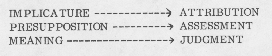
This functional relation among the two types of dynamic transactional components allows a methodological strategy: the empirical study of the symbolic value logic contained in psychodynamic processes through independently defined ethnodynamic conditions.
(P3): Relationship is topical. This specification pertains to the objective fact that relationship events are referrable through a conventionalized system of ORTHOGRAPHIC collocations. That is, all relationship events involve issues of interpretation, and these issues are investigatable through analyses of topicalizations. Thus, such an item as, "We were talking about Uncle Nate," indexes a relationship event that is distinctly different from the item, "We were talking about football," or, "We were arguing about Uncle Nate's refusal to ever give to charity." The differences are to be specified by reference to such issues of interpretation as, "what we've talked about," or, "what each of us has asserted about it." The empirical investigation of topicalization acts as relationship events leads to techniques such as Topic Domain Methodology and Paragraph Matrix Notation System, both of which we've discussed at length (see Index).
To summarize what we have been discussing, we can refer to the following figure:
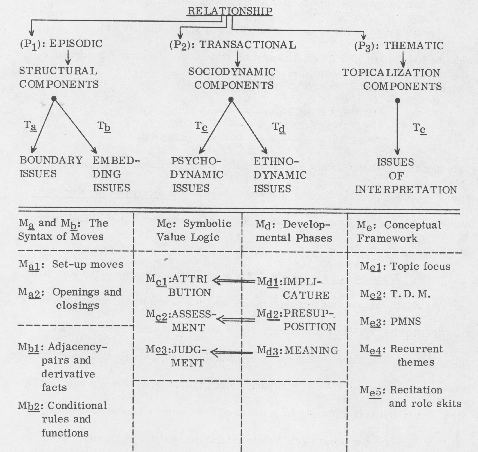 |
This figure shows that relationship is defined as a state of contact containing a triadic aspect: episodic, transactional, and topical. These three primary dimensions of variability jointly and exactly define the structural, dynamic, and thematic components of relationship in each of the three primary dimensions, respectively. Boundary and embedding issues are the current theoretical solutions to the empirical investigation of the structural components of social episodes (Ta and Tb, respectively). Within the transactional dimension, a current theoretical solution is that we have proposed under the rubric of sociodynamics: one type, psycho-dynamics (TC), concerns the specification of the underlying, psychogenesis of cognitive and symbolic acts; i.e., the details of a symbolic value logic in human affairs. The second type of social dynamic, ethnodynamics (Td), concerns the specification of the underlying, local ethnicity conditions in ritual exchanges, i.e., the developmental sequence that community practices exhibit or, the stages that are sanctioned in contingency practices.
The thematic aspect of relationship is observable in the third dimension of variability, namely, the topicalization components. Here, the current theoretical solution concerns the specification of issues of interpretation (Te); these always relate to a criterion based conceptual framework.
As shown in the figure, the methodological strategies (Ma - Me) currently being pursued in these five theoretical areas (Ta – Te) include the syntactic description of relationship episodes in terms of moves and sub-moves (MA and Mb); the coupling of developmental issues to a functional symbolic value logic (Mc and Md) (also indicated by the double arrows); and the annotation of topics within a conceptual framework that justifies interpretations of events (Me). Some specific methodological techniques which we are researching are mentioned in the figure. Details on the syntax of moves (Ma and Mb) may be found in Series III, Vol. 1, J. & G., 1975-77, in sections dealing with the functional analysis of conversation; as well, see our earlier discussion on transactional competence in J. & G., 1974. Details on symbolic value logic (Mg) and developmental phases (Md) will be found in the empirical investigations of Winskowski (1975-78) (and see [8. 3. 5] below). Details on the conceptual framework involved in interpretation (Me) can be found in Chapter 7, Section [8. 5] of this Chapter, and Chapter 10. For more technical treatments, see Series IV, Vol. 1 for (Me1) and Series 1, Vol. 2 for (Me4 and Me5), all in J. & G., 1975-77).
The various references mentioned here are to our own work. Students would wish to consult as well the works of others. By looking up in the index the entries of ETHNOMETHODOLOGY; ETHOGENIC APPROACH; PERSONALITY; and so on, you will be led to the extensive works of others listed in the References.
Based on the Writings of E. Swedenborg
Note: An updated version of this course is located at:
www.theisticpsychology.org/books/astrology/index.htm
6.13 The Limbus
Quoting from the Writings Sacred Scripture:
TCR 103. To this I shall add a revelation, that the soul which comes from the father is the person himself, and the body which comes from the mother, is not in itself the person, but a product of the person. This is merely its covering, woven of substances from the natural world, while the soul is of substances from the spiritual world. After death every person lays aside the natural which he got from his mother, and keeps the spiritual which he had from his father, together with a sort of fringe (limbus) around it composed of the purest natural substances. In the case of those who come into heaven this fringe is below with the spiritual side uppermost; with those who come into hell, the fringe is uppermost and the spiritual side is below. That is why a human angel receives what he says from heaven, so that it is good and true, but a human devil receives what he says from hell when he speaks from the heart, as he does in private, but as if from heaven when he speaks with the lips only, as he does in public.
[2] Since a person's soul is his very self, and by its origin the soul is spiritual, it is clear why the father's mind, attitude, character, inclination and affection of love live on in one descendant after another, and show up from one generation to the next. That is why many families, even whole nations, are recognisable likenesses of their ancestor; there is a shared type which shows up in the faces of each of his descendants, and this is only changed by the spirituality of the church. The type shared by Jacob and Judah still lives on in their descendants, allowing them to be distinguished from others, because down to the present day they have kept strictly to their religion. For in the seed from which each individual is conceived there is a shoot or cutting of the father's soul in all its completeness, wrapped in a covering of natural elements. These control the formation of the body in the mother's womb, where it may take on a resemblance to the father or the mother, though the father's type remains in it and constantly strives to come out. So if it is unable to do so in the first generation, it achieves this in subsequent ones.
[3] The reason why the father's type in all its completeness is in the seed is that, as already said, the soul is in origin spiritual, and the spiritual has nothing in common with space, so it can be reproduced in a small compass just as well as on a large scale. As for the Lord, when He was in the world, He put off by redeeming acts all the human He had from His mother, and put on the Human from the Father, that is, the Divine Human. That is why it is that in Him man is God and God is man. (TCR 103)
TCR 769. In respect to the state of souls after death, the belief universally and in each instance is that human souls after death are airy things (some cherishing the idea that they are like a puff of wind), and being such, they are reserved until the day of the last judgment either in the centre of the earth, where their abode is, or in the limbus of the fathers. But on these points they differ, some holding that souls are ethereal or aerial forms and thus are like phantoms and spectres, some of them dwelling in the air, some in the forests, some in the waters; others holding that the souls of the dead are transferred to the planets or to the stars, and have habitations given to them there; and some believe that after a thousand years they will return into their bodies; but the majority believe that they are reserved for the time when the entire firmament together with the terraqueous globe will be destroyed, which will be done by fire breaking forth from the centre of the earth or hurled down like universal lightning from heaven; that then the graves will be opened, and the reserved souls will be clothed again with their bodies, and transported to that holy city, Jerusalem, and so will dwell together on another earth in lustrous bodies, some lower down in that city, some higher up; for the height of it, like its breadth and length, will be twelve thousand furlongs (Apoc. 21:16). (TCR 769)
"Man's mind is his spirit, and the spirit is the man, because by the mind is meant all of man's will and understanding, and these are in principles in the brains and in principiates [or derivatives] in the body; therefore they are all things of man as to their forms.... For the first thread of the human form or the human form itself with each and everything thereof, is from the beginnings from the brain continued through the nerves. . . . It is this form into which man comes after death and which is then called a spirit and angel, and who is in all perfection a man, but a spiritual man. The material form that is added and superinduced in the world is not a human form from itself, but from the spirit to which it is added and superinduced that man may be able to perform uses in the natural world, and also to draw unto itself from the purer substances of the world a fixed containant of the spiritual things, and thus continue to perpetuate life ...." (DLW 387, 388)
See also Volume 5 Section
5.1.1.5 Anatomy of the Mind at Birth with a diagram of the limbus:
www.soc.hawaii.edu/leonj/theistic/ch5.htm#birth-anatomy
See also this article:
The 'Limbus' in Swedenborg. Extracts from article "On Immortality" by Rev.
Hugo Lj. Odhner. New Church Life 1960;80:5-13, 64-72,111-121 available on
the Web at:
http://www.theisticscience.org/theisticphysics/limbus.htm
Extracts from this article:
(...) The general source of the substance of the "limbus" is said to be "the inmosts of nature"; (Wis. viii: 4) "the purer substance of the world"; (DLW 388) or "the purer" or "purest things of nature," (DP 220; TCR 103) "nearest to spiritual things." (DP 220) But what could this mean? Doctrine tells us that nature's substances are created in discrete degrees, one composite of the other. Recently, scientists have assured us that the matter we handle is indeed composed of masses of molecules, held together by mystical bonds which no one really claims to understand; and that these molecules, in turn, are constituted of elemental atoms which are infinitesimally small, yet which are ordered like miniature solar systems in which incredibly mobile electrons whirl like planets around a center of nuclear particles. The Writings speak of three successive "atmospheres" from which three degrees of matter originated. (DLW 302) These atmospheres are the active forces which are the mediate causes of all natural phenomena. The highest, most universal of these spheres originates the force of gravity, (LJ post. 312) and may thus be taken as the "inmost" of nature; for in theory, the original form of matter must be conceived as gravitational fields of force. However this sphere may be conceived, it would somehow answer to what is called the "purest things of nature" out of which the "limbus" is said to be formed.
But how can the spirit of man draw unto itself, from the inmosts of nature, such a substance? Obviously this formation of a "containant" of the spirit must be an organic process, a process begun even before birth. (...)
All through man's life on earth, the subtlest natural substances distilled in the inmost recesses of the brain and the nervous system act as the agents of the spiritual substances which think and will. The spirit, through these most subtle essences of nature, is present throughout the body. Hence we read: "The spirit of a man is not a substance that is separate from the viscera, organs and members of the man, but it cleaves to them in conjunction; for the spiritual accompanies every stamen of them from the lowest to the inmost. . . ." "That man after death is equally a man . . . is because his spiritual is adjoined to his natural, or the substantial of the spirit to the material of the body, so aptly and unitedly that there is not a fibrilla, stamen, or least thread from these where the human of the spirit is not a one with the human body. . . ." (Wis. vii: 2, 4) Death is nothing but a separation of the natural substance from the spiritual.
The spirit or mind is, in one sense, present throughout a man's body. But the common center towards which all sensations travel, and from which all motor impulses proceed, is the brain. Within the subtle organics of the brain the natural mind becomes conscious of the states of the body and the world and organizes a memory of all its sensations. And in the brain the lowest or ultimate spiritual adapts the purest things of nature into a permanent basis, in which the mental states of memory, thought and affection are represented in an image by corresponding motions.
It is therefore said: "Man's natural mind consists of spiritual substances and at the same time of natural substances. From the spiritual substances, but not from the natural substances, comes thought. . . ." (DLW 257) And to make it clear that the natural substances — which are thus for all practical purposes an operational part of the natural mind while man is living in the world — are not destroyed along with the body, which, brain and all, decays in the grave, it is added: "These [natural substances of the natural mind]recede when man dies, but not the spiritual substances; wherefore, after death when man becomes a spirit or angel, that same mind remains in similar form in which it was in the world." (Ibid.)
It is clear from this that the purest things — or inmost things — of nature, selected and organized in the interiors of the brain as the natural basis of the memory, are the very substance which is elsewhere called the "limbus." "Every man, after death . . . retains the spiritual which he had from the father, together with a certain border (limbo) from the purest things of nature around it . . ." (TCR 103)
The departing spirit retains this "border." Nowhere do the Writings say that he takes it along into the spiritual world! For nothing natural can enter, or be a part of, the spiritual world. Yet he retains it, and its use is likened to that of a cutaneous covering for (or around) the spiritual body — which seems like a very intimate function. If we were literalists we might here evolve a rather grotesque picture of a spiritual body which, being spiritual, is not in space, but which has a skin made of natural substance! It is reasonably clear, however, that the Writings here employ a comparison. The living flesh which we carry is surrounded by a skin, or cutaneous covering. The skin is our boundary, the nether limit of our individuality. And while the body is living, the surface of the skin, or cuticle, consists of cells of flattened epithelium which gradually are deprived of life and dry up like scales and flake off. Yet without this covering of almost lifeless skin our bodies could not withstand the impact of the world or be protected from undue influences. In a parallel way the spiritual body is protected by the "limbus" as by a cutaneous envelope Its obvious use is negative — to fix the corporeal memory so that it can no more change! (...)
Let us note well that the "limbus" is not here given any role in the spiritual world as a medium in the intercourse of one spirit with another. It has a definite role in fixing the personality of a spirit. But it is a medium between spirits and men. We presume this to mean that when a spirit is exerting an influence on, or influx into, the mind of a man, there is an activity in the limbus of the spirit and a communication set up in the inmost sphere of nature which affects the natural substances of the natural mind of the man, or those inmost organics of his brain which are on the same level or degree and in a receptive state. But all this is in the realm of speculation, since little is known factually of the innermost substances of the brain or the inmosts of nature.
Indeed, the "medium" is from the inmosts of nature, and this "cannot be described except by abstractions." In recent times many scientists seem to have been forced to a similar conclusion. The hypothetical ingredients of the atom are admittedly mental constructs. Science shies at any mechanical models, but describes the inner sphere of nature in "a sheaf of mathematical formulae" — to borrow a phrase from Sir James Jeans. (...)
The question might be asked, "Where then does the ‘limbus' go at death?" That it remains in nature is not to be doubted. Yet what does its locale matter, if its substance is not affected any more by the changes of nature; but remains, independent, in a realm of simples, beyond the corpuscular universe of atoms and molecules which are within the narrow range of our sensory experience? At least, so we may surmise on the basis of what we now know of doctrine and of science. For all we know, the "limbus" might be a structure of wave-patterns, the form of which we can describe only by abstractions, and which is perpetually redintegrated without losing its characteristic uniqueness. If any one thinks this to be impossible, let him reflect on the fact that the whole pattern of a future man and his hereditary peculiarities are actually contained within the microscopic germ-plasm, which is not in the form of the body, yet in a perfect human form which, as to its interior structure, is known, it is said, to the Lord alone!
In one of his early commentaries, Swedenborg speaks of death in these words: "First of all there is released, from its connection with the earthly things which are properly called the body, that substance whose essence is mediate between the natural and the spiritual. This takes with it, because it encloses, that superior substance whose essence is spiritual and which is called the intellectual mind. . . . This, in turn, encloses man's principal and purer substance the essence of which is supra-celestial and which is properly called the soul. . . ." (WE 3058)
And the Spiritual Diary notes that at death "that of man which is vital is gathered together in a moment even if parts of the body were scattered over a thousand miles." (SD 1099) "As soon as the interiors of the body grow cold, the vital substances in the man are separated from the man, wherever they are, even if enclosed in a thousand labyrinths. . . . Nothing of the vital substance can remain in corporeal and material things. . . ." (SD 1104)
The vital substances here spoken of seem to refer to the limbus as well as to the spirit itself. For the limbus is still living, even as the body was living, from the soul. Yet the limbus is a natural substance, and thus has no spiritual attributes, no mental powers. It is not the mind, not the soul: its only attributes are those of nature, thus of motion; even though these motions, or potentialities to motion, are like the magnetic stresses on the recording tape which may be referred to as invisible wave-patterns rather than movements.
The limbus is physical. The angels never see it, they only know that it exists. It is not to be identified or confused with the spirit or even with the spiritual body. Yet it serves the spiritual body of man as a natural basis and gives it a certain "permanence" and "fixity." We also read that through it the spirit has "a relativity to those things which are in nature." In this life, such "relativity" is possible because the memory — which is the ultimate of the mind or spirit — has a basis in the natural organisms of the brain. The limbus must therefore be that which fixes the order of the corporeal memory for the after-death man.
Let us, then, dismiss any idea that the "limbus" is identical with the mind we use in this world, or with the spirit which lives to eternity in the spiritual world. We must learn to think spiritually of the immortal soul which is raised into the world of life on the third day after death. Man rises into that world, not in a limbus, but in a spiritual body, which has been formed during earth-life "by the truths and goods which flow in from the Lord through the spiritual world and are received by man within such things as are from the natural world and are called civil and moral." (TCR 583)
That the limbus takes no real or active part in the life of spirits among themselves — as it would if it were the actual skin or cutis of their spiritual bodies — is clear. And since the limbus gives fixation to the corporeal memory of man, which marks the lowest or sensual degree of his mental life, it is even said that with those in hell, the "limbus" is above and the spiritual below! (TCR 103) Not that the evil spirits live below their own skin! But by them the natural ideas and delights which once belonged to the life of their corporeal memory, are valued above spiritual things. That the hells are within the sphere of the natural degree of the mind only — the degree formed in juxtaposition with natural substances — is doctrinally certain. (DLW 345, 270, 274, 275)
See also this article:
SOUL-BODY INTERACTION IN HUMAN CONCEPTION AND DEVELOPMENT: The Clothing of the
Inmost In the Image of Heaven. Reuben P. Bell (1996) available at:
http://highermeaning.org/Authors/RPB/Soul-Body%20in%20conception.pdf
Swedenborg's definition of the soul is not an easy thing to pin down, evolving as it did from his earliest scientific works to the maturity and illuminated clarity of the theological Writings. But we can safely say that the soul is the inmost - that highest and first receptacle of the Lord in man (SD 2756; AC 2576, 2973, 9656, 9666; AE 313.4, Inv 13, 48). It is well above our consciousness, and is called a "higher spiritual substance," as compared to the "lower spiritual substance" of the mind (ISB 8, HH 39). It is therefore substantial, but not material (DLW 257; Lord 35). The soul is the organic essence, or spirit, of the body which cannot die, and does not live of itself, but receives life from the Lord (AC 1594, 1999, 10725; CL 315). It 9 is not the Divine, but that which receives the Divine (Word 6, D Wis II, ISB 8, 11); a receptacle of the Lord's life (AC 3938). The soul is also characterized by its necessary association with a natural component which defines it and actualizes it even in its exclusively spiritual existence after death. This natural component, the limbus, is drawn from "the finest things of nature," to provide ultimation for the spiritual body (DLW 257, 388, TCR 103). Swedenborg's definition of the soul is not an easy thing to pin down, evolving as it did from his earliest scientific works to the maturity and illuminated clarity of the theological Writings. But we can safely say that the soul is the inmost - that highest and first receptacle of the Lord in man (SD 2756; AC 2576, 2973, 9656, 9666; AE 313.4, Inv 13, 48). It is well above our consciousness, and is called a "higher spiritual substance," as compared to the "lower spiritual substance" of the mind (ISB 8, HH 39). It is therefore substantial, but not material (DLW 257; Lord 35). The soul is the organic essence, or spirit, of the body which cannot die, and does not live of itself, but receives life from the Lord (AC 1594, 1999, 10725; CL 315). It 9 is not the Divine, but that which receives the Divine (Word 6, D Wis II, ISB 8, 11); a receptacle of the Lord's life (AC 3938). The soul is also characterized by its necessary association with a natural component which defines it and actualizes it even in its exclusively spiritual existence after death. This natural component, the limbus, is drawn from "the finest things of nature," to provide ultimation for the spiritual body (DLW 257, 388, TCR 103). Swedenborg's definition of the soul is not an easy thing to pin down, evolving as it did from his earliest scientific works to the maturity and illuminated clarity of the theological Writings. But we can safely say that the soul is the inmost - that highest and first receptacle of the Lord in man (SD 2756; AC 2576, 2973, 9656, 9666; AE 313.4, Inv 13, 48). It is well above our consciousness, and is called a "higher spiritual substance," as compared to the "lower spiritual substance" of the mind (ISB 8, HH 39). It is therefore substantial, but not material (DLW 257; Lord 35). The soul is the organic essence, or spirit, of the body which cannot die, and does not live of itself, but receives life from the Lord (AC 1594, 1999, 10725; CL 315). It 9 is not the Divine, but that which receives the Divine (Word 6, D Wis II, ISB 8, 11); a receptacle of the Lord's life (AC 3938). The soul is also characterized by its necessary association with a natural component which defines it and actualizes it even in its exclusively spiritual existence after death. This natural component, the limbus, is drawn from "the finest things of nature," to provide ultimation for the spiritual body (DLW 257, 388, TCR 103). Swedenborg's definition of the soul is not an easy thing to pin down, evolving as it did from his earliest scientific works to the maturity and illuminated clarity of the theological Writings. But we can safely say that the soul is the inmost - that highest and first receptacle of the Lord in man (SD 2756; AC 2576, 2973, 9656, 9666; AE 313.4, Inv 13, 48). It is well above our consciousness, and is called a "higher spiritual substance," as compared to the "lower spiritual substance" of the mind (ISB 8, HH 39). It is therefore substantial, but not material (DLW 257; Lord 35). The soul is the organic essence, or spirit, of the body which cannot die, and does not live of itself, but receives life from the Lord (AC 1594, 1999, 10725; CL 315). It 9 is not the Divine, but that which receives the Divine (Word 6, D Wis II, ISB 8, 11); a receptacle of the Lord's life (AC 3938). The soul is also characterized by its necessary association with a natural component which defines it and actualizes it even in its exclusively spiritual existence after death. This natural component, the limbus, is drawn from "the finest things of nature," to provide ultimation for the spiritual body (DLW 257, 388, TCR 103). (...) Swedenborg's definition of the soul is not an easy thing to pin down, evolving as it did from his earliest scientific works to the maturity and illuminated clarity of the theological Writings. But we can safely say that the soul is the inmost -that highest and first receptacle of the Lord in man (SD 2756; AC2576, 2973, 9656, 9666; AE 313.4, Inv 13, 48). It is well above our consciousness, and is called a "higher spiritual substance, "as compared to the "lower spiritual substance" of the mind (ISB8, HH 39). It is therefore substantial, but not material (DLW257; Lord 35). The soul is the organic essence, or spirit, of the body which cannot die, and does not live of itself, but receives life from the Lord (AC 1594, 1999, 10725; CL 315). It is not the Divine, but that which receives the Divine (Word 6, D Wis II, ISB 8, 11); a receptacle of the Lord's life (AC 3938).
The soul is also characterized by its necessary association with a natural component which defines it and actualizes it even in its exclusively spiritual existence after death. This natural component, the limbus, is drawn from "the finest things of nature," to provide ultimation for the spiritual body (DLW 257,388, TCR 103). (...)
It is important to make a statement here about the soul of the offspring with respect to the father's original contribution to it. It is not enough to say that the soul is from the father; this does nothing to explain the nature of this "graft or offshoot" as it goes forth to its ultimation in the material substance of the womb. Nor does it imply any mechanism 12 preventing the offspring from actually being the father, as a simple extension, or clone. The problem of individuation must be addressed if we are to fully appreciate the propagation of a new person from another It is important to make a statement here about the soul of the offspring with respect to the father's original contribution to it. It is not enough to say that the soul is from the father; this does nothing to explain the nature of this "graft or offshoot" as it goes forth to its ultimation in the material substance of the womb. Nor does it imply any mechanism preventing the offspring from actually being the father, as a simple extension, or clone. The problem of individuation must be addressed if we are to fully appreciate the propagation of a new person from another. (...)
The offshoot is not a part of the father's soul. It is his soul “in completeness, its form and potency transferred whole into the seed” (ibid.). This spells trouble, unless we are free of the constraints of three-dimensional thinking, as discussed above. Note well that what is transferred whole is the form and potency of the father's soul - attributes substantial, but beyond natural time and space. What comes across at conception is nothing material, nothing of the formed substance of the father's soul, for this belongs to him and describes his individuation. What we find in the seed that is the rudiment of a new soul is 12 There are fascinating parallels between this principle and the actual molecular events at fertilization, where the sperm cell sheds all its components upon entering the ovum, except the contents of its nucleus and a single tiny centriole. 13 not the father, but "a distinct receptacle of life from which the father has withdrawn" (TCR 110:3, emphasis added). This is an essential distinction. This receptacle has in it a new soul in potential, and a human being in form, but is a very important discrete degree away - not yet ultimated in the material substance of the natural world. This will require the fabric of the mother's womb, and the external potency and form she brings to it as well. It is here that the soul weaves the body, but only after the father has withdrawn, to allow this process to go forward in the order of creation. 12 It is at this point that potency and form are manifested in three-dimensions, and a new soul emerges, a human being in form. The work of this emergence is performed by the father's soul - but the maternal matter that responds gives it identity in space and time The offshoot is not a part of the father's soul. It is his soul “in completeness, its form and potency transferred whole into the seed” (ibid.). This spells trouble, unless we are free of the constraints of three-dimensional thinking, as discussed above. Note well that what is transferred whole is the form and potency of the father's soul - attributes substantial, but beyond natural time and space. What comes across at conception is nothing material, nothing of the formed substance of the father's soul, for this belongs to him and describes his individuation. What we find in the seed that is the rudiment of a new soul is.
There are fascinating parallels between this principle and the actual molecular events at fertilization, where the sperm cell sheds all its components upon entering the ovum, except the contents of its nucleus and a single tiny centriole.13not the father, but "a distinct receptacle of life from which the father has withdrawn" (TCR 110:3, emphasis added). This is an essential distinction. This receptacle has in it a new soul in potential, and a human being in form, but is a very important discrete degree away - not yet ultimated in the material substance of the natural world. This will require the fabric of the mother's womb, and the external potency and form she brings to it as well. It is here that the soul weaves the body, but only after the father has withdrawn, to allow this process to go forward in the order of creation. It is at this point that potency and form are manifested in three-dimensions, and a new soul emerges, a human being in form. The work of this emergenceis performed by the father's soul - but the maternal matter that responds gives it identity in space and time. (...)
From: http://highermeaning.org/Authors/RPB/Soul-Body%20in%20conception.pdf
 The Writings of Swedenborg are available on the Web
in a searchable format at:
The Writings of Swedenborg are available on the Web
in a searchable format at:
A definitive and well respected biography of Swedenborg is:
Sigstedt, Cyriel (1952) The Swedenborg Epic. The Life and Works of Emanuel Swedenborg (New York: Bookman Associates, 1952) Available online: www.swedenborgdigitallibrary.org/ES/epicfor.htm
The Reading List identifies basic collateral works on the Writings by Swedenborg scholars.
Index to All Sections, Subject Index, and Readings is in Volume 18
This is the End of Volume 6
|