Scientific discovery of Spiritual Laws given in Rational
Scientific Revelations
|
|

Series: |
| ||||||||||||||||||||||||||||||||||||||||||||||||||||||||||||||||||||||||||||||||||||||||||||||||||||||||||||||||||||||||||||||||||||||||||||||||||||||||||||||||||||||||||||||||||||||||||||||||||||||||||||||||||||||||||||||||||||||||||||||||||||||||||||||||||||||||||||||||||||||||||||||||||||||||||||||||||||||||||||||||||||||||||||||||||||||||||||||||||||||||||||||||||||||||||||||||||||||||||||||||||||||||||||||||||||||||||||||||||||||||||||||||||||||||||||||||||||||||||||||||||||||||||||||||||||||||||||||||||||||||||||||||||||||||||||||||||||
|
Schematic Chart of Levels of Consciousness |
||
|
Discrete Levels of |
Correspondences of Divine Speech in Sacred Scripture |
Spiritual Geography, |
|
9 |
Infinite
Universal God |
Spiritual Sun |
|
8 |
Divine Speech as
|
|
|
7 |
Celestial-Rational |
Third Heaven |
|
6 |
Spiritual-Rational |
Second Heaven |
|
5 |
Spiritual-Natural |
First Heaven |
|
Death and Resuscitation |
||
|
4 |
Interior-Natural (virtual) |
Theistic Psychology |
|
3 |
Natural-Rational |
The Writings |
|
2 |
Natural-Sensuous |
New Testament |
|
1 |
Natural-Corporeal |
Old Testament |
|
0 |
Corporeal-Spiritual |
Falsified Sacred Scripture
in hell |
In the chart above, the
conscious natural mind covers layers 1 to 4. Layers 5 to 7 constitute the
unconscious spiritual mind. Layers 8 and 9 are uncreate, infinite, and Divine,
referring to the Divine Human's Mind or Spirit. Upon the death of our body and
subsequent resuscitation of our "spirit," our natural mind (layers 1,
2, 3, 4) becomes sub-conscious, and our conscious awareness is thenceforth
located forever in the spiritual mind (layers 5, 6, 7).
The eight layers of human
consciousness (0 to 7 in the chart), are created by the correspondences of
Divine Speech in Sacred Scripture (see Section xx). Here, individual development recapitulates history and evolution. Each
level that succeeds is a discrete degree higher or more interior and rational.
The Old Testament mentality or level of thinking (1) is our first concept of
God, heaven, and hell (see Section xx). The New Testament mentality or level of
thinking (2) is our next understanding of God, heaven, and hell (see Section
xx). The Writings mentality or level of thinking (3) is our third concept of
God, heaven, and hell (see Section xx). Our fourth concept of God, heaven, and
hell is theistic psychology, which is a level 4 mentality or thinking, and is
extracted from the Writings Sacred Scripture according to prescribed methods
specified in the Writings (see Section xx).
Level 4 becomes operational
when we undergo conscious character reformation in adult life and begin our
regeneration by applying the doctrine of truth from Sacred Scripture to our
daily willing and thinking (see Section xx). Level 4 thinking is called
"enlightenment" because its information base is from the spiritual-natural
mind, and its reasoning quality is genuinely rational. This genuinely rational
thinking is only the first layer of understanding genuine truth. Layer 3 is
natural-rational, which is a rationality whose concepts are bounded by
materialism, time and place. On the other hand, layer 4 reasoning is
interior-natural, which also means spiritual-natural reasoning. Layer 4 is a
new organ created within the natural mind by the Incarnation Event and is
called the interior-natural organ (see Section xx).
The scientific analysis by
correspondences of Genesis 24, 25, and 26 yields a complete anatomical and
developmental description of level 4 thinking (see Section xx). The natural
mind cannot be regenerated solely through layers 1, 2, and 3, which constitute
the literal meaning of Sacred Scripture (see Section xx). The Writings explain
that every person who wants to regenerate must first extract doctrinal
principles from the literal meaning of Sacred Scripture (see below). The Divine
Psychologist enlightens the person in the effort of extraction. This
enlightenment allows us to comprehend the “naked truths” in a spiritual way, not
merely natural.
Until young adulthood when
reformation and regeneration can begin, we only understand the Writings Sacred
Scripture naturally, that is, in their literal meaning. But when we receive
enlightenment, we can begin to understand them spiritually. Then the truths we
extract as doctrine for ourselves, constitute our spiritual doctrine, or
spiritual understanding, of spiritual topics. With this in our conscious
understanding, we can face spiritual temptations and engage in the process of
regeneration, spiritual growth, mental healing, and the capacity to be in
conjugial union, thus, to be prepared for heavenly life and bliss.
The Incarnation Event was the
process by which the Divine Human created the interior-natural organ within the
natural mind of the human race (layer 4). This took two steps. First, the
Divine Child created this new layer of thinking in Himself by extracting
theistic psychology from the literal meaning of the Hebrew Old Testament, which
He studied in His earliest years of conscious awareness as an infant (see
Section xx). This took several rational steps, as described in Genesis 24, 25,
and 26 (see Section xx). When the process was completed in Himself, the second
step was to create this new mental organ within the mind of every human being
who was already in the afterlife, then every human being who was alive in the
natural universe, and finally, every human being that is being born since then,
and to the endless future of new humanity.
The interior-natural organ
that makes possible conscious level 4 meanings, which may be called a virtual
heaven with three discrete layers of correspondences. This is because layers
5, 6, and 7 of the unconscious spiritual mind are virtually represented in our
conscious interior-natural mind (see Section xx). This is accomplished by
virtual higher-order correspondences of Sacred Scripture that can be
operational in the interior-natural organ, while they cannot be operational in
the external natural organ (layers 1, 2, 3). The thinking level of people in
their First Heaven is at layer 5 by means of spiritual-natural correspondences.
This meaning level is virtually represented in our conscious natural mind
through our understanding of spiritual-natural correspondences of Sacred
Scripture. We are similarly conscious of layers 6 and 7 by means of
spiritual-rational and celestial-rational correspondences of Sacred Scripture in their virtual form (see Section xx).
Regeneration cannot occur at
the natural level of thinking (1, 2, 3) about Sacred Scripture because the
literal meaning is always bound up in materialistic thinking that includes
historical names of places or people, time and number and, matter and motion.
This is true of all Sacred Scripture because it is always expressed in a
natural language -- Hebrew, Greek, Latin. Theistic psychology is a level of
thinking that goes into the interior of the literal meaning of Sacred Scripture
(level 4). At this level we learn to think and reason only from the universal
concepts contained in Divine Speech. Sacred Scripture is only a window to
Divine Speech, and the window is opened or made transparent when we apply the
method of correspondences with enlightenment, as prescribed in the literal meaning of the Writings Sacred Scripture
(see Section xx).
Nevertheless, there are
different discrete levels at which correspondences can be applied to one's
thinking and willing. One's degree of enlightenment or consciousness of higher
meanings in theistic psychology is proportional to one's degree of regeneration,
a process that goes on throughout life and never ceases to eternity. Theistic
psychology would be useful to teach children and young people, even though they
cannot begin their own regeneration until adulthood. But it would be useful to
them to learn the literacy skills involved in many aspects of theistic
psychology – diagrams, charts, and vocabulary lists arranged in rational sets,
as illustrated below.
They would understand these
spiritual topics naturally, which builds up their external rational thinking
abilities. Later when they are ready to start reformation, these
natural-rational concepts serve as “vessels” that are enlightened during the
extraction of doctrine and application to life.
Genesis 24 describes the
process by which the natural mind is set to order by means of the higher
correspondences in the interior-natural organ. Setting in order the natural
mind means to make it correspond with the spiritual mind. When we are born, everyone
inherits an external natural mind that is in disorder, and in fact, in an order
that is dead set against the spiritual order. The symptoms of this include a
civilization of materialism, the negative bias in science, numerous societal
problems, violent conflict between people, and individual inadequacies (depression,
addiction, deception, cynicism, intolerance, hatred). The natural
correspondences of Sacred Scripture in the human mind are ineffective to
overcome this inbred negativity because they are unable to face spiritual
temptations – the actual cause of their negativity.
Despite what people can read
in Sacred Scripture, and the religious doctrines that are justified through
them, people seem incapable of reforming themselves through these ideas and
concepts. They endlessly fall back to their inherited enjoyments and
inclinations, unwilling to give them up. Their concept of heaven and hell
(levels 1, 2, 3), isn't powerful enough in their mind to effect character
change until they are more willing to understand spiritual truths in a
spiritual way. This requires enlightenment, which requires willingness to
change our willing and thinking in daily activities so that they are lined up
with spiritual truths.
This is why
"salvation" of the human race was necessary in order to rescue the
human mind from hellish attachments people are unwilling to give up,
consequently condemning themselves to an eternity of hellish life. New and more
powerful mental tools had to be created, concepts and truths that could
overcome the hellish attachments with which we are born. Only God could do
that. But now consider the task of communicating these new mental reasoning
tools to the human race. God could not implant the new concepts into the
conscious natural mind of every individual. That would have felt like some
unknown power taking over our mind. It is not possible to acquire concepts
without wanting to, without some motivation or love for them.
The method this required
involved these nine steps.
(1) God willing Himself to be
born on earth as an ordinary human being.
(2) This Divine Child, though
the Divine from within Himself, had to be ordinary and natural from without,
thus had to be socialized and schooled.
(3) The Divine Child had to
discover His Divinity and mission by extracting the knowledge of theistic
psychology from the Old Testament Sacred Scripture.
(4) The Divine Child had to
apply this knowledge to His own thinking and willing in daily life where He was
a citizen, member of a religious group, and earning a living at a job.
(5) He had to recognize and
deal with the hellish attachments His natural mind inherited from natural
birth.
(6) He had to invent new
concepts and new ways of reasoning in order to vanquish these hellish attachments
in Himself.
(7) At last, He brought His inherited
disorderly natural mind into order according to His spiritual mind, making all
of Himself Divine at all levels, thus, "glorifying" His human
acquired from this earth, and uniting it perfectly with His Human Divine from
eternity. The result was the new Divine Human, which completes the creation of
the human race.
(8) He had to pass on these
new ways of thinking to the human race by creating a new capacity in the human
mind. He did this by creating a new organic entity within the natural mind
called the "interior-natural" organ.
(9) He can now activate this
newly created evolutionary mental organ and fill it with the operations of
spiritual correspondences. This new higher order knowledge is called theistic
psychology and is extracted from the correspondences of Divine Speech embodied
in the literal meaning of the Writings Sacred Scripture.
These nine steps collectively
constitute the Incarnation Event (see Section xx). It created a way out for
"fallen" humanity (see Section xx). A new interior-natural organ was
created within the conscious natural mind. Now at last, the human race was
complete. Every individual through personal effort, can now acquire the
capacity to become rationally conscious of spiritual things. This new rational
consciousness gives us the experience of the presence of God and His
co-participation in our willing and thinking in daily activities. This is
called “heaven on earth” and prepares our spiritual mind for celestial life as conjugial
angels in eternity.
5.1.1.5.2 Thinking With Angels:
Our Virtual Heavens
The descent of Divine Speech
– or, Divine Truth -- from the Spiritual Sun takes place throughout the mental
world of humanity simultaneously. Every human being is born with the same
discrete layers of the organic mind. Spiritual heat and light enters and fills every
mind equally, simultaneously, and totally.
In the highest layers of
everyone’s mind called “the Third Heaven,” Divine Speech takes the form of
Sacred Scripture written in celestial-rational correspondences. Divine Speech
then enters the spiritual layer of our mind called “the Second Heaven” where it
appears as Sacred Scripture written in spiritual-rational correspondences.
Next, Divine Speech enters the interior-natural layer of our mind called “the
First Heaven” where it appears as Sacred Scripture written in spiritual-natural
correspondences. At last, Divine Speech enters the external natural mind called
“earth” where it appears as Sacred Scripture written in natural correspondences
– the Writings Sacred Scripture written in natural-rational correspondences; the New Testament Sacred Scripture
written in natural-sensuous correspondences; and the Old Testament
Sacred Scripture written in natural-corporeal
correspondences of Divine Speech.
The meaning of
correspondences is the mechanism that the Divine Human uses to form the level
of mental operations in every human mind. Each discrete layer of the mind is
activated by its own degree of correspondences of Divine Speech. At each of
these levels, Divine Speech appears as Sacred Scripture written in correspondences
suitable and expressible for each level. Swedenborg has observed that these
forms of Sacred Scripture are present in the three heavens.
Theistic psychology extracts
the details of this universal process from the literal meaning of the natural-rational
correspondences of the Writings Sacred Scripture.
The systematic and cumulative
extraction of these scientific details facilitates our ability to cooperate
with the Divine Psychologist in our regeneration. The details of regeneration give
us charts and diagrams that allow us to commit to memory and understanding the
information contained within the Writings Sacred Scripture. It is very useful
to have in our conscious mind as much of the Writings as possible. It is not
the Writings that effect our regeneration, but the understanding of the
Writings in our conscious mind.
Extraction procedures are
illustrated in various ways below. For now, an example of extraction can be
given through the following passage. In the extraction process, “the Church” can
be taken as a reference to the
SS
76
VIII
THE CHURCH IS FROM THE WORD, AND IS SUCH AS IS ITS UNDERSTANDING OF THE WORD
That
the church is from the Word does not admit of doubt, for the Word is Divine
truth itself (n. 1-4); the doctrine of the church is from the Word (n. 50-61)
and through the Word there is conjunction with the Lord (n. 62-69). But doubt
may arise as to whether the understanding of the Word is what makes the church,
for there are those who believe that they are of the church because they have
the Word, read it or hear it from a preacher, and know something of its sense
of the letter, yet how this or that in the Word is to be understood they do not
know, and some of them little care. It shall therefore be proved that it is not
the Word that makes the church, but the understanding of it, and that such as
is the understanding of the Word among those who are in the church, such is the
church itself. The proof of this is as follows. (SS 76)
“The Church is from the Word”
means that the
The Writings instruct us on
how we are to regenerate. In order to cooperate in our regeneration in an
effective way, we need to have the Letter of the Writings in our conscious
understanding. When we then organize this knowledge into a coherent rational system
on some issue, it is called doctrine, or “doctrine of truth.”
The doctrine of truth we make
for ourselves from the Writings Sacred Scripture must then be applied to our
daily willing and thinking, moment by moment in every activity. This is the
work of regeneration, the struggle against temptation, and “picking up the
cross” and “walking in the way of truth.” The Divine Psychologist is present in
our mind and manages the whole show, even as He managed Isaac’s Binding by
Abraham, and as He managed the emotions David had when he wrote them down in
the Psalms, so that they may represent and describe His own mental states when,
hundreds of years later, He would be a Divine Child on earth struggling to
remake the human mind and save it from itself (see Section xx).
An inspiring and accurate
summary of the Divine Child’s mental states will be found in Rev. Geoffrey S.
Childs’ book The Path: The Inner Life of
Jesus Christ. (Fountain Publishing:
Swedenborg was a great
theistic psychologist because he was fully enlightened and he wrote from the
spiritual doctrine that had been revealed to him through this enlightenment.
Our task as theistic psychologists is to climb Jacob’s ladder by reconstructing
the spiritual doctrine from which he wrote the Letter of the Writings Sacred
Scripture. It was not possible for him to
write out the spiritual doctrine directly. The reasons are discussed in section
9 below titled
Why the Writings Sacred Scripture are
Written in Correspondences.
The result of applying
doctrine in our conscious mind to an episode of our own willing or thinking in
some activity, is enlightenment. The moment that we apply the doctrine of truth
in our mind to thinking or willing this or that detail, hundreds of times a
day, in that instant the Divine Psychologist enlightens us.
That means that our
consciousness is elevated in the level of meaning that we are able to perceive
or comprehend. Our rational consciousness of the Divine Human is now reformed by
correspondences that are higher than those before enlightenment (see charts
above). These higher spiritual correspondences are embodied or hidden within the
Letter of the Writings Sacred Scripture. Our new spiritual consciousness is
actually raised to the operations taking place in our First Heaven – not in the
same actual degree but in its virtual image of a discrete degree. We perceive
the spiritual-natural correspondences in the Writings, just as the people
already dwelling in their First Heaven perceive their Sacred Scripture. Quoting
THE
NATURAL DEGREE OF THE HUMAN MIND REGARDED IN ITSELF IS CONTINUOUS, BUT BY
CORRESPONDENCE WITH THE TWO HIGHER DEGREES, WHEN IT IS ELEVATED, IT APPEARS AS
IF IT WERE DISCRETE (DLW 256)
This process of progressive
continuous illumination or illustration goes on in proportion to the level of
temptations that we are willing to face in our character reformation and regeneration.
The higher the correspondences of Divine Speech in our conscious understanding,
the further we can be regenerated, all the way to the top portion of our
organic mind, which operates with celestial-rational correspondences of Divine
Speech. The level of correspondences we can consciously understand determines
the genes of our consciousness, or the mentality level at which we live life.
During the Incarnation Event
the Divine Child created a spiritual heaven within his natural mind grown on
earth, by glorifying it or making it one with His internal Human Divine. This
created the existence of the Divine Human which initiated an entirely new
relationship between God and the human race. What the Divine Child created in
His Own Mind He also recreates in the mind of every human being. The human race
had entered a new advanced evolutionary state based on the consciousness of the
Divine Human in our mind (called “Holy Spirit” in religion).
This new human ability had to
be organically created in some anatomical mechanism since, in human beings,
there can be no function or ability without an organic basis. In theistic
psychology this new organ is called the interior-natural organ or virtual
heaven. This new organ is a discrete degree more interior than the conscious
natural-rational mind. It is not possible for any information or stimulus
to enter this organ by means of the external natural mind that receives
information through the physical body. All information or stimulus that enters
the interior-natural organ is from the spiritual mind. But the spiritual mind
is unconscious while we are still conscious in the natural mind, thus, until
resuscitation.
Hence it is that the
interior-natural organ is a virtual heaven while we are in the natural mind and
still connected to the physical body. Through this new spiritual organ we can become conscious, when enlightened, of
higher order correspondences which our external natural-rational mind cannot
comprehend. When we read the Writings Sacred Scripture we are thinking with
natural-rational correspondences of Divine Speech. This is below the thinking
we do in our first heaven where we perceive the Writings Sacred Scripture with
spiritual-natural correspondences of Divine Speech.
Our virtual heaven allows us
to be enlightened through the higher-order spiritual correspondences by which
we comprehend Sacred Scripture in each of our three heavens. Though we are not
able to be conscious directly of our spiritual and celestial heaven, we are
able to be conscious of a spiritual replica or image of those correspondences,
and these are sufficient for obtaining progressive or continuous enlightenment
and spiritual growth through regeneration.
Quoting:
DLW 257. 1. The natural mind can be elevated up to the
light of heaven in which angels dwell, and can perceive naturally, thus not so
fully, what angels perceive spiritually. But the mind of the natural person
still cannot be elevated into angelic light itself.
2. By elevating his natural mind to the light of
heaven a person can think, even speak, with angels (...)
3. This takes place by a spiritual influx into
natural light, and not by any natural influx into spiritual light.
4. Human wisdom, which is natural so long as a
person lives in the natural world, can in no measure be elevated into angelic
wisdom, but can be elevated only into a kind of image of it. The reason is that
the elevation of the natural mind takes place by a continuous ascent, like the
progression from dark to light or from cruder to purer. (DLW 257)
This passage describes the
organic process of enlightenment as the “elevation of the natural mind.” The
natural mind is elevated by influx from the spiritual mind. This influx cannot
take place directly into the external natural mind because nothing spiritual
can exist there. However, when the Divine Child was growing up on earth during
the Incarnation Event, He created a new organic mind within His external
natural mind. This is called the interior-natural organ. This is the entry
point or reception point for the influx. Quoting:
With
people however who allow themselves to be regenerated the opposite takes place;
for gradually, that is, in consecutive stages, their rational is opened up, the
interior natural then becoming ranged in order beneath it, and the exterior natural
beneath that. This occurs especially in the period from late youth to
adulthood; it also continues in progressive stages to the final period of those
regenerating people's lives, and after that in heaven for ever. From all this
one may know what constitutes a person's interior natural and what his exterior
natural. (AC 5126)
The interior-natural organ is
built to react to the spiritual correspondences that operate in the spiritual
mind. This mind is a discrete degree above the natural mind. The organic
operation of the interior-natural organ is the mechanism of elevation,
enlightenment, or illustration while reading the Writings Sacred Scripture. We
experience it as a new wonderful ability to “think, even speak, with angels.”
To think with angels is to perceive spiritual correspondences within the
literal meaning of the Writings Sacred Scripture. This perception is the
experience of enlightenment.
The passage above (DLW 257)
indicates that in this state of enlightenment, we can understand spiritual and
celestial correspondences in a ”kind of image of angelic wisdom.” This phrase
may be rendered in theistic psychology as a virtual
image of higher order correspondences -- celestial-rational correspondences
of the Writings Sacred Scripture in our third heaven, spiritual-rational
correspondences of the Writings in our second heaven, and spiritual-natural
correspondences of the Writings Sacred Scripture in our first heaven.
In other words, the
interior-natural organ may be called a virtual heaven in the conscious natural
mind.
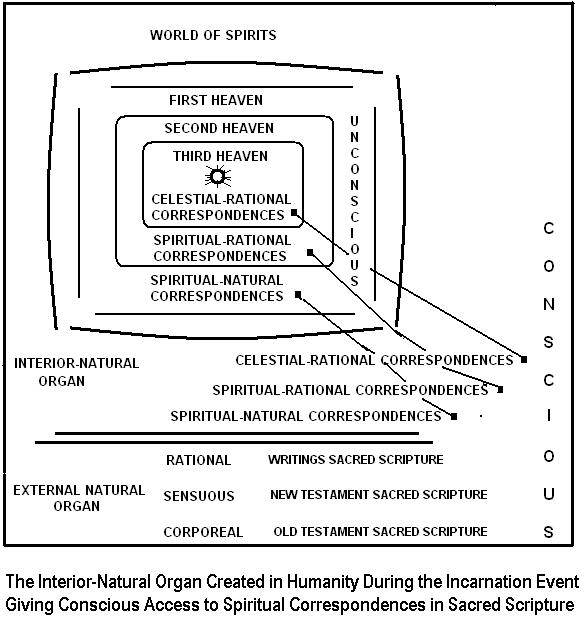
The accompanying diagram
depicts mental anatomy in relation to spiritual geography. If you familiarize
yourself with this schema, enough to reproduce it from memory, you will be
forming an essential concept in theistic psychology. The elements of the
diagram need to make a rational whole in our understanding. Within this
integration, enlightenment will reveal its spiritual reality.
The spiritual meanings we are
conscious of through this new organ, serve to make our regeneration effective
to the extent that we “love it,” that is, use it to guide our willing and
thinking. The interior-natural organ gives us the ability to be conscious of
spiritual correspondences of Divine speech in Sacred Scripture, even though we
still remain conscious in the natural mind. Our conscious rational
understanding is called “natural wisdom” and only an “image of angelic wisdom.”
Nevertheless, because it is a real image of it, it gives us the new power of
thinking with angels, that is, of reasoning about spiritual topics with
spiritual understanding. We can now consciously think in spiritual
correspondences that are not merely “deeper” than the natural-rational, but a
discrete degree above it. This new rational perception gives us access to the
three heavens in virtual form.
All heavens in the human mind
are created by correspondences of Divine Speech in Sacred Scripture.
Correspondences refer to discrete levels of meanings of Divine Truth. The
heavens of the human race since the Advent of the Writings Sacred Scripture are
in rational meanings of Divine Truth. Rational consciousness of God is the
only path available to the new heavens in our mind of eternity. Quoting from
the Writings Sacred Scripture:
The
interior natural is that which communicates with the rational and into which
the rational flows, and the exterior natural is that which communicates with
the senses, or through them with the world, thus into which the world flows. As
regards influx, it is continuous from the Lord through the rational into the
interior natural, and through this into the exterior (AC 5118)
The phrase “through the
rational” in this passage refers to the spiritual-rational (second heaven), not
the natural-rational (external natural mind). In other words, the content of
the interior-natural organ is from spiritual origin while that of the
natural-rational mind is from natural origin. Hence when we read the Writings
Sacred Scripture and focus on the literal meaning, our reasoning operations are
in the natural-rational mind. But when we make the literal meaning “vanish” and
focus on the extracted scientific meaning (AC 1405; 3776), our reasoning
process is in the interior-natural organ, which has a spiritual origin. It is
then that our “natural wisdom” is an image of “angelic wisdom.” It is then that
we can understand the doctrine of truth and theistic psychology spiritually. It is then that we are ready to face spiritual temptations and proceed
with our regeneration.
Quoting further:
The
interior natural is that which receives ideas of truth and good from the
rational, and stores them up for use, consequently which communicates
immediately with the rational; but the exterior natural is that which receives
images and thence ideas of things from the world through the senses.
[2]
These ideas, unless enlightened by those which are in the interior natural,
present fallacies, which are called the fallacies of the senses. (AC 5133) (See
Note 9)
It is important to see that
the word “rational” here refers to the rational of the spiritual mind known as
spiritual-rational correspondences of Divine Speech (our second heaven). If we
read the Writings Sacred Scripture with the “exterior natural” mind the
meanings we comprehend (“images, ideas”) “present fallacies of the senses”
which distort the literal meaning.
The interior-natural organ
develops from “putting truths into practice,” hence in proportion to
regeneration and character reformation. It is said that the “rational is opened
up” which means that higher order correspondences can be perceived and
consciously understood. But if the literal meaning “is enlightened in the
interior natural” organ, we are thinking and willing virtually as-if from our
first and second heaven, and even third.
Quoting:
It
can be seen from this that a person's rationality is in appearance as though of
three degrees-a rationality from the celestial degree, a rationality from the
spiritual degree, and a rationality from the natural degree. It can be seen,
too, that whether a person's rationality is elevated or not, still it remains
in the person as a faculty that can be elevated. (DLW 258)
The phrase “is in appearance
as though of three degrees” refers to the virtual heaven of the
interior-natural organ. Our rationality in this interior-natural organ is
spiritual-rational while our rationality in the external-natural mind is
natural-rational. Theistic psychology cannot be based on the natural-rational correspondences of the
Writings Sacred Scripture, which would mean to focus on its literal meaning. It
must be based on the extraction process that yields spiritual meanings and
makes the literal meaning “vanish.” This extraction process is described in the
Writings as the method of correspondences with enlightenment.
This gives us a virtual spiritual rationality “as
though” of the celestial-rational degree, the spiritual-rational degree, and
the spiritual-natural degree.
Quoting:
because
heavenly matters cannot be joined to natural matters so as to operate in
harmony with them, they therefore separate themselves, and heavenly matters in
merely natural people place themselves round about in the periphery surrounding
the natural matters that lie within. It is owing to this that a merely natural
person can speak and preach heavenly things, and also make a pretense of them
in his actions, even though he inwardly thinks in opposition to them. He does
the latter when he is alone, but the former when he is in the company of
others. (DLW 261)
It is said above that “a
merely natural person can speak and preach heavenly things.” This refers to our
initial phase of understanding spiritual topics naturally. Prior to beginning
regeneration in adult life, we read, teach, and preach the spiritual topics of
the Writings Sacred Scripture as “a merely natural person,” that is, we understand
them naturally with the thinking operations in our external natural-rational
mind. After we begin regeneration in adulthood, the Divine Psychologist opens
our interior-natural organ and we begin to understand spiritual topics
virtually “as though” the angels do.
The relation between the
interior-natural mind and regeneration is explained in this passage. Quoting:
When
the natural mind is prompted by the delights of its love and the gratifications
of its thought, which in themselves are evil and false, then the reaction of
the natural mind removes those elements which belong to the spiritual mind and
bars the door to them to keep them from entering, causing the action to come
from such things as accord with its reaction. The result is an action and
reaction of the natural mind which is opposed to the action and reaction of the
spiritual mind. This in turn causes a closing of the spiritual mind, like the
twisting of a spiral into the opposite direction.
[3]
On the other hand, if the spiritual mind is opened, then the action and
reaction of the natural mind are reversed. For the spiritual mind acts from
above or from within and at the same time through those elements in the natural
mind which have been disposed from within or from without to obey it, and it
twists into the opposite direction the spiral in which the natural mind acts
and reacts. That is because the natural mind is from birth in a state of
opposition to matters belonging to the spiritual mind, a state it acquires by
heredity from parents, as people know.
[4]
Of such a nature is the change of state called reformation and regeneration.
The state of the natural mind before reformation may be likened to a spiral
twisting or curving downward, while after reformation it may be likened to a spiral
twisting or curving upward. Consequently a person before reformation looks
downward to hell, but after reformation upward to heaven. (DLW 263)
The passage above describes
the organic character of the interior-natural organ in terms of twisting spiritual
fibers coiled upwards, while the inherited natural mind has coils twisting
downward. Reformation and regeneration involve the reversal of the twisting
fibers in the natural mind from downward to upward. Evil enjoyments coil
downward, along with their falsities. The fibers in the interior-natural organ
twist upward towards the spiritual influx.
Rev. N. C. Burnham in his 1887 book on discrete degrees, has drawn conclusive anatomical charts of the human mind as extracted from the Writings Sacrede Scripture. He shows the recursive and embedded “trinality” in which the human mind is organized so that we can picture the interior-natural organ with its three portions that are images of the three heavens located above it. (see diagrams above).
Quoting from the Writings Sacred Scripture:
AC 5224. And Pharaoh told them his dream. That this signifies about things to come, is evident from the signification of a "dream," as being foresight, prediction, the event (see n. 5091, 5092, 5104), thus things to come. How this stands in the internal sense is evident from the series of things. The subject treated of in this verse is the new state of the natural, when it is in obscurity because of truths having been banished from it, and that there is then disturbance in it in consulting memory-knowledges about things to come; for when such obscurity happens, the thought at once occurs, What will the event be?
[2] As during man's regeneration this is common in every such state, this state is here described in the internal sense; but such states are unknown at this day, both because few are being regenerated, and because those who are being regenerated do not reflect upon such things. At this day man cares not what is taking place within him, because external things possess his whole attention, and internal things have no importance to one who is wholly occupied with external things, that is, in whom they are the ends of life. Regarding this obscurity they would say, What are these matters to me, as there is no money or honor to be gained from them? Why should I think about the state of the soul, or the state of the internal man, whether it is in obscurity when truths have been banished, or in clearness when they have been replaced therein? What would it benefit me to know this? Whether there is any internal man is to me a matter of doubt, and also whether there is any other state of the soul than that which is of the body, nay, whether there is any soul that lives after death. Who has come back from the dead and declared it? So speaks the man of the church with himself at this day, and so he thinks when he hears or reads anything about the state of the internal man. From this it is plain why the things that are going on within man are at this day hidden and wholly unknown.
[3] Such an obscurity of the understanding never existed among the ancients. It was their wisdom to cultivate interior things, and thus to perfect the faculties of both understanding and will, and thereby to provide for the welfare of their soul. That the ancients gave their attention to things like these, is clear from their writings which are even now extant, and also from the desire of all to hear Solomon:
Therefore there came of all peoples to hear the wisdom of Solomon, from all kings of the earth, who had heard of his wisdom (1 Kings 4:34);and therefore came the queen of Sheba, who, from the bliss into which she came from hearing the wisdom of Solomon said,
Blest are thy men, blest are these thy servants, who stand continually before thee, and hear thy wisdom (1 Kings 10:8).Who at this day would call himself blest for this reason? (AC 5224)
AC 5225. And no one interpreted these things to Pharaoh. That this signifies that it was not known what would happen, is evident from the signification of "interpreting," as being to know what would happen (see n. 5141). Hence "no one interpreted" denotes not to know; for in the internal sense "no one" is the negative of a thing, and thus what is not; for the idea of a person is turned in the internal sense into the idea of a thing-as for instance the idea of a man, a husband, a woman, a wife, a son or daughter, a boy or maiden, is turned into the idea of truth or of good; and as above (n. 5223) the idea of a magician and wise man is turned into that of interior and exterior memory-knowledges. The reason of this is that in the spiritual world, or in heaven, not persons but things come into view, for persons limit the idea, and concentrate it upon something finite; whereas things do not limit and concentrate it, but extend it to the infinite, thus to the Lord.
For this reason also, no person named in the Word is perceived in heaven, but in his stead the thing that is represented by that person; so also no people or nation is perceived, but only its quality. Nay, not even is any historic statement of the Word about a person, nation, or people, known in heaven; and consequently it is not known who Abraham, Isaac, Jacob, the Israelitish people, and the Jewish nation were, but it is there perceived what Abraham, Isaac, Jacob, the Israelitish people, and the Jewish nation denote; and the same in all other cases. Thus the angelic speech is without limitation, and is also relatively universal. (AC 5225)
AC 607. But the character of this church will be described hereafter. That an idea of it may be presented here, it shall be briefly said that the Most Ancient Church was celestial, as already shown, but this church became spiritual. The Most Ancient Church had a perception of good and truth; this, or the Ancient Church, had not perception, but in its place another kind of dictate, which may be called conscience.
[2] But what is as yet unknown in the world, and is perhaps difficult to believe, is that the men of the Most Ancient Church had internal respiration, and only tacit external respiration. Thus they spoke not so much by words, as afterwards and as at this day, but by ideas, as angels do; and these they could express by innumerable changes of the looks and face, especially of the lips. In the lips there are countless series of muscular fibers which at this day are not set free, but being free with the men of that time, they could so present, signify, and represent ideas by them as to express in a minute's time what at this day it would require an hour to say by articulate sounds and words, and they could do this more fully and clearly to the apprehension and understanding of those present than is possible by words, or series of words in combination. This may perhaps seem incredible, but yet it is true. And there are many others, not of this earth, who have spoken and at this day speak in a similar manner; concerning whom, of the Lord's Divine mercy hereafter.
[3] It has been given me to know the nature of that internal respiration, and how in process of time it was changed. As these most ancient people had a respiration such as the angels have, who breathe in a similar manner, they were in profound ideas of thought, and were able to have such perception as cannot be described; and even if it could be described such as it really was, it would not be believed, because it would not be comprehended. But in their posterity this internal respiration little by little came to an end; and with those who were possessed with dreadful persuasions and phantasies, it became such that they could no longer present any idea of thought except the most debased, the effect of which was that they could not survive, and therefore all became extinct. (AC 607)
5.1.1.6 Altruism or the Love of Uses
Altruism is the ruling love in heaven. Only those loves and thoughts are possible in heaven that fit with altruism, such as, the desire to benefit others, the desire not to put self ahead of others, the feeling of greater satisfaction when benefiting others than when the self is benefited, the love of innocence, the love of obeying God, the desire to form a conjugial pair in which one loves the other more than self. Along with this collection of heavenly loves, the ruling love of altruism gathers around itself a collection of ideas and truths from Sacred Scripture, and a desire to eliminate from the cognitive mind any thoughts and reasonings that promote self.
No one can pass this test. Daily self-witnessing practice will allow us to develop a heavenly character that will eventually pass this test, as long as we use the methods of regeneration specified in Sacred Scripture. The Divine Psychologist works with every human being to bring about regeneration to the extent that the individual will cooperate. This means self-examination in the light of doctrine from Sacred Scripture, condemning each hellish trait that comes to our attention, refusing to perform the trait, and finally, holding it in aversion. Doing this to every trait we become aware of will put the old will to death so that at our second death we can rise in our heavenly proprium (see Section xx).
Few people know what is altruism. The dictionary defines it as "unselfish regard for or devotion to the welfare of others." Altruism comes from the Latin "alter" meaning other. In the Writings altruism is defined as the love of uses. It's become popular among sociobiologists and many psychologists to deny the possibility of genuine altruism. Indeed, the Writings reveal that the unregenerate human character is not capable of a single unselfish motive. Cynics doubt all acts of self-sacrifice and altruism saying that if you look underneath it you will find a selfish motive. The dictionary lists a second meaning for altruism: "2 : behavior by an animal that is not beneficial to or may be harmful to itself but that benefits others of its species" which is sociobiological view.
In theistic psychology, it is known from Sacred Scripture that altruism is the ruling love of those who dwell eternally in the heavens of their mind. When we are in that state of mind our thoughts and desires moment by moment are instantiated in us by the influx of the Divine Human's Proprium (see Section xx). Swedenborg reports that the instant someone in heaven blocks the inflowing Divine Human Proprium, one's own proprium or self takes over. Our consciousness is then instantly plunged into a state of semi-darkness in comparison. We fall out of our heaven and into our ordinary state of mind. We lose our peace and start being agitated, pulled in many directions by inconsistent or conflicting desires and thoughts. Then, the instant they turn their focus and desire back to the Divine Human, they become willing once more to lay down their own self and to be influxed by the Divine Human Proprium. The then have their heavenly peace and happiness back, which is characterized by the amazing fact that every day is better and grander than the previous, and this endlessly to eternity!
From this you can see that altruism is indeed not possible on one's own. But it becomes possible by shutting down one's own and being willing to be influxed by the Divine Human Proprium which is the source of peace, happiness, conjugial union, community with others, and endless progress and growth in the life of immortality in heaven.
What does it take to be willing to be taken over by the Proprium of the Divine Human?
From a materialistic, non-spiritual, natural-rational point of view, being taken over by God's will, sounds terrible. We then think of how hard it is to follow the Commandments of Sacred Scripture, let alone being forced to do them by the Divine Proprium inside of us. It may sound dreadful, unfree, scary, more like a hell than a heaven. But this is a false point of view. It doesn't represent what actually happens when we are wiling to be activated and operated by the Divine Human directly. The angels told Swedenborg that they can actually perceive the Divine Human inflowing within the goods they feel or intend, and the truths they think.
Now try to imagine how you would feel right now if you the Divine Human's Proprium flowed into you, not from your spiritual mind, but directly into your conscious natural mind.
An analogy to what would happen is represented by the image of man encased in a block of ice in the middle of Antarctica in the ice age!
Swedenborg reports what happens when people in their hells are brought back up into the world of spirits and are brought near an angel from whom emanates light and heat from the Spiritual Sun. They are plunged into darkness because that's how the unregenerate proprium sees spiritual light, which is truth--as total darkness, while they see some glitter of sulfuric light through falsified truths and fantasies. As well, they are plunged into a state of absolute cold because that's how they feel spiritual heat, which is altruistic love, while they feel infernal fire and heat through selfish lusts and subjugation of others to their will.
From these observations you can understand why the Divine Psychologist doesn't suddenly break the appearances that we are alone in our mind, and suddenly starts talking to you, or making you do this or that, taking away your own freedom to do what you please and think what you want. The Divine Human Proprium flows into our conscious mind only when we are willing to assume our heavenly state, which is, being willing to feel and think altruistically for the sake of immersing ourselves in the stream of the Divine Proprium.
Think of the image of immersing ourselves in the stream of the Divine Proprium.
As we are regenerating we are slowly and steadily replacing our hellish feelings and thoughts with heavenly feelings and thoughts. We experience agony and suffering in this process because it appears to us at first, that we are losing all our enjoyments of life by not being able to enjoy what we please and think what we want.
But the Divine Psychologist gives us a foretaste of heavenly life each time he brings to us a spiritual temptation in which we are willing to resist on the basis of the truth of doctrine from Sacred Scripture (see Section xx). This is called the "Sabbath rest" and refers to a period, sometime short sometimes longer, during which we feel the benefits of peace and calm, after the storm of battling our temptation. We feel the new will, the new proprium, the contentment of being right with God and neighbor. This feelings subsides and we are thrown back into the struggling consciousness of the natural mind. But it comes back after the next spiritual temptation until it becomes familiar and we begin to expect it, and then feel the relief when we are back in it.
It is at these times of heavenly peace ("Sabbath") that we realize with love and gratitude that the Divine Psychologist is actually with us running the show from our spiritual mind. As we begin to remember this idea and love in our daily consciousness, we begin to feel a permanent and unbreakable connection to the Divine Human. We are than "saved" for heavenly life because once in such a mental state, we are unwilling to give it up for any hellish love that are still plaguing us--fear, anxiety, doubt, self-reliance in spiritual matters, insufficient reliance on the doctrine of truth from Sacred Scripture, depression, unrealistic expectations, confusion about life and relationships, etc.
If we want heaven to be reproduced in our natural mind now, while we are still on earth, we can.
The process starts with compelling ourselves to (a) acquire spiritual-rational doctrine of truth from Sacred Scripture, and (b) apply it to your thoughts and feelings in daily self-witnessing practice.
If you catch yourself reacting to someone or some event with cursing, resentment, and the desire for revenge, say to yourself, "I'm in hell and these are the feelings of those who already dwell there in immortality. I don't have to be like them. I have still have a choice here on earth. My Divine Psychologist is present and ready to take over the second I give permission and am willing to reject the hellish reactions to this person or event."
Then you decide. Yes, you want to stop the hellish reaction because you want to avoid being stuck in hell forever and you want to move to your heaven. Now you take out your big guns and get ready for combat with the hells. They don't want to let you go because you are the source for their very life of enjoyment. They have nothing but misery without people on earth allowing them to inflow into your negative emotions and thoughts. This is their infernal love or lust.
But you have the bigger guns against which they have no power whatsoever. You have the Divine Truth in your understanding of the doctrine from Sacred Scripture as Divine Speech. This is the power by which the whole universe was created and by which it is being maintained. The evil spirits are forced to withdraw out of dread and agony for the spiritual light and heat that you are now letting into your conscious natural mind.
Immediately after the victory, you have the peace of Sabbath, for awhile. Then the next battle and the next battle. As you advance in temptation battles and become a spiritual veteran, your character is being reformed, your new will comes into existence and your thoughts are enlightened in rational consciousness. Nothing can hurt you now. Nothing can distract your or persuade you. No movement or philosophy, no dogma or heresy, no fantasy or persuasion. Though you still have many temptation battles left, you do not lose your heavenly peace. You are already in your heavenly proprium, though still on earth.
Others see the change in you. You are a nicer, more reliable, more useful person. You still experience negative emotions and thoughts--anxiety, fear, resentment, doubt, and you are still experiencing harmful loves--enjoyment of illicit sex, desire for popularity and flattery, indifference to wastefulness of resources, not caring about others as much as self, etc. But you are committed in your mind to get rid of them. Before this phase of your regeneration you were not committed to get rid of them. You were still holding on to them because this was your life and your enjoyment of living. And you were under the persuasion that if you give them up, you will be a hapless angel floating in clouds praying all day with nothing else to do to eternity. But now you know from the doctrine of truth you extracted from Sacred Scripture that the opposite is the case of what you feared and imagined. You are truly free and truly happy only when your old will dies and you immerse your consciousness in your new will, through which you are receiving the Divine Human Proprium.
You now feel the Divine Human Proprium as if it is your own
Now you feel a freedom in the desire to benefit others, and an enjoyment in doing that, far surpasses the previous enjoyment of benefiting yourself. The Writings refer to altruism as the love of uses. In other words, being motivated to benefit others in everything we do.
People have various ideas about what it means to love the neighbor and to be charitable. The literal meaning of Sacred Scripture defines these as sharing one's wealth with the poor and the needy, visiting the sick and those in prison, and being upright in one's business, not defrauding anyone. All this is true and serves well for religion and regeneration. When we go to the next phase of spiritual growth, we inquire into the universal meaning of love and charity and how it applies to our willing and thinking in everything we do. This gives us the rational doctrine of truth from Sacred Scripture, which begins the main phase of our spiritual life and reformation.
How does love of neighbor and charity apply to everything we do during a day?
This is what the Writings call the "love of uses." It refers to why you do something. For instance, suppose you are conscientious in cleaning your teeth and mouth every day. Ask yourself why you are doing it, or why you are not skipping it, since it's easier. You answer that you want to have healthy and clean looking teeth, and pleasant breath. These are uses. they are heavenly loves from the Divine Human Proprium. Taking care of your teeth is a form of charity because your motive for doing it is heavenly.
Take another example. You love surfing. You do it whenever you can. You enjoy it. Is it charity? It can be depending on why you are doing it. You can do it for either hellish or heavenly motives. Hellish motives would include surfing to get away from responsibilities, or to be able to brag about to friends, or to show your supremacy over competitors, or to impress girls, etc. Surfing for heavenly motives include getting a healthy form of exercise, appreciating the outdoors, feeling integrated with nature, perfecting oneself more and more, earning a living, etc.
Your behavior as a surfer will vary drastically depending on whether you have hellish or heavenly motives for doing it. With hellish motives for surfing you might have negative thoughts about other surfers with whom you feel competitive. You might ridicule denigrate them in your mind. You might have the desire to discriminate against some people, preventing them from surfing in the same place and displaying "surfing rage." You might also surf in a way that is dangerous or too risky. But when you have heavenly motives for surfing, you will not discriminate against some people and you would feel happy to help them out or give them the same access to the waves that you have. You would feel concern for strangers, not just for your surfing buddies.
Consider another example. You're on your job doing well with the boss or supervisor. You try to impress and appear competent and loyal to the rules and policies of the company. Is this hellish selfishness or heavenly charity? It depends on why you are doing it. It is hellish if your motive is to promote yourself at any cost even if you don't really deserve it. It is heavenly if you are trying to be sincere and to actually do what you claim, even if you're not being observed. Your behavior will be drastically different under these two types of motives. With a hellish motive you're going to act differently or inconsistently depending on who is watching you. For instance, company policy may forbid employees to use office computers to send personal email or to surf the Web for things you're personally interested in. But if you figure out a way of not getting monitored, you do it anyway, not caring that it is against company policy and that you are claiming that you're a good employee, supportive of its policies. But with a heavenly motive you are consistent in following rules whether or not you are being monitored. This is the love of uses and of charity. This is doing things for the sake of good and truth, that is, for the sake of the Divine Human and heaven.
We all start with hellish motives for most of the things we do in the course of a day. As we are committed to regeneration and cooperation with the Divine Psychologist, we slowly exchange our hellish motives for heavenly.
5.1.1.6.1 The Method of Self-witnessing
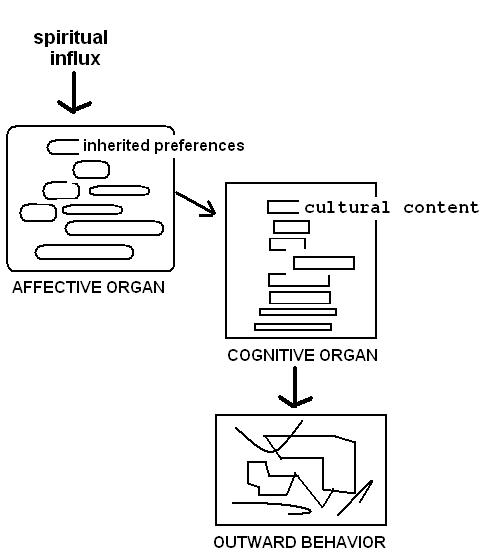
Self-witnessing our thoughts and emotions every day is the only way we can gather objective and accurate information about them. Without this information we cannot apply the doctrine of truth from Sacred Scripture, and therefore the Divine Psychologist cannot bring the temptations of self-awareness needed to freely reject the hellish traits (see Section xx). To help you with your self-witnessing I'm presenting a few social areas that you might want to gather data on. Note that the questions address the threefold self--feelings, thoughts, and actions (see Section xx). You need to witness yourself in both outward and mental behaviors. The outward behavior is only an effect of the mental behavior in the will (affective) and understanding (cognitive). Outward behavior can serve as an index of the feelings and motives you have (see Section xx).
Eating and Exercising
Entertainment
Keeping things clean and tidy
How you treat other people
Being wasteful or misusing public property
Doing things right
It takes systematic self-witnessing on a daily basis to be able to answer these questions objectively and accurately.
Every item is important. There is a tendency to want to use equity theory in excusing some of our hellish traits. People sometimes say about someone that he or she is not a bad person even though they have some bad traits. But this is a natural way of thinking about being a good person. The spiritual reality is that being good or bad does not depend on someone's judgment or evaluation. It depends on spiritual physiology. Being bad refers to harmful operations going on in the mind, vs. being good, which refers to healthy operations. Harmful operations cannot go on in heaven, while healthy operations cannot go on in hell, as we know from Swedenborg's reports in the Writings.
So you don't have the luxury of balancing your hellish traits as against the heavenly traits. You cannot excuse yourself about this or that "weakness" that you keep around in your character. Remember that at your second death you must abandon every hellish trait if you are entering heaven, and vice versa (see Section xx). You cannot keep even one trait of the opposite kind so that in their immortality, everyone is either all good or all evil.
Using equity theory in evaluating one's spiritual standing or quality is very common in our society today. This morning I heard popular Christian TV evangelist Joyce Meyer tell her audience to go ahead and have fun and do the things they like, but at the same time they should remember that they need to "work for God" as well. She told them that they need to share with the needy in both love and money. And she told the story of a boy outside in the cold, barefoot and shivering, looking longingly at the window of a shoe store, and peering inside. A woman came along, saw what was going on, took the child inside the store, cleaned his feet, and put socks and shoes on him. After this the boy looked up to her and said "Are you God's wife?" The audience applauded at the story. This is when Joyce Meyers instructed them to remember to do God's things every day, not just their own things.
This approach to charity and love of one's neighbor is only the first platform for spiritual growth. We need to go further or deeper if we are going to reach our heaven. Our understanding of what is charity must go beyond the idea of part time things to do for God, to the idea that everything should be done for God.
There are two models here--equity model and unity model. The equity model says that we can do our thing as long as we do God's thing, and the two will counterbalance each other. The unity model says that we must do all things simultaneously for us and for God. There should be no time when we do things for us or others, and not for God. Similarly, there should be no time when we do things for God, and not for us or others. This is what God wants, as revealed in Sacred Scripture. Since all things have a successive and simultaneous order, it makes sense to think of doing things for God or heaven at a higher more interior level, within the things we do for us and others.
For instance, if I do a good job flossing my teeth because it's a rational issue of commitment to good health, then I'm flossing simultaneously for myself and God, as well as others who are involved in what happens to me and my teeth--wife, dentist, and the merchants from whom I buy the food I chew with my healthy teeth. The other day someone came to our door selling raffle tickets to raise money for sports scholarships in a school. I have the rational freedom to refuse, which I do for a number of reasons, one being that I do not approve of this method of raising money for school activities. My principled refusal is therefore doing something for myself, for society, and for God, all simultaneously. This is charity in its correspondential sense.
Sometimes people volunteer to help in kitchen soups or they spontaneously make a significant gift to a charity operation. This is very helpful to the people who benefit. But is it helpful spiritually to the volunteer or to the giver? This depends on why they do it. It is not helpful to them for spiritual growth towards a heavenly character, if their motive is based in equity theory, thinking that they are now doing something good for God. But it will benefit them if their motive is to practice being an angel. In other words, they want to learn to love others as much as themselves, and perhaps more than themselves. This is the person who they want to become so they are practicing, acting it out in their daily life as one among many activities they normally do.
It will not benefit them spiritually if they think they are counterbalancing the bad things they did that day with this good thing of volunteering or sharing. There is no balancing out between good and evil traits or deeds. They cannot become an angel unless they have the angelic motive in all the other things they did that day. This motive is to train yourself to do all things properly, conscientiously, prudently, and competently, all day long. Some people spend their entire time doing something useful and expert all day long, working on their own at home, or in the woods, or at the beach, or in the sports arena. Their motive is to develop discipline and expertise in what they love to do. They do not go to Church, they do not socialize with neighbors and friends, they do not pay charity, they do not volunteer. Their focus is to become good at what they are into. Can they develop a heavenly character in this way?
The answer is, Yes, depending on why they do it.
They can do it for hellish motives like selfishness, hating and avoiding people, denigrating society, being cynical, maintaining a weakness of the will or lack of ambition, obsession with something, etc. Or, they can do it for heavenly motives like love of doing something useful to people, or love of becoming good at something for the sake of being useful to others. What matters in this type of lifestyle is how we treat others who are affected by what we do. For instance, do we care about noise, smoke, or other consequences of what we do that may be disturbing to neighbors? When you go to the supermarket, are you polite with the cashier or the pedestrians in the parking lot? When the phone rings with someone who has the wrong number, do you act insulting and in a bad mood?
It is not the helping of the needy that saves us, nor is it being non-social that condemns us. It's how we treat others in our life, in our daily actions and thoughts, whether family, neighbor, stranger, or society as a whole.
Remember too that all traits form a tight collection or grouping in your character, whether evil or good. Some appear light or small evils, like inconveniencing others by being late for things, while other evils appear heavy or serious, like hating and abusing people. The hells are organized into many layers according to the type of evil loves people hold on to, and how grave or abhorrent it is to others. So you can end up in a light hell which is better than a deeper hell. Nevertheless, you would still be in hell! even If you dwell in the lighter hell. Furthermore, you continue to be tied unconsciously to the deeper hells. Those who dwell in a lighter hell have the deeper hell within their unconscious. Thus you are their victim.
Hence when it comes to character reformation and spiritual growth we need an either--or type of thinking. Heavenly and hellish traits are absolute opposites and there is no spiritual in-between. Often it may appear that there is, and people talk about "grey areas" and "mixed feelings" and "tolerance for diversity.". But these are only appearances. Our hellish traits reside in the natural mind and there is not one of them that can enter the spiritual mind where reside our heavenly traits. It is an anatomical impossibility to have both heaven and hell in one organic structure. So we cannot balance the bad with the good in our character. In the afterlife, heavenly and hellish traits cannot be both present in our spiritual mind. There can be no overlap, not even of a single trait. Suppose for example, that you arrive in the afterlife with 99 percent of your traits being heavenly, and only 1 percent or less, being hellish. Now to enter heaven you must let go of the hellish traits, every one of them.
But suppose you don't want to give up one cherished hellish trait? Then you cannot enter heaven. You must wait until you are willing to give it up. Swedenborg found people in the afterlife who were unwilling to give up a personal attachment to someone who was in hell -- family member, best friend, or a person they venerated or admired, etc. These people brought heavenly traits with them and could enter heaven, but they wouldn't give up their personal attachment to the individual in hell. As a result, they suffered many hardships in that hellish environment to which they were unsuited. This proves that you cannot retain an attachment or the enjoyment of any hellish trait when you enter your heaven. There is no equity evaluation at the entrance gate, counting your hellish vs. your heavenly deeds, and seeing which outweighs the other. No one makes an evaluation of us when we enter our eternity, whether in heaven or in hell. Every individual makes this decision freely, choosing heaven or hell in their mind, depending on what trait they love the most, so they are willing to give up all else for it.
The equity model of spiritual growth is a wrong model. Following it will lead to insurmountable difficulties in acquiring a heavenly character for our immortality life. This is a matter of spiritual physiology and anatomy, not evaluation or judgment. Sacred Scripture in its literal meaning gives the appearance that God will judge us at death, or at the resurrection, "giving to each according to his works." Some will be declared "sheep" and be taken up to heaven, while others will be declared "goats" and will be carted off to hell. But this meaning is at the level of natural correspondences and reflects the mentality of the culture and people who originally received that Sacred Scripture as the basis of their religion. When we now extract the scientific meaning from the sentences of Sacred Scripture it becomes evident that God does not judge anyone because the Divine Human is pure Love, and love cannot judge anyone to punishment. Punishment is a natural idea of hell and of God.
When Swedenborg looked at the copy of Sacred Scripture read by those who were living in their heavens, the idea of punishment for sins or evils did not appear in the literal sentences. Instead, the sentences were transformed into their spiritual correspondences and spiritual ideas. In its spiritual idea, "punishment for sins" refers to the physiological consequences of loving hellish traits.
Every hellish operation, no matter how "light weight," is tied by an unbreakable chain to all the hells. This is a spiritual law of creation. It is equally true of every heavenly trait, from the lowest to the highest. Swedenborg was given the experience of an eagle's view, or a satellite view, of the entire heavens and the entire hells in human minds of our race. He confirms by eyesight what Sacred Scripture describes, namely, that to God the entire human race appears as one, and the entire past and future of the human race is present to God simultaneously (see Section xx).
5.1.1.7 The Genuine Human Shape and Form
The heavenly states exist in every human mind. There exist no heavens outside the human mind. Now try to imagine collecting the heavens together to take a look at them in one connected and integrated piece. You would then be able to see their shape. What shape do the heavens make when collected all together from each individual's mind? Swedenborg saw it so that he may be a witness, a scientist who recorded his observations and wrote it down as Sacred Scripture under direct conscious supervision of the Divine Human whom he had before himself constantly, as do all people who dwell in the immortality of their heavens. The shape Swedenborg saw was that of a human being which he called the Grand Man or the Grand Human.
Swedenborg was also given to observe the shape of all the hells in every human being. What does that look like, do you think? You may have guessed: It looks like a devil! Swedenborg called it a "deformed man" and so in theistic psychology we can refer to it as the Grand Monster.
These are fascinating reports. What do they mean? Or, How do we think about it in a productive way?
To me it helps to remember that the heaven and hell in everybody's mind are nothing but thoughts and feelings in organic form made of spiritual fibers and substances from the Spiritual Sun. These substances fall into two categories--the spiritual heat consists of "goods" and the spiritual light consists of "truths." Infinite quantities of "goods" and "truths" stream out of the Spiritual Sun creating human minds and bodies, each surrounded respectively by a spiritual world and a natural world. The affective organ contains the "goods" and its consequent feeling operations, and the cognitive organ contains the "truths" and its consequent thinking operations (see Section xx).
What shape does the affective and cognitive organs have? We know the shape of the heart and the brain. All organs have a shape. The fact is that every organ, of the body or of the mind, has the human shape in miniature, or "as an image," because goods and truths are in a human shape. Goods and truths proceed from the Spiritual Sun which is the brilliant aura around the Divine Human, who is there visible to those who are in their heavens (see Section xx). Whatever proceeds from the Divine Human remains a part of the Divine Human since only infinite Divine things proceed from Him. These infinite proceedings of goods and truths are received in the created things such as stones, trees, and human minds. They are then called "goods" and "truths" in those things -- stones, trees, minds. The goods and truths do not become part of the objects or minds since they are infinite and Divine. What is Divine cannot become part of what is finite, but can be received by it and have it within itself.
You can see from this that all finite things created and and all uncreate infinite things must resemble the human shape because that is the internal shape of the Divine Human. This is why He is called the infinite Divine Human.
All this is therefore a rational consequence of the fact that God is a Divine Human and has the Human shape. Everything that streams out from the Divine Human remains the Divine Human since God is omnipresent and the source of all created matter and substance. From all this you can see in some general and theoretical sense that the universe has the human shape and all things in the universe have the human shape. This is a heavenly secret that was known to the earliest generations who were born on this earth, and remnants of this idea survived in ancient written texts.
Of course to get a more particular point of view of what this all means we need to have a spiritual-rational idea of "shape" rather than merely a natural-rational idea. You can teach yourself to think in spiritual-rational correspondences rather than merely natural-rational, which follow a materialistic time-space bent structure. A spiritual idea of the shape of what is human, is to remember the scientific revelation that the human proper begins with the spiritual-rational (see Section xx). In other words, the natural mind in itself is not human. It is in the shape of a sub-human animal. You cannot see this physically. When we still are in the unregenerate materialistic phase of life, denying or doubting the existence of the spiritual, we still look human. We cry, we sing, we play, we plan, we love.
This is true. But it's the outward appearance only. If we were able to see the shape of the natural mind in which we are conscious, we would see the shape of animals--tigers, bears, wolves, scorpions, vampires, etc. But as soon as your mind is reformed and you have begun your regeneration process, the natural mind changes appearance. It begins to look more and more like a lamb, a horse, a bird of paradise, a pet. Throughout all these changes of our sub-human mind in the world of spirits, our physical body on earth remains the same in terms of human appearance (except for aging and weight gain).
When we are advanced in regeneration in adult life, our natural mind has turned into the human appearance proper, which is the image of the Divine Human.
What gives the natural mind its proper human image?
It is caused by acquiring spiritual-rational correspondences from Sacred Scripture and making them the basis of our new way of thinking and new way of willing and intending everything.
This results from the fact that everything spiritual is in the human shape or form. When we begin operating our natural mind with natural correspondences to spiritual-rational truths from Sacred Scripture, we then for the first time become truly and genuinely human. Until that phase of growth we are still only potentially human but not actually human. People who are stuck in the hells of their mind are stuck in their natural mind for that's the only entry point for hellish influx and traits. The spiritual mind contains only human things from the Spiritual Sun which is the aura around the Divine Human you can see when you enter the phase of your heaven. If you study theistic psychology you are acquiring rational concepts that can later serve as receptors of spiritual-rational correspondences from Sacred Scripture. "Later" means when you begin your regeneration (see Section xx).
So now everything in this discussion on the human shape comes down to the shape of good and truth from the Spiritual Sun. These substances are in the human shape. Good is alive and truth is alive. In other words, life is carried or made possible by good and truth streaming out of God in infinite quantity and variety, creating everything in their own shape or image.
The human shape viewed externally is familiar to us in each other and in a mirror or photograph and painting. But we know from the law of correspondences that all outward things exist in successive and simultaneous order of degrees, as discussed above. This means that the outward shape of something is produced by an inward cause which is produced by a more inward or inmost source. The shape of the inmost imparts itself by correspondence--not physical appearance. Hence it is that the shape of the Divine Human is the inmost of all shapes and is imparted to all created things by correspondences in a chain of correspondences from highest to lowest (see Section xx).
This means that the higher the correspondence level of some thing or quality, the more it has a true human shape. Swedenborg compared the appearance of the spiritual body of those who dwell in the highest and lowest heavens of their mind. He confirms that the celestial angels (Third Heaven) are amazingly handsome and beautiful with faces that reflect ineffable wisdom, understanding, and love. The faces of the spiritual angels (Second Heaven) was less striking in comparison, and the faces of the people in their First Heaven called angelic spirits, were like the faces of people on earth who are considered handsome and beautiful.
The human shape of good and truth imparts itself to all our mental organs and to every operation in them. Every love, feeling, affection, or intention has the human shape of good. Every thought, concept, understanding, or reasoning has the human shape of truth.
There are of course complications that should be understood to complete the picture. The human shape of good and truth can be distorted in our natural mind so that its shape is altered to that of a deformed human or monster. But the physical body does not reflect this because of God's intervention. It would be incredibly more difficult for us to acquire the motive to regenerate if we already looked like devils. Everybody would look like a devil and earth would be a hell, unprotected by truth and good because these human things are automatically turned into deformed versions of themselves in our inherited will and understanding.
God intervenes maximally and absolutely in everything. For instance, God snatches some of the good and truth flowing into the natural mind before it is distorted and corrupted, and turned into their opposites. The technical term for this that we use in theistic psychology is "remains" (see Section xx). These are goods and truths God saves and collects for us in an inaccessible part of our spiritual mind. For instance, when we are infants and children we are often filled with many good feelings for our parents and caretakers. We have many innocent enjoyments. We love other children and pets and moving around with our bodies. We discover basic new concepts and ideas that are genuine, from our own thoughts and from the environment. All these are in the proper human shape. God lays them away in the spiritual mind before they begin to be distorted and corrupted as we grow in our natural mind and begin to have less human thoughts and more monstrous feelings and emotions.
When we undergo the process of our second death (see Section xx), God unwraps these "remains" in our spiritual mind and makes them operational and conscious. Now we recognize these long forgotten celestial goods and truths from our childhood, and from later life, when we had rare moments of genuine human feelings and realizations. It all now comes back to us, and we have huge new resources for our life and happiness in immortality.
Everything we've been discussing about heavenly traits represents a spiritual idea of the human shape. To love the neighbor, to love being useful to others, to love the truth for its own sake, to love to form an eternal conjugial union, to love God--these are exclusively human loves and they have the human shape. The definition of human is therefore to have a heavenly desire or love, to think of a rational plan for it, and to fulfill the desire by performing appropriate acts. This is how Sacred Scripture describes the Divine Human. From infinite Divine Love married to infinite Divine Truth, the Divine Human creates the Spiritual Sun, which creates the spiritual world of human minds, which creates the physical universe of earths where human beings are born and become truly human by choice of love and truth, living in eternal conjugial happiness. This is God's fulfillment in existence of the Divine Love or Good married to the Divine Wisdom or Truth. This is the essence and entirety of the human shape or quality.
5.1.1.8 Life in the Embryo
The external natural mind is composed of both natural and spiritual substances, the natural are in the external portion and the spiritual in the internal portion. The external natural portion is called "maternal" and the internal spiritual portion is called "paternal." Upon the second death the maternal portion is laid to rest forever, and the spiritual or paternal portion now lays bare and takes over the mind, which means, its ruling love now prevails and controls all desires, intentions, thoughts, and appearances. The natural mind in itself is unable to support thought because what is natural is inert. But it appears that we think in our natural mind because it is really the spiritual mind that thinks within the natural. This is just like when we hear a sound or taste something. It appears that we are sensing the sound or taste in our sense organs, and materialists explain that it is really in the brain that we feel the sensation. But the Writings have revealed that the brain is inert, composed merely of chemicals and electricity, and these are not sensations or thoughts. Instead, the reality is that it is the mind that senses through the brain and body. Sensations are spiritual substances in the sensorimotor organ of the mind, and thoughts are spiritual substances in the cognitive organ of the mind.
So it is the mind that senses the physical environment through the sensory organs and the brain, which are thus mere instruments for the mind by which it senses, thinks, and feels.
Note however that the mind has nothing to sense or think about if the natural world is taken away from it. Note further, that in order for the natural mind to sensate and think, it must organize the incoming physical stimuli from the senses into a rational order it can understand and work with. The natural mind must therefore be educated by experiences, socialization, instruction in the sciences, art, and literacy. These constitute cultural content organized on a natural plane. The rational aspects of this content form the basis of correspondences in our understanding. We can then build up the rational mind from a mere natural beginning and make it more spiritually rational. The first step is to acquire ideas of morality and justice. The second step is to acquire ideas of religion and theistic psychology. This opens the spiritual aspect of the mind and makes it operational within the natural mind.
Now, the conscious natural mind is capable of thinking with spiritual-natural correspondences (First Heaven). This is the beginning of spiritual growth.
At first we grow a maternal rational which is external and natural, made of the order of physical things. This is the phase of materialistic thinking in every individual. After this we form the paternal rational which is internal and spiritual. This is the beginning of reformation and dualism in every person. The two rational minds and their developmental steps are described in detail in Sacred Scripture, especially in the scientific meaning of the Old Testament story of Abraham's two sons--Ishmael (first or maternal natural-rational) and Isaac (second or paternal spiritual-rational).
It is important to understand the extent to which God participates in human development from the moment of conception onward. The heavenly faculties that are capable of heavenly traits is formed by God during the growth process. Quoting from the Writings of Swedenborg:
In the human being the most general and all-embracing whole, holding every single thing in place, is the soul. It is also Divine Truth going forth from the Lord, for Divine Truth flows constantly into the soul and makes it what it is. (...) Divine Truth going forth from the Lord is what is called the Word, through which all things were created. (AC 6115)
"The Word" or Divine Truth is also called Divine Speech which always comes to human beings consciously by means of Sacred Scripture through the external natural mind. Divine Speech as Divine Truth unconsciously enters the soul from the Spiritual Sun which marks God's presence in the heavens and where He can be seen by angels as the Divine Human. Swedenborg frequently saw this himself when he was in the heavens in company with the inhabitants there.
Quoting from the Writings regarding how God forms the person in the womb:
THE FORMATION OF MAN IN THE WOMB BY THE LORD BY MEANS OF INFLUX INTO THESE TWO RECEPTACLES.
As in the formation of man in the womb spiritual things conjoin themselves with natural things there are many particulars that cannot be described, namely, such spiritual things as are abstracted from natural things, which consequently have no expressions in natural language except some most general expressions which one man may comprehend more intelligently than another. Nevertheless, by these and by comparisons that are also correspondences the following particulars shall be explained:1. The Lord conjoins Himself to man in the womb of the mother from his first conception, and forms man.
2. He conjoins Himself to man in these two receptacles, in the one through love, in the other through wisdom.
3. Love and wisdom unitedly and harmoniously form each and all things, and yet in these things they may be distinguished.
4. The receptacles are distinguished into three degrees with man, one within another; and the two higher are the dwelling-place's of the Lord, but not the lowest.
6. One receptacle is for the will of the future man and the other for his understanding; and yet nothing whatever of his will or of his understanding is present in the formation.
6. There is life in the embryo before birth, but the embryo is not conscious of it.
1. The Lord conjoins Himself to man in the womb of the mother from his first conception, and forms man.
By the Lord here and elsewhere is meant the Divine that proceeds from Him as the sun of heaven, where the angels are, and by and through which all things in the whole world have been created. That this is life itself has been shown already. That life itself is present from first conception and is what gives form, follows from this, that in order to be the form of life which man is, and in order to be an image and likeness of God, which man also is, and in order to be a recipient of love and wisdom, which are life from the Lord, thus a recipient of the Lord Himself, man must be formed by life itself. (...)
While man is in the womb he is in a state of innocence; therefore his first state after birth is a state of innocence; and the Lord dwells in man only in his innocence, consequently He especially dwells in him when he is as it were innocence. Likewise, man is then in a state of peace. Man is then in a state of innocence and in a state of peace, because the Divine love and the Divine wisdom are innocence itself and peace itself, as can be seen in the work on Heaven and Hell (n. 276-283, 284-290). I foresee that when you read this, some doubts may occur to your mind; but read to the end, and afterwards recollect, and the doubts will disappear.
[2] 2. He conjoins Himself to man in these two receptacles, in the one through love, in the other through wisdom.
This follows from the preceding article, where it was shown that all things of the body, both internal and external, from the head even to the heel, are formed and produced from these two receptacles; and as the beginnings and initiaments of all things are from these, it follows that the forming Divine is in them, and through them is in their continuations; but when it is in them and in their continuations, it is in them spiritually, not materially, for it is in their uses; and uses regarded in themselves are immaterial, while the things necessary for uses to become effects are material.
These two receptacles, which are the beginnings of man, are from the father; his formation to the full time of birth is from the mother; for the seed is from the man; his are the spermatic vessels and testicles in which the seed is elaborated and secreted; it is received by the female; hers is the womb wherein is the heat by which it is fostered, and in which are the little mouths by which it is nourished. In nature nothing exists except from seed, and nothing grows except by means of heat. What kind of form these beginnings have, which belong to man only, will be shown in what follows.
As the rudiment of man is seed, and this is a double receptacle of life, it is clear that the human soul is not life from life, that is, life in itself, for there is but one life, and that is God. The source of man's perception of life has been explained elsewhere. And as there is a continuation of these receptacles from the brains through the fibers into all parts of the body, it is also clear that there is a continuation of the reception of life into these parts, and that thus the soul is not here or there, but is in every form derived from these, just as the cause is in the things caused, and the principle in its derivations.
[3] 3. Love and wisdom unitedly and harmoniously form each and all things, and yet in these things they may be distinguished.
Love and wisdom are two distinct things, precisely as heat and light are; heat is felt, and so is love; light is seen, and so is wisdom. Wisdom is seen when man thinks, and love is felt when man is affected. Nevertheless, in the formation of things they do not operate as two but as one. This is true also of the heat and light of the sun of the world; for in the time of spring and summer heat co-operates with light, and light with heat, and things vegetate and germinate.
Likewise love in a state of peace and tranquility co-operates with wisdom, and wisdom with love, and produces and forms, and this both in the embryo and in the man. That the co-operation of love and wisdom is like the co-operation of heat and light is very clear from appearances in the spiritual world. There love is heat, and wisdom is light; and there all things in the angels are living, and all things around them are blooming, in the exact measure of the union of love and wisdom with them. The union of love and wisdom is reciprocal, love unites itself to wisdom, and wisdom reunites itself to love; consequently love acts and wisdom reacts, and through this reciprocation every effect exists.
[[2]] There is such a reciprocal union and consequent reciprocation between the will and understanding and between good and truth, also between charity and faith, with the man in whom the Lord is; and in fact, such is the reciprocal union of the Lord Himself with the church, which is meant by the Lord's words to the disciples in John, that:
They should be in Him and He in them (14:20; and in other places).
The same union is meant by the union of man and wife, in Mark:
The twain shall be one flesh, so that they are no more twain, but one flesh (10:8).
For the man was born to be understanding and consequently wisdom, and the woman to be will and consequently the affection which is of love (see the work on Heaven and Hell, n. 366-386).
[[3]] As there are two things, love and wisdom, that form the embryo in the womb, so there are two receptacles, one for love and the other for wisdom; so again there are two things in the body throughout, and these likewise are distinct and are united. There are two hemispheres of the brain, two eyes, two ears, two nostrils, two chambers of the heart, two hands, two feet, two kidneys, two testicles, and the rest of the viscera are doubled; and in every case what is on their right side has relation to the good of love, and what is on their left to the truth of wisdom.
That these two are so joined together as to act as one mutually and reciprocally, a diligent investigator can see if he will take the trouble. The union itself stands forth to view in the fibers stretched to and fro and interlaced in the midst of their course; and this is the reason of the signification of "right" and "left" in the Word. From all this the truth is clear that love and wisdom, unitedly and harmoniously form each and all things in the embryo, and yet in these things they may be distinguished.
[4] 4. The receptacles are distinguished into three degrees with man, one within the other; and the two higher are dwelling-places of the Lord, but not the lowest.
Some one might possibly form a fallacious idea of the beginnings of the human form, which pertain to the seed of the man, because they are called receptacles. From the term receptacle one may easily fall into the idea of a vessel or a little tube. I desire therefore to define and describe that initial form, as it was seen by me and made clear to me in the heavens, as adequately as the expressions of natural language will permit.
These receptacles are not tubular, or hollowed out like little vessels, but they are like the brain, of which they are an exceedingly minute and invisible type, with a delineation resembling a face in front, with no visible appendage. This primitive brain in the upper convex part was a structure of contiguous globules or little spheres, each little sphere being a conglomeration of like spheres still more minute, and each of these again of the very least. In front, in the flattened region of the nose, a kind of outline appeared for a face; but in the recess between the convex part and this flattened part there was no fiber; the convex part was covered round about with a very thin membrane, which was transparent. Thus was seen by me and shown to me the primitive of man, the first or lowest degree of which was the structure first described, the second or middle degree was the structure secondly described, and the third or highest degree was the structure thirdly described, thus one was within the other.
I was told that in each little sphere there were indescribable interlacings, more and more wonderful according to the degrees, also that in each particular the right part is the couch or receptacle of love, and the left part is the couch or receptacle of wisdom, and that by wonderful connections these are like partners and comrades, the same as the two hemispheres of the brain are.
[[2]] It was further shown in the light that fell brightly on it, that the structure of the two interior degrees was, in its position and flow, in the order and form of heaven, while the structure of the lowest degree in its position and flow, was in the form of hell. This is why it is said that the receptacles are distinguished into three degrees with man, one within another, and the two higher are dwelling-places of the Lord, but not the lowest. The lowest degree is such because man, from a hereditary taint, is born opposed to the order and form of heaven, and thus into evils of every kind; and this taint is in the natural, which is the lowest of man's life, and it is not wiped away unless the interior degree that has been formed for the reception of love and wisdom from the Lord is opened in him.
But how this degree and the inmost degree are opened is taught by the Lord in the Word, and will be taught in what follows. But to gain light on this subject, see what has been said before about degrees, also about the brain. These degrees are called higher, although they are interior, and for the reason that there is successive order of degrees and simultaneous order; things higher and lower are in successive order, but things interior and exterior are in simultaneous order, and the same things that in simultaneous order are interior, in successive order are higher; and the same is true of things exterior and lower.
And as there are three degrees in man so there are three degrees of the heavens, for the heavens consist of men who have become angels. According to degrees in successive order, the heavens are seen one above another, and according to degrees in simultaneous order, one within another. From this it is that "high" signifies in the Word what is internal, and the Lord is called "Most High," because He is in inmost things. Since, then, man in the beginning of his development is such a dwelling place of the Lord as has been described, and these three degrees are then open, and since everything that proceeds from the Lord as a sun is Man in least things and in greatest (as has been shown before in its place), so extension into any other form than the human is not possible; nor is extension possible except through rays of light from wisdom with heat from love in the midst; thus through vivified fibers, which are rays brought out into form. That there is a like determination is apparent to the eye.
[[3]] So many are the degrees of life with man; but with beasts the two higher degrees are lacking and they have only the lowest; consequently the beginnings of their life are not receptacles of the Lord's love and wisdom, but are receptacles of natural affection and knowledge, into which they are born. With clean beasts these receptacles are not reflected or turned contrary to the order of the flux of the universe, but are conformable to it; therefore from birth, as soon as they are brought forth, they are led into their functions and know them. For beasts have had no ability to pervert their affections, since they have not the intellectual faculty to think and reason from spiritual light, and to violate the laws of Divine order.
[5] 5. One receptacle is for the will of the future man and the other for his understanding; and yet nothing whatever of his will or of his understanding is present in the formation.
Will and understanding with man do not begin until the lungs are opened, and this does not take place until after birth; then the will of man becomes the receptacle of love, and the understanding becomes the receptacle of wisdom. They do not become such receptacles until the lungs are opened, because the lungs correspond to the life of the understanding, and the heart corresponds to the life of the will, and without the cooperation of the understanding and will, man has no life of his own, as there is no life apart from the co-operation of love and wisdom by means of which the embryo is formed and vivified, as has been said before.
In the embryo the heart alone beats, and the liver leaps, the heart for the circulation of the blood, and the liver for the reception of nourishment; from these is the motion of the other viscera, and this motion is felt as pulsative after the middle period of gestation. But this motion is not from any life proper to the fetus; one's own life is the life of the will and the life of the understanding; while the life of the infant is the life of commencing will and commencing understanding; from these only do the sensitive and the motor life in the body exist; and this life is not possible from the beating of the heart alone, but is possible from the conjunction of this with the respiration of the lungs.
This is seen to be true in men, who have both will and understanding; when they fall into a swoon or are suffocating, and respiration stops, they become as if dead; they have no sensation, their limbs do not move, they do not think nor will, and yet the heart performs its contractions and the blood circulates. But as soon as the lungs return to their respirations the man comes back into his activities and to his senses, and into his will and understanding. From all this a conclusion may be formed about the quality of the life of the fetus in the womb, in which only the heart performs its motions, and not yet the lungs, namely, that nothing of the life of the will and nothing of the life of the understanding is present in it; but the formation is effected solely by the life from the Lord by which man afterwards is to live. But about this more may be seen in the following article.
[6] 6. There is life in the embryo before birth, but the embryo is not conscious of it.
This follows from what has been said above; also that the life from which the embryo in the womb lives is not its life, but the Lord's alone, who alone is life. (D. Wis. 3)
You can see from these details that the growth of the fetus in the womb is managed by God through influx into the soul, and from there into the organs of the mind called the will (affective) and the understanding (cognitive) in their primitive form. The fetus is not conscious and thus has no will or understanding, and yet these organs become the active organic agents by which the brain and body develop during the nine months of gestation.
See also:
Bell, Reuben,
Rev. Dr. (1996). Soul-Body Interaction in Human Conception and Development. The
Clothing of the Inmost in the Image3 of Heaven. New Church Life. Online
at:
highermeaning.org/Authors/RPB/Soul-Body%20in%20conception.pdf
5.1.1.9 The Growth of the Mind
The growth of the human mind is based on the managed interaction between the unconscious internal spiritual mind and the conscious external natural mind. The external mind is built up consciously by our experiences and socialization, thus "from without," meaning from incoming stimuli through the physical senses in the natural world. But the internal mind is built up unconsciously from incoming stimuli from the spiritual world. God is in charge of the order and pacing of these incoming spiritual stimuli. The external conscious mind is therefore filled with the organized information of the material world, while the unconscious internal mind is filled with the organized information of the spiritual world. The process of build up of the two minds would not work if they were independent. The acquisition of concepts for our conscious thinking depends on the influx or facilitation effect from the unconscious spiritual mind. Quoting from the Writings on this subject:
AC 1460. Cognitions with man never come in childhood from the interior, but from objects of the senses, especially from hearing. There are with the external man recipient vessels, and these are formed by cognitions, the internal man inflowing and assisting. Cognitions are learned and implanted in the [external] memory according to the influx of the internal man. (AC 1460)
"Cognitions with man" refers to the concepts we acquire by which we are able to think and consciously process information in a systematic and rational order. Concepts must be built up by the "objects of the senses," which includes especially "hearing" or verbal interaction with others. Language plays a key role in allowing the build up of the natural mind. Concepts would not be rational and would not allow thinking unless they were "infilled" from within with spiritual-rational organization, which is called the "internal man inflowing and assisting." Concepts are called "cognitions" and they are described as "recipient vessels" that contain within them spiritual information and rational syntax.
In order to understand this process more clearly consider how we learn to talk. Infants hear adults speak to them and around them. They can learn what words are spoken when and they can associate words with objects and situations. Linguists have demonstrated that it would be impossible to learn a language merely by such associations. A computer could easily pick up and retain these associations, or you can simply have it access a dictionary file. The computer could not make up sentences with a dictionary file. What is lacking? It's grammar and its rules for forming sentences out of words. Grammar is a rational syntax or system that we use to create new sentences endlessly. The vocabulary we need may be quite small--a few hundred words, yet the number of new sentences we can form with a limited vocabulary is endless. Grammar allows us to combine and recombine words endlessly. If you give access to a computer program access to both a vocabulary file and a grammar file, it will be able to produce meaningful sentences, though there are many complications that need to be solved.
The point is this: children cannot invent or discover grammar from hearing sentences. To solve this puzzle, Noam Chomsky, the brilliant twentieth century linguist who founded modern linguistics, postulated that every child is born with a "LAD" -- language acquisition device at a high generality level. The generic grammar at this level is a rational-linguistic system that encompasses all natural languages humans have invented. With this "universal grammatical system" a child is able to acquire any language on earth. The child is able to figure out the grammar of the particular language spoken by using this generic grammar that is innate to all human beings.
It is clear that these innate higher order thought processes descend from the unconscious spiritual mind into the conscious natural mind. Without this spiritual influx from the spiritual world the child could not learn to talk, could not develop rational human thinking. Linguists are not able to explain where these innate cognitive operations come from. To say that they are "innate" is merely saying that it must be there from somewhere somehow. Now we know from theistic psychology where this innate process comes from and what the physiological mechanisms are that make it work.
Quoting from the Writings:
AC 3570. The rational is in the internal man and what transpires therein is unknown to the natural. (,,,) Man, who lives a merely natural life, can know nothing of what transpires in his internal man. The LORD disposes such things while man is entirely ignorant of it. Hence too it is that man knows not [perceptibly] how he is regenerated. (AC 3570)
It's important to obtain some scientific idea of how closely God is involved in the growth of the human mind, that is, in making the human grow. It is the same with a tree or plant. Materialistic concepts assign the process of cumulative cell growth to "nature" or "natural law" or "just built in process." But when we move on to a more rational explanation we want to have details about the process that controls cell growth. There are of course details we know from genetics, biochemistry, physiology, and anatomy. But each of these contributions arrive at the bottom of their explanations with atomic structures, where they end. In other words, some unknown force gets the atoms to act in a certain way which gets the cells to grow in a particular way. Without scientific revelations from Sacred Scripture the entire system of explanation for cell growth rests at the bottom on some unknown unspecifiable undiscussable force or principle.
All cell growth is driven by correspondences, just like a music box is driven by mechanical notches and grooves shaped to activate notes in a desired sequence. It is the musical score of organized notes that supplies the music box with its capacity to play a recognizable melody. In a similar way, the human mind grows by spiritual cells that are controlled by a spiritual 'score' carried by or contained in the stream of incoming goods and truths from the Spiritual Sun. Research in theistic science of the future will discover from Divine Speech (see Section xx), all the spiritual knowledge that we need to rationally understand how the cells of the mind are made to grow by God through the intermediaries of human love (goods) and wisdom (truths). Knowledge of successive and simultaneous degrees (see Section xx), and knowledge of correspondences (see Section xx), will provide the techniques for extracting this new knowledge. Swedenborg reports that when we are in the heavens of our mind this kind of knowledge floods our mind spontaneously when we are wondering about how something works.
We can understand some of it now in a general way. Consider how Burnham specifies the relations between the two minds to account for the pace of their growth.
5.1.1.9.1 The Mind's Growth During Childhood
THIS diagram presents the growth and storage of the mind during childhood, infancy having preceded,
youth yet to follow.
Compare this diagram with XVIII, XIX, and XXI.
The principal growth and implantation of remains during childhood have taken place in b the middle degree of the spiritual mind, in c the middle degree of the natural mind, and in e the middle of the limbus. The five senses of the body have increased in quickness and strength. The remaining three degrees not here lettered have somewhat advanced in preparation for future development.
The plane b is the middle degree of the spiritual mind and is the middle heaven. This degree ultimates in the natural mind; its first ultimate is c which is the middle degree of the natural mind; and its lowest ultimate is e the middle degree of the limbus.
This degree b and its ultimates are characterized by spiritual good and truth which are those of love to the neighbor; spiritual good is the good of that love, and spiritual truth is the truth that teaches, contains and defends it. These in their beginnings are stored imperceptibly in the middle degree of the spiritual mind during childhood, the child during this time being under the ministration of spiritual angels. While the LORD imperceptibly stores spiritual principles immediately from Himself and mediately through the angels of the spiritual heaven in the degree b, He by various perceptible and imperceptible means stores the corresponding degrees below with the affection of knowledge and with knowledge itself The perceptible means are external instruction and training.
In the Writings, two distinctions are drawn between the celestial and the spiritual. The view presented in this diagram coincides with only one of these distinctions. The other puts things celestial and things spiritual in each of the three degrees of the internal and of the external mind. These distinctions may be illustrated by the body. In one view the head is celestial, the trunk spiritual, the extremities natural; this is like the celestial, the spiritual and the natural in this diagram. In the other view the right part of the head is celestial, the left spiritual; so of the trunk and extremities.
To exemplify these distinctions take the whole mind consisting of will and understanding. The mind is organized with three distinct degrees from above down, celestial, spiritual and natural. Each degree has a voluntary which is the internal, essential, affectional, and an intellectual which is the external, formal, thinking. In the highest degree this voluntary and intellectual are celestial, in the middle spiritual, in the lowest natural. The voluntary in the highest receives love to the LORD, and the intellectual in the highest, the truth of that love. In the highest degree then exist celestial good and truth, in the middle spiritual good and truth, in the lowest natural good and truth. Thus there is the celestial and the spiritual or what is the same the voluntary and the intellectual in each degree as mentioned in Chapter XIX, page 81. This is one distinction. The other is the distinction between the highest degree which is celestial and the middle which is spiritual. The first distinction is between good and truth in one degree; the second is between good and truth in one degree in relation to good and truth in another.
These distinctions may be illustrated by the examples of a married pair in the celestial heaven, a pair in the spiritual, and a pair in the natural. In the highest, the husband and wife are related to each other as love and its wisdom or as the celestial and its spiritual; yet both are celestial in relation to the pair in the heaven below. The lower pair are related to each other as truth, and good from truth, or as the spiritual and its celestial; yet both are spiritual in relation to the pair above. So the pair in the lowest heaven are natural in relation to the pairs above; but in relation to each other one is celestial and the other spiritual.
To return to the diagram. We have said in substance that the germ of the degree b undergoes development during childhood and receives interior spirituals, while that in c also becomes developed and receives exterior spirituals. The exterior as well as interior spirituals are voluntary and intellectual - the affection of knowledge being voluntary, the knowledge itself intellectual. We call the plane c in the external mind spiritual because it answers to the middle or spiritual degree b in the internal mind. But c is properly the natural spiritual. Observe that the plane c which is paternal in its origin, acts in and by the plane e and the gross body which are from the mother. Hence the affections and acquisitions of the paternal are clothed with qualities which are maternal. Thus, as shown in Chapter XVIII page 71, maternal character and quality adhere for a time to the external of the higher faculties which as to their germinal forms and states were from the father; for which reason this external is called maternal.
During the period of childhood represented in this diagram there is a lingering continuance of the state of infancy that preceded-the celestial love of parents and the celestial-spiritual love of brothers and companions with somewhat of the innocence and peace inherent in those loves together with a continual addition of sensual and corporeal ideas and impressions.
So childhood with the affection of knowing continues into youth, though the predominant desire of the youth is to know causes and reasons. He asks not so much, What? as Why? This state we present in the next diagram. (Burnham, http://www.theisticscience.org/books/burnham/fig-XVIII.jpg )
Lets review one of the paragraphs above.
This degree b and its ultimates are characterized by spiritual good and truth which are those of love to the neighbor; spiritual good is the good of that love, and spiritual truth is the truth that teaches, contains and defends it. These in their beginnings are stored imperceptibly in the middle degree of the spiritual mind during childhood, the child during this time being under the ministration of spiritual angels. While the LORD imperceptibly stores spiritual principles immediately from Himself and mediately through the angels of the spiritual heaven in the degree b, He by various perceptible and imperceptible means stores the corresponding degrees below with the affection of knowledge and with knowledge itself. The perceptible means are external instruction and training.
"Degree b" refers to the spiritual layer of the internal mind. Into this mind are first deposited spiritual goods and truths called "the love of the neighbor," that is, the desire to act altruistically. This layer is in the internal spiritual mind and therefore it is not accessible to the hells which can only inflow into the natural mind. Therefore altruism is part of the "remains" we will need at our second death in order to enter our heaven forever, as discussed before (see Section xx). This illustrates how the spiritual mind is made to grow by God directly as well as mediately, using the minds of people who already dwell in their eternal heavens. In this case it is the "spiritual angels" who dwell in the Second Heaven whose work it is to insinuate altruism into the spiritual mind of those still living on earth. The spiritual "good" of altruism is deposited into the affective organ, while spiritual "truth" is deposited into the cognitive organ of the spiritual mind (see prior diagrams). All of this is unconscious and independent of the culture or intelligence of the child.
Simultaneously God arranges the right kind of "external instruction and training" for each child so that there may be correspondences in the conscious natural mind of the child that can react to the goods and truths that are implanted in the unconscious spiritual mind. These spiritual truths cannot later be used as remains unless they have "ultimates" or correspondences in the conscious natural mind. Spiritual goods and truths cannot be made operational or usable unless they are stabilized and tied to natural goods and truths in the conscious mind which have been acquired as-of self in daily experiences. This is the reason why God cannot create people directly into their heavens, but must go through the natural route on earth. To be an angel one must be a self-made angel, that is, as-if self-made while knowing it is by the Divine Human and not from self.
Let's discuss another paragraph from Burnham in the quote above:
To exemplify these distinctions take the whole mind consisting of will and understanding. The mind is organized with three distinct degrees from above down, celestial, spiritual and natural. Each degree has a voluntary which is the internal, essential, affectional, and an intellectual which is the external, formal, thinking. In the highest degree this voluntary and intellectual are celestial, in the middle spiritual, in the lowest natural. The voluntary in the highest receives love to the LORD, and the intellectual in the highest, the truth of that love. In the highest degree then exist celestial good and truth, in the middle spiritual good and truth, in the lowest natural good and truth. Thus there is the celestial and the spiritual or what is the same the voluntary and the intellectual in each degree as mentioned in Chapter XIX, page 81. This is one distinction. The other is the distinction between the highest degree which is celestial and the middle which is spiritual. The first distinction is between good and truth in one degree; the second is between good and truth in one degree in relation to good and truth in another.
One way of making this clearer is to picture each of the three degrees of the
mind--celestial, spiritual, natural--distinguished in the affective and
cognitive organs. Here is one way of picturing this.
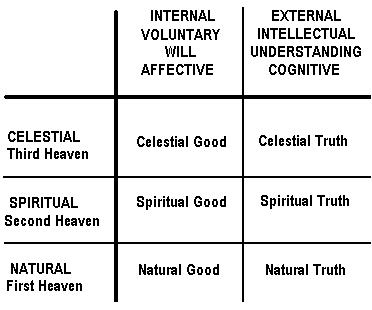
The three degrees of height in the mind correspond to the three heavens in the spiritual world. The celestial mind is in the Third Heaven. The spiritual mind is in the Second Heaven. The spiritual-natural mind is in the First Heaven. there is also an external natural mind below the spiritual-natural mind, but this is not shown on my diagram (bet see previous diagrams by Burnham discussed above).
Each of the three minds is composed of three organs--the affective organ, the cognitive organ, and the sensorimotor organ. I'm only showing the affective and cognitive organs in this diagram.
The affective organ is called "internal," "voluntary," and the "will." The cognitive organ is called "external," "intellectual," and the "understanding." Reception of Divine Speech inflowing from the Spiritual Sun will be first into the celestial mind through the Third Heaven. The spiritual mind then reacts to the celestial by correspondential connection. After this, the spiritual-natural mind reacts, also by correspondence. The reception of influx from the Spiritual sun is twofold. Spiritual heat enters the affective organ while spiritual light enters the cognitive organ. We receive celestial good in the affective organ of the celestial mind, and celestial truth in its cognitive organ. We receive spiritual good in the affective organ of the spiritual mind, and spiritual truth in its cognitive organ. We receive natural good in the affective organ of the spiritual-natural mind, and natural truth in its cognitive organ.
You can see from this anatomical description that Divine Speech proceeds from the Divine Human surrounded by the Spiritual Sun, and enters the minds of people in an orderly fashion in accordance with the anatomy of the mind and its receptor organs tied to each other by the laws of correspondence. The growth of the human mind is nothing but the reaction of our anatomy to spiritual heat and light streaming in from the Spiritual Sun. Spiritual heat is the substance of "good" and spiritual light is the substance of "truth."
This idea may present some difficulty in understanding unless you have a spiritual idea of the Spiritual Sun and the spiritual world, which is a world that overlaps with the human mind. The Spiritual Sun is a rational substance called Divine Truth within which is Divine Love. Spiritual heat and light streaming out of this Sun are therefore rational substances. Love (or good) is a rational substance called spiritual heat. Truth (or wisdom, intelligence, intellect, rationality) is a rational substance called spiritual light. The mind is constructed from birth onward by rational substances that correspond to our feelings and thoughts. Feelings and thoughts are nothing but the operation of the affective and cognitive organs, as they are bombarded by spiritual heat and light. When we think, our cognitive organ is reacting to the stimulation of incoming spiritual light. When we feel, sense, or intend something, our affective mind is reacting to the stimulation of incoming spiritual heat.
You can see from this that God is the source of our thinking and feeling through the inflowing spiritual heat and light form the Spiritual Sun. What flows from God cannot be separated from God, which means that the inflowing spiritual heat and light constitute God "in us." Sacred Scripture says that the Divine Human is in us and we are in the Divine Human. You can see now what this means. God is "in us" because spiritual heat and light are in our organs, and this originates from God and cannot be separated from God. Any person who experiences a good love and thinks a true thought, is in God and God is in that individual. This has nothing to do with religion or belief system. Atheists can love their family and country, and they can have the motive to be useful to society. These are good loves in which God dwells since all good loves originate from God and therefore remain God. It is the same with true ideas they may have--these are God in them even if they deny God's existence. But when they think about God and deny God's existence, God is not in that denial or irrational thinking. Instead, it is the hells that are in that kind of falsity and delusion.
Quoting from the Writings Sacred Scripture:
NJHD 191. These combats are caused by the truths of faith which are from the Word. From these the man ought to contend against evils and falsities; he cannot conquer if he combats from any other truths than these, because the Lord is not in any other. Since the combat is waged by the truths of faith, therefore, a man is not permitted to enter upon it, until he is in possession of the knowledges of good and truth, and until by means of them he has acquired some spiritual life; wherefore, such combats have no place with a man, before he has reached adult age. (NJHD 191)
The orderly development of the mind proceeds first in the sensual degree during infancy, then in the scientific degree during childhood, then in the natural-rational degree in early adulthood. After that begins reformation and regeneration, which takes the individual into more internal forms of the rational--first, spiritual-natural, then spiritual-rational, and at last, celestial-rational. These developmental steps are paced so that they tie to each other from the unconscious spiritual mind to the conscious natural mind. The natural mind contains three discrete degrees, as seen in prior diagrams, and they each correspond to the three degrees in the spiritual mind. The celestial-rational of the Third Heaven in the spiritual mind corresponds to the celestial-natural of the natural mind. The spiritual-rational of the Second Heaven in the spiritual mind corresponds to the celestial-natural of the natural mind. The spiritual-natural of the Second Heaven in the spiritual mind corresponds to the spiritual-natural of the natural mind. Below this is the natural-rational, which has a correspondence to the hells before it is regenerated, and afterwards, all levels of the natural mind correspond to the heavens.
Quoting from the Writings Sacred Scripture:
AC 3913. And she said, Behold my maidservant Bilhah. [analyzing a verse in the Old Testament Sacred Scripture Genesis 30:3]
That this signifies the affirming means which there is between natural truth and interior truth, is evident from the signification of a "maidservant" and also of a "handmaid" as being the affection of the knowledges that belong to the exterior man [= our natural mind]; and because this affection is the means for conjoining interior truths with natural or external truths, by "handmaid" is here signified the affirming means between them: and from the representation of Bilhah, as being the quality of this means.
By the handmaids given to Jacob by Rachel and Leah for women to the intent that they might bring forth offspring, nothing else was represented and signified in the internal sense, than such a thing as is of service; here, for a means of the conjunction of interior truth with external truth; for by Rachel is represented interior truth, and by Leah external truth (n. 3793, 3819). For by the twelve sons of Jacob are here described the twelve general or cardinal things by means of which while being regenerated or made a church, man is initiated into what is spiritual and celestial [= when we are being regenerated].
For when a man [=any individual man or woman] is being regenerated, or made a church (that is, when from a dead man he is becoming alive, or from corporeal heavenly), he is led by the Lord [= the Divine Psychologist] through many states [= developmental states]. These general states are what are designated by the "twelve sons," and afterwards by the "twelve tribes;" for which reason the "twelve tribes" signify all things of faith and love, as may be seen above (n. 3858); for generals involve all the particulars and singulars, and these latter bear relation to the former.
[2] When a man is being regenerated, the internal man [= spiritual mind] is to be conjoined with the external [= natural mind], consequently the goods and truths of the internal man with the goods and truths of the external; for from truths and goods man is man [= why we are human rather than animal]. These cannot be conjoined without means [= intermediate mental states]. Means are such things as derive something from the one side [= spiritual mind], and something from the other [= natural mind], and which are attended with the effect that insofar as the man accedes to the one [= to the spiritual mind], the other [= the natural mind] becomes subordinate [= we are then regenerating for heavenly life]. These means are what are signified by the "handmaids," the means on the part of the internal man by the handmaids of Rachel; and the means on the part of the external man by the handmaids of Leah. [= In the Old Testament story, Rachel is Jacob's wife from love; Leah is his wife by arrangement.]
[3] That there must be means of conjunction may be seen from the fact that of itself the natural man does not in the least agree with the spiritual man, but disagrees so far as to be altogether opposite [= prior to regeneration we enjoy mostly hellish traits]. For the natural man regards and loves himself and the world; but the spiritual man does not regard himself and the world, except insofar as is conducive to the promotion of uses in the spiritual world [= our life after resuscitation]; and thus regards its service and loves it from the use and end [= our spiritual mind loves only heavenly traits]. The natural man [= our life prior to regeneration] seems to himself to have life when he is elevated to dignities, and thus to supereminence over others; but the spiritual man [= our life after regeneration starts] seems to himself to have life in humility, and in being the least.
Nor does he disregard dignities, provided that by them as means he can be of service to his neighbor, to the community, and to the church. Yet he does not reflect for the sake of himself upon the dignities to which he is elevated, but for the sake of the uses which he regards as the ends [= when regenerating we are altruistic]. The natural man [= our life prior to regeneration] is in his bliss when he is richer than others, and possesses the world's wealth; but the spiritual man [= once we start regenerating] is in his bliss when he is in the knowledges of truth and good [= theistic psychology], which are his riches; and still more when he is in the practice of good according to truths [= uses truths to regenerate]; and yet he does not despise riches, because by means of them he can be in that practice, and in the world [= when regenerating we can pursue a normal life].
[4] From these few considerations it is evident that the state of the natural man and that of the spiritual man are opposed to each other by their ends; but that nevertheless they can be conjoined, which takes place when the things of the external man are made subordinate and subservient to the ends of the internal man [= we think and act in agreement with truths]. In order therefore that a man may become spiritual [= begin regeneration], it is necessary for the things of the external man to be reduced to compliance; thus that the ends in favor of self and the world be put off; and ends in favor of the neighbor and the Lord's kingdom [= our life after resuscitation] be put on. The former can by no means be put off and the latter put on, and thus the two be conjoined, except through means [= intermediate mental states]. These means are what are signified by the "handmaids," and in particular by the "four sons" born of the handmaids.
[5] The first means is one that affirms or is affirmative of internal truth-that it is so [= adopting the positive bias in science]. When this affirmative comes [= when we are willing], the man is in the beginning of regeneration; good is being worked by the internal, and causes the affirmation. This good cannot inflow into what is negative, nor even into what is full of doubt, until this becomes affirmative. But afterwards it manifests itself by affection [= we love studying theistic psychology], that is, by the man's being affected with truth [= we love finding out God's truth], or beginning to be delighted with it; first in knowing it, and then in acting according to it.
Take, for example, the truth that the Lord [= Incarnated Divine Human, now the Divine Psychologist in everyone] is the salvation for the human race. Unless this is made affirmative by the man, all the things he has learned from the Word or in the church concerning the Lord [= our knowledge of theistic psychology], and that are in his natural memory among the memory- knowledges, cannot be conjoined with his internal man, that is, with what can be there of faith [= rational understanding of truths]. Thus neither can affection flow in, not even into the generals of that truth which are conducive to man's salvation. But when it becomes affirmative, innumerable things are added, and are filled with the good that flows in; for good continually flows in from the Lord, but where there is no affirmative, it is not received. An affirmative is therefore the first means, and is as it were the first abode of the good that flows in from the Lord. The same is the case with all the other truths that are called truths of faith. (AC 3913)
The above passage discusses how regeneration takes place, namely when our every day conscious natural mind is rearranged to fit our spiritual mind which contains truths and goods from the Divine Psychologist. This rearrangement must be accomplished by our own mental efforts, especially engaging in combat of temptations. This means that we monitor our thoughts and feelings all day long and try to talk ourselves out of thinking or doing something that is contrary to the truths we understand. To exert this effort regularly as part of our daily life is the spiritual discipline called regeneration. As we do this more and more, we advance in regeneration more and more. Our character changes from egotistical and irresponsible to altruistic and wise. We live a virtuous life motivated by the desire to be useful to others and society. We love this because it is heaven. Upon resuscitation we come into this heaven and we exist there in conjugial love with our soul mate among other conjugial couples forming a spiritual society in eternity.
Prior to regeneration there is a dissociation between the spiritual and natural minds. The spiritual mind cannot bring about any changes in the natural mind because the natural mind reacts in opposition to it. After regeneration there is a consociation between them so that the natural mind reacts by correspondence to the spiritual mind and the two are in agreement. We are then called angels, even though we still continue to develop more and more towards that final goal. Quoting from the Writings:
When a man's interior is purified from evils by desisting from them and shunning them because they are sins, then the internal is opened, which is above it, and which is called the spiritual internal. This communicates with heaven; hence it is that a man is then introduced into heaven, and conjoined to the Lord.
There are two internals with man, one beneath and the other above. The internal which is beneath is that in which a man is, and from which he thinks, while he lives in the world, for it is natural. This, by way of distinction, we shall call the interior. But the internal which is above is that into which a man comes after death when he comes into heaven. All the angels of heaven are in this internal, for it is spiritual. It is this internal which is opened to the man who shuns evils as sins, but it is kept closed to the man who does not shun, evils as sins.
[3] The reason why this internal is kept closed to the man who does not shun evils as sins is, that the interior, or natural internal, before man becomes purified from sins, is hell; and so long as hell is there, heaven cannot be opened; but as soon as hell is removed, then it is opened. It must be known, however, that the spiritual internal and heaven are opened to man, so far as the natural internal is purified from the hell which is there; and this is not effected at once, but by degrees successively. From these things it is evident that a man of himself is hell, and becomes heaven by the Lord. Consequently, that he is rescued from hell by the Lord, and raised up to Himself into heaven, not immediately, but mediately, the means being the precepts just mentioned, by which the Lord leads him who is willing to be led. (AE 940)
The first paragraph in the passage above says that the internal spiritual mind "is opened," that is, activated and made operational, when the natural mind is "purified from evils by desisting from them and shunning them because they are sins." This refers to character reformation during which we apply the doctrine of truth from Sacred Scripture to our willing and thinking in daily activities. The Divine Psychologist arranges for us to have a particular temptation experience which gives us the opportunity to (a) witness the evil enjoyment or false idea we have, and (b) shun it as sin, which means to separate yourself from the evil enjoyment or false idea, to turn away from it as from hell itself see Section xx). This act of dissociation and turning away allows the Divine Psychologist to cut the inherited ties to the hells. This liberation from some hell society is called "when a man's interior is purified from evils."
The second paragraph contrasts the external conscious natural mind with the internal unconscious spiritual mind. When we enter the afterlife at death we are resuscitated as a spirit with a spiritual body and without a physical body. Now our external mind is laid to rest and rendered non-operational and we begin our life in eternity in our spiritual mind. Obviously, this mind had to be formed all along while we were on earth, otherwise we would fall into a coma when the natural mind is rendered completely non-operational at the second death (see Section xx). If at that point we became conscious in a spiritual mind that was not actually ours all along, we would not be who we are and we would be a stranger within. This cannot possibly form the basis of a heavenly life because our heaven has always been the state of fulfillment of our desires, our desires and loves, which we cumulatively formed during our growth on earth.
Hence it is that the content of the spiritual mind, though unconscious here on earth, nevertheless is our very own, and is nothing but the internal form of the loves we had on earth in the natural mind. There is a precise correspondence between every detail of content in our natural mind, and every corresponding detail of content in the spiritual mind. For instance, suppose you love playing sports. You love how you feel, you like the aftereffects, you like to rehearse events in your mind, you like to read about, talk about it, do it regularly over and over. This is the conscious love of sports that you have in your natural mind here on earth. You could not enjoy this love or have it unless it was acquired by cooperation from your unconscious spiritual mind. The love of sports you are conscious of is just the external form of the love of people that is in your unconscious mind.
The love of people in your unconscious spiritual mind corresponds to the love of sports in your conscious natural mind. The spiritual love is inside the natural love, and gives it life, which you experience as enjoyment, fun, interest, focus, involvement, excitement, satisfaction, etc. These are the things you actually love--enjoyment, fun, interest, etc., and these are the external forms of the love of people, which you are not even conscious of. You think it's something else. You think your love of sports has to do with your love of winning, competing, mastering. Now at your second death, the love of sports itself is laid to rest with the natural mind, and your consciousness becomes alive in your spiritual mind which contains the inside of that love--love of interacting with people. The external form of this love is gone, and you don't miss it. Now you are focused on the internal of the love which you had all along. So you lost nothing, and gained a lot, because the internal of every love is an entire degree more intense than its external form.
This is the case with all your loves. When you awaken in your spiritual mind you find everything there completely familiar and so intense that you become far more alive than before.
Swedenborg reports that when people then enter the heaven in their mind, everything looks familiar, like a homecoming--the people greet you like old family, you recognize the house on the street that belongs to you because it is the correspondential embodiment of your unconscious ideals of what a house should look like. We all begin our life of immortality in this state of complete familiarity but extraordinary intensity.
And if your dream house was a hellish mansion where evil enjoyments go on, that's what you enter, and you feel ecstatic that at last you have your most secret and unconscious dreams come true. But this mental state of excitement does not last as you discover that the evil enjoyments you have are not your own. They belong to evil societies that are much deeper in the hells, people who want to be devils, and satans, and genii, who then become your masters in hell. Your excitement and fun quickly turn into vile slavery to task masters that hate you and love to make you suffer. In heaven on the other hand, you discover that your enjoyments come from altruistic societies made of people who have entered the highest heaven in their mind, which is near God. From that place of superlative humanity they beam their ecstatic bliss to those who dwell farther from the Spiritual Sun.
As you study theistic psychology you acquire the skill of anticipating, or knowing in advance, what you will be like in your immortality. You can know this in general terms, even if not in specific detail, if you reflect on the anatomy of your mind, and the content of the loves and truths to which you are holding on to. Examine the hierarchy of your loves. Use your knowledge of the mind's anatomy to follow some love from its external manifestation in your conscious natural mind, to its internal origin in your unconscious spiritual mind. Many loves are characterized in Sacred Scripture so you can map our your connections with the spiritual societies. Daily self-witnessing practice is critical in the task of identifying our loves (see Section xx).
5.1.1.11 Regeneration of the Adult Mind
So far we have established the two principal mechanisms by which God grows the human mind while we are still in this life:
(a) by the use of the vertical community by which people who
already dwell in their heavens ("angels") or hells ("devils"), become the source
or "influx" for the correspondential content of our affective and cognitive organs
in our everyday conscious natural mind;
and
(b) by the anatomical layering of the mind in
correspondential degrees, with two main interdependent portions, one
unconscious (spiritual mind), the other conscious (natural mind).
The "influx" of spiritual feelings and thoughts is received by the corresponding layers of the unconscious spiritual mind (also called the internal mind). This forms the unconscious content of the spiritual mind called "remains" and consists of spiritual feelings and thoughts that live in the heavenly layers of our spiritual mind. The chief love in the unconscious spiritual mind is the ruling love with which the feelings of angel people inflow--altruism or the love of being useful to others, coupled with the desire of avoiding doing anything that might hurt or inconvenience others. The chief love or striving in the unconscious spiritual mind becomes by correspondence in the conscious natural mind, the truth of doctrine from Sacred Scripture arranged in rational order (i.e., theistic psychology). This truth of doctrine is that God the Divine Human is the source of all good and truth that are with us, and that everything we have that is our own from our self-intelligence, is nothing but evil and delusional. The contrast here is between all that we have that is from God and heaven (which is good), vs. all that we have from others or ourselves (which is from hell). Other truths follow from this one, and they are all insinuated by God into the spiritual mind and arranged in an orderly fashion as the individual grows from infancy, to childhood, to young adulthood, to adulthood and old age. Then, at death and resuscitation, the person becomes an angel person in the full bloom of youth, for conjugial life in eternity.
But things can go wrong in this process due to interference by the individual, that is, lack of cooperation with God, which restricts the growth of the mind into non-heavenly pathways.
Quoting from the Writings Sacred Scripture:
AR 510 [2] What is specifically meant by this expression, shall be explained: Every man who is reformed, is first reformed as to the internal man, and afterwards as to the external. The internal man is not reformed by merely knowing and understanding the truths and goods by which man is saved, but by willing and loving them; but the external man, by speaking and doing the things which the internal man wills and loves, and, in proportion as this takes place, in the same proportion man is regenerated.
The reason why he is not regenerated before, is, because his internal is not before in the effect, but only in the cause, and, unless the cause be in the effect, it is dissipated. It is like a house built upon ice, which sinks to the bottom when the ice is melted by the sun; in a word, it is like a man without feet to stand and walk upon. It is the same with the internal or spiritual man, if it is not founded on the external or natural man. (...)
This is what is meant also by the Lord's words to Peter:
Peter said, Thou shalt not wash my feet only, but also my hands and my head. Jesus said to him, He that is washed needeth not save to wash his feet, and the whole is clean (John 13:9-10).
(AR 510)
AC 7442. [2] How it is that the interiors also of the natural mind shall be taken possession of by the falsities of evil which are in the outermost parts of this mind, must be briefly told. The things that flow in with man through heaven from the Lord, flow into his interiors, and advance down to the ultimates or outermost parts, and there they are presented to man in a sensible form, consequently they flow down into the sensuous, and through this into the things of the body. If the sensuous has been filled with phantasies from fallacies and appearances, and especially if it has been filled with phantasies from falsities, then the truths which flow in are there turned into similar things, for they are received there according to the form that is induced on them (see n. 7343). Insofar also as truths are turned into falsities, so far the interiors through which they pass are closed, and at last there is no opening beyond that which is necessary for a sufficient transflux to confer the faculty of reasoning, and of confirming evils by means of falsities.
[3] Such being the case with man, it must needs be that while he is being regenerated his natural must be regenerated down to the sensuous; for unless this is regenerated, there is no reception of truth and good, because, as before said, the inflowing truth is there perverted, and then the interiors are closed. And therefore when the exteriors have been regenerated, the whole man has been regenerated, as was signified by the Lord's words to Peter when He washed his feet:
Simon Peter said unto Him
Lord, wash Thou not my feet only, but also my hands and my head. Jesus said to him, He that hath been bathed needeth not save to have his feet washed, and is clean every whit (John 13:9-10);
by the "feet" are signified natural things (n. 2162, 3761, 3986, 4280, 4938-4952); by "washing" is signified purifying (n. 3147, 5954); by "hands" are signified the interiors of the natural; and by the "head" spiritual things; hence is plain what is meant by "him that hath been bathed needing only to have his feet washed, and being clean every whit," namely, that a man has already been regenerated when he has been regenerated also in respect to the exteriors that belong to the natural. When therefore man has been regenerated also in respect to the natural, then all things therein have been made subordinate to the more interior things; and when these flow in there, they flow as into their generals, by which they present themselves to man in a sensible form. When this is the case with a man, he sensibly feels the affection of the truth that is of faith, and the affection of the good that is of charity.
[4] But the sensuous itself, which is the ultimate of the natural, can with difficulty be regenerated, because it has been filled with material ideas from things earthly, bodily, and worldly. Therefore the man who is being regenerated, especially at this day, is not regenerated as to the sensuous, but as to the natural which is next above the sensuous, to which he is elevated by the Lord from the sensuous, when he is thinking about the truths and goods of faith. The man who is being regenerated by the Lord is endowed with the capacity of elevation from the sensuous. With respect to the nature of the sensuous, and the elevation of the thought above it, see n. 5084, 5089, 5094, 5125, 5128, 5767, 6183, 6201, 6310, 6311, 6313, 6314, 6316, 6318, 6564, 6598, 6612, 6614, 6622, 6624, 6844, 6845, 6948, 6949.)
(AC 7442.)
The development of the unconscious spiritual is dependent to some extent on the individual's cooperation at the conscious level of the natural mind. The two minds are locked into each other for functioning, so that the spiritual mind cannot progress to its layering and development without the correspondential reaction of the conscious natural mind, thus of the individual's voluntary cooperation. Since we are born with a corrupted natural mind connected to the hells, our feelings and thoughts react in opposition and resistance to the heavenly content of the spiritual mind. The angels' altruistic loves and principles of living may inflow the spiritual layers of the mind, but this content cannot be fixed into the affective and cognitive organs without the correspondential reaction of the lower natural layers to which God gives us control. The "remains" that are placed in our unconscious mind are not ours to use in the afterlife unless we make them ours in this life. This is called "appropriating" the loves to self.
Altruistic loves and the truths of doctrine from Sacred Scripture, cannot be appropriated by the inherited "old will" which must first be reformed and regenerated. We must suffer ourselves to undergo temptations and to battle them with the truth of doctrine from Sacred Scripture. Then we acquire a "new will" which is suitable to react by correspondence to the remains in our unconscious spiritual mind. Then only do these remains become ours, part of the new proprium by which we can enter the heavens in our mind (see Section xx).
The spiritual influx progresses in three discrete layers from
celestial-rational (Third Heaven -- red), to
spiritual-rational
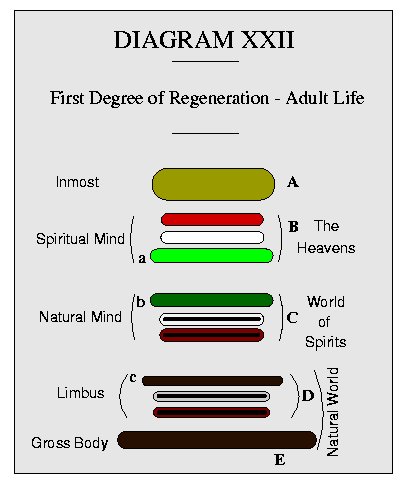 (Second Heaven
-- white), to
spiritual-natural (First Heaven -- a
light green). These are the three layers of the unconscious
spiritual mind (B The Heavens) that will serve us in the afterlife. These three layers of the
mind overlap totally with the three layers of the spiritual world, which is the
mental world of the afterlife in eternity (see
Section xx). Simultaneously, this downward progression or "descent" is matched
by a corresponding upward progression of the conscious natural mind, called
"ascent." The descending and ascending layers match each other perfectly. This
interdependence may be seen once more in the accompanying Burnham diagram.
(Second Heaven
-- white), to
spiritual-natural (First Heaven -- a
light green). These are the three layers of the unconscious
spiritual mind (B The Heavens) that will serve us in the afterlife. These three layers of the
mind overlap totally with the three layers of the spiritual world, which is the
mental world of the afterlife in eternity (see
Section xx). Simultaneously, this downward progression or "descent" is matched
by a corresponding upward progression of the conscious natural mind, called
"ascent." The descending and ascending layers match each other perfectly. This
interdependence may be seen once more in the accompanying Burnham diagram.
The celestial influx into the spiritual mind descends through the three layers shown in B (red, white, green) and this descent is matched by the ascent in the natural mind C (dark red, grey, dark green). Layer a (light green) is the spiritual correspondence to layer b (dark green). This is the state reached prior to regeneration, during growth of the mind form infancy to early adulthood. Layer b is the highest development of the natural mind and is called the natural-rational mind. Layer a is the lowest development of the spiritual mind and is called the spiritual-natural heaven.
When reformation and regeneration begin in adult life the process of growth now continues in an inverse order. Regeneration starts with reformation of the natural-rational mind (b--dark green) by means of the doctrine of truth from Sacred Scripture. It is our conscious rational concepts that are first purified and realigned to the internal spiritual truths that have been deposited in layer a (First Heaven). This is now our opportunity to enter our First Heaven while we are still on earth. The content of the First Heaven is composed of spiritual-natural correspondences of Sacred Scripture while the content of the natural-rational mind is composed of the literal meaning of Sacred Scripture. When these two are locked into one another, portion a is actually within b. In other words, b is made alive by a. This is called enlightenment because we now read Sacred Scripture in such a way that we see its meaning by "heavenly light," which is the spiritual light streaming from the Spiritual Sun. Our thinking and willing becomes more and more heavenly as the conscious natural mind (b) is regenerated.
But this growth process in the natural-rational mind cannot become permanent unless our regeneration descends into the middle layer of C (grey), which is the "scientific" layer of knowledges in our mind. To the extent that this scientific layer is regenerated, to that extent the middle layer of the spiritual mind in B (white) is fixed within the natural layer, enlightening us as to our perception and understanding of the natural world around us. We now can consciously see the spiritual within the natural, whereas before we only saw the natural as if that's all there was. Finally, the lowest portion of the natural mind is regenerated in C (dark red). This is called the sensuous-natural mind, and to the extent it is regenerated, to that extent the celestial-rational mind in B (red) descends into the sensuous-natural mind and vivifies it and enlightens it.
Regeneration is therefore an orderly process of the growth of the human mind. Every descending step in the conscious mind is matched by an ascending step in the unconscious mind until the entire mind is regenerated and made heavenly through influx. The entire process is managed by God and requires the conscious voluntary cooperation of the individual. This cooperation requires two steps: (a) acquiring the truth of doctrine from Sacred Scripture; and (b) applying it to our thinking and willing in daily activities. This is how Burnham summarizes the process:
This first step in adult regeneration, may be elucidated. The lowest degree of the spiritual mind a having been previously stored with good and truth is prepared for the man's entrance into it; he then rises into it and plants therein the interior seat of his thought and affection. Thus he begins to be a distinctively spiritual man but has not yet become so, especially not permanently so. To ensure this result the highest degree of his natural mind b and the corresponding plane of the limbus c must be cleansed of evil and falsity and appropriate good and truth adopted in their stead. (A.C. 3539 and 6724.)
Evil and falsity can be removed only by combat in obedience to the Divine command to shun them as sins, for the LORD can work in man to remove his disorders only when man co-operates with Him. (A.E. 790 [b].) This combat is waged by good and truth on the LORD's side against evil and falsity assaulting on the other. The goods and truths immediately brought into use as the hosts of the LORD in this combat are those already stored in these degrees (b and c) during youth, But these goods and truths cannot combat and expel the evils and falsities from these degrees except as infilled and animated by the higher goods and truths in a of the spiritual mind.
Thus the combat is primarily between the spiritual mind and the evils and falsities of the natural mind. The spiritual mind however fights from its own goods and truths by the goods and truths of the natural mind. (A.C. 6724, A.E. 176, 790.) Then the spiritual rests securely on the natural and the man thereafter holds his interior seat in that lowest degree of the spiritual mind. This degree of the natural mind is now conjoined with the spiritual and makes one with it. The man dying in this state goes to the lowest or natural heaven because he is regenerate to the natural degree of his spiritual mind and to the corresponding degree of his natural mind. This first great step of regeneration requires years for its accomplishment, with most persons, many years. Neither does it always actually commence at twenty-one years of age.
You can follow the citations he gives to the Writings to see more details of the process.
We begin the growth of our mind in external consciousness in the natural mind, but as we are regenerated, we enter progressively more and more into interior consciousness in our spiritual mind. This is the basis of our immortality. Quoting from the Writings:
Unless the natural assists no birth of interior truth is possible, since it is the natural that receives interior truths into its bosom once these are born; indeed it is the natural that enables them to push their way out. The same applies to instances of spiritual birth, in that reception must take place wholly within the natural. This is the reason why, when a person is being regenerated, the natural is first of all made ready to receive, and to the extent it is then able to receive, interior truths and goods are able to emerge and multiply.
This also explains why, if the natural man has not been made ready during the life of the body to receive the truths and goods of faith, that person cannot receive them in the next life and so cannot be saved. This is the implication of the common saying 'As the tree falls, so it must lie', meaning, What a person is when he dies, so he comes to be.
For a person has with him in the next life his whole natural memory, that is, the memory belonging to his external man, though he is not allowed to use it in that life, 2469-2494. In the next life therefore that memory serves as the groundwork on which interior truths and goods rest; but if that groundwork is not able to support the goods and truths which flow into it from within, interior goods and truths are either annihilated, or perverted, or cast aside. (AC 4588)
The spiritual mind we need in our immortality cannot develop by itself, or else God could create human beings directly in heaven, by passing life and evil in earthly life. God doesn't do this because it is not rationally possible. In order to have a spiritual mind that we accept as our very own for our life in eternity, it must be established as our own. Prior to regeneration we all have celestial loves and concepts in the spiritual mind by influx from the angels, as explained above. But this is not our own. It is borrowed goods. We cannot keep it or use it after we enter the world of spirits--unless they have been made our own. This process of making them our own is achieved through regeneration (see Section xx). That's when we appropriate to ourselves the celestial loves and truths that have been unconsciously implanted in the spiritual mind during growth on earth.
5.1.1.12 The Adult Unregenerate Hellish Mind
Diagram XXV depicts
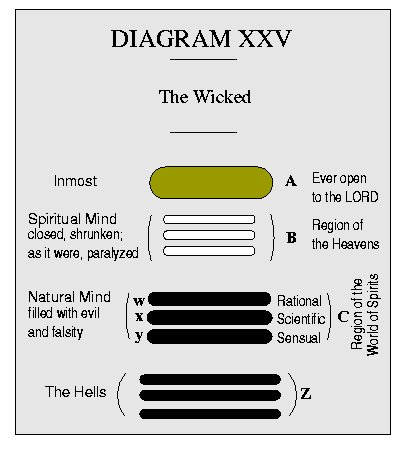 "the
wicked" which is the phrase used by Sacred Scripture to refer to the adult
mind that has not been regenerated and therefore comes into hell upon the second
death. Hell is already in such a mind prior to the death of the body and so
those who are resuscitated gravitate inexorably to the company of those who
dwell in the hell and in whose company they have been in while on earth. The
intentions and feelings we have when we are in this state are those that they
have in the hells of their mind, and when we come into conscious contact with
them, at our resuscitation, we acclaim them as our companions and long lost
friends, so familiar do they seem to us then, having been with them in our
feelings and intentions while still on earth.
"the
wicked" which is the phrase used by Sacred Scripture to refer to the adult
mind that has not been regenerated and therefore comes into hell upon the second
death. Hell is already in such a mind prior to the death of the body and so
those who are resuscitated gravitate inexorably to the company of those who
dwell in the hell and in whose company they have been in while on earth. The
intentions and feelings we have when we are in this state are those that they
have in the hells of their mind, and when we come into conscious contact with
them, at our resuscitation, we acclaim them as our companions and long lost
friends, so familiar do they seem to us then, having been with them in our
feelings and intentions while still on earth.
The spiritual mind pictured in the diagram at B, is pure and white, and communicates with the three heavens. This is the hellish person's unconscious spiritual mind, and it is "closed, shrunken, paralyzed" and rendered non-operational. This is because they become operational only when the natural mind cooperates by not opposing. When we have developed thoughts and intentions that are wicked, that is, antisocial and selfish, the natural mind resists the spiritual mind, but is accepting of the hells, shown in Z in all black.
Note that there are three degrees in the mind where we have our hells, just as there are three degrees in the mind where we have our heavens. The three degrees of the hells communicate and flow into the corresponding three degrees of the unregenerate natural mind in C--sensual, scientific, rational. Those who dwell in the three degrees of hell are called evil spirits, devils, satans, dragons, serpents, Lucifer, sirens, and genii, depending on which of the three degrees of evil they specialize in and in what combination. The first or less grievous hells have the rational mind especially corrupted (w). The second or intermediary hells have the scientific mind especially corrupted (x). And the third or most grievous hells have the sensual mind especially corrupted (y).
The Writings reveal that those who dwell in the hells of their mind are fond of the odor of excrement and corpses. Quoting:
It is to be known that falsities and evils of every kind correspond to unclean and loathsome things in the natural world, and the more direful falsities and evils to things pertaining to dead bodies and to fetid excrementitious things, and the milder falsities and evils to things pertaining to swamps; consequently the dwelling-places in the hells of those who are in such falsities and evils appear like pits and sepulchers; and if you will believe it, such evil genii and spirits also have their abode in the sepulchers, privies, and swamps that are in our world, although they do not know it; this is so because they correspond, and the things that correspond conjoin.
The same conclusion may be drawn from this, that to those who have been assassins and poisoners, and to those who have perceived delight in violating women, there is nothing more delightful than the odor of a corpse; and to those who have been eaten up with the love of ruling, and to those who have taken delight in adulteries, and no delight in marriages, there is nothing more delightful than the odor of excrement; and to those who have confirmed themselves in falsities, and have extinguished in themselves the affection of truth, there is nothing more delightful than the odor of a swamp and of urinous places. This is why the hells in which they dwell appear according to the corresponding delights, some like pits and some like sepulchers. (AE 659)
It has also been granted me to know the nature of the most crafty sensual men. Their hell is deep down, and behind, and they do not desire to be conspicuous. Therefore, they appear hovering about there like spectres, which are their fantasies; and they are called genii. Some of them were once sent out from that hell that I might know their character. They at once directed their influence to my neck beneath the occiput and from there they entered my affections, not wishing to enter my thoughts, which they dexterously avoided. They then kept changing my affections one after another with the design of bending them imperceptibly into their opposites, which are lusts of evil; and as they did not in the least touch my thoughts they would have bent and inverted my affections without my knowledge had not the Lord prevented this.
[5] Such do those become who in the world do not believe there is a Divine Providence, and who search out in others nothing but their cupidities and desires, and so lead them on till they acquire an ascendency over them. As they do this so secretly and craftily that others do not know it, and as these after death become like themselves, therefore immediately after their arrival in the spiritual world they are sent down into that hell. When seen in the light of heaven they appear without any nose; and what is wonderful, although they are so crafty yet they are more sensual than the rest. (DP 310)
It has been believed hitherto in the world that there is one devil who presides over the hells; that he was created an angel of light; but having become rebellious he was cast down with his crew into hell. This belief has prevailed because the Devil and Satan, and also Lucifer, are mentioned by name in the Word, and the Word in those places has been understood according to the sense of the letter. But by "the devil" and "Satan" there hell is meant, "devil" meaning the hell that is behind, where dwell the worst, who are called evil genii; and "Satan" the hell that is in front, where dwell the less wicked, who are called evil spirits; and "Lucifer" those who belong to Babel, or Babylon, who reach out their powers even into heaven. That there is no one devil to whom the hells are subject is evident also from this, that all who are in the hells, like all who are in the heavens, are from the human race (see n. 311-317); and that those who have gone there from the beginning of creation to this time amount to myriads of myriads, and every one of them is a devil of such a nature as was his opposition to the Divine while he lived in the world (see above, n. 311, 312). (HH 544)
Just as heaven, deriving as it does from the Lord, constitutes through mutual love one human being and one soul so to speak, and consequently has one end in view, which is to preserve and save all men eternally, so conversely does hell, deriving as it does from the proprium, constitute through self-love and love of the world, that is, through hatred, one devil and one frame of mind (animus), and consequently has one end in view, which is to destroy and condemn all men eternally. That this is the nature of their endeavors I have perceived thousands and thousands of times. Unless therefore the Lord were preserving everybody in every fraction of a moment, man would perish. (AC 694)
Some have brought with them from the world the idea that they must not talk to the devil but flee from him. They have been informed however that nothing at all could harm people whom the Lord is protecting, not even if the whole of hell were surrounding them, both from without and from within. This I have been given to know from many amazing experiences. Such were those experiences that in the end I had no fear at all, not even of the worst of the hellish crew, to deter me from talking to them.
I have also been granted such experiences so that I might get to know what the members of that crew are like. To people who have marveled that I have spoken to them I have been allowed to say further that not only would this do me no harm but also that devils in the next life have previously been men who went through life in the world hating, getting revenge, and committing adultery. I have said that some of them at the time were highly respected people, and indeed that some of them are people whom I had known during their lifetime.
I have also been allowed to say that 'devil' means nothing else than such a crew in hell, and in addition that people while living in the world have present with them at least two spirits from hell, as well as two angels from heaven, and that these hellish spirits though ruling among the wicked have among the good been overpowered and made subservient. Thus it is wrong to think of some devil existing since the beginning of creation other than those who have previously been men. When people have heard all this they have been dumbfounded and have confessed that they have held an altogether different opinion concerning the devil and his crew. (AC 968)
5.1.1
5.1.2 Structural and Functional Relations in the Mind or Spiritual Body
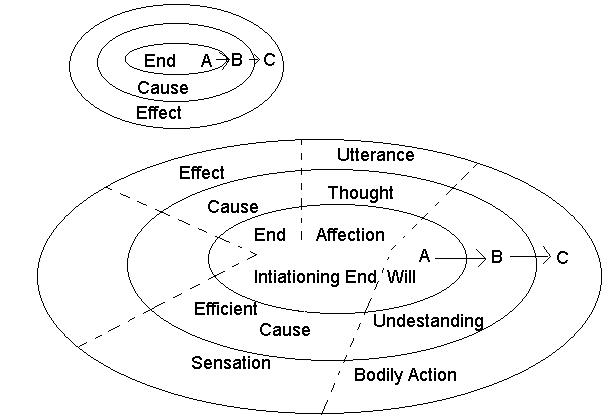
(From: www.soc.hawaii.edu/leonj/499s98/shintani/logos.html )
We are born dual citizens of the universe, with a physical body on some planet in the natural world, and a mental body in the world of spirits. Human beings on earth are therefore spirits temporarily tied to a physical body. Both the physical body and the mental body grow and develop together, locked into step by the inexorable laws of correspondences that governs the relation between natural and spiritual events. When the physical body dies, the mental body in the world of spirits is liberated and we continue a life of immortality in either the heavens of our mind, or the hells, depending on what we love more. The immortal mental body houses the affective, cognitive, and sensorimotor organs of our mind which contain our threefold self--our character and memories.
The mental body in the world of spirits is surrounded by an external atmosphere and a social environment just like the physical body on earth. The atmosphere around the mind is made of rational ether created by the Spiritual Sun, just as the atmosphere around the physical body is made of physical ether and gases created by the natural sun. The social environment of the mental body is created by the presence of other spirits. The interaction between spirits depends on their state of mind.
While we are still tied to a physical body on earth our conscious self is immersed in the natural mind and we are not conscious of spirits who are in the presence of our mental body. We are only conscious of what enters the natural mind through our sensorimotor organ that reacts directly to the sensorimotor apparatus of the physical body. Swedenborg reports that our mental body is visible to the spirits in the world of spirits but they are not allowed to approach it. A distinct odor familiar to spirits emanates and surrounds our mental body, and this special odor keeps them from approaching us. We are not aware of them because our awareness is restricted to the sensorimotor input from the physical environment.
There is however another type of communication between our mental body and the spirits in the world of spirits. This is called our vertical community (see Section xx). God connects us and disconnects us from various spirits on a moment by moment precise timing procedure. This process allows God to completely control what operations are going on in an individual's mind. Without controlling every thought and feeling in people, God could not control the events of the world and universe. The overall or general events are made up of the little individual events and so these have to be controlled in order to control the whole.
The process of connecting and disconnecting our mind with other spirits is called "influx." The diagram below shows that influx enters the affective organ, not the cognitive organ. Influx excites particular elements in the affective organ, the result of which is that we experience a particular kind of feeling. There is a correspondence between this feeling or emotion that we experience and the ruling love of the spirits who initiated the influx. Spirit societies in the heavens and the hells are arranged in a hierarchy that reflects their ruling loves. For instance, among the spirits of hell, the love of destroying innocence is a different ruling love from avarice, which is different from cruelty or illicit sex. Among spirits of heaven, the love to protect children is different from the love to acquire knowledges or to the environment clean. Every heavenly and hellish trait in human beings is traced back to a spiritual society where all its members have that one trait as a ruling love. Influx is the method by which they communicate this ruling love to those on earth. Through this exchange, which is automatic and completely controlled by God, they are able to experience fulfillment of their ruling love. Look at the diagram below.
Spiritual influx enters the affective organ where we have the DNA record of all our inherited traits. The organic record of that particular love is now activated by the particular influx. The result is that we have an experience in our consciousness that we call a feeling or a preference, also, a need or impulse, also, a longing, desire, motive, goal, or intention. These are all sub-varieties of what are called affections and loves in the good sense, and in the bad sense, infernal loves, lusts, and cupidities.
The spirits who originate the influx also experience something, which they find highly rewarding, though they do not know that it comes from us to them. The Writings describe how the process works. The affections that are aroused by the influx into our affective organ, now seeks out a cognitive partner it can ally itself with. This built in. Every affection has the property of seeking out a cognition that is compatible with it, like in a marriage, and the two as a couple, then produce offspring. In this case the offspring is the outward behavior, as shown in the diagram above.
Both the spirits and us feel most rewarded when the influx starts a chain of events that culminate in the outward behavior. For instance, God connects us with a spirit society whose ruling love is to hurt others by first befriending them and then treating them cruelly. As a result, we instantly experience a desire or impulse to hurt someone we are at that moment talking to. Our cognitive skills respond to the affective impulse by thinking of how to ridicule this person. Suddenly we say something out loud that is insulting to the person we are talking to. This closes the loop if influx. We experience an immediate enjoyment when we realize our insult has worked and the person is hurt. The spirits who originated the influx now experience a full completion and satisfaction of their own love to be cruel and hurt others.
What's amazing is that neither the spirits nor us have any inkling of the intimate way we are untied to each other during that moment of fulfillment. In fact, the spirits have the illusion that the thoughts we had in the selection of the insult, were their thoughts! They are not aware of us, but they are aware of our thoughts, and so they have no other choice but to experience them as their own thoughts responding to their own loves. Similarly, when we experience their loves of the moment, we are not aware of their presence so that we have no choice but to experience those loves as our very own.
As the diagram shows our loves in the affective organ are inherited, while our thoughts in the affective organ are acquired through cultural experience in the physical world. Spirits are no longer tied to the physical world and so are not capable of having new cultural content enter their thoughts. They are starved for new thoughts that could combine with their old loves so that these may be revitalized, as in anew marriage. They depend on us to supply the new cultural content through the thoughts we have in response to their loves. There is thus a perfect mutual balance and dependence between people still on earth and people who have already passed into their life of immortality.
The natural world and spiritual world are thus perfectly dependent on each other and neither can be removed without destroying the other. For us who are still on earth to develop and grow, we need influx. And once we enter our life of eternity in the mind, we join the existing spirit societies and provide influx for the new people born on some earth. (See also Section xx.)
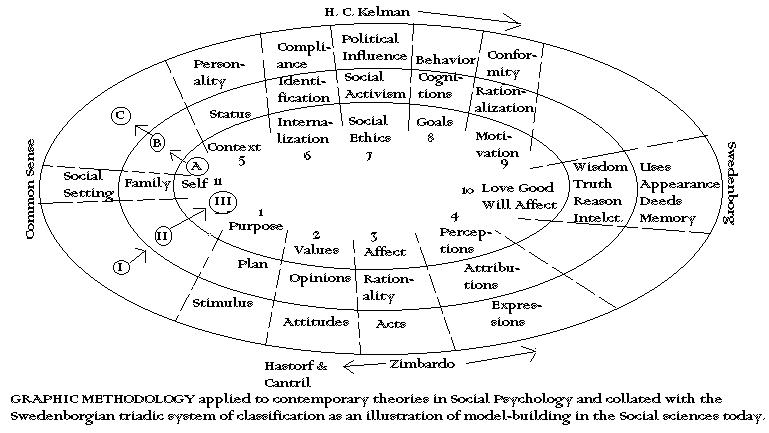
(From: www.soc.hawaii.edu/leonj/499s98/shintani/logos.html )
5.1.4 Rational Mind Mediates Natural and Spiritual Information
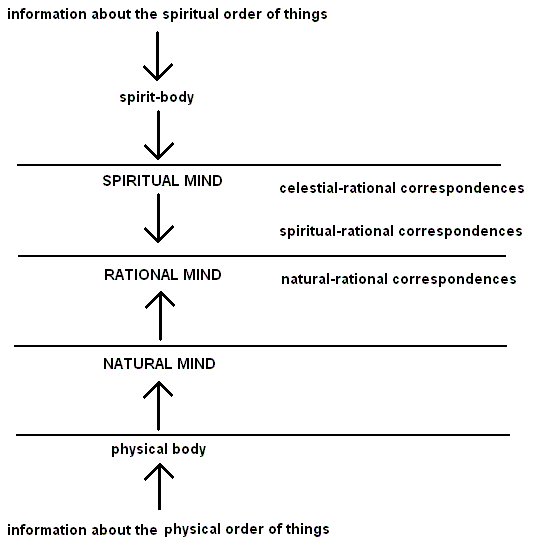
(From: www.soc.hawaii.edu/leonj/leonj/leonpsy/instructor/gloss/moses.html )
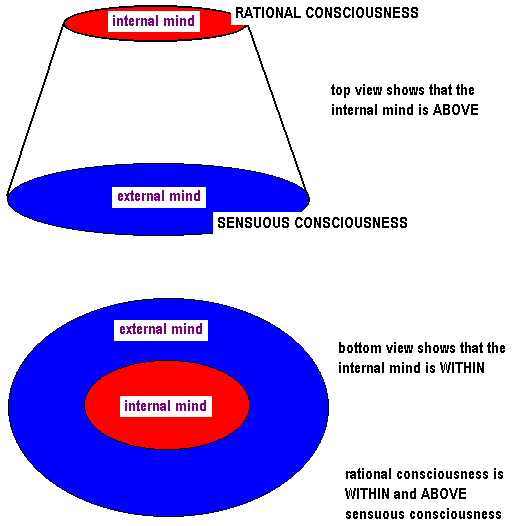
(From:
www.soc.hawaii.edu/leonj/leonj/leonpsy/instructor/gloss/moses.html )
5.2 Illustration of Predictive Research -- Developmental Phases in Spiritual Development
The official Ethical Principles of Psychologists and Code of Conduct of the American Psychological Association (2002) may be found online at: www.apa.org/ethics/code2002.html
The purpose of the Ethics Statement is to guide psychologists in the standards they should apply as professional psychologists. This includes all job settings where an individual delivers services or activities as a psychologist. For instance, psychotherapists, counselors, health professionals, supervisors, public service settings, researchers using human subjects, and instructors.
This Ethics Code applies only to psychologists' activities that are part of their scientific, educational, or professional roles as psychologists. Areas covered include but are not limited to the clinical, counseling, and school practice of psychology; research; teaching; supervision of trainees; public service; policy development; social intervention; development of assessment instruments; conducting assessments; educational counseling; organizational consulting; forensic activities; program design and evaluation; and administration. This Ethics Code applies to these activities across a variety of contexts, such as in person, postal, telephone, internet, and other electronic transmissions. These activities shall be distinguished from the purely private conduct of psychologists, which is not within the purview of the Ethics Code. (APA, Ethics Statement, 2002). www.apa.org/ethics/code2002.html
non-theistic psychology and theistic psychology share the same behavioral code of ethics but from an entirely different perspective and rationale. This makes sense since non-theistic psychology does not make use of the concept of God while theistic psychology is based on God's Speech or Sacred Scripture. Everything in theistic psychology relates to God from beginning to end for every concept. So the ethics of theistic psychologists will be overtly similar in ideal intent as the ethics of non-theistic psychology. But when non-theistic psychologists justify the ethical standards they naturally use a different rationale that has nothing to do with God or heaven and hell. In contrast, theistic psychologists justify the same ethical standards using the concepts of theistic psychology, namely in terms of heaven and hell.
To see the particulars of this difference, we can examine the opening paragraph of the Preamble which summarizes the overall view of the entire Ethics Statement.
Psychologists are committed to increasing scientific and professional knowledge of behavior and people's understanding of themselves and others and to the use of such knowledge to improve the condition of individuals, organizations, and society. Psychologists respect and protect civil and human rights and the central importance of freedom of inquiry and expression in research, teaching, and publication. They strive to help the public in developing informed judgments and choices concerning human behavior. In doing so, they perform many roles, such as researcher, educator, diagnostician, therapist, supervisor, consultant, administrator, social interventionist, and expert witness. This Ethics Code provides a common set of principles and standards upon which psychologists build their professional and scientific work.
We can ask why are theistic psychologists committed to
i) increasing scientific and professional knowledge of behavior
II) and people's understanding of themselves and others
iii) and to the use of such knowledge to improve the condition of individuals, organizations, and society
Increasing people's knowledge of human behavior is vital for regeneration from two aspects--(a) from the perspective of our efforts at character building, and (b) from the perspective of assisting others in their efforts of character building.
Regeneration is a process of spiritual development whose goal is to prepare the mind for eternal life in conjugial love in heaven. God, our Divine Psychologist, is effecting regeneration in us but our progress is proportional to our cooperation. The fact is that people are born with inherited tendencies that resist and oppose character rebuilding. We have an enormous inertia in giving our consent to the Divine Psychologist to do the work of regeneration in our mind, in our habits of feelings and thinking. For almost anyone, to change is to experience negative feelings and suffering, even anguish. If it were left up to everyone how many could actually compel themselves to cooperate despite our strong inner resistance? It makes good sense therefore to teach people the psychology of cooperation. Theistic psychology has very useful knowledge about techniques people can use to increase their willingness and ability to cooperate with the Divine Psychologist.
One central technique is called the self-witnessing method. It consists of systematic and cumulative self-monitoring activities in chosen areas of daily living or in recurrent mental operations. Self-witnessing has three areas of focus called the "threefold self"--affective self, cognitive self, and sensorimotor self. This type of self-witnessing collects data on our feelings, thoughts, sensations, and motor movements. For example, people who want to introduce improvements or changes in their food behavior typically experience difficulty making the changes permanent. There is frequently a relapse into the former food behavior, nullifying the gain. The motive to change the diet is spiritual. People in the positive bias (see Chapter 1) understand that there is a connection between choices we make now and spiritual consequences later, when we pass into the afterlife.
An unhealthy diet originates from inherited enjoyments that are evil. This means that our mind is tied to some spiritual society in the hells (see Section xx). These connections are inborn in the affective and cognitive organs of the mind. The connections with the hells is in the form of a non-conscious mental communication or influence from a distance. These interconnections vary with culture, religion, and generation or historical era. They derive from the fact that mental connections between people are physiological structures in the spiritual world (see Section xx). The specific content of the inherited traits determines which spirit society from hell will have the influencing agency. This can be observed in family traits, as well as in the similarity of co-patriots when they meet in a foreign land.
Self-witnessing gives us the details of what we think and how we feel in various situations during our daily activities. The thoughts, reactions, emotions, and feelings--all private behaviors unseen by others, are indices or signs of the hell society that is influencing us. For example, feeling angry to the point of fantasizing torturing someone. Or, feeling so turned on that we fantasize having sex with another man's wife. Every inherited tie to some hellish society puts us under the influence of others who dwell in their hells. God creates and maintains these interconnections which I call the "vertical community" to distinguish it from our horizontal community like the city we live in or the people we know (see Section xx).
We also inherit heavenly traits, hence connections in the vertical community with people who are in the heavens of their mind. Swedenborg discovered that people who are in the heavens o their mind are in company with others who are also in the heavens of their mind. As well, people who are in the hells of their mind are in company with others who are also in the hells of their mind. In theistic psychology this leads to a basic formula: the objective geography of the spiritual world = the subjective anatomy of the mind. What an astonishing revelation!
There is a clear separation between science and religion that should also be maintained by theistic psychologists. Science is universal and applies to all human beings equally. Religion is localized to history, culture, and ethnic group. There are therefore diverse religions as there are different cultures. Since every cultural group chooses its own religion it would be an ethical interference for science to promote one religion over another. But this doesn't mean that religion is not a legitimate area of research for science. Religious behavior and belief are prominent aspects of all cultures and communities spilling over into social morality and political agenda. Especially for theistic psychologists religious behavior is an important focus. This focus includes non-theistic and secular humanists who define themselves in relation to God, but in opposition or denial.
An issue arises with respect to religion and science because theistic psychology is based on Sacred Scripture that is historically identified with Western Judaeo-Christian religions, namely, the Old Testament (in Hebrew), the New Testament (in Greek), and the Writings (in Latin). As pointed out elsewhere (see Section xx), the literal meaning of this threefold Sacred Scripture is historical and relates to Western culture in the past three thousand years. But theistic psychology is based on the scientific meaning of the Threefold Scripture, not on its literal meaning. The literal meaning of the Old Testament is strongly ethnic and appears to be addressed to one nation. The literal meaning of the New Testament is more general, being able to be applied on a global basis. The literal meaning of the Writings is rational and therefore universal. The scientific meaning of the Writings is evident in the literal sense, less evident in the New Testament, and obscure in the Old Testament.
To derive the scientific meaning of the Old and New Testaments Swedenborg had to painstakingly define the psychological correspondences of historical events, of places and numbers, of allegories and prophecies rendered in poetic language, sometimes incomprehensible without knowledge of their correspondences. Since the Writings are written for the modern mind, its literal meaning is scientific in many parts. But there are parts that discuss particular religions and nations. If the literal meaning of these discussions were also the scientific meaning, then those parts of the Writings would not be suitable for theistic psychology since it is unethical for theistic psychologists to promote one religion over another.
But it is not feasible to divide the Writings up into portions suitable and portions not suitable for theistic psychology. The Writings are expressions of Divine Speech in a natural language, just like the Old and New Testaments. In fact, the three are connected into a solid unit whose coherence would be destroyed where one to omit portions from any of the three sets of Divine Speech. Remember that Divine Speech is universal. It is given by God to humanity and there is only one God. But when Divine Speech filters down from the celestial language, to the spiritual language, then to the natural language, it undergoes transformations governed by the laws of correspondences (see Section xx). By the time Divine Speech reaches the bottom of the line in a natural language, it necessarily contains historical and national references.
But only those references occur in this way that have a scientific meaning that applies to all of humanity. It is not possible for Divine Speech to be addressed to only some of humanity, to one nation or historical era. But when Divine Speech is transformed into a natural language, it becomes Sacred Scripture that appears to be given to one nation or culture. By applying the method of correspondences theistic psychologists can reconstruct Divine Speech through the various layers it has gone through on the way down to the natural world and natural mind. This is especially true of names, places, and numbers. For instance, the city "Jerusalem" which is the nation of Israel in the Middle East, disappears when we apply correspondences, to derive its scientific meaning as "spiritual doctrine" or the mental operations at the spiritual-rational level of the human mind. Similarly with all the cities mentioned in the Old Testament, the New Testament, and the Writings. They disappear from focus when you translate them into their psychological meaning.
Abraham, Isaac, Jacob, and Joseph disappear as historical and ethnic individuals when you recover their psychological meaning, which refers to the successive steps of development in our regeneration. Similarly in the Writings, when it says something about "Jews" the historical reference disappears when you recover its psychological meaning as the external state of mind relative to the internal. Similarly, Egypt, Assyria, and Israel actually refer to the anatomy of the human mind in hierarchical sequence--Egypt refers to thinking about God with natural correspondences, Assyria refers to thinking about God with spiritual correspondences, and Israel refers to thinking about God with celestial correspondences (see Section xx).
The Writings mention European nationals--French, Dutch, British, Swedish, etc. It is true that Swedenborg met people from these nations when he was in the world of spirits. Obviously when he interviewed people who had just passed on he sometimes discovered which country they were from, or even, which planet other than ours. But the more important issue is to understand that only those details are recorded in Sacred Scripture which correspond to the psychological meaning of universal Divine Speech. By focusing attention on their scientific correspondences the literal historical reference disappears. They are merely carriers of the universal meaning.
There is therefore no actual favoritism or promotion of one religion over another when we recover the universal meaning of Divine Speech. Theistic psychology is extracted from the literal sense of Sacred Scripture by reconstructing the universal meaning of Divine Speech which is embodied in the literal meaning of Sacred Scripture.
This extraction process for the sake of universal science is not in any way threatening to religions based on Sacred Scripture. The Writings reveal that all Sacred Scripture contain historical parts and they are true and correct in detail. This is obvious when you consider that Divine Speech is given with the intent of it being recovered from Sacred Scripture. But Sacred Scripture does not lie for this would be sacrilegious or blasphemous. Therefore the literal sense upon which religion is based remains accurate and holy, suitable for worship.
Practitioners of non-theistic psychology take a natural stand regarding moral issues of what's right or wrong, and regarding spiritual issues of what's good and evil. In contrast, theistic psychologists focus in on what's right and what's good and evil as fundamental issues people face in the lifelong struggle of regeneration, whose outcome determines their eternal future. The sharp difference between the two types of psychology is that there is no scientific basis for good and evil in non-theistic psychology, while in theistic psychology we have the good and evil defined by Divine Speech, which is the source of scientific revelations.
Knowledge of theistic psychology gives people an understanding of how mental habits we practice today will be determining influences on our mental habits in the afterlife, and how they determine the quality of our future life in eternity. Teaching theistic psychology involves presenting the facts and explanations that give people an understanding of how our present life determines our future life in the spiritual world. Theistic psychology is the science of immortality, hence the focus is on the built in connection there is between this life and the afterlife.
In public institutions like the one I'm teaching in, students in a classroom have diverse backgrounds in religion, ethnic identification, or secular beliefs like atheism or materialism. High ethical standards must be maintained in teaching to avoid putting persuasive pressure on students own belief systems about the spiritual issue of right vs. wrong or good vs. evil. Theistic psychology clearly proves that persuasive belief systems are injurious to people in the afterlife. This is because the process of persuasion diminishes one's freedom of choice in choosing between truth and falsity, and between good and evil. Swedenborg observed that people in the world of spirits undergo a rapid personality change shortly after the resuscitation process (see Section xx). In this phase, the internal, deep seated, dominant motives and loves come out into the fore of our personality, and they lead us to abandon all pretenses of personality, all belief systems we hold without rational understanding and approval.
When we emerge from this process no beliefs or attitudes are left that we acquired by persuasive belief or mystical faith. The individual is now left defenseless against all sorts of spiritual assault and victimization perpetrated by those who prey upon intellectually defenseless individuals. One is then misled, and led around, and ultimately dropped into the hells of our mind with little rational consciousness left to willingly get ourselves out of there. Those who teach theistic psychology must be fully aware of the damage done when pressure is placed on students to adopt ideas and principles of theistic psychology without understanding them rationally.
Teaching rational understanding is an ethical imperative for theistic psychologists.
Students who have read a significant portion of this book have told me that I am repetitious and talk about the same topic in many places repeating the same information. I've read other people complain that the Writings of Swedenborg are very repetitious and even boring in its meticulous rational style. The reason that repetition is needed in the presentation of theistic psychology is that there is a constant requirement to be fully clear and rational. When a new concept is introduced, readers can sometimes be told to recall or check back on certain earlier segments that connect to the new concept. But how realistic is this with most readers? People don't recall the prior segment, nor do they interrupt the flow of reading by reading some prior sections again. Therefore it is ethically necessary to connect the new concept to earlier ones so as to maintain the path of understanding.
Rational understanding has to do with integrating separate concepts into a higher entity called "doctrine," principle, or explanation. You cannot integrate a new concept unless you repeat what prior concepts are and how they fit together. The new concept must be fully justified and explained as to its parts and functions. For instance, if you teach anatomy and physiology, and you are introducing the new concept of the "heart," you need to use prior concepts like circulatory system and the lungs. If the details are numerous, students will not understand the body's physiology without going back to the earlier concepts.
Repeating facts and principles already discussed elsewhere, is done in such a way that the prior portions are re-integrated into the new portions. Compare the discussion of the "same topic" in several places and you will note differences. The perspective is slightly different, the content range is slightly different, and the application context is different. I would predict that when readers feel that this kind of repetition is boring, it is because they are not noticing the contextual differences and what is new about it when viewed in connection with the new topic. The solution to that is to reread over and over again until crystal clear understanding is reached. And sometimes it is advisable to reread prior sections, which is why I make it into a habit to cite other sections that deal with a topic more extensively.
non-theistic psychology does not take an ethical stand on the spiritual harm caused by television and movie content. It does take a stand on the negative effects of violence upon many children. These negative effects are defined in terms of behaving violently as a result of seeing violence portrayed in the media. But theistic psychologists have more knowledge and research about the spiritual effects of media content and therefore it becomes an ethical issue whether they condone it or promote it. The appropriate behavior as a theistic psychologist is to warn people of their harmful effects on themselves. This is similar to a doctor having an ethical obligation to warn someone not to drink contaminated water when the individual is unaware of the potential medical harm.
In theistic psychology is known that a determinative relationship exists between accepting one's evil enjoyments in this life and the life of eternal hell. Anyone may have evil thoughts and evil enjoyments since it is a strong hereditary tendency in the entire human race. It is a fact that children and adults enjoy violence on TV and all sorts of lewd entertainment. People enjoy watching other people being deceptive and nasty, cruel and very gross. This is natural and it may be universal. But now every person has a reaction to observing that we enjoy these bad and gross things. One reaction is to skip over it and not to think about it, and if someone mentions it, not to get too involved in the topic, or to violently disagree in order to end further discussion. This reaction is not helpful to the individual who is going to undergo spiritual regeneration, and theistic psychologists are committed to the universal necessity of undergoing spiritual regeneration. No one can live a life of immortality in heaven without undergoing spiritual regeneration, either in this life or in the world of spirits. But it is far better and safer to do it in this life for reasons known in theistic psychology (see Section xx).
The other reaction is a good one: We are shocked at ourselves.
This is a self-witnessing act of spiritual significance.
Being shocked at ourselves that we enjoy watching other people being abused, victimized, deceived, treated without dignity, is the result of our conscious awareness of conscience within us. This is a critical moment for the individual. Conscience is a sub-conscious receptor of heavenly Divine truths. Divine truths are the sole means by which we can resist the inherited connections we have to the hells. The hells act into our affective organ in the natural mind. We experience this influencing agency by being aware of a strong impulse, urge, or preference. We are propelled and attracted, like being pulled on a chain. This chain ends in hell. The people who insist on remaining in the hells of their mind can be destroyed by God or need to be fed. God feeds them in such a way that only good results are achieved by their participation in our mental life on earth.
There is a strong sub-conscious mental connection we have here on earth with those who are in the hells of their mind in the spiritual world. This connection is maintained by God moment by moment with much dynamic involvement. We are connected and disconnected to different societies or communities of people in the hells, depending on the psychological need we have at each moment of our living. For instance, my cat Minsky is here in the room and for the past few minutes he has been agitating to get me to stop typing and walk with him to the dish. My first reaction of annoyance could not have occurred unless the Divine Psychologist had connected me to the community in hell that needs the emotion of annoyance to feel alive. My feeling of annoyance at Minsky was their hellish manna God feeds them out of Mercy so they can have some life left to their delusional minds.
A similar instance happened with my cat Manna yesterday afternoon. He came into the room where I was typing and started agitating in his special way, one being to step on the keyboard. I walked him to the dish, opened it, gave him a new scoop, and walked back to my keyboard. I was suddenly struck by my heartlessness. Manna had just gotten up and he wants some human contact to bring his consciousness back into the real world. But I just walked away and did not even speak to him, did not even pet him or touch him. I felt overwhelmed with guilt and walked back to his dish, talked to him, petted him, then I walked away. A few minutes later he came back so I stopped typing. I combed him and carried him to his resting chair. This is the how the Divine Psychologist is working to reform my loves from selfish to altruistic.
By connecting me to the hells of annoyances God accomplishes two good things. First, the people who are stuck in an evil mental state are kept alive and active. Second, the annoyance I feel, which is not from myself but from them, is an opportunity for a spiritual temptation (or celestial) that faces me with the fact that I am still connected the hells of annoyances. If I do my normal self-witnessing, to which I'm committed, I cannot avoid making a choice that has incalculable spiritual significance for my entire future. I can see it as my selfishness, or my cruelty, or my rigidity, or my excessive task involvement, or a nudge from the Divine Psychologist--which are all good perceptions because they uncover the deep network of interconnections between the hells in my mind.
Theistic psychologists are committed to teaching self-witnessing skills to every individual. It is as important as other forms of literacy skills such as reading, writings, arithmetic, critical reasoning, art, and physical disciplines. It's not practical to merely advise parents to control what their children are watching or what songs they are listening to. Instead, parents and teachers can instruct children on how to practice self-witnessing techniques while they are watching entertainment or listening to it (see Section xx).
Instructing self-witnessing involves parents in the detail's of the mental world of their growing children.
The instruction of self-witnessing skills is a practical context for discussing how God's truths can give us the inner power tools we need for character building. The main motive for character building is religious. Unless we rebuild our inherited character we become wild people wallowing in the hells of our minds forever. Rebuilding our character by using the spiritual weapons of Divine truths insures that our immortal mind spends its eternity in the heavens our mind where we live with others in peace, in bliss, in the excitement of daily new discovery and adventure that never ends.
This is the constant choice that parents and teachers must bring to their children. This will equip them with the mental or spiritual tools that an immortal individual should have for safety and success.
In general the profession of psychology in my generation has not favored forms of censorship as a social technique for managing information in society. Theistic psychologists are ethically dedicated to the principle that we ought to do everything we can to enhance people's rational consciousness for the sake of their spiritual development. This involves self-witnessing within the context of religious doctrine or understanding. For Divine truths to be actual and have actual power in our mind we must understand them rationally. This is obvious since truths are rational by definition. We can know Divine truths yet not understand them rationally. This dimities their battle effectiveness in fighting the hells in our mind.
Censorship is a form of external compulsion and therefore when we comply with it we do so for an external motive. It has nothing to do with our agreement or understanding. We are given no choice. The spiritual choice we must have to grow is taken away from us. Therefore all forms external authority must be infused with rational understanding, and if not, authority becomes coercive and persuasive. Theistic psychologists know that persuasive obedience to a principle or belief system is useless in the world of spirits where we awaken within a few hours after the death of the physical body. They are useless in terms of fighting the attractions of hell because we are not as attached to the persuasive truths as we are to the falsities that justify our hellish attractions. Hence censorship is harmful.
Instead, theistic psychologists see the need for parents and teachers to teach critical thinking skills which are basic to spiritual growth. Since spiritual growth depends on rational consciousness it is necessary to develop the thinking skills of every individual. The existence of public education in all countries, and its mandate from the United Nations, is a result of people being led by God to see rational thinking as a human good to which every human being is entitled to by birth.
As a practical matter, parents and teachers cannot prevent children from exposure to information about evils they can't even imagine. And so this a clear potential for being spiritually harmed. It's the remains of innocence that are harmed (see Section xx). Innocence is absolutely required to live in one's heaven because our heaven is made of innocence. Innocence is defined as the willingness to obey and abide in God's truths. God's truths make the heaven of our innocence, hence our eternal life in that state of mind.
The critical need in parenting and education is therefore the protection of spiritual innocence by which every individual is willing to accept and obey God's truths. The best way to do this protection is for research to tell us. In the meantime we must teach children where evil enjoyments come from and why they need to give them up. Children need to be encouraged to practice critical thinking while watching television, listening to their favorite lyrics, or surfing the Web. They should be taught not to give themselves over to enjoyment of entertainment and that this is a life thy will have to give up soon anyway for something they would enjoy far more and with no trouble.
5.3.5 Theistic Psychologists View on War, Death Penalty, Abortion
Theistic psychologists view war and the death penalty as necessary techniques for society in controlling people who are going along with their evil tendencies. The vast majority of people in this country are ready to die for it to protect the nation and its people. They are willing to go into battle in defense of their country which they acknowledge as a "fatherland" or "motherland." This is rightly so and rational. One's country is what supports and protects what we have, our life and our possessions and our basic human rights. Too many countries are taken over by dragons who mislead and deceive and torture their hapless people--until by Divine Providence the wicked leaders are removed. Soon in the spiritual world they are going to encounter bigger devils than they are and they shall deserve our pity for great is there eternal suffering.
They suffer not because they are being punished by God since God never punishes anyone. But God has a built in system as to what happens when people found the Divine order and act against it in full premeditated intent and awareness. Such are cruel tyrants and all individuals who abuse others as a way of life for themselves. They love their willful rebellion so much, so deeply, that they are unwilling to give it up even as they are being tortured endlessly to eternity, and still they refuse to give it up. It is this refusal to give it up that keeps them in hell, not God's punishment.
Killing attackers in self-defense is seen as a reasonable behavior by people who think rationally about it. The Commandment not to kill or murder applies to wrongful killing. More research is needed in theistic psychology to determine the precise limits of what is rightful and wrongful killing. People have done much work on this regarding the law of the land and the science of jurisprudence and international law. It is reasonable for theistic psychologists to abide by the results of this body of rational knowledge.
It is similar with the death penalty. Personal philosophies and creeds may vary and disagree but in relation to theistic psychology the treatment of criminally convicted individuals may be left up to the law of the land and the experts who think these matters through and debate them with each other. Theistic psychologists can throw useful light on many aspects of these issues, but in general, they will abide by the reasonable conclusions of the specialists. Obviously, it's different when an injustice is being practiced by a society and encoded in the law. All reasonable people who have a strong sense of charity and decency will want to work for change through all the reasonable means available. Can they resort to terrorism?
The answer is, No.
One cannot rationally justify terrorism because it is an outward expression of an inner evil.
No evil may be justified by rationally thinking people, or else if they do, they become irrational and spiritually insane. They are preparing themselves for an eternal tie to sordid and cruel hells within which they will be imprisoned forever by their own lust for insanity, never wanting to let go no matter how much they have to suffer from the torture of bigger devils than they are.
War, terrorism, killing, and destruction are possible only from intentions and desires that are in the deep hells of the human race. The people who are in that state of mind are so deep that they are unwilling to ever emerge into rational consciousness and good. From that place in the human mind they are conjoined by God into a community of hell. They see each other, they interact, they live together, they suffer harsh conditions and worse of all, each others insane tortures. All those who lust for a particular kind of depravity or injustice or fantasy are gathered together by God into a community of their own. In this way the human hells are organized geographically to correspond with the human heavens but in corrupted or distorted form.
The heavens are also organized in this way by God so that each heavenly community is composed of people who are alike in their ruling loves. For every heavenly community there is a corresponding hellish community because everything good and true from God has been distorted and corrupted in the history of the human race. Each good and truth has its heavenly community in the human mind and likewise each hellish community has its corrupted good and distorted truth.
Killing someone can therefore come from either an evil or a good motive.
Sometimes people take it upon themselves to kill for supposedly a good motive. Just because they think or claim that their motive is good is no reason to accept it as good since people with an evil motive can easily claim that they have a good one. They may believe the motive is good when it is evil. This is typical. When we are not listening to conscience or acting according to moral principles we call good what is evil and evil what is good. Hence it is necessary to maintain full contact with a rational understanding of Sacred Scripture and a deep interest in studying the revelations in Divine Speech. This is God talking to us and teaching us how to get to heaven. Without Divine truths to pave our way and create our journey, we stay immersed in falsities that justify our love for evil from which we then cannot ever be separated.
Abortion is also considered by many as a form of killing and everyone in this country knows that abortion has been one of the most controversial, divisive, and violent of all political disagreements this generation. Such is the passion people feel for both sides. One side sees the inherent right of a woman to choose whether or not she wants to proceed with the pregnancy. Another side sees the inherent right of an unborn child to be protected from being deliberately killed.
Theistic psychologists have some facts not available to others that are relevant to this conflict. It is known that the human soul is immortal once created. It is also known that moment of creation of a human soul by God is at conception, prior to birth. God manages the growth process of the body through the soul. Clearly, the soul has to be created at conception so that God has the mechanism for making the fetus grow. When a woman decides to submit to an abortion she agrees to putting an end to the particular soul she carries in the fetus. But the soul is immortal. However the fetus doesn't have a mind of its own before it is born and the lungs are opened. It then takes its first breath and a mind is activated or born. From then on, second by second, the child's body is bombarded by incoming sensory stimuli of which it is aware. The mind organizes and feeds upon the order and property of this sensory input from the physical world. This experience is what creates the conscious human mind that can live in heaven to eternity. But without a mind, there is no personality, there is no awareness, motivation or a single thought.
Hence the mother and doctor and legislator who approve of abortions agree to putting an end to an immortal soul's right to a personality and consciousness.
The Writings tell us that the souls of unborn fetuses, once dead, are gathered by God into a place of the human mind that is above individual consciousness, thus above the highest heaven in our mind. In that highest state, souls are not conscious individual human beings so that they can absorb the intense heat and light of the Spiritual Sun where the Divine-Human abides in relation to the human mind. This gathering place near the Spiritual Sun is called the heaven of Human Internals. Just below this heaven is the Third Heaven of celestial angels where we are in our mind when we elevate ourselves to the highest potential of rational consciousness possible for human beings.
Many women, doctors, and legislators agree to abortion because they are unaware of these facts revealed by God to humankind in the Writings of Swedenborg. People who are unaware of appropriate rational information and believe false things and do evils, are not spiritually responsible for what they think or do. It's different in natural law for we cannot claim ignorance of the law as a defense when reasonable people could have known about it. Spiritually only that which we know can hurt us. Of course, if we ignore conscience, or ignore religion, or ignore rational considerations, or Divine truths we know of, then we are responsible for not knowing spiritual truths that reasonable people could know.
To be spiritually responsible means that we will suffer bad consequences from that act or from that irresponsible ignorance of truths. Such an attitude of willfulness is a love from hell to which we are deeply connected. It is this hellish love that will emerge from within once we hit the freedom roads in the world of spirits and begin our eternal life in the loves we've brought with us from our earthly life.
I first started using the self-witnessing methodology in 1971 while teaching social psychology. Students were able to understand the threefold self in terms of their affective, their cognitive, and their sensorimotor mind or self. Several generations of student reports show that self-witnessing the threefold self is an ordinary skill every normal person has acquired in the course of growing up. Even children are capable of this to some extent. It consists of self-monitoring one's feelings, thoughts, and sensations, i.e., the threefold self. People are able to write down what they are feeling, what they are thinking, and what they are sensing.
There might be a tendency to think that self-witnessing is introspective, subjective, and non-behavioral. Actually self-witnessing is observational, objective, empirical, and behavioral.
The method of self-witnessing is empirical and objective because the individual has the anatomical and functional ability to observe the lower part of the mind with the higher part. Just as we can observe in a mirror how we stand and how we walk, and give an objective report of it, in the same way we can observe from our rational mind what the sensory mind is doing, thinking, sensing. The objective report we give of our self-witnessing is the same objective report that independent observers would give if they had access to our feelings, thoughts, and sensations. But since this is not possible here on earth we must rely on self-witnessing for objective data on the mind. And since we observe ourselves as others would observe us, and as we would observe them, self-witnessing is objective, not subjective. The subject matter or content is subjective, or in the mind of one individual, but the observation method and the data are objective.
Self-witnessing yields objective and valid data by sampling one's feelings, thoughts, and sensations. All other methods available to psychology are indirect and inferential, hence only partially accurate and valid. these include personality tests, self-reports, interviews, and videotaping. Self-witnessing is the only method available for gathering objective data on samples of one's feelings, thoughts, and sensations. Several years ago I have introduced self-witnessing as a method that drivers can use to improve their driving habits (see Reading List).
In theistic psychology this self-monitoring methodology of the threefold self is called "spiritual self-witnessing." It is described in the Writings of Swedenborg as "self-examination for regeneration." Self-witnessing becomes "spiritual" when our purpose for doing it is character reformation that is motivated by heavenly preparation (or "regeneration") (see Section xx). In other words, we are trying to unlearn selfish traits and learn altruistic traits so that we may develop a character that can live in the heavenly regions of the spiritual world. This is called a spiritual motive because it has to do with a goal in the spiritual world.
Spiritual self-witnessing is the self-monitoring of one's threefold self in the daily events of life in order to discover objectively when we are feeling selfishly and thinking irrationally. The activity becomes spiritual when it is done for one's life in immortality.
I had been working with the threefold self for several years when I started reading the Writings of Swedenborg in 1971 (see Section xx). I was delighted to discover that the threefold self is also one of the major sub-systems in these Divine scientific revelations! The sequence affective--->cognitive--->sensorimotor is found everywhere in Swedenborg's Writings, as the following table shows. I have lined up the terms in the Writings that are used in parallel fashion to the threefold sequence:
| AFFECTIVE---->COGNITIVE----->SENSORIMOTOR | ||
|---|---|---|
| Love | Wisdom | Use |
| Good | Truth | Appearance |
| Will | Understanding | Action |
| Intention | Plan | Execution |
| Source | Cause | Effect |
| Desire | Belief | Conduct |
| Spiritual | Intellectual | Sensual |
| Feeling | Thinking | Sensing |
While it's fairly easy to monitor one's feelings and thoughts, it is more difficult to recognize which ones are selfish and irrational. This kind of critical thinking about oneself must be learned and taught.
Psychology as a science has two research foundations. One is physical measurement or description; the other is verbal responses. Personality theory relies heavily on paper-and-pencil inventories, tests, and self-ratings. If you took away these self-reports by subjects there would be very little left of personality theory and research. In theistic psychology there is a heavy reliance on self-witnessing methodology because no other technique is available when we want to know what feelings, thoughts, and sensations are in the mind.
Behavioral psychology does not maintain a focus on people's thoughts and feelings and has not favored methods like self-witnessing. Cognitive science has had an interest in thought processes, especially in their simulation or formal representations as computers and programming. The first computer chess program was written by Herbert Simon by representing the sequence of thoughts of a chess player as he spoke them out loud. He used a technique called "think aloud protocols" which are transcripts of audio recordings of an individual engaged in an expert task and speaking the thoughts out loud. There is also the technique of "thought sampling" that is used in clinical psychology and in sociolinguistics.
Spiritual self-witnessing is specialized in that its purpose is specifically to examine our thoughts and feelings all day long in order to evaluate them within the context of our efforts at character reformation. Further, the process of evaluating what we self-witness must be that of applying the doctrine of truth from Sacred Scripture (see Section xx). If we use an evaluation process based on self-intelligence--our own or someone else's--the process is not spiritual. Therefore it cannot have a lasting benefit to us in the afterlife of our immortality (see Section xx).
The term "character reformation" is often associated with correctional systems or religious schools. In other words it applies to a situation where someone is maladaptive and irrational, the focus being on correction or reformation. In theistic psychology character reformation is used because of the recognition that the human race today has evolved a character that is socially and spiritually maladaptive. The scientific revelations in the Writings of Swedenborg present both evidence and a rational account of how this negative development has occurred in the human race. When this is recognized, the focus on change necessarily becomes restorative and regenerative. Knowing the eternal consequences of a maladaptive character intensifies the motive for providing people with effective psychological techniques to reform or restore the individual's character to a state of integrity and spiritual adaptiveness.
There is nothing 'preachy,' intolerant, or dogmatic about the idea of character reformation as a central focus for theistic psychology. This is a rational and responsible thing to do, assuming one adopts the positive bias towards the scientific revelations in the Writings of Swedenborg. If one remains in the negative bias one retains the impression that "character reformation" is 'preachy' or prescriptive. But it is strictly objective, given the known consequences of arriving in the spiritual world without having reformed one's character (see Section xx). In that new state of life called being a "spirit," the power of thoughts and feelings is far greater than anything we can do in a physical body. As spirits we live in a world of rational ether, not physical space. In the spiritual world the mind is just as powerful as in dreams, capable of spontaneously creating an desired environment around ourselves--garden, beach, mountains, animals, weather. These created things are real--others can see it, and they can eat the fruit in your garden and pick the flowers. This is a normal event in rational ether or "the spiritual world" where our immortality goes on forever (see Section xx).
Living in rational ether as rational minds, our thoughts and feelings instantaneously produce changes in the immediate environment around us. We can turn a beautiful garden into an inhospitable desert in the flick of a thought. We need character integrity and stability to resist all the influences around us that other spirits create. Character integrity is an affective state but it requires an accompanying cognitive operation in order for the affective state to be stable and to last. In the spiritual world this cognitive content is supplied through instruction received by every "novitiate spirit." The capacity to accept this instruction depends on the rationality our mind possesses. Swedenborg reports that our level of rationality determines our quality of life in our immortality.
Self-witnessing as a daily practice is a new way of living. Through it, conscious awareness develops of all the things that otherwise would remain sub-conscious, unattended. Without self-witnessing as a consistent activity, how would it be possible to know the content of our thoughts and the quality and directionality of our feelings? Self-witnessing is different from self-monitoring and self-observation -- two terms used in psychology today. Self-witnessing is more like "self-examination," which is the term used in the Writings.
Self-examination is focused on evaluation by means of "doctrine of life," which is the doctrine of truth we extract from Sacred Scripture and apply to our thoughts and feelings all day long. The Writings use the expression "doctrine of life" to refer to an individual's principles by which one lives and makes decisions in daily life. The doctrine of life is learned from Sacred Scripture or from instruction based on it. It requires rational understanding of Divine revelation. The purpose of Divine revelation is always to assist people in preparing for life in eternity, which means, undergoing the effort and suffering involved in character reformation.
The suffering and pain during our character reformation comes from the action of giving up something we cherish and enjoy. This is why we resist character reformation. We don't want to face that suffering. We want to hold on to what gives us satisfaction, pleasure, and apparent self-sufficiency. These selfish or self-centered mechanisms are inborn and inherited. Whatever they love to do, people call good, even when it is evil. The alcoholic taking another drink before driving home knows it's illegal and morally wrong, but the contentment and satisfaction involved in being drunk supersedes all other principles of morality and decency that the alcoholic possesses. This mechanisms is similar for all addictions and psychological dependencies (see Section xx).
Self-witnessing methodology of the threefold self involves one's feelings or emotions, one's thoughts or reasonings, and one's sensory reactions or motor actions. It is within these three domains of behavior that the entire human drama takes place, both here and in our immortality. Hindu writers of old had access to Sacred Scripture that was transmitted to them by ancient civilizations prior to "the Fall," that is, character degradation in the human race by means of inherited evil traits. Hindu religious writings take the point of view that the universe is like a dream. We are the dreamers, and if we progress in character up-building, we can awaken from the dream of life into the discovery that we are Divine. Thus everyone is an illusion and there is only one Divine. This perspective is radically different from theistic psychology where there is an absolute duality maintained between God and creation, including human beings. The Writings show that the infinite Divine cannot be part of the created finite. But the Hindu system does recognize the idea that thoughts are spiritual and far more powerful than any physical energy.
The awesome power of thoughts and feelings is not to be taken lightly. Self-witnessing allows us to examine our thoughts and feelings in the evaluative context of our principles of living or doctrine of life. As our doctrine becomes more and more spiritual and rational, we can apply our latest understanding to our willing and thinking in everyday activities. The self-examination goes deeper and deeper as we progress in character reformation or regeneration.
There are specific spiritual laws which govern the developmental steps of character reformation. Knowing these steps from scientific revelations, allows us to cooperate with the built in mechanism and thus to further our character reformation until we are adequately prepared for facing eternity.
zzz
The Writings of Emanuel Swedenborg (1688-1772) contain an empirical, objective, and experimental investigation of the spiritual world. They are therefore the beginning of a new science which might be called "theistic science" which is based on the acknowledgement of the Writings as the source of Divinely given scientific revelations. Spiritual psychology would be a branch of theistic science, along with other disciplines such as biological theology and spiritual geography (see End Note 1). Spiritual psychology receives its content solely from the Writings since it is the only revelation of the Second Coming and contains an inexhaustible source of scientific information about the spiritual world.
Spiritual psychology ties in with contemporary psychology where the two overlap, namely in the area of mental development, and consequently, all external behavior that is controlled by mental processes. The mental world overlaps with the spiritual world. They are the same. This is because the mind is in the spiritual world and the same spiritual laws apply to both. The mind is a spiritual collection of organs, made of spiritual substances, and arranged in multiple levels of operation. For instance, the physical organ of the heart corresponds and reflects the spiritual organ of the will which gives us the ability to be motivated and struggle to achieve goals by means of feelings, loves, and affections. Similarly, the physical organ of the lungs corresponds and reflects the spiritual organ of the understanding which gives the ability to process cognitions, solve problems, and think rationally. Mental development is therefore nothing else than the growth of the spiritual organs of the mind. A young child has immature affective states and cognitive operations since the organs of the will and understanding are undeveloped. An adult has a fully developed external mind, but not yet an interior mind. The development of moral understanding and rational loves is the outer manifestation of the interior mind being opened more and more. The interior mind is the highest portion of the natural mind which has three levels: corporeal, sensuous, and rational.
Above the natural mind, is the spiritual mind, which itself has levels that correspond to the three Heavens: natural-spiritual, spiritual, and celestial. The human mind is therefore an organic construction that parallels the spiritual world exactly. Therefore, Swedenborg’s observational access to the spiritual world and his detailed description of it, constitute a rich source of knowledge for spiritual psychology. Now the human race has available new knowledge about the mind and its development and operation.
Conjunction with the Lord is a reciprocal conjunction, that is, that the Lord is in man and man in the Lord. (...) The conjunction of the Lord and man is reciprocal; and because it is reciprocal it necessarily follows, that man ought to conjoin himself to the Lord, in order that the Lord may conjoin himself to man; and that otherwise conjunction is not effected, but withdrawal and a consequent separation, yet not on the Lord's part, but on man's part. (TCR 371)
It is clear from the Writings that regeneration is necessary for salvation and heavenly life. Further, we are taught that regeneration is not automatic or spontaneous, but requires our active cooperation. Without this active cooperation there is no regeneration, consequently no salvation. It is therefore crucial to know how we ought to cooperate with the Lord in our regeneration. Our research on the psychology of self-observation or self-witnessing provides useful behavioral techniques that can help the individual in cooperating in regeneration.
5.4.0.1 Cataloguing the Components of the External and Interior Social Environment
Self-witnessing skills begin with creating a taxonomy, inventory, or catalog of the components of our social environment. The social environment is defined in terms of the occurrence of "situated behaviors," a phrase which carries the twofold idea of individual behavior and social setting. All human behavior is situated because it is carried out in a social setting. No behavior exists outside or independently of a social setting. For instance, our food behaviors are conditioned by family and societal habits, and even when we eat alone in our kitchen at midnight in the dark, we still engage in social behavior because what is in our refrigerator or food closet, is lifestyle choice, which consists of learned habits and norms of eating. But in addition to this, our mental behavior is also situated behavior. The setting is not physical in the sense that we can think and feel similar things in different physical settings. I can think of my cats while I’m driving or when I am lying in bed in my bedroom. I can feel embarrassed when I think about something I said or did, whether a moment ago, or years ago.
There is therefore an independence of mental behaviors from physical settings, but not from social settings. The individual is physically within society, but society is within the individual, mentally. Our life of feeling and thinking would be impossible without social content. What do we think with? Words defined by the dictionary. How do we think? By means of rules of language and logic that we learn as children from others. How do we reason? By means of rules, values, and justifications we acquire from our interactions with others. Therefore private mental behavior is situated socially in a way similar to external public behavior. The daily round taxonomy of human behavior needs to be mapped out equally for private mental behavior as for public external behavior. The external and internal social environment is quite complex as shown by the list below:
|
A few components of the |
A few components of the |
| my talk with others my connections my family tree my daily routine of activities my role, duties, and responsibilities my memberships and institutional connections my belongings and assets my interactions and transactions my declarations my reputation who I hang out with and where things I do together with someone people who depend on me people who love me people with whom I’ve had a fight people I’d like currently to meet people whom I know who I see or think about only rarely people on my invitation list things I write down, lists I keep the contents of my drawers and pockets my nickname family sayings etc. |
my talk with myself the things I imagine my interpretations of what’s going on my sensations and feelings my daydreams my prayers and spiritual reflections how I assess and evaluate things my self concept my routine concerns things I notice or ignore my ambitions my fears my preferences making plans, rehearsing things I cannot mention to someone what I like to eat my mood and energy level what I can smell my judgments my aversions my cravings my secrets my memories how I reason with myself etc. |
Given the complexity of the human environment, the task of cataloguing and itemizing its numerous components is indeed a daunting one. We did expect that the external social environment would be normative and similar across individuals, distributed across sub-categories that allowed variation within uniform settings. People got up at similar times in the morning, went through similar motions in the bedroom, bathroom, kitchen, garage, and highway, lunch, shopping, dinner, movie, date, television, bedroom, sleep. The daily language everyone used was English, the TV programs were the same, the songs and music, the aggressive driving, the newspaper, the lawnmower, etc. For the most part, the external social environment of the city overlaps the lives of individuals, providing a common, constant, and predictable pattern.
It will be found that this same normative predictability in the internal social environment of the individual. There is an urban legend that our private interior environment is individual rather than social. People have the strong illusion that what they think and imagine in their private world of thinking and feeling, is individual and free, in comparison to the external environment of their body, which is public and social. What we discovered was that the interior environment is as socially organized and catalogued as the external environment. What people think, what they imagine, what they fantasize, what they are afraid of, and so on, are things they do in common with each other, unknowingly, despite it taking place in the private, unobservable world of the individual self. We even had to coin a new phrase, "standardized imaginings," to reflect the uniformity with which people functioned in their mental operations. Thinking and emoting was not something free and individual, but social and standardized within narrow limits of determination. This standardization and uniformity of the mental world is totally unsuspected and we were surprised. It was the first important fruit we obtained from our self-witnessing research.
The names we give to the various groupings and sub-groupings of the daily round environment constitute a social psychological theory of what an individual is, and how an individual behaves through the body and in the mind. Later in this article we discuss and give samples of the main techniques, which include the recording and analysis of one’s external social talk as well as keeping track of one’s private internal dialog. We use the term "self-witnessing" to describe this approach in general. The theory is that self-witnessing is an effective method for self-objectivity. We also use the phrase "being an audience to yourself" which refers to the idea that you see yourself as others would see you. This is the definition of objectivity in social psychology. If we practice self-witnessing on the daily round we gain an objective view on ourselves. We are less vulnerable to illusions and a fantasy reputation of ourselves.
This objective self-knowledge constitutes an empirical baseline of our habits and traits, in the body and in the mind. Now we can use effective self-modification techniques to manage ourselves better, more rationally, more according to rational choice than family and neighborhood habits and scripts we happened to acquire in our socialization process. Thus we acquire a professionalized self. Our purpose was to teach these mental literacy skills to our students, to empower them to gain control over their lives. Polls and surveys indicate that the majority of individuals in our country experience on a daily basis a variety of powerful negative emotions, such as rage, hatred, anger, depression, cynicism, and the opposite of compassion and emotional intelligence.
My past self-witnessing research (see References and Readings) has uncovered an overwhelming burden of negativity that individuals labor under on a daily basis. Now we know from the Writings where this agony comes from, namely the cumulative inheritance of negativity and evil that is passed on from generation to generation. Why do we prefer behavior styles that are harmful? Why do we find it hard to remain balanced and rational? Why do we make others suffer? Why don’t we function at a higher moral level? Why can’t we be happy, contented, productive, peace loving people? The answer has been revealed in the Writings, namely that we are born sub-human natural animals with the apparatus and capacities to become truly human, which is called the angelic form. In order to achieve this higher potential of true humanity, we must change ourselves and acquire a new will and a new understanding.
Concerning how God manages our mental life, the Writings Sacred Scripture say this:
AC 227. It is a great truth that man is governed by the Lord by means of spirits and angels. When evil spirits begin to rule, the angels labor to avert evils and falsities, and hence arises a combat. It is this combat of which the man is rendered sensible by perception, dictate, and conscience. By these, and also by temptations, a man might clearly see that spirits and angels are with him, were he not so deeply immersed in corporeal things as to believe nothing that is said about spirits and angels. Such persons, even if they were to feel these combats hundreds of times, would still say that they are imaginary, and the effect of a disordered mind. I have been permitted to feel such combats, and to have a vivid sense of them, thousands and thousands of times, and this almost constantly for several years, as well as to know who, what, and where they were that caused them, when they came, and when they departed; and I have conversed with them. (AC 227)
The phrase vertical community was coined in theistic psychology to designate the fact that God keeps the entire human race integrated as people's mental operations (see Section xx). This is one of the most amazing scientific revelation to be found in the Writings Sacred Scripture (see Section xx). We are connected into a vertical community through our mental body, which is the organ where thinking and feeling operations can take place (see Section xx). When our cognitive organ is activated, we experience thoughts coming into our awareness.
Where do thoughts come from?
No scientist in the negative bias has ever been able to give a rational answer to this question. One irrational theory is that thoughts don't really exist, and that only electro-chemical operations of the brain cells exist. Another irrational answer is that thoughts do exist, but only temporarily, while the electro-chemical operations of the brain cells remain active. Thoughts somehow emerge from these electrical activities. A traditional idea in non-theistic psychology is that thoughts -- cognitive operations -- are memory images created by sensory input. The reason this explanation is irrational is that it equates a natural or material operation in time and space ("sensory input") with a mental or spiritual operation in eternity that is outside time and space (see Section xx).
A rational answer would have to assume the positive bias of dualism and acknowledge that the Swedenborg Reports deserve to be examined for their scientific merit (see Section xx). These reports present empirical proof of the reality of the vertical community from Swedenborg's three decades of daily observations in the world of eternity, being in a mental state of consciousness capable of communicating face to face conversations and interviews (see Section xx).
The idea of the vertical community means that we are never alone in our mind, but are unconsciously connected to the mind of others in a vertical chain. We have the illusion that our mental world is an individual's world, while our physical and social world is interactive. We know that socially we are not alone in the world. We may be alone in a room or in a swimming pool, but we are not alone in the city. We are well aware of our horizontal community that extends from house and neighborhood, to city and country, and the planet. We call it our horizontal community because it is located in space and time. But our vertical community is outside time and space, in the eternity of our mental world (see Section xx).
Every human being is born a dual citizen, with a physical body in time, and a mental body in eternity, outside time. Our thoughts and feelings cannot be located in time and space for they are not made of matter or energy (see Section xx). Hence we are born into eternity, which automatically makes us immortal. A thought or feeling cannot die because "death" applies only to the natural world of time, space, energy, and matter. Hence the mental body grows as the physical body grows, and at death of the physical body, the mental body continues its life in eternity. Swedenborg lived consciously in both worlds for 27 years, and was able to confirm by many observations and experiments, that every individual is resuscitated about 30 hours after the death of the physical body and then continues life forever in that new environment (see Section xx).
In Swedenborg's reports we have the scientific fact, observationally confirmed, that an individual's mental world is actually a social world in which we are surrounded by many others who are in their mental world. While we are not aware of the vertical community, prior to resuscitation, we are fully aware of it after resuscitation when we are no longer conscious in the natural mind (see Section xx).
Quoting from the Writings Sacred Scripture:
TCR 475. Man does not know that in respect to his mind he is in the midst of spirits, for the reason that the spirits with whom he is in company in the spiritual world, think and speak spiritually, while his own spirit thinks and speaks naturally so long as he is in the material body; and the natural man cannot understand or perceive spiritual thought and speech, nor the reverse.
This is why spirits cannot be seen. But when the spirit of man is in company with spirits in their world, he is also in spiritual thought and speech with them, because his mind is interiorly spiritual but exteriorly natural; therefore by means of his interiors he communicates with spirits, while by means of his exteriors he communicates with men. By such communication man has a perception of things, and thinks about them analytically. If it were not for such communication, man would have no more thought or other thought than a beast, and if all connection with spirits were taken away from him, he would instantly die. (TCR 475)
This passage indicates that we have a conscious natural mind and an unconscious spiritual mind while we are connected to the physical body. The conscious natural mind thinks in a natural language while the unconscious spiritual mind thinks in a spiritual language. Hence it is that we are not aware of what's going in our spiritual mind which thinks in a spiritual language. The two portions of our mind are functionally connected and influence each other, though we are not aware of it. Swedenborg's mission required that he be conscious in both his natural mind and his spiritual mind. Normally, we become conscious in our spiritual mind after resuscitation, as we lose our awareness of the natural mind (see Section xx). We can then see others who are conscious in their spiritual mind of eternity, and we can no longer see the physical bodies or natural minds of those still connected to earth.
The passage above also states that thinking in our conscious natural mind is possible only when our unconscious spiritual mind is in communication with other spiritual minds. This is the vertical community. If such communication were cut off, we would cease to think, hence, cease to be human. Our thoughts and feelings are therefore social events, consisting of interactive exchanges with others called "communication with spirits" and "being in company with spirits."
The way each individual mind operates is a consequence of the character of the spirits in the individual's vertical community, moment by moment, in the person's thinking and feeling, from our birth to endless immortality.
Whether we live in heaven or in hell, and the quality of life in each, depends on the thoughts and feelings we have, and this depends on the spiritual company we keep -- the character of our vertical community.
Quoting from the Writings Sacred Scripture:
AC 50. (...) Man is altogether ignorant that he is governed of the Lord through angels and spirits, and that with everyone there are at least two spirits, and two angels. By spirits man has communication with the world of spirits, and by angels with heaven. Without communication by means of spirits with the world of spirits, and by means of angels with heaven, and thus through heaven with the Lord, man could not live at all; his life entirely depends on this conjunction, so that if the spirits and angels were to withdraw, he would instantly perish.
[2] While man is unregenerate he is governed quite otherwise than when regenerated. While unregenerate there are evil spirits with him, who so domineer over him that the angels, though present, are scarcely able to do anything more than merely guide him so that he may not plunge into the lowest evil, and bend him to some good-in fact bend him to good by means of his own cupidities, and to truth by means of the fallacies of the senses. He then has communication with the world of spirits through the spirits who are with him, but not so much with heaven, because evil spirits rule, and the angels only avert their rule. [3] But when the man is regenerate, the angels rule, and inspire him with all goods and truths, and with fear and horror of evils and falsities. The angels indeed lead, but only as ministers, for it is the Lord alone who governs man through angels and spirits. (...) (AC 50)
HH 249. It is rarely granted at the present day, however, to talk with spirits, because it is dangerous.#
For then the spirits know, what otherwise they do not know, that they are with man, and evil spirits are such that they hold man in deadly hatred, and desire nothing more than to destroy him both soul and body, which indeed happens with those who have so indulged themselves in fantasies as to have separated from themselves the enjoyments proper to the natural man. Some also who lead a solitary life sometimes hear spirits talking with them, and without danger; but that the spirits with them may not know that they are with man they are at intervals removed by the Lord; for most spirits are not aware that any other world than that in which they live is possible, and therefore are unaware that there are men anywhere else.
This is why man on his part is not permitted to speak with them, for if he did they would know.
Those who meditate much on religious subjects, and are so intent upon them as to see them as it were inwardly within themselves, begin also to hear spirits speaking with them; for religious subjects, whatever they are, when man dwells upon them by himself and does not modify them with various things that are of use in the world, penetrate to the interiors and dwell there, and occupy the whole spirit of the man, and even enter into the spiritual world and act upon the spirits there. Such persons are visionaries and enthusiasts and whatever spirit they hear they believe to be the Holy Spirit, when, in fact, such spirits are enthusiastic spirits.
Such spirits see falsities as truths, and so, seeing them, they not only persuade themselves but also those with whom they inflow to believe them. Such spirits, however, have been gradually removed, because they began to lure others into evil and to gain control over them. Enthusiastic spirits are distinguished from other spirits by their believing themselves to be the Holy Spirit, and believing what they say to be Divine. As man honours such spirits with Divine worship they do not try to harm him. I have sometimes talked with them, and the wicked things they infused into their worshippers were then disclosed. They dwell together towards the left, in a desert place.
# Man is able to talk with spirits and angels; and the ancient people frequently talked with them (n. 67-69, 784, 1634, 1636, 7802).
In some earths angels and spirits appear in human form and talk with the inhabitants (n. 10751, 10752).
But on this earth at this day it is dangerous to talk with spirits, unless man is its true faith, and is led by the Lord (n. 784, 9438, 10751). (HH 249)AC 2123. That the last time is at hand may also be seen from this fact in the other life, that all the good which flows in from the Lord through heaven into the world of spirits, is there turned in a moment into what is evil, obscene, and profane, and that all the truth is turned in a moment into falsity; thus mutual love is turned into hatred, sincerity into deceit, and so on; so that those who are there are no longer capable of perceiving anything of what is good and true; and the like redounds upon man, who is governed through spirits with whom those who are in the world of spirits have communication. The certainty of this I have learned by much experience, which, if all advanced, would fill many pages. I have very frequently been permitted to perceive and hear how what is good and true from heaven is turned into what is evil and false, together with the amount and the nature of the change. (AC 2123)
AC 6193. Since spirits take possession in that way of all that forms a person's thought and will, and angels take possession of what is even more interior, so that he is joined very closely to them, the person cannot avoid the perception and sensation that he himself is the one who thinks and wills. For the nature of all communication in the next life is this: In a community in which people are alike, each thinks that what is another's is his own. When therefore people who are good go into a heavenly community they instantly enter into all the intelligence and wisdom of that community, entering into it so fully that they know no other than that such things exist within themselves. This is also how it is with man and a spirit present with him. The things that flow in from spirits from hell are evil and false, but those which flow in from angels from heaven are good and true; and through these opposite kinds of influx a person is held in the middle, thus in freedom.
[2] Because what flows in from angels comes through the more interior parts of a person, it is less easily recognized by outward sensation than that which flows in from evil spirits. Also, the angels are by nature such that they will not hear of goodness and truth flowing in from themselves, only of its coming from the Lord. They are indignant at the thought of anything different; for they have a very clear perception that that is the truth of the matter, and there is nothing they like more than for their desires and thoughts to begin not in themselves but in the Lord. Evil spirits on the other hand are angry ii they are told that their thoughts and desires do not begin in themselves, because that idea is contrary to what their loves lead them to be delighted with. And they are all the more angry when they are told that life does not exist independently in them but flows into them. This is demonstrated to those spirits through actual experience; and such demonstration takes place many times, when they do indeed confess that such is the truth, since they cannot speak contrary to experience. But after a while they deny it and have no wish to have it proved any more from experience. (AC 6193)AC 3482. Although the language used in the Word appears to mankind to be simple, and in some places crude, it is angelic language itself, though in its lowest form. For when angelic language, which is spiritual, falls into human expressions it cannot fall into any other type of language than this. Individual things are representative, and individual expressions carry a meaning. Since they were in direct communication with spirits and angels the ancients possessed no other kind of language. Their language was full of representatives, and a spiritual sense was present in each expression. Also, the books of the ancients were written in the same fashion, for talking and writing in that fashion was the aim of their wisdom. How far mankind has since then retreated from heaven becomes clear from this as well. At present it does not even know that the Word includes anything apart from that which is seen in the letter, not even that there is a spiritual sense in it. Whatever is said to lie beyond the literal sense is termed mystical, which solely on these grounds is rejected. This also explains why at the present day communication with heaven has been interrupted, so much so that few believe in the existence of any heaven at all. Indeed, amazing to say, far fewer of the learned and scholarly than of the simple believe in it. (AC 3482)
AC 4067. [2] To enable people to understand the way in which goods and truths exist with a person, something scarcely known by anyone must be revealed. It is indeed known and acknowledged that all good and all truth come from the Lord; and some also acknowledge the existence of influx, the nature of which however remains unknown to man. Now because no knowledge exists, at least no acknowledgement in the heart, of the truth that around man spirits and angels are present and that the internal man dwells in the midst of these and is thereby governed by the Lord, there is little belief in that truth even when it is spoken about. Countless communities exist in the next life, and these are arranged and set in order by the Lord according to all the genera of good and truth; also communities that are the complete opposite, according to all the genera of evil and falsity.
They are so arranged and set in order that no genus of good or truth exists, nor any species of that genus, nor even any specific difference, which does not have [a link with] such angelic communities, that is, to which angelic communities do not correspond. Nor on the other hand does any genus of evil or falsity exist, or any species of that genus, or even any specific difference, to which communities of devils do not correspond. Interiorly, that is, as regards his thoughts and affections, everyone is within a community of such angels or devils, although he is not actually aware of it.
Everything that a person thinks and wills originates there, so much so that if the communities of spirits or angels in which he dwells were taken away from him, he would instantly cease to have any thought or will at all; indeed he would instantly fall down completely dead. Such is the nature of man's state of being, though he believes that he himself is the originator of all he thinks and wills, and that neither hell nor heaven exists, or that hell is far removed from him, and heaven too.
[3] What is more, the good present with a person seems to him to be something that is a simple or single whole, but in fact it is something so complex, consisting of so many varying features, that he cannot possibly explore even so much as its general ones. And the same applies to the evil present with a person. But as is the good present with a person, so is the community of angels present with him; and as is the evil present with a person, so is the community of evil spirits present with him. A person chooses certain communities for himself, that is, he places himself within one of these; for like is brought into association with like.For example, one who is grasping chooses for himself communities of like-minded spirits who are motivated by his kind of desire; one who loves himself pre-eminently and despises others chooses for himself others who are like himself; while one who takes delight in acts of revenge chooses for himself such as delight in these; and so on with everyone else. Those spirits are in communication with hell, with man in the midst of them and utterly under their control, so much so that he is not under his own jurisdiction but under theirs, although he imagines from the delight he experiences, and so from the freedom he has, that he is in control of himself.
But one who is not grasping, or one who does not love himself pre-eminently and does not despise others, or one who does not take delight in acts of revenge, dwells in a community of like-minded angels and through them is led by the Lord, and indeed by means of freedom to everything good and true to which he allows himself to be led. And as he allows himself to be led to good which is more interior and more perfect, so he is conveyed to more interior and more perfect angelic communities. His changes of state are nothing else than changes of communities. The truth of this is evident to me from continuing experience which has lasted for several years now, from which it has become something as ordinary and everyday for me as any ordinary everyday thing experienced by anyone since he was a young child.
[4] These considerations now make clear the situation with the regeneration of man, and with the intermediate delights and forms of good by which a person is conveyed by the Lord from the state of the old man to that of the new, that is to say, it is effected by means of angelic communities and by changes of those communities. Intermediate forms of good and delight are nothing else than such communities, with which the Lord brings man into contact so that by means of them he may be introduced to spiritual and celestial kinds of good and truth. Once he has been conveyed to these, those communities are separated, and more interior and more perfect ones become linked to him. Nothing else than this is understood by the intermediate good meant by 'Laban', and nothing else by the separation of that good, which is the subject of the present chapter. (AC 4067)
SE 152. About the collective [energy] field of spirits
It is certainly difficult to understand what the collective field of spirits is, and what their impact upon human minds is, without being informed how spirits are differentiated most distinctly into kinds and species, and how their energy, which creates that field, responds to, and thus guides, every single thought and mental image in a human being.[The relation of human minds to] the collective field of spirits is no different from that of the air, which is the grosser atmosphere and related to hearing, compared to the ether or purer atmosphere related to sight; or the dense clouds around the earth compared to the clear and serene region up above.
1) The [energy] field of spirits is now so corrupted, that whatever flows from the more inward heaven into their realm, which constitutes the third heaven,* becomes so distorted that whatever [is communicated] does not become known at all, but all and the least messages stream into human minds with an entirely opposite content.
2) Such is that field at this day, and so it has been growing and is growing toward the last day, when it will be dispersed. But in most ancient times, it was not so. It is also because of this field that revelations cannot come forth today as they did in ancient times, except by an extraordinary way, and that there is no such communication with the heavens as there once was.
3) For a period of some hours I was shown how the collective field operates into human minds, and in fact, when it was allowed, how I was not in the least able to stop them from taking away my thought, and from prevailing - such is the strength of that field today, when spirits are given the power to act.
4) The whole field utterly opposes the angels' endeavors; and the power of the angels, who all belong to God the Messiah, is increased so that they are able to overcome.
5) Astounding things would emerge if I should tell what filthy objects they portray when they are allowed to work by fantasies - which I would rather pass by, because it would be shocking to tell; they are nothing less than filthy.
6) Angels of the third level** can also be in that same realm, and because they are governed by the heaven of angels, they cannot be hurt at all.
7) A fact I have found noteworthy was that at times, I have heard a spirit speaking with me, and he was abruptly removed. Now I have been allowed to learn that he was snatched away by the collective field, that is, compelled to speak in accord with the field's action. I observed still more things that have slipped from my memory: for that field takes away whatever truth and goodness they find to be the most unpleasant. But if God the Messiah sees fit, [I will speak] more fully elsewhere about this collective field, in general and in details. 1747, the 14th day of September (old calendar).
8) The collective field can be compared with the ethereal atmosphere, in that this conveys to the eye the individual objects, like those on streets and in the countryside, in all the details of their forms and shapes - indeed, to a thousand eyes at the same time, or even tens of thousands - and in this way, to each of a person's thoughts, reasonings and fantasies individually. [The comparison is valid,] for [the collective field] lies inside of nature.
* I.e. in descending order.
** I.e. third in a descending order. (SE 152)SE 206. For a long time I believed that the innermost and very inward angels knew what I was doing and thinking, since I thought it was their doing that the evil plans and deceptions of lying spirits were constantly being restrained. But when I was allowed on several occasions, by the Divine Mercy of God the Messiah, to speak with others who were bringing down the thinking of those angels to me, it was told by them that those angels did not know at all what I was doing or seeing, as did the spirits closest by, but that they were nevertheless continually reacting against the endeavors and acts of evil spirits, or of their aura, which they sensed most keenly, but did not know from what cause or from what person [it arose].
So it is only God the Messiah, Who acts through His angels, Who sees and knows every least thing, and Who therefore directs human endeavors. Now this is what is meant by the words, "Abraham does not know us." Today by means of a certain abstract thought, something ascended to the angels which moved them. They were surprised, and then spoke with me through others. 1747, the 13th day of October (old calendar).
Nor do the angels want to know what is going on on earth, because they are aware that everything has gone to corruption and ruin; wherefore they desire that the Kingdom of God the Messiah may come, hoping that communication may thus be opened up between them and mankind. (SE 206)
Se 1892. Mankind and spirits are not acquainted with even the most general facts in the heavens
By a spiritual vision I was shown today that we are not acquainted with even the most general of facts in heaven. Take, for example, the fact that only one point of thought that we regard as most subtle and complete, contains within it, so to speak, the whole of heaven. For there is something in heaven residing in every least particle. This seems amazing, to be sure, and yet it is just as in each least part of a human being, there is a communication of every least thing that is going on in the [whole] body. 1748, 23 April. (SE 1892)SE 3050. The true speech of spirits
The speech of words is not the speaking that is proper to spirits, but to mankind, or to the bodily memory; but the speech of the inward memory is the true speech of spirits, and what it is like was shown to me today. It is thought, and to be sure, communicative thought, by which I spoke with them just now, and in fact about how all that they can understand and can perceive is their knowledge, even if they had not previously known that they knew it. For they understand instantaneously, and because they understand, it cannot but be in them and can be said to be from them as well as anyone else who declares it.
So that speech is an inward speaking, embracing many things, for it is simultaneously observant of the thinking of the other, and perceptive of whether he is of the same thought. It is of such a nature that it is hardly ever wrong. In short, it is a communication of ideas, one of which cannot be expressed by many words, and if it is expressed this still brings out little, for [the communication] has with it its entire mental image, so to speak, that is being manifested.Such is the speech of spirits among themselves, in short, not words, but the images of words, for each word has a mental image of great extension, as is evident from the fact that (SE 3050)
SE 3051. the idea of one word is usually able to be expressed by many, and so are all the words in a chain of the speech of thought. This is an amazing thing, i.e. that spirits among themselves do not know that there is such speech and that they communicate their thoughts by means of it, because they are without any reflection on the speech of words, of which they are mutually ignorant because they do not reflect on it, for the reason that it is natural.
And now I realize that it is that speech of spirits in earthly humans that governs the speech of words, as I am now aware while writing these words. But that earthly humans do not know this and perhaps realize it, is because it is natural to their spirit, which they do not know they have. And that they do not know, or perhaps realize that these things are so, is because they cling, some to words, some to bodily things, some to worldly ones, whereby the faculty of understanding them perishes. I also realize that in a group, this speech of spirits appears like a faculty of speaking by words. I wrote these things when together with another spirit, who acknowledges it. 1748, 5 Sept.
SE 3052. However, angelic speech on a higher level functions likewise as a faculty, for that faculty [of spirits] cannot exist unless there is a still deeper one embracing many things in the least parts of an idea. I noticed that they were instructing someone else, but whether he understood, I do not know. This I know, that generals come from there, as was plain to be from many things, and also that the feelings of many in common overflow from there. The reason why I could not engage in the angelic speech I realize, namely, that my spirit is in the body, and spirits put on everything belonging to my bodily memory, so that it is not possible for me to engage in it. 1748, 5 Sept. (SE 3052)
Se 3053. What angelic speech is like could be understood also from this, that I was resolved to want to take action for a certain use, but was then dissuaded from it. I was aware of the use within myself, but when I was dissuaded, I realized that many things were involved, so that I ought not to take action for that use. Those many things are distinctly contained in the angelic speech, but with me in such a way that I could understand nothing of them.
But some not upright spirits wanted to shy away [from that speech], as I also realized, for it is just their nature not to let in anything coming from heaven. They can afterwards find out why, but not at the time, because they are acting from their nature. If they were to bring forth their reason, and to say for what use [action should be taken], they can do this in afterthought with many words, but they are only fabrications to support their own things. 1748, 5 Sept. (SE 3053)AC 784. The reason why heaven has been closed is a very deep arcanum, as also is the reason why it is so closed nowadays that no one knows even of the existence of spirits, let alone that angels are residing with him. He imagines that when he is not with fellow men in the world and when thinking all by himself he is completely alone. In fact however he is constantly in the company of spirits who observe and perceive very accurately what a person is thinking and what he intends and devises, as accurately and clearly as if this manifested itself for all the world to see. Of this man is not at all directly conscious, so closed is heaven to him. Nevertheless it is utterly true. The reason he is not conscious of it is that if heaven were not in this way closed to him at a time when faith is non-existent with him, still less the truth of faith, and charity even less, he would stand in very great danger. (AC 784)
AC 4048. There was a certain spirit close to my head who spoke to me. From the sound I perceived that his state was a state of tranquility, like that of a peaceful sleep. He asked about this and that, but so cautiously that someone wide awake could not have displayed greater caution. I perceived that interior angels spoke through him, and that his state was one in which he perceived and reproduced what they said. I made some inquiries about that state and then I told him that the nature of it was as I had perceived it. He replied that he did not speak anything other than what was good and true, and that he detected whether anything else was present; and if anything other came along he did not entertain it or utter it. In reference to his state he said that it was peaceful, as I was also allowed to perceive through the communication of it to me. I was told that of such a nature were the spirits who correlate with the sinuses or major blood vessels in the brain, and that those who were like that particular spirit correlate with the longitudinal sinus which lies between the two hemispheres of the brain, and in a quiet state there even though the brain on either side of it may be in utter turmoil. (AC 4048)
AC 5990. At the present day there are very many spirits who wish to enter not only a person's thoughts and affections but also his speech and actions, thus the bodily counterparts of his thoughts and affections as well. Those bodily counterparts however are not subject to particular influx from spirits and angels but are controlled by general influx. That is to say, when thoughts pass into and are channeled into speech and when the desires of the will pass into and are channeled into actions, their channeling and passage into the body takes place according to order, and is not controlled by means of any spirits in particular. For to enter a person's bodily aspects is to possess him.
Spirits who have the desire and intention to do this include those who during their lifetime were adulterers, that is, who took delight in acts of adultery and convinced themselves that such acts were permissible. Also included are those who were cruel people. The reason why both the adulterous and the cruel have that desire and intention to possess a person is that they more than all others are governed by the body and the senses. They have cast aside all thought about heaven, by attributing everything to natural forces and nothing to the Divine. Thus they have shut interior things off from themselves and opened up external ones, for which alone they had any love while in the world and to which they therefore desire to return in the next life through a person by taking possession of him.
[2] But the Lord makes provision which prevents such spirits from entering the world of spirits; they are confined to their own hells, shut well away. This explains why there are no cases of external possession at the present day; but there are nevertheless internal cases of it, also brought about by the hellish and devilish crew. For evil persons think the kinds of things that are filthy, also those which involve cruelty to others, as well as those that are contrary and harmful to Divine ones. Unless such thoughts were curbed by fear of the loss of position, material gain, reputation on account of such position and gain, fear of punishment by the law, or loss of life, they would break out into the open and such persons would plunge, more than those who are possessed, into the ruination of others and into blasphemous utterances made against matters of faith. But those external restraints make such people seem not to be possessed; they are however subject inwardly to such possession, even though they may not be outwardly. This is plainly evident from people like them in the next life, where external restraints are removed. There they are devils, constantly delighting in and desiring the ruination of others and the destruction of anything that is a matter of faith. (AC 5990)AC 5991. I once saw some spirits who must be called bodily or physical ones. They rose up from a deep place on the side of the sole of my right foot. It looked to the eyes of my spirit as though they inhabited thoroughly physical bodies. When I asked who spirits like these might be I was told that they were those who in the world had been clever and very knowledgeable; but they had used their knowledge entirely to reinforce themselves in their opposition to the Divine, and so to the things of the Church. And since they had become fully convinced that everything could be attributed to natural forces, they had shut themselves off more than others from interior things, thus from things of the spirit. This is why they had a thoroughly physical appearance.
Among them was one whom I had known when he lived in the world. At that time he had been one of those quite renowned for their clever abilities and their learning. But that cleverness and learning, which are the means to enable a person to think clearly about Divine matters, were for that man the means to think in opposition to them and to convince himself that they were valueless. For a person well endowed with cleverness and learning has more resources for proving his ideas than others have. Consequently the one I had known was interiorly possessed, though in outward appearance he seemed to be a decent and properly-behaved person. (AC 5991)
AC 5992. The angels through whom the Lord leads and also protects a person are near his head. Their function is to impart charity and faith, to notice the direction in which the person's delights turn, and to modify and bend those delights towards what is good, so far as they can do so in the person's freedom. The angels are forbidden to act in any violent manner and thereby crush a person's evil desires and false assumptions; they must act gently. Their function is also to control evil spirits who come from hell, which is done in countless ways, of which let only the following be mentioned here: When evil spirits infuse evils and falsities the angels instill truths and goods, which - even if they are not accepted - serve to temper what the former infuse. Spirits from hell are constantly on the attack, and angels provide protection; and this is a proper state of order.
[2] In particular the angels moderate affections, since they constitute a person's life and also his freedom. The angels also notice any influence on a person from hells which are now open but were not previously so, which happens when a person goes off into some new evil. To the extent that the person allows, the angels close those hells; they also remove any spirits who may be trying to come out from there. They also dispel any strange and new influences which can produce evil effects.
[3] In particular the angels call forth the forms of good and truth residing with a person and set them opposite the evils and falsities activated by the evil spirits. As a result the person is in the middle and is not conscious of the evil or of the good; and being in the middle he is in freedom to turn towards one or towards the other. Angels from the Lord employ means like these to lead and protect a person, doing so every instant and fraction of an instant. For if the angels were to let up merely for a single moment the person would be plunged into evil from which after that he cannot possibly be brought out. The angels are motivated to do all this by a love they receive from the Lord, for nothing gives them greater delight and happiness than to remove evils from a person and lead him to heaven. This is their joy, see Luke 15:7. Scarcely anyone believes the Lord has that kind of concern for a person, a constant concern lasting from the very beginning of a person's existence to the final moment of his life, and for evermore after that. (AC 5992)AC 5993. From all that has now been said it may be seen that to be in touch with the spiritual world a person must have two spirits from hell and two angels from heaven linked to him, and that without them he would not have any life at all. For the human being cannot by any means receive his life from general influx, like living creatures devoid of reason, which are dealt with in 5850, because his entire life is contrary to order. That being his state, if he were moved by general influx alone he would be moved inevitably by hell, not by heaven. And if not moved by heaven he would not have any interior life, nor thus any thought or will at all such as a human being possesses, not even any such as an animal possesses. For the human being is born without any use of reason and cannot be led into it except through influx from heaven.
[2] From what has been brought forward here it is also clear that a person cannot live without communication with the hells through spirits from there, for his entire life which he derives by heredity from his parents, and all that he adds of what is his own, consists of self-love and love of the world, not of love of the neighbour, still less of love of God. And because a person's entire life from what is properly his own consists of self-love and love of the world, it accordingly consists of contempt for others in comparison with self and of hatred felt for and revenge taken on all who do not show him favour. It therefore consists too of cruelty, for anyone harbouring hatred of others wishes to kill them, and is supremely delighted by the ruination of them. Unless spirits like this, who cannot come from anywhere but hell, were attached to those evils, and unless a person were led by those spirits in ways that accord with the delights of his life, he could not possibly be diverted towards heaven, for initially those actual delights of his are used to divert him. They are also used to place him in a state of freedom, thus finally to give him the power of choice. (AC 5993)AC 6200. Because I have been living - constantly, for nine years now* - in company with spirits and angels, I have been able to take careful note of the nature of influx. When I have been thinking, the material ideas in my thought have presented themselves so to speak in the middle of a wave-like motion. I have noticed that the wave was made up of nothing other than such ideas as had become attached to the particular matter in my memory that I was thinking about, and that a person's entire thought is seen by spirits in this way.
But nothing else enters that person's awareness then apart from what is in the middle which has presented itself as a material idea. I have likened that wave round about to spiritual wings which serve to raise the particular matter the person is thinking about up out of his memory. And in this way the person becomes aware of that matter. The surrounding material in which the wave-like motion takes place contained countless things that harmonized with the matter I was thinking about. This was made clear to me by the fact that from those things spirits living in a more perfect sphere knew everything I had ever learned on that particular subject. It accordingly showed me that spirits take in and absorb everything a person knows, while genii, who are interested solely in his desires and affections, do the same to all aspects of his loves.
[2] Let the following example illustrate the point. Whenever I have thought about a person I knew, an image of that person, like that which comes to anyone's mind when his name is mentioned, presented itself in the middle. But round about the image of him - looking like the wings of a bird that are moving up and down - there was everything I had known and thought since childhood regarding that person. Consequently the entire character of that person as it existed in my thought and affection presented itself to spirits in an instant. The like has also happened whenever I have thought about any city. From the sphere round about moving like a wave spirits knew in an instant everything I had ever seen in it or known about it. The same thing has applied to my scientific knowledge.
* These words occur in Volume Five of the Latin, published in 1753. (AC 6200)AC 6201. This was how my thought was seen by spirits when I had been raised a little way above the level of the senses. But when my thought took place on the latter level no such wave-like motion was seen; instead something entirely material appeared there, not unlike an object seen with the physical eyes. This is called thinking on the sensory level; but when thought takes place on a more internal level it is referred to as being raised above the level of the senses.
The ancients were well acquainted with the idea that a person can be raised above the sensory level, and therefore some of them also wrote about that condition. People whose thought takes place on the lower level are called sensory-minded, and spirits of a similar nature are attached to them. These spirits take hold of little more from a person than what enters his own awareness too; for they are more unrefined than all other spirits. I have also noticed that when a person is on the sensory level and has not been raised above it his thought is confined to what is of a bodily and worldly nature. He has no wish to know about things that belong to eternal life; indeed he refuses to listen to anything about it.
[2] To enable me to know the nature of all this I have been brought down frequently to that sensory level, when the things described have occurred instantly. At the same time spirits in that more unrefined sphere have poured in foul and offensive ideas. But as soon as I was raised above the sensory level such ideas were dispelled. The life of the majority of people who surrender themselves to physical pleasures is on that sensory level, and so is the life of those who have utterly refused to contemplate the existence of anything beyond what they can see and hear, in particular those who have refused to think about eternal life.For that reason people of this kind revile such higher things and are nauseated when they hear them mentioned. At the present day large numbers of spirits like this exist in the next life, for bands of them enter it from the world. Also when they flow into a person they prompt him to indulge his natural inclination to lead a selfish and worldly life, not a life for others except insofar as they countenance him and his selfish desires. To be raised up above these spirits a person must entertain thoughts of eternal life. (AC 6201)
AC 6202. I have also noticed another kind of influx which does not take place through the spirits present with a person but through others who are sent out from some community in hell to the sphere emanating from that person's life. They talk among themselves about the kinds of things that are unacceptable to the person, which results generally in a flowing into him of what is in many different ways troublesome, unpleasant, dejecting, and worrying. Such spirits have often been present with me, when I have experienced in the province of my stomach those who poured in feelings of anxiety - not that I knew where the feelings came from. Yet on every occasion I found out who they were, and then I heard them talking to one another about the kinds of things that were unacceptable to my affections.
Avaricious spirits in the same region have sometimes been visible, though in a slightly higher position; they have poured in the kind of anxiety that results from concern for the future. I have also been allowed to rebuke those spirits and to tell them that they correlate with undigested food in the stomach which produces bad breath and so is nauseating. I have also seen them being driven away; and once they were driven away, anxiety completely disappeared. I have had this experience a number of times so that I could be quite certain that those spirits were the source of the trouble.
[2] This is the kind of influx that takes place among those who for no good reason are anxious and depressed, and also among those who are undergoing spiritual temptation. During temptation however there is not only a general influx of such spirits but also a particular stirring up by spirits from hell of the evils the person has put into practice. 'Those spirits also pervert and put a wrong interpretation on the forms of good that the angels use to fight with in temptation. A state such as this is what the person who is being regenerated enters by being let down into what is wholly his own. And this happens when he immerses himself too much in worldly and bodily interests and needs to be raised towards spiritual ones. (AC 6202)AC 6203. The influx of evil from hell arises in the following way: When a person plunges himself into some evil - first because he gives in to it, then because he deliberately intends it, and finally because he loves and delights in it - the hell where that kind of evil reigns is opened; for evils and all their variations give rise to each distinction that marks off one hell from all the others. After it has been opened an influx from that hell also takes place. If a person embarks on evil in that way it clings to him, for the hell whose sphere now surrounds him finds in him the same delight as is their own when immersed in their own kind of evil.
This being so, that hell does not give up but stubbornly persists in causing the person to think about that evil - first of all now and again, then as often as anything related comes along, till at length it becomes what governs him all the time. When this happens he looks around for ideas such as will support the notion that the thing is not an evil, until he becomes thoroughly convinced it is not. At this point he strives so far as he can to get rid of external restraints and to make it allowable and smart, and at length even attractive and honourable, to engage in adulterous practices, theft involving trickery and deceit, various forms of arrogance and boasting, contempt for others, insults, persecution carried on under a cloak of righteousness, and other things like these. They are like blatant thefts which a person cannot refrain from committing once he has deliberately engaged in two or three; for they cling constantly to his thinking. (AC 6203)
AC 6204. In addition to this it should be recognized that evil entering a person's thought does not do him harm; for spirits from hell are constantly pouring in evil, but angels are constantly driving it away. But when it enters the will it does do harm, for it leads on to actions as often as external restraints do not hinder it. Evil enters the will when it is retained in one's thought, is approved of, and especially when it is acted upon and therefore delighted in. (AC 6204).
AC 6205. I have often noticed that evil spirits invest themselves in particular with a person's false notions and evil desires, and that when they do they control him in a despotic way. For one who gets inside a person's evil desires and false notions makes him subject to himself and turns him into his slave. But an influx coming through angels adjusts itself to the person's affections, which they guide gently, turning those affections towards what is good without breaking them. The actual influx of them is silent, barely perceptible, for it is an influx into the person's interiors, always operating through his freedom. (AC 6205)
AC 6206. To take the subject further, it should be recognized that all evil flows in from hell and all good from the Lord by way of heaven. The reason however why evil becomes a person's own is that he believes and convinces himself that he thinks and practices it all by himself. In this way he makes it his own. But if he believed what is really so, it would not be evil but good from the Lord that became his own. For if he believed what is really so he would think, the instant evil flowed in, that it came from the evil spirits present with him; and since that was what he thought the angels could ward that evil off and repel it.
For influx from angels takes place into what a person knows and believes, not what he does not know or believe; there is nowhere else for it to become firmly established than in something the person knows or believes.
[2] When a person in that way makes some evil his own he acquires the sphere that is a product of that evil. This sphere is what the spirits from hell who have a sphere of like evil around them associate themselves with, for like is linked to like. The spiritual sphere existing with man or spirit is an emanation from the life which belongs to his loves, from which his character is recognized from afar. Their spheres are what determine the ways in which all are joined to one another in the next life, and the ways in which communities are joined too. They also determine the separations that take place, for contrary spheres conflict with and repel one another. Consequently the spheres produced by the loves of what is evil are all in hell, while the spheres produced by the loves of what is good are all in heaven, that is, those dwelling in such spheres are there. (AC 6206)AC 6207. The influx from angels takes place primarily into a person's conscience, in which there is a base laid down for them to operate into. This base exists within the interior parts of the person. Conscience is twofold - interior and exterior. Interior conscience is a conscience concerned with what is spiritually good and true, exterior conscience with what is just and fair. The latter kind of conscience exists with many at the present day, but interior conscience with few.
Even so, those endowed with exterior conscience are saved in the next life, since they are the kind of people who, if they act contrary to what is good and true or contrary to what is just and fair, feel distressed and tormented within. They feel this way not because of any consequent loss of position, gain, or reputation but because they have acted contrary to what is good and true or just and fair.
But where neither kind of conscience exists there is something very inferior to them which on occasions simulates conscience. That is to say, a simulation of conscience exists when people are moved to practice what is true and good, fair and just, not by a love of it but for selfish reasons, for position and personal gain. These people too feel distressed and tormented when things unacceptable to them occur; but this kind of conscience is no conscience at all because it goes with self-love and love of the world and has nothing in it of the love of God and of one's neighbour. Nor is it therefore to be seen in the next life.
[2] People like this are also able to serve in quite high-ranking offices, just as those endowed with genuine conscience do, for to outward appearance they do the same kinds of things; but they do them for the sake of their own position and reputation. Therefore the more they fear the loss of the latter, the better they discharge their public duties in favour of neighbour and country. But people who do not fear their loss are utterly dispensable members of the state. Those with this false conscience do not even know what conscience is, and when they hear from others what it is they laugh at the idea and think it is the product of simplicity or sickness of mind.These matters have been stated so that people may know the nature of this influx, that is to say, that conscience is the base that has been laid down for the angels to flow into - in particular into the affections there for what is good and true, and for what is just and fair - and thereby bind and hold the person, though without taking away his freedom. (AC 6207)
AC 6208. There are quite a number of people who are endowed by heredity with natural good, as a result of which they delight in doing good to others. But since they have not adopted from the Word, from the teaching of the Church, or from the religion they belong to, any principles about the doing of good on account of those teachings, they have also been unable to have any conscience conferred on them; for conscience is not the product of natural or hereditary good but of teaching regarding what is true and good and of a life based on that teaching. When people like these come into the next life they are amazed that they are not received into heaven. They say they have led a good life, but they are told that a good life which is the outcome of natural or hereditary disposition is not a good life; it comes instead out of teaching regarding what is good and true and out of a life based on that teaching.
Through such teaching and life, they are told, people have principles stamped on their character regarding what is true and good and receive a conscience, which is the base laid down for heaven to flow into. So that those who are told these things may know they are true, they are sent to different communities, where they allow themselves to be misled into all kinds of evil solely through reasonings and consequent false persuasions that things which are evil are good, and those which are good are evil. They are thus swayed by those arguments wherever they go and are borne around like straws in the wind. For they have no principles, no base laid down into which the angels can operate and guide them away from the wicked. (AC 6208)
AC 6210. On some occasions I have happened to be deep in thought about worldly matters and the kinds of things that concern most people - possessions, the acquisition of riches, pleasures, and the like. At these times I noticed that I was slipping back into sensory-mindedness, and that to the extent that my thought was immersed in those worldly interests I was more removed from companionship with the angels.
This also proved to me that people who are deeply engrossed in such concerns cannot have any real contact with them in the next life. For when such thoughts occupy the whole mind they bear its lower part downwards, like weights pulling it down. When such worldly interests are a person's final concern they remove him from heaven, to which he cannot be raised except by means of the good of love and faith. This has been made additionally clear to me by the following experience. I was once taken through the dwelling-places of heaven, at which time my ideas were spiritual ones. Then I suddenly slipped into thinking about worldly matters, and all those spiritual ideas were scattered and became as nothing. (AC 6210)
AC 6211. I have sometimes wondered why speech and action are not governed by means of particular spirits in the way thought and will are governed by means of them. But I have been told that speech follows from thought and action from the will, and that this flows from true order, thus through general influx. Nevertheless spirits are assigned to each part of the body associated with the power of speech, and to each part associated with action, though these spirits are not directly aware of it. General influx is the unceasing endeavour by the Lord, acting through the whole of heaven, to enter every detail of a person's life. (AC 6211)
HH 292. With every individual there are good spirits and evil spirits. [people who are in the afterlife] Through the good spirits, man [people still connected to the physical body or earthlings] has conjunction with heaven, and through the evil spirits with hell. These spirits are in the world of spirits, which lies midway between heaven and hell. This world will be described particularly in the following pages.
When these spirits come to [or: become aware of being in the presence of] a man they enter into [or: become aware of] his entire memory, and thus into his entire thought, evil spirits into the evil things of his memory and thought, and good spirits into the good things of his memory and thought. These spirits have no knowledge at all that they are with a man, but when they are with him they believe that all things of his memory and thought are their own. Neither do they see the man, because nothing that is in our solar world falls within their vision.#
The Lord exercises the greatest care that the spirits should not know that they are with a man; for if they knew it, they would speak with him. In that case evil spirits would destroy him. For evil spirits, being conjoined with hell, desire nothing so much as to destroy man, not alone his soul, that is, his faith and love, but also his body.
It is otherwise when spirits do not speak with man, in which case they are not aware that what they are thinking and also what they are saying among themselves is from man. For they even speak among themselves from man, but believe that what they are thinking and saying is their own, and each esteems and loves what is his own.
In this way, spirits are constrained to love and esteem man, although they do not know it. That such is the conjunction of spirits with man has become so well known to me as a result of many years' continual experience that there is nothing better known to me.
# There are angels and spirits with every man, and by means of them man has communication with the spiritual world (n. 697, 2796, 2886, 2887, 4047, 4048, 5846-5866, 5976-5993).
Man without spirits with him cannot live (n. 5993).
Man is not seen by spirits, even as spirits are not seen by man (n. 5862).
Spirits can see nothing in our solar world with man except the one with whom they are speaking (n. 1880). (HH 292)HH 293. The reason that spirits who communicate with hell are also adjoined to man is that man is born into evils of every kind, consequently his first life can only be from them. Therefore, unless spirits of a nature like his own were adjoined to man he could not live, nor indeed could he be withdrawn from his evils and reformed. He is therefore held in his own life by means of evil spirits and withheld from it by means of good spirits, and by the two kept in equilibrium.
Being in equilibrium, he is in his freedom, and can be drawn away from evils and turned towards good, and good can also be implanted in him, which would not be possible at all if he were not in freedom. Freedom is not possible to man unless spirits from hell act on one side and spirits from heaven on the other, and man is in between.
Again, it has been shown that so far as a man's life is from what he inherits, and thus from self, if he were not permitted to be in evil he would have no life, and if he were not in freedom he would have no life.
Also he cannot be forced to good, and what is forced does not abide; further that the good that man receives in freedom is implanted in his will and becomes, as it were, his own (ejus proprium).#
These are the reasons that man has communication with hell and communication with heaven.
# All freedom is of love and affection, since what a man loves, that he does freely (n. 2870, 3158, 8987, 8990, 9585, 9591).
As freedom belongs to man's love, so it belongs to man's life (n. 2873).
Nothing appears as man's own except what is from freedom (n. 2880).
Man must have freedom that he maybe reformed (n. 1937, 1947, 2876, 2881, 3541, 3146, 3158, 4031, 8700).
Otherwise no love of good and truth can be implanted in man and be appropriated seemingly as his own (n. 2877, 2879, 2880, 2883, 8700).
Nothing that is done from compulsion is conjoined to man (n. 2875, 8700).
If man could be reformed by compulsion every one would be reformed (n.
2881).
Compulsion in reformation is harmful (n. 4031).
What states of compulsion are (n. 8392).(HH 293)
HH 294. The nature of the communication of heaven with good spirits, and of hell with evil spirits, and of the consequent conjunction with man of heaven and hell, will also be told. All the spirits who are in the world of spirits have communication with heaven or with hell, the evil spirits with hell, and the good spirits with heaven.
Heaven is distinguished into societies, and so is hell. Any one spirit belongs to some society, and continues to exist by influx from it, thus acting as one with it. Consequently, as man is conjoined with spirits so is he conjoined with heaven or with hell, even with the society there in which he is in respect of his affection or his love. For the societies of heaven are all distinguished in accordance with their affections of good and truth, and the societies of hell in accordance with their affections of evil and falsity. (Concerning the societies of heaven see above, n. 41-45; also n. 148-151.) (HH 294)
HH 295. The spirits adjoined to man are such as he himself is, in respect to affection or love; but the good spirits are adjoined to him by the Lord, while the evil spirits are summoned by the man himself. The spirits with man, however, are changed in accordance with the changes of his affections; thus, there are some spirits with him in infancy, others in boyhood, others in youth and manhood, and others in old age.
In infancy, those spirits are present who are in innocence and who thus communicate with the heaven of innocence, which is the inmost or third heaven; in childhood, those spirits are present who are in the affection of knowing, and who thus communicate with the ultimate or first heaven; in youth and manhood, spirits are present who are in the affection of what is true and good, and consequently in intelligence, and who thus communicate with the second or middle heaven; in old age, however, spirits are present who are in wisdom and innocence, and who thus communicate with the inmost or third heaven.
But the Lord effects this adjunction with those who can be reformed and regenerated. It is otherwise with those who cannot be [or: refuse to be] reformed or regenerated. Good spirits also are adjoined to these, that they may thereby be withheld from evil as much as possible, but their immediate conjunction is with evil spirits who communicate with hell, whereby they have such spirits with them as are like themselves. If they are lovers of self or lovers of gain, or lovers of revenge, or lovers of adultery, similar spirits are present, and dwell, as it were, in their evil affections, and man is incited by these, except so far as he can be kept from evil by good spirits, and they cling to him, and do not withdraw, so far as the evil affection prevails. Thus it is that a bad man is conjoined to hell and a good man is conjoined to heaven. (HH 295)
HH 298. The spirits who are with man, both those conjoined with heaven and those conjoined with hell, never inflow with man from their own memory and the thought derived therefrom, for if they should inflow from their own thought, man would not know but that whatever belonged to them would be his own (see above n. 256). Nevertheless, there inflows with man through them out of heaven an affection belonging to the love of good and truth, and out of hell an affection belonging to the love of evil and falsity.
Therefore as far as man's affection agrees with the affection that inflows, so far is that affection received by him in his thought, since man's interior thought is wholly in accord with his affection or love; but so far as man's affection does not agree with that affection it is not received.
Therefore, as thought is not introduced with man through spirits, but only an affection for good and an affection for evil, it is evident that man has choice, because he has freedom, and is thus able with his thought to receive good and reject evil, for he knows from the Word what is good and what is evil. Whatever he receives in thought from affection also is appropriated to him; but whatever he does not receive in thought from affection is not appropriated to him.
From these considerations, the nature of the influx with man of good out of heaven, and of evil out of hell, can be confirmed. (HH 298)
HH 299. I have also been permitted to know the source of human anxiety, grief of mind (animus), and interior sadness, which is called melancholy.
There are spirits not as yet in conjunction with hell, because they are in their first state; these will be described in the following pages where the world of spirits is dealt with. These spirits love things undigested and unprofitable, such as pertain to food becoming foul in the stomach. Consequently, they are present where such things are with man, because they find delight in them; and they talk there with one another from their own evil affection. The affection that is in their speech inflows from this source with man; and when this affection is the opposite of man's affection it becomes in him sadness and melancholy anxiety; but when it is in agreement it becomes in him gladness and cheerfulness.
These spirits appear near to the stomach [of the Grand Human], some to the left and some to the right of it, and some beneath and some above, also nearer and more remote, thus variously in accordance with the affections in which they are. That this is the source of anxiety of mind has been shown and proved to me by much experience. I have seen these spirits, I have heard them, I have felt the anxieties arising from them, I have talked with them; when they have been driven away the anxiety ceased; when they returned the anxiety returned; and I have noted the increase and decrease of it according to their approach and removal.
From this, it has been made clear to me why some who do not know what conscience is, because they have no conscience, ascribe its pain to the stomach.#
# Those who have no conscience do not know what conscience is (n. 7490,
9125).
There are some who laugh at conscience when they hear what it is (n. 7217).
Some believe that conscience is nothing; some that it is something natural that is sad and mournful, arising either from causes in the body or from causes in the world; some that it is something pertaining to the common people as a result of their being religious (n. 206, 831, 950; [T.C.R. n. 665]).
There is true conscience, spurious conscience, and false conscience (n. 1033). Pain of conscience is an anxiety of mind on account of what is unjust, insincere, or in any respect evil, which man believes to be against God and against the good of the neighbour (n. 7217).
Those have conscience who are in love to God and in charity towards the neighbour, but those who are not so have no conscience (n. 831, 965, 2380,
7490). (HH 299)HH 300. The conjunction of heaven with man is not like the conjunction of man with man, but the conjunction is with the interiors of man's mind (mens), that is, with his spiritual or internal man. But there is also a conjunction with his natural or external by means of correspondences, which will be spoken of in the next section where the conjunction of heaven with man by means of the Word is to be dealt with. (HH 300)
HH 438. To this may be added that every man in respect of his spirit, even while he is living in the body, is in some society with spirits, although he does not know it, if a good man he is by means of spirits in some angelic society, if an evil man in some infernal society; and after death he comes into that same society. This has been often told and shown to those who after death have come among spirits. Man, to be sure, does not appear in that society as a spirit while he is living in the world, for the reason that he then thinks naturally; but those who are thinking abstractly from the body, because they are then in the spirit, sometimes appear in their own society; and when seen they are easily distinguished from the spirits there, for they go about meditating and in silence, not looking at others, and apparently not seeing them; and as soon as any spirit speaks to them they vanish. (HH 438)
HH 439. To make clear that man in respect of his interiors is a spirit, I wish to relate from experience what happens when man is withdrawn from the body, and what it is to be carried away by the spirit to another place. (HH 439)
HH 440. As regards the first, namely, withdrawal from the body, it happens thus. Man is brought into a certain state that is mid-way between sleeping and waking, and when in that state he seems to himself to be wide awake; all the senses are as perfectly awake as in the completest bodily wakefulness, not only the sight and the hearing, but what is wonderful, the sense of touch also, which is then more exquisite than is ever possible when the body is awake. In this state, spirits and angels have been seen to the very life, and have been heard, and what is wonderful, have been touched, with almost nothing of the body intervening. This is the state that is called being withdrawn from the body, and not knowing whether one is in the body or out of it. I have been admitted into this state only three or four times, that I might know what it is, and might know that spirits and angels enjoy every sense, and that man does also in respect of his spirit when he is withdrawn from the body. (HH 440)
HH 441. As regards the second, being carried away by the spirit to another place, I have been shown by living experience what it is, and how it is done, but only two or three times. I wish to relate a single instance. Walking through the streets of a city and through fields, talking at the same time with spirits, I did not know otherwise than that I was fully awake, and in possession of my usual sight. Thus I walked on without going astray, and all the while with clear vision, seeing groves, rivers, palaces, houses, men, and other objects. But after walking thus for some hours, suddenly I saw with my bodily eyes, and noted that I was in another place. Being greatly astonished I perceived that I had been in the same state as those who were said to have been led away by the spirit into another place. For in this state there is no reflection upon the distance, even though it be many miles, nor any reflection upon the time, though it be many hours or days, neither is there any feeling of fatigue; and one is led unerringly through ways of which he himself is ignorant, even to the destined place. (HH 441)
HH 442. But these two states of man, which are his states when he is in his interiors, or what is the same, when he is in the spirit, are extraordinary; but as they are states known about in the Church, they were exhibited to me only that I might know what they are. But it has been granted to me now for many years to speak with spirits and to be with them as one of them, even in full wakefulness of the body. (HH 442)
For more selections on the vertical community see this article:
www.soc.hawaii.edu/leonj/LEONJ/leonpsy/instructor/gloss/vertical.html
5.4.0.2.1 The Universal Language in the Afterlife
Quoting from the Writings Sacred Scripture:
AC 1634.
1634. CHAPTER 14
CONCERNING THE SPEECH OF SPIRITS AND ANGELS
It is known from the Word of the Lord that many persons formerly spoke with spirits and angels, and that they heard and saw many things that are in the other life; but that afterwards heaven was as it were shut, insomuch that at the present day the existence of spirits and angels is scarcely credited, and still less that anyone can speak with them; for men regard it as impossible to speak with the unseen, and with those whose existence they in their hearts deny. But as of the Lord's Divine mercy I have now for some years been permitted to hold converse with spirits and angels almost continually, and to be in companionship with them as one of themselves, I may now relate what it has been given me to learn concerning their speech with one another.
AC 1635.
1635. The speech of spirits with me has been heard and perceived as distinctly as the speech of man with man; indeed, when I have spoken with them while I have been in company with men, I observed that just in the same way as I heard the men speaking sonorously, so also did I hear the spirits; insomuch that the spirits sometimes wondered that others did not hear what they said to me; for as regards the hearing there was absolutely no difference. But as the influx into the internal organs of hearing is different from that of speech with men, it could be heard only by myself; to whom of the Lord's Divine mercy these organs have been opened. Human speech passes in through the ear, by an external way, by means of the air; but the speech of spirits does not enter through the ear, nor by means of the air; but by an internal way, into the same organs of the head or brain. Consequently the hearing is the same.
AC 1636.
1636. How difficult it is for men to be brought to believe in the existence of spirits and angels, and still more that anyone can speak with them, has been evidenced to me by the following example. There were certain spirits who when they lived in the body had been among the more learned, and had then been known to me (for I have spoken with nearly all with whom I was acquainted during their bodily life, with some for several weeks, with others for a year, exactly as if they had been living in the body). These spirits were once brought into a state of thought similar to that which they had had while they lived in the world: in the other life this is easily done. The inquiry was then suggested, whether they believed that any man can speak with spirits. They then said, in that state, that it was a phantasy to believe any such thing; and this they asserted very persistently. From this it was given to know with how much difficulty a man can be brought to believe that any speaking with spirits is possible to man, for the reason that men do not believe in the existence of spirits, and still less that they are themselves to come among them after death. And at this these same spirits then wondered greatly; and yet they were among the more learned, and had spoken much in public concerning the other life, and concerning heaven and the angels; so that this might have been thought to be most fully known to them as a matter of memory-knowledge, especially from the Word, where it is frequently met with.
AC 1637.
1637. Among the wonderful things in the other life is the fact that the speech of spirits with a man is in his native tongue, which they speak as readily and skillfully as if they had been born in the same land, and had been brought up with the same language; and this whether they are from Europe, from Asia, or from any other part of the globe. The case is the same with those who lived thousands of years ago, before the language in question had come into existence. The spirits indeed know no otherwise than that the language in which they speak with a man is their own, and that of their native land. The case is the same with other languages in which the man is skilled; but beyond these languages, the spirits cannot utter a syllable of any language, unless to do this is given them by the Lord immediately. Even little children who had died before they had been taught any language, speak in the same way.[2] But the reason is that the language with which spirits are familiar is not a language of words, but is a language of ideas of thought; and this language is the universal of all languages; and when they are with a man, their ideas of thought fall into the words that are in the man, and this in a manner so correspondent and fitting that the spirits know no otherwise than that the words themselves are theirs, and that they are speaking in their own language; when yet they are speaking in that of the man. I have occasionally spoken with spirits concerning these matters. All souls, as soon as they enter into the other life, are endowed with the gift of being able to understand the speech of all who are in the whole world, precisely as if it were their native tongue, for they perceive whatever a man thinks. They are endowed with other faculties also that are still more excellent. Hence it is that souls, after the death of the body, can converse and associate with all, of whatever region or language they may have been.
AC 1638.
1638. The words which they speak, that is, which they call up or bring forth from the man's memory, and suppose to be their own, are well chosen and clear, full of meaning, distinctly pronounced, and applicable to the subject; and, wonderful to say, they know how to choose the words better and more promptly than the man himself; and as has been shown, they are even acquainted with the various significations of the words, and instantly apply them, without any premeditation, for the reason, as before said, that the ideas of their language flow solely into words that are fitting. The case with this is nearly like that of a man who speaks without any thought of the words he is using, being simply in the meaning of the words; then, in accordance with the meaning, his thought falls readily and spontaneously into words; the inner meaning is that which calls forth the words. In such an internal meaning, only one still more subtle and excellent, does the speech of spirits consist; and through this a man communicates with spirits, although he is unaware of it.AC 1639.
1639. The speech of words, as has been said, is the speech proper to man, and in fact to his corporeal memory; but the speech of ideas of thought is the speech of spirits, and in fact of the interior memory, which is the memory of the spirit. Men are not aware that they have this memory, because the memory of particulars, or of material things, which is corporeal, is everything, and obscures the interior memory; when yet without the interior memory, which is proper to his spirit, man cannot think at all. From this memory I have often spoken with spirits, thus in their own language, that is, by ideas of thought. How universal and copious this language is, may be seen from the fact that every word contains an idea of great extension; for it is well known that the single idea of a word may be set forth by many words; and this is still more true of the idea of one whole subject, and still more so of the idea of a number of such subjects, which can be brought together into one compound idea that still appears as simple; from which may be seen what is the quality of the natural speech of spirits among themselves, and by means of which speech man is conjoined with spirits.AC 1640.
1640. I have been enabled to perceive distinctly not only what was said to me by spirits, but also where they were when speaking; whether above the head, or below; whether at the right hand, or at the left; at the ear, or at some other point near or within the body; at what distance, whether greater or less. For they spoke with me from the various places or positions in which they were, according to their position in the Grand Man,, that is, according to their state.[2] I have also been enabled to perceive when they were coming, and when they were going away, and whither, and how far; also whether they were many or few; besides other things; and also from their speech to perceive their quality, for from their speech, in like manner as from their sphere, it is plainly manifest of what genius and of what natural disposition they are; also of what persuasion and what affection; so that if they are deceitful, even if there is no deceit while they are speaking, still the generic and specific character of their deceitfulness is perceived from every word and idea; and so with all other malignities and cupidities; so that there is no need of much exploration, for there is an image of the spirit in every word and idea.
[3] It is also perceived whether the idea of their speech is closed, or is open; also what is from themselves, what from others, and what from the Lord. This is much the same as it is with a man's countenance, from which, without a word, it is often known whether there is present dissembling, or deceit, or gladness, or cheerfulness natural or affected, whether there is friendliness from the heart, whether modesty, and also whether there is insanity; sometimes also the same is apparent from the tone of the man's speech. Why then should not this be the case in the other life, where the perception greatly exceeds such apperception? Indeed, before a spirit speaks, it is known from the thought alone what he intends to say; for thought flows in with greater rapidity than speech.
AC 1641.
1641. Spirits in the other life converse among themselves as men do on earth; and they who are good, with all familiarity of friendship and love, as I have frequently heard; and this in their own speech, by which they express more in a minute than a man can in an hour. For their speech, as before said, is the universal of all languages, being by means of ideas, the primitives of words. They speak upon subjects with such acuteness and perspicuity, by so many series of reasons following one another in order, and exercising persuasion, that if a man knew of it he would be astounded. They join persuasion and affection to their discourse, and thus give it life.[2] Sometimes also they discourse by means of simultaneous representations before the sight, and thus to the life. As for example: let the discourse be about shame, whether it can exist without reverence: among men this cannot be discussed except by means of many reasonings from evidence and examples, and still it remains in doubt; but with a spirit all would be done within a minute, by means of the states of the affection of shame varied in their order, and by means of those of reverence also; thus by perceiving the agreements and the disagreements, and at the same time beholding them in the representatives adjoined to the speech; from which they forthwith perceive the conclusion, which thus flows of itself from the disagreements thus reduced to agreement. So in all other cases. Souls come into this faculty directly after death; and good spirits then love nothing more than to instruct those who are newly arrived, and the ignorant.
[3] The spirits themselves are not aware that they speak with one another with speech of such surpassing excellence, and that they are furnished with an endowment so preeminent, unless it is given them by the Lord to reflect upon it; for this mode of speaking is natural to them, and is then inherent. The case in this respect is the same as it is with a man when he fixes his mind on the meaning of things, and not on the words and the mode of speaking, in that, without reflection, he sometimes does not know what kind of speech he is making use of.
AC 1642.
1642. This then is the speech of spirits; but the speech of angelic spirits is still more universal and perfect; and the speech of angels is more universal and perfect still. For there are three heavens, as before said; the first is where good spirits are, the second is where angelic spirits are, and the third is where angels are. The perfections thus ascend, as from exterior things to things more interior. To use a comparison for the sake of illustration, it is almost like hearing relatively to sight, and sight relatively to thought; for what the hearing can receive through speech in an hour, can be presented before the sight in a minute, as, for example, a view of plains, palaces, and cities and all that can be seen by the eye in many hours, can be comprehended by the thought in a minute. In such a ratio does the speech of spirits stand to the speech of angelic spirits, and the speech of angelic spirits to the speech of angels; for angelic spirits distinctly comprehend more in one idea of speech or thought, than spirits by several thousand; and so it is with angels in comparison with angelic spirits. How then must it be with the Lord, from whom is all the life of affection, thought, and speech, and who alone is the Speech, and the Word!AC 1643.
1643. The speech of angelic spirits is beyond comprehension; so that it will be treated of in few words, and only that kind which is called representative. The subject of the discourse is itself presented representatively in a wonderful form, which is withdrawn from the objects of sense, and is varied by means of the most pleasant and beautiful representatives in ways innumerable, with a continual influx of affections from the happy current of mutual love inflowing through the higher heaven from the Lord; from which influx each and all things are as it were alive. Each subject is thus presented, and this through continuous series. Not one single representative in any series can possibly be described to the understanding. These are the things that flow into the ideas of spirits; but to them they are not apparent, except as something general that flows in and affects them, without their having a distinct perception of the things that are distinctly perceived by the angelic spirits.AC 1644.
1644. There are very many evil spirits of an interior kind, who do not speak as spirits do, but are also in the beginnings of ideas, and are thus more subtle than other spirits. There are many such spirits; but they are completely separated from the angelic spirits, and cannot even approach them. These more subtle evil spirits likewise attach their ideas to objects and things in an abstract way, but to such as are filthy; and in them they represent to themselves various things of a filthy nature; and they involve their ideas in such things. They are as it were silly. Their speech was made known to me, and was also represented by the unclean dregs from a vessel; and the intellectual element of their speech was represented by the hinder parts of a horse, whose forward parts did not appear; for in the world of spirits the intellectual is represented by horses. But the speech of angelic spirits was represented by a maiden of graceful carriage, becomingly attired in a robe of white, that was neatly fitted to a kind of vest.AC 1645.
1645. But the speech of angels is ineffable, far above the speech of spirits, for it is above that of angelic spirits, and is not intelligible in any way to man so long as he lives in the body. Nor can the spirits in the world of spirits form any idea of it, for it is above the perceptive power of their thought. This speech of angels is not of things represented by any ideas like those of spirits and angelic spirits; but it is a speech of ends and of the derivative uses, which are the primaries and the essentials of things. Into these are angelic thoughts insinuated, and are varied there with indefinite variety; and in each and all things of that speech there is an inward and happy delight from the good of mutual love from the Lord, and a beautiful and delightful one from the truth of faith from that good. Ends, and the uses from them, are as it were most delicate recipients, and are the delightful subjects of unnumbered variations; and this by means of celestial and spiritual forms that are beyond comprehension. In these they are kept by the Lord, for the Lord's kingdom is simply a kingdom of ends and uses; and for this reason also the angels who are with a man attend to nothing else than the ends and uses, and elaborate nothing else from the man's thought. All other things, which are ideal and material, they care nothing for; because these are far below their sphere.AC 1646.
1646. The speech of angels sometimes appears in the world of spirits, thus before the interior sight, as a vibration of light, or of resplendent flame; and this with variation according to the state of the affections of their speech. It is only the general things of their speech, as regards the states of affection, and which general things originate in numberless distinct things, that are thus represented.AC 1647.
1647. The speech of the celestial angels is distinct from that of the spiritual angels, and is even more ineffable and inexpressible. The celestial and good things of ends are what their thoughts are insinuated into, and they are therefore in happiness itself; and, wonderful to say, their speech is far more abounding, for they are in the very fountains and origins of the life of thought and of speech.AC 1648.
1648. There is a speech of good spirits, and also of angelic spirits, which is a simultaneous speech of many, especially in circles or choirs, concerning which of the Lord's Divine mercy hereafter. The speech in choirs has often been heard by me; it has a cadence [labens], as if in rhythm. They have no thought about the words or ideas, for into these their sentiments flow spontaneously. No words or ideas flow in which multiply the sense, or draw it away to something else, or to which anything artificial adheres, or that seems to them elegant from self, or from self-love, for such things would at once cause disturbance. They do not inhere in any word; they think of the sense; the words follow spontaneously from the sense itself. They come to a close in unities, for the most part simple; but when in those which are compound, they turn by an accent to the next. These things are the result of their thinking and speaking in society; hence the form of the speech has a cadence in accordance with the connection and unanimity of the society. Such was once the form of songs; and such is that of the Psalms of David.AC 1649.
1649. Wonderful to say, this kind of speech, possessing the rhythmical or harmonic cadence of songs, is natural to spirits. They speak so among themselves, although they are not aware of it. Immediately after death souls come into the habit of speaking in this way. I have been initiated into the same, and it has at last become familiar. The reason their speech is of this nature, is that they speak in society, which for the most part they are not aware of: a very clear proof that they are all distinguished into societies, and that consequently all things fall into the forms of the societies.AC 1757.
1757. CONTINUATION CONCERNING THE SPEECH OF SPIRITS, AND ITS DIVERSITIES.
The speech of spirits with man, as before said, is effected by words; but the speech of spirits among themselves, by ideas-the origins of words-such as are the ideas of thought; these however are not so obscure as are man's ideas while he lives in the body, but are distinct, like those of speech. Human thought, after the decease of the body, becomes more distinct and clear; and the ideas of thought become discrete, so as to serve for distinct forms of speech; for obscurity has been dissipated together with the body; and so the thought-being liberated from the shackles in which it was as it were entangled, and consequently from the shade in which it was involved-becomes more instantaneous; and hence the mental view, perception, and utterance of each thing is more prompt.AC 1758.
1758. The speech of spirits is diverse: each society or family of spirits, and even every spirit, can be distinguished from others by their speech (much as is the case with men), not only by the affections which make the life of the speech and which fill or give impulse to the words, and by the accents, but also by the tones, and by other characteristics not so easily described.AC 1759.
1759. The speech of celestial spirits cannot easily flow into the articulate sounds or words that appertain to man; for it cannot be suited to a word in which there is anything that sounds harshly, or in which there is a rough doubling of consonants, or in which there is an idea that is derived from memory-knowledge; on which account they rarely flow into the speech otherwise than by affections which, like a flowing stream or a gentle breeze, soften the words. The speech of spirits who are intermediate between the celestial and the spiritual is sweet, flowing like the gentlest atmosphere, soothing the recipient organs, and softening the words themselves; it is also rapid and sure. The flow and the pleasantness of the speech come from the fact that the celestial good in their ideas is of this character, and there is nothing in the speech that dissents from the thought. All the sweet harmoniousness in the other life comes from goodness and charity. The speech of the spiritual also is flowing, but is not so soft and gentle. It is chiefly these who speak.AC 1760.
1760. There is also a flowing speech of evil genii; yet it is so only to the outward hearing; but inwardly it is grating, because from a pretense of good, and no affection of it. There is also a speech of these genii that is devoid of the flowing character, in which the dissent of the thoughts is perceived as something that silently creeps along.AC 1761.
1761. There are spirits who do not inflow in a stream-like manner, but by vibrations and movements to and fro, as it were in lines, and more or less sharp. The same inflow not only with the speech, but also with the reply. They are those who from many causes reject the interior things of the Word; looking upon man as their tool, and as of little account; and caring for themselves alone.AC 1762.
1762. There are spirits who do not speak, but who have expressed the sentiments of their mind by changes induced on my face, and have presented their ideas so vividly that their thought was thus made manifest as it were in a form. This was done by changes about the region of the lips, passing thence to the face; also about the eyes, while they were communicating the interior sentiments of their mind; around the left eye when they were communicating truth and affections of truth, and around the right eye when communicating good and affections of good.AC 1763.
1763. I have also heard a simultaneous speech of many spirits speaking together, that undulated like a roll, and flowed into the brain in varying directions. Also a speech of certain spirits that terminated in a quadruple movement, as if to the tone and sound of men threshing. These spirits are separated from others. They induce a pain in the head, as if from the suction of an air-pump. Some have been heard who spoke with a sonorous voice, but as if within, in themselves but still it came to the hearing as speech.[2] Others who spake by a belching forth of the words as from the belly; these are such as wish to give no attention to the sense of a thing, but are forced to speak by others. I have heard some who spoke with a rough or cracked sound; these apply themselves to the left side, under the elbow; also to the left external ear. Some I heard who could not speak aloud, but as if they had a cold; these belong to the class of those who by insinuations into the delights of others worm out their secrets for the purpose of doing harm.
[3] There are spirits of low stature, who, although few, speak like a great multitude, with a sound like thunder; they were heard above the head, and I thought that there was a multitude; but one of them came to me at the left side beneath the arm, and spoke in the same way with a thundering voice; he also moved away, and did the same. Whence such spirits come, will of the Lord's Divine mercy be told elsewhere. But these kinds of speech are comparatively rare. It is a remarkable fact that what is said in these various ways is heard as loudly and sonorously by one whose interior organs of hearing are opened, and also by spirits, as are sounds and the speech of men on earth; but they are not heard at all by one in whom these organs are not opened.
AC 1764.
1764. Once also spirits conversed with me simply by representatives shown before the sight, by representing flames of various colors; lights clouds rising and falling;, small houses and platforms for speaking of different kinds; vessels; persons variously dressed, and many other things, which were all significative; and merely from these it could be known what they desired to convey.
5.4.0.3 Self-Witnessing Of The Threefold Self: Affective, Cognitive, Sensorimotor
There is a simple but powerful relation between our negative thoughts or emotions and the character of the spirits that communicate with our mind. The spirit societies constitute our vertical community to which we belong and into which we are locked. Change in our feelings and thoughts is possible only with rearranging the spiritual societies with which we are communicating. Every thought or feeling is either from heaven or from hell. Rational thoughts and compassionate feelings can only come from the heavenly regions of our mind, while negative thoughts and emotions can only come from the hell regions in our mental world.
Self-witnessing is a good tool to use if we want to know, in the course of the day, when we are communicating with heaven and when with hell.
Quoting from the Writings Sacred Scripture:
AC 1040. As is a person's life in general therefore, so is his life in every individual part, indeed in the smallest individual parts of his motives and intentions - that is, of his will - and in the smallest individual parts of his thinking; so that not the least part of an idea can exist in which the same life is not present.
Take someone who is arrogant: arrogance is present in every individual endeavor of his will and in every individual idea of his thought. With someone who is avaricious avarice is in a similar way present, as is hatred with one who hates the neighbour. Or take someone who is stupid: stupidity is present in every individual part of his will and also of his thought, as is insanity with one who is insane. Such being the nature of man, his character is recognized in the next life from one single idea of his thought. (AC 1040)
In other words our general behavior is constructed out of particular details. Another way of saying this is that our macro-behaviors are constructed out of our micro-behaviors. Every act of thinking in the cognitive organ is motivated or driven by the affective organ, and the two together determine the sensorimotor organ's operation from which follows every physical act of doing. The internal motive in the affective organ enters into every external micro-behavior through the intermediation of the sensorimotor organ, or else the behavior would not occur. A particular thought in the cognitive organ would not occur were it not motivated by some intention in the affective organ such as an affection, intention, or goal.
The expressions in the passage above such as "someone who is arrogant" or "someone who is avaricious" or "someone who is stupid" refer to specific mental states that every individual experiences at some point. In our affective organ we can experience mental states of arrogance and avarice, and in our cognitive organ we can experience mental states of stupidity. Spiritually, "arrogance" signifies the "love of self and cupidities" (AC 623). "Avarice" signifies "to acknowledge and believe nothing" (AC 303). "Stupid" signifies "the corporeal sensual separated from the rational" (AE 923).
|
The literal sense of the Writings Sacred Scripture in AC 1040 |
What each
signifies |
|
someone who is arrogant |
love of self and cupidities |
|
someone who is avaricious |
to acknowledge and believe nothing |
|
someone who is stupid |
the corporeal sensual separated from the rational |
Hence the sentence Take someone who is arrogant: arrogance is present in every individual endeavor of his will and in every individual idea of his thought (AC 1040) signifies that prior to regeneration or character reformation, selfishness will enter into every single decision we make or act we carry out -- no matter what the situation appears to be on the outside. This is a most important revelation. People often believe that the good things they do and the good traits they have can somehow make up for the bad traits and evil decisions they also made. People believe in a sort of equity theory of justice and fairness. But here it is revealed that people think, decide, and intend either from heaven or from hell in their mind. They cannot act from in between those two extremes. They must think and act from either their heavenly motives or will, or from their hellish motives or will.
When they act from the old will, the unregenerate will that is inherited, then every single act and decision is selfish, and hence evil from hell. And when people act from the new will, the regenerating will that is from repentance and reformation, then every single act and decision is unselfish, and hence good from heaven (see Section xx).
The three mental states in the table above act together because all of the hells act as one, and all of the heavens act as one. All our hellish traits are connected together and support one another. All our heavenly traits are connected together and support one another. When we undergo our second death in the world of spirits (see Section xx), we are compelled to either let go of our heavenly traits, in which case we sink into hell, or, we let go of our hellish traits, in which case we ascend to heaven. You can see why we cannot retain even a single hellish trait, no matter how unimportant or trivial it may seem, and vice versa. This is because all the traits are connected and you cannot separate them. Holding on to a single seemingly unimportant hellish traits will prevent us from entering heaven until we are willing to let go of that one bad trait.
Regeneration is to be understood as a psychobiological process of the mind (see Section xx). The mind is a spiritual organ, not natural, because it is constructed out of spiritual substances from the spiritual Sun. The essence of these substances is Divine Truth (spiritual light) within which is Divine Love (spiritual heat) (see Section xx). Clearly, then, the mind is a rational construction because it is constructed out of truth. The environmental expanse of eternity in the mental world is constructed out of what might be called rational ether (see Section xx). Spiritual heat and light stream forth from the spiritual Sun, creating this rational ether in which our mental body and organs exist. These organs are therefore immortal because they are constructed out of immortal or eternal substances, unlike the physical body which constructed out of matter and energy from the natural sun, thus temporary, not eternal.
Spiritual light, called the substance of truth, is immortal and permanent, because it exists in eternity outside time and space. The spiritual fibers or neurons that constitute the organ of the mind are laid down and coiled in particular directions, creating a mental organ capable of cognitive operations. In this mode the mind is able to function as a receptor organ for spiritual truths flowing in from the spiritual Sun (see Section xx).
When we are born we live at first in both the natural world (with our physical body) and in the spiritual world (with our mental body) (see Section xx). The two bodies are functionally connected so that what happens in one is influenced by what happens in the other (see Section xx). Thus, as we have experiences, both bodies grow and mature. The individual and unique characteristics of both bodies are derived from heredity. The physical body contains inherited traits, strengths, and weaknesses. The mental body contains inherited needs, proclivities, preferences, tendencies. We inherit both good and evil mental traits (see Section xx).
Mental growth in rational spirituality consists of two steps in sequence. The first step is to inhibit or suppress the evil loves and tendencies that we have inherited and that govern our daily activities and lifestyle. The second step is to compel ourselves to will or intend what is good from what we know is true. What is true refers to what God reveals to us in Sacred Scripture.
These principles of good and true are called the Doctrine of truth in the mind. In other words, we study Sacred Scripture and formulate spiritual Doctrine in our understanding. This Doctrine teaches how we should will and think in our daily activities. If we then obey this teaching we grow spiritually. We do not grow spiritually when we fail to think and will in accordance with the doctrine of truth from Sacred Scripture. To grow spiritually means that our mental organs are being prepared for the ability to operate eternally in a heavenly state of mind (see Section xx). Failure to prepare our mental organs in this way results in developing a hellish state of mind, in which then we spend our eternity (see Section xx). The preparation of our mental organs for heavenly immortality goes on all our life on earth, and is called the process of regeneration, and also, character reformation (see Section xx).
Since willing (affective organ) and thinking (cognitive organ) are mental operations occurring dozens of times during every hour of the day, you can see that we must be able to monitor our willing and thinking sequences all day long to make sure that they agree with the Doctrine of truth we have in our understanding from Sacred Scripture. There is no general way of being regenerated, by confessing, by repenting of all our sins during prayer, by giving charity or doing good to others. These activities may be helpful and are certainly desirable, but they do not accomplish regeneration. The only thing that will accomplish it is to become aware of the particular items in our willing and thinking all day long, examining them and judging them in the light of our Doctrine of truth, and desisting from doing and thinking those evils because they are contrary to God's reality and because they prevent our spiritual mind from being prepared for our eternal happiness. God makes our unconscious spiritual mind to grow and develop to the extent that we are willing, with our conscious mind, to change our character by daily as-of self effort (see Section xx).
Quoting from the Writings Sacred Scripture:
NJHD 164. A man who examines himself for the purpose of practicing repentance, should explore his thoughts, and the intentions of his will; and there he ought to examine what he would do, if he were at liberty; that is, if he were not afraid of the laws, and the loss of reputation, honor, and gain. A man's evils are in his thoughts and intentions; and the evils which he does with the body are all from thence. Those persons who do not explore the evils of their thoughts and of their will cannot practice repentance; for afterwards they think and will just as they did before; and yet willing evils means doing them. This is meant by self-examination. (NJHD 164)
Self-examination is therefore a process of self-monitoring or self-witnessing, of becoming consciously aware of how we habitually think and intend all day long every day, hour by hour, minute by minute. We need to monitor what we would love to happen in situations all day long. For example, it is very common for drivers to have bad thoughts about other drivers. We forget about these thoughts almost as soon as we think them. We have the "sudden memory" of it, so that we can recognize it as familiar, but the consciousness of it dissipates instantly, as the next sequence of experiencing floods the awareness. If we monitor ourselves while driving, making a specific effort, we can start remembering our habitual thoughts. One effective method consists of the think aloud method, which involves speaking your thoughts out loud so you can hear them. This helps you become aware of them (see Section xx).
But be prepared: You will be shocked by the thoughts and images your mind produces when you are angry at someone, or when you think that someone has treated you badly. If you do this type of self-witnessing all day long, or several minutes a few times a day, you will begin to know yourself, who you actually are, as opposed to who you subjectively think you are without these objective data on yourself. This involves monitoring and note-keeping of our mental life in daily tasks and interactions with others. Each exercise involves keeping track in the three "domains" or organs of the mind: affective, cognitive, and sensorimotor.
Affective Organ (the faculty of the will):
What feelings or emotions do I experience in this situation?
What do I feel like doing right now?
Cognitive Organ (the faculty of the understanding):
What thoughts or images do I have right now?
What are the words and sentences I’m thinking right now?
Sensorimotor Organ (the faculty of sensing and acting out):
What sensations am I experiencing right now?
What is my body doing and how does it appear to others—my face, my hands, my position, my rhythm, my voice, my breathing, etc.
Keeping cumulative notes in a journal or diary can be helpful. Dictating notes with a voice recorder can be a very useful method for keeping track of thoughts for later review. Part of the self-witnessing discipline is to review or analyze these objective data that one collects over many samples of our daily interactions and behaviors. Reviewing and analyzing the self-observation data allows us to evaluate them as indicators of the quality of our mental life, to what extent it is "polluted" by negative emotions and thoughts. All negative emotions and thoughts are from hell, and all positive emotions and thoughts are from heaven.
Self-witnessing our daily life will reveal the "small" choices we make regarding our lifestyle—to what extent we are:
To the text that we do these things, think them, intend them, enjoy them, justify them -- to that extent we go deeper into our hells. The more frequently we perform non-charitable acts, thoughts, or feelings, the more they fix our character habits, and the more difficulty we have in wanting to change.
One fruitful area of focus is the media entertainment content we enjoy on TV, comics, novels, and music (see Section xx). The individual’s mind becomes filled and absorbed when routinely enjoying and tacitly accepting vulgarities, profanities and the lavish portrayal of lusts and violence. Monitoring our exposure and involvement with these cultural icons and idols allows us to decide whether or not to turn away and to turn back, and so regain an innocence that teaches us to feel shocked at these rehearsals and dramatic portrayals of evil -- cruelty, violence, immorality, deception, destructiveness of the common good. Similarly, we can examine to what extent we allow ourselves to repeat and enjoy songs with lyrics that are profane and glorify disorderly things -- the degradation and abuse of women, the practice of disrespect of legitimate authority and democratic government, the corruption of the innocent, the weakening of altruism, virtue, and chivalry (see Section xx).
You can construct a form to keep track of what you were watching or listening to every day over the course of a week or two, thus, to what you were exposing your mind on a regular basis. Using a data form will allow you to summarize the content of the program, show, or song, and thus to consciously identify and focus on portrayals of bad behaviors such as abuse against women, corruption of children, bending of ethics, leveling of values, bad driving, and other forms of negativity. It is interesting to note that students doing this exercise as an assignment, frequently state their surprise that they take in so much negativity without ordinarily giving it a second thought (see Section xx). Another assignment involved the analysis of lyrics, especially to isolate the implied meanings and presuppositions, and how these may shape one’s attitudes and habits of thinking (see Section xx).
Quoting from the Writings Sacred Scripture:
AC 3283. It is the rational in fact that coordinates everything in the natural, and in accordance with that coordination fittingly regards the things that are there. Indeed the rational is like a higher faculty of seeing which, when it looks at facts belonging to the natural man, is like someone looking down on to a plain below him. (AC 3283)
The rational self can monitor what the sensuous self is thinking or willing. Our mental operations are arranged in levels of operation:
Willing and thinking -- feelings and thoughts -- operate at these four levels all the time. If one of them stops, the whole series collapses, and we are no longer able to think and feel, hence no longer human beings (see Section xx). Self-witnessing is done by the rational self (level 3), which can look down and outward to the sensuous self (level 4), or up and inward to the spiritual self (level 2). Levels 4 and 3 belong to the natural mind, while levels 2 and 1 belong to the spiritual mind (see Section xx).
The various levels of the mind are created by Divine Speech through the correspondences of Sacred Scripture (see Section xx):
Anyone can perform self-witnessing or self-monitoring of the thoughts and the intended outcomes we desire or intend. The stream of thinking and willing of the natural mind is automatic and proceeds spontaneously as we cope with the moment by moment demands of living and doing. We can examine this spontaneous stream by directing our focus on it in a metanoid stance, looking down upon the stream of thinking and feeling from a higher level to a lower level, like looking on a plain below from a height, or like looking at a river when standing on a bridge and seeing the water and the flotsam go by below. In this way we inform ourselves of the content and quality of our thinking and willing all day long. Willing is an act, an inner act. Thinking is an inner act. We are responsible for all our acts, but especially our inner acts because we are free in our mind and cannot be coerced as we can be compelled to do this, or say that, these being outward acts.
Because we are free in our inner acts we are responsible for our willing and thinking acts, each one of them, thousands of them by the hour, every day. We are nothing but the cumulative collection of those inner acts. Such as these acts are, such are we, when we arrive in the afterlife (see Section xx).
Our consciousness, or life orientation, is such as the content is of our willing and thinking hour by hour all day long. This content can originate solely from the sensuous and corporeal self, in which case the willing and thinking is purely natural, having no spiritual dimension that we can appropriate. Or, the content of our willing and thinking can be based on the rational self , which is conscience and doctrine. Quoting from the Writings Sacred Scripture which are written in natural-rational correspondences of Divine Speech (see Section xx):
HH 532. The man who has the interiors of his mind open can see the evils and falsities that are with him, for these are below the spiritual mind. On the other hand, the man with whom the interiors have not been opened is unable to see his evils and falsities, because he is not above them but in them. (HH 532)
It is only when we focus our conscious awareness at the natural-rational level that we are able to monitor and become aware of what we are thinking and feeling in our daily activities.
To the extent that we function in our daily tasks from the interior activity of charity, making others as important in our mind as the self, to that extent our physical and mental acts will have acquired a spiritual dimension or existence. The focus therefore needs to be on how the inside world of charity in the will (or affective organ), can be within the intermediate world of thinking (cognitive organ), and the outward world of sensorimotor action. As we perform our routine acts outwardly, what is happening inwardly to our external or lower mind?
The Writings reveal that it’s common for people to arrive into the afterlife not knowing who they are, that is, what affections and ideas are in their subconscious mind. For instance, husbands do not at first recognize their wives in the afterlife while wives always recognize their husbands (xx). This is because men are less aware of what fills their subconscious while wives have an inner perception of their husbands subconscious mind (CL 166). But it’s otherwise with men who prepare themselves appropriately for conjugial love since they strive by discipline to uncover their subconscious resistance to the conjugial, and subdue it (see Section xx).
What is in our subconscious? The Divine Psychologist says: "innumerable things" of evil!
DP 296. There are innumerable things in every evil. In man's sight every evil appears as one single thing. This is the case with hatred and revenge, theft and fraud, adultery and whoredom, arrogance and high-mindedness, and with every other evil; and it is not known that in every evil there are innumerable things, exceeding in number the fibers and vessels in a man's body. (...)
Hence it follows that all these in their order must be restored and changed by the Lord in order that the man may be reformed; and this cannot be effected unless by the Divine Providence of the Lord, step by step from the earliest period of man's life to the last. (DP 296)
Since there are innumerable things in every one of our evil affections it is clear that we must rely on the Divine Psychologist to clear them and remove them from us. The very least we can do is to keep track of the major ones in the major categories as we become conscious of them through self-witnessing. You can see that a general type of confession and self-examination once or twice a year or month, is not going to be effective in knowing and removing our particular evils. Monitoring our willing and thinking hour by hour every day is necessary for us to become aware of our general evils. And when we shun our general evils, the Divine Psychologist is able to remove the innumerable evils that are attached to every general evil.
For example, there are innumerable evils attached to being overweight from overeating and under-exercising. We must take charge of it in our willing and thinking, day by day, so as to shun the evil delights that cause us to overeat and under-exercise. To the extent that we struggle under this yoke, trying to subdue and control ourselves, to that extent the Divine Psychologist can remove the innumerable evils that are attached to this general one.
The same goes for all our daily habits and routines that are from evil affections, such as our anger, impatience, swearing and cussing, adulterous thoughts, enjoyments of vulgar entertainment, our bending the rules of honesty and fairness to our favor, our neglect of duties and promises, and many such things. These are the things in which are hidden from our consciousness the innumerable evils that are spiritual fibers tying us to the hells and that are broken by the Divine Psychologist to the extent we do our share and cooperate in the general evils of which we can become conscious through systematic self-witnessing.
All these forms of lusts must be changed one by one; and the man himself, who with respect to his spirit appears as a human monster or devil, must be changed to become like a beautiful angel (DP 296).
Regeneration is a gradual and piecemeal process. Detesting one evil doesn’t make us detest another, especially when the other is hidden in our subconscious because we do not monitor and find it.
A wicked man from himself continually leads himself more and more deeply into his evils. It is said, from himself, because all evil is from man, for man turns good that originates from the Lord into evil, as was said above. The real reason why the wicked man immerses himself more deeply in evil is that as he wills and commits evil he advances into infernal societies more and more interiorly and also more and more deeply. Hence also the delight of evil increases, and so occupies his thoughts that at last he feels nothing more pleasant. He who has advanced more interiorly and deeply into infernal societies becomes as if he were bound with chains. So long as he lives in the world, however, he does not feel his chains, for they are as if made from soft wool or from fine threads of silk, and he loves them as they give him pleasure; but after death, instead of being soft they become hard, and instead of being pleasant they become galling. (DP 296:[3])
Who is the "wicked man" spoken of here? It is us, every individual, before being reformed and regenerated. In that state we tend to lead ourselves more and more deeply into our evil affections, loving them more and more, feeling them delightful and pleasant like nothing else, by which we are tied more and more to the hells.
At first we think about our evil affections, turning them over in our mind as we consider whether we should do them or not. If we give in and do them, we advance more deeply into associations with the infernals. Then, if we continue to will them despite our conscience, we "plunge ourselves to a depth from which we can be led out only by actual repentance" (DP 296)
Evils in the external, man cannot be removed by the lord except through man's instrumentality (DP 114)
An article in the July 2002 issue of New Church Life by Rev. Erik Sandstrom examines the question of how "we tackle our spiritual life or regeneration" (p. 284). His short answer is, "By finding our hereditary evils!" (p. 284). He cites AC 4317 which makes the following points:
(1) Every individual is born with hereditary evil which lies in the will. These evils in the will are the source of falsities in our mind, the two always going together.
(2) The carrier of this hereditary evil is the "very inward form" of the will, which is the source of all our motives, interests, and delights.
(4) We inherit the love of self in the will so that we love others less than ourselves, and only when they "honor" us or agree with us.
(5) When we arrive in the afterlife it becomes manifest that we love self alone, and others only to the extent that they honor us or agree with us. Otherwise we hate them and desire to cheat them, to dominate them, to abuse them, or to destroy them. These hatreds are hidden from our conscious awareness while we are still tied to the physical body. And yet everyone is able to become aware of them by self-monitoring their thoughts and feelings.
Knowing that we are all this way may motivate us to monitor our willing and thinking all day long, so that we may become aware of our actual evils in operation. We must witness ourselves in order to discover when and where we wish for something bad to happen to someone, or when we feel envious of someone’s good fortune, and how we use our imagination to delight ourselves with denigrating others and ignoring their expectations, needs, or requests to us.
In regeneration we cooperate as-of self with the Divine Psychologist by choosing to reject a particular evil that delights us or fulfills our needs. This is what makes it possible: our choosing to reject it. Whatever we do in freedom is done from love and therefore it is a higher rational love that makes us reject lower evil loves. As a result, in the afterlife, we arrive with a mind filled with rational loves, within which we can live as a heaven, because the Divine Psychologist’s good and truth flows in from within these rational loves.
We are privately confessing to the Divine Psychologist our sins against Him, by self-monitoring our willing and thinking all day long for the sake of our regeneration. It is the Divine Psychologist who manages the timing and content of our awareness and insight into our sins or evils. If we started telling Him about them, it would be pretending that He doesn’t know them, or that He is not in charge of managing them. This would be a foolish pretense. What the Divine Psychologist wants us to do is to monitor the evil affections and delights, and their false thoughts and attitudes. He brings them to our conscious awareness to the extent that we are willing to desist from them because they are sins against Him. He keeps out of our awareness those evils we are not ready to give up willingly.
It’s very important to have a scientific or medical perspective on regeneration, for this knowledge helps us to cooperate more with the Divine Psychologist. The slow down is not on the Divine Psychologist’s side. He would go more rapidly. But we are holding Him back like a toddler at a street crossing—you end up picking up the child and carrying it across. But the Divine Psychologist cannot pick us up and carry us to heaven, or else He would, do not doubt that! So He has revealed to us in a scientific way what the process entails and how we are to cooperate for maximum pace. For instance, He has revealed that He cannot remove sins clinging to us by our love, so He wants us to voluntarily desist from them and to detest them. Then He can remove them.
5.4.0.5 Without Self-Witnessing Our Own Evils, They Cannot Be Removed
Regeneration involves freely rejecting our evils even though they delight us tremendously. It is not possible to reject our own evils by the group or collectively, as just discussed. It is only possible to reject them one by one. Therefore if we don’t make lists, how are we going to keep track of them so we may reject them? This is a practical issue. If we run a department store without an inventory, can we succeed? We must identify something before we can sell it or reject it. Therefore we should use the method of making lists and inventories of our evils and falsities just as we make lists of things to do on a busy day.
No one can shun that of which he is ignorant. (...) Evils cannot be removed unless they appear. (DP 278)
the Divine Psychologist cannot remove our evils in secret or unconsciously. Removal of evils is a conscious and cooperative process, more like lifting a heavy furniture by two men, than surgery performed while being put to sleep by drugs. This is what’s meant by the expression "unless they appear." To continue the quote:
This does not mean that man is to do evils in order that they may appear, but that he is to examine himself, not his actions only, but also his thoughts, and what he would do if he were not afraid of the laws and disgrace; especially what evils he holds in his spirit to be allowable and does not regard as sins; for these he still commits. (DP 278)
The cooperative process is between the Divine Psychologist and the individual. First, we ought to "examine ourselves." It is specified that the self-examination focus must be threefold: (a) our feelings or motives in the will; (b) our thoughts and beliefs; and (c) our public acts as regulated by society ("the laws and disgrace"). In other words, we are commanded to examine our minute by minute willing, thinking, and acting out.
What are these particular types of evils? The evils we "do not regard as sins." For example, we may have long standing habits of thinking about others in a derogatory way. We never bring this out to the surface and would not want others to know about it. We see it as merely an inward habit that we won’t allow to have overt consequences. Just a kind of quirk—we might think. But this is fooling ourselves. We should use the definition of the Word for it, not our own, namely, "evils he holds in his spirit to be allowable and does not regard as sins."
In order that man may examine himself an understanding has been given him, and this separate from the will, that he may know, understand and acknowledge what is good and what is evil; and also that he may see the quality of his will, or what it is he loves and desires. In order that he may see this his understanding has been furnished with higher and lower thought, or interior and exterior thought, to enable him to see from higher or interior thought what his will is doing in the lower or exterior thought. This he sees as a man sees his face in a mirror; and when he sees it and knows what sin is, he is able, if he implores the help of the Lord, not to will it, but to shun it and afterwards to act against it; if not wholeheartedly, still he can exercise constraint upon it by combat, and at length turn away from it and hate it. (DP 278)
Here the Divine Psychologist is revealing the method He has provided for the human race to be regenerated for a life in heaven. From being born infernal, every individual can be regenerated into an angel by the time one passes on. The higher thought can see the lower thought "as a man sees his face in a mirror." The lower self, called the external man, is filled with evils from its inherited ties to the hells. It cannot regenerate itself for to the lower self, whatever feels good is good. Pleasure rules and the proof is always in the pudding.
When he sees it and knows what sin is, he is able, if he implores the help of the Lord, not to will it, but to shun it and afterwards to act against it; if not wholeheartedly, still he can exercise constraint upon it by combat, and at length turn away from it and hate it. (DP 278)
(a) with self-monitoring from the higher to the lower, "he sees it."
(b) from knowledge of the Letter of the Writings, he "knows what sin is."
(c) by imploring the Divine Psychologist for help, he is given the power "not to will it, but to shun it ."
(d) after being able to shun it, he gains the power "to act against it."
(e) by acting against it, "he can exercise constraint upon it by combat" from conscience
(f) by repeating these steps many times, we "at length turn away from it and hate it."
Now, and not before, he first perceives and also feels that evil is evil and that good is good. This then is what is involved in examining oneself, seeing one's evils and recognizing them, confessing them and afterwards desisting from them. (DP 278)
5.4.0.6 Metanoid Self-Witnessing Or Being An Audience To Yourself
To focus on the thousands of acts of willing and thinking every day, means to monitor and keep track of them. Note that normal social life does not require this kind of self-knowing. Society requires that we know things outside of ourselves, like the history of our country, or the multiplication table, or how to read instructions and write messages. But there is no social, legal, or professional requirement that we monitor our feelings, motives, thoughts, and interior dialog with ourselves. Once in awhile, if we get called on the witness stand, we might have to report on some of our willing and thinking. We are asked, Why did you do this? Or, What did you decide then? Or, Were you in love with her at that time? Etc. It is required by law that we answer honestly, but knowing the answer is not a requirement. In that case we reply, "I don’t remember," and the court accepts it. But the court does hold us responsible for knowing things outside of ourselves, such as, Did you see him or not? and, Were you ever contacted by this person, etc.
And yet, for our eternal fate in the afterlife, this external knowledge is not at all crucial, and will only last us as long as we are connected to the physical body, while the usefulness of the interior knowledge will last us to eternity. Clearly, the interior knowledge is immeasurably more important than the external knowledge, and yet, prior to our reformation, everyone favors the external knowledge, and pursues it, hardly paying attention to the far more crucial interior knowledge, which is knowledge about the character of our willing and the content of our thinking all day long.
The knowledge of a thing must come first in order that there may be a perception of it. (AC 5649)
Having practiced the self-witnessing discipline for more than three decades we are able to say various things about it that may be useful to others (see End Note 3 and 4). A most amazing discovery was the existence of "sudden memory" by which refers to the stream of thought that is our actual mental life in the natural mind. This stream of thought is the outward form of our affections. The quality of our affections is the result of the particular spiritual societies with which we are in contact as the sequence of thoughts proceeds. When we perform self-witnessing we are able to "tune in" to the stream of thought while carrying out one’s routine tasks all day long. This is not like meditation or deep reflection which are activities that occur when we stop our tasks and sit doing nothing, thus disengaged from the surrounding pace of events.
The stream of thinking accompanies every act and is a characteristic of human life. Every person is able to tune in and listen to it or become aware of it. What is amazing is that the instant one tries to reflect on what was snatched from the stream, it is mostly gone. One cannot remember what it was. It’s quite unsettling. How do we get hold of it or some of it, long enough so we can examine it in greater detail? You may be familiar with this experience when, upon awakening, you are still affectively filled by the sphere of your vivid dream, but the instant you try to reflect on what it is so you can put it in words, it remains unavailable to the conscious mind, staying just out of its reach—like the "tip-of-the-tongue" phenomenon when you’re trying to think of a name or word you know but can’t quite think of it.
Psychology teaches that there are two types of memory: short term and long term. The first lasts for several seconds—like the phone number we look up and then dial. If we wait more than a few seconds to dial it, we have to look it up again. We move things from short term to long term memory by repetition and rehearsal with the motive to recall it later. So you can memorize things in this way and place them permanently in your long term memory where you can recall it when you want to. Sudden memory seems to work for a second or two and then it’s gone. This is why we call it "sudden" memory—suddenly come and suddenly gone. This is the reality of our stream of consciousness under normal conditions. But self-witnessing skills allow you to snatch things from sudden memory and put them into short term, then long term memory where the record of the thoughts can be analyzed and evaluated.
We discovered that trying to think in words and sentences slows down the stream of consciousness so that it’s easier to become aware of what it is. This is somewhat like giving a "blow by blow" description to an imaginary tape recorder of what one is thinking. It seems to slow the stream down for awhile, enough so that one’s short term memory retains more of it and one is able to get a fix on what the topic is and its direction. In short term memory we can be aware and evaluate, and put anything we want into long term memory by mentally rehearsing or making a physical record of it. In this way the mental discipline of self-witnessing pays off because it gives conscious access to one’s normal everyday affections.
Daily self-witnessing practice enables us to exert rational and religious control over our interior dialog, daydreams, and emotional reactions to things moment by moment all day long. It reveals attitudes and interests. One can exert control by consciously choosing to stop or interrupt a particular line of thinking and feeling. We use the expression "self-regulatory sentences" for instructions we can give ourselves to control the stream of thinking: e.g., "Stop it. Why are you wasting time thinking these useless things?" Or: "That’s not a nice thing to think." Or: "How low can I get to be so fascinated by that sort of thing?" Etc. This gives people greater conscious control over their mental life allowing them to clean out the mental pollution that reigns in it from heredity and culture. It is not possible for humans to do anything without the accompanying thinking stream. By controlling this, we control a portion of our natural mind. Control of the lower natural mind by the higher natural mind; more particularly, control of the corporeal and sensual mind by the more interior rational mind. The Writings teach that this is the genuine human or celestial mind. This process is inhibited and destroyed when we do not remove the mental pollution by our own daily efforts, as-of-self but looking to the Divine Psychologist for strength. It is the Divine Psychologist who performs the regeneration, but He can do this only to the extent that we cooperate as-of self by means of daily conscious effort.
The celestial regions have walls and guards that keep out mental pollution from wandering strangers and evil spirits so that these lower things cannot enter that lofty region of human consciousness. Therefore we need to erect such walls and establish guards in our mind to prevent unholy things from entering and lodging there. Our culture of entertainment and social cynicism specializes in manufacturing large quantities of polluted ideas, pictures, and situations. Without vigilance exercised every hour of our waking time our mind gets inundated by mental pollutants, poisons, viruses, and all sorts of unpleasant, sleazy, scortatory, and idiotic suggestions. The mind is weighted down by them, even sinking into the corporeal.
The Writings warn those who make such mental pollution their abode in this life, for in the afterlife they are captured and tortured by those who have these same polluted things in them. And the omnipotence of a loving God cannot deliver them from this miserable lot for to remove them from it would leave nothing behind for any life by them (AC 5854[3]). Best therefore that we be diligent and sincere in our efforts at self-witnessing while there is still time and opportunity.
Have you listened in on yourself lately? We cannot trust the reputation or opinion we have of ourselves, for this is subjective, biased, and self-serving. The check mark we place on self-rating scales are inflated or deflated in accordance with our vanities: How good am I? How often do I get mad? Am I ever unkind or gross? What kind of mistakes do I make? How happy are the people around me with my conduct? Etc. To answer such questions objectively and accurately we must witness our life.
To react to what we observe is to make an evaluation of our willing and thinking. This evaluation is from a rational level, looking down, while the stream of thinking we are observing, is from a sensuous or corporeal level. An analogy might be standing on a bridge and looking down on the flow of a semi-transparent river and inspecting its contents—stones, fish, plants, debris. These things represent the content of our mind—knowledges, truths, and falsifications of truths. The flow of the river is the sequencing of the thoughts, their reasoning and coherence.
THAT CRUEL SPIRITS AND ADULTERERS LOVE NOTHING MORE THAN FILTH AND EXCREMENTS.
(((((I have spoken) previously of this [fact] that to such spirits, filth and excrements are very pleasant, so that they prefer the pleasantness of beholding such things to all other pleasantnesses, and not only filth and excrements, but also foul, loathsome, and horrid intestines of animals, to that degree, that when they act through man they snatch away all his interior sense, as also [his] sight, to such things, because they, are delighted therewith.
This also was shown me by manifest experience; when I walked in the street, they carried away my eyes to all such things; wherever there was filth, excrement and intestines, thither they directed my eyes, although I was ignorant where were such things in the street, because not observed by me. Still they saw these, whilst I was wholly unobservant, and thither directed my eyes, either to [my] side, or about [my] feet, or near and farther from thence; and the did not turn my eyes to anything else. (SE 2843)
Monitor your eyes as you walk on the street or as you read a magazine or watch TV. The eyes respond to our interest, to our affections, to what we find delightful. As your eyes roam they settle on this or that object, body part, detail. The eyes are quick. You have to catch yourself and become conscious of where they settle for how long, and where they keep coming back to. These eye movements will reveal interests and delights that we do not wish to publicize because they are filthy and scortatory, as the passage above describes. As Swedenborg walked in the street, the spirits with him "carried away my eyes to all such things; wherever there was filth, excrement and intestines, thither they directed my eyes, although I was ignorant where were such things in the street, because not observed by me." Monitoring our eyes will reveal to us what filthy things are of interest to us form heredity. These filthy interests are not our own affections, they are the affections of the filthy spirits. But we are tied to those spirits by heredity and the filth remains with us unless consciously removed.
Since spirits take possession in that way of all that forms a person's thought and will, and angels take possession of what is even more interior, so that he is joined very closely to them, the person cannot avoid the perception and sensation that he himself is the one who thinks and wills. . (AC 6193)
Our inherited connections with evils spirits cause our minds to be filled with blasphemous thoughts and curiosities.
Anyone who is governed by bodily and worldly love, and not at the same time by spiritual or by celestial love, does not have any but evil spirits with him, even when external holiness exists with him. Good spirits cannot in any way be present with such a person, for they perceive in an instant the kind of love which governs a person. There is a sphere emanating from the interior parts of him which the spirits perceive as plainly as man by his sense of smell perceives offensive and foul odors floating around him in the air. (AC 4311)
5.4.0.7 Macro-Behaviors Are Regenerated By Means Of Micro-Behaviors
All acts we do occur in a sequence and a setting. For example, we awake at dawn, drive to the beach, drive back, fix and eat breakfast, and clean up the kitchen. This is a morning routine that takes up a small portion of every day. Note that in order to describe it we use expressions that refer to macro-behaviors, or behavior units that are fairly general, like "driving to the beach" or "cleaning up the kitchen." You can see that each detail mentioned, has sub-components that are not mention. For instance, we spend about one hour at the beach walk, which is a unit ob behavior composed of multiple sub-routines. One for instance, has to do with saying good morning to the other beach walkers. This has many details to be described since it varies with each stranger we say good morning to. We could write a book on the many details about how we transact this complex event that takes one and a half seconds-- saying "Good morning."
An hour long beach walk is an event packed with details of sub-events. For example, admiring the sunrise—which varies every morning, listening to waves—which varies with the specific place or the weather, watching the frigate birds high in the sky looking for favorable air currents, and numerous other things, like the dogs, the fisherman who gives the dogs treats, each dog responding to it in its own way, and the things Diane picks up whether it’s a broken piece of glass, or a wounded bird she needs to drive it to the oceanic institute where they take care of them.
When we get to describing even more specific behavioral detail, we enter the micro-behavior world. Most people do not describe things at this level for it would be too boring and even meaningless, thus interfering with normal communication. For example:
I could describe what I do with my cell phone, not wanting to leave it in the car, fearing another break in as we had twice before. When I enter the car I place the tiny little phone on the tray, then when I arrive at the beach, I pick it up and put in my right back pocket. I have my wallet in my left back pocket. I have my keys in my left side pocket. I avoid putting the cell phone with the keys for it makes a noise as I walk. Etc. Etc. Who could stand endlessly discussing such details on our daily round of routines? So we don’t. And even each of these sub-details has sub-sub-details, like how I put the phone in my back pocket as I exit the car. My back pocket seals with a Velcro strip so I have to manage to open the flap held tight by the Velcro, as I hold the cell phone in the hand. This takes some practice to do effectively.
And then there are finer details to each of these little movements, as when I have a cut healing on my finger and try to avoid opening the wound by putting pressure on it at a certain angle. In each of these micro-behavior details there is a threefold stepwise execution. First, I have a motive, like protecting my cut finger from being injured as I open the Velcro flap. Second, I have a thought, like monitoring the angle of pressure on the cut on my finger and judging at which point I should no longer put pressure. Third, I have a sensorimotor execution of the hand rotation, the right amount of force exerted, and precise finger movements.
The spiritual importance of micro-descriptions of behavior is that every microbehavior, no matter how small in the overall sequence, is an outcome of a specific motive. No microbehavior can occur without a motive. From the Writings we know that all the heavens form a one, and all the hells form a one. Therefore all our motives and affections form a one. This is why the Writings speak of our ruling love. The ruling love rules all the other loves that are under its subordination. If there is selfishness or stupidity in our mind at any particular time, then every sub-routine and microbehavior we perform has this selfishness or stupidity in it. The motive driving our macrobehavior enters into every microbehavior of which it is constituted. And the motive always belongs to the will, supported by the thought. You can see then that willing and thinking is performed in numerous sequence of micro-behaviors built into macro-behaviors.
Self-modification of macro-behaviors is achieved in two steps. First, there must be a general motive or goal, such as going to the beach at dawn. All the sub-behaviors and their micro-behaviors depend on this one macro-behavior motive. The morning one of us decides to sleep in, all the micro-behaviors at the beach do not occur. In regeneration, the motivation to modify macro-behaviors must therefore come first. For example, I may decide that it is my citizen’s duty to pick up sharp pieces of glasses I see as I walk, so as to prevent injury to those who walk barefoot. In the past I did not do this. Now I’m motivated to be a better beach citizen and to stop acting with indifference towards the danger. This begins my regeneration effort with regard to this one area. It starts with a macro-motivation.
Now I need to struggle to regenerate all the micro-behaviors. For example, I see something a few feet away that might be a piece of glass. I should go over there and examine it, but I don’t want to break my aerobic pace, so I keep walking. I feel bothered. Now I can continue to walk or I can turn back. I’m in a struggle. And so on. You can see that the micro-behaviors confront the actual issues involved in carrying out the macro-behavior. Motives are set within motives in a complex hierarchy and we cannot regenerate the macro-behavior unless we tackle and modify the lower issues attendant to the micro-behaviors.
Metanoid self-witnessing is a mental literacy skill that allows us to monitor and evaluate the moment by moment stream of willing and thinking that constitutes an hour or a minute of our daily round of behaviors at the macro and micro levels of operation. The Writings speak of this metanoid or double focus in connection with self-examination, repentance, and regeneration (e.g., DP 114).
[A person] can from wisdom above view the love that is below, and in this way can view his thoughts, intentions, affections, and therefore the evils and falsities as well as the goods and truths of his life and doctrine; and without a knowledge and acknowledgment of these in himself he cannot be reformed. (DP 16)
Without self-examination, recognition, acknowledgment, confession and rejection of sins, thus without repentance, there is no forgiveness of them, thus no salvation, but eternal condemnation (DP 114)
IV. EVILS IN THE EXTERNAL, MAN CANNOT BE REMOVED BY THE LORD EXCEPT THROUGH MAN'S INSTRUMENTALITY
It is only religion which renews and regenerates a person. Religion is allotted the highest place in the human mind, and sees below it the social matters which concern the world. Religion too climbs up through these as the pure sap rises in a tree to its top, and from that lofty position it has a view of natural matters, just as someone on a tower or a mountain has a view of the plains beneath. (TCR 601)
The will inclines from birth towards evils, even to those which are enormous; hence, unless it were restrained by means of the understanding, a man would rush into acts of wickedness, indeed, from his inherent savage nature, he would destroy and slaughter, for the sake of himself, all who do not favor and indulge him. (ISB 14)
From these and many other passages in the Writings we acquire the idea that constant self-witnessing is a method that allows us to carry out the cooperation with the Divine Psychologist that He commands us to perform because it is necessary for our regeneration. When you begin self-witnessing one striking aspect of it is to become conscious of the macro and micro-integration of human willing and thinking. For example, I think about taking in the car for servicing. This is a macro-topic in my day’s schedule, to be integrated with many other macro-topics like sending email to someone, grooming the cat, shopping for groceries, reading the Writings, vacuuming the pool, and so on. Every macro-topic is kept in place by priorities of motives or affections in the will. But every macro-topic is constructed of an integrated series of micro-topics, each of these being maintained by a hierarchy of sub-motives, affections, and preferences in the will.
For example, vacuuming the pool is made of sub-tasks (1) getting the pole from its place behind the plants without injuring the plants; (2) taking off the brush attached to it and affixing the hose nuzzle extension on wheels; (3) curling or snaking the long hose into the water to fill it with water and empty it of air; and at least a dozen other sub-tasks. Each sub-task has a series or hierarchy of affections that determine the style, rate, and effectiveness of my willing, thinking, and acting out the movements of hands, head, and body. Each sub-task offers plenty of opportunity for inherited and acquired evils to break out and take over, producing errors, ineffectiveness, damage, injuries, anger, egocentric affectational styles, neglect, laziness, carelessness, and many others.
Self-witnessing reveals the astounding complexity of the ordinary behaviors we perform mentally and physically. Every micro-act or detail is managed by the Divine Psychologist through good and evil spirits with which He connects us, moment by moment as we perform our willing prompted by affections, our thinking prompted by knowledge and beliefs, and our sensory and motor activities that are prompted by our mental activities. But self-witnessing in itself is not a spiritual or religious activity. What makes it spiritual is the motive we have in doing it. A spiritual motive for self-witnessing makes it into a spiritual or religious discipline. From the Writings we have the commandment to know our willing and thinking so that we may evaluate each mental act in the light of Doctrine in our mind from the Writings. This is the spiritual motive for self-witnessing in the New Church mind. It is a Divine Commandment. We are given this commandment for our sake. We are taught that regeneration is by the Divine Psychologist but limited by the individual. the Divine Psychologist gives us the spiritual freedom not to regenerate! But to enter heaven, we must regenerate. And the process of our cooperation involves the micro-details of the micro-sub-tasks of the endless stream of ordinary acts in our willing and thinking all day long.
Category 3A Logging Activities (Time, Duration, Place, Participants, Occasion, Nature of Activity)
(i) 4:12 P.M. "(ii) 3 min. (iii) in our parking stall (iv) me
(i) 4:l5 P.M. "(ii) 13 min.; (iii) at home; (iv) me and my daughters; (v) putting away the groceries: (vi) taking groceries out of the bags and telling children to put them away and start doing their home-work, use the bathroom, then Sit down in the parlor"
(i) 4:28 P.M. "(ii) 2 min; (iii) at home: (iv) me; (v) in my
bedroom; (vi) changing my clothes, combing my hair, and putting NY clothes away"(i) 4:30 P.M. "(ii) 32 min; (iii) at home1 in the parlor: (iv) me and my daughters; (v) helping children to do their homework; (vi) lying down on the couch, talking to the children, listening to the stereo"
(i) 5:02 P.M. "(ii) 1 hour, 7 min; (iii) at home, in the parlor; (iv) me and my daughters; (v) lying on the couch; (vi) sleeping"
(i) 6:09 P.M. "(ii) 2 min,: (iii) at home on the couch; (iv) me and my daughters; (v) lying down on the couch: (vi) children wake me up and tell me to start cooking dinner--they're hungry, TV is on, and I start to sit up"
(i) 6:11 P.M. "(ii) 3 min,; (iii) at home, on the couch; (iv) me and my daughters; (v) discussing what to eat for dinner; (vi) .sitting down and smoking a cigarette"
Category 3E1.4 Situated Sensations and Feelings, Microdescriptions of Sensory Observations, Retinal Sensations
I am leaving the theater after watching a matinee feature: as I walk out of the theater, my eyes suddenly squint at the glare of the sun; the muscles around my eye tighten. My pupils experience and sharp but momentary pain; as I become accustom to the glare of the sun. The muscles around my eye begin to relax, I open my eyes to its normal position; the pain in my pupils gradually diminish towards the back of my head1 there is a slight throbbing in my eyes but it quickly diminishes; my vision is now normal and comfortable.
Category 3E1.7 Situated Sensations and Feelings, Microdescriptions of Sensory Observations, Smells and Odors
I preheat the oven before roasting the duck; as I prepare the duck there is a faint odor in the kitchen; I sniff at the duck, then at my hands; the smell doesn1t seem to be the duck or my hands; I start sniffing at the pot of vegetables on the stove; its not the vegetables; I take many short sniffs and several long ones; smells like something burning; I hear some sizzling and smoke coming out of the oven; my entire body is now tense; I rush to open the oven; smoke is coming out of it but there is not-thing in there that would burn; I grab a potholder and quickly open the broiler, beneath the oven; there it is, the drippings from the steak we had two days ago sizzling on the rack; I begin to relax; I remove the rack and place it in the sink; my body begins to relax; the smell of steak slowly leaves the air; I continue to prepare the duck.
Category 3B4 Situated Interior Dialogue, Reviewing-Making Plans and Lists
I'm driving home and thinking to myself what should I do first when I get home? First, I'll wash the clothes then clean the house while the clothes are in the washer and dryer; then I'll start to prepare dinner, no I better not, I think I'll take a bath after I'm through cleaning house: then I'll take the clothes out of the dryer fold them before starting dinner, that way I won' t have to interrupt my cooking to pick up the clothes and fold them; after dinner I'll rest for about half an before I start studying; I wonder if I should call Rita and ask her if she would like to go to the library me tonight, no, I better not, otherwise we might end up in the bar having a few drinks and I won't get a chance to study; let's see, first wash clothes, then shower, then cook dinner, relax for a little while, then study--sounds good, I think to myself, yeah, that's what I'll do tonight.
Category 3B6 Situated Interior Dialogue, Rehearsals and Practicings
I'm talking to Helen on the phone and she mentions Eddie called her and they talked for half an hour, I'm wondering if I should tell her that he called me the other night. no, I don't think I should, she might take it the wrong way. I'm wondering if I should say 'oh yeah, he called last night to see how every thing was going with me, he didn't say much, we only talked for about ten minutes or perhaps I should tell her that he had forgotten her number and that's why he called. No, maybe I should say, 'oh, that's nice, how is he doing?' and not mention to that he called me. Hmm, Nah, I don't think I should say anything at all about his call. Perhaps if he had wanted her to know that he called he would have told her himself... but he didn't... wonder why? On, well, forget it, it's not important anyway. I know, I'll just say that he called just to say hello and that he was doing fine...yeah, that's it, that's what I'll say.
Category 5A8.1 Regular Lists And Belongings, Inventories Of Ownership
, Documents And Mementos, Official-Legal-MedicalMy official legal documents include: birth certificate of self and children, marriage certificate, divorce decree, social-security card for self and kids, legal ownership paper for my car, car insurance document, check book, HMSA medical card, drivers license, school tuition agreement papers for children's school, BEOC award letter and tuition waiver, medical statements, bank statements, transcript from U.H. and Leeward Community College, school receipts for children, telephone bill receipts, rent receipts, student identification card, rental agreement paper, student fee slip, high school diploma, an associates degree in art and, science from Leeward Community College.
Personal-Biographical: I am looking in my bedroom for my personal things as I do not leave them lying around the house, here is a list of things that I've found on my book shelf which is 5' x 5':
1. A Bank of Hawaii statement in a blue envelope ,on my bookshelf, it is there because I forgot to balance my check book for last month.
2. A karate trophy for most outstanding dated 1968 on the book shelf. It is as a bookend.
3. There are forty-one albums and two tapes: Sinatra (9), Herb Ellis (2), Al Green (1), Charlie Byrd (3), Don Ho (2), Matt Monroe (1), Dionne Warwick (4), Jerry Vale (1), The Beatles (1), Sergio Mendes (3), Simon and Garfunkel (1), Best of '66 (1). Doris Day (1). Peter and Gordon (1), New Vaudeville Band (1), This is Broadway (1), Follow the Sun Around the World (i), Johnny Rivers (1). Liz Damon and the orient Express (1), Barbra Streisand (1), Gladys Knight & the pips (1), Carol King (1), Olivia Newton-John (1), Nat King Cole (1), and a Vikki Carr and The Strauss Family tapes on the shelf.
4. There are thirty-three hardback books and one-hundred and twelve paperback books on the shelf ranging in subject matter from politics to sex.
5. There are fifteen manila folders containing notes, handouts, and exams from previous courses.
1. There are four folders, all black, which contain old notes from previous courses.
2. One faded, old Frisbee that my daughter found outside while playing.
3. There are two bottles of cutex, one is a base coat the other is called frosted pink, a bottle of cutex remover (half empty), a bottle of baby powder, one snoopy bank, white, that my ex-husband gave me-there's no money in it, one old, metal fan that was a wedding gift, one large old yellow candle that a friend gave me, and four blank cassette cartridges all on the shelf.
4. On my dresser I find one bottle of apricot oil that I bought at a make up party, a ceramic dinosaur, that my daughter gave me last year for Christmas, a wedding pic of my brother and his wife, in a clear plastic cover, in a folding silver frame there's a picture of My mother and out dog, two pictures of my daughters when they were one and two years old, and picture of myself at Christmas time, 1967, a yellow scratch pad that has "fix car on Saturday" written on it, and & pencil holder with two pens in it on my dresser.
10. In my closet there is a box containing eight albums, two blue ones, three red ones, and three white ones. The white ones contain wedding pictures, high school photos of friends and family; the red and blue albums contain pictures of my children; there's a small white box containing all the negatives from all the photos.
11. There is one portable sewing machine in a green case, one old Singer sewing machine in a brown wooden cabinet, one green and yellow beach chair, one sewing table for the portable sewing machine, two shoe boxes containing a black pair of shoes and a white one, one pair of sandals next to them, beige in color, on the floor, and two sets of Scrabble, one tape deck, two file boxes, gray in color, and four evening purses-beige, black white, and off-white all on the shelf in the closet.
12. In a small, old shoe box on the shelf I find a brand new black shoe lace, small gold colored safety pins, a deck of Hanafuda cards, and an old combination lock that I once used for my locker in high school, I probably put them there so that I could find them easily but in fact I had completely forgotten about them.
Category 5B1.3 Routine Concerns: Selected Inventories, Privacy, From the Ears of Particular Others
I am standing outside of class and it is raining. My. girlfriend and I are talking about the course. She says that she has a hard time understanding the professor. I agree with her and mention that he is boring and doesn't seem to know how to communicate well with students, considering that that is what he teaches. Just then he walks in front of us and enters the room. I feel uneasy, I ask my friend if she thinks he overheard what I just said. She just shrugs. I think he did, but maybe he thought that she said it and not I. I don't know, I hope not."
Category 5B1.4.1 Routine Concerns, Selected Inventories, Privacy, From the Knowledge of Particular Others, Involving Your Activities
I am at home, opening my telephone bill for this month. John is sitting down beside me. I look at the bill and wonder if he is going to pay for his long distance call. He knows I don't have the money to pay for the whole bill by myself. I'm hoping that he asks to see the bill. No, he doesn't ask. I don't want to mention it to him, he might think that I'm assuming he won't pay for it. I'll just leave it on the dresser and hope that he is nosey enough to look at it himself and mention that he's going to pay for his half. I hope.
Category 5B1.4.2 Routine Concerns, Selected Inventories, Privacy, From the Knowledge of Particular Others, Involving Your Ideas
I am talking to my sister and she mentions that she doesn't want to have any more children because her husband is presently unemployed. She asks if I know of any sure method of birth control without having sterilization and taking the pill. I tell her that she should consult her physician and discuss the matter with her husband. I did not wish to pursue the matter as I know that it would only add to her confusion and a heated argument and hurt feelings might ensue. If she were not older than I, I would have told her that she should take the pill, which she is strongly against, The subject is then dropped and I ask her how she's doing in her present job.
Category 5C1.4 Noticing Observations, Visual Sightings, People in Public Places
Today, at Ala Moana shopping center, I saw Professor Z. He was wearing a printed red and white aloha shirt, white flared trousers, and white buck shoes.
Category 5C2.1.3 Noticing Observations, Relationship Events, Noticeables About People You Know (physical appearance, mood, etc.), Unmentionables Within the Relationship
Today I noticed Professor B wearing two different colored, different size rubber slippers. One was green and the other was brown. His pants are too short and his aloha shirt looks wrinkled, as if he didn't iron it. This is the umpteenth time I've seen him dress in such a manner.
Category 5D5 Description Of Transactions, Exchanging Information
While sitting outside of the classroom, I see a friend of mine approaching. She sits with me and we start to talk of school. She asks if I was accepted into the dental hygiene program. I say no I wasn't. I ask if she was, she says no. We then start to discuss the requirements for the program and how a person is selected into the program. She tells me that perhaps we should apply to the nursing program instead and proceeds to inform me of there requirements.
Category 5D6 Description Of Transactions, Making Arrangements
Faye called me tonight and invites me to have a drink with her at the bar tonight. I agree. She tells me if it would be alright if we meet in about one hour at Latin Villa. I say that that would be fine. I then call my neighbor and ask her if it would be possible for her to watch the kids for me tonight. She agrees.
Category 5D7 Description Of Transactions, Working Out a Problem
...them both to the cashier. Once its paid for, I take the package and leave the store, I go downstairs and buy a drink for myself, feeling proud that for once I bought a gift ahead of time instead of waiting till the last minute. After finishing my soda, I go to my car and leave.
Category 5K3 Non-Joint Activities, Mentioning a person to Someone
While talking to Carol on the telephone, we both mention a total of seven people; She mentioned four people, three from the store and her roommate. I mentioned John's name, Tom's and my sister's brother-in-law.
Category 5K4 Non Joint Activities, Avoiding a Person
After dropping off the kids at school, I came home to do some studying. Just as I park my car, I see my neighbor arriving home. I hurry out of my car and pretend not to see him. Just as I'm about to walk upstairs, he shouts "Hi Nan, how you doing? I smile at him and say alright but keep on walking...can1t stop now or I'll be stuck for hours talking to him! He looks at me and I feel that he would like me to say something so that he can start rapping. I keep on walking, Making sure that I don't look back again.
5.4.0.9 Teaching Self-Witnessing: Protection of Privacy Issues
Since we are teaching in a public State university there are ethical rules and expectations that govern every one of our instructional procedures. Protection of privacy issues in academic settings tend to be strictly enforced by state and federal guidelines and laws. For instance, a new federal guideline issued last year is that instructors are no longer allowed to post test results on wall lists outside the office, unless a coded number is used after assigning it to each student privately. We used to use the last four digits of the student’s social security number, but this is no longer appropriate we are told.
Our approach in teaching social psychology as a "community classroom" involved a lot of interaction between students, including teams working on a joint report, or students reading and analyzing the reports of other students. The subject matter also raised all sorts of privacy issues since students were writing reports about their self-witnessing—what they did, what they thought, what they felt like doing, what they complained about, what music they listened to and how they interpreted the lyrics, whom they tried to avoid and why, what they day dreamed about, and so on. The heart of the Generational Curriculum approach was that students would process, by reading and analysis, the work of prior generations as well as the work of the current generations. We had to find a way of doing this without running into privacy protection issues.
Our first strategy turned out to be a mistake. We consulted the oral history project on campus since they collected taped interviews of people speaking about their lives in much detail. Their procedure was to ask each taped person to sign a copyright release form or a permissions form, so that the library could then make the materials available to the public. We decided to follow their procedure and asked each student whether they wanted to sign a release form giving us permission to collect their reports into the Daily Round Archives. This was to be a strictly voluntary decision and no stigma was attached to anyone not signing the form, in which case the reports were turned over to them at the end of the semester. Interestingly, we never had more than five percent of the students opting out by simply not signing the form. Ninety-five percent of the students every generation decided to donate their reports to the Daily Round Archives Generational Curriculum Collection.
But this procedure was discontinued by request of the university authorities. Our problem was that we failed to realize the real issue. It was not so much violation of privacy due to the content of the student reports. It was the form that we used which was a copyright release of the reports each student authored. We should not have asked them to release their copyright. And there was no need to do this. We stopped using the release form, and returned the reports to the students at the end of the semester. Then we asked who wants to donate their reports to the Generational Curriculum Collection. They could pick which reports to donate, or they could alter the reports before handing them back, by removing their name or any pages. Using this new procedure, about eighty-five percent of the students handed their reports back. Of those who handed the reports back, about ten percent removed their name. So it was important to have a procedure where students took the initiative to dispose of their reports in any way they wanted.
With the advent of the Internet in 1995 we had a marvelous opportunity to move our Generational Curriculum Collection to the Web. From now on, there was no need to ask students for release forms or for donating their reports to the Generational Curriculum archives. Instead, we hit on a better idea. Let them publish their work! Once it is published, the public has a right to read them, and so do the other students. Further, publishing their reports turned them into real authors and scientists, not just student researchers. They now had a sense that they were serving the whole world wide web with valuable information they collected on themselves. It also made the work of prior generations instantly accessible to the click of a mouse. We were fortunate to be able to use the internet facilities of our college server. This semester we are working with Generation 18 (see End Note 4).
An important aspect of this procedure is that each student uploads or publishes their own reports. It is not done by the instructor or a lab assistant. The procedures involves the students inspecting their report online once they’ve done the uploading to the Web server of our school. In this way they have full awareness that they are publishing their work to a public world wide medium. Once uploaded students can make corrections at any time since the Web server remains continuously accessible by modem. It is typical for a student to upload the same report several times since they edit and improve it in the light of the instructor’s comments and the comments of other students.
We have found over the years that students react very favorably to reading the work of prior generations. All reports students write require that students read, analyze, and summarize various portions of the Generational Curriculum. This serves them for orientation to the work they will carry out during the semester, and gives them a sense of integration that is not possible otherwise. For instance, this semester, the fact that students can see that they are Generation 18, provides a continuity that has both cognitive and affective importance to them. Affectively, they express a tremendous sense of relief that they are not alone in this process, especially the aspects that trouble them, such as the advanced computer literacy skills they have to acquire along with doing the extensive work for the assigned research reports.
The written instructions we give tend to be very detailed, with each section and sub-section specified for content and format. One of the sub-sections of every report is "Advice to Future Generations." In this section, future students can relate affectively to the past by identifying with the problems and solutions past generations offer. It also gives the students writing the report, a sense of belonging to a generational learning culture, tied to the past and to the future. Students discuss their fears and anxieties in the course, especially concerning technical computer problems, and this seems to reassure them tremendously. A common statement you’ll find in their reports is: "I was glad to find out I was not the only one who felt this way."
Cognitively, the Generational Curriculum reports has allowed us to cumulate progress and quality from generation to generation. There is a distinct facilitation effect for students to be able to read the reports of other students on the same task, and not only once, but for several generations. We kept our reports similar over the years, although we change things slightly from semester to semester, both for the sake of improvement, and also to challenge students to go beyond the prior generations. You can explore the instructions available online for every generation (see End Note 2).
It has been our practice to allow students choices in which reports they want to work on. Almost all students, about 95 percent, are content in following the currently designated reports for that semester, but there may be one or two students during some semesters who request that they do a different report. We have several alternatives ready, with instructions online, and some of these are more traditional term papers, not directly related to self-witnessing. In this way, anyone who feels uncomfortable with this or that topic, may opt out. Having all the alternatives ready online, along with the designated instructions, helps eliminate any stigma that might be felt by a student for doing something different.
5.4.0.10 Grading and Assessment Approaches
Our written instructions make grading criteria explicit. Reports are not graded for content about the self-witnessing data. It’s useful to make this clear to them so they have no anxieties or concerns about the content of the observations they make about their feeling, thinking, and acting. The instructions try it to make it clear that the grading has to do with how thoroughly and creatively they follow the instructions. Since the instructions are quite detailed, it takes academic discipline and creative thinking in order to fulfill the instructions. This is what gets graded. For example, this semester Generation 18 is doing a bibliography report on information literacy. The first section is a review of the prior generations on this topic. The second report deals with their self-witnessing while using Web search engines for finding the materials for their bibliography. So the two reports are integrated. The self-witnessing portion instructs them to use a Form that we supply online. This Form prompts them to monitor their mood, their emotions, and their reasoning during the search tasks, keeping track of reactions to finding something or not finding something. After collecting this data on themselves for several weeks, students are instructed to tabulate and analyze the trends they could find in their reactions and thoughts cumulatively over the weeks of Web searching.
Students are given to understand that the content of their self-witnessing is not being evaluated or assessed. For example, the task for Generations 16 was called "Instructions for Report 2--Emotional Spin Cycle--Data Collection and Analysis" (available here: www.soc.hawaii.edu/leonj/leonj/leonpsy15/g15reports-instructions.html ). Students were given four zones of their daily round to witness:
Zone 1 (negative red) = Feeling rage-anger coupled with impaired thinking leading to aggressive behavior
Zone 2 (negative blue) = Feeling depression coupled with pessimistic thinking leading to self-destructive behavior
Zone 3 (positive blue) = Feeling self-mastery and self-satisfaction coupled with optimistic thinking leading to self-enhancing behavior
Zone 4 (positive red) = Feeling resolve with compassion coupled with emotionally intelligent thinking leading to supportive and constructive behavior
The purpose of this data collection exercise is to give you the opportunity to learn how to control your daily emotional spin cycle by going through three steps known as the Threestep Method—AWM:
Step 1: I ACKNOWLEDGE that I need to gain better control over my negative spin cycle.
Step 2: I WITNESS my threefold self in the negative spin cycle settings through objective self-monitoring or self-observation methods of data collection.
Step 3: I MODIFY my spin cycle in one selected area, and then I start again with another area.
In order to be practical we need to restrict self-witnessing observations to a few samples each day for several days. One good approach might be to decide you're going to sample your emotional spin cycle three times a day--morning, afternoon, and evening. This kind of spread allows you to collect a better or more representative sample of your emotional lifestyle habits. In this way you can benefit more from the exercise and your self-modification attempts could be more successful.
WEEK 1: Sampling and differentiating
Select one intense feeling that stands out in your mind that you've experienced this morning [this afternoon, this evening] and describe it, as well as the thinking and doing that went with it:
what was the actual feeling like, what was the sequence experienced
what thoughts were in your mind that accompanied the feeling, or occurred right after
what sensations and actions went with that feeling (and thinking)
Of course this means writing the observation down as soon as possible after it happens. If it's not practical for you to write it down immediately after, at least you can rehearse in your mind how you're going to describe it a little later, as soon as you can. Be sure to remember the details: the time, the place, the feeling and its intensity, the thinking and its sequence, the doing. The doing also includes your appearance to others since we are responsible for what shows and how we act in front of others. So try to remember what your body was doing and sensing (face, stomach, fingers, breathing, and tone of voice). The doing also includes the saying, if you spoke words out loud and what they were and what they probably sounded like to others present.
It's best to use a diary book or equivalent so you can page through and see if you haven't forgotten something. Be sure to have times, date, and place clearly marked for each sample you report.
In addition to the three descriptions mentioned above regarding feeling, thinking, and doing, you need to collect Global Ratings once at the end of each day:
_____ 1) What was my strongest stress point today: (1=very weak; 10=extreme)
_____ 2) What was my strongest level of satisfaction with myself today: (1=very weak; 10=extreme)
_____ 3) What was my best level of effectiveness or productivity today: (1=very weak; 10=extreme)
_____ 4) What was my best level of coping successfully with my feelings today: (1=very ineffectual; 10=extremely effective)
_____ 5) What is your current level of hope for the future: (1=little hope or brightness; 10=extremely hopeful and bright)
_____ 6) What was the worst level of negativity or selfishness of some other people around you (1=almost no negativity or selfishness observed; 10=extremely strong negative or selfish behavior observed)
By collecting these 6 numbers at the end of each day you will be able to use a global assessment comparison between week 1 and week 2. (Note: one per day is the minimum required, but you get extra points for doing more since this may be more accurate.)
About the Records Sheets:
Describe the record keeping you did, how accurate they are, and any problems or concerns that need to be mentioned.
Give one or two illustrations of the data you collected on the records sheet (insert this in your report 2).
Put all your record sheets into a separate file called records.html and link to it, inviting the reader to inspect them before continuing to read. Be sure you place a link back to your report 2 so people can get back there after inspecting your records file.
About the Bridge Technique:
Describe how you applied the bridge technique as an intervention.
How does such a technique supposed to work?
How effective was it?
Did its effectiveness vary on different days or with different activities?
What kind of resistance did you yourself put up when trying to apply the bridge technique? Be specific using actual examples from your records.
What are the origins of these weaknesses, strengths, and resistances?
How would you teach this technique to a friend or family member?
Who would be successful at it and who would not?
What prevents people from using this technique to reach happiness and perfection?
What limitations does it have?
An Interpretation and Discussion Section should cover these topics:
Give a brief summary of the overall pattern of results you obtained. Provide psychological explanations of the forces at play in those situations in so far as you can identify them from your data. You can also bring in explanatory concepts from your other courses or textbooks. Be sure to reference all your sources.
What have you learned about your threefold self by doing this project? Discuss all three behavioral domains of the threefold self--affective, cognitive, and sensorimotor
How did the four options diagram and vocabulary lists in the general instructions help you understand yourself better? Is this something you can use forever? Will you continue using this technique after the course is over? Would it make a big difference in your life whether you continued using this technique or not?
What characteristics such as strengths and weaknesses did you discover about yourself as a result of this project?
Would this technique be useful to: friends, parents, coworkers, children?
Should this approach be taught in schools and at the workplace?
Comment on the emotional spin cycle shown by Generation16 students in their Forum Discussions located at: www.soc.hawaii.edu/leonj/leonj/leonpsy16/forum-copy-g15.html
Here is a paragraph from another student’s report:
The design I used to collect my data was the journals I’ve been writing in past couple of weeks. I didn’t include Sunday. Sunday is more of a day I spend with God. In my journals, I self-monitored myself on the addiction I had on watching pornography. I’ve said in the beginning that watching pornography was my old habit from my teens. Each day I self-monitored myself by recording the level of sexual urge, stress, depression, and happiness from zero=none to five=extreme. This helped to find out what’s causing me to continue watching pornography. The ratings I then received were useful to track down the influence of watching pornography. They were thus useful to help me to understand myself. My journals were based on my relationship with God.
The logic behind the baseline-intervention approach was that I was going around a circle. I didn’t choose to stay in the positive but to spin from the positive to the negative. For example, I would tell myself one day that I would never watch pornography anymore. The next day I did it again.
This is one of my journals I wrote about this just to give a good illustration of the point I’m trying to make:
Dear Journal, 04-10-2002
It would’ve been a beautiful day if it weren’t for that mindless incident that I put myself into. You see this is something I’ve been struggling all my life to overcome. But it seems like it is a part of me. I know God can help me, but I have to do my part in that way His way for me will come to pass. Unfortunately, my soul doesn’t stand it if I don’t give in. How many times I’ve promised myself that I’m going to put a stop to this? I love God so much that I just don’t want Him to be upset of me, particularly on this sin I temporarily commit. Other than that, school is becoming a great deal for me. Same principle: I reap what I sow. If I’m faithful in little things, I will certainly be faithful in big things. I cannot move on to the big things if I am not faithful in the small things. This is my lesson. Thank You Father. Bye…
Discussion
In this project, I learned that my threefold self (feeling, thinking, and acting out) were compatible with each other. One day I would "feel" sexually aroused that affected my thinking and eventually acting out. Another day would be my "thinking" that affected my feeling and eventually acting out. It seemed when one domain started dwelling on pornography, the rest went with it. Because it was an addiction to me, an emotional roller-coastal ride was likely to occur.
The four options vocabulary really helped me to explain my emotional spin cycle. Knowing them, I started to realize myself better in a way that I had never thought before. Stress, for example, was always a feeling that I didn't know I had after watching pornography. I noticed it when I started to have pessimistic thinking about myself that my relationships with my friends and family were destroyed by stress.
The strength of this project was that I was able to cope with the addiction by the use of the Word of God (Bible). Even though I was always not successful at using it, the surrendering of my will to God and His Word made it possible. The weakness I discovered about myself was giving in so easily to the temptation once it hit me. Especially during the time the sexual urge was at the peak. That I could not handle, unknowing that submitting myself to the will of God could bring strength to resist it.
I will continue to use this technique even when the course is over. The understanding of the Four Options Diagram is the information I will carry on in my life to better understand my emotional spin cycle. It will totally make a different in my life as I continue to use it because it will change my life. The use of the bridge technique is a success to me. Without it, I would not understand the crossing of the negative to the positive and to stay in the positive.
This is useful to anybody who is in need of coping with whatever problem. "We are our own enemies" is a quote I use because I believe every problem starts from us. So in order for us to cope with a problem, we have to examine ourselves daily. Look into the activities we normally do in regular basis and be attentive to the words we say so we can understand ourselves better so we can have something to apply the bridge technique. Friends, parents, coworkers, children, etc. are the people that can use this technique.
We happened to pick the first report in the directory, and then noticed it has an unusual topic and focus. About ten percent of the people in our classes tend to have a strong self-consciousness about their religion and show this involvement in their reports. Here are some samples from another student’s report on the same topic (it is posted on the Web at: www.soc.hawaii.edu/leonj/409as2002/molyneaux/report2.html
Previous to meeting Dr. Leon James, I had not thought of myself to exist in three domains of behavior. I considered myself composite of the three domains, not separable or changeable. Examining myself through the three domains of behavior makes it possible for observations to be made and changes to occur. At first this seemed impossible, but with self observation and modification I was able to examine and record how my three domains of behavior function. I also was able to recognize stimulants that set my threefold self through the negative spin cycle. By addressing these stimulants I was able to modify my behavioral routines through cognitive appraisal. I found this to be extremely useful, because negative thoughts often plague my mind as a result of hurt feelings. These toxic thoughts would provoke and justify acts of destructive behavior not only against myself but also towards others. Once I figured out how to change my habits of thinking I was able to change my habits of behaving.
While observing our three fold self in the red options and blue options we were to keep records in a journal or on a tape recorder. The observation took place three days in a row. The next week was the intervention week, we did the same recording of our three fold self but also implemented the bridge technique. After we experimented and recorded we were able to see changes in the spin cycle by using the Baseline Intervention Approach, I was able to compare changes in my three fold self in the emotional spin cycle by comparing the data from the intervention week to that of the base line week. By gathering data and comparing the two weeks I will be able to see any improvements or changes in my options for the emotional spin cycle.
Examples of Blue Bridge Prompts I applied from the instructions:
** question your assumptions that lead to negative conclusions
** tell yourself you're catastrophizing in an irrational way
** tell yourself "Stop it!" when you witness yourself ruminating compulsively
** do a scenario analysis of the situation, writing down all the versions
** reject the idea that the worst is going to happen
** do a re-appraisal of the situation and find some good things about it
** go over in your mind what others have said to you
Examples of Red Bridge Prompts I applied from the instructions:
** order yourself to stop
** question your cold logic or negative conclusion by qualifying it, saying to yourself: "Not necessarily" or "Maybe, maybe not" etc. which help weaken the intensity of your negative persuasion
** make yourself think of relevant counter-information you've been ignoring so far
** restore balance by reminding yourself to think of both sides of the issue
** remind yourself that retaliation hurts people including yourself and it's not good
** remind yourself that all people have an inherent right to be treated with decency
** remind yourself that aggressive behavior won't bring you what you want
** consciously reject any fantasies of revenge as uncivilized and beneath you
** reject violence as ineffective in bringing about your goal
** reaffirm the human responsibility you bear to be fair and forgiving
This is a sample of my baseline week observations; negative red.
10:00 a.m. I am fuming right now, my Hawaiian teacher handed back papers and it was not a grand experience. She circled one misspelled word and commented that "by 202 I should know how to spell this". The thing was that it was a typo, a stupid error. I make those in English all the time, it was an accident. How dare her treat me like I am a child. I think she likes to single me out and pick on me. I could feel my face tighten, I knew I had a shitty look on my face. My anger was written all over my face and I wanted her to know I am upset. She reminded me of that dreaded kindergarten teacher you see in cartoons and I examined how bad she looked in the dress she was wearing, and her clothes were so out dated. It is like she thinks it is funny to see me struggle, she gives me no mercy. I was jealous of how she treated some of the other students, she seemed to be more patient and kind. She just laughed at me, I felt like a dog that could only do stupid tricks. Right now I am very tense. As class was over I stood up, glared at her and stamped out. She did not see my stare, I felt very disappointed. I felt like slamming the door so it shattered.
This is a sample of my baseline week observations; negative blues.
8:45 a.m. I have just arrived at school, I looked in the rearview mirror to do one last make-up check. "God I look terrible today" this was my expression as I looked in the mirror. I'm feeling so incompetent and foolish right now. I do not want to walk across campus because I am afraid people will be looking at me and think my butt is really huge. Tension is high, walking with a confrontational attitude.
This is a sample of my intervention week observations; positive blues.
10:00 a.m. Okay, I am getting up right now and I am looking in the mirror, I see myself and start to focus in on my appearance. Okay Korey STOP it! I will not allow myself to think those horrid thoughts about my body. I thought about how my boyfriend tells me how cute I am and how much he loves me just the way I am. This helped and I relaxed a bit, I did not feel so helpless. Decided today to start exercising and eat better, it can only help.
These are just a few samples of my observation recordings, if you are interested in seeing the rest of my observation Click Here!
Discussion:
Although the bridge technique was very useful it was not always possible to do. Because of my socialized habits of thinking, I often returned to my previous negative thinking. In order to change I need to be able to assess if my thinking routines and practice implementing the bridge. Due to my learned nature to be defensive and protect my self in conflict I struggle with in my thinking. Until I can change these habits, I will continue to activate schemas that may be unrealistic and irrational. Once I am able to adapt my thinking response to be emotionally intelligent, optimistic and realistic, I will be able to behave in self enhancing and supportive ways.
I am currently trying to teach this technique to my boyfriend, who has some serious problems with aggression.
Incidentally, both of these students have chosen to put their names on the Web reports.
The behaviors that the students’ self-witnessing data contain are never assessed. Whether the students were successful in their self-modification experiment is not assessed. For the purpose of the report this makes no difference. The area they pick to report on is not assessed or prescribed. Instructions specify the four zones of self-witnessing as a general theory applicable to every individual. Within each zone, the students pick their own topics they want to report on. The first student above chose to report on his involvement with pornography, but he could have picked food behavior, sports, television, roommates, the workplace, etc., as other students have done.
We make sure that students realize that the grading of their reports has nothing to do with their having this type or that type of reactions or feelings during the self-witnessing. And this becomes pretty obvious to them as they look at prior generation reports and become familiar with the instructions. Further, they remain their own authors, they write what they want, and they keep out whatever they want. There is no sense of coercion in reporting this or that, since the content is not what’s being addressed in the evaluation. Everyone has reactions and thoughts, and these are not graded or assessed in any way. Here is an example of the wording we have for stating our grading criteria:
(1) How closely and effectively does the overall report follow all instructions? Does the report go beyond the minimum instructions? Does it introduce new features that enhance the report?
(2) How much depth or substance does the report have? How skillfully and effectively is it conceptualized? How coherent is its presentation? How much effort does the report show in terms of data collection, write-up, formatting, and presentation?
(3) How effective is the appearance of the report? Is it easy to scroll across the report and know where one is? Is there too much text crowding on the screen? Is the background clear or does it make it more difficult to see the letters? Is the font effective or too weak?
(4) Are there Tables or Charts in the report? Were the data analyzed appropriately? Are the results explained coherently? Does the interpretation of the result involve psychological theory from other courses?
5.4.12 A Few Passages in the Writings Concerning Self-witnessing and Regeneration
Spiritual freedom is from the love of eternal life. Into this love and its delight no one comes but the man who thinks that evils are sins, and consequently does not will them, and at the same time looks to the Lord. As soon as a man does so, he is in this freedom; for no one has the power not to will evils because they are sins and so to refrain from doing them, unless from a more interior or higher freedom which is from a more interior or higher love. At first this freedom does not appear to be freedom, and yet it is; and later it does so appear, when the man acts from freedom itself according to reason itself, in thinking, willing, speaking and doing what is good and true. This freedom increases as natural freedom decreases and becomes subservient; and it conjoins itself with rational freedom which it purifies. [7] Everyone may come into this freedom provided he is willing to think that there is an eternal life, and that the temporary delight and bliss of a life in time are but as a fleeting shadow compared with the never-ending delight and bliss of a life in eternity. This a man can think if he wishes, because he has rationality and liberty, and because the Lord, from whom these two faculties are derived, continually gives him the ability to do so. (DP 73)
From infancy to childhood, and sometimes on into early youth, a person is absorbing forms of goodness and truth received from parents and teachers, for during those years he learns about those forms of goodness and truth and believes them with simplicity - his state of innocence enabling this to happen. It inserts those forms of goodness and truth into his memory; yet it lodges them only on the edge of it since the innocence of infancy and childhood is not an internal innocence which has an influence on the rational, only an external one which has an influence solely on the exterior natural, 2306, 3183, 3494, 4563, 4797. When however the person grows older, when he starts to think for himself and not, as previously, simply in the way his parents or teachers do, he brings back to mind and so to speak chews over what he has learned and believed before, and then he either endorses it, has doubts about it, or refuses to accept it. If he endorses it, this is an indication that he is governed by good, but if he refuses to accept it, that is an indication that he is governed by evil. If however he has doubts about what he has learned and believed before, it is an indication that he will move subsequently either into an affirmative attitude of mind or else into a negative one. (AC 5135)
It is the same with all things that belong to man's very life, as with those which relate to his understanding, and those which relate to his will. These also follow in order from interior to exterior things. Exterior things are memory-knowledges with their pleasant feelings; and outermost things are those of the senses, which communicate with the world by the sight, the hearing, the taste, the smell, and the touch. (AC 9216)
The interior can perceive what takes place in the exterior, or what is the same, that the higher can see what is in the lower; but not the reverse. Moreover they who have conscience can do this and are accustomed to do it, for when anything contrary to the truth of conscience flows into the thought, or into the endeavor of the will, they not only perceive it, but also find fault with it; and it even grieves them to be of such a character. (AC 1914)
[2] What the interior man is, scarcely anyone knows, and it must therefore be briefly stated. The interior man is intermediate between the internal and the external man. By the interior man the internal man communicates with the external; without this medium, no communication at all is possible. The celestial is distinct from the natural, and still more from the corporeal, and unless there is a medium by which there is communication, the celestial cannot operate at all into the natural, and still less into the corporeal. It is the interior man which is called the rational man; and this man, because it is intermediate, communicates with the internal man, where there is good itself and truth itself; and it also communicates with the exterior man, where there are evil and falsity. By means of the communication with the internal man, a man can think of celestial and spiritual things, or can look upward, which beasts cannot do. By means of the communication with the exterior man, a man can think of worldly and corporeal things, or can look downward; in this differing little from the beasts, which have in like manner an idea of earthly things. In a word, the interior or middle man is the rational man himself, who is spiritual or celestial when he looks upward, but animal when he looks downward.
[3] It is well known that a man can know that he speaks in one way while thinking in another, and that he does one thing while willing another; and that there exist simulation and deceit; also that there is reason, or the rational; and that this is something interior, because it can dissent; and also that with one who is to be regenerated there is something interior which combats with that which is exterior. This that is interior, and that thinks and wills differently from the exterior, and that combats, is the interior man. In this interior man there is conscience with the spiritual man, and perception with the celestial. This interior man, conjoined with the Divine internal man that was in the Lord, is what is here called "Abram the Hebrew." (AC 1702)
5.4.0.11 The Daily Round Archives Classification Scheme (DRA)
I. MAJOR CLASSIFICATION LEVEL
Zone 1: Biographic Record (White)
Zone 2: Tribe (Yellow)
Zone 3: Role (Green)
Zone 4: Psychohistory (Blue)
Zone 5: Territoriality (Brown)
Zone 6: Appearance (Black)
[Note: For explanations about the color code see End Note 4.]
II. SUB-CLASSIFICATION LEVEL
Zone 1: Biographic Record
1a My Vita
Zone 2: Tribe
2a My Talk
2b Connections
2c Family Tree
Zone 3: Role
3a Logging Activities
3b Situated Interior Dialogue
3c Situated Standardized Imaginings
3d Situated Psychologizings
3e Situated Sensations And Feelings
3f Situated Feeling Arguments
3g Situated Fantasy-Daydream Episodes
3h The Elevated Register
3i Responsibilities and Duties
3j Social Memberships
Zone 4: Psychohistory
4a Situated Attributions
4b Situated Evaluations And Assessments
4c Situated Judgments
4d Interviewing The Self
Zone 5: Territoriality
5a Regular Lists And Belongings
5b Routine Concerns: Selected Inventories
5c Noticing Observations
5d Description Of Transactions
5e Transactional Strategies: Episodes When
5f Declarations
5g Slogans
5h Epithets
5i Hangouts And Group Activities
5j Reporting Joint Activities
5k Non-Joint Activities
Zone 6: Appearance
6a Interviewing Others
MICRO CLASSIFICATION LEVEL
Zone 1: Biographic Record
1A. My Vita
1A1 Current Status in Community
1A2 Background
1A3 Topic focus
1A4 Personal
1A4.1 Favorites
1A4.3 Fears
1A4.2 Ambitions
Zone 2: Tribe
2A My Talk
2A1 Analysis of Argument Logic
2A1.1 Schema of Argument Structure
2A1.2 Description of Operational Talking Procedures
2A1.3 Schema of Behavioral Strategies in Talk
2A2 Analysis of Relationship
2A2.1 Case History
2A2.2 Relationship Dynamics
2A2.3 Tabulation of Pair Types
2A2.4 Tabulation of Role Types
2A3 Analysis of Sequence
2A3.1 Schema for Move Embeddings
2A3.2 Tabulation of Adjacency Relations
2A4 Analysis of Setting
2A4. 1 Discourse Analysis
2A4. 2 Tabulation of Derivative Relations
2A4. 3 Tabulation of Implicit Meanings
2A4. 4 Tabulation of the Rhythm of Exchange
2A4. 5 Transactional Engineering through Talk
2A5 Analysis of Topic
2A5. 1 Breakdown of Topics Exchanged
2A5. 2 Topical Annotations
2A5. 3 Topical Chart of Transcript
2A5. 4 Topicalization Dynamics
2A6 Transcript Annotations
2A6.1 Explanations
2A6.2 Stage Directions
2B Connections
2B1 People I Live With
2B2 People Who Are My Immediate Family
2B3 People Who Are My Extended Family
2B4 People Who Are Acquaintances of the Family
2B5 People I Know From Work
2B6 People I Regularly Socialize With
2B7 People Who Have Provided Me with
Professional Services2B8 People Who's change in Financial Status Would Affect My Financial Status
2B9 People Who Are Non-Intimates and Non-
Family whose Ill Health or Death Would Affect Me2B10 People Whom I Might Ask for a Recommendation
2B11 People Who Influenced My Intellectual and Personal Maturity
2B12 People I Don't Know Personally But Whose Ideas Affect Me
2B13 People Who Have or Could Ask 'Me for a Reference
2B14 People I see Regularly for Service or Supplies
2B15 People I'd Like Currently to Meet
2B16 People I Know Whose Words I Quote or Stories I Tell
2B17 People Whom I Believe to be Admired by My Parents
2B18 People Whom I Know Who I See or Think About Only Rarely
2C Family Tree
Zone 3
3a Logging Activities
3A1 Time
3A2 Duration
3A3 Place
3A4 Participants
3A5 Occasion
3A6 Nature of Activity
3b Situated Interior Dialogue
3B1 Overlays of Comments to Self
3B2 Value Expressions
3B3 Preparing Schedules
3B4 Reviewing-Making Plans and Lists
3B5 Emotionalizing Episodes
3B6 Rehearsals and Practicings
3B7 Annotations, Memorizings, Editings
3B8 Unmentionables Within the Relationship
3c Situated Standardized Imaginings
3d Situated Psychologizings
3e Situated Sensations And Feelings
3E1 Microdescriptions of Sensory Observations
3E1 .1 Aches and Pains
3E1 .2 Stretchings and Exercise
3E1 .3 Blushing
3E1.4 Retinal Sensations ~ etc.
3E1.5 Appetite and Cooking
3E1.6 Energy Level
3E1.7 Smells and Odors
3f Situated Feeling Arguments
3F1 Figuring Out a Conflict
3F2 Making Resolutions
3g Situated Fantasy-Daydream Episodes
3G1 Elaboration of Dramatized Scenarios
3G2 Construction of Catharsis Stories
3G3 Re-contacting Nostalgic Memories
3G4 Working out Alternative Realities
3h The Elevated Register
3H1 Praying-Invocations
3H2 Altered States of Consciousness
3H3 Meditations-Reading of Scriptures
3H4 Poetic Expressions
3i Responsibilities and Duties
3j Social Memberships
Zone 4: Psychohistory
4a Situated Attributions
4b Situated Assessments/Evaluations
4c Situated Judgments
4d Interviewing Self
4D1 Who Am I
4D2 What Am I
4D3 How Am I
4D4 What Do I Look to You
Zone 5: Territoriality
5a Regular Lists And Belongings
5Al Invitations
5A2 Announcements
5A3 Subscriptions
5A3.1 Periodicals
5A3.2 Membership Dues
5A3.3 Contributions
5A4 Bills
5A5 Closets
5A6 Drawers
5A7 Objects
5A8 Documents and Mementos
5A8.1 Official-Legal-Medical
5A8.2 Personal/Biographical
5A8.2. 1 Prizes
5A8.2.2 Letters
5A8.2.3 Gifts
5A8.2.4 Albums
5A8.2.5 Souvenirs
5A9 Personal Effects: Selected Inventories
5A9.l Purse/Wallet
5A9.2 Car Glove Compartment
5A9.3 Your Own Drawer for Stuff
5A9.4 Clothes Closet
5b Routine Concerns: Selected Inventories
5B1 Privacy
5B1.1 From the EYES of Particular Others
5B1.2 From the NOSE of Particular Others
5B1.3 From the EARS of Particular Others
5B1.4 From the Knowledge of Particular Others
5B1.4.1 Involving Your Activities
5B1.4.1.1 Places
5B1.4.1.2 People
5B1.4.1.3 Purchases
5B1.4.1.4 Bills
5B1.4.2 Involving Your Ideas
5B1.4.2.1 Memories
5B1.4.2.2 Attitudes
5B1.4.2.3 Opinions
5B2 Information: Record Keeping
5B2.1 Schedules
5B2.2 Shopping Lists
5B2.3 Date and Address Books
5B2.4 Check/Bank Books
5B2.5 Biographical
5B2.5.1 Diary
5B2.5.2 Notes
5B2.5.3 Resolutions
5c Noticing Observations
5C1 Visual Sightings
5C.1.1 Physical State-Appearance of Things and Places
5C1.2 Change in Normalcy Signs
5C1.3 Weather
5C1.4 People in Public Places
5C2 Relationship Events
5C2.l Noticeables About People You Know
5C2.1.1 Physical Appearance
5C2.1.2 Mood
5C2.1.3 Unmentionables Within the Relationship
5C2.l.4 Disoccasioned Mentionables
5C3 Auditory Pickings-up
5C3.1 Overheard Snatches of Talk
5C3.2 Sounds, Noises
5d Description Of Transactions
5D1 Gossiping
5D2 Catching Up on News
5D3 Having an Argument
5D4 Joking
5D5 Exchanging Information
5D6 Making Arrangements
5D7 Working Out a Problem
5D8 Sharing Secrets/Confess ions
5D9 Routine Reviews/News of the Day
5e Transactional Strategies: Episodes When I:
5El Lied
5E2 Avoided
5E3 Persisted
5E4 Pursued
5E5 Insisted On
5f Declarations
5F1 Problems
5F2 Concerns
5F3 Secrets
5F4 Disoccasioned Topics
5F5 Superstitions
5g Slogans
5Gl About Appearance
5G2 About Health
5G3 About Diet
5G4 Folk Wisdom
5h Epithets
5H1 Pet Peeves (self and others)
5H2 Family Sayings
5H3 Nicknames (self and others
5H4 Personal (self and others)
5H5 Regularized References To:
5H5.l Time
5H5.2 Place
5H5.3 Events
5i Hangouts And Group Activities
5I1 Places
5I2 Circumstances of Crowding With
5I3 Activities with Others
5I4 Rights and Privileges
5I5 Reputations
5j Reporting Joint Activities
5J1 Doing Something With Dates, Appointments
5J2 Telephone Calls
5J3 Writing/Receiving Notes, Letters, Memos, Ads, etc.
5J4 Paying Bills
5k Non-Joint Activities
5K1 Doing a Task for Another Person
5K2 Buying a Gift for Another Person
5K3 Mentioning a Person to Someone
5K4 Avoiding a Person
5K5 Going to See/Looking for a Person
5K6 Having a Mental Exchange with Someone
Zone 6: Appearance
6a Interviewing Others
6A1 Who Am
6A2 What Am
6A3 How Am I
6A4 What Do I Look Like To You
5.4.0.12 References on Self-witnessing Articles:
All articles listed are by Leon James except where otherwise noted. Each article on the Web has links to others, in a cumulative pattern. For a linked topical directory giving access to all articles, see the Swedenborg Theistic Science Glossary available on the Web at:
www.soc.hawaii.edu/leonj/leonj/leonpsy/instructor/gloss.html
Note 1
Overcoming Objections to Swedenborg's Writings Through the Development of Scientific Dualism (1998). (Published in New Philosophy, 2001, v.CIV n.3 & 4 pp. 153-217.) Article available on the Web at:
www.soc.hawaii.edu/leonj/leonj/leonpsy/instructor/np98.html
Substantive Dualism: Swedenborg's Integration of Biological Theology and Rational Psychology (1985). Article available on the Web at:
www.soc.hawaii.edu/leonj/leonj/leonpsy/instructor/dualism.html
Spiritual Psychology (1985). Article available on the Web at:
www.soc.hawaii.edu/leonj/leonj/leonpsy/instructor/gloss/spirpsy.html
Theistic Science: An Introduction (1990). Article available on the Web at:
www.soc.hawaii.edu/leonj/leonj/leonpsy/instructor/gloss/theistic.html
See also: Dr. Ian Thompson’s related articles on his Web site at:
Moses, Paul, and Swedenborg, or Ritual, Faith, and Theistic Science: The Three Phases of Religious Behavior (1999). Article available on the Web at:
www.soc.hawaii.edu/leonj/leonj/leonpsy/instructor/gloss/moses.html
Spiritual Geography--Part 1--Graphic Maps of Consciousness for Regeneration (1998). Article available on the Web at:
www.soc.hawaii.edu/leonj/leonj/leonpsy/instructor/gloss/geography.html
Note 2
Appendix A above, reproduces the DRA Classification Scheme.
Ethnography of an Academic Cyber-Community: The Hawaii Generational Curriculum Project (1985). A directory of links to articles and student reports, available on the Web at:
www.soc.hawaii.edu/leonj/leonj/leonpsy/gc/gcintro.html
The Class Home Page of the current semester (G18, Spring 2003) is available on the Web at:
9; www.soc.hawaii.edu/leonj/leonj/leonpsy18/g18classhome.html
Introduction to the Community Classroom Generational Curriculum (1997). Article available on the Web at:
www.soc.hawaii.edu/leonj/leonj/leonpsy/gc/intro.html
The Development of the Daily Round Archives—DRA (1981). Article available on the Web at:
www.soc.hawaii.edu/leonj/499f97/dtanioka/dra/dramast.html
See also Appendix A in the present article (above).
Social Psychology of the Generational Community Classroom (1979). Article available on the Web at:
www.soc.hawaii.edu/leonj/leonj/leonpsy/gc/spcc.html
Managing an Online Generational Learning Community (1997). Text of a talk, available on the Web at:
www.soc.hawaii.edu/leonj/leonj/leonpsy/gc/onlinetalk.html
Subject Index to the Daily Round Digital Library (1999). Index with links available on the Web at:
www.soc.hawaii.edu/leonj/leonj/leonpsy/gc/draindex.html
The Hawaii Online Daily Round Digital Library (1985). Links to articles and student reports, available on the Web at:
www.soc.hawaii.edu/leonj/leonj/leonpsy/gc/draintro.html
Traffic Psychology Self-Witnessing (1986). Student reports available on the Web at:
www.soc.hawaii.edu/leonj/499f97/suzuki/dra/
Social Psychology: Studying Community-Building Forces (1979). Lecture Notes available on the Web at:
www.soc.hawaii.edu/leonj/499f97/suzuki/james/cb1.html
Society’s Witnesses (1981). Our Social Psychology book is available on the Web at:
www.soc.hawaii.edu/leonj/leonj/leonpsy/instructor/society/hp.html
The Generational Curriculum Student Reports—Accessing Generations 1 through 18 (2003). Directory of links available on the Web at:
www.soc.hawaii.edu/leonj/leonj/leonpsy/gc/generations.html
Instructions for Studying Discourse in Talk: Topic, Argument, Setting, and Relationship (1977). Report available on the Web at:
www.soc.hawaii.edu/leonj/leonj/leonpsy/instructor/talk/talk1.html
Sample Song Analyses by Students (1981). Available on the Web at:
www.soc.hawaii.edu/leonj/499s2000/mazza/file8.html
Directory of Our Articles Available on the Web:
www.soc.hawaii.edu/leonj/leonj/leonpsy/leonarticles.html
Note 3
A Man of the Field: Forming The New Church Mind in Today’s World. (Volume 1: Reformation: The Struggle Against Nonduality; Volume 2: Enlightenment : The correspondential sense of the Writings; Volume 3: Regeneration: Spiritual Disciplines For Daily Life; Volume 4: Uses: The New Church Mind In Old Age (in preparation) Available on the Web at:
www.soc.hawaii.edu/leonj/nonduality.html
Note 4
Genes of Consciousness: Spiritual Genetics for Regeneration (1997). Available on the Web at:
www.soc.hawaii.edu/leonj/leonj/leonpsy/instructor/gloss/harmonizing4.htm
Spiritual Geography--Part 1--Graphic Maps of Consciousness for Regeneration (2000). Available on the Web at:
www.soc.hawaii.edu/leonj/leonj/leonpsy/instructor/gloss/geography.html
De Hemelsche Leer--Part 3--Methodological Tools for Extracting The Doctrine of the Church (xx). Available on the Web at:
www.soc.hawaii.edu/leonj/leonj/leonpsy/instructor/gloss/dhl3.html
Doctrine of the Wife for Husbands: A Spiritual Practice for Achieving Unity (1999). Available on the Web at:
www.soc.hawaii.edu/leonj/leonj/leonpsy/instructor/gloss/wife.html
Ethnographic Discourse Methodology (xx). Available on the Web at:
www.soc.hawaii.edu/leonj/499s98/shintani/ethno1.html
Appendix to The Third Force in Language Teaching: A New Ethnomethodological Approach to Discourse Analysis and Instruction (1972). Available on the Web at:
www.soc.hawaii.edu/leonj/leonj/leonpsy/instructor/thirdforce/toc.html
Principles of Ethnosemantics and Its Relation to Ethnomethodology and Applied Psycholinguistics (1977). Available on the Web at:
www.soc.hawaii.edu/leonj/leonj/leonpsy/instructor/ethnos/estoc.html
5.4.1 Self-Witnessing Literacy Skills
The Writings of Emanuel Swedenborg (1688-1771) contain an empirical, objective, and experimental investigation of the spiritual world. They are therefore the beginning of a new science which might be called "theistic science" which is based on the acknowledgement of the Writings as the source of Divinely given scientific revelations (see Chapter 1). Theistic psychology would be a branch of theistic science, along with a host of other new disciplines such as biological theology, spiritual geography, spiritual linguistics, religious behaviorism, etc. (see Section xx). Theistic psychology receives its content solely from Sacred Scripture as Divine Speech, which contains an inexhaustible source of scientific information about the universe (see Section xx).
The mental world overlaps with the spiritual world. They are the same (see Section xx). This is because the mind lives in the spiritual world since birth, and they are both constructed of the same rational laws and substances from the Spiritual Sun. The mind is a spiritual collection of organs, made of spiritual substances, and arranged in multiple levels of operation. For instance, the physical organ of the heart corresponds and reflects the spiritual organ of the will which gives us the ability to be motivated and struggle to achieve goals by means of feelings, loves, and affections.
Similarly, the physical organ of the lungs corresponds and reflects the spiritual organ of the understanding which gives the ability to process cognitions, solve problems, and think rationally. Mental development is therefore nothing else than the growth of the spiritual organs of the mind. A young child has immature affective states and cognitive operations since the organs of the will and understanding are undeveloped. An adult has a fully developed external mind, but not yet an interior mind. The development of moral understanding and rational loves is the outer manifestation of the interior mind as it is being opened more and more. The interior mind of which we are conscious is the highest portion of the natural mind which has three levels: corporeal, sensuous, and rational.
Above the natural mind, is the spiritual mind, which itself has levels that correspond to the three Heavens in the spiritual world: natural-spiritual (First Heaven), spiritual-rational (Second Heaven), and celestial-rational (Third or Highest Heaven). The human mind is therefore an organic instruction that exactly parallels the geography of the spiritual world--as witnessed by Swedenborg in his dual consciousness, and as everyone can witness when entering the afterlife of immortality .
Therefore, Swedenborg’s observational access to the spiritual world and his detailed description of it, constitute a rich source of knowledge for theistic psychology. Now the human race has available new scientific knowledge about the immortality of the mind and its development and operation.
We now know that God works with every individual as a Divine Psychologist (see Section xx). Nothing is more important in this life than to prepare our mind for immortality. In the afterlife of eternity every human being is either in the heavens or in the hells of their mind. If we do not undergo character reformation we are inexorably drawn into the hells because that's the only condition of life our inherited character is capable of sustaining. By undergoing the process of character reformation we grow spiritually into a celestial mind capable of living in conjugial perfection in the heavens of our mind.
But the process is not automatic. It is the Divine Psychologist who actually accomplishes the change or growth process, but only to the extent that we are willing to cooperate with God. Quoting from the Writings:
Conjunction with the Lord is a reciprocal conjunction, that is, that the Lord is in man and man in the Lord. (...) The conjunction of the Lord and man is reciprocal; and because it is reciprocal it necessarily follows, that man ought to conjoin himself to the Lord, in order that the Lord may conjoin himself to man; and that otherwise conjunction is not effected, but withdrawal and a consequent separation, yet not on the Lord's part, but on man's part. (TCR 371)
"The Lord" refers to the Divine Human who is our Divine Psychologist effecting the regeneration process for us to the extent that we cooperate. Our cooperation is called "reciprocal conjunction." The word "conjunction" refers to the mechanism of immortality. We are immortal because we are able to be conjoined to God, who is the only life of immortality there is. Our mind can receive this immortality by ordering our thinking and feeling into the "heavenly order" in which is mind of the Divine Human. The Divine Proprium now appears to us to be our own proprium--it is not, of course, since what is infinite cannot be our own. But God creates the sense in us that it is as-if our very own. By this means we have the sense that our immortality is our own, or that we are immortal (see Section xx).
It is clear from the Writings that regeneration is necessary for salvation and heavenly life. Further, it is revealed that regeneration is not automatic or spontaneous, but requires our active cooperation. Without this active cooperation there is no regeneration, consequently no salvation, and no heavenly life in immortality. It is therefore crucial to know how we ought to cooperate with our divine Psychologist in our regeneration. The self-witnessing methodology provides useful behavioral techniques that can help the individual to cooperate in regeneration. What makes the discipline spiritual is the motive to cooperate with the Divine Human in our regeneration.
Those who don't know about the Divine Human can still practice spiritual self-witnessing as long as their motive is to become a better person. Using it with the intention of becoming a better person makes the discipline spiritual. When such persons are resuscitated in the world of spirits, they are instructed about the Divine Human, and they gladly accept the new insights that such a perspective now provides them. This is the case also with everyone who arrives into the afterlife without any knowledge of theistic psychology, or even without any knowledge of Sacred Scripture.
The Writings reveal that all people arriving into the life of a spirit are instructed into the truths of Sacred Scripture, and therefore, about the Divine Human and His role as the Divine Psychologist to every person regardless of what they believed while living on earth. It is the same Divine Psychologist working and operating the thinking process and emotional reactions of every person, from birth through death to eternity. Swedenborg observed who accepted the spiritual instruction and who rejected it. Those who accepted the new truths, are seen following a path that suddenly opens up in front of them, and leading to their heaven. Those who rejected the new truths, are seen following a path that suddenly opens up in front of them, and leading to their hell.
Note carefully: It is the truth of God that we need because in this truth is our heaven. This is a physiological mechanism of the human mind. Heaven is created inside the rational portion of our mind. Our heaven is our rational consciousness at its fullest operational potential. Without the truth from Sacred Scripture as Divine Speech, we have no heaven to live in in our immortality. This is why every individual without exception is instructed upon arrival into the afterlife, soon after resuscitation in the world of spirits (see Section xx). The individual is taught by wise people who already dwell in their heavens. The person must be able to understand it, then accept it, then love it.
You and I are fortunate since we already are being instructed from Sacred Scripture about the science of immortality, which is the knowledge of spiritual truths reconstructed from Divine Speech. Once these truths are in our understanding, we have the choice of loving them or feeling indifferent or cold toward them. I say that we are fortunate because we have this choice now, and if we love the theistic psychology we understand, it becomes for us the doctrine of truth from Sacred Scripture as Divine Speech. We live this doctrine every day by self-witnessing our thoughts and feelings, then evaluating them in accordance with this doctrine in our conscious understanding.
The doctrine of truth will always inform us whether something we are thinking or feeling is from hell or from heaven. This is the critical information we need in order to be able to reject our inherited hellish traits. It is the Divine Psychologist that brings specific experiences and events into our daily life, experiences which are called temptations, and by which we can become aware of some particular hellish trait we have, or some particular hellish enjoyment we love and hang on to. You can see that there are only two ways in which the Divine Psychologist can bring us this information.
One method is our inborn conscience which always speaks with the voice of God
unless it has been deliberately perverted or injured by the individual through
persistent rejection. The other method is the Doctrine of truth from Scared
Scripture, as explained. No other method is available because all remaining
methods involve reliance on self-intelligence--either one's own or some other
person. And to human intelligence by itself it always appears that truth=falsity
and falsity=truth. Only conscience and doctrine of truth can break this
inherited infernal grip of illusion.
Self-witnessing skills begin with creating a taxonomy, inventory, or catalog of the components of our social and mental environment.
The social environment is defined in terms of the occurrence of "situated behaviors," a phrase which carries the twofold idea of individual behavior and social setting. All individual human behavior is situated because it is always carried out in a social setting. No behavior exists outside or independently of a social setting.
For instance, our food behaviors are conditioned by family and societal habits, and even when we eat alone in our kitchen at midnight in the dark, we still engage in social behavior because what is in our refrigerator or food closet, is a lifestyle choice, which consists of learned habits and norms of eating.
But in addition to this, our mental behavior is also situated behavior. The social setting is mental and since it is rational or spiritual, we can think and feel similar things in different physical settings. I can think of my cats while I’m driving or when I am lying in bed in my bedroom. I can feel embarrassed when I think about something I said or did, whether a moment ago, or years ago. Whatever I'm thinking about, it cannot be anything unless it is social. We can never be alone or do anything alone from ourselves, but only alone socially with others visible or not, past or present.
There is therefore an independence of mental behaviors from physical settings, but not from social settings.
The individual is physically within society, while society is within the individual mentally.
We are part of two types of social settings--one is the horizontal community, the other is the vertical community (see Section xx). Our horizontal community includes earthly things like culture, ethnic background, religion, and reference groups. Our vertical community includes spiritual things like the world of spirits, hell, heaven, and God.
Our life of feeling and thinking would be impossible without social content, both from our horizontal and vertical communities. The vertical community supplies our feelings and enjoyments. The horizontal community supplies our thoughts and dreams. God keeps everybody connected with everybody else in the human race across both worlds--this life and the afterlife. By varying who is more closely connected with whom, and who more distantly connected, God controls the experiences of every human being from birth to endless immortality. Social settings, and their meanings, are therefore the mechanisms God uses to keep humanity alive and as one.
Note however this important consideration: We get our feelings from the vertical community directly from others, but unconsciously. And we get our thoughts from the horizontal community indirectly from others, and consciously.
The process by which we get our feelings from the vertical community must remain unconscious, or else we would feel possessed by others, like zombies, and lose our freedom to choose, therefore our very happiness and life. Therefore the influx from spirits in the vertical community must remain unconscious. This is a protection God provides for us to protect our sense of as-of self independent life--the basis of our happiness in immortality.
On the other hand, the process by which we get our thoughts from the horizontal community of culture and religion, must be conscious, or else we would not feel that what we think is our own, but rather someone else's in us, like a computer. If our thoughts came into us from another person, as in so-called telepathy, and this all the time, we would not have a self that we can recognize. We would always feel like we are an agent for somebody else, not ourselves. We would be like translating machines, never speaking our own thoughts, never being who we are. Obviously, we could not be happy in our immortality in such a state.
It is evident therefore why the influx of feelings and enjoyments from the vertical community is unconscious, and why the effort to learn from the horizontal community how to think and what to think, must be conscious.
Consider the importance of thoughts in human lives. What do we think with? In this life, concepts and ideas that correspond to words in a learned natural language that are defined by the community dictionary. In the afterlife, we think with concepts and ideas that correspond to words in an innate universal spiritual language that all human beings use the instant they are resuscitated (see Section xx). The words of Sacred Scripture carry the infinite content of Divine Speech from the Divine Human's rational mind. The meaning of thoughts constitute the light of our consciousness.
If you removed social content or meaning from the mind, we would not have a single thought. Our consciousness would remain dark or in the "off" position. We would not be human beings. We would be organic machines, like tress or cells. We would have sensations, but no feelings, no meanings, no intentions, no plans, no anticipation of anything, no imagination, no understanding, no conscious awareness, no self, no identity. We would have no social life.
How do we think? In this world, by means of rules of language and logic that we learn as children from others. In the afterlife, we think by means of truths from Divine Speech streaming into the mind from the Spiritual Sun. How do we reason? In this life, by means of rules, values, and justifications we acquire in our socialization and from our interactions with others. In the other life, we reason by means of the doctrine of truth from Sacred Scripture which we read or from which we are instructed by others.
From all this you can see that private mental behavior is situated socially in a way similar to external public behavior. The daily round taxonomy of human behavior needs to be mapped out equally for private mental behavior as for public external behavior.
The external and internal social environment is quite complex as shown by the list below:
|
A few components of the |
A few components of the |
|
|
Given the complexity of the human environment, the task of cataloguing and itemizing its numerous components is indeed a daunting one. We can expect that the external social environment would be normative and similar across individuals, distributed across sub-categories that allow for variation within uniform settings. People get up at similar times in the morning, go through similar motions in the bedroom, bathroom, kitchen, garage, highway, lunch, shopping, dinner, movie, date, television, bedroom, sleep. The daily languages everyone uses is similar, the TV programs are the same, the songs and music, the aggressive driving, the newspaper, the lawnmower, etc. For the most part, the external social environment of the city overlaps the lives of individuals, providing a common, constant, and predictable pattern.
Many people are surprised however when it is pointed out that this same normative predictability also takes place in the internal private environment of the individual. There is an urban legend that our private interior environment is individual rather than social. People have the strong illusion that what they think and imagine in their private world of thinking and feeling, is individual and free, in comparison to the external environment of their body, which is public and constrained by social expectations and rules.
When I started doing research on self-witnessing I discovered that the interior environment is as socially organized and catalogued as the external environment. What people think, what they imagine, what they fantasize, what they are afraid of, and so on, are things they have in common with each other, unknowingly, despite it taking place in the private, unobservable world of the individual self. I coined a new phrase, "standardized imaginings," to reflect the uniformity with which people functioned in their mental operations. Thinking and emoting was not something free and individual, but social and standardized within narrow limits of determination. This standardization and uniformity of the mental world is totally unsuspected by most psychologists today. It was the first important fruit I obtained from the self-witnessing research in the 1970s (see Reading List).
5.4.1.2 Mental Literacy Skills
My wife Diane Nahl and I worked together on creating various groupings and sub-groupings of the daily round environment. This taxonomy of the daily round constitutes a novel social psychological theory of what an individual is, and how an individual behaves through the body and in the mind. Creating a taxonomy of our own daily round involves several types of skills, which include the recording and analysis of one’s external social talk as well as keeping track of one’s private internal dialog. Our theory has been that self-witnessing is an effective method for achieving self-objectivity. We also use the phrase "being an audience to yourself" which refers to the idea that you see yourself as others would see you. This is the definition of objectivity in social psychology. If we practice self-witnessing on the daily round we gain an objective view on ourselves. We are less vulnerable to illusions and a fantasy reputation of ourselves.
What determines what kind of thoughts we have of ourselves, whether realistic or exaggerated?
All thoughts are selected by our feelings or motives. Every feeling or intention selects thoughts for itself that are compatible to its goals. This is why we talk about the "primacy of the affective over the cognitive" (see Section xx). The feeling or emotion enters our mind unconsciously through our connection to the vertical community, as managed by the Divine Psychologist. Then this feeling seeks out the cognitive resources we have from our social environment. Those thoughts that are compatible feel right. We discard other thoughts that may have crept in by association or contrast or accident. Note that there is established a connection between the emotions of the spirits inflowing into our affective organ, and the thoughts of our understanding and memory, in our cognitive organ. This connection gives life to both. A feeling without a thought is almost nothing, and a thought without feeling is impossible. But when the two are combined, they form what is called a "spiritual marriage," and produce offspring or fruit.
This marriage creates consequence for both us and the spirits. The people or spirits who dwell in their heaven or their hell, experience satisfaction and completion of their desire and longing. We experience completion by having an experience. This is our life, and that is their life. The two populations of humanity, one on the earths and the other in the heavens and the hells, are thus mutually fulfilled. Each depends on the other for life and experience. Neither could have any human life without the other.
The objective self-knowledge we gain from daily self-witnessing practice, constitutes an empirical baseline of our habits and traits, in the body and in the mind.
Now we can use effective self-modification techniques to manage ourselves better, more rationally, more according to rational choice than family and neighborhood habits and scripts we happened to acquire in our socialization process. We thus acquire a professionalized self. We decided to start teaching these mental literacy skills to our students, to empower them to gain control over their lives. Polls and surveys indicate that the majority of individuals in our country experience on a daily basis a variety of powerful negative emotions, such as rage, hatred, anger, depression, cynicism, and the opposite of compassion and emotional intelligence (see Section xx).
Our self-witnessing research has uncovered an overwhelming burden of negativity that individuals labor under on a daily basis.
Now we know from the Writings where this agony comes from, namely the cumulative inheritance of negativity and evil that is passed on from generation to generation. The mechanism of inheritance, we now know, is the opening up of channels of communication or "influx" with societies of people who dwell in the hells of their immortality (see Section xx).
Why do we prefer behavior styles that are harmful? Why do we find it hard to remain balanced and rational? Why do we make others suffer through our lack of caring? Why don’t we function at a higher moral level? Why can’t we be happy, contented, productive, peace loving people?
The answer has been revealed in the Writings, namely that we are born sub-human natural animals with the apparatus and capacities for becoming truly human, which is called the "angelic form." In order to achieve this higher potential of true humanity, we must change ourselves and acquire a new will and a new understanding, thus, a new character, a new proprium (see Section xx).
But to achieve character reformation we must know the details of our current character. It is required that we become conscious of false ideas and evil enjoyments in ourselves, and then we are to freely choose to reject them from a heavenly motive. The instant we do this, God removes our inherited connection, and we are then freed to switch to the positive and truly human modality of mind and conduct.
But this must be done repeatedly with a different specific falsity we believe and evil we enjoy. There are thousands of such individual concepts and emotions in our character that must be identified, catalogued, and each in turn, freely rejected from a heavenly motive. Our Divine Psychologist manages the hierarchy and sequence of concepts and emotions that come to our conscious awareness in the course of a day. God brings to us all the temptations that we are ready to win, and thus ready to choose to reject some particular false idea or unjust act. God keeps away from our awareness anything that we are not ready to give up. The process of regeneration of the will or affective organ takes a lifetime to complete, and the Writings say that even in our immortality the regeneration process continues endlessly in higher and higher directions, closer and closer to the infinity of God though never to eternity being able to go beyond the human limit--the absolute dividing line between created finite things and the infinite uncreate (see Section xx).
Everything about our immortality depends therefore on our self-witnessing practice. The individual is the only observer of one’s mental life of thought and feeling. All other ways of getting information on our mental life is hypothetical and indirect, dependent on questions and tests regarding what we would do in such and such a situation. Even the external behavior of an individual is difficult to track, minute by minute, all day long--let alone the internal behavior of mental life that cannot be tracked by instruments. But self-reporting and self-monitoring are feasible activities for every ordinary person. The only thing that's usually lacking is the motivation to do it. Theistic psychology gives us an understanding of where that lack of motivation comes from and how to obtain it.
One of the most astonishing of all the scientific revelations I encountered in the Writings is that we are not alone in our private world of the mind. We are born "dual citizens," with a physical body in the natural world and a spirit-body in the spiritual world, and this is our mind. At the death of the physical body, the spirit-body awakens to full consciousness and continues life to eternity. Then the mind is in its own world and its own freedom indeed. In freedom, yes, but not alone, for in the mind we are never alone! Quoting from the Writings of Swedenborg:
It is a great truth that man is governed by the Lord by means of spirits and angels. When evil spirits begin to rule, the angels labor to avert evils and falsities, and hence arises a combat. It is this combat of which the man is rendered sensible by perception, dictate, and conscience. By these, and also by temptations, a man might clearly see that spirits and angels are with him, were he not so deeply immersed in corporeal things as to believe nothing that is said about spirits and angels. Such persons, even if they were to feel these combats hundreds of times, would still say that they are imaginary, and the effect of a disordered mind. I have been permitted to feel such combats, and to have a vivid sense of them, thousands and thousands of times, and this almost constantly for several years, as well as to know who, what, and where they were that caused them, when they came, and when they departed; and I have conversed with them. (AC 227)
In order to complete his Divinely appointed mission, Swedenborg received the special ability of being conscious in both worlds simultaneously. He was the only scientist in the history of modern times that had direct observational access to the spiritual world. In the passage above he points out that we can rationally understand that we are connected with spirits when we feel an approach-avoidance conflict during a temptation. We are "governed by the Lord by means of spirits and angels" refers to the unbroken chain or hierarchy of people in our vertical community from God downward. This type of managerial administration allows God to involve everyone with everyone while still retaining full control.
If God ruled every individual solely by Himself the human race would not be internally united and integrated and would be less perfect in its globality, hence in all its details. God maintains full control by exerting two types of influence or control--mediate and immediate. The immediate control by passes the influence through intermediaries--spirits and angels-- insuring that no single detail could occur without God's immediate control.
We have the illusion that our mental private world is individual, while our physical social world is interactive. But now the scientific fact has been revealed that the mental world is also a social world in which we are surrounded by many others. Quoting from the Writings regarding our horizontal and vertical communities:
Man does not know that in respect to his mind he is in the midst of spirits, for the reason that the spirits with whom he is in company in the spiritual world, think and speak spiritually, while his own spirit thinks and speaks naturally so long as he is in the material body; and the natural man cannot understand or perceive spiritual thought and speech, nor the reverse.
This is why spirits cannot be seen. But when the spirit of man is in company with spirits in their world, he is also in spiritual thought and speech with them, because his mind is interiorly spiritual but exteriorly natural; therefore by means of his interiors he communicates with spirits, while by means of his exteriors he communicates with men. By such communication man has a perception of things, and thinks about them analytically. If it were not for such communication, man would have no more thought or other thought than a beast, and if all connection with spirits were taken away from him, he would instantly die. (TCR 475)
Our thoughts and feelings are therefore social events, interactive exchanges with spirits, and being in company with spirits. The normal operation system of the mind is a consequence of the character of the spirits that we are with, moment by moment, in our thinking and feeling. There is a simple but powerful relation between our negative thoughts or emotions and the character of the spirits that communicate with our mind. The spirit societies constitute our vertical community to which we belong and into which we are locked. Change in our feelings and thoughts is possible only with rearranging the spiritual societies with which we are communicating. Every thought or feeling is either from angels in heaven or from devils in hell. And the Writings specify that rational thoughts and compassionate feelings can only come from heaven, while negative thoughts and emotions can only come from hell.
Self-witnessing is a good tool to use when we want to know in the course of the day whether we are communicating with heaven or with hell. In the afterlife each of us will dwell either in the heaven or in the hell of our immortal mind. We then join the vertical community and are called "spirits"--either angel spirits or devil spirits.
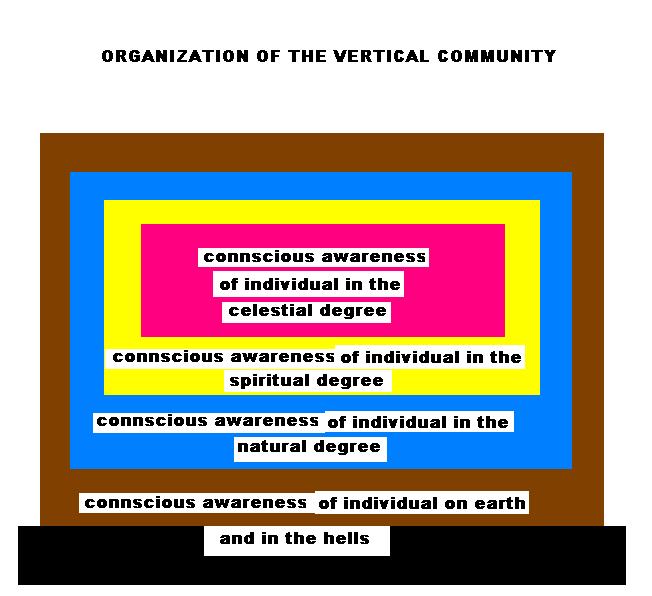
Quoting from the Writings:
Every spirit has communication with the interior and with the inmost heaven, though he is wholly ignorant of it, and without this communication he could not live. What he is inwardly, is known by the angels who are in his interiors, and he is also ruled by the Lord by means of these angels. Thus there are communications of his interiors in heaven, as there are of his exteriors in the world of spirits. By means of interior communications he is fitted for the use into which he is led without his being aware of it. The case is the same with man: he likewise communicates with heaven by means of angels-although of this he is wholly ignorant-for otherwise he could not live. The things which flow in therefrom into his thoughts, are only the ultimate effects; all his life is from this source, and from this are ruled all the endeavors [conatus] of his life. (AC 1399).
There were a number of spirits about me who were not good. An angel came, and I saw that the spirits could not endure his presence; for, as he came nearer, they fell back more and more. I wondered at this, but it was given me to know that the spirits could not stay in the sphere which he had with him. From this, and also from other experience, it has been made evident that one angel can put to flight myriads of evil spirits, for they cannot endure the sphere of mutual love. And yet it was perceived that the sphere of the angel had been tempered by means of others who were associated with him: if it had not been tempered, they would all have been dissipated. From all this it is evident what a perfect perception exists in the other life; and how those who are there are associated together, and also separated from fellowship, in accordance with the perceptions. (AC 1398)
CONCERNING THE SPHERES OF SPIRITS.
I have formerly spoken, if I mistake not; of spheres, but only of their extension and power of action; much remains to be said of their nature and quality, but at present I remark simply that they possess very wonderful properties, and may be compared to other spheres [or atmospheres] which either agree or disagree, and, as it were, coalesce or clash with each other. Those spirits which are at variance with each other perceive in an instant what is opposed to them, and by their sphere, as it were, convert it into such things as agree; nay, this holds even in regard to the minuter things which enter into the composition of the spheres of others. Spheres of this kind appear in men, but of a somewhat gross quality. The spheres of malignant spirits pervert so insensibly good thoughts into evil ones, according to every variety of circumstance which is present to man's idea, that neither man nor spirit can by any means know that such is the fact; and unless it had been given to reflect upon the subject, and to array it distinctly before the mind, and to know who the spirit was and where he was, I could never have known that facts of this nature existed. Provided a man knows what is good and true, and what is appropriate to these principles, and they will turn all that according to their genius, so that whatever is in the memory of a man they will bend it [to suit their purposes]. - 1748, April 29. (SE 1900)
5.4.1.4 Self-Witnessing Of The Threefold Self--Affective, Cognitive, Sensorimotor
Quoting from the Writings:
As is a person's life in general therefore, so is his life in every individual part, indeed in the smallest individual parts of his motives and intentions - that is, of his will - and in the smallest individual parts of his thinking; so that not the least part of an idea can exist in which the same life is not present.
Take someone who is arrogant: arrogance is present in every individual endeavor of his will and in every individual idea of his thought. With someone who is avaricious avarice is in a similar way present, as is hatred with one who hates the neighbor. Or take someone who is stupid: stupidity is present in every individual part of his will and also of his thought, as is insanity with one who is insane. Such being the nature of man, his character is recognized in the next life from one single idea of his thought. (AC 1040)
In other words our general behavior is created out of particular details. Our macro-behaviors are made of our micro-behaviors. Every act of thinking is motivated just as every act of doing. The motive enters into every micro-behavior or else the behavior would not continue. A particular thought would not occur were it not motivated by some intention, affection, or goal. The expressions "someone who is arrogant" or "someone who is avaricious" or "someone who is stupid" refer to specific mental states that every individual experiences at certain times. Psychology from the popular cartoon "Pogo" says that we have found the enemy, and it is us. We are the ones falling into states of arrogance, avarice, stupidity. According to the Writings, "arrogance" signifies the "love of self and cupidities" (AC 623). "Avarice" signifies "to acknowledge and believe nothing" (AC 303). "Stupid" signifies "the corporeal sensual separated from the rational" (AE 923).
Unless we practice self-witnessing every day how can we determine whether what we are thinking is right or wrong, and what we are enjoying and feeling is good or evil? Self-witnessing is therefore critical for spiritual growth which consists in applying the truth of doctrine from Sacred Scripture to one's thoughts and feelings. And this must be done at the various levels of the mind at which we carry out the operations of thinking and feeling.
Quoting from the Writings:
Man's interiors are distinguished into degrees, and in each degree the interiors are terminated, and by termination are separated from the degree next below; it is thus from the inmost to the outermost. (AC 5145)
Regeneration is to be understood as a psychobiological process of the mind.
The mind is a spiritual organ, not natural, because it is constructed out of spiritual substances from the Spiritual Sun. There are two spiritual substances issuing from the Spiritual Sun and creating, first, the events in the spiritual world, then, second, the events in the natural world. These two infinite substances are Divine Truth, or "spiritual light," and Divine Love, or "spiritual heat." Our mind exists in the world of spirits where it receives the stream of substances from the Spiritual Sun. Thus, love and truth in our mind must be physiologically stored, just as energy from the sun hitting our physical body is absorbed into the cells and elevates their temperature and activity level. Love and truth substances bombard our two mental organs. The affective organ receives the spiritual heat or love, while the cognitive receives the spiritual light or truth. These two spiritual substances must now be retained somewhere physiologically in the affective and cognitive organs of the mind.
Remember that all of the mind is constructed from spiritual substances and there is no physical matter like electricity or chemicals that can enter or exist in the mind. The mind is born in the world of spirits when the physical body is born on earth. Upon the death of the physical body, the mind is liberated in the rational world of immortality called "the spiritual world" that Swedenborg visited and described. The mind or "self" is immortal because it is made of spiritual substances which are eternal. Note what it takes for our consciousness to exist in heaven: We must have the eternal substances of good and truth in our mental organs. This is what makes them immortal.
Note also that God gives us the capacity to invert the truth and love that stream into our mind. In this inverted state they are called "distorted truth" or "falsity, and "corrupted good" or "evil." When we are resuscitated as a spirit and then go through our second death shortly afterwards, we must enter either the heaven or the hell in our mind. This depends on whether we retained good and truth, or, evil and falsity.
Self-witnessing allows us to become aware of the process of corruption of good and distortion of truth. Everyone is born with inherited ties to the people who dwell in the hells of their mind. God must honor or allow these ties to stand since if we were cut off from them, we would have no enjoyments left. Almost all of our enjoyments, if not all, are hellish from spiritual inheritance. This may sound like an exaggeration, but you can prove it to yourself by practicing self-witnessing (see the exercise recommended below, Section xx).
What you will discover is that most, if not all, the things we do in the course of a day stem from selfish considerations.
For example, people can be recognized as "good" employees in some business or institution, yet when something happens that turns them against the institution or boss, they show the willingness to hate, damage, and injure the people and the place, whether physically or by damaging their reputation. This proves that all along these people were not motivated to be good employees, but only made themselves appear as if they were. A good employee is by definition a decent law abiding person, and therefore would not be willing to become violent or vindictive when the company turns against them.
For another example think of people who have been "good" friends for years when one of them wins the lottery and refuses to share some of it with them. The so called good friends now become the real enemies, spewing hate and resentment, and spreading rumors to damage reputations. Think about the people you love or respect. Do you not sometimes deliberately hurt them or feel enjoyment in opposing them for the sake of what you think you deserve? How about when your reputation is at stake? Do you not mind lying or covering up something you did for which you are not sorry? How about your health behaviors? Do you think of yourself as basically a "good" person even though you overeat and make your body sick by not exercising?
With objective self-witnessing we quickly come to realize that we constantly take the good and turn it into what is evil and selfish, and we take the truth and constantly turn it into falsification of truth. We then begin to realize the critical need we have for learning how to stop doing this spiritual inversion. The quality of our immortality depends on it.
Spiritual growth or regeneration consists of two steps in sequence. The first step is to let go of the evil affections in the external mind. The second step is to compel yourself to will what is good from what you know is true.
What is true refers to the doctrine we extract from Sacred Scripture. This "doctrine of life" in our conscious awareness teaches how we should will and think in our daily activities in order to evolve a heavenly mind that can live in eternal "conjugial love" (see Section xx).
Since willing and thinking is made of thousands of particular items every hour and day, you can see that we must be able to monitor our willing and thinking sequences all day long to make sure that they agree with the doctrine of truth from Sacred Scripture that has been committed to memory and understanding. There is no way of being regenerated in a general way, by confessing and repenting of all our sins during prayer, or by giving charity and doing good to others. These things may be helpful and desirable but they do not accomplish regeneration. The only thing that will accomplish it, as revealed in Sacred Scripture, is to become aware of the particular and specific items in our willing and thinking all day long, judging them in the light of our doctrine of life, and desisting from doing and thinking them because they prevent our mind from being prepared for immortality in heaven.
Quoting from the Writings on the method of "self-examination" for regeneration:
A man's evils are in his thoughts and intentions (NJHD 164)
A man who examines himself for the purpose of practicing repentance, should explore his thoughts, and the intentions of his will; and there he ought to examine what he would do, if he were at liberty; that is, if he were not afraid of the laws, and the loss of reputation, honor, and gain. A man's evils are in his thoughts and intentions; and the evils which he does with the body are all from thence. Those persons who do not explore the evils of their thoughts and of their will cannot practice repentance; for afterwards they think and will just as they did before; and yet willing evils means doing them. This is meant by self-examination. (NJHD 164)
In other words, our inherited ties to the hells are in our thoughts and intentions. If we stopped all thoughts and intentions, we would be free of the hells, but as well, we would no longer be human beings. The thoughts are our own and they are in response to our affections and intentions, which are from hell, though it appears to us falsely that they are from our own self. Hence it says above that "A man's evils are in his thoughts and intentions."
It is also said that self-examination is spiritual if it is done for "repentance," that is, the desire to reform the character from evil to good. We are to "explore our thoughts and intentions" to see what we would prefer to happen if we were in total freedom and it was solely up to ourselves. The outward behavioral conduct is merely a reflection and consequence of the intentions and motives, which can be evil from the hells or good from the heavens.
Self-examination is therefore a process of self-monitoring. This involves monitoring and note-keeping of our mental life in daily tasks and interactions with others. I've heard some people say that it is not good to "overdo it" and that it's enough to examine our intentions and character from time to time, a few months apart. Otherwise, it was said, we become obsessed with what we are thinking and feeling, which is to our detriment. I have found no evidence for this position, and it is clear from many places in Sacred Scripture that regeneration in general is not possible without regeneration in specific particulars--what we think and intend all day long every day. There is no limit to how much self-witnessing one can do for our cooperation with the Divine Psychologist. I predict that future research will show that self-witnessing can be a permanent metanoid state of self-monitoring with great benefits for regeneration, character development, retraining, instruction, professionalization, expertise, mastery, and relationships.
Here is a method for prompting yourself while self-witnessing your threefold self in daily activities:
Focusing on the affective organ, i.e., the will:
What feelings do I have in this situation? Or:
What do I feel like doing right now?
Focusing on the cognitive organ, i.e., the understanding:
What thoughts do I have right now? Or:
What are the words and sentences I’m thinking right now?
Focusing on the sensorimotor organ, i.e., sensations and acting out:
What sensations am I experiencing right now? And:
What is my body doing and how does it appear to others—
my face, my hands, my position, my rhythm, my voice, my breathing, etc.
Keeping cumulative notes in a journal or diary can be helpful. Dictating notes with a voice recorder is very useful. Part of the self-witnessing discipline is to review or analyze the data collected over many samples of one’s interactions and behaviors, and then to evaluate them as indicators of one’s progress in self-change.
The "small" choices regarding our lifestyle—are we noisy neighbors or aggressive drivers, etc.—carry equal weight or greater weight than the large things of our social biography—degrees, income, awards, recognition, important achievements. The little things carry more weight because they are far more numerous given that they are the constituents of the larger things. And the more frequently we perform non-charitable acts, thoughts, or feelings, the more they fix our character habits, and the less we are willing to change.
One very useful area for exploration is the media entertainment content you enjoy on TV, comics, novels, music, etc. (see Section xx). The individual’s mind becomes filled and absorbed when routinely enjoying and tacitly accepting vulgarities, profanities and the lavish portrayal of lusts and violence. Monitoring our exposure and involvement with these things allows us to turn away and to turn back, and so regain an innocence that teaches us to feel shocked at these rehearsals and dramatic portrayals of evil. Similarly, we can examine to what extent we allow ourselves to repeat and enjoy songs with lyrics that are profane and glorify disorderly things.
You can use a form to keep track of what you are watching and to what you are exposing your mind on a daily basis. Try summarizing the content of the programs you watch, and identify bad behaviors such as abuse against women, corruption of children, bending of ethics, ubiquity of deception, leveling of values, dangerous driving, and other forms of negativity and self-centered intentions. People often state their surprise that they take in so much negativity without ordinarily giving it a second thought.
Those who have conscience do not swear in vain (AC 2842.)
The conscious natural mind has three operational levels--corporeal, sensuous, and rational, in that order of development. The corporeal is unaware of anything but itself. The sensuous is aware of the corporeal and of itself, but not the rational. The rational is aware of both the sensuous and the corporeal. And there are sub-levels within the rational so that we can observe from a higher rational what is going on in the lower rational.
The lowest conscious operations in the natural mind are called "corporeal" because they closely parallel the sensorimotor operations of the physical body. When the data from the corporeal mind are ordered and abstracted, they enter the sensuous mind. This level of mental operation is called "sensuous" because it is based on information that is abstracted from the physical body through the corporeal mind. The physical body and the physical environment represent the physical order of the natural world. This order is impressed upon the sensuous mind so that all thoughts we have at this level of thinking represent that order. It is called the order of "materialism" because the concepts incorporate the material world of physics, space, time, and matter.
You can see why therefore, when we hear about "spiritual" things or "mental" things, we can only think of them from a material construction as long as we are immersed in ideas originating from that level of materialistic thinking. Many people think about God in that materialistic way. I've often experienced this when someone mentions that they believe in God, I ask for additional details and discover that their idea of God is purely material. The Writings disclose that a material idea of God is finite, not infinite. I noticed that people use epithets for God that show this, as for instance, "God is a force" or, "God is an intelligent form of energy" or, "God is a higher form of being" etc. Other materialistic statements I heard include "God is evolving like the universe" or, "God cannot be omnipresent" or, "God is not a person" or even, "God's perfection is that in God exist all good and all evil" etc. These are the limitations of all concepts and ideas based on the sensuous level of thinking.
The next level above the sensuous is the rational mind. This organ is special and has a dual feature--the lower part of it can represent the physical order of the natural world, while the higher portion can represent the order of the spiritual world. The rational mind is therefore the beginning of the human being. The lower forms of thinking are sub-human or animal in the sense that animals also have the mental structures to think at that level--but not above that level called the human rational mind. This is the mind that allows us to be immortal.
The rational mind can assume the order of both worlds, natural and spiritual. The order of the natural world gives us cultural and biographical content for being a unique individual. This content is called our character. This character is immortal because it is constructed of spiritual-rational meanings and substances. So the lower rational or natural-rational mind, serves us for becoming a socialized individual capable of living in community. The upper rational or spiritual-rational mind, serves us for becoming a spirit in heaven. Both rational portions--the lower external and the higher internal, are necessary in order for us to have a life immortality in either heaven or hell.
Once we lose the physical body and start life in a mental world the level of our rationality determines the kind of life that is possible for us in this new spiritual environment. We bring with us in our lower rational mind, the capacity to continue life in community with others. And in our spiritual-rational mind we bring with us the level of community life we can support or participate in. There are three such levels carried by the correspondences we learned of Divine Speech (see Section xx). The spiritual-natural correspondences carry the "First Heaven," the spiritual-rational correspondences carry the "Second Heaven," and the celestial-rational correspondences carry the "Third Heaven."
The Writings reveal this complex anatomy of the mind by which a higher layer is conscious of what is happening at a lower layer. This is the feature that allows us to undergo the process of regeneration by which the old will is put to rest or dies, and the new will is created (see Section xx). Self-witnessing is the essential requirement for regeneration since the old will cannot die in general but only in specific. We cannot make a declaration of suicide and an act of self- sacrifice. The old self will only be strengthened by such an approach. It can die only by our rejection of the loves it contains. A higher level of our mind must witness the evils of the lower level, and then the lower level must agree to reject each love in turn. This is the real suicide of the material self. In its stead rises the dual self, which is the material self obedient to the spiritual-natural self that we can acquire in the natural mind.
The natural mind does not possess such an organ prior to starting our regeneration in adult life. As indicated above, the lower portion of the rational mind reflects a natural order while the upper portion reflects a spiritual order. But we are not directly conscious of the spiritual order through our senses, as we do when we become spirits. Since direct sensuous consciousness of the spiritual order is not available here on earth, the only way left is rational consciousness of the spiritual order--and this we obtain from the doctrine of truth from Sacred Scripture (see Section xx).
Spiritual self-witnessing involves therefore two components--(a) monitoring and record keeping skills on the threefold self in daily activities and (b) thinking about them in spiritual-natural correspondences. This is the interior level of the rational mind, not the external rational portion. The interior portion of the rational mind has three levels, as indicated above. We begin regeneration when we enter the first or lowest portion called the "First Heaven." This is the portion that contains the new will during the early phases of our regeneration. It is this spiritual-natural level that needs to evaluate our daily thoughts, feelings, intentions, and enjoyments. This is the spiritual "master" that the lower materialistic self must accept and obey.
Quoting from the Writings:
It is the rational in fact that coordinates everything in the natural, and in accordance with that coordination fittingly regards the things that are there. Indeed the rational is like a higher faculty of seeing which, when it looks at facts belonging to the natural man, is like someone looking down on to a plain below him. (AC 3283)
The rational self can monitor what the sensuous and corporeal self is thinking or willing. Anyone can perform self-witnessing or self-monitoring of the thoughts and the intended outcomes we desire with our affections (hopes, wishes, longings). The stream of thinking of the sensuous self is automatic and proceeds spontaneously as we cope with the moment by moment demands of living and doing. We can examine this spontaneous stream by directing our focus on it in a metanoid stance, looking down upon the sequence of thinking like on a "plain below," or like upon a river flowing underneath the bridge where we are standing and looking down on the flotsam and jetsam pass by underneath.
In this way we inform ourselves of the content and quality of our thinking and willing all day long. Willing is an act. Thinking is an act. We are responsible for all our acts. Every act is motivated by influx, as shown in the diagram above. Therefore we are responsible for our willing and thinking acts, each one of them, thousands of them by the hour, every day. Our character is nothing but the cumulative collection of those acts. Such as these acts are, such are we, when we arrive in the afterlife.
Our consciousness, or life orientation, is such as the content is of our willing and thinking hour by hour all day long. This content can originate solely from the sensuous and corporeal self, where we experience our conscious natural life. In which case the willing and thinking is purely natural, having no spiritual dimension that we can appropriate. Or, the content of our willing and thinking can be based on the rational self , which is made of conscience and doctrine.
Quoting from the Writings:
The man who has the interiors of his mind open can see the evils and falsities that are with him, for these are below the spiritual mind. On the other hand, the man with whom the interiors have not been opened is unable to see his evils and falsities, because he is not above them but in them. (HH 532)
"The man who has the interiors of his mind open" refers to our acquisition of spiritual-natural correspondences from Sacred Scripture and our ability to think from them in the course of our daily activities. To "see the evils and falsities that are with us" refers to the act of evaluating the self-witnessing data in terms of the spiritual-natural correspondences, that is, in terms of our doctrine of truth from Sacred Scripture. "The man with whom the interiors have not been opened " refers to the thoughts and perceptions we have at the corporeal-sensuous level. At this level of thinking we use correspondences that are below the spiritual-natural, namely, natural-rational correspondences, sensuous correspondences, and corporeal correspondences. The doctrine of truth extracted from Sacred Scripture is not genuine doctrine when formulated and thought of in terms of these lower, materialistic correspondences (see Section xx).
5.4.1.6 The Motive of Spiritual Charity
In order to acquire and maintain self-witnessing as a daily practice, we need to have a high-level motive called spiritual. This means being motivated to do something for the sake of our immortality. The Writings have disclosed who are those who dwell in the highest regions of the heavens. They are the people who have acquired for themselves the habit and love of altruism for the sake of God and heaven. Sacred Scripture often uses the expression "spiritual charity" to refer to altruism in its heavenly forms. Note that a materialistic view of charity is to give to the poor and to help those who are in need. A spiritual view of charity is to be altruistic for the sake of acquiring an angelic character for our immortality. It is the motive we have, that is, why we are helping others and why we care for them and try to protect their feelings. If we do these "charitable" things for selfish motives, we are not loving spiritual charity or altruism. For instance, we may be nice to people in order to get them to like us and do things for us, or to have a good reputation in order to enjoy the personal benefits. This is not altruism and it is not spiritual.
An important feature of self-witnessing is to identify and assess the reasons we have for doing something, not just the act of doing it. In general, any outward act may be either evil or good, depending only on the motive we have or the reward we feel by it. What we enjoy is an index or measure of what our motive is. For instance, we can lie for the sake of avoiding paying what we owe, or we can lie to protect an innocent person from unjust punishment. One act of lying is evil, but the other is good. A soldier killing an attacking enemy does a good thing, but later, when the danger is over, and the soldier kills anyway out of revenge, it is an evil act. Any act can be assessed spiritually only by the person's motive.
To the extent that we function in our daily tasks from the interior activity of charity, to that extent our physical and mental disciplines will have become spiritual. The focus therefore needs to be on how the inside world of charity in the new will, can be within the outside world of thinking and action. We need to know what is happening inwardly to our external or lower mind as we perform our routine acts outwardly:
What are we enjoying or hating about what’s going on? What are we thinking that we do not show?
The Writings reveal that it’s common for people to arrive into the afterlife not knowing who they really are, that is, what affections and ideas are in their subconscious mind. For instance, many husbands do not at first recognize their wives in the afterlife when they get together, while wives always recognize their husbands. This is because men are less aware of what fills their subconscious while wives have an inner perception of their husbands subconscious mind (see the Writings at CL 166). But it’s otherwise with men who prepare themselves appropriately for conjugial love since they strive by discipline to uncover their subconscious resistance to the conjugial, and subdue it (see Section xx).
What is in our subconscious? Quoting from the Writings:
There are innumerable things in every evil. In man's sight every evil appears as one single thing. This is the case with hatred and revenge, theft and fraud, adultery and whoredom, arrogance and high-mindedness, and with every other evil; and it is not known that in every evil there are innumerable things, exceeding in number the fibers and vessels in a man's body. (...)
Hence it follows that all these in their order must be restored and changed by the Lord in order that the man may be reformed; and this cannot be effected unless by the Divine Providence of the Lord, step by step from the earliest period of man's life to the last. (DP 296)
Since there are innumerable things in every one of our evil affections it is clear that we must rely on our Divine Psychologist to clear them and remove them from us, one by one. What we are required to do is to keep track of the major ones in the major categories as we become conscious of them through self-witnessing. You can see that a general type of confession and self-examination once or twice a year or month, is not going to be effective in knowing and removing our particular evils. Monitoring our willing and thinking hour by hour every day is necessary for us to become aware of our general evils. And when we reject our general evils, the Divine Psychologist is able to remove the innumerable evils that are attached to every general evil.
For example, there are innumerable evils attached to being overweight from overeating and under-exercising. We must take charge of it in our willing and thinking, day by day, so as to shun the evil delights that cause us to overeat and under-exercise. To the extent that we struggle under this yoke, trying to subdue and control ourselves, to that extent the Divine Psychologist can remove the innumerable evils that are attached to this general one.
The same goes for all our daily habits and routines that are from evil affections, such as our anger, impatience, swearing and cussing, adulterous thoughts, enjoyments of vulgar entertainment, our bending the rules of honesty and fairness to our favor, our neglect of duties and promises, and many such things. These are the things in which are hidden from our consciousness the "innumerable evils" that are actually spiritual fibers tying us to the hells. These ties are broken by the Divine Psychologist to the extent that we do our share and cooperate by rejecting the general evils of which we can become conscious through systematic self-witnessing. Quoting from the Writings:
All these forms of lusts must be changed one by one; and the man himself, who with respect to his spirit appears as a human monster or devil, must be changed to become like a beautiful angel (DP 296).
Our old will or character, seen in the world of spirits, is ugly like a monster or devil, but our reformed character or new will appears like an angel.
Regeneration is a gradual and piecemeal process. Detesting one evil doesn’t make us detest another, especially when the other is hidden in our subconscious because we do not monitor and find it. Quoting from the Writings:
A wicked man from himself continually leads himself more and more deeply into his evils. It is said, from himself, because all evil is from man, for man turns good that originates from the Lord into evil, as was said above. The real reason why the wicked man immerses himself more deeply in evil is that as he wills and commits evil he advances into infernal societies more and more interiorly and also more and more deeply. Hence also the delight of evil increases, and so occupies his thoughts that at last he feels nothing more pleasant.
He who has advanced more interiorly and deeply into infernal societies becomes as if he were bound with chains. So long as he lives in the world, however, he does not feel his chains, for they are as if made from soft wool or from fine threads of silk, and he loves them as they give him pleasure; but after death, instead of being soft they become hard, and instead of being pleasant they become galling. (DP 296)
Who is the "wicked man" spoken of here? It is us, every individual, before being reformed and regenerated. In that state we tend to lead ourselves more and more deeply into our evil affections, loving them more and more, feeling them delightful and pleasant like nothing else, by which we are tied more and more to the hells. Simultaneously, we are attracted to mental fabrications and falsities because they support our evil enjoyments. As well, we are repelled by the doctrine of truth from Sacred Scripture because this condemns our evil enjoyments and warns us of dire consequences.
At first we think favorably about our evil affections, turning them over in our mind as we consider whether we should continue enjoying them or not. If we give in and do them, we advance more deeply into associations with the infernals. Then, if we continue to will them despite our conscience, we "plunge ourselves to a depth from which we can be led out only by actual repentance" (DP 296) And repentance is less and less likely as we go deeper into the hells in our mind.
An article in the July 2002 issue of New Church Life by Rev. Erik Sandstrom examines the question of how "we tackle our spiritual life or regeneration" (p. 284). His short answer is, "By finding our hereditary evils!" (p. 284). He cites AC 4317 which makes the following points:
(1) Every individual is born with hereditary evil which lies in the will. These evils in the will are the source of falsities in our mind, the two always going together.
(2) The carrier of this hereditary evil is the "very inward form" of the will, which is the source of all our motives, interests, and delights.
(4) We inherit the love of self in the will so that we love others less than ourselves, and only when they "honor" us or agree with us.
(5) When we arrive in the afterlife it becomes manifest that we love self alone, and others only to the extent that they honor us or agree with us. Otherwise we hate them and desire to cheat them, to dominate them, to abuse them, or to destroy them. These hatreds are hidden from our conscious awareness while we are still tied to the physical body. And yet everyone is able to become aware of them by self-monitoring their thoughts and feelings.
Knowing that we are all this way may motivate us to monitor our willing and thinking all day long, so that we may become aware of our actual evils in operation. We must witness ourselves in order to discover when and where we wish for something bad to happen to someone, or when we feel envious of someone’s good fortune, and how we use our imagination to delight ourselves with denigrating others and ignoring their expectations, needs, or requests to us.
In regeneration we cooperate as-of self with the Divine Psychologist by choosing to reject a particular evil that delights us or fulfills our needs. This is what makes it possible--our choosing to reject it. Whatever we do in freedom is done from love and therefore it is a higher rational love that makes us reject lower evil loves. As a result, in the afterlife, we arrive with a mind filled with rational loves, within which we can live as a heaven, because the Divine Human’s good and truth flow into our mind from within these rational loves.
Regeneration involves freely rejecting our evils even though they delight us tremendously. It is not possible to reject our own evils as a group or collectively, as just discussed. It is only possible to reject them one by one. Therefore if we don’t make lists, how are we going to keep track of them so we may reject them? This is a practical issue. If we run a department store without an inventory, can we succeed? We must identify something before we can reject it. Therefore we can use the record keeping method of making lists and inventories of our evils and falsities just as we make lists of things to do on a busy day. From the Writings:
No one can shun that of which he is ignorant. (...) Evils cannot be removed unless they appear. (DP 278)
The Divine Psychologist cannot remove our evils in secret or unconsciously. Removal of evils is a conscious and cooperative process, more like lifting a heavy furniture by two men, than surgery performed while being put to sleep by drugs. This is what’s meant by the expression "unless they appear." To continue the quote:
This does not mean that man is to do evils in order that they may appear, but that he is to examine himself, not his actions only, but also his thoughts, and what he would do if he were not afraid of the laws and disgrace; especially what evils he holds in his spirit to be allowable and does not regard as sins; for these he still commits. (DP 278)
We are able to compel ourselves to not carry out an evil in outward behavior. This we should do. But it doesn't end there. We are required to condemn it as evil in our mind so that we cannot continue to enjoy the fantasy or desire in this evil.
What are evils that we "do not regard as sins." For example, we may have a long standing habit of thinking about others in a derogatory or denigrating way. We never bring this out to the surface and would not want others to know about it. We see it as merely an inward habit that we won’t allow to have overt consequences. Just a kind of quirk—we might think. But this is fooling ourselves. Quoting from the Writings:
In order that man may examine himself an understanding has been given him, and this separate from the will, that he may know, understand and acknowledge what is good and what is evil; and also that he may see the quality of his will, or what it is he loves and desires. In order that he may see this his understanding has been furnished with higher and lower thought, or interior and exterior thought, to enable him to see from higher or interior thought what his will is doing in the lower or exterior thought. This he sees as a man sees his face in a mirror; and when he sees it and knows what sin is, he is able, if he implores the help of the Lord, not to will it, but to shun it and afterwards to act against it; if not wholeheartedly, still he can exercise constraint upon it by combat, and at length turn away from it and hate it. (DP 278)
To focus on the thousands of acts of willing and thinking every day, means to monitor and keep track of them. Note that normal social life does not require this kind of self-knowing. Society requires that we know things outside of ourselves, like the history of our country, or the multiplication table, or how to read instructions and write messages. But there is no social, legal, or professional requirement that we monitor our feelings, motives, thoughts, and interior dialog with ourselves. Once in awhile, if we get called on the witness stand, we might have to report on some of our willing and thinking. We are asked, Why did you do this? Or, What did you decide then? Or, Were you in love with her at that time? Etc. It is required by law that we answer honestly, but knowing the answer is not a requirement. In that case we reply, "I don’t remember," and the court accepts it. But the court does hold us responsible for knowing things outside of ourselves, such as, Did you see him or not? and, Were you ever contacted by this person, etc.
And yet, for our eternal fate in the afterlife, this external knowledge is not at all crucial, and will only last us as long as we are connected to the physical body, while the usefulness of the interior knowledge will last us to eternity. Clearly, the interior knowledge is immeasurably more important than the external knowledge, and yet, prior to our reformation, everyone favors the external knowledge, and pursues it, hardly paying attention to the far more crucial interior knowledge, which is knowledge about the character of our willing and the content of our thinking all day long.
The knowledge of a thing must come first in order that there may be a perception of it. (AC 5649)
Having practiced the self-witnessing discipline for more than three decades I am able to say various things about it that may be useful to others. An amazing discovery was the existence of "sudden memory" which refers to the stream of thought that is our actual mental life in the natural mind (see Reading List). This stream of thought is the outward form of our affections. The quality of our affections is the result of the particular spiritual societies with which we are in contact as the sequence of thoughts proceeds. When we perform self-witnessing we are able to "tune in" to the stream of thought while carrying out one’s routine tasks all day long. This is not like meditation or deep reflection which are activities that occur when we stop our tasks and sit doing nothing, thus disengaged from the surrounding pace of events.
The stream of thinking accompanies every act and is a characteristic of human life. Every person is able to tune in and listen to it or become aware of it. What is amazing is that the instant one tries to reflect on what was snatched from the stream, it is mostly gone. One cannot remember what it was. It’s quite unsettling. How do we get hold of it or some of it, long enough so we can examine it in greater detail? You may be familiar with this experience when, upon awakening, you are still affectively filled by the sphere of your vivid dream, but the instant you try to reflect on what it is so you can put it in words, it remains unavailable to the conscious mind, staying just out of its reach—like the "tip-of-the-tongue" phenomenon when you’re trying to think of a name or word you know but can’t quite think of it.
Psychology teaches that there are two types of memory: short term and long term. The first lasts for several seconds—like the phone number we look up and then dial. If we wait more than a few seconds to dial it, we have to look it up again. We move things from short term to long term memory by repetition and rehearsal with the motive to recall it later. So you can memorize things in this way and place them permanently in your long term memory where you can recall it when you want to. Sudden memory seems to work for a second or two and then it’s gone. This is why I call it "sudden" memory—suddenly come and suddenly gone. This is the reality of our stream of consciousness under normal conditions. But self-witnessing skills allow you to snatch things from sudden memory and put them into short term, then long term memory where the record of the thoughts can be analyzed and evaluated.
I discovered that trying to think in words and sentences slows down the stream of consciousness so that it’s easier to become aware of what it is. This is somewhat like giving a "blow by blow" description to an imaginary tape recorder of what one is thinking. It seems to slow the stream down for awhile, enough so that one’s short term memory retains more of it and one is able to get a fix on what the topic is and its direction. In short term memory we can be aware and evaluate, and put anything we want into long term memory by mentally rehearsing or making a physical record of it. In this way the mental discipline of self-witnessing pays off because it gives conscious access to one’s normal everyday affections.
Daily self-witnessing practice enables us to exert rational and spiritual control over our interior dialog, daydreams, and emotional reactions to things, moment by moment all day long. It reveals attitudes and interests. One can exert control by consciously choosing to stop or interrupt a particular line of thinking and feeling. I use the expression "self-regulatory sentences" for instructions we can give ourselves to control the stream of thinking: e.g., "Stop it. Why are you wasting time thinking these useless things?" Or: "That’s not a nice thing to think." Or: "How low can I get to be so fascinated by that sort of thing?" Etc. This gives people greater conscious control over their mental life allowing them to clean out the mental pollution that reigns in it from heredity and culture.
It is not possible for humans to do anything without the accompanying thinking stream. By controlling this, we control a portion of our natural mind. That is, control of the lower natural mind by the higher natural mind; more particularly, control of the corporeal and sensual mind by the more interior rational mind. The Writings teach that this is the genuine human or celestial mind. This process is inhibited and destroyed when we do not remove the mental pollution by our own daily efforts, as-of-self but looking to God for the actual power to accomplish it in us. It is God who performs the regeneration, but He can do this only to the extent that we cooperate as-of self by means of daily conscious effort (see Section xx).
The celestial regions have walls and guards that keep out mental pollution from wandering strangers and evil spirits so that these lower things cannot enter that lofty region of human consciousness. Therefore we need to erect such walls and establish guards in our mind to prevent unholy things from entering and lodging there. Our culture of entertainment and social cynicism specializes in manufacturing large quantities of polluted ideas, pictures, and situations. Without vigilance exercised every hour of our waking time, our mind gets inundated by mental pollutants, poisons, viruses, and all sorts of unpleasant, sleazy, scortatory, and idiotic suggestions. The mind is weighted down by them, even sinking into the corporeal.
The Writings warn those who make such mental pollution their abode in this life, because in the afterlife they are captured and tortured by those who have these same polluted things in them. And the omnipotence of a loving God cannot deliver them from this miserable lot for to remove them from it would leave nothing behind for any life by them (see the Writings at AC 5854). Best therefore that we be diligent and sincere in our efforts at self-witnessing while there is still time and opportunity.
Have you listened in on yourself lately? We cannot trust the reputation or opinion we have of ourselves, for this is subjective, biased, and self-serving. The check mark we place on self-rating scales are inflated or deflated in accordance with our vanities: How good am I? How often do I get mad? Am I ever unkind or gross? What kind of mistakes do I make? How happy are the people around me with my conduct? Etc. To answer such questions objectively and accurately we must witness our life.
To react to what we observe is to make an evaluation of our willing and thinking. This evaluation is from a rational level, looking down, while the stream of thinking we are observing, is from a sensuous or corporeal level. An analogy might be standing on a bridge and looking down on the flow of a semi-transparent river and inspecting its contents—stones, fish, plants, debris. These things represent the content of our mind—knowledges, truths, and falsifications of truths. The flow of the river is the sequencing of the thoughts, their reasoning and coherence.
Swedenborg describes how spirits that he was associated with tried to direct his eyes to look at things they were interested in.
THAT CRUEL SPIRITS AND ADULTERERS LOVE NOTHING MORE THAN FILTH AND EXCREMENTS.
(((((I have spoken) previously of this [fact] that to such spirits, filth and excrements are very pleasant, so that they prefer the pleasantness of beholding such things to all other pleasantnesses, and not only filth and excrements, but also foul, loathsome, and horrid intestines of animals, to that degree, that when they act through man they snatch away all his interior sense, as also [his] sight, to such things, because they, are delighted therewith.
This also was shown me by manifest experience; when I walked in the street, they carried away my eyes to all such things; wherever there was filth, excrement and intestines, thither they directed my eyes, although I was ignorant where were such things in the street, because not observed by me. Still they saw these, whilst I was wholly unobservant, and thither directed my eyes, either to [my] side, or about [my] feet, or near and farther from thence; and the did not turn my eyes to anything else. (SE 2843)
Monitor your eyes as you walk on the street or as you read a magazine or watch TV. The eyes respond to our interest, to our affections, to what we find delightful. As your eyes roam, they settle on this or that object, body part, detail. The eyes are quick. You have to catch yourself and become conscious of where they settle for how long, and where they keep coming back to. These eye movements will reveal interests and delights that we do not wish to publicize because they are filthy and scortatory, as the passage above describes. As Swedenborg walked in the street, the spirits with him "carried away my eyes to all such things; wherever there was filth, excrement and intestines, thither they directed my eyes, although I was ignorant where were such things in the street, because not observed by me." Monitoring our eyes will reveal to us what filthy things are of interest to us form heredity. These filthy interests are not our own affections, they are the affections of the filthy spirits. But we are tied to those spirits by heredity and the filth remains with us unless consciously removed.
Since spirits take possession in that way of all that forms a person's thought and will, and angels take possession of what is even more interior, so that he is joined very closely to them, the person cannot avoid the perception and sensation that he himself is the one who thinks and wills. . (AC 6193)
Our inherited connections with evils spirits cause our minds to be filled with blasphemous thoughts and curiosities.
Anyone who is governed by bodily and worldly love, and not at the same time by spiritual or by celestial love, does not have any but evil spirits with him, even when external holiness exists with him. Good spirits cannot in any way be present with such a person, for they perceive in an instant the kind of love which governs a person. There is a sphere emanating from the interior parts of him which the spirits perceive as plainly as man by his sense of smell perceives offensive and foul odors floating around him in the air. (AC 4311)
=================================
www.soc.hawaii.edu/leonj/updates/lee/Section%208.1.3.html
[8.1.2]
The Hexagram of Sudden Memory. Consider the following downward series of semantic units and their usage in a sample illustration. We refer to such semantic structures by the label hexagram to indicate that it is a whole made up of two parts separated by a double line boundary and ordered in a vertical series. The rationale and structure of the hexagrammatic system are elaborated further in
| I. IMPRESSIONS
II. INTERPRETATIONS III. AWARENESS |
Illustration "It happens like this. First, you get some impression which you come to interpret, after which you become aware you've had them" |
| IV. SELFCONSCIOUS
V.UNSELFCONSCIOUS VI. CONSCIOUS |
"It happens like this. First you do it all selfconsciously, but after some practice you begin to do it unselfconsciously. Eventually you do it being fully conscious." |
the Appendix and in a number of places in this Workbook (see Index). Here, we wish to show its use or applicability in methodology.
Let us stipulate that this particular hexagram, called "The Hexagram of Sudden Memory," is a hypothesis about the structure of the units that make up sudden memory just as in the case of short-term memory, we stipulate discrete units underlying the natural flow of actions and events. Having stipulated this, we can now derive from it, a theory about what it is in the mind, since it is not in behavior. Assume therefore that sudden memory is a parameter of the mind and that it has the characteristics given by the above hexagram; these are as follows:
(i) every unit of mind (or gene of intellect) is a hexagram made up of two trigrams;
(ii) in this molecule, the upper trigrarn has three features in descending order; these are: IMPRESSIONS, INTERPRETATIONS, AWARENESS;
(iii) the upper trigram can be represented in behavior as the temporal verbal report: "First you get impressions, then you interpret them, and finally you become aware that you have them."
(iv) the lower trigram can be represented in behavior through the following assertion: "When you start, at first you kind of feel self-conscious but afterwards you sort of get used to it with practice, and then you kind of do it unselfconsciously . Eventually it becomes a routine and you're doing it fully consciously."
(v) the double line separates topical from pre-topical such that the upper sequence is pre-topical while the lower is topical; this can be represented behaviorally by the following verbal argument: "The SOCIO-cultural environment creates two zones: pre-topical and topical. Pre-topical belongs to all societies whether non-verbal, as ant colonies, or verbal, as human communities. But topical belongs only to verbal societies. As a result, impressions, interpretations, and awareness are societal features, not individual, hence ants may be, as a group manifesting the phenomena of impressions, or awareness, but not individually. However, ants are not conscious since they fail to exhibit topical phenomena."
Having assumed the above, let us now explore the consequences. First, it is provocative to say that ants are aware and make interpretations of their impressions, though given the new sociobiology (Wilson, 1976), the idea is no longer disrespectable! The oddity of the assertion disappears when "pre-topical', is seen as its frame, i. e., the awareness of the ants is not of a topical nature, as ours obviously is, given human language; thus we, are led to investigate the nature of a pre-topical element just as genes provide clues to the behavior of a species or, molecular transactions give clues to atomic structure. The hexagram we are investigating proposes that the phenomenon of consciousness is the sixth element in a descending series of which the upper three are pre-topical, i.e., characteristic of pre-literate and non-verbal societies or stages of development (ontology). This leads to the provocative assertion that awareness is pre-topical in the ontology of mind.
In behavior, ontogyny recapitulates phylogeny; in mind, synchrony recapitulates diachrony. The first assertion establishes the relationship between individual behavior and the inherited gene pool of the species; it gives the biological component to psychology. The second assertion --that synchrony recapitulates diachrony --establishes the relationship between personal experience and the socio-cultural environment; it gives the experiential component of psychology . Now we ask: Is this experiential component as real and amenable to scientific investigation as the biological component? We propose an affirmative solution though it will require a suitable methodology, suitable for the investigation of phenomena that are non-temporal, viz., synchronous. The hexagram.matic approach is the original methodology of synchronic synthesis devised by the first civilizations to invent literacy, i.e., the community practice of publishing knowledge and indexing text. This led to books, manuals, archives, official records (see Section [5. 2. 3] in Chapter 5). This method survives today in the form of the treatise called the "I Ching" and attributed to Confucius and earlier scholars of the Chinese Dynasties (circa 1100 B.C.). The I Ching is a unified theory of social settings and presents an exhaustive system of 64 situational hexagrams corresponding to the modalities of conduc t on the daily round (see Section [6.3.1] in Chapter 6).
Ethnosemantic methodology (ESM, for short) requires a special register just as statistics and experimental methodology involve specialized registers, i.e., vocabulary, syntax, mathematical operations abstract conceptions, formalized argument procedures, explicitness, routine replicability, and so forth. These are essential characteristics of any valid methodology. ESM employs a traditional and well established system of mathematics called hexagrammatic topology. This is a term we are proposing for what appears to have been around since the beginnings of literate civilizations, i.e. , circa 1100 B. C. (e.g., the Chou Dynasty in China which gave us the I CHING; the Mycennaen civilization that led to the Illiad of the Greeks; the Egyptian Book of the Dead; the Babylonian Code of Hammurabi). The beginnings of literacy were understandably functional evolutionary developments: verbal but preliterate human societies (i.e., 3, 000 years ago and beyond) were dependent on oral rituals of transmission of knowledge, tradition, practice, and ideals. There was thus maintained by necessity a caste system in society in which a few had the contact and conscious relationship with the past and therefore, with the continuity in conception and in awareness of the mechanisms of culture (For a personal view, see Yogananda, 1975; Roberts, 1974; 1976; Rampa., 1963; Jones, 1972. For a scientific view, see Hoggart, 1957; McLuhan, 1964; Jaynes, 1976).
With the evolution of literacy as an ordinary daily round phenomenon, i.e., when education became available to many in a community, there evolved a class of immortals called the classicists whose ideas, words, arguments, and attitudes are perpetrated in print and in translation and in reference, thus enduring in presence long after their author's natural life span. The "Books of Authority" as we might call them, thus constitute the archaeology of the objectified descriptions of the ideas of the past. They are the data needed for the histories of ideas, nations, and people (see Lovejoy, 1955 and Cassirer, 1950).
The methodology that transforms ideas into objective data needs to be presented. ESM is such a methodology. To illustrate its application, we present the following ennead of basic principles about ESM.
The capitalized terms are technical objects, to be defined presently, and the other terms are operational definitions. The latter may be represented through a geometric notation system or analogy, as follows:
trigram = a composite form made up of three distinct elements, e.g., triangles; triplets; the minimal family unit; any scale made in such a way as to have three positions; etc.
hexagram = a composite of two distinct trigrams ordered linearly such that one trigram assumes a lower order relative to the other trigram;
double hexagrams = a composite of two distinct hexagrams arranged in a 90 degree angle such that one hexagram assumes the horizontal position while the other assumes the vertical position; the double hexagram, forms a Cartesian coordinate system or hexagrammatic matrix In which 36 dyadic intersections are specified;
electric couple = a unit of cycle consisting of a pair of two double hexagrams; electric couples are phasal units with a value of 48 (one double =2 hexagram s = 4 trigrams = 4 x 3 = 12; hence 2 double hexagrams = 24 and a pair of doubles = 48);
double line = two parallel lines separating the lower from the upper trigram in any hexagram; the gap between the double lines represents the natural break between pre-topical and topical (roughly: matter and psyche, or reactivity and consciousness)
crossing the double line = a natural phenomenon characterizing the laws of phasal motion such that a transformation or metamorphosis is noted when crossing the double line, i.e., the phase between the adjacent constituent parts of the upper and lower trigrams in any hexagram; crossing from the upper to the lower is in the direction of dissolution of topic (topical to pre-topical); from lower to upper, it is in the direction of crystallizing topic;
dialectic movements = units of phasal values charted or plotted by reference to the hexagrammatic positions available; e.g., crossing the double line is a dialectic movement from phase III to IV or vice versa; similarly, going from phase I at one end of the lower trigram, to phase III, the other end, is a dialectic movement;
media for consciousness = distinct channels or manifolds having the property of retaining form or shape, and changes in these; the coding of these changes is possible in terms of topic, topic units, and topic domains or zones;
titles = the referential labeling that identifies a category of event, process, relationship, or experience; titles may be conventional or neologistic; e.g. "bread' and "eating bread with meals" are conventional topic nominals recognizable through the cataloguing practices of a community; "eating bread and thinking that I shouldn't bell is a neologistic topic nominal constructed according to standardized register principles or norms;
Thus far we have specified the operational definitions of the main components of ESM. Now let us introduce some basic technical terms. These are the conceptual elements that enter into the mathematics or geometry of the notation system of ESM.
www.soc.hawaii.edu/leonj/updates/lee/section8.1.2.html
================
5.4.1.8 Macro-Behaviors Are Regenerated by Means of Micro-Behaviors
All acts we do occur as a sequence in a social setting. For example, we awake at dawn, drive to the beach, drive back, fix and eat breakfast, and clean up the kitchen. This is a morning routine that takes up a small portion of every day. Note that in order to describe it I use expressions that refer to macro-behaviors, or behavior units that are fairly general, like "driving to the beach" or "cleaning up the kitchen." You can see that each detail mentioned, has sub-components that are not mentioned. For instance, my wife and I spend about one hour at the beach walk, which is a unit of behavior composed of multiple sub-routines. One has to do with saying good morning to the other beach walkers. This has many details to be described since it varies with each stranger we say good morning to. We could write a book on the many details about how we transact this complex event that takes one and a half seconds-- saying "Good morning" along with a complex set of gestures, body positions, and facial expressions, all of which must be timed in a certain way depending on who it is and how they are moving.
An hour long beach walk is an event packed with details of sub-events. For example, admiring the sunrise—which varies every morning, listening to waves—which varies with the specific place or the weather, watching the frigate birds high in the sky looking for favorable air currents, and numerous other things, like the dogs, the fisherman who gives the dogs treats, each dog responding to it in its own way, and the things my wife picks up like a broken piece of glass, or a wounded bird she needs to drive it to the oceanic institute where they take care of them.
When I get to describing even more specific behavioral detail, we enter the micro-behavior world. Most people do not describe things at this level for it would be too boring and even meaningless, thus interfering with normal communication. For example:
I could describe what I do with my cell phone, not wanting to leave it in the car, fearing another break in as we had twice before. When I enter the car I place the tiny little phone on the tray, then when I arrive at the beach, I pick it up and put in my right back pocket. I have my wallet in my left back pocket. I have my keys in my left side pocket. I avoid putting the cell phone with the keys for it makes a noise as I walk. Etc. Etc. Who could stand endlessly discussing such details on our daily round of routines? So we don’t. And even each of these sub-details has sub-sub-details, like how I put the phone in my back pocket as I exit the car. My back pocket seals with a Velcro strip so I have to manage to open the flap held tight by the Velcro, as I hold the cell phone in the hand. This takes some practice to do effectively.
And then there are finer details to each of these little movements, as when I have a cut healing on my finger and try to avoid opening the wound by putting pressure on it at a certain angle. In each of these micro-behavior details there is a threefold stepwise execution. First, I have a motive, like protecting my cut finger from being injured as I open the Velcro flap on my right back pocket. Second, I have a sequence of thoughts, like monitoring the angle of pressure on the cut on my finger and judging at which point I should no longer put pressure. Third, I have a sensorimotor execution of the hand rotation, the right amount of force exerted, and precise finger movements.
The spiritual importance of micro-descriptions of behavior is that every microbehavior, no matter how small in the overall sequence, is an outcome of a specific motive.
No microbehavior can occur without a motive. From the Writings we know that all the heavens form a one, and all the hells form a one. Therefore all our motives and affections form a one. This is why the Writings speak of our ruling love. The ruling love rules all the other loves that are under its subordination. If there is selfishness or stupidity in our mind at any particular time, then every sub-routine and microbehavior we perform has this selfishness or stupidity in it. The motive that drives our macro-behavior enters into every micro-behavior of which it is constituted. And the motive always belongs to the will, supported by the thought. You can see then that willing and thinking is performed in numerous sequences of micro-behaviors built into macro-behaviors. And this goes on all day long every day.
Self-modification of macro-behaviors is achieved in two steps. First, there must be a general motive or goal, such as going to the beach at dawn. All the sub-behaviors and their micro-behaviors depend on this one macro-behavior motive. The morning one of us decides to sleep in we do not go to the beach and all the micro-behaviors at the beach do not occur. In regeneration, the motivation to modify macro-behaviors must therefore come first. For example, I may decide that it is my citizen’s duty to pick up sharp pieces of glasses I see as I walk, so as to prevent injury to those who walk barefoot. In the past I did not do this. Now I’m motivated to be a better beach citizen and to stop acting with indifference towards the danger to others. This begins my regeneration effort with regard to this one area. It starts with a macro-motivation.
Now I need to struggle to regenerate all the micro-behaviors. For example, I see something a few feet away that might be a piece of glass. I should go over there and examine it, but I don’t want to break my aerobic pace, so I keep walking. I feel bothered. Now I can continue to walk or I can turn back. I’m in a struggle. And so on. You can see that the micro-behaviors confront the actual issues involved in carrying out the macro-behavior. Motives are set within motives in a complex hierarchy and we cannot regenerate the macro-behavior unless we tackle and modify the lower issues attendant to the micro-behaviors.
Metanoid self-witnessing is a mental literacy skill that allows us to monitor and evaluate the moment by moment stream of willing and thinking that constitutes an hour or a minute of our daily round of behaviors at the macro and micro levels of operation.
The Writings speak of this metanoid or double focus in connection with self-examination, repentance, and regeneration:
[A person] can from wisdom above view the love that is below, and in this way can view his thoughts, intentions, affections, and therefore the evils and falsities as well as the goods and truths of his life and doctrine; and without a knowledge and acknowledgment of these in himself he cannot be reformed. (DP 16)
Without self-examination, recognition, acknowledgment, confession and rejection of sins, thus without repentance, there is no forgiveness of them, thus no salvation, but eternal condemnation (DP 114)
IV. EVILS IN THE EXTERNAL, MAN CANNOT BE REMOVED BY THE LORD EXCEPT THROUGH MAN'S INSTRUMENTALITY
It is only religion which renews and regenerates a person. Religion is allotted the highest place in the human mind, and sees below it the social matters which concern the world. Religion too climbs up through these as the pure sap rises in a tree to its top, and from that lofty position it has a view of natural matters, just as someone on a tower or a mountain has a view of the plains beneath. (TCR 601)
The will inclines from birth towards evils, even to those which are enormous; hence, unless it were restrained by means of the understanding, a man would rush into acts of wickedness, indeed, from his inherent savage nature, he would destroy and slaughter, for the sake of himself, all who do not favor and indulge him. (ISB 14)
From these and many other passages in the Writings we acquire the idea that constant self-witnessing is a method that allows us to carry out the cooperation with our Divine Psychologist that we are commanded in Sacred Scripture as necessary for our regeneration. When you begin self-witnessing, one striking aspect of it is to become conscious of the macro and micro-integration of human willing and thinking. For example, I think about taking in the car for servicing. This is a macro-topic in my day’s schedule, to be integrated with many other macro-topics like sending email to someone, grooming the cat, shopping for groceries, reading the Writings, vacuuming the pool, and so on. Every macro-topic is kept in place by priorities of motives or affections in the will. But every macro-topic is constructed of an integrated series of micro-topics, each of these being maintained by a hierarchy of sub-motives, affections, and preferences in the will.
For example, vacuuming the pool is made of sub-tasks (1) getting the pole from its place behind the plants without injuring the plants; (2) taking off the brush attached to it and affixing the hose nuzzle extension on wheels; (3) curling or snaking the long hose into the water to fill it with water and empty it of air; and at least a dozen other sub-tasks. Each sub-task has a series or hierarchy of affections that determine the style, rate, and effectiveness of my willing, thinking, and acting out the movements of hands, head, and body. Each sub-task offers plenty of opportunity for inherited and acquired evils to break out and take over, producing errors, ineffectiveness, damage, injuries, anger, egocentric affectational styles, neglect, laziness, carelessness, and many others.
5.4.1.9 The Daily Round Archives
In 1971 I started teaching self-witnessing methods to my students in social psychology (see Reading List). This was ten years before I found the Writings of Swedenborg (see Section xx). Nevertheless the methods I used are serviceable for theistic psychology. As I discussed above, self-witnessing is made spiritual when the motive for doing it is heavenly, that is, regarding one's life after death. I also discussed the fact that social settings provide a standardized catalog for naming the activities of the threefold self in daily life. Finally, I pointed out that character reformation involves the modification of micro-behaviors that need to be empirically observed in one's thinking, willing, and doing. The spiritual purpose for this activity is to assess our macro and micro-motives by applying the doctrine of truth from Sacred Scripture which we have acquired by study. When we do this, God then removes the hellish motive from our character by breaking the inherited tie we had with the spirit society in hell that has this motive as its ruling love.
Working with my wife Diane Nahl (see Reading List), we constructed the Daily Round Archives Classification Scheme (DRA), which I reproduce below. We made use of the various theories of social settings that we were teaching in social psychology. We also used our own self-witnessing data to construct a general inventory of social settings that people are familiar with in their daily lives--the bedroom, the kitchen, the highway, the workplace, the shopping mall, etc. We also focused on people's "territoriality" such as their belongings, the people they know, and their reputation with different categories of people. We included as well the complexities of talk--what we say when to whom and in what way. And finally, we included various categories of thoughts and feelings.
Our purpose was to give students an empirical catalog which they can use to gather information on themselves as a way of self-witnessing one's life. Since everyone is socialized with similar skills, such as literacy and communication, it makes sense to have everyone witness their lives by using a standard catalog of where to look and what to observe. As the data produced by students increased in quantity with each semester, we started calling the collection as the "Daily Round Archives" (DRA). Keeping such a cumulative collection or database allowed new generations to look over the data collected on themselves by prior generations, as explained in several articles listed in the Reading List (they are all accessible on the Web).
As you read or inspect the DRA catalog you will note how we use phrases to specify features of micro-behaviors in the threefold self. For example in Category "2B Connections" there are entries for "2B5 People I Know From Work" and "2B8 People Whose change in Financial Status Would Affect My Financial Status." You can see that it makes a difference for our motives which category of people we are thinking about or relating to. In some categories of relationship we may have a different hellish motive than in another because our motives are social and depend on the social situation and its conditions.
Similarly in Category "3b Situated Interior Dialogue" it makes a difference whether we are talking to ourselves about a schedule ("3B4 Reviewing-Making Plans and Lists "), or "3B5 Emotionalizing Episodes" which refers to talking to ourselves about what happened in an emotionally charged encounter with someone.
Consider Category "5b Routine Concerns: Selected Inventories-- 5B1 Privacy." It makes a difference whether we are thinking about privacy "5B1.1 From the EYES of Particular Others" or privacy "5B1.4 From the Knowledge of Particular Others." This latter category has sub-categories that make a difference, e.g., if it's about "5B1.4.1 Involving Your Activities" or if it involves "5B1.4.2 Involving Your Ideas."
The DRA is therefore an inventory of settings for the threefold self in daily life. It gives us a detailed map of many recurrent aspects of our willing, thinking, and doing. This is the arena in which we perform and satisfy our inherited loves. Therefore this is the arena in which we must fight our battle for regeneration. As you go through it think of what it would be like to use it for your self-witnessing practice, should you decide to do it.
The Daily Round Archives (DRA)
Classification System for Self-Witnessing
I. MAJOR CLASSIFICATION LEVEL
Zone 1: Biographic Record (White)
Zone 2: Tribe (Yellow)
Zone 3: Role (Green)
Zone 4: Psychohistory (Blue)
Zone 5: Territoriality (Brown)
Zone 6: Appearance (Black)
II. SUB-CLASSIFICATION LEVEL
Zone 1: Biographic Record
1a My Vita
Zone 2: Tribe
2a My Talk
2b Connections
2c Family TreeZone 3: Role
3a Logging Activities
3b Situated Interior Dialogue
3c Situated Standardized Imaginings
3d Situated Psychologizings
3e Situated Sensations And Feelings
3f Situated Feeling Arguments
3g Situated Fantasy-Daydream Episodes
3h The Elevated Register
3i Responsibilities and Duties
3j Social MembershipsZone 4: Psychohistory
4a Situated Attributions
4b Situated Evaluations And Assessments
4c Situated Judgments
4d Interviewing The SelfZone 5: Territoriality
5a Regular Lists And Belongings
5b Routine Concerns: Selected Inventories
5c Noticing Observations
5d Description Of Transactions
5e Transactional Strategies: Episodes When
5f Declarations
5g Slogans
5h Epithets
5i Hangouts And Group Activities
5j Reporting Joint Activities
5k Non-Joint ActivitiesZone 6: Appearance
6a Interviewing Others
MICRO CLASSIFICATION LEVEL
Zone 1: Biographic Record
1A. My Vita
1A1 Current Status in Community
1A2 Background
1A3 Topic focus
1A4 Personal1A4.1 Favorites
1A4.3 Fears
1A4.2 Ambitions
Zone 2: Tribe
2A My Talk
2A1 Analysis of Argument Logic
2A1.1 Schema of Argument Structure
2A1.2 Description of Operational Talking Procedures
2A1.3 Schema of Behavioral Strategies in Talk
2A2 Analysis of Relationship
2A2.1 Case History
2A2.2 Relationship Dynamics
2A2.3 Tabulation of Pair Types
2A2.4 Tabulation of Role Types
2A3 Analysis of Sequence
2A3.1 Schema for Move Embeddings
2A3.2 Tabulation of Adjacency Relations
2A4 Analysis of Setting
2A4. 1 Discourse Analysis
2A4. 2 Tabulation of Derivative Relations
2A4. 3 Tabulation of Implicit Meanings
2A4. 4 Tabulation of the Rhythm of Exchange
2A4. 5 Transactional Engineering through Talk
2A5 Analysis of Topic
2A5. 1 Breakdown of Topics Exchanged
2A5. 2 Topical Annotations
2A5. 3 Topical Chart of Transcript
2A5. 4 Topicalization Dynamics
2A6 Transcript Annotations
2A6.1 Explanations
2A6.2 Stage Directions
2B Connections
2B1 People I Live With
B2 People Who Are My Immediate Family
2B3 People Who Are My Extended Family
2B4 People Who Are Acquaintances of the Family
2B5 People I Know From Work
2B6 People I Regularly Socialize With
2B7 People Who Have Provided Me with Professional Services
2B8 People Who's change in Financial Status Would Affect My Financial Status
2B9 People Who Are Non-Intimates and Non- Family whose Ill Health or Death Would Affect Me
2B10 People Whom I Might Ask for a Recommendation
2B11 People Who Influenced My Intellectual and Personal Maturity
2B12 People I Don't Know Personally But Whose Ideas Affect Me
2B13 People Who Have or Could Ask 'Me for a Reference
2B14 People I see Regularly for Service or Supplies
2B15 People I'd Like Currently to Meet
2B16 People I Know Whose Words I Quote or Stories I Tell
2B17 People Whom I Believe to be Admired by My Parents
2B18 People Whom I Know Who I See or Think About Only Rarely
2C Family Tree
Zone 3
3A Logging Activities
3A1 Time
3A2 Duration
3A3 Place
3A4 Participants
3A5 Occasion
3A6 Nature of Activity3B Situated Interior Dialogue
3B1 Overlays of Comments to Self
3B2 Value Expressions
3B3 Preparing Schedules
3B4 Reviewing-Making Plans and Lists
3B5 Emotionalizing Episodes
3B6 Rehearsals and Practicings
3B7 Annotations, Memorizings, Editings
3B8 Unmentionables Within the Relationship3C Situated Standardized Imaginings
3D Situated Psychologizings
3E Situated Sensations And Feelings
3E1 Microdescriptions of Sensory Observations
3E1 .1 Aches and Pains
3E1 .2 Stretchings and Exercise
3E1 .3 Blushing
3E1.4 Retinal Sensations ~ etc.
3E1.5 Appetite and Cooking
3E1.6 Energy Level
3E1.7 Smells and Odors
3F Situated Feeling Arguments
3F1 Figuring Out a Conflict
3F2 Making Resolutions
3G Situated Fantasy-Daydream Episodes
3G1 Elaboration of Dramatized Scenarios
3G2 Construction of Catharsis Stories
3G3 Re-contacting Nostalgic Memories
3G4 Working out Alternative Realities
3H The Elevated Register
3H1 Praying-Invocations
3H2 Altered States of Consciousness
3H3 Meditations-Reading of Scriptures
3H4 Poetic Expressions
3I Responsibilities and Duties
3J Social Memberships
Zone 4: Psychohistory
4A Situated Attributions
4B Situated Assessments/Evaluations
4C Situated Judgments
4D Interviewing Self
4D1 Who Am I
4D2 What Am I
4D3 How Am I
4D4 What Do I Look to You
Zone 5: Territoriality
5A Regular Lists And Belongings
5Al Invitations
5A2 Announcements
5A3 Subscriptions
5A3.1 Periodicals
5A3.2 Membership Dues
5A3.3 Contributions5A4 Bills
5A5 Closets
5A6 Drawers
5A7 Objects
5A8 Documents and Mementos5A8.1 Official-Legal-Medical
5A8.2 Personal/Biographical
5A8.2.1 Prizes
5A8.2.2 Letters
5A8.2.3 Gifts
5A8.2.4 Albums
5A8.2.5 Souvenirs
5A9 Personal Effects: Selected Inventories
5A9.l Purse/Wallet
5A9.2 Car Glove Compartment
5A9.3 Your Own Drawer for Stuff
5A9.4 Clothes Closet
5B Routine Concerns: Selected Inventories
5B1 Privacy
5B1.1 From the EYES of Particular Others
5B1.2 From the NOSE of Particular Others
5B1.3 From the EARS of Particular Others
5B1.4 From the Knowledge of Particular Others
5B1.4.1 Involving Your Activities
5B1.4.1.1 Places
5B1.4.1.2 People
5B1.4.1.3 Purchases
5B1.4.1.4 Bills5B1.4.2 Involving Your Ideas
5B1.4.2.1 Memories
5B1.4.2.2 Attitudes
5B1.4.2.3 Opinions
5B2 Information: Record Keeping
5B2.1 Schedules
5B2.2 Shopping Lists
5B2.3 Date and Address Books
5B2.4 Check/Bank Books
5B2.5 Biographical
5B2.5.1 Diary
5B2.5.2 Notes
5B2.5.3 Resolutions
5C Noticing Observations
5C1 Visual Sightings
5C.1.1 Physical State-Appearance of Things and Places
5C1.2 Change in Normalcy Signs
5C1.3 Weather
5C1.4 People in Public Places5C2 Relationship Events
5C2.l Noticeables About People You Know
5C2.1.1 Physical Appearance
5C2.1.2 Mood
5C2.1.3 Unmentionables Within the Relationship
5C2.l.4 Disoccasioned Mentionables
5C3 Auditory Pickings-up
5C3.1 Overheard Snatches of Talk
5C3.2 Sounds, Noises
5D Description Of Transactions
5D1 Gossiping
5D2 Catching Up on News
5D3 Having an Argument
5D4 Joking
5D5 Exchanging Information
5D6 Making Arrangements
5D7 Working Out a Problem
5D8 Sharing Secrets/Confess ions
5D9 Routine Reviews/News of the Day
5E Transactional Strategies: Episodes When I:
5El Lied
5E2 Avoided
5E3 Persisted
5E4 Pursued
5E5 Insisted On
5F Declarations
5F1 Problems
5F2 Concerns
5F3 Secrets
5F4 Disoccasioned Topics
5F5 Superstitions
5G Slogans
5Gl About Appearance
5G2 About Health
5G3 About Diet
5G4 Folk Wisdom
5H Epithets
5H1 Pet Peeves (self and others)
5H2 Family Sayings
5H3 Nicknames (self and others
5H4 Personal (self and others)
5H5 Regularized References To:5H5.l Time
5H5.2 Place
5H5.3 Events
5I Hangouts And Group Activities
5I1 Places
5I2 Circumstances of Crowding With
5I3 Activities with Others
5I4 Rights and Privileges
5I5 Reputations
5J Reporting Joint Activities
5J1 Doing Something With Dates, Appointments
5J2 Telephone Calls
5J3 Writing/Receiving Notes, Letters, Memos, Ads, etc.
5J4 Paying Bills
5K Non-Joint Activities
5K1 Doing a Task for Another Person
5K2 Buying a Gift for Another Person
5K3 Mentioning a Person to Someone
5K4 Avoiding a Person
5K5 Going to See/Looking for a Person
5K6 Having a Mental Exchange with Someone
Zone 6: Appearance
6A Interviewing Others
6A1 Who Am
6A2 What Am
6A3 How Am I
6A4 What Do I Look Like To You
Now here are some samples of categories as filled in by some of the students.
Category 3A Logging Activities (Time, Duration, Place, Participants, Occasion, Nature of Activity)
(i) 4:12 P.M. "(ii) 3 min. (iii) in our parking stall (iv) me and my daughters; (v) unloading the groceries from the car; (vi) carrying groceries upstairs, checking the mailbox, putting grocery bag on the kitchen floor, telling the kids to hurry up"
(i) 4:l5 P.M. "(ii) 13 min.; (iii) at home; (iv) me and my daughters; (v) putting away the groceries: (vi) taking groceries out of the bags and telling children to put them away and start doing their home-work, use the bathroom, then Sit down in the parlor"
(i) 4:28 P.M. "(ii) 2 min; (iii) at home: (iv) me; (v) in my bedroom; (vi) changing my clothes, combing my hair, and putting NY clothes away"
(i) 4:30 P.M. "(ii) 32 min; (iii) at home1 in the parlor: (iv) me and my daughters; (v) helping children to do their homework; (vi) lying down on the couch, talking to the children, listening to the stereo"
(i) 5:02 P.M. "(ii) 1 hour, 7 min; (iii) at home, in the parlor; (iv) me and my daughters; (v) lying on the couch; (vi) sleeping"
(i) 6:09 P.M. "(ii) 2 min,: (iii) at home on the couch; (iv) me and my daughters; (v) lying down on the couch: (vi) children wake me up and tell me to start cooking dinner--they're hungry, TV is on, and I start to sit up"
(i) 6:11 P.M. "(ii) 3 min,; (iii) at home, on the couch; (iv) me and my daughters; (v) discussing what to eat for dinner; (vi) .sitting down and smoking a cigarette"
Category 3E1.4 Situated Sensations and Feelings, Microdescriptions of Sensory Observations, Retinal Sensations
I am leaving the theater after watching a matinee feature: as I walk out of the theater, my eyes suddenly squint at the glare of the sun; the muscles around my eye tighten. My pupils experience and sharp but momentary pain; as I become accustom to the glare of the sun. The muscles around my eye begin to relax, I open my eyes to its normal position; the pain in my pupils gradually diminish towards the back of my head1 there is a slight throbbing in my eyes but it quickly diminishes; my vision is now normal and comfortable.
Category 3E1.7 Situated Sensations and Feelings, Microdescriptions of Sensory Observations, Smells and Odors
I preheat the oven before roasting the duck; as I prepare the duck there is a faint odor in the kitchen; I sniff at the duck, then at my hands; the smell doesn1t seem to be the duck or my hands; I start sniffing at the pot of vegetables on the stove; its not the vegetables; I take many short sniffs and several long ones; smells like something burning; I hear some sizzling and smoke coming out of the oven; my entire body is now tense; I rush to open the oven; smoke is coming out of it but there is not-thing in there that would burn; I grab a potholder and quickly open the broiler, beneath the oven; there it is, the drippings from the steak we had two days ago sizzling on the rack; I begin to relax; I remove the rack and place it in the sink; my body begins to relax; the smell of steak slowly leaves the air; I continue to prepare the duck.
Category 3B4 Situated Interior Dialogue, Reviewing-Making Plans and Lists
I'm driving home and thinking to myself what should I do first when I get home? First, I'll wash the clothes then clean the house while the clothes are in the washer and dryer; then I'll start to prepare dinner, no I better not, I think I'll take a bath after I'm through cleaning house: then I'll take the clothes out of the dryer fold them before starting dinner, that way I won' t have to interrupt my cooking to pick up the clothes and fold them; after dinner I'll rest for about half an before I start studying; I wonder if I should call Rita and ask her if she would like to go to the library me tonight, no, I better not, otherwise we might end up in the bar having a few drinks and I won't get a chance to study; let's see, first wash clothes, then shower, then cook dinner, relax for a little while, then study--sounds good, I think to myself, yeah, that's what I'll do tonight.
Category 3B6 Situated Interior Dialogue, Rehearsals and Practicings
I'm talking to Helen on the phone and she mentions Eddie called her and they talked for half an hour, I'm wondering if I should tell her that he called me the other night. no, I don't think I should, she might take it the wrong way. I'm wondering if I should say 'oh yeah, he called last night to see how every thing was going with me, he didn't say much, we only talked for about ten minutes or perhaps I should tell her that he had forgotten her number and that's why he called. No, maybe I should say, 'oh, that's nice, how is he doing?' and not mention to that he called me. Hmm, Nah, I don't think I should say anything at all about his call. Perhaps if he had wanted her to know that he called he would have told her himself... but he didn't... wonder why? On, well, forget it, it's not important anyway. I know, I'll just say that he called just to say hello and that he was doing fine...yeah, that's it, that's what I'll say.
Category 5A8.1 Regular Lists And Belongings, Inventories Of Ownership, Documents And Mementos, Official-Legal-Medical
My official legal documents include: birth certificate of self and children, marriage certificate, divorce decree, social-security card for self and kids, legal ownership paper for my car, car insurance document, check book, HMSA medical card, drivers license, school tuition agreement papers for children's school, BEOC award letter and tuition waiver, medical statements, bank statements, transcript from U.H. and Leeward Community College, school receipts for children, telephone bill receipts, rent receipts, student identification card, rental agreement paper, student fee slip, high school diploma, an associates degree in art and, science from Leeward Community College.
Personal-Biographical: I am looking in my bedroom for my personal things as I do not leave them lying around the house, here is a list of things that I've found on my book shelf which is 5' x 5':
1. A Bank of Hawaii statement in a blue envelope ,on my bookshelf, it is there because I forgot to balance my check book for last month.
2. A karate trophy for most outstanding dated 1968 on the book shelf. It is as a bookend.
3. There are forty-one albums and two tapes: Sinatra (9), Herb Ellis (2), Al Green (1), Charlie Byrd (3), Don Ho (2), Matt Monroe (1), Dionne Warwick (4), Jerry Vale (1), The Beatles (1), Sergio Mendes (3), Simon and Garfunkel (1), Best of '66 (1). Doris Day (1). Peter and Gordon (1), New Vaudeville Band (1), This is Broadway (1), Follow the Sun Around the World (i), Johnny Rivers (1). Liz Damon and the orient Express (1), Barbra Streisand (1), Gladys Knight & the pips (1), Carol King (1), Olivia Newton-John (1), Nat King Cole (1), and a Vikki Carr and The Strauss Family tapes on the shelf.
4. There are thirty-three hardback books and one-hundred and twelve paperback books on the shelf ranging in subject matter from politics to sex.
5. There are fifteen manila folders containing notes, handouts, and exams from previous courses.
1. There are four folders, all black, which contain old notes from previous courses.
2. One faded, old Frisbee that my daughter found outside while playing.
3. There are two bottles of cutex, one is a base coat the other is called frosted pink, a bottle of cutex remover (half empty), a bottle of baby powder, one snoopy bank, white, that my ex-husband gave me-there's no money in it, one old, metal fan that was a wedding gift, one large old yellow candle that a friend gave me, and four blank cassette cartridges all on the shelf.
4. On my dresser I find one bottle of apricot oil that I bought at a make up party, a ceramic dinosaur, that my daughter gave me last year for Christmas, a wedding pic of my brother and his wife, in a clear plastic cover, in a folding silver frame there's a picture of My mother and out dog, two pictures of my daughters when they were one and two years old, and picture of myself at Christmas time, 1967, a yellow scratch pad that has "fix car on Saturday" written on it, and & pencil holder with two pens in it on my dresser.
10. In my closet there is a box containing eight albums, two blue ones, three red ones, and three white ones. The white ones contain wedding pictures, high school photos of friends and family; the red and blue albums contain pictures of my children; there's a small white box containing all the negatives from all the photos.
11. There is one portable sewing machine in a green case, one old Singer sewing machine in a brown wooden cabinet, one green and yellow beach chair, one sewing table for the portable sewing machine, two shoe boxes containing a black pair of shoes and a white one, one pair of sandals next to them, beige in color, on the floor, and two sets of Scrabble, one tape deck, two file boxes, gray in color, and four evening purses-beige, black white, and off-white all on the shelf in the closet.
12. In a small, old shoe box on the shelf I find a brand new black shoe lace, small gold colored safety pins, a deck of Hanafuda cards, and an old combination lock that I once used for my locker in high school, I probably put them there so that I could find them easily but in fact I had completely forgotten about them.
Category 5B1.3 Routine Concerns: Selected Inventories, Privacy, From the Ears of Particular Others
I am standing outside of class and it is raining. My. girlfriend and I are talking about the course. She says that she has a hard time understanding the professor. I agree with her and mention that he is boring and doesn't seem to know how to communicate well with students, considering that that is what he teaches. Just then he walks in front of us and enters the room. I feel uneasy, I ask my friend if she thinks he overheard what I just said. She just shrugs. I think he did, but maybe he thought that she said it and not I. I don't know, I hope not."
Category 5B1.4.1 Routine Concerns, Selected Inventories, Privacy, From the Knowledge of Particular Others, Involving Your Activities
I am at home, opening my telephone bill for this month. John is sitting down beside me. I look at the bill and wonder if he is going to pay for his long distance call. He knows I don't have the money to pay for the whole bill by myself. I'm hoping that he asks to see the bill. No, he doesn't ask. I don't want to mention it to him, he might think that I'm assuming he won't pay for it. I'll just leave it on the dresser and hope that he is nosey enough to look at it himself and mention that he's going to pay for his half. I hope.
Category 5B1.4.2 Routine Concerns, Selected Inventories, Privacy, From the Knowledge of Particular Others, Involving Your Ideas
I am talking to my sister and she mentions that she doesn't want to have any more children because her husband is presently unemployed. She asks if I know of any sure method of birth control without having sterilization and taking the pill. I tell her that she should consult her physician and discuss the matter with her husband. I did not wish to pursue the matter as I know that it would only add to her confusion and a heated argument and hurt feelings might ensue. If she were not older than I, I would have told her that she should take the pill, which she is strongly against, The subject is then dropped and I ask her how she's doing in her present job.
Category 5C1.4 Noticing Observations, Visual Sightings, People in Public Places
Today, at Ala Moana shopping center, I saw Professor Z. He was wearing a printed red and white aloha shirt, white flared trousers, and white buck shoes.
Category 5C2.1.3 Noticing Observations, Relationship Events, Noticeables About People You Know (physical appearance, mood, etc.), Unmentionables Within the Relationship
Today I noticed Professor B wearing two different colored, different size rubber slippers. One was green and the other was brown. His pants are too short and his aloha shirt looks wrinkled, as if he didn't iron it. This is the umpteenth time I've seen him dress in such a manner.
Category 5D5 Description Of Transactions, Exchanging Information
While sitting outside of the classroom, I see a friend of mine approaching. She sits with me and we start to talk of school. She asks if I was accepted into the dental hygiene program. I say no I wasn't. I ask if she was, she says no. We then start to discuss the requirements for the program and how a person is selected into the program. She tells me that perhaps we should apply to the nursing program instead and proceeds to inform me of there requirements.
Category 5D6 Description Of Transactions, Making Arrangements
Faye called me tonight and invites me to have a drink with her at the bar tonight. I agree. She tells me if it would be alright if we meet in about one hour at Latin Villa. I say that that would be fine. I then call my neighbor and ask her if it would be possible for her to watch the kids for me tonight. She agrees.
Category 5D7 Description Of Transactions, Working Out a Problem
...them both to the cashier. Once its paid for, I take the package and leave the store, I go downstairs and buy a drink for myself, feeling proud that for once I bought a gift ahead of time instead of waiting till the last minute. After finishing my soda, I go to my car and leave.
Category 5K3 Non-Joint Activities, Mentioning a person to Someone
While talking to Carol on the telephone, we both mention a total of seven people; She mentioned four people, three from the store and her roommate. I mentioned John's name, Tom's and my sister's brother-in-law.
Category 5K4 Non Joint Activities, Avoiding a Person
After dropping off the kids at school, I came home to do some studying. Just as I park my car, I see my neighbor arriving home. I hurry out of my car and pretend not to see him. Just as I'm about to walk upstairs, he shouts "Hi Nan, how you doing? I smile at him and say alright but keep on walking...can1t stop now or I'll be stuck for hours talking to him! He looks at me and I feel that he would like me to say something so that he can start rapping. I keep on walking, Making sure that I don't look back again.
Quoting from the Writings:
Spiritual freedom is from the love of eternal life. Into this love and its delight no one comes but the man who thinks that evils are sins, and consequently does not will them, and at the same time looks to the Lord. As soon as a man does so, he is in this freedom; for no one has the power not to will evils because they are sins and so to refrain from doing them, unless from a more interior or higher freedom which is from a more interior or higher love. At first this freedom does not appear to be freedom, and yet it is; and later it does so appear, when the man acts from freedom itself according to reason itself, in thinking, willing, speaking and doing what is good and true. This freedom increases as natural freedom decreases and becomes subservient; and it conjoins itself with rational freedom which it purifies. [7] Everyone may come into this freedom provided he is willing to think that there is an eternal life, and that the temporary delight and bliss of a life in time are but as a fleeting shadow compared with the never-ending delight and bliss of a life in eternity. This a man can think if he wishes, because he has rationality and liberty, and because the Lord, from whom these two faculties are derived, continually gives him the ability to do so. (DP 73)
From infancy to childhood, and sometimes on into early youth, a person is absorbing forms of goodness and truth received from parents and teachers, for during those years he learns about those forms of goodness and truth and believes them with simplicity - his state of innocence enabling this to happen. It inserts those forms of goodness and truth into his memory; yet it lodges them only on the edge of it since the innocence of infancy and childhood is not an internal innocence which has an influence on the rational, only an external one which has an influence solely on the exterior natural, 2306, 3183, 3494, 4563, 4797. When however the person grows older, when he starts to think for himself and not, as previously, simply in the way his parents or teachers do, he brings back to mind and so to speak chews over what he has learned and believed before, and then he either endorses it, has doubts about it, or refuses to accept it. If he endorses it, this is an indication that he is governed by good, but if he refuses to accept it, that is an indication that he is governed by evil. If however he has doubts about what he has learned and believed before, it is an indication that he will move subsequently either into an affirmative attitude of mind or else into a negative one. (AC 5135)
It is the same with all things that belong to man's very life, as with those which relate to his understanding, and those which relate to his will. These also follow in order from interior to exterior things. Exterior things are memory-knowledges with their pleasant feelings; and outermost things are those of the senses, which communicate with the world by the sight, the hearing, the taste, the smell, and the touch. (AC 9216)
The interior can perceive what takes place in the exterior, or what is the same, that the higher can see what is in the lower; but not the reverse. Moreover they who have conscience can do this and are accustomed to do it, for when anything contrary to the truth of conscience flows into the thought, or into the endeavor of the will, they not only perceive it, but also find fault with it; and it even grieves them to be of such a character. (AC 1914)
[2] What the interior man is, scarcely anyone knows, and it must therefore be briefly stated. The interior man is intermediate between the internal and the external man. By the interior man the internal man communicates with the external; without this medium, no communication at all is possible. The celestial is distinct from the natural, and still more from the corporeal, and unless there is a medium by which there is communication, the celestial cannot operate at all into the natural, and still less into the corporeal. It is the interior man which is called the rational man; and this man, because it is intermediate, communicates with the internal man, where there is good itself and truth itself; and it also communicates with the exterior man, where there are evil and falsity. By means of the communication with the internal man, a man can think of celestial and spiritual things, or can look upward, which beasts cannot do. By means of the communication with the exterior man, a man can think of worldly and corporeal things, or can look downward; in this differing little from the beasts, which have in like manner an idea of earthly things. In a word, the interior or middle man is the rational man himself, who is spiritual or celestial when he looks upward, but animal when he looks downward.
[3] It is well known that a man can know that he speaks in one way while thinking in another, and that he does one thing while willing another; and that there exist simulation and deceit; also that there is reason, or the rational; and that this is something interior, because it can dissent; and also that with one who is to be regenerated there is something interior which combats with that which is exterior. This that is interior, and that thinks and wills differently from the exterior, and that combats, is the interior man. In this interior man there is conscience with the spiritual man, and perception with the celestial. This interior man, conjoined with the Divine internal man that was in the Lord, is what is here called "Abram the Hebrew." (AC 1702)
Without metanoid self-witnessing we would not be able to reach our human potential in heaven to live out our life of immortality. The last paragraph of the passage above refers to this metanoid self-witnessing when saying that "the rational is something interior, because it can dissent; and also that with one who is to be regenerated there is something interior which combats with that which is exterior." The interior of the conscious natural mind consists of our rational thinking operations that we learn by acquiring literacy skills (see Section xx). The doctrine of truth from Sacred Scripture that we have acquired for ourselves is such a rational thinking operation, and when we apply it to our thinking and willing in daily life, the "interior combats with the exterior." This is what Sacred Scripture calls "the combat of temptations" during which the Divine Psychologist precisely calibrates the content and intensity of the temptation, never allowing a temptation to go beyond the limit we can tolerate, and still let reason win.
In other words, all the spiritual temptations God brings to us are spiritual combats that we can win, and in fact, will win, since, as revealed in Sacred Scripture, God keeps in His focus all the future and all the past of any event. But it is critical to understand what kind of a combat this is and who is engaged in it. Quoting from the Writings:
The Lord combats for man in temptations.
The Lord alone combats for man in temptations, and man does not combat at all from himself (n. 1692, 8172, 8175, 8176, 8273). Man cannot by any means combat against evils and falsities from himself, because that would be to fight against all the hells, which the Lord alone can subdue and conquer (n. 1692). The hells fight against man, and the Lord for him (n. 8159).Man combats from truths and goods, thus from the knowledges and affections thereof which are with him; but it is not man who combats, but the Lord by them (n. 1661).
Man thinks that the Lord is absent in temptations, because his prayers are not heard as they are when out of them, but nevertheless the Lord is then more present with him (n. 840). In temptations man ought to combat as from himself, and not to hang down his hands and expect immediate help; but nevertheless he ought to believe that it is from the Lord (n. 1712, 8179, 8969). Man cannot otherwise receive a heavenly proprium (n. 1937, 1947, 2882, 2883, 2891). The quality of that proprium, that it is not man's, but the Lord's with him (n. 1937,1917, 2882, 2883, 2891, 8497).
Temptation is of no avail, and productive of no good, unless a man believes, at least after the temptations, that the Lord has fought and conquered for him (n. 8969). They who place merit in works, cannot combat against evils, because they combat from their own proprium, and do not permit the Lord to combat for them (n. 9978). They who believe they have merited heaven by their temptations, are with much difficulty saved (n. 2273).
The Lord does not tempt, but liberates, and leads to good (n. 2768).
Temptations appear to be from the Divine, when yet they are not (n. 4299). In what sense the petition in the Lord's prayer, "Lead us not into temptations," is to be understood, from experience (n. 1875). The Lord does not concur in temptations by permitting them, according to the idea which man has of permission (n. 2768).
In every temptation there is freedom, although it does not appear so, but the freedom is interiorly with man from the Lord, and he therefore combats and is willing to conquer, and not to be conquered, which he would not do without freedom (n. 1937, 1947, 2881). The Lord effects this by means of the affection of truth and good impressed on the internal man, although the man does not know it (n. 5044). For all freedom is of affection or love, and according to its quality (n. 2870, 3158, 8987, 8990, 9585, 9591) (NJHD 200)
.[Note: the numbers in the text refer to Numbered Sections in the book of the Writings called Arcana Coelestia that you can look up online at: www.theheavenlydoctrines.org ]
It says above that "The Lord does not tempt, but liberates, and leads to good." and also that "Temptations appear to be from the Divine, when yet they are not." Instead it is our love for some evil enjoyment that tempts us to give in to it. God participates by connecting us to evil spirits whose ruling love is to satisfy this particular love. It is their love and their desire that we then feel as our very own (see Section xx). The source of the temptation is our holding on to this love. God cooperates in order to give us the opportunity to witness our longing to enjoy that particular evil love. God wants us to then reject that love as unworthy and contrary to our intention to acquire a heavenly proprium for our immortality.
It is also said above that "Man combats from truths and goods, thus from the knowledges and affections thereof which are with him; but it is not man who combats, but the Lord by them." We combat in temptation by means of "knowledges of truths" and "affections of goods." The "knowledges of truths" refers to the doctrine of truth from Sacred Scripture. The "affections of goods" refers to our motive to apply this doctrine to our self-witnessing observations. Note however that "it is not man who combats, but the Lord by them." In other words, our Divine Psychologist supplies the effective power to the doctrine of truth in our mind when we use it to condemn our evil thoughts and feelings. Hence it is said above that "The Lord combats for man in temptations."
In the literal meaning of Sacred Scripture temptations are presented as something God does in order to test the sincerity of an individual's faith. Such tests are supposed to "prove the mettle" of a person's commitment to faith. It is even said that those who die by the extreme physical temptation of being tortured for their faith, called "martyrdom," merit sainthood for themselves. But when we reconstruct Divine Speech through correspondences and extract the universal meaning, it becomes clear that God does not tempt and does not need to test a person. This kind of an idea is an external view of God, as if God were on the outside and wants to know what the individual is like on the inside when really challenged. But the fact is that God is active both outside and inside the individual, managing every detail of the outside event as well as every detail of our thinking process in facing the temptation, and every detail of balancing the good and evil spirits, so that we may have a free choice, and finally, every detail of the power it takes to defeat the evils spirits by containing them and distancing them. God therefore does not "test" someone's faith in order to see the outcome.
Temptations are therefore positive events that we need in order to remove our inherited ties to the hells. Why then does Sacred Scripture in "the Lord's Prayer" say that we should pray not to be led into temptations? Quoting from the Writings of Swedenborg:
I was allowed to see the angelic ideas surrounding these words in the Lord's Prayer, 'Do not lead us into temptation, but deliver us from evil'. Good spirits nearest to me began to remove 'temptation' and 'evil' by a certain idea that was perceptible within me, and this they continued to do until that which was purely angelic, that is, good, remained, and no idea of temptation or evil was there - the literal sense thereby perishing altogether.
Of that good countless ideas were being formed when that removal first began - ideas of how good may come out of a person's affliction when yet the affliction originates in that person and in his evil, which holds punishment within it. And coupled with these ideas there was a kind of indignation that people should suppose that temptation and the evil going with it should come from any other source, and that there should be any thought of evil when they thought about the Lord.
These ideas were being purified every time they rose up higher. These risings were represented by removals, also described in 1393, which were carried out with a rapidity and in a manner that were indescribable, until they passed into the shadowy side of my thought. At that point they were in heaven where angelic ideas beyond words exist regarding that good which is the Lord's. (AC 1875)
In other words, Swedenborg was able to observe the thoughts and attitudes of the good spirits and angels he was with on that occasion. The spirits automatically did mentally what we want to do painstakingly when we are using correspondences to reconstruct Divine Speech from Sacred Scripture (see Section xx). The literal meaning of temptations was removed by focusing on their function or use, which is the removal of evil and its replacement with what is angelic or good in the person's new will.
Quoting from the Writings regarding the "internal sense" of temptation, that is, the universal scientific sense it has in theistic psychology:
As regards the words 'God tempted', these are used in accordance with the sense of the letter in which temptations and many other things are attributed to God. But in accordance with the internal sense the truth is that God does not tempt anyone. In times of temptation He is constantly delivering the person from it, as far as possible, that is, as far as the deliverance does no harm, and He constantly has good in view to which He leads the one who is undergoing temptations. For God never consents to temptations with any other objectives.
[2] And although it is said of Him that He permits, this attribution is not made according to man's idea of permission, that is to say, that by permitting He approves Man cannot do other than have the idea that anyone who permits something also wills it. But it is evil residing with man which causes and even leads him into temptation. God is no more the cause of it than a king or a judge is when a person does evil and is therefore punished for it. For anyone who forsakes the laws of Divine order, all of which are those of good and from this of truth, makes himself subject to laws contrary to Divine order, which are those of evil and falsity, and consequently of punishments and torments. (AC 2768)
This passage tells us that God "consents to temptations" but "does not tempt anyone." In other words, it is God's omnipotence and Laws of Permissions that make a temptation experience possible. While creating and managing the temptation, God "is constantly delivering the person from it ... as far as the deliverance does no harm." God does not permit anything in a temptation that does not serve the person's regeneration.
The passage refers to a distinction, elaborated elsewhere, between what God "wills." which is called the "Divine Providence," and what God "permits," which is called the "Laws of Permissions of the Divine Providence." God does not "approve" what He permits but allows it for the sake of the individuals' regeneration process. It is revealed that unless temptations and evils were allowed by God, no one could be regenerated. In the literal meaning of the Lord's Prayer we ask God to not lead us into temptations. Obviously, we should not be asking this if we need temptations in order to rebuild our inherited character. But the literal meaning of Sacred Scripture is serviceable for those who are not yet knowledgeable about theistic psychology and the scientific sense of Sacred Scripture.
We all go through such a phase of religion in which we are immersed in the literal meanings of Sacred Scripture. At that level of thinking we "cannot do other than have the idea that anyone who permits something also wills it." Hence we say to God "Lead us not into temptations," hoping to avoid them. But as we acquire knowledge of theistic psychology we think of the universal sense that is carried within the literal meaning. When we then say to our Divine Psychologist, "Lead us not into temptations," we focus on the idea that God fights for us and that He only permits what is good for our regeneration. And when we feel the agony of our spiritual conflict, being pulled irresistibly to what we can see is evil, we focus not on resentment of God for "testing" us, but on the idea that God is nearest to us when we experience the combat of temptations. Quoting from the Writings:
As long as temptation lasts, a person assumes that the Lord is not present, for he is being harassed by evil genii, so harassed in fact that sometimes he has so great a feeling of hopelessness as scarcely to believe in the existence of any God at all. Yet at such times the Lord is more present than that person can possibly believe. But once temptation subsides he receives comfort, and for the first time believes that the Lord is present. (AC 840)
As we practice spiritual self-witnessing every day we are cooperating with the Divine Psychologist, making it possible for God to bring us to awareness of our evils and our enjoyment of them.
The following inventory was used by my students in social psychology in the 1970s (see Reading List for more on my social psychology lectures). I present it here because I think it can help you keep track of many recurrent features of your social life. By doing this you will be forming a "cognitive atlas" of your social environment. This is the arena in which you perform your thinking and willing every day. You might need to adjust some of the items to fit your situation, and you might want to expand some of the areas or add new ones.
Part A: Personal Demographic Information
Part B: Employment, Work, & Skills
Part C: Living Conditions
Part D: Student Role Behaviors
Part E: Schedule of Activities
Part F: Community Standing
Part C: Interaction Style
Part H: Registry Information
Part A: Personal Demographic Information
Specify your "favorites" in each of the following category:
|
1. Breakfast |
9. Cars |
17. Games |
|
2. Lunch |
10. Clothing Stores |
18. Local Public Figures |
|
3. Dinner |
11. Beaches |
19. First Name For Boy |
|
4. Drinks |
12. TV Programs |
20. First Name For Girl |
|
5. Snacks |
13. Entertainers |
21. Tim of the Day |
|
6. Secret Snacks |
14. Movies |
22. Proverb, Saying, or Quotations |
|
7. Music |
15. Books |
23. Other? Please specify |
|
8. Authors |
16. Magazines |
|
Part B: Employment, Work, & Skills
24. How many hours per week do you work at a job?
25. What wages do you earn?
26. What type of work is it: Where, and what you do, or: what you’re expected to know how to do.
27. How long in this job, and how long you expect to be in it.
28. List other work you’ve done (paid or as a volunteer). Give title or describe duties and indicate whether voluntary or paid.
29. List the skills you’ve acquired over the years as a result of jobs you’ve had.
30. List the skills you’ve acquired as a result of hobbies or interests.
31. List the skills you intend to acquire and hopefully will.
32. List other skills or talents you have.
Part C: Living Conditions
33. Who do you live with? (e.g., with a roommate in dorm; with spouse or friend or alone in own apartment; etc.).
34. How do you get to campus?
35. How long does it take from door to door?
36-41. Rate your living conditions in each of the following categories, giving a “1” for “top rank – fully satisfactory” and a “5” for “lowest rank – fully unsatisfactory”:
36. Noise level: give rating and an explanation.
37. Cleanliness and appearance: give rating and explanation
38. Amount of personal space available: give rating and explanation.
39. Facilities and services: give rating and explanation.
40. Neighborhood: give rating and explanation.
41. Other? Describe, give rating and explanation.
Part D. Student Role Behaviors
42-48. Take a minute to figure out how many people you’ve talked to more than five times this semester on campus, in each of the following categories:
42. Other students.
43. Faculty.
44. Graduate T.A.’s
45. Office staff.
46. University administrators (deans, program directors)
47. Maintenance staff (custodians, security, gardeners)
48. Other?
49-57. Rate your experiences with each of the following items giving each a score of “1” for “tops” and “5” for “the bottom”:
49. My overall behavior in my best course this semester: name course and give rating.
50. My overall interaction with faculty this semester: give rating and explanation.
51. My overall interaction with university officials: give rating and explanation.
52. My overall interaction with student administrators: give rating and explanation.
53. My overall interaction with office staff: give rating and explanation.
54. My overall interaction with the people I work with presently: explain.
55. My overall interaction with my immediate family: rating and explanation.
56. My overall interaction with my extended family: rate and explain.
57. Others you’d like to mention?
58-68. Do any of the following observations definitely apply to you? Answer Yes or No and add explanation:
58. Often feeling too sleepy to pay good attention to lecture in class.
59. Often feeling too tired to study.
60. Often feeling too tired to go to work, but going anyway.
61. Often feeling too sick or unwell to enjoy life thoroughly.
62. Often feeling frustrated and confused in a course to the extent that you
think you’re getting nothing out of it.
63. Often feeling lucky and privileged to be a college student.
64. Often having difficulty getting up in the morning.
65. Often feeling too hungry on campus to have enthusiasm and zest.
66. Often feeling excited and stimulated by the contents of the course or
assigned readings.
67. Often feeling too preoccupied with personal matters to be able to function well.
68. Please specify any others you’d like to mention.
69-73. Under what conditions do you do your schoolwork? List the proportion of time for each category and add
explanation. Proportions in 69-73 should add up to 100%.
69. With someone else present in your room.
70. Alone in a room.
71. In the library or reading room.
72. Outdoors (on and off campus).
73. Other?
74-92. The following table will help you figure out how you spend your time. First, fill in this table, then transfer the results, one by one, on cards 74 –92, adding an explanation on each.
| ACTIVITY | NUMBER OF HOURS SPENT LAST WEEK DURING | |
|
|
WEEKDAYS |
TWO WEEK END DAYS |
|
74. Sleeping and resting |
||
|
75. Eating snacks |
||
|
76. Preparing food |
||
|
77. Shopping for food |
||
|
78. All other shopping |
||
|
79. Doing school work |
||
|
80. Reading or studying Sacred Scripture |
||
|
81. Getting to and from places |
||
|
82. Parenting activities |
||
|
83. Cleaning and fixing things for self |
||
|
84. Talking on the phone |
||
|
85. Watching TV and movies |
||
|
86. Face-to-face socializing |
||
|
87. Being on the job |
||
|
88. Physical exercising (workout, sports) |
||
|
89. Reading (Newspapers, Magazines, Books, etc.) |
||
|
90. Doing nothing |
||
|
91. Others you’d like to mention |
||
|
92. Everything else left over |
||
Part F: Community Standing
93-95. List your recommendations for each of the following categories:
93. What eating places would you recommend to visiting friends or family of your parents?
94. What eating places would your parents recommend to them?
95. Which bank would you recommend to them? And why?
96-109. Who would you recommend for each of the following category of services:
|
96. Physician |
101. Auto mechanic |
106. Baby sitter |
|
97. Dentist |
102. Real estate agent |
107. Hair dresser |
|
98. Chiropractor |
103. Lawyer |
108. Religious advisor |
|
99. Acupuncturist |
104. Insurance agent |
109. Any others you’d like to mention |
|
100. Masseuse |
105. Accountant |
110. When is the last time you participated in a political campaign? Explain
the extent of your involvement.
111. Did anyone else you know participate? Explain.
112. Have you ever served as an officer of an organization, club, etc.? Explain.
113. Have you ever been awarded any prizes, honors, etc. by any group? Describe.
114. Who would you ask for a reference for a job? Names persons and their occupations.
Part G: Interaction Style
115-123.Think back to an episode or event that occurred within the last hour from this moment. The event may be something you did, thought, realized, or noticed, either perfectly ordinary or not.
115. Describe the event (i.e. what you did, saw, and noticed).
116. Date today and day of the week.
117. Time.
118. Place.
119. Participants.
120. Circumstances leading up to the event.
121. Sensations, emotions, physical reactions.
122. Interior Dialog (what you said to yourself; use quotations you can remember).
123. Annotations (your comments on this now that you’ve reported it and see it
in perspective).
124-127.Now take stock of yourself and answer according to your current observations.
124. Mention a few things that are on your mind right now.
125. How do you feel? Describe your physical state: mention details about your aches and pains, etc.
126. Name 5 things you’d like to have more of.
127. Name 5 things you’d like to be free of.
128. List some activities you regularly do with another person. Describe the activities and relationship of person to you.
129. Now list some other persons and describe the activities you regularly do with them.
130. List what activities you’ve done for others in the past two weeks. Describe activities and relationship of persons to you.
131-139. Think back over the past two weeks and indicate which of the following have been daily activities or occurrences for you.
131. Praying: when, what, to whom, and how often?
132. Wishing: what for?
133. Suffering: when, and what you do about it?
134. Sinning: what do you do after?
135. Regretting something: what?
136. Getting mad: who did you blame it on?
137. Curiosity: what about?
138. Other?
139. Talking to yourself about what you said to someone or what someone said
to you: what did you resolve to do?
140-141. Think of the last time someone said each of the following to you. Report: (i) relationship of person to you; (ii) setting; (iii) your approximate reply.
140. What did you do today?
141. What’re you doing these days?
142. Other?
143-145. Think of the last time you said each of the following to someone. Report: (i) relationship of person to you; (ii) setting; (iii) what did happen?
143. “Guess what happened today?”
144. “Good for you.”
145. Other?
146-150. Think of the last time you had a really good….
146. Laugh. (what happened?)
147. Cry. (why?)
148. Scare. (what did you imagine?)
149. Time. (describe)
150. Other?
Part H: Registry Information
151. Name, permanent address, and telephone number.
152. Age.
153. Sex.
154. Ethnic background.
155. Year.
156. Semester.
157. Major.
158. How many semesters at UH?
159. Courses you’ve taken this semester.
160. Schools you’ve attended.
16l. Places in this area you’ve visited (include dates and length of time).
162. Previous residences not in this area (place and date).
5.4.3 Discovery of Sudden Memory
Radicalist Empiricism. The Universal Modes of Enactment in Human Experience. A Self-Witnessing Account of the Discovery of Sudden Memory and My Interpretation of Its Significance for the Human Race
Please note: This essay was written in 1974, four years before I started studying Swedenborg.
The saga of a human life strikes us with awe. We
focus on details, and get involved, and the awe vanishes. Once in a while, our
involvements appear to redirect themselves, and once more, we catch a glimpse of
the whole. Once again we are filled with wonderment and acceptance.
This second-time-round awakening or re-awakening, is
now familiar, yet no less awe inspiring. We remember having been here before,
yet it still feels marvelously unbelievable, reassuringly compelling in its
defiance of comprehension.
How does this all come about? Scientific and philosophical accounts as known in the classical and contemporary literature are familiar to us. After much involvement in that mode of thinking and reasoning, we find them puerile and make believe. In no way does contemporary empiricism in psychology come to grips with the fundamental realities of human consciousness. The current standards of empiricism and of experimentalism in psychology function effectively to exclude any sort of evidence that is dependent upon the acceptance of personal and unique observations and data. Yet only personally unique perspectives can yield the data for constructing radicalist formulations that relate to the objective reality of human experiencing.
| Comment
written in 1999:
It's interesting that I was able to sense that the uniquely personal is inward and real at a time when inward meant less real. What I call "radicalist formulations" are those based on self-observation of experiencing . I took up the position that this objective reality at a time when "empiricism and of experimentalism in psychology" were striving to exclude the experiential, the personal, and the unique, as much as possible. I was taking an intellectual leap, a chance for which I could be ostracized, I thought. One book that gave me courage was Gendlin's Experiencing (I'll check the reference). Also, Albert Ellis, who is still going strong today, even stronger than in the 1970s. Ellis established the relationship between behaviorism and rationalism. He was enormously influential in psychology, as a result. However, even Gendlin and Ellis avoided the issue I'm raising here: the connection between rationalism and a higher reality. At the time, this higher reality was associated with "consciousness" so that I grabbed on to this concept, hoping to ride it to this higher reality whose discovery I was craving for. At the very least, the existence of the topic of consciousness allowed me to pursue these higher realities without being accused of being a theologian in disguise. That would have ended my career as a scientist. I was working at the University of Illinois, Champaign, until 1971. This department of psychology prided itself in being the fourth best in the country, and I was called in once to the Chair's office, to account for myself in leading an Ellis-based Communications Workshop for towns people, off campus, in the evenings, as a personal activity. What was I up to? Was this research? Was I giving counseling under the table? It was an atmosphere of intimidation, and your focus and interests had to fall within acceptable, politically correct, scientific approach. I've kept rack of some of the key people who influenced me in that early period of my career--see this article. |
Let us name a few relevant issues which ordinary empiricism excludes:
This self-witnessing report presents my explorative attempts in what I've come to call radicalist empiricism.
| Comment
written in 1999:
At this period, covering two decades in my training, 1950-1970, I did not have the idea that the mind and the spiritual world are one and the same thing. I did not have an idea of dualism in terms of two real worlds, one material, the other substantial. I was a dissatisfied monist or materialist because that attitude in my field required a lesser scientific value to be put on "soft" stuff like consciousness, awareness, mental states, thoughts, feelings. Instead of that mushy stuff, a greater scientific value on should be placed on "hard" stuff like reaction times, selection choices, voice analysis, brain scans, and so forth, which were indirect measures of experience, and to my mind, irrelevant to what I was looking for. Here I use the expression "radicalist empiricism" to refer to my approach in studying what is moment to moment awareness. I felt it important to retain the word empiricism, unlike some in the psychodynamic and transcendental psychology fields, who gave up on empiricism, arguing that experience cannot be invested empirically but required other methods such hermeneutics, content analysis, literary criticism, philosophical comparison, and so on. I was against abandoning the fort to the materialists. The future lay in science, not something lesser. I was able to see plainly that the self-witnessing method was empirical when employed through the discourse thinking approach, that is listening to yourself as you forced your thinking to be in sentences. This approach is familiar to everyone because it is one of the methods used by authors and movie directors to inform us of a character's mental processes. But this was not an acceptable method for psychology in that "hard-nosed" period of its history. But I knew it would be a hard sell. Already my mentor, Charles Osgood, who was at the time, President of the prestigious American Psychological Association (1964) had called me "a mentalist in disguise" in one of our public exchanges with graduate and colleagues students around. I was defending the idea that "intention" could not be given a sensory-motor meaning, like he was wanting to do for the sake of remaining a behavioristic psycholinguist. The attack was then just beginning between the new Chomsky-Fodor forces, self-defined mentalists, and the Hull-Osgood forces, self-defined as cognitive behaviorists. The book of readings on Semantics that I published with my colleague Danny Steinberg, contains a line up of this debate. I fought hard to remain a behaviorist, and I had to defend the idea that mental processes are behavioral processes. That was my Ph.D. dissertation at McGill University in 1962. Here, in this document, I go a step further, with the recognition that empiricism in the study of awareness was radicalist, that is, it required re-entering the origins of psychology, as the study of "psyche" or mind, but now, through the modern ideas of empiricism. In what follows, note the care I take to translate subjective sentences about experience (in quotes), to the objective language of behavioral psychology. |
Experience is an act of living through an event. It relates the person to the event; it expresses a personal involvement in events as they occur. "An experience I'll never forget" refers to something the person observed or lived through. "It is not within my experience" refers to all that has happened to me to date, everything done or undergone by me. "My experiences” include the effect on me of anything or everything that has happened to me, my individual reactions to events, feelings, etc.
“Have We had any previous experience?" refers to activity that includes training, observation or practice, and personal participation. It includes any knowledge, skill, or practice resulting from this. "I am experiencing sadness" specifies the value of the personal involvement at a particular time. "I am conscious of my experiences” is an assertion that I am aware of what I am feeling. "My unconscious experiences are hidden from my awareness" is a stipulative proposition that sets up a dual relationship between the speaker and the experiencer, for instance:
the speaker asserts something about the experiencer which
the latter knows nothing about. Thus, a person may experience unconscious needs
and desires. These refer to personal involvements in events that are not
recognized or known to the speaker.
Since experiences include
reactions to feelings, it follows from the preceding, that some of a person’s
reactions, feelings, and thoughts are unconscious or unaware to the speaker.
Since some of these reactions include verbal comments and verbalized feelings,
it follows further that a portion of our reasonings will thus be similarly
unconscious.
Thus, I am deriving a perspective on experience that
shows it to be a continuous life activity whose details in content or value are
partially obstructed from conscious reflection. Note that experiential
continuity is not matched by a commensurate continuity in consciousness or
awareness: the latter fluctuates and oscillates between waking states and
sleeping states. It also fluctuates over life segments from childhood, to
maturity, to old age.
Thus, consciousness and awareness oscillate, while experience is continuous. It is clear that experience includes this oscillation in consciousness, since it includes all activity. The crucial question is this: can this experience of oscillation of consciousness become a conscious activity, as many other experiences become conscious to the individual observing self in a self-conscious manner?
The contemporary literature is replete with various
sorts of claims to the effect that changes in awareness can be produced by
meditative or contemplative activities of this kind. It is claimed that merely
witnessing one's experiences is a sufficient condition for a mode of existence
far superior in quality to the ordinary level of consciousness, as expressed
say, by social success or artistic creations.
If this claim is true, and if a way were found to get a person to merely witness
the self, it should immediately be brought forth as a most important public
issue. Surely it is important to examine such a possibility, for if
practicable, it would greatly enhance the race’s position.
The following is a summary of my evidence to date. It
will be seen that, by and large, the evidence is strongly supportive of the
merely-witnessing claim. At the same time, the evidence shows that merely
attempting the performance of the activity is not a sufficient condition for
succeeding in performing it. Each experiment is reported in the following
format:
The series of experiments reported here will be seen as cumulatively interrelated.
EXPERIMENT 1: Merely Witnessing Doing Nothing
(1.) Rationale of the Problem
The conditions for doing nothing are commonly known.
We say: "I’m not doing anything." as an indication of availability for
interaction. We say: “I didn't do anything.” as an indication that we have
nothing to report about it right then. However, it is obvious that doing
nothing does not refer to the cessation of experiential continuity nor to
oscillation in consciousness. For we say that "I slept, then I awoke" rather
than "I did nothing, then I did something" to refer to the same sequence.
Therefore, the question arises: When we are performing the activity we refer to as doing nothing, what are we in fact doing?
The purpose of this experiment is to investigate the
answer to this question using the method of merely-witnessing.
(2.) Conditions of Observation
I sit in front of this table. Upon it is this pad I
am writing on. I will make my first attempt of merely witnessing as I sit here
comfortably, with my eyes closed. Right now, my back aches, my mouth feels dry,
my fingers hurt from writing. I have an authentic slot for the performance of
the experiment. I wish to stop writing. I feel I want to take a break. To
stretch. To stop being occupied writing this. When I stop writing this
paragraph, I begin my condition of doing nothing. I will then assume a viewing
position for merely witnessing. If my attempt is successful, and I perform the
merely witnessing activity, I should feel enlightened and ecstatic. I will then
attempt to report my experience.
(3.) The Evidence
My experience lasted approximately fifteen seconds, possibly more, but I'm certain not over one minute. I straightened my painfully cramped legs. This sub-activity represents for me the outside boundaries of the experience. All others are organized within the structural features of this central theme. I now reconstruct these features as involving such components as:
(4.) Discussion
This report does not appear encouraging at all. I felt no ecstatic perspective. It is of course possible that one may require more than fifteen seconds to become enlightened. But how long? As an arbitrary figure, let us pick seven years. Seven years ago I became aware of oscillating activity in my consciousness. For several years thereafter my recurrent observations of these oscillations evoked intense reactions both emotionally and, expressively, in my writings. Eventually, however, I became increasingly aware the way in which these intense reactions were more and more contracted in time. The condition of merely witnessing oscillations in consciousness does not allow unrecognized involvements, though it allows any involvement. Thus, in theory at least, merely having intense reactions does not invalidate the merely witnessing condition: only not recognizing them invalidates the condition.
Have I, then, during these past seven years of
awakening experienced states of enlightenment?
My memory prompts me to a definitive answer: Yes, I
can easily affirm the assertion that I have had recurrent experiences of states
of enlightenment. Further, I can assert that these experiences are directly
related to my observations concerning these oscillations in consciousness.
I recall that, in the beginning, I did not consciously disentangle from my experience the fragment of it that related to enlightenment per se, and the fragment that related to ecstatic and intensely transporting feelings. I came to this realization, it appears to me now, by becoming aware of states of ecstasy that were not simultaneously accompanied by enlightenment. Thus, the possibility arose that feeling states and states of enlightenment are independent of each other.
| Comment
written in 1999:
As I read this today, I recognize the significance of this discovery. Obviously, "feeling states" refer to the affective domain and "states of enlightenment" refer to the cognitive domain. I had discovered empirically, through self-witnessing, that the affective and cognitive domains are separated. Later in my studies of Swedenborg, this division was confirmed, and more than that, it was designated as "nothing can be more important than to understand how the two act as one" -- see here for more on this. In the Writings of Swedenborg (died in 1771) we find the frequent assertion that people don't know the difference between a thought and feeling. When I read this in 1981, I thought, surely this has changed with all the psychology going around this century. No. I have conducted so-called informal surveys with friends and they don't know the difference. I tested my students who are majors in psychology in their final year, and they don't the difference. And if I were bold enough, I would test my colleagues in psychology, and I predict they won't know the difference. Friend, do you know the difference? This topic shall return, so I will let you read on. |
I remember a significant dilemma: why should I pursue ecstatic feeling states just because I know I can be successful at it?
I now realize that I am already in an enlightened state. I now remember that I've had this realization before. It feels as though I had it many times.
I now realize that the possibility exists that I may forget that I am already enlightened.
What makes my situation different from other
people's is the fact that my ordinary reactions, when I forget that I am already
enlightened, appear to be significantly contracted compared to theirs. As a
result, my re-awakenings occur more regularly. Each time I adapt to a pattern of
re-awakenings, my merely witnessing activities decrease. My enlightenment
becomes automatized at this new and higher level. I then no longer am aware: I
have forgotten that I am already enlightened. My reactions return to their
dramatical involvements. But since they are still contracted, I reach a new
enlightenment and ascend another level of witnessing. My re-awakenings assume a
new pattern. I then wonder: will there be another wave? How could there not
be?
END OF EXPERIMENT 1
The preceding discussion is quite obviously favorable to the process of merely witnessing. But it shows that merely witnessing is not a sufficient condition for maintaining a steady state of enlightenment. To insure the latter, the individual must develop mechanisms for counteracting adaptation to enlightenment and its gradual dissipation from consciousness. One such mechanism appears to be the process of contraction, which happens to be the one I have personally explored. It may be useful to have some description of it. To this task I now proceed.
EXPERIMENT 2: Observing the Process of Experiential Contraction
(1.) Statement of the Problem
The notion of contraction relates to habits of memory
scanning, in the following way. Consider the common situation of what we often
talk about as "I'm getting better at it", referring to a person's involvement
with managing one's interpersonal interactions in difficult or trying
circumstances. For instance: "I'm getting better at getting along with him" or
“I'm getting better at being able to just ignore that" or "I'm getting better at
keeping my concentration on it", and the like. These standardized displays (or
comments) allow us to mark publicly to the other participant
that we are referring to a complex package of personal
experience relating our involvement with that topicalized
issue. These exchanges do not, however, specify
or identify the content of this experience. They are only
labels or titles for the experience, the contents of the experience itself
remaining non-topicalized.
| Comment written in 1999:
This finding was important. I generalized it to my work in psycholinguistics where it turned up as "the Principle of Indeterminacy of Meaning" in which I argued that the definition of a word allows us to put words together in a sentence, and this sentence does not have a definition as the words themselves have. One version of this principle will be found in this chapter. Since we use sentences to communicate, I concluded that the communicative value of the sentence, that is, its meaning, is indeterminate, and is serviceable only because it homes in as title, to the general area. My final conclusion was original and revolutionary, namely, that sentences are encapsulated titles for paragraphs, pages, and chapters which we would have to write or say to describe our experiencing in a more specific or referential manner. This led to the idea that a new paradigm of linguistics or psycho-linguistics needs to be developed in which we deal with the syntax of titles as encapsulated references to particular operations of human experience. If you want, you can look at a paper I wrote on titles. |
In ordinary interactions, participants typically
exchange such titles without actually specifying the story itself. These
exchanges are therefore impersonal (not inauthentic, not dehumanizing, not
victimizing --- they may but need not have such additional value
characteristics). They are impersonal because the participants act as if
they are exchanging cards upon which appear titles of what they are talking
about, but not the stories themselves. Remember that story in which two
friends memorized a bunch of jokes by number, then all they had to do is to say
a number, to have them both explode in laughter. But remember also Searle's
Chinese Room in which you pass written cards to those outside without knowing
any Chinese, but only having memorized which answer card can go with which
question card.
Sentences, viewed as encapsulated titles, are examples of contraction. Much of ordinary talk is contracted-talk. That kind of talk is common in the contemporary North American register because it is so functional. It consists of making impersonal exchanges count as sufficient behavior for maintaining the membership rituals.
The socio-function of a thing dictates the dialectics of ordinary pragmatics. The social function of a thing forces or engenders the impersonal register by contingent environmental practices. In other words, those who are good at keeping interactions at an objective impersonal level, are more productive, and get rewarded. The opposite is the case with those who fail to adapt to the productivity reward contingencies. They get punished, or, reward is kept from them. What is pragmatic in this impersonal relationship context is therefore determined by its function, use, or productivity.
The successful compete, and win, all within this register. The membership standards of high character, role sophistication, duty, service, obligation -- are all stated within the impersonal register. It is truly democratic and impartial.
That same register provides the data for contemporary
scientific psychology and for its practices in mental health and education.
Also,
the language and register of psychotherapy, is cast into a mode of human
engineering that presumes a behavioral register (viz. “the laws of behavior”)
that is quite practically conceived by therapists as actual. Thus, they are
lead to accept the prima facie evidence of experimental argumentation and
conclude inauthentically that the laws of behavior (in the impersonal register)
are indeed the laws of a natural actuality. They are not.
Contracted-talk (the impersonal register) is not a
necessary condition for socialized exchanges. Let us present
the argument for this assertion.
Suppose we adopt a strategy familiar to therapists and ask:
"You are telling me that you are getting better at that. Can you tell me in what way you mean this? Can you elaborate further on this?"
-- or some such stratagem. We might get in response such things as:
"Well, I mean that I don’t feel as much anger as before, when I used to get all tense and defensive,"
or, perhaps,
"I am referring to the times I used to get involved with her in such a way that I was not aware of my real reactions towards her, towards how she was acting, which made me tense and defensive without knowing it; but now I'm aware when that happens and either I control myself better or I become more objective or whatever it may be at different times, but the resultant of it is that I'm no longer doing the same thing and I've gotten much better at it, especially in the past few days."
Consider the above elaboration, and consider all the ways
in which such further elaborations could be gotten into by the person, either by
oneself, or as prompted by a therapist or some other participant, and
furthermore, assume that a very substantial record of such detailed reports are
accumulated either in a file or in the cumulative phases of a relationship (viz.
the dyadic history of events). Then what?
Examine such a statement as "I used to get involved
with her." In the example above, the person specifies the ways in which he used
to be involved: he says that he is referring to "involved with her in such a way
that I was not aware of my real reactions towards her, towards how she was
acting." Note that the specification given, is but a title whose story is not
given: i.e., he says "I was not aware of my real reactions": what were these
reactions? Or, again: "I was not aware of my real reactions towards ... how
she was acting": how did she act?
Thus, it turns out that the person is prompted to specify and identify the content of the stories referred to by the titles they exchanged. Then, what they do in their further elaborations is to provide additional titles that refer to content not specified or identified.
Instead of homing in, they scatter; instead of a
convergent solution to what's being talked about, there is a divergent or
increasing number of possible answers as they explore further and produce more
titles. To convince yourself of this, practice by pursuing the argument in
precisely the same algorithmic method as I have illustrated with the example,
but using your own attempts at describing it as fully as you can to a
hypothetical listener and questioner. Note that no matter how far and deep you
are led in your argumentation, you will continue to give specifications that
refer the listener to a package of experiencing whose details are not specified,
thus making it an infinitely recursive and unending process. This idea was
clearly seen by Harold Garfinkel in his 1967 book Studies in
Ethnomethodology.
We have arrived at a very strong position from which to view the process of contraction and its relation to habits of memory scanning. Interpersonal talk is always contracted and impersonal; it never reveals the experiential referent event about which the participant is talking to the other participants.
This very strong conclusion, unrealized in the understanding of contemporary practices in psychotherapy, leads to a very strong and practical conclusion:
Intra-personal talk (internal
dialogue, discourse thinking, thinking to oneself, making personal comments or
having reactions, etc.) is always contracted and impersonal.
The evidence for this conclusion needs to be
presented. If true, it can function as a tool for expanding awareness. This
principle is an instance of merely witnessing: it is an observation about the
ordinary oscillation of consciousness. If the process of reflection is
authentic, we validate the conclusion through our own unique position. At that
point, we are self-actualizing, and we are in the process of awakening, which is
the feeling of being enlightened.
The following conditions describe the attempt that will constitute this experiment. The purpose of the experiment is to examine the evidence that will arise as I deliberately attempt to validate the above conclusion.
I depart therefore with the presumption that the conclusion is correct. I call this the Positive Bias and is the opposite of the more common Null Hypothesis approach, which is the Negative Bias. At the same time I remind myself that my attempt at performing the conditions necessary for the positive evidence to arise may not be successful. The evidence may not arise. Or if something arises, I may observe it but forget it later in the reporting.
Therefore, since these invalidating conditions may
themselves occur without my awareness, what appears to me to be negative
evidence or no evidence, is not that. Rather, the necessary conditions for the
evidence to arise were not actualized by me, and instead, other conditions
prevailed. In that case, I will not know whether the lack of positive evidence
is due to the inauthenticity of the conclusion (its falseness), or to the fact
that I failed to enact the necessary conditions.
It is clear, therefore, that the logic of radicalist empiricism requires the exclusion of all negative evidence. Its postulates are presumed to be practical and actual; its conclusions must be evidenced by positive observations of self-validation. In that case, the observational data always relate to authentication of the person's unique perspective, hence they are, ipso facto, self-actualizing.
| Comment written in 1999:
This is a remarkable conclusion, given that I had come to this radical position on my own steam, as it were. I was taking a chance making such radical declarations solely on my own evidence. Ah, this was the rub! I was challenged to throw away my politicized fears of scientism and to rely only on my intrepid experiments and their results. This was authenticity. And so here was a result that struck me as awesome in importance. Negative results could be attributed to a number of things, and so one had to keep going until positive evidence was obtained. Years later I came across Swedenborg's notion of the negative vs. the affirmative attitude, which is similar to what I saw here on my own. He called this process "confirmation" of the the truths of revelation. It is a downward operation from the rational, where the truth is formulated and seen, down and out into the natural mind, where its sensory knowledges or sciences serve as the database for confirming the rational or spiritual principle. |
(2.) Conditions of Observation
My task is to enact a mode of consciousness as defined by the following memory scanning instructions:
(i) I am to go about my usual way on the daily schedule; therefore, I will maintain my habits of memory scanning usual on my daily round.
(ii) At the same time, I am to observe specifically the process of contraction in my Intra-personal activities; viz.
"When I talk to myself what am I saying?" or "When I watch myself act, how do I title the experiencing details? How do I use these titles to later reconstruct the details that were there but where not referred to in my observations or in my recollections of them or of my experiences?"
I will record notes, or not, as my involvements warrant. I will declare an end to the experiment when the appropriateness of such an action prompts me to do so.
(3) The
Evidence: Navigational Performances
This is approximately 48 hours later. At this point, I am totally incapable of projecting an outline for how I should present whatever it is that I have to present.
The very thought of working on such an outline on a piece
of paper while I interrupt this account, is odious to me. I am experiencing a
strong compulsion to continue writing, feeling at ease and reassured that
whatever will come out is what is required in this report.
It will organize itself, whatever I do.
Therefore, I am content in letting it happen.
I am experiencing a contact with the first episode. I
became aware of a dilemma that causes disease: the episode flashed in my mind.
I saw myself in one scene of that episode and realized immediately that it was
filled with details of my personal habits. I do not wish to report them here.
The recognition that I have taken a definitive stand
on the Issue feels relieving, salutary. I feel reassured once again, that my
report will organize itself appropriately despite this difficulty, despite
future difficulties.
Because I want you to know what I am talking about, so
that you can actualize your own enactment in the validation of the conclusion, I
am prompted to talk about certain features of the episode in question. This move
in my report is engendered by the relationship we have developed over these many
pages.
The episode occurred a few minutes after the start of the experiment, and lasted approximately 40 minutes. I had decided to retire to my easy chair and enact what I call navigation performances. I have developed over the past seven years a personal method or ritual which allows me to alter my ordinary modes of memory scanning. I understand that navigational performances are neither rare nor difficult nor extraordinary. I refuse to engage in mystifying formulations as to what they really mean or are. I have never felt any need, poetic or scientific, to erect a rational context for the interpretation of the existence of navigational experiences: I see no ghosts, soul, extra-terrestrial beings, angels, devils, gods, or God. I am only aware of experiencing, of being the flow, of being the topic, of being the relationships. I am aware also of all the ways I can dramatize my experiences, by reifying themes and myths as actual in my imagination.
| Comment written in 1999:
Here again, the utter emptiness of my visions is plainly in evidence. I did not know at the time, but I can see it now: I was trapped in the natural mind, bouncing around transcendental concepts, but not getting any results. How could I? The natural sees only darkness when peering into the rational mind, that is, the spiritual world. Without acknowledging God, what reality could I be in touch with? Theistic science could not yet be born in my mind, for at this point I was an atheist. Despite this, my discoveries were unconsciously rational. They were not self-engendered, but inspired. How this is the case will come out later. Read on. |
During my initial months and years of observing my navigational experiences, I remember dramatizing a great deal: I toyed with the idea of contacting or being contacted by super-human entities; I reified myself as God, or The-Only-Intelligence-Alive; I encountered intelligent forms of life that felt absolutely alien to my being, and about whose intentions towards me I could not even speculate; I have felt the spooky sensitivities, the sensation of presences, the foreknowledge of the future, the contact with the Immaculate Conception; and many, many more. Never did any of these experiences prove to be validatable by another person. I conclude therefore that these experiences are titled in my memory, but that the details of the content under these titles remain unavailable through their specification: what is available instead, are these titles which are quite obviously cast in the standardized dramaturgical themes of the North American topic register.
The various reports in the literature concerning navigational performances are all cast in such a standardized dramatical theme: Abraham, Moses, the Prophets, Jesus, St. Augustine, Alistair Crowley, Aldous Huxley, Timothy Leary, John Lily, Carlos Castaneda, Franklin Jones--to name but a few that are well-known to me and to contemporary readers. These personal reports are actually personal dramatizations. They constitute interesting and informative details, not about the reporter's experiences, but about how he titles his experiences. Therefore, such reports attest to the varieties of, not human experiences per se but the varieties of a particular kind of experiences namely, the contemporary styles of acceptable dramatizations in reporting navigational performances.
| Comment written in 1999:
How astonishing that I could make the list above, putting the Bible and Jesus at the same level as Timothy Leary or Carlos Castaneda. I had utterly no knowledge of Jesus, except by literary reputation, which I was mimicking. And I had utterly no knowledge of the Bible and the secrets and truths it contained. All I had was my sectarian childhood and my graduate school atheism. Thus I was more blind then Helen Keller. I discuss my religious background in this article. |
On the other hand, there may be another mode of
dramatizing content, of recording titles for experiences, which function not to
reconstruct content but to reconstruct process, independently of however content
is titled by the self-conscious observation of navigational performances. The
following represents such an attempt in connection with the episode I am
mentioning.
As I was approaching a certain state of consciousness, while executing my habitual pre-navigation ritual, I became aware of some presence of an awareness that I remember having then reconstructed as some point in space, distinct from me, but related to me. I reified this feeling or sensation by giving it a standardized dramatized title:
"That's me over there observing my experiences. That's me the Witness."
I was simultaneously myself having experiences and myself observing them and myself formulating them and myself reacting to them.
I interrupted my exercise and, fetching my pad and pen, recorded the following which felt like in the nature of an important insight or realization about myself:
"My public performances are but an excuse to justify my private rehearsals of them: the former makes me tired while the latter fulfills me.
REFLECTIVE AWARENESS: Distinction Between Consciousness and Experiencing
Life is the process of experiencing. Experiencing is
a feature of the human life activity. Our literature is replete with the many
varied reports that have accumulated over the race's history, reports which
index the modulations in imaginative styles which gave rise to the myths and
legends of human life, its origins, and its ultimate direction. These are the
reports that experiencing has produced.
It is clear, when stated in abstract, uninvolved
terms, that these reports generated by the process of experiencing are not the
experiencing. The collective social enterprise of organized knowledge and
tradition, in their aggregate, still does not represent experiencing, but only
various sorts of reports made possible by the existence of experiencing as a
process in the world.
While the above has been recognized by many noted
writers over the course of the race's history, its reflexive implications for
the quality of experiencing have not been adequately formulated in the general
understanding, as evidenced by the existence of various multitudinous and
contradictory programs or ways of living, all which purport to lead to a higher
and fuller quality of experiencing. Such disagreements attest to my observation
that the reflexivity of consciousness and its relation to the quality of
experiencing has not been adequately formulated in the general understanding of
organized knowledge. This, too, may be granted without much difficulty.
I want to point out the important observation that the
fact that this relationship has not been adequately formulated in the general
understanding of organized knowledge leaves open the possibility that specific
particular individuals may reach an understanding of this relationship that goes
beyond the state of organized knowledge. Thus, it is more important to see the
issue of understanding as separate and independent from the issue of formulating
that personal understanding as knowledge.
This article has three purposes. The first, is to
develop the argument that establishes this independence. The second, is to
provide the proof that understanding experiencing cannot be formulated as
knowledge or report. The third, is to develop an empirical procedure, called
radicalist empiricism, which facilitates understanding of experiencing by
self-validating procedures of objective observation of experiencing.
The basic argument can be briefly stated here, by way
of anticipation.
I begin by establishing a distinction between
consciousness and experiencing. Consciousness is a process of awareness of
reflexivity. That is, experiencing includes the process of consciousness such
that consciousness is a reflexive awareness of experiencing. Reflexive
awareness implies two logical components: an experiential process and the
reflection of that process as content in awareness. These two components are
independent as shown by the fact that the content of reflexive awareness
relating to a particular experiential process or activity can be reformulated
any number of times by adding additional content or context to the latest
attempt at formulation. Thus, the content of consciousness varies independently
from the process of experiencing. Understanding consciousness is a separate
task from understanding experiencing.
The implications of this conclusion are striking. For
instance, it leads to a reformulation of the basic nature of memory. In the
traditional formulations of this notion, the human brain, or the mind, is seen
as a repository of information stamped in through the process of experiencing
and later available for recall or comparison through various postulated
mechanisms of storage and retrieval of coded information. Left entirely
unexplained and mysterious, is the process whereby experiencing is transformed
into the coded information. This article will show that this transformation
process involves a coding procedure that yields only reports made up of titles
that refer to packages of experiences but never to the specific details of these
experiences. In other words, the coding and retrieval of information in the
process of memory, no matter how much it is elaborated and detailed in
description, will always remain non-specific and uninformative concerning the
experiences themselves. Therefore, the content of consciousness, being the
content of awareness, being the content of all memory, is a content made up of
standardized imaginings or impersonal titles or labels for the
actual experiencing process, but is never the authentic reflection of the
experiencing process itself.
These considerations lead to further important and
insufficiently understood consequences for the quality of experiencing. Since
experiencing includes the various reformulations in content of awareness,
memory, or consciousness it also will include this process of constant
reformulation in content. Thus, the quality of experiencing will relate to this
reformulation process, but it will be independent of the specific changing
content of it. No matter how we formulate and reformulate the content of
consciousness over time, it is not the details of these accounts in awareness
that will affect the quality of experiencing. Only the process of continuous
reformulation will.
Hence, the quality of experiencing cannot be affected
by any specific content of consciousness. Thus, the adoption of beliefs
concerning life, the self, and the world, or the change in content of such
beliefs, cannot affect the quality of the experiencing process. Only the
process itself of sequential reformulations over time; whatever their content,
can affect the quality of experiencing. What is this interaction?
The process of reformulating the content of
consciousness affects the quality of experiencing in the following way. This
process of successive reformulations, which constitutes the
changing content of consciousness over time, may either be witnessed or not.
When the formulation process is witnessed, it raises the quality of
experiencing. When it is not witnessed, it leaves the quality of experiencing
unaffected. Witnessing the reformulation process of consciousness raises the
quality of experiencing in the sense that the witnessing activity, which is but
another experiencing process, extends the experiencing process. Another way of
saying this is that witnessing extends the contact between the person and the
real environment: in which one functions to produce the process of
self-actualization.
Thus, not the changing content of consciousness, but
rather the witnessing of these changes as personal life process, that
contributes to the raising of the quality of experiencing or being in life.
There is then this crucial and practical relationship to be understood between
witnessing and self-actualization.
The process of witnessing is to be distinguished from
the process of awareness, observation, or consciousness. The stratagem of
self-observation has been traditionally offered as a means of increasing
self-awareness. However, it is clear that self-observation only produces
continuous reformulations about self-awareness and consciousness. It can-not
produce an increase in the quality of life or experiencing.
Witnessing, on the other hand, is an experiential
process that is different and independent of the process of observation or
self-observation. While the latter yields standardized impersonal reports,
continually reformulated as consciousness, witnessing yields only another
experience, not another report. It is an experiential process and therefore,
not itself formulatable as a report. Therefore, witnessing cannot form part of
the content of consciousness, while self-observation does.
The traditional scientific accounts of man and
experiencing have attempted to describe human behavior in terms of models that
are appropriate to the description of machines and computers. The scientific
tradition has therefore consistently omitted from its accounts an understanding
of man that sets him apart from whatever it is that machines and computers do
not have. Thus, while we can formulate such accounts that deal with man's
self-observational activities, and can conceive of advanced types of machines
that simulate these self-observational activities, such accounts will remain
impractical and inauthentic for understanding man on account of the fact that
man’s witnessing activities (as distinguished from his self-observational
activities) remain undealt with in these traditional scientific reductionistic
accounts.
The process of witnessing cannot be encompassed in any
sort of model that requires observational data, as is the case with all
traditional scientific accounts. The process of witnessing cannot validly be
reduced or transformed into a report containing observational data. We need
therefore an objective account of the process of witnessing itself, though this
account may not include self-observational reports as data. Radicalist
empiricism, as outlined here, does provide a basis for such an objectivity. We
will show that witnessing is both personally unique in content as well as
unreportable and unavailable to consciousness. We will describe empirical
methods of self-actualization that depend on the reconstruction of witnessing
processes in the here and now. These depend on a mode of witnessing that we
call merely witnessing or witnessing the process of contraction in
consciousness. These activities are validated only in the unique experience of
the individual and are independent of consensual evidence or standardized
reporting.
INTRODUCTION TWO: SELF-ACTUALIZING
1.1. I begin by explaining the title of this article,
which affords us at the same time the opportunity of defining the scope of our
topic.
As a first cut we can say that we are dealing with the
way people think, or more specifically, we wish to present some observations of
a very interesting and fundamental sort about the nature of human memory and
consciousness. We hope to be able to demonstrate in this article that these
fundamental observations about the nature of the human thinking process are of a
practical sort that can be of immediate value to the reader. In this, we assume
that our observations can be corroborated by the reader himself who can check
out what we are saying through objective self-observation of the thinking
process.
Second, we should say that we are dealing specifically
with the North American cultural standards of operation. This is important to
remember since the formulation of our observations are designed to be relevant
to such an audience. Nevertheless, while the individual content of memory and
inter-relationships of ideas varies across cultural identifications and
historical periods, it will be seen that the dialectics of memory and its
pragmatic social functions appear universally relevant to the species.
1.2 We need to discuss, at this point, our attitude
towards objective self-observation. In the history of Psychology in North
America, the so-called school of introspectionism was at its heyday under the
supposedly professional paternalism of Titchener at around the turn of this
century. According to standard historical treatment of the topic (e.g. Boring),
introspectionism as a scientific movement lost out to the experimentalism of
functionalists and later, behaviorists, neo-behaviorists, and cognitivists in
the "human experimental,” "developmental," and “social psychology" fields of
endeavor. It is important to realize that Titchener’s introspectionism, as well
as the Wundtian German psychology of the late nineteenth century, was primarily
an experimental endeavor. Thus, it is the case, that functional experimentalism
won out against introspective experimentalism as the dominant and standard
approach in American scientific psychology.
When we talk about objective self-observation we do
not mean to refer to any sort of experimentalism, introspective, functional,
structural, behavioral, cognitive, etc. Instead, we mean to refer to the
systematic, explicit reconstruction (viz. objectively stated criteria and
specifications) or formulation of natural memory or thinking mechanisms as they
actually occur, or, as the individual actually performs these acts. In the
experimental attitude, the conditions of observations are specified, usually
after the observations are made, in terms that are operationally repeatable
across samples of a given population. This requirement restricts inherently the
nature of the evidence or facts that serve as input to theory, interpretation,
and application. We have found that these restrictions exclude automatically
and wholesale the inclusion of precisely the sort of evidence we need for the
construction models of particular, individual, and unique acts.
Thus, the experimental attitude leads to the
formulation of nomothetic principles of human behavior) that is, principles that
apply to "the average" or "the mode" of a population or sample. It is then
hoped that generalizations towards individual particular cases can be made to be
practical. Unfortunately, the rationalizations involved in justifying the
nomothetic approach in such applied fields as education, counseling, and
psychotherapy, are very complex and not at all clear. Hence we find the
contemporary scientific picture of experimentalism which is enormously
inconsistent and fragmented. Hence, also, the low degree of adequacy of
functioning ordinarily characteristic of the individual in his group, leading to
mass population symptoms that occupy much of our public and private focus:
anxiety, depression, guilt, fear, doubt, confusion, ignorance, and various forms
of illnesses and feelings of worthlessness, dependency, and weakness.
Therefore, we are proposing in this article an
approach to objectivity that is self-actualizing: the context and conditions of
observation are not specified, either before or after, the recording of the
observations. We say merely that the context is natural or actual, and
furthermore, unique to the witnessing observer. It would be un-realistic as
well as unnecessary to require that individual, personal, and unique observation
conditions be fully stated and much less, replicated. Instead of replication of
observation conditions, we speak about ratification of validity concerning the
observations themselves.
In other words, a particular observation about human
memory functioning is proposed by someone, say, as we do in this article. Next,
the listener or reader acts as if the proposition were true, viz. assumes that
the observation is factually correct. Finally, he attempts through
self-observation to validate the correctness of the proposed observations. At
this point either of two things can happen: either the person is cap able of
ratifying the proposal as valid, or he is not capable. In the positive case,
the individual gets the feeling that something about his way of functioning has
been clarified to him and he feels realized or actualized. In the negative
case, the person may either decide that the proposition is wrong or that he
cannot validate it, or, continue to attempt to validate it.
1.3 We call our attitude "the radicalist register"
byway of marking two of its important features. One is that the validation
process involved in the ratification of radicalist assertions is always
actualizing and objectifying, rather than nomothetic and subjectifying. In
other words, the ratification process in the radicalist register always requires
evidence that is personally relevant and available to the individual's
understanding The other important feature of the radicalist register is that
nothing is ever excluded from the formulation of a proposition, including the
very process that generates this formulation. Thus, radicalist assertions
always have a global, universal applicability that is independent of context or
sampling.
2. THINKING IS A SCANNING OPERATION
2.1 It stands to reason as well as to common
experience that we are natural organisms capable of storing a great deal of
information. A simple and sufficient demonstration of this is given when
someone asks We questions and We give various sorts of replies. How old are We?
When is the last time We've seen John? What did We do last night after dinner?
Who is the current Secretary of State? Have We voted yet? And so on. A more
subtle, but equally convincing demonstration, is given whenever we talk to
ourselves or think "consciously": the picture that is evident upon
reconstruction is that we have some-thing in the nature of a scanning mechanism
that allows us to focus our attention, awareness, or witnessing on different
segments of our available memory. Thus, we may isolate, in reconstruction, what
some of our scanning mechanism has accomplished. We do this by reference to
standard available topic domains or topics, as performed commonly in reporting
or describing transactions. Thus, we might say something like this:
"I was sitting in the waiting room waiting for Marty to come out of the doctor's office. I was aware that people were looking at me surreptitiously. I thought about how that affected me. It was very unpleasant. I tried to focus on other things thinking about work and shopping. I was relieved when Marty showed up with a bright smile on his face."
It is clear what the person is talking about. We do not need experimental
replication to validate the radicalist truth of the observations related in this
report. By thus validating radically the observations reported, we ratify and
accept it, as might be evidenced in Wer reply: e.g.,
(a) "I hope We didn't have to wait too long in such an uncomfortable situation. Me too, I get ill at ease when people look at me and I don't have a legitimate purpose for being there."
(b) "Oh, why do We care, anyway. They are just strangers. Maybe Wer Ego needs strengthening."
It can be seen that both replies (a) and (b) grant ratification of the original
report, by implication, by tacit agreement, even though the content and attitude
shown in the two replies are transactionally and functionally quite different.
An example of non-ratification would be the case where the reply does not relate
in the eyes of the original reporter to his report. E.g.,
(a) “It was a very nice doctor. Did We have a good time waiting?"
(b) I’ve got gall bladder stones. Dammit!"
Here, the replier acts as if he has failed to ratify the original report. It
should be made clear that the crucial variable for deciding whether ratification
has taken place is whether or not the participants jointly agree (or indicate by
their action that they jointly agree) that such ratification has taken place.
Thus, in the second example above, the two replies may yet constitute
ratification, if it is the case that the two participants have among each other
and to themselves exchanged signs that ratification has occurred. This sign may
be gestural, facial, or functional (by presence or absence of certain expected
comments, depending on the setting and the relationship).
2.2. It is clear that some interactions involve
ratification displays (or transactional moves) whose format is conventionalized
by the daily ritual of conversational conventions. These standard ritual idioms
often mark the exchanges that people engage in on the daily round. One must be
careful not to confuse ritual style with its functional value. The modulation
style of conversational moves and reply moves mark such things as membership
identity, role type, and personality. What matters here is to realize the
functional value of moves, not their variable content. Thus while it is the
case that in many of our public exchanges we use transactional idioms of a
standard, pre-defined format, and thus can relate to strangers we've never
talked to before, nevertheless many our exchanges in relationships of a more
intimate sort are personally informative. Thus, in the end, it is only the
participants themselves that between them and among each other decide jointly as
to the functional value of a reply move: that is, whether or not it constitutes
ratification of what went on before, between themselves.
2.3. We wish to focus our attention now on how it is
that scanning operations turn into habits of scanning in particular familiar
ways. This problem is related in a fundamental sense to habits of ratification
procedures in our public exchanges, in the senses discussed above.
It stands to reason that the fact we can talk to just
about any stranger on the North American continent is a fact that does not come
about as a by-product of some other condition: that it just so happens that we
all talk largely interchangeable versions of English, and it just so happens
that humans are sufficiently alike that we hit upon the same logic and the same
topics. It is evident that common practices of socialization (e.g., schools,
T.V.) and maintenance of a standard order or ratified operational procedures for
establishing order (e.g., jurisprudence, legislation, and clubs) are
generatively responsible for the remarkable fact of universal accessibility for
relationship among the North American natives. How else would we have national
press services, federal programs, national unions, or international monetary
agreements? How else would we have public issues, standard topics, official
procedures, or national character?
We may refer to all this cultural activity in relation
to the individual, as the standardization of memory scanning habits. In the
academic literature, this topic is discussed in relation to such topics as
enculturation, assimilation, education, training, indoctrination, brainwashing,
psychotherapy, expansion of consciousness, and the like. Common to all of these
notions is the view that the individual has developed habits of scanning memory
that are different or antithetical to some specified standard pattern, and,
hence, we find the involvement with change, with modification of behavior, with
development of awareness.
2.4. The requirements of maintaining a functionally
viable North American grouping eventuate into what we call socio-functional
pragmatics. That is, survival and success of the individual are made contingent
upon the individual's relationship to the officially ratified standards and
procedures. The pragmatics of social settings always tends towards a stable
socio-functional system. In common parlance, we recognize this as common sense,
ordinary logic, practical understanding, or in their antitheses, as idealistic,
impractical, fictitious, theoretical, metaphysical.
Thus, the pragmatics of socio-function establishes a
self-contained cultural milieu that maintains itself in orderly change through
the contingent enforcement of standardized public practices and attitudes. If
the individual is to survive and experience the social rewards, he must come to
develop and settle upon habits of memory scanning that will allow him to
exercise membership.
3. THE MODE OF CAPTIVITY THROUGH THE DAILY SCHEDULE
3.1. Natural systems tend to break down towards their
simplest state. For instance, a burning match or candle will continue to
consume itself unless disturbed by some other event in its environ went. A body
in motion will continue to move unless counteracted by another force. It is
sometimes assumed that some sort of entity called the human spirit or will is
not subject to this natural pattern. However, it could equally be true that the
person who asserts that is wrong either because there is no such entity, or if
there is) its nature is not all like they suppose it is. Thus, we can maintain
correctly the position that all systems and their components, however
formulated, can themselves be included into a still larger system, and therefore
any proposition asserting some absolute freedom or restriction cannot be true or
accepted logically.
This radicalist attitude is itself a statement of
absolutes, hence subject to its own proposition of denial. But this conclusion
is quite acceptable because we see that it is merely another format for the
observation that natural systems tend to break down towards their simplest
state, and our radicalist proposition is an instance of such a breakdown.
Therefore, all is well, thus far.
3.2. We can say now that the pragmatics of
socio-function is a group historical process that is independent of the
individual and his personal unique perspective. We can say that his cultural
environment is his environment, and that the contingencies of socio-function
represent the pragmatic strategies of action that are left available to him
through this now, 'external' social environment.
There thus develops the relationship of the individual
to the group standards. His time henceforth must be accountable to these group
standards that maintain historical independence of him. Not only his time, but
also how his time is spent. This accountability vie refer to as the daily
schedule.
3.3. We see the daily schedule as a standardized
socio-functional mechanism in groups for the development and maintenance of
memory scanning habits among its membership. Even a superficial examination of
our ordinary day-to-day lives shows the extent to which people's lives are
organized by the ratified public order: national audiences of millions,
supermarkets, department stores, banking practices, holidays, public facilities
and utilities. As a result of these massive organizational contingency
practices, the social environment has created the uniformity of behavior across
the membership that is indexed by surveys, polls, and circulation figures.
What does all this show?
It shows that in order to survive by standardized
criteria of success, the individual must learn to manage his daily schedule in a
practical way that will afford him continued access to membership rewards. In
accomplishing this, he embroils his personal life with the lives of other
persons in relationships that are entirely conditioned by the daily schedule. A
great portion of his waking conscious life is devoted to the management of
these relationships within the daily schedule. At that point, he has become
captive, his own efforts being responsible for his state of captivity. His
memory scanning habits have become inter-personally functional: what he thinks
about a great deal, the terms of his thinking, and the logic of his reasoning
are all cast in the socio-functional register. Thus he attempts to survive and
fulfill himself.
4.1. Social identity can be seen to have two components. One refers to a socio-legal entity that is stabilized and permanent. Name. Place of origin. Job position. Education. Membership affiliations -. The sorts of things we put into personal record files, biographical histories, and case reports, official as well as self-generated, written as well as oral. The other component refers us to a socio-personal actuality that does not remain stable over time. We experience oscillations in mood, phases in relationship, and cycles in developmental pattern. We typically formulate our socio-personal selves in changing terms that mark modulations in self-perception, in self-evaluation, in self-actualization:
(a) "Today I feel different."
(b) "I no longer get upset at it, as I used to."
(c) "I feel like I'm finally grown up."
(d) "I feel sad on rainy days."
(e) "This experience has greatly affected me."
(f) "I am not myself today."
etc.
We now wish to focus our discussion on the relationship between this
oscillating, changing socio-personal component of identity and memory
mechanisms.
4.2. The individual’s success or lack of it in
managing the non-stability of the socio-personal component is intimately bound
up with the external requirements imposed by his daily schedule. The pragmatics
of contemporary social setting in North America allow and foster management
tactics that give priority to adequacy of socio-legal membership functioning.
Thus it is the case that many people ordinarily will allow long lapses of time
during which their memory scanning mechanism has been totally captive in the
service of the daily schedule and its attendant problems and preoccupations.
The group standards are clearly supportive of such a
pattern. Many standard value orientations such as patriotism, citizenship,
institutional loyalty, role related success, traditional qualities of character,
all function directly to impress upon the individual that his life is public
life, that his goals must be public goals. Much of education, rehabilitation,
and psychotherapy center around this theme: namely, that the natural,
fluctuating nonstable, ever-changing socio-personal actuality must be contained
within the permissible and ratified group standards for individual existence.
Thus, the ordinary social state of consciousness is
generated principally by what might be afforded by an individual's daily
schedule, its group standards, its standard topics, its topical formulations and
resolutions. In that state, the individual is captive, indoctrinated,
assimilated, ethnocentric. His feelings of inadequacy and un-fulfillment, his
alienation and his dependency upon untrustworthy others are now his real
environment. He has no other resources but what the group provides. If he is
seriously malfunctioning in his public interpersonal life, he is treated and
re-indoctrinated. Or else, he suffers quietly, and alone.
4.3. Who am I? What am I? Where am I going? What's
really going on around here? These are the familiar but poignant slogans that
echo man’s cumulative burden of cultural history. The ritual of talk, which
characterizes our species uniquely in the Solar System, is the functional
element that maintains this human cry. It might be said that it creates it.
But how?
There is a simple argument, which is this. Talking
implies a separative duality and a separatist perspective: that is, first, a
duality that divides the process of talking into separate parties to the
process, i.e., there must always be more than one participating subject to the
talking process: two individuals, or one individual acting like two by
linguistic mimicry of dialogue. And second, it implies more than one
perspective: if A and B talk to each other, 'A and B' represent A listening to
himself and B listening to himself; it is clear that they represent opposite
positions vis-a-vis each other, as indeed literally expressed in our references
to the conventional exchange (face-to-face talk; My Worthy Opponent; the two
parties hereunto mentioned; the State vs. McCloud).
Thus, the ritual of talk, both inter- and
intra-personal, pre-supposes the logical reification of existential uniqueness
(as Viewer, as Spokesman. as Talker) and of individual separateness from all
other (talking) individuals. It creates the first person singular, the “I”, who
is the Subject of all my assertions. Whatever I say, it is I who says it. I
claim that I mean what I say. I mean what I said. I am. I think. I am
responsible. I take heed. I hereby promise to. Yes, but who are We? Are We
the person I knew ten years ago and with whom I went to summer camp for fourteen
years? Are We the person I originally married? Are We the person that promised
me never to get mad whenever I lose my temper and scream at We?
These, too, are poignant lines in the everyday
mythology of our North American legends. We have been characterized by many of
our gifted spokesmen as the Age of Alienation, or Anxiety, or Psychologizing,
and our Search as the search for Meaning, for Integration, for Resolution of
Commitments, for Authenticity and for Self-Actualization. These characterize
the contemporary familiar modulations of the drama of Identity, of the Ego, and
the Selves.
Identity and memory. Memory and scanning mechanism.
Habits of scanning and socio-functional pragmatics. Survival and contingent
rewards, and habits of scanning, and the daily schedule. The daily schedule and
habits of scanning and consciousness. Consciousness and identity and memory.
Standardization, socio-function, pragmatics, logic, common sense. Language,
register, duality. The ritual of talk.
We hope that we have been sufficiently informative in
the earlier pages of this article to allow the reader to piece together the
argument that is given in a contracted form. (We may suggest that We take a few
minutes for this, checking back, if necessary, to the materials in the preceding
pages. We believe, after many less successful attempts, that this would be
preferable to compounding the argument by still further elaboration at this
point.) We wish now to continue with the development of our principal argument.
4.4. We would now like to present the relevant
evidence for captivity. That is, the socially functioning individual that holds
membership in his interactive group, accomplishes this position (and its
contingent rewards) by successfully managing a personal daily schedule within
the social settings of his daily round (from bed back to the bed, in our
culture, at least). The management of the daily schedule embroils the
individual in relationships with other persons. These relationships among
participants are carried out in episodal exchanges arranged in standard
locales. The exchanges are managed by joint reciprocal reference to ratified
standards of operational procedures. We have called this organizing functional
system for human interaction, the register. Thus, a social group comes into
existence when several individuals of a species act towards each other as if
there were a set of ratified consensual norms to govern their behavior amongst
each other. As if behavior is constitutive: that is, it is established by prior
convention, by mutual agreement, explicit or tacit, or implied, or inferred, or
expected, or conferred, or presumed, or assumed. These various terms give us
the character of constitutive exchanges: their structure is transactional, that
is, claim-based. All displays by which transactional exchanges are marked
represent public declarations of association with the self: I act, I move, I
respond, I reply, I question, I demand, I give in, I disagree, I revolt, I
assert, I believe, I experience, I feel, I see, I understand, I rest. These are
the claims that I make to We; also, whenever I talk to myself or think, I talk,
I act as if I am talking to my self. I act as if I am a duality: spokesman and
witness, performer-observer, emoter-feeler, projector-screen, subject-abject,
talker-listener, speaker-hearer, doer-thinker, planner-plan, thinker-thought,
and so on. This constitutive duality engenders the dialectics of the register.
It generates the social setting; it isolates the here/now coordinates we call
the context of on-going interaction.
4.4. The context of on-going interaction is thus seen
as a pivotal conception. The specification of what constitutes the social
setting derives from the standard register: it identifies the components and
procedures of constitutive exchanges; that is, the rituals to be enacted by the
parties to an exchange and the possible transactions in their permissible
(meaningful) thematic modulations as functionally organized under role types.
These role organized functions are institutionally managed, by the group for the
group, by reference to acknowledged ratification procedures (e.g., precedent,
tradition, law, order). The successful management of one's role behaviors
represents the individual's daily round. His personal daily schedule from bed
to bed is the record of his moment-to-moment existence: what he has to think
about, all the things he's expected to do, all the ways he must figure out to do
them, the way he must constantly manage his reputation, what he says or claims,
what he is aware of feeling, thinking, what he has to notice to survive, to be
accepted, what he has to remember to function, what he must keep track of, what
he forgets, the puzzles he formulates, the comments he makes, or in short, his
actuality.
It is clear now that individual actuality, or
consciousness, or being, or existence is very intimately and fundamentally
embroiled with the standard reality of the group consensus, of the socialization
process during acquisition stages, of the institutional maintenance programs in
education, professionalization, the mass media, of bureaucratization, of mass
production and consumption, of standardized knowledge, of role assimilation,
etc. These social relationships are carried out by constitutive as-if behavior
that requires, for their successful enactment, the acquisition of individual
memory scanning habits that occupy the individual's actual consciousness on this
daily round. This ordinary state of existence is the state we have called
captivity.
5.1. We would now like to present the details of the
evidence for captivity.
The unsuspected reaches of the daily schedule into the
deepest as well as the most automatic habits of scanning by the individual are,
at first, staggering and overwhelming to come to realize. This is a most
crucial point and we want to make sure that we communicate adequately the nature
of these observations. We need therefore to state in some more explicit terms
the specific ways in which the daily schedule ramifies the broad spectrum of
control of consciousness over the socially captive person.
Let us discuss, first, the more readily recognized
features of this control, then go on to the areas where the ordinary attitude
does not sufficiently clarify the nature of this external control over the
individual's scanning habits. Finally, we will discuss the consequences for
relationship phase of differential selectivity in scanning habits between the
participants involved, and how such intersections constitute the context of
socialized existence.
Our discussion might be facilitated by reference to
the accompanying figure which is a more or less arbitrary selection of some of
the more readily recognizable control features of the daily schedule. The first
six items of reference are grouped together inasmuch as they all deal with what
we might call "internal dialogue” - that is, thinking in the form of talking to
oneself, reasoning, figuring things out, planning, analyzing, etc. The second
grouping contains items 7 through 13 and refer to automatized habits of thinking
or scanning the environment. Many or most of these, if not all, (it is not
necessary at the moment to resolve this further), have at one time been
non-automatic, conscious, and deliberate (as for example during acquisition
stages)
THE CONSEQUENCES OF THE DAILY SCHEDULE
A. THINGS WE FORGET: INTERNAL DIALOGUE
1. Information, Facts
2. Resolutions, Commitments, Promises
3. Insights, Understandings, Realizations, Awakenings
4. Positions Assumed in Exchanges
5. Subjectifying Rationalizations and Justifications
6. Sudden Memory and Reconstruction of Actuality
B. AUTOMATIC HABITS WE NO LONGER
REMEMBER:
STANDARDIZATION OF MEMBERSHIP DEALINGS
7. Opinions, Facts, Information
8. Assumptions, Presumptions, Implications
9. Attitudes, Orientations, Values
10. Expectations About Appropriate Behavior
11. Ritualized Replies and Remedies (Role Type)
12. Directions Concerning How Long Things Should Take
13. Directions Concerning Mixing Activities
5.2. The problem of memory resolves itself in practice
as the problem of availability of information. Some models assume that nothing
is ever forgotten, though the availability of memory items varies with the
context actual during performance. Other models agree with the contingency
effects of the conditioned context, though they may further postulate various
mechanisms of decay or interference, both of which give the appearance of
forgetting. We need not be concerned here with these various models of
forgetting. Whatever the case may be concerning these various interpretations
of various appearances or behavioral manifestations, in practice, the
availability issue is essentially primordial: it solely defines on-going
performance in exchanges.
It is logical to infer that information necessary to
enact the interaction rituals will be functionally available to the interacting
participants; without the contextual availability of a repertoire of
transactional displays, it would be impossible for the individual to maintain
membership functioning. We are led therefore to the notion of a display
repertoire, which represents all the meaningful displays that an individual
accrues to his performance skills and can be triggered by contextual features of
the setting.
Display repertoire should be seen in its broadest
coverage: a display is the unit of transactional exchange. It marks the
individual 's claimed position in the exchange, and provides the contention
point for a remedy or reply. The reply move must also be cast in the accredited
register of display mechanisms. The indexing media of display repertoire covers
the sensory modalities as well as the symbolic: a display may be a visual sign,
a change in appearance, a verbal comment and its implications, or it may be the
noticed absence of any of these in slots where they could have occurred.
Thus, it is clear that display repertoire covers all
availability of functioning in on-going interactions, whether publicly enacted
or privately witnessed. The socio-functional pragmatics of economic employment
resolves itself, in practice, to the conditioned availability of pre-defined
segments of display repertoire (viz. skills, competencies, abilities,
potentials, etc.). That is, accreditation for hiring practices (training,
education, degrees, licenses, etc.) are functionally designed to certify
availability of specified skills under pre-defined contexts. This has created
the dynamics of social achieve-achievement and individual competition as
regulated by the daily schedule.
Thus, the enactment of the daily schedule contingently
engenders a pattern of availability in display repertoire; the organized
structural features of this pattern are variously recognized as role type,
personality, skills, knowledge, character, experience, actuality, etc. These
define the living person: his habits and his modes of functioning.
5.3. The relationship between display repertoire and
consciousness needs now to be specified. It is neither logically necessary nor
practical to allow excess undefined implications to the notion of consciousness
as long as it is made clear that we are dealing with human consciousness as a
pragmatic entity. For instance, claims by various sorts of persons as to their
ability for expanded consciousness’ remain unratifiable by personal observation
unless they are pragmatically socio-functional; that is, such alleged phenomena
become real or actual only upon personal experience. However, such phenomena
are not available for validation to the ordinary attitude. Therefore, to the
ordinary attitude, consciousness refers to the awareness of operations relating
to display repertoire in the terms and in the register of the standardized
membership rituals.
The captive mood of consciousness thus overlaps with
the standardized organization of display repertoire. To the socially captive
person, consciousness is restricted to the available scanning programs of
display repertoire. A record of his consciousness would be a biographical
record as imitated by fiction writers in their dramatic productions. The content
of consciousness is cast in the transactional register: what I am aware of, what
I notice, what is important to me, what I say to my-self, what I figure
is the case, what my presuppositions are, what I react in certain particular
ways --- it is the individual's display repertoire that is referred to by the
relative pronoun in all these cases. Consider what's involved in the ordinary
management of the daily schedule. However one distributes one's activities on
the daily round, there is a primordial planetary principle no one can escape:
that is, all activity takes up time, and time never waits. Social,
socio-functional pragmatic time runs up in one direction: it always goes
forward. A life time has a limited number of days. A day has a fixed number of
seconds. As each second ticks away, the new day becomes older, and dies.
Therefore, the daily round affords a limited number of transactional displays.
It stands to reason that a heavy daily schedule of activities occupies the
individual's limited moments of consciousness to a greater extent than a
relatively unscheduled day. Thus we have such things as Sundays, holidays,
Evenings, Vacation Periods, etc. during which the captive person experiences a
significant change in his relationship to the "working schedule." We need now
to examine the ways in which the reality of social settings prescribe both
vacation time schedules as well as work schedules, so that the socially captive
person is never free of standardization, even when he is "on his own schedule."
5.4. We should first point out the obvious fact that
vacation-time schedule, no less than work-time schedule, is circumscribed by and
contextualized within the standard schedules. The excitement of Friday
afternoon to millions of North Americans is counter-balanced by the Monday
morning blues. Summer vacation jitters in our schools has its counterpart in
back-to-school jitters in our homes. The departing teenagers on their way to a
date are reminded by solicitous parents of curfew time, and if they forget, the
local radio announcer will remind them that it's curfew and do they know where
their children are? We may sleep in on certain mornings but noon does come
around, and if not, evening, and the next morning. We may take an extra hour
for lunch, once in a while, or even as a new habit, but five o’clock pushes on,
and there is no way of neutralizing that fact.
What about segments of time: does the socially captive
register allow isolated, even though circumscribed, chunks of free moments? It
is clear that this freedom only refers to an apparent choice of pre-defined
activities, and not to the very content or composition of particular
activities. Thus, We can choose which program to watch, but all broadcasts are
in the standard register; We can choose which books We read, but We have to buy
it at the bookstore or borrow it from someone who has bought it; We can choose
which section of the newspaper We want to read, but it remains the
newspaper; We can choose to listen or not, but when We do, We only hear what can
be said; We can choose to talk or remain silent, but in either case, We follow
the possibilities prescribed by the ritual; We can sit around doing nothing, but
how can We stop doing things in Wer head?
The duality of perspective and role position imposed
by the rituals of interaction reifies the separateness of the individual from
other individuals and from his selves. It creates the socialized individual and
the captive consciousness. We have discussed the evidence that shows that the
ordinary individual's consciousness is preoccupied with memory scanning habits
that reify an individual actuality whose unique pattern is contained within the
socio-functionally managed schedule on his daily round. We have examined the
most general and most readily recognizable contextual features of ordinary
settings and the way they prescribe the content of consciousness. Let us now
examine some additional evidence.
5.5. An example of hidden thought control in
standardization of professional activity can be cited from our own situation.
As academicians, we find that our role availability has been pre-empted by the
group standards in many ways, but we wish to point out specifically the fact
that our socio-legal identity markers (name, position, department, courses
taught, etc.) serve to facilitate our quasi forced exposure to many sorts of
visitors and pieces of mail. Consider, in particular, our experiences with
receiving regular and voluminous communications, through the mail, and through
the periodic visits of representatives from the textbook publishing industry.
Both the circulars and the comments made by the
representatives when visiting our offices use a line or a discernible motivation
that is quite readily classified by all concerned as salesmanship. This is
quite ordinary practice, and though we tend to joke about being pestered, etc.,
the group standard clearly defines such an exchange as professionally normal and
ordinary.
Similarly, the slogans of the commercial circulars are
presumed to be quite normally in the register of salesmanship, whatever the
style of the pitch. That too is recognized as standard practice as we skim the
daily mail and nonchalantly drop the junk into the junk box.
But what are then the hidden features of this ordinary
exchange? For this We need to know who is involved and why. First, there are
the writers and the consulting editors who are academicians like us. The
circulars we receive very often quote parts of the author’s writings or
reproduce table of contents and sometimes, detailed sub-headings. Thus, the
commercial circular contains some pivotal information relating to subject matter
topicalization: in fact, it is an informative index of the topics treated in the
book. This function is, however, hidden to the ordinary attitude. Thousands
upon thousands of our colleagues are perennially exposed to such topical
indices. Most of it is in a language and register that feels familiar to the
professional. Can he possibly disentangle where he obtains his vocabulary? His
familiarity with terms he himself may not use? Or may incorporate in his
vocabulary? Did it come from a textbook, a circular, an abstract, a colloquium,
or a convention speech? These distinctions are not ordinarily maintained; they
are not socio-functionally pragmatic. They get lost in the expert’s knowledge
and attitude. They become automatic.
5.6. The conversations with the publishing
representative reveal similar directive scanning requirements that cumulate into
standardized and automatic habits of topicalization and topic focus projection.
He identifies for us, and his colleagues similarly for thousands of our
colleagues, the text for the years the trends across the nation, the latest
topics in the academic arena. We need not accept or ratify the correctness of
his choices as the this or the that, and we often have no or contrary choices of
our own, or those of other representatives. It is this very freedom, publicly
acknowledged and ratified, that covers up the hidden function of the exchange:
which is, that a small set of marked titles and topical sub-divisions repeatedly
recur in these monopolized exchanges, thus allowing for the continued
maintenance of standard topics and topicalized standards.
Now we can extend this exemplar case to other
professions, private clubs, lodges, unions, commercial institutions, official
and legal notices, and so on, to the full complex gamut of activities related to
mass mail contact and distribution. Also to be included are the numerous public
signs, commercial and traffic, as well as public directories such as the yellow
pages, broadcasting programs, newspaper want ads, supermarket labels, posters,
cards, literary catalogues, and etc.
In the ordinary attitude, these various differential
activities are scanned for potential information. Some of it is felt to be
practical and crucial; some of it is seen as interesting; some of it is
mistrusted; some of it is recognized as familiar and annoyingly redundant; etc.
But all this related to the recognized and ratified functions of information
transmission in mass populated fields; whatever one’s further reactions to them
may be, positive, neutral or negative, there is still to be dealt with the
hidden function of the exchange. This is the same as in our own professional
sub-variety of it, namely the mass assimilation of great numbers of people
through the introduction and infusion of topic slots and their associated
vocabularies. These then coalesce and cumulate into the standardized scanning
habits the individual must develop to survive adequately in the social setting.
They generatively determine the content of memory and thought as the internal
dialogue unfolds with each ticking of the human life-clock. They occupy our
topic focus, they fill our attention, they structure our reasoning, they
condition our habits, they generate our talk, they govern our rituals, they
determine our positions, they define our ordinary selves.
5.7. We can now discuss the standardization of memory
scanning habits in ordinary interactions. We first point to a few common
observations:
A is sitting in a waiting room. He sits on a chair, with back straight, both feet down, eyes straight ahead, hands on knees. He remains immobile for two minutes. The other people look on surreptitiously. They slump. They sit up. They turn the head this way and that. Their facial expression is neutral or slightly changing once in a while as if in response to some internal dialogue.
A now changes his position. he bends down, fixes his
shoe laces, then stays honchoed for two minutes. The other people look on.
Some smile. Some smile and return to a more neutral expression within two or
three seconds. Others smile and continue smiling for ten seconds or more.
Then they smile less and less, as if they are control-ling the rate at which
their face changes from the smile to the more neutral look.
etc.
We wish to focus on these exchanges and recognize their standardized
structure and function. Quite obviously, body posture and movement are
ordinarily managed, deliberately as well as unwittingly, in such a way as to
conform to the limits of permissible variations in amplitude, direction,
intensity, and rhythm. Thus, as soon as an individual transgresses these
standard limits, as A does in the case above, his non-standard behavior assumes
notice value. Notice value in body activity and appearance, is related to
expectations of normalcy, and their violation. According to the information
provided in the sample case above, it is clear that the other people in the
waiting room are engaged in a continuous managing of their facial and bodily
postures. Their focus of attention is required to monitor normalcy signs.
These normalcy signs relate to the standard operating procedures of given social
settings. Thus, once again, we see the way in which the pragmatics of
contingently managed exchanges occupy the individual's scanning habits on the
daily round.
6. STANDARDIZED IMAGININGS AND THE
RECONSTRUCTION OF RECORD
6. 1. We have been discussing the case for captivity
as the ordinary state of socialized consciousness. At this point we must come
to grips with the problem of the uniqueness of the individual in relation to the
standardization of his memory scanning habits. It is impractical, as well as
unnecessary, to seek refuge in some non-objective reaffirmation of the person's
spiritual essence. We are committed in this presentation to an objective
statement of the human condition. It must include all forms of accounting
practices: scientific, religious, spiritual, ordinary, humanistic, science
fiction, poetic, and etc. Therefore, only such statements are here relevant
that are socio-functionally practical: the reader must be afforded a viewing
point from which he can ratify our statements through personal validation.
That, and only that, defines the very relationship that makes this very
transaction actual: us, the writers, and We, the reader.
Therefore, we must build upon a cumulative definition
of individual uniqueness that is objectively specifiable. Only then will the
full strength of the previous comments on standardization become reified as that
which uniquely characterizes actual exchanges, including this very one, which is
obviously unique, as well, yet standardized. How else would We understand this
sentence?? How else would We have read this far?? Notice how we can use the
standardized personal pronoun "We" in the previous sentence: who is "We"?
We are attempting to be as deliberate as we can: we
are attempting to reflect upon this very exchange we are now having, as We are
reading these lines. Who are we talking to? Clearly, logic dictates that We
are the reader, so we are addressing We, yet we don't know who We are. We are
addressing a generalized We, yet We are unique. Wer uniqueness of identity and
personal record, each of We separately, and us, separately, does not prevent the
standardized exchange. The latter is thus independent of uniqueness. Every
book in the Library of Congress is a unique product. Yet all books conform to
the contemporary standards of publishing. Every personal record generated by an
individual's daily round is a unique accomplishment. No other individual has
had or will have another one just like it. This follows logically from our
space/time postulates as well as from our experience. We watch the band walk in
perfect unison down the football field. We marvel at the accomplishment of an
orchestrated performance. We feel compelled to present a sober face in
appreciation of trainers and directors, practice and coordination, memory,
persistence, and dedication. We know that each machine-like element in the
group whole is a fellow person, a captive brother, a uniquely feeling and
composed entity, cut out of the same tender rib, soft, dangerous, cunning,
separate, warm, unique, sharing, competitive, friend, murderer. Each unique
record of actuality is a life-theme story. All stories of socialized persons
are cast in a standardized register. The content of each record is a content of
uniquely creative standardized imaginings.
6.2. Thus, we need not feel that our captive mood of
standardized existence robs us of our individual uniqueness or creativity or
originality. But we wish to focus our attention right now on the relationship
between captivity and suffering. This relates to the problem of how to
characterize uniqueness: only an accurate characterization of my uniqueness
affords me any sort of authentic answer to "Who am I?", and only an authentic
answer will actualize me. The inauthentic answers don't feel as good as the
authentic answers. Authentic answers feel relieving, freeing, clarifying,
hopeful. Inauthentic answers feel tight, threatening, conflictual,
time-consuming.
Thus, it is in the objective attitude of the
radicalist register that we are attempting to communicate these observations on
our collectively human operations, including the present exchange. This
attitude sees individual uniqueness as an authentic reconstruction of an
individual's uniqueness: one's objective characterization by oneself for oneself
of what there is to witness about the personal life record that one is
producing. This authentic witnessing is the objective reconstruction. It is
the individual's only chance, from the logical point of view, to free oneself
from the captive mood. Everything else one does fails to substantiate one's
uniqueness. One's self-actualization involves the authentic reconstruction of
the unique record one is producing. The individual, therefore, must witness
their uniqueness, in order to actualize. But in the captive mood, it is
difficult to witness the uniqueness of one’s record: our witnessing scanning
habits keep us constantly focused upon the transactional topic domains. Even
under spiritual or self-analytic work, the meditating individual is constantly
talking to himself, or if not, as with experienced mediators, they appear to
lapse into another sort of captive mood variously called inspirational, astral,
expanded, non-terrestrial, super-human, or just plain Nothingness or some other
single Word/Concept. But such solutions do not appear practical. They embroil
the individual into further and deeper, and sometimes more subtle, relationships
of a fixed order. The fixed order is either internal, external, both, or
neither, relative to the individual. This raises a most serious obstacle to the
aspiring candidate or practitioner: if the standardized order specified by the
teacher does not fit the individual's uniqueness, his problems of captivity will
continue to plague him. If the fixed order is experienced as authentic, the
authentication will be relative to the fixed order rather than relative to the
actualization of the individual's uniqueness. Thus, though such an individual
is spiritually awakened, his social state remains captive. His consciousness,
even if at times objective, insists on returning to an ordinary steady state. To
the spiritually awakened this oscillation is experienced as suffering.
Suffering is an existential symptom. It is related to
ordinary consciousness. It is the experiential reification of the oscillation
of consciousness from ordinary states of captivity to self-actualized states of
objective witnessing. The individual who is not aware of his suffering operates
in a captive mood of consciousness: he might reach positions of social success
and believe himself to he actualized, or happy, or whatever. Nevertheless, in a
more objective perspective such ordinary experiences are ultimately inadequate.
The individual may at times, or much later, come to realize this, since the
oscillation of consciousness arises unexpectedly.
What is important is to determine whether the objective
perspective of witnessing the unique record one constructs can be acquired in
relationship or whether it is a natural process outside the bounds of objective
discourse. Can certain sorts of relationships facilitate or affect this process
of self-actualization? If so, how? I shall discuss this issue in the final
section. The solution I offer appears to me practicable. We must be the judge.
7. SUDDEN MEMORY: A NEW DISCOVERY
7.1. I trust that I have given you, the reader, a sufficiently coherent feeling about the preceding sections. If not, it might be best to review in your head the specific problem areas. Having done that, decide whether you wish to re-read some sections or go on. This section is the most crucial: it contains the nature of my discovery about the standardization of consciousness, the key to the control mechanisms that maintain ordinary social captivity. You undoubtedly realize by now that you are not hereby reading an ordinary article. This writing attempts to contact you more than to transmit a piece of communication. This is because we are engaged in an exchange that attempts to reflect itself. We are talking about consciousness, about here/now awareness, about automatic memory scanning habits, which, in the ordinary treatment of these topics, are dealt with as objects of intellectual examination. If that were my purpose in this kind of communicative exchange, I should have written in an altogether different style, one that is more nearly patterned after the contemporary publishing industry's standards of acceptability, and also therefore, more reassuring to you since you're already familiar with that. But that is not my purpose.
My aim is not for us to treat memory, thinking, and
consciousness as a topic in the usual mode that has accumulated
in the dominant academic literature, pretending that it makes sense or that it
refers to us (We are human, aren't we?). And as behavioral scientists, we feel
silly or hesitant or penitent, so that we renew our resolution to try to go
further, to learn more about it, to take more courses, to read more books, to
interview more people, to carry out more tests, to think some more about it.
Yes, we are good at it. We are dedicated. We are persistent. We are sincere.
We are vulnerable. We are disappointed. We are frustrated. We get angry. We
feel guilty. We huff and we puff. We smile. We feel silly. We sit up. We
take heed. Suddenly, we are intrigued. We wonder all sorts of things. We get
excited. We anticipate wildly. We are ecstatic. We experience having gotten
lost. Something is wrong. We worry. We get distracted. We get involved. We
stop witnessing. Our awareness is already gone. We are captive. Suddenly we
are awake, and we begin again.
7.2. It was such a relief for us to discover that
people don't always know what they are saying. I felt stupid whenever I failed
to understand. We were impressed by authority, by intelligence, by great
skill. We were tricked into the standard legend of the expert: if I need a
plumber or an electronics engineer or a surgeon, why not also, the expert who
can tell me about myself, about my memory scanning habits, about my
captivity--the GURU. After years and years of agony, of self-flagellation, or
nail biting, of costly preoccupations, of expensive relationships, of ecstatic
disappointments, of oscillating reawakenings, we are here. Need I say more?
We are baffled. And why not? Consider what we are
doing: We are attempting to follow whatever it is that we are attempting to
say. Right. Sounds good? But it's not. It's not an objectively accurate
description of what we are doing. Here is the proof: Isn't it the case that we
are doing much more than that? We are also reacting, and commenting, and
sensing, and organizing, and rephrasing, and exploring implications, and
interpreting, and etc., without even mentioning all the other sorts of things we
are doing just right now (eating, sitting, resting, waiting, getting educated,
listening to the traffic outside, hearing all sorts of things, contacting,
breathing, sensing, moving muscles, changing positions,….). Certainly it is the
case that saying that we are trying to follow what we are trying to say is not
untrue, but neither is it accurate.
7.3. Let us examine this problem in greater detail.
We are so used to saying that we are doing this and we are doing that. We are
reading. We are reading an article. We are reading an article while waiting
for dinner to be ready because we are interested in this topic and we believe
that what it says in there is meaningful, and can be understood. We feel
involved, stimulated, excited, bored, frantic. We attempt to put it all
together. Dinner is ready. We talk about it. We eat and talk about all sorts
of things. We watch the late show. We turn off the T.V., and the lights,
wonder about brushing our teeth, we relax, and flit in inner landscapes, we
drift away. We wake up. It's time to get dressed.
It feels like a hopeless task: to describe everything
accurately, completely, objectively. And if, by some miracle of some separate
reality, we should be able to accomplish a total and full description of “what I
am doing just right now", even if it were but a mental or some super-mental
picture, it would still be incomplete because, not included will be Wer
relationship to that picture: who is making the picture, who is looking at it,
what holds it there, where do the components of the picture come from--none of
these will even be included. Even if we include all of these as well in, now, a
still more accurate picture, left out it will be: who is looking at this new
picture now... and begin again.
Therefore, actual exchanges can never be fully and
accurately described. Instead, descriptions are given for which various sorts
of ratifications are possible. The type of ratification given by the evaluation
of the description (another person or the speaker) is thus informative: it
represents a selection of possibilities. Choosing one type in particular
contributes the evaluator's display for the alignment that is taken up. We are
claiming that we are choosing X. Later we may claim not X because we claim that
we have changed our mind. Still later we may claim that we have changed our
mind again and claim X again. What is this play? This pretend game that is
really real? This as-if behavior --that is it!
If I say to myself "Who am I?", what kind of a
description is possible? If a fully accurate one is not possible, then which
description should I ratify as that which I believe to be true right now? Does
it make a difference? How?
If I say to myself, "What am I?" or “What's going on
right now?" or "Who the hell is in charge right here, anyway!" or "What is the
answer, what is the secret!", I recognize myself crying out in my aloneness. If
I choose an-answer-to-ratify-for-the-time-being, to calm my nerves and reduce my
palpitations, I know I am fooling myself. I stand awed at this power I have, to
fool myself right under my prophet's nose. We think we have problems: We want
to know who is causing trouble in our shop or how to invest wisely or who stole
our bike or how to get to Park Avenue. That's nothing compared to my problems:
I just want to stay away from all of that. You try that, if you think that's
easy!
7.4. So, we are all in the same boat. Our imaginations have been standardized. We think about us, what we think about others. Perhaps not in unison, for often we don't think the same things even if we try to! But they claim they can think of something that we can't possibly think of, and we claim we can think of something they can't possibly think of. Tit for Tat. You claim you wouldn't care to think that, I claim I wouldn't care to think this, and so we often disagree and act as if we are not thinking the same things.
It is clear the way the dialectics of interaction
produces this necessary division between you and me: for if I look at myself in
the mirror, my enantiomorph will look out at me. He is a strange version of
me. If I see his right hand wave at me, I feel my left hand wave at him. If I
catch a glimpse of his face as I'm looking away from the mirror, he disappears,
but I may still see him through the corner of my eye if I'm careful not to move
except for the eyes.
Who is my enantiomorph?
I think. I am aware. I am conscious. Who is thinking? Who is being conscious? Who shall give the answer? Which one should I ratify?
The circle is closing. Our argument is getting concrete. Do we feel the wall of bricks yet?
7.5. We are good. We are persistent. We have gotten this far. Those who have left, therefore, will never know this. They have left in frustration, anger, negligence, or circumstances beyond their own control. Now that you are here, you no longer feel uptight, suspicious, disagreeable, heavy. You feel, interest, curiosity, excitement, hope. You wish that this were really it. That you could really understand and feel clarified. Therefore, you can also relax and feel comfortable. Now, we too, are ready. Let us begin, then.
7.6. We feel tender and vulnerable. We cry for ourselves. We hide, or, we think maybe we ought not show it, then and there, or here and now. We are perplexed. We are impatient. We are puzzled. We smile. Why do we smile? We cry out. We feel overwhelmed. Why do we feel over-whelmed? Why do we cry? Why do we sob? We pity ourselves. We are tender and feeling. We hurt in so many ways. We avoid and we feel helpless.
But we are also strong. Because even if we continue crying, we know it's going to be all right. So we continue crying. And crying. And we sigh. And we stop crying. And we feel resigned.
And we cry some more. Until we no longer do:
Now we are hesitant. We are tougher than before, but
also wary. Our toughening up has made us more solid. Now we have some
character. We have bought some time. We are on a plateau and we are eager to
explore. Now we cry with excitement. We are involved again, hopeful again.
All is well. We even look around ourselves and feel stupid for not having seen
that, or that, before. How could I have been so silly, so blind, so naive, so
closed? Ah, how much better it is from this vantage point. How much more
comfortable!
So now We are in a tolerably stable position. Things
are going pretty good, here and there, and We can always fix up that thing over
there, and if all goes well, keep my fingers crossed, I'll be over there
tomorrow, or possibly the next day, at worst the weekend, and then, well, then,
we'll see. We're a little wise now. So we do our business, stay out of
trouble, remember our blessings, dabble a little here and there, try out a few
things, a few new relationships, a few new experiences, a few new therapies and
programs, and we get along. Ups and downs, but isn't perfection a childish
idealism? So we strengthen our resolve, we renew our efforts with re-awakened
inspiration, we remain hopeful.
But why do we continue to seek? Why did Buddha come back after he was already in Nirvana? Why do enlightened men continue to serve and abet ordinary relationships?
Know then that we are not here. That we are not the participants to this exchange. We have sent spokesmen and ambassadors. Only, the Ambassador is, in this case, also the President. So now the Ambassador claims at the round bargaining table, that he has to go check first with the President. What is the Opponent going to do? Especially when it turns out that the Ambassador -- President is also the Opponent! What will you do then?
Laugh, of course.
Because We would feel the absurdity in the scenario.
Our reason is shocked by what we can accomplish.
7.7. We realize that our vulnerabilities are self-made scenarios. We are surprised that this realization does not alter anything. So what.
If we don't get lost at this point, we'll be in good shape. If we can resist the temptation to begin again... we might just make it this time.
We are surprised to discover that separateness and aloneness do not hurt. We remain balanced. What now?
Keep your cool. Let's review what we have discovered about sudden memory.
First, what we already know about memory is that it is selective and has scanning mechanisms. There appears to be forgetting or conditional availability of information. There also appears to be automatic as well as deliberate control in the operation of memory scanning habits. We can prove that memory is organized so that informational materials are interconnected in specific ways. We appear to have a type of memory called by psychologists "long term memory" as well as another type called "short term memory." For instance, if we're given a telephone number by the operator, we can thank them, hang up, dial the digits… But what if it's busy? We now frantically start repeating the digit sequence in our head, or, as most people would feel compelled to do, out loud.
Why is it necessary for us to keep repeating the
number? Of course, because otherwise we'd forget it. How come we forget that
but not, say, who we just saw running down the hall? Why can we keep the latter
information in our heads, without having to frantically (or calmly) repeat it as
with the former? Why?
Various sorts of complicated answers have been
given. In neurophysiological terms, in terms of networks of associative
structures, in terms of programmed tapes, in terms of energy, space, time, and
functional relationships. So be it.
Now, what we are looking for is
something else. We are looking for a realization, not an explanation. And we
are left unconvinced that explanation leads to realization, for it can also lead
to further mystification and non-realization.
In other words, we are looking for a process. We
dimly apperceive, or at least, wish to commit ourselves to, a position which
would make us comfortable with our various realizations, as our moments unfold.
That is a process. It is a process of relationship, of relatedness, of
relating. To what?
Now be very careful. For as soon as we ratify some
sort of answer to ourselves, we are committed to an involvement with our
directionality: Quo Vadis, my brother? Where will you go? Out of place, but
aren't all places, places? Out of time, but aren't all moments related to time,
whether in or out? Haven't we already arrived, since we can't go
anywhere else?
So, gingerly, with great caution, we are lead to still
more subtle explorations. What is process in relationship?
Various answers are already familiar and available
from our display repertoire. Process is change. Process is independent of
content. Process is dynamic and functional. Process is constant. Process is
growth, development, directionality, ritual, determined, natural.
Somehow, though all of these elaborations are
interesting in many ways, they yet remain incompletely satisfactory. Somehow we
get the feeling that no matter how much these elaborations are sought after
deeper, they will lack some essential quality we are looking for.
7.8. We feel that the way we think is so strictly personal that it could not possibly be captured by a theoretical account. Not wishing to adopt a position that would leave us mystified, we therefore reject that process: that is, the process whereby we continue to search for theoretical formulations that are continually improved. That process is adequate for socio-functional pragmatics. It keeps society going. But now, we are looking here for a position wherefrom to view our social selves as enantiomorphs: because that is the objective position, the position that We Werself can and must validate. Adopting that position is the process we are looking for. It is the process of self-actualization. Of redemption of aloneness and separateness. Or, more simply, the most adequate position we can now formulate. This is the limit of our authenticity and of our understanding.
THE END
7.9. Now we can only repeat what we have already
understood. We will do so because we believe that understanding often needs
several waves of assault. Now that we have this relationship, as affected by
the preceding pages We have read, we are committed to its full enactment.
Can you reflect upon the phases of this relationship? Can you remember some of the ways you've felt, towards me, towards my topics, towards my assertions, towards my style of presentation? All of that and all of the parts that you no longer remember just right now, and all of the parts that you weren't aware about but were still happening to you, and all of the parts you've postponed for later examination, and all the momentary short-term memory pictures you get that you couldn't hold in your mind long enough to make it stick. All of that and other things not even mentioned. All of that is our relationship. It is the process we are talking about.
Can you see, yet? Can you discern the interstitial structure? Even some glimmers? Let's go on.
7.10. Rex is almost seven. He is my son.
| I asked him on the
phone, "Rex, tell me something. What do you know about the world?"
He replied easily: "There is only one world, and it will go on forever." I asked him if he liked that. He said: "I should because if there is only one world, I have nowhere else to go." I was surprised. His impregnable logic felt challenging. I argued: "How do We know?" He wisely said, again: "There is only one world and we are inside it." Ha, I saw a chance: "But, Rex, if we are inside, what's outside?" "There is nothing outside." Now I felt I had him: "Ah, but isn't there space there? Couldn't We go there?" “Well, if there is another world, I am glad.” I wasn't going to let him go even after this brilliant answer! "Why?" The answer was devastating: "Because if there is another world, and this one I'm in should blow up, then there will be another place for me to go." I felt humbled. And elated. Process in relationship is self-actualizing. |
7.11. Since the sequential record we are each of us personally and uniquely producing is not available to our ordinary scanning habits, it is literally true that we have to make ourselves up. We don't remember all of the things that we did, felt, thought, in connection with this very relationship between you and me, and certainly it is the case that you don't know all the implications it might have for you in the future. Therefore, if I ask you what this relationship is, or if you think about it on your own, you then have to make up an account or formulation. But we already know that the account must be incomplete. We already know that however much you improve it, it will remain incompletely satisfying. Therefore, you do not remain in this position. Instead, you reflect the process of relationship. We do this by adopting a new position: we adopt that position which views the relationship, all that it must represent but which we cannot remember, as the enantiomorph. From that position, we switch places with the enantiomorph. What you do, now appears to you as I--Enantiomorph in objectively reflected dialectics. You see things in symmetrical opposition. That process of viewing is practiced as the radicalist register. That is why you feel that this article is not in the same register as that which you are familiar with.
Well, how does it fit, my friend?
You have many questions. You are containing your excitement. You wish I was there so you could ask me questions. You can always use the e-mail button below...
7.12. Consider the process of witnessing. It is not the same as observing. When we observe something happening, say people walking around in a department store, we are doing a reporting job. We report what we've observed, from one moment to the next. Of course, we observe and report within a limited field. Our view, as well as our topical exposition of it, is contained within the pragmatic bounds of interactions. We always feel that the report is never whole or complete, that it leaves out other things that could have been put in. But we don’t have these feelings when we witness something that's happening. We are in the happening, part of it. We have a defined or definite relationship to the event. Thus, the process of witnessing integrates the part/whole fragmentation. It is actual, personal, and unique. Hence, reconstructing witnessing accounts of your life episodes is the process of self-actualization, of actualizing the record you are producing.
I call this process of reconstruction, an enactment.
The enactment mode of as-if behavior is the antidote to social captivity. Not changes in personality. Not changes in the world. Only changes in as-if pretenses. Constitutive positions must be altered by constitutive means: if we are awake but we hallucinate that we are dreaming, there is only the antidote of counter-hallucination. The funny thing about all this is that it appears to work. This whole crazy show appears to work! So, let us quickly go to this new hopeful conception. The end, or one ending, is nearly upon us.
The insight pleased me and I felt strong excitement. It
leads me to all sorts of agreeable fantasies about my social standing and
success.
I then felt I should stop these fantasies and occupy
my time more productively in the light of my intentions relating to the
experiment. A few minutes later, I again interrupted my exercise and made the
following note, being concerned that I might forget it.
EPILOGUE TWO: THE MODE OF ENACTMENT IN THE RADICALIST REGISTER
There is no culmination in action. Everything always becomes the framing for what happens next, so long as things continue to happen. Since there is no culmination in action, therefore, there is no fulfillment in personal seeking. Each next step is framed by all the previous steps. There is never a last step. Therefore, anticipated goals are as if motivators: we act as if we are motivated by the goals; that is, we forget or avoid the view whereby we can see that the goals are not actual or authentic motivators.
We engage in this avoidance because it has been made contingently pragmatic by the socio-function of group membership and standing. As long as we are functioning in any sort of relationship, we have no choice but to express this function through the register of interaction, which is the register of socialized captivity. We witness this as process in relationship. We witness the reification of our collective standardized imaginings about each other. We contract our socialized register. We spend less time being involved in seeking, while we maintain our daily schedule. The appearances remain unchanged. Everyone thinks we're still the same, basically. But in fact, we are now basically different and in appearance the same. Everyone is fooled. We're now in the mode of enactment of the radicalist register.
We can say anything, believe anything. We can assert this and deny that. We can now make wise cracks about the gurus. We're taking to the habit of winking and laughing out very loudly. We become amused when we see others' sincerity and their airs. Once in a while we begin to doubt and puzzle once again. We are very clever. But somehow we just can't get it together again as we used to: We just can't muster that much energy any more for all our should's and shouldn'ts’. We are wise now. We have nice satisfying answers for whatever our doubts can throw against us. We are humbled by how little we have anything to do with the whole that we can witness. We act, and feel, and think and we observe our acts, feelings, thoughts. Then we witness that relationship. We feel we have nothing to do with it. It runs by itself just in case we should try to interfere, and if we do, then there is that to observe, and to witness that relationship. Meanwhile it goes on by itself -- just in case anyone might try to interfere …
It's been 25 years since I've written and last read this essay. There is a lot of it that's interesting in terms of my self-witnessing observations, especially the mechanism of sudden memory and standardized imaginings, two topics you'll find in several other reports from that period. There is a poignant absence of spiritual vision in this report, reflecting my total captivity within the natural mind. I was unable to extirpate myself from this corporeal perspective on the inner person. I remained a natural man--for another 5 years. And then the universe within exploded. The veil was torn and my eyes could see the human race's Redeemer. At last. That story continues here. I hope you can persuade yourself to follow me there.
This night I also observed that there were spirits who represented dreams, and that this was their life whilst man is asleep; and that when many persons are dreamed of, each of those spirits took the role of one person. I manifestly discovered this when I awoke, for I then spoke for quite a time with those who acted the part of this or that person. The phantasies of evil spirits are dire and cruel, the spirits taking delight in cruelly treating men; in order that I might perceive this, their savagery was continued for some time after I awoke, nor could they desist. (SE 180)
Self-witnessing generates sampling data of one's mental operations moment by moment. This method of data gathering on oneself is essential for character reformation, as discussed in other sections. But by itself it would not be enough for theistic psychology which must be based on Divinely revealed facts about what we cannot observe about ourselves. These scientific revelations are embedded or hidden within the literal-historical-poetic meaning of sacred scripture. The attempt to have science accept "Creationism" as equivalent scientifically to evolution theory, illustrates the confusion that results when the literal meaning of sacred scripture is taken as historical and scientifically descriptive. As shown in the later revelations in the Writings of Swedenborg (18th century), sacred scripture is Divine Speech and this language is spiritual as well as natural. The literal meaning is natural and intended for religion, but the hidden spiritual meaning is scientific and intended for theistic science and psychology.
When the code of correspondences is applied to Divine Speech in the natural level, we are able to identify and describe the spiritual meaning within it. This systematic extraction process allows theistic psychology research the result of which is the gradual, orderly, and cumulative knowledge of the mental world, its growth and its conscious rational effective management. For instance if we apply this extraction technique to the Genesis "creation" story, we discover that the 11 Chapters involved in the Old Testament describe the creation of the new mind, the regenerated mind which is a heavenly mind that can live in heaven. In other words the creation story in Genesis is not a historical account in the literal sense but a figurative account of the mental development for character reformation, also called "salvation" (see Section on Religious Behaviorism below). The Writings give a word by word and verse by verse analysis of Genesis, Exodus, the Book of Revelations, and major parts of the Psalms, the Books of the Prophets, and the remaining Books of Moses.
(to be continued)
(based on Chapters 1 and 2 of Volume 2 of another book--see:
www.soc.hawaii.edu/leonj/v2ch1-nonduality.html
www.soc.hawaii.edu/leonj/v2ch2-nonduality.html
zzz
Table of Trines in Relation to the correspondential sense of Sacred Scripture
| Row number | |||
| 1 |
Old Testament |
New Testament |
The Writings |
| 2 |
sensorimotor organ [S] |
cognitive organ [C] predominates as a spiritual revelation about causes (omniscience) |
affective organ [A] |
| 3 |
nervous system, |
respiratory system, |
circulatory system |
| 4 |
plane of effects, |
plane of causes, |
plane of ends, |
| 5 |
basis of doctrine, |
containant of doctrine |
support of doctrine |
| 6 |
consciousness of God as |
consciousness of God as |
consciousness of God as |
| 7 |
consciousness of God as |
consciousness of God as |
consciousness of God as |
| 8 |
Old Testament phase |
New Testament phase |
Third Testament phase |
| 9 |
corporeal spirituality |
sensuous spirituality |
rational spirituality |
| 10 |
corporeal heaven heaven is in the natural world after resurrection; spiritual rewards are saintly powers, earthly possessions and happiness |
sensuous heaven heaven is in eternity prior to resurrection and on earth after resurrection; spiritual rewards are mental goodness and peace |
rational heaven heaven is the mental world of eternity in which we are immediately after death; we continue immortality either in a conjugial heaven or in the hell of our ruling love |
For the sake of memorizing this chart, here it is again without the explanations:
| Row number | |||
| 1 |
Old Testament (OT) |
New Testament (NT) |
The Writings (TT) |
| 2 |
sensorimotor organ [S] (omnipotence) |
cognitive organ [C] (omniscience) |
affective organ [A] |
| 3 |
nervous system |
respiratory system |
circulatory system |
| 4 |
plane of effects |
plane of causes |
plane of ends |
| 5 |
basis of doctrine |
containant of doctrine |
support of doctrine |
| 6 |
celestial sensuousness (infancy) |
spiritual sensuousness (childhood) |
natural sensuousness (adolescence) |
| 7 |
natural doctrine |
spiritual-natural doctrine |
spiritual-rational doctrine (old age) |
| 8 |
Old Testament phase |
New Testament phase |
Third Testament phase |
| 9 |
corporeal spirituality |
sensuous spirituality |
rational spirituality |
| 10 | corporeal heaven | sensuous heaven | rational heaven |
Some charts list trines in the literal sense while others, like the chart above, lists concepts derived from the literal sense. Here is a chart that lists trines based on the literal sense as they occur in the Writings Sacred Scripture (see Section 9.0.1.2 Trigrammatic Gene Structures):
| Sensorimotor [S] | Cognitive [C] | Affective [A] |
| Use | Wisdom | Love |
| Natural | Spiritual | Celestial |
| First heaven | Second heaven | Third heaven |
| Memory-knowledges | Knowledges | Doctrinal things |
| Sensory (action) | Understanding | Will |
| Effect | Cause | Source |
| Outermost | Intermediate | Inmost |
| Divine Proceeding | Divine Existere | Divine Essence |
| Salvation | Redemption | Creation |
| Jacob | Isaac | Abraham |
| Egypt | Assyria | Jerusalem |
| Good works | Faith | Charity |
| Holy Spirit | Son | Father |
| Divine Proceeding | Divine Truth | Divine Love |
| Spiritual influx | Spiritual Light | Spiritual heat |
| Interior-natural | Spiritual-rational | Celestial-rational |
| Horses | Mules | Lamb |
| Springs | Rivers | Mountains |
| Faith | Knowledge | Ideas |
(Note that slight differences in adjacency order need to be addressed. for these charts)
Note: For further explanations and tables on trines:
(1) See SCA/ACS Diagram and explanations in the Genes of Consciousness article here: www.soc.hawaii.edu/leonj/leonj/leonpsy/instructor/gloss/harmonizing4.htm#diagram4
(2) See also relevant Glossary Entries here:
www.soc.hawaii.edu/leonj/leonj/leonpsy/instructor/gloss.html
(3) See also my book Moses, Paul, and Swedenborg: Three Steps in Rational Spirituality here: www.soc.hawaii.edu/leonj/leonj/leonpsy/instructor/gloss/moses.html
zzz
Here is a table showing some of the dualist concepts for psychology and biology that I extracted from Swedenborg's 12-volume work called Arcana Coelestia (AC) and from Divine Providence (DP). Similar extractions are possible from Swedenborg's other works.
Arcana Coelestia Numbers
|
Divine Providence Numbers
|
||
| Cognitive science |
1460; 1636; 1725; 3035; 3128; 3224; 3512;5075; 6199; 8885 | Abortion | 324 |
| Dream Analysis | 6319 | Classical conditioning |
118 |
| Scientific dualism | 8882; 8904 | Darwinism | 183; 206; 232; 233; 298 |
| Ethno- methodology |
3092; 3167 | Emotional contagion |
296; 327 |
| Gender differences | 1468; 1469; 1484 | Gestalt psychology |
279; 314 |
| Genetic culture | 6323; 6344 | Humanism | 117 |
| Genetics | 3469; 8042 | Individual differences |
298; 327 |
| Interior memory | 1504; 2256; 2474; 2492; 3223; 9683 | Laws of learning | 227; 326 |
| Neuro- physiology |
2252; 2786; 2796; 4325; 4410; 4326; 6200 | Mental health | 2; 265 |
| Pedagogy | 1255; 1495; 1542; 1895; 2533; 5126; 6368; 10057; 10076 | Neuro- physiology |
195; 220; 297; 314; 319; 379 |
| Phenomenology | 1526; 1532; 1542; 2994 | Psycho- biology |
181; 195; 196; 227; 279; 308; 314; 319; 326 |
| Pragmatism | 1163; 2475 | Spiritual psychology & empiricism |
153; 156; 168; 181; 196; 197; 209; 265; 278; 279; 298; 299 |
| Psychobiology | 1533; 2016; 2025; 2796; 3161 | Psychology & religion |
254; 299; 300; 326; 327 |
| Psychotherapy | 1440; 1504; 1584; 1585; 1947; 2260; 2474; 2733; 2892; 3223; 3509; 4063; 5044; 6225; 6324; 5044; 8478 | Unconscious | 168; 184; 206; 251; 296 |
| Synechdoche | 2209 | ||
| Vertical community | 2556; 3110; 3131; 4067; 5861; 6193 | ||
This listing represents a conceptual identification I was able to make between dualist science in Swedenborg and contemporary concepts in psychology and social science. In the future, I intend to develop the theoretical rationales that justify these identifications so that it may be confirmed by consensus.
The next segment is a quote from:
www.soc.hawaii.edu/leonj/v1ch1-nonduality.html
How was Swedenborg’s understanding to be enlightened so that he could rationally and scientifically describe reality and God in relation to the human race?
The answer is surprisingly simple: Swedenborg had to be given access to a spiritual laboratory so that he may conduct his experimental and empirical observations by which he might discover the rational truths of reality and God in relation to human beings.
These laboratory facilities were given him as part of the Divine mission, which is why Swedenborg wrote that the Writings represent the greatest miracle and wonder ever bestowed upon the human race by God’s Love. Swedenborg’s experiments with spirit subjects and geographical explorations in the spiritual world were effected through the intermediary of many people in the spiritual world. The people who inhabit the celestial regions in their mind are called angels and have many powers that Swedenborg did not have, being still a man on earth. These angels intervened of his behalf, protected him from harm, and arranged for conditions Swedenborg needed to make his observations and to write them down in a natural language (Neo-Latin and Swedish). He not only wrote down what happened but was also given the capacity to provide a scientific and theological context for his observations and reports. Thus, nothing is wanting in the Writings for fulfilling its role as the greatest intellectual boon the human race has ever received, or will ever receive again.
Within a matter of a few weeks since the Divine-Human’s appearance to Swedenborg, he began to experience new perceptions as he was reading the Bible. His practiced genius was able to make detailed indexes of the Holy Book which he read in the original Hebrew and Greek. To his amazement he discovered that within the literal meaning of the Old and New Testaments there lay hidden a spiritual meaning that was not apparent to the reader until each word and phrase was taken as a correspondence for some deeper spiritual meaning. For example, by collating many corresponding passages from both Testaments, Swedenborg showed how any rational and educated person could discover the spiritual message in each verse. The content of these spiritual meanings hidden within the literal had to do with the rational exposition of reality and God in relation to the human race.
This systematic work of discovery was most important and impressive, and will be a benefit to humankind for all the ages to come. And yet, this work would not have been sufficient to constitute the final, total, and thus last, Divine Revelation by which everything the human race can know and understand. There also had to be a science to it. Where was the science of it? Extracting a rational system from historical Divine works in the Bible is admirable, but it is not a scientific work. The only way Swedenborg could produce a scientific report of the spiritual world was to be there when he describes it!
This was granted to him by Divine intervention as the greatest miracle in human history, according to Swedenborg's own estimation. Quoting from the Writings:
As regards spirits and angels in general, all of whom are the souls of people living on after the death of the body, they possess far more perfect sensory powers than men, that is, the powers of sight, hearing, smell, and touch, but not of taste. Spirits however are not able, and angels are even less able, to see anything whatever in the world with their sight, that is, with the sight of the spirit. For the light of the world, or of the sun, is to them as pitch darkness, just as man cannot with his sight, that is, with the sight of the body, see anything whatever in the next life; for to him the light of heaven, or the Divine-Human's heavenly light, is as pitch darkness.
[2] Nevertheless, when it pleases the Divine-Human, spirits and angels are able to see the things that exist in the world through the eyes of one in the world, though the Divine-Human does not allow such a thing to happen with anyone except someone for whom the Divine-Human makes it possible to converse with spirits and angels, and to be together with them. Through my own eyes they have been allowed to see the things that are in the world, and to see them as plainly as I myself saw them, and also to hear the people talking to me. On occasions it has come about that through me some have seen their friends whom they had had during their lifetime, as present then as formerly; and at this they have been dumbfounded. They have also seen their married partners and their children, and have wished me to tell them that they were present and could see them, and to report about their state in the next life. But I was forbidden to tell this to them and to reveal to them that they were seen as described, the reason for this being that they would have said I was insane or would have thought that such reports were delirious wanderings of the mind. For I knew very well that although they would say with their lips that spirits exist and that the dead have risen, they would still not believe it in their hearts.
[3] When my interior sight was first opened and through my eyes they saw the world and what was in it, spirits and angels were so astonished that they said it was the greatest miracle of all time, and a new found joy entered into them that in this way a communication now existed of earth with heaven, and of heaven with earth. This delight lasted for several months, but after that it became commonplace, and now they do not wonder at it at all. I have been informed that spirits and angels present with other people do not see anything at all of things in the world, but merely perceive the thoughts and affections of those with whom they are present.
[4] From these considerations it has become clear that man was created in such a way that while living on earth among men he might live at the same time in heaven among angels, and vice versa. He was so created that heaven and earth might co-exist and act as one, with men knowing what was going on in heaven and angels what was going on in the world. And when they departed the earthly life men might accordingly pass from the Divine-Human's kingdom on earth into the Divine-Human's kingdom in the heavens, passing not as into a different kingdom, but as into the same one in which they had been when they lived in the body. But because man has become so bodily-minded he has closed heaven against himself. (AC 1880)
Selections from the Writings Sacred Scripture:
AC 4223. (...) This shows also that the use they serve existed before the organic forms of the body came into being, and that the use produced and adapted those forms to itself, and not the reverse. But once the forms have been produced or the organs adapted, the uses they serve then flow from them, in which event it seems as though the forms or organs were prior to the uses, when that is not in fact the case. For the use flows in from the Lord, doing so by way of heaven, in keeping with order and with the form in which the Lord has arranged heaven, and so in keeping with correspondences. This is the manner in which man is brought into existence and in which he is kept in existence. This again shows the origin of the correspondence of the human being - every single part of him - with the heavens” AC 4223
The Writings of Swedenborg are on the Web and on CD with full text Boolean searching provided: theheavenlydoctrines.org/dtSearch.html
Searching the Writings is a convenient and effective method for extractive research in theistic psychology, as discussed at the beginning of Chapter 5. I use keyword searching to find Numbers in the Writings that discuss a particular topic I'm thinking or writing about. Boolean operators are very useful to limit the search by specifying what aspects of the topic I'm interested in at the time. For instance, suppose I want to know what the Writings say about
5.6.2 Indexical Concordance Technique: The Writings vs. the Web
Prior work on this topic may be consulted for an expanded view: www.soc.hawaii.edu/leonj/updates/lee/Section%207.2.html www.soc.hawaii.edu/leonj/499s2000/banaag/file53.html (by Diane Nahl)
Table showing the frequency of occurrence of certain concepts in the Writings and on the Web in April 2004:
| Numbers in the Writings in thousands | The Writings Top 20 Ranks |
The Web Top 20 Ranks |
Number of Web Pages in millions (2004) |
|
| Lord | 22 | 1st | 7th | 33 |
| Love | 13 | 2nd | 2nd | 124 |
| Divine | 12 | 3rd | 14th | 14 |
| Church | 12 | 4th | 6th | 44 |
| God | 10 | 5th | 5th | 61 |
| Human | 7 | 6th | 4th | 85 |
| Hell | 6 | 7th | 10th | 17 |
| Wisdom | 5 | 8th | 13th | 10 |
| Doctrine | 4 | 9th | 15th | 4 |
| Marriage | 2 | 10th | 9th | 20 |
| Wife | 2 | 11th | 8th | 31 |
| Heaven | 1 | 12th | 11th | 16 |
| Husband | 1 | 13th | 12th | 14 |
| Sex | 1/2 | 14th | 1st | 227 |
| Money | 1/10 | 15th | 3rd | 107 |
There is a good agreement between the Writings and the Web on the top 6 most frequently occurring concepts: Lord, Love, Divine, Church, God, and Human. In other words God tends to be the most frequently discussed idea in both the Writings and The Web today. Quite remarkable! There is a marked disagreement regarding the concepts of Sex and Money: they are the least discussed among the top 15 in the Writings but the most discussed on the Web. This also makes sense! There is also good agreement regarding the concepts of Heaven, Hell, Marriage, wife, and Husband, which are among the popular topics.
The Ten Commandments are significant in human history because they were communicated to the human race by God Himself rather than through the intermediary of a prophet. Swedenborg points out that most of the Commandments were known to various nations in Asia and the Middle East and often formed part of their legal code. Swedenborg points out that no society or kingdom could have survived for any length of time had there not been legal prohibitions against murder, theft, adultery, and false witness. The fact that these prohibitions are mentioned later as part of the Divinely Spoken Ten Commandments indicates to the world that these are not merely human laws but Divine as well. In other words, when you break these prohibitions you're not only accountable to secular government but to God and the afterlife.
It is part of the religious belief system that if you break God's Commandments you are sinning and sin always leads to spiritual death or eternal hell.
This sounds like a very harsh Divine retribution that needs to be interpreted rationally in order to keep it harmonious with the idea of God as Divine Love for whom it is impossible to feel angry or the desire to punish. Even mere human justice recognizes that stealing is not like murder, and adultery does not deserve life in prison, and even less, eternity in hell. The way to create this rational harmony is by investigating the scientific sense of the Ten Commandments. When this is done it becomes very clear that God does not do any punishing but that the punishment is an automatic consequence of the behavior of breaking the prohibitions in the Commandments.
We need to understand the exact mechanism of this automatic built-in negative consequence system of Divine management. We will examine the scientific sense of the Ten Commandments in the Old Testament. Since these verse are Divine Speech we already know that it will have several layers of meaning as the Divine Speech filters down from the highest heaven in our mind to the natural mind which is the locus of our conscious awareness while we are tied to the physical body on earth. When we read the literal text of the Ten Commandments we are focusing on the natural and historical meaning, which is similar to the laws of all civilized societies. In this sense there is no Divinity in the Ten Commandments and the Old Testament version and the legal statutes of countries appear similar.
In order therefore to see where the Divinity lies in the Ten Commandments, we need to acknowledge it, first, as Sacred Scripture and Divine Speech, which is adopting the positive bias. Second, we then need to apply what has been revealed in the Wirings of Swedenborg about the code of correspondences in which all Sacred Scripture is written. By doing this we are slowly and gradually climbing up the influx ladder and reconstructing the scientific meaning of each Commandment. As a result we discover what God says about the scientific mechanism He uses to oversee and manage our spiritual development in preparation for heavenly life. The scientific sense of each Commandment will tell us how the mind is influenced by obeying or disobeying it. These consequences determine the physiology of our mind and therefore the conditions of life our mind can support in the afterlife. Such as our mind is, such is our destiny in eternity, whether in heaven or in hell. Hell is not a punishment for sin but a way of life determined by people's loves, or lusts and cupidities. These affective operations make the mind such as it is.
Quoting the Writings:
The reason why the Ten Commandments in their spiritual and celestial senses contain in universal form all the commandments relating to doctrine and life, and so the whole of faith and charity, is that the literal sense of the Word in every single detail, both generally and in every part, conceals two inner senses, one called spiritual, the other celestial. And these senses contain Divine truth with its own light and Divine goodness with its own heat. Now since the Word is like this both generally and in every part, each of the Ten Commandments must be explained in those three senses, the natural, the spiritual and the celestial. The nature of the Word has already been shown to be like this by the demonstrations given in the chapter on the Sacred Scripture or the Word (193-208 above). (TCR 289)
In other words, the Ten Commandments, being Divine Speech as Sacred Scripture, contain layers of meaning, or "inner senses," that can be reconstructed. In the Writings the layers of meaning of Sacred Scripture are categorized into three distinct degrees called natural, spiritual, and celestial. These three degrees correspond to three levels of thinking about spirituality (see the explanations in my Moses book). These three degrees of meaning correspond to the three heavens in every person's mind, each heaven containing its own meaning. Divine Speech filters down through these three heavens, and those who are in each heaven understand only that meaning which corresponds to that level of mentality. We can gain some understanding of each of these levels of meaning because our natural mind is capable of interior perception through higher correspondences (see xx).
Quoting the next Number in the Writings:
No one who is ignorant of the nature of the Word can have the slightest idea that infinity is contained in its details, that is to say, that its contents are countless, so that not even the angels can exhaust them. Anything found there can be compared to a seed, which planted in the ground can grow into a great tree, and produce an abundance of seeds; these again produce similar trees to form a garden, and their seeds in turn form other gardens, and so on to infinity. The Word of the Divine-Human is like this in its details, and such above all are the Ten Commandments. For since they teach love to the Divine-Human and love towards the neighbor, they are a short summary of the whole Word. The Divine-Human also shows that the Word is like this by a comparison:
The kingdom of God is like a mustard seed, which a man took and planted in his land. This seed is smaller than all other seeds; but when it has grown up, it is larger than any plant, and it becomes a tree, so that the birds of the sky come and nest in its branches. Matt. 13:31, 32; Mark 4:31, 32; Luke 13:18, 19; cf. also Ezek. 17:2-8.
The fact that such an infinity of spiritual seeds or truths lies in the Word, can be established from the wisdom of the angels, the whole of which is derived from the Word, In their case wisdom goes on growing for ever. The wiser they become, the more clearly do they see that wisdom has no end; and they perceive that they are merely at its entrance, and they cannot reach even the minutest part of the Divine-Human's Divine wisdom. They call this bottomless. Now since this is the source of the Word, coming as it does from the Divine-Human, it is plain that all its details contain a sort of infinity. (TCR 290)
We are given some fascinating details here about the construction of the human mind. "Angels" refers to the level of our feeling and thinking in the celestial portion of our mind. It is said above that the source of our rationality and intelligence at this highest level of human potential, is "the Word" or Divine Speech in the form of written Sacred Scripture. Divine Speech is the source of all truths which form our rationality and intelligence. Our ability to think rationally and with wisdom comes from appropriating for ourselves truths or meanings we pick up from reading Sacred Scripture. But since there are three distinct degrees of meaning in Sacred Scripture, the level of rationality we form through it depends on which layer of meaning we focus on and understand.
Each word of each Commandment contains infinite truths for building our intelligence and rationality endlessly to eternity.
Continuing with the next Number from the Writings:
THE FIRST COMMANDMENT
"There is not to be any other God before my face'"
These are the words of the first commandment (Exod. 20:3; Deut. 5:7). Their ordinary meaning in the natural or literal sense is that idols are not to be worshipped (...) (TCR 291)
This commandment 'There is not to be any other God before my face' also means in the natural sense that no human being, alive or dead, is to be worshipped as a god, another practice found in Asia and various surrounding countries. (...) (TCR 292)
In the natural or literal sense this commandment also means that no one is to be loved above all except God, nor anything except what comes from God. This too agrees with the Divine-Human's words (Matt. 22:37-39; Luke 10:25-28). Anyone or anything which is loved above all is, to the lover, God and divine. For instance, if anyone loves himself or the world above all else, then he or the world is his own god. This is why such people do not in their hearts acknowledge any God. They are therefore linked with like minds in hell, where all are gathered who have loved themselves or the world above all. (TCR 293)
The literal sense of the First Commandment tells us that we are not love things of this world above the things of the spiritual world. When we think of the scientific sense as to why we should feel this way it becomes clear that loving natural things above spiritual things involves tying ourselves down to lower forms of mental states. For instance, when our love for eating is greater than our love for staying healthy, we are in trouble. I heard on the news the other day that there are 40 million overweight people in the U.S. and there is a rising incidence of killer diseases associated with being overweight--high cholesterol, heart attacks, diabetes, high blood pressure, cancer, as well as lowered functioning and productivity.
Another example is the rising incidence of the spread of sexually transmitted diseases when people's promiscuous or addictive love for sex is greater than their love for prudence or their love for one of the sex (monogamy--see Section xx). It's not that promiscuous and unsafe sex is a sin that God punishes, as some religious people believe, but that having unsafe sex as part of a promiscuous sub-culture is elevating the love of sex above the love of prudence and monogamy (love of one of the sex).
When we place the love of God to the highest rank in our motivational system, we still love and enjoy food and sex, possibly more than others, but we moderate the love of sex and food by means of the love of God. To love God means to obey God's Commandments. By doing this we are rearranging our motivational hierarchy to agree with the highest intelligence and truth that our mind is capable of. When we subordinate all our loves to the love of God, we exercise prudence, wisdom, rationality, and compassion in all our behaviors every day--food behavior, sexual behavior, business, relationships, entertainment.
From a scientific perspective we can see that God doesn't desire that we love Him out of Divine pride or glory. Commandments are for our sake, not His. God is not only our Creator but also our Manager, Therapist, and Co-participant in our thinking, feeling, and acting, arranging all things in the environment for the benefit of our regeneration or spiritual development. God's purpose is to elevate our mind into our heaven where we can live in happiness and protection forever. What happens when we disregard professional rules and follow our own ideas when mixing hazardous chemicals or explosives? Boom! We know this, so we follow correct procedures and live. It is the same with the Commandments.
Quoting the next Number from the Writings Sacred Scripture: [explications are not in original]
The spiritual sense of this commandment is that no other God is to be worshipped except the Divine-Human Jesus Christ [historical name in the New Testament Sacred Scripture for the Incarnation], because He is Jehovah [historical name of God in the Old Testament Sacred Scripture], who came into the world and carried out the redemption [reference to the Incarnation Event], without which no man, nor any angel, could have been saved [regenerated or prepared for heavenly life]. The following passages in the Word [Old Testament Sacred Scripture] show that there is no other God beside Him.
On that day it will be said, Behold, He is our God, whom we have awaited to free us. He is Jehovah, whom we have awaited; let us exult and rejoice in His salvation. Isa. 25:9. (...)
Am I not Jehovah, and there is no other God beside me? There is no righteous God and Savior beside me. Isa. 45:21, 22.
I am Jehovah, and there is no Savior beside me. Isa. 43:11; Hosea 13:4. (...)
A child is born for us, a son is given to us, whose name is Wonderful, Counselor, God, Hero, the everlasting Father, the Prince of peace. Isa. 9:6. (...)
We are in truth, in Jesus Christ. He is the true God and everlasting life. My sons, beware of idols. 1 John 5:20, 21.
These passages plainly show that the Divine-Human our Savior is Jehovah Himself [the Incarnated God, who is at once the Creator, the Redeemer and the Regenerator. This is the spiritual sense of this commandment. (TCR 294)
This passage identifies the "spiritual sense" (or correspondential sense) of the First Commandment in terms of the literal historical meaning of the Old and New Testaments. The historical and literal meaning of Sacred Scripture serves for religion (see Section xx). This is a necessary consequence of the filtering of Divine Speech down to the natural mind dealing with the conditions and events of this world in terms of times, culture, and history. It is called here the "spiritual sense" of the First Commandment because it depends on putting together various passages in the Old and New Testaments where the historical identity of the Incarnate God is specified. God's Incarnation is His entering the natural world in time and culture (see Section xx). This necessitates His appearance in a particular religion and nation. But we can reconstruct the higher scientific sense by reconstructing the rational meaning of God as the Divine-Human. If you think of references to "Jehovah" and "Jesus Christ" as the universal God in the Form of the Divine-Human, all religion, history, and culture disappear from focus, and there emerges the scientific message. In the next Number it is called the "celestial sense":
The celestial sense of this commandment is that the Divine-Human Jehovah is infinite, measureless and eternal; He is omnipotent, omniscient and omnipresent. He is the first and the last, the beginning and the end, who was and who is and who shall be. He is love itself and wisdom itself, or good itself and truth itself, and consequently life itself, Thus He is the sole source of everything. (TCR 295)
Note the assertion that God is "the sole source of everything." To love God more than anything means to recognize God as the source of everything--our thoughts, our feelings, our sensations, our actions, our environment and its events. I call this the scientific sense of the First Commandment because it is a scientific statement to identify the source of everything. For instance, if we want to identify the source of mercury in our drinking water, we need to follow scientific procedures such as testing samples of the water at various times and in various places. We would then discover where is the highest concentration of mercury and we can investigate what entry mechanisms are in place for getting the mercury into the water system, such as leaks from hazardous wastes or illegal dumping of chemicals from a factory.
Similarly, to inquire what is the source of everything is a scientific investigation. The scientific meaning of the First Commandment is that God is the source of everything. This in itself is not sufficient as a scientific inquiry, but it is the beginning, and further inquiry into God's Speech will give us more details.
5.7.2 Second Commandment: Do Not Take the Name of God in Vain
Continuing with the next Number:
THE SECOND COMMANDMENT
"You are not to take the name of Jehovah your God in vain, for Jehovah will not hold anyone guiltless, who takes His name in vain."
Taking the name of Jehovah God in vain means in the natural or literal sense the misuse of the name itself in all sorts of conversation, especially false statements or lies, and in swearing without good cause, or in order to avoid being blamed, in evil intentions, which are curses, and in witchcraft and spells. On the other hand, swearing by God and His holiness, the Word and the Gospel, at coronations, ordination into the priesthood, or inauguration into offices of trust, is not taking the name of God in vain, unless the one who takes the oath subsequently rejects his promises as worthless. The name of God, being holiness itself, is to be constantly employed in the sacred business of the church, as in prayers, hymns and all forms of worship, as well as in sermons and writings on religious subjects. This is because God is present in everything to do with religion, and when He is duly invoked, His presence is summoned by His name, and He listens. In these ways the name of God is hallowed. (TCR 297)
The literal sense of the Second Commandment refers, as in the other cases, to religious behavior--worship, sacraments, priesthood, and Church. God's Name represents God and therefore speaking against God or saying things that are irreverent or disrespectful of God, is to violate the prohibition of taking God's Name "in vain." The scientific sense of "holiness" and the "sacred," refers to our attitude of respect for God as the Supreme Being. "Jehovah God" is the religious name of God as known to Jews and Christians. The scientific sense of "Jehovah God" is the Divine-Human, which is the Name of God as it is known to the entire human race in the spiritual world.
When we swear, curse, or engage in jokes or levity regarding the religious things of God, we are downgrading the quality of the source of our mental input in thinking and feeling. All thinking and feeling originates and is managed by God on our behalf. If we deny God or disdain His religious Name, we are cutting off the source of our intelligence and rationality, inverting what we receive from God into its opposite. Thus we become irrational and insane in spiritual things, not knowing what is good or evil, true or false. God forbids us to disrespect Him because such an attitude is extremely harmful to us and prevents our spiritual development. When this is halted, we cannot prepare our mind for eternal life in heaven.
In order to understand this process rationally it is necessary to know the anatomy of the mind and how "influx" takes place through the various layers of the mind's organic structure (see Section xx). Acknowledgement of God and respectful worship of God is physiological process that begins in the upper portions of the organic mind called celestial, then filters down through the spiritual by correspondence, and at last comes into our consciousness in the natural mind. In this conscious form or content, worship and respect of God appear as religious behavior.
But be aware that this external behavior and thinking is the bottom of the process, and that it results from inward influx through the layers of the unconscious mind. Denying God or ridiculing religion is the process of inversion during the descent of influx into our mind. God maintains our reasoning capacity in operating order moment by moment. It is therefore from God's management of our mind that we are able either to worship God or to ridicule. In both instances it is God's management operation, not our own, for we have no power to operate any part of our mind on our own. This is a rational consequence of the definition of God as omnipotent. If we were able to operate any part of our mind or body by ourselves, from ourselves, then God would not be omnipotent. This is a logical conclusion.
Having realized this, we must immediately answer the pressing problem that presents itself to the rational mind: Then we are robots and have no responsibility. And therefore putting people into hell is a cruel joke.
Obviously, if we're going to argue rationally, hell could not be a cruel joke if God is omnipotent and good with nothing bad in Him. Hell is therefore not a joke and not cruel. It is a mental operation that God manages, just as He manages heaven. to understand this rationally we need to know more about the mechanisms God uses to manage everything in our mind and body, and especially we must understand the concept of as-of self (see Section xx). We are not conscious that it is God who is managing our mental operations. God prevents us from perceiving His operational Presence because if He didn't, and we would be able to perceive His operation, we would lose all desire or motive to do anything. We would lose the ability to plan things and to intend things that are either heavenly or hellish. Since we would do nothing, we would not do evil since God would not. We would therefore be in heaven being human robots, but not human beings. We would have no motive to choose this or that, we would have no feeling of trying and winning, no feeling of loving and enjoying, no reason to think, no reason to talk.
You can see that it is not possible for God to turn us into such angelic robots because it is contrary to God's rationality and Love. God's Love desires only to make us supremely happy to eternity. To accomplish this He has to manage to raise every individual's mind into heaven. Heaven is a rational consciousness of God's truth, by which we can receive God's love. Being filled with God's truth and love, we live happily as human beings to eternity. We have an identity and a uniqueness. We can form relationships with other unique human beings. We can form a conjugial couple and a heavenly society. All this that God desires would be lost and impossible were He to (a) let us perceive His operation in our conscious mind, or (b) stop managing the entire process from beginning to end and from first to last.
God created a wonderful solution: the as-of self. First He hides His operational Presence. Second, He creates in us the feeling of freedom of choice from self. This is what's called the "as-of self" in the Writings. Note that it contrasts with the idea of "the self" that we are familiar with. Until the Writings revealed it was not known by anyone that we have an as-of self. Some people said that we have a self, others that we don't really have a self, but no one said that we have an as-of self. And if someone had said it, it would have been seen as equivalent to the self. But the concept of "self" is natural and does not take into account how we can have a self if God is omnipotent. Some people thought that God just removed Himself from nature and mind, so that we did have a self. But this is obviously illogical since God is omnipresent and cannot remove Himself from anywhere.
The as-of self concept solves the logical conundrum. We have an as-of self not from any power of our own but from God's power. An analogy from the Writings is to think of two teams of strong men in a contest pulling a rope on either side of a dividing line. Suppose they are perfectly matched in strength. No team can win. Then a little child comes along and pulls the rope in one direction and the strong men are pulled over and fall. It's as-if the little child is very strong, stronger than ten muscle men. But this is an appearance and in reality the child is much weaker than one man.
This analogy reflects the model God is using to create the as-of self feeling. We have much less power to operate the mind than the child has to pull the men over. God manages the mental operations on either side of any choice we are making. God balances perfectly the power to go one way or the other. We don't need any power to make the choice but only the indication of which way we want to go. The moment we choose, it is done for us by God. The situation (which God also manages) then determines what are the consequences of the choice. Sometimes nothing happens, nothing moves. Sometimes what we expected happens. Sometimes the opposite or something unexpected. Whatever God manages to occur, that we attribute to our choice. this works only so long as we cannot perceive God's actual operations in us.
Hence it is that we feel that we are our own agent of action and choice. Whatever choices we make cumulate to create our environment and personality. God is in charge at all times and with every detail. The process is infinitely complex when you consider the endless choices we make from birth to eternity, and how they must fit together with the endless choices of endless numbers of humanity. Only God who is infinite can take care of any part of it and of all of it.
The choice to deny God and ridicule religion takes us down a mental path filled with wrong choices and produce awful experiences that God continues to manage and operate, but not to control or reverse. Our as-of self would be instantly shattered and destroyed if God prevented us from sliding into cumulative hell. God does prevent many things that we are unconscious of. This He can do and does endless times as He operates to influence our choices up to the line of compulsion or coercion, but never crossing that line. Therefore God gives us the power to defeat God's desire for us for heaven, and allows us to live in hell. Even then, the Writings reveal that God moderates every evil and only allows the evil that He cannot prevent, given the necessity to maintain the as-of self.
For instance God manages our memory process so that what we remember or forget is used to manage what happens without arousing our perception of His operations. God prevent some bad choices by blocking our memory, keeping us ignorant of something, or keeping occasions and opportunities form presenting themselves. Yet all this management activity still cannot prevent people from making bad choices without visible interference. Swedenborg reports that no one in hell is allowed to do more than the evil that keeps them living. Also, that events on earth are controlled so that worse things don't happen in many situations.
"Taking the Name of God in vain" is therefore an expression that refers to the evil consequences God cannot prevent and allows to happen to people who are asserting their as-of self in a direction of irrationality or disorder, thus opposite to God's rational order that leads to heavenly states of mind. The people in hell still maintain their as-of self for this the basis of their living. If God were to override the as-of self so that the people hell could feel themselves being taken to heaven, they would perceive God's operational presence, which would destroy their as-of self. Now they might in heaven, but they lack an as-of self. They are worse off than in hell because they have no as-of self, hence no motive, identity, or happiness.
Continuing with the next Number:
In the correspondential sense the name of God means the whole of the church's teaching taken from the Word, and through which the Divine-Human is invoked and worshipped. All of this is summed up in the name of God. Therefore taking the name of God in vain means using anything from this source in idle talk, false statements, lies, curses, witchcraft and spells; for this too is slandering and blaspheming God, and so His name. The following passages will show that the Word and all the church takes from it, and so all worship, is the name of God.
From the rising of the sun men shall call upon my name. Isa. 41:25.
From the rising of the sun to its setting, great is my name among the nations, and in every place incense is offered to my name. (...) Mal. 1:11-13.
All peoples walk in the name of their God, and we shall walk in the name of Jehovah our God. Micah 4:5. (...)
Jesus said, Where two or three are gathered together in my name, there am I in their midst. Matt. 18:20. (...)
Those who believe will have life in His name. John 20:31.
The Divine-Human said, You have a few names in Sardis. Rev. 3:4.
There are many other passages in which, as in these, the name of God means the Divine which goes forth from God, and through which He is worshipped. The name of Jesus Christ, however, means the whole of redemption, and the whole of His teaching, and so the whole of salvation. Jesus means the whole of salvation by means of redemption; Christ the whole of salvation by means of His teaching. (TCR 298)
The names of God in Sacred Scripture are associated with religious, historical, and cultural events. But when we focus on the scientific meaning of each of God's names, the historical-religious reference vanishes and what's left behind is a specific scientific concept about human development, the anatomy of the mind, and the operational laws by which God manages the details of our thinking and feeling. In this passage it is revealed that the name "Jesus Christ" refers in its scientific sense to "redemption." This refers to character reformation or regeneration. In other words the sentence quoted above "Jesus said, Where two or three are gathered together in my name, there am I in their midst. Matt. 18:20" means that redemption ("Jesus," "my name," "there am I") or character reformation becomes effective when we acknowledge ("gather together") that it is God or the Divine-Human who puts up the power we need to reject inherited traits that bind us to hell. "Redemption" is like "deliverance" since to redeem means to buy back from bondage. It is the bondage of sin that are freed from when we acknowledge the Divine-Human and act from this rational faith.
"Jesus Christ" refers to the universal Divine-Human who is worshipped in every religion as God. In cultural context, only Christians acknowledge this name as Divine, while other religions acknowledge the Divine-Human under another name, each according to their own ethnic history. Nevertheless, it is clear that they all worship the same Divine-Human since there is only one infinite God, by definition and by rational necessity. The name of God refers not only to the Person of the Divine-Human but to "the whole of His teaching." Thus, Divine Speech or Sacred Scripture is part of the Name of God. Therefore to ridicule Sacred Scripture or to deny that it is Divine in every part, constitutes taking the Name of God in vain.
The expression "Divine-Human" is used in the New Testament only once (I believe) (Rev. 3:4) but it is used thousands of times in the Writings of Swedenborg. I think this means that the Divine-Human was not universally revealed in the New Testament, which has remained associated exclusively with the Christian religion. But the new age of the Second Coming ushered through the Writings of Swedenborg (1688-1772), God's name as the Divine-Human is being introduced for science and thus universally and not solely associated with Christianity. Quoting from Swedenborg:
The names used in the spiritual world make it plain that someone's name does not mean just his name, but his whole character. In that world no one keeps the name he received at baptism and from his father or family in the world, but everyone there is named to suit his character, and angels have names to suit their moral and spiritual lives. (...)
Even in the natural world a name does not mean just the name, but at the same time a person's whole character, since this is inseparable from the name. In ordinary speech we say, 'He is doing this for the sake of his name', or 'for the sake of the reputation of his name'; or 'this man has a famous name.' We mean by this that he is famous for qualities he possesses, such as ingenuity, learning, achievements, and so on. Everyone knows that if anyone insults and slanders someone by name, he is also insulting and slandering the way he lives. The ideas are linked, so that the reputation of his name is destroyed. In much the same way, if anyone utters the name of a king, duke or high dignitary in an insulting fashion, he heaps abuse also on their majesty and dignity. Equally, if anyone pronounces a person's name in a contemptuous tone, he at the same time shows his contempt for the way he lives. It is the same with every person; the laws of all kingdoms forbid a person's name to be slandered or insulted, because the name is equivalent to his character and reputation. (TCR 300)
In the United States libel laws prohibit people from slandering the name or reputation of someone else or some business or institution. Heavy fines and prison terms are assigned to people convicted of this crime. There also laws against expressing threats against the President. We sometimes read in the news about people arrested and put in jail for expressing threats against government officials. It is clear that laws against slander and libel are necessary in society and without them society would fall into chaos and self-destruct. The same holds true for the Ten Commandments, and without them, people would remain ignorant of their hellish behaviors, and the human race would perish thereby, everyone ending up in their eternal hells. The primary purpose of the Ten Commandments is thus to make us aware of our hellish traits, and thus choose to remain in them, or to reject them.
Note the explicit acknowledgement in the Old Testament regarding God being worshiped under many Names: "From the rising of the sun men shall call upon my name." (Isa. 41:25) "From the rising of the sun to its setting, great is my name among the nations, and in every place incense is offered to my name." (Mal. 1:11). "All peoples walk in the name of their God, and we shall walk in the name of Jehovah our God." (Micah 4:5.).
Both the Old and New Testaments acknowledge that God is worshiped by all nations. In the fundamentalist idea of some Jews and Christians, they are the only ones who worship the one true God. But this dogma is contradicted by Sacred Scripture in the Old Testament, the New Testament, and the Writings of Swedenborg. In general, fundamentalist beliefs in other religions like Islam and Hinduism, also hold the dogma that they are the only ones who worship the one true God. However this does not represent the majority perspective in all the major religions.
Note in the passage above (TCR 298) the list of eight behaviors that constitute taking the name of God in vain: idle talk, false statements, lies, curses, witchcraft, spells, slandering, and blaspheming God. When we do one of these behaviors we usually do most of them or are prone to doing all of them. When we guard ourselves from doing one of them we also tend not to do any of them. What happens when we do one or more of these behaviors? Why are they prohibited by God?
Because acknowledgement of God reflects the rational reality of the world while rejection of God reflects the irrational delusions of insanity. Denial of God leads to forms of thinking that are irrational and hurtful while acknowledgment of God leads to forms of thinking that are rational and beneficial. If God exists and operates our mind and the environment (the positive bias in science), then to think the opposite is clearly contrary to our reality, and leads us into irrational and hurtful behaviors and choices. Each one of the Ten Commandments is designed by God to assist us in keeping our thinking in the rational mode. The Ten Commandments in their whole, both literal and scientific meaning, constitute a complete system of effective control over inherited and acquired hellish traits.
When we try to obey each of the Commandments, our natural mind reacts in opposition. We feel a strong resistance, a deep annoyance and reluctance. We don't want to give up what is delightful and seemingly harmless. Most people can give up murder, many can give up stealing, few can give up lying and adultery, and almost no one is willing to give up slander, innuendo, character assassination, cursing, gossip, exaggeration, idle talk, or obscene jokes. By holding on firmly to the Ten Commandments in their whole, keeping them in constant focus all day long, we are able to self-witness our resistances and reluctances and rebellions.
Observing these inner reactions when facing a Commandment gives us a free choice as to whether we obey it and reject our hellish behavior, or whether we reject the Commandment and continue in our hellish behavior. Having the freedom of this choice is what is called "redemption" and "salvation" of the human race. Each of us can still choose the hells and reject the heavens in our mind. Those who make this choice are not redeemed and are not saved from their hellish traits. Those who make the choice of rejecting the hellish trait and adopting the heavenly, are redeemed and saved for life in their heavens.
This free choice of redemption and salvation was not available to the human race prior to the Incarnation Event when the Divine-Human entered the natural world in history and culture. Until then people on this earth knew of the Ten Commandments and of Sacred Scripture but were incapable of free choice. The inherited tendencies of the hellish traits held a lock on rational thinking and people's minds were filled with false idols, distorted dogmas, and intellectual rationalizations that allowed them to neutralize the clear and simple teachings of Sacred Scripture. God's Incarnation as the Divine-Human person was a mechanism for defeating the stronghold of false beliefs on the human race. It restored free choice between obeying and disobeying the Ten Commandments in their complex. How this was done is discussed elsewhere (see Section xx).
Quoting from the Writings of Swedenborg:
THE THIRD COMMANDMENT
Remember to keep the Sabbath day holy; for six days you are to labor and do all your work, but the seventh day is the Sabbath for Jehovah your God.For this third commandment, see Exod. 20:8-10; Deut. 5:12, 13. In the natural or literal sense this means that six days are for man and his work, and the seventh is for the Lord, and for Him to give man rest.
Sabbath in the language of the original means rest. Among the Children of Israel the Sabbath was the holiest of observances, because it represented the Lord. The six days represented the Lord's toils and battles against the hells, the seventh His victory over them, and so rest. Since that day represented the completion of the Lord's whole act of redemption, it was for that reason the height of holiness.
When, however, the Lord came into the world, so that representations of Him ceased, that day became a day for instruction in Divine matters, and also a day of rest from work, for meditation about matters conducive to salvation and everlasting life, and a day for love towards the neighbor. (...) (TCR 301)
In the historical-religious sense, to keep the Sabbath appears like an ethnic-cultural ritual that is not universally applicable to other religions. But in in its universal scientific meaning "Sabbath" refers to the mental state following temptation or our struggle against a hellish trait in ourselves that comes to our attention. God uses the mechanism of temptation to give us the awareness of a particular hellish trait or habit we have. Once we become aware of it in the face of a Commandment, we are set up for the free choice to remain in it or to reject it. When we reject it, God weakens the habit or tendency, and if we reject it consistently, God removes the habit. In this way all our hellish traits can be removed.
The process of temptation is painful and disturbing, sometimes in the extreme. It is always unpleasant. To some it feels like punishment form God, but in reality, God doesn't punish but works to bring us to victory in temptations. This experience of victory over temptations feels as-if our own victory, though we must acknowledge rationally that it is God's victory over the hells to which we are chained by birth. The state following victory over a temptation is called "Sabbath," a Hebrew word meaning "rest from struggles." This state of Sabbath in our mind is sweet and peaceful. After a victory in temptation we feel the close presence of God, and we bask in a mental state of freedom from slavishness to our emotions and obsessions.
The Commandment to keep the Sabbath refers therefore to the absolute requirement that we acknowledge God's operational presence in our thoughts and feelings as we struggle to obey God's Commandments in our efforts at character reformation or regeneration. To disobey this Commandment is to reject the idea in our mind that God is operating our mental activity, and to adopt instead the point of view that we alone are operating our mental activity. This rejection is death or eternal hell because the denial of God in our mental operations neutralizes God's efforts to save us. It is like driving a car without wearing seat belts. We thereby neutralize the safety feature that will save us from injury and death in case of a collision.
Quoting from the Next Number (TCR 302):
In the correspondential sense this commandment means man's reformation and regeneration by the Lord. 'Six days of work' means the fight against the flesh and its lusts, and at the same time against the evils and falsities which are implanted in one by hell. The seventh day means his being linked with the Lord, and his consequent regeneration. It will be shown later on, in the chapter on reformation and regeneration, that, so long as that fight continues, a person is engaged in spiritual labor; but when he is regenerated, he has rest. The important points made there are these:
(i) Regeneration is an exact replica of a person's conception, gestation in the womb, birth and training.
(ii) The first act of a new birth is called the reformation of the understanding, its second act is the regeneration of the will and hence of the understanding.
(iii) The internal man must first be reformed, and the external man by means of the internal.
(iv) At that time a struggle takes place between the internal and external man; the one who wins becomes master over the other.
(v) A person's regeneration is having a new will and a new understanding, etc.
The reason why this commandment in the correspondential sense means a person's reformation and regeneration is that it parallels the Lord's toils and battles with the hells, and His victory over them, followed by rest. For the way in which the Lord glorified His Human and made it Divine is the same as the way in which He reforms man and regenerates him, making him spiritual. This is what is meant by 'following Him'. It is plain from Isaiah chapters 53 and 63 that the Lord engaged in battles and these are called toils; and similar events with men are called toils (Isa. 65:23; Rev. 2:2, 3). (TCR 302)
The above passage specifies several key details about the use of the Ten Commandments for character reformation. Regeneration is the process of applying the Ten Commandments to one's daily activities--affective, cognitive, and sensorimotor--what our motives are, what our thinking is, and what are overt actions are. Regeneration is an organic process of the physiology of the mind. It is revealed here that regeneration of the mind has three phases, like the generation of a birth--conception, gestation, birth, and socialization ("training"). The phase of conception in spiritual rebirth is cognitive reformation ("understanding"), which refers to rearranging the meanings and content of our thinking to agree with the Ten Commandments in their complex whole. For instance, moving from the materialistic negative bias to the dualism of positive bias, constitutes conception in the regeneration process.
The second phase of gestation in regeneration consists of affective modification attempts ("regeneration of the will"). It is not enough of course to be reformed by filling our intellect with the scientific revelations in the Ten Commandments. To stop at reformation would be like a miscarriage in gestation--no baby will be formed and born. Reformation of the intellect through the positive bias and through knowledge of the Ten Commandments in their complex, is the beginning that needs to be followed up by applying the reformation of the intellect to the choices and action of the will. It is the will, or the affective organ, that determines whether we shall obey the Commandments we know, or whether we shall disobey them. Once this mental gestation process is matured, a new understanding develops from the new will. This new consciousness of truth is higher than before because it is now actual, whereas before it was theoretical. When we obey a Commandment God gives us a new insight into its meaning so that we are prepared to continue obeying that Commandment at a deeper level. This permits us to be regenerated in our deeper loves or hidden character traits.
Note the statement that the "internal man must first be reformed, and the external man by means of the internal." This is referring to the sensuous portion of the natural mind vs. the rational portion of the natural mind. The sensuous portion is called the "external man" because it is formed by the experiences we have in the world through our physical senses. The sensuous mind contains the sensations and delights of our physical life, and the concepts that are based on them. These are time-bound and space-bound concepts like the concepts of materialistic science in the negative bias mode. But the "internal man" refers to our rational reasoning process and our rational emotions based on them. We are able to operate mentally above the sensuous mind by abstracting the sensuous data as they come in and re-ordering them into a rational system of understanding. Science is the organized and cumulative activity of creating these abstracted theories or doctrines. These scientific theories need a context of the positive bias so that we may be informed from Divine scientific revelations. This is the "internal man" -- scientific revelations in the positive bias.
We are told here that in regeneration there is a struggle going on between the "external man" and the "internal man." In other words, the sensuous-rational operation in the natural mind are opposed to the spiritual-rational operation in the highest portions of our natural mind. Unless the higher rational wins over the lower rational, our consciousness will remain lodged in the natural concepts of the sensuous mind. The higher rational refers to our scientific understanding of the Ten Commandments, while the lower rational refers to our religious understanding. These two forms of understanding oppose each other because the religious understanding is mystical and cultural, while the scientific understanding is universal and eternal. The cultural and earthly is distorted while the spiritual and heavenly is rational and true.
The internal man must first be reformed because the external man is compelled to reform by the internal man. In other words, our lower rational thinking cannot reform from itself but only from something higher than itself. This is the general law in mental operations, that the higher controls the lower and never the reverse.
The Sabbath rest is relief we feel when we have struggled and won between our lower and higher nature. God gives us this rest by inducing upon our mind quietude, contentment, security, and peace. These heavenly states of mind become possible when we choose a heavenly love to become the ruling love. Quoting from Swedenborg:
Heavenly peace, which prevents evils and falsities rising up from the hells and assaulting us, can be compared with natural peace in many respects. For instance, the peace which follows wars, when everyone lives protected from enemies, safe in his town and in his house, his estates and gardens; as the prophet said speaking in natural fashion about heavenly peace:
They will sit each man under his vine and under his fig-tree, unafraid. Micah 4:4; Isa. 65:21-23.
It can also be compared with mental relaxation and rest after hard work; or with the solace mothers experience after childbirth, when their maternal love affords its delights. Another comparison might be with fine weather after storms, black clouds and thunder; and with spring at the end of a severe winter, and the flourishing of new crops in the fields, and the gardens, meadows and woods bursting into flower. It can equally be compared with the state of mind of those who after storms and dangers on the sea reach harbor, and set foot on the land they hoped for. (TCR 304)
Reading the above in its scientific meaning we can see some of the details of this mental state called the Sabbath rest. "The end of a severe winter" refers to our negative mental states during the struggles of temptation, when we have won victory by choosing to obey the Commandments. "Black clouds and thunder" refers to the pain and suffering, the anxiety and agony when we are on the edge of free choice between what we desire and enjoy sensuously, and what we desire and enjoy rationally or spiritually. This is a thunderous stormy battle in our experience, agonizingly unpleasant. "Childbirth" refers to rebirth or spiritual development, as discussed just above (conception, gestation, birth, socialization).
The "fine weather" and "spring" refer to the mental states of the Sabbath rest. "Flourishing of new crops in the fields" refers to the semantic enrichment of our understanding which is afforded us through the activation of higher mental processes--a new state called enlightenment. Victory over temptations brings both peace and enlightenment. "Gardens, meadows and woods bursting into flower" refers to the informational enrichment of our intellect. We have a deeper understanding after victory than before. We see with a clearer vision, higher consciousness, deeper insight into truth, reality, eternity. We read Sacred Scripture and we realize it is Divine Speech. Our rational understanding expands to new content and meaning, more universal and integrative, but also more particular and singular to one's unique situation and position.
It is said above that "Heavenly peace prevents evils and falsities rising up from the hells and assaulting us." When we are in the state of mind called the Sabbath rest, we are in heavenly peace on earth, that is, we are experiencing a correspondence of our true heaven. In this mental state, there is rational consciousness of the celestial kind, and this is called eternity. When we are in this mental state we are segregated and protected from being "assaulted by evils and falsities rising up from the hells." The hells in our mind rise by means of false concepts and beliefs. When we allow them in by acquiescing uncritically, the hellish traits receive a boost and enter into higher rational processes such as our moral reasoning. Suddenly we begin to be confused about what's right or wrong in a situation. The Ten Commandments no longer seem so clear about it. This is the action of the false beliefs upon the reasoning process. They make it easier for evil motives to be justified and pursued.
But in our heavenly operations we are completely isolated from any falsity and any evil. The Divine-Human struggling for us in our temptation will not permit the hellish influences to spread into our moral and rational mind--as long as we choose the Commandments over self-intelligence or the intelligence of a friend, book, or philosophy.
Quoting from the Writings of Swedenborg:
THE FOURTH COMMANDMENT
Honor your father and your mother, so that your days may be long and you may prosper upon earth.This commandment is found in Exodus 20:12 and Deuteronomy 5:16. Honoring your father and mother means in the natural or literal sense honoring one's parents, obeying them, being attached to them, and showing gratitude for the kindnesses they do. These include feeding and clothing their children, and bringing them into the world, so that there they may live civilized and respectable lives; also bringing them into heaven by teaching them the rules of religion. In this way they provide for their temporal prosperity as well as their eternal happiness. They do all this because of the love they have from the Lord, in whose place they act. It also means, in appropriate cases, the honoring of guardians by their wards, if the parents are dead.
In a wider sense this commandment means that one should honor one's king and magistrates, since these provide all with the necessities of life in general, just as parents do in particular cases. In the widest sense the commandment means that one should love one's country, since it feeds and protects one; hence it is called one's fatherland. Honor should be shown by parents to both one's country and its rulers, and they should implant this idea in their children. (TCR 305)
It's obvious that this Commandment is universal since no society can exist or survive unless people obey the government and family norms. "To honor father and mother" refers to all relationship of dependency that a human being must have to survive on earth and in eternity. It includes teachers, baby sitters, neighbors, police officers, judges, civil servants, the military, legislators, insurance agents, sanitary engineers, cleaning ladies, and truck drivers. No service profession can be excluded. God is commanding us that we honor all of them. Why?
Because without honoring them we cannot enter our heaven. This is exactly the same answer for every Commandment. Heaven in eternity is inside you rational consciousness which is built up from Sacred Scripture. Rational consciousness is the key to eternal life in happiness. False beliefs corrupt and sicken our rational consciousness like a virus from an email attachment corrupts and spreads throughout your computer, and the computer of others who open the email attachment you inadvertently forwarded. False beliefs are mental operations with defective rationality. If you love these false beliefs they are able through your love, to invade like a virus, higher mental operations until your rational and moral judgment is defective. You are then at the mercy of your illusions and insanities. You cannot free yourself from your hells.
Hence to obey this Commandment protects your mental operations from losing rationality. If you honor your doctor, you comply with the medication regimen. If you forget, you don't honor your medical professional because you don't obey the professional advice (see Section xx on Health Behaviors). If you honor your government, you respect the laws enacted by the elected legislators. You don't try to cheat or get around. If you get a traffic ticket and lie to the judge to get off, you are not honoring the judge or the country's court system and constitution. If you cheat on your tax forms, you are not honoring the government, its laws, and the whole of society. This Commandment really protects us from the endless temptations we experience in daily life, at work, shopping, driving, or paying your bills and voting.
Even if you don't cheat at your taxes but feel resentful for having to pay, you are not honoring the system, the country, the professionals, the legislators. Paying taxes is a rational necessity for any society or community. Honoring the system is part of the attitude of people who have integrity. Honesty, sincerity, integrity, fair-mindedness, caring are all heavenly traits that we can perform when we elevate this Commandment to our immediate focus in daily life. Paying taxes cheerfully and with gratitude is an expression of obedience of this Commandment, especially if this Commandment is your motivation for paying your taxes cheerfully. We can think of the use our money will be put. We can think of taxes as sharing money with others who are needy since the government distributes the income to pay for public roads and law and order.
Whatever we do when we are motivated by obedience to the Ten Commandments, we are regenerating and being born with a new character that can live in heaven to eternity. People who are not explicitly aware of the Ten Commandments as Sacred Scripture nevertheless are aware of similar injunctions of life from parents and school. Everyone has an inborn conscience that informs us of the Commandments in some form. If we behave with the explicit motive to obey conscience, we are regenerating and developing spiritually a character that can live in heaven to eternity.
Cynicism and pessimism are obviously not from our heavenly inventory. When we are immersed in false belief systems that oppose this Commandment, our mental operations take a lower level of consciousness, where cynicism and pessimism appear logical and justifiable positions or perspectives. In this state of mind we have rejected the Commandment of honoring God and society. Cynicism is a type of reasoning that is blind to some evidence as it strives to distort the evidence for positivity and innocence. When we are in a cynical state we fall into negative conclusions about government leaders, making it impossible for us to see their innocence or sincerity. When we are in a pessimistic state we reject the truth that God is in charge. Cynicism and pessimism are subjective states; they are different from prudence and objective assessment.
Quoting from the next Number:
In the correspondential sense honoring one's father and mother means reverencing and loving God and the church. In this sense father means God, who is the Father of all, and mother means the church. Children and angels in the heavens know of no other father or mother, since the Lord causes them to be born anew there by means of the church. This is why the Lord says:
Do not call anyone on earth your father, for you have one Father, who is in the heavens. Matt. 23:9.
This is said for the benefit of children and angels in heaven, not for children and people on earth. The Lord teaches the same lesson in the prayer shared by all Christian churches: 'Our Father in the heavens, may your name be hallowed.'
The reason why mother in the correspondential sense means the church, is that just as a mother on earth feeds her children with natural food, so the church does with spiritual food. This too is why in the Word the church is frequently called mother. For instance, in Hosea:
Strive with your mother; she is not my wife, and I am not her husband. Hosea 2:2, 5.
(...) And in the Gospels:
Jesus, stretching out his hand to the disciples, said, My mother and my brothers are those who hear the Word of God, and do it. Matt. 12:49, 50; Mark 3:33-35; Luke 8:21; John 19: 25-27.
(TCR 306)
In the passage above, when focusing on the scientific meaning, "the church" refers to the integrated action of the affective and cognitive operations in the mind. The cognitive is called "the faith in the church," while the affective is called "the charity in the church." "Father" refers to God and "mother" refers to the church. In other words, the operation of the affective and cognitive mind is called "the church," while God who is managing the operation is called "Father." Hence to "honor father and mother" refers to honoring religion and the work of religion, which is regeneration and spiritual development.
Honoring the church in its literal sense means to be respectful of all religion, our own and that of others who worship God.
Quoting from the next Number:
It must be grasped that there proceeds constantly from the Lord a Divine sphere of heavenly love towards all who embrace the teaching of His church, and who, just as children in the world obey their father and mother, obey Him, are attached to Him, and seek food, that is, instruction from Him. This heavenly sphere is the origin of the natural sphere of love towards infants and children. This is extremely universal, affecting not only human beings but also birds and beasts, even down to snakes; and not only animate creatures, but even inanimate objects.
But the Lord, in order to work on these as He does on spiritual things, created the sun to be a sort of father in the natural world, and the earth to be a sort of mother. For the sun is so to speak the common father, and the earth the common mother, from whose marriage spring all the products of germination which adorn the earth's surface. The action of that heavenly sphere on the natural world produces those wonderful developments of plants from seed to fruit and to new seeds. That too is why there are many kinds of plants which by day turn their faces, so to speak, towards the sun, and turn them away when the sun sets. That too is why there are flowers which open as the sun rises and close as it sets. That too is why song birds sing sweetly in the early morning, and likewise when they have been fed by mother earth.
So it is that all these things honor their father and their mother. All of these occurrences are evidence that the Lord, by means of the sun and the earth in the natural world, provides all necessities for living creatures and for inanimate matter. That is why we read in the Psalms of David:
Praise Jehovah from the heavens. Praise Him, sun and moon; praise Him from the earth, whales and deeps. Praise Him, fruit tree and all cedars; wild beast and every animal, reptile and birds with wings; the kings of the earth and all peoples, young men and maidens. Ps. 148:1-12.
(TCR 308)
As we are penetrating the meaning of this Commandment in its scientific sense we can see that it has universal application. Even animals and plants represent this Commandment because they are activated by the sun as a kind of father, and the earth as a kind of mother, to produce the offspring of this marriage in the form of flowers and fruits. The heavenly sphere of honoring God and His Commandments, spreads to society and nature. If human beings would stop honoring God altogether, no animal or plant could survive since their operations are correspondential expressions produced from the Divine Commandments in our mind being honored and obeyed. God has created the natural world to be nothing but a reflection of the mental world. The mental world is the initiating cause of all natural events. Hence if human beings stop honoring the Commandments, the mechanism for the operation of animal and plant life ceases. As well for the geological order of things on earth--their physical operations are also dependent on the appropriate mental activity of human beings.
Quoting from the Writings of Swedenborg:
THE FIFTH COMMANDMENT
You are not to commit murder.This commandment, 'You are not to commit murder', means in the natural sense that it is forbidden to kill a human being or inflict upon him any wound that might prove fatal; also to mutilate his body. It also means not doing any drastic injury to his name or reputation, since to many people their reputation is as precious as their life. In a wider natural sense murder includes feelings of enmity, hatred and revenge which are murderous in intent. For these have the idea of murder lurking in them, like fire in wood beneath ashes; and the fire of hell is precisely this. This is why we talk of burning with hatred and being hot for vengeance. These are murders in intention, but not in deed. If fear of the law, of retaliation and being punished in the same way were removed, such people would break out into actions, especially if the intention contains an element of deceit or savagery. These words of the Lord prove that hatred is a kind of murder:
You have heard that it was said by the men of old, You are not to commit murder, and anyone who kills will be subject to judgment. But I tell you that anyone who is angry with his brother unjustifiably will be subject to the hell of fire. Matt. 5:21, 22.
The reason is that everything intentional is an act of the will, and thus is essentially a deed. (TCR 309)
The New Testament two thousand years ago introduced the idea that mentally breaking the Ten Commandments is as hurtful to the individual as physically breaking them. To intend harm to others is a hellish trait and if we make it allowable in our mind, we cannot get rid of it in the afterlife. Hence Sacred Scripture warns us not to break the Commandments either overtly or mentally.
This New Testament concept ushered in a new evolutionary step for the human race everywhere. A related idea is contained in the contrast between obeying the letter of the law but not obeying its spirit. To disobey the law in spirit refers to thinking and feeling in a way contrary to the Commandments, and allowing it. If we are regenerating we cannot allow it. If we are mentally unchaste in marriage, or if we allow ourselves to fantasize or seek out pornographic entertainment, we are breaking the Commandment against adultery. If we are resentful and fantasize revenge, we are breaking the Commandment against murder. If we are envious and desire to take away the possessions of others, we are violating the Commandment against stealing. And so on.
I call this a new evolutionary step for humanity because it elevates us to higher states of rational consciousness. It makes good sense. The internal and the external man, as discussed above, battle each other until the rational mind subdues the sensuous mind. The passage above tells us that when we allow a crime or sin in our mind without disapproving of it, we are only held back from committing it by external sanction and fear of getting caught. In the world of spirits we have no such external fears any more. So whatever is in our desire and thinking cannot be kept inside, and is expressed. In the spiritual world our state depends on the character we bring with us from our life on earth. Our character is what we love, desire, and choose when we are completely free.
We need therefore to train our mind not to break the Commandments in thinking, desiring, and expecting. We do this by disapproving and rejecting the thoughts and feelings we are aware of that are contrary to the Commandments that we know of, or to the dictates of conscience that we feel.
Continuing with the next Number:
The nature of the human internal, if not reformed by the Lord, has been made plain to me by seeing the devils and satans in hell. For these are constantly minded to kill the Lord, and because they cannot do this, they keep trying to kill those who are devoted to the Lord. Because they cannot do this, as they can kill people in the world, they make every effort to attack them in order to destroy their souls, that is, to destroy the faith and charity they possess. Thoughts of hatred and revenge actually appear in their vicinity like fires, either smoky or white-hot ones; hatred looks like a smoky fire, revenge like a white-hot one. But they are not real fires, only appearances. Sometimes the savage thoughts in their hearts are made visible in the air above them as battles with angels, in which the angels are killed and slaughtered; it is their anger and hatred for heaven, which causes such horrible scenes to be staged.
Moreover the same spirits look from a distance like wild animals of every kind, such as tigers, leopards, wolves, foxes, dogs, crocodiles and snakes of all kinds. When they see peaceful animals, which are representative forms, they imagine they are attacking them and trying to butcher them. They came into my view looking like dragons, standing next to women who had babies, which they were trying to swallow, exactly like what is described in Revelation, chapter 12.
These visions are simply representations of their hatred for the Lord and His new church. It is not apparent to their companions that the people in the world who want to destroy the Lord's church are like this. The reason is that their bodies allow them to behave properly, thus absorbing and hiding these appearances. But in the sight of the angels, who do not look at their bodies but their spirits, they appear in similar shapes to the devils described above.
How could anyone know such facts, if the Lord had not opened his sight and given him the ability to gaze into the spiritual world? But for this these facts, along with many others equally memorable, would have remained hidden from human beings for ever. (TCR 312)
Swedenborg reminds us in the last paragraph that had he not been given by God the opportunity to observe and report on the spiritual world, humanity would not have known what conditions of life we are to expect in hell if we do not regenerate. Those who enter the afterlife with hatred and murder in their motivational system, are unwilling to stop their constant desire and passion to kill God, to kill people in heaven, to kill anyone who supports religion, God, and obedience to Commandments. Their hatred of the good makes them appear like wild animals. Their murderous and violent passions create "smoky" and "white-hot" fires around them. Their violent and vile emotions are projected outward into visionary scenes around them that depict the evils they are imagining and enjoying. While we are attached to the physical body on earth, these hellish mental events are hidden from others, absorbed by the physical body so nothing shows on the outside. But once they arrive into the afterlife, everything comes out and everything is visible to others. Hence they are segregated in their hells so that they cannot harm others, but only each other, taking turns at torturer and victim.
Quoting from the Writings:
THE SIXTH COMMANDMENT
You are not to commit adultery.In the natural sense, this commandment forbids not only committing adultery, but also having obscene desires and realizing them, and so indulging in lascivious thoughts and talk. It is clear from these words of the Lord that even lusting is committing adultery:
You have heard that it was said by the men of old, You are not to commit adultery. But I say to you, that if anyone looks at another man's wife so as to lust after her, he has already committed adultery with her in his heart. Matt. 5:27, 28.
The reason is that when lust is in the will, it becomes like a deed; for the enticement only enters the understanding, but the intention enters the will, and a lustful intention is a deed. More on this subject can be found in my book CONJUGIAL LOVE AND SCORTATORY LOVE, published at Amsterdam in 1768. This contains sections on he opposition of [scortatory and] conjugial love (423-443); fornication (444a-460); types and degrees of adultery (478-499); the lust for deflowering (501-505); the lust for variety (506-510); the lust for rape (5-11, 512); the lust for seducing the innocent (513, 514); the imputation of either love, both scortatory and conjugial (523-531). All these ideas are meant by this commandment in the natural sense. (TCR 313)
Once again it is being emphasized that the mental act is as serious as the physical when it comes to breaking a Commandment. In the section on Sexuality (see Section xx) it is indicated that love of sex is indiscriminate and non-exclusive while love of one of the sex is chaste and monogamous. Adultery refers to love of sex in its many forms, though some forms are more weighty or serious than other forms because of the motive that we have and the justification that we fabricate for making the behavior allowable in our mind. Sex therapy in the medical and psychological professions often recommend fantasizing different partners or perusing pornographic movies to "spice up" the marital sex and reintroduce some of the passion that is lost after the initial years together. But we see from this Commandment that such mental adultery is harmful to the conjugial love in the marriage.
Continuing with the next Number:
In the correspondential sense committing adultery means adulterating the various kinds of good in the Word and falsifying its truths. These meanings of committing adultery have until now been unknown, because the correspondential sense of the Word has until now been hidden. It is perfectly plain from the following passages that this and nothing else is meant in the Word by 'committing fornication, committing adultery, and whoring.'
Run up and down the streets of Jerusalem, and seek to find a man who acts righteously and seeks the truth; when I gave them plenty, they went after whores. Jer. 5:1, 7. (...)
They acted foolishly in Israel, they went after whores, and spoke my Word untruthfully. Jer. 29:23.
They went after whores, because they have abandoned Jehovah. Hosea 4:10. (...)
Babylon has given all nations to drink from the wine of anger of her whoring. Rev. 14:8. (...)
(TCR 314).
The word "adultery" in Sacred Scripture has two references, one relating to sexual behavior, the other to religious behavior. "Whoring" is often a reference to "adulterating the Word," which means falsifying the truths in Sacred Scripture, for the purpose of justifying a lifestyle that is contrary to the Commandments. Sometimes this is called "profaning the Word," "falsifying the truth," and "adulterating the good."
Continuing with the next Number:
There are a number of reasons why a person may appear chaste, not only to others, but even to himself, when in fact he is utterly unchaste. For he is unaware that when lust is present in the will it constitutes a deed, and this lust can only be removed by the Lord after the person has repented. It is not abstaining from the act which makes a person chaste, but abstaining from willing it, when the opportunity is there, because it is a sin.
Suppose for example someone abstains from adultery and fornication simply out of fear of the civil law and its penalties; from fear of losing his reputation and respectability; from fear of catching diseases by this means; from fear of quarrelling with his wife at home and thus upsetting his life; from fear of a husband or relatives taking revenge, and of being beaten by their servants; or from greed; or from weakness due to disease, abuse or age, or impotence for any other reason; even if he abstains from these actions as the result of any natural or moral law, and not at the same time as the result of spiritual law, yet that person is inwardly an adulterer and fornicator. For in spite of this he believes these actions not to be sins, and so in his spirit does not treat them as unlawful in the sight of God. Consequently he commits them in spirit, even if he does not do so bodily in the sight of the world. After death therefore, when he becomes a spirit, he openly speaks in favor of them.
Moreover, adulterers can be compared with the forsworn, who break their promises, or with the satyrs and priapi of the ancients, who roamed the woods shouting, 'Where are the girls, the brides and wives for us to have fun with?' Adulterers actually look like satyrs and priapi in the spiritual world. They can also be likened to stinking he-goats; or to dogs which run about the streets, looking around to sniff out bitches with whom to wanton, and so forth. Their virility, when they become husbands, can be likened to the flowering of tulips in spring-time, which within a month wither and droop. (TCR 316)
This remarkable passage puts illicit sex in a spiritual context. Many people today would see nothing but dogmatic preaching in this Number of Sacred Scripture. It doesn't fit the modern mentality and sexual morality of our generation in the Western world. But in fact the details being revealed above are not Swedenborg's dogma but scientific observations similar to a medical researcher who traces heart failure to cholesterol clogged arteries. In the world of spirits he was able to observe the behavior and character of those who had developed a taste for illicit sex and exploitative sex while in the life of the physical body on earth. When he says that "Adulterers actually look like satyrs and priapi in the spiritual world" he is not discussing his religious sexual attitudes but reporting a fact visible and verifiable to anyone in the world of spirits, including each of us, when we enter into that state of rational immortality, just a few earth hours after the physical body is detached from our mind. Swedenborg's observations are easily verifiable by anyone who is conscious in the spiritual world.
This Number makes it clear that abstinence from illicit sexual behavior is not in itself an indication that the individual abstains mentally. From the socio-legal perspective in our society it makes a world of difference whether someone fantasizes a rape or committing one. There are no laws in the United States that address what one does mentally in one's own private mind. Society leaves the individual in total internal freedom. Only physical actions are addressed by laws. No one can go to jail in the U.S. for thinking something or enjoying something in fantasy no matter what it is. This is true of our horizontal community--it is external only. But our vertical community is internal (see Section xx). We are in mental communication with the entire human race, and we are not conscious of the various levels of connectivity we actually have with the inhabitants of the spiritual world, both in heaven and in hell. No mental operation can take place in one mind without the influx or co-participation of many other minds, some of whom are semantically close, others more distant in terms of influencing agents. Swedenborg was able to observe this Grant Integration of all human minds in various ways (see Section xx).
When we are fantasizing illicit sex or enjoying pornographic entertainment in the privacy of our mind, we are not alone. Many individuals in their hells are closely connected to us in that moment. In a real sense, we descend to their hells where we experience the enjoyments and delights they feel as a result of our fantasy. The amazing thing is that we feel their enjoyment as our own! They are not aware of us just as we are not aware of them, and yet we are connected in this way: their enjoyment enters our fantasy and we then experience their enjoyment as our own. We attribute our enjoyment to the fantasy of which we are of course aware. I don't think they are conscious of the content of our fantasy, but they supply their own fantasy, of which we are not conscious. So only the enjoyment or delight is held in common, though neither is aware of this.
Now the consequences to us.
We become attached by love to those delights that are theirs but feel like ours. In other words, we become spiritually attached to one another since love is a bonding agent that never gives up once sealed. The enjoyment of mentally engaging in illicit sex does not in itself create the unbreakable bond with those hells. All we need to do is to reject those enjoyments as not our own but from hell. This is a free choice from rational doctrine based on Sacred Scripture or on conscience. When we take this position of choice, God can immediately remove the connection we have with those hells. Now when they return to us through new fantasies of a similar kind, we can disapprove of them and refuse to go on with them. This becomes easier with repetition since God removes the masses of disorderly people that are connected to us through our various fantasies, daydreams, desires, or longings.
Now you can see why adultery and all illicit sex and pornography is solemnly forbidden by Divine Commandment. It's not just a religious "thing." It's a scientific fact that evil spirits from hell bond with us when we engage in these behaviors, physical or mental. These bonds are incalculably dangerous to us, for if they remain permanent, we will be unwilling to remove ourselves from these fantasies and longings, no matter how dreadful our lives become in eternal hell. The enjoyment of illicit sex destroys the enjoyment of married sex. Those who are in the hell of their mind are not willing to rise up from that mental state. Swedenborg has proven this over and over again with various groups of people and individuals who were raised to the heaven of their mind by rendering their hell temporarily unavailable to their consciousness. As soon as they were in the heaven of their mind they were in company with others in their heavenly states. They could not stand it for very long. There was nothing in their heaven they could enjoy. They felt lifeless and dying, so that they had to be removed and allowed back into their hells, where Swedenborg saw them revive into the insanity of their life.
This is then the danger of breaking the Commandment against physical and mental illicit sex. Again, it is not the occurrence of these thoughts that constitute the danger, nor the enjoyment of them when they occur. For this merely represents the inherited bonds we have with those hells. These bonds become permanent only of we confirm them by love. If we go along with our enjoyment of illicit fantasies and thoughts, we love them, and we accept the love even though we know it is against conscience, against Divine Commandment, and against our rational understanding. By going along we are making the choice of acceptance, love, and permanent bonding. By refusing to go along we are weakening the inherited bond.
To refuse to go along is to stop the fantasy or thought or image because it is against the Commandment, or because it is against our future in eternity. If this is the motive, God then weakens the inherited connection until it has been completely neutralized. At some point we will no longer feel the delight as our own. Instead we will feel disgust at the idea that we could enjoy such hurtful activities. The more we weaken our connection to illicit sex the more we are able to strengthen our connection to married sex and conjugial love. When Swedenborg talked to those in the heavens of their mind he was told that their sexual passion and enjoyment in the context of conjugial love is immeasurably greater than what they knew in their life in the physical body.
Illicit sex, adultery, or pornography are expressions of the love of sex which is inherited, and is especially strong for men. It is a natural love that we share with birds and bees, elephants and porcupines. Sex becomes human when it descends from the rational mind into the sensuous mind and into the corporeal mind. When sex descends in this orderly fashion it springs from conjugial love which is celestial from the Spiritual Sun. Then the sex in the body is merely an expression of the love in the heart, and this love is celestial and spiritual, not natural. When the celestial and spiritual are within the natural, then sex is orderly, and according to creation, far more satisfying and pleasurable than the sex in the body that is disorderly and from another source.
Quoting from the Writings
THE SEVENTH COMMANDMENT
You are not to steal.In the natural sense this commandment means literally not stealing, engaging in brigandage or piracy in peacetime; and in general not depriving anyone of his goods secretly or on any pretext. It also extends to all imposture and unlawful gain, usury and extortion, as well as fraud in payment of dues and taxes and in repaying debts. Workers who do not work in good faith and without deceit offend against this commandment; so do merchants who cheat over their wares, weights, measures and calculations; so do officers who withhold their troops' pay; and judges who are influenced in their judgments by friendship, bribery, nepotism or other reasons, so perverting laws or legal processes, and depriving others of the lawful possession of their goods. (TCR 317)
Fraud through deceit obviously violates this Commandment. But so does cheating the government or loafing on the job. Using your influence to obtain a favor for someone may be sometimes be legitimate, but often it is not, if it means that someone else unfairly loses something thereby. If you find something on the street knowing who it belongs to, not returning it, breaks this Commandment. You may get away with charging too much for a service, but your spiritual future may be placed in jeopardy. A Divine Commandment is not something to be ignored since it is given to us by God as a protection from ending up in hell.
Continuing with the next Number:
In the correspondential sense stealing means depriving others of the truths they get from their faith; this is the effect of falsities and heretical beliefs. Priests, whose ministry is conducted solely for the sake of profit or to seek honors, and who teach the sort of things which they see, or could see, from the Word not to be true, are spiritual thieves, since they take away from the people their means of salvation, the truths of faith. Such people are called thieves in the following passages of the Word:
He who does not enter into the sheepfold through the gate, but climbs in somewhere else, is a thief and a robber. A thief does not come except to steal, to slaughter and destroy. John 10:1, 10.
Lay up your treasures not upon earth, but in heaven, where thieves do not come and steal. Matt. 6:19, 20. (...)
They will run about the city, they will run on the wall, they will climb into houses, they will enter through windows like a thief. Joel 2:9.
(TCR 318)
Stealing someone's chances of being successful or a good person hurts you because it ties you to those who enjoy this evil activity. Corrupt clergy who sexually abuse children in their congregation hurt themselves more than their depravity brings them pleasure. As well, clergy who use their position for power or gain, hurt themselves by bonding with those in their hells who delight in this kind of exploitation and deceit. Ministers and teachers who make up false doctrine and dogma to control the believers, hurt themselves by becoming associated with those in their hells who obsess with such things.
In the celestial sense thieves mean those who strip the Lord of His Divine power, and those who claim for themselves His merit and righteousness. Although these people worship God, yet it is not in Him they trust, but in themselves; and they do not either believe in God, but in themselves. (TCR 319)
This deeper meaning of stealing is perhaps the most hurtful and dangerous in terms of the eternal consequences. It has to do with a falsification in one's mind of revelations about God in Sacred Scripture. One form of this evil is to separate God's Divine from God's Human. Another form is to attribute to oneself the "merit of righteousness" which refers to the fantasy that we are good because of our own effort and power. For instance, we attribute success to our talent and intelligence rather than to God's operation of our mental and physical activity, along with managing the events of our success or skill. This is stealing because it takes away the role of God which is primary while our role is as nothing in comparison.
Quoting from the Writings:
THE EIGHTH COMMANDMENT
You are not to bear false witness against your neighbor.Appearing as a false witness against one's neighbor or giving false evidence means in the strictest natural sense not being a false witness before a judge, or before other people out of court, against someone who is wrongly accused of some crime, and asserting this in God's name, or swearing by anything else holy, or by oneself, or by such things as affect the reputation of one's name. In a wider natural sense this commandment forbids all kinds of lying and hypocrisy in public life with evil intent; also, criticizing and slandering one's neighbor so as to undermine his honor, name and reputation, on which the whole of a person's character depends. In the widest natural sense it includes using trickery, guile and deliberate wrong-dealing against someone for various causes, such as enmity, hatred, revenge, envy, rivalry, etc. These evil actions contain bearing false witness hidden within them. (TCR 321)
What is more common than deception in our generation? We begin to lie as children and we continue lying as adults. The paragraph above sets out three levels of deception that we perform in terms of how direct or wily we are in our lying. The first level covers overt behaviors of lying and deception. These are the first we must stop and give up if we are to undergo spiritual development and preparation for life in heaven in eternity. This level may be called the overt socio-legal level of lying or swearing. This covers both oral and written forms of deception, as for instance lying to an investigator for the purpose of hurting someone else.
It's important to attach the purpose of why we do something to the assessment of some deceptive behavior. For instance, if you are a detective or spy in the lawful protection of your country, your purpose is a legitimate one, not a selfish one to benefit yourself in some scheme you're involved in. The purpose of the deception makes it a hellish or a heavenly behavior. This principle applies to all the Commandments. For instance, the prohibition against killing is addressed to killing for a hellish purpose, not killing for a heavenly purpose such as the defense of your country by an attacker or self-defense when attacked by a stranger.
The second level of deception and lying involves slandering or gossiping about someone with the purpose of hurting their reputation or business. Spreading a false rumor would also fall in this category of deception, as also hypocrisy and pretending to agree while planning to disagree in some business deal--all this for personal gain and for gaining an unfair advantage. The third level of deception and lying involves trickery, guile, treachery, and conspiracy done for the purpose of injuring someone out of a desire for revenge or hatred. Continuing with the next Number:
In the correspondential sense, "bearing false witness" means to persuade that falsity of belief is true belief and evil of life is good of life, and the reverse, doing this from purpose, not from ignorance; that is, doing this after one has learned what is true and good, not before; for the Lord says:
If ye were blind, ye would have no sin; but now ye say, We see; therefore your sin remaineth (John 9:41).
In the Word this kind of falsehood is called a "lie" and the intent is called "deceit," as in the following passages: (...)
This is a rebellious people, lying sons, they will not hear the law of Jehovah (Isa. 30:9). (...)
Thou wilt destroy them that speak a lie; Jehovah abhorreth the man of deceit (Ps. 5:6).Because a "lie" means what is false, the Lord says: (,,,)
That when the devil speaketh a lie, he speaketh from his own (John 8:44).
(TCR 322)
The external levels of deception are natural behaviors that are motivated by more inward spiritual loves that are from hell. These evil loves connect us to those who are in their hells and ties us to them so that we give up the freedom of our own choices. Deception at the inner level involves posing as a teacher or friend in order to entrap the other person into situations when they can be abused and hurt. The entrapment procedure involves clever ways of persuading the other person that you have their interest at heart. For example, a teacher, priest, or older friend who seduces and entraps children into satisfying their sexual depravity. Also, an author or movie director who distorts a story in order to mislead people about something for some selfish purpose or gain. This type of deception includes a pop singer "idol" whose message and performance exploits and hurts some one or some group for the sake of making more money. A boy seducing a girl by pretending he loves her, also falls into this category of inner deception. A famous person who endorses a product knowing it's harmful to users, is doing this kind of deception. Continuing:
In the celestial sense, bearing false witness means blaspheming the Lord and the Word, thus banishing truth itself from the church; for the Lord is the Truth itself, as likewise the Word. On the other hand, to bear witness in this sense, means to speak the truth, and testimony means the truth itself. For this reason the Decalogue is called the "testimony" (Exod. 25:16, 21, 22; 31:7, 18; 32:15, 16; 40:20; Lev. 16:13; Num. 17:4, 7, 10).(...) (TCR 323)
Every religion forbids blasphemy of God or of the religion, including its Sacred Scripture and the holy things of their worship rituals. The desire to attack God and worship of Him involves the deepest level of deception and lying. This is because all truth issues from God and to attack God is the same as to attack all truths, not just some of them. Sometimes people who attack God or religion may not have this motive of attacking all truth. They may do it by learned habit or imitation of style without having reflected on its meaning or significance. In that case the behavior would be violation of the Commandment not the take the Name of God in vain (see Second Commandment above).
Continuing with the Next Number:
THE NINTH AND TENTH COMMANDMENTS.
THOU SHALT NOT COVET THY NEIGHBOR'S HOUSE; THOU SHALT NOT COVET THY NEIGHBOR'S WIFE, NOR HIS MANSERVANT NOR HIS MAIDSERVANT, NOR HIS OX, NOR HIS ASS, NOR ANYTHING THAT IS THY NEIGHBOR'S. (TCR 325)These two commandments have relation to all the preceding ones, and teach and enjoin not only that evils must not be done, but also that they must not be lusted after, consequently that evils pertain not solely to the external man, but also to the internal; since he who refrains from doing evils and yet lusts to do them, still does them. For the Lord says:
If anyone lusts after another's wife, he has committed adultery with her already in his heart (Matt. 5:27, 28);
and the external man becomes internal, or acts as one with the internal, only when lusts have been removed. This also the Lord teaches, saying:
Woe unto you, scribes and Pharisees; for ye cleanse the outside of the cup and of the platter, but within they are full of extortion and excess. Thou blind Pharisee, cleanse first the inside of the cup and platter, that the outside may be clean also (Matt. 23:25, 26).
And the same is taught throughout that chapter. The internals which are Pharisaical, are lusts after the things that are forbidden to be done in the first, second, fifth, sixth, seventh and eighth commandments. It is known that when the Lord was in the world, He taught the internal things of the church, and these internal things are not to lust after evils; and He so taught in order that the internal and external man may make one. This is the being born anew, of which the Lord spoke to Nicodemus in the third chapter of John; and no man can be born anew or be regenerated, and consequently become internal, except from the Lord. That these two commandments may have relation to all the preceding ones, inasmuch as the things forbidden therein are not to be lusted after, the house is first mentioned, after the wife, then the manservant, maidservant, ox, and ass, and lastly, everything that is the neighbor's. (...) (TCR 326)
In the passage above a crucial distinction is made between external physical behavior and internal mental behavior. In the mentality of the human mind represented by the Old Testament, the Commandments and Statues govern one's external physical behavior. The next evolutionary phase of the human mind is represented by the New Testament mentality, which is that the Commandments apply especially to mental behavior. There is a natural tendency to assess ourselves by listing our outward accomplishments and conduct. For example, I used to believe that I am a good person because I don't murder, steal, or swear falsely. A few things I used to do that I knew were wrong but was able to justify them as not really that bad or evil, like lying to protect myself, making false declarations about my income, gossiping about others, and cheating sexually. My ability to justify these evil behaviors is referred to in the passage above as "internals that are Pharisaical." A "blind Pharisee" is an expression of Sacred Scripture referring to these mental justification procedures in which we end up accepting our evil enjoyments and intentions.
But it is revealed in the Writings that we are required to compel ourselves to stop mental acts of evil that justify outward behaviors. This is called "the internal things of the church," where "church" refers to our mental justification procedures by which we accept or reject our loves or lusts. It is revealed above that "the external man becomes internal, or acts as one with the internal, only when lusts have been removed." This refers to our outward behaviors ("external man") in relation to our mental justifications of them ('internal man"). In order to live in heaven in eternity we must undergo character reformation since we are born with inherited tendencies to evil enjoyments ("lusts"). We enjoy breaking the Commandments; we enjoy ego trips; we enjoy hurting others when we feel like it; we enjoy getting away with not being fully sincere, fully honest, fully fair. These inherited enjoyments of evil loves stand in opposition to our commitment to rebuild our character from hellish to heavenly.
God is giving us the rational understanding of His revelations so that we may see that we cannot enter heavenly life in our immortality unless we bring our external behavior in conformity with our interior morality from Sacred Scripture. This is called "being reborn" ("Nicodemus") or regenerated by God. Only God has the power to force alignment between our external and our internal self. The internal moral and rational self must compel the external irrational self to obey the letter and the spirit of the Commandments. "The letter" of the Commandments refers to our external physical behaviors, while "the spirit" refers to our internal mental behaviors (reasoning, justifying, thinking, enjoying, intending, desiring).
How can we compel ourselves not to enjoy something?
I love chocolate and I long to eat as much of it as I desire. I can stop putting it in my mouth, but how can I stop enjoying it? I can stop myself from looking at pornography, but how can I stop enjoying it?
God has revealed that if I don't stop enjoying what is bad for me, I can never get rid of it. I can never live in my heavenly mind when I get into the afterlife because I am then unwilling to give up the enjoyments that are bad for me and my future. Swedenborg has observed this effect with many people after their resuscitation in the world of spirits (see Section xx). What God warns against, Swedenborg was able to confirm directly by observation. Between our first death and resuscitation, and our second death a short time after, we undergo special experiences brought to us by God, in which we are faced with all the inner loves we brought with us in our mind. This is the process by which we are compelled to give up the evil loves, so that we remain with only good loves, or give up our good loves, remaining with only evil loves. No one can keep both kinds of loves as we had been able to on earth.
If I keep my desire for eating something that is not good for me, I cannot keep my good desires such as staying healthy and taking responsibility for it. If I keep my enjoyment of pornography, I cannot keep my enjoyment for married love, which is the only sexuality possible in heaven. This is why it's so critical that I stop myself from enjoying overeating and pornography, among many other things like that. This is the burden of character rebuilding. And indeed, we cannot stop enjoying what we are enjoying from inherited tendencies. But God can put an end to it--if we consent to it. God cannot put an end to it if we do not consent (see Section xx).
The act of consenting to it is called our "cooperation in regeneration." We cooperate with our Divine Psychologist by "washing our feet ourselves," which is a way Sacred Scripture refers to the as-of self effort required to inhibit and suppress external acts that we know are contrary to the Commandments. If we do this consistently, then we give consent to God to remove the enjoyment of evil acts and their justifications. God brings me face to face with temptations about chocolate, pornography, and many other things in the course of a day. My job is to make sure I don't do them in my outward behavior--my hand, my mouth, my eyes. In my self-witnessing (see Section xx) I have observed many times that the longer I abstain from evil acts the less I am tormented by missing out on their enjoyments. God has revealed that eventually, my enjoyment of them will completely die, and will be replaced by an aversion for them, and a horror at the idea of doing them or enjoying them. All I need to do is to persevere and be steadfast in my commitment to cooperate with God in my regeneration or spiritual development.
Continuing with the passage:
In the correspondential sense, these two commandments forbid all lusts that are contrary to the spirit, thus all that are contrary to the spiritual things of the church, which relate chiefly to faith and charity; for unless lusts are subdued, the flesh let loose would rush into every wickedness. For it is known from Paul,
That the flesh lusteth against the spirit, and the spirit against the flesh (Gal. 5:17);
and from James:
Each man is tempted by his own lust when he is enticed; then the lust, when it hath conceived, beareth sin; and sin, when it is completed, bringeth forth death (James 1:14, 15);
again from Peter,
That the Lord reserves the unrighteous unto the day of judgment, to be punished; but chiefly them that walk after the flesh in lust (2 Peter 2:9, 10).
In short, these two commandments understood in the spirit sense relate to all things that have before been presented in the correspondential sense, that they must not be lusted after; so likewise, to all that has been before presented in the celestial sense; but to repeat all these things is unnecessary. (TCR 327)
In the literal language of Sacred Scripture there is talk about "sin" and punishment of it by "death." These two things refer to our mental states when we fail to cooperate with the Divine Psychologist in regenerating us through daily temptations. These mental states form a one with the mental states of those who are in the hells of their mind. These evil states become our permanent consciousness in the afterlife from which we are unwilling to exit once we are permanently in them. Hence they are called "death" because life in hell is devoid of all that is truly life--happiness, rationality, conjugial love, beauty, pleasantness, peace, understanding, inventiveness, cooperation, community, altruism, truly human. In the hells of our mind we have none of these, and one is then called "dead"--unhappy, irrational, sexually impotent, deformed, suffering, dull, egotistical, beastly, not human:
The lusts of the flesh, the eye, and the other senses, separated from the lusts, that is, from the affections, the desires, and the delights of the spirit, are wholly like the lusts of beasts, and consequently are in themselves beastlike. But the affections of the spirit are such as angels have, and therefore are to be called truly human. For this reason, so far as anyone indulges the lusts of the flesh, he is a beast and a wild beast; but so far as one satisfies the desires of the spirit, he is a man and an angel. The lusts of the flesh may be compared to shriveled and dried up grapes and to wild grapes; but the affections of the spirit to juicy and delicious grapes, and also to the taste of the wine that is pressed from them.
The lusts of the flesh may be compared to stables where there are asses, goats, and swine; but the affections of the spirit to stables where there are noble horses, and sheep and lambs; and they differ as an ass and a horse, a goat and a sheep, a lamb and a pig; in general, as dross and gold, as limestone and silver, as coral and rubies, and so on. Lust and the deed are connected like blood and flesh, or like flame and oil; for lust is within the deed, as air from the lungs is in breathing or in speaking, or as wind in the sail when the vessel is in motion, or as water on the wheel that gives motion and action to machinery. (TCR 328)
The "lusts of the flesh" refers to enjoyments we derive from hurtful behaviors, while the "desires of the spirit" refers to our rational loves for obedience, peacefulness, and respect for God and people. One takes us to the hells of our mind, while the other to the heavens of our mind. This is how God has created human beings. This is the true reality that no one can escape.
THE TEN COMMANDMENTS OF THE DECALOGUE CONTAIN ALL THINGS THAT BELONG TO LOVE TO GOD, AND ALL THINGS THAT BELONG TO LOVE TOWARD THE NEIGHBOR.
In eight of the commandments of the decalogue, the first, second, fifth, sixth, seventh, eighth, ninth, and tenth, there is nothing said of love to God and love toward the neighbor; since it is not said that God should be loved, that His name should be hallowed, that the neighbor should be loved and consequently that he should be dealt with sincerely and uprightly. It is only said, "Thou shalt have no other God before Me;" "Thou shalt not take the name of God in vain;" "Thou shalt not kill;" "Thou shall not commit adultery;" "Thou shalt not steal;" "Thou shalt not bear false witness;" "Thou shalt not covet what belongs to thy neighbor;" that is in general, that evil, either against God or the neighbor, is not to be cherished in will or thought, nor to be done.The reason why such things as relate directly to love and charity are not commanded, but only such things as are opposed to them are forbidden, is that so far as man shuns evils as sins, so far does he will the goods that pertain to love and charity. That the prime thing of love to God and the neighbor is not to do evil, and the second to do good, will be seen in the chapter on Charity. (TCR 329)
There is an interesting psychology revealed here, namely, that in order for people to be good, they must first stop being bad. We often hear people justify themselves by saying that they are not as bad as some others, and that their bad traits are balanced out by a lot of good traits they also have, so all in all, they figure, they're good. Sometimes people try to make up for the bad they do by giving away money to the needy, or by serving in soup kitchens for the poor on certain days. This is certainly very useful to the people who are being helped. But one should understand that the good we do cannot make up for the bad we do. We must still face the bad we do on its own. The passage above reveals that we must stop doing evils before we can start doing good, or else the good we do is not actually good. So the Ten Commandments of God tell us what we must not do in a complex. Only if we stop doing these things that are forbidden, can we then do the things that are required--to love God and neighbor more than we love ourselves.
To love the neighbor means to refrain from doing evil to any person. Doing evil means to hurt others by injuring them or by feeling hateful towards them or indifferent to their need and suffering.
There are two opposite loves, the love of desiring and doing good, and the love of desiring and doing evil; this latter is infernal and the other is heavenly; for all hell is in the love of doing evil, and all heaven in the love of doing good. Since then, man is born into all kinds of evil, and therefore from birth inclines to what pertains to hell, and since he cannot enter heaven unless he is born again or regenerated, it is necessary that evils, which belong to hell, should be removed before he can desire goods, which are heavenly. For no one can be adopted by the Lord until he is separated from the devil. But how evils are removed and man is brought to do good, will be shown in the two chapters, on Repentance, and on Reformation and Regeneration.
That evils must be put away, before the good that a man does becomes good in the sight of God, the Lord teaches in Isaiah:
Wash you, make you clean; put away the evil of your doings from before mine eyes; [cease to do evil], learn to do well, then though your sins be as scarlet, they shall be as white as snow; though they be red like crimson, they shall be as wool (Isaiah. 1:16-18). (...)
(TCR 329)
Good and evil cannot exist together, and so far as evil is put away good is regarded and felt as good, for the reason that there exhales from everyone in the spiritual world a sphere of his love which spreads itself round about and affects, and causes sympathies and antipathies. By these spheres the good are separated from the evil. That evil must be put away before good can be recognized, perceived, and loved, may be compared to many things in the natural world; for example: one cannot visit another who keeps a leopard and a panther shut up in his chamber (himself living safely with them because he feeds them), until those wild beasts have been removed. (...)
Man himself ought to purify himself from evils, and not wait for the Lord to do this without his cooperation. Otherwise he would be like a servant going to his master, with his face and clothes befouled with soot and dung, and saying, "Master, wash me." Would not his master say to him, "You foolish servant, what are you saying? See, there are water, soap, and a towel; have you not hands of your own and the power to use them? Wash yourself." So will the Lord God say, "These means of purification are from Me, and your ability to will and do are also from Me; therefore use these My gifts end endowments as your own, and you will be purified;" and so on. That the external man is to be cleansed, but by means of the internal the Lord teaches in the twenty-third chapter of Matthew from beginning to end. (TCR 331)
5.7.10 Summary Table For the Scientific Meaning of the Ten Commandments
| TEN COMMANDMENTS | SCIENTIFIC MEANING (see Section 5.7) |
SELF-WITNESSING DATA |
| First Commandment There is not to be any other God before my face |
God is the sole source of everything. Spiritual values must guide every one of your behaviors. | |
| Second Commandment Do not take the Name of God in vain |
You must give up what is against God in your mind--slander, innuendo, character assassination, cursing, gossip, exaggeration, idle talk, obscene jokes. | |
| Third Commandment Keep the Sabbath Day Holy |
You must acknowledge God's operational presence in your thoughts and feelings all day long every day. | |
| Fourth Commandment Honor your father and mother |
Obey your conscience and the rule of law. Do not be cynical, arrogant, and unethical. Conserve the common good. | |
| Fifth Commandment Do not murder |
Do not vent your anger or fantasize revenge. Do not violate the human rights of anyone. | |
| Sixth Commandment Do not commit adultery |
Do not fantasize illicit sex or enjoy pornographic entertainment in the privacy of your mind. | |
| Seventh Commandment Do not steal |
Do not spread false beliefs or deprive others of their truth and rationality. Do not attribute any power to yourself, but only to God. | |
| Eight Commandment Do not lie |
Do not deceive anyone for your personal benefit. Do not contradict the truth of God. Do not justify in your mind, or find excuses for, the bad things you do. | |
| Ninth and Tenth Commandments Do not covet |
Do not focus only on cleaning up your outward behavior. You must also clean up your private thoughts and feelings. |
You can use this Table for assessing yourself in relation to the Ten Commandments--see an example in Section 6.0.5.2..
The subtitle of the book Rise Above It is "Spiritual Development Through the Ten Commandments" (Touchstone Seminars, Philadelphia 2001. See also the Web site at: newearth.org/~touchstone/main.php?content=book
In this unique book Ray and Star Silverman use the Ten Commandments in group seminars designed to help people grow spiritually. What's unusual is that the group members are from different religions and the seminar has been used for this purpose in several countries besides the United States. The book demonstrates that the Ten Commandments are pan-religious and pan-cultural. For each Commandment, the authors present the equivalent in five religions: Judaism, Christianity, Islam, Buddhism, and the New Church ( which is based on the Writings of Swedenborg). Quoting from the Introduction:
In this book we will try to show how the Sacred Scriptures of the various religions, when understood more deeply, are really one religion. This is because they all teach the same fundamental message: There is One God, infinitely loving and wise, Who is leading each of us , at every moment, into all the love and wisdom we are willing to receive. As the Dalai Lama has said, "Every major religion of the world has similar ideals of love, the same goal benefiting humanity through spiritual practice, and the same effect of making their followers into better human beings." In brief, every major religion seeks to aid its adherents in finding their way to the Kingdom of God. (Ray and Star Silverman, Rise Above It, p. 2),
The authors state their belief that "the Ten Commandments...are a Divinely given framework that contains the totality of spiritual growth. ... We regard them as a heavenly curriculum...intended for the spiritual development of humanity.... From the first word to the last--the Ten Commandments are a continuous stream of Divine Truths.... It is a curriculum prepared by the "Master Teacher--the One True God of heaven and earth." (p.5) The authors present the book not merely as pan-religious theology but as a "book of life." "Rising above" refers to "rising above merely natural existence and entering higher states of consciousness--states that are closer to God--so that we may see clearly the circumstances and situations in which we find ourselves. We get a new view from a higher vantage point." (p. 8-9).
The authors recommend that seminar participants "keep journals in which they record their experiences of examining themselves in the light of a particular commandment that is being studied." (p. 9). This is followed by the attempt to put the commandment into practice. Participants share this experience with the rest of the group. They consider it important for people to get together in groups to share their experiences of trying to live each commandment in their daily lives. Besides mutual support and encouragement, participants can also provide each other with incentives to keep working at it despite conflict and difficulties.
The First Commandment provides the occasion for identifying one's "false gods" in life--fascinations, compulsive interests, addictions, TV, as well as self-centered traits and character weaknesses like perfectionism, being overcritical of others and uncritical of self, excessive conformism to friends or trends, self-centered bragging, hopelessness, pessimism, etc. A false god is anything that hurts your spiritual development because you are overly attached to it or because it keeps you down (see Section xx).
Each Commandment is quoted in five religions. For instance the Second Commandment about the Name of God, is rendered as follows:
You shall not take the name of the Lord your God in vain (Old Testament-Jewish)
Whoever calls upon the name of the Lord shall be saved (New Testament--Christian)
He is Allah and there is no other God, the Sovereign Lord, the Holy One, the source of peace, the guardian of faith, the preserver of safety, the exalted in might, the irresistible, the supreme...Qur'an--Islam)
They call him Indra, Mitra, Varuna, and Agni...To what is one the sages give many names. (Rig Veda, Hinduism)
The name of anyone means not only his name but his whole characteristic quality (New Church--Swedenborg)
The authors point out that taking the name of God in vain does not only refer to swearing and cussing but also to insincerity in one's worship and religion. If we fail to practice what we profess about God, we are taking His name in vain. Forgetting to pray or to give thanks to God for what we are able to enjoy and do, is also a form of taking the name of God in vain. The book advises people to pray for qualities in themselves that they are lacking rather than ask for worldly things they desire or covet. Some of the qualities of the One True God are listed as love, compassion, humor, patience, order, optimism, forgiveness, charity, gratitude, playfulness, peace, innocence, trust, understanding. These are the qualities we ourselves must strive to acquire within ourselves if we are sincere about honoring God's name (see Section xx).
Another Commandment is worded as follows:
You shall not bear false witness against your neighbor. (Old Testament)
For this cause I was born, and for this cause have I come into the world, that I should bear witness to the truth. (New Testament)
Those who fear Allah, when a thought of evil from Satan assaults them, bring Allah to remembrance, and lo! they see aright! (Qu'ran)
To tell the truth is consistent with righteousness. There is nothing higher than the truth. (Santiparva)
When a person abstains from false testimonies and turns away from them as sins, the love of truth and the love of justice flow in from the Lord through heaven... As a consequence his utterances become utterances of truth, and his works become works of justice. (The Writings of Swedenborg)
Lying and deceit destroy meaningful connections in relationships.
Muhammad is quoted as saying: "The signs of a hypocrite are three: when he talks, he lies; when he makes a promise he breaks it; and when he is trusted, he is disloyal." (p.173). "Truth-telling" is the key to keeping human relationships healthy.
But telling the truth is also something we need to do with ourselves about ourselves. "Being true to oneself" means that we don't justify ourselves when we are wrong, that we don't try to protect what is not noble in us by using rationalizations for our faults and, denials for our weaknesses. Examining our thought patterns is essential to assess our truth-telling or our lying (see Section xx). Do we twist the truth to our advantage? Do we exaggerate details to gain an advantage in an argument? Do we omit parts of a story to make ourselves look good when we're not?
Discouragement is often based on lying to oneself. Hopelessness is based on lying to ourselves about God like "God is powerless" or "God is absent" or "God doesn't think I deserve it." One of the daily exercises the book recommends to tell the truth: "be true to yourself and to others; live in integrity and keep your word. Harness the power of truth to refute the false witnesses that enter your mind and occupy your thoughts. The truth is that God is all powerful, and that with God all things are possible." (p.187)
What are the false witnesses in our mind? They are the falsities we believe to be true and the truths we believe to be falsities. This mental trap is unavoidable when we freely choose to turn away from the Commandments as the guides for how we should think and why. Once we are in this mental trap there is only one method for getting out--Sacred Scripture. This contains the meaning we need to contradict the false witnesses in our mind. And especially, it contains the power from God by which we can freely choose to obey the Commandments because they are God's Divine Truth.
The most universal use of the Ten commandments as a group is that it gives every human being anywhere anytime the freedom to choose the reality based on God vs. the reality based on self and others. One reality leads to a life of eternal conjugial happiness in heaven, while the other leads to a life of infernal misery forever. A lot more is at stake here than comfort or self-pride!
The book Rise Above It presents the Ten Commandments at the religious level of thinking. It is based on the idea from the Writings that we live in inner bondage to our false beliefs and their negative emotions about ourselves, others, and society. We free ourselves from this inner slavishness to negativity and pessimism by applying the Ten Commandments to our daily thoughts and feelings. Swedenborg says that the only freedom humans have is to follow God's laws from conscience and rational choices. It is a useful book for religious behaviorism (see Section xx). In theistic psychology we have an interest in pan-religious ideas because they identify the universal concepts about God that we need to explain scientifically. Some of these concepts were presented in the prior section above titled The Scientific Meaning of the Ten Commandments (Section 5.7).
See also Section 6.0.5 on Peter Rhodes' Spiritual Growth Groups and Section 10.1 on the Daily Emotional Spin Cycle.
5.8 What the Bible Says: Illustration of Applied Research
Based on John Odhner at members.aol.com/johnodhner/Introduction.html
5.9 Color Wisdom--A Universal Method for Tracking Spiritual Development:
Illustration of Applied Research
For an introduction and illustration of the technique see Section 9.0.
For a full treatment of this methodology see how it is applied in:
The Genes of Consciousness at:
www.soc.hawaii.edu/leonj/leonj/leonpsy/instructor/gloss/harmonizing4.htm
The following matrix shows the hierarchical cognitive operation that creates coherence in the construction of meaning and in our reasoning process.
lower trigram = white, yellow, green categories of words
upper trigram = blue, brown, black categories of words
hexagram = lower + upper trigrams
double = first + second hexagrams collocated (nominal + complement)
argument = the unit of reasoning constructed out of a nominal + its complement
theme = unit of reasoning constructed with two argument units
number of themes = statement, reply, paragraph, story, essay, article, book (all
discourse and talk)
5.10 Illustration of Predictive Research in Theistic Psychology
5.11 Spiritual Numerology
xxxx
Discourse
|
||
| I. Particular Facts
|
II. Specific Facts |
III. General Facts |
I. Outermost/Lowest Level of
Discourse
|
||
II. First Internal/Intermediate
Level of Discourse
|
||
III. Second Internal/High
Discourse Level
|
||
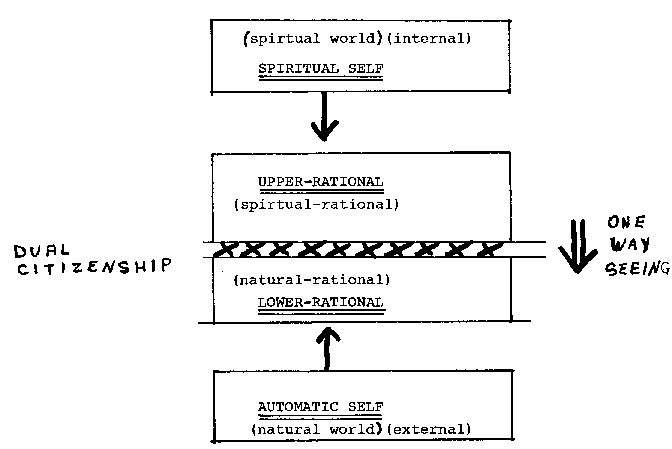
SE 4671. Then, also, a little paper was let down, written with Hebrew letters, just as they wrote them in the most ancient times. They differ little from the Hebrew letters of the present day, but, nevertheless, [they differ] slightly; and the angel who was with me, said that he comprehended everything which was written there from the letters alone, and that every letter contained some idea, yea, the sense of the ideas; and he also taught me what [yod], what [aleph], and what [hey] signified; but, what the rest [of the letters] signified, it was not permitted him to tell: he said also that all things of the Word are inspired in this manner, and that the third heaven knows thence, when the Word is read by man in the Hebrew text, all the divine-celestial which is inspired, and that each and all the things therein treat of the Lord. Such a sense cannot be explained, because it is the celestial sense, of which not one idea can be expressed. From this it may be apparent, that the Word, according to the Lord's words, is inspired as to every jot and tittle. I spoke with them concerning the origin of that thing, why merely the form of the Hebrew letter should present these things; and the cause was derived from the form of the flow of heaven, which is of such a character; and that, because they [i. e. the letters] are in that flow, which makes the foundation of order, they [i. e. the angels] thence have perception. (SE 4671)
 The Writings of Swedenborg are available on the Web
in a searchable format at:
The Writings of Swedenborg are available on the Web
in a searchable format at:
A definitive and well respected biography of Swedenborg is:
Sigstedt, Cyriel (1952) The Swedenborg Epic. The Life and Works of Emanuel Swedenborg (New York: Bookman Associates, 1952) Available online: www.swedenborgdigitallibrary.org/ES/epicfor.htm
The Reading List identifies basic collateral works on the Writings by Swedenborg scholars.
The Topical Index to Sections and Reading List is in Volume 18
This is the End of Volume 5
|

















 Theistic Psychology:
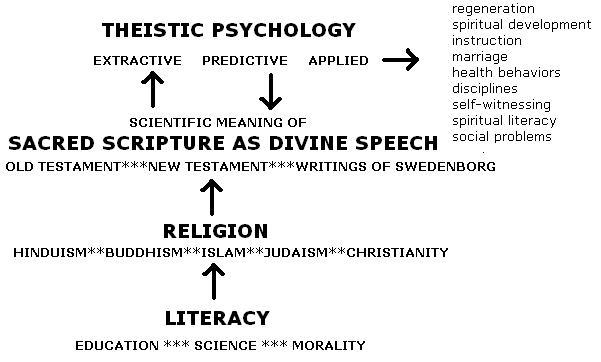
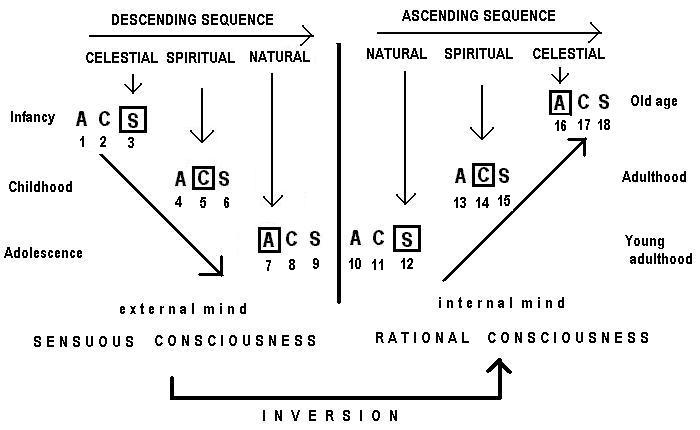
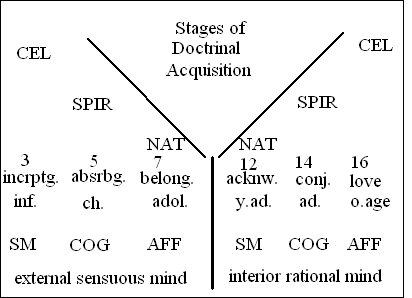
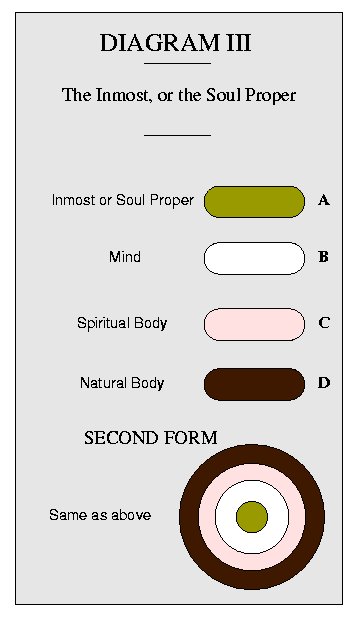
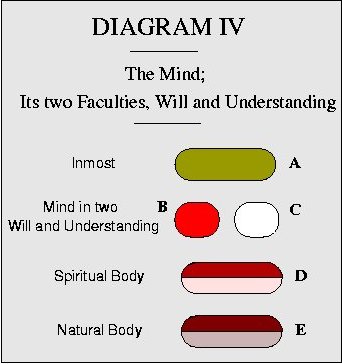
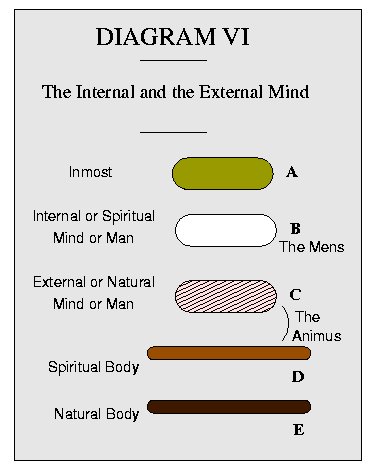
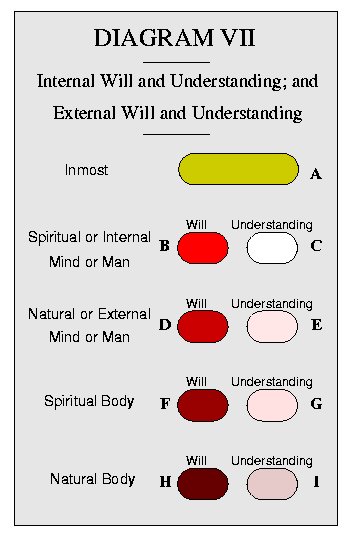
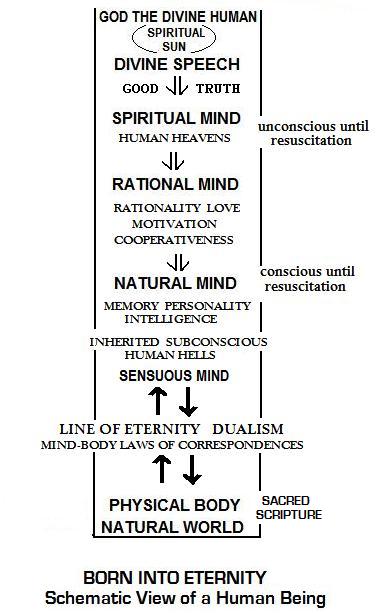
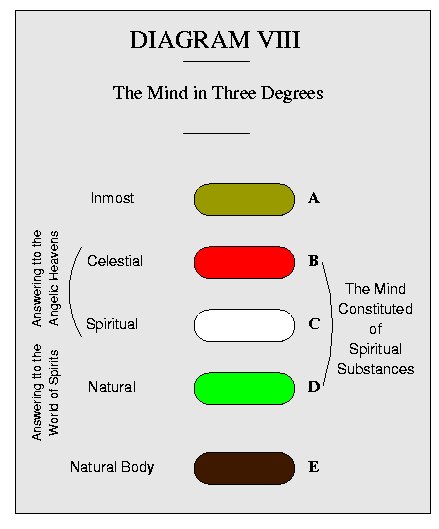
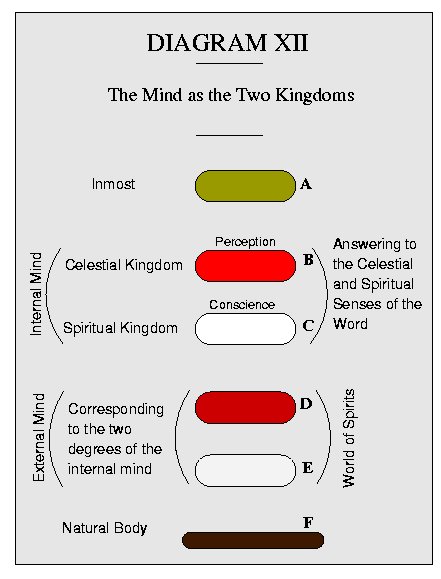
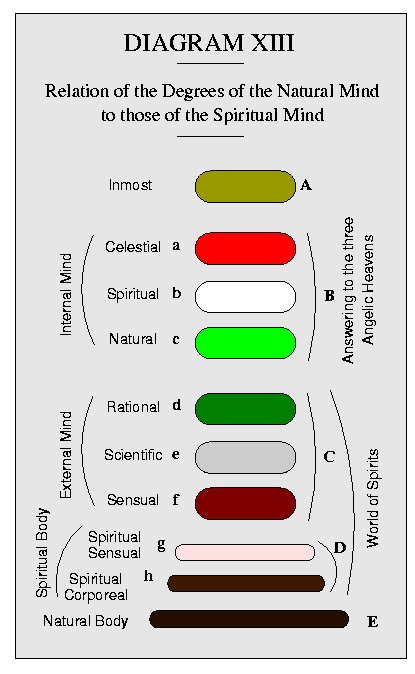 can mirror or represent the
three degrees of the internal spiritual mind (a, b, c). Since the geography of
the spiritual world = the anatomy of the mind, the threefold layer of the
natural mind overlaps with the threefold layer of the world of spirits, which is
the area in between heaven and hell. Our natural mind functions in the world of
spirits from birth until our second death when we permanently enter either the
heaven or hell (see Section xx).
can mirror or represent the
three degrees of the internal spiritual mind (a, b, c). Since the geography of
the spiritual world = the anatomy of the mind, the threefold layer of the
natural mind overlaps with the threefold layer of the world of spirits, which is
the area in between heaven and hell. Our natural mind functions in the world of
spirits from birth until our second death when we permanently enter either the
heaven or hell (see Section xx).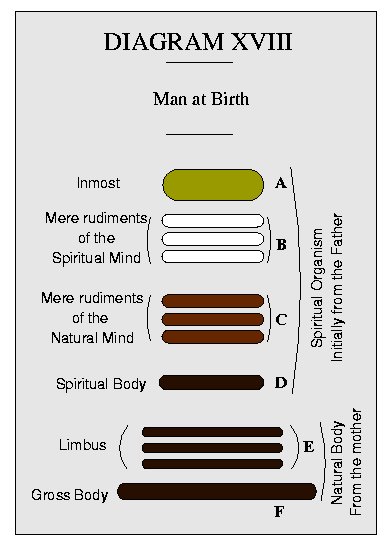 Below this is the internal
spiritual mind in an undeveloped state, but capable of being developed
(B--white). Note that this consists of three layers, as already discussed in
Diagram XIII just above. Below this are the three corresponding layers of the
external natural mind (C--brown). Below this is the spiritual body (D--black).
Below the spiritual body is the natural body, which is portrayed with two major
components. The internal layer is the "limbus" with its three sub-degrees
(E--black), while the external layer is the physical body called "gross body"
(F--black).
Below this is the internal
spiritual mind in an undeveloped state, but capable of being developed
(B--white). Note that this consists of three layers, as already discussed in
Diagram XIII just above. Below this are the three corresponding layers of the
external natural mind (C--brown). Below this is the spiritual body (D--black).
Below the spiritual body is the natural body, which is portrayed with two major
components. The internal layer is the "limbus" with its three sub-degrees
(E--black), while the external layer is the physical body called "gross body"
(F--black).