|
| |
Theistic Psychology:
The Scientific Knowledge of God
Extracted from the
Correspondential Sense
of Sacred Scripture

by Dr.
Leon James
Professor of Psychology
University of Hawaii
Published on the Web in 2004
Last update: 2006
For Permissions Note and
Conditions of Use see
Volume 18
Topical Index to Sections,
Subject Index, Selections, and Reading List in Volume 18
This is Volume 15
Universal Sacred Scripture
(this is version 13a)
15.0 Sacred Scripture --
The Sole Source of Scientific Knowledge About God
15.0.1 Scientific
Revelations in the Old Testament Sacred Scripture
15.0.1.1
The Scientific Meaning of Genesis
15.0.1.2
The Scientific Meaning of Psalms
15.0.2 Scientific
Revelations in the New Testament Sacred Scripture
15.0.2.1
The Scientific Meaning of the Parables of Jesus
15.0.2.2
The Scientific Meaning of the Book of Revelation
(Apocalypse)
15.0.2.3
The Scientific Meaning of the Lord's Prayer
15.0.3 Scientific
Revelations in the Writings Sacred Scripture
15.0.4
Ancient Forms of Sacred Scripture and
Their Derivatives
15.0.4.1
The Most Ancient Word and the Celestial Race Before the
Fall
15.0.4.2
Correspondences From The Ancient Word and the Spiritual
Race
15.0.4.3
Egyptian Hieroglyphics As Correspondences
15.0.4.4 Hindu
Sacred Scriptures on the Nature of God
15.0.4.4.1
The Trinity of God
15.0.4.5
Buddhism as a Religion -- the Buddha and the
Dharma
15.0.4.6
The I Ching System of Discrete Degrees
15.0.4.7
Greek Mythology As Symbolism For Mental States
15.0.4.8 The Hierarchical Order of Creation in the Kabala
15.0.4.9
The Correspondences in Yoga
15.0.4.10
Zoroastrian Sacred Scripture
15.0.4.11
The Correspondential Sense of (Bahai) Baha'i Sacred Scripture
15.1
Faith and Charity
15.2
Charity or the Love of
Being Useful
15.3
Consciousness Raising
and Enlightenment
15.4
Miracles and
Prophesies
15.4.1
Visions of
Heaven
15.5
Persuasive and
Blind Faith
15.6
Rational Faith
and Rational Love
15.7
Fundamentalism and
External Worship
15.8
Rational Spirituality
and Internal Worship
15.9
Resurrection
and Resuscitation of the Dead
15.10
Children in
Heaven
15.11
Marriage in
Heaven
15.12
The Clergy,
Sacraments, and the Priesthood
15.0
Sacred Scripture -- The Sole Source of Scientific Knowledge
About God
There are two different approaches to
knowing God that have been practiced by humanity over the generations. In
theistic psychology these two spiritual disciplines are called sensuous
spirituality and rational spirituality (see Section xx).
The discipline of sensuous spirituality
involves experiencing the "divine" through various methods -- meditation, yoga,
fasting, trance, self-flagellation, sexual abstinence, visions, animal
sacrifices, making miracles happen, hearing living voices, ingesting
psychotropic chemicals, and others. These methods involve the idea that the
"divine" can be experienced by human beings. In theistic psychology this is
known as the philosophy of nonduality (see Section xx). Non-duality is the
opposite of dualism (see Section xx). Nonduality asserts that God and human
beings are of one continuous substance, which implies that we can climb high
enough to actually realize that all along we were God.
In contrast, rational spirituality is the
spiritual discipline of getting closer to God through Sacred Scripture. In
theistic psychology it is known that the spiritual mind in which our heaven of
eternity lies, is formed by the spiritual-rational and celestial-rational
correspondences of Divine Speech hidden within Sacred Scripture. This makes
sense when you consider the fact that God is Divine Love (or Good) covered over with
Divine Truth (or Rationality) (see Section xx). Good can only conjoin with its own truth
(see Section xx). The higher the level of Divine truth that we can consciously
understand rationally, the closer we come to God's Divine Truth and Rationality.
Truth is the spiritual-rational and celestial-rational substance that forms the
rationality in the mind of every human being (see Section xx).
Rational spirituality is the discipline
of extracting the rational doctrine of truth from Sacred Scripture using the
method of correspondences that is revealed in Sacred Scripture, and then
applying this doctrine of truth to one's daily willing, thinking, and doing
(see Section xx).
It is not yet known in our modern times that
the heaven of our eternity is located within spiritual-rational and
celestial-rational correspondences of Sacred Scripture. When we understand and
love these rational correspondences of Divine Speech, which means living and
thinking according to them, then we are preparing our spiritual mind to be a
conjugial heaven in which we know God directly and receive from Him all that we
are willing and able to take in terms of human potential and happiness.
It is clear that knowledge about eternity
and God is not possible to be discovered through the sensations from our
physical body and the reasoning power of our natural mind. The proof of this is
that traditional science, with its amazing history of inventions and
explanations, knows zero about eternity and God, so that all it can do is to
deny that such things exist or are part of scientific reality. Another proof is
that the enormous scholarship and effort invested over the centuries in the
literature on religion, God, and spirituality, has brought zero knowledge about
God and eternity, and only wild speculations and disagreements among them.
All this proves that scientific and
scholarly knowledge of God cannot be discovered and invented, but only received
from God through the correspondences of Divine Speech in Sacred Scripture -- not
the literal sense of Sacred Scripture (which is sectarian religion), but the
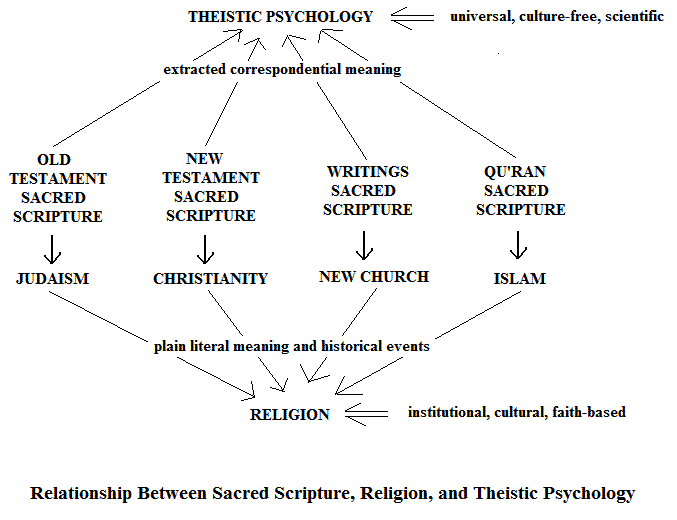
revealed correspondential sense that lies hidden within (see Section xx). The diagram below portrays the distinct
difference between religion and theistic psychology, even though they are both
closely related to Sacred Scripture.
Sacred Scripture is the expression of Divine Speech in a natural
language, transformed through the laws of correspondences that God used to
create the layers of mind and existence (see Section xx).
Although the sentences of Sacred Scripture are
written out by a an individual in a particular language and culture, they are not the individual's
own sentences, but sentences that have been transformed by correspondences as
Divine Speech descends into that individual's mind from its unconscious
spiritual level to its conscious natural level (see Section xx). First, Divine Speech enters
the celestial-rational mind of the individual. This is unconscious while we are
still connected to the physical world. Second,
Divine Speech descends into the spiritual-rational layer of the individual's
mind, which is also
unconscious until our resuscitation (see Section xx). Third, Divine Speech descends
by correspondential meaning into the natural mind of the
individual, where it becomes conscious and the person is able to write it down.
The "prophet" or "revelator" does not himself know what layers of
correspondential meanings lie hidden with the sentences they write down. They
and others are only aware of the literal meaning.
The descent of Divine Speech through the layers of the human
mind takes place by correspondences (see Section xx). Those who are conscious in
their celestial-rational mind after their resuscitation (see Section xx), are conscious
of Divine Speech in terms of celestial-rational correspondences (see Section
xx). These celestial-rational meanings or truths give human beings the highest possible consciousness,
knowledge, worship, and love of God.
Those who, after resuscitation, are conscious in their
spiritual-rational mind, are conscious of Divine Speech in terms
of spiritual-rational correspondences (see Section xx). These meanings of Sacred
Scripture give human beings the next lowest possible consciousness, knowledge,
worship, and love of God. Those who are conscious in their natural mind,
namely, us while we are still connected to earth, are conscious of Divine Speech
in terms of natural correspondences of Divine Speech (see Section xx). These
natural meanings of Sacred
Scripture give human beings the next lowest possible consciousness, knowledge,
worship, and love of God.
We are connected to earth by the laws of correspondences which
functionally link together our mental body in eternity and our physical body in
time-space. Our conscious natural mind is capable of entering virtually,
as a training ground, into the various layers of worship and love of God. We
begin with natural worship and love of God which is based on our ethnic
membership in a particular religion and our historical ties to the literal meaning of Sacred Scripture
recognized in that religion. If we do not try to live by the truths of Sacred
Scripture as we understand them, then we are not preparing ourselves adequately
for immortality in eternity (see Section xx). Instead of being or existing in a heaven
within our spiritual-rational mind,
our consciousness then sinks into the bottom of our natural mind, which is
called the corporeal-sensuous mind, as opposed to the natural-rational mind (see
Section xx).
At this level of feeling and thinking, the correspondences of
Sacred Scripture cannot be comprehended rationally. All truth of Sacred
Scripture is inverted and perverted through irrational thoughts and feelings,
which taken together as a whole, are called the human hells in the mind (see Section xx). It is our choice, but the choice is to be
made prior to death, while we still can reform our character from inherited hellish
traits to freely acquired heavenly traits (see Section xx).
To the extent that we try to live by the truths of Sacred
Scripture that we understand, to that extent God can elevate our consciousness
from the natural-sensuous thinking and feeling, to the natural-rational thinking
and feeling (see Section xx). When God thus elevates and enlightens our
understanding of Him, we become capable of a higher spiritual-rational worship and love of God, as
a result of which God can further elevate our consciousness from
natural-rational, to spiritual-rational, and finally to
celestial-rational meanings of Sacred Scripture.
This process of elevation of the individual by God takes
place through
(1) the individual's rational study and understanding of
Sacred Scripture as Divine Truth, and
(2) in proportion to the individual's efforts at applying this understanding
to one's daily willing, thinking, and doing.
Knowledge of Divine truth cannot change our hellish character, but
can only give us an understanding of how God's truth is to dictate our willing, thinking, and doing.
Conjunction with God occurs afterward, and only to the extent that we are
willing to give up our hellish and selfish enjoyments, and replace them with
heavenly and altruistic enjoyments. In proportion as we do this, to that extent
we are conjoined to God in rational understanding, worship, and love.
Conjunction with God gives us an eternal conjugial heaven with a maximum of
human love, altruism, enjoyment, and happiness (in the affective organ), along
with their consequent rationality, wisdom. intelligence, knowledge, and
inventiveness (in the cognitive organ).
We vary in sincerity and consistency. We must be willing to
undergo the temptations that God puts in our way in our mind. This requires
spiritual combat. Our understanding of Divine truth from Sacred Scripture
provides the weapons for the combat against our hellish enjoyments (see Section
xx). Once we engage in combat, as if of our own, then God immediately manages
the victory for us. We can have no victory if we believe that we are fighting
our evils with our own power and intelligence. God can provide victory only if we
acknowledge in our mind and understand rationally, that by ourselves we have
zero power since God is omnipotent and has all the power.
Under some conditions we fall into the persuasion that to fight
our temptations as if on our own, would be to think that the power to fight is
ours -- which is a hellish thought against the reality of truth. As a result of
this kind of thinking, we fall into a passive mode and wait for God to liberate
us in our trial. But this strategy cannot work and it prevents character
reformation. In that case God cannot bring spiritual temptations for us to fight, but only
natural temptations (see Sections xx). Natural temptations build our external
personality, appearance, and overt conduct. This is necessary for acquiring
morality according to one's conscience. But the inner character cannot be
altered by natural temptations. It requires spiritual temptations. God brings
spiritual temptations to our mind to the extent of our rational understanding of truth
from Sacred Scripture (see Section xx).
Without the truth of Sacred Scripture in
our rational understanding, God cannot bring spiritual temptations to our mind,
and as a result, we cannot be regenerated. We die in the character that we
inherited, which is a hell (see Section xx). Only the truth of Sacred Scripture,
applied to spiritual temptations, can give us the new heavenly character we need
to live in the heavens of our eternity (see Section xx). God can bring spiritual
temptations to us only when we have acquired as-of self, truths from Sacred
Scripture in our mind. These truths in our mind must be present before God can
bring spiritual temptations to us, and thus regenerate us (see Section xx).
Hence it is necessary for us to have in our understanding Divine
rational
truth in order for us to be prepared for heaven by temptations through regeneration or
daily efforts at character reformation. The higher the rationality in our
understanding of truth from Sacred Scripture, the more we can be regenerated by God to higher and
higher heavenly potentials, in proportion to our daily efforts in applying the truth
to our daily willing, thinking, and doing.
It makes sense therefore to think
that God has provided a method by which we can acquire higher and higher
meanings, or more and more rational meanings, so that we can apply it to our
daily willing and thinking, and thereby become celestial beings in our heavenly
eternity (see Section xx).
The diagram above shows that theistic psychology, and
theistic science generally, is the scientific knowledge that is extracted from
Sacred Scripture, when we apply the method of correspondences with enlightenment
(see Section xx). There are two ideas to understand here: correspondences and
enlightenment.
When Divine Speech, or Divine Truth, descends by correspondences through the layers
of the human mind, we are conscious of it differently at each successive layer. That is,
Divine Speech forms our consciousness at each level of the mind, through
meanings of Sacred Scripture.
Quoting from the Writings Sacred Scripture:
AC 5614. Surely we had now returned these two times. [Genesis
43:10]
That this signifies that there would have been spiritual life both exterior
and interior, is evident from the signification of "going," as being to live
(of which above, n. 5605); and therefore "returning" is living therefrom, for
they went thither to procure corn, and by "corn" is signified the good of
truth from which is spiritual life; and from the signification of "these two
times," which, as it relates to life, denotes life exterior and interior, for
by the "produce" they got the first time was signified life that is exterior
or in the natural, for the reason that they were without an intermediate (as
explained in the preceding chapter); while by the "corn" they get this time is
signified interior life, because they were now with Benjamin, who is the
intermediate, as explained in this and in the following chapter.
Hence it is that by "surely we had now returned these two
times," is signified spiritual life both exterior and interior.
[2] That this is the signification cannot but seem strange,
especially to one who knows nothing about what is spiritual; for it seems as
if "returning these two times" has nothing in common with the spiritual life
that is signified; but still this is the internal sense of the words. If you
will believe it, the interior thought itself of the man who is in good
apprehends this, because this thought is in the internal sense, although
while in the body the man is deeply ignorant of it; for unknown to him the
internal sense, that is, the spiritual sense, which is of the interior
thought, falls into material and sensuous ideas that partake of time and space
and of such things as are in the world, and therefore it does not appear that
his interior thought is of such a nature; for his interior thought is like
that of the angels, his spirit being in company with them.
[3] That the thought of the man who is in good is according to
the internal sense, may be seen from the fact that when after death he
comes into heaven, he at once without any information is in the internal
sense, and this could not be unless as to his interior thought he had been in
this sense while in the world. The reason of his being in this internal
sense is that there is a correspondence between spiritual and natural things
so complete that there is not the smallest thing that has not its
correspondence; and therefore because the interior or rational mind of the man
who is in good is in the spiritual world, and his exterior or natural mind in
the natural world, it must needs be that both minds think (the interior mind
spiritually, and the exterior naturally), and that the spiritual falls into
the natural, and they act as a one by correspondence.
[4] That man's interior mind, the ideas of thought of which
are called intellectual and are said to be immaterial, does not think from the
words of any language, nor consequently from natural forms, can be seen by
him who is able to reflect on these things, for he can think in a moment what
he can scarcely utter in an hour, and he does so by universals which comprise
in them very many particulars. These ideas of thought are spiritual,
and when the Word is being read are no other than as the internal sense is;
although the man does not know this, because as before said these spiritual
ideas, by influx into what is natural, present natural ideas, so that the
spiritual ideas do not appear; insomuch that unless he has been instructed
the man believes that there is no spiritual unless it is like the natural,
and even that he does not think otherwise in spirit than as he speaks in the
body. In such a manner does the natural cast a shade over the spiritual. (AC
5614)
In order to understand rationally what is Divine Speech and how
it manages our thoughts and the universe, we need to remember the idea of
"substantive dualism" in the positive bias (see Section xx). The word
"substantive" in the mental world of eternity corresponds to the word "material"
in the physical world of time. The physical sun in time-space provides all
the matter needed on the planets -- air, earth, minerals, plant protein, brain
tissue, electricity -- it all comes originally from a piece of the sun. All
planets in a solar system are offshoots of the star that cool down and become
planets. Hence everything on a planet comes from the sun. These things are so in
the physical world because they are correspondences or effects produced by
things in the mental world to which they correspond by creation and since
creation (see Section xx).
The mental things to which they correspond include the Spiritual
Sun, which corresponds to the physical sun, that is, to each star and to their
totality of endless stars with endless planets. The material light with its
heat that streams from the physical sun crosses instantly the space between
it and the planets, and activates the things on the planet. This is so because
substantive light with its heat streams out from the Spiritual Sun and
crosses instantly the mental world of humanity tat God created in eternity. In
other words, God created a dual universe, one materila in time-space, the other
substantive in eternity. What is not known generally is that the substantive
world of eternity is the mental world of the human race.
In order to create the human race, God had to create a mental
world in eternity and a physical world in time. The mental world of
eternity is known as the afterlife. What is not known that human beings are born
simultaneously in both universes. The material body in time-space, which is
temporary, and the substantive body in eternity. The substantive body is also
known as the spiritual body or the mental body. The shape and form of the
physical body is caused by the shape and form of the spiritual body to which it
corresponds in every part and detail. When the physical body "dies", we continue
life in our spiritual body, with the only difference, that now we are no longer
aware of the physical world. Since we are born into eternity, we are immortal.
The reason this must be so is because our consciousness, our
sensations, our thoughts, and our feelings are not made of material things from
the physical sun, as our brain is. Our brain and physical body is material and
temporary, but our mental life in the spiritual body is eternal. Hence it is
that our personality or self, as we know ourselves, is immortal. Whatever is
constructed out of substances from the Spiritual Sun, must necessarily be
immortal or eternal. Our mental life is constructed out of the light and heat
from the Spiritual Sun that streams into the mental world of the human race.
Every spiritual body, containing our mental organs of willing (affective),
thinking (cognitive), and sensing-moving (sensorimotor) is constructed, then
activated, by the spiritual light streaming into the cognitive organ, and the
spiritual heat streaming into the affective organ (see diagrams in Section xx).
So with that explanation as a background context, you can
understand rationally how Divine Speech manages both universes. First the
universes are constructed out of the substances of spiritual light and heat
which stream out in infinite variety and quantity form the Spiritual Sun. Divine
Speech is nothing else than this stream of spiritual light and heat creating the
two universes and continuing to create them and manage them by a continuous and
endless stream of spiritual light and heat.
The inmost structural framework of any created thing in the two
universes is therefore this spiritual light and heat that streams out in
infinite variety. Then, in successive discrete layers, this stream of
substantive light and heat creates the mental world out of rational ether, with
succeeding mental layers that become more and more specialized or limited in
property. The upper layers of the mental world are called heavenly experiences,
the middle layers are called natural experiences, and the lowest layers are
called hellish experiences. Your experience as an individual is determined by
which layer your consciousness is bottoming out. You can be in heavenly layers
today and in hellish layers tomorrow, and then again in heavenly layers
sometimes later.
While we are connected to a physical body, we can alternate
across all the layers. This is because we need training and preparation for
conscious life in eternity. During this training period we accumulate
experiences, traits, habits, and above all, loves. Every love we accumulate
is immortal and stays in our mental world forever. Hence it becomes
extremely critical for us to manage our loves. We inherit strong tendencies to
love and enjoy hellish traits. Unless we learn to detach ourselves from these
inherited loves, they remain attached to us in our mental world. After we are
resuscitated, a few hours following our "death", we have various experiences
that force us to look at all our loves, both heavenly and hellish. Then after
exploring them, we are forced to select what we are willing to give up.
This is called the vastation (see Section xx).
If we are unwilling to give up even one of our hellish loves, then
all our heavenly loves and traits are put to sleep biologically, and rendered
inoperative. This is called "damnation" or "second death." Your personality in hell, that is, when all your heavenly traits
are removed, is crude, gross, beastly, evil, infernal, monstrous, irrational, delusional,
constantly enraged, stupid, and with the deepest hatred for God, innocence,
infants, and conjugial marriage. Further, Swedenborg reports that our mental
states in hell do not allow any sexuality that can satisfy us, but only
compulsions and fetishes that are inherently acerbating and tormenting our mind
endlessly.
Bit if we are willing to give up all hellish loves, then they
are biologically put to sleep, rendered inoperative. This allows our
consciousness to rise to our heavenly loves, and to remain in them forever (see
Section xx). Your heavenly personality is celestial, conjugial, rational,
wise, intelligent, peaceful, and loving God, innocence, infants, and conjugial
marriage. Further, Swedenborg reports that our mental states in heaven allow
true human sexuality that can satisfy us with joy and conjugial bliss that is
inherently expanding and enriching our mind endlessly.
Throughout the generations of communities over the millennia,
God has provided information on the two universes, how He manages them, and how
we are to prepare for our immortal life in eternity. This information is
obtained from the correspondential sense of Sacred Scripture,
which has been provided in some form in every culture.
Divine Speech issuing from the Spiritual Sun and spreading into
the two universes, becomes conscious to human beings
through the meanings of Sacred Scripture, and these meanings are different
throughout the layers of
the mind. Sacred Scripture exists in every layer of the mind so that people
who live in that layer can have conscious access to Divine Speech. After you
are resuscitated you will be able to see copies of Sacred Scripture. Swedenborg
saw these on a regular basis and reports that a very intense light shines forth
from the book, and this is on account of the Spiritual Sun which is in its
inmost layer of meaning (see Section).
Divine Speech comes to us as meaning. This meaning is our
consciousness itself. The mental world of the human race is constructed out of
meaning or rational ether. There is only one mental world of eternity, just as
there is only physical world of space. Every spiritual body is in this one
mental world. So the source of your sensations, thoughts, and feelings is the
same as the source of my sensations, thoughts, and feelings. This is true for
every individual and the entire human race (see Vertical Community,
Section xx).
The meaning of Sacred Scripture in the highest layer of our
mental world is at the level of consciousness called celestial-rational.
Anyone whose loves are heavenly, and has given up loves that are hellish,
resides and exists in this celestial mental layer of the human race. Sacred
Scripture is available at any layer to allow us to climb up in consciousness to
the celestial-rational meanings and thinking. At this level of existence we are
Angels of great power and knowledge, existing in conjugial bliss that increases
to eternity (see Section xx).
The next layer of consciousness is to think in terms of
spiritual-rational correspondences of Divine Speech in Sacred Scripture. In a
lower layer we can exist in spiritual-natural correspondences of Divine Speech
in Sacred Scripture. Below that we can exist in the natural correspondences of
Divine Speech in Sacred Scripture. This is the level the people are typically
conscious of. They read Sacred Scripture in a natural language and they see that
it contains information about God's interactions with certain people at certain
times. All religions are based on this natural interpretation of their Sacred
Scripture.
This is why there needs to be as many religions as there are
groupings of cultures, and each religion must have its own original revelation
or Sacred Scripture, given to a prophet by God. This is done with people who are
willing to be the trustworthy guardians and protectors of that Sacred Scripture.
In other words these people were "chosen" by God because He could activate their
loves as loyal keepers of the sacred text. You can see how important it was for
the text to be preserved exactly as dictated by God through the prophet's mind.
The text starts as celestial-rational ideas of God's words, then changes to
spiritual ideas of God's words, then to natural ideas of God's words. That's
when the prophet becomes conscious of the words and writes them down.
You can see that it's not possible for the prophet to know or
express God's words in either celestial or spiritual meanings. The prophet
thinks and writes in a natural language, not spiritual, not celestial. So the
text of God's words in a natural language looks like....what? Well, we know this
from the Sacred Scripture familiar to us from our socialization or education.
God talks about His relationship to a particular people and tells stories about
their lives on earth. God also talks about commandments were must do. Also, that
He loves us and provides for us. And also, that if we love Him, He can reward us
with heaven. But if we oppose Him, we will suffer the torments of hell.
What do you think? Is this all? Is it all that God is talking
about to human beings? No insights? No solved puzzles? No description of the
afterlife? Of the future? Of how God manages it all? Why isn't God talking about
that? Wouldn't it be more believable if God talked about these higher things
instead of ordinary things that ordinary people and children can understand?
The answer is that these higher things are the very things God
is talking to us about, but by the time it gets translated from celestial, to
spiritual, to natural, what's left are the things understood by ordinary people
and children. God also provides a way for people who want more. He makes sure
that all sacred text written out by a prophet is sequenced and selected so that
the inner and inmost layers of meaning in it, are maintained.
The result is that all Sacred Scripture serves two purposes. One
for letting ordinary people and children know that there is God, that He loves
them, that He wants to take them to heaven, but that they must cooperate by
following the commandments in the sacred text. The second source of Sacred
Scripture is for scientists, scholars, and students who want to climb up the
layers of meaning hidden with. Every single word of Sacred Scripture is sacred,
holy, and Divine, and every sequence of words is Divine Truth. This fact cannot
be known or understood unless one knows that there are layers of Divine meaning
hidden within, and to some extent, what they are (celestial, spiritual, natural,
see Section xx).
People entrusted with the sacred task of being keepers and
protectors of some Sacred Scripture ought to be honored for their efforts over
the centuries and generations. Even if they do not accept the ideas of theistic
psychology, that there are hidden layers of meaning, they still are ready to
defend and protect the text itself. With this they are performing a universal
service for all humanity, past, present and future. Every Sacred Scripture
represents a unique link God has created between Him and humanity. Through this
link flows a never ending and continuous stream of consciousness raising
meanings that equip us with heavenly truths that we can use to empower our
heavenly loves to defeat the hellish ones.
So the purpose of all Sacred Scripture is to give human
beings heavenly truths that we can use to defeat our hellish loves and their
falsities. Without these truths, we are pulled down inexorably into the
psychobiology of existence in eternal hell.
All this has been arranged by God as a method for our spiritual
growth, which is achieved by climbing up the layers of meaning hidden in Sacred
Scripture. All Sacred Scripture at any particular layer of the mental world,
contains all the layers that are above it. Hence whatever layer people are at in
their thinking and feeling, they can use their Sacred Scripture to climb up to
the celestial-rational level of thinking and loving. The climbing of meaning
in all Sacred Scripture is different outwardly between different sacred texts,
but the same inwardly in all of them.
This is because there is only one God and He manages every
person regardless of their culture, beliefs or knowledge. Theistic psychology
is the knowledge we acquire through which we can make this climb successful with
any Sacred Scripture. Success is guaranteed because it is prescribed by God
in the hidden layers of meaning of Sacred Scripture.
God's meanings or Divine Rationality is
adapted or accommodated to the individual's mind by means of the layers of meanings
that there are in correspondences. The change in meaning of Sacred Scripture
across the layers of the human mental world, is managed by God
through successive levels of correspondences to His Divine Speech or Rational
Ideas. God wants us to know what these correspondences
are that He uses to manage the created universe through Divine
Speech or truth (see Section xx). God has therefore revealed through Sacred
Scripture what these correspondences are. But subsequently these correspondences
were corrupted and used for magic so that God managed to have them forgotten
until this desire to corrupt correspondences died out. God then gave new sacred
text in which he revealed once more what correspondences are (see Section xx). Illustrations and
demonstrations will be given in the following Sections (see also Section xx).
The new revelations about correspondences in the Writings Sacred Scripture given
through Swedenborg in the 18th century, now provides modern science access to
this powerful knowledge.
One must therefore study and understand the laws of
correspondences by which Divine Speech becomes Sacred Scripture at various
levels of human thinking and feeling. These laws are Divine and cannot be discovered.
We
must not invent them or construct them from human intelligence. In the Writings
Sacred Scripture, God has revealed to the modern scientific mind what these correspondences are. The same
correspondences apply to all Sacred Scripture since there is only one Divine
Speech that filters through the various natural language versions of Sacred
Scripture in all the genuine religions that God has created on this earth.
But note this important phenomenon:
You can read a
dictionary of correspondences (see Section xx) and try to understand the
spiritual meaning of natural expressions in Sacred Scripture --
but this will only allow you to perceive the natural meaning of these
correspondences. For instance
we can read in the dictionary of correspondences that when Sacred Scripture
mentions "water" in some sense (rain, ocean, river, flood,
fountain) it is actually discussing cognitive operations in the natural layer
of our mind, which involves meanings paraphrased from the literal sense of
the sacred text. When the sacred text contrasts "water" with "wine" in
some way, it is referring to cognitive operations in the spiritual layer of
our mind, which involves meanings we derive by correspondences of the
literal text of Sacred Scripture.
Spiritual meanings of God and eternity (wine) and natural
meanings of God and eternity (water) are at different layers of understanding or
consciousness in our mind. The sacred text is striving to bring our focus on its
spiritual meanings because these are the meanings that raise our consciousness
above the natural world. These spiritual meanings are needed for our
preparation for eternity. This is why theistic psychology can be so
beneficial to all humanity.
Theistic psychology is the scientific knowledge that we
accumulate through the method of correspondences with enlightenment. The reason
we say "with enlightenment" is that all spiritual meanings must be perceived by
enlightenment from God. God constantly and ceaselessly works in our individual
mind to enlighten it with spiritual light from the Spiritual Sun. This results
in the elevation of our consciousness from the natural world to the spiritual
world of eternity.
You can see
the result of this effort as you read throughout the 18 volumes of this work. If
your purpose for studying theistic psychology is to acquire correspondential truths from
Sacred Scripture ("wine"), with a view to applying them to your daily willing, thinking,
and doing, then God will enlighten you, raise your consciousness to the highest
levels, and empower you with wisdom and conjugial love (see Section xx). If your
purpose is not that of applying the knowledge to your character reformation,
then it is impossible for God to enlighten you and to raise your consciousness.
This is because enlightenment is the process of using spiritual truths to
fight our hellish enjoyments (temptations, see Section xx).
The following diagram depicts the evolutionary steps of
humankind on this earth created by Divine Speech exteriorized as Sacred
Scripture. It presents a historical sequence extracted from the Writings Sacred
Scripture.
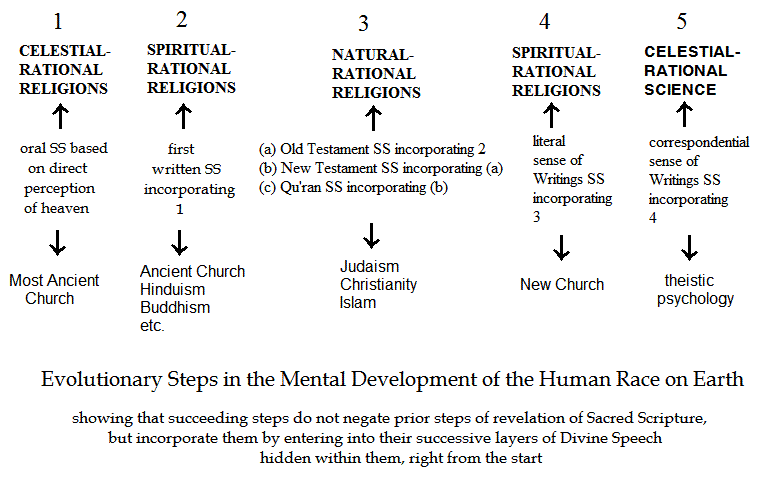
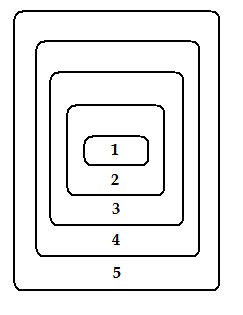
The above diagram presents evolution in a successive order
(see Section xx). The diagram below presents it in simultaneous order. It
shows that what has been produced by successive steps in development exists in
real time in simultaneous order. That is, what was first is now inmost, and what
was last is now outmost.
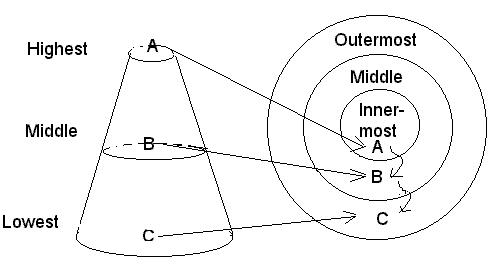
See also the following diagram which explains the relationship
between successive and simultaneous order.
God creates all things by means of truth within which is good
(see Section xx). These two substances are living and infinite as they are part
of God's own infinite substance. It follows therefore that the inmost framework
of an object is the substance of good and truth arranged in a particular and
unique order to produce existence of that object. Divine truth within which is
good is therefore the basic infrastructure upon which all creation rests, and
from which all objects get their unique form and properties. Remember that God
is omnipresent. Now you can begin to see how that is scientifically true.
God is omnipresent not in space but apart from space (see
Section xx). The words "apart" and "within" are used in theistic psychology to
refer to the discrete layers of all created objects. God is present in every
object, molecule, or property, in a discrete degree "apart" or "within" the
object itself. Since good and truth are substances in God and of God, they
remain of God when they are "apart" or "within" any object. Hence it is that God
is omnipresent -- through his own substance that lies within every object,
maintaining it in existence, thus giving it subsistence (see Section xx).
It is the same whether you say truth within which is good, or
whether you say Divine Truth within which is Divine Good, and also, whether you
say Divine Speech within which is Divine Love. Hence you can see that we can
also say that God creates and maintains all things in existence through Divine
Speech. As Divine Speech descends from God it first enters into the mental world
of the human race (see Section xx). From the top layer called celestial mind, it
then descends or exteriorizes into the next layer called the spiritual
mind, then the rational mind, then the natural mind, then the physical body and
the rest of the physical world of matter in time space. This is at the bottom or
the most exterior level of existence.
Divine Speech enters each layer of creation by the power of
correspondences that is built into good and truth. In other words, the
substances of good and truth can exist at different spiritual distance from that
which first proceeds from the Divine Human through the Spiritual Sun (see
Section xx). The celestial arrangement of good and truth is as perfect an
image and likeness of God's mind as is possible to achieve for created and
finite human beings. The Sacred
Scripture that exists in the celestial layer of the mental world was seen by
Swedenborg, and may be seen by all whose consciousness rests on celestial-rational
correspondences of Divine Speech (see Section xx).
Swedenborg was able to compare the written version of the Old
and New Testament Sacred Scriptures across the four layers of the human mind:
celestial or third heaven, spiritual or second heaven, interior-natural or first
heaven (spiritual-natural), and finally exterior-natural, which is the version that is known here on earth in a
natural language and script.
Quoting from the Writings Sacred Scripture:
AC 3737. Such an order has been instituted by the Lord that
higher things inflow into lower ones, and therein present an image of
themselves in general, and consequently are together therein in a certain
general form, and thus are in order from the Highest, that is, from the Lord;
from this it is that the proximate image of the Lord is the inmost heaven,
which is the heaven of innocence and peace, where those who are celestial
dwell; which heaven, because nearest to the Lord, is called His "likeness."
The next heaven, namely, that which succeeds and is in a lower degree, is an
"image" of the Lord, because in this heaven, as in something general, there
are simultaneously presented the things which are in the higher heaven. The
ultimate heaven, which succeeds this again, is similarly circumstanced, for
the particulars and singulars of the heaven next higher inflow into this
heaven, and are therein presented in general, and in a correspondent form.
[2] The case is similar with man, for he has been created and
formed to be an image of the three heavens. In man that which is inmost
inflows in like manner into that which is lower; and this in like manner into
that which is lowest or last. The natural and corporeal consists of such an
influx and concourse into those things which are beneath, and finally into
those which are last. In this way there is a connection of the last or
ultimate things with the first, without which connection that which is last in
order would not subsist a single moment. Thus it is manifest what is meant by
higher things being in the ultimate of order as in their house. Whether we
speak of things higher and lower, or interior and exterior, it is the same;
for to man's view things interior appear as higher; and for this reason man
places heaven on high, when yet it is in what is internal. (AC 3737)
It is revealed in Sacred Scripture that the physical world is
created for the sake of our physical body which allows us to develop a natural
mind that contains an operational affective organ for feelings, a cognitive
organ operating our thoughts, and a sensorimotor organ that acts as an
intermediary between the interior mental and the exterior mental (see Section
xx). The question immediately arises as to why there is evil in the human mind
and things in the world that are noxious to the life and happiness of human
beings. Evil in the mind, like selfishness and cruelty, and noxious things in
the world, like poisons and draughts, were not present with the earliest
generations that lived on this earth. They were "celestial" people, peace loving
and in mutual respect and love to each other (see Section xx). Their natural
mind grew and was formed into a natural heaven that corresponded to their
spiritual and celestial mind or heaven. Earth was then a paradise in outward
form. When the inhabitants reached their third decade of life they were
regenerated sufficiently so that they could transition from their natural mind
to their spiritual mind in eternity.
Swedenborg interviewed some of them in their celestial
heavens and they appeared to him to live in an heavenly paradise similar in
appearance to what they had on earth many thousands of years ago, by earth time.
They were not at all conscious of time and appeared in age to be around 20. They
lived as conjugial couples in eternal bliss. They possessed, worshipped, and
cherished God as the Divine Human, whom they could not see or talk to
directly until after the Incarnation Event. They were able to talk to the
Divine Human through an intermediary celestial person who was then put into a
trance like mental state, speaking only what God spoke through the intermediary
person (see Section
xx). They had with them the Sacred Scripture of the Most Ancient Church
called the Most Ancient Word (see Section xx). Their religions were celestial
rational, as the diagram above shows. Their Oral Sacred Scripture was the source
of all their knowledge about God and reality. When they left their physical body
they were resuscitated directly into the heaven of their celestial mind. Hell
did not yet exist in the human mind.
But subsequent generations did not do as well. They started
exploring what it would feel like to disobey their conscience and their teachers
from heaven who communicated with them. God allowed this to occur and provided
for it as well, always moderating their tendency to precipitate themselves into
greater and greater profanation of the truth of their Oral Sacred Scripture
which they had in their understanding and memory. When these people were
resuscitated they were unable to raise their consciousness and life to the level
of their heavens. Their feelings and emotions could not stand the obedient,
altruistic, and virtuous spheres of their heavens. Hence God provided for them a
portion of the mental world where a sphere of hell can exist and support their
life of evil loves, delusional beliefs, and bestial lifestyle. After this, all
people who were born on this earth inherited this hell in their mind. Life on
earth then became a struggle to regenerate, to alter fundamentally one's
inherited character traits, from a love of hellish traits, to a love of heavenly
traits (see Section xx).
You can see therefore that the generations that were born after
the human hells had been created are different from the generations that were
before. The earliest generations, called the celestial human race, does not have
a hell in their affective organ of the natural mind. Subsequent generations,
called the spiritual race, were born with hell in their mind. This essential
anatomical difference in mental structure necessitates the separation in
spiritual geography, of the two races, celestial and spiritual. The people of
the celestial race that live in the hells are separated from the rest of the
celestial race that does not have a hell in the mind.
The spiritual race has therefore a different evolutionary
history. The early generations of the spiritual race, called the Ancient Church,
derived their rationality and knowledge from the Ancient Sacred Scripture which
they had with them. This was the first time that a written Sacred Scripture
became available to the human race. Their religions were spiritual-rational, as
shown in the diagram above. Swedenborg was able to read this version in the
spiritual world as it is still with the people in heaven who had received it
while on earth. A few passages from this Ancient Word are quoted in the
Old Testament Sacred Scripture (see Section xx). This is an indication that the
evolution of Sacred Scriptures on this earth took place not by replacement of
each other but by incorporation. The later version always incorporates the
earlier version, making it a basis for itself, and then expanding on it by new
revelations that take the human race further in its evolution, that is, in its
relationship to God.
The spiritual-rational religions also evolved in the course of
time until the original understanding was gradually lost. Subsequent versions of
Sacred Scripture were given which incorporated the previous versions, and took
them to new revelations and new relationships to God. First among these
natural-rational religions was the Old Testament Sacred Scripture, then the New
Testament Sacred Scripture, then the Qu'ran Sacred Scripture.
The next evolutionary step came when the human race was brought
to modern times and science and a new ability to understand Sacred Scripture
rationally. The Writings Sacred Scripture were given in the 18th century as a
spiritual-rational revelation in modern scientific terms, and they incorporate,
confirm, and strengthen the Divine truths that have been revealed in all of
Sacred Scripture until then, but now, in a scientific way which was not possible
before. This has given birth to theistic psychology, which may be called a
celestial-rational science.
It is clear therefore that Sacred Scripture plays a principal
and essential role in the evolution of the human race both on earth and in
eternity.
This presentation continues in Section 1.1.4.3.2 Extracting the
Content of Divine Speech Through Correspondences and related Sections. (see
Section xx).
Quoting from the Writings Sacred Scripture:
SS
1. Doctrine of Holy Scripture
THE HOLY SCRIPTURE OR WORD IS DIVINE TRUTH
It is in everybody's mouth that the Word is from God, is Divinely inspired,
and is therefore holy; and yet hitherto no one has known wherein it is Divine.
For in the letter the Word appears like a common writing, in a style that is
strange, and neither so sublime nor so brilliant as apparently are the
writings of the day. For this reason a man who worships nature as God, or in
preference to God, and who consequently thinks from himself and what is proper
to himself, and not from heaven from the Lord, may easily fall into error in
respect to the Word, and into contempt for it, and while reading it may say to
himself, What is this? What is that? Can this be Divine? Could God, whose
wisdom is infinite, speak in this manner? Wherein consists its holiness, and
whence comes its holiness, except from religious feeling and its consequent
persuasion?
SS 2. But he who thinks in this way does not consider that Jehovah Himself, the
God of heaven and earth, spoke the Word through Moses and the prophets, and
that it must therefore be Divine truth itself, for what Jehovah Himself speaks
can be nothing else. Nor does he consider that the Lord, who is the same as
Jehovah, spoke the Word that is in the Gospels, much of it with His own mouth,
and the rest from the spirit of His mouth, which is the Holy Spirit. This is
why, as He Himself says, there is Life in His words, that He is the Light
which enlightens, and that He is the Truth.*
[2] That the words which the Lord Himself spoke in the Gospels are Life, is
declared in John:
The words that I speak unto you, they are spirit, and they are life (John
6:63).
Jesus said to the woman at Jacob's well, If thou knewest the gift of God, and
who it is that saith to thee, Give Me to drink, thou wouldest have asked of
Him, and He would have given thee living water. Whosoever drinketh of the
water that I shall give him shall never thirst, but the water that I shall
give him shall be in him a well of water springing up into eternal life (John
4:6, 10, 14).
"Jacob's well" signifies the Word, as also in Deut. 33:28, for which reason
the Lord sat there and conversed with the woman. And "water" signifies the
truth that is in the Word.
[3] Again in John:
If any man thirst, let him come unto Me, and drink. He that believeth Me, as
the Scripture hath said, out of his belly shall flow rivers of living water
(John 7:37-38).
Peter said unto Jesus, Thou hast the words of eternal life (John 6:68).
And therefore the Lord says in Mark:
Heaven and earth shall pass away; but My words shall not pass away (Mark
13:31).
The reason the Lord's words are "Life" is that He Himself is the "Life" and
the "Truth," as He teaches in John:
I am the way, the truth, and the life (John 14:6).
In the beginning was the Word, and the Word was with God, and God was the
Word; in Him was life; and the life was the light of men (John 1:1, 4.)
"The Word" here means the Lord as to Divine truth, in which alone there is
life and there is light.
[4] It is on this account that the Word, which is from the Lord and which is
the Lord, is called
A fountain of living waters (Jer. 2:13; 17:13; 31:9).
A fountain of salvation (Isa. 12:3).
A fountain (Zech. 13:1).
A river of the water of life (Rev. 22:1).
And it is said that
The Lamb that is in the midst of the throne shall feed them, and shall lead
them unto living fountains of waters (Rev. 7:17).
Besides other passages where the Word is called the "sanctuary" and the
"Tabernacle" in which the Lord dwells with man.
(SS 1)
SS 3. But the natural man cannot be persuaded by these considerations to believe
that the Word is Divine truth itself wherein are Divine wisdom and Divine
life; for he judges it by its style, and in this they do not appear. Yet the
style of the Word is the Divine style itself, with which no other style,
however sublime and excellent it may seem, is at all to be compared; for every
other style is as darkness is to light. The style of the Word is such that
there is holiness in every sentence, and in every word, and in some places in
even the very letters. This is why the Word conjoins man with the Lord, and
opens heaven. From the Lord proceed two things: Divine love, and Divine wisdom
(or, what is the same, Divine good, and Divine truth, for Divine good is of
His Divine love, and Divine truth is of His Divine wisdom), and in its essence
the Word is both of these; and as it conjoins man with the Lord, and opens
heaven, it follows that the man who reads it from the Lord, and not from
himself alone, is filled by it with the good of love and the truths of wisdom;
his will with the good of love, and his understanding with the truths of
wisdom. In this way man has life by means of the Word. (SS 3)
SS 4. Therefore in order to remove all doubt as to such being the character of
the Word, the Lord has revealed to me the Word's internal sense. In its
essence this sense is spiritual, and in relation to the external sense, which
is natural, is as soul is to body. This sense is the spirit which gives life
to the letter; it can therefore bear witness to the divinity and holiness of
the Word, and convince even the natural man, if he is willing to be convinced.
(SS 4)
SS 6. From the Lord proceed the CELESTIAL, the SPIRITUAL, and the NATURAL, one
after another. That is called the celestial which proceeds from His Divine
love, and is Divine good; that is called the SPIRITUAL which proceeds from His
Divine wisdom, and is Divine truth; the NATURAL is from both, being their
complex in the ultimate. The angels of the Lord's celestial kingdom, of whom
is composed the third or highest heaven, are in that Divine which proceeds
from the Lord that is called the celestial, for they are in the good of love
from the Lord. The angels of the Lord's spiritual kingdom, of whom is composed
the second or middle heaven, are in that Divine which proceeds from the Lord
that is called the spiritual, for they are in truths of wisdom from the Lord.*
But the men of the church on earth are in the Divine Natural, which also
proceeds from the Lord.
From this it follows that the Divine in proceeding
from the Lord to its ultimates descends through three degrees, and is named
the celestial, the spiritual, and the natural. The Divine which comes down
from the Lord to men descends through these three degrees; and when it has
come down, it holds these three degrees contained within it. Such is
everything Divine, so that when it is in its ultimate degree it is in its
fullness. Such is the Word; in its ultimate sense it is natural, in its
interior sense it is spiritual, and in its inmost sense it is celestial; and
in each sense it is Divine. That such is the nature of the Word does not
appear in the sense of the letter, which sense is natural, for the reason that
hitherto the man of this world has known nothing about the heavens; and
consequently has not known what the spiritual is, nor what the celestial is,
nor therefore the distinction between them and the natural. (SS 6)
SS 8. As therefore the Word interiorly is spiritual and celestial, it is written
exclusively by correspondences. And what is thus written is in its ultimate
sense written in a style such as is that of the Prophets and Evangelists,
which, although it may appear common, yet conceals within it Divine and all
angelic wisdom. (SS 8)
SS 9. ii. The spiritual sense is in all things of the Word, and in every single
particular of it. This cannot be better seen than by examples, such as the
following. John says in Revelation:
I saw heaven opened, and behold a white horse, and He that sat upon him was
called Faithful and True, and in righteousness He doth judge and make war. His
eyes were as a flame of fire, and on His head were many crowns, and He had a
name written that no man knew but He Himself, and He was clothed with a
vesture dipped in blood, and His name is called the Word of God. And His
armies in heaven followed Him upon white horses, clothed in fine linen, white
and clean. And He hath on His vesture and on His thigh a name written, King of
kings and Lord of lords. And I saw an angel standing in the sun, and he cried
with a loud voice, Come and gather yourselves together to the great supper,
that ye may eat the flesh of kings, and the flesh of captains, and the flesh
of mighty men, and the flesh of horses, and of them that sit on them, and the
flesh of all men, both free and bond, and small and great (Rev. 19:11-18).
What these things signify cannot be known except from the spiritual sense of
the Word, and no one can know the spiritual sense except from a knowledge of
correspondences, for all the above words are correspondences, and not one word
there is without meaning. The knowledge of correspondences teaches what is
signified by the white horse, what by Him who sat thereon, what by His eyes
that were as a flame of fire, what by the crowns that were upon His head, what
by His vesture dipped in blood, what by the white linen in which they were
clothed who were of His army in heaven, what by the angel standing in the sun,
what by the great supper to which they should come and gather themselves, and
what by the flesh of kings, and captains, and others, which they should eat.
The signification of each of these things in the spiritual sense may be seen
in White Horse, where they are explained, so that it is unnecessary to explain
them further here. In that little work it has been shown that the Lord in
respect to the Word is here described; and that by His eyes which were as a
flame of fire, and by the crowns that were upon His head, and by the name that
no one knew but He Himself, is meant the spiritual sense of the Word, and that
no one can know it but the Lord Himself and he to whom He wills to reveal it;
and also that by His vesture dipped in blood is meant the natural sense of the
Word, which is the sense of its letter, to which violence has been done. That
it is the Word which is thus described is very evident, for it is said "His
name is called the Word of God"; and that it is the Lord who is meant is
equally clear, for it is said that the name of Him who sat on the white horse
was written, King of kings and Lord of lords. That at the end of the church
the spiritual sense of the Word is to be opened is signified not only by what
is said of the white horse and of Him who sat thereon, but also by the great
supper to which the angel standing in the sun invited all to come, and to eat
the flesh of kings and of captains, of mighty men, of horses, and of them that
sat on them, and of all both free and bond. All these expressions would be
empty words and devoid of spirit and life, unless there were what is spiritual
within them, like soul in body. (SS 9)
SS 12. In Revelation, chapter 6, it is said:
That when the Lamb opened the first seal of the book, there went forth a white
horse, and that he who sat thereon had a bow, and to him was given a crown;
that when He opened the second seal there went forth a red horse, and that to
him who sat thereon was given a great sword; that when He opened the third
seal there went forth a black horse, and that he who sat thereon had a pair of
balances in his hand; and that when He opened the fourth seal there went forth
a pale horse, and that the name of him who sat thereon was death (Rev. 6:1-8).
What these things signify can be unfolded solely by means of the spiritual
sense; and it is completely unfolded when it is known what is signified by the
opening of the seals, by a horse, and by the other things mentioned. By them
are described the successive states of the church, from its beginning to its
end, in respect to its understanding of the Word. The "opening of the seals of
the book by the Lamb" signifies the manifestation by the Lord of those states
of the church. A "horse" signifies the understanding of the Word; the "white
horse," the understanding of truth from the Word in the first state of the
church; the "bow" of him who sat upon that horse, the doctrine of charity and
faith fighting against falsities; the "crown," eternal life, the prize of
victory. The "red horse" signifies the understanding of the Word destroyed in
respect to good, in the second state of the church; the "great sword," falsity
fighting against truth. The "black horse" signifies the understanding of the
Word destroyed in respect to truth, in the third state of the church; the
"pair of balances," the estimation of truth so small that there was scarcely
any. The "pale horse" signifies the understanding of the Word annihilated by
evils of life and the derivative falsities, in the fourth or last state of the
church; and "death" signifies eternal condemnation.
It is not apparent in the
sense of the letter or natural sense that such is the signification of these
things in the spiritual sense, so that unless the spiritual sense were at some
time opened, the Word as to this and all other things in Revelation would be
so completely closed that at last no one would know wherein its Divine
holiness lies. It is equally so in respect to what is signified by the "four
horses" and the "four chariots" that came forth from between two mountains of
brass (Zech. 6:1-8). (SS 12)
SS 15. In order that it may be seen that without the spiritual sense the
prophetical parts of the Word of the Old Testament are in many passages not
intelligible, I will adduce a few, such as the following in Isaiah:
Then shall Jehovah stir up a scourge against Asshur, according to the smiting
of Midian at the rock of Oreb, and his rod shall be upon the sea, which he
shall lift up in the way of Egypt. And it shall come to pass in that day that
his burden shall be taken away from off thy shoulder, and his yoke from off
thy neck. He shall come against Aiath; he shall pass to Migron; against
Michmash he shall command his arms; they shall pass over Mebara; Gebah shall
be a lodging to us; Ramah shall tremble; Gibeah of Saul shall flee. Wail with
thy voice O daughter of Gallim; hearken O Laish, O wretched Anathoth. Madmenah
shall be a wanderer; the inhabitants of Gebim shall gather themselves
together. Is there as yet a day to stand in Nob? The mountain of the daughter
of Zion, the hill of Jerusalem, shall shake her hand. Jehovah shall cut off
the thickets of the forest with iron, and Lebanon shall fall by a magnificent
one (Isa. 10:26-32, 34).
Here we meet with mere names, from which nothing can be drawn except by the
aid of the spiritual sense, in which all the names in the Word signify things
of heaven and the church. From this sense it is gathered that these words
signify that the whole church has been devastated by memory-knowledges [scientifica]*
perverting all truth, and confirming falsity.
[2] In another place in the same prophet:
In that day the envy of Ephraim shall depart, and the enemies of Judah shall
be cut off; Ephraim shall not envy Judah, and Judah shall not straiten
Ephraim; but they shall fly upon the shoulder of the Philistines toward the
sea, together shall they spoil the sons of the east, Edom and Moab shall be
the putting forth of their hand. Jehovah shall utter a curse against the
tongue of the Egyptian sea, and with the vehemence of His spirit He shall
shake His hand over the river, and shall smite it into seven streams, so that
He shall make a way [to pass over it] with shoes. Then shall there be a path
for the remnant of his people, which remnant shall be from Asshur (Isa.
11:13-16).
Here also no one would see anything Divine except one who knows what is
signified by the several names; and yet the subject treated of is the Lord's
advent, and what shall then come to pass, as is plainly evident from verses 1
to 10. Who, therefore, without the aid of the spiritual sense, would see that
by these things in their order is signified that they who are in falsities
from ignorance, yet have not suffered themselves to be led astray by evils,
will come to the Lord, and that the church will then understand the Word; and
that falsities will then no longer harm them?
[3] The case is the same where there are not names, as in Ezekiel:
Thus saith the Lord Jehovih, Son of man, say unto the bird of every wing, and
to every wild beast of the field, Assemble yourselves and come, gather
yourselves from round about to My sacrifice which I sacrifice for you, a great
sacrifice upon the mountains of Israel, that ye may eat flesh and drink blood;
ye shall eat the flesh of the mighty, and drink the blood of the princes of
the earth; ye shall eat fat to satiety, and drink blood to drunkenness, of my
sacrifice which I have sacrificed for you. Ye shall be sated at my table with
the horse and the chariot, with the mighty man, and with every man of war.
Thus will I set my glory among the nations (Ezek. 39:17-21).
One who does not know from the spiritual sense what is signified by a
sacrifice, by flesh and blood, by a horse, a chariot, a mighty man, and a man
of war, would suppose that such things were to be eaten and drunk. But the
spiritual sense teaches that to "eat the flesh and drink the blood of the
sacrifice which the Lord Jehovih will offer upon the mountains of Israel"
signifies to appropriate to one's self Divine good and Divine truth from the
Word; for the subject treated of is the calling together of all to the Lord's
kingdom, and, specifically, the setting up anew of the church by the Lord
among the nations. Who cannot see that by "flesh" is not here meant flesh, nor
blood by "blood"? As that people should drink blood to drunkenness, and that
they should be sated with horse, chariot, mighty man, and every man of war. So
in a thousand other passages in the prophets.
SS 16. Without the spiritual sense no one would know why the prophet Jeremiah was
commanded
To buy himself a girdle, and put it on his loins; and not to draw it through
the waters, but to hide it in a hole of the rock by Euphrates (Jer. 13:1-7).
Or why the prophet Isaiah was commanded
To loose the sackcloth from off his loins, and put the shoe from off his foot,
and go naked and barefoot three years (Isa. 20:2-3).
Or why the prophet Ezekiel was commanded
To pass a razor upon his head and upon his beard, and afterwards to divide the
hairs, and burn a third part in the midst of the city, smite a third part with
the sword, scatter a third part in the wind, and bind a few of them in his
skirts, and at last throw them into the midst of the fire (Ezek. 5:1-4).
Or why the same prophet was commanded
To lie upon his left side three hundred and ninety days, and upon his right
side forty days, and to make himself a cake of wheat, and barley, and millet,
and spelt, with the dung of an ox, and eat it; and in the meantime to raise a
rampart and a mound against Jerusalem, and besiege it (Ezek. 4:1-15).
Or why the prophet Hosea was twice commanded
To take to himself a harlot to wife (Hos. 1:2-9; 3:2-3).
And many like things. Moreover, without the spiritual sense who would know
what is signified by all the things pertaining to the Tabernacle, such as the
ark, the mercy-seat, cherubim, lampstand, altar of incense, the bread of faces
on the table, and its veils and curtains? Who without the spiritual sense
would know what is signified by Aaron's garments of holiness, by his coat,
cloak, ephod, urim and thummim, miter, and other things? Who without the
spiritual sense would know what is signified by all the things enjoined
concerning the burnt-offerings, sacrifices, meat-offerings, and
drink-offerings, and also concerning the Sabbaths and feasts? The truth is
that not the least thing was commanded concerning them that did not signify
something of the Lord, heaven, and the church. From these few examples it may
be clearly seen that there is a spiritual sense in all things of the Word and
in every particular of it. (SS 16)
SS 17. That the Lord when in the world spoke by correspondences, thus that He
spoke spiritually while He spoke naturally, is evident from His parables, in
each and every word of which there is a spiritual sense. Take for example the
parable of the ten virgins:
The kingdom of the heavens is like unto ten virgins, who took their lamps and
went forth to meet the bridegroom; five of them were wise, and five were
foolish; they that were foolish took their lamps, and took no oil, but the
wise took oil in their lamps. While the bridegroom tarried they all slumbered
and slept; and at midnight there was a cry made, Behold, the bridegroom
cometh, go ye out to meet him. Then all those virgins awaked, and trimmed
their lamps; and the foolish said unto the wise, Give us of your oil, for our
lamps are gone out; but the wise answered, saying, Not so, lest there be not
enough for us and you; but go ye rather to them that sell, and buy for
yourselves. And while they went away to buy, the bridegroom came, and they
that were ready went in with him to the wedding, and the door was shut.
Afterwards came also the other virgins, saying, Lord, lord, open to us; but he
answered and said, Verily I say unto you, I know you not (Matt. 25:1-12).
[2] That there is a spiritual sense in each and every one of these things, and
a consequent Divine holiness, can be seen by him only who knows that a
spiritual sense exists, and what is its nature. In the spiritual sense, the
"kingdom of God" means heaven and the church; the "bridegroom," the Lord; the
"wedding," the marriage of the Lord with heaven and the church by means of the
good of love and of faith. "Virgins" signify those who are of the church;
"ten," all; "five," some; "lamps," the truths of faith; "oil," the good of
love; to "sleep," and to "awake," the life of man in this world which is
natural life, and his life after death which is spiritual; to "buy," to
procure for themselves; to "go to them that sell and buy oil," to procure for
themselves the good of love from others after death; and as this can then be
no longer procured, although they came with their lamps and the oil they had
bought to the door where the wedding was, yet the bridegroom said to them "I
know you not." The reason is that after his life in this world a man remains
such as he had lived in this world.
[3] From all this it is evident that the Lord spoke exclusively by
correspondences, and this because He spoke from the Divine that was in Him,
and was His. That the "bridegroom" signifies the Lord; the "kingdom of the
heavens," the church; a "wedding," the marriage of the Lord with the church by
means of the good of love and of faith; "ten," all; "five," some; to "sleep,"
a natural state; to "buy," to procure for one's self; a "door," entrance into
heaven; and "not to know them," when spoken by the Lord, not to be in His
love, is evident from many passages in the prophetic Word where these
expressions have a like signification. It is because "virgins" signify those
who are of the church that the virgin and daughter of Zion, of Jerusalem, of
Judah, and of Israel are so often mentioned in the prophetic Word. And it is
because "oil" signifies the good of love that all the holy things of the
Israelitish church were anointed with oil. It is the same with all the other
parables, and with all the words the Lord spoke, and that were written in the
Gospels. This is why the Lord says that
His words are spirit and are life (John 6:63).
[4] It is the same with all the Lord's miracles, which were Divine because
they signified the various states of those with whom the church was to be set
up anew by the Lord. Thus when the blind received sight, it signified that
they who had been in ignorance of truth should receive intelligence; when the
deaf received hearing, it signified that they who had previously heard nothing
about the Lord and the Word should hearken and obey; when the dead were
raised, it signified that they who otherwise would spiritually perish would
become living; and so on. This is meant by the Lord's reply to the disciples
of John, who sent them to ask whether He was the one that should come:
Tell John the things which ye do hear and see: the blind receive their sight,
and the lame walk, the lepers are cleansed, and the deaf hear, the dead rise
again, and the poor hear the gospel (Matt. 11:3-5).
Moreover, all the miracles related in the Word contain in them such things as
belong to the Lord, to heaven, and to the church. This makes these miracles
Divine, and distinguishes them from those which are not Divine. These few
examples are given in order to illustrate what the spiritual sense is, and to
show that it is in all things of the Word and in every particular of it. (SS
17)
SS 18. iii. From the spiritual sense it is that the Word is Divinely inspired,
and is holy in every word. It is said in the church that the Word is holy, and
this because Jehovah God spoke it; but as its holiness is not apparent from
the letter alone, he who on this account once doubts its holiness, afterwards
confirms his doubt when reading the Word by many things in it, for he then
thinks, Can this be holy; can this be Divine? Therefore lest such a thought
should flow in with many, and should afterwards prevail, and thereby the
conjunction of the Lord with the church, in which is the Word, should perish,
it has now pleased the Lord to reveal the spiritual sense, in order that it
may be known where in the Word this holiness lies hid.
[2] This again may be illustrated by examples. The Word treats sometimes of
Egypt, sometimes of Asshur, sometimes of Edom, of Moab, of the sons of Ammon,
of Tyre and Sidon, of Gog; and one who does not know that these names signify
things of heaven and the church may be led into the error that the Word treats
much of nations and peoples, and but little of heaven and the church; thus
much of earthly, and little of heavenly things. But when he knows what is
signified by them, or by their names, he can come out of error into truth.
[3] And so when he sees in the Word such frequent mention of gardens, groves,
and forests, and also of the trees in them, as the olive, vine, cedar, poplar,
oak; and also such frequent mention of the lamb, sheep, goat, calf, ox; and
likewise of mountains, hills, valleys, and the fountains, rivers, and waters
in them, and many like things, one who knows nothing about the spiritual sense
of the Word must believe that these things only are meant. For he is not aware
that a garden, grove, and forest, mean wisdom, intelligence, and knowledge;
that an olive, vine, cedar, poplar, and oak, mean the celestial, spiritual,
rational, natural, and sensuous good and truth of the church; that a lamb,
sheep, goat, calf, and ox mean innocence, charity, and natural affection; that
mountains, hills, and valleys, mean higher, lower, and lowest things of the
church; that Egypt signifies memory-knowledge,* Asshur reason, Edom the
natural, Moab the adulteration of good, the sons of Ammon the adulteration of
truth, Tyre and Sidon the knowledges of truth and good, and Gog external
worship without internal. But when a man knows these things he is able to
consider that the Word treats solely of heavenly things, and that these
earthly things are merely the subjects [subjecta] in which the heavenly things
are.
[4] But let this also be illustrated by an example from the Word. We read in
David:
The voice of Jehovah is upon the waters; the God of glory maketh it to
thunder; Jehovah is upon the great waters. The voice of Jehovah breaketh the
cedars; yea, Jehovah breaketh in pieces the cedars of Lebanon. He maketh them
also to skip like a calf, Lebanon and Sirion like a son of unicorns. The voice
of Jehovah cutteth out as a flame of fire. The voice of Jehovah maketh the
wilderness to tremble; it maketh the wilderness of Kadesh to tremble. The
voice of Jehovah maketh the hinds to be in travail, and layeth bare the
forests; but in his temple everyone saith, Glory (Ps. 29:3-9).
He who is not aware that everything here, even as to every single word, is
Divinely holy, may, if a merely natural man, say to himself, What is this -
that Jehovah sitteth upon the waters, that by His voice He breaketh the
cedars, maketh them skip like a calf, and Lebanon like a son of unicorns, and
maketh the hinds to be in travail, and so on? For he knows not that in the
spiritual sense the power of Divine truth, or of the Word, is described by
these things.
[5] In this sense, the "voice of Jehovah," here called "thunder" means the
Divine truth or Word in its power. The "great waters," upon which Jehovah
sits, mean the truths of the Word. The "cedars," and "Lebanon," which He
"breaks," and "breaks in pieces" mean the false things of the rational man.
The "calf," and a "son of unicorns" mean the false things of the natural and
of the sensuous man. The "flame of fire" means the affection of what is false.
The "wilderness," and the "wilderness of Kadesh" mean the church in which
there is not anything true and good. The "hinds" which the voice of Jehovah
causes to be in travail, mean the nations who are in natural good. And the
"forests" which He lays bare, mean the knowledges [scientiae et cognitiones]*
which the Word opens to them. Therefore these words follow: "In his temple
everyone saith, Glory," which mean that there are Divine truths in each and
every thing of the Word. For the "temple" signifies the Lord, and therefore
the Word, and also heaven and the church; and "glory" signifies Divine truth.
From all this it is evident that there is not a word in this passage that is
not descriptive of the Divine power of the Word against falsities of every
kind in natural men, and of the Divine power in reforming the nations. (SS 18)
SS 25. The reason why the spiritual sense of the Word has been at this day
disclosed by the Lord is that the doctrine of genuine truth has now been
revealed; and this doctrine, and no other, is in accord with the spiritual
sense of the Word. This sense, moreover, is signified by the appearing of the
Lord in the clouds of heaven with glory and power (Matt. 24:30, 31); which
chapter treats of the consummation of the age, by which is meant the last time
of the church. The opening of the Word as to its spiritual sense was also
promised in Revelation. It is there meant by the "white horse," and by the
"great supper" to which all are invited (Rev. 19:11-18). That for a long time
the spiritual sense will not be recognized, and that this is entirely owing to
those who are in falsities of doctrine, especially concerning the Lord, and
who therefore do not admit truths, is meant in Revelation by the "beast," and
by the "kings of the earth," who should make war with him that sat upon the
white horse (19:19). By the "beast" are meant the Papists, as in chapter 17:3;
and by the "kings of the earth" are meant the Reformed who are in false things
of doctrine. (SS 25)
SS 26. v. Henceforth the spiritual sense of the Word will be imparted solely to
him who from the Lord is in genuine truths. The reason of this is that no one
can see the spiritual sense except from the Lord alone, nor unless from Him he
is in genuine truths. For the spiritual sense of the Word treats solely of the
Lord and His kingdom; and this is the sense in which are His angels in heaven,
for it is His Divine truth there. To this sense a man can do violence if he
has a knowledge of correspondences, and wishes by means of it and from
self-intelligence to investigate the spiritual sense of the Word. For through
some correspondences with which he is acquainted he may pervert the meaning of
it, and may even force it to confirm what is false, and this would be doing
violence to Divine truth, and also to heaven. And therefore if anyone purposes
to open that sense from himself and not from the Lord, heaven is closed; and
then the man either sees nothing, or else becomes spiritually insane.
[2] Another reason is that the Lord teaches everyone by means of the Word, and
He teaches from those truths which the man already has, and not without a
medium does He pour new truths in, so that unless man is in Divine truths, or
if he is only in a few truths and at the same time in falsities, he may from
these falsify the truths, as it is well known is done by every heretic in
regard to the Word's sense of the letter. Therefore in order to prevent
anybody from entering into the spiritual sense of the Word, or from perverting
the genuine truth that belongs to that sense, guards have been set by the
Lord, which in the Word are meant by the cherubim.
[3] That guards have been set has been represented to me in the following
manner:
It was granted me to see great purses, having the appearance of sacks, in
which silver was stored up in great abundance. As the purses were open, it
seemed as if anyone might take out, and even pillage, the silver therein
deposited; but near those purses sat two angels as guards. The place where the
purses were laid appeared like a manger in a stable. In an adjoining apartment
were seen modest maidens together with a chaste wife, and near that apartment
stood two little children, and it was said that they were to be sported with,
not in childish fashion, but wisely. After this there appeared a harlot, and a
horse lying dead.
[4] On seeing these things I was instructed that by them was represented the
sense of the letter of the Word, in which is the spiritual sense. The large
purses full of silver, signified knowledges of truth in great abundance. Their
being open and yet guarded by angels, signified that everyone may get
knowledges of truth from the Word, but that care is taken lest anyone should
falsify the spiritual sense, in which are pure truths. The manger in a stable
in which the purses lay, signified spiritual instruction for the understanding
- a manger signifies this because the horse that feeds from it signifies the
understanding.
[5] The modest maidens seen in the adjoining apartment, signified affections
of truth; and the chaste wife, the conjunction of good and truth. The little
children signified the innocence of wisdom therein; they were angels from the
third heaven, who all appear like little children. The harlot, together with
the dead horse, signified the falsification of the Word by many of this day,
whereby all understanding of truth perishes. The harlot signified
falsification; and the dead horse, no understanding of truth. (SS 26)
SS 35. It has been shown in Doctrine of the Lord (n. 28) that the prophets of the
Old Testament represented the Lord in respect to the Word, and thereby
signified the doctrine of the church from the Word, and that for this reason
they were called "sons of man." From this it follows that by means of the
various things they suffered and endured, they represented the violence done
by the Jews to the sense of the letter of the Word. Thus:
The prophet Isaiah was commanded to put off the sackcloth from off his loins,
and to put off his shoe from off his foot, and to go naked and barefoot three
years (Isa. 20:2-3).
And so
The prophet Ezekiel was commanded to pass a barber's razor upon his head and
upon his beard, and to burn a third part in the midst of the city, to smite a
third part with the sword, and to scatter a third part in the wind, and to
wrap a few of the hairs in his skirts, and at last to cast them into the midst
of the fire and burn them (Ezek. 5:1-4).
[2] As the "prophets" represented the Word, and consequently signified the
doctrine of the church from the Word, as said above, and as the "head"
signifies wisdom from the Word, therefore the "hair" and "beard" signify the
ultimate of truth. By reason of this signification, it was a mark of deep
mourning, and also a great disgrace, for anyone to make himself bald, or to be
seen bald. For this and no other reason it was that the prophet shaved off the
hair of his head and his beard, that so he might represent the state of the
Jewish Church in respect to the Word. For this and no other reason was it that
The forty-two children who called Elisha bald were torn to pieces by two
she-bears (2 Kings 2:23-24).
For as before said a "prophet" represented the Word, and "baldness" signified
the Word without its ultimate sense.
[3] It will be seen in the next chapter (n. 49) that the "Nazirites"
represented the Lord in respect to the Word in its ultimates; and therefore it
was an ordinance for them that they should let their hair grow, and shave off
none of it. Moreover the term "Nazirite" in the Hebrew tongue means the hair
of the head.
It was also an ordinance for the high priest that he should not shave his head
(Lev. 21:10).
Likewise for the head of a household (Lev. 21:5).
[4] This was why baldness was to them a great disgrace, as is evident from the
following passages:
On all heads baldness, and every beard shaven (Isa. 15:2; Jer. 48:37).
Shame upon all faces, and baldness upon all heads (Ezek. 7:18).
Every head made bald, and every shoulder plucked (Ezek. 29:18).
I will cause sackcloth to come up upon all loins, and baldness upon every head
(Amos 8:10).
Put on baldness, and shave thee on account of the sons of thy delights, and
enlarge thy baldness, for they are gone into exile from thee (Micah 1:16).
To "put on baldness" and to "enlarge" it here signifies to falsify the truths
of the Word in its ultimates, for when these are falsified (as was done by the
Jews) the whole Word is destroyed; for the ultimates of the Word are its props
and supports; indeed, each word is a prop and a support to its celestial and
spiritual truths. As the "hair" signifies truth in the ultimates, in the
spiritual world all who despise the Word, and falsify its sense of the letter,
appear bald; whereas they who honor and love it appear with becoming hair. On
this subject see also below (n. 49). (SS 35)
SS 38. There are in heaven and in this world a successive order and a
simultaneous order. In successive order one thing succeeds and follows another
from highest to lowest; but in simultaneous order one thing is next to another
from inmost to outmost. Successive order is like a column with successive
parts from the top to the bottom; but simultaneous order is like a connected
structure with successive circumferences from center to surface. It shall now
be told how successive order becomes simultaneous order in the ultimate. It is
in this way: The highest things of successive order become the inmost ones of
simultaneous order, and the lowest things of successive order become the
outermost ones of simultaneous order. Comparatively speaking it is as if the
column of successive parts were to sink down and become a connected body in a
plane.
[2] Thus is the simultaneous formed from the successive, and this in all
things both in general and in particular of the natural world, and also of the
spiritual world; for everywhere there is a first, a middle, and an ultimate,
and the first aims at and goes through the middle to its ultimate. Apply this
to the Word. The celestial, the spiritual, and the natural proceed from the
Lord in successive order, and in the ultimate are in simultaneous order; and
it is in this way that the celestial and spiritual senses of the Word are
simultaneous in its natural sense. When this is comprehended, it may be seen
how the natural sense of the Word, which is the sense of the letter, is the
basis, containant, and support of its spiritual and celestial senses; and how
in the sense of the letter of the Word Divine good and Divine truth are in
their fullness, in their holiness, and in their power. (SS 38)
SS 40. The truths of the sense of the letter of the Word are in part not naked
truths, but appearances of truth, and are as it were likenesses and
comparisons taken from things such as exist in nature, and thus accommodated
and adapted to the apprehension of the simple and of little children. But
being correspondences they are receptacles and abodes of genuine truth; and
are like enclosing and containing vessels, as a crystal cup encloses noble
wine, and as a silver plate holds palatable food. They are also like garments
which clothe, as swathings do an infant, and a pretty dress a maiden. They are
also like the memory-knowledges [scientifica] of the natural man which contain
within them perceptions and affections of truth of the spiritual man. The
naked truths themselves which are enclosed, held, clothed, and contained, are
in the spiritual sense of the Word; and the naked goods are in its celestial
sense.
[2] But let this be illustrated from the Word. Jesus said:
Woe unto you, Scribes and Pharisees, because ye cleanse the outside of the cup
and of the platter, but within they are full of extortion and excess. Thou
blind Pharisee, cleanse first the inside of the cup and of the platter, that
the outside thereof may be clean also (Matt. 23:25-26).
The Lord here spoke by means of ultimate things which are containants, and
said "cup and platter"; and "cup" means wine, and "wine" the truth of the
Word; and "platter" means food, and "food" the good of the Word. To "cleanse
the inside of the cup and platter" means to purify by means of the Word the
interior things which belong to will and thought and thus to love and faith.
"That the outside may be clean also" means that in this way, exterior things,
which are the actions and the conversation, will have been made pure, for
these derive their essence from the interior things.
[3] Again, Jesus said:
There was a certain rich man, who was clothed in crimson and fine linen, and
living in mirth and splendor every day; and there was a certain poor man,
named Lazarus, who was laid at his porch, full of sores (Luke 16:19-20).
Here also the Lord spoke by means of natural things that were correspondences,
and contained spiritual things. The "rich man" means the Jewish nation, which
is called "rich" because it possessed the Word, in which are spiritual riches.
The "crimson and fine linen" with which he was clothed signify the good and
truth of the Word; "crimson" its good, and "fine linen" its truth. To "live in
mirth and splendor every day" signifies the delight they had in possessing and
reading the Word. The "poor man Lazarus" means the Gentiles who had not the
Word; and that these were despised and scorned by the Jews, is meant by
Lazarus lying at the rich man's porch full of sores.
[4] The reason the Gentiles are meant by "Lazarus" is that the Gentiles were
beloved by the Lord, as
Lazarus, who was raised from the dead was beloved by the Lord (John 11:3, 5,
36), and is called His friend (John 11:11), and reclined with the Lord at
table (John 12:2).
From the two foregoing passages it is evident that the truths and goods of the
sense of the letter of the Word are as vessels and as garments for the naked
truth and good that lie hidden in its spiritual and celestial senses. (SS 40)
SS 50. V.
THE DOCTRINE OF THE CHURCH IS TO BE DRAWN FROM THE SENSE FO THE LETTER OF TH
WORD, AND IS TO BE CONFIRMED THEREBY
It has been shown in the preceding chapter that the Word in the sense of the
letter is in its fullness, in its holiness, and in its power; and as the Lord
is the Word (for He is the all of the Word), it follows that He is most of all
present in the sense of the letter, and that from it He teaches and enlightens
man. But these things shall be set forth in the following order:
i. The Word cannot be understood without doctrine.
ii. Doctrine must be drawn from the sense of the letter of the Word.
iii. But the Divine truth which must be of doctrine appears to none but those
who are in enlightenment from the Lord. (SS 50)
SS 51. i. The Word cannot be understood without doctrine. This is because the
Word in the sense of the letter consists exclusively of correspondences, to
the end that things spiritual and celestial may be simultaneous or together
therein, and that every word may be their container and support. For this
reason, in some places in the sense of the letter the truths are not naked,
but clothed, and are then called appearances of truth. Many truths also are
accommodated to the capacity of simple folk, who do not uplift their thoughts
above such things as they see before their eyes. There are also some things
that appear like contradictions, although the Word when viewed in its own
light contains no contradiction. And again in certain passages in the
Prophets, names of persons and places are gathered together from which, in the
letter, no sense can be elicited, as in those passages adduced above (n. 15).
Such being the Word in the sense of the letter, it is evident that it cannot
be understood without doctrine.
[2] But to illustrate this by examples. It is said,
That Jehovah repents (Exod. 32:12, 14; Jonah 3:9; 4:2);
And also
That Jehovah does not repent (Num. 23:19; 1 Sam. 15:29).
Without doctrine these passages cannot be reconciled. It is said
That Jehovah visits the iniquity of the fathers upon the sons to the third and
fourth generation (Num. 14:18);
And it is also said that
The father shall not die for the son, nor the son for the father, but everyone
for his own sin (Deut. 24:16).
Interpreted by doctrine these passages are not discordant, but are in
agreement.
[3] Jesus says,
Ask, and it shall be given you; seek, and ye shall find; knock, and it shall
be opened unto you; for everyone that asketh shall receive, and he that
seeketh shall find, and to him that knocketh it shall be opened (Matt. 7:7-8;
21:21-22).
Without doctrine it might be believed that everyone will receive what he asks
for; but from doctrine it is believed that whatever a man asks not from
himself but from the Lord is given; for this also is what the Lord says,
If ye abide in Me, and My words abide in you, ye shall ask what ye will, and
it shall be done unto you (John 15:7).
[4] The Lord says,
Blessed are the poor, for theirs is the kingdom of God (Luke 6:20).
Without doctrine it may be thought that heaven is for the poor and not for
the rich, but doctrine teaches that the poor in spirit are meant, for the
Lord says,
Blessed are the poor in spirit; for theirs is the kingdom of heaven (Matt.
5:3).
[5] The Lord says,
Judge not, that ye be not judged; for with what judgment ye judge ye
shall be judged (Matt. 7:1-2; Luke 6:37).
Without doctrine this might be cited to confirm the notion that it is not
to be said of what is evil that it is evil, thus that an evil person is not to
be judged to be evil; yet according to doctrine it is lawful to judge, but
justly; for the Lord says,
Judge righteous judgment (John 7:24).
[6] Jesus says,
Be not ye called Teacher, for One is your Teacher, even the Christ. And
call no man your father on the earth; for One is your Father in the heavens.
Neither be ye called masters; for One is your Master, the Christ (Matt.
23:8-10).
Without doctrine it would seem that it is not lawful to call any person
teacher, father, or master; but from doctrine it is known that in the natural
sense it is lawful to do this, but not in the spiritual sense.
[7] Jesus said to His disciples,
When the Son of man shall sit upon the throne of His glory, ye also shall
sit upon twelve thrones, judging the twelve tribes of Israel (Matt. 19:28).
From these words it may be inferred that the Lord's disciples will sit in
judgment, when yet they can judge no one. Doctrine therefore must reveal this
secret by explaining that the Lord alone, who is omniscient and knows the
hearts of all, will sit in judgment, and is able to judge; and that His twelve
disciples mean the church as to all the truths and goods it possesses from the
Lord through the Word; from which doctrine concludes that these truths will
judge everyone, according to the Lord's words in John 3:17-18; 12:47-48.
[8] He who reads the Word without doctrine does not see the consistency of
what is said in the prophets about the Jewish nation and Jerusalem - that the
church with that nation, and its seat in that city, will remain to eternity;
as in the following passages:
Jehovah will visit his flock the house of Judah, and will make them as a
horse of glory in war; from him shall come forth the corner stone, from him
the nail, and from him the bow of war (Zech. 10:3-4, 6-7).
Behold I come, that I may dwell in the midst of thee. And Jehovah shall make
Judah an inheritance, and shall again choose Jerusalem (Zech. 2:10, 12).
It shall come to pass in that day that the mountains shall drop new wine,
and the hills shall flow with milk, and Judah shall be to eternity, and
Jerusalem from generation to generation (Joel 3:18-20).
Behold, the days come in which I will sow the house of Israel and the house
of Judah with the seed of man, and in which I will make a new covenant with
the house of Israel, and with the house of Judah; and this shall be the
covenant, I will put My law in their inward parts, and will write it upon
their heart and I will be their God, and they shall be My people (Jer.
31:27, 31, 33).
In that day ten men shall take hold, out of all the languages of the
nations, of the skirt of a man that is a Jew, saying, We will go with you,
for we have heard that God is with you (Zech. 8:23)
So in other places, as Isa. 44:21, 24, 26; 49:22, 23; 65:9; 66:20, 22; Jer.
3:18; 23:5; 50:19, 20; Nahum 1:15; Mal. 3:4.
In these passages the Lord's advent is treated of, and that this
[establishment of the Jews] will then come to pass.
[9] But the contrary is declared in many other places, of which this
passage only shall be adduced:
I will hide My face from them, I will see what their latter end shall be, for
they are a generation of perversions, sons in whom is no faithfulness. I said,
I will cast them into outermost corners, I will make the remembrance of them
to cease from man, for they are a nation void of counsel, neither is there
understanding in them; their vine is of the vine of Sodom, and of the fields
of Gomorrah; their grapes are grapes of gall; their clusters are of
bitternesses; their wine is the poison of dragons, and the cruel venom of
asps. Is not this hidden with Me, sealed up among My treasures? To Me
belongeth vengeance and retribution (Deut. 32:20-35).
It is of that same nation that these things are said. And things of the
same purport are said elsewhere,
As in Isa. 3:1-2, 8; 5:3, 6; Deut. 9:5-6; Matt. 12:39; 23:27-28; John 8:44;
and in Jeremiah and Ezekiel throughout.
These passages which seem contradictory will however from doctrine be seen
to accord, for this teaches that in the Word "Israel" and "Judah" do not mean
Israel and Judah, but the church in both senses, in one that it is devastated,
in the other that it is to be set up anew by the Lord.
Other things like these exist in the Word, from which it plainly appears that
the Word cannot be understood without doctrine.
SS 52. From all this it is evident that they who read the Word without
doctrine, or who do not acquire for themselves doctrine from the Word, are in
obscurity as to every truth, and that their minds are wavering and uncertain,
prone to errors, and pliant to heresies, which they also embrace wherever
inclination or authority favors, and their reputation is not endangered. For
the Word is to them like a lampstand without a lamp, and in their gloom they
seem to see many things, and yet see scarcely anything, for doctrine alone is
a lamp. I have seen such persons examined by angels, and found to be able to
confirm from the Word whatever they please, and it was also found that they
confirm what is of their own love and of the love of those whom they favor.
And I have seen them stripped of their garments, a sign that they were devoid
of truths; for in the spiritual world garments are truths. (SS 52)
SS 54. That by means of doctrine the Word not only becomes intelligible,
but also as it were shines with light, is because without doctrine it is not
understood, and is like a lampstand without a lamp, as has been shown above.
By means of doctrine therefore the Word is understood, and is like a lampstand
with a lighted lamp. The man then sees more things than he had seen before,
and also understands those things which before he had not understood. Dark and
contradictory things he either does not see and passes over, or sees and
interprets them so that they agree with the doctrine. The experience of the
Christian world attests that the Word is seen from doctrine, and is also
interpreted according to it. All the Reformed see and interpret the Word from
and according to their own doctrine; so do the Papists from and according to
theirs, and even the Jews do so from and according to theirs; thus from a
false doctrine all see falsities, and from a true doctrine truths. It is
evident therefore that true doctrine is like a lamp in the dark, and a
guidepost on the way. But doctrine is not only to be drawn from the sense of
the letter of the Word, but must also be confirmed thereby; for if not so
confirmed the truth of doctrine appears as if only man's intelligence were in
it, and not the Lord's Divine wisdom; and so the doctrine would be like a
house in the air, and not on the earth, and would lack a foundation. (SS 54)
SS 56. It might be believed that the doctrine of genuine truth could be
procured by means of the spiritual sense of the Word which is furnished
through a knowledge of correspondences. But doctrine is not procured by means
of that sense, but is only lighted up and corroborated. For as said before (n.
26), no one comes into the spiritual sense of the Word by means of
correspondences unless he is first in genuine truths from doctrine. If a man
is not first in genuine truths he may falsify the Word by means of some
correspondences with which he is acquainted, by connecting them together and
interpreting them so as to confirm that which cleaves to his mind from some
principle previously received. Moreover the spiritual sense of the Word is not
given anyone except by the Lord alone, and it is guarded by Him as heaven is
guarded, for heaven is in it. It is better therefore for man to study the Word
in the sense of the letter; from this alone is doctrine furnished. (SS 56)
SS 57. iii. The genuine truth which must be of doctrine appears in
the sense of the letter to none but those who are in enlightenment from the
Lord. Enlightenment is from the Lord alone, and exists with those who love
truths because they are truths and make them of use for life. With others
there is no enlightenment in the Word. The reason why enlightenment is from
the Lord alone is that the Lord is in all things of the Word. The reason why
enlightenment exists with those who love truths because they are truths and
make them of use for life is that such are in the Lord and the Lord in them.
For the Lord is His own Divine truth, and when this is loved because it is
Divine truth (and it is loved when it is made of use), the Lord is in it with
the man. This the Lord teaches in John:
In that day ye shall know that ye are in Me and I in you. He that hath My
commandments, and doeth them, he loveth Me, and I will love him, and will
manifest Myself to him; and I will come unto him, and make My abode with him
(John 14:20-21, 23).
And in Matthew:
Blessed are the pure in heart, for they shall see God (Matt. 5:8).
These are they who are in enlightenment when they are reading the Word, and
to whom the Word shines and is translucent. (SS 57)
SS 60. The contrary takes place with those who read the Word from the
doctrine of a false religion, and still more with those who confirm that
doctrine from the Word, having in view their own glory or this world's riches.
With them the truth of the Word is as it were in the shade of night, and what
is false is as in the light of day. They read what is true, but do not see it;
and if they see the shadow of it they falsify it. These are they of whom the
Lord says that:
They have eyes, but see not; and ears, but do not understand (Matt.
13:13).
For nothing else blinds a man except his own and the confirmation of what
is false. Man's own is the love of self and the derivative conceit of
self-intelligence; and the confirmation of what is false is thick darkness
counterfeiting the light. The light of such men is merely natural, and their
sight is like that of one who sees phantoms in the gloom. (SS 60)
SS 62. VI BY MEANS OF THE SENSE OF THE LETTER OF THE WORD THERE
IS CONJUNCTION WITH THE LORD AND ASSOCIATION WITH THE ANGELS
The reason why there is conjunction with the Lord by means of the Word is that
the Word treats solely of him, and the Lord is consequently its all in all and
is called the Word, as has been shown in Doctrine of the Lord. The reason why
the conjunction is in the sense of the letter is that in this sense the Word
is in its fullness, its holiness, and its power, as has been shown above in
its proper chapter. The conjunction is not apparent to the man, but is in the
affection of truth, and in his perception of it, thus is in the man's love for
and faith in Divine truth. (SS 62)
SS 63. The reason why there is association with the angels of heaven by
means of the sense of the letter is that the spiritual sense and celestial
sense are in it, and the angels are in these senses, the angels of the
spiritual kingdom being in the Word's spiritual sense, and those of the
celestial kingdom in its celestial sense. These senses are evolved from the
Word's natural sense which is the sense of the letter while a true man is in
it. The evolution is instantaneous; consequently so is the association. (SS
63)
SS 64. It has been made plain to me by much experience that the spiritual
angels are in the spiritual sense of the Word, and the celestial angels in its
celestial sense. While reading the Word in its sense of the letter it has been
given me to perceive that communication was effected with the heavens, now
with this society of them, now with that, and that what I understood according
to the natural sense, the spiritual angels understood according to the
spiritual sense, and the celestial angels according to the celestial sense,
and this in an instant. As I have perceived this communication many thousands
of times, there remains with me no doubt about it. Moreover there are spirits
beneath the heavens who abuse this communication; they recite some sayings
from the sense of the letter, and immediately observe and take note of the
society with which communication is effected. This I have frequently seen and
heard. From these things it has been given me to know by actual experience
that the Word in respect to its sense of the letter is the Divine medium of
conjunction with the Lord and with heaven. (Concerning this conjunction by the
Word see also what is said in Heaven and Hell, n. 303-310.) (SS 64)
SS 67. We may now illustrate by an example how from the natural sense in
which is the Word with men, the spiritual angels draw forth their own sense,
and the celestial angels theirs. Take as an example five commandments of the
Decalogue: Honor thy father and thy mother. By "father and mother" a man
understands his father and mother on earth, and all who stand in their place,
and by to "honor" he understands to hold in honor and obey them. But a
spiritual angel understands the Lord by "father," and the church by "mother,"
and by to "honor" he understands to love. And a celestial angel understands
the Lord's Divine love by "father," and His Divine wisdom by "mother," and by
to "honor" to do what is good from him.
[2] Thou shalt not steal. By to "steal" a man understands to steal,
defraud, or under any pretext take from his neighbor his goods. A spiritual
angel understands to deprive others of their truths of faith and goods of
charity by means of falsities and evils. And a celestial angel understands to
attribute to himself what is the Lord's, and to claim for himself His
righteousness and merit.
[3] Thou shalt not commit adultery. By "committing adultery" a man
understands to commit adultery and fornication, to do obscene things, speak
lascivious words, and harbor filthy thoughts. A spiritual angel understands to
adulterate the goods of the Word, and falsify its truths. And a celestial
angel understands to deny the Lord's Divinity and to profane the Word.
[4] Thou shalt not kill. By "killing," a man understands also bearing
hatred, and desiring revenge even to the death. A spiritual angel understands
to act as a devil and destroy men's souls. And a celestial angel understands
to bear hatred against the Lord, and against what is His.
[5] Thou shalt not bear false witness. By "bearing false witness" a man
understands also to lie and defame. A spiritual angel understands to say and
persuade that what is false is true and what is evil good, and the reverse.
And a celestial angel understands to blaspheme the Lord and the Word.
[6] From these examples it may be seen how the spiritual and celestial of
the Word are evolved and drawn out from the natural sense in which they are.
Wonderful to say, the angels draw out their senses without knowing what the
man is thinking about, and yet the thoughts of the angels and of the men make
a one by means of correspondences, like end, cause, and effect. Moreover ends
actually are in the celestial kingdom, causes in the spiritual kingdom, and
effects in the natural kingdom. This conjunction by means of correspondences
is such from creation. This then is the source of man's association with
angels by means of the Word. (SS 67)
SS 71. As regards the Word in heaven, it is written in a spiritual style,
which differs entirely from a natural style. The spiritual style consists
solely of letters, each of which contains a meaning, and there are points
above the letters which exalt the meaning. With the angels of the spiritual
kingdom the letters resemble printed letters in our world; and with the angels
of the celestial kingdom the letters (each of which also contains a complete
meaning) resemble the ancient Hebrew letters, curved in various ways, and with
marks above and within.
Such being the style of their writing, there are no names of persons and
places in their Word such as there are in ours, but instead of the names there
are the things which they signify. Thus instead of Moses there is the
historical Word, instead of Elijah, the prophetical Word; instead of Abraham,
Isaac, and Jacob, the Lord as to His Divinity and Divine Human; instead of
Aaron, the priestly office; instead of David, the kingly office, each of the
Lord; instead of the names of the twelve sons of Jacob, or of the tribes of
Israel, various things of heaven and the church; and like things instead of
the names of the Lord's twelve disciples; instead of Zion and Jerusalem, the
church in respect to the Word and doctrine from the Word; instead of the land
of Canaan, the church itself; instead of the cities therein on this side and
beyond Jordan, various things of the church and of its doctrine; and so with
all the other names.
It is the same with the numbers; neither do these appear in the Word that
is in heaven, but instead of them the things to which the numbers that are in
our Word correspond. It is evident from these examples that the Word in heaven
is a Word that corresponds to our Word, and thus that the two are a one, for
correspondences make a one. (SS 71)
SS 72. It is a wonderful thing that the Word in the heavens is so written
that the simple understand it in simplicity, and the wise in wisdom, for there
are many points and marks over the letters, which as has been said exalt the
meaning, and to these the simple do not attend, nor are they even aware of
them; whereas the wise pay attention to them, each one according to his
wisdom, even to the highest wisdom. In every larger society of heaven, a copy
of the Word, written by angels inspired by the Lord, is kept in its sanctuary,
lest being elsewhere it should be altered in some point. In respect to the
fact that the simple understand it in simplicity and the wise in wisdom, our
Word is indeed like that in heaven, but this is effected in a different way.
(SS 72)
SS 77. The Word is the Word according to the understanding of it in a man,
that is, as it is understood. If it is not understood, the Word is indeed
called the Word, but it is not the Word with the man. The Word is the truth
according to the understanding of it, for it may not be the truth, because it
may be falsified. The Word is spirit and life according to the understanding
of it, for its letter if not understood is dead. And as a man has truth and
life according to his understanding of the Word, so has he faith and love
according thereto, for truth is of faith, and love is of life. Now as the
church exists by means of faith and love, and according to them, it follows
that the church is the church through the understanding of the Word and
according thereto; a noble church if in genuine truths, an ignoble church if
not in genuine truths, and a destroyed church if in falsified truths. (SS 77)
SS 78. Further, it is through the Word that the Lord is present with a man
and is conjoined with him, for the Lord is the Word, and as it were speaks
with the man in it. The Lord is also Divine truth itself, as likewise is the
Word. From this it is evident that the Lord is present with a man and is at
the same time conjoined with him, according to his understanding of the Word,
for according to this the man has truth and the derivative faith, and also
love and the derivative life. The Lord is indeed present with a man through
the reading of the Word, but he is conjoined with him through the
understanding of truth from the Word, and according thereto; and in proportion
as the Lord has been conjoined with a man, in the same proportion the church
is in him. The church is within man; the church that is outside of him is the
church with a number of men who have the church within them. This is meant by
the Lord's words to the Pharisees who asked when the kingdom of God would
come:
The kingdom of God is within you (Luke 17:21).
Here the "kingdom of God" means the Lord, and from him, the church.
(SS 78)
SS 84. Readers of the Word who pay attention to the matter can see that
there are pairs of expressions in it that appear like repetitions of the same
thing, such as "brother" [and "companion," "poor"] and "needy," "waste" and
"solitude," "vacuity" and "emptiness," "foe" and "enemy," "sin" and
"iniquity," "anger" and "wrath," "nation" and "people," "joy" and "gladness,"
"mourning" and "weeping," "righteousness" and "judgment," etc. These
expressions appear synonymous but are not so, for "brother," "poor," "waste,"
["vacuity,"] "foe," "sin," "anger," "nation," "joy," "mourning," and
"righteousness" are predicated of good, and in the opposite sense of evil;
whereas "companion," "needy," "solitude," "emptiness," "enemy," "iniquity,"
"wrath," "people," "gladness," "weeping," and "judgment" are predicated of
truth, and in the opposite sense of falsity.
And yet it seems to a reader who is not acquainted with this secret, that
"poor" and "needy," "waste" and "solitude," "vacuity" and " emptiness," "foe"
and "enemy," are one and the same thing; and in like manner "sin" and
"iniquity," "anger" and "wrath," "nation" and "people," "joy" and "gladness,"
"mourning" and "weeping," "righteousness" and "judgment"; and yet they are not
one thing, but become one thing by conjunction. Many things are also joined
together in the Word, such as "fire" and "flame," "gold" and "silver," "brass"
and "iron," "wood" and "stone," "bread" and "water," "bread" and "wine,"
"bright crimson" and "fine linen," etc., which is done because "fire," "gold,"
"brass," "wood," "bread," and "bright crimson" signify good; and "flame,"
"silver," "iron," "stone," "water," "wine," and "fine-linen" signify truth.
And in the same way it is said that men are to "love God with all the heart
and with all the soul"; and that God will "create in a man a new heart and a
new spirit"; for "heart" is predicated of the good of love, and "soul" of the
truth from that good. There are also words that are used alone, or without a
mate, because they partake of both good and truth. But these and many other
things are not apparent except to the angels, and to those also who while in
the natural sense are also in the spiritual sense. (SS 84)
SS 90. As the subject here treated of is the Divinity and holiness of the
Word, to what has already been said we may add something worthy of mention. A
small piece of paper marked with Hebrew letters, but written as the ancients
wrote them, was once sent me from heaven. In those times some of the letters
that now are partly formed with straight lines were curved, and had little
horns that turned upward. The angels who were then with me said that they
themselves discerned complete meanings from the very letters, and that they
knew them especially from the curvings of the lines and of the points of each
letter. And they explained what the letters meant when taken each by itself
and what when taken together; and said that the H that was added to the names
of Abram and Sarai means what is infinite and eternal. They also explained in
my presence from the letters or syllables alone the meaning of the Word in
Psalm 32:2, showing that the sum of their meaning is that the Lord is merciful
even to those who do evil.
[2] They informed me that the writing in the third heaven consists of
curved letters that are bent in various ways, and that each letter possesses a
complete meaning; that the vowels there indicate a sound that corresponds to
the affection, and that in that heaven they cannot utter the vowels i and e,
but instead of them y and eu, but that they do use the vowels a, o, and u,
because they give a full sound.* Further: that they do not pronounce any
consonants as hard, but soft, and that it is from this that certain Hebrew
letters have a dot in the center as a sign that they are to be pronounced as
[hard, and are without this dot when] soft; and they said that hardness in
pronouncing the letters is in use in the spiritual heaven because there they
are in truths, and truth admits of what is hard, but not good, in which are
the angels of the celestial kingdom or third heaven. They also said that these
angels possess the Word written with curved letters that have significant
points and little horns. This shows what is meant by the words of the Lord:
One jot or one tittle shall in no wise pass from the law till all be fulfilled
(Matt. 5:18);
It is easier for heaven and earth to pass away than for one tittle of the law
to fail (Luke 16:17).
(SS 90)
SS 97. Be it known moreover that the literal sense of the Word is a guard
to the genuine truths that lie hidden within. It is a guard in this respect,
that it can be turned this way or that, and explained according to the way it
is taken, yet without injury or violence to its internal. It does no harm for
the sense of the letter to be understood in one way by one person and in a
different way by another; but it does harm for the Divine truths that lie
hidden within to be perverted, because this inflicts violence on the Word. The
sense of the letter is a guard against this, and the guard is effectual in the
case of those who are in falsities from their religion, but do not confirm
those falsities, for these persons do the Word no violence.
[2] This guard is signified by cherubs, and in the Word is described by
them. This is signified by the cherubs that were stationed at the entrance of
the garden of Eden after Adam and his wife had been cast out, of which we read
as follows:
When Jehovah God had driven out the man, He made to dwell at the east of the
garden of Eden the cherubim, and the flame of a sword which turned every way,
to keep the way of the tree of life (Gen. 3:24).
The "cherubim" signify a guard; the "way of the tree of life" signifies the
access to the Lord which men have by means of the Word; the "flame of a sword
that turned every way" signifies Divine truth in ultimates, this being like
the Word in the sense of the letter, which can be so turned.
[3] The same is meant by the cherubs of gold that were placed upon the two
ends of the mercy seat that was upon the ark in the Tabernacle (Exod.
25:18-21). As this was signified by cherubs, the Lord spoke with Moses
from between them (Exod. 25:22; 37:9; Num. 7:89). That the Lord does not speak
to man except in what is full, and that the Word in the sense of the letter is
Divine truth in fullness, may be seen above (n. 37-49). So therefore did the
Lord speak to Moses from between the cherubs. In nowise different was the
signification of the cherubs on the curtains of the Tabernacle, and on
the veil (Exod. 26:1, 31), for the curtains and veils of the Tabernacle
represented the ultimate things of heaven and the church, and therefore of the
Word, as may be seen above (n. 46). Nor in anywise different was the
signification of the cherubs in the midst of the temple in Jerusalem (1 Kings
6:23-28). The cherubs carved on the walls and doors of the temple (1 Kings
6:29, 32, 35). Or the cherubs in the new temple (Ezek. 41:18-20); as also may
be seen above (n. 47).
[4] As cherubs signified a guard that the Lord, heaven, and Divine truth
such as is within the Word be not approached immediately, but mediately
through ultimate things, it is said of the king of Tyre,
Thou sealest up the measure, full of wisdom and perfect in beauty; thou
hast been in Eden the garden of God; every precious stone was thy covering;
thou, O cherub, art the outspreading of that which covereth; I have
destroyed thee, O covering cherub, in the midst of the stones of fire (Ezek.
28:12-14, 16).
"Tyre" signifies the church in respect to the knowledges of truth and good,
and therefore its "king" signifies the Word, in which and from which are these
knowledges. It is evident that the Word in its ultimate, which is the sense of
the letter, is here signified by that king, and also that a guard is signified
by a "cherub," for it is said, "thou sealest up the measure; every precious
stone was thy covering"; and "thou, O cherub, art the outspreading of that
which covereth"; and also "O covering cherub."
That the "precious stones" mentioned in this passage mean truths of the
literal sense of the Word may be seen above (n. 45). As "cherubs" signify what
is ultimate of Divine truth as a guard, it is said in David:
Jehovah bowed the heavens also and came down; and He rode upon a cherub
(Ps. 18:9-10)O Shepherd of Israel, Thou that sittest upon the cherubim,
shine forth (Ps. 80:1).
Jehovah sitteth upon the cherubim (Ps. 99:1).
To "ride upon cherubs" and to "sit upon them" means upon the ultimate sense
of the Word.
[5] Divine truth in the Word, and the quality of it, are described by the
cherubs in the first, ninth, and tenth chapters of Ezekiel; but as no one can
know what is signified by the several particulars of the description of them,
except one to whom the spiritual sense has been opened, it has been disclosed
to me what in brief is signified by all the things said about the cherubs in
the first chapter of Ezekiel, which are as follows:
The external Divine sphere of the Word is described (Ezek. 1:4);
It is represented as a man (Ezek. 1:5);
And conjoined with spiritual and celestial things (Ezek. 1:6);
The natural of the Word, its quality (Ezek. 1:7);
The spiritual and the celestial of the Word conjoined with its natural, their
quality (Ezek. 1:8-9);
The Divine love of the good and truth celestial, spiritual, and natural
therein, severally and also together (Ezek. 1:10-11);
They all look to the one thing (Ezek. 1:12);
The sphere of the Word from the Lord's Divine good and Divine truth, from
which the Word is alive (Ezek. 1:13-14);
The doctrine of good and truth in the Word and from the Word (Ezek. 1:15-21);
The Divine of the Lord above the Word and in it (Ezek. 1:22-23);
And from it (Ezek. 1:24-25);
The Lord is above the heavens (Ezek. 1:26);
And Divine love and Divine wisdom are His (Ezek. 1:27-28).
These summaries have been compared with the Word in heaven, and are in
conformity with it. (SS 97)
SS 101. XII BEFORE THE WORD THAT IS NOW IN THE WORLD THERE WAS A WORD
WHICH IS LOST
From what is related in the books of Moses it is evident that worship by means
of sacrifices was known, and that men prophesied from the mouth of Jehovah,
before the Word was given to the Israelitish nation through Moses and the
prophets. That worship by means of sacrifices was known is evident from these
facts:
The sons of Israel were commanded to overturn the altars of the nations,
break in pieces their images, and cut down their groves (Exod. 34:13; Deut.
7:5; 12:3).
In Shittim Israel began to commit whoredom with the daughters of Moab; they
called the people to the sacrifices of their gods, and the people did eat,
and bowed down to their gods; and Israel joined himself especially to Baal-peor,
and on that account the anger of Jehovah was kindled against Israel (Num.
25:1-3).
Balaam, who was from Syria, caused altars to be built, and sacrificed oxen
and sheep (Num. 22:40; 23:1, 2, 14, 29, 30).
[2] That men prophesied from the mouth of Jehovah, is evident from the
prophecies of Balaam (Num. 23:7-10, 18-24; 24:3-9, 16-24).
He also prophesied concerning the Lord that a star should arise out of Jacob,
and a scepter out of Israel (Num. 24:17).
And he prophesied from the mouth of Jehovah (Num. 22:13, 18; 23:3, 5, 8, 16,
26; 24:1, 13).
From these facts it is evident that there existed among the nations a
Divine worship similar to that instituted through Moses among the Israelitish
nation.
[3] That it existed even before the time of Abram is in some measure
apparent from the words in Moses (Deut. 32:7, 8), but more evidently from what
is said of Melchizedek king of Salem:
That he brought forth bread and wine, and blessed Abram, and that Abram gave
him tithes of all (Gen. 14:18-20);
and that Melchizedek represented the Lord, for he is called
Priest of God Most High (Gen. 14:18);
and it is said in David concerning the Lord:
Thou art a priest to eternity, after the manner of Melchizedek (Ps.
110:4).
Hence it was that Melchizedek brought forth bread and wine as holy things
of the church, even as they are holy things in the sacrament of the supper;
and that Melchizedek could bless Abram, and that Abram gave him tithes of all.
(SS 101)
SS 102. I have been told by angels of heaven that there was among the ancients
a Word written entirely by correspondences, but that it had been lost, and
they said that it is still preserved, and is in use in that heaven where those
ancient people dwell who had possessed it in this world. The ancients who
still use that Word in heaven came partly from the land of Canaan and the
neighboring countries, such as Syria, Mesopotamia, Arabia, Chaldea, Assyria,
and Egypt, and also from Sidon, Tyre, and Nineveh. The inhabitants of all
these kingdoms were in representative worship, and consequently in the
knowledge of correspondences.
The wisdom of that time was derived from this knowledge, and by its means
they had an interior perception, and a communication with the heavens. Those
who had an interior acquaintance with the correspondences of that Word were
called wise and intelligent, and later, diviners and magi. But as that Word
was full of correspondences which only in a remote way signified celestial and
spiritual things, and consequently began to be falsified by many, of the
Lord's Divine Providence it disappeared in course of time, and at length was
utterly lost, and another Word, written by correspondences less remote than
the other, was given by means of prophets among the sons of Israel. Yet many
names of places in the land of Canaan and in the surrounding countries were
retained in this Word with significations like those they had in the Ancient
Word. It was for this reason that Abram was commanded to go into that land,
and that his descendants, from Jacob, were brought into it. (SS 102)
SS 103. That there was a Word among the ancients is evident from Moses, who
mentions it, and who took some things from it (Num. 21:14, 15, 27-30); the
historical parts of that Word being called Wars of Jehovah, and its
prophetical parts Enunciations. From the historical parts of that Word Moses
took the following:
Wherefore it is said in the book of the Wars of Jehovah, At Vaheb in
Suphah, and the rivers of Arnon; and the watercourse of the rivers that
inclineth toward the dwelling of Ar, and betaketh itself to the border of
Moab (Num. 21:14, 15).
In that Word, as in ours, the "Wars of Jehovah" meant and described the
Lord's combats with hell and his victories over it at the time when He should
come into the world. The same combats are meant, and are described, in many
passages of the historical parts of our Word, such as the wars of Joshua with
the nations of the land of Canaan, and those of the judges and kings of
Israel.
[2] From the prophetical parts of that Word Moses took the following:
Wherefore the Enunciators say, Come ye to Heshbon, let the city of Sihon
be built and strengthened; for a fire is gone out of Heshbon, a flame from
the city of Sihon, it hath devoured Ar of Moab, the possessors of the high
places of Arnon. Woe to thee, Moab! Thou hast perished, O people of Chemosh:
he hath given his sons as fugitives, and his daughters into captivity unto
Sihon king of the Amorites. With darts have we destroyed them. Heshbon hath
perished even unto Dibon, and we have laid waste even unto Nophah, which
reacheth unto Medeba (Num. 21:27-30).
The translators say "They that speak in Proverbs," but the rendering should
be "Enunciators," or "Prophetic Enunciations," as is evident from the meaning
of the word m'shalim in the Hebrew tongue, which is not merely proverbs, but
also prophetic enunciations, as in Num. 23:7, 18; 24:3, 15, where it is said
that Balaam uttered "his enunciation" which was prophetic, and which also was
about the Lord. His enunciation is called mashal, in the singular. Consider
also that the things taken from them by Moses are not proverbs, but
prophecies.
[3] That the Ancient Word, like ours, was Divine or Divinely inspired, is
evident from Jeremiah, where almost the same words occur:
A fire is gone forth out of Heshbon, and a flame from the midst of Sihon,
that hath devoured the corner of Moab, and the crown of the head of the sons
of clamor. Woe unto thee, O Moab! The people of Chemosh is undone, for thy
sons have been carried off into captivity, and thy daughters into captivity
(Jer. 48:45-46).
Besides these books, a prophetic book of the Ancient Word called the Book
of Jashar, or the Book of the Upright, is mentioned by David and by Joshua. By
David:
David lamented over Saul and over Jonathan, and wrote, To teach the sons
of Judah the bow. Behold it is written in the Book of Jashar (2 Sam. 1:17,
18).
And by Joshua:
Joshua said, Sun, be silent in Gibeon, and thou, moon, in the valley of
Ajalon. Is not this written in the Book of Jashar? (Josh. 10:12, 13).
Furthermore: I have been told that the first seven chapters of Genesis
appear in that Ancient Word complete to the slightest expression. (SS 103)
SS 104. XIII THE PEOPLE OUTSIDE THE CHURCH WHO ARE NOT IN POSSESSION
OF THE WORD HAVE LIGHT BY ITS MEANS
There can be no conjunction with heaven unless somewhere on earth there is a
church where the Word is, and where by it the Lord is known; for the Lord is
the God of heaven and earth, and apart from Him there is no salvation. It is
sufficient that there be a church where the Word is, even if it consists of
comparatively few, for even in that case the Lord is present by its means in
the whole world, for by its means heaven is conjoined with the human race.
That there is conjunction by means of the Word may be seen above (n. 62-69).
(SS 104)
SS 113. It has been given me to know by much experience that by means of
the Word man has communication with heaven. While I read the Word through from
the first chapter of Isaiah to the last of Malachi, and the Psalms of David, I
was permitted clearly to perceive that each verse communicated with some
society of heaven, and thus the whole Word with the universal heaven. (SS 113)
SS 114. XIV WITHOUT THE WORD NO ONE WOULD HAVE A KNOWLEDGE OF
GOD, OF HEAVEN AND HELL, OF A LIFE AFTER DEATH, AND STILL LESS OF THE LORD
This follows as a general conclusion from what has been already said and
shown; as that the Word is Divine truth itself (n. 1-4); that it is a medium
of conjunction with the angels of heaven (n. 62-69); that everywhere in it
there is a marriage of the Lord and the church, and a consequent marriage of
good and truth (n. 80-89); that the quality of the church is such as is its
understanding of the Word (n. 76-79); that the Word exists in the heavens
also, and the angels have their wisdom from it (n. 70-75); that the nations
and peoples outside the church also have spiritual light by means of the Word
(n. 104-113); and much more besides. From all this it can be concluded that
without the Word no one would possess spiritual intelligence, which consists
in having knowledge of a God, of heaven and hell, and of a life after death;
nor would know anything whatever about the Lord, about faith in him and love
to him, nor anything about redemption, by means of which nevertheless comes
salvation. As the Lord also says to His disciples:
Without Me ye can do nothing (John 15:5);
and John:
A man can receive nothing except it be given him from heaven (John 3:27).
(SS 114)
SS 115. But as there are those who maintain, and have confirmed themselves
in the opinion, that without a Word it is possible for a man to know of the
existence of God, and of heaven and hell, and of all the other things taught
by the Word, and as they thereby weaken the authority and holiness of the
Word, if not with the lips, yet in the heart, therefore it is not practicable
to deal with them from the Word, but only from rational light, for they do not
believe in the Word, but in themselves. Investigate the matter from rational
light, and you will find that in man there are two faculties of life called
the understanding and the will, and that the understanding is subject to the
will, but not the will to the understanding, for the understanding merely
teaches and shows the way. Make further investigation, and you will find that
man's will is what is his own [proprium], and that this, regarded in itself,
is nothing but evil, and that from this springs what is false in the
understanding.
[2] Having discovered these facts you will see that from himself a man does
not desire to understand anything but that which comes from the own of his
will, and also that it is not possible for him to do so unless there is some
other source from which he may know it. From the own of his will a man does
not desire to understand anything except that which relates to himself and to
the world; everything above this is to him in thick darkness. So that when he
sees the sun, the moon, the stars, and chances to think about their origin,
how is it possible for him to think otherwise than that they exist of
themselves? Can he raise his thoughts higher than do many of the learned in
the world who acknowledge only nature, in spite of the fact that from the Word
they know of the creation of all things by God? What then would these same
have thought if they had known nothing from the Word?
[3] Do you believe that the wise men of old, Aristotle, Cicero, Seneca, and
others, who wrote about God and the immortality of the soul, got this from
themselves [proprio]? Not so, but from others who had it by tradition from
those who first knew it from the [Ancient] Word. Neither do the writers on
natural theology get any such matters from themselves. They merely confirm by
rational arguments what they have already become acquainted with from the
church in which is the Word; and there may be some among them who confirm
without believing it. (SS 115)
SS 117. That from the most ancient times there has been religion, and that
everywhere the inhabitants of the world have had knowledge of God, and have
known something about a life after death, has not originated in themselves or
their own penetration, but from the Ancient Word (spoken of above, n.
101-103), and, at a later period, from the Israelitish Word. From these two
Words the things of religion have spread into the Indies and their islands,
and through Egypt and Ethiopia into the kingdoms of Africa, and from the
maritime parts of Asia into Greece, and from thence into Italy. But as the
Word could not be written in any other way than by means of representatives,
which are such things in this world as correspond to heavenly things, and
therefore signify them, the things of religion among many of the nations were
turned into idolatry, and in Greece into fables, and the Divine attributes and
predicates into so many gods, over whom they set one supreme, whom they called
"Jove"* from "Jehovah." It is known that they had knowledge of paradise, of
the flood, of the sacred fire, and of the four ages, from the first or golden
age to the last or iron age, by which are meant the four states of the church
(as in Daniel 2:31-35). It is also known that the Mohammedan religion, which
came later and destroyed the former religions of many nations, was taken from
the Word of both Testaments. (SS 117)
SS 118. Lastly, I will state of what character those become after death who
ascribe all things to their own intelligence, and little or nothing to the
Word. They first become as if inebriated, then as if silly, and finally
stupid, and they sit in darkness. Of such insanity, therefore, let all beware.
(SS 118)
AC 1408. These and the things which follow occurred historically as they
are written; but the historicals are representatives and all the words are
significative. The case is the same with all the historicals of the Word, not
only with those in the books of Moses, but also with those in the books of
Joshua, Judges, Samuel, and Kings. In all these, nothing is apparent but mere
history; but although it is history in the sense of the letter, still in the
internal sense there are arcana of heaven, which lie stored up and hidden
there, and which can never be seen so long as the mind, together with the eye,
is kept in the historicals; nor are they revealed until the mind is removed
from the sense of the letter.
The Word of the Lord is like a body that
contains within it a living soul; the things belonging to the soul do not
appear while the mind is so fixed in corporeal things that it scarcely
believes that there is a soul, still less that it will live after death; but
as soon as the mind withdraws from corporeal things, those which are of the
soul and life become manifest. And this also is the reason, not only why
corporeal things must die before man can be born anew, or be regenerated, but
also why the body itself must die so that he may come into heaven and see
heavenly things.
[2] Such also is the case with the Word of the Lord: its corporeal things
are those which are of the sense of the letter; and when the mind is kept in
these, the internal things are not seen at all; but when the former are as it
were dead, then for the first time are the latter presented to view. But still
the things of the sense of the letter are similar to those which are with man
while in the body, to wit, to the knowledges of the memory that come from the
things of sense, and which are general vessels that contain interior or
internal things within them.
It may be known from this that the vessels are
one thing, and the essentials contained in the vessels another. The vessels
are natural; the essentials contained in the vessels are spiritual and
celestial. So likewise the historicals of the Word, and all the expressions in
the Word, are general, natural, and indeed material vessels, in which are
things spiritual and celestial; and these in no wise come into view except by
the internal sense.
[3] This will be evident to everyone from the mere fact that many things in
the Word are said according to appearances, and indeed according to the
fallacies of the senses, as that the Lord is angry, that He punishes, curses,
kills, and many other such things; when yet in the internal sense they mean
quite the contrary, namely, that the Lord is in no wise angry and punishes,
still less does He curse and kill. And yet to those who from simplicity of
heart believe the Word as they apprehend it in the letter, no harm is done
while they live in charity. The reason is that the Word teaches nothing else
than that everyone should live in charity with his neighbor, and love the Lord
above all things. They who do this have in themselves the internal things; and
therefore with them the fallacies taken from the sense of the letter are
easily dispelled. (AC 1408)
AC 10582. That I will put thee in a cleft of the rock. That this signifies
the obscurity and falsity of faith such as is with those who are in external
things without what is internal, is evident from the signification of "a cleft
of the rock," as being what is obscure and false of faith; for by "rock" is
signified faith (as just above, n. 10580); and by a "cleft," its obscurity and
also its falsity (of which below). It is said "such as is with those who are
in external things without what is internal," because with such all the truth
which is of faith is in obscurity, and is also attended with falsity. For such
of them as believe the Word, believe it everywhere according to the letter,
and not according to its interior meaning; and those who so believe cannot be
in any light, for light from heaven flows in through the internal into the
external.
Moreover, what they believe without light from heaven appears as
truth, but nevertheless with them it is falsity, for they have a material and
earthly idea about truth, and not at the same time a spiritual and heavenly
idea, and every material and earthly idea abounds in fallacies unless there is
in it light from heaven. For example: as James and John had an earthly idea
about the Lord's kingdom, they asked that they might sit the one on His right
hand and the other on the left in His kingdom; but Jesus said: Ye know not
what ye ask. Ye know that the princes of the nations lord it over them. Not so
shall it be among you; but whosoever would become great among you must be your
minister; and whosoever would be first must be your servant (Matt. 20:21, 22,
25-27).
[2] People of this character, like the men of those days, do not know what
the heavenly kingdom is, nor what the glory there is, not what love is, nor
even what faith is; in general, not what good is; for they base their judgment
on bodily and earthly things, and call good all the delight of the body and
its senses; and eminence over others they call glory; the love of the world
and the love of self they call heavenly love; and memory-knowledge made
persuasive they call faith. When they think about God, they think materially,
and therefore either deny God and regard nature as God; or else they worship
idols, or dead men. From this it is evident how obscure is faith, and also how
false it is, with those who are in merely external things.
[3] In such obscurity and falsity of faith are those who believe the
Word solely as to the sense of its letter, without doctrine made from it by
one who is enlightened. They who read the Word without doctrine are like those
who walk in darkness without a lamp. Such are all merely sensuous men. That
such is the Jewish nation is evident, for they explain all things of the Word
according to the sense of the letter, because they are in external things
separate from what is internal. In the other life such people do not dwell
upon the rocks; but either in caves there, or in clefts of the rocks.
[4] That a "cleft of the rock" denotes what is obscure and false of faith,
is evident also from other passages in the Word, as in Isaiah: In that day
Jehovah shall hiss for the fly that is in the uttermost part of the rivers of
Egypt, and for the bee that is in the land of Assyria. And they shall come,
and shall rest all of them in the rivers of desolations, and in the clefts of
the rocks (Isa. 7:18, 19). in this passage is described the coming of the Lord
and the state of the church at that time, that there would be desolation of
all things that belong to spiritual truth and good. For by these words is
signified that the man of the church would then have receded from internal
things, and would have become altogether external, thus merely sensuous.
To
become sensuous is not to apprehend and believe anything but what the external
senses assert. "The fly in the uttermost part of the rivers of Egypt" denotes
the falsity of the wholly external or merely sensuous man; "the bee in the
land of Assyria" denotes the falsity of reasoning therefrom; "the rivers of
desolations" denote the truths of doctrine altogether desolated; and "the
clefts of the rocks" denote the falsities of faith thence derived. Who would
divine that these words signify such things which, unless disclosed by the
internal sense, would be completely hidden?
[5] Again: In that day a man shall cast away the idols which they had
made for themselves to bow down to, to the moles and to the bats; to enter
into the clefts of the rocks, and into the fissures of the ragged rocks (Isa.
2:20, 21); "to bow down to the moles and to the bats" denotes to worship such
things as are in thick darkness and in the shade of night, that is, external
things without anything internal; "to enter into the clefts of the rocks, and
into the fissures of the ragged rocks," denotes into the obscurities and
darknesses of faith, thus into falsities.
[6] In Jeremiah: I will bring back the sons of Israel upon their land; and
send unto many fishers, who shall fish them; and unto hunters, who shall hunt
them from upon every mountain, upon every hill, and out of the holes of the
rocks (Jer. 16:15, 16). The restoration of the church is here treated of,
which is signified by "bringing back the sons of Israel upon their land;" "to
fish them" denotes to instruct in the external things of the church; "to hunt
them" denotes to instruct in the internal things thereof; they who are "upon
mountain and upon hill" denote those who are in love and in charity; those in
"the holes of the rocks" denote those who are in faith not yet enlightened,
thus who are in what is obscure of faith.
[7] Again: I have made thee smallest among the nations; the pride of thine
heart, O thou that dwellest in the holes of the rock holding the height of the
hill (Jer. 49:15, 16). The pride of thine heart hath deceived thee, O thou
that dwellest in the clefts of the rocks, in the height of thy seat; who saith
in his heart, Who shall pull me down to the earth? Though thou exalt thee as
the eagle, and though thou set thy nest among the stars, from thence I will
pull thee down (Obad. 3, 4). "To dwell in the holes of the rock" denotes in
falsities of faith.
The subject here treated of is those who exalt themselves
above others, believing that they are more learned than all others, when yet
they are in falsities, and even cannot see truths. In the other life such
persons dwell in the holes of rocks, and sometimes they project themselves
upon the rocks; but they are cast down therefrom into their holes, and into
the caves which are beneath the rocks. This is meant by "holding the height of
the hill," and "exalting thyself as an eagle," and "setting the nest among the
stars," and yet being "pulled down."
From all this it can now be seen that by
"putting Moses in a cleft of the rock" is signified such obscurity and falsity
of faith as is with those who are in external things without what is internal;
for by Moses is here meant the people, because he here bears relation to their
head (see n. 10556). (AC 10582)
AC 2395. For we will destroy this place. That this signifies that the state
of evil in which they were would condemn them, is evident from the meaning of
"destroying," when predicated of the Lord, as being in the internal
significance to perish by evil, that is, to be condemned; and also from the
signification of "this place," as being a state of evil (n. 2393).
It is
frequently said in the Word that Jehovah "destroys;" but in the internal sense
it is meant that man destroys himself; for Jehovah or the Lord destroys no
one. But as from the fact of His seeing and regulating all things in both
general and particular it appears as if the destruction came from Jehovah or
the Lord, it is so expressed in many places in the Word, to the end that men
may thereby be kept in a most general idea that all things are under the
Lord's eyes, and all things under His auspices; for if at first they are kept
in this idea, they can afterwards be easily instructed. For the explications
of the Word as to the internal sense are nothing but particulars that
elucidate a general idea.
[2] Another reason why it is so expressed is that they who are in no love
are kept in fear, and thereby stand in awe of the Lord, and flee to Him for
the sake of deliverance. This shows that it does no harm to believe the sense
of the letter, even though the internal sense teaches something else, provided
that it is done from a simple heart. But these things will be treated of more
fully in what follows, at verse 24 (n. 2447), where it is said that Jehovah
caused it to rain brimstone and fire upon Sodom and Gomorrah. The angels,
being in the internal sense, are so far from thinking that Jehovah destroys
anyone that they cannot endure even the idea of such a thing; and therefore
when these and other such things are read in the Word by man, the sense of the
letter is cast away as it were to the back, and at last passes into this: that
evil itself is what destroys man, and that the Lord destroys no one (as may be
seen from the example given above in n. 1875). (AC 2395)
AR 911. [verse 18] 'And the construction of the wall was of jasper'
signifies that every Divine Truth of the Word in the sense of the letter with
the men of that Church is transparent by virtue of the Divine Truth in the
correspondential sense. By 'the wall' is signified the Word in the sense of the
letter (n. 898). By 'the construction' is signified everything of it, because
everything of it is in the construction. By 'jasper' is signified much the
same as by 'a precious stone' on the whole, and by 'a precious stone' when
said of the Word is signified the Divine Truth of the Word in the sense of the
letter transparent by virtue of the Divine Truth in the correspondential sense (n.
231, 540, 726, 823). That much the same is signified by 'jasper' may be seen
above (n. 897).
The reason why it is transparent is because Divine Truth in the sense of
the letter is in natural light and Divine Truth in the correspondential sense is in
spiritual light, and therefore when spiritual light inflows into the natural
light with a man who is reading the Word, he is enlightened and sees the
truths there, for the objects of spiritual light are truths. Indeed the Word
in the sense of the letter is such that the more a man is enlightened by means
of an influx of the light of heaven the more he sees truths by virtue of their
connection and resultant form, and the more he so sees them the more
interiorly is his rational opened, for the rational is the very receptacle of
the light of heaven. (AR 911)
AC 1408. These and the things which follow occurred historically as they
are written; but the historicals are representatives and all the words are
significative. The case is the same with all the historicals of the Word, not
only with those in the books of Moses, but also with those in the books of
Joshua, Judges, Samuel, and Kings. In all these, nothing is apparent but mere
history; but although it is history in the sense of the letter, still in the
internal sense there are arcana of heaven, which lie stored up and hidden
there, and which can never be seen so long as the mind, together with the eye,
is kept in the historicals; nor are they revealed until the mind is removed
from the sense of the letter.
The Word of the Lord is like a body that
contains within it a living soul; the things belonging to the soul do not
appear while the mind is so fixed in corporeal things that it scarcely
believes that there is a soul, still less that it will live after death; but
as soon as the mind withdraws from corporeal things, those which are of the
soul and life become manifest. And this also is the reason, not only why
corporeal things must die before man can be born anew, or be regenerated, but
also why the body itself must die so that he may come into heaven and see
heavenly things.
[2] Such also is the case with the Word of the Lord: its corporeal things
are those which are of the sense of the letter; and when the mind is kept in
these, the internal things are not seen at all; but when the former are as it
were dead, then for the first time are the latter presented to view. But still
the things of the sense of the letter are similar to those which are with man
while in the body, to wit, to the knowledges of the memory that come from the
things of sense, and which are general vessels that contain interior or
internal things within them. It may be known from this that the vessels are
one thing, and the essentials contained in the vessels another. The vessels
are natural; the essentials contained in the vessels are spiritual and
celestial. So likewise the historicals of the Word, and all the expressions in
the Word, are general, natural, and indeed material vessels, in which are
things spiritual and celestial; and these in no wise come into view except by
the internal sense.
[3] This will be evident to everyone from the mere fact that many things in
the Word are said according to appearances, and indeed according to the
fallacies of the senses, as that the Lord is angry, that He punishes, curses,
kills, and many other such things; when yet in the internal sense they mean
quite the contrary, namely, that the Lord is in no wise angry and punishes,
still less does He curse and kill. And yet to those who from simplicity of
heart believe the Word as they apprehend it in the letter, no harm is done
while they live in charity. The reason is that the Word teaches nothing else
than that everyone should live in charity with his neighbor, and love the Lord
above all things. They who do this have in themselves the internal things; and
therefore with them the fallacies taken from the sense of the letter are
easily dispelled. (AC 1408)
AC 715. As the most ancient people knew, and when they were in
self-humiliation acknowledged, that they were nothing but beasts and wild
beasts, and were men solely by virtue of what they had from the Lord,
therefore whatever pertained to themselves they not only likened to but called
beasts and birds; things of the will they compared to beasts, and called
beasts; and things of the understanding they compared to and called birds. But
they distinguished between good affections and evil affections. Good
affections they compared to lambs, sheep, kids, she-goats, he-goats, rams,
heifers, oxen-for the reason that they were good and gentle, and serviceable
to life, since they could be eaten, and their skins and wool could furnish
clothing. These are the principal clean beasts. But those which are evil and
fierce, and not serviceable to life, are unclean beasts. (AC 715)
15.0.1
Scientific Revelations in the Old Testament Sacred Scripture
15.0.1.1 The Scientific
Meaning of Genesis
zzzz
AC 4585. And they journeyed from Bethel,
and there was still a tract of land to come to Ephrath. That this signifies
that now was the spiritual of the celestial, is evident from the signification
of "journeying from Bethel" as being what is continuous of the advancement of
the Divine from the Divine natural (that "journeying" denotes what is
continuous may be seen above, n. 4554, here in the supreme sense what is
continuous of the advancement of the Divine, and that "Bethel" is the Divine
natural, n. 4559, 4560); from the signification of a "tract of land in
coming," as being what is intermediate (of which in what follows); and from
the signification of "Ephrath," as being the spiritual of the celestial in a
former state (of which below where Bethlehem is treated of, which is the
spiritual of the celestial in a new state), hence it is said, "Ephrath, this
is Bethlehem" (verse 19).
[2] In these verses the subject treated of
is the advancement of the Lord's Divine toward interior things, for when the
Lord made His Human Divine He advanced in a like order to that in which He
makes man new by regeneration, namely, from what is external to interior
things, thus from the truth which is in the ultimate of order to a good which
is interior, and is called spiritual good, and from this to celestial good.
But these things cannot fall into the understanding of anyone unless it is
known what the external man and the internal man are, and that the former is
distinct from the latter, although while man is living in the body they appear
as one; also unless it is known that the natural constitutes the external man,
and the rational the internal; and further, unless it is known what the
spiritual is and what the celestial.
[3] These things have indeed already been
occasionally unfolded, nevertheless they who have previously had no idea about
them in consequence of having no desire to know the things of eternal life,
find it impossible to have any such idea. Such people say, "What is the
internal man? Is it possible that it can be distinct from the external? What
is the natural, and the rational? Are they not one? Moreover, What is the
spiritual, and the celestial? Is not this a new distinction? We have heard of
the spiritual, but that the celestial is something else we have not heard."
The case however is thus: They who have not previously acquired any idea on
these subjects, for the reason that the cares of the world and of the body
have possession of all their thought and take away all desire of knowing
anything else; or because they deem it sufficient to know their doctrinal
tenets as they are commonly known, and that it is of no consequence to have
any further thought about the matter, saying, "We see the world, but the other
life we do not see, perhaps it exists and perhaps not"-much persons put away
all these subjects, for even at the first look they at heart reject them.
[4] Nevertheless as they are such things
as are contained in the internal sense of the Word, and these cannot be
explained without adequate terms, and we have no terms more adequate for
expressing exterior things than the term natural, for interior things than the
term rational, for those things which are of truth the term spiritual, and
those which are of good the term celestial, it is absolutely necessary to make
use of these terms, for without terms adapted to the subject nothing can be
described. In order therefore that those who desire to know may receive some
idea of what the spiritual of the celestial is which Benjamin represents and
which "Bethlehem" signifies, I will briefly explain it. In the supreme sense
the subject that has been treated of is the glorification of the Lord's
natural, and in the relative sense the regeneration of man as to his natural.
That Jacob represented the man of the church as to his external, and Israel as
to his internal, thus Jacob as to his exterior natural, and Israel as to his
interior natural, has been shown above (n. 4286); for the spiritual man is
from the natural, and the celestial man is from the rational. It has also been
shown that the Lord's glorification advanced from external things to more
interior things, in like manner as the regeneration of man advances, and that
for the sake of this representation Jacob was called "Israel."
[5] But a further advance toward more
interior things is now treated of, namely, toward the rational, for as just
said, the rational constitutes the internal man. The intermediate between the
internal of the natural and the external of the rational is what is meant by
the spiritual of the celestial, which is signified by "Ephrath" and
"Bethlehem," and is represented by Benjamin. This intermediate derives
somewhat from the internal of the natural which is "Israel," and from the
external of the rational which is "Joseph;" for that which is intermediate
derives something from each extreme, otherwise it could not serve as an
intermediate. In order that anyone from being spiritual may become celestial,
he must needs advance through this intermediate, for to climb up to higher
things without an intermediate is not possible.
[6] And therefore the nature of the
advance through this intermediate is here described by Jacob's coming to
Ephrath, and by Rachel's bringing forth Benjamin there. Hence it is evident
that by their journeying from Bethel, and by there being yet a tract of land
to come to Ephrath, is signified what is continuous of the advancement of the
Lord's Divine from the Divine natural to the spiritual of the celestial which
is signified by "Ephrath" and "Bethlehem," and is represented by Benjamin. The
spiritual of the celestial is the intermediate that is spoken of, being called
"spiritual" from the spiritual man, which viewed in itself is the interior of
the natural man, and "celestial" from the celestial man, which viewed in
itself is the rational man. "Joseph" is the exterior rational man, and
therefore the celestial of the spiritual from the rational is predicated of
him. (AC 4585)
AC 4586. And Rachel brought forth, and
suffered hard things in her bringing forth. That this signifies the
temptations of interior truth, is evident from the signification of "bringing
forth," as being the coming forth of the spiritual things which are of truth
and of the celestial things which are of good, for in the internal sense "to
bring forth" denotes the things of the spiritual birth (see n. 1145, 1255,
2584, 3860, 3868, 3905, 3915, 3919, 4070); from the representation of Rachel,
as being the affection of interior truth (see n. 3758, 3782, 3793, 3819); and
from the signification of "suffering hard things," as being to undergo
temptations, for when "to suffer hard things" is predicated of truths and
goods, or of spiritual things and celestial things, it cannot mean anything
else, because no one can attain to these except by means of temptations, for
then interior goods and truths fight with the evils and falsities from what is
hereditary and what is actual, the man being kept by the Lord from within in
goods and truths, and being assaulted by the evils and falsities which burst
forth from what is hereditary, and which are present from what is actual, that
is, by the spirits and genii who are in these evils and falsities and are with
the man. Hence come temptations, whereby not only are evils and falsities,
when overcome, cast out and removed, but also goods and truths are confirmed.
These are the things which are signified by Rachel's bringing forth, and by
her suffering hard things in her bringing forth. (AC 4586)
See much more on the correspondential sense of all the
books of the Old Testament Sacred Scripture at the Bible Meanings Info site: http://www.biblemeanings.info/Bible/genesis.html
Note that what we call correspondential
sense in theistic psychology, is called "spiritual sense" or "interior
sense" in the Writings Sacred Scripture.
15.0.1.2 The Scientific Meaning of Psalms
zzzz
See Bible Meanings Info site at: http://www.biblemeanings.info/Bible/psalms.html
15.0.2
Scientific Revelations in the New Testament Sacred Scripture
The Old Testament Sacred Scripture and the
New Testament Sacred Scripture were written a thousand years apart, and yet they
are continuous with each other, both in the literal (religious) sense and in the
correspondential (scientific) sense. The continuity is evident in many places
where it is foretold in the Old Testament Sacred Scripture that God will be
incarnated on this earth. One of the most direct statements is found in the Old
Testament Book of the Prophet Isaiah, Chapter 9, verse 6, quoted below.
Quoting from
http://bible.cc
"For unto us a child is born, unto us a son is given; and the government
shall be upon his shoulder: and his name shall be called Wonderful,
Counselor, Mighty God, Everlasting Father, Prince of Peace." (Isaiah 9:6)
[Old Testament Sacred Scripture]
Commentary: Wesley's Notes
For - Having spoken of the glorious light, and joy, and
victory of God's people, he now proceeds to shew the ground of it.
Us - Unto us Jews, of whom Christ was born, and to whom he was
primarily sent.
A child - The Messiah by the consent of interpreters, not only
Christian, but Jewish: for so the ancient Hebrew doctors understood the place,
and particularly the Chaldee paraphrast; although the latter Jews, out of
opposition to Christ, wrest it to Hezekiah. Which extravagant conceit, as it
hath no foundation in this or any other text of scripture, so it is fully
confuted by the following titles, which are such as cannot without blasphemy
and nonsense be ascribed to Hezekiah, nor indeed to any mere mortal man, as we
shall see.
Is born - Or, shall be born, as the prophets generally speak.
The government - Of God's people, to whom he is given.
Shoulders - Upon him, or in his hands. He mentions shoulders,
because great burdens are commonly laid upon men's shoulders.
His name - This is not to be taken for a description of his
name, but of his glorious nature and qualities.
Wonderful counselor - And so Christ is, because he hath been the
counselor of his church in all ages, and the author and giver of all those
excellent counsels delivered not only by the apostles, but also by the
prophets, and hath gathered and enlarged, and preserved his church, by
admirable counsels and methods of his providence, and, in a word, hath in him
all the treasures of wisdom and knowledge, Col 2:3.
Mighty God - This title can agree to no man but Christ, who was God as
well as man, to whom the title of God or Jehovah is given, both in the Old and
New Testament. And it is a true observation, that this Hebrew word El is never
used in the singular number, of any creature, but only of the almighty God.
The father - The father of eternity. Who, though as man he was
then unborn, yet was and is from everlasting to everlasting.
Commentary: Matthew Henry
The Syrians and Assyrians first ravaged the countries here mentioned, and
that region was first favoured by the preaching of Christ. Those that want the
gospel, walk in darkness, and in the utmost danger. But when the gospel comes
to any place, to any soul, light comes. Let us earnestly pray that it may
shine into our hearts, and make us wise unto salvation. The gospel brings joy
with it. Those who would have joy, must expect to go through hard work, as the
husbandman, before he has the joy of harvest; and hard conflict, as the
soldier, before he divides the spoil. The Jews were delivered from the yoke of
many oppressors; this was a shadow of the believer's deliverance from the yoke
of Satan. The cleansing the souls of believers from the power and pollution of
sin, would be by the influence of the Holy Spirit, as purifying fire. These
great things for the church, shall be done by the Messiah, Emmanuel.
The Child is born; it was certain; and the church, before
Christ came in the flesh, benefitted by his undertaking. It is a prophecy of
him and of his kingdom, which those that waited for the Consolation of Israel
read with pleasure.
This Child was born for the benefit of us men, of us sinners, of all
believers, from the beginning to the end of the world.
Justly is he called Wonderful, for he is both God and man. His
love is the wonder of angels and glorified saints.
He is the Counselor, for he knew the counsels of God from
eternity; and he gives counsel to men, in which he consults our welfare.
He is the Wonderful Counselor; none teaches like him.
He is God, the mighty One. Such is the work of the Mediator,
that no less power than that of the mighty God could bring it to pass.
He is God, one with the Father.
As the Prince of Peace, he reconciles us to God; he is the Giver
of peace in the heart and conscience; and when his kingdom is fully
established, men shall learn war no more.
The government shall be upon him; he shall bear the burden of
it. Glorious things are spoken of Christ's government. There is no end to the
increase of its peace, for the happiness of its subjects shall last for ever.
The exact agreement of this prophecy with the doctrine of the New
Testament, shows that Jewish prophets and Christian teachers had the same view
of the person and salvation of the Messiah. To what earthly king or kingdom
can these words apply? Give then, O Lord, to thy people to know thee by every
endearing name, and in every glorious character. Give increase of grace in
every heart of thy redeemed upon earth.
From
http://bible.cc
zzzz
Quoting from the Writings Sacred Scripture:
TCR 82. (1) Jehovah God descended and assumed a Human
that He might redeem men and save them.
In the Christian churches at this day it is believed
that God the Creator of the universe begat a Son from eternity, and that this
Son descended and assumed a Human in order to redeem and save men. But this is
an error, and of itself falls to the ground as soon as it is considered that
God is one, and that it is worse than incredible in the sight of reason to say
that the one God begat a Son from eternity, and that God the Father, together
with the Son and Holy Spirit, each one of whom singly is God, is one God. This
incredible notion is wholly dissipated, like a falling star in midair, when it
is shown from the Word that Jehovah God Himself descended and became Man and
also Redeemer.
[2] The first statement, that it was Jehovah God Himself
who descended and became Man, is made clear in the following passages:
Behold, a virgin shall conceive and shall bear a Son,
who shall be called God-with-us (Isa. 7:14; Matt. 1:22, 23).
Unto us a Child is born, unto us a Son is given; and
the government shall be upon His shoulder; and His name shall be called
Wonderful, God, Mighty, Father of Eternity, the Prince of Peace (Isa. 9:6).
It shall be said in that day, Lo, this is our God; we
have waited for Him that He may deliver us; this is Jehovah; we have waited
for Him; let us exult and be glad in His salvation (Isa. 25:9).
The voice of one crying in the desert, Prepare ye the
way of Jehovah; make level in the wilderness a highway for our God, and all
flesh shall see it together (Isa. 40:3, 5).
Behold, the Lord Jehovah cometh in strength, and His
arm shall rule for Him behold, His reward is with Him. He shall feed His
flock like a shepherd (Isa. 40:10, 11).
Jehovah said, Sing for joy and be glad, O daughter of
Zion; for lo, I come to dwell in the midst of thee. Then many nations shall
cleave to Jehovah in that day (Zech. 2:10, 11).
I, Jehovah, have called thee in righteousness, and I
will give thee for a covenant of the people. I am Jehovah; this is My name;
My glory will I not give to another (Isa. 42:6-8).
Behold, the days come, that I will raise up unto David
a righteous Branch and He shall reign as King, and He shall execute judgment
and righteousness in the earth, and this is His name, Jehovah our
righteousness (Jer. 23:5, 6; 33:15, 16).
See also the places where the Lord's coming is called
"the day of Jehovah" (as in Isa. 13:6, 9, 13, 22; Ezek. 31:15; Joel 1:15;
2:1, 2, 11; 3:1, 14, 18; Amos 5:13, 18, 20; Zeph. 1:7-18; Zech. 14:1, 4-21;
and elsewhere).
[3] That it was Jehovah Himself who descended and
assumed the Human is especially evident in Luke, where it is said:
Mary said to the angel, How shall this come to pass,
seeing I know not a man? And the angel answered her, The Holy Spirit shall
come upon thee, and the power of the Most High shall overshadow thee;
therefore also that holy thing that is born of thee shall be called the Son
of God (Luke 1:34, 35).
And in Matthew:
The angel said to Joseph, the bridegroom of Mary, in a
dream, that that which was begotten in her was of the Holy Spirit. And
Joseph knew her not till she had brought forth her firstborn son, and he
called His name Jesus (Matt. 1:20, 25).
It will be shown in the third chapter of this work that
the Divine that goes forth from Jehovah God is what is meant by the Holy
Spirit. Who does not know that the offspring has its soul and life from the
father, and that the body is from the soul? Can anything, then, be more
plainly declared than that the Lord had His soul and life from Jehovah God;
and as the Divine cannot be divided, that the very Divine of the Father was
His soul and life? This is why the Lord so often called Jehovah God His
Father, and why Jehovah God called Him His Son. Can there be anything, then,
more absurd than to say that the soul of the Lord was from His mother Mary? as
is at this day dreamed by both the Roman Catholics and the Reformed, they not
having yet been awakened by the Word. (TCR 82)
AC 10819. As the Father is in the Lord, and the Father
and the Lord are one, and as He must be believed in, and whoso believeth in
Him hath eternal life, it is evident that the Lord is God. That the Lord is
God is taught everywhere in the Word, as in these passages:
In the beginning was the Word, and the Word was with
God, and God was the Word. All things were made by Him; and without Him was
not anything made that was made. And the Word was made flesh, and dwelt
among us, and we beheld His glory, the glory as of the only-begotten of the
Father (John 1:1, 3, 14).
Unto us a Child is born, unto us a Son is given, and
the government shall be upon His shoulder, and His name shall be called God,
Hero, the Father of Eternity, the Prince of Peace (Isa. 9:6).
A virgin shall conceive, and bring forth, and His name
shall be called God with us (Isa. 7:14; Matt. 1:23).
Behold the days come when I will raise unto David a
righteous Branch, who shall reign as king, and shall prosper; and this is
His name whereby they shall call Him, JEHOVAH OUR RIGHTEOUSNESS (Jer.
23:5-6; 33:15-16).
(AC 10819)
For more extensive information on the topic of this Section, please consult
the Bible Meanings Info site at:
http://www.biblemeanings.info/index.htm
15.0.2.1
The Scientific Meaning of the Parables of Jesus
The New Testament Sacred Scripture validates
the Old Testament Sacred Scripture by incorporating it into itself. The New
Testament Sacred Scripture reveals that the Old Testament Sacred Scripture has a
correspondential sense whose topic is the repeated announcement of the Divine
incarnation of God as a human born on earth (see Section xx). For instances
there are numerous Divine laws given in the Old Testament Sacred Scripture
regarding animal sacrifices and how they were to be performed. The New Testament
Sacred Scripture reveals that the purpose of these animal sacrifices was to
serve as a symbolic representative in worship of the Divine Incarnation process.
Centuries later, the Writings Sacred Scripture reveals that the entire Old
Testament Sacred Scripture possess two levels of meaning, one visible, the other
hidden. All Sacred Scripture contains these two senses because Sacred Scripture
is Divine Speech expressed in natural correspondences. This visible, literal,
historical sense of all Sacred Scripture serves the very basis and foundation
for religion (see Section xx).
The visible sense of all Sacred Scripture is
necessarily immersed in a culture and time. It has an historical and ethnic
social context and identifies God by a particular Name, as specified in the
Sacred Scripture given through their prophet from God. This knowledge had been
revealed to the earliest generations on this earth who possessed the Oral Sacred
Scripture from direct perception through the spiritual mind which was then still
conscious to the human race on earth (see Section xx). Subsequently this
knowledge of correspondences in Sacred Scripture was lost. The Writings Sacred
Scripture reveal that God kept the knowledge hidden until the 18th century when
the modern mind evolved enough in scientific rationality to understand theistic
psychology. The Writings Sacred Scripture were recognized by a few readers
immediately upon Swedenborg's publication of the last volume of the Writings in
1771 (see Section xx). The first groups of Christians calling themselves as the
New Church religion based on the Writings Sacred Scripture occurred in 1787 in
England and the United States (see Section xx).
When you examine the Old Testament Sacred
Scripture, the New Testament Sacred Scripture, and the Writings Sacred Scripture
it becomes fully evident that they are connected at both levels -- connected
historically at the visible literal level of meaning, and connected universally
by the hidden correspondential or scientific level of meaning. Since
correspondences are now revealed in the Writings Sacred Scripture any one can
demonstrate this scientific continuity between the these three collections of
Sacred Scripture. They were given to different cultures and times separated by
thousands of years. The dozens of authors involved in their writing were
unrelated to each other and themselves had no idea at all that what they were
writing down under Divine dictation contained a hidden correspondential meaning.
Hence the rational and scientific continuity of the subject matter and topics in
these collections of Sacred Scripture can only be considered of a Divine
authorship, and not merely human.
Quoting from the Writings Sacred Scripture:
SE 672. About the heavens
I was told that before the coming of the Lord into the world, there had
been no other heaven than the inward one.* For as yet no one on this earth
could understand the very inward, much less the innermost matters; and because
higher knowledge must precede, therefore no other heaven could come into being
at that time. The inward heaven* is such that something earthly is joined to
their spiritual part. Consequently, when angels formerly spoke with people on
earth, and through the prophets, the Word had to come down directly into
earthly forms. This resulted in the prophetical style that the Lord also chose
to use in part. For otherwise they would not have been able to understand
inward, much less very inward, spiritual matters. For this reason also the
Lord spoke in parables.
About this subject I spoke with those in heaven, who seemed to me to affirm
them, that is, that there had been this kind of a heaven for the sake of the
inhabitants of this earth, but that a very inward and innermost heaven had
nevertheless existed from others in the universe. * See 262 and footnote 3.
(SE 672)
The New Testament
Sacred Scripture for the first time two thousand years ago, has revealed to
humankind that God speaks in correspondences in Sacred Scripture. Further, it
reveals numerous details about what these Divine correspondences are. The most
direct instances are the many parables of Jesus that are given there and
explained as to what their spiritual lesson is. The Writings Sacred Scripture go
over these revelations in the New Testament Sacred Scripture and amplify upon
them, demonstrating with multiple instances what the correspondences are in all
of the Old and New Testament Sacred Scriptures.
The following is a selection from
The Parables of Jesus Christ Explained by The Rev. J. Clowes (1851) who was
a New Church minister in England.
From
http://www.biblemeanings.info/Parables/Clowes/Parables_of_Jesus.htm
(see there the interpretation of other parables as well)
THE PARABLE OF THE SOWER.
And he spate many things to them in parables, saying, Behold, a sower
went forth to sow; and when he sowed, some seeds fell by the way-side, and
the birds came and devoured them up: some fell upon, stony places, where
they had not much earth; and forthwith they sprung up, because they had no
depth of earth; and when the sun was up, they were scorched; and, because
they had no root, they withered away: and some fell among thorns; and the
thorns sprung up and choked them: but others fell into good ground, and
brought forth fruit, some an hundred-fold, some sixty-fold, some
thirty-fold. Who has ears to hear, let him hear. The Sower is the Son of
Man, or Jesus Christ, in His Divine Humanity. He is called the Sower,
because the seed sown is the Eternal Truth, or the Word of God, and all
Truth, properly so called, is from Jesus Christ, who on that account calls
Himself the Truth. (Matt. 13:3-10)
By sowing, when spoken of Jesus Christ, is to be understood the
insemination and implantation of His Divine Truth, or Word, in the
understandings and lives of men; this is effected by man's hearing, or
reading, the Word of God, by his meditating on what he hears or reads, but,
above all, by the application of what he hears, or reads, to the purpose of
reforming his life, by separating from himself all evil ends and purposes, and
by loving, thinking, and doing those good things which the Word of God teaches
to be good.
Mankind, then, differ in the way of receiving and admitting the Eternal
Truth, and this difference is described in the parable to be four-fold, which
four-fold reception is distinguished in the parable, first by some seed
falling by the way-side; secondly, by some falling upon stony places, where
they have not much earth; thirdly, by some falling among thorns; and, lastly,
by some falling into good ground.
The first distinction, described by some seed falling by the way-side,
includes all those who receive the Word of God, or the Eternal Truth, without
affection.
Every one receives the Word of God without affection who hears it, and
reads it, and yet is not interested in what he hears and reads, having his
affections immersed merely in the things of time and of sense, without any
elevation to the great things of Eternity.
The second distinction, described by the seeds which fell upon stony
places, where they have not much earth, includes all those who hear, or read,
the Word of God, and imbibe its truth, yet not from a genuine affection for
that truth, but from some external affection which regards only the gain and
glory of this world: thus they love the truth, not for its own sake, but for
the sake of their own temporal interests, which they think to advance and
secure by means of the knowledge of truth.
The third distinction, described by the seeds which fell among thorns,
includes all those who hear, or read, the Word of God, without any desire to
remove the cravings of evil, and who thus are desirous to become intelligent
in heavenly knowledge, but not for the purpose of purifying and reforming
their own hearts and lives in the sight of God.
The last distinction, described by the seeds which fell into good ground,
includes all those who receive the Word of God, and its Eternal Truths, with a
genuine and devout affection, at the same time applying them to the purposes
for which they are given, namely, the purification, reformation, and
regeneration of their hearts and lives in the sight of God.
Let us now consider the effects of these different receptions of the Word
of God in the minds of men.
The first effect is described in these words. The birds came and devoured
them up.
By the birds, in this passage, are to be understood all false persuasions
of doctrine and of life, which always occupy the minds of those who are
destitute of affection for the Eternal Truth; and by devouring up the seeds of
truth is to be understood, that where the Word of God is received without
affection it cannot produce its proper fruits, because it is liable to be
perverted and destroyed by false persuasions, which occupy the natural mind of
every man before he admits with affection the light of the Eternal Word.
The next effect of a wrong reception of the Word of God, is described in
these words, Forthwith they sprung up, because they had no depth of earth; and
when the sun was up, they were scorched; and because they had no root, they
withered away.
This is to denote, that where the Eternal Truth is received from an
affection not genuine, that is to say, from an affection grounded in worldly
gain or glory, in that mind an appearance is presented of the growth of truth,
but then it is a growth in the memory and understanding only, and not in the
will, or love; therefore, it is said, because they have no depth of earth, for
the earth, in this case, relates to the will, or love, and its depth has
relation to the inmost principle of each.
The sun, as applied in the Holy Scriptures, is used both in a good and bad
sense, according to the subject treated of; and in a good sense, it relates to
the Lord Himself, and to the Divine Love and Wisdom which proceed from Him;
but in a bad sense, it is applied to denote the destructive principle of
self-love, when it is exalted in the human mind above the love of God and
Heaven. By the seeds being scorched, then, is to be understood, that where the
truth is not received with a genuine affection, or for its own sake, in that
mind it is withered and destroyed by the influence of self-love, which will
not allow it to take its proper root, and bear its proper fruits; therefore,
it is added, because they had no root, they withered away, to teach the
important lesson, that where self-love is predominant it is impossible that
the Eternal Truth should gain a place in the natural mind of man, so as to
produce all its blessed and saving effects.
The third effect of a wrong reception of the Word of God, is described in
these words. The thorns sprung up and choked them.
By the thorns are to be understood the cravings of evil, which Jesus
Christ, in his explanation of the parable, calls the cares of this world, and
the deceitfulness of riches, by which are meant, all those anxieties,
concerns, and affections of the merely external man, who prevail over the
better desires of the internal man; and by choking the seed of truth, is to be
understood, all that suffocation of the pure knowledge of God, and of His Holy
Word, which must of necessity take place in that mind, where the appetites of
the body, and the cravings of animal life, are suffered to exalt themselves
above the higher interests to man's spiritual and eternal life; therefore it
is added, by Jesus Christ, that such a mind becomes unfruitful, because the
fruitfulness of heavenly truth can only be found in its effects upon the
natural man, by purifying his ends of life, and forming him to every good
thought, word, and work; in case, therefore, that the operation of heavenly
truth is resisted by the natural mind, it is impossible there can be any
fruitfulness of truth in the natural man.
The fourth effect resulting from the reception of the Eternal Truth is
described in these words, It brought forth fruit, some an hundred-fold, some
sixty-fold, some thirty-fold.
By fruit is to be understood, all the good of love and charity, that is to
say, of love towards God, and charity towards our neighbour; and by bringing
forth this fruit is to be understood, that this good of love and charity
manifests itself in the natural man in all good thoughts, words, and works, of
a holy and useful life, agreeably to those words of Jesus Christ, where He
says, Let your light so shine before men that they may see your good works,
and glorify your Father which is in Heaven: (Matt. 5:16). and in another
place, If you know these things, happy are you if you do them (John 13:17). It
is, therefore, said in the parable, that other seed fell into good ground, to
denote that the reception of truth, in this case, was an interior reception,
or, a reception in the inner man; that is to say, in the will, or love, as
well as in the understanding and memory. Therefore, Jesus Christ, in
explaining this reception of the Eternal Truth, says, He that receives seed
into good ground is he that hears the Word and understands it, to instruct us,
that a right and profitable reception of the Eternal Truth is a reception both
in the will, signified by hearing, and in the intellect, signified by
understanding; and to instruct us yet further, that all fruitfulness of the
Holy Word is the result of this two-fold reception, or what may be properly
called the heavenly marriage of good and truth, and not from the single
reception of either of those principles separate from the other.
The distinctions expressed in the parable by hundred-fold, sixty-fold, and
thirty-fold, are intended to express the different degrees of fruitfulness of
the Eternal Truth in human minds, which will ever depend upon the degree in
which good and truth are united, or in which the will and understanding are
conjointly affected. As, therefore, in some cases, this conjunction may be
less perfect than in others, in like manner it is to be supposed, that the
fruitfulness will vary, and this agreeably to the distinctions here mentioned
of an hundred-fold, sixty-fold, and thirty-fold.
Jesus Christ concludes this parable by saying, He that has ears to hear,
let him hear; teaching us by these words, that He intended his instruction
only for those who were in a disposition to receive it, and not for those who
were in no disposition. For by those who have ears to hear He meant to
describe all sincere and upright minds, which are desirous, both' to receive
and profit by the lessons of the Eternal Wisdom, therefore He says of these,
let them hear, in other words, let them understand and receive, because to
them it is given, to know the mysteries of the Kingdom of Heaven, inasmuch as
they are in a right state of mind to profit, by those mysteries: whereas, to
others it is not given, since others are not in a state to profit by them,
and, therefore, if such mysteries were made known to them, they would but
profane and defile them, and thus increase their condemnation, agreeably to
those words of Jesus Christ, This is the condemnation, that light is come into
the world, and men loved darkness rather than light, because their deeds were
evil (John 3:19).
The general instruction then to be derived from this parable is, that men
ought to be very careful in hearing, or reading, the Word of God, to note the
affection from which they hear and read, and to see that this affection be
pure and genuine, resulting from the love of truth, for its own sake, and not
for any earthly ends of temporal gain and glory. We learn, yet further, from
this parable, that the Eternal Truth can never produce its full fruitfulness
in the mind and life of man until it operates conjointly on his will and
understanding, that is to say, on his love and thought; but that when it is
attended with this double operation, it forms in man the true heavenly
marriage, by virtue whereof he has eternal conjunction with Jesus Christ and
His kingdom, and through that conjunction is formed to every good thought,
word, and work.
From
http://www.biblemeanings.info/Parables/Clowes/Parables_of_Jesus.htm
(see there the correspondential meaning of other parables as well)
Now we can look at some additional revelations that are
useful for the study of theistic psychology because they show the empirical
observations one can make about correspondences. Quoting from the Writings
Sacred Scripture:
SE 4372. THAT THOUGHTS FALL INTO REPRESENTATIVES, LIKE THE PARABLES OF THE
LORD. While collecting seeds, I perceived from angelic spirits that their
thoughts were upon the last times when the good seed should be separated from
the bad, and in like manner in other things; so that what the Lord spoke by
parables are such things as good spirits represent to themselves, especially
while the man who lives in charity thinks concerning any kind of seed, without
reflection upon celestial things; and so in regard to everything else. - 1749,
August 24. (SE 4372)
SE 3356. THAT THE THOUGHTS AND SPEECH OP ANGELS, ALSO OF ANGELIC SPIRITS,
FALL INTO PARABLES. When I wrote concerning those things which [are] in No.
1577, that the thoughts of angelic spirits and angels are like parables,
certain spirits doubted, because the idea of a parable is not understood by
them; wherefore, angels and angelic spirits tested the matter, whether their
ideas fell into parables, and it was confirmed by them, that they do not fail
other than into parables, for parables contain generals. - 1748, September 26.
(SE 3356)
Life 2. That works are what make a man of the church, and that he is saved
according to them, is also taught by the Lord in the parables, many of which
imply that those who do what is good are accepted, and that those who do what
is evil are rejected. As in the parable
Of the husbandmen in the vineyard (Matt. 21:33-44);
Of the fig-tree that did not yield fruit (Luke 13:6-9);
Of the talents, and the pounds, with which they were to trade (Matt.
25:14-31; Luke 19:13-25);
Of the Samaritan who bound up the wounds of him that was wounded by robbers
(Luke 10:30-37);
Of the rich man and Lazarus (Luke 16:19-31);
Of the ten virgins (Matt. 25:1-12).
(Doctrine of Life 2)
AE 193 [10] That the knowledges of truth and good from the Word will be
taken away from those who have not acquired spiritual life for themselves, is
also meant in the Lord's parables respecting the talents and pounds given to
the servants that they might trade and make gain, and respecting the servant
who traded not and gained nothing, of whom it is written in the parables:
Unto him who hid his talent in the earth his lord said, Thou wicked and
slothful servant, thou oughtest to have put my silver to the bankers, in
order that at my coming I might have received mine own with interest. Take
therefore the talent from him, and give it unto him that hath the ten
talents. For unto everyone that hath shall be given, that he may have
abundance; but from him that hath not shall be taken away even that which he
hath. And cast ye out the unprofitable servant into outer darkness (Matt.
25:14-30).
And in another place:
He came who had received the one pound, saying, Lord, behold, here is thy
pound, which I kept laid up in a napkin. The lord said, Wherefore gavest not
thou my money into the bank, that coming I might have regained mine own with
interest. And He said, Take from him the pound, and give to him that hath
ten pounds. I say unto you, To everyone that hath shall be given; but from
him that hath not, even than which he hath shall be taken away from him
(Luke 19:13-26).
Here "talents," "pounds," and "money," signify the knowledges of truth and
good from the Word; "to trade," "to make gain," "to put it to the bankers," or
"in the bank," signifies to acquire for oneself thereby spiritual life and
intelligence; "hiding these in the earth" or "in a napkin" signifies in the
memory of the natural man only; of such it is therefore said that from them
should be taken away that which they have, according to what has been
explained in the beginning of this article.
[11] This takes place with all in the other life who have acquired for
themselves knowledges from the Word, and have not committed them to the life,
but only to the memory. He who has knowledges from the Word in the memory
only, even if they were thousands, if he has not committed them to the life,
remains natural as before. Committing knowledges from the Word to the life is
thinking from them, when one, left to himself, thinks from his spirit, and
also wing them and doing them; for this is loving truths because they are
truths; and those who do this are those who become spiritual by means of
knowledges from the Word. (AE 193)
AC 9803. From this it is evident that to be intelligent and wise does not
consist in understanding and being wise about many things of the world; but in
understanding and willing the things of heaven. For there are those who
understand and are wise about many things of the world, and yet do not believe
or will the things of heaven; thus are insane. These are they of whom the Lord
says:
I speak by parables; because seeing they see not, and hearing they hear
not, neither do they understand (Matt. 13:13).
The world cannot receive the Spirit of truth, because it seeth Him not,
neither knoweth Him (John 14:17). (AC 9803)
(AC 9803)
AC 7984. [4] This state is what is meant by a "full state," and is
signified by "thirty." It is described by the Lord in the parables of the
talents in Matt. 25:14-30, and of the pounds in Luke 19:12-27, and finally in
these words:
To everyone that hath shall be given, and he shall have abundance, but
from him that hath not, even that which he hath shall be taken away from him
(Matt. 25:29).
He said unto them that stood by, Take away from him the pound, and give it
to him who hath the ten pounds: they said to him, Lord, he hath ten pounds.
I say to you, that unto everyone that hath shall be given; but from him that
hath not even that which he hath shall be taken from him (Luke 19:24-26).
That everyone's measure is filled, the Lord also teaches in another place
in Luke:
Give, and it shall be given unto you; good measure, pressed down, shaken
together, and running over, shall they give into your bosom (Luke 6:38).
From all this it is now evident what is meant by a full state. (AC 7984)
AC 4637. It is quite clear that all the details, every single one,
mentioned by the Lord in His parables are representative of and mean the
spiritual and celestial attributes of His kingdom, and in the highest sense
Divine attributes in Himself. Consequently anyone who does not know this
cannot make anything else out of the Lord's parables than ordinary comparisons
which hold nothing deeper within them, as with this particular parable
concerning the ten virgins. He makes nothing more out of it if he does not
know what 'virgins' means in the internal sense, and also what ten, five,
lamps, vessels, oil, those who sell, a wedding feast, and every other detail
mean. And the same is true with all other parables. As has been stated, the
details mentioned by the Lord in them look, in the outward form they take,
like ordinary comparisons, but in their internal form their nature is such
that they fill the whole of heaven. This is because the internal sense is
contained within every detail, and that sense is such that its spiritual and
celestial content spreads like light and flame throughout the heavens in all
directions. That sense is utterly superior to the sense of the letter, flowing
from every phrase and every word, indeed from every tiny letter. But what is
embodied in the internal sense of this particular parable may be seen from
what follows below. (AC 4637)
AC 3898. What these words embody no one can know except from the teaching
of the internal sense - such as the prediction that false Christs will arise
who will show great signs and wonders; the command that they should not go out
if they were told that Christ was in the wilderness, and that they should not
believe it if they were told that He was in the inner rooms; the declaration
that the coming of the Son of Man will be like lightning which comes from the
east and is seen as far as the west; and also the comment that where the
carcass is, there the eagles will be gathered together. These various
statements - like those that come before and those that follow them in this
chapter - do not seem, in the sense of the letter, to have any connection with
one another. But in the internal sense there is a most wonderful flow of
ideas, and this starts to be seen when one understands what is meant by 'false
Christs', by 'greet signs and wonders', by 'the wilderness' and 'the inner
rooms', also by 'the coming of the Son of Man', and lastly by 'the carcass'
and 'the eagles'.
[2] The Lord's reason for speaking in this manner was that people should not
understand the Word in case they profaned it; for once the Church had been
destroyed, as it had been at that time among the Jews, people would have
profaned the Word if they had understood it. This was also why the Lord spoke
in parables, as He himself teaches in Matthew 13:13-15; Mark 4:11, 12; Luke
8:10. For the Word cannot be profaned by those who have no knowledge of its
mysteries, only by those who do, see 301-303, 593, 1008, 1010, 1059, 1327,
1328, 2051, 3398, 3402; and more so by those who consider themselves learned
than by those who consider themselves unlearned.
[3] But the reason why the interior contents of the Word are being disclosed
at the present time is that the Church today has been so much vastated, that
is, is so devoid of faith and love, that although people know and understand
they still do not acknowledge, let alone believe, see 3398, 3399 - with the
exception of a few who lead a good life and are called the elect. Among these
few who are now able to be taught the new Church is to be established. But
where those few are the Lord alone knows. Few of these will be inside the
Church. In the past it has been the gentiles among whom new Churches have been
established, see 2986. (AC 3898)
AC 217. That the "vine" is used in the Word to signify spiritual good, and
the "fig-tree" natural good, is at this day utterly unknown, because the
internal sense of the Word has been lost; nevertheless, wherever these
expressions occur, they signify or involve this meaning; as also in what the
Lord spoke in parables concerning a "vineyard" and a "fig-tree;" as in
Matthew:
Jesus seeing a fig-tree in the way, came to it, but found nothing thereon
save leaves only, and He said unto it, Let no fruit grow on thee
henceforward forever; and presently the fig-tree withered away (Matt.
21:19),
by which is meant, that no good, not even natural good, was to be found
upon the earth. Similar is the meaning of the "vine" and "fig-tree" in
Jeremiah:
Were they ashamed when they had committed abomination? Nay, they were not
at all ashamed, and they knew not how to blush; therefore I will surely
gather them, saith Jehovah; there shall be no grapes on the vine, nor figs
on the fig-tree, and the leaf hath fallen (Jer. 8:12-13),
by which is signified that all good, both spiritual and natural, had
perished, since they were so depraved as to have lost even the sense of shame,
like those at the present day who are in evil, and who, so far from blushing
for their wickedness, make it their boast. In Hosea:
I found Israel like grapes in the wilderness; I saw your fathers as the
first-ripe in the fig-tree in the beginning (Hos. 9:10)
And in Joel:
Be not afraid, ye beasts of My fields, for the tree shall bear its fruit,
the fig-tree and the vine shall yield their strength (Joel 2:22).
The "vine" here denotes spiritual good, and the "fig-tree" natural good.
(AC 217)
15.0.2.2
The Scientific Meaning of the Book of Revelation
(Apocalypse)
15.0.2.3
The Scientific Meaning of the Lord's Prayer
15.0.3
Scientific Revelations in the Writings Sacred Scripture
(See Section xx)
15.0.4
Ancient Forms of Sacred Scripture and Their Derivatives
From:
www.truthbook.com/worldreligioustexts.htm
|
World Religious Texts
•
Baha'i Faith Texts – Gleanings, from the Writings of
Baha'u'lah
Golden Rule: Lay not on any soul a load that you would not wish
to be laid upon you, and desire not for anyone the things you would
not desire for yourself.
Download ASCII Text
of 'Gleanings' – (201k zipped)
•
Buddhist Text – The Dhammapada
Golden Rule: Treat not others in ways that you yourself would
find hurtful.
— The Buddha, Udana-Varga 5.18
Download
ASCII Text of The Dhammapada – (54k zipped)
•
Chinese Classics – Confucian Analects • Doctrine of the
Mean • The Great Learning
Golden Rule: One word which sums up the basis of all good
conduct . . . loving kindness. Do not do to others what you do not
want done to yourself.
— Confucius, Analects 15.23
Download ASCII
Chinese Classics Texts – (109k zipped)
•
Christian Texts – The Apocrypha • The Old Testament •
The New Testament
Golden Rule: In everything, do to others as you would have them
do to you; for this is the law and the prophets.
— Jesus, Matthew 7:12
Download
ASCII Christian Texts – (1781k zipped)
The Book of Mormon – Another Testament of Jesus Christ
A downloadable copy of The Book of Mormon may be purchased here.
•
Hindu Texts – Bhagavad Gita • Upanishads
Golden Rule: This is the sum of duty: do not do to others what
would cause pain if done to you.
— Mahabharata 5:1517
Download ASCII
Hindu Texts – (294k zipped)
•
Islamic Texts – The Qur'an
Golden Rule: Not one of you truly believes until you wish for
others what you wish for yourself.
— The Prophet Muhammad, Hadith
Download ASCII
Text of The Qur'an – (320k zipped)
• Jainism –
Golden Rule: One should treat all creatures in the world as one
would like to be treated.
— Mahavira, Sutrakritanga
•
Judaic Texts – Torah (The Law) • Nevi'im (The
Prophets) • Ketuvim (The Writings)
Golden Rule: What is hateful to you, do not do to your
neighbor. This is the whole Torah; all the rest is commentary.
— Hillel, Talmud, Shabbath 31a
Download ASCII
Judaic Texts – (1091k zipped)
• Sikhism –
Golden Rule: I am a stranger to no one; and no one is a
stranger to me. Indeed, I am a friend to all.
— Guru Granth Sahib, pg. 1299
•
The Texts of Taoism – Tao Te Ching
Golden Rule: Regard your neighbor's gain as your own gain and
your neighbor's loss as your own loss.
— T'ai Shang Kan Ying P'ien, 213-218
Download ASCII
Text of Tao Te Ching – (81k zipped)
• Zoroastrianism
Golden Rule: Do not do unto others whatever is injurious to
yourself.
— Shayast-na-Shayast 13.29
|
15.0.4.1
The Most
Ancient Word and the Celestial Race Before the Fall
AC 125. Verse 16. And Jehovah God commanded the man,
saying, Of every tree of the garden, eating thou mayest eat.
To "eat of every tree" is to know from perception what
is good and true; for, as before observed, a "tree" signifies perception. The
men of the Most Ancient Church had the knowledges of true faith by means of
revelations, for they conversed with the Lord and with angels, and were also
instructed by visions and dreams, which were most delightful and paradisal to
them. They had from the Lord continual perception, so that when they reflected
on what was treasured up in the memory they instantly perceived whether it was
true and good, insomuch that when anything false presented itself, they not
only avoided it but even regarded it with horror: such also is the state of
the angels. In place of this perception of the Most Ancient Church, however,
there afterwards succeeded the knowledge [cognitio] of what is true and good
from what had been previously revealed, and afterwards from what was revealed
in the Word. (AC 125)
AC 607. But the character of this church will be described
hereafter. That an idea of it may be presented here, it shall be briefly said
that the Most Ancient Church was celestial, as already shown, but this church
became spiritual. The Most Ancient Church had a perception of good and truth;
this, or the Ancient Church, had not perception, but in its place another kind
of dictate, which may be called conscience.
[2] But what is as yet unknown in the world, and is perhaps
difficult to believe, is that the men of the Most Ancient Church had internal
respiration, and only tacit external respiration. Thus they spoke not so much
by words, as afterwards and as at this day, but by ideas, as angels do; and
these they could express by innumerable changes of the looks and face,
especially of the lips. In the lips there are countless series of muscular
fibers which at this day are not set free, but being free with the men of that
time, they could so present, signify, and represent ideas by them as to
express in a minute's time what at this day it would require an hour to say by
articulate sounds and words, and they could do this more fully and clearly to
the apprehension and understanding of those present than is possible by words,
or series of words in combination. This may perhaps seem incredible, but yet
it is true. And there are many others, not of this earth, who have spoken and
at this day speak in a similar manner; concerning whom, of the Lord's Divine
mercy hereafter.
[3] It has been given me to know the nature of that
internal respiration, and how in process of time it was changed. As these most
ancient people had a respiration such as the angels have, who breathe in a
similar manner, they were in profound ideas of thought, and were able to have
such perception as cannot be described; and even if it could be described such
as it really was, it would not be believed, because it would not be
comprehended. But in their posterity this internal respiration little by
little came to an end; and with those who were possessed with dreadful
persuasions and phantasies, it became such that they could no longer present
any idea of thought except the most debased, the effect of which was that they
could not survive, and therefore all became extinct. (AC 607)
AC 608. When internal respiration ceased, external
respiration gradually succeeded, almost like that of the present day; and with
external respiration a language of words, or of articulate sound into which
the ideas of thought were determined. Thus the state of man was entirely
changed, and became such that he could no longer have similar perception, but
instead of perception another kind of dictate which may be called conscience,
for it was like conscience, though a kind of intermediate between perception
and the conscience known to some at this day. And when such determination
of the ideas of thought took place, that is to say, into spoken words, they
could no longer be instructed, like the most ancient man, through the internal
man, but through the external. And therefore in place of the revelations
of the Most Ancient Church, doctrinal things succeeded, which could first be
received by the external senses, and from them material ideas of the memory
could be formed, and from these, ideas of thought, by which and according to
which they were instructed. Hence it was that this church which followed
possessed an entirely different genius from that of the Most Ancient Church,
and if the Lord had not brought the human race into this genius, or into this
state, no man could have been saved. (AC 608)
AC 609. As the state of the man of this church which is
called "Noah" was altogether changed from that of the man of the Most Ancient
Church, he could no longer-as said before-be informed and enlightened in the
same way as the most ancient man; for his internals were closed, so that he no
longer had communication with heaven, except such as was unconscious. Nor, for
the same reason, could he be instructed except as before said by the external
way of sense or of the senses. On this account, of the Lord's providence,
doctrinal matters of faith, with some of the revelations to the Most Ancient
Church, were preserved for the use of this posterity. These doctrinal things
were first, collected by "Cain" and were stored up that they might not be
lost; and therefore it is said of Cain that a "mark was set upon him, lest
anyone should slay him" (concerning which see what was said at that place,
Gen. 4:15). These doctrinal matters were afterwards reduced into doctrine by
"Enoch;" but because this doctrine was of use to no one at that time, but was
for posterity, it is said that "God took him." (See also Gen. 5:24.) These
doctrinal matters of faith are what were preserved by the Lord for the use of
this posterity or church; for it was foreseen by the Lord that perception
would be lost, and therefore it was provided that these doctrinal things
should remain. (AC 609)
The Numbers quoted above explain the essential difference
between the celestial and spiritual races of humanity as they occurred in human
history and in the evolution of human consciousness. This evolution is
accomplished through the daily perfection of the Grand Human, that is, the
race's mental states called heaven (see Section xx). When we are in that mental
state we are called angels to eternity. In other words, we migrate in our
spiritual geography between the first and second death (see Section xx). If we
are willing, we are given to ascend in consciousness from being spiritual to
being celestial. When we are in spiritual mental states our thoughts and
interests revolve around the topic of what is truth, how can truth be formed
into doctrine, and how can genuine doctrine lead to charity and uses. When we
are in celestial mental states our thoughts and interests revolve around
the topic of what is loving God and neighbor, how love gives perception of all
truth, and how charity and uses precede doctrine.
The spiritual states are less interior, the celestial states
more interior, and the difference is not directly comparable, so superior is the
interiorness of the celestial states of feeling and thinking. The only
relationship possible between celestial and spiritual states is that of
correspondence, like the correspondence between cause and effect.
15.0.4.2
Correspondences From The Ancient Word and the Spiritual Race
15.0.4.3
Egyptian
Hieroglyphics As Correspondences
Based on Odhner's study of Swedenborg's evidence:
Odhner, C.Th. (1914) Correspondences of Egypt: A Study In the Theology of the
Ancient
Church. (The Academy Book Room Bryn
Athyn. Pa.). Available online:
www.humanorganic.org/HO/CTOdhner/Egypt.shtml
15.0.4.4
Hindu
Sacred Scriptures on the Nature of God
(See also Section 10.10 on Yoga, Bhagavad Gita,
and the Upanishads.)
The Sacred Scriptures collected under the religion of Hinduism are fully
theistic in the sense that this is defined in theistic psychology. It
acknowledges the reality of monotheism, of God's omnipotence, of sin,
regeneration, holy scripture, Divine inspiration, heaven, and hell. The
correspondential sense of Hindu Sacred Scripture has not yet been examined in
any detail. The following are selections from the literal sense of Hindu Sacred
Scriptures and commentaries.
From a Web site Essentials of the Upanishads:
www.dvaita.org/shaastra/upanishad.html
Central Theme
This Upanishad which is in the form of a dialogue between Chaturmukha Brahma
and Sadashiva, and brings out the sarva-prerakatva
(controller of all others), sarvottamatva
(superiority over all else) and sakalyena avedyatva
(Unknowable in its entirety) of the Supreme Person.
Who Directs Us?
The Upanishad asks three questions at the outset:
- Who directs the mind towards its good or bad objects?
- Who directs Mukhya PraaNa to discharge his duties?
- Who directs the senses -- eye, ear, etc., towards the respective
objects?
All these questions have but a single answer. He who gives the power of
seeing to the eye, hearing to the ear, thinking to the mind and power to move
to PraaNa directs their respective activities. He is evidently the Supreme
God. Those who realise that He is the director of the mind, senses and even of
Mukhya PraaNa, will attain liberation. This takes us to the question of the
nature of God.
The Supreme Is Infinite And Therefore Cannot Be Fully
Comprehended
God is beyond the reach of the senses, beyond words and even beyond the mind.
Being Infinite, He cannot be brought within the compass of limited knowledge.
One cannot know how He directs the senses, mind, etc. However, He does not
remain altogether unknown, but is not completely known because of His infinite
nature. He is unique, distinct from and Superior to all known things manifest
or unmanifest. He cannot be known through speech, mind, eyes, etc., but knows
all that is known through these and regulates them. He is immanent in all the
jiiva-s and directs them, but He is not
identical to them.
Those who think that they know Him fully do not really know Him, as they
have not comprehended His Infinite nature. On the other hand, those who think
that they do not know Him fully, know Him, as they have realised His Infinite
nature. The knowledge of God to the best of one's ability is adequate for
one's salvation. The presence of God as the Inner resident and controller of
all is brought out by an interesting story of
ahaMkaarakhaNDana (humbling the pride) of Agni, Nasikya Vayu and
Indra in this Upanishad.
Tapas, Dama And Karma -- Means Of Spiritual Progress
The Upanishad concludes its teaching by stating that
tapas (penance), dama (subduing
the senses) and karma (prescribed action)
are the means to obtain spiritual knowledge. The Vedas, Vedangas and Mimamsa
constitute the source Literature of philosophical inquiry.
The exposition of the sarva-prerakatva
and the sarvottamatva of the Supreme Lord
is the key note of this Upanishad.
(...)
Delineation Of A Supreme Lord Is The
Central Theme
The central theme of Upanishads is Monotheism or the delineation of a
Supreme Being as the cardinal principle of the universe. This is designated as
Brahman, Atman, Akshara, Akaasha, PraaNa, etc. In the Upanishads, Akaasha and
PraaNa can also mean the element Akaasha, the deity Vayu etc. The meaning
applicable in a particular text has to be derived with the help of attributes
mentioned therein. The Supreme Principle is described as the Creator,
Sustainer, Regulator, Destroyer, Enlightener and Liberator of all. It is also
the one and only Independent Principle upon which all other entities are
dependent. It is Immanent and Transcendent. It admits of contradictory
features of everyday experience being present in it simultaneously --
aNu (atomic) and
mahat.h (infinite), etc.
Being Infinite in all respects, it cannot be comprehended by anyone
completely. It has no drawbacks or blemishes of any kind. It directs all and
is not directed or constrained by anyone. It is absolutely independent in its
very nature and essence, functions and comprehension and innate unlimited
bliss, none of which need any element external to it for its completeness. All
others derive their limited qualities and capacities from it. It is thus
described as Sat, Chit and Ananda in its essential nature. The features of the
Supreme Lord are described almost in all the Upanishads. PraaNa occupies an
important place in the Upanishads next only to the Supreme being. The
Chhaandogya and ShaTprashna Upanishads, in particular, bring out the role of
PraaNa, who is His chief aide and is superior to all other deities.
He is however eternally and completely subservient to Lord Vishnu, the
Supreme being. Upanishads clearly distinguish between the Supreme Being and
other souls. Their basic differences which are in their essential nature
itself are contrasted in several texts. The metaphor of the two birds, one
reaping the fruits of its past deeds and the other not doing so is found more
than once. The Causus-belli of the Upanishads -- to enable the souls to attain
liberation by the grace of God, would be totally incongruent and lost, if they
have no locus standi in their essential nature as distinct fron the world and
the Lord. Upanishads are also clear about the reality of the external world
(other than the souls) and state it clearly more than once.
prakrti or primordial Nature is the material
cause of the world, while God is the efficient cause. The text
eka vij~nAnena sarvavij~nAna does not support
the Vivarta theory of Advaita, which reduces the external world to an unreal
state in essence.
A number of upaasana-s are described.
The importance of shravana,
manana etc. Is stressed. The need of
vairaagya (detachment from material
entities), bhakti (devotion towards the
Lord), etc., for the aspirant in his efforts to achieve salvation is
delineated. The doctrine of prasaada
(God's grace) is mentioned more than once. Eschatology is described through
texts explaining devaayaNa and
pitraayaNa. Thus all that is necessary to
pursue the spiritual path is covered in the Upanishads. With a view to give a
more detailed picture of the contents of each of these Upanishads, a summary
of the subjects dealt with along with essential points in each is now given
under separate headings.
From a Web site Essentials of the Upanishads:
www.dvaita.org/shaastra/upanishad.html
Quoting from The Rig-Veda - Book 1
HYMN XXV. Varuna.
HYMN XXV. Varuna.
I WHATEVER law of thine, O God, O Varuna, as we are men,
Day after day we violate.
2 give us not as a prey to death, to be destroyed by thee in wrath,
To thy fierce anger when
displeased.
3 To gain thy mercy, Varuna, with hymns we bind thy heart, as binds
The charioteer his tethered
horse.
4 They flee from me dispirited, bent only on obtaining wealths
As to their nests the birds of
air.
5 When shall we bring, to be appeased, the Hero, Lord of warrior might,
Him, the far-seeing Varuna?
6 This, this with joy they both accept in common: never do they fail
The ever-faithful worshipper.
7 He knows the path of birds that fly through heaven, and, Sovran of the sea,
He knows the ships that are
thereon.
8 True to his holy law, he knows the twelve moons with their progeny:
He knows the moon of later
birth.
9 He knows the pathway of the wind, the spreading, high, and mighty wind
He knows the Gods who dwell
above.
10 Varuna, true to holy law, sits down among his people; he,
Most wise, sits there to govern.
all.
11 From thence percerving he beholds all wondrous things, both what hath been,
And what hereafter will be done.
12 May that Aditya, very -wise, make fair paths for us all our days:
May lie prolong our lives for
us.
13 Varuna, wearing golden mail, hath clad him in a shining robe.
His spies are seated found
about.
14 The God whom enemies threaten not, nor those who tyrannize o'er men,
Nor those whose minds are bent
on wrong.
15 He who gives glory to mankind, not glory that is incomplete,
To our own bodies giving it.
16 Yearning for the wide-seeing One, my thoughts move onward unto him,
As kine unto their pastures
move.
17 Once more together let us speak, because my meath is brought: priest-like
Thou eatest what is dear to
thee.
18 Now saw I him whom all may see, I saw his car above the earth:
He hath accepted these my songs.
19 Varuna, hear this call of mine: be gracious unto us this day
Longing for help I cried to
thee.
20 Thou, O wise God, art Lord of all, thou art the King of earth and heaven
Hear, as thou goest on thy way.
21 Release us from the upper bond, untie the bond between, and loose
The bonds below, that I may
live.
From:
http://www.hinduwebsite.com/sacredscripts/hinduism/rigveda/rigveda1_3.asp
========================
From:
http://www.hinduwebsite.com/hinduism/hinduscriptures.asp
Hinduwebsite.com
by Jayaram V
Hindu scriptures can be grouped into the following categories:
The Shruti literature consisting of the Vedas The Smriti literature
consisting of the Dharma shastras or the law books. The Itihasas comprising of
the two epics The Puranas consisting of the ancient lore The Agamas dealing
with the mechanics of ritual worship The Darsanas dealing with the various
schools of philosophical thought. The popular literature rendered in the
native languages. The Vedas:
The Vedas are part of the Shruti literature. Shruti means that which is
heard. The Vedas are considered to be divine in origin and not man made. No
one truly knows how old they are. Some of the Rigvedic verses were perhaps
composed in the early phases of human civilization. For centuries they were
passed down from one generation to another through oral tradition. They were
probably rendered into written form during the epic period, around 1500 BC.
The Vedas are eternal (nitya) and out of this world (apauruseya). Hindus
believe that God brings the Vedas into this world at the beginning of every
cycle of creation for the welfare of the mankind and withdraws them again at
the end of it. The Vedas are revealed to the mankind through rishis (rsi) or
great seers. The rsis were considered to be the mind born children of Brahma,
who were created solely for the purpose of introducing the Vedas to the
mankind. The word rsi means he who had seen (drs) the Truth.
The Mystery of the Vedas : The Vedas are considered to be very holy,
Brahman Himself in the form of words and sounds. Beneath the layers of poetic
imagery, colorful visions and seemingly superstitious ritual prayers
practices, The Vedas said to contain profound secrets of the worlds, their
origins and knowledge of the spiritual realms into which man can ascend by the
exercise of his will and transformation of his consciousness. They speak not
just of various gods and divine powers of the external world for the purpose
of bringing down rains, drive away of the scourge or assuage our fear of
storms and tempests, but of various divinities and spiritual entities that
exist in our psychic awareness and arise and awake as we progress through
various stages of spiritual advancement in our quest for Self Realization.
Although on the surface, the Vedic hymns appear to be mere ritualistic
invocations addressed to various gods and goddesses, in reality they are
addressed to acknowledge the arrival or descent of specific forces or energies
of the higher worlds into our individual consciousness or to invoke their
presence. Unfortunately we are no more conversant with the hidden meaning,
although we have some vague idea about it, because of the revelations of Sri
Aurobindo, in his famous work, the Secret of the Vedas.( To know more about
Sri Aurobindo please to the section on Masters).
For centuries the Vedas were kept as a closely guarded secret by the
Brahmin Caste and taught only to a select few. (Something like the Microsoft
not wanting to share its programming secrets with others!). While this might
have enabled the Vedas to survive the ravages of time in their most
unadulterated form, and enabled the priestly order to maintain their sway, it
also contributed to the decline of the Vedic religion and the conversion of
many lower caste people into other religions and sectarian movements. It was
after the arrival of the Europeans to the Indian subcontinent that an
organized and sincere effort was made to introduce the Vedas to the academic
circles of the West in the form of translations and commentaries.
From:
http://www.hinduwebsite.com/hinduism/hinduscriptures.asp
========================
15.0.4.4.1
The Trinity of God
I present a correspondential analysis of concepts from
Hindu Sacred Scriptures. These particular quotes by an interpreter are not
directly from Sacred Scriptures but they use concepts from the Hindu Sacred
Scriptures. Hence these concepts have a correspondential sense that can be
analyzed.
From:
http://www.hinduwebsite.com/trinity.asp
The Trinity of Gods by Jayaram V
In Hinduism we come across three principal gods called the Hindu trinity.
They are Lord Brahma, Lord Vishnu and Lord Siva. Lord Brahma is the creator,
Lord Vishnu the preserver and Lord Siva the destroyer. They represent many
things at many levels.
Correspondential Analysis of Concepts:
Lord Brahma is the creator
= God as He is in Himself, infinite,
unknowable, indescribable ("Father")
Lord Vishnu the preserver
= God as He appears outside of
Himself in His creation ("Son", "Divine Human")
Lord Siva the destroyer
= God as He manages the universe and
the mind ("Holy Spirit", "Divine Providence")
+++
Goddess Saraswathi is the consort of Lord Brahma, Lakshmi and goddess earth
of Lord Vishnu and Parvathi and Ganga of Lord Siva. Symbolically the three
gods represent various things at various levels some of which are described
below:
Correspondential Analysis of Concepts:
Goddess Saraswathi is the consort of Lord Brahma
= Divine Love in infinite variety in
God as He is in Himself
Lakshmi and goddess earth
of Lord Vishnu
= Divine Truth in infinite
variety in God as He is outside of Himself in creation
Parvathi and Ganga of Lord Siva
= the marriage of Divine Love
and Divine Truth in God as He is in all created things
+++
1. On the Physical plane, Brahma is the psychic element, Vishnu the mental
element and Siva the physical element.
2. On the mental plane, Brahma is the intuitive and creative thought,
Vishnu is buddhi or intelligence and Siva stands for emotions and feelings.
3. On the earthly plane, Brahma is the sky, Vishnu is the Sun and Siva is
the moon.
Correspondential Analysis of Concepts:
On the Physical (Psychic) plane
= the celestial level of the
mind
Brahma
= the affective organ of the will
("psychic" and "heart")
Vishnu
= the cognitive organ of the
understanding ("mental" and "mind")
Siva
= the sensorimotor organ of action
("physical" and "corporeal")
On the mental plane
= the spiritual level of the
mind
Brahma
= the affective organ of the will
("intuitive and creative")
Vishnu
= the cognitive organ of the
understanding ("intelligence")
Siva
= the sensorimotor organ of action
("emotions and feelings")
On the earthly plane
= the natural level of the
mind
Brahma
= the affective organ of the will
("sky")
Vishnu
= the cognitive organ of the
understanding ("sun"")
Siva
= the sensorimotor organ of action
("moon")
+++
4. In the life of an individual, they represent the three phases of life.
Brahma represent the first phase, the phase of celibacy and studentship (brahmacharya)
where knowledge or study is the main pursuit of the individual. Knowledge
(goddess Saraswathi) is his constant companion during this phase.
Correspondential Analysis of Concepts:
the three phases of life
= all the stages of spiritual
development or character regeneration in adult life
Brahma represent the first phase, the phase of celibacy and studentship
(brahmacharya)
where knowledge or study is the main pursuit of the individual.
= the stage of mental reformation
of the understanding during which one acquires spiritual truths from Sacred
Scripture, and this requires the desire to know God ("celibacy") and the
commitment to the study and doctrinal interpretation of Sacred Scripture as
God's Word or Divine Speech ("studentship")
Knowledge
(goddess Saraswathi) is his constant companion during this phase.
= the affection or love for
acquiring the truths of Sacred Scripture
+++
Lord Vishnu represents the second phase, that is the phase of the
householder and adulthood during which the individual fulfills his religious
and family obligations, helps the poor and the needy and works for the
preservation of his family and community. During this phase wealth (goddess
Lakshmi) is his constant companion without which he cannot perform his
responsibilities well.
Correspondential Analysis of Concepts:
Lord Vishnu represents the second phase, that is the phase of the
householder and adulthood during which the individual fulfills his religious and
family obligations, helps the poor and the needy and works for the preservation
of his family and community.
= the stage of character
reformation of the will when we reach adulthood ("householder") during which we
struggle against our inherited traits ("family obligations"), struggle to avoid
hurting others for selfish reasons ("helps the poor and the needy"), and compel
ourselves to become a sincere and useful citizen ("works for the preservation of
his family and community").
During this phase wealth (goddess Lakshmi) is his constant companion
without which he cannot perform his responsibilities well.
= character regeneration requires
submission to and guidance of spiritual doctrine from Sacred Scripture
+++
Lord Siva represents the old age, or the third phase called
Vanaprasthashrama (life of renunciation) during which he renounces his worldly
life, goes to a forest and spends his life there along with his wife. Like
Lord Siva he leads a homeless life with meager belongings and without any
attachment in pursuit of true knowledge.
Correspondential Analysis of Concepts:
Lord Siva represents the old age, or the third phase called
Vanaprasthashrama (life of renunciation)
= the stage of advanced
regeneration ("old age") during which we are fully committed to living according
to the spiritual doctrine in our mind from Sacred Scripture ("life of
renunciation")
during which he renounces his worldly
life
= in advanced stages of
regeneration of character we are focused on doing only that which is useful to
others as well as to oneself, not merely what is useful and convenient to self
("renounces worldly life")
goes to a forest and spends his life there along with his wife.
= during this stage of spiritual
development we immerse ourselves in a life of good ("wife") according to
spiritual truths from Sacred Scripture ("goes to a forest")
Like
Lord Siva he leads a homeless life with meager belongings and without any
attachment
= in this final stage of
spiritual development we rely totally on the work of Divine Providence in our
mind ("Lord Siva"), rejecting anything that is based on our own
self-intelligence ("leads a homeless life") or our own power ("with meager
belongings"), rejecting all loves and enjoyments belonging to our inherited
character ("without any attachment")
in pursuit of true knowledge.
= the spiritual phase of advanced
regeneration of character consists in relying exclusively on spiritual truths
from Sacred Scripture, and from no other source, whether self or others
+++
In the final phase called sanyasasrama dharma, he becomes Iswara himself !
During this phase he renounces life altogether and tries to attain liberation
from this mortal world. He destroys all his previous attachments and desires
and engages himself in deep meditation, leading the life of a true renunciate
along with his wife who as his consort becomes the Universal Mother. Thus the
three phases of life represented by the trinity ends in One representing the
fact that they are one and the same Iswara.
Correspondential Analysis of Concepts:
In the final phase called sanyasasrama dharma, he becomes Iswara
himself ! During this phase he renounces life altogether and tries to attain
liberation from this mortal world.
= in the advanced stage of
character regeneration based on spiritual doctrine from Sacred Scripture ("sanyasasrama
dharma") we take on God's Proprium or Character ("Iswara himself") as a result
of which we no longer pursue any of our inherited ego traits ("renounces life
altogether"). This state gives us celestial peace in the stream of Divine
Providence, no longer tempted by the corporeal enjoyments and needs of our
inherited ego ("liberation from this mortal world").
He destroys all his previous attachments and desires and engages
himself in deep meditation, leading the life of a true renunciate
= in this regenerated state
we no longer struggle ("leading the life of a true renunciate") to overcome our
inherited enjoyments and needs ("destroys all his previous attachments and
desires"), and all our willing and thinking in daily activities is consciously
motivated by our knowledge and understanding of spiritual good and truth
("engages himself in deep meditation")
along with his wife who as his consort becomes the Universal Mother.
= the state of liberation and
enlightenment is the state of conjugial love or marriage unity between husband
and wife, who then form a single unit or spiritual mind ("Universal Mother")
Thus the three phases of life represented by the trinity ends in One
representing the fact that they are one and the same Iswara.
= All the phases of spiritual
regeneration of our character lead us to the celestial state of eternity in
which husband and wife as one human unit constitute the Divine Proprium in whom
there is the Trinity of God (see above).
See also:
By former theistic psychology student Ami Lyons -- his
two articles here:
Hinduism and Theistic Psychology
www.soc.hawaii.edu/leonj/theistic/lyons-hinduism.htm
The Beginnings of Correspondences
www.soc.hawaii.edu/leonj/theistic/lyons-correspondences.htm
15.0.4.5
Buddhism as a Religion -- the Buddha and the Dharma
The following essay should be read in its entirety. I quote here only a few
highlights which allow us to examine its essential relationship to theistic
psychology. Some overlapping concepts include:
- the Buddha = the celestial mind of eternity that we can develop
through enlightenment and character reformation (see Section xx)
- the Dharma = our rational understanding of the doctrine of Divine
Truth (see Section xx)
- Karma = good or evil action, whose inevitable consequences return
to the individual
- purification = withholding oneself from willing and thinking evil
against others
- Nirvana and peace from craving or attachment = the celestial peace
of the regenerated mind following combats in temptations in character
reformation
From: Buddhism As A Religion
By Ven Dr.K.Sri Dhammananda Maha Nayaka
Thero
http://home2.pacific.net.sg/~bvs/religion1.htm
(...)
The Buddha's message as a religious way of life: "Keeping away from ail
evil deeds, cultivation or life by doing good deeds and purification of mind
from mental impurities."
For our purposes, religion may be defined in a very broad sense as a body
of moral and philosophical teachings and the acceptance with confidence of
such teachings In this sense. Buddhism is a religion. (...)
There was no reason at all for the Buddha to introduce another religion
because at that time 2000 years ago there were already 62 religious cults in
India alone Since the existing religions during his time could not provide the
answers to his questions he decided not to use the ingredients or concepts of
these religions, but to introduce what he himself had realized. What was the
religious thinking in India at the time? 'God created everybody: god is
responsible for everything; god will reward: god can forgive all our sins: and
god is responsible for our lives after our death: god will send us to heaven
or he will send us to hell'
These are the basic ingredients of al religions even today. At the same
time there were certain other religions also in India which taught that it was
necessary for believers to torture their physical bodies, thinking that they
could wash away ail their sins during their lifetimes so they could go to
heaven after death. Another religious group encouraged religious rites and
rituals and ceremonies and animal sacrifices to please their gods. This group
believed that through these practices they could go to heaven. Some others
again introduced prayer and worship and asked forgiveness for the sins
committed. The Buddha did not recognize the efficacy of all these practices.
(...)
The world is indebted to the Buddha for the rise of rationalism as a
protest against the superstitions of religion. It is he who emancipated man
from the thralldom of the priests. It is he who first showed the way to free
man from the coils of hypocrisy and religious dictatorship.
During the Buddha's time no religious practice was considered higher than
the rites rituals and sacrifice of living beings to the gods: but to the
Buddha, no practice could be more humiliating or degrading to man. A sacrifice
is nothing more than bribery: and salvation won by bribery and corruption is
not a salvation which any self respecting man would care to get. (...)
The Buddha used the word dharma to describe his entire teaching. Dharma
means that which holds up, upholds, supports. The Buddha taught the dharma to
help us escape the suffering caused by existence and to prevent us from
degrading human dignity and descending into lower states such as hell, animal,
the spirit or ghost or devil realms. The Dharma introduced by the Buddha holds
and supports us and frees us from the misery of these realms. It also means
that if we follow the methods he advocates we will never get into such
unfortunate circumstances as being born blind, crippled, deaf, dumb or rrad.
So in the Buddha's usage dharma is the advice given to support us in our
struggle to be free from suffering and also to upgrade human values. Western
philosophers describe Buddhism as a noble way of life or as a religion of
freedom and reason' .
The Dharma is not an extraordinary law created by or given by anyone Our
body itself is Dharma. Our mind itself is Dharma; the whole universe is
Dharma. By understanding the nature of the physical body and the nature of the
mind and worldly conditions we realize the Dharma The Buddha taught us to
understand the nature of our existence rationally in a realistic way. It
concerns the life, here and now, of each sentient being and thus
interrelatedly of all existence. Usually when people talk about religion they
ask, "What Is your faith?" They use the word "faith." The Buddha was not
interested in the development of "faith" in an absolute sense, although it can
be useful in the preliminary stages of one's religious development.
The danger of relying on faith alone without analytical knowledge is that
it can make us into religious fanatics. Those who allow faith to crystallize
in their minds cannot see other peoples' point of view because they have
already established in their minds that what they believe is alone the truth.
The Buddha insisted that one must not accept even his own Teachings on the
basis of faith alone. One must gain knowledge and then develop understanding
through study, discussion, meditation and finally contemplation. Knowledge is
one thing, understanding a another. If there is understanding one can adjust
one's life according to changing circumstances based on the knowledge one has.
We may have met learned people who know many things but are not realistic
because their egoism their selfishness, their anger, their hatred do not allow
them to gain unbiased mental attitudes and peace of mind. When it is necessary
to compromise we must know how to compromise. When it is necessary to
tolerate, we must know how to tolerate. When it is necessary to stand firm we
must stand firm, with dignity. (...)
The word karma (or kamma) It simply means action. If a person commits a bad
karma it will be impossible for that person to escape from its bad effect.
Somehow or other he or she must face the consequences that will follow.
According to ancient belief there is a god to operate the effect of this
karma. God punishes according to one's bad karma. God rewards according to own
good karma. The Buddha did not accept this belief. He said there is no being
or force which handles the operation of the effects of karma. Karma itself
will yield the result as a neutral operation of the law of cause and effect.
He said we can avoid and, in some cases, even overcome the effect of karma if
we act wisely.
He said we must never surrender ourselves fantastically thinking that since
we have done bad action there can be no more hope. Other religions teach that
god can negate the effect of karma through forgiveness if the followers
worship and pray and sacrifice. But the Buddha teaches that we have to effect
our salvation by our own effort and mental purity. "The Buddha can tell you
what to do but he can not do the work for you." You have to do the work of
salvation yourself The Buddha has clearly stated that no one can do any thing
for another for salvation except show the way. Therefore we must not depend on
god and not even depend on the Buddha. We must know what are the qualifies,
duties, and responsibilities of being a human being. He said that if we have
committed certain bad karma, we should not waste precious energy by being
frustrated or disappointed in our effort to put it right.
The first thing to do is to firmly resolve to stop repeating such bad karma
by realizing the harm it can do. The second thing is to cultivate more and
more good karma. Thirdly we must fry to reduce evil thought, selfishness,
hatred, anger, jealousy, grudges, and ill-will. In this way we can reduce the
bad effect of the bad karma that we commit. This is the Buddha method for
overcoming the bad effects. He did not say we must pray to and worship him and
that he would forgive all our sins.
Purify and impurity of our mind depend on ourselves. Neither god, Buddha,
nor human being can pollute or purify one's mind, I cannot create impurity in
your mind. I cannot purify your mind. But by taking my word or my action you
create either purity or impurity within yourself. Outsiders cannot do anything
for your mind if your mind is strong enough to resist it. That is why
knowledge and understanding are important.
The Buddha taught that what man needs for his happiness is not a religion
or a mass of theories but an understanding of the cosmic nature of the
universe and its complete operation according to the laws of cause and effect.
Until this fact is fully understood, man's understanding of life and existence
will remain imperfect and faulty. (...)
The Buddha never claimed to have created the Dharma. What he discovered was
the universal truth of the real nature or existence. In fact some religious
terms were already well known in India at that time. But the Buddha's
uniqueness is that he took existing concepts and gave them very refined
meanings and much deeper significance. For example. before the Buddha's time.
"Nirvana" (or Nibbana) simply meant peace or extinction. But he gave it
entirely new dimensions of meaning NI means "no" and VANA means "craving": No
more craving no more attachment and no more selfishness.
We cannot experience Nirvana because we have craving, attachment and
selfishness. When we get rid of these defilement we can experience Nirvanic
bliss It is difficult to experience true bliss because we have emotions and we
crave for sensual gratification. So long as we live this world of sensual
pleasures we will never experience true happiness. Of course it is true that
we experience some kind of happiness in life but it cannot be termed
"happiness" in the absolute sense of the word because it is not permanent. We
cannot gain bliss by harboring anger or hatred, selfishness or delusion.
Occasionally, we do experience certain degrees of emotional satisfaction. But
the nature of this happiness is lust like lightning, it is fleeting. It
appears on a moment and disappears the next. True bliss is not like this. If
there is true bliss we will experience a permanent sense of calmness,
satisfaction and tranquility. So the real purpose of our lives should be to
purify our clouded, deluded, misled minds and free ourselves from worries and
disturbances. So long as we spend our time constantly solving problems, always
looking over our shoulders, always wondering what to do next, we can never be
at peace.
Develop the Mind
The Buddha's advice is that we should be free from these distractions if we
want to experience bliss This release must however be obtained by our own
effort and come from within ourselves. We cannot gain salvation from a god or
the Buddha or from heaven. We cannot get ultimate freedom through external
agents. Supernatural beings cannot help us to gain wisdom and final liberation
no matter how much we worship them or praise them through penances, charms,
mantras, incantations and invocations and animal sacrifices. 'We are the
results of what we were and we will be the results of what we are."
Actions condition our happiness or unhappiness and finally secure our
salvation. Salvation or deliverance is an individual affair. Just as each
human being has to eat drink and digest and sleep for himself. All karmic
actions are maintained as part of our mental formations and remain there
submerged. We remain oblivious of these past actions because the other mental
activities cloud the mind which therefore cannot recall actions in the past.
When we develop our minds through meditation we arrest the distractions
provided by the five senses. When the mind is clear it reduces anxiety,
craving, anger, jealousy and delusion. (...)
The Buddha advised his followers to cultivate and develop the latent power
within them and showed them how to make the best use of their willpower and
intelligence without being slaves to an unknown being to find eternal
happiness. Without blaming anybody else Buddhism also teaches that man is
responsible for his own action. Man should face the facts of life, and
shoulder the responsibilities of life by fulfilling his duties and obligations
to himself as well as to others.
His pain and pleasure are created by himself and he has the ability to get
rid of his sufferings and maintain peace and happiness by understanding his
weaknesses and using his own effort to overcome them. Man's untrained mind is
responsible for all the troubles, calamities, disturbances, unfavorable
circumstances and even the changes of elements and matter Conversely man's
mind can change unfortunate situations in the world and also can make it a
peaceful, prosperous and happy place for all to live. This can be done only
through the purification of mental energy. (...)
According to the Buddha a beautiful thought and word which is not followed
by corresponding action is like a bright flower that has no scent and will
bear no fruit.
The eight fold path introduced by the Buddha is a planned course of inward
culture and progress. By merely resorting to external worship, ceremonies and
prayers, one can never make progress in righteousness and inner development.
Mere prayer for salvation, the Buddha says, is like "asking the farther bank
or a river to come over so that one may get to the other side without personal
effort."
Many religions claim that messages were revealed to mankind by a god.
However some rationalists ask, if there is only one god, and he had given his
message for the benefit of all mankind, why are there so many different
beliefs in the world?
If the message was meant for the whole of the human race what was the
difficulty for god to announce his message publicly so that there would be no
room for doubt or misinterpretation?
Everybody would accept the message and there would be no religious friction
and the whole world could just follow the one message of the god. (...)
The Buddha on the other hand never claimed anything like receiving
knowledge from outside sources. Throughout his ministry he always asserted
that his listeners were free to question him and challenge his teachings so
that they could personally hear the truth. He said. "Come and see" (Ehipassiku).
He did not say "Come and believe." Whenever he spoke anything, it was because
he had personally tested the validity of the saying for himself as an ordinary
human being. He claimed no divinity. He understood everything because he knew
how he had to suffer during so many previous births for all the bad deeds he
had committed through ignorance. He had learned the hard way. He advised his
followers through his own experience. He had done tremendous service to
mankind by practicing and observing the great (perfection) PARAMIS over
countless lifetimes and finally experienced the supreme bliss. We have to ask
ourselves which is more reliable, the testimony of one who speaks from
personal experience or that of one who claims to have heard it from someone
else who is always invisible. (...)
When we are young we must consider that although we are young, in time we
will grow old. When we are healthy we must think that in time we can fall
sick. Health is not permanent. When we prepare ourselves wisely for decay,
ageing, sickness and finally death, it will not be nearly as difficult to
bear. Understanding that these are worldly conditions which everyone has to
face, we can bear any suffering with fortitude. This is the strength, the
'refuge' that the Buddha promises. There are those who grumble and cry when
misfortune hits them. This is nothing but lack of understanding. Moaning about
it will not make the suffering go away. To avoid the pain that misfortune can
bring we must strengthen our minds through understanding.
There is nothing or nobody who has come into existence who can escape the
natural process of "coming to an end." There has to be an end. Otherwise
things cannot exist. We need not be afraid of this perfectly natural
phenomenon. We can all consider that even at death it is not the end of life
but only the beginning of another. We know with the poet Wordsworth that. "The
soul that rises with us, our life's star, has elsewhere had its setting,
cometh from afar." When we disappear from this world physically, the life
appears elsewhere -- so why worry? Aren't we simply getting a new passport in
our journey through Samsara? (...)
It is very unfortunate that in many existing religions the followers are
not encouraged to respect the leaders of another religion. They are warned
that if they do so they would be committing a sin and even worse, they would
go to hell for it.
The Buddha clearly tells us that we must respect those who are worthy of
respect. Although we may not agree with certain religious points of view they
hold, if they are sincere in their efforts to serve humanity and uplift it, we
must respect them for it. There are noble people in every religion.
The Buddha did not advise his disciples to go and convert people who would
otherwise go to hell. Rather he advised them to show the world what is right
and what is wrong and to be good and to do good, to encourage men to come and
see for themselves the truth that he taught.
He and his followers do not condemn the followers of other religionists as
"sinners" who are doomed to spend an eternity in hell. According to Buddhists,
even those who have no "religion" but who live in dignity, with compassion and
goodwill can "go to heaven", that is, experience happiness.
When we are happy and contented we are in "heaven." When we suffer
physically or mentally we are in "hell." There is no need to wait to die to
experience either of these states.
Buddism is unique because we can talk about this "religion" even without
any reference to heaven or hell. I am sure that others cannot talk about
religion in this way.
The Buddha's message of goodwill and understanding to all beings is a
universal message. The world today needs this noble message more than ever
before in the history of humankind.
Buddhism as a religion is the unique exposition of the absolute truth which
will show man how to live in peace and harmony with his fellow beings.
See also: Suzuki, D. T. (1996).
Swedenborg: Buddha of the North. West Chester: Swedenborg Foundation.
See also: "Swedenborg: Buddha of the North By D. T. Suzuki" Reviewed by
Barbara Darling-Smith. Philosophy East and West Vol. 49, No. 2 (April 1999) pp.
231-235. Online at:
ccbs.ntu.edu.tw/FULLTEXT/JR-PHIL/ew94208.htm
See also 7.0.5.1 The Law of Karma of Good and Evil as
described in the Writings Sacred Scripture.
15.0.4.6
The I Ching System of Discrete Degrees
15.0.4.7
Greek Mythology As Symbolism For Mental States
15.0.4.8
The
Hierarchical Order of Creation in the Kabala
See: Jewish perspective:
Steinsaltz,
Adin. Rabbi. (2003). Opening the Tanya. Discovering the Moral and Mystical
Teachings of a Classic Work of Kabbalah. San Francisco: Jossey-Bass.
See: Christian perspective:
To Embrace Hebrew Roots: Part VIII Literal Kabbalah: Gematria &
Numerology
http://www.seekgod.ca/print/hrpr/printliteralkab.htm
15.0.4.9
The Correspondences in Yoga
Quoting from a Web site
www.hinduism.co.za/rajayoga.htm
|
Raja Yoga
From The Mahabharata
Santi Parva, Section CCCXVII
Translated by Sri Kisari Mohan Ganguli
(Sankhya and Yoga
compared)
Addressing King Janaka
Yajnavalkya said:
Listen now to me as I truly discourse on the science of the Yogis as
heard and seen by me, O best of kings! There is no knowledge that can
compare with that of the Sankhyas. There is no puissance that compares
with that of Yoga. These two ordain the same practices, and both are
regarded as capable of leading to Emancipation. Those men that are not
blest with intelligence regard the Sankhya and the Yoga systems to be
different from each other. We, however, O king, look upon them as one
and the same, according to the conclusion to which we have arrived
(after study and reflection). That which the Yogis have in view is the
very same which the Sankhyas also have in view. He who sees both the
Sankhya and the Yoga systems to be one and the same is to be regarded as
truly conversant with the topics or principles that ordain the universe.
Know, O king, that the vital breaths and the senses are the chief means
for practising Yoga. By only regulating those breaths and the senses,
Yogis wander everywhere at their will.
[Note: By the word ‘Rudra’ is meant ‘Prana’ and the other breaths.
The commentator explains that the etymology in Sanskrit is :Utkramana
Kale Dehinam Rodyanti iti Rudrah Pranah. By regulating the vital breaths
and the senses, Yogis attain to Yoga puissance and succeed in roving
wherever they please in their Linga-sarira or subtle bodies.]
When the gross body is destroyed, Yogis endued with subtle bodies
possessed of the eight Yoga attributes of Anima, Laghima, Prapti, etc.,
wander over the universe, enjoying (in that body) all kinds of
felicities, O sinless one. The wise have, in the scriptures,
spoken of Yoga as conferring eight kinds of puissance. They have spoken
of Yoga as possessed of eight limbs.
[Note: The eight limbs of Yoga are Pranayama, Pratyahara, Dhyana,
Dharana, Tarka, Samadhi, with the two additional ones of Yama and Niyama]
Indeed, O king, they have not spoken of any other kind of
Yoga. It has been said that the practices of Yogis excellent as these
are (for their results) are of two kinds. Those two kinds, according to
the indications occurring in the scriptures, are practices endued with
attributes and those freed from attributes. The concentration of the
mind on the sixteen objects named, with simultaneous regulation of the
breath, O king, is one kind. The concentration of the mind in such a way
as to destroy all difference between the contemplator, the object
contemplated, and the act of contemplation along with subjugation of the
senses, is of another kind. The first kind of Yoga is said to be that
possessed of attributes; the second kind is said to be that freed from
attributes.
[Note: In the first line of 9 the word ‘Pranayama’ is used to mean
regulation of the vital breaths. In the second line, the same word
implies the ‘Ayamah’ or ‘Nigraha’ of the senses with the mind. By
Dharana is meant the fixing of the mind, one after another, on the
sixteen things named in treatises on Yoga. By ‘Ekagrata’ of the mind is
meant that concentration in which there is no longer any consciousness
of difference between, ‘Dyatri’, ‘Dhyeya, and ‘Dhyana’.]
Then again, regulation of the breath is Yoga with attributes. In Yoga
without attributes, the mind, freed from its functions, should be fixed.
Only the regulation of the breath which is said to be endued with
attributes should, in the first instance, be practised, for, O ruler of
Mithila, if the breath (that is inhaled and suspended) be exhaled
without mentally reflecting the while upon a definite image (furnished
by a limited Mantra), the wind in the neophyte’s system will increase to
his great injury.
[Note: It is difficult for those who do not practise Pranayama to
understand this fully. The fact is, Saguna Pranayama , when the breath
is inhaled, the inhalation is measured by the time taken up in mentally
reciting a well-known Mantra. So when inhaled breath is suspended, the
suspension is measured by the time taken in mentally reciting a
particular Mantra. When therefore, the suspended breath should be
exhaled, it should be done by similarly measuring the time of exhaling.
For beginners, this Saguna Pranayama is recommended. Of course only
exhalation has been spoken of but it applies equally to inhalation and
suspension. These three processes, in Yoga language, are Puraka,
Kumbhaka, and Rechaka.]
In the first Yama of the night, twelve ways of holding the breath are
recommended. After sleep, in the last Yama of the night, other twelve
ways of doing the same have been laid down. Without doubt, one endued
with tranquillity, of subdued senses, living in retirement, rejoicing in
one’s own self, and fully conversant with the import of the scriptures,
should (regulating one’s breath in these four and twenty ways) fix one’s
soul (on the Supreme Soul).
[Note: ‘Ekantasilin’ means a Sannyasin. Atmarama is one who takes
pleasure in one’s soul instead of in spouses and children.]
Dispelling the five faults of the five senses, viz., (withdrawing
them from their objects of) sound, form, touch, taste and scent, and
dispelling those conditions called Pratibha and Apavarga, O ruler of the
Mithilas, all the senses should be fixed upon the mind. The mind should
then be fixed on Consciousness, O king, Consciousness should next be
fixed on intelligence or Buddhi, and Buddhi should then be fixed on
Prakriti. Thus merging these one after another, Yogis contemplate the
Supreme Soul which is One, which is freed from Rajas, which is
stainless, which is Immutable and Infinite and Pure and without defect,
who is Eternal Purusha, who is unchangeable, who is indivisible, who is
without decay and death, who is everlasting, who transcends diminution,
and which is Immutable Brahma.
Listen now, O monarch, to the indications of one that is in Yoga. All
the indications of cheerful contentment are his who is slumbering in
contentment are seen in the person, that is in Samadhi. The person in
Samadhi, the wise say, looks like the fixed and upward flame of a lamp
that is full of oil and that burns in a breezeless spot. He is like a
rock which is incapable of being moved in the slightest degree by ever a
heavy downpour from the clouds. He is incapable of being moved by the
din of conches and drums, or by songs or the sound of hundreds of
musical instruments beat or blown together. Even this is the indication
of one in Samadhi. As a man of cool courage and determination, while
ascending a flight of steps with a vessel full of oil in his hands, does
not spill even a drop of the liquid if frightened and threatened by
persons armed with weapons even so the Yogi, when his mind has been
concentrated and when he beholds the Supreme Soul in Samadhi, does not,
in consequence of the entire stoppage of the functions of his senses at
such a time, move in the slightest degree. Even these should be known to
be the indication of the Yogi while he is in Samadhi. While in Samadhi,
the Yogi beholds Brahman which is Supreme and Immutable and which is
situated like a blazing Effulgence in the midst of thick Darkness. It is
by this means that he attains, after many years, to Emancipation after
casting off this inanimate body. Even this is what the eternal Sruti
declares. This is called the Yoga of the Yogis. What else is it? Knowing
it, they that are endued with wisdom regard themselves as crowned with
success.
from a Web site
www.hinduism.co.za/rajayoga.htm
|
Quoting from the Writings Sacred Scripture on the spiritual significance of
breath and respiration, and on the difference between external and internal
respiration:
SE 3121. CONCERNING GENERAL RESPIRATION.
A general indulation of heaven was perceived, and I was told that it is the
respiration of heaven, whereby [comes] the respiration of men and of many
things. It corresponded to my respiration about as 3 to 1: for such
respiration goes out [abit] into endeavor [conatum], from which all things
respire. (SE 3121)
SE 3464. I was afterwards remitted into the company of those of this
character, from whence respiration flowed in, that I might know their
quality; the respiration was then separated from the pectoral region, and
removed to the abdominal about the naval, nor did it extend itself any
further; and this signifies a life separated from good and truth. There were
then shown to me certain species of respirations, concerning which much
conversation also was had, as, for instance, that there is conjoined with
the usual respirations an external one, which is common to the world of
spirits; then an internal with an insensible external, which is sufficiently
good; then an internal without an external, which is better; and finally an
insensible one that was to me scarcely perceptible, which is angelic. But
these in general; there are still other genera, and an indefinite number of
species, pertaining to different regions of the body and the determinations
thence, concerning which, by the favor of the Lord, I shall speak elsewhere.
I was first accustomed thus to respire in my early childhood, when saying
my morning and evening prayers, and occasionally afterwards, when exploring
the harmonies of the lungs and heart, and especially when deeply engaged in
writing the works that have been published. For a course of years I
continually observed that there was a tacit respiration, scarcely
perceptible, concerning which it was subsequently given me to reflect, and
then to write. I was thus during many years, from the period of childhood,
introduced into such respirations, especially by means of absorbing
speculations, in which the breathing seems to become quiescent, as otherwise
the intense study of truth is scarcely possible. Afterwards, when heaven was
opened to me, and I was enabled to converse with spirits, I sometimes
scarcely breathed by inspiration at all for the space of a short hour, and
merely drew in enough of air to keep up the process of thinking.
Thus I was introduced by the Lord into interior respirations. I have also
again and again observed, that when I was passing into a state of sleep, my
respiration was almost taken away, so that I would awake and catch my
breath. When I observe nothing of the kind, I continue to write and think,
and am not aware of my respiration being arrested, unless I reflect upon it.
This I may say has happened in instances innumerable. Nor was I at such
times able to observe the various changes, because I did not reflect upon
them. The design of all this was, that every kind of state, every kind of
sphere, and every kind of society, particularly the more interior, might
find in my own a fit respiration, which should come into play without any
reflection on my part, and that thus a medium of interaction might be
afforded with spirits and angels. (SE 3164)
HH 449. As to the senses of the body I was brought into a state of
insensibility, thus nearly into the state of the dying, but with the
interior life and thought remaining unimpaired, in order that I might
perceive and retain in the memory the things that happened to me, and that
happen to those who are resuscitated from the dead. I perceived that the
respiration of the body was almost wholly taken away; but the interior
respiration of the spirit went on in connection with a slight and tacit
respiration of the body. Then at first a communication of the pulse of the
heart with the celestial kingdom was established, because that kingdom
corresponds to the heart in man.# Angels from that kingdom were seen, some
at a distance, and two sitting near my head. Thus all my own affection was
taken away although thought and perception continued.
[2] I was in this state for some hours. Then the spirits who were around
me withdrew, supposing that I was dead; and an aromatic odour like that of
an embalmed body was perceived, for when the celestial angels are present
everything pertaining to the corpse is perceived as aromatic, and when
spirits perceive this they cannot approach; and in this way evil spirits are
kept away from man's spirit when he is being introduced into eternal life.
The angels seated at my head were silent, merely sharing their thoughts with
mine; and when their thoughts are received, the angels know that the spirit
of man is in a state in which it can be drawn forth from the body. This
sharing of their thoughts was effected by looking into my face, for in this
way in heaven thoughts are shared.
[3] As thought and perception remained with me, that I might know and
remember how resuscitation is effected, I perceived that the angels first
tried to ascertain what my thought was, whether it was like the thought of
those who are dying, which is usually about eternal life; also that they
wished to keep my mind in that thought. Afterwards, I was told that the
spirit of man is held in its last thought when the body expires, until it
returns to the thoughts that are from its general or ruling affection in the
world. Especially was I permitted to see and feel that there was a pulling
and drawing forth, as it were, of the interiors of my mind, thus of my
spirit, from the body; and I was told that this is from the Lord, and that
the resurrection is thus effected.
# The heart corresponds to the Lord's celestial kingdom, the lungs to His
spiritual kingdom (n. 3635, 3886, 3887). (HH 449)
SE 605. There is also a collective breathing, about which I was able to
observe the following, namely, that I was then somehow taking part in a
collective breathing that was easy and spontaneous; and indeed, that the
collective breathing of heaven related to my own breathing as three to one,
as did my heartbeat also. Nevertheless, because of the collective
respiration, all can breathe in accordance with this rule, that the
contiguous collective breathing turns into something continuous, so that
from that continuum, all have their own breathings, of every variety.
1748, 30 January. (SE 605)
SE 1614. Another common operation or action of theirs was into the
respiration of the lungs, to the left, which was such that if described it
could scarcely be perceived, for there was a gentle leading of my
respiration from the interior, so that I had no need of anything like
voluntary effort in inhaling or expelling my breath; this was governed by
heaven from the interior, so that not so much the substances as the
animations of the lungs, from which arises their motion, [were controlled by
it.] Thus the influence was in the interior [pulmonary] fibers that are not
visible to the eye, for the animation was perceived to be ruled by heaven,
without voluntary action on my part, so that I had no need to draw my breath
or spirit, but it was drawn by heaven. The forces employed in this
animation, as evinced by the intervals [between the pulsations], were such
as seemed habitual to me. (SE 1614)
SE 1615. The third common action of heaven was in the systole and
diastole of the heart, which was manifestly perceived, but was gentler or
softer than at other times. Its pulsations were like the animations [of the
lungs] in softness, and within them, but the times regular like those of the
heart, being about one- third, yet such that they terminated in the pulmonic
movements, and thus in a certain manner governed them. The times of the
pulmonic respiration were common to them and to the heart, as composed of
those of the heart; the terminations of the heart's times closed in the
pulmonic beats, and were related to each other somewhat like the motions of
the angelic gyres, concerning which elsewhere. But how it is precisely that
the pulmonic motions commenced I could not perceive; but how [the influx]
insinuated itself into the lungs at the end of every animation, I could in a
measure observe. The heart, therefore, represents the celestial, the lungs
the spiritual; the analogy lies in the manner in which the celestial inflows
into the spiritual. The pulsations of the heart, which were soft and
regular, were so observable that I could count them one by one. (SE 1615)
AC 3884. As in the world it is quite unknown that there is a
correspondence of heaven or the Grand Man with all things of man, and that
man comes forth and subsists therefrom, so that what is said on the subject
may seem paradoxical and incredible, I may here relate the things that
experience has enabled me to know with certainty. Once, when the interior
heaven was opened to me, and I was conversing with the angels there, I
was permitted to observe the following phenomena. Be it known that although
I was in heaven, I was nevertheless not out of myself, but in the body, for
heaven is within man, wherever he may be, so that when it pleases the Lord,
a man may be in heaven and yet not be withdrawn from the body.
In this way it was given me to perceive the general workings of heaven
as plainly as an object is perceived by any of the senses. Four workings
or operations were then perceived by me. The first was into the brain at the
left temple, and was a general operation as regards the organs of reason;
for the left side of the brain corresponds to rational or intellectual
things, but the right to the affections or things of the will.
[2] The second general operation that I perceived was into the
respiration of the lungs, and it led my respiration gently, but from within,
so that I had no need to draw breath or respire by any exertion of my will.
The very respiration of heaven was at the time plainly perceived by me. It
is internal, and for this reason is imperceptible to man; but by a wonderful
correspondence it inflows into man's respiration, which is external, or of
the body; and if man were deprived of this influx, he would instantly fall
down dead.
[3] The third operation that I perceived was into the systole and
diastole of the heart, which had then more of softness with me than I had
ever experienced at any other time. The intervals of the pulse were regular,
being about three within each period of respiration; yet such as to
terminate in and thus direct the things belonging to the lungs. How at the
close of each respiration the alternations of the heart insinuated
themselves into those of the lungs, I was in some measure enabled to
observe. The alternations of the pulse were so observable that I was able to
count them; they were distinct and soft.
[4] The fourth general operation was into the kidneys, which also it was
given me to perceive, but obscurely. From these things it was made manifest
that heaven or the Grand Man has cardiac pulses, and that it has
respirations; and that the cardiac pulses of heaven or the Grand Man have a
correspondence with the heart and with its systolic and diastolic motions;
and that the respirations of heaven or the Grand Man have a correspondence
with the lungs and their respirations; but that they are both unobservable
to man, being imperceptible, because internal. (AC 3884)
AC 1879. On one occasion while in bed I was told that evil spirits were
conspiring against me with the intention of suffocating me, but as I was
safe and felt secure under the Lord's keeping, I disregarded the threats and
went to sleep. But awaking in the middle of the night, I felt that I was
not breathing of myself, but from heaven, for there was nothing of my own
respiration, as I plainly perceived. It was then said that the band of
conspirators was present, and that it was composed of those who hold in
hatred the interior things of the Word (that is, the very truths of faith,
for these are the interiors of the Word), and who thus hate them because
they are contrary to their fallacies, persuasions, and cupidities, which the
sense of the letter might be brought to support.
[2] After their attempt had failed, their leaders tried to enter into the
viscera of my body, and to penetrate even to the heart, and to this also
they were admitted. This was all the time perceived by manifest sensation,
for one to whom the interiors of the spirit are opened, gets at the same
time a sensible perception of such things. But I was then introduced into a
kind of celestial state, which was that I made no effort to repel these
visitors, still less to avenge the injury. They then said that there was
peace; but soon they were as if deprived of rationality, breathing out
vengeance, and striving to carry out their purpose, but in vain. They
afterwards dispersed of themselves. (AC 1879)
CL 171. (xiii) A wife is linked to her husband by the sphere of life
which issues from her love for him.
From each individual there comes, or rather pours forth, a spiritual sphere
due to the affections of his love; this surrounds him and enters into the
natural sphere coming from the body, and they are linked together. It is
commonly known in the world that there is a natural sphere continuously
emanating from the body, not only from human beings, but also from animals,
and indeed from trees, fruits, flowers, and also from metals. It is much the
same in the spiritual world; but there the spheres which emanate from
objects are spiritual. The spheres emanating from spirits and angels are
more deeply spiritual, because they possess affections of love, and so
inward perceptions and thoughts. This is the origin of every kind of
sympathy or antipathy, and it is what links everything or holds it apart.
Presence or absence in that world depends upon these spheres, for what is of
the same nature and concordant causes presence and linking, but what is of
different nature and discordant causes separation and absence. These spheres
therefore are what create distance there.
Certain people are also aware of the effects produced by these spiritual
spheres in the natural world. The mutual inclination of married couples
towards each other are from no other origin. Spheres of unanimity and
concord unite, those of opposition and discord separate; for concordant
spheres are pleasant and welcome, opposing and discordant ones unpleasant
and unwelcome.
[2] I have heard from angels, who are able to perceive the spheres clearly,
that there is not a single internal or external part of a person which is
not renewing itself. It does this by dissolving and being replaced, and this
is the source of the sphere which continually pours forth. They said that
this sphere is packed closely around the person to the back and to the
front, thinly at the back, but densely at the front. The sphere coming from
the chest is linked with respiration. That is why a married couple who
differ in disposition and disagree in their affections lie in bed turned
away from each other, back to back. Conversely, those who agree in
disposition and affections turn towards each other.
[3] They also said that since the spheres come from every part of the person
and extend to some distance around him, they not only link or separate the
couple from without, but also from within. This, they said, is the origin of
all the differences and varieties in conjugial love. They ended by saying
that the sphere of love coming from a wife who is tenderly loved is
perceived in heaven as a sweet fragrance, notably more pleasant than that
perceived in the world by a newly wed bridegroom in the first days after his
wedding. These facts make plain the truth of the assertion that a wife is
linked to her husband by the sphere of life which comes from her love for
him. (CL 171)
15.0.4.10
Zoroastrian Sacred Scripture
VISPERAD 3 - BEGINNING OF THE HAOMA OFFERING; ROLL-CALL OF THE PRIEST.
1. (The Zaotar speaks.) (I call for) the Havanan, and would have him
here. (The Ratu answers.) I will come (and fulfill his duties). (The Zaotar
speaks.) I would have the Atarevakhsha here. (The Ratu answers.) I will come
(and fulfill the services which fall to his charge). (The Zaotar.) I would
have the Frabaretar. (The Ratu.) I will come (and fulfill the services which
fall to his charge). (The Zaotar.) I would have the Aberet present. (The
Ratu.) I will come (for him). (The Zaotar.) I would have the Asnatar. (The
Ratu.) I will come (and do the duties which he serves). (The Zaotar.) I
would have the Raethwishkar to be here. (The Ratu.) I will come (for him).
(The Zaotar.) I would have the Sraoshavareza present, the wisest one, the
most correct and veracious in his speech (The Ratu.) I will come.
2. (The Zaotar.) I would have the Fire-priest to be here, and the
warrior, and the thrifty tiller of the earth, and the house-lord, and the
lords of the Vis and the Zantu.
3. And I summon the youth of holy thoughts, words and works, and of good
conscience; (yea), the youth of good speech, given (in marriage) to his kin.
And I summon the province-ranger, and the itinerant of many arts, and the
house-mistress.
4. And I summon the woman advanced in her holy thoughts, and words, and
deeds, and well subordinated, whose ruler is her lord, the holy one, who is
(as) the bounteous Armaiti; (yea), I summon even Thy wives, O Ahura ! And I
summon likewise the holy man advanced in his good thoughts, and words, and
deeds, who is learned in pious lore, and innocent of the Kayadha, and by
whose deeds the settlements are furthered in the righteous order.
5. Yea, we summon you, whoever you may be, if only chiefs of the
Mazdayasnians; and we summon the Bounteous Immortals, and the pious
Saoshyants (the prophets for our help), the most correct and truthful in
their speech, the most zealous, the most glorious in their thoughts, the
greatest ones, and the powerful; and we summon the Fire-priests, and the
warriors, and the diligent husbandman of the Mazdayasnian faith.
6. (The Zaotar.) As an Ahu to be (revered and) chosen, the Atarevakhsha
(announcing) speaks forth to me. (The Ratu [?].) So let the Ratu from his
righteousness, holy and learned, speak forth. (The Ratu.) As an Ahu to be
(revered and) chosen, the Zaotar (announcing) speaks forth to me. (The
Zaotar.) So let the Ratu from (his) righteousness, holy and learned, speak
forth. (The Ratu.) Thou art the announcer for us, O Fire-priest! [(Pazand.)
It is the Zaotar (who is meant).] (The Zaotar.) I will come as this Zaotar,
and recite the Staota Yesnya with memorized intoning, chanting, and praise.
VISPERAD 4.
1. (Yea,) we sacrifice to the thoughts of the mind, and to the good
wisdom, and to the good and blessed sanctity, and to the good religious
knowledge, and to good health (of soul and body). [At their (several)
seasons, and with the presence of seasonable circumstances, they are
hymned.]
2. Confession is to be made for the Kine; we, Zarathushtrian
Mazdayasnians, celebrate at the sacrificial time for the Myazda-offering, at
the time for the Ratufriti, the prayer for blessings, for the sacrificial
worship, homage, propitiation, and praise of the entire creation of the holy
(and the clean).
VISPERAD 5.
1. I come to You, O Ye Bountiful Immortals! as a praiser priest, and
invoker, as a memoriser, reciting (Your ritual), and as a chanter for Your
sacrifice and homage, Your propitiation, and Your praise; (yea, for Yours)
the Bountiful Immortals, and for our preparation, (O ye holy Saoshyants!)
and for your well-timed prayer for blessings, and your sanctification, and
for our victorious smiting of our foes, beneficial (as it is) for our souls,
for ours, the Saoshyants, (with you), and holy.
2. And I make my offering to You, O Ye Bountiful Immortals, who rule
aright, and who dispose (of all) aright! (Yea), I offer You the flesh of my
very body, and all the blessings of my life as well.
3. And I confess my belief in Thee, O Ahura Mazda! and as a Mazdayasnian
of the order of Zarathushtra, and in accordance with this Faith.
VISPERAD 6.
1. In accordance with the precept, with praise, and with the joyful
reception of grace, with Zaothras intelligently offered, with sacrificial
words correctly spoken, I call the good Amesha Spenta by their names of
beauty; yea, I worship the Bountiful Immortals by their beautiful names,
with the blessing of the ritual Order, with the longing blessing of
Righteousness the good.
VISPERAD 7.
1. We worship the (sacrificial) words correctly uttered, and Sraosha
(Obedience) the blessed, and the good Ashi, (the blest order of our rites),
and Nairya-sangha. And we worship the victorious Peace as the unprostrated
and unmoved. And we sacrifice to the Fravashis of the saints, and to the
Chinwad Bridge, and to the Garo Nmana of Ahura, even Heaven, the best world
of the saints, the shining and all glorious!
2. And we sacrifice to that better path that leads to that Best World (as
well). And we worship Arshtat (Justice) the good, which helps the
settlements to advance and flourish, benefiting them thereby, that Arshtat
which is the Mazdayasnian Faith; and (with her) we worship Rashnu the most
just, and Mithra of the wide pastures. And we worship Parendi the wealthy,
wealthy with a wealth of thoughts, with a throng of words, and with a
breadth of actions, [for she makes our persons agile (for good thoughts and
words and actions)]
3. And we worship that virile defensive Heroism which possesses men who
think beforehand, and heroic men, which is fleeter a than the fleet,
stronger than the strong, which comes to him who is endowed by God, which,
when especially made theirs by men, produces one who is a freer of the body.
And we worship Sleep, the Mazda-made, the gladdener of the herd and men.
4. And we worship those things in the creation of the holy which are the
ancient institutions, those formed before the sky, the water, the land, the
plants, and the Kine of blessed gift. And we worship the sea Vouru-kasha,
and the stormy wind which is made by Mazda, and the shining heaven, of old
created, the first-made earthly object of (all) the earthly world.
5. And we worship thee, the Fire, O Ahura Mazda's son! the holy lord of
the ritual order, and this Baresman, having the Zaothra with it, and the
girdle with it, spread out with sanctity, the holy ritual chief, and we
worship Apam-napat (the son of waters)
VISPERAD 8.
1. With this word be Thou approached, with the proper word be Thou
present here, Thou who art Ahura Mazda, the holy, together with the good
Yazads who are the Bountiful Immortals, who rule aright, and dispose (of
all) aright, together with fifty, and a hundred, and a thousand, and ten
thousand, and millions, and yet more.
2. And to Him who rules the best let the Kingdom be!
From:
AVESTA: VISPERAD (Extensions to the liturgy) (Translated by L. H. Mills :
From Sacred Books of the East, American Edition, 1898.)
http://www.hinduwebsite.com/sacredscripts/zoroscripts/avesta_3_visperad.htm
Sad Dar
Translated by E. W. West, from Sacred Books of the East, volume
24, Clarendon Press, 1885.
From:
http://www.hinduwebsite.com/sacredscripts/zoroscripts/saddar0.htm
INTRODUCTION.
- 1.
- In the name of Ohrmazd, the lord, the greatest and wise, the
all-ruling, all knowing, and almighty.
- 2.
- This is a book (kitab), about the proper and improper, which is
extracted from the good and pure religion of the Mazda-worshippers. 3.
What is expedient (vajib) is this, for every one to know and keep this in
practice. 4. And it is not desirable that he become independent (hali) of
this for a single hour (sa'hat). 5. Because, when one becomes independent,
the sin for each one may become abundant; and when it is brought into
practice the reward becomes abundant.
- 6.
- On this occasion (vaqt) I, a servant of the religion -- like the mobed
Eran-shah, son (bin) of Yazad-yar, son of Tishtar-yar, son of Adarbad, son
of Mahraspand -- have sent a reward to their souls, unto every one who
reads and is bound by duty. 7. Thus much (in qadar), which has come
written, is a good work they know, whosoever are superior; but it is not
possible for every one inferior to know of this. 8. If it were more (ziyadat)
it is proper, but if (imma) less than this it is not proper to know;
while, in gratitude for the benefits (shukr-i ni'hmat) of the sacred
being, they become increasing in action, and the sacred being, the most
high (ta'halai), makes benefits occur on the spot on that account.
- 9.
- And, secondly, the kindness (lutf) and generosity (karm) of the sacred
being, the most high, are manifest from this, that he created us with each
member (alat) complete (tamam), and did not keep anything from the
maternal nature. 10. And whatever was necessary for use he gave us. 11. At
the head, likewise, he appointed a master, which is the wisdom for the
purpose that they may keep these members in action.
- 12.
- May the peace of the sacred being, the most high, be on the souls of
those acquainted with the religion of the pure Zartosht, the Spitaman, and
of those who are pure and virtuous. 13. For the souls of those persons it
is desirable that every duty they perform they shall perform through the
authority dasturi) of the wisdom of the high-priests.
CHAPTER 1.
- 1.
- The first subject is this, that it is necessary that they become
steadfast in the religion, and do not introduce any hesitation (shakk) and
doubt into the heart. 2. And that they make a statement ('haqiqat) with
confidence (i'htiqad), that the good religion, the true and perfect, which
the Lord sent into the world ('halq), is that which Zartosht has brought;
which is this I hold.
- 3.
- Every time that mankind are like this, and do not introduce any
hesitation and doubt into the heart, of every duty and good work that
others have done, from the days of Zartosht until these days, and of
whatever one does after this until the resurrection, there is a share for
that person. 4. When the soul, on the fourth night, arrives at the head of
the Chinwad bridge, the angel Mihr and the angel Rashn make up its account
('hisab) and reckoning. 5. And, if the good works it has done be deficient
in quantity, of every duty and good work that those of the good religion
have done in the earth of seven regions they appoint it a like portion
(nazib), till the good works become more in weight; and the soul arrives
righteous in the radiant locality of heaven.
- 6.
- For it is declared in revelation, that of the duty and good work which
they perform in doubt -- that is (ya'hni), they entertain a suspicion like
this, that 'I do not know that this faith, which I possess, is better in
comparison with other faiths' -- no merit whatever comes to their souls.
7. Therefore, the first (avval) thing is to become steadfast in the
religion; and this is the chief of all good works.
CHAPTER 2.
- 1.
- The second subject is this, that it is necessary to make an effort
(gahd), so that they may not commit any sin. 2. If even a trifling sin
occurs it is not desirable to assume that this small quantity does not
possess harm hereafter.
- 3.
- For it is said in revelation, that if such be the quantity of sin that
the sin is one filament of the hair of the eyelashes more in weight than
the good works are, that person arrives in hell. 4. And if such a quantity
of good works be in excess, he arrives righteous in the radiant locality
of heaven.
- 5.
- Therefore, even if a sin be trifling it is not desirable to commit it;
and it is requisite to refrain, so that they may not commit it, and may
become without doubt as to the religion.
CHAPTER 3.
- 1.
- The third subject is this, that it is necessary for man that he be
continuously employed (mashjhul) on his own work, and then the work
becomes his own.
- 2.
- For it is declared in revelation, that every one who hereafter becomes
employed on his own work, if in the midst of that work any trouble and
discomfort happen to him, obtains in that other world twelve recompenses
for every single instance. 3. If he becomes employed on iniquity (fasad),
and in the midst of that work any trouble and harm happen to him, he so
obtains in that other world only torment ('huqubat) and punishment.
- 4.
- Similarly (maTHalam), if any one be himself going, employed on his own
work, and a robber falls upon him on the road, and carries off his
property (qumash), or he be slain, they give him back in that other world
four things for each one of whatever they have carried off. 5. If he be
slain he becomes righteous, any sin that he has committed goes clean away
from him, and they convey him to heaven. 6. But (amma) if he becomes
faulty (batil) in any duty, and a robber falls upon him on the road, and
carries off his wealth (mal), or he be slain, when he descends to that
other world all the property that other carried off from him becomes just
as though it were his who has carried it off from that person; and,
besides, there occur, as a substitute ('hivaz) for that property, the
punishment and torment they give him. 7. And if he be slain it is just as
though he who has carried it off from that person were one who had
innocently slain that person who arrives in hell as retribution (mukafat)
for sin.
CHAPTER 4.
- 1.
- The fourth subject is this, that it is not desirable for any one that
he should become hopeless of the pity (ra'hmat) and forgiveness of Ohrmazd,
and fix his heart outwardly on this, that our sin is excessive and it is
not possible to arrive in heaven. 2. Because it happens that a small
quantity of duty and good work is performed, and it may be that for that
quantity Ohrmazd, the good and propitious, may have pity on him and may
make him arrive in heaven.
- 3.
- For it is declared in revelation, that one time when Zartosht was in
conversation with the sacred being, the most high, he saw a man whose
whole body was in hell, and one foot -- the right one -- was outside of
hell. 4. Zartosht inquired of the sacred being, the most high, thus: 'What
person has this man been?' 5. Ohrmazd, the good and propitious, gave a
reply (javab) thus: 'He has been a king, and possessed the sovereignty of
thirty-three towns, and was conducting that sovereignty many years. 6. And
he never did any virtuous action, but was committing much oppression,
lawlessness, and violence (thulm). 7. By chance (qazara) he was one day
going on the chase, and arrived out at a place (mauza'h) and saw a goat
that was tied. 8. A morsel of hay was placed very far off, and that goat
was hungry. 9. Owing to this the goat was trying to eat the hay, but did
not reach the hay. 10. This the king saw, and kicked his foot at that hay
and cast it in front of the goat. 11. Now, in recompense for that, that
one foot of his is outside of hell, and the remaining (baqi) limbs are in
hell.'
- 12.
- Therefore, although a sin has happened to any one, it is not necessary
for him to become hopeless. 13. And whoever has the power (taqat) is to
endeavor to perform good works, so that there may be an atonement for the
sin thereby; because the sacred being, the good and propitious, is kind to
every one.
CHAPTER 5.
- 1.
- The fifth subject is this, that it is necessary for all those of the
good religion that they make a thorough effort, so that they celebrate the
ritual and become Navazud.
- 2.
- For in our religion there is no good work more ample than this. 3. And
it is declared in revelation, that, although much duty and good work be
performed, it is not possible to attain to the supreme heaven (garothman),
except on that one occasion when the Navazud ceremony is performed, or
they have celebrated a getig-kharid. 4. And on any occasion ('hal), if
they are not able to perform it with their own hands, it is requisite to
order it; and then it is inevitably necessary that the celebration of the
Getig-kharid should be in the same manner as they would have performed it
with their own hands.
- 5.
- Man and woman are both equal in this good work; therefore, it is not
proper to neglect this duty, for it is the chief of all the good works of
the religion. 6. Because it is declared in revelation, that on the day
that they are performing the Navazud ceremony, or are celebrating a
Getig-kharid on his account, three times the soul of that person arrives
at heaven, and they show it a place therein, and offer it a profuse
greeting (niTHar).
- 7.
- The explanation (tafsir) of the Gahs is this, that a Gah -- that is,
that his own place -- becomes visible to him in heaven that day.
- 8.
- And if one does not perform a Navazud ceremony, or does not order the
celebration of a Getig-kharid, it is the same as when a poor (gharib) man
makes for a town, and does not obtain a spot where he may alight in that
place. 9. Although it is his own town he is in this trouble. 10.
Therefore, it is not possible to bring to hand a place in heaven through
any good work, except by the performance of the Navazud ceremony, or by
ordering the celebration of a Getig-kharid.
- 11.
- And a Getig-kharid is this, that heaven is purchased in the world, and
one's own place brought to hand in heaven.
CHAPTER 6.
- 1.
- The sixth subject is this, that of the many good works there are those
which, when they accomplish them, obtain great ('hathim) rewards; and if
one does not perform them severe punishment seizes upon one at the head of
the Chinwad bridge. 2. One is the celebration of the season festivals [Gahambars];
the second is keeping the days of the guardian spirits [fravashis]; the
third is attending to the souls of fathers, mothers, and other relations;
the fourth is reciting the Khwarshed Niyayesh [Sun Litany] three times
every day; the fifth is reciting the Mah Niyayesh [Moon Litany] three
times every month, once when it becomes new, once when it becomes full,
and once when it becomes slender; and the sixth is celebrating the
Rapithwin ceremony once every year. 3. If not able to celebrate them
oneself, it is requisite to order them, so that they may celebrate them
every single time.
- 4.
- These six good works are things indispensable unto every one. 5. When
any one of them is not performed -- be it that which, if omitted at its
own time, it is not possible to accomplish, or if it be. that one time one
omits an occasion, and another time they accomplish twice as much -- one
should consider that as an advantage, which occurs in retribution for it,
or as atonement for the transgression. 6. Because they call the
transgression of each of these six a bridge-sin; that is, every one
through whom a transgression of these may have arisen they keep back, at
the head of the Chinwad bridge, till punishment for it happens to him, and
no good work is possible in this place, which is torment and punishment
for him.
- 7.
- Therefore it is necessary to make an effort, that they may be
performed each one at its own time, so hat they may obtain a recompense,
and not a severe punishment.
CHAPTER 7.
- 1.
- The seventh subject is this, that, when a sneeze ('hatsat) comes forth
from any one, it is requisite to recite one Yatha-ahu-vairyo and one
Ashem-vohu. 2. Because there is a fiend in our bodies, and she is an
adversary who is connected with mankind, and strives so that she may make
misfortune ('hillat) and sickness predominant (mustauli) over mankind. 3.
And in our bodies there is a fire which they call a disposition -- in
Arabic they say tabi'hat -- and they call it the sneezing instinct (gharizi).
4. It is connected with that fiend, and they wage warfare, and it keeps
her away from the body of man. 5. Then, as the fire becomes successful
over that fiend, and puts her to flight (hazimat), a sneeze comes because
that fiend comes out.
- 6.
- Afterwards, because it is necessary, they recite these inward prayers
and perform the benediction (afrin) of the fire, so that it may remain for
a long period while thou art keeping this fiend defeated. 7. When another
person hears the sneeze, it is likewise requisite for him to utter; the
said prayers, and to accomplish the benediction of that spirit.
CHAPTER 8.
- 1.
- The eighth subject is this, that it is necessary to maintain the
religion by rule (dastur), and to practice obedience to the commands of
the high-priests; and every duty that people perform they should perform
by their authority.
- 2.
- For it is declared in the good religion, that, if they accomplish as
many good works as the leaves of trees, or the sand-grains of the desert,
or the drops (qatrah) of rain, which they do not perform by command of the
high-priests, or to their satisfaction, no merit whatever attains to their
souls, and for the good works they have done they obtain sin as a
recompense. 3. While such a one is living it is not proper to call him
righteous, and when he dies he does not attain to heaven, and not a single
archangel comes near him. 4. He does not make his escape from the hands of
the demons and Ahriman, and he does not obtain a release from hell. 5.
Because duties and good works attain to the soul on those occasions when
they perform them with the authority of the high-priests and those
acquainted with the religion, and when they give them one-tenth of those
good works.
CHAPTER 9.
- 1.
- The ninth subject is this, that it is necessary to practice abstinence
from committing or permitting unnatural intercourse. 2. For this is the
chief of all sins in the religion: there is no worse sin than this in the
good religion, and it is proper to call those who commit it worthy of
death in reality.
- 3.
- If any one comes forth to them, and shall see them in the act, and is
working with an ax, it is requisite for him to cut off the heads or to rip
up the bellies of both, and it is no sin for him. 4. But it is not proper
to kill any person without the authority of high-priests and kings, except
on account of committing or permitting unnatural intercourse.
- 5.
- For it says in revelation that unnatural intercourse is on a par with
Ahriman, with Afrasiyab, with Dahak [Zohak], with Tur-i Bradrok-resh who
slew Zartosht, with Malkos who will arise, with the serpent Srobovar which
existed in the days of Sam Nariman, and as many sins as are theirs. 6. And
Ahriman, the evil one, becomes more joyful, owing to this practice, than
owing to the other sins which have made high-priests necessary; for the
soul itself of that person becomes extinct.
- 7.
- And when they commit the sin with women, it is just the same as that
with men.
CHAPTER 10.
- 1.
- The tenth subject is this, that it is incumbent on all those of the
good religion, women and men, every one who attains to fifteen years, to
wear the sacred thread-girdle [kusti]. 2. Because the sacred thread-girdle
is to be a girding of the loins and to preserve obedience (ta'hat) to the
Lord, may he be honored and glorified ('hazza va jalla)!
- 3.
- The first person who set the wearing of this sacred thread-girdle in
view was Jamshed. 4. And it may be the whole (jumlah) of the demons and
fiends who are made extinct by the glory of wearing the sacred
thread-girdle.
- 5.
- Every one who has tied the sacred thread-girdle round the waist is out
of the department of Ahriman, and is established in the department of
Ohrmazd. 6. And also, while he keeps the sacred thread-girdle on the
waist, there is a share for him of all those duties and good works which
they perform in the earth of seven regions. 7. It is like that which
occurs when they are performing hamazor and hama
asho, and have put on this sacred thread-girdle [kusti] on that
account, or when, similarly, some one in Cashmere, or Eranvej, or Kangdez,
or the enclosure formed by Jam [Jamshed], performs a good work, and we are
not able to perform it with hama zor, then they and we, who wear the
sacred thread-girdle on the waist, are mutually connected and equally
meritorious, one with the other. 8. As no good work attains to him who
does not wear a sacred thread-girdle -- excepting that which he performs
himself -- it is therefore necessary that any one of mankind should not
put it away from the waist on any occasion, so that the associated good
works of those of the good religion may attain to him.
- 9.
- And those four knots, with which they tie it on, are on this account,
that it may give four attestations. 10. The first knot is that which
preserves constancy (qarar), and gives attestation as to the existence,
unity, purity, and matchlessness of the sacred being, the good and
propitious. 11. The second knot is that which gives attestation that is
the good religion of the Mazda-worshippers which is the word of the sacred
being. 12. The third knot is that which gives attestation as to the
apostleship and mission (rasuli) in the just ('haqq) Zartosht, the
Spitaman. 13. The fourth knot is that which adduces more pleasantly, gives
assurance (iqrar), and openly accepts that I should think of good, speak
of good, and do good. 14. And from the whole I become established; and the
pure, good religion is this, that I persist in those views.
- 15.
- And, again, when the archangels [Amahraspands] came meeting Zartosht
they likewise wore the sacred thread-girdle on the waist; and the
distinctive characteristic (farq) amid the laws of the sacred being is the
wearing of the sacred thread-girdle. 16. It is incumbent both on woman and
on man, and it is altogether (albattah) improper when they do not wear it.
The above is from:
http://www.hinduwebsite.com/sacredscripts/zoroscripts/saddar0.htm
15.0.4.11
The Correspondential Sense in Bahai Sacred Scripture
Theistic psychology is the knowledge and science that is extracted from
Sacred Scripture through the method of correspondences that is revealed and
described exclusively in the Writings of Swedenborg (see Section xx). All
religions are based on a particular cultural and historical version of Sacred
Scripture. In its universal idea all Sacred Scripture given by God forms one
rational and scientific series of ideas -- when viewed through the
correspondential sense, and not at all when viewed through the literal sense.
When we view this or that version of Sacred Scripture in its literal
meaning, the versions do not agree with each other and even contradict each
other to such an extent that people from different religions see each other in
hostile terms. This conflict and division disappears completely when we
translate each version of Sacred Scripture into its correspondential meaning.
When this is done one discovers the rational and scientific unity of all
Sacred Scripture as Divine Speech expressed in some natural language and in
natural-historical ideas. When the universal Divine Speech to humanity
descends to the physical world as a text written in a natural language,
message is necessarily cast in natural ideas that ordinary people can
understand and accept.
If Sacred Scripture were written directly in terms of correspondential
meanings it would no longer be Sacred Scripture but theistic psychology. And
this is a science that depends on facts and research, thus not at all suitable
for religion. People of any religion can study the correspondential sense of
their Sacred Scripture, but this would not be a religious activity but a
scientific project. And this scientific project must include research on the
correspondential sense of other Sacred Scriptures that one's religion does not
acknowledge. Hence it is that theistic psychology is a science, not a
religion.
Various cultural-historical versions of Sacred Scripture have been examined
in theistic psychology and this research will continue and increase in the
future as a critical component of theistic psychology.
In this Section I am examining the correspondential sense of the Baha'i
Sacred Scripture.
Online copies of Baha'i Sacred Writings are presented at:
http://reference.bahai.org/en/t/b/KI/
- the purpose of life is to know and worship God, to acquire
virtues, to promote the oneness of mankind and to carry forward an
ever-advancing civilization
- all humanity was created by one God and is part of one human
race
- work performed in the spirit of service is a form of worship
- the soul, created at the moment of conception, is destined by
God to reach the afterlife, where it will continue to progress
until it attains the presence of God
- daily prayer and communion with God
- high moral principles, including trustworthiness,
chastity and honesty
- independent investigation of truth
- a life dedicated to the service of humanity
- fellowship with the followers of all religions
- avoidance of excessive materialism, partisan politics,
backbiting, alcohol, drugs and gambling
God, His Manifestations And Man
Selections from the Writings of Bahá'u'lláh
From:
http://info.bahai.org/article-1-3-2-12.html
The Bearers of the Trust of God are made manifest unto the peoples of the
earth as the Exponents of a new Cause and the Revealers of a new Message.
Inasmuch as these Birds of the celestial Throne are all sent down from the
heaven of the Will of God, and as they all arise to proclaim His
irresistible Faith, they, therefore, are regarded as one soul and the same
person. For they all drink from the one Cup of the love of God, and all
partake of the fruit of the same Tree of Oneness.
Correspondential Analysis:
"The Bearers of the Trust of God"
= the prophets and revelators
that God provides to the peoples and nations of this world, that they may
bring to people the Voice or Speech of God to humanity
"are made manifest unto the peoples of the earth"
= spiritual truths that were
previously incomprehensible, can now be seen in the conscious natural mind by
any thoughtful person
"as the Exponents of a new Cause and the Revealers of a new Message"
= Divine Speech expressed in natural
languages is given by God anew from time to time, each time with a new
spiritual message that could not be given as clearly in earlier revelations
"these Birds of the celestial Throne are all sent down from the heaven
of the Will of God"
= new spiritual-rational ideas from
God through heaven descend into the minds of all individuals, ideas that
contain God's love and God's truth for the human race, both in this world and
in the world of eternity where our heavens are and to which we all pass on at
the death of the temporary physical body
"they all arise to proclaim His irresistible Faith"
= all spiritual-rational ideas
descend from God into every person's unconscious spiritual mind, from where
they descend into our conscious natural mind, where we can understand
rationally that God is love (good) and truth, and that all good (love) and
truth that each of us possess, is actually God's love and truth in our mind,
thus God with us
"they, therefore, are regarded as one soul and the same person"
= the content of humanity's
mind consists of all the people's intentions, loves, thoughts, sensations,
actions, in all the past, present, and future, are in one endless collection
that in God's Mind is united into One Grand Human or Individual
"they all drink from the one Cup of the love of God"
= every human being, past, present,
and future, has the same relationship to God through the acknowledgement of
God's truths given in Sacred Scripture
"all partake of the fruit of the same Tree of Oneness"
=
= every human being, past, present, and future, has the same relationship to
God through the reception of God's love or good, that is given in our will or
heart each time we avoid evils in our heart and mind as sins against God
+++
These Manifestations of God have each a twofold station. One is the
station of pure abstraction and essential unity. In this respect, if thou
callest them all by one name, and dost ascribe to them the same attributes,
thou hast not erred from the truth. Even as He hath revealed: "No
distinction do We make between any of His Messengers." For they, one and
all, summon the people of the earth to acknowledge the unity of God, and
herald unto them the Kawthar of an infinite grace and bounty. They are all
invested with the robe of prophethood, and are honored with the mantle of
glory.
Correspondential Analysis:
"These Manifestations of God have each a twofold station. One is the
station of pure abstraction and essential unity. In this respect, if thou
callest them all by one name, and dost ascribe to them the same attributes,
thou hast not erred from the truth."
= God has given various outward
versions of Himself in different Sacred Scriptures ("These Manifestations of
God"), but they each have the same inner correspondential meaning of Him. This
inner spiritual meaning constitutes their inner spiritual unity, which is the
good and truth flowing to human beings from the same One God. The diversity in
the versions of Sacred Scripture reflects and supports the diversity of
cultural practices and world views that exist among the people of this earth.
"Even as He hath revealed: "No distinction do We make between any of His
Messengers." For they, one and all, summon the people of the earth to
acknowledge the unity of God"
= The versions of Sacred Scripture
("His Messengers") are all equivalent in their inner correspondential message,
which is that our willing and thinking in all daily activities must be made to
conform to God's eternal order.
"and herald unto them the Kawthar of an infinite grace and bounty. They are all
invested with the robe of prophethood, and are honored with the mantle of
glory."
= God has provided that each version
of Sacred Scripture, in its own literal, theological, or cultural sense, be
sufficient and adequate in providing a clear unambiguous message to adherents
of God's commandments of life for them. Every literal version of Sacred
Scripture is given to humanity through an individual chosen and prepared by
God ("invested with the robe of prophethood") to receive Divine Speech or
Truth in that particular version at that particular time in that historical
and geographic place. Every literal version of Sacred Scripture is invested
with an inner correspondential meaning ("honored with the mantle of glory").
+++
Thus hath Muhammad, the Point of the Qur'an, revealed: "I am all the
Prophets." Likewise, He saith: "I am the first Adam, Noah, Moses, and
Jesus." Similar statements have been made by Imam 'Ali. Sayings such as
these, which indicate the essential unity of those Exponents of Oneness,
have also emanated from the Channels of God's immortal utterance, and the
Treasuries of the gems of Divine knowledge, and have been recorded in the
Scriptures.
Correspondential Analysis:
"Thus hath Muhammad, the Point of the Qur'an, revealed: "I am all the
Prophets." Likewise, He saith: "I am the first Adam, Noah, Moses, and
Jesus." Similar statements have been made by Imam 'Ali."
= the inner unity of all Sacred
Scripture is affirmed by God in the literal sense of Sacred Scripture in its
various versions, yet each version reveals something new of its own, given
through God's chosen prophet, each new prophet being capable of receiving
something new from God, and creating a new spiritual force for God in the world
and in eternity
"Sayings such as these, which indicate the essential unity of those
Exponents of Oneness, have also emanated from the Channels of God's immortal
utterance, and the Treasuries of the gems of Divine knowledge, and have been
recorded in the Scriptures"
= the literal sense of various
versions of Sacred Scripture affirms the Divinity of all versions of Sacred
Scripture. The literal sense is Divine, and the inner correspondential sense is
Divine. Both are Divine Truth.
+++
These Countenances are the recipients of the Divine Command, and
the Day Springs of His Revelation. This Revelation is exalted above the
veils of plurality and the exigencies of number. Thus He saith: "Our Cause
is but One." Inasmuch as the Cause is one and the same, the Exponents
thereof also must needs be one and the same. Likewise, the Imams of the
Muhammadan Faith, those lamps of certitude, have said: "Muhammad is our
first, Muhammad is our last, Muhammad our all."
Correspondential Analysis:
"These Countenances are the recipients of the Divine Command, and
the Day Springs of His Revelation."
= the literal sense of Sacred
Scripture contains God's commandments about our intentions, thoughts, and acts
that we perform during our daily activities -- how we must arrange them in a
heavenly order, for this is the mental order that exists in our eternity or
heaven
"This Revelation is exalted above the veils of plurality and
the exigencies of number."
= the literal sense of every version
of Sacred Scripture provides access to God's commandments for our mental
world, which He wants us to arrange in the order of heaven, which is Himself
"Thus He saith: "Our Cause is but One." Inasmuch as the Cause
is one and the same, the Exponents thereof also must needs be one and the same."
= the literal sense of all Sacred
Scripture enjoins its adherents that in order to be saved and enter the
eternal heavenly life, they must acknowledge the spiritual unity of God,
regardless of the literal, theological, or cultural versions. There is only
One God and every event in the world and in the mind is managed by Divine
Providence from His Divine Love and Omnipotence through His Divine Truth and
Omnipresence.
"Likewise, the Imams of the Muhammadan Faith, those lamps of
certitude, have said: "Muhammad is our first, Muhammad is our last, Muhammad
our all."
= God's chosen prophet receives the
Divine Truth from God, and Divine Providence sees to it that only God's Divine
Word is written down. Hence the literal of Sacred Scripture contains within
itself Divine Truth and even, God Himself.
+++
It is clear and evident to thee that all the Prophets are the Temples of
the Cause of God, Who have appeared clothed in divers attire. If thou wilt
observe with discriminating eyes, thou wilt behold Them all abiding in the
same tabernacle, soaring in the same heaven, seated upon the same throne,
uttering the same speech, and proclaiming the same Faith. Such is the unity
of those Essences of Being, those Luminaries of infinite and immeasurable
splendor! Wherefore, should one of these Manifestations of Holiness proclaim
saying: "I am the return of all the Prophets," He, verily, speaketh the
truth. In like manner, in every subsequent Revelation, the return of the
former Revelation is a fact, the truth of which is firmly established....
The other station is the station of distinction, and pertaineth to the
world of creation, and to the limitations thereof. In this respect, each
Manifestation of God hath a distinct individuality, a definitely prescribed
mission, a predestined revelation, and specially designated limitations.
Each one of them is known by a different name, is characterized by a special
attribute, fulfils a definite mission, and is entrusted with a particular
Revelation. Even as He saith: "Some of the Apostles We have caused to excel
the others. To some God hath spoken, some He hath raised and exalted. And to
Jesus, Son of Mary, We gave manifest signs, and We strengthened Him with the
Holy Spirit."
It is because of this difference in their station and mission that the
words and utterances flowing from these Well Springs of Divine knowledge
appear to diverge and differ. Otherwise, in the eyes of them that are
initiated into the mysteries of Divine wisdom, all their utterances are, in
reality, but the expressions of one Truth. As most of the people have failed
to appreciate those stations to which We have referred, they, therefore,
feel perplexed and dismayed at the varying utterances pronounced by
Manifestations that are essentially one and the same.
It hath ever been evident that all these divergencies of utterance are
attributable to differences of station. Thus, viewed from the standpoint of
their oneness and sublime detachment, the attributes of Godhead, Divinity,
Supreme Singleness, and Inmost Essence, have been, and are applicable to
those Essences of Being, inasmuch as they all abide on the throne of Divine
Revelation, and are established upon the seat of Divine Concealment. Through
their appearance the Revelation of God is made manifest, and by their
countenance the Beauty of God is revealed. Thus it is that the accents of
God Himself have been heard uttered by these Manifestations of the Divine
Being.
Viewed in the light of their second station -- the station of
distinction, differentiation, temporal limitations, characteristics and
standards -- they manifest absolute servitude, utter destitution, and
complete self-effacement. Even as He saith: "I am the servant of God. I am
but a man like you."...
Were any of the all-embracing Manifestations of God to declare: "I am
God," He, verily, speaketh the truth, and no doubt attacheth thereto. For it
hath been repeatedly demonstrated that through their Revelation, their
attributes and names, the Revelation of God, His names and His attributes,
are made manifest in the world. Thus, He hath revealed: "Those shafts were
God's, not Thine." And also He saith: "In truth, they who plighted fealty
unto Thee, really plighted that fealty unto God." And were any of them to
voice the utterance, "I am the Messenger of God," He, also, speaketh the
truth, the indubitable truth. Even as He saith: "Muhammad is not the father
of any man among you, but He is the Messenger of God." Viewed in this light,
they are all but Messengers of that ideal King, that unchangeable Essence.
And were they all to proclaim, "I am the Seal of the Prophets," they,
verily, utter but the truth, beyond the faintest shadow of doubt. For they
are all but one person, one soul, one spirit, one being, one revelation.
They are all the manifestation of the "Beginning" and the "End," the "First"
and the "Last," the "Seen" and "Hidden" -- all of which pertain to Him Who
is the Innermost Spirit of Spirits and Eternal Essence of Essences. And were
they to say, "We are the Servants of God," this also is a manifest and
indisputable fact. For they have been made manifest in the uttermost state
of servitude, a servitude the like of which no man can possibly attain. Thus
in moments in which these Essences of Being were deep immersed beneath the
oceans of ancient and everlasting holiness, or when they soared to the
loftiest summits of Divine mysteries, they claimed their utterances to be
the Voice of Divinity, the Call of God Himself.
Were the eye of discernment to be opened, it would recognize that in this
very state, they have considered themselves utterly effaced and non-existent
in the face of Him Who is the All-Pervading, the Incorruptible. Methinks,
they have regarded themselves as utter nothingness, and deemed their mention
in that Court an act of blasphemy. For the slightest whisperings of self
within such a Court is an evidence of self-assertion and independent
existence. In the eyes of them that have attained unto that Court, such a
suggestion is itself a grievous transgression. How much more grievous would
it be, were aught else to be mentioned in that Presence, were man's heart,
his tongue, his mind, or his soul, to be busied with any one but the
Well-Beloved, were his eyes to behold any countenance other than His beauty,
were his ear to be inclined to any melody but His Voice, and were his feet
to tread any way but His way....
By virtue of this station they have claimed for themselves the Voice of
Divinity and the like, whilst by virtue of their station of Messengership,
they have declared themselves the Messengers of God. In every instance they
have voiced an utterance that would conform to the requirements of the
occasion, and have ascribed all these declarations to Themselves,
declarations ranging from the realm of Divine Revelation to the realm of
creation, and from the domain of Divinity even unto the domain of earthly
existence. Thus it is that whatsoever be their utterance, whether it pertain
to the realm of Divinity, Lordship, Prophethood, Messengership,
Guardianship, Apostleship, or Servitude, all is true, beyond the shadow of a
doubt. Therefore these sayings which We have quoted in support of Our
argument must be attentively considered, that the divergent utterances of
the Manifestations of the Unseen and Day Springs of Holiness may cease to
agitate the soul and perplex the mind.5
From:
http://info.bahai.org/article-1-3-2-12.html
The Book of the Covenant
From:
http://info.bahai.org/article-1-3-3-1.html
O ye that dwell on earth! The religion of God is for love and unity; make
it not the cause of enmity or dissension. In the eyes of men of insight and
the beholders of the Most Sublime Vision, whatsoever are the effective means
for safeguarding and promoting the happiness and welfare of the children of
men hath already been revealed by the Pen of Glory. But the foolish ones of
the earth, being nurtured in evil passions and desires, have remained
heedless of the consummate wisdom of Him Who is, in truth, the All-Wise,
while their words and deeds are prompted by idle fancies and vain
imaginings.
O ye the loved ones and the trustees of God! Kings are the manifestations
of the power, and the daysprings of the might and riches, of God. Pray ye on
their behalf. He hath invested them with the rulership of the earth and hath
singled out the hearts of men as His Own domain.
Conflict and contention are categorically forbidden in His Book. This is
a decree of God in this Most Great Revelation. It is divinely preserved from
annulment and is invested by Him with the splendour of His confirmation.
Verily He is the All-Knowing, the All-Wise.
It is incumbent upon everyone to aid those daysprings of authority and
sources of command who are adorned with the ornament of equity and justice.
Blessed are the rulers and the learned among the people of Baha. They are My
trustees among My servants and the manifestations of My commandments amidst
My people. Upon them rest My glory, My blessings and My grace which have
pervaded the world of being. In this connection the utterances revealed in
the Kitab-i-Aqdas are such that from the horizon of their words the light of
divine grace shineth luminous and resplendent.
O ye My Branches! A mighty force, a consummate power lieth concealed in
the world of being. Fix your gaze upon it and upon its unifying influence,
and not upon the differences which appear from it.
From:
http://info.bahai.org/article-1-3-3-1.html
Extracts from the Bahá'í Writings on Consultation
From:
http://info.bahai.org/article-1-3-6-6.html
Man must consult on all matters, whether major or minor, so that he may
become cognizant of what is good. Consultation giveth him insight into
things and enableth him to delve into questions which are unknown. The light
of truth shineth from the faces of those who engage in consultation. Such
consultation causeth the living waters to flow in the meadows of man's
reality, the rays of ancient glory to shine upon him, and the tree of his
being to be adorned with wondrous fruit. The members who are consulting,
however, should behave in the utmost love, harmony and sincerity towards
each other. The principle of consultation is one of the most fundamental
elements of the divine edifice. Even in their ordinary affairs the
individual members of society should consult.
(From a Tablet - translated from the Persian)
--------------------------------------------------------------------------------
Every one of the friends should highly praise the other and each should
regard himself as evanescent and as naught in the presence of others. All
matters should be consulted upon in the meeting and whatever is the majority
vote should be carried out. I swear by the one true God, it is better that
all should agree on a wrong decision, than for one right vote to be singled
out, inasmuch as single votes can be sources of dissension, which lead to
ruin. Whereas, if in one case they take a wrong decision, in a hundred other
cases they will adopt right decisions, and concord and unity are preserved.
This will offset any deficiency, and will eventually lead to the righting of
the wrong.
(From a Tablet - translated from the Persian)
--------------------------------------------------------------------------------
The purpose of consultation is to show that the views of several
individuals are assuredly preferable to one man, even as the power of a
number of men is of course greater than the power of one man. Thus
consultation is acceptable in the presence of the Almighty, and hath been
enjoined upon the believers, so that they may confer upon ordinary and
personal matters, as well as on affairs which are general in nature and
universal.
For instance, when a man hath a project to accomplish, should he consult
with some of his brethren, that which is agreeable will of course be
investigated and unveiled to his eyes, and the truth will be disclosed.
Likewise on a higher level, should the people of a village consult one
another about their affairs, the right solution will certainly be revealed.
In like manner, the members of each profession, such as in industry, should
consult, and those in commerce should similarly consult on business affairs.
In short, consultation is desirable and acceptable in all things and on all
issues.
(Cited in a letter dated 15 February 1922 written by Shoghi Effendi to
the National Spiritual Assembly of Persia)
--------------------------------------------------------------------------------
Regarding thy question about consultation of a father with his son, or a
son with his father, in matters of trade and commerce, consultation is one
of the fundamental elements of the foundation of the Law of God. Such
consultation is assuredly acceptable, whether between father and son, or
with others. There is nothing better than this. Man must consult in all
things for this will lead him to the depths of each problem and enable him
to find the right solution.
(From a Tablet - translated from the Persian)
--------------------------------------------------------------------------------
The honoured members of the Spiritual Assembly should exert their efforts
so that no differences may occur, and if such differences do occur, they
should not reach the point of causing conflict, hatred and antagonism, which
lead to threats. When you notice that a stage has been reached when enmity
and threats are about to occur, you should immediately postpone discussion
of the subject, until wranglings, disputations, and loud talk vanish, and a
propitious time is at hand.
(From a Tablet - translated from the Persian)
--------------------------------------------------------------------------------
Settle all things, both great and small, by consultation. Without prior
consultation, take no important step in your own personal affairs. Concern
yourselves with one another. Help along one another's projects and plans.
Grieve over one another. Let none in the whole country go in need. Befriend
one another until ye become as a single body, one and all...
(From a Tablet - translated from the Persian)
From:
http://info.bahai.org/article-1-3-6-6.html
15.1
Faith and Charity
zzzz
15.2
Charity or the Love of
Being Useful
15.3
Consciousness Raising
and Enlightenment
zzzz
15.4
Miracles and
Prophesies
zzzz
Quoting from the Writings Sacred Scripture:
AC 1882. There are two kinds of visions that are
not of the ordinary kind, into which I have been let solely that I might
know their nature, and what is meant by its being said in the Word that men
were "withdrawn from the body," and that they were "carried by the spirit
into another place." (AC 1882)
AC 1883. As regards the first, namely, being withdrawn from the body, the
case is this. The man is brought into a certain state that is midway between
sleep and wakefulness, and when he is in this state he cannot know but that
he is wholly awake. All his senses are as fully awake as in the highest
wakefulness of the body; the sight, the hearing, and, wonderful to say, the
touch, which is then more exquisite than it can ever be in the wakefulness
of the body. In this state also spirits and angels have been seen to the
very life, and also heard, and, wonderful to say, have been touched, and
almost nothing of the body then intervened. This is the state of which it is
said that they are "withdrawn from the body," and that they "do not know
whether they are in the body or out of it."* I have been let into this state
only three or four times, merely that I might know how the case is with it,
and that spirits and angels are in the enjoyment of every sense, even touch
in a form more delicate and more exquisite than that of the body.
* See 2 Cor. 12:3. (AC 1883)
AC 1884. As regards the other
kind of vision-being carried away by the spirit into another place-it has
been shown me by living experience what it is, and how it is done, but only
two or three times. One single experience I may mention. Walking through the
streets of a city and through the country, and being at the same time also
in conversation with spirits, I did not know but that I was wide awake and
saw as at other times, so that I walked on without mistake, and all the time
being in vision, seeing groves, rivers, palaces, houses, men, and many other
things. But after I had thus walked for hours, suddenly I was in the sight
of the body, and became aware that I was in another place. Greatly amazed at
this, I perceived that I had been in such a state as they were in of whom it
is said that they were "led away by the spirit into another place;"* for
while this state lasts there is no reflection concerning the way, even if it
be many miles; nor is there reflection concerning the time, even if it be
many hours or days; nor is there any feeling of fatigue. Moreover the person
is led through ways of which he has no knowledge, even to the appointed
place. This took place that I might know that a man can be led by the Lord
without his knowing whence and whither.
* See 1 Kings 18:12; 19:8; Ezek. 3:12, 14; Acts 8:39. (AC 1884)
AC 1885. These two kinds of visions, however, are extraordinary, and were
shown me merely to the end that I might know their nature. But the things I
have habitually "seen" [as mentioned in the title to this work] are all
those which of the Lord's Divine mercy you may see related in this First
Part, and which are placed at the beginning and end of the several chapters.
These are not visions, but things seen in the highest wakefulness of the
body, and this for several years.* (AC 1885)
15.5
Persuasive and
Blind Faith
15.6
Rational Faith
and Rational Love
Quoting from the Writings Sacred Scripture:
TCR 371. (iii) The link with the Lord is reciprocal, so that the Lord
is in the person, and he is in the Lord.
Scripture teaches, and the reason too can see, that the link is
reciprocal. The Lord teaches that His link with the Father is reciprocal,
for He says to Philip:
Do you not believe that I am in the Father and the Father is in me?
Believe me, I am in the Father, and the Father is in me. John 14:10, 11.
So that you may know and believe that the Father is in me and I am in the
Father. John 10:38.
Jesus said, Father, the time has come. Glorify your Son, so that your Son
too may glorify you. John 17:1.
Father, all that is mine is yours, and all that is yours is mine. John
17:10.
The Lord's description of His link with man is similar, that is, as being
reciprocal; for He says:
Remain in me and I in you. He who remains in me, and I in him, bears much
fruit. John 15:4, 5.
He who eats my flesh and drinks my blood remains in me and I in him. John
6:56.
On that day you will know that I am in my Father, and you are in me, and I
am in you. John 14:20.
If anyone performs Christ's commands, he remains in Christ and Christ in
him. 1 John 3:24; 4:13.
If anyone shall confess that Jesus* is the Son of God, God remains in him,
and he in God. 1 John 4:15.
If anyone hears my voice and opens the door, I shall come in to him, and
dine with him, and he with me. Rev. 3:20.
[2] These plain statements make it obvious that the link between the Lord
and man is reciprocal; and it follows inevitably from this that a person
ought to link himself with the Lord, so that the Lord may link Himself with
him. It also follows that the consequence would otherwise be not linking,
but removal and separation, though this is not on the Lord's part, but on
man's. In order to make the link reciprocal, man has been given free choice,
allowing him to set foot on the road to heaven, or the road to hell. This
gift of freedom is the source of man's ability to reciprocate, so that he
can link himself with the Lord or with the devil. But more illustrations
will be offered of that freedom, its nature and the reason it has been given
to man, in the following chapters dealing with free will, repentance,
reformation and regeneration, and imputation.
[3] It is to be deplored that the reciprocal linking of the Lord and man,
despite the clarity of its statement in the Word, is still unknown to the
Christian church. The reason for this ignorance is the theories held about
faith and free will. The theories about faith are that faith is conferred
without man contributing anything to its acquisition, or adapting himself to
receive it or making any more effort than a block of wood. The theories
about free will are that man has not so much as a grain of free will in
spiritual matters. But to prevent the reciprocal linking of the Lord and
man, on which the salvation of the human race depends, from remaining any
longer hidden in ignorance, I am compelled to make it known; and there is no
better way of doing this than through illustrative examples.
[4] There are two kinds of reciprocation leading to linking: one is
alternate, the other mutual. Alternate reciprocation leading to linking can
be illustrated by the breathing of the lungs. A person inhales air, using it
to expand the chest, and then expels the inhaled air, so contracting the
chest. The act of inhaling and the consequent expansion is effected by means
of the force exerted by the atmospheric pressure; but the expulsion of air
and consequent contraction is effected by means of the muscular effort
operating on the ribs. Such is the reciprocal link between the air and the
lungs, and on it depends the functioning of the senses and movement
throughout the body; for if respiration ceases, both of these fail.
[5] Reciprocal linking by alternate action can also be illustrated by the
heart's link with the lungs and the lungs' link with the heart. The heart
supplies blood from its right chamber to the lungs, and the lungs return it
to the left chamber of the heart. This produces a reciprocal link, and on it
the life of the whole body is totally dependent. There is a similar link of
the blood with the heart, and of the heart with the blood; the blood from
the whole of the body flows through the veins into the heart, and flows out
of the heart through the arteries to the whole of the body, so that its
action and reaction constitute a link. There is a similar action and
reaction, which keeps a link in being, between the embryo and the mother's
womb.
[6] However, the reciprocal link between the Lord and man is not of this
sort; it is a mutual link, achieved not by actions and reactions, but by
co-operation. For the Lord acts, and the man receives the action from the
Lord, and works as if of himself, to be precise, of himself from the Lord.
This working on the man's part coming from the Lord is imputed to him as if
it were his, since he is perpetually kept by the Lord in a state of free
will. The freedom which he has in consequence is the ability to will and
think from the Lord, that is, from the Word, and also the ability to will
and think from the devil, that is, contrary to the Lord and the Word. The
Lord gives man this freedom so that he can enter into a reciprocal link, and
by its means be granted everlasting life and blessedness; for this is
unattainable without a reciprocal link.
[7] This kind of mutual reciprocal link too can be illustrated by various
features of man and the world. Such is the link between the soul and the
body in each individual. Such is the link between the will and action or
between the thought and speech. Such is the link between the two eyes, the
two ears and the two nostrils. The linking of the two eyes being, in its own
fashion, reciprocal, is clear from the optic nerve; in this fibres from
either hemisphere of the brain are twined round one another, and thus
entwined proceed towards either eye. The case with the ears and nostrils is
similar.
[8] There is a similar mutual reciprocal link between light and the eye,
sound and the ear, smell and the nose, taste and the tongue, and touch and
the body. For the eye is in light and light is in the eye, sound is in the
ear and the ear is in sound, smell is in the nose and the nose is in smell,
taste is in the tongue and the tongue is in taste, and touch is in the body
and the body is in touch. This sort of reciprocal linking can also be
compared with that of a horse with a carriage, that of an ox with a plough,
that of a wheel with a machine, that of a sail with the wind, that of a
flute with the air. To sum up, such is the reciprocal link between end and
cause, or between cause and effect. There is, however, no room to explain
all these one by one, since it would take a great many pages. (TCR 371)
15.7
Fundamentalism and
External Worship
For an in depth analysis, please see:
James,
Leon. (2003) Moses, Paul, and Swedenborg: Three
Steps in Rational Spirituality. Available at:
www.soc.hawaii.edu/leonj/leonj/leonpsy/instructor/gloss/moses.html
Quoting from the Writings Sacred Scripture:
SE 5936. WOMEN WHO PREACH. Women who think in the way
men do on religious subjects, and talk much about them, and still more if
they preach in meetings, do away with the feminine nature, which is
affectional; owing to which they must be with married men: they also become
material, so that affection perishes and their interiors are closed. They
also begin to develop a tendency, as regards the thoughts, to take up with
crazes; which takes place because the affection, being then destroyed,
causes the intellectual to be crazy. In outward form, indeed, they are still
able to appear like other women. In a word, they become sensual in the last
degree. Woman belongs to the home; and she [becomes] of a different nature
where [she engages in] preaching. (SE 5936)
The correspondential sense of SE 5936, to be confirmed in
the literal sense of the Writings Sacred Scripture where marked (zzz)
“women who preach” = the proprial self-intelligence and
self-love of a man or a woman (zzz -- see why Eve from man’s rib)
“women who think the way men do” = the thoughts of a man
or a woman when led by self-intelligence and self-love (zzz)
“do away with the feminine nature, which is affectional”
= what is contrary to the regenerated will or disorder in the individual’s
willing in daily activities (feelings, intentions, emotions) (zzz)
“owing to which they must be with married men: they also
become material” = the proprial unregenerate will of men and women is
corporeal and sensuous, which is infernal (“to be with married men” = adultery
= corruption of the will) (zzz)
“so that affection perishes and their interiors are
closed” = a man or woman prior to being regenerated is in the order of hell. (zzz)
So that the first half of SE 5936 becomes in its true
meaning:
The proprial self-intelligence and self-love of a man
or a woman, that is, the thoughts of a man or a woman when led by
self-intelligence and self-love, are contrary to the regenerated will,
indicating disorder in the individual’s willing in daily activities
(feelings, intentions, emotions). This proprial unregenerate will of men and
women is corporeal and sensuous, which is infernal. Thus, a man or woman
prior to being regenerated is in the order of hell.
15.8
Rational Spirituality
and Internal Worship
15.9
Resurrection
and Resuscitation of the Dead
15.10
Children in
Heaven
Quoting from the Writings Sacred Scripture:
HH 345. What the
difference is between those who die in childhood and those who die in
mature life will also be told. Those dying in mature life have a plane
acquired from the earthly and material world, and this they carry with
them. This plane is their memory and its corporeal natural affection. This
remains fixed and is then quiescent, but still serves their thought after
death as an outermost plane, since thought inflows into it. Consequently
such as this plane is, and such as the correspondence is between the
things that are in it and the rational faculty, such is the man after
death. But little children who die in childhood and are educated in heaven
do not have such a plane, but they have a spiritual-natural plane, since
they derive nothing from the material world and the earthly body. For this
reason, they cannot be in such gross affections and consequent thoughts,
since they derive all things from heaven. Moreover, these little children
do not know that they were born in the world, but believe that they were
born in heaven. Neither do they know about any other than a spiritual
birth effected through the cognitions of good and truth and through the
intelligence and wisdom, from which man is a man; and as these are from
the Lord they believe themselves to be the Lord's own, and love to be so.
Nevertheless, it is possible for the state of men who grow up on the earth
to become as perfect as the state of little children who grow up in
heaven, provided they put away bodily and earthly loves, which are the
loves of self and the world, and receive in their place spiritual loves.
(HH 345)
15.11
Marriage in
Heaven
15.12
The Clergy,
Sacraments, and the Priesthood
 The Writings of Swedenborg are available on the Web
in a searchable format at: The Writings of Swedenborg are available on the Web
in a searchable format at:
www.theheavenlydoctrines.org
and at
www.smallcanonsearch.com
and at
www.swedenborgdigitallibrary.org/index1a.html
|


















